EP3199601A1 - Composition d'encre aqueuse pour instruments d'écriture - Google Patents
Composition d'encre aqueuse pour instruments d'écriture Download PDFInfo
- Publication number
- EP3199601A1 EP3199601A1 EP15844353.1A EP15844353A EP3199601A1 EP 3199601 A1 EP3199601 A1 EP 3199601A1 EP 15844353 A EP15844353 A EP 15844353A EP 3199601 A1 EP3199601 A1 EP 3199601A1
- Authority
- EP
- European Patent Office
- Prior art keywords
- aqueous ink
- ink composition
- cellulose
- writing instrument
- viscosity
- Prior art date
- Legal status (The legal status is an assumption and is not a legal conclusion. Google has not performed a legal analysis and makes no representation as to the accuracy of the status listed.)
- Granted
Links
Images
Classifications
-
- C—CHEMISTRY; METALLURGY
- C09—DYES; PAINTS; POLISHES; NATURAL RESINS; ADHESIVES; COMPOSITIONS NOT OTHERWISE PROVIDED FOR; APPLICATIONS OF MATERIALS NOT OTHERWISE PROVIDED FOR
- C09D—COATING COMPOSITIONS, e.g. PAINTS, VARNISHES OR LACQUERS; FILLING PASTES; CHEMICAL PAINT OR INK REMOVERS; INKS; CORRECTING FLUIDS; WOODSTAINS; PASTES OR SOLIDS FOR COLOURING OR PRINTING; USE OF MATERIALS THEREFOR
- C09D11/00—Inks
- C09D11/16—Writing inks
-
- C—CHEMISTRY; METALLURGY
- C09—DYES; PAINTS; POLISHES; NATURAL RESINS; ADHESIVES; COMPOSITIONS NOT OTHERWISE PROVIDED FOR; APPLICATIONS OF MATERIALS NOT OTHERWISE PROVIDED FOR
- C09D—COATING COMPOSITIONS, e.g. PAINTS, VARNISHES OR LACQUERS; FILLING PASTES; CHEMICAL PAINT OR INK REMOVERS; INKS; CORRECTING FLUIDS; WOODSTAINS; PASTES OR SOLIDS FOR COLOURING OR PRINTING; USE OF MATERIALS THEREFOR
- C09D11/00—Inks
- C09D11/16—Writing inks
- C09D11/18—Writing inks specially adapted for ball-point writing instruments
Definitions
- the present invention relates to an aqueous ink composition for writing instruments which is excellent in storage stability of particles of pigments and the like, a writing property with the passage of time, followability, and quality of the drawn lines, though having a low viscosity, as compared with ink compositions prepared by using conventional thickener and gelling agents, such as xanthan gum showing thixotropy.
- Natural compounds, semisynthetic compounds obtained by chemical modification of natural compounds, and synthetic compounds chemically synthesized from petrochemical starting materials have so far been known as thickeners and gelling agents showing thixotropic property which are used for ink compositions for writing instruments.
- ink compositions for aqueous ink ballpoint pens characterized by containing 0.20 to 0.45% by weight of xanthan gum as a natural thickeners and gelling agent
- aqueous ink compositions characterized by containing alkaline metal salts or ammonium salts, such as carboxymethyl cellulose sodium having an etherification degree of 1.5 or more which is obtained by chemical modification of cellulose as a semisynthetic thickeners and gelling agent (refer to, for example, patent document 2)
- aqueous ink compositions for ballpoint pens containing polyethers, urethane-modified polyethers, and polyaminoplastol ethers as a synthetic thickeners and gelling agent
- polyethers, urethane-modified polyethers, and polyaminoplastol ethers as a synthetic thickeners and gelling agent
- ink compositions for aqueous ink ballpoint pens characterized by comprising at least water, a colorant and fermented cellulose are known as aqueous ink compositions prepared by utilizing of the above celluloses (refer to, for example, patent document 4).
- the fermented cellulose used in the ink compositions for aqueous ink ballpoint pens shown in patent document 4 described above comprises fine fibrous particles and is added for enhancing the dry-up performance by forming a soft resin film (film of the cellulose fibers) at the tip of the pen, and a thixotropic agent (xanthan gum) is further used in combination for modifying the ink viscosity.
- a thixotropic agent xanthan gum
- an aqueous ink composition for a writing instrument which is excellent in storage stability of particles, a writing property with the passage of time, and quality of the drawn lines though having a low viscosity by using a natural thickener and gelling agent having specific physical properties since natural thickening and gelling agents tend to be preferred from the viewpoints of the safety and ecological consideration (Japanese Patent Application No. 2013-203137 ).
- an object of the present invention is to provide an aqueous ink composition for a writing instrument which does not cause line splitting and can maintain quality of the drawn lines even when a limiting viscosity value exceeds 10 and which is excellent, as is the case with the earlier application, in storage stability of particles, such as a pigment, a writing property with the passage of time, and the like though having a low viscosity.
- the present inventors have considered that the limiting viscosity is a factor for exerting an influence on line splitting in the earlier application, but the present inventors have found that obtained is an aqueous ink composition for a writing instrument which does not cause line splitting and can maintain quality of the drawn lines even when a limiting viscosity value exceeds 10 by modifying the range of the limiting viscosity and the respective viscosity values at the shear rates of 3.83 s -1 and 383 s -1 to limited ranges and which is excellent, as is the case with the earlier application, in storage stability of particles, such as a pigment, a writing property with the passage of time, and the like though having a low viscosity and meets the object described above.
- the present invention have been come to complete.
- the present invention resides in the following items (1) to (3).
- an aqueous ink composition for a writing instrument which is excellent in storage stability of particles, a writing property with the passage of time, followability, and quality of the drawn lines though having a low viscosity as compared with ink compositions prepared by using conventional thickeners and gelling agents, such as xanthan gum.
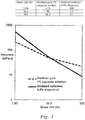
- FIG. 1 is a characteristic diagram showing the relation of between a shear rate and a viscosity in an oxidized cellulose dispersion used in the present invention (Examples 1 to 7) and xanthan gum aqueous solution used in Comparative Examples 1, 2, 4 and 6.
- the aqueous ink composition for a writing instrument according to the present invention is characterized by containing 0.05 to 1.5% by mass of oxidized cellulose and having a limiting viscosity of 16 mPa•s or less derived from a Casson's equation, a viscosity value of 100 to 3000 mPa•s at a shear rate of 3.83 s -1 and a viscosity value of 10 to 40 mPa•s at a shear rate of 383 s -1 .
- the oxidized cellulose used in the present invention has a cellulose I form crystal structure and is obtained by oxidizing a hydroxyl group (-OH group) in a C6-position of ⁇ -glucose constituting cellulose [(C 6 H 10 O 5 ) n : natural polymer in which numbers of ⁇ -glucose molecules are linearly polymerized via glycosidic bonds] to modify the hydroxyl group to an aldehyde group (-CHO) and a carboxyl group (-COOH group).
- the oxidized cellulose used in the present invention comprises fibers obtained by oxidizing the surface of a naturally originating cellulose solid starting material having I form crystal structure and finely pulverizing the material into a nano size.
- a naturally originating cellulose which is the starting material
- nanofibers called microfibrils are turned into bundles almost without exception to assume a higher order structure, and therefore the cellulose cannot readily be pulverized to a nano size as the cellulose is and dispersed.
- oxidized cellulose used in the present invention, a part of hydroxyl groups of the cellulose fibers is oxidized to introduce thereinto an aldehyde group and a carboxyl group, whereby the cellulose is reduced in a hydrogen bonding between the surfaces which is a driving force for a strong cohesive force between the microfibrils, and the oxidized cellulose is subjected to dispersion treatment and pulverized to a nano size.
- the oxidized cellulose having the physical properties described above is used to thereby make it possible to exert the effects of the present invention, and the oxidized cellulose having a number average fiber diameter of 2 to 150 nm is preferred.
- the oxidized cellulose has more preferably a number average fiber diameter of 3 to 80 nm. Controlling a number average fiber diameter of the oxidized cellulose to 2 nm or more makes it possible to allow the oxidized cellulose to exert a function of a dispersion medium, and on the contrary, controlling the number average fiber diameter to 150 nm or less makes it possible to further enhance a dispersion stability of the cellulose fibers themselves.
- the number average fiber diameter described above can be measured, for example, in the following procedure. That is, the sample prepared by diluting cellulose fibers by adding water thereto is subjected to dispersion treatment, and the dispersion is cast on a grid coated by a carbon film subjected to hydrophilic treatment and observed under a transmission electron microscope (TEM). The number average fiber diameter can be measured and calculated from the image thus obtained.
- TEM transmission electron microscope
- the oxidized cellulose used in the present invention can be produced, for example, by at least three steps of an oxidation reaction step in which a natural cellulose used for a starting material is oxidized by the reaction with a co-oxidant in water using an N-oxyl compound as an oxidation catalyst, a work up step in which impurities are removed to obtain reacted fibers impregnated with water, and a dispersion step in which the reacted fibers impregnated with water are dispersed into a solvent.
- the natural cellulose means purified celluloses isolated from plants, animals, and biosynthetic celluloses, such as bacterially produced gels.
- biosynthetic celluloses such as bacterially produced gels.
- capable of being listed are celluloses isolated from softwood tree pulps, hardwood tree pulps, cotton pulps, such as cotton linters and cotton lints, non-wood pulps, such as straw pulps, and bagasse pulps, BC, and sea squirts, celluloses isolated from seaweeds, and the like.
- the cellulose shall not be restricted thereto.
- the natural cellulose can be enhanced in reaction efficiency and productivity by subjecting preferably to treatment for raising the surface area, such as beating. Further, when the natural cellulose stored in the condition of never dry after isolation and work up is used, the natural cellulose can still be enhanced in a reaction efficiency since the converged body of the microfibrils stays in a state in which the cellulose is liable to be swollen, and the natural cellulose can preferably be reduced in a number average fiber diameter after subjected to pulverizing treatment.
- a dispersant for the natural cellulose in the reaction is water, and a concentration of the natural cellulose in the reaction aqueous solution is optional if the concentration is a concentration in which the reagent can sufficiently be diffused.
- the concentration is usually about 5% or less based on a weight of the reaction aqueous solution.
- N-oxyl compounds which can be used as an oxidizing catalyst for cellulose are reported (article entitled " Nitroxide-mediated oxidation of cellulose using TEMPO derivatives: HPSEC and NMR analyses of the oxidized products" by I. Shibata and A. Isogai, Cellulose, Vol. 10, pp. 335 to 341, 2003 ), and TEMPO (2,2,6,6-tetramethyl-1-piperidine-N-oxyl), 4-acetamide-TEMPO, 4-carboxy-TEMPO, and 4-phosphonoxy-TEMPO are particularly preferred in terms of a reaction rate in water at ambient temperature.
- a catalytic amount is satisfactory for an addition amount of the above N-oxyl compounds, and N-oxyl compounds are added to the reaction aqueous solution in a range of preferably 0.1 to 4 mmol/l, more preferably 0.2 to 2 mmol/l.
- hypohalous acid or salts thereof, halous acid or salts thereof, perhalogen acid or salts thereof, hydrogen peroxide, per-organic acids, and the like can be used as the co-oxidant, and alkali metal hypohalides, for example, sodium hypochlorite and sodium hypobromite are preferred.
- alkali metal hypohalides for example, sodium hypochlorite and sodium hypobromite are preferred.
- sodium hypochlorite is used, the reaction is allowed to proceed preferably in the presence of alkali metal bromide, for example, sodium bromide in terms of the reaction rate.
- An addition amount of the above alkali metal bromide is about 1 to 40 molar equivalent, preferably about 10 to 20 molar equivalent based on the N-oxyl compound.
- an addition amount of the co-oxidant is selected preferably in a range of about 0.5 to 8 mmol based on 1 g of the natural cellulose, and the reaction is completed in about 5 to 120 minutes, within 240 minutes at the longest
- a pH of the reaction aqueous solution is maintained preferably in a range of about 8 to 11.
- a temperature of the aqueous solution is optional in a range of about 4 to 40°C, and the reaction can be carried out at room temperature and does not have to be controlled particularly in temperature.
- reaction product fibers and water which are contained in the reaction slurry, such as unreacted hypochlorous acid, and various byproducts are removed to the outside of the system in the work up step, but since the reaction product fibers are not dispersed usually in pieces of a nanofibers unit at the above stage, a dispersion of the reaction product fibers having a high purity (99% by mass or more) and water is prepared by an ordinary work up method, that is, repeating washing with water and filtering.
- any equipments may be used as is the case with a method (for example, continuous decanter) carried out by making use of centrifugal dehydration as long as they are equipments by which the object described above can be achieved.
- the aqueous dispersion of the reaction product fibers thus obtained stays in a range of about 10 to 50% by mass in terms of solid content (cellulose) concentration in a squeezed state.
- solid content (cellulose) concentration in a squeezed state.
- reaction product fibers (aqueous dispersion) impregnated with water obtained in the work up step described above is dispersed in a solvent and subjected to dispersion treatment, whereby the dispersion of the oxidized cellulose can be obtained, and the above dispersion can be dried to prepare the oxidized cellulose to be used.
- the solvent used as the dispersant is preferably water, but in addition to water, alcohols (such as methanol, ethanol, isopropanol, isobutanol, sec-butanol, tert-butanol, methyl cellosolve, ethyl cellosolve, ethylene glycol, and glycerin) which are soluble in water, ethers (such as ethylene glycol dimethyl ether, 1,4-dioxane, and tetrahydrofuran), ketones (such as acetone and methyl ethyl ketone), N, N-dimethylformamide, N,N-dimethylacetamide, dimethyl sulfoxide, and the like may be used according to the objects.
- alcohols such as methanol, ethanol, isopropanol, isobutanol, sec-butanol, tert-butanol, methyl cellosolve, ethyl cellosolve, ethylene
- the mixtures of the above compounds can suitably be used.
- the dispersions of the fibers of a nano-level can efficiently be obtained in a certain case by trying stepwise dispersion in which a solvent is added little by little for dispersion.
- the dispersion conditions can be selected so that the state of the dispersion after the dispersion step is viscous or gelatinous.
- the oxidized cellulose used may be a dispersion of the oxidized cellulose described above.
- the aqueous ink composition for a writing instrument according to the present invention is characterized by containing the oxidized cellulose described above, and the composition is used, for example, as an ink composition for writing instruments, such as aqueous ink ballpoint pens.
- content (solid content) of the oxidized cellulose described above is 0.05 to 1.5% by mass (hereinafter referred to merely as %), preferably 0.1 to 1.0% based on the aqueous ink composition for a writing instrument (total amount).
- At least a colorant and a water-soluble solvent in addition to the oxidized cellulose described above are contained in the aqueous ink composition for a writing instrument according to the present invention.
- the usable colorant includes pigments and/or water-soluble dyes.
- the kind of the pigments shall not specifically be restricted, and optional ones selected from inorganic and organic pigments which have so far conventionally been used for writing instruments, such as aqueous ink ballpoint pens can be used.
- the inorganic pigments include, for example, carbon blacks, metal powders and the like.
- the organic pigments include, for example, azo lakes, insoluble azo pigments, chelated azo pigments, phthalocyanine pigments, perylene and perynone pigments, anthraquinone pigments, quinacridone pigments, dye lakes, nitro pigments, nitroso pigments, and the like.
- capable of being used are phthalocyanine blue (C. I. 74160), phthalocyanine green (C. I. 74260), Hansa yellow 3G (C. I. 11670), diazo yellow GR (C. I. 21100), permanent red 4R (C. I. 12335), brilliant carmine 6B (C. I. 15850), quinacridone red (C. I. 46500), and the like.
- plastic pigments constituted from particles of styrene and acryl resins can be used as well.
- hollow resin particles having voids in the insides of the particles can be used as white pigments, or resin particles (pseudo pigments) colored with basic dyes described later which are excellent in color developability and dispersibility, and the like can be used as well.
- the direct dyes include, for example, C. I. Direct Blacks 17, 19, 22, 32, 38, 51 and 71, C. I. Direct Yellows 4, 26, 44 and 50, C. I. Direct Reds 1, 4, 23, 31, 37, 39, 75, 80, 81, 83, 225, 226 and 227, C. I. Direct Blues 1, 15, 71, 86, 106 and 119, and the like.
- the acid dyes include, for example, C. I. Acid Blacks 1, 2, 24, 26, 31, 52, 107, 109, 110, 119, and 154, C.I. Acid Yellows 7, 17, 19, 23, 25, 29, 38, 42, 49, 61, 72, 78, 110, 127, 135, 141, and 142, C.I. Acid Reds 8, 9, 14, 18, 26, 27, 35, 37, 51, 52, 57, 82, 87, 92, 94, 115, 129, 131, 186, 249, 254, 265, and 276, C.I. Acid Violets 18 and 17, C.I. Acid Blues 1, 7, 9, 22, 23, 25, 40, 41, 43, 62, 78, 83, 90, 93, 103, 112, 113, and 158, C.I. Acid Greens 3, 9, 16, 25 and 27, and the like.
- a large part of the food dyes is included in the direct dyes or the acid dyes, and one example which is not included therein includes C.I. Food Yellow 3.
- the basic dyes include, for example, C. I. Basic Yellows 1, 2 and 21, C. I. Basic Oranges 2, 14 and 32, C. I. Basic Reds 1, 2, 9 and 14, C. I. Basic Brown 12, C. I. Basic Blacks 2 and 8, and the like.
- the resin particles colored with the basic dyes include fluorescent pigments obtained by coloring resin particles of acrylonitrile base copolymers with basic fluorescent dyes.
- the specific trade names thereof include Sinloihi Color SF series (manufactured by Sinloihi Co., Ltd.), NKW and NKP series (manufactured by Nippon Fluorescent Chemical Co., Ltd.), and the like.
- the above colorants may be used alone respectively or in combination of two or more kinds thereof.
- Content of the colourant based on a total amount of the aqueous ink composition for a writing instrument falls in a range of usually 0.5 to 30%, preferably 1 to 15%.
- the ink composition is weakly colored, or hue of the handwritings becomes indefinite in a certain case.
- the colorant is added in excess of 30%, inferior writing is brought about in a certain case. Accordingly, both are not preferred.
- the water-soluble organic solvent which can be used includes, for example, glycols, such as ethylene glycol, diethylene glycol, triethylene glycol, propylene glycol, polyethylene glycol, 3-butylene glycol, thiodiethylene glycol, and glycerin, ethylene glycol monomethyl ether, diethylene glycol monomethyl ether, and the like, and the water soluble solvent can be used alone or in a mixture.
- Content of the above water-soluble organic solvents is preferably 5 to 40% based on a total amount of the aqueous ink composition for a writing instrument.
- the aqueous ink composition for a writing instrument according to the present invention can suitably contain, in addition to the oxidized cellulose, the colorant and the water-soluble organic solvent each described above, a dispersant, a lubricant, a pH modifier, a rust preventive, a preservative or a fungicide, and the like as well as water (such as tap water, refined water, distilled water, deionized water, and purified water) as a balance which is a solvent, as long as the effects of the present invention are not deteriorated.
- water such as tap water, refined water, distilled water, deionized water, and purified water
- the dispersant is preferably used.
- the dispersant has an action to adsorb on the surface of the pigment to enhance an affinity thereof with water and disperse stably the pigment in water.
- Nonionic and anionic surfactants and water-soluble resins are used as the dispersant.
- Water-soluble polymers are preferably used.
- the lubricant includes nonionic surfactants, such as fatty acid esters of polyols which are also used as a surface treating agent for pigments, higher fatty acid esters of sugars, polyoxyalkylene higher fatty acid esters, and alkylphosphoric acid esters, anionic surfactants, such as alkylsulfonic acid salts and alkylarylsulfonic acid salts of higher fatty acid amides, derivatives of polyalkylene glycols, fluorinated surfactants, polyether-modified silicones, and the like.
- nonionic surfactants such as fatty acid esters of polyols which are also used as a surface treating agent for pigments, higher fatty acid esters of sugars, polyoxyalkylene higher fatty acid esters, and alkylphosphoric acid esters
- anionic surfactants such as alkylsulfonic acid salts and alkylarylsulfonic acid salts of higher fatty acid amides, derivatives of polyalkylene glyco
- the pH modifier includes ammonia, urea, monoethanolamine, diethanolamine, triethanolamine, alkali metal salts of carbonic acid and phosphoric acid, such as sodium tripolyphosphate, and sodium carbonate, hydrates of alkali metals, such as sodium hydroxide.
- the rust preventive includes benzotriazole, tolyltriazole, dicyclohexylammonium nitrite, saponins, and the like
- the preservative or the fungicide includes phenol, sodium omadine, sodium benzoate, benzimidazole base compounds, and the like.
- the aqueous ink composition for a writing instrument can be prepared by suitably combining the oxidized cellulose, the colorant, the water-soluble organic solvent and the other respective components each described above according to the uses of the inks for writing instruments (such as ballpoint pens and marking pens) to stir and mix components by means of a stirring device, such as a homomixer, a homogenizer, and a disperser, and removing, if necessary, coarse particles in the ink composition by filtration or centrifugal separation.
- a stirring device such as a homomixer, a homogenizer, and a disperser
- the ballpoint pen can be prepared by charging an aqueous ink ballpoint pen body equipped with a ball having a diameter of 0.18 to 2.0 mm with the above aqueous ink composition for a writing instrument.
- aqueous ink ballpoint pen body used shall not specifically be restricted as long as the pen body is equipped with a ball having a diameter falling in the range described above, and particularly preferred is an aqueous ink ballpoint pen equipped with a refill having a stainless steel tip (provided with a cemented carbide-made ball) at a point, which is finished by charging an ink reservoir of a polypropylene tube with the aqueous ink composition described above.
- the ink having a particularly high viscosity has to be used in order to provide the drawn lines with good quality, and a limiting viscosity of the ink which is derived from Casson's equation has to be controlled to 16 mPa•s or less, more preferably 1 to 10 mPa•s from the viewpoint of preventing a splitting phenomenon which is liable to be brought about when a writing speed becomes fast.
- the shear stress ( ⁇ ) can be calculated from the shear rate (D) and the measured value (25°C) of the viscosity.
- the yield value ( ⁇ 0) is obtained by plotting the respective square roots of the values of the shear rates - the shear stresses (measured values) measured at two or more points to obtain a linear line and squaring the intercept of the linear line.
- the limiting viscosity ( ⁇ ) is determined as a gradient of a straight line obtained by plotting (Casson plot) the square roots of the shear stresses versus the square roots of the shear rates (particularly in a high shear rate region).
- the aqueous ink composition for a writing instrument according to the present invention is provided with a limiting viscosity falling in the range described above, whereby the good drawn line quality can be achieved even when the ink having a high viscosity is used, or the writing speed becomes fast.
- the oxidized cellulose has to be evenly dispersed in order to control the limiting viscosity described above to 16 mPa•s or less. It cannot be dispersed in a sufficiently homogeneous state by a simple device, such as a disperser, and it is difficult to control the limiting viscosity to 16 mPa•s or less, particularly 10 mPa•s or less.
- the stirring conditions are set to suitable conditions in order to homogeneously disperse the oxidized cellulose by means of, for example, a bead mill, a homomixer, a homogenizer, a high-pressure homogenizer, an ultrasonic homogenizer, a high-pressure wet media-less atomizing device, and the like which can carry out strong shearing, whereby the limiting viscosity can be controlled to 16 mPa•s or less, particularly 10 mPa•s or less.
- an aqueous ink composition for a writing instrument which is excellent in storage stability of particles, a writing property with the passage of time, followability, quality of the drawn lines, though having a low viscosity is obtained in the present invention by controlling a limiting viscosity to 16 mPa•s or less and regulating a viscosity value (25°C) at a shear rate of 3.83 s -1 to 100 to 3000 mPa•s and a viscosity value (25°C) at a shear rate of 383 s -1 to 10 to 40 mPa•s respectively.
- the respective contents of the oxidized cellulose and water, and the dispersion mode thereof are suitably combined in order to control the respective viscosity values at the respective shear rates described above to the limited ranges, whereby the aqueous ink composition for a writing instrument having the respective viscosity values controlled to the suitable ranges at the respective shear rates can be prepared.
- a production method for the aqueous ink composition for a writing instrument according to the present invention is not specifically different from production methods for other aqueous ink compositions, and the aqueous ink composition can be produced by the methods.
- the aqueous ink composition for a writing instrument according to the present invention is obtained by mixing and stirring the respective components including the oxidized cellulose described above, particularly by setting the stirring conditions to suitable conditions by means of a bead mill, a homomixer, a homogenizer, a high-pressure homogenizer, an ultrasonic homogenizer, a high-pressure wet media-less atomizing device, and the like which can carry out strong shearing, whereby a thixotropic ink (for example, an ink for a gel ink aqueous ink ballpoint pen) can be produced.
- a thixotropic ink for example, an ink for a gel ink aqueous ink ballpoint pen
- a pH (25°C) of the aqueous ink composition for a writing instrument according to the present invention is controlled preferably to 5 to 10 by a pH modifier from the viewpoints of usability, safety, stability of the ink itself, and a matching property with the ink reservoir, and the pH is controlled more preferably to 6 to 9.5.
- the aqueous ink composition for a writing instrument according to the present invention is charged into ballpoint pens, marking pens and the like which are equipped with pen tip parts, such as ballpoint pen tips, fiber tips, felt tips, and plastic tips.
- the ballpoint pen in the present invention includes pens obtained by charging an ink reservoir (refill) for a ballpoint pen with the aqueous ink composition for a writing instrument having the composition described above and charging the above ink reservoir with a substance as an ink follower, wherein the substance is not compatible with the aqueous ink composition stored in the above ink reservoir and has a smaller specific gravity than that of the above aqueous ink composition, and it includes, for example, polybutene, silicone oils, mineral oils, and the like.
- the structures of the ballpoint pen and the marking pen shall not specifically be restricted, and structures may be, for example, free ink type ballpoint pens and marking pens provided with a collector structure (ink-holding mechanism) in which a holder itself is used as an ink reservoir and in which the aqueous ink composition for a writing instrument having the constitution described above is filled in the above holder.
- a collector structure in which a holder itself is used as an ink reservoir and in which the aqueous ink composition for a writing instrument having the constitution described above is filled in the above holder.
- the oxidized cellulose used shows a high viscosity even at a low viscosity of 0.05 to 1.5% in the aqueous ink composition for a writing instrument and shows a high thixotropy index which is inherent to cellulose, and therefore the aqueous ink composition exerts a rheology-controlling effect as a thickener and gelling agent for aqueous ink compositions for writing instruments in a smaller amount than the thickener and gelling agent of conventional fine cellulose and xanthan gum.
- the aqueous ink composition for a writing instrument which is excellent in storing stability of particles, a writing property with the passage of time, followability, and quality of the drawn lines though having a low viscosity and which is suited to writing instruments, such as aqueous ink ballpoint pens is obtained by controlling the limiting viscosity derived from Casson's equation to 16 mPa•s or less and regulating a viscosity value (25°C) at a shear rate of 3.83 s -1 to 100 to 3000 mPa•s and a viscosity value (25°C) at a shear rate of 383 s -1 to 10 to 40 mPa•s respectively.
- the oxidized cellulose having the following physical properties was used to prepare the prescribed amounts of the respective aqueous ink compositions for a writing instrument according to blend compositions shown in the following Table 1 by mixing and stirring the components by a wet method by means of a high-pressure wet media-less atomizing device (Nano Vater manufactured by Yoshida Kikai Co., Ltd.) while suitably changing stirring conditions (a shearing force, a pressure and a stirring time) and carrying out filtration by a bag filter of 10 ⁇ m.
- a high-pressure wet media-less atomizing device Neano Vater manufactured by Yoshida Kikai Co., Ltd.
- the pH values of the respective aqueous ink composition for a writing instrument were measured at 25°C by means of a pH measuring meter (manufactured by HORIBA, Ltd.) to find that the pH values fell in a range of 7.9 to 8.2.
- aqueous ink compositions for a writing instrument obtained in Examples 1 to 7 and Comparative Examples 1 to 9 were used to measure viscosity values by the following method.
- the limiting viscosity ( ⁇ ) was calculated from the Casson's equation shown above. To be specific, the shear stress after 30 seconds since starting the measurement of the viscosities at the shear rates of 3.83 s -1 and 383 s -1 were determined, whereby the limiting viscosity ( ⁇ ) was calculated.
- aqueous ink compositions for a writing instrument obtained in Examples 1 to 7 and Comparative Examples 1 to 9 were used to prepare aqueous ink ballpoint pens and the like by the following method, and the ballpoint pens were used to evaluate stability with the passage of time, a pigment-settling property, followability, and a writing property (line splitting) by the following evaluation methods. The results thereof are shown in the following Table 1.
- Oxidized cellulose used is
- An undried sulfurous acid-bleached softwood pulp (comprising principally fibers having a fiber diameter exceeding 1000 nm) corresponding to 2 g in terms of dried weight, 0.025 g of TEMPO and 0.25 g of sodium bromide were dispersed in 150 ml of water, and then 13% by weight aqueous sodium hypochlorite solution was added thereto so that an amount of sodium hypochlorite was 2.5 mmol based on 1 g of the pulp, whereby the reaction was initiated. A 0.5 M aqueous sodium hydroxide solution was added dropwise during the reaction to maintain the pH at 10.5.
- reaction product fibers impregnated with water having solid content of 25% by mass The reaction was regarded as finished at a point of time when the pH was not observed to be changed, and the reactant was filtrated through a glass filter, followed by repeating five times washing with sufficiently large amount of water and filtration to obtain reaction product fibers impregnated with water having solid content of 25% by mass.
- a number average fiber diameter of the oxidized celluloses obtained above was confirmed and measured by the following method.
- a number average fiber diameter of the oxidized cellulose was measured in the following manner.
- a sample prepared by diluting the oxidized cellulose by adding water was dispersed for 15 minutes by means of a homomixer, at 12000 rpm, and then the dispersion was casted on a grid coated by a carbon film which was subjected to hydrophilic treatment. This was observed under a transmission type electron microscope (TEM), and the number average fiber diameter was calculated from the image obtained above to result in finding that the number average fiber diameter was about 140 nm.
- TEM transmission type electron microscope
- aqueous ink ballpoint pens The respective aqueous ink compositions obtained above were used to prepare aqueous ink ballpoint pens.
- a holder of a ballpoint pen (trade name: Signo UM-100, manufactured by Mitsubishi Pencil Co., Ltd.) was used to charge each of the inks described above into a refill comprising a polypropylene-made ink reservoir having an inner diameter of 4.0 mm and a length of 113 mm, a stainless steel-made tip (cemented carbide ball, ball diameter: 0.7 mm), and a joint connecting the above reservoir with the tip, and an ink follower comprising a mineral oil as a principal component was loaded at a rear end of the ink, whereby an aqueous ink ballpoint pen was prepared.
- the respective aqueous ink ballpoint pens obtained were left standing at 50°C for a week and then used for writing, and the writing properties were evaluated according to the following evaluation criteria.
- Example 4 The ink compositions were filled in the aqueous ink ballpoint pens described above in Examples 1 to 3 and 5 to 7 and Comparative Examples 1 to 5 and 7 to 9 and in ballpoint pens for correction tools CLN-250 (manufactured by Mitsubishi Pencil Co., Ltd.) in Example 4 and Comparative Example 6, and the respective aqueous ink ballpoint pens and ballpoint pens for correction tools were used to write on a paper for a writing test by hand and evaluate the states thereof (line splitting) according to the following evaluation criteria. Evaluation criteria:
- the ink compositions were filled in the aqueous ink ballpoint pens described above in Examples 1 to 7 and Comparative Examples 1 to 9 and in ballpoint pens for correction tools CLN-250 (manufactured by Mitsubishi Pencil Co., Ltd.) in Example 4 and Comparative Example 6, and the respective aqueous ink ballpoint pens and ballpoint pens for correction tools were used to write on a writing paper based on the ISO standard by freehand at a triple speed, a double speed and an ordinary speed respectively and evaluate the respective drawn lines according to the following evaluation criteria.
- xanthan gum was used in Comparative Examples 1, 2, 4 and 6; the carboxyvinyl polymer was used in Comparative Example 3; the carboxymethyl cellulose (CMC) was used in Comparative Example 5; content of the oxidized cellulose is out of scope of the present invention in Comparative Examples 7 and 8; content of the oxidized cellulose is in the scope of the present invention, and the limiting viscosity value is in the scope of the present invention, but the respective viscosity values at the shear rates of 3.83 s -1 and 383 s -1 is out of the scope of the present invention in Comparative Example 9. It has become clear that in the above cases, the satisfactory results are not obtained in any of writing property with the passage of time, the pigment-settling resistance, followability and quality of the drawn lines.
- Examples 1 to 7 The relation of the shear rate with the viscosity in the oxidized cellulose used in the present invention (Examples 1 to 7) and xanthan gum used in Comparative Examples 1, 2, 4 and 6 was examined. That is, xanthan gum aqueous solution of 1% and an oxidized cellulose dispersion of 0.5% were prepared to measure the viscosities at the shear rates of 3.83 s -1 , 38.3 s -1 and 383 s -1 by means of an EMD type viscometer (manufactured by Toki Sangyo Co., Ltd.). The results thereof are shown in FIG. 1 .
- both the oxidized cellulose and xanthan gum show pseudoplastic flow in which a viscosity is decreased as a shear rate is increased and that the oxidized cellulose used in the present invention shows a high viscosity in standing still but shows a flow characteristic in which a viscosity is extremely reduced in flowing and is changed in behavior to a large extent.
- aqueous ink compositions for a writing instrument containing the oxidized cellulose and having a limiting viscosity of 16 mPa•s or less derived from Casson's equation a viscosity value (25°C) of 100 to 3000 mPa•s at a shear rate of 3.83 s -1 and a viscosity value (25°C) of 10 to 40 mPa•s at a shear rate of 383 s -1 respectively are excellent in storage stability of the particles, a writing property with the passage of time, followability and quality of the drawn lines, though having a low viscosity, as compared with aqueous ink compositions containing conventional thickeners and gelling agents, such as xanthan gum.
- aqueous ink composition for a writing instrument which is suited to writing instruments, such as aqueous ink ballpoint pens and marking pens.
Landscapes
- Chemical & Material Sciences (AREA)
- Life Sciences & Earth Sciences (AREA)
- Engineering & Computer Science (AREA)
- Materials Engineering (AREA)
- Wood Science & Technology (AREA)
- Organic Chemistry (AREA)
- Inks, Pencil-Leads, Or Crayons (AREA)
- Pens And Brushes (AREA)
Applications Claiming Priority (2)
| Application Number | Priority Date | Filing Date | Title |
|---|---|---|---|
| JP2014195539A JP6339914B2 (ja) | 2014-09-25 | 2014-09-25 | 筆記具用水性インク組成物 |
| PCT/JP2015/075898 WO2016047469A1 (fr) | 2014-09-25 | 2015-09-11 | Composition d'encre aqueuse pour instruments d'écriture |
Publications (3)
| Publication Number | Publication Date |
|---|---|
| EP3199601A1 true EP3199601A1 (fr) | 2017-08-02 |
| EP3199601A4 EP3199601A4 (fr) | 2018-04-25 |
| EP3199601B1 EP3199601B1 (fr) | 2022-11-30 |
Family
ID=55580996
Family Applications (1)
| Application Number | Title | Priority Date | Filing Date |
|---|---|---|---|
| EP15844353.1A Active EP3199601B1 (fr) | 2014-09-25 | 2015-09-11 | Composition d'encre aqueuse pour instruments d'écriture |
Country Status (8)
| Country | Link |
|---|---|
| US (1) | US20170275484A1 (fr) |
| EP (1) | EP3199601B1 (fr) |
| JP (1) | JP6339914B2 (fr) |
| KR (1) | KR102372284B1 (fr) |
| CN (1) | CN106687537B (fr) |
| ES (1) | ES2935523T3 (fr) |
| TW (1) | TWI679254B (fr) |
| WO (1) | WO2016047469A1 (fr) |
Cited By (1)
| Publication number | Priority date | Publication date | Assignee | Title |
|---|---|---|---|---|
| US12297362B2 (en) | 2019-01-25 | 2025-05-13 | SOCIéTé BIC | Non newtonian ballpoint pen ink comprising cellulose nanofibers |
Families Citing this family (7)
| Publication number | Priority date | Publication date | Assignee | Title |
|---|---|---|---|---|
| JP6899777B2 (ja) * | 2015-11-02 | 2021-07-07 | 日本製紙株式会社 | セルロースナノファイバー分散液のろ過方法および製造方法 |
| JP6840536B2 (ja) * | 2016-12-28 | 2021-03-10 | 株式会社パイロットコーポレーション | 筆記具用水性インキ組成物およびそれを用いた筆記具 |
| CN110494297B (zh) * | 2017-03-31 | 2021-02-12 | 三菱铅笔株式会社 | 书写工具用笔芯和使用了该书写工具用笔芯的书写工具 |
| JP7539637B2 (ja) * | 2020-03-19 | 2024-08-26 | 愛媛県 | 水性塗料組成物 |
| CN113502089B (zh) * | 2021-06-25 | 2022-10-25 | 浙江纳美新材料股份有限公司 | 一种水性笔墨水用的色浆 |
| KR102404914B1 (ko) | 2022-03-18 | 2022-06-07 | 주식회사 엑티브온 | 고광택 수성 잉크 조성물 |
| CN121100159A (zh) | 2023-05-12 | 2025-12-09 | 三菱铅笔株式会社 | 书写工具用水性墨组合物及使用该书写工具用水性墨组合物的书写工具 |
Family Cites Families (9)
| Publication number | Priority date | Publication date | Assignee | Title |
|---|---|---|---|---|
| JPS5974175A (ja) | 1982-10-20 | 1984-04-26 | Sakura Color Prod Corp | 水性ボ−ルペン用インキ組成物 |
| JPS62124170A (ja) | 1985-11-26 | 1987-06-05 | Daicel Chem Ind Ltd | 水性インキ組成物 |
| TW429267B (en) * | 1996-02-05 | 2001-04-11 | Pilot Ink Co Ltd | Preparation method for shear-thinning water-based ball-point pen inks, shear-thinning water-based ball-point pen ink compositions, and ball-point pens employing the same |
| TW473526B (en) * | 1997-05-07 | 2002-01-21 | Mitsubishi Pencil Co | Water based white color tone pigment ink for ballpoint pen |
| JP2001158869A (ja) * | 1999-09-20 | 2001-06-12 | Sakura Color Prod Corp | 筆記具用油性インキ |
| JP4673985B2 (ja) | 2001-02-13 | 2011-04-20 | パイロットインキ株式会社 | ボールペン用水性インキ組成物 |
| JP2013091730A (ja) | 2011-10-26 | 2013-05-16 | Pilot Corporation | 水性ボールペン用インキ組成物およびそれを用いた水性ボールペン |
| JP5545775B2 (ja) * | 2012-03-05 | 2014-07-09 | 第一工業製薬株式会社 | 水性インク組成物およびそれを用いた筆記具 |
| JP6202965B2 (ja) * | 2013-09-30 | 2017-09-27 | 三菱鉛筆株式会社 | 筆記具用水性インク組成物 |
-
2014
- 2014-09-25 JP JP2014195539A patent/JP6339914B2/ja active Active
-
2015
- 2015-09-11 CN CN201580051932.1A patent/CN106687537B/zh active Active
- 2015-09-11 ES ES15844353T patent/ES2935523T3/es active Active
- 2015-09-11 WO PCT/JP2015/075898 patent/WO2016047469A1/fr not_active Ceased
- 2015-09-11 US US15/514,032 patent/US20170275484A1/en not_active Abandoned
- 2015-09-11 EP EP15844353.1A patent/EP3199601B1/fr active Active
- 2015-09-11 KR KR1020177010826A patent/KR102372284B1/ko active Active
- 2015-09-22 TW TW104131270A patent/TWI679254B/zh active
Cited By (1)
| Publication number | Priority date | Publication date | Assignee | Title |
|---|---|---|---|---|
| US12297362B2 (en) | 2019-01-25 | 2025-05-13 | SOCIéTé BIC | Non newtonian ballpoint pen ink comprising cellulose nanofibers |
Also Published As
| Publication number | Publication date |
|---|---|
| CN106687537A (zh) | 2017-05-17 |
| TW201625751A (zh) | 2016-07-16 |
| EP3199601B1 (fr) | 2022-11-30 |
| WO2016047469A1 (fr) | 2016-03-31 |
| KR102372284B1 (ko) | 2022-03-08 |
| CN106687537B (zh) | 2020-10-27 |
| KR20170060082A (ko) | 2017-05-31 |
| ES2935523T3 (es) | 2023-03-07 |
| TWI679254B (zh) | 2019-12-11 |
| JP2016065173A (ja) | 2016-04-28 |
| JP6339914B2 (ja) | 2018-06-06 |
| EP3199601A4 (fr) | 2018-04-25 |
| US20170275484A1 (en) | 2017-09-28 |
Similar Documents
| Publication | Publication Date | Title |
|---|---|---|
| EP3053970B1 (fr) | Composition d'encre aqueuse pour instruments d'écriture | |
| EP3199601B1 (fr) | Composition d'encre aqueuse pour instruments d'écriture | |
| EP3070131A1 (fr) | Composition d'encre aqueuse pour outils d'écriture | |
| JP2013181167A (ja) | 水性インク組成物およびそれを用いた筆記具 | |
| JPH07118592A (ja) | ボールペン用水性金属光沢色インキ | |
| TWI683865B (zh) | 書寫工具用水性墨水組成物 | |
| US20250250449A1 (en) | Non-newtonian ballpoint pen ink comprising cellulose nanofibers | |
| JP2015174993A (ja) | 筆記具用水性インク組成物 | |
| JP2017125135A (ja) | 筆記具用水性インク組成物 | |
| JP2000104000A (ja) | 水性光沢インキ組成物 | |
| JP6322451B2 (ja) | 筆記具 | |
| JP6712465B2 (ja) | 筆記具用水性インク組成物 | |
| JP6647018B2 (ja) | 筆記具用水性インク組成物 | |
| JP2002030241A (ja) | 水性ボールペン用インキ組成物 | |
| JPH07316482A (ja) | ボ−ルペン用水性インキ組成物 | |
| JP2001302958A (ja) | 水性ボールペン用インキ組成物 |
Legal Events
| Date | Code | Title | Description |
|---|---|---|---|
| STAA | Information on the status of an ep patent application or granted ep patent |
Free format text: STATUS: THE INTERNATIONAL PUBLICATION HAS BEEN MADE |
|
| PUAI | Public reference made under article 153(3) epc to a published international application that has entered the european phase |
Free format text: ORIGINAL CODE: 0009012 |
|
| STAA | Information on the status of an ep patent application or granted ep patent |
Free format text: STATUS: REQUEST FOR EXAMINATION WAS MADE |
|
| 17P | Request for examination filed |
Effective date: 20170406 |
|
| AK | Designated contracting states |
Kind code of ref document: A1 Designated state(s): AL AT BE BG CH CY CZ DE DK EE ES FI FR GB GR HR HU IE IS IT LI LT LU LV MC MK MT NL NO PL PT RO RS SE SI SK SM TR |
|
| AX | Request for extension of the european patent |
Extension state: BA ME |
|
| DAV | Request for validation of the european patent (deleted) | ||
| DAX | Request for extension of the european patent (deleted) | ||
| A4 | Supplementary search report drawn up and despatched |
Effective date: 20180326 |
|
| RIC1 | Information provided on ipc code assigned before grant |
Ipc: C09D 11/16 20140101AFI20180320BHEP Ipc: C09D 11/18 20060101ALI20180320BHEP |
|
| STAA | Information on the status of an ep patent application or granted ep patent |
Free format text: STATUS: EXAMINATION IS IN PROGRESS |
|
| 17Q | First examination report despatched |
Effective date: 20200612 |
|
| GRAP | Despatch of communication of intention to grant a patent |
Free format text: ORIGINAL CODE: EPIDOSNIGR1 |
|
| STAA | Information on the status of an ep patent application or granted ep patent |
Free format text: STATUS: GRANT OF PATENT IS INTENDED |
|
| RIN1 | Information on inventor provided before grant (corrected) |
Inventor name: TAKEUCHI, YOJI Inventor name: SAKANE, NORIKO Inventor name: NISHIJIMA, CHIHIRO |
|
| INTG | Intention to grant announced |
Effective date: 20220615 |
|
| GRAS | Grant fee paid |
Free format text: ORIGINAL CODE: EPIDOSNIGR3 |
|
| GRAA | (expected) grant |
Free format text: ORIGINAL CODE: 0009210 |
|
| STAA | Information on the status of an ep patent application or granted ep patent |
Free format text: STATUS: THE PATENT HAS BEEN GRANTED |
|
| AK | Designated contracting states |
Kind code of ref document: B1 Designated state(s): AL AT BE BG CH CY CZ DE DK EE ES FI FR GB GR HR HU IE IS IT LI LT LU LV MC MK MT NL NO PL PT RO RS SE SI SK SM TR |
|
| REG | Reference to a national code |
Ref country code: CH Ref legal event code: EP Ref country code: GB Ref legal event code: FG4D |
|
| REG | Reference to a national code |
Ref country code: AT Ref legal event code: REF Ref document number: 1534677 Country of ref document: AT Kind code of ref document: T Effective date: 20221215 |
|
| REG | Reference to a national code |
Ref country code: IE Ref legal event code: FG4D |
|
| REG | Reference to a national code |
Ref country code: DE Ref legal event code: R096 Ref document number: 602015081812 Country of ref document: DE |
|
| REG | Reference to a national code |
Ref country code: ES Ref legal event code: FG2A Ref document number: 2935523 Country of ref document: ES Kind code of ref document: T3 Effective date: 20230307 |
|
| REG | Reference to a national code |
Ref country code: LT Ref legal event code: MG9D |
|
| REG | Reference to a national code |
Ref country code: NL Ref legal event code: MP Effective date: 20221130 |
|
| PG25 | Lapsed in a contracting state [announced via postgrant information from national office to epo] |
Ref country code: SE Free format text: LAPSE BECAUSE OF FAILURE TO SUBMIT A TRANSLATION OF THE DESCRIPTION OR TO PAY THE FEE WITHIN THE PRESCRIBED TIME-LIMIT Effective date: 20221130 Ref country code: PT Free format text: LAPSE BECAUSE OF FAILURE TO SUBMIT A TRANSLATION OF THE DESCRIPTION OR TO PAY THE FEE WITHIN THE PRESCRIBED TIME-LIMIT Effective date: 20230331 Ref country code: NO Free format text: LAPSE BECAUSE OF FAILURE TO SUBMIT A TRANSLATION OF THE DESCRIPTION OR TO PAY THE FEE WITHIN THE PRESCRIBED TIME-LIMIT Effective date: 20230228 Ref country code: LT Free format text: LAPSE BECAUSE OF FAILURE TO SUBMIT A TRANSLATION OF THE DESCRIPTION OR TO PAY THE FEE WITHIN THE PRESCRIBED TIME-LIMIT Effective date: 20221130 Ref country code: FI Free format text: LAPSE BECAUSE OF FAILURE TO SUBMIT A TRANSLATION OF THE DESCRIPTION OR TO PAY THE FEE WITHIN THE PRESCRIBED TIME-LIMIT Effective date: 20221130 |
|
| REG | Reference to a national code |
Ref country code: AT Ref legal event code: MK05 Ref document number: 1534677 Country of ref document: AT Kind code of ref document: T Effective date: 20221130 |
|
| PG25 | Lapsed in a contracting state [announced via postgrant information from national office to epo] |
Ref country code: RS Free format text: LAPSE BECAUSE OF FAILURE TO SUBMIT A TRANSLATION OF THE DESCRIPTION OR TO PAY THE FEE WITHIN THE PRESCRIBED TIME-LIMIT Effective date: 20221130 Ref country code: PL Free format text: LAPSE BECAUSE OF FAILURE TO SUBMIT A TRANSLATION OF THE DESCRIPTION OR TO PAY THE FEE WITHIN THE PRESCRIBED TIME-LIMIT Effective date: 20221130 Ref country code: LV Free format text: LAPSE BECAUSE OF FAILURE TO SUBMIT A TRANSLATION OF THE DESCRIPTION OR TO PAY THE FEE WITHIN THE PRESCRIBED TIME-LIMIT Effective date: 20221130 Ref country code: IS Free format text: LAPSE BECAUSE OF FAILURE TO SUBMIT A TRANSLATION OF THE DESCRIPTION OR TO PAY THE FEE WITHIN THE PRESCRIBED TIME-LIMIT Effective date: 20230330 Ref country code: HR Free format text: LAPSE BECAUSE OF FAILURE TO SUBMIT A TRANSLATION OF THE DESCRIPTION OR TO PAY THE FEE WITHIN THE PRESCRIBED TIME-LIMIT Effective date: 20221130 Ref country code: GR Free format text: LAPSE BECAUSE OF FAILURE TO SUBMIT A TRANSLATION OF THE DESCRIPTION OR TO PAY THE FEE WITHIN THE PRESCRIBED TIME-LIMIT Effective date: 20230301 |
|
| P01 | Opt-out of the competence of the unified patent court (upc) registered |
Effective date: 20230515 |
|
| PG25 | Lapsed in a contracting state [announced via postgrant information from national office to epo] |
Ref country code: NL Free format text: LAPSE BECAUSE OF FAILURE TO SUBMIT A TRANSLATION OF THE DESCRIPTION OR TO PAY THE FEE WITHIN THE PRESCRIBED TIME-LIMIT Effective date: 20221130 |
|
| PG25 | Lapsed in a contracting state [announced via postgrant information from national office to epo] |
Ref country code: SM Free format text: LAPSE BECAUSE OF FAILURE TO SUBMIT A TRANSLATION OF THE DESCRIPTION OR TO PAY THE FEE WITHIN THE PRESCRIBED TIME-LIMIT Effective date: 20221130 Ref country code: RO Free format text: LAPSE BECAUSE OF FAILURE TO SUBMIT A TRANSLATION OF THE DESCRIPTION OR TO PAY THE FEE WITHIN THE PRESCRIBED TIME-LIMIT Effective date: 20221130 Ref country code: EE Free format text: LAPSE BECAUSE OF FAILURE TO SUBMIT A TRANSLATION OF THE DESCRIPTION OR TO PAY THE FEE WITHIN THE PRESCRIBED TIME-LIMIT Effective date: 20221130 Ref country code: DK Free format text: LAPSE BECAUSE OF FAILURE TO SUBMIT A TRANSLATION OF THE DESCRIPTION OR TO PAY THE FEE WITHIN THE PRESCRIBED TIME-LIMIT Effective date: 20221130 Ref country code: CZ Free format text: LAPSE BECAUSE OF FAILURE TO SUBMIT A TRANSLATION OF THE DESCRIPTION OR TO PAY THE FEE WITHIN THE PRESCRIBED TIME-LIMIT Effective date: 20221130 Ref country code: AT Free format text: LAPSE BECAUSE OF FAILURE TO SUBMIT A TRANSLATION OF THE DESCRIPTION OR TO PAY THE FEE WITHIN THE PRESCRIBED TIME-LIMIT Effective date: 20221130 |
|
| PG25 | Lapsed in a contracting state [announced via postgrant information from national office to epo] |
Ref country code: SK Free format text: LAPSE BECAUSE OF FAILURE TO SUBMIT A TRANSLATION OF THE DESCRIPTION OR TO PAY THE FEE WITHIN THE PRESCRIBED TIME-LIMIT Effective date: 20221130 Ref country code: AL Free format text: LAPSE BECAUSE OF FAILURE TO SUBMIT A TRANSLATION OF THE DESCRIPTION OR TO PAY THE FEE WITHIN THE PRESCRIBED TIME-LIMIT Effective date: 20221130 |
|
| REG | Reference to a national code |
Ref country code: DE Ref legal event code: R097 Ref document number: 602015081812 Country of ref document: DE |
|
| PLBE | No opposition filed within time limit |
Free format text: ORIGINAL CODE: 0009261 |
|
| STAA | Information on the status of an ep patent application or granted ep patent |
Free format text: STATUS: NO OPPOSITION FILED WITHIN TIME LIMIT |
|
| PGFP | Annual fee paid to national office [announced via postgrant information from national office to epo] |
Ref country code: IT Payment date: 20230810 Year of fee payment: 9 |
|
| 26N | No opposition filed |
Effective date: 20230831 |
|
| PG25 | Lapsed in a contracting state [announced via postgrant information from national office to epo] |
Ref country code: SI Free format text: LAPSE BECAUSE OF FAILURE TO SUBMIT A TRANSLATION OF THE DESCRIPTION OR TO PAY THE FEE WITHIN THE PRESCRIBED TIME-LIMIT Effective date: 20221130 |
|
| PGFP | Annual fee paid to national office [announced via postgrant information from national office to epo] |
Ref country code: ES Payment date: 20231003 Year of fee payment: 9 |
|
| REG | Reference to a national code |
Ref country code: CH Ref legal event code: PL |
|
| PG25 | Lapsed in a contracting state [announced via postgrant information from national office to epo] |
Ref country code: LU Free format text: LAPSE BECAUSE OF NON-PAYMENT OF DUE FEES Effective date: 20230911 |
|
| REG | Reference to a national code |
Ref country code: BE Ref legal event code: MM Effective date: 20230930 |
|
| PG25 | Lapsed in a contracting state [announced via postgrant information from national office to epo] |
Ref country code: LU Free format text: LAPSE BECAUSE OF NON-PAYMENT OF DUE FEES Effective date: 20230911 Ref country code: MC Free format text: LAPSE BECAUSE OF FAILURE TO SUBMIT A TRANSLATION OF THE DESCRIPTION OR TO PAY THE FEE WITHIN THE PRESCRIBED TIME-LIMIT Effective date: 20221130 |
|
| REG | Reference to a national code |
Ref country code: IE Ref legal event code: MM4A |
|
| PG25 | Lapsed in a contracting state [announced via postgrant information from national office to epo] |
Ref country code: IE Free format text: LAPSE BECAUSE OF NON-PAYMENT OF DUE FEES Effective date: 20230911 |
|
| PG25 | Lapsed in a contracting state [announced via postgrant information from national office to epo] |
Ref country code: CH Free format text: LAPSE BECAUSE OF NON-PAYMENT OF DUE FEES Effective date: 20230930 |
|
| PG25 | Lapsed in a contracting state [announced via postgrant information from national office to epo] |
Ref country code: IE Free format text: LAPSE BECAUSE OF NON-PAYMENT OF DUE FEES Effective date: 20230911 Ref country code: CH Free format text: LAPSE BECAUSE OF NON-PAYMENT OF DUE FEES Effective date: 20230930 |
|
| PG25 | Lapsed in a contracting state [announced via postgrant information from national office to epo] |
Ref country code: BE Free format text: LAPSE BECAUSE OF NON-PAYMENT OF DUE FEES Effective date: 20230930 |
|
| PG25 | Lapsed in a contracting state [announced via postgrant information from national office to epo] |
Ref country code: BG Free format text: LAPSE BECAUSE OF FAILURE TO SUBMIT A TRANSLATION OF THE DESCRIPTION OR TO PAY THE FEE WITHIN THE PRESCRIBED TIME-LIMIT Effective date: 20221130 |
|
| PG25 | Lapsed in a contracting state [announced via postgrant information from national office to epo] |
Ref country code: BG Free format text: LAPSE BECAUSE OF FAILURE TO SUBMIT A TRANSLATION OF THE DESCRIPTION OR TO PAY THE FEE WITHIN THE PRESCRIBED TIME-LIMIT Effective date: 20221130 |
|
| PG25 | Lapsed in a contracting state [announced via postgrant information from national office to epo] |
Ref country code: IT Free format text: LAPSE BECAUSE OF NON-PAYMENT OF DUE FEES Effective date: 20240911 |
|
| PG25 | Lapsed in a contracting state [announced via postgrant information from national office to epo] |
Ref country code: CY Free format text: LAPSE BECAUSE OF FAILURE TO SUBMIT A TRANSLATION OF THE DESCRIPTION OR TO PAY THE FEE WITHIN THE PRESCRIBED TIME-LIMIT; INVALID AB INITIO Effective date: 20150911 |
|
| PG25 | Lapsed in a contracting state [announced via postgrant information from national office to epo] |
Ref country code: HU Free format text: LAPSE BECAUSE OF FAILURE TO SUBMIT A TRANSLATION OF THE DESCRIPTION OR TO PAY THE FEE WITHIN THE PRESCRIBED TIME-LIMIT; INVALID AB INITIO Effective date: 20150911 |
|
| PGFP | Annual fee paid to national office [announced via postgrant information from national office to epo] |
Ref country code: DE Payment date: 20250730 Year of fee payment: 11 |
|
| PGFP | Annual fee paid to national office [announced via postgrant information from national office to epo] |
Ref country code: GB Payment date: 20250731 Year of fee payment: 11 |
|
| PGFP | Annual fee paid to national office [announced via postgrant information from national office to epo] |
Ref country code: FR Payment date: 20250808 Year of fee payment: 11 |
|
| REG | Reference to a national code |
Ref country code: ES Ref legal event code: FD2A Effective date: 20251031 |
|
| PG25 | Lapsed in a contracting state [announced via postgrant information from national office to epo] |
Ref country code: TR Free format text: LAPSE BECAUSE OF FAILURE TO SUBMIT A TRANSLATION OF THE DESCRIPTION OR TO PAY THE FEE WITHIN THE PRESCRIBED TIME-LIMIT Effective date: 20221130 |
|
| PG25 | Lapsed in a contracting state [announced via postgrant information from national office to epo] |
Ref country code: ES Free format text: LAPSE BECAUSE OF NON-PAYMENT OF DUE FEES Effective date: 20240912 |