EP3199984A1 - Film antireflet, élément optique et procédé de fabrication d'élément optique - Google Patents
Film antireflet, élément optique et procédé de fabrication d'élément optique Download PDFInfo
- Publication number
- EP3199984A1 EP3199984A1 EP17000093.9A EP17000093A EP3199984A1 EP 3199984 A1 EP3199984 A1 EP 3199984A1 EP 17000093 A EP17000093 A EP 17000093A EP 3199984 A1 EP3199984 A1 EP 3199984A1
- Authority
- EP
- European Patent Office
- Prior art keywords
- particles
- prickle
- protrusions
- film
- less
- Prior art date
- Legal status (The legal status is an assumption and is not a legal conclusion. Google has not performed a legal analysis and makes no representation as to the accuracy of the status listed.)
- Withdrawn
Links
- 230000003287 optical effect Effects 0.000 title claims abstract description 28
- 238000000034 method Methods 0.000 title claims description 21
- 238000004519 manufacturing process Methods 0.000 title claims description 12
- 239000002245 particle Substances 0.000 claims abstract description 207
- 239000000463 material Substances 0.000 claims abstract description 14
- VYPSYNLAJGMNEJ-UHFFFAOYSA-N Silicium dioxide Chemical compound O=[Si]=O VYPSYNLAJGMNEJ-UHFFFAOYSA-N 0.000 claims description 31
- 239000011258 core-shell material Substances 0.000 claims description 23
- 239000003973 paint Substances 0.000 claims description 14
- 239000007771 core particle Substances 0.000 claims description 12
- -1 silicon alkoxide Chemical class 0.000 claims description 11
- 238000000576 coating method Methods 0.000 claims description 10
- 239000011248 coating agent Substances 0.000 claims description 9
- 229910052710 silicon Inorganic materials 0.000 claims description 7
- 239000010703 silicon Substances 0.000 claims description 7
- 239000003960 organic solvent Substances 0.000 claims description 3
- 230000003301 hydrolyzing effect Effects 0.000 claims 1
- 239000010408 film Substances 0.000 description 92
- 238000011049 filling Methods 0.000 description 15
- 230000015572 biosynthetic process Effects 0.000 description 14
- KFZMGEQAYNKOFK-UHFFFAOYSA-N Isopropanol Chemical compound CC(C)O KFZMGEQAYNKOFK-UHFFFAOYSA-N 0.000 description 12
- YXFVVABEGXRONW-UHFFFAOYSA-N Toluene Chemical compound CC1=CC=CC=C1 YXFVVABEGXRONW-UHFFFAOYSA-N 0.000 description 12
- 239000000377 silicon dioxide Substances 0.000 description 12
- 230000000052 comparative effect Effects 0.000 description 11
- 238000002296 dynamic light scattering Methods 0.000 description 11
- XLYOFNOQVPJJNP-UHFFFAOYSA-N water Substances O XLYOFNOQVPJJNP-UHFFFAOYSA-N 0.000 description 11
- PPBRXRYQALVLMV-UHFFFAOYSA-N Styrene Chemical compound C=CC1=CC=CC=C1 PPBRXRYQALVLMV-UHFFFAOYSA-N 0.000 description 10
- 230000007423 decrease Effects 0.000 description 10
- 238000000108 ultra-filtration Methods 0.000 description 10
- 238000013019 agitation Methods 0.000 description 9
- 239000011162 core material Substances 0.000 description 9
- 239000011230 binding agent Substances 0.000 description 8
- 230000003247 decreasing effect Effects 0.000 description 8
- 238000005259 measurement Methods 0.000 description 8
- 239000010410 layer Substances 0.000 description 7
- 239000011257 shell material Substances 0.000 description 7
- WYURNTSHIVDZCO-UHFFFAOYSA-N Tetrahydrofuran Chemical compound C1CCOC1 WYURNTSHIVDZCO-UHFFFAOYSA-N 0.000 description 6
- 238000006243 chemical reaction Methods 0.000 description 6
- 239000000243 solution Substances 0.000 description 6
- 230000002378 acidificating effect Effects 0.000 description 5
- 239000007864 aqueous solution Substances 0.000 description 5
- 238000000149 argon plasma sintering Methods 0.000 description 5
- 239000000306 component Substances 0.000 description 5
- 239000006185 dispersion Substances 0.000 description 5
- VEXZGXHMUGYJMC-UHFFFAOYSA-N Hydrochloric acid Chemical compound Cl VEXZGXHMUGYJMC-UHFFFAOYSA-N 0.000 description 4
- 230000005540 biological transmission Effects 0.000 description 4
- 229910052681 coesite Inorganic materials 0.000 description 4
- 229910052906 cristobalite Inorganic materials 0.000 description 4
- 239000010419 fine particle Substances 0.000 description 4
- 239000011521 glass Substances 0.000 description 4
- 230000005484 gravity Effects 0.000 description 4
- 229910001635 magnesium fluoride Inorganic materials 0.000 description 4
- 239000002904 solvent Substances 0.000 description 4
- 238000004528 spin coating Methods 0.000 description 4
- 229910052682 stishovite Inorganic materials 0.000 description 4
- 239000004094 surface-active agent Substances 0.000 description 4
- 229910052905 tridymite Inorganic materials 0.000 description 4
- LZZYPRNAOMGNLH-UHFFFAOYSA-M Cetrimonium bromide Chemical compound [Br-].CCCCCCCCCCCCCCCC[N+](C)(C)C LZZYPRNAOMGNLH-UHFFFAOYSA-M 0.000 description 3
- MUBZPKHOEPUJKR-UHFFFAOYSA-N Oxalic acid Chemical compound OC(=O)C(O)=O MUBZPKHOEPUJKR-UHFFFAOYSA-N 0.000 description 3
- BOTDANWDWHJENH-UHFFFAOYSA-N Tetraethyl orthosilicate Chemical compound CCO[Si](OCC)(OCC)OCC BOTDANWDWHJENH-UHFFFAOYSA-N 0.000 description 3
- 230000003466 anti-cipated effect Effects 0.000 description 3
- 238000004364 calculation method Methods 0.000 description 3
- 238000007720 emulsion polymerization reaction Methods 0.000 description 3
- 239000000203 mixture Substances 0.000 description 3
- 239000012788 optical film Substances 0.000 description 3
- 229920000642 polymer Polymers 0.000 description 3
- 239000003505 polymerization initiator Substances 0.000 description 3
- YLQBMQCUIZJEEH-UHFFFAOYSA-N tetrahydrofuran Natural products C=1C=COC=1 YLQBMQCUIZJEEH-UHFFFAOYSA-N 0.000 description 3
- 239000010409 thin film Substances 0.000 description 3
- 239000011800 void material Substances 0.000 description 3
- IJGRMHOSHXDMSA-UHFFFAOYSA-N Atomic nitrogen Chemical compound N#N IJGRMHOSHXDMSA-UHFFFAOYSA-N 0.000 description 2
- NBIIXXVUZAFLBC-UHFFFAOYSA-N Phosphoric acid Chemical compound OP(O)(O)=O NBIIXXVUZAFLBC-UHFFFAOYSA-N 0.000 description 2
- ATUOYWHBWRKTHZ-UHFFFAOYSA-N Propane Chemical compound CCC ATUOYWHBWRKTHZ-UHFFFAOYSA-N 0.000 description 2
- QAOWNCQODCNURD-UHFFFAOYSA-N Sulfuric acid Chemical compound OS(O)(=O)=O QAOWNCQODCNURD-UHFFFAOYSA-N 0.000 description 2
- LXEKPEMOWBOYRF-UHFFFAOYSA-N [2-[(1-azaniumyl-1-imino-2-methylpropan-2-yl)diazenyl]-2-methylpropanimidoyl]azanium;dichloride Chemical compound Cl.Cl.NC(=N)C(C)(C)N=NC(C)(C)C(N)=N LXEKPEMOWBOYRF-UHFFFAOYSA-N 0.000 description 2
- 230000002776 aggregation Effects 0.000 description 2
- 238000004220 aggregation Methods 0.000 description 2
- 125000002091 cationic group Chemical group 0.000 description 2
- 238000010586 diagram Methods 0.000 description 2
- 238000003618 dip coating Methods 0.000 description 2
- 239000000835 fiber Substances 0.000 description 2
- 229910052736 halogen Inorganic materials 0.000 description 2
- 150000002367 halogens Chemical class 0.000 description 2
- 238000006460 hydrolysis reaction Methods 0.000 description 2
- 239000012535 impurity Substances 0.000 description 2
- 239000003999 initiator Substances 0.000 description 2
- 239000007788 liquid Substances 0.000 description 2
- ORUIBWPALBXDOA-UHFFFAOYSA-L magnesium fluoride Chemical compound [F-].[F-].[Mg+2] ORUIBWPALBXDOA-UHFFFAOYSA-L 0.000 description 2
- 239000000178 monomer Substances 0.000 description 2
- 239000011368 organic material Substances 0.000 description 2
- 239000004033 plastic Substances 0.000 description 2
- 229920003023 plastic Polymers 0.000 description 2
- 238000006116 polymerization reaction Methods 0.000 description 2
- 238000012545 processing Methods 0.000 description 2
- 239000012798 spherical particle Substances 0.000 description 2
- 238000004544 sputter deposition Methods 0.000 description 2
- 239000012780 transparent material Substances 0.000 description 2
- QMYCJCOPYOPWTI-UHFFFAOYSA-N 2-[(1-amino-1-imino-2-methylpropan-2-yl)diazenyl]-2-methylpropanimidamide;hydron;chloride Chemical compound Cl.NC(=N)C(C)(C)N=NC(C)(C)C(N)=N QMYCJCOPYOPWTI-UHFFFAOYSA-N 0.000 description 1
- MNULHGQAROOBFB-UHFFFAOYSA-N 3-[(1-amino-2-methylpropylidene)amino]propanoic acid Chemical compound CC(C)C(N)=NCCC(O)=O MNULHGQAROOBFB-UHFFFAOYSA-N 0.000 description 1
- PXGOKWXKJXAPGV-UHFFFAOYSA-N Fluorine Chemical compound FF PXGOKWXKJXAPGV-UHFFFAOYSA-N 0.000 description 1
- 239000004793 Polystyrene Substances 0.000 description 1
- 239000006087 Silane Coupling Agent Substances 0.000 description 1
- XUIMIQQOPSSXEZ-UHFFFAOYSA-N Silicon Chemical compound [Si] XUIMIQQOPSSXEZ-UHFFFAOYSA-N 0.000 description 1
- XTXRWKRVRITETP-UHFFFAOYSA-N Vinyl acetate Chemical compound CC(=O)OC=C XTXRWKRVRITETP-UHFFFAOYSA-N 0.000 description 1
- 125000005396 acrylic acid ester group Chemical group 0.000 description 1
- 150000004703 alkoxides Chemical class 0.000 description 1
- 229910000147 aluminium phosphate Inorganic materials 0.000 description 1
- 125000000129 anionic group Chemical group 0.000 description 1
- 238000013459 approach Methods 0.000 description 1
- 239000002635 aromatic organic solvent Substances 0.000 description 1
- 238000003491 array Methods 0.000 description 1
- LBSPZZSGTIBOFG-UHFFFAOYSA-N bis[2-(4,5-dihydro-1h-imidazol-2-yl)propan-2-yl]diazene;dihydrochloride Chemical compound Cl.Cl.N=1CCNC=1C(C)(C)N=NC(C)(C)C1=NCCN1 LBSPZZSGTIBOFG-UHFFFAOYSA-N 0.000 description 1
- JKRBKUNNPGKVLF-UHFFFAOYSA-N bis[2-(4,5-dihydro-1h-imidazol-2-yl)propan-2-yl]diazene;sulfo hydrogen sulfate;dihydrate Chemical compound O.O.OS(=O)(=O)OS(O)(=O)=O.N=1CCNC=1C(C)(C)N=NC(C)(C)C1=NCCN1 JKRBKUNNPGKVLF-UHFFFAOYSA-N 0.000 description 1
- WUKWITHWXAAZEY-UHFFFAOYSA-L calcium difluoride Chemical compound [F-].[F-].[Ca+2] WUKWITHWXAAZEY-UHFFFAOYSA-L 0.000 description 1
- 229910001634 calcium fluoride Inorganic materials 0.000 description 1
- 239000003054 catalyst Substances 0.000 description 1
- 239000003093 cationic surfactant Substances 0.000 description 1
- DBKNGKYVNBJWHL-UHFFFAOYSA-N chloro-dimethyl-octylsilane Chemical compound CCCCCCCC[Si](C)(C)Cl DBKNGKYVNBJWHL-UHFFFAOYSA-N 0.000 description 1
- 238000009833 condensation Methods 0.000 description 1
- 238000001816 cooling Methods 0.000 description 1
- 239000008358 core component Substances 0.000 description 1
- 238000004132 cross linking Methods 0.000 description 1
- PLMFYJJFUUUCRZ-UHFFFAOYSA-M decyltrimethylammonium bromide Chemical compound [Br-].CCCCCCCCCC[N+](C)(C)C PLMFYJJFUUUCRZ-UHFFFAOYSA-M 0.000 description 1
- 229910003460 diamond Inorganic materials 0.000 description 1
- 239000010432 diamond Substances 0.000 description 1
- 238000004821 distillation Methods 0.000 description 1
- XJWSAJYUBXQQDR-UHFFFAOYSA-M dodecyltrimethylammonium bromide Chemical compound [Br-].CCCCCCCCCCCC[N+](C)(C)C XJWSAJYUBXQQDR-UHFFFAOYSA-M 0.000 description 1
- 238000001035 drying Methods 0.000 description 1
- 238000005516 engineering process Methods 0.000 description 1
- 238000011156 evaluation Methods 0.000 description 1
- 238000001704 evaporation Methods 0.000 description 1
- 238000001914 filtration Methods 0.000 description 1
- 229910052731 fluorine Inorganic materials 0.000 description 1
- 239000011737 fluorine Substances 0.000 description 1
- 238000010438 heat treatment Methods 0.000 description 1
- JYVPKRHOTGQJSE-UHFFFAOYSA-M hexyl(trimethyl)azanium;bromide Chemical compound [Br-].CCCCCC[N+](C)(C)C JYVPKRHOTGQJSE-UHFFFAOYSA-M 0.000 description 1
- 150000002430 hydrocarbons Chemical group 0.000 description 1
- 230000007062 hydrolysis Effects 0.000 description 1
- 238000003384 imaging method Methods 0.000 description 1
- 230000006872 improvement Effects 0.000 description 1
- 230000001939 inductive effect Effects 0.000 description 1
- 229910010272 inorganic material Inorganic materials 0.000 description 1
- 239000011147 inorganic material Substances 0.000 description 1
- 230000003993 interaction Effects 0.000 description 1
- 238000005342 ion exchange Methods 0.000 description 1
- 239000004816 latex Substances 0.000 description 1
- 229920000126 latex Polymers 0.000 description 1
- 239000004973 liquid crystal related substance Substances 0.000 description 1
- 230000007246 mechanism Effects 0.000 description 1
- BFXIKLCIZHOAAZ-UHFFFAOYSA-N methyltrimethoxysilane Chemical compound CO[Si](C)(OC)OC BFXIKLCIZHOAAZ-UHFFFAOYSA-N 0.000 description 1
- 239000011259 mixed solution Substances 0.000 description 1
- 238000012986 modification Methods 0.000 description 1
- 230000004048 modification Effects 0.000 description 1
- WVFLGSMUPMVNTQ-UHFFFAOYSA-N n-(2-hydroxyethyl)-2-[[1-(2-hydroxyethylamino)-2-methyl-1-oxopropan-2-yl]diazenyl]-2-methylpropanamide Chemical compound OCCNC(=O)C(C)(C)N=NC(C)(C)C(=O)NCCO WVFLGSMUPMVNTQ-UHFFFAOYSA-N 0.000 description 1
- 229910052757 nitrogen Inorganic materials 0.000 description 1
- XCOHAFVJQZPUKF-UHFFFAOYSA-M octyltrimethylammonium bromide Chemical compound [Br-].CCCCCCCC[N+](C)(C)C XCOHAFVJQZPUKF-UHFFFAOYSA-M 0.000 description 1
- 239000011146 organic particle Substances 0.000 description 1
- 235000006408 oxalic acid Nutrition 0.000 description 1
- 125000004430 oxygen atom Chemical group O* 0.000 description 1
- 238000001139 pH measurement Methods 0.000 description 1
- 230000000704 physical effect Effects 0.000 description 1
- 239000002798 polar solvent Substances 0.000 description 1
- 229920001296 polysiloxane Polymers 0.000 description 1
- 229920002223 polystyrene Polymers 0.000 description 1
- 230000008569 process Effects 0.000 description 1
- 239000001294 propane Substances 0.000 description 1
- 229920005989 resin Polymers 0.000 description 1
- 239000011347 resin Substances 0.000 description 1
- 238000000926 separation method Methods 0.000 description 1
- 235000012239 silicon dioxide Nutrition 0.000 description 1
- 229920002050 silicone resin Polymers 0.000 description 1
- 239000002356 single layer Substances 0.000 description 1
- 239000000126 substance Substances 0.000 description 1
- 239000000758 substrate Substances 0.000 description 1
- 150000005621 tetraalkylammonium salts Chemical class 0.000 description 1
- CPUDPFPXCZDNGI-UHFFFAOYSA-N triethoxy(methyl)silane Chemical compound CCO[Si](C)(OCC)OCC CPUDPFPXCZDNGI-UHFFFAOYSA-N 0.000 description 1
- QQQSFSZALRVCSZ-UHFFFAOYSA-N triethoxysilane Chemical compound CCO[SiH](OCC)OCC QQQSFSZALRVCSZ-UHFFFAOYSA-N 0.000 description 1
- YUYCVXFAYWRXLS-UHFFFAOYSA-N trimethoxysilane Chemical compound CO[SiH](OC)OC YUYCVXFAYWRXLS-UHFFFAOYSA-N 0.000 description 1
- SZEMGTQCPRNXEG-UHFFFAOYSA-M trimethyl(octadecyl)azanium;bromide Chemical compound [Br-].CCCCCCCCCCCCCCCCCC[N+](C)(C)C SZEMGTQCPRNXEG-UHFFFAOYSA-M 0.000 description 1
- 238000007740 vapor deposition Methods 0.000 description 1
Images

Classifications
-
- G—PHYSICS
- G02—OPTICS
- G02B—OPTICAL ELEMENTS, SYSTEMS OR APPARATUS
- G02B1/00—Optical elements characterised by the material of which they are made; Optical coatings for optical elements
- G02B1/10—Optical coatings produced by application to, or surface treatment of, optical elements
- G02B1/11—Anti-reflection coatings
- G02B1/113—Anti-reflection coatings using inorganic layer materials only
-
- B—PERFORMING OPERATIONS; TRANSPORTING
- B82—NANOTECHNOLOGY
- B82Y—SPECIFIC USES OR APPLICATIONS OF NANOSTRUCTURES; MEASUREMENT OR ANALYSIS OF NANOSTRUCTURES; MANUFACTURE OR TREATMENT OF NANOSTRUCTURES
- B82Y30/00—Nanotechnology for materials or surface science, e.g. nanocomposites
-
- C—CHEMISTRY; METALLURGY
- C01—INORGANIC CHEMISTRY
- C01B—NON-METALLIC ELEMENTS; COMPOUNDS THEREOF; METALLOIDS OR COMPOUNDS THEREOF NOT COVERED BY SUBCLASS C01C
- C01B33/00—Silicon; Compounds thereof
- C01B33/113—Silicon oxides; Hydrates thereof
- C01B33/12—Silica; Hydrates thereof, e.g. lepidoic silicic acid
- C01B33/126—Preparation of silica of undetermined type
-
- C—CHEMISTRY; METALLURGY
- C01—INORGANIC CHEMISTRY
- C01B—NON-METALLIC ELEMENTS; COMPOUNDS THEREOF; METALLOIDS OR COMPOUNDS THEREOF NOT COVERED BY SUBCLASS C01C
- C01B33/00—Silicon; Compounds thereof
- C01B33/113—Silicon oxides; Hydrates thereof
- C01B33/12—Silica; Hydrates thereof, e.g. lepidoic silicic acid
- C01B33/14—Colloidal silica, e.g. dispersions, gels, sols
- C01B33/145—Preparation of hydroorganosols, organosols or dispersions in an organic medium
-
- G—PHYSICS
- G02—OPTICS
- G02B—OPTICAL ELEMENTS, SYSTEMS OR APPARATUS
- G02B1/00—Optical elements characterised by the material of which they are made; Optical coatings for optical elements
- G02B1/10—Optical coatings produced by application to, or surface treatment of, optical elements
- G02B1/11—Anti-reflection coatings
-
- B—PERFORMING OPERATIONS; TRANSPORTING
- B82—NANOTECHNOLOGY
- B82Y—SPECIFIC USES OR APPLICATIONS OF NANOSTRUCTURES; MEASUREMENT OR ANALYSIS OF NANOSTRUCTURES; MANUFACTURE OR TREATMENT OF NANOSTRUCTURES
- B82Y20/00—Nanooptics, e.g. quantum optics or photonic crystals
-
- C—CHEMISTRY; METALLURGY
- C01—INORGANIC CHEMISTRY
- C01P—INDEXING SCHEME RELATING TO STRUCTURAL AND PHYSICAL ASPECTS OF SOLID INORGANIC COMPOUNDS
- C01P2004/00—Particle morphology
- C01P2004/30—Particle morphology extending in three dimensions
- C01P2004/32—Spheres
- C01P2004/34—Spheres hollow
-
- G—PHYSICS
- G02—OPTICS
- G02B—OPTICAL ELEMENTS, SYSTEMS OR APPARATUS
- G02B2207/00—Coding scheme for general features or characteristics of optical elements and systems of subclass G02B, but not including elements and systems which would be classified in G02B6/00 and subgroups
- G02B2207/107—Porous materials, e.g. for reducing the refractive index
-
- G—PHYSICS
- G02—OPTICS
- G02B—OPTICAL ELEMENTS, SYSTEMS OR APPARATUS
- G02B2207/00—Coding scheme for general features or characteristics of optical elements and systems of subclass G02B, but not including elements and systems which would be classified in G02B6/00 and subgroups
- G02B2207/109—Sols, gels, sol-gel materials
-
- G—PHYSICS
- G02—OPTICS
- G02B—OPTICAL ELEMENTS, SYSTEMS OR APPARATUS
- G02B5/00—Optical elements other than lenses
- G02B5/02—Diffusing elements; Afocal elements
- G02B5/0205—Diffusing elements; Afocal elements characterised by the diffusing properties
- G02B5/0236—Diffusing elements; Afocal elements characterised by the diffusing properties the diffusion taking place within the volume of the element
- G02B5/0247—Diffusing elements; Afocal elements characterised by the diffusing properties the diffusion taking place within the volume of the element by means of voids or pores
Definitions
- the present disclosure relates to an antireflection film, in which scattering of incident light is at a low level and which has a low refractive index, and to an optical member and a method for manufacturing the optical member.
- antireflection films having a thickness of several tens to several hundreds of nanometers and being composed of a single optical film or stacked optical films that have different refractive indices have been formed in order to suppress reflection at a light incidence and emission interface of an optical device.
- Dry film formation methods e.g., vapor deposition and sputtering
- wet film formation methods e.g., dip coating and spin coating, are used for forming the antireflection film.
- inorganic materials e.g., silica, magnesium fluoride, and calcium fluoride
- organic materials e.g., silicone resins and amorphous fluororesins, which are transparent materials having low refractive indices, are employed as the material used for forming an outermost layer of the antireflection film.
- a low-refractive-index film that utilizes the refractive index of air of 1.0 is used for the antireflection film in order to decrease the refractive index. It is possible to decrease the refractive index by forming gaps in the layers of silica and magnesium fluoride.
- Japanese Patent Laid-Open No. 2001-233611 discloses an antireflection film produced by making a film from a paint in which spherical silica-based hollow particles and a binder for cross-linking the particles with each other are mixed.
- Japanese Patent Laid-Open No. 2013-41275 discloses a low-refractive-index antireflection film, wherein the refractive index (nd) of the antireflection film is decreased to about 1.25 by adopting a process for making a film from silica-based hollow particles and, thereafter, making a film from a binder solution such that the particles are arrayed and the size of gaps between particles is reduced.
- the low-refractive-index antireflection film described in Japanese Patent Laid-Open No. 2013-41275 it is effective to minimize the amount of the binder in order to decrease the refractive index.
- an antireflection film containing a small amount of binder or no binder it is effective to increase the size of gaps between the particles in order to further decrease the refractive index.
- the distance between particles is substantially equal to the diameter of the outer periphery of the particle. In the case where the silica particles are disposed without being arrayed, large gaps are formed between the particles, and optical scattering increases.
- the present disclosure provides an antireflection film including fine particles, e.g., silica particles, which have a low refractive index, wherein light scattering is suppressed and the refractive index is further decreased.
- fine particles e.g., silica particles
- the present invention in its first aspect provides an optical member as specified in claims 1 to 6.
- the present invention in its second aspect provides an antireflection film as specified in claims 7 to 11.
- the present invention in its third aspect provides a method for manufacturing hollow particles that have a surface and prickle-like protrusions on the surface as specified in claims 12 and 13.
- the present invention in its fourth aspect provides a method for manufacturing an optical member as specified in claim 14.
- an antireflection film which includes hollow particles that have fine prickle-like protrusions on their surface and which has a low refractive index and a low level of scattering, and an optical member are provided.
- An antireflection film according to the present disclosure may be utilized for optical elements having a function of reducing the amounts of interfacial reflection at light incidence and emission surfaces, for example, imaging equipment, e.g., still cameras and video cameras, projection equipment, e.g., liquid crystal projectors and optical scanning apparatuses of electrophotographic equipment.
- imaging equipment e.g., still cameras and video cameras
- projection equipment e.g., liquid crystal projectors and optical scanning apparatuses of electrophotographic equipment.
- An optical member may be used for optical films, lenses, prisms, and the like.
- Fig. 1 is a schematic diagram showing an optical member 1.
- an antireflection film 3 is disposed on a base material 2.
- Plastic or glass may be used as the base material 2.
- the antireflection film 3 includes hollow particles 4 that have fine prickle-like protrusions on their surface.
- the hollow particles 4 that have fine prickle-like protrusions on their surface are arrayed, contact between spherical portions of the hollow particles 4 is hindered by the prickle-like protrusions and the hollow particles 4 are arrayed with small gaps 5 present between the particles. Therefore, in the antireflection film 3 including the hollow particles 4 that have prickle-like protrusions on their surface, the air content in the entire antireflection film increases without disturbing arrays to a great extent during coating. Consequently, the antireflection film 3 having a low refractive index and a low level of scattering is produced by appropriately selecting the sizes of the prickle-like protrusions.
- an optical member 11 including an antireflection film 13 containing hollow particles 14 that have no fine prickle-like protrusions on their surface have a small size of gaps, a high refractive index, and a low level of antireflection performance compared with the antireflection film 3 containing hollow particles that have prickle-like protrusions.
- the spatial filling ratio of the antireflection film 3 with the hollow particles 4 is preferably 50 percent by volume or more and 68 percent by volume or less. If the spatial filling ratio of the hollow particles 4 is less than 50 percent by volume, the size of gaps between the particles increases and light scattering increases. If the spatial filling ratio of the hollow particles 4 is more than 68 percent by volume, the size of gaps is reduced and the refractive index does not substantially decrease compared with that of the antireflection film shown in Fig. 2 . In this regard, the theoretical maximum filling ratio is 74.1% where a single type of spherical particle is closest-packed (perfectly arrayed state), as shown in Fig. 2 .
- the spatial filling ratio (F) of the particles is determined on the basis of (Formula 1) below.
- "a” represents an average particle size of fine particles, which may be determined by a dynamic light scattering method (DLS)
- “b” represents an average distance between centers of gravity, which may be determined on the basis of image processing, by using commercially available image processing software, e.g., image Pro PLUS (produced by Media Cybernetics, Inc.), of an image obtained by observing the film surface under a scanning electron microscope.
- image Pro PLUS produced by Media Cybernetics, Inc.
- the average distance between centers of gravity b is specified as an average of distances b between a particle and 6 nearby particles, the calculation is performed with respect to each of at least 20 particles, and an averaged value is employed.
- F 2 ⁇ 4 / 3 ⁇ ⁇ a / 2 3 / 24 ⁇ 2 ⁇ b / 2 3
- the antireflection film 3 may contain 10 percent by volume or less of binder, and preferably 5 percent by volume or less of binder. However, in order to decrease the refractive index of the antireflection film 3, it is desirable that no binder be contained.
- the refractive index of the antireflection film 3 is made to be 1.08 or more and 1.14 or less because the refractive index is decreased by the hollow particles 4 and the gaps 5.
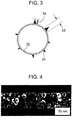
- Fig. 3 is a schematic diagram of a hollow particle 4 that has prickle-like protrusions 31 composed of fine prickle-like protrusions on their surface.
- the prickle-like protrusion refers to a needle-like structure that extends in the direction inclined at least 45 degrees to a tangent line of the surface of the hollow particle.
- the prickle-like protrusions may be observed by using a scanning electron microscope or scanning transmission electron microscope. Reflection images of the particles are photographed at a magnification of 500,000 times. A plurality of images are photographed such that the number of particles becomes at least 10. The contrast of each image is appropriately processed by using image Pro PLUS (produced by Media Cybernetics, Inc.). Regarding prickle-like protrusions that extend in the direction inclined at least 45 degrees to tangent lines of the surface of the particle, the widths 33 of the base of the prickle-like protrusions, the heights 34 of the prickle-like protrusions, and the proportion of prickle-like protrusions relative to the surface of the particle are determined.
- the calculation is performed with respect to the surfaces of 10 or more hollow particles present in all photographed images, and the height of the prickle-like protrusion and the proportion of the prickle-like protrusions with respect to the outer periphery of the particle, which are values averaged with respect to the number of particles, are specified as the structural values of the prickle-like protrusion.
- the height of the prickle-like protrusion is preferably 3 nm or more and 20 nm or less. If the height of the prickle-like protrusion is less than 3 nm, the distance between particles decreases during film formation and, unfavorably, the refractive index of the antireflection film 3 approaches the refractive index of the hollow particles 4. If the height of the prickle-like protrusion is more than 20 nm, the size of gaps between particles increases and scattering increases.
- the proportion of prickle-like protrusions is preferably 3% or more and 30% or less of the surface of the particle. If the proportion of prickle-like protrusions is less than 3% of the surface of the particle, it is difficult to form gaps between the hollow particles 4. If the proportion of prickle-like protrusions is more than 30% of the surface of the particle, the refractive index increases because the proportion of prickle-like protrusions increases relative to the surface of the particle, and the antireflection performance is degraded.
- the height of the prickle-like protrusion and the proportion of prickle-like protrusions relative to the surface of the particle are adjusted by adjusting the pH of the solution, the amount of the material for forming the shell, the reaction temperature, and the like.
- the number average particle size of the shapes excluding the prickle-like protrusions is preferably 20 nm or more and 210 nm or less. In the case where the number average particle size of the hollow particles is more than 210 nm, light scattering of the antireflection film 3 increases.
- the material used for forming the hollow particles 4 can be a material having a low refractive index, and may be SiO 2 , MgF 2 , fluorine, and organic resins, e.g., silicone. Among these, SiO 2 and MgF 2 can be used, and in particular, SiO 2 can be used because the particles are easily produced.
- particles may form particle aggregates including a surfactant and organic materials, e.g., a polymer, between particles in a liquid.
- the aggregate refers to a soft chain-like state, where particles do not firmly aggregate.
- the gap size between particles and the gap size between aggregates are controlled by controlling the size of aggregates.
- an antireflection film 3 having a low refractive index and a still lower level of scattering. If the size of aggregates increases, large voids are generated between aggregates during film formation, and the scattering characteristics become equivalent to these in the related art. Therefore, the size of the chain is more preferably 20 nm or more and 250 nm or less in average.
- the antireflection film 3 is obtained by producing a paint containing hollow particles 4 that have a plurality of fine prickle-like protrusions on their surface and, thereafter, performing coating with the resulting paint.
- a manufacturing process for producing the hollow particles 4 includes a first step of producing core particles in water, a second step of forming shells having prickle-like protrusions on the surfaces of the core particles, and a third step of producing hollow particles by removing cores while retaining the prickle-like protrusions on their surface.
- a method for manufacturing the optical member 1 includes a fourth step of preparing a paint containing the hollow particles 4 obtained in the first to third steps and a fifth step of forming a film by coating with the paint. The first to fifth steps will be described below in detail.
- the technique to synthesize core particles composed of organic particles can involve emulsion polymerization capable of producing latex particles having relatively uniform particle sizes of 100 nm or less.
- monomers usable for emulsion polymerization include styrene, acrylic acid esters, and vinyl acetate.
- a monomer of styrene or the like that does not contain an oxygen atom can be used in consideration of the stability in water.
- surfactants usable for emulsion polymerization include water-soluble cationic surfactants, e.g., tetraalkylammonium salts. Specific examples include hexyltrimethylammonium bromide, octyltrimethylammonium bromide, decyltrimethylammonium bromide, dodecyltrimethylammonium bromide, hexadecyltrimethylammonium bromide, and octadecyltrimethylammonium bromide.
- water-soluble cationic surfactants e.g., tetraalkylammonium salts. Specific examples include hexyltrimethylammonium bromide, octyltrimethylammonium bromide, decyltrimethylammonium bromide, dodecyltrimethylammonium bromide, hexadecyltrimethylammonium bromide, and octadecyl
- Polymerization initiators can be water soluble. Further, water-soluble polymerization initiators of the same cationic type as the surfactants are desirable because the reaction proceeds stably. Examples include 2,2'-azobis[2-(2-imidazoline-2-yl)propane] dihydrochloride, 2,2'-azobis[2-(2-imidazoline-2-yl)propane] disulfate dihydrate, 2,2"-azobis[2-(2-imidazoline-2-yl)propane], 2,2'-azobis(2-methylpropionamidine]dihydrochloride, 2,2"-azobis[N-(2-carboxyethyl)-2-methylpropionamidine] n-hydrate, and 2,2'-azobis[2-methyl-N-(2-hydroxyethyl)propionamide]. These initiators are appropriately selected such that the temperature at a half-life of 10 hours is higher than the temperature condition of the polymerization.
- the size of the core particle is preferably 10 nm or more and 200 nm or less. If the size is less than 10 nm, variations in the size unfavorably increase relative to the average particle size. If the size is more than 200 nm, light scattering is unfavorably caused by the antireflection film produced in the fifth step.
- the particle size may be measured as a number average particle size by using a dynamic light scattering measuring apparatus Zetasizer Nano ZS (produced by Malvern Instruments, hereafter referred to as DLS).
- DLS dynamic light scattering measuring apparatus Zetasizer Nano ZS (produced by Malvern Instruments, hereafter referred to as DLS).
- the zeta potential of a shell material used in the second step is negative except in a strongly acidic case.
- the potential of the core is preferably +30 mV or more.
- the zeta potential may be measured by DLS used in the measurement of the particle size.
- the inorganic component of the resulting shell can be represented by RySiOz (R represents a hydrocarbon group, 0 ⁇ y ⁇ 1, and 1 ⁇ z ⁇ 2).
- the RySiOz component may be obtained by hydrolysis-condensation of a silicon alkoxide.
- tetraalkoxysilanes typified by trimethoxysilane or triethoxysilane
- alkyltrialkoxysilanes typified by methyltrimethoxysilane or methyltriethoxysilane, and mixtures thereof may be used.
- the hydrolysis reaction of the silicon alkoxide can proceed under an acidic condition such that prickle-like protrusions are easily formed.
- an oligomer two-dimensionally or anisotropically grows under an acidic condition and an oligomer three-dimensionally or isotropically grows under a basic condition.
- elliptical or filler-shaped particles are obtained due to anisotropic growth of the oligomer under the acidic condition, and spherical particles are obtained due to isotropic growth of the oligomer under the basic condition. Consequently, in the case where core-shell particles are produced under the basic condition, unfavorably, the oligomer isotropically grows and a shell shape having a smooth surface is formed.
- the zeta potential of the core-shell particles provided with the shells is preferably +15 mV or more.
- the repulsive force between the particles decreases and, thereby, particles easily aggregate so as to disperse as aggregated particles having substantially large sizes in a liquid. Consequently, the value of scattering caused by a film after a paint film forming step of performing coating with the paint and forming the film increases.
- silica particles that are not hollow can be formed separately, a pH at which the zeta potential becomes -15 mV can be measured in advance, and shells can be synthesized around the cores at the resulting pH. Consequently, the dispersibility of the hollow particles at the time when cores are removed is secured.
- the surface potential of the core-shell particle may be adjusted by the core material, the shell material, the pH, and the like.
- the second step it is possible to make the zeta potential of the core-shell particles +15 mV or more by inducing the reaction under a condition of a pH of 3 or more and 6 or less. If the pH is less than 3, the size of the prickle-like protrusion increases because two-dimensional growth of the oligomer excessively proceeds. However, bonding points between oligomers are decreased because of the bulkiness of anisotropically shaped oligomers adhering to core surfaces and, unfavorably, the shell strength is reduced. If the pH is more than 7, core-shell particles having prickle-like protrusions on their surface are not generated.
- pH regulators mainly include hydrochloric acid, phosphoric acid, oxalic acid, and sulfuric acid, and common acidic aqueous solutions may be used.
- the number average particle size of the shapes excluding the prickle-like protrusions is preferably 20 nm or more and 210 nm or less. In the case where the number average particle size of the core-shell particles is more than 210 nm, light scattering of the antireflection film obtained in the fifth step increases.
- the average particle size of the core-shell particles may be measured by using DLS in the same manner as the first step.
- the core is taken out of the core-shell particle obtained in the second step so as to form the hollow particle.
- a method for taking out the core examples include a known method ( Japanese Patent Laid-Open No. 2014-34488 ) in which the core is hydrophobized by a silane coupling agent or the like and is extracted together with an aromatic organic solvent, e.g., toluene.
- an organic solvent e.g., an aprotic polar solvent that dissolves both the particle and the polymer, can be used.
- the fourth step in order to produce a hollow particle paint suitable for film formation, components other than the hollow particles and the solvent are removed.
- removal methods include filtration, centrifugal separation, ion exchange, and ultrafiltration. These may remove components, e.g., surfactants, initiators, and pH regulators, which are used in the first to third steps.
- the hollow particles are in the form of aggregates.
- unnecessary components can be removed until the sizes of the aggregates become 250 nm or less.
- the solvent is appropriately changed by distillation or the like so as to become suitable for film formation.
- the average particle size of the hollow particles may be measured by using DLS in the same manner as the first step and the second step.
- An antireflection film having a low refractive index is obtained by performing coating with the hollow particle paint obtained in the fourth step.
- the antireflection film is composed of only hollow silica particles and the outside of the particles is the air. Therefore, the refractive index of the film decreases to a great extent.
- a material may be made into a film on the resulting antireflection film. For example, in the case where a silica oligomer is used, the refractive index increases but an improvement in strength of the film is expected.
- the coating method can be solution coating, e.g., spin coating, bar coating, or dip coating, because of convenience and low cost.
- the hollow particles obtained by the manufacturing method may be made into a film by a method, such as a sputtering method or an evaporation method, and be used as the antireflection film.
- An optical element having a surface refractive index decreased to a great extent may be obtained by forming the above-described antireflection film on a transparent material, e.g., plastic or glass.
- a particle size analyzer (Zetasizer Nano ZS produced by Malvern Instruments) was used, about 1 ml of solution was put into a glass cell, and the measurement was performed at 25°C.
- the prickle-like protrusions were measured in the following procedure.
- the pH in the aqueous solution was measured by using D-71S produced by HORIBA, Ltd.
- a thin film formed on a silicon wafer was used, and the refractive index was measured in the wavelength range of 380 nm to 800 nm by using a spectroscopic ellipsometer (VASE, produced by J ⁇ A ⁇ Woolam). At that time, a Cauchy model was applied to the thin film and fitting was performed. The resulting value of the refractive index at a wavelength of 550 nm is shown, in a table, as the refractive index in the present example.
- VASE spectroscopic ellipsometer
- the size and the density of voids in the hollow particle film were calculated in the following procedure.
- the resulting thin film in the state of being vertically irradiated with light at illuminance of 4,000 lux was photographed with a camera from behind at an angle of 45°.
- a 150-W halogen fiber illuminator PLL-150C
- the light emitted from the halogen fiber illuminator was passed through a rod homogenizer (RHO-13S-E2), and the illuminance of the light was adjusted to 4,000 lux with an iris diaphragm.
- the camera used for photographing was a camera (Canon EOS40D) with a camera lens (Compact-Macro Lens EF 50 mm), and photographing was performed under the conditions of a shutter speed of 10 seconds, an aperture of F10, and ISO of 400.
- Adobe Photo Shop was used.
- Silica fine particles were synthesized in advance by adding 2 g of tetraethoxysilane (produced by KISHIDA CHEMICAL Co., Ltd.) to water having a pH of 8.0 and performing agitation for 24 hours.
- the zeta potential of the fine particles was measured and the values shown in Table 1 were obtained.
- Table 1 pH 2 3 4.5 5.5 6 6.5 7 8 SiO2 ⁇ potential [mV] -13 -22 -27 -29 -30 -42 -45 -51
- a polystyrene polymer serving as core particles was synthesized by using styrene. After 240 g of water and 5 g of cetyltrimethylammonium bromide aqueous solution having a concentration of 0.01 g/ml (produced by Sigma-Aldrich, hereafter referred to as CTAB) were put into a reaction container, the reaction container was filled with nitrogen and was heated to 80°C. After the heating, 2 ml of analytical grade styrene (produced by KISHIDA CHEMICAL Co., Ltd.) was added, and agitation was performed for 5 minutes.
- CTAB cetyltrimethylammonium bromide aqueous solution having a concentration of 0.01 g/ml
- AIBA 2,2'-azobis(2-amidinopropane) hydrochloride aqueous solution having a concentration of 0.1 g/ml
- AIBA 2,2'-azobis(2-amidinopropane) hydrochloride aqueous solution having a concentration of 0.1 g/ml
- the water layer obtained in the third step was extracted and was repeatedly passed through an ultrafiltration film with MWCO of 100,000 so as to remove water-soluble impurities and water molecules at the same time while isopropyl alcohol was added. Concentration was also performed by the ultrafiltration, and the ultrafiltration was stopped when a total volume reached 30 cc. After 0.3 g of the resulting solution was dried, observation by using a scanning electron microscope was performed. As a result, hollow particles that had prickle-like protrusions on their surface were identified. Five images were photographed at a magnification of 500,000 times. An average height of prickle-like protrusions and the proportion of prickle-like protrusions relative to the surface of the particle of 23 particles were determined by image processing and the results were 7 nm and 20%, respectively.
- the refractive index of the resulting single-layer film measured 1.11, and the value of scattering measured 19.
- the base material was cut with a diamond cutter, and a cross section was observed by using a scanning electron microscope.
- a film, which had a thickness of 123 nm, of stacked particles was observed.
- the filling ratio of the particles was calculated by using the image of the observed surface and was 70%. In the case where the resulting filling ratio was used, the refractive index of the film was mathematically 1.14. Therefore, it was ascertained that the refractive index might further decrease by 0.03.
- Core-shell type particles of 33.5 nm having prickle-like protrusions on their surface were obtained in the same manner as Example 1 except that the pH was adjusted to 3.0.
- the zeta potential measured +30 mV.
- Core-shell type particles of 33.6 nm having prickle-like protrusions on their surface were obtained in the same manner as Example 1 except that the pH was adjusted to 5.5.
- Core-shell type particles of 33.4 nm having prickle-like protrusions on their surface were obtained in the same manner as Example 1 except that the pH was adjusted to 6.0.
- the zeta potential measured +17 mV.
- a first step was performed in the same manner as Example 1. Thereafter, in a second step, the pH was adjusted to 6.5, 2 g of tetraethoxysilane (produced by TOKYO KASEI KOGYO CO., LTD.) serving as a silicon alkoxide was mixed, and agitation was performed. As a result, after agitation was performed for 3 hours, aggregation of particles was visually identified. The size of a particle was estimated by using a scanning transmission electron microscope and was about 33 nm. However, no prickle-like protrusion was observed on the surface. The zeta potential of the aggregated particles measured +7 mV.
- Example 2 The resulting particles were observed by using a scanning electron microscope in the same manner as Example 1. As a result, aggregates of hollow particles having no prickle-like protrusions were identified.
- the mixture of water and THF obtained in the third step was repeatedly passed through an ultrafiltration film with MWCO of 100,000 so as to remove water-soluble impurities and water molecules at the same time while isopropyl alcohol was added. Concentration was also performed by the ultrafiltration, and the ultrafiltration was stopped when a total volume reached 30 cc. At this time, the size of aggregate of hollow particles measured 348 nm on the basis of DLS. Therefore, the ultrafiltration was further performed until the size of the aggregate reached 229 nm.
- Example 2 Film formation of hollow particles was performed in the same manner as Example 1. As a result, the refractive index of the film was 1.09 and the value of scattering was 16. The density of voids in the hollow particle film was measured. As a result, the number of void spaces of 2,000 nm 2 or more, in which a particle was not present, was 1/ ⁇ m 2 in a predetermined cross section.
- Example 2 Film formation of hollow particles was performed in the same manner as Example 1. As a result, the refractive index of the film was 1.10 and the value of scattering was 8.5. The density of voids in the hollow particle film was measured. As a result, a void space of 2,000 nm 2 or more, in which a particle was not present, was not identified in a predetermined cross section.
- Core-shell particles were synthesized in the same manner as Comparative example 1 except that the pH was adjusted to 8.0 in the second step. As a result, after agitation was performed for 5 hours, aggregation of particles was visually identified. The size of a particle was estimated by using a scanning transmission electron microscope and was about 33 nm. No prickle-like protrusion was observed on the surface of the particle. The zeta potential of the aggregated particles measured +4 mV. Third step and fourth step
- Example 2 The resulting particles were observed by using a scanning electron microscope in the same manner as Example 1. As a result, aggregates of hollow particles having no prickle-like protrusions were identified.
- Core-shell type particles of 31.9 nm having prickle-like protrusions on their surface were obtained in the same manner as Comparative example 1 except that the pH was adjusted to 2.0 in the second step.
- the zeta potential measured +32 mV.
- the prickle-like protrusions were measured.
- the average height of prickle-like protrusions was 22 nm and the proportion of prickle-like protrusions was 35% of the surface of the particle.
- the refractive index of the hollow particles was estimated on the basis of the ratio of the two-dimensional hollow to silica, and, thereby 1.258 was obtained.
- the filling ratio was 70% and, therefore, the calculated value of the refractive index of the film was 1.19, which was the same value as the actually measured value.
Landscapes
- Chemical & Material Sciences (AREA)
- Physics & Mathematics (AREA)
- Organic Chemistry (AREA)
- Inorganic Chemistry (AREA)
- General Physics & Mathematics (AREA)
- Optics & Photonics (AREA)
- Engineering & Computer Science (AREA)
- Nanotechnology (AREA)
- Dispersion Chemistry (AREA)
- Composite Materials (AREA)
- Condensed Matter Physics & Semiconductors (AREA)
- Materials Engineering (AREA)
- Crystallography & Structural Chemistry (AREA)
- Surface Treatment Of Optical Elements (AREA)
- Laminated Bodies (AREA)
- Glass Melting And Manufacturing (AREA)
- Surface Treatment Of Glass (AREA)
- Silicon Compounds (AREA)
- Optical Elements Other Than Lenses (AREA)
Applications Claiming Priority (1)
| Application Number | Priority Date | Filing Date | Title |
|---|---|---|---|
| JP2016017544 | 2016-02-01 |
Publications (1)
| Publication Number | Publication Date |
|---|---|
| EP3199984A1 true EP3199984A1 (fr) | 2017-08-02 |
Family
ID=57868016
Family Applications (1)
| Application Number | Title | Priority Date | Filing Date |
|---|---|---|---|
| EP17000093.9A Withdrawn EP3199984A1 (fr) | 2016-02-01 | 2017-01-20 | Film antireflet, élément optique et procédé de fabrication d'élément optique |
Country Status (4)
| Country | Link |
|---|---|
| US (2) | US20170219740A1 (fr) |
| EP (1) | EP3199984A1 (fr) |
| JP (1) | JP6983514B2 (fr) |
| CN (1) | CN107024729B (fr) |
Cited By (1)
| Publication number | Priority date | Publication date | Assignee | Title |
|---|---|---|---|---|
| CN114924338A (zh) * | 2022-06-13 | 2022-08-19 | 深圳市兆驰光元科技有限公司 | 一种扩散膜及背光模组 |
Families Citing this family (4)
| Publication number | Priority date | Publication date | Assignee | Title |
|---|---|---|---|---|
| JP2020008843A (ja) * | 2018-06-28 | 2020-01-16 | キヤノン株式会社 | 反射防止塗料、反射防止膜が設けられた光学部材、光学機器および撮像装置 |
| KR102518416B1 (ko) | 2018-07-31 | 2023-04-06 | 삼성디스플레이 주식회사 | 저굴절층 및 이를 포함하는 전자 장치 |
| CN113416001A (zh) * | 2021-07-21 | 2021-09-21 | 东莞市晶博光电股份有限公司 | 一种利用中空玻璃微球制备超硬仿生ar片的方法 |
| CN113529019B (zh) * | 2021-07-21 | 2023-08-15 | 东莞市晶博光电股份有限公司 | 一种利用多弧离子镀和磁控溅射镀制备超硬仿生ar片的方法 |
Citations (8)
| Publication number | Priority date | Publication date | Assignee | Title |
|---|---|---|---|---|
| US6103379A (en) * | 1994-10-06 | 2000-08-15 | Bar-Ilan University | Process for the preparation of microspheres and microspheres made thereby |
| JP2001233611A (ja) | 2000-02-24 | 2001-08-28 | Catalysts & Chem Ind Co Ltd | シリカ系微粒子、該微粒子分散液の製造方法、および被膜付基材 |
| US20040028918A1 (en) * | 2000-10-18 | 2004-02-12 | Hans-Joachim Becker | Thermally tempered glasscomprising a non-abrasive, porous, sio2 antireflection layer |
| US20110195239A1 (en) * | 2008-10-17 | 2011-08-11 | Nobuaki Takane | Film having low refractive index film and method for producing the same, anti-relection film and method for producing the same, coating liquid set for low refractive index film, substrate having microparticle-laminated thin film and method for producing the same, and optical member |
| US20120276290A1 (en) * | 2011-04-28 | 2012-11-01 | University Of North Dakota | Silica nanoparticles with rough surface |
| JP2013041275A (ja) | 2011-07-21 | 2013-02-28 | Canon Inc | 光学部材の製造方法および光学部材 |
| JP2014034488A (ja) | 2012-08-08 | 2014-02-24 | Canon Inc | 中空粒子の分散液の製造方法、反射防止膜の製造方法及び光学素子の製造方法 |
| US20150132564A1 (en) * | 2012-05-22 | 2015-05-14 | Dsm Ip Assets B.V. | Composition and process for making a porous inorganic oxide coating |
Family Cites Families (10)
| Publication number | Priority date | Publication date | Assignee | Title |
|---|---|---|---|---|
| DE3640586A1 (de) * | 1986-11-27 | 1988-06-09 | Norddeutsche Affinerie | Verfahren zur herstellung von hohlkugeln oder deren verbunden mit wandungen erhoehter festigkeit |
| EP2226365B1 (fr) * | 2001-10-25 | 2016-08-10 | Panasonic Intellectual Property Management Co., Ltd. | Corps émetteur pour éclairage de panneau |
| TW200846715A (en) * | 2006-12-18 | 2008-12-01 | Kolon Inc | Optical sheets |
| JP2009037064A (ja) * | 2007-08-02 | 2009-02-19 | Panasonic Electric Works Co Ltd | 反射防止基材の製造方法及び反射防止基材 |
| JP5438583B2 (ja) * | 2010-04-01 | 2014-03-12 | 富士フイルム株式会社 | 撮像レンズおよび撮像装置 |
| JP5481299B2 (ja) * | 2010-07-22 | 2014-04-23 | 矢崎総業株式会社 | 導通検査治具の動作制御構造 |
| BR112014018980A8 (pt) * | 2012-02-01 | 2017-07-11 | 3M Innovative Properties Company | Materiais nanoestruturados e métodos para a produção dos mesmos |
| US9442222B2 (en) * | 2012-07-31 | 2016-09-13 | Dai Nippon Printing Co., Ltd. | Antireflective article, image display device, and production mold for antireflective article |
| WO2015095154A1 (fr) * | 2013-12-20 | 2015-06-25 | Cabot Corporation | Particules composites d'oxyde métallique-polymère pour polissage mécano-chimique |
| US9738788B1 (en) * | 2014-05-26 | 2017-08-22 | Hrl Laboratories, Llc | Nanoparticle-coated multilayer shell microstructures |
-
2017
- 2017-01-20 EP EP17000093.9A patent/EP3199984A1/fr not_active Withdrawn
- 2017-01-23 CN CN201710048404.1A patent/CN107024729B/zh active Active
- 2017-01-30 JP JP2017014845A patent/JP6983514B2/ja active Active
- 2017-01-30 US US15/419,852 patent/US20170219740A1/en not_active Abandoned
-
2019
- 2019-05-24 US US16/422,720 patent/US20190285774A1/en not_active Abandoned
Patent Citations (8)
| Publication number | Priority date | Publication date | Assignee | Title |
|---|---|---|---|---|
| US6103379A (en) * | 1994-10-06 | 2000-08-15 | Bar-Ilan University | Process for the preparation of microspheres and microspheres made thereby |
| JP2001233611A (ja) | 2000-02-24 | 2001-08-28 | Catalysts & Chem Ind Co Ltd | シリカ系微粒子、該微粒子分散液の製造方法、および被膜付基材 |
| US20040028918A1 (en) * | 2000-10-18 | 2004-02-12 | Hans-Joachim Becker | Thermally tempered glasscomprising a non-abrasive, porous, sio2 antireflection layer |
| US20110195239A1 (en) * | 2008-10-17 | 2011-08-11 | Nobuaki Takane | Film having low refractive index film and method for producing the same, anti-relection film and method for producing the same, coating liquid set for low refractive index film, substrate having microparticle-laminated thin film and method for producing the same, and optical member |
| US20120276290A1 (en) * | 2011-04-28 | 2012-11-01 | University Of North Dakota | Silica nanoparticles with rough surface |
| JP2013041275A (ja) | 2011-07-21 | 2013-02-28 | Canon Inc | 光学部材の製造方法および光学部材 |
| US20150132564A1 (en) * | 2012-05-22 | 2015-05-14 | Dsm Ip Assets B.V. | Composition and process for making a porous inorganic oxide coating |
| JP2014034488A (ja) | 2012-08-08 | 2014-02-24 | Canon Inc | 中空粒子の分散液の製造方法、反射防止膜の製造方法及び光学素子の製造方法 |
Cited By (2)
| Publication number | Priority date | Publication date | Assignee | Title |
|---|---|---|---|---|
| CN114924338A (zh) * | 2022-06-13 | 2022-08-19 | 深圳市兆驰光元科技有限公司 | 一种扩散膜及背光模组 |
| CN114924338B (zh) * | 2022-06-13 | 2023-12-05 | 深圳市兆驰光元科技有限公司 | 一种扩散膜及背光模组 |
Also Published As
| Publication number | Publication date |
|---|---|
| CN107024729B (zh) | 2019-10-22 |
| JP6983514B2 (ja) | 2021-12-17 |
| US20170219740A1 (en) | 2017-08-03 |
| US20190285774A1 (en) | 2019-09-19 |
| JP2017138593A (ja) | 2017-08-10 |
| CN107024729A (zh) | 2017-08-08 |
Similar Documents
| Publication | Publication Date | Title |
|---|---|---|
| US20190285774A1 (en) | Antireflection film, optical member, and method for manufacturing optical member | |
| CN102264799B (zh) | 复合颗粒及其制造方法、中空颗粒、其制造方法及用途 | |
| EP2734871B1 (fr) | Élément optique et son procédé de production | |
| Min et al. | Large-scale assembly of colloidal nanoparticles and fabrication of periodic subwavelength structures | |
| US20210199855A1 (en) | Optical member and method for manufacturing optical member | |
| US20170073237A1 (en) | Method for manufacturing hollow silica particles, hollow silica particles, and composition and thermal insulation sheet comprising same | |
| JP2013137578A (ja) | 単粒子膜エッチングマスク、該単粒子膜エッチングマスクを用いて得られた微細構造体 | |
| KR101102115B1 (ko) | 실리카계 미립자의 제조방법, 피막 형성용 도료 및피막부착 기재 | |
| CN102625817A (zh) | 球状核壳型氧化铈/高分子杂化纳米粒子的聚集体及其制造方法 | |
| US20180259680A1 (en) | Antireflective optical member and method for producing antireflective optical member | |
| JP2015118345A (ja) | メソポーラスシリカナノ粒子分散溶液及びその製造方法、並びに塗布液及びメソポーラスシリカ多孔質膜 | |
| EP2695917A2 (fr) | Procédé de fabrication d'une dispersion de particules creuses, d'un film antireflet et d'un élément optique | |
| KR100542032B1 (ko) | 오르가노폴리실록산 미세 입자, 그의 제조방법 및 액정디스플레이 | |
| JP5241199B2 (ja) | 繊維状中空シリカ微粒子の製造方法および反射防止被膜付基材 | |
| JP2016061794A (ja) | 反射防止フィルム、偏光板、カバーガラス、画像表示装置、及び反射防止フィルムの製造方法 | |
| US20170269264A1 (en) | Optical member, method for manufacturing optical member, and optical device | |
| JP5579512B2 (ja) | 複合粒子およびその製造方法 | |
| JP5915696B2 (ja) | 単粒子膜エッチングマスク付基板の製造方法 | |
| WO2023189785A1 (fr) | Dispersion de particules creuses de silice et son procédé de production | |
| Kanai et al. | Fabrication of large-area silica colloidal crystals immobilized in hydrogel film | |
| JP2025066515A (ja) | 粒子の分散液、及びその製造方法 | |
| JP2024111808A (ja) | 中空シリカ粒子の分散液、及びその製造方法 | |
| JP2024142576A (ja) | 中空シリカ粒子の分散液、及びその製造方法 | |
| CN118591507A (zh) | 中空二氧化硅粒子的分散液及其制造方法 | |
| JP2025049841A (ja) | 粒子の分散液、及びその製造方法 |
Legal Events
| Date | Code | Title | Description |
|---|---|---|---|
| PUAI | Public reference made under article 153(3) epc to a published international application that has entered the european phase |
Free format text: ORIGINAL CODE: 0009012 |
|
| AK | Designated contracting states |
Kind code of ref document: A1 Designated state(s): AL AT BE BG CH CY CZ DE DK EE ES FI FR GB GR HR HU IE IS IT LI LT LU LV MC MK MT NL NO PL PT RO RS SE SI SK SM TR |
|
| AX | Request for extension of the european patent |
Extension state: BA ME |
|
| 17P | Request for examination filed |
Effective date: 20180202 |
|
| RBV | Designated contracting states (corrected) |
Designated state(s): AL AT BE BG CH CY CZ DE DK EE ES FI FR GB GR HR HU IE IS IT LI LT LU LV MC MK MT NL NO PL PT RO RS SE SI SK SM TR |
|
| GRAP | Despatch of communication of intention to grant a patent |
Free format text: ORIGINAL CODE: EPIDOSNIGR1 |
|
| INTG | Intention to grant announced |
Effective date: 20181119 |
|
| STAA | Information on the status of an ep patent application or granted ep patent |
Free format text: STATUS: THE APPLICATION HAS BEEN WITHDRAWN |
|
| 18W | Application withdrawn |
Effective date: 20190311 |