EP3199991A1 - Fibre optique - Google Patents
Fibre optique Download PDFInfo
- Publication number
- EP3199991A1 EP3199991A1 EP16153043.1A EP16153043A EP3199991A1 EP 3199991 A1 EP3199991 A1 EP 3199991A1 EP 16153043 A EP16153043 A EP 16153043A EP 3199991 A1 EP3199991 A1 EP 3199991A1
- Authority
- EP
- European Patent Office
- Prior art keywords
- core
- optical fiber
- range
- fiber according
- core optical
- Prior art date
- Legal status (The legal status is an assumption and is not a legal conclusion. Google has not performed a legal analysis and makes no representation as to the accuracy of the status listed.)
- Withdrawn
Links
- 239000013307 optical fiber Substances 0.000 title claims abstract description 27
- 239000000835 fiber Substances 0.000 claims abstract description 86
- 238000005253 cladding Methods 0.000 claims abstract description 46
- 230000003287 optical effect Effects 0.000 claims abstract description 17
- 239000000463 material Substances 0.000 claims abstract description 13
- 239000011800 void material Substances 0.000 claims abstract description 7
- VYPSYNLAJGMNEJ-UHFFFAOYSA-N Silicium dioxide Chemical compound O=[Si]=O VYPSYNLAJGMNEJ-UHFFFAOYSA-N 0.000 claims description 43
- 239000000377 silicon dioxide Substances 0.000 claims description 21
- 239000011521 glass Substances 0.000 claims description 8
- WKBPZYKAUNRMKP-UHFFFAOYSA-N 1-[2-(2,4-dichlorophenyl)pentyl]1,2,4-triazole Chemical compound C=1C=C(Cl)C=C(Cl)C=1C(CCC)CN1C=NC=N1 WKBPZYKAUNRMKP-UHFFFAOYSA-N 0.000 claims description 2
- -1 PMMA Chemical compound 0.000 claims description 2
- 229910019142 PO4 Inorganic materials 0.000 claims description 2
- 239000005371 ZBLAN Substances 0.000 claims description 2
- 150000004770 chalcogenides Chemical class 0.000 claims description 2
- 150000002222 fluorine compounds Chemical class 0.000 claims description 2
- NBIIXXVUZAFLBC-UHFFFAOYSA-K phosphate Chemical compound [O-]P([O-])([O-])=O NBIIXXVUZAFLBC-UHFFFAOYSA-K 0.000 claims description 2
- 239000010452 phosphate Substances 0.000 claims description 2
- 229920003229 poly(methyl methacrylate) Polymers 0.000 claims description 2
- 229920000642 polymer Polymers 0.000 claims description 2
- 239000004926 polymethyl methacrylate Substances 0.000 claims description 2
- SITVSCPRJNYAGV-UHFFFAOYSA-L tellurite Chemical compound [O-][Te]([O-])=O SITVSCPRJNYAGV-UHFFFAOYSA-L 0.000 claims description 2
- 238000004364 calculation method Methods 0.000 description 8
- 230000008878 coupling Effects 0.000 description 8
- 238000010168 coupling process Methods 0.000 description 8
- 238000005859 coupling reaction Methods 0.000 description 8
- 230000005540 biological transmission Effects 0.000 description 5
- 230000007423 decrease Effects 0.000 description 5
- 230000000694 effects Effects 0.000 description 5
- 230000003595 spectral effect Effects 0.000 description 5
- 238000004088 simulation Methods 0.000 description 4
- 230000008033 biological extinction Effects 0.000 description 3
- 230000008859 change Effects 0.000 description 3
- 230000008901 benefit Effects 0.000 description 2
- 239000005387 chalcogenide glass Substances 0.000 description 2
- 230000003993 interaction Effects 0.000 description 2
- 238000001228 spectrum Methods 0.000 description 2
- 101710121003 Oxygen-evolving enhancer protein 3, chloroplastic Proteins 0.000 description 1
- 238000005452 bending Methods 0.000 description 1
- 230000006835 compression Effects 0.000 description 1
- 238000007906 compression Methods 0.000 description 1
- 239000006185 dispersion Substances 0.000 description 1
- 230000006872 improvement Effects 0.000 description 1
- 238000011835 investigation Methods 0.000 description 1
- 230000007246 mechanism Effects 0.000 description 1
- 230000000737 periodic effect Effects 0.000 description 1
- 230000001902 propagating effect Effects 0.000 description 1
- 230000009467 reduction Effects 0.000 description 1
Images



Classifications
-
- G—PHYSICS
- G02—OPTICS
- G02B—OPTICAL ELEMENTS, SYSTEMS OR APPARATUS
- G02B6/00—Light guides; Structural details of arrangements comprising light guides and other optical elements, e.g. couplings
- G02B6/02—Optical fibres with cladding with or without a coating
- G02B6/02295—Microstructured optical fibre
- G02B6/02314—Plurality of longitudinal structures extending along optical fibre axis, e.g. holes
- G02B6/02319—Plurality of longitudinal structures extending along optical fibre axis, e.g. holes characterised by core or core-cladding interface features
- G02B6/02323—Core having lower refractive index than cladding, e.g. photonic band gap guiding
- G02B6/02328—Hollow or gas filled core
-
- G—PHYSICS
- G02—OPTICS
- G02B—OPTICAL ELEMENTS, SYSTEMS OR APPARATUS
- G02B6/00—Light guides; Structural details of arrangements comprising light guides and other optical elements, e.g. couplings
- G02B6/02—Optical fibres with cladding with or without a coating
- G02B6/02295—Microstructured optical fibre
- G02B6/02314—Plurality of longitudinal structures extending along optical fibre axis, e.g. holes
- G02B6/02342—Plurality of longitudinal structures extending along optical fibre axis, e.g. holes characterised by cladding features, i.e. light confining region
- G02B6/02371—Cross section of longitudinal structures is non-circular
-
- C—CHEMISTRY; METALLURGY
- C03—GLASS; MINERAL OR SLAG WOOL
- C03B—MANUFACTURE, SHAPING, OR SUPPLEMENTARY PROCESSES
- C03B2203/00—Fibre product details, e.g. structure, shape
- C03B2203/42—Photonic crystal fibres, e.g. fibres using the photonic bandgap PBG effect, microstructured or holey optical fibres
-
- G—PHYSICS
- G02—OPTICS
- G02B—OPTICAL ELEMENTS, SYSTEMS OR APPARATUS
- G02B6/00—Light guides; Structural details of arrangements comprising light guides and other optical elements, e.g. couplings
- G02B6/02—Optical fibres with cladding with or without a coating
- G02B6/02295—Microstructured optical fibre
- G02B6/02314—Plurality of longitudinal structures extending along optical fibre axis, e.g. holes
- G02B6/02342—Plurality of longitudinal structures extending along optical fibre axis, e.g. holes characterised by cladding features, i.e. light confining region
- G02B6/02366—Single ring of structures, e.g. "air clad"
Definitions
- the present invention relates to an optical fiber. More specifically, the invention relates to an anti-resonant optical fiber having a hollow core.
- HCFs with a "negative curvature" of the core-cladding boundary have been investigated by several research groups as an alternative transmission medium owing to its low loss and wide transmission bandwidth.
- the term "negative curvature” means that the surface normal to the core boundary is oppositely directed from the core, which usually is achieved by letting a number of intersecting circular elements define the core boundary.
- This type of fiber is known as a hollow-core anti-resonant (HC-AR) fiber.
- HC-AR hollow-core anti-resonant
- the guiding mechanism of HC-AR fiber relies on the combination of an inhibited coupling (IC) between the core and cladding modes and anti-resonance.
- HC-AR fiber This inhibited coupling from the core to the cladding is the result of a low density of cladding modes, which allows the light to be guided in the air-core.
- the key advantage of HC-AR fiber is that the coupling between the core and cladding modes can be made anti-resonant (strongly inhibited) by carefully engineering the interaction between the core and cladding modes, which results in low loss and much broader spectral bandwidths.
- An important factor is to achieve a strongly negative curvature at the core boundary as this leads to increased mode confinement because the core mode is experiencing stronger inhibited coupling to the glass modes residing in the intersecting nodes of the negative-curvature cladding elements.
- HC-AR fibers with anti-resonance elements of more intricate shapes have, e.g., been demonstrated by Yu, et al., "Low loss silica hollow core fibers for 3-4 ⁇ m spectral region,” Opt. Express 20(10), 11153-11158 (2012 ).
- this design does not conform with the node-free design, so other more complex designs suggested using nested smaller elements inside the larger elements, e.g. F. Poletti, "Nested antiresonant nodeless hollow core fiber,” Opt. Express 22(20), 23807-23828 (2014 ), or M. S. Habib et al., "Low-loss hollow-core silica fibers with adjacent nested anti-resonant tubes,” Opt. Express 23, 17394-17406 (2015 ). Although these designs improve the loss performance significantly, they are also very complex to fabricate.
- an improved hollow-core anti-resonant optical fiber would be advantageous, and in particular a fiber having a lower loss would be advantageous.
- An object of the present invention is to provide an alternative to the prior art, where anti-resonance elements in the cladding are able to give an increased negative curvature at the core boundary and a node-free configuration both without compromising the core size.
- the anti-resonance elements are evenly distributed tubes with substantially equal and uniform wall thicknesses so as to create the desired anti-resonant effects.
- the elongated cross-sectional geometry of the anti-resonance element is an oval geometry.
- the elongated cross-sectional geometry of the anti-resonance element is an elliptical geometry.
- one or more of the anti-resonance elements comprise an inner void.
- one or more of the anti-resonance elements comprises multiple inner voids.
- a radius of curvature of the anti-resonance elements in a region adjacent to the core region is in the range of 2 ⁇ m-10 ⁇ m, such as in the range 3 ⁇ m-8 ⁇ m, or even such as in the range 4 ⁇ m-6 ⁇ m.
- the optical material is chosen from glasses in the group of silica, ZBLAN, fluorides, tellurite, phosphate, chalcogenide, or a polymer such as PMMA, or topas.
- the optical pulses are femtosecond pulses.
- a system comprising the anti-resonant hollow-core optical fiber according to the first aspect, and a Yb-femtosecond laser.
- Figure 1 illustrates a HC-AR fiber 1 according to the prior art.
- the fiber comprises an outer cladding 2, typically in the form of a capillary.
- a number of anti-resonance elements 3 are arranged within the outer cladding 2, and surrounding the core region 4 wherein light may be made to propagate.
- the fiber comprises six anti-resonant elements 3, in the form of circular capillaries.
- the anti-resonance elements 3 are shown here to form nodes, in that they touch each other where they are adjacent. These nodes support cladding modes residing in the glass, and when the core mode couples to these glass modes the loss increases. Therefore it has been shown that removing the circles from each other ("node-free" case) the leakage loss is reduced.
- Figure 2 shows an embodiment of the HC-AR fiber 100 according to the present invention.
- the main components of the fiber are similar to those described above in connection with figure 1 , in that the fiber comprises an outer cladding 102, a core region 104, and a number of anti-resonance elements 103.
- the fiber shown in figure 1 there are some important changes that have been employed in order to reduce leakage loss from the fiber 1, i.e. that the anti-resonance elements 103 are arranged in a node-free (i.e. non-touching) configuration, and that the elements 103 are non-circular, but rather have an elongated cross-sectional geometry with a major axis 105 and a minor axis 106.
- the anti-resonance elements 103 are arranged so that their major axes are oriented along radial directions of the fiber.
- the inventors have surprisingly found that the combination of allowing space between neighboring anti-resonance elements and forming them in a non-circular anisotropic shape significantly reduces the leakage loss and hence the total propagation loss through the fiber.
- the optical material for forming the fiber is chosen to be silica, but the results could also be used for fibers of other materials.
- the loss contributions considered here scale with wavelength, so that the fibers according to the invention may also be realized for other wavelengths by appropriate scaling of the structural dimension.
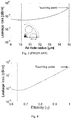
- Figure 3 shows the leakage loss as a function of air-hole radius for six circular tubes, for the given core radius of 15 ⁇ m. It can be seen from Fig. 3 that the leakage loss decreases when air-hole radius decrease from 15 (i.e. elements touching) to 10.20 ⁇ m, and after that leakage loss again increases with the decrement of air-hole radius meaning that there is an optimum value of air-hole radius in which leakage loss is minimum.
- the lowest leakage loss was found ⁇ 0.05 dB/m for an air-hole radius (r) of 10.20 ⁇ m, which is around one order of magnitude lower in compared when the air-holes are touched with each other (see Fig. 3 ).
- the inset in Fig. 3 illustrates a mode profile for the fundamental mode at the design wavelength.
- Figure 4 shows calculations of leakage loss vs. ellipticity for embodiments of HC-AR fibers according to the present invention.
- the core radius is fixed at 15 ⁇ m, and a "width" of the anti-resonance elements is varied.
- the dimensions along the major axis are maintained (i.e 15 ⁇ m), while the dimension along the minor axis is varied.
- Curve c) shows the loss curve with the optimized circular air-hole radius; the leakage loss is lower in the entire wavelength regime ranging from 0.90 to 1.8 ⁇ m than that shown in curves a) and b).
- curve d) shows the loss spectrum of six elliptical tubes with the optimized air-hole radius; the leakage loss is around two orders of magnitude and one order of magnitude lower than that shown in curves b) and c), respectively. Therefore, it is clear that squeezing one of the axes of the air-holes help to reduce leakage loss significantly.
- the power fraction in silica i.e. the optical power overlap with the silica cladding
- leakage loss as a function of wavelength are shown in the figures for both circular and elliptical tubes.
- One of the limiting factors in high power beam delivery is power fraction in silica, which should preferably be kept small.
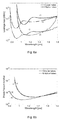
- Figure 6b shows that power fraction in silica may be minimized by tuning the strut thickness of silica, resulting in a power fraction in silica of ⁇ 1.7 x 10 -5 at 1.06 ⁇ m, which are several orders of magnitude lower than reported values for PBG guiding HC-PCF. All these characteristics makes these HC-AR fibers an attractive medium for propagation of high power beam delivery.
- the power fraction in silica for circular and elliptical anti-resonant elements fig. 6b
- the change seems similar, but the advantage again comes in terms of leakage loss: the leakage loss ( fig. 6a ) for circular elements has a very significant minimum at a wavelength controlled by the strut thickness.
- figure 7 shows leakage loss and power fraction in silica for the same strut thickness.
- the figure summarizes these trends by showing the leakage loss and power fraction in silica as a function of strut thickness at the chosen design wavelength of 1.06 ⁇ m for both the circular and elliptical tube cases.
- Fig. 7a elliptical tubes have one order of magnitude lower losses compared to circular when strut thickness varies from 0.35 to 0.42 ⁇ m; whereas power fraction in silica is almost same for both cases as shown in Fig. 7b .
- the loss is almost stable for elliptical tubes compared to circular tubes as a function of strut thickness whereas power fraction in silica reduces with the decrease of strut thickness for both cases.
- the first three cladding modes have slightly larger ⁇ n eff than the first higher order core mode (LP11).
- the slight difference of ⁇ n eff between the cladding modes and first higher-order-core mode (HOM) are achieved because the core hole area is only 1.65 times larger than a single hole area in the cladding ( A. Hartung, et al., "Low-loss single-mode guidance in large-core antiresonant hollow-core fibers", Opt. Letters 40(14), 3432-3435 (2015 )). Therefore, the first HOM is located within the domain of the cladding modes, which increases the possibility of phase matching between the cladding modes and HOMs ( Fig. 8 ).
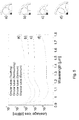
- FIG. 8 shows the higher-order-mode extinction ratio (HOMER), which is defined as the ratio between the loss of the HOM having the lowest loss and the loss of the fundamental mode (FM). It can be seen from Fig. 8 that the leakage loss of the LP01 mode decreases with the decrement of ellipticity; whereas the minimum loss of the HOMs have higher losses compared to the LP01 mode in the whole ellipticity range.
- HOMER higher-order-mode extinction ratio
Landscapes
- Physics & Mathematics (AREA)
- General Physics & Mathematics (AREA)
- Optics & Photonics (AREA)
- Optical Fibers, Optical Fiber Cores, And Optical Fiber Bundles (AREA)
Priority Applications (1)
| Application Number | Priority Date | Filing Date | Title |
|---|---|---|---|
| EP16153043.1A EP3199991A1 (fr) | 2016-01-27 | 2016-01-27 | Fibre optique |
Applications Claiming Priority (1)
| Application Number | Priority Date | Filing Date | Title |
|---|---|---|---|
| EP16153043.1A EP3199991A1 (fr) | 2016-01-27 | 2016-01-27 | Fibre optique |
Publications (1)
| Publication Number | Publication Date |
|---|---|
| EP3199991A1 true EP3199991A1 (fr) | 2017-08-02 |
Family
ID=55237592
Family Applications (1)
| Application Number | Title | Priority Date | Filing Date |
|---|---|---|---|
| EP16153043.1A Withdrawn EP3199991A1 (fr) | 2016-01-27 | 2016-01-27 | Fibre optique |
Country Status (1)
| Country | Link |
|---|---|
| EP (1) | EP3199991A1 (fr) |
Cited By (35)
| Publication number | Priority date | Publication date | Assignee | Title |
|---|---|---|---|---|
| CN108181684A (zh) * | 2018-02-11 | 2018-06-19 | 江西师范大学 | 一种微结构空心光纤 |
| CN109143462A (zh) * | 2018-10-12 | 2019-01-04 | 西安邮电大学 | 一种高双折射蜣螂形纤芯光子晶体光纤 |
| CN109212662A (zh) * | 2018-10-25 | 2019-01-15 | 江西师范大学 | 一种多谐振层空心光纤 |
| CN109270625A (zh) * | 2018-10-25 | 2019-01-25 | 北京航空航天大学 | 一种传输中空光束的葫芦光纤 |
| WO2019071921A1 (fr) * | 2017-10-13 | 2019-04-18 | 北京工业大学 | Fibre optique à cœur creux d'anti-résonance à multiples couches de résonance |
| CN109932778A (zh) * | 2019-03-14 | 2019-06-25 | 深圳大学 | 反谐振光纤及其演化方法 |
| CN111435187A (zh) * | 2019-10-30 | 2020-07-21 | 济南大学 | 一种具有高双折射低损耗的空芯负曲率光子晶体光纤 |
| US10859763B2 (en) * | 2018-11-13 | 2020-12-08 | Beihang University | Hollow-core antiresonant fiber with nested supporting rings and its design method |
| CN112230329A (zh) * | 2020-11-02 | 2021-01-15 | 北京邮电大学 | 一种单偏振低损耗空芯负曲率光纤 |
| CN112433294A (zh) * | 2020-11-26 | 2021-03-02 | 中国计量大学 | 基于双负曲率包层结构的太赫兹波导 |
| CN112859236A (zh) * | 2021-01-20 | 2021-05-28 | 北京工业大学 | 一种棒状微结构光纤 |
| CN113050218A (zh) * | 2021-03-25 | 2021-06-29 | 中国计量大学 | 支持52种轨道角动量模式的负曲率太赫兹光纤 |
| CN113296186A (zh) * | 2021-06-17 | 2021-08-24 | 燕山大学 | 偏振保持空芯反谐振光纤 |
| CN113311533A (zh) * | 2021-06-04 | 2021-08-27 | 江西师范大学 | 一种反谐振空芯光纤 |
| CN113589456A (zh) * | 2021-06-23 | 2021-11-02 | 华南师范大学 | 一种信能共传微结构光纤 |
| JP2021534445A (ja) * | 2018-08-08 | 2021-12-09 | ユニバーシティ、オブ、サウサンプトンUniversity Of Southampton | 中空コア光ファイバ |
| CN113940613A (zh) * | 2021-09-18 | 2022-01-18 | 北京航空航天大学 | 光纤和内窥镜 |
| CN114007990A (zh) * | 2019-07-17 | 2022-02-01 | 贺利氏石英玻璃有限两合公司 | 制造空芯光纤和空芯光纤预制件的方法 |
| CN114035263A (zh) * | 2021-11-17 | 2022-02-11 | 南京理工大学 | 一种莱洛三角形低折射率棒的光子带隙光纤 |
| CN114167542A (zh) * | 2021-06-01 | 2022-03-11 | 上海大学 | 一种超低噪声系数有源光纤及其制备方法 |
| CN114325926A (zh) * | 2021-12-01 | 2022-04-12 | 燕山大学 | 一种具有异质结构双包层的空芯反谐振光纤 |
| CN114414084A (zh) * | 2021-12-28 | 2022-04-29 | 北京邮电大学 | 一种基于spr效应的空芯负曲率光纤温度传感器 |
| CN114910995A (zh) * | 2022-04-27 | 2022-08-16 | 东北石油大学 | 支持多个轨道角动量模式长距离稳定通信的反谐振光纤 |
| CN115485094A (zh) * | 2020-02-03 | 2022-12-16 | 傲科激光应用技术股份有限公司 | 激光标记系统和方法 |
| CN115728863A (zh) * | 2022-12-07 | 2023-03-03 | 烽火通信科技股份有限公司 | 一种低损耗反谐振空芯光纤 |
| CN116699755A (zh) * | 2023-07-05 | 2023-09-05 | 桂林电子科技大学 | 一种应用于近红外波段(1150nm~2000nm)的低损耗空芯光纤 |
| CN116774347A (zh) * | 2023-07-05 | 2023-09-19 | 桂林电子科技大学 | 一种可调谐空芯光纤 |
| CN116990899A (zh) * | 2023-08-04 | 2023-11-03 | 黄山学院 | 一种(s+c+l)波段混合导光型单偏振单模空芯光纤 |
| CN117369046A (zh) * | 2023-12-08 | 2024-01-09 | 南京信息工程大学 | 一种中红外色散平坦的空芯反谐振光纤 |
| CN117369045A (zh) * | 2023-11-02 | 2024-01-09 | 南京信息工程大学 | 一种中红外单模单偏振的空芯反谐振光纤 |
| CN118884602A (zh) * | 2024-08-13 | 2024-11-01 | 燕山大学 | 具有回形针包层结构的超带宽双芯负曲率光纤偏振分束器 |
| CN119200081A (zh) * | 2024-11-26 | 2024-12-27 | 东南大学 | 一种近零色散3~5µm中红外波段的复合空芯光纤 |
| WO2025082140A1 (fr) * | 2023-10-19 | 2025-04-24 | 长飞光纤光缆股份有限公司 | Fibre à âme creuse ayant une marque d'azimut et procédé de détection de face d'extrémité de fibre à âme creuse |
| US12442975B2 (en) | 2023-05-11 | 2025-10-14 | University Of Central Florida Research Foundation, Inc. | Anti-resonant hollow-core fibers featuring support structures |
| CN121325315A (zh) * | 2025-12-17 | 2026-01-13 | 西安邮电大学 | 一种基于空芯负曲率光纤的光纤偏振器 |
Citations (1)
| Publication number | Priority date | Publication date | Assignee | Title |
|---|---|---|---|---|
| GB2526879A (en) * | 2014-06-06 | 2015-12-09 | Univ Southampton | Hollow-core optical fibers |
-
2016
- 2016-01-27 EP EP16153043.1A patent/EP3199991A1/fr not_active Withdrawn
Patent Citations (1)
| Publication number | Priority date | Publication date | Assignee | Title |
|---|---|---|---|---|
| GB2526879A (en) * | 2014-06-06 | 2015-12-09 | Univ Southampton | Hollow-core optical fibers |
Non-Patent Citations (7)
| Title |
|---|
| A. HARTUNG ET AL.: "Low-loss single-mode guidance in large-core antiresonant hollow-core fibers", OPT. LETTERS, vol. 40, no. 14, 2015, pages 3432 - 3435, XP055221852, DOI: doi:10.1364/OL.40.003432 |
| F. POLETTI: "Nested antiresonant nodeless hollow core fiber", OPT. EXPRESS, vol. 22, no. 20, 2014, pages 23807 - 23828, XP055221870, DOI: doi:10.1364/OE.22.023807 |
| KOSOLAPOV ET AL.: "Demonstration of C02-laser power delivery through chalcogenide-glass fiber with negative-curvature hollow core", OPT. EXPRESS, vol. 19, no. 25, 2011, pages 25723 - 25728 |
| M. S. HABIB ET AL.: "Low-loss hollow-core silica fibers with adjacent nested anti-resonant tubes", OPT. EXPRESS, vol. 23, 2015, pages 17394 - 17406 |
| PRYAMIKOV ET AL.: "Demonstration of a waveguide regime for a silica hollow-core microstructured optical fiber with a negative curvature of the core boundary in the spectral region 3.5 pm", OPT. EXPRESS, vol. 19, no. 2, 2011, pages 1441 - 1448, XP055222321, DOI: doi:10.1364/OE.19.001441 |
| W. BELARDI; J. C. KNIGHT: "Hollow antiresonant fibers with low bending loss", OPT. EXPRESS, vol. 22, no. 8, 2014, pages 10091 - 10096 |
| YU ET AL.: "Low loss silica hollow core fibers for 3-4 pm spectral region", OPT. EXPRESS, vol. 20, no. 10, 2012, pages 11153 - 11158 |
Cited By (52)
| Publication number | Priority date | Publication date | Assignee | Title |
|---|---|---|---|---|
| WO2019071921A1 (fr) * | 2017-10-13 | 2019-04-18 | 北京工业大学 | Fibre optique à cœur creux d'anti-résonance à multiples couches de résonance |
| US11009654B2 (en) | 2017-10-13 | 2021-05-18 | Beijing University Of Technology | Anti-resonant hollow core optical fiber having multiple resonant layers |
| CN108181684A (zh) * | 2018-02-11 | 2018-06-19 | 江西师范大学 | 一种微结构空心光纤 |
| CN108181684B (zh) * | 2018-02-11 | 2023-06-27 | 江西师范大学 | 一种微结构空心光纤 |
| JP2023126277A (ja) * | 2018-08-08 | 2023-09-07 | ユニバーシティ、オブ、サウサンプトン | 中空コア光ファイバ |
| US11640029B2 (en) | 2018-08-08 | 2023-05-02 | University Of Southampton | Hollow core optical fibre |
| JP2021534445A (ja) * | 2018-08-08 | 2021-12-09 | ユニバーシティ、オブ、サウサンプトンUniversity Of Southampton | 中空コア光ファイバ |
| CN109143462A (zh) * | 2018-10-12 | 2019-01-04 | 西安邮电大学 | 一种高双折射蜣螂形纤芯光子晶体光纤 |
| CN109270625A (zh) * | 2018-10-25 | 2019-01-25 | 北京航空航天大学 | 一种传输中空光束的葫芦光纤 |
| CN109212662A (zh) * | 2018-10-25 | 2019-01-15 | 江西师范大学 | 一种多谐振层空心光纤 |
| US10859763B2 (en) * | 2018-11-13 | 2020-12-08 | Beihang University | Hollow-core antiresonant fiber with nested supporting rings and its design method |
| CN109932778A (zh) * | 2019-03-14 | 2019-06-25 | 深圳大学 | 反谐振光纤及其演化方法 |
| US11940648B2 (en) | 2019-07-17 | 2024-03-26 | Heraeus Quarzglas Gmbh & Co. Kg | Methods for producing a hollow-core fiber and for producing a preform for a hollow-core fiber |
| CN114007990A (zh) * | 2019-07-17 | 2022-02-01 | 贺利氏石英玻璃有限两合公司 | 制造空芯光纤和空芯光纤预制件的方法 |
| CN114007990B (zh) * | 2019-07-17 | 2023-12-08 | 贺利氏石英玻璃有限两合公司 | 制造空芯光纤和空芯光纤预制件的方法 |
| CN111435187A (zh) * | 2019-10-30 | 2020-07-21 | 济南大学 | 一种具有高双折射低损耗的空芯负曲率光子晶体光纤 |
| CN111435187B (zh) * | 2019-10-30 | 2022-08-09 | 济南大学 | 一种具有高双折射低损耗的空芯负曲率光子晶体光纤 |
| CN115485094A (zh) * | 2020-02-03 | 2022-12-16 | 傲科激光应用技术股份有限公司 | 激光标记系统和方法 |
| CN112230329B (zh) * | 2020-11-02 | 2021-09-17 | 北京邮电大学 | 一种单偏振低损耗空芯负曲率光纤 |
| CN112230329A (zh) * | 2020-11-02 | 2021-01-15 | 北京邮电大学 | 一种单偏振低损耗空芯负曲率光纤 |
| CN112433294A (zh) * | 2020-11-26 | 2021-03-02 | 中国计量大学 | 基于双负曲率包层结构的太赫兹波导 |
| CN112433294B (zh) * | 2020-11-26 | 2022-08-23 | 中国计量大学 | 基于双负曲率包层结构的太赫兹波导 |
| CN112859236A (zh) * | 2021-01-20 | 2021-05-28 | 北京工业大学 | 一种棒状微结构光纤 |
| CN113050218A (zh) * | 2021-03-25 | 2021-06-29 | 中国计量大学 | 支持52种轨道角动量模式的负曲率太赫兹光纤 |
| CN114167542B (zh) * | 2021-06-01 | 2024-05-28 | 上海大学 | 一种超低噪声系数有源光纤及其制备方法 |
| CN114167542A (zh) * | 2021-06-01 | 2022-03-11 | 上海大学 | 一种超低噪声系数有源光纤及其制备方法 |
| CN113311533A (zh) * | 2021-06-04 | 2021-08-27 | 江西师范大学 | 一种反谐振空芯光纤 |
| CN113296186B (zh) * | 2021-06-17 | 2022-02-18 | 燕山大学 | 偏振保持空芯反谐振光纤 |
| CN113296186A (zh) * | 2021-06-17 | 2021-08-24 | 燕山大学 | 偏振保持空芯反谐振光纤 |
| CN113589456A (zh) * | 2021-06-23 | 2021-11-02 | 华南师范大学 | 一种信能共传微结构光纤 |
| CN113940613A (zh) * | 2021-09-18 | 2022-01-18 | 北京航空航天大学 | 光纤和内窥镜 |
| CN114035263A (zh) * | 2021-11-17 | 2022-02-11 | 南京理工大学 | 一种莱洛三角形低折射率棒的光子带隙光纤 |
| CN114035263B (zh) * | 2021-11-17 | 2024-04-23 | 南京理工大学 | 一种莱洛三角形低折射率棒的光子带隙光纤 |
| CN114325926B (zh) * | 2021-12-01 | 2022-08-30 | 燕山大学 | 一种具有异质结构双包层的空芯反谐振光纤 |
| CN114325926A (zh) * | 2021-12-01 | 2022-04-12 | 燕山大学 | 一种具有异质结构双包层的空芯反谐振光纤 |
| CN114414084A (zh) * | 2021-12-28 | 2022-04-29 | 北京邮电大学 | 一种基于spr效应的空芯负曲率光纤温度传感器 |
| CN114910995A (zh) * | 2022-04-27 | 2022-08-16 | 东北石油大学 | 支持多个轨道角动量模式长距离稳定通信的反谐振光纤 |
| CN114910995B (zh) * | 2022-04-27 | 2023-11-17 | 东北石油大学 | 支持多个轨道角动量模式长距离稳定通信的反谐振光纤 |
| CN115728863A (zh) * | 2022-12-07 | 2023-03-03 | 烽火通信科技股份有限公司 | 一种低损耗反谐振空芯光纤 |
| WO2024119889A1 (fr) * | 2022-12-07 | 2024-06-13 | 烽火通信科技股份有限公司 | Fibre à âme creuse anti-résonance à faible perte |
| US12442975B2 (en) | 2023-05-11 | 2025-10-14 | University Of Central Florida Research Foundation, Inc. | Anti-resonant hollow-core fibers featuring support structures |
| US12442976B2 (en) | 2023-05-11 | 2025-10-14 | University Of Central Florida Research Foundation, Inc. | Anti-resonant hollow-core fibers featuring support structures |
| CN116699755A (zh) * | 2023-07-05 | 2023-09-05 | 桂林电子科技大学 | 一种应用于近红外波段(1150nm~2000nm)的低损耗空芯光纤 |
| CN116774347A (zh) * | 2023-07-05 | 2023-09-19 | 桂林电子科技大学 | 一种可调谐空芯光纤 |
| CN116990899A (zh) * | 2023-08-04 | 2023-11-03 | 黄山学院 | 一种(s+c+l)波段混合导光型单偏振单模空芯光纤 |
| WO2025082140A1 (fr) * | 2023-10-19 | 2025-04-24 | 长飞光纤光缆股份有限公司 | Fibre à âme creuse ayant une marque d'azimut et procédé de détection de face d'extrémité de fibre à âme creuse |
| CN117369045A (zh) * | 2023-11-02 | 2024-01-09 | 南京信息工程大学 | 一种中红外单模单偏振的空芯反谐振光纤 |
| CN117369046B (zh) * | 2023-12-08 | 2024-02-09 | 南京信息工程大学 | 一种中红外色散平坦的空芯反谐振光纤 |
| CN117369046A (zh) * | 2023-12-08 | 2024-01-09 | 南京信息工程大学 | 一种中红外色散平坦的空芯反谐振光纤 |
| CN118884602A (zh) * | 2024-08-13 | 2024-11-01 | 燕山大学 | 具有回形针包层结构的超带宽双芯负曲率光纤偏振分束器 |
| CN119200081A (zh) * | 2024-11-26 | 2024-12-27 | 东南大学 | 一种近零色散3~5µm中红外波段的复合空芯光纤 |
| CN121325315A (zh) * | 2025-12-17 | 2026-01-13 | 西安邮电大学 | 一种基于空芯负曲率光纤的光纤偏振器 |
Similar Documents
| Publication | Publication Date | Title |
|---|---|---|
| EP3199991A1 (fr) | Fibre optique | |
| US20260118573A1 (en) | Hollow-core optical fibers | |
| US8797642B2 (en) | Large mode area optical fiber | |
| Birks et al. | Photonic crystal fibres: An endless variety | |
| US7174078B2 (en) | Dual core photonic crystal fibers (PCF) with special dispersion properties | |
| Paul et al. | Ultra-high negative dispersion compensating modified square shape photonic crystal fiber for optical broadband communication | |
| Komanec et al. | Hollow-core optical fibers | |
| EP2056135B1 (fr) | Fibre optique et guide de lumière | |
| Allan et al. | Surface modes and loss in air-core photonic bandgap fibers | |
| Gong et al. | Single-polarization single-mode broadband ultra-low loss hollow-core anti-resonant fiber with nested double C-type cladding tubes | |
| Zhu et al. | Nested low-loss hollow core fiber | |
| EP3454100B1 (fr) | Procédé de conception de fibre optique | |
| Kliros et al. | Prediction of Macrobending and splice losses for photonic crystal fibers based on the effective index method | |
| Kovačević et al. | Calculation of the bandwidth of W-type photonic crystal fibers by time-dependent power flow equation | |
| JP5771569B2 (ja) | 光ファイバ | |
| Nguyen et al. | Numerical Investigation of Optical Properties in Carbon Tetrachloride-Filled Photonic Crystal Fibers | |
| EP2764386A1 (fr) | Modèles de fibres pour lasers à impulsions ultrabrèves, accordables en longueurs d'ondes | |
| Johny et al. | Determination of fiber parameters and the effects of dispersion in a Radio over Fiber system | |
| Birks | Photonic bandgap fibres | |
| BELOGLASOV et al. | A chirped photonic-crystal fibre | |
| HK1245894B (en) | Hollow-core optical fibers | |
| HK1245893B (en) | Hollow-core optical fibers | |
| Mohammed et al. | Analysis and Modeling of Microstructured Fiber Using The Analytical Method Based on The Empirical Equation | |
| Dong | Specialty Optical Fibers for Applications in Fiber Lasers | |
| Kobayashi et al. | Infrared tube-leaky optical fibers with microstructured glass supports |
Legal Events
| Date | Code | Title | Description |
|---|---|---|---|
| PUAI | Public reference made under article 153(3) epc to a published international application that has entered the european phase |
Free format text: ORIGINAL CODE: 0009012 |
|
| AK | Designated contracting states |
Kind code of ref document: A1 Designated state(s): AL AT BE BG CH CY CZ DE DK EE ES FI FR GB GR HR HU IE IS IT LI LT LU LV MC MK MT NL NO PL PT RO RS SE SI SK SM TR |
|
| AX | Request for extension of the european patent |
Extension state: BA ME |
|
| STAA | Information on the status of an ep patent application or granted ep patent |
Free format text: STATUS: THE APPLICATION IS DEEMED TO BE WITHDRAWN |
|
| 18D | Application deemed to be withdrawn |
Effective date: 20180203 |