EP3200188A1 - Procédés implémentés par ordinateur pour évaluer une maladie par analyse vocale et programmes informatiques associés - Google Patents
Procédés implémentés par ordinateur pour évaluer une maladie par analyse vocale et programmes informatiques associés Download PDFInfo
- Publication number
- EP3200188A1 EP3200188A1 EP16382029.3A EP16382029A EP3200188A1 EP 3200188 A1 EP3200188 A1 EP 3200188A1 EP 16382029 A EP16382029 A EP 16382029A EP 3200188 A1 EP3200188 A1 EP 3200188A1
- Authority
- EP
- European Patent Office
- Prior art keywords
- time series
- audio data
- disease
- representations
- implemented method
- Prior art date
- Legal status (The legal status is an assumption and is not a legal conclusion. Google has not performed a legal analysis and makes no representation as to the accuracy of the status listed.)
- Withdrawn
Links
- 238000000034 method Methods 0.000 title claims abstract description 39
- 208000037265 diseases, disorders, signs and symptoms Diseases 0.000 title claims abstract description 29
- 201000010099 disease Diseases 0.000 title claims abstract description 27
- 238000004458 analytical method Methods 0.000 title claims description 19
- 238000004590 computer program Methods 0.000 title claims description 6
- 230000006870 function Effects 0.000 claims abstract description 25
- 230000009466 transformation Effects 0.000 claims abstract description 21
- 238000010801 machine learning Methods 0.000 claims abstract description 17
- 238000004422 calculation algorithm Methods 0.000 claims abstract description 15
- 238000007620 mathematical function Methods 0.000 claims abstract description 4
- 230000005750 disease progression Effects 0.000 claims description 9
- 206010061818 Disease progression Diseases 0.000 claims description 8
- 238000012502 risk assessment Methods 0.000 claims description 7
- 238000000354 decomposition reaction Methods 0.000 claims description 4
- 238000011002 quantification Methods 0.000 claims description 4
- FGUUSXIOTUKUDN-IBGZPJMESA-N C1(=CC=CC=C1)N1C2=C(NC([C@H](C1)NC=1OC(=NN=1)C1=CC=CC=C1)=O)C=CC=C2 Chemical compound C1(=CC=CC=C1)N1C2=C(NC([C@H](C1)NC=1OC(=NN=1)C1=CC=CC=C1)=O)C=CC=C2 FGUUSXIOTUKUDN-IBGZPJMESA-N 0.000 claims 1
- 230000011218 segmentation Effects 0.000 description 12
- 208000018737 Parkinson disease Diseases 0.000 description 11
- 230000007704 transition Effects 0.000 description 8
- 230000005236 sound signal Effects 0.000 description 7
- 230000002269 spontaneous effect Effects 0.000 description 7
- 238000012549 training Methods 0.000 description 7
- 239000013598 vector Substances 0.000 description 6
- 238000011156 evaluation Methods 0.000 description 5
- 239000011159 matrix material Substances 0.000 description 5
- 238000012545 processing Methods 0.000 description 5
- 238000010586 diagram Methods 0.000 description 4
- 238000012706 support-vector machine Methods 0.000 description 4
- 238000004891 communication Methods 0.000 description 3
- 238000003745 diagnosis Methods 0.000 description 3
- 230000005284 excitation Effects 0.000 description 3
- 238000000605 extraction Methods 0.000 description 3
- 239000012634 fragment Substances 0.000 description 3
- 230000000306 recurrent effect Effects 0.000 description 3
- 230000003595 spectral effect Effects 0.000 description 3
- 238000013528 artificial neural network Methods 0.000 description 2
- 239000000090 biomarker Substances 0.000 description 2
- 238000001514 detection method Methods 0.000 description 2
- 208000035475 disorder Diseases 0.000 description 2
- 230000002068 genetic effect Effects 0.000 description 2
- 239000003550 marker Substances 0.000 description 2
- 238000012544 monitoring process Methods 0.000 description 2
- 230000002459 sustained effect Effects 0.000 description 2
- 206010013952 Dysphonia Diseases 0.000 description 1
- 208000025535 REM sleep behavior disease Diseases 0.000 description 1
- 239000008186 active pharmaceutical agent Substances 0.000 description 1
- 238000013459 approach Methods 0.000 description 1
- 238000003491 array Methods 0.000 description 1
- 230000004888 barrier function Effects 0.000 description 1
- 230000008859 change Effects 0.000 description 1
- 230000001427 coherent effect Effects 0.000 description 1
- 238000010276 construction Methods 0.000 description 1
- 229940079593 drug Drugs 0.000 description 1
- 239000003814 drug Substances 0.000 description 1
- 230000002996 emotional effect Effects 0.000 description 1
- 238000001914 filtration Methods 0.000 description 1
- 210000004704 glottis Anatomy 0.000 description 1
- 230000006872 improvement Effects 0.000 description 1
- 230000010354 integration Effects 0.000 description 1
- 238000011835 investigation Methods 0.000 description 1
- 238000007477 logistic regression Methods 0.000 description 1
- 239000000203 mixture Substances 0.000 description 1
- 230000003287 optical effect Effects 0.000 description 1
- 238000005192 partition Methods 0.000 description 1
- 230000001575 pathological effect Effects 0.000 description 1
- 230000007170 pathology Effects 0.000 description 1
- 230000000737 periodic effect Effects 0.000 description 1
- 238000007781 pre-processing Methods 0.000 description 1
- 238000007637 random forest analysis Methods 0.000 description 1
- 238000012216 screening Methods 0.000 description 1
- 208000019116 sleep disease Diseases 0.000 description 1
- 208000020685 sleep-wake disease Diseases 0.000 description 1
- 208000024891 symptom Diseases 0.000 description 1
- 230000002123 temporal effect Effects 0.000 description 1
- 238000012360 testing method Methods 0.000 description 1
- 230000036962 time dependent Effects 0.000 description 1
- 238000010200 validation analysis Methods 0.000 description 1
- 210000001260 vocal cord Anatomy 0.000 description 1
Images


Classifications
-
- G—PHYSICS
- G10—MUSICAL INSTRUMENTS; ACOUSTICS
- G10L—SPEECH ANALYSIS TECHNIQUES OR SPEECH SYNTHESIS; SPEECH RECOGNITION; SPEECH OR VOICE PROCESSING TECHNIQUES; SPEECH OR AUDIO CODING OR DECODING
- G10L25/00—Speech or voice analysis techniques not restricted to a single one of groups G10L15/00 - G10L21/00
- G10L25/48—Speech or voice analysis techniques not restricted to a single one of groups G10L15/00 - G10L21/00 specially adapted for particular use
- G10L25/51—Speech or voice analysis techniques not restricted to a single one of groups G10L15/00 - G10L21/00 specially adapted for particular use for comparison or discrimination
- G10L25/66—Speech or voice analysis techniques not restricted to a single one of groups G10L15/00 - G10L21/00 specially adapted for particular use for comparison or discrimination for extracting parameters related to health condition
-
- A—HUMAN NECESSITIES
- A61—MEDICAL OR VETERINARY SCIENCE; HYGIENE
- A61B—DIAGNOSIS; SURGERY; IDENTIFICATION
- A61B5/00—Measuring for diagnostic purposes; Identification of persons
- A61B5/40—Detecting, measuring or recording for evaluating the nervous system
- A61B5/4076—Diagnosing or monitoring particular conditions of the nervous system
- A61B5/4082—Diagnosing or monitoring movement diseases, e.g. Parkinson, Huntington or Tourette
-
- A—HUMAN NECESSITIES
- A61—MEDICAL OR VETERINARY SCIENCE; HYGIENE
- A61B—DIAGNOSIS; SURGERY; IDENTIFICATION
- A61B5/00—Measuring for diagnostic purposes; Identification of persons
- A61B5/48—Other medical applications
- A61B5/4803—Speech analysis specially adapted for diagnostic purposes
-
- A—HUMAN NECESSITIES
- A61—MEDICAL OR VETERINARY SCIENCE; HYGIENE
- A61B—DIAGNOSIS; SURGERY; IDENTIFICATION
- A61B5/00—Measuring for diagnostic purposes; Identification of persons
- A61B5/72—Signal processing specially adapted for physiological signals or for diagnostic purposes
- A61B5/7235—Details of waveform analysis
- A61B5/7253—Details of waveform analysis characterised by using transforms
-
- A—HUMAN NECESSITIES
- A61—MEDICAL OR VETERINARY SCIENCE; HYGIENE
- A61B—DIAGNOSIS; SURGERY; IDENTIFICATION
- A61B5/00—Measuring for diagnostic purposes; Identification of persons
- A61B5/72—Signal processing specially adapted for physiological signals or for diagnostic purposes
- A61B5/7235—Details of waveform analysis
- A61B5/7253—Details of waveform analysis characterised by using transforms
- A61B5/7257—Details of waveform analysis characterised by using transforms using Fourier transforms
-
- A—HUMAN NECESSITIES
- A61—MEDICAL OR VETERINARY SCIENCE; HYGIENE
- A61B—DIAGNOSIS; SURGERY; IDENTIFICATION
- A61B5/00—Measuring for diagnostic purposes; Identification of persons
- A61B5/72—Signal processing specially adapted for physiological signals or for diagnostic purposes
- A61B5/7271—Specific aspects of physiological measurement analysis
- A61B5/7275—Determining trends in physiological measurement data; Predicting development of a medical condition based on physiological measurements, e.g. determining a risk factor
-
- G—PHYSICS
- G16—INFORMATION AND COMMUNICATION TECHNOLOGY [ICT] SPECIALLY ADAPTED FOR SPECIFIC APPLICATION FIELDS
- G16H—HEALTHCARE INFORMATICS, i.e. INFORMATION AND COMMUNICATION TECHNOLOGY [ICT] SPECIALLY ADAPTED FOR THE HANDLING OR PROCESSING OF MEDICAL OR HEALTHCARE DATA
- G16H50/00—ICT specially adapted for medical diagnosis, medical simulation or medical data mining; ICT specially adapted for detecting, monitoring or modelling epidemics or pandemics
- G16H50/30—ICT specially adapted for medical diagnosis, medical simulation or medical data mining; ICT specially adapted for detecting, monitoring or modelling epidemics or pandemics for calculating health indices; for individual health risk assessment
Definitions
- the present invention generally relates to methods for disease assessment.
- the invention relates to computer implemented methods, and computer programs, for assessing a disease, preferably Parkinson, through voice analysis.
- Access to healthcare for Parkinson patients and other diseases that might be detectable via voice analysis is mostly limited to people that have access to neurologists. Some patients might not have access to neurologists at all and some might have several barriers before they get adequate diagnosis and treatment. On average it takes five specialist (including non-neurologists) visits to be diagnosed with Parkinson and on average four years.
- Document [1] discloses nonlinear speech analysis algorithms which reveal pathological characteristics in Parkinson's disease. Given a raw audio signal containing sustained vowel utterances, in the method proposed in this document dysphonia measure features (e.g., jitter, shimmer, harmonics to noise ratio), empirical mode decomposition excitation ratios, vocal fold excitation ratios, and classical spectral features like MFCCs and their derivatives are first extracted. Next, feature selection and regression are performed using least absolute shrinkage, selection operators, and classification and regression trees. Training is done with 42 Parkinson patients and a disease severity score is computed from the trained models.
- dysphonia measure features e.g., jitter, shimmer, harmonics to noise ratio
- empirical mode decomposition excitation ratios e.g., vocal fold excitation ratios
- classical spectral features like MFCCs and their derivatives e.g., vocal fold excitation ratios, and classical spectral features like MFCCs and their derivatives are first extracted. Next, feature selection and regression are
- Document [2] discloses an automatic evaluation of Parkinson's speech. Given a raw audio signal containing either spontaneous speech or specific speech tasks like reading words or syllable repetition, first groups of features (acoustic, prosodic, glottal, and openSmile features) are extracted. Acoustic features are based on a Gaussian mixture model of MFCCs and their first and second derivatives. Prosodic features are calculated over voiced and unvoiced fragments of audio, and include fundamental frequency energy, duration, and jitter. Glottal excitation features use a glottis model and linear predictive coding. OpenSmile features are a pool of features computed with the openSmile software package.
- a support vector machine with linear kernel is trained on several functionals (statistical moments, minimum, maximum, percentiles, etc.) of the afore-mentioned features computed for 88 Parkinson patients and 88 controls.
- a three-stage prediction of the degree of severity of the patients is also done using the same feature and classification scheme. Individual accuracies per feature group and speech tasks are reported. A combination of speech tasks and feature groups is also studied but does not achieve the best accuracy.
- Document [3] discloses a method for automatic evaluation of articulatory disorders in Parkinson's disease.
- the method given a raw audio signal containing repeated diadochokinetic utterances, first segments the signal by locating high energy fragments, filtering the signal, and applying suitable thresholding, including Bayesian step change point detection. With this, the method is able to detect the timestamps of the initial burst of an utterance, vowel onsets, and occlusions. From this segmentation then a number of specific features are computed, including vowel similarity and variability quotients, onset to occlusion intervals, and speech timing measures. Such features are based on simple computations such as auto-correlation, time intervals, and low-level spectral characteristics. Features are summarized by statistical moments (mean and standard deviation) and a support vector machine classifier with radial basis function kernel is trained using 24 Parkinson patients (newly diagnosed/not already treated) and 22 controls.
- Document [4] discloses a method using voiced/unvoiced transitions in speech as a potential bio-marker to detect Parkinson's disease. Said method, given a raw audio signal containing spontaneous speech, first locates transitions between sounds. To do so, a publicly available tool called 'Praat' that estimates the timestamps of such transitions using time-domain auto- and cross-correlation methods is used. Timestamps are then used to fragment the raw audio signal and get short excerpts from it (40 msec to the right and to the left of the timestamp). After that, standard MFCC and Bark band energy features are computed from those excerpts in frames of 20 msec lengths using a 10 msec hop.
- 'Praat' that estimates the timestamps of such transitions using time-domain auto- and cross-correlation methods is used. Timestamps are then used to fragment the raw audio signal and get short excerpts from it (40 msec to the right and to the left of the timestamp). After that,
- Embodiments of the present invention provide according to an aspect a computer implemented method for assessing a disease through voice analysis, wherein a computer system including one or more processors comprises the following steps:
- Embodiments of the present invention also provide according to another aspect a computer implemented method for assessing a disease through voice analysis, wherein a computer system including one or more processors comprises the following steps:
- said disease to be assessed is Parkinson.
- the proposed methods are also suitable for other diseases that might be detectable via voice analysis.
- the audio data is uttered by the user during a telephone conversation maintained by the user via a phone device.
- the audio data is uttered by the user in a controlled environment (room, sound-proof booth, etc.) via a microphone or a similar device.
- the audio data is recorded and stored in a memory or database, i.e. the proposed methods are executed off-line.
- the audio data further includes a label indicating whether the audio data comes from a diseased or a healthy user.
- the label may further indicate, if the label indicates that the user is a diseased user, an indication specifying the level of severity of the disease.
- the mathematical audio transformation functions may include: a constant Q transform (CQT), Empirical mode decomposition (EMD), a Recurrence quantification analysis (RQA), and/or a fast Fourier transform (FFT).
- CQT constant Q transform
- EMD Empirical mode decomposition
- RQA Recurrence quantification analysis
- FFT fast Fourier transform
- the one or more different measures are computed over the entire first and second time series representations or series of first and second time series representations.
- the one or more different measures are computed over a specific part of the first and second time series representations or series of first and second time series representations.
- the one or more different measures are computed over a specific timestamp.
- the computed score may be communicated to the user either via a software application installed on a computer device or via a dedicated website.
- a computer program product is one embodiment that has a computer-readable medium including computer program instructions encoded thereon that when executed on at least one processor in a computer system causes the processor to perform the operations indicated herein as embodiments of the invention.
- model combinations are trained on an order of magnitude larger sample than the state of the art.
- the invention is more scalable than the state of the art, i.e., it theoretically provides better coverage to the full population.
- model combinations with user and feature subsets provide a higher accuracy and stability of the results. They reduce the bias and variance of the invention.
- models can be trained by taking that into account and comparing such user's disease progression with itself and other users. This way, a personalized, time-dependent disease progression score can be obtained.
- the segmentation module of the proposed invention is a key module for dealing with such type of audio and allows the present invention to be applicable to the case of spontaneous speech.
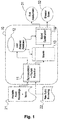
- Fig. 1 illustrates a general block diagram of the proposed invention illustrating the different modules/units involved for assessing a disease such as Parkinson through voice analysis.
- the computer system 10 which includes one or more processors and at least one memory, implements an algorithm to perform two main tasks: train and prediction.
- labels consist of a binary sign indicating whether the audio data comes from a diseased or a healthy user and, in case it is a diseased user, of a real number indicating the level of severity of the disease.
- the computer system 10 may directly receive the uttered audio data from the user, i.e. the computer system may perform the assessment in real time.
- the output of the computer system 10 consists of a risk assessment score 31 and/or a disease progression score 32.
- the former gives an indication of the possibility of a user of having said disease (e.g. Parkinson).
- the latter gives an indication of the severity of the disease.
- Both outputs 31, 32 can be transmitted directly to a doctor or physician, or can be communicated directly to the user. Possibilities for the latter include a mobile APP, mobile web, an API, SDK, integration with telephone systems or a dedicated website.
- risk assessment score 31 consists of a real value between 0 and 1, indicating the probability of the user of having Parkinson based on the conducted analysis
- disease progression score 32 consists of an integer value between 0 and 32, equivalent to the Unified Parkinson's Disease Rating Scale (UPDRS) scale.
- UPDRS Unified Parkinson's Disease Rating Scale
- the output of the computer system 10 can also consist of intermediate speech analysis such as some feature evolution along time.
- the audio data recording can be performed while the user maintains a phone conversation via a phone device (mobile, fixed, or VoIP) or in a controlled environment, for example a sound-proof booth.
- a phone device mobile, fixed, or VoIP
- a controlled environment for example a sound-proof booth.
- the computer system 10 includes a representation and feature extraction module 11 storing different mathematical audio transformation functions that can be used by the computer system 10 to compute at a first phase representation and features from the audio data signal(s) 21, 22 or from derived representations thereof.
- the following mathematical audio transformation functions can be used by the proposed invention:
- the computer system 10 incorporates another phase of abstraction, consisting of applying again the mathematical audio transformation functions previously applied to a number of the already obtained representations and features (that is, a second computation of the mathematical audio transformation functions or functions, depending on the embodiment considered, is further implemented).
- Fig. 3 details an embodiment of this aspect.
- the computer system 10 can take as input a given representation obtained in the first phase (e.g., the CQT) and compute features from it following another representation used in the first phase (e.g., RQA features). This deeper level of abstraction brings intuitively valuable features with which to train the proposed models that will be explained below.
- Measures can be also applied on top of any given representation or feature (first or second phases), and be directly input to the proposed model schema. Measures may include minimum and maximum values, percentiles, statistical moments, histograms, entropies, and statistics about segment timestamps. Measures can be computed over an entire audio data recording 21, 22, over a segment, or over a specific part of the representation or feature. The last two are determined by a segmentation unit of the representation and feature extraction module 11.
- the invention incorporates a segmentation stage working with representations and features, both at the individual and combined levels (i.e., performing segmentation with one feature at a time or performing segmentation with a combination of them).
- the segmentation unit is thought as an unsupervised, heuristics-based unit. It is based on thresholding of selected features/representations, especially RQA and EMD representations, but also on pattern-matching of transition events. The latter can be done on the basis of manually selected patterns or unsupervised inferred patterns. Patterns can be unsupervised inferred by considering time series motif finding algorithms or classical clustering algorithms adapted to the problem of repeated pattern discovery.
- the computer system 10 includes also a user features' database 12 consisting of a series of feature arrays of high dimensionality, one per each audio data recording of each user being considered. These will be exploited by a models module 13 and also by the model combination module 14.
- Models module 13 stores state-of-the-art machine learning algorithms, including but not limited to gradient boosted trees, random forests, support vector machines with linear and radial basis function kernels, deep neural networks, and recurrent neural networks.
- Models stored in the models module 13 are trained on subsets of the considered users and recordings. In addition, they can be trained on subsets of the considered features/representations. Subsets are chosen randomly. The same subset can be used for multiple models and the same machine learning algorithm can be used with different feature subsets.
- the labels (ground truth data) used for training the models are: whether it is a healthy user or diseased user, and in case of being a diseased user, the UPDRS score.
- present invention considers two types of models: binary classifiers and real-valued regressors. For both cases present invention can derive the output values by model combination.
- the outputs of all considered models are combined in order to derive the final output.
- risk assessment 31 and disease progression scores 32 present invention follows a voting strategy, where each model's output contributes with a pre-trained weight to the final decision. It has to be noted that this implies that, for binary classifiers, after adding up their weighted outputs, a real-valued single number is obtained. This corresponds to the risk assessment score 31, yielded in terms of a probability.
- the combined value for the regressors already lead to a single real-valued number in the range of the UPDRS score present invention tries to predict.
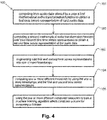
- the method 100 starts by computing, step 101, from audio data uttered by a user a first mathematical audio transformation function to obtain a first time series representation of said audio data. Then, step 102, a second mathematical audio transformation function, equal or different to the first mathematical function, is computed over said obtained first time series representation to obtain a second time series representation of the audio data. At that time, step 103, said first and second time series representations are segmented into one or more timestamps and then, step 104, one or more different measures (e.g.
- step 105 the one or more different computed measures are used to train a machine learning algorithm which computes a score (either a risk score or a disease progression score) for assessing said Parkinson disease.
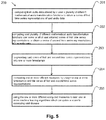
- Fig. 5 illustrates another embodiment of the proposed method for assessing Parkinson.
- a plurality of different mathematical audio transformation functions are computed, step 201, from the audio data uttered by the user to obtain a series of first time series representations of said audio data.
- step 202 a plurality of different mathematical audio transformation functions are also computed over some or all of said obtained series of first time series representations to obtain a series of second time series representations of the audio data.
- step 203 Once the series of first and second time series representations are computed this are segmented, step 203, into one or more timestamps, and one or more different measures computed thereof, step 204.
- the computed measures are used to train one or more machine learning algorithms which compute the final score for assessing the disease.
- the audio data used can be single or multiple per user. These can include spontaneous, free speech, or targeted specific speech tasks, including but not limited to sustained vowel phonations, word and sentence reading, and diadochokinetic utterances.
- users that form the training basis come from multiple user groups, including both healthy users and patients with Parkinson.
- the latter can be subdivided into users with LRKK2 genetic marker, users with sleep disorder, diagnosed but untreated users, and diagnosed and treated users with different Parkinson's disease progression stages.
- Initial input labels could be expanded to demographics data facilitated by the patient, medical assessment variables (including but not limited to type of medication, dose, year of diagnosis, patient's age), and self-reported variables (including but not limited to emotional textual descriptions, illness-specific subjective evaluations, and self-administered questionnaires).
- medical assessment variables including but not limited to type of medication, dose, year of diagnosis, patient's age
- self-reported variables including but not limited to emotional textual descriptions, illness-specific subjective evaluations, and self-administered questionnaires.
- Input audio data can go beyond clean audio recordings.
- present invention can consider dynamically-compressed audio, perceptually-compressed audio (e.g., MP3), distorted audio, telephonic channel audio, environmentally-noisy audio, incomplete audio (e.g., with silences or extreme noises in short-time chunks of the signal), etc.
- the input audio data may be preprocessed to enhance its quality and remove noise.
- Deployed features or representations can be component-wise and instance-wise normalized both at intermediate or final stages.
- Levels of assessment of the Parkinson's disease include but are not limited to UPDRS and Hoehn & Yahr scores, and intelligibility indices.
- the risk assessment score 31 can be based on different concepts, including but not limited to probabilities, medical scores, and binary values.
- the disease progression score 32 can be based on different concepts and strategies, including but not limited to UPDRS, Hoehn & Yahr scores, and hospital-specific scales. At the same time, it can be based on the user itself, in case this has provided previous data to the computer system 10, or other users, be these in a similar or a very different condition as compared to the user under test.
- feedback loops can be added in the feature/representation extraction process. For instance RQA with RQA itself or Classical Audio Processing features from RQA-derived representations. Feedback loops can operate over all possible dimensions of the representation or a subset of these.
- models considered by present invention can be expanded also to logistic regression, nearest neighbors models, and Bayesian classifiers, among others.
- models can include specifically-designed capabilities to identify distortionless features, or those less prone to be affected by distortion, or identifying which features to ignore under certain suboptimal conditions of the audio recording or the telephonic channel.
- Feature subset selection prior to model training can also be done manually or based on some existing feature selection criteria, including but not limited to Chi square, Gini coefficient, and recursive feature selection.
- the synthetic minority oversample technique can be considered.
- the segmentation module can be enhanced by considering a supervised approach.
- a phoneme recognition engine can also be employed in order to derive a phoneme-based segmentation of free speech and the posterior probability of the inferred phonemes.
- model combination can be done with known techniques like stacking, boosting, or bagging.
- the software programs included as part of the invention may be embodied in a computer program product that includes a computer useable medium.
- a computer usable medium can include a readable memory device, such as a hard drive device, a flash memory device, a CD-ROM, a DVD/ROM, or a computer diskette, having computer readable program code segments stored thereon.
- the computer readable medium can also include a communications link, either optical, wired, or wireless, having program code segments carried thereon as digital or analog signals.
Landscapes
- Health & Medical Sciences (AREA)
- Life Sciences & Earth Sciences (AREA)
- Engineering & Computer Science (AREA)
- Public Health (AREA)
- General Health & Medical Sciences (AREA)
- Physics & Mathematics (AREA)
- Medical Informatics (AREA)
- Biomedical Technology (AREA)
- Pathology (AREA)
- Animal Behavior & Ethology (AREA)
- Surgery (AREA)
- Veterinary Medicine (AREA)
- Biophysics (AREA)
- Heart & Thoracic Surgery (AREA)
- Molecular Biology (AREA)
- Physiology (AREA)
- Signal Processing (AREA)
- Artificial Intelligence (AREA)
- Computer Vision & Pattern Recognition (AREA)
- Psychiatry (AREA)
- Neurology (AREA)
- Epidemiology (AREA)
- Neurosurgery (AREA)
- Audiology, Speech & Language Pathology (AREA)
- Primary Health Care (AREA)
- Databases & Information Systems (AREA)
- Mathematical Physics (AREA)
- Developmental Disabilities (AREA)
- Data Mining & Analysis (AREA)
- Computational Linguistics (AREA)
- Human Computer Interaction (AREA)
- Acoustics & Sound (AREA)
- Multimedia (AREA)
- Measurement Of The Respiration, Hearing Ability, Form, And Blood Characteristics Of Living Organisms (AREA)
Priority Applications (1)
| Application Number | Priority Date | Filing Date | Title |
|---|---|---|---|
| EP16382029.3A EP3200188A1 (fr) | 2016-01-27 | 2016-01-27 | Procédés implémentés par ordinateur pour évaluer une maladie par analyse vocale et programmes informatiques associés |
Applications Claiming Priority (1)
| Application Number | Priority Date | Filing Date | Title |
|---|---|---|---|
| EP16382029.3A EP3200188A1 (fr) | 2016-01-27 | 2016-01-27 | Procédés implémentés par ordinateur pour évaluer une maladie par analyse vocale et programmes informatiques associés |
Publications (1)
| Publication Number | Publication Date |
|---|---|
| EP3200188A1 true EP3200188A1 (fr) | 2017-08-02 |
Family
ID=55272416
Family Applications (1)
| Application Number | Title | Priority Date | Filing Date |
|---|---|---|---|
| EP16382029.3A Withdrawn EP3200188A1 (fr) | 2016-01-27 | 2016-01-27 | Procédés implémentés par ordinateur pour évaluer une maladie par analyse vocale et programmes informatiques associés |
Country Status (1)
| Country | Link |
|---|---|
| EP (1) | EP3200188A1 (fr) |
Cited By (14)
| Publication number | Priority date | Publication date | Assignee | Title |
|---|---|---|---|---|
| CN108269590A (zh) * | 2018-01-17 | 2018-07-10 | 广州势必可赢网络科技有限公司 | 一种声带恢复评分方法及装置 |
| CN109285551A (zh) * | 2018-09-18 | 2019-01-29 | 上海海事大学 | 基于wmfcc和dnn的帕金森患者声纹识别方法 |
| WO2019194843A1 (fr) * | 2018-04-05 | 2019-10-10 | Google Llc | Système et procédé de génération d'informations de diagnostic médical au moyen d'un apprentissage profond et d'une compréhension sonore |
| CN110555468A (zh) * | 2019-08-15 | 2019-12-10 | 武汉科技大学 | 一种联合递归图和cnn的脑电信号识别方法及系统 |
| WO2021048514A1 (fr) * | 2019-09-10 | 2021-03-18 | Oxford University Innovation Limited | Prédiction de résultats cliniques dans la maladie de parkinson |
| WO2021091066A1 (fr) * | 2019-11-05 | 2021-05-14 | Samsung Electronics Co., Ltd. | Système et procédé de surveillance spécifique de sujet passif |
| WO2021184211A1 (fr) * | 2020-03-17 | 2021-09-23 | 深圳市欢太科技有限公司 | Procédé et appareil d'évaluation de risques, dispositif électronique et support de stockage |
| WO2021245728A1 (fr) * | 2020-06-01 | 2021-12-09 | サスメド株式会社 | Système d'estimation de maladie, dispositif d'acquisition de données d'enseignant et programme d'acquisition de données d'enseignant |
| JPWO2022054414A1 (fr) * | 2020-09-08 | 2022-03-17 | ||
| CN114863951A (zh) * | 2022-07-11 | 2022-08-05 | 中国科学院合肥物质科学研究院 | 一种基于模态分解的构音障碍快速检测方法 |
| CN115564078A (zh) * | 2022-09-28 | 2023-01-03 | 电子科技大学长三角研究院(湖州) | 停车场泊位占用率短时域预测方法、系统、设备及终端 |
| CN116113356A (zh) * | 2020-09-04 | 2023-05-12 | 南韩商智聪医治股份有限公司 | 用于确定用户痴呆程度的方法及装置 |
| CN117059133A (zh) * | 2023-10-13 | 2023-11-14 | 首都医科大学附属北京天坛医院 | 言语功能评估装置、电子设备和存储介质 |
| US12383159B2 (en) | 2019-12-19 | 2025-08-12 | Koninklijke Philips N.V. | Automated and objective symptom severity score |
Citations (1)
| Publication number | Priority date | Publication date | Assignee | Title |
|---|---|---|---|---|
| US20120265024A1 (en) * | 2010-10-05 | 2012-10-18 | University Of Florida Research Foundation, Incorporated | Systems and methods of screening for medical states using speech and other vocal behaviors |
-
2016
- 2016-01-27 EP EP16382029.3A patent/EP3200188A1/fr not_active Withdrawn
Patent Citations (1)
| Publication number | Priority date | Publication date | Assignee | Title |
|---|---|---|---|---|
| US20120265024A1 (en) * | 2010-10-05 | 2012-10-18 | University Of Florida Research Foundation, Incorporated | Systems and methods of screening for medical states using speech and other vocal behaviors |
Non-Patent Citations (7)
| Title |
|---|
| A. TSANAS: "Nonlinear speech analysis algorithms mapped to a standard metric achieve clinically useful quantification of average Parkinson's disease symptom severity", JOURNAL OF THE ROYAL SOCIETY INTERFACE, vol. 8, no. 59, 2010, pages 842 - 855 |
| J. R. OROZCO-ARROYAV: "Voiced/unvoiced transitions in speech as a potential bio-marker to detect Parkinson's disease", PROC. OF THE ANNUAL CONF. OF THE INT. SPEECH COMMUNICATION ASSOC. (INTERSPEECH, 2015, pages 95 - 99 |
| M. NOVOTNY: "Automatic evaluation of articulatory disorders in Parkinson's disease", IEEE/ACM TRANS. ON AUDIO, SPEECH, AND LANGUAGE PROCESSING, vol. 22, no. 9, 2014, pages 1366 - 1378, XP058061982, DOI: doi:10.1109/TASLP.2014.2329734 |
| MAHADEVA PRASANNA S R ET AL: "Vowel Onset Point Detection Using Source, Spectral Peaks, and Modulation Spectrum Energies", IEEE TRANSACTIONS ON AUDIO, SPEECH AND LANGUAGE PROCESSING, IEEE SERVICE CENTER, NEW YORK, NY, USA, vol. 17, no. 4, 1 May 2009 (2009-05-01), pages 556 - 565, XP011253713, ISSN: 1558-7916, DOI: 10.1109/TASL.2008.2010884 * |
| MICHAL NOVOTN ET AL: "Automatic evaluation of articulatory disorders in Parkinson's disease", IEEE/ACM TRANSACTIONS ON AUDIO, SPEECH, AND LANGUAGE PROCESSING, IEEE, USA, vol. 22, no. 9, 1 September 2014 (2014-09-01), pages 1366 - 1378, XP058061982, ISSN: 2329-9290, DOI: 10.1109/TASLP.2014.2329734 * |
| MUHAMMAD KALEEM ET AL: "Pathological speech signal analysis and classification using empirical mode decomposition", MEDICAL AND BIOLOGICAL ENGINEERING AND COMPUTING., vol. 51, no. 7, 5 March 2013 (2013-03-05), DE, pages 811 - 821, XP055282052, ISSN: 0140-0118, DOI: 10.1007/s11517-013-1051-8 * |
| T. BOCKLET: "Automatic evaluation of Parkinson's speech - Acoustic, prosodic and voice related cues", PROC. OF THE ANNUAL CONF. OF THE INT. SPEECH COMMUNICATION ASSOC. (INTERSPEECH, 2013, pages 1149 - 1153 |
Cited By (20)
| Publication number | Priority date | Publication date | Assignee | Title |
|---|---|---|---|---|
| CN108269590A (zh) * | 2018-01-17 | 2018-07-10 | 广州势必可赢网络科技有限公司 | 一种声带恢复评分方法及装置 |
| WO2019194843A1 (fr) * | 2018-04-05 | 2019-10-10 | Google Llc | Système et procédé de génération d'informations de diagnostic médical au moyen d'un apprentissage profond et d'une compréhension sonore |
| US12070323B2 (en) | 2018-04-05 | 2024-08-27 | Google Llc | System and method for generating diagnostic health information using deep learning and sound understanding |
| CN109285551A (zh) * | 2018-09-18 | 2019-01-29 | 上海海事大学 | 基于wmfcc和dnn的帕金森患者声纹识别方法 |
| CN110555468A (zh) * | 2019-08-15 | 2019-12-10 | 武汉科技大学 | 一种联合递归图和cnn的脑电信号识别方法及系统 |
| WO2021048514A1 (fr) * | 2019-09-10 | 2021-03-18 | Oxford University Innovation Limited | Prédiction de résultats cliniques dans la maladie de parkinson |
| WO2021091066A1 (fr) * | 2019-11-05 | 2021-05-14 | Samsung Electronics Co., Ltd. | Système et procédé de surveillance spécifique de sujet passif |
| US11741986B2 (en) | 2019-11-05 | 2023-08-29 | Samsung Electronics Co., Ltd. | System and method for passive subject specific monitoring |
| US12383159B2 (en) | 2019-12-19 | 2025-08-12 | Koninklijke Philips N.V. | Automated and objective symptom severity score |
| WO2021184211A1 (fr) * | 2020-03-17 | 2021-09-23 | 深圳市欢太科技有限公司 | Procédé et appareil d'évaluation de risques, dispositif électronique et support de stockage |
| WO2021245728A1 (fr) * | 2020-06-01 | 2021-12-09 | サスメド株式会社 | Système d'estimation de maladie, dispositif d'acquisition de données d'enseignant et programme d'acquisition de données d'enseignant |
| CN116113356A (zh) * | 2020-09-04 | 2023-05-12 | 南韩商智聪医治股份有限公司 | 用于确定用户痴呆程度的方法及装置 |
| WO2022054414A1 (fr) * | 2020-09-08 | 2022-03-17 | パナソニックIpマネジメント株式会社 | Système de traitement de signaux sonores et procédé de traitement de signaux sonores |
| JPWO2022054414A1 (fr) * | 2020-09-08 | 2022-03-17 | ||
| JP7394411B2 (ja) | 2020-09-08 | 2023-12-08 | パナソニックIpマネジメント株式会社 | 音信号処理システム、及び、音信号処理方法 |
| CN114863951A (zh) * | 2022-07-11 | 2022-08-05 | 中国科学院合肥物质科学研究院 | 一种基于模态分解的构音障碍快速检测方法 |
| CN114863951B (zh) * | 2022-07-11 | 2022-09-23 | 中国科学院合肥物质科学研究院 | 一种基于模态分解的构音障碍快速检测方法 |
| CN115564078A (zh) * | 2022-09-28 | 2023-01-03 | 电子科技大学长三角研究院(湖州) | 停车场泊位占用率短时域预测方法、系统、设备及终端 |
| CN117059133A (zh) * | 2023-10-13 | 2023-11-14 | 首都医科大学附属北京天坛医院 | 言语功能评估装置、电子设备和存储介质 |
| CN117059133B (zh) * | 2023-10-13 | 2024-01-26 | 首都医科大学附属北京天坛医院 | 言语功能评估装置、电子设备和存储介质 |
Similar Documents
| Publication | Publication Date | Title |
|---|---|---|
| EP3200188A1 (fr) | Procédés implémentés par ordinateur pour évaluer une maladie par analyse vocale et programmes informatiques associés | |
| US11749414B2 (en) | Selecting speech features for building models for detecting medical conditions | |
| US11538472B2 (en) | Processing speech signals in voice-based profiling | |
| EP3762942B1 (fr) | Système et procédé de génération d'informations de diagnostic médical au moyen d'un apprentissage profond et d'une compréhension sonore | |
| Tirronen et al. | The effect of the MFCC frame length in automatic voice pathology detection | |
| Sáenz-Lechón et al. | Automatic assessment of voice quality according to the GRBAS scale | |
| JP2017532082A (ja) | 患者の精神状態のスピーチベース評価のためのシステム | |
| Syed et al. | Inter classifier comparison to detect voice pathologies | |
| Farhadipour et al. | Dysarthric speaker identification with different degrees of dysarthria severity using deep belief networks | |
| Feng | Toward knowledge-driven speech-based models of depression: Leveraging spectrotemporal variations in speech vowels | |
| Sharma et al. | Prediction of specific language impairment in children using speech linear predictive coding coefficients | |
| Kumar et al. | Parkinson’s speech detection using YAMNet | |
| Kadiri et al. | Severity classification of Parkinson's disease from speech using single frequency filtering-based features | |
| Punithavathi et al. | [Retracted] Empirical Investigation for Predicting Depression from Different Machine Learning Based Voice Recognition Techniques | |
| Safdar et al. | Prediction of specific language impairment in children using cepstral domain coefficients | |
| Kumari et al. | A review on early diagnosis of parkinson’s disease using speech signal parameters based on machine learning technique | |
| Patel et al. | Machine learning for automatic speech recognition | |
| Alqam | Classification of the Severity of Speech Disorder in Patients With Parkinson’s Disease Using Artificial Intelligence Techniques | |
| López | Adaptation of Speaker and Speech Recognition Methods for theAutomatic Screening of Speech Disorders Using Machine Learning | |
| HK40120515A (en) | Selecting speech features for building models for detecting medical conditions | |
| Appakaya | An Automated Framework for Connected Speech Evaluation of Neurodegenerative Disease: A Case Study in Parkinson's Disease | |
| Lillini et al. | Dysarthric Speech Classification: A Comparative Analysis of Decision-Support Methods | |
| Gómez-Acosta et al. | Development and Evaluation of a Classification Model for Parkinson’s Disease Detection Based on Ensemble Learning and Comparative Feature Selection Strategies | |
| CN121963792A (zh) | 反映健康状态的语音全局特征提取与数值化方法及系统 | |
| Kwansomkid et al. | Algorithm Classifying Depressed Patients’ Speech Samples Using Deep Learning |
Legal Events
| Date | Code | Title | Description |
|---|---|---|---|
| PUAI | Public reference made under article 153(3) epc to a published international application that has entered the european phase |
Free format text: ORIGINAL CODE: 0009012 |
|
| STAA | Information on the status of an ep patent application or granted ep patent |
Free format text: STATUS: THE APPLICATION HAS BEEN PUBLISHED |
|
| AK | Designated contracting states |
Kind code of ref document: A1 Designated state(s): AL AT BE BG CH CY CZ DE DK EE ES FI FR GB GR HR HU IE IS IT LI LT LU LV MC MK MT NL NO PL PT RO RS SE SI SK SM TR |
|
| AX | Request for extension of the european patent |
Extension state: BA ME |
|
| STAA | Information on the status of an ep patent application or granted ep patent |
Free format text: STATUS: THE APPLICATION IS DEEMED TO BE WITHDRAWN |
|
| 18D | Application deemed to be withdrawn |
Effective date: 20180203 |