EP3200413A1 - Procédé, appareil et dispositif de traitement de signal - Google Patents
Procédé, appareil et dispositif de traitement de signal Download PDFInfo
- Publication number
- EP3200413A1 EP3200413A1 EP14904602.1A EP14904602A EP3200413A1 EP 3200413 A1 EP3200413 A1 EP 3200413A1 EP 14904602 A EP14904602 A EP 14904602A EP 3200413 A1 EP3200413 A1 EP 3200413A1
- Authority
- EP
- European Patent Office
- Prior art keywords
- sub
- carrier
- training field
- tss
- spatial flow
- Prior art date
- Legal status (The legal status is an assumption and is not a legal conclusion. Google has not performed a legal analysis and makes no representation as to the accuracy of the status listed.)
- Granted
Links
Images




Classifications
-
- H—ELECTRICITY
- H04—ELECTRIC COMMUNICATION TECHNIQUE
- H04L—TRANSMISSION OF DIGITAL INFORMATION, e.g. TELEGRAPHIC COMMUNICATION
- H04L27/00—Modulated-carrier systems
- H04L27/26—Systems using multi-frequency codes
- H04L27/2601—Multicarrier modulation systems
- H04L27/2602—Signal structure
- H04L27/261—Details of reference signals
- H04L27/2613—Structure of the reference signals
-
- H—ELECTRICITY
- H04—ELECTRIC COMMUNICATION TECHNIQUE
- H04L—TRANSMISSION OF DIGITAL INFORMATION, e.g. TELEGRAPHIC COMMUNICATION
- H04L27/00—Modulated-carrier systems
- H04L27/26—Systems using multi-frequency codes
-
- H—ELECTRICITY
- H04—ELECTRIC COMMUNICATION TECHNIQUE
- H04B—TRANSMISSION
- H04B7/00—Radio transmission systems, i.e. using radiation field
- H04B7/02—Diversity systems; Multi-antenna system, i.e. transmission or reception using multiple antennas
- H04B7/04—Diversity systems; Multi-antenna system, i.e. transmission or reception using multiple antennas using two or more spaced independent antennas
- H04B7/0413—MIMO systems
- H04B7/0452—Multi-user MIMO systems
-
- H—ELECTRICITY
- H04—ELECTRIC COMMUNICATION TECHNIQUE
- H04L—TRANSMISSION OF DIGITAL INFORMATION, e.g. TELEGRAPHIC COMMUNICATION
- H04L25/00—Baseband systems
- H04L25/02—Details ; arrangements for supplying electrical power along data transmission lines
- H04L25/0202—Channel estimation
- H04L25/0204—Channel estimation of multiple channels
-
- H—ELECTRICITY
- H04—ELECTRIC COMMUNICATION TECHNIQUE
- H04L—TRANSMISSION OF DIGITAL INFORMATION, e.g. TELEGRAPHIC COMMUNICATION
- H04L25/00—Baseband systems
- H04L25/02—Details ; arrangements for supplying electrical power along data transmission lines
- H04L25/0202—Channel estimation
- H04L25/0224—Channel estimation using sounding signals
- H04L25/0228—Channel estimation using sounding signals with direct estimation from sounding signals
-
- H—ELECTRICITY
- H04—ELECTRIC COMMUNICATION TECHNIQUE
- H04L—TRANSMISSION OF DIGITAL INFORMATION, e.g. TELEGRAPHIC COMMUNICATION
- H04L27/00—Modulated-carrier systems
- H04L27/26—Systems using multi-frequency codes
- H04L27/2601—Multicarrier modulation systems
- H04L27/2647—Arrangements specific to the receiver only
- H04L27/2655—Synchronisation arrangements
- H04L27/2689—Link with other circuits, i.e. special connections between synchronisation arrangements and other circuits for achieving synchronisation
- H04L27/2695—Link with other circuits, i.e. special connections between synchronisation arrangements and other circuits for achieving synchronisation with channel estimation, e.g. determination of delay spread, derivative or peak tracking
-
- H—ELECTRICITY
- H04—ELECTRIC COMMUNICATION TECHNIQUE
- H04W—WIRELESS COMMUNICATION NETWORKS
- H04W72/00—Local resource management
- H04W72/04—Wireless resource allocation
- H04W72/044—Wireless resource allocation based on the type of the allocated resource
- H04W72/0453—Resources in frequency domain, e.g. a carrier in FDMA
-
- H—ELECTRICITY
- H04—ELECTRIC COMMUNICATION TECHNIQUE
- H04L—TRANSMISSION OF DIGITAL INFORMATION, e.g. TELEGRAPHIC COMMUNICATION
- H04L5/00—Arrangements affording multiple use of the transmission path
- H04L5/003—Arrangements for allocating sub-channels of the transmission path
- H04L5/0044—Allocation of payload; Allocation of data channels, e.g. PDSCH or PUSCH
Definitions
- Embodiments of the present invention relate to wireless communications technologies, and in particular, to a signal processing method and apparatus, and a device.
- Uplink multi-user multiple-input multiple-output (English: Multi-User Multiple-Input Multiple-Output, MU-MIMO for short) is a key technology of a new-generation wireless local area network (English: Wireless local Access Network, WLAN for short) standard 802.11 ax.
- an access point (English: Access Point, AP for short) obtains channel estimation of the uplink MU-MIMO by using a high efficiency long training field in an uplink packet sent by each STA (English: High Efficiency Long Training field, HE-LTF for short), to demodulate signals from different user equipments (English: Station, STA for short).
- FIG. 1 is an exemplary diagram of a training field solution using sub-carrier (English: Sub-carrier) or sub-band (English: Sub-band) interleaving in the prior art.
- a training field includes 4+1 orthogonal frequency division multiplexing (English: Orthogonal Frequency Division Multiplexing, OFDM for short) symbols.
- the training field is divided into two parts according to functions.
- a first part includes the first four OFDM symbols, that is, an LTF-1, an LTF-2, an LTF-3, and an LTF-4, and a second part includes a fifth OFDM symbol, that is, an additional LTF.
- Subcarriers of each OFDM symbol in the first part of the training field each carry a known reference symbol.
- Each spatial flow sequentially correspond to different sub-carriers or sub-bands in each OFDM symbol, and have locations that do not overlap with those of corresponding sub-carriers or sub-bands of corresponding spatial flows in an adjacent OFDM symbol.
- a sub-carrier or sub-band corresponding to each spatial flow repeats every four sub-carriers or sub-bands, and after four OFDM symbols, each spatial flow traverses all sub-carriers, but sub-carriers corresponding to the spatial flows are orthogonal to each other. In this way, by using a known reference symbol carried by sub-carriers corresponding to each spatial flow, channel estimation of the corresponding spatial flow on each sub-carrier can be obtained.
- the additional LTF in the second part of the training field is a repetition of the LTF-1 in the first part of the training field, and is mainly used to estimate a carrier frequency offset (English: Carrier Frequency Offset, CFO for short) corresponding to each spatial flow, so as to compensate for a phase offset caused due to the CFO during channel estimation.
- a carrier frequency offset English: Carrier Frequency Offset, CFO for short
- channel estimation obtained by using the foregoing prior art is of low precision, and estimation performance is relatively poor.
- Embodiments of the present invention provide a signal processing method and apparatus, and a device, to improve precision of channel estimation, and improve estimation performance.
- an embodiment of the present invention provides a signal processing apparatus, applied to a multi-user multiple-input multiple-output MU-MIMO system, and including:
- each TSS in the OFDM symbol in the second part of the training field, includes N sub-carrier groups, and each spatial flow corresponds to at least one sub-carrier in at least one sub-carrier group of each TSS.
- each TSS includes D levels of sub-carrier groups, where D is a positive integer greater than or equal to 2; and a (D-1) th -level sub-carrier group includes at least two D th -level sub-carrier groups, the D th -level sub-carrier group includes at least N sub-carriers, and each spatial flow corresponds to at least one sub-carrier in at least one D th -level sub-carrier group included by each (D-1) th -level sub-carrier group.
- each TSS includes K first-level sub-carrier groups, each first-level sub-carrier group includes N second-level sub-carrier groups, and each spatial flow corresponds to at least one sub-carrier in at least one second-level sub-carrier group of each first-level sub-carrier group, where K is a positive integer.
- M is an integer greater than or equal to 2
- TSSs, in a same location, of all OFDM symbols in the second part of the training field constitute one TSS combination, each TSS combination includes N M sub-carrier arrays, and the sub-carrier array includes M sub-carriers in a time direction and includes at least one sub-carrier in a frequency domain direction; and that each spatial flow corresponds to at least one sub-carrier in each TSS of each OFDM symbol in the second part of the training field includes:
- M is an integer greater than or equal to 2
- TSSs, in a same location, of all OFDM symbols in the second part of the training field constitute one TSS combination, each TSS combination includes N M sub-carrier arrays, and the sub-carrier array includes M sub-carriers in a time direction and includes at least one sub-carrier in a frequency domain direction; and that each spatial flow corresponds to at least one sub-carrier in each TSS of each OFDM symbol in the second part of the training field includes:
- an embodiment of the present invention provides user equipment, applied to a multi-user multiple-input multiple-output MU-MIMO system, and including the signal processing apparatus according to any one of the first aspect.
- an embodiment of the present invention provides a signal processing apparatus, applied to a multi-user multiple-input multiple-output MU-MIMO system, and including:
- each TSS in the OFDM symbol in the second part of the training field, includes N sub-carrier groups, and each spatial flow corresponds to at least one sub-carrier in at least one sub-carrier group of each TSS.
- each TSS includes D levels of sub-carrier groups, where D is a positive integer greater than or equal to 2; and a (D-1) th -level sub-carrier group includes at least two D th -level sub-carrier groups, the D th -level sub-carrier group includes at least N sub-carriers, and each spatial flow corresponds to at least one sub-carrier in at least one D th -level sub-carrier group included by each (D-1) th -level sub-carrier group.
- each TSS includes K first-level sub-carrier groups, each first-level sub-carrier group includes N second-level sub-carrier groups, and each spatial flow corresponds to at least one sub-carrier in at least one second-level sub-carrier group of each first-level sub-carrier group, where K is a positive integer.
- M is an integer greater than or equal to 2
- TSSs, in a same location, of all OFDM symbols in the second part of the training field constitute one TSS combination, each TSS combination includes N M sub-carrier arrays, and the sub-carrier array includes M sub-carriers in a time direction and includes at least one sub-carrier in a frequency domain direction; and that each spatial flow corresponds to at least one sub-carrier in each TSS of each OFDM symbol in the second part of the training field includes:
- M is an integer greater than or equal to 2
- TSSs, in a same location, of all OFDM symbols in the second part of the training field constitute one TSS combination, each TSS combination includes N M sub-carrier arrays, and the sub-carrier array includes M sub-carriers in a time direction and includes at least one sub-carrier in a frequency domain direction; and that each spatial flow corresponds to at least one sub-carrier in each TSS of each OFDM symbol in the second part of the training field includes:
- the acquiring module is specifically configured to:
- the correction module is specifically configured to:
- an embodiment of the present invention provides an access point device, applied to a multi-user multiple-input multiple-output MU-MIMO system, and including the signal processing apparatus according to any one of the third aspect.
- an embodiment of the present invention provides a signal processing method, applied to a multi-user multiple-input multiple-output MU-MIMO system, and including:
- each TSS in the OFDM symbol in the second part of the training field, includes N sub-carrier groups, and each spatial flow corresponds to at least one sub-carrier in at least one sub-carrier group of each TSS.
- each TSS includes D levels of sub-carrier groups, where D is a positive integer greater than or equal to 2; and a (D-1) th -level sub-carrier group includes at least two D th -level sub-carrier groups, the D th -level sub-carrier group includes at least N sub-carriers, and each spatial flow corresponds to at least one sub-carrier in at least one D th -level sub-carrier group included by each (D-1) th -level sub-carrier group.
- each TSS includes K first-level sub-carrier groups, each first-level sub-carrier group includes N second-level sub-carrier groups, and each spatial flow corresponds to at least one sub-carrier in at least one second-level sub-carrier group of each first-level sub-carrier group, where K is a positive integer.
- M is an integer greater than or equal to 2
- TSSs, in a same location, of all OFDM symbols in the second part of the training field constitute one TSS combination, each TSS combination includes N M sub-carrier arrays, and the sub-carrier array includes M sub-carriers in a time direction and includes at least one sub-carrier in a frequency domain direction; and that each spatial flow corresponds to at least one sub-carrier in each TSS of each OFDM symbol in the second part of the training field includes:
- M is an integer greater than or equal to 2
- TSSs, in a same location, of all OFDM symbols in the second part of the training field constitute one TSS combination, each TSS combination includes N M sub-carrier arrays, and the sub-carrier array includes M sub-carriers in a time direction and includes at least one sub-carrier in a frequency domain direction; and that each spatial flow corresponds to at least one sub-carrier in each TSS of each OFDM symbol in the second part of the training field includes:
- an embodiment of the present invention provides a signal processing method, applied to a multi-user multiple-input multiple-output MU-MIMO system, and including:
- each TSS in the OFDM symbol in the second part of the training field, includes N sub-carrier groups, and each spatial flow corresponds to at least one sub-carrier in at least one sub-carrier group of each TSS.
- each TSS includes D levels of sub-carrier groups, where D is a positive integer greater than or equal to 2; and a (D-1) th -level sub-carrier group includes at least two D th -level sub-carrier groups, the D th -level sub-carrier group includes at least N sub-carriers, and each spatial flow corresponds to at least one sub-carrier in at least one D th -level sub-carrier group included by each (D-1) th -level sub-carrier group.
- each TSS includes K first-level sub-carrier groups, each first-level sub-carrier group includes N second-level sub-carrier groups, and each spatial flow corresponds to at least one sub-carrier in at least one second-level sub-carrier group of each first-level sub-carrier group, where K is a positive integer.
- M is an integer greater than or equal to 2
- TSSs, in a same location, of all OFDM symbols in the second part of the training field constitute one TSS combination, each TSS combination includes N M sub-carrier arrays, and the sub-carrier array includes M sub-carriers in a time direction and includes at least one sub-carrier in a frequency domain direction; and that each spatial flow corresponds to at least one sub-carrier in each TSS of each OFDM symbol in the second part of the training field includes:
- M is an integer greater than or equal to 2
- TSSs, in a same location, of all OFDM symbols in the second part of the training field constitute one TSS combination, each TSS combination includes N M sub-carrier arrays, and the sub-carrier array includes M sub-carriers in a time direction and includes at least one sub-carrier in a frequency domain direction; and that each spatial flow corresponds to at least one sub-carrier in each TSS of each OFDM symbol in the second part of the training field includes:
- the obtaining, for each spatial flow, a phase correction factor corresponding to the spatial flow includes:
- the performing, by using the phase correction factor, phase correction on channel estimation of the spatial flow corresponding to the phase correction factor, to obtain channel estimation of each spatial flow after the phase correction includes:
- an embodiment of the present invention provides a signal, where the signal is a signal including N spatial flows, the signal includes a training field, and the training field includes a first part and a second part, where the first part of the training field includes L orthogonal frequency division multiplexing OFDM symbols, L ⁇ N, N is a positive integer, sub-carriers of the OFDM symbol in the first part of the training field are divided into N training sub-carrier sets TSSs, each spatial flow corresponds to one TSS in each OFDM symbol in the first part of the training field, and each spatial flow corresponds to TSSs of different frequency domain locations in different OFDM symbols in the first part of the training field; and the second part of the training field includes M OFDM symbols, sub-carriers of the OFDM symbol in the second part of the training field are divided into N TSSs in a division manner that is the same as a division manner of the sub-carriers of the OFDM symbol in the first part of the training field, and each spatial flow corresponds to at least one sub
- each TSS in the OFDM symbol in the second part of the training field, includes N sub-carrier groups, and each spatial flow corresponds to at least one sub-carrier in at least one sub-carrier group of each TSS.
- each TSS includes D levels of sub-carrier groups, where D is a positive integer greater than or equal to 2; and a (D-1) th -level sub-carrier group includes at least two D th -level sub-carrier groups, the D th -level sub-carrier group includes at least N sub-carriers, and each spatial flow corresponds to at least one sub-carrier in at least one D th -level sub-carrier group included by each (D-1) th -level sub-carrier group.
- each TSS includes K first-level sub-carrier groups, each first-level sub-carrier group includes N second-level sub-carrier groups, and each spatial flow corresponds to at least one sub-carrier in at least one second-level sub-carrier group of each first-level sub-carrier group, where K is a positive integer.
- M is an integer greater than or equal to 2
- TSSs, in a same location, of all OFDM symbols in the second part of the training field constitute one TSS combination, each TSS combination includes N M sub-carrier arrays, and the sub-carrier array includes M sub-carriers in a time direction and includes at least one sub-carrier in a frequency domain direction; and that each spatial flow corresponds to at least one sub-carrier in each TSS of each OFDM symbol in the second part of the training field is specifically:
- M is an integer greater than or equal to 2
- TSSs, in a same location, of all OFDM symbols in the second part of the training field constitute one TSS combination, each TSS combination includes N M sub-carrier arrays, and the sub-carrier array includes M sub-carriers in a time direction and includes at least one sub-carrier in a frequency domain direction; and that each spatial flow corresponds to at least one sub-carrier in each TSS of each OFDM symbol in the second part of the training field is specifically:
- sub-carriers of an OFDM symbol in a second part of a training field are divided into N TSSs in a division manner that is the same as a division manner of sub-carriers of an OFDM symbol in a first part of the training field, and each spatial flow corresponds to at least one sub-carrier in a TSS, in each frequency domain location, of the OFDM symbol in the second part of the training field.
- a second part of a training field is a direct repetition of a part of OFDM symbols in a first part of the training field.
- the second part of the training field is a direct repetition of a first OFDM symbol LTF-1, and is mainly used to estimate a CFO corresponding to each spatial flow, so as to compensate for a phase offset caused due to the CFO during channel estimation.
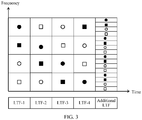
- a solid circle “ ⁇ ” is used to represent a first spatial flow
- a solid square “ ⁇ ” is used to represent a second spatial flow
- a hollow circle “ ⁇ ” is used to represent a third spatial flow
- a hollow square " ⁇ " is used to represent a fourth spatial flow.
- each spatial flow has only 1/L corresponding sub-carriers in one OFDM symbol; therefore, channel estimation of each spatial flow is obtained by means of combination after 1/L corresponding sub-carriers of each of L OFDM symbols: the LTF-1, an LTF-2, ..., and an LTF-L are obtained.
- L 4
- H m ( k ) is the channel estimation of the m th spatial flow
- ⁇ m,n is a set of numbers of all sub-carriers in the LTF-n that belong to the m th spatial flow.
- the operator ⁇ represents obtaining a phase angle of a corresponding complex number.
- a WLAN is a half-duplex system, that is, only receiving or only transmission is supported at a same time, and receiving and transmission cannot be performed simultaneously.
- uplink MU-MIMO when a STA is switched from a receive state, for example, a state of receiving a downlink frame including scheduling control information, to a transmit state, a current consumed by a radio frequency circuit suddenly increases, which causes a frequency fluctuation of a voltage-controlled oscillator (English: Voltage Controlled Oscillator, VCO for short) including a radio frequency carrier.
- a voltage-controlled oscillator English: Voltage Controlled Oscillator, VCO for short
- a CFO fluctuates within a range or ⁇ 1 kilohertz (KHz). After 70 us to 100 us, a fluctuation range drops to 500 hertz (Hz) or below and gradually tends to be stable.
- the training field is a part of a physical-layer packet preamble (English: Preamble), and is located in an area in which a CFO fluctuates relatively much. Moreover, when there are a relatively large quantity of spatial flows, each OFDM symbol in the training field has a relatively obvious phase offset caused by carrier phase noise.
- a CFO of each OFDM symbol changes with respect to different spatial flows, and includes a random phase offset caused by carrier phase noise.
- CFO or phase offset estimation corresponding to another OFDM symbol in the first part of the training field cannot be obtained.
- the embodiments of the present invention provide a signal processing method and apparatus, and a device, which use a structure different from that of a second part of a training field in the prior art.
- sub-carriers of an OFDM symbol in a second part of a training field are divided into N TSSs in a division manner that is the same as a division manner of sub-carriers of an OFDM symbol in a first part of the training field, and each spatial flow corresponds to at least one sub-carrier in a TSS, in each frequency domain location, of the OFDM symbol in the second part of the training field.
- phase correction is effectively performed on channel estimation that is obtained in another OFDM symbol in the first part of the training field, so that precision of the channel estimation is improved, and estimation performance is improved.
- the structure of the second part of the training field is improved.
- FIG. 2 is a schematic structural diagram of Embodiment 1 of a signal processing apparatus in the present invention.
- This embodiment of the present invention provides the signal processing apparatus, applied to an MU-MIMO system.
- the apparatus may be independently disposed, or may be integrated in user equipment.
- the user equipment may be a terminal device such as a mobile phone, a portable computer, a tablet computer, a game console, a television, or a telephone set, or even may be a switch, an electrical appliance, or other hardware in a customer location.
- the signal processing apparatus 20 includes: a signal acquiring module 21 and a sending module 22.
- the signal acquiring module 21 is configured to acquire a signal including N spatial flows, where the signal includes a training field, and the training field includes a first part and a second part, where the first part of the training field includes L OFDM symbols, L ⁇ N, N is a positive integer, sub-carriers of the OFDM symbol in the first part of the training field are divided into N training sub-carrier sets (English: Training Sub-carrier Set, TSS for short), each spatial flow corresponds to one TSS in each OFDM symbol in the first part of the training field, and each spatial flow corresponds to TSSs of different frequency domain locations in different OFDM symbols in the first part of the training field; and the second part of the training field includes M OFDM symbols, sub-carriers of the OFDM symbol in the second part of the training field are divided into N TSSs in a division manner that is the same as a division manner of the sub-carriers of the OFDM symbol in the first part of the training field, and each spatial flow corresponds to at least one sub-carrier in each TSS
- the described "acquire” includes a meaning of "generate”. That is, the signal including at least one spatial flow is generated by the signal acquiring module 21. Generally, a maximum value of N is 8, which is not limited in the present invention.
- Subcarriers of each OFDM symbol in the first part of the training field are divided into N TSSs in a same manner, and each TSS has a different frequency domain location.
- the TSS may be a sub-band constituted by consecutive sub-carriers, or may be a sub-carrier sequence sequentially spaced by N-1 sub-carriers.
- L ⁇ N channel estimation of each spatial flow on corresponding sub-carriers in the L OFDM symbols is acquired, and on this basis, channel estimation of each spatial flow on each sub-carrier may be further obtained by means of interpolation.
- Subcarriers of each OFDM symbol in the second part of the training field are divided into N TSSs in a division manner that is the same as a division manner of the sub-carriers of the OFDM symbol in the first part of the training field.
- Each spatial flow corresponds to at least one sub-carrier in each TSS of the OFDM symbol in the second part of the training field, and each TSS corresponds to at least one OFDM symbol in the second part of the training field.
- the sending module 22 sends the foregoing signal to the receive end.
- the receive end receiving the foregoing signal may obtain, by using the OFDM symbol included in the second part of the training field, a phase correction factor corresponding to the OFDM symbol in the first part of the training field, and phase offset compensation is effectively performed on channel estimation that is obtained in the OFDM symbol in the first part of the training field, to improve precision of the channel estimation and improve estimation performance.
- a process in which the receive end performs channel estimation according to the signal is described in detail in an embodiment of a receive end side.
- sub-carriers of each OFDM symbol in the second part of the training field are divided into N TSSs in a division manner that is the same as a division manner of the sub-carriers of the OFDM symbol in the first part of the training field.
- sub-carriers included in each TSS are divided into different levels of sub-carrier groups. For example, a TSS includes ten sub-carriers whose identifiers are 1, 2, 3, ..., and 10.
- the ten sub-carriers are divided into two first-level sub-carrier groups, a first first-level sub-carrier group includes sub-carriers marked as 1, 2, 3 4, and 5, and a second first-level sub-carrier group includes sub-carriers marked as 6, 7, 8, 9, and 10. Then, the first first-level sub-carrier group is further divided into two second-level sub-carrier groups, a first second-level sub-carrier group includes sub-carriers marked as 1, 2, and 3, and a second second-level sub-carrier group includes sub-carriers marked as 4 and 5.
- the second first-level sub-carrier group is further divided into two second-level sub-carrier groups, a third second-level sub-carrier group includes sub-carriers marked as 6, 7, and 8, a fourth second-level sub-carrier group includes sub-carriers marked as 9 and 10, and so on.
- each TSS includes D levels of sub-carrier groups, where D is a positive integer greater than or equal to 2.
- D is a positive integer greater than or equal to 2.
- a (D-1) th -level sub-carrier group includes at least two D th -level sub-carrier groups, the D th -level sub-carrier group includes at least N sub-carriers, and each spatial flow corresponds to at least one sub-carrier in at least one D th -level sub-carrier group included by each (D-1) th -level sub-carrier group.
- each TSS includes two levels of sub-carrier groups, where each first-level sub-carrier group further includes N second-level sub-carrier groups, and each spatial flow corresponds to at least one sub-carrier in at least one second-level sub-carrier group included by each first-level sub-carrier group.
- each spatial flow corresponds to at least one sub-carrier in at least one second-level sub-carrier group included by each first-level sub-carrier group.
- a value of M is 1, that is, the second part of the training field includes one OFDM symbol, that is, each TSS includes one level of sub-carrier group.
- each TSS includes N sub-carriers groups, and each spatial flow corresponds to at least one sub-carrier in at least one sub-carrier group of each TSS.
- an LTF-1, an LTF-2, an LTF-3, and an LTF-4 are four OFDM symbols included in the first part of the training field in this implementation manner, which is the same as the solution shown in FIG.
- sub-carriers of the additional LTF are divided in a division manner that is the same as a division manner of sub-carriers of the LTF-1, the LTF-2, the LTF-3, and the LTF-4, and an entire frequency band is divided into four TSSs.
- a location difference of the four TSSs lies in a difference in a sub-carrier frequency, and herein, the four TSSs are represented by four rectangular structures.
- the LTF-1, the LTF-2, the LTF-3, and the LTF-4 one TSS of four TSSs corresponds to one spatial flow, and the TSSs sequentially do not overlap with each other.
- Each TSS of the additional LTF is further divided into four sub-carrier groups, each sub-carrier group includes at least one sub-carrier, and each sub-carrier group corresponds to one different spatial flow.
- a value of a quantity N of the spatial flows is 4, and the four spatial flows each correspond to at least one sub-carrier in each TSS of the additional LTF.
- each TSS includes K first-level sub-carrier groups, each first-level sub-carrier group includes N second-level sub-carrier groups, and each spatial flow corresponds to at least one sub-carrier in at least one second-level sub-carrier group of each first-level sub-carrier group, where K is a positive integer.
- Each TSS of the additional LTF includes at least K*N sub-carriers, where K is a positive integer greater than 1. As shown in FIG.
- an LTF-1, an LTF-2, an LTF-3, and an LTF-4 are four OFDM symbols included in the first part of the training field in this implementation manner, which is the same as the solution shown in FIG. 1 , and the additional LTF, that is, the OFDM symbol included in the second part of the training field in this implementation manner, is different from the solution shown in FIG. 1 .
- sub-carriers of the additional LTF are divided in a division manner that is the same as a division manner of sub-carriers of the LTF-1, the LTF-2, the LTF-3, and the LTF-4 in the solution shown in FIG. 1 , and an entire frequency band is divided into four TSSs.
- a location difference of the four TSSs lies in a difference in a frequency range, and herein, the four TSSs are represented by four rectangular structures.
- each TSS of four TSSs corresponds to one spatial flow, and the TSSs sequentially do not overlap with each other.
- Each TSS of the additional LTF includes two first-level sub-carrier groups, each first-level sub-carrier group includes at least four second-level sub-carrier groups, each second-level sub-carrier group includes at least one sub-carrier, and each second-level sub-carrier group corresponds to one different spatial flow. Specifically, as shown in FIG.
- the first-level sub-carrier group includes four second-level sub-carrier groups, and each second-level sub-carrier group corresponds to one different spatial flow.
- a value of a quantity N of the spatial flows is 4, and the four spatial flows each correspond to at least one sub-carrier in each TSS of the additional LTF.
- each TSS is further divided into two sub-carrier groups, each sub-carrier group is further divided into four sub-carrier subgroups, and each sub-carrier subgroup corresponds to one spatial flow.
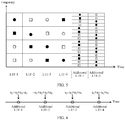
- the value of M is 2, that is, the second part of the training field includes two OFDM symbols, which are separately an additional LTF-1 and an additional LTF-2.
- the two OFDM symbols have same TSS division and same sub-carrier group division, but correspondences between a sub-carrier group and a spatial flow are different.
- Subcarrier groups, whose numbers are 1, 2, 3, and 4 from top to bottom, of one TSS of the additional LTF-1 are in one-to-one correspondence with spatial flows whose numbers are 1, 2, 3, and 4, and sub-carrier groups, whose numbers are 1, 2, 3, and 4 from top to bottom, of one TSS of the additional LTF-2, are in one-to-one correspondence with spatial flows whose numbers are 3, 4, 1, and 2.
- M relatively small
- M is an integer greater than or equal to 2
- TSSs, in a same location, of all OFDM symbols in the second part of the training field constitute one TSS combination
- each TSS combination includes N M sub-carrier arrays
- the sub-carrier array includes M sub-carriers in a time direction and includes at least one sub-carrier in a frequency domain direction. That each spatial flow corresponds to at least one sub-carrier in each TSS of each OFDM symbol in the second part of the training field may be specifically: all the spatial flows are divided into N M groups, where each group includes M spatial flows, and the groups of spatial flows are respectively mapped to the N M sub-carrier arrays of each TSS combination by using an M ⁇ M -dimensional spatial flow mapping matrix P.
- N M is a positive integer
- P is an orthogonal matrix. That is, the TSS of each additional LTF is divided into N M sub-carrier groups, and sub-carrier groups, in a same frequency domain location, of M additional LTFs constitute one sub-carrier array, that is, the sub-carrier array has M sub-carriers in the time direction and has at least one sub-carrier in the frequency domain direction.
- P may be a matrix in the following form:
- M signal components of the signal vector are mapped to each sub-carrier, in a same frequency domain location, of the M additional LTFs.
- the sub-carrier, in the frequency domain location, of each additional LTF carries all M spatial flows of the group of spatial flows.
- each OFDM symbol of the first four OFDM symbols each correspond to one spatial flow, and the TSSs sequentially do not overlap with each other.
- Fifth and sixth OFDM symbols are additional LTFs, which are separately an additional LTF-1 and an additional LTF-2.
- Each TSS of the additional LTF-1 and the additional LTF-2 is further divided into two sub-carrier groups, and sub-carrier groups, in a same frequency domain location, of the two additional LTFs constitute one sub-carrier array, which corresponds to two spatial flows. As shown in FIG.
- TSSs in a same location, of all the OFDM symbols in the second part of the training field constitute one TSS combination
- each TSS combination includes two sub-carrier arrays
- the sub-carrier array includes two sub-carriers in a time direction and includes two sub-carriers in a frequency domain direction.
- All the spatial flows are also divided into two groups, each group includes two spatial flows, and the groups of spatial flows are respectively mapped to the two sub-carrier arrays of each TSS combination by using a 2 ⁇ 2 -dimensional spatial flow mapping matrix P.
- the TSS of each additional LTF is divided into two sub-carrier groups, and sub-carrier groups, in a same frequency domain location, of the two additional LTFs constitute one sub-carrier array, that is, the sub-carrier array has two sub-carriers in the time direction and has at least one sub-carrier in the frequency domain direction.
- M is an integer greater than or equal to 2
- TSSs, in a same location, of all OFDM symbols in the second part of the training field constitute one TSS combination
- each TSS combination includes N M sub-carrier arrays
- the sub-carrier array includes M sub-carriers in a time direction and includes at least one sub-carrier in a frequency domain direction.
- That each spatial flow corresponds to at least one sub-carrier in each TSS of each OFDM symbol in the second part of the training field may be specifically: all the spatial flows are divided into N M groups, where each group includes M spatial flows, and the M spatial flows each correspond to at least one sub-carrier in at least one sub-carrier array of each TSS combination.
- a value of N M is a positive integer.
- the TSS of each additional LTF is divided into N M sub-carrier groups, and sub-carrier groups, in a same frequency domain location, of the M additional LTFs constitute one sub-carrier array, that is, the sub-carrier array has M sub-carriers in the time direction and has at least one sub-carrier in the frequency domain direction.
- each OFDM symbol of previous four OFDM symbols corresponds to one spatial flow, and the TSSs sequentially do not overlap with each other.
- Fifth and sixth OFDM symbols are additional LTFs, which are separately an additional LTF-1 and an additional LTF-2.
- Each TSS of the additional LTF-1 and the additional LTF-2 is further divided into two sub-carrier groups, where two sub-carrier groups of the additional LTF-1 correspond to spatial flows whose numbers are 1 and 2, and two sub-carrier groups of the additional LTF-2 correspond to spatial flows whose numbers are 3 and 4.
- TSSs in a same location, of all the OFDM symbols in the second part of the training field constitute one TSS combination
- each TSS combination includes two sub-carrier arrays
- the sub-carrier array includes two sub-carriers in a time direction and includes at least one sub-carrier in a frequency domain direction.
- All the spatial flows are also divided into two groups, each group includes two spatial flows, and the two spatial flows each correspond to at least one sub-carrier in at least one sub-carrier array of each TSS combination.
- the TSS of each additional LTF is divided into two sub-carrier groups, and sub-carrier groups, in a same frequency domain location, of the two additional LTFs constitute one sub-carrier array, that is, the sub-carrier array has two sub-carriers in the time direction and has at least one sub-carrier in the frequency domain direction.
- An embodiment of the present invention further provides user equipment, applied to an MU-MIMO system.
- the user equipment includes the apparatus shown in FIG. 2 .
- the user equipment may be a terminal device such as a mobile phone, a portable computer, a tablet computer, a game console, a television, or a telephone set, or even may be a switch, an electrical appliance, or other hardware in a customer location.
- FIG. 9 is a schematic structural diagram of Embodiment 2 of a signal processing apparatus in the present invention.
- This embodiment of the present invention provides the signal processing apparatus, applied to an MU-MIMO system.
- the apparatus may be independently disposed, or may be integrated in a wireless access point or an access point device such as a wireless router, where the wireless router may include a wireless gateway, a wireless bridge, or the like.
- the signal processing apparatus 90 includes: a receiving module 91, an acquiring module 92, and a correction module 93.
- the receiving module 91 is configured to receive a signal including N spatial flows, where the signal includes a training field, and the training field includes a first part and a second part, where the first part of the training field includes L OFDM symbols, L ⁇ N, N is a positive integer, sub-carriers of the OFDM symbol in the first part of the training field are divided into N training sub-carrier sets (English: Training Sub-carrier Set, TSS for short), each spatial flow corresponds to one TSS in each OFDM symbol in the first part of the training field, and each spatial flow corresponds to TSSs of different frequency domain locations in different OFDM symbols in the first part of the training field; and the second part of the training field includes M OFDM symbols, sub-carriers of the OFDM symbol in the second part of the training field are divided into N TSSs in a division manner that is the same as a division manner of the sub-carriers of the OFDM symbol in the first part of the training field, and each spatial flow corresponds to at least one sub-carrier in each TSS of
- the acquiring module 92 is configured to obtain, for each spatial flow in the signal received by the receiving module 91, a phase correction factor corresponding to the spatial flow.
- the correction module 93 is configured to perform phase correction on channel estimation of the spatial flow by using the phase correction factor acquired by the acquiring module 92, to obtain channel estimation of each spatial flow after the phase correction.
- the signal processing apparatus 90 is disposed in correspondence with the signal processing apparatus 20 shown in FIG. 2 , where the signal processing apparatus 20 is a signal sending end, and the signal processing apparatus 90 is a signal receiving end.
- the signal processing apparatus 90 receives a signal sent by the signal processing apparatus 20; therefore, the signal in this embodiment is the same as the signal sent by the foregoing signal sending end.
- phase correction factor corresponding to the OFDM symbol in the first part of the training field is obtained, and phase correction is effectively performed on channel estimation that is obtained in the OFDM symbol in the first part of the training field, to improve precision of the channel estimation and improve estimation performance.
- the signal is described briefly herein, and for detailed descriptions, refer to the signal sending end.
- each TSS includes D levels of sub-carrier groups, where D is a positive integer greater than or equal to 2; and a (D-1) th -level sub-carrier group includes at least two D th -level sub-carrier groups, the D th -level sub-carrier group includes at least N sub-carriers, and each spatial flow corresponds to at least one sub-carrier in at least one D th -level sub-carrier group included by each (D-1) th -level sub-carrier group.
- correspondences between a sub-carrier group and a spatial flow are the same or different. For example, in a structure of a training sequence included in a signal shown in FIG. 5 , for two OFDM symbols: an additional LTF-1 and an additional LTF-2, correspondences between a sub-carrier group and a spatial flow are different.
- each TSS includes N sub-carrier groups, and each spatial flow corresponds to at least one sub-carrier in at least one sub-carrier group of each TSS.
- each TSS includes K first-level sub-carrier groups, each first-level sub-carrier group includes N second-level sub-carrier groups, and each spatial flow corresponds to at least one sub-carrier in at least one second-level sub-carrier group of each first-level sub-carrier group, where K is a positive integer.
- M is an integer greater than or equal to 2
- TSSs, in a same location, of all OFDM symbols in the second part of the training field constitute one TSS combination
- each TSS combination includes N M sub-carrier arrays
- the sub-carrier array includes M sub-carriers in a time direction and includes at least one sub-carrier in a frequency domain direction.
- That each spatial flow corresponds to at least one sub-carrier in each TSS of each OFDM symbol in the second part of the training field may be specifically: all the spatial flows are divided into N M groups, where each group includes M spatial flows, and the groups of spatial flows are respectively mapped to the N M sub-carrier arrays of each TSS combination by using an M ⁇ M -dimensional spatial flow mapping matrix P.
- a value of N M is a positive integer
- P is an orthogonal matrix.
- M is an integer greater than or equal to 2
- TSSs, in a same location, of all OFDM symbols in the second part of the training field constitute one TSS combination
- each TSS combination includes N M sub-carrier arrays
- the sub-carrier array includes M sub-carriers in a time direction and includes at least one sub-carrier in a frequency domain direction.
- That each spatial flow corresponds to at least one sub-carrier in each TSS of each OFDM symbol in the second part of the training field may be specifically: all the spatial flows are divided into N M groups, where each group includes M spatial flows, and the M spatial flows each correspond to at least one sub-carrier in at least one sub-carrier array of each TSS combination.
- a value of N M is a positive integer.
- ⁇ ⁇ m,n represents a phase correction factor, corresponding to an m th spatial flow, of an n th OFDM symbol in the first part of the training field
- H m,n ( k ) is first channel estimation, obtained by using the n th OFDM symbol in the first part of the training field, of the m th spatial flow
- H m,L +1 ( k ) is second channel estimation, obtained by using the second part of the training field, of the m th spatial flow
- ⁇ m,n is a set of numbers of sub-carriers in a sub-carrier group that corresponds to the m th spatial flow and that is in a TSS or TSS combination in a corresponding location in the second part of the training field, where the TSS or TSS combination in the corresponding location is a TSS or TSS combination that is the same as a TSS that corresponds to the m th spatial flow and that is in the n th OFDM symbol in the first part of
- each spatial flow corresponds to only 1/N sub-carriers in one OFDM symbol; therefore, channel estimation of each spatial flow is obtained by means of combination after 1/N corresponding sub-carriers of each of L OFDM symbols: the LTF-1, an LTF-2, ..., and an LTF-L are obtained.
- phase correction may be performed on L pieces of channel estimation of each spatial flow that are obtained in each TSS of the LTF-1, LTF-2, ..., and LTF-L, and the L pieces of channel estimation of each spatial flow are combined to obtain channel estimation, on all sub-carriers, of each spatial flow after the phase correction.
- a phase correction operation may be effectively performed on L pieces of channel estimation, having different phases, of each spatial flow that are obtained in each of L OFDM symbols in a first part of the training field, so that the pieces of channel estimation of each spatial flow have a same phase. Because neither a CFO nor phase noise needs to be estimated, the pieces of channel estimation of each spatial flow are not affected by CFO fluctuation and the phase noise.
- An embodiment of the present invention further provides an access point device, applied to an MU-MIMO system, and including the apparatus shown in FIG. 9 .
- the access point device may be a wireless access point, a wireless router, or the like, where the wireless router may include a wireless gateway, a wireless bridge, or the like.
- FIG. 10 is a flowchart of Embodiment 1 of a signal processing method in the present invention.
- This embodiment of the present invention provides the signal processing apparatus, applied to an MU-MIMO system.
- the method may be executed by a signal processing apparatus, and the apparatus may be independently disposed, or may be integrated in user equipment.
- the user equipment may be a terminal device such as a mobile phone, a portable computer, a tablet computer, a game console, a television, or a telephone set, or even may be a switch, an electrical appliance, or other hardware in a customer location.
- the signal processing method includes:
- the signal includes a training field, and the training field includes a first part and a second part, where the first part of the training field includes L OFDM symbols, L ⁇ N, N is a positive integer, sub-carriers of the OFDM symbol in the first part of the training field are divided into N TSSs, each spatial flow corresponds to one TSS in each OFDM symbol in the first part of the training field, and each spatial flow corresponds to TSSs of different frequency domain locations in different OFDM symbols in the first part of the training field; and the second part of the training field includes M OFDM symbols, sub-carriers of the OFDM symbol in the second part of the training field are divided into N TSSs in a division manner that is the same as a division manner of the sub-carriers of the OFDM symbol in the first part of the training field, and each spatial flow corresponds to at least one sub-carrier in each TSS of the OFDM symbol in the second part of the training field.
- the first part of the training field includes L OFDM symbols, L ⁇ N, N is
- S102 Send the signal to a receive end.
- the signal in this embodiment is the same as the signal in the foregoing embodiments, and details are not described herein again. For detailed descriptions, refer to any one of the foregoing apparatus embodiments.
- the method in this embodiment may be executed by the apparatus embodiment shown in FIG. 2 , and implementation principles and technical solutions thereof are similar, which are not described in detail herein again.
- each TSS includes D levels of sub-carrier groups, where D is a positive integer greater than or equal to 2; and a (D-1) th -level sub-carrier group includes at least two D th -level sub-carrier groups, the D th -level sub-carrier group includes at least N sub-carriers, and each spatial flow corresponds to at least one sub-carrier in at least one D th -level sub-carrier group included by each (D-1) th -level sub-carrier group.
- each TSS in the OFDM symbol in the second part of the training field, includes N sub-carrier groups, and each spatial flow corresponds to at least one sub-carrier in at least one sub-carrier group of each TSS.
- a value of M is 1; a value of D is 2; and in the OFDM symbol in the second part of the training field, each TSS includes K first-level sub-carrier groups, each first-level sub-carrier group includes N second-level sub-carrier groups, and each spatial flow corresponds to at least one sub-carrier in at least one second-level sub-carrier group of each first-level sub-carrier group, where K is a positive integer.
- M is an integer greater than or equal to 2
- TSSs, in a same location, of all OFDM symbols in the second part of the training field constitute one TSS combination
- each TSS combination includes N M sub-carrier arrays
- the sub-carrier array includes M sub-carriers in a time direction and includes at least one sub-carrier in a frequency domain direction.
- That each spatial flow corresponds to at least one sub-carrier in each TSS of each OFDM symbol in the second part of the training field may include: all the spatial flows are divided into N M groups, where each group includes M spatial flows, and the groups of spatial flows are respectively mapped to the N M sub-carrier arrays of each TSS combination by using an M ⁇ M -dimensional spatial flow mapping matrix P.
- M is an integer greater than or equal to 2
- TSSs, in a same location, of all OFDM symbols in the second part of the training field constitute one TSS combination
- each TSS combination includes N M sub-carrier arrays
- phase correction factor corresponding to an OFDM symbol in a first part of the training field is obtained, and phase correction is effectively performed on channel estimation that is obtained in the OFDM symbol in the first part of the training field, to improve precision of the channel estimation and improve estimation performance.
- FIG. 11 is a flowchart of Embodiment 2 of a signal processing method in the present invention.
- This embodiment of the present invention provides the signal processing method, applied to an MU-MIMO system.
- the method may be executed by a signal processing apparatus.
- the apparatus may be independently disposed, or may be integrated in a wireless access point or an access point device such as a wireless router, where the wireless router may include a wireless gateway, a wireless bridge, or the like.
- the signal processing method includes:
- the signal includes a training field
- the training field includes a first part and a second part
- the first part of the training field includes L OFDM symbols, L ⁇ N, N is a positive integer
- sub-carriers of the OFDM symbol in the first part of the training field are divided into N TSSs
- each spatial flow corresponds to one TSS in each OFDM symbol in the first part of the training field
- each spatial flow corresponds to TSSs of different frequency domain locations in different OFDM symbols in the first part of the training field
- the second part of the training field includes M OFDM symbols
- sub-carriers of the OFDM symbol in the second part of the training field are divided into N TSSs in a division manner that is the same as a division manner of the sub-carriers of the OFDM symbol in the first part of the training field
- each spatial flow corresponds to at least one sub-carrier in each TSS of the OFDM symbol in the second part of the training field.
- S120 Obtain, for each spatial flow, a phase correction factor corresponding to the spatial flow.
- S130 Perform, by using the foregoing phase correction factor, phase correction on channel estimation of the spatial flow corresponding to the phase correction factor, to obtain channel estimation of each spatial flow after the phase correction.
- the signal in this embodiment is the same as the signal in the foregoing embodiments, and details are not described herein again. For detailed descriptions, refer to any one of the foregoing apparatus embodiments.
- the method in this embodiment may be executed by the apparatus embodiment shown in FIG. 9 , and implementation principles and technical solutions thereof are similar, which are not described in detail herein again.
- each TSS includes D levels of sub-carrier groups, where D is a positive integer greater than or equal to 2; and a (D-1) th -level sub-carrier group includes at least two D th -level sub-carrier groups, the D th -level sub-carrier group includes at least N sub-carriers, and each spatial flow corresponds to at least one sub-carrier in at least one D th -level sub-carrier group included by each (D-1) th -level sub-carrier group.
- each TSS in the OFDM symbol in the second part of the training field, includes N sub-carrier groups, and each spatial flow corresponds to at least one sub-carrier in at least one sub-carrier group of each TSS.
- a value of M is 1; a value of D is 2; and in the OFDM symbol in the second part of the training field, each TSS includes K first-level sub-carrier groups, each first-level sub-carrier group includes N second-level sub-carrier groups, and each spatial flow corresponds to at least one sub-carrier in at least one second-level sub-carrier group of each first-level sub-carrier group, where K is a positive integer.
- M is an integer greater than or equal to 2
- TSSs, in a same location, of all OFDM symbols in the second part of the training field constitute one TSS combination
- each TSS combination includes N M sub-carrier arrays
- the sub-carrier array includes M sub-carriers in a time direction and includes at least one sub-carrier in a frequency domain direction.
- That each spatial flow corresponds to at least one sub-carrier in each TSS of each OFDM symbol in the second part of the training field may include: all the spatial flows are divided into N M groups, where each group includes M spatial flows, and the groups of spatial flows are respectively mapped to the N M sub-carrier arrays of each TSS combination by using an M ⁇ M -dimensional spatial flow mapping matrix P.
- M is an integer greater than or equal to 2
- TSSs, in a same location, of all OFDM symbols in the second part of the training field constitute one TSS combination
- each TSS combination includes N M sub-carrier arrays
- the sub-carrier array includes M sub-carriers in a time direction and includes at least one sub-carrier in a frequency domain direction.
- That each spatial flow corresponds to at least one sub-carrier in each TSS of each OFDM symbol in the second part of the training field may include: all the spatial flows are divided into N M groups, where each group includes M spatial flows, and the M spatial flows each correspond to at least one sub-carrier in at least one sub-carrier array of each TSS combination.
- ⁇ ⁇ m,n represents a phase correction factor, corresponding to an m th spatial flow, of an n th OFDM symbol in the first part of the training field;
- H m,n ( k ) is first channel estimation, obtained by using the n th OFDM symbol in the first part of the training field, of the m th spatial flow;
- H m , L +1 ( k ) is second channel estimation, obtained by using the second part of the training field, of the m th spatial flow;
- ⁇ m,n is a set of numbers of sub-carriers in a sub-carrier group that corresponds to the m th spatial flow and that is in a TSS or TSS combination in a corresponding location in the second part of the training field, where the TSS or TSS combination in the corresponding location is a TSS or TSS combination that is the same as a TSS that corresponds to the m th spatial flow and that is in the n th OFDM symbol in the first part
- phase correction factor corresponding to an OFDM symbol in a first part of the training field is obtained, and phase correction is effectively performed on channel estimation that is obtained in the OFDM symbol in the first part of the training field, to improve precision of the channel estimation and improve estimation performance.
- An embodiment of the present invention provides a signal, where the signal is a signal including N spatial flows, the signal includes a training field, and the training field includes a first part and a second part, where the first part of the training field includes L OFDM symbols, L ⁇ N, N is a positive integer, sub-carriers of the OFDM symbol in the first part of the training field are divided into N TSSs, each spatial flow corresponds to one TSS in each OFDM symbol in the first part of the training field, and each spatial flow corresponds to TSSs of different frequency domain locations in different OFDM symbols in the first part of the training field; and the second part of the training field includes M OFDM symbols, sub-carriers of the OFDM symbol in the second part of the training field are divided into N TSSs in a division manner that is the same as a division manner of the sub-carriers of the OFDM symbol in the first part of the training field, and each spatial flow corresponds to at least one sub-carrier in each TSS of the OFDM symbol in the second part of the training field
- each TSS includes D levels of sub-carrier groups, where D is a positive integer greater than or equal to 2; and a (D-1) th -Ievel sub-carrier group includes at least two D th -level sub-carrier groups, the D th -level sub-carrier group includes at least N sub-carriers, and each spatial flow corresponds to at least one sub-carrier in at least one D th -level sub-carrier group included by each (D-1) th -level sub-carrier group.
- each TSS includes N sub-carrier groups, and each spatial flow corresponds to at least one sub-carrier in at least one sub-carrier group of each TSS.
- each spatial flow corresponds to at least one sub-carrier in at least one sub-carrier group of each TSS.
- a value of M is 1; a value of D is 2; and in the OFDM symbol in the second part of the training field, each TSS includes K first-level sub-carrier groups, each first-level sub-carrier group includes N second-level sub-carrier groups, and each spatial flow corresponds to at least one sub-carrier in at least one second-level sub-carrier group of each first-level sub-carrier group, where K is a positive integer.
- K is a positive integer.
- M is an integer greater than or equal to 2
- TSSs, in a same location, of all OFDM symbols in the second part of the training field constitute one TSS combination
- each TSS combination includes N M sub-carrier arrays
- the sub-carrier array includes M sub-carriers in a time direction and includes at least one sub-carrier in a frequency domain direction.
- That each spatial flow corresponds to at least one sub-carrier in each TSS of each OFDM symbol in the second part of the training field may be specifically: all the spatial flows are divided into N M groups, where each group includes M spatial flows, and the groups of spatial flows are respectively mapped to the N M sub-carrier arrays of each TSS combination by using an M ⁇ M -dimensional spatial flow mapping matrix P.
- M is an integer greater than or equal to 2
- TSSs, in a same location, of all OFDM symbols in the second part of the training field constitute one TSS combination
- each TSS combination includes N M sub-carrier arrays
- the sub-carrier array includes
- M is an integer greater than or equal to 2
- TSSs, in a same location, of all OFDM symbols in the second part of the training field constitute one TSS combination
- each TSS combination includes N M sub-carrier arrays
- the sub-carrier array includes M sub-carriers in a time direction and includes at least one sub-carrier in a frequency domain direction.
- That each spatial flow corresponds to at least one sub-carrier in each TSS of each OFDM symbol in the second part of the training field includes: all the spatial flows are divided into N M groups, where each group includes M spatial flows, and the M spatial flows each correspond to at least one sub-carrier in at least one sub-carrier array of each TSS combination.
- FIG. 8 refer to a structure shown in FIG. 8 .
- the value of M is a positive integer greater than 1, for OFDM symbols in the second part of the training field, correspondences between a sub-carrier group and a spatial flow are the same or different. Specifically, if the correspondences are the same, it may be understood that structures of the OFDM symbols in the second part of the training field are the same, for example, the structures shown in FIG. 3 or FIG. 4 ; or if the correspondences are different, refer to FIG. 5 .
- the program may be stored in a computer-readable storage medium.
- the foregoing storage medium includes: any medium that can store program code, such as a ROM, a RAM, a magnetic disk, or an optical disc.
Landscapes
- Engineering & Computer Science (AREA)
- Computer Networks & Wireless Communication (AREA)
- Signal Processing (AREA)
- Power Engineering (AREA)
- Radio Transmission System (AREA)
- Mobile Radio Communication Systems (AREA)
Applications Claiming Priority (1)
| Application Number | Priority Date | Filing Date | Title |
|---|---|---|---|
| PCT/CN2014/089133 WO2016061750A1 (fr) | 2014-10-22 | 2014-10-22 | Procédé, appareil et dispositif de traitement de signal |
Publications (3)
| Publication Number | Publication Date |
|---|---|
| EP3200413A1 true EP3200413A1 (fr) | 2017-08-02 |
| EP3200413A4 EP3200413A4 (fr) | 2017-10-18 |
| EP3200413B1 EP3200413B1 (fr) | 2020-09-16 |
Family
ID=55760042
Family Applications (1)
| Application Number | Title | Priority Date | Filing Date |
|---|---|---|---|
| EP14904602.1A Active EP3200413B1 (fr) | 2014-10-22 | 2014-10-22 | Procédé, appareil et dispositif de traitement de signal |
Country Status (4)
| Country | Link |
|---|---|
| US (1) | US10326628B2 (fr) |
| EP (1) | EP3200413B1 (fr) |
| CN (1) | CN106416164B (fr) |
| WO (1) | WO2016061750A1 (fr) |
Families Citing this family (4)
| Publication number | Priority date | Publication date | Assignee | Title |
|---|---|---|---|---|
| WO2016061750A1 (fr) * | 2014-10-22 | 2016-04-28 | 华为技术有限公司 | Procédé, appareil et dispositif de traitement de signal |
| CN109391578B (zh) * | 2017-08-11 | 2022-07-22 | 华为技术有限公司 | 信号发送方法、信号接收方法、终端设备及网络设备 |
| US10298299B1 (en) * | 2018-05-31 | 2019-05-21 | Quantenna Communications, Inc. | Transmutable MIMO wireless transceiver |
| EP3959826A1 (fr) * | 2019-04-23 | 2022-03-02 | Sony Group Corporation | Dispositifs et procédés de communication |
Family Cites Families (4)
| Publication number | Priority date | Publication date | Assignee | Title |
|---|---|---|---|---|
| KR101576407B1 (ko) * | 2011-11-18 | 2015-12-09 | 엘지전자 주식회사 | 무선랜 시스템에서 데이터 유닛을 전송하는 방법 및 이를 지원하는 장치 |
| US9088504B2 (en) * | 2012-01-06 | 2015-07-21 | Qualcomm Incorporated | Systems and methods for wireless communication of long data units |
| US9397805B2 (en) * | 2013-04-15 | 2016-07-19 | Qualcomm Incorporated | Systems and methods for backwards-compatible preamble formats for multiple access wireless communication |
| WO2016061750A1 (fr) * | 2014-10-22 | 2016-04-28 | 华为技术有限公司 | Procédé, appareil et dispositif de traitement de signal |
-
2014
- 2014-10-22 WO PCT/CN2014/089133 patent/WO2016061750A1/fr not_active Ceased
- 2014-10-22 EP EP14904602.1A patent/EP3200413B1/fr active Active
- 2014-10-22 CN CN201480073642.2A patent/CN106416164B/zh active Active
-
2017
- 2017-04-21 US US15/493,675 patent/US10326628B2/en active Active
Also Published As
| Publication number | Publication date |
|---|---|
| EP3200413A4 (fr) | 2017-10-18 |
| EP3200413B1 (fr) | 2020-09-16 |
| US10326628B2 (en) | 2019-06-18 |
| WO2016061750A1 (fr) | 2016-04-28 |
| CN106416164A (zh) | 2017-02-15 |
| US20170222855A1 (en) | 2017-08-03 |
| CN106416164B (zh) | 2018-10-12 |
Similar Documents
| Publication | Publication Date | Title |
|---|---|---|
| US11082172B2 (en) | Methods and apparatus for multi-carrier communications with variable channel bandwidth | |
| EP3393069B1 (fr) | Procédé et dispositif sans fil permettant de transmettre un préambule d'accès aléatoire au moyen d'un procédé à tonalité unique | |
| US20220109593A1 (en) | System and scheme of scalable ofdm numerology | |
| KR101496896B1 (ko) | 대역 확장성을 지원하는 셀룰러 무선통신시스템에서 보호대역이 구성된 하향링크 신호의 송수신 방법 및 장치 | |
| EP4033673B1 (fr) | Émission et réception de pilotes pour accès multiple par répartition orthogonale de la fréquence | |
| US10517093B2 (en) | Frequency location indexing for a wideband component carrier | |
| JP2021503224A (ja) | 位相トラッキング参照信号送信 | |
| EP3210354B1 (fr) | Conceptions de wlan pour la prise en charge d'un canal de propagation en extérieur | |
| EP3863351A1 (fr) | Système de communications ofdm doté d'un procédé de détermination de décalage de sous-porteuse pour génération de symbole ofdm | |
| CN105027524A (zh) | 在使用波束成形的无线通信系统中发送和接收上行链路随机接入信道时隙的方法和装置 | |
| JP2010539780A (ja) | パイロットサブキャリア割当てを用いる無線通信システム | |
| US10230511B2 (en) | Pilot signal transmission method and apparatus | |
| US10326628B2 (en) | Signal processing method and apparatus, and device | |
| EP3675445A1 (fr) | Procédé et appareil de transmission d'unité de données de protocole de couche physique | |
| EP3188392A1 (fr) | Procédé de transmission de données, procédé et dispositif d'estimation de canal | |
| WO2018013596A1 (fr) | Système et procédé de confirmation de commutation de faisceau | |
| EP3742636A1 (fr) | Procédé et dispositif de transmission de signaux de référence | |
| EP3447981A1 (fr) | Procédé et dispositif de traitement de données | |
| US9225414B2 (en) | Transmission device and method using space-frequency transmission diversity | |
| US12245271B2 (en) | Random access preamble for non-terrestrial network |
Legal Events
| Date | Code | Title | Description |
|---|---|---|---|
| STAA | Information on the status of an ep patent application or granted ep patent |
Free format text: STATUS: THE INTERNATIONAL PUBLICATION HAS BEEN MADE |
|
| PUAI | Public reference made under article 153(3) epc to a published international application that has entered the european phase |
Free format text: ORIGINAL CODE: 0009012 |
|
| STAA | Information on the status of an ep patent application or granted ep patent |
Free format text: STATUS: REQUEST FOR EXAMINATION WAS MADE |
|
| 17P | Request for examination filed |
Effective date: 20170425 |
|
| AK | Designated contracting states |
Kind code of ref document: A1 Designated state(s): AL AT BE BG CH CY CZ DE DK EE ES FI FR GB GR HR HU IE IS IT LI LT LU LV MC MK MT NL NO PL PT RO RS SE SI SK SM TR |
|
| AX | Request for extension of the european patent |
Extension state: BA ME |
|
| A4 | Supplementary search report drawn up and despatched |
Effective date: 20170918 |
|
| RIC1 | Information provided on ipc code assigned before grant |
Ipc: H04L 27/26 20060101AFI20170912BHEP |
|
| DAX | Request for extension of the european patent (deleted) | ||
| GRAP | Despatch of communication of intention to grant a patent |
Free format text: ORIGINAL CODE: EPIDOSNIGR1 |
|
| STAA | Information on the status of an ep patent application or granted ep patent |
Free format text: STATUS: GRANT OF PATENT IS INTENDED |
|
| INTG | Intention to grant announced |
Effective date: 20200525 |
|
| GRAS | Grant fee paid |
Free format text: ORIGINAL CODE: EPIDOSNIGR3 |
|
| GRAA | (expected) grant |
Free format text: ORIGINAL CODE: 0009210 |
|
| STAA | Information on the status of an ep patent application or granted ep patent |
Free format text: STATUS: THE PATENT HAS BEEN GRANTED |
|
| AK | Designated contracting states |
Kind code of ref document: B1 Designated state(s): AL AT BE BG CH CY CZ DE DK EE ES FI FR GB GR HR HU IE IS IT LI LT LU LV MC MK MT NL NO PL PT RO RS SE SI SK SM TR |
|
| REG | Reference to a national code |
Ref country code: GB Ref legal event code: FG4D |
|
| REG | Reference to a national code |
Ref country code: CH Ref legal event code: EP |
|
| REG | Reference to a national code |
Ref country code: DE Ref legal event code: R096 Ref document number: 602014070362 Country of ref document: DE |
|
| REG | Reference to a national code |
Ref country code: IE Ref legal event code: FG4D |
|
| REG | Reference to a national code |
Ref country code: AT Ref legal event code: REF Ref document number: 1315168 Country of ref document: AT Kind code of ref document: T Effective date: 20201015 |
|
| PG25 | Lapsed in a contracting state [announced via postgrant information from national office to epo] |
Ref country code: FI Free format text: LAPSE BECAUSE OF FAILURE TO SUBMIT A TRANSLATION OF THE DESCRIPTION OR TO PAY THE FEE WITHIN THE PRESCRIBED TIME-LIMIT Effective date: 20200916 Ref country code: NO Free format text: LAPSE BECAUSE OF FAILURE TO SUBMIT A TRANSLATION OF THE DESCRIPTION OR TO PAY THE FEE WITHIN THE PRESCRIBED TIME-LIMIT Effective date: 20201216 Ref country code: GR Free format text: LAPSE BECAUSE OF FAILURE TO SUBMIT A TRANSLATION OF THE DESCRIPTION OR TO PAY THE FEE WITHIN THE PRESCRIBED TIME-LIMIT Effective date: 20201217 Ref country code: BG Free format text: LAPSE BECAUSE OF FAILURE TO SUBMIT A TRANSLATION OF THE DESCRIPTION OR TO PAY THE FEE WITHIN THE PRESCRIBED TIME-LIMIT Effective date: 20201216 Ref country code: SE Free format text: LAPSE BECAUSE OF FAILURE TO SUBMIT A TRANSLATION OF THE DESCRIPTION OR TO PAY THE FEE WITHIN THE PRESCRIBED TIME-LIMIT Effective date: 20200916 Ref country code: HR Free format text: LAPSE BECAUSE OF FAILURE TO SUBMIT A TRANSLATION OF THE DESCRIPTION OR TO PAY THE FEE WITHIN THE PRESCRIBED TIME-LIMIT Effective date: 20200916 |
|
| REG | Reference to a national code |
Ref country code: AT Ref legal event code: MK05 Ref document number: 1315168 Country of ref document: AT Kind code of ref document: T Effective date: 20200916 |
|
| REG | Reference to a national code |
Ref country code: NL Ref legal event code: MP Effective date: 20200916 |
|
| PG25 | Lapsed in a contracting state [announced via postgrant information from national office to epo] |
Ref country code: LV Free format text: LAPSE BECAUSE OF FAILURE TO SUBMIT A TRANSLATION OF THE DESCRIPTION OR TO PAY THE FEE WITHIN THE PRESCRIBED TIME-LIMIT Effective date: 20200916 Ref country code: RS Free format text: LAPSE BECAUSE OF FAILURE TO SUBMIT A TRANSLATION OF THE DESCRIPTION OR TO PAY THE FEE WITHIN THE PRESCRIBED TIME-LIMIT Effective date: 20200916 |
|
| REG | Reference to a national code |
Ref country code: LT Ref legal event code: MG4D |
|
| PG25 | Lapsed in a contracting state [announced via postgrant information from national office to epo] |
Ref country code: SM Free format text: LAPSE BECAUSE OF FAILURE TO SUBMIT A TRANSLATION OF THE DESCRIPTION OR TO PAY THE FEE WITHIN THE PRESCRIBED TIME-LIMIT Effective date: 20200916 Ref country code: RO Free format text: LAPSE BECAUSE OF FAILURE TO SUBMIT A TRANSLATION OF THE DESCRIPTION OR TO PAY THE FEE WITHIN THE PRESCRIBED TIME-LIMIT Effective date: 20200916 Ref country code: EE Free format text: LAPSE BECAUSE OF FAILURE TO SUBMIT A TRANSLATION OF THE DESCRIPTION OR TO PAY THE FEE WITHIN THE PRESCRIBED TIME-LIMIT Effective date: 20200916 Ref country code: PT Free format text: LAPSE BECAUSE OF FAILURE TO SUBMIT A TRANSLATION OF THE DESCRIPTION OR TO PAY THE FEE WITHIN THE PRESCRIBED TIME-LIMIT Effective date: 20210118 Ref country code: LT Free format text: LAPSE BECAUSE OF FAILURE TO SUBMIT A TRANSLATION OF THE DESCRIPTION OR TO PAY THE FEE WITHIN THE PRESCRIBED TIME-LIMIT Effective date: 20200916 Ref country code: CZ Free format text: LAPSE BECAUSE OF FAILURE TO SUBMIT A TRANSLATION OF THE DESCRIPTION OR TO PAY THE FEE WITHIN THE PRESCRIBED TIME-LIMIT Effective date: 20200916 |
|
| PG25 | Lapsed in a contracting state [announced via postgrant information from national office to epo] |
Ref country code: ES Free format text: LAPSE BECAUSE OF FAILURE TO SUBMIT A TRANSLATION OF THE DESCRIPTION OR TO PAY THE FEE WITHIN THE PRESCRIBED TIME-LIMIT Effective date: 20200916 Ref country code: AL Free format text: LAPSE BECAUSE OF FAILURE TO SUBMIT A TRANSLATION OF THE DESCRIPTION OR TO PAY THE FEE WITHIN THE PRESCRIBED TIME-LIMIT Effective date: 20200916 Ref country code: AT Free format text: LAPSE BECAUSE OF FAILURE TO SUBMIT A TRANSLATION OF THE DESCRIPTION OR TO PAY THE FEE WITHIN THE PRESCRIBED TIME-LIMIT Effective date: 20200916 Ref country code: IS Free format text: LAPSE BECAUSE OF FAILURE TO SUBMIT A TRANSLATION OF THE DESCRIPTION OR TO PAY THE FEE WITHIN THE PRESCRIBED TIME-LIMIT Effective date: 20210116 Ref country code: PL Free format text: LAPSE BECAUSE OF FAILURE TO SUBMIT A TRANSLATION OF THE DESCRIPTION OR TO PAY THE FEE WITHIN THE PRESCRIBED TIME-LIMIT Effective date: 20200916 |
|
| REG | Reference to a national code |
Ref country code: CH Ref legal event code: PL |
|
| REG | Reference to a national code |
Ref country code: DE Ref legal event code: R097 Ref document number: 602014070362 Country of ref document: DE |
|
| PG25 | Lapsed in a contracting state [announced via postgrant information from national office to epo] |
Ref country code: LU Free format text: LAPSE BECAUSE OF NON-PAYMENT OF DUE FEES Effective date: 20201022 Ref country code: MC Free format text: LAPSE BECAUSE OF FAILURE TO SUBMIT A TRANSLATION OF THE DESCRIPTION OR TO PAY THE FEE WITHIN THE PRESCRIBED TIME-LIMIT Effective date: 20200916 Ref country code: SK Free format text: LAPSE BECAUSE OF FAILURE TO SUBMIT A TRANSLATION OF THE DESCRIPTION OR TO PAY THE FEE WITHIN THE PRESCRIBED TIME-LIMIT Effective date: 20200916 |
|
| REG | Reference to a national code |
Ref country code: BE Ref legal event code: MM Effective date: 20201031 |
|
| PLBE | No opposition filed within time limit |
Free format text: ORIGINAL CODE: 0009261 |
|
| STAA | Information on the status of an ep patent application or granted ep patent |
Free format text: STATUS: NO OPPOSITION FILED WITHIN TIME LIMIT |
|
| 26N | No opposition filed |
Effective date: 20210617 |
|
| GBPC | Gb: european patent ceased through non-payment of renewal fee |
Effective date: 20201216 |
|
| PG25 | Lapsed in a contracting state [announced via postgrant information from national office to epo] |
Ref country code: BE Free format text: LAPSE BECAUSE OF NON-PAYMENT OF DUE FEES Effective date: 20201031 Ref country code: DK Free format text: LAPSE BECAUSE OF FAILURE TO SUBMIT A TRANSLATION OF THE DESCRIPTION OR TO PAY THE FEE WITHIN THE PRESCRIBED TIME-LIMIT Effective date: 20200916 Ref country code: CH Free format text: LAPSE BECAUSE OF NON-PAYMENT OF DUE FEES Effective date: 20201031 Ref country code: SI Free format text: LAPSE BECAUSE OF FAILURE TO SUBMIT A TRANSLATION OF THE DESCRIPTION OR TO PAY THE FEE WITHIN THE PRESCRIBED TIME-LIMIT Effective date: 20200916 Ref country code: LI Free format text: LAPSE BECAUSE OF NON-PAYMENT OF DUE FEES Effective date: 20201031 |
|
| PG25 | Lapsed in a contracting state [announced via postgrant information from national office to epo] |
Ref country code: IT Free format text: LAPSE BECAUSE OF FAILURE TO SUBMIT A TRANSLATION OF THE DESCRIPTION OR TO PAY THE FEE WITHIN THE PRESCRIBED TIME-LIMIT Effective date: 20200916 Ref country code: IE Free format text: LAPSE BECAUSE OF NON-PAYMENT OF DUE FEES Effective date: 20201022 Ref country code: FR Free format text: LAPSE BECAUSE OF NON-PAYMENT OF DUE FEES Effective date: 20201116 |
|
| PG25 | Lapsed in a contracting state [announced via postgrant information from national office to epo] |
Ref country code: GB Free format text: LAPSE BECAUSE OF NON-PAYMENT OF DUE FEES Effective date: 20201216 |
|
| PG25 | Lapsed in a contracting state [announced via postgrant information from national office to epo] |
Ref country code: IS Free format text: LAPSE BECAUSE OF FAILURE TO SUBMIT A TRANSLATION OF THE DESCRIPTION OR TO PAY THE FEE WITHIN THE PRESCRIBED TIME-LIMIT Effective date: 20210116 Ref country code: TR Free format text: LAPSE BECAUSE OF FAILURE TO SUBMIT A TRANSLATION OF THE DESCRIPTION OR TO PAY THE FEE WITHIN THE PRESCRIBED TIME-LIMIT Effective date: 20200916 Ref country code: MT Free format text: LAPSE BECAUSE OF FAILURE TO SUBMIT A TRANSLATION OF THE DESCRIPTION OR TO PAY THE FEE WITHIN THE PRESCRIBED TIME-LIMIT Effective date: 20200916 Ref country code: CY Free format text: LAPSE BECAUSE OF FAILURE TO SUBMIT A TRANSLATION OF THE DESCRIPTION OR TO PAY THE FEE WITHIN THE PRESCRIBED TIME-LIMIT Effective date: 20200916 |
|
| PG25 | Lapsed in a contracting state [announced via postgrant information from national office to epo] |
Ref country code: MK Free format text: LAPSE BECAUSE OF FAILURE TO SUBMIT A TRANSLATION OF THE DESCRIPTION OR TO PAY THE FEE WITHIN THE PRESCRIBED TIME-LIMIT Effective date: 20200916 |
|
| PG25 | Lapsed in a contracting state [announced via postgrant information from national office to epo] |
Ref country code: NL Free format text: LAPSE BECAUSE OF NON-PAYMENT OF DUE FEES Effective date: 20200923 |
|
| PGFP | Annual fee paid to national office [announced via postgrant information from national office to epo] |
Ref country code: DE Payment date: 20250902 Year of fee payment: 12 |