EP3200686B1 - Dispositif permettant d'évaluer des données respiratoires chez un sujet surveillé - Google Patents
Dispositif permettant d'évaluer des données respiratoires chez un sujet surveillé Download PDFInfo
- Publication number
- EP3200686B1 EP3200686B1 EP15818081.0A EP15818081A EP3200686B1 EP 3200686 B1 EP3200686 B1 EP 3200686B1 EP 15818081 A EP15818081 A EP 15818081A EP 3200686 B1 EP3200686 B1 EP 3200686B1
- Authority
- EP
- European Patent Office
- Prior art keywords
- data
- respiratory
- subject
- exertion
- collected
- Prior art date
- Legal status (The legal status is an assumption and is not a legal conclusion. Google has not performed a legal analysis and makes no representation as to the accuracy of the status listed.)
- Active
Links
- 230000000241 respiratory effect Effects 0.000 title claims description 77
- 210000004072 lung Anatomy 0.000 claims description 41
- 238000012544 monitoring process Methods 0.000 claims description 30
- 230000035565 breathing frequency Effects 0.000 claims description 28
- 230000029058 respiratory gaseous exchange Effects 0.000 claims description 27
- QVGXLLKOCUKJST-UHFFFAOYSA-N atomic oxygen Chemical compound [O] QVGXLLKOCUKJST-UHFFFAOYSA-N 0.000 claims description 12
- 229910052760 oxygen Inorganic materials 0.000 claims description 12
- 239000001301 oxygen Substances 0.000 claims description 12
- 230000001939 inductive effect Effects 0.000 claims description 5
- 238000000034 method Methods 0.000 description 27
- 230000036544 posture Effects 0.000 description 15
- 230000001965 increasing effect Effects 0.000 description 11
- 208000006545 Chronic Obstructive Pulmonary Disease Diseases 0.000 description 9
- 230000007423 decrease Effects 0.000 description 7
- 201000010099 disease Diseases 0.000 description 7
- 208000037265 diseases, disorders, signs and symptoms Diseases 0.000 description 7
- 230000000694 effects Effects 0.000 description 7
- 230000003434 inspiratory effect Effects 0.000 description 6
- 230000006870 function Effects 0.000 description 5
- 238000007620 mathematical function Methods 0.000 description 5
- 208000000059 Dyspnea Diseases 0.000 description 4
- 206010013975 Dyspnoeas Diseases 0.000 description 4
- 238000007405 data analysis Methods 0.000 description 4
- 230000004044 response Effects 0.000 description 4
- 238000012935 Averaging Methods 0.000 description 3
- 208000019693 Lung disease Diseases 0.000 description 3
- 230000008901 benefit Effects 0.000 description 3
- 230000003247 decreasing effect Effects 0.000 description 3
- 238000012886 linear function Methods 0.000 description 3
- 238000012545 processing Methods 0.000 description 3
- 230000002685 pulmonary effect Effects 0.000 description 3
- 208000011623 Obstructive Lung disease Diseases 0.000 description 2
- 230000008859 change Effects 0.000 description 2
- 210000000038 chest Anatomy 0.000 description 2
- 238000013399 early diagnosis Methods 0.000 description 2
- 230000036541 health Effects 0.000 description 2
- 230000033001 locomotion Effects 0.000 description 2
- 238000012986 modification Methods 0.000 description 2
- 230000004048 modification Effects 0.000 description 2
- 230000003287 optical effect Effects 0.000 description 2
- 230000000630 rising effect Effects 0.000 description 2
- 238000013125 spirometry Methods 0.000 description 2
- 206010006458 Bronchitis chronic Diseases 0.000 description 1
- 206010013082 Discomfort Diseases 0.000 description 1
- 206010014561 Emphysema Diseases 0.000 description 1
- 208000001953 Hypotension Diseases 0.000 description 1
- 206010021143 Hypoxia Diseases 0.000 description 1
- 206010059487 Lung hyperinflation Diseases 0.000 description 1
- 241000124008 Mammalia Species 0.000 description 1
- 241001465754 Metazoa Species 0.000 description 1
- 210000001015 abdomen Anatomy 0.000 description 1
- 208000024716 acute asthma Diseases 0.000 description 1
- 238000004458 analytical method Methods 0.000 description 1
- 206010006451 bronchitis Diseases 0.000 description 1
- 208000023819 chronic asthma Diseases 0.000 description 1
- 208000007451 chronic bronchitis Diseases 0.000 description 1
- 230000001684 chronic effect Effects 0.000 description 1
- 230000009194 climbing Effects 0.000 description 1
- 125000004122 cyclic group Chemical group 0.000 description 1
- 230000001351 cycling effect Effects 0.000 description 1
- 238000001514 detection method Methods 0.000 description 1
- 238000005516 engineering process Methods 0.000 description 1
- 230000036543 hypotension Effects 0.000 description 1
- 208000018875 hypoxemia Diseases 0.000 description 1
- 230000006698 induction Effects 0.000 description 1
- 208000015181 infectious disease Diseases 0.000 description 1
- 238000005305 interferometry Methods 0.000 description 1
- 238000005259 measurement Methods 0.000 description 1
- 210000004165 myocardium Anatomy 0.000 description 1
- 230000000750 progressive effect Effects 0.000 description 1
- 238000012887 quadratic function Methods 0.000 description 1
- 230000024977 response to activity Effects 0.000 description 1
- 208000013220 shortness of breath Diseases 0.000 description 1
- 238000009423 ventilation Methods 0.000 description 1
Images



Classifications
-
- A—HUMAN NECESSITIES
- A61—MEDICAL OR VETERINARY SCIENCE; HYGIENE
- A61B—DIAGNOSIS; SURGERY; IDENTIFICATION
- A61B5/00—Measuring for diagnostic purposes; Identification of persons
- A61B5/08—Measuring devices for evaluating the respiratory organs
- A61B5/091—Measuring volume of inspired or expired gases, e.g. to determine lung capacity
-
- A—HUMAN NECESSITIES
- A61—MEDICAL OR VETERINARY SCIENCE; HYGIENE
- A61B—DIAGNOSIS; SURGERY; IDENTIFICATION
- A61B5/00—Measuring for diagnostic purposes; Identification of persons
- A61B5/02—Detecting, measuring or recording for evaluating the cardiovascular system, e.g. pulse, heart rate, blood pressure or blood flow
- A61B5/024—Measuring pulse rate or heart rate
-
- A—HUMAN NECESSITIES
- A61—MEDICAL OR VETERINARY SCIENCE; HYGIENE
- A61B—DIAGNOSIS; SURGERY; IDENTIFICATION
- A61B5/00—Measuring for diagnostic purposes; Identification of persons
- A61B5/08—Measuring devices for evaluating the respiratory organs
- A61B5/0806—Measuring devices for evaluating the respiratory organs by whole-body plethysmography
-
- A—HUMAN NECESSITIES
- A61—MEDICAL OR VETERINARY SCIENCE; HYGIENE
- A61B—DIAGNOSIS; SURGERY; IDENTIFICATION
- A61B5/00—Measuring for diagnostic purposes; Identification of persons
- A61B5/08—Measuring devices for evaluating the respiratory organs
- A61B5/0816—Measuring devices for examining respiratory frequency
-
- A—HUMAN NECESSITIES
- A61—MEDICAL OR VETERINARY SCIENCE; HYGIENE
- A61B—DIAGNOSIS; SURGERY; IDENTIFICATION
- A61B5/00—Measuring for diagnostic purposes; Identification of persons
- A61B5/103—Measuring devices for testing the shape, pattern, colour, size or movement of the body or parts thereof, for diagnostic purposes
- A61B5/11—Measuring movement of the entire body or parts thereof, e.g. head or hand tremor or mobility of a limb
- A61B5/1116—Determining posture transitions
-
- A—HUMAN NECESSITIES
- A61—MEDICAL OR VETERINARY SCIENCE; HYGIENE
- A61B—DIAGNOSIS; SURGERY; IDENTIFICATION
- A61B5/00—Measuring for diagnostic purposes; Identification of persons
- A61B5/103—Measuring devices for testing the shape, pattern, colour, size or movement of the body or parts thereof, for diagnostic purposes
- A61B5/11—Measuring movement of the entire body or parts thereof, e.g. head or hand tremor or mobility of a limb
- A61B5/1118—Determining activity level
-
- A—HUMAN NECESSITIES
- A61—MEDICAL OR VETERINARY SCIENCE; HYGIENE
- A61B—DIAGNOSIS; SURGERY; IDENTIFICATION
- A61B5/00—Measuring for diagnostic purposes; Identification of persons
- A61B5/68—Arrangements of detecting, measuring or recording means, e.g. sensors, in relation to patient
- A61B5/6801—Arrangements of detecting, measuring or recording means, e.g. sensors, in relation to patient specially adapted to be attached to or worn on the body surface
- A61B5/6802—Sensor mounted on worn items
- A61B5/6804—Garments; Clothes
Definitions
- the present invention relates to a device for assessing respiratory data in a monitored subject.
- the invention in particular relates to a device for determining pulmonary parameters of individuals, especially pulmonary parameters of patients with obstructive pulmonary diseases. More particularly, this invention provides a device for robustly and accurately measuring dynamic hyperinflation in individuals, the method using the device requiring little if any attention of the individual.
- COPD chronic obstructive pulmonary disease
- Other similar diseases may suffer from dyspnea (shortness of breath) and other respiratory discomforts. Due to expiratory flow limitations and/or reduced elasticity of the lungs, air trapping and lung hyperinflation may occur, causing progressive loss of lung volume available for active breathing. Hyperinflation particularly occurs on exertion but may also occur at rest in individuals having such a disease in an advanced stage.
- Dynamic hyperinflation is associated with periods of increased drive to breathe, such as occurs during exercise, excitement or in case of pulmonary infections.
- a patient will have limited time to exhale air and the amount of exhaled air will decrease with respect to the amount of inhaled air in a breathing cycle (a breathing cycle corresponds to one inhalation-exhalation sequence) resulting in hyperinflation.
- a breathing cycle corresponds to one inhalation-exhalation sequence
- a particular object relates to providing a device for robustly and accurately measuring dynamic hyperinflation in individuals, the method using the device requiring little if any attention of the individual.
- the device for assessing respiratory data in a monitored subject comprises:
- a method using the device in a particular embodiment is able to assess hyperinflation, more preferably dynamic hyperinflation in a patient unremarkably, that is with little, if any, attention from the patient and without hindering the patient. This permits the patient to perform normal daily activities.
- a method using the claimed device further allows assessing dynamic hyperinflation in a patient in an early stage of disease, typical diseases comprising obstructive pulmonary diseases, such as COPD, chronic bronchitis, emphysema, chronic or acute asthma, and others. Methods are not part of the claimed invention.
- the monitored subject may be a healthy person or a patient, but the invention may also be applied to another animal, such as a mammal.
- the parametric relation between the collected respiratory data and the collected exertion level data may in principle be represented by any conceivable mathematical function having one or more parameters.
- the value of the one or more parameters is determined by fitting the mathematical function to the collected data by known procedures, such as by least square fitting procedures.
- the inventors have found that parameters obtained by fitting a mathematical function to the relation between the collected respiratory data and the collected exertion level data provide an accurate and sensitive measure of the occurrence of pulmonary diseases, in particular of hyperinflation.
- suitable mathematical functions comprise but are not limited to functions that exhibit a variation between an upper limit and a lower limit of the respiratory data, logarithmic and/or exponential functions, polynomial functions of any degree, such as quadratic functions for instance, and linear functions.
- a method is provided wherein the parametric relation between the collected respiratory data and the collected exertion level data is linear, i.e. may be represented by a linear mathematical function.
- other more complex functions may describe the relation between the collected data more accurately, the inventors have established that a linear function is already able to significantly discriminate between healthy subjects and those suffering from some form of (dynamic) hyperinflation.
- a particularly robust assessment of respiratory data is achieved by providing a device wherein the parametric relation between the collected respiratory data and the collected exertion level data is linear and, more preferably, the parameter comprises the gradient of the linear parametric relation. It has been established that such parameter is relatively insensitive to absolute errors in the respiratory data and/or the exertion level data of the subject at the different levels of exertion. This is an advantage since the data mentioned above may be easily influenced by extraneous factors, such as by the specific posture of the individual during monitoring. On the other hand, such parameter has proven to be sensitive to the occurrence of pulmonary diseases, in particular of relatively low levels of dynamic hyperinflation.
- the invention relates to a device wherein the respiratory data comprise the instantaneous lung volume.
- Monitoring instantaneous lung volume involves monitoring the changes in lung volume with time during a certain period of interest, which may be minutes, hours, days or even longer. Typically, lung volume will increase with inhalation and decrease again when exhaling.
- the respiratory data comprise the end expiratory lung volume (EELV) after expirations only.
- EELV end expiratory lung volume
- the respiratory data may be obtained by any method known in the art, such as by spirometry.
- the respiratory data are obtained by respiratory plethysmography, more preferably by respiratory inductive plethysmography using respiration monitoring means that comprise respiratory plethysmographic sensors, more preferably respiratory inductive plethysmographic sensors.
- Further data required in accordance with the invention comprise exertion level data that at least relate to oxygen demand or need of the monitored subject during exertion.
- a monitored subject may at least partly fulfil instantaneous oxygen demand by increasing instantaneous heart rate, by increasing breathing frequency or by a combination of both.
- Monitoring oxygen demand may therefore be adequately carried out by monitoring instantaneous heart rate, which involves monitoring the changes in heart rate that occur with time during a certain period of interest, which again may be minutes, hours, days or even longer.
- heart rate may increase with an increasing level of exertion (or oxygen demand) and decrease with decreasing exertion level (or oxygen demand).
- Tthe invention provides a device wherein the exertion level data comprise heart rate, as measured by a heart rate measuring device.
- a suitable heart rate monitor comprises a transmitter attached to a belt that is worn around the chest, and a receiver for collecting the heart rate data. The transmitter receives an electrical signal that is transmitted through the heart muscle in order for it to contract and sends an electromagnetic signal containing heart rate data to the receiver.
- Other systems are also suitable, including systems using the Doppler Effect.
- a particularly useful embodiment of the invention provides a device wherein the exertion level data are obtained from the respiratory data, in particular but not limited to instantaneous lung volume data.
- Instantaneous lung volume data represent the cyclic changes in lung volume with time due to inhalation and exhalation cycles. The frequency of such breathing cycles will generally depend on the level of exertion, and its frequency may increase with increasing exertion level (or oxygen demand), and decrease again after the level of exertion (or oxygen demand) has been lowered.
- the breathing frequency -as measure for exertion- in an embodiment of the invention is obtained from the recorded respiratory data.
- the breathing frequency can be obtained from these data in several ways, such as by establishing the duration of respiratory cycles. Such duration may for instance be established by measuring the time difference between instants of ends of expiration. The instants of ends of expiration occur at the end of each breathing cycle, defined as a sequence of an inhalation and an exhalation. Other methods for determining the breathing frequency from the recorded respiratory data may also be used, such as establishing the time difference between the starts of breathing cycles, or between other corresponding advents in respiratory cycles. It is also possible in a preferred embodiment of the method to use any kind of averaging technique to obtain a moving average of breathing frequency with time. It is for instance possible to obtain a moving average breathing frequency at a certain time from the preceding n breathing (respiratory) cycles, where n preferably ranges for 2 to 10, more preferably from 3 to 8, most preferably from 4 to 6.
- the values for Time of Inspiration are used.
- the TI is established by measuring the time difference between instants of ends of expiration and subsequent instants of end of inspiration.
- the values for Time of Expiration are used.
- the TE is established by measuring the time difference between instants of ends of inspiration and subsequent instants of end of expiration.
- the device can in principle be used on individuals in widely differing postures, such as those encountered in sitting, walking, running, bicycling, performing household activities, climbing, and any other conceivable posture.
- the posture of the monitored individual is relatively stable while performing the method, such as encountered in bicycling for instance.
- a useful embodiment comprises a method wherein the posture data comprise instantaneous 3D shape data of the torso of the subject with time.
- the invention relates to a device for assessing respiratory data in a monitored subject, which device is used in conjunction with the invented method.
- the device comprises:
- the computing means of the device are configured to establish a parametric relation between the collected respiratory data and the collected exertion level data, the parametric relation being described by one or more parameters; and assessing the respiratory data of the subject in terms of the value of the one or more parameters.
- the assessment may comprise comparing the value of the one or more parameters with certain threshold values for these parameters in order to establish a condition of health or a condition of disease, or a state of disease. It will be clear that any method of assessment is available in the context of the present invention.
- the device further comprises posture monitoring means for collecting posture and/or position data of the subject, especially from, though not necessarily limited to, the torso, as well as computing means for correcting the collected respiratory data, using the posture data.
- An embodiment of the device provides computing means for establishing a linear parametric relation between the collected respiratory data and the collected exertion level data.
- Yet another embodiment of the device provides computing means for establishing a linear parametric relation between the collected respiratory data and the collected exertion level data wherein the parameter comprises the gradient of the linear parametric relation.
- the invention provides a device wherein the respiration monitoring means are configured to collect respiratory data comprising instantaneous lung volume, in particular end expiratory lung volume (EELV) after expirations.
- EELV end expiratory lung volume
- respiration monitoring means comprise respiratory plethysmographic sensors, more preferably respiratory inductive plethysmographic sensors.
- respiration monitoring means comprise respiratory plethysmographic sensors, more preferably respiratory inductive plethysmographic sensors.
- the device relate to the exertion level monitoring means which in one embodiment comprise a heart rate measuring device, and in another particularly useful embodiment comprise the respiration monitoring means configured for collecting the respiratory data of the subject.
- the exertion level data preferably comprise breathing frequency, obtained from the (moving average) duration of respiration cycles (or parts of respiration cycles, like TI or TE). The duration of any respiration cycle may be obtained in several ways, as was already described above.
- Another embodiment of the invention provides a device further comprising posture monitoring means for collecting data related to the posture of the subject, in particular comprising posture monitoring means configured for obtaining instantaneous 3D shape data of the torso of the subject.
- a device wherein the computing means comprise a processor; a computer-readable memory operatively coupled to the processor; wherein the computer-readable memory is adapted to receive the respiratory and/or exertion level data of the subject at different levels of exertion; and wherein the processor is configured to establish the parametric relation between the collected respiratory data and the collected exertion level data, and assess the respiratory data of the subject.
- the computing means comprise a processor; a computer-readable memory operatively coupled to the processor; wherein the computer-readable memory is adapted to receive the respiratory and/or exertion level data of the subject at different levels of exertion; and wherein the processor is configured to establish the parametric relation between the collected respiratory data and the collected exertion level data, and assess the respiratory data of the subject.
- a device which is portable by the subject is particularly preferred.
- a wearable item that carries at least the respiration monitoring means and/or the exertion level monitoring means.
- Such wearable items may comprise a garment, a shirt, and/or one or more bands, and provide an individual with a comfortable monitoring system that can be used in normal life situations and/or during periods of exercise.
- Total lung capacity corresponds to the total volume of air the lungs can contain.
- Vital capacity VC
- RV residual volume
- FRC functional residual capacity
- the inspiratory reserve volume is the maximal volume that can be inhaled from the end-inspiratory level and the expiratory reserve volume (ERV) is the maximal volume that can be exhaled from the end-expiratory level.
- the sum of TV and IRV results in the inspiratory capacity (IC) which is the inspiratory volume from a regular expiration up to maximal inspiration, and generally varies in proportion with the EELV.
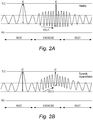
- Figure 2(A) illustrates a normal subject's response (lung volume versus time) to an increased respiratory demand, such as occurs during exertion.
- the principal response is use IRV and ERV to increase TV, while a secondary response is to increase breathing frequency, in particular at higher levels of respiratory demand.
- IRV and ERV to increase TV
- a secondary response is to increase breathing frequency, in particular at higher levels of respiratory demand.
- FIG. 2(B) schematically illustrates a patient suffering from COPD.
- the patient's ERV is difficult to exploit due to expiratory flow limitations and incomplete expiration and ERV is not used to increase TV when needed, e.g. during increased activity. Due to repeated incomplete expiration the EELV raises and the patient gets hyperinflated using the IRV without significantly increasing TV. As a result IC decreases and ventilation can only be increased by faster breathing, further worsening hyperinflation and breathing becomes so restricted that the patient has to stop activity. This phenomenon is known as "dynamic hyperinflation". Dynamic hyperinflation is dynamic since lung volumes generally return to their original values after exertion is brought to lower levels again.
- COPD patients may experience discomfort such as dyspnea and breathlessness.
- dynamic hyperinflation can cause even more problems like alveolar overdistention resulting in hypoxemia, hypotension, or alveolar rupture. Being able to track and manage dynamic hyperinflation in COPD patients at an early stage is therefore important.
- the invention in one embodiment offers a device for assessing dynamic hyperinflation in a monitored subject.
- the invented device is based on the discovery that the presence or absence of dynamic hyperinflation and an indication of its degree (volume and/or speed of induction) can be reliably determined by establishing a parametric relation between collected respiratory data and collected exertion level data, the parametric relation being described by one or more parameters, and assessing the degree of dynamic hyperinflation in terms of the value of the one or more parameters.
- two parameters turn out to yield a particularly reliable and sensitive prediction or detection of the presence of dynamic hyperinflation.
- the parameters comprise end expiratory lung volumes (EELV) after expirations and the breathing frequency, obtained by the time difference between instants of ends of expiration. Breathing frequency is indicative of the level of exertion, and is easily obtained from respiratory data.
- EELV end expiratory lung volumes
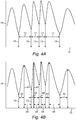
- FIG. 4A illustrates exemplary respiratory data.
- the graph represents the tidal lung volumes 10 (in liter) of a series of breaths versus time 12 (in seconds). Each breath has a rising inspiratory portion and a falling expiratory portion.
- One inspiration-expiration cycle takes a certain amount of time 11, which may differ from cycle to cycle.
- Time intervals 11 are usually defined in seconds.
- the inverse of a time interval 11 for a cycle defines breathing frequency in 1/sec for said cycle.
- An average breathing frequency of the preceding n cycles may also be used.
- To each breathing cycle moreover is associated an EELV 13 (the minima between cycles). For each cycle therefore, a unique combination of values of EELV 13 and prior breathing frequency 26 may be calculated from the respiratory data taken during exertion.
- FIG. 4B defines the TE and TI for respiratory cycles.
- the graph represents the tidal lung volumes 10 (in liter) of a series of breaths versus time 12 (in seconds). Each breath has a rising inspiratory portion and a falling expiratory portion.
- One inspiration takes a certain amount of time 44, which may differ from inspiration to inspiration.
- Time intervals 44 correspond to the TI and are usually defined in seconds.
- the TI is established by measuring the time difference 44 between instants of ends of expiration and subsequent instants of end of inspiration.
- the inverse of the TI defines some kind of inspiration frequency in 1/sec which may be used for data analysis, as described above.
- Time intervals 45 correspond to the TE and are usually defined in seconds.
- the TE is established by measuring the time difference 45 between instants of ends of inspiration and subsequent instants of end of expiration.
- the inverse of the TE defines some kind of expiration frequency in 1/sec which may be used for data analysis, as described above.
- Figure 6A shows a graph obtained on a patient having COPD and associated dynamic hyperinflation, while figure 6B is indicative of a healthy person.
- the parametric relation between the EELV data 13 and the collected breathing frequencies 26 may be fitted with a linear function 14. Other functions may also be used if appropriate.
- a particularly sensitive parameter comprises the gradient (or slope) 15 of the linear parametric relation, depicted by line 14.
- Data obtained at different levels of exertion on a patient having COPD show a negative slope 15 ( figure 6A ), while data obtained at different levels of exertion on a healthy person show a positive slope 15.
- the slope for a healthy person may also be about zero, but a significantly negative slope turns out to be indicative of (incipient) dynamic hyperinflation.
- the present invention may be used in any patient monitoring system as long as respiratory data is available from which at least EELV and breathing frequency can be determined. It is possible to use the device of the invention in a hospital, clinic, or laboratory environment and use data from respiratory sensors available in such environments. Suitable sensors include spirometric measuring systems and body plethysmography arrangements for instance. These however are less portable and may limit or even prevent patient motion. In a preferred embodiment of the invention therefore, the device is practiced in a patient's day-to-day environment while the patient is performing day-to-day activities, or while the patient performs some exercise, such as when cycling for instance. In such embodiments, respiratory sensors are preferably portable and light weight, and are arranged on or incorporated in a wearable item, such as a shirt, jacket, bands, patches, and the like.
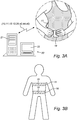
- FIG. 3A and 3B An exemplary embodiment of a shirt provided with monitoring sensors is shown in figures 3A and 3B .
- the subject of figure 3B is provided with two bands (15, 16) that are configured to measure respiratory lung volumes.
- One band 15 is arranged around the rib cage and produces first signals indicative of instantaneous lung volume.
- a second band 16 is arranged around the abdomen and produces second signals indicative of instantaneous lung volume. Both signals may be used as such to produce the graphs of figures 6A and 6B , or they may be combined in some way to produce the graphs of figures 6A and 6B , for instance by taking a (weighted) sum of the data produced.
- the size sensors 19 incorporated in the bands (15, 16) may be based on technologies known in the art, including magnetometers; strain gauges using magnetic, mechanical or optical means; optical techniques including interferometry; electrical impedance; surface electrical or magnetic activity; body plethysmography, ultrasonic and doppler measurements of body wall motions or body diameters; and so forth.
- Preferred size sensors are based on respiratory inductive plethysmography (RIP).
- RIP responds to anatomic size changes by measuring the self-inductance of one or more conductive elements (metallic or non-metallic) arranged in the bands (15, 16) on the body portion to be measured.
- RIP sensor self-inductance varies with size in response to an underlying body part size change. The changing self-inductance is sensed by a variable frequency oscillator/demodulator module, the output of which is responsive to oscillator frequencies and ultimately to sensor size.
- the data that originate from the sensor(s) is transmitted via suitable wiring 17 (see figure 3A ) to a portable data unit or PDU 18, that is conveniently carried in a small pocket on the shirt.
- the bands (15, 16) incorporate a size sensor 19 that is sensitive to respiration and may also comprise other sensors (not shown), such as posture sensors, accelerometers, ECG sensors, temperature sensors, and so forth.
- the PDU 18 stores data and accepts input from the wearer of the shirt.
- the PDU 18 may also be incorporated in the shirt itself and further retrieves and (wirelessly) transmits sensor data to storage and analysis systems.
- the PDU 18 may be provided with a processing device for processing sensor data, and/or processed and/or raw data may also be transmitted to a remote computer system 20.
- a suitable data analysis system 20 comprises a workstation computer 21 with processor to which is connected a monitor 22 for viewing sensor data.
- Raw or (partly) processed sensor data (10, 11, 12, 13, 26, 43, 44, 45) is transferred to system 20, and stored in computer readable memory for further processing.
- the processor of computer system 20, or in other embodiments a processor of the PDA, or a processor of any other device, such as a smartphone, is configured to establish a parametric relation between the collected respiratory data and the collected exertion level data, and assess the respiratory data of the subject.
- FIG. 5 An exemplary flow chart of a programmed method using a device according to an embodiment of the invention is illustrated in figure 5 .
- a next step 32 measures lung volumes 10 over a certain time period.
- This step 32 is performed while decreasing and increasing the workload (or the level of exertion) a number of times in step 33 to obtain a well defined and representative sample of respiratory data for data analysis.
- the minimum and maximum level of exertion (or breathing frequency 26) required to achieve a representable data sample depends on conditions such as the health of the person involved, the sensors used, and so on.
- One skilled in the art will readily be able to obtain a representative sample without undue burden.
- a next step 34 the processor determines EELV timestamps, defined as the times where the person's exhalation stops and an inhalation starts.
- the EELV timestamps generally correspond to the instants in time where the lung volume 10 reaches a local minimum.
- a next step 35 evaluates breathing frequency for each EELV timestamp. This breathing frequency 26 for an EELV timestamp is defined as the inverse of the time expired since the previous EELV timestamp. The average breathing frequency of several preceding breaths can also be used as the breathing frequency for one EELV.
- the same step 35 also evaluates the EELV 13 (the volume of air present in the lungs at the end of exhalation) for each timestamp.
- a next step 36 creates a two-dimensional dataset from the computed EELV 13 and corresponding breathing frequency 26 data, the latter being the independent variable in the dataset.
- a linear fit is carried out of the collected dataset (13, 26) which produces a gradient or slope 15 of the linear relationship 14. The value of the slope 15 turns out to be highly representative for the occurrence of dynamic hyperinflation.
- the algorithm ends at step 38.
Landscapes
- Health & Medical Sciences (AREA)
- Life Sciences & Earth Sciences (AREA)
- Medical Informatics (AREA)
- Molecular Biology (AREA)
- Veterinary Medicine (AREA)
- Biophysics (AREA)
- Pathology (AREA)
- Engineering & Computer Science (AREA)
- Biomedical Technology (AREA)
- Heart & Thoracic Surgery (AREA)
- Public Health (AREA)
- Physics & Mathematics (AREA)
- Surgery (AREA)
- Animal Behavior & Ethology (AREA)
- General Health & Medical Sciences (AREA)
- Pulmonology (AREA)
- Physiology (AREA)
- Cardiology (AREA)
- Dentistry (AREA)
- Oral & Maxillofacial Surgery (AREA)
- Hematology (AREA)
- Measurement Of The Respiration, Hearing Ability, Form, And Blood Characteristics Of Living Organisms (AREA)
Claims (11)
- Dispositif d'évaluation de l'hyper-ventilation chez un sujet surveillé, le dispositif comprenant :un moyen de surveillance de respiration destiné à collecter des données respiratoires du sujet à différents niveaux d'effort, les données respiratoires se rapportant au moins au volume de poumon instantané (10) et comprennent le volume de poumon expiratoire final (EELV) (13) après expirations ;un moyen de surveillance de niveau d'effort destiné à collecter des données de niveau d'effort du sujet aux différents niveaux d'effort, les données de niveau d'effort se rapportant au moins à une demande en oxygène instantanée et comprennent la fréquence cardiaque, telle que mesurée par un dispositif de mesure de fréquence cardiaque, ou la fréquence respiratoire (26), obtenue à partir des données respiratoires ;un moyen de calcul (21) destiné à :établir une relation paramétrique entre les données respiratoires collectées et les données de niveau d'effort collectées, la relation paramétrique étant décrite par un ou plusieurs paramètres ; etl'accès à la présence de l'hyperventilation chez le sujet en termes de la valeur du ou des paramètres.
- Dispositif selon la revendication 1, dans lequel la relation paramétrique entre les données respiratoires collectées (13) et les données de niveau d'effort (26) collectées est linéaire (14).
- Dispositif selon la revendication 2, dans lequel le paramètre comprend le gradient (15) de la relation paramétrique linéaire (14).
- Dispositif selon l'une quelconque des revendications précédentes, dans lequel le moyen de surveillance de respiration comprend des capteurs pléthysmographiques respiratoires (19), plus préférablement des capteurs pléthysmographiques inductifs respiratoires.
- Dispositif selon l'une quelconque des revendications précédentes, dans lequel les données de niveau d'effort qui se rapportent à la demande en oxygène comprennent le temps d'inspiration (TI), obtenu à partir des données respiratoires.
- Dispositif selon l'une quelconque des revendications précédentes, dans lequel les données de niveau d'effort qui se rapportent à la demande en oxygène comprennent le temps d'expiration (TE), obtenu à partir des données respiratoires (13).
- Dispositif selon l'une quelconque des revendications précédentes, comprenant, en outre, un moyen de surveillance de posture destiné à collecter des données associées à la posture du suj et.
- Dispositif selon la revendication 7, dans lequel les données associées à la posture du sujet comprennent des données de forme 3D instantanées du torse du sujet.
- Dispositif selon l'une quelconque des revendications précédentes, dans lequel le moyen de calcul (21) comprend :une unité de traitement ;une mémoire pouvant être lue par ordinateur couplée de manière opérationnelle à l'unité de traitement ;dans lequel la mémoire pouvant être lue par ordinateur est adaptée afin de recevoir les données respiratoires et/ou de niveau d'effort du sujet aux différents niveaux d'effort ; etdans lequel l'unité de traitement est configurée de manière à établir la relation paramétrique entre les données respiratoires collectées (13) et les données de niveau d'effort collectées (26), et accède aux données respiratoires du sujet.
- Dispositif selon l'une quelconque des revendications précédentes, dans lequel le dispositif est portable par le sujet et comprend un élément d'habillement qui supporte le moyen de surveillance de respiration et/ou le moyen de surveillance de niveau d'effort.
- Dispositif selon la revendication 10, dans lequel l'élément d'habillement comprend un vêtement, une chemise, et/ou une ou plusieurs bandes (15, 16).
Applications Claiming Priority (2)
| Application Number | Priority Date | Filing Date | Title |
|---|---|---|---|
| NL2013551A NL2013551B1 (en) | 2014-10-01 | 2014-10-01 | Device and method for assessing respiratory data in a monitored subject. |
| PCT/NL2015/050688 WO2016053103A2 (fr) | 2014-10-01 | 2015-10-01 | Dispositif et procédé permettant d'évaluer des données respiratoires chez un sujet surveillé |
Publications (2)
| Publication Number | Publication Date |
|---|---|
| EP3200686A2 EP3200686A2 (fr) | 2017-08-09 |
| EP3200686B1 true EP3200686B1 (fr) | 2020-09-02 |
Family
ID=52293115
Family Applications (1)
| Application Number | Title | Priority Date | Filing Date |
|---|---|---|---|
| EP15818081.0A Active EP3200686B1 (fr) | 2014-10-01 | 2015-10-01 | Dispositif permettant d'évaluer des données respiratoires chez un sujet surveillé |
Country Status (6)
| Country | Link |
|---|---|
| US (1) | US11058323B2 (fr) |
| EP (1) | EP3200686B1 (fr) |
| CN (1) | CN107205672B (fr) |
| CA (1) | CA2963471C (fr) |
| NL (1) | NL2013551B1 (fr) |
| WO (1) | WO2016053103A2 (fr) |
Families Citing this family (5)
| Publication number | Priority date | Publication date | Assignee | Title |
|---|---|---|---|---|
| US10055948B2 (en) * | 2015-11-30 | 2018-08-21 | Nike, Inc. | Apparel with ultrasonic position sensing and haptic feedback for activities |
| CN107550477B (zh) * | 2017-09-27 | 2024-02-02 | 福山信(北京)科技有限公司 | 一种生物体征检测装置 |
| CN107510457A (zh) * | 2017-09-27 | 2017-12-26 | 福山信(北京)科技有限公司 | 一种生物体征检测装置 |
| EP3749402B1 (fr) | 2018-02-06 | 2022-12-21 | Maquet Critical Care AB | Agencement de ventilateur |
| US20240100290A1 (en) * | 2022-09-23 | 2024-03-28 | Covidien Lp | Expiratory flow control |
Family Cites Families (17)
| Publication number | Priority date | Publication date | Assignee | Title |
|---|---|---|---|---|
| US5261397A (en) * | 1991-05-10 | 1993-11-16 | The Children's Hospital Of Philadelphia | Methods and apparatus for measuring infant lung function and providing respiratory system therapy |
| CN2183777Y (zh) * | 1994-01-21 | 1994-11-30 | 徐承礼 | 一种人工肺仪 |
| US5546952A (en) * | 1994-09-21 | 1996-08-20 | Medtronic, Inc. | Method and apparatus for detection of a respiratory waveform |
| US7396327B2 (en) * | 2002-01-07 | 2008-07-08 | Micromed Technology, Inc. | Blood pump system and method of operation |
| WO2006037184A1 (fr) * | 2004-10-06 | 2006-04-13 | Resmed Limited | Procede et appareil pour surveillance non invasive de parametres respiratoires lors de troubles respiratoires du sommeil |
| AU2005318949B2 (en) * | 2004-12-23 | 2012-05-10 | ResMed Pty Ltd | Method for detecting and disciminatng breathing patterns from respiratory signals |
| US7680534B2 (en) * | 2005-02-28 | 2010-03-16 | Cardiac Pacemakers, Inc. | Implantable cardiac device with dyspnea measurement |
| JP5340727B2 (ja) * | 2005-05-20 | 2013-11-13 | アディダス アーゲー | 動的過膨張を測定するための方法及びシステム |
| US7775983B2 (en) * | 2005-09-16 | 2010-08-17 | Cardiac Pacemakers, Inc. | Rapid shallow breathing detection for use in congestive heart failure status determination |
| EP1957139B1 (fr) * | 2005-12-06 | 2011-11-23 | Maquet Critical Care AB | Appareil permettant d'estimer le volume pulmonaire en fin d'expiration |
| WO2008045995A2 (fr) * | 2006-10-12 | 2008-04-17 | Massachusetts Institute Of Technology | Methode de mesure du stress physiologique |
| US9615773B1 (en) * | 2008-08-13 | 2017-04-11 | Cleveland Medical Devices Inc. | Method and device for sleep analysis and therapy |
| AU2010201032B2 (en) * | 2009-04-29 | 2014-11-20 | Resmed Limited | Methods and Apparatus for Detecting and Treating Respiratory Insufficiency |
| EP2397074B1 (fr) * | 2010-06-19 | 2012-10-24 | M Stenqvist AB | Système et support lisible par ordinateur stockant un programme pour déterminer la pression transpulmonaire chez un patient connecté à un appareil respiratoire |
| US9713689B2 (en) * | 2010-07-12 | 2017-07-25 | Laurent Brochard | Methods of evaluating a patient for PEEP therapy |
| US9174046B2 (en) * | 2011-01-25 | 2015-11-03 | Cedric Francois | Apparatus and methods for assisting breathing |
| US9750463B2 (en) * | 2013-12-10 | 2017-09-05 | General Electric Company | Respiratory stress detection |
-
2014
- 2014-10-01 NL NL2013551A patent/NL2013551B1/en not_active IP Right Cessation
-
2015
- 2015-10-01 US US15/515,988 patent/US11058323B2/en active Active
- 2015-10-01 WO PCT/NL2015/050688 patent/WO2016053103A2/fr not_active Ceased
- 2015-10-01 EP EP15818081.0A patent/EP3200686B1/fr active Active
- 2015-10-01 CA CA2963471A patent/CA2963471C/fr active Active
- 2015-10-01 CN CN201580063661.1A patent/CN107205672B/zh active Active
Non-Patent Citations (1)
| Title |
|---|
| None * |
Also Published As
| Publication number | Publication date |
|---|---|
| CA2963471A1 (fr) | 2016-04-07 |
| EP3200686A2 (fr) | 2017-08-09 |
| US20170231526A1 (en) | 2017-08-17 |
| CN107205672A (zh) | 2017-09-26 |
| CN107205672B (zh) | 2021-07-02 |
| NL2013551B1 (en) | 2016-10-03 |
| US11058323B2 (en) | 2021-07-13 |
| CA2963471C (fr) | 2023-08-29 |
| WO2016053103A3 (fr) | 2016-06-30 |
| WO2016053103A2 (fr) | 2016-04-07 |
Similar Documents
| Publication | Publication Date | Title |
|---|---|---|
| US8790273B2 (en) | Noninvasive method and system for measuring pulmonary ventilation | |
| US8790274B2 (en) | Non-invasive method for measuring changes in body position and respiration | |
| AU2006251609B2 (en) | Methods and systems for determining dynamic hyperinflation | |
| EP3200686B1 (fr) | Dispositif permettant d'évaluer des données respiratoires chez un sujet surveillé | |
| KR20160081740A (ko) | 무구속적으로 측정한 생체신호를 이용하여 산소탈포화지수를 획득하는 방법 | |
| CN106999097A (zh) | 用于评估受试者中的慢性阻塞性肺疾病copd严重度的装置和方法 | |
| US10123724B2 (en) | Breath volume monitoring system and method | |
| RU2677003C2 (ru) | Устройство и способ определения сигнала объема дыхания по данным изображения | |
| Nesar et al. | Improving touchless respiratory monitoring via lidar orientation and thermal imaging | |
| KR102379320B1 (ko) | 스트레인 게이지를 이용한 개인 상관계수 기반의 맞춤형 호흡량 측정 장치 및 방법 | |
| AU2025202413A1 (en) | Method and arrangement for respiratory measurement | |
| EP2517131A2 (fr) | Mesure d'indice de bode | |
| KR102379321B1 (ko) | 스트레인 게이지를 이용한 개인 상관계수 기반의 맞춤형 호흡량 측정 시스템 | |
| US20240237914A1 (en) | Respiratory Measurement Method, Respiratory Measurement Device, and Respiratory Measurement System |
Legal Events
| Date | Code | Title | Description |
|---|---|---|---|
| STAA | Information on the status of an ep patent application or granted ep patent |
Free format text: STATUS: THE INTERNATIONAL PUBLICATION HAS BEEN MADE |
|
| PUAI | Public reference made under article 153(3) epc to a published international application that has entered the european phase |
Free format text: ORIGINAL CODE: 0009012 |
|
| STAA | Information on the status of an ep patent application or granted ep patent |
Free format text: STATUS: REQUEST FOR EXAMINATION WAS MADE |
|
| 17P | Request for examination filed |
Effective date: 20170501 |
|
| AK | Designated contracting states |
Kind code of ref document: A2 Designated state(s): AL AT BE BG CH CY CZ DE DK EE ES FI FR GB GR HR HU IE IS IT LI LT LU LV MC MK MT NL NO PL PT RO RS SE SI SK SM TR |
|
| AX | Request for extension of the european patent |
Extension state: BA ME |
|
| DAV | Request for validation of the european patent (deleted) | ||
| DAX | Request for extension of the european patent (deleted) | ||
| STAA | Information on the status of an ep patent application or granted ep patent |
Free format text: STATUS: EXAMINATION IS IN PROGRESS |
|
| 17Q | First examination report despatched |
Effective date: 20190717 |
|
| GRAP | Despatch of communication of intention to grant a patent |
Free format text: ORIGINAL CODE: EPIDOSNIGR1 |
|
| STAA | Information on the status of an ep patent application or granted ep patent |
Free format text: STATUS: GRANT OF PATENT IS INTENDED |
|
| INTG | Intention to grant announced |
Effective date: 20200323 |
|
| GRAS | Grant fee paid |
Free format text: ORIGINAL CODE: EPIDOSNIGR3 |
|
| GRAA | (expected) grant |
Free format text: ORIGINAL CODE: 0009210 |
|
| STAA | Information on the status of an ep patent application or granted ep patent |
Free format text: STATUS: THE PATENT HAS BEEN GRANTED |
|
| AK | Designated contracting states |
Kind code of ref document: B1 Designated state(s): AL AT BE BG CH CY CZ DE DK EE ES FI FR GB GR HR HU IE IS IT LI LT LU LV MC MK MT NL NO PL PT RO RS SE SI SK SM TR |
|
| REG | Reference to a national code |
Ref country code: GB Ref legal event code: FG4D |
|
| REG | Reference to a national code |
Ref country code: AT Ref legal event code: REF Ref document number: 1307844 Country of ref document: AT Kind code of ref document: T Effective date: 20200915 Ref country code: CH Ref legal event code: EP |
|
| REG | Reference to a national code |
Ref country code: DE Ref legal event code: R096 Ref document number: 602015058507 Country of ref document: DE |
|
| REG | Reference to a national code |
Ref country code: IE Ref legal event code: FG4D |
|
| REG | Reference to a national code |
Ref country code: NL Ref legal event code: FP |
|
| REG | Reference to a national code |
Ref country code: LT Ref legal event code: MG4D |
|
| PG25 | Lapsed in a contracting state [announced via postgrant information from national office to epo] |
Ref country code: SE Free format text: LAPSE BECAUSE OF FAILURE TO SUBMIT A TRANSLATION OF THE DESCRIPTION OR TO PAY THE FEE WITHIN THE PRESCRIBED TIME-LIMIT Effective date: 20200902 Ref country code: BG Free format text: LAPSE BECAUSE OF FAILURE TO SUBMIT A TRANSLATION OF THE DESCRIPTION OR TO PAY THE FEE WITHIN THE PRESCRIBED TIME-LIMIT Effective date: 20201202 Ref country code: LT Free format text: LAPSE BECAUSE OF FAILURE TO SUBMIT A TRANSLATION OF THE DESCRIPTION OR TO PAY THE FEE WITHIN THE PRESCRIBED TIME-LIMIT Effective date: 20200902 Ref country code: GR Free format text: LAPSE BECAUSE OF FAILURE TO SUBMIT A TRANSLATION OF THE DESCRIPTION OR TO PAY THE FEE WITHIN THE PRESCRIBED TIME-LIMIT Effective date: 20201203 Ref country code: NO Free format text: LAPSE BECAUSE OF FAILURE TO SUBMIT A TRANSLATION OF THE DESCRIPTION OR TO PAY THE FEE WITHIN THE PRESCRIBED TIME-LIMIT Effective date: 20201202 Ref country code: FI Free format text: LAPSE BECAUSE OF FAILURE TO SUBMIT A TRANSLATION OF THE DESCRIPTION OR TO PAY THE FEE WITHIN THE PRESCRIBED TIME-LIMIT Effective date: 20200902 Ref country code: HR Free format text: LAPSE BECAUSE OF FAILURE TO SUBMIT A TRANSLATION OF THE DESCRIPTION OR TO PAY THE FEE WITHIN THE PRESCRIBED TIME-LIMIT Effective date: 20200902 |
|
| REG | Reference to a national code |
Ref country code: AT Ref legal event code: MK05 Ref document number: 1307844 Country of ref document: AT Kind code of ref document: T Effective date: 20200902 |
|
| PG25 | Lapsed in a contracting state [announced via postgrant information from national office to epo] |
Ref country code: RS Free format text: LAPSE BECAUSE OF FAILURE TO SUBMIT A TRANSLATION OF THE DESCRIPTION OR TO PAY THE FEE WITHIN THE PRESCRIBED TIME-LIMIT Effective date: 20200902 Ref country code: PL Free format text: LAPSE BECAUSE OF FAILURE TO SUBMIT A TRANSLATION OF THE DESCRIPTION OR TO PAY THE FEE WITHIN THE PRESCRIBED TIME-LIMIT Effective date: 20200902 Ref country code: LV Free format text: LAPSE BECAUSE OF FAILURE TO SUBMIT A TRANSLATION OF THE DESCRIPTION OR TO PAY THE FEE WITHIN THE PRESCRIBED TIME-LIMIT Effective date: 20200902 |
|
| PG25 | Lapsed in a contracting state [announced via postgrant information from national office to epo] |
Ref country code: CZ Free format text: LAPSE BECAUSE OF FAILURE TO SUBMIT A TRANSLATION OF THE DESCRIPTION OR TO PAY THE FEE WITHIN THE PRESCRIBED TIME-LIMIT Effective date: 20200902 Ref country code: PT Free format text: LAPSE BECAUSE OF FAILURE TO SUBMIT A TRANSLATION OF THE DESCRIPTION OR TO PAY THE FEE WITHIN THE PRESCRIBED TIME-LIMIT Effective date: 20210104 Ref country code: SM Free format text: LAPSE BECAUSE OF FAILURE TO SUBMIT A TRANSLATION OF THE DESCRIPTION OR TO PAY THE FEE WITHIN THE PRESCRIBED TIME-LIMIT Effective date: 20200902 Ref country code: RO Free format text: LAPSE BECAUSE OF FAILURE TO SUBMIT A TRANSLATION OF THE DESCRIPTION OR TO PAY THE FEE WITHIN THE PRESCRIBED TIME-LIMIT Effective date: 20200902 Ref country code: EE Free format text: LAPSE BECAUSE OF FAILURE TO SUBMIT A TRANSLATION OF THE DESCRIPTION OR TO PAY THE FEE WITHIN THE PRESCRIBED TIME-LIMIT Effective date: 20200902 |
|
| PG25 | Lapsed in a contracting state [announced via postgrant information from national office to epo] |
Ref country code: AL Free format text: LAPSE BECAUSE OF FAILURE TO SUBMIT A TRANSLATION OF THE DESCRIPTION OR TO PAY THE FEE WITHIN THE PRESCRIBED TIME-LIMIT Effective date: 20200902 Ref country code: AT Free format text: LAPSE BECAUSE OF FAILURE TO SUBMIT A TRANSLATION OF THE DESCRIPTION OR TO PAY THE FEE WITHIN THE PRESCRIBED TIME-LIMIT Effective date: 20200902 Ref country code: ES Free format text: LAPSE BECAUSE OF FAILURE TO SUBMIT A TRANSLATION OF THE DESCRIPTION OR TO PAY THE FEE WITHIN THE PRESCRIBED TIME-LIMIT Effective date: 20200902 Ref country code: IS Free format text: LAPSE BECAUSE OF FAILURE TO SUBMIT A TRANSLATION OF THE DESCRIPTION OR TO PAY THE FEE WITHIN THE PRESCRIBED TIME-LIMIT Effective date: 20210102 |
|
| REG | Reference to a national code |
Ref country code: CH Ref legal event code: PL |
|
| REG | Reference to a national code |
Ref country code: DE Ref legal event code: R097 Ref document number: 602015058507 Country of ref document: DE |
|
| PG25 | Lapsed in a contracting state [announced via postgrant information from national office to epo] |
Ref country code: LU Free format text: LAPSE BECAUSE OF NON-PAYMENT OF DUE FEES Effective date: 20201001 Ref country code: MC Free format text: LAPSE BECAUSE OF FAILURE TO SUBMIT A TRANSLATION OF THE DESCRIPTION OR TO PAY THE FEE WITHIN THE PRESCRIBED TIME-LIMIT Effective date: 20200902 Ref country code: SK Free format text: LAPSE BECAUSE OF FAILURE TO SUBMIT A TRANSLATION OF THE DESCRIPTION OR TO PAY THE FEE WITHIN THE PRESCRIBED TIME-LIMIT Effective date: 20200902 |
|
| PLBE | No opposition filed within time limit |
Free format text: ORIGINAL CODE: 0009261 |
|
| STAA | Information on the status of an ep patent application or granted ep patent |
Free format text: STATUS: NO OPPOSITION FILED WITHIN TIME LIMIT |
|
| 26N | No opposition filed |
Effective date: 20210603 |
|
| PG25 | Lapsed in a contracting state [announced via postgrant information from national office to epo] |
Ref country code: CH Free format text: LAPSE BECAUSE OF NON-PAYMENT OF DUE FEES Effective date: 20201031 Ref country code: DK Free format text: LAPSE BECAUSE OF FAILURE TO SUBMIT A TRANSLATION OF THE DESCRIPTION OR TO PAY THE FEE WITHIN THE PRESCRIBED TIME-LIMIT Effective date: 20200902 Ref country code: SI Free format text: LAPSE BECAUSE OF FAILURE TO SUBMIT A TRANSLATION OF THE DESCRIPTION OR TO PAY THE FEE WITHIN THE PRESCRIBED TIME-LIMIT Effective date: 20200902 Ref country code: LI Free format text: LAPSE BECAUSE OF NON-PAYMENT OF DUE FEES Effective date: 20201031 |
|
| PG25 | Lapsed in a contracting state [announced via postgrant information from national office to epo] |
Ref country code: IT Free format text: LAPSE BECAUSE OF FAILURE TO SUBMIT A TRANSLATION OF THE DESCRIPTION OR TO PAY THE FEE WITHIN THE PRESCRIBED TIME-LIMIT Effective date: 20200902 Ref country code: IE Free format text: LAPSE BECAUSE OF NON-PAYMENT OF DUE FEES Effective date: 20201001 |
|
| PG25 | Lapsed in a contracting state [announced via postgrant information from national office to epo] |
Ref country code: TR Free format text: LAPSE BECAUSE OF FAILURE TO SUBMIT A TRANSLATION OF THE DESCRIPTION OR TO PAY THE FEE WITHIN THE PRESCRIBED TIME-LIMIT Effective date: 20200902 Ref country code: MT Free format text: LAPSE BECAUSE OF FAILURE TO SUBMIT A TRANSLATION OF THE DESCRIPTION OR TO PAY THE FEE WITHIN THE PRESCRIBED TIME-LIMIT Effective date: 20200902 Ref country code: CY Free format text: LAPSE BECAUSE OF FAILURE TO SUBMIT A TRANSLATION OF THE DESCRIPTION OR TO PAY THE FEE WITHIN THE PRESCRIBED TIME-LIMIT Effective date: 20200902 |
|
| PG25 | Lapsed in a contracting state [announced via postgrant information from national office to epo] |
Ref country code: MK Free format text: LAPSE BECAUSE OF FAILURE TO SUBMIT A TRANSLATION OF THE DESCRIPTION OR TO PAY THE FEE WITHIN THE PRESCRIBED TIME-LIMIT Effective date: 20200902 |
|
| PGFP | Annual fee paid to national office [announced via postgrant information from national office to epo] |
Ref country code: NL Payment date: 20241026 Year of fee payment: 10 |
|
| PGFP | Annual fee paid to national office [announced via postgrant information from national office to epo] |
Ref country code: DE Payment date: 20241029 Year of fee payment: 10 |
|
| PGFP | Annual fee paid to national office [announced via postgrant information from national office to epo] |
Ref country code: BE Payment date: 20241028 Year of fee payment: 10 |
|
| PGFP | Annual fee paid to national office [announced via postgrant information from national office to epo] |
Ref country code: GB Payment date: 20241028 Year of fee payment: 10 |
|
| PGFP | Annual fee paid to national office [announced via postgrant information from national office to epo] |
Ref country code: FR Payment date: 20241025 Year of fee payment: 10 |