EP3200911B1 - Verfahren zur flüssigkeitsauthentifizierung durch detektion von flavonoidderivaten - Google Patents
Verfahren zur flüssigkeitsauthentifizierung durch detektion von flavonoidderivaten Download PDFInfo
- Publication number
- EP3200911B1 EP3200911B1 EP15767536.4A EP15767536A EP3200911B1 EP 3200911 B1 EP3200911 B1 EP 3200911B1 EP 15767536 A EP15767536 A EP 15767536A EP 3200911 B1 EP3200911 B1 EP 3200911B1
- Authority
- EP
- European Patent Office
- Prior art keywords
- flavonoid
- composition
- groups
- electrolytic solution
- liquid
- Prior art date
- Legal status (The legal status is an assumption and is not a legal conclusion. Google has not performed a legal analysis and makes no representation as to the accuracy of the status listed.)
- Active
Links
Images


Classifications
-
- B—PERFORMING OPERATIONS; TRANSPORTING
- B01—PHYSICAL OR CHEMICAL PROCESSES OR APPARATUS IN GENERAL
- B01J—CHEMICAL OR PHYSICAL PROCESSES, e.g. CATALYSIS OR COLLOID CHEMISTRY; THEIR RELEVANT APPARATUS
- B01J19/00—Chemical, physical or physico-chemical processes in general; Their relevant apparatus
- B01J19/0093—Microreactors, e.g. miniaturised or microfabricated reactors
-
- C—CHEMISTRY; METALLURGY
- C10—PETROLEUM, GAS OR COKE INDUSTRIES; TECHNICAL GASES CONTAINING CARBON MONOXIDE; FUELS; LUBRICANTS; PEAT
- C10L—FUELS NOT OTHERWISE PROVIDED FOR; NATURAL GAS; SYNTHETIC NATURAL GAS OBTAINED BY PROCESSES NOT COVERED BY SUBCLASSES C10G OR C10K; LIQUIFIED PETROLEUM GAS; USE OF ADDITIVES TO FUELS OR FIRES; FIRE-LIGHTERS
- C10L1/00—Liquid carbonaceous fuels
- C10L1/003—Marking, e.g. coloration by addition of pigments
-
- B—PERFORMING OPERATIONS; TRANSPORTING
- B01—PHYSICAL OR CHEMICAL PROCESSES OR APPARATUS IN GENERAL
- B01L—CHEMICAL OR PHYSICAL LABORATORY APPARATUS FOR GENERAL USE
- B01L3/00—Containers or dishes for laboratory use, e.g. laboratory glassware; Droppers
- B01L3/50—Containers for the purpose of retaining a material to be analysed, e.g. test tubes
- B01L3/502—Containers for the purpose of retaining a material to be analysed, e.g. test tubes with fluid transport, e.g. in multi-compartment structures
- B01L3/5027—Containers for the purpose of retaining a material to be analysed, e.g. test tubes with fluid transport, e.g. in multi-compartment structures by integrated microfluidic structures, i.e. dimensions of channels and chambers are such that surface tension forces are important, e.g. lab-on-a-chip
-
- C—CHEMISTRY; METALLURGY
- C07—ORGANIC CHEMISTRY
- C07D—HETEROCYCLIC COMPOUNDS
- C07D311/00—Heterocyclic compounds containing six-membered rings having one oxygen atom as the only hetero atom, condensed with other rings
- C07D311/02—Heterocyclic compounds containing six-membered rings having one oxygen atom as the only hetero atom, condensed with other rings ortho- or peri-condensed with carbocyclic rings or ring systems
- C07D311/04—Benzo[b]pyrans, not hydrogenated in the carbocyclic ring
- C07D311/22—Benzo[b]pyrans, not hydrogenated in the carbocyclic ring with oxygen or sulfur atoms directly attached in position 4
- C07D311/26—Benzo[b]pyrans, not hydrogenated in the carbocyclic ring with oxygen or sulfur atoms directly attached in position 4 with aromatic rings attached in position 2 or 3
- C07D311/28—Benzo[b]pyrans, not hydrogenated in the carbocyclic ring with oxygen or sulfur atoms directly attached in position 4 with aromatic rings attached in position 2 or 3 with aromatic rings attached in position 2 only
- C07D311/30—Benzo[b]pyrans, not hydrogenated in the carbocyclic ring with oxygen or sulfur atoms directly attached in position 4 with aromatic rings attached in position 2 or 3 with aromatic rings attached in position 2 only not hydrogenated in the hetero ring, e.g. flavones
-
- C—CHEMISTRY; METALLURGY
- C07—ORGANIC CHEMISTRY
- C07D—HETEROCYCLIC COMPOUNDS
- C07D311/00—Heterocyclic compounds containing six-membered rings having one oxygen atom as the only hetero atom, condensed with other rings
- C07D311/02—Heterocyclic compounds containing six-membered rings having one oxygen atom as the only hetero atom, condensed with other rings ortho- or peri-condensed with carbocyclic rings or ring systems
- C07D311/04—Benzo[b]pyrans, not hydrogenated in the carbocyclic ring
- C07D311/58—Benzo[b]pyrans, not hydrogenated in the carbocyclic ring other than with oxygen or sulphur atoms in position 2 or 4
- C07D311/60—Benzo[b]pyrans, not hydrogenated in the carbocyclic ring other than with oxygen or sulphur atoms in position 2 or 4 with aryl radicals attached in position 2
- C07D311/62—Benzo[b]pyrans, not hydrogenated in the carbocyclic ring other than with oxygen or sulphur atoms in position 2 or 4 with aryl radicals attached in position 2 with oxygen atoms directly attached in position 3, e.g. anthocyanidins
-
- C—CHEMISTRY; METALLURGY
- C10—PETROLEUM, GAS OR COKE INDUSTRIES; TECHNICAL GASES CONTAINING CARBON MONOXIDE; FUELS; LUBRICANTS; PEAT
- C10L—FUELS NOT OTHERWISE PROVIDED FOR; NATURAL GAS; SYNTHETIC NATURAL GAS OBTAINED BY PROCESSES NOT COVERED BY SUBCLASSES C10G OR C10K; LIQUIFIED PETROLEUM GAS; USE OF ADDITIVES TO FUELS OR FIRES; FIRE-LIGHTERS
- C10L1/00—Liquid carbonaceous fuels
- C10L1/10—Liquid carbonaceous fuels containing additives
- C10L1/14—Organic compounds
- C10L1/18—Organic compounds containing oxygen
-
- C—CHEMISTRY; METALLURGY
- C10—PETROLEUM, GAS OR COKE INDUSTRIES; TECHNICAL GASES CONTAINING CARBON MONOXIDE; FUELS; LUBRICANTS; PEAT
- C10L—FUELS NOT OTHERWISE PROVIDED FOR; NATURAL GAS; SYNTHETIC NATURAL GAS OBTAINED BY PROCESSES NOT COVERED BY SUBCLASSES C10G OR C10K; LIQUIFIED PETROLEUM GAS; USE OF ADDITIVES TO FUELS OR FIRES; FIRE-LIGHTERS
- C10L1/00—Liquid carbonaceous fuels
- C10L1/10—Liquid carbonaceous fuels containing additives
- C10L1/14—Organic compounds
- C10L1/18—Organic compounds containing oxygen
- C10L1/185—Ethers; Acetals; Ketals; Aldehydes; Ketones
- C10L1/1852—Ethers; Acetals; Ketals; Orthoesters
- C10L1/1855—Cyclic ethers, e.g. epoxides, lactides, lactones
-
- C—CHEMISTRY; METALLURGY
- C10—PETROLEUM, GAS OR COKE INDUSTRIES; TECHNICAL GASES CONTAINING CARBON MONOXIDE; FUELS; LUBRICANTS; PEAT
- C10L—FUELS NOT OTHERWISE PROVIDED FOR; NATURAL GAS; SYNTHETIC NATURAL GAS OBTAINED BY PROCESSES NOT COVERED BY SUBCLASSES C10G OR C10K; LIQUIFIED PETROLEUM GAS; USE OF ADDITIVES TO FUELS OR FIRES; FIRE-LIGHTERS
- C10L1/00—Liquid carbonaceous fuels
- C10L1/10—Liquid carbonaceous fuels containing additives
- C10L1/14—Organic compounds
- C10L1/18—Organic compounds containing oxygen
- C10L1/185—Ethers; Acetals; Ketals; Aldehydes; Ketones
- C10L1/1857—Aldehydes; Ketones
-
- C—CHEMISTRY; METALLURGY
- C10—PETROLEUM, GAS OR COKE INDUSTRIES; TECHNICAL GASES CONTAINING CARBON MONOXIDE; FUELS; LUBRICANTS; PEAT
- C10L—FUELS NOT OTHERWISE PROVIDED FOR; NATURAL GAS; SYNTHETIC NATURAL GAS OBTAINED BY PROCESSES NOT COVERED BY SUBCLASSES C10G OR C10K; LIQUIFIED PETROLEUM GAS; USE OF ADDITIVES TO FUELS OR FIRES; FIRE-LIGHTERS
- C10L1/00—Liquid carbonaceous fuels
- C10L1/10—Liquid carbonaceous fuels containing additives
- C10L1/14—Organic compounds
- C10L1/28—Organic compounds containing silicon
-
- G—PHYSICS
- G01—MEASURING; TESTING
- G01N—INVESTIGATING OR ANALYSING MATERIALS BY DETERMINING THEIR CHEMICAL OR PHYSICAL PROPERTIES
- G01N27/00—Investigating or analysing materials by the use of electric, electrochemical, or magnetic means
- G01N27/26—Investigating or analysing materials by the use of electric, electrochemical, or magnetic means by investigating electrochemical variables; by using electrolysis or electrophoresis
- G01N27/416—Systems
-
- B—PERFORMING OPERATIONS; TRANSPORTING
- B01—PHYSICAL OR CHEMICAL PROCESSES OR APPARATUS IN GENERAL
- B01J—CHEMICAL OR PHYSICAL PROCESSES, e.g. CATALYSIS OR COLLOID CHEMISTRY; THEIR RELEVANT APPARATUS
- B01J2219/00—Chemical, physical or physico-chemical processes in general; Their relevant apparatus
- B01J2219/00781—Aspects relating to microreactors
- B01J2219/00783—Laminate assemblies, i.e. the reactor comprising a stack of plates
-
- B—PERFORMING OPERATIONS; TRANSPORTING
- B01—PHYSICAL OR CHEMICAL PROCESSES OR APPARATUS IN GENERAL
- B01J—CHEMICAL OR PHYSICAL PROCESSES, e.g. CATALYSIS OR COLLOID CHEMISTRY; THEIR RELEVANT APPARATUS
- B01J2219/00—Chemical, physical or physico-chemical processes in general; Their relevant apparatus
- B01J2219/00781—Aspects relating to microreactors
- B01J2219/00819—Materials of construction
- B01J2219/00837—Materials of construction comprising coatings other than catalytically active coatings
- B01J2219/0084—For changing surface tension
-
- B—PERFORMING OPERATIONS; TRANSPORTING
- B01—PHYSICAL OR CHEMICAL PROCESSES OR APPARATUS IN GENERAL
- B01J—CHEMICAL OR PHYSICAL PROCESSES, e.g. CATALYSIS OR COLLOID CHEMISTRY; THEIR RELEVANT APPARATUS
- B01J2219/00—Chemical, physical or physico-chemical processes in general; Their relevant apparatus
- B01J2219/00781—Aspects relating to microreactors
- B01J2219/00851—Additional features
- B01J2219/00853—Employing electrode arrangements
-
- B—PERFORMING OPERATIONS; TRANSPORTING
- B01—PHYSICAL OR CHEMICAL PROCESSES OR APPARATUS IN GENERAL
- B01J—CHEMICAL OR PHYSICAL PROCESSES, e.g. CATALYSIS OR COLLOID CHEMISTRY; THEIR RELEVANT APPARATUS
- B01J2219/00—Chemical, physical or physico-chemical processes in general; Their relevant apparatus
- B01J2219/00781—Aspects relating to microreactors
- B01J2219/00873—Heat exchange
-
- B—PERFORMING OPERATIONS; TRANSPORTING
- B01—PHYSICAL OR CHEMICAL PROCESSES OR APPARATUS IN GENERAL
- B01J—CHEMICAL OR PHYSICAL PROCESSES, e.g. CATALYSIS OR COLLOID CHEMISTRY; THEIR RELEVANT APPARATUS
- B01J2219/00—Chemical, physical or physico-chemical processes in general; Their relevant apparatus
- B01J2219/00781—Aspects relating to microreactors
- B01J2219/00873—Heat exchange
- B01J2219/00885—Thin film heaters
-
- B—PERFORMING OPERATIONS; TRANSPORTING
- B01—PHYSICAL OR CHEMICAL PROCESSES OR APPARATUS IN GENERAL
- B01J—CHEMICAL OR PHYSICAL PROCESSES, e.g. CATALYSIS OR COLLOID CHEMISTRY; THEIR RELEVANT APPARATUS
- B01J2219/00—Chemical, physical or physico-chemical processes in general; Their relevant apparatus
- B01J2219/00781—Aspects relating to microreactors
- B01J2219/00889—Mixing
-
- B—PERFORMING OPERATIONS; TRANSPORTING
- B01—PHYSICAL OR CHEMICAL PROCESSES OR APPARATUS IN GENERAL
- B01L—CHEMICAL OR PHYSICAL LABORATORY APPARATUS FOR GENERAL USE
- B01L2300/00—Additional constructional details
- B01L2300/06—Auxiliary integrated devices, integrated components
- B01L2300/0627—Sensor or part of a sensor is integrated
- B01L2300/0636—Integrated biosensor, microarrays
-
- B—PERFORMING OPERATIONS; TRANSPORTING
- B01—PHYSICAL OR CHEMICAL PROCESSES OR APPARATUS IN GENERAL
- B01L—CHEMICAL OR PHYSICAL LABORATORY APPARATUS FOR GENERAL USE
- B01L2300/00—Additional constructional details
- B01L2300/06—Auxiliary integrated devices, integrated components
- B01L2300/0627—Sensor or part of a sensor is integrated
- B01L2300/0645—Electrodes
-
- B—PERFORMING OPERATIONS; TRANSPORTING
- B01—PHYSICAL OR CHEMICAL PROCESSES OR APPARATUS IN GENERAL
- B01L—CHEMICAL OR PHYSICAL LABORATORY APPARATUS FOR GENERAL USE
- B01L2300/00—Additional constructional details
- B01L2300/08—Geometry, shape and general structure
- B01L2300/0861—Configuration of multiple channels and/or chambers in a single devices
- B01L2300/0883—Serpentine channels
-
- B—PERFORMING OPERATIONS; TRANSPORTING
- B01—PHYSICAL OR CHEMICAL PROCESSES OR APPARATUS IN GENERAL
- B01L—CHEMICAL OR PHYSICAL LABORATORY APPARATUS FOR GENERAL USE
- B01L2300/00—Additional constructional details
- B01L2300/18—Means for temperature control
- B01L2300/1805—Conductive heating, heat from thermostatted solids is conducted to receptacles, e.g. heating plates, blocks
- B01L2300/1827—Conductive heating, heat from thermostatted solids is conducted to receptacles, e.g. heating plates, blocks using resistive heater
-
- C—CHEMISTRY; METALLURGY
- C10—PETROLEUM, GAS OR COKE INDUSTRIES; TECHNICAL GASES CONTAINING CARBON MONOXIDE; FUELS; LUBRICANTS; PEAT
- C10L—FUELS NOT OTHERWISE PROVIDED FOR; NATURAL GAS; SYNTHETIC NATURAL GAS OBTAINED BY PROCESSES NOT COVERED BY SUBCLASSES C10G OR C10K; LIQUIFIED PETROLEUM GAS; USE OF ADDITIVES TO FUELS OR FIRES; FIRE-LIGHTERS
- C10L1/00—Liquid carbonaceous fuels
- C10L1/10—Liquid carbonaceous fuels containing additives
- C10L1/14—Organic compounds
- C10L1/18—Organic compounds containing oxygen
- C10L1/19—Esters ester radical containing compounds; ester ethers; carbonic acid esters
- C10L1/1905—Esters ester radical containing compounds; ester ethers; carbonic acid esters of di- or polycarboxylic acids
-
- C—CHEMISTRY; METALLURGY
- C10—PETROLEUM, GAS OR COKE INDUSTRIES; TECHNICAL GASES CONTAINING CARBON MONOXIDE; FUELS; LUBRICANTS; PEAT
- C10L—FUELS NOT OTHERWISE PROVIDED FOR; NATURAL GAS; SYNTHETIC NATURAL GAS OBTAINED BY PROCESSES NOT COVERED BY SUBCLASSES C10G OR C10K; LIQUIFIED PETROLEUM GAS; USE OF ADDITIVES TO FUELS OR FIRES; FIRE-LIGHTERS
- C10L2230/00—Function and purpose of a components of a fuel or the composition as a whole
- C10L2230/16—Tracers which serve to track or identify the fuel component or fuel composition
-
- C—CHEMISTRY; METALLURGY
- C10—PETROLEUM, GAS OR COKE INDUSTRIES; TECHNICAL GASES CONTAINING CARBON MONOXIDE; FUELS; LUBRICANTS; PEAT
- C10L—FUELS NOT OTHERWISE PROVIDED FOR; NATURAL GAS; SYNTHETIC NATURAL GAS OBTAINED BY PROCESSES NOT COVERED BY SUBCLASSES C10G OR C10K; LIQUIFIED PETROLEUM GAS; USE OF ADDITIVES TO FUELS OR FIRES; FIRE-LIGHTERS
- C10L2290/00—Fuel preparation or upgrading, processes or apparatus therefore, comprising specific process steps or apparatus units
- C10L2290/38—Applying an electric field or inclusion of electrodes in the apparatus
-
- C—CHEMISTRY; METALLURGY
- C10—PETROLEUM, GAS OR COKE INDUSTRIES; TECHNICAL GASES CONTAINING CARBON MONOXIDE; FUELS; LUBRICANTS; PEAT
- C10L—FUELS NOT OTHERWISE PROVIDED FOR; NATURAL GAS; SYNTHETIC NATURAL GAS OBTAINED BY PROCESSES NOT COVERED BY SUBCLASSES C10G OR C10K; LIQUIFIED PETROLEUM GAS; USE OF ADDITIVES TO FUELS OR FIRES; FIRE-LIGHTERS
- C10L2290/00—Fuel preparation or upgrading, processes or apparatus therefore, comprising specific process steps or apparatus units
- C10L2290/60—Measuring or analysing fractions, components or impurities or process conditions during preparation or upgrading of a fuel
-
- G—PHYSICS
- G01—MEASURING; TESTING
- G01N—INVESTIGATING OR ANALYSING MATERIALS BY DETERMINING THEIR CHEMICAL OR PHYSICAL PROPERTIES
- G01N33/00—Investigating or analysing materials by specific methods not covered by groups G01N1/00 - G01N31/00
- G01N33/22—Fuels; Explosives
Definitions
- the technical field of the present invention is a method for the detection of reactive flavonoid derivatives in a liquid environment. These reactive molecules can act as marker for the liquid, serving as authentication means for verifying the authenticity and/or origin of the liquid.
- the present invention further concerns liquids, in particular fuels comprising a flavonoid derivative marker, the use of flavonoids as a marker for authentication purposes, authentication methods using the marker, and corresponding authentication equipment and devices.
- US 6 699 384 B1 discloses a compact electrochemical sensor system.
- a marking substance is often added to the liquid, such as a specific dye.
- the addition of a marker is also employed in order to distinguish between liquids that are chemically identical or very similar, but which are regulated differently.
- a certain dye is added into heavily taxed diesel fuel in Germany, while the chemically very similar or identical heating oil is taxed at a lower rate and is not marked with a specific dye.
- the identity of a liquid in a car tank can then be assessed by analyzing the liquid as to presence of the specific marker dye.
- the authenticity of the liquid is then assessed by means of a detector, e.g. a colour detector or spectral analysis in case of a certain dye.
- a detector e.g. a colour detector or spectral analysis in case of a certain dye.
- the marking can be easily counterfeited in case that commercially available substances (e.g. dyes) are used, as only the properties of the marker (but not its interaction with a detection device) are assessed.
- commercially available substances e.g. dyes
- their presence can be easily determined, sometimes even with the naked eye.
- Such a maker therefore provides only a very low level of security, as a counterfeiter can easily assess which kinds of visible markers are present, and can then try to get a similar optical effect by using similar or commercially available substances for addition to a forged product.
- such a marker is preferably chemically similar to the liquid in which it is used, but can still be detected even when present only in small quantities. Of course, such a marker should not naturally occur in the liquid to be marked.
- a further object is to provide a method for authenticating the origin and/or authenticity of a liquid that overcomes the problems of the prior art.
- a further object is to provide a method for authenticating the origin and/or authenticity of a liquid that cannot be performed with the naked eye, but which can still be performed on-site with comparatively simple and compact equipment, such as hand-held devices.
- the marker should also be easy to obtain and to produce in an environmentally friendly manner.
- the present invention aims at providing a liquid having an improved security level, i.e. which is more difficult to counterfeit, than liquids containing a conventional marker.
- the present invention further aims at providing a marker that is useful in such methods and for such purposes.
- Embodiments of the present invention utilize a specific derivatization of electrochemically active compounds polyphenolics, flavonoids) to render them soluble in petroleum products (e.g. fuel).
- the derivatives are electrochemically non-active, in particular in comparison to the respective flavonoids and polyphenols, and can thus be regarded as a latent marker. They further provide a security feature for liquids, in particular hydrocarbon fuels, as they are resistant to potential fuel laundering.
- the latent marker (flavonoid derivative) can then be detected and analyzed in a Lab-on-a-chip (MEMS, ⁇ -TAS) device.
- MEMS Lab-on-a-chip
- the device performs a sample extraction, followed by a specific chemical reaction to release partially or completely the modifications introduced in the original flavonoid structure by the derivatization, to thereby restore the electrochemical activity.
- Electrochemical detection of flavonoid in LOC coupled with a potentiostat and optionally a smartphone then allows the qualitative and quantitative analysis of the liquid as to presence and amount of the marker, respectively the flavonoid obtained therefrom.
- liquid is used to denote a substance that is liquid at room temperature (20 °C) and 1 atm pressure.
- the liquid is preferably a fuel.
- fuel is used to denote liquid compositions preferably consisting essentially of (i.e. more than 95% by weight) of hydrocarbons. Examples of fuels include diesel, gasoline, kerosene, liquefied petroleum gas (LPG), and other fuel oils such as naptha.
- LPG liquefied petroleum gas
- fuel in the present invention also encompasses methanol and in particular ethanol.
- organic has its common meaning in the art.
- An organic group is therefore a group that is part of organic chemistry, and as such has at least one carbon atom and typically at least one hydrogen atom.
- an organic substance and an organic group are composed to at least 25% by weight or more of hydrogen and carbon atoms, more preferably at least 50% by weight, and up to 100% by weight.
- the remainder may be made of any species, but preferably consists of atoms selected from the group of oxygen, nitrogen, silicon, sulfur and halogen (F, CI, Br, I) atoms, more preferably selected from the group consisting of oxygen, nitrogen, silicon and halogens, and further preferably selected from the group consisting of oxygen, nitrogen and silicon.
- one or more is used to denote that at least one of the following materials or elements is present. Typically, the term is used to denote the presence of one, two, three, four, five or six of the respective materials or elements, more preferably one, two or three, further preferably one or two.
- the marker used in the liquid for authenticating the origin and/authenticity of the liquid is a flavonoid (polyphenol) derivative.
- the marker is preferably electrochemically non-active, in particular in comparison to the fully or partially de-derivatized flavonoid that is detected in the use and the processes of the present invention.
- the marker is thus preferably used as a latent marker, which reveals the properties attributed to the authenticity of the liquid only after a chemical reaction, since the partially or fully de-derivatized reaction product obtained from the marker is the species that is in fact detected and/or analyzed.
- the marker is indicative for the authenticity and/or origin of a liquid, the marker is typically a compound that is prepared separately and added to the liquid on purpose. Put differently, the marker is typically not a compound that is naturally occurring in the liquid to be tested for its authenticity.
- Flavonoids are natural polyphenolic compounds of plant origin. They are electrochemically active, which means that they can undergo oxidation and reduction reactions in an electrochemical process.
- the authentication method of the present invention relies on this electrochemical process and utilizes the reaction kinetics (such as the oxidation potential, the necessary current or the speed of the reaction) for authentication purposes, which will be explained in more detail below.
- Flavonoids are derived from this heterocyclic oxygen compound flavone and its related forms isoflavone and neoflavone. In a flavonoid, all three rings are typcially substituted by hydroxyl groups and/oror methoxy groups, and particular forms differ mainly in the degree of substitution and oxidation.
- the marker used in the present invention is a flavonoid derivative, wherein a hydrophilic group (a hydroxyl group) of a flavonoid is reacted with a reagent that introduces a hydrophobic moiety at the respective position, thereby forming a flavonoid derivative wherein the hydrophilic (hydroxyl) group is converted into a more hydrophobic group.
- the hydrophilic (hydroxyl) group is then restored in the detection process, and the presence of the flavonoid is detected utilizing an electrochemical process.
- the derivatization of the hydrophilic groups (hydroxyl groups) of a flavonoid with hydrophobic molecules is performed in order to increase their solubility and stability in fuel.
- This specific derivatization makes the obtained flavonoid derivatives more resistant to fuel laundering processes (e.g., chemical attack with strong acids, bases etc) and render it electrochemically less reactive in comparison to the non-derivatized flavonoid (latent marker).
- the preferred markers used in the present invention are flavonoid derivatives that can be obtained from flavonoids having the following basic structures:
- a flavonoid In a flavonoid, all three rings are typically substituted by hydroxyl groups and/or methoxy groups.
- the markers (flavonoid derivatives) used in the present invention are thus preferably those according to any one of the following formulae: where
- R can be known protective groups for a hydroxyl group, forming together with the oxygen to which R is bound e,g, a Methoxymethyl ether, allyl ether, benzyl ether, butyldiphenylsilylether, triphenylsilylether, triisopropylsilylether, acetyl, tosyl group or benzoid acid ester.
- Such protective groups are well known to the skilled person and listed for instance in W. Green, P. G. M. Wuts, Protective Groups in Organic Synthesis, Wiley-Interscience, New York, 1999, 76-86, 708-711 .
- Preferred groups represented by R are tert-butyldimethylsilyl, tert-butyldiphenylsily, tert-butyl and isopropyl.
- the compounds used as marker are flavonoid derivatives, it is a requirement that two or more of the groups represented by R is not H.
- three or more, such as 4 or 5, of the groups represented by R are not hydrogen, of course provided that there are at least three or more, such as 4 or 5, groups represented by R (i.e. provided that the sum of n and m is 2 or more, or 3 or more, such as 4 or 5, respectively).
- none of the R groups represents an alkyl group. In another embodiment, none of the R groups forms, together with the O to which it is connected, a fatty acid ester residue.
- the present invention provides novel compounds that are useful as markers in liquids, such as fuels, as described above.
- the compounds are morin derivatives selected from those represented by the following formula (A), and quercetin derivatives, represented by the following formula (B):
- R is as defined above.
- three or four of the R groups in formulae (A) and (B) are not hydrogen, and are identical groups other than hydrogen selected from the meanings of R described above.
- three or four of the R groups are all acetyl (-C(O)CH3) or are all triisopropylsilyl (TIPS, - Si[CH(CH 3 ) 2 ] 3 ).
- R groups are identical and are each either acetyl or a silyl group, which is preferably selected from triisopropylsilyl and diphenyl t-butyl silyl, and in one preferred embodiment of formula (B) four of the five R groups are identical and are each acetyl.
- the sole remaining R group that is not either acetyl or triisopropylsilyl, or that is not acetyl, respectively, is preferably H.
- the R group that is not either acetyl or triisopropylsilyl, or that is not acetyl, respectively, and that is preferably H, is preferably the R present on the ring having only one OR group (the pyranon ring).
- none of the R groups represents an alkyl group. In another embodiment, none of the R groups forms, together with the O to which it is connected, a fatty acid ester residue.
- the amount of the marker in the liquid is typically 100 ppm (by weight) or less, preferably 50 ppm (by weight) or less, and most preferably 10 ppm (by weight of less). It can however also be as low as 1 ppm or less.
- a suitable concentration can be determined by the skilled person by taking into account the sensitivity of the authentication equipment to be used, the ease of removal of derivatizing groups therein, the used de-derivatizing agents and the electrochemical reactivity of the obtained species.
- a flavonoid compound is dissolved in a suitable solvent, such as DMF (dimethylformamide) .
- a suitable solvent such as DMF (dimethylformamide)
- t-BuPh 2 SiCl and imidazole are slowly added at room temperature.
- the reaction mixture is stirred for a suitable time, e.g. 3h, keeping the same temperature.
- the flavanoid derivative thus formed is isolated from the reaction mixture, e.g. by adding a saturated solution of NaCl in water to the reaction mixture and then extracting the flavonoid derivative using for instance petrol ether.
- Flavonoid and t-Butyl chloride are added respectively to pyridine at 25°C.
- the reaction is stirred for 4 h.
- the reaction mixture is carefully poured onto an aqueous solution of 2M HCl.
- the desired d flavonoid derivative is obtained by extraction with a suitable solvent such as petrol ether.
- flavonoid compound Me 2 CHBr and K 2 CO 3 are dissolved in acetone at 20°C. The reaction is allowed to stir for 19h. Then, the solvent is removed under vacuum, and water is added to the crude reaction mixture. The desired flavonoid derivative can then be extracted by adding a suitable solvent, such as petrol ether.
- a suitable solvent such as petrol ether.
- a flavonoid compound such as TIPSCI (tri-isopropylsilyl chloride), and imidazole are dissolved in dichloromethane at room temperature.
- the reaction is allowed to stir for 24h. Then, the solvent is removed under vacuum, and water is added to the reaction crude.
- the flavonoid derivative can then be obtained by extraction with a suitable solvent, such as petrol ether.
- a flavonoid compound, acetic acid anhydride and triethylamine are dissolved in dichloromethane at room temperature.
- the reaction is allowed to stir for 3h.
- the solvent is removed under vacuum, and water is added to the reaction crude.
- the desired flavonoid derivative can be obtained by extraction with a suitable solvent, such as petrol ether.
- flavonoids can be obtained by routine technology, and many are commercially available.
- flavonoid derivatives can be obtained using Quercetin ( CAS Number 117-39-5 ) as starting material:
- the quercetin derivative (3,5,7-tri-tert-butoxy-2-(3,4-di-tert-butoxyphenyl)-4H-chromen-4-one) can be synthesized.
- the quercetin derivative (2-(3,4-bis((tert-butyldiphenylsilyl)oxy)phenyl)-3,5,7-tris((tert-butyldiphenylsilyl)oxy)-4H-chromen-4-one) can be synthesized.
- the quercetin derivative 2-(3,4-diacetoxyphenyl)-4-oxo-4H-chromene-3,5,7-triyl triacetate can be synthesized.
- the morin derivative 2-(2,4-diacetoxyphenyl)-4-oxo-4H-chromene-3,5,7-triyl triacetate can be synthesized.
- the morin derivative containing four groups tri-isopropylsilyl (TIPS) can be synthesized.
- the marker is then again transformed to the flavonoid by removing some, and preferably all of the modification groups (protective groups).
- the marker in the fuel it is possible to obtain the marker in the fuel and to convert it again to the more electrochemically active species, such as the flavonoid.
- This can be effected e.g. within a handheld device, such as a Lab-on-Chip (LOC).
- LOC Lab-on-Chip
- a specific chemical reaction releases partially or completely the modifications introduced in the flavonoid structure in order to restore its electrochemical activity and enable the electrochemical detection.
- the de-derivatized species or flavonoids precipitate during the process, i.e., separate from fuel components, due to the increased hydrophilicity of the de-derivatized species or flavonoid compared to the less hydrophilic flavonoid derivative.
- a derivatized flavonoid (shown in example 2) undergoes a chemical reaction in the presence of suitable reagents: a base (e.g. K 2 CO 3 , Kryptofix 222 (4,7,13,16,21,24-Hexaoxa-1,10 diazabicyclo[8.8.8]hexacosane), and a solvent such as CH 3 CN.
- a base e.g. K 2 CO 3 , Kryptofix 222 (4,7,13,16,21,24-Hexaoxa-1,10 diazabicyclo[8.8.8]hexacosane
- a solvent such as CH 3 CN
- a flavonoid derivative (as shown for instance in example 1) undergoes a chemical reaction in the presence of suitable reagents: anhydrous CF 3 CO 2 H; at a suitable temperature of e.g. 25°C, over as suitable time, such as during 5 min, resulting in release of structure modification.
- a flavonoid derivative (e.g. as shown in example 1) undergoes a chemical reaction in the presence of reagents: CF 3 CH 2 OH, CF 3 SO 3 H; at the temperature of e.g. -5°C, over a time of e.g. 1 min, resulting in release of structure modification.
- a flavonoid derivative (e.g. the one shown in example 1) undergoes a chemical reaction in the presence of suitable reagents, such as: BCI3, CH 2 Cl 2 ; at a temperature of -e.g. 0°C, resulting in release of structure modification in sufficient time (e.g. 5 minutes).
- suitable reagents such as: BCI3, CH 2 Cl 2 ; at a temperature of -e.g. 0°C, resulting in release of structure modification in sufficient time (e.g. 5 minutes).
- a flavonoid derivative (e.g. the ones shown in example 3 and 4) undergoes a chemical reaction in the presence of suitable reagents, such as: Potassium carbonate, in a mixture of tetrahydrofuran-water at reflux for 2 hours, resulting in release of structure modification.
- suitable reagents such as: Potassium carbonate
- a flavonoid derivative (e.g. the one shown in example 5) undergoes a chemical reaction in the presence of suitable reagents, such as: tetrabutyl ammonium fluoride, in tetrahydrofuran at reflux for 2 hours, resulting in release of structure modification.
- suitable reagents such as: tetrabutyl ammonium fluoride, in tetrahydrofuran at reflux for 2 hours, resulting in release of structure modification.
- the marker in the fuel is detected by transforming the marker (flavonoid derivative) into a flavonoid or a less hydrophobic flavonoid derivative by removing some or all of the structure modifications, as outlined above, and the resulting species is then detected by a suitable device.
- This may for instance be achieved as follows: Within a Lab-on-a-chip (LOC), a specific chemical reaction leads to partial or complete release of the modifications introdiced in the flavonoid structure in order to restore its electrochemical activity.
- the chemical reaction is followed by flavonoid separation, e.g. by precipitation (separation step).Within the LOC, then the detection of a flavonoid (qualitative and/or quantitative analysis) is performed on e.g. a carbon or metal-based (preferably microelectro-array) working electrode, using one of a standard electrochemical method.
- the detection may be controlled with a smartphone coupled to a portable potentiostat, or an assembly of a potentiostat/galvanostat and a LOC. If desired, the test results may then be sent to a central control system.
- the detection (qualitative and/or quantitative analysis) of electrochemically active flavonoids or flavonoid derivatives is performed in a three-electrode electrochemical compartment, using one of a standard electroanalytical method (voltammetric, amperometric or potentiometric).
- Electroanalytical methods are class of techniques in analytical chemistry which study an analyte by measuring the potential (volts) and/or current (amperes) in an electrochemical cell. Both the qualitative and quantitative analysis can be obtained by analyzing the signal (current/or potential) obtained during the measurement. The intensity of the signal depends strongly on the concentration of the analyzed species (obtained from the marker), their reactivity as well as on the working electrode surface and may vary between nanoamperes and miliamperes for the potential range between -3 volts up to + 3 volts.
- Voltammetry is a category of electroanalytical methods in which information about an analyte is obtained by measuring the current as the potential is varied.
- the obtained curves (current in function of potential) give information on chemical processes (e.g., oxidation, reduction) occurring during the detection.
- the intensity of the signal, the shape of peaks and their position allow the qualitative and quantitative analysis of species of interests.
- voltammetric detection the potential is varied either step by step or continuously, and the actual current value is measured as the dependent variable.
- voltammetric methods exist, depending on how the potential is applied: Linear Sweep Voltammetry, Cyclic Voltammetry, Square Wave Voltammetry, Differential Pulse Voltammetry, Normal Pulse Voltammetry, Differential Normal Pulse Voltammetry... etc.
- Amperometry is a category of electroanalytical methods in which information about analyte is obtained by measuring a current as a function of an independent variable that is, typically, time or electrode potential.
- Potentiometry is a category of electroanalytical methods in which information about analyte is obtained by measuring the potential of the electrochemical cell under static conditions.
- Potentiometric methods require use of a galvanostat whereas voltammetric and amperometric methods require use of a potentiostat.
- the electrochemical reactions are controlled using a potentiostat or potentiostat/galvanostat, preferably a hand-held, portable device (i.e. potentiostat EmStat3 of PalmSens or bipotentiostat/galvanostat ⁇ Stat400 of DropSens).
- a potentiostat or potentiostat/galvanostat preferably a hand-held, portable device (i.e. potentiostat EmStat3 of PalmSens or bipotentiostat/galvanostat ⁇ Stat400 of DropSens).
- Potentiostat is the electronic hardware required to control a three electrode electrochemical cell (including a working electrode, a reference and a counter electrode). In other words, potentiostat is a control and measuring device used for most electrochemical experiments related to redox chemistry (oxidation/reduction) and other chemical phenomena.
- Bipotentiostat or polypotentiostat are potentiostats capable of controlling more than 1 working electrode during the electrochemical experiment.
- Potentiostat comprises an electric circuit which controls the potential across the cell by sensing changes in its resistance, varying accordingly the current supplied to the system: a higher resistance will result in a decreased current, while a lower resistance will result in an increased current, in order to keep the voltage constant as described by Ohm's law.
- Galvanostat (or amperostat) is a control and measuring device capable of keeping the current through an electrochemical cell.
- potentiostat/galvanostat in its potentiostatic mode controls the potential of the counter electrode against the working electrode so that the potential difference between the working electrode and the reference electrode is well defined, and correspond to the value specified by the user.
- galvanostatic mode the current flow between the working electrode and the counter electrode is controlled. The potential difference between the reference electrode and working electrode and the current flowing between the counter electrode and working electrode are continuously monitored.
- the electrochemical cell compartment comprises a reference, a counter, and a working electrode.
- the working electrode is the electrode in an electrochemical system on which the reaction of interest is occurring.
- the working electrode can be a conventional-sized planar electrode (typically radius 1 mm or greater) or microelectrode (typically radius smaller than 50 micrometers).
- the working electrode is a microelectrode-array consisting of many individual but electrically connected microelectrodes, distributed randomly or arranged in a periodic (e.g., hexagonal or square) array.
- the working electrode could be in interdigitated configuration.
- the working electrode consists of two individually addressable arrays of microelectrodes with an interdigitated approach.
- Such configuration requires using a bipotentiostat to control electrochemical reactions.
- the working electrode could be made of metal (platinum, gold, silver, palladium, copper, nickel... etc) or carbon based material (glassy carbon, graphite, mesoporous carbon, doped diamond...etc).
- the surface of the working electrode could be nanostructured (e.g., using nanotubes, nanofibers, nanowires, nanoparticles...etc.) or functionalized with electrochemical mediators in order to enhance electrochemical active area and/or electronic transfer properties.
- the counter electrode (or auxiliary electrode) is an electrode which is used to close the current circuit in the electrochemical cell. It is usually made of an inert material (e.g. platinum, gold or graphite) and usually it does not participate in the electrochemical reaction.
- an inert material e.g. platinum, gold or graphite
- the reference electrode is an electrode which has a stable and well-known electrode potential and it is used as point of reference in the electrochemical cell for the potential control and measurement.
- An electrolytic solution (present in chamber 203 in Fig. 1 and 2 , and 220 in Fig. 3 ) for measuring background signal contains the conductive agent introduced to enable electrochemical detection.
- an electrolytic solution should contain salt, acid or base, for example: sodium chloride NaCl, sodium nitrate NaNO 3 , potassium chloride KCI, sodium perchlorate NaClO 4 , perchloric acid HClO 4 , sodium hydroxide NaOH, potassium hydroxide, chloric acid HClO 3 ...etc, typically in the concentration range of 0.01M to 1M.
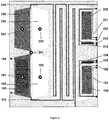
- Electrolytic solution (present in chamber 102 in Fig. 1 , 103 in Fig. 2 , 120 in Fig. 3 , and 100 in Fig.4 ) contains a conductive agent (as above) and additionally contains the reactants to restore electrochemical activity of flavonoids.
- Figure 1 shows a first embodiment of a design of a "reaction chamber" LOC, wherein the MEMS size is approximately 20 mm X 17 mm.
- the marker detection can be performed as follows: In a first phase fuel and reactant can be introduced in the reaction chamber 100 through the inlet 101 and electrolytic solution can be introduced in the electrolytic solution chamber 102 through the inlet 102. If the reactant is already present inside the reaction chamber 100, only fuel has to be introduced through the inlet 101. In a phase 2, the reaction chamber 100 can be heated up to the reaction temperature, and then be cooled (actively or passively by switching off any heat source) to restore the marker electrochemical activity.
- a phase 3 pressure can be applied in the inlet 301 to move both the fuel and the electrolytic solution, through the mixing channel 110.
- the hydrophilic flavonoids can move from the fuel to the electrolytic solution.
- the electrolytic solution can be driven in the detection chamber 120, which has a hydrophilic floor surface.
- electrochemical detection of Flavonoids can be carried out in an electrochemical cell compartment comprising a counter electrode 121, a working electrode (microelectrode-array) 122, and a reference electrode 123 using one of a standard electroanalytical method.
- the temperature of the cell can be maintained within a desired range by means of a heater 224.
- a Blank Analysis can be performed in phases 1 to 3 as follows: In a phase 1, fuel is introduced in the fuel chamber 200 through the inlet 201 and the electrolytic solution is introduced in the electrolytic solution chamber 203 through the inlet 202. In a phase 2a pressure is applied in inlet 301 to move both the fuel and the electrolytic solution, through the mixing channel 210. At the end of the mixing channel 210, the electrolytic solution will be driven in the detection chamber 220. In a phase 3 background electrochemical analysis can be carried out in an electrochemical cell compartment comprising a counter electrode 221, a working electrode (microelectrode-array) 222, and a reference electrode 223 using one of a standard electroanalytical method. The temperature of the cell can be maintained within a desired range by means of a heater 224.
- a detection device of an embodiment of the present invention may further comprise a controller that is configured to control the fluid flow and the temperature for performing any method embodiment as part of the present disclosure.
- the controller may operate valves, pumps, pressurizers, heating elements, cooling elements, and the like so as (1) mix a flavonoid derivative with an electrolytic solution to produce a mixture; (2) heat and then cool the mixture to change the electrochemical activity and produce an electrochemically more active flavonoid or flavonoid derivative; (3) separate said obtained electrochemically more active flavonoid or flavonoid derivative from the liquid, and (4) perform an electrochemical analysis of the obtained electrochemically more active flavonoid or flavonoid derivative.
- the latter may in particular be performed so as to obtain an output indicating an authenticity of a liquid, based on the contents of corresponding flavonoid derivatives.
- Figure 2 shows a second embodiment of a design of a "reaction channel” LOC, wherein the MEMS size is approximately 20 mm X 17 mm.
- the marker detection can be performed as follows: In a phase there can be introduced at the same time the fuel with the reactant in the reaction channel 100 through the inlet 101 and the electrolytic solution in the electrolytic solution channel 103 through the inlet 102, and a pressure can be applied to move the fluids along their channels 100 and 103 up to the mixing channel 110 and the detection chamber 120. In a phase 2 the reaction channel 100 can be heated up to the reaction temperature, and then can be cooled (actively or passively by switching off any heat source). The marker electrochemical activity can be restored during its flow through the reaction channel 100.
- the fuel with the re-activated marker and the electrolytic solution can reach at the same time the inlet of the mixing channel 110 and during their "side by side” flow, the hydrophilic flavonoids can move from the fuel to the electrolytic solution.
- the electrolytic solution will be driven in the detection chamber 120, which has a hydrophilic floor surface.
- Flavonoids electrochemical detection can take place in an electrochemical cell compartment comprising a counter electrode 121, a working electrode (microelectrode-array) 122, and a reference electrode 123 using one of a standard electroanalytical method.
- the temperature of the cell can be maintained within a desired range by means of a heater 224.
- a Blank Analysis can be performed in phases 1 to 3 as follows: In a phase 1, there can be introduced at the same time the fuel in the fuel channel 200 through the inlet 201 and the electrolytic solution in the electrolytic channel 203 through the inlet 202, and a pressure can be applied to move the fluids along the channels 200 and 203 up to the mixing channel 210 and the detection chamber 220. In a phase 2, the electrolytic solution can be driven at the end of the mixing channel 210 in the detection chamber 220. In a phase 3 background Electrochemical Analysis can take place in an electrochemical cell compartment comprising a counter electrode 221, a working electrode (microelectrode-array) 222, and a reference electrode 223 using one of a standard electroanalytical method. The temperature of the cell can be maintained within a desired range by means of a heater 224.
- Figure 3 shows a third embodiment of a design of a "service chamber” LOC, wherein the MEMS size is approximately 10 mm X 17 mm.
- the marker detection can be performed as follows: In a phase 1, electrolytic solution can be introduced in the detection chamber 120 through the inlet 102. The hydrophilic floor surface of the detection chamber 120 and the hydrophobic floor surface of the neighboring service chamber 130 can constrain the electrolytic solution in the detection chamber 130. In a phase 2, fuel with the reactant can be introduced in the reaction channel 100 through the inlet 101, and a pressure can be applied to move the fluid along the reaction channel 100 up to the service chamber 130. In a phase 3, the reaction channel 100 can be heated up to the reaction temperature, and can then be cooled (actively or passively by switching off any heat source).
- the marker electrochemical activity can be restored during its flow through the reaction channel 100.
- the fuel with the re-activated marker can reach the service chamber 130 where it can stay in contact with the electrolytic solution as long as the hydrophilic flavonoids will move from the fuel to the electrolytic solution.
- Flavonoids electrochemical detection can take place in an electrochemical cell compartment comprising a counter electrode 121, a working electrode (microelectrode-array) 122, and a reference electrode 123 using one of a standard electroanalytical method.
- the temperature of the cell can be maintained within a desired range by means of a heater 224.
- a Blank Analysis can be performed in phases 1 to 3 as follows:
- electrolytic solution can be introduced in the detection chamber 220 through the inlet 202.
- the hydrophilic floor surface of the detection chamber 220 and the hydrophobic floor surface of the neighboring service chamber 230 can constrain the electrolytic solution in the detection chamber 220.
- fuel can be introduced in fuel channel 200 through the inlet 201, and a pressure can be applied to move the fluid along the channel 200 up to the service chamber 230.
- the fuel can reach the service chamber 230 and can stay in contact with the electrolytic solution in detection chamber 220 for a time during which hydrophilic molecules could move from the fuel to the electrolytic solution.
- phase 4 background electrochemical analysis can take place in an electrochemical cell compartment comprising a counter electrode 221, a working electrode (microelectrode-array) 222, and a reference electrode 223 using one of a standard electroanalytical method.
- the temperature of the cell can be maintained within a desired range by means of a heater 224.
- Figures 4 and 5 show a fourth embodiment of a design of a "flow on water” LOC.
- the marker detection can be performed as follows: In a phase 1, fuel can be introduced with reactant in reaction channel 100 through the inlet 101, and a pressure can be applied to move the fluid along the reaction channel 100 up to the detection chamber 120. In a phase 2, the reaction channel 100 can be heated up to the reaction temperature, and it can then be cooled (actively or passively by switching off any heat source). The electrochemical activity can be restored during the flow through the reaction channel 100. In a phase 3, the fuel with the re-activated marker (i.e. the partially or fully de-derivatized marker)can reach the detection chamber 120 and can flow through its dedicated channel over the electrolytic solution.
- the re-activated marker i.e. the partially or fully de-derivatized marker
- the hydrophilic de-derivatized marker e.g. flavonoid
- the electrochemical detection of the partially or fully de-derivatized marker can take place in an electrochemical cell compartment comprising a counter electrode 123, a working electrode (microelectrode-array) 121, and a reference electrode 122 using one of a standard electroanalytical method.
- the temperature of the cell can be maintained within a desired range by means of a heater 224.
- a schematic cross-sectional view of the detection chamber 120 is shown in Figure 5 .
- an integration of a mobile phone or, generally, a combination with a mobile electronic device, such as a smartphone, a personal digital assistant (PDA), or the like is envisaged.
- the LOC is connected to a potentiostat/galvanostat and a mobile (smart) phone or device.
- a corresponding application software running on the phone/device
- the detection results can then also be sent to a central control system/server by means of the networking and communication capabilities of the mentioned mobile phones/devices.
- the detection device can be implemented, at least in part, as a lab on chip (LOC) detection device.
- LOC lab on chip
Landscapes
- Chemical & Material Sciences (AREA)
- Organic Chemistry (AREA)
- Oil, Petroleum & Natural Gas (AREA)
- Chemical Kinetics & Catalysis (AREA)
- Health & Medical Sciences (AREA)
- Engineering & Computer Science (AREA)
- General Chemical & Material Sciences (AREA)
- Emergency Medicine (AREA)
- Analytical Chemistry (AREA)
- General Health & Medical Sciences (AREA)
- Life Sciences & Earth Sciences (AREA)
- Clinical Laboratory Science (AREA)
- Dispersion Chemistry (AREA)
- Hematology (AREA)
- Immunology (AREA)
- Pathology (AREA)
- Physics & Mathematics (AREA)
- Biochemistry (AREA)
- General Physics & Mathematics (AREA)
- Electrochemistry (AREA)
- Molecular Biology (AREA)
- Investigating Or Analyzing Non-Biological Materials By The Use Of Chemical Means (AREA)
- Investigating Or Analysing Biological Materials (AREA)
- Measuring Or Testing Involving Enzymes Or Micro-Organisms (AREA)
- Food Science & Technology (AREA)
- Medicinal Chemistry (AREA)
Claims (19)
- Eine Zusammensetzung, die bei 20 °C und 1 atm Druck eine Flüssigkeit ist, umfassenda) einen Authentifizierungsmarker, der ein Flavonoidderivat ist, das durch Modifizieren der Hydroxylgruppen eines Flavonoids mit organischen Gruppen erhältlich ist, wobei die Konzentration des Flavonoidderivats 100 Gew.-ppm oder weniger beträgt, undb) eine organische Substanz in einer Menge von 90 Gew.-% oder mehr,wobei der Authentifizierungsmarker nicht natürlicherweise in der Zusammensetzung vorhanden ist und wobei das Flavonoidderivat, das durch Modifizieren der Hydroxylgruppen eines Flavonoids mit organischen Gruppen erhältlich ist, durch eine der folgenden Formeln dargestellt ist:
 wobei X für H oder OR steht;n für eine ganze Zahl von 0 bis 4 steht und m für eine ganze Zahl von 0 bis 5 steht, sofern die Summe von m und n 2 oder mehr beträgt,mehrere R in einem Molekül gleich oder verschieden sein können, und jedes R Folgendes sein kann:H,eine verzweigte, lineare oder zyklische Alkylgruppe mit 1 bis 50 Kohlenstoffatomen,eine C(=O)-Alkylgruppe, wobei die Alkylgruppe wie oben definiert ist,eine Trialkylsilylgruppe, wobei die Alkylgruppen jeweils unabhängig voneinander eine verzweigte, lineare oder cyclische Alkylgruppe mit 1 bis 50 Kohlenstoffatomen sind,eine Diarylalkylsilylgruppe mit zwei Arylgruppen und einer Alkylgruppe, wobei die Alkylgruppe eine verzweigte, lineare oder cyclische Alkylgruppe mit 1 bis 50 Kohlenstoffatomen ist und die Arylgruppen jeweils unabhängig voneinander aromatische Ringe mit 6 bis 10 Kohlenstoffatomen sind,eine Dialkylarylsilylgruppe mit einer Arylgruppe und zwei Alkylgruppen, wobei die Alkylgruppen und die Arylgruppen wie oben für die Diarylalkylsilylgruppe definiert sind,eine Allylgruppe,eine Methylenalkylethergruppe, wobei die Alkylgruppe wie oben definiert ist, odereine Tetrahydropyranylgruppe,unter der Voraussetzung, dass zwei oder mehr der R-Gruppen nicht für Wasserstoff stehen.
 - Die Zusammensetzung, die eine Flüssigkeit bei 20 °C und 1 atm Druck nach Anspruch 1 ist, die ein Brennstoff ist und wobei die organische Substanz in einer Menge von gleich oder größer als 95 Gew.-% vorhanden ist und ein oder mehrere Kohlenwasserstoffe mit 6 bis 22 Kohlenstoffatomen, Methanol oder Ethanol ist.
- Die Zusammensetzung nach Anspruch 1 oder 2, wobei das Flavonoidderivat einige oder alle der modifizierenden organischen Gruppen beim Erwärmen auf eine Temperatur von 50 °C oder höher verliert.
- Verwendung eines Flavonoidderivats, das durch Modifizieren der Hydroxylgruppen eines Flavonoids mit organischen Gruppen erhältlich ist, als Marker zum Authentifizieren der Echtheit und/oder Herkunft einer Zusammensetzung, die bei 20°C und 1 atm Druck eine Flüssigkeit ist, durch elektrochemische Analyse, wobei der Marker in der Zusammensetzung, die bei 20 °C und 1 atm Druck eine Flüssigkeit ist, nicht natürlicherweise vorhanden ist.
- Verwendung nach Anspruch 4, wobei das Flavonoidderivat wie in Anspruch 1 definiert ist.
- Ein Verfahren zum Authentifizieren der Echtheit und/oder Herkunft einer Zusammensetzung, die bei 20 °C und 1 atm Druck eine Flüssigkeit ist, die einen Authentifizierungsmarker enthält, der ein Flavonoidderivat ist, das durch Derivatisierung der Hydroxylgruppen eines Flavonoids mit organischen Gruppen erhältlich ist, wobei der Authentifizierungsmarker nicht natürlicherweise in der Zusammensetzung vorhanden ist, wobei das Verfahren die folgenden Schritte umfasst:- Mischen der Zusammensetzung, die das Flavonoidderivat enthält, mit einer elektrolytischen Lösung, um eine Mischung herzustellen;- Erwärmen und dann Abkühlen der Mischung zur Herstellung eines Flavonoids oder Flavonoidderivats, das elektrochemisch aktiver im Vergleich zu dem Flavonoidderivat ist, das zur Herstellung der Mischung mit einer elektrolytischen Lösung gemischt wird;- Abtrennen des erhaltenen elektrochemisch aktiveren Flavonoids oder Flavonoidderivats von der Mischung, und- elektrochemische Analyse des erhaltenen elektrochemisch aktiveren Flavonoids oder Flavonoidderivats.
- Das Verfahren nach Anspruch 6, wobei die Zusammensetzung, die eine Flüssigkeit ist, ein Brennstoff ist und wobei die Konzentration des Markers gleich oder weniger als 10 Gew.-ppm beträgt.
- Das Verfahren nach einem der Ansprüche 6 und 7, wobei das Verfahren in einer tragbaren Vorrichtung ausgeführt wird.
- Das Verfahren nach einem der Ansprüche 6 bis 8, wobei die Abtrennung des erhaltenen elektrochemisch aktiveren Flavonoids oder Flavonoidderivats von der Zusammensetzung, die eine Flüssigkeit ist, durch eine Strömung nebeneinander in einem Mischkanal, in dem auch die elektrolytische Lösung strömt, erreicht wird.
- Das Verfahren nach einem der Ansprüche 6 bis 9, das in einer Labor-auf-dem-Chip-Detektionsvorrichtung durchgeführt wird.
- Die Zusammensetzung, die eine Flüssigkeit bei 20 °C und 1 atm Druck ist, nach einem der Ansprüche 1 bis 3, Verwendung nach Anspruch 4 oder 5 oder das Verfahren nach einem der Ansprüche 6 bis 10, wobei das Flavonoidderivat, das durch Modifizieren der Hydroxylgruppen eines Flavonoids mit organischen Gruppen erhältlich ist, eine von Quercetin oder Morin abgeleitete Struktureinheit enthält.
- Eine Detektionsvorrichtung, die zum vollständigen oder teilweisen Entderivatisieren eines Flavonoidderivats eingerichtet ist, das durch Modifizieren der Hydroxylgruppen eines Flavonoids mit organischen Gruppen erhältlich ist und als Authentifizierungsmarker in einer Zusammensetzung, die bei 20 °C und 1 atm Druck eine Flüssigkeit ist, gelöst ist, und zum Abtrennen des teilweise oder vollständig entderivatisierten Flavonoids von der Zusammensetzung, umfassend:- eine Reaktionskammer (100) zum Enthalten eines Reaktanten und zum Aufnehmen der Zusammensetzung;- einen ersten Eingang (101) und einen mikrofluidischen Kanal zum Einführen einer Menge der Zusammensetzung in die Reaktionskammer (100);- ein Heizgerät (104) zum Erwärmen der Reaktionskammer (100) auf eine Reaktionstemperatur;- eine Kammer (103) für die elektrolytische Lösung zum Enthalten einer elektrolytischen Lösung;- einen zweiten Eingang (102) zum Einführen einer Menge der elektrolytischen Lösung in die Kammer (103) für die elektrolytische Lösung;- einen Mischkanal (110), der dazu eingerichtet ist, einen laminaren nebeneinanderliegenden Fluss der Mischung aus der Zusammensetzung und dem Reaktanten aus der Reaktionskammer (100) und der elektrolytischen Lösung aus der Kammer (103) für die elektrolytische Lösung zu erzeugen; und- eine Detektionskammer (120), die am Ende des Mischkanals (110) angeordnet ist und Elektroden zur elektrochemischen Analyse aufweist.
- Die Detektionsvorrichtung nach Anspruch 12, wobei die Vorrichtung ferner ein aktives Kühlelement zum Abkühlen der Reaktionskammer (100) umfasst.
- Die Detektionsvorrichtung nach Anspruch 12 oder 13, wobei die Detektionskammer (120) eine hydrophile Oberfläche umfasst.
- Die Detektionsvorrichtung nach einem der Ansprüche 12 bis 14, wobei die Detektionskammer (120) eine Arbeitselektrode (122), eine Hilfselektrode (121) und eine Referenzelektrode (123) umfasst.
- Die Detektionsvorrichtung nach Anspruch 15, wobei die Arbeitselektrode (122) eine Mikroelektrodenanordnung umfasst.
- Die Detektionsvorrichtung nach einem der Ansprüche 12 bis 16, die ferner ein Steuergerät umfasst, das dazu eingerichtet ist, den Strom der Flüssigkeit und die Temperatur zur Durchführung eines Verfahrens nach einem der Ansprüche 6 bis 10 zu steuern.
- Ein System, das eine Detektionsvorrichtung nach einem der Ansprüche 12 bis 17 und eine Zusammensetzung umfasst, die bei 20°C und 1 atm Druck eine Flüssigkeit ist und einen Authentifizierungsmarker enthält, der ein Flavonoidderivat ist, das durch Modifizieren der Hydroxylgruppen eines Flavonoids mit organischen Gruppen erhältlich ist, wobei der Authentifizierungsmarker in der Flüssigkeit mit einer Konzentration von gleich oder weniger als 10 Gew.-ppm gelöst ist.
- Das System nach Anspruch 18, wobei das Flavonoidderivat eine von Quercetin oder Morin abgeleitete Struktureinheit enthält.
Applications Claiming Priority (3)
| Application Number | Priority Date | Filing Date | Title |
|---|---|---|---|
| EP14003374 | 2014-09-30 | ||
| EP15159701 | 2015-03-18 | ||
| PCT/EP2015/072109 WO2016050636A1 (en) | 2014-09-30 | 2015-09-25 | Method for liquid authentication by detection of flavonoid derivatives |
Publications (2)
| Publication Number | Publication Date |
|---|---|
| EP3200911A1 EP3200911A1 (de) | 2017-08-09 |
| EP3200911B1 true EP3200911B1 (de) | 2021-04-28 |
Family
ID=54185981
Family Applications (1)
| Application Number | Title | Priority Date | Filing Date |
|---|---|---|---|
| EP15767536.4A Active EP3200911B1 (de) | 2014-09-30 | 2015-09-25 | Verfahren zur flüssigkeitsauthentifizierung durch detektion von flavonoidderivaten |
Country Status (8)
| Country | Link |
|---|---|
| US (1) | US10800988B2 (de) |
| EP (1) | EP3200911B1 (de) |
| BR (1) | BR112016001773B1 (de) |
| CO (1) | CO2017003251A2 (de) |
| EA (1) | EA033761B1 (de) |
| ES (1) | ES2875936T3 (de) |
| MX (1) | MX383875B (de) |
| WO (1) | WO2016050636A1 (de) |
Families Citing this family (4)
| Publication number | Priority date | Publication date | Assignee | Title |
|---|---|---|---|---|
| FR3071062B1 (fr) * | 2017-09-13 | 2019-08-30 | IFP Energies Nouvelles | Dispositif de mesure de la stabilite a l'oxydation et/ou de la stabilite thermique d'un carburant au moyen d'une puce micro-fluidique |
| GB2604120B (en) * | 2021-02-24 | 2024-12-25 | Biotag Pty Ltd | Marking of carbonaceous fluids |
| EP4059604B1 (de) | 2021-03-19 | 2025-02-12 | National Yang Ming Chiao Tung University | Mikrofluidisches testsystem und mikrofluidisches testverfahren |
| TWI784869B (zh) * | 2021-03-19 | 2022-11-21 | 國立陽明交通大學 | 微流體檢測系統及微流體檢測方法 |
Family Cites Families (10)
| Publication number | Priority date | Publication date | Assignee | Title |
|---|---|---|---|---|
| DE19804756A1 (de) * | 1998-02-06 | 1999-08-12 | Basf Ag | Feste Kraftstoffadditive |
| JPH11307756A (ja) * | 1998-02-20 | 1999-11-05 | Canon Inc | 光電変換装置および放射線読取装置 |
| US5984983A (en) * | 1998-12-04 | 1999-11-16 | Morton International, Inc. | Use of carbonyl compounds as markers |
| US6699384B1 (en) * | 1999-09-21 | 2004-03-02 | Battelle Memorial Institute | Compact electrochemical sensor system and method for field testing for metals in saliva or other fluids |
| DE10357004A1 (de) * | 2003-12-05 | 2005-06-30 | Merck Patent Gmbh | Flavonoid-Derivat |
| US7919325B2 (en) * | 2004-05-24 | 2011-04-05 | Authentix, Inc. | Method and apparatus for monitoring liquid for the presence of an additive |
| JP4613099B2 (ja) | 2005-06-03 | 2011-01-12 | シャープ株式会社 | 電気化学検出装置 |
| WO2008086897A1 (en) * | 2007-01-19 | 2008-07-24 | Ajinomoto Omnichem S.A. | Anti-oxidant fuel additives |
| CN102993148B (zh) * | 2011-09-13 | 2015-12-09 | 复旦大学 | 槲皮素衍生物或其类似物及其应用 |
| KR20140055528A (ko) * | 2012-10-31 | 2014-05-09 | 삼성전자주식회사 | 미세유동장치, 미세유동시스템 및 미세유동 검사장치의 제어방법 |
-
2015
- 2015-09-25 EP EP15767536.4A patent/EP3200911B1/de active Active
- 2015-09-25 EA EA201690362A patent/EA033761B1/ru unknown
- 2015-09-25 US US15/516,013 patent/US10800988B2/en active Active
- 2015-09-25 MX MX2015016256A patent/MX383875B/es unknown
- 2015-09-25 WO PCT/EP2015/072109 patent/WO2016050636A1/en not_active Ceased
- 2015-09-25 ES ES15767536T patent/ES2875936T3/es active Active
- 2015-09-25 BR BR112016001773-0A patent/BR112016001773B1/pt active IP Right Grant
-
2017
- 2017-04-03 CO CONC2017/0003251A patent/CO2017003251A2/es unknown
Non-Patent Citations (1)
| Title |
|---|
| VOLPI N ET AL: "Analysis of flavonoids from propolis by on-line HPLC-electrospray mass spectrometry", JOURNAL OF PHARMACEUTICAL AND BIOCHEMICAL ANALYSIS, ELSEVIER B.V, vol. 42, no. 3, 26 September 2006 (2006-09-26), pages 354 - 361, XP028005187, ISSN: 0731-7085, [retrieved on 20060926], DOI: 10.1016/J.JPBA.2006.04.017 * |
Also Published As
| Publication number | Publication date |
|---|---|
| US10800988B2 (en) | 2020-10-13 |
| ES2875936T3 (es) | 2021-11-11 |
| EP3200911A1 (de) | 2017-08-09 |
| EA201690362A1 (ru) | 2016-06-30 |
| BR112016001773A8 (pt) | 2020-01-21 |
| CO2017003251A2 (es) | 2017-08-10 |
| WO2016050636A1 (en) | 2016-04-07 |
| US20170298283A1 (en) | 2017-10-19 |
| BR112016001773B1 (pt) | 2021-02-23 |
| MX383875B (es) | 2025-03-11 |
| MX2015016256A (es) | 2016-07-14 |
| EA033761B1 (ru) | 2019-11-22 |
| BR112016001773A2 (pt) | 2017-08-01 |
Similar Documents
| Publication | Publication Date | Title |
|---|---|---|
| Fernandes et al. | Ion-specific bathochromic shifts: Simultaneous detection of multiple heavy metal pollutants via charge transfer interactions | |
| Jin et al. | Fast response near-infrared fluorescent probe for hydrogen sulfide in natural waters | |
| Mergu et al. | A novel colorimetric detection probe for copper (II) ions based on a Schiff base | |
| Manna et al. | A thio-urea based chromogenic and fluorogenic chemosensor for expeditious detection of Cu2+, Hg2+ and Ag+ ions in aqueous medium | |
| Khan et al. | Design and one-pot synthesis of a novel pyrene based fluorescent sensor for selective “turn on”, naked eye detection of Ni2+ ions, and live cell imaging | |
| Zamani et al. | Determination of gadolinium (III) ions in soil and sediment samples by a novel gadolinium membrane sensor based on 6-methyl-4-{[1-(2-thienyl) methylidene] amino} 3-thioxo-3, 4-dihydro-1, 2, 4-triazin-5-(2H)-one | |
| Aziz et al. | Azo-azomethine complex activity and sensor potential toward Ca (II) ion in life samples: the spectroscopic and morphological studies | |
| Khandare et al. | Fluorescence turn-on chemosensor for the detection of dissolved CO2 based on ion-induced aggregation of tetraphenylethylene derivative | |
| US10800988B2 (en) | Method for liquid authentication by detection of flavonoid derivatives | |
| Sharma et al. | A benzimidazole-based Co3+ complex for electrochemical and spectroscopic recognition of I− and HSO4-in semi-aqueous media | |
| Liu et al. | A cyclometalated iridium (III) complex-based luminescent probe for HCO3− and CO32− detection and its application by test strips | |
| Shokrollahi et al. | Construction of a new Cu2+ coated wire ion selective electrode based on 2-((2-(2-(2-(2-hydroxy-5-methoxybenzylidene amino) phenyl) disufanyl) phenylimino) methyl)-4-methoxyphenol Schiff base | |
| CN109096311A (zh) | 一种检测水的荧光探针、制备方法及其应用 | |
| JP2014012654A (ja) | テトラフェニルエテン誘導体から成る発蛍光性化合物 | |
| Thimaradka et al. | Hydrazinylpyridine based highly selective optical sensor for aqueous source of carbonate ions: Electrochemical and DFT studies | |
| Abdallah et al. | Selective and sensitive electrochemical sensors based on an ion imprinting polymer and graphene oxide for the detection of ultra-trace Cd (ii) in biological samples | |
| Wu et al. | A novel “on-off-on” acylhydrazone-based fluorescent chemosensor for ultrasensitive detection of Pd2+ | |
| Nag et al. | Detection of metanil yellow adulteration in turmeric powder using nano nickel cobalt oxide modified graphite electrode | |
| Liang et al. | A rhodamine-benzothiophene based fluorescent chemosensor for Hg2+ detection: Synthesis, theoretical calculations, and investigations in solutions and biosystems | |
| Guang et al. | A novel 4-phenyl amino thiourea derivative designed for real-time ratiometric–colorimetric detection of toxic Pb2+ | |
| Nasir et al. | Signal amplification by electro-oligomerisation for improved isoproturon detection | |
| Zhang et al. | Development of a Ti₃C₂ MXene-AgNPs-based SERS platform for ionophore-based ion-selective detection | |
| Routray et al. | Advances in mercury ion sensing using BODIPY-based compounds: a sexennial update | |
| CN116410172B (zh) | 一种基于异氟尔酮-氧杂蒽的粘度荧光探针的制备和应用 | |
| Mohammadi et al. | Efficient electrochemical determination of Sudan I in food samples based on modified electrode by using Ni-Fe layered double hydroxide nanosheets and ionic liquid |
Legal Events
| Date | Code | Title | Description |
|---|---|---|---|
| STAA | Information on the status of an ep patent application or granted ep patent |
Free format text: STATUS: THE INTERNATIONAL PUBLICATION HAS BEEN MADE |
|
| PUAI | Public reference made under article 153(3) epc to a published international application that has entered the european phase |
Free format text: ORIGINAL CODE: 0009012 |
|
| STAA | Information on the status of an ep patent application or granted ep patent |
Free format text: STATUS: REQUEST FOR EXAMINATION WAS MADE |
|
| 17P | Request for examination filed |
Effective date: 20161208 |
|
| AK | Designated contracting states |
Kind code of ref document: A1 Designated state(s): AL AT BE BG CH CY CZ DE DK EE ES FI FR GB GR HR HU IE IS IT LI LT LU LV MC MK MT NL NO PL PT RO RS SE SI SK SM TR |
|
| AX | Request for extension of the european patent |
Extension state: BA ME |
|
| DAV | Request for validation of the european patent (deleted) | ||
| DAX | Request for extension of the european patent (deleted) | ||
| STAA | Information on the status of an ep patent application or granted ep patent |
Free format text: STATUS: EXAMINATION IS IN PROGRESS |
|
| 17Q | First examination report despatched |
Effective date: 20190417 |
|
| RIC1 | Information provided on ipc code assigned before grant |
Ipc: C07D 311/30 20060101ALI20190819BHEP Ipc: G01N 27/416 20060101ALI20190819BHEP Ipc: B01L 3/00 20060101ALI20190819BHEP Ipc: G01N 27/00 20060101ALI20190819BHEP Ipc: C07D 311/62 20060101ALI20190819BHEP Ipc: G01N 33/22 20060101ALI20190819BHEP Ipc: C10L 1/00 20060101ALI20190819BHEP Ipc: B01J 19/00 20060101AFI20190819BHEP Ipc: C10L 1/185 20060101ALI20190819BHEP |
|
| GRAP | Despatch of communication of intention to grant a patent |
Free format text: ORIGINAL CODE: EPIDOSNIGR1 |
|
| STAA | Information on the status of an ep patent application or granted ep patent |
Free format text: STATUS: GRANT OF PATENT IS INTENDED |
|
| INTG | Intention to grant announced |
Effective date: 20200724 |
|
| RAP1 | Party data changed (applicant data changed or rights of an application transferred) |
Owner name: SICPA HOLDING SA |
|
| GRAJ | Information related to disapproval of communication of intention to grant by the applicant or resumption of examination proceedings by the epo deleted |
Free format text: ORIGINAL CODE: EPIDOSDIGR1 |
|
| STAA | Information on the status of an ep patent application or granted ep patent |
Free format text: STATUS: EXAMINATION IS IN PROGRESS |
|
| GRAP | Despatch of communication of intention to grant a patent |
Free format text: ORIGINAL CODE: EPIDOSNIGR1 |
|
| STAA | Information on the status of an ep patent application or granted ep patent |
Free format text: STATUS: GRANT OF PATENT IS INTENDED |
|
| GRAS | Grant fee paid |
Free format text: ORIGINAL CODE: EPIDOSNIGR3 |
|
| GRAJ | Information related to disapproval of communication of intention to grant by the applicant or resumption of examination proceedings by the epo deleted |
Free format text: ORIGINAL CODE: EPIDOSDIGR1 |
|
| GRAL | Information related to payment of fee for publishing/printing deleted |
Free format text: ORIGINAL CODE: EPIDOSDIGR3 |
|
| STAA | Information on the status of an ep patent application or granted ep patent |
Free format text: STATUS: EXAMINATION IS IN PROGRESS |
|
| INTC | Intention to grant announced (deleted) | ||
| INTG | Intention to grant announced |
Effective date: 20201215 |
|
| GRAP | Despatch of communication of intention to grant a patent |
Free format text: ORIGINAL CODE: EPIDOSNIGR1 |
|
| STAA | Information on the status of an ep patent application or granted ep patent |
Free format text: STATUS: GRANT OF PATENT IS INTENDED |
|
| INTC | Intention to grant announced (deleted) | ||
| INTG | Intention to grant announced |
Effective date: 20210127 |
|
| GRAA | (expected) grant |
Free format text: ORIGINAL CODE: 0009210 |
|
| STAA | Information on the status of an ep patent application or granted ep patent |
Free format text: STATUS: THE PATENT HAS BEEN GRANTED |
|
| AK | Designated contracting states |
Kind code of ref document: B1 Designated state(s): AL AT BE BG CH CY CZ DE DK EE ES FI FR GB GR HR HU IE IS IT LI LT LU LV MC MK MT NL NO PL PT RO RS SE SI SK SM TR |
|
| REG | Reference to a national code |
Ref country code: GB Ref legal event code: FG4D |
|
| REG | Reference to a national code |
Ref country code: CH Ref legal event code: EP |
|
| REG | Reference to a national code |
Ref country code: AT Ref legal event code: REF Ref document number: 1386484 Country of ref document: AT Kind code of ref document: T Effective date: 20210515 |
|
| REG | Reference to a national code |
Ref country code: DE Ref legal event code: R096 Ref document number: 602015068682 Country of ref document: DE |
|
| REG | Reference to a national code |
Ref country code: IE Ref legal event code: FG4D |
|
| REG | Reference to a national code |
Ref country code: LT Ref legal event code: MG9D |
|
| REG | Reference to a national code |
Ref country code: AT Ref legal event code: MK05 Ref document number: 1386484 Country of ref document: AT Kind code of ref document: T Effective date: 20210428 |
|
| PG25 | Lapsed in a contracting state [announced via postgrant information from national office to epo] |
Ref country code: FI Free format text: LAPSE BECAUSE OF FAILURE TO SUBMIT A TRANSLATION OF THE DESCRIPTION OR TO PAY THE FEE WITHIN THE PRESCRIBED TIME-LIMIT Effective date: 20210428 Ref country code: NL Free format text: LAPSE BECAUSE OF FAILURE TO SUBMIT A TRANSLATION OF THE DESCRIPTION OR TO PAY THE FEE WITHIN THE PRESCRIBED TIME-LIMIT Effective date: 20210428 Ref country code: LT Free format text: LAPSE BECAUSE OF FAILURE TO SUBMIT A TRANSLATION OF THE DESCRIPTION OR TO PAY THE FEE WITHIN THE PRESCRIBED TIME-LIMIT Effective date: 20210428 Ref country code: HR Free format text: LAPSE BECAUSE OF FAILURE TO SUBMIT A TRANSLATION OF THE DESCRIPTION OR TO PAY THE FEE WITHIN THE PRESCRIBED TIME-LIMIT Effective date: 20210428 Ref country code: AT Free format text: LAPSE BECAUSE OF FAILURE TO SUBMIT A TRANSLATION OF THE DESCRIPTION OR TO PAY THE FEE WITHIN THE PRESCRIBED TIME-LIMIT Effective date: 20210428 Ref country code: BG Free format text: LAPSE BECAUSE OF FAILURE TO SUBMIT A TRANSLATION OF THE DESCRIPTION OR TO PAY THE FEE WITHIN THE PRESCRIBED TIME-LIMIT Effective date: 20210728 |
|
| REG | Reference to a national code |
Ref country code: ES Ref legal event code: FG2A Ref document number: 2875936 Country of ref document: ES Kind code of ref document: T3 Effective date: 20211111 |
|
| PG25 | Lapsed in a contracting state [announced via postgrant information from national office to epo] |
Ref country code: LV Free format text: LAPSE BECAUSE OF FAILURE TO SUBMIT A TRANSLATION OF THE DESCRIPTION OR TO PAY THE FEE WITHIN THE PRESCRIBED TIME-LIMIT Effective date: 20210428 Ref country code: IS Free format text: LAPSE BECAUSE OF FAILURE TO SUBMIT A TRANSLATION OF THE DESCRIPTION OR TO PAY THE FEE WITHIN THE PRESCRIBED TIME-LIMIT Effective date: 20210828 Ref country code: GR Free format text: LAPSE BECAUSE OF FAILURE TO SUBMIT A TRANSLATION OF THE DESCRIPTION OR TO PAY THE FEE WITHIN THE PRESCRIBED TIME-LIMIT Effective date: 20210729 Ref country code: NO Free format text: LAPSE BECAUSE OF FAILURE TO SUBMIT A TRANSLATION OF THE DESCRIPTION OR TO PAY THE FEE WITHIN THE PRESCRIBED TIME-LIMIT Effective date: 20210728 Ref country code: PT Free format text: LAPSE BECAUSE OF FAILURE TO SUBMIT A TRANSLATION OF THE DESCRIPTION OR TO PAY THE FEE WITHIN THE PRESCRIBED TIME-LIMIT Effective date: 20210830 Ref country code: PL Free format text: LAPSE BECAUSE OF FAILURE TO SUBMIT A TRANSLATION OF THE DESCRIPTION OR TO PAY THE FEE WITHIN THE PRESCRIBED TIME-LIMIT Effective date: 20210428 Ref country code: RS Free format text: LAPSE BECAUSE OF FAILURE TO SUBMIT A TRANSLATION OF THE DESCRIPTION OR TO PAY THE FEE WITHIN THE PRESCRIBED TIME-LIMIT Effective date: 20210428 Ref country code: SE Free format text: LAPSE BECAUSE OF FAILURE TO SUBMIT A TRANSLATION OF THE DESCRIPTION OR TO PAY THE FEE WITHIN THE PRESCRIBED TIME-LIMIT Effective date: 20210428 |
|
| REG | Reference to a national code |
Ref country code: NL Ref legal event code: MP Effective date: 20210428 |
|
| PG25 | Lapsed in a contracting state [announced via postgrant information from national office to epo] |
Ref country code: EE Free format text: LAPSE BECAUSE OF FAILURE TO SUBMIT A TRANSLATION OF THE DESCRIPTION OR TO PAY THE FEE WITHIN THE PRESCRIBED TIME-LIMIT Effective date: 20210428 Ref country code: CZ Free format text: LAPSE BECAUSE OF FAILURE TO SUBMIT A TRANSLATION OF THE DESCRIPTION OR TO PAY THE FEE WITHIN THE PRESCRIBED TIME-LIMIT Effective date: 20210428 Ref country code: DK Free format text: LAPSE BECAUSE OF FAILURE TO SUBMIT A TRANSLATION OF THE DESCRIPTION OR TO PAY THE FEE WITHIN THE PRESCRIBED TIME-LIMIT Effective date: 20210428 Ref country code: SK Free format text: LAPSE BECAUSE OF FAILURE TO SUBMIT A TRANSLATION OF THE DESCRIPTION OR TO PAY THE FEE WITHIN THE PRESCRIBED TIME-LIMIT Effective date: 20210428 Ref country code: SM Free format text: LAPSE BECAUSE OF FAILURE TO SUBMIT A TRANSLATION OF THE DESCRIPTION OR TO PAY THE FEE WITHIN THE PRESCRIBED TIME-LIMIT Effective date: 20210428 Ref country code: RO Free format text: LAPSE BECAUSE OF FAILURE TO SUBMIT A TRANSLATION OF THE DESCRIPTION OR TO PAY THE FEE WITHIN THE PRESCRIBED TIME-LIMIT Effective date: 20210428 |
|
| REG | Reference to a national code |
Ref country code: DE Ref legal event code: R097 Ref document number: 602015068682 Country of ref document: DE |
|
| PLBE | No opposition filed within time limit |
Free format text: ORIGINAL CODE: 0009261 |
|
| STAA | Information on the status of an ep patent application or granted ep patent |
Free format text: STATUS: NO OPPOSITION FILED WITHIN TIME LIMIT |
|
| 26N | No opposition filed |
Effective date: 20220131 |
|
| REG | Reference to a national code |
Ref country code: BE Ref legal event code: MM Effective date: 20210930 |
|
| PG25 | Lapsed in a contracting state [announced via postgrant information from national office to epo] |
Ref country code: IS Free format text: LAPSE BECAUSE OF FAILURE TO SUBMIT A TRANSLATION OF THE DESCRIPTION OR TO PAY THE FEE WITHIN THE PRESCRIBED TIME-LIMIT Effective date: 20210828 Ref country code: MC Free format text: LAPSE BECAUSE OF FAILURE TO SUBMIT A TRANSLATION OF THE DESCRIPTION OR TO PAY THE FEE WITHIN THE PRESCRIBED TIME-LIMIT Effective date: 20210428 Ref country code: AL Free format text: LAPSE BECAUSE OF FAILURE TO SUBMIT A TRANSLATION OF THE DESCRIPTION OR TO PAY THE FEE WITHIN THE PRESCRIBED TIME-LIMIT Effective date: 20210428 |
|
| PG25 | Lapsed in a contracting state [announced via postgrant information from national office to epo] |
Ref country code: LU Free format text: LAPSE BECAUSE OF NON-PAYMENT OF DUE FEES Effective date: 20210925 Ref country code: IE Free format text: LAPSE BECAUSE OF NON-PAYMENT OF DUE FEES Effective date: 20210925 Ref country code: BE Free format text: LAPSE BECAUSE OF NON-PAYMENT OF DUE FEES Effective date: 20210930 |
|
| PG25 | Lapsed in a contracting state [announced via postgrant information from national office to epo] |
Ref country code: HU Free format text: LAPSE BECAUSE OF FAILURE TO SUBMIT A TRANSLATION OF THE DESCRIPTION OR TO PAY THE FEE WITHIN THE PRESCRIBED TIME-LIMIT; INVALID AB INITIO Effective date: 20150925 |
|
| P01 | Opt-out of the competence of the unified patent court (upc) registered |
Effective date: 20230523 |
|
| PG25 | Lapsed in a contracting state [announced via postgrant information from national office to epo] |
Ref country code: CY Free format text: LAPSE BECAUSE OF FAILURE TO SUBMIT A TRANSLATION OF THE DESCRIPTION OR TO PAY THE FEE WITHIN THE PRESCRIBED TIME-LIMIT Effective date: 20210428 |
|
| PG25 | Lapsed in a contracting state [announced via postgrant information from national office to epo] |
Ref country code: MK Free format text: LAPSE BECAUSE OF FAILURE TO SUBMIT A TRANSLATION OF THE DESCRIPTION OR TO PAY THE FEE WITHIN THE PRESCRIBED TIME-LIMIT Effective date: 20210428 |
|
| PG25 | Lapsed in a contracting state [announced via postgrant information from national office to epo] |
Ref country code: TR Free format text: LAPSE BECAUSE OF FAILURE TO SUBMIT A TRANSLATION OF THE DESCRIPTION OR TO PAY THE FEE WITHIN THE PRESCRIBED TIME-LIMIT Effective date: 20210428 |
|
| PG25 | Lapsed in a contracting state [announced via postgrant information from national office to epo] |
Ref country code: MT Free format text: LAPSE BECAUSE OF FAILURE TO SUBMIT A TRANSLATION OF THE DESCRIPTION OR TO PAY THE FEE WITHIN THE PRESCRIBED TIME-LIMIT Effective date: 20210428 |
|
| REG | Reference to a national code |
Ref country code: CH Ref legal event code: U11 Free format text: ST27 STATUS EVENT CODE: U-0-0-U10-U11 (AS PROVIDED BY THE NATIONAL OFFICE) Effective date: 20251001 |
|
| PGFP | Annual fee paid to national office [announced via postgrant information from national office to epo] |
Ref country code: DE Payment date: 20250820 Year of fee payment: 11 |
|
| PGFP | Annual fee paid to national office [announced via postgrant information from national office to epo] |
Ref country code: IT Payment date: 20250820 Year of fee payment: 11 |
|
| PGFP | Annual fee paid to national office [announced via postgrant information from national office to epo] |
Ref country code: GB Payment date: 20250820 Year of fee payment: 11 |
|
| PGFP | Annual fee paid to national office [announced via postgrant information from national office to epo] |
Ref country code: FR Payment date: 20250820 Year of fee payment: 11 |
|
| PGFP | Annual fee paid to national office [announced via postgrant information from national office to epo] |
Ref country code: CH Payment date: 20251001 Year of fee payment: 11 |
|
| PGFP | Annual fee paid to national office [announced via postgrant information from national office to epo] |
Ref country code: ES Payment date: 20251001 Year of fee payment: 11 |