EP3201124B1 - Alliages dynamiquement vulcanisés - Google Patents
Alliages dynamiquement vulcanisés Download PDFInfo
- Publication number
- EP3201124B1 EP3201124B1 EP15757072.2A EP15757072A EP3201124B1 EP 3201124 B1 EP3201124 B1 EP 3201124B1 EP 15757072 A EP15757072 A EP 15757072A EP 3201124 B1 EP3201124 B1 EP 3201124B1
- Authority
- EP
- European Patent Office
- Prior art keywords
- alloy
- elastomer
- thermoplastic resin
- nylon
- phr
- Prior art date
- Legal status (The legal status is an assumption and is not a legal conclusion. Google has not performed a legal analysis and makes no representation as to the accuracy of the status listed.)
- Active
Links
Images


Classifications
-
- C—CHEMISTRY; METALLURGY
- C08—ORGANIC MACROMOLECULAR COMPOUNDS; THEIR PREPARATION OR CHEMICAL WORKING-UP; COMPOSITIONS BASED THEREON
- C08L—COMPOSITIONS OF MACROMOLECULAR COMPOUNDS
- C08L23/00—Compositions of homopolymers or copolymers of unsaturated aliphatic hydrocarbons having only one carbon-to-carbon double bond; Compositions of derivatives of such polymers
- C08L23/26—Compositions of homopolymers or copolymers of unsaturated aliphatic hydrocarbons having only one carbon-to-carbon double bond; Compositions of derivatives of such polymers modified by chemical after-treatment
- C08L23/28—Compositions of homopolymers or copolymers of unsaturated aliphatic hydrocarbons having only one carbon-to-carbon double bond; Compositions of derivatives of such polymers modified by chemical after-treatment by reaction with halogens or halogen-containing compounds
- C08L23/283—Iso-olefin halogenated homopolymers or copolymers
-
- B—PERFORMING OPERATIONS; TRANSPORTING
- B60—VEHICLES IN GENERAL
- B60C—VEHICLE TYRES; TYRE INFLATION; TYRE CHANGING; CONNECTING VALVES TO INFLATABLE ELASTIC BODIES IN GENERAL; DEVICES OR ARRANGEMENTS RELATED TO TYRES
- B60C1/00—Tyres characterised by the chemical composition or the physical arrangement or mixture of the composition
- B60C1/0008—Compositions of the inner liner
-
- C—CHEMISTRY; METALLURGY
- C08—ORGANIC MACROMOLECULAR COMPOUNDS; THEIR PREPARATION OR CHEMICAL WORKING-UP; COMPOSITIONS BASED THEREON
- C08K—Use of inorganic or non-macromolecular organic substances as compounding ingredients
- C08K3/00—Use of inorganic substances as compounding ingredients
- C08K3/34—Silicon-containing compounds
- C08K3/346—Clay
-
- C—CHEMISTRY; METALLURGY
- C08—ORGANIC MACROMOLECULAR COMPOUNDS; THEIR PREPARATION OR CHEMICAL WORKING-UP; COMPOSITIONS BASED THEREON
- C08L—COMPOSITIONS OF MACROMOLECULAR COMPOUNDS
- C08L23/00—Compositions of homopolymers or copolymers of unsaturated aliphatic hydrocarbons having only one carbon-to-carbon double bond; Compositions of derivatives of such polymers
- C08L23/02—Compositions of homopolymers or copolymers of unsaturated aliphatic hydrocarbons having only one carbon-to-carbon double bond; Compositions of derivatives of such polymers not modified by chemical after-treatment
- C08L23/04—Homopolymers or copolymers of ethene
- C08L23/08—Copolymers of ethene
- C08L23/0846—Copolymers of ethene with unsaturated hydrocarbons containing atoms other than carbon or hydrogen
- C08L23/0853—Ethylene vinyl acetate copolymers
- C08L23/0861—Saponified copolymers, e.g. ethylene vinyl alcohol copolymers
-
- C—CHEMISTRY; METALLURGY
- C08—ORGANIC MACROMOLECULAR COMPOUNDS; THEIR PREPARATION OR CHEMICAL WORKING-UP; COMPOSITIONS BASED THEREON
- C08L—COMPOSITIONS OF MACROMOLECULAR COMPOUNDS
- C08L77/00—Compositions of polyamides obtained by reactions forming a carboxylic amide link in the main chain; Compositions of derivatives of such polymers
-
- B—PERFORMING OPERATIONS; TRANSPORTING
- B82—NANOTECHNOLOGY
- B82Y—SPECIFIC USES OR APPLICATIONS OF NANOSTRUCTURES; MEASUREMENT OR ANALYSIS OF NANOSTRUCTURES; MANUFACTURE OR TREATMENT OF NANOSTRUCTURES
- B82Y30/00—Nanotechnology for materials or surface science, e.g. nanocomposites
-
- C—CHEMISTRY; METALLURGY
- C08—ORGANIC MACROMOLECULAR COMPOUNDS; THEIR PREPARATION OR CHEMICAL WORKING-UP; COMPOSITIONS BASED THEREON
- C08L—COMPOSITIONS OF MACROMOLECULAR COMPOUNDS
- C08L2201/00—Properties
- C08L2201/14—Gas barrier composition
-
- C—CHEMISTRY; METALLURGY
- C08—ORGANIC MACROMOLECULAR COMPOUNDS; THEIR PREPARATION OR CHEMICAL WORKING-UP; COMPOSITIONS BASED THEREON
- C08L—COMPOSITIONS OF MACROMOLECULAR COMPOUNDS
- C08L2205/00—Polymer mixtures characterised by other features
- C08L2205/03—Polymer mixtures characterised by other features containing three or more polymers in a blend
-
- C—CHEMISTRY; METALLURGY
- C08—ORGANIC MACROMOLECULAR COMPOUNDS; THEIR PREPARATION OR CHEMICAL WORKING-UP; COMPOSITIONS BASED THEREON
- C08L—COMPOSITIONS OF MACROMOLECULAR COMPOUNDS
- C08L2205/00—Polymer mixtures characterised by other features
- C08L2205/22—Mixtures comprising a continuous polymer matrix in which are dispersed crosslinked particles of another polymer
Definitions
- the present invention relates generally to dynamically vulcanized alloys of elastomer and thermoplastic resins. More specifically, the present invention relates to dynamically vulcanized alloys containing nanofillers.
- thermoplastic elastomer compositions containing elastomers both cured and uncured, and thermoplastic resins are known in the industry.
- a cured elastomer composition is known as either thermoplastic plastic vulcanizates (TPVs) or as dynamically vulcanized alloys (DVAs).
- TPVs thermoplastic plastic vulcanizates
- DVAs dynamically vulcanized alloys
- the elastomer in TPVs is dispersed in the thermoplastic resin, providing flexibility to the material due to the elastomer and reprocessability due to the thermoplastic resin.
- TPVs or DVAs are cast, blown, or molded to form the final products.
- the conventional fabrication process is a multiple-step process having the following steps.
- the compound is produced by (i) preparing a rubber master batch by mixing, at temperatures below the cross-linking temperature, the elastomer and curative until a uniform mix state is obtained (this is often referred to as pre-conditioning) and (ii) premixing a resin master batch comprising a thermoplastic resin and plasticizers. If desired, conventional fillers and other processing aids may also be added to the rubber master batch.
- a thermoplastic resin masterbatch is mixed typically in a twin screw extruder by mixing the resin and plasticizers. The resin masterbatch may then be pelletized.
- the rubber master batch, resin master batch, and all remaining components are then fed into a mixer, as well as any desired secondary components, and mixed at high temperatures under shear conditions.
- the elastomer component is vulcanized during the melt mixing.
- DVAs compounded for low permeability [or stated alternatively: high impermeability] applications comprise low-permeability thermoplastic resin, such as polyamide or a blend of polyamides, in which there is dispersed a low-permeability rubber.
- low permeability rubbers include butyl rubber, halobutyl rubbers, or brominated isobutylene para-methylstyrene copolymers.
- the rubber is cured under conditions of dynamic vulcanization (curing the rubber during melt mixing as opposed to static curing that typically occurs in a rubber mold) and is intimately and uniformly dispersed as a particulate phase within a continuous phase of the thermoplastic resin.
- a co-continuous morphology may also be formed.
- the elastic nature is desirable for applications requiring flexibility, strength, and elongation. Such properties are also desirable in tire materials.
- the thermoplastic resin provides a very low permeability to the inner liner layer while the elastomer provides flexibility and durability to the inner liner layer.
- the inner liner layer formed from DVA can be formed as a very thin layer.
- Conventional inner liner layers, comprised of only a base elastomer(s) typically have a thickness or gauge in the range of 1.25 to 7.0 mm while inner liner layers formed from DVA have typically a thickness range of 0.08 mm to 0.25 mm.
- US 7,491,764 discloses a nanocomposite composition having a nanofiller, an elastomeric matrix, and one or more exfoliating additives.
- US 8,039,526 discloses a method for preparing a nanofiller-filed TPV.
- the past work of Applicants and others in using DVA for tire innerliners has highlighted the need for continued improvement in impermeability of the DVAs.
- the present invention is directed to a DVA/TPV composition
- a DVA/TPV composition comprising a thermoplastic resin and an elastomer.
- the elastomer is a low-permeability rubber.
- the present invention is directed to a dynamically vulcanized alloy, the alloy comprising at least one elastomer comprising C 4 to C 7 isomonoolefin derived units; at least one thermoplastic resin having a melting temperature in the range of 170°C to 260°C; a nanofiller; and 5 to 30 phr of an ethylene copolymer resin, wherein the elastomer is present as a dispersed phase of small particles in a continuous phase of the thermoplastic resin.
- Polymer may be used to refer to homopolymers, copolymers, interpolymers, terpolymers, etc.
- a copolymer may refer to a polymer comprising at least two monomers, optionally with other monomers.
- the monomer is present in the polymer in the polymerized form of the monomer or in the polymerized form of a derivative from the monomer (i.e., a monomeric unit).
- the phrase comprising the (respective) monomer or the like is used as shorthand.
- Elastomer refers to any polymer or composition of polymers consistent with the ASTM D1566 definition: "a material that is capable of recovering from large deformations, and can be, or already is, modified to a state in which it is essentially insoluble, if vulcanized, (but can swell) in a solvent.”
- elastomers may be referred to as polymers, elastomeric polymers, or rubbers; the term elastomer may be used herein interchangeably with the term rubber or polymer.
- phr is parts per hundred rubber or "parts”, and is a measure common in the art wherein components of a composition are measured relative to a total of all of the elastomer components.
- the total phr or parts for all rubber components, whether one, two, three, or more different rubber components is present in a given recipe is normally defined as 100 phr. All other non-rubber components are ratioed against the 100 parts of rubber and are expressed in phr. This way one can easily compare, for example, the levels of curatives or filler loadings, etc., between different compositions based on the same relative proportion of rubber without the need to recalculate percentages for every component after adjusting levels of only one, or more, component(s).
- vulcanized or “cured” refers to the chemical reaction that forms bonds or cross-links between the polymer chains of an elastomer.
- DVA dynamically vulcanized alloy
- downstream and upstream when discussing a process or an extruder are given conventional terms in the art.
- referencing something as 'downstream' in the process or extruder it means a point in time or location in the process or extruder that is after the referenced point.
- referencing something as 'upstream' in the process or extruder it means a point in time or location in the process or extruder that is before the referenced point. For example, if B is introduced downstream of A, then B is introduced into the process or extruder after A and conversely if B is introduced upstream of A, then it is introduced before A.
- the DVA has a desired morphology wherein the elastomer is uniformly dispersed as fine particles within the thermoplastic resin.
- the thermoplastic resin component forms the continuous phase and the elastomer is the dispersed phase even where the rubber to resin ratio is 1.0 or more.
- the dispersed particle size of the elastomer and the structure of the resin phase are controlled to improve the durability of the DVA, in particular durability at low temperatures.
- the elastomeric component of the DVA may be selected from an assortment of thermosetting, elastomeric materials. For uses where impermeability of the final article to be produced is desired, the use of at least one low-permeability elastomer is desired.
- elastomers derived from a mixture of monomers the mixture having at least the following monomers: a C 4 to C 7 isoolefin monomer and a polymerizable monomer.
- the isoolefin is present in a range from 70 to 99.5 wt% of the total monomers in any embodiment, or 85 to 99.5 wt% in any embodiment.
- the polymerizable monomer is present in amounts in the range of from 30 to about 0.5 wt% in any embodiment, or from 15 to 0.5 wt% in any embodiment, or from 8 to 0.5 wt% in any embodiment.
- the elastomer will contain monomer derived unit amounts having the same weight percentages.
- the isoolefin is a C 4 to C 7 compound, non-limiting examples of which are compounds such as isobutylene, isobutene, 2-methyl-1-butene, 3-methyl-1-butene, 2-methyl-2-butene, 1-butene, 2-butene, methyl vinyl ether, indene, vinyltrimethylsilane, hexene, and 4-methyl-1-pentene.
- the polymerizable monomer may be a C4 to C14 multiolefin such as isoprene, butadiene, 2,3-dimethyl-1,3-butadiene, myrcene, 6,6-dimethyl-fulvene, hexadiene, cyclopentadiene, and piperylene.
- Other polymerizable monomers such as styrene, alkylstyrene, e.g., p-methylstyrene, and dichlorostyrene are also suitable for preparing a useful e
- Preferred elastomers useful in the practice of this invention include isobutylene-based copolymers.
- An isobutylene based elastomer or a polymer refers to an elastomer or a polymer comprising at least 70 mol% repeat units from isobutylene and at least one other polymerizable unit.
- the isobutylene-based copolymer may or may not be halogenated.
- ionomer versions of these polyisobutylene polymers may also be used as the elastomeric component of the invention.
- the elastomer may be a butyl-type rubber or branched butyl-type rubber, especially halogenated versions of these elastomers.
- Useful elastomers are unsaturated butyl rubbers such copolymers of olefins or isoolefins and multiolefins.
- Non-limiting examples of unsaturated elastomers useful in the method and composition of the present invention are poly(isobutylene-co-isoprene), polyisoprene, polybutadiene, polyisobutylene, poly(styrene-co-butadiene), natural rubber, star-branched butyl rubber, and mixtures thereof.
- Useful elastomers in the present invention can be made by any suitable means known in the art, and the invention is not herein limited by the method of producing the elastomer.
- Butyl rubber is obtained by reacting isobutylene with 0.5 to 8 wt% isoprene, or reacting isobutylene with 0.5 wt% to 5.0 wt% isoprene - the remaining weight percent of the polymer being derived from isobutylene; the butyl rubber contains monomer derived unit amounts having the same weight percentages.
- Elastomeric compositions of the present invention may also comprise at least one random copolymer comprising a C 4 to C 7 isoolefin and an alkylstyrene comonomer.
- the isoolefin may be selected from any of the above listed C 4 to C 7 isoolefin monomers, and is preferably an isomonoolefin, and in any embodiment may be isobutylene.
- the alkylstyrene may be para-methylstyrene, containing at least 80%, more alternatively at least 90% by weight of the para-isomer.
- the random copolymer may optionally include functionalized interpolymers.
- the functionalized interpolymers have at least one or more of the alkyl substituents groups present in the styrene monomer units; the substituent group may be a benzylic halogen or some other functional group.
- the polymer may be a random elastomeric copolymer of a C 4 to C 7 ⁇ -olefin and an alkylstyrene comonomer.
- the alkylstyrene comonomer may be para-methylstyrene containing at least 80%, alternatively at least 90% by weight, of the para-isomer.
- the random comonomer may optionally include functionalized interpolymers wherein at least one or more of the alkyl substituents groups present in the styrene monomer units contain a halogen or some other functional group; up to 60 mol% of the para-substituted styrene present in the random polymer structure may be the functionalized. Alternatively, in any embodiment, from 0.1 to 5 mol% or 0.2 to 3 mol% of the para-substituted styrene present may be the functionalized.
- the functional group may be halogen or some other functional group which may be incorporated by nucleophilic substitution of any benzylic halogen with other groups such as carboxylic acids; carboxy salts; carboxy esters, amides and imides; hydroxy; alkoxide; phenoxide; thiolate; thioether; xanthate; cyanide; cyanate; amino and mixtures thereof.
- the elastomer comprises random polymers of isobutylene and 0.5 to 20 mol% para-methylstyrene wherein up to 60 mol% of the methyl substituent groups present on the benzyl ring is functionalized with a halogen such a bromine or chlorine, an acid, or an ester.
- the functionality on the elastomer is selected such that it can react or form polar bonds with functional groups present in the thermoplastic resin, for example, acid, amino or hydroxyl functional groups, when the DVA components are mixed at reactive temperatures.
- Brominated poly(isobutylene-co-p-methylstyrene) "BIMSM" polymers useful in the present invention generally contain from 0.1 to 5 mol% of bromomethylstyrene groups relative to the total amount of monomer derived units in the copolymer.
- the amount of bromomethyl groups is from 0.5 to 3.0 mol%, or from 0.3 to 2.8 mol%, or from 0.4 to 2.5 mol%, or from 0.5 to 2.0 mol%, wherein a desirable range for the present invention may be any combination of any upper limit with any lower limit.
- the BIMSM polymer has either 1.0 to 2.0 mol% bromomethyl groups, or 1.0 to 1.5 mol% of bromomethyl groups.
- exemplary BIMSM polymers useful in the present invention contain from 0.2 to 10 wt% of bromine, based on the weight of the polymer, or from 0.4 to 6 wt% bromine, or from 0.6 to 5.6 wt%.
- Useful BIMSM polymers may be substantially free of ring halogen or halogen in the polymer backbone chain.
- the random polymer is a polymer of C 4 to C 7 isoolefin derived units (or isomonoolefin), para-methylstyrene derived units and para-(halomethylstyrene) derived units, wherein the para-(halomethylstyrene) units are present in the polymer from 0.5 to 2.0 mol% based on the total number of para-methylstyrene, and wherein the para-methylstyrene derived units are present from 5 to 15 wt%, or 7 to 12 wt%, based on the total weight of the polymer.
- the para-(halomethylstyrene) is para-(bromomethylstyrene).
- Suitable low-permeability elastomers are isobutylene containing elastomers such as isobutylene - isoprene - alkylstyrene terpolymers or halogenated isobutylene-isoprene-alkylstyrene terpolymers wherein for each of these terpolymers, the isobutylene derived component in the terpolymer is 70 to 99 wt% of the monomer units in the polymer, the isoprene derived component is 29 to 0.5 wt% of the monomer units in the polymer, and the alkylstyrene derived component is 29 to 0.5 wt% of the monomer units in the polymer.
- Suitable C 4 to C 7 isoolefin derived elastomers (including the brominated isobutylene-paramethylstyrene copolymers) having a number average molecular weight Mn of at least about 25,000, preferably at least about 50,000, preferably at least about 75,000, preferably at least about 100,000, preferably at least about 150,000.
- the polymers may also have a ratio of weight average molecular weight (Mw) to number average molecular weight (Mn), i.e., Mw/Mn of less than about 6, preferably less than about 4, more preferably less than about 2.5, most preferably less than about 2.0.
- suitable halogenated isobutylene elastomer components include copolymers (such as brominated isobutylene-paramethylstyrene copolymers) having a Mooney viscosity (1+4) at 125°C (as measured by ASTM D 1646-99) of 30 or more, or more preferably 40 or more.
- Preferred elastomers include copolymers of isobutylene and para-alkylstyrene, which may or may not be halogenated. Preferably the copolymer of isobutylene and para-alkylstyrene is halogenated. Such elastomers are described in EP 0 344 021 .
- the copolymers preferably have a substantially homogeneous compositional distribution.
- Preferred alkyl groups for the para-alkylstyrene moiety include alkyl groups having from 1 to 5 carbon atoms, primary haloalkyl, secondary haloalkyl having from 1 to 5 carbon atoms and mixtures thereof.
- a preferred copolymer comprises isobutylene and para-methylstyrene.
- brominated copolymers of isobutylene and para-methylstyrene include those having 5 to 12 weight % para-methylstyrene, 0.3 to 1.8 mol % brominated para-methylstyrene, and a Mooney viscosity of 30 to 65 (1+4) at 125°C (as measured by ASTM D 1646-99).
- the brominated copolymers of isobutylene and para-methylstyrene include those having 7 to 12 weight % para-methylstyrene, 0.75 to 1.5 mol % brominated para-methylstyrene, and a Mooney viscosity of 30 to 45 (1+4) at 125°C (as measured by ASTM D 1646-99).
- thermoplastic resin is a thermoplastic polymer, copolymer, or mixture thereof having a melting temperature of about 170°C to about 260° C, preferably less than 260°C, and most preferably less than about 240°C.
- the thermoplastic resin should have a molecular weight in the range of 13,000 to 50,000 and/or a Young's modulus of more than 200 MPa at 23°C.
- a thermoplastic is a synthetic resin that softens when heat is applied and regains its original properties upon cooling.
- thermoplastic resins may be used singly or in combination and generally contain nitrogen, oxygen, halogen, sulfur or other groups capable of interacting with an aromatic functional groups such as halogen or acidic groups.
- Suitable thermoplastic resins include polyamides, polyimides, polycarbonates, polyesters, polysulfones, polylactones, polyacetals, acrylonitrile-butadiene-styrene resins (ABS), polyphenyleneoxide (PPO), polyphenylene sulfide (PPS), polystyrene, styrene-acrylonitrile resins (SAN), styrene maleic anhydride resins (SMA), aromatic polyketones (PEEK, PED, and PEKK), ethylene acetate copolymer resins (EVA) and mixtures thereof.
- Suitable polyamides comprise crystalline or resinous, high molecular weight solid polymers including homopolymers, copolymers, and terpolymers having recurring amide units within the polymer chain.
- Polyamides may be prepared by polymerization of one or more epsilon lactams such as caprolactam, pyrrolidione, lauryllactam and aminoundecanoic lactam, or amino acid, or by condensation of dibasic acids and diamines. Both fiber-forming and molding grade nylons are suitable.
- polyamides examples include polycaprolactam (nylon-6), polylauryllactam (nylon-12), polyhexamethyleneadipamide (nylon-6,6) polyhexamethyleneazelamide (nylon-6,9), polyhexamethylenesebacamide (nylon-6,10), poly(hexamethylene dodecanediamide (nylon-6,12), polyhexamethyleneisophthalamide (nylon-6, IP) and the condensation product of 11-amino-undecanoic acid (nylon-11).
- Commercially available polyamides may be advantageously used in the practice of this invention, with linear crystalline polyamides having a softening point or melting point between 170 and 260°C being preferred.
- polyesters which may be employed include the polymer reaction products of one or a mixture of aliphatic or aromatic polycarboxylic acids esters of anhydrides and one or a mixture of diols.
- suitable polyesters include poly (trans-1,4-cyclohexylene C2-6 alkane dicarboxylates such as poly(trans-1,4-cyclohexylene succinate) and poly (trans-1,4-cyclohexylene adipate); poly (cis or trans-1,4-cyclohexanedimethylene) alkanedicarboxylates such as poly(cis-1,4-cyclohexanedimethylene) oxlate and poly-(cis-1,4-cyclohexanedimethylene) succinate, poly (C2-4 alkylene terephthalates) such as polyethyleneterephthalate and polytetramethylene- terephthalate, poly (C2-4 alkylene isophthalates such as polyethyleneisophthalate and polytetram
- Preferred polyesters are derived from aromatic dicarboxylic acids such as naphthalenic or phthalic acids and C2 to C4 diols, such as polyethylene terephthalate and polybutylene terephthalate. Preferred polyesters will have a melting point in the range of 160°C to 260°C.
- Poly(phenylene ether) (PPE) resins which may be used in accordance with this invention are well known, commercially available materials produced by the oxidative coupling polymerization of alkyl substituted phenols. They are generally linear, amorphous polymers having a glass transition temperature in the range of 190°C to 235°C.
- the thermoplastic resin is present in an amount ranging from about 10 to 98 wt% based on the alloy blend, and from about 20 to 95 wt% in another embodiment. In yet another embodiment, the thermoplastic resin is present in an amount ranging from 35 to 90 wt%.
- the amount of elastomer in the DVA is in an amount ranging from about 2 to 90 wt% based on the alloy blend, and from about 5 to 80 wt% in another embodiment. In any embodiment of the invention, the elastomer is present in an amount ranging from 10 to 65 wt%.
- the thermoplastic resin is present in the alloy, relative to the amount of elastomer, in an amount in the range of 40 to 80 phr.
- the DVA incorporates a low level of an ethylene copolymer resin having relatively high gas barrier properties.
- ethylene copolymer resins include ethylene vinyl acetates, ethylene vinyl alcohols, as well as copolymers of ethylene with vinyl acetate or alkyl acrylates for example methyl acrylate and ethyl acrylate can be employed.
- the ethylene copolymer resin is an ethylene vinyl alcohol (EVOH).
- the EVOH in an embodiment has a polymerized ethylene component proportion of from 20 mol% to not more than 50 mol% and a degree of hydrolysis of 90% or more.
- the EVOH has an ethylene content from 30 mol% to 50 mol%, an ethylene content from 30 mol% to 40 mol%, an ethylene content from 30 mol% to 34 mol%, an ethylene content from 34 mol% to 36 mol%, an ethylene content from 36 mol% to 40 mol%, an ethylene content from 40 mol% to 46 mol%, an ethylene content from 46 mol% to 50 mol%, or a mixture thereof, and the like.
- the EVOH is semicrystalline; a higher degree of crystallinity of the EVOH generally improves the air barrier property, i.e., reduces the air transmission rate.
- the EVOH is subjected to a heat treatment in the TPE or DVA to increase crystallinity and improve air barrier characteristic.
- the EVOH polymer by itself has an air transmission rate at 65% relative humidity and 20°C by test method ISO 14663-2 annex C of less than 5 cc.20 ⁇ m/m 2 .day.atm, preferably less than 3 cc.20 ⁇ m/m 2 .day.atm, more preferably less than 2 cc.20 ⁇ m/m 2 .day.atm.
- the EVOH can be produced, for example, by saponifying an ethylene-vinyl acetate copolymer (EVA) obtained by, for example, a radical polymerization of ethylene and vinyl acetate.
- EVA ethylene-vinyl acetate copolymer
- a product commercially available, for example, from EVAL Company of America may be used alone or in any combinations, such as EVAL E105A (ethylene content 44 mol%), EVAL H171B (ethylene component ratio of 38 mol%), or EVAL L171B (ethylene component ratio of 26 mol%), for example.
- the ethylene copolymer resin is present in an amount effective to improve the air barrier properties of the DVA.
- the ethylene copolymer resin is present in an amount ranging from greater than about 5 phr, or 10 phr, or 15 phr to less than about 20 phr, or 30 phr, preferably in the range of about 5 to about 15 phr.
- the amount of ethylene copolymer resin such as the above discussed EVOH, is present in an amount less than the primary thermoplastic resin that forms the continuous matrix in the DVA.
- the ratio of the ethylene copolymer resin to the primary thermoplastic resin expressed in terms of phr of the primary elastomer, has a range of greater than about 0.0625 to less than about 0.375, or 0.5, or 0.75.
- a nanofiller is incorporated into the elastomeric polymer.
- the nanofillers are also referred to as layered fillers due to the size and substructure of the fillers.
- Nanofillers have a maximum dimension in the range of from about 0.0001 ⁇ m to about 100 ⁇ m.
- the other characteristic of a nanofiller is the high ratio of surface area to volume; this is in distinction to a fine grain carbon black that might have a very small maximum dimension, but which has a low ratio of surface area to volume per grain. This high ratio of surface area to volume provides the nanofiller with a sheet-like structure. Such materials are typically agglomerated, resulting in the layered filler.
- the layered filler may be a layered clay.
- the layered clay belongs to the general class of clay minerals with expanding crystal lattices commonly referred to as a "smectite" or "smectite-type clay.”
- this may include the dioctahedral smectites which consist of montmorillonite, beidellite, and nontronite, and the trioctahedral smectites, which includes saponite, hectorite, and sauconite.
- synthetically prepared smectite-clays are also encompassed.
- the layered clay may comprise natural or synthetic phyllosilicates, such as montmorillonite, nontronite, beidellite, bentonite, volkonskoite, laponite, hectorite, saponite, sauconite, magadite, kenyaite, stevensite, and the like, as well as vermiculite, halloysite, aluminate oxides, hydrotalcite, and the like. Combinations of any of the previous embodiments are also contemplated. These clays typically have at least one naturally occurring cation, or first cation, such as potassium, calcium, or sodium, present within their galleries that are attracted to the net negative charge of the clay surface.
- first cation such as potassium, calcium, or sodium
- clays like montmorillonite may be mined with a naturally occurring cation such as sodium or calcium.
- the clays have a cationic exchange capacity (CEC) that relates to the ion exchange capacity of the clay, or the total quantity of positive charge that can be absorbed onto the clay surface, expressed in terms of positive charges per unit mass of colloidal particles.
- CEC cationic exchange capacity
- Some CEC values for exemplary clay materials are as follows: montmorillonite clays range from 70 to 150 meq /100 g; hallosite clays range from 40 to 50 meq /100 g; and kaolinite clays ranges from 1 to 10 meq /100 g; wherein the milliequivalent (meq) ratio is defined as the number of milliequivalents of the cation, per 100 grams of clay, 100% active basis.
- the layered clays described above is modified by intercalation or exfoliation by at least one agent, modifier, or surfactant capable of undergoing ion exchange reactions with the anions present at the interlayer surfaces of the layered filler to render the clay more hydrophobic.
- the agents, modifiers, or surfactants are selected for their capability of undergoing ion exchange reactions with the anions present at the interlayer surfaces of the layered filler.
- Suitable compounds are cationic surfactants, preferably amines.
- the amines may be secondary or tertiary amines having the structure N + (R 1 R 2 R 3 ) wherein R 1 and R 2 are the same or different and are independently selected from C 1 to C 26 alkyls, C 2 to C 26 alkenyls, and C 6 to C 26 aryls and R 3 may be hydrogen, a C 1 to C 26 alkyl, a C 2 to C 26 alkenyls, or a C 6 to C 26 aryl.
- R 1 and R 2 are independently selected from C 1 to C 8 alkyls, C 2 to C 8 alkenyls, and C 6 to C 8 aryls, and R 3 is selected from hydrogen, C 9 to C 26 alkyls, C 9 to C 26 alkenyls, and C 9 to C 26 aryls.
- R 1 and R 2 are independently selected from C 1 to C 8 alkyls, and C 2 to C 8 alkenyls
- R 3 is selected from hydrogen, C 6 to C 26 aryl substitution on a C 1 to C 26 alkyl.
- R 1 is selected from C 1 to C 8 alkyls, C 2 to C 8 alkenyls, and C 6 to C 8 aryls
- R 2 is selected from C 9 to C 26 alkyls, C 9 to C 26 alkenyls, and C 9 to C 26 aryls
- R 3 is selected from hydrogen, C 1 to C 26 alkyls, C 2 to C 26 alkenyls, and C 6 to C 26 aryls.
- the amine may be a quaternary amine, structurally described as follows: (R 1 R 2 R 3 R 4 )N + wherein R 1 , R 2 , R 3 , and R 4 are the same or different and are independently selected from C 1 to C 26 alkyls, C 2 to C 26 alkenyls, and C 6 to C 26 aryls.
- R 1 and R 2 are independently selected from C 1 to C 8 alkyls, C 2 to C 8 alkenyls, and C 6 to C 8 aryls
- R 3 and R 4 are independently selected from C 9 to C 26 alkyls, C 9 to C 26 alkenyls, and C 9 to C 26 aryls.
- R 1 and R 2 are independently selected from C 1 to C 8 alkyls, and C 2 to C 8 alkenyls
- R 3 is selected from C 9 to C 26 alkyls
- R 4 is a C 6 to C 26 aryl substitution on a C 1 to C 26 alkyl.
- R 1 is selected from C 1 to C 8 alkyls, C 2 to C 8 alkenyls, and C 6 to C 8 aryls
- R 2 is selected from C 9 to C 26 alkyls, C 9 to C 26 alkenyls, and C 9 to C 26 aryls
- R 3 and R 4 are the same or different and are independently selected from hydrogen, C 1 to C 26 alkyls, C 2 to C 26 alkenyls, and C 6 to C 26 aryls.
- Suitable quaternary ammoniums include, but are not limited to, dialkyl di-hydrogenated tallow ammonium, trialkyl hydrogenated tallow ammonium, dimethyl di-hydrogenated tallow ammonium, benzyl trialkyl ammonium, methyl benzyl dialkyl ammonium, methyl benzyl di-hydrogenated tallow ammonium, dimethyl benzyl hydrogenated tallow ammonium, and dibenzyl dialkyl ammonium.
- the modifying agent is added to the clay to undergo ion exchange reactions with the anions present at the interlayer surfaces of the layered filler
- the modifying agent is conventionally added to the clay in amounts ranging from less than, equal, or greater than the CEC value for the particular clay.
- the amount of agent will be equal to or greater than the CEC value.
- the milliequivalent ratio is defined as the number of milliequivalents of the ammonium compound, per 100 grams of clay, 100% active basis.
- the typical clays used in this invention have modifying agents present in amounts of 25 to 150 meq in one embodiment, and 70 to 125 meq in another embodiment.
- the preferred amount ratio will vary depending on the characteristics of the particular ammonium compound utilized and the desired exfoliation of the clay in the elastomer.
- the modifying agent will contain 15 to 60 wt% of the modified filler in one embodiment, and will contain 25 to 45 wt% in another embodiment.
- the nanofiller is treated such that the modified nanofiller is substantially free or absent of any unassociated modifying agents or amines.
- the filler is treated so as to be substantially free or absent of any nucleophilic amines, i.e., free or absent of any amines that have an unbonded electron pair.
- an unassociated or free modifying agent or amine is a compound that has not bonded via the ionic forces on the surface of the filler layers.
- substantially free the modified filler has not more than 1.5 wt%, or not more than 0.5 wt%, or not more than 0.01 wt% of unassociated modifying agent or amine in the modified nanofiller.
- the method of treatment of the nanofiller to eliminate any unassociated modifying agent or amines is not critical to the present invention - only that the nanofiller meet the desired criteria of substantially free or completely free of any unassociated modifying agent or amines.
- the amount of exfoliated layered filler incorporated in the DVA generally will range from 1 phr or 2 phr or 3 phr or 4 phr or 5 phr to 6 or 7 or 8 or 10 or 15 phr.
- the DVA may further comprise a secondary elastomer.
- the secondary elastomer may be any elastomer, but preferably the secondary elastomer is a non-isobutylene-containing elastomer.
- An example of a preferred secondary elastomer is a maleic anhydride-modified copolymer.
- the secondary elastomer is a copolymer comprising maleic anhydride and ester functionalities such as maleic anhydride-modified ethylene-ethyl acrylate.
- the amount of the secondary elastomer in the DVA may be in the range of from about 2 wt% to about 45 wt%. If the DVA comprises at least one elastomer and a secondary elastomer, the total amount of both the elastomer and secondary elastomer is preferably in the range of from about 2 wt% to about 90 wt%.
- This secondary elastomer may be cured along with the primary isoolefin based elastomer or it may be selected to remain uncured and act as a compatibilizer as discussed below.
- Other materials may be blended into the DVA to assist with preparation of the DVA or to provide desired physical properties to the DVA.
- additional materials include, but are not limited to, curatives, stabilizers, compatibilizers, reactive plasticizers, non-reactive plasticizers, extenders and polyamide oligomers or low molecular weight polyamide as described in US 8,021,730 B2 .
- Curing of the primary elastomer is generally accomplished by the incorporation of the curing agents and optionally accelerators, with the overall mixture of any such components referred to as the cure system or cure package.
- Suitable curing components include sulfur, metal oxides, organometallic compounds, radical initiators.
- Common curatives include ZnO, CaO, MgO, Al2O3, CrO3, FeO, Fe2O3, and NiO. These metal oxides can be used alone or in conjunction with metal stearate complexes (e.g., the stearate salts of Zn, Ca, Mg, and Al), or with stearic acid or other organic acids and either a sulfur compound or an alkyl or aryl peroxide compound or diazo free radical initiators. If peroxides are used, peroxide co-agent commonly used in the art may be employed. The use of peroxide curative may be avoided if the thermoplastic resin is one such that the presence of peroxide would cause the thermoplastic resin to cross-link.
- accelerants also known as accelerators
- Suitable curative accelerators include amines, guanidines, thioureas, thiazoles, thiurams, sulfenamides, sulfenimides, thiocarbamates, xanthates, and the like.
- Numerous accelerators are known in the art and include, but are not limited to, the following: stearic acid, diphenyl guanidine (DPG), tetramethylthiuram disulfide (TMTD), 4,4'-dithiodimorpholine (DTDM), tetrabutylthiuram disulfide (TBTD), 2,2'-benzothiazyl disulfide (MBTS), hexamethylene-1,6-bisthiosulfate disodium salt dihydrate, 2-(morpholinothio) benzothiazole (MBS or MOR), compositions of 90% MOR and 10% MBTS (MOR90), N-tertiarybutyl-2-benzothiazole sulfenamide (TBBS), N-(1,3-dimethylbutyl)-N'-phenyl-p-phenylenediamine (6PPD), and N-oxydiethylene thiocarbamyl-N-oxydiethylene sulfonamide (
- At least one curing agent is typically present at about 0.1 to about 15 phr; alternatively at about 1.0 to about 10 phr, or at about 1.0 to 6.0 phr, or at about 1.0 to 4.0 phr, or at about 1.0 to 3.0 phr, or at about 1.0 to 2.5 phr, or at about 2.0 to 5.0 phr. If only a single curing agent is used, it is preferably a metal oxide such as zinc oxide.
- Components previously used to compatibilize the viscosity between the elastomer and thermoplastic components include low molecular weight polyamides, maleic anhydride grafted polymers having a molecular weight on the order of 10,000 or greater, methacrylate copolymers, tertiary amines and secondary diamines.
- compatibilizers are maleic anhydride-grafted ethylene-ethyl acrylate copolymers (a solid rubbery material available from Mitsui-DuPont as AR-201 having a melt flow rate of 7 g/10 min measured per JIS K6710), as well as butylbenzylsulfonamide and polyisobutylene succinic anhydride; the use of such additives are further discussed in pending US Application 12/548,797, filed August 29, 2009 . These compounds may act to increase the 'effective' amount of thermoplastic material in the elastomeric/thermoplastic compound. The amount of additive is selected to achieve the desired viscosity comparison without negatively affecting the characteristics of the DVA. If too much additive is present, impermeability may be decreased and the excess may have to be removed during post-processing. If not enough compatibilizer is present, the elastomer may not invert phases to become the dispersed phase in the thermoplastic resin matrix.
- Plasticizers for thermoplastics are generally defined as a compound added to polymeric materials to improve flexibility, extensibility, and processability.
- Known and conventional thermoplastic plasticizers are supplied in the form of low to high viscosity liquid and may be functionalized.
- plasticizers are known in the thermoplastic resin art as plasticizers have different compatibilities with each type of thermoplastic resin and have different effects on the properties of the thermoplastic resin.
- Known thermoplastic plasticizers include different types of esters, hydrocarbons (aliphatic, naphthenic, and aromatic), polyesters, and polycondensates; see Handbook of Thermoplastic Elastomers, Jiri George Drobny, p.
- non-reactive plasticizers include hydrocarbons functionalized by tertiary amines, secondary diamines, or sulfonamides.
- BBSA butylbenzylsulfonamide
- the anhydride functionalized oligomer may be prepared by thermal or chloro methods known in the art of reacting an alkyl, aryl, or olefin oligomer with anhydride, preferably maleic anhydride.
- the oligomer including copolymers of lower olefins, before being reacted with the anhydride, has a molecular weight in the range of about 500 to 5000, or 500 to 2500, or 750 to 2500, or 500 to 1500.
- the oligomer may also have a molecular weight in the ranges of 1000 to 5000, 800 to 2500, or 750 to 1250.
- succinic anhydrides include poly-isobutylene succinic anhydride, poly-butene succinic anhydride, n-octenyl succinic anhydride, n-hexenyl succinic anhydride, and dodocenyl succinic anhydride.
- the most preferred anhydride functionalized oligomers are those derived from polyisobutene and are commonly known as polyisobutylene succinic anhydride or polyisobutene succinic anhydride (PIBSA).
- the PIBSA may be made by cationic polymerization of isobutene with boron trifluoride as catalyst.
- the anhydride level of the AFO may vary and a preferred range is about 1% to about 30 wt% with a preferred range of 5 to 25 wt% and a more preferred range of 7 to 17 wt% and a most preferred range of 9 to 15 wt%.
- the nanofiller prior to preparation of the DVA, is first incorporated into the primary elastomer. This can be done by any previously known methods such as melt blending, solution blending, or emulsion blending.
- Melt blending of the nanofiller and elastomer is carried out by combining the polymer components and the clay in the form of an intercalate in any suitable mixing device such as a BanburyTM mixer, BrabenderTM mixer or preferably a mixer/extruder and mixing at temperatures in the range of 120°C up to 300°C under conditions of shear sufficient to allow the clay intercalate to exfoliate and become uniformly dispersed within the polymer to form a nanocomposite.
- any suitable mixing device such as a BanburyTM mixer, BrabenderTM mixer or preferably a mixer/extruder and mixing at temperatures in the range of 120°C up to 300°C under conditions of shear sufficient to allow the clay intercalate to exfoliate and become uniformly dispersed within the polymer to form a nanocomposite.
- the filler is blended into the elastomer by contacting Solution A comprising a hydrocarbon solvent and at least one layered nanofiller slurried therein with Solution B comprising a solvent and at least one elastomer (Solution B is commonly referred to as a cement due to dissolving of the elastomer in the solvent), and removing the solvents from the contact product of Solution A and Solution B to form a nanocomposite.
- Suitable solvents include hydrocarbons such as alkanes, including C 4 to C 22 linear, cyclic, branched alkanes, alkenes, aromatics, and mixtures thereof.
- the solution created by the combination of Solution A and Solution B contains 40 to 99 wt% of solvent, with the remainder being the dissolved elastomer and the slurried nanofiller.
- an aqueous slurry of nanofiller is mixed with a polymer dissolved in a solvent (i.e. a polymer cement).
- a solvent i.e. a polymer cement
- the mixing should be sufficiently vigorous to form emulsions or micro-emulsions and permit exfoliation of the layered filler.
- the emulsions can be formed as an aqueous solution or suspension in an organic solution. The solvent and water are removed to recover the nanocomposite.
- a surfactant is typically used.
- the surfactant concentration is sufficient to allow the formation of a relatively stable emulsion.
- the amount of surfactant employed is at least 0.001 wt% of the total emulsion.
- the selection of the surfactant in the present invention must be such that it i ) does not interfere with the later grafting of the primary elastomer and the thermoplastic resin during formation of the DVA or i ) undesirably alter the relative viscosities of the nanocomposite and thermoplastic resin during formation of the DVA.
- solution blending and emulsion blending The difference between solution blending and emulsion blending is the inclusion of water in the emulsion blending and, conversely, the absence of water in the solution blending.
- the resulting nanocomposite should be dried to remove as much solvent as possible so that residual solvent does not affect the relative viscosities of the elastomer and thermoplastic resin during preparation of the DVA.
- the DVA is prepared.
- the morphology of the DVA is critical in obtaining the desired properties. Uniform distribution of submicron or nanometer sized elastomer particles in a continuous thermoplastic matrix is important to achieve optimum properties. Sub-inclusions of the thermoplastic inside the rubber particles may also be present; but for any sub-inclusions in the elastomer, the thermoplastic resin will preferably not be discontinuous in the DVA.
- the morphology of the DVA is dependent upon the mixing conditions, including temperature, order of introducing ingredients, residence time, as well as shear rates; it has been determined that using any randomly selected or on-hand variety of mixers and extruders may not provide the necessary DVA morphology.
- the DVA is prepared by jointly feeding into an initial feed throat of an extruder the elastomeric nanocomposite and all or part of the primary thermoplastic resin to begin mixing and shearing of the elastomeric nanocomposite and thermoplastic resin.
- the ethylene copolymer resin is added at a feed port distanced from the initial feed throat.
- any remaining primary thermoplastic resin is added after grafting has initiated.
- curatives or a cure package fed into the extruder at a downstream location are curatives or a cure package fed into the extruder at a downstream location. Mixing of the extruder contents continues until the elastomeric nanocomposite is fully dispersed as discrete particles in a continuous domain of the thermoplastic resin.
- Air permeability also referred to herein as "permeability”, “Mocon”, or “Mocon permeability” was measured using a MOCON OxTran Model 2/61 operating under the principle of dynamic measurement of air transport through a thin film.
- the units of measure are cc-mm/m2-day-mmHg.
- the method is as follows: flat film or rubber samples are dried for 2 hours at 150°C and then clamped into diffusion cells which are purged of residual oxygen using an oxygen free carrier gas. The carrier gas is routed to a sensor until a stable zero value is established. Pure oxygen or air is then introduced into the outside of the chamber of the diffusion cells at a temperature of 60°C.
- the air diffusing through the film to the inside chamber is conveyed to a sensor which measures the air diffusion rate. Permeability is measured in cc-mm/m2-day-mmHg at 60°C. A listing of various components used in the DVA samples is provided in Table 1.
- Comparative DVA samples A, B, and C were prepared to show the characteristics of the DVAs when the DVA excludes both an ethylene copolymer resin and nanofiller.
- the compositions of the comparative samples were identical and are provided in Table 2 below, with the amount of each component expressed in terms of parts per hundred rubber.
- the BIMSM elastomer is present at 52.78 wt% and the primary thermoplastic resin, the polyamide copolymer, is present in an amount of 31.14 wt%.
- the oxygen permeability of DVAs A to C was tested and is reported in Figure 1 as "A”, "B", and “C", respectively.
- the nanofiller RXG-7083 was added to each of the DVAs of Table 2 such that the amount of BIMSM/nanofiller was 90/10 phr.
- Figure 1 also shows the air permeability of DVAs A to C with nanofiller.
- the addition of nanofiller favorably reduces the Mocon air permeability.
- DVAs with nanofiller had about a 25% improvement in Mocon.
- Figure 1 indicates that the introduction of expandable smectite-type clay (i.e., a montrmorillonite treated clay with surfactant) in the elastomer results in improved barrier properties of the resulting composition.
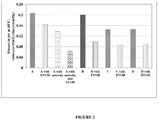
- Figure 2 shows the air permeability of DVAs A to D with nanofiller and/or EVOH.
- the addition of 10 phr of RXG-7083 nanofiller and/or 7.9 phr of EVOH favorably reduces the Mocon air permeability, in comparison to DVAs without EVOH and/or nanofiller.
- DVAs with nanofiller result in about a 33% improvement in Mocon
- compositions with EVOH result in about a 21% improvement in Mocon.
- DVA A indicates that the addition of nanofiller in combination with EVOH unexpectedly reduces the Mocon permeability of the composition, in comparison to DVA A with only EVOH or with only nanofiller.
- DVAs with both nanofiller and EVOH result in about a 70% improvement in Mocon.
- Figure 2 indicates that the target composition air permeability can be achieved with the addition of a combination of EVOH and nanofiller.
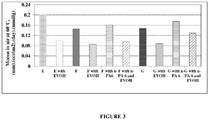
- Figure 3 shows the air permeability of DVAs E to G (based on Polyamide 1 and Polyamide 2) with EVOH and/or Polyamide 4.
- the addition of 7.9 phr of EVOH and/or 16 phr of Polyamide 4 in place of Polyamide 2 favorably reduces the Mocon air permeability, in comparison to DVAs without EVOH and/or Polyamide 4.
- DVAs E and G indicate that the addition of EVOH in combination with Polyamide 4 reduces Mocon to about the same level as DVAs E and G with only EVOH but to a lower air permeability level as DVAs E and G with Polyamide 4.
- Figure 4 shows the air permeability of DVAs H to J (based on Polyamide 3 and Polyamide 2) with EVOH and/or Polyamide 4.
- the addition of 7.9 phr of EVOH and/or 16 phr of Polyamide 4 in place of Polyamide 2 favorably reduces the Mocon air permeability, in comparison to DVAs without EVOH and/or Polyamide 4.
- DVAs H and J indicate that the addition of EVOH in combination with Polyamide 4 reduces Mocon to about the same level as DVAs H and J with only EVOH but to a lower air permeability level as DVAs H and J with Polyamide 4.
- Figures 3 and 4 indicate that DVAs based on Polyamide 1 (such as DVAs E to G) have favorably lower Mocon than DVAs based on Polyamide 3 (such as DVAs H to J).
- the inventive compositions can be used to make any number of articles.
- the article is selected from tire curing bladders, tire innerliners, tire innertubes, and air sleeves.
- the article is a hose or a hose component in multilayer hoses, such as those that contain polyamide as one of the component layers.
- Other useful goods that can be made using compositions of the invention include air spring bladders, seals, molded goods, cable housing, and other articles disclosed in THE VANDERBILT RUBBER HANDBOOK, PP. 637-772 (Ohm, ed., R.T. Vanderbilt Company, Inc. 1990 ).
Landscapes
- Chemical & Material Sciences (AREA)
- Chemical Kinetics & Catalysis (AREA)
- Medicinal Chemistry (AREA)
- Polymers & Plastics (AREA)
- Organic Chemistry (AREA)
- Health & Medical Sciences (AREA)
- General Chemical & Material Sciences (AREA)
- Dispersion Chemistry (AREA)
- Engineering & Computer Science (AREA)
- Mechanical Engineering (AREA)
- Compositions Of Macromolecular Compounds (AREA)
- Tires In General (AREA)
- Manufacture Of Macromolecular Shaped Articles (AREA)
- Processes Of Treating Macromolecular Substances (AREA)
Claims (15)
- Alliage dynamiquement vulcanisé, l'alliage comprenant :a. au moins un élastomère comprenant des motifs dérivés d'isomonooléfines en C4 à C7 ;b. au moins une résine thermoplastique ayant une température de fusion dans la plage de 170 °C à 260 °C ;c. une nanocharge ; etd. 5 à 30 phr d'une résine de copolymère d'éthylène,dans lequel l'élastomère est présent sous forme d'une phase dispersée de petites particules dans une phase continue de la résine thermoplastique.
- Alliage tel que revendiqué dans la revendication 1, dans lequel ladite nanocharge comprend une charge lamellaire et un modificateur amine.
- Alliage tel que revendiqué dans la revendication 2, dans lequel le modificateur amine a la structure suivante :
(R1R2R3R4)N+
dans laquelle R1 est choisi parmi les alkyles en C1 à C8, les alcényles en C2 à C8 et les aryles en C6 à C8, R2 est choisi parmi les alkyles en C9 à C26, les alcénylesen C9 à C26 et les aryles en C9 à C26 et R3 et R4 sont identiques ou différents et sont indépendamment choisis parmi l'atome d'hydrogène, les alkyles en C1 à C26, les alcénylesen C2 à C26 et les aryles en C6 à C26. - Alliage tel que revendiqué dans la revendication 2 ou 3, dans lequel le modificateur amine est choisi dans le groupe constitué par les ions tétraalkylammonium, trialkylarylammonium et dialkyldiarylammonium.
- Alliage tel que revendiqué dans l'une quelconque des revendications 1 à 4, dans lequel la charge lamellaire est au moins un silicate et est choisie entre la montmorillonite, la nontronite, la beidellite, la bentonite, la volkonskoïte, la laponite, l'hectorite, la saponite, la sauconite, la magadite, la kenyaite, la stevensite, la vermiculite, l'halloysite, les oxydes aluminates et/ou l'hydrotalcite.
- Alliage tel que revendiqué dans l'une quelconque des revendications 1 à 5, dans lequel la résine de copolymère d'éthylène ne comprend pas plus de 50 mol% d'éthylène.
- Alliage tel que revendiqué dans l'une quelconque des revendications 1 à 6, dans lequel la résine de copolymère d'éthylène est l'éthylène-alcool vinylique.
- Alliage tel que revendiqué dans l'une quelconque des revendications 1 à 7, dans lequel le rapport de la résine de copolymère d'éthylène à la résine thermoplastique, exprimés en phr de l'élastomère, est dans la plage de 0,0625 à 0,75.
- Alliage tel que revendiqué dans l'une quelconque des revendications 1 à 8, dans lequel la nanocharge est dans la plage de 4 à 15 phr.
- Alliage tel que revendiqué dans l'une quelconque des revendications 1 à 9, dans lequel la résine thermoplastique est choisie parmi les polyamides, les polyimides, les polycarbonates, les polyesters, les polysulfonates, les polylactones, les polyacétals, les résines d'acrylonitrile-butadiène-styrène, le poly(oxyde de phénylène), le poly(sulfure de phénylène), le polystyrène, les résines de styrène-acrylonitrile, les résines de styrène-anhydride maléique, les polycétones aromatiques, les résines de copolymère d'acétate d'éthylène et/ou les mélanges de ceux-ci.
- Alliage tel que revendiqué dans l'une quelconque des revendications 1 à 10, dans lequel la résine thermoplastique est un polyamide choisi dans le groupe constitué par le nylon 6, le nylon 12, le nylon 6/6, le nylon 6/9, le nylon 6/10, le nylon 6/12, le copolymère nylon 6/66, le nylon 11 et les mélanges de ceux-ci.
- Alliage tel que revendiqué dans l'une quelconque des revendications 1 à 11, dans lequel l'élastomère est un élastomère dérivé d'isobutylène.
- Alliage tel que revendiqué dans l'une quelconque des revendications 1 à 12, dans lequel l'élastomère est un copolymère d' isobutylène et d'un alkylstyrène.
- Alliage tel que revendiqué dans l'une quelconque des revendications 1 à 13, la résine thermoplastique étant présente dans l'alliage en une quantité de 40 à 80 phr.
- Article formé à partir de l'alliage dynamiquement vulcanisé tel qu'indiqué dans l'une quelconque des revendications 1 à 14, l'article étant un calandrage intérieur de pneu ou une vessie de pneu ou étant incorporé en tant que couche dans un pneu, une vessie, un tuyau souple, une courroie, un ressort pneumatique ou une coupelle de carrosserie de véhicule.
Applications Claiming Priority (2)
| Application Number | Priority Date | Filing Date | Title |
|---|---|---|---|
| US201462058983P | 2014-10-02 | 2014-10-02 | |
| PCT/US2015/045312 WO2016053485A1 (fr) | 2014-10-02 | 2015-08-14 | Alliages dynamiquement vulcanisés |
Publications (2)
| Publication Number | Publication Date |
|---|---|
| EP3201124A1 EP3201124A1 (fr) | 2017-08-09 |
| EP3201124B1 true EP3201124B1 (fr) | 2019-11-13 |
Family
ID=54015213
Family Applications (1)
| Application Number | Title | Priority Date | Filing Date |
|---|---|---|---|
| EP15757072.2A Active EP3201124B1 (fr) | 2014-10-02 | 2015-08-14 | Alliages dynamiquement vulcanisés |
Country Status (6)
| Country | Link |
|---|---|
| US (1) | US10414914B2 (fr) |
| EP (1) | EP3201124B1 (fr) |
| JP (1) | JP2017530230A (fr) |
| CN (1) | CN106715573A (fr) |
| SG (1) | SG11201701314SA (fr) |
| WO (1) | WO2016053485A1 (fr) |
Families Citing this family (2)
| Publication number | Priority date | Publication date | Assignee | Title |
|---|---|---|---|---|
| US20180057674A1 (en) * | 2015-05-29 | 2018-03-01 | ExxonMobil Chemical Company - Law Technology | Dynamically Vulcanized Alloys |
| CN109422969B (zh) * | 2017-09-04 | 2020-05-19 | 北京化工大学 | 一种基于evoh的高气体阻隔性热塑性硫化胶及其制备方法 |
Family Cites Families (13)
| Publication number | Priority date | Publication date | Assignee | Title |
|---|---|---|---|---|
| CN1235955C (zh) | 2001-06-08 | 2006-01-11 | 埃克森美孚化学专利公司 | 低渗透性纳米复合材料 |
| RU2309167C2 (ru) | 2001-06-13 | 2007-10-27 | Эксонмобил Кемикэл Пейтентс Инк. | Нанокомпозиты с низкой проницаемостью |
| JP5247456B2 (ja) * | 2005-10-27 | 2013-07-24 | エクソンモービル ケミカル パテンツ,インコーポレイティド | 熱可塑性エラストマー組成物及びその製造方法 |
| US8039526B2 (en) * | 2006-04-05 | 2011-10-18 | Exxonmobil Chemical Patents Inc. | Thermoplastic vulcanizates including nanoclays and processes for making the same |
| US7923491B2 (en) * | 2008-08-08 | 2011-04-12 | Exxonmobil Chemical Patents Inc. | Graphite nanocomposites |
| CA2729589C (fr) * | 2008-08-08 | 2011-11-01 | Exxonmobil Chemical Patents Inc. | Nanocomposites de graphite |
| JP4888868B2 (ja) * | 2009-09-08 | 2012-02-29 | 住友ゴム工業株式会社 | 空気入りタイヤ |
| JP5668079B2 (ja) * | 2009-12-17 | 2015-02-12 | エクソンモービル・ケミカル・パテンツ・インク | エラストマー性ナノ複合体、ナノ複合体組成物、及び製造方法 |
| US8461240B2 (en) * | 2010-04-30 | 2013-06-11 | Exxonmobil Chemical Patents Inc. | Elastomeric nanocomposites, nanocomposite compositions, and methods of manufacture |
| US8415431B2 (en) * | 2010-08-05 | 2013-04-09 | Exxonmobil Chemical Patents Inc. | Thermoplastic elastomeric compositions |
| JP4862954B1 (ja) * | 2010-09-13 | 2012-01-25 | 横浜ゴム株式会社 | 熱可塑性樹脂組成物の製造方法 |
| US9586355B2 (en) * | 2011-03-11 | 2017-03-07 | Exxonmobil Chemical Patents Inc. | Dynamically vulcanized thermoplastic elastomer film |
| RU2589714C2 (ru) * | 2011-12-19 | 2016-07-10 | Эксонмобил Кемикэл Пейтентс Инк. | Эластомерные композиции и их применение в изделиях |
-
2015
- 2015-08-14 JP JP2017516824A patent/JP2017530230A/ja active Pending
- 2015-08-14 SG SG11201701314SA patent/SG11201701314SA/en unknown
- 2015-08-14 EP EP15757072.2A patent/EP3201124B1/fr active Active
- 2015-08-14 US US15/500,979 patent/US10414914B2/en active Active
- 2015-08-14 CN CN201580050776.7A patent/CN106715573A/zh active Pending
- 2015-08-14 WO PCT/US2015/045312 patent/WO2016053485A1/fr not_active Ceased
Non-Patent Citations (1)
| Title |
|---|
| None * |
Also Published As
| Publication number | Publication date |
|---|---|
| JP2017530230A (ja) | 2017-10-12 |
| WO2016053485A1 (fr) | 2016-04-07 |
| US20170218190A1 (en) | 2017-08-03 |
| EP3201124A1 (fr) | 2017-08-09 |
| US10414914B2 (en) | 2019-09-17 |
| CN106715573A (zh) | 2017-05-24 |
| WO2016053485A8 (fr) | 2017-01-05 |
| SG11201701314SA (en) | 2017-04-27 |
Similar Documents
| Publication | Publication Date | Title |
|---|---|---|
| EP1358265B1 (fr) | Composition elastomerique | |
| US8283407B2 (en) | Processing aids for elastomeric compositions | |
| US7425591B2 (en) | Elastomeric composition | |
| CN101326199B (zh) | 用于弹性体组合物的加工助剂 | |
| CA2770878C (fr) | Copolymeres elastomeres, compositions de copolymeres, et leur utilisation dans des articles | |
| US20180057674A1 (en) | Dynamically Vulcanized Alloys | |
| US20060167184A1 (en) | Innerliners for use in tires | |
| EP2794752B1 (fr) | Compositions élastomères et leur utilisation dans des articles | |
| CA2849339C (fr) | Procede pour la production en continu de compositions d'elastomere thermoplastique exemptes d'halogene | |
| EP3201124B1 (fr) | Alliages dynamiquement vulcanisés | |
| US8247496B2 (en) | Processing aids for elastomeric compositions | |
| CN1474855A (zh) | 弹性体组合物 |
Legal Events
| Date | Code | Title | Description |
|---|---|---|---|
| STAA | Information on the status of an ep patent application or granted ep patent |
Free format text: STATUS: THE INTERNATIONAL PUBLICATION HAS BEEN MADE |
|
| PUAI | Public reference made under article 153(3) epc to a published international application that has entered the european phase |
Free format text: ORIGINAL CODE: 0009012 |
|
| STAA | Information on the status of an ep patent application or granted ep patent |
Free format text: STATUS: REQUEST FOR EXAMINATION WAS MADE |
|
| 17P | Request for examination filed |
Effective date: 20170426 |
|
| AK | Designated contracting states |
Kind code of ref document: A1 Designated state(s): AL AT BE BG CH CY CZ DE DK EE ES FI FR GB GR HR HU IE IS IT LI LT LU LV MC MK MT NL NO PL PT RO RS SE SI SK SM TR |
|
| AX | Request for extension of the european patent |
Extension state: BA ME |
|
| DAV | Request for validation of the european patent (deleted) | ||
| DAX | Request for extension of the european patent (deleted) | ||
| GRAP | Despatch of communication of intention to grant a patent |
Free format text: ORIGINAL CODE: EPIDOSNIGR1 |
|
| STAA | Information on the status of an ep patent application or granted ep patent |
Free format text: STATUS: GRANT OF PATENT IS INTENDED |
|
| RIC1 | Information provided on ipc code assigned before grant |
Ipc: B60C 1/00 20060101ALI20181220BHEP Ipc: C08L 77/00 20060101ALI20181220BHEP Ipc: C08L 23/08 20060101ALI20181220BHEP Ipc: B82Y 30/00 20110101AFI20181220BHEP Ipc: C08K 3/34 20060101ALI20181220BHEP Ipc: C08L 23/28 20060101ALI20181220BHEP |
|
| INTG | Intention to grant announced |
Effective date: 20190121 |
|
| GRAJ | Information related to disapproval of communication of intention to grant by the applicant or resumption of examination proceedings by the epo deleted |
Free format text: ORIGINAL CODE: EPIDOSDIGR1 |
|
| STAA | Information on the status of an ep patent application or granted ep patent |
Free format text: STATUS: REQUEST FOR EXAMINATION WAS MADE |
|
| INTC | Intention to grant announced (deleted) | ||
| GRAP | Despatch of communication of intention to grant a patent |
Free format text: ORIGINAL CODE: EPIDOSNIGR1 |
|
| STAA | Information on the status of an ep patent application or granted ep patent |
Free format text: STATUS: GRANT OF PATENT IS INTENDED |
|
| INTG | Intention to grant announced |
Effective date: 20190702 |
|
| GRAS | Grant fee paid |
Free format text: ORIGINAL CODE: EPIDOSNIGR3 |
|
| GRAA | (expected) grant |
Free format text: ORIGINAL CODE: 0009210 |
|
| STAA | Information on the status of an ep patent application or granted ep patent |
Free format text: STATUS: THE PATENT HAS BEEN GRANTED |
|
| AK | Designated contracting states |
Kind code of ref document: B1 Designated state(s): AL AT BE BG CH CY CZ DE DK EE ES FI FR GB GR HR HU IE IS IT LI LT LU LV MC MK MT NL NO PL PT RO RS SE SI SK SM TR |
|
| REG | Reference to a national code |
Ref country code: CH Ref legal event code: EP Ref country code: AT Ref legal event code: REF Ref document number: 1201462 Country of ref document: AT Kind code of ref document: T Effective date: 20191115 |
|
| REG | Reference to a national code |
Ref country code: DE Ref legal event code: R096 Ref document number: 602015041676 Country of ref document: DE |
|
| REG | Reference to a national code |
Ref country code: IE Ref legal event code: FG4D |
|
| REG | Reference to a national code |
Ref country code: NL Ref legal event code: MP Effective date: 20191113 |
|
| REG | Reference to a national code |
Ref country code: LT Ref legal event code: MG4D |
|
| PG25 | Lapsed in a contracting state [announced via postgrant information from national office to epo] |
Ref country code: PT Free format text: LAPSE BECAUSE OF FAILURE TO SUBMIT A TRANSLATION OF THE DESCRIPTION OR TO PAY THE FEE WITHIN THE PRESCRIBED TIME-LIMIT Effective date: 20200313 Ref country code: GR Free format text: LAPSE BECAUSE OF FAILURE TO SUBMIT A TRANSLATION OF THE DESCRIPTION OR TO PAY THE FEE WITHIN THE PRESCRIBED TIME-LIMIT Effective date: 20200214 Ref country code: LT Free format text: LAPSE BECAUSE OF FAILURE TO SUBMIT A TRANSLATION OF THE DESCRIPTION OR TO PAY THE FEE WITHIN THE PRESCRIBED TIME-LIMIT Effective date: 20191113 Ref country code: NL Free format text: LAPSE BECAUSE OF FAILURE TO SUBMIT A TRANSLATION OF THE DESCRIPTION OR TO PAY THE FEE WITHIN THE PRESCRIBED TIME-LIMIT Effective date: 20191113 Ref country code: LV Free format text: LAPSE BECAUSE OF FAILURE TO SUBMIT A TRANSLATION OF THE DESCRIPTION OR TO PAY THE FEE WITHIN THE PRESCRIBED TIME-LIMIT Effective date: 20191113 Ref country code: SE Free format text: LAPSE BECAUSE OF FAILURE TO SUBMIT A TRANSLATION OF THE DESCRIPTION OR TO PAY THE FEE WITHIN THE PRESCRIBED TIME-LIMIT Effective date: 20191113 Ref country code: PL Free format text: LAPSE BECAUSE OF FAILURE TO SUBMIT A TRANSLATION OF THE DESCRIPTION OR TO PAY THE FEE WITHIN THE PRESCRIBED TIME-LIMIT Effective date: 20191113 Ref country code: NO Free format text: LAPSE BECAUSE OF FAILURE TO SUBMIT A TRANSLATION OF THE DESCRIPTION OR TO PAY THE FEE WITHIN THE PRESCRIBED TIME-LIMIT Effective date: 20200213 Ref country code: BG Free format text: LAPSE BECAUSE OF FAILURE TO SUBMIT A TRANSLATION OF THE DESCRIPTION OR TO PAY THE FEE WITHIN THE PRESCRIBED TIME-LIMIT Effective date: 20200213 Ref country code: FI Free format text: LAPSE BECAUSE OF FAILURE TO SUBMIT A TRANSLATION OF THE DESCRIPTION OR TO PAY THE FEE WITHIN THE PRESCRIBED TIME-LIMIT Effective date: 20191113 |
|
| PG25 | Lapsed in a contracting state [announced via postgrant information from national office to epo] |
Ref country code: RS Free format text: LAPSE BECAUSE OF FAILURE TO SUBMIT A TRANSLATION OF THE DESCRIPTION OR TO PAY THE FEE WITHIN THE PRESCRIBED TIME-LIMIT Effective date: 20191113 Ref country code: HR Free format text: LAPSE BECAUSE OF FAILURE TO SUBMIT A TRANSLATION OF THE DESCRIPTION OR TO PAY THE FEE WITHIN THE PRESCRIBED TIME-LIMIT Effective date: 20191113 Ref country code: IS Free format text: LAPSE BECAUSE OF FAILURE TO SUBMIT A TRANSLATION OF THE DESCRIPTION OR TO PAY THE FEE WITHIN THE PRESCRIBED TIME-LIMIT Effective date: 20200313 |
|
| PG25 | Lapsed in a contracting state [announced via postgrant information from national office to epo] |
Ref country code: AL Free format text: LAPSE BECAUSE OF FAILURE TO SUBMIT A TRANSLATION OF THE DESCRIPTION OR TO PAY THE FEE WITHIN THE PRESCRIBED TIME-LIMIT Effective date: 20191113 |
|
| PG25 | Lapsed in a contracting state [announced via postgrant information from national office to epo] |
Ref country code: EE Free format text: LAPSE BECAUSE OF FAILURE TO SUBMIT A TRANSLATION OF THE DESCRIPTION OR TO PAY THE FEE WITHIN THE PRESCRIBED TIME-LIMIT Effective date: 20191113 Ref country code: DK Free format text: LAPSE BECAUSE OF FAILURE TO SUBMIT A TRANSLATION OF THE DESCRIPTION OR TO PAY THE FEE WITHIN THE PRESCRIBED TIME-LIMIT Effective date: 20191113 Ref country code: CZ Free format text: LAPSE BECAUSE OF FAILURE TO SUBMIT A TRANSLATION OF THE DESCRIPTION OR TO PAY THE FEE WITHIN THE PRESCRIBED TIME-LIMIT Effective date: 20191113 Ref country code: ES Free format text: LAPSE BECAUSE OF FAILURE TO SUBMIT A TRANSLATION OF THE DESCRIPTION OR TO PAY THE FEE WITHIN THE PRESCRIBED TIME-LIMIT Effective date: 20191113 Ref country code: RO Free format text: LAPSE BECAUSE OF FAILURE TO SUBMIT A TRANSLATION OF THE DESCRIPTION OR TO PAY THE FEE WITHIN THE PRESCRIBED TIME-LIMIT Effective date: 20191113 |
|
| REG | Reference to a national code |
Ref country code: DE Ref legal event code: R097 Ref document number: 602015041676 Country of ref document: DE |
|
| REG | Reference to a national code |
Ref country code: AT Ref legal event code: MK05 Ref document number: 1201462 Country of ref document: AT Kind code of ref document: T Effective date: 20191113 |
|
| PG25 | Lapsed in a contracting state [announced via postgrant information from national office to epo] |
Ref country code: SK Free format text: LAPSE BECAUSE OF FAILURE TO SUBMIT A TRANSLATION OF THE DESCRIPTION OR TO PAY THE FEE WITHIN THE PRESCRIBED TIME-LIMIT Effective date: 20191113 Ref country code: SM Free format text: LAPSE BECAUSE OF FAILURE TO SUBMIT A TRANSLATION OF THE DESCRIPTION OR TO PAY THE FEE WITHIN THE PRESCRIBED TIME-LIMIT Effective date: 20191113 |
|
| PLBE | No opposition filed within time limit |
Free format text: ORIGINAL CODE: 0009261 |
|
| STAA | Information on the status of an ep patent application or granted ep patent |
Free format text: STATUS: NO OPPOSITION FILED WITHIN TIME LIMIT |
|
| 26N | No opposition filed |
Effective date: 20200814 |
|
| PG25 | Lapsed in a contracting state [announced via postgrant information from national office to epo] |
Ref country code: SI Free format text: LAPSE BECAUSE OF FAILURE TO SUBMIT A TRANSLATION OF THE DESCRIPTION OR TO PAY THE FEE WITHIN THE PRESCRIBED TIME-LIMIT Effective date: 20191113 Ref country code: AT Free format text: LAPSE BECAUSE OF FAILURE TO SUBMIT A TRANSLATION OF THE DESCRIPTION OR TO PAY THE FEE WITHIN THE PRESCRIBED TIME-LIMIT Effective date: 20191113 |
|
| PG25 | Lapsed in a contracting state [announced via postgrant information from national office to epo] |
Ref country code: IT Free format text: LAPSE BECAUSE OF FAILURE TO SUBMIT A TRANSLATION OF THE DESCRIPTION OR TO PAY THE FEE WITHIN THE PRESCRIBED TIME-LIMIT Effective date: 20191113 |
|
| PG25 | Lapsed in a contracting state [announced via postgrant information from national office to epo] |
Ref country code: MC Free format text: LAPSE BECAUSE OF FAILURE TO SUBMIT A TRANSLATION OF THE DESCRIPTION OR TO PAY THE FEE WITHIN THE PRESCRIBED TIME-LIMIT Effective date: 20191113 |
|
| REG | Reference to a national code |
Ref country code: CH Ref legal event code: PL |
|
| PG25 | Lapsed in a contracting state [announced via postgrant information from national office to epo] |
Ref country code: LI Free format text: LAPSE BECAUSE OF NON-PAYMENT OF DUE FEES Effective date: 20200831 Ref country code: LU Free format text: LAPSE BECAUSE OF NON-PAYMENT OF DUE FEES Effective date: 20200814 Ref country code: CH Free format text: LAPSE BECAUSE OF NON-PAYMENT OF DUE FEES Effective date: 20200831 |
|
| REG | Reference to a national code |
Ref country code: BE Ref legal event code: MM Effective date: 20200831 |
|
| PG25 | Lapsed in a contracting state [announced via postgrant information from national office to epo] |
Ref country code: IE Free format text: LAPSE BECAUSE OF NON-PAYMENT OF DUE FEES Effective date: 20200814 Ref country code: BE Free format text: LAPSE BECAUSE OF NON-PAYMENT OF DUE FEES Effective date: 20200831 |
|
| PG25 | Lapsed in a contracting state [announced via postgrant information from national office to epo] |
Ref country code: TR Free format text: LAPSE BECAUSE OF FAILURE TO SUBMIT A TRANSLATION OF THE DESCRIPTION OR TO PAY THE FEE WITHIN THE PRESCRIBED TIME-LIMIT Effective date: 20191113 Ref country code: MT Free format text: LAPSE BECAUSE OF FAILURE TO SUBMIT A TRANSLATION OF THE DESCRIPTION OR TO PAY THE FEE WITHIN THE PRESCRIBED TIME-LIMIT Effective date: 20191113 Ref country code: CY Free format text: LAPSE BECAUSE OF FAILURE TO SUBMIT A TRANSLATION OF THE DESCRIPTION OR TO PAY THE FEE WITHIN THE PRESCRIBED TIME-LIMIT Effective date: 20191113 |
|
| PG25 | Lapsed in a contracting state [announced via postgrant information from national office to epo] |
Ref country code: MK Free format text: LAPSE BECAUSE OF FAILURE TO SUBMIT A TRANSLATION OF THE DESCRIPTION OR TO PAY THE FEE WITHIN THE PRESCRIBED TIME-LIMIT Effective date: 20191113 |
|
| P01 | Opt-out of the competence of the unified patent court (upc) registered |
Effective date: 20230518 |
|
| PGFP | Annual fee paid to national office [announced via postgrant information from national office to epo] |
Ref country code: GB Payment date: 20230822 Year of fee payment: 9 |
|
| GBPC | Gb: european patent ceased through non-payment of renewal fee |
Effective date: 20240814 |
|
| PG25 | Lapsed in a contracting state [announced via postgrant information from national office to epo] |
Ref country code: GB Free format text: LAPSE BECAUSE OF NON-PAYMENT OF DUE FEES Effective date: 20240814 |
|
| PGFP | Annual fee paid to national office [announced via postgrant information from national office to epo] |
Ref country code: DE Payment date: 20250827 Year of fee payment: 11 |
|
| PGFP | Annual fee paid to national office [announced via postgrant information from national office to epo] |
Ref country code: FR Payment date: 20250825 Year of fee payment: 11 |