EP3201619B1 - Polymère condensé p-nitrophényl/formaldéhyde pour la mesure du ph, procédé de préparation, et utilisation - Google Patents
Polymère condensé p-nitrophényl/formaldéhyde pour la mesure du ph, procédé de préparation, et utilisation Download PDFInfo
- Publication number
- EP3201619B1 EP3201619B1 EP15800938.1A EP15800938A EP3201619B1 EP 3201619 B1 EP3201619 B1 EP 3201619B1 EP 15800938 A EP15800938 A EP 15800938A EP 3201619 B1 EP3201619 B1 EP 3201619B1
- Authority
- EP
- European Patent Office
- Prior art keywords
- group
- stands
- formula
- phenyl
- support
- Prior art date
- Legal status (The legal status is an assumption and is not a legal conclusion. Google has not performed a legal analysis and makes no representation as to the accuracy of the status listed.)
- Active
Links
- 0 **C1CC2OC2CC1 Chemical compound **C1CC2OC2CC1 0.000 description 4
- OGYUXYYGERYYNR-MWBNKCOKSA-N C/C(/[N+]([O-])=O)=C\C(\Cc1cc([N+]([O-])=O)ccc1O)=C(/CCc(cc(cc1)[N+]([O-])=O)c1O)\O Chemical compound C/C(/[N+]([O-])=O)=C\C(\Cc1cc([N+]([O-])=O)ccc1O)=C(/CCc(cc(cc1)[N+]([O-])=O)c1O)\O OGYUXYYGERYYNR-MWBNKCOKSA-N 0.000 description 1
- YYLWXDIGYFPUSK-ONEGZZNKSA-N CCOC(/C=C/C(Cl)=O)=O Chemical compound CCOC(/C=C/C(Cl)=O)=O YYLWXDIGYFPUSK-ONEGZZNKSA-N 0.000 description 1
- KDQPMQNHVQVVMR-UHFFFAOYSA-N Cc1cc([N+]([O-])=O)ccc1O Chemical compound Cc1cc([N+]([O-])=O)ccc1O KDQPMQNHVQVVMR-UHFFFAOYSA-N 0.000 description 1
Images


Classifications
-
- G—PHYSICS
- G01—MEASURING; TESTING
- G01N—INVESTIGATING OR ANALYSING MATERIALS BY DETERMINING THEIR CHEMICAL OR PHYSICAL PROPERTIES
- G01N31/00—Investigating or analysing non-biological materials by the use of the chemical methods specified in the subgroup; Apparatus specially adapted for such methods
- G01N31/22—Investigating or analysing non-biological materials by the use of the chemical methods specified in the subgroup; Apparatus specially adapted for such methods using chemical indicators
- G01N31/221—Investigating or analysing non-biological materials by the use of the chemical methods specified in the subgroup; Apparatus specially adapted for such methods using chemical indicators for investigating pH value
-
- C—CHEMISTRY; METALLURGY
- C08—ORGANIC MACROMOLECULAR COMPOUNDS; THEIR PREPARATION OR CHEMICAL WORKING-UP; COMPOSITIONS BASED THEREON
- C08G—MACROMOLECULAR COMPOUNDS OBTAINED OTHERWISE THAN BY REACTIONS ONLY INVOLVING UNSATURATED CARBON-TO-CARBON BONDS
- C08G12/00—Condensation polymers of aldehydes or ketones with only compounds containing hydrogen attached to nitrogen
- C08G12/02—Condensation polymers of aldehydes or ketones with only compounds containing hydrogen attached to nitrogen of aldehydes
- C08G12/04—Condensation polymers of aldehydes or ketones with only compounds containing hydrogen attached to nitrogen of aldehydes with acyclic or carbocyclic compounds
-
- G—PHYSICS
- G01—MEASURING; TESTING
- G01N—INVESTIGATING OR ANALYSING MATERIALS BY DETERMINING THEIR CHEMICAL OR PHYSICAL PROPERTIES
- G01N33/00—Investigating or analysing materials by specific methods not covered by groups G01N1/00 - G01N31/00
- G01N33/18—Water
-
- G—PHYSICS
- G01—MEASURING; TESTING
- G01N—INVESTIGATING OR ANALYSING MATERIALS BY DETERMINING THEIR CHEMICAL OR PHYSICAL PROPERTIES
- G01N33/00—Investigating or analysing materials by specific methods not covered by groups G01N1/00 - G01N31/00
- G01N33/48—Biological material, e.g. blood, urine; Haemocytometers
Definitions
- the invention relates to a wide range optical indicator for measuring pH, the support comprising said indicator, and the sensor comprising said supported indicator.
- the measuring range is determined by the dissociation constant (pK) of the indicator. If the measurement is based on the determination of the ratio of the acidic and basic form by the change of the absorption (change of colour) or by the change of fluorescence, and the instrumental analysis thereof, the precise determination of pH is possible around the dissociation constant of the indicator, in the range of pK ⁇ 1-1.5, that is within pH 2 to 3 units.
- US 4,500,691 discloses phenol novolac derivatives comprising amino groups, for the preparation of which a condensed polymer of nitro phenol with formaldehyde can be used as starting material [see: the compound of Formula (V), wherein R 1 stands for a nitro group in p-position, and R 2 and R 3 stand for hydrogen; from column 1, line 40 until column 2 line 40].
- US 2004/0241331 A1 discloses silane-modified phenolic resins, wherein the phenolic skeleton may carry a number of substituents. The scope of disclosed substituents, however, does not include the nitro group.
- the silane-modified phenolic resins may be applied as additives of vulcanizable rubber compositions.
- Optical sensors comprising certain indicator compounds are disclosed for measuring of pH e.g. in US 5,039, 492 , US 2006/0121623 A1 and WO 2009/118271 A1 .
- a drawback of the known pH measuring optical indicators is that their measuring range is very narrow, and in general extends to 2, in the most favorable case 3 pH units.
- a fluorescence pH measuring method is known, which gives satisfactory result in a wider pH range than those mentioned above ( Chem. Commun., 2014,50, p. 4711-47139 ).
- the hydrogen ions to be determined influence the fluorescence intensity of the indicator molecule according to the so called photon induced electron transfer (PET) ( Sensors and Actuators B: Chemical, Volume 114, Issue 1, p. 308-315 ) mechanism.
- PET photon induced electron transfer
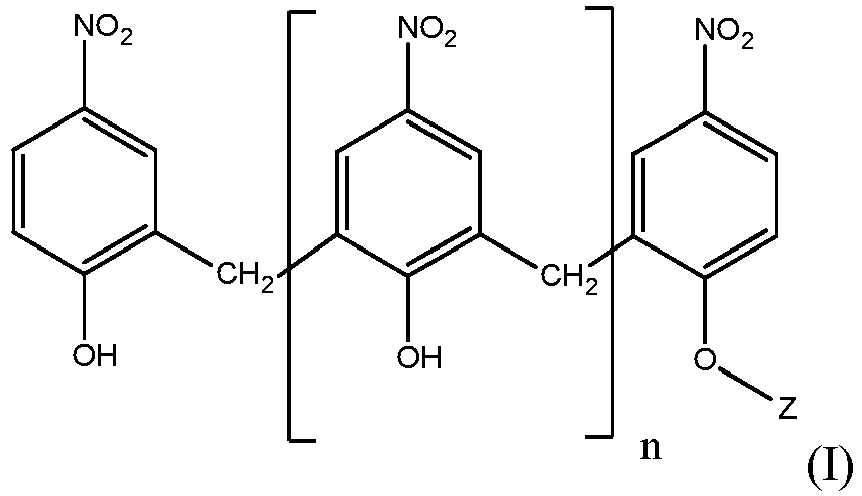
- the present invention relates to the use of one or more p-nitro-phenyl/formaldehyde condensed polymers according to Formula (I) wherein n has a value of 1 to 20, and Z stands for H or a binding group, for measuring pH, wherein the pH is typically in the range of 1.8 to 10.
- the used p-nitrophenyl/formaldehyde condensed polymer according to Formula (I) can be stabilized to a support, wherein the stabilization can be achieved by a physical or a chemical bond.
- Z stands for a group according to the Formula L 1 '-R-L 2 , wherein
- the present invention relates to a p-nitro-phenyl / formaldehyde derivative according to Formula (II) wherein n has a value of 1 to 20,
- a third aspect of the present invention relates to a process for the preparation of the functionalized derivative according to Formula (II), which comprises the step of reacting of the p-nitro-phenyl/formaldehyde condensed polymer according to Formula (I), wherein Z stands for H, with a reagent according to the Formula L 1 -R-L 2 ,
- a fourth aspect of the present invention relates to a supported p-nitro-phenyl / formaldehyde polymer, which comprises a support and one or more p-nitro-phenyl/formaldehyde condensed polymer according to Formula (I) in the state of being stabilized to said support wherein n has a value of 1 to 20, and Z stands for H or a binding group.
- the p-nitro-phenyl/formaldehyde condensed polymer according to Formula (I) can be stabilized to the support by a physical or by a chemical bond.
- the p-nitro-phenyl/formaldehyde condensed polymer according to Formula (I) can be stabilized to the support in the form of one or more functionalized derivative according to Formula (II) by a covalent bond.
- the support is a silicon nanopearl, having a diameter of 0.01 to 2 ⁇ m.
- the subject matter of the invention is an optical indicator for use for measuring pH, wherein the optical indicator comprises a support, and one or more p-nitro-phenyl/formaldehyde condensed polymer according to Formula (I) in a state bound to said support wherein n has a value of 1 to 20, and Z stands for H or a binding group.
- the p-nitro-phenyl/formaldehyde condensed polymer according to Formula (I) is the polymer according to Formula (I') wherein n has a value 1 to 20.
- binding group shall mean an arbitrary binding group, which is suitable for forming of a covalent bond, between the polymer according to the Formula (I') and the support.
- the group according to the formula L 1 '-R-L 2 may be mentioned.
- the p-nitro-phenyl/formaldehyde condensed polymer according to Formula (I) is the functionalized derivative thereof according to Formula (II) wherein n has a value of 1 to 20,
- the present invention relates to a process for the preparation of the functionalized derivatives according to Formula (II), wherein the p-nitro-phenyl/formaldehyde condensed polymer according to Formula (I) wherein Z stands for H, is reacted with the reagent according to the Formula L 1 -R-L 2 ,
- the present invention relates to a supported polymer, which comprises a support and a p-nitro-phenyl/formaldehyde condensed polymer according to Formula (I) in a state bound to said support.
- the p-nitro-phenyl/formaldehyde condensed polymer according to Formula (I) is bound either by a physical bond or a chemical bond.
- the p-nitro-phenyl/formaldehyde condensed polymer according to Formula (I), especially in the form of the functionalized derivative according to Formula (II), is bound by a covalent bond.
- the invention relates to an optical sensor comprising the supported polymer according to the invention for measuring pH.
- alkyl group means a monofunctional hydrocarbon group with the specified number of carbon atoms, which may be linear or branched.
- alkanediyl group means a saturated bifunctional hydrocarbon group, with the given number of carbon atoms, said group being either of straght or branched chain.
- alkenediyl group means an unsaturated bifunctional hydrocarbon group, with the given number of carbon atoms, containing one or more double bonds, said group being either of straght or branched chain.
- saturated, unsaturated or aromatic, straight or branched or cyclic bifunctional hydrocarbon group means a saturated, unsaturated or aromatic, straight or branched or cyclic bifunctional hydrocarbon group, which is linked to the L 1 and L 2 groups via carbon atoms in ⁇ - ⁇ positions.
- saturated, unsaturated or aromatic, straight or branched or cyclic monofunctional hydrocarbon group means a saturated, unsaturated or aromatic, straight or branched or cyclic bifunctional hydrocarbon group, which is linked by one of the terminal carbon atoms.
- perfluorinated derivative means a hydrocarbon group, in which each hydrogen is replaced by a flourine atom.
- n has the value of 1 to 20, especially 2 to 15, preferably 3 to 10.
- R stands for a direct bond or a C1-C20 saturated, unsaturated or aromatic, straight or branched or cyclic bifunctional hydrocarbon group.
- R stands for a direct bond or a C1-C20 saturated, unsaturated or aromatic, straight or branched or cyclic bifunctional hydrocarbon group.
- X stands for halogene atom, such as fluorine, chlorine, bromine or iodine atom, especially fluorine or chlorine atom.
- R 1 stands for C1-C6 alkyl group, especially C1-C4 alkyl group.
- methyl, ethyl, n- or isopropyl or n-, iso- sec- or tert-butyl group may be mentioned.
- R 2 stands for C1-C6 alkanediyl vagy alkenediyl group, espaecially C1-C4 alkanediyl- or alkenediyl group.
- methylene, ethylene, propylene or ethenediyl group may be mentioned.
- R 3 stands for hydrogen or C1-C6 alkyl group, especially hydrogen or C1-C4 alkyl group.
- alkyl group the methyl, ethyl, n- or isopropyl or n-, iso-, sec- or tert-butyl group may be mentioned.
- R 4 stands for C1-C20 saturated, unsaturated or aromatic, straight or branched or cyclic, monofunctional hydrocarbon group or a perfluorinated or aminated derivative thereof.
- R 4 stands for C1-C20 saturated, unsaturated or aromatic, straight or branched or cyclic, monofunctional hydrocarbon group or a perfluorinated or aminated derivative thereof.
- the methyl group, ethyl group, phenyl group, pentafluorophenyl group and 3-aminopropyl group may be mentioned.
- the p-nitro-phenyl/formaldehyde condensed polymer according to Formula (I), wherein Z stands for H [compound according to Formula (I')] can be prepared by known reactions. Said reactions are proceeded by either condensing phenol with formaldehyde, and nitrating the obtained condensed polymer [process (a)], or by condensing p-nitro-phenol with formaldehyde [process (b)].
- the starting materials used in the course of the process are commercially available, for example from Sigma-Aldrich, Alfa Aesar, VWR International.
- phenol is condensed with formaldehyde, as a result of which phenol/formaldehyde condensed polymer is obtained.
- the obtained resin is equivalent with novolac in terms of their chemical composition, however, it is of smaller molecular weight.
- the process is usually performed at room temperature, especially at 20-25°C, and at atmospheric pressure. However, the process can also be made at a lower temperature and pressure.
- the process is optionally made in the presence of a catalyst.
- catalyst sulphuric acid, hydrochloric acid, oxalic acid may be used.
- the obtained resin is conventionally separated, e.g. is washed with distilled water, then is dissolved in ethanol and added dropwise into water.
- the phenol/formaldehyde condensed polymer is nitrated.
- the nitration is performed in a manner known for the skilled person.
- a nitrating mixture an aqueous mixture of concentrated H 2 SO 4 /HNO 3
- solvent e.g. formic acid, butiric acid, especially propionic acid and acetic acid can be used.
- the nitration of the phenol/formaldehyde condensed polymer in not complete.
- the rate of nitration is in general 27-36%, especially 47-53%.
- the rate of nitration is monitored by elementary analysis.
- the process is especially performed at 4-5°C temperature and atmospheric pressure. However, the process can also be made at a lower or higher temperature and pressure.
- the nitration is in general performed in the presence of the atmosphere of an inert gas, in particular in argon or nitrogen atmosphere.
- the final product is conventionally purified, e.g. is diluted with water, then is filtered through a filter paper, and is washed until the pH of the filtrate becomes mostly neutral. Then the product is dried at room temperature.
- the preparation of p-nitro-phenyl/formaldehyde condensed polymer according to Formula (I) can also be accomplished in one step according to process (b).
- p-nitro-phenol is condensed with formaldehyde.
- the condensation according to process (b) is performed according to the method as described in the first step of process (a).
- the p-nitro-phenol used as starting material may be prepared by a known method or can be commercially obtained.
- the process is usually performed at a temperature above 100 °C, especially 150-160°C temperature, and at atmospheric pressure. However, the process can also be made at a lower or higher temperature and pressure. In general, the process is performed for 24 hours with formaldehyde, in the presence of NaOH.
- the produced polymer is purified by conventional methods, e.g. it is washed with acetic acid and ethanol, is cenrtifuged after washing, then is dried at 60-70°C.
- the p-nitro-phenyl/formaldehyde condensed polymer according to Formula (I') can be used as indicator at measuring pH.
- a process is performed, wherein the p-nitro-phenyl/formaldehyde condensed polymer according to Formula (I') is stabilized to a support.
- the linkage can be achieved by a physical bond or a chemical bond.
- the material of the support can be solid or can be in sol or gel state, its surface can be smooth or porous.
- glass quartz, amorphous silicon dioxide, polycarbonate, polyester, poly-methyl-methacrylate or other optically translucent polymer may be mentioned.
- the support may be of plain or curved surface, in particular of spherical surface.
- the support is a nanopearl, which has a diameter of 0.001 to 10 ⁇ m, in particular 0.01 to 5 ⁇ m.
- the support is a silica nanopearl, which has a diameter of 0.01 to 2 ⁇ m.
- the indicator in the form of p-nitro-phenyl/formaldehyde condensed polymer according to Formula (I') is taken up in a suitable solvent, or is mixed in a sol-gel mixture. Then the obtained mixture is contacted with the support.
- a process is performed, wherein the dissolved form of the indicator, or the reagents necessary for the formation of sol-gel, said reagent can be e.g. water, hydrochloric acid, or a solution of ammonia, is added to the mixture of the applied tetraalkoxy-silanes, such as, e.g.
- aceton, THF, DMF, in particular ethyl acetate may be used.
- the stabilization to the support may be facilitated by the activation of the support, said activation may be done chemically e.g. by nitric acid, Caro-acid (the mixture of hydrogen-peroxide and sulphuric acid), or physically, e.g. by ionizing radiation, plasma or ultrasonic activation.
- the p-nitro-phenyl/formaldehyde condensed polymer according to Formula (I') is converted to the functional derivative according to Formula (II).
- the p-nitro-phenyl/formaldehyde condensed polymer according to Formula (I') is reacted with a compound according to Formula L 1 -R-L 2 .
- Scheme 3 One embodiment of the process is illustrated by Scheme 3:
- the compound according to formula L 1 -R-L 2 used as reagent can be prepared by known processes or is commercially available (Sigma Aldrich, Alfa Aesar).
- the process in general is performed at room temparature, in particlar at 20-25°C temperature, and atmospheric pressure. However, the process can also be made at a lower or higher temperature and pressure.
- the indicator is stabilized on the surface of the support in the form of the functionalized derivative according to Formula (II) with a covalent bond.
- the functionalized derivative according to Formula (II) is taken up in a suitable solvent, and is contacted with the surface of a solid support, e.g. silica nanopearl.
- a process is performed, wherein the functionalized derivative according to Formula (II) is taken up in a suitable solvent, and is mixed into the sol-gel mixture.
- acetone especially tetrahydrofurane, ethyl-acetate
- reagent for the preparation of sol-gel APTES PhTES, DiME-DiMOS, especially TEOS, MTES can be used.
- a process is performed, wherein the support is first treated with excess diisocyanate derivative, then it is immersed into a solution of the polymer according to Formula (I') made with an anhydrous solvent without separation, or said solution is spread on the surface of the support.
- the indicator applied to the support can be built into an optical sensor applicable for measuring pH.
- a conventional process is performed, as it is exemplified by pouring up, spin-coating, knife-coating, dip-coating, and the like.
- the optical sensor can be any kind of optical sensor or device, which detects the quantity or quality of chemical components in gas or liquid phase, and it is converted to an electric signal, which is useful for analytical purposes ( Pure&App. Chem., Vol. 63, No. 9, pp. 1247-1250, 1991 ).
- optical indicator according to the present invention and the sensor device including said optical sensor can be used for measuring pH.
- the indicator built in the optical sensor dissociates to H + ion and anion, the rate of said dissociation being determined by the pH of the sample.
- the colour of the acidic and basic form is different from each other, which can be detected spectrofotomet-rically.
- the calibration takes place with buffers with various pH values. Measuring pH and the calibration are published in detail by Sensors and Actuators B 128 (2008) 388-398 , Sensors and Actuators B 194 (2014) 238-248 .
- the phenolic OH groups of the p-nitro-phenyl/formaldehyde condensed polymer according to Formula (I) dissociate gradually as a function of the pH value. Accordingly, the large number of the phenolic OH groups makes it possible to determine the pH in a wide range, such as in 1.8 to 10 pH range, preferable in 2 to 10 range.
- the theory of the measuring it can be the determination of the change in absorbance, transmission, reflection, attenuation of total reflection (ATIR) and refractive index.
- the determination of the pH is performed using the theory of absorbance.
- light beam is directed to a layer of the p-nitro-phenyl/formaldehyde condensed polymer according to Formula (I), and the change in the transmission through the layer is determined.
- the amount of the change is in linear proportion of the colour of the polymer layer, thus detecting of the change makes it possible to follow the pH value.
- the change of the absorbance is compared to a sample with known pH value as zero value, wherein the change obtained in the sample to be measured can be positive or negative as compared to the zero value.
- the pH value of the sample to be measured can be read from the calibration curve.
- the optical sensor device according to the invention can be applied for measuring pH in all conventional media.
- air, natural and artificial waters, drinking water, biological media e.g. blood, body fluids, and the like
- biological media e.g. blood, body fluids, and the like
- Example 2 The preparation of p-nitro-phenyl/formaldehyde condensed polymer (PI-1) from G-1:
- PI-1 indicator For the preparation of the PI-1 indicator to the mixture of 6 ml water and 6 ml concentrated nitric acid 2 ml (0,30342 g/10 ml) G-1 resin dissolved in acetic acid is added dropwise in argon atmosphere. In the course of nitration the temperature of the mixture is kept below 5 °C. The colour of the PI-1 indicator formed during the reaction is dark red, then at room temperature is changes to orange. The PI-1 indicator produced well dissolves in THF and acetone, less easily in ethanol. Its solution is yellow in acidic state, dark yellow, sometimes yellowish brown in basic phase.
- Example 3 The preparation of p-nitro-phenyl/formaldehyde condensed polymer (PI-2) in one step:
- 3,5 g 4-nitrophenol is pulverized in achate mortar, then it is put into a 100 ml double neck round bottom flask equipped with magnetic stirrer. Paraffin oil bath is place under the tube, also with magnetic stirrer, and a thermometer calibrated between 100 to 200°C. One neck of the round bottom flask is equipped with a ball cooler, the other neck serves for the entering of the reagents.
- the 4-nitrophenol is melted at 116 °C, then 3 ml of 38% formalyne is added thereto dropwise. After 5 minutes of stirring 750 ⁇ l of 0,4 g/ml NaOH is added to the mixture dropwise. The temperature is elevated to between 150 to 160°C, and is maintained there for 24 hours.
- the reaction mixture is allowed to cool to room temperature, and acetic acid is added thereto in such an amount that all of the resin is completely dissolved, then the mixture is stirred for further 30 minutes. Then by adding distilled water, the PI-2 indicator is precipitated, and is stirred for 24 hours. The PI-2 indicator is then purified by dialysis. The precipitated material is centrifuged at 5000 rpm for 30 minutes, then is decanted and dried at 60-70 °C in an exsiccator. The obtained PI-2 will be yellow in acidic state and orange in basic state.
- the characteristics of the prepared G-1, PI-1 and PI-2 materials glass transition temperature (Tg), number average molecular weight (Mn) and weight average molecular weight (Mw): T g (°C) M n M w G-1 87.6 1550 2000 PI-1 97.2 910 1300 PI-2 134.9 and 110.7 770 840
- Example 4 The modification of PI molecules for the stabilization with covalent bond:
- PI-2 50,00 mg is dissolved in a 2:1 mixture of 5,00 ml THF and toluene. 15.00 ⁇ l of (3-isocyanatopropyl)triethoxy-silane (3-IPTS) is added thereto, and the solution is stirred for 24 hours.
- the modified indicator molecules, the MP-2 are used in the same solution, as where the modification had happened.
- the modification such a triethoxy silyl group is attached to the indicator molecule, with which the indicator can be attached to e.g. glass or silica surface.
- Example 5 The preparation of sol-gel with physically stabilized PI-2 indicator:
- the preparation of the D1 sensor layer 50 mg of the sol-gel containing of the pulverized PI-2 indicator is suspended in a 10% ethanolic solution of 450 mg polyurethane hydrogel (e.g. Hydrogel D-4, Tyndall-Plains-Hunter). After homogenization 100 micron thick layer is formed from the mixture on the glass support, then it is allowed to stand for 1 day.
- polyurethane hydrogel e.g. Hydrogel D-4, Tyndall-Plains-Hunter
- Figure 2 demonstrates the change in the absorbance in the function of the pH as compared to the absorption determined in dry state, wherein the horizontal axis x shows the pH value, while the verical axis y shows the value of change in the absorance ( ⁇ Absorbance).
- the stabilization of the indicator molecule in a sol-gel ensures the ability for the determination of the pH in even wider pH range as compared to the dissolved indicator.
- Example 6 The chemical stabilization of PI-2 on the surface of silica nanopearl:
- PI-2 is dissolved in a 2:1 mixture of 5.00 ml of THF and toluene. 15.00 ⁇ l of 3-IPTS is added thereto, and the solution is stirred for 24 hours.
- a suspension is prepared from the nanopearls by adding 2.00 ml of absolute ethanol. While stirring 2.50 ml of the solution comprising the MPI-2 is added thereto, then the mixture of 2.00 ml of the absolute ethanol and 8.70 ⁇ l of 25 m/m% ammonia solution.
- the solution is stirred for 24 hours, it is purified and dried on air.
- the average size of the thus prepared nanopearls coated with MPI-2 indicator [Scheme 2 (c)] is determined as 203 nm.
- Example 7 The chemical stabilization of the MPI in sol-gel
- PI 0.37838 g of PI is dissolved in 2 ml of THF, then 2 ml of THF containing 167.5 ml 3-IPTS is added thereto dropwise with stirring, and it is further stirred for 2 hours (MPI-2 cocktail).
- the calibration curve according to Figure 3 can be obtained.
- the horizontal axis x according to the calibration curve of Figure 3 demonstrates the pH value
- its vertical axis y demonstrates the value of change in the absorbance ( ⁇ Absorbance).
- Example 8 The chemical stabilization of the indicator on cellulose surface:
- Example 9 The chemical stabilization of the indicator on the surface of a support containing amino group:
- the chemical stabilization described in the above examples can be accomplished also in such a way that first the support is treated with excess isocyanate derivative, then it is immersed in the non-aqueous solution of the polymer according to Formula (I') without separation, or this solution is spread on the surface of the support. Thus a supported polymer identical with those above is obtained.
Landscapes
- Life Sciences & Earth Sciences (AREA)
- Health & Medical Sciences (AREA)
- Chemical & Material Sciences (AREA)
- Immunology (AREA)
- Pathology (AREA)
- Physics & Mathematics (AREA)
- Analytical Chemistry (AREA)
- Biochemistry (AREA)
- General Health & Medical Sciences (AREA)
- General Physics & Mathematics (AREA)
- Engineering & Computer Science (AREA)
- Medicinal Chemistry (AREA)
- Molecular Biology (AREA)
- Food Science & Technology (AREA)
- Biophysics (AREA)
- Chemical Kinetics & Catalysis (AREA)
- Polymers & Plastics (AREA)
- Organic Chemistry (AREA)
- Biomedical Technology (AREA)
- Hematology (AREA)
- Urology & Nephrology (AREA)
- Investigating Or Analyzing Non-Biological Materials By The Use Of Chemical Means (AREA)
Claims (15)
- Utilisation d'un polymère condensé p-nitrophényl/formaldéhyde selon la formule (I)

- Utilisation telle que revendiquée dans la revendication 1, où le polymère condensé selon la formule (I) est stabilisé sur un support.
- Utilisation telle que revendiquée dans les revendications 1 ou 2, où le pH à mesurer se situe dans la plage allant de 1,8 à 10.
- Utilisation telle que revendiquée dans les revendications 1 à 3, où le polymère condensé p-nitro-phényl/formaldéhyde selon la formule (I) est stabilisé au support par une liaison physique.
- Utilisation telle que revendiquée dans les revendications 1 à 3, où le polymère condensé p-nitro-phényl/formaldéhyde selon la formule (I) est stabilisé au support par une liaison chimique.
- Utilisation telle que revendiquée dans la revendication 5, où dans la formule (I) Z représente un groupe selon la formule L1'-R-L2, oùL1' représentea) un groupe 2-hydroxyéthane-1,2-diyle
 b) un groupe 6-hydroxy-phényl-1,3-diyle
 c) un groupe thiocarbonylamino
 d) un groupe carbonylamino
 e) un groupe carbonyle
 R représente une liaison directe ou un groupe hydrocarboné bifonctionnel saturé, insaturé ou aromatique, linéaire ou ramifié ou cyclique, en C1-C20,L2 représentea) un groupe alcoxy-silanyle -Si(OR3)mR4(3-m) où m a une valeur de 1 à 3, R3 représente un hydrogène ou un groupe alkyle en C1-C6, R4 représente un groupe hydrocarboné monofonctionnel saturé, insaturé ou aromatique,
linéaire ou ramifié ou cyclique, en C1-C20, ou un dérivé perfluoré ou aminé de celui-ci,b) un groupe isothiocyanato S=C=N-c) un groupe isocyanato O=C=N-d) un groupe halogénure d'acide e) un groupe ester
 f) un groupe carboxyle
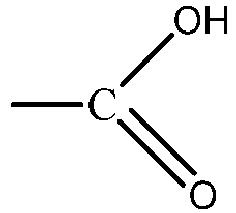 g) un groupe mercapto HS-
 - Utilisation telle que revendiquée dans l'une quelconque des revendications 1 à 6, où le support est un nanoperle de silice, dont le diamètre est de 0,01 à 2 µm.
- Dérivé fonctionnalisé selon la formule (II)
 L1' représentea) un groupe 2-hydroxyéthane-1,2-diyle
 b) un groupe 6-hydroxy-phényl-1,3-diyle
 c) un groupe thiocarbonylamino
 d) un groupe carbonylamino
 e) un groupe carbonyle
 L2 représentea) un groupe alcoxy-silanyle -Si(OR3)mR4(3-m)
où m a une valeur de 1 à 3, R3 représente un hydrogène ou un groupe alkyle en C1-C6, R4 représente un groupe hydrocarboné monofonctionnel saturé, insaturé ou aromatique, linéaire ou ramifié ou cyclique, en C1-C20, ou un dérivé perfluoré ou aminé de celui-ci,b) un groupe isothiocyanato S=C=N-c) un groupe isocyanato O=C=N-d) un groupe halogénure d'acide e) un groupe ester
 f) un groupe carboxyle
 g) un groupe mercapto HS-
 - Dérivé fonctionnalisé selon la formule (II) tel que revendiqué dans la revendication 8, où L1' est différent d'un groupe 1,2-époxy, d'un groupe 3,4-époxycyclohexyle ou d'un groupe isocyanato, si R est un groupe hydrocarboné saturé, insaturé, linéaire ou ramifié en C1-C18 et L2 représente un groupe alcoxy-silanyle -Si(OR3)mR4(3-m), où R3 représente un groupe alkyle en C1-C4 et R4 représente un groupe alkyle en C1-C4, un groupe phényle ou un groupe cyclohéxyle.
- Procédé pour la préparation du dérivé fonctionnalisé selon la formule (II) tel que revendiqué dans la revendication 8, qui comprend l'étape de réaction du polymère condensé p-nitrophényl/formaldéhyde selon la formule (I), où Z représente H, avec un réactif selon la formule L1-R-L2,où L1 représentea) un groupe 1,2-époxy
 b) un groupe 3,4-époxycyclohéxyle
 c) un groupe isothiocyanato S=C=N-d) un groupe isocyanato O=C=N-e) un groupe halogénure d'acide
 f) un groupe ester
 g) un groupe carboxyle
 R et L2 ont les significations spécifiées dans la revendication 9.
 - Polymère supporté, qui comprend un support et un ou plusieurs polymères condensés p-nitrophényl/formaldéhyde selon la formule (I) à l'état de stabilisation audit support
- Polymère supporté tel que revendiqué dans la revendication 11, où le polymère condensé p-nitrophényl/formaldéhyde selon la formule (I) est stabilisé au support par une liaison physique.
- Polymère supporté tel que revendiqué dans la revendication 11, où le polymère condensé p-nitrophényl/formaldéhyde selon la formule (I) est stabilisé au support par une liaison chimique.
- Polymère supporté tel que revendiqué dans la revendication 13, où le polymère condensé p-nitrophényl/formaldéhyde selon la formule (I) est stabilisé au support sous la forme d'un ou plusieurs dérivés fonctionnalisés selon la formule (II) par une liaison covalente.
- Polymère supporté selon l'une quelconque des revendications 11 à 14, où le support est une nanoperle de silice, dont le diamètre est de 0,01 à 2 µm.
Applications Claiming Priority (3)
| Application Number | Priority Date | Filing Date | Title |
|---|---|---|---|
| HUP1400460 | 2014-09-30 | ||
| HU1500285A HU230707B1 (hu) | 2015-06-17 | 2015-06-17 | Széles tartományban működő optikai érzékelő pH mérésére |
| PCT/HU2015/050009 WO2016051217A1 (fr) | 2014-09-30 | 2015-09-29 | P-nitrophénol-formaldéhyde polycondensé aux fins de mesure, procédé de production et utilisation |
Publications (2)
| Publication Number | Publication Date |
|---|---|
| EP3201619A1 EP3201619A1 (fr) | 2017-08-09 |
| EP3201619B1 true EP3201619B1 (fr) | 2021-02-17 |
Family
ID=89991858
Family Applications (1)
| Application Number | Title | Priority Date | Filing Date |
|---|---|---|---|
| EP15800938.1A Active EP3201619B1 (fr) | 2014-09-30 | 2015-09-29 | Polymère condensé p-nitrophényl/formaldéhyde pour la mesure du ph, procédé de préparation, et utilisation |
Country Status (3)
| Country | Link |
|---|---|
| US (1) | US10338043B2 (fr) |
| EP (1) | EP3201619B1 (fr) |
| WO (1) | WO2016051217A1 (fr) |
Family Cites Families (12)
| Publication number | Priority date | Publication date | Assignee | Title |
|---|---|---|---|---|
| JPS5536518B2 (fr) * | 1972-11-21 | 1980-09-20 | ||
| US4500691A (en) | 1983-01-13 | 1985-02-19 | Ciba-Geigy Corporation | Phenol-novolaks containing amino groups |
| US5039492A (en) | 1989-01-27 | 1991-08-13 | Metricor, Inc. | Optical pH and gas concentration sensor |
| US5017452A (en) | 1989-12-20 | 1991-05-21 | The Mead Corporation | Method for image developing on plain paper utilizing a developer-donor sheet |
| DE59209350D1 (de) | 1991-09-30 | 1998-07-02 | Merck Patent Gmbh | SENSORMEMBRAN ZUR ANZEIGE DES pH-WERTES EINER PROBE, IHRE HERSTELLUNG UND VERWENDUNG |
| US5267532A (en) * | 1992-05-05 | 1993-12-07 | Anitox Corporation | pH-indicating material and cat litter containing same |
| US5808108A (en) * | 1997-01-15 | 1998-09-15 | Chappelow; Cecil C. | Polymeric compositions and composites prepared from spiroorthocarbonates and epoxy monomers |
| GB2395555B (en) | 2002-11-22 | 2005-10-12 | Schlumberger Holdings | Apparatus and method of analysing downhole water chemistry |
| US6875807B2 (en) | 2003-05-28 | 2005-04-05 | Indspec Chemical Corporation | Silane-modified phenolic resins and applications thereof |
| US8097725B2 (en) | 2004-12-03 | 2012-01-17 | Roche Diagnostics Operations, Inc. | Luminescent indicator dye and optical sensor |
| WO2009118271A1 (fr) | 2008-03-25 | 2009-10-01 | Dublin City University | Matériaux dérivés d’un sol-gel pour une détection de ph par fluorescence optique |
| JP5462099B2 (ja) * | 2010-07-27 | 2014-04-02 | 富士フイルム株式会社 | レーザー彫刻用樹脂組成物、レーザー彫刻用レリーフ印刷版原版及びその製造方法、並びに、レリーフ印刷版及びその製版方法 |
-
2015
- 2015-09-29 EP EP15800938.1A patent/EP3201619B1/fr active Active
- 2015-09-29 WO PCT/HU2015/050009 patent/WO2016051217A1/fr not_active Ceased
- 2015-09-29 US US15/515,697 patent/US10338043B2/en active Active
Non-Patent Citations (1)
| Title |
|---|
| None * |
Also Published As
| Publication number | Publication date |
|---|---|
| US10338043B2 (en) | 2019-07-02 |
| US20170307572A1 (en) | 2017-10-26 |
| WO2016051217A1 (fr) | 2016-04-07 |
| EP3201619A1 (fr) | 2017-08-09 |
Similar Documents
| Publication | Publication Date | Title |
|---|---|---|
| Murtagh et al. | A study of the effects of organic modification and processing technique on the luminescence quenching behavior of sol− gel oxygen sensors based on a Ru (II) complex | |
| US7799276B2 (en) | Functionalized particles for composite sensors | |
| CN103257127B (zh) | 一种改善荧光指示剂分子在有机硅胶中分散性及制备氧敏感荧光膜的方法 | |
| CN109021283B (zh) | 用于检测氧化乐果的CsPbBr3钙钛矿量子点-分子印迹荧光传感器及其制备方法 | |
| JP5224330B2 (ja) | コア‐シェル構造のシリカナノ粒子の製造方法、コア‐シェル構造のシリカナノ粒子、及びそれを用いた標識試薬 | |
| Yadavi et al. | A novel Fe3+ ions chemosensor by covalent coupling fluorene onto the mono, di-and tri-ammonium functionalized nanoporous silica type SBA-15 | |
| Aydin et al. | Silica Gel‐Immobilized 5‐aminoisophthalohydrazide: A novel sorbent for solid phase extraction of Cu, Zn and Pb from natural water samples | |
| Sousa et al. | Organic–inorganic hybrid sol–gel materials doped with a fluorescent triarylimidazole derivative | |
| Kriltz et al. | Covalent immobilization of a fluorescent pH-sensitive naphthalimide dye in sol–gel films | |
| EP3201619B1 (fr) | Polymère condensé p-nitrophényl/formaldéhyde pour la mesure du ph, procédé de préparation, et utilisation | |
| Zakery et al. | Novel histamine fluorosensor based on modified environmental friendly carbon nanoparticles from gum tragacanth | |
| EP0468777B1 (fr) | Procédé pour lier un colorant sensible à une substance à analyser à un silicone durcissable par un additif et utilisation pour l'élaboration d'un capteur | |
| US5015715A (en) | Method for bonding an analyte-sensitive dye compound to an addition-cure silicone | |
| CN119529830B (zh) | 一种基于双色碳点的分子印迹聚合物比率荧光探针及其制备方法和应用 | |
| EP3726215A1 (fr) | Nanoparticules de silice pour diagnostic par biomarqueurs et leur procédé de production | |
| Çakmakçi et al. | Nonhydrolytic sol–gel synthesized oligosiloxane resin reinforced thiol-ene photocured coatings for the immobilization of acetylcholinesterase | |
| Jang et al. | Conjugated polymer-hybridized silica nanoparticle as a fluorescent sensor for cysteine | |
| Amro et al. | Supported thin flexible polymethylhydrosiloxane permeable films functionalised with silole groups: new approach for detection of nitroaromatics | |
| CN101845145B (zh) | 芘取代聚二甲基硅氧烷衍生物及其制备方法与应用 | |
| CN112852092A (zh) | 一种超疏水耐磨聚丙烯薄膜及其制备方法 | |
| Dong et al. | Fluorescent silica-polymer composite microspheres for recognition and separation of 4-nitrophenol | |
| FR2866341A1 (fr) | Gel hybride organique-inorganique imprime comprenant un complexant organique mettant en jeu des interactions pi - pi et/ou pi-nu | |
| KR101795418B1 (ko) | 불소 이온 검출용 화학센서 및 그 제조방법 | |
| CN119219951B (zh) | 一种用于检测水中汞离子的荧光敏感膜及其制备方法 | |
| Georgescu | Molecularly imprinted polymers for biomimetic sensors |
Legal Events
| Date | Code | Title | Description |
|---|---|---|---|
| STAA | Information on the status of an ep patent application or granted ep patent |
Free format text: STATUS: THE INTERNATIONAL PUBLICATION HAS BEEN MADE |
|
| PUAI | Public reference made under article 153(3) epc to a published international application that has entered the european phase |
Free format text: ORIGINAL CODE: 0009012 |
|
| STAA | Information on the status of an ep patent application or granted ep patent |
Free format text: STATUS: REQUEST FOR EXAMINATION WAS MADE |
|
| 17P | Request for examination filed |
Effective date: 20170428 |
|
| AK | Designated contracting states |
Kind code of ref document: A1 Designated state(s): AL AT BE BG CH CY CZ DE DK EE ES FI FR GB GR HR HU IE IS IT LI LT LU LV MC MK MT NL NO PL PT RO RS SE SI SK SM TR |
|
| AX | Request for extension of the european patent |
Extension state: BA ME |
|
| DAV | Request for validation of the european patent (deleted) | ||
| DAX | Request for extension of the european patent (deleted) | ||
| RIC1 | Information provided on ipc code assigned before grant |
Ipc: G01N 33/18 20060101ALI20191025BHEP Ipc: G01N 31/22 20060101AFI20191025BHEP |
|
| GRAP | Despatch of communication of intention to grant a patent |
Free format text: ORIGINAL CODE: EPIDOSNIGR1 |
|
| STAA | Information on the status of an ep patent application or granted ep patent |
Free format text: STATUS: GRANT OF PATENT IS INTENDED |
|
| INTG | Intention to grant announced |
Effective date: 20191210 |
|
| GRAJ | Information related to disapproval of communication of intention to grant by the applicant or resumption of examination proceedings by the epo deleted |
Free format text: ORIGINAL CODE: EPIDOSDIGR1 |
|
| STAA | Information on the status of an ep patent application or granted ep patent |
Free format text: STATUS: REQUEST FOR EXAMINATION WAS MADE |
|
| INTC | Intention to grant announced (deleted) | ||
| GRAS | Grant fee paid |
Free format text: ORIGINAL CODE: EPIDOSNIGR3 |
|
| STAA | Information on the status of an ep patent application or granted ep patent |
Free format text: STATUS: GRANT OF PATENT IS INTENDED |
|
| GRAP | Despatch of communication of intention to grant a patent |
Free format text: ORIGINAL CODE: EPIDOSNIGR1 |
|
| INTG | Intention to grant announced |
Effective date: 20200831 |
|
| GRAA | (expected) grant |
Free format text: ORIGINAL CODE: 0009210 |
|
| STAA | Information on the status of an ep patent application or granted ep patent |
Free format text: STATUS: THE PATENT HAS BEEN GRANTED |
|
| AK | Designated contracting states |
Kind code of ref document: B1 Designated state(s): AL AT BE BG CH CY CZ DE DK EE ES FI FR GB GR HR HU IE IS IT LI LT LU LV MC MK MT NL NO PL PT RO RS SE SI SK SM TR |
|
| REG | Reference to a national code |
Ref country code: GB Ref legal event code: FG4D |
|
| REG | Reference to a national code |
Ref country code: CH Ref legal event code: EP |
|
| REG | Reference to a national code |
Ref country code: DE Ref legal event code: R096 Ref document number: 602015065685 Country of ref document: DE |
|
| REG | Reference to a national code |
Ref country code: AT Ref legal event code: REF Ref document number: 1362115 Country of ref document: AT Kind code of ref document: T Effective date: 20210315 |
|
| REG | Reference to a national code |
Ref country code: IE Ref legal event code: FG4D |
|
| REG | Reference to a national code |
Ref country code: NL Ref legal event code: FP |
|
| REG | Reference to a national code |
Ref country code: LT Ref legal event code: MG9D |
|
| PG25 | Lapsed in a contracting state [announced via postgrant information from national office to epo] |
Ref country code: PT Free format text: LAPSE BECAUSE OF FAILURE TO SUBMIT A TRANSLATION OF THE DESCRIPTION OR TO PAY THE FEE WITHIN THE PRESCRIBED TIME-LIMIT Effective date: 20210617 Ref country code: NO Free format text: LAPSE BECAUSE OF FAILURE TO SUBMIT A TRANSLATION OF THE DESCRIPTION OR TO PAY THE FEE WITHIN THE PRESCRIBED TIME-LIMIT Effective date: 20210517 Ref country code: LT Free format text: LAPSE BECAUSE OF FAILURE TO SUBMIT A TRANSLATION OF THE DESCRIPTION OR TO PAY THE FEE WITHIN THE PRESCRIBED TIME-LIMIT Effective date: 20210217 Ref country code: BG Free format text: LAPSE BECAUSE OF FAILURE TO SUBMIT A TRANSLATION OF THE DESCRIPTION OR TO PAY THE FEE WITHIN THE PRESCRIBED TIME-LIMIT Effective date: 20210517 Ref country code: FI Free format text: LAPSE BECAUSE OF FAILURE TO SUBMIT A TRANSLATION OF THE DESCRIPTION OR TO PAY THE FEE WITHIN THE PRESCRIBED TIME-LIMIT Effective date: 20210217 Ref country code: GR Free format text: LAPSE BECAUSE OF FAILURE TO SUBMIT A TRANSLATION OF THE DESCRIPTION OR TO PAY THE FEE WITHIN THE PRESCRIBED TIME-LIMIT Effective date: 20210518 Ref country code: HR Free format text: LAPSE BECAUSE OF FAILURE TO SUBMIT A TRANSLATION OF THE DESCRIPTION OR TO PAY THE FEE WITHIN THE PRESCRIBED TIME-LIMIT Effective date: 20210217 |
|
| REG | Reference to a national code |
Ref country code: AT Ref legal event code: MK05 Ref document number: 1362115 Country of ref document: AT Kind code of ref document: T Effective date: 20210217 |
|
| PG25 | Lapsed in a contracting state [announced via postgrant information from national office to epo] |
Ref country code: RS Free format text: LAPSE BECAUSE OF FAILURE TO SUBMIT A TRANSLATION OF THE DESCRIPTION OR TO PAY THE FEE WITHIN THE PRESCRIBED TIME-LIMIT Effective date: 20210217 Ref country code: PL Free format text: LAPSE BECAUSE OF FAILURE TO SUBMIT A TRANSLATION OF THE DESCRIPTION OR TO PAY THE FEE WITHIN THE PRESCRIBED TIME-LIMIT Effective date: 20210217 Ref country code: LV Free format text: LAPSE BECAUSE OF FAILURE TO SUBMIT A TRANSLATION OF THE DESCRIPTION OR TO PAY THE FEE WITHIN THE PRESCRIBED TIME-LIMIT Effective date: 20210217 Ref country code: SE Free format text: LAPSE BECAUSE OF FAILURE TO SUBMIT A TRANSLATION OF THE DESCRIPTION OR TO PAY THE FEE WITHIN THE PRESCRIBED TIME-LIMIT Effective date: 20210217 |
|
| PG25 | Lapsed in a contracting state [announced via postgrant information from national office to epo] |
Ref country code: IS Free format text: LAPSE BECAUSE OF FAILURE TO SUBMIT A TRANSLATION OF THE DESCRIPTION OR TO PAY THE FEE WITHIN THE PRESCRIBED TIME-LIMIT Effective date: 20210617 |
|
| PG25 | Lapsed in a contracting state [announced via postgrant information from national office to epo] |
Ref country code: SM Free format text: LAPSE BECAUSE OF FAILURE TO SUBMIT A TRANSLATION OF THE DESCRIPTION OR TO PAY THE FEE WITHIN THE PRESCRIBED TIME-LIMIT Effective date: 20210217 Ref country code: AT Free format text: LAPSE BECAUSE OF FAILURE TO SUBMIT A TRANSLATION OF THE DESCRIPTION OR TO PAY THE FEE WITHIN THE PRESCRIBED TIME-LIMIT Effective date: 20210217 Ref country code: EE Free format text: LAPSE BECAUSE OF FAILURE TO SUBMIT A TRANSLATION OF THE DESCRIPTION OR TO PAY THE FEE WITHIN THE PRESCRIBED TIME-LIMIT Effective date: 20210217 Ref country code: CZ Free format text: LAPSE BECAUSE OF FAILURE TO SUBMIT A TRANSLATION OF THE DESCRIPTION OR TO PAY THE FEE WITHIN THE PRESCRIBED TIME-LIMIT Effective date: 20210217 |
|
| REG | Reference to a national code |
Ref country code: DE Ref legal event code: R097 Ref document number: 602015065685 Country of ref document: DE |
|
| PG25 | Lapsed in a contracting state [announced via postgrant information from national office to epo] |
Ref country code: DK Free format text: LAPSE BECAUSE OF FAILURE TO SUBMIT A TRANSLATION OF THE DESCRIPTION OR TO PAY THE FEE WITHIN THE PRESCRIBED TIME-LIMIT Effective date: 20210217 Ref country code: SK Free format text: LAPSE BECAUSE OF FAILURE TO SUBMIT A TRANSLATION OF THE DESCRIPTION OR TO PAY THE FEE WITHIN THE PRESCRIBED TIME-LIMIT Effective date: 20210217 Ref country code: RO Free format text: LAPSE BECAUSE OF FAILURE TO SUBMIT A TRANSLATION OF THE DESCRIPTION OR TO PAY THE FEE WITHIN THE PRESCRIBED TIME-LIMIT Effective date: 20210217 |
|
| PLBE | No opposition filed within time limit |
Free format text: ORIGINAL CODE: 0009261 |
|
| STAA | Information on the status of an ep patent application or granted ep patent |
Free format text: STATUS: NO OPPOSITION FILED WITHIN TIME LIMIT |
|
| 26N | No opposition filed |
Effective date: 20211118 |
|
| PG25 | Lapsed in a contracting state [announced via postgrant information from national office to epo] |
Ref country code: AL Free format text: LAPSE BECAUSE OF FAILURE TO SUBMIT A TRANSLATION OF THE DESCRIPTION OR TO PAY THE FEE WITHIN THE PRESCRIBED TIME-LIMIT Effective date: 20210217 Ref country code: ES Free format text: LAPSE BECAUSE OF FAILURE TO SUBMIT A TRANSLATION OF THE DESCRIPTION OR TO PAY THE FEE WITHIN THE PRESCRIBED TIME-LIMIT Effective date: 20210217 |
|
| PG25 | Lapsed in a contracting state [announced via postgrant information from national office to epo] |
Ref country code: SI Free format text: LAPSE BECAUSE OF FAILURE TO SUBMIT A TRANSLATION OF THE DESCRIPTION OR TO PAY THE FEE WITHIN THE PRESCRIBED TIME-LIMIT Effective date: 20210217 |
|
| PG25 | Lapsed in a contracting state [announced via postgrant information from national office to epo] |
Ref country code: IT Free format text: LAPSE BECAUSE OF FAILURE TO SUBMIT A TRANSLATION OF THE DESCRIPTION OR TO PAY THE FEE WITHIN THE PRESCRIBED TIME-LIMIT Effective date: 20210217 |
|
| REG | Reference to a national code |
Ref country code: CH Ref legal event code: PL |
|
| REG | Reference to a national code |
Ref country code: BE Ref legal event code: MM Effective date: 20210930 |
|
| PG25 | Lapsed in a contracting state [announced via postgrant information from national office to epo] |
Ref country code: IS Free format text: LAPSE BECAUSE OF FAILURE TO SUBMIT A TRANSLATION OF THE DESCRIPTION OR TO PAY THE FEE WITHIN THE PRESCRIBED TIME-LIMIT Effective date: 20210617 Ref country code: MC Free format text: LAPSE BECAUSE OF FAILURE TO SUBMIT A TRANSLATION OF THE DESCRIPTION OR TO PAY THE FEE WITHIN THE PRESCRIBED TIME-LIMIT Effective date: 20210217 |
|
| PG25 | Lapsed in a contracting state [announced via postgrant information from national office to epo] |
Ref country code: LU Free format text: LAPSE BECAUSE OF NON-PAYMENT OF DUE FEES Effective date: 20210929 Ref country code: BE Free format text: LAPSE BECAUSE OF NON-PAYMENT OF DUE FEES Effective date: 20210930 |
|
| PG25 | Lapsed in a contracting state [announced via postgrant information from national office to epo] |
Ref country code: LI Free format text: LAPSE BECAUSE OF NON-PAYMENT OF DUE FEES Effective date: 20210930 Ref country code: CH Free format text: LAPSE BECAUSE OF NON-PAYMENT OF DUE FEES Effective date: 20210930 |
|
| PG25 | Lapsed in a contracting state [announced via postgrant information from national office to epo] |
Ref country code: HU Free format text: LAPSE BECAUSE OF FAILURE TO SUBMIT A TRANSLATION OF THE DESCRIPTION OR TO PAY THE FEE WITHIN THE PRESCRIBED TIME-LIMIT; INVALID AB INITIO Effective date: 20150929 |
|
| PG25 | Lapsed in a contracting state [announced via postgrant information from national office to epo] |
Ref country code: CY Free format text: LAPSE BECAUSE OF FAILURE TO SUBMIT A TRANSLATION OF THE DESCRIPTION OR TO PAY THE FEE WITHIN THE PRESCRIBED TIME-LIMIT Effective date: 20210217 |
|
| PG25 | Lapsed in a contracting state [announced via postgrant information from national office to epo] |
Ref country code: MK Free format text: LAPSE BECAUSE OF FAILURE TO SUBMIT A TRANSLATION OF THE DESCRIPTION OR TO PAY THE FEE WITHIN THE PRESCRIBED TIME-LIMIT Effective date: 20210217 |
|
| PG25 | Lapsed in a contracting state [announced via postgrant information from national office to epo] |
Ref country code: MT Free format text: LAPSE BECAUSE OF FAILURE TO SUBMIT A TRANSLATION OF THE DESCRIPTION OR TO PAY THE FEE WITHIN THE PRESCRIBED TIME-LIMIT Effective date: 20210217 |
|
| PGFP | Annual fee paid to national office [announced via postgrant information from national office to epo] |
Ref country code: DE Payment date: 20250919 Year of fee payment: 11 |
|
| PGFP | Annual fee paid to national office [announced via postgrant information from national office to epo] |
Ref country code: NL Payment date: 20250918 Year of fee payment: 11 |
|
| PGFP | Annual fee paid to national office [announced via postgrant information from national office to epo] |
Ref country code: GB Payment date: 20250919 Year of fee payment: 11 |
|
| PGFP | Annual fee paid to national office [announced via postgrant information from national office to epo] |
Ref country code: FR Payment date: 20250922 Year of fee payment: 11 |
|
| PGFP | Annual fee paid to national office [announced via postgrant information from national office to epo] |
Ref country code: IE Payment date: 20250918 Year of fee payment: 11 |
|
| PG25 | Lapsed in a contracting state [announced via postgrant information from national office to epo] |
Ref country code: TR Free format text: LAPSE BECAUSE OF FAILURE TO SUBMIT A TRANSLATION OF THE DESCRIPTION OR TO PAY THE FEE WITHIN THE PRESCRIBED TIME-LIMIT Effective date: 20210217 |