EP3201735B1 - Verfahren, software und vorrichtung zum testen des gesichtsfeldes eines patienten - Google Patents
Verfahren, software und vorrichtung zum testen des gesichtsfeldes eines patienten Download PDFInfo
- Publication number
- EP3201735B1 EP3201735B1 EP15791005.0A EP15791005A EP3201735B1 EP 3201735 B1 EP3201735 B1 EP 3201735B1 EP 15791005 A EP15791005 A EP 15791005A EP 3201735 B1 EP3201735 B1 EP 3201735B1
- Authority
- EP
- European Patent Office
- Prior art keywords
- target
- patient
- marker
- new
- display
- Prior art date
- Legal status (The legal status is an assumption and is not a legal conclusion. Google has not performed a legal analysis and makes no representation as to the accuracy of the status listed.)
- Not-in-force
Links
Images
Classifications
-
- A—HUMAN NECESSITIES
- A61—MEDICAL OR VETERINARY SCIENCE; HYGIENE
- A61B—DIAGNOSIS; SURGERY; IDENTIFICATION
- A61B3/00—Apparatus for testing the eyes; Instruments for examining the eyes
- A61B3/02—Subjective types, i.e. testing apparatus requiring the active assistance of the patient
- A61B3/024—Subjective types, i.e. testing apparatus requiring the active assistance of the patient for determining the visual field, e.g. perimeter types
-
- A—HUMAN NECESSITIES
- A61—MEDICAL OR VETERINARY SCIENCE; HYGIENE
- A61B—DIAGNOSIS; SURGERY; IDENTIFICATION
- A61B3/00—Apparatus for testing the eyes; Instruments for examining the eyes
- A61B3/0091—Fixation targets for viewing direction
-
- G—PHYSICS
- G06—COMPUTING OR CALCULATING; COUNTING
- G06F—ELECTRIC DIGITAL DATA PROCESSING
- G06F3/00—Input arrangements for transferring data to be processed into a form capable of being handled by the computer; Output arrangements for transferring data from processing unit to output unit, e.g. interface arrangements
- G06F3/01—Input arrangements or combined input and output arrangements for interaction between user and computer
- G06F3/011—Arrangements for interaction with the human body, e.g. for user immersion in virtual reality
- G06F3/013—Eye tracking input arrangements
-
- A—HUMAN NECESSITIES
- A61—MEDICAL OR VETERINARY SCIENCE; HYGIENE
- A61B—DIAGNOSIS; SURGERY; IDENTIFICATION
- A61B3/00—Apparatus for testing the eyes; Instruments for examining the eyes
- A61B3/10—Objective types, i.e. instruments for examining the eyes independent of the patients' perceptions or reactions
- A61B3/113—Objective types, i.e. instruments for examining the eyes independent of the patients' perceptions or reactions for determining or recording eye movement
Definitions
- the present invention relates to a method, apparatus and software for use in testing a patient's visual field.
- Visual field tests are examinations conducted in order to determine the extent of a patient's visual field.
- There are a number of existing tests for measuring and generating a graphical representation of a patient's visual field such as for example the Bjerrum test, the Static Perimetry test and the Optokinetic test.
- Problems associated with known tests stem from the fact that in each case the patient is required to give some sort of indication or response as to when they see the target in their visual field. The exact point of when the target is seen can be somewhat subjective and unclear and can therefore lead to significant inaccuracies.
- patients can often lose fixation or concentration, leading them to scan the screen for the next target, which leads to an inaccurate picture of what is detected as within their peripheral visual field.
- US 6,367,392 discloses in claim 1 a method and apparatus for testing the visual field, comprising
- An object of the present invention is to seek to overcome the problems associated with such known tests and apparatus.
- a method for testing a patient's visual field using testing apparatus comprising the steps of: (a) providing a fixation target on a display at a known target position; (b) tracking the patient's direction of gaze using an eye tracker to determine the patient's point of regard on the display; (c) providing a marker on the display indicating the patient's point of regard, where the marker moves with movement of the patient's point of regard; (d) detecting when the marker is moved to the fixation target; (e) once the marker is moved to the fixation target, providing a new target on the display at a further known target position; (f) recording the new target as detected if the marker is moved to the new target, the new target then becoming the fixation target; (g) repeating steps (e) and (f) for further new targets at further known target positions for determining the patient's visual field based on the positions of the new targets that have been detected.
- the fixation target is a target over which the patient is initially encouraged to focus on.
- the new target is a visual field target provided somewhere on the screen in what would be the visual field of a normal patient. If the patient is aware of the visual field target while looking at the fixation target, then they are encouraged to move their focus to it.
- the visual field target then becomes the fixation target at a revised known target position.
- a new visual field target can then be provided on the display and the process is repeated to build up a visual field.
- the patient's point of regard on the display screen is accurately determined using eye tracking, thereby ensuring that focus on the fixation target has been maintained at the point when a new target was presented in the patient's peripheral field.
- the provision of the marker indicating the patient's current point of regard provides a synergetic effect in that the patent is provided with something on screen to focus on and control relative to the current fixation target. That is, the marker functions as a target sight for targets, introducing a gaming element to the testing process which helps to maintain the patient's concentration. As such, the patient's gaze is less likely to deviate from the current fixation target since this would cause the marker to move off the fixation target, prompting the patient to move their focus back.
- step (f) further comprises recording the new target as not detected if, after a period of time, the marker is not moved to the new target.
- the method further comprises the step of preparing a visual field map based on the positions of targets that have been recorded as detected and not detected.
- step (f) further comprises repositioning the new target if it is recorded as not detected.
- this gives the patient an opportunity to establish whether such a target is in their visual field. If the patient is not aware of such a target then it is repositioned, for example closer to the fixation target, to try to establish the limits of the patient's visual field at that orientation.
- the new target is repositioned in incremental steps. This helps to provide time for the patient to react.
- the marker is displayed as one of a dot, a circle, or crosshairs.
- the marker appears as a target sight for new field targets, helping to reinforce the gaming elements to the testing process.
- step (f) further comprises providing a visual or audible notification to the patient when the marker is moved to the new target.
- the visual or audible notification to the patient is continuous while the marker is in contact with the new target.
- an alert may sound or display if the patient's point of regard moves off from the fixation target once on it. Again, this helps to prompt the patient to move their focus back to the fixation target.
- step (f) further comprises removing the previous fixation target from display after the marker is moved to the new target.
- step (f) further comprises determining if the marker is moved along a path between the fixation target and the new target.
- the path has a width for providing a tolerance to inaccuracy in the patient's movement of their direction of gaze.
- a notional direct linear path between the fixation target and the new target is used to define a wider path or channel that is designated as being a region in which the marker is determined as travelling directly to the newly presented visual field target with an acceptable or reasonable degree of tolerance to allow for inaccuracies in the patient's movement of their direction of gaze or in the eye tracking system.
- step (f) further comprises removing the new target from display if the marker is moved outside of the path. In this way, the patient is prevented from scanning the display screen looking for new targets.
- a notification is generated to prompt the patient to move their point of regard back to the fixation target.
- the method further comprises conducting a calibration procedure, the calibration procedure comprising the steps of: providing a calibration fixation target on the display; prompting the patient to focus on the calibration fixation target for a period of time; adjusting the position of the marker indicating the patient's point of regard over the calibration fixation target. In this way, more accurate eye tracking is achieved.
- step (f) further comprises recording the reaction time of the patient.
- step (e) comprises changing the brightness of the new target and/or the contrast of the new target relative to the displayed background over a period of time.
- the brightness or contrast may increase over a period of time.
- a visual field target may be presented by fading in and becoming progressively more visible. That is, the visual field target may start from a point where it is substantially blended with the display background, with a similar colour and brightness. The contrast with the background may then increase steadily over a period of time until the visual field target is detected or a maximum contrast or brightness is reached.
- step (e) further comprises recording the brightness and/or contrast level of the new target at the time of detection.
- the step of recording the brightness and/or contrast level of the new target at the time of detection may comprise accounting for the reaction time of the patient.
- step (d) the new target is presented once the marker is moved at least partially over the fixation target.
- the method further comprises moving the fixation target and moving the new target with the fixation target to maintain it at a constant position relative to the fixation target, wherein the patient is encouraged to track the movement by maintaining the marker over the fixation target and the new target is only displayed when the marker is over the fixation target or being moved directly towards the new target. Having the fixation target move ensures that the patient has to maintain their attention thereon.
- results from the method may be recorded in graphical or pictorial form, representing the visual field of the patient.
- results from testing the same patient at different times or different target contrast levels may further be superimposable for indicating the deterioration/progress of the patient, as well as the severity of their defect of visual field.
- the method further comprises providing the patient with a patient actuated indicator for designating a target as detected, wherein the step of recording the target as detected comprises requiring the patient to actuate the patient actuated indicator once the marker is moved to the target.
- the step of recording the target as detected comprises requiring the patient to actuate the patient actuated indicator once the marker is moved to the target.
- the patient's involvement in the test is thereby increased, leading to improved concentration, and consequently more accurate results.
- the test may be thought of as requiring the patent to both aim at each target with their point of regard marker and fire at the target using their button or trigger.
- the method further comprises providing a visual or audible notification to the patient when the target is recorded as detected. More preferably, the visual notification comprises altering the appearance of the marker and/or the target. In embodiments, a different visual or audible notification may be provided to the patient if the patient actuated indicator is actuated when the marker has not been moved to the target.
- a software program having instructions for implementing a method for testing a patient's visual field using testing apparatus, the software program comprising: (a) instructions for providing a fixation target on a display at a known target position; (b) instructions for tracking the patient's direction of gaze using an eye tracker to determine the patient's point of regard on the display; (c) instructions for providing a marker on the display indicating the patient's point of regard, where the marker moves with movement of the patient's point of regard; (d) instructions for detecting when the marker is moved to the fixation target; (e) instructions for providing a new target on the display at a further known target position once the marker is moved to the fixation target; (f) instructions for recording the new target as detected if the marker is moved to the new target, the new target then becoming the fixation target; (g) instructions for repeating instructions (e) and (f) for further new targets a further known target positions for determining the patient's visual field based on the positions
- apparatus for testing a patient's visual field comprising: a display; an eye tracker for tracking the patient's direction of gaze to determine the patient's point of regard on the display; a control unit configured to (a) present a fixation target on the display at a known target position; (b) present a marker on the display indicating the patient's point of regard, where the marker moves with movement of the patient's point of regard; and (c) present a new target on the display at a further known target position once the marker is moved to the fixation target; a memory for recording the new target as detected if the marker is moved to the new target, the new target then becoming the fixation target; wherein the control unit is further configured to present further new targets at further known target positions and the memory is for recording if the further new targets are detected for determining the patient's visual field based on the positions of the new targets that have been detected.
- the apparatus comprises a head mounted unit comprising the display and the eye tracker.
- the position of the patient's eyes relative to where the display screen is visualised is kept constant. Furthermore, this allows the present invention to be provided as a compact apparatus.
- the apparatus further comprises a patient actuated indicator for designating a target as detected, wherein the control unit is configured to record targets as detected only when the patient actuated indicator is actuated by the patient once the marker is moved to the target.
- the control unit is further configured to provide a visual or audible notification to the patient when a target is recorded as detected. More preferably, the control unit is further configured to provide said visual notification by altering the appearance of the marker and/or the target.
- the control unit may be further configured to provide a different visual or audible notification to the patient if the patient actuated indicator is actuated when the marker has not been moved to the target.
- a method for testing a patient's visual field using testing apparatus comprising the steps of: (a) providing a fixation target on a display at a known target position and providing the patient with a patient actuated indicator; (b) tracking the patient's direction of gaze using an eye tracker to determine the patient's point of regard on the display; (c) providing a marker on the display indicating the patient's point of regard, where the marker moves with movement of the patient's point of regard; (d) detecting when both the marker is moved to the fixation target and the patient actuated indicator is actuated to designate a target as detected; (e) once the target is detected, providing a new target on the display at a further known target position; (f) recording the new target as detected if the marker is moved to the new target and the patient actuated indicator is actuated, the new target then becoming the fixation target; (g) repeating steps (e) and (f) for further new targets at further
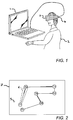
- Figure 1 shows an example of testing apparatus for implementing an embodiment of the present invention.
- the patient 2 is provided with a head mounted unit 4 connected to computer 1 on which is stored software with instructions for implementing the testing methodology according to this embodiment of the present invention.
- Head unit 4 provides a head mounted display 3 integrated with an eye tracker for tracking the patient's direction of gaze.
- the display 3 is a retinal display unit that projects light directly into a patient's eye or eyes such that an image of the visual field test display screen is formed on their retina.
- the eye tracker comprises cameras integrated into the head unit 4 and directed toward the patient's eyes. Processing within either the head unit 4 or the computer 1 utilises the feed from the integrated cameras to determine the patient's direction of gaze. By integrating the display 3 and eye tracker within the head unit 4, the position of the patient's eyes relative to where the display screen is visualised is kept constant.
- alternative displays 3 may be used.
- more conventional head mounted displays which comprise small OLED, LED or LCD display screens may be used.
- the head mounted display may also be an actual flat or curved display in front of the patient's eye/s.
- more conventional display screens such as computer monitors, projector systems, or flat screen displays could also be used.
- the eye tracker may be provided as a separate unit.
- Figure 2 shows a schematic representation of a visual field test screen 7 similar to that which would be visualised as being displayed on the display 3 to the patient 2 wearing the head mounted unit 4.
- the screen 7 has a display background on which a sequence of target spots T n are displayed.
- a marker 5 is displayed in the form of crosshairs and is moveable in real time with the patent's direction of gaze under the control of the eye tracker such that the marker 5 designates the patient's point of regard on the display screen 7. As such, the position of the marker 5 provides a continuous indication of what the patient is looking at on the display screen 7.
- a calibration process is performed whereby a patient is prompted to focus on a displayed calibration target spot in order to calibrate the eye tracker.
- the patient is asked to maintain their focus on the calibration target spot for a period of time.
- the position of the marker 5 is adjusted so it is accurately positioned over the calibration target spot, where the patient's point of regard is located.
- the eye tracking processing may also compensate for minor inaccuracies in detection or small eye movements by damping the movement of the marker 5.
- the calibration process may be repeated later if, for example, the patient considers the position of the marker to be inaccurate.
- the first target T1 and the moveable marker 5 are displayed on display 3.
- the patient is prompted to begin the test by moving their point of regard, and hence marker 5, to the target T1.
- the patient is also instructed to move their point of regard towards any presented visual field target they subsequently see.
- These prompts may be from a practitioner administering the test, or be provided automatically by the software generating audio or on-screen instructions.
- the position of the marker 5 will coincide with target T1 on the display.
- the action of the marker 5 being moved over target T1 thereby designates it as the current fixation target.
- Establishing the marker 5 over the target can be confirmed by an audible or visual notification, such as an explosion effect.
- an audible or visual notification such as an explosion effect.
- either or both of the marker 5 and the target T1 may change their shape or colour.
- the audible or visual notification may be continuous while the marker 5 remains in contact with the current fixation target in order to keep the patient focussed on it.
- target T2 is then displayed on the screen as a new visual field target. If the patient becomes aware of this new target in their visual field while still looking at target T1, they will move their direction of gaze toward it in accordance with the pre-test instructions. Once the patient is looking at the new target T2, because their point of regard will coincide with the new target, marker 5 will have moved over it. This indicates this target has been seen, which is recorded as a positive patient response for that position by computer 1. Target T2 then becomes the new fixation target. Again, establishing the marker 5 over the new target T2 can be confirmed by an audible or visual notification.
- the fixation target may be configured to vibrate or oscillate or otherwise change its appearance, once it has been selected by the patient directing their point of regard to it. This oscillation or movement helps to maintain the patient's direction of gaze on the target as their eyes are drawn to the movement.
- a notional positive movement corridor or channel 6 is defined along the path between the targets. As shown by the dashed line 6 in Figure 2 , this corridor or channel 6 is wider than the marker 5, and has a width selected to allow for minor inaccuracy in the patient's direction of gaze movements. Accordingly, during the test, a patient is able to move their point of regard directly to new targets along the positive movement channel 6. However, any other movement of the marker 5 outside this positive movement channel 6 indicates the patent is scanning the display screen. This causes the test to be paused by removing the new visual field target from display. The patient must then return their point of regard back to the fixation target to recommence the test.
- the new visual field target at that position is recorded as not seen.
- the size and/or contrast of the new visual field target may be increased over a period of time until the target is seen, and the size and/or contrast upon detection may be recorded.
- a new visual field target if a new visual field target is not seen, it can be moved under computer control to where it is seen and the position recorded, or other targets are displayed one at a time until one is seen and the process continues further.
- a visual field can be built up. Hence, the patient simply follows targets appearing on the screen with their point of regard.
- the apparatus may further comprise means for repositioning the display position of the fixation target to allow a new target to be positioned on the screen.
- a substantial part of the field on one side may be missing such that as successive targets are presented, only those not in the missing part are seen. This could have an effect in gradually moving the fixation target further and further to one side of the display. Consequently, the useful area of the screen for presenting further targets will be diminished.
- the fixation target can be moved under the control of the computer to a position where there is sufficient space left on the display to present further targets and thus continue the test.
- Such a means for repositioning the target may, for example, be provided in the form of software for the computer.
- the testing apparatus may further comprise a patient actuated indicator, such as a button or trigger that can be pressed by the patient during the test for designating targets as seen.
- a patient actuated indicator such as a button or trigger that can be pressed by the patient during the test for designating targets as seen.
- the patient may also be instructed to actuate the indicator when the marker 5 is over the target to designate it as seen.
- This patient input would also be monitored by computer 1 such that each target is only recorded as having been seen, and the next target displayed, once both actions occur simultaneously. The patient's involvement in the test is thereby increased, leading to improved concentration, and consequently more accurate results.
- the test may be thought of as requiring the patent to both aim at each target with their direction of gaze marker and fire at the target using their button or trigger.
- the appearance of either or both of the marker 5 and the target T may change.
- an alternative visual or audible notification may also be provided to the patient if they actuate the indicator when the marker 5 is not over the target.
- This alternative visual or audible notification which may be, for instance, a "boo" sound, may thereby be used to alert the patient that they have missed the target.
- the results of the visual field test may be output as a visual field map.
- the results of the test may be uploaded to a cloud storage system, for example, for comparison with other patients.
Landscapes
- Engineering & Computer Science (AREA)
- Health & Medical Sciences (AREA)
- Life Sciences & Earth Sciences (AREA)
- Physics & Mathematics (AREA)
- Animal Behavior & Ethology (AREA)
- Heart & Thoracic Surgery (AREA)
- Veterinary Medicine (AREA)
- Public Health (AREA)
- Biophysics (AREA)
- Ophthalmology & Optometry (AREA)
- Biomedical Technology (AREA)
- General Health & Medical Sciences (AREA)
- Medical Informatics (AREA)
- Molecular Biology (AREA)
- Surgery (AREA)
- General Engineering & Computer Science (AREA)
- Theoretical Computer Science (AREA)
- Human Computer Interaction (AREA)
- General Physics & Mathematics (AREA)
- Eye Examination Apparatus (AREA)
Claims (15)
- Verfahren zum Testen des Gesichtsfeldes eines Patienten (2) unter Verwendung einer Testvorrichtung, das Verfahren umfassend die Schritte von:(a) Bereitstellen eines Fixationszieles auf einer Anzeige (3) an einer bekannten Zielposition;(b) Verfolgen der Blickrichtung des Patienten (2) unter Verwendung eines Eye-Trackers zum Bestimmen des Betrachtungspunktes des Patienten (2) auf der Anzeige (3);(c) Bereitstellen einer Markierung (5) auf der Anzeige (3), die den Betrachtungspunkt des Patienten (2) anzeigt, wobei sich die Markierung (5) mit einer Bewegung des Betrachtungspunktes des Patienten (2) bewegt;(d) Detektieren, wenn die Markierung (5) auf das Fixationsziel bewegt wird;(e) sobald die Markierung (5) auf das Fixationsziel bewegt wird, Bereitstellen eines neuen Zieles auf der Anzeige (3) an einer weiteren bekannten Zielposition;(f) Aufzeichnen des neuen Zieles als detektiert, wenn die Markierung (5) auf das neue Ziel bewegt wird, wobei dann das neue Ziel das Fixationsziel wird;(g) Wiederholen der Schritte (e) und (f) für weitere neue Ziele an weiteren bekannten Zielpositionen zum Bestimmen des Gesichtsfeldes des Patienten (2) basierend auf den Positionen der neuen Ziele, die detektiert wurden.
- Verfahren nach Anspruch 1, wobei Schritt (f) weiter umfasst Aufzeichnen des neuen Zieles als nicht detektiert, wenn die Markierung (5) nach einer Zeitdauer nicht auf das neue Ziel bewegt wird.
- Verfahren nach Anspruch 2, weiter umfassend den Schritt des Erstellens einer Gesichtsfeldkarte basierend auf den Positionen von Zielen, die als detektiert und nicht detektiert aufgezeichnet wurden.
- Verfahren nach Anspruch 2 oder 3, wobei Schritt (f) weiter umfasst Neupositionieren des neuen Zieles, wenn es als nicht detektiert aufgezeichnet wird.
- Verfahren nach einem vorstehenden Anspruch, wobei Schritt (f) weiter umfasst Bestimmen wenn die Markierung (5) entlang eines Weges (6) zwischen dem Fixationsziel und dem neuen Ziel bewegt wird, wobei der Weg (6) eine Breite aufweist, um eine Toleranz gegenüber einer Ungenauigkeit bei der Bewegung der Blickrichtung des Patienten (2) bereitzustellen.
- Verfahren nach Anspruch 5, wobei Schritt (f) weiter umfasst Entfernen des neuen Zieles von der Anzeige (3), wenn die Markierung (5) außerhalb des Weges (6) bewegt wird.
- Verfahren nach Anspruch 6, wobei, wenn das neue Ziel von der Anzeige (3) entfernt wird, eine Benachrichtigung erzeugt wird, um den Patienten (2) aufzufordern, seinen Betrachtungspunkt zurück zu dem Fixationsziel zu bewegen.
- Verfahren nach einem vorstehenden Anspruch, weiter umfassend Durchführen eines Kalibrierungsverfahrens, das Kalibrierungsverfahren umfassend die Schritte von:Bereitstellen eines Kalibrierungsfixationszieles auf der Anzeige (3);Auffordern des Patienten (2), sich für eine Zeitdauer auf das Kalibrierungsfixationsziel zu konzentrieren;Einstellen der Position der Markierung (5), die den Betrachtungspunkt des Patienten (2) anzeigt, über dem Kalibrierungsfixationsziel.
- Verfahren nach einem vorstehenden Anspruch, wobei Schritt (e) umfasst Verändern der Helligkeit des neuen Zieles und/oder des Kontrastes des neuen Zieles relativ zu dem angezeigten Hintergrund über eine Zeitdauer.
- Verfahren nach einem vorstehenden Anspruch, weiter umfassend Bewegen des Fixationszieles und Bewegen des neuen Zieles mit dem Fixationsziel, um es in einer konstanten Position relativ zu dem Fixationsziel zu halten,
wobei der Patient (2) ermutigt wird, die Bewegung durch Halten der Markierung (5) über dem Fixationsziel zu verfolgen, und das neue Ziel nur angezeigt wird, wenn sich die Markierung (5) über dem Fixationsziel befindet oder direkt in Richtung des neuen Zieles bewegt wird. - Verfahren nach einem vorstehenden Anspruch, weiter umfassend Bereitstellen des Patienten (2) mit einer patientenbetätigten Anzeigevorrichtung zum Kennzeichnen eines Zieles als detektiert,
wobei der Schritt des Aufzeichnens des Zieles als detektiert das Erfordernis umfasst, dass der Patient (2) die patientenbetätigte Anzeigevorrichtung betätigt, sobald die Markierung (5) auf das Ziel bewegt wird. - Softwareprogramm mit Anweisungen zum Implementieren eines Verfahrens zum Testen des Gesichtsfeldes eines Patienten (2) unter Verwendung einer Testvorrichtung, wobei das Softwareprogramm umfasst:(a) Anweisungen zum Bereitstellen eines Fixationszieles auf der Anzeige (3) an einer bekannten Zielposition;(b) Anweisungen zum Verfolgen der Blickrichtung des Patienten (2) unter Verwendung eines Eye-Trackers zum Bestimmen des Betrachtungspunktes des Patienten (2) auf der Anzeige (3);(c) Anweisungen zum Bereitstellen einer Markierung (5) auf der Anzeige (3), die den Betrachtungspunkt des Patienten (2) anzeigt, wobei sich die Markierung (5) mit einer Bewegung des Betrachtungspunktes des Patienten (2) bewegt;(d) Anweisungen zum Detektieren, wenn die Markierung (5) auf das Fixationsziel bewegt wird;(e) Anweisungen zum Bereitstellen eines neuen Zieles auf der Anzeige (3) an einer weiteren bekannten Zielposition, sobald die Markierung (5) auf das Fixationsziel bewegt wird;(f) Anweisungen zum Aufzeichnen des neuen Zieles als detektiert, wenn die Markierung (5) auf das neue Ziel bewegt wird, wobei dann das neue Ziel das Fixationsziel wird;(g) Anweisungen zum Wiederholen der Anweisungen (e) und (f) für weitere neue Ziele an weiteren bekannten Zielpositionen zum Bestimmen des Gesichtsfeldes des Patienten (2) basierend auf den Positionen der neuen Ziele, die detektiert wurden.
- Vorrichtung zum Testen eines Gesichtsfeldes eines Patienten (2), wobei die Vorrichtung umfasst:eine Anzeige (3);einen Eye-Tracker zum Verfolgen der Blickrichtung des Patienten (2) zum Bestimmen des Betrachtungspunktes des Patienten auf der Anzeige (3);eine Steuereinheit zum (a) Darstellen eines Fixationszieles auf der Anzeige (3) an einer bekannten Zielposition; (b) Darstellen einer Markierung (5) auf der Anzeige (3), die den Betrachtungspunkt des Patienten (2) anzeigt, wobei sich die Markierung (5) mit einer Bewegung des Betrachtungspunktes des Patienten (2) bewegt; und (c) Darstellen eines neuen Zieles auf der Anzeige (3) an einer weiteren bekannten Zielposition, sobald die Markierung (5) auf das Fixationsziel bewegt wird;einen Speicher zum Aufzeichnen des neuen Zieles als detektiert, wenn die Markierung (5) auf das neue Ziel bewegt wird, wobei dann das neue Ziel das Fixationsziel wird;wobei die Steuereinheit weiter konfiguriert ist zum Darstellen weiterer neuer Ziele an weiteren bekannten Zielpositionen und der Speicher ist zum Aufzeichnen, wenn die weiteren neuen Ziele detektiert wurden, zum Bestimmen des Gesichtsfeldes des Patienten (2) basierend auf den Positionen der neuen Ziele, die detektiert wurden.
- Vorrichtung nach Anspruch 13, wobei die Vorrichtung eine kopfmontierte Einheit (4) umfasst, die die Anzeige (3) und den Eye-Tracker umfasst.
- Vorrichtung nach Anspruch 13 oder 14, weiter umfassend eine patientenbetätigte Anzeigevorrichtung zum Kennzeichnen eines Zieles als detektiert,
wobei die Steuereinheit nur zum Aufzeichnen von Zielen als detektiert konfiguriert ist, wenn die patientenbetätigte Anzeigevorrichtung durch den Patienten (2) betätigt wird, sobald die Markierung (5) auf das Ziel bewegt wird.
Applications Claiming Priority (2)
| Application Number | Priority Date | Filing Date | Title |
|---|---|---|---|
| GBGB1417208.4A GB201417208D0 (en) | 2014-09-30 | 2014-09-30 | Method Software And Apparatus For Testing A Patiants Visual Field |
| PCT/GB2015/052759 WO2016051136A1 (en) | 2014-09-30 | 2015-09-23 | Method, software and apparatus for testing a patient's visual field |
Publications (2)
| Publication Number | Publication Date |
|---|---|
| EP3201735A1 EP3201735A1 (de) | 2017-08-09 |
| EP3201735B1 true EP3201735B1 (de) | 2018-12-12 |
Family
ID=51901328
Family Applications (1)
| Application Number | Title | Priority Date | Filing Date |
|---|---|---|---|
| EP15791005.0A Not-in-force EP3201735B1 (de) | 2014-09-30 | 2015-09-23 | Verfahren, software und vorrichtung zum testen des gesichtsfeldes eines patienten |
Country Status (8)
| Country | Link |
|---|---|
| US (1) | US10178949B2 (de) |
| EP (1) | EP3201735B1 (de) |
| JP (1) | JP2017529964A (de) |
| CN (1) | CN106999035A (de) |
| AU (1) | AU2015326644A1 (de) |
| CA (1) | CA3000598C (de) |
| GB (1) | GB201417208D0 (de) |
| WO (1) | WO2016051136A1 (de) |
Families Citing this family (25)
| Publication number | Priority date | Publication date | Assignee | Title |
|---|---|---|---|---|
| GB2542759B (en) * | 2015-08-20 | 2021-03-03 | Ibisvision Ltd | Method and apparatus for testing a patients visual field |
| JP2017091327A (ja) * | 2015-11-12 | 2017-05-25 | 富士通株式会社 | ポインティング支援装置、ポインティング支援方法およびポインティング支援プログラム |
| JP2020515895A (ja) | 2017-03-27 | 2020-05-28 | エイヴギャント コーポレイション | 操作可能な中心窩ディスプレイ |
| CN111511318B (zh) * | 2017-09-27 | 2023-09-15 | 迈阿密大学 | 数字治疗矫正眼镜 |
| AU2018367510A1 (en) * | 2017-11-14 | 2020-06-25 | Vivid Vision, Inc. | Systems and methods for visual field analysis |
| CN108304066A (zh) * | 2018-01-24 | 2018-07-20 | 三峡大学 | 安全标识视觉传达效果量化方法 |
| JP6996343B2 (ja) * | 2018-02-28 | 2022-01-17 | 株式会社Jvcケンウッド | 評価装置、評価方法、及び評価プログラム |
| JP7027958B2 (ja) * | 2018-02-28 | 2022-03-02 | 株式会社Jvcケンウッド | 評価装置、評価方法、及び評価プログラム |
| JP6928382B2 (ja) * | 2018-08-24 | 2021-09-01 | 学校法人北里研究所 | 視認性評価システム |
| US10855978B2 (en) * | 2018-09-14 | 2020-12-01 | The Toronto-Dominion Bank | System and method for receiving user input in virtual/augmented reality |
| CA3122089A1 (en) | 2018-12-07 | 2020-06-11 | Avegant Corp. | Steerable positioning element |
| CA3125739A1 (en) | 2019-01-07 | 2020-07-16 | Avegant Corp. | Control system and rendering pipeline |
| JP7246044B2 (ja) * | 2019-03-06 | 2023-03-27 | 株式会社ファインデックス | 視標視認判定システム及び視野検査装置 |
| JP7215246B2 (ja) * | 2019-03-08 | 2023-01-31 | 株式会社Jvcケンウッド | 表示装置、表示方法、及び表示プログラム |
| BR112021019438A2 (pt) * | 2019-03-28 | 2021-12-07 | Univ Miami | Determinação e melhoria de defeito de visão |
| KR102649783B1 (ko) | 2019-03-29 | 2024-03-20 | 아브간트 코포레이션 | 도파관을 사용한 조향 가능한 하이브리드 디스플레이 |
| GB201905934D0 (en) * | 2019-04-29 | 2019-06-12 | Univ Manchester | Visual field assessment system and method |
| KR102735397B1 (ko) | 2020-01-06 | 2024-11-27 | 아브간트 코포레이션 | 색 특이적인 변조를 이용한 머리 장착형 시스템 |
| US20240335104A1 (en) * | 2020-06-16 | 2024-10-10 | Findex Inc. | Visual Field Testing Apparatus |
| JP7802277B2 (ja) * | 2021-12-24 | 2026-01-20 | 株式会社ファインデックス | 視野検査装置 |
| JP2022037273A (ja) * | 2020-08-25 | 2022-03-09 | 株式会社ファインデックス | 可視判定システム及び視野検査装置 |
| JP7639495B2 (ja) * | 2021-04-02 | 2025-03-05 | 株式会社Jvcケンウッド | 視野評価装置 |
| EP4326140A4 (de) * | 2021-04-21 | 2025-07-30 | Olleyes Inc | System und verfahren zur bereitstellung von sichtfeldtests |
| US12505557B2 (en) * | 2022-04-28 | 2025-12-23 | Universal City Studios Llc | Systems and methods for providing a show effect using a detectable marker |
| US12678039B2 (en) | 2022-12-15 | 2026-07-14 | Verily Health Inc. | Visual field test in a VR headset |
Family Cites Families (14)
| Publication number | Priority date | Publication date | Assignee | Title |
|---|---|---|---|---|
| GB9722949D0 (en) * | 1997-10-30 | 1998-01-07 | Bid Instr Ltd | Ocular testing and related projection apparatus and method |
| CA2333678A1 (en) * | 1999-03-31 | 2000-10-05 | Virtual-Eye.Com, Inc. | Kinetic visual field apparatus and method |
| JP2003000542A (ja) * | 2001-06-21 | 2003-01-07 | Foundation For Nara Institute Of Science & Technology | 視野検査装置、視野検査方法およびプログラム |
| JP3659937B2 (ja) * | 2001-07-10 | 2005-06-15 | 参天製薬株式会社 | サルの視野測定システム及び視野測定方法 |
| JP2004121707A (ja) * | 2002-10-07 | 2004-04-22 | Yamanashi Tlo:Kk | 視野検査方法および装置 |
| CN1827035A (zh) * | 2006-04-06 | 2006-09-06 | 赵阳 | 减少视野检查中被检者主观误差的方法和相关装置 |
| GB0625912D0 (en) * | 2006-12-22 | 2007-02-07 | Bid Instr Ltd | Method for visual field testing |
| CN101730500B (zh) * | 2007-03-08 | 2013-12-18 | 北英属哥伦比亚大学 | 用于客观地测试视野的设备和方法 |
| GB0915136D0 (en) * | 2009-08-28 | 2009-10-07 | Cambridge Entpr Ltd | Visual perimeter measurement system and method |
| JP5421146B2 (ja) * | 2010-02-15 | 2014-02-19 | 学校法人 関西大学 | 視野検査システム |
| JP4888579B2 (ja) | 2010-04-21 | 2012-02-29 | パナソニック電工株式会社 | 視機能検査装置 |
| EP2499963A1 (de) | 2011-03-18 | 2012-09-19 | SensoMotoric Instruments Gesellschaft für innovative Sensorik mbH | Verfahren und Vorrichtung für Blickpunktabbildung |
| JP2015502238A (ja) * | 2011-12-20 | 2015-01-22 | アイチェック ヘルス コネクション, インコーポレイテッド | 緑内障における視野欠損を監視するためのビデオゲーム |
| US8937591B2 (en) * | 2012-04-06 | 2015-01-20 | Apple Inc. | Systems and methods for counteracting a perceptual fading of a movable indicator |
-
2014
- 2014-09-30 GB GBGB1417208.4A patent/GB201417208D0/en not_active Ceased
-
2015
- 2015-09-23 AU AU2015326644A patent/AU2015326644A1/en not_active Abandoned
- 2015-09-23 CN CN201580065142.9A patent/CN106999035A/zh not_active Withdrawn
- 2015-09-23 US US15/515,616 patent/US10178949B2/en active Active
- 2015-09-23 JP JP2017518254A patent/JP2017529964A/ja active Pending
- 2015-09-23 EP EP15791005.0A patent/EP3201735B1/de not_active Not-in-force
- 2015-09-23 CA CA3000598A patent/CA3000598C/en active Active
- 2015-09-23 WO PCT/GB2015/052759 patent/WO2016051136A1/en not_active Ceased
Non-Patent Citations (1)
| Title |
|---|
| None * |
Also Published As
| Publication number | Publication date |
|---|---|
| EP3201735A1 (de) | 2017-08-09 |
| US10178949B2 (en) | 2019-01-15 |
| CN106999035A (zh) | 2017-08-01 |
| JP2017529964A (ja) | 2017-10-12 |
| CA3000598A1 (en) | 2016-04-07 |
| GB201417208D0 (en) | 2014-11-12 |
| AU2015326644A1 (en) | 2017-05-18 |
| WO2016051136A1 (en) | 2016-04-07 |
| CA3000598C (en) | 2023-03-28 |
| US20170245753A1 (en) | 2017-08-31 |
Similar Documents
| Publication | Publication Date | Title |
|---|---|---|
| CA3000598C (en) | Method, software and apparatus for testing a patient's visual field | |
| US7988288B2 (en) | Method for visual field testing | |
| US8696127B2 (en) | Ophthalmic apparatus | |
| US20170049316A1 (en) | Method and apparatus for testing a patient's visual field | |
| JP5657665B2 (ja) | 視野測定システム及び方法 | |
| JP6366510B2 (ja) | 視覚系の機能を評価するためのシステムの作動方法および装置 | |
| US7452078B2 (en) | Eye refractive power measurement apparatus | |
| JP5643004B2 (ja) | 眼科装置 | |
| JP2002102169A (ja) | 眼科装置 | |
| JP2011050532A (ja) | 眼底カメラ | |
| US20140118693A1 (en) | Ophthalmologic apparatus, control method thereof, and program | |
| CN113288044B (zh) | 动态视力检测系统和方法 | |
| US10537240B2 (en) | Method for assessing function of the visual system and apparatus thereof | |
| JP2016193067A (ja) | 視野計 | |
| JP2020099556A (ja) | 視野検査装置 | |
| CN107072523A (zh) | 用于监测眼动以检查视场的系统、方法和设备 | |
| JP2018171139A5 (de) | ||
| JP2015144635A (ja) | 検出装置および検出方法 | |
| CN111479494B (zh) | 眼屈光力测定装置 | |
| JP4551283B2 (ja) | 眼科装置 | |
| KR20170090877A (ko) | 인터랙티브 사용자 캘리브레이션 장치 및 방법 | |
| US20160183781A1 (en) | Apparatus and method for assessing and improving the reliability of a visual field test | |
| JP4481712B2 (ja) | 眼調節機能測定装置 | |
| JP2019177096A5 (de) | ||
| JP5587478B2 (ja) | 眼科撮影装置及びその制御方法 |
Legal Events
| Date | Code | Title | Description |
|---|---|---|---|
| STAA | Information on the status of an ep patent application or granted ep patent |
Free format text: STATUS: THE INTERNATIONAL PUBLICATION HAS BEEN MADE |
|
| PUAI | Public reference made under article 153(3) epc to a published international application that has entered the european phase |
Free format text: ORIGINAL CODE: 0009012 |
|
| STAA | Information on the status of an ep patent application or granted ep patent |
Free format text: STATUS: REQUEST FOR EXAMINATION WAS MADE |
|
| 17P | Request for examination filed |
Effective date: 20170424 |
|
| AK | Designated contracting states |
Kind code of ref document: A1 Designated state(s): AL AT BE BG CH CY CZ DE DK EE ES FI FR GB GR HR HU IE IS IT LI LT LU LV MC MK MT NL NO PL PT RO RS SE SI SK SM TR |
|
| AX | Request for extension of the european patent |
Extension state: BA ME |
|
| DAV | Request for validation of the european patent (deleted) | ||
| DAX | Request for extension of the european patent (deleted) | ||
| GRAP | Despatch of communication of intention to grant a patent |
Free format text: ORIGINAL CODE: EPIDOSNIGR1 |
|
| STAA | Information on the status of an ep patent application or granted ep patent |
Free format text: STATUS: GRANT OF PATENT IS INTENDED |
|
| INTG | Intention to grant announced |
Effective date: 20180621 |
|
| GRAS | Grant fee paid |
Free format text: ORIGINAL CODE: EPIDOSNIGR3 |
|
| GRAA | (expected) grant |
Free format text: ORIGINAL CODE: 0009210 |
|
| STAA | Information on the status of an ep patent application or granted ep patent |
Free format text: STATUS: THE PATENT HAS BEEN GRANTED |
|
| AK | Designated contracting states |
Kind code of ref document: B1 Designated state(s): AL AT BE BG CH CY CZ DE DK EE ES FI FR GB GR HR HU IE IS IT LI LT LU LV MC MK MT NL NO PL PT RO RS SE SI SK SM TR |
|
| REG | Reference to a national code |
Ref country code: GB Ref legal event code: FG4D |
|
| REG | Reference to a national code |
Ref country code: CH Ref legal event code: EP |
|
| REG | Reference to a national code |
Ref country code: AT Ref legal event code: REF Ref document number: 1076857 Country of ref document: AT Kind code of ref document: T Effective date: 20181215 |
|
| REG | Reference to a national code |
Ref country code: DE Ref legal event code: R096 Ref document number: 602015021567 Country of ref document: DE |
|
| REG | Reference to a national code |
Ref country code: IE Ref legal event code: FG4D |
|
| REG | Reference to a national code |
Ref country code: NL Ref legal event code: MP Effective date: 20181212 |
|
| REG | Reference to a national code |
Ref country code: LT Ref legal event code: MG4D |
|
| PG25 | Lapsed in a contracting state [announced via postgrant information from national office to epo] |
Ref country code: FI Free format text: LAPSE BECAUSE OF FAILURE TO SUBMIT A TRANSLATION OF THE DESCRIPTION OR TO PAY THE FEE WITHIN THE PRESCRIBED TIME-LIMIT Effective date: 20181212 Ref country code: LT Free format text: LAPSE BECAUSE OF FAILURE TO SUBMIT A TRANSLATION OF THE DESCRIPTION OR TO PAY THE FEE WITHIN THE PRESCRIBED TIME-LIMIT Effective date: 20181212 Ref country code: BG Free format text: LAPSE BECAUSE OF FAILURE TO SUBMIT A TRANSLATION OF THE DESCRIPTION OR TO PAY THE FEE WITHIN THE PRESCRIBED TIME-LIMIT Effective date: 20190312 Ref country code: HR Free format text: LAPSE BECAUSE OF FAILURE TO SUBMIT A TRANSLATION OF THE DESCRIPTION OR TO PAY THE FEE WITHIN THE PRESCRIBED TIME-LIMIT Effective date: 20181212 Ref country code: LV Free format text: LAPSE BECAUSE OF FAILURE TO SUBMIT A TRANSLATION OF THE DESCRIPTION OR TO PAY THE FEE WITHIN THE PRESCRIBED TIME-LIMIT Effective date: 20181212 Ref country code: ES Free format text: LAPSE BECAUSE OF FAILURE TO SUBMIT A TRANSLATION OF THE DESCRIPTION OR TO PAY THE FEE WITHIN THE PRESCRIBED TIME-LIMIT Effective date: 20181212 Ref country code: NO Free format text: LAPSE BECAUSE OF FAILURE TO SUBMIT A TRANSLATION OF THE DESCRIPTION OR TO PAY THE FEE WITHIN THE PRESCRIBED TIME-LIMIT Effective date: 20190312 |
|
| REG | Reference to a national code |
Ref country code: AT Ref legal event code: MK05 Ref document number: 1076857 Country of ref document: AT Kind code of ref document: T Effective date: 20181212 |
|
| PG25 | Lapsed in a contracting state [announced via postgrant information from national office to epo] |
Ref country code: GR Free format text: LAPSE BECAUSE OF FAILURE TO SUBMIT A TRANSLATION OF THE DESCRIPTION OR TO PAY THE FEE WITHIN THE PRESCRIBED TIME-LIMIT Effective date: 20190313 Ref country code: RS Free format text: LAPSE BECAUSE OF FAILURE TO SUBMIT A TRANSLATION OF THE DESCRIPTION OR TO PAY THE FEE WITHIN THE PRESCRIBED TIME-LIMIT Effective date: 20181212 Ref country code: AL Free format text: LAPSE BECAUSE OF FAILURE TO SUBMIT A TRANSLATION OF THE DESCRIPTION OR TO PAY THE FEE WITHIN THE PRESCRIBED TIME-LIMIT Effective date: 20181212 Ref country code: SE Free format text: LAPSE BECAUSE OF FAILURE TO SUBMIT A TRANSLATION OF THE DESCRIPTION OR TO PAY THE FEE WITHIN THE PRESCRIBED TIME-LIMIT Effective date: 20181212 |
|
| PG25 | Lapsed in a contracting state [announced via postgrant information from national office to epo] |
Ref country code: NL Free format text: LAPSE BECAUSE OF FAILURE TO SUBMIT A TRANSLATION OF THE DESCRIPTION OR TO PAY THE FEE WITHIN THE PRESCRIBED TIME-LIMIT Effective date: 20181212 |
|
| PG25 | Lapsed in a contracting state [announced via postgrant information from national office to epo] |
Ref country code: IT Free format text: LAPSE BECAUSE OF FAILURE TO SUBMIT A TRANSLATION OF THE DESCRIPTION OR TO PAY THE FEE WITHIN THE PRESCRIBED TIME-LIMIT Effective date: 20181212 Ref country code: CZ Free format text: LAPSE BECAUSE OF FAILURE TO SUBMIT A TRANSLATION OF THE DESCRIPTION OR TO PAY THE FEE WITHIN THE PRESCRIBED TIME-LIMIT Effective date: 20181212 Ref country code: PT Free format text: LAPSE BECAUSE OF FAILURE TO SUBMIT A TRANSLATION OF THE DESCRIPTION OR TO PAY THE FEE WITHIN THE PRESCRIBED TIME-LIMIT Effective date: 20190412 Ref country code: PL Free format text: LAPSE BECAUSE OF FAILURE TO SUBMIT A TRANSLATION OF THE DESCRIPTION OR TO PAY THE FEE WITHIN THE PRESCRIBED TIME-LIMIT Effective date: 20181212 |
|
| PG25 | Lapsed in a contracting state [announced via postgrant information from national office to epo] |
Ref country code: SK Free format text: LAPSE BECAUSE OF FAILURE TO SUBMIT A TRANSLATION OF THE DESCRIPTION OR TO PAY THE FEE WITHIN THE PRESCRIBED TIME-LIMIT Effective date: 20181212 Ref country code: SM Free format text: LAPSE BECAUSE OF FAILURE TO SUBMIT A TRANSLATION OF THE DESCRIPTION OR TO PAY THE FEE WITHIN THE PRESCRIBED TIME-LIMIT Effective date: 20181212 Ref country code: EE Free format text: LAPSE BECAUSE OF FAILURE TO SUBMIT A TRANSLATION OF THE DESCRIPTION OR TO PAY THE FEE WITHIN THE PRESCRIBED TIME-LIMIT Effective date: 20181212 Ref country code: IS Free format text: LAPSE BECAUSE OF FAILURE TO SUBMIT A TRANSLATION OF THE DESCRIPTION OR TO PAY THE FEE WITHIN THE PRESCRIBED TIME-LIMIT Effective date: 20190412 Ref country code: RO Free format text: LAPSE BECAUSE OF FAILURE TO SUBMIT A TRANSLATION OF THE DESCRIPTION OR TO PAY THE FEE WITHIN THE PRESCRIBED TIME-LIMIT Effective date: 20181212 |
|
| REG | Reference to a national code |
Ref country code: DE Ref legal event code: R097 Ref document number: 602015021567 Country of ref document: DE |
|
| PLBE | No opposition filed within time limit |
Free format text: ORIGINAL CODE: 0009261 |
|
| STAA | Information on the status of an ep patent application or granted ep patent |
Free format text: STATUS: NO OPPOSITION FILED WITHIN TIME LIMIT |
|
| PG25 | Lapsed in a contracting state [announced via postgrant information from national office to epo] |
Ref country code: DK Free format text: LAPSE BECAUSE OF FAILURE TO SUBMIT A TRANSLATION OF THE DESCRIPTION OR TO PAY THE FEE WITHIN THE PRESCRIBED TIME-LIMIT Effective date: 20181212 Ref country code: AT Free format text: LAPSE BECAUSE OF FAILURE TO SUBMIT A TRANSLATION OF THE DESCRIPTION OR TO PAY THE FEE WITHIN THE PRESCRIBED TIME-LIMIT Effective date: 20181212 Ref country code: SI Free format text: LAPSE BECAUSE OF FAILURE TO SUBMIT A TRANSLATION OF THE DESCRIPTION OR TO PAY THE FEE WITHIN THE PRESCRIBED TIME-LIMIT Effective date: 20181212 |
|
| 26N | No opposition filed |
Effective date: 20190913 |
|
| PG25 | Lapsed in a contracting state [announced via postgrant information from national office to epo] |
Ref country code: TR Free format text: LAPSE BECAUSE OF FAILURE TO SUBMIT A TRANSLATION OF THE DESCRIPTION OR TO PAY THE FEE WITHIN THE PRESCRIBED TIME-LIMIT Effective date: 20181212 |
|
| PG25 | Lapsed in a contracting state [announced via postgrant information from national office to epo] |
Ref country code: MC Free format text: LAPSE BECAUSE OF FAILURE TO SUBMIT A TRANSLATION OF THE DESCRIPTION OR TO PAY THE FEE WITHIN THE PRESCRIBED TIME-LIMIT Effective date: 20181212 |
|
| REG | Reference to a national code |
Ref country code: CH Ref legal event code: PL |
|
| PG25 | Lapsed in a contracting state [announced via postgrant information from national office to epo] |
Ref country code: LI Free format text: LAPSE BECAUSE OF NON-PAYMENT OF DUE FEES Effective date: 20190930 Ref country code: IE Free format text: LAPSE BECAUSE OF NON-PAYMENT OF DUE FEES Effective date: 20190923 Ref country code: LU Free format text: LAPSE BECAUSE OF NON-PAYMENT OF DUE FEES Effective date: 20190923 Ref country code: CH Free format text: LAPSE BECAUSE OF NON-PAYMENT OF DUE FEES Effective date: 20190930 |
|
| REG | Reference to a national code |
Ref country code: BE Ref legal event code: MM Effective date: 20190930 |
|
| PG25 | Lapsed in a contracting state [announced via postgrant information from national office to epo] |
Ref country code: BE Free format text: LAPSE BECAUSE OF NON-PAYMENT OF DUE FEES Effective date: 20190930 |
|
| PG25 | Lapsed in a contracting state [announced via postgrant information from national office to epo] |
Ref country code: CY Free format text: LAPSE BECAUSE OF FAILURE TO SUBMIT A TRANSLATION OF THE DESCRIPTION OR TO PAY THE FEE WITHIN THE PRESCRIBED TIME-LIMIT Effective date: 20181212 |
|
| PG25 | Lapsed in a contracting state [announced via postgrant information from national office to epo] |
Ref country code: HU Free format text: LAPSE BECAUSE OF FAILURE TO SUBMIT A TRANSLATION OF THE DESCRIPTION OR TO PAY THE FEE WITHIN THE PRESCRIBED TIME-LIMIT; INVALID AB INITIO Effective date: 20150923 Ref country code: MT Free format text: LAPSE BECAUSE OF FAILURE TO SUBMIT A TRANSLATION OF THE DESCRIPTION OR TO PAY THE FEE WITHIN THE PRESCRIBED TIME-LIMIT Effective date: 20181212 |
|
| PG25 | Lapsed in a contracting state [announced via postgrant information from national office to epo] |
Ref country code: MK Free format text: LAPSE BECAUSE OF FAILURE TO SUBMIT A TRANSLATION OF THE DESCRIPTION OR TO PAY THE FEE WITHIN THE PRESCRIBED TIME-LIMIT Effective date: 20181212 |
|
| PGFP | Annual fee paid to national office [announced via postgrant information from national office to epo] |
Ref country code: GB Payment date: 20230929 Year of fee payment: 9 |
|
| PGFP | Annual fee paid to national office [announced via postgrant information from national office to epo] |
Ref country code: FR Payment date: 20230928 Year of fee payment: 9 Ref country code: DE Payment date: 20230921 Year of fee payment: 9 |
|
| REG | Reference to a national code |
Ref country code: DE Ref legal event code: R119 Ref document number: 602015021567 Country of ref document: DE |
|
| GBPC | Gb: european patent ceased through non-payment of renewal fee |
Effective date: 20240923 |
|
| PG25 | Lapsed in a contracting state [announced via postgrant information from national office to epo] |
Ref country code: DE Free format text: LAPSE BECAUSE OF NON-PAYMENT OF DUE FEES Effective date: 20250401 |
|
| PG25 | Lapsed in a contracting state [announced via postgrant information from national office to epo] |
Ref country code: GB Free format text: LAPSE BECAUSE OF NON-PAYMENT OF DUE FEES Effective date: 20240923 |
|
| PG25 | Lapsed in a contracting state [announced via postgrant information from national office to epo] |
Ref country code: FR Free format text: LAPSE BECAUSE OF NON-PAYMENT OF DUE FEES Effective date: 20240930 |