EP3202773A1 - Chelatverbindung und verfahren zur herstellung davon - Google Patents
Chelatverbindung und verfahren zur herstellung davon Download PDFInfo
- Publication number
- EP3202773A1 EP3202773A1 EP15846030.3A EP15846030A EP3202773A1 EP 3202773 A1 EP3202773 A1 EP 3202773A1 EP 15846030 A EP15846030 A EP 15846030A EP 3202773 A1 EP3202773 A1 EP 3202773A1
- Authority
- EP
- European Patent Office
- Prior art keywords
- chelate
- compound
- chelate compound
- chitosan
- compound according
- Prior art date
- Legal status (The legal status is an assumption and is not a legal conclusion. Google has not performed a legal analysis and makes no representation as to the accuracy of the status listed.)
- Withdrawn
Links
- 0 C[C@@](C*(C1)=*)*2(*)[C@@]1[U]([C@](CC(C)=*)CC(CI(*)C=C)C1)c3c1cc(C)cc3C2 Chemical compound C[C@@](C*(C1)=*)*2(*)[C@@]1[U]([C@](CC(C)=*)CC(CI(*)C=C)C1)c3c1cc(C)cc3C2 0.000 description 4
- IBGBGRVKPALMCQ-UHFFFAOYSA-N Oc1ccc(C=O)cc1O Chemical compound Oc1ccc(C=O)cc1O IBGBGRVKPALMCQ-UHFFFAOYSA-N 0.000 description 1
Images




Classifications
-
- C—CHEMISTRY; METALLURGY
- C08—ORGANIC MACROMOLECULAR COMPOUNDS; THEIR PREPARATION OR CHEMICAL WORKING-UP; COMPOSITIONS BASED THEREON
- C08B—POLYSACCHARIDES; DERIVATIVES THEREOF
- C08B37/00—Preparation of polysaccharides not provided for in groups C08B1/00 - C08B35/00; Derivatives thereof
- C08B37/0006—Homoglycans, i.e. polysaccharides having a main chain consisting of one single sugar, e.g. colominic acid
- C08B37/0024—Homoglycans, i.e. polysaccharides having a main chain consisting of one single sugar, e.g. colominic acid beta-D-Glucans; (beta-1,3)-D-Glucans, e.g. paramylon, coriolan, sclerotan, pachyman, callose, scleroglucan, schizophyllan, laminaran, lentinan or curdlan; (beta-1,6)-D-Glucans, e.g. pustulan; (beta-1,4)-D-Glucans; (beta-1,3)(beta-1,4)-D-Glucans, e.g. lichenan; Derivatives thereof
- C08B37/0027—2-Acetamido-2-deoxy-beta-glucans; Derivatives thereof
- C08B37/003—Chitin, i.e. 2-acetamido-2-deoxy-(beta-1,4)-D-glucan or N-acetyl-beta-1,4-D-glucosamine; Chitosan, i.e. deacetylated product of chitin or (beta-1,4)-D-glucosamine; Derivatives thereof
-
- A—HUMAN NECESSITIES
- A61—MEDICAL OR VETERINARY SCIENCE; HYGIENE
- A61K—PREPARATIONS FOR MEDICAL, DENTAL OR TOILETRY PURPOSES
- A61K31/00—Medicinal preparations containing organic active ingredients
- A61K31/70—Carbohydrates; Sugars; Derivatives thereof
- A61K31/7008—Compounds having an amino group directly attached to a carbon atom of the saccharide radical, e.g. D-galactosamine, ranimustine
-
- A—HUMAN NECESSITIES
- A61—MEDICAL OR VETERINARY SCIENCE; HYGIENE
- A61K—PREPARATIONS FOR MEDICAL, DENTAL OR TOILETRY PURPOSES
- A61K31/00—Medicinal preparations containing organic active ingredients
- A61K31/70—Carbohydrates; Sugars; Derivatives thereof
- A61K31/715—Polysaccharides, i.e. having more than five saccharide radicals attached to each other by glycosidic linkages; Derivatives thereof, e.g. ethers, esters
- A61K31/716—Glucans
- A61K31/722—Chitin, chitosan
-
- A—HUMAN NECESSITIES
- A61—MEDICAL OR VETERINARY SCIENCE; HYGIENE
- A61K—PREPARATIONS FOR MEDICAL, DENTAL OR TOILETRY PURPOSES
- A61K9/00—Medicinal preparations characterised by special physical form
- A61K9/0012—Galenical forms characterised by the site of application
- A61K9/0014—Skin, i.e. galenical aspects of topical compositions
-
- A—HUMAN NECESSITIES
- A61—MEDICAL OR VETERINARY SCIENCE; HYGIENE
- A61K—PREPARATIONS FOR MEDICAL, DENTAL OR TOILETRY PURPOSES
- A61K9/00—Medicinal preparations characterised by special physical form
- A61K9/06—Ointments; Bases therefor; Other semi-solid forms, e.g. creams, sticks, gels
-
- A—HUMAN NECESSITIES
- A61—MEDICAL OR VETERINARY SCIENCE; HYGIENE
- A61P—SPECIFIC THERAPEUTIC ACTIVITY OF CHEMICAL COMPOUNDS OR MEDICINAL PREPARATIONS
- A61P17/00—Drugs for dermatological disorders
- A61P17/12—Keratolytics, e.g. wart or anti-corn preparations
-
- B—PERFORMING OPERATIONS; TRANSPORTING
- B01—PHYSICAL OR CHEMICAL PROCESSES OR APPARATUS IN GENERAL
- B01D—SEPARATION
- B01D21/00—Separation of suspended solid particles from liquids by sedimentation
- B01D21/01—Separation of suspended solid particles from liquids by sedimentation using flocculating agents
-
- C—CHEMISTRY; METALLURGY
- C07—ORGANIC CHEMISTRY
- C07H—SUGARS; DERIVATIVES THEREOF; NUCLEOSIDES; NUCLEOTIDES; NUCLEIC ACIDS
- C07H15/00—Compounds containing hydrocarbon or substituted hydrocarbon radicals directly attached to hetero atoms of saccharide radicals
- C07H15/18—Acyclic radicals, substituted by carbocyclic rings
Definitions
- the present invention relates to chelate compounds in which a chelate-forming moiety has been introduced into a base compound having amino groups, such as chitosan, and to their synthetic methods, and relates in particular to novel chelate compounds which have been rendered to be water-soluble through treatment with hydrochloric acid, and to their synthetic methods.
- Chitosan is a ⁇ -1,4-linked polymer of glucosamine (2-amino-2-deoxy- ⁇ -D-glucose), and is obtained by deacetylation of chitin (poly-N-acetyl glucosamine), which is abundant by-product in the crab and shrimp processing industries. Chitosan has long been indicated as exhibiting antibacterial/antioxidant action, and may be valuable resource of high utility.
- the inventors of the present application have also noted the usefulness of chitosan, and previously developed a water-insoluble polymer iron chelating agent which can capture selectively biologically unstable iron (i.e., NTBI), and proposed that chelates insoluble in water are not drawn into metabolic processes in the body (see Patent Document 1).
- NTBI selectively biologically unstable iron
- Patent Document 1 discloses a water-insoluble polymer iron chelating agent in which a phenol based chelating agent of specific structure is bonded by chemically stable -NH-CH 2 - bonds to a chitosan chain, and also disclosed a method for capturing iron ions, using the polymer iron chelating agent in question.
- Patent Document 1 PCT Domestic Republication WO 2012/096183
- the polymer iron chelating agent disclosed in the aforementioned Patent Document 1 has the advantage that, being water-insoluble, the compound is not drawn into metabolic processes in the body, but depending on the application, water solubility may be required in some instances.
- chitosan in order to use these compounds in antibacterial filters for air conditioning systems, toothpaste, and dermal mediations, it is preferable for chitosan to be water-soluble.
- Water-soluble chitosan readily forms a hydrogel in aqueous solution, which may be valuable for the aforementioned applications.
- Solubilization and antimicrobial transformation of natural chitosan can typically be achieved through quanternization of the amino groups of chitosan. Quanternized chitosan is obtained by quanternization of the amino group at the C-2 position. However, it is necessary to use a halogenated alkyl agent during the quanternization, and there is a risk that such agents are toxic.
- the present invention has as an object to provide chelate compounds which are highly safe and are applicapable in various uses, as well as to provide the synthetic methods.
- a further object of the present invention is to provide chelate compounds of various forms, such as water-soluble and water-insoluble forms for various applications, as well as their synthetic methods.
- the chelate compounds by the present invention are characterized in that a chelate-forming moiety is bonded to a base compound having amino groups, and at least some of the amino groups are halide salts.
- the synthetic method for chelate compounds of the present invention is characterized in that the aldehyde group of an aromatic cyclic compound able to form a chelate is present, and the aldehyde group is reacted with a base compound having amino groups, to form a Schiff base, which is then reduced by a reducing agent, and treated with hydrohalic acid.
- the chelate compounds of the present invention are synthesized by a procedure different from quaternization of amino groups, and is characterized in that the chelate compounds, while having various functionalities such as an iron removal function, have no toxicity. Moreover, through selection of the base compound, various chelate compounds for particular applications are provided.
- a water-soluble chelate compound may be obtained, and water-soluble chelate compounds readily form hydrogels in aqueous solution, giving many additional utilization.
- chitosan of water-insoluble bead form as the base compound, it is possible to obtain completely novel chelate compounds that have not been encountered to date.
- a chelate compound can be converted to the form of a halide salt through reduction by a reducing agent, followed by treatment with a hydrohalic acid (e.g., hydrochloric acid).
- a hydrohalic acid e.g., hydrochloric acid
- a reducing agent e.g., hydrochloric acid
- residual unreacted Schiff base compounds or reducing agent used can be toxic. For these reasons considerable time and effort are required to wash these out. Additionally, it is necessary to use large amounts of the reducing agent in order to completely delete the unreacted Schiff base.
- Treatment with the aforementioned hydrohalic acid (hydrochloric acid) is effective in solving these problems, and through treatment with hydrochloric acid for example, any unreacted Schiff base compounds and reducing agent will be broken down and completely be eliminated within a short time.
- the present invention it is possible to provide chelate compounds with which use in various applications is possible. Moreover, it is possible to provide chitosan chelate compounds of an appropriate form, such as a water-soluble chitosan chelate compound, a chelate compound in the form of water-insoluble beads, for various applications. Further, the synthetic method of the present invention has the effect that unreacted Schiff base compounds or reducing agent can be completely eliminated within a short time, further enhancing the safety of the chelate compounds obtained thereby.
- the chelate compounds of the present invention have a chelate-forming moiety bonded to a base compound that has amino groups, at least some of the amino groups being halide salts.
- Some compounds having amino groups can be employed as the base compound, including the both high-molecular compounds and low-molecular compounds.
- the compound having a glucosamine skeleton is preferred, the most preferred compound being chitosan. It is possible to use chitosan of various molecular weights, and of several forms such as flake form or bead form.
- the chelate compound of the present invention has a chelate-forming moiety bonded to the base compound via an amino group. Functions as a chelating agent are effected by this chelate-forming moiety.
- the chelate-forming moiety is an aromatic ring (e.g., a phenol derivative) having a functional group that can form a coordinate bond with a metal, such as a hydroxyl group. Structures shown in Formulas 1-4, for example, can be cited as specific structures.
- the chelate-forming moiety is an aromatic ring having two hydroxyl groups situated at ortho-positions, in which a coordination bond is formed to give a stable coordination structure of a 5-membered ring with a metal ion (e.g., an iron ion).
- a metal ion e.g., an iron ion
- the chelate-forming moiety is an aromatic ring having one hydroxyl group and one carboxylic acid group situated at ortho-positions, in which a coordination bond is formed in such a way that stable coordination structure of a 6-membered ring is formed with a metal ion (e.g., an iron ion).
- a metal ion e.g., an iron ion
- the chelate-forming moiety is an aromatic ring having a carboxylic acid group bonded via an amino group to one hydroxyl group situated at ortho-positions, with which chelation of a metal ion (e.g., an iron ion) by a stable coordination structure to form one 5-membered ring and one 6-membered ring.
- a metal ion e.g., an iron ion
- the chelate-forming moiety is an aromatic ring having one hydroxyl group, and two functional groups (carboxylic acid groups bonded via amino groups) situated at ortho-positions to either side, making it possible to increase the number of metal ions that can be chelated per single chelate-forming moiety.
- a significant feature of the chelate compound by the present invention is that at least some of the amino groups take the form of halide salts. Doing so various advantages, such as solubilization in water, are conferred to chelate compounds.
- Possible halide salts include, in addition to hydrochloride, salts such as HBr, HI, and HF. In the applications such as oral ingestion or medical use, for example, the salt would be limited to hydrochloride for safety reason.
- the chelate compound shown by Formula 5 has a natural high polymer known as chitosan as the base compound.
- the chitosan used as the base compound is a commercially available compound (with a molecular weight of 90,000 or less), chitosan with a molecular weight of 54,000, and also chitosan with a molecular weight of 35,000.
- the substituent group on the aromatic ring is a functional group that can form a coordination bond as described previously, and therefore at least one of R 1 , R 2 , R 3 , R 4 and R 5 in the formula is a hydroxyl group, the others being any selected from a hydrogen atom, a hydroxyl group, a carboxylic group, and an alkohol group.
- the chelate compounds indicated by Formula 5 having chitosan as the base compound are water-soluble, and are considered to be useful not only in eliminating dust, but also eliminating pathogens and viruses, when these compounds are added in the filters for vacuum cleaners, air conditioning systems, and air purifiers. Because the chelate compounds of the present invention exhibits an iron removal function, they should act to clean the teeth, when added in the toothpaste.
- water-soluble chitosan indicated by Formula 5 has the characteristic of forming a hydrogel, and was found to exhibit the function to remove phosphoric acid.
- the medical effects afforded by hydrogels should be due to the metal ion chelating action.
- the chelate compound A-6, the chelate compound A-9, and a hydrogel of the chelate compound A-2 readily form precipitates in aqueous solution with phosphate ions, diphosphate ions, polyphosphate ions, molybdate ions, and bichromate ions, and can therefore be used to eliminate phosphate ions and others.
- the chelate compounds of the present invention when bonded to an iron ion, strongly bind with phosphate ions and homologues (diphosphate, polyphosphate), and also with hydrogen peroxide, and thus efficiently eliminate these compounds.
- the water-soluble chelate compounds of the present embodiment have chitosan as the matrix, and therefore are considered to be safe to the human body, and can be utilized as an oral drug for phosphate ion removal. While phosphate ion is essential to the body, excessive levels can be harmful, and have been indicated to be dangerous to dialysis patients, for example. For patients suffering from chronic kidney disease, dialysis is crucial for supporting life, and the development of drugs that can efficiently remove phosphate ion is a crucial issue. At present there are some drugs available commercially including lanthanum carbonate, but safety of these compounds have been pointed out. The water-soluble chelate compounds of the present embodiment give no problems in safety.
- phosphate ion is added as a preservative to many food products, but phosphate ion is a regulated additive.
- diphosphoric acid pyrophosphoric acid
- polyphosphoric acid are used in place of phosphate ion, but is it desirable to avoid these as much as possible as well.
- the chelate compounds of the present embodiment form precipitates with diphosphoric acid (pyrophosphoric acid), and polyphosphoric acid, making their removal to be possible.
- Molybdenic acid, vanadic acid, and bichromic acid are compounds shown to be toxic substances to the body, and the chelate compounds of the present embodiment are capable of removing these toxic substances as well.
- the efficacy of hydrogels of the chelate compounds includes the ability to serve as wound therapy, as well as effects in reliving pain and inflammation and in cooling, due to the fact that the main component in the hydrogels is water.
- Nanogel formation is a special example of a hydrogel, and formation of nanogels was observed for chelate compounds of the present embodiment (e.g., chelate compound A-6).
- aqueous solutions of the water-soluble chelate compounds of the present embodiment e.g. chelate compound A-2
- a film forms, and the chelate compound constituting the film binds strongly with iron ions, and thus films obtained in this way can be used for iron detection.
- chelate compound A-2 water-soluble chelate compounds of the present embodiment
- quantitative uses by examining the colored portion of the film with spectroscopic methods, and quantifying the iron ions through comparison with a standard density solution.
- the bead-shaped chitosan is a water-insoluble substance consisted of crosslinked chitosan, which is obtained commercially (e.g. CHITO PEARL (TM) from Fujibo Corp.). Processing of bead-shaped chitosan to give functionality has not been done to date, and an iron removal function imparted in the present invention is notable.
- Chelate compounds obtained using bead-shaped chitosan as the base compound are insoluble in water, and therefore are easily separated from a reaction system, giving them with exceptional ease of handling.
- the bead-shaped chelate compounds of the present embodiment have an iron removal function, a phosphate ion removal function, and a removal function of toxic substances such as bichromic acid, and can therefore be used for purification of the water.
- chelate compounds containing bead-shaped chitosan are not particularly required to be water-soluble, therefore use of these compounds is possible without convertion to halide salts; however, conversion to a halide salt (hydrochloride) is advantageous in that impurities such as reducing agents can be quickly removed during the synthesis process.
- Formula 7 and Formula 8 are examples of chelate compounds that employ low-molecular weight base compounds.
- Formula 7 is a chelate compound that has glucosamine as the base compound
- Formula 8 is a chelate compound that has histidine as the base compound.
- These chelate compounds can be used as reagents for quantitative testing of iron ions, or for detection of biologically unstable iron (NTBI) in cells or tissue.
- NTBI biologically unstable iron
- chelate compounds of the present invention have the advantages mentioned previously, a further advantage associated with the treatment for conversion to a halide salt (particularly hydrochloric acid treatment) during synthesis is that product exhibiting excellent safety can be synthesized efficiently with minimal impurities.
- the synthetic methods for the chelate compounds of the present invention are described below.
- a base compound having amino groups is reacted with the aldehyde groups of an aromatic ring compound having functional groups able to form a chelate
- Formula 9 shows a synthesis process for a chelate compound of the present invention.
- the base compound is chitosan, and is converted to a hydrochloride by hydrochloric, the treatment being described.
- the chelate-forming site is introduced through the formation of a Schiff base.
- the formed Schiff base is once isolated as a solid, and then reduced.
- bead-shaped chitosan as the base compound is considered to be preferable, because an intermediate compound formed with all of the aldehyde (the Schiff base compound) can be isolated, and can be reduced.
- the product obtained by reduction will be treated with dilute hydrochloric acid. Any Schiff base that has not been reduced is broken down by this procedure, which ensures the maximum level of safety of the obtained products.
- This hydrochloric acid treatment makes long-term storage of the target compound to be possible, and makes recycling use possible.
- a number of the phenol groups are neutralized by sodium ions (-ONa). Phenol groups in this state are susceptible to oxidation by oxygen in the air, and turn brown when left to stand over time, and it has been verified that such browned samples exhibit reduced iron ion removal capability.
- Hydrochloric acid treatment is necessary to accomplish this, and compounds obtained by such hydrochloric acid treatment are very good, and can being stored for extended periods. Further, adsorbed iron ions by the product can be removed all by dilute hydrochloric acid, and an H-type compound can be reused as an adsorbent, which makes the compounds very to be convenient on the economic stand of view.
- hydrochloric acid treatment is also effective in removing excess reducing agent that was used in the process of synthesizing the compound.
- any unreacted reducing agent e.g., NaBH4
- the cleaning process will require time and effort.
- the washing time can be dramatically shortened, and chelate compounds of high quality can be produced with good productivity.
- the chelate compounds obtained thereby are converted to hydrochlorides, and through the procedure it is possible to provide various water-soluble chitosan chelate compounds capable of being developed into nanogels or films, highly safe and convenient water-insoluble chitosan chelate compounds, and other such novel chelate compounds which have a wide range of functions, and have a variety of forms.
- a chelate compound (hydrochloride) was prepared in the same manner as Example 1, except for using chitosan having molecular weight of 54,000 as the base compound.
- a chelate compound (hydrochloride) was prepared in the same manner as Example 1, except for using chitosan having molecular weight of 35,000 as the base compound.
- a chelate compound was synthesized from a commercially available bead-shaped chitosan (CHITO PEARL BCW-3007 (TM) from Fujibo Corp.) as the base compound, the chemical formula of the bead-shaped chitosan being that shown by Formula 11.
- CHITO PEARL BCW-3007 TM
- Formula 11 description of the crosslinking structure is omitted.
- the bead-shaped chitosan was dried once.
- the dried bead-shaped chitosan (1.0 g) and 2,3-dihydroxybenzaldehyde (0.6 g) were added to water-methanol (1:4, 50 mL) and stirred for about one hour.
- the dried granular chitosan returned to its pre-drying granular state, and became yellow due to condensation with the aldehyde.
- the yellow-discolored granular chitosan was filtered by suction, and washed well with methanol (to eliminate the unreacted 2,3-dihydroxybenzaldehyde).
- the product was suspended in a methanol-water mixed solvent (4:1, 50 mL), and 3 g of sodium tetrahydroborate was added in small portions.
- the yellow granular chitosan turned white.
- the product was left for one hour, filtered by suction, and washed throughly with water (to eliminate unreacted sodium tetrahydroborate).
- the granular chitosan thus obtained was added to a 1 N hydrochloric acid solution (50 mL) and stirred for one hour.
- the product obtained in this manner was filtered by suction, and washed with water, and then with methanol.
- the compound obtained (chelate compound B-1) was almost colorless.
- the black pearl-shaped compound obtained was filtered by suction, and washed thoroughly with water.
- An iron chelate was obtained.
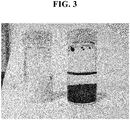
- Fig. 3 is photographs showing difference in color between the chelate compound (hydrochloride) obtained in Example 4 (left) and one converted to an iron chelate (right). In the iron chelate, the compound changed to dark black due to incorporation of iron ions.
- the color of an iron chelate will differ depending on the chelate used.
- the iron chelate obtained had a very high ability to bind strongly with phosphate ions, diphosphate ions, polyphosphate ions, and thus it is apparent that these iron chelates show high ability to eliminate these ions from an aqueous
- a chelate compound was carried out using glucosamine as the base compound.
- Glucosamine hydrochloride (Wako Pure Chemical Industries, 2.15 g, 0.01 mol) was dissolved in an aqueous solution (10 mL) containing an equal amount of NaOH.
- 40 mL of a methanol solution containing 1.68 g (0.01 mol) of 3,4-dihydroxybenzaldehyde was added, a small amount of NaBH4 (-300 mg) was added thereto, and the solution was reduced to small volume.
- the solution was once filtered, and was adjusted to below pH 7 with dilute hydrochloric acid, and the target compound was obtained in the form of white precipitate by adding ethanol.
Landscapes
- Health & Medical Sciences (AREA)
- Chemical & Material Sciences (AREA)
- Life Sciences & Earth Sciences (AREA)
- General Health & Medical Sciences (AREA)
- Medicinal Chemistry (AREA)
- Molecular Biology (AREA)
- Organic Chemistry (AREA)
- Public Health (AREA)
- Pharmacology & Pharmacy (AREA)
- Animal Behavior & Ethology (AREA)
- Veterinary Medicine (AREA)
- Epidemiology (AREA)
- Engineering & Computer Science (AREA)
- Biochemistry (AREA)
- Chemical Kinetics & Catalysis (AREA)
- Dermatology (AREA)
- Materials Engineering (AREA)
- Polymers & Plastics (AREA)
- Genetics & Genomics (AREA)
- Biotechnology (AREA)
- Bioinformatics & Cheminformatics (AREA)
- General Chemical & Material Sciences (AREA)
- Nuclear Medicine, Radiotherapy & Molecular Imaging (AREA)
- Polysaccharides And Polysaccharide Derivatives (AREA)
- Pharmaceuticals Containing Other Organic And Inorganic Compounds (AREA)
- Food Science & Technology (AREA)
- Physics & Mathematics (AREA)
- Analytical Chemistry (AREA)
- General Physics & Mathematics (AREA)
- Immunology (AREA)
- Pathology (AREA)
- Removal Of Specific Substances (AREA)
Applications Claiming Priority (2)
| Application Number | Priority Date | Filing Date | Title |
|---|---|---|---|
| JP2014198609A JP6188660B2 (ja) | 2014-09-29 | 2014-09-29 | キレート化合物及びその製造方法 |
| PCT/JP2015/077468 WO2016052488A1 (ja) | 2014-09-29 | 2015-09-29 | キレート化合物及びその製造方法 |
Publications (2)
| Publication Number | Publication Date |
|---|---|
| EP3202773A1 true EP3202773A1 (de) | 2017-08-09 |
| EP3202773A4 EP3202773A4 (de) | 2018-04-25 |
Family
ID=55630515
Family Applications (1)
| Application Number | Title | Priority Date | Filing Date |
|---|---|---|---|
| EP15846030.3A Withdrawn EP3202773A4 (de) | 2014-09-29 | 2015-09-29 | Chelatverbindung und verfahren zur herstellung davon |
Country Status (4)
| Country | Link |
|---|---|
| US (1) | US10308725B2 (de) |
| EP (1) | EP3202773A4 (de) |
| JP (1) | JP6188660B2 (de) |
| WO (1) | WO2016052488A1 (de) |
Families Citing this family (6)
| Publication number | Priority date | Publication date | Assignee | Title |
|---|---|---|---|---|
| JP2017176946A (ja) * | 2016-03-28 | 2017-10-05 | 株式会社ダステック | キレート化担体及びその製造方法 |
| WO2018207852A1 (ja) * | 2017-05-11 | 2018-11-15 | 株式会社ダステック | 抗腫瘍活性、抗菌活性、および/または抗ウイルス活性を有し、副作用が低減された鉄キレート剤を含む医薬組成物 |
| JP2018188419A (ja) * | 2017-05-11 | 2018-11-29 | 株式会社ダステック | 抗腫瘍活性、抗菌活性、および/または抗ウイルス活性を有し、副作用が低減された鉄キレート剤を含む医薬組成物 |
| CN110256605B (zh) * | 2019-08-13 | 2019-12-06 | 中国科学院烟台海岸带研究所 | 一种高抗氧化的酚基壳聚糖希夫碱及其制备方法和应用 |
| CN113262198A (zh) * | 2021-05-27 | 2021-08-17 | 江南大学 | 一种微凝胶及其制备方法与应用 |
| KR20240147993A (ko) * | 2022-02-03 | 2024-10-10 | 도소 가부시키가이샤 | 수용성 킬레이트 폴리머 및 그 제조 방법 |
Family Cites Families (7)
| Publication number | Priority date | Publication date | Assignee | Title |
|---|---|---|---|---|
| US4424346A (en) * | 1981-06-04 | 1984-01-03 | Canadian Patents And Development Ltd. | Derivatives of chitins, chitosans and other polysaccharides |
| US5300628A (en) * | 1992-06-29 | 1994-04-05 | Ocg Microelectronic Materials, Inc. | Selected chelate resins and their use to remove multivalent metal impurities from resist components |
| WO1999020316A1 (en) * | 1997-10-20 | 1999-04-29 | Board Of Regents, The University Of Texas System | Single photon-emitting radiotraces and methods for their use |
| JP4222760B2 (ja) * | 2002-01-28 | 2009-02-12 | 大阪有機化学工業株式会社 | 2−メトキシ−4−グルコサミノメチルフェノール |
| CA2579355A1 (en) * | 2004-09-07 | 2006-03-16 | Michael J. Adam | Synthesis of radiolabeled sugar metal complexes |
| CN100535183C (zh) * | 2007-06-06 | 2009-09-02 | 南开大学 | 一种用于abs塑料基体化学镀前处理的工艺 |
| EP2664333B1 (de) | 2011-01-14 | 2016-10-12 | Disease Adsorption System Technologies Co., Ltd. | Polymere eisenchelatbildner |
-
2014
- 2014-09-29 JP JP2014198609A patent/JP6188660B2/ja active Active
-
2015
- 2015-09-29 WO PCT/JP2015/077468 patent/WO2016052488A1/ja not_active Ceased
- 2015-09-29 EP EP15846030.3A patent/EP3202773A4/de not_active Withdrawn
- 2015-09-29 US US15/324,904 patent/US10308725B2/en active Active
Also Published As
| Publication number | Publication date |
|---|---|
| WO2016052488A1 (ja) | 2016-04-07 |
| EP3202773A4 (de) | 2018-04-25 |
| JP6188660B2 (ja) | 2017-08-30 |
| JP2016069467A (ja) | 2016-05-09 |
| US20170210828A1 (en) | 2017-07-27 |
| US10308725B2 (en) | 2019-06-04 |
Similar Documents
| Publication | Publication Date | Title |
|---|---|---|
| US10308725B2 (en) | Chelate compounds and their synthetic methods | |
| Kołodyńska | Adsorption characteristics of chitosan modified by chelating agents of a new generation | |
| Domard | pH and cd measurements on a fully deacetylated chitosan: application to CuII—polymer interactions | |
| Guibal et al. | Study of molybdate ion sorption on chitosan gel beads by different spectrometric analyses | |
| Heras et al. | N-methylene phosphonic chitosan: a novel soluble derivative | |
| CN107163160B (zh) | 一种抗坏血酸化壳聚糖季铵盐及其制备方法 | |
| Mackay et al. | Quaternary amine functionalized chitosan for enhanced adsorption of low concentration phosphate to remediate environmental eutrophication | |
| CN105195111A (zh) | 聚乙烯亚胺改性壳聚糖包裹磁性纳米纤维素吸附剂的制备方法及其产品 | |
| CN108752501B (zh) | 一种含有机酸盐的壳聚糖季铵盐及其制备方法和应用 | |
| Skorik et al. | Evaluation of various chitin-glucan derivatives from Aspergillus niger as transition metal adsorbents | |
| EP2664333B1 (de) | Polymere eisenchelatbildner | |
| Cai et al. | Study on the flocculating properties of quaternized carboxymethyl chitosan | |
| CN105713244A (zh) | 去除水中金属离子的聚谷氨酸-壳聚糖凝胶的制备方法 | |
| Aden et al. | Efficent removal of nickel (II) salts from aqueous solution using carboxymethylchitosan-coated silica particles as adsorbent | |
| CN108623708A (zh) | 一种含卤代乙酸的壳聚糖季铵盐及其制备方法和应用 | |
| JPH08506184A (ja) | 血液凝固阻止組成物 | |
| Meng et al. | An efficient chitosan-naphthalimide fluorescent probe for simultaneous detection and adsorption of Hg2+ and its application in seafood, water and soil environments | |
| CN104056604A (zh) | 一种水体正三价砷的净化材料的制备方法 | |
| Nishad et al. | Enhancing the metal ion binding characteristics and reversal of selectivity of crosslinked chitosan sorbents through functionalisation for targeted applications | |
| Tal et al. | Preparation and characterization of Melamine-Formaldehyde (MF)-bound cyclen derivatives for efficient removal of uranium [U (VI)] ions from wastewater | |
| Quyen et al. | Hydroxyl-modified chitosan nanofiber beads for sustainable boron removal and environmental applications | |
| Cui et al. | Enhanced fluorescence of chitosan by grafting pyridine groups and its responsive pH properties | |
| Pant et al. | Radiation cross-linked carboxymethylated starch and iron removal capacity in aqueous solution | |
| Suh et al. | Fe (III) sequestering agents built on poly (ethylenimine) through crosslinkage of three molecules of a salicylate derivative preassembled by Fe (III) ion | |
| Privar et al. | Effect of regioselectivity of chitosan carboxyalkylation and type of cross-linking on the metal-chelate sorption properties toward ciprofloxacin |
Legal Events
| Date | Code | Title | Description |
|---|---|---|---|
| STAA | Information on the status of an ep patent application or granted ep patent |
Free format text: STATUS: THE INTERNATIONAL PUBLICATION HAS BEEN MADE |
|
| PUAI | Public reference made under article 153(3) epc to a published international application that has entered the european phase |
Free format text: ORIGINAL CODE: 0009012 |
|
| STAA | Information on the status of an ep patent application or granted ep patent |
Free format text: STATUS: REQUEST FOR EXAMINATION WAS MADE |
|
| 17P | Request for examination filed |
Effective date: 20170106 |
|
| AK | Designated contracting states |
Kind code of ref document: A1 Designated state(s): AL AT BE BG CH CY CZ DE DK EE ES FI FR GB GR HR HU IE IS IT LI LT LU LV MC MK MT NL NO PL PT RO RS SE SI SK SM TR |
|
| AX | Request for extension of the european patent |
Extension state: BA ME |
|
| DAV | Request for validation of the european patent (deleted) | ||
| DAX | Request for extension of the european patent (deleted) | ||
| A4 | Supplementary search report drawn up and despatched |
Effective date: 20180327 |
|
| RIC1 | Information provided on ipc code assigned before grant |
Ipc: C07H 15/18 20060101AFI20180321BHEP Ipc: C08B 37/08 20060101ALI20180321BHEP |
|
| STAA | Information on the status of an ep patent application or granted ep patent |
Free format text: STATUS: EXAMINATION IS IN PROGRESS |
|
| 17Q | First examination report despatched |
Effective date: 20200821 |
|
| STAA | Information on the status of an ep patent application or granted ep patent |
Free format text: STATUS: THE APPLICATION IS DEEMED TO BE WITHDRAWN |
|
| 18D | Application deemed to be withdrawn |
Effective date: 20210112 |