EP3202819B1 - Reifen - Google Patents
Reifen Download PDFInfo
- Publication number
- EP3202819B1 EP3202819B1 EP15847908.9A EP15847908A EP3202819B1 EP 3202819 B1 EP3202819 B1 EP 3202819B1 EP 15847908 A EP15847908 A EP 15847908A EP 3202819 B1 EP3202819 B1 EP 3202819B1
- Authority
- EP
- European Patent Office
- Prior art keywords
- thermoplastic elastomer
- molecular weight
- tire
- acid
- polyamide
- Prior art date
- Legal status (The legal status is an assumption and is not a legal conclusion. Google has not performed a legal analysis and makes no representation as to the accuracy of the status listed.)
- Not-in-force
Links
Images


Classifications
-
- B—PERFORMING OPERATIONS; TRANSPORTING
- B60—VEHICLES IN GENERAL
- B60C—VEHICLE TYRES; TYRE INFLATION; TYRE CHANGING; CONNECTING VALVES TO INFLATABLE ELASTIC BODIES IN GENERAL; DEVICES OR ARRANGEMENTS RELATED TO TYRES
- B60C5/00—Inflatable pneumatic tyres or inner tubes
- B60C5/007—Inflatable pneumatic tyres or inner tubes made from other material than rubber
-
- B—PERFORMING OPERATIONS; TRANSPORTING
- B60—VEHICLES IN GENERAL
- B60C—VEHICLE TYRES; TYRE INFLATION; TYRE CHANGING; CONNECTING VALVES TO INFLATABLE ELASTIC BODIES IN GENERAL; DEVICES OR ARRANGEMENTS RELATED TO TYRES
- B60C1/00—Tyres characterised by the chemical composition or the physical arrangement or mixture of the composition
-
- B—PERFORMING OPERATIONS; TRANSPORTING
- B60—VEHICLES IN GENERAL
- B60C—VEHICLE TYRES; TYRE INFLATION; TYRE CHANGING; CONNECTING VALVES TO INFLATABLE ELASTIC BODIES IN GENERAL; DEVICES OR ARRANGEMENTS RELATED TO TYRES
- B60C5/00—Inflatable pneumatic tyres or inner tubes
- B60C5/01—Inflatable pneumatic tyres or inner tubes without substantial cord reinforcement, e.g. cordless tyres, cast tyres
-
- C—CHEMISTRY; METALLURGY
- C08—ORGANIC MACROMOLECULAR COMPOUNDS; THEIR PREPARATION OR CHEMICAL WORKING-UP; COMPOSITIONS BASED THEREON
- C08G—MACROMOLECULAR COMPOUNDS OBTAINED OTHERWISE THAN BY REACTIONS ONLY INVOLVING UNSATURATED CARBON-TO-CARBON BONDS
- C08G69/00—Macromolecular compounds obtained by reactions forming a carboxylic amide link in the main chain of the macromolecule
- C08G69/02—Polyamides derived from amino-carboxylic acids or from polyamines and polycarboxylic acids
- C08G69/08—Polyamides derived from amino-carboxylic acids or from polyamines and polycarboxylic acids derived from amino-carboxylic acids
- C08G69/14—Lactams
-
- C—CHEMISTRY; METALLURGY
- C08—ORGANIC MACROMOLECULAR COMPOUNDS; THEIR PREPARATION OR CHEMICAL WORKING-UP; COMPOSITIONS BASED THEREON
- C08G—MACROMOLECULAR COMPOUNDS OBTAINED OTHERWISE THAN BY REACTIONS ONLY INVOLVING UNSATURATED CARBON-TO-CARBON BONDS
- C08G69/00—Macromolecular compounds obtained by reactions forming a carboxylic amide link in the main chain of the macromolecule
- C08G69/02—Polyamides derived from amino-carboxylic acids or from polyamines and polycarboxylic acids
- C08G69/36—Polyamides derived from amino-carboxylic acids or from polyamines and polycarboxylic acids derived from amino acids, polyamines and polycarboxylic acids
-
- C—CHEMISTRY; METALLURGY
- C08—ORGANIC MACROMOLECULAR COMPOUNDS; THEIR PREPARATION OR CHEMICAL WORKING-UP; COMPOSITIONS BASED THEREON
- C08G—MACROMOLECULAR COMPOUNDS OBTAINED OTHERWISE THAN BY REACTIONS ONLY INVOLVING UNSATURATED CARBON-TO-CARBON BONDS
- C08G69/00—Macromolecular compounds obtained by reactions forming a carboxylic amide link in the main chain of the macromolecule
- C08G69/40—Polyamides containing oxygen in the form of ether groups
-
- C—CHEMISTRY; METALLURGY
- C08—ORGANIC MACROMOLECULAR COMPOUNDS; THEIR PREPARATION OR CHEMICAL WORKING-UP; COMPOSITIONS BASED THEREON
- C08L—COMPOSITIONS OF MACROMOLECULAR COMPOUNDS
- C08L21/00—Compositions of unspecified rubbers
-
- B—PERFORMING OPERATIONS; TRANSPORTING
- B29—WORKING OF PLASTICS; WORKING OF SUBSTANCES IN A PLASTIC STATE IN GENERAL
- B29D—PRODUCING PARTICULAR ARTICLES FROM PLASTICS OR FROM SUBSTANCES IN A PLASTIC STATE
- B29D30/00—Producing pneumatic or solid tyres or parts thereof
- B29D30/06—Pneumatic tyres or parts thereof (e.g. produced by casting, moulding, compression moulding, injection moulding, centrifugal casting)
- B29D30/08—Building tyres
-
- C—CHEMISTRY; METALLURGY
- C08—ORGANIC MACROMOLECULAR COMPOUNDS; THEIR PREPARATION OR CHEMICAL WORKING-UP; COMPOSITIONS BASED THEREON
- C08G—MACROMOLECULAR COMPOUNDS OBTAINED OTHERWISE THAN BY REACTIONS ONLY INVOLVING UNSATURATED CARBON-TO-CARBON BONDS
- C08G2380/00—Tyres
Definitions
- the present invention relates to a tire that is mounted on a rim, in particular, a tire in which at least a portion of a tire case is formed of a resin material.
- Pneumatic tires composed of, for example, rubber, an organic fiber material and a steel member have been used for vehicles such as passenger cars.
- thermoplastic polymer materials thermoplastic elastomer, thermoplastic resin materials and the like
- JP-A Japanese Patent Application Laid-Open
- JP-A No. 2012-46030 proposes a tire produced using a polyamide-based thermoplastic elastomer as a thermoplastic polymer material.
- JP 2014-037551 discloses a rubber composition for a side wall
- US 2014/124114 discloses an inner liner for a pneumatic tire
- EP 3199567 discloses a tire comprising a tire skeleton body that is made of a resin material containing a polyamide-based thermoplastic elastomer.
- a tire produced using a thermoplastic polymer material can be easily produced and less expensive, compared to conventional rubber tires. However, there is room for improvement from the viewpoint of low rolling resistance (low loss property), compared to conventional rubber tires. Furthermore, in a case in which a tire is produced using a thermoplastic elastomer, realizing performance that is comparable to that of conventional rubber tires is requested, while production efficiency is increased and a lowering the cost is realized.
- an object of the invention is to provide a tire which is formed using a resin material and achieves both a desirable elastic modulus and an excellent low loss property while having durability.
- a tire which is formed using a resin material and achieves both a desirable elastic modulus and an excellent low loss property while having durability can be provided.
- the tire according to the invention has an a tire frame formed of a resin material (that is, formed using at least a resin material) and has a circular form.
- the resin material includes a thermoplastic elastomer having a structure including a hard segment (HS) and a soft segment (SS), which repeat alternately, in which a number of repeating units in one molecular chain is from 2 to 10, each of the repeating units being a pair of the hard segment (HS) and the soft segment (SS), the thermoplastic elastomer having a number average molecular weight of from 100,000 to 160,000.
- the number of repeating units in one molecule, each of the repeating units being a pair of the hard segment (HS) and the soft segment (SS) refers to the number of pairs repeating in one molecular chain of a thermoplastic elastomer having a structure including a hard segment (HS) and a soft segment (SS), which repeat alternately, "one unit” of the pairs being a pair of one hard segment (HS) and one soft segment (SS).
- the number of repeating units refers to an average value of the repeating units in the thermoplastic elastomer included in the resin material.
- thermoplastic elastomer included in the resin material has a hard segment and a soft segment, properties exhibited by these segments can be obtained. Furthermore, since the number average molecular weight of the thermoplastic elastomer is in the range of from 100,000 to 160,000, excellent rim fittability and productivity can be obtained, and durability can also be obtained.
- intermediate phase regions in which hard segments and soft segments are mixed
- the tire according to the invention includes a thermoplastic elastomer having a number average molecular weight in the range described above, the thermoplastic elastomer having a structure including a hard segment (HS) and a soft segment (SS), which repeat alternately, in which the number of repeating units in one molecular chain is from 2 to 10, each of the repeating units being a pair of the hard segment (HS) and the soft segment (SS).
- the length of one hard segment (HS) becomes longer compared to the case in which only a thermoplastic elastomer having the same overall molecular weight and having a number of the aforementioned repeating units of more than 10 is included.
- thermoplastic elastomer that is used as the resin material has a structure including a hard segment (HS) and a soft segment (SS), which repeat alternately. Furthermore, the number of repeating units in one molecular chain is from 2 to 10, each of the repeating units being a pair of the hard segment (HS) and the soft segment (SS), and the number average molecular weight is from 100,000 to 160,000.
- the resin material may also include a thermoplastic elastomer other than the thermoplastic elastomer described above, or optional components.
- the term "resin” according to the present specification is a concept including a thermoplastic resin and a thermosetting resin; however, the resin does not include natural rubber.
- the thermoplastic elastomer may have a linking section between a hard segment (HS) and a soft segment (SS).
- the "linking section” is a linking section that links two or more segments, namely, a linking section between a hard segment and a soft segment.
- the linking section may be, for example, a portion linked using a chain extending agent that will be described later.
- the number of the repeating units described above in the thermoplastic elastomer is adjusted to be from 2 to 10. If the number of repeating units is more than 10, the length of one hard segment (HS) becomes relatively shorter in a case in which the overall molecular weight is the same, in which case it is difficult to control the elastic modulus to a desirable range, and the loss is also increased. On the other hand, if the number of repeating units is less than 2, elastomeric properties are deteriorated, the required rubber elasticity may not be obtained, and the elasticity or elongation property required for a tire may not be obtained.
- the number of the repeating units in the thermoplastic elastomer is preferably 2 or more, and more preferably 3 or more, as the lower limit.
- the upper limit is preferably 8 or less, and more preferably 6 or less.
- the number of repeating units (average value) each composed of a pair of a hard segment (HS) and a soft segment (SS) can be calculated by measuring the average molecular weight of the thermoplastic elastomer, the respective average molecular weights of the hard segment (HS) and the soft segment (SS) by NMR.
- thermoplastic elastomer Average molecular weight of HS ⁇ X + average molecular weight of SS ⁇ X
- Average molecular weight of thermoplastic elastomer Average molecular weight of HS ⁇ X + average molecular weight of SS ⁇ X ⁇ 1
- Average molecular weight of thermoplastic elastomer Average molecular weight of HS ⁇ X + average molecular weight of SS ⁇ X + 1 wherein X in Formulae (1) to (3) represents an integer of 1 or more.
- the thermoplastic elastomer may contain a linking section.
- the "repeating unit" one unit of which refers to a pair of one hard segment (HS) and one soft segment (SS), may be in a form in which a HS is linked to an SS via a linking section,
- the numbers (average values) of repeating units of HS and SS can be calculated by measuring the average molecular weight of the thermoplastic elastomer or the respective average molecular weights of the hard segment (HS), the soft segment (SS) and the linking section, by NMR as described above.
- thermoplastic elastomer a hard segment (HS), a soft segment (SS), a linking section by NMR.
- thermoplastic elastomer to be measured is dissolved in deuterated trifluoroacetic acid, and measurement by 1 H-NMR and 13 C-NMR is performed according usual methods. Next, assignment of the respective functional groups is implemented, the structures of HS, SS and the linking section are identified, and the molecular weights are determined. A value obtained by adding up the molecular weights of the respective sites corresponds to the average molecular weight per repeating unit.
- Control of the number of repeating units of HS and SS may be carried out by adjusting the molecular weight of a hard segment (HS) and a molecular weight of the soft segment (SS) in one unit such that the number average molecular weight and the number of repeating units in one molecule in the thermoplastic elastomer will have intended values. Adjustment of the degree of polymerization of these HS and SS (that is, the number of polymerization sites) may also be adopted.
- the number average molecular weight of the thermoplastic elastomer is in the range of from 100,000 to 160,000. If the number average molecular weight is less than 45,000, rim fittability is deteriorated. On the other hand, if the number average molecular weight is more than 160,000, melt viscosity becomes high, and there is a possibility that insufficient filling may occur at the time of filling the tire frame. Therefore, increase in the molding temperature and the mold temperature is required. For this reason, the cycling time is prolonged, and therefore, productivity is lowered.
- a method of respectively adjusting the molecular weights of the hard segment (HS) and the soft segment (SS) in a case in which the thermoplastic elastomer has a linking section, a method of adjusting the molecular weight of the linking section as well), a method of adjusting the degree of polymerization may be adopted.
- the number average molecular weight of the thermoplastic elastomer may be measured by gel permeation chromatography (GPC), and for example, GPC (gel permeation chromatography) such as "HLC-8320GPC EcoSEC” manufactured by Tosoh Corp. or the like may be used.
- GPC gel permeation chromatography
- the average value of the mass ratio (HS/SS) of the hard segment (HS) to the soft segment (SS) in a repeating unit is preferably from 20/80 to 90/10.
- the mass ratio is more preferably from 20/80 to 80/20, still more preferably from 30/70 to 80/20, and still more preferably from 40/60 to 75/25.
- the average mass ratio of HS in the repeating unit is 20 or more (in other word, when the average mass ratio of SS is 80 or less), rigidity required for a tire can be imparted.
- the average mass ratio of HS in the repeating unit is 90 or less (that is, the average mass ratio of SS is 10 or more), rim fittability can be secured by including a certain amount of SS.
- thermoplastic elastomer has a linking section
- a chain extending agent it is preferable that the content of the chain extending agent is adjusted such that the hydroxyl group or amino group of the monomer that serves as a raw material of the soft segment and the carboxyl group of the chain extending agent are in almost equimolar amounts.
- thermoplastic elastomer examples include a polyamide-based thermoplastic elastomer (Thermoplastic Amid Elastomer, TPA), a polyester-based thermoplastic elastomer (Thermoplastic Polyester Elastomer, TPC), a polyolefin-based thermoplastic elastomer (Thermoplastic PolyOlefin, TPO), a polystyrene-based thermoplastic elastomer (Styrenic Thermoplastic Elastomer, TPS), a polyurethane-based thermoplastic elastomer (Thermoplastic Polyurethane, TPU), a thermoplastic rubber crosslinked product (ThermoPlastic Vulcanizates, TPV), and other thermoplastic elastomers (Thermoplastic elastomers other, TPZ), as defined by JIS K6418:2007.
- TPA polyamide-based thermoplastic elastomer
- TPC polyester-based thermoplastic elastomer
- thermoplastic elastomer comprises at least one selected from the group consisting of a polyamide-based thermoplastic elastomer, a polyurethane-based thermoplastic elastomer, and a polyester-based thermoplastic elastomer.
- TPU Polyurethane-based thermoplastic elastomer
- TPA polyamide-based thermoplastic elastomer
- TPC polyester-based thermoplastic elastomer
- thermoplastic elastomer TPU
- polyamide-based thermoplastic elastomer TPA
- polyester-based thermoplastic elastomer TPC
- a polyamide-based thermoplastic elastomer (TPA) is more preferable from the viewpoint of hydrolyzability.
- thermoplastic elastomer TPA
- TPU polyurethane-based thermoplastic elastomer
- TPC polyester-based thermoplastic elastomer
- polyamide-based thermoplastic elastomer means a thermoplastic elastomer of a copolymer having a polymer that constitutes a portion or the entirety of a hard segment, the hard segment being crystalline and having a high melting point, and a polymer that constitutes a portion or the entirety of a soft segment, the soft segment being amorphous and having a low glass transition temperature, in which the polymer that constitutes a portion or the entirety of the hard segment has amide bonds (-CONH-) in the main chain.
- the polyamide-based thermoplastic elastomer is a material in which at least a polyamide constitutes a portion or the entirety (preferably, the entirety) of a hard segment that is crystalline and has a high melting point, and another polymer (either a polyester or a polyether) constitutes a portion or the entirety (preferably, the entirety) of a soft segment that is amorphous and has a low glass transition temperature.
- R 1 represents a molecular chain of a hydrocarbon having from 2 to 20 carbon atoms (for example, an alkylene group having from 2 to 20 carbon atoms).
- R 2 represents a hydrocarbon molecular chain having from 3 to 20 carbon atoms (for example, an alkylene group having from 3 to 20 carbon atoms).
- R 1 is preferably a hydrocarbon molecular chain having from 3 to 18 carbon atoms (for example, an alkylene group having from 3 to 18 carbon atoms), more preferably a hydrocarbon molecular chain having from 4 to 15 carbon atoms (for example, an alkylene group having from 4 to 15 carbon atoms), and particularly preferably a hydrocarbon molecular chain having from 10 to 15 carbon atoms (for example, an alkylene group having from 10 to 15 carbon atoms).
- R 2 is preferably a hydrocarbon molecular chain having from 3 to 18 carbon atoms (for example, an alkylene group having from 3 to 18 carbon atoms), more preferably a hydrocarbon molecular chain having from 4 to 15 carbon atoms (for example, an alkylene group having from 4 to 15 carbon atoms), and particularly preferably a hydrocarbon molecular chain having from 10 to 15 carbon atoms (for example, an alkylene group having from 10 to 15 carbon atoms).
- Examples of monomers represented by the above Formula (1) or Formula (2) include an ⁇ -aminocarboxylic acid, and a lactam.
- Examples of the polyamide that forms a part or the whole of a hard segment include a polycondensate of an ⁇ -aminocarboxylic acid, a polycondensate of a lactam, and a co -polycondensate of a diamine and a dicarboxylic acid.
- Examples of the ⁇ -aminocarboxylic acid include an aliphatic ⁇ -aminocarboxylic acid having from 5 to 20 carbon atoms, such as 6-aminocaproic acid, 7-aminoheptanoic acid, 8-aminooctanoic acid, 10-aminocapric acid, 11-aminoundecanoic acid, or 12-aminododecanoic acid.
- Examples of the lactam include an aliphatic lactam having from 5 to 20 carbon atoms, such as lauryllactam, ⁇ -caprolactam, undecanelactam, ⁇ -enantholactam, or 2-pyrrolidone.
- diamine compounds such as an aliphatic diamine having from 2 to 20 carbon atoms, such as ethylenediamine, trimethylenediamine, tetramethylenediamine, hexamethylenediamine, heptamethylenediamine, octamethylenediamine, nonamethylenediamine, decamethylenediamine, undecamethylenediamine, dodecamethylenediamine, 2,2,4-trimethylhexamethylenediamine, 2,4,4-trimethylhexamethylenediamine, 3-methylpentamethylenediamine or metaxylenediamine.
- diamine compounds such as an aliphatic diamine having from 2 to 20 carbon atoms, such as ethylenediamine, trimethylenediamine, tetramethylenediamine, hexamethylenediamine, heptamethylenediamine, octamethylenediamine, nonamethylenediamine, decamethylenediamine, undecamethylenediamine, dodecamethylenediamine, 2,2,
- the dicarboxylic acid may be represented by HOOC-(R 3 ) m -COOH, wherein R 3 represents a hydrocarbon molecular chain having from 3 to 20 carbon atoms, and m represents 0 or 1.
- R 3 represents a hydrocarbon molecular chain having from 3 to 20 carbon atoms
- m represents 0 or 1.
- the dicarboxylic acid include an aliphatic dicarboxylic acid having from 2 to 22 carbon atoms, such as oxalic acid, succinic acid, glutaric acid, adipic acid, pimelic acid, suberic acid, azelaic acid, sebacic acid, or dodecanedioic acid.
- polyamides that forms a portion or the entirety of the hard segment include a polyamide obtained by ring-opening polycondensation of ⁇ -caprolactam (polyamide 6), a polyamide obtained by ring-opening polycondensation of undecane lactam (polyamide 11), a polyamide obtained by ring-opening polycondensation of lauryl lactam (polyamide 12), a polyamide obtained by polycondensation of 12-aminododecanoic acid (polyamide 12), a polycondensate polyamide of a diamine and a dibasic acid (polyamide 66), and a polyamide having meta-xylenediamine as a constituent unit (amide MX).
- polyamide 6 polyamide obtained by ring-opening polycondensation of ⁇ -caprolactam
- polyamide 11 polyamide obtained by ring-opening polycondensation of undecane lactam
- lauryl lactam polyamide 12
- Polyamide 6 can be expressed by, for example, ⁇ CO-(CH 2 ) 5 -NH ⁇ n , wherein n represents the number of repeating units, which may be freely set.
- n is preferably from 2 to 100, and more preferably from 3 to 50.
- Polyamide 11 can be expressed by, for example, ⁇ CO-(CH 2 ) 10 -NH ⁇ n , wherein n represents the number of repeating units, which may be freely set.
- n is preferably from 2 to 100, and more preferably from 3 to 50.
- Polyamide 12 can be expressed by, for example, ⁇ CO-(CH 2 ) 11 -NH ⁇ n , wherein n represents the number of repeating units, which may be freely set.
- n is preferably from 2 to 100, and more preferably from 3 to 50.
- Polyamide 66 can be expressed by, for example, ⁇ CO(CH 2 ) 4 CONH(CH 2 ) 6 NH ⁇ n , wherein n represents the number of repeating units, which may be freely set.
- n is preferably from 2 to 100, and more preferably from 3 to 50.
- the amide MX having meta-xylenediamine as a constituent unit may be represented by, for example, the following constituent unit (A-1), wherein n represents the number of repeating units, which may be freely set, and for example, n is preferably from 2 to 100, and more preferably from 3 to 50.
- the polyamide-based thermoplastic elastomer has a polyamide having a unit structure represented by -[CO-(CH 2 ) 11 -NH]- as a hard segment (polyamide 12).
- polyamide 12 can be obtained by ring-opening polycondensation of lauryl lactam, or polycondensation of 12-aminododecanoic acid.
- the polymer that forms a portion or the entirety of the soft segment may be, for example, a polyester and a polyether.
- Further examples include a polyethylene glycol, a polypropylene glycol, a polytetramethylene ether glycol (PTMG), and an ABA-type triblock polyether. These can be used singly or in combination of two or more kinds thereof.
- a polyetherdiamine obtained by reacting ammonia with a terminal of a polyether may be used, and for example, an ABA-type triblock polyetherdiamine may be used.
- ABA-type triblock polyether refers to a polyether represented by the following Formula (3).
- each of x and z independently represents an integer from 1 to 20, and y represents an integer from 4 to 50.
- each of x and z is preferably an integer from 1 to 18, more preferably an integer from 1 to 16, particularly preferably an integer from 1 to 14, and most preferably an integer from 1 to 12.
- y is preferably an integer from 5 to 45, more preferably an integer from 6 to 40, particularly preferably an integer from 7 to 35, and most preferably an integer from 8 to 30.
- the "ABA-type triblock polyether diamine” may be a polyether diamine represented by the following Formula (N).
- each of X N and Z N independently represents an integer from 1 to 20, and Y N represents an integer from 4 to 50.
- each of X N and Z N is preferably an integer from 1 to 18, more preferably an integer from 1 to 16, particularly preferably an integer from 1 to 14, and most preferably an integer from 1 to 12.
- Y N is preferably an integer from 5 to 45, more preferably an integer from 6 to 40, particularly preferably an integer from 7 to 35, and most preferably an integer from 8 to 30.
- the combination of the hard segment and the soft segment may be a combination of any of the hard segments and the soft segments mentioned above.
- a combination of a ring-opening polycondensate of lauryl lactam/ABA-type triblock polyether; a combination of a ring-opening polycondensate of lauryl lactam/ABA-type triblock polyetherdiamine; a combination of a polycondensate of aminododecanoic acid/ABA-type triblock polyether; or a combination of a polycondensate of aminododecanoic acid/ABA-type triblock polyetherdiamine is particularly preferred.
- the polymer forming a part or the whole of a soft segment may include a diamine, such as a branched saturated diamine having from 6 to 22 carbon atoms, a branched alicyclic diamine having from 6 to 16 carbon atoms or norbornane diamine, as a monomer unit.
- the branched saturated diamine having from 6 to 22 carbon atoms, the branched alicyclic diamine having from 6 to 16 carbon atoms and norbornane diamine may be used singly, or in combination of two or more thereof.
- These diamines may also be used in combination with the ABA-type triblock polyether or the ABA-type triblock polyetherdiamine described above.
- Examples of the branched saturated diamine having from 6 to 22 carbon atoms include 2,2,4-trimethyl-1,6-hexanediamine, 2,4,4-trimethyl-1,6-hexanediamine, 1,2-diaminopropane, 1,3-diaminopentane, 2-methyl-1,5-diaminopentane and 2-methyl-1,8-diaminooctane.
- Examples of the branched alicyclic diamine having from 6 to 16 carbon atoms include 5-amino-2,2,4-trimethyl-1-cyclopentane methyl amine and 5-amino-1,3,3-trimethylcyclohexane methyl amine. Each of these diamines may be in the cis -form or the trans -form, or a mixture of these isomers.
- norbornane diamine examples include 2,5-norbornane dimethyl amine, 2,6-norbornane dimethyl amine, or a mixture thereof.
- the polymer forming a part or the whole of a soft segment may include other diamine compounds than those described above, as monomer units.
- diamine compounds include an aliphatic diamine such as ethylene diamine, trimethylene diamine, tetramethylene diamine, hexamethylene diamine, heptamethylene diamine, octamethylene diamine, nonamethylene diamine, decamethylene diamine, undecamethylene diamine, dodecamethylene diamine, 2,2,4-trimethylhexamethylene diamine, 2,4,4-trimethylhexamethylene diamine, or 3-methylpentamethylene diamine, an alicyclic diamine such as bis(4-aminocyclohexyl)methane, bis(4-aminocyclohexyl)propane, 1,3-bisaminomethylcyclohexane or 1,4-bisaminomethylcyclohexane, or an aromatic diamine such as metaxylylenediamine or paraxylylenediamine.
- diamines may be used singly, or in combination of two or more thereof, as appropriate.
- the linking section of the polyamide-based thermoplastic elastomer may be, for example, a part linked using a chain extending agent.
- Examples of the chain extending agent include a dicarboxylic acid, a diol, and a diisocyanate.
- the dicarboxylic acid for example, at least one selected from an aliphatic, alicyclic or aromatic dicarboxylic acid, or a derivative thereof may be used.
- the diol for example, an aliphatic diol, an alicyclic diol, or an aromatic diol may be used.
- the diisocyanate for example, an aromatic diisocyanate, an aliphatic diisocyanate, an alicyclic diisocyanate, or a mixture thereof may be used.
- dicarboxylic acid examples include: aliphatic dicarboxylic acids including a linear aliphatic dicarboxylic acid having from 2 to 25 carbon atoms, such as adipic acid, decane dicarboxylic acid, oxalic acid, succinic acid, glutaric acid, pimelic acid, suberic acid, azelaic acid, sebacic acid, or dodecanedioic acid; a dimerized aliphatic dicarboxylic acid having from 14 to 48 carbon atoms that is a dimerized unsaturated fatty acid obtained by fractional distillation of a triglyceride, and hydrogenated products of these dicarboxylic acid; alicyclic dicarboxylic acids such as 1,4-cyclohexane dicarboxylic acid; and aromatic dicarboxylic acids such as terephthalic acid and isophthalic acid.
- dodecanedioic acid, eicosanedioic acid dodecan
- diisocyanate examples include 1,5-naphthalene diisocyanate, 4,4'-diphenylmethane diisocyanate, 4,4'-diphenyldimethylmethane diisocyanate, 1,3-phenylene diisocyanate, 1,4-phenylene diisocyanate, 2,4-tolylene diisocyanate, 2,6-tolylene diisocyanate, a mixture of 2,4-tolylene diisocyanate and 2,6-tolylene diisocyanate, hexamethylene diisocyanate, cyclohexane-1,4-diisocyanate, xylene diisocyanate, isophorone diisocyanate, 4,4'-dicyclohexylmethane diisocyanate, methylcyclohexane diisocyanate, tetramethylxylylene diisocyanate, 2,6-diisopropylphenyl isocyanate, and 1,3,
- diol examples include ethylene glycol, diethylene glycol, triethylene glycol, propylene glycol, butanediol, hexanediol, neopentyl glycol, cyclohexanediol, cyclohexanedimethanol, hydrogenated bisphenol A, an ethylene oxide adduct of bisphenol A, and a propylene oxide adduct of bisphenol A.
- an aliphatic diol is preferable, and butanediol is more preferable.
- the polyamide-based thermoplastic elastomer may be synthesized by copolymerizing a polymer that forms a portion or the entirety of the hard segment and a polymer that forms a portion or the entirety of the soft segment, according to a known method.
- the polyamide-based thermoplastic elastomer may be obtained by polymerizing a monomer that serves as a raw material of a hard segment (for example, a ⁇ -aminocarboxylic acid such as 12-aminododecanoic acid, or a lactam such as lauryl lactam), a monomer that serves as a raw material of a soft segment (for example, the ABA-type triblock polyether or the ABA-type triblock polyetherdiamine as described above), and if necessary, a chain extending agent (for example, adipic acid or decanedicarboxylic acid) in a vessel.
- a monomer that serves as a raw material of a hard segment for example, a ⁇ -aminocarboxylic acid such as 12-aminododecanoic acid, or a lactam such as lauryl lactam
- a monomer that serves as a raw material of a soft segment for example, the ABA-type triblock poly
- the polyamide-based thermoplastic elastomer may be synthesized by performing normal pressure melt polymerization, or by performing normal pressure melt polymerization and further performing melt polymerization under reduced pressure.
- a lactam is used as the monomer that serves as a raw material of the hard segment
- an appropriate amount of water may be present, and the polyamide-based thermoplastic elastomer may be produced by a method including melt polymerization under a pressure of from 0.1 to 5 MPa and subsequent normal pressure melt polymerization and/or melt polymerization under reduced pressure.
- synthesis reactions can be carried out in either in a batch manner or in a continuous manner.
- a batch reaction tank, mono-tank or multi-tank continuous reaction apparatus, a tubular continuous reaction apparatus may be used singly or in appropriate combination.
- the polymerization temperature is preferably from 150 °C to 300 °C, and more preferably from 160 °C to 280 °C.
- the polymerization time may appropriately be set in relation to the number average molecular weight of the polyamide-based thermoplastic elastomer to be synthesized, and the polymerization temperature.
- the polymerization time is preferably from 0.5 to 30 hours, and more preferably from 0.5 to 20 hours.
- additives may be added, as necessary, in order to adjust the molecular weight or stabilize the melt viscosity at the time of shaping, and examples of additives include monoamins or diamines such as laurylamine, stearylamine, hexamethylenediamine, and metaxylylenediamine, and monocarboxylic acids or dicarboxylic acids such as acetic acid, benzoic acid, stearic acid, adipic acid, sebacic acid and dodecanedioic acid. Additives may be selected, as appropriate, in consideration of the molecular weight and viscosity of the polyamide-based thermoplastic elastomer to be obtained, provided that the additives should not adversely affect the effect according to the invention.
- catalysts may be used, as necessary.
- the catalyst may be, for example, a compound containing at least one selected from the group consisting of P, Ti, Ge, Zn, Fe, Sn, Mn, Co, Zr, V, Ir, La, Ce, Li, Ca and Hf.
- examples include inorganic phosphorus compounds, organic titanium compounds, organic zirconium compounds and organic tin compounds.
- examples of inorganic phosphorus compounds include: phosphorus-containing acids such as phosphoric acid, pyrophosphoric acid, polyphosphoric acid, phosphorous acid and hypophosphorous acid; alkali metal salts of phosphorus-containing acids; or alkaline earth metal salts of phosphorus-containing acids.
- Examples or organic titanium compounds include titanium alkoxides (such as titanium tetrabutoxide or titanium tetraisopropoxide).
- organic zirconium compounds include zirconium alkoxides (such as zirconium tetrabutoxide (also indicated as “Zr(OBu) 4 " or “Zr(OC 4 H 8 ) 4 ”)).
- organic tin compounds examples include distannoxane compounds (such as 1-hydroxy-3-isothiocyanate-1,1,3,3-tetrabutyldistannoxane), tin acetate, dibutyltin dilaurate, or butyltin hydroxide oxide hydrate.
- the amount of the catalyst to be added and the timing of addition of the catalyst are not particularly limited as long as the desired product can be obtained quickly.
- polyamide-based thermoplastic elastomer examples include a combination of a ring-opening polycondensate of lauryl lactam/polyethylene glycol/adipic acid, a combination of a ring-opening polycondensate of lauryl lactam/polypropylene glycol/adipic acid, a combination of a ring-opening polycondensate of lauryl lactam/polytetramethylene ether glycol/adipic acid, a combination of a ring-opening polycondensate of lauryl lactam/ABA-type triblock polyether/adipic acid, a combination of a ring-opening polycondensate of lauryl lactam/ABA-type triblock polyetherdiamine/decanedicarboxylic acid, a combination of a ring-opening polycondensate of lauryl lactam/polyethylene glycol/decanedicarboxylic acid, a combination of a
- any combination of the preferred embodiments described above in connection with the combination of constituent units, the composition ratio thereof, the molecular weight may be used.
- the polyester-based thermoplastic elastomer may be a material in which at least a polyester constitutes a portion or the entirety of a crystalline hard segment having a high melting point, and another polymer (for example, polyester or polyether) constitutes a portion or the entirety of an amorphous soft segment having a low glass transition temperature.
- an aromatic polyester is used.
- An aromatic polyester can be formed using, for example, an aromatic dicarboxylic acid or an ester-forming derivative thereof, and an aliphatic diol.
- Examples of the aromatic polyester that forms a portion or the entirety of the hard segment include polyethylene terephthalate, polybutylene terephthalate, polystyrene terephthalate, polyethylene naphthalate, and polybutylene naphthalate. Polybutylene terephthalate is preferable.
- One of suitable aromatic polyesters that form a portion or the entirety of the hard segment may be polybutylene terephthalate derived from terephthalic acid and/or dimethyl terephthalate and 1,4-butanediol.
- Another suitable aromatic polyesters that form a portion or the entirety of the hard segment may be a polyester derived from a dicarboxylic acid component such as isophthalic acid, phthalic acid, naphthalene-2,6-dicarboxylic acid, naphthalene-2,7-dicarboxylic acid, diphenyl-4,4'-dicarboxylic acid, diphenoxyethanedicarboxylic acid, 5-sulfoisophthalic acid, or an ester-forming derivative thereof, and a diol having a molecular weight of 300 or less [for example, an aliphatic diol such as ethylene glycol, trimethylene glycol, pentamethylene glycol, hexamethylene glycol, neopenty
- a polymer selected from an aliphatic polyester or an aliphatic polyether is employed.
- aliphatic polyether examples include poly(ethylene oxide) glycol, poly(propylene oxide) glycol, poly(tetramethylene oxide) glycol, poly(hexamethylene oxide) glycol, a copolymer of an ethylene oxide and propylene oxide, an ethylene oxide addition polymer of poly(propylene oxide) glycol, and a copolymer of ethylene oxide and tetrahydrofuran.
- Examples of the aliphatic polyester include poly( ⁇ -caprolactone), polyenantholactone, polycaprylolactone, polybutylene adipate, and polyethylene adipate.
- poly(tetramethylene oxide) glycol an ethylene oxide adduct of poly(propylene oxide) glycol, poly( ⁇ -caprolactone), polybutylene adipate, polyethylene adipate is preferable.
- the linking section may be, for example, a part linked by a chain extending agent.
- chain extending agent include the chain extending agents described above in connection with the polyamide-based thermoplastic elastomer.
- a polyester-based thermoplastic elastomer may be synthesized by copolymerizing a polymer that forms a portion or the entirety of the hard segment and a polymer that forms a portion or the entirety of the soft segment, according to a known method.
- the polyurethane-based thermoplastic elastomer may be a material in which at least polyurethane constitutes a portion or the entirety of a hard segment having pseudo-crosslinking formed by physical aggregation, and another polymer constitutes a portion or the entirety of a soft segment that is amorphous and has a low glass transition temperature.
- the polyurethane-based thermoplastic elastomer is represented as a copolymer including a soft segment containing a unit structure represented by the following Formula A and a hard segment containing a unit structure represented by the following Formula B.
- P represents a long-chain aliphatic polyether or a long-chain aliphatic polyester.
- R represents an aliphatic hydrocarbon, an alicyclic hydrocarbon, or an aromatic hydrocarbon.
- P' represents a short-chain aliphatic hydrocarbon, an alicyclic hydrocarbon, or an aromatic hydrocarbon.
- P originates from a diol compound containing a long-chain aliphatic polyether or a long-chain aliphatic polyester represented by P.
- Examples of such a diol compound include polyethylene glycol, polypropylene glycol, polytetramethylene ether glycol, poly(butylene adipate) diol, poly- ⁇ -caprolactone diol, poly(hexamethylene carbonate) diol, and the ABA-type triblock polyether, all of which have a molecular weight in the range described above.
- R originates from a diisocyanate compound containing an aliphatic hydrocarbon, an alicyclic hydrocarbon or an aromatic hydrocarbon represented by R.
- Examples of an aliphatic diisocyanate compound containing an aliphatic hydrocarbon represented by R include 1,2-ethylene diisocyanate, 1,3-propylene diisocyanate, 1,4-butane diisocyanate, and 1,6-hexamethylene diisocyanate.
- Examples of a diisocyanate compound containing an alicyclic hydrocarbon represented by R include 1,4-cyclohexane diisocyanate and 4,4-cyclohexane diisocyanate. Furthermore, examples of an aromatic diisocyanate compound containing an aromatic hydrocarbon represented by R include 4,4'-diphenylmethane diisocyanate and tolylene diisocyanate.
- the short-chain aliphatic hydrocarbon for example, a hydrocarbon having a molecular weight of less than 500 may be used.
- P' originates from a diol compound containing a short-chain aliphatic hydrocarbon, an alicyclic hydrocarbon or an aromatic hydrocarbon represented by P'.
- Examples of an aliphatic diol compound containing a short-chain aliphatic hydrocarbon represented by P' include a glycol and a polyalkylene glycol.
- Examples thereof include ethylene glycol, propylene glycol, trimethylene glycol, 1,4-butanediol, 1,3-butanediol, 1,5-pentanediol, 1,6-hexanediol, 1,7-heptanediol, 1,8-octanediol, 1,9-nonanediol, and 1,10-decanediol.
- examples of an alicyclic diol compound containing an alicyclic hydrocarbon represented by P' include cyclopentane-1,2-diol, cyclohexane-1,2-diol, cyclohexane-1,3-diol, cyclohexane-1,4-diol, and cyclohexane-1,4-dimethanol.
- Examples of an aromatic diol compound containing an aromatic hydrocarbon represented by P' include hydroquinone, resorcin, chlorohydroquinone, bromohydroquinone, methylhydroquinone, phenylhydroquinone, methoxyhydroquinone, phenoxyhydroquinone, 4,4'-dihydroxybiphenyl, 4,4'-dihydroxydiphenyl ether, 4,4'-dihydroxydiphenyl sulfide, 4,4'-dihydroxydiphenylsulfone, 4,4'-dihydroxybenzophenone, 4,4'-dihydroxydiphenylmethane, bisphenol A, 1,1-di(4-hydroxyphenyl)cyclohexane, 1,2-bis(4-hydroxyphenoxy)ethane, 1,4-dihydroxynaphthalene, and 2,6-dihydroxynaphthalene.
- R in Formula B is the same as R in Formula A.
- the linking section may be, for example, a part linked by a chain extending agent.
- chain extending agent include the chain extending agents described above in connection with the polyamide-based thermoplastic elastomer.
- the polyurethane-based thermoplastic elastomer may be synthesized by copolymerizing a polymer that forms a portion or the entirety of a hard segment and a polymer that forms a portion or the entirety of a soft segment, according to a known method.
- polyurethane-based thermoplastic elastomer examples include tolylene diisocyanate (TDI)/polyester-based polyol copolymer, TDI/polyether-based polyol copolymer, TDI/caprolactone-based polyol copolymer, TDI/polycarbonate-based polyol copolymer, 4,4'-diphenylmethane diisocyanate (MDI)/polyester-based polyol copolymer, MDI/polyether-based polyol copolymer, MDI/caprolactone-based polyol copolymer, or MDI/polycarbonate-based polyol copolymer is preferred; TDI and a polyester-based polyol, TDI and a polyether-based polyol, MDI and a polyester polyol, or MDI and a polyether-based polyol are more preferred.
- TDI tolylene diisocyanate
- the resin material may include various additives, as desired, such as rubber, various fillers (for example, silica, calcium carbonate, or clay), anti-aging agents, oils, plasticizers, colorants, weather resistance agents and reinforcing agents.
- various additives for example, silica, calcium carbonate, or clay
- anti-aging agents oils, plasticizers, colorants, weather resistance agents and reinforcing agents.
- the contents of the additives in the resin material (tire frame) are not particularly limited, and the additives may be used, as appropriate, in a range in which the effect according to the invention is not impaired.
- the content of resin component in the resin material is preferably 50% by mass or more, and more preferably 90% by mass or more, with respect to the total amount of the resin material.
- the content of resin component in the resin material is the balance remaining after subtracting the total content of the various additives from the total amount of the resin components.
- the tire frame according to the invention is formed using the resin material.
- the melting point (or softening point) of the resin material (tire frame) is ordinarily from 100 °C to 350 °C, and preferably approximately from 100 °C to 250 °C. From the viewpoint of tire productivity, the melting point (softening point) is preferably approximately from 120 °C to 250 °C, and more preferably from 120 °C to 200 °C.
- the tire according to the invention has excellent durability at running, such as puncture resistance or wear resistance.
- the heating temperature described above is preferably a temperature that is 10 °C to 150 °C higher than the melting point (or softening point) of the resin material forming a part or the whole of the tire frame, and more preferably a temperature that is 10 °C to 100 °C higher than the melting point (or softening point) of the resin material forming a part or the whole of the tire frame.
- the resin material can be obtained by adding various additives, if necessary, and appropriately mixing the ingredients using a known method (for example, melt mixing).
- the resin material obtained by melt mixing may be shaped into pellets, if necessary, and used.
- the tensile strength at yield as defined in Japanese Industrial Standards (JIS) K7113:1995 of the resin material (tire frame) itself is preferably 5 MPa or more, more preferably from 5 MPa to 20 MPa, and still more preferably from 5 MPa to 17 MPa.
- JIS Japanese Industrial Standards
- the resin material can endure deformation due to a load applied to the tire at, for example, running.
- the tensile elongation at yield as defined in JIS K7113:1995 of the resin material (tire frame) itself is preferably 10% or more, more preferably from 10% to 70%, and still more preferably from 15% to 60%.
- the tensile elongation at yield of the resin material is 10% or more, the elastic range is large, and air seal property can be improved.
- the tensile elongation at break as defined in JIS K7113:1995 of the resin material (tire frame) itself is preferably 50% or more, preferably 100% or more, still more preferably 150% or more, and particularly preferably 200% or more.
- rim fittability is excellent, and the tire is resistant to breakage upon impact.
- the deflection temperature under load as defined in ISO75-2 or ASTM D648 of the resin material (tire frame) itself (under a load of 0.45 MPa) is preferably 50 °C or higher, preferably from 50 °C to 150 °C, and more preferably from 50 °C to 130 °C.
- the deflection temperature under load of the resin material is 50 °C or higher, deformation of the tire frame can be reduced even when vulcanization is performed in tire production.
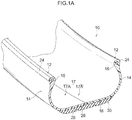
- FIG. 1A is a perspective view illustrating a cross-section of a part of a tire according to one embodiment of the invention.
- Fig. 1B is a cross-sectional view of a bead portion mounted on a rim.
- the tire 10 according to the present embodiment has a cross-sectional shape that is substantially similar to those of conventional ordinary pneumatic rubber tires.
- the tire 10 includes a tire case 17 that includes: a pair of bead portions 12 that contact a bead sheet portion 21 and a rim flange 22 of a rim 20 illustrated in Fig. 1B ; side portions 14 that each outwardly extend from a bead portion 12 in the tire radial direction; and a crown portion 16 (outer circumferential portion) that connects the tire-radial-direction outer end of one side portion 14 and the tire-radial-direction outer end of the other side portion 14.
- HS hard segment
- SS soft segment
- the thermoplastic elastomer having a number average molecular weight of from 100,000 to 160,000 is used as the resin material.
- the tire case 17 is made of a single resin material in the present embodiment, the invention is not limited to this configuration, and thermoplastic resin materials having different properties may be used for the respective parts of the tire case 17 (for example, side portions 14, a crown portion 16 and bead portions 12), similar to conventional ordinary rubber pneumatic tires.
- a reinforcing member for example, a polymer or metal fiber, cord, non-woven fabric, or woven fabric
- the tire case 17 is a member obtained by joining together a pair of tire case half parts (tire frame pieces) 17A formed only of a resin material.
- Each tire case half part 17A is formed by producing an integrated body composed of one bead portion 12, one side portion 14 and a half-width part of the crown portion 16 by molding such as injection molding.
- the tire case 17 is formed by disposing the formed tire case half parts 17A, which have the same annular shape, to face to each other, and joining them together at the tire equatorial plane.
- the tire case 17 is not limited to those obtained by joining together two members, and may be formed by joining together three or more members.
- Each of the tire case half parts 17A formed using at least the above-described resin material may be shaped using, for example, vacuum molding, pressure forming, injection molding or melt casting. Therefore, vulcanization is unnecessary, the production process can greatly be simplified, and the forming time can be saved, as compared to the case of forming a tire case with rubber as in conventional techniques.
- the tire case half parts 17A have a bilaterally symmetric shape, i.e., one of the tire case half parts 17A has the same shape as the other tire case half part 17A. Therefore, there is also an advantage in that only one type of mold is required for forming the tire case half parts 17A.
- annular bead core 18 made only of a steel cord similar to those used in conventional ordinary pneumatic tires is embedded in each of the bead portions 12, as illustrated in Fig. 1B .
- the invention is not limited to this configuration, and the bead core 18 may be omitted as long as it is ensured that the bead portion 12 has rigidity, and mounting on the rim 20 can be performed successfully.
- the bead core 18 may alternatively be formed using, for example, an organic fiber cord, a resin-coated organic fiber cord, or a hard resin, instead of a steel cord.
- annular sealing layer 24 formed of a material (for example, rubber) having a higher sealing property than that of the resin material forming a part or the whole of the tire case 17 is provided on a part of the bead portion 12 that contacts the rim 20 or at least on a part of the bead portion 12 that contacts the rim flange 22 of the rim 20.
- the sealing layer 24 may also be provided in a part in which the tire case 17 (the bead portion 12) and the bead seat 21 contact each other.
- a material softer than the resin material that forms a part or the whole of the tire case 17 may be used as the material having a higher sealing property than that of the resin material that forms a part or the whole of the tire case 17.
- thermoplastic resin thermoplastic elastomer
- a polyurethane-based resin a polyolefin-based resin
- a polystyrene-based thermoplastic resin a polyester resin
- a blend of any of these resins with a rubber or an elastomer a polyurethane-based resin, a polyolefin-based resin, a polystyrene-based thermoplastic resin, or a polyester resin, or a blend of any of these resins with a rubber or an elastomer.
- thermoplastic elastomer such as a polyester-based thermoplastic elastomer, a polyurethane-based thermoplastic elastomer, a polystyrene-based thermoplastic elastomer, a polyolefin-based thermoplastic elastomer, or a combination of two or more of these elastomers or a blend of any of these elastomers with a rubber.
- a reinforcing cord 26 having a higher rigidity than that of the resin material forming a part or the whole of the tire case 17 is wound around the crown portion 16 in the circumferential direction of the tire case 17.
- the reinforcing cord 26 is helically wound to form a reinforcing cord layer 28 in a state in which at least a part of the reinforcing cord 26 is embedded in the crown portion 16 in cross-sectional view taken along the axial direction of tire case 17.
- a tread 30 formed of a material (for example, rubber) having a higher wear resistance than that of the resin material forming a part or the whole of the tire case 17 is disposed at the tire-radial-direction outer circumferential side of the reinforcing cord layer 28.
- Fig. 2 is a cross-sectional view taken along the tire rotation axis, which illustrates a state in which the reinforcing cord is embedded in the crown portion of the tire case of the tire according to the first embodiment.
- the reinforcing cord 26 is helically wound in a state in which at least a part of the reinforcing cord 26 is embedded in the crown portion 16 in a cross-sectional view taken along the axial direction of the tire case 17, and, together with a part of the outer circumferential portion of the tire case 17, forms the reinforcing cord layer 28 indicated by the intermittent lines in Fig. 2 .
- the part of the reinforcing cord 26 that is embedded in the crown portion 16 is in close contact with the resin material forming a part or the whole of the crown portion 16 (the tire case 17).
- a monofilament (single filament) of a metal fiber, an organic fiber, or a multifilament (stranded filament) in which such fibers are stranded, such as a steel cord composed of stranded steel fibers, may be used as the reinforcing cord 26.
- a steel cord is used as the reinforcing cord 26.
- the depth L of embedding in Fig. 2 illustrates the depth of embedding of the reinforcing cord 26 in the tire case 17 (the crown portion 16) along the tire rotation axis direction.
- the depth L of embedding of the reinforcing cord 26 in the crown portion 16 is preferably equal to or greater than 1/5 of the diameter D of the reinforcing cord 26, and more preferably more than 1/2 of the diameter D of the reinforcing cord 26. It is most preferable that the entire reinforcing cord 26 is embedded in the crown portion 16.
- the reinforcing cord 26 When the depth L of embedding of the reinforcing cord 26 is more than 1/2 of the diameter D of the reinforcing cord 26, the reinforcing cord 26 is less likely to drop off from the embedded portion due to the dimensions of the reinforcing cord 26.
- the surface When the entire reinforcing cord 26 is embedded in the crown portion 16, the surface (the outer circumferential surface) becomes flat, whereby entry of air into an area around the reinforcing cord can be reduced even when a member is placed on the crown portion 16 in which the reinforcing cord 26 is embedded.
- the reinforcing cord layer 28 corresponds to a belt disposed on the outer circumferential surface of a carcass of a conventional pneumatic rubber tire.
- the tread 30 is disposed on the tire-radial-direction outer circumferential side of the reinforcing cord layer 28. It is preferable that the same type of rubber as that used for conventional pneumatic rubber tires is used as the rubber used for the tread 30. A crown formed of another type of resin material having higher wear resistance than that of the resin material forming a part or the whole of the tire case 17 may be used, in place of the tread 30. In the tread 30, a tread pattern composed of plural grooves is formed on the contact surface that comes into contact with a road surface, similar to conventional pneumatic rubber tires.
- tire case half parts are formed using a resin including a thermoplastic resin elastomer according to the invention, as described above.
- the forming of these tire cases is preferably performed using injection molding.
- the tire case half parts supported by thin metal support rings are aligned to face each other.
- a jointing mold is placed so as to contact the outer circumferential surface of a butt portion of the tire case half parts.
- the jointing mold is configured to pressurize a region at or around the joint portion (the butt portion) of the tire case half parts 17A with a predetermined pressure.
- the pressure is applied to the region at or around the joint portion of the tire case half parts at a temperature equal to or higher than the melting point (or softening point) of the resin material that forms a part or the whole of the tire case.
- the joint portion of the tire case half parts is heated and pressurized by the jointing mold, the joint portion is melted, and the tire case half parts are fused with each other, as a result of which the members are integrated to form the tire case 17.
- the invention is not limited thereto; heating of the joint portion may be carried out using, for example, a separately provided high frequency heater, or the tire case half parts may be bonded by softening or melting the joint portion, in advance, via application of hot air, irradiation with infrared radiation, and applying a pressure to the joint portion using the jointing mold.
- a reinforcing cord layer 28 may be formed on the outer circumferential side of the crown portion 16 of the tire case 17 by winding a heated reinforcing cord 26 on the outer circumferential surface of the crown portion 16 such that the heated reinforcing cord 26 is embedded in the outer circumferential surface of the crown portion 16, using a cord supplying apparatus equipped with a reel having a reinforcing cord 26 wound thereon, a cord heating apparatus, various rollers.
- a reinforcing cord layer 28 is formed on the outer circumferential side of the crown portion 16 of the tire case 17 by winding the heated reinforcing cord 26 on the outer circumferential surface of the crown portion 16 such that the heated reinforcing cord 26 is embedded in the outer circumferential surface of the crown portion 16.
- a belt-shaped vulcanized tread 30 is wound on the outer circumferential surface of the tire case 17 for one revolution, and the tread 30 is bonded to the outer circumferential surface of the tire case 17 using, for example, an adhesive.
- precured crowns known thus far for use in retreaded tires may be used as the tread 30.
- the present process is a process similar to the process of bonding a precured crown to the outer circumferential surface of a casing of a retreaded tire.
- a tire 10 can be completed by bonding a sealing layer 24 formed only of a vulcanized rubber to the bead portion 12 of the tire case 17 using, for example, an adhesive.
- a portion or the entirety of the tire case 17 is formed of a resin material including a thermoplastic elastomer having a structure including a hard segment (HS) and a soft segment (SS), which repeat alternately, in which a number of repeating units in one molecular chain is from 2 to 10, each of the repeating units being a pair of the hard segment (HS) and the soft segment (SS), the thermoplastic elastomer having a number average molecular weight of from 100,000 to 160,000. Therefore, the tire 10 of the present embodiment has a desirable elastic modulus and excellent low loss property.
- HS hard segment
- SS soft segment
- a reinforcing cord 26 having higher rigidity than that of the resin material is helically wound along the circumferential direction, and therefore, puncture resistance, cutting resistance, and rigidity in the circumferential direction of the tire 10 are enhanced.
- puncture resistance, cutting resistance, and rigidity in the circumferential direction of the tire 10 are enhanced.
- the reinforcing cord 26 is embedded on the outer circumferential surface of a crown portion 16 of a tire case 17 formed using at least a resin material and is in close contact with the resin material, as is seen in a cross-sectional view (cross-section illustrated in Fig. 1 ) along the axial direction of the tire case 17, air inclusion at the time of production is suppressed, and movement of the reinforcing cord 26 caused by force applied during driving is suppressed. Thereby, detachment or the like in the reinforcing cord 26, the tire case 17 and the tread 30 is suppressed, and durability of the tire 10 is improved.
- annular bead core 18 formed of a metal material only is embedded in the bead portion 12, the tire case 17, that is, the tire 10 can be firmly retained on the rim 20, similarly to the case of conventional pneumatic rubber tires.
- a sealing layer 24 formed only of a rubber material having higher sealing property than that of the resin material forming a portion or the entirety of the tire case 17, is provided on a part of the bead portion 12 that contacts with the rim 20, sealing property between the tire 10 and the rim 20 is improved. Therefore, air leakage within the tire is further suppressed, compared to the case in which only the rim 20 and the resin material that forms a portion or the entirety of the tire case 17 are sealed. Rim fittability is also enhanced by providing the sealing layer 24.
- a configuration in which the reinforcing cord 26 is heated is adopted in the first embodiment
- a configuration in which the outer circumference of the reinforcing cord 26 is coated with the same resin material as that of the tire case 17, for example may be adopted.
- incorporation of air during embedding the reinforcing cord in the crown portion 16 can effectively be reduced.
- the tire 10 in the first embodiment is what is referred to as a tubeless tire, in which an air chamber is formed between the tire 10 and the rim 20 by fitting the bead portions 12 to the rim 20.
- the invention is not limited to this configuration, and a complete tube shape may be adopted.
- the polyamide-based thermoplastic elastomer thus obtained was pelletized and injection molded at 220°C, whereby a sample piece was obtained. Each measurement was performed using samples obtained by stamping out specimens from this sample piece.
- the polyamide-based thermoplastic elastomer thus obtained was pelletized, and was subjected to Soxhlet extraction in hot water for 8 hours. Subsequently, the polyamide-based thermoplastic elastomer was injection molded at 220°C, whereby a sample piece was obtained. Each measurement was performed using samples obtained by stamping out specimens from this sample piece.
- thermoplastic elastomers obtained in the Examples, Reference Examples and the Comparative Examples. The results are presented in Table 1 and Table 2.
- the tensile modulus as defined by JIS K7113:1995 (unless particularly stated otherwise, the "elastic modulus” used in the present specification means tensile modulus) was measured.
- the measured values of elastic modulus obtained by the measurement method described above relative values were determined by performing calculation based on the value of Comparative Example 1, the relative value of which is set to be 100. A higher elastic modulus is more preferable.
- the tensile elongation at break Eb as defined by JIS K7113:1995 was measured.
- relative values were determined by performing calculation based on the value of Comparative Example 1, the relative value of which is set to be 100.
- a larger value of Eb indicates superior fracture resistance property (durability), and as a reference, if Eb is lower by 10% or more than that of Comparative Example 1, the fracture resistance property (durability) is regarded as inferior.
- the Examples in which the number of repeating units of the hard segment (HS) and the soft segment (SS) in one molecular chain is from 2 to 10, and the number average molecular weight is from 45,000 to 160,000, can achieve both an excellent elastic modulus and low loss property while having durability, compared to the Comparative Examples in which at least one of these requirements is not satisfied.
Landscapes
- Chemical & Material Sciences (AREA)
- Health & Medical Sciences (AREA)
- Chemical Kinetics & Catalysis (AREA)
- Medicinal Chemistry (AREA)
- Polymers & Plastics (AREA)
- Organic Chemistry (AREA)
- Engineering & Computer Science (AREA)
- Mechanical Engineering (AREA)
- Proteomics, Peptides & Aminoacids (AREA)
- Life Sciences & Earth Sciences (AREA)
- Polyamides (AREA)
- Tires In General (AREA)
- Manufacture Of Macromolecular Shaped Articles (AREA)
- Compositions Of Macromolecular Compounds (AREA)
- Polyesters Or Polycarbonates (AREA)
- Other Resins Obtained By Reactions Not Involving Carbon-To-Carbon Unsaturated Bonds (AREA)
- Polyurethanes Or Polyureas (AREA)
Claims (5)
- Reifen, der einen Reifenrahmen umfasst, der aus einem Harzmaterial geformt ist und eine Kreisform aufweist,
wobei das Harzmaterial ein thermoplastisches Elastomer mit einer Struktur umfasst, die ein hartes Segment (HS) und ein weiches Segment (SS) einschließt, die sich abwechselnd wiederholen, wobei eine durchschnittliche Anzahl von Wiederholungseinheiten in einer Molekülkette 2 bis 10 beträgt, wobei jede der Wiederholungseinheiten ein Paar aus dem harten Segment (HS) und dem weichen Segment (SS) sind, wobei das thermoplastische Elastomer ein zahlengemitteltes Molekulargewicht von 100000 bis 160000 hat, wobei
das thermoplastische Elastomer mindestens eines ist, das ausgewählt ist aus der Gruppe bestehend aus einem thermoplastischen Elastomer auf Polyamidbasis, einem thermoplastischen Elastomer auf Polyurethanbasis und einem thermoplastischen Elastomer auf Polyesterbasis;
das thermoplastische Elastomer auf Polyamidbasis ein Polyamid als hartes Segment (HS) und mindestens einen Polyester oder einen Polyether als weiches Segment (SS) einschließt;
das thermoplastische Elastomer auf Polyurethanbasis ein Copolymer ist, das ein weiches Segment (SS), das eine durch die folgende Formel A dargestellte Einheitsstruktur einschließt, und ein hartes Segment (HS) einschließt, das eine durch die folgende Formel B dargestellte Einheitsstruktur einschließt:
 wobei in Formel A P einen langkettigen aliphatischen Polyether oder einen langkettigen aliphatischen Polyester darstellt und R einen aliphatischen Kohlenwasserstoff, einen alicyclischen Kohlenwasserstoff oder einen aromatischen Kohlenwasserstoff darstellt und in Formel B P' einen kurzkettigen aliphatischen Kohlenwasserstoff, einen alicyclischen Kohlenwasserstoff oder einen aromatischen Kohlenwasserstoff darstellt und R einen aliphatischen Kohlenwasserstoff, einen alicyclischen Kohlenwasserstoff oder einen aromatischen Kohlenwasserstoff darstellt;das thermoplastische Elastomer auf Polyesterbasis ein Copolymer ist, das einen aromatischen Polyester als hartes Segment (HS) und mindestens eines von einem aliphatischen Polyester oder einem aliphatischen Polyether als weiches Segment (SS) einschließt;das zahlengemittelte Molekulargewicht des thermoplastischen Elastomers durch Gelpermeationschromatographie gemessen wird; unddie durchschnittliche Anzahl der Wiederholungseinheiten in einer Molekülkette auf der Grundlage eines durchschnittlichen Molekulargewichts des harten Segments (HS) und eines durchschnittlichen Molekulargewichts des weichen Segments (SS) und wahlweise eines durchschnittlichen Molekulargewichts eines Verbindungsabschnitts, der das harte Segment (HS) und das weiche Segment (SS) verbindet, die durch NMR gemessen werden, und das zahlengemittelte Molekulargewicht des thermoplastischen Elastomers berechnet wird.
 - Reifen nach Anspruch 1, wobei die durchschnittliche Anzahl der Wiederholungseinheiten 2 bis 8 beträgt.
- Reifen nach Anspruch 1, wobei die durchschnittliche Anzahl der Wiederholungseinheiten 2 bis 6 beträgt.
- Reifen nach einem der Ansprüche 1 bis 3, wobei ein Massenverhältnis (HS/SS) des harten Segments (HS) zu dem weichen Segment (SS) in den Wiederholungseinheiten 20/80 bis 80/20 beträgt.
- Reifen nach einem der Ansprüche 1 bis 4, wobei das thermoplastische Elastomer ein thermoplastisches Elastomer auf Polyamidbasis ist.
Applications Claiming Priority (2)
| Application Number | Priority Date | Filing Date | Title |
|---|---|---|---|
| JP2014199160 | 2014-09-29 | ||
| PCT/JP2015/077612 WO2016052564A1 (ja) | 2014-09-29 | 2015-09-29 | タイヤ |
Publications (3)
| Publication Number | Publication Date |
|---|---|
| EP3202819A1 EP3202819A1 (de) | 2017-08-09 |
| EP3202819A4 EP3202819A4 (de) | 2017-08-09 |
| EP3202819B1 true EP3202819B1 (de) | 2019-05-08 |
Family
ID=55630589
Family Applications (1)
| Application Number | Title | Priority Date | Filing Date |
|---|---|---|---|
| EP15847908.9A Not-in-force EP3202819B1 (de) | 2014-09-29 | 2015-09-29 | Reifen |
Country Status (5)
| Country | Link |
|---|---|
| US (1) | US10611190B2 (de) |
| EP (1) | EP3202819B1 (de) |
| JP (1) | JP6001811B2 (de) |
| CN (1) | CN107075113B (de) |
| WO (1) | WO2016052564A1 (de) |
Families Citing this family (10)
| Publication number | Priority date | Publication date | Assignee | Title |
|---|---|---|---|---|
| EP3199593B1 (de) | 2014-09-24 | 2018-11-14 | Bridgestone Corporation | Reifen |
| WO2016047708A1 (ja) | 2014-09-24 | 2016-03-31 | 株式会社ブリヂストン | タイヤ |
| EP3202818B1 (de) | 2014-09-29 | 2018-11-14 | Bridgestone Corporation | Reifen |
| WO2016052563A1 (ja) | 2014-09-29 | 2016-04-07 | 株式会社ブリヂストン | タイヤ |
| JP6517572B2 (ja) * | 2015-04-10 | 2019-05-22 | 株式会社ブリヂストン | ポリアミド系熱可塑性エラストマー及びタイヤ |
| CN108698443B (zh) * | 2016-02-22 | 2020-07-24 | 株式会社普利司通 | 轮胎 |
| WO2018211734A1 (ja) * | 2017-05-18 | 2018-11-22 | 株式会社ブリヂストン | タイヤ |
| CN110655646B (zh) * | 2019-09-16 | 2021-01-19 | 北京化工大学 | 一种长碳链尼龙弹性体的制备方法 |
| JP6969596B2 (ja) * | 2019-10-08 | 2021-11-24 | 住友ゴム工業株式会社 | 空気入りタイヤ |
| CN119931020A (zh) * | 2025-03-13 | 2025-05-06 | 中国科学院长春应用化学研究所 | 一种改性聚醚胺及其制备方法和应用、一种尼龙弹性体 |
Citations (1)
| Publication number | Priority date | Publication date | Assignee | Title |
|---|---|---|---|---|
| EP3199567A1 (de) * | 2014-09-24 | 2017-08-02 | Bridgestone Corporation | Reifen |
Family Cites Families (10)
| Publication number | Priority date | Publication date | Assignee | Title |
|---|---|---|---|---|
| JPS61293223A (ja) * | 1985-06-20 | 1986-12-24 | Tokyo Inst Of Technol | ポリエ−テル−ポリアミド系マルチブロツク共重合体及びその製造方法 |
| JP2949805B2 (ja) * | 1990-08-07 | 1999-09-20 | 三菱化学株式会社 | 末端変性ポリエーテルアミド樹脂 |
| WO2009093695A1 (ja) | 2008-01-23 | 2009-07-30 | Ube Industries, Ltd. | ゴム組成物、ベーストレッド用ゴム組成物、チェーファー用ゴム組成物、及びサイドウォール用ゴム組成物、並びにそれらを用いたタイヤ |
| FR2957082B1 (fr) | 2010-03-05 | 2012-03-02 | Michelin Soc Tech | Pneumatique dont la bande de roulement comporte un elastomere thermoplastique. |
| EP3254867B1 (de) | 2010-08-25 | 2020-06-03 | Bridgestone Corporation | Reifen und reifenherstellungsverfahren |
| CN103189215B (zh) * | 2010-08-25 | 2018-12-18 | 株式会社普利司通 | 轮胎、及轮胎的制造方法 |
| JP5623825B2 (ja) | 2010-08-25 | 2014-11-12 | 株式会社ブリヂストン | タイヤの製造方法 |
| JP5993545B2 (ja) | 2010-08-25 | 2016-09-14 | 株式会社ブリヂストン | タイヤ |
| BR112013030356B1 (pt) * | 2011-05-31 | 2020-06-23 | Kuraray Co., Ltd. | Forro interno para pneu, método para produzir o mesmo, e pneu |
| WO2014157559A1 (ja) | 2013-03-29 | 2014-10-02 | 株式会社ブリヂストン | タイヤ |
-
2015
- 2015-09-29 US US15/515,135 patent/US10611190B2/en active Active
- 2015-09-29 WO PCT/JP2015/077612 patent/WO2016052564A1/ja not_active Ceased
- 2015-09-29 CN CN201580052441.9A patent/CN107075113B/zh not_active Expired - Fee Related
- 2015-09-29 EP EP15847908.9A patent/EP3202819B1/de not_active Not-in-force
- 2015-09-29 JP JP2016514787A patent/JP6001811B2/ja not_active Expired - Fee Related
Patent Citations (1)
| Publication number | Priority date | Publication date | Assignee | Title |
|---|---|---|---|---|
| EP3199567A1 (de) * | 2014-09-24 | 2017-08-02 | Bridgestone Corporation | Reifen |
Also Published As
| Publication number | Publication date |
|---|---|
| CN107075113A (zh) | 2017-08-18 |
| US10611190B2 (en) | 2020-04-07 |
| WO2016052564A1 (ja) | 2016-04-07 |
| JP6001811B2 (ja) | 2016-10-05 |
| JPWO2016052564A1 (ja) | 2017-04-27 |
| CN107075113B (zh) | 2019-11-22 |
| EP3202819A1 (de) | 2017-08-09 |
| EP3202819A4 (de) | 2017-08-09 |
| US20170232796A1 (en) | 2017-08-17 |
Similar Documents
| Publication | Publication Date | Title |
|---|---|---|
| EP3202819B1 (de) | Reifen | |
| EP3199593B1 (de) | Reifen | |
| EP3199571B1 (de) | Reifen | |
| EP3202818B1 (de) | Reifen | |
| EP3202817B1 (de) | Reifen | |
| EP3199568A1 (de) | Reifen | |
| EP3421536B1 (de) | Reifen | |
| EP3202852B1 (de) | Reifengerippe und reifen | |
| EP3640052A1 (de) | Harz-metall-verbundstoffelement für reifen sowie reifen |
Legal Events
| Date | Code | Title | Description |
|---|---|---|---|
| STAA | Information on the status of an ep patent application or granted ep patent |
Free format text: STATUS: THE INTERNATIONAL PUBLICATION HAS BEEN MADE |
|
| PUAI | Public reference made under article 153(3) epc to a published international application that has entered the european phase |
Free format text: ORIGINAL CODE: 0009012 |
|
| STAA | Information on the status of an ep patent application or granted ep patent |
Free format text: STATUS: REQUEST FOR EXAMINATION WAS MADE |
|
| 17P | Request for examination filed |
Effective date: 20170406 |
|
| A4 | Supplementary search report drawn up and despatched |
Effective date: 20170706 |
|
| AK | Designated contracting states |
Kind code of ref document: A1 Designated state(s): AL AT BE BG CH CY CZ DE DK EE ES FI FR GB GR HR HU IE IS IT LI LT LU LV MC MK MT NL NO PL PT RO RS SE SI SK SM TR |
|
| AX | Request for extension of the european patent |
Extension state: BA ME |
|
| DAV | Request for validation of the european patent (deleted) | ||
| DAX | Request for extension of the european patent (deleted) | ||
| STAA | Information on the status of an ep patent application or granted ep patent |
Free format text: STATUS: EXAMINATION IS IN PROGRESS |
|
| 17Q | First examination report despatched |
Effective date: 20180426 |
|
| GRAP | Despatch of communication of intention to grant a patent |
Free format text: ORIGINAL CODE: EPIDOSNIGR1 |
|
| STAA | Information on the status of an ep patent application or granted ep patent |
Free format text: STATUS: GRANT OF PATENT IS INTENDED |
|
| INTG | Intention to grant announced |
Effective date: 20181116 |
|
| GRAS | Grant fee paid |
Free format text: ORIGINAL CODE: EPIDOSNIGR3 |
|
| GRAA | (expected) grant |
Free format text: ORIGINAL CODE: 0009210 |
|
| STAA | Information on the status of an ep patent application or granted ep patent |
Free format text: STATUS: THE PATENT HAS BEEN GRANTED |
|
| AK | Designated contracting states |
Kind code of ref document: B1 Designated state(s): AL AT BE BG CH CY CZ DE DK EE ES FI FR GB GR HR HU IE IS IT LI LT LU LV MC MK MT NL NO PL PT RO RS SE SI SK SM TR |
|
| REG | Reference to a national code |
Ref country code: GB Ref legal event code: FG4D |
|
| REG | Reference to a national code |
Ref country code: CH Ref legal event code: EP Ref country code: AT Ref legal event code: REF Ref document number: 1130042 Country of ref document: AT Kind code of ref document: T Effective date: 20190515 |
|
| REG | Reference to a national code |
Ref country code: DE Ref legal event code: R096 Ref document number: 602015030111 Country of ref document: DE Ref country code: IE Ref legal event code: FG4D |
|
| REG | Reference to a national code |
Ref country code: NL Ref legal event code: MP Effective date: 20190508 |
|
| REG | Reference to a national code |
Ref country code: LT Ref legal event code: MG4D |
|
| PG25 | Lapsed in a contracting state [announced via postgrant information from national office to epo] |
Ref country code: FI Free format text: LAPSE BECAUSE OF FAILURE TO SUBMIT A TRANSLATION OF THE DESCRIPTION OR TO PAY THE FEE WITHIN THE PRESCRIBED TIME-LIMIT Effective date: 20190508 Ref country code: HR Free format text: LAPSE BECAUSE OF FAILURE TO SUBMIT A TRANSLATION OF THE DESCRIPTION OR TO PAY THE FEE WITHIN THE PRESCRIBED TIME-LIMIT Effective date: 20190508 Ref country code: SE Free format text: LAPSE BECAUSE OF FAILURE TO SUBMIT A TRANSLATION OF THE DESCRIPTION OR TO PAY THE FEE WITHIN THE PRESCRIBED TIME-LIMIT Effective date: 20190508 Ref country code: AL Free format text: LAPSE BECAUSE OF FAILURE TO SUBMIT A TRANSLATION OF THE DESCRIPTION OR TO PAY THE FEE WITHIN THE PRESCRIBED TIME-LIMIT Effective date: 20190508 Ref country code: NO Free format text: LAPSE BECAUSE OF FAILURE TO SUBMIT A TRANSLATION OF THE DESCRIPTION OR TO PAY THE FEE WITHIN THE PRESCRIBED TIME-LIMIT Effective date: 20190808 Ref country code: PT Free format text: LAPSE BECAUSE OF FAILURE TO SUBMIT A TRANSLATION OF THE DESCRIPTION OR TO PAY THE FEE WITHIN THE PRESCRIBED TIME-LIMIT Effective date: 20190908 Ref country code: ES Free format text: LAPSE BECAUSE OF FAILURE TO SUBMIT A TRANSLATION OF THE DESCRIPTION OR TO PAY THE FEE WITHIN THE PRESCRIBED TIME-LIMIT Effective date: 20190508 Ref country code: LT Free format text: LAPSE BECAUSE OF FAILURE TO SUBMIT A TRANSLATION OF THE DESCRIPTION OR TO PAY THE FEE WITHIN THE PRESCRIBED TIME-LIMIT Effective date: 20190508 Ref country code: NL Free format text: LAPSE BECAUSE OF FAILURE TO SUBMIT A TRANSLATION OF THE DESCRIPTION OR TO PAY THE FEE WITHIN THE PRESCRIBED TIME-LIMIT Effective date: 20190508 |
|
| PG25 | Lapsed in a contracting state [announced via postgrant information from national office to epo] |
Ref country code: BG Free format text: LAPSE BECAUSE OF FAILURE TO SUBMIT A TRANSLATION OF THE DESCRIPTION OR TO PAY THE FEE WITHIN THE PRESCRIBED TIME-LIMIT Effective date: 20190808 Ref country code: RS Free format text: LAPSE BECAUSE OF FAILURE TO SUBMIT A TRANSLATION OF THE DESCRIPTION OR TO PAY THE FEE WITHIN THE PRESCRIBED TIME-LIMIT Effective date: 20190508 Ref country code: LV Free format text: LAPSE BECAUSE OF FAILURE TO SUBMIT A TRANSLATION OF THE DESCRIPTION OR TO PAY THE FEE WITHIN THE PRESCRIBED TIME-LIMIT Effective date: 20190508 Ref country code: GR Free format text: LAPSE BECAUSE OF FAILURE TO SUBMIT A TRANSLATION OF THE DESCRIPTION OR TO PAY THE FEE WITHIN THE PRESCRIBED TIME-LIMIT Effective date: 20190809 |
|
| REG | Reference to a national code |
Ref country code: AT Ref legal event code: MK05 Ref document number: 1130042 Country of ref document: AT Kind code of ref document: T Effective date: 20190508 |
|
| PG25 | Lapsed in a contracting state [announced via postgrant information from national office to epo] |
Ref country code: SK Free format text: LAPSE BECAUSE OF FAILURE TO SUBMIT A TRANSLATION OF THE DESCRIPTION OR TO PAY THE FEE WITHIN THE PRESCRIBED TIME-LIMIT Effective date: 20190508 Ref country code: RO Free format text: LAPSE BECAUSE OF FAILURE TO SUBMIT A TRANSLATION OF THE DESCRIPTION OR TO PAY THE FEE WITHIN THE PRESCRIBED TIME-LIMIT Effective date: 20190508 Ref country code: EE Free format text: LAPSE BECAUSE OF FAILURE TO SUBMIT A TRANSLATION OF THE DESCRIPTION OR TO PAY THE FEE WITHIN THE PRESCRIBED TIME-LIMIT Effective date: 20190508 Ref country code: DK Free format text: LAPSE BECAUSE OF FAILURE TO SUBMIT A TRANSLATION OF THE DESCRIPTION OR TO PAY THE FEE WITHIN THE PRESCRIBED TIME-LIMIT Effective date: 20190508 Ref country code: AT Free format text: LAPSE BECAUSE OF FAILURE TO SUBMIT A TRANSLATION OF THE DESCRIPTION OR TO PAY THE FEE WITHIN THE PRESCRIBED TIME-LIMIT Effective date: 20190508 Ref country code: CZ Free format text: LAPSE BECAUSE OF FAILURE TO SUBMIT A TRANSLATION OF THE DESCRIPTION OR TO PAY THE FEE WITHIN THE PRESCRIBED TIME-LIMIT Effective date: 20190508 |
|
| REG | Reference to a national code |
Ref country code: DE Ref legal event code: R097 Ref document number: 602015030111 Country of ref document: DE |
|
| PG25 | Lapsed in a contracting state [announced via postgrant information from national office to epo] |
Ref country code: IT Free format text: LAPSE BECAUSE OF FAILURE TO SUBMIT A TRANSLATION OF THE DESCRIPTION OR TO PAY THE FEE WITHIN THE PRESCRIBED TIME-LIMIT Effective date: 20190508 Ref country code: SM Free format text: LAPSE BECAUSE OF FAILURE TO SUBMIT A TRANSLATION OF THE DESCRIPTION OR TO PAY THE FEE WITHIN THE PRESCRIBED TIME-LIMIT Effective date: 20190508 |
|
| PLBE | No opposition filed within time limit |
Free format text: ORIGINAL CODE: 0009261 |
|
| STAA | Information on the status of an ep patent application or granted ep patent |
Free format text: STATUS: NO OPPOSITION FILED WITHIN TIME LIMIT |
|
| PG25 | Lapsed in a contracting state [announced via postgrant information from national office to epo] |
Ref country code: TR Free format text: LAPSE BECAUSE OF FAILURE TO SUBMIT A TRANSLATION OF THE DESCRIPTION OR TO PAY THE FEE WITHIN THE PRESCRIBED TIME-LIMIT Effective date: 20190508 |
|
| 26N | No opposition filed |
Effective date: 20200211 |
|
| PG25 | Lapsed in a contracting state [announced via postgrant information from national office to epo] |
Ref country code: PL Free format text: LAPSE BECAUSE OF FAILURE TO SUBMIT A TRANSLATION OF THE DESCRIPTION OR TO PAY THE FEE WITHIN THE PRESCRIBED TIME-LIMIT Effective date: 20190508 |
|
| PG25 | Lapsed in a contracting state [announced via postgrant information from national office to epo] |
Ref country code: SI Free format text: LAPSE BECAUSE OF FAILURE TO SUBMIT A TRANSLATION OF THE DESCRIPTION OR TO PAY THE FEE WITHIN THE PRESCRIBED TIME-LIMIT Effective date: 20190508 Ref country code: MC Free format text: LAPSE BECAUSE OF FAILURE TO SUBMIT A TRANSLATION OF THE DESCRIPTION OR TO PAY THE FEE WITHIN THE PRESCRIBED TIME-LIMIT Effective date: 20190508 |
|
| REG | Reference to a national code |
Ref country code: CH Ref legal event code: PL |
|
| PG25 | Lapsed in a contracting state [announced via postgrant information from national office to epo] |
Ref country code: LI Free format text: LAPSE BECAUSE OF NON-PAYMENT OF DUE FEES Effective date: 20190930 Ref country code: CH Free format text: LAPSE BECAUSE OF NON-PAYMENT OF DUE FEES Effective date: 20190930 Ref country code: IE Free format text: LAPSE BECAUSE OF NON-PAYMENT OF DUE FEES Effective date: 20190929 Ref country code: LU Free format text: LAPSE BECAUSE OF NON-PAYMENT OF DUE FEES Effective date: 20190929 |
|
| REG | Reference to a national code |
Ref country code: BE Ref legal event code: MM Effective date: 20190930 |
|
| PG25 | Lapsed in a contracting state [announced via postgrant information from national office to epo] |
Ref country code: BE Free format text: LAPSE BECAUSE OF NON-PAYMENT OF DUE FEES Effective date: 20190930 |
|
| GBPC | Gb: european patent ceased through non-payment of renewal fee |
Effective date: 20190929 |
|
| PG25 | Lapsed in a contracting state [announced via postgrant information from national office to epo] |
Ref country code: GB Free format text: LAPSE BECAUSE OF NON-PAYMENT OF DUE FEES Effective date: 20190929 |
|
| PG25 | Lapsed in a contracting state [announced via postgrant information from national office to epo] |
Ref country code: CY Free format text: LAPSE BECAUSE OF FAILURE TO SUBMIT A TRANSLATION OF THE DESCRIPTION OR TO PAY THE FEE WITHIN THE PRESCRIBED TIME-LIMIT Effective date: 20190508 |
|
| PG25 | Lapsed in a contracting state [announced via postgrant information from national office to epo] |
Ref country code: IS Free format text: LAPSE BECAUSE OF FAILURE TO SUBMIT A TRANSLATION OF THE DESCRIPTION OR TO PAY THE FEE WITHIN THE PRESCRIBED TIME-LIMIT Effective date: 20190908 |
|
| PG25 | Lapsed in a contracting state [announced via postgrant information from national office to epo] |
Ref country code: MT Free format text: LAPSE BECAUSE OF FAILURE TO SUBMIT A TRANSLATION OF THE DESCRIPTION OR TO PAY THE FEE WITHIN THE PRESCRIBED TIME-LIMIT Effective date: 20190508 Ref country code: HU Free format text: LAPSE BECAUSE OF FAILURE TO SUBMIT A TRANSLATION OF THE DESCRIPTION OR TO PAY THE FEE WITHIN THE PRESCRIBED TIME-LIMIT; INVALID AB INITIO Effective date: 20150929 |
|
| PG25 | Lapsed in a contracting state [announced via postgrant information from national office to epo] |
Ref country code: MK Free format text: LAPSE BECAUSE OF FAILURE TO SUBMIT A TRANSLATION OF THE DESCRIPTION OR TO PAY THE FEE WITHIN THE PRESCRIBED TIME-LIMIT Effective date: 20190508 |
|
| P01 | Opt-out of the competence of the unified patent court (upc) registered |
Effective date: 20230531 |
|
| PGFP | Annual fee paid to national office [announced via postgrant information from national office to epo] |
Ref country code: FR Payment date: 20230928 Year of fee payment: 9 Ref country code: DE Payment date: 20230920 Year of fee payment: 9 |
|
| REG | Reference to a national code |
Ref country code: DE Ref legal event code: R119 Ref document number: 602015030111 Country of ref document: DE |
|
| PG25 | Lapsed in a contracting state [announced via postgrant information from national office to epo] |
Ref country code: DE Free format text: LAPSE BECAUSE OF NON-PAYMENT OF DUE FEES Effective date: 20250401 |
|
| PG25 | Lapsed in a contracting state [announced via postgrant information from national office to epo] |
Ref country code: FR Free format text: LAPSE BECAUSE OF NON-PAYMENT OF DUE FEES Effective date: 20240930 |