EP3202838A1 - Corps de silicone poreux et son procédé de production - Google Patents
Corps de silicone poreux et son procédé de production Download PDFInfo
- Publication number
- EP3202838A1 EP3202838A1 EP15846893.4A EP15846893A EP3202838A1 EP 3202838 A1 EP3202838 A1 EP 3202838A1 EP 15846893 A EP15846893 A EP 15846893A EP 3202838 A1 EP3202838 A1 EP 3202838A1
- Authority
- EP
- European Patent Office
- Prior art keywords
- porous silicone
- silicone body
- porous
- alkoxysilane
- skeleton
- Prior art date
- Legal status (The legal status is an assumption and is not a legal conclusion. Google has not performed a legal analysis and makes no representation as to the accuracy of the status listed.)
- Withdrawn
Links
- 229920001296 polysiloxane Polymers 0.000 title claims abstract description 139
- 238000004519 manufacturing process Methods 0.000 title claims description 14
- 230000001588 bifunctional effect Effects 0.000 claims abstract description 33
- 239000011148 porous material Substances 0.000 claims abstract description 28
- 238000006116 polymerization reaction Methods 0.000 claims abstract description 12
- 230000006835 compression Effects 0.000 claims description 38
- 238000007906 compression Methods 0.000 claims description 38
- 238000012360 testing method Methods 0.000 claims description 34
- 238000010438 heat treatment Methods 0.000 claims description 30
- 238000006243 chemical reaction Methods 0.000 claims description 16
- 230000000977 initiatory effect Effects 0.000 claims description 6
- 238000005191 phase separation Methods 0.000 claims description 6
- 238000005979 thermal decomposition reaction Methods 0.000 claims description 6
- 238000000034 method Methods 0.000 claims description 5
- 238000000137 annealing Methods 0.000 description 16
- QTBSBXVTEAMEQO-UHFFFAOYSA-N Acetic acid Chemical compound CC(O)=O QTBSBXVTEAMEQO-UHFFFAOYSA-N 0.000 description 15
- 238000005133 29Si NMR spectroscopy Methods 0.000 description 13
- 239000007787 solid Substances 0.000 description 13
- KFZMGEQAYNKOFK-UHFFFAOYSA-N Isopropanol Chemical compound CC(C)O KFZMGEQAYNKOFK-UHFFFAOYSA-N 0.000 description 11
- 230000000052 comparative effect Effects 0.000 description 11
- 239000000499 gel Substances 0.000 description 11
- 239000000126 substance Substances 0.000 description 10
- 125000003545 alkoxy group Chemical group 0.000 description 9
- 239000002243 precursor Substances 0.000 description 8
- 239000000463 material Substances 0.000 description 7
- -1 biphenylyl group Chemical group 0.000 description 6
- 238000001228 spectrum Methods 0.000 description 6
- 239000004094 surface-active agent Substances 0.000 description 6
- XSQUKJJJFZCRTK-UHFFFAOYSA-N Urea Chemical compound NC(N)=O XSQUKJJJFZCRTK-UHFFFAOYSA-N 0.000 description 5
- 239000004202 carbamide Substances 0.000 description 5
- WOWHHFRSBJGXCM-UHFFFAOYSA-M cetyltrimethylammonium chloride Chemical compound [Cl-].CCCCCCCCCCCCCCCC[N+](C)(C)C WOWHHFRSBJGXCM-UHFFFAOYSA-M 0.000 description 5
- 125000005647 linker group Chemical group 0.000 description 5
- XLYOFNOQVPJJNP-UHFFFAOYSA-N water Substances O XLYOFNOQVPJJNP-UHFFFAOYSA-N 0.000 description 5
- 125000000217 alkyl group Chemical group 0.000 description 4
- 125000002496 methyl group Chemical group [H]C([H])([H])* 0.000 description 4
- 239000000203 mixture Substances 0.000 description 4
- 125000001997 phenyl group Chemical group [H]C1=C([H])C([H])=C(*)C([H])=C1[H] 0.000 description 4
- 238000003756 stirring Methods 0.000 description 4
- OKKJLVBELUTLKV-UHFFFAOYSA-N Methanol Chemical compound OC OKKJLVBELUTLKV-UHFFFAOYSA-N 0.000 description 3
- MUBZPKHOEPUJKR-UHFFFAOYSA-N Oxalic acid Chemical compound OC(=O)C(O)=O MUBZPKHOEPUJKR-UHFFFAOYSA-N 0.000 description 3
- 239000003377 acid catalyst Substances 0.000 description 3
- 238000004458 analytical method Methods 0.000 description 3
- 239000007864 aqueous solution Substances 0.000 description 3
- 239000003054 catalyst Substances 0.000 description 3
- 238000007334 copolymerization reaction Methods 0.000 description 3
- 238000004132 cross linking Methods 0.000 description 3
- JJQZDUKDJDQPMQ-UHFFFAOYSA-N dimethoxy(dimethyl)silane Chemical compound CO[Si](C)(C)OC JJQZDUKDJDQPMQ-UHFFFAOYSA-N 0.000 description 3
- 125000003709 fluoroalkyl group Chemical group 0.000 description 3
- 239000011521 glass Substances 0.000 description 3
- BFXIKLCIZHOAAZ-UHFFFAOYSA-N methyltrimethoxysilane Chemical compound CO[Si](C)(OC)OC BFXIKLCIZHOAAZ-UHFFFAOYSA-N 0.000 description 3
- 239000000243 solution Substances 0.000 description 3
- 239000002904 solvent Substances 0.000 description 3
- 239000007858 starting material Substances 0.000 description 3
- 239000011240 wet gel Substances 0.000 description 3
- CURLTUGMZLYLDI-UHFFFAOYSA-N Carbon dioxide Chemical compound O=C=O CURLTUGMZLYLDI-UHFFFAOYSA-N 0.000 description 2
- LZZYPRNAOMGNLH-UHFFFAOYSA-M Cetrimonium bromide Chemical compound [Br-].CCCCCCCCCCCCCCCC[N+](C)(C)C LZZYPRNAOMGNLH-UHFFFAOYSA-M 0.000 description 2
- 229910018557 Si O Inorganic materials 0.000 description 2
- VYPSYNLAJGMNEJ-UHFFFAOYSA-N Silicium dioxide Chemical compound O=[Si]=O VYPSYNLAJGMNEJ-UHFFFAOYSA-N 0.000 description 2
- GWEVSGVZZGPLCZ-UHFFFAOYSA-N Titan oxide Chemical compound O=[Ti]=O GWEVSGVZZGPLCZ-UHFFFAOYSA-N 0.000 description 2
- 239000004964 aerogel Substances 0.000 description 2
- 125000003118 aryl group Chemical group 0.000 description 2
- 125000004432 carbon atom Chemical group C* 0.000 description 2
- CVQVSVBUMVSJES-UHFFFAOYSA-N dimethoxy-methyl-phenylsilane Chemical compound CO[Si](C)(OC)C1=CC=CC=C1 CVQVSVBUMVSJES-UHFFFAOYSA-N 0.000 description 2
- 238000000635 electron micrograph Methods 0.000 description 2
- 125000001301 ethoxy group Chemical group [H]C([H])([H])C([H])([H])O* 0.000 description 2
- 238000006460 hydrolysis reaction Methods 0.000 description 2
- 238000011835 investigation Methods 0.000 description 2
- 125000005358 mercaptoalkyl group Chemical group 0.000 description 2
- BDAGIHXWWSANSR-UHFFFAOYSA-N methanoic acid Natural products OC=O BDAGIHXWWSANSR-UHFFFAOYSA-N 0.000 description 2
- 125000000956 methoxy group Chemical group [H]C([H])([H])O* 0.000 description 2
- VLKZOEOYAKHREP-UHFFFAOYSA-N n-Hexane Chemical compound CCCCCC VLKZOEOYAKHREP-UHFFFAOYSA-N 0.000 description 2
- 238000000655 nuclear magnetic resonance spectrum Methods 0.000 description 2
- 230000003287 optical effect Effects 0.000 description 2
- 238000011084 recovery Methods 0.000 description 2
- 150000004756 silanes Chemical class 0.000 description 2
- 229910052710 silicon Inorganic materials 0.000 description 2
- 239000010703 silicon Substances 0.000 description 2
- LIVNPJMFVYWSIS-UHFFFAOYSA-N silicon monoxide Inorganic materials [Si-]#[O+] LIVNPJMFVYWSIS-UHFFFAOYSA-N 0.000 description 2
- 238000006467 substitution reaction Methods 0.000 description 2
- HITBDIPWYKTHIH-UHFFFAOYSA-N 2-[diethoxy(methyl)silyl]ethyl-diethoxy-methylsilane Chemical compound CCO[Si](C)(OCC)CC[Si](C)(OCC)OCC HITBDIPWYKTHIH-UHFFFAOYSA-N 0.000 description 1
- IKYAJDOSWUATPI-UHFFFAOYSA-N 3-[dimethoxy(methyl)silyl]propane-1-thiol Chemical compound CO[Si](C)(OC)CCCS IKYAJDOSWUATPI-UHFFFAOYSA-N 0.000 description 1
- UUEWCQRISZBELL-UHFFFAOYSA-N 3-trimethoxysilylpropane-1-thiol Chemical compound CO[Si](OC)(OC)CCCS UUEWCQRISZBELL-UHFFFAOYSA-N 0.000 description 1
- OSWFIVFLDKOXQC-UHFFFAOYSA-N 4-(3-methoxyphenyl)aniline Chemical compound COC1=CC=CC(C=2C=CC(N)=CC=2)=C1 OSWFIVFLDKOXQC-UHFFFAOYSA-N 0.000 description 1
- ZCYVEMRRCGMTRW-UHFFFAOYSA-N 7553-56-2 Chemical compound [I] ZCYVEMRRCGMTRW-UHFFFAOYSA-N 0.000 description 1
- VHUUQVKOLVNVRT-UHFFFAOYSA-N Ammonium hydroxide Chemical compound [NH4+].[OH-] VHUUQVKOLVNVRT-UHFFFAOYSA-N 0.000 description 1
- WKBOTKDWSSQWDR-UHFFFAOYSA-N Bromine atom Chemical compound [Br] WKBOTKDWSSQWDR-UHFFFAOYSA-N 0.000 description 1
- ZAMOUSCENKQFHK-UHFFFAOYSA-N Chlorine atom Chemical compound [Cl] ZAMOUSCENKQFHK-UHFFFAOYSA-N 0.000 description 1
- PXGOKWXKJXAPGV-UHFFFAOYSA-N Fluorine Chemical compound FF PXGOKWXKJXAPGV-UHFFFAOYSA-N 0.000 description 1
- 235000011114 ammonium hydroxide Nutrition 0.000 description 1
- GDTBXPJZTBHREO-UHFFFAOYSA-N bromine Substances BrBr GDTBXPJZTBHREO-UHFFFAOYSA-N 0.000 description 1
- 229910052794 bromium Inorganic materials 0.000 description 1
- 239000001569 carbon dioxide Substances 0.000 description 1
- 229910002092 carbon dioxide Inorganic materials 0.000 description 1
- 239000003153 chemical reaction reagent Substances 0.000 description 1
- 239000013626 chemical specie Substances 0.000 description 1
- 229910052801 chlorine Inorganic materials 0.000 description 1
- 239000000460 chlorine Substances 0.000 description 1
- 238000012669 compression test Methods 0.000 description 1
- 239000003431 cross linking reagent Substances 0.000 description 1
- 238000013016 damping Methods 0.000 description 1
- 238000004455 differential thermal analysis Methods 0.000 description 1
- DIJRHOZMLZRNLM-UHFFFAOYSA-N dimethoxy-methyl-(3,3,3-trifluoropropyl)silane Chemical compound CO[Si](C)(OC)CCC(F)(F)F DIJRHOZMLZRNLM-UHFFFAOYSA-N 0.000 description 1
- 238000001035 drying Methods 0.000 description 1
- 230000000694 effects Effects 0.000 description 1
- NKSJNEHGWDZZQF-UHFFFAOYSA-N ethenyl(trimethoxy)silane Chemical compound CO[Si](OC)(OC)C=C NKSJNEHGWDZZQF-UHFFFAOYSA-N 0.000 description 1
- ZLNAFSPCNATQPQ-UHFFFAOYSA-N ethenyl-dimethoxy-methylsilane Chemical compound CO[Si](C)(OC)C=C ZLNAFSPCNATQPQ-UHFFFAOYSA-N 0.000 description 1
- 125000001495 ethyl group Chemical group [H]C([H])([H])C([H])([H])* 0.000 description 1
- 238000011156 evaluation Methods 0.000 description 1
- 229910052731 fluorine Inorganic materials 0.000 description 1
- 239000011737 fluorine Substances 0.000 description 1
- 235000019253 formic acid Nutrition 0.000 description 1
- 125000000524 functional group Chemical group 0.000 description 1
- 229910052736 halogen Inorganic materials 0.000 description 1
- 150000002367 halogens Chemical class 0.000 description 1
- 230000007062 hydrolysis Effects 0.000 description 1
- 230000003301 hydrolyzing effect Effects 0.000 description 1
- 229910052740 iodine Inorganic materials 0.000 description 1
- 239000011630 iodine Substances 0.000 description 1
- 125000001449 isopropyl group Chemical group [H]C([H])([H])C([H])(*)C([H])([H])[H] 0.000 description 1
- 238000005259 measurement Methods 0.000 description 1
- 239000011259 mixed solution Substances 0.000 description 1
- 238000002156 mixing Methods 0.000 description 1
- 238000012986 modification Methods 0.000 description 1
- 230000004048 modification Effects 0.000 description 1
- 125000001624 naphthyl group Chemical group 0.000 description 1
- 239000012454 non-polar solvent Substances 0.000 description 1
- 235000006408 oxalic acid Nutrition 0.000 description 1
- 230000000149 penetrating effect Effects 0.000 description 1
- 239000000843 powder Substances 0.000 description 1
- 238000002360 preparation method Methods 0.000 description 1
- 125000002572 propoxy group Chemical group [*]OC([H])([H])C(C([H])([H])[H])([H])[H] 0.000 description 1
- 229910000077 silane Inorganic materials 0.000 description 1
- 239000000377 silicon dioxide Substances 0.000 description 1
- 125000001424 substituent group Chemical group 0.000 description 1
- 125000000547 substituted alkyl group Chemical group 0.000 description 1
- 238000000352 supercritical drying Methods 0.000 description 1
- 125000003944 tolyl group Chemical group 0.000 description 1
- 238000007039 two-step reaction Methods 0.000 description 1
- 125000000391 vinyl group Chemical group [H]C([*])=C([H])[H] 0.000 description 1
- 125000005023 xylyl group Chemical group 0.000 description 1
Images

Classifications
-
- C—CHEMISTRY; METALLURGY
- C08—ORGANIC MACROMOLECULAR COMPOUNDS; THEIR PREPARATION OR CHEMICAL WORKING-UP; COMPOSITIONS BASED THEREON
- C08J—WORKING-UP; GENERAL PROCESSES OF COMPOUNDING; AFTER-TREATMENT NOT COVERED BY SUBCLASSES C08B, C08C, C08F, C08G or C08H
- C08J9/00—Working-up of macromolecular substances to porous or cellular articles or materials; After-treatment thereof
- C08J9/28—Working-up of macromolecular substances to porous or cellular articles or materials; After-treatment thereof by elimination of a liquid phase from a macromolecular composition or article, e.g. drying of coagulum
-
- C—CHEMISTRY; METALLURGY
- C08—ORGANIC MACROMOLECULAR COMPOUNDS; THEIR PREPARATION OR CHEMICAL WORKING-UP; COMPOSITIONS BASED THEREON
- C08G—MACROMOLECULAR COMPOUNDS OBTAINED OTHERWISE THAN BY REACTIONS ONLY INVOLVING UNSATURATED CARBON-TO-CARBON BONDS
- C08G77/00—Macromolecular compounds obtained by reactions forming a linkage containing silicon with or without sulfur, nitrogen, oxygen or carbon in the main chain of the macromolecule
- C08G77/04—Polysiloxanes
- C08G77/06—Preparatory processes
-
- C—CHEMISTRY; METALLURGY
- C08—ORGANIC MACROMOLECULAR COMPOUNDS; THEIR PREPARATION OR CHEMICAL WORKING-UP; COMPOSITIONS BASED THEREON
- C08J—WORKING-UP; GENERAL PROCESSES OF COMPOUNDING; AFTER-TREATMENT NOT COVERED BY SUBCLASSES C08B, C08C, C08F, C08G or C08H
- C08J9/00—Working-up of macromolecular substances to porous or cellular articles or materials; After-treatment thereof
- C08J9/22—After-treatment of expandable particles; Forming foamed products
- C08J9/228—Forming foamed products
-
- C—CHEMISTRY; METALLURGY
- C08—ORGANIC MACROMOLECULAR COMPOUNDS; THEIR PREPARATION OR CHEMICAL WORKING-UP; COMPOSITIONS BASED THEREON
- C08J—WORKING-UP; GENERAL PROCESSES OF COMPOUNDING; AFTER-TREATMENT NOT COVERED BY SUBCLASSES C08B, C08C, C08F, C08G or C08H
- C08J9/00—Working-up of macromolecular substances to porous or cellular articles or materials; After-treatment thereof
- C08J9/28—Working-up of macromolecular substances to porous or cellular articles or materials; After-treatment thereof by elimination of a liquid phase from a macromolecular composition or article, e.g. drying of coagulum
- C08J9/286—Working-up of macromolecular substances to porous or cellular articles or materials; After-treatment thereof by elimination of a liquid phase from a macromolecular composition or article, e.g. drying of coagulum the liquid phase being a solvent for the monomers but not for the resulting macromolecular composition, i.e. macroporous or macroreticular polymers
-
- C—CHEMISTRY; METALLURGY
- C08—ORGANIC MACROMOLECULAR COMPOUNDS; THEIR PREPARATION OR CHEMICAL WORKING-UP; COMPOSITIONS BASED THEREON
- C08J—WORKING-UP; GENERAL PROCESSES OF COMPOUNDING; AFTER-TREATMENT NOT COVERED BY SUBCLASSES C08B, C08C, C08F, C08G or C08H
- C08J9/00—Working-up of macromolecular substances to porous or cellular articles or materials; After-treatment thereof
- C08J9/36—After-treatment
-
- C—CHEMISTRY; METALLURGY
- C08—ORGANIC MACROMOLECULAR COMPOUNDS; THEIR PREPARATION OR CHEMICAL WORKING-UP; COMPOSITIONS BASED THEREON
- C08J—WORKING-UP; GENERAL PROCESSES OF COMPOUNDING; AFTER-TREATMENT NOT COVERED BY SUBCLASSES C08B, C08C, C08F, C08G or C08H
- C08J2201/00—Foams characterised by the foaming process
- C08J2201/02—Foams characterised by the foaming process characterised by mechanical pre- or post-treatments
- C08J2201/026—Crosslinking before of after foaming
-
- C—CHEMISTRY; METALLURGY
- C08—ORGANIC MACROMOLECULAR COMPOUNDS; THEIR PREPARATION OR CHEMICAL WORKING-UP; COMPOSITIONS BASED THEREON
- C08J—WORKING-UP; GENERAL PROCESSES OF COMPOUNDING; AFTER-TREATMENT NOT COVERED BY SUBCLASSES C08B, C08C, C08F, C08G or C08H
- C08J2201/00—Foams characterised by the foaming process
- C08J2201/04—Foams characterised by the foaming process characterised by the elimination of a liquid or solid component, e.g. precipitation, leaching out, evaporation
- C08J2201/05—Elimination by evaporation or heat degradation of a liquid phase
- C08J2201/0502—Elimination by evaporation or heat degradation of a liquid phase the liquid phase being organic
-
- C—CHEMISTRY; METALLURGY
- C08—ORGANIC MACROMOLECULAR COMPOUNDS; THEIR PREPARATION OR CHEMICAL WORKING-UP; COMPOSITIONS BASED THEREON
- C08J—WORKING-UP; GENERAL PROCESSES OF COMPOUNDING; AFTER-TREATMENT NOT COVERED BY SUBCLASSES C08B, C08C, C08F, C08G or C08H
- C08J2201/00—Foams characterised by the foaming process
- C08J2201/04—Foams characterised by the foaming process characterised by the elimination of a liquid or solid component, e.g. precipitation, leaching out, evaporation
- C08J2201/054—Precipitating the polymer by adding a non-solvent or a different solvent
- C08J2201/0542—Precipitating the polymer by adding a non-solvent or a different solvent from an organic solvent-based polymer composition
- C08J2201/0543—Precipitating the polymer by adding a non-solvent or a different solvent from an organic solvent-based polymer composition the non-solvent being organic
-
- C—CHEMISTRY; METALLURGY
- C08—ORGANIC MACROMOLECULAR COMPOUNDS; THEIR PREPARATION OR CHEMICAL WORKING-UP; COMPOSITIONS BASED THEREON
- C08J—WORKING-UP; GENERAL PROCESSES OF COMPOUNDING; AFTER-TREATMENT NOT COVERED BY SUBCLASSES C08B, C08C, C08F, C08G or C08H
- C08J2201/00—Foams characterised by the foaming process
- C08J2201/04—Foams characterised by the foaming process characterised by the elimination of a liquid or solid component, e.g. precipitation, leaching out, evaporation
- C08J2201/054—Precipitating the polymer by adding a non-solvent or a different solvent
- C08J2201/0545—Precipitating the polymer by adding a non-solvent or a different solvent from an aqueous solvent-based polymer composition
- C08J2201/0546—Precipitating the polymer by adding a non-solvent or a different solvent from an aqueous solvent-based polymer composition the non-solvent being organic
-
- C—CHEMISTRY; METALLURGY
- C08—ORGANIC MACROMOLECULAR COMPOUNDS; THEIR PREPARATION OR CHEMICAL WORKING-UP; COMPOSITIONS BASED THEREON
- C08J—WORKING-UP; GENERAL PROCESSES OF COMPOUNDING; AFTER-TREATMENT NOT COVERED BY SUBCLASSES C08B, C08C, C08F, C08G or C08H
- C08J2205/00—Foams characterised by their properties
- C08J2205/02—Foams characterised by their properties the finished foam itself being a gel or a gel being temporarily formed when processing the foamable composition
- C08J2205/022—Hydrogel, i.e. a gel containing an aqueous composition
-
- C—CHEMISTRY; METALLURGY
- C08—ORGANIC MACROMOLECULAR COMPOUNDS; THEIR PREPARATION OR CHEMICAL WORKING-UP; COMPOSITIONS BASED THEREON
- C08J—WORKING-UP; GENERAL PROCESSES OF COMPOUNDING; AFTER-TREATMENT NOT COVERED BY SUBCLASSES C08B, C08C, C08F, C08G or C08H
- C08J2205/00—Foams characterised by their properties
- C08J2205/02—Foams characterised by their properties the finished foam itself being a gel or a gel being temporarily formed when processing the foamable composition
- C08J2205/024—Organogel, i.e. a gel containing an organic composition
-
- C—CHEMISTRY; METALLURGY
- C08—ORGANIC MACROMOLECULAR COMPOUNDS; THEIR PREPARATION OR CHEMICAL WORKING-UP; COMPOSITIONS BASED THEREON
- C08J—WORKING-UP; GENERAL PROCESSES OF COMPOUNDING; AFTER-TREATMENT NOT COVERED BY SUBCLASSES C08B, C08C, C08F, C08G or C08H
- C08J2205/00—Foams characterised by their properties
- C08J2205/02—Foams characterised by their properties the finished foam itself being a gel or a gel being temporarily formed when processing the foamable composition
- C08J2205/028—Xerogel, i.e. an air dried gel
-
- C—CHEMISTRY; METALLURGY
- C08—ORGANIC MACROMOLECULAR COMPOUNDS; THEIR PREPARATION OR CHEMICAL WORKING-UP; COMPOSITIONS BASED THEREON
- C08J—WORKING-UP; GENERAL PROCESSES OF COMPOUNDING; AFTER-TREATMENT NOT COVERED BY SUBCLASSES C08B, C08C, C08F, C08G or C08H
- C08J2205/00—Foams characterised by their properties
- C08J2205/04—Foams characterised by their properties characterised by the foam pores
-
- C—CHEMISTRY; METALLURGY
- C08—ORGANIC MACROMOLECULAR COMPOUNDS; THEIR PREPARATION OR CHEMICAL WORKING-UP; COMPOSITIONS BASED THEREON
- C08J—WORKING-UP; GENERAL PROCESSES OF COMPOUNDING; AFTER-TREATMENT NOT COVERED BY SUBCLASSES C08B, C08C, C08F, C08G or C08H
- C08J2383/00—Characterised by the use of macromolecular compounds obtained by reactions forming in the main chain of the macromolecule a linkage containing silicon with or without sulfur, nitrogen, oxygen, or carbon only; Derivatives of such polymers
- C08J2383/04—Polysiloxanes
Definitions
- the present invention relates to a porous silicone body and a method for producing a porous silicone body.
- a sol-gel reaction involving phase separation has conventionally been known as a method for obtaining a monolithic porous material having continuous though-holes with controlled sizes in an organic-inorganic hybrid system using an oxide such as silica or titania, and a trifunctional alkoxysilane as starting materials (see Patent Documents 1 and 2).
- an oxide such as silica or titania
- a trifunctional alkoxysilane as starting materials
- Patent Document 3 describes the preparation of a silicone monolithic body of an aerogel or xerogel having continuously penetrating flow channels and a silicone skeleton capable of dissolving chemical species by using both a bifunctional group-containing alkoxysilane and a trifunctional group-containing alkoxysilane or trifunctional or higher group-containing alkoxysilane as staring materials, copolymerizing those silanes by a sol-gel reaction, forming a network by Si-O bonds and simultaneously performing phase separation.
- Patent Document 3 further describes that the silicone monolithic body has both high flexibility and high porosity.
- the prevent inventors obtained the following finding.
- the silicone monolithic body had high flexibility and high heat resistance due to siloxane bonds.
- an object of the present invention is to provide a novel material having high flexibility and high heat resistance and additionally having excellent recoverability of heat-resistant cushioning properties, and a method for producing the material.
- a porous silicone body according to the present invention is a porous silicone body having communicating pores and a three-dimensional network silicone skeleton that forms the pores, wherein the silicone skeleton is formed by the polymerization of a bifunctional alkoxysilane and a trifunctional alkoxysilane, and the proportion of unreacted parts in the silicone skeleton is 10 mol% or less.
- the porous silicone body according to the present invention is preferably that 50% compression set at a test temperature of 150°C is 5% or less. Furthermore, it is preferred that 50% compression set at a test temperature of 250°C is 10% or less.
- a method for producing a porous silicone body according to the present invention is a method for producing the above-described porous silicone body, and comprises a step of copolymerizing a bifunctional alkoxysilane and a trifunctional alkoxysilane by a sol-gel reaction involving phase separation to form a porous silicone body having communicating pores and a three-dimensional network silicone skeleton that forms the pores, and a step of heat-treating the porous silicone body at a temperature lower than the thermal decomposition initiation temperature thereof.
- the heat treatment is conducted at a temperature of preferably 100 to 320°C, and more preferably 150 to 300°C. Furthermore, the heat treatment is preferably conducted for 8 to 120 hours.
- the porous silicone body according to the present invention has high flexibility and high heat resistance, and additionally has excellent recoverability of heat-resistant cushioning properties.
- the porous silicone body of the present invention is a porous silicone body having communicating pores and a three-dimensional network silicone skeleton that forms the pores, wherein the silicone skeleton is formed by the polymerization of a bifunctional alkoxysilane and a trifunctional alkoxysilane, and the proportion of unreacted parts in the silicone skeleton is 10 mol% or less.
- the porous silicone body of the present invention has communicating pores and a three-dimensional network silicone skeleton that forms the pores.
- the porous silicone body of the present invention has a monolithic structure.
- the "monolithic structure” used herein is a bicontinuous structure integrally constituted by a continuous three-dimensional network skeleton and communicating pores.
- the silicone skeleton in the porous silicone body of the present invention is formed by the copolymerization of a bifunctional alkoxysilane and a trifunctional alkoxysilane.
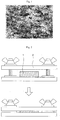
- the porous silicone body of the present invention has a monolithic structure having the three-dimensional network structure thus formed and communicating pores, and as a result, can have high flexibility and high heat resistance based on siloxane bonds. Electron micrograph of the porous silicone body of the present invention is shown in FIG. 1 .
- the bifunctional alkoxysilane has four bonding groups bonded to silicon. Of the four bonding groups, two groups are alkoxy groups that participate in polymerization (bonding), and the remaining two groups are modifying groups that do not participate in a reaction.
- the bifunctional alkoxysilane is represented by the following chemical formula (1).
- the alkoxy group (-OR 1 ) in the bifunctional alkoxysilane is preferably an alkoxy group having 1 to 5 carbon atoms. From the standpoint of hydrolysis reaction rate, the alkoxy group is preferably methoxy group, ethoxy group or propoxy group, and more preferably methoxy group or ethoxy group. Two alkoxy groups (-OR 1 ) in the bifunctional alkoxysilane may be the same or different.
- Examples of the modifying group (-R 2 ) in the bifunctional alkoxysilane include a substituted or unsubstituted alkyl group, an aryl group, a vinyl group and a mercaptoalkyl group.
- the alkyl group in the substituted or unsubstituted alkyl group is preferably an alkyl group having 1 to 5 carbon atoms. Methyl group or ethyl group is preferred, and methyl group is more preferred.
- Example of the substituent includes a halogen element such as fluorine, chlorine, bromine or iodine.
- the substituted alkyl group is preferably a fluoroalkyl group.
- aryl group examples include phenyl group, tolyl group, xylyl group, biphenylyl group and naphthyl group. Phenyl group is preferred.
- Examples of the mercaptoalkyl group include mercaptomethyl group, mercaptoethyl group and mercaptopropyl group.
- Mercaptopropyl group is preferred.
- Two modifying groups (-R 2 ) in the bifunctional alkoxysilane may be the same or different. From the standpoint of imparting functions such as water repellency and heat resistance to the structure to be obtained, at least one of those two modifying groups is preferably selected from the group consisting of methyl group, phenyl group and a fluoroalkyl group.
- bifunctional alkoxysilane specifically include dimethyl dimethoxysilane, methylphenyl dimethoxysilane, methylvinyl dimethoxysilane, 3-mercaptopropylmethyl dimethoxysilane and 3,3,3-trifluoropropylmethyl dimethoxysilane. From the standpoint of improvement of heat resistance, dimethyl dimethoxysilane and methylphenyl dimethoxysilane are particularly preferred.
- the bifunctional alkoxysilane may be used in one kind alone or as mixtures of two or more kinds.
- the trifunctional alkoxysilane has four bonding groups bonded to silicon. Of the four bonding groups, three groups are alkoxy groups that participate in polymerization (bonding), and the remaining one group is a modifying group that does not participate in a reaction.
- the trifunctional alkoxysilane is represented by the following chemical formula (2).
- Examples of the alkoxy group (-OR 3 ) in the trifunctional alkoxysilane include the same groups as in the alkoxy group (-OR 1 ) in the bifunctional alkoxysilane.
- Examples of the modifying group (-R 4 ) in the trifunctional alkoxysilane include the same groups as in the modifying group (-R 2 ) in the bifunctional alkoxysilane.
- the modifying group in the trifunctional alkoxysilane is preferably methyl group, phenyl group or a fluoroalkyl group, from the standpoint of imparting functions such as water repellency and heat resistance to the structure to be obtained.
- trifunctional alkoxysilane specifically include methyl trimethoxysilane, vinyl trimethoxysilane and 3-mercaptopropyl trimethoxysilane. Methyl trimethoxysilane is particularly preferred from the standpoint of the improvement of heat resistance.
- the trifunctional alkoxysilane may be used in one kind alone or as mixtures of two or more kinds.
- tri- or more polyfunctional alkoxysilanes may be further copolymerized together with the bifunctional alkoxysilane and trifunctional alkoxysilane.
- the tri- or more polyfunctional alkoxysilanes used herein mean silanes having more than three alkoxy groups participating in polymerization (bonding). Examples of the tri- or more polyfunctional alkoxysilanes include alkoxysilanes having -Si-C-C-Si- structure or -Si-phenyl-Si- structure. The number of bonding groups to Si is 4.
- alkoxysilanes having -Si-C-C-Si- structure or -Si-phenyl-Si- structure as a crosslinking agent, 6 functional groups can be utilized, and denser silicone network can be formed.
- Example of the alkoxysilane having -Si-C-C-Si- structure includes 1,2-bis(methyldiethoxysilyl)ethane.
- Polymerization ratio between the bifunctional alkoxysilane and the trifunctional alkoxysilane can be appropriately selected considering properties and the like of a desired porous silicone body, and is not particularly limited.
- the polymerization ratio (bifunctional alkoxysilane:trifunctional alkoxysilane) is preferably 2:8 to 6:4, and more preferably 3:7 to 5:5, in volume ratio.
- the polymerization ratio is 2:8 or more, it is preferred in imparting flexibility to a porous body to be obtained.
- the polymerization ratio is 6:4 or less, it is preferred in maintaining mechanical strength.
- the polymerization ratio of the tri- or more polyfunctional alkoxysilanes is not particularly limited.
- volume ratio to the total of the bifunctional alkoxysilane and trifunctional alkoxysilane total of bifunctional alkoxysilane and trifunctional alkoxysilane: tri- or more polyfunctional alkoxysilanes
- total of bifunctional alkoxysilane and trifunctional alkoxysilane: tri- or more polyfunctional alkoxysilanes is, for example, 6:4 to 4:6.
- the proportion of unreacted parts in the silicone skeleton is 10 mol% or less. According to the present invention, excellent recoverability of heat-resistant cushioning properties can be obtained by controlling the proportion of unreacted parts in the silicone skeleton to 10 mol% or less.
- the "recoverability of cushioning properties” used herein means properties that when an object is placed under compression at a certain temperature and the pressure is then released, the shape of the object recovers the shape before compression.
- the “recoverability of heat-resistant cushioning properties” used herein means properties that when an object is placed under compression at high temperature and the pressure is then released, the shape of the object recovers the shape before compression at high temperature.
- the recoverability of (heat-resistant) cushioning properties can be evaluated as follows.
- the compressive residual strain (50% compression set) at a test temperature of 150°C is preferably 5% or less, and more preferably 2% or less.
- the compressive residual strain (50% compression set) at a test temperature of 250°C is preferably 10% or less, more preferably 5% or less, and particularly preferably 3% or less.
- the proportion of unreacted parts in the silicone skeleton is controlled to 10 mol% or less.
- the porous silicone body of the present invention has high flexibility and high heat resistance due to its structure, and additionally can exhibit excellent recoverability of heat-resistant cushioning properties.
- the proportion of unreacted parts in the silicone skeleton can be derived from the measurement result by solid 29 Si-NMR.
- the silicone skeleton in the porous silicone body of the present invention is formed by copolymerization between the bifunctional alkoxysilane and the trifunctional alkoxysilane.
- the structural unit of the chemical formula (3) is referred to as D1
- the structural unit of the chemical formula (4) is referred to as D2
- the structural unit of the chemical formula (5) is referred to as T2
- the structural unit of the chemical formula (6) is referred to as T3.
- the structural units D1 and D2 are structural units derived from the bifunctional alkoxysilane
- the structure units T2 and T3 are structural units derived from the trifunctional alkoxysilane.
- R 5 represents H or R 1 .
- R 1 and R 2 are the same as defined in the chemical formula (1))
- R 6 represents H or R 3 .
- R 3 and R 4 are the same as defined in the chemical formula (2))
- the structural unit D1 has OR 5 as an unreacted group.
- the structural unit T 2 also has OR 6 as an unreacted group.
- the structural units D2 and T3 do not have an unreacted group.
- the proportion (mol%) of each structural unit can be derived from an integrated value of each peak in NMR spectrum obtained by solid 29 Si-NMR analysis.
- the total of the proportion (mol%) of the unreacted parts (the structural units D1 and T2) occupied in the whole structural units is defined as the proportion of unreacted parts in the silicone skeleton.
- the proportions of the structural units (unreacted parts) having unreacted groups derived from more than trifunctional alkoxysilanes and the structural units (reacted parts) that do not have unreacted groups are similarly derived in addition to the structural units D1, D2, T2 and T3, and the total of the proportions (mol%) of the structural unit D1, the structural unit D2 and the structural unit having unreacted groups derived from tri- or more polyfunctional alkoxysilanes occupied in the whole structural units is defined as the proportion of unreacted parts in the silicone skeleton.
- the proportion of unreacted parts in the silicone skeleton is 10 mol% or less, preferably 9 mol% or less, and more preferably 8 mol% or less.
- the proportion of unreacted parts is controlled to 10 mol% or less, excellent recoverability of heat-resistant cushioning properties can be obtained.
- the lower limit of the proportion of the unreacted parts is not particularly limited. However, when the proportion is excessively small, flexibility may deteriorate. Therefore, the proportion of unreacted parts is, for example, 2 mol% or more, and preferably 3 mol% or more.
- the proportion of unreacted parts in the silicone skeleton can be controlled by, for example, a heat treatment (annealing treatment) described hereinafter. Furthermore, the proportion can also be controlled by irradiation with ultraviolet rays emitted from laser, LED, lamp light source or the like.
- a heat treatment annealing treatment
- ultraviolet rays emitted from laser, LED, lamp light source or the like.
- the porosity of the porous silicone body of the present invention is not particularly limited.
- the porosity is preferably 50% or more, more preferably 80% or more, and still more preferably 90% or more.
- the porosity is less than 50%, flexibility and lightness may deteriorate.
- the porosity is too high, mechanical strength may decrease. Therefore, the porosity is preferably 95% or less.
- the average pore size of the communicating pores in the porous silicone body of the present invention is not particularly limited, but is, for example, 50 to 50,000 nm.
- the skeleton diameter of the silicone skeleton is not particularly limited, but is, for example, 50 to 10,000 nm.
- the average pore size of the communicating pores in the porous silicone body of the present invention can be measured by SEM, optical microscope or the like.
- the skeleton diameter of the silicone skeleton can be measured by SEM, optical microscope or the like.
- the porous silicone body of the present invention is that, in an unconfined compression test, shape recovery rate in 10 seconds when the porous silicone body has been compressed to 80% and the pressure has then been released is preferably 90% or more, more preferably 95% or more, and particularly preferably 100%. When the shape recovery rate is 90% or more, high flexibility can be exhibited.
- the porous silicone body of the present invention is that in TG-GTA (Thermogravimetry-Differential Thermal Analysis), the thermal decomposition initiation temperature is preferably 300°C or higher, and more preferably 350°C or higher.
- TG-GTA Thermogravimetry-Differential Thermal Analysis
- the method for producing a porous silicone body of the present invention (hereinafter referred to as "the production method of the present invention") is described below.
- the method for producing a porous silicone body of the present invention is the production method of the above-described porous silicone body, and comprises a step of copolymerizing a bifunctional alkoxy silane and a trifunctional alkoxysilane by a sol-gel reaction involving phase separation to form a porous silicone body having communicating pores and a three-dimensional network silicone skeleton that forms the pores, and a step of heat-treating the porous silicone body at a temperature lower than the thermal decomposition initiation temperature thereof.
- the bifunctional alkoxysilane and trifunctional alkoxysilane are used as precursors, network of Si-O bonds is formed by copolymerization of those by a sol-gel reaction and simultaneously an acid-base two step reaction is conducted by an acid catalyst and a base catalyst while controlling phase separation by a surfactant, thereby forming a porous silicone body having communicating pores and a three-dimensional network silicone skeleton that forms the pores.
- a surfactant thereby forming a porous silicone body having communicating pores and a three-dimensional network silicone skeleton that forms the pores.
- Acetic acid as an acid catalyst is mixed with water as a solvent in a vessel such as a glass vessel to prepare an acetic acid aqueous solution.
- n-Hexadecyltrimethylammonium chloride (CTAC) as a surfactant and urea as a base catalyst are then added to the acetic acid aqueous solution.
- Bifunctional alkoxysilane and trifunctional alkoxysilane as precursors are added to the resulting mixture, followed by stirring, for example, at 10 to 30°C for 0.5 to 2.0 hours, thereby proceeding hydrolysis of the precursors.
- the solution obtained is transferred to a closed vessel, and heated, for example, at 50 to 85°C for 6 to 48 hours.
- Urea is hydrolyzed, and under basic conditions, the precursors hydrolyzed are polycondensed by a sol-gel reaction. Thus, a wet gel is obtained.
- the wet gel obtained is impregnated into, for example, a mixed solution of water and isopropyl alcohol, and the resulting mixture is washed with isopropyl alcohol, methanol or the like to remove unreacted precursors and surfactants.
- the monolithic gel thus obtained is impregnated into a non-polar solvent such as normal hexane to perform solvent substitution, followed by drying, for example, at 20 to 80°C for 5 to 24 hours.
- a porous silicone body having a monolithic structure is obtained as a xerogel.
- a porous silicone body having a monolithic structure as an aerogel can also be obtained by further subjecting the monolithic gel obtained above to supercritical drying with carbon dioxide gas or the like.
- the kinds of materials and the order of addition thereof, reaction conditions, and the like can be appropriately adjusted so long as a porous silicone body having the desired monolithic structure is obtained, and therefore, the first step is not limited to the above embodiment.
- cetyltrimethylammonium bromide (CTAB) or the like may be used as a surfactant in place of n-hexadecyltrimethylammonium chloride (CTAC).
- Oxalic acid, formic acid or the like may be used as an acid catalyst in place of acetic acid.
- Ammonia water or the like may be used as a base catalyst in place of urea.
- more than trifunctional alkoxysilanes may be further used as a precursor.
- the porous silicone body obtained in the first step is subjected to a heat treatment (annealing treatment) at a temperature lower than the thermal decomposition initiation temperature thereof.
- the proportion of unreacted parts in the silicone skeleton constituting the porous silicone body can be controlled by performing the heat treatment (annealing treatment).
- the heat treatment (annealing treatment) can be performed by, for example, maintaining the porous silicone body in a heating furnace heated to a given temperature for a given period of time.
- the heating temperature in the heat treatment is a temperature lower than the thermal decomposition initiation temperature of the porous silicone body, and can be appropriately determined considering the kinds of starting materials used (bifunctional alkoxysilane, trifunctional alkoxysilane and the like), heating time, and the like.
- the heating temperature is preferably 320°C or lower, and more preferably 300°C or lower.
- the lower limit of the heating temperature in the heat treatment (annealing treatment) is not particularly limited.
- the lower limit is, for example, 100°C or higher, and preferably 150°C or higher.
- the porous silicone body is subjected to the heat treatment (annealing treatment) at a temperature higher than the temperature at which the porous silicone body is used under compression at high temperature.
- the heating time in the heat treatment can be appropriately determined considering the kinds of starting materials used (bifunctional alkoxysilane, trifunctional alkoxysilane and the like), heating temperature, and the like, and is not particularly limited.
- the heating time is, for example, 8 hours or more, preferably 12 hours or more, and more preferably 18 hours.
- the heating time is, for example, 120 hours or less, preferably 100 hours or less, more preferably 80 hours or less, still more preferably 70 hours or less, and still further more preferably 60 hours or less.
- the porous silicone body is subjected to the heat treatment (annealing treatment) at high temperature for a long period of time, there is a possibility that the porous silicone body deteriorates and does not exhibit the desired flexibility and recoverability of heat-resistant cushioning properties.
- the heat treatment (annealing treatment) at low temperature for a short period of time there is a possibility that the proportion of unreacted parts in the silicone skeleton cannot be sufficiently controlled. Therefore, in performing the heat treatment (annealing treatment), it is preferred to conduct the heat treatment by selecting appropriate conditions in consideration of those.
- porous silicone body of the present invention has excellent recoverability of heat-resistant cushioning properties is not clear, but is presumed to be as follows.
- the heat treatment is performed to the porous silicone body, thereby previously allowing to proceed the reaction (crosslinking) of unreacted parts in the silicone skeleton under non-compression conditions and controlling the proportion of the unreacted parts low as 10 mol% or less. Therefore, it is presumed that even though the porous silicone body of the present invention is maintained under compression conditions at high temperature, the reaction (crosslinking) of unreacted parts does not proceed under the compression conditions at high temperature, or even if the reaction proceeds, the reaction is limitative, and as a result, the porous silicone body can exhibit excellent recoverability of heat-resistant cushioning properties when the pressure has been thereafter.
- the porous silicone body of the present invention has high flexibility and heat resistance, and additionally has excellent recoverability of heat-resistant cushioning properties. Therefore, the porous silicone body can be usefully used as a damping material, a vibration-proof material, a cushioning material and the like in the fields of aviation, space, automobile, nuclear powder facility, ship and the like.
- n-Hexadecyltrimethylammonium chloride 10 g as a surfactant and urea (50 g) were added to 5 mM acetic acid aqueous solution (150 mL), followed by mixing those in a glass vessel under stirring.
- Methyl trimethoxysilane (30 mL) and dimethyl dimethoxysilane (20 mL) as precursors were added to the glass vessel, followed by stirring with a stirrer for 60 minutes. After stirring, the resulting solution was transferred to a closed vessel, and heated at 80°C for 24 hours, thereby hydrolyzing urea to form basic conditions.
- the precursors hydrolyzed were polycondensed by a sol-gel reaction under the basic conditions.
- the wet gel obtained was impregnated into a water/isopropyl alcohol (1:1) solution, and then washed with isopropyl alcohol to remove unreacted reagents and surfactants.
- the monolithic gel thus obtained was impregnated into normal hexane to perform solvent substitution, and then dried at 60°C for 24 hours.
- a porous silicone body having a monolithic structure as a xerogel was obtained.
- the porous silicone body obtained was further subjected to annealing treatment in a heating furnace at a temperature of 250°C for 48 hours. Thus, a porous silicone body of Example 1 was prepared.
- a porous silicone body of Example 2 was prepared in the same manner as in Example 1, except that an annealing treatment was conducted in a heating furnace at 150°C for 50 hours.
- a porous silicone body of Comparative Example 1 was prepared in the same manner as in Example 1, except that an annealing treatment was not conducted.
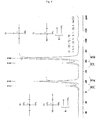
- Porous silicone bodies of Example 1 and Comparative Example 1 were analyzed by solid 29 Si-NMR. Solid 29 Si-NMR spectrum of the porous silicone body of Example 1 is shown in FIG. 3 . Solid 29 Si-NMR spectrum of the porous silicone body of Comparative Example 1 is shown in FIG. 4 .
- the proportions (mol%) of the structural units D1, D2, T2 and T3 in the silicone skeletons in the porous silicone bodies of Example 1 and Comparative Example 1 were calculated by analyzing those solid 29 Si-NMR spectra, respectively. The results are shown in Table 1.
- the porous silicone body of Example 2 was also analyzed by solid 29 Si-NMR, and the proportions (mol%) of the structural units D1, D2, T2 and T3 in the silicone skeleton in the porous silicone body were calculated by the solid 29 Si-NMR spectrum. The results are also shown in Table 1.
- a test sample having a size of 10 mm vertical x 10 mm horizontal x 10 mm thick (T 0 ) of each porous silicone body of Example 1 and Comparative Example 1 was prepared.
- the test sample was compressed until the thickness of the test sample after compression by a compression tester reaches 50% (5 mm, T 0 /2) before compression under the test temperature of each of -68°C, 80°C, 150°C and 250°C, and then allowed to stand under the test temperature for 22 hours. After allowing to stand at ordinary temperature (23°C) for 2 hours, the pressure was released, the thickness (T 1 , unit: mm) of the test sample was measured after the lapse of 1 minute, and compressive residual strain (50% compression set) was calculated based on the following formula.
- Compressive residual strain 50 % compression set % T 0 ⁇ T 1 / T 0 ⁇ 100
- the proportion of unreacted parts in the silicone skeleton was 7.5 mol%, 50% compression set (%) at the test temperature of 150°C was low as 3.2%, and 50% compression set (%) at the test temperature of 250°C was low as 5.0%.
- the porous silicone body had excellent recoverability of heat-resistant cushioning properties.
- the proportion of unreacted parts in the silicone skeleton was 9.5 mol%, and 50% compression set (%) at the test temperature of 150°C was low as 2.9%.
- the porous silicone body had excellent recoverability of heat-resistant cushioning properties.
- the porous silicone body of Comparative Example 1 the proportion of unreacted parts in the silicone skeleton was 14.7 mol%, 50% compression set (%) at the test temperature of 150°C was high as 45.0%, and compression set (%) at the test temperature of 250°C was high as 48.0%.
- the porous silicone body did not have sufficient recoverability of heat-resistant cushioning properties.
Landscapes
- Chemical & Material Sciences (AREA)
- Health & Medical Sciences (AREA)
- Chemical Kinetics & Catalysis (AREA)
- Medicinal Chemistry (AREA)
- Polymers & Plastics (AREA)
- Organic Chemistry (AREA)
- Engineering & Computer Science (AREA)
- Materials Engineering (AREA)
- Silicon Polymers (AREA)
- Manufacture Of Porous Articles, And Recovery And Treatment Of Waste Products (AREA)
Applications Claiming Priority (2)
| Application Number | Priority Date | Filing Date | Title |
|---|---|---|---|
| JP2014199444A JP6373148B2 (ja) | 2014-09-29 | 2014-09-29 | シリコーン多孔質体及びシリコーン多孔質体の製造方法 |
| PCT/JP2015/077194 WO2016052357A1 (fr) | 2014-09-29 | 2015-09-25 | Corps de silicone poreux et son procédé de production |
Publications (2)
| Publication Number | Publication Date |
|---|---|
| EP3202838A1 true EP3202838A1 (fr) | 2017-08-09 |
| EP3202838A4 EP3202838A4 (fr) | 2018-02-21 |
Family
ID=55630393
Family Applications (1)
| Application Number | Title | Priority Date | Filing Date |
|---|---|---|---|
| EP15846893.4A Withdrawn EP3202838A4 (fr) | 2014-09-29 | 2015-09-25 | Corps de silicone poreux et son procédé de production |
Country Status (6)
| Country | Link |
|---|---|
| US (1) | US20170298204A1 (fr) |
| EP (1) | EP3202838A4 (fr) |
| JP (1) | JP6373148B2 (fr) |
| KR (1) | KR20170061131A (fr) |
| CN (1) | CN106715555A (fr) |
| WO (1) | WO2016052357A1 (fr) |
Families Citing this family (4)
| Publication number | Priority date | Publication date | Assignee | Title |
|---|---|---|---|---|
| US11518855B2 (en) | 2017-08-25 | 2022-12-06 | Kyoto University | Low-density gel product and production method therefor |
| CN108752037B (zh) * | 2018-07-16 | 2021-11-19 | 华南理工大学 | 一种基于聚碳硅烷制备的多孔碳化硅块体及其制备方法与应用 |
| JP7336237B2 (ja) * | 2019-03-29 | 2023-08-31 | 旭化成株式会社 | 改質多孔質体、改質多孔質体の製造方法、反射材、多孔質シート |
| JP7372753B2 (ja) * | 2019-03-29 | 2023-11-01 | 旭化成株式会社 | 反射材 |
Family Cites Families (7)
| Publication number | Priority date | Publication date | Assignee | Title |
|---|---|---|---|---|
| US6420441B1 (en) * | 1999-10-01 | 2002-07-16 | Shipley Company, L.L.C. | Porous materials |
| JP2004182865A (ja) * | 2002-12-03 | 2004-07-02 | Hitachi Chem Co Ltd | シロキサン樹脂多孔体及びその製造方法 |
| JP2004281535A (ja) * | 2003-03-13 | 2004-10-07 | Fujitsu Ltd | 被膜形成材料、絶縁膜の製造方法及び半導体装置 |
| JP5019342B2 (ja) * | 2003-12-25 | 2012-09-05 | シンジーテック株式会社 | シリコーンエラストマー多孔質体 |
| WO2007010949A1 (fr) * | 2005-07-19 | 2007-01-25 | Dynax Corporation | Procédé de production d'un aérogel d'alkylsiloxane, aérogel d'alkylsiloxane, appareil permettant de le produire et procédé de fabrication d'un panneau qui en contient |
| EP2352786A1 (fr) * | 2008-08-05 | 2011-08-10 | World Properties, Inc. | Mousses polymères conductrices, procédé de fabrication et articles faits de ces mousses |
| JP2014061457A (ja) * | 2012-09-19 | 2014-04-10 | Kyoto Univ | シリコーン製モノリス体及びそれを用いた分離、精製、濃縮方法 |
-
2014
- 2014-09-29 JP JP2014199444A patent/JP6373148B2/ja active Active
-
2015
- 2015-09-25 US US15/513,020 patent/US20170298204A1/en not_active Abandoned
- 2015-09-25 KR KR1020177008028A patent/KR20170061131A/ko not_active Ceased
- 2015-09-25 CN CN201580052934.2A patent/CN106715555A/zh active Pending
- 2015-09-25 EP EP15846893.4A patent/EP3202838A4/fr not_active Withdrawn
- 2015-09-25 WO PCT/JP2015/077194 patent/WO2016052357A1/fr not_active Ceased
Also Published As
| Publication number | Publication date |
|---|---|
| KR20170061131A (ko) | 2017-06-02 |
| WO2016052357A1 (fr) | 2016-04-07 |
| JP6373148B2 (ja) | 2018-08-15 |
| EP3202838A4 (fr) | 2018-02-21 |
| CN106715555A (zh) | 2017-05-24 |
| JP2016069499A (ja) | 2016-05-09 |
| US20170298204A1 (en) | 2017-10-19 |
Similar Documents
| Publication | Publication Date | Title |
|---|---|---|
| US10941897B2 (en) | Preparation method of silica aerogel-containing blanket and silica aerogel-containing blanket prepared by using the same | |
| EP3279246B1 (fr) | Corps poreux et procédé de production de corps poreux | |
| Wang et al. | Flexible, high-temperature-resistant silica-polymer aerogel hybrids by templating polymethylsilsesquioxane microstructure with trace polyimide | |
| EP3284719A1 (fr) | Procédé de fabrication d'une couverture contenant un aérogel de silice et couverture contenant un aérogel de silice ainsi fabriquée | |
| TWI698467B (zh) | 被絕熱體的製造方法及被絕熱體 | |
| EP3202838A1 (fr) | Corps de silicone poreux et son procédé de production | |
| EP3199493A1 (fr) | Aérogel composite, et élément de support et matériau d'isolation thermique comportant un aérogel composite | |
| US20250368839A1 (en) | Coating liquid, production method for coating film, and coating film | |
| WO2017133312A1 (fr) | Tissu ultra-hydrophobe et son procédé de fabrication | |
| Zolotareva et al. | -Diketones and their derivatives in sol–gel processes | |
| CN109943902A (zh) | 一种改性聚酯纤维及制备方法 | |
| EP3275527B1 (fr) | Membrane perméable aux gaz, utilisation d'une composition pour la formation d'une telle membrane et procédé pour la produire | |
| KR100840603B1 (ko) | 영구적 소수성을 갖는 에어로겔의 제조 방법 및 이로부터제조된 에어로겔 | |
| KR20090008084A (ko) | 실리카 에어로젤의 제조방법과 이에 의하여 제조된 실리카에어로젤 | |
| TW201806862A (zh) | 氣凝膠複合體、帶氣凝膠複合體的支撐構件及絕熱材料 | |
| KR102785203B1 (ko) | 저 압축 영구 변형 에어로겔 및 에어로겔 복합재 및 제조 방법 | |
| JP6411008B2 (ja) | 含フッ素基修飾ポリシルセスキオキサン液体、含フッ素基修飾ポリシルセスキオキサンガラス及びこれらの製造方法 | |
| JP2022152981A (ja) | 高分子材料、遮熱材、防曇フィルム及び高分子材料の製造方法 | |
| Bescher et al. | Fluorinated copolymer-oxide hybrids | |
| Sharp et al. | Star gels. New hybrid network materials from polyfunctional single component precursors | |
| CARAVAJAL | STRUCTURAL CHARACTERIZATION OF APTS-MODIFIED SILICA USING SOLID-STATE CP/MAS NMR (AMINOSILANE) | |
| WO2019163131A1 (fr) | Structure, matériau pour applications de liaison, procédé de production de structure et procédé de revêtement | |
| WO2018097103A1 (fr) | Gel de polysiloxane ainsi que procédé de fabrication de celui-ci, matériau d'isolation thermique, et verre feuilleté | |
| WO1990008169A1 (fr) | Heteropolycondensats d'acide silicique modifies organiques |
Legal Events
| Date | Code | Title | Description |
|---|---|---|---|
| PUAI | Public reference made under article 153(3) epc to a published international application that has entered the european phase |
Free format text: ORIGINAL CODE: 0009012 |
|
| 17P | Request for examination filed |
Effective date: 20170330 |
|
| AK | Designated contracting states |
Kind code of ref document: A1 Designated state(s): AL AT BE BG CH CY CZ DE DK EE ES FI FR GB GR HR HU IE IS IT LI LT LU LV MC MK MT NL NO PL PT RO RS SE SI SK SM TR |
|
| AX | Request for extension of the european patent |
Extension state: BA ME |
|
| DAV | Request for validation of the european patent (deleted) | ||
| DAX | Request for extension of the european patent (deleted) | ||
| A4 | Supplementary search report drawn up and despatched |
Effective date: 20180118 |
|
| RIC1 | Information provided on ipc code assigned before grant |
Ipc: C08J 9/28 20060101ALI20180112BHEP Ipc: C08J 9/36 20060101AFI20180112BHEP |
|
| 17Q | First examination report despatched |
Effective date: 20180926 |
|
| STAA | Information on the status of an ep patent application or granted ep patent |
Free format text: STATUS: THE APPLICATION HAS BEEN WITHDRAWN |
|
| 18W | Application withdrawn |
Effective date: 20181212 |