EP3202853B1 - Reifenrahmen und reifen - Google Patents
Reifenrahmen und reifen Download PDFInfo
- Publication number
- EP3202853B1 EP3202853B1 EP15847321.5A EP15847321A EP3202853B1 EP 3202853 B1 EP3202853 B1 EP 3202853B1 EP 15847321 A EP15847321 A EP 15847321A EP 3202853 B1 EP3202853 B1 EP 3202853B1
- Authority
- EP
- European Patent Office
- Prior art keywords
- polyamide
- tire
- resinous material
- reinforcing cord
- thermoplastic elastomer
- Prior art date
- Legal status (The legal status is an assumption and is not a legal conclusion. Google has not performed a legal analysis and makes no representation as to the accuracy of the status listed.)
- Not-in-force
Links
- JBKVHLHDHHXQEQ-UHFFFAOYSA-N epsilon-caprolactam Chemical compound O=C1CCCCCN1 JBKVHLHDHHXQEQ-UHFFFAOYSA-N 0.000 claims description 121
- 239000012260 resinous material Substances 0.000 claims description 78
- 229920002647 polyamide Polymers 0.000 claims description 64
- 229920002725 thermoplastic elastomer Polymers 0.000 claims description 51
- 229920002292 Nylon 6 Polymers 0.000 claims description 27
- 239000004952 Polyamide Substances 0.000 claims description 26
- 229920000570 polyether Polymers 0.000 claims description 16
- 239000004721 Polyphenylene oxide Substances 0.000 claims description 15
- 238000005227 gel permeation chromatography Methods 0.000 claims description 5
- 229920000728 polyester Polymers 0.000 claims description 5
- 238000001644 13C nuclear magnetic resonance spectroscopy Methods 0.000 claims description 2
- 238000005160 1H NMR spectroscopy Methods 0.000 claims description 2
- 230000003014 reinforcing effect Effects 0.000 description 86
- 229920001971 elastomer Polymers 0.000 description 34
- 229920000642 polymer Polymers 0.000 description 34
- 125000004432 carbon atom Chemical group C* 0.000 description 30
- 229920001451 polypropylene glycol Polymers 0.000 description 30
- 239000000654 additive Substances 0.000 description 25
- -1 aliphatic lactam Chemical class 0.000 description 23
- 239000011324 bead Substances 0.000 description 23
- 238000000034 method Methods 0.000 description 23
- 239000005060 rubber Substances 0.000 description 20
- 150000004985 diamines Chemical class 0.000 description 17
- 238000010438 heat treatment Methods 0.000 description 17
- 229920000909 polytetrahydrofuran Polymers 0.000 description 16
- 230000000996 additive effect Effects 0.000 description 15
- 239000000806 elastomer Substances 0.000 description 14
- 229920005989 resin Polymers 0.000 description 13
- 239000011347 resin Substances 0.000 description 13
- IJGRMHOSHXDMSA-UHFFFAOYSA-N Atomic nitrogen Chemical compound N#N IJGRMHOSHXDMSA-UHFFFAOYSA-N 0.000 description 12
- 238000002844 melting Methods 0.000 description 12
- 230000008018 melting Effects 0.000 description 12
- 238000006116 polymerization reaction Methods 0.000 description 12
- 230000008569 process Effects 0.000 description 12
- OFOBLEOULBTSOW-UHFFFAOYSA-N Malonic acid Chemical compound OC(=O)CC(O)=O OFOBLEOULBTSOW-UHFFFAOYSA-N 0.000 description 11
- 238000006243 chemical reaction Methods 0.000 description 11
- 239000000463 material Substances 0.000 description 11
- 238000007789 sealing Methods 0.000 description 11
- PBLZLIFKVPJDCO-UHFFFAOYSA-N 12-aminododecanoic acid Chemical compound NCCCCCCCCCCCC(O)=O PBLZLIFKVPJDCO-UHFFFAOYSA-N 0.000 description 10
- 239000002994 raw material Substances 0.000 description 10
- 239000004215 Carbon black (E152) Substances 0.000 description 9
- 229930195733 hydrocarbon Natural products 0.000 description 9
- 239000000178 monomer Substances 0.000 description 9
- 229920005992 thermoplastic resin Polymers 0.000 description 9
- SLXKOJJOQWFEFD-UHFFFAOYSA-N 6-aminohexanoic acid Chemical compound NCCCCCC(O)=O SLXKOJJOQWFEFD-UHFFFAOYSA-N 0.000 description 8
- WNLRTRBMVRJNCN-UHFFFAOYSA-N adipic acid Chemical compound OC(=O)CCCCC(O)=O WNLRTRBMVRJNCN-UHFFFAOYSA-N 0.000 description 8
- 125000002947 alkylene group Chemical group 0.000 description 8
- 238000004519 manufacturing process Methods 0.000 description 8
- CXMXRPHRNRROMY-UHFFFAOYSA-N sebacic acid Chemical compound OC(=O)CCCCCCCCC(O)=O CXMXRPHRNRROMY-UHFFFAOYSA-N 0.000 description 8
- 239000004970 Chain extender Substances 0.000 description 7
- 239000000835 fiber Substances 0.000 description 7
- 238000002347 injection Methods 0.000 description 7
- 239000007924 injection Substances 0.000 description 7
- 238000001746 injection moulding Methods 0.000 description 7
- 229910052757 nitrogen Inorganic materials 0.000 description 7
- 238000007142 ring opening reaction Methods 0.000 description 7
- 238000003786 synthesis reaction Methods 0.000 description 7
- MUBZPKHOEPUJKR-UHFFFAOYSA-N Oxalic acid Chemical compound OC(=O)C(O)=O MUBZPKHOEPUJKR-UHFFFAOYSA-N 0.000 description 6
- 229910000831 Steel Inorganic materials 0.000 description 6
- 230000015572 biosynthetic process Effects 0.000 description 6
- 230000000052 comparative effect Effects 0.000 description 6
- 150000002009 diols Chemical class 0.000 description 6
- TVIDDXQYHWJXFK-UHFFFAOYSA-N dodecanedioic acid Chemical compound OC(=O)CCCCCCCCCCC(O)=O TVIDDXQYHWJXFK-UHFFFAOYSA-N 0.000 description 6
- NAQMVNRVTILPCV-UHFFFAOYSA-N hexane-1,6-diamine Chemical compound NCCCCCCN NAQMVNRVTILPCV-UHFFFAOYSA-N 0.000 description 6
- 150000003951 lactams Chemical class 0.000 description 6
- 239000010959 steel Substances 0.000 description 6
- 229920006345 thermoplastic polyamide Polymers 0.000 description 6
- 239000002253 acid Substances 0.000 description 5
- 125000001183 hydrocarbyl group Chemical group 0.000 description 5
- 229910052751 metal Inorganic materials 0.000 description 5
- 239000002184 metal Substances 0.000 description 5
- 239000000203 mixture Substances 0.000 description 5
- 229920001169 thermoplastic Polymers 0.000 description 5
- 238000004073 vulcanization Methods 0.000 description 5
- XLYOFNOQVPJJNP-UHFFFAOYSA-N water Substances O XLYOFNOQVPJJNP-UHFFFAOYSA-N 0.000 description 5
- ROSDSFDQCJNGOL-UHFFFAOYSA-N Dimethylamine Chemical compound CNC ROSDSFDQCJNGOL-UHFFFAOYSA-N 0.000 description 4
- 239000004677 Nylon Substances 0.000 description 4
- 229920000299 Nylon 12 Polymers 0.000 description 4
- 239000001361 adipic acid Substances 0.000 description 4
- 235000011037 adipic acid Nutrition 0.000 description 4
- 125000001931 aliphatic group Chemical group 0.000 description 4
- 239000003054 catalyst Substances 0.000 description 4
- 150000001875 compounds Chemical class 0.000 description 4
- 230000000694 effects Effects 0.000 description 4
- 238000011156 evaluation Methods 0.000 description 4
- 150000002430 hydrocarbons Chemical class 0.000 description 4
- 238000005304 joining Methods 0.000 description 4
- BDJRBEYXGGNYIS-UHFFFAOYSA-N nonanedioic acid Chemical compound OC(=O)CCCCCCCC(O)=O BDJRBEYXGGNYIS-UHFFFAOYSA-N 0.000 description 4
- 229920001778 nylon Polymers 0.000 description 4
- 229910052698 phosphorus Inorganic materials 0.000 description 4
- WLJVNTCWHIRURA-UHFFFAOYSA-N pimelic acid Chemical compound OC(=O)CCCCCC(O)=O WLJVNTCWHIRURA-UHFFFAOYSA-N 0.000 description 4
- 238000006068 polycondensation reaction Methods 0.000 description 4
- 239000002861 polymer material Substances 0.000 description 4
- KIDHWZJUCRJVML-UHFFFAOYSA-N putrescine Chemical compound NCCCCN KIDHWZJUCRJVML-UHFFFAOYSA-N 0.000 description 4
- 229920006395 saturated elastomer Polymers 0.000 description 4
- TYFQFVWCELRYAO-UHFFFAOYSA-N suberic acid Chemical compound OC(=O)CCCCCCC(O)=O TYFQFVWCELRYAO-UHFFFAOYSA-N 0.000 description 4
- 238000012360 testing method Methods 0.000 description 4
- XFNJVJPLKCPIBV-UHFFFAOYSA-N trimethylenediamine Chemical compound NCCCN XFNJVJPLKCPIBV-UHFFFAOYSA-N 0.000 description 4
- 238000005406 washing Methods 0.000 description 4
- 238000004804 winding Methods 0.000 description 4
- JCUZDQXWVYNXHD-UHFFFAOYSA-N 2,2,4-trimethylhexane-1,6-diamine Chemical compound NCCC(C)CC(C)(C)CN JCUZDQXWVYNXHD-UHFFFAOYSA-N 0.000 description 3
- DPQHRXRAZHNGRU-UHFFFAOYSA-N 2,4,4-trimethylhexane-1,6-diamine Chemical compound NCC(C)CC(C)(C)CCN DPQHRXRAZHNGRU-UHFFFAOYSA-N 0.000 description 3
- QTBSBXVTEAMEQO-UHFFFAOYSA-N Acetic acid Chemical compound CC(O)=O QTBSBXVTEAMEQO-UHFFFAOYSA-N 0.000 description 3
- JHWNWJKBPDFINM-UHFFFAOYSA-N Laurolactam Chemical compound O=C1CCCCCCCCCCCN1 JHWNWJKBPDFINM-UHFFFAOYSA-N 0.000 description 3
- OAICVXFJPJFONN-UHFFFAOYSA-N Phosphorus Chemical compound [P] OAICVXFJPJFONN-UHFFFAOYSA-N 0.000 description 3
- 239000002202 Polyethylene glycol Substances 0.000 description 3
- 150000007513 acids Chemical class 0.000 description 3
- 239000000853 adhesive Substances 0.000 description 3
- 230000001070 adhesive effect Effects 0.000 description 3
- WPYMKLBDIGXBTP-UHFFFAOYSA-N benzoic acid Chemical compound OC(=O)C1=CC=CC=C1 WPYMKLBDIGXBTP-UHFFFAOYSA-N 0.000 description 3
- XMSVKICKONKVNM-UHFFFAOYSA-N bicyclo[2.2.1]heptane-3,4-diamine Chemical compound C1CC2(N)C(N)CC1C2 XMSVKICKONKVNM-UHFFFAOYSA-N 0.000 description 3
- 230000005587 bubbling Effects 0.000 description 3
- 125000003178 carboxy group Chemical group [H]OC(*)=O 0.000 description 3
- 238000009826 distribution Methods 0.000 description 3
- 230000002349 favourable effect Effects 0.000 description 3
- 230000009477 glass transition Effects 0.000 description 3
- 238000010348 incorporation Methods 0.000 description 3
- 238000002156 mixing Methods 0.000 description 3
- 239000011574 phosphorus Substances 0.000 description 3
- 229920001223 polyethylene glycol Polymers 0.000 description 3
- 230000005855 radiation Effects 0.000 description 3
- PWGJDPKCLMLPJW-UHFFFAOYSA-N 1,8-diaminooctane Chemical compound NCCCCCCCCN PWGJDPKCLMLPJW-UHFFFAOYSA-N 0.000 description 2
- WTFAGPBUAGFMQX-UHFFFAOYSA-N 1-[2-[2-(2-aminopropoxy)propoxy]propoxy]propan-2-amine Chemical compound CC(N)COCC(C)OCC(C)OCC(C)N WTFAGPBUAGFMQX-UHFFFAOYSA-N 0.000 description 2
- RTBFRGCFXZNCOE-UHFFFAOYSA-N 1-methylsulfonylpiperidin-4-one Chemical compound CS(=O)(=O)N1CCC(=O)CC1 RTBFRGCFXZNCOE-UHFFFAOYSA-N 0.000 description 2
- QFGCFKJIPBRJGM-UHFFFAOYSA-N 12-[(2-methylpropan-2-yl)oxy]-12-oxododecanoic acid Chemical compound CC(C)(C)OC(=O)CCCCCCCCCCC(O)=O QFGCFKJIPBRJGM-UHFFFAOYSA-N 0.000 description 2
- QUBNFZFTFXTLKH-UHFFFAOYSA-N 2-aminododecanoic acid Chemical compound CCCCCCCCCCC(N)C(O)=O QUBNFZFTFXTLKH-UHFFFAOYSA-N 0.000 description 2
- QGZKDVFQNNGYKY-UHFFFAOYSA-N Ammonia Chemical compound N QGZKDVFQNNGYKY-UHFFFAOYSA-N 0.000 description 2
- VTYYLEPIZMXCLO-UHFFFAOYSA-L Calcium carbonate Chemical compound [Ca+2].[O-]C([O-])=O VTYYLEPIZMXCLO-UHFFFAOYSA-L 0.000 description 2
- PIICEJLVQHRZGT-UHFFFAOYSA-N Ethylenediamine Chemical compound NCCN PIICEJLVQHRZGT-UHFFFAOYSA-N 0.000 description 2
- 229920000571 Nylon 11 Polymers 0.000 description 2
- 229920002302 Nylon 6,6 Polymers 0.000 description 2
- NBIIXXVUZAFLBC-UHFFFAOYSA-N Phosphoric acid Chemical compound OP(O)(O)=O NBIIXXVUZAFLBC-UHFFFAOYSA-N 0.000 description 2
- 239000004793 Polystyrene Substances 0.000 description 2
- VYPSYNLAJGMNEJ-UHFFFAOYSA-N Silicium dioxide Chemical compound O=[Si]=O VYPSYNLAJGMNEJ-UHFFFAOYSA-N 0.000 description 2
- KDYFGRWQOYBRFD-UHFFFAOYSA-N Succinic acid Natural products OC(=O)CCC(O)=O KDYFGRWQOYBRFD-UHFFFAOYSA-N 0.000 description 2
- KKEYFWRCBNTPAC-UHFFFAOYSA-N Terephthalic acid Chemical compound OC(=O)C1=CC=C(C(O)=O)C=C1 KKEYFWRCBNTPAC-UHFFFAOYSA-N 0.000 description 2
- FDLQZKYLHJJBHD-UHFFFAOYSA-N [3-(aminomethyl)phenyl]methanamine Chemical compound NCC1=CC=CC(CN)=C1 FDLQZKYLHJJBHD-UHFFFAOYSA-N 0.000 description 2
- 150000001408 amides Chemical class 0.000 description 2
- 229960002684 aminocaproic acid Drugs 0.000 description 2
- JFCQEDHGNNZCLN-UHFFFAOYSA-N anhydrous glutaric acid Natural products OC(=O)CCCC(O)=O JFCQEDHGNNZCLN-UHFFFAOYSA-N 0.000 description 2
- QFNNDGVVMCZKEY-UHFFFAOYSA-N azacyclododecan-2-one Chemical compound O=C1CCCCCCCCCCN1 QFNNDGVVMCZKEY-UHFFFAOYSA-N 0.000 description 2
- 230000008901 benefit Effects 0.000 description 2
- KDYFGRWQOYBRFD-NUQCWPJISA-N butanedioic acid Chemical compound O[14C](=O)CC[14C](O)=O KDYFGRWQOYBRFD-NUQCWPJISA-N 0.000 description 2
- 230000008859 change Effects 0.000 description 2
- 239000003795 chemical substances by application Substances 0.000 description 2
- YQLZOAVZWJBZSY-UHFFFAOYSA-N decane-1,10-diamine Chemical compound NCCCCCCCCCCN YQLZOAVZWJBZSY-UHFFFAOYSA-N 0.000 description 2
- 230000003247 decreasing effect Effects 0.000 description 2
- 230000002950 deficient Effects 0.000 description 2
- 238000010586 diagram Methods 0.000 description 2
- 229910001873 dinitrogen Inorganic materials 0.000 description 2
- QFTYSVGGYOXFRQ-UHFFFAOYSA-N dodecane-1,12-diamine Chemical compound NCCCCCCCCCCCCN QFTYSVGGYOXFRQ-UHFFFAOYSA-N 0.000 description 2
- PWSKHLMYTZNYKO-UHFFFAOYSA-N heptane-1,7-diamine Chemical compound NCCCCCCCN PWSKHLMYTZNYKO-UHFFFAOYSA-N 0.000 description 2
- 230000006872 improvement Effects 0.000 description 2
- 239000004615 ingredient Substances 0.000 description 2
- QQVIHTHCMHWDBS-UHFFFAOYSA-N isophthalic acid Chemical compound OC(=O)C1=CC=CC(C(O)=O)=C1 QQVIHTHCMHWDBS-UHFFFAOYSA-N 0.000 description 2
- 238000005259 measurement Methods 0.000 description 2
- 238000000465 moulding Methods 0.000 description 2
- SXJVFQLYZSNZBT-UHFFFAOYSA-N nonane-1,9-diamine Chemical compound NCCCCCCCCCN SXJVFQLYZSNZBT-UHFFFAOYSA-N 0.000 description 2
- 235000006408 oxalic acid Nutrition 0.000 description 2
- 239000008188 pellet Substances 0.000 description 2
- 150000003018 phosphorus compounds Chemical class 0.000 description 2
- 230000000704 physical effect Effects 0.000 description 2
- 239000004014 plasticizer Substances 0.000 description 2
- 229920002223 polystyrene Polymers 0.000 description 2
- 229920002635 polyurethane Polymers 0.000 description 2
- 239000004814 polyurethane Substances 0.000 description 2
- 238000007493 shaping process Methods 0.000 description 2
- 239000007787 solid Substances 0.000 description 2
- 150000003606 tin compounds Chemical class 0.000 description 2
- 229910052719 titanium Inorganic materials 0.000 description 2
- 239000010936 titanium Substances 0.000 description 2
- 150000003609 titanium compounds Chemical class 0.000 description 2
- VXUYXOFXAQZZMF-UHFFFAOYSA-N titanium(IV) isopropoxide Chemical compound CC(C)O[Ti](OC(C)C)(OC(C)C)OC(C)C VXUYXOFXAQZZMF-UHFFFAOYSA-N 0.000 description 2
- KLNPWTHGTVSSEU-UHFFFAOYSA-N undecane-1,11-diamine Chemical compound NCCCCCCCCCCCN KLNPWTHGTVSSEU-UHFFFAOYSA-N 0.000 description 2
- 229910052726 zirconium Inorganic materials 0.000 description 2
- 150000003755 zirconium compounds Chemical class 0.000 description 2
- PXGZQGDTEZPERC-UHFFFAOYSA-N 1,4-cyclohexanedicarboxylic acid Chemical compound OC(=O)C1CCC(C(O)=O)CC1 PXGZQGDTEZPERC-UHFFFAOYSA-N 0.000 description 1
- XAUQWYHSQICPAZ-UHFFFAOYSA-N 10-amino-decanoic acid Chemical compound NCCCCCCCCCC(O)=O XAUQWYHSQICPAZ-UHFFFAOYSA-N 0.000 description 1
- GUOSQNAUYHMCRU-UHFFFAOYSA-N 11-Aminoundecanoic acid Chemical compound NCCCCCCCCCCC(O)=O GUOSQNAUYHMCRU-UHFFFAOYSA-N 0.000 description 1
- QKHWUKPTSMULMZ-UHFFFAOYSA-N 2-(aminomethyl)-3,3,5-trimethylcyclopentan-1-amine Chemical compound CC1CC(C)(C)C(CN)C1N QKHWUKPTSMULMZ-UHFFFAOYSA-N 0.000 description 1
- BOWUOGIPSRVRSJ-UHFFFAOYSA-N 2-aminohexano-6-lactam Chemical compound NC1CCCCNC1=O BOWUOGIPSRVRSJ-UHFFFAOYSA-N 0.000 description 1
- GAGWMWLBYJPFDD-UHFFFAOYSA-N 2-methyloctane-1,8-diamine Chemical compound NCC(C)CCCCCCN GAGWMWLBYJPFDD-UHFFFAOYSA-N 0.000 description 1
- JZUHIOJYCPIVLQ-UHFFFAOYSA-N 2-methylpentane-1,5-diamine Chemical compound NCC(C)CCCN JZUHIOJYCPIVLQ-UHFFFAOYSA-N 0.000 description 1
- RNLHGQLZWXBQNY-UHFFFAOYSA-N 3-(aminomethyl)-3,5,5-trimethylcyclohexan-1-amine Chemical compound CC1(C)CC(N)CC(C)(CN)C1 RNLHGQLZWXBQNY-UHFFFAOYSA-N 0.000 description 1
- CQZLEYBEPASILI-UHFFFAOYSA-N 3-amino-azacyclotridecan-2-one Chemical compound NC1CCCCCCCCCCNC1=O CQZLEYBEPASILI-UHFFFAOYSA-N 0.000 description 1
- FJSUFIIJYXMJQO-UHFFFAOYSA-N 3-methylpentane-1,5-diamine Chemical compound NCCC(C)CCN FJSUFIIJYXMJQO-UHFFFAOYSA-N 0.000 description 1
- DZIHTWJGPDVSGE-UHFFFAOYSA-N 4-[(4-aminocyclohexyl)methyl]cyclohexan-1-amine Chemical compound C1CC(N)CCC1CC1CCC(N)CC1 DZIHTWJGPDVSGE-UHFFFAOYSA-N 0.000 description 1
- BDBZTOMUANOKRT-UHFFFAOYSA-N 4-[2-(4-aminocyclohexyl)propan-2-yl]cyclohexan-1-amine Chemical compound C1CC(N)CCC1C(C)(C)C1CCC(N)CC1 BDBZTOMUANOKRT-UHFFFAOYSA-N 0.000 description 1
- UUFLMKKCFXJHER-UHFFFAOYSA-N 5-tert-butylazepan-2-one Chemical compound CC(C)(C)C1CCNC(=O)CC1 UUFLMKKCFXJHER-UHFFFAOYSA-N 0.000 description 1
- XDOLZJYETYVRKV-UHFFFAOYSA-N 7-Aminoheptanoic acid Chemical compound NCCCCCCC(O)=O XDOLZJYETYVRKV-UHFFFAOYSA-N 0.000 description 1
- UQXNEWQGGVUVQA-UHFFFAOYSA-N 8-aminooctanoic acid Chemical compound NCCCCCCCC(O)=O UQXNEWQGGVUVQA-UHFFFAOYSA-N 0.000 description 1
- 239000005711 Benzoic acid Substances 0.000 description 1
- 229910052684 Cerium Inorganic materials 0.000 description 1
- 244000043261 Hevea brasiliensis Species 0.000 description 1
- QISSLHPKTCLLDL-UHFFFAOYSA-N N-Acetylcaprolactam Chemical compound CC(=O)N1CCCCCC1=O QISSLHPKTCLLDL-UHFFFAOYSA-N 0.000 description 1
- ZWXPDGCFMMFNRW-UHFFFAOYSA-N N-methylcaprolactam Chemical compound CN1CCCCCC1=O ZWXPDGCFMMFNRW-UHFFFAOYSA-N 0.000 description 1
- REYJJPSVUYRZGE-UHFFFAOYSA-N Octadecylamine Chemical compound CCCCCCCCCCCCCCCCCCN REYJJPSVUYRZGE-UHFFFAOYSA-N 0.000 description 1
- 235000021355 Stearic acid Nutrition 0.000 description 1
- 239000004809 Teflon Substances 0.000 description 1
- 229920006362 Teflon® Polymers 0.000 description 1
- QLBRROYTTDFLDX-UHFFFAOYSA-N [3-(aminomethyl)cyclohexyl]methanamine Chemical compound NCC1CCCC(CN)C1 QLBRROYTTDFLDX-UHFFFAOYSA-N 0.000 description 1
- BGYHLZZASRKEJE-UHFFFAOYSA-N [3-[3-(3,5-ditert-butyl-4-hydroxyphenyl)propanoyloxy]-2,2-bis[3-(3,5-ditert-butyl-4-hydroxyphenyl)propanoyloxymethyl]propyl] 3-(3,5-ditert-butyl-4-hydroxyphenyl)propanoate Chemical compound CC(C)(C)C1=C(O)C(C(C)(C)C)=CC(CCC(=O)OCC(COC(=O)CCC=2C=C(C(O)=C(C=2)C(C)(C)C)C(C)(C)C)(COC(=O)CCC=2C=C(C(O)=C(C=2)C(C)(C)C)C(C)(C)C)COC(=O)CCC=2C=C(C(O)=C(C=2)C(C)(C)C)C(C)(C)C)=C1 BGYHLZZASRKEJE-UHFFFAOYSA-N 0.000 description 1
- OXIKYYJDTWKERT-UHFFFAOYSA-N [4-(aminomethyl)cyclohexyl]methanamine Chemical compound NCC1CCC(CN)CC1 OXIKYYJDTWKERT-UHFFFAOYSA-N 0.000 description 1
- ISKQADXMHQSTHK-UHFFFAOYSA-N [4-(aminomethyl)phenyl]methanamine Chemical compound NCC1=CC=C(CN)C=C1 ISKQADXMHQSTHK-UHFFFAOYSA-N 0.000 description 1
- UKLDJPRMSDWDSL-UHFFFAOYSA-L [dibutyl(dodecanoyloxy)stannyl] dodecanoate Chemical compound CCCCCCCCCCCC(=O)O[Sn](CCCC)(CCCC)OC(=O)CCCCCCCCCCC UKLDJPRMSDWDSL-UHFFFAOYSA-L 0.000 description 1
- ZVQOOHYFBIDMTQ-UHFFFAOYSA-N [methyl(oxido){1-[6-(trifluoromethyl)pyridin-3-yl]ethyl}-lambda(6)-sulfanylidene]cyanamide Chemical compound N#CN=S(C)(=O)C(C)C1=CC=C(C(F)(F)F)N=C1 ZVQOOHYFBIDMTQ-UHFFFAOYSA-N 0.000 description 1
- 235000011054 acetic acid Nutrition 0.000 description 1
- 230000002411 adverse Effects 0.000 description 1
- 229910052783 alkali metal Inorganic materials 0.000 description 1
- 229910052784 alkaline earth metal Inorganic materials 0.000 description 1
- 229910000147 aluminium phosphate Inorganic materials 0.000 description 1
- 125000003277 amino group Chemical group 0.000 description 1
- 229910021529 ammonia Inorganic materials 0.000 description 1
- 230000003712 anti-aging effect Effects 0.000 description 1
- 150000004984 aromatic diamines Chemical class 0.000 description 1
- CJYXCQLOZNIMFP-UHFFFAOYSA-N azocan-2-one Chemical compound O=C1CCCCCCN1 CJYXCQLOZNIMFP-UHFFFAOYSA-N 0.000 description 1
- 239000002585 base Substances 0.000 description 1
- 235000010233 benzoic acid Nutrition 0.000 description 1
- YHWCPXVTRSHPNY-UHFFFAOYSA-N butan-1-olate;titanium(4+) Chemical compound [Ti+4].CCCC[O-].CCCC[O-].CCCC[O-].CCCC[O-] YHWCPXVTRSHPNY-UHFFFAOYSA-N 0.000 description 1
- BSDOQSMQCZQLDV-UHFFFAOYSA-N butan-1-olate;zirconium(4+) Chemical compound [Zr+4].CCCC[O-].CCCC[O-].CCCC[O-].CCCC[O-] BSDOQSMQCZQLDV-UHFFFAOYSA-N 0.000 description 1
- KBNBFLVBJDYEFE-UHFFFAOYSA-M butyl-hydroxy-oxotin;hydrate Chemical compound O.CCCC[Sn](O)=O KBNBFLVBJDYEFE-UHFFFAOYSA-M 0.000 description 1
- 229910052791 calcium Inorganic materials 0.000 description 1
- 239000011575 calcium Substances 0.000 description 1
- 229910000019 calcium carbonate Inorganic materials 0.000 description 1
- 238000005266 casting Methods 0.000 description 1
- 239000004927 clay Substances 0.000 description 1
- 229910052570 clay Inorganic materials 0.000 description 1
- 239000003086 colorant Substances 0.000 description 1
- 238000007796 conventional method Methods 0.000 description 1
- 238000001816 cooling Methods 0.000 description 1
- 229920001577 copolymer Polymers 0.000 description 1
- 150000001923 cyclic compounds Chemical class 0.000 description 1
- 230000006866 deterioration Effects 0.000 description 1
- 239000012975 dibutyltin dilaurate Substances 0.000 description 1
- 150000001991 dicarboxylic acids Chemical class 0.000 description 1
- XPPKVPWEQAFLFU-UHFFFAOYSA-N diphosphoric acid Chemical compound OP(O)(=O)OP(O)(O)=O XPPKVPWEQAFLFU-UHFFFAOYSA-N 0.000 description 1
- JRBPAEWTRLWTQC-UHFFFAOYSA-N dodecylamine Chemical compound CCCCCCCCCCCCN JRBPAEWTRLWTQC-UHFFFAOYSA-N 0.000 description 1
- 239000002657 fibrous material Substances 0.000 description 1
- 239000000945 filler Substances 0.000 description 1
- 238000011049 filling Methods 0.000 description 1
- 238000004508 fractional distillation Methods 0.000 description 1
- 229910052732 germanium Inorganic materials 0.000 description 1
- 229910052735 hafnium Inorganic materials 0.000 description 1
- 239000001257 hydrogen Substances 0.000 description 1
- 229910052739 hydrogen Inorganic materials 0.000 description 1
- 125000002887 hydroxy group Chemical group [H]O* 0.000 description 1
- 230000001771 impaired effect Effects 0.000 description 1
- 229910052741 iridium Inorganic materials 0.000 description 1
- 229910052742 iron Inorganic materials 0.000 description 1
- 238000004898 kneading Methods 0.000 description 1
- 229910052746 lanthanum Inorganic materials 0.000 description 1
- 229910052744 lithium Inorganic materials 0.000 description 1
- 229910052748 manganese Inorganic materials 0.000 description 1
- 239000000155 melt Substances 0.000 description 1
- 150000002763 monocarboxylic acids Chemical class 0.000 description 1
- 229920003052 natural elastomer Polymers 0.000 description 1
- 229920001194 natural rubber Polymers 0.000 description 1
- 239000004745 nonwoven fabric Substances 0.000 description 1
- QIQXTHQIDYTFRH-UHFFFAOYSA-N octadecanoic acid Chemical compound CCCCCCCCCCCCCCCCCC(O)=O QIQXTHQIDYTFRH-UHFFFAOYSA-N 0.000 description 1
- OQCDKBAXFALNLD-UHFFFAOYSA-N octadecanoic acid Natural products CCCCCCCC(C)CCCCCCCCC(O)=O OQCDKBAXFALNLD-UHFFFAOYSA-N 0.000 description 1
- 239000003921 oil Substances 0.000 description 1
- WTSXICLFTPPDTL-UHFFFAOYSA-N pentane-1,3-diamine Chemical compound CCC(N)CCN WTSXICLFTPPDTL-UHFFFAOYSA-N 0.000 description 1
- ACVYVLVWPXVTIT-UHFFFAOYSA-N phosphinic acid Chemical compound O[PH2]=O ACVYVLVWPXVTIT-UHFFFAOYSA-N 0.000 description 1
- 229920005906 polyester polyol Polymers 0.000 description 1
- 229920001225 polyester resin Polymers 0.000 description 1
- 239000004645 polyester resin Substances 0.000 description 1
- 230000000379 polymerizing effect Effects 0.000 description 1
- 229920000098 polyolefin Polymers 0.000 description 1
- 229920005672 polyolefin resin Polymers 0.000 description 1
- 229920000137 polyphosphoric acid Polymers 0.000 description 1
- AOHJOMMDDJHIJH-UHFFFAOYSA-N propylenediamine Chemical compound CC(N)CN AOHJOMMDDJHIJH-UHFFFAOYSA-N 0.000 description 1
- 229940005657 pyrophosphoric acid Drugs 0.000 description 1
- HNJBEVLQSNELDL-UHFFFAOYSA-N pyrrolidin-2-one Chemical compound O=C1CCCN1 HNJBEVLQSNELDL-UHFFFAOYSA-N 0.000 description 1
- 239000012744 reinforcing agent Substances 0.000 description 1
- 238000005096 rolling process Methods 0.000 description 1
- 239000000377 silicon dioxide Substances 0.000 description 1
- 239000008117 stearic acid Substances 0.000 description 1
- 239000000126 substance Substances 0.000 description 1
- 238000001308 synthesis method Methods 0.000 description 1
- 229920001897 terpolymer Polymers 0.000 description 1
- ISIJQEHRDSCQIU-UHFFFAOYSA-N tert-butyl 2,7-diazaspiro[4.5]decane-7-carboxylate Chemical compound C1N(C(=O)OC(C)(C)C)CCCC11CNCC1 ISIJQEHRDSCQIU-UHFFFAOYSA-N 0.000 description 1
- GJZYNYJIBDCRFC-UHFFFAOYSA-N tert-butyl 2-oxoazepane-1-carboxylate Chemical compound CC(C)(C)OC(=O)N1CCCCCC1=O GJZYNYJIBDCRFC-UHFFFAOYSA-N 0.000 description 1
- BFKJFAAPBSQJPD-UHFFFAOYSA-N tetrafluoroethene Chemical compound FC(F)=C(F)F BFKJFAAPBSQJPD-UHFFFAOYSA-N 0.000 description 1
- 229920001187 thermosetting polymer Polymers 0.000 description 1
- 239000004416 thermosoftening plastic Substances 0.000 description 1
- 229910052718 tin Inorganic materials 0.000 description 1
- YJGJRYWNNHUESM-UHFFFAOYSA-J triacetyloxystannyl acetate Chemical compound [Sn+4].CC([O-])=O.CC([O-])=O.CC([O-])=O.CC([O-])=O YJGJRYWNNHUESM-UHFFFAOYSA-J 0.000 description 1
- UFTFJSFQGQCHQW-UHFFFAOYSA-N triformin Chemical compound O=COCC(OC=O)COC=O UFTFJSFQGQCHQW-UHFFFAOYSA-N 0.000 description 1
- 235000021122 unsaturated fatty acids Nutrition 0.000 description 1
- 150000004670 unsaturated fatty acids Chemical class 0.000 description 1
- 229910052720 vanadium Inorganic materials 0.000 description 1
- 238000009834 vaporization Methods 0.000 description 1
- 230000008016 vaporization Effects 0.000 description 1
- 239000004636 vulcanized rubber Substances 0.000 description 1
- 239000002759 woven fabric Substances 0.000 description 1
- 229910052725 zinc Inorganic materials 0.000 description 1
Images
Classifications
-
- C—CHEMISTRY; METALLURGY
- C08—ORGANIC MACROMOLECULAR COMPOUNDS; THEIR PREPARATION OR CHEMICAL WORKING-UP; COMPOSITIONS BASED THEREON
- C08K—Use of inorganic or non-macromolecular organic substances as compounding ingredients
- C08K5/00—Use of organic ingredients
- C08K5/16—Nitrogen-containing compounds
- C08K5/34—Heterocyclic compounds having nitrogen in the ring
- C08K5/3412—Heterocyclic compounds having nitrogen in the ring having one nitrogen atom in the ring
-
- B—PERFORMING OPERATIONS; TRANSPORTING
- B60—VEHICLES IN GENERAL
- B60C—VEHICLE TYRES; TYRE INFLATION; TYRE CHANGING; CONNECTING VALVES TO INFLATABLE ELASTIC BODIES IN GENERAL; DEVICES OR ARRANGEMENTS RELATED TO TYRES
- B60C1/00—Tyres characterised by the chemical composition or the physical arrangement or mixture of the composition
- B60C1/0041—Compositions of the carcass layers
-
- B—PERFORMING OPERATIONS; TRANSPORTING
- B60—VEHICLES IN GENERAL
- B60C—VEHICLE TYRES; TYRE INFLATION; TYRE CHANGING; CONNECTING VALVES TO INFLATABLE ELASTIC BODIES IN GENERAL; DEVICES OR ARRANGEMENTS RELATED TO TYRES
- B60C5/00—Inflatable pneumatic tyres or inner tubes
- B60C5/01—Inflatable pneumatic tyres or inner tubes without substantial cord reinforcement, e.g. cordless tyres, cast tyres
-
- C—CHEMISTRY; METALLURGY
- C08—ORGANIC MACROMOLECULAR COMPOUNDS; THEIR PREPARATION OR CHEMICAL WORKING-UP; COMPOSITIONS BASED THEREON
- C08G—MACROMOLECULAR COMPOUNDS OBTAINED OTHERWISE THAN BY REACTIONS ONLY INVOLVING UNSATURATED CARBON-TO-CARBON BONDS
- C08G69/00—Macromolecular compounds obtained by reactions forming a carboxylic amide link in the main chain of the macromolecule
- C08G69/40—Polyamides containing oxygen in the form of ether groups
-
- C—CHEMISTRY; METALLURGY
- C08—ORGANIC MACROMOLECULAR COMPOUNDS; THEIR PREPARATION OR CHEMICAL WORKING-UP; COMPOSITIONS BASED THEREON
- C08L—COMPOSITIONS OF MACROMOLECULAR COMPOUNDS
- C08L77/00—Compositions of polyamides obtained by reactions forming a carboxylic amide link in the main chain; Compositions of derivatives of such polymers
- C08L77/06—Polyamides derived from polyamines and polycarboxylic acids
Definitions
- the present invention relates to a tire to be mounted on a rim and a tire frame used for the tire, and particularly relates to a tire in which at least a part of a tire frame (tire case) is made of a resinous material.
- Pneumatic tires composed of, for example, rubber, an organic fiber material and a steel member have been used for vehicles such as passenger cars.
- Ordinary rubber materials used in tire frames of conventional pneumatic tires do not have problems in terms of heat resistance and the like.
- tire manufacturing processes therefor usually include plural processes including kneading, sheeting, shaping and vulcanization, and an improvement in productivity has been desired.
- thermoplastic resins particularly thermoplastic resins and thermoplastic elastomers
- tire materials have been studied in recent years, considering that the resins have light weights, high shapability, and high recyclability.
- thermoplastic polymer materials thermoplastic resins
- thermoplastic resins have a lot of advantages from the viewpoint of improving productivity, such as being injection moldable.
- a circular tire frame made of a thermoplastic resin material that includes a polyamide-based thermoplastic elastomer as the thermoplastic polymer material and a low-molecular compound is proposed in Japanese Patent Application Laid-open ( JP-A) No. 2013-180621 , the low molecular compound having three or more carbon atoms, having a group capable of hydrogen bonding in a molecule thereof, but not having a glass transition temperature.
- Tires in which thermoplastic polymer materials are used can be manufactured more easily at lower cost than conventional tires made of rubber. Tires in which thermoplastic polymer materials are used are desired to be mountable on rims, and to have excellent fittability to rims such that internal air does not leak when the tires are mounted on rims, and, in addition, to achieve low rolling resistance (low-loss property).
- An exemplary method for achieving a low-loss property while retaining fittability to a rim is a method in which the hard segment / soft segment ratio in the thermoplastic elastomer is controlled.
- fittability to a rim (elastic modulus) and a low-loss property have a trade-off relationship such that enhancement of one of the properties leads to deterioration of the other property, and it has been difficult to improve both of the properties.
- the present invention aims to provide a tire frame that is formed using a resinous material, and that achieve both of excellent fittability to a rim and an excellent low-loss property.
- a tire frame that is formed using a resinous material, and that achieve both of excellent fittability to a rim and an excellent low-loss property, can be provided.
- a tire frame according to the invention is formed using a resinous material including a polyamide-based thermoplastic elastomer and a caprolactam (i.e., formed using at least the resinous material).
- polyamide-based thermoplastic elastomer means a copolymeric thermoplastic resin material including:
- the polyamide-based thermoplastic elastomer is sometimes simply referred to as a "TPA" (Thermoplastic Amid Elastomer).
- the resinous material according to the invention includes a caprolactam (CL) in addition to a polyamide-based thermoplastic elastomer (TPA), and this configuration enables obtainment of a tire frame that achieves both of excellent fittability to a rim and an excellent low-loss property.
- CL caprolactam
- TPA polyamide-based thermoplastic elastomer
- caprolactam acts as a plasticizer, whereby the loss can be decreased while reducing a change in the elastic modulus. Further, the inclusion of a caprolactam (CL) enables the polymer viscosity at the time of melting to be decreased, thereby enabling an improvement in injection moldability.
- the tire frame according to the invention is a tubular tire frame including a resinous material including a polyamide-based thermoplastic elastomer (TPA) and a caprolactam (CL) (i.e., formed using at least the resinous material).
- a resinous material including a polyamide-based thermoplastic elastomer (TPA) and a caprolactam (CL) (i.e., formed using at least the resinous material).
- the resinous material may include other thermoplastic elastomers than the polyamide-based thermoplastic elastomer, and other desired components.
- the content of the polyamide-based thermoplastic elastomer according to the invention with respect to the total amount of the resinous material is preferably 30% by mass or more, more preferably 50% by mass or more, and particularly preferably 70% by mass or more.
- the scope of the term "resin” encompasses thermoplastic resins and thermosetting resins, but does not include natural rubber.
- the polyamide-based thermoplastic elastomer (TPA) according to the invention may be a material including at least:
- the polyamide-based thermoplastic elastomer may include a connection portion that is formed using a chain extender such as a dicarboxylic acid, and that connects a hard segment and a soft segment.
- a chain extender such as a dicarboxylic acid
- the polyamide forming a part or the whole of a hard segment is, for example, a polyamide synthesized using a monomer represented by the following Formula (1) or Formula (2).
- Formula (1) H 2 N-R 1 -COOH
- R 1 represents a hydrocarbon molecular chain having from 2 to 20 carbon atoms (for example, an alkylene group having from 2 to 20 carbon atoms).
- R 2 represents a hydrocarbon molecular chain having from 3 to 20 carbon atoms (for example, an alkylene group having from 3 to 20 carbon atoms).
- R 1 is preferably a hydrocarbon molecular chain having from 3 to 18 carbon atoms (for example, an alkylene group having from 3 to 18 carbon atoms), more preferably a hydrocarbon molecular chain having from 4 to 15 carbon atoms (for example, an alkylene group having from 4 to 15 carbon atoms), and particularly preferably a hydrocarbon molecular chain having from 10 to 15 carbon atoms (for example, an alkylene group having from 10 to 15 carbon atoms).
- R 2 is preferably a hydrocarbon molecular chain having from 3 to 18 carbon atoms (for example, an alkylene group having from 3 to 18 carbon atoms), more preferably a hydrocarbon molecular chain having from 4 to 15 carbon atoms (for example, an alkylene group having from 4 to 15 carbon atoms), and particularly preferably a hydrocarbon molecular chain having from 10 to 15 carbon atoms (for example, an alkylene group having from 10 to 15 carbon atoms).
- Examples of monomers represented by the above Formula (1) or Formula (2) include an ⁇ -aminocarboxylic acid, and a lactam.
- Examples of the polyamide that forms a part or the whole of a hard segment include a polycondensate of an ⁇ -aminocarboxylic acid, a polycondensate of a lactam, and a co -polycondensate of a diamine and a dicarboxylic acid.
- Examples of the ⁇ -aminocarboxylic acid include an aliphatic ⁇ -aminocarboxylic acid having from 5 to 20 carbon atoms, such as 6-aminocaproic acid, 7-aminoheptanoic acid, 8-aminooctanoic acid, 10-aminocapric acid, 11-aminoundecanoic acid, or 12-aminododecanoic acid.
- Examples of the lactam include an aliphatic lactam having from 5 to 20 carbon atoms, such as lauryllactam, ⁇ -caprolactam, undecanelactam, ⁇ -enantholactam, or 2-pyrrolidone.
- diamine compounds such as an aliphatic diamine having from 2 to 20 carbon atoms, such as ethylenediamine, trimethylenediamine, tetramethylenediamine, hexamethylenediamine, heptamethylenediamine, octamethylenediamine, nonamethylenediamine, decamethylenediamine, undecamethylenediamine, dodecamethylenediamine, 2,2,4-trimethylhexamethylenediamine, 2,4,4-trimethylhexamethylenediamine, 3-methylpentamethylenediamine or metaxylenediamine.
- diamine compounds such as an aliphatic diamine having from 2 to 20 carbon atoms, such as ethylenediamine, trimethylenediamine, tetramethylenediamine, hexamethylenediamine, heptamethylenediamine, octamethylenediamine, nonamethylenediamine, decamethylenediamine, undecamethylenediamine, dodecamethylenediamine, 2,2,
- the dicarboxylic acid may be represented by HOOC-(R 3 ) m -COOH, wherein R 3 represents a hydrocarbon molecular chain having from 3 to 20 carbon atoms, and m represents 0 or 1.
- R 3 represents a hydrocarbon molecular chain having from 3 to 20 carbon atoms
- m represents 0 or 1.
- the dicarboxylic acid include an aliphatic dicarboxylic acid having from 2 to 22 carbon atoms, such as oxalic acid, succinic acid, glutaric acid, adipic acid, pimelic acid, suberic acid, azelaic acid, sebacic acid, or dodecanedioic acid.
- Examples of the polyamide that forms a part or the whole of a hard segment include a polyamide (polyamide 6) obtained by ring-opening polycondensation of ⁇ -caprolactam, a polyamide (polyamide 11) obtained by ring-opening polycondensation of undecanelactam, a polyamide (polyamide 12) obtained by ring-opening polycondensation of lauryllactam, a polyamide (polyamide 12) obtained by polycondensation of 12-aminododecanoic acid, a polycondensate polyamide of a diamine and a dibasic acid (for example, polyamide 66), or a polyamide (amide MX) including metaxylenediamine as a structural unit.
- a polyamide (polyamide 6) obtained by ring-opening polycondensation of ⁇ -caprolactam
- a polyamide (polyamide 11) obtained by ring-opening polycondensation of undecane
- Polyamide 6 can be expressed by, for example, ⁇ CO-(CH 2 ) 5 -NH ⁇ n , wherein n represents the number of repeating units, which may be freely set.
- n is preferably from 2 to 100, and more preferably from 3 to 50.
- Polyamide 11 can be expressed by, for example, ⁇ CO-(CH 2 ) 10 -NH ⁇ n , wherein n represents the number of repeating units, which may be freely set.
- n is preferably from 2 to 100, and more preferably from 3 to 50.
- Polyamide 12 can be expressed by, for example, ⁇ CO-(CH 2 ) n -NH ⁇ n , wherein n represents the number of repeating units, which may be freely set.
- n is preferably from 2 to 100, and more preferably from 3 to 50.
- Polyamide 66 can be expressed by, for example, ⁇ CO(CH 2 ) 4 CONH(CH 2 ) 6 NH ⁇ n , wherein n represents the number of repeating units, which may be freely set.
- n is preferably from 2 to 100, and more preferably from 3 to 50.
- Amide MX which includes metaxylenediamine as a structural unit, can be represented by, for example, the following structural unit (A-1), wherein n in (A-1) represents the number of repeating units, which may be freely set.
- n is preferably from 2 to 100, and more preferably from 3 to 50.
- the polyamide thermoplastic elastomer preferably includes a polyamide (polyamide 6) having a unit structure represented by -[CO-(CH 2 ) 5 -NH]-, or a polyamide (polyamide 12) having a unit structure represented by -[CO-(CH 2 ) 11 -NH]-, as a hard segment.
- the polyamide thermoplastic elastomer preferably includes a polyamide (polyamide 6) having a structural unit represented by -[CO-(CH 2 ) 5 -NH]-.
- polyamide 6 having a structural unit represented by -[CO-(CH 2 ) 5 -NH]-.
- the inclusion of the polyamide 6, in particular, enables the tire frame to have excellent heat resistance.
- Examples of the polymer forming a part of the whole of a soft segment include polyesters and polyethers.
- examples include a polyether or polyester such as polyethylene glycol, polypropylene glycol, polytetramethylene ether glycol (PTMG), or a polyester polyol, or an ABA-type triblock polyether diol. These may be used singly or in combination of two or more thereof.
- a polyether diamine obtained by allowing, for example, ammonia to react with terminals of a polyether may be used, and, for example, an ABA-type triblock polyether diamine may be used.
- ABA-type triblock polyether diol refers to a polyether represented by the following Formula (3).
- each of x and z independently represents an integer from 1 to 20, and y represents an integer from 4 to 50.
- each of x and z is preferably an integer from 1 to 18, more preferably an integer from 1 to 16, particularly preferably an integer from 1 to 14, and most preferably an integer from 1 to 12.
- y is preferably an integer from 5 to 45, more preferably an integer from 6 to 40, particularly preferably an integer from 7 to 35, and most preferably an integer from 8 to 30.
- the "ABA-type triblock polyether diamine” may be a polyether diamine represented by the following Formula (N).
- each of X N and Z N independently represents an integer from 1 to 20, and Y N represents an integer from 4 to 50.
- each of X N and Z N is preferably an integer from 1 to 18, more preferably an integer from 1 to 16, particularly preferably an integer from 1 to 14, and most preferably an integer from 1 to 12.
- Y N is preferably an integer from 5 to 45, more preferably an integer from 6 to 40, particularly preferably an integer from 7 to 35, and most preferably an integer from 8 to 30.
- the combination of a hard segment and a soft segment is, for example, a combination of any of the above examples of a hard segment and any of the above examples of a soft segment.
- the combination of a hard segment and a soft segment is preferably a combination of a ring-opening polycondensate of ⁇ -caprolactam and polyethylene glycol, a combination of a ring-opening polycondensate of ⁇ -caprolactam and polypropylene glycol, a combination of a ring-opening polycondensate of ⁇ -caprolactam and polytetramethylene ether glycol, a combination of a ring-opening polycondensate of ⁇ -caprolactam and an ABA-type triblock polyether diol, a combination of a polycondensate of aminohexanoic acid and polyethylene glycol, a combination of a polycondensate of aminohexanoic acid and polypropylene glycol, a combination of a
- the polymer forming a part or the whole of a soft segment may include a diamine, such as a branched saturated diamine having from 6 to 22 carbon atoms, a branched alicyclic diamine having from 6 to 16 carbon atoms or norbornane diamine, as a monomer unit.
- a branched saturated diamine having from 6 to 22 carbon atoms, a branched alicyclic diamine having from 6 to 16 carbon atoms and norbornane diamine may be used singly, or in combination of two or more thereof.
- These diamines are preferably used in combination with the ABA-type triblock polyether diol described above.
- Examples of the branched saturated diamine having from 6 to 22 carbon atoms include 2,2,4-trimethyl-1,6-hexanediamine, 2,4,4-trimethyl-1,6-hexanediamine, 1,2-diaminopropane, 1,3-diaminopentane, 2-methyl-1,5-diaminopentane and 2-methyl-1,8-diaminooctane.
- Examples of the branched alicyclic diamine having from 6 to 16 carbon atoms include 5-amino-2,2,4-trimethyl-1-cyclopentane methyl amine and 5-amino-1,3,3-trimethylcyclohexane methyl amine. Each of these diamines may be in the cis -form or the trans -form, or a mixture of these isomers.
- norbornane diamine examples include 2,5-norbornane dimethyl amine, 2,6-norbornane dimethyl amine, or a mixture thereof.
- the polymer forming a part or the whole of a soft segment may include other diamine compounds than those described above, as monomer units.
- diamine compounds include an aliphatic diamine such as ethylene diamine, trimethylene diamine, tetramethylene diamine, hexamethylene diamine, heptamethylene diamine, octamethylene diamine, nonamethylene diamine, decamethylene diamine, undecamethylene diamine, dodecamethylene diamine, 2,2,4-trimethylhexamethylene diamine, 2,4,4-trimethylhexamethylene diamine, or 3-methylpentamethylene diamine, an alicyclic diamine such as bis(4-aminocyclohexyl)methane, bis(4-aminocyclohexyl)propane, 1,3-bisaminomethylcyclohexane or 1,4-bisaminomethylcyclohexane, or an aromatic diamine such as metaxylylenediamine or paraxylylenediamine.
- diamines may be used singly, or in combination of two or more thereof, as appropriate.
- a chain extender such as a dicarboxylic acid
- a dicarboxylic acid may be used in the polyamide-based thermoplastic elastomer, in addition to a hard segment and a soft segment.
- the dicarboxylic acid at least one selected from aliphatic dicarboxylic acids, alicyclic dicarboxylic acids and aromatic dicarboxylic acids, or a derivative thereof, may be used.
- dicarboxylic acid examples include: aliphatic dicarboxylic acids including a linear aliphatic dicarboxylic acid having from 2 to 25 carbon atoms, such as adipic acid, decane dicarboxylic acid, oxalic acid, succinic acid, glutaric acid, pimelic acid, suberic acid, azelaic acid, sebacic acid, or dodecanedioic acid, a dimerized aliphatic dicarboxylic acid having from 14 to 48 carbon atoms that is a dimerized unsaturated fatty acid obtained by fractional distillation of a triglyceride, and hydrogenated products these dicarboxylic acid; alicyclic dicarboxylic acids such as 1,4-cyclohexane dicarboxylic acid; and aromatic dicarboxylic acids such as terephthalic acid and isophthalic acid.
- aliphatic dicarboxylic acids including a linear aliphatic dicarboxylic acid having
- the resinous material according to the invention includes at least caprolactam (CL) as an additive.
- CL caprolactam
- the term "caprolactam” refers to a lactam of an aminocaproic acid represented by NH 2 (CH 2 ) 5 COOH, i.e., a cyclic compound including a -NHCO-bond, and specific examples thereof include ⁇ -caprolactam (6-aminocaproic lactam).
- the content of caprolactam (CL) in the resinous material is preferably from 0.1% by mass to 20% by mass, more preferably from 1% by mass to 15% by mass, and still more preferably from 3% by mass to 10% by mass, with respect to the total amount of the resinous material.
- the content of caprolactam (CL) is 0.1% by mass or more, loss of the caprolactam due to vaporization during injection molding or a vulcanization process is reduced, and both of a desirable elastic modulus and an excellent low-loss property can effectively be achieved.
- the content of caprolactam (CL) is 20% by mass or less, the viscosity is controlled to be within an appropriate range, and excellent injection moldability can be obtained.
- caprolactams examples include ⁇ -caprolactam, N-Boc- ⁇ -caprolactam, 4-t-butylcaprolactam, ⁇ -aminocaprolactam, N-methylcaprolactam and N-acetylcaprolactam, which are manufactured, for example, by Aldrich.
- a method used for incorporating a caprolactam (CL) into the resinous material is, for example, a method in which a caprolactam (CL) in a desired amount is added after a polyamide-based thermoplastic elastomer is synthesized.
- a caprolactam When a caprolactam is used as a raw material in synthesis of a polyamide-based thermoplastic elastomer, arrangement may be made such that a specified amount of caprolactam is added in advance, and such that the caprolactam as a raw material remains in an unpolymerized state after synthesis of a polyamide-based thermoplastic elastomer.
- the addition amount of the caprolactam as a raw material and/or the polymerization conditions may be adjusted such that the caprolactam remains. Since the residual caprolactam is removed by washing (especially washing with water) performed after the synthesis of a polyamide-based thermoplastic elastomer, the amount of the caprolactam (CL) in the resinous material can be controlled by adjusting the washing conditions.
- the mass ratio (HS/SS, HS mass ratio) of hard segment (HS) to soft segment (SS) is preferably in the range of from 55/45 to 85/15.
- the HS mass ratio is equal to or higher than the lower limit, the elastic modulus is high, and the shape maintainability and favorable fittability to a rim are obtained.
- the HS mass ratio is equal to or lower than the upper limit, the elastic modulus is not excessively high, and favorable fittability to a rim is obtained.
- the HS mass ratio can be adjusted to a desired range by adjusting the charge amounts of raw materials for forming a hard segment and the charge amounts of raw materials for forming a soft segment.
- the HS mass ratio in the polyamide-based thermoplastic elastomer can be measured using 1 H-NMR and 13 C-NMR.
- the contents of hard segment and soft segment in the polyamide thermoplastic elastomer is preferably set, as appropriate, such that the HS mass ratio is in the above-described range.
- the content of the chain extender is preferably set such that the hydroxyl groups or amino groups of the monomer(s) serving as the raw material for a soft segment are approximately equimolar to the carboxyl groups of the chain extender.
- the contents of hard segment, soft segment and optional chain extender in the polyamide thermoplastic elastomer are appropriately set so that the HS mass ratio is in the above-described range.
- desired contents for the respective moieties can be obtained by adjusting the charge amounts for the respective moieties.
- the weight average molecular weight of the polyamide-based thermoplastic elastomer contained in the resinous material is not particularly limited, and is preferably approximately from 10,000 to 400,000. From the viewpoints of further improving the fittability to a rim and improving the pressure resistance against the internal pressure of a tire, the weight average molecular weight of the polyamide-based thermoplastic elastomer is preferably from 15,700 to 300,000, and more preferably from 22,000 to 200,000.
- the weight average molecular weight of the polyamide-based thermoplastic elastomer can be measured using gel permeation chromatography (GPC).
- GPC gel permeation chromatography
- HLC-8320GPC EcoSEC manufactured by Tosoh Corporation may be used.
- the number average molecular weight of the polymer (polyamide) forming a part or the whole of a hard segment is preferably from 300 to 15,000 from the viewpoint of melt moldability.
- the number average molecular weight of the polymer forming a part or the whole of a soft segment is preferably from 200 to 6000 from the viewpoints of toughness and low-temperature flexibility.
- the polyamide-based thermoplastic elastomer can be synthesized by copolymerizing a polymer forming a part or the whole of a hard segment and a polymer forming a part or the whole of a soft segment, using known methods.
- the polyamide thermoplastic elastomer may be obtained by polymerizing, in a container, a monomer serving as a raw material for forming a hard segment (for example, an ⁇ -aminocarboxylic acid such as 12-aminododecanoic acid, or a lactam such as lauryllactam), a monomer serving as a raw material for forming a soft segment (for example, the ABA-type triblock polyether diol) and a chain extender (for example, adipic acid or decanedicarboxylic acid).
- a monomer serving as a raw material for forming a hard segment for example, an ⁇ -aminocarboxylic acid such as 12-aminododecan
- the polyamide-based thermoplastic elastomer may be synthesized by performing normal pressure melt polymerization, or further performing reduced-pressure melt polymerization in addition to normal pressure melt polymerization.
- a lactam is used as a monomer serving as a raw material for forming a hard segment
- an appropriate amount of water may also be present, and the polyamide-based thermoplastic elastomer may be produced by a method including melt polymerization under an elevated pressure that is 0.1 to 5 MPa above normal pressure, and subsequent normal pressure melt polymerization and/or reduced pressure melt polymerization.
- synthesis methods may be performed in either a batch manner or a continuous manner.
- a batch reaction tank, a mono-tank or multi-tank continuous reaction apparatus, a tubular continuous reaction apparatus may be used singly or in an appropriate combination of two or more thereof.
- the polymerization temperature is preferably from 150 °C to 300 °C, and more preferably from 160 °C to 280 °C.
- the polymerization time may appropriately be set in relation to the polymerization average molecular weight of the polyamide thermoplastic elastomer to be synthesized, and the polymerization temperature.
- the polymerization time is preferably from 0.5 to 30 hours, and more preferably from 0.5 to 20 hours.
- additives may be added, as necessary, in order to adjust the molecular weight or stabilize the melt viscosity at the time of shaping, and examples of additives include monoamins or diamines such as laurylamine, stearylamine, hexamethylenediamine, and metaxylylenediamine, and monocarboxylic acids or dicarboxylic acids such as acetic acid, benzoic acid, stearic acid, adipic acid, sebacic acid and dodecanedioic acid. Additives may be selected, as appropriate, in consideration of the molecular weight and viscosity of the polyamide-based thermoplastic elastomer to be obtained, provided that the additives should not adversely affect the effect according to the invention.
- catalysts may be used, as necessary.
- the catalyst may be, for example, a compound containing at least one selected from the group consisting of P, Ti, Ge, Zn, Fe, Sn, Mn, Co, Zr, V, Ir, La, Ce, Li, Ca and Hf.
- examples include inorganic phosphorus compounds, organic titanium compounds, organic zirconium compounds and organic tin compounds.
- inorganic phosphorus compounds include: phosphorus-containing acids such as phosphoric acid, pyrophosphoric acid, polyphosphoric acid, phosphorous acid and hypophosphorous acid; alkali metal salts of phosphorus-containing acids; or alkaline earth metal salts of phosphorus-containing acids.
- Examples or organic titanium compounds include titanium alkoxides (such as titanium tetrabutoxide or titanium tetraisopropoxide).
- organic zirconium compounds include zirconium alkoxides (such as zirconium tetrabutoxide (also indicated as “Zr(OBu) 4 " or “Zr(OC 4 H 8 ) 4 ”)).
- organic tin compounds examples include distannoxane compounds (such as 1-hydroxy-3-isothiocyanate-1,1,3,3-tetrabutyldistannoxane), tin acetate, dibutyltin dilaurate, or butyltin hydroxide oxide hydrate.
- the amount of the catalyst to be added and the timing of addition of the catalyst are not particularly limited as long as the desired product can be obtained quickly.
- the resinous material may include various additives, as desired, such as rubber, various fillers (for example, silica, calcium carbonate, or clay), anti-aging agents, oils, plasticizers, colorants, weather resistance agents and reinforcing agents.
- various additives for example, silica, calcium carbonate, or clay
- anti-aging agents oils, plasticizers, colorants, weather resistance agents and reinforcing agents.
- the contents of the additives in the resinous material (tire frame) are not particularly limited, and the additives may be used, as appropriate, in a range in which the effect according to the invention is not impaired.
- non-resinous components such as additives
- the content of resin component in the resinous material is 50% by mass or more, and preferably 90% by mass or more, with respect to the total amount of the resinous material.
- the content of resin component in the resinous material is the balance remaining after subtracting the total content of the various additives from the total amount of the resin components.
- the tire frame according to the invention is formed using the resinous material.
- the melting point (or softening point) of the resinous material (tire frame) is ordinarily from 100 °C to 350 °C, and preferably approximately from 100 °C to 250 °C. From the viewpoint of tire productivity, the melting point (softening point) is preferably approximately from 120 °C to 250 °C, and more preferably from 120 °C to 200 °C.
- the tire according to the invention has excellent durability at running, such as puncture resistance or wear resistance.
- the heating temperature described above is preferably a temperature that is 10 °C to 150 °C higher than the melting point (or softening point) of the resinous material forming a part or the whole of the tire frame, and more preferably a temperature that is 10 °C to 100 °C higher than the melting point (or softening point) of the resinous material forming a part or the whole of the tire frame.
- the resinous material can be obtained by adding various additives, if necessary, and appropriately mixing the ingredients using a known method (for example, melt mixing).
- the resinous material obtained by melt mixing may be shaped into pellets, if necessary, and used.
- the tensile strength at yield as defined in Japanese Industrial Standards (JIS) K7113:1995 of the resinous material (tire frame) itself is preferably 5 MPa or more, more preferably from 5 MPa to 20 MPa, and still more preferably from 5 MPa to 17 MPa.
- JIS Japanese Industrial Standards
- the tensile strength at yield of the resinous material is 5 MPa or more, the resinous material can endure deformation due to a load applied to the tire at, for example, running.
- the tensile elongation at yield as defined in JIS K7113:1995 of the resinous material (tire frame) itself is preferably 10% or more, more preferably from 10% to 70%, and still more preferably from 15% to 60%.
- the tensile elongation at yield of the resinous material is 10% or more, the elastic range is large, and fittability to a rim can be improved.
- the tensile elongation at break as defined in JIS K7113:1995 of the resinous material (tire frame) itself is preferably 50% or more, preferably 100% or more, still more preferably 150% or more, and particularly preferably 200% or more.
- the tensile elongation at break of the resinous material is 50% or more, fittability to a rim is excellent, and the tire is resistant to breakage upon impact.
- the deflection temperature under load as defined in ISO75-2 or ASTM D648 of the resinous material (tire frame) itself (under a load of 0.45 MPa) is preferably 50 °C or higher, preferably from 50 °C to 150 °C, and more preferably from 50 °C to 130 °C.
- the deflection temperature under load of the resinous material is 50 °C or higher, deformation of the tire frame can be reduced even when vulcanization is performed in tire production.
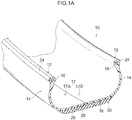
- FIG. 1A is a perspective view illustrating a cross-section of a part of a tire according to one embodiment of the invention
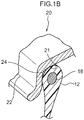
- Fig. 1B is a cross-sectional view of a bead portion mounted on a rim.
- the tire 10 according to the present embodiment has a cross-sectional shape that is substantially similar to those of conventional ordinary pneumatic rubber tires.
- the tire 10 includes a tire case 17 that includes: a pair of bead portions 12 that contact a bead sheet portion 21 and a rim flange 22 of a rim 20 illustrated in Fig. 1B ; side portions 14 that each outwardly extend from a bead portion 12 in the tire radial direction; and a crown portion 16 (outer circumferential portion) that connects the tire-radial-direction outer end of one side portion 14 and the tire-radial-direction outer end of the other side portion 14.
- a resinous material including a polyamide-based thermoplastic elastomer and a caprolactam may be used.
- the tire case 17 is made of a single resinous material in the present embodiment, the invention is not limited to this configuration, and thermoplastic resin materials having different properties may be used for the respective parts of the tire case 17 (for example, side portions 14, a crown portion 16 and bead portions 12), similar to conventional ordinary pneumatic rubber tires.
- a reinforcing member for example, a polymer or metal fiber, cord, non-woven fabric, or woven fabric
- the tire case 17 is a member obtained by joining together a pair of tire case half parts (tire frame pieces) 17A formed only of a resinous material.
- Each tire case half part 17A is formed by producing an integrated body composed of one bead portion 12, one side portion 14 and a half-width part of the crown portion 16 by molding such as injection molding.
- the tire case 17 is formed by disposing the formed tire case half parts 17A, which have the same annular shape, to face to each other, and joining them together at the tire equatorial plane.
- the tire case 17 is not limited to those obtained by joining together two members, and may be formed by joining together three or more members.
- Each of the tire case half parts 17A formed using at least the above-described resinous material may be shaped using, for example, vacuum molding, pressure forming, injection molding or melt casting. Therefore, vulcanization is unnecessary, the production process can greatly be simplified, and the forming time can be saved, as compared to the case of forming a tire case with rubber as in conventional techniques.
- the tire case half parts 17A have a bilaterally symmetric shape, i.e., one of the tire case half parts 17A has the same shape as the other tire case half part 17A. Therefore, there is also an advantage in that only one type of mold is required for forming the tire case half parts 17A.
- annular bead core 18 made only of a steel cord similar to those used in conventional ordinary pneumatic tires is embedded in each of the bead portions 12, as illustrated in Fig. 1B .
- the invention is not limited to this configuration, and the bead core 18 may be omitted as long as it is ensured that the bead portion 12 has rigidity, and mounting on the rim 20 can be performed successfully.
- the bead core 18 may alternatively be formed using, for example, an organic fiber cord, a resin-coated organic fiber cord, or a hard resin, instead of a steel cord.
- annular sealing layer 24 formed of a material (for example, rubber) having a higher sealing property than that of the resinous material forming a part or the whole of the tire case 17 is provided on a part of the bead portion 12 that contacts the rim 20 or at least on a part of the bead portion 12 that contacts the rim flange 22 of the rim 20.
- the sealing layer 24 may also be provided in a part in which the tire case 17 (the bead portion 12) and the bead seat 21 contact each other.
- a material softer than the resinous material that forms a part or the whole of the tire case 17 may be used as the material having a higher sealing property than that of the resinous material that forms a part or the whole of the tire case 17.
- thermoplastic resin thermoplastic elastomer
- a polyurethane-based resin a polyolefin-based resin
- a polystyrene-based thermoplastic resin a polyester resin
- a blend of any of these resins with a rubber or an elastomer a polyurethane-based resin, a polyolefin-based resin, a polystyrene-based thermoplastic resin, or a polyester resin, or a blend of any of these resins with a rubber or an elastomer.
- thermoplastic elastomer such as a polyester-based thermoplastic elastomer, a polyurethane-based thermoplastic elastomer, a polystyrene-based thermoplastic elastomer, a polyolefin-based thermoplastic elastomer, or a combination of two or more of these elastomers or a blend of any of these elastomers with a rubber.
- a reinforcing cord 26 having a higher rigidity than that of the resinous material forming a part or the whole of the tire case 17 is wound around the crown portion 16 in the circumferential direction of the tire case 17.
- the reinforcing cord 26 is helically wound to form a reinforcing cord layer 28 in a state in which at least a part of the reinforcing cord 26 is embedded in the crown portion 16 in cross-sectional view taken along the axial direction of tire case 17.
- a crown 30 formed of a material (for example, rubber) having a higher wear resistance than that of the resinous material forming a part or the whole of the tire case 17 is disposed at the tire-radial-direction outer circumferential side of the reinforcing cord layer 28.
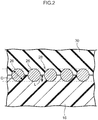
- Fig. 2 is a cross-sectional view taken along the tire rotation axis, which illustrates a state in which the reinforcing cord is embedded in the crown portion of the tire case of the tire according to the first embodiment.
- the reinforcing cord 26 is helically wound in a state in which at least a part of the reinforcing cord 26 is embedded in the crown portion 16 in a cross-sectional view taken along the axial direction of the tire case 17, and, together with a part of the outer circumferential portion of the tire case 17, forms the reinforcing cord layer 28 indicated by the intermittent lines in Fig. 2 .
- the part of the reinforcing cord 26 that is embedded in the crown portion 16 is in close contact with the resinous material forming a part or the whole of the crown portion 16 (the tire case 17).
- a monofilament (single filament) of a metal fiber, an organic fiber, or the like, or a multifilament (stranded filament) in which such fibers are stranded, such as a steel cord composed of stranded steel fibers, may be used as the reinforcing cord 26.
- a steel cord is used as the reinforcing cord 26.
- the depth L of embedding in Fig. 2 illustrates the depth of embedding of the reinforcing cord 26 in the tire case 17 (the crown portion 16) along the tire rotation axis direction.
- the depth L of embedding of the reinforcing cord 26 in the crown portion 16 is preferably equal to or greater than 1/5 of the diameter D of the reinforcing cord 26, and more preferably more than 1/2 of the diameter D of the reinforcing cord 26. It is most preferable that the entire reinforcing cord 26 is embedded in the crown portion 16.
- the depth L of embedding of the reinforcing cord 26 is more than 1/2 of the diameter D of the reinforcing cord 26, the reinforcing cord 26 is difficult to drop off from the embedded portion due to the dimensions of the reinforcing cord 26.
- the reinforcing cord layer 28 corresponds to a belt disposed on the outer circumferential surface of a carcass of a conventional pneumatic rubber tire.
- the crown 30 is disposed on the tire-radial-direction outer circumferential side of the reinforcing cord layer 28. It is preferable that the same type of rubber as that used for conventional pneumatic rubber tires is used as the rubber used for the crown 30.
- a crown formed of another type of resinous material having higher wear resistance than that of the resinous material forming a part or the whole of the tire case 17 may be used, in place of the crown 30.
- a crown pattern composed of plural grooves is formed on the contact surface that comes into contact with a road surface, similar to conventional pneumatic rubber tires. A method of manufacturing a tire according to the present embodiment is described below.
- tire case half parts are formed using a resinous material including the polyamide-based thermoplastic elastomer, as described above.
- the forming of these tire cases is preferably performed using injection molding.
- the tire case half parts supported by thin metal support rings are aligned to face each other.
- a jointing mold is placed so as to contact the outer circumferential surface of a butt portion of the tire case half parts.
- the jointing mold is configured to pressurize a region at or around the joint portion (the butt portion) of the tire case half parts 17A with a predetermined pressure.
- the pressure is applied to the region at or around the joint portion of the tire case half parts at a temperature equal to or higher than the melting point (or softening point) of the resinous material that forms a part or the whole of the tire case.
- the joint portion of the tire case half parts is heated and pressurized by the jointing mold, the joint portion is melted, and the tire case half parts are fused with each other, as a result of which the members are integrated to form the tire case 17.
- the invention is not limited thereto; heating of the joint portion may be carried out using, for example, a separately provided high frequency heater, or the tire case half parts may be bonded by softening or melting the joint portion, in advance, via application of hot air, irradiation with infrared radiation, or the like, and applying a pressure to the joint portion using the jointing mold.
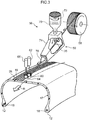
- Fig. 3 is an explanatory diagram explaining an operation to embed the reinforcing cord in the crown portion of the tire case using a cord heating device and rollers.
- Fig. 3 is an explanatory diagram explaining an operation to embed the reinforcing cord in the crown portion of the tire case using a cord heating device and rollers.
- a cord feeding apparatus 56 includes: a reel 58 on which a reinforcing cord 26 is wound; a cord heating device 59 disposed at the cord conveying direction downstream side of the reel 58; a first roller 60 disposed at the reinforcing cord 26 conveying direction downstream side of the cord heating device 59; a first cylinder device 62 for moving the first roller 60 in directions in which the first rollers comes into contact with and get away from the outer circumferential surface of the tire; a second roller 64 disposed at the reinforcing cord 26 conveying direction downstream side of the first roller 60; and a second cylinder device 66 for moving the second roller 64 in directions in which the second roller comes into contact with and get away from the outer circumferential surface of the tire.
- the second roller 64 can be used as a cooling roller formed of metal.
- the surfaces of the first roller 60 and the second roller 64 are coated with a fluororesin (in the present embodiment, TEFLON (registered trademark)) with a view to reducing adhesion of the melted or softened resinous material.
- TEFLON registered trademark
- the cord feeding apparatus 56 is configured to have two rollers of the first roller 60 and the second roller 64 in the present embodiment, the present invention is not limited to this configuration, and the cord feeding apparatus may be configured to have only one of these rollers (that is, a single roller).
- the cord heating device 59 includes a heater 70 and a fan 72 that generate hot air.
- the cord heating device 59 includes a heating box 74 into which hot air is supplied and in which the reinforcing cord 26 passes through the inside space thereof, and a discharge outlet 76 through which the heated reinforcing cord 26 is discharged.
- the temperature of the heater 70 of the cord heating device 59 is increased, and the air around the heater 70 heated by the heater 70 is sent to the heating box74 by an air current generated by the rotation of the fan 72.
- the reinforcing cord 26 drawn out from the reel 58 is fed to the inside of the heating box 74, of which the inner space is heated with hot air, whereby the reinforcing cord 26 is heated (for example, to increase the temperature of the reinforcing cord 26 to be approximately 100°C to 200°C).
- the heated reinforcing cord 26 passes through the discharge outlet 76, and is helically wound, with a constant tension, around the outer circumferential surface of the crown portion 16 of the tire case 17 rotating in the direction indicated by arrow R in Fig. 3 .
- the resinous material at the contact portion is melted or softened, and at least a part of the heated reinforcing cord 26 is embedded in the outer circumferential surface of the crown portion 16.
- the depth L of embedding of the reinforcing cord 26 can be adjusted by the heating temperature for the reinforcing cord 26, the tension acting on the reinforcing cord 26, the pressure applied by the first roller 60, and the like.
- the depth L of embedding of the reinforcing cord 26 is set to be equal to or greater than 1/5 of the diameter D of the reinforcing cord 26.
- the depth L of embedding of the reinforcing cord 26 is more preferably more than 1/2 of the diameter D of the reinforcing cord 26, and it is most preferable that the entire reinforcing cord 26 is embedded.
- a reinforcing cord layer 28 is formed on the outer circumferential side of the crown portion 16 of the tire case 17 by winding the heated reinforcing cord 26 on the outer circumferential surface of the crown portion 16 such that the heated reinforcing cord 26 is embedded in the outer circumferential surface of the crown portion 16.
- a belt-shaped vulcanized crown 30 is wound on the outer circumferential surface of the tire case 17 for one revolution, and the crown 30 is bonded to the outer circumferential surface of the tire case 17 using, for example, an adhesive.
- precured crowns known thus far for use in retreaded tires may be used as the crown 30.
- the present process is a process similar to the process of bonding a precured crown to the outer circumferential surface of a casing of a retreaded tire.
- a tire 10 can be completed by bonding a sealing layer 24 formed only of a vulcanized rubber to the bead portion 12 of the tire case 17 using, for example, an adhesive.
- the invention is not limited to this configuration.
- a hot airflow generation device may be used to heat the outer circumferential surface of the crown portion 16 in which the reinforcing cord 26 is to be embedded, and the reinforcing cord 26 may thereafter be embedded in the crown portion 16.
- the heat source of the cord heating device 59 includes the heater and the fan in the first embodiment, the invention is not limited to this configuration, and a configuration in which the reinforcing cord 26 is directly heated by radiation heat (for example, infrared radiation) may be adopted.
- radiation heat for example, infrared radiation
- the invention is not limited to this configuration; a configuration in which cold airflow is directly applied to the region at which the resinous is melted or softened, to forcibly cool and solidify the region at which the resinous is melted or softened may also be adopted.
- a configuration in which the reinforcing cord 26 is heated is adopted in the first embodiment
- a configuration in which the outer circumference of the reinforcing cord 26 is coated with the same resinous material as that of the tire case 17, for example may be adopted.
- incorporation of air during embedding the reinforcing cord in the crown portion 16 can effectively be reduced.
- the tire 10 in the first embodiment is what is referred to as a tubeless tire, in which an air chamber is formed between the tire 10 and the rim 20 by fitting the bead portions 12 to the rim 20.
- the invention is not limited to this configuration, and a complete tube shape may be adopted.
- the tire according to the invention may have a configuration in which a reinforcing cord member having a cord member covered with a resinous material is used, as illustrated in the second embodiment (Figs. 4 and 5) of Japanese Patent Application Laid-open ( JP-A) No. 2012-46030 .
- caprolactam 173 g of dodecanedioic acid and 37 g of aminohexanoic acid, which were manufactured by Aldrich, were added into a reaction vessel having a capacity of 2L and equipped with a stirrer, a nitrogen gas inlet and a condensed water discharge port.
- the air inside the reaction vessel was sufficiently replaced by nitrogen, and then the temperature was raised to 250 °C and a reaction was allowed to proceed for 4 hours at an elevated pressure elevated by 0.6 MPa.
- PA6 a polymer (HS) forming a hard segment
- PPG/PTMG/PPG JEFFAMINE (registered trademark) RT-1000 (tradename) manufactured by HUNTSMAN
- the mixture was stirred at 230 °C for 7 hours under nitrogen flow, and 7.1 g of caprolactam (manufactured by Aldrich) and 1 g of IRGANOX1010 (manufactured by BASF) were added thereto, whereby a white polyamide elastomer was obtained.
- the obtained polyamide elastomer was shaped into pellets, and injection-molded at 220 °C, thereby obtaining a sample piece.
- Various measurements were carried out using a sample obtained by stamping out a test piece from the sample piece.
- the polymer (HS) forming a hard segment, the polymer forming a soft segment, the ratio of hard segment HS to soft segment SS (mass ratio), and the additive and its content were set as indicated in Table 1.
- the HS was changed to a PA6 having a molecular weight of 1860.
- the charge amounts were changed such that the charge amount of the PA6 (HS) having a molecular weight of 1860 was 200 g, such that the charge amount of the PPG/PTMG/PPG was 108 g, and such that the charge amount of caprolactam was 6.2 g.
- a polyamide elastomer was obtained in the same manner as that in Example 1, except for the above points.
- the polymer (HS) forming a hard segment, the polymer forming a soft segment, the ratio of hard segment HS to soft segment SS (mass ratio), and the additive and its content were set as indicated in Table 1.
- the HS was changed to a PA6 having a molecular weight of 2030.
- the charge amounts were changed such that the charge amount of PA6 (HS) having a molecular weight of 2030 was 200 g, such that the charge amount of the PPG/PTMG/PPG (SS) was 99 g, and such that the charge amount of caprolactam was 12 g.
- a polyamide elastomer was obtained in the same manner as that in Example 1, except for the above points.
- the polymer (HS) forming a hard segment, the polymer forming a soft segment, the ratio of hard segment HS to soft segment SS (mass ratio), and the additive and its content were set as indicated in Table 1.
- the HS was changed to a PA6 having a molecular weight of 2330.
- the charge amounts were changed such that the charge amount of PA6 (HS) having a molecular weight of 2330 was 200 g, such that the charge amount of the PPG/PTMG/PPG (SS) was 86 g, and such that the charge amount of caprolactam was 25 g.
- a polyamide elastomer was obtained in the same manner as that in Example 1, except for the above points.
- the polymer (HS) forming a hard segment, the polymer forming a soft segment, the ratio of hard segment HS to soft segment SS (mass ratio), and the additive and its content were set as indicated in Table 2.
- the HS was changed to a PA6 having a molecular weight of 4670.
- the charge amounts were changed such that the charge amount of PA6 (HS) having a molecular weight of 4670 was 200 g, such that the soft segment was changed to 86 g of PPG (ELASTAMINE (registered trademark) RP-2009 manufactured by HUNTSMAN, diamine), and such that the charge amount of caprolactam was 24 g.
- a polyamide elastomer was obtained in the same manner as that in Example 1, except for the above points.
- the polymer (HS) forming a hard segment, the polymer forming a soft segment, the ratio of hard segment HS to soft segment SS (mass ratio), and the additive and its content were set as indicated in Table 2.
- the HS was changed to a PA12 having a molecular weight of 3000.
- the charge amounts were changed such that the charge amount of PA12 (HS) having a molecular weight of 3000 was 200 g, such that the charge amount of the PPG/PTMG./PPG (SS) was 67 g, and such that the charge amount of caprolactam was 10 g.
- a polyamide elastomer was obtained in the same manner as that in Example 1, except for the above points.
- the polymer (HS) forming a hard segment, the polymer forming a soft segment, the ratio of hard segment HS to soft segment SS (mass ratio), and the additive and its content were set as indicated in Table 2.
- the HS was changed to a PA6 having a molecular weight of 5670.
- the charge amounts were changed such that the charge amount of PA6 (HS) having a molecular weight of 5670 was 200 g, such that the charge amount of PPG (SS) was 35 g, and such that the charge amount of the additive (aminododecanoic acid) was 7.0 g.
- a polyamide elastomer was obtained in the same manner as that in Example 1, except for the above points.
- the polymer (HS) forming a hard segment, the polymer forming a soft segment, the ratio of hard segment HS to soft segment SS (mass ratio), and the additive and its content were set as indicated in Table 3.
- the HS was changed to a PA6 having a molecular weight of 2330.
- the charge amounts were changed such that the charge amount of PA6 (HS) having a molecular weight of 2330 was 200 g, such that the charge amount of the PPG/PTMG/PPG (SS) was 86 g, and such that the charge amount of caprolactam was 0 g (i.e., caprolactam was not added).
- a polyamide elastomer was obtained in the same manner as that in Example 1, except for the above points.
- grade A was assigned to samples capable of being shaped into a flat plate using a 15t injection molding machine
- grade B was assigned to samples having an inferior handleability (deficient metering) compared to that of grade A
- grade C was assigned to samples that exhibited deficient filling (high viscosity).
- a tire was produced using the polymer obtained in each of the Examples and the Comparative Examples, with reference to the first embodiment described above. Then, the tire was mounted on a rim. Grade A was assigned to a case in which air sealing was achieved, grade B was assigned to a case in which handleability at mounting on a rim was inferior due to hardness, and grade C was assigned to a case in which cracks occurred and/or air sealing was not achieved.
- a test piece having circular disk shape with a diameter of 8 mm that was stamped out from a 2 mm-thick sample piece was used for the measurement.
- loss tangent (tan ⁇ ) was measured at a temperature of 30 °C, a distortion of 1% and a frequency of 20 Hz using a viscoelasticity measuring instrument (manufactured by TA instruments).
- Grade A was assigned to a case in which the tan ⁇ was 0.08 or less
- grade B was assigned to a case in which the tan ⁇ was from more than 0.08 to 0.12
- grade C was assigned to a case in which the tan ⁇ was more than 0.12.
- the sample that exhibited the smallest loss among all the Examples and Comparative Examples was taken as the base (100), and the indices for the respective samples were indicated.
- the obtained sample was tested with respect to the moisture absorbing property thereof according to the following method.
- a test piece prepared using a 15t injection molding machine was left to stand in a constant-temperature constant-humidity environment of 23 °C and a relative humidity of 50%.
- the saturated moisture content observed when a weight change ended was measured using a Karl Fischer moisture titrator (manufactured by Mitsubishi Chemical Analytech Co., Ltd.).
- a hot press at 160 °C which simulates vulcanization, is performed on the injected piece:
Landscapes
- Chemical & Material Sciences (AREA)
- Health & Medical Sciences (AREA)
- Chemical Kinetics & Catalysis (AREA)
- Medicinal Chemistry (AREA)
- Polymers & Plastics (AREA)
- Organic Chemistry (AREA)
- Engineering & Computer Science (AREA)
- Mechanical Engineering (AREA)
- Tires In General (AREA)
- Compositions Of Macromolecular Compounds (AREA)
- Other Resins Obtained By Reactions Not Involving Carbon-To-Carbon Unsaturated Bonds (AREA)
Claims (10)
- Runder Reifenrahmen, umfassend ein Harzmaterial, das ein thermoplastisches Elastomer auf Polyamidbasis und ein Caprolactam einschließt,
wobei der Gehalt des thermoplastischen Elastomers auf Polyamidbasis in Bezug auf die Gesamtmenge des Harzmaterials 50 Massen-% oder mehr beträgt. - Reifenrahmen nach Anspruch 1, wobei ein Gehalt des Caprolactams im Harzmaterial 0,1 Massen-% bis 20 Massen-% beträgt.
- Reifenrahmen nach Anspruch 1 oder Anspruch 2, wobei das thermoplastische Elastomer auf Polyamidbasis Polyamid 6 als hartes Segment enthält.
- Reifen, umfassend den Reifenrahmen nach einem der Ansprüche 1 bis 3.
- Reifenrahmen nach Anspruch 1, wobei ein Gehalt des thermoplastischen Elastomers auf Polyamidbasis in Bezug auf eine Gesamtmenge des Harzmaterials 70 Massen-% oder mehr beträgt.
- Reifenrahmen nach Anspruch 1, wobei ein Massenverhältnis (HS/SS) von hartem Segment (HS) zu weichem Segment (SS) in einem Bereich von 55/45 bis 85/15 liegt,
wobei das harte Segment Polyamid umfasst,
das weiche Segment mindestens eines von Polyester oder Polyether umfasst, und
das Massenverhältnis (HS/SS) das Massenverhältnis in dem thermoplastischen Elastomer auf Polyamidbasis ist, gemessen unter Verwendung von 1H-NMR und 13C-NMR. - Reifenrahmen nach Anspruch 1, wobei ein gewichtsdurchschnittliches Molekulargewicht des thermoplastischen Elastomers auf Polyamidbasis 10000 bis 400000 beträgt und
wobei das gewichtsdurchschnittliche Molekulargewicht des thermoplastischen Elastomers auf Polyamidbasis unter Verwendung von Gelpermeationschromatographie gemessen wird. - Reifenrahmen nach Anspruch 1, wobei eine Zugfestigkeit des Harzmaterials 5 MPa oder mehr beträgt und
wobei die Zugfestigkeit des Harzmaterials gemäß JIS K7113: 1995 gemessen wird. - Reifenrahmen nach Anspruch 1, wobei eine Zugdehnung des Harzmaterials 10% oder mehr beträgt und
wobei die Zugdehnung des Harzmaterials gemäß JIS K7113: 1995 gemessen wird. - Reifenrahmen nach Anspruch 1, wobei eine Bruchdehnung des harzartigen Materials 50% oder mehr beträgt und
wobei die Bruchdehnung des Harzmaterials gemäß JIS K7113: 1995 gemessen wird.
Applications Claiming Priority (2)
| Application Number | Priority Date | Filing Date | Title |
|---|---|---|---|
| JP2014203499 | 2014-10-01 | ||
| PCT/JP2015/077966 WO2016052706A1 (ja) | 2014-10-01 | 2015-10-01 | タイヤ骨格体およびタイヤ |
Publications (3)
| Publication Number | Publication Date |
|---|---|
| EP3202853A4 EP3202853A4 (de) | 2017-08-09 |
| EP3202853A1 EP3202853A1 (de) | 2017-08-09 |
| EP3202853B1 true EP3202853B1 (de) | 2019-06-12 |
Family
ID=55630727
Family Applications (1)
| Application Number | Title | Priority Date | Filing Date |
|---|---|---|---|
| EP15847321.5A Not-in-force EP3202853B1 (de) | 2014-10-01 | 2015-10-01 | Reifenrahmen und reifen |
Country Status (5)
| Country | Link |
|---|---|
| US (1) | US20170233550A1 (de) |
| EP (1) | EP3202853B1 (de) |
| JP (1) | JP5989280B1 (de) |
| CN (1) | CN107075252A (de) |
| WO (1) | WO2016052706A1 (de) |
Families Citing this family (1)
| Publication number | Priority date | Publication date | Assignee | Title |
|---|---|---|---|---|
| CN111278664B (zh) * | 2017-10-25 | 2022-06-10 | 株式会社普利司通 | 轮胎用金属树脂复合构件及轮胎 |
Family Cites Families (11)
| Publication number | Priority date | Publication date | Assignee | Title |
|---|---|---|---|---|
| NL82877C (de) * | 1955-02-14 | |||
| JP2000095861A (ja) * | 1998-09-21 | 2000-04-04 | Unitika Ltd | ナイロン6樹脂組成物 |
| CA2627170C (en) * | 2005-10-27 | 2012-02-21 | Exxonmobil Chemical Patents Inc. | Low permeability thermoplastic elastomer composition |
| DE602005020532D1 (de) * | 2005-12-16 | 2010-05-20 | Exxonmobil Chem Patents Inc | Verfahrenshilfsmittel für elastomerzusammensetzungen |
| JP2007217445A (ja) * | 2006-02-14 | 2007-08-30 | Toray Ind Inc | 制電性ポリ乳酸樹脂組成物およびそれからなる成形品 |
| EP2197956B1 (de) * | 2007-10-11 | 2018-11-21 | ExxonMobil Chemical Patents Inc. | Effizientes mischverfahren zur herstellung einer thermoplastischen elastomerzusammensetzung |
| US7902287B2 (en) * | 2008-01-21 | 2011-03-08 | Basf Aktiengesellschaft | Polyamide resin composition and method of preparing |
| WO2009093695A1 (ja) * | 2008-01-23 | 2009-07-30 | Ube Industries, Ltd. | ゴム組成物、ベーストレッド用ゴム組成物、チェーファー用ゴム組成物、及びサイドウォール用ゴム組成物、並びにそれらを用いたタイヤ |
| CN102257063B (zh) * | 2008-12-17 | 2014-12-24 | 埃克森美孚化学专利公司 | 可用于流体阻挡应用的稳定化的动态硫化热塑性弹性体组合物 |
| CN103189215B (zh) * | 2010-08-25 | 2018-12-18 | 株式会社普利司通 | 轮胎、及轮胎的制造方法 |
| JP6034074B2 (ja) * | 2012-07-03 | 2016-11-30 | 旭化成株式会社 | 共重合ポリアミド |
-
2015
- 2015-10-01 WO PCT/JP2015/077966 patent/WO2016052706A1/ja not_active Ceased
- 2015-10-01 EP EP15847321.5A patent/EP3202853B1/de not_active Not-in-force
- 2015-10-01 US US15/515,152 patent/US20170233550A1/en not_active Abandoned
- 2015-10-01 JP JP2016514791A patent/JP5989280B1/ja not_active Expired - Fee Related
- 2015-10-01 CN CN201580053143.1A patent/CN107075252A/zh active Pending
Non-Patent Citations (1)
| Title |
|---|
| None * |
Also Published As
| Publication number | Publication date |
|---|---|
| CN107075252A (zh) | 2017-08-18 |
| EP3202853A4 (de) | 2017-08-09 |
| US20170233550A1 (en) | 2017-08-17 |
| EP3202853A1 (de) | 2017-08-09 |
| JP5989280B1 (ja) | 2016-09-07 |
| JPWO2016052706A1 (ja) | 2017-04-27 |
| WO2016052706A1 (ja) | 2016-04-07 |
Similar Documents
| Publication | Publication Date | Title |
|---|---|---|
| EP2980120B1 (de) | Reifen | |
| EP2979898B1 (de) | Reifen | |
| JP6333806B2 (ja) | タイヤ | |
| EP3392059A1 (de) | Reifen | |
| US10017007B2 (en) | Tire | |
| US10703139B2 (en) | Tire | |
| EP3202818B1 (de) | Reifen | |
| EP3199568B1 (de) | Reifen | |
| EP3202853B1 (de) | Reifenrahmen und reifen | |
| EP3202852B1 (de) | Reifengerippe und reifen | |
| EP3305548B1 (de) | Reifen | |
| JP6474273B2 (ja) | タイヤ |
Legal Events
| Date | Code | Title | Description |
|---|---|---|---|
| STAA | Information on the status of an ep patent application or granted ep patent |
Free format text: STATUS: THE INTERNATIONAL PUBLICATION HAS BEEN MADE |
|
| PUAI | Public reference made under article 153(3) epc to a published international application that has entered the european phase |
Free format text: ORIGINAL CODE: 0009012 |
|
| STAA | Information on the status of an ep patent application or granted ep patent |
Free format text: STATUS: REQUEST FOR EXAMINATION WAS MADE |
|
| 17P | Request for examination filed |
Effective date: 20170410 |
|
| A4 | Supplementary search report drawn up and despatched |
Effective date: 20170706 |
|
| AK | Designated contracting states |
Kind code of ref document: A1 Designated state(s): AL AT BE BG CH CY CZ DE DK EE ES FI FR GB GR HR HU IE IS IT LI LT LU LV MC MK MT NL NO PL PT RO RS SE SI SK SM TR |
|
| AX | Request for extension of the european patent |
Extension state: BA ME |
|
| DAV | Request for validation of the european patent (deleted) | ||
| DAX | Request for extension of the european patent (deleted) | ||
| STAA | Information on the status of an ep patent application or granted ep patent |
Free format text: STATUS: EXAMINATION IS IN PROGRESS |
|
| 17Q | First examination report despatched |
Effective date: 20180503 |
|
| GRAP | Despatch of communication of intention to grant a patent |
Free format text: ORIGINAL CODE: EPIDOSNIGR1 |
|
| STAA | Information on the status of an ep patent application or granted ep patent |
Free format text: STATUS: GRANT OF PATENT IS INTENDED |
|
| INTG | Intention to grant announced |
Effective date: 20181220 |
|
| GRAS | Grant fee paid |
Free format text: ORIGINAL CODE: EPIDOSNIGR3 |
|
| GRAA | (expected) grant |
Free format text: ORIGINAL CODE: 0009210 |
|
| STAA | Information on the status of an ep patent application or granted ep patent |
Free format text: STATUS: THE PATENT HAS BEEN GRANTED |
|
| AK | Designated contracting states |
Kind code of ref document: B1 Designated state(s): AL AT BE BG CH CY CZ DE DK EE ES FI FR GB GR HR HU IE IS IT LI LT LU LV MC MK MT NL NO PL PT RO RS SE SI SK SM TR |
|
| REG | Reference to a national code |
Ref country code: GB Ref legal event code: FG4D |
|
| REG | Reference to a national code |
Ref country code: CH Ref legal event code: EP |
|
| REG | Reference to a national code |
Ref country code: AT Ref legal event code: REF Ref document number: 1142496 Country of ref document: AT Kind code of ref document: T Effective date: 20190615 |
|
| REG | Reference to a national code |
Ref country code: DE Ref legal event code: R096 Ref document number: 602015032017 Country of ref document: DE |
|
| REG | Reference to a national code |
Ref country code: IE Ref legal event code: FG4D |
|
| REG | Reference to a national code |
Ref country code: NL Ref legal event code: MP Effective date: 20190612 |
|
| REG | Reference to a national code |
Ref country code: LT Ref legal event code: MG4D |
|
| PG25 | Lapsed in a contracting state [announced via postgrant information from national office to epo] |
Ref country code: HR Free format text: LAPSE BECAUSE OF FAILURE TO SUBMIT A TRANSLATION OF THE DESCRIPTION OR TO PAY THE FEE WITHIN THE PRESCRIBED TIME-LIMIT Effective date: 20190612 Ref country code: LT Free format text: LAPSE BECAUSE OF FAILURE TO SUBMIT A TRANSLATION OF THE DESCRIPTION OR TO PAY THE FEE WITHIN THE PRESCRIBED TIME-LIMIT Effective date: 20190612 Ref country code: NO Free format text: LAPSE BECAUSE OF FAILURE TO SUBMIT A TRANSLATION OF THE DESCRIPTION OR TO PAY THE FEE WITHIN THE PRESCRIBED TIME-LIMIT Effective date: 20190912 Ref country code: FI Free format text: LAPSE BECAUSE OF FAILURE TO SUBMIT A TRANSLATION OF THE DESCRIPTION OR TO PAY THE FEE WITHIN THE PRESCRIBED TIME-LIMIT Effective date: 20190612 Ref country code: AL Free format text: LAPSE BECAUSE OF FAILURE TO SUBMIT A TRANSLATION OF THE DESCRIPTION OR TO PAY THE FEE WITHIN THE PRESCRIBED TIME-LIMIT Effective date: 20190612 Ref country code: SE Free format text: LAPSE BECAUSE OF FAILURE TO SUBMIT A TRANSLATION OF THE DESCRIPTION OR TO PAY THE FEE WITHIN THE PRESCRIBED TIME-LIMIT Effective date: 20190612 |
|
| PG25 | Lapsed in a contracting state [announced via postgrant information from national office to epo] |
Ref country code: BG Free format text: LAPSE BECAUSE OF FAILURE TO SUBMIT A TRANSLATION OF THE DESCRIPTION OR TO PAY THE FEE WITHIN THE PRESCRIBED TIME-LIMIT Effective date: 20190912 Ref country code: GR Free format text: LAPSE BECAUSE OF FAILURE TO SUBMIT A TRANSLATION OF THE DESCRIPTION OR TO PAY THE FEE WITHIN THE PRESCRIBED TIME-LIMIT Effective date: 20190913 Ref country code: LV Free format text: LAPSE BECAUSE OF FAILURE TO SUBMIT A TRANSLATION OF THE DESCRIPTION OR TO PAY THE FEE WITHIN THE PRESCRIBED TIME-LIMIT Effective date: 20190612 Ref country code: RS Free format text: LAPSE BECAUSE OF FAILURE TO SUBMIT A TRANSLATION OF THE DESCRIPTION OR TO PAY THE FEE WITHIN THE PRESCRIBED TIME-LIMIT Effective date: 20190612 |
|
| REG | Reference to a national code |
Ref country code: AT Ref legal event code: MK05 Ref document number: 1142496 Country of ref document: AT Kind code of ref document: T Effective date: 20190612 |
|
| PG25 | Lapsed in a contracting state [announced via postgrant information from national office to epo] |
Ref country code: EE Free format text: LAPSE BECAUSE OF FAILURE TO SUBMIT A TRANSLATION OF THE DESCRIPTION OR TO PAY THE FEE WITHIN THE PRESCRIBED TIME-LIMIT Effective date: 20190612 Ref country code: NL Free format text: LAPSE BECAUSE OF FAILURE TO SUBMIT A TRANSLATION OF THE DESCRIPTION OR TO PAY THE FEE WITHIN THE PRESCRIBED TIME-LIMIT Effective date: 20190612 Ref country code: AT Free format text: LAPSE BECAUSE OF FAILURE TO SUBMIT A TRANSLATION OF THE DESCRIPTION OR TO PAY THE FEE WITHIN THE PRESCRIBED TIME-LIMIT Effective date: 20190612 Ref country code: RO Free format text: LAPSE BECAUSE OF FAILURE TO SUBMIT A TRANSLATION OF THE DESCRIPTION OR TO PAY THE FEE WITHIN THE PRESCRIBED TIME-LIMIT Effective date: 20190612 Ref country code: PT Free format text: LAPSE BECAUSE OF FAILURE TO SUBMIT A TRANSLATION OF THE DESCRIPTION OR TO PAY THE FEE WITHIN THE PRESCRIBED TIME-LIMIT Effective date: 20191014 Ref country code: CZ Free format text: LAPSE BECAUSE OF FAILURE TO SUBMIT A TRANSLATION OF THE DESCRIPTION OR TO PAY THE FEE WITHIN THE PRESCRIBED TIME-LIMIT Effective date: 20190612 Ref country code: SK Free format text: LAPSE BECAUSE OF FAILURE TO SUBMIT A TRANSLATION OF THE DESCRIPTION OR TO PAY THE FEE WITHIN THE PRESCRIBED TIME-LIMIT Effective date: 20190612 |
|
| PG25 | Lapsed in a contracting state [announced via postgrant information from national office to epo] |
Ref country code: IS Free format text: LAPSE BECAUSE OF FAILURE TO SUBMIT A TRANSLATION OF THE DESCRIPTION OR TO PAY THE FEE WITHIN THE PRESCRIBED TIME-LIMIT Effective date: 20191012 Ref country code: SM Free format text: LAPSE BECAUSE OF FAILURE TO SUBMIT A TRANSLATION OF THE DESCRIPTION OR TO PAY THE FEE WITHIN THE PRESCRIBED TIME-LIMIT Effective date: 20190612 Ref country code: ES Free format text: LAPSE BECAUSE OF FAILURE TO SUBMIT A TRANSLATION OF THE DESCRIPTION OR TO PAY THE FEE WITHIN THE PRESCRIBED TIME-LIMIT Effective date: 20190612 Ref country code: IT Free format text: LAPSE BECAUSE OF FAILURE TO SUBMIT A TRANSLATION OF THE DESCRIPTION OR TO PAY THE FEE WITHIN THE PRESCRIBED TIME-LIMIT Effective date: 20190612 |
|
| REG | Reference to a national code |
Ref country code: DE Ref legal event code: R097 Ref document number: 602015032017 Country of ref document: DE |
|
| PG25 | Lapsed in a contracting state [announced via postgrant information from national office to epo] |
Ref country code: TR Free format text: LAPSE BECAUSE OF FAILURE TO SUBMIT A TRANSLATION OF THE DESCRIPTION OR TO PAY THE FEE WITHIN THE PRESCRIBED TIME-LIMIT Effective date: 20190612 |
|
| PLBE | No opposition filed within time limit |
Free format text: ORIGINAL CODE: 0009261 |
|
| STAA | Information on the status of an ep patent application or granted ep patent |
Free format text: STATUS: NO OPPOSITION FILED WITHIN TIME LIMIT |
|
| PG25 | Lapsed in a contracting state [announced via postgrant information from national office to epo] |
Ref country code: DK Free format text: LAPSE BECAUSE OF FAILURE TO SUBMIT A TRANSLATION OF THE DESCRIPTION OR TO PAY THE FEE WITHIN THE PRESCRIBED TIME-LIMIT Effective date: 20190612 Ref country code: PL Free format text: LAPSE BECAUSE OF FAILURE TO SUBMIT A TRANSLATION OF THE DESCRIPTION OR TO PAY THE FEE WITHIN THE PRESCRIBED TIME-LIMIT Effective date: 20190612 |
|
| 26N | No opposition filed |
Effective date: 20200313 |
|
| PG25 | Lapsed in a contracting state [announced via postgrant information from national office to epo] |
Ref country code: IS Free format text: LAPSE BECAUSE OF FAILURE TO SUBMIT A TRANSLATION OF THE DESCRIPTION OR TO PAY THE FEE WITHIN THE PRESCRIBED TIME-LIMIT Effective date: 20200224 Ref country code: MC Free format text: LAPSE BECAUSE OF FAILURE TO SUBMIT A TRANSLATION OF THE DESCRIPTION OR TO PAY THE FEE WITHIN THE PRESCRIBED TIME-LIMIT Effective date: 20190612 Ref country code: SI Free format text: LAPSE BECAUSE OF FAILURE TO SUBMIT A TRANSLATION OF THE DESCRIPTION OR TO PAY THE FEE WITHIN THE PRESCRIBED TIME-LIMIT Effective date: 20190612 |
|
| REG | Reference to a national code |
Ref country code: CH Ref legal event code: PL |
|
| PG2D | Information on lapse in contracting state deleted |
Ref country code: IS |
|
| PG25 | Lapsed in a contracting state [announced via postgrant information from national office to epo] |
Ref country code: CH Free format text: LAPSE BECAUSE OF NON-PAYMENT OF DUE FEES Effective date: 20191031 Ref country code: LU Free format text: LAPSE BECAUSE OF NON-PAYMENT OF DUE FEES Effective date: 20191001 Ref country code: LI Free format text: LAPSE BECAUSE OF NON-PAYMENT OF DUE FEES Effective date: 20191031 |
|
| REG | Reference to a national code |
Ref country code: BE Ref legal event code: MM Effective date: 20191031 |
|
| PG25 | Lapsed in a contracting state [announced via postgrant information from national office to epo] |
Ref country code: BE Free format text: LAPSE BECAUSE OF NON-PAYMENT OF DUE FEES Effective date: 20191031 |
|
| GBPC | Gb: european patent ceased through non-payment of renewal fee |
Effective date: 20191001 |
|
| PG25 | Lapsed in a contracting state [announced via postgrant information from national office to epo] |
Ref country code: GB Free format text: LAPSE BECAUSE OF NON-PAYMENT OF DUE FEES Effective date: 20191001 Ref country code: IE Free format text: LAPSE BECAUSE OF NON-PAYMENT OF DUE FEES Effective date: 20191001 |
|
| PG25 | Lapsed in a contracting state [announced via postgrant information from national office to epo] |
Ref country code: CY Free format text: LAPSE BECAUSE OF FAILURE TO SUBMIT A TRANSLATION OF THE DESCRIPTION OR TO PAY THE FEE WITHIN THE PRESCRIBED TIME-LIMIT Effective date: 20190612 |
|
| PG25 | Lapsed in a contracting state [announced via postgrant information from national office to epo] |
Ref country code: MT Free format text: LAPSE BECAUSE OF FAILURE TO SUBMIT A TRANSLATION OF THE DESCRIPTION OR TO PAY THE FEE WITHIN THE PRESCRIBED TIME-LIMIT Effective date: 20190612 Ref country code: HU Free format text: LAPSE BECAUSE OF FAILURE TO SUBMIT A TRANSLATION OF THE DESCRIPTION OR TO PAY THE FEE WITHIN THE PRESCRIBED TIME-LIMIT; INVALID AB INITIO Effective date: 20151001 |
|
| PGFP | Annual fee paid to national office [announced via postgrant information from national office to epo] |
Ref country code: DE Payment date: 20211020 Year of fee payment: 7 |
|
| PGFP | Annual fee paid to national office [announced via postgrant information from national office to epo] |
Ref country code: FR Payment date: 20211022 Year of fee payment: 7 |
|
| PG25 | Lapsed in a contracting state [announced via postgrant information from national office to epo] |
Ref country code: MK Free format text: LAPSE BECAUSE OF FAILURE TO SUBMIT A TRANSLATION OF THE DESCRIPTION OR TO PAY THE FEE WITHIN THE PRESCRIBED TIME-LIMIT Effective date: 20190612 |
|
| REG | Reference to a national code |
Ref country code: DE Ref legal event code: R119 Ref document number: 602015032017 Country of ref document: DE |
|
| PG25 | Lapsed in a contracting state [announced via postgrant information from national office to epo] |
Ref country code: FR Free format text: LAPSE BECAUSE OF NON-PAYMENT OF DUE FEES Effective date: 20221031 Ref country code: DE Free format text: LAPSE BECAUSE OF NON-PAYMENT OF DUE FEES Effective date: 20230503 |