EP3202894A1 - Verfahren zur herstellung dreidimensionaler zellaggregate - Google Patents
Verfahren zur herstellung dreidimensionaler zellaggregate Download PDFInfo
- Publication number
- EP3202894A1 EP3202894A1 EP15846123.6A EP15846123A EP3202894A1 EP 3202894 A1 EP3202894 A1 EP 3202894A1 EP 15846123 A EP15846123 A EP 15846123A EP 3202894 A1 EP3202894 A1 EP 3202894A1
- Authority
- EP
- European Patent Office
- Prior art keywords
- cell
- cells
- pressure
- pressurization
- container
- Prior art date
- Legal status (The legal status is an assumption and is not a legal conclusion. Google has not performed a legal analysis and makes no representation as to the accuracy of the status listed.)
- Withdrawn
Links
Images


Classifications
-
- A—HUMAN NECESSITIES
- A61—MEDICAL OR VETERINARY SCIENCE; HYGIENE
- A61K—PREPARATIONS FOR MEDICAL, DENTAL OR TOILETRY PURPOSES
- A61K35/00—Medicinal preparations containing materials or reaction products thereof with undetermined constitution
- A61K35/12—Materials from mammals; Compositions comprising non-specified tissues or cells; Compositions comprising non-embryonic stem cells; Genetically modified cells
- A61K35/34—Muscles; Smooth muscle cells; Heart; Cardiac stem cells; Myoblasts; Myocytes; Cardiomyocytes
-
- A—HUMAN NECESSITIES
- A61—MEDICAL OR VETERINARY SCIENCE; HYGIENE
- A61L—METHODS OR APPARATUS FOR STERILISING MATERIALS OR OBJECTS IN GENERAL; DISINFECTION, STERILISATION OR DEODORISATION OF AIR; CHEMICAL ASPECTS OF BANDAGES, DRESSINGS, ABSORBENT PADS OR SURGICAL ARTICLES; MATERIALS FOR BANDAGES, DRESSINGS, ABSORBENT PADS OR SURGICAL ARTICLES
- A61L27/00—Materials for grafts or prostheses or for coating grafts or prostheses
- A61L27/36—Materials for grafts or prostheses or for coating grafts or prostheses containing ingredients of undetermined constitution or reaction products thereof, e.g. transplant tissue, natural bone, extracellular matrix
- A61L27/38—Materials for grafts or prostheses or for coating grafts or prostheses containing ingredients of undetermined constitution or reaction products thereof, e.g. transplant tissue, natural bone, extracellular matrix containing added animal cells
- A61L27/3804—Materials for grafts or prostheses or for coating grafts or prostheses containing ingredients of undetermined constitution or reaction products thereof, e.g. transplant tissue, natural bone, extracellular matrix containing added animal cells characterised by specific cells or progenitors thereof, e.g. fibroblasts, connective tissue cells, kidney cells
- A61L27/3826—Muscle cells, e.g. smooth muscle cells
-
- A—HUMAN NECESSITIES
- A61—MEDICAL OR VETERINARY SCIENCE; HYGIENE
- A61L—METHODS OR APPARATUS FOR STERILISING MATERIALS OR OBJECTS IN GENERAL; DISINFECTION, STERILISATION OR DEODORISATION OF AIR; CHEMICAL ASPECTS OF BANDAGES, DRESSINGS, ABSORBENT PADS OR SURGICAL ARTICLES; MATERIALS FOR BANDAGES, DRESSINGS, ABSORBENT PADS OR SURGICAL ARTICLES
- A61L27/00—Materials for grafts or prostheses or for coating grafts or prostheses
- A61L27/36—Materials for grafts or prostheses or for coating grafts or prostheses containing ingredients of undetermined constitution or reaction products thereof, e.g. transplant tissue, natural bone, extracellular matrix
- A61L27/38—Materials for grafts or prostheses or for coating grafts or prostheses containing ingredients of undetermined constitution or reaction products thereof, e.g. transplant tissue, natural bone, extracellular matrix containing added animal cells
- A61L27/3895—Materials for grafts or prostheses or for coating grafts or prostheses containing ingredients of undetermined constitution or reaction products thereof, e.g. transplant tissue, natural bone, extracellular matrix containing added animal cells using specific culture conditions, e.g. stimulating differentiation of stem cells, pulsatile flow conditions
-
- C—CHEMISTRY; METALLURGY
- C12—BIOCHEMISTRY; BEER; SPIRITS; WINE; VINEGAR; MICROBIOLOGY; ENZYMOLOGY; MUTATION OR GENETIC ENGINEERING
- C12M—APPARATUS FOR ENZYMOLOGY OR MICROBIOLOGY; APPARATUS FOR CULTURING MICROORGANISMS FOR PRODUCING BIOMASS, FOR GROWING CELLS OR FOR OBTAINING FERMENTATION OR METABOLIC PRODUCTS, i.e. BIOREACTORS OR FERMENTERS
- C12M23/00—Constructional details, e.g. recesses, hinges
- C12M23/02—Form or structure of the vessel
- C12M23/06—Tubular
-
- C—CHEMISTRY; METALLURGY
- C12—BIOCHEMISTRY; BEER; SPIRITS; WINE; VINEGAR; MICROBIOLOGY; ENZYMOLOGY; MUTATION OR GENETIC ENGINEERING
- C12M—APPARATUS FOR ENZYMOLOGY OR MICROBIOLOGY; APPARATUS FOR CULTURING MICROORGANISMS FOR PRODUCING BIOMASS, FOR GROWING CELLS OR FOR OBTAINING FERMENTATION OR METABOLIC PRODUCTS, i.e. BIOREACTORS OR FERMENTERS
- C12M23/00—Constructional details, e.g. recesses, hinges
- C12M23/02—Form or structure of the vessel
- C12M23/08—Flask, bottle or test tube
-
- C—CHEMISTRY; METALLURGY
- C12—BIOCHEMISTRY; BEER; SPIRITS; WINE; VINEGAR; MICROBIOLOGY; ENZYMOLOGY; MUTATION OR GENETIC ENGINEERING
- C12M—APPARATUS FOR ENZYMOLOGY OR MICROBIOLOGY; APPARATUS FOR CULTURING MICROORGANISMS FOR PRODUCING BIOMASS, FOR GROWING CELLS OR FOR OBTAINING FERMENTATION OR METABOLIC PRODUCTS, i.e. BIOREACTORS OR FERMENTERS
- C12M23/00—Constructional details, e.g. recesses, hinges
- C12M23/02—Form or structure of the vessel
- C12M23/10—Petri dish
-
- C—CHEMISTRY; METALLURGY
- C12—BIOCHEMISTRY; BEER; SPIRITS; WINE; VINEGAR; MICROBIOLOGY; ENZYMOLOGY; MUTATION OR GENETIC ENGINEERING
- C12M—APPARATUS FOR ENZYMOLOGY OR MICROBIOLOGY; APPARATUS FOR CULTURING MICROORGANISMS FOR PRODUCING BIOMASS, FOR GROWING CELLS OR FOR OBTAINING FERMENTATION OR METABOLIC PRODUCTS, i.e. BIOREACTORS OR FERMENTERS
- C12M23/00—Constructional details, e.g. recesses, hinges
- C12M23/38—Caps; Covers; Plugs; Pouring means
-
- C—CHEMISTRY; METALLURGY
- C12—BIOCHEMISTRY; BEER; SPIRITS; WINE; VINEGAR; MICROBIOLOGY; ENZYMOLOGY; MUTATION OR GENETIC ENGINEERING
- C12M—APPARATUS FOR ENZYMOLOGY OR MICROBIOLOGY; APPARATUS FOR CULTURING MICROORGANISMS FOR PRODUCING BIOMASS, FOR GROWING CELLS OR FOR OBTAINING FERMENTATION OR METABOLIC PRODUCTS, i.e. BIOREACTORS OR FERMENTERS
- C12M35/00—Means for application of stress for stimulating the growth of microorganisms or the generation of fermentation or metabolic products; Means for electroporation or cell fusion
- C12M35/04—Mechanical means, e.g. sonic waves, stretching forces, pressure or shear stimuli
-
- C—CHEMISTRY; METALLURGY
- C12—BIOCHEMISTRY; BEER; SPIRITS; WINE; VINEGAR; MICROBIOLOGY; ENZYMOLOGY; MUTATION OR GENETIC ENGINEERING
- C12M—APPARATUS FOR ENZYMOLOGY OR MICROBIOLOGY; APPARATUS FOR CULTURING MICROORGANISMS FOR PRODUCING BIOMASS, FOR GROWING CELLS OR FOR OBTAINING FERMENTATION OR METABOLIC PRODUCTS, i.e. BIOREACTORS OR FERMENTERS
- C12M41/00—Means for regulation, monitoring, measurement or control, e.g. flow regulation
- C12M41/40—Means for regulation, monitoring, measurement or control, e.g. flow regulation of pressure
-
- C—CHEMISTRY; METALLURGY
- C12—BIOCHEMISTRY; BEER; SPIRITS; WINE; VINEGAR; MICROBIOLOGY; ENZYMOLOGY; MUTATION OR GENETIC ENGINEERING
- C12N—MICROORGANISMS OR ENZYMES; COMPOSITIONS THEREOF; PROPAGATING, PRESERVING, OR MAINTAINING MICROORGANISMS; MUTATION OR GENETIC ENGINEERING; CULTURE MEDIA
- C12N5/00—Undifferentiated human, animal or plant cells, e.g. cell lines; Tissues; Cultivation or maintenance thereof; Culture media therefor
- C12N5/0062—General methods for three-dimensional culture
-
- C—CHEMISTRY; METALLURGY
- C12—BIOCHEMISTRY; BEER; SPIRITS; WINE; VINEGAR; MICROBIOLOGY; ENZYMOLOGY; MUTATION OR GENETIC ENGINEERING
- C12N—MICROORGANISMS OR ENZYMES; COMPOSITIONS THEREOF; PROPAGATING, PRESERVING, OR MAINTAINING MICROORGANISMS; MUTATION OR GENETIC ENGINEERING; CULTURE MEDIA
- C12N5/00—Undifferentiated human, animal or plant cells, e.g. cell lines; Tissues; Cultivation or maintenance thereof; Culture media therefor
- C12N5/06—Animal cells or tissues; Human cells or tissues
- C12N5/0602—Vertebrate cells
- C12N5/0652—Cells of skeletal and connective tissues; Mesenchyme
- C12N5/0661—Smooth muscle cells
-
- C—CHEMISTRY; METALLURGY
- C12—BIOCHEMISTRY; BEER; SPIRITS; WINE; VINEGAR; MICROBIOLOGY; ENZYMOLOGY; MUTATION OR GENETIC ENGINEERING
- C12M—APPARATUS FOR ENZYMOLOGY OR MICROBIOLOGY; APPARATUS FOR CULTURING MICROORGANISMS FOR PRODUCING BIOMASS, FOR GROWING CELLS OR FOR OBTAINING FERMENTATION OR METABOLIC PRODUCTS, i.e. BIOREACTORS OR FERMENTERS
- C12M3/00—Tissue, human, animal or plant cell, or virus culture apparatus
-
- C—CHEMISTRY; METALLURGY
- C12—BIOCHEMISTRY; BEER; SPIRITS; WINE; VINEGAR; MICROBIOLOGY; ENZYMOLOGY; MUTATION OR GENETIC ENGINEERING
- C12N—MICROORGANISMS OR ENZYMES; COMPOSITIONS THEREOF; PROPAGATING, PRESERVING, OR MAINTAINING MICROORGANISMS; MUTATION OR GENETIC ENGINEERING; CULTURE MEDIA
- C12N2521/00—Culture process characterised by the use of hydrostatic pressure, flow or shear forces
Definitions
- the present invention relates to a method for preparing a three-dimensional cell aggregate.
- Patent Document 1 solved the above-described problem.
- Patent Document 1 discloses a technique in which cultured cells are collected as a cell sheet simply by using a "temperature-responsive cell culture apparatus" and changing the culture temperature. Since the cultured cells obtained have not undergone enzyme treatment, they have the advantage that they can be collected as a single sheet without destroying proteins present between cells.
- Patent Document 1 For preparation of a cell sheet having more than a certain thickness, even the technique according to Patent Document 1 requires a laborious operation of stacking a plurality of monolayer cell sheets. There have been only a very limited number of reports in which cells were successfully formed into a three-dimensional multilayered sheet by a simple process. There has been no technique that can be used at a practical level.
- Patent Document 1 WO 01/068799
- An object of the present invention is to provide means for enabling preparation of a thick cell aggregate by a simple process without an operation of detaching and stacking of cells.
- the present inventors have intensively studied to discover that a thick sheet-shaped cell aggregate can be obtained simply by applying pressure to a cell suspension or a medium containing cells, and that, by carrying out addition of cells and application of pressure a plurality of times, a cell aggregate in which cells adhere to and aggregate with each other to form a sheet shape with a sufficient strength can be obtained, thereby completing the present invention.
- the present invention provides a method for preparing a three-dimensional cell aggregate, said method comprising: a cell encasing step of placing a cell suspension in a cell container; and a pressure application step of applying pressure to cells in said container.
- the present invention also provides a cell sheet comprising a three-dimensional cell aggregate prepared by the above-described method of the present invention.
- the present invention further provides a device for preparing a three-dimensional cell aggregate, said device comprising: a cell container for receiving a cell suspension therein; and pressure application means for applying pressure to cells in said cell container continuously, periodically, or intermittently, or in a manner in which a plurality of these modes are combined.
- a thick, robust cell aggregate can be obtained by a simple operation of applying pressure to a cell suspension or a medium comprising cells.
- a sheet-shaped cell aggregate can be prepared using a system having a simple constitution. Since the operation of stacking a plurality of cell sheets is not necessary, cells are hardly damaged, and the cells can be kept in a favorable state, so that the cells can be advantageously used as a tissue piece for transplantation.
- the cell aggregate obtained by the method of the present invention is expected to be practically used not only as a tissue piece for transplantation, but also in a variety of fields such as the field of drug discovery including evaluation of drug efficacy and drug screening, and the field of foods including artificial meat (cultured meat).
- the method for preparing a three-dimensional cell aggregate by the present invention comprises: a cell encasing step of placing a cell suspension in a cell container; and a pressure application step of applying pressure to cells in the container.
- the pressure application step may be carried out immediately after placing a cell suspension in the container, or may be delayed by a certain amount of time until cells in the suspension precipitate to the bottom of the container. That is, the present invention may comprise, between the cell encasing step and the pressure application step, a non-pressurization step of maintaining the cell suspension without pressurization.
- the length of the non-pressurization period is not limited, and may be appropriately set depending on the amount, the type, and the like of the cells used. Normally, most of the cells in the cell suspension precipitate when the cell suspension is left to stand for about 30 minutes to several hours. However, the cell suspension may be left to stand for not less than 12 hours, for example, not less than about 20 hours.
- the upper limit of the length of the non-pressurization period is also not limited. It is normally not more than about several days, for example, not more than about 72 hours.
- the cell encasing step and the pressure application step may be carried out two or more times repeatedly. That is, when the "cell encasing step ⁇ pressure application step" process is regarded as one routine, not less than two routines may be carried out. In cases where the cell encasing step and the pressure application step are carried out two or more times, the conditions of the pressurization treatment (pressurization pattern) may be the same or different among the pressure application steps. By repeating the addition of cells and the application of pressure, a thicker and more robust cell aggregate can be prepared. In cases where two or more routines are carried out, the number of times of the routines is not limited.
- the cell encasing step and the pressure application step may be carried out a large number of times for several weeks or for a longer period.
- the non-pressurization step may be included between the cell encasing step and the pressure application step.
- the length of time of the non-pressurization step may also be the same or different among the routines.
- the cells used in the present invention are animal cells, preferably mammalian cells such as human cells.
- the type of the cells is not limited, and smooth muscle cells, cardiac muscle cells, fibroblasts, myoblasts, cartilage cells, osteoblasts, and the like may be used.
- the cells may be those prepared by differentiation of pluripotent cells excluding human embryonic stem cells, such as induced pluripotent stem cells, or stem cells or precursor cells of various tissues.
- cells collected from the patient or another individual may be cultured, grown, and allowed to differentiate if necessary, to prepare a cell suspension.
- the cell suspension to be used may be prepared by culturing the cells by monolayer culture according to a conventional method in a culture vessel such as a petri dish, detaching the resulting monolayer cells and dispersing the monolayer into cells by treatment with an enzyme such as trypsin, performing centrifugation, removing the supernatant, and then adjusting the cell density appropriately.
- the medium in which cells are dispersed may be a culture medium commonly used for cell culture, or a buffer such as HEPES buffer (4-(2-HydroxyEthyl)-1-PiperazineEthaneSulfonic acid) or phosphate buffered saline.
- HEPES buffer 4-(2-HydroxyEthyl)-1-PiperazineEthaneSulfonic acid
- phosphate buffered saline phosphate buffered saline.
- the cell density in the cell suspension is adjusted to a sufficiently high cell density.
- the appropriate cell density may vary depending on the shape and the size of the cell container, and the size of the cell itself.
- the sufficient amount of the cells contained in the cell suspension may be larger than the amount with which a monolayer can be formed on the area of the bottom of the cell container in the direction of gravity during the pressure application.
- the area of the bottom in the direction of gravity corresponds to the inner area of the lower half of the syringe that is placed horizontally.
- a cell density of not less than 300,000 cells/mL is sufficient for the preparation of a three-dimensional cell aggregate.
- a cell suspension with a cell density corresponding to not less than 1000 cells per 1 cm 2 for example, not less than about 100,000 cells per 1 cm 2 , or not less than about 250,000 cells per 1 cm 2 , may be sufficiently used.
- the upper limit of the cell density is not limited, the cell density is usually not more than 10,000,000 cells per 1 cm 2 .
- the cell suspension may be prepared with only one kind of cells, or with a mixture of two or more kinds of cells.
- the cell suspension may be prepared with a mixture of cardiac muscle cells and vascular endothelial cells.
- the type of the cells to be added into the cell container may be changed.
- An artificial tissue may be constructed by stacking different cells using, for example, fibroblasts for the first two layers, smooth muscle cells for the next four layers, and endothelial cells for the uppermost layer.
- the cell container is not limited as long as its material does not adversely affect living cells, and as long as the container has a strength which provides resistance to the pressurization treatment.
- the shape of the cell container is also not limited, and the container may be a container having a cylindrical shape such as a syringe or a tube; a container having a flask-like shape; or a container having a flat shape such as a culture dish.
- the cell container may be, for example, a non-sealed container having an opening communicating with the gas phase outside the container. In cases where a non-sealed, lidded container is used, the gap between the lid and the main body of the container acts as the opening, and allows the communication with the gas phase outside the container.
- the pressure application is usually carried out in a state where the cell container is left to stand, a lid is not always necessary for the cell container.
- the pressure application is usually carried out in a state where the cell container is placed in a pressure vessel that is resistant to high pressure.
- By sending compressed air into the pressure vessel pressure can be applied to the cells (medium containing the cells) in the cell container.
- the pressurization method using compressed air is more preferred since such a method can be carried out with a simple system configuration and makes it possible to more freely select the shape of the cell container.
- the inner wall of the cell container does not necessarily have to be subjected to surface treatment for cell adhesion (collagen coating, polylysine coating, or the like).
- surface treatment for cell adhesion collagen coating, polylysine coating, or the like.
- the inner wall without such surface treatment for cell adhesion makes it easier to harvest the cell aggregate after the pressurization treatment.
- the inner wall of the cell container may be subjected to surface treatment for cell adhesion.
- the cell suspension or the medium containing the cells is under atmospheric pressure.
- "application of pressure to cells in a container” means that the medium containing the cells is placed under a pressure higher than atmospheric pressure.
- "atmospheric pressure” means a pressure of about 100 kPa to about 101 kPa. The state where the cell suspension or the medium containing the cells is under only atmospheric pressure may be expressed as "non-pressurized" state.
- the pressure applied to the cell suspension or the medium containing the cells may be not less than about 102 kPa, preferably not less than about 110 kPa, for example, not less than 150 kPa, or about 180 kPa.
- the upper limit of the pressure is not limited, and may be appropriately selected depending on the type of the cells.
- the pressure is usually not more than 100 MPa, or may be, for example, not more than about 1000 kPa, not more than about 500 kPa, not more than about 400 kPa, or not more than about 300 kPa.
- the length of the pressurization treatment is not limited, and may be appropriately set depending on the type of the cells used, the cell number, and/or the like. Usually, a pressurization treatment for about several ten minutes is sufficient for allowing aggregation and adhesion of the cells, and thus a three-dimensional cell aggregate can be obtained.
- the length of the pressurization treatment in each pressure application step may be, for example, not less than about 30 minutes, not less than about 90 minutes, not less than about 3 hours, or not less than about 5 hours.
- the upper limit of the length of the pressurization treatment in each pressure application step is also not limited.
- the length of the pressurization treatment in each pressure application step is usually not more than about several days, and may be, for example, not more than about 72 hours, or not more than about 48 hours. However, since a desired cell aggregate can be obtained even in cases where the pressure application step is carried out for a longer period, the upper limit of the length of each pressurization treatment is not limited to those described above, and the pressurization treatment may be carried out for a period of more than several days, for example, for a period of about one or two months. Although replacement of the medium (culture medium or buffer) of the cell suspension is not necessarily required in the present invention, replacement of the medium may be carried out, if necessary, during the pressurization treatment or at another appropriate time for maintaining an environment preferred for the cells.
- the pressurization pattern is not limited, and the pressurization may be carried out continuously or periodically. Pressure may be continuously applied at a constant intensity through the pressurization treatment period, or the pressure applied may be changed at intervals of several seconds to several minutes or several hundred seconds to perform periodic pressurization treatment.
- a pressurization pattern based on combination of three or more kinds of pressure for example, 300 kPa ⁇ atmospheric pressure ⁇ 150 kPa ⁇ atmospheric pressure
- periodic pressurization with the same cycle may be continued, or the pressurization pattern may be changed during the step.
- a preferred pressurization pattern can be appropriately selected depending on the type of the cells used, the cell number, and/or the like.
- "application of a pressure of 180 kPa for 90 minutes” means not only continuous application of a pressure of 180 kPa to the cells in the medium for 90 minutes, but also repeating of pressurization at 180 kPa for several seconds to several hundred seconds and pressurization at a lower pressure or non-pressurization (atmospheric pressure) for several seconds to several hundred seconds, and includes e.g. carrying out a cycle of "application of a pressure at 180 kPa for 10 seconds ⁇ atmospheric pressure for 10 seconds" for 90 minutes.
- the temperature during the pressurization treatment may be appropriately set depending on the type of the cells used. Usually, temperature conditions employed for culturing the cells used are employed. In cases of animal cells, the temperature normally used is about 30°C to 40°C, and, in cases of human somatic cells, the temperature may be about 35°C to 38°C. However, the temperature is not limited, and may be lowered to about room temperature or a low temperature which does not cause freezing (about 15°C). In cases where the non-pressurization step is included, the temperature during the non-pressurization step may be the same as the temperature during the pressure application step, or may be different from the temperature during the pressure application step.
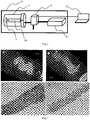
- Fig. 1 An example of the system or device for carrying out the method of the present invention is shown in Fig. 1 .
- the term "cell suspension” includes not only liquids in a state where cells are dispersed in the entire medium, but also liquids in a state where cells in the medium have precipitated downward to make the cell density uneven.
- the pressure application means for applying pressure to cells in the cell container includes a compressor 8 and a regulator 6.
- a pressure vessel 4 for holding a cell container 2 therein is connected to the compressor 8 through the regulator 6, and these are placed in an incubator 10 as a closed space.
- the regulator 6 is connected to a computer 12 placed outside the incubator 10, and the intensity and the pattern of the pressure applied to a cell suspension 14 in the cell container 2 are controlled by instructions from the computer 12.
- the pressure application means and the pressure vessel holding the cell container therein are held in the closed space, but in the present invention, their arrangement is not limited as long as at least the cell container is held in the closed space.
- the closed space herein means a space where the composition of the gas and the temperature in the space can be controlled independently of those in the outside thereof.
- the pressure vessel 4 has an appropriate internal shape that is suitable for the cell container 2 used.
- the cell container 2 held in the pressure vessel 4 is a non-sealed container (in an example shown in Fig. 1 , the cell container 2 is a non-sealed syringe whose tip is open), and the cell suspension 14 communicates with the outside (the gas phase in the incubator 10) through the regulator 6.
- the pressure may be set to about 100 kPa to 101 kPa.
- the non-pressurization step may be carried out between the cell encasing step and the pressure application step.
- This system therefore allows continuous pressurization, periodic pressurization, or pressurization in a manner in which their combination is intermittently carried out. That is, in this system, the computer 12 can give instructions such that pressure is applied continuously, periodically, or intermittently, or in a manner in which a plurality of these modes are combined.
- the CO 2 concentration in the closed space (in the incubator) may be a concentration that is used for culturing the cells in a normal manner. In cases of human somatic cells, the CO 2 concentration is generally set to 5.0%.
- the CO 2 concentration in the incubator 10 may be adjusted such that the pH of the cell suspension is appropriately maintained. That is, the system shown in Fig. 1 may have means for adjusting the CO 2 concentration in the closed space (in the incubator), i.e. the CO 2 concentration in the air to be sent into the pressure vessel.
- the pH of the cell suspension can be appropriately maintained by keeping the CO 2 concentration in the incubator 10 constant without fluctuating it.
- the control of the CO 2 concentration is not necessarily required.
- the CO 2 concentration in the incubator 10 may be kept at 5.0%.
- the range within which the CO 2 concentration is controlled during the pressurization treatment is not limited, and may be appropriately selected depending on the type of the cells, intensity of the pressure, and/or the like.
- the CO 2 concentration during the pressure application step may be controlled within the range of about 3.0% to 5.0%, for example, about 3.5% to 5.0%.
- the CO 2 concentration may be controlled such that the CO 2 concentration during the non-pressurization is about 5.0%, and the CO 2 concentration during the pressurization is about 3.5%.
- the CO 2 concentration during the pressure application step may be kept constant at a concentration slightly lower than that during ordinary cell culture.
- the CO 2 concentration during the non-pressurization step may be kept at 5.0%, and the CO 2 concentration during the pressure application step may be kept constant at not less than 3.0% and less than 5.0% (e.g., at about 3.5%).
- the system may have a constitution as follows. That is, as pressure application means, a container for holding a medium, and a pump, are arranged instead of the compressor 8, and a liquid transfer line which connects them to the inside of the cell container 2 held in the pressure vessel 4 is provided. In this constitution, pressure is applied to the medium to send the medium into the cell container 2, thereby carrying out the pressurization treatment.
- a porous membrane having pores with a size that does not allow the cells held in the container to pass therethrough may be arranged at the connecting portion between the liquid transfer line and the cell container, so that the cells can be prevented from escaping to the outside of the cell container due to backflow or the like.
- the pressure vessel may be integrated with the cell container to be used as a cell container with resistance to high pressure.
- a system constitution in which automatic or manual replacement of the medium can be carried out as needed may be employed.
- replacement of the medium can be carried out at the same time by removing part of the medium after pressurization treatment and newly adding the cell suspension.
- a waste line that allows discarding of the medium in the cell container 2 to the outside of the container, and pressure control means on the waste line such as a regulator for controlling the hydrostatic pressure of the medium may be arranged, to provide a constitution in which the medium can be replaced not only at the time of addition of the cell suspension, but also at any other time.
- a porous membrane may be arranged similarly to the connecting portion between the liquid transfer line and the cell container 2.
- a cell tissue body consisting essentially of cells (cells and substances produced from the cells) can be produced without using a three-dimensional scaffolding such as a porous scaffolding composed of a polymer, biomolecule or the like that has been conventionally and indispensably used for production of a three-dimensional cell aggregate.
- a three-dimensional scaffolding such as a porous scaffolding composed of a polymer, biomolecule or the like that has been conventionally and indispensably used for production of a three-dimensional cell aggregate.
- aggregation and adhesion of cells to each other can be promoted by only performing pressurization treatment without coexistence of a porous three-dimensional scaffolding in the cell suspension, to obtain a thick cell cluster.
- a certain scaffolding may be used depending on the purpose of use of the cell aggregate.
- the three-dimensional cell aggregate obtained by the method of the present invention can be utilized as it is as a cell sheet.
- the operation of stacking of a plurality of monolayer cultured cells is necessary for production of a thick multilayer cell sheet.
- operation of sequentially stacking prepared monolayer cells is not carried out, so that the production process is simple, and the damage on the cells can be largely reduced.
- the size and the shape of the cell aggregate may be influenced also by the shape of the cell container used, it is also possible to control the size and the shape of the cell aggregate by selection of the cell container.
- Cells such as human umbilical arterial smooth muscle cells were subjected to monolayer culture in a petri dish, and the resulting monolayer cells were detached by treatment with trypsin, followed by dispersing the cells in DMEM medium supplemented with 10% bovine serum. After centrifugation, the supernatant was removed, and the cell density was appropriately adjusted to one million cells/mL to several million cells/mL.
- pressurization treatment of the cells was carried out.
- 300 ⁇ L of human smooth muscle cell suspension with a cell density of 1,000,000 cells/mL prepared as described above was placed, and the syringe was then held in a pressure vessel in an incubator.
- the conditions in the incubator were set at 5% CO 2 , 37°C, and the CO 2 concentration was controlled at 3.6% to 5.0% during the pressurization treatment.
- the pressurization treatment was carried out by repeating "180 kPa for 10 seconds ⁇ 110 kPa for 10 seconds".
- Minute 90 and Hour 15 during the course of the pressurization treatment, the conditions of the cells in the syringe were observed.
- the cells were found to be aggregating and adhering to each other to form a sheet-like shape.
- Fig. 2A shows a cell cluster observed at Hour 15 during the pressurization treatment.
- Fig. 2B shows cells obtained without the pressurization treatment.
- Fig. 2C and Fig. 2D show images of HE-stained sections of the obtained cell clusters. Since a high-density cell suspension was used, cells aggregated with each other to some extent even without the pressurization treatment. However, as shown by the HE-stained image, the cell cluster had only low robustness, and its thickness was small, so that the cell cluster was unusable as a cell sheet ( Fig. 2B and Fig. 2D ). In contrast, in the case where the pressurization treatment was carried out, most of the cells in the suspension aggregated with each other to produce a cell cluster having a thickness of not less than 100 ⁇ m ( Fig. 2A, Fig. 2C ).
- Nuclei were also found inside the cell cluster.
- the cell cluster was highly robust, in which the cells were tightly aggregating. This cell cluster was further cultured at 37°C for up to 24 hours, and then observed. As a result, the cells were found to be retaining the shape as a sheet-shaped cell aggregate without causing disaggregation of the cells and breakage of the cell cluster.
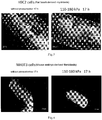
- Fig. 3 shows photographs of cells obtained by subjecting a suspension of rat heart-derived myoblasts H9C2 to pressurization treatment (right) or to incubation without pressurization treatment (left).
- Fig. 4 shows photographs of cells obtained by subjecting a suspension of mouse embryo-derived fibroblasts NIH3T3 to pressurization treatment (right) or to incubation without pressurization treatment (left). It could be confirmed that a highly robust sheet-shaped cell cluster can be obtained with these cells similarly to the smooth muscle cells.
- the density of the cell suspension was 1,950,000 cells/mL in the case of the rat heart-derived myoblasts H9C2, and 3,150,000 cells/mL in the case of the mouse embryo-derived fibroblasts NIH3T3.
- the volume of the suspension placed in the syringe was 300 ⁇ L in both cases.
- the pressurization treatment was carried out by repeating "180 kPa for 10 seconds ⁇ 110 kPa for 10 seconds". The treatment time was 17 hours
- a method in which addition of cells to the cell container and application of pressure were repeated ( FIG. 5 , the following (1) to (3)) was carried out to prepare cell aggregates.
- As the cell container a square or circular glass culture dish was used. The culture dish was coated with fibronectin.
- the pressurization pattern employed was a cycle of 110 kPa for 250 seconds ⁇ 180 kPa for 250 seconds (0.002 Hz). The temperature in the incubator was kept at 37°C, and the CO 2 concentration was kept at 5% during the process including the pressure application step.
- Fig. 6 shows photographs of cell aggregates prepared as described in (1) to (3) above. When the sheets were pulled using tweezers, the sheets extended about 1.8-fold without breakage. Thus, robust cell sheets could be prepared.
- cell aggregates were prepared by repeating addition of cells and pressurization treatment or by only repeating addition of cells and leaving the cells to stand under atmospheric pressure without pressurization treatment, and the obtained cell aggregates were compared with each other.
- a square glass culture dish (0.8 cm 2 ) was used as the cell container. The culture dish was coated with fibronectin. The CO 2 concentration was kept constant at 5%, and the temperature was kept at 37°C.
- Cell aggregates obtained by (1) and (2) were fixed with formalin, and their paraffin sections were prepared and stained with HE.
- Fig. 8 shows the HE-stained images.
- the cell aggregate of (1) which was prepared with pressurization, showed four or more layers of cells arranged in a laminar pattern.
- the cell aggregate of (2) which was prepared without pressurization, hardly showed layered cells, and no laminar pattern could be found.
- rat neonatal aortic smooth muscle cells were pressurized at 110-180 kPa at 0.002 Hz for 24 hours. On the next day, 1,000,000 cells were further added to the culture dish. During the treatment, the CO 2 concentration was kept constant at 5%, and the temperature was kept at 37°C. This process was repeated 15 times, and a cell aggregate having 15 layers was obtained one month later.
- Fig. 12 shows an image of an Elastica-van Gieson-stained section of the cell aggregate obtained. The scale bar represents 100 ⁇ m. The thickness of the cell aggregate was as large as more than 200 ⁇ m. Viable cells were stained with trypan blue and counted to find that the viable cell ratio was not less than 90%.
Landscapes
- Health & Medical Sciences (AREA)
- Life Sciences & Earth Sciences (AREA)
- Engineering & Computer Science (AREA)
- Chemical & Material Sciences (AREA)
- Zoology (AREA)
- Wood Science & Technology (AREA)
- Bioinformatics & Cheminformatics (AREA)
- Organic Chemistry (AREA)
- Biomedical Technology (AREA)
- Biotechnology (AREA)
- Genetics & Genomics (AREA)
- General Health & Medical Sciences (AREA)
- Microbiology (AREA)
- Biochemistry (AREA)
- General Engineering & Computer Science (AREA)
- Cell Biology (AREA)
- Sustainable Development (AREA)
- Clinical Laboratory Science (AREA)
- Veterinary Medicine (AREA)
- Public Health (AREA)
- Animal Behavior & Ethology (AREA)
- Epidemiology (AREA)
- Medicinal Chemistry (AREA)
- Developmental Biology & Embryology (AREA)
- Analytical Chemistry (AREA)
- Dermatology (AREA)
- Botany (AREA)
- Transplantation (AREA)
- Oral & Maxillofacial Surgery (AREA)
- Chemical Kinetics & Catalysis (AREA)
- Rheumatology (AREA)
- Virology (AREA)
- Vascular Medicine (AREA)
- Immunology (AREA)
- Urology & Nephrology (AREA)
- Pharmacology & Pharmacy (AREA)
- Cardiology (AREA)
- Mechanical Engineering (AREA)
- Micro-Organisms Or Cultivation Processes Thereof (AREA)
- Apparatus Associated With Microorganisms And Enzymes (AREA)
Applications Claiming Priority (3)
| Application Number | Priority Date | Filing Date | Title |
|---|---|---|---|
| JP2014198224 | 2014-09-29 | ||
| JP2015033064 | 2015-02-23 | ||
| PCT/JP2015/077447 WO2016052472A1 (ja) | 2014-09-29 | 2015-09-29 | 三次元細胞集合体の作製方法 |
Publications (2)
| Publication Number | Publication Date |
|---|---|
| EP3202894A1 true EP3202894A1 (de) | 2017-08-09 |
| EP3202894A4 EP3202894A4 (de) | 2018-05-23 |
Family
ID=55630499
Family Applications (1)
| Application Number | Title | Priority Date | Filing Date |
|---|---|---|---|
| EP15846123.6A Withdrawn EP3202894A4 (de) | 2014-09-29 | 2015-09-29 | Verfahren zur herstellung dreidimensionaler zellaggregate |
Country Status (4)
| Country | Link |
|---|---|
| US (1) | US10669525B2 (de) |
| EP (1) | EP3202894A4 (de) |
| JP (1) | JP6733126B2 (de) |
| WO (1) | WO2016052472A1 (de) |
Cited By (1)
| Publication number | Priority date | Publication date | Assignee | Title |
|---|---|---|---|---|
| WO2019148864A1 (zh) * | 2018-01-30 | 2019-08-08 | 京东方科技集团股份有限公司 | 细胞片层转移装置和细胞片层处理设备 |
Families Citing this family (9)
| Publication number | Priority date | Publication date | Assignee | Title |
|---|---|---|---|---|
| WO2018208628A1 (en) * | 2017-05-06 | 2018-11-15 | Memphis Meats, Inc. | Compositions and methods for increasing the culture density of a cellular biomass within a cultivation infrastructure |
| WO2019014652A1 (en) | 2017-07-13 | 2019-01-17 | Memphis Meats, Inc. | COMPOSITIONS AND METHODS FOR INCREASING THE EFFICACY OF CELL CULTURES USED IN FOOD PRODUCTION |
| SG11202104869SA (en) * | 2018-11-23 | 2021-06-29 | Valneva Se | Food products comprising avian stem cells |
| EP3969571A4 (de) | 2019-05-14 | 2023-05-24 | Aleph Farms Ltd. | Pluripotente zellaggregate und ihre verwendung |
| CN113755432B (zh) * | 2020-07-17 | 2022-06-10 | 上海我武干细胞科技有限公司 | 干细胞培养方法 |
| JP7569546B2 (ja) | 2020-09-25 | 2024-10-18 | 公立大学法人横浜市立大学 | 消化管被覆材及び移植用材料 |
| AU2022269414A1 (en) | 2021-05-06 | 2023-12-14 | Yeda Research And Development Co. Ltd. | Method for inducing hypertrophic muscle fibers for industrial meat production |
| US20250382577A1 (en) * | 2022-05-12 | 2025-12-18 | Institute Of Science Tokyo | Tendon/ligament-like artificial tissue produced using three-dimensional mechanosignaling cell culture system |
| WO2023240152A1 (en) | 2022-06-07 | 2023-12-14 | Upside Foods, Inc. | Engineering cell lines capable of proliferation in growth factor free media formulations |
Family Cites Families (13)
| Publication number | Priority date | Publication date | Assignee | Title |
|---|---|---|---|---|
| JPS63226204A (ja) | 1987-03-17 | 1988-09-20 | 海洋科学技術センタ− | 圧力容器を用いた生物培養装置 |
| US6528052B1 (en) * | 2000-09-29 | 2003-03-04 | The Board Of Trustees Of The Leland Stanford Junior University | Method for in vivo ex vivo and in vitro repair and regeneration of cartilage and collagen and bone remodeling |
| JP3865354B2 (ja) * | 2000-03-02 | 2007-01-10 | 高木産業株式会社 | 細胞又は組織の培養方法 |
| DK1264877T3 (da) | 2000-03-16 | 2013-10-28 | Cellseed Inc | Celledyrkningsbæremateriale, fremgangsmåde til samdyrkning af celler og samdyrket cellelag opnået derved |
| JP2004283010A (ja) * | 2003-03-19 | 2004-10-14 | Toyobo Co Ltd | 細胞の培養方法、細胞培養物及び医用生体材料 |
| JP4182326B2 (ja) | 2002-05-28 | 2008-11-19 | 東洋紡績株式会社 | 細胞の保存方法 |
| ATE408666T1 (de) | 2002-05-28 | 2008-10-15 | Toyo Boseki | Verfahren zur kultur, zum speichern und zur induzierung von differenzierung von zellen und gerät zur verwendung in diesem verfahren, und dazugehöriges gebrauchsverfahren. |
| JP4607432B2 (ja) * | 2003-05-12 | 2011-01-05 | 高木産業株式会社 | 細胞又は組織の培養装置 |
| US8414928B2 (en) | 2006-12-06 | 2013-04-09 | George R. Dodge | Methods for the generation of cartilage-like material by mechanical loading |
| US9410113B2 (en) * | 2007-10-26 | 2016-08-09 | St3 Development Corporation | Bioreactor system for three-dimensional tissue stimulator |
| JP5624981B2 (ja) | 2008-06-24 | 2014-11-12 | ザ・キュレーターズ・オブ・ザ・ユニバーシティ・オブ・ミズーリThe Curators Ofthe University Of Missouri | 自己集合性多細胞体、および前記多細胞体を用いて3次元の生物構造体を作製する方法 |
| JP2010022269A (ja) | 2008-07-18 | 2010-02-04 | Soka Univ | 細胞の保存方法及びその装置 |
| JP2010148401A (ja) | 2008-12-24 | 2010-07-08 | Soka Univ | 細胞保存容器 |
-
2015
- 2015-09-29 US US15/515,013 patent/US10669525B2/en active Active
- 2015-09-29 WO PCT/JP2015/077447 patent/WO2016052472A1/ja not_active Ceased
- 2015-09-29 JP JP2016552042A patent/JP6733126B2/ja active Active
- 2015-09-29 EP EP15846123.6A patent/EP3202894A4/de not_active Withdrawn
Cited By (2)
| Publication number | Priority date | Publication date | Assignee | Title |
|---|---|---|---|---|
| WO2019148864A1 (zh) * | 2018-01-30 | 2019-08-08 | 京东方科技集团股份有限公司 | 细胞片层转移装置和细胞片层处理设备 |
| US11680235B2 (en) | 2018-01-30 | 2023-06-20 | Boe Technology Group Co., Ltd. | Cell sheet transfer device and cell sheet processing equipment |
Also Published As
| Publication number | Publication date |
|---|---|
| US10669525B2 (en) | 2020-06-02 |
| JPWO2016052472A1 (ja) | 2017-07-13 |
| EP3202894A4 (de) | 2018-05-23 |
| JP6733126B2 (ja) | 2020-07-29 |
| US20170218329A1 (en) | 2017-08-03 |
| WO2016052472A1 (ja) | 2016-04-07 |
Similar Documents
| Publication | Publication Date | Title |
|---|---|---|
| US10669525B2 (en) | Method for producing three-dimensional cell aggregates | |
| CN104321419B (zh) | 细胞培养系统和细胞培养方法 | |
| CN107267442A (zh) | 微载体上的多能干细胞培养 | |
| WO2014039938A1 (en) | Spherical multicellular aggregates with endogenous extracellular matrix | |
| JP6492106B2 (ja) | 3d組織培養のための細胞の調製方法 | |
| US20170067019A1 (en) | Method of Continuous Mass Production of Progenitor Stem-like Cells Using a Bioreactor System | |
| US7439057B2 (en) | Convective flow tissue assembly | |
| EP3770248A1 (de) | Zellkulturverfahren, verfahren zur herstellung eines zellträgerverbundstoffs, kultivierte zelle und zellträgerverbundstoff | |
| JPH06327462A (ja) | 細胞凝集体の形成方法 | |
| CN109790515B (zh) | 细胞组织的制造方法及多孔膜 | |
| US20220228108A1 (en) | Cell culture base material and cell culture base material with cells | |
| EP3196293B1 (de) | Dreidimensionales zellkultursystem und zellkulturverfahren damit | |
| EP3456811B1 (de) | Zellkultursubstrat, zellkulturbehälter und verfahren für zellkultur | |
| WO2005014774A1 (ja) | 動物細胞の培養担体と、該培養担体を用いた動物細胞の培養方法および移植方法 | |
| US20120058560A1 (en) | Bioreactor System | |
| WO2023278285A1 (en) | Stackable plates for culturing tissue models | |
| JP6422221B2 (ja) | 多能性幹細胞からなる細胞塊製造方法 | |
| JP2017131144A (ja) | 三次元細胞集合体作製用材料、三次元細胞集合体作製用組成物、三次元細胞集合体作製用セット、組成物収容容器、及び三次元細胞集合体の作製方法 | |
| EP3730604A1 (de) | Verfahren zur herstellung einer blattförmigen zellkultur | |
| US20210054319A1 (en) | Flow bioreactor device for monitoring cellular dynamics | |
| US11142776B2 (en) | Delivery of biomolecules into cells through carbon nanotube arrays | |
| JP2016111988A (ja) | 三次元細胞集合体、並びにその製造方法及び形成用溶液 | |
| WO2017044158A1 (en) | Method of continuous mass production of progenitor stem-like cells using a bioreactor system | |
| Shojaie et al. | Generation of ESC-derived mouse airway epithelial cells using decellularized lung scaffolds | |
| WO2020189645A1 (ja) | 細胞培養担体、並びにその製造方法及び製造装置 |
Legal Events
| Date | Code | Title | Description |
|---|---|---|---|
| STAA | Information on the status of an ep patent application or granted ep patent |
Free format text: STATUS: THE INTERNATIONAL PUBLICATION HAS BEEN MADE |
|
| PUAI | Public reference made under article 153(3) epc to a published international application that has entered the european phase |
Free format text: ORIGINAL CODE: 0009012 |
|
| STAA | Information on the status of an ep patent application or granted ep patent |
Free format text: STATUS: REQUEST FOR EXAMINATION WAS MADE |
|
| 17P | Request for examination filed |
Effective date: 20170413 |
|
| AK | Designated contracting states |
Kind code of ref document: A1 Designated state(s): AL AT BE BG CH CY CZ DE DK EE ES FI FR GB GR HR HU IE IS IT LI LT LU LV MC MK MT NL NO PL PT RO RS SE SI SK SM TR |
|
| AX | Request for extension of the european patent |
Extension state: BA ME |
|
| DAV | Request for validation of the european patent (deleted) | ||
| DAX | Request for extension of the european patent (deleted) | ||
| A4 | Supplementary search report drawn up and despatched |
Effective date: 20180424 |
|
| RIC1 | Information provided on ipc code assigned before grant |
Ipc: C12M 3/00 20060101ALI20180419BHEP Ipc: C12N 5/00 20060101ALI20180419BHEP Ipc: C12N 5/07 20100101AFI20180419BHEP Ipc: C12M 1/12 20060101ALI20180419BHEP Ipc: C12M 1/34 20060101ALI20180419BHEP Ipc: C12M 1/00 20060101ALI20180419BHEP Ipc: C12M 1/24 20060101ALI20180419BHEP Ipc: C12M 1/22 20060101ALI20180419BHEP |
|
| STAA | Information on the status of an ep patent application or granted ep patent |
Free format text: STATUS: EXAMINATION IS IN PROGRESS |
|
| 17Q | First examination report despatched |
Effective date: 20201204 |
|
| GRAP | Despatch of communication of intention to grant a patent |
Free format text: ORIGINAL CODE: EPIDOSNIGR1 |
|
| STAA | Information on the status of an ep patent application or granted ep patent |
Free format text: STATUS: GRANT OF PATENT IS INTENDED |
|
| RIC1 | Information provided on ipc code assigned before grant |
Ipc: C12N 5/07 20100101AFI20210512BHEP Ipc: C12M 3/00 20060101ALI20210512BHEP Ipc: C12M 1/00 20060101ALI20210512BHEP Ipc: C12M 1/12 20060101ALI20210512BHEP Ipc: C12M 1/24 20060101ALI20210512BHEP Ipc: C12M 1/22 20060101ALI20210512BHEP Ipc: C12M 1/34 20060101ALI20210512BHEP Ipc: C12N 5/00 20060101ALI20210512BHEP Ipc: C12N 5/077 20100101ALI20210512BHEP Ipc: C12M 1/42 20060101ALI20210512BHEP Ipc: A61K 35/34 20150101ALI20210512BHEP Ipc: A61L 27/38 20060101ALI20210512BHEP |
|
| INTG | Intention to grant announced |
Effective date: 20210604 |
|
| STAA | Information on the status of an ep patent application or granted ep patent |
Free format text: STATUS: THE APPLICATION IS DEEMED TO BE WITHDRAWN |
|
| 18D | Application deemed to be withdrawn |
Effective date: 20211015 |