EP3203261A1 - Objekterkennungsvorrichtung - Google Patents
Objekterkennungsvorrichtung Download PDFInfo
- Publication number
- EP3203261A1 EP3203261A1 EP15846981.7A EP15846981A EP3203261A1 EP 3203261 A1 EP3203261 A1 EP 3203261A1 EP 15846981 A EP15846981 A EP 15846981A EP 3203261 A1 EP3203261 A1 EP 3203261A1
- Authority
- EP
- European Patent Office
- Prior art keywords
- reception
- coordinates
- unit
- reception unit
- transmission
- Prior art date
- Legal status (The legal status is an assumption and is not a legal conclusion. Google has not performed a legal analysis and makes no representation as to the accuracy of the status listed.)
- Granted
Links
Images


Classifications
-
- G—PHYSICS
- G01—MEASURING; TESTING
- G01S—RADIO DIRECTION-FINDING; RADIO NAVIGATION; DETERMINING DISTANCE OR VELOCITY BY USE OF RADIO WAVES; LOCATING OR PRESENCE-DETECTING BY USE OF THE REFLECTION OR RERADIATION OF RADIO WAVES; ANALOGOUS ARRANGEMENTS USING OTHER WAVES
- G01S15/00—Systems using the reflection or reradiation of acoustic waves, e.g. sonar systems
- G01S15/88—Sonar systems specially adapted for specific applications
- G01S15/93—Sonar systems specially adapted for specific applications for anti-collision purposes
- G01S15/931—Sonar systems specially adapted for specific applications for anti-collision purposes of land vehicles
-
- B—PERFORMING OPERATIONS; TRANSPORTING
- B60—VEHICLES IN GENERAL
- B60R—VEHICLES, VEHICLE FITTINGS, OR VEHICLE PARTS, NOT OTHERWISE PROVIDED FOR
- B60R21/00—Arrangements or fittings on vehicles for protecting or preventing injuries to occupants or pedestrians in case of accidents or other traffic risks
-
- G—PHYSICS
- G01—MEASURING; TESTING
- G01S—RADIO DIRECTION-FINDING; RADIO NAVIGATION; DETERMINING DISTANCE OR VELOCITY BY USE OF RADIO WAVES; LOCATING OR PRESENCE-DETECTING BY USE OF THE REFLECTION OR RERADIATION OF RADIO WAVES; ANALOGOUS ARRANGEMENTS USING OTHER WAVES
- G01S15/00—Systems using the reflection or reradiation of acoustic waves, e.g. sonar systems
- G01S15/87—Combinations of sonar systems
- G01S15/876—Combination of several spaced transmitters or receivers of known location for determining the position of a transponder or a reflector
- G01S15/878—Combination of several spaced transmitters or receivers of known location for determining the position of a transponder or a reflector wherein transceivers are operated, either sequentially or simultaneously, both in bi-static and in mono-static mode, e.g. cross-echo mode
-
- G—PHYSICS
- G01—MEASURING; TESTING
- G01S—RADIO DIRECTION-FINDING; RADIO NAVIGATION; DETERMINING DISTANCE OR VELOCITY BY USE OF RADIO WAVES; LOCATING OR PRESENCE-DETECTING BY USE OF THE REFLECTION OR RERADIATION OF RADIO WAVES; ANALOGOUS ARRANGEMENTS USING OTHER WAVES
- G01S15/00—Systems using the reflection or reradiation of acoustic waves, e.g. sonar systems
- G01S15/88—Sonar systems specially adapted for specific applications
- G01S15/93—Sonar systems specially adapted for specific applications for anti-collision purposes
-
- G—PHYSICS
- G01—MEASURING; TESTING
- G01S—RADIO DIRECTION-FINDING; RADIO NAVIGATION; DETERMINING DISTANCE OR VELOCITY BY USE OF RADIO WAVES; LOCATING OR PRESENCE-DETECTING BY USE OF THE REFLECTION OR RERADIATION OF RADIO WAVES; ANALOGOUS ARRANGEMENTS USING OTHER WAVES
- G01S5/00—Position-fixing by co-ordinating two or more direction or position line determinations; Position-fixing by co-ordinating two or more distance determinations
- G01S5/18—Position-fixing by co-ordinating two or more direction or position line determinations; Position-fixing by co-ordinating two or more distance determinations using ultrasonic, sonic or infrasonic waves
- G01S5/22—Position of source determined by co-ordinating a plurality of position lines defined by path-difference measurements
-
- G—PHYSICS
- G08—SIGNALLING
- G08G—TRAFFIC CONTROL SYSTEMS
- G08G1/00—Traffic control systems for road vehicles
- G08G1/16—Anti-collision systems
Definitions
- the present disclosure relates to an object detection device.
- a conventional object detection device is mounted in a vehicle, and detects an object by transmitting a transmission wave to a detection range and receiving a reflected wave resulting from the reflection by the object within the detection range.
- the above object detection device is used for an automatic control such as automatically applying brakes, for example, when an object has been detected.
- an object detection device mounted in a vehicle is designed so that low objects to a certain degree are not included within a detection range (for example, PTL 1).
- the transmission direction of a transmission wave is set to a horizontal direction, and when the vehicle body is inclined and there is a possibility that a low-height object as mentioned above is included within the detection range, the detection range is reduced by decreasing the gain of the reception of a reflected wave.
- An object detection device includes a transmission unit for transmitting a transmission wave to a detection range, a first reception unit for receiving a reflected wave resulting from reflection of the transmission wave transmitted from the transmission unit by an object within the detection range, a second reception unit for receiving a reflected wave resulting from reflection of the transmission wave transmitted from the transmission unit by the object within the detection range, and a third reception unit for receiving a reflected wave resulting from the reflection of the transmission wave transmitted from the transmission unit by the object within the detection range.
- the object detection device further includes a determination unit for determining presence or absence of an object to be avoided, based on outputs of the first reception unit, the second reception unit, and the third reception unit.
- the determination unit calculates first coordinates at which the object is estimated to be present, based on a first reception time from when the transmission unit transmits a transmission wave until a reflected wave is received by the first reception unit, and a second reception time from when the transmission unit transmits a transmission wave until a reflected wave is received by the second reception unit, and calculates second coordinates at which the object is estimated to be present, based on the second reception time, and a third reception time from when the transmission unit transmits a transmission wave until a reflected wave is received by the third reception unit.
- the determination unit compares a distance between the first coordinates and the second coordinates with a prescribed reference distance, determines that the object needs to be avoided in a case where the distance between the first coordinates and the second coordinates is less than the reference distance, and determines that an object is not the object to be avoided in a case where the distance between the first coordinates and the second coordinates is equal to or larger than the reference distance.
- the distance by which an object can be detected (hereinafter, referred to as a "detection distance") is shortened when the detection range is reduced.
- An object of the present disclosure is to provide an object detection device that can suppress reduction of the detection distance, while reducing occurrence of incorrect detections.
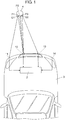
- FIG. 1 is a diagram for describing an operation of an object detection device according to an exemplary embodiment of the present disclosure.
- FIG. 2 is a diagram of vehicle 3 seen from the front side, and shows arrangement of reception units 11 to 14.
- FIG. 3 is a diagram of vehicle 3 seen from the left side, and shows the arrangement of reception units 11 to 14.
- the object detection device of the present exemplary embodiment has reception units 11 to 14, and a determination unit, disposed on the front side of vehicle 3.
- Each of reception units 11 to 14 outputs a voltage value corresponding to strength of an incident ultrasonic wave.
- Determination unit 2 determines presence or absence of object 4 which needs to be avoided (hereinafter, referred to as an "obstacle"), based on the outputs of reception units 11 to 14.
- object 4 to be determined as unnecessary to avoid is set to low-height object 4 to a degree capable of being driven over by vehicle 3, such as a low step, a road stud, or a curbstone, with a height of approximately 10 cm.
- Each of reception units 11 to 14 has a piezoelectric element (not shown), and a signal processing circuit (not shown).
- the signal processing circuit performs suitable signal processing, such as amplification or noise removal, by being interposed between the piezoelectric element and determination unit 2.
- the piezoelectric elements of reception units 11 to 14 are fixed by being arranged in a left-right direction on the front side of vehicle 3. Note that, while these piezoelectric elements are fixed on the front side in the present exemplary embodiment, the piezoelectric elements may be fixed on the rear side.
- Determination unit 2 determines the presence or absence of an obstacle in a prescribed detection range formed in front (or behind) vehicle 3.
- the left-right direction will be described based on FIG. 1 .
- the up-down direction of FIG. 1 is referred to as the front-rear direction of vehicle 3.
- the direction in which the surface that receives a reflected wave is facing, and in which the detection range is formed (upwards in FIG. 1 ), in reception units 11 to 14 is referred to as the front.
- Each of reception units 11 to 14 is disposed at a position higher than the height of object 4 capable of being driven over by vehicle 3 (that is, not considered as an obstacle).
- reception units 12 and 13 disposed in the center have a driving circuit for driving the piezoelectric element in accordance with a signal input from determination unit 2.
- Reception units 12 and 13 function as transmission units for transmitting a transmission wave to the detection range.
- reception units 12 and 13 are disposed at positions higher than reception units 11 and 14.
- the reception units capable of being used as transmission units are the reception units capable of being disposed in the center out of the three reception units for driving, specifically, reception unit 12 and reception unit 13.
- reception unit 12 and reception unit 13 only one reception unit is used at a time as a transmission unit. That is, only one of reception unit 12 and reception unit 13 is used at a time as a transmission unit.
- reception units 11 to 14 are used at a time. That is, when reception unit 12 is used as a transmission unit, reception unit 14 is not used, and reception units 11 to 13 are used, as reception units. On the other hand, when reception unit 13 is used as a transmission unit, reception unit 11 is not used, and reception units 12 to 14 are used as reception units.
- reception unit 12 when reception unit 12 is used as a transmission unit, the detection range is formed inclined more to the left than when reception unit 13 is used as a transmission unit.
- FIG. 1 shows an example where reception unit 12 is used as a transmission unit.
- Determination unit 2 has, for example, a storage unit (not shown) in which programs and data are stored, and a micro controller that operates in accordance with the programs stored in the storage unit. Determination unit 2 may be integrated in one chip. Moreover, a part of each of reception units 11 to 14 (for example, the signal processing circuit) may be integrated in one chip along with determination unit 2.
- reception units 11 to 13 are used as reception units.
- Determination unit 2 controls reception unit 12 so as to periodically transmit pulse-type transmission waves (ultrasonic waves).
- the duration of a transmission wave is shortened to the extent that reverberations in reception unit 12 are sufficiently attenuated before a reflected wave is received from the closest distance estimated from when transmission has started.
- the transmission interval of the transmission waves is longer than the time until a reflected wave is received from an estimated longest distance, and is as short as possible.
- determination unit 2 compares an output voltage with a prescribed reception threshold, and sets a timing at which the output voltage is equal to or higher than the reception threshold as a reception timing at which a reflected wave has been received. Note that, since reverberations are generated directly after the transmission of a transmission wave in reception unit 12, which is also utilized as a transmission unit, the output of reception unit 12 is ignored until a time has elapsed to the extent that the reverberations have sufficiently attenuated after the transmission of a transmission wave. In addition, for each of reception units 11 to 13, determination unit 2 measures a time from an immediate timing at which a transmission wave has been transmitted until the above reception timing (hereinafter, referred to as a "reception time").
- a sum of the distance from a point P1 at which the received reflected wave has been reflected (hereinafter, referred to as a "reflection point") to the transmission unit (that is, reception unit 12) and the distance from reception unit 11 that receives the reflected wave to reflection point P1 is obtained.
- a sum of the distance from reflection point P2 to the transmission unit and the distance from reception unit 12 that receives the reflected wave to reflection point P2 is obtained, and a sum of the distance from reflection point P3 to the transmission unit (that is, reception unit 12) and the distance from reception unit 13 that receives the reflected wave to reflection point P3 is obtained.
- reception unit 12 is also utilized as a transmission unit, the above ellipsoidal surface will have a distance between focal points that is 0 (that is, a spherical surface) for reception unit 12.
- determination unit 2 calculates, as coordinates Q1, coordinates of a point further on the front side with respect to reception unit 12, out of the intersection of an ellipsoidal surface obtained from the reception time in reception unit 11 (hereinafter, referred to as a "first reception time"), a spherical surface obtained from the reception time in reception unit 12 (hereinafter, referred to as a "second reception time”), and a horizontal surface that includes reception unit 12.
- first reception time an ellipsoidal surface obtained from the reception time in reception unit 11
- second reception time a spherical surface obtained from the reception time in reception unit 12
- determination unit 2 calculates, as coordinates Q2, coordinates of a point further on the front side with respect to reception unit 12, out of the intersection of a spherical surface obtained from the second reception time, an ellipsoidal surface obtained from the reception time in reception unit 13 (hereinafter, referred to as a "third reception time"), and a horizontal surface that includes reception unit 12.
- coordinates Q1 are at a position (coordinates) of reflection point P1 (P2), under the assumption that reflection point P1 that reflects a reflected wave received by reception unit 11 and reflection point P2 that reflects a reflected wave received by reception unit 12 are the same, and this reflection point P1 (P2) is located on a same horizontal surface as reception unit 12.
- coordinates Q2 are at a position (coordinates) of reflection point P2 (P3), under the assumption that second reflection point P2 and reflection point P3 that reflects a reflected wave received by reception unit 13 are the same, and this reflection point is located on a same horizontal surface as reception unit 12. Therefore, if the above assumptions are correct, coordinates Q1, coordinates Q2, and the positions of all of reflection points P1 to P3 coincide with one another, that is, the distance between coordinates Q1 and coordinates Q2 becomes 0.
- the distance between coordinates Q1. and coordinates Q2 increases. That is, in the case where the height of object 4 is lower than the height of reception units 11 to 13, the distance between coordinates Q1 and coordinates Q2 increases more than that in the case where the height of object 4 is higher than the height of reception units 11 to 13.
- determination unit 2 compares the distance between coordinates Q1 and coordinates Q2 (hereinafter, referred to as a "determination distance") with a prescribed reference distance.
- determination unit 2 determines that object 4 is an obstacle (that is, object 4 needs to be avoided), such as the ball shown in FIG. 1 .
- determination unit 2 outputs a prescribed electric signal (hereinafter, referred to as a "detection signal") to the outside.
- the detection signal is used, for example, as warning, or a trigger of automatic emergency brakes.
- determination unit 2 determines that object 4 is not an obstacle, since object 4 has a height lower than the height of reception units 11 to 13 and can be driven over by vehicle 3.
- the occurrence of incorrect detections can be reduced without reducing the detection range.
- reception unit 11 and reception unit 13 are disposed at mutually different heights, as shown in FIG. 2 and FIG. 3 .
- the determination distance increases since the distance between first reflection point P1 and third reflection point P3 increases in the case of object 4 with a low height. Therefore, in the object detection device of the present exemplary embodiment, it is easier to determine that object 4 is not an obstacle. That is, the occurrence of incorrect detections, such as object 4 with a height capable of being driven over by vehicle 3 and not to be detected as an obstacle, being detected as an obstacle, can be reduced.
- reception unit 11 may be disposed at a position higher than reception unit 13.
- both reception unit 11 and reception unit 14 may be disposed at positions higher than reception unit 12 and reception unit 13.
- the object detection device of the present exemplary embodiment described with reference to FIG. 1 includes a transmission unit (reception unit 12) for transmitting a transmission wave to a detection range, reception unit 11 for receiving a reflected wave resulting from the reflection of the transmission wave transmitted from the transmission unit (reception unit 12) by object 4 within the detection range, reception unit 12 for receiving a reflected wave resulting from the reflection of the transmission wave transmitted from the transmission unit (reception unit 12) by object 4 within the detection range, and reception unit 13 for receiving a reflected wave resulting from the reflection of the transmission wave transmitted from the transmission unit (reception unit 12) by object 4 within the detection range.
- the object detection device further includes determination unit 2 for determining the presence or absence of object 4 to be avoided, based on outputs of reception unit 11, reception unit 12, and reception unit 13.
- determination unit 2 calculates first coordinates Q1 at which object 4 is estimated to be present, based on a first reception time from when the transmission unit (reception unit 12) transmits a transmission wave until a reflected wave is received by reception unit 11, and a second reception time from when the transmission unit (reception unit 12) transmits a transmission wave until a reflected wave is received by reception unit 12. Further, determination unit 2 calculates second coordinates Q2 at which object 4 is estimated to be present, based on the second reception time, and a third reception time from when the transmission unit transmits a transmission wave until a reflected wave is received by reception unit 13.
- determination unit 2 compares a distance between first coordinates Q1 and second coordinates Q2 with a prescribed reference distance, determines that object 4 needs to be avoided in the case where the distance between first coordinates Q1 and second coordinates Q2 is less than the reference distance, and determines that object 4 does not need to be avoided in the case where the distance between first coordinates Q1 and second coordinates Q2 is equal to or larger than the reference distance.
- reception unit 12 is used as a transmission unit.
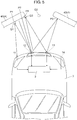
- FIG. 4 is a diagram for describing the operation, in an object detection device according to an exemplary embodiment of the present disclosure, in the case where object 4 that reflects a transmission wave is a wall.
- Object 4 shown in FIG. 4 has a determination distance that is equal to or larger than the reference distance since a distance between reflection point P1 and reflection point P3 is large, even though object 4 has a high height and needs to be avoided.
- the strength of a reflected wave (a peak value of the output voltages of reception units 11 to 13) is increased more than that in the case of object 4 with a low height that can be driven over by vehicle 3.
- determination unit 2 compares the peak value of the output voltage of each of reception units 11 to 13 (the strength of a reflected wave) with a reference threshold.
- object 4 is determined to be an obstacle if the peak value of the output voltages of all of reception units 11 to 13 is equal to or higher than the reference threshold, even if the determination distance is equal to or larger than the reference distance.
- determination unit 2 determines that object 4 is not an obstacle, in the case where the determination distance is equal to or larger than the reference distance, and the peak value of the output voltage in any one of reception units 11 to 13 is less than the reference threshold.
- the above reference threshold is the value at which the strength of a reflected wave (a peak value of the output voltages of reception units 11 to 13) in object (obstacle) 4 to be avoided is estimated to exceed, and is set higher than a reception threshold used for determination of a reception timing.
- the strength of a reflected wave in object 4 with a height lower than the height of reception units 11 to 13 decreases as the distance with object 4 increases, if the distance with object 4 is equal to or larger than a certain distance.
- the strength decreases as the distance with object 4 decreases, if the distance with object 4 is equal to or smaller than a certain distance, due to the directivity of each of reception units 11 to 13. Accordingly, determination unit 2 changes the reference threshold in accordance with the distance with object 4.
- determination unit 2 derives the reference threshold by using at least one of the first reception time, the second reception time, and the third reception time.
- a table may be used, or a computation may be used, for the derivation of the reference threshold. If the above configuration is adopted, detection omissions can be reduced, in which object 4 such as a wall is determined as not an obstacle.
- determination unit 2 derives a reference threshold at which the strength of a reflected wave in object 4 to be avoided is estimated to exceed, by using at least one of the first reception time, the second reception time, and the third reception time.
- determination unit 2 determines that object 4 needs to be avoided in the case where the strength of a reflected wave received by reception unit 11, the strength of a reflected wave received by reception unit 12, and the strength of a reflected wave received by reception unit 13 are all equal to or higher than the reference threshold.
- determination unit 2 calculates third coordinates Q3 by using the time from when the transmission wave is transmitted until a timing when an nth reflected wave (n is a prescribed integer of 2 or more) is received by third reception unit 13 (that is, a timing when a number of times the output voltage of reception unit 13 once falls below the reception threshold and again exceeds a reception threshold becomes n-1 times) (hereinafter, referred to as a "fourth reception time"), and the second reception time.
- the calculation of third coordinates Q3 is performed similarly to the calculation of second coordinates Q2, except that the fourth reception time is used instead of the third reception time.
- determination unit 2 calculates a distance between first coordinates Q1 and third coordinates Q3 (hereinafter, referred to as a "second determination distance"), and determines that object 4 needs to be avoided (that is, object 4 is an obstacle) if the second determination distance is less than the reference distance, even if the determination distance is equal to or larger than the reference distance. If the above configuration is adopted, detection omissions can be reduced, such as determining that object 4 does not need to be avoided (that is, object 4 is not an obstacle) due to increase in the determination distance in the case where a plurality of objects 4 are present or the like.
- determination unit 2 calculates third coordinates Q3 at which object 4 is estimated to be present, based on the second reception time, and a fourth reception time from when the transmission unit (reception unit 12) transmits a transmission wave until a prescribed number of 2 times or more of reflected waves are received by reception unit 13. Additionally, determination unit 2 determines that object 4 needs to be avoided, in the case where a distance between third coordinates Q3 and first coordinates Q1 is less than the reference distance, even in the case where a distance between first coordinates Q1 and second coordinates Q2 is equal to or larger than the reference distance.
- reception unit 13 is used as a transmission unit
- the operation is an operation common to the above description except that reception unit 12 is used instead of reception unit 11 in the above description and that reception unit 14 is used instead of reception unit 13 in the above description, and thus a description will be omitted.
- the object detection device of the present disclosure can reduce the occurrence of incorrect detections without reducing the detection range.
Landscapes
- Engineering & Computer Science (AREA)
- Radar, Positioning & Navigation (AREA)
- Remote Sensing (AREA)
- Physics & Mathematics (AREA)
- General Physics & Mathematics (AREA)
- Computer Networks & Wireless Communication (AREA)
- Acoustics & Sound (AREA)
- Mechanical Engineering (AREA)
- Measurement Of Velocity Or Position Using Acoustic Or Ultrasonic Waves (AREA)
- Traffic Control Systems (AREA)
Applications Claiming Priority (2)
| Application Number | Priority Date | Filing Date | Title |
|---|---|---|---|
| JP2014205012A JP6403055B2 (ja) | 2014-10-03 | 2014-10-03 | 物体検知装置 |
| PCT/JP2015/004998 WO2016051805A1 (ja) | 2014-10-03 | 2015-10-01 | 物体検知装置 |
Publications (3)
| Publication Number | Publication Date |
|---|---|
| EP3203261A1 true EP3203261A1 (de) | 2017-08-09 |
| EP3203261A4 EP3203261A4 (de) | 2017-10-25 |
| EP3203261B1 EP3203261B1 (de) | 2018-09-12 |
Family
ID=55629867
Family Applications (1)
| Application Number | Title | Priority Date | Filing Date |
|---|---|---|---|
| EP15846981.7A Active EP3203261B1 (de) | 2014-10-03 | 2015-10-01 | Objekterkennungsvorrichtung |
Country Status (4)
| Country | Link |
|---|---|
| US (1) | US10295666B2 (de) |
| EP (1) | EP3203261B1 (de) |
| JP (1) | JP6403055B2 (de) |
| WO (1) | WO2016051805A1 (de) |
Families Citing this family (4)
| Publication number | Priority date | Publication date | Assignee | Title |
|---|---|---|---|---|
| JP6577767B2 (ja) * | 2015-06-30 | 2019-09-18 | 株式会社デンソー | 物体検知装置及び物体検知方法 |
| US10875481B2 (en) * | 2017-02-09 | 2020-12-29 | Honda Motor Co., Ltd. | Mounting structure for external environment detection device for vehicle |
| JP6750567B2 (ja) * | 2017-05-30 | 2020-09-02 | 株式会社Soken | 物体検出装置 |
| WO2020049650A1 (ja) * | 2018-09-05 | 2020-03-12 | 三菱電機株式会社 | 運転支援装置 |
Family Cites Families (11)
| Publication number | Priority date | Publication date | Assignee | Title |
|---|---|---|---|---|
| JPH0792265A (ja) * | 1993-09-20 | 1995-04-07 | Sumitomo Electric Ind Ltd | 障害物検出装置 |
| US5574426A (en) * | 1995-06-30 | 1996-11-12 | Insys, Ltd. | Obstacle detection system for vehicles moving in reverse |
| JP3788109B2 (ja) | 1999-06-07 | 2006-06-21 | 日産自動車株式会社 | 障害物検出装置 |
| US8194132B2 (en) * | 2006-01-20 | 2012-06-05 | Old World Industries, Llc | System for monitoring an area adjacent a vehicle |
| JP5444589B2 (ja) * | 2006-06-30 | 2014-03-19 | アイシン精機株式会社 | 情報処理装置、情報処理方法、及び、プログラム |
| DE102008021614B4 (de) * | 2008-01-14 | 2015-09-24 | Siemens Aktiengesellschaft | Verfahren, Vorrichtung, Knoten und Computerprogramm zum Bestimmen einer Position eines Knotens in einem Ad-Hoc-Netzwerk |
| JP4799631B2 (ja) * | 2009-02-27 | 2011-10-26 | 株式会社日本自動車部品総合研究所 | 物体検出装置 |
| DE102010030466B4 (de) * | 2010-06-24 | 2021-05-20 | Robert Bosch Gmbh | Verfahren zur Warnung eines Fahrers vor einer Kollision |
| KR101976391B1 (ko) * | 2012-11-16 | 2019-08-28 | 현대모비스 주식회사 | 차량 주차 지원 장치 및 방법 |
| CN104755344B (zh) * | 2012-11-27 | 2016-05-04 | 日产自动车株式会社 | 车辆用加速抑制装置以及车辆用加速抑制方法 |
| JP6369035B2 (ja) * | 2013-02-05 | 2018-08-08 | 株式会社デンソー | 物標検出装置 |
-
2014
- 2014-10-03 JP JP2014205012A patent/JP6403055B2/ja not_active Expired - Fee Related
-
2015
- 2015-10-01 EP EP15846981.7A patent/EP3203261B1/de active Active
- 2015-10-01 US US15/509,584 patent/US10295666B2/en active Active
- 2015-10-01 WO PCT/JP2015/004998 patent/WO2016051805A1/ja not_active Ceased
Also Published As
| Publication number | Publication date |
|---|---|
| JP2016075526A (ja) | 2016-05-12 |
| EP3203261B1 (de) | 2018-09-12 |
| US20170285168A1 (en) | 2017-10-05 |
| EP3203261A4 (de) | 2017-10-25 |
| WO2016051805A1 (ja) | 2016-04-07 |
| US10295666B2 (en) | 2019-05-21 |
| JP6403055B2 (ja) | 2018-10-10 |
Similar Documents
| Publication | Publication Date | Title |
|---|---|---|
| US11726203B2 (en) | Object detection device | |
| EP3203261B1 (de) | Objekterkennungsvorrichtung | |
| US10745008B2 (en) | Driving support device and driving support method | |
| US9830818B2 (en) | Parking zone recognizing apparatus and control method thereof | |
| US10011275B2 (en) | Collision prevention device | |
| US9582886B2 (en) | Object recognition device | |
| KR102310278B1 (ko) | 차량의 자동긴급제동시스템 및 자동긴급제동방법 | |
| US9815442B2 (en) | Advanced emergency brake system and method for controlling brake thereof | |
| US8823578B2 (en) | Driving assist apparatus | |
| WO2017104773A1 (ja) | 移動体制御装置及び移動体制御方法 | |
| US11603096B2 (en) | Traveling control apparatus | |
| US10663582B2 (en) | Detection device, detection method, and storage medium | |
| JP6412457B2 (ja) | 運転支援装置、及び運転支援方法 | |
| WO2017110702A1 (ja) | 運転支援装置及び運転支援方法 | |
| US20180178793A1 (en) | Driving control device | |
| US20190212444A1 (en) | Detection device, detection method, and recording medium | |
| WO2016204213A1 (ja) | 車両制御装置、及び車両制御方法 | |
| US11163061B2 (en) | Object detection apparatus and object detection method | |
| JP2014099019A (ja) | 車両の衝突予防装置 | |
| CN106662642A (zh) | 检测系统 | |
| US9714033B2 (en) | Vehicle collision avoidance system | |
| US10914832B2 (en) | Estimation apparatus | |
| US20240427016A1 (en) | Obstacle detection device, obstacle detection method, and computer-readable medium | |
| US20190256063A1 (en) | Deceleration determination device and non-transitory computer readable storage medium for storing program thereof | |
| KR102825485B1 (ko) | 레이더 장치와, 레이더 장치의 장착 각도 조절 장치 및 방법과, 레이더 장치의 막힘 검출 장치 및 방법 |
Legal Events
| Date | Code | Title | Description |
|---|---|---|---|
| PUAI | Public reference made under article 153(3) epc to a published international application that has entered the european phase |
Free format text: ORIGINAL CODE: 0009012 |
|
| 17P | Request for examination filed |
Effective date: 20170209 |
|
| AK | Designated contracting states |
Kind code of ref document: A1 Designated state(s): AL AT BE BG CH CY CZ DE DK EE ES FI FR GB GR HR HU IE IS IT LI LT LU LV MC MK MT NL NO PL PT RO RS SE SI SK SM TR |
|
| AX | Request for extension of the european patent |
Extension state: BA ME |
|
| A4 | Supplementary search report drawn up and despatched |
Effective date: 20170922 |
|
| RIC1 | Information provided on ipc code assigned before grant |
Ipc: G08G 1/16 20060101ALI20170918BHEP Ipc: G01S 15/87 20060101ALI20170918BHEP Ipc: B60R 21/00 20060101ALI20170918BHEP Ipc: G01S 5/22 20060101ALI20170918BHEP Ipc: G01S 15/93 20060101AFI20170918BHEP |
|
| DAV | Request for validation of the european patent (deleted) | ||
| DAX | Request for extension of the european patent (deleted) | ||
| GRAJ | Information related to disapproval of communication of intention to grant by the applicant or resumption of examination proceedings by the epo deleted |
Free format text: ORIGINAL CODE: EPIDOSDIGR1 |
|
| GRAP | Despatch of communication of intention to grant a patent |
Free format text: ORIGINAL CODE: EPIDOSNIGR1 |
|
| INTG | Intention to grant announced |
Effective date: 20180326 |
|
| RIN1 | Information on inventor provided before grant (corrected) |
Inventor name: NAKAGAWA, TAKUMA |
|
| GRAS | Grant fee paid |
Free format text: ORIGINAL CODE: EPIDOSNIGR3 |
|
| GRAA | (expected) grant |
Free format text: ORIGINAL CODE: 0009210 |
|
| AK | Designated contracting states |
Kind code of ref document: B1 Designated state(s): AL AT BE BG CH CY CZ DE DK EE ES FI FR GB GR HR HU IE IS IT LI LT LU LV MC MK MT NL NO PL PT RO RS SE SI SK SM TR |
|
| REG | Reference to a national code |
Ref country code: GB Ref legal event code: FG4D |
|
| REG | Reference to a national code |
Ref country code: CH Ref legal event code: EP |
|
| REG | Reference to a national code |
Ref country code: IE Ref legal event code: FG4D |
|
| REG | Reference to a national code |
Ref country code: DE Ref legal event code: R096 Ref document number: 602015016381 Country of ref document: DE |
|
| REG | Reference to a national code |
Ref country code: AT Ref legal event code: REF Ref document number: 1041275 Country of ref document: AT Kind code of ref document: T Effective date: 20181015 |
|
| REG | Reference to a national code |
Ref country code: NL Ref legal event code: MP Effective date: 20180912 |
|
| REG | Reference to a national code |
Ref country code: LT Ref legal event code: MG4D |
|
| PG25 | Lapsed in a contracting state [announced via postgrant information from national office to epo] |
Ref country code: RS Free format text: LAPSE BECAUSE OF FAILURE TO SUBMIT A TRANSLATION OF THE DESCRIPTION OR TO PAY THE FEE WITHIN THE PRESCRIBED TIME-LIMIT Effective date: 20180912 Ref country code: LT Free format text: LAPSE BECAUSE OF FAILURE TO SUBMIT A TRANSLATION OF THE DESCRIPTION OR TO PAY THE FEE WITHIN THE PRESCRIBED TIME-LIMIT Effective date: 20180912 Ref country code: BG Free format text: LAPSE BECAUSE OF FAILURE TO SUBMIT A TRANSLATION OF THE DESCRIPTION OR TO PAY THE FEE WITHIN THE PRESCRIBED TIME-LIMIT Effective date: 20181212 Ref country code: SE Free format text: LAPSE BECAUSE OF FAILURE TO SUBMIT A TRANSLATION OF THE DESCRIPTION OR TO PAY THE FEE WITHIN THE PRESCRIBED TIME-LIMIT Effective date: 20180912 Ref country code: FI Free format text: LAPSE BECAUSE OF FAILURE TO SUBMIT A TRANSLATION OF THE DESCRIPTION OR TO PAY THE FEE WITHIN THE PRESCRIBED TIME-LIMIT Effective date: 20180912 Ref country code: GR Free format text: LAPSE BECAUSE OF FAILURE TO SUBMIT A TRANSLATION OF THE DESCRIPTION OR TO PAY THE FEE WITHIN THE PRESCRIBED TIME-LIMIT Effective date: 20181213 Ref country code: NO Free format text: LAPSE BECAUSE OF FAILURE TO SUBMIT A TRANSLATION OF THE DESCRIPTION OR TO PAY THE FEE WITHIN THE PRESCRIBED TIME-LIMIT Effective date: 20181212 |
|
| PG25 | Lapsed in a contracting state [announced via postgrant information from national office to epo] |
Ref country code: HR Free format text: LAPSE BECAUSE OF FAILURE TO SUBMIT A TRANSLATION OF THE DESCRIPTION OR TO PAY THE FEE WITHIN THE PRESCRIBED TIME-LIMIT Effective date: 20180912 Ref country code: LV Free format text: LAPSE BECAUSE OF FAILURE TO SUBMIT A TRANSLATION OF THE DESCRIPTION OR TO PAY THE FEE WITHIN THE PRESCRIBED TIME-LIMIT Effective date: 20180912 Ref country code: AL Free format text: LAPSE BECAUSE OF FAILURE TO SUBMIT A TRANSLATION OF THE DESCRIPTION OR TO PAY THE FEE WITHIN THE PRESCRIBED TIME-LIMIT Effective date: 20180912 |
|
| REG | Reference to a national code |
Ref country code: AT Ref legal event code: MK05 Ref document number: 1041275 Country of ref document: AT Kind code of ref document: T Effective date: 20180912 |
|
| REG | Reference to a national code |
Ref country code: DE Ref legal event code: R084 Ref document number: 602015016381 Country of ref document: DE |
|
| PG25 | Lapsed in a contracting state [announced via postgrant information from national office to epo] |
Ref country code: IS Free format text: LAPSE BECAUSE OF FAILURE TO SUBMIT A TRANSLATION OF THE DESCRIPTION OR TO PAY THE FEE WITHIN THE PRESCRIBED TIME-LIMIT Effective date: 20190112 Ref country code: AT Free format text: LAPSE BECAUSE OF FAILURE TO SUBMIT A TRANSLATION OF THE DESCRIPTION OR TO PAY THE FEE WITHIN THE PRESCRIBED TIME-LIMIT Effective date: 20180912 Ref country code: ES Free format text: LAPSE BECAUSE OF FAILURE TO SUBMIT A TRANSLATION OF THE DESCRIPTION OR TO PAY THE FEE WITHIN THE PRESCRIBED TIME-LIMIT Effective date: 20180912 Ref country code: NL Free format text: LAPSE BECAUSE OF FAILURE TO SUBMIT A TRANSLATION OF THE DESCRIPTION OR TO PAY THE FEE WITHIN THE PRESCRIBED TIME-LIMIT Effective date: 20180912 Ref country code: EE Free format text: LAPSE BECAUSE OF FAILURE TO SUBMIT A TRANSLATION OF THE DESCRIPTION OR TO PAY THE FEE WITHIN THE PRESCRIBED TIME-LIMIT Effective date: 20180912 Ref country code: RO Free format text: LAPSE BECAUSE OF FAILURE TO SUBMIT A TRANSLATION OF THE DESCRIPTION OR TO PAY THE FEE WITHIN THE PRESCRIBED TIME-LIMIT Effective date: 20180912 Ref country code: IT Free format text: LAPSE BECAUSE OF FAILURE TO SUBMIT A TRANSLATION OF THE DESCRIPTION OR TO PAY THE FEE WITHIN THE PRESCRIBED TIME-LIMIT Effective date: 20180912 Ref country code: CZ Free format text: LAPSE BECAUSE OF FAILURE TO SUBMIT A TRANSLATION OF THE DESCRIPTION OR TO PAY THE FEE WITHIN THE PRESCRIBED TIME-LIMIT Effective date: 20180912 Ref country code: PL Free format text: LAPSE BECAUSE OF FAILURE TO SUBMIT A TRANSLATION OF THE DESCRIPTION OR TO PAY THE FEE WITHIN THE PRESCRIBED TIME-LIMIT Effective date: 20180912 |
|
| PG25 | Lapsed in a contracting state [announced via postgrant information from national office to epo] |
Ref country code: SM Free format text: LAPSE BECAUSE OF FAILURE TO SUBMIT A TRANSLATION OF THE DESCRIPTION OR TO PAY THE FEE WITHIN THE PRESCRIBED TIME-LIMIT Effective date: 20180912 Ref country code: SK Free format text: LAPSE BECAUSE OF FAILURE TO SUBMIT A TRANSLATION OF THE DESCRIPTION OR TO PAY THE FEE WITHIN THE PRESCRIBED TIME-LIMIT Effective date: 20180912 Ref country code: PT Free format text: LAPSE BECAUSE OF FAILURE TO SUBMIT A TRANSLATION OF THE DESCRIPTION OR TO PAY THE FEE WITHIN THE PRESCRIBED TIME-LIMIT Effective date: 20190112 |
|
| REG | Reference to a national code |
Ref country code: CH Ref legal event code: PL |
|
| REG | Reference to a national code |
Ref country code: DE Ref legal event code: R097 Ref document number: 602015016381 Country of ref document: DE |
|
| REG | Reference to a national code |
Ref country code: BE Ref legal event code: MM Effective date: 20181031 |
|
| PG25 | Lapsed in a contracting state [announced via postgrant information from national office to epo] |
Ref country code: LU Free format text: LAPSE BECAUSE OF NON-PAYMENT OF DUE FEES Effective date: 20181001 |
|
| PLBE | No opposition filed within time limit |
Free format text: ORIGINAL CODE: 0009261 |
|
| STAA | Information on the status of an ep patent application or granted ep patent |
Free format text: STATUS: NO OPPOSITION FILED WITHIN TIME LIMIT |
|
| REG | Reference to a national code |
Ref country code: IE Ref legal event code: MM4A |
|
| PG25 | Lapsed in a contracting state [announced via postgrant information from national office to epo] |
Ref country code: DK Free format text: LAPSE BECAUSE OF FAILURE TO SUBMIT A TRANSLATION OF THE DESCRIPTION OR TO PAY THE FEE WITHIN THE PRESCRIBED TIME-LIMIT Effective date: 20180912 Ref country code: MC Free format text: LAPSE BECAUSE OF FAILURE TO SUBMIT A TRANSLATION OF THE DESCRIPTION OR TO PAY THE FEE WITHIN THE PRESCRIBED TIME-LIMIT Effective date: 20180912 |
|
| 26N | No opposition filed |
Effective date: 20190613 |
|
| PG25 | Lapsed in a contracting state [announced via postgrant information from national office to epo] |
Ref country code: SI Free format text: LAPSE BECAUSE OF FAILURE TO SUBMIT A TRANSLATION OF THE DESCRIPTION OR TO PAY THE FEE WITHIN THE PRESCRIBED TIME-LIMIT Effective date: 20180912 Ref country code: BE Free format text: LAPSE BECAUSE OF NON-PAYMENT OF DUE FEES Effective date: 20181031 Ref country code: LI Free format text: LAPSE BECAUSE OF NON-PAYMENT OF DUE FEES Effective date: 20181031 Ref country code: CH Free format text: LAPSE BECAUSE OF NON-PAYMENT OF DUE FEES Effective date: 20181031 |
|
| PG25 | Lapsed in a contracting state [announced via postgrant information from national office to epo] |
Ref country code: IE Free format text: LAPSE BECAUSE OF NON-PAYMENT OF DUE FEES Effective date: 20181001 Ref country code: FR Free format text: LAPSE BECAUSE OF NON-PAYMENT OF DUE FEES Effective date: 20181112 |
|
| PG25 | Lapsed in a contracting state [announced via postgrant information from national office to epo] |
Ref country code: MT Free format text: LAPSE BECAUSE OF NON-PAYMENT OF DUE FEES Effective date: 20181001 |
|
| PG25 | Lapsed in a contracting state [announced via postgrant information from national office to epo] |
Ref country code: TR Free format text: LAPSE BECAUSE OF FAILURE TO SUBMIT A TRANSLATION OF THE DESCRIPTION OR TO PAY THE FEE WITHIN THE PRESCRIBED TIME-LIMIT Effective date: 20180912 |
|
| PG25 | Lapsed in a contracting state [announced via postgrant information from national office to epo] |
Ref country code: HU Free format text: LAPSE BECAUSE OF FAILURE TO SUBMIT A TRANSLATION OF THE DESCRIPTION OR TO PAY THE FEE WITHIN THE PRESCRIBED TIME-LIMIT; INVALID AB INITIO Effective date: 20151001 Ref country code: CY Free format text: LAPSE BECAUSE OF FAILURE TO SUBMIT A TRANSLATION OF THE DESCRIPTION OR TO PAY THE FEE WITHIN THE PRESCRIBED TIME-LIMIT Effective date: 20180912 Ref country code: MK Free format text: LAPSE BECAUSE OF NON-PAYMENT OF DUE FEES Effective date: 20180912 |
|
| GBPC | Gb: european patent ceased through non-payment of renewal fee |
Effective date: 20191001 |
|
| PG25 | Lapsed in a contracting state [announced via postgrant information from national office to epo] |
Ref country code: GB Free format text: LAPSE BECAUSE OF NON-PAYMENT OF DUE FEES Effective date: 20191001 |
|
| REG | Reference to a national code |
Ref country code: DE Ref legal event code: R081 Ref document number: 602015016381 Country of ref document: DE Owner name: PANASONIC AUTOMOTIVE SYSTEMS CO., LTD., YOKOHA, JP Free format text: FORMER OWNER: PANASONIC INTELLECTUAL PROPERTY MANAGEMENT CO., LTD, OSAKA-SHI, OSAKA, JP |
|
| PGFP | Annual fee paid to national office [announced via postgrant information from national office to epo] |
Ref country code: DE Payment date: 20251021 Year of fee payment: 11 |