EP3203473A1 - Unité de prédiction de l'intelligibilité monaurale de la voix, prothèse auditive et système auditif binauriculaire - Google Patents
Unité de prédiction de l'intelligibilité monaurale de la voix, prothèse auditive et système auditif binauriculaire Download PDFInfo
- Publication number
- EP3203473A1 EP3203473A1 EP17153174.2A EP17153174A EP3203473A1 EP 3203473 A1 EP3203473 A1 EP 3203473A1 EP 17153174 A EP17153174 A EP 17153174A EP 3203473 A1 EP3203473 A1 EP 3203473A1
- Authority
- EP
- European Patent Office
- Prior art keywords
- time
- unit
- speech intelligibility
- signal
- frequency
- Prior art date
- Legal status (The legal status is an assumption and is not a legal conclusion. Google has not performed a legal analysis and makes no representation as to the accuracy of the status listed.)
- Granted
Links
Images




Classifications
-
- H—ELECTRICITY
- H04—ELECTRIC COMMUNICATION TECHNIQUE
- H04R—LOUDSPEAKERS, MICROPHONES, GRAMOPHONE PICK-UPS OR LIKE ACOUSTIC ELECTROMECHANICAL TRANSDUCERS; ELECTRIC HEARING AIDS; PUBLIC ADDRESS SYSTEMS
- H04R25/00—Electric hearing aids
- H04R25/50—Customised settings for obtaining desired overall acoustical characteristics
- H04R25/505—Customised settings for obtaining desired overall acoustical characteristics using digital signal processing
-
- H—ELECTRICITY
- H04—ELECTRIC COMMUNICATION TECHNIQUE
- H04R—LOUDSPEAKERS, MICROPHONES, GRAMOPHONE PICK-UPS OR LIKE ACOUSTIC ELECTROMECHANICAL TRANSDUCERS; ELECTRIC HEARING AIDS; PUBLIC ADDRESS SYSTEMS
- H04R25/00—Electric hearing aids
- H04R25/50—Customised settings for obtaining desired overall acoustical characteristics
-
- G—PHYSICS
- G10—MUSICAL INSTRUMENTS; ACOUSTICS
- G10L—SPEECH ANALYSIS TECHNIQUES OR SPEECH SYNTHESIS; SPEECH RECOGNITION; SPEECH OR VOICE PROCESSING TECHNIQUES; SPEECH OR AUDIO CODING OR DECODING
- G10L25/00—Speech or voice analysis techniques not restricted to a single one of groups G10L15/00 - G10L21/00
- G10L25/48—Speech or voice analysis techniques not restricted to a single one of groups G10L15/00 - G10L21/00 specially adapted for particular use
- G10L25/51—Speech or voice analysis techniques not restricted to a single one of groups G10L15/00 - G10L21/00 specially adapted for particular use for comparison or discrimination
- G10L25/60—Speech or voice analysis techniques not restricted to a single one of groups G10L15/00 - G10L21/00 specially adapted for particular use for comparison or discrimination for measuring the quality of voice signals
-
- H—ELECTRICITY
- H04—ELECTRIC COMMUNICATION TECHNIQUE
- H04R—LOUDSPEAKERS, MICROPHONES, GRAMOPHONE PICK-UPS OR LIKE ACOUSTIC ELECTROMECHANICAL TRANSDUCERS; ELECTRIC HEARING AIDS; PUBLIC ADDRESS SYSTEMS
- H04R25/00—Electric hearing aids
- H04R25/55—Electric hearing aids using an external connection, either wireless or wired
- H04R25/552—Binaural
-
- H—ELECTRICITY
- H04—ELECTRIC COMMUNICATION TECHNIQUE
- H04R—LOUDSPEAKERS, MICROPHONES, GRAMOPHONE PICK-UPS OR LIKE ACOUSTIC ELECTROMECHANICAL TRANSDUCERS; ELECTRIC HEARING AIDS; PUBLIC ADDRESS SYSTEMS
- H04R25/00—Electric hearing aids
- H04R25/55—Electric hearing aids using an external connection, either wireless or wired
- H04R25/554—Electric hearing aids using an external connection, either wireless or wired using a wireless connection, e.g. between microphone and amplifier or using Tcoils
-
- G—PHYSICS
- G10—MUSICAL INSTRUMENTS; ACOUSTICS
- G10L—SPEECH ANALYSIS TECHNIQUES OR SPEECH SYNTHESIS; SPEECH RECOGNITION; SPEECH OR VOICE PROCESSING TECHNIQUES; SPEECH OR AUDIO CODING OR DECODING
- G10L21/00—Speech or voice signal processing techniques to produce another audible or non-audible signal, e.g. visual or tactile, in order to modify its quality or its intelligibility
- G10L21/02—Speech enhancement, e.g. noise reduction or echo cancellation
- G10L21/0272—Voice signal separating
-
- H—ELECTRICITY
- H04—ELECTRIC COMMUNICATION TECHNIQUE
- H04R—LOUDSPEAKERS, MICROPHONES, GRAMOPHONE PICK-UPS OR LIKE ACOUSTIC ELECTROMECHANICAL TRANSDUCERS; ELECTRIC HEARING AIDS; PUBLIC ADDRESS SYSTEMS
- H04R2225/00—Details of deaf aids covered by H04R25/00, not provided for in any of its subgroups
- H04R2225/43—Signal processing in hearing aids to enhance the speech intelligibility
-
- H—ELECTRICITY
- H04—ELECTRIC COMMUNICATION TECHNIQUE
- H04R—LOUDSPEAKERS, MICROPHONES, GRAMOPHONE PICK-UPS OR LIKE ACOUSTIC ELECTROMECHANICAL TRANSDUCERS; ELECTRIC HEARING AIDS; PUBLIC ADDRESS SYSTEMS
- H04R2225/00—Details of deaf aids covered by H04R25/00, not provided for in any of its subgroups
- H04R2225/51—Aspects of antennas or their circuitry in or for hearing aids
Definitions
- a monaural speech intelligibility predictor unit :
- a monaural speech intelligibility predictor unit adapted for receiving an information signal x comprising either a clean or noisy and/or processed version of a target speech signal.
- the monaural speech intelligibility predictor unit is configured to provide as an output a speech intelligibility predictor value d for the information signal.
- the speech intelligibility predictor unit comprises
- the input unit is configured to receive information signal x as a time variant (time domain/full band) signal x (n) , n being a time index.
- the input unit is configured to receive information signal x in a time-frequency representation x(k,m) from another unit or device, k and m being frequency and time indices, respectively.
- the input unit comprises a frequency decomposition unit for providing a time-frequency representation x(k,m) of the information signal x from a time domain version of the information signal x (n) , n being a time index.
- the frequency decomposition unit comprises a band-pass filterbank (e.g., a Gamma-tone filter bank), or is adapted to implement a Fourier transform algorithm (e.g. a short-time Fourier transform (STFT) algorithm).
- the envelope extraction unit comprises an algorithm for implementing a Hilbert transform, or for low-pass filtering the magnitude of complex-valued STFT signals x(k,m), etc.
- the monaural speech intelligibility predictor unit comprises a normalization and/or transformation unit adapted for providing normalized and/or transformed versions X ⁇ m of said time-frequency segments X m .
- the normalization and/or transformation unit is configured to apply one or more algorithms for row and/or column normalization and/or transformation to the time-frequency segments S m and/or X m . In an embodiment, the normalization and/or transformation unit is configured to provide normalization and/or transformation operations of rows and/or columns of the time-frequency segments S m and/or X m .
- monaural speech intelligibility predictor unit comprises a normalization and transformation unit configured to provide normalization and/or transformation of rows and columns of said time-frequency segments S m and X m , wherein said normalization and/or transformation of rows comprises at least one of the following operations R1) mean normalization of rows, R2) unit-norm normalization of rows, R3) Fourier transform of rows, R4) providing a Fourier magnitude spectrum of rows, and R5) providing the identity operation, and wherein said normalization and/or transformation of columns comprises at least one of the following operations C1) mean normalization of columns, and C2) unit-norm normalization of columns.
- the normalization and/or transformation unit is configured to apply one or more of the following algorithms to the time-frequency segments X m (or S m )
- the monaural speech intelligibility predictor unit comprises a voice activity detector (VAD) unit for indicating whether or not or to what extent a given time-segment of the information signal comprises or is estimated to comprise speech, and providing a voice activity control signal indicative thereof.
- VAD voice activity detector
- the voice activity detector unit is configured to provide a binary indication identifying segments comprising speech or no speech.
- the voice activity detector unit is configured to identify segments comprising speech with a certain probability.
- the voice activity detector is applied to a time-domain signal (or full-band signal, x(n), n being a time index).
- the voice activity detector is applied to a time-frequency representation of the information signal ( x(k,m), or x j ( m ), k and j being frequency indices (bin and sub-band, respectively), m being a time index) or a signal originating therefrom.
- the voice activity detector unit is configured to identify time-frequency segments comprising speech on a time-frequency unit level (or e.g. in a frequency sub-band signal x j (m) )
- the monaural speech intelligibility predictor unit is adapted to receive a voice activity control signal from another unit or device.
- the monaural speech intelligibility predictor unit is adapted to wirelessly receive a voice activity control signal from another device.
- the time-frequency segment division unit and/or the segment estimation unit is/are configured to base the generation of the time-frequency segments X m or normalized and/or transformed versions X ⁇ m thereof and of the estimates of the essentially noise-free time-frequency segments S m or normalized and/or transformed versions S ⁇ m thereof on the voice activity control signal, e.g. to generate said time-frequency segments in dependence of the voice activity control signal (e.g. only if the probability that the time-frequency segment in question contains speech is larger than a predefined value, e.g. 0.5).
- the monaural speech intelligibility predictor unit e.g. the envelope extraction unit
- k1(j) and k2(j) denote DFT bin indices corresponding to lower and higher cut-off frequencies of the j th sub-band
- J is the number of sub-bands
- M is the number of signal frames in the signal in question
- f( ⁇ ) is a function.
- the segment estimation unit is configured to estimate the essentially noise-free time-frequency segments S ⁇ m from time-frequency segments X ⁇ m representing the information signal based on statistical methods.
- the segment estimation unit is configured to estimate said essentially noise-free time-frequency segments S m or normalized and/or transformed versions S ⁇ m thereof based on super-vectors x ⁇ m derived from time-frequency segments X m or from normalized and/or transformed time-frequency segments X ⁇ m of the information signal, and an estimator r ( x ⁇ m ) that maps the super vectors x ⁇ m of the information signal to estimates of super vectors s ⁇ m representing the essentially noise-free, optionally normalized and/or transformed time-frequency segments S ⁇ m .
- the super vectors x ⁇ m and s ⁇ m are J ⁇ Nx1 super-vectors generated by stacking the columns of the (optionally normalized and/or transformed) time-frequency segments X ⁇ m of the information signal, and the essentially noise-free (optionally normalized and/or transformed) time-frequency segments S ⁇ m , respectively, i.e.
- the statistical methods comprise one or more of
- the statistical methods comprise a class of solutions involving maps r(.) , which are linear in the observations x ⁇ m .
- This has the advantage of being a particularly (computationally) simple approach, and hence well suited for portable (low power capacity) devices, such as hearing aids.
- the segment estimation unit is configured to estimate the essentially noise-free time-frequency segments S ⁇ m based on a linear estimator.
- the linear estimator is determined in an offline procedure (prior to the normal use of the monaural speech intelligibility predictor unit using a (potentially large) training set of noise-free speech signals.
- An estimate of the (clean) essentially noise-free time-frequency segments S m can e.g. be found by reshaping the estimate of super-vector to a time-frequency segment matrix ( ).
- z ⁇ m is a super vector (one of M ⁇ ) for an exemplary clean speech time segment.
- R ⁇ z ⁇ represents a (crude) statistical model of a typical speech signal.
- the confidence of the model can be improved by increasing the number of entries M ⁇ in the training set and/or increasing the diversity of the entries z ⁇ m in the training set.
- the training set is customized (e.g. in number and/or diversity of entries) to the application in question, e.g. focused on entries that are expected to occur.
- the duration of the speech active parts of the information signal is defined as a (possibly accumulated) time period where the voice activity control signal indicates that the information signal comprises speech.
- a hearing aid is a hearing aid
- a hearing aid adapted for being located at or in left and right ears of a user, or for being fully or partially implanted in the head of the user, the hearing aid comprising a monaural speech intelligibility predictor unit as described above, in the detailed description of embodiments, in the drawings and in the claims is furthermore provided by the present disclosure.
- the hearing aid according comprises
- the hearing loss model is configured to provide that the input signal to the monaural speech intelligibility predictor unit (e.g. the output of the configurable processing unit, cf. e.g. FIG. 8A ) is modified to reflect a deviation of a user's hearing profile from a normal hearing profile, e.g. to reflect a hearing impairment of the user.
- the monaural speech intelligibility predictor unit e.g. the output of the configurable processing unit, cf. e.g. FIG. 8A
- the input signal to the monaural speech intelligibility predictor unit e.g. the output of the configurable processing unit, cf. e.g. FIG. 8A
- the configurable signal processing unit is adapted to control or influence the processing of the respective electric input signals based on said final speech intelligibility predictor d provided by the monaural speech intelligibility predictor unit. In an embodiment, the configurable signal processing unit is adapted to control or influence the processing of the respective electric input signals based on said final speech intelligibility predictor d when the target signal component comprises speech, such as only when the target signal component comprises speech (as e.g. defined by a voice (speech) activity detector).
- the hearing aid is adapted to provide a frequency dependent gain and/or a level dependent compression and/or a transposition (with or without frequency compression) of one or frequency ranges to one or more other frequency ranges, e.g. to compensate for a hearing impairment of a user.
- the output unit comprises a number of electrodes of a cochlear implant or a vibrator of a bone conducting hearing aid.
- the output unit comprises an output transducer.
- the output transducer comprises a receiver (loudspeaker) for providing the stimulus as an acoustic signal to the user.
- the output transducer comprises a vibrator for providing the stimulus as mechanical vibration of a skull bone to the user (e.g. in a bone-attached or bone-anchored hearing aid).
- the input unit comprises an input transducer for converting an input sound to an electric input signal.
- the input unit comprises a wireless receiver for receiving a wireless signal comprising sound and for providing an electric input signal representing said sound.
- the hearing aid comprises a directional microphone system adapted to enhance a target acoustic source among a multitude of acoustic sources in the local environment of the user wearing the hearing aid.
- the directional system is adapted to detect (such as adaptively detect) from which direction a particular part of the microphone signal originates.
- the hearing aid comprises an antenna and transceiver circuitry for wirelessly receiving a direct electric input signal from another device, e.g. a communication device or another hearing aid.
- a wireless link established by antenna and transceiver circuitry of the hearing aid can be of any type.
- the wireless link is used under power constraints, e.g. in that the hearing aid comprises a portable (typically battery driven) device.
- the hearing aid comprises a forward or signal path between an input transducer (microphone system and/or direct electric input (e.g. a wireless receiver)) and an output transducer.
- the signal processing unit is located in the forward path.
- the signal processing unit is adapted to provide a frequency dependent gain according to a user's particular needs.
- the hearing aid comprises an analysis path comprising functional components for analyzing the input signal (e.g. determining a level, a modulation, a type of signal, an acoustic feedback estimate, etc.).
- some or all signal processing of the analysis path and/or the signal path is conducted in the frequency domain.
- some or all signal processing of the analysis path and/or the signal path is conducted in the time domain.
- the hearing aid comprises an analogue-to-digital (AD) converter to digitize an analogue input with a predefined sampling rate, e.g. 20 kHz.
- the hearing aid comprises a digital-to-analogue (DA) converter to convert a digital signal to an analogue output signal, e.g. for being presented to a user via an output transducer.
- AD analogue-to-digital
- DA digital-to-analogue
- the hearing aid comprises a number of detectors configured to provide status signals relating to a current physical environment of the hearing aid (e.g. the current acoustic environment), and/or to a current state of the user wearing the hearing aid, and/or to a current state or mode of operation of the hearing aid.
- one or more detectors may form part of an external device in communication (e.g. wirelessly) with the hearing aid.
- An external device may e.g. comprise another hearing aid, a remote control, and audio delivery device, a telephone (e.g. a Smartphone), an external sensor, etc.
- one or more of the number of detectors operate(s) on the full band signal (time domain).
- one or more of the number of detectors operate(s) on band split signals ((time-) frequency domain).
- the hearing aid further comprises other relevant functionality for the application in question, e.g. compression, noise reduction, feedback reduction, etc.
- a monaural speech intelligibility predictor unit as described above, in the detailed description of embodiments, in the drawings and in the claims in a hearing aid to modify signal processing in the hearing aid aiming at enhancing intelligibility of a speech signal presented to a user by the hearing aid is furthermore provided by the present disclosure.
- a method of providing a monaural speech intelligibility predictor :
- a method of providing a monaural speech intelligibility predictor for estimating a user's ability to understand an information signal x comprising either a clean or noisy and/or processed version of a target speech signal comprises
- the method comprises identifying whether or not or to what extent a given time-segment of the information signal comprises or is estimated to comprise speech.
- the method provides a binary indication identifying segments comprising speech or no speech.
- the method identifies segments comprising speech with a certain probability.
- the method identifies time-frequency segments comprising speech on a time-frequency unit level (e.g. in a frequency sub-band signal x j (m) ).
- the method comprises wirelessly receiving a voice activity control signal from another device.
- the method comprises subjecting a speech signal (a signal comprising speech) to a hearing loss model configured to model imperfections of an impaired auditory system to thereby provide said information signal x.
- a speech signal e.g. signal y in FIG. 3A
- the resulting information signal x can be used as an input to the speech intelligibility predictor, thereby providing a measure of the intelligibility of the speech signal for an unaided hearing impaired person.
- the hearing loss model is a generalized model reflecting a hearing impairment of an average hearing impaired user.
- the hearing loss model is configurable to reflect a hearing impairment of a particular user, e.g.
- a frequency dependent hearing loss device of a hearing threshold from a(n average) hearing threshold of a normally hearing person.
- a speech signal e.g. signal y in FIG. 3D
- the resulting information signal x can be used as an input to the speech intelligibility predictor (cf. e.g. FIG. 3D ), thereby providing a measure of the intelligibility of the speech signal for an aided hearing impaired person.
- a speech signal e.g. signal y in FIG. 3D
- the speech intelligibility predictor cf. e.g. FIG. 3D
- Such scheme may e.g.
- the method comprises adding noise to a target speech signal to provide said information signal x, which is used as input to the method of providing a monaural speech intelligibility predictor value.
- the addition of a predetermined (or varying) amount of noise to an information signal can be used to - in a simple way - emulate a hearing loss of a user (to provide the effect of a hearing loss model).
- the target signal is modified (e.g. attenuated) according to the hearing loss of a user, e.g. an audiogram.
- noise is added to a target signal AND the target signal is attenuated to reflect a hearing loss of a user.
- the method comprises providing a normalization and/or transformation of the time-frequency segments X m to provide normalized and/or transformed time-frequency segments X ⁇ m .
- the normalization and/or transformation unit is configured to apply one or more algorithms for row and/or column normalization and/or transformation to the time-frequency segments X m .
- the method comprises providing that the essentially noise-free time-frequency segments S ⁇ m from time-frequency segments X ⁇ m representing the information signal are estimated based on statistical methods.
- the method comprises that the generation of the time-frequency segments X m or normalized and/or transformed versions X ⁇ m thereof and of the estimates of the essentially noise-free time-frequency segments S m or normalized and/or transformed versions S ⁇ m thereof are generated in dependence of whether or not or to what extent a given time-segment of the information signal comprises or is estimated to comprise speech (e.g. only if the probability that the time-frequency segment in question contains speech is larger than a predefined value, e.g. 0.5).
- a predefined value e.g. 0.5
- the method comprises providing that the essentially noise-free time-frequency segments S m or normalized and/or transformed versions S ⁇ m thereof are estimated based on super-vectors x ⁇ m defined by time-frequency segments X m or by normalized and/or transformed time-frequency segments X ⁇ m of the information signal, and an estimator r ( x ⁇ m ) that maps the super vectors x ⁇ m of the information signal to estimates of super vectors s ⁇ m representing the essentially noise-free, optionally normalized and/or transformed time-frequency segments S ⁇ m .
- the super vectors x ⁇ m and s ⁇ m are J ⁇ Nx1 super-vectors generated by stacking the columns of the (optionally normalized and/or transformed) time-frequency segments X ⁇ m of the information signal, and the essentially noise-free (optionally normalized and/or transformed) time-frequency segments S ⁇ m , respectively, i.e.
- the method comprises providing that the essentially noise-free time-frequency segments S ⁇ m are estimated based on a linear estimator.
- L / (J ⁇ N) may be less than 50%, e.g. less than 33%, such as less than 20%.
- J ⁇ N is around 500
- L is around 100 (leading to U z ⁇ ,1 being a 500x100 matrix (dominant sub-space), and U z ⁇ , 2 is a 500x400 matrix (inferior sub-space)).
- This example of matrix G may be recognized as an orthogonal projection operator.
- the matrix U z ⁇ ,1 can be substituted by a matrix of the form U z ⁇ ,1 D , where D is a diagonal weighting matrix.
- the diagonal weighting matrix D is configured to scale the columns of U z ⁇ ,1 according to their (e.g. estimated) importance.
- the method comprises estimating of the (clean) essentially noise-free time-frequency segments S m by reshaping the estimate of super-vector to a time-frequency segment matrix .
- the duration of the speech active parts of the information signal is defined as a (possibly accumulated) time period where it has been identified that a given time-segment of the information signal comprises speech.
- a (first) binaural hearing system :
- a (first) binaural hearing system comprising left and right hearing aids as described above, in the detailed description of embodiments and drawings and in the claims is furthermore provided.
- each of the left and right hearing aids comprises antenna and transceiver circuitry for allowing a communication link to be established and information to be exchanged between said left and right hearing aids.
- the binaural hearing system further comprising a binaural speech intelligibility prediction unit for providing a final binaural speech intelligibility measure d binaural of the predicted speech intelligibility of the user, when exposed to said sound input, based on the monaural speech intelligibility predictor values d left , d right of the respective left and right hearing aids.
- the binaural hearing system is adapted to activate such approach when an asymmetric listening situation is detected or selected by the user, e.g. a situation where a speaker is located predominantly to one side of the user wearing the binaural hearing system, e.g. when sitting in a car.
- the respective configurable signal processing units of the left and right hearing aids are adapted to control or influence the processing of the respective electric input signals based on said final binaural speech intelligibility measure d binaural . In an embodiment, the respective configurable signal processing units of the left and right hearing aids are adapted to control or influence the processing of the respective electric input signals to maximize said final binaural speech intelligibility measure d binaural .
- a (first) method ofproviding a binaural speech intelligibility predictor
- a (first) method of providing a binaural speech intelligibility predictor d binaural for estimating a user's ability to understand an information signal x comprising either a clean or noisy and/or processed version of a target speech signal, when said information is received at both ears of the user is further provided,
- the method comprises at each of the left and right ears of the user:
- a (second) method of providing a binaural speech intelligibility predictor
- a (second) method of providing a binaural speech intelligibility predictor d binaural for estimating a user's ability to understand an information signal x comprising either a clean or noisy and/or processed version of a target speech signal, when said information is received at left and right ears of the user comprises:
- step c) and d) comprises
- the method comprises in step d) that the maximized binaural speech intelligibility predictor d binaural is analytically or numerically determined, or determined via statistical methods.
- the method comprises identifying whether or not or to what extent a given time-segment of the information signal x as received at left and right ears of the user comprises or is estimated to comprise speech.
- the step of identifying whether or not or to what extent a given time-segment of the information signal x as received at left and right ears of the user comprises or is estimated to comprise speech may be performed in the time domain prior to steps a) and b) of the method (frequency decomposition). Alternatively, it may be performed after the frequency decomposition.
- the method of providing a binaural speech intelligibility predictor d binaural is only executed on time segments of the information signal that has been identified to comprises speech (e.g. with a probability above a certain threshold value).
- a method of providing binaural speech intelligibility enhancement :
- a method of providing binaural speech intelligibility enhancement in a binaural hearing aid system comprising left and right hearing aids located at or in left and right ears of the user, or being fully or partially implanted in the head of the user is further provided by the present disclosure.
- the method comprises
- the method comprises creating output stimuli configured to be perceivable by the user as sound at the left and right ears of the user based on processed left and right signals u left , u right , respectively, or signals derived therefrom.
- a (second) binaural hearing system (second) binaural hearing system:
- a (second) binaural hearing system comprising left and right hearing aids configured to execute the method of providing binaural speech intelligibility enhancement as described above, in the detailed description of embodiments and drawings and in the claims is furthermore provided.
- a computer readable medium :
- a tangible computer-readable medium storing a computer program comprising program code means for causing a data processing system to perform at least some (such as a majority or all) of the steps of any one of the methods described above, in the 'detailed description of embodiments' and in the claims, when said computer program is executed on the data processing system is furthermore provided by the present application.
- Such computer-readable media can comprise RAM, ROM, EEPROM, CD-ROM or other optical disk storage, magnetic disk storage or other magnetic storage devices, or any other medium that can be used to carry or store desired program code in the form of instructions or data structures and that can be accessed by a computer.
- Disk and disc includes compact disc (CD), laser disc, optical disc, digital versatile disc (DVD), floppy disk and Blu-ray disc where disks usually reproduce data magnetically, while discs reproduce data optically with lasers. Combinations of the above should also be included within the scope of computer-readable media.
- the computer program can also be transmitted via a transmission medium such as a wired or wireless link or a network, e.g. the Internet, and loaded into a data processing system for being executed at a location different from that of the tangible medium.
- a transmission medium such as a wired or wireless link or a network, e.g. the Internet
- a computer program comprising instructions which, when the program is executed by a computer, cause the computer to carry out (steps of) the method described above, in the 'detailed description of embodiments' and in the claims is furthermore provided by the present application.
- a data processing system :
- a data processing system comprising a processor and program code means for causing the processor to perform at least some (such as a majority or all) of the steps of the any one of the methods described above, in the 'detailed description of embodiments' and in the claims is furthermore provided by the present application.
- a hearing system :
- a hearing system comprising a hearing aid as described above, in the 'detailed description of embodiments', and in the claims, AND an auxiliary device is moreover provided.
- the system is adapted to establish a communication link between the hearing aid and the auxiliary device to provide that information (e.g. control and status signals, possibly audio signals) can be exchanged or forwarded from one to the other.
- information e.g. control and status signals, possibly audio signals
- the auxiliary device is or comprises a remote control for controlling functionality and operation of the hearing aid(s).
- the function of a remote control is implemented in a SmartPhone, the SmartPhone possibly running an APP allowing to control the functionality of the audio processing device via the SmartPhone (the hearing aid(s) comprising an appropriate wireless interface to the SmartPhone, e.g. based on Bluetooth or some other standardized or proprietary scheme).
- a non-transitory application termed an APP
- the APP comprises executable instructions configured to be executed on an auxiliary device to implement a user interface for a hearing aid or a hearing (aid) system described above in the 'detailed description of embodiments', and in the claims.
- the APP is configured to run on cellular phone, e.g. a smartphone, or on another portable device allowing communication with said hearing aid or said hearing system.
- a 'hearing aid' refers to a device, such as e.g. a hearing instrument or an active ear-protection device or other audio processing device, which is adapted to improve, augment and/or protect the hearing capability of a user by receiving acoustic signals from the user's surroundings, generating corresponding audio signals, possibly modifying the audio signals and providing the possibly modified audio signals as audible signals to at least one of the user's ears.
- a 'hearing aid' further refers to a device such as an earphone or a headset adapted to receive audio signals electronically, possibly modifying the audio signals and providing the possibly modified audio signals as audible signals to at least one of the user's ears.
- Such audible signals may e.g.
- acoustic signals radiated into the user's outer ears acoustic signals transferred as mechanical vibrations to the user's inner ears through the bone structure of the user's head and/or through parts of the middle ear as well as electric signals transferred directly or indirectly to the cochlear nerve of the user.
- the hearing aid may be configured to be worn in any known way, e.g. as a unit arranged behind the ear with a tube leading radiated acoustic signals into the ear canal or with a loudspeaker arranged close to or in the ear canal, as a unit entirely or partly arranged in the pinna and/or in the ear canal, as a unit attached to a fixture implanted into the skull bone, as an entirely or partly implanted unit, etc.
- the hearing aid may comprise a single unit or several units communicating electronically with each other.
- a hearing aid comprises an input transducer for receiving an acoustic signal from a user's surroundings and providing a corresponding input audio signal and/or a receiver for electronically (i.e. wired or wirelessly) receiving an input audio signal, a (typically configurable) signal processing circuit for processing the input audio signal and an output means for providing an audible signal to the user in dependence on the processed audio signal.
- an amplifier may constitute the signal processing circuit.
- the signal processing circuit typically comprises one or more (integrated or separate) memory elements for executing programs and/or for storing parameters used (or potentially used) in the processing and/or for storing information relevant for the function of the hearing aid and/or for storing information (e.g. processed information, e.g. provided by the signal processing circuit), e.g. for use in connection with an interface to a user and/or an interface to a programming device.
- the output means may comprise an output transducer, such as e.g. a loudspeaker for providing an air-borne acoustic signal or a vibrator for providing a structure-borne or liquid-borne acoustic signal.
- the output means may comprise one or more output electrodes for providing electric signals.
- the vibrator may be adapted to provide a structure-borne acoustic signal transcutaneously or percutaneously to the skull bone.
- the vibrator may be implanted in the middle ear and/or in the inner ear.
- the vibrator may be adapted to provide a structure-borne acoustic signal to a middle-ear bone and/or to the cochlea.
- the vibrator may be adapted to provide a liquid-borne acoustic signal to the cochlear liquid, e.g. through the oval window.
- the output electrodes may be implanted in the cochlea or on the inside of the skull bone and may be adapted to provide the electric signals to the hair cells of the cochlea, to one or more hearing nerves, to the auditory cortex and/or to other parts of the cerebral cortex.
- a 'hearing system' refers to a system comprising one or two hearing aids
- a 'binaural hearing system' refers to a system comprising two hearing aids and being adapted to cooperatively provide audible signals to both of the user's ears.
- Hearing systems or binaural hearing systems may further comprise one or more 'auxiliary devices', which communicate with the hearing aid(s) and affect and/or benefit from the function of the hearing aid(s).
- Auxiliary devices may be e.g. remote controls, audio gateway devices, mobile phones (e.g. SmartPhones), public-address systems, car audio systems or music players.
- Hearing aids, hearing systems or binaural hearing systems may e.g. be used for compensating for a hearing-impaired person's loss of hearing capability, augmenting or protecting a normal-hearing person's hearing capability and/or conveying electronic audio signals to a person.
- the electronic hardware may include microprocessors, microcontrollers, digital signal processors (DSPs), field programmable gate arrays (FPGAs), programmable logic devices (PLDs), gated logic, discrete hardware circuits, and other suitable hardware configured to perform the various functionality described throughout this disclosure.
- Computer program shall be construed broadly to mean instructions, instruction sets, code, code segments, program code, programs, subprograms, software modules, applications, software applications, software packages, routines, subroutines, objects, executables, threads of execution, procedures, functions, etc., whether referred to as software, firmware, middleware, microcode, hardware description language, or otherwise.
- the present application relates to the field of hearing aids.
- the present invention relates to specifically to signal processing methods for predicting the intelligibility of speech, e.g., in the form of an index that correlate highly with the fraction of words that an average listener (amongst a group of listeners with similar hearing profiles) would be able to understand from some speech material.
- we present solutions to the problem of predicting the intelligibility of speech signals which are distorted, e.g., by noise or reverberation, and which might have been passed through some signal processing device, e.g., a hearing aid.
- the invention is characterized by the fact that the intelligibility prediction is based on the noisy/processed signal only - in the literature, such methods are called non-intrusive intelligibility predictors, e.g. [1].
- non-intrusive intelligibility predictors e.g. [1].
- the non-intrusive class of methods which we focus on in the present invention, is in contrast to the much larger class of methods which require a noise-free and unprocessed reference speech signal to be available too (e.g. [2,3,4], etc.) - this class of methods is called intrusive.
- the core of the invention is a method for monaural, non-intrusive intelligibility prediction - in other words, given a noisy speech signal, picked up by a single microphone, and potentially passed through some signal processing stages, e.g. of a hearing aid system, we wish to estimate its' intelligibility.
- a noisy speech signal picked up by a single microphone, and potentially passed through some signal processing stages, e.g. of a hearing aid system, we wish to estimate its' intelligibility.
- Much of the signal processing of the present disclosure is performed in the time-frequency domain, where a time domain signal is transformed into the (time-)frequency domain by a suitable mathematical algorithm (e.g. a Fourier transform algorithm) or filter (e.g. a filter bank).
- a suitable mathematical algorithm e.g. a Fourier transform algorithm
- filter e.g. a filter bank
- FIG. 1A schematically shows a time variant analogue signal (Amplitude vs time) and its digitization in samples, the samples being arranged in a number of time frames, each comprising a number N s of digital samples.
- FIG. 1A shows an analogue electric signal (solid graph), e.g. representing an acoustic input signal, e.g. from a microphone, which is converted to a digital audio signal in an analogue-to-digital (AD) conversion process, where the analogue signal is sampled with a predefined sampling frequency or rate f s , f s being e.g.
- Each (audio) sample x(n) represents the value of the acoustic signal at n by a predefined number N b of bits, N b being e.g. in the range from 1 to 16 bits.
- a number of (audio) samples N s are arranged in a time frame, as schematically illustrated in the lower part of FIG. 1A , where the individual (here uniformly spaced) samples are grouped in time frames (1, 2, ..., N s )).
- the time frames may be arranged consecutively to be non-overlapping (time frames 1, 2, ..., m, ..., M) or overlapping (here 50%, time frames 1, 2, ..., m, ..., M'), where m is time frame index.
- a time frame comprises 64 audio data samples. Other frame lengths may be used depending on the practical application.
- FIG. 1B schematically illustrates a time-frequency representation of the (digitized) time variant electric signal x(n) of FIG. 1A .
- the time-frequency representation comprises an array or map of corresponding complex or real values of the signal in a particular time and frequency range.
- the time-frequency representation may e.g. be a result of a Fourier transformation converting the time variant input signal x(n) to a (time variant) signal x(k,m) in the time-frequency domain.
- the Fourier transformation comprises a discrete Fourier transform algorithm (DFT).
- DFT discrete Fourier transform algorithm
- the frequency range considered by a typical hearing device e.g.
- a time frame is defined by a specific time index m and the corresponding K DFT-bins (cf. indication of Time frame m in FIG. 1B ).
- a time frame m represents a frequency spectrum of signal x at time m.
- a DFT-bin (k,m) comprising a (real) or complex value x(k,m) of the signal in question is illustrated in FIG. 1B by hatching of the corresponding field in the time-frequency map.
- Each value of the frequency index k corresponds to a frequency range ⁇ f k , as indicated in FIG. 1B by the vertical frequency axis f .
- Each value of the time index m represents a time frame.
- the time ⁇ t m spanned by consecutive time indices depend on the length of a time frame (e.g. 25 ms) and the degree of overlap between neighbouring time frames (cf. horizontal t -axis in FIG. 1B ).
- each sub-band comprising one or more DFT-bins (cf. vertical Sub-band j-axis in FIG. 1B ).
- the j th sub-band (indicated by Sub-band j ( x j (m) ) in the right part of FIG. 1B ) comprises DFT-bins with lower and upper indices k1(j) and k2(j) , respectively, defining lower and upper cut-off frequencies of the j th sub-band, respectively.
- a specific time-frequency unit (j,m) is defined by a specific time index m and the DFT-bin indices k1(j)-k2(j) , as indicated in FIG. 1B by the bold framing around the corresponding DFT-bins.
- a specific time-frequency unit (j,m) contains complex or real values of the j th sub-band signal x j (m) at time m.
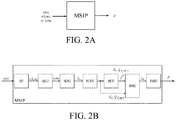
- FIG. 2A symbolically illustrates a monaural speech intelligibility predictor unit (MSIP) providing a monaural speech intelligibility predictor d based on a time domain version x(n) ( n being a time (sample) index), a time-frequency band representation x(k,m) ( k being a frequency index, m being a time (frame) index) or a sub-band representation x j (m) (j being a frequency sub-band index) of an information signal x comprising speech.
- MSIP monaural speech intelligibility predictor unit
- FIG. 2B shows an embodiment a monaural speech intelligibility predictor unit (MSIP ) adapted for receiving an information signal x(n) comprising either a clean or noisy and/or processed version of a target speech signal, the speech intelligibility predictor unit being configured to provide as an output a speech intelligibility predictor value d for the information signal.
- the speech intelligibility predictor unit (MSIP) comprises
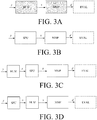
- FIG. 3A shows a monaural speech intelligibility predictor unit ( MSIP ) in combination with a hearing loss model ( HLM ) and an (optional) evaluation unit ( EVAL ) .
- the Monaural Speech Intelligibility Predictor ( MSIP ) estimates an intelligibility index d, which reflects the intelligibility of a noisy and potentially processed speech signal.
- a noisy/reverberant speech signal y which potentially has been passed through some signal processing device, e.g. a hearing aid (cf. e.g. signal processing unit ( SPU ) in FIG. 3B, 3C, 3D ), is considered for analysis by the monaural speech intelligibility predictor ( MSIP ) .
- the present disclosure proposes an algorithm, which can predict the intelligibility of the signal noisy/processed signal, as perceived by a group of listeners with similar hearing profiles, e.g. normal hearing or hearing impaired listeners.
- the signal under study, y is passed through a hearing loss model ( HLM ), to model the imperfections of an impaired auditory system providing information signal x. This is done to simulate the potential decrease in intelligibility due to a hearing loss.
- HLM hearing loss model
- Several methods for simulating a hearing loss exist cf. e.g. [6]). The, perhaps, simplest consists of adding to the input signal a statistically independent noise signal, which is spectrally shaped according to the audiogram of the listener (cf.
- an evaluation unit ( EVAL ) is included to evaluate the resulting speech intelligibility predictor value d.
- the evaluation unit ( EVAL ) may e.g. further process the speech intelligibility predictor value d , to e.g. graphically and/or numerically display the current and/or recent historic values, derive trends, etc.
- the evaluation unit may propose actions to the user (or a communication partner or caring person), such as add directionality, move closer, speak louder, activate SI-enhancement mode, etc.
- the evaluation unit may e.g. be implemented in a separate device, e.g.
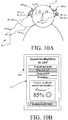
- a user interface acting as a user interface to the speech intelligibility predictor unit ( MSIP ) and/or to a hearing aid including such unit., e.g. implemented as a remote control devise, e.g. as an APP of a smartphone (cf. FIG. 10A, 10B ).
- MSIP speech intelligibility predictor unit
- a hearing aid including such unit., e.g. implemented as a remote control devise, e.g. as an APP of a smartphone (cf. FIG. 10A, 10B ).
- FIG. 3B shows a monaural speech intelligibility predictor unit ( MSIP ) in combination with a signal processing unit ( SPU ) and an (optional) evaluation unit ( EVAL ) .
- MSIP monaural speech intelligibility predictor
- SPU signal processing unit
- EVAL evaluation unit
- FIG. 3C shows a first combination of a monaural speech intelligibility predictor unit ( MSIP ) with a hearing loss model ( HLM ), a signal processing unit ( SPU ) and an (optional) evaluation unit ( EVAL ) .
- a noisy signal, y comprising speech is passed through a hearing loss model ( HLM ) to model the imperfections of an impaired auditory system providing noisy hearing loss shaped signal x , which is passed through a signal processing unit ( SPU ) and the processed output signal x thereof is used as an input to the monaural speech intelligibility predictor ( MSIP ) .
- the MSIP- unit provides the resulting speech intelligibility predictor value d, which is fed to the evaluation unit ( EVAL ) for further processing, analysis and/or display.
- FIG. 3D shows a second combination of a monaural speech intelligibility predictor unit (MSIP) with a hearing loss model ( HLM ), a signal processing unit ( SPU ) and an (optional) evaluation unit ( EVAL ) .
- MSIP monaural speech intelligibility predictor unit
- HLM hearing loss model
- SPU signal processing unit
- EVAL evaluation unit
- the embodiment of FIG. 3D is similar to the embodiment of FIG. 3C apart from the two units HLM and SPU being sapped in order.
- the embodiment pf FIG. 3D may reflect a setup used in a hearing aid to evaluate the intelligibility of a processed signal u from a signal processing unit ( SPU ) (e.g. intended for presentation to a user).
- SPU signal processing unit
- the noisy signal comprising speech y is passed through the signal processing unit ( SPU ) and the processed output signal u thereof is passed through a hearing loss model ( HLM ) to model the imperfections of an impaired auditory system and providing noisy hearing loss shaped signal x, which is used by the monaural speech intelligibility predictor unit ( MSIP ) to determine the resulting speech intelligibility predictor value d, which is fed to the evaluation unit ( EVAL ) for further processing, analysis and/or display.
- HLM hearing loss model
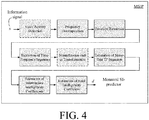
- FIG. 4 shows an embodiment of a monaural speech intelligibility predictor unit ( MSIP ) according to the present disclosure.
- the embodiment of a monaural speech intelligibility predictor shown in FIG. 4 is decomposed into a number of sub-units (e.g. representing separate tasks of a corresponding method). Each sub-unit (process step) is described in more detail in the following. Sub-units (process steps) that are symbolized with dashed outline are optional.
- Speech intelligibility relates to regions of the input signal with speech activity - silence regions do no contribute to SI.
- the first step is to detect voice activity regions in the input signal (in other realizations, voice activity detection is performed implicitly at a later stage of the algorithm).
- the explicit voice activity detection can be done with any of a range of existing algorithms, e.g., [8,9] or the references therein. Let us denote the input signal with speech activity by x' ( n ), where n is a discrete-time index.
- the first step is to perform a frequency decomposition of the signal x ( n ).
- This may be achieved in many ways, e.g., using a short-time Fourier transform (STFT), a band-pass filterbank (e.g., a Gamma-tone filter bank), etc.
- STFT short-time Fourier transform
- band-pass filterbank e.g., a Gamma-tone filter bank
- the temporal envelopes of each sub-band signal are extracted. This may, e.g., be achieved using a Hilbert transform, or by low-pass filtering the magnitude of complex-valued STFT signals, etc.
- a sampling frequency of 10000 Hz a time-frequency representation is obtained by segmenting x '( n ) into (e.g. 50%) overlapping, windowed frames; normally, some tapered window, e.g. a Hanning-window is used.
- the window length could e.g. be 256 samples when the sample rate is 10000 Hz.
- each frame is Fourier transformed using a fast Fourier transform (FFT) (potentially after appropriate zero-padding).
- FFT fast Fourier transform
- one could use one-third octave bands (e.g. as in [4]), but it should be clear that any other sub-band division can be used (for example, the grouping could be uniform, i.e., unrelated to perception in this respect).
- any other sub-band division can be used (for example, the grouping could be uniform, i.e., unrelated to perception in this respect).
- one-third octave bands and a sampling rate of 10000 Hz there are 15 bands which cover the frequency range 150-5000 Hz (cf. e.g. [4]).
- Other numbers of bands and another frequency range can be used.
- x j (m) is real (i.e. f( ⁇ ) represents a real (non-complex) function).
- envelope representations may be implemented, e.g., using a Gammatone filterbank, followed by a Hilbert envelope extractor, etc, and functions f(w) may be applied to these envelopes in a similar manner as described above for STFT based envelopes.
- the result of this procedure is a time-frequency representation in terms of sub-band temporal envelopes, x j ( m ) , where j is a sub-band index, and m is a time index (cf. e.g. FIG. 1B ).
- the time-frequency representation x j ( m ) into segments , i.e., spectrograms corresponding to N successive samples of all sub-band signals.
- segments which have been shifted in time to operate on frame indices m - N / 2 + 1 through m + N / 2 , to be centered around the current value of frame index m.
- each segment X m may be normalized/transformed in various ways.
- a still further combination is to provide at least one normalization and/or transformation operation of rows and at least one normalization and/or transformation operation of columns of said time-frequency segments S m and X m .
- the next step involves estimation of the underlying noise-free normalized/transformed time-frequency segment S ⁇ m . Obviously, this matrix cannot be observed in practice, since only the noisy/processed normalized/transformed time-frequency segment in matrix X ⁇ m is available.
- the problem of estimating an un-observable target vector s ⁇ m based on a related, but distorted, observation x ⁇ m is a well-known problem in many engineering contexts, and many methods can be applied to solve it. These include (but are not limited to) methods based on neural networks, e.g. where the map r (.) is pre-estimated off-line, e.g.
- Bayesian techniques e.g., where the joint probability density function of ( s ⁇ m , x ⁇ m ) is estimated off-line and used for providing estimates of s ⁇ m , which are optimal in some statistical sense, e.g., minimum mean-square error (mmse) sense, maximum a posteriori (MAP) sense, or maximum likelihood (ML) sense, etc.
- mmse minimum mean-square error
- MAP maximum a posteriori
- ML maximum likelihood
- a particularly simple class of solutions involve maps r (.) which are linear in the observations x ⁇ m .
- the estimated normalized/transformed time-frequency segment may now be used together with the corresponding noisy/processed segment X ⁇ m to compute an intermediate intelligibility index d m , reflecting the intelligibility of the signal segment X ⁇ m .
- d m may be defined as
- the noisy/processed segment X ⁇ m and the corresponding estimate of the underlying clean segment may be used to generate an estimate of the noise-free, unprocessed speech signals, which can be used with the noisy, processed signals as input to any existing intrusive intelligibility prediction scheme, e.g., the STOI algorithm (cf. e.g. [4]).
- the STOI algorithm cf. e.g. [4]
- N may preferably be chosen with a view to characteristics of the human vocal system.
- N is chosen, so that a time spanned by N (possibly overlapping) time frames is in the range from 50 ms or 100 ms to 1 s, e.g. between 300 ms and 600 ms.
- N is chosen to represent the (e.g. average or maximum) duration of a basic speech element of the language in question.
- N is chosen to represent the (e.g. average or maximum) duration of a syllable (or word) of the language in question.
- J 15.
- N 30.
- J ⁇ N 450.
- a time frame has duration of 10 ms, or more, e.g. 25 ms or more, e.g. 40 ms or more (e.g. depending on a degree of overlap). In an embodiment, a time frame has a duration in the range between 10 ms and 40 ms.
- the matrix G may be pre-estimated (i.e. off-line, prior to application of the proposed method or device) using a training set of noise-free speech signals.
- G we can think of G as a way of building a priori knowledge of the statistical structure of speech signals into the estimation process. Many variants of this approach exist. In the following, one of them is described.
- This approach has the advantage of being computationally relatively simple, and hence well suited for applications (such as portable electronic devices, e.g. hearing aids) where power consumption is an important design parameter (restriction).
- U z ⁇ U z ⁇ , 1 U z ⁇ , 2
- U z ⁇ ,1 is an J ⁇ N ⁇ L matrix with the eigenvectors corresponding to the L ⁇ J ⁇ N dominant eigenvalues
- U z ⁇ , 2 has the remaining eigen vectors as columns.
- L / (J ⁇ N) may be less than 80%, such as less than 50%, e.g. less than 33%, such as less than 20% or less than 10%.
- L may e.g. be 100 (leading to U z ⁇ ,1 being a 450x100 matrix (dominant sub-space), and U s ⁇ ,2 being a 450x350 matrix (inferior sub-space)).
- This example of matrix G may be recognized as an orthogonal projection operator (cf. e.g. [12]).
- FIG. 5A shows a first binaural speech intelligibility predictor in combination with a hearing loss model.
- the Binaural Speech Intelligibility Predictor (BSIP ) estimates an intelligibility index d binaural , which reflects the intelligibility of a listener listening to two noisy and potentially processed information signals comprising speech x left and x right (presented to the listener's left and right ears, respectively).
- binaural signals y left and y right comprising speech are passed through a binaural hearing loss model (BHLM ) first, to model the imperfections of an impaired auditory system, providing noisy and/or processed hearing loss shaped signals x left and x right for use by the binaural speech intelligibility predictor (BSIP ).
- BHLM binaural hearing loss model
- a potential hearing loss may be modelled by simply adding independent noise to the input signals, spectrally shaped according to the audiogram of the listener - this approach was e.g. used in [7].
- FIG. 5B A block diagram of this approach is given in FIG. 5B
- FIG. 5B shows an embodiment of a binaural speech intelligibility predictor based on a combination of two monaural speech intelligibility predictors in combination with a hearing loss model.
- FIG. 5B illustrates processing steps for determining a better-ear non-intrusive binaural intelligibility predictor d binaural .
- FIG. 5B shows noisy and/or processed binaural signals y left and y right comprising speech are (in each of the left and right monaural speech intelligibility predictors), which are passed through respective hearing loss models ( HLM ) for the left and right ears, providing noisy and/or processed hearing loss shaped signals x left and x right .
- HLM hearing loss models
- the hearing loss models ( HLM ) for the left and right ears may constitute or form part of the binaural hearing loss model ( BHLM ) of FIG. 5A .
- the left and right information signals x left and x right are used by the monaural speech intelligibility predictors ( MSIP ) of the left and right ears, respectively, to provide left and right (monaural) speech intelligibility predictors d left and d right .
- a maximum value of the left and right speech intelligibility predictors d left and d right is determined by calculation unit ( max ) and used as the binaural intelligibility predictor d binaural .
- the monaural speech intelligibility predictors ( MSIP ) of the left and right ears and the calculation unit ( max ) may constitute or form part of the binaural speech intelligibility predictor ( BSIP ) of FIG. 5A .
- FIG. 6 The processing steps of the proposed non-intrusive binaural intelligibility predictor are outlined in FIG. 6 .
- the individual processing blocks in FIG. 6 are identical to the blocks used in the monaural, non-intrusive speech intelligibility predictor proposed above ( FIG. 4 ), except for the Equalization-Cancellation stage (EC) (as indicated with a bold-faced box in FIG. 6 ).
- EC Equalization-Cancellation stage
- This stage is completely described in [13].
- the EC-stage is briefly outlined. For a detailed treatment, see [13] and the references therein.
- the EC-stage operates independently on different frequency sub-bands (hence, the frequency decomposition stage before the EC-stage).
- the EC-stage time-shifts the input signals (from left and right ear) and adjusts their amplitudes in order to find the time shift and amplitude adjustment that leads to the maximum predicted intelligibility ( d binaural in FIG. 5 , hence, the bold dashed arrow from the output of the model leading back to the EC-stage).
- d binaural is maximized in each frequency band, whereby a resulting binaural speech intelligibility predictor can be provided, e.g. as a single scalar value.
- no closed-form solution exists for the optimal time-shift/amplitude adjustment, but the optimal parameter pairs may at least be found by a brute-force search across a suitable range of parameter values (see [13] for details of such exhaustive search approach).
- FIG. 7 shows a method of providing an intrusive binaural speech intelligibility predictor d binaural for adapting the processing of a binaural hearing aid systems to maximize the intelligibility of output speech signal(s).
- the L microphone signals y' 1 , y' 2 , ..., y' L are processed in binaural signal processing unit (BSPU ) to produce a left- and a right-ear signal, u left and u right , e.g. to be presented for a user.
- BSPU binaural signal processing unit
- the microphone signals from spatially separated locations are assumed to be transmitted wirelessly (or wired) for processing in the hearing aid system.
- the signals are passed through the binaural intelligibility model (BSIP ) proposed above, where the binaural hearing loss model (BHLM , see above for some details) is optional.
- the resulting estimated intelligibility index d binaural is returned to the processing unit ( BSPU ) of the hearing aid system, which adapts the parameters of relevant signal processing algorithms to maximize d binaural .
- the hearing aid system has at its disposal a number of processing schemes, which could be relevant for a particular acoustic situation.
- the hearing aid system may be equipped with three different noise reduction schemes: mild, medium, and aggressive.
- the hearing aid system applies (e.g. successively) each of the noise reduction schemes to the input signal and chooses the one that leads to maximum (estimated) intelligibility.
- the hearing aid user need not suffer the perceptual annoyance of the hearing aid system "trying-out" processing schemes.
- the hearing aid system could try out the processing schemes "internally", i.e., without presenting the result of each of the tried-out processing schemes through the loudspeakers - only the output signal which has largest (estimated) intelligibility needs to be presented to the user.
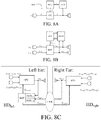
- FIG. 8A shows an embodiment of a hearing aid (HD) according to the present disclosure comprising a monaural speech intelligibility predictor unit (MSIP) for estimating intelligibility of an output signal u and using the predictor to adapt the signal processing of an input speech signal y' to maximize the monaural speech intelligibility predictor d.
- the hearing aid HD comprises at least one input unit (here a microphone, e.g. two or more).
- the microphone provides a time-variant electric input signal y' representing a sound input y received at the microphone.
- the electric input signal y' is assumed to comprise a target signal component and a noise signal component (at least in some time segments).
- the target signal component originates from a target signal source, e.g. a person speaking.
- the hearing aid further comprises a configurable signal processing unit (SPU) for processing the electric input signal y' and providing a processed signal u.
- the hearing aid further comprises an output unit for creating output stimuli configured to be perceivable by the user as sound based on an electric output either in the form of the processed signal u from the signal processing unit or a signal derived therefrom.
- a loudspeaker is directly connected to the output of the signal processing unit (SPU), thus receiving output signal u .
- the hearing aid further comprises a hearing loss model unit (HLM) connected to the monaural speech intelligibility predictor unit (MSIP) and the output of the signal processing unit, and configured to modify the electric output signal u reflecting a hearing impairment of the relevant ear of the user to provide information signal x to the monaural speech intelligibility predictor unit (MSIP).
- HLM hearing loss model unit
- the monaural speech intelligibility predictor unit (MSIP) provides an estimate of the intelligibility of the output signal by the user in the form of the (final) speech intelligibility predictor d , which is fed to a control unit of the configurable signal processing unit to modify signal processing to optimize d.
- FIG. 8B shows a first embodiment of a binaural hearing aid system according to the present disclosure comprising a binaural speech intelligibility predictor unit (BSIP) for estimating the perceived intelligibility of the user when presented with the respective left and right output signals u left and u right of the binaural hearing aid system and using the predictor d binaural to adapt the binaural signal processing unit (BSPU) of input signals y' left and y' right comprising speech to maximize the binaural speech intelligibility predictor d binaural .
- BSIP binaural speech intelligibility predictor unit
- BSIP binaural speech intelligibility predictor unit
- FIG. 8C shows an embodiment of a binaural hearing system comprising left and right hearing aids ( HD left , HD right ) according to the present disclosure.
- the left and right hearing aids ( HD left , HD right ) are adapted to be located at or in left and right ears ( Left Ear , Right Ear in FIG. 8C ) of a user.
- the signal processing of each of the left and right hearing aids is guided by an estimate of the speech intelligibility experienced by the hearing aid user, the binaural speech intelligibility predictor d binaural (cf.
- the binaural speech intelligibility predictor unit ( BSIP ) is configured to take as inputs the output signals u left , u right of left and hearing aids as modified by a hearing loss model ( HLM left , HLM right , respectively, in FIG. 8C ) for the respective left and right ears of the user, respectively (to model imperfections of an impaired auditory system of the user).
- the speech intelligibility estimation/prediction takes place in the left-ear hearing aid ( Left Ear: HD left ) .
- the output signal u right of the right-ear hearing aid ( Right Ear: HD right ) is transmitted to the left-ear hearing aid ( Left Ear: HD left ) via communication link LINK.
- the communication link ( LINK ) may be based on a wired or wireless connection.
- the hearing aids are preferably wirelessly connected.
- Each of the hearing aids ( HD left , HD right ) comprise two microphones, a signal processing block ( SPU ), and a loudspeaker. Additionally, one or both of the hearing aids comprise a binaural speech intelligibility unit (BSIP ) .
- the two microphones of each of the left and right hearing aids ( HD left , HD right ) each pick up a - potentially noisy (time varying) signal y(t) (cf. y 1,left , y 2,left and y 1,right , y 2,right in FIG. 8C ) - and which generally consists of a target signal component s(t) (cf. s 1,left , s 2,left and s 1,right , s 2,right in FIG.
- the subscripts 1, 2 indicate a first and second (e.g. front and rear) microphone, respectively, while the subscripts left, right indicate whether it is the left or right ear hearing aid ( HD left , HD right , respectively).
- the signal processing units ( SPU ) of each hearing aid may be (individually) adapted (cf. control signal d binaural ). Since the binaural speech intelligibility predictor is determined in the left-ear hearing aid ( HD left ), adaptation of the processing in the right-ear hearing aid ( HD right ) requires control signal d binaural to be transmitted from left to right-ear hearing aid via communication link (LINK).
- SPU signal processing units
- each of the left and right hearing aids comprise two microphones. In other embodiments, each (or one) of the hearing aids may comprises three or more microphones.
- the binaural speech intelligibility predictor ( BSIP ) is located in the left hearing aid ( HD left ).
- the binaural speech intelligibility predictor ( BSIP ) may be located in the right hearing aid ( HD right ), or alternatively in both, preferably performing the same function in each hearing aid.
- the latter embodiment consumes more power and requires a two-way exchange of output audio signals ( u left , u right ), whereas the exchange of processing control signals ( d binaural in FIG. 8C ) can be omitted.
- the binaural speech intelligibility predictor unit (BSIP ) is located in a separate auxiliary device, e.g. a remote control (e.g. embodied in a SmartPhone), requiring that an audio link can be established between the hearing aids and the auxiliary device for receiving output signals ( u left , u right ) from, and transmitting processing control signals ( d binaural ) to, the respective hearing aids ( HD left , HD right ).
- a separate auxiliary device e.g. a remote control (e.g. embodied in a SmartPhone)
- the processing performed in the signal processing units ( SPU ) and controlled or influenced by the control signals ( d binaural ) of the respective left and right hearing aids ( HD left , HD right ) from the binaural speech intelligibility predictor ( BSIP ) may in principle include any processing algorithm influencing speech intelligibility, e.g. spatial filtering (beamforming) and noise reduction, compression, feedback cancellation, etc.
- the adaptation of the signal processing of a hearing aid based on the estimated binaural speech intelligibility predictor includes (but are not limited to):
- FIG. 9 illustrates an exemplary hearing aid (HD) formed as a receiver in the ear (RITE) type of hearing aid comprising a part (BTE) adapted for being located behind pinna and a part (ITE) comprising an output transducer (OT, e.g. a loudspeaker/receiver) adapted for being located in an ear canal of the user.
- the BTE-part and the ITE-part are connected (e.g. electrically connected) by a connecting element (IC).
- the BTE part comprises an input unit comprising two (individually selectable) input transducers (e.g.
- the input unit further comprises two (individually selectable) wireless receivers (WLR 1 , WLR 2 ) for providing respective directly received auxiliary audio and/or information signals.
- the hearing aid (HA) further comprises a substrate SUB whereon a number of electronic components are mounted, including a configurable signal processing unit (SPU), a monaural speech intelligibility predictor unit (MSIP), and a hearing loss model unit (coupled to each other and input and output units via electrical conductors Wx), as e.g. described above in connection with 8A.
- the configurable signal processing unit (SPU) provides an enhanced audio signal (cf. e.g. signal u in FIG.
- the ITE part comprises an output unit in the form of a loudspeaker (receiver) (OT) for converting an electric signal (e.g. u in FIG. 8A ) to an acoustic signal.
- the ITE-part further comprises a guiding element, e.g. a dome, (DO) for guiding and positioning the ITE-part in the ear canal of the user.
- the hearing aid (HD) exemplified in FIG. 9 is a portable device and further comprises a battery (BAT) for energizing electronic components of the BTE- and ITE-parts.
- BAT battery
- the hearing aid device comprises an input unit for providing an electric input signal representing sound.
- the input unit comprises one or more input transducers (e.g. microphones) (MIC 1 , MIC 2 ) for converting an input sound to an electric input signal.
- the input unit comprises one or more wireless receivers (WLR 1 , WLR 2 ) for receiving (and possibly transmitting) a wireless signal comprising sound and for providing corresponding directly received auxiliary audio input signals.
- the hearing aid device comprises a directional microphone system (beamformer) adapted to enhance a target acoustic source among a multitude of acoustic sources in the local environment of the user wearing the hearing aid device.
- the directional system is adapted to detect (such as adaptively detect) from which direction a particular part of the microphone signal originates.
- the hearing aid of FIG. 9 may form part of a hearing aid and/or a binaural hearing aid system according to the present disclosure.
- FIG. 10A shows an embodiment of a binaural hearing system comprising left and right hearing aids ( HD left , HD right ) in communication with a portable (handheld) auxiliary device ( AD ) functioning as a user interface ( UI ) for the binaural hearing aid system (cf. FIG. 10B ).
- the binaural hearing system comprises the auxiliary device ( Aux, and the user interface UI ).
- wireless links denoted IA-WL (e.g. an inductive link between the left and right hearing aids) and WL-RF (e.g. RF-links (e.g.
- Bluetooth between the auxiliary device Aux and the left HD left , and between the auxiliary device Aux and the right HD right , hearing aid, respectively) are indicated (implemented in the devices by corresponding antenna and transceiver circuitry, indicated in FIG. 10A in the left and right hearing aids as RF - IA - Rx / Tx - l and RF - IA - Rx / Tx - r , respectively).
- FIG. 10B shows the auxiliary device ( Aux ) comprising a user interface ( UI ) in the form of an APP for controlling and displaying data related to the speech intelligibility predictors.
- the user interface ( UI ) comprises a display (e.g. a touch sensitive display) displaying a screen of a Speech intelligibility SI-APP for controlling the hearing aid system and a number of predefined actions regarding functionality of the binaural (or monaural) hearing system.
- a user ( U ) has the option of influencing a mode of operation via the selection of a SI-prediction mode to be a Monaural SIP or Binaural SIP mode.
- FIG. 10B shows the screen shown in FIG. 10B .
- the grey shaded button Monaural SIP may be selected instead of Binaural SIP.
- the SI-enhancement mode may be selected to activate processing of the input signal that an optimizes the (monaural or binaural) speech intelligibility predictor.
- connection or “coupled” as used herein may include wirelessly connected or coupled.
- the term “and/or” includes any and all combinations of one or more of the associated listed items. The steps of any disclosed method is not limited to the exact order stated herein, unless expressly stated otherwise.
Landscapes
- Engineering & Computer Science (AREA)
- Acoustics & Sound (AREA)
- Physics & Mathematics (AREA)
- Signal Processing (AREA)
- Health & Medical Sciences (AREA)
- Otolaryngology (AREA)
- Neurosurgery (AREA)
- General Health & Medical Sciences (AREA)
- Computer Networks & Wireless Communication (AREA)
- Multimedia (AREA)
- Quality & Reliability (AREA)
- Computational Linguistics (AREA)
- Human Computer Interaction (AREA)
- Audiology, Speech & Language Pathology (AREA)
- Stereophonic System (AREA)
- Tone Control, Compression And Expansion, Limiting Amplitude (AREA)
- Circuit For Audible Band Transducer (AREA)
Applications Claiming Priority (1)
| Application Number | Priority Date | Filing Date | Title |
|---|---|---|---|
| EP16154704.7A EP3203472A1 (fr) | 2016-02-08 | 2016-02-08 | Unité de prédiction de l'intelligibilité monaurale de la voix |
Publications (3)
| Publication Number | Publication Date |
|---|---|
| EP3203473A1 true EP3203473A1 (fr) | 2017-08-09 |
| EP3203473B1 EP3203473B1 (fr) | 2024-04-10 |
| EP3203473C0 EP3203473C0 (fr) | 2024-04-10 |
Family
ID=55315358
Family Applications (2)
| Application Number | Title | Priority Date | Filing Date |
|---|---|---|---|
| EP16154704.7A Withdrawn EP3203472A1 (fr) | 2016-02-08 | 2016-02-08 | Unité de prédiction de l'intelligibilité monaurale de la voix |
| EP17153174.2A Active EP3203473B1 (fr) | 2016-02-08 | 2017-01-26 | Unité de prédiction de l'intelligibilité monaurale de la voix, prothèse auditive et système auditif binauriculaire |
Family Applications Before (1)
| Application Number | Title | Priority Date | Filing Date |
|---|---|---|---|
| EP16154704.7A Withdrawn EP3203472A1 (fr) | 2016-02-08 | 2016-02-08 | Unité de prédiction de l'intelligibilité monaurale de la voix |
Country Status (3)
| Country | Link |
|---|---|
| US (1) | US10154353B2 (fr) |
| EP (2) | EP3203472A1 (fr) |
| CN (1) | CN107046668B (fr) |
Cited By (1)
| Publication number | Priority date | Publication date | Assignee | Title |
|---|---|---|---|---|
| EP4106349A1 (fr) | 2021-06-15 | 2022-12-21 | Oticon A/s | Dispositif auditif comprenant un estimateur de l'intelligibilité de la parole |
Families Citing this family (10)
| Publication number | Priority date | Publication date | Assignee | Title |
|---|---|---|---|---|
| US11056129B2 (en) * | 2017-04-06 | 2021-07-06 | Dean Robert Gary Anderson | Adaptive parametrically formulated noise systems, devices, and methods |
| EP3514792B1 (fr) * | 2018-01-17 | 2023-10-18 | Oticon A/s | Procédé d'optimisation d'un algorithme d'amélioration de la parole basée sur un algorithme de prédiction d'intelligibilité de la parole |
| EP3598777B1 (fr) | 2018-07-18 | 2023-10-11 | Oticon A/s | Dispositif auditif comprenant un estimateur de probabilité de présence de parole |
| WO2020049472A1 (fr) * | 2018-09-04 | 2020-03-12 | Cochlear Limited | Nouvelles techniques de traitement sonore |
| CN109410976B (zh) * | 2018-11-01 | 2022-12-16 | 北京工业大学 | 双耳助听器中基于双耳声源定位和深度学习的语音增强方法 |
| US11172294B2 (en) * | 2019-12-27 | 2021-11-09 | Bose Corporation | Audio device with speech-based audio signal processing |
| US11671769B2 (en) * | 2020-07-02 | 2023-06-06 | Oticon A/S | Personalization of algorithm parameters of a hearing device |
| EP4075829B1 (fr) * | 2021-04-15 | 2024-03-06 | Oticon A/s | Dispositif ou système auditif comprenant une interface de communication |
| CN113345457B (zh) * | 2021-06-01 | 2022-06-17 | 广西大学 | 一种基于贝叶斯理论的声学回声消除自适应滤波器及滤波方法 |
| EP4207194B1 (fr) * | 2021-12-29 | 2026-04-29 | GN Audio A/S | Dispositif audio avec détection de la qualité audio et procédés associés |
Family Cites Families (24)
| Publication number | Priority date | Publication date | Assignee | Title |
|---|---|---|---|---|
| JP4694835B2 (ja) * | 2002-07-12 | 2011-06-08 | ヴェーデクス・アクティーセルスカプ | 補聴器および音声の明瞭さを高める方法 |
| BRPI0415951B1 (pt) * | 2003-10-30 | 2018-08-28 | Coding Tech Ab | método e codificador de áudio para codificar um sinal de áudio, e, método e decodificador de áudio para decodificar um sinal de áudio codificado |
| US20060262938A1 (en) * | 2005-05-18 | 2006-11-23 | Gauger Daniel M Jr | Adapted audio response |
| US8964997B2 (en) * | 2005-05-18 | 2015-02-24 | Bose Corporation | Adapted audio masking |
| EP1994791B1 (fr) * | 2006-03-03 | 2015-04-15 | GN Resound A/S | Commutation automatique entre des modes microphone omnidirectionnels et directionnels dans une prothèse auditive |
| BRPI0807703B1 (pt) * | 2007-02-26 | 2020-09-24 | Dolby Laboratories Licensing Corporation | Método para aperfeiçoar a fala em áudio de entretenimento e meio de armazenamento não-transitório legível por computador |
| AU2009274456B2 (en) * | 2008-04-18 | 2011-08-25 | Dolby Laboratories Licensing Corporation | Method and apparatus for maintaining speech audibility in multi-channel audio with minimal impact on surround experience |
| WO2011001693A1 (fr) * | 2009-07-03 | 2011-01-06 | パナソニック株式会社 | Système d'évaluation de netteté de son de mot, son procédé et son programme |
| EP2372700A1 (fr) * | 2010-03-11 | 2011-10-05 | Oticon A/S | Prédicateur d'intelligibilité vocale et applications associées |
| DK2563044T3 (da) * | 2011-08-23 | 2014-11-03 | Oticon As | En fremgangsmåde, en lytteanordning og et lyttesystem for at maksimere en bedre øreeffekt |
| DK2795924T3 (en) * | 2011-12-22 | 2016-04-04 | Widex As | Method for operating a hearing aid and a hearing aid |
| DK2820863T3 (en) * | 2011-12-22 | 2016-08-01 | Widex As | Method of operating a hearing aid and a hearing aid |
| US8913768B2 (en) * | 2012-04-25 | 2014-12-16 | Gn Resound A/S | Hearing aid with improved compression |
| US8843367B2 (en) * | 2012-05-04 | 2014-09-23 | 8758271 Canada Inc. | Adaptive equalization system |
| US9524733B2 (en) * | 2012-05-10 | 2016-12-20 | Google Inc. | Objective speech quality metric |
| US9685921B2 (en) * | 2012-07-12 | 2017-06-20 | Dts, Inc. | Loudness control with noise detection and loudness drop detection |
| WO2014094865A1 (fr) * | 2012-12-21 | 2014-06-26 | Widex A/S | Procédé pour faire fonctionner une prothèse auditive, et prothèse auditive |
| US20150012265A1 (en) * | 2013-07-02 | 2015-01-08 | Sander Jeroen van Wijngaarden | Enhanced Speech Transmission Index measurements through combination of indirect and direct MTF estimation |
| US10176818B2 (en) * | 2013-11-15 | 2019-01-08 | Adobe Inc. | Sound processing using a product-of-filters model |
| EP2928210A1 (fr) * | 2014-04-03 | 2015-10-07 | Oticon A/s | Système d'assistance auditive biauriculaire comprenant une réduction de bruit biauriculaire |
| EP3038106B1 (fr) * | 2014-12-24 | 2017-10-18 | Nxp B.V. | Amélioration d'un signal audio |
| WO2016112969A1 (fr) * | 2015-01-14 | 2016-07-21 | Widex A/S | Procédé pour faire fonctionner un système d'aide auditive, et système d'aide auditive |
| WO2016112968A1 (fr) * | 2015-01-14 | 2016-07-21 | Widex A/S | Procédé pour faire fonctionner un système d'aide auditive, et système d'aide auditive |
| US10799186B2 (en) * | 2016-02-12 | 2020-10-13 | Newton Howard | Detection of disease conditions and comorbidities |
-
2016
- 2016-02-08 EP EP16154704.7A patent/EP3203472A1/fr not_active Withdrawn
-
2017
- 2017-01-26 EP EP17153174.2A patent/EP3203473B1/fr active Active
- 2017-02-07 US US15/426,760 patent/US10154353B2/en active Active
- 2017-02-08 CN CN201710069826.7A patent/CN107046668B/zh not_active Expired - Fee Related
Non-Patent Citations (19)
| Title |
|---|
| A. H. ANDERSEN; J. M. DE HAAN; Z.-H. TAN; J. JENSEN: "A method for predicting the intelligibility of noisy and non-linearly enhanced binaural speech", PROC. INT. CONF. ACOUST., SPEECH, SIGNAL PROCESSING (ICASSP, March 2016 (2016-03-01), pages 4995 - 4999, XP032901554, DOI: doi:10.1109/ICASSP.2016.7472628 |
| A. W. BRONKHORST: "The cocktail party phenomenon: A review on speech intelligibility in multiple-talker conditions", ACTA ACUSTICA UNITED WITH ACUSTICA, vol. 86, no. L, January 2000 (2000-01-01), pages 117 - 128 |
| ANSI S3.5, METHODS FOR THE CALCULATION OF THE SPEECH INTELLIGIBILITY INDEX, 1995 |
| B. C. J. MOORE: "Cochlear Hearing Loss, Physiological, Psychological and Technical Issues", 2007, WILEY |
| C. H. TAAL; R. C. HENDRIKS; R. HEUSDENS; J. JENSEN: "An Algorithm for Intelligibility Prediction of Time-Frequency Weighted Noisy Speech", IEEE TRANS. AUDIO, SPEECH, LANG. PROCESS., vol. 19, no. 7, September 2011 (2011-09-01), pages 2125 - 2136, XP011335558, DOI: doi:10.1109/TASL.2011.2114881 |
| CEES H TAAL ET AL: "An Algorithm for Intelligibility Prediction of Time-Frequency Weighted Noisy Speech", IEEE TRANSACTIONS ON AUDIO, SPEECH AND LANGUAGE PROCESSING, IEEE SERVICE CENTER, NEW YORK, NY, USA, vol. 19, no. 7, 1 September 2011 (2011-09-01), pages 2125 - 2136, XP011335558, ISSN: 1558-7916, DOI: 10.1109/TASL.2011.2114881 * |
| EPHRAIM Y ET AL: "A SIGNAL SUBSPACE APPROACH FOR SPEECH ENHANCEMENT", IEEE TRANSACTIONS ON SPEECH AND AUDIO PROCESSING, IEEE SERVICE CENTER, NEW YORK, NY, US, vol. 3, no. 4, 1 July 1995 (1995-07-01), pages 251 - 266, XP002926209, ISSN: 1063-6676, DOI: 10.1109/89.397090 * |
| J. JENSEN; C. H. TAAL: "Speech Intelligibility Prediction based on Mutual Information", IEEE TRANS. AUDIO, SPEECH, AND LANGUAGE PROCESSING, vol. 22, no. 2, February 2014 (2014-02-01), pages 430 - 440, XP011536651, DOI: doi:10.1109/TASLP.2013.2295914 |
| J. JENSEN; Z.-H. TAN: "Minimum Mean-Square Error Estimation of Mel-Frequency Cepstral Features - A Theoretically Consistent Approach", IEEE TRANS. AUDIO, SPEECH, LANGUAGE PROCESS., vol. 23, no. 1, 2015, pages 186 - 197, XP011570051, DOI: doi:10.1109/TASLP.2014.2377591 |
| J.R. DELLER; J.G. PROAKIS; J.H.L. HANSEN: "Discrete-Time Processing of Speech Signals", 2000, IEEE PRESS |
| K. S. RHEBERGEN; N. J. VERSFELD: "A speech intelligibility index based approach to predict the speech reception threshold for sentences in fluctuating noise for normal-hearing listeners", J. ACOUST. SOC. AM., vol. 117, no. 4, 2005, pages 2181 - 2192, XP012072900, DOI: doi:10.1121/1.1861713 |
| NICOLAS ELLAHAM ET AL: "Binaural Objective Intelligibility Measurement and Hearing Aids", CANADIAN ACOUSTICS, JOURNAL OF THE CANADIAN ACOUSTICAL ASSOCIATION, vol. 37, no. 3, 1 September 2009 (2009-09-01), pages 136, XP055289604 * |
| P. C. LOIZOU: "Speech Enhancement - Theory and Practice", 2007, CRC PRESS |
| R. BEUTELMANN; T. BRAND: "Prediction of intelligibility in spatial noise and reverberation for normal-hearing and hearing-impaired listeners", J. ACOUST. SOC. AM., vol. 120, no. 1, April 2006 (2006-04-01), pages 331 - 342, XP012090546, DOI: doi:10.1121/1.2202888 |
| SANDER J. VAN WIJNGAARDEN ET AL: "Binaural intelligibility prediction based on the speech transmission index", THE JOURNAL OF THE ACOUSTICAL SOCIETY OF AMERICA, vol. 123, no. 6, 1 January 2008 (2008-01-01), New York, NY, US, pages 4514 - 4523, XP055289591, ISSN: 0001-4966, DOI: 10.1121/1.2905245 * |
| T. DAU; D. PUSCHEL; A. KOHLRAUSH: "A quantitative model of the ''effective'' signal processing in the auditory system. I. Model structure", J. ACOUST. SOC. AM., vol. 99, no. 6, 1996, pages 3615 - 3622, XP009019971, DOI: doi:10.1121/1.414960 |
| T. H. FALK; V. PARSA; J. F. SANTOS; K. AREHART; O. HAZRATI; R. HUBER; J. M. KATES; S. SCOLLIE: "Objective Quality and Intelligibility Prediction for Users of Assistive Listening Devices", IEEE SIGNAL PROCESSING MAGAZINE, vol. 32, no. 2, March 2015 (2015-03-01), pages 114 - 124, XP011573070, DOI: doi:10.1109/MSP.2014.2358871 |
| XU YONG ET AL: "A Regression Approach to Speech Enhancement Based on Deep Neural Networks", IEEE/ACM TRANSACTIONS ON AUDIO, SPEECH, AND LANGUAGE PROCESSING, IEEE, USA, vol. 23, no. 1, 1 January 2015 (2015-01-01), pages 7 - 19, XP011570045, ISSN: 2329-9290, [retrieved on 20150114], DOI: 10.1109/TASLP.2014.2364452 * |
| Y. EPHRAIM; H. L. VAN TREES: "A signal subspace approach for speech enhancement", IEEE TRANS. SPEECH, AUDIO PROC., vol. 3, no. 4, 1995, pages 251 - 266, XP002926209, DOI: doi:10.1109/89.397090 |
Cited By (3)
| Publication number | Priority date | Publication date | Assignee | Title |
|---|---|---|---|---|
| EP4106349A1 (fr) | 2021-06-15 | 2022-12-21 | Oticon A/s | Dispositif auditif comprenant un estimateur de l'intelligibilité de la parole |
| US11950057B2 (en) | 2021-06-15 | 2024-04-02 | Oticon A/S | Hearing device comprising a speech intelligibility estimator |
| US12317037B2 (en) | 2021-06-15 | 2025-05-27 | Oticon A/S | Hearing device comprising a speech intelligibility estimator |
Also Published As
| Publication number | Publication date |
|---|---|
| US10154353B2 (en) | 2018-12-11 |
| EP3203473B1 (fr) | 2024-04-10 |
| EP3203473C0 (fr) | 2024-04-10 |
| CN107046668A (zh) | 2017-08-15 |
| EP3203472A1 (fr) | 2017-08-09 |
| US20170230765A1 (en) | 2017-08-10 |
| CN107046668B (zh) | 2021-01-05 |
Similar Documents
| Publication | Publication Date | Title |
|---|---|---|
| EP3203473B1 (fr) | Unité de prédiction de l'intelligibilité monaurale de la voix, prothèse auditive et système auditif binauriculaire | |
| EP3514792B1 (fr) | Procédé d'optimisation d'un algorithme d'amélioration de la parole basée sur un algorithme de prédiction d'intelligibilité de la parole | |
| US11109163B2 (en) | Hearing aid comprising a beam former filtering unit comprising a smoothing unit | |
| EP3694229B1 (fr) | Dispositif auditif comprenant un système de réduction du bruit | |
| EP3214620B1 (fr) | Unité prédictive intrusive d'intelligibilité d'un signale monaurale de parole, systeme de prothese auditive | |
| EP3300078B1 (fr) | Unité de détection d'activité vocale et dispositif auditif comprenant une unité de détection d'activité vocale | |
| EP2916321B1 (fr) | Traitement d'un signal audio bruité pour l'estimation des variances spectrales d'un signal cible et du bruit | |
| US10701494B2 (en) | Hearing device comprising a speech intelligibility estimator for influencing a processing algorithm | |
| US10341785B2 (en) | Hearing device comprising a low-latency sound source separation unit | |
| EP3057335B1 (fr) | Système auditif comprenant un prédicteur binaural de l'intelligibilité de la parole | |
| EP3793210A1 (fr) | Dispositif auditif comprenant un système de réduction du bruit | |
| EP3681175A1 (fr) | Dispositif auditif comprenant une compensation du son direct | |
| EP3934279A1 (fr) | Personnalisation de paramètres d'algorithme d'un dispositif auditif | |
| US11632635B2 (en) | Hearing aid comprising a noise reduction system | |
| EP3833043A1 (fr) | Système auditif comprenant un formeur de faisceaux personnalisé | |
| US10262675B2 (en) | Enhancement of noisy speech based on statistical speech and noise models | |
| EP2916320A1 (fr) | Procédé à plusieurs microphones et pour l'estimation des variances spectrales d'un signal cible et du bruit |
Legal Events
| Date | Code | Title | Description |
|---|---|---|---|
| PUAI | Public reference made under article 153(3) epc to a published international application that has entered the european phase |
Free format text: ORIGINAL CODE: 0009012 |
|
| STAA | Information on the status of an ep patent application or granted ep patent |
Free format text: STATUS: THE APPLICATION HAS BEEN PUBLISHED |
|
| AK | Designated contracting states |
Kind code of ref document: A1 Designated state(s): AL AT BE BG CH CY CZ DE DK EE ES FI FR GB GR HR HU IE IS IT LI LT LU LV MC MK MT NL NO PL PT RO RS SE SI SK SM TR |
|
| AX | Request for extension of the european patent |
Extension state: BA ME |
|
| STAA | Information on the status of an ep patent application or granted ep patent |
Free format text: STATUS: REQUEST FOR EXAMINATION WAS MADE |
|
| 17P | Request for examination filed |
Effective date: 20180209 |
|
| RBV | Designated contracting states (corrected) |
Designated state(s): AL AT BE BG CH CY CZ DE DK EE ES FI FR GB GR HR HU IE IS IT LI LT LU LV MC MK MT NL NO PL PT RO RS SE SI SK SM TR |
|
| STAA | Information on the status of an ep patent application or granted ep patent |
Free format text: STATUS: EXAMINATION IS IN PROGRESS |
|
| 17Q | First examination report despatched |
Effective date: 20200210 |
|
| RIC1 | Information provided on ipc code assigned before grant |
Ipc: G10L 21/0272 20130101ALN20231003BHEP Ipc: G10L 25/60 20130101AFI20231003BHEP |
|
| GRAP | Despatch of communication of intention to grant a patent |
Free format text: ORIGINAL CODE: EPIDOSNIGR1 |
|
| STAA | Information on the status of an ep patent application or granted ep patent |
Free format text: STATUS: GRANT OF PATENT IS INTENDED |
|
| RIC1 | Information provided on ipc code assigned before grant |
Ipc: G10L 21/0272 20130101ALN20231013BHEP Ipc: G10L 25/60 20130101AFI20231013BHEP |
|
| INTG | Intention to grant announced |
Effective date: 20231113 |
|
| GRAS | Grant fee paid |
Free format text: ORIGINAL CODE: EPIDOSNIGR3 |
|
| GRAA | (expected) grant |
Free format text: ORIGINAL CODE: 0009210 |
|
| STAA | Information on the status of an ep patent application or granted ep patent |
Free format text: STATUS: THE PATENT HAS BEEN GRANTED |
|
| AK | Designated contracting states |
Kind code of ref document: B1 Designated state(s): AL AT BE BG CH CY CZ DE DK EE ES FI FR GB GR HR HU IE IS IT LI LT LU LV MC MK MT NL NO PL PT RO RS SE SI SK SM TR |
|
| REG | Reference to a national code |
Ref country code: GB Ref legal event code: FG4D |
|
| REG | Reference to a national code |
Ref country code: CH Ref legal event code: EP |
|
| REG | Reference to a national code |
Ref country code: DE Ref legal event code: R096 Ref document number: 602017080778 Country of ref document: DE |
|
| REG | Reference to a national code |
Ref country code: IE Ref legal event code: FG4D |
|
| U01 | Request for unitary effect filed |
Effective date: 20240502 |
|
| U07 | Unitary effect registered |
Designated state(s): AT BE BG DE DK EE FI FR IT LT LU LV MT NL PT SE SI Effective date: 20240515 |
|
| PG25 | Lapsed in a contracting state [announced via postgrant information from national office to epo] |
Ref country code: IS Free format text: LAPSE BECAUSE OF FAILURE TO SUBMIT A TRANSLATION OF THE DESCRIPTION OR TO PAY THE FEE WITHIN THE PRESCRIBED TIME-LIMIT Effective date: 20240810 |
|
| PG25 | Lapsed in a contracting state [announced via postgrant information from national office to epo] |
Ref country code: HR Free format text: LAPSE BECAUSE OF FAILURE TO SUBMIT A TRANSLATION OF THE DESCRIPTION OR TO PAY THE FEE WITHIN THE PRESCRIBED TIME-LIMIT Effective date: 20240410 |
|
| PG25 | Lapsed in a contracting state [announced via postgrant information from national office to epo] |
Ref country code: GR Free format text: LAPSE BECAUSE OF FAILURE TO SUBMIT A TRANSLATION OF THE DESCRIPTION OR TO PAY THE FEE WITHIN THE PRESCRIBED TIME-LIMIT Effective date: 20240711 |
|
| PG25 | Lapsed in a contracting state [announced via postgrant information from national office to epo] |
Ref country code: ES Free format text: LAPSE BECAUSE OF FAILURE TO SUBMIT A TRANSLATION OF THE DESCRIPTION OR TO PAY THE FEE WITHIN THE PRESCRIBED TIME-LIMIT Effective date: 20240410 |
|
| PG25 | Lapsed in a contracting state [announced via postgrant information from national office to epo] |
Ref country code: PL Free format text: LAPSE BECAUSE OF FAILURE TO SUBMIT A TRANSLATION OF THE DESCRIPTION OR TO PAY THE FEE WITHIN THE PRESCRIBED TIME-LIMIT Effective date: 20240410 |
|
| PG25 | Lapsed in a contracting state [announced via postgrant information from national office to epo] |
Ref country code: PL Free format text: LAPSE BECAUSE OF FAILURE TO SUBMIT A TRANSLATION OF THE DESCRIPTION OR TO PAY THE FEE WITHIN THE PRESCRIBED TIME-LIMIT Effective date: 20240410 Ref country code: NO Free format text: LAPSE BECAUSE OF FAILURE TO SUBMIT A TRANSLATION OF THE DESCRIPTION OR TO PAY THE FEE WITHIN THE PRESCRIBED TIME-LIMIT Effective date: 20240710 Ref country code: IS Free format text: LAPSE BECAUSE OF FAILURE TO SUBMIT A TRANSLATION OF THE DESCRIPTION OR TO PAY THE FEE WITHIN THE PRESCRIBED TIME-LIMIT Effective date: 20240810 Ref country code: HR Free format text: LAPSE BECAUSE OF FAILURE TO SUBMIT A TRANSLATION OF THE DESCRIPTION OR TO PAY THE FEE WITHIN THE PRESCRIBED TIME-LIMIT Effective date: 20240410 Ref country code: GR Free format text: LAPSE BECAUSE OF FAILURE TO SUBMIT A TRANSLATION OF THE DESCRIPTION OR TO PAY THE FEE WITHIN THE PRESCRIBED TIME-LIMIT Effective date: 20240711 Ref country code: ES Free format text: LAPSE BECAUSE OF FAILURE TO SUBMIT A TRANSLATION OF THE DESCRIPTION OR TO PAY THE FEE WITHIN THE PRESCRIBED TIME-LIMIT Effective date: 20240410 Ref country code: RS Free format text: LAPSE BECAUSE OF FAILURE TO SUBMIT A TRANSLATION OF THE DESCRIPTION OR TO PAY THE FEE WITHIN THE PRESCRIBED TIME-LIMIT Effective date: 20240710 |
|
| REG | Reference to a national code |
Ref country code: DE Ref legal event code: R097 Ref document number: 602017080778 Country of ref document: DE |
|
| PG25 | Lapsed in a contracting state [announced via postgrant information from national office to epo] |
Ref country code: CZ Free format text: LAPSE BECAUSE OF FAILURE TO SUBMIT A TRANSLATION OF THE DESCRIPTION OR TO PAY THE FEE WITHIN THE PRESCRIBED TIME-LIMIT Effective date: 20240410 |
|
| PG25 | Lapsed in a contracting state [announced via postgrant information from national office to epo] |
Ref country code: SK Free format text: LAPSE BECAUSE OF FAILURE TO SUBMIT A TRANSLATION OF THE DESCRIPTION OR TO PAY THE FEE WITHIN THE PRESCRIBED TIME-LIMIT Effective date: 20240410 Ref country code: RO Free format text: LAPSE BECAUSE OF FAILURE TO SUBMIT A TRANSLATION OF THE DESCRIPTION OR TO PAY THE FEE WITHIN THE PRESCRIBED TIME-LIMIT Effective date: 20240410 |
|
| PG25 | Lapsed in a contracting state [announced via postgrant information from national office to epo] |
Ref country code: SM Free format text: LAPSE BECAUSE OF FAILURE TO SUBMIT A TRANSLATION OF THE DESCRIPTION OR TO PAY THE FEE WITHIN THE PRESCRIBED TIME-LIMIT Effective date: 20240410 |
|
| PG25 | Lapsed in a contracting state [announced via postgrant information from national office to epo] |
Ref country code: SM Free format text: LAPSE BECAUSE OF FAILURE TO SUBMIT A TRANSLATION OF THE DESCRIPTION OR TO PAY THE FEE WITHIN THE PRESCRIBED TIME-LIMIT Effective date: 20240410 Ref country code: SK Free format text: LAPSE BECAUSE OF FAILURE TO SUBMIT A TRANSLATION OF THE DESCRIPTION OR TO PAY THE FEE WITHIN THE PRESCRIBED TIME-LIMIT Effective date: 20240410 Ref country code: RO Free format text: LAPSE BECAUSE OF FAILURE TO SUBMIT A TRANSLATION OF THE DESCRIPTION OR TO PAY THE FEE WITHIN THE PRESCRIBED TIME-LIMIT Effective date: 20240410 Ref country code: CZ Free format text: LAPSE BECAUSE OF FAILURE TO SUBMIT A TRANSLATION OF THE DESCRIPTION OR TO PAY THE FEE WITHIN THE PRESCRIBED TIME-LIMIT Effective date: 20240410 |
|
| PLBE | No opposition filed within time limit |
Free format text: ORIGINAL CODE: 0009261 |
|
| STAA | Information on the status of an ep patent application or granted ep patent |
Free format text: STATUS: NO OPPOSITION FILED WITHIN TIME LIMIT |
|
| U20 | Renewal fee for the european patent with unitary effect paid |
Year of fee payment: 9 Effective date: 20250131 |
|
| 26N | No opposition filed |
Effective date: 20250113 |
|
| PG25 | Lapsed in a contracting state [announced via postgrant information from national office to epo] |
Ref country code: MC Free format text: LAPSE BECAUSE OF FAILURE TO SUBMIT A TRANSLATION OF THE DESCRIPTION OR TO PAY THE FEE WITHIN THE PRESCRIBED TIME-LIMIT Effective date: 20240410 |
|
| PGFP | Annual fee paid to national office [announced via postgrant information from national office to epo] |
Ref country code: GB Payment date: 20251219 Year of fee payment: 10 |
|
| PG25 | Lapsed in a contracting state [announced via postgrant information from national office to epo] |
Ref country code: IE Free format text: LAPSE BECAUSE OF NON-PAYMENT OF DUE FEES Effective date: 20250126 |
|
| REG | Reference to a national code |
Ref country code: CH Ref legal event code: U11 Free format text: ST27 STATUS EVENT CODE: U-0-0-U10-U11 (AS PROVIDED BY THE NATIONAL OFFICE) Effective date: 20260201 |
|
| U20 | Renewal fee for the european patent with unitary effect paid |
Year of fee payment: 10 Effective date: 20260202 |
|
| PGFP | Annual fee paid to national office [announced via postgrant information from national office to epo] |
Ref country code: CH Payment date: 20260201 Year of fee payment: 10 |
|
| PG25 | Lapsed in a contracting state [announced via postgrant information from national office to epo] |
Ref country code: CY Free format text: LAPSE BECAUSE OF FAILURE TO SUBMIT A TRANSLATION OF THE DESCRIPTION OR TO PAY THE FEE WITHIN THE PRESCRIBED TIME-LIMIT Effective date: 20240410 |
|
| PG25 | Lapsed in a contracting state [announced via postgrant information from national office to epo] |
Ref country code: TR Free format text: LAPSE BECAUSE OF FAILURE TO SUBMIT A TRANSLATION OF THE DESCRIPTION OR TO PAY THE FEE WITHIN THE PRESCRIBED TIME-LIMIT Effective date: 20240410 |