EP3203675B1 - Système de modulation à deux porteuses à faible papr dans un réseau local sans fil - Google Patents
Système de modulation à deux porteuses à faible papr dans un réseau local sans fil Download PDFInfo
- Publication number
- EP3203675B1 EP3203675B1 EP17154548.6A EP17154548A EP3203675B1 EP 3203675 B1 EP3203675 B1 EP 3203675B1 EP 17154548 A EP17154548 A EP 17154548A EP 3203675 B1 EP3203675 B1 EP 3203675B1
- Authority
- EP
- European Patent Office
- Prior art keywords
- papr
- referred
- modulation scheme
- modulated symbols
- dcm
- Prior art date
- Legal status (The legal status is an assumption and is not a legal conclusion. Google has not performed a legal analysis and makes no representation as to the accuracy of the status listed.)
- Active
Links
Images


Classifications
-
- H—ELECTRICITY
- H04—ELECTRIC COMMUNICATION TECHNIQUE
- H04L—TRANSMISSION OF DIGITAL INFORMATION, e.g. TELEGRAPHIC COMMUNICATION
- H04L27/00—Modulated-carrier systems
- H04L27/26—Systems using multi-frequency codes
- H04L27/2601—Multicarrier modulation systems
- H04L27/2614—Peak power aspects
- H04L27/2618—Reduction thereof using auxiliary subcarriers
-
- H—ELECTRICITY
- H04—ELECTRIC COMMUNICATION TECHNIQUE
- H04L—TRANSMISSION OF DIGITAL INFORMATION, e.g. TELEGRAPHIC COMMUNICATION
- H04L1/00—Arrangements for detecting or preventing errors in the information received
- H04L1/02—Arrangements for detecting or preventing errors in the information received by diversity reception
- H04L1/04—Arrangements for detecting or preventing errors in the information received by diversity reception using frequency diversity
-
- H—ELECTRICITY
- H04—ELECTRIC COMMUNICATION TECHNIQUE
- H04L—TRANSMISSION OF DIGITAL INFORMATION, e.g. TELEGRAPHIC COMMUNICATION
- H04L1/00—Arrangements for detecting or preventing errors in the information received
- H04L1/0001—Systems modifying transmission characteristics according to link quality, e.g. power backoff
- H04L1/0002—Systems modifying transmission characteristics according to link quality, e.g. power backoff by adapting the transmission rate
- H04L1/0003—Systems modifying transmission characteristics according to link quality, e.g. power backoff by adapting the transmission rate by switching between different modulation schemes
-
- H—ELECTRICITY
- H04—ELECTRIC COMMUNICATION TECHNIQUE
- H04L—TRANSMISSION OF DIGITAL INFORMATION, e.g. TELEGRAPHIC COMMUNICATION
- H04L1/00—Arrangements for detecting or preventing errors in the information received
- H04L1/004—Arrangements for detecting or preventing errors in the information received by using forward error control
- H04L1/0056—Systems characterized by the type of code used
- H04L1/0057—Block codes
-
- H—ELECTRICITY
- H04—ELECTRIC COMMUNICATION TECHNIQUE
- H04L—TRANSMISSION OF DIGITAL INFORMATION, e.g. TELEGRAPHIC COMMUNICATION
- H04L1/00—Arrangements for detecting or preventing errors in the information received
- H04L1/004—Arrangements for detecting or preventing errors in the information received by using forward error control
- H04L1/0056—Systems characterized by the type of code used
- H04L1/0059—Convolutional codes
-
- H—ELECTRICITY
- H04—ELECTRIC COMMUNICATION TECHNIQUE
- H04L—TRANSMISSION OF DIGITAL INFORMATION, e.g. TELEGRAPHIC COMMUNICATION
- H04L27/00—Modulated-carrier systems
- H04L27/26—Systems using multi-frequency codes
- H04L27/2601—Multicarrier modulation systems
- H04L27/2614—Peak power aspects
- H04L27/2621—Reduction thereof using phase offsets between subcarriers
-
- H—ELECTRICITY
- H04—ELECTRIC COMMUNICATION TECHNIQUE
- H04L—TRANSMISSION OF DIGITAL INFORMATION, e.g. TELEGRAPHIC COMMUNICATION
- H04L27/00—Modulated-carrier systems
- H04L27/26—Systems using multi-frequency codes
- H04L27/28—Systems using multi-frequency codes with simultaneous transmission of different frequencies each representing one code element
-
- H—ELECTRICITY
- H04—ELECTRIC COMMUNICATION TECHNIQUE
- H04L—TRANSMISSION OF DIGITAL INFORMATION, e.g. TELEGRAPHIC COMMUNICATION
- H04L5/00—Arrangements affording multiple use of the transmission path
- H04L5/0001—Arrangements for dividing the transmission path
- H04L5/0003—Two-dimensional division
- H04L5/0005—Time-frequency
- H04L5/0007—Time-frequency the frequencies being orthogonal, e.g. OFDM(A) or DMT
-
- H—ELECTRICITY
- H04—ELECTRIC COMMUNICATION TECHNIQUE
- H04L—TRANSMISSION OF DIGITAL INFORMATION, e.g. TELEGRAPHIC COMMUNICATION
- H04L5/00—Arrangements affording multiple use of the transmission path
- H04L5/003—Arrangements for allocating sub-channels of the transmission path
- H04L5/0044—Allocation of payload; Allocation of data channels, e.g. PDSCH or PUSCH
-
- H—ELECTRICITY
- H04—ELECTRIC COMMUNICATION TECHNIQUE
- H04W—WIRELESS COMMUNICATION NETWORKS
- H04W84/00—Network topologies
- H04W84/02—Hierarchically pre-organised networks, e.g. paging networks, cellular networks, WLAN [Wireless Local Area Network] or WLL [Wireless Local Loop]
- H04W84/10—Small scale networks; Flat hierarchical networks
- H04W84/12—WLAN [Wireless Local Area Networks]
Definitions
- the disclosed embodiments relate generally to wireless network communications, and, more particularly, to for dual subcarrier modulation (DCM) and peak-to-average power ratio (PAPR) reduction in wireless communications systems.
- DCM dual subcarrier modulation
- PAPR peak-to-average power ratio
- IEEE 802.11 is a set of media access control (MAC) and physical layer (PHY) specifications for implementing wireless local area network (WLAN) communication in the Wi-Fi (2.4, 3.6, 5, and 60 GHz) frequency bands.
- the 802.11 family consists of a series of half-duplex over-the-air modulation techniques that use the same basic protocol.
- the standards and amendments provide the basis for wireless network products using the Wi-Fi frequency bands.
- IEEE 802.11ac is a wireless networking standard in the IEEE 802.11 family providing high-throughput WLANs on the 5 GHz band. Significantly wider channel bandwidths (20MHz, 40MHz, 80MHz, and 160MHz) were proposed in the IEEE 802.11ac standard.
- the High Efficiency WLAN study group (HEW SG) is a study group within IEEE 802.11 working group that will consider the improvement of spectrum efficiency to enhance the system throughput in high-density scenarios of wireless devices. Because of HEW SG, TGax (an IEEE task group) was formed and tasked to work on IEEE 802.11ax standard that will become a successor to IEEE 802.11ac. Recently, WLAN has seen exponential growth across organizations in many industries.
- Orthogonal Frequency Division Multiple Access is introduced in HE WLAN to enhance the user experiences by assigning subsets of subcarriers to different users, allowing simultaneous data transmission by several users.
- each user is assigned with a group of subcarriers called a resource unit (RU).
- a wireless station STA can transmit one minimum size RU (which is about 2 MHz bandwidth) in uplink and downlink OFDMA.
- the power density of its data portion is 9dB higher than its preamble.
- This narrow band uplink OFDMA signal is hard to be detected by CCA because CCA is operated on bandwidth that is greater or equal to 20MHz. Therefore, one STA can experience 9dB higher interferences on subcarriers in a particular narrow band than other subcarriers. It can be seen that narrow band interference are intrinsic in HE WLAN. A scheme to deal with such narrow band interference is needed.
- HE-SIG-B In Multi-User (MU) transmissions, performance of HE-SIG-B is encoded using 1x symbol duration. As a result, its performance is worse than data symbol with 4x symbol duration when used the same modulation and coding scheme (MCS). A more robust modulation scheme is needed for HE-SIGB. In addition, to extend the range for outdoor scenarios, a new modulation scheme that can operate at lower SNR than MCS0 is also desired.
- MCS0 modulation and coding scheme
- Dual Sub-Carrier Modulation modulates the same information on a pair of subcarriers.
- DCM can introduce frequency diversity into OFDM systems by transmitting the same information on two subcarriers separated in frequency.
- DCM can be implemented with low complexity and provide better performance than existing modulation schemes used in WLAN.
- DCM enhances the reliability transmissions, especially under narrow band interferences.
- the data field of an HE PPDU can be encoded using either the binary convolutional code (BCC) or the low-density parity check (LDPC) code.
- BCC binary convolutional code
- LDPC low-density parity check
- the encoder is selected by the Coding field in HE-SIG-A of the HE PPDU.
- DCM has a significant diversity improvement in multi-path fading channel, it suffers from a high peak-to-average power ratio (PAPR).
- PAPR peak-to-average power ratio
- Dual sub-carrier modulation is introduced in high efficiency (HE) WLAN.
- DCM is a solution to deal with narrow band interferences and for range extension.
- DCM can introduce frequency diversity into OFDM systems by transmitting the same information on two subcarriers separated in frequency. If DCM is applied, then the transmitter modulates the same encoded bits onto two separated subcarriers with the same or different constellation mapping schemes.
- DCM suffers from a high peak-to-average power ratio (PAPR).
- PAPR peak-to-average power ratio
- BPSK binary phase shift keying
- a first BPSK modulation scheme is applied to map encoded bits of a data packet onto lower subcarriers; a second BPSK modulation scheme is applied to map the same encode bits of the data packets onto upper subcarriers.
- the first and the second BPSK modulation schemes are designed such that a low PAPR is achieved.
- a wireless source station encodes data information to be transmitted from the source station to a destination station over a resource unit (RU) in an orthogonal frequency division multiplexing (OFDM) wireless local area network.
- the source station modulates encoded bits to a first set of modulated symbols using a first BPSK modulation scheme, wherein the first set of modulated symbols is mapped onto a first half of frequency subcarriers of the RU.
- the source station modulates the same encoded bits to a second set of modulated symbols using a second BPSK modulation scheme if dual carrier modulation (DCM) is applied, wherein the second set of modulated symbols is mapped onto a second half of frequency subcarriers of the RU.
- DCM dual carrier modulation
- the source station transmits a data packet containing the modulated symbols to the destination station.
- FIG. 1 illustrates a wireless communications system 100 and a high efficiency HE PPDU frame structure supporting dual carrier modulation (DCM) with peak to average power ratio (PAPR) reduction in accordance with a novel aspect.
- Wireless communications network 100 comprises a wireless access point AP 101 and a wireless station STA 102.
- wireless devices communicate with each other through various well-defined frame structures.
- a frame comprises a Physical Layer Convergence Procedure (PLCP) Protocol Data Unit (PPDU), a frame header, and a payload. Frames are in turn divided into very specific and standardized sections.
- PLCP Physical Layer Convergence Procedure
- PPDU Protocol Data Unit
- Frames are in turn divided into very specific and standardized sections.
- a high efficiency (HE) PPDU frame 110 is transmitted from AP 101 to STA 102.
- PLCP Physical Layer Convergence Procedure
- PPDU Protocol Data Unit
- HE PPDU 110 comprises a legacy short training field (L-STF 111), a legacy long training field (L-LTF 112), a legacy signal field (L-SIG 113), a repeat legacy signal field (RL-SIG 114), a HE signal A field (HE-SIG-A 115), a HE signal B field (HE-SIG-B 116), a HE short training field (HE-STF 117), a HE long training field for data (HE-LTF 118), HE-data payload 120, and a Packet Extension (PE) 121.
- L-STF 111 legacy short training field
- L-LTF 112 legacy long training field
- L-SIG 113 legacy signal field
- R-SIG 114 repeat legacy signal field
- HE signal A field HE-SIG-A 115
- HE signal B field HE-SIG-B 116
- HE short training field HE-STF 117
- HE-data payload 120 a Pack
- Orthogonal Frequency Division Multiple Access is introduced in HE WLAN to enhance the user experiences by assigning subsets of subcarriers to different users, allowing simultaneous data transmission by several users.
- OFDMA Orthogonal Frequency Division Multiple Access
- each user is assigned with a group of subcarriers called a resource unit (RU).
- RU resource unit
- an STA can transmit one minimum size RU (which is about 2 MHz bandwidth) in uplink OFDMA. Compared to its 20MHz preamble, the power density of its data portion is 9dB higher than its preamble.
- This narrow band uplink OFDMA signal is hard to be detected by CCA. Therefore, one STA can experience 9dB higher interferences on subcarriers in a particular narrow band than other subcarriers.
- narrow band interferences are intrinsic in HE WLAN.
- a scheme to deal with the narrow band interferences is thus needed.
- robustness with narrow-band interference is important to HE WLAN. Enhancing the PER performance of HE-data portion can extend the range for outdoor scenarios.
- a new modulation scheme for HE-data that can operate at lower SNR than MCS0 is also desired.
- a more robust modulation scheme is needed for HE-SIG-B.
- DCM dual sub-carrier modulation
- HE WLAN high-power wireless local area network
- DCM is a perfect solution to deal with narrow band interferences.
- DCM can introduce frequency diversity into OFDM systems by transmitting the same information on two subcarriers separated in frequency.
- OFDMA one frequency resource block is assigned to a given user.
- the DCM schemes for the one frequency block is the same as OFDM case for single user.
- HE SIG-A 115 or HE SIG-B 116 comprises an MCS sub-field indicating the MCS and a DCM bit indicating whether DCM is applied for the subsequent HE SIG-B 116 or subsequent data payload 120 for that user. If DCM is applied and indicated, then the transmitter AP 101 modulates the same encoded bits of HE PPDU 110 on two separated subcarriers with different mapping schemes. At the receiver side, STA 102 receives HE PPDU 110, decodes the MCS and DCM indication bit, and performs demodulation and decoding accordingly.
- the transmit signals in an OFDM system can have high peak values in the time domain since many subcarrier components are added via an Inverse Fast Fourier Transformation (IFFT) operation.
- IFFT Inverse Fast Fourier Transformation
- OFDM system are known to have a high peak-to-average power ratio (PAPR) when compared to single-carrier systems.
- PAPR peak-to-average power ratio
- DCM When DCM is applied, while it has a significant diversity improvement in multi-path fading channel, it suffers from a high PAPR.
- the modulation and mapping schemes for the dual subcarriers under DCM are selected to reduce PAPR.
- FIG. 2 is a simplified block diagram of wireless devices 201 and 211 in accordance with a novel aspect.
- wireless device 201 e.g., a transmitting device
- antennas 207 and 208 transmit and receive radio signal.
- RF transceiver module 206 coupled with the antennae, receives RF signals from the antennas, converts them to baseband signals and sends them to processor 203.
- RF transceiver 206 also converts received baseband signals from the processor, converts them to RF signals, and sends out to antennas 207 and 208.
- Processor 203 processes the received baseband signals and invokes different functional modules and circuits to perform features in wireless device 201.
- Memory 202 stores program instructions and data 210 to control the operations of device 201.
- antennas 217 and 218 transmit and receive RF signals.
- RF transceiver module 216 coupled with the antennae, receives RF signals from the antennas, converts them to baseband signals and sends them to processor 213.
- the RF transceiver 216 also converts received baseband signals from the processor, converts them to RF signals, and sends out to antennas 217 and 218.
- Processor 213 processes the received baseband signals and invokes different functional modules and circuits to perform features in wireless device 211.
- Memory 212 stores program instructions and data 220 to control the operations of the wireless device 211.
- wireless devices 201 and 211 also include several functional modules and circuits that can be implemented and configured to perform embodiments of the present invention.
- wireless device 201 is a transmitting device that includes an encoder 205, a symbol mapper/modulator 204, and an OFDMA module 209.
- Wireless device 211 is a receiving device that includes a decoder 215, a symbol de-mapper/de-modulator 214, and a OFDMA module 219.
- a wireless device may be both a transmitting device and a receiving device.
- the different functional modules and circuits can be implemented and configured by software, firmware, hardware, and any combination thereof.
- the function modules and circuits when executed by the processors 203 and 213 (e.g., via executing program codes 210 and 220), allow transmitting device 201 and receiving device 211 to perform embodiments of the present invention.
- device 201 At the transmitter side, device 201 generates a HE PPDU frame, and inserts both MCS and DCM indication bit in a signal field of the HE PPDU frame. Device 201 then applies corresponding MCS and DCM and transmits the HE PPDU to the receiver.
- device 211 receives the HE PPDU, and decodes the MCS and DCM indication bit. If the DCM indication bit is zero, then the receiver calculates the logarithm likelihood ratio (LLR) of a received bit for each subcarrier based on the indicated MCS.
- LLR logarithm likelihood ratio
- the receiver calculates the LLR by performing LLR combining of the upper subcarrier and the lower subcarrier of the resource unit.
- FIG. 3 is a simplified diagram of a transmitting device 300 that applies DCM modulation.
- the encoded and interleaved bits of a RU output from encoder/interleaver 301 is fed into DCM constellation mapper 302.
- Encoder 301 may be an LDPC encoder or a BCC encoder with BCC interleaver.
- DCM constellation mapper 302 modulates the same encoded bits on two separate sub-carriers with possibly different mapping schemes. For example, as shown in Figure 3 , subcarrier n and subcarrier m carry the same bit information. Subcarrier n is the lower subcarrier and is applied with mapping scheme #1, subcarrier m is the upper subcarrier and is applied with mapping scheme #2.
- the modulated signals are then mapped onto data subcarriers of an RU and then fed into IFFT 303 and to be transmitted.
- the two frequency subcarriers used for DCM can be pre-determined. For example, to maximize the frequency diversity, if n is the subcarrier k, then m is the subcarrier k+(N/2), where N is the total number of subcarriers in one OFDM symbol or RU to be used for data transmission.
- Figure 4 illustrates one example of modulation mapping scheme for binary phase shift keying (BPSK) with DCM that reduces the peak to average power ratio (PAPR).
- S n and S m can be obtained by mapping 1-bit encoded bit b 0 on two identical or different BPSK constellation.
- the modulated symbols S n and S m are obtained by mapping the 1-bit encoded bit b 0 using BPSK mapping scheme #1, and BPSK mapping scheme #2, respectively.
- the same encoded bit streams are modulated and mapped by the DCM constellation mapper onto the lower subcarriers and the upper subcarriers of the resource unit RU 400, respectively.
- N SD be the number of data subcarriers in one resource Unit (RU).
- the DCM constellation mappers are applied.
- the encoded bits are modulated to first half of complex numbers and mapped to the lower half of the data subcarriers [1, 2, ... N SD / 2 ] of the RU.
- the encoded bits are duplicated and modulated to second half of complex numbers and mapped to the upper half of the data subcarriers [ NS D / 2+1 , N SD / 2+1 , ... N SD ] of the RU.
- each station can transmit signals using one or more resource units (RU).
- the RU size can be 26, 52, 106, 242, 484, or 996 tones with tone spacing of about 78.1kHz.
- the generated complex numbers will be mapped to data tones of the first half and the data tones of the second half of the frequency segments of the RU.
- the first half frequency segment of a RU contains tones 1 to N SD /2
- the second half frequency segment of a RU contains tones N SD /2 to tones N SD , where N SD is the RU size.
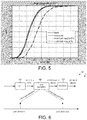
- Figure 5 illustrates examples of the cumulative distribution function (CDF) of PAPR corresponding to different BPSK modulation schemes. Since PAPR varies from packet to packet, in the example of Figure 5 , the PAPR for 10,000 packets are computed and the CDFs of the PAPR corresponding to different modulation schemes are plotted. Three different modulation schemes are used. In a first modulation scheme, non-DCM BPSK is used; in a second modulation scheme, DCM BPSK with no special mapping is used; in a third modulation scheme, DCM BPSK with proposed special mapping is used.
- a first modulation scheme non-DCM BPSK is used
- DCM BPSK with no special mapping is used
- DCM BPSK with proposed special mapping is used.
- the average PAPR is about 7.25dB.
- data is duplicated and modulated with no special mapping, e.g., the same BPSK mapping is used for the lower half of the subcarriers and the upper half of the subcarriers.
- the average PAPR is about 8.5dB, which is higher than non-DCM BPSK modulation.
- DCM BPSK with proposed special mapping data is modulated with a first BPSK mapping scheme #1 for the lower half of the subcarriers, duplicated data is then modulated with a second BPSK mapping scheme #2 for the upper half of the subcarriers.
- the average PAPR is very close to non-DCM BPSK modulation scheme.
- FIG. 6 is a simplified diagram of a receiving device 600 that applies DCM de-modulation with de-mapping.
- r m h m s m + v m ⁇ ⁇ ⁇ Lower subcarrier
- the de-mapper/demodulator 602 of the receiver can calculate the logarithm likelihood ratio (LLR) of a received bit by combining the received signals from the upper subcarrier and the lower subcarrier if the SNR is considered "good” for the upper and lower subcarriers.
- LLR logarithm likelihood ratio
- the receiver can choose to calculate the LLR of a received bit just from the upper subcarrier or from the lower subcarrier if the SNR is considered "bad” for the lower or the upper subcarriers, respectively.
- the demodulated signal is then fed to decoder 603 for outputting the decoded signal.
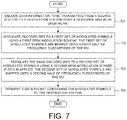
- FIG. 7 is flow chart of a method of transmitting and encoding a HE PPDU frame with DCM and PAPR reduction in accordance with a novel aspect.
- a wireless source station encodes data information to be transmitted from the source station to a destination station over a resource unit (RU) in an orthogonal frequency division multiplexing (OFDM) wireless local area network.
- the source station modulates encoded bits to a first set of modulated symbols using a first binary phase shift keying (BPSK) modulation scheme, wherein the first set of modulated symbols is mapped onto a first half of frequency subcarriers of the RU.
- BPSK binary phase shift keying
- the source station modulates the same encoded bits to a second set of modulated symbols using a second BPSK modulation scheme if dual carrier modulation (DCM) is applied, wherein the second set of modulated symbols is mapped onto a second half of frequency subcarriers of the RU.
- the source station transmits a data packet containing the modulated symbols to the destination station.
Landscapes
- Engineering & Computer Science (AREA)
- Signal Processing (AREA)
- Computer Networks & Wireless Communication (AREA)
- Quality & Reliability (AREA)
- Mobile Radio Communication Systems (AREA)
Claims (12)
- Procédé comprenant le fait :de coder (701) des informations de données à transmettre d'une station source à une station de destination sur une unité de ressource, également appelée RU, dans un réseau local sans fil de multiplexage par répartition orthogonale de fréquence, également appelé OFDM ;de moduler (702) des bits codés en un premier ensemble de symboles modulés en utilisant un premier schéma de modulation par déplacement de phase bivalente, également appelé BPSK ;de moduler (703) les mêmes bits codés en un deuxième ensemble de symboles modulés en utilisant un deuxième schéma de modulation par déplacement de phase bivalente, BPSK, si une modulation à double porteuse, également appelée DCM, est appliquée ; etde transmettre (704) un paquet de données contenant les symboles modulés à la station de destination,dans lequel le premier ensemble de symboles modulés est mappé sur une première moitié de sous-porteuses de fréquence de la RU et le deuxième ensemble de symboles modulés est mappé sur une deuxième moitié de sous-porteuses de fréquence de la RU si une DCM est appliquée,caractérisé en ce quele premier ensemble de symboles modulés est sn pour une sous-porteuse n, où le deuxième ensemble de symboles modulés est sm pour une sous-porteuse m, et où sm = sn*ej*(pi)*m, n et m sont des indices de sous-porteuse.
- Procédé de la revendication 1, caractérisé en ce que le premier schéma de modulation et le deuxième schéma de modulation sont choisis pour obtenir un premier rapport puissance de crête sur puissance moyenne, également appelé PAPR.
- Procédé de la revendication 2, caractérisé en ce qu'un deuxième PAPR est obtenu si aucune DCM n'est appliquée, et dans lequel le deuxième PAPR est essentiellement le même que le premier PAPR.
- Procédé de la revendication 2, caractérisé en ce qu'un deuxième PAPR est obtenu si le premier schéma de modulation et le deuxième schéma de modulation sont identiques, et dans lequel le deuxième PAPR est supérieur au premier PAPR.
- Procédé de la revendication 1, caractérisé en ce que le codage implique un codage de commande de canal à contrôle de parité de faible densité, également appelé LDPC.
- Procédé de la revendication 1, caractérisé en ce que le codage implique un codeur à code convolutif binaire, également appelé BCC, suivi d'un entrelaceur BCC.
- Station sans fil (201) comprenant :un codeur (205), qui est configuré pour coder des informations de données à transmettre d'une station source à une station de destination sur une unité de ressource (RU) dans un réseau local sans fil de multiplexage par répartition orthogonale de fréquence, également appelé OFDM ;un modulateur (204), qui est configuré pour moduler des bits codés en un premier ensemble de symboles modulés en utilisant un premier schéma de modulation par déplacement de phase bivalente, également appelé BPSK, où le premier ensemble de symboles modulés est mappé sur une première moitié de sous-porteuses de fréquence de la RU ;le modulateur (204), qui est configuré pour moduler les mêmes bits codés en un deuxième ensemble de symboles modulés en utilisant un deuxième schéma de modulation par déplacement de phase bivalente, également appelé BPSK, si une modulation à double porteuse, également appelée DCM, est appliquée, où le deuxième ensemble de symboles modulés est mappé sur une deuxième moitié de sous-porteuses de fréquence de la RU ; etun émetteur (206), qui est configuré pour transmettre un paquet de données contenant les symboles modulés à la station de destination,caractérisée en ce quele premier ensemble de symboles modulés est sn pour une sous-porteuse n, où le deuxième ensemble de symboles modulés est sm pour une sous-porteuse m, et où sm = sn*ej*(pi)*m, n et m sont des indices de sous-porteuse.
- Station sans fil de la revendication 7, caractérisée en ce que la station sans fil (201) est configurée pour sélectionner le premier schéma de modulation et le deuxième schéma de modulation pour obtenir un premier rapport puissance de crête sur puissance moyenne, également appelé PAPR.
- Station sans fil de la revendication 8, caractérisée en ce qu'un deuxième PAPR est obtenu si aucune DCM n'est appliquée, et où le deuxième PAPR est essentiellement le même que le premier PAPR.
- Station sans fil de la revendication 8, caractérisée en ce qu'un deuxième PAPR est obtenu si le premier schéma de modulation et le deuxième schéma de modulation sont identiques, et où le deuxième PAPR est supérieur au premier PAPR.
- Station sans fil de la revendication 7, caractérisée en ce que le codeur (205) comprend un codeur de commande de canal à contrôle de parité de faible densité, également appelé LDPC.
- Station sans fil de la revendication 7, caractérisée en ce que le codeur (205) comprend un code convolutif binaire, également appelé BCC, suivi d'un entrelaceur BCC.
Applications Claiming Priority (2)
| Application Number | Priority Date | Filing Date | Title |
|---|---|---|---|
| US201662291038P | 2016-02-04 | 2016-02-04 | |
| US15/422,755 US10225122B2 (en) | 2016-02-04 | 2017-02-02 | Low PAPR dual sub-carrier modulation scheme for BPSK in WLAN |
Publications (2)
| Publication Number | Publication Date |
|---|---|
| EP3203675A1 EP3203675A1 (fr) | 2017-08-09 |
| EP3203675B1 true EP3203675B1 (fr) | 2021-04-28 |
Family
ID=57963099
Family Applications (1)
| Application Number | Title | Priority Date | Filing Date |
|---|---|---|---|
| EP17154548.6A Active EP3203675B1 (fr) | 2016-02-04 | 2017-02-03 | Système de modulation à deux porteuses à faible papr dans un réseau local sans fil |
Country Status (2)
| Country | Link |
|---|---|
| US (1) | US10225122B2 (fr) |
| EP (1) | EP3203675B1 (fr) |
Families Citing this family (21)
| Publication number | Priority date | Publication date | Assignee | Title |
|---|---|---|---|---|
| EP3167303B1 (fr) | 2014-08-18 | 2021-09-29 | MEDIATEK Inc. | Format d'antenne de radiogoniométrie |
| WO2017026769A1 (fr) * | 2015-08-12 | 2017-02-16 | 엘지전자 주식회사 | Procédé de transmission de signaux en mode dcm dans un système lan sans fil, et dispositif associé |
| EP3139532B1 (fr) | 2015-09-07 | 2018-12-12 | MediaTek Inc. | Formats et allocation du champ commun de he-sig-b |
| EP3148276B1 (fr) | 2015-09-28 | 2018-09-05 | MediaTek Inc. | Signalisation d'attribution de ressources structurée |
| US10187124B2 (en) | 2015-10-01 | 2019-01-22 | Mediatek Inc | Beam-change indication for channel estimation enhancement |
| US10211948B2 (en) | 2015-10-12 | 2019-02-19 | Mediatek Inc. | LDPC tone mapping schemes for dual-sub-carrier modulation in WLAN |
| US10686641B2 (en) | 2015-11-05 | 2020-06-16 | Mediatek Inc. | Signaling and feedback schemes of time-vary channels in high-efficiency WLAN |
| US11019559B2 (en) | 2015-12-09 | 2021-05-25 | Mediatek Inc. | VHT operation information subfield design in WLAN |
| EP3182628B1 (fr) | 2015-12-17 | 2022-05-11 | Mediatek, Inc. | Conception d'entrelaceur de double modulation de sous-porteuse dans un réseau local sans fil |
| EP3443717A1 (fr) * | 2016-04-12 | 2019-02-20 | Marvell World Trade, Ltd. | Modulation double porteuse qui atténue un papr |
| KR102130020B1 (ko) * | 2017-07-26 | 2020-07-03 | 엘지전자 주식회사 | 무선랜 시스템에서 신호의 송수신 방법 및 이를 위한 장치 |
| WO2019132390A1 (fr) * | 2017-12-28 | 2019-07-04 | 엘지전자 주식회사 | Procédé et dispositif de configuration d'un format de trame en utilisant un procédé nbt dans un système lan sans fil |
| KR102629072B1 (ko) * | 2018-11-13 | 2024-01-24 | 한국전자통신연구원 | 무선 통신 시스템에서의 데이터 재전송 방법 및 장치 |
| CN113439413B (zh) * | 2019-02-15 | 2023-12-22 | Lg电子株式会社 | 在无线通信系统中生成低papr序列的方法及用于该方法的装置 |
| US11882062B2 (en) * | 2020-06-16 | 2024-01-23 | Nxp Usa, Inc. | Method and apparatus for wireless communications |
| US11937230B2 (en) * | 2020-06-16 | 2024-03-19 | Nxp Usa, Inc. | Method and apparatus for wireless communications |
| EP4152660A4 (fr) * | 2020-07-01 | 2023-11-29 | LG Electronics, Inc. | Procédé et appareil de réception d'une ppdu dans laquelle des données sont dupliquées dans un système wlan |
| US20220014406A1 (en) * | 2020-07-09 | 2022-01-13 | Mediatek Singapore Pte. Ltd. | Low PAPR Duplicated Dual Carrier Modulation For BPSK In Wireless Communications |
| EP4319280A4 (fr) * | 2021-04-01 | 2024-05-29 | Beijing Xiaomi Mobile Software Co., Ltd. | Procédé de communication et appareil de communication |
| US11411786B1 (en) | 2021-05-03 | 2022-08-09 | Raytheon Company | Constant envelope bi-phase shift keying (CE-BPSK) modulation for “mode S” and other communication applications |
| US11792062B2 (en) | 2021-05-28 | 2023-10-17 | Huawei Technologies Co., Ltd. | Apparatus and method for wireless communication |
Family Cites Families (63)
| Publication number | Priority date | Publication date | Assignee | Title |
|---|---|---|---|---|
| KR100318952B1 (ko) | 1999-12-29 | 2002-01-04 | 윤종용 | 무선통신시스템에서 채널 추정을 위한 장치 및 방법 |
| US8929550B2 (en) | 2013-02-01 | 2015-01-06 | Department 13, LLC | LPI/LPD communication systems |
| CA2506779A1 (fr) | 2002-11-22 | 2004-06-10 | Ben Gurion University | Systeme d'antenne intelligent a localisation amelioree de sources polarisees |
| AU2003247662A1 (en) | 2003-03-27 | 2004-11-23 | Bae Systems Information And Electronic Systems Integration Inc | Direction-finding for multiple cochannel sources |
| US20080191941A1 (en) | 2007-02-12 | 2008-08-14 | Mobileaccess Networks Ltd. | Indoor location determination |
| US20080232485A1 (en) | 2007-03-21 | 2008-09-25 | Samsung Electronics Co., Ltd. | Method and system for improved power loading by steering and power loading the preamble in beamforming wireless communication systems |
| US20090122890A1 (en) | 2007-11-08 | 2009-05-14 | Faraday Technology Corp. | Ofdm dcm demodulation method |
| CN102007747B (zh) | 2008-04-18 | 2014-12-03 | 皇家飞利浦电子股份有限公司 | 改进的双载波调制预编码 |
| WO2010022785A1 (fr) | 2008-08-28 | 2010-03-04 | Telefonaktiebolaget Lm Ericsson (Publ) | Positionnement d'un terminal d'utilisateur |
| WO2010052800A1 (fr) | 2008-11-05 | 2010-05-14 | Ntt Docomo, Inc. | Etalement de code bidimensionnel pour système fdma entrelacé |
| US8213527B2 (en) | 2009-03-25 | 2012-07-03 | Cisco Technology, Inc. | Channel variation detection of wireless channel for adaptive transmission schemes |
| CN101867398A (zh) | 2009-04-20 | 2010-10-20 | 中兴通讯股份有限公司 | 一种适用于频分复用系统的单用户波束成形方法和装置 |
| US8638880B2 (en) * | 2010-01-18 | 2014-01-28 | Telefonaktiebolaget Lm Ericsson (Publ) | Radio base station and user equipment and methods therein |
| US8441393B2 (en) | 2010-02-10 | 2013-05-14 | Tialinx, Inc. | Orthogonal frequency division multiplexing (OFDM) radio as radar |
| US8824386B2 (en) | 2010-05-05 | 2014-09-02 | Mediatek Inc. | Method and system of operating a multi-user system |
| CN102149192B (zh) | 2011-01-25 | 2013-12-25 | 南京信息工程大学 | 一种基于移动台合作的蜂窝网络无线定位方法 |
| US8965284B2 (en) | 2011-04-07 | 2015-02-24 | Nokia Corporation | Facilitating positioning through Bluetooth low energy wireless messaging |
| US9281928B2 (en) * | 2011-04-18 | 2016-03-08 | Broadcom Corporation | Range extension within single user, multiple user, multiple access, and/or MIMO wireless communications |
| US20150023449A1 (en) | 2013-01-11 | 2015-01-22 | Broadcom Corporation | Distributed signal fields (SIGs) for use in wireless communications |
| WO2012156570A1 (fr) | 2011-05-16 | 2012-11-22 | Nokia Corporation | Procédé et appareil permettant de trouver facilement une direction |
| US10021599B2 (en) | 2011-09-20 | 2018-07-10 | Qualcomm Incorporated | Channel and bandwidth switch procedures for wireless networks |
| KR101942026B1 (ko) * | 2011-10-06 | 2019-01-25 | 삼성전자 주식회사 | 경판정에 의한 mdcm 신호 복조 방법 및 연판정에 의한 mdcm 신호 복조 방법 |
| US8929192B2 (en) | 2012-01-25 | 2015-01-06 | Nokia Corporation | Method, apparatus, and computer program product for short-range communication based direction finding |
| US9100984B2 (en) | 2012-04-04 | 2015-08-04 | Qualcomm Incorporated | Wireless channelization |
| US9319896B2 (en) | 2012-05-03 | 2016-04-19 | MEDIATEK Singapore Ple. Ltd. | Beam-change indication for channel estimation improvement in wireless networks |
| US9702963B2 (en) | 2012-05-30 | 2017-07-11 | Nokia Technologies Oy | Method, apparatus, and computer program product for high accuracy location determination |
| CA2877484C (fr) | 2012-07-09 | 2017-09-19 | Lg Electronics Inc. | Procede et appareil d'emission/reception d'informations de canal de fonctionnement dans un systeme de communication sans fil |
| US9615214B2 (en) | 2012-12-07 | 2017-04-04 | Nokia Technologies Oy | Handling positioning messages |
| WO2014107869A1 (fr) | 2013-01-10 | 2014-07-17 | Nokia Corporation | Gestion de signaux |
| US9112737B2 (en) | 2013-03-06 | 2015-08-18 | Qualcomm Incorporated | Systems and methods for determining a channel variation metric |
| WO2014179794A1 (fr) | 2013-05-03 | 2014-11-06 | Marvell World Trade Ltd. | Recommandations de changement de faisceau et de lissage dans des systèmes wlan en mode mixte |
| US9780919B2 (en) | 2013-07-05 | 2017-10-03 | Quallcomm, Incorporated | High efficiency WLAN preamble structure |
| WO2015069811A1 (fr) | 2013-11-06 | 2015-05-14 | Mediatek Singapore Pte. Ltd. | Schéma de rétroaction d'échec de réception dans des réseaux locaux sans fil |
| US9655119B2 (en) | 2013-11-07 | 2017-05-16 | Qualcomm Incorporated | Primary channel determination in wireless networks |
| US9325463B2 (en) | 2013-11-19 | 2016-04-26 | Intel IP Corporation | High-efficiency WLAN (HEW) master station and methods to increase information bits for HEW communication |
| US10070378B2 (en) | 2014-02-07 | 2018-09-04 | Fortinet, Inc. | Steering inherently autonomous wireless devices to access points based on MIMO (multiple input/ multiple output) capabilities of network components |
| US10206122B2 (en) | 2014-02-25 | 2019-02-12 | Mediatek Inc. | Direction finding positioning in wireless local area networks |
| KR102087665B1 (ko) | 2014-04-10 | 2020-03-11 | 삼성전자주식회사 | 셀룰러 무선 통신 시스템에서 비인가 대역 채널을 사용하는 방법 및 장치 |
| US9647816B2 (en) | 2014-07-16 | 2017-05-09 | Newracom, Inc. | Wireless local area network communications with varying subcarrier spacings |
| WO2016013742A1 (fr) | 2014-07-21 | 2016-01-28 | Lg Electronics Inc. | Procédé et appareil de transmission d'un signal de référence pour une mesure de changement de canal dans un système de communications sans fil |
| WO2016022613A1 (fr) | 2014-08-04 | 2016-02-11 | Mediatek Inc. | Identification de lobe principal et de lobe secondaire d'antenne réseau pour radiogoniométrie |
| EP3167303B1 (fr) | 2014-08-18 | 2021-09-29 | MEDIATEK Inc. | Format d'antenne de radiogoniométrie |
| US20160065467A1 (en) | 2014-08-29 | 2016-03-03 | Mediatek Inc. | Configurable Signaling Field and its Indication |
| JP6459015B2 (ja) | 2015-01-08 | 2019-01-30 | マーベル ワールド トレード リミテッド | 方法および装置 |
| US9736640B2 (en) | 2015-02-23 | 2017-08-15 | Qualcomm Incorporated | Methods and systems for a ranging protocol |
| US20160323060A1 (en) | 2015-04-28 | 2016-11-03 | Intel IP Corporation | Apparatus, computer readable medium, and method for higher qam in a high efficiency wireless local-area network |
| WO2016178534A1 (fr) | 2015-05-05 | 2016-11-10 | 삼성전자주식회사 | Dispositif et procédé de signalisation d'informations dans un système de réseau local sans fil |
| US20160330055A1 (en) | 2015-05-07 | 2016-11-10 | Samsung Electronics Co., Ltd. | Apparatus for and method of an interleaver and a tone mapper |
| US10616017B2 (en) | 2015-05-26 | 2020-04-07 | Mediatek Inc. | Reliable dual sub-carrier modulation schemes in high efficiency WLAN |
| WO2016204460A1 (fr) | 2015-06-18 | 2016-12-22 | 엘지전자 주식회사 | Procédé et appareil de mise en œuvre de transmission de liaison montante dans un système de réseau local sans fil |
| US20160370450A1 (en) | 2015-06-22 | 2016-12-22 | Sony Mobile Communications Inc. | Methods, devices, and computer program products for determining relative direction of remote rf signal source |
| US10123330B2 (en) | 2015-07-01 | 2018-11-06 | Samsung Electronics Co., Ltd. | Methods to enable efficient wideband operations in local area networks using OFDMA |
| CN113037448B (zh) | 2015-08-07 | 2023-11-21 | 纽瑞科姆有限公司 | 用于wlan系统中的多用户传输的控制信息 |
| US20170064718A1 (en) | 2015-08-25 | 2017-03-02 | Qualcomm Incorporated | Resource allocation signaling in a wireless local area network preamble |
| EP3139532B1 (fr) | 2015-09-07 | 2018-12-12 | MediaTek Inc. | Formats et allocation du champ commun de he-sig-b |
| EP3148276B1 (fr) | 2015-09-28 | 2018-09-05 | MediaTek Inc. | Signalisation d'attribution de ressources structurée |
| US10187124B2 (en) | 2015-10-01 | 2019-01-22 | Mediatek Inc | Beam-change indication for channel estimation enhancement |
| US10211948B2 (en) * | 2015-10-12 | 2019-02-19 | Mediatek Inc. | LDPC tone mapping schemes for dual-sub-carrier modulation in WLAN |
| US10686641B2 (en) | 2015-11-05 | 2020-06-16 | Mediatek Inc. | Signaling and feedback schemes of time-vary channels in high-efficiency WLAN |
| US11019559B2 (en) | 2015-12-09 | 2021-05-25 | Mediatek Inc. | VHT operation information subfield design in WLAN |
| CN108370285B (zh) * | 2015-12-11 | 2020-12-11 | 马维尔国际有限公司 | 生成数据单元的物理层phy前导码字段的方法和装置 |
| EP3182628B1 (fr) | 2015-12-17 | 2022-05-11 | Mediatek, Inc. | Conception d'entrelaceur de double modulation de sous-porteuse dans un réseau local sans fil |
| US10362447B2 (en) | 2016-01-21 | 2019-07-23 | Intel IP Corporation | Apparatus, system and method of angle of departure (AoD) estimation |
-
2017
- 2017-02-02 US US15/422,755 patent/US10225122B2/en active Active
- 2017-02-03 EP EP17154548.6A patent/EP3203675B1/fr active Active
Non-Patent Citations (1)
| Title |
|---|
| None * |
Also Published As
| Publication number | Publication date |
|---|---|
| US10225122B2 (en) | 2019-03-05 |
| EP3203675A1 (fr) | 2017-08-09 |
| US20170230220A1 (en) | 2017-08-10 |
Similar Documents
| Publication | Publication Date | Title |
|---|---|---|
| EP3203675B1 (fr) | Système de modulation à deux porteuses à faible papr dans un réseau local sans fil | |
| EP3157218B1 (fr) | Schémas de courbes de reproduction tonale pour modulation de sous-porteuse dans un réseau wlan | |
| EP3182628B1 (fr) | Conception d'entrelaceur de double modulation de sous-porteuse dans un réseau local sans fil | |
| EP3098999B1 (fr) | Schémas de modulation de sous-porteuse double fiable dans un réseau local sans fil (wlan) à haute efficacité | |
| US9379863B2 (en) | Method for signaling information by modifying modulation constellations | |
| US11349696B1 (en) | Systems and methods to reduce peak to average power ratio for dual sub-carrier modulated transmissions in a wireless network | |
| TWI653862B (zh) | 雙子載波調製方法和無線站點 | |
| US20080170636A1 (en) | Apparatus and method for reducing peak-to-average power ratio in a wireless communication system | |
| CN114586408B (zh) | 带有可检测wlan版本标识符的前导码 | |
| CN107919945B (zh) | 发送数据分组的方法及无线站 | |
| US20170295049A1 (en) | Dual carrier modulation that mitigates papr | |
| US9444672B2 (en) | Data modulation | |
| CN106533612A (zh) | 传输高效率信令b字段的方法、站点和接入点 | |
| US20250337540A1 (en) | Extended range signaling field for wireless communications | |
| US20260005905A1 (en) | Papr reduction for data portion of enhanced long range ppdu | |
| AU2024338498A1 (en) | Devices and methods for reliable communication in a wireless network |
Legal Events
| Date | Code | Title | Description |
|---|---|---|---|
| PUAI | Public reference made under article 153(3) epc to a published international application that has entered the european phase |
Free format text: ORIGINAL CODE: 0009012 |
|
| STAA | Information on the status of an ep patent application or granted ep patent |
Free format text: STATUS: THE APPLICATION HAS BEEN PUBLISHED |
|
| AK | Designated contracting states |
Kind code of ref document: A1 Designated state(s): AL AT BE BG CH CY CZ DE DK EE ES FI FR GB GR HR HU IE IS IT LI LT LU LV MC MK MT NL NO PL PT RO RS SE SI SK SM TR |
|
| AX | Request for extension of the european patent |
Extension state: BA ME |
|
| STAA | Information on the status of an ep patent application or granted ep patent |
Free format text: STATUS: REQUEST FOR EXAMINATION WAS MADE |
|
| 17P | Request for examination filed |
Effective date: 20180209 |
|
| RBV | Designated contracting states (corrected) |
Designated state(s): AL AT BE BG CH CY CZ DE DK EE ES FI FR GB GR HR HU IE IS IT LI LT LU LV MC MK MT NL NO PL PT RO RS SE SI SK SM TR |
|
| STAA | Information on the status of an ep patent application or granted ep patent |
Free format text: STATUS: EXAMINATION IS IN PROGRESS |
|
| 17Q | First examination report despatched |
Effective date: 20190625 |
|
| REG | Reference to a national code |
Ref country code: DE Ref legal event code: R079 Ref document number: 602017037411 Country of ref document: DE Free format text: PREVIOUS MAIN CLASS: H04L0005000000 Ipc: H04L0027260000 |
|
| GRAP | Despatch of communication of intention to grant a patent |
Free format text: ORIGINAL CODE: EPIDOSNIGR1 |
|
| STAA | Information on the status of an ep patent application or granted ep patent |
Free format text: STATUS: GRANT OF PATENT IS INTENDED |
|
| RIC1 | Information provided on ipc code assigned before grant |
Ipc: H04L 5/00 20060101ALI20201027BHEP Ipc: H04L 1/04 20060101ALI20201027BHEP Ipc: H04L 27/26 20060101AFI20201027BHEP Ipc: H04L 27/28 20060101ALI20201027BHEP |
|
| INTG | Intention to grant announced |
Effective date: 20201110 |
|
| GRAS | Grant fee paid |
Free format text: ORIGINAL CODE: EPIDOSNIGR3 |
|
| GRAA | (expected) grant |
Free format text: ORIGINAL CODE: 0009210 |
|
| STAA | Information on the status of an ep patent application or granted ep patent |
Free format text: STATUS: THE PATENT HAS BEEN GRANTED |
|
| AK | Designated contracting states |
Kind code of ref document: B1 Designated state(s): AL AT BE BG CH CY CZ DE DK EE ES FI FR GB GR HR HU IE IS IT LI LT LU LV MC MK MT NL NO PL PT RO RS SE SI SK SM TR |
|
| RAP3 | Party data changed (applicant data changed or rights of an application transferred) |
Owner name: MEDIATEK INC. |
|
| REG | Reference to a national code |
Ref country code: GB Ref legal event code: FG4D |
|
| REG | Reference to a national code |
Ref country code: CH Ref legal event code: EP |
|
| REG | Reference to a national code |
Ref country code: DE Ref legal event code: R096 Ref document number: 602017037411 Country of ref document: DE |
|
| REG | Reference to a national code |
Ref country code: AT Ref legal event code: REF Ref document number: 1388407 Country of ref document: AT Kind code of ref document: T Effective date: 20210515 |
|
| REG | Reference to a national code |
Ref country code: IE Ref legal event code: FG4D |
|
| REG | Reference to a national code |
Ref country code: DE Ref legal event code: R081 Ref document number: 602017037411 Country of ref document: DE Owner name: MEDIATEK INC., HSIN-CHU, CN Free format text: FORMER OWNER: MEDIATEK INC., HSIN-CHU, TW |
|
| REG | Reference to a national code |
Ref country code: LT Ref legal event code: MG9D |
|
| REG | Reference to a national code |
Ref country code: AT Ref legal event code: MK05 Ref document number: 1388407 Country of ref document: AT Kind code of ref document: T Effective date: 20210428 |
|
| PG25 | Lapsed in a contracting state [announced via postgrant information from national office to epo] |
Ref country code: NL Free format text: LAPSE BECAUSE OF FAILURE TO SUBMIT A TRANSLATION OF THE DESCRIPTION OR TO PAY THE FEE WITHIN THE PRESCRIBED TIME-LIMIT Effective date: 20210428 Ref country code: HR Free format text: LAPSE BECAUSE OF FAILURE TO SUBMIT A TRANSLATION OF THE DESCRIPTION OR TO PAY THE FEE WITHIN THE PRESCRIBED TIME-LIMIT Effective date: 20210428 Ref country code: AT Free format text: LAPSE BECAUSE OF FAILURE TO SUBMIT A TRANSLATION OF THE DESCRIPTION OR TO PAY THE FEE WITHIN THE PRESCRIBED TIME-LIMIT Effective date: 20210428 Ref country code: BG Free format text: LAPSE BECAUSE OF FAILURE TO SUBMIT A TRANSLATION OF THE DESCRIPTION OR TO PAY THE FEE WITHIN THE PRESCRIBED TIME-LIMIT Effective date: 20210728 Ref country code: FI Free format text: LAPSE BECAUSE OF FAILURE TO SUBMIT A TRANSLATION OF THE DESCRIPTION OR TO PAY THE FEE WITHIN THE PRESCRIBED TIME-LIMIT Effective date: 20210428 Ref country code: LT Free format text: LAPSE BECAUSE OF FAILURE TO SUBMIT A TRANSLATION OF THE DESCRIPTION OR TO PAY THE FEE WITHIN THE PRESCRIBED TIME-LIMIT Effective date: 20210428 |
|
| PG25 | Lapsed in a contracting state [announced via postgrant information from national office to epo] |
Ref country code: NO Free format text: LAPSE BECAUSE OF FAILURE TO SUBMIT A TRANSLATION OF THE DESCRIPTION OR TO PAY THE FEE WITHIN THE PRESCRIBED TIME-LIMIT Effective date: 20210728 Ref country code: PT Free format text: LAPSE BECAUSE OF FAILURE TO SUBMIT A TRANSLATION OF THE DESCRIPTION OR TO PAY THE FEE WITHIN THE PRESCRIBED TIME-LIMIT Effective date: 20210830 Ref country code: PL Free format text: LAPSE BECAUSE OF FAILURE TO SUBMIT A TRANSLATION OF THE DESCRIPTION OR TO PAY THE FEE WITHIN THE PRESCRIBED TIME-LIMIT Effective date: 20210428 Ref country code: SE Free format text: LAPSE BECAUSE OF FAILURE TO SUBMIT A TRANSLATION OF THE DESCRIPTION OR TO PAY THE FEE WITHIN THE PRESCRIBED TIME-LIMIT Effective date: 20210428 Ref country code: RS Free format text: LAPSE BECAUSE OF FAILURE TO SUBMIT A TRANSLATION OF THE DESCRIPTION OR TO PAY THE FEE WITHIN THE PRESCRIBED TIME-LIMIT Effective date: 20210428 Ref country code: GR Free format text: LAPSE BECAUSE OF FAILURE TO SUBMIT A TRANSLATION OF THE DESCRIPTION OR TO PAY THE FEE WITHIN THE PRESCRIBED TIME-LIMIT Effective date: 20210729 Ref country code: IS Free format text: LAPSE BECAUSE OF FAILURE TO SUBMIT A TRANSLATION OF THE DESCRIPTION OR TO PAY THE FEE WITHIN THE PRESCRIBED TIME-LIMIT Effective date: 20210828 Ref country code: LV Free format text: LAPSE BECAUSE OF FAILURE TO SUBMIT A TRANSLATION OF THE DESCRIPTION OR TO PAY THE FEE WITHIN THE PRESCRIBED TIME-LIMIT Effective date: 20210428 |
|
| REG | Reference to a national code |
Ref country code: NL Ref legal event code: MP Effective date: 20210428 |
|
| PG25 | Lapsed in a contracting state [announced via postgrant information from national office to epo] |
Ref country code: EE Free format text: LAPSE BECAUSE OF FAILURE TO SUBMIT A TRANSLATION OF THE DESCRIPTION OR TO PAY THE FEE WITHIN THE PRESCRIBED TIME-LIMIT Effective date: 20210428 Ref country code: CZ Free format text: LAPSE BECAUSE OF FAILURE TO SUBMIT A TRANSLATION OF THE DESCRIPTION OR TO PAY THE FEE WITHIN THE PRESCRIBED TIME-LIMIT Effective date: 20210428 Ref country code: DK Free format text: LAPSE BECAUSE OF FAILURE TO SUBMIT A TRANSLATION OF THE DESCRIPTION OR TO PAY THE FEE WITHIN THE PRESCRIBED TIME-LIMIT Effective date: 20210428 Ref country code: RO Free format text: LAPSE BECAUSE OF FAILURE TO SUBMIT A TRANSLATION OF THE DESCRIPTION OR TO PAY THE FEE WITHIN THE PRESCRIBED TIME-LIMIT Effective date: 20210428 Ref country code: ES Free format text: LAPSE BECAUSE OF FAILURE TO SUBMIT A TRANSLATION OF THE DESCRIPTION OR TO PAY THE FEE WITHIN THE PRESCRIBED TIME-LIMIT Effective date: 20210428 Ref country code: SK Free format text: LAPSE BECAUSE OF FAILURE TO SUBMIT A TRANSLATION OF THE DESCRIPTION OR TO PAY THE FEE WITHIN THE PRESCRIBED TIME-LIMIT Effective date: 20210428 Ref country code: SM Free format text: LAPSE BECAUSE OF FAILURE TO SUBMIT A TRANSLATION OF THE DESCRIPTION OR TO PAY THE FEE WITHIN THE PRESCRIBED TIME-LIMIT Effective date: 20210428 |
|
| REG | Reference to a national code |
Ref country code: DE Ref legal event code: R097 Ref document number: 602017037411 Country of ref document: DE |
|
| PLBE | No opposition filed within time limit |
Free format text: ORIGINAL CODE: 0009261 |
|
| STAA | Information on the status of an ep patent application or granted ep patent |
Free format text: STATUS: NO OPPOSITION FILED WITHIN TIME LIMIT |
|
| 26N | No opposition filed |
Effective date: 20220131 |
|
| PG25 | Lapsed in a contracting state [announced via postgrant information from national office to epo] |
Ref country code: IS Free format text: LAPSE BECAUSE OF FAILURE TO SUBMIT A TRANSLATION OF THE DESCRIPTION OR TO PAY THE FEE WITHIN THE PRESCRIBED TIME-LIMIT Effective date: 20210828 Ref country code: AL Free format text: LAPSE BECAUSE OF FAILURE TO SUBMIT A TRANSLATION OF THE DESCRIPTION OR TO PAY THE FEE WITHIN THE PRESCRIBED TIME-LIMIT Effective date: 20210428 |
|
| PG25 | Lapsed in a contracting state [announced via postgrant information from national office to epo] |
Ref country code: IT Free format text: LAPSE BECAUSE OF FAILURE TO SUBMIT A TRANSLATION OF THE DESCRIPTION OR TO PAY THE FEE WITHIN THE PRESCRIBED TIME-LIMIT Effective date: 20210428 |
|
| PG25 | Lapsed in a contracting state [announced via postgrant information from national office to epo] |
Ref country code: MC Free format text: LAPSE BECAUSE OF FAILURE TO SUBMIT A TRANSLATION OF THE DESCRIPTION OR TO PAY THE FEE WITHIN THE PRESCRIBED TIME-LIMIT Effective date: 20210428 |
|
| REG | Reference to a national code |
Ref country code: CH Ref legal event code: PL |
|
| REG | Reference to a national code |
Ref country code: BE Ref legal event code: MM Effective date: 20220228 |
|
| PG25 | Lapsed in a contracting state [announced via postgrant information from national office to epo] |
Ref country code: LU Free format text: LAPSE BECAUSE OF NON-PAYMENT OF DUE FEES Effective date: 20220203 |
|
| PG25 | Lapsed in a contracting state [announced via postgrant information from national office to epo] |
Ref country code: LI Free format text: LAPSE BECAUSE OF NON-PAYMENT OF DUE FEES Effective date: 20220228 Ref country code: IE Free format text: LAPSE BECAUSE OF NON-PAYMENT OF DUE FEES Effective date: 20220203 Ref country code: CH Free format text: LAPSE BECAUSE OF NON-PAYMENT OF DUE FEES Effective date: 20220228 |
|
| PG25 | Lapsed in a contracting state [announced via postgrant information from national office to epo] |
Ref country code: BE Free format text: LAPSE BECAUSE OF NON-PAYMENT OF DUE FEES Effective date: 20220228 |
|
| P01 | Opt-out of the competence of the unified patent court (upc) registered |
Effective date: 20230607 |
|
| PG25 | Lapsed in a contracting state [announced via postgrant information from national office to epo] |
Ref country code: HU Free format text: LAPSE BECAUSE OF FAILURE TO SUBMIT A TRANSLATION OF THE DESCRIPTION OR TO PAY THE FEE WITHIN THE PRESCRIBED TIME-LIMIT; INVALID AB INITIO Effective date: 20170203 |
|
| PG25 | Lapsed in a contracting state [announced via postgrant information from national office to epo] |
Ref country code: MK Free format text: LAPSE BECAUSE OF FAILURE TO SUBMIT A TRANSLATION OF THE DESCRIPTION OR TO PAY THE FEE WITHIN THE PRESCRIBED TIME-LIMIT Effective date: 20210428 Ref country code: CY Free format text: LAPSE BECAUSE OF FAILURE TO SUBMIT A TRANSLATION OF THE DESCRIPTION OR TO PAY THE FEE WITHIN THE PRESCRIBED TIME-LIMIT Effective date: 20210428 |
|
| PG25 | Lapsed in a contracting state [announced via postgrant information from national office to epo] |
Ref country code: TR Free format text: LAPSE BECAUSE OF FAILURE TO SUBMIT A TRANSLATION OF THE DESCRIPTION OR TO PAY THE FEE WITHIN THE PRESCRIBED TIME-LIMIT Effective date: 20210428 |
|
| PG25 | Lapsed in a contracting state [announced via postgrant information from national office to epo] |
Ref country code: MT Free format text: LAPSE BECAUSE OF FAILURE TO SUBMIT A TRANSLATION OF THE DESCRIPTION OR TO PAY THE FEE WITHIN THE PRESCRIBED TIME-LIMIT Effective date: 20210428 |
|
| PGFP | Annual fee paid to national office [announced via postgrant information from national office to epo] |
Ref country code: GB Payment date: 20251211 Year of fee payment: 10 |
|
| PGFP | Annual fee paid to national office [announced via postgrant information from national office to epo] |
Ref country code: FR Payment date: 20251128 Year of fee payment: 10 |
|
| PGFP | Annual fee paid to national office [announced via postgrant information from national office to epo] |
Ref country code: DE Payment date: 20251210 Year of fee payment: 10 |