EP3203701A1 - Procédé de commande d'une session de conférence en temps réel, produit de programme informatique amenant un ordinateur à exécuter le procédé, et système de communication pour commander la session de conférence en temps réel - Google Patents
Procédé de commande d'une session de conférence en temps réel, produit de programme informatique amenant un ordinateur à exécuter le procédé, et système de communication pour commander la session de conférence en temps réel Download PDFInfo
- Publication number
- EP3203701A1 EP3203701A1 EP16154347.5A EP16154347A EP3203701A1 EP 3203701 A1 EP3203701 A1 EP 3203701A1 EP 16154347 A EP16154347 A EP 16154347A EP 3203701 A1 EP3203701 A1 EP 3203701A1
- Authority
- EP
- European Patent Office
- Prior art keywords
- user
- duration
- data
- time
- passive
- Prior art date
- Legal status (The legal status is an assumption and is not a legal conclusion. Google has not performed a legal analysis and makes no representation as to the accuracy of the status listed.)
- Granted
Links
Images


Classifications
-
- H—ELECTRICITY
- H04—ELECTRIC COMMUNICATION TECHNIQUE
- H04N—PICTORIAL COMMUNICATION, e.g. TELEVISION
- H04N7/00—Television systems
- H04N7/14—Systems for two-way working
- H04N7/15—Conference systems
-
- H—ELECTRICITY
- H04—ELECTRIC COMMUNICATION TECHNIQUE
- H04L—TRANSMISSION OF DIGITAL INFORMATION, e.g. TELEGRAPHIC COMMUNICATION
- H04L12/00—Data switching networks
- H04L12/02—Details
- H04L12/16—Arrangements for providing special services to substations
- H04L12/18—Arrangements for providing special services to substations for broadcast or conference, e.g. multicast
- H04L12/1813—Arrangements for providing special services to substations for broadcast or conference, e.g. multicast for computer conferences, e.g. chat rooms
- H04L12/1831—Tracking arrangements for later retrieval, e.g. recording contents, participants activities or behavior, network status
-
- H—ELECTRICITY
- H04—ELECTRIC COMMUNICATION TECHNIQUE
- H04L—TRANSMISSION OF DIGITAL INFORMATION, e.g. TELEGRAPHIC COMMUNICATION
- H04L65/00—Network arrangements, protocols or services for supporting real-time applications in data packet communication
- H04L65/10—Architectures or entities
- H04L65/102—Gateways
- H04L65/1023—Media gateways
-
- H—ELECTRICITY
- H04—ELECTRIC COMMUNICATION TECHNIQUE
- H04L—TRANSMISSION OF DIGITAL INFORMATION, e.g. TELEGRAPHIC COMMUNICATION
- H04L65/00—Network arrangements, protocols or services for supporting real-time applications in data packet communication
- H04L65/1066—Session management
- H04L65/1083—In-session procedures
- H04L65/1094—Inter-user-equipment sessions transfer or sharing
-
- H—ELECTRICITY
- H04—ELECTRIC COMMUNICATION TECHNIQUE
- H04L—TRANSMISSION OF DIGITAL INFORMATION, e.g. TELEGRAPHIC COMMUNICATION
- H04L65/00—Network arrangements, protocols or services for supporting real-time applications in data packet communication
- H04L65/40—Support for services or applications
- H04L65/403—Arrangements for multi-party communication, e.g. for conferences
-
- H—ELECTRICITY
- H04—ELECTRIC COMMUNICATION TECHNIQUE
- H04L—TRANSMISSION OF DIGITAL INFORMATION, e.g. TELEGRAPHIC COMMUNICATION
- H04L65/00—Network arrangements, protocols or services for supporting real-time applications in data packet communication
- H04L65/40—Support for services or applications
- H04L65/403—Arrangements for multi-party communication, e.g. for conferences
- H04L65/4038—Arrangements for multi-party communication, e.g. for conferences with floor control
-
- H—ELECTRICITY
- H04—ELECTRIC COMMUNICATION TECHNIQUE
- H04L—TRANSMISSION OF DIGITAL INFORMATION, e.g. TELEGRAPHIC COMMUNICATION
- H04L65/00—Network arrangements, protocols or services for supporting real-time applications in data packet communication
- H04L65/60—Network streaming of media packets
- H04L65/75—Media network packet handling
- H04L65/762—Media network packet handling at the source
-
- H—ELECTRICITY
- H04—ELECTRIC COMMUNICATION TECHNIQUE
- H04M—TELEPHONIC COMMUNICATION
- H04M3/00—Automatic or semi-automatic exchanges
- H04M3/42—Systems providing special services or facilities to subscribers
- H04M3/56—Arrangements for connecting several subscribers to a common circuit, i.e. affording conference facilities
- H04M3/563—User guidance or feature selection
- H04M3/566—User guidance or feature selection relating to a participants right to speak
-
- H—ELECTRICITY
- H04—ELECTRIC COMMUNICATION TECHNIQUE
- H04M—TELEPHONIC COMMUNICATION
- H04M3/00—Automatic or semi-automatic exchanges
- H04M3/42—Systems providing special services or facilities to subscribers
- H04M3/56—Arrangements for connecting several subscribers to a common circuit, i.e. affording conference facilities
- H04M3/567—Multimedia conference systems
-
- H—ELECTRICITY
- H04—ELECTRIC COMMUNICATION TECHNIQUE
- H04M—TELEPHONIC COMMUNICATION
- H04M3/00—Automatic or semi-automatic exchanges
- H04M3/42—Systems providing special services or facilities to subscribers
- H04M3/56—Arrangements for connecting several subscribers to a common circuit, i.e. affording conference facilities
- H04M3/568—Arrangements for connecting several subscribers to a common circuit, i.e. affording conference facilities audio processing specific to telephonic conferencing, e.g. spatial distribution, mixing of participants
-
- H—ELECTRICITY
- H04—ELECTRIC COMMUNICATION TECHNIQUE
- H04M—TELEPHONIC COMMUNICATION
- H04M3/00—Automatic or semi-automatic exchanges
- H04M3/42—Systems providing special services or facilities to subscribers
- H04M3/56—Arrangements for connecting several subscribers to a common circuit, i.e. affording conference facilities
- H04M3/568—Arrangements for connecting several subscribers to a common circuit, i.e. affording conference facilities audio processing specific to telephonic conferencing, e.g. spatial distribution, mixing of participants
- H04M3/569—Arrangements for connecting several subscribers to a common circuit, i.e. affording conference facilities audio processing specific to telephonic conferencing, e.g. spatial distribution, mixing of participants using the instant speaker's algorithm
-
- H—ELECTRICITY
- H04—ELECTRIC COMMUNICATION TECHNIQUE
- H04N—PICTORIAL COMMUNICATION, e.g. TELEVISION
- H04N7/00—Television systems
- H04N7/14—Systems for two-way working
- H04N7/15—Conference systems
- H04N7/155—Conference systems involving storage of or access to video conference sessions
-
- H—ELECTRICITY
- H04—ELECTRIC COMMUNICATION TECHNIQUE
- H04M—TELEPHONIC COMMUNICATION
- H04M2203/00—Aspects of automatic or semi-automatic exchanges
- H04M2203/30—Aspects of automatic or semi-automatic exchanges related to audio recordings in general
- H04M2203/305—Recording playback features, e.g. increased speed
Definitions
- the invention relates to a method of controlling a real-time conference session.
- the invention further relates to a computer program product causing a computer to execute the method, and a communication system for controlling the real-time conference session.
- a modern conference session can be established by a mixing unit in the form of a conference bridge or Media Streamer.
- the Media Streamer executes an application for controlling of a conference which can be defined as a program, in particular a computer program or application software that allows an administrator to control the conference.
- the application for controlling a conference is running on a computer, the application is able to provide a mixture of speech signals from participants, also called users, of the conference.
- the application for controlling the conference can be installed on a personal computer, abbreviated to PC, and/or run on the PC.
- PC is also referred to as the Media Streamer, a media server or application server.
- the application for controlling the conference itself is called Media Server.
- Media Server the application for controlling the conference itself is called Media Server.
- the term “Media Streamer”, which is also called “conference server”, is equally used for execution of the application software for controlling the conference in the form of software, and in a form of this application in hardware.
- the Media Streamer is set up to receive as a server from each of the communication terminals of the conference participants the respective audio/video signals and to transmit the mixed audio/video signals to communication terminals of the conference participants.
- a communication terminal of a participant may act a telephone unit, an IP Phone (IP: internet Protocol) or a PC client, wherein another communication terminal, such as a mobile telephone or another server, is possible.
- IP internet Protocol
- a conference in which at least two participants of the conference are not resident at a same place/location such that they cannot communicate with each other without the use of technical means.
- the communication of the participants will rather be executed via the mixing unit by mixing the voice signals of the participants, wherein said conference can be configured for example as a teleconference or videoconference.
- participants communicate only by exchange of speech regardless of how the voice signals of the participants are transferred. Therefore, both a teleconference over a landline and a teleconference in which one or more participants communicate with each other over a cellular network are called teleconference.
- a conference in the form of a video conference is possible with image signals of the participants being transmitted in real-time to other participants in addition to the exchange of voice signals of the participants.
- a conference is also meant to comprise an application sharing wherein other media are to be exchanged between the participants of the conference in addition to the exchange of voice and video data of the participants, for example in the form of a transfer of data between the participants.
- This data can be shifted/delayed in time with respect to the real-time data of the voice and/or image signals of the participants and can be displayed on a screen, for example the screen of a personal computer.
- the mixing unit in form of a media Streamer can be connected via a network, for example, the intranet or the Internet, to the communication terminals of the participants of the conference.
- a network for example, the intranet or the Internet
- the voice and/or video and/or data signals are transferred in the form of data packets from one participant to another participant in the conference.
- mute mode can be deactivated when the user presses an unmute or mute-off button.
- mute-off button there are times when a user forgets to press the mute-off button and by the time the participant starts to talk mute is still on and apparently the other participants of the conference are not able to listen to the talking participant until the talking participant realizes to unmute or mute-off and repeat the content already spoken.
- Active participants served via a fast communication channel may be served via a fast voice and/or video conferencing channel.
- Passive participants may be served via a different slower voice and/or video conferencing channel leading to a delay in receiving the data for the passive participant when compared to a same point-in-time of reception of the data by an active participant. The delay is not critical for the passive participant as long as the participant stays passive.
- a passive participant may want do an utterance or temporarily take part in the discussion of the active participants, typically introduced by a so called "raise hand" or similar indication. After this indication, the administrator or moderator may turn a passive participant into an active participant with a notification.
- the participant that indicated to take part in the discussion of the active participants gets connected via real-time to a point-in-time of the discussion he is not aware of because of the streaming delay prohibiting this participant to catch up to point-in-time of the real-time discussion. This situation is comparable to the situation as described for a muted participant forgetting to unmute before starting to talk.
- the object is solved by the method of controlling a real-time conference session according to claim 1, by the computer program product causing a computer to execute the method according to claim 12, and by the communication system for controlling a real-time conference session according to claim 14.
- the inventive method of controlling a real-time conference session comprises the following steps: Connecting a first communication terminal of a first user and a second communication terminal of a second user to a media processing unit for transmitting of audio and/or video data between the first user and the second user, wherein the conference session comprises a passive mode of the first user, wherein the data is received and transmitted by the first communication terminal as passive data but not received by the second terminal, and an active mode of the first user, wherein the data is received and transmitted by the first communication terminal and received by the second terminal as active data, switching from the passive mode to the active mode at a switching point-in-time, wherein after the switching a first duration of the passive data of the first user, the first duration ending at or starting from the switching point-in-time, is left to be transmitted to the second user, recording of the first duration of the passive data and a second duration of the active data of the first user, the second duration starting from the switching point-in-time, compared to the recording hastened replaying of the recorded first duration of the passive data
- a synchronization duration between a first end of the second duration of the active data of the first user during recording and a second end of the replayed second duration of the active data after recording is equal or smaller than a predetermined duration, e.g. n times 10 msec with n being an integer between 1 and 10, preferably 3 to 5, and more preferably chosen such, that the predetermined duration is not perceived by the first and/or second user, switching-off of the recording and starting to transmit the data of the first user in real-time to the second user.
- the conference session may be established by a Media Streamer such as a Web-server or by conference unit such as a DSP unit (DSP: Digital signal Processor) or a conference bridge.
- DSP Digital signal Processor
- the audio and/or video data may be transmitted as RTP packets (RTP: Real-time Transport Protocol).
- RTP Real-time Transport Protocol
- Each of the first and second communication devices may be a wired telephone, a cellular phone, a computer such as a PC or tablet-PC, a server or the like.
- the audio and/or video data may be transmitted or streamed for reception of a given user only.
- the communication terminal of the user in passive mode is not allowed/able to transmit data to the media processing unit.
- the audio and/or video data of the passive mode may be transmitted at a smaller data rate leading to a lower quality of service and/or slower transmission speed compared to the transmission of the audio and/or video data of the active mode.
- the passive mode may not transmit image data but only audio data for reception by a passive user.
- a higher quality of service channel may be reserved for the active mode.
- Different transmission channels are used for the active and passive channels, respectively.
- the active mode may transmit the data to and from the communication terminal in real-time. During the playing back of the recorded data such a real-time active mode is defined to still transmit in the active mode although the second user is not receiving the data in real-time yet.
- the first duration ending at the switching point-in-time corresponds to the duration for the voice recognition and subsequent automatic unmute of two to three seconds. During this first duration, the other users of the conference session cannot listen to the still muted and thus passive participant and this muted duration is left to be transmitted to another user such as the second user.
- the first duration starting from the switching point-in-time corresponds to the delay in receiving of the data for the passive user when compared to a same point-in-time of reception of the data by an active user served by a faster communication channel than the passive user.
- While active users may be served via real-time voice and/or video conferencing over (S)RTP [(Secure) Real-time Transport Protocol] via SIP (Session initiation Protocol) or WebRTC (Web Real-time Communication) communication platforms
- passive users may be served via voice/video streaming over HTTP(S) [Hypertext Transfer Protocol (Secure)], also known as DASH (Dynamic Adaptive Streaming over HTTP) or HLS (HTTP Live Streaming) protocol.
- Streaming based protocols deliver media in form of audio and/or video data with a streaming delay in the order of 3 to 5 seconds compared to a real-time delay of a few hundred milliseconds. Therefore, the first duration starting from the switching point-in-time may be in the same range, i.e. 3 to 5 seconds.
- the recorded data is replayed in a faster speed than the recording speed, i.e. hastened replayed compared to the recording, wherein the recorded first duration of the passive data and the recorded second duration of the active data to the second user are replayed after switching starting from the switching point-in-time. Due to the hastened replay, it is possible to gradually reconstruct the lost content of the first duration in time to catch up with the faster or real-time or transmission provided in the active mode.
- a synchronization delay between a first end of the second duration of the active data of the first user during recording and a second end of the replayed second duration of the active data after recording is equal or smaller than a predetermined duration, e.g. 10 to 30 msec (milliseconds) which is not perceived by the first and/or second user
- the recording is switched-off and the data of the first user after the switch-off is transmitted in real-time to the second user.
- the second user receives a summary in time of the first duration not received yet and the subsequent content of audio and/or video data of the first user in the active mode until it is no longer required to record the data and possible to switch back to the direct transmission of the data of the first user to the second user.
- the hastened replaying of the recorded passive data and the recorded active data replaces a transmission of the active data of the first user to the second user in real-time right after switching from passive to active mode.
- the data of the first user may be transmitted not only to the second user but also to the first user.
- the first user can listen to the delayed data between the end of his passive mode and the beginning of his active mode by catching up with to real-time delay of a few hundred milliseconds while finishing the streaming with the delay of few seconds.
- the media processing unit it is possible to simultaneously record and play back data of the first user that without the media processing unit would be lost when switching the first user from passive mode to active mode.
- the media processing unit is intervened between the first terminal and the second terminal as an additional component that performs audio and/or video recording and playing at the same time after the switching point.
- a loss of information of the recorded first duration of the passive data and/or the recorded second duration of the active data is advantageously introduced during the recording and/or the replaying for achieving the hastened replaying, e.g. by implementing a loss system comprising dropping or skipping single or several speech samples and/or frames of the recorded first duration of the passive data and/or the recorded second duration of the active data.
- hastened replay can be facilitated e.g. by implementing loss system are tolerating a certain degree of service degradation that either is preferably without degradation of the perceived user experience.
- encoders simply encode speech samples one-to-one from a fixed time slice e.g. ITU-T G.711.
- Speech samples are populated into frames which in turn are packetized for transmission over the communication network/system of the conference session.
- the encoder at the sender side of the communication terminal may generate the continuous stream in real-time conveyed encrypted within sRTP over UDP packets, each carrying a few or a small number of speech samples as a trade-off between a risk of packet loss and a protocol overhead.
- the RTP packets include an identification of the codec in use and a time-stamp allowing re-sequencing and identifying packet loss over the transport network.
- the payload may be stacked as a bit-stream onto the jitter-buffer accommodating propagation delay variations of the transport network between the first communication terminal. From this buffer, the decoder may consume this bit-stream for replay at the audio device of the receiver which may be embodied as the media processing unit.
- Hastened replay of the audio/video-stream may be facilitated by implementing a loss-system in front of the decoder in the first communication terminal that drops every n-th speech sample (m times 10 msec) before stacking the speech samples to the jitter-buffer of the first communication terminal.
- Bulk dropping must be avoided, i.e. providing a small number of m, for which the number of m is typically known that does not impact the user experience for the first and/or second user, e.g. m can be determined in quality measures of the codec to a predetermined value.
- a further additional embodiment is to hasten the replaying by shortening packet included silence periods of the audio data for which comfort noise patterns that may be injected by the first communication terminal are recognized.
- the hastened replay e.g. is facilitated similar to the Video-Cassette-Recorder ("VCR)-capability "Forward".
- VCR Video-Cassette-Recorder
- the media processing unit advantageously decodes the received information at faster speed and may skip certain frames of the video data transmitted in packets. Up to double speed, even a faster speed, audio may be retained.
- MPEG and related video codecs know (I)ntra, (P)redicted, and (B)i-directional frames.
- the decoder may skip the (B)i-directional frames or subsequent B-frames for speeding up/hastened replay.
- the predetermined duration of the synchronization delay in an embodiment is defined as n times 10 msec, wherein n is an integer preferably chosen such that the synchronization delay is not perceived by the second user, e.g. by choosing n as an integer between 1 and 10, preferably as 6, more preferably as 3.
- the number n is proposed to be chosen such that the receiving person, e.g. the second user, does not sense/notice the synchronization delay.
- the value for n may not only depend on the subjective perception of the receiving person but also on the quality of the transmission network between the first communication terminal, the media processing unit, and the second terminal. The lower the quality of service of the transmission network, the smaller may the number n be chosen.
- the number n may be chosen such that the interrupt introduced by the synchronization delay is not perceived to a higher degree than other interrupts in the communication channel without the synchronization delay being transmitted.
- the hastened replaying of the recorded first duration of the passive data and the recorded second duration of the active data to the second user ends at the first interruption point-in-time and the switching-off of the recording and starting to transmit the data of the first user in real-time to the second user is shifted to the first interruption point-in-time.
- the switching-off of the recording and starting to transmit the data of the first user in real-time is shifted in time to the first interruption point-in-time for giving the interrupting user a chance for his utterance.
- the first user may stop talking and wait for the other interrupting user to finish.
- the recording finishes together with the replaying. Consequently, information of the recorded data of the first user that has not yet been replayed is not transmitted to the second user.
- the first duration ending at the switching point-in-time and left to be transmitted to the second user comprises a voice activity detection response duration according to a response behavior of a voice activity detection unit, wherein, when the voice activity detection response duration, i.e. a duration of the response behavior of the voice activity recognition, ends, the switching from the passive mode of the first user to the active mode of the first user is triggered by a voice activity detection unit by automatically activating the unmute function.
- this embodiment is a solution to the object of the present invention to provide a method which better reduces a loss of information when a user of a conference session forgets to unmute.
- the voice activity detection response duration is utilized as the intentional delay.
- the first user is still muted and cannot be heard by the second user (yet). It is therefore advantageous for the second user when an intentional delay for synchronizing streams of the conference session is not introduced as such, but part of the voice activity detection response duration required to detect the voice of the first user for automatically unmuting the first user is utilized as the intentional delay.
- a further embodiment addresses the case, when the first user is interrupted by the second user at a second interruption point-in-time before the recording of the second duration of the active data of the first user has started.
- the switching-off of the recording and starting to transmit the data of the first user in real-time to the second user is then shifted to a point-in-time when the voice activity detection response duration ends, wherein the hastened replaying of the first duration of the passive data ends at the point-in-time when the voice activity detection response duration ends. Consequently, all other information being sent after the voice activity detection unit has detected voice is not transmitted to the second user so the second user will only hear what has been sent by the first user while the first user was on mute.
- the first user may also hear his replayed voice until the voice activity detection response duration ends. So, the first user knows that whatever he said before the interruption has been transmitted to the second user. Afterwards, it is up to the first and/or second user to decide who will continue to talk as it often happens in conference sessions when two users of trying to talk at the same time.
- the passive mode is switched in another embodiment to the active mode by an administrator of the conference session and/or automatically by an indication recognition means recognizing an indication and executing the switching from the passive mode to the active mode in response to recognizing the indication, when the first user has given the indication to the administrator and/or indication recognition means that he intends to be switched from the passive mode to the active mode, e.g. in form of a gesture such as a hand raise or a push on an indication button or touchpad.
- the indication recognition means may comprise a single or several cameras for detecting optical data of the first user which is processed for retrieving optical indication of the first user.
- the indication recognition means may alternatively or in addition comprise one or more microphones for recording and retrieving an audio utterance of the first user.
- the location / position of the first user may be detected by processing time-of-flight information from the microphones and/or cameras.
- the indication recognition means may be comprised by the media processing unit or realized as a stand-alone unit.
- the passive data is transmitted at a lower data rate than the data rate of the active data, wherein the passive data is received by the first user with a passive delay with respect to the active data, wherein the passive delay corresponds to the first duration of the passive data of the first user which starts from the switching point-in-time and is left to be transmitted to the second user.
- This embodiment addresses the case where in the active mode the audio/video data is transmitted in real-time, whereas in the passive mode the audio/video data is transmitted at a lower speed than in the active mode by streaming.
- the passive data may be transmitted to the first user in another embodiment by a mixing unit in form of a media streaming unit, e.g.
- a Web-server introducing the passive delay as a streaming delay of streaming delay duration, e.g. 1 to 10 seconds, preferably 3 to 5 seconds. Therefore, in combination with the features of recording of the first duration of the passive data and the second duration of the active data of the first user starting from the switching point-in-time, the hastened replaying of the recorded first duration of the passive data and the recorded second duration of the active data to the second user starting from the switching point-in-time, and switching-off of the recording and starting to transmit the date of the first user in real-time to the second user, when the synchronization delay between the first end of the second duration of the active data of the first user viewing recording and second end of the replayed second duration of the active data of the recording is equal or smaller than a predetermined duration, these respective embodiments are a solution the other object of the invention to provide a method which better reduces a loss of information when a passive user, who receives audio and/or video data with a delay compared to an active user, of a conference session is turned into
- the passive data of the streaming delay during recording may be streamed in a further embodiment preconditioned for the hastened replaying, e.g. by reducing a transfer delay and/or omitting complementary encoding layers of the passive data of the streaming delay.
- the preconditioning may be realized by transmitting different data streams to the first user who has indicated that he wants to be switched from passive mode to active mode and to the second user who has not indicated that he wants to be switched from passive mode to active mode.
- the preconditioned data stream may be generated in the media processing unit for the first user.
- the same or other preconditioned data streams may be generated in the media processing unit for other potentially switched passive users.
- a computer program product may be provided which, when run on a computer, causes the computer to execute the inventive method as outlined above.
- the computer program product may be a software product comprising instructions.
- the computer program product may be comprised by a machine readable medium, wherein the machine-readable medium may be a floppy disc, a CD (Compact Disc), a DVD (Digital Versatile Disc), or any other suitable digital or analog medium.
- the invention further comprises a communication system for controlling a real-time conference session comprising: A first communication terminal of a first user, a second communication terminal of a second user, and a media processing unit, wherein the first communication terminal and the second communication terminal are connected to the media processing unit for transmitting of audio and/or video data between the first user and the second user, wherein the communication system is configured to allow the conference session to comprise a passive mode of the first user, wherein the data is received at and transmitted by the first communication terminal as passive data but not received by the second terminal, and an active mode of the first user, wherein the data is received and transmitted by the first communication terminal and received by the second terminal as active data.
- the communication system further comprises switching means for switching from the passive mode to the active mode at a switching point-in-time, wherein after the switching a first duration of the passive data of the first user, the first duration ending at or starting from the switching point-in-time, is left to be transmitted to the second user, recording means for recording of the first duration of the passive data and a second duration of the active data of the first user, the second duration starting from the switching point-in-time, replaying means for compared to the recording hastened replaying of the recorded first duration of the passive data and the recorded second duration of the active data to the second user after switching, the replaying starting from the switching point-in-time, and switching-off means for switching-off of the recording and starting to transmit the data of the first user in real-time to the second user, when a synchronization delay between a first end of the second duration of the active data of the first user during recording and a second end of the replayed second duration of the active data after recording is equal or smaller than a predetermined duration.
- the invention comprises the communication system further comprising a mixing unit in form of a media streaming unit, e.g. a Web-server, for providing conference features or a conference unit, wherein the media processing unit and/or the mixing unit are arranged inside of a private branch exchange such as a Private Automated Branch Exchange.
- a private branch exchange such as a Private Automated Branch Exchange.
- the data may not be transmitted via the PBX but via the media server in form of the Web-server which may be connected to the media processing unit.
- the Web-server and the media processing unit may be linked to the decomposed PBX which handles call/session control and protocol handling.
- the media processing unit may generate announcements such as feedback tones and handled the conferencing in terms of mixing audio/video data signals and the connection to the first and second communication terminals.
- announcements such as feedback tones and handled the conferencing in terms of mixing audio/video data signals and the connection to the first and second communication terminals.
- PPBX Private Automatic Branch Exchange
- such a PBX may be realized as a server that automatically provides switching functions.
- part of or all the functions of the media processing unit such as the switching from the passive mode to the active mode, the recording of the first duration of the passive data and the second duration of the active data of the first user, the hastened replaying compared to the recording of the recorded first duration of the passive data and the recorded second duration of the active data to the second user after switching, and, when a synchronization delay between a first end of the second duration of the active data of the first user during recording and a second end of the replayed second duration of the active data after recording is equal or smaller than a predetermined duration, the switching-off of the recording and starting to transmit the data of the first user in real-time to the second user, and/or part of or all the functions of the Media Streamer such as the mixing of the data streams of the first and second users are arranged inside of the private branch exchange such as the Private Automatic Branch Exchange.
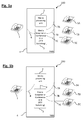
- FIG. 1 A illustrates a communication system 100 for a conference session of four users.
- a communication terminal 1, e.g. a smart phone, a tablet PC, an IP Phone or a PC client, of the first user is connected to a mixing unit 3 in form of a Media Streamer, i.e. in form of a Web-server, or a conference unit via connection link 6.
- the transmission and mixing of data from users of the conference session is established by the communication system 100.
- Other protocols for transmission of the data between the users of the conference session are possible.
- Additional communication terminals 5A, 5B, 5C, e.g. wired telephones or cellular phones, of a second or more users are linked to the mixing unit 3 by communication links 7A, 7B, and 7C, respectively.
- the mixing unit 3 and a media processing unit 2 are comprised by a private automated branch exchange 4.
- audio/video data of the uses are transmitted between the communication terminals 1, 5A, 5B, and 5C downstream, i.e. from the mixing unit 3 to the communication terminals 1, 5A, 5B, 5C, also called from a server to a client, and upstream, i.e. from at least one of the communication terminals 1, 5A, 5B, 5C to the mixing unit 3, also called from the client to the server, the exchange of data from the communication terminals, also called clients, occurs via the mixing unit 3 without involvement of the media processing unit 2.
- the mixing unit 3 would pass through the data of the first user and the second user without mixing.
- the mixing unit may be missing for a communication link between the first (1) and the second (5A) communication terminals using only the switching function of the PBX or PABX if required.
- the conference session comprises a passive mode, e.g. of the first user, wherein the data is received and transmitted by the first communication terminal 1 as passive data but not received by the second terminal, 5A, 5B, 5C, i.e. allowing transmission of data upstream and downstream between the mixing unit 3 and the first communication terminal 1 but not downstream from the mixing unit 3 to the second communication terminal, 5A, 5B, 5C, and an active mode of the first user, wherein the data is received by the first communication terminal 1 from the second communication terminal, 5A, 5B, 5C and transmitted by the first communication terminal 1 to the second communication terminal, 5A, 5B, 5C, i.e.
- the first communication terminal 1 is not directly connected to the mixing unit 3 but linked via communication link 8 to the media processing unit 2 which is linked via communication link 9 to the mixing unit 3.
- the first duration of passive data left to be transmitted is recorded and replayed in a faster speed as the speed during recording and simultaneously to the recording by the media processing unit 2 after switching to the active mode in order to catch up with a real-time conversation in the active mode between the users of the conference session.
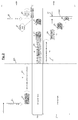
- FIG. 2 illustrates the case of FIG. 1 B for the embodiment that the first user is muted, also called mute-on mode or mute activated mode, which is defined as the passive mode, and there is a switchover from the mixing unit 3, which may be a conference unit (DSP unit), a conference server or a media processing unit, to the media processing unit 2.
- the mixing unit 3 may be a conference unit (DSP unit), a conference server or a media processing unit
- RTP packets received from the first communication terminal 1 are no longer directed in the communication system 100 to the mixing unit 3 but to the media processing unit 2, wherein the media processing unit 2 sends (processed) RTP packets to the mixing unit 3.
- the upper region 1 A in FIG. 2 represents (a timing of data transmitted by) the first communication terminal 1.
- 2B represents the media processing unit 2 in a recording mode 2R and a replaying mode 2P.
- the media processing unit 2 starts recording, 11, when the first user activates mute-on, 12, which may retain a time window for saving memory used for recording in the media processing unit 2.
- the lengths of the horizontal arrows 12 to 26 displayed in FIG. 2 - and other horizontal arrows in FIG. 3 , 5 , 6 , and 7 - represent relative durations/periods in time to each other (see direction of arrow of time "t" in the upper left corner of FIG. 2 - and "t” in FIG. 3 , 5 , 6 , and 7 ).
- the first user decides to talk at the beginning of arrow 13 representing a voice activity detection response duration.
- the voice of the first user is detected at the end of the voice activity detection response duration 13, which may be in the order of 1 to 3 msec.
- the muting is automatically deactivated after a certain period of time, this means that during the muting duration a content spoken by the first user would be lost if not recorded by the media processing unit 2.
- the first user continues to talk after the point-in-time when the mute is deactivated and payload has been established upstream and downstream between the first user and the second user.
- the voice activity detection response duration 13 in this embodiment is the first duration of the passive data, which is recorded along with a second duration 14 of the active data of the first user starting from the switching point-in-time 13A of the switching from passive mode to active mode. Therefore, at the start of the second duration 14 mute is deactivated automatically by switching to the active mode, and whatever was said during the voice activity detection response duration 13 is transmitted from the media processing unit 2 to the mixing unit 3.
- the recording may be arranged for all the users of the conference session by an individual Round recording buffer per user e.g. at the media processing unit 2 or the mixing unit 3, the Round Robin process referring to a pattern or ordering whereby recent recordings overwrite previous recording sequences per user in a circular manner.
- a faster speed is chosen for a hastened replaying of the recorded first duration 13 of the passive data and the recorded second duration 14 of the active data via the media processing unit 2 and transmitted to the communication terminals 5A, 5B, 5C via the mixing unit 3 and communication links 7A, 7B, 7C (see smaller lengths of the replayed voice activity detection response duration 23 and replayed second duration 24 to the recorded voice activity detection response duration 13 and recorded second duration 14.
- the recording continues as illustrated in FIG. 2 by the second durations 15, 16.
- the hastened replaying continues as long as a synchronization delay 27 between a first end 18 of the second duration 16 of the active data of the first user during recording and a second end 26A of the replayed second duration 26 of the active data after recording is equal or smaller than a predetermined duration.
- the media processing unit 2 therefore continues to replay to the mixing unit 3 the recorded second durations 15, 16 as replayed second durations 25, 26 until the replayed audio/video data of the first user is within a predetermined duration for a synchronization delay 27.
- the synchronization delay is within the predetermined duration, which may be 10 to 100 msec, preferably 30 to 50 msec, there is a switching-off of the recording at a switchover point 17 where the media processing unit 2 no longer records and no longer replays such that the mixing unit 3 is now supplied with audio/video data by the communication terminal 1 (see second duration 19 in active mode) without involvement from or detouring of the media processing unit 2.
- the communication system 100 starts to transmit the data of the first user in real-time to the second user.
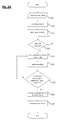
- the flowchart of the schematic timeline of FIG. 2A starts with the first user activating mute, S21, wherein the recording, S22, begins, leading to a switchover to the media processing unit 2, S23, which initiates the mute-off detection, S24, in the form of a voice activity detection.
- the mute-off detection continues until the first user starts talking leading to a switchover from passive mode to active mode and hastened replaying, S25, of the recorded/video data of the first user compared to the speed of recording.
- the recording continues, S26, as long as the last recorded session time difference, also called synchronization delay, is less then predetermined duration measured in milliseconds, S27 (see x ms in step S27 in Fig.
- x is an integer, e.g. 1 to 100, preferably 30-50, and ms are milliseconds).
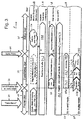
- FIG. 3 illustrates another embodiment of the invention in a schematic timeline comprising a real-time active mode and a delayed passive mode.
- the first communication terminal 1 (and a timeline of the data transmission thereof) is represented by horizontal bar 1 B, whereas the media processing unit 2 is represented by horizontal bar 2B.
- a conference session with active and passive participants/users is established by the communication system 100.
- the users are served differently in terms of active users communicating with real-time media exchanged via e.g. a conference server, 3A, and passive users receiving media/data by streaming, 36, e.g. over https delivered e.g. by a Media Streamer, typically a Web-server, 3B, wherein the conference server and the Media Streamer may by comprised by the mixing unit 3.
- This embodiment may occur especially in a conference of a large number of participants, e.g. tens or hundreds of users as passive users and a few users as active users.
- the media streaming may be subject to significant additional delay (approximately 3 - 5 sec) compared to real-time communication of the active mode.
- streaming may not be suitable for online, i.e. real-time, communication but may be sufficient to save processing power at the conference and/or mixing unit for a large number of passive users, because the media sent by passive users are not required to be processed as long as the streaming delay is not perceived by users staying in passive mode.
- a passive user may change to an active user to contribute to the discussion of the active users.
- the notion of "Raise Hand" 31 is known for passive users, 30, that may be muted to avoid background noise in large or mobile configurations.
- a moderator by user interaction or the communication system 100 automatically may switch the first user from passive to active mode, 32. Due to a non-negligible encoding delay, the real-time communication may be a few second ahead of the streaming communication leading to a time gap to be catched up with smoothly, preferable not perceived by the transitioned first user 33 and/or the other conferees such as the second user.
- the media processing unit 2 starts recording, 37A, of the real-time media 37 captured from the first communication device 1.
- a replay buffer (not shown) of the media streaming may still contain media frames, 36B, to be delivered to the first user's first communication device 1 to avoid information loss.
- the media processing unit 2 may provide at least one preconditioned/optimized media/data stream 36A in parallel to the regular media streaming 36 for the purpose of saving time during replay, e.g. in form of processed data comprising a reduced transfer delay and/or omitted complementary encoding layers compared to the regular media streaming 36.
- the hastened replay (see replayed duration 37B) of the recorded duration 37A of the real-time data 37 after switching to active mode starts (seamlessly) continuing with the replayed duration 38B of the meanwhile recorded media (see duration 38A) of the real-time duration 38 until the replayed media/data is timely within a predetermined synchronization delay with the real-time media.
- This is the point-in-time where the first user is switched from the media processing unit 2 to a conference server comprised by the mixing unit 3.
- 2R also called Sync Point 34
- 2R starts the transmission of real-time data from the first communication device 1 to the mixing unit 3, i.e. upstream, 39, and from mixing unit 3 to the first communication device 1, i.e. downstream, 39A.
- the transitional mode 33 and the active user mode 35 of the first user following the Sync Point 34 are defined to be comprised by the active mode starting from the switching point-in-time. Concluding, the timeline starting with duration 37B corresponds to the un-mute use illustrated in FIG. 2 starting from the second duration 24.
- FIG. 4 illustrates a flowchart of the schematic timeline of FIG. 3 and starts with the first user being a passive user raising hand, 31.
- a moderator/administrator of the conference session switches the first user from passive mode to active mode, S41, which stops the regular streaming from the Media Streamer to the first communication terminal 1 (down streaming, S42). It begins a recording, S43, of audio/video data being streamed (in passive mode) from the second communication terminal 5A, 5B, 5C to the media processing unit 2, i.e. upstream, wherein the media processing unit 2 may provide optionally a modified/pre-conditioned media stream in order to promote hastened replaying, S44, in addition to or instead of the recorded stream of S43.
- Remaining queued streaming frames are transmitted, S 45, from the media processing unit 2 to the first communication terminal 1.
- S46 to the first communication terminal 1, replaying of the preconditioned remaining queued streaming frames or of the remaining queued streaming frames without preconditioning and subsequently hastened replaying of the recorded media/data which have been transmitted to the media processing unit 2 (upstream) starts, S47.
- S48 Once the last recorded content of the recorded data has been replayed, S48, the recording of the first user is switched-off and the first user is switched from streaming to real-time in the active mode, 32.
- the first user is then in active mode (activated) which enables bi-directional real-time communication between the first user and the second user, S 49, which ends the flow illustrated in FIG. 4 .
- FIG. 5 illustrates a schematic timeline of the inventive method comprising an intended delay 51 added by the communication system 100 to synchronize data streams of the users of the conference session.
- the first communication terminal 1 is represented, while the media processing unit 2 is represented in the lower region 2C.
- intentional delays may be introduced in order to synchronize streams.
- This intended delay can be exploited by prioritizing streams of users that use the inventive method.
- the silence duration is deterred to a smaller amount.
- the voice activity detection response duration 13 is utilized to provide the intended delay 51.
- the voice activity detection response duration is the duration of silence with the first user still being muted, the silence duration may occur during this intended delay.
- FIG. 6 illustrates a schematic timeline of the inventive method comprising an interruption after the switching from passive mode to active mode.
- the embodiment addresses the case where the second user as another user intervenes while the media processing unit 2 replays the recorded voice/video content of the first user.
- the first communication terminal 1 is represented, while the media processing unit 2 is represented in the lower region 2D.
- the other user is interrupting the conversation which leads to an interruption of the replaying at an interruption point-in-time 61.
- the other user may be polite that the first user stops talking and waits for the other user to finish. This means that the switchover point 17 of switching-off the recording 18 is shifted to the interruption point-in-time 61.
- FIG. 7 illustrates a schematic timeline of the inventive method comprising an interruption point-in-time 71 before the switching point-in-time 17 from passive mode to active mode leading to the switching-off point-in-time 18 for the recording.
- the interruption point-in-time 71 may be introduced when the first user talks and unmute has not been detected yet.
- the switchover point 17 is shifted to the end of the voice activity detection response duration 13 at the point-in-time 18 when the recording is switched-off. This means that information being sent after the detection of voice is lost, shown in FIG. 7 as the duration 72 in black.
- the second user will only hear what has been said while on mute.
- the recorded data while on mute has been recorded and is replayed while the first user continues to speak.
- this duration shown as a gap 73 and FIG. 7 the first user will in addition to his real-time voice hear his voice as recorded on mute before the recording has been switched-off. Therefore, the first user will know that whatever he said before the interruption is not lost but transmitted to the second user. Then it is up to the users to decide who would continue to talk as it may happen in conferences when two users are trying to talk at the same time.
- an interrupt triggered by the second user will be indicated from the relevant media processing unit serving the second user.
- a technical feature or several technical features which has/have been disclosed with respect to a single or several embodiments discussed herein before, e.g. utilizing several media processing units, may be present also in another embodiment, e.g. the embodiment comprising a real-time active mode and a delayed passive mode displayed in FIG. 3 and FIG. 4 , respectively, except it is/they are specified not to be present or it is impossible for it/them to be present for technical reasons.
Landscapes
- Engineering & Computer Science (AREA)
- Multimedia (AREA)
- Signal Processing (AREA)
- Computer Networks & Wireless Communication (AREA)
- Business, Economics & Management (AREA)
- General Business, Economics & Management (AREA)
- Computer Vision & Pattern Recognition (AREA)
- General Engineering & Computer Science (AREA)
- Telephonic Communication Services (AREA)
- Two-Way Televisions, Distribution Of Moving Picture Or The Like (AREA)
Priority Applications (4)
| Application Number | Priority Date | Filing Date | Title |
|---|---|---|---|
| EP16154347.5A EP3203701B1 (fr) | 2016-02-04 | 2016-02-04 | Procédé de commande d'une session de conférence en temps réel, produit de programme informatique amenant un ordinateur à exécuter le procédé, et système de communication pour commander la session de conférence en temps réel |
| US15/422,629 US10044783B2 (en) | 2016-02-04 | 2017-02-02 | Method of controlling a real-time conference session |
| CN201710226801.3A CN107040751B (zh) | 2016-02-04 | 2017-02-03 | 控制实时会议会话的方法、机器可读介质及通信系统 |
| US16/030,192 US10250661B2 (en) | 2016-02-04 | 2018-07-09 | Method of controlling a real-time conference session |
Applications Claiming Priority (1)
| Application Number | Priority Date | Filing Date | Title |
|---|---|---|---|
| EP16154347.5A EP3203701B1 (fr) | 2016-02-04 | 2016-02-04 | Procédé de commande d'une session de conférence en temps réel, produit de programme informatique amenant un ordinateur à exécuter le procédé, et système de communication pour commander la session de conférence en temps réel |
Publications (2)
| Publication Number | Publication Date |
|---|---|
| EP3203701A1 true EP3203701A1 (fr) | 2017-08-09 |
| EP3203701B1 EP3203701B1 (fr) | 2021-04-21 |
Family
ID=55353014
Family Applications (1)
| Application Number | Title | Priority Date | Filing Date |
|---|---|---|---|
| EP16154347.5A Active EP3203701B1 (fr) | 2016-02-04 | 2016-02-04 | Procédé de commande d'une session de conférence en temps réel, produit de programme informatique amenant un ordinateur à exécuter le procédé, et système de communication pour commander la session de conférence en temps réel |
Country Status (3)
| Country | Link |
|---|---|
| US (2) | US10044783B2 (fr) |
| EP (1) | EP3203701B1 (fr) |
| CN (1) | CN107040751B (fr) |
Cited By (4)
| Publication number | Priority date | Publication date | Assignee | Title |
|---|---|---|---|---|
| WO2019055086A1 (fr) * | 2017-09-18 | 2019-03-21 | Microsoft Technology Licensing, Llc | Transmission de données à l'aide de plusieurs tampons de gigue |
| CN112995720A (zh) * | 2019-12-16 | 2021-06-18 | 成都鼎桥通信技术有限公司 | 一种音视频同步方法和装置 |
| EP4072095A1 (fr) * | 2021-04-08 | 2022-10-12 | Unify Patente GmbH & Co. KG | Systèmes et procédés de communication dans un appel en conférence |
| US12413632B2 (en) | 2021-12-14 | 2025-09-09 | Motion Meetings Inc. | Integrating online and telephonic conference platforms and enabling screening of attendee questions regardless of way attendee joins |
Families Citing this family (14)
| Publication number | Priority date | Publication date | Assignee | Title |
|---|---|---|---|---|
| US20190068662A1 (en) * | 2017-08-25 | 2019-02-28 | International Business Machines Corporation | Cognitive Headset Awareness with External Voice Interruption Detection |
| DE102017131420A1 (de) * | 2017-12-29 | 2019-07-04 | Unify Patente Gmbh & Co. Kg | Echtzeit-Kollaborations-Plattform und Verfahren zum Ausgeben von Mediaströmen über ein Echtzeit-Ansagesystem |
| CN110324277B (zh) * | 2018-03-28 | 2021-11-05 | 腾讯科技(深圳)有限公司 | 实时通信的连接方法、装置、存储介质及电子装置 |
| CN111093048B (zh) * | 2019-12-31 | 2021-07-20 | 江苏大恒创科技术有限公司 | 新型多媒体视频会议系统及实现方法 |
| CN111556351B (zh) * | 2020-05-15 | 2022-04-15 | 宁波菊风系统软件有限公司 | 一种rtp文件播放系统 |
| CN111756939B (zh) * | 2020-06-28 | 2022-05-31 | 联想(北京)有限公司 | 在线语音控制方法、装置及计算机设备 |
| US11662975B2 (en) * | 2020-10-06 | 2023-05-30 | Tencent America LLC | Method and apparatus for teleconference |
| NL2027060B1 (en) * | 2020-12-07 | 2022-07-07 | Microsoft Technology Licensing Llc | Automatically turning off a visual interruption symbol in a virtual meeting |
| US11832077B2 (en) * | 2021-06-04 | 2023-11-28 | Apple Inc. | Spatial audio controller |
| US11405448B1 (en) | 2021-08-23 | 2022-08-02 | Verizon Patent And Licensing Inc. | Systems and methods for adaptively improving the perceived quality of a video conference by passive users |
| US12477018B2 (en) * | 2022-04-25 | 2025-11-18 | Sony Interactive Entertainment Inc. | Context sensitive alerts involving muted users |
| US12537709B2 (en) * | 2023-02-03 | 2026-01-27 | Zoom Communications, Inc. | Instant replay for video conferences |
| EP4513405A1 (fr) | 2023-08-22 | 2025-02-26 | Unify Beteiligungsverwaltung GmbH & Co. KG | Assistant numérique contextuel pour assistance de présentation |
| US20260081999A1 (en) | 2024-09-18 | 2026-03-19 | Mitel Networks Corporation | Apparatus and method for smart-call disconnection based on context-aware mechanism |
Citations (3)
| Publication number | Priority date | Publication date | Assignee | Title |
|---|---|---|---|---|
| US20080137558A1 (en) * | 2006-12-12 | 2008-06-12 | Cisco Technology, Inc. | Catch-up playback in a conferencing system |
| EP2797316A2 (fr) * | 2013-04-24 | 2014-10-29 | Mitel Networks Corporation | Système de téléconférence avec caractéristiques de rattrapage et son procédé d'utilisation |
| WO2015001492A1 (fr) * | 2013-07-02 | 2015-01-08 | Family Systems, Limited | Systèmes et procédés d'amélioration de services d'audioconférence |
Family Cites Families (8)
| Publication number | Priority date | Publication date | Assignee | Title |
|---|---|---|---|---|
| US6959075B2 (en) * | 2003-03-24 | 2005-10-25 | Cisco Technology, Inc. | Replay of conference audio |
| GB2437785A (en) * | 2006-05-02 | 2007-11-07 | Skype Ltd | Voice over internet protocol (VOIP) group conference communication |
| US8700665B2 (en) * | 2009-04-27 | 2014-04-15 | Avaya Inc. | Intelligent conference call information agents |
| WO2012166811A2 (fr) * | 2011-05-31 | 2012-12-06 | Google Inc. | Mise en sourdine de participants dans une session de communication |
| US8681203B1 (en) * | 2012-08-20 | 2014-03-25 | Google Inc. | Automatic mute control for video conferencing |
| CN104767652B (zh) * | 2014-01-08 | 2020-01-17 | 杜比实验室特许公司 | 监视数字传输环境性能的方法 |
| US9940944B2 (en) * | 2014-08-19 | 2018-04-10 | Qualcomm Incorporated | Smart mute for a communication device |
| WO2017222408A1 (fr) * | 2016-06-23 | 2017-12-28 | Ringcentral, Inc., (A Delaware Corporation) | Système et procédé de vidéoconférence implémentant une quasi sourdine vidéo |
-
2016
- 2016-02-04 EP EP16154347.5A patent/EP3203701B1/fr active Active
-
2017
- 2017-02-02 US US15/422,629 patent/US10044783B2/en active Active
- 2017-02-03 CN CN201710226801.3A patent/CN107040751B/zh not_active Expired - Fee Related
-
2018
- 2018-07-09 US US16/030,192 patent/US10250661B2/en active Active
Patent Citations (3)
| Publication number | Priority date | Publication date | Assignee | Title |
|---|---|---|---|---|
| US20080137558A1 (en) * | 2006-12-12 | 2008-06-12 | Cisco Technology, Inc. | Catch-up playback in a conferencing system |
| EP2797316A2 (fr) * | 2013-04-24 | 2014-10-29 | Mitel Networks Corporation | Système de téléconférence avec caractéristiques de rattrapage et son procédé d'utilisation |
| WO2015001492A1 (fr) * | 2013-07-02 | 2015-01-08 | Family Systems, Limited | Systèmes et procédés d'amélioration de services d'audioconférence |
Cited By (6)
| Publication number | Priority date | Publication date | Assignee | Title |
|---|---|---|---|---|
| WO2019055086A1 (fr) * | 2017-09-18 | 2019-03-21 | Microsoft Technology Licensing, Llc | Transmission de données à l'aide de plusieurs tampons de gigue |
| US10432543B2 (en) | 2017-09-18 | 2019-10-01 | Microsoft Technology Licensing, Llc | Dual jitter buffers |
| CN112995720A (zh) * | 2019-12-16 | 2021-06-18 | 成都鼎桥通信技术有限公司 | 一种音视频同步方法和装置 |
| CN112995720B (zh) * | 2019-12-16 | 2022-11-18 | 成都鼎桥通信技术有限公司 | 一种音视频同步方法和装置 |
| EP4072095A1 (fr) * | 2021-04-08 | 2022-10-12 | Unify Patente GmbH & Co. KG | Systèmes et procédés de communication dans un appel en conférence |
| US12413632B2 (en) | 2021-12-14 | 2025-09-09 | Motion Meetings Inc. | Integrating online and telephonic conference platforms and enabling screening of attendee questions regardless of way attendee joins |
Also Published As
| Publication number | Publication date |
|---|---|
| US10250661B2 (en) | 2019-04-02 |
| US20170230439A1 (en) | 2017-08-10 |
| EP3203701B1 (fr) | 2021-04-21 |
| CN107040751A (zh) | 2017-08-11 |
| CN107040751B (zh) | 2020-04-10 |
| US20180316738A1 (en) | 2018-11-01 |
| US10044783B2 (en) | 2018-08-07 |
Similar Documents
| Publication | Publication Date | Title |
|---|---|---|
| US10250661B2 (en) | Method of controlling a real-time conference session | |
| RU2398361C2 (ru) | Интеллектуальный способ, система и узел ограничения аудио | |
| RU2398362C2 (ru) | Соединение независимых мультимедийных источников в конференц-связь | |
| US6963353B1 (en) | Non-causal speaker selection for conference multicast | |
| EP1505815B1 (fr) | Procédé et appareil pour améliorer des signaux ennuyeux dans une conférence audio/vidéo | |
| US8736663B2 (en) | Media detection and packet distribution in a multipoint conference | |
| EP1496700B1 (fr) | Dispositif, méthode et programme d'ordinateur permettant des visioconférences dans un système de communication | |
| EP1868348B1 (fr) | Contrôle de présentation de conférence et protocole de contrôle | |
| US20070291667A1 (en) | Intelligent audio limit method, system and node | |
| US20150030149A1 (en) | Speech-Selective Audio Mixing for Conference | |
| US20070294263A1 (en) | Associating independent multimedia sources into a conference call | |
| US10051115B2 (en) | Call initiation by voice command | |
| WO2008113269A1 (fr) | Procédé et dispositif pour réaliser une conversation privée dans une session multipoint | |
| EP2356817A1 (fr) | Dispositif et procédé pour synchroniser des données audio reçues avec des données vidéo | |
| US10362173B2 (en) | Web real-time communication from an audiovisual file | |
| CN105191316A (zh) | 用于切换经压缩的视频流的切换装置、具有切换装置的会议系统以及用于切换经压缩的视频流的过程 | |
| JP5340880B2 (ja) | 遠隔会話システムの出力制御装置、その方法、およびコンピュータが実行可能なプログラム | |
| JP2008227693A (ja) | 話者映像表示制御システム、話者映像表示制御方法、話者映像表示制御プログラム、通信端末及び多地点テレビ会議システム | |
| JP6119363B2 (ja) | 通信処理装置、方法及びプログラム、並びに、通信システム | |
| WO2009053871A1 (fr) | Service de communications | |
| JPH08317362A (ja) | テレビ会議システムの端末装置 | |
| JP2008048058A (ja) | ネットワークボックス | |
| MX2007006914A (es) | Metodo, sistema y nodo de limite de audio inteligentes. | |
| JPH04371058A (ja) | 多地点テレビ会議システム | |
| HK1072334B (en) | Method and apparatus for improving nuisance signals in audio/video conference |
Legal Events
| Date | Code | Title | Description |
|---|---|---|---|
| PUAI | Public reference made under article 153(3) epc to a published international application that has entered the european phase |
Free format text: ORIGINAL CODE: 0009012 |
|
| STAA | Information on the status of an ep patent application or granted ep patent |
Free format text: STATUS: THE APPLICATION HAS BEEN PUBLISHED |
|
| AK | Designated contracting states |
Kind code of ref document: A1 Designated state(s): AL AT BE BG CH CY CZ DE DK EE ES FI FR GB GR HR HU IE IS IT LI LT LU LV MC MK MT NL NO PL PT RO RS SE SI SK SM TR |
|
| AX | Request for extension of the european patent |
Extension state: BA ME |
|
| STAA | Information on the status of an ep patent application or granted ep patent |
Free format text: STATUS: REQUEST FOR EXAMINATION WAS MADE |
|
| 17P | Request for examination filed |
Effective date: 20180207 |
|
| RBV | Designated contracting states (corrected) |
Designated state(s): AL AT BE BG CH CY CZ DE DK EE ES FI FR GB GR HR HU IE IS IT LI LT LU LV MC MK MT NL NO PL PT RO RS SE SI SK SM TR |
|
| STAA | Information on the status of an ep patent application or granted ep patent |
Free format text: STATUS: EXAMINATION IS IN PROGRESS |
|
| 17Q | First examination report despatched |
Effective date: 20200302 |
|
| GRAP | Despatch of communication of intention to grant a patent |
Free format text: ORIGINAL CODE: EPIDOSNIGR1 |
|
| STAA | Information on the status of an ep patent application or granted ep patent |
Free format text: STATUS: GRANT OF PATENT IS INTENDED |
|
| INTG | Intention to grant announced |
Effective date: 20201116 |
|
| RAP1 | Party data changed (applicant data changed or rights of an application transferred) |
Owner name: UNIFY PATENTE GMBH & CO. KG |
|
| GRAS | Grant fee paid |
Free format text: ORIGINAL CODE: EPIDOSNIGR3 |
|
| GRAA | (expected) grant |
Free format text: ORIGINAL CODE: 0009210 |
|
| STAA | Information on the status of an ep patent application or granted ep patent |
Free format text: STATUS: THE PATENT HAS BEEN GRANTED |
|
| AK | Designated contracting states |
Kind code of ref document: B1 Designated state(s): AL AT BE BG CH CY CZ DE DK EE ES FI FR GB GR HR HU IE IS IT LI LT LU LV MC MK MT NL NO PL PT RO RS SE SI SK SM TR |
|
| REG | Reference to a national code |
Ref country code: GB Ref legal event code: FG4D |
|
| REG | Reference to a national code |
Ref country code: CH Ref legal event code: EP |
|
| REG | Reference to a national code |
Ref country code: DE Ref legal event code: R096 Ref document number: 602016056344 Country of ref document: DE Ref country code: IE Ref legal event code: FG4D |
|
| REG | Reference to a national code |
Ref country code: AT Ref legal event code: REF Ref document number: 1385806 Country of ref document: AT Kind code of ref document: T Effective date: 20210515 |
|
| REG | Reference to a national code |
Ref country code: LT Ref legal event code: MG9D |
|
| REG | Reference to a national code |
Ref country code: AT Ref legal event code: MK05 Ref document number: 1385806 Country of ref document: AT Kind code of ref document: T Effective date: 20210421 |
|
| REG | Reference to a national code |
Ref country code: NL Ref legal event code: MP Effective date: 20210421 |
|
| PG25 | Lapsed in a contracting state [announced via postgrant information from national office to epo] |
Ref country code: FI Free format text: LAPSE BECAUSE OF FAILURE TO SUBMIT A TRANSLATION OF THE DESCRIPTION OR TO PAY THE FEE WITHIN THE PRESCRIBED TIME-LIMIT Effective date: 20210421 Ref country code: NL Free format text: LAPSE BECAUSE OF FAILURE TO SUBMIT A TRANSLATION OF THE DESCRIPTION OR TO PAY THE FEE WITHIN THE PRESCRIBED TIME-LIMIT Effective date: 20210421 Ref country code: LT Free format text: LAPSE BECAUSE OF FAILURE TO SUBMIT A TRANSLATION OF THE DESCRIPTION OR TO PAY THE FEE WITHIN THE PRESCRIBED TIME-LIMIT Effective date: 20210421 Ref country code: HR Free format text: LAPSE BECAUSE OF FAILURE TO SUBMIT A TRANSLATION OF THE DESCRIPTION OR TO PAY THE FEE WITHIN THE PRESCRIBED TIME-LIMIT Effective date: 20210421 Ref country code: BG Free format text: LAPSE BECAUSE OF FAILURE TO SUBMIT A TRANSLATION OF THE DESCRIPTION OR TO PAY THE FEE WITHIN THE PRESCRIBED TIME-LIMIT Effective date: 20210721 Ref country code: AT Free format text: LAPSE BECAUSE OF FAILURE TO SUBMIT A TRANSLATION OF THE DESCRIPTION OR TO PAY THE FEE WITHIN THE PRESCRIBED TIME-LIMIT Effective date: 20210421 |
|
| REG | Reference to a national code |
Ref country code: DE Ref legal event code: R079 Ref document number: 602016056344 Country of ref document: DE Free format text: PREVIOUS MAIN CLASS: H04L0029060000 Ipc: H04L0065000000 |
|
| PG25 | Lapsed in a contracting state [announced via postgrant information from national office to epo] |
Ref country code: PL Free format text: LAPSE BECAUSE OF FAILURE TO SUBMIT A TRANSLATION OF THE DESCRIPTION OR TO PAY THE FEE WITHIN THE PRESCRIBED TIME-LIMIT Effective date: 20210421 Ref country code: NO Free format text: LAPSE BECAUSE OF FAILURE TO SUBMIT A TRANSLATION OF THE DESCRIPTION OR TO PAY THE FEE WITHIN THE PRESCRIBED TIME-LIMIT Effective date: 20210721 Ref country code: PT Free format text: LAPSE BECAUSE OF FAILURE TO SUBMIT A TRANSLATION OF THE DESCRIPTION OR TO PAY THE FEE WITHIN THE PRESCRIBED TIME-LIMIT Effective date: 20210823 Ref country code: SE Free format text: LAPSE BECAUSE OF FAILURE TO SUBMIT A TRANSLATION OF THE DESCRIPTION OR TO PAY THE FEE WITHIN THE PRESCRIBED TIME-LIMIT Effective date: 20210421 Ref country code: RS Free format text: LAPSE BECAUSE OF FAILURE TO SUBMIT A TRANSLATION OF THE DESCRIPTION OR TO PAY THE FEE WITHIN THE PRESCRIBED TIME-LIMIT Effective date: 20210421 Ref country code: LV Free format text: LAPSE BECAUSE OF FAILURE TO SUBMIT A TRANSLATION OF THE DESCRIPTION OR TO PAY THE FEE WITHIN THE PRESCRIBED TIME-LIMIT Effective date: 20210421 Ref country code: GR Free format text: LAPSE BECAUSE OF FAILURE TO SUBMIT A TRANSLATION OF THE DESCRIPTION OR TO PAY THE FEE WITHIN THE PRESCRIBED TIME-LIMIT Effective date: 20210722 Ref country code: IS Free format text: LAPSE BECAUSE OF FAILURE TO SUBMIT A TRANSLATION OF THE DESCRIPTION OR TO PAY THE FEE WITHIN THE PRESCRIBED TIME-LIMIT Effective date: 20210821 |
|
| REG | Reference to a national code |
Ref country code: DE Ref legal event code: R097 Ref document number: 602016056344 Country of ref document: DE |
|
| PG25 | Lapsed in a contracting state [announced via postgrant information from national office to epo] |
Ref country code: RO Free format text: LAPSE BECAUSE OF FAILURE TO SUBMIT A TRANSLATION OF THE DESCRIPTION OR TO PAY THE FEE WITHIN THE PRESCRIBED TIME-LIMIT Effective date: 20210421 Ref country code: ES Free format text: LAPSE BECAUSE OF FAILURE TO SUBMIT A TRANSLATION OF THE DESCRIPTION OR TO PAY THE FEE WITHIN THE PRESCRIBED TIME-LIMIT Effective date: 20210421 Ref country code: SK Free format text: LAPSE BECAUSE OF FAILURE TO SUBMIT A TRANSLATION OF THE DESCRIPTION OR TO PAY THE FEE WITHIN THE PRESCRIBED TIME-LIMIT Effective date: 20210421 Ref country code: SM Free format text: LAPSE BECAUSE OF FAILURE TO SUBMIT A TRANSLATION OF THE DESCRIPTION OR TO PAY THE FEE WITHIN THE PRESCRIBED TIME-LIMIT Effective date: 20210421 Ref country code: EE Free format text: LAPSE BECAUSE OF FAILURE TO SUBMIT A TRANSLATION OF THE DESCRIPTION OR TO PAY THE FEE WITHIN THE PRESCRIBED TIME-LIMIT Effective date: 20210421 Ref country code: CZ Free format text: LAPSE BECAUSE OF FAILURE TO SUBMIT A TRANSLATION OF THE DESCRIPTION OR TO PAY THE FEE WITHIN THE PRESCRIBED TIME-LIMIT Effective date: 20210421 Ref country code: DK Free format text: LAPSE BECAUSE OF FAILURE TO SUBMIT A TRANSLATION OF THE DESCRIPTION OR TO PAY THE FEE WITHIN THE PRESCRIBED TIME-LIMIT Effective date: 20210421 |
|
| PLBE | No opposition filed within time limit |
Free format text: ORIGINAL CODE: 0009261 |
|
| STAA | Information on the status of an ep patent application or granted ep patent |
Free format text: STATUS: NO OPPOSITION FILED WITHIN TIME LIMIT |
|
| 26N | No opposition filed |
Effective date: 20220124 |
|
| PGFP | Annual fee paid to national office [announced via postgrant information from national office to epo] |
Ref country code: GB Payment date: 20220225 Year of fee payment: 7 Ref country code: DE Payment date: 20220225 Year of fee payment: 7 |
|
| PG25 | Lapsed in a contracting state [announced via postgrant information from national office to epo] |
Ref country code: IS Free format text: LAPSE BECAUSE OF FAILURE TO SUBMIT A TRANSLATION OF THE DESCRIPTION OR TO PAY THE FEE WITHIN THE PRESCRIBED TIME-LIMIT Effective date: 20210821 Ref country code: AL Free format text: LAPSE BECAUSE OF FAILURE TO SUBMIT A TRANSLATION OF THE DESCRIPTION OR TO PAY THE FEE WITHIN THE PRESCRIBED TIME-LIMIT Effective date: 20210421 |
|
| PGFP | Annual fee paid to national office [announced via postgrant information from national office to epo] |
Ref country code: FR Payment date: 20220223 Year of fee payment: 7 |
|
| PG25 | Lapsed in a contracting state [announced via postgrant information from national office to epo] |
Ref country code: IT Free format text: LAPSE BECAUSE OF FAILURE TO SUBMIT A TRANSLATION OF THE DESCRIPTION OR TO PAY THE FEE WITHIN THE PRESCRIBED TIME-LIMIT Effective date: 20210421 |
|
| PG25 | Lapsed in a contracting state [announced via postgrant information from national office to epo] |
Ref country code: MC Free format text: LAPSE BECAUSE OF FAILURE TO SUBMIT A TRANSLATION OF THE DESCRIPTION OR TO PAY THE FEE WITHIN THE PRESCRIBED TIME-LIMIT Effective date: 20210421 |
|
| REG | Reference to a national code |
Ref country code: CH Ref legal event code: PL |
|
| REG | Reference to a national code |
Ref country code: BE Ref legal event code: MM Effective date: 20220228 |
|
| PG25 | Lapsed in a contracting state [announced via postgrant information from national office to epo] |
Ref country code: LU Free format text: LAPSE BECAUSE OF NON-PAYMENT OF DUE FEES Effective date: 20220204 |
|
| PG25 | Lapsed in a contracting state [announced via postgrant information from national office to epo] |
Ref country code: LI Free format text: LAPSE BECAUSE OF NON-PAYMENT OF DUE FEES Effective date: 20220228 Ref country code: IE Free format text: LAPSE BECAUSE OF NON-PAYMENT OF DUE FEES Effective date: 20220204 Ref country code: CH Free format text: LAPSE BECAUSE OF NON-PAYMENT OF DUE FEES Effective date: 20220228 |
|
| PG25 | Lapsed in a contracting state [announced via postgrant information from national office to epo] |
Ref country code: BE Free format text: LAPSE BECAUSE OF NON-PAYMENT OF DUE FEES Effective date: 20220228 |
|
| REG | Reference to a national code |
Ref country code: DE Ref legal event code: R119 Ref document number: 602016056344 Country of ref document: DE |
|
| GBPC | Gb: european patent ceased through non-payment of renewal fee |
Effective date: 20230204 |
|
| PG25 | Lapsed in a contracting state [announced via postgrant information from national office to epo] |
Ref country code: GB Free format text: LAPSE BECAUSE OF NON-PAYMENT OF DUE FEES Effective date: 20230204 |
|
| PG25 | Lapsed in a contracting state [announced via postgrant information from national office to epo] |
Ref country code: GB Free format text: LAPSE BECAUSE OF NON-PAYMENT OF DUE FEES Effective date: 20230204 Ref country code: FR Free format text: LAPSE BECAUSE OF NON-PAYMENT OF DUE FEES Effective date: 20230228 Ref country code: DE Free format text: LAPSE BECAUSE OF NON-PAYMENT OF DUE FEES Effective date: 20230901 |
|
| PG25 | Lapsed in a contracting state [announced via postgrant information from national office to epo] |
Ref country code: HU Free format text: LAPSE BECAUSE OF FAILURE TO SUBMIT A TRANSLATION OF THE DESCRIPTION OR TO PAY THE FEE WITHIN THE PRESCRIBED TIME-LIMIT; INVALID AB INITIO Effective date: 20160204 |
|
| PG25 | Lapsed in a contracting state [announced via postgrant information from national office to epo] |
Ref country code: MK Free format text: LAPSE BECAUSE OF FAILURE TO SUBMIT A TRANSLATION OF THE DESCRIPTION OR TO PAY THE FEE WITHIN THE PRESCRIBED TIME-LIMIT Effective date: 20210421 Ref country code: CY Free format text: LAPSE BECAUSE OF FAILURE TO SUBMIT A TRANSLATION OF THE DESCRIPTION OR TO PAY THE FEE WITHIN THE PRESCRIBED TIME-LIMIT Effective date: 20210421 |
|
| PG25 | Lapsed in a contracting state [announced via postgrant information from national office to epo] |
Ref country code: MT Free format text: LAPSE BECAUSE OF FAILURE TO SUBMIT A TRANSLATION OF THE DESCRIPTION OR TO PAY THE FEE WITHIN THE PRESCRIBED TIME-LIMIT Effective date: 20210421 |
|
| PG25 | Lapsed in a contracting state [announced via postgrant information from national office to epo] |
Ref country code: TR Free format text: LAPSE BECAUSE OF FAILURE TO SUBMIT A TRANSLATION OF THE DESCRIPTION OR TO PAY THE FEE WITHIN THE PRESCRIBED TIME-LIMIT Effective date: 20210421 |