EP3203904B1 - Prothèse cognitive adaptative et ses applications - Google Patents
Prothèse cognitive adaptative et ses applications Download PDFInfo
- Publication number
- EP3203904B1 EP3203904B1 EP15849401.3A EP15849401A EP3203904B1 EP 3203904 B1 EP3203904 B1 EP 3203904B1 EP 15849401 A EP15849401 A EP 15849401A EP 3203904 B1 EP3203904 B1 EP 3203904B1
- Authority
- EP
- European Patent Office
- Prior art keywords
- stimulation
- adaptive
- cognitive
- prosthetic
- subset
- Prior art date
- Legal status (The legal status is an assumption and is not a legal conclusion. Google has not performed a legal analysis and makes no representation as to the accuracy of the status listed.)
- Active
Links
Images




Classifications
-
- A—HUMAN NECESSITIES
- A61—MEDICAL OR VETERINARY SCIENCE; HYGIENE
- A61N—ELECTROTHERAPY; MAGNETOTHERAPY; RADIATION THERAPY; ULTRASOUND THERAPY
- A61N1/00—Electrotherapy; Circuits therefor
- A61N1/18—Applying electric currents by contact electrodes
- A61N1/32—Applying electric currents by contact electrodes alternating or intermittent currents
- A61N1/36—Applying electric currents by contact electrodes alternating or intermittent currents for stimulation
- A61N1/3605—Implantable neurostimulators for stimulating central or peripheral nerve system
- A61N1/3606—Implantable neurostimulators for stimulating central or peripheral nerve system adapted for a particular treatment
- A61N1/36103—Neuro-rehabilitation; Repair or reorganisation of neural tissue, e.g. after stroke
-
- A—HUMAN NECESSITIES
- A61—MEDICAL OR VETERINARY SCIENCE; HYGIENE
- A61B—DIAGNOSIS; SURGERY; IDENTIFICATION
- A61B5/00—Measuring for diagnostic purposes; Identification of persons
- A61B5/40—Detecting, measuring or recording for evaluating the nervous system
- A61B5/4058—Detecting, measuring or recording for evaluating the nervous system for evaluating the central nervous system
- A61B5/4064—Evaluating the brain
-
- A—HUMAN NECESSITIES
- A61—MEDICAL OR VETERINARY SCIENCE; HYGIENE
- A61B—DIAGNOSIS; SURGERY; IDENTIFICATION
- A61B5/00—Measuring for diagnostic purposes; Identification of persons
- A61B5/40—Detecting, measuring or recording for evaluating the nervous system
- A61B5/4076—Diagnosing or monitoring particular conditions of the nervous system
- A61B5/4094—Diagnosing or monitoring seizure diseases, e.g. epilepsy
-
- A—HUMAN NECESSITIES
- A61—MEDICAL OR VETERINARY SCIENCE; HYGIENE
- A61B—DIAGNOSIS; SURGERY; IDENTIFICATION
- A61B5/00—Measuring for diagnostic purposes; Identification of persons
- A61B5/72—Signal processing specially adapted for physiological signals or for diagnostic purposes
- A61B5/7235—Details of waveform analysis
- A61B5/7264—Classification of physiological signals or data, e.g. using neural networks, statistical classifiers, expert systems or fuzzy systems
-
- A—HUMAN NECESSITIES
- A61—MEDICAL OR VETERINARY SCIENCE; HYGIENE
- A61B—DIAGNOSIS; SURGERY; IDENTIFICATION
- A61B5/00—Measuring for diagnostic purposes; Identification of persons
- A61B5/72—Signal processing specially adapted for physiological signals or for diagnostic purposes
- A61B5/7235—Details of waveform analysis
- A61B5/7264—Classification of physiological signals or data, e.g. using neural networks, statistical classifiers, expert systems or fuzzy systems
- A61B5/7267—Classification of physiological signals or data, e.g. using neural networks, statistical classifiers, expert systems or fuzzy systems involving training the classification device
-
- A—HUMAN NECESSITIES
- A61—MEDICAL OR VETERINARY SCIENCE; HYGIENE
- A61N—ELECTROTHERAPY; MAGNETOTHERAPY; RADIATION THERAPY; ULTRASOUND THERAPY
- A61N1/00—Electrotherapy; Circuits therefor
- A61N1/18—Applying electric currents by contact electrodes
- A61N1/32—Applying electric currents by contact electrodes alternating or intermittent currents
- A61N1/36—Applying electric currents by contact electrodes alternating or intermittent currents for stimulation
- A61N1/3605—Implantable neurostimulators for stimulating central or peripheral nerve system
- A61N1/3606—Implantable neurostimulators for stimulating central or peripheral nerve system adapted for a particular treatment
- A61N1/36082—Cognitive or psychiatric applications, e.g. dementia or Alzheimer's disease
-
- A—HUMAN NECESSITIES
- A61—MEDICAL OR VETERINARY SCIENCE; HYGIENE
- A61N—ELECTROTHERAPY; MAGNETOTHERAPY; RADIATION THERAPY; ULTRASOUND THERAPY
- A61N1/00—Electrotherapy; Circuits therefor
- A61N1/18—Applying electric currents by contact electrodes
- A61N1/32—Applying electric currents by contact electrodes alternating or intermittent currents
- A61N1/36—Applying electric currents by contact electrodes alternating or intermittent currents for stimulation
- A61N1/3605—Implantable neurostimulators for stimulating central or peripheral nerve system
- A61N1/36128—Control systems
- A61N1/36135—Control systems using physiological parameters
- A61N1/36139—Control systems using physiological parameters with automatic adjustment
-
- G—PHYSICS
- G16—INFORMATION AND COMMUNICATION TECHNOLOGY [ICT] SPECIALLY ADAPTED FOR SPECIFIC APPLICATION FIELDS
- G16H—HEALTHCARE INFORMATICS, i.e. INFORMATION AND COMMUNICATION TECHNOLOGY [ICT] SPECIALLY ADAPTED FOR THE HANDLING OR PROCESSING OF MEDICAL OR HEALTHCARE DATA
- G16H50/00—ICT specially adapted for medical diagnosis, medical simulation or medical data mining; ICT specially adapted for detecting, monitoring or modelling epidemics or pandemics
- G16H50/70—ICT specially adapted for medical diagnosis, medical simulation or medical data mining; ICT specially adapted for detecting, monitoring or modelling epidemics or pandemics for mining of medical data, e.g. analysing previous cases of other patients
Definitions
- the present invention relates to prosthetics for alleviating various neurological and/or neuropsychiatric disorders and, in particular, to adaptive cognitive prosthetics capable of learning to replace or augment function lost by a damaged or diseased brain region.
- US7430546 discloses a system for signal processing in a neural network, which is suggested can be used to stimulate neural tissue.
- an adaptive cognitive prosthetic comprises a processing unit for converting input data from an input data assembly into a cognitive variable and selecting a stimulation pattern for conveying the cognitive variable.
- the cognitive variable corresponds to the computational function managed by the damaged region of the brain being replaced or by-passed by the adaptive cognitive prosthetic.
- the processing unit employs an adaptive algorithm to assemble the stimulation pattern by combination of subset stimulation patterns, the combination of subset stimulation patterns learned by the adaptive algorithm through error analysis.
- the adaptive algorithm is a hierarchical learning algorithm. A stimulation assembly of the cognitive prosthetic administers the selected stimulation pattern.
- methods of providing stimulation patterns for conveying cognitive variables comprise providing input data to a processing unit from an input data assembly and converting the input data into a cognitive variable with the processing unit.
- a stimulation pattern for conveying the cognitive variable is selected by the processing unit, wherein the processing unit employs an adaptive algorithm to assemble the stimulation pattern by combination of subset stimulation patterns, the combination of subset stimulation patterns learned by the adaptive algorithm through error analysis.
- the subset stimulation patterns can be assembled in a hierarchical format.
- a stimulation assembly of the cognitive prosthetic administers the selected stimulation pattern.
- An adaptive cognitive prosthetic described herein comprises a processing unit for converting input data from an input data assembly into a cognitive variable and selecting a stimulation pattern for conveying the cognitive variable.
- the processing unit employs an adaptive algorithm to assemble the stimulation pattern by combination of subset stimulation patterns, the subset stimulation patterns learned by the adaptive algorithm through error analysis.
- input data comprises environmental stimuli such as electromagnetic radiation, heat, sound, tactile sensation(s), chemosensation(s) and/or sensations of movement, such as gravity or acceleration forces.
- environmental stimuli can be measured and collected with a variety of detection apparatus including focal plane arrays, charge coupled devices, photodiode arrays, thermometers, thermocouples, chemosensors, tactile sensors and/or accelerometers.
- Collected input data can also include neural activity from a patient.
- Neural activity of a patient can be measured and collected by a variety of techniques. For example, fluctuations in electric potential from a single neuron or a population of neurons can be measured using electrodes in contact with the brain or positioned outside the skull. Generally, invasive microelectrodes can be employed for monitoring single neuron activity or electroencephalography (EEG) electrodes are placed on the scalp to record population activity.
- EEG electroencephalography
- neural activity can also be measured by one or more chemical techniques including variances in ion concentrations such as sodium, potassium and/or calcium.
- neural activity can be ascertained by the measuring the concentration of neurotransmitters, gene expression and/or metabolites.
- Functional magnetic resonance imaging (fMRI) using blood-oxygen-level dependent (BOLD) contrast is used to quantify neural activity.
- the measured neural activity can correspond to responses to environmental stimuli encountered by the patient.
- the measured neural activity may also originate from self-generated thought(s) or desire(s) of a patient, such as thoughts to begin or desist a specific behavior.
- Physiological signals from the body can also serve as input data for the adaptive cognitive prosthetic.
- the input data is converted into a cognitive variable by a processing unit of the adaptive cognitive prosthetic.
- input data in the format of an image of a patient's environment is converted to a cognitive variable serving to differentiate objects in the environment.
- the cognitive variable may rank objects in the imaged environment according to various criteria, such as interest of the object to the patient.
- the input data of the image may be provided by a focal plane array and associated electronics.
- the input data may be neural activity in the visual cortex that carries information regarding the image of the environment.
- the processing unit selects a stimulation pattern for conveying the cognitive variable.
- the processing unit employs an adaptive algorithm to assemble the stimulation pattern by combination of subset stimulation patterns, the combination of subset stimulation patterns learned by the adaptive algorithm through error analysis.
- Various adaptive algorithms can be used to learn and select the appropriate stimulation pattern.
- the adaptive algorithm in some embodiments, can learn and select stimulation patterns unique to each cognitive variable encountered. High-dimensionality is important for the adaptive cognitive prosthetic. High dimensionality provides diversity of outputs required to match everyday experiences.
- the adaptive algorithm employs a hierarchical learning algorithm.
- the subset stimulation patterns are combined in a hierarchical format.
- subset stimulation patterns can be combined in order of increasing complexity.
- Subset stimulation patterns conveying basic functions or characteristics of the cognitive variable can be combined first, followed by the addition of subset stimulation patterns of increasing complexity for conveying more intricate functions or characteristics of the cognitive variable.
- the adaptive algorithm can employ a continuous error function for evaluating the accuracy of each combination of subset stimulation patterns for conveying one or more functions or characteristics of the cognitive variable. If a combination of subset stimulation patterns does not meet a set accuracy threshold, the combination is discarded. In this way, the adaptive algorithm learns the combination of subset stimulation patterns for accurately conveying the cognitive variable.
- Evaluation of whether a combination of subset stimulation patterns meets a set or predetermined accuracy threshold is guided by feedback from a behavioral paradigm and/or directly from the patient using the adaptive cognitive prosthetic.
- Feedback from the behavioral paradigm can vary, including non-limiting metrics listed in Table I.
- Table I - Behavioral Paradigm Metrics Simple success/failure feedback on every trial of subset stimulation pattern combination e.g. patient correctly identified a tone or found a target stimulus in a visual search Graded responses from the patient to provide detailed error signals to the learning algorithm (e.g. patient identified a tone has having a frequency of X kHz which was off by Y kHz)
- Time required for patient to perform a task Scores that encapsulate several aspects of performance on a behavioral task (e.g. how many targets were found in a visual search display with bonus factors for faster performance)
- Feedback from the patient can also vary, including the non-limiting metrics provided in Table II.
- Table II Patient Feedback Metrics Closeness of elicited neural activity with a predetermined desired pattern. This can include several metrics (e.g. Mahalanobis distance, discriminability, etc.) acting on either a single neuron activity or the activity of populations of neurons and either within a single brain region or across several regions; changes in temporal patterning, such as synchronous oscillations, can be included. Changes in concentrations of neurotransmitters, neuromodulators or ions Changes in gene expression Changes in systemic physiological values (e.g. heart rate, blood sugar, hormone levels, etc.)
- systemic physiological values e.g. heart rate, blood sugar, hormone levels, etc.
- any combination of the metrics of Tables I and II can be used in the continuous error function. Further, the feedback can vary at different points during learning.
- subset stimulation patterns conveying basic functions or characteristics of the cognitive variable are learned first by the adaptive algorithm. Once sufficient accuracy is reached, subset stimulation patterns of increasing complexity are added for conveying more intricate functions or characteristics of the cognitive variable.
- Such hierarchical assembling permits the facile evaluation of numerous subset pattern combinations yielding a highly effective stimulation pattern for conveying the cognitive variable.
- stimulation patterns for conveying cognitive variables can be constructed from discrete cosine transforms (DCTs).
- DCTs have two properties crucial for the learning algorithm.
- DCTs provide a continuous space for generating stimuli.
- one can continuously combine multiple subset stimulation patterns to generate 'morphed' images that vary smoothly in space see Figure 2B for an example.
- the continuous nature of DCTs allows the learning algorithm to assume a continuous error function, improving performance.
- low-frequency basis functions can be used to broadly estimate low complexity subset stimulation patterns ( Figure 2A ) which then become refined with the addition of higher-frequency basis functions representing higher complexity subset stimulation patterns. ( Figure 2C ).
- Such hierarchy is crucial to the learning algorithm: it effectively reduces the dimensionality of the stimulation patterns being estimated at any point in time.
- the algorithm can first learn the optimal combination of the low-frequency images shown in Figure 2A (example mixtures are seen in Figure 2B ). After learning has plateaued, these lower-frequency components can be fixed (or learning slowed) and the next level of higher-frequency components can be learned (these 'children' stimuli are seen in Figure 2C and are also continuous). In this way learning is limited to a subset of parameters at a time, reducing the high-dimensional search space, and allowing for effective learning to take place.
- stimulation pattern space can be divided using a series to convergently approximate a function.
- Suitable convergent series can include the Taylor series, Volterra series and Fourier series.
- the Taylor series permits any locally differentiable function to be approximated by a summation of weighted polynomials.
- the polynomials become a basis set from which any function can be constructed.
- parameters for polynomials of increasing order e.g. linear, then quadratic, cubic, etc.
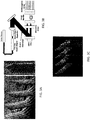
- the stimulation assembly comprises multiple 3-D waveguides for light-based stimulation.
- Such waveguides can use genetically-encoded light-sensitive ion channels to manipulate neural activity with light. Activation of these channels is extremely rapid, allowing neural activity to be controlled with millisecond precision.
- neuron activity is controlled by laser light that is channeled into the brain with fiber optics.
- the spatial precision of this approach is coarser than the spatial resolution of neurons ( ⁇ 1mm). Therefore, 3D optogenetic stimulation arrays that deliver light with 100 micron precision can be used. ( Figure 3 ).
- the arrays are micro-fabricated on silicon wafers, much like electronic circuit boards.
- silica waveguides guide light into the brain.
- Several waveguides can be placed in parallel, running along a sharpened 'shank' that can pierce neural tissue ( Figure 3A , magnified area).
- Figure 3A magnified area
- the waveguides carry light from the flat back-end of the array into the brain. Therefore, delivering a 2D pattern of light onto the back of the array will lead to a 3D pattern of light in the brain.
- Figure 3B shows one approach to creating such a pattern: a high-powered laser is reflected off a digital micro-mirror device (DMD) into the 3D array.
- DMDs consist of over a million miniature mirrors that, when 'ON', direct laser light into the 3D array (and when 'OFF' direct it away from the array). In this way, we can pattern the orientation of the micro-mirrors in order to create a 3D pattern of light in the brain ( Figure 3C ). Furthermore, we maintain the temporal accuracy of optogenetics - DMDs can update at rates well over 1 kHz.
- the stimulation assembly can comprise an array of electrodes for administering the selected stimulation pattern via electrical current.
- the stimulation assembly employs heating elements for administering the selected stimulation pattern via thermal stimulation.
- the stimulation assembly employs a transducer array for mechanically administering the selected stimulation pattern through ultrasound.
- the stimulation assembly administers the selected stimulation pattern via fluctuating magnetic fields.
- methods of providing stimulation patterns for conveying cognitive variables comprise providing input data to a processing unit from an input data assembly and converting the input data into a cognitive variable with the processing unit.
- a stimulation pattern for conveying the cognitive variable is selected by the processing unit, wherein the processing unit employs an adaptive algorithm to assemble the stimulation pattern by combination of subset stimulation patterns, the combination of subset stimulation patterns learned by the adaptive algorithm through error analysis as described hereinabove.
- the subset stimulation patterns can be assembled in a hierarchical format.
- a stimulation assembly of the cognitive prosthetic administers the selected stimulation pattern.
- Components of methods described herein, including input data, processing unit and stimulation assembly can have construction and/or properties recited above. Further, stimulation patterns of the methods can be assembled according to the learning principles described above governing the hierarchical adaptive algorithm.
- a 'random walk' model was tested to learn appropriate stimulation patterns.
- the random walk did not reduce dimensionality when attempting to learn the appropriate stimulation patterns.
- Two different methods of reducing dimensionality of the learning problem were then tested: (1) DCT (a frequency based method discussed herein, similar to Fourier transform) and (2) a sequential subspace (learning on local subsets of neurons at a time).
- DCT frequency based method discussed herein, similar to Fourier transform
- a sequential subspace learning on local subsets of neurons at a time.
- leaning occurred in a structure subspace (e.g. reduced dimensionality, either based on DCT or sequential) or leaning was conducted over the entire space (random walk).
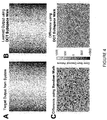
- Figure 4(A) shows the desired stimulation pattern output while Figure 4(B) shows the learned response stimulation pattern using the DCT subspace approach.
- the error between the target output and the generated response was calculated by directly subtracting the two patterns.
- Figure 4(C) illustrates this error was significantly reduced when using the DCT subspace (right) in comparison with the default random walk (left).
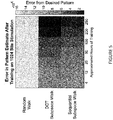
- a key aspect of the adaptive cognitive prosthetic described herein is that the prosthetic learns on a limited number of iterations. Assuming behavioral tasks can be completed at a rate of about 4 trials per minute, this limits the algorithm to about 60,000 iterations in 250 hours (i.e. in about 1 year).
- Figure 5 illustrates the relative speed of learning for the three approaches of this Example 1.
- the DCT is highly effective and able to learn significantly faster than the random walk and sequential subspace. With only 4 hours of training, the DCT drastically reduced error between the target stimulation pattern and learned stimulation pattern.
- the adaptive cognitive prosthetic must learn simulation patterns in high-dimensional space.
- the need to stimulate at many sites exacerbates the leaning problem, as illustrated in Figure 6 .
- Increasing the number of stimulation sites causes an exponential increase in learning error using the default random walk algorithm; learning in subspaces as described herein renders high-dimensional stimulation feasible.
- Hemispatial neglect is a common symptom following damage to the right posterior parietal cortex.
- Patients with hemispatial neglect show a characteristic decrease in awareness of objects in their contralesional visual field (i.e. objects on the left of patients with right parietal damage). This can dramatically impact their everyday lives, causing them to ignore objects in the affected part of the visual field. This deficit extends beyond simple perception - memory and actions towards the affected side are also reduced. For example, patients with hemispatial neglect will often neglect to care for the contralesional side of their body (e.g. only shaving the right half of their face).
- Figure 7 shows the performance of patients performing a visual search task (to find all of the 'A's). Patients can perform this task well when the targets are presented with only a few distractors ( Figure 7 , left; black circles indicate targets the patient found, black underlines are missed targets), demonstrating they do not have difficulty perceiving them. However, they are no longer able to locate the target stimuli in the affected (left) hemifield when the visual scene becomes cluttered with distractors ( Figure 7 , right). This impairment does not extend to the unaffected (right) side.
- parietal cortex plays a leading role when attention is captured by a salient external stimulus ( Figure 9 , left).
- salience is an integration of bottom-up and top-down biases: brighter and faster-moving stimuli are always salient, regardless of task (bottom-up) while stimuli that share an attribute of the searched-for target can be salient in a particular task (top-down, e.g. green vegetables in a produce stand when looking for an apple).
- Neurons in parietal cortex integrate bottom-up and top-down biases to encode the saliency of a visual object. Competition between the representation of multiple objects gives rise to a 'priority' map where the most salient object is strongly represented. This priority map can then drive attention - one should attend to the highest priority object at any moment
- parietal cortex When parietal cortex is damaged this priority map can be disrupted. Indeed, this fits the behavioral deficits observed in hemispatial neglect: if objects in the contralesional (affected) hemifield are no longer able to 'compete' for representation in the saliency map then they will be ignored. This is particularly true for cluttered displays where many objects are competing for representation. Indeed, monkeys with a lesion in parietal cortex (LIP) are not impaired in finding targets when presented alone but have difficulty performing difficult visual search tasks. This not only supports the hypothesis that parietal cortex (LIP) carries a saliency map of the visual scene but also demonstrates lesions to parietal cortex in non-human primates is a good model system for hemispatial neglect in human patients.
- LIP parietal cortex
- Parsing of neural inputs is done online and in real-time.
- Band-pass filtering of the raw voltage signal from electrodes of the recording assembly separate the low-frequency local field potential (LFP) and the high-frequency signal containing the action potentials from individual neurons.
- LFPs provide a measure of the local neural population and carry information in their spectral content - for example, visual stimuli induce strong gamma-band (45 - 90 Hz) oscillations in the LFP of visual cortex.
- the action potentials of neurons will be isolated from the high-frequency signal using a custom algorithm developed on >2,000 previously recorded (and sorted) neurons.
- the resulting multi-unit activity (MUA) is ideal for a cognitive prosthetic: it approximates the spatio-temporal precision of single neuron activity while being more robust to noise and electrode drift. Together, the LFP and MUA will provide the neural inputs into the algorithm.
- the simplest form of a saliency map is determined: one that encodes whether a stimulus exists, without encoding its relative saliency to other objects in the scene ( Figure 10 ).
- Recorded neural activity in visual cortex detects whether there is an object at each possible location. Detection of the visual array is accomplished with a simple classification algorithm on all simultaneously recorded neural signals in visual cortex (i.e. both LFP and MUA in V4 and IT).
- these signals are projected into a lower-dimensional space that captures the majority of signal variance (e.g. through principal component analysis, Figure 10 , middle).
- classification is done via k-means clustering to determine what stimuli are visible ( Figure 10 , middle).
- each saliency map must be transformed into a unique pattern of stimulation.
- the 'correct' stimulation pattern is unknown and, therefore, must be learned.
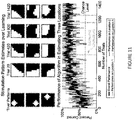
- the adaptive cognitive prosthetic uses a learning algorithm that minimizes an error function defined by behavioral performance: the cognitive prosthetic is performing well when behavioral performance is high.
- the algorithm finds stimulation patterns unique to each cognitive variable (in this case, saliency maps) that improves behavioral performance to the greatest degree.
- the adaptive algorithm learns stimulus patterns quickly and accurately, despite only receiving 'correct' and 'incorrect' feedback ( Figure 11 , bottom). Note, once low-frequency patterns were learned, adding high-frequency components increased the complexity of stimulation patterns, finding finer patterns that better approximated the 'true' pattern ( Figure 11 , top).
Landscapes
- Health & Medical Sciences (AREA)
- Life Sciences & Earth Sciences (AREA)
- Neurology (AREA)
- Engineering & Computer Science (AREA)
- Neurosurgery (AREA)
- Veterinary Medicine (AREA)
- Public Health (AREA)
- General Health & Medical Sciences (AREA)
- Animal Behavior & Ethology (AREA)
- Biomedical Technology (AREA)
- Physics & Mathematics (AREA)
- Physiology (AREA)
- Biophysics (AREA)
- Artificial Intelligence (AREA)
- Pathology (AREA)
- Heart & Thoracic Surgery (AREA)
- Medical Informatics (AREA)
- Molecular Biology (AREA)
- Surgery (AREA)
- Radiology & Medical Imaging (AREA)
- Nuclear Medicine, Radiotherapy & Molecular Imaging (AREA)
- Psychiatry (AREA)
- Psychology (AREA)
- Fuzzy Systems (AREA)
- Evolutionary Computation (AREA)
- Mathematical Physics (AREA)
- Computer Vision & Pattern Recognition (AREA)
- Signal Processing (AREA)
- Rehabilitation Therapy (AREA)
- Child & Adolescent Psychology (AREA)
- Developmental Disabilities (AREA)
- Hospice & Palliative Care (AREA)
- Electrotherapy Devices (AREA)
Claims (13)
- Prothèse cognitive adaptative comprenant :une unité de traitement pour convertir des données d'entrée provenant d'un ensemble de données d'entrée en une variable cognitive et sélectionner un motif de stimulation pour transmettre la variable cognitive, dans laquelle, en utilisation, l'unité de traitement emploie un algorithme adaptatif pour assembler le motif de stimulation par combinaison de motifs de stimulation de sous-ensemble dans un format hiérarchique, la combinaison de motifs de stimulation de sous-ensemble faisant l'objet d'un apprentissage par l'algorithme adaptatif par l'intermédiaire d'une analyse d'erreur, l'analyse d'erreur comprenant une détermination du fait qu'une combinaison de motifs de stimulation de sous-ensemble répond ou non à un seuil de précision défini ou prédéterminé guidé par une rétroaction provenant d'un paradigme comportemental et/ou directement d'un patient utilisant la prothèse cognitive adaptative, etun ensemble de stimulation pour administrer le motif de stimulation sélectionné.
- Prothèse cognitive adaptative selon la revendication 1, dans laquelle le format hiérarchique classe les motifs de stimulation de sous-ensemble en fonction de la complexité de motif.
- Prothèse cognitive adaptative selon la revendication 1 ou la revendication 2, dans laquelle les motifs de stimulation de sous-ensemble sont combinés par ordre croissant de complexité.
- Prothèse cognitive adaptative selon la revendication 2, dans laquelle la complexité de motif de stimulation de sous-ensemble est proportionnelle à des fréquences de signal définissant le motif de stimulation de sous-ensemble.
- Prothèse cognitive adaptative selon la revendication 4, dans laquelle l'algorithme adaptatif inclut une transformée en cosinus discrète.
- Prothèse cognitive adaptative selon la revendication 1, dans laquelle l'ensemble d'entrée comprend un ensemble d'enregistrement pour enregistrer les données d'entrée.
- Prothèse cognitive adaptative selon la revendication 6, dans laquelle les données d'entrée comprennent une activité neuronale d'un patient.
- Prothèse cognitive adaptative selon la revendication 6 ou la revendication 7, dans laquelle les données d'entrée comprennent des stimuli environnementaux ressentis par un patient.
- Algorithme cognitif adaptatif selon l'une quelconque des revendications 6 à 8, dans lequel les données d'entrée comprennent un ou plusieurs signaux physiologiques provenant d'un patient.
- Prothèse cognitive adaptative selon la revendication 1, dans laquelle l'ensemble de stimulation comprend des réseaux d'électrodes pour administrer le motif de stimulation sélectionné via une décharge électrique.
- Prothèse cognitive adaptative selon la revendication 1, dans laquelle l'ensemble de stimulation comprend des guides d'onde pour administrer le motif de stimulation sélectionné via une stimulation électromagnétique.
- Prothèse cognitive adaptative selon la revendication 1, dans laquelle, en utilisation, l'ensemble de stimulation administre le motif de stimulation sélectionné• via des champs magnétiques fluctuants ;• via une stimulation thermique à travers un réseau d'éléments chauffants ; ou• mécaniquement à travers un réseau de transducteurs.
- Prothèse cognitive adaptative selon la revendication 1, dans laquelle la fonction cognitive comprend une ou plusieurs réponses à des stimuli environnementaux, incluant des objets dans un champ de vision, et les réponses incluent une différenciation des objets.
Applications Claiming Priority (2)
| Application Number | Priority Date | Filing Date | Title |
|---|---|---|---|
| US201462060534P | 2014-10-06 | 2014-10-06 | |
| PCT/US2015/054007 WO2016057396A1 (fr) | 2014-10-06 | 2015-10-05 | Prothèse cognitive adaptative et ses applications |
Publications (3)
| Publication Number | Publication Date |
|---|---|
| EP3203904A1 EP3203904A1 (fr) | 2017-08-16 |
| EP3203904A4 EP3203904A4 (fr) | 2018-05-09 |
| EP3203904B1 true EP3203904B1 (fr) | 2020-08-26 |
Family
ID=55653605
Family Applications (1)
| Application Number | Title | Priority Date | Filing Date |
|---|---|---|---|
| EP15849401.3A Active EP3203904B1 (fr) | 2014-10-06 | 2015-10-05 | Prothèse cognitive adaptative et ses applications |
Country Status (3)
| Country | Link |
|---|---|
| US (1) | US10994141B2 (fr) |
| EP (1) | EP3203904B1 (fr) |
| WO (1) | WO2016057396A1 (fr) |
Families Citing this family (3)
| Publication number | Priority date | Publication date | Assignee | Title |
|---|---|---|---|---|
| WO2017053237A1 (fr) * | 2015-09-21 | 2017-03-30 | Boston Scientific Neuromodulation Corporation | Optimisation automatique de programme |
| US10985951B2 (en) | 2019-03-15 | 2021-04-20 | The Research Foundation for the State University | Integrating Volterra series model and deep neural networks to equalize nonlinear power amplifiers |
| KR102566150B1 (ko) * | 2020-10-07 | 2023-08-14 | 이화여자대학교 산학협력단 | 광 프로브 |
Citations (1)
| Publication number | Priority date | Publication date | Assignee | Title |
|---|---|---|---|---|
| US20020103512A1 (en) * | 2000-12-12 | 2002-08-01 | Echauz Javier Ramon | Adaptive method and apparatus for forecasting and controlling neurological disturbances under a multi-level control |
Family Cites Families (11)
| Publication number | Priority date | Publication date | Assignee | Title |
|---|---|---|---|---|
| US7430546B1 (en) * | 2003-06-07 | 2008-09-30 | Roland Erwin Suri | Applications of an algorithm that mimics cortical processing |
| US7424151B2 (en) * | 2004-06-04 | 2008-09-09 | Xerox Corporation | Method and system for image classification and halftone frequency detection |
| US7894903B2 (en) * | 2005-03-24 | 2011-02-22 | Michael Sasha John | Systems and methods for treating disorders of the central nervous system by modulation of brain networks |
| US8585567B2 (en) | 2007-12-11 | 2013-11-19 | Tokitae Llc | Systems, devices, and methods including paramagnetic oscillation, rotation and translation of hemozoin asymmetric nanoparticles in response to multi-harmonic optical detection of the presence of hemozoin |
| EP2095759A1 (fr) * | 2008-02-29 | 2009-09-02 | Essilor International (Compagnie Générale D'Optique) | Évaluation et amélioration de la perception visuelle dynamique |
| WO2010017448A1 (fr) * | 2008-08-07 | 2010-02-11 | Massachusetts Institute Of Technology | Codage pour prothèses visuelles |
| US8655441B2 (en) | 2009-04-16 | 2014-02-18 | Massachusetts Institute Of Technology | Methods and apparatus for monitoring patients and delivering therapeutic stimuli |
| CA2772330A1 (fr) * | 2009-08-27 | 2011-03-03 | The Cleveland Clinic Foundation | Systeme et procede d?estimation d?une region d?activation tissulaire |
| DE102009057962B4 (de) | 2009-12-11 | 2012-09-20 | Karlsruher Institut für Technologie | Nervenprothese und Verfahren zur Herstellung einer Nervenprothese |
| US20110307079A1 (en) * | 2010-04-29 | 2011-12-15 | Board Of Trustees Of Michigan State University, The | Multiscale intra-cortical neural interface system |
| JP6060146B2 (ja) * | 2011-03-24 | 2017-01-11 | カリフォルニア インスティテュート オブ テクノロジー | 神経刺激装置 |
-
2015
- 2015-10-05 WO PCT/US2015/054007 patent/WO2016057396A1/fr not_active Ceased
- 2015-10-05 US US15/517,331 patent/US10994141B2/en active Active
- 2015-10-05 EP EP15849401.3A patent/EP3203904B1/fr active Active
Patent Citations (1)
| Publication number | Priority date | Publication date | Assignee | Title |
|---|---|---|---|---|
| US20020103512A1 (en) * | 2000-12-12 | 2002-08-01 | Echauz Javier Ramon | Adaptive method and apparatus for forecasting and controlling neurological disturbances under a multi-level control |
Also Published As
| Publication number | Publication date |
|---|---|
| US20170304625A1 (en) | 2017-10-26 |
| EP3203904A1 (fr) | 2017-08-16 |
| US10994141B2 (en) | 2021-05-04 |
| EP3203904A4 (fr) | 2018-05-09 |
| WO2016057396A1 (fr) | 2016-04-14 |
Similar Documents
| Publication | Publication Date | Title |
|---|---|---|
| JP7014129B2 (ja) | 推定器生成装置、モニタリング装置、推定器生成方法及び推定器生成プログラム | |
| JP7492951B2 (ja) | ユーザ相互作用の高速且つ正確な追跡を使用する人間/コンピュータインターフェース | |
| KR102045569B1 (ko) | 조종사 상태의 통합 감시 제어 장치 및 이를 이용한 조종사의 임무 수행 능력 유도 방법 | |
| US11883181B2 (en) | Multimodal wearable measurement systems and methods | |
| US20220015736A1 (en) | Augmented reality systems and methods for user health analysis | |
| RU2672684C2 (ru) | Сенсорные стимулы для повышения точности оценки определения стадий сна | |
| US20180103917A1 (en) | Head-mounted display eeg device | |
| KR102029219B1 (ko) | 뇌 신호를 추정하여 사용자 의도를 인식하는 방법, 그리고 이를 구현한 헤드 마운트 디스플레이 기반 뇌-컴퓨터 인터페이스 장치 | |
| KR102143910B1 (ko) | 뇌-컴퓨터 인터페이스 시스템 기반의 통합 신호 처리 방법 | |
| EP4368238A1 (fr) | Procédé mis en uvre par ordinateur de cartographie d'électrodes d'une prothèse cérébrale | |
| US10994141B2 (en) | Adaptive cognitive prosthetic and applications thereof | |
| Ponce et al. | Brain computer interfaces for cerebral palsy | |
| Zheng et al. | Eye fixation versus pupil diameter as eye-tracking features for virtual reality emotion classification | |
| Hekmatmanesh et al. | Review of the State-of-the-art on Bio-signal-based Brain-controlled Vehicles | |
| Hoffmann | Bayesian machine learning applied in a brain-computer interface for disabled users | |
| Wessel | Pioneering research into brain computer interfaces | |
| CN121533737B (zh) | 基于中医数据的ai心理健康监控方法、装置及电子设备 | |
| Manchala | Human computer interface using electroencephalography | |
| Tovar | Of Machines and Men: Searching for the What, When, and Where of Perception | |
| TONIOLO | A novel Hidden Markov Model implementation for Brain-Computer Interface driven wheelchair | |
| Karaduman et al. | Determining the demands of disabled people by artificial intelligence methods | |
| Islam et al. | Neuroscience Informatics | |
| Sanchez | Channel Islands | |
| CN121754800A (zh) | 一种抑郁症反馈调控刺激实验装置 | |
| Wang | Brains in the Wild: Machine learning for naturalistic, long-term neural and video recordings |
Legal Events
| Date | Code | Title | Description |
|---|---|---|---|
| STAA | Information on the status of an ep patent application or granted ep patent |
Free format text: STATUS: THE INTERNATIONAL PUBLICATION HAS BEEN MADE |
|
| PUAI | Public reference made under article 153(3) epc to a published international application that has entered the european phase |
Free format text: ORIGINAL CODE: 0009012 |
|
| STAA | Information on the status of an ep patent application or granted ep patent |
Free format text: STATUS: REQUEST FOR EXAMINATION WAS MADE |
|
| 17P | Request for examination filed |
Effective date: 20170503 |
|
| AK | Designated contracting states |
Kind code of ref document: A1 Designated state(s): AL AT BE BG CH CY CZ DE DK EE ES FI FR GB GR HR HU IE IS IT LI LT LU LV MC MK MT NL NO PL PT RO RS SE SI SK SM TR |
|
| AX | Request for extension of the european patent |
Extension state: BA ME |
|
| DAV | Request for validation of the european patent (deleted) | ||
| DAX | Request for extension of the european patent (deleted) | ||
| A4 | Supplementary search report drawn up and despatched |
Effective date: 20180409 |
|
| RIC1 | Information provided on ipc code assigned before grant |
Ipc: A61B 5/00 20060101ALI20180403BHEP Ipc: A61N 1/36 20060101ALI20180403BHEP Ipc: A61B 5/04 20060101AFI20180403BHEP |
|
| STAA | Information on the status of an ep patent application or granted ep patent |
Free format text: STATUS: EXAMINATION IS IN PROGRESS |
|
| 17Q | First examination report despatched |
Effective date: 20190208 |
|
| GRAP | Despatch of communication of intention to grant a patent |
Free format text: ORIGINAL CODE: EPIDOSNIGR1 |
|
| STAA | Information on the status of an ep patent application or granted ep patent |
Free format text: STATUS: GRANT OF PATENT IS INTENDED |
|
| INTG | Intention to grant announced |
Effective date: 20191107 |
|
| GRAJ | Information related to disapproval of communication of intention to grant by the applicant or resumption of examination proceedings by the epo deleted |
Free format text: ORIGINAL CODE: EPIDOSDIGR1 |
|
| STAA | Information on the status of an ep patent application or granted ep patent |
Free format text: STATUS: EXAMINATION IS IN PROGRESS |
|
| GRAP | Despatch of communication of intention to grant a patent |
Free format text: ORIGINAL CODE: EPIDOSNIGR1 |
|
| STAA | Information on the status of an ep patent application or granted ep patent |
Free format text: STATUS: GRANT OF PATENT IS INTENDED |
|
| INTC | Intention to grant announced (deleted) | ||
| INTG | Intention to grant announced |
Effective date: 20200316 |
|
| GRAS | Grant fee paid |
Free format text: ORIGINAL CODE: EPIDOSNIGR3 |
|
| GRAA | (expected) grant |
Free format text: ORIGINAL CODE: 0009210 |
|
| STAA | Information on the status of an ep patent application or granted ep patent |
Free format text: STATUS: THE PATENT HAS BEEN GRANTED |
|
| AK | Designated contracting states |
Kind code of ref document: B1 Designated state(s): AL AT BE BG CH CY CZ DE DK EE ES FI FR GB GR HR HU IE IS IT LI LT LU LV MC MK MT NL NO PL PT RO RS SE SI SK SM TR |
|
| REG | Reference to a national code |
Ref country code: GB Ref legal event code: FG4D |
|
| REG | Reference to a national code |
Ref country code: CH Ref legal event code: EP |
|
| REG | Reference to a national code |
Ref country code: AT Ref legal event code: REF Ref document number: 1305576 Country of ref document: AT Kind code of ref document: T Effective date: 20200915 |
|
| REG | Reference to a national code |
Ref country code: IE Ref legal event code: FG4D |
|
| REG | Reference to a national code |
Ref country code: DE Ref legal event code: R096 Ref document number: 602015058136 Country of ref document: DE |
|
| REG | Reference to a national code |
Ref country code: DE Ref legal event code: R079 Ref document number: 602015058136 Country of ref document: DE Free format text: PREVIOUS MAIN CLASS: A61B0005040000 Ipc: A61B0005240000 |
|
| REG | Reference to a national code |
Ref country code: LT Ref legal event code: MG4D |
|
| PG25 | Lapsed in a contracting state [announced via postgrant information from national office to epo] |
Ref country code: FI Free format text: LAPSE BECAUSE OF FAILURE TO SUBMIT A TRANSLATION OF THE DESCRIPTION OR TO PAY THE FEE WITHIN THE PRESCRIBED TIME-LIMIT Effective date: 20200826 Ref country code: GR Free format text: LAPSE BECAUSE OF FAILURE TO SUBMIT A TRANSLATION OF THE DESCRIPTION OR TO PAY THE FEE WITHIN THE PRESCRIBED TIME-LIMIT Effective date: 20201127 Ref country code: NO Free format text: LAPSE BECAUSE OF FAILURE TO SUBMIT A TRANSLATION OF THE DESCRIPTION OR TO PAY THE FEE WITHIN THE PRESCRIBED TIME-LIMIT Effective date: 20201126 Ref country code: HR Free format text: LAPSE BECAUSE OF FAILURE TO SUBMIT A TRANSLATION OF THE DESCRIPTION OR TO PAY THE FEE WITHIN THE PRESCRIBED TIME-LIMIT Effective date: 20200826 Ref country code: LT Free format text: LAPSE BECAUSE OF FAILURE TO SUBMIT A TRANSLATION OF THE DESCRIPTION OR TO PAY THE FEE WITHIN THE PRESCRIBED TIME-LIMIT Effective date: 20200826 Ref country code: SE Free format text: LAPSE BECAUSE OF FAILURE TO SUBMIT A TRANSLATION OF THE DESCRIPTION OR TO PAY THE FEE WITHIN THE PRESCRIBED TIME-LIMIT Effective date: 20200826 Ref country code: BG Free format text: LAPSE BECAUSE OF FAILURE TO SUBMIT A TRANSLATION OF THE DESCRIPTION OR TO PAY THE FEE WITHIN THE PRESCRIBED TIME-LIMIT Effective date: 20201126 Ref country code: PT Free format text: LAPSE BECAUSE OF FAILURE TO SUBMIT A TRANSLATION OF THE DESCRIPTION OR TO PAY THE FEE WITHIN THE PRESCRIBED TIME-LIMIT Effective date: 20201228 |
|
| REG | Reference to a national code |
Ref country code: NL Ref legal event code: MP Effective date: 20200826 |
|
| REG | Reference to a national code |
Ref country code: AT Ref legal event code: MK05 Ref document number: 1305576 Country of ref document: AT Kind code of ref document: T Effective date: 20200826 |
|
| PG25 | Lapsed in a contracting state [announced via postgrant information from national office to epo] |
Ref country code: LV Free format text: LAPSE BECAUSE OF FAILURE TO SUBMIT A TRANSLATION OF THE DESCRIPTION OR TO PAY THE FEE WITHIN THE PRESCRIBED TIME-LIMIT Effective date: 20200826 Ref country code: NL Free format text: LAPSE BECAUSE OF FAILURE TO SUBMIT A TRANSLATION OF THE DESCRIPTION OR TO PAY THE FEE WITHIN THE PRESCRIBED TIME-LIMIT Effective date: 20200826 Ref country code: PL Free format text: LAPSE BECAUSE OF FAILURE TO SUBMIT A TRANSLATION OF THE DESCRIPTION OR TO PAY THE FEE WITHIN THE PRESCRIBED TIME-LIMIT Effective date: 20200826 Ref country code: RS Free format text: LAPSE BECAUSE OF FAILURE TO SUBMIT A TRANSLATION OF THE DESCRIPTION OR TO PAY THE FEE WITHIN THE PRESCRIBED TIME-LIMIT Effective date: 20200826 Ref country code: IS Free format text: LAPSE BECAUSE OF FAILURE TO SUBMIT A TRANSLATION OF THE DESCRIPTION OR TO PAY THE FEE WITHIN THE PRESCRIBED TIME-LIMIT Effective date: 20201226 |
|
| PG25 | Lapsed in a contracting state [announced via postgrant information from national office to epo] |
Ref country code: SM Free format text: LAPSE BECAUSE OF FAILURE TO SUBMIT A TRANSLATION OF THE DESCRIPTION OR TO PAY THE FEE WITHIN THE PRESCRIBED TIME-LIMIT Effective date: 20200826 Ref country code: RO Free format text: LAPSE BECAUSE OF FAILURE TO SUBMIT A TRANSLATION OF THE DESCRIPTION OR TO PAY THE FEE WITHIN THE PRESCRIBED TIME-LIMIT Effective date: 20200826 Ref country code: EE Free format text: LAPSE BECAUSE OF FAILURE TO SUBMIT A TRANSLATION OF THE DESCRIPTION OR TO PAY THE FEE WITHIN THE PRESCRIBED TIME-LIMIT Effective date: 20200826 Ref country code: DK Free format text: LAPSE BECAUSE OF FAILURE TO SUBMIT A TRANSLATION OF THE DESCRIPTION OR TO PAY THE FEE WITHIN THE PRESCRIBED TIME-LIMIT Effective date: 20200826 Ref country code: CZ Free format text: LAPSE BECAUSE OF FAILURE TO SUBMIT A TRANSLATION OF THE DESCRIPTION OR TO PAY THE FEE WITHIN THE PRESCRIBED TIME-LIMIT Effective date: 20200826 |
|
| REG | Reference to a national code |
Ref country code: DE Ref legal event code: R097 Ref document number: 602015058136 Country of ref document: DE |
|
| PG25 | Lapsed in a contracting state [announced via postgrant information from national office to epo] |
Ref country code: AT Free format text: LAPSE BECAUSE OF FAILURE TO SUBMIT A TRANSLATION OF THE DESCRIPTION OR TO PAY THE FEE WITHIN THE PRESCRIBED TIME-LIMIT Effective date: 20200826 Ref country code: AL Free format text: LAPSE BECAUSE OF FAILURE TO SUBMIT A TRANSLATION OF THE DESCRIPTION OR TO PAY THE FEE WITHIN THE PRESCRIBED TIME-LIMIT Effective date: 20200826 Ref country code: ES Free format text: LAPSE BECAUSE OF FAILURE TO SUBMIT A TRANSLATION OF THE DESCRIPTION OR TO PAY THE FEE WITHIN THE PRESCRIBED TIME-LIMIT Effective date: 20200826 |
|
| REG | Reference to a national code |
Ref country code: CH Ref legal event code: PL |
|
| PG25 | Lapsed in a contracting state [announced via postgrant information from national office to epo] |
Ref country code: SK Free format text: LAPSE BECAUSE OF FAILURE TO SUBMIT A TRANSLATION OF THE DESCRIPTION OR TO PAY THE FEE WITHIN THE PRESCRIBED TIME-LIMIT Effective date: 20200826 Ref country code: MC Free format text: LAPSE BECAUSE OF FAILURE TO SUBMIT A TRANSLATION OF THE DESCRIPTION OR TO PAY THE FEE WITHIN THE PRESCRIBED TIME-LIMIT Effective date: 20200826 Ref country code: LU Free format text: LAPSE BECAUSE OF NON-PAYMENT OF DUE FEES Effective date: 20201005 |
|
| PLBE | No opposition filed within time limit |
Free format text: ORIGINAL CODE: 0009261 |
|
| STAA | Information on the status of an ep patent application or granted ep patent |
Free format text: STATUS: NO OPPOSITION FILED WITHIN TIME LIMIT |
|
| REG | Reference to a national code |
Ref country code: BE Ref legal event code: MM Effective date: 20201031 |
|
| PG25 | Lapsed in a contracting state [announced via postgrant information from national office to epo] |
Ref country code: IT Free format text: LAPSE BECAUSE OF FAILURE TO SUBMIT A TRANSLATION OF THE DESCRIPTION OR TO PAY THE FEE WITHIN THE PRESCRIBED TIME-LIMIT Effective date: 20200826 |
|
| 26N | No opposition filed |
Effective date: 20210527 |
|
| PG25 | Lapsed in a contracting state [announced via postgrant information from national office to epo] |
Ref country code: LI Free format text: LAPSE BECAUSE OF NON-PAYMENT OF DUE FEES Effective date: 20201031 Ref country code: SI Free format text: LAPSE BECAUSE OF FAILURE TO SUBMIT A TRANSLATION OF THE DESCRIPTION OR TO PAY THE FEE WITHIN THE PRESCRIBED TIME-LIMIT Effective date: 20200826 Ref country code: BE Free format text: LAPSE BECAUSE OF NON-PAYMENT OF DUE FEES Effective date: 20201031 Ref country code: CH Free format text: LAPSE BECAUSE OF NON-PAYMENT OF DUE FEES Effective date: 20201031 |
|
| PG25 | Lapsed in a contracting state [announced via postgrant information from national office to epo] |
Ref country code: IE Free format text: LAPSE BECAUSE OF NON-PAYMENT OF DUE FEES Effective date: 20201005 |
|
| PG25 | Lapsed in a contracting state [announced via postgrant information from national office to epo] |
Ref country code: TR Free format text: LAPSE BECAUSE OF FAILURE TO SUBMIT A TRANSLATION OF THE DESCRIPTION OR TO PAY THE FEE WITHIN THE PRESCRIBED TIME-LIMIT Effective date: 20200826 Ref country code: MT Free format text: LAPSE BECAUSE OF FAILURE TO SUBMIT A TRANSLATION OF THE DESCRIPTION OR TO PAY THE FEE WITHIN THE PRESCRIBED TIME-LIMIT Effective date: 20200826 Ref country code: CY Free format text: LAPSE BECAUSE OF FAILURE TO SUBMIT A TRANSLATION OF THE DESCRIPTION OR TO PAY THE FEE WITHIN THE PRESCRIBED TIME-LIMIT Effective date: 20200826 |
|
| PG25 | Lapsed in a contracting state [announced via postgrant information from national office to epo] |
Ref country code: MK Free format text: LAPSE BECAUSE OF FAILURE TO SUBMIT A TRANSLATION OF THE DESCRIPTION OR TO PAY THE FEE WITHIN THE PRESCRIBED TIME-LIMIT Effective date: 20200826 |
|
| PGFP | Annual fee paid to national office [announced via postgrant information from national office to epo] |
Ref country code: DE Payment date: 20251029 Year of fee payment: 11 |
|
| PGFP | Annual fee paid to national office [announced via postgrant information from national office to epo] |
Ref country code: GB Payment date: 20251027 Year of fee payment: 11 |
|
| PGFP | Annual fee paid to national office [announced via postgrant information from national office to epo] |
Ref country code: FR Payment date: 20251027 Year of fee payment: 11 |