EP3204397B1 - Galnac phosphoramidite, deren nucleinsaüre konjugate and vervendung - Google Patents
Galnac phosphoramidite, deren nucleinsaüre konjugate and vervendung Download PDFInfo
- Publication number
- EP3204397B1 EP3204397B1 EP15778299.6A EP15778299A EP3204397B1 EP 3204397 B1 EP3204397 B1 EP 3204397B1 EP 15778299 A EP15778299 A EP 15778299A EP 3204397 B1 EP3204397 B1 EP 3204397B1
- Authority
- EP
- European Patent Office
- Prior art keywords
- nucleic acid
- och
- group
- galnac
- formula
- Prior art date
- Legal status (The legal status is an assumption and is not a legal conclusion. Google has not performed a legal analysis and makes no representation as to the accuracy of the status listed.)
- Active
Links
Images







Classifications
-
- A—HUMAN NECESSITIES
- A61—MEDICAL OR VETERINARY SCIENCE; HYGIENE
- A61K—PREPARATIONS FOR MEDICAL, DENTAL OR TOILETRY PURPOSES
- A61K47/00—Medicinal preparations characterised by the non-active ingredients used, e.g. carriers or inert additives; Targeting or modifying agents chemically bound to the active ingredient
- A61K47/50—Medicinal preparations characterised by the non-active ingredients used, e.g. carriers or inert additives; Targeting or modifying agents chemically bound to the active ingredient the non-active ingredient being chemically bound to the active ingredient, e.g. polymer-drug conjugates
- A61K47/51—Medicinal preparations characterised by the non-active ingredients used, e.g. carriers or inert additives; Targeting or modifying agents chemically bound to the active ingredient the non-active ingredient being chemically bound to the active ingredient, e.g. polymer-drug conjugates the non-active ingredient being a modifying agent
- A61K47/54—Medicinal preparations characterised by the non-active ingredients used, e.g. carriers or inert additives; Targeting or modifying agents chemically bound to the active ingredient the non-active ingredient being chemically bound to the active ingredient, e.g. polymer-drug conjugates the non-active ingredient being a modifying agent the modifying agent being an organic compound
- A61K47/549—Sugars, nucleosides, nucleotides or nucleic acids
-
- A—HUMAN NECESSITIES
- A61—MEDICAL OR VETERINARY SCIENCE; HYGIENE
- A61K—PREPARATIONS FOR MEDICAL, DENTAL OR TOILETRY PURPOSES
- A61K47/00—Medicinal preparations characterised by the non-active ingredients used, e.g. carriers or inert additives; Targeting or modifying agents chemically bound to the active ingredient
- A61K47/50—Medicinal preparations characterised by the non-active ingredients used, e.g. carriers or inert additives; Targeting or modifying agents chemically bound to the active ingredient the non-active ingredient being chemically bound to the active ingredient, e.g. polymer-drug conjugates
- A61K47/51—Medicinal preparations characterised by the non-active ingredients used, e.g. carriers or inert additives; Targeting or modifying agents chemically bound to the active ingredient the non-active ingredient being chemically bound to the active ingredient, e.g. polymer-drug conjugates the non-active ingredient being a modifying agent
- A61K47/56—Medicinal preparations characterised by the non-active ingredients used, e.g. carriers or inert additives; Targeting or modifying agents chemically bound to the active ingredient the non-active ingredient being chemically bound to the active ingredient, e.g. polymer-drug conjugates the non-active ingredient being a modifying agent the modifying agent being an organic macromolecular compound, e.g. an oligomeric, polymeric or dendrimeric molecule
-
- A—HUMAN NECESSITIES
- A61—MEDICAL OR VETERINARY SCIENCE; HYGIENE
- A61P—SPECIFIC THERAPEUTIC ACTIVITY OF CHEMICAL COMPOUNDS OR MEDICINAL PREPARATIONS
- A61P1/00—Drugs for disorders of the alimentary tract or the digestive system
- A61P1/16—Drugs for disorders of the alimentary tract or the digestive system for liver or gallbladder disorders, e.g. hepatoprotective agents, cholagogues, litholytics
-
- A—HUMAN NECESSITIES
- A61—MEDICAL OR VETERINARY SCIENCE; HYGIENE
- A61P—SPECIFIC THERAPEUTIC ACTIVITY OF CHEMICAL COMPOUNDS OR MEDICINAL PREPARATIONS
- A61P3/00—Drugs for disorders of the metabolism
-
- A—HUMAN NECESSITIES
- A61—MEDICAL OR VETERINARY SCIENCE; HYGIENE
- A61P—SPECIFIC THERAPEUTIC ACTIVITY OF CHEMICAL COMPOUNDS OR MEDICINAL PREPARATIONS
- A61P3/00—Drugs for disorders of the metabolism
- A61P3/06—Antihyperlipidemics
-
- A—HUMAN NECESSITIES
- A61—MEDICAL OR VETERINARY SCIENCE; HYGIENE
- A61P—SPECIFIC THERAPEUTIC ACTIVITY OF CHEMICAL COMPOUNDS OR MEDICINAL PREPARATIONS
- A61P31/00—Antiinfectives, i.e. antibiotics, antiseptics, chemotherapeutics
- A61P31/12—Antivirals
- A61P31/14—Antivirals for RNA viruses
-
- A—HUMAN NECESSITIES
- A61—MEDICAL OR VETERINARY SCIENCE; HYGIENE
- A61P—SPECIFIC THERAPEUTIC ACTIVITY OF CHEMICAL COMPOUNDS OR MEDICINAL PREPARATIONS
- A61P31/00—Antiinfectives, i.e. antibiotics, antiseptics, chemotherapeutics
- A61P31/12—Antivirals
- A61P31/20—Antivirals for DNA viruses
-
- A—HUMAN NECESSITIES
- A61—MEDICAL OR VETERINARY SCIENCE; HYGIENE
- A61P—SPECIFIC THERAPEUTIC ACTIVITY OF CHEMICAL COMPOUNDS OR MEDICINAL PREPARATIONS
- A61P35/00—Antineoplastic agents
-
- A—HUMAN NECESSITIES
- A61—MEDICAL OR VETERINARY SCIENCE; HYGIENE
- A61P—SPECIFIC THERAPEUTIC ACTIVITY OF CHEMICAL COMPOUNDS OR MEDICINAL PREPARATIONS
- A61P9/00—Drugs for disorders of the cardiovascular system
- A61P9/10—Drugs for disorders of the cardiovascular system for treating ischaemic or atherosclerotic diseases, e.g. antianginal drugs, coronary vasodilators, drugs for myocardial infarction, retinopathy, cerebrovascula insufficiency, renal arteriosclerosis
-
- C—CHEMISTRY; METALLURGY
- C07—ORGANIC CHEMISTRY
- C07H—SUGARS; DERIVATIVES THEREOF; NUCLEOSIDES; NUCLEOTIDES; NUCLEIC ACIDS
- C07H1/00—Processes for the preparation of sugar derivatives
-
- C—CHEMISTRY; METALLURGY
- C07—ORGANIC CHEMISTRY
- C07H—SUGARS; DERIVATIVES THEREOF; NUCLEOSIDES; NUCLEOTIDES; NUCLEIC ACIDS
- C07H15/00—Compounds containing hydrocarbon or substituted hydrocarbon radicals directly attached to hetero atoms of saccharide radicals
- C07H15/02—Acyclic radicals, not substituted by cyclic structures
- C07H15/04—Acyclic radicals, not substituted by cyclic structures attached to an oxygen atom of the saccharide radical
-
- C—CHEMISTRY; METALLURGY
- C07—ORGANIC CHEMISTRY
- C07H—SUGARS; DERIVATIVES THEREOF; NUCLEOSIDES; NUCLEOTIDES; NUCLEIC ACIDS
- C07H15/00—Compounds containing hydrocarbon or substituted hydrocarbon radicals directly attached to hetero atoms of saccharide radicals
- C07H15/02—Acyclic radicals, not substituted by cyclic structures
- C07H15/04—Acyclic radicals, not substituted by cyclic structures attached to an oxygen atom of the saccharide radical
- C07H15/08—Polyoxyalkylene derivatives
-
- C—CHEMISTRY; METALLURGY
- C07—ORGANIC CHEMISTRY
- C07H—SUGARS; DERIVATIVES THEREOF; NUCLEOSIDES; NUCLEOTIDES; NUCLEIC ACIDS
- C07H21/00—Compounds containing two or more mononucleotide units having separate phosphate or polyphosphate groups linked by saccharide radicals of nucleoside groups, e.g. nucleic acids
-
- Y—GENERAL TAGGING OF NEW TECHNOLOGICAL DEVELOPMENTS; GENERAL TAGGING OF CROSS-SECTIONAL TECHNOLOGIES SPANNING OVER SEVERAL SECTIONS OF THE IPC; TECHNICAL SUBJECTS COVERED BY FORMER USPC CROSS-REFERENCE ART COLLECTIONS [XRACs] AND DIGESTS
- Y02—TECHNOLOGIES OR APPLICATIONS FOR MITIGATION OR ADAPTATION AGAINST CLIMATE CHANGE
- Y02P—CLIMATE CHANGE MITIGATION TECHNOLOGIES IN THE PRODUCTION OR PROCESSING OF GOODS
- Y02P20/00—Technologies relating to chemical industry
- Y02P20/50—Improvements relating to the production of bulk chemicals
- Y02P20/55—Design of synthesis routes, e.g. reducing the use of auxiliary or protecting groups
Definitions
- This invention generally relates to the field of phosphoramidite derivatives.
- the invention relates to conjugates of nucleic acid molecules with N-Acetylgalactosamine containing molecules. Also provided are methods for preparation of these molecules and possible uses thereof, in particular in medicine.
- nucleic acid molecules have been conjugated to certain ligands such as peptides, lipids, sterols, and carbohydrates.
- Nucleic acid conjugates have been extensively evaluated for use in siRNAs, where they are considered essential in order to obtain sufficient in vivo potency. For example, by attachment of a conjugate moiety containing terminal galactose or a derivative thereof to the nucleic acid, thereby targeting the nucleic acid molecule to hepatocytes via binding to the asialoglycoprotein receptor (ASGPR), see for example WO2009/073809 , WO2011/104169 and WO2012/083046 .
- ASGPR asialoglycoprotein receptor
- EP2796150 describes hybrid conjugates which comprise a hydrophilic material and hydrophobic material bonded to both ends of an siRNA or an oligonucleotide.
- the hydrophilic material is a specific GalNAc phosphoramidite to be coupled to a pegylated siRNA molecule.
- US 6,057,431 relates to phosphoamidite derivatives having a monosaccharide or a derivative thereof at their terminals, in particular to oligonucleotide derivatives in which oligonucleotides are introduced into said phosphoamidite derivatives.
- WO2014/118267 , WO2014/179620 and WO2014/179625 relate to antisense oligonucleotide carbohydrate conjugates, in particular comprising an antisense oligomer and an asialoglycoprotein receptor targeting conjugate moiety, such as a GalNAc conjugate moiety.
- carbohydrate conjugates are their complex synthesis, which comprises more than ten individual synthesis steps. For each desired conjugate, a complex and specific synthesis protocol has to be set up.
- the disclosure provides a great flexibility in the synthesis of GalNAc-nucleic acid conjugates.
- Suitable GalNAc phosphoramidites (with desired linker), nucleic acids and, if desired, brancher molecules and/or spacer molecules can be combined according to specific needs.
- the individual building blocks can be chosen such that binding of the final conjugate is, e.g. with regard to the spacing between the GalNAc molecules, ideally suited for binding to a specific cell receptor, e.g. the asialoglycoprotein receptor (ASGPR).
- ASGPR asialoglycoprotein receptor
- novel GalNAc phosphoramidites may be used in solid phase synthesis together with e.g. LNA and DNA phosphoramidites. This allows assembly of the nucleic acid carbohydrate conjugate immediately after the nucleic acid molecule synthesis, while the nucleic acid is still attached to the solid support.
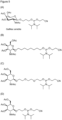
- the invention provides a compound selected from the group consisting of A-H,J-L having the structural formulas shown in the appended claims.
- the invention provides said compound for use as a medicament.
- the present disclosure relates to novel N-acetylgalactosamine (GaINAc) phosphoramidites. Accordingly, the disclosure provides a compound having the general formula (I) wherein
- the GalNAc moiety can be either in the alpha or the beta configuration as indicated by the wavy line in formula II. In preferred embodiments the GalNAc moiety is in the beta configuration.
- GalNAc moiety is the N-Acetylgalactosamine (GaINAc) part of a structure comprising GaINAc.
- GaINAc N-Acetylgalactosamine
- the GalNAc moiety is the part of the molecule which does not constitute the L.
- GalNAc conjugate moiety refers to a molecule comprising at least one GalNAc moiety and which can be conjugated unto a drug in particular a nucleic acid.
- the GalNAc conjugate moiety has affinity towards the asialoglycoprotein receptor.
- phosphoramidite as used herein means any compound containing a phosphor atom in oxidation state III which is bound covalently to at least one nitrogen atom.
- Preferred phophoramidites are compounds containing a phosphor atom in oxidation state III which is bound covalently to at least one nitrogen atom and two oxygen atoms.
- phophoramidites are compounds containing a phosphor atom in oxidation state III which is bound covalently to at least one nitrogen atom and one oxygen atom and instead of a second oxygen has a sulphor atom or a C 1 -C 6 -alkyl group.
- R' and R" of the secondary amino group -NR'R" in formula (I) are independently selected from C 1 -C 6 -alkyl, in particular from methyl, ethyl, propyl, isopropyl, n-butyl, sec-butyl, t-butyl, n-pentyl and n-hexyl.
- R' is identical to R", and -NR'R" then preferably is selected from the group consisting of dimethylamino, diethylamino, diisopropylamino, and dibutylamino.
- R' and R" each are isopropyl.
- R' and R" together form a five- or six-membered ring, which may be substituted and which may contain one further heteroatom selected from N and O.
- R' and R" form an unsubstituted five-membered ring, in other embodiments, they form an unsubstituted six-membered ring.
- the five-membered or six-membered ring is substituted at one or more carbon atoms.
- the ring may be substituted at one, two, three or four carbon atoms, preferably at one or two carbon atoms.
- Preferred substituents are methyl and ethyl.
- the ring is selected from the group consisting of pyrrolidino, piperidino, 2,6-dimethylpiperidino, morpholino, imidazolyl and 4-methylimidazolyl.
- the moiety A in formula (I) is, according to some embodiments, selected from C 1 -C 6 -alkyl, in particular from the group consisting of methyl and ethyl.
- A is a protected hydroxy group (-OH) or a protected thio group (-SH).
- exemplary non-limited protected hydroxy groups are either groups, exemplary non-limited protected thio groups are thioether groups.
- the protected -OH or -SH group represented by A is selected from the group consisting of 2-cyanoethoxy, 2-cyanoethylthio, methoxy, ethoxy, S-isobutanoyl-2-(2-mercapto-ethoxy)ethoxy, S-pivaloyl-2-(2-mercapto-ethoxy)ethoxy, and S-pivaloyl-2-mercaptoethoxy.
- A is a 2-cyanoethoxy group.
- the linker group L is selected according to the desired application of the GalNAc phosphoramidite.
- one or more of the carbon atoms in the chain may each independently be replaced by -NH-CO-, -CO-NH- and/or a heteroatom, particularly O.
- the number of replacements should be adapted such that the total length of the linker does not exceed 30 atoms after replacements and maintaining at least one neighbouring atom to the replacements as carbon atoms in the case of -NH-CO-, -CO-NH and at least 2 neighbouring carbon atoms in the case of heteroatom replacements. In some embodiments the number of replacements is less than 5 and the neighbouring atoms to the replacements are carbon atoms.
- the linker between the GalNAc and the phosphoramidite may be derived from a simple diol. In principle, any symmetrical or unsymmetrical diol could be used as a linker in the GaINAc phosphoramidite, provided it contains no other nucleophilic groups.
- carbon atoms in the chain are replaced by oxygen atoms in order to form an array of - (OCH 2 CH 2 )-groups.
- L is selected from the group consisting of C 2 -C 30 -alkylene, C 2 -C 30 -alkenylene, and -CH 2 CH 2 -(OCH 2 CH 2 ) 0-8 -OCH 2 CH 2 -.
- the linker group L may be selected from C 2 -C 20 -alkylene, C 2 -C 20 -alkenylene, -CH 2 CH 2 -(OCH 2 CH 2 ) 0-6 -OCH 2 CH 2 -, CH 2 CH 2 -(OCH 2 CH 2 ) 0-3 -OCH 2 CH 2 -, CH 2 CH 2 -(OCH 2 CH 2 ) 0-4 -OCH 2 CH 2 -, and CH 2 CH 2 -(OCH 2 CH 2 ) 6-8 -OCH 2 CH 2 .
- the alkylene is selected from C 3 -C 19 -alkylene, but not C 6 alkylene or from C 7 -C 19 -alkylene.
- the linker group L may be selected from the group consisting of -(CH 2 ) 2 -, -(CH 2 ) 3 -, -(CH 2 ) 4 -, -(CH 2 ) 5 -, -(CH 2 ) 6 -, -(CH 2 ) 7 -, -(CH 2 ) 8 -, -(CH 2 ) 9 -, -(CH 2 ) 10 -, -(CH 2 ) 11 -, -(CH 2 ) 12 -, -CH 2 CH 2 OCH 2 CH 2 -, - CH 2 CH 2 OCH 2 CH 2 OCH 2 CH 2 -, and -CH 2 CH 2 (OCH 2 CH 2 ) 2 OCH 2 CH 2 -.
- the linker L is -(CH 2 ) 2 - or-(CH 2 ) 3 -. In other preferred embodiments, the linker L is -(CH 2 ) 8 - or -CH 2 CH 2 OCH 2 CH 2 OCH 2 CH 2 -. In another preferred embodiment, the linker L is - (CH 2 ) 5 or -CH 2 CH 2 OCH 2 CH 2 -. In another preferred embodiment, the linker L is - CH 2 CH 2 OCH 2 CH 2 -, -CH 2 CH 2 OCH 2 CH 2 OCH 2 CH 2 -, or -CH 2 CH 2 (OCH 2 CH 2 ) 2 OCH 2 CH 2 -.
- the protecting group A' is selected from the group consisting of acetyl, benzoyl, phenoxy-acetyl, dimethoxytrityl (DMT), pivaloyl, isobutyryl, t-butyldimethylsilyl, t-butyldiphenylsilyl, triisopropylsilyl and isopropyldimethylsilyl.
- A' is acetyl.
- acetyl is used as the protecting group A'.
- the acetyl groups may be removed together with the protecting groups of the nucleic acid, e.g. LNA or DNA, in the cleavage and deprotecting step normally used in e.g. LNA synthesis.
- dimethoxytrityl is used as the protecting group A' at carbon atom 6 of the GalNAc.
- DMT dimethoxytrityl
- the compound has the general formula (I), wherein A is -O-CH 2 CH 2 CN, R' and R" each are isopropyl, and G is represented by formula (II), wherein A' is acetyl and L is selected from the group consisting of -(CH 2 ) 2 -, -(CH 2 ) 3 -, -(CH 2 ) 4 -, -(CH 2 ) 5 -, -(CH 2 ) 6 -, -(CH 2 ) 7 -, -(CH 2 ) 8 -, -(CH 2 ) 9 -, -(CH 2 ) 10 -, -(CH 2 ) 11 -, -(CH 2 ) 12 -, -CH 2 CH 2 OCH 2 CH 2 -, - CH 2 CH 2 OCH 2 CH 2 OCH 2 CH 2 -, and -CH 2 CH 2 (OCH 2 CH 2 ) 2 OCH 2 CH 2 -.
- A' is acety
- A is -O-CH 2 CH 2 CN, R' and R" each are isopropyl, A' is acetyl and L is -(CH 2 ) 2 -.
- A is -O-CH 2 CH 2 CN, R' and R" each are isopropyl, A' is acetyl and L is -(CH 2 ) 3 -.
- A is -O-CH 2 CH 2 CN, R' and R" each are isopropyl, A' is acetyl and L is -CH 2 CH 2 OCH 2 CH 2 OCH 2 CH 2 -.
- A is -O-CH 2 CH 2 CN, R' and R" each are isopropyl, A' is acetyl and L is -(CH 2 ) 8 -.
- A' at position 6 of the sugar is DMT.
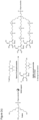
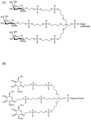
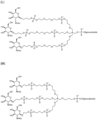
- Exemplary GalNAc phosphoramidites are represented in figure 5 by formulas (A) to (D).
- the present disclosure relates to novel GalNAc-nucleic acid conjugates, in particular GalNAc cluster conjugates.
- the GalNAc conjugate moieties can modify or enhance the pharmacokinetic and pharmacodynamic properties of the attached nucleic acid.
- the first atom of the linker L is the atom where the linker is attached to the GalNAc moiety in formula II and II'.
- the variable Z in formula (III) represents a nucleic acid molecule.
- the nucleic acid molecules referred to in the context of the invention will be more extensively described below and can generally be DNA, RNA or may comprise a nucleotide sequence which comprises both nucleotides and nucleotide analogues or is completely consisting of nucleotide analogues.
- the GalNAc conjugate moiety can either be built on to the 5'- or 3'-end of the nucleic acid.
- the GalNAc conjugate moiety is built on to the 5'- end of the nucleic acid molecule.
- the nucleic acid molecule Z may contain one or more locked nucleic acid nucleosides.
- the nucleic acid molecule may contain one or more phosphorothioate or boranophosphate internucleoside linkages.
- DNA and RNA nucleosides are linked with phosphorothioate or boranophosphate.
- all the nucleosides and/or nucleoside analogues in the nucleic acid molecule are linked with phosphorothioate or boranophosphate.
- a PO linker is placed between the nucleic acid and the GalNAc conjugate moiety.
- other linkers can be placed between the nucleic acid and the GalNAc conjugate moiety.
- the variable T in general formula (III) is represented by general formula (IV).
- General formula (IV) shows the branching region of the GalNAc cluster nucleic acid conjugate.
- R 2 is H
- the branching molecule is a doubler, i.e. during synthesis, two GalNAc phosphoramidites are added to the reactive end of the branching molecule.
- R 2 is -(CH 2 ) q -R 1
- the branching molecule is a trebler, i.e. during synthesis, three GalNAc phosphoramidites are added to the reactive end of the branching molecule.
- variable T in general formula (III) is represented by general formula (VI).
- a linker e.g. a PO linker.
- s is 0 when T in formula (III) is represented by formula (VI).
- R' and R" of the secondary amino group -NR'R" in formula (III) are selected from C 1 -C 6 alkyl or R' and R" together form a five- or six-membered ring, which may be substituted and which may contain one further heteroatom selected from N and O, wherein specific C 1 -C 6 alkyl groups and rings are selected from those defined above with regard to formula (I).
- R' is identical to R
- -NR'R" is selected from the group consisting of dimethylamino, diethylamino, diisopropylamino, and dibutylamino.
- R' and R" each are isopropyl.
- R' and R" together form a five- or six-membered ring as set forth above with regard to formula (I).
- the ring is selected from the group consisting of pyrrolidino, piperidino, 2,6-dimethylpiperidino, morpholino, imidazolyl and 4-methylimidazolyl.
- variable T in formula (III) is represented by general formula (IV), which, via R 1 , R 3 and, if R 2 is not H, R 2 , makes reference to formula (V), which in turn, via G, refers to formula (II)'.
- the variables occurring in formulae (IV), (V) and (II)' are further defined as follows.
- variable m in formula (IV) is an integer from 1 to 3, i.e. it represents 1, 2 or 3, preferably 2 or 3.
- n in formula (IV) is an integer from 0 to 5, i.e. it represents 0, 1, 2, 3, 4 or 5. In preferred embodiments, n is 0.
- variable p in formula (IV) is an integer from 0 to 3, i.e. it represents 0, 1, 2 or 3, preferably 0 or 1. In certain preferred embodiments, p is 1. In other preferred embodiments, p is 0.
- variable q in formula (IV) is, independently at each occurrence, an integer from 1 to 2, i.e. it represents 1, or 2. In preferred embodiments, q is the same integer at each occurrence. In particularly preferred embodiments, q is 1 at each occurrence.
- n is 0, p is 1 and q is 1; in other embodiments, n is 0, p is 0 and q is 1; in still other embodiments, n is 1, m is 1, 2 or 3, preferably 3, p is 1 and q is 1.
- the topological positioning of two or three GaINAc moieties in a cluster is expected to be important for function. For example, this positioning may influence its ability to bind the asialoglycoprotein receptor (ASGPR), which is one exemplary application of the novel compounds described herein. Therefore, it is important that the backbone of the GalNAc-cluster does not superate a certain length.
- backbone a contiguous chain of atoms is meant.
- the backbone of ethane is C-C (contiguous chain of 2 atoms)
- the backbone of diethylether is C-C-O-C-C (contiguous chain of 5 atoms).
- the contiguous chain starting with the first atom of linker L in R1 and ending with the attachment point in formula (IV), or starting with the first atom of linker L in R 3 and ending with the attachment point in formula (IV), or, if R 2 is not H, starting with the first atom of linker L in R 2 and ending with the attachment point in formula (IV), is defined as having a maximum length of 30 atoms.
- each of the contiguous chains may vary in their length, but no single one of these contiguous chains is longer than 30 atoms.
- the length of each of the contiguous chains may be independently 8, 9, 10, 12, 14, 16, 18, 20, 25 or 30 atoms in length.
- each of the contiguous chains starting with the first atom of linker L in R 1 , R 3 , and, if R 2 is not H, R 2 , and ending with the attachment point in formula (IV), has the same length.
- each of the contiguous chains starting with the first atom of linker L in R 1 , R 3 , and, if R 2 is not H, R 2 , and ending with the attachment point in formula (IV), have different length
- each of the three contiguous chains may have a length of 16 atoms or 22 atoms, independent of each other.
- the contiguous chain starting with the first atom of linker L in R 1 and ending with the attachment point in formula (IV), or starting with the first atom of linker L in R 3 and ending with the attachment point in formula (IV), or, if R 2 is not H, starting with the first atom of linker L in R 2 and ending with the attachment point in formula (IV), is defined as being between 10 and 25 ⁇ , more preferably from 12 to 22 ⁇ and most preferably from 14 to 20 ⁇ .
- the contiguous chain starting with the first atom of linker L in R 1 ending with the attachment point in formula (IV), is between 14 and 20 ⁇ , more preferably between 16 and 18 ⁇ and each of the contiguous chain starting with the first atom of linker L in R 3 ending with the attachment point in formula (IV), is between 10 and 18 ⁇ , more preferably between 14 and 16 ⁇ and the contiguous chain starting with the first atom of linker L in R 1 , R 3 , and, if R 2 is not H, R 2 , and ending with the attachment point in formula (IV), has the same length is between 16 and 25 ⁇ , more preferably between 18 and 20 ⁇ .
- the " attachment point" is the carbon atom of the -CH 2 -group in -(CH 2 ) q - directly bound to the branching point carbon atom in each of the branches present in formula (IV).
- the length of the backbone of linker group L is around 8 atoms, i.e. 6, 7, 8, 9 or 10 atoms.
- the length of the contiguous chain starting with the first atom of linker L in R 1 , R 3 or, if R 2 is not H, R 2 , and ending with the attachment point in formula (IV) is adjusted mainly by selecting an appropriate linker group L.
- the variable s in formula (V) is 0.
- a similar construct can be assembled using a short linker in the GalNAc phosphoramidite, combining it with a spacer phosphoramidite.
- This is a convenient way to vary the length of the linker between the brancher (or nucleic acid if no brancher is present) and the GalNAc moiety without having to make separate GalNAc phosphoramidites with different linkers.
- the variable s in formula (V) is 1.
- the contiguous chain starting with the first atom of linker L in R 1 , R 3 or, if R 2 is not H, R 2 , and ending with the branching point carbon atom in formula (IV) has a length of from 9 to 23 atoms.
- the contiguous chain starting with the first atom of linker L in R 1 , R 3 or, if R 2 is not H, R 2 , and ending with the branching point carbon atom in formula (IV) has a length of from 9 to 21 atoms, such as 12 to 18 atoms, e.g. 16 atoms.
- the "branching point carbon atom" is the carbon atom to which -(CH 2 ) q -R 1 , -(CH 2 ) q -R 3 and R 2 are bound to (see figure 1 ).
- variable W in formula (V) is selected from the group consisting of -(CH 2 ) 2-15 -, i.e. -(CH 2 ) 2 -, -(CH 2 ) 3 -, -(CH 2 ) 4 -, -(CH 2 ) 5 -, -(CH 2 ) 6 -, - (CH 2 ) 7 -, -(CH 2 ) 8 -, -(CH 2 ) 9 -, -(CH 2 ) 10 -, -(CH 2 ) 11 -, -(CH 2 ) 12 -, -(CH 2 ) 13 -, -(CH 2 ) 14 -, -(CH 2 ) 15 -, and - CH 2 CH 2 (OCH 2 CH 2 ) 0-4 OCH 2 CH 2 -, i.e.
- W is -(CH 2 ) 8 - or CH 2 CH 2 OCH 2 CH 2 OCH 2 CH 2 -.
- W is -(CH 2 ) 5 - or - CH 2 CH 2 OCH 2 CH 2 -.
- W is -(CH 2 ) 2 - or -CH 2 CH 2 CH 2 .
- variable r in formula (V) is, independently at each occurrence, an integer from 1 to 5, i.e. it represents 1, 2, 3, 4 or 5.
- r is the same integer at each occurrence.
- r is 3 at each occurrence.
- r is 4 at each occurrence.
- variable V in formula (V) is, independently at each occurrence, selected from -O-, -NH-CO- and -CO-NH-. In certain preferred embodiments, V is -NH-CO- at each occurrence. In other preferred embodiments, V is -O- at each occurrence.
- variable Y in formula (V) is, independently at each occurrence, selected from O and S. In certain preferred embodiments, Y is O at each occurrence.
- variables X 1 and X 2 in formula (III), (V) and (VI) are, independently at each occurrence, selected from a number of different combinations:
- variables X 1 and X 2 in formula (III), (V) and (VI) are, independently at each occurrence, selected from the group consisting of the following combinations:
- Y, X 1 and X 2 are selected such that the group -O-P(X 1 X 2 )-Y- in formula (V), independently at each occurrence, represents a phosphodiester group, a phosphorothioate group or a phosphorodithioate group.
- Y, X 1 and X 2 are selected such that the group -O-P(X 1 X 2 )-Y- in formula (V), independently at each occurrence, represents a phosphodiester group or a phosphorothioate group.
- Y, X 1 and X 2 are selected such that they represent the same group at each occurrence, preferably a phosphodiester group or a phosphorothioate group.
- variable G in formula (V) or (VI) is represented by formula (II)'.
- a 1 is a protecting group which is selected such that it is stable to the reaction conditions it will be exposed to, such as the conditions used in the process for preparing the phosphoramidite, and the coupling and oxidation step of the cluster and oligonucleotide synthesis process.
- a suitable hydroxyl protecting group A 1 according to formula (II)' acyl groups and silyl groups may be mentioned.
- the protecting group A 1 is selected from the group consisting of acetyl, benzoyl, phenoxy-acetyl, pivaloyl, dimethoxytrityl (DMT), isobutyryl, t-butyldimethylsilyl, t-butyldiphenylsilyl, triisopropylsilyl and isopropyldimethylsilyl.
- a 1 is acetyl.
- dimethoxytrityl is used as the protecting group A 1 at position 6 of the sugar. The advantage of using DMT at this position is that it allows for easy separation of failure sequences (e.g. non-complete constructs where a failure in the synthesis has resulted in the GalNAc moiety not being added) during purification.
- the linker group L in formula (II)' is selected according to the desired application of the GalNAc nucleic acid conjugate.
- one or more of the carbon atoms in the chain may each independently be replaced by -NH-CO-, -CO-NH- and/or a heteroatom, particularly O.
- the number of replacements should be adapted such that the total length of the linker does not exceed 30 atoms after replacements and maintaining at least one neighbouring atom to the replacements as carbon atoms in the case of -NH-CO-, -CO-NH and at least 2 neighbouring carbon atoms in the case of heteroatom replacements. In some embodiments the number of replacements is less than 5 and the neighbouring atoms to the replacements are carbon atoms.
- the linker between the GalNAc moiety and the phosphoramidite may be derived from a simple diol. In principle, any symmetrical or unsymmetrical diol could be used as a linker in the GaINAc phosphoramidite, provided they contain no other nucleophilic groups.
- carbon atoms in the chain are replaced by oxygen atoms in order to form an array of -(OCH 2 CH 2 )-groups.
- L is selected from the group consisting of C 2 -C 20 -alkylene, C 2 -C 20 -alkenylene, and -CH 2 CH 2 -(OCH 2 CH 2 ) 0-6 -OCH 2 CH 2 -, CH 2 CH 2 -(OCH 2 CH 2 ) 0-3 -OCH 2 CH 2 -, and CH 2 CH 2 -(OCH 2 CH 2 ) 0-4 -OCH 2 CH 2 . More specifically the alkylene is selected from C 3 -C 19 -alkylene, but not C 6 alkylene or from C 7- C 19 -alkylene.
- the linker group L may be selected from the group consisting of -(CH 2 ) 2 -, -(CH 2 ) 3 -, -(CH 2 ) 4 -, -(CH 2 ) 5 -, -(CH 2 ) 6 -, -(CH 2 ) 7 -, -(CH 2 ) 8 -, -(CH 2 ) 9 -, -(CH 2 ) 10 -, -(CH 2 ) 11 -, -(CH 2 ) 12 -, -CH 2 CH 2 OCH 2 CH 2 -, - CH 2 CH 2 OCH 2 CH 2 OCH 2 CH 2 -, and -CH 2 CH 2 (OCH 2 CH 2 ) 2 OCH 2 CH 2 -.
- the linker L is -(CH 2 ) 2 - or-(CH 2 ) 3 -. In other preferred embodiments, the linker L is -(CH 2 ) 8 - or-CH 2 CH 2 OCH 2 CH 2 OCH 2 CH 2 -. In another preferred embodiment, the linker L is - (CH 2 ) 5 or -CH 2 CH 2 OCH 2 CH 2 -. In another preferred embodiment, the linker L is CH 2 CH 2 OCH 2 CH 2 -, -CH 2 CH 2 OCH 2 CH 2 OCH 2 CH 2 -, or -CH 2 CH 2 (OCH 2 CH 2 ) 2 OCH 2 CH 2 -.
- the doubler or trebler is asymmetrical, i.e. at least one of the variables q, r, s, X 1 and X 2 in formula (IV) and (V) has one specific meaning at its first occurrence (e.g. in R 1 ) and a different specific meaning at the second and/or further occurrence(s) (e.g. in R 3 and/or R 2 ).
- the asymmetry regards particularly the length of the branches defined by R 1 , R 3 and optionally R 2 , meaning that at least one of the variables q, r and s has a different value at its first occurrence as compared to its second and/or third occurrence.
- the doubler or trebler is symmetrical at least with regard to the length of the branches defined by R 1 , R 3 and optionally R 2 , i.e. the variables q, r and s have the same value at each occurrence.
- the variables X 1 and X 2 and/or A 1 represent the same group at each occurrence.
- n is 0, p is 0, R 2 is H, q is 1, V is -NH-CO-, and r is 4.
- n is 0, p is 1, R 2 is -(CH 2 ) q -R 1 , q is 1, V is -O-, and r is 3.
- n is 1, m is 3, p is 1, R 2 is -(CH 2 ) q -R 1 , q is 1, V is -O-, and r is 3.
- X 1 and X 2 of formula (III) may be selected independently of the X 1 and X 2 in formula (V) and (VI).
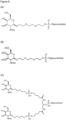
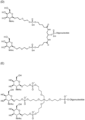
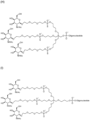
- Embodiments of GalNAc-nucleic acid conjugates are represented in Figure 6 by formulas (A) - (N).
- oligonucleotide in the formulas (A)-(N) is to be understood in the broad contexts of nucleic acid.
- the GalNAc cluster nucleic acid conjugates according to the invention may be specifically designed for binding to the asialoglycoprotein receptor (ASGPR).
- ASGPR asialoglycoprotein receptor
- a monovalent, a bivalent or, preferably, trivalent GaINAc nucleic acid conjugate according to the invention has a strong affinity for the ASGPR.
- strong affinity means an affinity characterized by an IC 50 value below 50 nM, preferably 25 nM or less, more preferably 10 nM or less, more preferably 5 nM or less.
- the IC 50 forASGPR of a GalNAc-nucleic acid conjugate with a monovalent GalNAc cluster is 50 nM, preferably 25 nM or less, more preferably 15 nM or less, more preferably 10 nM or less, more preferably 5 nM or less.
- the IC 50 forASGPR of a GalNAc-nucleic acid conjugate with a bivalent GalNAc cluster is 50 nM, preferably 25 nM or less, more preferably 15 nM or less, more preferably 10 nM or less, more preferably 5 nM or less.
- the IC 50 for ASGPR of a GalNAc-nucleic acid conjugate with a trivalent GaINAc phosphoramidite cluster is 25 nM or less, preferably 15 nM or less, more preferably 10 nM or less, more preferably 5 nM or less, more preferably between 1 nM and 5 nM, e.g. about 3 nM.
- the IC 50 is the concentration of GalNAc-nucleic acid conjugate that inhibits labelled ligand binding to the ASPGR by 50%.
- the IC 50 can be determined by the method described in Rensen et al 2001 Journal of Biological Chemistry Vol 276 pp 37577 .
- Hepatocytes primary or in culture are incubated with the ligand 125 I-labelled asialylated orosomucoid (ASOR) at one concentration (e.g. 5 nM) for 2h at 4 °C in the presence of increasing amounts of the GalNAc-nucleic acid conjugate to be investigated.
- concentrations could be from 2 to 200 mM
- concentrations could be from 1 to 1000 nM
- trivalent GalNAc-nucleic acid conjugates the concentrations could be from 0.2 to 200 nM, at increasing concentrations.
- the binding of the labelled ASOR is followed in the presence of the GalNAc-nucleic acid conjugate to be investigated.
- Nonspecific binding can be determined in the presence of 100 mM GalNAc.
- Displacement binding data can be analysed using a single site binding model and the IC 50 is calculated.
- the present disclosure relates to a manufacturing process of GalNAc phosphoramidites. Accordingly, the disclosure provides a process for the preparation of a compound of formula (I), comprising the steps:
- the protecting group A 3 must be suitable to protect one of the hydroxy groups of a diol of general formula HO-L-OH.
- Such protecting groups are known to the skilled person in the field of organic synthesis.
- acyl groups and silyl groups may be used.
- the protecting group A 3 is selected from the group consisting of acetyl, benzoyl, phenoxy-acetyl, pivaloyl, isobutyryl, t-butyldimethylsilyl, t-butyldiphenylsilyl, triisopropylsilyl and isopropyldimethylsilyl.
- a 3 is an t-butyldiphenylsilyl group.
- the linker group L in HO-L-O-A 3 is selected according to the desired application of the GalNAc phosphoramidite.
- one or more of the carbon atoms in the chain may each independently be replaced by -NH-CO-, -CO-NH- and/or a heteroatom, particularly O.
- the number of replacements should be adapted such that the total length of the linker does not exceed 30 atoms after replacements and maintaining at least one neighbouring atom to the replacements as carbon atoms in the case of -NH-CO-, -CO-NH and at least 2 neighbouring carbon atoms in the case of heteroatom replacements.
- the number of replacements is less than 5 and the neighbouring atoms to the replacements are carbon atoms.
- no more than one or two replacements are made in the chain and the neighbouring atoms to the replacements are carbon atoms.
- L is selected from the group consisting of C 2 -C 30 -alkylene, C 2 -C 30 -alkenylene, and -CH 2 CH 2 -(OCH 2 CH 2 ) 0-8 -OCH 2 CH 2 -. -. More specifically, the linker group L may be selected from C 2 -C 20 -alkylene, C 2 -C 20 -alkenylene, and -CH 2 CH 2 -(OCH 2 CH 2 ) 0-6 -OCH 2 CH 2 -.
- the linker group L may be selected from the group consisting of -(CH 2 ) 2 -, -(CH 2 ) 3 -, -(CH 2 ) 4 -, -(CH 2 ) 5 -, -(CH 2 ) 6 -, -(CH 2 ) 7 -, -(CH 2 ) 8 -, -(CH 2 ) 9 -, - (CH 2 ) 10 -, -(CH 2 ) 11 -, -(CH 2 ) 12 -, -CH 2 CH 2 OCH 2 CH 2 -, -CH 2 CH 2 OCH 2 CH 2 OCH 2 CH 2 -, and - CH 2 CH 2 (OCH 2 CH 2 ) 2 OCH 2 CH 2 -.
- the linker L is -(CH 2 ) 2 - or -(CH 2 ) 3 -. In other preferred embodiments, the linker L is -(CH 2 ) 8 - or -CH 2 CH 2 OCH 2 CH 2 OCH 2 CH 2 -. In another preferred embodiment, the linker L -CH 2 CH 2 OCH 2 CH 2 -.. In another preferred embodiment, the linker L is -CH 2 CH 2 OCH 2 CH 2 -, -CH 2 CH 2 OCH 2 CH 2 OCH 2 CH 2 -, or - CH 2 CH 2 (OCH 2 CH 2 ) 2 OCH 2 CH 2 -.
- deprotection can be carried out e.g. by adding mild acid or mild base or a catalyst etc..
- the present disclosure relates to a manufacturing process of a nucleic acid conjugate using at least one GalNAc phosphoramidite.
- Such manufacturing processes are not encompassed by the wording of the claims but are considered as useful for understanding the invention.
- the disclosure provides a process for the preparation of a GalNAc-nucleic acid conjugate, comprising the steps:
- the disclosure provides a process for the preparation of a nucleic acid conjugate, comprising the steps:
- the disclosure provides a process for the preparation of a nucleic acid conjugate, comprising the steps:
- the linker L in formula (I) is selected from the group consisting of, -(CH 2 ) 6 -, -(CH 2 ) 7 -, -(CH 2 ) 8 -, -(CH 2 ) 9 -, -(CH 2 ) 10 -, -(CH 2 ) 11 -, -(CH 2 ) 12 -, CH 2 CH 2 OCH 2 CH 2 OCH 2 CH 2 -, and -CH 2 CH 2 (OCH 2 CH 2 ) 2 OCH 2 CH 2 .
- the conjugate moiety in the GalNAc-nucleic acid conjugate is produced from a brancher and a compound according to formula (I), i.e. without a spacer, then q is 1; q' is 1; and r is 3 and L is -(CH 2 ) 8 - or CH 2 CH 2 OCH 2 CH 2 OCH 2 CH 2 - or -(CH 2 ) 5 or CH 2 CH 2 OCH 2 CH 2 -.
- the conjugate moiety in the GalNAc-nucleic acid conjugate is produced from a doubler and a compound according to formula (I), i.e. without a spacer, then q is 1; q' is 1; and r is 3 and L is -(CH 2 ) 5 - or CH 2 CH 2 OCH 2 CH 2 -.
- the conjugate moiety in the GalNAc-nucleic acid conjugate is produced from a trebler and a compound according to formula (I), i.e. without a spacer, then q is 1; q' is 1; and r is 3 and L is -(CH 2 ) 8 - or CH 2 CH 2 OCH 2 CH 2 OCH 2 CH 2 -.
- the process applies a brancher, a spacer, and a compound of formula (I). More particularly, the disclosure provides a process for the preparation of a nucleic acid conjugate, comprising the steps:
- the conjugate part in the nucleic acid conjugate is produced from a brancher where q is 1; q' is 1; and r is 3, a spacer where W is selected from -(CH 2 ) 2-5 - or - CH 2 CH 2 OCH 2 CH 2 - or -CH 2 CH 2 OCH 2 CH 2 OCH 2 CH 2 - and a compound according to formula (I) where L is -(CH 2 ) 2-5 - or CH 2 CH 2 OCH 2 CH 2 -.
- the W is -(CH 2 ) 3 and L is CH 2 CH 2 OCH 2 CH 2 -.
- W is -(CH 2 ) 3 or -(CH 2 ) 2 and L is - CH 2 CH 2 OCH 2 CH 2 OCH 2 CH 2 -.
- W is CH 2 CH 2 OCH 2 CH 2 OCH 2 CH 2 and L is -(CH 2 ) 3 - or -(CH 2 ) 2 .
- W is -(CH 2 ) 3 - and L is -(CH 2 ) 2 .
- nucleic acid molecule used in the generation of the GalNAc nucleic acid conjugates will be more extensively described below.
- the nucleic acid molecule can be DNA, RNA or may comprise a nucleotide sequence which comprises both nucleosides and nucleoside analogues or is completely consisting of nucleoside analogues.
- the GalNAc conjugate moiety can either be built on to the 5'- or 3'- end of the nucleic acid molecule.
- the GalNAc conjugation moiety is built on to the 5'- end of the nucleic acid molecule.
- a PO linker is placed between the nucleic acid and the GalNAc conjugate moiety.
- the nucleic acid molecule may contain one or more locked nucleic acid nucleosides.
- the nucleic acid molecule may contain one or more phosphorothioate or boranophosphate internucleoside linkages.
- DNA and RNA nucleosides are linked with phosphorothioate or boranophosphate. More preferably all the nucleosides and/or nucleoside analogues in the nucleic acid molecule are linked with phosphorothioate or boranophosphate.
- a GalNAc-nucleic acid conjugate can be made by coupling a GalNAc phosphoramidite according to formula (I) directly to the 5'-end of a nucleic acid molecule, e.g. an oligonucleotide, as part of e.g. a sequential synthesis on solid support, using phosphoramidite chemistry. In these embodiments, no brancher or spacer molecules are added to the nucleic acid molecule.
- the protected hydroxy group or hydroxy groups of the nucleic acid (step (ii)), the brancher molecule (step (iii); e.g. A 4 O-), and the spacer molecule(s) (step (iv); e.g. A 5 O-), respectively, are deprotected before they are reacted further, i.e. before the brancher molecule in step (ii) is added, the spacer molecule in step (iii) is added or the compound according to formula (I) or formula (III) is added.
- a brancher molecule is added to the nucleic acid molecule using phosphoramidite chemistry.
- the brancher molecule is preferably represented by general formula (IV a)
- a 4 is a suitable protecting group.
- protecting groups are known to the skilled person in the field of organic synthesis. For example, groups forming ethers with the free OH group may be mentioned.
- the protecting group A 4 is dimethoxytrityl (DMT).
- variables V 1 and V 3 in formula (IV a) are independently selected from -O-, -NH-CO- and -CO-NH-; in certain embodiments, they are both -O-; in other embodiments, they are both - NH-CO-.
- variable V 2 in formula (IV a) is absent or is selected from -O-, -NH-CO- and -CO-NH-.
- q' is 0
- -(CH 2 ) r -OA 4 attached to V 2 in formula (IV a) is also absent.
- V 2 is -O-; in other embodiments, V 2 is -NH-CO-.
- V 1 , V 2 and V 3 are -O-.
- variables X 1 and X 2 in formula (IV a) are selected from a number of different combinations:
- variables X 1 and X 2 in formula (IV a) are selected from the group consisting of the following combinations:
- X 1 and X 2 are selected such that the group -O-P(X 1 X 2 )- in formula (IV a), together with the hydroxy group to which it is attached, represents a phosphodiester group, a phosphorothioate group or a phosphorodithioate group.
- the brancher may be 1-[5-(4,4'-dimethoxy-trityloxy)pentylamido]-3-[5-fluorenomethoxy-carbonyl-oxy-pentylamido]-propyl-2-[(2-cyanoethyl)-(N,N-diisopropyl)]-phosphoramidite (Glen Research Catalogue Number: 10-1925-xx).
- a spacer molecule is added to each of the branches of the brancher molecule using phosphoramidite chemistry.
- the spacer molecule is preferably represented by general formula (V a)
- a 5 is a suitable protecting group.
- protecting groups are known to the skilled person in the field of organic synthesis.
- the protecting group A 5 may be independently selected at each occurrence. In preferred embodiments, however, the same protecting group is used for all spacers.
- protecting groups A 5 groups forming ethers with the free OH group may be mentioned as suitable protecting groups A 5 .
- the protecting group A 5 is dimethoxytrityl (DMT).
- variable W in formula (V a) is selected from the group consisting of -(CH 2 ) 2-15 -, i.e. -(CH 2 ) 2 -, -(CH 2 ) 3 -, -(CH 2 ) 4 -, -(CH 2 ) 5 -, -(CH 2 ) 6 -, -(CH 2 ) 7 -, -(CH 2 ) 8 -, -(CH 2 ) 9 -, -(CH 2 ) 10 -, -(CH 2 ) 11 -, -(CH 2 ) 12 -, -(CH 2 ) 13 -, -(CH 2 ) 14 -, -(CH 2 ) 15 -, and -CH 2 CH 2 (OCH 2 CH 2 ) 0-4 OCH 2 CH 2 -, i.e.
- W is -(CH 2 ) 8 - or CH 2 CH 2 OCH 2 CH 2 OCH 2 CH 2 -.
- W is -(CH 2 ) 5 - or -CH 2 CH 2 OCH 2 CH 2 -.
- W is -(CH 2 ) 2 - or - CH 2 CH 2 CH 2 .
- variables X 1 and X 2 in formula (V a) are independently selected from the combinations defined with regard to X 1 and X 2 in formula (IV a) above.
- the spacer phosphoramidite molecule is represented by general formula (VII)
- R' and R" of the secondary amino group -NR'R" in formula (VII) are selected from C 1 -C 6 alkyl or R' and R" together form a five- or six-membered ring, which may be substituted and which may contain one further heteroatom selected from N and O, wherein specific C 1 -C 6 alkyl groups and rings are selected from those defined above with regard to formula (I).
- R' is identical to R
- -NR'R" is selected from the group consisting of dimethylamino, diethylamino, diisopropylamino, and dibutylamino, preferably diisopropylamino.
- R' and R" together form a five- or six-membered ring as set forth above with regard to formula (I).
- the ring is selected from the group consisting of pyrrolidino, piperidino, 2,6-dimethylpiperidino, morpholino, imidazolyl and 4-methylimidazolyl.
- protecting group A 2 in formula (VII) is a protected hydroxy group (-OH) or a protected thio group (-SH).
- exemplary non-limited protected hydroxy groups are ether groups
- exemplary non-limited protected thio groups are thioether groups.
- the protected -OH or -SH group represented by A 2 is selected from the group consisting of 2-cyanoethoxy, 2-cyanoethylthio, methoxy, ethoxy, S-isobutanoyl-2-(2-mercapto-ethoxy)ethoxy, S-pivaloyl-2-(2-mercapto-ethoxy)ethoxy, and S-pivaloyl-2-mercaptoethoxy.
- Protecting group A 6 in formula (VII) may be independently selected at each occurrence: In preferred embodiments, however, the same protecting group is used for all spacers. For example, groups forming ethers with the free OH group may be mentioned as suitable protecting groups A 6 . In certain preferred embodiments, the protecting group A 6 is dimethoxytrityl (DMT).
- DMT dimethoxytrityl
- a 2 is -CH 2 CH 2 CN
- a 6 is 4',4'-Dimethoxytrityl
- R 4 is selected from the group consisting of: -CH 2 CH 2 OCH 2 CH 2 OCH 2 CH 2 -, -CH 2 CH 2 (OCH 2 CH 2 ) 4 OCH 2 CH 2 -, -CH 2 CH 2 CH 2 -, and -(CH 2 ) 12 -
- NR'R" is a secondary amino group, wherein R' and R" are independently selected from C 1 -C 6 -alkyl or R' and R" together form a five- or six-membered ring, which may be substituted and which may contain one further heteroatom selected from N and O.
- a 2 is -CH 2 CH 2 CN, A 6 is 4',4'-Dimethoxytrityl, R 4 is - CH 2 CH 2 CH 2 - and R' and R" are each isopropyl. In further preferred specific embodiments, A 2 is -CH 2 CH 2 CN, A 6 is 4',4'-Dimethoxytrityl, R 4 is -CH 2 CH 2 OCH 2 CH 2 OCH 2 CH 2 - and R' and R" are each isopropyl.
- the length of the backbone of the GalNAc-phosphoramidite shall not exceed a certain length. Accordingly, the compounds used in the process for the preparation of a GalNAc-nucleic acid conjugate, the contiguous chain starting with the first atom of linker L in the compound according to formula (I), if no brancher and/or spacer molecules are used, and ending with the phosphorus atom linking the conjugate moiety to the nucleic acid, is defined as having a minimum length of 10 atoms and a maximum length of 34 atoms.
- the contiguous chain starting with the first atom of linker L in R1, R3 or, if R2 is not H, R2, and ending with the attachment point in formula (IV) has a minimum length of 8 atoms and a maximum length of 30 atoms.
- the individual contiguous chains may vary in their length, but no single one of these contiguous chains is longer than 34 atoms.
- the length of each of the contiguous chains may be independently 8, 9, 10, 12, 14, 16, 18, 20, 25, 30, 31, 32, 33 or 34 atoms in length starting with the first atom of linker L in the compound according to formula (I), if no brancher and/or spacer molecules are used, and ending with the phosphorus atom linking the conjugate moiety to the nucleic acid.
- the maximum length of the contiguous chain starting with the first atom of linker L in the compound according to formula (I), where no brancher and/or spacer molecules are present is preferably 10, 12 atoms or 14 atoms.
- the length is between10 and 34 atoms, more preferably between 10 and 30 atoms, more preferably between 14 and 26 atoms, even more preferably between 16 and 20 atoms.
- each of the contiguous chains starting with the first atom of linker L in R 1 , R 3 , and, if R 2 is not H, R 2 , and ending with the attachment point in formula (IV), may be independently 8, 9, 10, 11, 12, 13, 14, 15, 16, 17, 18, 19, 20, 22, 24, 26, 28, 30 atoms in length.
- each of the three contiguous chains may have a length of 14 atoms, 16 atoms or 18 atoms.
- the length is between 8 and 30 atoms, more preferably between 14 and 22 atoms, even more preferably between 16 and 20 atoms.
- a branched conjugate moiety is added to the nucleic acid molecule via step (ii).
- the contiguous chain starting with the first atom of linker L in the compound according to formula (I) and ending with the branching point carbon atom in formula (IV a) may preferably have a length of from 9 to 23 atoms.
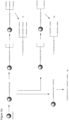
- the GalNAc-nucleic acid conjugates may be synthesized (on solid support using phosphoramidite chemistry) by the sequential synthesis of a nucleic acid followed by the addition of optionally a brancher and, optionally a spacer, and the GalNAc phosphoramidite and cleavage from the support (see Figure 1 for an overview scheme).
- the disclosure relates to various uses of the described novel GalNAc phosphoramidites. These uses are not encompassed by the wording of the claims but are considered as useful for understanding the invention.
- conjugated GalNAc clusters can be used to facilitate drug delivery of the drug moiety conjugated to the GalNAc conjugate moiety.
- drugs conjugated to a GalNAc conjugate moiety may have improved uptake to the liver compared to the unconjugated drug moiety.
- Suitable drugs may for example be nucleic acids capable of regulating a target gene or RNA in a cell or mammalian, e.g. single stranded oligonucleotides or siRNAs.
- the invention relates to medical uses of the compounds according to the invention.
- the invention provides the use of a compound according to (A) to (N) as a medicament.
- GalNAc-nucleic acid conjugates e.g. a nucleic acid conjugated to a trivalent (i.e. which has a brancher with three branches) GalNAc cluster are capable of binding to the asialoglycoprotein receptor (ASGPR), thereby allowing cellular uptake of the GalNAc-nucleic acid compounds of the invention.
- ASGPR asialoglycoprotein receptor
- GalNAc nucleic acid conjugates e.g. LNA containing oligonucleotide conjugates
- LNA containing oligonucleotide conjugates are for use in down-regulating a liver-expressed RNA.
- a metabolic disease or disorder or a hepatic disease or disorder.
- hepatitis including viral hepatitis, such as HBV or HCV
- hepatic steatosis including metabolic malfunctions
- atherosclerosis hyperlipidemia
- hypercholesterolemia familiar hypercholesterolemia e.g.
- dyslipidemias e.g., familial hyperlipidemia (FCHL), acquired hyperlipidemia, statin-resistant hypercholesterolemia, coronary artery disease (CAD), and coronary heart disease (CHD), acute coronary syndrome (ACS), liver-fibrosis (or disease associated with liver-fibrosis), cirrhosis and cancer.
- FCHL familial hyperlipidemia
- CAD coronary artery disease
- CHD coronary heart disease
- ACS acute coronary syndrome
- liver-fibrosis or disease associated with liver-fibrosis
- cirrhosis cancer.
- liver diseases such as hepatitis (including viral hepatitis, such as HBV or HCV), hepatic steatosis (including metabolic malfunctions), atherosclerosis, hyperlipidemia, hypercholesterolemia, familiar hypercholesterolemia e.g. gain of function mutations in Apolipoprotein B, HDL/LDL cholesterol imbalance, dyslipidemias, e.g ., familial hyperlipidemia (FCHL), acquired hyperlipidemia, statin-resistant hypercholesterolemia, coronary artery disease (CAD), and coronary heart disease (CHD), cirrhosis and cancer.
- hepatitis including viral hepatitis, such as HBV or HCV
- hepatic steatosis including metabolic malfunctions
- atherosclerosis hyperlipidemia
- hypercholesterolemia familiar hypercholesterolemia e.g. gain of function mutations in Apolipoprotein B, HDL/LDL cholesterol imbalance
- dyslipidemias e.g ., familial hyperlipidemia (
- nucleic acid molecule in the context of the present invention, refers to a molecule formed by covalent linkage of two or more nucleosides (i.e. an oligonucleotide).
- a single nucleoside (unit) may also be referred to as a monomer or unit.
- nucleoside i.e. an oligonucleotide
- unit a single nucleoside (unit) may also be referred to as a monomer or unit.
- nucleoside nucleoside
- nucleotide nucleotide
- unit and “monomer” are used interchangeably. It will be recognised that when referring to a sequence of nucleotides or monomers, what is referred to is the sequence of bases, such as A, T, G, C or U or analogues thereof.
- the nucleic acid molecule can be DNA, RNA or may comprise a nucleotide sequence which comprises both nucleotides and nucleotide analogues.
- nucleic acid analogue molecules that modulate RNA within a cell are desired.
- the modulation can for example be facilitating degradation of mRNA, blockage of mRNA transcription, repair of splice sites, prevention of splicing or blockage of micro RNA.
- the nucleic acid molecule may comprise or consist of a contiguous nucleotide sequence which corresponds to the reverse complement of the target nucleic acid.
- the nucleic acid molecule may tolerate 1, 2, 3, or 4 (or more) mismatches, when hybridising to the target nucleic acid sequence and still sufficiently bind to the target to show the desired effect, i.e. down-regulation of the target.
- Mismatches may, for example, be compensated by increased length of the oligomer nucleotide sequence and/or an increased number of nucleotide analogues, such as LNA, present within the nucleotide sequence.
- the contiguous nucleotide sequence comprises no more than 3, such as no more than 2 mismatches when hybridizing to the target sequence, such as to the corresponding region of a nucleic acid which encodes a mammalian target protein.
- the contiguous nucleotide sequence comprises no more than a single mismatch when hybridizing to the target sequence, such as the corresponding region of a nucleic acid which encodes a mammalian target protein.
- the nucleotide sequence of the nucleic acid molecules is preferably at least 80% identical to the reverse complement of a corresponding sequence present in the target nucleic acid, such as at least 85%, at least 90%, at least 91%, at least 92%at least 93%, at least 94%, at least 95%, at least 96% identical, at least 97% identical, at least 98% identical, at least 99% identical, such as 100% identical.
- complementary means that two sequences are complementary when the sequence of one can bind to the sequence of the other in an anti-parallel sense wherein the 3'-end of each sequence binds to the 5'-end of the other sequence and each A, T(U), G, and C of one sequence is then aligned with a T(U), A, C, and G, respectively, of the other sequence.
- the complementary sequence of the nucleic acid molecule has at least 80% complementary to a sub-sequence present in the target nucleic acid molecule, such as at least 85%, at least 90%, at least 91%, at least 92%, at least 93%, at least 94%, at least 95%, at least 96% complementary, at least 97% complementary, at least 98% complementary, at least 99% complementary, such as 100% complementary (perfectly complementary).
- the degree of complementarity is expressed as the percentage complementarity between the sequence of the nucleic acid molecule and the sequence of the target region that best aligns therewith. The percentage is calculated by counting the number of aligned bases that form pairs between the 2 sequences, dividing by the total number of monomers in the nucleic acid molecule (antisense oligonucleotide or siRNA), and multiplying by 100. In such a comparison a nucleobase/nucleotide which does not align is termed a mismatch.
- RNAi polynucleotides may be selected from the group comprising: siRNA, microRNA, double-strand RNA (dsRNA), short hairpin RNA (shRNA), and expression cassettes encoding RNA capable of inducing RNA interference.
- siRNA comprises a double stranded structure typically containing 15-50 base pairs and preferably 21-25 base pairs and having a nucleotide sequence identical (perfectly complementary) or nearly identical (partially complementary) to a coding sequence in an expressed target gene or RNA within the cell.
- An siRNA may be composed of two annealed polynucleotides or a single polynucleotide that forms a hairpin structure.
- An siRNA molecule of the invention comprises a sense region and an antisense region.
- the siRNA of the conjugate is assembled from two oligonucleotide fragments wherein one fragment comprises the nucleotide sequence of the antisense strand of the siRNA molecule and a second fragment comprises nucleotide sequence of the sense region of the siRNA molecule.
- the sense strand is connected to the antisense strand via a linker molecule, such as a polynucleotide linker or a non-nucleotide linker.
- the conjugate of the invention is coupled to the sense strand of the siRNA. If a cleavable linker is present between the siRNA and the conjugate the conjugate can be linked to either the sense or antisense strand.
- MicroRNAs are small noncoding RNA gene products about 22 nucleotides long that direct destruction or translational repression of their mRNA targets. If the complementarity between the miRNA and the target mRNA is partial, translation of the target mRNA is repressed. If complementarity is extensive, the target mRNA is cleaved. For miRNAs, the complex binds to target sites usually located in the 3' UTR of mRNAs that typically share only partial homology with the miRNA. A "seed region" - a stretch of about seven (7) consecutive nucleotides on the 5' end of the miRNA that forms perfect base pairing with its target - plays a key role in miRNA specificity. Blocking the seed region of the miRNA with an oligomer or facilitation of the binding of the RISC/miRNA complex to the mRNA can lead to either the repression of protein translation or cleavage and degradation of the mRNA.
- RNAi polynucleotide expression cassettes can be transcribed in the cell to produce small hairpin RNAs that can function as siRNA, separate sense and anti-sense strand linear siRNAs, or miRNA.
- RNA polymerase III transcribed DNAs contain promoters selected from the list comprising: U6 promoters, HI promoters, and tRNA promoters.
- RNA polymerase II promoters include UI, U2, U4, and U5 promoters, snRNA promoters, microRNA promoters,and mRNA promoters.
- RNA modulation can be facilitated by single stranded oligonucleotides complementary to the target mRNA or miRNA (antisense oligonucleotides). It is recognised that antisense oligonucleotides may function via non RNase mediated degradation of target mRNA, such as by steric hindrance of translation, or other methods, however, the preferred antisense oligonucleotides of the invention are capable of recruiting an endoribonuclease (RNase), such as RNase H.
- RNase endoribonuclease
- EP 1 222 309 provides in vitro methods for determining RNase H activity, which may be used to determine the ability to recruit RNase H.
- An antisense oligonucleotide is deemed capable of recruiting RNase H if, when provided with the complementary RNA target, it has an initial rate, as measured in pmol/l/min, of at least 1 %, such as at least 5%, such as at least 10% or more than 20% of the of the initial rate determined using DNA only oligonucleotide, having the same base sequence but containing only DNA monomers, with no 2' substitutions, with phosphorothioate linkage groups between all monomers in the oligonucleotide, using the methodology provided by Example 91 - 95 of EP 1 222 309 .
- an antisense oligonucleotide is deemed capable of recruiting RNase H if, when provided with the complementary RNA target, and RNase H, the RNase H initial rate, as measured in pmol/l/min, is at least 20%, such as at least 40 %, such as at least 60 %, such as at least 80 % of the initial rate determined using the equivalent DNA only oligonucleotide, with no 2' substitutions, with phosphorothioate linkage groups between all nucleotides in the oligonucleotide, using the methodology provided by Example 91 - 95 of EP 1 222 309 .
- the region of the oligomer which forms the consecutive nucleotide units which, when formed in a duplex with the complementary target RNA is capable of recruiting RNase consists of nucleotide units which form a DNA/RNA like duplex with the RNA target - and include both DNA units and LNA units which are in the alpha-L configuration, particularly preferred being alpha-L-oxy LNA.
- the antisense oligonucleotide is a single stranded molecule, and preferably does not comprise short regions of, for example, at least 3, 4 or 5 contiguous nucleotides, which are complementary to equivalent regions within the same antisense oligonucleotide (i.e. duplexes) - in this regards, the antisense oligonucleotide is not (essentially) double stranded. In some embodiments, the antisense oligonucleotide is essentially not double stranded, such as is not a siRNA. In various embodiments, the antisense oligonucleotide of the invention may consist entirely of the contiguous nucleotide region.
- the antisense oligonucleotide is not substantially self-complementary.
- the compound of the invention does not comprise RNA (units). It is preferred that the compound according to the invention is a linear molecule or is synthesised as a linear molecule.
- the antisense oligonucleotide consists of or comprises a contiguous nucleotide sequence from 10 - 50, such as 10 - 30 nucleotides in length.
- the antisense oligonucleotides comprise or consist of a contiguous nucleotide sequence of a total of from 10 - 22, such as 10 - 16, such as 10 - 14, such as 11 - 20, such as 12 - 18, such as 12 - 16, such as 13 - 17, or such as 10, 11, 12, 13, 14, 15, 16. 17, 18, 19, 20, 21, 22, 23, 24, 25, 26, 27, 28, 29 or 30 contiguous nucleotides in length.
- the antisense oligonucleotide, or contiguous nucleotide sequence may be in the form of a gapmer, a headmer or a mixmer.
- a "headmer” is defined as an antisense oligonucleotide that comprises a region X and a region Y that is contiguous thereto, with the 5'-most monomer of region Y linked to the 3'-most monomer of region X.
- Region X comprises a contiguous stretch of non-RNase recruiting nucleoside analogues and region Y comprises a contiguous stretch (such as at least 7 contiguous monomers) of DNA monomers or nucleoside analogue monomers recognizable and cleavable by the RNase.
- a “tailmer” is defined as an antisense oligonucleotide that comprises a region X and a region Y that is contiguous thereto, with the 5'-most monomer of region Y linked to the 3'-most monomer of the region X.
- Region X comprises a contiguous stretch (such as at least 7 contiguous monomers) of DNA monomers or nucleoside analogue monomers recognizable and cleavable by the RNase, and region X comprises a contiguous stretch of non-RNase recruiting nucleoside analogues.
- a “mixmer” consists of an alternating composition of (i) DNA monomers or nucleoside analogue monomers recognizable and cleavable by RNase, and (ii) non-RNase recruiting nucleoside analogue monomers. Examples of mixmers can be found in WO2005/023995 .
- the antisense oligonucleotide of the invention is a gapmer.
- a gapmer antisense oligonucleotide is an antisense oligonucleotide which comprises a contiguous stretch of nucleotides which is capable of recruiting an RNAse, such as RNase H, such as a region of at least 6 or 7 DNA nucleotides, referred to herein in as region B, wherein region B is flanked both 5' and 3' by regions of affinity enhancing nucleotide analogues, such as from 1-6 nucleotide analogues 5' and 3' to the contiguous stretch of nucleotides which is capable of recruiting RNAse - these regions are referred to as regions A and A' respectively.
- the A and A' regions can also be termed the wings of the Gapmer.
- the gapmer comprises a (poly)nucleotide sequence of formula (5' to 3'), A-B-A', or optionally A-B-A'-PO or PO-A-B-A', wherein; region A (5' region wing) consists or comprises of at least one nucleoside analogue, such as at least one LNA unit, such as from 1-6 nucleoside analogues, such as LNA units, and; region B consists or comprises of at least five consecutive nucleotides which are capable of recruiting RNAse (when formed in a duplex with a complementary RNA molecule, such as the mRNA target), such as DNA nucleosides, and; region A' (3'region wing) consists or comprises of at least one nucleoside analogue, such as at least one LNA unit, such as from 1-6 nucleoside analogues, such as LNA units, and; region PO when present consists or comprises of 1-10 nucleoside units, preferably from 1-4 nucleoside
- region A and A' consists independently of each other of 1, 2, 3, 4, 5 or 6 nucleoside analogues, such as LNA units, such as from 2-5 nucleoside analogues, such as 2-5 LNA units, such as 2-4 nucleoside analogues, such as 2-4 LNA, such as 3 or 4 nucleotide analogues, such as 3 or 4 LNA units.
- nucleoside analogues such as LNA units, such as from 2-5 nucleoside analogues, such as 2-5 LNA units, such as 2-4 nucleoside analogues, such as 2-4 LNA, such as 3 or 4 nucleotide analogues, such as 3 or 4 LNA units.
- B consists or comprises of 5, 6, 7, 8, 9, 10, 11 or 12 consecutive nucleotides which are capable of recruiting RNAse, or from 5-12, or from 6-10, or from 7-9, such as 8 consecutive nucleotides which are capable of recruiting RNAse.
- region B consists or comprises at least one DNA nucleoside unit, such as 1-12 DNA units, preferably from 4-12 DNA units, more preferably from 6-10 DNA units, such as from 7-10 DNA units, most preferably 8, 9 or 10 DNA units.
- the monomers which are capable of recruiting RNAse are selected from the group consisting of DNA monomers, alpha-L-LNA monomers, C4' alkylayted DNA monomers (see PCT/EP2009/050349 and Vester et al., Bioorg. Med. Chem. Lett. 18 (2008) 2296 - 2300 ), and UNA (unlinked nucleic acid) nucleotides (see Fluiter et al., Mol. Biosyst., 2009, 10, 1039 ).
- the internucleoside linkages in the gapmer region B comprises one or more nucleoside linkages selected from the group consisting of phosphorothioate, phosphorodithioate and boranophosphate. Preferably all the internucleoside linkages of region Bare phosphorothioate.
- the gapmer is designed with one the following A-B-A' motifs 2-7-1, 1-7-2, 2-7-2, 3-7-3, 2-7-3, 3-7-2, 3-7-4, 4-7-3 or 1-8-1, 1-8-2, 2-8-1, 2-8-2, 3-8-3, 2-8-3, 3-8-2, 3-8-3, 3-8-4, 4-8-3, 4-8-1, 4-8-2, 1-8-4, 2-8-4, or 1-9-1, 1-9-2, 2-9-1, 2-9-2, 2-9-3, 3-9-2, 1-9-3, 3-9-1, 4-9-1, 1-9-4, 3-9-3, 3-9-4, 4-9-3,or; 1-10-1, 1-10-2, 2-10-1, 2-10-2, 1-10-3, 3-10-1, 3-10-3, 3-10-4, 4-10-3.
- WO2007/146511 and WO2008/113832 refers to 'shortmer' gapmer antisense oligonucleotides.
- antisense oligonucleotides presented here may be such shortmer gapmers.
- region PO is a biocleavable linker that comprise or consists of at least one DNA or RNA nucleosides linked to the 5' or 3' end of the antisense oligonucleotide via a phosphodiester linkage.
- the internucleoside linkage between the first and second region is considered as part of region PO.
- all the internucleoside linkages in region PO are phosphodiester linkage.
- the sequence of bases in region PO is selected to provide an optimal endonuclease cleavage site, based upon the predominant endonuclease cleavage enzymes present in the target tissue or cell or sub-cellular compartment.
- region PO comprises a dinucleotide of sequence AA, AT, AC, AG, TA, TT, TC, TG, CA, CT, CC, CG, GA, GT, GC, or GG, wherein C may be 5-methylcytosine (also referred to as m C), and/or T may be replaced with U.
- C may be 5-methylcytosine (also referred to as m C), and/or T may be replaced with U.
- region B comprises a trinucleotide of sequence AAA, AAT, AAC, AAG, ATA, ATT, ATC, ATG, ACA, ACT, ACC, ACG, AGA, AGT, AGC, AGG, TAA, TAT, TAC, TAG, TTA, TTT, TTC, TAG, TCA, TCT, TCC, TCG, TGA, TGT, TGC, TGG, CAA, CAT, CAC, CAG, CTA, CTG, CTC, CTT, CCA, CCT, CCC, CCG, CGA, CGT, CGC, CGG, GAA, GAT, GAC, CAG, GTA, GTT, GTC, GTG, GCA, GCT, GCC, GCG, GGA, GGT, GGC, and GGG wherein C may be 5-methylcytosine and/or T may be replaced with U.
- region L' comprises a trinucleotide of sequence AAAX, AATX, AACX, AAGX, ATAX, ATTX, ATCX, ATGX, ACAX, ACTX, ACCX, ACGX, AGAX, AGTX, AGCX, AGGX, TAAX, TATX, TACX, TAGX, TTAX, TTTX, TTCX, TAGX, TCAX, TCTX, TCCX, TCGX, TGAX, TGTX, TGCX, TGGX, CAAX, CATX, CACX, CAGX, CTAX, CTGX, CTCX, CTTX, CCAX, CCTX, CCCX, CCGX, CGAX, CGTX, CGCX, CGGX, GAAX, GATX, GACX, CAGX, GTAX, GTTX, GTCX, GTGX, GCAX, GCTX, GCCX, GCCX,
- nucleobases A, T, U, G, C may be substituted with nucleobase analogues which function as the equivalent natural nucleobase (e.g. base pair with the complementary nucleoside).
- target refers to a naturally existing cellular or molecular structure within a cell, wherein the target is involved in a pathology of interest that the pharmaceutically active molecule is meant to act on.
- the target is a nucleic acid sequence (target nucleic acid) that upon modulation changes the pathology of interest.
- target nucleic acid refers to a DNA or RNA encoding a mammalian target polypeptide, such as human a target polypeptide or a non-coding DNA or RNA molecule exerting a regulatory effect on mechanisms within a cell, such as viral infection mechanisms, RNA silencing or post-transcriptional regulation of gene expression.
- Non-coding RNA molecules can for example be micro RNA.
- the target nucleic acid is a gene, a messenger RNA (mRNA) or micro RNA (miRNA) present in a cell, such as a mammalian cell in particular a human cell in vitro or in vivo.
- the cell is a cell comprising asialoglycoprotein receptors (ASPGR) on the surface, such as liver cells and testis cells, in particular hepatocytes and Leydig cells.
- the target nucleic acid is mRNA, such as pre-mRNA, although preferably mature mRNA.
- the target mRNA or pre-mRNA is expressed in a liver cell.
- the "target nucleic acid” may be a cDNA or a synthetic oligonucleotide derived from the above DNA or RNA nucleic acid targets.
- the nucleic acid molecule e.g. siRNA or antisense oligonucleotide
- the pharmaceutically active molecule preferably a nucleic acid molecule
- the pharmaceutically active molecule of the invention can affect the inhibition of the target, typically in a mammalian such as a human cell.
- the nucleic acid molecule bind to the target nucleic acid and affect inhibition of expression of at least 10% or 20% compared to the normal expression level, more preferably at least a 30%, 40%, 50%, 60%, 70%, 80%, 90% or 95% inhibition compared to the normal expression level (such as the expression level in the absence of the nucleic acid molecule or nucleic acid molecule conjugate.
- Modulation of expression level may be determined by measuring protein levels, e.g. by the methods such as SDS-PAGE followed by western blotting using suitable antibodies raised against the target protein.
- modulation of expression levels can be determined by measuring levels of mRNA, e.g. by northern blotting or quantitative RT-PCR.
- naturally occurring variant thereof refers to variants of the target polypeptide of nucleic acid sequence which exist naturally within the defined taxonomic group, such as mammalian, such as mouse, monkey, and preferably human.
- the term also may encompass any allelic variant of the target encoding genomic DNA which are found at the Chromosome by chromosomal translocation or duplication, and the RNA, such as mRNA derived therefrom.
- “Naturally occurring variants” may also include variants derived from alternative splicing of the target mRNA.
- the term when referenced to a specific polypeptide sequence, e.g., the term also includes naturally occurring forms of the protein which may therefore be processed, e.g. by co- or post-translational modifications, such as signal peptide cleavage, proteolytic cleavage, glycosylation, etc.
- nucleoside analogue and “nucleotide analogue” are used interchangeably.
- nucleotide refers to a glycoside comprising a sugar moiety, a base moiety and a covalently linked group (linkage group), such as a phosphate or phosphorothioate internucleotide linkage group, and covers both naturally occurring nucleotides, such as DNA or RNA, and non-naturally occurring nucleotides comprising modified sugar and/or base moieties, which are also referred to as “nucleotide analogues" herein.
- a single nucleotide (unit) may also be referred to as a monomer or nucleic acid unit.
- nucleoside is commonly used to refer to a glycoside comprising a sugar moiety and a base moiety, and may therefore be used when referring to the nucleotide units, which are covalently linked by the internucleotide linkages between the nucleotides of the oligomer.
- nucleotide is often used to refer to a nucleic acid monomer or unit, and as such in the context of an oligonucleotide may refer to the base - such as the "nucleotide sequence”, typically refer to the nucleobase sequence (i.e. the presence of the sugar backbone and internucleoside linkages are implicit).
- nucleotide may refer to a "nucleoside” for example the term “nucleotide” may be used, even when specifying the presence or nature of the linkages between the nucleosides.
- the 5' terminal nucleotide of an oligonucleotide does not comprise a 5' internucleotide linkage group, although may or may not comprise a 5' terminal group.
- Non-naturally occurring nucleotides include nucleotides which have modified sugar moieties, such as bicyclic nucleotides or 2' modified nucleotides, such as 2' substituted nucleotides.
- Nucleoside analogues are variants of natural nucleosides, such as DNA or RNA nucleosides, by virtue of modifications in the sugar and/or base moieties. Analogues could in principle be merely “silent” or “equivalent” to the natural nucleosides in the context of the nucleic acid molecule, i.e. have no functional effect on the way the nucleic acid molecule works to inhibit target gene expression. Such "equivalent” analogues may nevertheless be useful if, for example, they are easier or cheaper to manufacture, or are more stable to storage or manufacturing conditions, or represent a tag or label.
- the analogues will have a functional effect on the way in which the nucleic acid molecule works to inhibit expression; for example by producing increased binding affinity to the target and/or increased resistance to intracellular nucleases and/or increased ease of transport into the cell.
- Increased binding affinity to the target results in enhanced duplex stability of the nucleic acid molecule with the complementary RNA in term of a positive change in the melting temperature ( ⁇ Tm) of the duplex by at least +0.5 °C per modification, preferably by at least +1 °C, 1.5 °C, +2 °C, +2.5°C, +3 °C per modification, more preferably by at least +4 °C per modification, most preferably by at least +4.5 °C per modification.
- Analogues providing such an affinity increase are also termed affinity-enhancing analogues.
- affinity-enhancing analogues Specific examples of nucleoside analogues with a functional effect on the way in which the nucleic acid molecule works are described by e.g. Freier & Altmann; Nucl. Acid Res., 1997, 25, 4429-4443 and Uhlmann; Curr. Opinion in Drug Development, 2000, 3(2), 293-213 , and shown below:
- the nucleic acid molecule may thus comprise or consist of a simple sequence of natural occurring nucleosides - preferably 2'-deoxynucleotides (referred to herein generally as "DNA”), but also possibly ribonucleotides (referred to herein generally as "RNA"), or a combination of such naturally occurring nucleosides and one or more non-naturally occurring nucleotides, i.e. nucleotide analogues.
- the natural occurring nucleosides may contain natural internucleoside linkages such as phophodiesters or stabilizing linkages such as phosphodiester, phosphorothioate or boranophosphate or a mixture of these linkages.
- Nucleotide analogues may suitably enhance the affinity of the nucleic acid molecule for the target sequence.
- nucleotide analogues examples include WO2007/031091 or are referenced therein.
- LNA refers to a bicyclic nucleoside analogue, known as "Locked Nucleic Acid”. It may refer to an LNA monomer, or, when used in the context of an "LNA oligonucleotide", LNA refers to an oligonucleotide containing one or more such bicyclic nucleotide analogues.
- LNA nucleotides are characterised by the presence of a linker group (such as a bridge) between C2' and C4' of the ribose sugar ring - for example as shown as the biradical R 4* - R 2* as described below.
- the LNA used in the oligonucleotide compounds of the invention preferably has the structure of formula (VIII)
- R 4* and R 2* together designate a biradical consisting of a groups selected from the group consisting of C(R a R b )-C(R a R b )-, C(R a R b )-O-, C(R a R b )-NR a -, C(R a R b )-S-, and C(R a R b )-C(R a R b )-O-, wherein each R a and R b may optionally be independently selected.
- R a and R b may be, optionally independently selected from the group consisting of hydrogen and C1-6 alkyl, such as methyl, such as hydrogen.
- R 4* and R 2* together designate the biradical -O-CH(CH 2 OCH 3 )- (2'O-methoxyethyl bicyclic nucleic acid - Seth at al., 2010, J. Org. Chem ) - in either the R- or S-configuration.
- R 4* and R 2* together designate the biradical -O-CH(CH 2 CH 3 )- (2'O-ethyl bicyclic nucleic acid - Seth at al., 2010, J. Org. Chem ). - in either the R- or S-configuration.
- R 4* and R 2* together designate the biradical -O-CH(CH 3 )-. - in either the R- or S- configuration. In some embodiments, R 4* and R 2* together designate the biradical -O-CH 2 -O-CH 2 - ( Seth at al., 2010, J. Org. Chem ).
- R 4* and R 2* together designate the biradical -O-NR-CH 3 - - ( Seth at al., 2010, J. Org. Chem ).
- the LNA units have a structure selected from the following group:
- R 1* , R 2 , R 3 , R 5 , R 5* are independently selected from the group consisting of hydrogen, halogen, C 1-6 alkyl, substituted C 1-6 alkyl, C 2-6 alkenyl, substituted C 2-6 alkenyl, C 2-6 alkynyl or substituted C 2-6 alkynyl, C 1-6 alkoxyl, substituted C 1-6 alkoxyl, acyl, substituted acyl, C 1-6 aminoalkyl or substituted C 1-6 aminoalkyl.
- asymmetric groups may be found in either R or S orientation.
- R 1* , R 2 , R 3 , R 5 , R 5* are hydrogen.
- R 1* , R 2 , R 3 are independently selected from the group consisting of hydrogen, halogen, C 1-6 alkyl, substituted C 1-6 alkyl, C 2-6 alkenyl, substituted C 2-6 alkenyl, C 2-6 alkynyl or substituted C 2-6 alkynyl, C 1-6 alkoxyl, substituted C 1-6 alkoxyl, acyl, substituted acyl, C 1-6 aminoalkyl or substituted C 1-6 aminoalkyl.
- asymmetric groups may be found in either R or S orientation.
- R 1* , R 2 , R 3 are hydrogen.
- either R 5 or R 5* are hydrogen
- B in relation to nucleosides and nucleotides and anlogues thereof is a nucleobase, including nucleobase analogues and naturally occurring nucleobases, such as a purine or pyrimidine, or a substituted purine or substituted pyrimidine, such as a nucleobase referred to herein, such as a nucleobase selected from the group consisting of adenine, cytosine, thymine, adenine, uracil, and/or a modified or substituted nucleobase, such as 5-thiazolo-uracil, 2-thio-uracil, 5-propynyl-uracil, 2'thio-thymine, 5-methyl cytosine, 5-thiozolo-cytosine, 5-propynyl-cytosine, and 2,6-diaminopurine.
- nucleobase including nucleobase analogues and naturally occurring nucleobases, such as a purine or pyr
- R 4* and R 2* together designate the biradical C(R a R b )-N(R c )-O-, wherein R a and R b are independently selected from the group consisting of hydrogen, halogen, C 1-6 alkyl, substituted C 1-6 alkyl, C 2-6 alkenyl, substituted C 2-6 alkenyl, C 2-6 alkynyl or substituted C 2-6 alkynyl, C 1-6 alkoxyl, substituted C 1-6 alkoxyl, acyl, substituted acyl, C 1-6 aminoalkyl or substituted C 1-6 aminoalkyl, such as hydrogen, and; wherein R c is selected from the group consisting of hydrogen, halogen, C 1-6 alkyl, substituted C 1-6 alkyl, C 2-6 alkenyl, substituted C 2-6 alkenyl, C 2-6 alkynyl or substituted C 2-6 alkynyl, C 1-6 alkoxyl, substituted C
- R 4* and R 2* together designate the biradical C(R a R b )-O-C(R c R d ) -O-, wherein R a , R b , R c , and R d are independently selected from the group consisting of hydrogen, halogen, C 1-6 alkyl, substituted C 1-6 alkyl, C 2-6 alkenyl, substituted C 2-6 alkenyl, C 2-6 alkynyl or substituted C 2-6 alkynyl, C 1-6 alkoxyl, substituted C 1-6 alkoxyl, acyl, substituted acyl, C 1-6 aminoalkyl or substituted C 1-6 aminoalkyl, such as hydrogen.
- Z is C 1-6 alkyl or substituted C 1-6 alkyl. In some embodiments Z is methyl. In some embodiments Z is substituted C 1-6 alkyl. In some embodiments said substituent group is C 1-6 alkoxy. In some embodiments Z is CH 3 OCH 2 -. For all chiral centers, asymmetric groups may be found in either R or S orientation. Such bicyclic nucleotides are disclosed in US 7,399,845 .
- R 1* , R 2 , R 3 , R 5 , R 5* are hydrogen. In some some embodiments, R 1* , R 2 , R 3* are hydrogen, and one or both of R 5 , R 5* may be other than hydrogen as referred to above and in WO 2007/134181 .
- R 4* and R 2* together designate a biradical which comprise a substituted amino group in the bridge such as consist or comprise of the biradical -CH 2 -N( R c )-, wherein R c is C 1 - 12 alkyloxy.
- R 1* , R 2 , R 3 , R 5 , R 5* are independently selected from the group consisting of hydrogen, halogen, C 1-6 alkyl, substituted C 1-6 alkyl, C 2-6 alkenyl, substituted C 2-6 alkenyl, C 2-6 alkynyl or substituted C 2-6 alkynyl, C 1-6 alkoxyl, substituted C 1-6 alkoxyl, acyl, substituted acyl, C 1-6 aminoalkyl or substituted C 1-6 aminoalkyl.
- R 1* , R 2 , R 3 , R 5 , R 5* are hydrogen. In some embodiments, R 1* , R 2 , R 3 are hydrogen and one or both of R 5 , R 5* may be other than hydrogen as referred to above and in WO 2007/134181 .
- each J 1 and J 2 is, independently, H, C1-C 6 alkyl, substituted C1-C 6 alkyl, C 2 -C 6 alkenyl, substituted C 2 -C 6 alkenyl, C 2 -C 6 alkynyl, substituted C 2 -C 6 alkynyl, C1-C 6 aminoalkyl, substituted C1-C 6 aminoalkyl or a protecting group.
- Such compounds are disclosed in WO2009006478A .
- each J 1 and J 2 is, independently, H, C 1-6 alkyl, C 2-6 alkenyl, C 2-6 alkynyl, C 1-6 aminoalkyl or a protecting group; and, optionally wherein when Q is C(q 1 )(q 2 )(q 3 )(q 4 ) and one of q 3 or q 4
- R 1* , R 2 , R 3 , R 5 , R 5* are hydrogen.
- asymmetric groups may be found in either R or S orientation.
- Such bicyclic nucleotides are disclosed in WO2008/154401 .
- R 1* , R 2 , R 3 , R 5 , R 5* are independently selected from the group consisting of hydrogen, halogen, C 1-6 alkyl, substituted C 1-6 alkyl, C 2-6 alkenyl, substituted C 2-6 alkenyl, C 2-6 alkynyl or substituted C 2-6 alkynyl, C 1-6 alkoxyl, substituted C 1-6 alkoxyl, acyl, substituted acyl, C 1-6 aminoalkyl or substituted C 1-6 aminoalkyl.
- R 1* , R 2 , R 3 , R 5 , R 5* are hydrogen.
- R 1* , R 2 , R 3 are hydrogen and one or both of R 5 , R 5* may be other than hydrogen as referred to above and in WO 2007/134181 or WO2009/067647 (alpha-L-bicyclic nucleic acids analogs).
- nucleoside analogues and their use in antisense oligonucleotides are disclosed in WO2011/115818 , WO2011/085102 , WO2011/017521 , WO2009/100320 , WO2010/036698 , WO2009/124295 and WO2009/006478 .
- Such nucleoside analogues may in some aspects be useful in the nucleic acid molecules of present invention.
- the LNA used in the nucleic acid molecules preferably has the structure of the general formula (IX): wherein Y is selected from the group consisting of-O-, -CH 2 O-, -S-, -NH-, N(R e ) and/or -CH 2 -; Z and Z* are independently selected among an internucleotide linkage, R H , a terminal group or a protecting group; B constitutes a natural or non-natural nucleotide base moiety (nucleobase), and R H is selected from hydrogen and C 1-4 -alkyl; R a , R b R c , R d and R e are, optionally independently, selected from the group consisting of hydrogen, optionally substituted C 1-12 -alkyl, optionally substituted C 2-12 -alkenyl, optionally substituted C 2-12 -alkynyl, hydroxy, C 1-12 -alkoxy, C 2-12 -alkoxyalkyl, C
- R a , R b R c , R d and R e are, optionally independently, selected from the group consisting of hydrogen and C 1-6 alkyl, such as methyl.
- R a , R b R c , R d and R e are, optionally independently, selected from the group consisting of hydrogen and C 1-6 alkyl, such as methyl.
- C 1-6 alkyl such as methyl.
- asymmetric groups may be found in either R or S orientation, for example, two exemplary stereochemical isomers include the beta-D and alpha-L isoforms, which may be illustrated as follows:
- thio-LNA comprises a locked nucleotide in which Y in the general formula above is selected from S or -CH 2 -S-.
- Thio-LNA can be in both beta-D and alpha-L-configuration.
- amino-LNA comprises a locked nucleotide in which Y in the general formula above is selected from -N(H)-, N(R)-, CH 2 -N(H)-, and -CH 2 -N(R)- where R is selected from hydrogen and C 1-4 -alkyl.
- Amino-LNA can be in both beta-D and alpha-L-configuration.
- Oxy-LNA comprises a locked nucleotide in which Y in the general formula above represents -O-. Oxy-LNA can be in both beta-D and alpha-L-configuration.
- ENA comprises a locked nucleotide in which Y in the general formula above is - CH 2 -O- (where the oxygen atom of -CH 2 -O- is attached to the 2'-position relative to the base B).
- R e is hydrogen or methyl.
- LNA is selected from beta-D-oxy-LNA, alpha-L-oxy-LNA, beta-D-amino-LNA and beta-D-thio-LNA, in particular beta-D-oxy-LNA.
- affinity-enhancing nucleotide analogues in the nucleic acid molecule can allow the size of the specifically binding nucleic acid molecule to be reduced, and may also reduce the upper limit to the size of the nucleic acid molecule before non-specific or aberrant binding takes place.
- the nucleic acid molecule comprises at least 1 nucleoside analogue. In some embodiments the nucleic acid molecule comprises at least 2 nucleotide analogues. In some embodiments, the nucleic acid molecule comprises from 3-8 nucleotide analogues, e.g. 6 or 7 nucleotide analogues. In the by far most preferred embodiments, at least one of said nucleotide analogues is a locked nucleic acid (LNA); for example at least 3 or at least 4, or at least 5, or at least 6, or at least 7, or 8, of the nucleotide analogues may be LNA. In some embodiments all the nucleotides analogues may be LNA.
- LNA locked nucleic acid
- nucleic acid molecules of the invention which are defined by that sequence may comprise a corresponding nucleotide analogue in place of one or more of the nucleotides present in said sequence, such as LNA units or other nucleotide analogues, which raise the duplex stability/T m of the nucleic acid molecule/target duplex (i.e. affinity enhancing nucleotide analogues).
- any mismatches between the nucleotide sequence of the nucleic acid molecule and the target sequence are preferably found in regions outside the affinity enhancing nucleotide analogues, such as region B as referred to herein, and/or region L as referred to herein, and/or at the site of non-modified such as DNA nucleotides in the oligonucleotide, and/or in regions which are 5' or 3' to the contiguous nucleotide sequence.
- modification of the nucleotide include modifying the sugar moiety to provide a 2'-substituent group or to produce a bridged (locked nucleic acid) structure which enhances binding affinity and may also provide increased nuclease resistance.
- a preferred nucleotide analogue is LNA, such as oxy-LNA (such as beta-D-oxy-LNA, and alpha-L-oxy-LNA), and/or amino-LNA (such as beta-D-amino-LNA and alpha-L-amino-LNA) and/or thio-LNA (such as beta-D-thio-LNA and alpha-L-thio-LNA) and/or ENA (such as beta-D-ENA and alpha-L-ENA). Most preferred is beta-D-oxy-LNA.
- oxy-LNA such as beta-D-oxy-LNA, and alpha-L-oxy-LNA
- amino-LNA such as beta-D-amino-LNA and alpha-L-amino-LNA
- thio-LNA such as beta-D-thio-LNA and alpha-L-thio-LNA
- ENA such as beta-D-ENA and alpha-L-ENA
- nucleotide analogues present within the nucleic acid molecule of the invention are independently selected from, for example: 2'-O-alkyl-RNA units, 2'-amino-DNA units, 2'-fluoro-DNA units, LNA units, arabino nucleic acid (ANA) units, 2'-fluoro-ANA units, HNA units, INA (intercalating nucleic acid - Christensen, 2002. Nucl. Acids. Res. 2002 30: 4918-4925 ) units and 2'MOE units.
- the nucleotide analogues are 2'-O-methoxyethyl-RNA (2'MOE), 2'-fluoro-DNA monomers or LNA nucleotide analogues, and as such the oligonucleotide of the invention may comprise nucleotide analogues which are independently selected from these three types of analogue, or may comprise only one type of analogue selected from the three types.
- at least one of said nucleotide analogues is 2'-MOE-RNA, such as 2, 3, 4, 5, 6, 7, 8, 9 or 10 2'-MOE-RNA nucleotide units.
- at least one of said nucleotide analogues is 2'-fluoro DNA, such as 2, 3, 4, 5, 6, 7, 8, 9 or 10 2'-fluoro-DNA nucleotide units.
- the nucleic acid molecule according to the invention comprises at least one Locked Nucleic Acid (LNA) unit, such as 1, 2, 3, 4, 5, 6, 7, or 8 LNA units, such as from 3 - 7 or 4 to 8 LNA units, or 3, 4, 5, 6 or 7 LNA units.
- LNA Locked Nucleic Acid
- all the nucleotide analogues are LNA.
- the nucleic acid molecule may comprise both beta-D-oxy-LNA, and one or more of the following LNA units: thio-LNA, amino-LNA, oxy-LNA, and/or ENA in either the beta-D or alpha-L configurations or combinations thereof.
- all LNA cytosine units are 5'methyl-Cytosine.
- the nucleic acid molecule may comprise both LNA and DNA units.
- the combined total of LNA and DNA units is 10-25, such as 10 - 24, preferably 10-20, such as 10 - 18, even more preferably 12-16.
- the nucleotide sequence of the nucleic acid molecule such as the contiguous nucleotide sequence consists of at least one LNA and the remaining nucleotide units are DNA units.
- the nucleic acid molecule comprises only LNA nucleotide analogues and naturally occurring nucleotides (such as RNA or DNA, most preferably DNA nucleotides), optionally with modified internucleotide linkages such as phosphorothioate.
- nucleobase refers to the base moiety of a nucleotide and covers both naturally occurring, as well as non-naturally occurring variants. Thus, “nucleobase” covers not only the known purine and pyrimidine heterocycles but also heterocyclic analogues and tautomeres thereof.
- nucleobases include, but are not limited to adenine, guanine, cytosine, thymidine, uracil, xanthine, hypoxanthine, 5-methylcytosine, isocytosine, pseudoisocytosine, 5-bromouracil, 5-propynyluracil, 6-aminopurine, 2-aminopurine, inosine, diaminopurine, and 2-chloro-6-aminopurine.
- At least one of the nucleobases present in the nucleic acid molecule is a modified nucleobase selected from the group consisting of 5-methylcytosine, isocytosine, pseudoisocytosine, 5-bromouracil, 5-propynyluracil, 6-aminopurine, 2-aminopurine, inosine, diaminopurine, and 2-chloro-6-aminopurine.
- each monomer is linked to the 3' adjacent monomer via a linkage group.
- linkage group or "internucleotide linkage” are intended to mean a group capable of covalently coupling together two nucleosides. Specific and preferred examples include phosphate groups and phosphorothioate groups.
- nucleosides of the nucleic acid molecule of the invention or contiguous nucleotide sequence thereof are coupled together via linkage groups.
- each nucleoside is linked to the 3' adjacent nucleoside via a linkage group.
- Suitable internucleotide linkages include those listed within WO2007/031091 , for example the internucleotide linkages listed on the first paragraph of page 34 of WO2007/031091 .
- internucleotide linkage from its normal phosphodiester to one that is more resistant to nuclease attack, such as phosphorothioate or boranophosphate - these two, being cleavable by RNase H, also allow that route of antisense inhibition in reducing the expression of the target gene.
- Suitable sulphur (S) containing internucleotide linkages as provided herein may be preferred.
- Phosphorothioate internucleotide linkages are also preferred, particularly for the gap region (B) of gapmers.
- Phosphorothioate linkages may also be used for the flanking regions (A and A', and for linking A or A' to L, and within region L, as appropriate).
- Regions A, B and A' may however comprise internucleotide linkages other than phosphorothioate, such as phosphodiester linkages, particularly, for instance when the use of nucleotide analogues protects the internucleotide linkages within regions A and A' from endonuclease degradation - such as when regions A and A' comprise LNA nucleotides.
- the internucleotide linkages in the nucleic acid molecule may be phosphodiester, phosphorothioate or boranophosphate so as to allow RNase H cleavage of targeted RNA.
- Phosphorothioate is preferred, for improved nuclease resistance and other reasons, such as ease of manufacture.
- nucleic acid molecule of the invention the nucleosides and/or nucleoside analogues are linked to each other by means of phosphorothioate groups.
- nucleic acid molecule can modify the bioavailability and/or bio-distribution of a nucleic acid molecule - see WO2008/113832 .
- all remaining linkage groups are either phosphodiester or phosphorothioate, or a mixture thereof.
- all the internucleotide linkage groups are phosphorothioate.
- linkages are phosphorothioate linkages
- alternative linkages such as those disclosed herein may be used, for example phosphate (phosphodiester) linkages may be used, particularly for linkages between nucleoside analogues, such as LNA, units.
- phosphate (phosphodiester) linkages may be used, particularly for linkages between nucleoside analogues, such as LNA, units.
- C residues are annotated as 5'methyl modified cytosine
- one or more of the Cs present in the nucleic acid molecule may be unmodified C residues.
- WO2009/124238 refers to oligomeric compounds having at least one bicyclic nucleoside attached to the 3' or 5' termini by a neutral internucleoside linkage.
- the nucleic acid molecules of the invention may therefore have at least one bicyclic nucleoside attached to the 3' or 5' termini by a neutral internucleoside linkage, such as one or more phosphotriester, methylphosphonate, MMI, amide-3, formacetal or thioformacetal.
- the remaining linkages may be phosphorothioate.
- compositions not encompassed by the wording of the claims but considered as useful for understanding the invention
- compositions may be used in pharmaceutical formulations and compositions.
- compositions comprise a pharmaceutically acceptable diluent, carrier, salt or adjuvant.
- WO2007/031091 provides suitable and preferred pharmaceutically acceptable diluent, carrier and adjuvants. Suitable dosages, formulations, administration routes, compositions, dosage forms, combinations with other therapeutic agents, pro-drug formulations are also provided in WO2007/031091 .
- the compounds of the invention may be utilized as research reagents for, for example, diagnostics, therapeutics and prophylaxis.
- compounds of the invention may be used to specifically modulate the synthesis of a target protein (typically by degrading or inhibiting the mRNA and thereby prevent protein formation) in a cell.
- compounds of the invention may be used to modulate a non-coding DNA or RNA molecule exerting a regulatory effect on mechanisms within a cell in cells and experimental animals thereby facilitating functional analysis of the target or an appraisal of its usefulness as a target for therapeutic intervention.
- the cell is a cell comprising asialoglycoprotein receptors (ASPGR) on the surface, such as liver cells and testis cells, in particular hepatocytes and Leydig cells.
- ASPGR asialoglycoprotein receptors
- an animal or a human suspected of having a disease or disorder, which can be alleviated or treated by modulating a DNA or RNA encoding a mammalian target polypeptide, such as human a target polypeptide or by modulating a non-coding DNA or RNA molecule exerting a regulatory effect on mechanisms within a cell, such as viral infection mechanisms, RNA silencing or post-transcriptional regulation of gene expression.
- Non-coding RNA molecules can for example be micro RNA.
- the target nucleic acid is a gene, a messenger RNA (mRNA) or micro RNA (miRNA).
- nucleic acid conjugate or a pharmaceutical composition according to the invention is typically administered in an effective amount.
- liver diseases such as hepatitis (including viral hepatitis, such as HBV or HCV), hepatic steatosis , atherosclerosis, hyperlipidemia, hypercholesterolemia, familiar hypercholesterolemia e.g. gain of function mutations in Apolipoprotein B, HDL/LDL cholesterol imbalance, dyslipidemias, e.g., familial hyperlipidemia (FCHL), acquired hyperlipidemia, statin-resistant hypercholesterolemia, coronary artery disease (CAD), and coronary heart disease (CHD), cirrhosis and cancer.
- hepatitis including viral hepatitis, such as HBV or HCV
- hepatic steatosis e.g. gain of function mutations in Apolipoprotein B, HDL/LDL cholesterol imbalance
- dyslipidemias e.g., familial hyperlipidemia (FCHL), acquired hyperlipidemia, statin-resistant hypercholesterolemia, coronary artery disease (CAD), and coronary heart disease (
- tert-butyldiphenylsilylchloride (TBDPSCI) (2.6mL, 10mmol) was added dropwise to a mixture of ethyleneglycol (3.4mL, 60.7mmol) and pyridine (3.4mL, 42.2mmol) at room temperature. After stirring for 3.5 hours, the reaction mixture was diluted with EtOAc (50 mL). The organic phase was extracted with water (30 mL), 20 % NaHCOs (30 mL), brine (30 ml), dried over Na 2 SO 4 and evaporated. The residue was purified by DCVC chromatography (eluent EtOAc in hexanes from 10% to 25%). Product (TBDPS glycol) was isolated as a white solid, 2.54 g, yield 84 %.
- NEt 3 *3HF (1.2mL, 7.4mmol) was added to a solution of 2 (776mg, 1.23mmol) and NEt 3 (0.44mL, 3.07mmol) in 12mL THF. The reaction mixture was stirred and room temperature for 20 hours, and then evaporated. The residue was purified by column chromatography (eluent MeOH in DCM from 4% to 10%). 3 was isolated as a white solid 416mg, yield 86%, 1 H-NMR.
- TBDPSCI (9.1mL, 35mmol) was added dropwise to a mixture of ethyleneglycol (28.4mL, 210mmol) and pyridine (11.3mL) at room temperature. After stirring for2 h the reaction mixture was diluted with EtOAc (150mL), extracted with water (100mL), brine (100ml), dried over Na 2 SO 4 and evaporated. The residue was purified by DCVC chromatography (eluent EtOAc in hexanes form 10 % to 30 %).TBDPS triethyleneglycol isolated as viscous oil, 10.7 g, yield 79 %.
- Acetyl chloride is added dropwise to a solution of NAcGal and TBDPS glycol in DMF at 0°C. The reaction mixture is stirred at 70°C until completion. The reaction mixture is cooled 0°C and quenched with excess anh. pyridine. The reaction mixture is allow to reach room temperature and excess acetic anhydride is added. The mixture is stirred until completion. Based on Medina et al, Biomaterials 32 (2011), 4118-4129 .
- This composition can be subjected to reactions steps 4 and 5 above to obtain a anomeric mixture of GalNAc phosphoramidites, i.e. containing both alpha- and beta-GalNAc. If an alpha-GalNAc phosphormamidite is desired this can be purified from the anomeric mixture.
- Oligonucleotides were synthesized on NittoPhase Unylinker 200 supports using the phosphoramidite approach at 20 ⁇ mol scale. At the end of the synthesis, the oligonucleotides were cleaved from the solid support using concentrated ammonium hydroxide for 16 hours at 60°C. The oligonucleotides were purified by reverse phase HPLC and characterized by UPLC, and the molecular mass was further confirmed by ESI-MS.
- the crude compounds were purified by preparative reversed phase HPLC on a Phenomenex Jupiter C18 10 ⁇ 150x10 mm column. 0.1 M ammonium acetate pH 8 and acetonitrile was used as buffers at a flow rate of 5 mL/min. The collected fractions were lyophilized to give the purified compound typically as a white solid.
- the GalNac- nucleic acid compounds in table 1 have been synthesized using the following oligonucleotide sequences 5'G m CattggtatT m CA-3' (SEQ ID NO: 1) or 5' caG m CattggtatT m CA-3' (SEQ ID NO: 2). All linkages in SEQ ID NO: 1 were phosphothioate linkages. In SEQ ID NO: 2 the first two nucleosides (ca) are linked by phospohodiester linkages the remaining linkages are phosphothioate linkages.
- Capital letters denote LNA monomers ( m C is 5-methylcytosine LNA monomer) and lower case letters is DNA monomers.
- Table 1 Compound as shown in figure 6 GalNAc construct Chain length Oligonucleotide sequence Calc. mass Found mass B monovalent 8 SEQ ID NO: 1 4668.8 4668.4 ( fig 4 ) E trivalent 10 SEQ ID NO: 2 6339.2 6338.8 I trivalent 16 SEQ ID NO: 2 6604.2 6602.6 M trivalent 16 SEQ ID NO: 2 6754.0 6755.0 N trivalent 30 SEQ ID NO: 2 7371.5 7371.3 Control No 0 SEQ ID NO: 1 GaINAc2 trivalent 16 SEQ ID NO: 1
- the control compound is the unconjugated oligonucleotide of SEQ ID NO: 1 (i.e. without any GalNAc moieties attached).
- the GalNAc2 compound is SEQ ID NO: 1 attached to the GalNAc2 cluster shown below, the oligonucleotide is indicated as the wavy line and is connected to the GalNAc2 construct with a phospothioate group.
- Oligonucleotides conjugated to the GalNAc2 cluster are described in WO 2014/118267 and the compound corresponds to SEQ ID NO: 20 in WO 2014/076196 .
- Example 3 Knock down of ApoB mRNA and total cholesterol with GalNAc-conjugates in vivo.
- GalNAc2 cluster conjugated LNA-antisense oligonucleotide
- GalNAc constructs of the invention ( Figure 6 E , I , M and N ) or unconjugated LNA antisense oligonucleotide (see Example 2, table 1 for details) and sacrificed at days 10 where liver and kidney were isolated.
- mice Each compound was tested in an animal group containing five mice with weight of approximately 20g. Serum samples were collected at day 3 and 7 (50 microL/mouse) and at sacrifice total serum was collected for determination of total serum cholesterol as described in protocol below. The results are shown in figure 8 .
- RNAlater Analysis for ApoB mRNA knockdown.
- the animals were anaesthetised with 70% CO 2 -30% O 2 and sacrificed by cervical dislocation. One half of the large liver lobe and one kidney were minced and submerged in RNAlater.
- the RNA was purified on a MagnaPure 96 System; Roche using Cellular RNA Large Volume Kit (#05467535001; Roche) using the manufacturer's standard protocol.
- First strand synthesis was performed using Reverse Transcriptase reagents from Ambion according to the manufacturer's instructions.
- RNA 0.5 ⁇ g total RNA was adjusted to (10.8 ⁇ l) with RNase free H 2 O and mixed with 2 ⁇ l random decamers (50 ⁇ M) and 4 ⁇ l dNTP mix (2.5 mM each dNTP) and heated to 70 °C for 3 min after which the samples were rapidly cooled on ice.
- 2 ⁇ l 10 ⁇ Buffer RT, 1 ⁇ l MMLV Reverse Transcriptase (100 U/ ⁇ l) and 0.25 ⁇ l RNase inhibitor (10 U/ ⁇ l) were added to each sample, followed by incubation at 42 °C for 60 min, heat inactivation of the enzyme at 95°C for 10 min and then the sample was cooled to 4 °C.
- cDNA samples were diluted 1: 5 and subjected to RT-QPCR using Taqman Fast Universal PCR Master Mix 2x (Applied Biosystems Cat #4364103) and Taqman gene expression assay (mApoB, Mn01545150_m1 and mGAPDH #4352339E) following the manufacturers protocol and processed in an Applied Biosystems RT-qPCR instrument (7500/7900 or ViiA7) in fast mode.
- Serum cholesterol analysis Immediately before sacrifice retro-orbital sinus blood was collected using S-monovette Serum-Gel vials (Sarstedt, Nümbrecht, Germany) for serum preparation. Serum was analyzed for total cholesterol using ABX Pentra Cholesterol CP (Triolab, Brondby, Denmark) according to the manufacturer's instructions.
Landscapes
- Chemical & Material Sciences (AREA)
- Health & Medical Sciences (AREA)
- Organic Chemistry (AREA)
- Life Sciences & Earth Sciences (AREA)
- General Health & Medical Sciences (AREA)
- Engineering & Computer Science (AREA)
- Molecular Biology (AREA)
- Biochemistry (AREA)
- Biotechnology (AREA)
- Genetics & Genomics (AREA)
- Medicinal Chemistry (AREA)
- Pharmacology & Pharmacy (AREA)
- Animal Behavior & Ethology (AREA)
- Public Health (AREA)
- Veterinary Medicine (AREA)
- Crystallography & Structural Chemistry (AREA)
- General Chemical & Material Sciences (AREA)
- Chemical Kinetics & Catalysis (AREA)
- Bioinformatics & Cheminformatics (AREA)
- Nuclear Medicine, Radiotherapy & Molecular Imaging (AREA)
- Virology (AREA)
- Diabetes (AREA)
- Epidemiology (AREA)
- Oncology (AREA)
- Obesity (AREA)
- Hematology (AREA)
- Communicable Diseases (AREA)
- Gastroenterology & Hepatology (AREA)
- Heart & Thoracic Surgery (AREA)
- Cardiology (AREA)
- Vascular Medicine (AREA)
- Urology & Nephrology (AREA)
- Saccharide Compounds (AREA)
- Pharmaceuticals Containing Other Organic And Inorganic Compounds (AREA)
- Medicinal Preparation (AREA)
- Measuring Or Testing Involving Enzymes Or Micro-Organisms (AREA)
Claims (2)
- Verbindung, die aus der Gruppe ausgewählt ist, die aus Folgendem besteht:


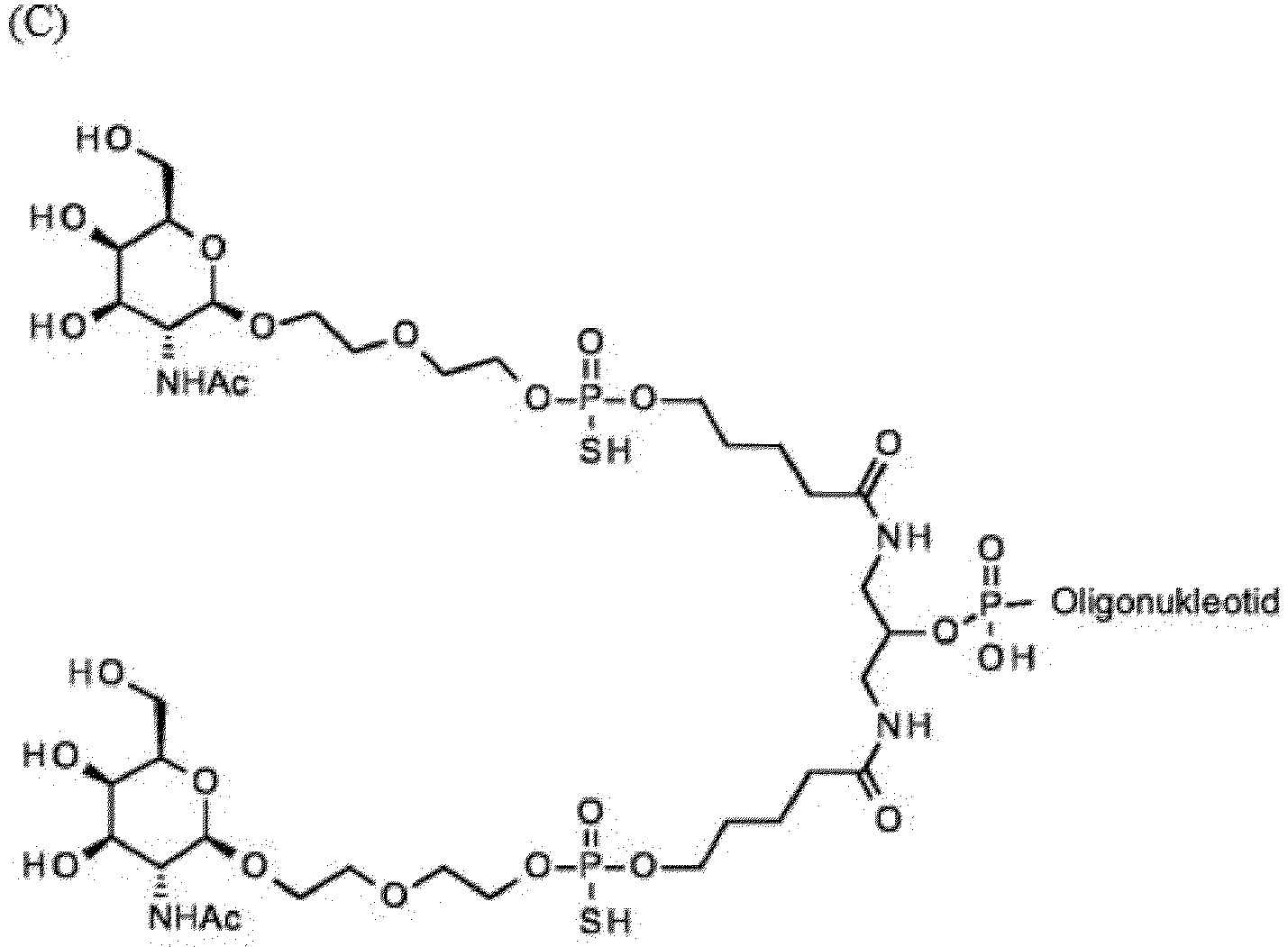


- Verbindung nach Anspruch 1 zur Verwendung als ein Medikament.
Applications Claiming Priority (3)
| Application Number | Priority Date | Filing Date | Title |
|---|---|---|---|
| EP14188444 | 2014-10-10 | ||
| EP15181807 | 2015-08-20 | ||
| PCT/EP2015/073331 WO2016055601A1 (en) | 2014-10-10 | 2015-10-09 | Galnac phosphoramidites, nucleic acid conjugates thereof and their use |
Publications (3)
| Publication Number | Publication Date |
|---|---|
| EP3204397A1 EP3204397A1 (de) | 2017-08-16 |
| EP3204397C0 EP3204397C0 (de) | 2024-10-02 |
| EP3204397B1 true EP3204397B1 (de) | 2024-10-02 |
Family
ID=54291295
Family Applications (1)
| Application Number | Title | Priority Date | Filing Date |
|---|---|---|---|
| EP15778299.6A Active EP3204397B1 (de) | 2014-10-10 | 2015-10-09 | Galnac phosphoramidite, deren nucleinsaüre konjugate and vervendung |
Country Status (14)
| Country | Link |
|---|---|
| US (2) | US20170327524A1 (de) |
| EP (1) | EP3204397B1 (de) |
| JP (1) | JP6626101B2 (de) |
| KR (1) | KR20170068469A (de) |
| CN (1) | CN106795200B (de) |
| AU (1) | AU2015329974B2 (de) |
| BR (1) | BR112017005938A2 (de) |
| CA (1) | CA2961993A1 (de) |
| IL (1) | IL251145A0 (de) |
| MX (1) | MX2017004039A (de) |
| RU (1) | RU2017114156A (de) |
| SG (1) | SG11201702877TA (de) |
| WO (1) | WO2016055601A1 (de) |
| ZA (1) | ZA201701845B (de) |
Families Citing this family (72)
| Publication number | Priority date | Publication date | Assignee | Title |
|---|---|---|---|---|
| GB201408623D0 (en) | 2014-05-15 | 2014-07-02 | Santaris Pharma As | Oligomers and oligomer conjugates |
| CN106795200B (zh) | 2014-10-10 | 2020-06-19 | 豪夫迈·罗氏有限公司 | Galnac亚磷酰胺、其核酸缀合物及其用途 |
| US20160319278A1 (en) | 2015-04-03 | 2016-11-03 | University Of Massachusetts | Fully stabilized asymmetric sirna |
| WO2017030973A1 (en) | 2015-08-14 | 2017-02-23 | University Of Massachusetts | Bioactive conjugates for oligonucleotide delivery |
| US10478503B2 (en) | 2016-01-31 | 2019-11-19 | University Of Massachusetts | Branched oligonucleotides |
| CA3011946A1 (en) | 2016-03-07 | 2017-09-14 | Arrowhead Pharmaceuticals, Inc. | Targeting ligands for therapeutic compounds |
| RU2747822C2 (ru) | 2016-03-14 | 2021-05-14 | Ф. Хоффманн-Ля Рош Аг | Олигонуклеотиды для понижения экспрессии pd-l1 |
| EP3228326A1 (de) | 2016-04-05 | 2017-10-11 | Silence Therapeutics GmbH | Nucleinsäure verbunden mit einem dreiwertigen glykokonjugat |
| CA3020585A1 (en) | 2016-04-11 | 2017-10-19 | Arbutus Biopharma Corporation | Targeted nucleic acid conjugate compositions |
| WO2017178656A1 (en) | 2016-04-14 | 2017-10-19 | Roche Innovation Center Copenhagen A/S | TRITYL-MONO-GalNAc COMPOUNDS AND THEIR USE |
| EP4219767A1 (de) | 2016-06-17 | 2023-08-02 | F. Hoffmann-La Roche AG | Papd5- und papd7-inhibitoren zur behandlung einer hepatitis-b-infektion |
| CA3033368A1 (en) | 2016-08-12 | 2018-02-15 | University Of Massachusetts | Conjugated oligonucleotides |
| CA3033867A1 (en) | 2016-08-17 | 2018-02-22 | Solstice Biologics, Ltd. | Polynucleotide constructs |
| SG11201901841TA (en) | 2016-09-02 | 2019-03-28 | Arrowhead Pharmaceuticals Inc | Targeting ligands |
| US11400161B2 (en) | 2016-10-06 | 2022-08-02 | Ionis Pharmaceuticals, Inc. | Method of conjugating oligomeric compounds |
| EP3594346A4 (de) | 2017-03-10 | 2020-12-16 | National Center For Child Health And Development | Antisense-oligonukleotid und zusammensetzung zur prävention oder behandlung der glykogenspeicherkrankheit typ ia |
| SI3607068T1 (sl) * | 2017-04-05 | 2023-02-28 | Silence Therapeutics Gmbh | Z RNA interferenco posredovano inhibiranje TMPRSS6 |
| WO2018185252A1 (en) * | 2017-04-05 | 2018-10-11 | Silence Therapeutics Gmbh | Nucleic acid conjugates |
| EP3385272A1 (de) * | 2017-04-05 | 2018-10-10 | Silence Therapeutics GmbH | Weitere neuartige oligonukleotid-ligand-konjugate |
| MX2019012280A (es) | 2017-04-11 | 2020-01-23 | Arbutus Biopharma Corp | Composiciones dirigidas. |
| JP7406793B2 (ja) | 2017-06-23 | 2023-12-28 | ユニバーシティー オブ マサチューセッツ | 2テイル自己デリバリー型siRNAおよび関連方法 |
| US11597744B2 (en) | 2017-06-30 | 2023-03-07 | Sirius Therapeutics, Inc. | Chiral phosphoramidite auxiliaries and methods of their use |
| CN107674094A (zh) * | 2017-09-18 | 2018-02-09 | 中国石油大学(华东) | 一种亚磷酰胺硫辛醇酯及其合成方法和用途 |
| CN111511914B (zh) | 2017-10-16 | 2023-11-17 | 豪夫迈·罗氏有限公司 | 减少PAPD5和PAPD7 mRNA的核酸分子用于治疗乙型肝炎感染 |
| CN109957566B (zh) * | 2017-12-26 | 2023-08-25 | 广州市锐博生物科技有限公司 | 修饰的寡核苷酸和可用于合成修饰的寡核苷酸的化合物 |
| WO2019127004A1 (zh) * | 2017-12-26 | 2019-07-04 | 广州市锐博生物科技有限公司 | 修饰的寡核苷酸和可用于合成修饰的寡核苷酸的化合物 |
| IL276043B2 (en) * | 2018-01-29 | 2024-06-01 | Hoffmann La Roche | Process for the preparation of galnac oligonucleotide conjugates |
| KR102398295B1 (ko) | 2018-03-09 | 2022-05-17 | 다이이찌 산쿄 가부시키가이샤 | 당원병 Ia형 치료약 |
| SG11202009680XA (en) | 2018-04-05 | 2020-10-29 | Hoffmann La Roche | Use of fubp1 inhibitors for treating hepatitis b virus infection |
| PE20210346A1 (es) | 2018-07-03 | 2021-02-25 | Hoffmann La Roche | Oligonucleotidos para modular la expresion de tau |
| CN112534055A (zh) | 2018-07-13 | 2021-03-19 | 豪夫迈·罗氏有限公司 | 用于调节rtel1表达的寡核苷酸 |
| WO2020033899A1 (en) | 2018-08-10 | 2020-02-13 | University Of Massachusetts | Modified oligonucleotides targeting snps |
| US11279930B2 (en) | 2018-08-23 | 2022-03-22 | University Of Massachusetts | O-methyl rich fully stabilized oligonucleotides |
| WO2020043750A1 (en) | 2018-08-28 | 2020-03-05 | Roche Innovation Center Copenhagen A/S | Neoantigen engineering using splice modulating compounds |
| WO2020139788A2 (en) * | 2018-12-28 | 2020-07-02 | Sirnaomics, Inc. | Targeted delivery of therapeutic molecules |
| CN113614232A (zh) | 2019-01-18 | 2021-11-05 | 马萨诸塞大学 | 动态药代动力学修饰锚 |
| JP7503072B2 (ja) | 2019-02-26 | 2024-06-19 | ロシュ イノベーション センター コペンハーゲン エーエス | オリゴヌクレオチドの製剤化方法 |
| SG11202112741XA (en) | 2019-05-31 | 2021-12-30 | Aligos Therapeutics Inc | Modified gapmer oligonucleotides and methods of use |
| KR20220047989A (ko) | 2019-08-09 | 2022-04-19 | 유니버시티 오브 매사추세츠 | Snp를 표적화하는 화학적으로 변형된 올리고뉴클레오타이드 |
| IL291251B1 (en) | 2019-09-10 | 2026-02-01 | Daiichi Sankyo Co Ltd | Oligonucleotide-galnac conjugate for targeted delivery to the liver and method for its production |
| US12365894B2 (en) | 2019-09-16 | 2025-07-22 | University Of Massachusetts | Branched lipid conjugates of siRNA for specific tissue delivery |
| CN111041025B (zh) | 2019-12-17 | 2021-06-18 | 深圳市瑞吉生物科技有限公司 | 基于结合N-乙酰半乳糖胺多肽的mRNA靶向分子及其制备方法 |
| WO2021122735A1 (en) | 2019-12-19 | 2021-06-24 | F. Hoffmann-La Roche Ag | Use of sept9 inhibitors for treating hepatitis b virus infection |
| EP4077669A1 (de) | 2019-12-19 | 2022-10-26 | F. Hoffmann-La Roche AG | Verwendung von sbds-inhibitoren zur behandlung von hepatitis-b-virus-infektionen |
| WO2021122921A1 (en) | 2019-12-19 | 2021-06-24 | F. Hoffmann-La Roche Ag | Use of cops3 inhibitors for treating hepatitis b virus infection |
| JP2023506954A (ja) | 2019-12-19 | 2023-02-20 | エフ. ホフマン-ラ ロシュ エージー. | B型肝炎ウイルス感染を処置するためのsaraf阻害剤の使用 |
| WO2021122869A1 (en) | 2019-12-19 | 2021-06-24 | F. Hoffmann-La Roche Ag | Use of scamp3 inhibitors for treating hepatitis b virus infection |
| EP4081217A1 (de) | 2019-12-24 | 2022-11-02 | F. Hoffmann-La Roche AG | Pharmazeutische kombination von antivirusmitteln, die hbv und/oder einen immunmodulator zur behandlung von hbv steuern |
| MX2022007908A (es) | 2019-12-24 | 2022-07-21 | Hoffmann La Roche | Combinacion farmaceutica de un oligonucleotido terapeutico que actua sobre hbv y un agonista de tlr7 para el tratamiento de hbv. |
| WO2021197371A1 (zh) * | 2020-03-31 | 2021-10-07 | 南京金斯瑞生物科技有限公司 | 一种含有刚性连接子的生物偶联物 |
| CN111575279A (zh) * | 2020-04-27 | 2020-08-25 | 江苏为真生物医药技术股份有限公司 | 利用asgpr小分子配体特异性捕获肝细胞外囊泡或循环肿瘤细胞的方法 |
| WO2021242883A1 (en) | 2020-05-26 | 2021-12-02 | University Of Massachusetts | Synthetic oligonucleotides having regions of block and cluster modifications |
| AU2021295358B2 (en) * | 2020-06-24 | 2026-01-22 | Sapreme Technologies B.V. | Conjugate of galnac and saponin, therapeutic composition comprising said conjugate and a galnac-oligonucleotide conjugate |
| AR122731A1 (es) | 2020-06-26 | 2022-10-05 | Hoffmann La Roche | Oligonucleótidos mejorados para modular la expresión de fubp1 |
| CN111744019B (zh) | 2020-07-01 | 2023-08-04 | 深圳瑞吉生物科技有限公司 | 基于甘露糖的mRNA靶向递送系统及其应用 |
| CN116157522A (zh) | 2020-08-21 | 2023-05-23 | 豪夫迈·罗氏有限公司 | A1cf抑制剂用于治疗乙型肝炎病毒感染的用途 |
| WO2022140365A1 (en) * | 2020-12-22 | 2022-06-30 | Empirico Inc. | Galnac compositions for improving sirna bioavailability |
| IL303886A (en) * | 2020-12-23 | 2023-08-01 | Flagship Pioneering Inc | Compositions of modified trems and uses thereof |
| TW202246500A (zh) | 2021-02-02 | 2022-12-01 | 瑞士商赫孚孟拉羅股份公司 | 用於抑制 rtel1 表現之增強型寡核苷酸 |
| WO2022189861A1 (en) | 2021-03-08 | 2022-09-15 | Tollys | Carbohydrate conjugates of tlr3 ligands and uses thereof |
| EP4161942B1 (de) | 2021-03-19 | 2023-08-02 | Bachem Holding AG | Verbesserte oligonukleotidsynthese zur unterdrückung der depurinierung |
| US20250282813A1 (en) | 2021-04-09 | 2025-09-11 | Bachem Holding Ag | Pseudo solid phase protecting group and methods for the synthesis of oligonucleotides and oligonucleotide conjugates |
| CN117677699A (zh) | 2021-06-23 | 2024-03-08 | 马萨诸塞大学 | 用于治疗先兆子痫和其他血管生成病症的优化抗flt1寡核苷酸化合物 |
| WO2023111210A1 (en) | 2021-12-17 | 2023-06-22 | F. Hoffmann-La Roche Ag | Combination of oligonucleotides for modulating rtel1 and fubp1 |
| US11879125B2 (en) | 2022-03-16 | 2024-01-23 | Empirico Inc. | GalNAc compositions for improving siRNA bioavailability |
| EP4495240A1 (de) | 2022-03-16 | 2025-01-22 | Daiichi Sankyo Company, Limited | Sirna zur unterdrückung der expression des transferrinrezeptors-2 |
| US20260001902A1 (en) | 2022-09-19 | 2026-01-01 | Bachem Holding Ag | Improved oligonucleotide synthesis |
| WO2024083746A1 (en) | 2022-10-17 | 2024-04-25 | Bachem Holding Ag | Method and composition for oligonucleotide synthesis |
| CN120981247A (zh) | 2023-03-27 | 2025-11-18 | 赛伦斯治疗有限责任公司 | 用于干细胞移植的化合物和组合物 |
| KR20240161853A (ko) * | 2023-05-03 | 2024-11-13 | 주식회사 네오나 | 신규한 화합물 및 이의 간암 치료 용도 |
| EP4695265A1 (de) | 2023-10-16 | 2026-02-18 | Bachem Holding AG | Verfahren und zusammensetzung zur synthese von oligonukleotiden |
| CN121181640A (zh) * | 2024-06-21 | 2025-12-23 | 中国科学院上海药物研究所 | 以丁二酰基为连接链的偶联物及其制备方法和用途 |
Family Cites Families (41)
| Publication number | Priority date | Publication date | Assignee | Title |
|---|---|---|---|---|
| AU5122796A (en) | 1995-03-31 | 1996-10-16 | Drug Delivery System Institute, Ltd. | Amidite derivatives and oligonucleotide derivatives |
| US6617442B1 (en) | 1999-09-30 | 2003-09-09 | Isis Pharmaceuticals, Inc. | Human Rnase H1 and oligonucleotide compositions thereof |
| EP2415486B1 (de) | 2001-05-18 | 2017-02-22 | Sirna Therapeutics, Inc. | Konjugate und Zusammensetzungen zur zellulären Verabreichung |
| JP4221921B2 (ja) * | 2001-08-23 | 2009-02-12 | ブラザー工業株式会社 | 印刷装置 |
| WO2004046160A2 (en) | 2002-11-18 | 2004-06-03 | Santaris Pharma A/S | Amino-lna, thio-lna and alpha-l-oxy-ln |
| US20050074801A1 (en) | 2003-09-09 | 2005-04-07 | Monia Brett P. | Chimeric oligomeric compounds comprising alternating regions of northern and southern conformational geometry |
| US20050053981A1 (en) | 2003-09-09 | 2005-03-10 | Swayze Eric E. | Gapped oligomeric compounds having linked bicyclic sugar moieties at the termini |
| US20120122801A1 (en) * | 2005-01-05 | 2012-05-17 | Prosensa B.V. | Mannose-6-phosphate receptor mediated gene transfer into muscle cells |
| US20060148740A1 (en) * | 2005-01-05 | 2006-07-06 | Prosensa B.V. | Mannose-6-phosphate receptor mediated gene transfer into muscle cells |
| WO2007031091A2 (en) | 2005-09-15 | 2007-03-22 | Santaris Pharma A/S | Rna antagonist compounds for the modulation of p21 ras expression |
| WO2007090071A2 (en) | 2006-01-27 | 2007-08-09 | Isis Pharmaceuticals, Inc. | 6-modified bicyclic nucleic acid analogs |
| JP2009536222A (ja) | 2006-05-05 | 2009-10-08 | アイシス ファーマシューティカルズ, インコーポレーテッド | Pcsk9の発現を調節するための化合物および方法 |
| AU2007249349B2 (en) | 2006-05-11 | 2012-03-08 | Isis Pharmaceuticals, Inc. | 5'-Modified bicyclic nucleic acid analogs |
| DK2149605T3 (da) | 2007-03-22 | 2013-09-30 | Santaris Pharma As | Korte RNA antagonist forbindelser til modulering af det ønskede mRNA |
| CA2685127C (en) | 2007-04-23 | 2019-01-08 | Alnylam Pharmaceuticals, Inc. | Glycoconjugates of rna interference agents |
| CA2688321A1 (en) | 2007-05-30 | 2008-12-11 | Isis Pharmaceuticals, Inc. | N-substituted-aminomethylene bridged bicyclic nucleic acid analogs |
| DK2173760T4 (en) | 2007-06-08 | 2016-02-08 | Isis Pharmaceuticals Inc | Carbocyclic bicyclic nukleinsyreanaloge |
| AU2008272918B2 (en) | 2007-07-05 | 2012-09-13 | Isis Pharmaceuticals, Inc. | 6-disubstituted bicyclic nucleic acid analogs |
| WO2009067647A1 (en) | 2007-11-21 | 2009-05-28 | Isis Pharmaceuticals, Inc. | Carbocyclic alpha-l-bicyclic nucleic acid analogs |
| WO2009073809A2 (en) | 2007-12-04 | 2009-06-11 | Alnylam Pharmaceuticals, Inc. | Carbohydrate conjugates as delivery agents for oligonucleotides |
| WO2009090182A1 (en) | 2008-01-14 | 2009-07-23 | Santaris Pharma A/S | C4'-substituted - dna nucleotide gapmer oligonucleotides |
| WO2009100320A2 (en) | 2008-02-07 | 2009-08-13 | Isis Pharmaceuticals, Inc. | Bicyclic cyclohexitol nucleic acid analogs |
| US9290534B2 (en) | 2008-04-04 | 2016-03-22 | Ionis Pharmaceuticals, Inc. | Oligomeric compounds having at least one neutrally linked terminal bicyclic nucleoside |
| EP2274423A2 (de) | 2008-04-04 | 2011-01-19 | Isis Pharmaceuticals, Inc. | Bicyclische nukleoside umfassende oligomere verbindungen mit verringerter toxizität |
| DK2356129T3 (da) | 2008-09-24 | 2013-05-13 | Isis Pharmaceuticals Inc | Substituerede alpha-L-bicykliske nukleosider |
| US9012421B2 (en) | 2009-08-06 | 2015-04-21 | Isis Pharmaceuticals, Inc. | Bicyclic cyclohexose nucleic acid analogs |
| WO2011085102A1 (en) | 2010-01-11 | 2011-07-14 | Isis Pharmaceuticals, Inc. | Base modified bicyclic nucleosides and oligomeric compounds prepared therefrom |
| SI2539451T1 (sl) | 2010-02-24 | 2016-04-29 | Arrowhead Research Corporation | Sestavki za ciljano dostavo sirna |
| US9193752B2 (en) | 2010-03-17 | 2015-11-24 | Isis Pharmaceuticals, Inc. | 5′-substituted bicyclic nucleosides and oligomeric compounds prepared therefrom |
| AU2011343664B2 (en) | 2010-12-17 | 2015-10-08 | Arrowhead Pharmaceuticals, Inc. | Galactose cluster-pharmacokinetic modulator targeting moiety for siRNA |
| WO2013089522A1 (ko) | 2011-12-15 | 2013-06-20 | (주)바이오니아 | 신규한 올리고뉴클레오티드 접합체 및 그 용도 |
| CN104837996A (zh) | 2012-11-15 | 2015-08-12 | 罗氏创新中心哥本哈根有限公司 | 抗apob反义缀合物化合物 |
| AU2014211406B2 (en) | 2013-01-30 | 2019-07-18 | Roche Innovation Center Copenhagen A/S | LNA oligonucleotide carbohydrate conjugates |
| DK2992098T3 (da) * | 2013-05-01 | 2019-06-17 | Ionis Pharmaceuticals Inc | Sammensætninger og fremgangsmåder til modulering af hbv- og ttr-ekspression |
| EP3564374A1 (de) * | 2013-06-21 | 2019-11-06 | Ionis Pharmaceuticals, Inc. | Zusammensetzungen und verfahren zur modulation von zielnukleinsäuren |
| US9382540B2 (en) | 2014-05-01 | 2016-07-05 | Isis Pharmaceuticals, Inc | Compositions and methods for modulating angiopoietin-like 3 expression |
| EA036496B1 (ru) | 2014-05-01 | 2020-11-17 | Ионис Фармасьютикалз, Инк. | Конъюгированные олигонуклеотиды для модулирования экспрессии фактора комплемента b |
| BR112016022742B1 (pt) | 2014-05-01 | 2022-06-14 | Ionis Pharmaceuticals, Inc | Composto químico, composição compreendendo o composto e uso dos mesmos |
| HUE052709T2 (hu) | 2014-05-01 | 2021-05-28 | Ionis Pharmaceuticals Inc | Módosított antiszensz oligonukleotidok konjugátumai és azok alkalmazása PKK expressziójának módosítására |
| US9315241B2 (en) | 2014-05-02 | 2016-04-19 | Seahorse Equipment Corp | Buoyant turret mooring with porous receptor cage |
| CN106795200B (zh) | 2014-10-10 | 2020-06-19 | 豪夫迈·罗氏有限公司 | Galnac亚磷酰胺、其核酸缀合物及其用途 |
-
2015
- 2015-10-09 CN CN201580054547.2A patent/CN106795200B/zh active Active
- 2015-10-09 KR KR1020177009419A patent/KR20170068469A/ko not_active Withdrawn
- 2015-10-09 US US15/517,685 patent/US20170327524A1/en not_active Abandoned
- 2015-10-09 AU AU2015329974A patent/AU2015329974B2/en not_active Expired - Fee Related
- 2015-10-09 MX MX2017004039A patent/MX2017004039A/es unknown
- 2015-10-09 SG SG11201702877TA patent/SG11201702877TA/en unknown
- 2015-10-09 JP JP2017518829A patent/JP6626101B2/ja active Active
- 2015-10-09 RU RU2017114156A patent/RU2017114156A/ru not_active Application Discontinuation
- 2015-10-09 BR BR112017005938A patent/BR112017005938A2/pt not_active Application Discontinuation
- 2015-10-09 EP EP15778299.6A patent/EP3204397B1/de active Active
- 2015-10-09 CA CA2961993A patent/CA2961993A1/en not_active Abandoned
- 2015-10-09 WO PCT/EP2015/073331 patent/WO2016055601A1/en not_active Ceased
-
2017
- 2017-03-14 IL IL251145A patent/IL251145A0/en unknown
- 2017-03-15 ZA ZA2017/01845A patent/ZA201701845B/en unknown
-
2020
- 2020-08-06 US US16/987,225 patent/US11505569B2/en active Active
Also Published As
| Publication number | Publication date |
|---|---|
| JP2017533189A (ja) | 2017-11-09 |
| AU2015329974B2 (en) | 2019-06-20 |
| EP3204397A1 (de) | 2017-08-16 |
| KR20170068469A (ko) | 2017-06-19 |
| CN106795200A (zh) | 2017-05-31 |
| AU2015329974A1 (en) | 2017-04-06 |
| WO2016055601A1 (en) | 2016-04-14 |
| US20210017214A1 (en) | 2021-01-21 |
| RU2017114156A (ru) | 2018-11-15 |
| AU2015329974A8 (en) | 2017-04-13 |
| IL251145A0 (en) | 2017-04-30 |
| US11505569B2 (en) | 2022-11-22 |
| ZA201701845B (en) | 2018-05-30 |
| US20170327524A1 (en) | 2017-11-16 |
| CA2961993A1 (en) | 2016-04-14 |
| EP3204397C0 (de) | 2024-10-02 |
| MX2017004039A (es) | 2017-07-24 |
| SG11201702877TA (en) | 2017-05-30 |
| RU2017114156A3 (de) | 2019-05-07 |
| JP6626101B2 (ja) | 2019-12-25 |
| CN106795200B (zh) | 2020-06-19 |
| BR112017005938A2 (pt) | 2017-12-12 |
Similar Documents
| Publication | Publication Date | Title |
|---|---|---|
| US11505569B2 (en) | GalNAc phosphoramidites, nucleic acid conjugates thereof and their use | |
| KR102468177B1 (ko) | 트리틸-모노-GalNAc 화합물 및 이의 용도 | |
| DK2920307T3 (en) | ANTI-APOB, ANTISENSE CONJUGATE RELATIONSHIPS | |
| RU2649367C2 (ru) | Конъюгаты углевода и lna-олигонуклеотида | |
| CN107208092B (zh) | 手性毒性筛选方法 | |
| EP2310505B1 (de) | Antidot-oligomere | |
| US20180112217A1 (en) | Stereospecific Phosphorothioate LNA | |
| WO2009090182A1 (en) | C4'-substituted - dna nucleotide gapmer oligonucleotides | |
| AU2014300981A1 (en) | Antisense oligomers and conjugates targeting PCSK9 | |
| HK1237788A1 (en) | Galnac phosphoramidites, nucleic acid conjugates thereof and their use | |
| HK1237788B (zh) | Galnac亚磷酰胺、其核酸缀合物及其用途 | |
| HK40002339A (zh) | 三苯甲基-单-galnac化合物及其用途 | |
| HK1244028B (zh) | 手性毒性筛选方法 |
Legal Events
| Date | Code | Title | Description |
|---|---|---|---|
| STAA | Information on the status of an ep patent application or granted ep patent |
Free format text: STATUS: THE INTERNATIONAL PUBLICATION HAS BEEN MADE |
|
| PUAI | Public reference made under article 153(3) epc to a published international application that has entered the european phase |
Free format text: ORIGINAL CODE: 0009012 |
|
| STAA | Information on the status of an ep patent application or granted ep patent |
Free format text: STATUS: REQUEST FOR EXAMINATION WAS MADE |
|
| 17P | Request for examination filed |
Effective date: 20170510 |
|
| AK | Designated contracting states |
Kind code of ref document: A1 Designated state(s): AL AT BE BG CH CY CZ DE DK EE ES FI FR GB GR HR HU IE IS IT LI LT LU LV MC MK MT NL NO PL PT RO RS SE SI SK SM TR |
|
| AX | Request for extension of the european patent |
Extension state: BA ME |
|
| DAV | Request for validation of the european patent (deleted) | ||
| DAX | Request for extension of the european patent (deleted) | ||
| TPAC | Observations filed by third parties |
Free format text: ORIGINAL CODE: EPIDOSNTIPA |
|
| STAA | Information on the status of an ep patent application or granted ep patent |
Free format text: STATUS: EXAMINATION IS IN PROGRESS |
|
| 17Q | First examination report despatched |
Effective date: 20180910 |
|
| GRAP | Despatch of communication of intention to grant a patent |
Free format text: ORIGINAL CODE: EPIDOSNIGR1 |
|
| STAA | Information on the status of an ep patent application or granted ep patent |
Free format text: STATUS: GRANT OF PATENT IS INTENDED |
|
| INTG | Intention to grant announced |
Effective date: 20240517 |
|
| GRAS | Grant fee paid |
Free format text: ORIGINAL CODE: EPIDOSNIGR3 |
|
| GRAA | (expected) grant |
Free format text: ORIGINAL CODE: 0009210 |
|
| STAA | Information on the status of an ep patent application or granted ep patent |
Free format text: STATUS: THE PATENT HAS BEEN GRANTED |
|
| AK | Designated contracting states |
Kind code of ref document: B1 Designated state(s): AL AT BE BG CH CY CZ DE DK EE ES FI FR GB GR HR HU IE IS IT LI LT LU LV MC MK MT NL NO PL PT RO RS SE SI SK SM TR |
|
| REG | Reference to a national code |
Ref country code: GB Ref legal event code: FG4D |
|
| REG | Reference to a national code |
Ref country code: CH Ref legal event code: EP |
|
| REG | Reference to a national code |
Ref country code: IE Ref legal event code: FG4D |
|
| REG | Reference to a national code |
Ref country code: DE Ref legal event code: R096 Ref document number: 602015090034 Country of ref document: DE |
|
| U01 | Request for unitary effect filed |
Effective date: 20241002 |
|
| U07 | Unitary effect registered |
Designated state(s): AT BE BG DE DK EE FI FR IT LT LU LV MT NL PT RO SE SI Effective date: 20241009 |
|
| U20 | Renewal fee for the european patent with unitary effect paid |
Year of fee payment: 10 Effective date: 20241022 |
|
| PG25 | Lapsed in a contracting state [announced via postgrant information from national office to epo] |
Ref country code: HR Free format text: LAPSE BECAUSE OF FAILURE TO SUBMIT A TRANSLATION OF THE DESCRIPTION OR TO PAY THE FEE WITHIN THE PRESCRIBED TIME-LIMIT Effective date: 20241002 Ref country code: IS Free format text: LAPSE BECAUSE OF FAILURE TO SUBMIT A TRANSLATION OF THE DESCRIPTION OR TO PAY THE FEE WITHIN THE PRESCRIBED TIME-LIMIT Effective date: 20250202 |
|
| PG25 | Lapsed in a contracting state [announced via postgrant information from national office to epo] |
Ref country code: ES Free format text: LAPSE BECAUSE OF FAILURE TO SUBMIT A TRANSLATION OF THE DESCRIPTION OR TO PAY THE FEE WITHIN THE PRESCRIBED TIME-LIMIT Effective date: 20241002 |
|
| PG25 | Lapsed in a contracting state [announced via postgrant information from national office to epo] |
Ref country code: NO Free format text: LAPSE BECAUSE OF FAILURE TO SUBMIT A TRANSLATION OF THE DESCRIPTION OR TO PAY THE FEE WITHIN THE PRESCRIBED TIME-LIMIT Effective date: 20250102 |
|
| PG25 | Lapsed in a contracting state [announced via postgrant information from national office to epo] |
Ref country code: GR Free format text: LAPSE BECAUSE OF FAILURE TO SUBMIT A TRANSLATION OF THE DESCRIPTION OR TO PAY THE FEE WITHIN THE PRESCRIBED TIME-LIMIT Effective date: 20250103 |
|
| PG25 | Lapsed in a contracting state [announced via postgrant information from national office to epo] |
Ref country code: CZ Free format text: LAPSE BECAUSE OF FAILURE TO SUBMIT A TRANSLATION OF THE DESCRIPTION OR TO PAY THE FEE WITHIN THE PRESCRIBED TIME-LIMIT Effective date: 20241002 Ref country code: PL Free format text: LAPSE BECAUSE OF FAILURE TO SUBMIT A TRANSLATION OF THE DESCRIPTION OR TO PAY THE FEE WITHIN THE PRESCRIBED TIME-LIMIT Effective date: 20241002 |
|
| PG25 | Lapsed in a contracting state [announced via postgrant information from national office to epo] |
Ref country code: RS Free format text: LAPSE BECAUSE OF FAILURE TO SUBMIT A TRANSLATION OF THE DESCRIPTION OR TO PAY THE FEE WITHIN THE PRESCRIBED TIME-LIMIT Effective date: 20250102 |
|
| PG25 | Lapsed in a contracting state [announced via postgrant information from national office to epo] |
Ref country code: SM Free format text: LAPSE BECAUSE OF FAILURE TO SUBMIT A TRANSLATION OF THE DESCRIPTION OR TO PAY THE FEE WITHIN THE PRESCRIBED TIME-LIMIT Effective date: 20241002 |
|
| PG25 | Lapsed in a contracting state [announced via postgrant information from national office to epo] |
Ref country code: MC Free format text: LAPSE BECAUSE OF FAILURE TO SUBMIT A TRANSLATION OF THE DESCRIPTION OR TO PAY THE FEE WITHIN THE PRESCRIBED TIME-LIMIT Effective date: 20241002 |
|
| PG25 | Lapsed in a contracting state [announced via postgrant information from national office to epo] |
Ref country code: SK Free format text: LAPSE BECAUSE OF FAILURE TO SUBMIT A TRANSLATION OF THE DESCRIPTION OR TO PAY THE FEE WITHIN THE PRESCRIBED TIME-LIMIT Effective date: 20241002 |
|
| PLBE | No opposition filed within time limit |
Free format text: ORIGINAL CODE: 0009261 |
|
| STAA | Information on the status of an ep patent application or granted ep patent |
Free format text: STATUS: NO OPPOSITION FILED WITHIN TIME LIMIT |
|
| 26N | No opposition filed |
Effective date: 20250703 |
|
| PGFP | Annual fee paid to national office [announced via postgrant information from national office to epo] |
Ref country code: GB Payment date: 20250923 Year of fee payment: 11 |
|
| PG25 | Lapsed in a contracting state [announced via postgrant information from national office to epo] |
Ref country code: IE Free format text: LAPSE BECAUSE OF NON-PAYMENT OF DUE FEES Effective date: 20241009 |
|
| U20 | Renewal fee for the european patent with unitary effect paid |
Year of fee payment: 11 Effective date: 20250923 |
|
| REG | Reference to a national code |
Ref country code: CH Ref legal event code: U11 Free format text: ST27 STATUS EVENT CODE: U-0-0-U10-U11 (AS PROVIDED BY THE NATIONAL OFFICE) Effective date: 20251101 |
|
| PGFP | Annual fee paid to national office [announced via postgrant information from national office to epo] |
Ref country code: CH Payment date: 20251101 Year of fee payment: 11 |
|
| PG25 | Lapsed in a contracting state [announced via postgrant information from national office to epo] |
Ref country code: CY Free format text: LAPSE BECAUSE OF FAILURE TO SUBMIT A TRANSLATION OF THE DESCRIPTION OR TO PAY THE FEE WITHIN THE PRESCRIBED TIME-LIMIT; INVALID AB INITIO Effective date: 20151009 |
|
| PG25 | Lapsed in a contracting state [announced via postgrant information from national office to epo] |
Ref country code: HU Free format text: LAPSE BECAUSE OF FAILURE TO SUBMIT A TRANSLATION OF THE DESCRIPTION OR TO PAY THE FEE WITHIN THE PRESCRIBED TIME-LIMIT; INVALID AB INITIO Effective date: 20151009 |