EP3204441B1 - Polycarbonates solubles dans l'eau pour applications médicales - Google Patents
Polycarbonates solubles dans l'eau pour applications médicales Download PDFInfo
- Publication number
- EP3204441B1 EP3204441B1 EP15849474.0A EP15849474A EP3204441B1 EP 3204441 B1 EP3204441 B1 EP 3204441B1 EP 15849474 A EP15849474 A EP 15849474A EP 3204441 B1 EP3204441 B1 EP 3204441B1
- Authority
- EP
- European Patent Office
- Prior art keywords
- polymer
- group
- monovalent radical
- carbons
- radical selected
- Prior art date
- Legal status (The legal status is an assumption and is not a legal conclusion. Google has not performed a legal analysis and makes no representation as to the accuracy of the status listed.)
- Active
Links
- 0 C*C(C(CCC(O)=O)NC(C)(C)C)=O Chemical compound C*C(C(CCC(O)=O)NC(C)(C)C)=O 0.000 description 6
- FVKFHMNJTHKMRX-UHFFFAOYSA-N C(CN1)CN2C1=NCCC2 Chemical compound C(CN1)CN2C1=NCCC2 FVKFHMNJTHKMRX-UHFFFAOYSA-N 0.000 description 1
- IQLYOQWJIOCERB-HWKANZROSA-N C/C=C(\C)/CN=O Chemical compound C/C=C(\C)/CN=O IQLYOQWJIOCERB-HWKANZROSA-N 0.000 description 1
- ARNHJEGONCMUJO-UHFFFAOYSA-N CC(C)(C)OC(NCCOC(C(C)(CO1)COC1=O)=O)=O Chemical compound CC(C)(C)OC(NCCOC(C(C)(CO1)COC1=O)=O)=O ARNHJEGONCMUJO-UHFFFAOYSA-N 0.000 description 1
- CJTXYPSDSHAUJQ-UHFFFAOYSA-N CCC(C(CC(NCCO)=O)NC(C)(C)C)=O Chemical compound CCC(C(CC(NCCO)=O)NC(C)(C)C)=O CJTXYPSDSHAUJQ-UHFFFAOYSA-N 0.000 description 1
- JTSACWLMMPZTEH-UHFFFAOYSA-N O=C(CC1)OCCC11OCCO1 Chemical compound O=C(CC1)OCCC11OCCO1 JTSACWLMMPZTEH-UHFFFAOYSA-N 0.000 description 1
Images





Classifications
-
- C—CHEMISTRY; METALLURGY
- C08—ORGANIC MACROMOLECULAR COMPOUNDS; THEIR PREPARATION OR CHEMICAL WORKING-UP; COMPOSITIONS BASED THEREON
- C08G—MACROMOLECULAR COMPOUNDS OBTAINED OTHERWISE THAN BY REACTIONS ONLY INVOLVING UNSATURATED CARBON-TO-CARBON BONDS
- C08G64/00—Macromolecular compounds obtained by reactions forming a carbonic ester link in the main chain of the macromolecule
- C08G64/18—Block or graft polymers
-
- C—CHEMISTRY; METALLURGY
- C08—ORGANIC MACROMOLECULAR COMPOUNDS; THEIR PREPARATION OR CHEMICAL WORKING-UP; COMPOSITIONS BASED THEREON
- C08G—MACROMOLECULAR COMPOUNDS OBTAINED OTHERWISE THAN BY REACTIONS ONLY INVOLVING UNSATURATED CARBON-TO-CARBON BONDS
- C08G64/00—Macromolecular compounds obtained by reactions forming a carbonic ester link in the main chain of the macromolecule
- C08G64/02—Aliphatic polycarbonates
-
- A—HUMAN NECESSITIES
- A61—MEDICAL OR VETERINARY SCIENCE; HYGIENE
- A61K—PREPARATIONS FOR MEDICAL, DENTAL OR TOILETRY PURPOSES
- A61K45/00—Medicinal preparations containing active ingredients not provided for in groups A61K31/00 - A61K41/00
- A61K45/06—Mixtures of active ingredients without chemical characterisation, e.g. antiphlogistics and cardiaca
-
- A—HUMAN NECESSITIES
- A61—MEDICAL OR VETERINARY SCIENCE; HYGIENE
- A61K—PREPARATIONS FOR MEDICAL, DENTAL OR TOILETRY PURPOSES
- A61K47/00—Medicinal preparations characterised by the non-active ingredients used, e.g. carriers or inert additives; Targeting or modifying agents chemically bound to the active ingredient
- A61K47/30—Macromolecular organic or inorganic compounds, e.g. inorganic polyphosphates
- A61K47/34—Macromolecular compounds obtained otherwise than by reactions only involving carbon-to-carbon unsaturated bonds, e.g. polyesters, polyamino acids, polysiloxanes, polyphosphazines, copolymers of polyalkylene glycol or poloxamers
-
- A—HUMAN NECESSITIES
- A61—MEDICAL OR VETERINARY SCIENCE; HYGIENE
- A61K—PREPARATIONS FOR MEDICAL, DENTAL OR TOILETRY PURPOSES
- A61K9/00—Medicinal preparations characterised by special physical form
- A61K9/14—Particulate form, e.g. powders, Processes for size reducing of pure drugs or the resulting products, Pure drug nanoparticles
- A61K9/141—Intimate drug-carrier mixtures characterised by the carrier, e.g. ordered mixtures, adsorbates, solid solutions, eutectica, co-dried, co-solubilised, co-kneaded, co-milled, co-ground products, co-precipitates, co-evaporates, co-extrudates, co-melts; Drug nanoparticles with adsorbed surface modifiers
- A61K9/146—Intimate drug-carrier mixtures characterised by the carrier, e.g. ordered mixtures, adsorbates, solid solutions, eutectica, co-dried, co-solubilised, co-kneaded, co-milled, co-ground products, co-precipitates, co-evaporates, co-extrudates, co-melts; Drug nanoparticles with adsorbed surface modifiers with organic macromolecular compounds
-
- C—CHEMISTRY; METALLURGY
- C08—ORGANIC MACROMOLECULAR COMPOUNDS; THEIR PREPARATION OR CHEMICAL WORKING-UP; COMPOSITIONS BASED THEREON
- C08G—MACROMOLECULAR COMPOUNDS OBTAINED OTHERWISE THAN BY REACTIONS ONLY INVOLVING UNSATURATED CARBON-TO-CARBON BONDS
- C08G64/00—Macromolecular compounds obtained by reactions forming a carbonic ester link in the main chain of the macromolecule
- C08G64/02—Aliphatic polycarbonates
- C08G64/0208—Aliphatic polycarbonates saturated
- C08G64/0225—Aliphatic polycarbonates saturated containing atoms other than carbon, hydrogen or oxygen
- C08G64/0233—Aliphatic polycarbonates saturated containing atoms other than carbon, hydrogen or oxygen containing halogens
-
- C—CHEMISTRY; METALLURGY
- C08—ORGANIC MACROMOLECULAR COMPOUNDS; THEIR PREPARATION OR CHEMICAL WORKING-UP; COMPOSITIONS BASED THEREON
- C08G—MACROMOLECULAR COMPOUNDS OBTAINED OTHERWISE THAN BY REACTIONS ONLY INVOLVING UNSATURATED CARBON-TO-CARBON BONDS
- C08G64/00—Macromolecular compounds obtained by reactions forming a carbonic ester link in the main chain of the macromolecule
- C08G64/02—Aliphatic polycarbonates
- C08G64/0208—Aliphatic polycarbonates saturated
- C08G64/0225—Aliphatic polycarbonates saturated containing atoms other than carbon, hydrogen or oxygen
- C08G64/0241—Aliphatic polycarbonates saturated containing atoms other than carbon, hydrogen or oxygen containing nitrogen
-
- C—CHEMISTRY; METALLURGY
- C08—ORGANIC MACROMOLECULAR COMPOUNDS; THEIR PREPARATION OR CHEMICAL WORKING-UP; COMPOSITIONS BASED THEREON
- C08G—MACROMOLECULAR COMPOUNDS OBTAINED OTHERWISE THAN BY REACTIONS ONLY INVOLVING UNSATURATED CARBON-TO-CARBON BONDS
- C08G64/00—Macromolecular compounds obtained by reactions forming a carbonic ester link in the main chain of the macromolecule
- C08G64/20—General preparatory processes
- C08G64/30—General preparatory processes using carbonates
-
- C—CHEMISTRY; METALLURGY
- C08—ORGANIC MACROMOLECULAR COMPOUNDS; THEIR PREPARATION OR CHEMICAL WORKING-UP; COMPOSITIONS BASED THEREON
- C08G—MACROMOLECULAR COMPOUNDS OBTAINED OTHERWISE THAN BY REACTIONS ONLY INVOLVING UNSATURATED CARBON-TO-CARBON BONDS
- C08G64/00—Macromolecular compounds obtained by reactions forming a carbonic ester link in the main chain of the macromolecule
- C08G64/42—Chemical after-treatment
-
- A—HUMAN NECESSITIES
- A61—MEDICAL OR VETERINARY SCIENCE; HYGIENE
- A61K—PREPARATIONS FOR MEDICAL, DENTAL OR TOILETRY PURPOSES
- A61K9/00—Medicinal preparations characterised by special physical form
- A61K9/0012—Galenical forms characterised by the site of application
- A61K9/0019—Injectable compositions; Intramuscular, intravenous, arterial, subcutaneous administration; Compositions to be administered through the skin in an invasive manner
Definitions
- the present invention relates to water soluble polycarbonates for medical applications, and more specifically to water soluble polycarbonates for controlled delivery of therapeutic agents such as drugs.
- PEG Poly(ethylene glycol)
- PEG Poly(ethylene glycol)
- PDI polydispersity index
- PEG is soluble in a wide range of organic solvents and water. Furthermore, reactive functionalities can be introduced with ease into PEG macromolecules, making it an excellent candidate for the functionalization of biologically important materials.
- materials possess "stealth properties" if they exhibit low propensity to interact with biological materials (e.g., opsonins) of the physiological environment (e.g., blood stream).
- biological materials e.g., opsonins
- a protective sheath of hydrogen bonded water molecules surrounds the PEG chains.
- the hydrated PEG chains can exhibit excellent stealth properties.
- PEG-stabilized drug compositions have been characterized as having reduced enzymatic degradation, decreased uptake by the reticular endothelial system, and reduced renal filtration, which in turn lead to increased blood circulation half-life and bioavailability. Attaching PEG to a therapeutically useful material (e.g., drug) can also significantly decrease the toxicity of the material.
- PEGylated means comprising a PEG polymer chain.
- the PEG can be bound covalently and/or non-covalently.
- PEGylated products have been on the market for approximately 20 years.
- PEG polystyrene glycostyrene glycostyrene
- Mn number average molecular weight
- PEG having a number average molecular weight (Mn) of about 40 kDa is commonly used for PEGylation of biologically active molecules.
- the side products e.g. 1,4-dioxane
- the side products e.g. 1,4-dioxane
- the residual unreacted ethylene oxide monomer are toxic.
- these byproducts are known carcinogens and are regulated for pharmaceutical grade PEG.
- PEG is a stealth polymer
- PEG induces an immune response when administered intravenously, orally, and/or dermally.
- Non-biodegradable polymers are also of interest as PEG alternatives (Scheme 2, where each subscript m is independently a number having an average value greater than 1). Many of these polymers are promising as PEG alternatives for applications where only low molecular weight polymers are needed. At high molecular weights, bioaccumulation can become problematic. Poly(N-(2-hydroxypropyl) methacrylamide) and poly(glycerol) have reached clinical trials.
- biodegradable water soluble polycarbonates have been prepared as alternatives to PEG. These are shown in Scheme 3, where in each case subscript m is independently a number having an average value greater than 1.
- the sugar-containing polymers are limited because receptors of the body can bind to sugars. For example, galactose can be used to target liver cells.
- the polycarbonates containing the short PEG side groups can be used as an alternative to PEG; however, these are synthetically challenging to work with because of ring chain equilibrium. The bulkier the side chain, the more difficult it is to obtain a high degree of polymerization. The remaining polycarbonates are negative-charged, which limits their solubility in organic solvents.
- JP 2013/527280 and US 2010/0305281 describe polymers comprising repeat units comprising a side chain pentafluorophenyl ester group.
- hydrophilic polymers suitable for delivery of therapeutic agents for medical treatments.
- the hydrophilic polymers should be biodegradable, non-toxic, and soluble in organic solvents and water.
- the hydrophilic polymers should not induce an undesirable immune response.
- the hydrophilic polymers should be accessible in a range of molecular weights having narrow PDIs, and should degrade to non-toxic byproducts.
- a polymer that comprises a carbonate repeat unit of formula (1): wherein
- composition comprising:
- the disclosed hydrophilic polymers comprise a carbonate repeat unit of formula (1): wherein
- a starred bond represents an attachment point, not a methyl group.
- the hydrophilic polymers can consist essentially of non-charged repeat units.
- the hydrophilic polymers preferably induce little or no flocculation of a serum solution over a 48 hour period.
- a phosphate buffered serum mixture containing a hydrophilic polymer can have an average particle size (based on an average circular diameter determined by dynamic light scattering) in a range of about 10 nm to about 500 nm, more specifically about 10 nm to about 150 nm, and even more specifically about 10 nm to about 60 nm after 48 hours compared to the initial serum mixture.
- the hydrophilic polymers can comprise one or two polymer branches.
- Each polymer branch can comprise a polycarbonate backbone (i.e., composed of carbonate repeat units) or a polyestercarbonate backbone (i.e., composed of ester repeat units and carbonate repeat units).
- Each polymer branch can be a homopolymer, a random copolymer, or a block copolymer comprising the carbonate repeat unit of formula (1).
- hydrophilic homopolymers have a structure according to formula (1a): wherein
- the hydrophilic polymer of formula (1a) comprises one polymer branch emanating from a polymer chain end group I'-O-*, and the polymer branch is a homopolymer of the carbonate repeat units shown.
- the fragment I'-O-* is a residue of a monol initiator for the ring opening polymerization (ROP) used to prepare the hydrophilic polymer.
- More specific hydrophilic random copolymers have a structure according to formula (2): wherein
- the vertical stacking of the repeat units within the square brackets indicates random distribution of the two carbonate repeat units shown.
- the hydrophilic polymer comprises one polymer branch emanating from a polymer chain end group I'-O-*, and the polymer branch is a random copolymer of the two repeat units shown.
- Either repeat unit of formula (3) can be linked to the end group I'-O-*, and either repeat unit can be a terminal repeat unit at the opposing end of the polymer chain.
- the polymer chain comprises a terminal hydroxy group capable of initiating a ROP.
- Subscripts m and n represent the average numbers of the respective repeat units in the copolymer chain.
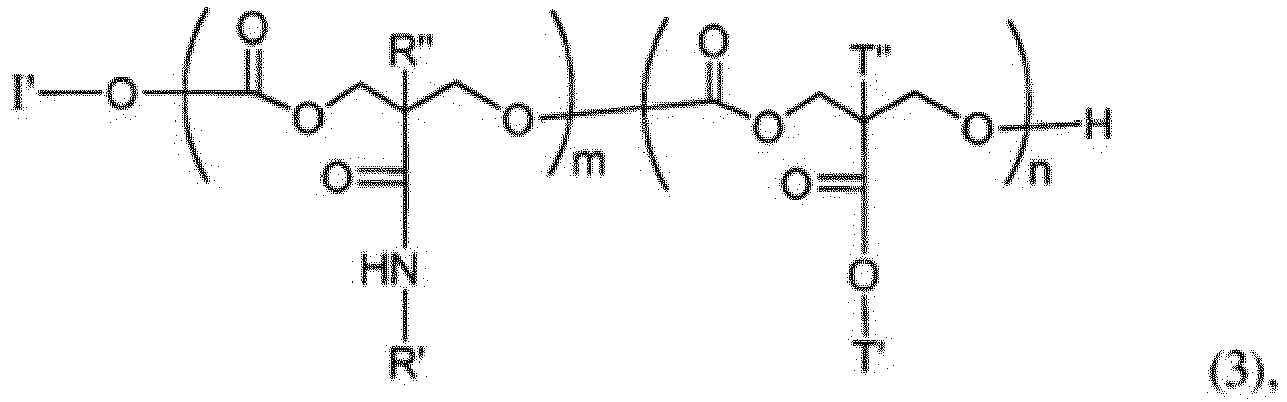
- More specific hydrophilic diblock polymers have a structure according to formula (3): wherein
- the hydrophilic polymer of formula (3) comprises one polymer branch emanating from a polymer chain end group I'-O-*, and the polymer branch is a diblock copolymer of the two carbonate repeat units shown.
- a first block comprises a homopolymer of the first carbonate repeat unit, and a second block comprises a homopolymer of the second carbonate repeat unit.
- the fragment I'-O-* is a residue of a monol initiator for a ring opening polymerization (ROP) used to prepare the hydrophilic polymer.
- ROP ring opening polymerization
- hydrophilic polymers have two polymer branches, wherein each of the polymer branches is linked to a divalent linking group *-O-I"-O-*, as in structures of formula (4): wherein
- the hydrophilic polymer of formula (4) comprises 2 polymer branches emanating from a central fragment *-O-I"-O-*, and each of the polymer branches is a homopolymer of the carbonate repeat unit of formula (1).
- the fragment *-O-I"-O-* is a residue of a diol initiator for a ring opening polymerization (ROP) used to prepare the hydrophilic polymer.
- ROP ring opening polymerization
- m has an average value of about 10 to about 100.
- m has an average value of about 10 to about 100 and n, when present, has an average value of about 0.20m to about 0.4m.
- the hydrophilic polymers exhibit no critical micelle concentration (CMC) below 500 mg/L in water.
- the hydrophilic polymers can be biodegradable and/or biocompatible.
- biodegradable is defined by the American Society for Testing and Materials as degradation caused by biological activity, especially by enzymatic action, leading to a significant change in the chemical structure of the material.
- a material is “biodegradable” if it undergoes 60% biodegradation within 180 days in accordance with ASTM D6400.
- a material is “enzymatically biodegradable” if the material can be degraded (e.g., depolymerized) by a reaction catalyzed by an enzyme.
- a “biocompatible” material is defined herein as a material capable of performing with an appropriate host response in a specific application.
- restricted metals include ionic and nonionic forms of beryllium, magnesium, calcium, strontium, barium, radium, aluminum, gallium, indium, thallium, germanium, tin, lead, arsenic, antimony, bismuth, tellurium, polonium, and metals of Groups 3 to 12 of the Periodic Table.
- Metals of Groups 3 to 12 of the Periodic Table include scandium, titanium, vanadium, chromium, manganese, iron, cobalt, nickel, copper, zinc, yttrium, zirconium, niobium, molybdenum, technetium, ruthenium, rhodium, palladium, silver, cadmium, lanthanum, cerium, praseodymium, neodymium, promethium, samarium, europium, gadolinium, terbium, dysprosium, holmium, erbium, thulium, ytterbium, lutetium, hafnium, tantalum, tungsten, rhenium, osmium, iridium, platinum, gold, mercury, actinium, thorium, protactinium, uranium, neptunium, plutonium, americium, curium, berkelium, califor
- Each one of the foregoing restricted metals can have a concentration in the hydrophilic polymer of 0 parts to 100 ppm (parts per million), 0 parts to 100 ppb (parts per billion), or 0 parts to 100 ppt (parts per trillion).
- each one of the foregoing restricted metals has a concentration of 0 parts in the hydrophilic polymer (i.e., the concentration is below detection limits).
- the chemical formulas of the components used in the ring opening polymerization (ROP), including the cyclic monomers, the ROP initiator, the catalyst for the ring opening polymerization, the solvent, and any base accelerator contain none of the above restricted metals.
- the therapeutic agent can comprise a restricted metal.
- the hydrophilic polymers can be non-toxic.
- the polymers exhibit an intravenous LD50 value of 500 mg/kg or more.
- intravenous LD50 of a substance refers to the median lethal intravenous dosage in milligrams of the substance per kilogram of a test mammal's (e.g., mouse) body mass that kills 50% of the test mammal population in a specified time period.
- cyclic carbonyl monomer includes cyclic carbonate monomers, cyclic ester monomers, and combinations thereof that can be polymerized in a ring opening polymerization.
- the hydrophilic polymers are preferably formed by an organocatalyzed ring-opening polymerization (ROP). Two or more ROPs can be conducted sequentially to form block copolymers.
- ROP organocatalyzed ring-opening polymerization
- the ROP reaction mixture includes a first cyclic carbonate monomer that has a pendant active ester side chain.
- active esters include pentafluorophenyl ester (PFP), pentachlorophenyl ester, para-nitrophenyl ester, and N-hydroxysuccinimidyl ester.
- the first cyclic carbonate monomer comprises a pendant pentafluorophenyl ester (PFP) group.
- the ROP reaction forms a living initial polymer containing a plurality of repeat units that comprise a pendant active ester group.
- the initial polymer has a living end group (hydroxy group) capable of initiating another ROP, which can optionally be end capped.
- Treatment of the initial polymer or the endcapped initial polymer with an amino-alcohol compound produces the disclosed hydrophilic polymer comprising the carbonate repeat unit of formula (1).
- the active ester preferably selectively reacts with the amine group of the amino-alcohol without causing significant aminolysis of the initial polymer backbone.
- a non-limiting example of a first cyclic carbonate monomer comprising an active ester group is MTC-C6F5, which has a pendant pentafluorophenyl ester (PFP) group.
- Cyclic carbonate monomers comprising active ester side chains can be used singularly or in combination.
- the ROP reaction mixture includes an organocatalyst whose chemical structure preferably contains none of the restricted metals described further above.
- the organocatalyst is preferably an organic acid.
- exemplary organic acids include diphenylphosphate, sulfuric acid, p-toluenesulfonic acid, methanesulfonic acid, and trifluoromethane sulfonic acid (triflic acid).
- the organocatalyst is trifluoromethane sulfonic acid.
- organocatalysts for ring opening polymerizations include tertiary amines such as triallylamine, triethylamine, tri-n-octylamine and benzyldimethylamine 4-dimethylaminopyridine, phosphines, N-heterocyclic carbenes (NHC), bifunctional aminothioureas, phosphazenes, amidines, and guanidines.
- tertiary amines such as triallylamine, triethylamine, tri-n-octylamine and benzyldimethylamine 4-dimethylaminopyridine, phosphines, N-heterocyclic carbenes (NHC), bifunctional aminothioureas, phosphazenes, amidines, and guanidines.
- a more specific organocatalyst is N-bis(3,5-trifluoromethyl)phenyl-N'-cyclohexylthiourea (TU):
- ROP organocatalysts comprise at least one 1,1,1,3,3,3-hexafluoropropan-2-ol-2-yl (HFP) group.
- Singly-donating hydrogen bond catalysts have the formula (5): R 2 -C(CF 3 ) 2 OH (5), wherein R 2 represents a hydrogen or a monovalent radical having 1 to 20 carbons, for example an alkyl group, substituted alkyl group, cycloalkyl group, substituted cycloalkyl group, heterocycloalkyl group, substituted heterocycloalklyl group, aryl group, substituted aryl group, or a combination thereof.
- Exemplary singly-donating hydrogen bonding catalysts are listed in Table 1. Table 1. 4-HFA-St 4-HFA-Tol HFTB NFTB HFIP
- Doubly-donating hydrogen bonding catalysts have two HFP groups, represented by the formula (6): wherein R 3 is a divalent radical bridging group comprising 1 to 20 carbons, such as an alkylene group, a substituted alkylene group, a cycloalkylene group, substituted cycloalkylene group, a heterocycloalkylene group, substituted heterocycloalkylene group, an arylene group, a substituted arylene group, or a combination thereof.
- Representative double hydrogen bonding catalysts of formula (6) include those listed in Table 2.
- R 2 is an arylene or substituted arylene group, and the HFP groups occupy positions meta to each other on the aromatic ring. Table 2. 3,5-HFA-MA 3,5-HFA-St 1,3-HFAB 1,4-HFAB
- the catalyst is selected from the group consisting of 4-HFA-St, 4-HFA-Tol, HFTB, NFTB, HPIP, 3,5-HFA-MA, 3,5-HFA-St, 1,3-HFAB, 1,4-HFAB, and combinations thereof.
- HFP-containing groups bound to a support.
- the support comprises a polymer, a crosslinked polymer bead, an inorganic particle, or a metallic particle.
- HFP-containing polymers can be formed by known methods including direct polymerization of an HFP-containing monomer (for example, the methacrylate monomer 3,5-HFA-MA or the styryl monomer 3,5-HFA-St).
- Functional groups in HFP-containing monomers that can undergo direct polymerization (or polymerization with a comonomer) include acrylate, methacrylate, alpha, alpha, alpha-trifluoromethacrylate, alpha-halomethacrylate, acrylamido, methacrylamido, norbornene, vinyl, vinyl ether, and other groups known in the art.
- linking groups include C 1 -C 12 alkyl, a C 1 -C 12 heteroalkyl, ether group, thioether group, amino group, ester group, amide group, or a combination thereof.
- catalysts comprising charged HFP-containing groups bound by ionic association to oppositely charged sites on a polymer or a support surface.
- the ROP reaction mixture comprises at least one organocatalyst and, when appropriate, several organocatalysts together.
- the ROP catalyst can be added in a proportion of 1/20 to 1/40,000 moles relative to the cyclic carbonyl monomers, and preferably in a proportion of 1/1,000 to 1/20,000 moles relative to the cyclic carbonyl monomers.
- the ROP reaction mixture includes an initiator.
- the ROP initiator can have 1 or more nucleophilic groups selected from the group consisting of alcohols, amines, thiols, and combinations thereof. Most preferably the ROP initiator is a monol and/or diol initiator comprising 1 to 20 carbons.
- the initiator can include other functional groups such as, for example, a halide, ester, amide, ether, urea, and/or protected nucleophilic groups such as protected thiols, protected amines, and protected alcohols.
- Exemplary mono-nucleophilic initiators include mono-alcohols, such as methanol, ethanol, propanol, propargyl alcohol, butanol, 3- butyn-1-ol, 2-hydroxyethyl acrylate, pentanol, amyl alcohol, capryl alcohol, nonyl alcohol, decyl alcohol, undecyl alcohol, lauryl alcohol, tridecyl alcohol, myristyl alcohol, pentadecyl alcohol, cetyl alcohol, heptadecyl alcohol, stearyl alcohol, nonadecyl alcohol, pyrene butanol, and other aliphatic saturated alcohols, cyclopentanol, cyclohexanol, cycloheptanol, cyclooctanol and other aliphatic cyclic alcohols; phenol, substituted phenols, benzyl alcohol, substituted benzyl alcohols, and the like.
- mono-alcohols
- Exemplary dinucleophilic initiators include benzenedimethanol, hydroquinone, resorcinol, propylene glycol, ethylene glycol, diethylene glycol, and triethylene glycol, 1,3-propanediol, 1,4-butanediol, 1,5-pentanediol, and 1,6-hexanediol.
- An even more specific dinucleophilic initiator is BnMPA, a precursor used in the preparation of cyclic carbonate monomers:
- the initiator When prepared with a monol initiator, the initiator becomes the fragment I'-O-*, as in formula (2) shown further above. When prepared with a diol initiator, the initiator becomes the fragment *-O-I'-O-*, as in formula (3) shown further above.
- the ROP reaction mixture can include a second hydrophobic cyclic carbonyl monomer selected from the group consisting of cyclic carbonates, cyclic esters, and combinations thereof, which can undergo ring opening to form a hydrophobic carbonate and/or ester second repeat unit, respectively.
- the second repeat units can act as diluents for adjusting the hydrophilic/hydrophobic balance of the hydrophilic polymers. That is, the amphiphilic properties of the hydrophilic polymers can be controlled by adjusting the amount and structure of the first cyclic carbonate monomer and/or the amount and structure of a diluent second cyclic carbonyl monomer.
- More specific diluent cyclic carbonate monomers have a structure according to formula (7): wherein each Q 2 is a monovalent radical independently selected from the group consisting of hydrogen and alkyl groups comprising 1 to 5 carbons, and R 3 is a monovalent radical independently selected from the group consisting of alkyl groups comprising 1 to 30 carbons and aryl groups comprising 6 to 30 carbons.
- the second repeat unit formed by ring opening polymerization of the diluent monomer of formula (7) has the formula (8): wherein Q 2 and R 3 are defined as above, and backbone carbons and oxygens are numbered as shown.
- This second repeat unit comprises a backbone carbonate group.
- R 3 is a group comprising 1 to 6 carbons
- Q 2 is methyl or ethyl.
- Exemplary cyclic ester monomers include compounds of the formula (9): wherein v is an integer of 1 to 8, each Q 3 is a monovalent radical independently selected from the group consisting of hydrogen, alkyl groups comprising 1 to 30 carbons, and aryl groups comprising 6 to 30 carbon atoms.
- the cyclic ester ring can optionally comprise a carbon-carbon double bond; that is, optionally, a group of formula (9) can independently represent a group.
- the cyclic ester ring can also comprise a heteroatom such as oxygen, nitrogen, sulfur, or a combination thereof; that is, optionally a group of formula (9) can independently represent a *-O-*, *-S-*, *-N(H)-*, or an *-N(R 1 )-* group, wherein R 1 is a monovalent radical independently selected from the group consisting of alkyl groups comprising 1 to 30 carbons and aryl groups comprising 6 to 30 carbons. Cyclic ester monomers of formula (9) can be stereospecific or non-stereospecific.
- the second repeat unit formed by ring opening polymerization of the diluent monomer of formula (9) has the formula (10): wherein Q 3 and v are defined as above under formula (9).
- the second repeat unit comprises a backbone ester group.
- diluent cyclic ester monomers include the compounds of Table 4 and stereospecific versions thereof where feasible.
- diluent cyclic ester monomers are dioxane dicarbonyl monomers of formula (11): wherein w and w' are independent integers having a value of 1 to 3, and each Q 4 and each Q 5 is a monovalent radical independently selected from the group consisting of hydrogen, alkyl groups comprising 1 to 30 carbons, and aryl groups comprising 6 to 30 carbon atoms.
- Compounds of formula (11) can be stereospecific or non-stereospecific.
- w and w' are each 1, each Q 4 is hydrogen, and each Q 5 is an alkyl group comprising 1 to 6 carbons.
- the diluent monomer is D-lactide or L-lactide.
- the second repeat unit formed by ring opening polymerization of the diluent monomer of formula (11) has the formula (12): wherein Q 4 , Q 5 , w, and w' are defined as above under formula (11), and backbone carbons and oxygens are numbered as shown.
- This second repeat unit has two backbone ester groups.
- Examples of diluent monomers of formula (11) include the compounds of Table 5. Table 5. D-Lactide (DLA), meso-Lactide (MLA) (two opposite centers of asymmetry, R and S) L-Lactide (LLA), or racemic Lactide, 1:1 D:L forms (DLLA) Glycolide (GLY)
- DLA D-Lactide
- MLA meso-Lactide
- LLA L-Lactide
- GLY racemic Lactide
- the above cyclic carbonyl monomers can be purified by recrystallization from a solvent such as ethyl acetate or by other known methods of purification, with particular attention being paid to removing as much water as possible from the monomer.
- the monomer moisture content can have a value of 1 to 10,000 ppm, 1 to 1,000 ppm, 1 to 500 ppm, and most specifically 1 to 100 ppm, by weight of the monomer.
- the cyclic carbonyl monomers used in the ROP, the first repeat units, and/or the second repeat units can be stereospecific or non-stereospecific.
- a stereospecific monomer and/or stereospecific repeat unit i) has a non-superposable mirror image and ii) comprises one or more asymmetric tetravalent carbons (i.e., tetrahedral sp 3 carbons).
- Each asymmetric tetravalent carbon is assigned an R or S symmetry based on Cahn-Ingold-Prelog (CIP) symmetry rules.
- the stereospecific repeat unit can be present substantially as the R stereoisomer or substantially as the S stereoisomer, meaning the stereoisomer can be present in a stereoisomeric purity of 90% to 100%, 94% or more, or more particularly 98% to 100%.
- the stereospecific repeat unit can be present substantially as the R,R stereoisomer, substantially as the R,S stereoisomer, substantially as the S,S stereoisomer, or substantially as the S,R stereoisomer.
- the ROP polymerization can be conducted in the presence of an optional accelerator, in particular a nitrogen base.
- a nitrogen base examples include pyridine (Py), N,N-dimethylaminocyclohexane (Me 2 NCy), 4-N,N-dimethylaminopyridine (DMAP), trans 1,2-bis(dimethylamino)cyclohexane (TMCHD), 1,8-diazabicyclo[5.4.0]undec-7-ene (DBU), 1,5,7-triazabicyclo[4.4.0]dec-5-ene (TBD), 7-methyl-1,5,7-triazabicyclo[4.4.0]dec-5-ene (MTBD), (-)-sparteine, (Sp) 1,3-bis(2-propyl)-4,5-dimethylimidazol-2-ylidene (Im-1), 1,3-bis(2,4,6-trimethylphenyl)imidazol-2-ylidene (Im-2), 1,3
- the accelerator has two or three nitrogens, each capable of participating as a Lewis base, as for example in the structure (-)-sparteine. Stronger bases generally improve the polymerization rate.
- the ring-opening polymerization is preferably performed at a temperature of about 15° C to about 50° C, and even more specifically 20° C to 30° C. Reaction times vary with solvent, temperature, agitation rate, pressure, and equipment. In general, the polymerizations are complete within 1 to 100 hours.
- the ROP reaction is preferably performed with a solvent.
- solvents include dichloromethane, chloroform, benzene, toluene, xylene, chlorobenzene, dichlorobenzene, benzotrifluoride, petroleum ether, acetonitrile, pentane, hexane, heptane, 2,2,4-trimethylpentane, cyclohexane, diethyl ether, t-butyl methyl ether, diisopropyl ether, dioxane, tetrahydrofuran, or a combination comprising one of the foregoing solvents.
- a suitable monomer concentration is about 0.1 to 5 moles per liter, and more particularly about 0.2 to 4 moles per liter.
- the ROP polymerizations are conducted using a dry, inert atmosphere, such as nitrogen or argon, and at a pressure of 100 MPa to 500 MPa (1 atm to 5 atm), more typically at a pressure of 100 MPa to 200 MPa (1 atm to 2 atm).
- a dry, inert atmosphere such as nitrogen or argon
- the solvent can be removed using reduced pressure.
- the catalyst and the accelerator can be the same material.
- some ring opening polymerizations can be conducted using 1,8-diazabicyclo[5.4.0]undec-7-ene (DBU) alone, with no another catalyst or accelerator present.
- DBU 1,8-diazabicyclo[5.4.0]undec-7-ene
- the catalyst is preferably present in an amount of about 0.2 to 20 mol%, 0.5 to 10 mol%, 1 to 5 mol%, or 1 to 2.5 mol%, based on total moles of cyclic carbonyl monomer.
- the nitrogen base accelerator when used, is preferably present in an amount of 0.1 to 5.0 mol%, 0.1 to 2.5 mol%, 0.1 to 1.0 mol%, or 0.2 to 0.5 mol%, based on total moles of cyclic carbonyl monomer.
- the catalyst and the nitrogen base accelerator can be the same compound, depending on the particular cyclic carbonyl monomer.
- the amount of initiator is calculated based on the equivalent molecular weight per nucleophilic initiator group.
- the catalysts can be removed by selective precipitation or in the case of the solid supported catalysts, simply by filtration.
- the block copolymer can comprise residual catalyst in an amount greater than or equal to 0 wt% (weight percent), based on total weight of the hydrophilic polymer and the residual catalyst.
- the initial polymer formed by the ROP or the endcapped initial polymer is treated with an amino-alcohol, thereby forming a hydrophilic polymer.
- the amino-alcohol comprises 1 to 4 carbons and 1 or more hydroxyl groups. Particularly preferred amino-alcohols include: and The amino-alcohols can be stereospecific or non-stereospecific. The amino-alcohols can be used singularly or in combination. In an embodiment, the amino-alcohol is serinol (2-amino-1,3-propanediol).
- the hydrophilic polymers preferably have a number average molecular weight Mn of about 1500 or more, more preferably about 1500 to about 50,000, and most preferably about 5000 to about 20,000. In an embodiment, the hydrophilic polymer has a number average molecular weight Mn of about 5000 to about 10,000.
- the hydrophilic polymers can have a polydispersity index (PDI) of 1.01 to 2.0, more preferably 1.01 to 1.30, and even more preferably 1.01 to 1.25.
- PDI polydispersity index
- the initial polymer and/or the hydrophilic polymer can further be treated with an endcap agent to prevent further chain growth and stabilize the reactive end groups against unwanted side reactions such as chain scission.
- Endcap agents include, for example, materials for converting terminal hydroxyl groups to esters, such as carboxylic acid anhydrides, carboxylic acid chlorides, or reactive esters (e.g., p-nitrophenyl esters).
- the endcap agent is acetic anhydride, which converts reactive hydroxy end groups to acetate ester groups.
- the endcap agent can also comprise a biologically active moiety, which becomes bound to the terminal end group of the ring opened polymer chain.
- the hydrophilic polymer has a living end group (i.e., not endcapped), which is capable of initiating a ring opening polymerization.
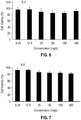
- hydrophilic polymers alone are generally non-cytotoxic.
- cell viability of human embryonic kidney cells HEK293 can be in a range of 80% to 100% at polymer concentrations up to 200 mg/L.
- compositions for a medical treatment comprising a disclosed polymer and a therapeutic agent.
- the hydrophilic polymer can serve as a carrier for a therapeutic agent, which can be bound to the hydrophilic polymer by non-covalent interactions (e.g., hydrogen bonding, hydrophobic interactions) and/or covalent bonds.
- the hydrophilic polymer can serve as a dispersing aid for the therapeutic agent in an aqueous mixture.
- compositions can release the therapeutic agent in the blood stream and/or within a cell.
- compositions can be in the form of water-dispersible particles.
- the particles can have an average particle size as measured by dynamic light scattering of about 10 nm to about 500 nm, more preferably 10 nm to about 200 nm.
- the particles can further comprise water.
- compositions can comprise the therapeutic agent in an amount greater than 0 weight percent (wt%), and more particularly in an amount of about 0.1 wt.% to about 15 wt% based on total dry weight of the compositions.
- the therapeutic agent can be any suitable therapeutic agent capable of forming a reversible complex (i.e., by non-covalent interactions) and/or adduct (i.e., by covalent interactions) with a disclosed hydrophilic polymer, wherein the complex and/or adduct is capable of controlled release of the therapeutic agent.
- Non-limiting therapeutic agents include DNA, genes, peptides, proteins, enzymes, lipids, phospholipids, and nucleotides), natural or synthetic organic compounds (e.g., drugs, dyes, synthetic polymers, oligomers, and amino acids), inorganic materials (e.g., metals and metal oxides), radioactive variants of the foregoing, and combinations of the foregoing.
- the therapeutic agent is a drug and/or a gene.
- the therapeutic agent is effective in inducing a desirable medical response.
- desirable medical responses include selective alteration of the chemical structure and/or activity of a cell type relative to another cell type.
- one desirable change in a chemical structure can be the incorporation of a gene into the DNA of a cell.
- a desirable change in activity can be the expression of the transfected gene by the cell.
- Another desirable change in cell activity can be the induced production of a desired hormone or enzyme.
- a desirable change in activity can be the selective death of one cell type over another cell type.
- the therapeutic agent can selectively kill a bacterium, inactivate a virus, and/or kill tumor cells. No limitation is placed on the relative change in cellular activity caused by the therapeutic agent, providing the change is desirable and useful. Moreover, no limitation is placed on the therapeutic agent, providing the therapeutic agent induces a medically useful response.
- Non-limiting exemplary commercially available drugs include 13-cis-Retinoic Acid, 2-CdA, 2-Chlorodeoxyadenosine, 5-Azacitidine, 5-Fluorouracil, 5-FU, 6-Mercaptopurine, 6-MP, 6-TG, 6-Thioguanine, Abraxane, Accutane®, Actinomycin-D, Adriamycin®, Adrucil®, Afinitor®, Agrylin®, Ala-Cort®, Aldesleukin, Alemtuzumab, ALIMTA, Alitretinoin, Alkaban-AQ®, Alkeran®, All-transretinoic Acid, Alpha Interferon, Altretamine, Amethopterin, Amifostine, Aminoglutethimide, Anagrelide, Anandron®, Anastrozole, Arabinosylcytosine, Ara-C, Aranesp®, Aredia®, Arimidex®, Aromasin®, Arranon®, Ar
- Non-limiting examples of rigid hydrophobic drugs include the anti-tumor drug paclitaxel (PTX): anti-tumor drug doxorubicin (DOX): immunosuppressive drug cyclosporin A (CYC): and hair growth drug spironolactone (SPL):
- PTX anti-tumor drug paclitaxel
- DOX anti-tumor drug doxorubicin
- CYC immunosuppressive drug cyclosporin A
- SPL hair growth drug spironolactone
- the therapeutic agents can be used singularly or in combination.
- Also disclosed is a method of forming a loaded polymer comprising i) forming a first mixture comprising water and a disclosed hydrophilic polymer, ii) forming a second mixture comprising a therapeutic agent and a solvent selected from the group consisting of organic solvents, water, and combinations thereof, iii) combining the first mixture and the second mixture, thereby forming a third mixture, and iv) removing the organic solvent(s) from the third mixture, thereby forming the loaded polymer as a dispersed particle comprising the hydrophilic polymer and the therapeutic agent bound by non-covalent and/or covalent interactions.
- the third mixture can be dialyzed against deionized water using a dialysis membrane system to remove the organic solvent.
- Exemplary organic solvents include methanol, ethanol, propanol, 2-propanol, 1-butanol, 2-butanol, t-butyl alcohol, acetone, 2-butanone, dimethoxyethane, diglyme, diethyl ether, methyl t-butyl ether, methylene chloride, ethyl acetate, ethylene glycol, glycerin, dimethylsulfoxide, dimethylformamide, acetic acid, tetrahydrofuran (THF), and dioxane.
- methanol ethanol, propanol, 2-propanol, 1-butanol, 2-butanol, t-butyl alcohol, acetone, 2-butanone, dimethoxyethane, diglyme, diethyl ether, methyl t-butyl ether, methylene chloride, ethyl acetate, ethylene glycol, glycerin, dimethylsulfox
- the loaded polymer can comprise the hydrophilic polymer in an amount of about 50.0 wt% to about 99.9 wt%, and the therapeutic agent in an amount of about 50.0 wt% to about 0.1 wt%, each based on total dry weight of the loaded polymer.
- Particles of the loaded polymer can have an average particle size (circular cross sectional diameter) of 10 nm to 500 nm, more preferably 10 nm to 250 nm, and most preferably 25 nm to 200 nm as measured by dynamic light scattering.
- the aqueous solution can have a pH of 4.5 to 8.0, more particularly 5.0 to 8.0, or even more particularly 7.0 to 8.0.
- Loaded polymer compositions comprising a disclosed hydrophilic polymer and a therapeutic agent can be used for human and/or non-human medical treatments.
- the compositions can be administered in the form of a powder, a pill, a liquid solution, paste, and/or a gel.
- the compositions can be used as a drug.
- the compositions can be administered topically, orally, as suppositories, and/or by injection, including intravenous injections.
- the compositions can further comprise water and have the form of a stable aqueous dispersion.
- a method comprises contacting a cell with a loaded polymer, thereby killing the cell.
- the cell is a microbe. In another embodiment, the cell is a cancer cell.
- An antimicrobial composition comprises a loaded polymer comprising a disclosed hydrophilic polymer and an antimicrobial agent.
- the antimicrobial composition can be applied to a human and/or non-human animal tissue, including mammalian and/or non-mammalian animal tissue.
- the general term "animal tissue" includes wound tissue, burn tissue, skin, internal organ tissue, blood, bones, cartilage, teeth, hair, eyes, nasal surfaces, oral surfaces, other body cavity surfaces, and any cell membrane surfaces.
- a method comprises contacting an animal tissue with the loaded polymer, thereby killing a bacterium.
- the bacterium can be a Gram-positive bacterium, Gram-negative bacterium, yeast and/or fungus.
- the antimicrobial composition can be used in the form of a powder, a pill, and/or an aqueous mixture applied as a freely flowing liquid, spray, cream, injectable mixture, and/or gel.
- Uses include disinfectants for hands, skin, hair, bone, ear, eye, nose, throat, internal tissue, wounds, and teeth (e.g., as a mouthwash).
- Still other uses include disinfectants for articles such as medical devices. Medical devices include swabs, catheters, sutures, stents, bedpans, gloves, facial masks, absorbent pads, absorbent garments, internal absorbent devices, and insertable mechanical devices.
- a method comprises contacting a surface of an article with the loaded polymer composition, thereby disinfecting the surface.
- a method comprises contacting a surface of an article with an aqueous mixture of the composition.
- Mn is the number average molecular weight
- Mw is the weight average molecular weight
- MW is the molecular weight of one molecule.
- MTC-C6F5 has the following structure: MTC-C6F5 was produced using the procedure described by Sanders, et al., "A Simple and Efficient Synthesis of Functionalized Cyclic Carbonate Monomers Using a Versatile Pentafluorophenyl Ester Intermediate", Journal of the American Chemical Society, 2010, 132, pages 14724-14726 .
- BnMPA has the following structure:
- BnMPA and other cyclic carbonate monomers can be prepared from 2,2-bis(methylol)propionic (BisMPA) according to Scheme 4.
- BisMPA can be converted (i) to the benzyl ester BnMPA using known methods. Reaction of BnMPA with triphosgene (ii) produces cyclic carbonyl monomer, MTCOBn. Debenzylation of MTCOBn (iii) produces 5-methyl-5-carboxyl-1,3-dioxan-2-one (MTCOH). Two pathways are shown for forming an ester from MTCOH. In the first pathway, (iv), MTCOH is treated with a suitable carboxy activating agent, such as dicyclohexylcarbodiimide (DCC), which reacts with ROH to form MTCOR in a single step.
- DCC dicyclohexylcarbodiimide
- MTCOH can be converted first (v) to the acid chloride MTCCl followed by treatment (vi) of MTCCl with ROH in the presence of a base to form MTCOR. Both pathways are illustrative and are not meant to be limiting.
- MTCOEt (MW 188.2) has the structure. Using the above Scheme 4, MTCCl was treated with ethanol to form MTCOEt. MTCOEt was used as a non-functional counterpart for dilution effects and to introduce hydrophobic blocks to the block polymer.
- the benzyl peak (not shown) of the initiator fragment is in the same region as the CDCl 3 peak with these materials.
- P-1 has two polymer branches emanating from a chain fragment derived from the diol initiator (initiator fragment).
- Each of the polymer branches consists essentially of a homopolymer chain of repeating units formed by the ROP of MTC-C6F5.
- a first terminal repeat unit of each homopolymer chain is linked to the initiator fragment.
- a second terminal repeat unit of each homopolymer chain has a hydroxy group capable of initiating another ROP.
- the non-isolated intermediate polymer P-2 has one polymer branch linked to an initiator fragment derived from the monol initiator 3-butyn-1-ol.
- the polymer branch consists essentially of a homopolymer chain of repeat units formed by the ROP of MTC-C6F5.
- a first terminal repeat unit of the homopolymer chain is linked to the initiator fragment.
- a second terminal repeat unit of the homopolymer chain has a hydroxy group capable of initiating another ROP.
- the initiator fragment is also a polymer branch end group.
- the isolated polymer P-3 also has one polymer branch linked to an initiator fragment derived from the monol initiator 3-butyn-1-ol.
- the initiator fragment is also an end group of the polymer branch.
- the polymer branch consists essentially of a diblock copolymer chain formed by a first ROP of MTC-C6F5 followed by a second ROP of MTCOEt.
- the diblock copolymer chain contains a first hydrophilic block derived from MTC-C6F5 and a hydrophobic second block derived from MTCOEt.
- a first terminal repeat unit of the first block is linked to the initiator fragment.
- a second terminal repeat unit of the first block is linked to a first terminal repeat unit of second block.
- a second terminal repeat unit of the second block contains a hydroxy group capable of initiating another ROP.
- P-4 was prepared according to the procedure of Example 2, differing by the size of the block derived from MTCOEt.
- the amounts used were as follows: 3-butyn-1-ol initiator (0.0085g, 0.12 mmol) and MTC-C6F5 monomer (1.98 g, 6.06 mmol) were dissolved in dichloromethane (8 mL), the catalyst was triflic acid (0.046 g, 0.30 mmol), and MTC-OEt monomer (0.34 g, 1.82 mmol) was dissolved in dichloromethane (12 mL). The MTC-OEt polymerization was stopped at 66.5% conversion.
- Examples 6-10 Preparation of amide polymers A-2 to A-6. These polymers were prepared from P-1 using the general procedure of Example 5 and the amino-alcohols listed in Table 8 below.
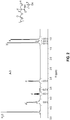
- Figure 2 is a 1 H NMR spectrum of A-3 (Example 7). The following are 400 MHz 1 H NMR peak assignments of Examples 6 to 9 obtained in D 2 O:
- Table 8 summarizes the structures and properties of the pentafluorophenyl ester polymers P-1 and amide polymers A-1 to A-6.
- the R' groups of Table 8 refer to the R' the structure below of formula (13): The starred bonds of the R' groups of Table 8 are linked to an amide nitrogen. The degree of polymerization m is also listed in Table 8. Table 8. Example Name Amino alcohol used R' m Water Soluble?
- GPC Mn GPC Mw GPC PDI 1 P-1 20 No 5206 5494 1.055 5 A-1 2-Amino-ethanol 20 Yes 6837 7424 1.086 6 A-2 3-Amino-1-propanol 20 Yes 6207 6651 1.071 7 A-3 1-Amino-2-propanol (racemic) 20 Yes 5625 6016 1.069 8 A-4 2-Amino-1-butanol 20 Limited 6434 6977 1.08 9 A-5 Serinol 20 Yes 7084 7572 1.068 10 A-6 ( ⁇ )-3-Amino-1,2-propane diol 20 Yes 5391 5713 1.06
- Polymer P-1 and the amide-containing polymers A-1 to A-3 and A-5 of Table 8 were also analyzed by gel permeation chromatography (GPC) to determine if there was any degradation of the backbone during amide formation. As shown by the DMF GPC traces in Figure 3 , there was no broadening of the peak and no significant drop in polymer molecular weight.
- A-4 (Example 7), prepared with 2-aminobutanol, had limited water solubility but all other amide-containing polymers (A-1, A-2, A-3, A-5, and A-6) were fully water soluble.
- Examples 11-20 Preparation of diblock polymers D-1 to D-10. These polymers were prepared from P-3 (Example 2) or P-4 (Example 3) using the general procedure of Example 4 and the amino-alcohols listed in Table 9 below.
- Table 9 summarizes the properties of diblock copolymers D-1 to D-10 and the precursor polymers P-3 and P-4. Subscripts m and n of Table 9 and the R' groups of Table 9 refer to m, n, and R', respectively, of the structure of formula (14): The starred bonds of the R' groups of Table 9 are linked to an amide nitrogen. Table 9. Example Name Amino alcohol used R' A Block (m) B Block (n) Water Soluble?
- Examples 21-25 Preparation of amide homopolymers A-7 to A-11. These polymers were prepared from P-5 using the general procedure of Example 5 and the amino-alcohols listed in Table 10 below. The following are 400 MHz 1 H NMR peak assignments of Examples 21 to 25 obtained in D 2 O:
- Table 10 summarizes the structures and properties of the pentafluorophenyl ester polymer P-5 and amide polymers A-7 to A-11.
- the R' groups of Table 10 refer to the R' groups of formula (15): The starred bond of the R' group in Table 10 is linked to an amide nitrogen. The degree of polymerization m is also listed in Table 10. Table 10. Example Name Amino alcohol used R' m Water Soluble?
- GPC Mn GPC Mw GPC PDI 1 P-5 a 20 No 6200 7100 1.15 21 A-7 2-Amino-ethanol 20 Yes ND ND ND 22 A-8 3-Amino-1-propanol 20 Yes ND ND ND 23 A-9 1-Amino-2-propanol (racemic) 20 Yes ND ND ND 24 A-10 Serinol 20 Yes ND ND ND 25 A-11 ( ⁇ )-3-Amino-1,2-propane diol 20 Yes ND ND ND a GPC run in THF, all others run in DMF ND not determined
- HEK293 cells were cultured in RPMI-1640 supplied with 10% fetal bovine serum (FBS) and 1% penicillin-streptomycin.
- HEK293 cells were seeded onto 96-well plates at a density of 10,000 cells/well. The cells were incubated at 37° C, 5% CO 2 . After 24 hours, the medium was replaced with fresh medium containing polymer at various concentrations. After 48 hours incubation, 100 microliters of fresh medium and 20 microliters of 5 mg/mL MTT solution were used to replace the sample medium. After 4 hours incubation, the medium was removed, and DMSO (150 microliters) was added to each well to dissolve the formazan crystals.
- FBS fetal bovine serum
- penicillin-streptomycin penicillin-streptomycin
- mice Female Balb/c mice (19-21 g) were randomly selected and kept in cages for at least 5 days to allow for acclimatization to the laboratory conditions. Mice were fasted for 12 hours before testing. The dose of the polymer was 500 mg/kg. Polymer was dissolved in sterilized saline at a concentration of 50 mg/mL for injection and administered via the intravenous injection. Polymer solution was firstly given to one mouse. If the first mouse survived after 48 hours, two more mice were further used for the test. After injection, all the animals were observed every 30 minutes for the first 4 hours and daily thereafter, for a total of 14 days.
- One method of determining if a polymer system has stealth characteristics is to look at the stability of a serum solution containing the polymer. Using dynamic light scattering, the sizes of particles formed in the serum can be measured with time. If the initial particle size remains consistent over time (i.e., the serum solution does not show unacceptable flocculation with time), it can be assumed that the polymer has stealth characteristics.
- the synthetic polymer and/or the serum components can flocculate.
- the amide-containing polymers of Table 8 and Table 9 were dissolved in phosphate buffered saline (PBS) containing 10% FBS. The concentration of each polymer was 500 mg/L.
- the time dependent particle sizes of the serum solutions were analyzed by dynamic light scattering using a Zetasizer 3000 HAS (Malvern Instrument Ltd., Malvern, UK) equipped with a He-Ne laser beam at 658 nm (scattering angle: 90°) for a 24 hour period or 48 hour period. Each sample was measured 3 times and an average particle size was obtained. The particle size is reported as the average circular diameter in nanometers.
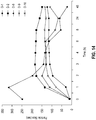
- Figure 12 is a graph showing the particle size behavior of several polymers of Table 10 in PBS/10% FBS as a function of time. PEG 2 kDa and 10% serum were used as controls. The particle size remains constant over a 24 hour period for each sample, indicating that no flocculation was caused by polymers A-7, A-8, A-9, A-10, and A-11. The average particle size observed for each sample was in a range of 10 nm to 15 nm.
- the average particle size obtained using D-3 and D-7 was in a range of about 10 nm to 20 nm for the first 24 hours, and rose thereafter to about 110 nm and about 30 nm, respectively, at 48 hours.
- the average particle size obtained using D-8 was in a range of about 10 nm to 20 nm for 8 hours and rose thereafter to about 170 nm at 48 hours.
- the average particle size obtained using D-4 fluctuated between 75 nm and about 30 nm in the first 24 hours, and rose thereafter to about 130 nm at 48 hours.
- the average particle size obtained using D-5 fluctuated between 70 nm and about 20 nm in the first 3 hours, and thereafter remained less than 30 nm up to 48 hours.
- D-9 derived from ( ⁇
- the average particle size obtained using D-1 rose to a plateau of about 100 nm in the first 3 hours, which extended to 48 hours.
- the average particle size obtained using D-2 rose to a peak of about 175 nm, which decreased to about 150 nm at 48 hours.
- the average particle size obtained using D-6 rose to a peak of about 325 nm at 1 hour, which decreased thereafter to about 20 nm at 48 hours.
- the average particle size obtained using D-9 rose to a plateau of about 120 nm in the first 3 hours, which extended to 48 hours.
- the average particle size obtained using D-10 rose to a peak of about 150 nm in the first 2 hours, which fell to about 130 nm at 48 hours.
- the particle size data for the Table 8 series of polymers indicate that polycarbonates comprising a majority of non-charged hydrophilic repeat units bearing one or two hydroxy groups are non-toxic and possess stealth properties in serum, making these polymers attractive as dispersants for hydrophobic therapeutic agents.
- a monol, diol, or a mixture thereof can be employed as the initiator for the ring opening polymerization.
- Each of the hydrophilic carbonate repeat units has an amide side chain wherein the amide carbonyl is linked to the polymer backbone.
- the amide side chain can comprise 3 to 5 carbons, 1 amide group, and 1 to 2 hydroxy groups.
- the amide side chain comprises 2 hydroxymethylene groups (*-CH 2 -OH).
- the particle size data for the Table 9 series of polymers which comprise a non-charged hydrophobic second polymer block, indicate these polymers can also possess stealth properties with respect to serum components. Less flocculation was observed for D-7 and D-8 compared to D-9 and D-10, indicating that a side chain containing two hydroxymethylene groups may be more compatible with serum components compared to a diol side chain that contains one hydroxymethylene group and one hydroxymethine group: Therefore, the Table 9 polymers are also attractive as dispersants for hydrophobic therapeutic agents (e.g., genes, proteins, peptides, drugs, and combinations thereof).
- the hydrophilic repeat units can be used in combination.
- the hydrophobic repeat units can also be used in combination.
Landscapes
- Chemical & Material Sciences (AREA)
- Health & Medical Sciences (AREA)
- Medicinal Chemistry (AREA)
- Chemical Kinetics & Catalysis (AREA)
- Polymers & Plastics (AREA)
- Organic Chemistry (AREA)
- Life Sciences & Earth Sciences (AREA)
- Epidemiology (AREA)
- Veterinary Medicine (AREA)
- Pharmacology & Pharmacy (AREA)
- Animal Behavior & Ethology (AREA)
- General Health & Medical Sciences (AREA)
- Public Health (AREA)
- Engineering & Computer Science (AREA)
- Bioinformatics & Cheminformatics (AREA)
- General Chemical & Material Sciences (AREA)
- Proteomics, Peptides & Aminoacids (AREA)
- Inorganic Chemistry (AREA)
- Polyesters Or Polycarbonates (AREA)
- Medicinal Preparation (AREA)
- Compositions Of Macromolecular Compounds (AREA)
- Materials For Medical Uses (AREA)
Claims (15)
- Polymère comprenant un motif répété carbonate de formule (1) :
 R' est un radical monovalent comportant 2 à 4 carbones et 1 à 2 groupes hydroxy,R" est un radical monovalent choisi dans le groupe consistant en hydrogène, méthyle, éthyle et propyle,le polymère est non chargé, etle polymère est soluble dans l'eau.
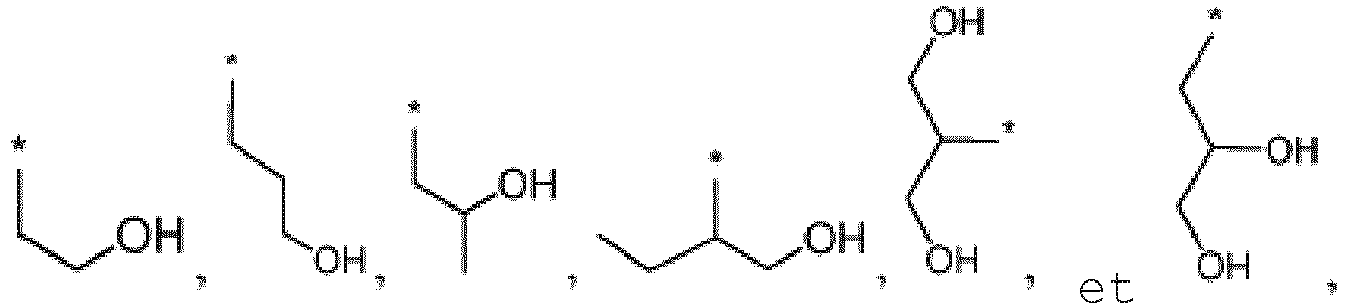
 - Polymère selon la revendication 1, dans lequel R' est choisi dans le groupe consistant en
dans lequel la Mn est déterminée par chromatographie par perméation de gel (GPC) utilisant du DMF comme éluant, ou
dans lequel le polymère a une valeur DL50 intraveineuse sur souris de plus de 500 mg/kg, ou
dans lequel le polymère est biodégradable en conformité avec la norme ASTM D6400. - Polymère selon une quelconque revendication précédente, dans lequel le polymère comprend une branche de polymère liée par un motif répété terminal à un groupe d'extrémité de polymère de structure I'-O-*, la branche de polymère est un homopolymère de motif répété carbonate, et I' comprend 1 à 20 carbones, ou dans lequel le polymère possède une structure selon la formule (1a) :

m est un nombre ayant une valeur moyenne plus grande que 1,
I' est un radical monovalent comprenant 1 à 20 carbones, chaque R" est un radical monovalent indépendant choisi dans le groupe consistant en hydrogène, méthyle, éthyle et propyle, et chaque R' est un radical monovalent indépendant choisi dans le groupe consistant en :
- Polymère selon la revendication 1, dans lequel le polymère comprend une branche de polymère liée par un motif répété terminal à un groupe d'extrémité de polymère de structure I'-O-*, la branche de polymère est un copolymère statistique du motif répété carbonate, et un second motif répété hydrophobe non chargé, et I' comprend 1 à 20 carbones, ou
dans lequel le polymère est un copolymère statistique possédant une structure selon la formule (2) : m est un nombre ayant une valeur moyenne plus grande que 1,n est un nombre ayant une valeur moyenne plus grande que 1, chaque T' est un radical monovalent indépendant comprenant 1 à 6 carbones,chaque T" est un radical monovalent indépendant choisi dans le groupe consistant en les groupes alkyle comprenant 1 à 30 carbones et les groupes aryle comprenant 6 à 30 carbones,chaque R" est un radical monovalent indépendant choisi dans le groupe consistant en hydrogène, méthyle, éthyle et propyle,I' est un groupe monovalent comprenant 1 à 20 carbones, et chaque R' est choisi dans le groupe consistant en :
- Polymère selon la revendication 1, dans lequel le polymère comprend une branche de polymère liée par un motif répété terminal à un groupe d'extrémité de polymère de structure I'-O-*, la branche de polymère est un copolymère diséquencé comprenant une première séquence liée à une seconde séquence, la première séquence comprend le motif répété carbonate, et la seconde séquence comprend un second motif répété hydrophobe non chargé, ou dans lequel le polymère est un copolymère diséquencé possédant une structure selon la formule (3) :
 m est un nombre ayant une valeur moyenne plus grande que 1,n est un nombre ayant une valeur moyenne plus grande que 1,I' est un radical monovalent comprenant 1 à 20 carbones,chaque R" est un radical monovalent indépendant choisi dans le groupe consistant en hydrogène, méthyle, éthyle et propyle,chaque T" est un radical monovalent indépendant choisi dans le groupe consistant en hydrogène, méthyle, éthyle et propyle,chaque T' est un radical monovalent indépendant choisi dans le groupe consistant en les groupes alkyle comprenant 1 à 30 carbones et les groupes aryle comprenant 6 à 30 carbones, etchaque R' est un radical monovalent indépendant choisi dans le groupe consistant en :
- Polymère selon la revendication 1, dans lequel le polymère comprend deux branches de polymère, les deux branches de polymère sont liées par des motifs répétés terminaux respectifs à un groupe de liaison divalent de structure *-O-I"-O-*, I" comprend 2 à 20 carbones, et chacune des deux branches de polymère comprend le motif répété carbonate, ou
dans lequel le polymère possède une structure selon la formule (4) : m est un nombre ayant une valeur moyenne plus grande que 1, I" est un groupe de liaison divalent comprenant 2 à 20 carbones, etchaque R" est un radical monovalent indépendant choisi dans le groupe consistant en hydrogène, méthyle, éthyle et propyle, et chaque R' est un radical monovalent indépendant choisi dans le groupe consistant en :
- Polymère selon une quelconque revendication précédente, dans lequel R" est méthyle.
- Polymère selon une quelconque revendication précédente, dans lequel le motif répété carbonate est stéréospécifique.
- Composition comprenant :le polymère de la revendication 1 ; etun agent thérapeutique pour un traitement médical, l'agent thérapeutique étant choisi dans le groupe consistant en les gènes, les protéines, les peptides, les médicaments et leurs combinaisons ;dans laquellele polymère et l'agent thérapeutique sont liés par des interactions non covalentes,la composition est dispersible dans l'eau sous forme de particule ayant un diamètre de cercle moyen de 10 nm à 500 nm, etun mélange aqueux de la composition convient à une injection intraveineuse.
- Composition selon la revendication 9, dans laquelle le polymère a une structure selon la formule (4) :
 m est un nombre ayant une valeur moyenne plus grande que 1,I" est un groupe de liaison divalent comprenant 2 à 20 carbones, etchaque R" est un radical monovalent indépendant choisi dans le groupe consistant en hydrogène, méthyle, éthyle et propyle, et chaque R' est un radical monovalent indépendant choisi dans le groupe consistant en
 le polymère est soluble dans l'eau.
 - Composition selon la revendication 10, dans laquelle m a une valeur moyenne de 20 à 50, ou
dans laquelle le polymère a une masse moléculaire moyenne en nombre (Mn) de 5000 à 10 000, moyennant quoi la Mn est déterminée par chromatographie par perméation de gel (GPC) utilisant DMF comme éluant. - Composition selon la revendication 9, dans laquelle le polymère est un copolymère diséquencé possédant une structure selon la formule (3) :
 m est un nombre ayant une valeur moyenne plus grande que 1,n est un nombre ayant une valeur moyenne plus grande que 1,I' est un radical monovalent comprenant 1 à 20 carbones,chaque R" est un radical monovalent indépendant choisi dans le groupe consistant en hydrogène, méthyle, éthyle et propyle,chaque T" est un radical monovalent indépendant choisi dans le groupe consistant en hydrogène, méthyle, éthyle et propyle,chaque T' est un radical monovalent indépendant choisi dans le groupe consistant en les groupes alkyle comprenant 1 à 30 carbones et les groupes aryle comprenant 6 à 30 carbones, etchaque R' est un radical monovalent indépendant choisi dans le groupe consistant en :
- Procédé comprenant :la formation d'un premier mélange comprenant de l'eau et un polymère comprenant un premier motif répété carbonate de formule (1) :
 la formation d'un deuxième mélange comprenant i) un solvant choisi dans le groupe consistant en les solvants organiques, l'eau et leurs combinaisons et ii) un agent thérapeutique pour un traitement médical, l'agent thérapeutique étant choisi dans le groupe consistant en les gènes, les protéines, les peptides, les médicaments et leurs combinaisons ;la combinaison du premier mélange et du deuxième mélange, formant ainsi un troisième mélange ; etl'élimination du solvant organique du troisième mélange, formant ainsi une particule comprenant le polymère et l'agent thérapeutique liés par des interactions non covalentes, dans lequel la particule est dispersible dans l'eau, et un mélange aqueux de la particule convient à une injection intraveineuse.
 - Procédé selon la revendication 13, dans lequel R' est

- Procédé selon la revendication 13, dans lequel le polymère possède une structure selon la formule (4) :
 m est un nombre ayant une valeur moyenne plus grande que 1,I" est un groupe de liaison divalent comprenant 2 à 20 carbones, etchaque R" est un radical monovalent indépendant choisi dans le groupe consistant en hydrogène, méthyle, éthyle et propyle, etchaque R' est un radical monovalent indépendant choisi dans le groupe consistant en
 m est un nombre ayant une valeur moyenne plus grande que 1,n est un nombre ayant une valeur moyenne plus grande que 1,I' est un radical monovalent comprenant 1 à 20 carbones,chaque R" est un radical monovalent indépendant choisi dans le groupe consistant en hydrogène, méthyle, éthyle et propyle,chaque R' est un radical monovalent indépendant choisi dans le groupe consistant en hydrogène, méthyle, éthyle et propyle,chaque T" est un radical monovalent indépendant choisi dans le groupe consistant en les groupes alkyle comprenant 1 à 30 carbones et les groupes aryle comprenant 6 à 30 carbones, etchaque T' est un radical monovalent indépendant choisi dans le groupe consistant en :
Applications Claiming Priority (2)
| Application Number | Priority Date | Filing Date | Title |
|---|---|---|---|
| US14/506,733 US9469726B2 (en) | 2014-10-06 | 2014-10-06 | Water soluble polycarbonates for medical applications |
| PCT/IB2015/056639 WO2016055880A1 (fr) | 2014-10-06 | 2015-09-01 | Polycarbonates solubles dans l'eau pour applications médicales |
Publications (3)
| Publication Number | Publication Date |
|---|---|
| EP3204441A1 EP3204441A1 (fr) | 2017-08-16 |
| EP3204441A4 EP3204441A4 (fr) | 2018-05-09 |
| EP3204441B1 true EP3204441B1 (fr) | 2019-11-27 |
Family
ID=55632015
Family Applications (1)
| Application Number | Title | Priority Date | Filing Date |
|---|---|---|---|
| EP15849474.0A Active EP3204441B1 (fr) | 2014-10-06 | 2015-09-01 | Polycarbonates solubles dans l'eau pour applications médicales |
Country Status (8)
| Country | Link |
|---|---|
| US (1) | US9469726B2 (fr) |
| EP (1) | EP3204441B1 (fr) |
| JP (1) | JP6720154B2 (fr) |
| CN (1) | CN107001603B (fr) |
| DE (1) | DE112015003925B4 (fr) |
| GB (1) | GB2543222B (fr) |
| SG (1) | SG11201703673WA (fr) |
| WO (1) | WO2016055880A1 (fr) |
Families Citing this family (7)
| Publication number | Priority date | Publication date | Assignee | Title |
|---|---|---|---|---|
| KR102270299B1 (ko) | 2015-03-02 | 2021-06-28 | 고꾸리쯔 다이가꾸호우징 도쿄노우코우다이가쿠 | 열분해성 바인더 |
| KR102281027B1 (ko) | 2016-04-01 | 2021-07-26 | 고꾸리쯔 다이가꾸호우징 도쿄노우코우다이가쿠 | 열분해성 바인더 |
| JPWO2019045092A1 (ja) * | 2017-09-04 | 2020-10-01 | 国立大学法人東京農工大学 | 新規脂肪族ポリカーボネート |
| CN113677736B (zh) * | 2019-03-29 | 2024-08-02 | 日油株式会社 | 分支型分解性聚乙二醇衍生物 |
| EP3950703A4 (fr) * | 2019-03-29 | 2023-01-04 | NOF Corporation | Liant polyéthylène glycol dégradable ramifié |
| CN111471289A (zh) * | 2020-06-15 | 2020-07-31 | 上海品诚控股集团有限公司 | 一种抗菌遮光pc卡基料组合物及其制备方法 |
| CN116640295B (zh) * | 2023-05-26 | 2025-06-24 | 大连理工大学 | 一种水溶性的聚碳酸酯材料及合成方法 |
Family Cites Families (11)
| Publication number | Priority date | Publication date | Assignee | Title |
|---|---|---|---|---|
| GB0131112D0 (en) * | 2001-12-31 | 2002-02-13 | Univ London Pharmacy | Block copolymers |
| CN1174019C (zh) | 2002-04-30 | 2004-11-03 | 武汉大学 | 聚(2-取代基羰基-2-甲基三亚甲基碳酸酯)及其制备方法和用途 |
| JP5557373B2 (ja) * | 2006-11-21 | 2014-07-23 | アボット ラボラトリーズ | 薬剤溶出性コーティングにおけるテトラフルオロエチレン、ヘキサフルオロプロピレン、及びフッ化ビニリデンのターポリマーの使用 |
| WO2008124634A1 (fr) * | 2007-04-04 | 2008-10-16 | Massachusetts Institute Of Technology | Micelles inverses encapsulées par un polymère |
| US7951899B2 (en) | 2008-08-15 | 2011-05-31 | Polytechnic University | Enzyme-catalyzed polycarbonate and polycarbonate ester synthesis |
| CN101544751B (zh) * | 2009-03-30 | 2011-02-16 | 武汉大学 | 一种生物可降解的水溶性聚碳酸酯及其制备方法 |
| US7939621B2 (en) * | 2009-04-30 | 2011-05-10 | International Business Machines Corporation | Oligocarbonate molecular transporters |
| US8143369B2 (en) | 2009-06-02 | 2012-03-27 | International Business Machines Corporation | Polymers bearing pendant pentafluorophenyl ester groups, and methods of synthesis and functionalization thereof |
| US8470891B2 (en) * | 2009-12-23 | 2013-06-25 | International Business Machines Corporation | Biodegradable block polymers for drug delivery, and methods related thereto |
| WO2014133102A1 (fr) * | 2013-02-27 | 2014-09-04 | 国立大学法人山形大学 | Polymère biocompatible en tant que matière antithrombogène, carbonate cyclique utile comme précurseur correspondant et procédé pour sa production |
| US9717797B2 (en) | 2013-12-05 | 2017-08-01 | International Business Machines Corporation | Polycarbonates bearing aromatic N-heterocycles for drug delivery |
-
2014
- 2014-10-06 US US14/506,733 patent/US9469726B2/en not_active Expired - Fee Related
-
2015
- 2015-09-01 DE DE112015003925.2T patent/DE112015003925B4/de not_active Expired - Fee Related
- 2015-09-01 CN CN201580054431.9A patent/CN107001603B/zh active Active
- 2015-09-01 SG SG11201703673WA patent/SG11201703673WA/en unknown
- 2015-09-01 EP EP15849474.0A patent/EP3204441B1/fr active Active
- 2015-09-01 JP JP2017518459A patent/JP6720154B2/ja active Active
- 2015-09-01 GB GB1701185.9A patent/GB2543222B/en active Active
- 2015-09-01 WO PCT/IB2015/056639 patent/WO2016055880A1/fr not_active Ceased
Non-Patent Citations (1)
| Title |
|---|
| None * |
Also Published As
| Publication number | Publication date |
|---|---|
| GB2543222B (en) | 2017-06-28 |
| CN107001603B (zh) | 2018-12-25 |
| JP2017535633A (ja) | 2017-11-30 |
| US9469726B2 (en) | 2016-10-18 |
| EP3204441A4 (fr) | 2018-05-09 |
| DE112015003925B4 (de) | 2018-03-22 |
| WO2016055880A1 (fr) | 2016-04-14 |
| US20160095933A1 (en) | 2016-04-07 |
| GB201701185D0 (en) | 2017-03-08 |
| EP3204441A1 (fr) | 2017-08-16 |
| SG11201703673WA (en) | 2017-06-29 |
| DE112015003925T5 (de) | 2017-06-22 |
| JP6720154B2 (ja) | 2020-07-08 |
| CN107001603A (zh) | 2017-08-01 |
| GB2543222A (en) | 2017-04-12 |
Similar Documents
| Publication | Publication Date | Title |
|---|---|---|
| US11690380B2 (en) | Antimicrobial guanidinium and thiouronium functionalized polymers | |
| EP3204441B1 (fr) | Polycarbonates solubles dans l'eau pour applications médicales | |
| EP2516504B1 (fr) | Polymères biodégradables, complexes de ceux-ci pour la thérapie génique et l'administration de médicament, et procédés associés à ceux-ci | |
| US9974303B2 (en) | Cationic polymers for antimicrobial applications and delivery of bioactive materials | |
| EP2516502B1 (fr) | Polymères séquencés biodégradables pour l'administration de médicament et procédés associés à ceux-ci | |
| US8642086B2 (en) | Antimicrobial compositions, methods of preparation thereof, and uses thereof | |
| US8496946B2 (en) | Antimicrobial hydrogels, methods of preparation thereof, and articles therefrom | |
| JP6457392B2 (ja) | ポリカーボネートに担持させた医薬用ペンダント型1級アミン | |
| US9901649B2 (en) | Block copolymers for therapeutic drug delivery | |
| US8834861B2 (en) | Polycarbonates for delivery of drugs and methods of preparation thereof | |
| US8633296B1 (en) | Composite hydrogels for delivery of biologically active materials | |
| US9718957B2 (en) | Biodegradable organic radical-functionalized polycarbonates for medical applications | |
| US9987369B2 (en) | Vitamin functionalized gel-forming block copolymers for biomedical applications | |
| US10392470B2 (en) | Polyester nanogel core star polymers for delivery of therapeutic agents |
Legal Events
| Date | Code | Title | Description |
|---|---|---|---|
| STAA | Information on the status of an ep patent application or granted ep patent |
Free format text: STATUS: THE INTERNATIONAL PUBLICATION HAS BEEN MADE |
|
| PUAI | Public reference made under article 153(3) epc to a published international application that has entered the european phase |
Free format text: ORIGINAL CODE: 0009012 |
|
| STAA | Information on the status of an ep patent application or granted ep patent |
Free format text: STATUS: REQUEST FOR EXAMINATION WAS MADE |
|
| 17P | Request for examination filed |
Effective date: 20170503 |
|
| AK | Designated contracting states |
Kind code of ref document: A1 Designated state(s): AL AT BE BG CH CY CZ DE DK EE ES FI FR GB GR HR HU IE IS IT LI LT LU LV MC MK MT NL NO PL PT RO RS SE SI SK SM TR |
|
| AX | Request for extension of the european patent |
Extension state: BA ME |
|
| DAV | Request for validation of the european patent (deleted) | ||
| DAX | Request for extension of the european patent (deleted) | ||
| A4 | Supplementary search report drawn up and despatched |
Effective date: 20180409 |
|
| RIC1 | Information provided on ipc code assigned before grant |
Ipc: C08G 64/42 20060101ALI20180403BHEP Ipc: C08G 64/02 20060101AFI20180403BHEP Ipc: A61K 47/34 20170101ALI20180403BHEP Ipc: C08G 64/30 20060101ALI20180403BHEP |
|
| STAA | Information on the status of an ep patent application or granted ep patent |
Free format text: STATUS: EXAMINATION IS IN PROGRESS |
|
| 17Q | First examination report despatched |
Effective date: 20181115 |
|
| REG | Reference to a national code |
Ref country code: DE Ref legal event code: R079 Ref document number: 602015042691 Country of ref document: DE Free format text: PREVIOUS MAIN CLASS: C08G0064020000 Ipc: A61K0045060000 |
|
| GRAP | Despatch of communication of intention to grant a patent |
Free format text: ORIGINAL CODE: EPIDOSNIGR1 |
|
| STAA | Information on the status of an ep patent application or granted ep patent |
Free format text: STATUS: GRANT OF PATENT IS INTENDED |
|
| RIC1 | Information provided on ipc code assigned before grant |
Ipc: A61K 9/00 20060101ALI20190614BHEP Ipc: A61K 9/14 20060101ALI20190614BHEP Ipc: C08G 64/02 20060101ALI20190614BHEP Ipc: C08G 64/42 20060101ALI20190614BHEP Ipc: C08G 64/30 20060101ALI20190614BHEP Ipc: A61K 45/06 20060101AFI20190614BHEP Ipc: C08G 64/18 20060101ALI20190614BHEP |
|
| INTG | Intention to grant announced |
Effective date: 20190704 |
|
| GRAS | Grant fee paid |
Free format text: ORIGINAL CODE: EPIDOSNIGR3 |
|
| GRAA | (expected) grant |
Free format text: ORIGINAL CODE: 0009210 |
|
| STAA | Information on the status of an ep patent application or granted ep patent |
Free format text: STATUS: THE PATENT HAS BEEN GRANTED |
|
| AK | Designated contracting states |
Kind code of ref document: B1 Designated state(s): AL AT BE BG CH CY CZ DE DK EE ES FI FR GB GR HR HU IE IS IT LI LT LU LV MC MK MT NL NO PL PT RO RS SE SI SK SM TR |
|
| REG | Reference to a national code |
Ref country code: GB Ref legal event code: FG4D |
|
| REG | Reference to a national code |
Ref country code: CH Ref legal event code: EP |
|
| REG | Reference to a national code |
Ref country code: DE Ref legal event code: R096 Ref document number: 602015042691 Country of ref document: DE |
|
| REG | Reference to a national code |
Ref country code: AT Ref legal event code: REF Ref document number: 1205975 Country of ref document: AT Kind code of ref document: T Effective date: 20191215 |
|
| REG | Reference to a national code |
Ref country code: IE Ref legal event code: FG4D |
|
| REG | Reference to a national code |
Ref country code: NL Ref legal event code: MP Effective date: 20191127 |
|
| REG | Reference to a national code |
Ref country code: LT Ref legal event code: MG4D |
|
| PG25 | Lapsed in a contracting state [announced via postgrant information from national office to epo] |
Ref country code: BG Free format text: LAPSE BECAUSE OF FAILURE TO SUBMIT A TRANSLATION OF THE DESCRIPTION OR TO PAY THE FEE WITHIN THE PRESCRIBED TIME-LIMIT Effective date: 20200227 Ref country code: FI Free format text: LAPSE BECAUSE OF FAILURE TO SUBMIT A TRANSLATION OF THE DESCRIPTION OR TO PAY THE FEE WITHIN THE PRESCRIBED TIME-LIMIT Effective date: 20191127 Ref country code: LV Free format text: LAPSE BECAUSE OF FAILURE TO SUBMIT A TRANSLATION OF THE DESCRIPTION OR TO PAY THE FEE WITHIN THE PRESCRIBED TIME-LIMIT Effective date: 20191127 Ref country code: SE Free format text: LAPSE BECAUSE OF FAILURE TO SUBMIT A TRANSLATION OF THE DESCRIPTION OR TO PAY THE FEE WITHIN THE PRESCRIBED TIME-LIMIT Effective date: 20191127 Ref country code: NL Free format text: LAPSE BECAUSE OF FAILURE TO SUBMIT A TRANSLATION OF THE DESCRIPTION OR TO PAY THE FEE WITHIN THE PRESCRIBED TIME-LIMIT Effective date: 20191127 Ref country code: NO Free format text: LAPSE BECAUSE OF FAILURE TO SUBMIT A TRANSLATION OF THE DESCRIPTION OR TO PAY THE FEE WITHIN THE PRESCRIBED TIME-LIMIT Effective date: 20200227 Ref country code: GR Free format text: LAPSE BECAUSE OF FAILURE TO SUBMIT A TRANSLATION OF THE DESCRIPTION OR TO PAY THE FEE WITHIN THE PRESCRIBED TIME-LIMIT Effective date: 20200228 Ref country code: LT Free format text: LAPSE BECAUSE OF FAILURE TO SUBMIT A TRANSLATION OF THE DESCRIPTION OR TO PAY THE FEE WITHIN THE PRESCRIBED TIME-LIMIT Effective date: 20191127 |
|
| PG25 | Lapsed in a contracting state [announced via postgrant information from national office to epo] |
Ref country code: IS Free format text: LAPSE BECAUSE OF FAILURE TO SUBMIT A TRANSLATION OF THE DESCRIPTION OR TO PAY THE FEE WITHIN THE PRESCRIBED TIME-LIMIT Effective date: 20200327 Ref country code: RS Free format text: LAPSE BECAUSE OF FAILURE TO SUBMIT A TRANSLATION OF THE DESCRIPTION OR TO PAY THE FEE WITHIN THE PRESCRIBED TIME-LIMIT Effective date: 20191127 Ref country code: HR Free format text: LAPSE BECAUSE OF FAILURE TO SUBMIT A TRANSLATION OF THE DESCRIPTION OR TO PAY THE FEE WITHIN THE PRESCRIBED TIME-LIMIT Effective date: 20191127 |
|
| PG25 | Lapsed in a contracting state [announced via postgrant information from national office to epo] |
Ref country code: AL Free format text: LAPSE BECAUSE OF FAILURE TO SUBMIT A TRANSLATION OF THE DESCRIPTION OR TO PAY THE FEE WITHIN THE PRESCRIBED TIME-LIMIT Effective date: 20191127 |
|
| PG25 | Lapsed in a contracting state [announced via postgrant information from national office to epo] |
Ref country code: DK Free format text: LAPSE BECAUSE OF FAILURE TO SUBMIT A TRANSLATION OF THE DESCRIPTION OR TO PAY THE FEE WITHIN THE PRESCRIBED TIME-LIMIT Effective date: 20191127 Ref country code: EE Free format text: LAPSE BECAUSE OF FAILURE TO SUBMIT A TRANSLATION OF THE DESCRIPTION OR TO PAY THE FEE WITHIN THE PRESCRIBED TIME-LIMIT Effective date: 20191127 Ref country code: PT Free format text: LAPSE BECAUSE OF FAILURE TO SUBMIT A TRANSLATION OF THE DESCRIPTION OR TO PAY THE FEE WITHIN THE PRESCRIBED TIME-LIMIT Effective date: 20200419 Ref country code: ES Free format text: LAPSE BECAUSE OF FAILURE TO SUBMIT A TRANSLATION OF THE DESCRIPTION OR TO PAY THE FEE WITHIN THE PRESCRIBED TIME-LIMIT Effective date: 20191127 Ref country code: CZ Free format text: LAPSE BECAUSE OF FAILURE TO SUBMIT A TRANSLATION OF THE DESCRIPTION OR TO PAY THE FEE WITHIN THE PRESCRIBED TIME-LIMIT Effective date: 20191127 Ref country code: RO Free format text: LAPSE BECAUSE OF FAILURE TO SUBMIT A TRANSLATION OF THE DESCRIPTION OR TO PAY THE FEE WITHIN THE PRESCRIBED TIME-LIMIT Effective date: 20191127 |
|
| REG | Reference to a national code |
Ref country code: DE Ref legal event code: R097 Ref document number: 602015042691 Country of ref document: DE |
|
| PG25 | Lapsed in a contracting state [announced via postgrant information from national office to epo] |
Ref country code: SK Free format text: LAPSE BECAUSE OF FAILURE TO SUBMIT A TRANSLATION OF THE DESCRIPTION OR TO PAY THE FEE WITHIN THE PRESCRIBED TIME-LIMIT Effective date: 20191127 Ref country code: SM Free format text: LAPSE BECAUSE OF FAILURE TO SUBMIT A TRANSLATION OF THE DESCRIPTION OR TO PAY THE FEE WITHIN THE PRESCRIBED TIME-LIMIT Effective date: 20191127 |
|
| REG | Reference to a national code |
Ref country code: AT Ref legal event code: MK05 Ref document number: 1205975 Country of ref document: AT Kind code of ref document: T Effective date: 20191127 |
|
| PLBE | No opposition filed within time limit |
Free format text: ORIGINAL CODE: 0009261 |
|
| STAA | Information on the status of an ep patent application or granted ep patent |
Free format text: STATUS: NO OPPOSITION FILED WITHIN TIME LIMIT |
|
| REG | Reference to a national code |
Ref country code: DE Ref legal event code: R082 Ref document number: 602015042691 Country of ref document: DE Representative=s name: VENNER SHIPLEY GERMANY LLP, DE Ref country code: DE Ref legal event code: R082 Ref document number: 602015042691 Country of ref document: DE Representative=s name: VENNER SHIPLEY LLP, DE |
|
| 26N | No opposition filed |
Effective date: 20200828 |
|
| PG25 | Lapsed in a contracting state [announced via postgrant information from national office to epo] |
Ref country code: AT Free format text: LAPSE BECAUSE OF FAILURE TO SUBMIT A TRANSLATION OF THE DESCRIPTION OR TO PAY THE FEE WITHIN THE PRESCRIBED TIME-LIMIT Effective date: 20191127 Ref country code: SI Free format text: LAPSE BECAUSE OF FAILURE TO SUBMIT A TRANSLATION OF THE DESCRIPTION OR TO PAY THE FEE WITHIN THE PRESCRIBED TIME-LIMIT Effective date: 20191127 Ref country code: PL Free format text: LAPSE BECAUSE OF FAILURE TO SUBMIT A TRANSLATION OF THE DESCRIPTION OR TO PAY THE FEE WITHIN THE PRESCRIBED TIME-LIMIT Effective date: 20191127 |
|
| PG25 | Lapsed in a contracting state [announced via postgrant information from national office to epo] |
Ref country code: IT Free format text: LAPSE BECAUSE OF FAILURE TO SUBMIT A TRANSLATION OF THE DESCRIPTION OR TO PAY THE FEE WITHIN THE PRESCRIBED TIME-LIMIT Effective date: 20191127 |
|
| REG | Reference to a national code |
Ref country code: CH Ref legal event code: PL |
|
| REG | Reference to a national code |
Ref country code: BE Ref legal event code: MM Effective date: 20200930 |
|
| PG25 | Lapsed in a contracting state [announced via postgrant information from national office to epo] |
Ref country code: LU Free format text: LAPSE BECAUSE OF NON-PAYMENT OF DUE FEES Effective date: 20200901 |
|
| PG25 | Lapsed in a contracting state [announced via postgrant information from national office to epo] |
Ref country code: FR Free format text: LAPSE BECAUSE OF NON-PAYMENT OF DUE FEES Effective date: 20200930 |
|
| PG25 | Lapsed in a contracting state [announced via postgrant information from national office to epo] |
Ref country code: LI Free format text: LAPSE BECAUSE OF NON-PAYMENT OF DUE FEES Effective date: 20200930 Ref country code: IE Free format text: LAPSE BECAUSE OF NON-PAYMENT OF DUE FEES Effective date: 20200901 Ref country code: BE Free format text: LAPSE BECAUSE OF NON-PAYMENT OF DUE FEES Effective date: 20200930 Ref country code: CH Free format text: LAPSE BECAUSE OF NON-PAYMENT OF DUE FEES Effective date: 20200930 |
|
| PG25 | Lapsed in a contracting state [announced via postgrant information from national office to epo] |
Ref country code: TR Free format text: LAPSE BECAUSE OF FAILURE TO SUBMIT A TRANSLATION OF THE DESCRIPTION OR TO PAY THE FEE WITHIN THE PRESCRIBED TIME-LIMIT Effective date: 20191127 Ref country code: MT Free format text: LAPSE BECAUSE OF FAILURE TO SUBMIT A TRANSLATION OF THE DESCRIPTION OR TO PAY THE FEE WITHIN THE PRESCRIBED TIME-LIMIT Effective date: 20191127 Ref country code: CY Free format text: LAPSE BECAUSE OF FAILURE TO SUBMIT A TRANSLATION OF THE DESCRIPTION OR TO PAY THE FEE WITHIN THE PRESCRIBED TIME-LIMIT Effective date: 20191127 |
|
| PG25 | Lapsed in a contracting state [announced via postgrant information from national office to epo] |
Ref country code: MK Free format text: LAPSE BECAUSE OF FAILURE TO SUBMIT A TRANSLATION OF THE DESCRIPTION OR TO PAY THE FEE WITHIN THE PRESCRIBED TIME-LIMIT Effective date: 20191127 Ref country code: MC Free format text: LAPSE BECAUSE OF FAILURE TO SUBMIT A TRANSLATION OF THE DESCRIPTION OR TO PAY THE FEE WITHIN THE PRESCRIBED TIME-LIMIT Effective date: 20191127 |
|
| PGFP | Annual fee paid to national office [announced via postgrant information from national office to epo] |
Ref country code: DE Payment date: 20240916 Year of fee payment: 10 |
|
| PGFP | Annual fee paid to national office [announced via postgrant information from national office to epo] |
Ref country code: GB Payment date: 20250903 Year of fee payment: 11 |