EP3204468B1 - Verfahren zur adsorberregenerierung - Google Patents
Verfahren zur adsorberregenerierung Download PDFInfo
- Publication number
- EP3204468B1 EP3204468B1 EP14903558.6A EP14903558A EP3204468B1 EP 3204468 B1 EP3204468 B1 EP 3204468B1 EP 14903558 A EP14903558 A EP 14903558A EP 3204468 B1 EP3204468 B1 EP 3204468B1
- Authority
- EP
- European Patent Office
- Prior art keywords
- adsorber
- stream
- regeneration
- gaseous
- process according
- Prior art date
- Legal status (The legal status is an assumption and is not a legal conclusion. Google has not performed a legal analysis and makes no representation as to the accuracy of the status listed.)
- Active
Links
Images
Classifications
-
- B—PERFORMING OPERATIONS; TRANSPORTING
- B01—PHYSICAL OR CHEMICAL PROCESSES OR APPARATUS IN GENERAL
- B01D—SEPARATION
- B01D53/00—Separation of gases or vapours; Recovering vapours of volatile solvents from gases; Chemical or biological purification of waste gases, e.g. engine exhaust gases, smoke, fumes, flue gases, aerosols
- B01D53/02—Separation of gases or vapours; Recovering vapours of volatile solvents from gases; Chemical or biological purification of waste gases, e.g. engine exhaust gases, smoke, fumes, flue gases, aerosols by adsorption, e.g. preparative gas chromatography
- B01D53/04—Separation of gases or vapours; Recovering vapours of volatile solvents from gases; Chemical or biological purification of waste gases, e.g. engine exhaust gases, smoke, fumes, flue gases, aerosols by adsorption, e.g. preparative gas chromatography with stationary adsorbents
- B01D53/0407—Constructional details of adsorbing systems
- B01D53/0423—Beds in columns
-
- B—PERFORMING OPERATIONS; TRANSPORTING
- B01—PHYSICAL OR CHEMICAL PROCESSES OR APPARATUS IN GENERAL
- B01J—CHEMICAL OR PHYSICAL PROCESSES, e.g. CATALYSIS OR COLLOID CHEMISTRY; THEIR RELEVANT APPARATUS
- B01J20/00—Solid sorbent compositions or filter aid compositions; Sorbents for chromatography; Processes for preparing, regenerating or reactivating thereof
- B01J20/02—Solid sorbent compositions or filter aid compositions; Sorbents for chromatography; Processes for preparing, regenerating or reactivating thereof comprising inorganic material
- B01J20/06—Solid sorbent compositions or filter aid compositions; Sorbents for chromatography; Processes for preparing, regenerating or reactivating thereof comprising inorganic material comprising oxides or hydroxides of metals not provided for in group B01J20/04
- B01J20/08—Solid sorbent compositions or filter aid compositions; Sorbents for chromatography; Processes for preparing, regenerating or reactivating thereof comprising inorganic material comprising oxides or hydroxides of metals not provided for in group B01J20/04 comprising aluminium oxide or hydroxide; comprising bauxite
-
- B—PERFORMING OPERATIONS; TRANSPORTING
- B01—PHYSICAL OR CHEMICAL PROCESSES OR APPARATUS IN GENERAL
- B01J—CHEMICAL OR PHYSICAL PROCESSES, e.g. CATALYSIS OR COLLOID CHEMISTRY; THEIR RELEVANT APPARATUS
- B01J20/00—Solid sorbent compositions or filter aid compositions; Sorbents for chromatography; Processes for preparing, regenerating or reactivating thereof
- B01J20/30—Processes for preparing, regenerating, or reactivating
- B01J20/34—Regenerating or reactivating
- B01J20/3408—Regenerating or reactivating of aluminosilicate molecular sieves
-
- B—PERFORMING OPERATIONS; TRANSPORTING
- B01—PHYSICAL OR CHEMICAL PROCESSES OR APPARATUS IN GENERAL
- B01J—CHEMICAL OR PHYSICAL PROCESSES, e.g. CATALYSIS OR COLLOID CHEMISTRY; THEIR RELEVANT APPARATUS
- B01J20/00—Solid sorbent compositions or filter aid compositions; Sorbents for chromatography; Processes for preparing, regenerating or reactivating thereof
- B01J20/30—Processes for preparing, regenerating, or reactivating
- B01J20/34—Regenerating or reactivating
- B01J20/3433—Regenerating or reactivating of sorbents or filter aids other than those covered by B01J20/3408 - B01J20/3425
-
- B—PERFORMING OPERATIONS; TRANSPORTING
- B01—PHYSICAL OR CHEMICAL PROCESSES OR APPARATUS IN GENERAL
- B01J—CHEMICAL OR PHYSICAL PROCESSES, e.g. CATALYSIS OR COLLOID CHEMISTRY; THEIR RELEVANT APPARATUS
- B01J20/00—Solid sorbent compositions or filter aid compositions; Sorbents for chromatography; Processes for preparing, regenerating or reactivating thereof
- B01J20/30—Processes for preparing, regenerating, or reactivating
- B01J20/34—Regenerating or reactivating
- B01J20/345—Regenerating or reactivating using a particular desorbing compound or mixture
- B01J20/3458—Regenerating or reactivating using a particular desorbing compound or mixture in the gas phase
-
- C—CHEMISTRY; METALLURGY
- C07—ORGANIC CHEMISTRY
- C07C—ACYCLIC OR CARBOCYCLIC COMPOUNDS
- C07C2/00—Preparation of hydrocarbons from hydrocarbons containing a smaller number of carbon atoms
- C07C2/02—Preparation of hydrocarbons from hydrocarbons containing a smaller number of carbon atoms by addition between unsaturated hydrocarbons
- C07C2/04—Preparation of hydrocarbons from hydrocarbons containing a smaller number of carbon atoms by addition between unsaturated hydrocarbons by oligomerisation of well-defined unsaturated hydrocarbons without ring formation
- C07C2/06—Preparation of hydrocarbons from hydrocarbons containing a smaller number of carbon atoms by addition between unsaturated hydrocarbons by oligomerisation of well-defined unsaturated hydrocarbons without ring formation of alkenes, i.e. acyclic hydrocarbons having only one carbon-to-carbon double bond
-
- C—CHEMISTRY; METALLURGY
- C07—ORGANIC CHEMISTRY
- C07C—ACYCLIC OR CARBOCYCLIC COMPOUNDS
- C07C7/00—Purification; Separation; Use of additives
- C07C7/12—Purification; Separation; Use of additives by adsorption, i.e. purification or separation of hydrocarbons with the aid of solids, e.g. with ion-exchangers
-
- C—CHEMISTRY; METALLURGY
- C10—PETROLEUM, GAS OR COKE INDUSTRIES; TECHNICAL GASES CONTAINING CARBON MONOXIDE; FUELS; LUBRICANTS; PEAT
- C10G—CRACKING HYDROCARBON OILS; PRODUCTION OF LIQUID HYDROCARBON MIXTURES, e.g. BY DESTRUCTIVE HYDROGENATION, OLIGOMERISATION, POLYMERISATION; RECOVERY OF HYDROCARBON OILS FROM OIL-SHALE, OIL-SAND, OR GASES; REFINING MIXTURES MAINLY CONSISTING OF HYDROCARBONS; REFORMING OF NAPHTHA; MINERAL WAXES
- C10G25/00—Refining of hydrocarbon oils in the absence of hydrogen, with solid sorbents
- C10G25/12—Recovery of used adsorbent
-
- C—CHEMISTRY; METALLURGY
- C10—PETROLEUM, GAS OR COKE INDUSTRIES; TECHNICAL GASES CONTAINING CARBON MONOXIDE; FUELS; LUBRICANTS; PEAT
- C10G—CRACKING HYDROCARBON OILS; PRODUCTION OF LIQUID HYDROCARBON MIXTURES, e.g. BY DESTRUCTIVE HYDROGENATION, OLIGOMERISATION, POLYMERISATION; RECOVERY OF HYDROCARBON OILS FROM OIL-SHALE, OIL-SAND, OR GASES; REFINING MIXTURES MAINLY CONSISTING OF HYDROCARBONS; REFORMING OF NAPHTHA; MINERAL WAXES
- C10G67/00—Treatment of hydrocarbon oils by at least one hydrotreatment process and at least one process for refining in the absence of hydrogen only
- C10G67/02—Treatment of hydrocarbon oils by at least one hydrotreatment process and at least one process for refining in the absence of hydrogen only plural serial stages only
- C10G67/06—Treatment of hydrocarbon oils by at least one hydrotreatment process and at least one process for refining in the absence of hydrogen only plural serial stages only including a sorption process as the refining step in the absence of hydrogen
-
- B—PERFORMING OPERATIONS; TRANSPORTING
- B01—PHYSICAL OR CHEMICAL PROCESSES OR APPARATUS IN GENERAL
- B01D—SEPARATION
- B01D2253/00—Adsorbents used in seperation treatment of gases and vapours
- B01D2253/10—Inorganic adsorbents
- B01D2253/104—Alumina
-
- B—PERFORMING OPERATIONS; TRANSPORTING
- B01—PHYSICAL OR CHEMICAL PROCESSES OR APPARATUS IN GENERAL
- B01D—SEPARATION
- B01D2256/00—Main component in the product gas stream after treatment
- B01D2256/24—Hydrocarbons
-
- B—PERFORMING OPERATIONS; TRANSPORTING
- B01—PHYSICAL OR CHEMICAL PROCESSES OR APPARATUS IN GENERAL
- B01D—SEPARATION
- B01D2257/00—Components to be removed
- B01D2257/55—Compounds of silicon, phosphorus, germanium or arsenic
- B01D2257/556—Organic compounds
-
- B—PERFORMING OPERATIONS; TRANSPORTING
- B01—PHYSICAL OR CHEMICAL PROCESSES OR APPARATUS IN GENERAL
- B01D—SEPARATION
- B01D2257/00—Components to be removed
- B01D2257/70—Organic compounds not provided for in groups B01D2257/00 - B01D2257/602
-
- B—PERFORMING OPERATIONS; TRANSPORTING
- B01—PHYSICAL OR CHEMICAL PROCESSES OR APPARATUS IN GENERAL
- B01D—SEPARATION
- B01D2259/00—Type of treatment
- B01D2259/40—Further details for adsorption processes and devices
- B01D2259/40083—Regeneration of adsorbents in processes other than pressure or temperature swing adsorption
- B01D2259/40088—Regeneration of adsorbents in processes other than pressure or temperature swing adsorption by heating
-
- B—PERFORMING OPERATIONS; TRANSPORTING
- B01—PHYSICAL OR CHEMICAL PROCESSES OR APPARATUS IN GENERAL
- B01D—SEPARATION
- B01D2259/00—Type of treatment
- B01D2259/40—Further details for adsorption processes and devices
- B01D2259/40083—Regeneration of adsorbents in processes other than pressure or temperature swing adsorption
- B01D2259/40088—Regeneration of adsorbents in processes other than pressure or temperature swing adsorption by heating
- B01D2259/4009—Regeneration of adsorbents in processes other than pressure or temperature swing adsorption by heating using hot gas
-
- C—CHEMISTRY; METALLURGY
- C10—PETROLEUM, GAS OR COKE INDUSTRIES; TECHNICAL GASES CONTAINING CARBON MONOXIDE; FUELS; LUBRICANTS; PEAT
- C10G—CRACKING HYDROCARBON OILS; PRODUCTION OF LIQUID HYDROCARBON MIXTURES, e.g. BY DESTRUCTIVE HYDROGENATION, OLIGOMERISATION, POLYMERISATION; RECOVERY OF HYDROCARBON OILS FROM OIL-SHALE, OIL-SAND, OR GASES; REFINING MIXTURES MAINLY CONSISTING OF HYDROCARBONS; REFORMING OF NAPHTHA; MINERAL WAXES
- C10G2300/00—Aspects relating to hydrocarbon processing covered by groups C10G1/00 - C10G99/00
- C10G2300/40—Characteristics of the process deviating from typical ways of processing
- C10G2300/4093—Catalyst stripping
-
- C—CHEMISTRY; METALLURGY
- C10—PETROLEUM, GAS OR COKE INDUSTRIES; TECHNICAL GASES CONTAINING CARBON MONOXIDE; FUELS; LUBRICANTS; PEAT
- C10G—CRACKING HYDROCARBON OILS; PRODUCTION OF LIQUID HYDROCARBON MIXTURES, e.g. BY DESTRUCTIVE HYDROGENATION, OLIGOMERISATION, POLYMERISATION; RECOVERY OF HYDROCARBON OILS FROM OIL-SHALE, OIL-SAND, OR GASES; REFINING MIXTURES MAINLY CONSISTING OF HYDROCARBONS; REFORMING OF NAPHTHA; MINERAL WAXES
- C10G2300/00—Aspects relating to hydrocarbon processing covered by groups C10G1/00 - C10G99/00
- C10G2300/70—Catalyst aspects
-
- C—CHEMISTRY; METALLURGY
- C10—PETROLEUM, GAS OR COKE INDUSTRIES; TECHNICAL GASES CONTAINING CARBON MONOXIDE; FUELS; LUBRICANTS; PEAT
- C10G—CRACKING HYDROCARBON OILS; PRODUCTION OF LIQUID HYDROCARBON MIXTURES, e.g. BY DESTRUCTIVE HYDROGENATION, OLIGOMERISATION, POLYMERISATION; RECOVERY OF HYDROCARBON OILS FROM OIL-SHALE, OIL-SAND, OR GASES; REFINING MIXTURES MAINLY CONSISTING OF HYDROCARBONS; REFORMING OF NAPHTHA; MINERAL WAXES
- C10G2300/00—Aspects relating to hydrocarbon processing covered by groups C10G1/00 - C10G99/00
- C10G2300/70—Catalyst aspects
- C10G2300/708—Coking aspect, coke content and composition of deposits
Definitions
- the invention relates to a process for the regeneration of an adsorber according to claim 1.
- a liquid stream (S2) is applied which is obtained by hydrogenation of a stream (S1) comprising at least one alkane and least one olefin.
- the stream (S2) comprises one alkane and a reduced amount of at least one olefin compared to the amount in the stream (S1). Then the stream (S2) is converted from the liquid into the gaseous phase and the adsorber is regenerated by contact with the gaseous stream (S2).
- compositions often need to be purified from compounds containing heteroatoms in particular heteroatoms like sulfur or oxygen before use as starting materials in catalyzed reactions. These impurities may inhibit or lower the activities of catalysts.
- the purification can be performed by employing adsorbers.
- WO 2010/057905 A1 discloses a process for the oligomerization of olefins by bringing at least one C2 to C8 olefin into contact with a nickel containing heterogeneous catalyst. Preferably the olefins are passed over an adsorption material before being brought in contact with the catalyst in order to prevent catalyst poisoning.
- WO 2010/057905 A1 does not disclose a process for the regeneration of adsorbers DE 10 2008 007 081 A1 discloses a process for the production of n-butene-oligomers and 1-butene from a technical mixture-I of C 4 -hydrocarbons.
- WO 2005/056503 discloses a composite catalyst for the selective oligomerization of lower alkenes and the production of high octane products. While the oligomerization of lower alkenes and mixtures of alkenes is reported in detail, the use of adsorbers for purification of the starting materials or the regeneration of adsorbers is not mentioned.
- WO 01/83407 describes a process for the oligomerization of alkenes having from 3 to 6 carbon atoms using a catalyst containing a zeolite of the MFS structure type under conditions to obtain selectively oligomeric product containing predominant amount of certain oligomers.
- a catalyst containing a zeolite of the MFS structure type under conditions to obtain selectively oligomeric product containing predominant amount of certain oligomers.
- the regeneration of the adsorbers is required periodically. This can be achieved, for example, by purging the adsorber with inert gases or hydrocarbons at elevated temperatures.
- Suitable regeneration media need to be essentially free of olefins and compounds containing heteroatoms, in particular free of compounds containing oxygen and sulfur. Residual olefins tend to form detrimental coke and polymer precipitates on the adsorbent, at the temperatures applied, during the regeneration process.
- compositions comprising olefins purified in an adsorber often comprise significant amounts of saturated hydrocarbons. These purified saturated hydrocarbons may be separated from the olefins in downstream process steps and would be applicable for the regeneration of the adsorbers. However, even after distillation of the product stream, the saturated hydrocarbon fraction usually still contains considerable amounts of residual olefins. Streams containing considerable amounts of olefins cannot successfully be employed for adsorber regeneration due to the increased formation of precipitates and/or coke on the adsorber surface.
- US 4,935,399 and US 4,935,400 both describe a similar process for the reduction of hydrocarbon losses during regeneration of adsorbers containing molecular sieves for the removal of sulfur compounds from liquid hydrocarbon streams. While the process according to US 4,935,399 comprises heating of the adsorber bed directly by a device located within the adsorber bed, in US 4,935,400 the adsorber bed is heated by purging with gaseous hydrocarbon only. Both documents explain the use of hydrocarbon streams for the regeneration of adsorber beds containing molecular sieves, but none of them deals with the application of hydrocarbons comprising residual olefins as regeneration media.
- US 5,177,298 discloses a process for regeneration of oxygenate-containing adsorbents using hydrocarbon regenerant streams.
- the streams used require extra pretreatment by additional adsorbers in order to remove compounds containing sulfur or oxygen.
- US 5,177,298 does not disclose a technical solution for the use of hydrocarbons comprising residual olefins as regeneration media.
- US 6,673,239 B2 discloses a system and process for removing water and compounds containing heteroatoms from hydrocarbons and a system and process for regeneration of adsorbents used therein.
- the regeneration comprises passing an isoparaffin over a water-adsorbent, then passing the isoparaffin over the heteroatom-containing compound adsorbent.
- US 6,673,239 B2 does not deal with isoparaffin comprising residual olefins. It also provides no solution for the prevention of coking and the formation of polymers at the elevated temperatures of a regeneration process caused by residual olefins in the regeneration media.
- US 2012/0024324 A1 discloses a process for regeneration of purification beds with a jet compressor in an open loop cycle.
- a fluid composition comprising an inert gas and a regeneration composition is used as regeneration media.
- the application of hydrocarbons as regeneration media is not considered in the disclosure.
- US 2011/0021851 A1 discloses a process for desorbing an adsorbent bed with a hydrocarbon desorbent stream which has undergone a selective hydrogenation to convert the dienes and olefins.
- the problem underlying the present invention consists in the development of a new process for regeneration of adsorbers.
- the object is achieved by a process for regeneration of an adsorber comprising the following steps a) to c):
- the process according to the present invention allows the application of hydrocarbon mixtures comprising olefins for adsorber regeneration, without significant formation of detrimental precipitates of coke and polymers on the adsorbent.
- the stream (S2) is being employed as regeneration stream or regeneration media of an adsorber.
- the stream (S1) originates from an earlier process step.
- the present invention allows the employment of components as regeneration media for an adsorber whereby said components have been purified earlier on the same adsorber, but who are in fact by-products, for example, within a process for producing octene by dimerization of butene.
- Such by-products are usually discharged as waste, but within the process of the present invention they can be successfully employed/ converted into a regeneration stream.
- the flow of the regeneration media can be directed, opposite to the flow of any organic composition in the operation mode of the adsorber.
- the regeneration media can be passed through the adsorber according to the direction of the flow of any organic composition during the operation mode taking full advantage of the temperature gradient within the adsorber, further lowering the consumption of regeneration media.
- the present invention provides a method for efficient regeneration of adsorbers.
- the invention is specified in more detail as follows:
- the present invention relates to a process for the regeneration of an adsorber comprising the steps a) to c).
- the term "adsorber” comprises the adsorbent as well as the device in which the adsorbent is embedded in.
- the expression “adsorber material” may be used.
- adsorber may be used equivalently for adsorbent, even if a certain statement actually refers only to the adsorbent but not to the device in which the adsorbent is embedded in.
- the adsorber can be employed for the adsorption of compounds containing oxygen and/or sulphur out of organic compositions.
- the adsorber can be employed for the adsorption of ethers, alcohols, thiols, thioethers, sulfoxides, ketones, aldehydes or mixtures thereof.
- Any adsorbent known to the person skilled in the art being appropriate for performing the adsorption of compounds containing oxygen and/or sulphur out of organic compositions may be applied.
- Preferred adsorbents are, for example, molecular sieves with a pore diameter of 4 to 15 ⁇ .
- molecular sieves applicable are crystalline, natural aluminia silicates, like layer lattice silicates or synthetic molecular sieves.
- commercially available molecular sieves as sold by the Bayer AG, Dow, Union Carbide, Laporte or Mobil may be used. These molecular sieves can be, for example, zeolithes of the A-, X-and Y-type.
- synthetic molecular sieves comprise silicium and aluminium as main components, other atoms as side-components such as lanthanides like gallium, indium and lanthanum or other elements like nickel, cobalt, copper, zinc or silver may be useful. These can be introduced into the zeolithe for example by means of an ionexchange with exchangeable cations.
- synthetic zeolithes can be employed, in which other atoms like boron or phosphorus are incorporated in the layer by co-precipitation.
- adsorbents are aluminium phosphate, silicium dioxide, kieselgur, titanium dioxide, zirconium dioxide, polymeric adsorbents and mixtures thereof.
- the most preferred adsorbent is aluminium oxide, commercially available for example as Selexsorb CDL from BASF.
- the adsorbent in the adsorber is based on aluminium oxide and/or the adsorber can be employed for the adsorption of compounds containing oxygen and/or sulphur out of organic compositions, preferably the adsorber can be employed for the adsorption of ethers, alcohols or mixtures thereof.
- the assembly wherein the adsorber is integrated, may comprise at least one further adsorber identical to the first adsorber in respect of the adsorbent and its operation mode.
- step c) wherein the adsorber to be regenerated in step c) (step c) is defined below) is part of an assembly which contains at least one further adsorber, preferably the at least one further adsorber is under its operation mode during the regeneration of the first adsorber, and/or each adsorber within this assembly is identical in respect of the adsorbent and its operation mode.
- Regeneration in the context of the present invention, means desorption and removal of adsorbed compounds containing oxygen and/or sulfur from the adsorber, in particular from the adsorbent in the adsorber.
- the inventive process for regeneration of the adsorber may also comprise additional measures/ steps necessary, for example, for preparation of the regeneration medium, the adsorber itself for regeneration or for enabling the adsorber after finished regeneration to be operated again for adsorption of compounds containing oxygen and/or sulphur out of organic compositions.
- An adsorber within the context of the present invention, is in operation mode, when a stream comprising an organic composition, comprising at least one alkane and/or at least one olefin and compounds containing oxygen and/or sulfur is fed into the adsorber and compounds containing oxygen and/or sulfur are adsorbed completely or at least partially from this stream on the adsorbent.
- the respective composition is preferably not being routed through the adsorber before.
- At least 50%, more preferably at least 80%, most preferably at least 97% of the compounds containing oxygen and/or sulfur are adsorbed from the stream during the operation mode of the respective adsorber according to the preceding paragraph.
- An adsorber within the context of this invention, is in regeneration mode when measures to remove or measures related to the removal of adsorbed compounds containing containing oxygen and/or sulphur from the adsorbent are carried out or optionally the definition of the operation mode does not apply.
- the adsorber of the present invention can be operated either in operation mode or in regeneration mode.
- Claim 1 defines the process for regeneration of an adsorber according to the present invention.
- Stream (S1) comprises at least one alkane which is butane.
- the stream (S1) and/or stream (S2) may comprise in a specific embodiment one or more further alkanes different from butane, which may be selected from one linear, branched and/or cyclic alkane.
- the alkane contains 1 to 14, more preferably 3 to 10, most preferably 4 to 6 carbon atoms in its longest chain.
- the at least one alkane can be, for example, selected from the group: methane, ethane, propane, pentane, hexane, heptane, octane, nonane and decane.
- butane may refer to n-butane and/or isobutane.
- Stream (S1) comprises at least one olefin which is butene.
- the stream (S1) and/or stream (S2) may comprise in a specific embodiment one or more further olefins different from butene, which may be selected from a linear, branched, cyclic monoolefin and/or a linear, branched, cyclic olefin containing more than one olefinic double bond.
- the olefin has 2 to 14, more preferably 3 to 10, most preferably 4 to 6 carbon atoms in its longest carbon chain.
- stereoisomer of an olefin exists, e.g. the corresponding cis- and transisomer, these isomers are, in the context of the present invention, regarded as equivalent. Further, it is not differentiated between constitutional isomers of monoolefins.
- butene may comprise the constitutional isomers 1-butene and/or 2-butene as well as 2-butene the corresponding cis- and/or trans-stereoisomer.
- Monoolefins can be, for example, selected from the group: ethene, propene, pentene, hexene, heptene, octene, nonene and decene.
- this olefin is preferably a diene, more preferably butadiene.
- the stream (S1) can comprise at least one alkane and at least one olefin in a total of at least 99 wt.-%, more preferably in a total of at least 99.5 wt.-%, most preferably in a total of at least 99.9 wt.-%.
- the stream (S1) comprises at least 96 wt.-% butane and not more than 4 wt.-% butene and the stream (S2) comprises not more than 1000 wt.-ppm olefin, preferably not more than 500 wt.-ppm olefin, most preferably not more than 100 wt.-ppm olefin.
- the stream (S2) can comprise at least 99 wt.-% of at least one alkane, preferably at least 99.5 wt.-% of at least one alkane, most preferably at last 99.9 wt.-% of at least one alkane.
- the amount of olefins containing more than one olefinic double bond in stream (S1) and/or stream (S2) is lower than 500 ppm, more preferably lower than 300 ppm, most preferably lower than 100 ppm, preferably the olefin containing more than one olefinic double bond is a diene, preferably butadiene.
- the hydrogenation may be carried out by any appropriate method known to the person skilled in the art.
- Useful may be a catalyzed hydrogenation using at least a catalyst and a hydrogen source.
- the catalyst comprises d-block elements, more preferably, for example, Pd, Pt, Ru, Ir, Rh, Cu, Ni or Co, most preferably Pd, Ni, Pt or Rh, in particular preferably Pd or Ni.
- the hydrogenation can be performed using H 2 -gas and/or as catalytic transfer hydrogenation, employing for example ammonium formate, silyl hydrides, NaBH 4 , cyclohexene or alcohols like methanol and propanol as hydrogen source.
- the hydrogenation is carried out using H 2 -gas as hydrogen source.
- the hydrogen source and the solvent may be identical, for example, in the case of alcohols like methanol.
- polar-protic, polar-nonprotic and/or unpolar solvents can be employed, for example methanol, ethanol, propanol, isopropanol, tetrahydrofurane or toluene.
- the hydrogenation can be carried out without using any solvent.
- the hydrogenation is carried out without the use of any solvent and with H 2 -gas as hydrogen source.
- a trickle bed reactor is employed for performing the hydrogenation.
- the stream (S1) originates from an organic composition which has been earlier purified by the same adsorber or by a similar further adsorber during the operation mode of the respective adsorber.
- an oligomerization of olefins preferably a dimerization of butene to octene, and/or a distillation step to separate butane from butene be carried out prior to step a) and after the purification of the organic composition by at least one adsorber in its operation mode be employed.
- the pressure of stream (S2) in step a) may be of 5 to 80 bar, more preferably of 10 to 50 bar, most preferably of 20 to 30 bar.
- step a) in step a),
- step b) the stream (S2) is converted from liquid phase into gaseous phase.
- the conversion may be carried out by any appropriate method or apparatus known to the person skilled in the art.
- the conversion in step b) may be carried out by lowering the pressure and/or heating of the liquid stream (S2), preferably by employing at least one evaporator and/or at least one super-heater and/or at least one flash vessel.
- liquid stream (S2) originating from step a), with a pressure of 5 to 80 bar, preferably of 10 to 50 bar, most preferably of 20 to 30 bar is, for the conversion according step b), fed into a flash vessel, wherein the pressure of liquid stream (S2) is lowered to 4 to 16 bar, preferably to 7 to 13 bar, most preferably to 8 to 11 bar.
- Lowering the pressure of liquid stream (S2), preferably in a flash vessel, compared to the pressure of liquid (S2) obtained in step a), can result in conversion of at least a part of liquid stream (S2) into gaseous phase.
- Remaining liquid stream (S2) at lowered pressure may be converted into gaseous phase by use of at least one evaporator.
- liquid stream (S2) By lowering the pressure of liquid stream (S2), preferably in a flash vessel, compared to the pressure of liquid stream (S2) obtained in step a), 0 to 80%, preferably less than 10% of liquid stream (S2) may be converted into gaseous phase.
- liquid stream (S2) may be converted into gaseous phase, preferably with at least one evaporator, with or without prior lowering the pressure compared to the pressure obtained for stream (S2) in step a).
- an evaporator is a device which converts a liquid stream into gaseous phase by transfer of heat to the liquid stream.
- Any evaporator known to the person skilled in the art being appropriate for performing the evaporation may be applied.
- evaporators are electric evaporators and evaporators transferring heat by means of a heat transfer medium, like steam (gaseous water) or other gaseous media, hydrocarbons, oils or salts.
- a heat transfer medium like steam (gaseous water) or other gaseous media, hydrocarbons, oils or salts.
- the evaporators are of the Kettle type.
- the conversion of liquid stream (S2) into gaseous phase according to step b) may also comprise super-heating.
- Super-heating in the context of the present invention, means further increasing the temperature of the already gaseous stream (S2), preferably by transfer of heat to the gaseous stream (S2).
- Super-heating may be performed with one or more super-heaters.
- the super-heaters can be arranged in series and/or in parallel.
- super-heaters examples are electric super-heaters and super-heaters transferring heat by means of a heat transfer medium, suitable gaseous media, hydrocarbons, oils or salts.
- a heat transfer medium suitable gaseous media, hydrocarbons, oils or salts.
- super-heaters are of the shell-and-tube-type.
- Evaporating and super-heating may be performed in different devices and/or be combined in at least one device capable to fulfill both functions, for instance a shell-and-tube heat exchanger stacked on top of a Kettle-type evaporator..
- the same stream of heat transfer medium may be passed through only one evaporator or super-heater or through more than one evaporator or super-heater.
- the same stream of heat transfer medium can be used for evaporators or super-heaters or for evaporators and super-heaters.
- the same type of heat transfer medium can be applied for all evaporators and/or super-heaters or different types of heat transfer media for each individual device or a group of evaporators and/or super-heaters may be used.
- the heat transfer to the liquid or gaseous stream (S2) by the respective evaporators and/or super-heaters may be reduced, stopped completely and/or one or any number of evaporators and/or one or any number of super-heaters may be by-passed by stream (S2).
- gaseous stream (S2) is passed through all evaporators and/or super-heaters and heat transfer is reduced or stopped when lower temperatures for gaseous stream (S2) are required.
- evaporators and/or super-heaters are by-passed if liquid stream (S2) is required.
- step c) the adsorber is regenerated by contact with the gaseous stream (S2) obtained in step b).
- step c) the regeneration of the adsorber can be carried out at a temperature in the range of 230 to 270°C, preferably at 250°C and/or by passing the gaseous stream (S2) through a device containing the adsorber.
- the pressure of gaseous stream (S2) in step c) is usually identical to the pressure of gaseous stream (S2) as obtained in step b) or a) or lower.
- the heating rate of the adsorber does not exceed 60°C/h, more preferably it does not exceed 40°C/h.
- Step c) of the inventive process may comprise the following component steps c1) to c5):
- Condensation meaning conversion from gaseous into liquid phase, of the components comprised in stream (S2) in step c), in particular in step c1), usually takes place if at least one spot, meaning a spacial element, inside the adsorber, being the adsorbent and/or the adsorber wall, has a temperature, which is below the dew point temperature of the respective components comprised in gaseous stream (S2), present at that spot.
- the condensate obtained in step c1) contains the stream (S2) and the residue of the organic composition which was not removed from the adsorber when carrying out draining step d), and the condensate is optionally collected in a device, preferably in a buffer vessel, in order to pass the collected condensate through an adsorber during its operation mode.
- the temperature of the gaseous stream (S2) is preferably not more than 100°C, more preferably not more than 60°C, higher than the temperature of the adsorber, especially during the heating steps c1) and/or c2).
- the temperature of the gaseous or optionally liquid stream (S2) is preferably not more than 100°C, more preferably not more than 60°C, lower than the temperature of the adsorber, especially during the cooling steps c4) and/or c5).
- the temperature of the gaseous or optionally liquid stream (S2) is not more than 100°C, preferably not more than 60°C, lower than the adsorber, especially during the cooling steps c4) and/or c5).
- the flow direction of the gaseous stream (S2) through the adsorber in steps c1), c2) and/or c3) is opposite to the flow direction of any organic composition through the same adsorber during its operation mode, and/or the gaseous stream (S2) in step c4) and/or the liquid stream (S2) in step c5) have the same flow direction through the adsorber as the flow direction of any organic composition through the same adsorber during its operation mode.
- the outflow obtained from the adsorber comprising gaseous stream (S2) and optionally impurities removed from the adsorber, can be condensed, preferably by employing at least one condenser and/or at least one cooler.
- Condensing can be performed using one condenser and/or cooler or two or more cooler and/or condenser connected in series and/or in parallel.
- the adsorber After finishing the regeneration of the adsorber according to step c), the adsorber can be switched into its operation mode by feeding it with an organic composition to be purified.
- the invention may comprise a further a draining step d), carried our prior to step c), in order to at least partially remove an organic composition which was passed through the adsorber during its operation mode.
- At least 10%, more preferably at least 30%, most preferably at least 40%, in particular preferably at least 60 % of the organic composition may be removed from the adsorber in the draining step d).
- the drained organic composition may be collected in order to reduce losses of valuable organic composition to be purified during operation mode.
- the process for the regeneration of an adsorber comprises the following steps a) to c):
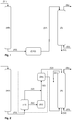
- Fig. 1 illustrates the most basic assembly of the present invention.
- a stream (S1) is fed into the hydrogenation reactor (HR).
- the stream (S1) is converted in the hydrogenation reactor (HR) into the stream (S2) and routed through the evaporation/heating unit (EHU) in order to be converted from the liquid into the gaseous phase.
- the adsorber (A) is regenerated by contact with gaseous stream (S2) coming from the evaporation/heating unit (EHU).
- the stream (S4) is leaving adsorber (A) during regeneration mode but not during operation mode of the adsorber (A).
- the stream (S4) comprises at least the stream (S2) and /or compounds containing oxygen and/or sulphur and/or optionally some residue of organic composition.
- the streams (S3) and (S5) are only present during operation mode.
- the stream (S3) comprises organic composition and compounds containing oxygen and/or sulphur.
- the stream (S5) comprises organic composition and no compounds containing oxygen and/or sulphur or a lower amount of compounds containing oxygen and/or sulphur than stream (S3).
- Stream (S5) is leaving adsorber (A) on the opposite end of adsorber (A), chosen for the introduction of stream (S3) into the adsorber (A).
- stream (S4) usually additionally comprises (compared to stream (S2)) those elements (such as compounds containing oxygen and/or sulphur) which were adsorbed by the adsorber from stream (S3) during its operation mode.
- Fig. 2 demonstrates one possible embodiment for evaporation/heating unit (EHU).
- Liquid stream (S2) is fed into a flash vessel (FV) and routed from there directly and/or indirectly over an evaporator (EV) to a super-heater (SH).
- EV evaporator
- SH super-heater
- S2 can be fed into adsorber (A) opposite or according to the direction of the flow of stream (S3).
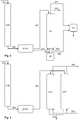
- a buffer vessel connected over stream (S6) with adsorber (A) and a cooling unit (CU) for cooling for example of the streams (S4).
- Stream (S6) can be routed in any direction between at least adsorber (A) and buffer vessel (BV).
- Stream (S6) comprises at least organic composition and/or stream (S2) and/or compounds containing oxygen and/or sulphur.
- Cooling unit (CU) comprises at least one cooler and/or condenser which are serially connected and/or parallel-connected with each other.
- Fig. 4 shows an embodiment of the invention employing at least two adsorbers (A1) and (A2).
- the set-up makes it possible to run one adsorber in operation mode and the other in parallel in regeneration mode.
- stream (S3) is fed only into the adsorber in operation mode and stream (S2) is only fed into the adsorber in regeneration mode. Consequently, stream (S4) is only leaving the adsorber in regeneration mode and stream (S5) is only leaving the adsorber in operation mode.
Landscapes
- Chemical & Material Sciences (AREA)
- Organic Chemistry (AREA)
- Chemical Kinetics & Catalysis (AREA)
- Analytical Chemistry (AREA)
- Oil, Petroleum & Natural Gas (AREA)
- Engineering & Computer Science (AREA)
- General Chemical & Material Sciences (AREA)
- Inorganic Chemistry (AREA)
- Water Supply & Treatment (AREA)
- Separation Of Gases By Adsorption (AREA)
- Organic Low-Molecular-Weight Compounds And Preparation Thereof (AREA)
- Gas Separation By Absorption (AREA)
Claims (13)
- Verfahren zur Regeneration eines Adsorbers, umfassend die folgenden Schritte a) bis c):a) Hydrierung eines mindestens Butan und mindestens Buten umfassenden Stroms (S1) zum Erhalt eines mindestens Butan und eine im Vergleich zur Menge in dem Strom (S1) reduzierte Menge Buten umfassenden flüssigen Stroms (S2),b) Umwandeln des Stroms (S2) von der Flüssigphase in die Gasphase,c) Regenerieren des Adsorbers durch Kontakt mit dem in Schritt b) erhaltenen gasförmigen Strom (S2) undwobei sowohl der Strom (S1) mindestens 96 Gew.-% Butan und nicht mehr als 4 Gew.-% Buten umfasst als auch der Strom (S2) nicht mehr als 1000 Gew.-ppm an Olefin umfasst.
- Verfahren nach Anspruch 1, wobei der Strom (S1) mindestens ein Alkan und mindestens ein Olefin in einer Gesamtmenge von mindestens 99 Gew.-%, vorzugsweise in einer Gesamtmenge von mindestens 99,5 Gew.-%, ganz besonders bevorzugt in einer Gesamtmenge von mindestens 99,9 Gew.-% umfasst.
- Verfahren nach Anspruch 1 oder 2, wobei in Schritt a)i) die Menge an Olefinen in Strom (S1), die mehr als eine olefinische Doppelbindung enthalten, niedriger als 500 ppm, weiter bevorzugt niedriger als 300 ppm, ganz besonders bevorzugt niedriger als 100 ppm, liegt, wobei es sich bei dem Olefin, das mehr als eine olefinische Doppelbindung enthält, vorzugsweise um ein Dien, vorzugsweise Butadien, handelt und/oderii) der Strom (S2) nicht mehr als 500 Gew.-ppm Olefin, vorzugsweise nicht mehr als 100 Gew.-ppm Olefin, umfasst, wobei es sich bei dem Olefin vorzugsweise um Buten handelt, und/oderiii) der Strom (S2) mindestens 99 Gew.-% mindestens eines Alkans, vorzugsweise mindestens 99,5 Gew.-% mindestens eines Alkans, ganz besonders bevorzugt mindestens 99,9 Gew.-% mindestens eines Alkans, umfasst.
- Verfahren nach einem der Ansprüche 1 bis 3, wobei das Adsorptionsmittel auf Aluminiumoxid basiert.
- Verfahren nach einem der Ansprüche 1 bis 4, wobei die Umwandlung in Schritt b) durch eine Druckerniedrigung und/oder das Erhitzen des flüssigen Stroms (S2), vorzugsweise unter Einsatz mindestens eines Verdampfers und/oder mindestens eines Überhitzers und/oder mindestens eines Flashbehälters, durchgeführt wird.
- Verfahren nach einem der Ansprüche 1 bis 5, wobei die Regeneration des Adsorbers in Schritt c) bei einer Temperatur im Bereich von 230 bis 270 °C, vorzugsweise bei 250 °C, und/oder durch das Leiten des gasförmigen Stroms (S2) durch eine den Adsorber enthaltende Vorrichtung durchgeführt wird.
- Verfahren nach einem der Ansprüche 1 bis 6, wobei vor dem Durchführen von Schritt c) ein Ablaufschritt d) zur zumindest teilweisen Entfernung einer organischen Zusammensetzung, die durch den Adsorber geleitet wurde, während dieser sich im Betriebsmodus befand, durchgeführt wird.
- Verfahren nach einem der Ansprüche 1 bis 7, wobei Schritt c) die folgenden Teilschritte c1) bis c5) umfasst:c1) Erhitzen des Adsorbers durch Kontakt mit dem gasförmigen Strom (S2), wobei der gasförmige Strom (S2) innerhalb des Adsorbers kondensiert wird,c2) Erhitzen des Adsorbers durch Kontakt mit dem gasförmigen Strom (S2) auf eine Temperatur im Bereich von 230 bis 270 °C, ohne dass jegliche Kondensation des gasförmigen Stroms (S2) innerhalb des Adsorbers erfolgt,c3) Regeneration des Adsorbers bei einer Temperatur im Bereich von 230 bis 270 °C durch Kontakt mit dem gasförmigen Strom (S2),c4) Kühlen des Adsorbers durch Kontakt mit dem gasförmigen Strom (S2) auf eine Temperatur im Bereich von 80-120 °C undc5) Kühlen des Adsorbers durch Kontakt mit dem in Schritt a) erhaltenen flüssigen Strom (S2) auf eine Temperatur unter 80 °C, vorzugsweise auf eine Temperatur im Bereich von 40 bis 60 °C,wobei Schritt d) vor Schritt c) durchgeführt wird und Schritt c) die Teilschritte c1), gefolgt von c2), gefolgt von c3), gefolgt von c4) und gefolgt von c5) umfasst.
- Verfahren nach Anspruch 8, wobei das in Schritt c1) erhaltene Kondensat den Strom (S2) und den Rest der organischen Zusammensetzung, die während des Durchführens des Ablaufschritts d) nicht vom Adsorber entfernt wurde, enthält und das Kondensat gegebenenfalls in einer Vorrichtung, vorzugsweise in einem Pufferbehälter, gesammelt wird, um das gesammelte Kondensat durch einen sich im Betriebsmodus befindlichen Adsorber zu leiten.
- Verfahren nach den Ansprüchen 8 oder 9, wobei die Strömungsrichtung des gasförmigen Stroms (S2) durch den Adsorber in den Schritten c1), c2) und/oder c3) entgegengesetzt zur Strömungsrichtung jeglicher organischer Zusammensetzung durch den selben sich im Betriebsmodus befindlichen Adsorber verläuft und/oder der gasförmige Strom (S2) in Schritt c4) und/oder der flüssige Strom (S2) in Schritt c5) die selbe Strömungsrichtung durch den Adsorber aufweist bzw. aufweisen wie die Strömungsrichtung jeglicher organischen Zusammensetzung, die durch den selben sich im Betriebsmodus befindlichen Adsorber verläuft.
- Verfahren nach Anspruch 8, wobeii) die Erhitzungsrate des Adsorbers 60 °C/h nicht übersteigt, sie vorzugsweise 40 °C/h nicht übersteigt und/oderii) die Temperatur des gasförmigen Stroms (S2) nicht mehr als 100 °C, vorzugsweise nicht mehr als 60 °C, über der Temperatur des Adsorbers liegt, insbesondere während der Erhitzungsschritte c1) und/oder c2) und/oderiii) die Temperatur des gasförmigen oder gegebenenfalls flüssigen Stroms (S2) nicht mehr als 100 °C, vorzugsweise nicht mehr als 60 °C, unter der Temperatur des Adsorbers liegt, insbesondere während der Kühlschritte c4) und/oder c5) .
- Verfahren nach einem der Ansprüche 1 bis 11, wobeii) der aus dem Adsorber erhaltene Ausfluss, der den gasförmigen Strom (S2) und die aus dem Adsorber entfernten Verunreinigungen umfasst, im Anschluss an Schritt c) kondensiert wird, vorzugsweise unter Einsatz mindestens eines Kondensators und/oder mindestens eines Kühlers und/oderii) der Adsorber nach Beendigung der Regeneration des Adsorbers nach Schritt c) in Betrieb genommen wird, indem ihm eine zu reinigende organische Zusammensetzung zugeführt wird.
- Verfahren nach einem der Ansprüche 1 bis 12, wobei der in Schritt c) zu regenerierende Adsorber Teil einer Anordnung ist, die mindestens einen weiteren Adsorber enthält, wobei der mindestens eine weitere Adsorber vorzugsweise während der Regeneration des ersten Adsorbers betrieben wird und/oder jeder Adsorber innerhalb dieser Anordnung im Hinblick auf das Adsorptionsmittel und auf seinen Betriebsmodus identisch ist.
Applications Claiming Priority (1)
| Application Number | Priority Date | Filing Date | Title |
|---|---|---|---|
| PCT/CN2014/088232 WO2016054789A1 (en) | 2014-10-09 | 2014-10-09 | Process for adsorber regeneration |
Publications (3)
| Publication Number | Publication Date |
|---|---|
| EP3204468A1 EP3204468A1 (de) | 2017-08-16 |
| EP3204468A4 EP3204468A4 (de) | 2018-06-20 |
| EP3204468B1 true EP3204468B1 (de) | 2020-07-29 |
Family
ID=55652478
Family Applications (1)
| Application Number | Title | Priority Date | Filing Date |
|---|---|---|---|
| EP14903558.6A Active EP3204468B1 (de) | 2014-10-09 | 2014-10-09 | Verfahren zur adsorberregenerierung |
Country Status (8)
| Country | Link |
|---|---|
| US (1) | US10940427B2 (de) |
| EP (1) | EP3204468B1 (de) |
| KR (1) | KR102368270B1 (de) |
| CN (1) | CN106795440B (de) |
| EA (1) | EA033601B1 (de) |
| ES (1) | ES2826406T3 (de) |
| SG (1) | SG11201702270SA (de) |
| WO (1) | WO2016054789A1 (de) |
Families Citing this family (5)
| Publication number | Priority date | Publication date | Assignee | Title |
|---|---|---|---|---|
| KR102332470B1 (ko) | 2014-10-09 | 2021-11-30 | 바스프 에스이 | 올리고머화된 올레핀의 제조 방법 |
| MY182513A (en) | 2014-10-09 | 2021-01-25 | Basf Se | Process for purification of an organic composition |
| CN111263744B (zh) * | 2017-10-25 | 2023-05-05 | 巴斯夫欧洲公司 | 通过选择性氢化从包含c3至c5烃的材料料流中除去二烯的方法 |
| EP3792337B1 (de) * | 2019-05-14 | 2024-02-07 | Evonik Oxeno GmbH & Co. KG | Verfahren zur reinigung eines kohlenwasserstoffstroms mit restbuten |
| CN111943797A (zh) * | 2019-05-14 | 2020-11-17 | 赢创运营有限公司 | 纯化烃物流的方法 |
Family Cites Families (25)
| Publication number | Priority date | Publication date | Assignee | Title |
|---|---|---|---|---|
| US3208157A (en) * | 1961-09-20 | 1965-09-28 | Phillips Petroleum Co | Regeneration of adsorbents |
| ES2008082B3 (es) * | 1985-12-16 | 1989-07-16 | Union Carbide Corp | Proceso para la retirada del eter dimetilico que se encuentra a modo de impureza en los productos de alimentacion de c3-c5 olefinicos liquidos. |
| US4952746A (en) | 1986-11-14 | 1990-08-28 | Uop | Process for the removal of hydrogenatable hydrocarbonaceous compounds from a hydrocarbonaceous stream and hydrogenating these compounds |
| US4814517A (en) * | 1988-06-09 | 1989-03-21 | Uop | Oxygenate removal in MTBE production |
| US5171923A (en) * | 1988-08-31 | 1992-12-15 | Exxon Chemical Patents Inc. | Recycle for process for purification of linear paraffins |
| US4935400A (en) | 1988-10-12 | 1990-06-19 | Amoco Corporation | Reduction of hydrocarbon losses in a molecular sieve hydrocarbon treating system |
| US4935399A (en) | 1988-10-12 | 1990-06-19 | Amoco Corporation | Reduction of hydrocarbon losses in a molecular sieve hydrocarbon treating system |
| US5177298A (en) | 1991-06-18 | 1993-01-05 | Uop | Liquid phase adsorption process |
| US5365011A (en) * | 1992-05-29 | 1994-11-15 | The Boc Group, Inc. | Method of producing unsaturated hydrocarbons and separating the same from saturated hydrocarbons |
| DE19845857A1 (de) | 1998-10-05 | 2000-04-06 | Basf Ag | Verfahren zur katalytischen Oligomerisierung von Monoolefinen |
| GB0010433D0 (en) | 2000-04-28 | 2000-06-14 | Exxon Chemical Patents Inc | Alkene oligomerization process |
| US6632766B2 (en) * | 2000-12-08 | 2003-10-14 | Uop Llc | Composite adsorbents for purifying hydrocarbon streams |
| US6673239B2 (en) | 2000-12-21 | 2004-01-06 | Conocophillips Company | Hydrocarbon purificatin system regeneration |
| FR2852019B1 (fr) | 2003-03-07 | 2007-04-27 | Inst Francais Du Petrole | Procede de desulfuration, de deazotation et/ou de desaromatisation d'une charge hydrocarbonee par adsorption par un solide adsorbant use |
| WO2005056503A1 (en) | 2003-12-12 | 2005-06-23 | University Of Waterloo | Composite catalyst for the selective oligomerization of lower alkenes and the production of high octane products |
| US7452459B2 (en) * | 2004-03-30 | 2008-11-18 | Uop Llc | Process for the removal of sulfur-oxidated compounds from a hydrocarbonaceous stream |
| DE102005009665A1 (de) | 2005-02-28 | 2006-08-31 | Basf Ag | Verfahren zur Herstellung von Propen aus 2-Buten- und Isobuten-reichen Feedströmen |
| DE102008007081B4 (de) | 2008-01-31 | 2018-12-06 | Evonik Degussa Gmbh | Verfahren zur Herstellung von n-Buten-Oligomeren und 1-Buten aus technischen Mischungen I von C4-Kohlenwasserstoffen |
| CN102170953B (zh) | 2008-09-01 | 2015-02-04 | 巴斯夫欧洲公司 | 吸附剂材料和含烃气体脱硫的方法 |
| WO2010057905A1 (de) | 2008-11-19 | 2010-05-27 | Basf Se | Oligomerisierung von olefinen |
| CN102421804B (zh) | 2009-04-24 | 2014-10-15 | 尤尼威蒂恩技术有限公司 | 在开路循环中用喷气压缩机使净化床再生 |
| DE102009027406A1 (de) * | 2009-07-01 | 2011-01-05 | Evonik Oxeno Gmbh | Verfahren zur Herstellung von geruchsarmen n-Butan |
| US8193111B2 (en) | 2009-07-24 | 2012-06-05 | Uop Llc | Process or system for desorbing an adsorbent bed |
| CN103254932B (zh) * | 2013-05-22 | 2015-12-23 | 南京工业大学 | 提取轻石脑油中c4~c6正构烷烃联产异戊烷和异构己烷工艺 |
| SG11201702276YA (en) * | 2014-10-09 | 2017-04-27 | Basf Se | Heat exchange process for adsorber regeneration |
-
2014
- 2014-10-09 EP EP14903558.6A patent/EP3204468B1/de active Active
- 2014-10-09 ES ES14903558T patent/ES2826406T3/es active Active
- 2014-10-09 EA EA201790705A patent/EA033601B1/ru not_active IP Right Cessation
- 2014-10-09 SG SG11201702270SA patent/SG11201702270SA/en unknown
- 2014-10-09 CN CN201480082539.4A patent/CN106795440B/zh active Active
- 2014-10-09 WO PCT/CN2014/088232 patent/WO2016054789A1/en not_active Ceased
- 2014-10-09 KR KR1020177012010A patent/KR102368270B1/ko active Active
- 2014-10-09 US US15/517,848 patent/US10940427B2/en active Active
Non-Patent Citations (1)
| Title |
|---|
| None * |
Also Published As
| Publication number | Publication date |
|---|---|
| KR20170067812A (ko) | 2017-06-16 |
| US10940427B2 (en) | 2021-03-09 |
| US20170246585A1 (en) | 2017-08-31 |
| EA201790705A1 (ru) | 2017-09-29 |
| KR102368270B1 (ko) | 2022-02-28 |
| EP3204468A4 (de) | 2018-06-20 |
| WO2016054789A1 (en) | 2016-04-14 |
| ES2826406T3 (es) | 2021-05-18 |
| CN106795440B (zh) | 2019-04-05 |
| EA033601B1 (ru) | 2019-11-08 |
| SG11201702270SA (en) | 2017-04-27 |
| EP3204468A1 (de) | 2017-08-16 |
| CN106795440A (zh) | 2017-05-31 |
Similar Documents
| Publication | Publication Date | Title |
|---|---|---|
| EP3204468B1 (de) | Verfahren zur adsorberregenerierung | |
| US10807018B2 (en) | Process for purification of an organic composition | |
| EP3204344B1 (de) | Recyclingverfahren zur adsorberregenerierung mit einem hydrierten butanstrom | |
| US9943828B2 (en) | Heat exchange process for adsorber regeneration | |
| EP3204470B1 (de) | Verfahren zur regenerierung eines zur adsorption von sauerstoff und/oder schwefel enthaltenden organischen zusammensetungen verwendeten adsorbers |
Legal Events
| Date | Code | Title | Description |
|---|---|---|---|
| STAA | Information on the status of an ep patent application or granted ep patent |
Free format text: STATUS: THE INTERNATIONAL PUBLICATION HAS BEEN MADE |
|
| PUAI | Public reference made under article 153(3) epc to a published international application that has entered the european phase |
Free format text: ORIGINAL CODE: 0009012 |
|
| STAA | Information on the status of an ep patent application or granted ep patent |
Free format text: STATUS: REQUEST FOR EXAMINATION WAS MADE |
|
| 17P | Request for examination filed |
Effective date: 20170509 |
|
| AK | Designated contracting states |
Kind code of ref document: A1 Designated state(s): AL AT BE BG CH CY CZ DE DK EE ES FI FR GB GR HR HU IE IS IT LI LT LU LV MC MK MT NL NO PL PT RO RS SE SI SK SM TR |
|
| AX | Request for extension of the european patent |
Extension state: BA ME |
|
| DAX | Request for extension of the european patent (deleted) | ||
| A4 | Supplementary search report drawn up and despatched |
Effective date: 20180522 |
|
| RIC1 | Information provided on ipc code assigned before grant |
Ipc: C10G 25/12 20060101AFI20180515BHEP Ipc: C10G 67/06 20060101ALI20180515BHEP Ipc: B01D 53/04 20060101ALI20180515BHEP Ipc: B01J 20/34 20060101ALI20180515BHEP |
|
| STAA | Information on the status of an ep patent application or granted ep patent |
Free format text: STATUS: EXAMINATION IS IN PROGRESS |
|
| 17Q | First examination report despatched |
Effective date: 20191104 |
|
| REG | Reference to a national code |
Ref country code: DE Ref legal event code: R079 Ref document number: 602014068441 Country of ref document: DE Free format text: PREVIOUS MAIN CLASS: C10G0025000000 Ipc: C10G0067060000 |
|
| GRAP | Despatch of communication of intention to grant a patent |
Free format text: ORIGINAL CODE: EPIDOSNIGR1 |
|
| STAA | Information on the status of an ep patent application or granted ep patent |
Free format text: STATUS: GRANT OF PATENT IS INTENDED |
|
| RIC1 | Information provided on ipc code assigned before grant |
Ipc: C10G 67/06 20060101AFI20200228BHEP Ipc: B01D 53/04 20060101ALI20200228BHEP Ipc: B01J 20/08 20060101ALI20200228BHEP Ipc: B01J 20/34 20060101ALI20200228BHEP Ipc: C10G 25/12 20060101ALI20200228BHEP |
|
| INTG | Intention to grant announced |
Effective date: 20200403 |
|
| GRAS | Grant fee paid |
Free format text: ORIGINAL CODE: EPIDOSNIGR3 |
|
| GRAA | (expected) grant |
Free format text: ORIGINAL CODE: 0009210 |
|
| STAA | Information on the status of an ep patent application or granted ep patent |
Free format text: STATUS: THE PATENT HAS BEEN GRANTED |
|
| AK | Designated contracting states |
Kind code of ref document: B1 Designated state(s): AL AT BE BG CH CY CZ DE DK EE ES FI FR GB GR HR HU IE IS IT LI LT LU LV MC MK MT NL NO PL PT RO RS SE SI SK SM TR |
|
| REG | Reference to a national code |
Ref country code: CH Ref legal event code: EP |
|
| REG | Reference to a national code |
Ref country code: AT Ref legal event code: REF Ref document number: 1295796 Country of ref document: AT Kind code of ref document: T Effective date: 20200815 |
|
| REG | Reference to a national code |
Ref country code: IE Ref legal event code: FG4D |
|
| REG | Reference to a national code |
Ref country code: DE Ref legal event code: R096 Ref document number: 602014068441 Country of ref document: DE |
|
| REG | Reference to a national code |
Ref country code: NL Ref legal event code: FP |
|
| REG | Reference to a national code |
Ref country code: SE Ref legal event code: TRGR |
|
| REG | Reference to a national code |
Ref country code: LT Ref legal event code: MG4D |
|
| REG | Reference to a national code |
Ref country code: AT Ref legal event code: MK05 Ref document number: 1295796 Country of ref document: AT Kind code of ref document: T Effective date: 20200729 |
|
| PG25 | Lapsed in a contracting state [announced via postgrant information from national office to epo] |
Ref country code: FI Free format text: LAPSE BECAUSE OF FAILURE TO SUBMIT A TRANSLATION OF THE DESCRIPTION OR TO PAY THE FEE WITHIN THE PRESCRIBED TIME-LIMIT Effective date: 20200729 Ref country code: GR Free format text: LAPSE BECAUSE OF FAILURE TO SUBMIT A TRANSLATION OF THE DESCRIPTION OR TO PAY THE FEE WITHIN THE PRESCRIBED TIME-LIMIT Effective date: 20201030 Ref country code: HR Free format text: LAPSE BECAUSE OF FAILURE TO SUBMIT A TRANSLATION OF THE DESCRIPTION OR TO PAY THE FEE WITHIN THE PRESCRIBED TIME-LIMIT Effective date: 20200729 Ref country code: PT Free format text: LAPSE BECAUSE OF FAILURE TO SUBMIT A TRANSLATION OF THE DESCRIPTION OR TO PAY THE FEE WITHIN THE PRESCRIBED TIME-LIMIT Effective date: 20201130 Ref country code: NO Free format text: LAPSE BECAUSE OF FAILURE TO SUBMIT A TRANSLATION OF THE DESCRIPTION OR TO PAY THE FEE WITHIN THE PRESCRIBED TIME-LIMIT Effective date: 20201029 Ref country code: LT Free format text: LAPSE BECAUSE OF FAILURE TO SUBMIT A TRANSLATION OF THE DESCRIPTION OR TO PAY THE FEE WITHIN THE PRESCRIBED TIME-LIMIT Effective date: 20200729 Ref country code: AT Free format text: LAPSE BECAUSE OF FAILURE TO SUBMIT A TRANSLATION OF THE DESCRIPTION OR TO PAY THE FEE WITHIN THE PRESCRIBED TIME-LIMIT Effective date: 20200729 Ref country code: BG Free format text: LAPSE BECAUSE OF FAILURE TO SUBMIT A TRANSLATION OF THE DESCRIPTION OR TO PAY THE FEE WITHIN THE PRESCRIBED TIME-LIMIT Effective date: 20201029 |
|
| PG25 | Lapsed in a contracting state [announced via postgrant information from national office to epo] |
Ref country code: PL Free format text: LAPSE BECAUSE OF FAILURE TO SUBMIT A TRANSLATION OF THE DESCRIPTION OR TO PAY THE FEE WITHIN THE PRESCRIBED TIME-LIMIT Effective date: 20200729 Ref country code: LV Free format text: LAPSE BECAUSE OF FAILURE TO SUBMIT A TRANSLATION OF THE DESCRIPTION OR TO PAY THE FEE WITHIN THE PRESCRIBED TIME-LIMIT Effective date: 20200729 Ref country code: RS Free format text: LAPSE BECAUSE OF FAILURE TO SUBMIT A TRANSLATION OF THE DESCRIPTION OR TO PAY THE FEE WITHIN THE PRESCRIBED TIME-LIMIT Effective date: 20200729 Ref country code: IS Free format text: LAPSE BECAUSE OF FAILURE TO SUBMIT A TRANSLATION OF THE DESCRIPTION OR TO PAY THE FEE WITHIN THE PRESCRIBED TIME-LIMIT Effective date: 20201129 |
|
| PG25 | Lapsed in a contracting state [announced via postgrant information from national office to epo] |
Ref country code: EE Free format text: LAPSE BECAUSE OF FAILURE TO SUBMIT A TRANSLATION OF THE DESCRIPTION OR TO PAY THE FEE WITHIN THE PRESCRIBED TIME-LIMIT Effective date: 20200729 Ref country code: SM Free format text: LAPSE BECAUSE OF FAILURE TO SUBMIT A TRANSLATION OF THE DESCRIPTION OR TO PAY THE FEE WITHIN THE PRESCRIBED TIME-LIMIT Effective date: 20200729 Ref country code: RO Free format text: LAPSE BECAUSE OF FAILURE TO SUBMIT A TRANSLATION OF THE DESCRIPTION OR TO PAY THE FEE WITHIN THE PRESCRIBED TIME-LIMIT Effective date: 20200729 Ref country code: DK Free format text: LAPSE BECAUSE OF FAILURE TO SUBMIT A TRANSLATION OF THE DESCRIPTION OR TO PAY THE FEE WITHIN THE PRESCRIBED TIME-LIMIT Effective date: 20200729 Ref country code: CZ Free format text: LAPSE BECAUSE OF FAILURE TO SUBMIT A TRANSLATION OF THE DESCRIPTION OR TO PAY THE FEE WITHIN THE PRESCRIBED TIME-LIMIT Effective date: 20200729 |
|
| REG | Reference to a national code |
Ref country code: DE Ref legal event code: R097 Ref document number: 602014068441 Country of ref document: DE |
|
| REG | Reference to a national code |
Ref country code: ES Ref legal event code: FG2A Ref document number: 2826406 Country of ref document: ES Kind code of ref document: T3 Effective date: 20210518 |
|
| PG25 | Lapsed in a contracting state [announced via postgrant information from national office to epo] |
Ref country code: AL Free format text: LAPSE BECAUSE OF FAILURE TO SUBMIT A TRANSLATION OF THE DESCRIPTION OR TO PAY THE FEE WITHIN THE PRESCRIBED TIME-LIMIT Effective date: 20200729 |
|
| REG | Reference to a national code |
Ref country code: CH Ref legal event code: PL |
|
| PLBE | No opposition filed within time limit |
Free format text: ORIGINAL CODE: 0009261 |
|
| STAA | Information on the status of an ep patent application or granted ep patent |
Free format text: STATUS: NO OPPOSITION FILED WITHIN TIME LIMIT |
|
| PG25 | Lapsed in a contracting state [announced via postgrant information from national office to epo] |
Ref country code: MC Free format text: LAPSE BECAUSE OF FAILURE TO SUBMIT A TRANSLATION OF THE DESCRIPTION OR TO PAY THE FEE WITHIN THE PRESCRIBED TIME-LIMIT Effective date: 20200729 Ref country code: LU Free format text: LAPSE BECAUSE OF NON-PAYMENT OF DUE FEES Effective date: 20201009 Ref country code: SK Free format text: LAPSE BECAUSE OF FAILURE TO SUBMIT A TRANSLATION OF THE DESCRIPTION OR TO PAY THE FEE WITHIN THE PRESCRIBED TIME-LIMIT Effective date: 20200729 |
|
| 26N | No opposition filed |
Effective date: 20210430 |
|
| PG25 | Lapsed in a contracting state [announced via postgrant information from national office to epo] |
Ref country code: SI Free format text: LAPSE BECAUSE OF FAILURE TO SUBMIT A TRANSLATION OF THE DESCRIPTION OR TO PAY THE FEE WITHIN THE PRESCRIBED TIME-LIMIT Effective date: 20200729 Ref country code: LI Free format text: LAPSE BECAUSE OF NON-PAYMENT OF DUE FEES Effective date: 20201031 Ref country code: CH Free format text: LAPSE BECAUSE OF NON-PAYMENT OF DUE FEES Effective date: 20201031 |
|
| PG25 | Lapsed in a contracting state [announced via postgrant information from national office to epo] |
Ref country code: IE Free format text: LAPSE BECAUSE OF NON-PAYMENT OF DUE FEES Effective date: 20201009 |
|
| PG25 | Lapsed in a contracting state [announced via postgrant information from national office to epo] |
Ref country code: TR Free format text: LAPSE BECAUSE OF FAILURE TO SUBMIT A TRANSLATION OF THE DESCRIPTION OR TO PAY THE FEE WITHIN THE PRESCRIBED TIME-LIMIT Effective date: 20200729 Ref country code: MT Free format text: LAPSE BECAUSE OF FAILURE TO SUBMIT A TRANSLATION OF THE DESCRIPTION OR TO PAY THE FEE WITHIN THE PRESCRIBED TIME-LIMIT Effective date: 20200729 Ref country code: CY Free format text: LAPSE BECAUSE OF FAILURE TO SUBMIT A TRANSLATION OF THE DESCRIPTION OR TO PAY THE FEE WITHIN THE PRESCRIBED TIME-LIMIT Effective date: 20200729 |
|
| PG25 | Lapsed in a contracting state [announced via postgrant information from national office to epo] |
Ref country code: MK Free format text: LAPSE BECAUSE OF FAILURE TO SUBMIT A TRANSLATION OF THE DESCRIPTION OR TO PAY THE FEE WITHIN THE PRESCRIBED TIME-LIMIT Effective date: 20200729 |
|
| PGFP | Annual fee paid to national office [announced via postgrant information from national office to epo] |
Ref country code: NL Payment date: 20251024 Year of fee payment: 12 |
|
| PGFP | Annual fee paid to national office [announced via postgrant information from national office to epo] |
Ref country code: DE Payment date: 20251028 Year of fee payment: 12 |
|
| PGFP | Annual fee paid to national office [announced via postgrant information from national office to epo] |
Ref country code: GB Payment date: 20251023 Year of fee payment: 12 |
|
| PGFP | Annual fee paid to national office [announced via postgrant information from national office to epo] |
Ref country code: IT Payment date: 20251022 Year of fee payment: 12 |
|
| PGFP | Annual fee paid to national office [announced via postgrant information from national office to epo] |
Ref country code: FR Payment date: 20251027 Year of fee payment: 12 |
|
| PGFP | Annual fee paid to national office [announced via postgrant information from national office to epo] |
Ref country code: BE Payment date: 20251024 Year of fee payment: 12 |
|
| PGFP | Annual fee paid to national office [announced via postgrant information from national office to epo] |
Ref country code: SE Payment date: 20251024 Year of fee payment: 12 |
|
| PGFP | Annual fee paid to national office [announced via postgrant information from national office to epo] |
Ref country code: ES Payment date: 20251118 Year of fee payment: 12 |