EP3205221A1 - Orthosis - Google Patents
Orthosis Download PDFInfo
- Publication number
- EP3205221A1 EP3205221A1 EP17160741.9A EP17160741A EP3205221A1 EP 3205221 A1 EP3205221 A1 EP 3205221A1 EP 17160741 A EP17160741 A EP 17160741A EP 3205221 A1 EP3205221 A1 EP 3205221A1
- Authority
- EP
- European Patent Office
- Prior art keywords
- fibers
- support element
- orthosis according
- orthosis
- leg
- Prior art date
- Legal status (The legal status is an assumption and is not a legal conclusion. Google has not performed a legal analysis and makes no representation as to the accuracy of the status listed.)
- Granted
Links
Images
Classifications
-
- A—HUMAN NECESSITIES
- A61—MEDICAL OR VETERINARY SCIENCE; HYGIENE
- A61F—FILTERS IMPLANTABLE INTO BLOOD VESSELS; PROSTHESES; DEVICES PROVIDING PATENCY TO, OR PREVENTING COLLAPSING OF, TUBULAR STRUCTURES OF THE BODY, e.g. STENTS; ORTHOPAEDIC, NURSING OR CONTRACEPTIVE DEVICES; FOMENTATION; TREATMENT OR PROTECTION OF EYES OR EARS; BANDAGES, DRESSINGS OR ABSORBENT PADS; FIRST-AID KITS
- A61F5/00—Orthopaedic methods or devices for non-surgical treatment of bones or joints; Nursing devices ; Anti-rape devices
- A61F5/01—Orthopaedic devices, e.g. long-term immobilising or pressure directing devices for treating broken or deformed bones such as splints, casts or braces
- A61F5/0193—Apparatus specially adapted for treating hip dislocation; Abduction splints
-
- A—HUMAN NECESSITIES
- A41—WEARING APPAREL
- A41D—OUTERWEAR; PROTECTIVE GARMENTS; ACCESSORIES
- A41D13/00—Professional, industrial or sporting protective garments, e.g. surgeons' gowns or garments protecting against blows or punches
- A41D13/12—Surgeons' or patients' gowns or dresses
- A41D13/1236—Patients' garments
- A41D13/1254—Patients' garments for the lower part of the body
Definitions
- the invention relates to an orthopedic prosthesis, short orthosis, especially for people with spastic cerebral palsy, with at least one positionable in the leg area support member for supporting, in particular spreading a leg or both legs, and at least one holding device for holding the at least one support element, which in such a way Supporting element is coupled, which can be held when supporting the orthosis, the support member substantially in a desired position.
- Such an orthosis is for example from the US 4,607,629 A known.
- the sensorimotor system in humans is composed of a closed loop between the pyramidal system, which includes the brain regions (cerebrum) for motion control, and the extrapyramidal motor system, which is understood by the nerve tracts to transmit motion impulses.
- the extrapyramidal motor system receives a motion signal from the pyramidal system, whereupon the movement is carried out and subsequently a feedback to the pyramidal system, so that a closed loop is created.
- People affected by spastic cerebral palsy usually have damage in both parts of the sensorimotor control loop, which temporarily suspends motion control.
- the symptoms are characterized by high muscle tensions (muscle hypertension) or constant changes of strong and weak muscle tensions (hypotonia), which are compensated by pathological postures.
- high muscle tensions muscle hypertension
- constant changes of strong and weak muscle tensions hyperotonia
- pathological postures One of them is the misalignment of the legs when standing or walking, which is characterized by heavily bent inwards legs.
- the US 5,123,407 A discloses a pair of shorts having pockets on the thigh insides into which wedge-shaped pads are insertable as spacers.
- a leg-fix cushion is known that attaches to one leg and provides a padded liner between the legs. For this, the other leg is fixed relative to the first leg.
- the US 5,895,366 A describes a device in which a unitary cushion can be fastened as a bridge element between the two legs. It is a fixed with Velcro fluid pad, which can be inflated as needed.
- a hip protector is known that can be used in an underwear garment and protects the outside of the respective hip joint.
- the object of the invention is therefore to provide an orthosis, in particular for people with spastic cerebral palsy and an X-leg deformity, which restricts the freedom of movement of the user little and is suitable for everyday use.
- the object is achieved by an orthosis according to claim 1, which is characterized in that the holding device includes at least one adjustable strap wherein at least one end is coupled to the support element, and in that the holding device has a strap around the abdominal area and each Supporting element is held by means of at least one further tether.
- the object is further achieved by an orthosis according to claim 2, which is characterized in that the holding device is a combination of straps and pants with pockets for receiving a support member.
- the inventive orthosis is achieved in a particularly simple manner that the legs of the user when walking and standing approximately assume the normal position. Just by positioning a support element between the legs, the buckling of the legs inwards is successfully prevented by the legs are supported or spread. By improving the leg position a better foot support, ankle and hip position is achieved at the same time, so that contractures of the user are corrected and prophylactically counteracted.
- the support element remains even when walking or similar movements in a desired target position, which is located depending on the user, especially in the area between the knee and lower hip lug.
- the user can thus perform his physical activities without having to readjust the orthosis again and again.
- the support function is ensured by the orthosis with the result that the freedom of movement and comfort of the user is little limited by the orthosis.
- the orthosis is so compact that it can be worn under everyday garments without being noticeable from the outside significantly.
- the support function and the correction of the misalignment of the legs is achieved particularly effective in that the orthosis according to the invention is equipped with two support elements, each associated with a leg and arranged by means of the holding device when worn on the inside of the respective leg.
- the thickness of the support elements can be reduced by about half compared to an orthosis with only one support element without loss of spreading force.
- the spreading force results as a reaction force from the pressure when adjoining two support elements on the inside of the legs.
- the support element is shaped so that the support element rests exactly on the inner leg area, achieved a particularly pleasant haptic impression in the user. Furthermore, this property also achieves the advantage of increased Carrying comfort, by minimizing possible friction between the inner leg portion and the support element.
- the outside of the support element is shaped so that it is adapted to the extent of misalignment of the legs achieved in a very precise manner that the outward spreading force are adapted to the needs of the user.
- the profile of the outside can be varied in two axes. On the one hand results from the profile of the outside along the circumference, the size of the spreading force on the legs according to their relative position when walking.
- the profile of the outside in the vertical direction, d. H. running from the hip to the knee, defines the spreading force according to the expression of the leg anatomy of the user. The spreading force is thus tailored to the everyday application situation and anatomical conditions of the user.
- the support elements of which are stiffer at the ends than the central regions, a longer lifetime of the support element is achieved in a particularly reliable manner.
- the orthosis according to the invention with a holding device which contains at least one adjustable strap, wherein at least one end is coupled to the support element, increases in a particularly simple manner the individual adaptability of the orthosis depending on the needs of the user in everyday life and its anatomical conditions. In the same way, a reliable compliance with the desired target position is achieved.
- a particularly preferred embodiment of the orthosis according to the invention consists in that the holding device has a carrying strap which can be laid around the abdominal region and each supporting element is held by means of at least one further holding strap.
- This embodiment achieves a particularly prominent, stable and reliable abutment of the support elements on the inner region of the legs in the desired desired position.
- the carrying strap and / or the tether has a hook-and-loop fastener with which the length can be varied. This allows the user in a particularly simple manner that he can adjust the holding device at any time with simple steps to his needs.
- the holding device has a pair of trousers, to which at least one support element is attached
- the user is offered a particularly high level of practicality, since the trousers are usually pulled in and out without the help of third parties can be.
- the application of the orthosis is thus also for people with physical limitations as an executable task.
- the pants has a pocket, in which a support element can be inserted.
- the trousers with a pocket achieve the particularly good protection of the support element from dirt and sweat in the application and a good positioning of the support element.
- the pants are designed in the manner of a short cycling pants, wherein the pockets are formed in the inner region.
- this embodiment offers the user a higher acceptance in his social environment.
- the trousers conceal the support elements, so that they are not visible from the outside and are not recognizable as an orthosis at first sight.
- the user also has the possibility of being able to wear the orthosis, for example, in private rooms without another garment or under such.
- the holding device is a combination of straps and pants with pockets for receiving a support element.
- the provision of a support member in a pocket of the pants and additional straps coupled to the support member allow for a particularly reliable posture of the support members at their desired set position and a firm abutment against the legs of the user.
- the orthosis according to the invention with a support element made of a foam offers the user by its damping properties a particularly high wearing comfort while fulfilling the support function.
- a particularly preferred embodiment of the orthosis according to the invention is that the foam is selected from the group consisting of the materials according to claim 16, which can be produced in a particularly simple manner, a foam which in its elasticity, hardness and longevity of individual needs of the user.
- An orthosis according to the invention in which the pants are selected from a group of textile fibers according to claim 17 has the particularly advantageous properties of being elastic, skin-friendly and breathable.
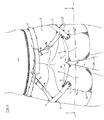
- FIG. 1 shows an orthosis with two positioned in the leg area support members 1, 2 for supporting in particular spreading of the legs and a holding device 4 for holding the support members 1, 2, so that when wearing the orthosis, the support elements 1, 2 can be maintained substantially in a desired position.
- the orthosis may also be formed with only one support element (not shown).
- Each support member 1, 2 is each assigned a leg and arranged on the inside of the respective leg so that an outward spreading force is exerted on the legs.
- the support elements 1, 2 are so curved shaped that they embrace a region on the inner thigh of a leg and in the central region 1a, 2a have a greater thickness than at the edge regions 1 b, 2b.
- the support elements 1, 2 are stiffer than the central regions 1 a, 2 a, whereby the coupling 6 c, 7 c, 8 c, 9 c between the tethers 6, 7, 8, 9 and support elements 1, 2 is stabilized.
- the holding device 4 is a combination of a plurality of straps 5, 6, 7, 8, 9 and a pants 3 with formed inside pockets 10, 11.
- the straps 5, 6, 7, 8, 9 include a order the abdominal area can be laid shoulder strap 5, to which more tethers 6, 7, 8, 9 are sewn.
- the straps 6, 7, 8, 9 are coupled at one end to the support elements 1, 2.
- the straps 6c, 7c, 8c, 9c and ensure, when wearing the orthosis, that the support elements 1, 2 are held substantially in a desired position.
- the straps 5, 6, 7, 8, 9 have a hook and loop fastener 5b, 6b, 7b, 8b, 9b, with which the length is adjustable. This allows easy adaptability to a user and also to vary the tensile force exerted on the support elements.
- the pants 3 at the couplings 6c, 7c, 8c, 9c holes 3b which are provided with a circumferential seam.
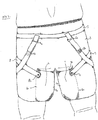
- FIG. 2 shows the further course of the support elements 1, 2 and straps 5, 6, 7, 8, 9 on the back of the pants.
- Two straps 6, 7 each; 8, 9 are crossed from the front of the support belt 5 back to the support element 1, 2 or from the back of the support belt 5 forward to the support element 1, 2. If the straps on the Velcro fasteners 6b, 7b, 8b, 9b shortened and thereby stretched, experience the support elements at both edge regions 1 b, 2b a tensile force diagonally upwards, so that they are pressed more strongly against the inner legs and are even better protected against slipping.
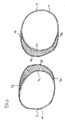
- FIG. 3 shows a cross section of the leg portion of the orthosis with the pants 3 and formed in the interior of pockets 10, 11.
- the pants 3 is designed in the manner of a short cycling pants and has sewn pockets inside the interior 10, 11, in which the support elements 1, 2 inserted become.
- the pockets 10, 11 and pants 3 are tight and elastic on the support elements 1, 2 and contribute to the further attachment and positioning of the support elements 1, 2 in a desired position.
- the inner sides 1 c, 2 c of the support elements 1, 2 are shaped so that the support elements 1, 2 fit as accurately as possible on the inner leg portion.
- the outer sides 1 d, 2 d of the support members 1, 2 meanwhile have a shape that is adapted to the extent of malalignment of the legs.
- the angle ⁇ between the legs is different.
- the spreading force on the user's legs increases, the smaller the angle ⁇ between the support elements 1, 2 and the outer sides 1 d, 2 d of the support elements are pressed against each other. Due to the exact shape and thickness of the support elements 1, 2, an adaptation to a user and individual adjustment of a spreading force can be made.
- An orthosis in particular for people with spastic cerebral palsy, can have at least one support element that can be positioned in the leg region for supporting, in particular, struting of my leg or both legs and at least one holding device for holding the at least one support element, which is coupled to the support element in such a way that when carrying the Orthosis that at least one support element can be held substantially in a desired position.
- the orthosis according to the preceding paragraph is preferably characterized in that two support elements are provided, which are each associated with a leg and are arranged by the holding means when worn on the inside of the respective leg so that exerted an outward spreading force on the legs becomes.
- the orthosis according to the preceding paragraph is preferably characterized in that a support element is curved so that it partially surrounds a region on the inner thigh of a leg.
- An orthosis according to one of the three preceding paragraphs is preferably characterized in that the support member in a central region has a greater thickness than in an edge region.
- the orthosis according to at least one of the above paragraphs is preferably characterized in that an inner side of the support element is shaped so that the support element fits snugly against the réelleschenkelbreich.
- the orthosis according to at least one of the above paragraphs is preferably characterized in that an outer side of the support element is shaped so that it is adapted to the extent of the misalignment of the legs.
- the orthosis according to one of the preceding paragraphs is preferably characterized in that the edge regions of the support element are stiffer than the central regions.
- the holding device includes at least one adjustable strap, wherein at least one end is coupled to the support member 1, 2.
- the orthosis according to the preceding paragraph is preferably characterized in that the holding device has a carrying strap which can be placed around the abdominal region and each supporting element is held by means of at least one further holding strap.
- the orthosis according to one of the two preceding paragraphs is preferably characterized in that the carrying strap has a hook-and-loop fastener with which the length can be varied.
- the orthosis according to at least one of the above paragraphs is preferably characterized in that the holding device comprises a pair of pants, on which at least one support element can be fastened.
- the orthosis according to the preceding paragraph is preferably characterized in that the pants have a pocket, in which a support element can be inserted.
- the orthosis according to one of the two preceding paragraphs is preferably characterized in that the pants are designed in the manner of a short pair of cycling shorts, wherein the pockets are formed in the inner region.
- the orthosis according to one of the preceding paragraphs is preferably characterized in that the holding device is a combination of straps and pants with pockets for receiving a support element.
- the orthosis according to at least one of the above paragraphs is preferably characterized in that a support element is formed from a foam.
- the orthosis according to the preceding paragraph is preferably characterized in that the foam is selected from the group consisting of the materials formaldehyde resins, polyisocyanurates, polystyrene, polyurethanes, polyvinyl chloride, ethylene vinyl acetate and mixtures thereof.
- the pants are selected from the group consisting of the textile fibers cotton, cupro, lyocell, modal fibers, viscose fibers, acetate fibers, triacetate fibers, alginate fibers, polyacrylic fibers, aramid fibers, polychloride fibers, spandex, elastomers , Fluorofibers, modacrylic fibers, polyamide fibers, polyester fibers, polyethylene fibers, polyimide fibers, polypropylene fibers, polyester fibers, polyethylene fibers, polyimide fibers, polypropylene fibers, vinyl fibers, and mixtures thereof.
Landscapes
- Health & Medical Sciences (AREA)
- Engineering & Computer Science (AREA)
- General Health & Medical Sciences (AREA)
- Orthopedic Medicine & Surgery (AREA)
- Textile Engineering (AREA)
- Nursing (AREA)
- Physical Education & Sports Medicine (AREA)
- Biomedical Technology (AREA)
- Heart & Thoracic Surgery (AREA)
- Vascular Medicine (AREA)
- Life Sciences & Earth Sciences (AREA)
- Animal Behavior & Ethology (AREA)
- Public Health (AREA)
- Veterinary Medicine (AREA)
- Orthopedics, Nursing, And Contraception (AREA)
Abstract
Die Erfindung betrifft eine Orthese, insbesondere für Menschen mit spastischer Cerebralparese, mit - mindestens einem an der Innenseite des Oberschenkels positionierbaren Stützelement (1, 2) zum Abstützen, insbesondere Spreizen, eines Beines oder beider Beine und - mindestens einer Halteeinrichtung (4) zum Halten des mindestens einen Stützelements (1, 2), die einen um den Bauchbereich legbaren Tragegurt (5) aufweist, mindestens einen verstellbaren Gurt (6, 8) enthält, dessen erstes Ende mit einem vorderen Bereich (6c) des mindestens einen Stützelementes (1, 2) und dessen zweites Ende mit einem hinteren Bereich des Tragegurtes gekoppelt ist, und mindestens einen weiteren Haltegurt (7, 9) enthält, dessen erstes Ende mit einem hinteren Bereich (7c) des mindestens einen Stützelementes (1, 2) und dessen zweites Endet mit einem vorderen Bereich des Tragegurtes gekoppelt ist, so dass beim Tragen der Orthese das Stützelement (1, 2) im Wesentlichen in einer Sollposition gehalten werden kann.The invention relates to an orthosis, in particular for people with spastic cerebral palsy, with - At least one positionable on the inside of the thigh support element (1, 2) for supporting, in particular spreading, a leg or both legs and - At least one holding device (4) for holding the at least one support element (1, 2), the a carrying strap (5) which can be laid around the abdominal region, at least one adjustable strap (6, 8), the first end of which is coupled to a front portion (6c) of the at least one support element (1, 2) and the second end of which is coupled to a rear portion of the strap; and at least one further tether (7, 9) having its first end coupled to a rear portion (7c) of the at least one support member (1, 2) and the second end coupled to a front portion of the riser, so that when wearing the orthosis, the support element (1, 2) can be held substantially in a desired position.
Description
Die Erfindung betrifft eine orthopädische Prothese, kurz Orthese, insbesondere für Menschen mit spastischer Cerebralparese, mit mindestens einem im Beinbereich positionierbaren Stützelement zum Abstützen, insbesondere Spreizen eines Beines oder beider Beine, und mindestens einer Halteeinrichtung zum Halten des mindestens ein Stützelementes, welche derart mit dem Stützelement gekoppelt ist, das beim Tragen der Orthese das Stützelement im Wesentlichen in einer Sollposition gehalten werden kann.The invention relates to an orthopedic prosthesis, short orthosis, especially for people with spastic cerebral palsy, with at least one positionable in the leg area support member for supporting, in particular spreading a leg or both legs, and at least one holding device for holding the at least one support element, which in such a way Supporting element is coupled, which can be held when supporting the orthosis, the support member substantially in a desired position.
Eine derartige Orthese ist beispielsweise aus der
Menschen, die von Cerebralparese betroffen sind, leiden unter Bewegungsstörungen, die durch Schädigungen im sensomotorischen System verursacht werden. Das sensomotorische System ist bei Menschen aus einem geschlossenen Regelkreis zwischen dem pyramidalen System, das die Gehirnregionen (Cerebrum) für Bewegungssteuerungen umfasst, und dem extrapyramidal motorischen System aufgebaut, unter der die Nervenbahnen zur Übertragung von Bewegungsimpulsen verstanden werden. Das extrapyramidal motorische System empfängt ein Bewegungssignal aus dem pyramidalen System, worauf die Bewegung ausgeführt wird und anschließend eine Rückmeldung an das pyramidale System erfolgt, so dass ein geschlossener Regelkreis entsteht. Von spastischer Cerebralparese betroffene Menschen weisen in der Regel Schädigungen in beiden Teilen des sensomotorischen Regelkreises auf, wodurch die Bewegungskontrolle zeitweise aussetzt. Die Symptome zeigen sich durch hohe Muskelspannungen (Muskelhypertonie) oder ständiges Wechseln von starken und schwachen Muskelspannungen (Muskelhypotonie), die durch pathologische Körperhaltungen ausgeglichen werden. Eines davon ist die Fehlstellung der Beine beim Stehen oder Gehen, die sich durch stark nach innen gebeugte Beine auszeichnet.People who suffer from cerebral palsy suffer from movement disorders caused by damage in the sensorimotor system. The sensorimotor system in humans is composed of a closed loop between the pyramidal system, which includes the brain regions (cerebrum) for motion control, and the extrapyramidal motor system, which is understood by the nerve tracts to transmit motion impulses. The extrapyramidal motor system receives a motion signal from the pyramidal system, whereupon the movement is carried out and subsequently a feedback to the pyramidal system, so that a closed loop is created. People affected by spastic cerebral palsy usually have damage in both parts of the sensorimotor control loop, which temporarily suspends motion control. The symptoms are characterized by high muscle tensions (muscle hypertension) or constant changes of strong and weak muscle tensions (hypotonia), which are compensated by pathological postures. One of them is the misalignment of the legs when standing or walking, which is characterized by heavily bent inwards legs.
Bereits bekannt sind Metallschienengestelle, die außen am Bein befestigt werden, um die Fehlstellung der Beine zu korrigieren. Diese Vorrichtungen haben den Nachteil, dass sie starr sind und somit die Bewegung des Anwenders stark einschränken. Darüber hinaus sind diese Vorrichtungen schwer und unästhetisch, wodurch der Komfort, Wohlbefinden und die soziale Akzeptanz des Anwenders beeinträchtigt werden.Already known metal rail racks, which are attached to the outside of the leg to correct the malalignment of the legs. These devices have the disadvantage that they are rigid and thus greatly restrict the movement of the user. In addition, are These devices are heavy and unaesthetic, thereby compromising the comfort, well-being and social acceptability of the user.
Bekannt ist auch der Einsatz von orthopädischen Fußsohleneinlagen zur positiven Beeinflussung der Körperhaltung. Sie weisen den Nachteil auf, dass sich die Körperhaltung nur unwesentlich verbessert und für Menschen mit ausgeprägten Fehlstellungen ungeeignet sind.Also known is the use of orthopedic soles for positively influencing the posture. They have the disadvantage that the posture improved only insignificantly and are unsuitable for people with pronounced misalignments.
Aus der
Die
Aus der
Die
Aus der
Aufgabe der Erfindung ist es daher eine Orthese, insbesondere für Menschen mit spastischer Cerebralparese und einer X-Bein Fehlstellung, anzugeben, welche die Bewegungsfreiheit des Anwenders wenig einschränkt und alltagstauglich ist.The object of the invention is therefore to provide an orthosis, in particular for people with spastic cerebral palsy and an X-leg deformity, which restricts the freedom of movement of the user little and is suitable for everyday use.
Erfindungsgemäß wird die Aufgabe durch eine Orthese nach Anspruch 1 gelöst, die sich dadurch auszeichnet, dass die Halteeinrichtung mindestens einen verstellbaren Gurt enthält wobei mindestens ein Ende mit dem Stützelement gekoppelt ist, und dadurch, dass die Halteeinrichtung einen um den Bauchbereich legbaren Tragegurt aufweist und jedes Stützelement mittels mindestens einem weiteren Haltegurt gehalten wird. Erfindungsgemäß wird die Aufgabe ferner durch eine Orthese nach Anspruch 2 gelöst, die sich dadurch auszeichnet, dass die Halteeinrichtung eine Kombination aus Gurten und einer Hose mit Taschen zur Aufnahme eines Stützelements ist.According to the invention the object is achieved by an orthosis according to
Durch die erfindungsgemäße Orthese wird auf besonders einfache Weise erreicht, dass die Beine des Anwenders beim Gehen und Stehen annähernd die Normalstellung einnehmen. Allein durch die Positionierung eines Stützelements zwischen die Beine wird das Einknicken der Beine nach innen erfolgreich verhindert, indem die Beine abgestützt bzw. gespreizt werden. Durch die Verbesserung der Beinstellung wird gleichzeitig auch eine bessere Fußauflage, Fußgelenk- und Hüftstellung erreicht, so dass Kontrakturen des Anwenders korrigiert werden und ihnen prophylaktisch entgegengewirkt wird.The inventive orthosis is achieved in a particularly simple manner that the legs of the user when walking and standing approximately assume the normal position. Just by positioning a support element between the legs, the buckling of the legs inwards is successfully prevented by the legs are supported or spread. By improving the leg position a better foot support, ankle and hip position is achieved at the same time, so that contractures of the user are corrected and prophylactically counteracted.
Insbesondere durch die Kopplung mit einer Halteeinrichtung verbleibt das Stützelement auch beim Gehen oder vergleichbaren Bewegungen in einer gewünschten Sollposition, die sich je nach Anwender insbesondere im Bereich zwischen Knie und unterem Hüftansatz befindet. Der Anwender kann somit seine körperlichen Tätigkeiten ausführen, ohne die Orthese immer wieder nachjustieren zu müssen. Somit wird zu jedem Zeitpunkt die Stützfunktion durch die Orthese gewährleistet mit dem Ergebnis, dass die Bewegungsfreiheit und der Komfort des Anwenders durch die Orthese wenig eingeschränkt wird. Ferner ist die Orthese so kompakt, dass es unter alltäglichen Kleidungsstücken getragen werden kann, ohne von außen signifikant aufzufallen.In particular, by the coupling with a holding device, the support element remains even when walking or similar movements in a desired target position, which is located depending on the user, especially in the area between the knee and lower hip lug. The user can thus perform his physical activities without having to readjust the orthosis again and again. Thus, at any time the support function is ensured by the orthosis with the result that the freedom of movement and comfort of the user is little limited by the orthosis. Furthermore, the orthosis is so compact that it can be worn under everyday garments without being noticeable from the outside significantly.
Die Stützfunktion und die Korrektur der Fehlstellung der Beine wird besonders effektiv dadurch erreicht, dass die erfindungsgemäße Orthese mit zwei Stützelementen ausgestattet wird, die jeweils einem Bein zugeordnet und mittels der Halteeinrichtung beim Tragen an der Innenseite des jeweiligen Beines angeordnet sind. Die Dicke der Stützelemente kann gegenüber einer Orthese mit nur einem Stützelement ohne Verlust der Spreizkraft um etwa die Hälfte verringert werden. Die Spreizkraft resultiert als Reaktionskraft aus dem Druck beim Angrenzen zweier Stützelemente an der Innenseite der Beine.The support function and the correction of the misalignment of the legs is achieved particularly effective in that the orthosis according to the invention is equipped with two support elements, each associated with a leg and arranged by means of the holding device when worn on the inside of the respective leg. The thickness of the support elements can be reduced by about half compared to an orthosis with only one support element without loss of spreading force. The spreading force results as a reaction force from the pressure when adjoining two support elements on the inside of the legs.
Mittels einer bevorzugten erfindungsgemäßen Orthese mit einem gekrümmt geformten Stützelement, das einen Bereich am inneren Oberschenkel eines Beines teilweise umgreift, erreicht man eine besonders zuverlässige Einhaltung der Sollposition am Beinbereich des Anwenders. Zusätzlich dazu stellt sich beim Anlegen eines solch geformten Stützelements durch die gleichmäßigere Druckverteilung auf eine umfassende Beinoberfläche ein angenehmer haptischer Eindruck für den Anwender ein.By means of a preferred orthosis according to the invention with a curved support element which partially surrounds a region on the inner thigh of a leg, a particularly reliable maintenance of the desired position on the leg region of the user is achieved. In addition, when applying such a shaped support member by the more even pressure distribution on a comprehensive leg surface a pleasant haptic impression for the user.
Eine erfindungsgemäße Orthese, deren Stützelement so geformt ist, dass das Stützelement genau am Innenschenkelbereich anliegt, erreicht einen besonders angenehmen haptischen Eindruck beim Anwender. Ferner erzielt diese Eigenschaft auch den Vorteil eines erhöhten Tragekomforts, indem mögliche Reibungen zwischen dem Innenschenkelbereich und dem Stützelement minimiert werden.An orthosis according to the invention, the support element is shaped so that the support element rests exactly on the inner leg area, achieved a particularly pleasant haptic impression in the user. Furthermore, this property also achieves the advantage of increased Carrying comfort, by minimizing possible friction between the inner leg portion and the support element.
Mit einer erfindungsgemäßen Orthese, deren Außenseite des Stützelementes so geformt ist, dass sie an das Ausmaß der Fehlstellung der Beine angepasst ist, erreicht auf eine äußerst präzise Art und Weise, dass die nach außen wirkende Spreizkraft an die Bedürfnisse des Anwenders angepasst sind. Das Profil der Außenseite kann in zwei Achsen variiert werden. Einerseits ergibt sich aus dem Profil der Außenseite entlang des Umfangs die Größe der Spreizkraft auf die Beine entsprechend ihrer relativen Stellung beim Gehen. Das Profil der Außenseite in vertikaler Richtung, d. h. von der Hüfte zum Knie verlaufend, definiert die Spreizkraft nach der Ausprägung der Beinanatomie des Anwenders. Die Spreizkraft ist also auf die alltäglichen Anwendungssituation und anatomischen Gegebenheiten des Anwenders abgestimmt.With an orthosis according to the invention, the outside of the support element is shaped so that it is adapted to the extent of misalignment of the legs achieved in a very precise manner that the outward spreading force are adapted to the needs of the user. The profile of the outside can be varied in two axes. On the one hand results from the profile of the outside along the circumference, the size of the spreading force on the legs according to their relative position when walking. The profile of the outside in the vertical direction, d. H. running from the hip to the knee, defines the spreading force according to the expression of the leg anatomy of the user. The spreading force is thus tailored to the everyday application situation and anatomical conditions of the user.
Mit einer erfindungsgemäßen Orthese, deren Stützelemente an den Enden steifer sind als die mittleren Bereiche, erreicht man auf eine besonders zuverlässige Weise eine höhere Lebensdauer des Stützelements.With an orthosis according to the invention, the support elements of which are stiffer at the ends than the central regions, a longer lifetime of the support element is achieved in a particularly reliable manner.
Die erfindungsgemäße Orthese mit einer Halteeinrichtung, die mindestens einen verstellbaren Gurt enthält, wobei mindestens ein Ende mit dem Stützelement gekoppelt ist, erhöht auf besonders einfache Art und Weise die individuelle Anpassbarkeit der Orthese je nach den Bedürfnissen des Anwenders im Alltag und seinen anatomischen Gegebenheiten. Auf gleichem Wege wird auch eine zuverlässige Einhaltung der gewünschten Sollposition erreicht.The orthosis according to the invention with a holding device which contains at least one adjustable strap, wherein at least one end is coupled to the support element, increases in a particularly simple manner the individual adaptability of the orthosis depending on the needs of the user in everyday life and its anatomical conditions. In the same way, a reliable compliance with the desired target position is achieved.
Eine besonders bevorzugte Ausführungsform der erfindungsgemäßen Orthese besteht darin, dass die Halteeinrichtung einen um den Bauchbereich legbaren Tragegurt aufweist und jedes Stützelement mittels mindestens eines weiteren Haltegurtes gehalten wird. Diese Ausführungsform erreicht ein besonders hervorstehendes, stabiles und zuverlässiges Anliegen der Stützelemente am Innenbereich der Beine in der gewünschten Sollposition.A particularly preferred embodiment of the orthosis according to the invention consists in that the holding device has a carrying strap which can be laid around the abdominal region and each supporting element is held by means of at least one further holding strap. This embodiment achieves a particularly prominent, stable and reliable abutment of the support elements on the inner region of the legs in the desired desired position.
Bevorzugt ist weiterhin eine Ausführungsform, bei der der Tragegurt und/oder der Haltegurt einen Klettverschluss aufweist, mit dem die Länge variierbar ist. Dadurch wird dem Anwender auf besonders einfache Art und Weise ermöglicht, dass er die Halteeinrichtung jederzeit mit einfachen Handgriffen an seine Bedürfnisse anpassen kann.Also preferred is an embodiment in which the carrying strap and / or the tether has a hook-and-loop fastener with which the length can be varied. This allows the user in a particularly simple manner that he can adjust the holding device at any time with simple steps to his needs.
Mit einer erfindungsgemäßen Orthese, bei der die Halteeinrichtung eine Hose aufweist, an welcher mindestens ein Stützelement befestigt ist, wird dem Anwender eine besonders hohe Alltagstauglichkeit geboten, da die Hose in der Regel ohne Hilfe Dritter ein- und ausgezogen werden kann. Das Anlegen der Orthese gestaltet sich dadurch auch für Menschen mit körperlichen Einschränkungen als ausführbare Aufgabe.With an orthosis according to the invention, in which the holding device has a pair of trousers, to which at least one support element is attached, the user is offered a particularly high level of practicality, since the trousers are usually pulled in and out without the help of third parties can be. The application of the orthosis is thus also for people with physical limitations as an executable task.
Besonders bevorzugt ist eine Ausführungsform, bei der die Hose eine Tasche aufweist, in welcher ein Stützelement einlegbar ist. Zu den bereits genannten Vorteilen, erreicht die Hose mit einer Tasche den besonders guten Schutz des Stützelements vor Schmutz und Schweiß in der Anwendung und eine gute Positionierung des Stützelementes.Particularly preferred is an embodiment in which the pants has a pocket, in which a support element can be inserted. In addition to the advantages already mentioned, the trousers with a pocket achieve the particularly good protection of the support element from dirt and sweat in the application and a good positioning of the support element.
Bevorzugt ist weiterhin eine Ausführungsform, bei der die Hose nach Art einer kurzen Radlerhose ausgebildet ist, wobei die Taschen im Innenbereich ausgebildet sind. Neben der Alltagstauglichkeit, bietet diese Ausführungsform dem Anwender eine höhere Akzeptanz in seinem sozialen Umfeld. Die Hose verdeckt die Stützelemente, so dass sie von außen nicht sichtbar und auf dem ersten Blick nicht als Orthese erkennbar sind. Der Anwender hat damit auch die Möglichkeit, die Orthese beispielsweise in privaten Räumen ohne ein weiteres Kleidungsstück oder unter einem solchen tragen zu können.Also preferred is an embodiment in which the pants are designed in the manner of a short cycling pants, wherein the pockets are formed in the inner region. In addition to everyday practicality, this embodiment offers the user a higher acceptance in his social environment. The trousers conceal the support elements, so that they are not visible from the outside and are not recognizable as an orthosis at first sight. The user also has the possibility of being able to wear the orthosis, for example, in private rooms without another garment or under such.
Vorteilhaft ist auch eine erfindungsgemäße Orthese, bei der die Halteeinrichtung eine Kombination aus Gurten und eine Hose mit Taschen zur Aufnahme eines Stützelements ist. Die Anordnung eines Stützelementes in einer Tasche der Hose und zusätzliche Gurte, die mit dem Stützelement gekoppelt sind, erlauben eine besonders zuverlässige Haltung der Stützelemente an ihrer gewünschten Sollposition und ein festes Anliegen an den Beinen des Anwenders.Also advantageous is an orthosis according to the invention, in which the holding device is a combination of straps and pants with pockets for receiving a support element. The provision of a support member in a pocket of the pants and additional straps coupled to the support member allow for a particularly reliable posture of the support members at their desired set position and a firm abutment against the legs of the user.
Die erfindungsgemäße Orthese mit einem Stützelement aus einem Schaumstoff bietet dem Anwender durch seine dämpfenden Eigenschaften einen besonders hohen Tragekomfort bei gleichzeitiger Erfüllung der Stützfunktion.The orthosis according to the invention with a support element made of a foam offers the user by its damping properties a particularly high wearing comfort while fulfilling the support function.
Eine besonders bevorzugte Ausführungsform der erfindungsgemäßen Orthese besteht darin, dass der Schaumstoff ausgewählt ist aus der Gruppe bestehend aus den Materialen nach Anspruch 16, wodurch auf besonders einfache Art und Weise ein Schaumstoff hergestellt werden kann, der in seiner Elastizität, Härtegrad und Langlebigkeit den individuellen Bedürfnissen des Anwenders entspricht.A particularly preferred embodiment of the orthosis according to the invention is that the foam is selected from the group consisting of the materials according to claim 16, which can be produced in a particularly simple manner, a foam which in its elasticity, hardness and longevity of individual needs of the user.
Eine erfindungsgemäße Orthese bei der die Hose ausgewählt ist aus einer Gruppe von Textilfasern nach Anspruch 17 weist die besonders vorteilhaften Eigenschaften auf, elastisch, hautfreundlich und atmungsaktiv zu sein.An orthosis according to the invention in which the pants are selected from a group of textile fibers according to claim 17 has the particularly advantageous properties of being elastic, skin-friendly and breathable.
Ein Ausführungsbeispiel der Erfindung ist in den folgenden Zeichnungen dargestellt und wird im Folgenden näher erläutert. Es zeigt:
Figur 1- eine Frontansicht der Orthese im getragenen Zustand;
Figur 2- eine Rückansicht der Orthese im getragenen Zustand;
Figur 3- eine Schnittansicht von oben entlang der Linie A-A.
- FIG. 1
- a front view of the orthosis in the worn state;
- FIG. 2
- a rear view of the orthosis in the worn state;
- FIG. 3
- a sectional view from above along the line AA.
In der hier gezeigten Ausführung ist die Halteeinrichtung 4 eine Kombination aus mehreren Gurten 5, 6, 7, 8, 9 und einer Hose 3 mit im Innenbereich ausgebildeten Taschen 10, 11. Die Gurte 5, 6, 7, 8, 9 umfassen einen um den Bauchbereich legbaren Tragegurt 5, an dem weitere Haltegurte 6, 7, 8, 9 angenäht sind. Die Gurte 6, 7, 8, 9, sind an einem Ende mit den Stützelementen 1, 2 gekoppelt. Die Gurte 6c, 7c, 8c, 9c und sorgen beim Tragen der Orthese dafür, dass die Stützelemente 1, 2 im Wesentlichen in einer Sollposition gehalten werden. Zudem weisen die Gurte 5, 6, 7, 8, 9 einen Klettverschluss 5b, 6b, 7b, 8b, 9b auf, mit dem die Länge verstellbar ist. Dies ermöglicht eine einfache Anpassbarkeit an einen Benutzer und auch, die auf die Stützelemente ausgeübte Zugkraft zu variieren. Ferner enthält die Hose 3 an den Kopplungen 6c, 7c, 8c, 9c Löcher 3b, die mit einer umlaufenden Naht versehen sind.In the embodiment shown here, the holding device 4 is a combination of a plurality of
Eine Orthese, insbesondere für Menschen mit spastischer Cerebralparese, kann mindestens ein im Beinbereich positionierbares Stützelement zum Abstützen insbesondere Spreizen meines Beines oder beider Beine und mindestens eine Halteeinrichtung zum Halten des mindestens einen Stützelementes aufweisen, welches derart mit dem Stützelement gekoppelt ist, dass beim Tragen der Orthese das mindestens eine Stützelement im Wesentlichen in einer Sollposition gehalten werden kann.An orthosis, in particular for people with spastic cerebral palsy, can have at least one support element that can be positioned in the leg region for supporting, in particular, struting of my leg or both legs and at least one holding device for holding the at least one support element, which is coupled to the support element in such a way that when carrying the Orthosis that at least one support element can be held substantially in a desired position.
Die Orthese nach dem vorangegangenen Absatz zeichnet sich vorzugsweise dadurch aus, dass zwei Stützelemente vorgesehen sind, die jeweils einem Bein zugeordnet sind und mittels der Halteeinrichtung beim Tragen an der Innenseite des jeweiligen Beines so angeordnet sind, dass eine nach außen gerichtete Spreizkraft auf die Beine ausgeübt wird.The orthosis according to the preceding paragraph is preferably characterized in that two support elements are provided, which are each associated with a leg and are arranged by the holding means when worn on the inside of the respective leg so that exerted an outward spreading force on the legs becomes.
Die Orthese nach dem vorangegangenen Absatz zeichnet sich vorzugsweise dadurch aus, dass ein Stützelement so gekrümmt geformt ist, dass es einen Bereich am inneren Oberschenkel eines Beines teilweise umgreift.The orthosis according to the preceding paragraph is preferably characterized in that a support element is curved so that it partially surrounds a region on the inner thigh of a leg.
Eine Orthese nach einem der drei vorstehenden Absätze zeichnet sich vorzugsweise dadurch aus, dass das Stützelement in einem mittleren Bereich eine größere Dicke aufweist als in einem Randbereich.An orthosis according to one of the three preceding paragraphs is preferably characterized in that the support member in a central region has a greater thickness than in an edge region.
Die Orthese nach mindestens einem der vorstehenden Abätze zeichnet sich vorzugsweise dadurch aus, dass eine Innenseite des Stützelements so geformt ist, dass das Stützelement passgenau am Innenschenkelbreich anliegt.The orthosis according to at least one of the above paragraphs is preferably characterized in that an inner side of the support element is shaped so that the support element fits snugly against the Innenschenkelbreich.
Die Orthese nach mindestens einem der vorstehenden Abätze zeichnet sich vorzugsweise dadurch aus, dass eine Außenseite des Stützelements so geformt ist, dass sie an das Ausmaß der Fehlstellung der Beine angepasst ist.The orthosis according to at least one of the above paragraphs is preferably characterized in that an outer side of the support element is shaped so that it is adapted to the extent of the misalignment of the legs.
Die Orthese nach einem der vorstehenden Abätze zeichnet sich vorzugsweise dadurch aus, dass die Randbereiche des Stützelements steifer sind als die mittleren Bereiche.The orthosis according to one of the preceding paragraphs is preferably characterized in that the edge regions of the support element are stiffer than the central regions.
Die Orthese nach einem der vorstehenden Abätze zeichnet sich vorzugsweise dadurch aus, dass die Halteeinrichtung mindestens einen verstellbaren Gurt enthält, wobei mindestens ein Ende mit dem Stützelement 1,2 gekoppelt ist.The orthosis according to one of the preceding paragraphs is preferably characterized in that the holding device includes at least one adjustable strap, wherein at least one end is coupled to the
Die Orthese nach dem vorangegangenen Absatz zeichnet sich vorzugsweise dadurch aus, dass die Halteeinrichtung einen um den Bauchbereich legbaren Trage-Gurt aufweist und jedes Stützelement mittels mindestens eines weiteren Halte-Gurtes gehalten wird.The orthosis according to the preceding paragraph is preferably characterized in that the holding device has a carrying strap which can be placed around the abdominal region and each supporting element is held by means of at least one further holding strap.
Die Orthese nach einem der beiden vorangegangenen Absätze zeichnet sich vorzugsweise dadurch aus, dass der Trage-Gurt einen Klettverschluss aufweist, mit dem die Länge variierbar ist.The orthosis according to one of the two preceding paragraphs is preferably characterized in that the carrying strap has a hook-and-loop fastener with which the length can be varied.
Die Orthese nach mindestens einem der vorstehenden Abätze zeichnet sich vorzugsweise dadurch aus, dass die Halteeinrichtung eine Hose aufweist, an welcher mindestens ein Stützelement befestigbar ist.The orthosis according to at least one of the above paragraphs is preferably characterized in that the holding device comprises a pair of pants, on which at least one support element can be fastened.
Die Orthese nach dem vorangegangenen Absatz zeichnet sich vorzugsweise dadurch aus, dass die Hose eine Tasche aufweist, in welche ein Stützelement einlegbar ist.The orthosis according to the preceding paragraph is preferably characterized in that the pants have a pocket, in which a support element can be inserted.
Die Orthese nach einem der beiden vorangegangenen Absätze zeichnet sich vorzugsweise dadurch aus, dass die Hose nach Art einer kurzen Radlerhose ausgebildet ist, wobei die Taschen im Innenbereich ausgebildet sind.The orthosis according to one of the two preceding paragraphs is preferably characterized in that the pants are designed in the manner of a short pair of cycling shorts, wherein the pockets are formed in the inner region.
Die Orthese nach einem der vorstehenden Abätze zeichnet sich vorzugsweise dadurch aus, dass die Halteeinrichtung eine Kombination aus Gurten und einer Hose mit Taschen zur Aufnahme eines Stützelementes ist.The orthosis according to one of the preceding paragraphs is preferably characterized in that the holding device is a combination of straps and pants with pockets for receiving a support element.
Die Orthese nach mindestens einem der vorstehenden Abätze zeichnet sich vorzugsweise dadurch aus, dass ein Stützelement aus einem Schaumstoff gebildet ist.The orthosis according to at least one of the above paragraphs is preferably characterized in that a support element is formed from a foam.
Die Orthese nach dem vorangegangenen Absatz zeichnet sich vorzugsweise dadurch aus, dass der Schaumstoff ausgewählt ist aus der Gruppe bestehend aus den Materialien Formaldehyd-Harze, Polyisocyanurate, Polystyrol, Polyurethane, Polyvinylchlorid, Ethylenvinylacetat und Mischungen davon.The orthosis according to the preceding paragraph is preferably characterized in that the foam is selected from the group consisting of the materials formaldehyde resins, polyisocyanurates, polystyrene, polyurethanes, polyvinyl chloride, ethylene vinyl acetate and mixtures thereof.
Die Orthese nach einem der vorstehenden Abätze zeichnet sich vorzugsweise dadurch aus, dass die Hose ausgewählt ist aus der Gruppe bestehend aus den Textilfasern Baumwolle, Cupro, Lyocell, Modalfasern, Viskosefasern, Acetatfasern, Triacetatfasern, Alginatfasern, Polyacrylfasern, Aramidfasern, Polychloridfasern, Elasthan, Elastodien, Flurofasern, Modacrylfasern, Polyamidfasern, Polyesterfasern, Polyethylenfasern, Polyimidfasern, Polypropylenfasern, Polyesterfasern, Polyethylenfasern, Polyimidfasern, Polypropylenfasern, Vinylfasern und Mischungen davon.The orthosis according to one of the preceding paragraphs is preferably characterized in that the pants are selected from the group consisting of the textile fibers cotton, cupro, lyocell, modal fibers, viscose fibers, acetate fibers, triacetate fibers, alginate fibers, polyacrylic fibers, aramid fibers, polychloride fibers, spandex, elastomers , Fluorofibers, modacrylic fibers, polyamide fibers, polyester fibers, polyethylene fibers, polyimide fibers, polypropylene fibers, polyester fibers, polyethylene fibers, polyimide fibers, polypropylene fibers, vinyl fibers, and mixtures thereof.
Claims (15)
mindestens einen verstellbaren Gurt (6, 8) enthält, dessen erstes Ende mit einem vorderen Bereich (6c) des mindestens einen Stützelementes (1, 2) und dessen zweites Ende mit einem hinteren Bereich des Tragegurtes gekoppelt ist, und mindestens einen weiteren Haltegurt (7, 9) enthält, dessen erstes Ende mit einem hinteren Bereich (7c) des mindestens einen Stützelementes (1, 2) und dessen zweites Endet mit einem vorderen Bereich des Tragegurtes gekoppelt ist,
so dass beim Tragen der Orthese das mindestens eine Stützelement (1, 2) im Wesentlichen in einer Sollposition gehalten werden kann.Orthosis, in particular for people with spastic cerebral palsy, with
at least one adjustable strap (6, 8), the first end of which is coupled to a front region (6c) of the at least one support element (1, 2) and the second end of which is coupled to a rear region of the carrying belt, and at least one further tether (7 , 9), the first end of which is coupled to a rear region (7c) of the at least one support element (1, 2) and whose second end is coupled to a front region of the carrying belt,
so that when wearing the orthosis, the at least one support element (1, 2) can be held substantially in a desired position.
Applications Claiming Priority (2)
| Application Number | Priority Date | Filing Date | Title |
|---|---|---|---|
| DE202009017677U DE202009017677U1 (en) | 2009-12-30 | 2009-12-30 | orthosis |
| EP10805710A EP2519123A1 (en) | 2009-12-30 | 2010-12-27 | Orthotic |
Related Parent Applications (1)
| Application Number | Title | Priority Date | Filing Date |
|---|---|---|---|
| EP10805710A Division EP2519123A1 (en) | 2009-12-30 | 2010-12-27 | Orthotic |
Publications (2)
| Publication Number | Publication Date |
|---|---|
| EP3205221A1 true EP3205221A1 (en) | 2017-08-16 |
| EP3205221B1 EP3205221B1 (en) | 2018-03-14 |
Family
ID=42780014
Family Applications (2)
| Application Number | Title | Priority Date | Filing Date |
|---|---|---|---|
| EP10805710A Pending EP2519123A1 (en) | 2009-12-30 | 2010-12-27 | Orthotic |
| EP17160741.9A Active EP3205221B1 (en) | 2009-12-30 | 2010-12-27 | Orthosis |
Family Applications Before (1)
| Application Number | Title | Priority Date | Filing Date |
|---|---|---|---|
| EP10805710A Pending EP2519123A1 (en) | 2009-12-30 | 2010-12-27 | Orthotic |
Country Status (3)
| Country | Link |
|---|---|
| EP (2) | EP2519123A1 (en) |
| DE (1) | DE202009017677U1 (en) |
| WO (1) | WO2011080247A1 (en) |
Families Citing this family (4)
| Publication number | Priority date | Publication date | Assignee | Title |
|---|---|---|---|---|
| US10842653B2 (en) | 2007-09-19 | 2020-11-24 | Ability Dynamics, Llc | Vacuum system for a prosthetic foot |
| US9687033B2 (en) | 2015-06-23 | 2017-06-27 | Frog Leg Mobility Inc. | Leg mobility assistive garment |
| CN109157313A (en) * | 2018-08-30 | 2019-01-08 | 宁波市鄞州区亿德医疗器械有限公司 | Software hip abduction orthoses |
| WO2025217527A1 (en) * | 2024-04-11 | 2025-10-16 | Bennett Gatto | A lower extremity spacer pad for static and dynamic balance |
Citations (7)
| Publication number | Priority date | Publication date | Assignee | Title |
|---|---|---|---|---|
| US4607629A (en) | 1985-03-21 | 1986-08-26 | Max Lerman | Dynamic post-operative hip abduction brace |
| US5123407A (en) | 1991-04-09 | 1992-06-23 | Dewhurst Dennis K | Hip alignment garment |
| US5377693A (en) | 1994-01-04 | 1995-01-03 | Loper; Edward C. | Thigh and leg alignment apparatus |
| WO1995019154A1 (en) | 1994-01-17 | 1995-07-20 | Sahva A/S | Hip protector |
| US5895366A (en) | 1996-06-12 | 1999-04-20 | Orthosis Corrective Systems Corp. | Hip and knee abductor with air bladder |
| US20060074365A1 (en) * | 2004-10-01 | 2006-04-06 | Randall Brown | Apparatus and method for use of a hip brace |
| DE202008002836U1 (en) | 2008-02-28 | 2008-05-21 | Neubauer, Norbert | Cushion for leg fixation |
Family Cites Families (6)
| Publication number | Priority date | Publication date | Assignee | Title |
|---|---|---|---|---|
| JP2818209B2 (en) * | 1989-08-10 | 1998-10-30 | アルケア株式会社 | Coating equipment and manufacturing method thereof |
| US5147286A (en) * | 1990-08-27 | 1992-09-15 | Bissell Healthcare Corporation | Hip abduction device |
| AU7870198A (en) * | 1996-12-20 | 1998-07-17 | Gunze Limited | Waist protection member |
| US6254561B1 (en) * | 1998-08-11 | 2001-07-03 | Diversified Marketing Association, Inc. | Method and apparatus for positioning a patient for radiation therapy |
| US20040049139A1 (en) * | 2002-09-05 | 2004-03-11 | Marin Craciunescu | Therapeutic lower extremity device |
| DE102006048313A1 (en) * | 2006-10-02 | 2008-04-03 | Paul Hartmann Ag | Compression stocking has an elasticated construction with pocket for inserting variable pressure element |
-
2009
- 2009-12-30 DE DE202009017677U patent/DE202009017677U1/en not_active Expired - Lifetime
-
2010
- 2010-12-27 WO PCT/EP2010/070754 patent/WO2011080247A1/en not_active Ceased
- 2010-12-27 EP EP10805710A patent/EP2519123A1/en active Pending
- 2010-12-27 EP EP17160741.9A patent/EP3205221B1/en active Active
Patent Citations (7)
| Publication number | Priority date | Publication date | Assignee | Title |
|---|---|---|---|---|
| US4607629A (en) | 1985-03-21 | 1986-08-26 | Max Lerman | Dynamic post-operative hip abduction brace |
| US5123407A (en) | 1991-04-09 | 1992-06-23 | Dewhurst Dennis K | Hip alignment garment |
| US5377693A (en) | 1994-01-04 | 1995-01-03 | Loper; Edward C. | Thigh and leg alignment apparatus |
| WO1995019154A1 (en) | 1994-01-17 | 1995-07-20 | Sahva A/S | Hip protector |
| US5895366A (en) | 1996-06-12 | 1999-04-20 | Orthosis Corrective Systems Corp. | Hip and knee abductor with air bladder |
| US20060074365A1 (en) * | 2004-10-01 | 2006-04-06 | Randall Brown | Apparatus and method for use of a hip brace |
| DE202008002836U1 (en) | 2008-02-28 | 2008-05-21 | Neubauer, Norbert | Cushion for leg fixation |
Also Published As
| Publication number | Publication date |
|---|---|
| DE202009017677U1 (en) | 2010-09-23 |
| EP3205221B1 (en) | 2018-03-14 |
| EP2519123A1 (en) | 2012-11-07 |
| WO2011080247A1 (en) | 2011-07-07 |
Similar Documents
| Publication | Publication Date | Title |
|---|---|---|
| EP0164374B1 (en) | Orthopedic device for the knee joint | |
| EP3407842B1 (en) | Recliner-type orthosis comprising tightening straps | |
| EP2442773B1 (en) | Compression bandage | |
| DE10143067A1 (en) | knee brace | |
| EP3694451B1 (en) | Device for supporting movement and lifting movements of a human body | |
| EP3205221B1 (en) | Orthosis | |
| EP3820414A1 (en) | Back support belt | |
| DE102011119397A1 (en) | Shoulder Brace | |
| EP2874579B1 (en) | Shoulder abduction orthosis | |
| EP3013435B1 (en) | Component for fitting to a safety harness | |
| DE1147711B (en) | Abduction splint | |
| DE202024102521U1 (en) | Hip orthosis for mobilizing a hip joint | |
| EP4333779B1 (en) | Back support belt | |
| EP2656820B1 (en) | Device for stabilizing body segments | |
| DE102005062477B4 (en) | Orthopedic aid | |
| DE102013011435B4 (en) | Seat belt for people | |
| WO2013004226A2 (en) | Device for stabilising parts of the body | |
| EP2865286B1 (en) | Knee-pad and insert for knee-pad | |
| WO2021223803A1 (en) | Joint-protecting splint and use thereof | |
| DE202011100814U1 (en) | Fixing belt for the medical fixation of a patient | |
| DE102011107300A1 (en) | Shoe for children with clubfeet, has flexible shaft formed out of textile as base material, sole provided at underside of shaft, and plunger pin provided for connecting with orthosis at sole | |
| DE102015107962A1 (en) | Device for normalizing the shoulder position of a person |
Legal Events
| Date | Code | Title | Description |
|---|---|---|---|
| PUAI | Public reference made under article 153(3) epc to a published international application that has entered the european phase |
Free format text: ORIGINAL CODE: 0009012 |
|
| STAA | Information on the status of an ep patent application or granted ep patent |
Free format text: STATUS: REQUEST FOR EXAMINATION WAS MADE |
|
| 17P | Request for examination filed |
Effective date: 20170629 |
|
| AC | Divisional application: reference to earlier application |
Ref document number: 2519123 Country of ref document: EP Kind code of ref document: P |
|
| AK | Designated contracting states |
Kind code of ref document: A1 Designated state(s): AL AT BE BG CH CY CZ DE DK EE ES FI FR GB GR HR HU IE IS IT LI LT LU LV MC MK MT NL NO PL PT RO RS SE SI SK SM TR |
|
| GRAP | Despatch of communication of intention to grant a patent |
Free format text: ORIGINAL CODE: EPIDOSNIGR1 |
|
| STAA | Information on the status of an ep patent application or granted ep patent |
Free format text: STATUS: GRANT OF PATENT IS INTENDED |
|
| INTG | Intention to grant announced |
Effective date: 20171019 |
|
| GRAS | Grant fee paid |
Free format text: ORIGINAL CODE: EPIDOSNIGR3 |
|
| GRAA | (expected) grant |
Free format text: ORIGINAL CODE: 0009210 |
|
| STAA | Information on the status of an ep patent application or granted ep patent |
Free format text: STATUS: THE PATENT HAS BEEN GRANTED |
|
| AC | Divisional application: reference to earlier application |
Ref document number: 2519123 Country of ref document: EP Kind code of ref document: P |
|
| AK | Designated contracting states |
Kind code of ref document: B1 Designated state(s): AL AT BE BG CH CY CZ DE DK EE ES FI FR GB GR HR HU IE IS IT LI LT LU LV MC MK MT NL NO PL PT RO RS SE SI SK SM TR |
|
| REG | Reference to a national code |
Ref country code: GB Ref legal event code: FG4D Free format text: NOT ENGLISH |
|
| REG | Reference to a national code |
Ref country code: CH Ref legal event code: EP Ref country code: AT Ref legal event code: REF Ref document number: 977989 Country of ref document: AT Kind code of ref document: T Effective date: 20180315 |
|
| REG | Reference to a national code |
Ref country code: IE Ref legal event code: FG4D Free format text: LANGUAGE OF EP DOCUMENT: GERMAN |
|
| REG | Reference to a national code |
Ref country code: DE Ref legal event code: R096 Ref document number: 502010014771 Country of ref document: DE |
|
| REG | Reference to a national code |
Ref country code: SE Ref legal event code: TRGR |
|
| REG | Reference to a national code |
Ref country code: NL Ref legal event code: FP |
|
| REG | Reference to a national code |
Ref country code: LT Ref legal event code: MG4D |
|
| PG25 | Lapsed in a contracting state [announced via postgrant information from national office to epo] |
Ref country code: HR Free format text: LAPSE BECAUSE OF FAILURE TO SUBMIT A TRANSLATION OF THE DESCRIPTION OR TO PAY THE FEE WITHIN THE PRESCRIBED TIME-LIMIT Effective date: 20180314 Ref country code: CY Free format text: LAPSE BECAUSE OF FAILURE TO SUBMIT A TRANSLATION OF THE DESCRIPTION OR TO PAY THE FEE WITHIN THE PRESCRIBED TIME-LIMIT Effective date: 20180314 Ref country code: LT Free format text: LAPSE BECAUSE OF FAILURE TO SUBMIT A TRANSLATION OF THE DESCRIPTION OR TO PAY THE FEE WITHIN THE PRESCRIBED TIME-LIMIT Effective date: 20180314 Ref country code: NO Free format text: LAPSE BECAUSE OF FAILURE TO SUBMIT A TRANSLATION OF THE DESCRIPTION OR TO PAY THE FEE WITHIN THE PRESCRIBED TIME-LIMIT Effective date: 20180614 Ref country code: FI Free format text: LAPSE BECAUSE OF FAILURE TO SUBMIT A TRANSLATION OF THE DESCRIPTION OR TO PAY THE FEE WITHIN THE PRESCRIBED TIME-LIMIT Effective date: 20180314 |
|
| PG25 | Lapsed in a contracting state [announced via postgrant information from national office to epo] |
Ref country code: LV Free format text: LAPSE BECAUSE OF FAILURE TO SUBMIT A TRANSLATION OF THE DESCRIPTION OR TO PAY THE FEE WITHIN THE PRESCRIBED TIME-LIMIT Effective date: 20180314 Ref country code: GR Free format text: LAPSE BECAUSE OF FAILURE TO SUBMIT A TRANSLATION OF THE DESCRIPTION OR TO PAY THE FEE WITHIN THE PRESCRIBED TIME-LIMIT Effective date: 20180615 Ref country code: RS Free format text: LAPSE BECAUSE OF FAILURE TO SUBMIT A TRANSLATION OF THE DESCRIPTION OR TO PAY THE FEE WITHIN THE PRESCRIBED TIME-LIMIT Effective date: 20180314 Ref country code: BG Free format text: LAPSE BECAUSE OF FAILURE TO SUBMIT A TRANSLATION OF THE DESCRIPTION OR TO PAY THE FEE WITHIN THE PRESCRIBED TIME-LIMIT Effective date: 20180614 |
|
| REG | Reference to a national code |
Ref country code: SK Ref legal event code: T3 Ref document number: E 27237 Country of ref document: SK |
|
| REG | Reference to a national code |
Ref country code: DE Ref legal event code: R082 Ref document number: 502010014771 Country of ref document: DE Representative=s name: GRAMM, LINS & PARTNER PATENT- UND RECHTSANWAEL, DE Ref country code: DE Ref legal event code: R081 Ref document number: 502010014771 Country of ref document: DE Owner name: OTTOBOCK SE & CO. KGAA, DE Free format text: FORMER OWNER: OTTO BOCK HEALTHCARE GMBH, 37115 DUDERSTADT, DE |
|
| PG25 | Lapsed in a contracting state [announced via postgrant information from national office to epo] |
Ref country code: MT Free format text: LAPSE BECAUSE OF FAILURE TO SUBMIT A TRANSLATION OF THE DESCRIPTION OR TO PAY THE FEE WITHIN THE PRESCRIBED TIME-LIMIT Effective date: 20180314 |
|
| PG25 | Lapsed in a contracting state [announced via postgrant information from national office to epo] |
Ref country code: AL Free format text: LAPSE BECAUSE OF FAILURE TO SUBMIT A TRANSLATION OF THE DESCRIPTION OR TO PAY THE FEE WITHIN THE PRESCRIBED TIME-LIMIT Effective date: 20180314 Ref country code: PL Free format text: LAPSE BECAUSE OF FAILURE TO SUBMIT A TRANSLATION OF THE DESCRIPTION OR TO PAY THE FEE WITHIN THE PRESCRIBED TIME-LIMIT Effective date: 20180314 Ref country code: ES Free format text: LAPSE BECAUSE OF FAILURE TO SUBMIT A TRANSLATION OF THE DESCRIPTION OR TO PAY THE FEE WITHIN THE PRESCRIBED TIME-LIMIT Effective date: 20180314 Ref country code: RO Free format text: LAPSE BECAUSE OF FAILURE TO SUBMIT A TRANSLATION OF THE DESCRIPTION OR TO PAY THE FEE WITHIN THE PRESCRIBED TIME-LIMIT Effective date: 20180314 Ref country code: EE Free format text: LAPSE BECAUSE OF FAILURE TO SUBMIT A TRANSLATION OF THE DESCRIPTION OR TO PAY THE FEE WITHIN THE PRESCRIBED TIME-LIMIT Effective date: 20180314 |
|
| PG25 | Lapsed in a contracting state [announced via postgrant information from national office to epo] |
Ref country code: SM Free format text: LAPSE BECAUSE OF FAILURE TO SUBMIT A TRANSLATION OF THE DESCRIPTION OR TO PAY THE FEE WITHIN THE PRESCRIBED TIME-LIMIT Effective date: 20180314 Ref country code: CZ Free format text: LAPSE BECAUSE OF FAILURE TO SUBMIT A TRANSLATION OF THE DESCRIPTION OR TO PAY THE FEE WITHIN THE PRESCRIBED TIME-LIMIT Effective date: 20180314 |
|
| REG | Reference to a national code |
Ref country code: DE Ref legal event code: R097 Ref document number: 502010014771 Country of ref document: DE |
|
| PG25 | Lapsed in a contracting state [announced via postgrant information from national office to epo] |
Ref country code: PT Free format text: LAPSE BECAUSE OF FAILURE TO SUBMIT A TRANSLATION OF THE DESCRIPTION OR TO PAY THE FEE WITHIN THE PRESCRIBED TIME-LIMIT Effective date: 20180716 |
|
| PLBE | No opposition filed within time limit |
Free format text: ORIGINAL CODE: 0009261 |
|
| STAA | Information on the status of an ep patent application or granted ep patent |
Free format text: STATUS: NO OPPOSITION FILED WITHIN TIME LIMIT |
|
| PG25 | Lapsed in a contracting state [announced via postgrant information from national office to epo] |
Ref country code: DK Free format text: LAPSE BECAUSE OF FAILURE TO SUBMIT A TRANSLATION OF THE DESCRIPTION OR TO PAY THE FEE WITHIN THE PRESCRIBED TIME-LIMIT Effective date: 20180314 |
|
| 26N | No opposition filed |
Effective date: 20181217 |
|
| REG | Reference to a national code |
Ref country code: CH Ref legal event code: PL |
|
| GBPC | Gb: european patent ceased through non-payment of renewal fee |
Effective date: 20181227 |
|
| PG25 | Lapsed in a contracting state [announced via postgrant information from national office to epo] |
Ref country code: LU Free format text: LAPSE BECAUSE OF NON-PAYMENT OF DUE FEES Effective date: 20181227 Ref country code: MC Free format text: LAPSE BECAUSE OF FAILURE TO SUBMIT A TRANSLATION OF THE DESCRIPTION OR TO PAY THE FEE WITHIN THE PRESCRIBED TIME-LIMIT Effective date: 20180314 |
|
| REG | Reference to a national code |
Ref country code: IE Ref legal event code: MM4A |
|
| REG | Reference to a national code |
Ref country code: BE Ref legal event code: MM Effective date: 20181231 |
|
| PG25 | Lapsed in a contracting state [announced via postgrant information from national office to epo] |
Ref country code: IE Free format text: LAPSE BECAUSE OF NON-PAYMENT OF DUE FEES Effective date: 20181227 Ref country code: FR Free format text: LAPSE BECAUSE OF NON-PAYMENT OF DUE FEES Effective date: 20181231 |
|
| PG25 | Lapsed in a contracting state [announced via postgrant information from national office to epo] |
Ref country code: BE Free format text: LAPSE BECAUSE OF NON-PAYMENT OF DUE FEES Effective date: 20181231 |
|
| PG25 | Lapsed in a contracting state [announced via postgrant information from national office to epo] |
Ref country code: GB Free format text: LAPSE BECAUSE OF NON-PAYMENT OF DUE FEES Effective date: 20181227 Ref country code: LI Free format text: LAPSE BECAUSE OF NON-PAYMENT OF DUE FEES Effective date: 20181231 Ref country code: CH Free format text: LAPSE BECAUSE OF NON-PAYMENT OF DUE FEES Effective date: 20181231 |
|
| REG | Reference to a national code |
Ref country code: AT Ref legal event code: MM01 Ref document number: 977989 Country of ref document: AT Kind code of ref document: T Effective date: 20181227 |
|
| PG25 | Lapsed in a contracting state [announced via postgrant information from national office to epo] |
Ref country code: AT Free format text: LAPSE BECAUSE OF NON-PAYMENT OF DUE FEES Effective date: 20181227 |
|
| PG25 | Lapsed in a contracting state [announced via postgrant information from national office to epo] |
Ref country code: MK Free format text: LAPSE BECAUSE OF NON-PAYMENT OF DUE FEES Effective date: 20180314 Ref country code: HU Free format text: LAPSE BECAUSE OF FAILURE TO SUBMIT A TRANSLATION OF THE DESCRIPTION OR TO PAY THE FEE WITHIN THE PRESCRIBED TIME-LIMIT; INVALID AB INITIO Effective date: 20101227 |
|
| PG25 | Lapsed in a contracting state [announced via postgrant information from national office to epo] |
Ref country code: IS Free format text: LAPSE BECAUSE OF FAILURE TO SUBMIT A TRANSLATION OF THE DESCRIPTION OR TO PAY THE FEE WITHIN THE PRESCRIBED TIME-LIMIT Effective date: 20180714 |
|
| PG25 | Lapsed in a contracting state [announced via postgrant information from national office to epo] |
Ref country code: SI Free format text: LAPSE BECAUSE OF NON-PAYMENT OF DUE FEES Effective date: 20181227 |
|
| PGFP | Annual fee paid to national office [announced via postgrant information from national office to epo] |
Ref country code: NL Payment date: 20251217 Year of fee payment: 16 |
|
| PGFP | Annual fee paid to national office [announced via postgrant information from national office to epo] |
Ref country code: TR Payment date: 20251222 Year of fee payment: 16 |
|
| PGFP | Annual fee paid to national office [announced via postgrant information from national office to epo] |
Ref country code: SE Payment date: 20251217 Year of fee payment: 16 |
|
| PGFP | Annual fee paid to national office [announced via postgrant information from national office to epo] |
Ref country code: SK Payment date: 20251222 Year of fee payment: 16 |
|
| PGFP | Annual fee paid to national office [announced via postgrant information from national office to epo] |
Ref country code: DE Payment date: 20251222 Year of fee payment: 16 |
|
| PGFP | Annual fee paid to national office [announced via postgrant information from national office to epo] |
Ref country code: IT Payment date: 20251231 Year of fee payment: 16 |