EP3205697B1 - Verwendung einer abdeckfolie für die chemische lösungsbehandlung - Google Patents
Verwendung einer abdeckfolie für die chemische lösungsbehandlung Download PDFInfo
- Publication number
- EP3205697B1 EP3205697B1 EP15848893.2A EP15848893A EP3205697B1 EP 3205697 B1 EP3205697 B1 EP 3205697B1 EP 15848893 A EP15848893 A EP 15848893A EP 3205697 B1 EP3205697 B1 EP 3205697B1
- Authority
- EP
- European Patent Office
- Prior art keywords
- masking sheet
- resins
- psa
- substrate
- masking
- Prior art date
- Legal status (The legal status is an assumption and is not a legal conclusion. Google has not performed a legal analysis and makes no representation as to the accuracy of the status listed.)
- Active
Links
Images
Classifications
-
- C—CHEMISTRY; METALLURGY
- C09—DYES; PAINTS; POLISHES; NATURAL RESINS; ADHESIVES; COMPOSITIONS NOT OTHERWISE PROVIDED FOR; APPLICATIONS OF MATERIALS NOT OTHERWISE PROVIDED FOR
- C09J—ADHESIVES; NON-MECHANICAL ASPECTS OF ADHESIVE PROCESSES IN GENERAL; ADHESIVE PROCESSES NOT PROVIDED FOR ELSEWHERE; USE OF MATERIALS AS ADHESIVES
- C09J7/00—Adhesives in the form of films or foils
- C09J7/20—Adhesives in the form of films or foils characterised by their carriers
- C09J7/22—Plastics; Metallised plastics
-
- C—CHEMISTRY; METALLURGY
- C09—DYES; PAINTS; POLISHES; NATURAL RESINS; ADHESIVES; COMPOSITIONS NOT OTHERWISE PROVIDED FOR; APPLICATIONS OF MATERIALS NOT OTHERWISE PROVIDED FOR
- C09J—ADHESIVES; NON-MECHANICAL ASPECTS OF ADHESIVE PROCESSES IN GENERAL; ADHESIVE PROCESSES NOT PROVIDED FOR ELSEWHERE; USE OF MATERIALS AS ADHESIVES
- C09J107/00—Adhesives based on natural rubber
-
- C—CHEMISTRY; METALLURGY
- C09—DYES; PAINTS; POLISHES; NATURAL RESINS; ADHESIVES; COMPOSITIONS NOT OTHERWISE PROVIDED FOR; APPLICATIONS OF MATERIALS NOT OTHERWISE PROVIDED FOR
- C09J—ADHESIVES; NON-MECHANICAL ASPECTS OF ADHESIVE PROCESSES IN GENERAL; ADHESIVE PROCESSES NOT PROVIDED FOR ELSEWHERE; USE OF MATERIALS AS ADHESIVES
- C09J7/00—Adhesives in the form of films or foils
- C09J7/20—Adhesives in the form of films or foils characterised by their carriers
-
- C—CHEMISTRY; METALLURGY
- C09—DYES; PAINTS; POLISHES; NATURAL RESINS; ADHESIVES; COMPOSITIONS NOT OTHERWISE PROVIDED FOR; APPLICATIONS OF MATERIALS NOT OTHERWISE PROVIDED FOR
- C09J—ADHESIVES; NON-MECHANICAL ASPECTS OF ADHESIVE PROCESSES IN GENERAL; ADHESIVE PROCESSES NOT PROVIDED FOR ELSEWHERE; USE OF MATERIALS AS ADHESIVES
- C09J7/00—Adhesives in the form of films or foils
- C09J7/20—Adhesives in the form of films or foils characterised by their carriers
- C09J7/22—Plastics; Metallised plastics
- C09J7/25—Plastics; Metallised plastics based on macromolecular compounds obtained otherwise than by reactions involving only carbon-to-carbon unsaturated bonds
-
- C—CHEMISTRY; METALLURGY
- C09—DYES; PAINTS; POLISHES; NATURAL RESINS; ADHESIVES; COMPOSITIONS NOT OTHERWISE PROVIDED FOR; APPLICATIONS OF MATERIALS NOT OTHERWISE PROVIDED FOR
- C09J—ADHESIVES; NON-MECHANICAL ASPECTS OF ADHESIVE PROCESSES IN GENERAL; ADHESIVE PROCESSES NOT PROVIDED FOR ELSEWHERE; USE OF MATERIALS AS ADHESIVES
- C09J7/00—Adhesives in the form of films or foils
- C09J7/20—Adhesives in the form of films or foils characterised by their carriers
- C09J7/22—Plastics; Metallised plastics
- C09J7/25—Plastics; Metallised plastics based on macromolecular compounds obtained otherwise than by reactions involving only carbon-to-carbon unsaturated bonds
- C09J7/255—Polyesters
-
- C—CHEMISTRY; METALLURGY
- C09—DYES; PAINTS; POLISHES; NATURAL RESINS; ADHESIVES; COMPOSITIONS NOT OTHERWISE PROVIDED FOR; APPLICATIONS OF MATERIALS NOT OTHERWISE PROVIDED FOR
- C09J—ADHESIVES; NON-MECHANICAL ASPECTS OF ADHESIVE PROCESSES IN GENERAL; ADHESIVE PROCESSES NOT PROVIDED FOR ELSEWHERE; USE OF MATERIALS AS ADHESIVES
- C09J7/00—Adhesives in the form of films or foils
- C09J7/30—Adhesives in the form of films or foils characterised by the adhesive composition
- C09J7/38—Pressure-sensitive adhesives [PSA]
-
- C—CHEMISTRY; METALLURGY
- C09—DYES; PAINTS; POLISHES; NATURAL RESINS; ADHESIVES; COMPOSITIONS NOT OTHERWISE PROVIDED FOR; APPLICATIONS OF MATERIALS NOT OTHERWISE PROVIDED FOR
- C09J—ADHESIVES; NON-MECHANICAL ASPECTS OF ADHESIVE PROCESSES IN GENERAL; ADHESIVE PROCESSES NOT PROVIDED FOR ELSEWHERE; USE OF MATERIALS AS ADHESIVES
- C09J7/00—Adhesives in the form of films or foils
- C09J7/30—Adhesives in the form of films or foils characterised by the adhesive composition
- C09J7/38—Pressure-sensitive adhesives [PSA]
- C09J7/381—Pressure-sensitive adhesives [PSA] based on macromolecular compounds obtained by reactions involving only carbon-to-carbon unsaturated bonds
- C09J7/383—Natural or synthetic rubber
-
- C—CHEMISTRY; METALLURGY
- C25—ELECTROLYTIC OR ELECTROPHORETIC PROCESSES; APPARATUS THEREFOR
- C25D—PROCESSES FOR THE ELECTROLYTIC OR ELECTROPHORETIC PRODUCTION OF COATINGS; ELECTROFORMING; APPARATUS THEREFOR
- C25D11/00—Electrolytic coating by surface reaction, i.e. forming conversion layers
-
- C—CHEMISTRY; METALLURGY
- C25—ELECTROLYTIC OR ELECTROPHORETIC PROCESSES; APPARATUS THEREFOR
- C25D—PROCESSES FOR THE ELECTROLYTIC OR ELECTROPHORETIC PRODUCTION OF COATINGS; ELECTROFORMING; APPARATUS THEREFOR
- C25D11/00—Electrolytic coating by surface reaction, i.e. forming conversion layers
- C25D11/02—Anodisation
-
- C—CHEMISTRY; METALLURGY
- C25—ELECTROLYTIC OR ELECTROPHORETIC PROCESSES; APPARATUS THEREFOR
- C25D—PROCESSES FOR THE ELECTROLYTIC OR ELECTROPHORETIC PRODUCTION OF COATINGS; ELECTROFORMING; APPARATUS THEREFOR
- C25D11/00—Electrolytic coating by surface reaction, i.e. forming conversion layers
- C25D11/02—Anodisation
- C25D11/022—Anodisation on selected surface areas
-
- C—CHEMISTRY; METALLURGY
- C25—ELECTROLYTIC OR ELECTROPHORETIC PROCESSES; APPARATUS THEREFOR
- C25D—PROCESSES FOR THE ELECTROLYTIC OR ELECTROPHORETIC PRODUCTION OF COATINGS; ELECTROFORMING; APPARATUS THEREFOR
- C25D11/00—Electrolytic coating by surface reaction, i.e. forming conversion layers
- C25D11/02—Anodisation
- C25D11/04—Anodisation of aluminium or alloys based thereon
-
- C—CHEMISTRY; METALLURGY
- C25—ELECTROLYTIC OR ELECTROPHORETIC PROCESSES; APPARATUS THEREFOR
- C25D—PROCESSES FOR THE ELECTROLYTIC OR ELECTROPHORETIC PRODUCTION OF COATINGS; ELECTROFORMING; APPARATUS THEREFOR
- C25D11/00—Electrolytic coating by surface reaction, i.e. forming conversion layers
- C25D11/02—Anodisation
- C25D11/04—Anodisation of aluminium or alloys based thereon
- C25D11/06—Anodisation of aluminium or alloys based thereon characterised by the electrolytes used
- C25D11/08—Anodisation of aluminium or alloys based thereon characterised by the electrolytes used containing inorganic acids
-
- C—CHEMISTRY; METALLURGY
- C09—DYES; PAINTS; POLISHES; NATURAL RESINS; ADHESIVES; COMPOSITIONS NOT OTHERWISE PROVIDED FOR; APPLICATIONS OF MATERIALS NOT OTHERWISE PROVIDED FOR
- C09J—ADHESIVES; NON-MECHANICAL ASPECTS OF ADHESIVE PROCESSES IN GENERAL; ADHESIVE PROCESSES NOT PROVIDED FOR ELSEWHERE; USE OF MATERIALS AS ADHESIVES
- C09J2203/00—Applications of adhesives in processes or use of adhesives in the form of films or foils
- C09J2203/31—Applications of adhesives in processes or use of adhesives in the form of films or foils as a masking tape for painting
-
- C—CHEMISTRY; METALLURGY
- C09—DYES; PAINTS; POLISHES; NATURAL RESINS; ADHESIVES; COMPOSITIONS NOT OTHERWISE PROVIDED FOR; APPLICATIONS OF MATERIALS NOT OTHERWISE PROVIDED FOR
- C09J—ADHESIVES; NON-MECHANICAL ASPECTS OF ADHESIVE PROCESSES IN GENERAL; ADHESIVE PROCESSES NOT PROVIDED FOR ELSEWHERE; USE OF MATERIALS AS ADHESIVES
- C09J2301/00—Additional features of adhesives in the form of films or foils
- C09J2301/30—Additional features of adhesives in the form of films or foils characterized by the chemical, physicochemical or physical properties of the adhesive or the carrier
- C09J2301/302—Additional features of adhesives in the form of films or foils characterized by the chemical, physicochemical or physical properties of the adhesive or the carrier the adhesive being pressure-sensitive, i.e. tacky at temperatures inferior to 30°C
-
- C—CHEMISTRY; METALLURGY
- C09—DYES; PAINTS; POLISHES; NATURAL RESINS; ADHESIVES; COMPOSITIONS NOT OTHERWISE PROVIDED FOR; APPLICATIONS OF MATERIALS NOT OTHERWISE PROVIDED FOR
- C09J—ADHESIVES; NON-MECHANICAL ASPECTS OF ADHESIVE PROCESSES IN GENERAL; ADHESIVE PROCESSES NOT PROVIDED FOR ELSEWHERE; USE OF MATERIALS AS ADHESIVES
- C09J2400/00—Presence of inorganic and organic materials
- C09J2400/10—Presence of inorganic materials
- C09J2400/16—Metal
- C09J2400/163—Metal in the substrate
-
- C—CHEMISTRY; METALLURGY
- C09—DYES; PAINTS; POLISHES; NATURAL RESINS; ADHESIVES; COMPOSITIONS NOT OTHERWISE PROVIDED FOR; APPLICATIONS OF MATERIALS NOT OTHERWISE PROVIDED FOR
- C09J—ADHESIVES; NON-MECHANICAL ASPECTS OF ADHESIVE PROCESSES IN GENERAL; ADHESIVE PROCESSES NOT PROVIDED FOR ELSEWHERE; USE OF MATERIALS AS ADHESIVES
- C09J2407/00—Presence of natural rubber
-
- C—CHEMISTRY; METALLURGY
- C09—DYES; PAINTS; POLISHES; NATURAL RESINS; ADHESIVES; COMPOSITIONS NOT OTHERWISE PROVIDED FOR; APPLICATIONS OF MATERIALS NOT OTHERWISE PROVIDED FOR
- C09J—ADHESIVES; NON-MECHANICAL ASPECTS OF ADHESIVE PROCESSES IN GENERAL; ADHESIVE PROCESSES NOT PROVIDED FOR ELSEWHERE; USE OF MATERIALS AS ADHESIVES
- C09J2423/00—Presence of polyolefin
- C09J2423/10—Presence of homo or copolymers of propene
- C09J2423/106—Presence of homo or copolymers of propene in the substrate
-
- C—CHEMISTRY; METALLURGY
- C09—DYES; PAINTS; POLISHES; NATURAL RESINS; ADHESIVES; COMPOSITIONS NOT OTHERWISE PROVIDED FOR; APPLICATIONS OF MATERIALS NOT OTHERWISE PROVIDED FOR
- C09J—ADHESIVES; NON-MECHANICAL ASPECTS OF ADHESIVE PROCESSES IN GENERAL; ADHESIVE PROCESSES NOT PROVIDED FOR ELSEWHERE; USE OF MATERIALS AS ADHESIVES
- C09J2425/00—Presence of styrenic polymer
-
- C—CHEMISTRY; METALLURGY
- C09—DYES; PAINTS; POLISHES; NATURAL RESINS; ADHESIVES; COMPOSITIONS NOT OTHERWISE PROVIDED FOR; APPLICATIONS OF MATERIALS NOT OTHERWISE PROVIDED FOR
- C09J—ADHESIVES; NON-MECHANICAL ASPECTS OF ADHESIVE PROCESSES IN GENERAL; ADHESIVE PROCESSES NOT PROVIDED FOR ELSEWHERE; USE OF MATERIALS AS ADHESIVES
- C09J2453/00—Presence of block copolymer
-
- C—CHEMISTRY; METALLURGY
- C09—DYES; PAINTS; POLISHES; NATURAL RESINS; ADHESIVES; COMPOSITIONS NOT OTHERWISE PROVIDED FOR; APPLICATIONS OF MATERIALS NOT OTHERWISE PROVIDED FOR
- C09J—ADHESIVES; NON-MECHANICAL ASPECTS OF ADHESIVE PROCESSES IN GENERAL; ADHESIVE PROCESSES NOT PROVIDED FOR ELSEWHERE; USE OF MATERIALS AS ADHESIVES
- C09J2467/00—Presence of polyester
- C09J2467/006—Presence of polyester in the substrate
-
- C—CHEMISTRY; METALLURGY
- C09—DYES; PAINTS; POLISHES; NATURAL RESINS; ADHESIVES; COMPOSITIONS NOT OTHERWISE PROVIDED FOR; APPLICATIONS OF MATERIALS NOT OTHERWISE PROVIDED FOR
- C09J—ADHESIVES; NON-MECHANICAL ASPECTS OF ADHESIVE PROCESSES IN GENERAL; ADHESIVE PROCESSES NOT PROVIDED FOR ELSEWHERE; USE OF MATERIALS AS ADHESIVES
- C09J2481/00—Presence of sulfur containing polymers
- C09J2481/006—Presence of sulfur containing polymers in the substrate
-
- C—CHEMISTRY; METALLURGY
- C09—DYES; PAINTS; POLISHES; NATURAL RESINS; ADHESIVES; COMPOSITIONS NOT OTHERWISE PROVIDED FOR; APPLICATIONS OF MATERIALS NOT OTHERWISE PROVIDED FOR
- C09J—ADHESIVES; NON-MECHANICAL ASPECTS OF ADHESIVE PROCESSES IN GENERAL; ADHESIVE PROCESSES NOT PROVIDED FOR ELSEWHERE; USE OF MATERIALS AS ADHESIVES
- C09J2493/00—Presence of natural resin
-
- C—CHEMISTRY; METALLURGY
- C09—DYES; PAINTS; POLISHES; NATURAL RESINS; ADHESIVES; COMPOSITIONS NOT OTHERWISE PROVIDED FOR; APPLICATIONS OF MATERIALS NOT OTHERWISE PROVIDED FOR
- C09J—ADHESIVES; NON-MECHANICAL ASPECTS OF ADHESIVE PROCESSES IN GENERAL; ADHESIVE PROCESSES NOT PROVIDED FOR ELSEWHERE; USE OF MATERIALS AS ADHESIVES
- C09J2495/00—Presence of bitume
Definitions
- the present invention relates to a masking sheet for use in a treatment with a chemical solution (chemical solution treatment).
- Patent Document 1 Japanese Patent Application Publication No. 2014-139299
- the masking sheet disclosed herein can be formed so that, when the masking sheet is inspected from its outer face, it has areas where solution penetration is relatively highly visually detectable (i.e. highly-detectable areas) and areas where it is relatively poorly visually detectable (i.e. poorly-detectable areas). According to such an embodiment, with the presence of the poorly-detectable areas, the visibility of the masking sheet can be increased. According to the masking sheet in this embodiment, visual detectability of solution penetration and visibility of the masking sheet can be favorably combined.
- some areas in the first or second face of the substrate are roughened to decrease the optical transmittance in these areas.
- the roughening can be done by suitably employing a chemical means such as CS treatment or a physical means such as abrasion.
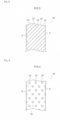
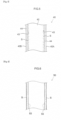
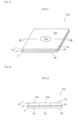
- Figs. 3 to 5 a few embodiments are illustrated as examples with respect to the masking sheet having highly-detectable areas and poorly-detectable areas.
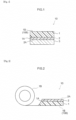
- the masking sheet in each of these drawings has a constitution as shown in Fig. 1 where the PSA layer is placed on the first face side of the substrate.
- Fig. 3 shows a planar view of a long masking sheet 20 seen from the outer face side.
- the masking sheet 20 linear highly-detectable areas 22 and linear poorly-detectable areas 24 are placed in parallel to one another to form a striped pattern.
- regions S with solution penetration can be easily visually detected over the entire outer face.
- the masking sheet 20 can be provided with adequate visibility.
- the size and the density of arrangement of poorly-detectable areas 34 are not particularly limited. For instance, they can be selected in view of the balance between visual detectability of solution penetration and visibility of the masking sheet 30, etc.
- the shapes of the poorly-detectable areas 34 are not particularly limited. For instance, they can be in a pattern of, for instance, circles, triangles, polygons such as squares, or arbitrary figures such as star shapes.
- the density of arrangement of poorly-detectable areas 34 can be uniform entirely over the masking sheet 30; or it can be non-uniform, for instance, with the peripheries and central areas having different densities of arrangement.
- Fig. 5 shows a planar view of a long masking sheet 40 seen from the outer face side.
- long narrow poorly-detectable areas 44 are arranged along one edge 40Aand the other edge 40B of the width direction (lengthwise edges 40Aand 40B) and the central portion of the width direction serves as highly-detectable areas 42.
- the outer edges of the width direction are highly visible because of the poorly-detectable areas 44 running continuously along the two edges 40A and 40B of the width direction. Thus, the location of the masking sheet 40 can be precisely found.
- an indicator that turns colored or undergoes a color change under an acidic condition can be included in the PSAlayer.
- the indicator can be placed entirely and evenly, or can be placed locally. For instance, it can be in an embodiment where the indicator is placed only at the peripheries of the masking sheet, in an embodiment where it is placed in areas corresponding to certain markers.
- the masking sheet disclosed herein can be widely used in various kinds of CS treatment carried out in an embodiment where a chemical solution can penetrate into the masking sheet, for instance, in an etching process, in a plating process, etc.
- the type of chemical solution used is not particularly limited. For instance, it can be an acidic solution, a basic solution, an oxidizing solution, a reducing solution, etc.
- the processing object (adherend) to be subjected to CS treatment is not particularly limited, in material, shape, etc.
- the masking sheet disclosed herein can be used in CS treatment of various types of members such as a metal member, a glass member, a ceramic member, and a resin member.
- it can be preferably used as a masking sheet for CS treatment of a metal member.
- a masking sheet used in CS treatment of a light metal member e.g. an aluminum member.
- it can be preferably used as a masking sheet for anodizing (anodic oxidation) of a light metal member.
- the light metal member refers to a metal member having a surface formed of solely a light metal species such as aluminum, magnesium and titanium or an alloy (light alloy) whose primary component is the light metal species.
- An aluminum member refers to a metal member having a surface formed of aluminum or an aluminum alloy (an alloy whose primary component is aluminum). Examples of the aluminum alloy include the 2000 series alloys, 3000 series alloys, 4000 series alloys, 5000 series alloys, 6000 series alloys, and 7000 series alloys.
- Preferable objects to which the masking sheet disclosed herein is applied include an aluminum member having a surface formed of aluminum (typically a 1000-series aluminum) or a 2000-series alloy (e.g. duralumin A2024, duraluminA2017, etc.).
- anodizing process carried out using the masking sheet disclosed herein. It can be general chromic acid anodizing, phosphoric acid anodizing, boric acid anodizing, sulfuric acid anodizing, sulfuric acid/boric acid anodizing, etc.
- the material or the shape of the article to be anodized is not particularly limited.
- the processing object is typically a light metal member.
- the article (processing object) to be treated with chemical solution include metal members used as exterior members and other building members of transportation equipment.
- the transportation equipment include motor vehicles (including passenger cars, trucks, buses, motor tricycles, tractors, snow mobiles, bulldozers, and amphibious vehicles), railroad vehicles (including trains such as bullet trains, diesel vehicles, maglev trains, cable cars, monorail vehicles, and trolley buses), aircrafts (including airplanes, helicopters, and air cushion crafts), and vessels (including large ships, small ships, and water scooters).
- motor vehicles including passenger cars, trucks, buses, motor tricycles, tractors, snow mobiles, bulldozers, and amphibious vehicles
- railroad vehicles including trains such as bullet trains, diesel vehicles, maglev trains, cable cars, monorail vehicles, and trolley buses
- aircrafts including airplanes, helicopters, and air cushion crafts
- vessels including large ships, small ships, and water scooters.
- Aluminum members typically duralumin members for exterior panels of an airplane.
- the surface of the metal member subjected to anodizing may be subjected to shot peening in advance.
- the metal member can also be milled for purposes such as thickness adjustment.
- the metal member can be subjected to a common process such as washing, degreasing, drying, etching and aging.
- an etching step may be included between a shot peening process and CS treatment (anodizing).
- the masking sheet used in the etching step can be used continuously as the masking sheet for anodizing; or the masking sheet for the etching step can be removed after the etching process and a masking sheet for anodizing can be newly applied.
- the masking sheet disclosed herein can be preferably used as a masking sheet that is applied to non-target areas of the metal member when such a metal member is subjected to CS treatment such as anodizing.
- CS treatment e.g. anodizing
- the masking sheet disclosed herein can be preferably applied to an article (typically a metal member, particularly a member made of light metal such as aluminum and aluminum alloy) that is further subjected to another process (a subsequent process) after the CS treatment.
- the subsequent process may be a process of forming an undercoat layer (a primer layer), a coating process, and the like given to the chemical solution-treated article.
- the CS treatment is an anodizing process
- the subsequent process can be a process of sealing the anodic oxidation coating formed by the anodizing process.
- the subsequent process may be a CS treatment (e.g. a process of applying a liquid such as an aqueous or solvent-based primer and an aqueous or solvent-based paint) or a process not involving a chemical solution (e.g. a dry process such as a powder coating process).
- Such a PSAproduct 100 can be obtained, for instance, as shown in Fig. 8 , by cutting the masking sheet 10 supported on the release liner 3 from the second face 1B side of a substrate 1 to a depth that does not reach the back face 3B (opposite from the PSA layer side surface) of the release liner 3 (i.e. to a depth at most that does not completely divide the release liner 3).
- a cutting mode that divides the masking sheet, but not the release liner and a cut formed in such a cutting mode may be called "halfway cut (cutting)."
- the halfway cut PSAproduct 100 is typically used in an embodiment where the first PSApiece 10a is separated from the second PSA piece 10b and the release liner 3 with the second PSA piece 10b left on the release liner 3, and the separated first PSA piece 10a is applied to an area to be masked of the processing object.
- the unapplied first PSA piece 10a as a halfway cut PSA product 100, it can be handled in the same way regardless of the size and the shape of the first PSA piece 10a. This is particularly meaningful when the first PSApiece 10a has a relatively complex shape and when the first PSApiece 10a is in a relatively small size.
- the release liner 3 extends over the first PSA piece 10a, it is also advantageous in view of the handling properties (the easy-to-pick-up properties) for peeling the first PSA piece 10a from the release liner 3.
- the release liner is continuous means that the release liner is continuous (not completely cut apart) at least at the boundary between the first and second PSA pieces.
- the PSA product disclosed herein can be made in an embodiment where the release liner is divided elsewhere, but not at the boundary; and in an embodiment where the release liner is cut through the surface opposite from the PSAlayer partially at the boundary between the first and second PSA pieces.
- the shape of the first PSA piece is not particularly limited. It can be selected in accordance with the shape of a certain masked area.
- Non-limiting examples of the shape of the first PSA piece include circle, ellipse, oval, polygons (triangle, square, etc.), various letters and symbols, and shapes of logo marks as well as shapes of negative images of these.
- the second PSA piece separated from the first PSA piece may or may not be used as a PSA sheet (typically a masking sheet) for the same purpose with the first PSA piece or for a different purpose.
- a halfway cut PSAproduct for masking purposes e.g. a PSA product used for masking purposes during anodizing
- the formation of sticky strings can be prevented or inhibited to further enhance the masking performance or its reliability (consistency).
- matters disclosed by the present description include a PSA sheet for masking purposes, the PSA sheet comprising a substrate having first and second faces and a PSA layer placed on the first face side of the substrate, wherein the PSA layer is formed with a PSA crosslinked by a reaction of a hydroxy group-containing polymer and a hydroxy-reactive crosslinking agent.
- the PSA sheet having such a constitution is suitably used in an embodiment where it is halfway cut and then applied to an adherend.
- Non-limiting examples of the organic material include a synthetic organic material, a natural organic material, a semi-synthetic organic material and a recycled organic material.
- the organic materials may be used solely as one species or as a mixture of two or more species, for instance, in a film form, in a matrix form dispersing other material, in a form impregnated in other material, in a fiber form, in a powder form, etc.
- Non-limiting examples of the inorganic non-metallic material include various kinds of glass and ceramic. From the standpoint of the flexibility of the masking sheet, etc., the inorganic non-metallic material can be used as a blend or a composite that further comprises an organic material, typically in a fiber form or in a powder form.
- a substrate film comprises a resin film capable of maintaining its shape by itself (i.e. a self-supported or independent film) as the base film.
- the "resin film” refers to a resin film that has a non-porous structure and is typically essentially free of bubbles (essentially void-free).
- the resin film may have a monolayer structure or a multilayer structure (e.g. a three-layer structure) formed of two or more layers.
- Examples of preferable resinous materials include a polyester-based resin, PPS resin and a polyolefinic resin.
- the polyester-based resin refers to a resin comprising more than 50 % polyester by weight.
- the PPS resin refers to a resin comprising more than 50 % PPS by weight.
- the polyolefinic resin refers to a resin comprising more than 50 % polyolefin by weight.
- polyolefinic resin solely one species of polyolefin or a combination of two or more species of polyolefin can be used.
- the polyolefin include an ⁇ -olefin homopolymer, a copolymer of two or more species of a-olefin, and a copolymer of one, two or more species of ⁇ -olefin and another vinyl monomer.
- Specific examples include polyethylene (PE), polypropylene (PP), ethylene-propylene copolymers such as ethylene-propylene rubber (EPR), ethylene-propylene-butene copolymers, ethylene-butene copolymers, and ethylene-ethyl acrylate copolymers.
- the method for producing the resin film is not particularly limited.
- a heretofore known general resin film molding method can be suitably employed, for instance, extrusion molding, inflation molding, T-die casting, and calender roll molding.
- the substrate may be formed essentially of such a base film.
- the substrate may comprise a supplemental layer besides the base film.
- the supplemental layer include a visual detectability-adjusting layer (e.g. a colored layer) and an antistatic layer provided to the first or second face of the base film.
- the substrate's thickness is suitably 15 ⁇ m or greater, preferably 25 ⁇ m or greater, or more preferably 40 ⁇ m or greater. A larger thickness of the substrate tends to make it easier to prevent solution penetration with swelling from the outer face side of the masking sheet. From such a standpoint, the substrate's thickness can be 50 ⁇ m or greater, or it is more preferably 60 ⁇ m or greater.
- the second face of the substrate may be subjected to heretofore known surface treatment as necessary, such as release treatment and antistatic treatment.
- the back face of the substrate can be provided with a long-chain alkyl-based, olefinic, or silicone-based release layer, etc., to reduce the unwinding force of the protection sheet wound in a roll.
- the second face of the substrate may be subjected to treatment such as corona discharge treatment, plasma treatment, UV-ray irradiation, acid treatment and alkali treatment.
- the PSA layer in the art disclosed herein may be formed from PSA compositions in various forms, such as a water-dispersed PSA composition, water-soluble PSA composition, solvent-based PSA composition, hot-melt PSA composition and active energy ray-curable PSA composition. From the standpoint of the resistance to solution penetration, etc., a solvent-based PSAcomposition can be preferably used.
- the PSA comprises, preferably as the base polymer (the primary component, i.e. a component accounting for more than 50 % by weight, among the polymers), one, two or more species among various rubbery polymers such as rubber-based polymers, acrylic polymers, polyester-based polymers, urethane-based polymers, polyether-based polymers, silicone-based polymers, polyamide-based polymers, and fluoropolymers that are known in the PSAfield.
- the PSApreferable from the standpoint of the resistance to chemical solutions, etc. include a rubber-based PSA, an acrylic PSAand a silicone-based PSA.
- the rubber-based PSA refers to a PSA that comprises one, two or more species of rubber-based polymer as the base polymer.
- the acrylic PSA and the silicone-based PSA refers to a polymer that includes a monomeric unit derived from an acrylic monomer in the polymer structure, typically a polymer that comprises a monomeric unit derived from an acrylic monomer at a ratio above 50 % by weight.
- the acrylic monomer refers to a monomer having at least one (meth)acryloyl group per molecule.
- the (meth)acryloyl group comprehensively refers to acryloyl group and methacryloyl group.
- a rubber-based PSA layer of which the primary component is a rubber-based PSA is used.
- the rubber-based PSA comprises one, two or more species of rubber-based polymer selected from natural rubbers and optionally synthetic rubbers.
- the primary component refers to a component accounting for more than 50 % by weight unless otherwise noted.
- the natural rubber is not particularly limited.
- standard Malaysian rubber SMR
- standard Vietnamese rubber SVR
- ribbed smoked sheets RSS
- pale crepe and the like can be used.
- a natural rubber having such a relatively high Mooney viscosity MS 1+4 (100°C) can be particularly preferably used, for instance, in a non-crosslinked PSA layer described later or in a rubber-based PSA layer (possibly a non-crosslinked PSA layer) in which the rubber-based polymer has a composition essentially formed of a natural rubber.
- styrene-based block copolymer it is possible to use a species having a styrene content of 5 % to 50 % by weight, preferably 10 % to 45 % by weight, or more preferably 12 % to 35 % by weight (e.g. 15 % to 30 % by weight).
- the styrene content refers to the weight ratio of styrene in the total weight of the block copolymer and can be determined by NMR (nuclear magnetic resonance spectroscopy).
- the styrene-based block copolymer may comprise, as the primary component, a polymer having a linear structure such as a diblock copolymer and a triblock copolymer, or a polymer having a radial structure.
- styrene-isoprene block copolymer it is possible to use a species having a styrene content of 5 % to 50 % by weight, preferably 10 % to 45 % by weight, or more preferably 12 % to 35 % by weight (e.g. 15 % to 30 % by weight).
- a preferable styrene-isoprene block copolymer comprises a polymer having a radial structure as the primary component. Examples of commercial styrene-isoprene block copolymers that can be preferably used include trade name QUINTAC 3460C (available from Zeon Corporation).
- the ratio of their amounts contained is not particularly limited.
- the composition may include 10 parts to 110 parts by weight (preferably 15 parts to 80 parts by weight, more preferably 20 parts to 40 parts by weight) of the synthetic rubber to 100 parts by weight of the natural rubber.
- the weight ratio of the natural rubber and the synthetic rubber combined in the entire PSAlayer can be, but is not particularly limited to, typically 30 % to 90 % by weight, preferably 40 % to 80 % by weight, or more preferably 40 % to 70 % by weight, for instance, 45 % to 60 % by weight.
- the weight ratio of the natural rubber and the synthetic rubber combined in the entire PSAlayer can be 10 % to 70 % by weight (more preferably 20 % to 60 % by weight, e.g. 30 % to 60 % by weight).
- preferable rubber-based PSA is a PSA comprising a rubber-based polymer that is essentially formed of a natural rubber, that is, a PSAin which the natural rubber accounts for 95 % by weight or more (typically 98 % by weight or more, e.g. 99 % by weight or more) of the rubber-based polymer.
- a PSAin which the rubber-based polymer essentially consists of a synthetic rubber that is, a PSAin which the synthetic rubber accounts for 95 % by weight or more (typically 98 % by weight or more, e.g. 99 % by weight or more) of the rubber-based polymer.
- the art disclosed herein can be preferably implemented in an embodiment of the masking sheet comprising a PSAlayer formed of a non-crosslinked PSA.
- the "PSA layer formed of a non-crosslinked PSA” refers to a PSA layer formed without a deliberate process of forming chemical bonding in the base polymer (i.e. a crosslinking process, e.g. addition of a crosslinking agent, etc.).
- a crosslinking process e.g. addition of a crosslinking agent, etc.
- Such a PSAlayer tends to be highly flexible; and therefore, it can be conformable to contours possibly present on the adherend surface, showing tight adhesion to the adherend surface.
- the PSAlayer is also less susceptible to accumulation of internal distortion (even if distortion occurs momentarily, it can be easily dissipated); and therefore, even if it is exposed to, for instance, physical stress or a temperature change after applied, peeling due to internal distortion hardly occurs. Thus, it tends to readily maintain tight adhesion to the adherend surface. Such highly tight adhesion to the adherend surface may advantageously contribute to prevent penetration of chemical solutions. It is particularly meaningful to comprise a PSA layer formed of a non-crosslinked PSA when the masking sheet is applied to a milled member (which may have contours corresponding to mill marks on the surface, e.g.
- the art disclosed herein can be preferably implemented in an embodiment comprising, for instance, a non-crosslinked rubber-based PSA layer, wherein the rubber-based polymer in the rubber-based PSAlayer essentially consists of a natural rubber that has a Mooney viscosity MS 1+4 (100°C) of higher than 70 (typically higher than 70, but 100 or lower), more preferably 75 or higher (typically 75 to 100), for instance, 80 or higher (typically 80 to 100, or 85 or higher, e.g. 85 to 120, or even 85 to 100).
- Mooney viscosity MS 1+4 100°C
- the PSA layer in the art disclosed herein may comprise a tackifier in addition to the base polymer.
- the inclusion of the tackifier can increase the adhesive strength to an adherend (a processing object) and increase the reliability (consistency) of masking performance.
- the tackifier one, two or more species can be used among commonly-known tackifiers such as rosin-based resins, petroleum-based resins, terpene-based resins, phenolic resins and the like.
- rosin-based resin examples include rosin derivatives such as disproportionated rosins, hydrogenated rosins, polymerized rosins, maleinized rosins, and fumarated rosins as well as phenol-modified rosins and rosin esters.
- phenol-modified rosins examples include products of addition reactions of natural rosins or rosin derivatives with phenols as well as phenol-modified rosins resulting from reactions of resole phenolic resins with natural rosins or rosin derivatives.
- the phenol-modified rosin can be used as a metal salt.
- the rosin ester examples include products of esterification of the rosin-based resins with polyols. Rosin phenol resins can be esterified as well.
- Examples of the petroleum resin include aliphatic (C5-based) petroleum resins, aromatic (C9-based) petroleum resins, aliphatic/aromatic copolymer (C5/C9-based) petroleum resins, hydrogenated products of these (e.g. alicyclic petroleum resins obtainable by hydrogenating aromatic petroleum resins), and various modified products of these (e.g. products modified with anhydrous maleic acid).
- terpene-based resin examples include terpene resins and modified terpene resins.
- terpene resin examples include terpenes (typically monoterpenes) such as ⁇ -pinene, ⁇ -pinene, d-limonene, l-limonene, and dipentene.
- the terpene resin can be a homopolymer of one species of terpene or a copolymer of two or more species of terpene.
- Examples of the homopolymer of one species of terpene include ⁇ -pinene polymer, ⁇ -pinene polymer, and dipentene polymer.
- modified terpene resin examples include resins resulting from modifications (phenol modification, styrene modification, hydrogenation, hydrocarbon modification, etc.) of terpene resins as those described above.
- modifications include terpene-phenol resins, styrene-modified terpene resins, and hydrogenated terpene resins.
- the terpene-phenol resin refers to a polymer that comprises a terpene residue and a phenol residue and its concept encompasses both a copolymer of a terpene and a phenol compound (a terpene-phenol copolymer resin) and a phenol-modification product of a terpene homopolymer or a terpene copolymer (a terpene resin, typically an unmodified terpene resin).
- phenolic resin examples include condensation products of formaldehyde and various phenols such as phenol, m-cresol, 3,5-xylenol, p-alkylphenols and resorcinol.
- Other examples of the phenolic resin include resoles obtainable by base-catalyzed addition reactions of the phenols and formaldehyde as well as novolacs obtainable by acid-catalyzed condensation reactions of the phenols and formaldehyde.
- Examples of commercial tackifiers that can be preferably used include, but are not limited to, trade name QUINTONE D-200 (anhydrous maleic acid-modified C5/C9-based petroleum resin, softening point about 100 °C, available from Zeon Corporation), trade name SUMILITE PR12603N (phenol-modified rosin, softening point about 130 °C, available from Sumitomo Bakelite Co., Ltd.), and trade name YS RESIN PX1150 (terpene resin, softening point about 115 °C, available from Yasuhara Chemical Co. Ltd.).
- trade name QUINTONE D-200 anhydrous maleic acid-modified C5/C9-based petroleum resin, softening point about 100 °C, available from Zeon Corporation
- trade name SUMILITE PR12603N phenol-modified rosin, softening point about 130 °C, available from Sumitomo Bakelite Co., Ltd.
- the tackifier content is not particularly limited. It can be selected so that appropriate adhesive performance can be produced in accordance with certain purpose and application.
- the tackifier content (when two or more species of tackifier are contained, their combined amount) to 100 parts by weight of the base polymer can be, for instance, 5 parts to 500 parts by weight.
- the tackifier content to 100 parts by weight of the base polymer can be 20 parts to 350 parts by weight, preferably 50 parts to 300 parts by weight, or more preferably 65 parts to 250 parts by weight.
- the tackifier content to 100 parts by weight of the base polymer can be, for instance, 20 parts to 150 parts by weight; it is preferably 30 parts to 120 parts by weight, or more preferably 40 parts to 100 parts by weight.
- the tackifier content can be preferably applied to a rubber-based PSA (typically a PSAcomprising a natural rubber and a synthetic rubber together).
- the tackifier content to 100 parts by weight of the base polymer can be, for instance, 5 parts to 100 parts by weight; it is preferably 10 parts to 80 parts by weight, or more preferably 15 parts to 60 parts by weight (e.g. 20 parts to 40 parts by weight).
- the tackifier content can be preferably applied to a PSA (preferably a non-crosslinked PSA) whose rubber-based polymer essentially consists of a natural rubber.
- the masking sheet disclosed herein can be made in an embodiment where the tackifier content in the PSAlayer is, for instance, 10 % to 85 % by weight. From the standpoint point of obtaining greater effects of the use of the tackifier, the tackifier content in the PSAlayer is usually preferably 15 % by weight or higher, or more preferably 20 % by weight or higher. From the standpoint of the efficiency of removal work from the adherend (processing object), etc., the tackifier content in the PSA layer is usually suitably 75 % by weight or lower, or preferably 70 % by weight or lower.
- the tackifier content in the PSAlayer can also be 40 % by weight or higher, or even 50 % by weight or higher (e.g. 60 % by weight or higher).
- this tackifier content can be preferably applied to a rubber-based PSA (typically a PSA comprising a natural rubber and a synthetic rubber together).
- the tackifier content in the PSAlayer can be 10 % to 70 % by weight, or more preferably 10 % to 50 % by weight (e.g. 15 % to 35 % by weight).
- this tackifier content can be preferably applied to a PSA (preferably a non-crosslinked PSA) whose rubber-based polymer essentially consists of a natural rubber.
- the tackifier it is preferable to use a species having a softening point (softening temperature) of about 60 °C or higher (preferably about 80 °C or higher, or more preferably about 90 °C or higher).
- a tackifier having a softening point at or above the lower limit the PSAlayer is likely to be formed with excellent residue-free removability.
- the maximum softening point is not particularly limited. For instance, it can be about 200 °C or lower (typically 180 °C or lower).
- the softening point of a tackifier can be determined based on the softening point test method (ring and ball method) specified in JIS K2207.
- the tackifier can be preferably used in an embodiment comprising a tackifier having a softening point of 120 °C or higher.
- the tackifier with softening point at or above 120 °C can be used alone or in combination with a tackifier with softening point below 120 °C.
- the ratio of the tackifier with softening point at or above 120 °C in the total tackifier used is usually suitably 5 % by weight or higher, or preferably 10 % by weight or higher (e.g. 15 % by weight or higher).
- the maximum ratio of the tackifier with softening point at or above 120 °C can be, for instance, 95 % by weight or lower, or usually suitably 70 % by weight or lower (e.g. lower than 50 % by weight).
- the tackifier can be preferably used in an embodiment comprising a tackifier having a softening point below 120 °C.
- the tackifier with softening point below 120 °C can be used alone or in combination of a tackifier with softening point at or above 120°C.
- the ratio of the tackifier with softening point below 120 °C in the total tackifier used can be, for instance, 30 % by weight or higher; it is usually suitably 50 % by weight or higher, or preferably 70 % by weight or higher.
- the ratio of the tackifier with softening point below 120 °C can be 95 % by weight or higher, or even 100 % by weight.
- a terpene-based resin with softening point below 120 °C typically at or above 80 °C, but below 120 °C
- tackifier solely one species or a combination of two or more species can be used.
- a combination of a petroleum-based resin and a rosin-based resin can be preferably used as the tackifier.
- a combination of a petroleum-based resin and a rosin-based resin can be preferably used as the tackifier.
- the relation of their amounts used is not particularly limited.
- the amount of the petroleum-based resin used to 1 part by weight of the rosin-based resin can be, for instance, 0.1 part to 20 parts by weight; it is usually suitably 0.7 part to 15 parts by weight, or preferably 1.0 part to 10 parts by weight (typically greater than 1.0 part by weight, but 10 parts by weight or less).
- the petroleum-based resin is used in an amount of 1.5 parts to 8 parts by weight relative to 1 part by weight of the rosin-based resin, more favorable results can be obtained.
- the amount of the rosin-based resin used to 100 parts by weight of the petroleum-based resin can be, for instance, 10 parts to 200 parts by weight; it is usually suitably 20 parts to 120 parts by weight, or preferably 30 parts to 80 parts by weight.
- the relation of the amounts of the petroleum-based resin and the rosin-based resin used can be preferably applied to, for instance, a rubber-based PSA (typically a PSA comprising a natural rubber and a synthetic rubber together).
- a terpene-based resin can be preferably used as the tackifier. While no particular limitations are imposed, such an embodiment is favorable, for instance, in a PSA (preferably a non-crosslinked PSA) whose rubber-based polymer essentially consists of a natural rubber.
- the art disclosed herein can be preferably implemented in an embodiment where the terpene-based resin (typically a terpene resin) accounts for more than 50 % by weight (more preferably 70 % by weight or more, typically 85 % by weight or more, e.g. 95 % by weight or more) of the tackifier.
- the natural rubber may have a Mooney viscosity MS 1+4 (100°C) of 80 or higher (typically 80 to 100).
- the PSA layer in the art disclosed herein may be formed from a PSA composition comprising a crosslinking agent.
- the use of the crosslinking agent tends to enhance the residue-free removability of the masking sheet.
- a crosslinking agent known or commonly used in the PSA field can be used, such as an isocyanate-based crosslinking agent, epoxy-based crosslinking agent, silicone-based crosslinking agent, oxazoline-based crosslinking agent, aziridine-based crosslinking agent, silane-based crosslinking agent, alkyl etherified melamine-based crosslinking agent, and metal chelate-based crosslinking agent.
- the crosslinking agent solely one species or a combination of two or more species can be used.
- the amount of the crosslinking agent used is not particularly limited. In a preferable embodiment, the amount of the crosslinking agent used can be, for instance, 0.1 part to 10 parts by weight relative to 100 parts by weight of the base polymer; it is usually suitably 1 part to 8 parts by weight. Alternatively, essentially no crosslinking agent may be used.
- a favorable example of the crosslinking agent is an isocyanate-based crosslinking agent.
- the isocyanate-based crosslinking agent is typically an isocyanate having at least two isocyanate groups per molecule.
- the isocyanate can be either an aromatic isocyanate or an aliphatic isocyanate.
- the isocyanate is preferably an aromatic isocyanate.
- commercial aromatic isocyanate-based crosslinking agents include trade name CORONATE L (available from Nippon Polyurethane Industry Co., Ltd.).
- CORONATE L available from Nippon Polyurethane Industry Co., Ltd.
- For the isocyanate-based crosslinking agent solely one species or a combination of two or more species can be used.
- the isocyanate is preferably a polyisocyanate having at least three isocyanate groups per molecule, or more preferably at least one species selected from the group consisting of aromatic polyisocyanates and aliphatic polyisocyanates.
- the polyisocyanate include an aromatic diisocyanate-polyol adduct and an aliphatic diisocyanate-polyol adduct.
- a compound having terminal isocyanate groups obtainable by a reaction of a polyol and the diisocyanate in excess can be preferably used as the polyisocyanate.
- aromatic diisocyanate examples include tolylene diisocyanate, diphenylmethane diisocyanate, 1,5-naphthylene diisocyanate, tolidine diisocyanate, xylylene diisocyanate, and tetramethylxylylene diisocyanate.
- a preferable example is tolylene diisocyanate.
- Examples of the aliphatic diisocyanate include 1,6-hexamethylene diisocyanate, 1,4-tetramethylene diisocyanate, 2-methyl-1,5-pentane diisocyanate, 3-methyl-1,5-pentane diisocyanate, lysine diisocyanate, isophorone diisocyanate, cyclohexyl diisocyanate, hydrogenated tolylene diisocyanate, hydrogenated xylene diisocyanate, hydrogenated diphenylmethane diisocyanate, and hydrogenated tetramethylxylene diisocyanate.
- a preferable example is 1,6-hexamethylene diisocyanate.
- polyol examples include aliphatic polyols such as ethylene glycol, glycerin, trimethylolpropante, pentaerythritol, di(trimethylolpropane), and dipentaerythritol. Among them, trimethylolpropane is preferable.
- the PSA layer in the art disclosed herein may be formed from a PSA composition comprising a hydroxy group-containing polymer. It is preferable to use the hydroxy group-containing polymer in combination with a hydroxy-reactive crosslinking agent. By this, a flexible crosslinked structure is formed by the reaction of the hydroxy group-containing polymer and the hydroxy-reactive crosslinking agent, and the separability (easy-to-detach properties) of the PSA can be enhanced while degradation of other properties is inhibited.
- Such combined use of a hydroxy group-containing polymer and a hydroxy-reactive crosslinking agent is particularly meaningful, for instance, in a masking sheet that can be used in a form halfway cut as described later. Since rubber-based PSA generally tends to be susceptible to blocking, in the masking sheet having a rubber-based PSA layer, it is particularly meaningful to use a hydroxy group containing polymer and a hydroxy-reactive crosslinking agent together.
- the hydroxy group-containing polymer a polymer having in average one or more (typically 1.5 or more) hydroxy groups per molecule can be preferably used.
- the number average molecular weight (Mn) of the hydroxy group-containing polymer is not particularly limited. It can be, for instance, about 500 to 500000. From the standpoint of the compatibility and reactivity with other components, the hydroxy group-containing polymer usually has a Mn value of suitably about 500 to 50000, preferably about 500 to 20000, or more preferably about 500 to 10000 (e.g. about 500 to 5000). Mn can be determined based on ASTM D2503.
- Non-limiting examples of the hydroxy group-containing polymer include polyethyle-based polyols such as polyethylene glycol, polypropylene-based polyols such as polypropylene glycol, polybutadiene polyols, hydrogenated polybutadiene polyols, polyisoprene polyols, and hydrogenated polyisoprene polyols. From the standpoint of the compatibility with the base polymer, etc., preferable examples include hydrogenated polyisoprene polyols, polyisoprene polyols, polybutadiene polyols and hydrogenated polybutadiene polyols.
- the hydroxy group-containing polymer has a hydroxyl value (mgKOH/g) of 5 or greater (typically 10 or greater, e.g. 20 or greater).
- the hydroxyl value (mgKOH/g) of the hydroxy group-containing polymer is preferably 95 or less (typically 80 or less).
- a hydroxy group-containing polymer having a hydroxyl value (mgKOH/g) in a range of 20 to 80 can be used.
- the hydroxyl value can be determined based on JIS K1557:1970.
- hydroxy group-containing polymer a commercial product can be used.
- the commercial product include Poly bd R-45HT (liquid butadiene having terminal hydroxy groups, Mn 2800, hydroxyl value 46.6 mgKOH/g, available from Idemitsu Kosan Co., Ltd.), Poly ip (liquid polyisoprene having terminal hydroxy groups, Mn 2500, hydroxyl value 46.6 mgKOH/g, available from Idemitsu Kosan Co., Ltd.), EPOL (hydrogenated liquid polyisoprene having terminal hydroxy groups, Mn 2500, hydroxyl value 50.5 mgKOH/g, available from Idemitsu Kosan Co., Ltd.), GI-1000 (liquid polybutadiene having a hydroxy group, Mn 1500, hydroxyl value 60-75 mgKOH/g, available from Nippon Soda Co., Ltd.), GI-2000 (hydrogenated liquid polybutadiene having a hydroxy group, Mn 2100, hydroxyl
- the amount of the hydroxy group-containing polymer contained to 100 parts by weight of the base polymer is not particularly limited.
- the amount of the hydroxy group-containing polymer contained to 100 parts by weight of the base polymer is usually suitably about 1 part to 20 parts by weight, or preferably about 2 parts to 15 parts by weight (e.g. about 2.5 parts to 10 parts by weight).
- hydroxy-reactive crosslinking agent it is possible to use a compound having a functional group (e.g. isocyanate group, epoxy group, melamine group, aldehyde group, etc.) that is reactive with hydroxy group (preferably a compound having two or more hydroxy-reactive functional groups per molecule).
- a compound having a functional group e.g. isocyanate group, epoxy group, melamine group, aldehyde group, etc.
- the hydroxy-reactive crosslinking agent can be used in combination with a crosslinking agent that is unreactive to hydroxy group.
- the amount of the crosslinking agent used can be, for instance, 0.1 part by weight or greater to 100 parts by weight of the base polymer; it is usually suitably 0.5 part by weight or greater.
- the crosslinking agent is used in an amount of 1 part by weight or more (preferably 2 parts by weight or more, e.g. 3 parts by weight or more) to 100 parts by weight of the base polymer, greater effects tend to be obtained in increasing the residue-free removability.
- the maximum amount of the crosslinking agent used is not particularly limited.
- the amount of the crosslinking agent used to 100 parts by weight of the base polymer is suitably 25 parts by weight or less, preferably 20 parts by weight or less, or more preferably 15 parts by weight or less (e.g. 10 parts by weight or less).
- the hydroxy group-containing polymer content can be selected so that the A value in the equation (1) below is preferably 1 to 12000, more preferably 10 to 5000, or yet more preferably 25 to 2500 (typically 50 to 1000, e.g. 75 to 500).
- A (hydroxyl value (mgKOH/g) of hydroxy group containing polymer) ⁇ (parts by weight of hydroxy group containing polymer to 100 parts by weight of base polymer)
- the easy-to-detach properties of the PSAlayer tend to be enhanced.
- the adhesiveness tends to increase.
- the hydroxy group-containing polymer content can be selected so that the B value in the equation (2) is preferably 0.1 to 20, more preferably 0.2 to 10, or yet more preferably 0.3 to 5, for instance, 0.4 to 3.
- B (hydroxyl value (mgKOH/g) of hydroxy group containing polymer ⁇ weight (g) of hydroxy group containing polymer) weight (g) of PSA layer
- a hydroxy group-containing polymer and a hydroxy-reactive crosslinking agent e.g. an isocyanate-based crosslinking agent
- the amount of the hydroxy group-containing polymer used to 1 part by weight of the hydroxy-reactive crosslinking agent can be, for instance, 0.1 part to 20 parts by weight. From the standpoint of effectively obtaining the advantages of the crosslinking, it is usually suitably 0.5 part to 15 parts by weight, preferably 1 part to 10 parts by weight, or more preferably greater than 1 part by weight and 5 parts by weight or less (e.g. 1.2 parts to 3 parts by weight).
- the PSA composition may comprise one, two or more species of urethanation catalyst.
- a hydroxy group-containing polymer e.g. an isocyanate-based crosslinking agent
- it is particularly meaningful to accelerate the crosslinking reaction with the inclusion of the urethanation catalyst.
- urethanation catalyst examples include tin compounds such as dibutyltin dilaurate and dioctyltin dilaurate; carboxylic acid salts of metals such as zinc, cobalt, copper and bismuth; amine compounds such as 1,4-diazabicyclo[2.2.2]octane; chelates of metals such as iron, titanium, and zirconium.
- tin compounds such as dibutyltin dilaurate and dioctyltin dilaurate
- carboxylic acid salts of metals such as zinc, cobalt, copper and bismuth
- amine compounds such as 1,4-diazabicyclo[2.2.2]octane
- chelates of metals such as iron, titanium, and zirconium.
- Salts of bismuth with organic acid can also be used.
- salts of bismuth with alicyclic organic acids such as salts of bismuth with resin acids containing abietic acid, neoabietic acid, d-pimaric acid, iso-d-pimaric acid, podocarpic acid, or a combination of two kinds or more thereof, as a main component; salts of bismuth with aromatic organic acids such as benzoic acid, cinnamic acid and p-oxycinnamic acid; and the like) can also be used.
- iron chelates in view of the compatibility with the PSA and the urethanation reactivity, iron chelates, dibutyltin dilaurate, dioctyltin dilaurate and salts of bismuth with resin acids are preferable; in view of the reactivity, iron chelates are more preferable.
- the urethanation catalyst content is not particularly limited. For instance, it can be about 0.001 part to 2.0 parts by weight (preferably 0.005 part to 1.5 parts by weight, more preferably 0.008 part to 1.0 part by weight) to 100 parts by weight of the base polymer.
- the PSAlayer in the art disclosed herein may further comprise, as necessary, known additives that can be used in PSA, such as leveling agent, crosslinking aid, plasticizer, softener, colorant (dye, pigment, etc.), filler, antistatic agent, anti-aging agent, UV absorber, antioxidant, and photostabilizer.
- leveling agent such as leveling agent, crosslinking aid, plasticizer, softener, colorant (dye, pigment, etc.), filler, antistatic agent, anti-aging agent, UV absorber, antioxidant, and photostabilizer.
- a phenolic anti-aging agent can be preferably used as the anti-aging agent.
- the amount of the anti-aging agent added to 100 parts by weight of the base polymer can be, for instance, 0.1 part to 10 parts by weight, or preferably 0.5 part to 5 parts by weight.
- An example of commercial products of such anti-aging agent is trade name NOCRAC NS-6 (available from Ouchi Shinko Chemical Industrial Co., Ltd.).
- the masking sheet disclosed herein can be formed by a heretofore known method.
- a direct method can be employed where the PSAcomposition is directly provided (typically applied) to a substrate as those described earlier and allowed to dry to form a PSA layer.
- a transfer method can also be employed where the PSA composition is provided to a releasable surface (release face) and allowed to dry to form a PSA layer on the surface and the PSAlayer is transferred to a substrate.
- release face a release liner surface, the substrate's back face that has been subjected to release treatment and the like can be used.
- the PSAcomposition can be applied, for instance, using a heretofore known coater such as a gravure roll coater, a die coater, and a bar coater. From the standpoint of accelerating the crosslinking reaction, increasing the productivity, etc., the PSA composition is preferably dried with heat.
- the drying temperature can be, for instance, about 40 °C to 150 °C, or usually preferably about 60 °C to 130 °C.
- the thickness of the PSA layer is not particularly limited and can be suitably adjusted in accordance with a certain purpose.
- the PSAlayer's thickness can be, for instance, about 1 ⁇ m to 100 ⁇ m. From the standpoint of the tightness of adhesion to the adherend surface, the thickness is favorably 5 ⁇ m or greater, or more preferably 10 ⁇ m or greater. In an application where it is adhered to a surface subject to shot peening, the PSA layer's thickness is preferably 15 ⁇ m or greater, or more preferably 20 ⁇ m or greater.
- the PSAlayer's thickness is preferably 80 ⁇ m or less, more preferably 60 ⁇ m or less, or yet more preferably 50 ⁇ m or less.
- the PSAlayer's thickness can be 20 ⁇ m to 40 ⁇ m.
- a release layer formed using a silicone-based release agent it is preferable to use a release layer formed using a silicone-based release agent.
- a release layer formed with a non-silicone-based release agent can be used.
- the non-silicone-based release agent include long-chain alkyl-based release agents, olefinic release agents and fluorine-based release agents.
- preferable non-silicone-based release agents include long-chain alkyl-based release agents and olefinic release agents. In particular, long-chain alkyl-based release agents are preferable.
- the same kinds can be preferably used.
- the overall thickness (excluding the thickness of any release liner) of the masking sheet disclosed herein can be, but is not particularly limited to, for instance, 20 ⁇ m to 600 ⁇ m; it is usually suitably 40 ⁇ m to 250 ⁇ m, preferably 60 ⁇ m to 180 ⁇ m (more preferably 100 ⁇ m to 180 ⁇ m, e.g. 100 ⁇ m to 150 ⁇ m).
- the substrate and the PSAlayer have a combined thickness in these ranges.
- the masking sheet in the art disclosed herein can be made in an embodiment that satisfies 0.7 N mm ⁇ Et' ⁇ Hs 3 .
- Et' is the elastic modulus of the masking sheet and Hs is the thickness of the substrate of the masking sheet.
- the Et' ⁇ Hs 3 value is proportional to the flexural rigidity of the masking sheet.
- the masking sheet tends to have a greater ability to prevent solution penetration.
- the masking sheet disclosed herein is preferably formed with a non-metal substrate.
- a non-metal substrate typically an insulator
- the electric field is likely to be greatly distorted because of the adhered masking sheet.
- the distortion of the electric field may induce concentration of the current; and therefore, in the vicinity of the peripheries of the masking sheet using the non-metal substrate, formation of gas (gas formed mainly by electrolytic decomposition, i.e. electrolyzed gas) tends to be accelerated.
- the masking sheet may have an Et' ⁇ Hs 3 value of greater than 0.8 N mm, preferably greater than 1.0 N mm, more preferably greater than 1.5 N mm, or yet more preferably greater than 2.0 N ⁇ mm (e.g. greater than 2.2 N mm).
- Et' ⁇ Hs 3 value With increasing Et' ⁇ Hs 3 value, solution penetration into the masking sheet tends to be inhibited to a greater extent in a CS treatment (e.g. in an anodizing process) given to a member on which the masking sheet is adhered to areas to be masked.
- the maximum Et' ⁇ Hs 3 value is not particularly limited.
- Et' ⁇ Hs 3 is usually suitably about 10 ⁇ 10 3 N mm or less, or preferably about 1 ⁇ 10 3 N ⁇ mm or less (e.g. about 0.5 ⁇ 10 3 N ⁇ mm or less).
- the elastic modulus Et' of the masking sheet can be determined, using a commercial dynamic viscoelastometer.
- a sample (masking sheet) for analysis is cut to a 30 mm long by 5 mm wide strip to prepare a test piece.
- the test piece using a dynamic viscoelastometer (RSA-III available from TA Instruments) in a tension mode, at a chuck distance of 23 mm, a heating rate of 10 °C/min, a frequency of 1 Hz and a strain of 0.05 %, the tensile storage elastic modulus is determined as the value per unit cross-sectional area of substrate in a temperature range of 0 °C to 100 °C. From the results, the tensile storage elastic modulus per unit cross-sectional area of substrate at 25 °C can be determined. This value can be used as the elastic modulus Et' of the masking sheet.
- the elastic modulus Et' of the masking sheet is determined as the value per unit cross-sectional area of substrate. This is because, usually, the PSA's elastic modulus is negligibly small as compared to the substrate's elastic modulus (typically less than 1 % of the substrate's elastic modulus). Thus, when the cross-sectional area of the PSA layer is included in the cross-sectional area used for determination of the tensile storage elastic modulus, it makes it rather difficult to appropriately access the properties of the masking sheet to meet the objective of this invention.
- the PSA's elastic modulus is exceedingly small as compared to the substrate's elastic modulus; and therefore, from the standpoint of solving the technical problem of this invention, the elastic modulus determined with respect to the masking sheet sample by the method described above (i.e. tensile storage elastic modulus per unit cross-sectional area of substrate, Et') can be considered mostly the same as the substrate's elastic modulus Es' (measured in the same manner as for Et' except that a 30 mm long by 5 mm wide strip cut from the substrate is used as the sample). Accordingly, in the art disclosed herein, the substrate's elastic modulus Es' can be used as a substitute for the elastic modulus Et' of the masking sheet or as an approximation thereof that is satisfactory at least for practical use. As used herein, Et' and Es' are interchangeable unless otherwise noted. For instance, Et' ⁇ Hs 3 can be read as Es' ⁇ Hs 3 and vice versa.
- the elastic modulus Et' of the masking sheet is not particularly limited.
- Et' can be, for instance, 0.3 GPa or greater (typically 0.5 GPa or greater).
- Et' is advantageously 1.0 GPa or greater (i.e. 1.0 ⁇ 10 3 N/mm 2 or greater), preferably 1.5 GPa or greater, or more preferably 2.0 GPa or greater.
- the maximum Et' value is not particularly limited. From the standpoint of the availability of the substrate or the ease of its manufacturing, it is usually suitably 30 GPa or less, preferably 20 GPa or less, or more preferably 10 GPa or less (e.g. 6.0 GPa or less).
- Et' can be adjusted by the composition of the substrate and the materials used therein as well as by the combination of these, etc.
- the thickness Ht of the masking sheet is not particularly limited.
- Ht is 7 mm or less (typically 5 mm or less, e.g. 1 mm or less).
- Ht can be 0.50 mm or less; it is preferably 0.30 mm or less, more preferably 0.25 mm or less (e.g. 0.20 mm or less), or yet more preferably 0.15 mm or less (typically less than 0.15 mm).
- a liquid such as a solvent-based paint is supplied (e.g.
- a smaller thickness Ht of the masking sheet makes it easier to reduce the amount of the liquid that accumulates on the edge faces of the masking sheet. This is particularly meaningful when the masking sheet disclosed herein is used for masking in a coating process (typically a coating process using a solvent-based paint), etc. This can bring about effects such as increased precision of coating and greater residue-free removability when removing the masking sheet after the coating process.
- the minimum Ht is not particularly limited. It is usually suitably 0.04 mm or greater, or preferably 0.06 mm or greater.
- the masking sheet disclosed herein can be preferably made in an embodiment where Ht is greater than 0.08 mm (typically 0.09 mm or greater, e.g. 0.10 mm or greater).
- the thickness Ht of the masking sheet refers to the thickness of the portion that is applied to the adherend (processing object) and excludes the thickness of the release liner.
- the thickness Hs of the substrate constituting the masking sheet is not particularly limited. Hs can be, for instance, 5 mm or less (typically 3 mm or less). From the standpoint of the handling properties and the ease of processing the masking sheet, Hs is usually suitably 1 mm or less (e.g. 0.50 mm or less). In a preferable embodiment, Hs can be 0.30 mm or less; it is preferably 0.20 mm or less, or more preferably 0.15 mm or less (e.g. 0.12 mm or less). With the use of a substrate having a small Hs value, it is easier to make the masking sheet with a smaller thickness Ht.
- the minimum Hs value is not particularly limited. It is usually suitably 0.03 mm or greater, or preferably 0.05 mm or greater (typically greater than 0.05 mm). Hs can also be 0.07 mm or greater, or even 0.08 mm or greater (e.g. 0.10 mm or greater).
- the modulus elasticity Es' of the substrate constituting the masking sheet is not particularly limited. Es' can be, for instance, 0.3 GPa or greater (typically 0.5 GPa or greater). From the standpoint of the ease of constructing the masking sheet to be highly proof against solution penetration while using a thinner substrate, Es' is advantageously 1.0 GPa or greater, preferably 1.5 GPa or greater, or more preferably 2.0 GPa or greater.
- the maximum Es' value is not particularly limited. From the standpoint of the availability of the substrate or the ease of its manufacturing, it is usually suitably 30 GPa or less, preferably 20 GPa or less, or more preferably 10 GPa or less (e.g. 6.0 GPa or less). Es' can be adjusted by the composition of the substrate and the materials used therein as well as by the combination of these, etc.
- the masking sheet disclosed herein preferably has a 180° peel strength of 1.5 N/25mm or greater (e.g. 2.0 N/25mm or greater) to a stainless steel (SUS) plate. From the standpoint of the efficiency of removal work and the residue-free removability, the 180° peel strength of the masking sheet is preferably 7.0 N/25mm or less (e.g. 5.0 N/25mm or less).
- the 180° peel strength can be determined based on JIS Z0237, by applying a test piece to a SUS plate at a measurement temperature of 23 °C and peeling the test piece 30 minutes later at a tensile speed of 300 mm/min.
- the masking sheet disclosed herein can be made in an embodiment where it has a 90° peel strength (to-duralumin 90° peel strength) of, for instance, about 0.5 N/20mm or greater when determined using a smooth duralumin A2024 plate as the adherend.
- the to-duralumin 90° peel strength is usually advantageously 1.0 N/20mm or greater, or preferably 1.5 N/20mm or greater (e.g. 2.0 N/20mm or greater).
- the to-duralumin 90° peel strength is preferably 3.0 N/20mm or greater; it can also be, for instance, 4.5 N/20mm or greater.
- the maximum to-duralumin 90° peel strength is not particularly limited. From the standpoint of the efficiency of removal work and the residue-free removability, it is usually suitably 25 N/20mm or less, or preferably 20 N/20mm or less (typically 15 N/20mm or less, e.g. 10 N/20mm or less).
- the to-duralumin 90° peel strength can be determined based on JIS Z0237 as follows: at a measurement temperature of 23 °C, the masking sheet is applied to a duralumin plate (a smooth duralumin A2024 plate); after 30 minutes, the masking sheet is peeled at a tensile speed of 300 mm/min in the 90° direction relative to the surface of the duralumin plate.
- the to-duralumin 90° peel strength can be adjusted, for instance, by the composition of the PSA layer forming the PSA sheet, the thickness of the PSAlayer, etc.
- the masking sheet disclosed herein can be made in an embodiment where it has a 90° peel strength to adherend (i.e. non-target areas of a processing object) (to-adherend 90° peel strength) of, for instance, about 0.5 N/20mm or greater.
- the to-adherend 90° peel strength is usually advantageously 1.0 N/20mm or greater, or preferably 1.5 N/20mm or greater (e.g. 2.0 N/20mm or greater).
- the to-adherend 90° peel strength is preferably 3.0 N/20mm or greater; it can also be, for instance, 4.5 N/20mm or greater.
- the maximum to-adherend 90° peel strength is not particularly limited. From the standpoint of the efficiency of removal work and the residue-free removability, it is usually suitably 25 N/20mm or less, or preferably 20 N/20mm or less (typically 15 N/20mm or less, e.g. 10 N/20mm or less).
- the to-adherend 90° peel strength can be determined in the same manner as for the to-duralumin 90° peel strength expect for the adherend used in the measurement.
- the adherend used in the measurement of the to-adherend 90° peel strength is not limited to an adherend completely identical to the object to which the PSAis actually applied; it can be anything that has the quality of material or the surface condition that gives a measurement result approximately comparable to the 90° peel strength to the object.
- the masking sheet disclosed herein preferably show great residue-free removability to certain adherend. For instance, in the 180° peel strength measurement, it is preferable that it does not cause leftover adhesive residue on the SUS plate as the adherend. For instance, in the measurement of the to-duralumin 90° peel strength and the to-adherend 90° peel strength, it preferably causes no leftover adhesive residue on the surface after its removal.
- a preferable masking sheet satisfies at least one of these properties, or more preferably two or more thereof.
- the masking sheet disclosed herein has an average solution penetration distance of preferably 5 mm or less, or more preferably 3 mm or less.
- it has a solution penetration distance (on a smooth duralumin plate) of preferably 5 mm or less, more preferably 3 mm or less, or yet more preferably 1 mm or less.
- the masking sheet that satisfies one or both of these conditions can be preferably used in an embodiment where, after the anodizing process, a subsequent process is carried out with the masking sheet being continuously adhered on the adherend.
- the PSA product can be used to mask coating-unrequired areas (non-target areas) as well.
- the processing object may be coated while it still (continuously) has the masking sheet adhered thereon during the CS treatment.
- the hassle of replacing the masking sheet (generally including the work of removing the masking sheet used in the CS treatment step from the processing object, the work of cleaning the surface of the processing object after the removal, and applying a new masking sheet) can be omitted to increase the productivity of a chemical solution-treated metal product. It can also reduce the consumption of the masking sheet; and thus, it is preferable from the standpoint of saving resources as well.
- paint coating material
- undercoat sometimes called a primer
- intermediate coat sometimes called a finish coat
- finish coat sometimes called a topcoat
- the form of the paint used in the coating step is not particularly limited. It can be in forms of an aqueous paint, a solvent-based paint, a powder paint, etc.
- the PSA forming the PSAlayer may dissolve into the paint accumulated at the edge face of the PSAlayer. Subsequently, when the paint accumulated at the edge face of the PSAlayer is allowed to dry the PSA dissolved out of the PSAlayer typically forms a thin film that spreads outward from the masking sheet. This thin film is likely to be left (as leftover adhesive residue) on the processing object when the masking sheet is removed.
- the masking sheet used continuously from the CS treatment step (e.g. an anodizing step) through the coating step has a thickness Ht of preferably 0.30 mm or less, more preferably 0.25 mm or less (e.g. 0.20 mm or less), or yet more preferably 0.15 mm or less (typically less than 0.15 mm).
- the PSA composition A1 was applied to one face of a release liner obtained by treating high-grade paper laminated with polyethylene resin on each side with a silicone-based release agent, allowed to dry in an oven at 100 °C with air circulation for three minutes to form a 40 ⁇ m thick PSAlayer.
- the first face of a 75 ⁇ m thick PET film (trade name LUMIRROR available from Toray Industries, Inc.) as the substrate was adhered to the PSAlayer on the release liner to obtain a masking sheet according to Example 1.
- the applied amount of the PSA composition A1 was adjusted to form a 20 ⁇ m thick PSAlayer.
- As the substrate was used a 100 ⁇ m thick PET film (trade name LUMIRROR available from Toray Industries, Inc.). Otherwise in the same manner as Example 1, a masking sheet according to this Example was obtained.
- the applied amount of the PSA composition A1 was adjusted to form a 30 ⁇ m thick PSAlayer. Otherwise in the same manner as Example 2, a masking sheet according to this Example was obtained.
- the applied amount of the PSA composition A1 was adjusted to form a 40 ⁇ m thick PSAlayer. Otherwise in the same manner as Example 2, a masking sheet according to this Example was obtained.
- Example 3 as the release liner, was used a PET film treated with a silicone-based release agent on one face; as the substrate, was used an 80 ⁇ m thick polybutylene terephthalate (PBT) film (trade name NOVADURAN available from Mitsubishi Engineering-Plastics Corporation). Otherwise in the same manner as Example 3, a masking sheet according to this Example was obtained.
- PBT polybutylene terephthalate
- Example 3 As the substrate, was used 80 ⁇ m thick aluminum foil (trade name ALUMINUM FOIL C, soft aluminum foil available from Toyo Aluminum K. K.). Otherwise in the same manner as Example 3, a masking sheet according to this Example was obtained.
- ALUMINUM FOIL C soft aluminum foil available from Toyo Aluminum K. K.
- the masking sheet according to each Example was cut to a 50 mm wide by 50 mm long size and the release liner was removed.
- the haze value (%) of the resultant was measured based on JIS K7136, using a haze and transmittance meter under trade name HAZEMETER HM-150 available from Murakami Color Research Liboratory.
- the masking sheet according to each Example was cut to a 10 mm wide by 50 mm long size to prepare a test piece.
- the release liner was removed from the test piece and the test piece was press-bonded to the printed face of the test paper.
- the press-bonding was carried out with a 2 kg roller moved back and forth once.
- the test paper on which the masking sheet was adhered was fixed approximately at an eye level onto a vertical wall in a room adjusted to an illuminance of 400 lux to 500 lux with a fluorescent light on the ceiling.
- the test paper was visually inspected by a test operator with 1.0 vision standing 1 m away from the wall to determine the smallest font size of numbers under the masking sheet that were legible from the second face side (back face side) of the masking sheet. For instance, when 8-point numbers were legible, but 7-point numbers were illegible, the lower limit of legible font size (minimum legible font size) was determined to be 8 points.
- that numbers under the masking sheet are legible means that all numbers from 0 to 9 can be identified.
- the masking sheet according to each Example was cut to a 20 mm wide by 100 mm long size to prepare a test piece.
- the release liner was removed and the test piece was press-bonded to an aluminum plate (50 mm wide, 125 mm long, 2.0 mm thick) having a smooth surface.
- the press-bonding was carried out with a 2 kg roller moved back and force once.
- the resultant was aged under an atmosphere at 23 °C and 50 % RH for 48 hours to obtain a measurement sample.
- a 5 % aqueous NaOH solution (basic solution) was put in a thermostatic bath and kept at 60 °C. In this, the measurement sample was immersed for 10 minutes. Subsequently, the measurement sample was removed from the solution. With the test piece still adhered on the aluminum plate, the test piece was visually inspected to evaluate whether or not the solution penetration was visually detectable. The inspection was performed by a test operator with 1.0 vision 50 cm straight away from the second face of the test piece.
- the average distance from the peripheries of the test pieces to the inner ends of regions with solution penetration was determined in the 60 mm long central areas of the two long sides of the test piece (i.e. the segments of the respective long sides excluding 20 mm long segments from the two ends of the long sides).
- the test piece was removed from the aluminum plate to inspect the presence of solution penetration, and the average solution penetration distance was determined in the same manner.
- the measurement sample removed from the solution was gently washed with water and allowed to naturally dry at room temperature. After dried, the test piece was manually peeled from the aluminum plate by a test operator. The peeling was carried out at a tensile speed of about 0.3 m/min in the 90° direction. After the test piece was removed, the surface of the aluminum plate was visually inspected for the presence of leftover adhesive residue.
- Table 1 shows the test results of the protection sheets according to Examples 1 to 6.
- a masking sheet according to Example 7 was fabricated using the PSA composition B 1 in place of the PSA composition A1 but otherwise in the same manner as Example 3, subjected to the same haze value measurement and see-through quality test, and exhibited a haze value of 23 % and G-grade see-through quality.
- the masking sheet according to Example 7 was subjected to the same solution penetration test as for Examples 1 to 6, it showed Pass levels of see-through quality and masking ability with respect to both the basic solution and the acidic solution and was found capable of solving the problem of this invention. With respect to the residue-free removability it fell short of the ability of the masking sheet of Example 3, yet was at a practical level.
- the PSA composition A2 was applied to one face of a release liner obtained by treating high-grade paper laminated with polyethylene resin on each side with a silicone-based release agent, allowed to dry in an oven with air circulation at 100 °C for three minutes to form a 30 ⁇ m thick PSAlayer.
- the first face of a 125 ⁇ m thick PET film (trade name LUMIRROR available from Toray Industries, Inc.) as the substrate was adhered to the PSAlayer on the release liner to obtain a masking sheet according to Example 8.
- the release liner was left on the PSA layer as it was and used to protect the adhesive face of the masking sheet.
- PET films of 100 ⁇ m thickness (Example 9) and 75 ⁇ m thickness (Example 10) were used, respectively. Otherwise in the same manner as Example 8, masking sheets according to Examples 9 and 10 were obtained.
- a PEN film of 75 ⁇ m thickness (available from Teijin Limited) was used. Otherwise in the same manner as Example 8, a masking sheet according to Example 11 was obtained.
- Example 12 As the substrate, PPS films of 75 ⁇ m thickness (Example 12) and 100 ⁇ m (Example 13) (both available from Toray Industries, Inc.) were used. Otherwise in the same manner as Example 8, masking sheets according to Example 12 and 13 were obtained.
- Example 14 In place of the PSA composition A2, the PSA composition A3 was used. Otherwise in the same manner as Example 9, a masking sheet according to Example 14 was obtained.
- Example 15 a masking sheet according to Example 15 was obtained.
- a circle of 25 mm diameter was punched out from the masking sheet according to each Example along with the release liner protecting the adhesive face.
- the release liner was removed from the punched out masking sheet (test piece) and the exposed adhesive face was press-bonded to an adherend with a 2 kg roller moved back and forth once.
- a pre-degreased duralumin plate (a smooth duralumin A2024 plate) of 200 mm length, 100 mm width and 1 mm thickness was used.
- the sample to which the test piece was thus adhered was left standing in the standard environment for 30 minutes, suspended in a chromic acid anodizing solution, and anodized at a liquid temperature of 40 °C at a voltage of 20 V for 35 minutes.
- the state of solution penetration was visually inspected from the back face of the masking sheet.
- the distance of the solution penetration was measured from the periphery of the test piece in the radial direction and the maximum distance of penetration in each sample was recorded as the solution penetration distance of the sample.
- the average value of the solution penetration distances of the five samples was determined.
- a duralumin plate having a milled surface (a milled plate) was used as the adherend. Otherwise in the same manner as the above, the adherend with the masking sheet according to each Example adhered thereon was anodized and the solution penetration distance was determined.
- the masking sheets of Examples 8 to 15 were all suitably proof against solution penetration. Among them, with respect to the masking sheet of Example 15 comprising a PSA layer formed from the PSA composition A4, the solution penetration distance did not change much between the smooth plate and the milled plate, exhibiting excellent adaptability to an adherend having an uneven surface. Comparison of Examples 8 to 10 indicates that with increasing Et' ⁇ Hs 3 value, the solution penetration distance tends to decrease. It is noted that in each of the masking sheets of Examples 8 to 15, the areas where solution penetration occurred were clearly observable when inspected from the outer face of the masking sheet. When subjected to CS treatment under the same conditions as the anodizing process but without the applied electric current, the solution penetration distance was less than 0.1 mm in all Examples 8 to 15.
- the anodized sample according to each Example was gently washed with water and allowed to naturally dry at room temperature. Subsequently, with respect to two samples among the five samples, the test operator peeled the test pieces from the duralumin plates by hand. The peeling was carried out at a tensile speed of about 0.3 m/min in the 90° direction relative to the surface of the duralumin plate. After the test pieces were peeled, the surfaces of the duralumin plates were visually inspected for the presence of leftover adhesive residue. As a result, leftover adhesive residue was not observed in any of Examples 8 to 15.
- a solvent-based paint EPORA#3000S (available from Nihon Tokushu Toryo Co., Ltd.) was sprayed over the entire surfaces of the duralumin plates on the sides on which the test pieces were adhered.
- the paint was sprayed in an amount to form a coating layer of about 10 ⁇ m thickness after dried.
- the sprayed paint was allowed to dry at about 100 °C.
- the test operator peeled the test pieces from the duralumin plates by hand. The peeling was carried out at a tensile speed of about 0.3 m/min in the 90° direction relative to the surface of the duralumin plate. After the test pieces were peeled, the surfaces of the duralumin plates were visually inspected and none of them was found with leftover adhesive residue.
- the 90° peel strength (to-duralumin 90° peel strength) was 6.5 N/20mm when determined by the method described earlier, using a smooth duralumin A2024 plate as the adherend.
- the to-duralumin 90° peel strength was 1.0 N/20mm or greater (more specifically, 3.0 N/20mm or greater, but 25 N/20mm or less) when determined in the same manner.
- no leftover adhesive residue was observed on the duralumin plate, either.
Landscapes
- Chemical & Material Sciences (AREA)
- Organic Chemistry (AREA)
- Chemical Kinetics & Catalysis (AREA)
- Engineering & Computer Science (AREA)
- Electrochemistry (AREA)
- Materials Engineering (AREA)
- Metallurgy (AREA)
- Inorganic Chemistry (AREA)
- Adhesive Tapes (AREA)
- Adhesives Or Adhesive Processes (AREA)
- Laminated Bodies (AREA)
Claims (7)
- Verwendung einer Maskierungsfolie für eine Behandlung mit einer chemischen Lösung in
einem Anodisierungsverfahren eines Metallteils, wobei die Maskierungsfolie umfasst:ein Substrat, besitzend erste und zweite Flächen, undeine druckempfindliche Klebstoffschicht, angebracht auf der ersten Flächenseite des Substrats,wobei die Maskierungsfolie so beschaffen ist, dass das Eindringen einer chemischen Lösung in die Maskierungsfolie visuell nachweisbar ist, wenn sie von der Außenflächenseite der Maskierungsfolie, wie in der Beschreibung definiert, untersucht wird, wobei die Maskierungsfolie zumindest in einigen Bereichen einen Trübungswert von 90 % oder weniger besitzt, wobei das Substrat ein nicht-metallisches Substrat umfasst, und wobei die druckempfindliche Klebstoffschicht aus einem druckempfindlichen Klebstoff auf Kautschukbasis gebildet ist,wobei der Trübungswert durch die Gleichung Th (%) = Td/Ttx100 ausgedrückt wird, wobei Th der Trübungswert (%) ist, Td die Durchlässigkeit für diffuses Licht ist und Tt die Gesamtlichtdurchlässigkeit ist, wobei der Trübungswert (%) auf der Grundlage von JIS-K7136 gemessen wird,wobei das Substrat eine Harzfolie umfasst,wobei die Harzfolie aus der Gruppe ausgewählt ist, umfassend Polyesterharze, Polyolefinharze, Polyamidharze, Polyimidharze, Polyamid-Imid-Harze, Polyetheretherketonharze, Polyethersulfone, Polyphenylensulfidharze, Polycarbonatharze, Polyurethanharze, Ethylen-Vinylacetatharze, Fluorharze, wie Polytetrafluorethylen, Acrylharze oder Mischungen davon,wobei der druckempfindliche Klebstoff auf Kautschukbasis einen Naturkautschuk als Polymer auf Kautschukbasis umfasst. - Die Verwendung nach Anspruch 1, die so beschaffen ist, dass Bereiche, in denen die Lösungspenetration relativ stark visuell nachweisbar ist, und Bereiche, in denen sie relativ schwach visuell nachweisbar ist, vorhanden sind, wenn sie von der Außenfläschenseite der Maskierungsfolie aus betrachtet werden, wobei die relativ stark visuell nachweisbaren Bereiche und die relativ schwach visuell nachweisbaren Bereiche als Bereiche definiert sind, die einen Unterschied an Trübungswert von 15 % oder mehr besitzen.
- Die Verwendung nach irgendeinem der Ansprüche 1 oder 2, besitzend einen Marker, der zur Bestimmung des Ausmaßes der Lösungspenetration verwendet wird.
- Die Verwendung nach Anspruch 3, wobei der Naturkautschuk eine Mooney-Viskosität MS1+4 (100°C) von 80 oder höher besitzt.
- Die Verwendung nach irgendeinem der Ansprüche 1 bis 4, wobei die druckempfindliche Klebstoffschicht einen Klebrigmacher umfasst, wobei der Klebrigmacher 10 bis 85 Gew.-% der druckempfindlichen Klebstoffschicht ausmacht.
- Die Verwendung nach irgendeinem der Ansprüche 1 bis 5, wobei die Maskierungsfolie auf eine Oberfläche eines kugelgestrahlten Metallteils geklebt wird.
- Maskierungsverfahren für eine Behandlung mit einer chemischen Lösung, das das Verwenden einer Maskierungsfolie in einem Anodisierungsprozess eines Metallteils umfasst, wobei die Maskierungsfolie umfasst:ein Substrat, besitzend erste und zweite Flächen, undeine druckempfindliche Klebstoffschicht, angebracht auf der ersten Flächenseite des Substrats,wobei die Maskierungsfolie so beschaffen ist, dass das Eindringen einer chemischen Lösung in die Maskierungsfolie visuell nachweisbar ist, wenn sie von der Außenflächenseite der Maskierungsfolie, wie in der Beschreibung definiert, untersucht wird, wobei die Maskierungsfolie zumindest in einigen Bereichen einen Trübungswert von 90 % oder weniger besitzt, wobei das Substrat ein nicht-metallisches Substrat umfasst, und wobei die druckempfindliche Klebstoffschicht aus einem druckempfindlichen Klebstoff auf Kautschukbasis gebildet ist,wobei der Trübungswert durch die Gleichung Th (%) = Td/Ttx100 ausgedrückt wird, wobei Th der Trübungswert (%) ist, Td die Durchlässigkeit für diffuses Licht ist und Tt die Gesamtlichtdurchlässigkeit ist, wobei der Trübungswert (%) auf der Grundlage von JIS-K7136 gemessen wird,wobei das Substrat eine Harzfolie umfasst,wobei die Harzfolie aus der Gruppe ausgewählt ist, umfassend Polyesterharze, Polyolefinharze, Polyamidharze, Polyimidharze, Polyamid-Imid-Harze, Polyetheretherketonharze, Polyethersulfone, Polyphenylensulfidharze, Polycarbonatharze, Polyurethanharze, Ethylen-Vinylacetatharze, Fluorharze, wie Polytetrafluorethylen, Acrylharze oder Mischungen davon, wobei der druckempfindliche Klebstoff auf Kautschukbasis einen Naturkautschuk als Polymer auf Kautschukbasis umfasst.
Applications Claiming Priority (2)
| Application Number | Priority Date | Filing Date | Title |
|---|---|---|---|
| JP2014205587 | 2014-10-06 | ||
| PCT/JP2015/077994 WO2016056469A1 (ja) | 2014-10-06 | 2015-10-01 | 薬液処理用マスキングシート |
Publications (3)
| Publication Number | Publication Date |
|---|---|
| EP3205697A1 EP3205697A1 (de) | 2017-08-16 |
| EP3205697A4 EP3205697A4 (de) | 2018-05-09 |
| EP3205697B1 true EP3205697B1 (de) | 2024-12-04 |
Family
ID=55653082
Family Applications (2)
| Application Number | Title | Priority Date | Filing Date |
|---|---|---|---|
| EP15848620.9A Active EP3205751B1 (de) | 2014-10-06 | 2015-10-01 | Abdeckfolie zur anodisierung |
| EP15848893.2A Active EP3205697B1 (de) | 2014-10-06 | 2015-10-01 | Verwendung einer abdeckfolie für die chemische lösungsbehandlung |
Family Applications Before (1)
| Application Number | Title | Priority Date | Filing Date |
|---|---|---|---|
| EP15848620.9A Active EP3205751B1 (de) | 2014-10-06 | 2015-10-01 | Abdeckfolie zur anodisierung |
Country Status (5)
| Country | Link |
|---|---|
| US (2) | US20170292042A1 (de) |
| EP (2) | EP3205751B1 (de) |
| JP (4) | JP6633534B2 (de) |
| TW (4) | TWI690581B (de) |
| WO (4) | WO2016056468A1 (de) |
Families Citing this family (9)
| Publication number | Priority date | Publication date | Assignee | Title |
|---|---|---|---|---|
| JP6815740B2 (ja) * | 2016-03-29 | 2021-01-20 | 日東電工株式会社 | マスキングシート |
| JP6885789B2 (ja) * | 2016-05-31 | 2021-06-16 | 株式会社クラレ | インナーライナー、空気入りタイヤ、及びそれらの製造方法 |
| CA3048896A1 (en) * | 2016-12-30 | 2018-07-05 | 3M Innovative Properties Company | Tapes and methods of use for masking aluminum surfaces in chromic acid anodization |
| WO2019216402A1 (ja) * | 2018-05-10 | 2019-11-14 | 日東シンコー株式会社 | ホットメルト接着シート |
| CN110556331B (zh) * | 2019-09-19 | 2023-03-14 | 苏州芯慧联半导体科技有限公司 | 一种复合材料及使用该材料的静电卡盘的制造方法 |
| CN113512361B (zh) * | 2021-02-22 | 2022-10-04 | 烟台大学 | 一种高粘接强度虫胶及其制备方法 |
| WO2022208814A1 (ja) * | 2021-03-31 | 2022-10-06 | 株式会社寺岡製作所 | 粘着組成物及び粘着テープ |
| JP7778618B2 (ja) * | 2022-03-18 | 2025-12-02 | 日東電工株式会社 | レーザ加工用粘着シート |
| WO2025100529A1 (ja) * | 2023-11-09 | 2025-05-15 | 積水化学工業株式会社 | 粘着テープ |
Family Cites Families (29)
| Publication number | Priority date | Publication date | Assignee | Title |
|---|---|---|---|---|
| JPS60238497A (ja) * | 1984-05-09 | 1985-11-27 | Nitto Electric Ind Co Ltd | 部分メツキなどの部分処理方法 |
| JPH0241163Y2 (de) * | 1984-11-12 | 1990-11-01 | ||
| JPH0234680A (ja) * | 1988-07-25 | 1990-02-05 | Hitachi Chem Co Ltd | マスキングテープ用粘着剤 |
| US5516581A (en) * | 1990-12-20 | 1996-05-14 | Minnesota Mining And Manufacturing Company | Removable adhesive tape |
| JP3738038B2 (ja) * | 1993-08-11 | 2006-01-25 | ニチバン株式会社 | 粘着剤組成物及びマスキングテープ |
| JPH09134991A (ja) * | 1995-11-07 | 1997-05-20 | Soken Chem & Eng Co Ltd | リードフレームメッキマスキング用粘着テープ |
| JP3622931B2 (ja) * | 1996-04-04 | 2005-02-23 | ソニーケミカル株式会社 | 塗装マスキングテープ用基材及び塗装マスキングテープ |
| US5941890A (en) * | 1998-06-26 | 1999-08-24 | Ethicon Endo-Surgery, Inc. | Implantable surgical marker |
| SG82087A1 (en) * | 1999-09-10 | 2001-07-24 | Sumitomo Chemical Co | Pressure sensitive adhesive |
| JP2003119441A (ja) * | 2001-10-10 | 2003-04-23 | Sekisui Chem Co Ltd | メッキ用マスキングテープ |
| CA2513122A1 (en) * | 2003-01-31 | 2004-08-12 | Teijin Limited | Adhesive sheet and laminate |
| JP4051438B2 (ja) * | 2003-02-21 | 2008-02-27 | Dowaメタルテック株式会社 | 金属セラミック複合部材に対するメッキ方法、パターン製造成方法、および湿式処理装置、並びにパワーモジュール用金属セラミックス複合部材 |
| CN101065297A (zh) * | 2004-11-24 | 2007-10-31 | 可乐丽股份有限公司 | 水溶性薄膜卷及水溶性薄膜的解卷方法 |
| JP4824430B2 (ja) * | 2006-02-28 | 2011-11-30 | 富士フイルム株式会社 | ナノ構造体の製造方法 |
| WO2009133175A1 (de) * | 2008-04-30 | 2009-11-05 | Tesa Se | Klebeband |
| JP2010018831A (ja) * | 2008-07-09 | 2010-01-28 | Ibiden Co Ltd | 受熱部材、及び、排気管放熱システム |
| JP2010042328A (ja) * | 2008-08-08 | 2010-02-25 | Eagle Ind Co Ltd | 表面処理用治具 |
| JP2010126698A (ja) * | 2008-11-28 | 2010-06-10 | Furukawa Electric Co Ltd:The | マスキング用剥離性粘着テープ |
| JP5116706B2 (ja) * | 2009-02-20 | 2013-01-09 | 日東電工株式会社 | 表面保護シート |
| DE102009027283A1 (de) * | 2009-04-03 | 2010-10-07 | Tesa Se | Klebefolie zum Verschließen von Gefäßen und Kanälen, Herstellung und Verwendung dieser |
| JP2011148943A (ja) * | 2010-01-25 | 2011-08-04 | Nitto Denko Corp | 保護シートおよびその利用 |
| US8530021B2 (en) * | 2011-03-08 | 2013-09-10 | 3M Innovative Properties Company | Microstructured tape |
| JP6009812B2 (ja) * | 2011-06-17 | 2016-10-19 | 日東電工株式会社 | 粘着フィルム |
| FI20115683A0 (fi) * | 2011-06-30 | 2011-06-30 | Beneq Oy | Pinnankäsittelylaite |
| JP5955579B2 (ja) * | 2011-07-21 | 2016-07-20 | 日東電工株式会社 | ガラスエッチング用保護シート |
| US8912119B2 (en) * | 2011-10-31 | 2014-12-16 | Intertape Polymer Corp. | Pressure-chromic tape and methods of making same |
| JP2013253317A (ja) * | 2012-05-08 | 2013-12-19 | Fujifilm Corp | 半導体装置用基板、半導体装置、調光型照明装置、自己発光表示装置、太陽電池および反射型液晶表示装置 |
| WO2014097903A1 (ja) * | 2012-12-21 | 2014-06-26 | 日東電工株式会社 | 粘着テープ |
| JP6046500B2 (ja) * | 2013-01-17 | 2016-12-14 | 日東電工株式会社 | 薬液処理用保護シート |
-
2015
- 2015-10-01 JP JP2016553074A patent/JP6633534B2/ja active Active
- 2015-10-01 WO PCT/JP2015/077993 patent/WO2016056468A1/ja not_active Ceased
- 2015-10-01 US US15/516,990 patent/US20170292042A1/en not_active Abandoned
- 2015-10-01 EP EP15848620.9A patent/EP3205751B1/de active Active
- 2015-10-01 JP JP2016553073A patent/JPWO2016056468A1/ja active Pending
- 2015-10-01 JP JP2016553075A patent/JP6474422B2/ja active Active
- 2015-10-01 WO PCT/JP2015/077994 patent/WO2016056469A1/ja not_active Ceased
- 2015-10-01 EP EP15848893.2A patent/EP3205697B1/de active Active
- 2015-10-01 JP JP2016553072A patent/JP6588454B2/ja active Active
- 2015-10-01 US US15/517,044 patent/US20170306185A1/en not_active Abandoned
- 2015-10-01 WO PCT/JP2015/077992 patent/WO2016056467A1/ja not_active Ceased
- 2015-10-01 WO PCT/JP2015/077995 patent/WO2016056470A1/ja not_active Ceased
- 2015-10-06 TW TW104132874A patent/TWI690581B/zh active
- 2015-10-06 TW TW104132873A patent/TW201623507A/zh unknown
- 2015-10-06 TW TW104132871A patent/TWI687554B/zh active
- 2015-10-06 TW TW104132875A patent/TW201621086A/zh unknown
Also Published As
| Publication number | Publication date |
|---|---|
| EP3205751B1 (de) | 2024-08-28 |
| JP6474422B2 (ja) | 2019-02-27 |
| EP3205697A1 (de) | 2017-08-16 |
| EP3205697A4 (de) | 2018-05-09 |
| EP3205751A1 (de) | 2017-08-16 |
| JP6633534B2 (ja) | 2020-01-22 |
| JPWO2016056469A1 (ja) | 2017-08-17 |
| TW201621094A (zh) | 2016-06-16 |
| US20170292042A1 (en) | 2017-10-12 |
| TW201623507A (zh) | 2016-07-01 |
| TWI687554B (zh) | 2020-03-11 |
| TW201619322A (zh) | 2016-06-01 |
| WO2016056467A1 (ja) | 2016-04-14 |
| US20170306185A1 (en) | 2017-10-26 |
| WO2016056469A1 (ja) | 2016-04-14 |
| EP3205751A4 (de) | 2018-05-23 |
| JP6588454B2 (ja) | 2019-10-09 |
| TWI690581B (zh) | 2020-04-11 |
| JPWO2016056470A1 (ja) | 2017-08-31 |
| TW201621086A (zh) | 2016-06-16 |
| WO2016056468A1 (ja) | 2016-04-14 |
| JPWO2016056468A1 (ja) | 2017-07-27 |
| JPWO2016056467A1 (ja) | 2017-07-27 |
| WO2016056470A1 (ja) | 2016-04-14 |
Similar Documents
| Publication | Publication Date | Title |
|---|---|---|
| EP3205697B1 (de) | Verwendung einer abdeckfolie für die chemische lösungsbehandlung | |
| EP3127978B1 (de) | Klebefolie | |
| EP3127975B1 (de) | Klebefolie | |
| EP3409738A1 (de) | Abdeckband für kugelstrahlverfahren | |
| JP6598343B1 (ja) | グラフィックシート、その製造方法及びその使用方法 | |
| US12343967B2 (en) | Decorative laminate, method of producing decorative laminate, and vehicle | |
| WO2017122671A1 (ja) | 粘着シート | |
| EP3127971B1 (de) | Klebefolie | |
| EP3357988A1 (de) | Haftfolie und verfahren zur herstellung der haftfolie | |
| JP6815740B2 (ja) | マスキングシート | |
| US11053416B2 (en) | Adhesive sheet, and adhesive sheet production method |
Legal Events
| Date | Code | Title | Description |
|---|---|---|---|
| STAA | Information on the status of an ep patent application or granted ep patent |
Free format text: STATUS: THE INTERNATIONAL PUBLICATION HAS BEEN MADE |
|
| PUAI | Public reference made under article 153(3) epc to a published international application that has entered the european phase |
Free format text: ORIGINAL CODE: 0009012 |
|
| STAA | Information on the status of an ep patent application or granted ep patent |
Free format text: STATUS: REQUEST FOR EXAMINATION WAS MADE |
|
| 17P | Request for examination filed |
Effective date: 20170504 |
|
| AK | Designated contracting states |
Kind code of ref document: A1 Designated state(s): AL AT BE BG CH CY CZ DE DK EE ES FI FR GB GR HR HU IE IS IT LI LT LU LV MC MK MT NL NO PL PT RO RS SE SI SK SM TR |
|
| AX | Request for extension of the european patent |
Extension state: BA ME |
|
| DAV | Request for validation of the european patent (deleted) | ||
| DAX | Request for extension of the european patent (deleted) | ||
| A4 | Supplementary search report drawn up and despatched |
Effective date: 20180409 |
|
| RIC1 | Information provided on ipc code assigned before grant |
Ipc: C25D 11/00 20060101ALI20180403BHEP Ipc: C25D 11/02 20060101ALI20180403BHEP Ipc: C09J 107/00 20060101ALI20180403BHEP Ipc: C09J 7/22 20180101AFI20180403BHEP Ipc: C09J 7/38 20180101ALI20180403BHEP |
|
| STAA | Information on the status of an ep patent application or granted ep patent |
Free format text: STATUS: EXAMINATION IS IN PROGRESS |
|
| 17Q | First examination report despatched |
Effective date: 20200311 |
|
| GRAP | Despatch of communication of intention to grant a patent |
Free format text: ORIGINAL CODE: EPIDOSNIGR1 |
|
| STAA | Information on the status of an ep patent application or granted ep patent |
Free format text: STATUS: GRANT OF PATENT IS INTENDED |
|
| INTG | Intention to grant announced |
Effective date: 20240423 |
|
| GRAS | Grant fee paid |
Free format text: ORIGINAL CODE: EPIDOSNIGR3 |
|
| RAP3 | Party data changed (applicant data changed or rights of an application transferred) |
Owner name: NITTO DENKO CORPORATION |
|
| P01 | Opt-out of the competence of the unified patent court (upc) registered |
Free format text: CASE NUMBER: APP_45085/2024 Effective date: 20240804 |
|
| GRAA | (expected) grant |
Free format text: ORIGINAL CODE: 0009210 |
|
| STAA | Information on the status of an ep patent application or granted ep patent |
Free format text: STATUS: THE PATENT HAS BEEN GRANTED |
|
| AK | Designated contracting states |
Kind code of ref document: B1 Designated state(s): AL AT BE BG CH CY CZ DE DK EE ES FI FR GB GR HR HU IE IS IT LI LT LU LV MC MK MT NL NO PL PT RO RS SE SI SK SM TR |
|
| REG | Reference to a national code |
Ref country code: GB Ref legal event code: FG4D |
|
| REG | Reference to a national code |
Ref country code: CH Ref legal event code: EP |
|
| REG | Reference to a national code |
Ref country code: DE Ref legal event code: R096 Ref document number: 602015090576 Country of ref document: DE |
|
| REG | Reference to a national code |
Ref country code: IE Ref legal event code: FG4D |
|
| REG | Reference to a national code |
Ref country code: LT Ref legal event code: MG9D |
|
| REG | Reference to a national code |
Ref country code: NL Ref legal event code: MP Effective date: 20241204 |
|
| PG25 | Lapsed in a contracting state [announced via postgrant information from national office to epo] |
Ref country code: HR Free format text: LAPSE BECAUSE OF FAILURE TO SUBMIT A TRANSLATION OF THE DESCRIPTION OR TO PAY THE FEE WITHIN THE PRESCRIBED TIME-LIMIT Effective date: 20241204 |
|
| PG25 | Lapsed in a contracting state [announced via postgrant information from national office to epo] |
Ref country code: FI Free format text: LAPSE BECAUSE OF FAILURE TO SUBMIT A TRANSLATION OF THE DESCRIPTION OR TO PAY THE FEE WITHIN THE PRESCRIBED TIME-LIMIT Effective date: 20241204 |
|
| PG25 | Lapsed in a contracting state [announced via postgrant information from national office to epo] |
Ref country code: BG Free format text: LAPSE BECAUSE OF FAILURE TO SUBMIT A TRANSLATION OF THE DESCRIPTION OR TO PAY THE FEE WITHIN THE PRESCRIBED TIME-LIMIT Effective date: 20241204 |
|
| PG25 | Lapsed in a contracting state [announced via postgrant information from national office to epo] |
Ref country code: ES Free format text: LAPSE BECAUSE OF FAILURE TO SUBMIT A TRANSLATION OF THE DESCRIPTION OR TO PAY THE FEE WITHIN THE PRESCRIBED TIME-LIMIT Effective date: 20241204 |
|
| PG25 | Lapsed in a contracting state [announced via postgrant information from national office to epo] |
Ref country code: NO Free format text: LAPSE BECAUSE OF FAILURE TO SUBMIT A TRANSLATION OF THE DESCRIPTION OR TO PAY THE FEE WITHIN THE PRESCRIBED TIME-LIMIT Effective date: 20250304 |
|
| PG25 | Lapsed in a contracting state [announced via postgrant information from national office to epo] |
Ref country code: LV Free format text: LAPSE BECAUSE OF FAILURE TO SUBMIT A TRANSLATION OF THE DESCRIPTION OR TO PAY THE FEE WITHIN THE PRESCRIBED TIME-LIMIT Effective date: 20241204 Ref country code: GR Free format text: LAPSE BECAUSE OF FAILURE TO SUBMIT A TRANSLATION OF THE DESCRIPTION OR TO PAY THE FEE WITHIN THE PRESCRIBED TIME-LIMIT Effective date: 20250305 |
|
| PG25 | Lapsed in a contracting state [announced via postgrant information from national office to epo] |
Ref country code: RS Free format text: LAPSE BECAUSE OF FAILURE TO SUBMIT A TRANSLATION OF THE DESCRIPTION OR TO PAY THE FEE WITHIN THE PRESCRIBED TIME-LIMIT Effective date: 20250304 |
|
| PG25 | Lapsed in a contracting state [announced via postgrant information from national office to epo] |
Ref country code: NL Free format text: LAPSE BECAUSE OF FAILURE TO SUBMIT A TRANSLATION OF THE DESCRIPTION OR TO PAY THE FEE WITHIN THE PRESCRIBED TIME-LIMIT Effective date: 20241204 |
|
| REG | Reference to a national code |
Ref country code: AT Ref legal event code: MK05 Ref document number: 1748159 Country of ref document: AT Kind code of ref document: T Effective date: 20241204 |
|
| PG25 | Lapsed in a contracting state [announced via postgrant information from national office to epo] |
Ref country code: SM Free format text: LAPSE BECAUSE OF FAILURE TO SUBMIT A TRANSLATION OF THE DESCRIPTION OR TO PAY THE FEE WITHIN THE PRESCRIBED TIME-LIMIT Effective date: 20241204 |
|
| PG25 | Lapsed in a contracting state [announced via postgrant information from national office to epo] |
Ref country code: PL Free format text: LAPSE BECAUSE OF FAILURE TO SUBMIT A TRANSLATION OF THE DESCRIPTION OR TO PAY THE FEE WITHIN THE PRESCRIBED TIME-LIMIT Effective date: 20241204 |
|
| PG25 | Lapsed in a contracting state [announced via postgrant information from national office to epo] |
Ref country code: IS Free format text: LAPSE BECAUSE OF FAILURE TO SUBMIT A TRANSLATION OF THE DESCRIPTION OR TO PAY THE FEE WITHIN THE PRESCRIBED TIME-LIMIT Effective date: 20250404 |
|
| PG25 | Lapsed in a contracting state [announced via postgrant information from national office to epo] |
Ref country code: PT Free format text: LAPSE BECAUSE OF FAILURE TO SUBMIT A TRANSLATION OF THE DESCRIPTION OR TO PAY THE FEE WITHIN THE PRESCRIBED TIME-LIMIT Effective date: 20250404 |
|
| PG25 | Lapsed in a contracting state [announced via postgrant information from national office to epo] |
Ref country code: EE Free format text: LAPSE BECAUSE OF FAILURE TO SUBMIT A TRANSLATION OF THE DESCRIPTION OR TO PAY THE FEE WITHIN THE PRESCRIBED TIME-LIMIT Effective date: 20241204 |
|
| PG25 | Lapsed in a contracting state [announced via postgrant information from national office to epo] |
Ref country code: RO Free format text: LAPSE BECAUSE OF FAILURE TO SUBMIT A TRANSLATION OF THE DESCRIPTION OR TO PAY THE FEE WITHIN THE PRESCRIBED TIME-LIMIT Effective date: 20241204 Ref country code: AT Free format text: LAPSE BECAUSE OF FAILURE TO SUBMIT A TRANSLATION OF THE DESCRIPTION OR TO PAY THE FEE WITHIN THE PRESCRIBED TIME-LIMIT Effective date: 20241204 |
|
| PG25 | Lapsed in a contracting state [announced via postgrant information from national office to epo] |
Ref country code: SK Free format text: LAPSE BECAUSE OF FAILURE TO SUBMIT A TRANSLATION OF THE DESCRIPTION OR TO PAY THE FEE WITHIN THE PRESCRIBED TIME-LIMIT Effective date: 20241204 |
|
| PG25 | Lapsed in a contracting state [announced via postgrant information from national office to epo] |
Ref country code: CZ Free format text: LAPSE BECAUSE OF FAILURE TO SUBMIT A TRANSLATION OF THE DESCRIPTION OR TO PAY THE FEE WITHIN THE PRESCRIBED TIME-LIMIT Effective date: 20241204 |
|
| PG25 | Lapsed in a contracting state [announced via postgrant information from national office to epo] |
Ref country code: IT Free format text: LAPSE BECAUSE OF FAILURE TO SUBMIT A TRANSLATION OF THE DESCRIPTION OR TO PAY THE FEE WITHIN THE PRESCRIBED TIME-LIMIT Effective date: 20241204 |
|
| REG | Reference to a national code |
Ref country code: DE Ref legal event code: R097 Ref document number: 602015090576 Country of ref document: DE |
|
| PG25 | Lapsed in a contracting state [announced via postgrant information from national office to epo] |
Ref country code: SE Free format text: LAPSE BECAUSE OF FAILURE TO SUBMIT A TRANSLATION OF THE DESCRIPTION OR TO PAY THE FEE WITHIN THE PRESCRIBED TIME-LIMIT Effective date: 20241204 |
|
| PG25 | Lapsed in a contracting state [announced via postgrant information from national office to epo] |
Ref country code: DK Free format text: LAPSE BECAUSE OF FAILURE TO SUBMIT A TRANSLATION OF THE DESCRIPTION OR TO PAY THE FEE WITHIN THE PRESCRIBED TIME-LIMIT Effective date: 20241204 |
|
| PLBE | No opposition filed within time limit |
Free format text: ORIGINAL CODE: 0009261 |
|
| STAA | Information on the status of an ep patent application or granted ep patent |
Free format text: STATUS: NO OPPOSITION FILED WITHIN TIME LIMIT |
|
| PGFP | Annual fee paid to national office [announced via postgrant information from national office to epo] |
Ref country code: FR Payment date: 20250908 Year of fee payment: 11 |
|
| 26N | No opposition filed |
Effective date: 20250905 |
|
| PGFP | Annual fee paid to national office [announced via postgrant information from national office to epo] |
Ref country code: DE Payment date: 20250902 Year of fee payment: 11 |