EP3205765A1 - Waschverfahren - Google Patents
Waschverfahren Download PDFInfo
- Publication number
- EP3205765A1 EP3205765A1 EP16155339.1A EP16155339A EP3205765A1 EP 3205765 A1 EP3205765 A1 EP 3205765A1 EP 16155339 A EP16155339 A EP 16155339A EP 3205765 A1 EP3205765 A1 EP 3205765A1
- Authority
- EP
- European Patent Office
- Prior art keywords
- unit dose
- dose article
- container
- washing machine
- drawer
- Prior art date
- Legal status (The legal status is an assumption and is not a legal conclusion. Google has not performed a legal analysis and makes no representation as to the accuracy of the status listed.)
- Withdrawn
Links
Images





Classifications
-
- D—TEXTILES; PAPER
- D06—TREATMENT OF TEXTILES OR THE LIKE; LAUNDERING; FLEXIBLE MATERIALS NOT OTHERWISE PROVIDED FOR
- D06F—LAUNDERING, DRYING, IRONING, PRESSING OR FOLDING TEXTILE ARTICLES
- D06F35/00—Washing machines, apparatus, or methods not otherwise provided for
- D06F35/005—Methods for washing, rinsing or spin-drying
- D06F35/006—Methods for washing, rinsing or spin-drying for washing or rinsing only
-
- B—PERFORMING OPERATIONS; TRANSPORTING
- B65—CONVEYING; PACKING; STORING; HANDLING THIN OR FILAMENTARY MATERIAL
- B65D—CONTAINERS FOR STORAGE OR TRANSPORT OF ARTICLES OR MATERIALS, e.g. BAGS, BARRELS, BOTTLES, BOXES, CANS, CARTONS, CRATES, DRUMS, JARS, TANKS, HOPPERS, FORWARDING CONTAINERS; ACCESSORIES, CLOSURES, OR FITTINGS THEREFOR; PACKAGING ELEMENTS; PACKAGES
- B65D25/00—Details of other kinds or types of rigid or semi-rigid containers
- B65D25/20—External fittings
- B65D25/205—Means for the attachment of labels, cards, coupons or the like
-
- B—PERFORMING OPERATIONS; TRANSPORTING
- B65—CONVEYING; PACKING; STORING; HANDLING THIN OR FILAMENTARY MATERIAL
- B65D—CONTAINERS FOR STORAGE OR TRANSPORT OF ARTICLES OR MATERIALS, e.g. BAGS, BARRELS, BOTTLES, BOXES, CANS, CARTONS, CRATES, DRUMS, JARS, TANKS, HOPPERS, FORWARDING CONTAINERS; ACCESSORIES, CLOSURES, OR FITTINGS THEREFOR; PACKAGING ELEMENTS; PACKAGES
- B65D25/00—Details of other kinds or types of rigid or semi-rigid containers
- B65D25/54—Inspection openings or windows
-
- B—PERFORMING OPERATIONS; TRANSPORTING
- B65—CONVEYING; PACKING; STORING; HANDLING THIN OR FILAMENTARY MATERIAL
- B65D—CONTAINERS FOR STORAGE OR TRANSPORT OF ARTICLES OR MATERIALS, e.g. BAGS, BARRELS, BOTTLES, BOXES, CANS, CARTONS, CRATES, DRUMS, JARS, TANKS, HOPPERS, FORWARDING CONTAINERS; ACCESSORIES, CLOSURES, OR FITTINGS THEREFOR; PACKAGING ELEMENTS; PACKAGES
- B65D43/00—Lids or covers for rigid or semi-rigid containers
- B65D43/14—Non-removable lids or covers
- B65D43/16—Non-removable lids or covers hinged for upward or downward movement
-
- B—PERFORMING OPERATIONS; TRANSPORTING
- B65—CONVEYING; PACKING; STORING; HANDLING THIN OR FILAMENTARY MATERIAL
- B65D—CONTAINERS FOR STORAGE OR TRANSPORT OF ARTICLES OR MATERIALS, e.g. BAGS, BARRELS, BOTTLES, BOXES, CANS, CARTONS, CRATES, DRUMS, JARS, TANKS, HOPPERS, FORWARDING CONTAINERS; ACCESSORIES, CLOSURES, OR FITTINGS THEREFOR; PACKAGING ELEMENTS; PACKAGES
- B65D83/00—Containers or packages with special means for dispensing contents
-
- B—PERFORMING OPERATIONS; TRANSPORTING
- B65—CONVEYING; PACKING; STORING; HANDLING THIN OR FILAMENTARY MATERIAL
- B65D—CONTAINERS FOR STORAGE OR TRANSPORT OF ARTICLES OR MATERIALS, e.g. BAGS, BARRELS, BOTTLES, BOXES, CANS, CARTONS, CRATES, DRUMS, JARS, TANKS, HOPPERS, FORWARDING CONTAINERS; ACCESSORIES, CLOSURES, OR FITTINGS THEREFOR; PACKAGING ELEMENTS; PACKAGES
- B65D85/00—Containers, packaging elements or packages, specially adapted for particular articles or materials
- B65D85/70—Containers, packaging elements or packages, specially adapted for particular articles or materials for materials not otherwise provided for
- B65D85/804—Disposable containers or packages with contents which are mixed, infused or dissolved in situ, i.e. without having been previously removed from the package
-
- C—CHEMISTRY; METALLURGY
- C11—ANIMAL OR VEGETABLE OILS, FATS, FATTY SUBSTANCES OR WAXES; FATTY ACIDS THEREFROM; DETERGENTS; CANDLES
- C11D—DETERGENT COMPOSITIONS; USE OF SINGLE SUBSTANCES AS DETERGENTS; SOAP OR SOAP-MAKING; RESIN SOAPS; RECOVERY OF GLYCEROL
- C11D17/00—Detergent materials or soaps characterised by their shape or physical properties
- C11D17/04—Detergent materials or soaps characterised by their shape or physical properties combined with or containing other objects
- C11D17/041—Compositions releasably affixed on a substrate or incorporated into a dispensing means
- C11D17/042—Water soluble or water disintegrable containers or substrates containing cleaning compositions or additives for cleaning compositions
-
- C—CHEMISTRY; METALLURGY
- C11—ANIMAL OR VEGETABLE OILS, FATS, FATTY SUBSTANCES OR WAXES; FATTY ACIDS THEREFROM; DETERGENTS; CANDLES
- C11D—DETERGENT COMPOSITIONS; USE OF SINGLE SUBSTANCES AS DETERGENTS; SOAP OR SOAP-MAKING; RESIN SOAPS; RECOVERY OF GLYCEROL
- C11D17/00—Detergent materials or soaps characterised by their shape or physical properties
- C11D17/04—Detergent materials or soaps characterised by their shape or physical properties combined with or containing other objects
- C11D17/041—Compositions releasably affixed on a substrate or incorporated into a dispensing means
- C11D17/042—Water soluble or water disintegrable containers or substrates containing cleaning compositions or additives for cleaning compositions
- C11D17/043—Liquid or thixotropic (gel) compositions
-
- C—CHEMISTRY; METALLURGY
- C11—ANIMAL OR VEGETABLE OILS, FATS, FATTY SUBSTANCES OR WAXES; FATTY ACIDS THEREFROM; DETERGENTS; CANDLES
- C11D—DETERGENT COMPOSITIONS; USE OF SINGLE SUBSTANCES AS DETERGENTS; SOAP OR SOAP-MAKING; RESIN SOAPS; RECOVERY OF GLYCEROL
- C11D17/00—Detergent materials or soaps characterised by their shape or physical properties
- C11D17/04—Detergent materials or soaps characterised by their shape or physical properties combined with or containing other objects
- C11D17/041—Compositions releasably affixed on a substrate or incorporated into a dispensing means
- C11D17/042—Water soluble or water disintegrable containers or substrates containing cleaning compositions or additives for cleaning compositions
- C11D17/045—Multi-compartment
-
- D—TEXTILES; PAPER
- D06—TREATMENT OF TEXTILES OR THE LIKE; LAUNDERING; FLEXIBLE MATERIALS NOT OTHERWISE PROVIDED FOR
- D06F—LAUNDERING, DRYING, IRONING, PRESSING OR FOLDING TEXTILE ARTICLES
- D06F39/00—Details of washing machines not specific to a single type of machines covered by groups D06F9/00 - D06F27/00
- D06F39/02—Devices for adding soap or other washing agents
- D06F39/026—Devices for adding soap or other washing agents the powder or tablets being added directly, e.g. without the need of a flushing liquid
-
- A—HUMAN NECESSITIES
- A47—FURNITURE; DOMESTIC ARTICLES OR APPLIANCES; COFFEE MILLS; SPICE MILLS; SUCTION CLEANERS IN GENERAL
- A47L—DOMESTIC WASHING OR CLEANING; SUCTION CLEANERS IN GENERAL
- A47L15/00—Washing or rinsing machines for crockery or tableware
- A47L15/42—Details
- A47L15/44—Devices for adding cleaning agents; Devices for dispensing cleaning agents, rinsing aids or deodorants
- A47L15/4463—Multi-dose dispensing arrangements
Definitions
- the present invention relates to packaged products, particularly comprising a container and water-soluble unit dose articles
- Water-soluble unit dose articles comprising cleaning compositions have become very popular with consumers. Such articles contain the cleaning composition which is only released once the article is contacted with water. This offers a convenient means for the consumer to dose the cleaning composition into the wash liquor without the need for scoops or other measuring means. Such unit dose articles are often packaged in tubs or bags, in which multiple unit dose articles are arranged randomly within the package.
- the present invention relates to a method of delivering a flexible water-soluble unit dose article to the drum or drawer of a fabric washing machine or to an automatic ware washing machine, comprising the steps of;
- the present invention is to a method of delivering a flexible water-soluble unit dose article to the drum or drawer of a fabric washing machine or to an automatic ware washing machine.
- the method comprises a step a. of obtaining a unit dose article in a container, wherein the container is configured to allow one unit dose article to be ejected from the container at a time.
- the container and unit dose articles are described in more detail below.
- the method comprises a step b. of positioning the container near the drawer, drum or other reception point.
- the method comprises a step c. of ejecting the unit dose article from the container directly in the drum, drawer or other reception point. Means of ejecting the unit dose article from the container is described in more detail below.
- the method comprises a step d. of removing the container from the position near the drawer, drum or other reception point;
- the method comprises a step e. of initiating the wash operation of the fabric washing machine or automatic ware washing machine.
- Items to be washed may be added to the fabric washing machine or ware washing machine before addition of the unit dose article to the drum, drawer or other reception point. Alternatively, items to be washed may be added to the fabric washing machine or ware washing machine after addition of the unit dose article to the drum, drawer or other reception point. Alternatively, items to be washed may be added to the fabric washing machine or ware washing machine before and after addition of the unit dose article to the drum, drawer or other reception point.
- the use or consumer does not touch the unit dose article during the process.
- touching we herein mean they do not handle the unit dose article, for example the do not place it in their hand.
- the method of the present invention is applicable to any suitable fabric washing or ware washing machine.
- the machine may be semi- or fully-automatic. Those skilled in the art will know suitable fabric washing and ware washing machines.
- the present invention also offers the benefit of reducing visibility of the unit dose articles to children and so reducing the temptation of the child to touch it. Without wishing to be bound by theory, if the child cannot see that a unit dose article is present then he will not be tempted to attempt to obtain it. This reduces the potential hazards of children obtaining unit dose articles.
- a further benefit is that the method of the present invention means consumers do not need to touch the unit dose article. It is preferable to add aversive agents to the unit dose articles to deter children from ingesting said articles. However, there is the possibility of the aversive agent being transferred to the skin of the user as they touch the unit dose article. If the user then puts their hands in their mouth the aversive agent could accidentally be transferred to the mouth of the user. The present invention reduces the possibility of this happening.
- a further benefit of the present invention is the simplification of the wash process.
- the present invention removes the steps of opening of the container, manual retrieval of the unit dose article and subsequent replacement of the container lid. Furthermore, there is no risk of the user leaving the lid off of the pack following retrieval of the unit dose article from the pack, so reducing risk of children obtaining a unit dose article as well as reducing moisture impact.
- the container comprises an opening and an internal compartment.
- the container may be of any suitable shape.
- the container may have an overall straight shape, e.g. with straight sides, or may have a curved shape or may comprise both straight and curved elements.
- the container may have any suitable shape.
- the container may be circular, square, rectangular, triangular or oval in shape, or a mixture thereof.
- Preferably the container has a straight shape, i.e. a shape comprising straight sides.
- the container may be made from any suitable material.
- the container may be made from metallic materials, Aluminium, plastic materials, cardboard materials, laminates, cellulose pulp materals or a mixture thereof.
- the container may be made from a plastic material, preferably a polyolefin material.
- the container may be made from polypropylene, polystyrene, polyethylene, polyethylene terephthalate, PVC or a mixture thereof or more durable engineering plastics like Acrylonitrile Butadiene Styrene (ABS), Polycarbonates, Polyamides and the like
- ABS Acrylonitrile Butadiene Styrene
- the material used to make the container may comprise other ingredients, such as colorants, preservatives, plasticisers, UV stabilizers , Oxygen, perfume and moisture barriers recycled materials and the like.
- the container may be made used any suitable process. Suitable processes include but are not limited to thermoforming, injection molding, injection stretch blow molding, extrusion blowmolding , tube forming from a flat laminate with a welding step, extruded tube forming.
- the container may be opaque, transparent or translucent. Preferably, the container is opaque.
- the container may comprise a region, such as a strip that allows the consumer to view the internal compartment of the container and ascertain how many unit dose article are present.
- the container has a recognisable base such that when at rest the base is located on the underside of the container as it rests on a surface.
- the container will also have a top and sides.
- the container comprises an internal compartment.
- the container comprises walls having an inner surface and an outer surface.
- the outer surface of the walls comprise the external side of the packaged article.
- the inner walls define the internal compartment.
- the container may comprise more than one internal compartment.
- the internal compartment may have any suitable shape.
- the shape of the internal compartment may be substantially the same shape as the container or may differ from the shape of the container.
- the internal compartment may have any suitable shape. Those skilled in the art will recognise suitable shapes able to accommodate the unit dose articles.
- the internal compartment may be circular, square, rectangular, triangular or oval in shape, or a mixture thereof.
- the container comprises an opening. The opening is located between the internal compartment and the external environment of the container and allows the unit dose articles located within the internal compartment to exit the container when desired by the consumer. The opening may be located at any suitable point on the container, but needs to be of sufficient size to allow a water-soluble unit dose article to pass through it.
- the opening may be arranged so that the unit dose article exits the container vertically, horizontally or any angle between horizontal and vertical, preferably vertically, when the consumer is holding the container.
- the container is also arranged such that it can be held by the consumer to allow said horizontal, vertical or any angle between horizontal and vertical exit of the water-soluble unit dose article.
- the opening may be located at the top of the container.
- the opening may be located at the base of the container.
- the opening may be located on the side of the container.
- the opening may be located on the side of the container, but be more substantially located towards the base of the container. Without wishing to be bound by theory, it may be preferable that the opening is located at the base of the container or on the side of the base but more substantially towards the base than the top, as gravity would aid in the transfer of the water-soluble unit dose article from the internal compartment, through the opening and into the environment external of the packaged product.
- the opening may comprise a recloseable means.
- the recloseable means partially or completely covers the opening when in a closed position such that a water-soluble unit dose article cannot pass through the opening.
- the recloseable means when in a closed position the recloseable means completely covers the opening.
- the recloseable means allows a water-soluble unit dose article to pass through the opening.
- the recloseable means may be in the form of a lid which can be removed and replaced by the consumer.
- the recloseable means may be in the form of a lid that remains attached to the container using a suitable means, for example a hinge mechanism.
- the recloseable means may be opened via manual or mechanical means or a mixture thereof.
- suitable mechanical means include but are not limited to push, turn, spring mechanisms and mixtures thereof.
- the mechanical means may comprise an electronic element, such as an electronically controlled actuation means. Those skilled in the art would recognise suitable electronic means.
- the opening means may be closed via a mechanical or electronic means. This has the benefit of increasing the probability of the consumer closing the container following use to minimise water ingress.
- the recloseable means may be a child deterrent closure.
- the container comprises at least two flexible water-soluble unit dose articles.
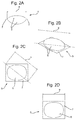
- 'flexible' we herein mean that the water-soluble unit dose articles are not rigid, rather they are formed in a manner that allows the shape to deform upon application of a suitable external force, but return to substantially their original shape upon removing said external force.
- This deformation characteristic allows the unit dose article to 'squash' allowing it to fit into a space that is smaller than a particular dimension of the unit dose article when the unit dose article is at rest.
- the side walls of the container may be placed at a distance smaller than the width of the unit dose article.
- the width of the unit dose article decreases due to the pressure exerted by the side walls, but the height of the unit dose article may correspondingly increase to accommodate the reduced internal volume of the unit dose article caused by the reduced width.
- the unit dose article may comprise a flange.
- Said flange is comprised of excess sealed film material that protrudes beyond the edge of the unit dose article and provides increased surface area for seal of the first and second films. Since the flange is also made of the same flexible film material, it may also 'squash' or deform to accommodate the unit dose article in the container.
- the flange may squash, the unit dose article per se may squash or both may squash.
- the unit dose articles are positioned side-by-side to form a single row of unit dose articles within the container.
- by placing in a single row there is reduced contact between neighbouring unit dose articles. This reduces the risk of contamination of multiple neighbours by e.g. water from the hands of consumer retrieving a unit dose article or from contamination of leaking unit dose articles.
- the unit dose articles are arranged in a row the contact point between adjacent unit dose articles is well defined. Clumping can be reduced by engineering a mechanical feature in the container that re-separates them, for example, a sliding or gripping means can pull the unit dose articles apart again.
- the single row arrangement also has the added benefit of maximising space during storage of the packaged product.
- Traditional tubs and bags tend to have a large footprint which is inconvenient to the consumer during storage of the product.
- the footprint of the container is reduced.
- the container may comprise at maximum 25 unit dose articles.
- the container may comprise at maximum 25 unit dose articles.
- the container may comprise a means to effect release of the unit dose article from the container upon actuation of the means by the consumer.
- the means may effect transfer of the unit dose article from the internal compartment through the opening and into the external environment.
- the means may effect transfer of the unit dose article from the internal compartment to a position prior to the opening.
- the means may effect the transfer of the unit dose article from a position prior, through the opening and to a position external of the container.
- suitable means for example mechanical, electronic or a mixture thereof, preferably mechanical means.
- suitable mechanical means may be selected from spring mechanisms, twist mechanisms, push or pull mechanisms, turn mechanisms, gear wheels and mixtures thereof.
- the mechanical means may be a manually operated mechanical means.
- One suitable manual means is in the form of a flexible zone within the walls of the container. Upon application of pressure to the flexible zone, the volume of the internal compartment is reduced forcing a unit dose article to be pushed out of the internal compartment and through the opening.
- the container may comprise a means to allow it to be temporarily secured to a surface.
- a means to allow it to be temporarily secured to a surface may comprise a releasable pressure means such as a 'vacuum suction cup', an adhesive, a hanging element or a mixture thereof.
- a releasable pressure means such as a 'vacuum suction cup', an adhesive, a hanging element or a mixture thereof.
- a releasable pressure means such as a 'vacuum suction cup', an adhesive, a hanging element or a mixture thereof.
- the container may comprise at least two compartments wherein each compartment comprises at least two unit dose articles and wherein each compartment is physically separated from the next.
- a water-soluble unit dose article is generally in the form of a pouch. It comprises a unitary dose of a composition as a volume sufficient to provide a benefit in an end application.
- the water-soluble unit dose article comprises at least one water-soluble film shaped such that the unit-dose article comprises at least one internal compartment surrounded by the water-soluble film.
- the at least one compartment comprises a cleaning composition.
- the water-soluble film is sealed such that the cleaning composition does not leak out of the compartment during storage. However, upon addition of the water-soluble unit dose article to water, the water-soluble film dissolves and releases the contents of the internal compartment into the wash liquor.
- the compartment should be understood as meaning a closed internal space within the unit dose article, which holds the composition.
- the unit dose article comprises a water-soluble film.
- the unit dose article is manufactured such that the water-soluble film completely surrounds the composition and in doing so defines the compartment in which the composition resides.
- the unit dose article may comprise two films. A first film may be shaped to comprise an open compartment into which the composition is added. A second film is then laid over the first film in such an orientation as to close the opening of the compartment. The first and second films are then sealed together along a seal region. The film is described in more detail below.
- the unit dose article may comprise more than one compartment, even at least two compartments, or even at least three compartments, or even at least four compartments, or even at least five compartments.
- the compartments may be arranged in superposed orientation, i.e. one positioned on top of the other. Alternatively, the compartments may be positioned in a side-by-side orientation, i.e. one orientated next to the other.
- the compartments may even be orientated in a 'tyre and rim' arrangement, i.e. a first compartment is positioned next to a second compartment, but the first compartment at least partially surrounds the second compartment, but does not completely enclose the second compartment. Alternatively one compartment may be completely enclosed within another compartment.
- the unit dose article comprises at least two compartments, one of the compartments may be smaller than the other compartment.
- the unit dose article comprises at least three compartments, two of the compartments may be smaller than the third compartment, and preferably the smaller compartments are superposed on the larger compartment.
- the superposed compartments preferably are orientated side-by-side.
- the cleaning composition may be comprised in at least one of the compartments. It may for example be comprised in just one compartment, or may be comprised in two compartments, or even in three compartments.
- the cleaning composition may be a laundry detergent composition, an automatic dishwashing composition, a hard surface cleaning composition or a combination thereof.
- the cleaning composition may comprise a solid, a liquid or a mixture thereof.
- the term liquid includes a gel, a solution, a dispersion, a paste or a mixture thereof.
- the unit dose article may comprise a flange.
- Said flange is comprised of excess sealed film material that protrudes beyond the edge of the unit dose article and provides increased surface area for seal of the first and second films.
- the unit dose article has a height, a width and a length.
- the maximum of any of these dimensions is meant to mean the greatest distance between two points on opposite sides of the unit dose article.
- the unit dose article may not have straight sides and so may have variable lengths, widths and heights depending on where the measurement is taken. Therefore, the maximum should be measured at any two points that are the furthest apart from each other.
- the maximum length may be between 2cm and 5 cm, or even between 2cm and 4cm, or even between 2cm and 3cm.
- the maximum length maybe greater than 2cm and less than 6cm
- the maximum width may be between 2cm and 5cm.
- the maximum width maybe greater than 3cm and less than 6cm.
- the maximum height may be between 2cm and 5cm.
- the maximum height maybe greater than 2cm and less than 4cm.
- These lengths may be in the presence or absence of the flange.
- the length: height ratio is from 3:1 to 1:1; or the width: height ratio is from 3:1 to 1:1, or even 2.5:1 to 1:1; or the ratio of length to height is from 3:1 to 1:1 and the ratio of width to height is from 3:1 to 1:1, or even 2.5:1 to 1:1, or a combination thereof.
- These ratios may be in the presence of absence of a flange.
- Each individual unit dose article may have a weight of between 10g and 40g, or even between 15g and 35g.
- One or more sides of the unit dose article may have a radius of curvature.
- the unit dose article preferably does not comprise substantially straight sides or right angled corners. Without wishing to be bound by theory, this is preferred as it reduces the available surface area of unit dose articles to contact one another and the walls of the container.
- the contacting sides between the side by side positioned unit dose articles have a radius of curvature.
- the film of the present invention is soluble or dispersible in water.
- the water-soluble film Prior to be being formed into a unit dose article, the water-soluble film preferably has a thickness of from 20 to 150 micron, preferably 35 to 125 micron, even more preferably 50 to 110 micron, most preferably about 76 micron.
- the film has a water-solubility of at least 50%, preferably at least 75% or even at least 95%, as measured by the method set out here after using a glass-filter with a maximum pore size of 20 microns:
- Preferred film materials are preferably polymeric materials.
- the film material can, for example, be obtained by casting, blow-moulding, extrusion or blown extrusion of the polymeric material, as known in the art.
- Preferred polymers, copolymers or derivatives thereof suitable for use as pouch material are selected from polyvinyl alcohols, polyvinyl pyrrolidone, polyalkylene oxides, acrylamide, acrylic acid, cellulose, cellulose ethers, cellulose esters, cellulose amides, polyvinyl acetates, polycarboxylic acids and salts, polyaminoacids or peptides, polyamides, polyacrylamide, copolymers of maleic/acrylic acids, polysaccharides including starch and gelatine, natural gums such as xanthum and carragum.
- the level of polymer in the pouch material for example a PVA polymer, is at least 60%.
- the polymer can have any weight average molecular weight, preferably from about 1000 to 1,000,000, more preferably from about 10,000 to 300,000 yet more preferably from about 20,000 to 150,000.
- Mixtures of polymers can also be used as the pouch material.
- Preferred films exhibit good dissolution in cold water, meaning unheated distilled water.
- Preferably such films exhibit good dissolution at temperatures of 24°C, even more preferably at 10°C.
- good dissolution it is meant that the film exhibits water-solubility of at least 50%, preferably at least 75% or even at least 95%, as measured by the method set out here after using a glass-filter with a maximum pore size of 20 microns, described above.
- Preferred films are those supplied by Monosol under the trade references M8630, M8900, M8779, M8310, films.
- the PVA resin can comprise about 30 to about 85 wt% of the first PVA polymer, or about 45 to about 55 wt% of the first PVA polymer.
- the PVA resin can contain about 50 w.% of each PVA polymer, wherein the viscosity of the first PVA polymer is about 13 cP and the viscosity of the second PVA polymer is about 23 cP.
- the film may be opaque, transparent or translucent.
- the film may comprise a printed area.
- the printed area may cover between 10 and 80% of the surface of the film; or between 10 and 80% of the surface of the film that is in contact with the internal space of the compartment; or between 10 and 80% of the surface of the film and between 10 and 80% of the surface of the compartment.
- the area of print may cover an uninterrupted portion of the film or it may cover parts thereof, i.e. comprise smaller areas of print, the sum of which represents between 10 and 80% of the surface of the film or the surface of the film in contact with the internal space of the compartment or both.
- the area of print may comprise inks, pigments, dyes, blueing agents or mixtures thereof.
- the area of print may be opaque, translucent or transparent.
- the area of print may comprise a single colour or maybe comprise multiple colours, even three colours.
- the area of print may comprise white, black, blue, red colours, or a mixture thereof.
- the print may be present as a layer on the surface of the film or may at least partially penetrate into the film.
- the film will comprise a first side and a second side.
- the area of print may be present on either side of the film, or be present on both sides of the film. Alternatively, the area of print may be at least partially comprised within the film itself.
- the area of print may comprise an ink, wherein the ink comprises a pigment.
- the ink for printing onto the film has preferably a desired dispersion grade in water.
- the ink may be of any color including white, red, and black.
- the ink may be a water-based ink comprising from 10% to 80% or from 20% to 60% or from 25% to 45% per weight of water.
- the ink may comprise from 20% to 90% or from 40% to 80% or from 50% to 75% per weight of solid.
- the ink may have a viscosity measured at 20°C with a shear rate of 1000s -1 between 1 and 600 cPs or between 50 and 350 cPs or between 100 and 300 cPs or between 150 and 250 cPs.
- the measurement may be obtained with a cone- plate geometry on a TA instruments AR-550 Rheometer.
- the area of print may be achieved using standard techniques, such as flexographic printing or inkjet printing.
- the area of print is achieved via flexographic printing, in which a film is printed, then moulded into the shape of an open compartment. This compartment is then filled with a detergent composition and a second film placed over the compartment and sealed to the first film.
- the area of print may be on either or both sides of the film.
- an ink or pigment may be added during the manufacture of the film such that all or at least part of the film is coloured.
- the film may comprise an aversive agent, for example a bittering agent.
- Suitable bittering agents include, but are not limited to, naringin, sucrose octaacetate, quinine hydrochloride, denatonium benzoate, or mixtures thereof.
- Any suitable level of aversive agent may be used in the film. Suitable levels include, but are not limited to, 1 to 5000ppm, or even 100 to 2500ppm, or even 250 to 2000rpm.
- the unit dose article may be flowed wrapped.
- Flow wrapped unit dose articles comprise an outer water insoluble or water-soluble film.
- the flow wrapped unit dose articles maybe joined together by the external flow wrap film and wherein the flow wrap film comprises an area of weakness between adjacent unit dose articles to allow them to be separated.
- An example of an area of weakness is a perforated line.
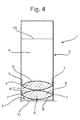
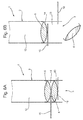
- a packaged product in accordance with FIG 6 was compared to a standard off-the-shelf rigid
- the packaged product according to the invention comprised a tube shaped container filled with unit dose articles (stacked on top of each other) and a dispenser means.
- the open tube comprises a plate inside the dispenser acting as a blocking means, preventing the unit dose articles from falling out of the container.
- a rotating action moves the tube and will release 1 unit dose article at a time, preventing the unit dose article above to be released as well by means of an internal wall.
- the rotation action is controlled by means of a rubber band to bring it back into its original position after actuation.
- Unit dose articles are stacked one on top of each other in the container and are held in place by the bottom plate of the container. Rubber band is connecting the tube (moving part) with the fixed bottom plate of the dispenser is in rest
- the off-the-shelf rigid product comprised a tub with a lid (Package C).
- the unit dose articles were arranged randomly within the tub, and the consumer had to first open the hinged lid, followed by retrieving a unit dose article using their hand, followed by closing the lid.
- 25 consumers were each asked to dose a single unit dose article from the package C). They were asked to dose a single unit dose article from package A and a single unit dose article from package C into a receptacle, and replace the package to its starting point. In each case the receptacle was placed in front of the unit dose article at a distance of 36cm (edge of the receptacle to edge of the package).
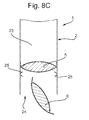
- a packaged product in accordance with FIG 8 was compared to a standard off-the-shelf rigid plastic container (Ariel Pods product).
- the packaged product according to the invention comprised a gripping means.
- the package consists of a long tube-shaped part where the unit dose articles are stored ( on top of each other) . Pushing the top of this tube downwards will activate a mechanism with cantilever claws at the bottom of the package. The downwards pushing action forces the claws to open so 1 unit dose article can be released whilst in this same continuous movement the unit dose article above is kept in place due to the specific shape of the claws.
- rubber bands will force the tube back to its original position (before actuation).
- the off-the-shelf rigid product comprised a tub with a lid (Package C).
- the unit dose articles were arranged randomly within the tub, and the consumer had to first open the hinged lid, followed by retrieving a unit dose article using their hand, followed by closing the lid.
- 25 consumers were each asked to dose a single unit dose article from the packaged product according to the invention (package B) and the rigid plastic container (package C). They were asked to dose a single unit dose article from package A and a single unit dose article from package B into a receptacle, and replace the package to its starting point. In each case the receptacle was placed in front of the unit dose article at a distance of 36cm (edge of the receptacle to edge of the package). In was noted how many times a unit dose article was dispensed into the receptacle using package B wherein the consumer dosed a single unit dose article at a time without touching. Also, the time taken for the consumer to complete the dosing operation and replace the package to the starting position was recorded.
Landscapes
- Engineering & Computer Science (AREA)
- Chemical & Material Sciences (AREA)
- Mechanical Engineering (AREA)
- Textile Engineering (AREA)
- Life Sciences & Earth Sciences (AREA)
- Chemical Kinetics & Catalysis (AREA)
- Oil, Petroleum & Natural Gas (AREA)
- Wood Science & Technology (AREA)
- Organic Chemistry (AREA)
- Dispersion Chemistry (AREA)
- Packages (AREA)
Priority Applications (4)
| Application Number | Priority Date | Filing Date | Title |
|---|---|---|---|
| EP16155339.1A EP3205765A1 (de) | 2016-02-11 | 2016-02-11 | Waschverfahren |
| US15/428,271 US10704182B2 (en) | 2016-02-11 | 2017-02-09 | Method of washing |
| PCT/US2017/017079 WO2017139426A1 (en) | 2016-02-11 | 2017-02-09 | Method of washing |
| CA3011618A CA3011618C (en) | 2016-02-11 | 2017-02-09 | Method of delivering unit dose articles to a washing machine |
Applications Claiming Priority (1)
| Application Number | Priority Date | Filing Date | Title |
|---|---|---|---|
| EP16155339.1A EP3205765A1 (de) | 2016-02-11 | 2016-02-11 | Waschverfahren |
Publications (1)
| Publication Number | Publication Date |
|---|---|
| EP3205765A1 true EP3205765A1 (de) | 2017-08-16 |
Family
ID=55349762
Family Applications (1)
| Application Number | Title | Priority Date | Filing Date |
|---|---|---|---|
| EP16155339.1A Withdrawn EP3205765A1 (de) | 2016-02-11 | 2016-02-11 | Waschverfahren |
Country Status (4)
| Country | Link |
|---|---|
| US (1) | US10704182B2 (de) |
| EP (1) | EP3205765A1 (de) |
| CA (1) | CA3011618C (de) |
| WO (1) | WO2017139426A1 (de) |
Cited By (1)
| Publication number | Priority date | Publication date | Assignee | Title |
|---|---|---|---|---|
| GB2606860A (en) * | 2021-05-14 | 2022-11-23 | Unilever Global Ip Ltd | Package containing water-soluble capsules |
Families Citing this family (13)
| Publication number | Priority date | Publication date | Assignee | Title |
|---|---|---|---|---|
| US10276411B2 (en) | 2017-08-18 | 2019-04-30 | Applied Materials, Inc. | High pressure and high temperature anneal chamber |
| WO2019182967A1 (en) | 2018-03-19 | 2019-09-26 | Applied Materials, Inc. | Methods for depositing coatings on aerospace components |
| US11015252B2 (en) | 2018-04-27 | 2021-05-25 | Applied Materials, Inc. | Protection of components from corrosion |
| US11009339B2 (en) | 2018-08-23 | 2021-05-18 | Applied Materials, Inc. | Measurement of thickness of thermal barrier coatings using 3D imaging and surface subtraction methods for objects with complex geometries |
| EP3959356A4 (de) | 2019-04-26 | 2023-01-18 | Applied Materials, Inc. | Verfahren zum schutz von luft- und raumfahrtkomponenten gegen korrosion und oxidation |
| US11794382B2 (en) | 2019-05-16 | 2023-10-24 | Applied Materials, Inc. | Methods for depositing anti-coking protective coatings on aerospace components |
| US11697879B2 (en) | 2019-06-14 | 2023-07-11 | Applied Materials, Inc. | Methods for depositing sacrificial coatings on aerospace components |
| US11466364B2 (en) | 2019-09-06 | 2022-10-11 | Applied Materials, Inc. | Methods for forming protective coatings containing crystallized aluminum oxide |
| DE102019128280A1 (de) * | 2019-10-21 | 2021-04-22 | Henkel Ag & Co. Kgaa | Verpacktes Produkt |
| US11519066B2 (en) | 2020-05-21 | 2022-12-06 | Applied Materials, Inc. | Nitride protective coatings on aerospace components and methods for making the same |
| CN115734826A (zh) | 2020-07-03 | 2023-03-03 | 应用材料公司 | 用于翻新航空部件的方法 |
| USD1088343S1 (en) | 2022-05-11 | 2025-08-12 | People Against Dirty Holdings Limited | Packet |
| CN118547472A (zh) * | 2023-02-24 | 2024-08-27 | 青岛海尔洗衣机有限公司 | 一种洗衣进水盒、洗衣进水盒工作方法及洗衣装置 |
Citations (3)
| Publication number | Priority date | Publication date | Assignee | Title |
|---|---|---|---|---|
| GB2386130A (en) * | 2002-03-06 | 2003-09-10 | Reckitt Benckiser Nv | Detergent dosing delay device for a dishwasher |
| WO2012025315A1 (en) * | 2010-08-26 | 2012-03-01 | Unilever Plc | Dispensing device |
| EP2924162A1 (de) * | 2014-03-24 | 2015-09-30 | The Procter and Gamble Company | Verfahren zum Wäschewaschen |
Family Cites Families (17)
| Publication number | Priority date | Publication date | Assignee | Title |
|---|---|---|---|---|
| US2960259A (en) | 1956-06-25 | 1960-11-15 | James A Mcintosh | Dispenser for pills or pellets and the like |
| US3300090A (en) | 1965-03-24 | 1967-01-24 | Carden Columbus Heard | Tablet and capsule dispenser |
| US3578207A (en) | 1968-10-21 | 1971-05-11 | James F Danow | Adjustable bread dsipenser with ejector-controlled closure |
| US3591043A (en) | 1969-04-21 | 1971-07-06 | Kelly Murphy | Article container and dispenser |
| US3877473A (en) | 1973-09-10 | 1975-04-15 | Leslie Williams | Bingo type chip dispenser |
| US5779095A (en) | 1997-01-31 | 1998-07-14 | Imaginings 3, Inc. | Portable gumball dispenser |
| GB9906175D0 (en) | 1999-03-17 | 1999-05-12 | Unilever Plc | A water soluble package |
| US7086110B2 (en) * | 2002-02-13 | 2006-08-08 | The Procter & Gamble Company | Selective dispensing of laundry additives during automatic machine laundering of fabric |
| US20050279755A1 (en) | 2004-06-16 | 2005-12-22 | Jansen Torben R | Hand soap product and hand soap dispenser |
| GB2414958A (en) | 2004-06-11 | 2005-12-14 | Reckitt Benckiser Nv | A process for preparing a water soluble article. |
| US20060249534A1 (en) | 2005-05-09 | 2006-11-09 | Sainz Jose R | Comestible product dispenser having single hand operation and method of using same |
| US20120070106A1 (en) | 2010-09-20 | 2012-03-22 | Gustavo Jose Camargo-Parodi | Flexible bag containing unit dose articles |
| GB201101547D0 (en) * | 2011-01-31 | 2011-03-16 | Reckitt Benckiser Nv | Container for use in a washing process |
| US20130292414A1 (en) | 2012-05-02 | 2013-11-07 | Spencer D. Sutherland | Dispensing Device |
| CA2841024C (en) | 2014-01-30 | 2017-03-07 | The Procter & Gamble Company | Unit dose article |
| RU2645671C2 (ru) | 2014-03-27 | 2018-02-27 | Дзе Проктер Энд Гэмбл Компани | Водорастворимая капсула с нанесенной печатью |
| EP2927307A1 (de) | 2014-03-31 | 2015-10-07 | The Procter & Gamble Company | Wäscheeinheitsdosisartikel |
-
2016
- 2016-02-11 EP EP16155339.1A patent/EP3205765A1/de not_active Withdrawn
-
2017
- 2017-02-09 WO PCT/US2017/017079 patent/WO2017139426A1/en not_active Ceased
- 2017-02-09 CA CA3011618A patent/CA3011618C/en active Active
- 2017-02-09 US US15/428,271 patent/US10704182B2/en active Active
Patent Citations (3)
| Publication number | Priority date | Publication date | Assignee | Title |
|---|---|---|---|---|
| GB2386130A (en) * | 2002-03-06 | 2003-09-10 | Reckitt Benckiser Nv | Detergent dosing delay device for a dishwasher |
| WO2012025315A1 (en) * | 2010-08-26 | 2012-03-01 | Unilever Plc | Dispensing device |
| EP2924162A1 (de) * | 2014-03-24 | 2015-09-30 | The Procter and Gamble Company | Verfahren zum Wäschewaschen |
Cited By (3)
| Publication number | Priority date | Publication date | Assignee | Title |
|---|---|---|---|---|
| GB2606860A (en) * | 2021-05-14 | 2022-11-23 | Unilever Global Ip Ltd | Package containing water-soluble capsules |
| GB2606860B (en) * | 2021-05-14 | 2025-07-23 | Unilever Global Ip Ltd | Package containing water-soluble capsules |
| US12559292B2 (en) | 2021-05-14 | 2026-02-24 | Conopco, Inc. | Package containing water-soluble capsules |
Also Published As
| Publication number | Publication date |
|---|---|
| CA3011618C (en) | 2020-08-04 |
| CA3011618A1 (en) | 2017-08-17 |
| WO2017139426A1 (en) | 2017-08-17 |
| US10704182B2 (en) | 2020-07-07 |
| US20170233930A1 (en) | 2017-08-17 |
Similar Documents
| Publication | Publication Date | Title |
|---|---|---|
| CA3011618C (en) | Method of delivering unit dose articles to a washing machine | |
| US9708117B1 (en) | Packaged product | |
| EP3205601A1 (de) | Verpacktes produkt | |
| EP3205600A1 (de) | Verpacktes produkt | |
| US10934064B2 (en) | Consumer product that includes a container and unit dose articles | |
| CA2787090C (en) | Container systems with lids for unit dose detergent compositions | |
| JP6804459B2 (ja) | マルチドーズ型洗浄製品及び製造方法 | |
| US20170259984A1 (en) | Flexible containers having flexible valves | |
| US20170283749A1 (en) | Water soluble pouch | |
| EP3205602A1 (de) | Verpacktes produkt | |
| EP3483087B1 (de) | Verbraucherprodukt | |
| US20100147726A1 (en) | Packaging with improved water vapour permeability | |
| US20110127271A1 (en) | Packaging | |
| EP2698326A1 (de) | Wiederverschliessbarer blisterpackungsbehälter | |
| EP3521182B1 (de) | Verfahren zur herstellung eines konsumgüterprodukts | |
| CA3004035A1 (en) | Consumer goods product | |
| US20100147725A1 (en) | Packaging with improved water vapour barrier rating | |
| US20180273234A1 (en) | Container comprising a thermoformed tub and dosing units located therein | |
| EP3483088A1 (de) | Verfahren zur dosierung eines waschmittelprodukts |
Legal Events
| Date | Code | Title | Description |
|---|---|---|---|
| PUAI | Public reference made under article 153(3) epc to a published international application that has entered the european phase |
Free format text: ORIGINAL CODE: 0009012 |
|
| STAA | Information on the status of an ep patent application or granted ep patent |
Free format text: STATUS: THE APPLICATION HAS BEEN PUBLISHED |
|
| AK | Designated contracting states |
Kind code of ref document: A1 Designated state(s): AL AT BE BG CH CY CZ DE DK EE ES FI FR GB GR HR HU IE IS IT LI LT LU LV MC MK MT NL NO PL PT RO RS SE SI SK SM TR |
|
| AX | Request for extension of the european patent |
Extension state: BA ME |
|
| STAA | Information on the status of an ep patent application or granted ep patent |
Free format text: STATUS: REQUEST FOR EXAMINATION WAS MADE |
|
| 17P | Request for examination filed |
Effective date: 20180213 |
|
| RBV | Designated contracting states (corrected) |
Designated state(s): AL AT BE BG CH CY CZ DE DK EE ES FI FR GB GR HR HU IE IS IT LI LT LU LV MC MK MT NL NO PL PT RO RS SE SI SK SM TR |
|
| STAA | Information on the status of an ep patent application or granted ep patent |
Free format text: STATUS: EXAMINATION IS IN PROGRESS |
|
| 17Q | First examination report despatched |
Effective date: 20210428 |
|
| STAA | Information on the status of an ep patent application or granted ep patent |
Free format text: STATUS: THE APPLICATION IS DEEMED TO BE WITHDRAWN |
|
| 18D | Application deemed to be withdrawn |
Effective date: 20210909 |