EP3206077A1 - Linse mit induzierter öffnung und verfahren - Google Patents
Linse mit induzierter öffnung und verfahren Download PDFInfo
- Publication number
- EP3206077A1 EP3206077A1 EP16170493.7A EP16170493A EP3206077A1 EP 3206077 A1 EP3206077 A1 EP 3206077A1 EP 16170493 A EP16170493 A EP 16170493A EP 3206077 A1 EP3206077 A1 EP 3206077A1
- Authority
- EP
- European Patent Office
- Prior art keywords
- lens
- power
- aperture
- center
- avg
- Prior art date
- Legal status (The legal status is an assumption and is not a legal conclusion. Google has not performed a legal analysis and makes no representation as to the accuracy of the status listed.)
- Granted
Links
Images




Classifications
-
- G—PHYSICS
- G02—OPTICS
- G02C—SPECTACLES; SUNGLASSES OR GOGGLES INSOFAR AS THEY HAVE THE SAME FEATURES AS SPECTACLES; CONTACT LENSES
- G02C7/00—Optical parts
- G02C7/02—Lenses; Lens systems ; Methods of designing lenses
- G02C7/04—Contact lenses for the eyes
- G02C7/041—Contact lenses for the eyes bifocal; multifocal
-
- G—PHYSICS
- G02—OPTICS
- G02C—SPECTACLES; SUNGLASSES OR GOGGLES INSOFAR AS THEY HAVE THE SAME FEATURES AS SPECTACLES; CONTACT LENSES
- G02C7/00—Optical parts
- G02C7/02—Lenses; Lens systems ; Methods of designing lenses
- G02C7/024—Methods of designing ophthalmic lenses
-
- G—PHYSICS
- G02—OPTICS
- G02C—SPECTACLES; SUNGLASSES OR GOGGLES INSOFAR AS THEY HAVE THE SAME FEATURES AS SPECTACLES; CONTACT LENSES
- G02C7/00—Optical parts
- G02C7/02—Lenses; Lens systems ; Methods of designing lenses
- G02C7/04—Contact lenses for the eyes
- G02C7/041—Contact lenses for the eyes bifocal; multifocal
- G02C7/042—Simultaneous type
-
- G—PHYSICS
- G02—OPTICS
- G02C—SPECTACLES; SUNGLASSES OR GOGGLES INSOFAR AS THEY HAVE THE SAME FEATURES AS SPECTACLES; CONTACT LENSES
- G02C7/00—Optical parts
- G02C7/02—Lenses; Lens systems ; Methods of designing lenses
- G02C7/022—Ophthalmic lenses having special refractive features achieved by special materials or material structures
-
- G—PHYSICS
- G02—OPTICS
- G02C—SPECTACLES; SUNGLASSES OR GOGGLES INSOFAR AS THEY HAVE THE SAME FEATURES AS SPECTACLES; CONTACT LENSES
- G02C7/00—Optical parts
- G02C7/02—Lenses; Lens systems ; Methods of designing lenses
- G02C7/04—Contact lenses for the eyes
- G02C7/047—Contact lens fitting; Contact lenses for orthokeratology; Contact lenses for specially shaped corneae
-
- G—PHYSICS
- G02—OPTICS
- G02C—SPECTACLES; SUNGLASSES OR GOGGLES INSOFAR AS THEY HAVE THE SAME FEATURES AS SPECTACLES; CONTACT LENSES
- G02C7/00—Optical parts
- G02C7/02—Lenses; Lens systems ; Methods of designing lenses
- G02C7/04—Contact lenses for the eyes
- G02C7/049—Contact lenses having special fitting or structural features achieved by special materials or material structures
-
- A—HUMAN NECESSITIES
- A45—HAND OR TRAVELLING ARTICLES
- A45C—PURSES; LUGGAGE; HAND CARRIED BAGS
- A45C11/00—Receptacles for purposes not provided for in groups A45C1/00-A45C9/00
- A45C11/005—Contact lens cases
-
- G—PHYSICS
- G02—OPTICS
- G02C—SPECTACLES; SUNGLASSES OR GOGGLES INSOFAR AS THEY HAVE THE SAME FEATURES AS SPECTACLES; CONTACT LENSES
- G02C2202/00—Generic optical aspects applicable to one or more of the subgroups of G02C7/00
- G02C2202/24—Myopia progression prevention
-
- G—PHYSICS
- G02—OPTICS
- G02C—SPECTACLES; SUNGLASSES OR GOGGLES INSOFAR AS THEY HAVE THE SAME FEATURES AS SPECTACLES; CONTACT LENSES
- G02C7/00—Optical parts
- G02C7/02—Lenses; Lens systems ; Methods of designing lenses
- G02C7/04—Contact lenses for the eyes
- G02C7/041—Contact lenses for the eyes bifocal; multifocal
- G02C7/044—Annular configuration, e.g. pupil tuned
Definitions
- the present application relates generally to optical lenses. More particularly, the present application relates to methods for creating optical lenses with induced apertures and parameters for improving the vision of the wearer and comfort of the lenses.
- Myopia or short sightedness is a condition in which the far-point of the eye is less than infinite in distance from the surface of the eye.
- a myopic eye can see objects clearly only within a finite distance limited by the level of myopia in the eye.
- Advancing myopia is the result of the scleral ball of the eye elongating so that the retina that lies against the posterior inner wall of the eye moves behind the eye's distance image focal point.
- a light diverging or "minus" lens is conventionally used to move the focused light from in front of the retina backward to the retinal plane.
- the minus lens whether spectacle lens, intraocular lens, contact lens, or other light diverging ophthalmic device, allows the myopic eye to regain the clarity of objects at a longer distance.
- Presbyopia is generally accepted to be caused by the lack of elasticity of the crystalline lens in the eye.
- the eye accommodates the divergent, rather than parallel, light arriving from the near object.
- the eye will then perform the act of accommodation resulting in a physical change to steepen the shape of the crystalline lens within the eye.
- Accommodation increases the convergence of light waves by causing the eye's intraocular lens surfaces to be more steeply curved, which in turn adds focal power to the optical system of the eye. The closer an object is viewed, the greater the accommodative demand placed on the eye.
- a person's crystalline lens will stiffen as the person ages, losing its accommodative ability and likewise losing its ability to change shape. This stiffening therefore prevents the eye from focusing light properly when viewing objects at close range, leading to the condition known as presbyopia.
- Reading glasses are commonly provided to treat presbyopia.
- Such a power distribution has a central or apex area having distance vision correcting power and a power distribution creating a blurred region outside of the apex area so as to cause an "induced aperture.”
- the lens is not a physical pinhole, it produces similar increased depth of focus effects to the user without suffering from the loss of light and increased diffraction inherent in physical pinholes. This lens increases the depth of focus, therefore requiring less from the eye's accommodation to see clearly at near distances, and reducing accommodative stress to thereby limit the progression of myopia and treat presbyopia.
- the induced aperture can be most advantageous when located near the center of the wearer's eye. Because of this, movement of the lens is permitted, but movement beyond a particular threshold can prevent the induced aperture from performing its intended function. Also, traditional American National Standards Institute (ANSI) methods of characterizing soft contact lens power profiles were inadequate to predict clinical performance for the induced aperture lenses. These standards were also inadequate to produce lenses of a single power profile for a wide range of presbyopia.
- ANSI American National Standards Institute
- the present application discloses various lenses and methods for producing a lens having an induced aperture.
- the lenses can have a geometry that maintains a centered position about a wearer's eye to prevent substantial movement of the lens about the eye.
- a novel method can be used for verifying the power profiles used with this lens, and the method can produce a lens having a single power profile for a wide range of presbyopes.
- the present application discloses an ophthalmic lens including an apex area having distance vision correcting power and a power distribution creating a blurred region outside of the apex area so as to cause an induced aperture.
- the base curve can be between 7.9 mm and 8.5 mm; and the lens diameter can be between 14.3 and 14.5 mm.
- an ophthalmic lens including an apex area having distance vision correcting power and a power distribution creating a blurred region outside of the apex area so as to cause an induced aperture.
- the lens can be made of polymacon, and the power distribution can include a power profile having an aperture inducing power rise between +2.00 to +2.75 diopters.
- an ophthalmic lens including an apex area having distance vision correcting power and a power distribution creating a blurred region outside of the apex area so as to cause an induced aperture.
- the lens can be made of etafilcon, and the power distribution can include an aperture inducing power rise between +2.375 to +3.125.
- an ophthalmic lens including an apex area having distance vision correcting power and a power distribution creating a blurred region outside of the apex area so as to cause an induced aperture.
- the power distribution can include an aperture inducing power rise between +2.00 to +3.25 diopters, for example, with silicon hydrogel material lenses.
- the ophthalmic lens for a user requiring a labeled power for clear vision.
- the ophthalmic lens can include an apex area having distance vision correcting power and a power distribution creating a blurred region outside of the apex area so as to cause an induced aperture.
- the labeled power can be an area weighted average of a sagittal power as a function of radius from a lens center.
- the combination can include the ophthalmic lens including an apex area having distance vision correcting power and a power distribution creating a blurred region outside of the apex area so as to cause an induced aperture. It can also include the package being marked with a labeled power that is substantially equivalent to an area weighted average of a sagittal power as a function of radius from a lens center.
- an ophthalmic lens having an apex area with distance vision correcting power and a power distribution creating a blurred region outside of the apex area so as to cause an induced aperture.
- the lens can have a sag between about 3.7 mm and 4.75 mm.
- the present application discloses, for example, lenses and methods for verifying a lens with an induced aperture.
- the induced aperture can include a clear power around a center point of the wearer's eye, and a blur region immediately surrounding the center point. The wearer will therefore not perceive an aperture in the middle of their vision but will have the optical benefits of an aperture without a physical aperture in the lens.
- the power rise about the distance power of the apical aperture is not seen by wearers while viewing distance objects through the aperture. This feature of the aperture allows for a wide range of presbyopia correction.
- the lenses can have a geometry that maintains a centered position about a wearer's eye to prevent more than a permissible amount of movement of the lens relative to the eye. Further disclosed is a method for verifying that the power profiles used with the lens correspond to labeled powers a user would normally wear with a lens not having an induced aperture.
- a lens according to the present application can include a continuous axi-symmetric power distribution that provides multiple functions.
- a central portion or apex of the lens can have a power distribution selected preferably for correcting a user's distance vision.
- the power distribution can increase in power quickly over a short radial dimension to produce a blur effect on the user's vision.
- This radial area of rapidly rising power is termed here for convenience a "blur" zone.
- the magnitude of blur in the blur zone can be selected so that the eye cannot resolve a level of detail in the distance.
- This induced optical aperture generates an increased depth of focus due in part to the user's cortical response to the blur of inhibition.
- the associated increased depth of focus of the lens will compensate, at least partially, for defocus occurring when the user attempts near vision.
- This compensatory or "pseudo" accommodation provides clearer vision for the presbyope and reduced accommodative stress and accommodative lag stress that are believed to be associated with myopia progression.
- FIG. 1 depicts a graph of the distribution 50 of the optical power rise as a function of radial dimension (x) from the apex of a lens according to the invention.
- the term "power rise” can mean the power above the distance corrective power at the apex of the lens (apical power).
- a centrally located distance vision region 60 has a power distribution that varies within a power range for distance vision correction.
- the distance correction power is that power providing clear vision when viewing objects infinitely distant from the user.
- the distribution power rise initially increases continuously but slowly as the radius moves away from the apical center. This continues to a design point Dp at a radial dimension in the range of about 0.5 to 1.5 millimeters from the apex, for example.
- the power increases more quickly and continuously until a maximum power value 62 is reached.
- the portion of the lens and power distribution 50 between the design point D p and peak power 62 defines and creates a blur zone 64.
- the rapidly rising power in the blur zone 64 produces the unfocused light impinging peripherally on the retina to create a blur.
- the power distribution rises sufficiently quickly to create a blur and to reach a maximum power within the constraint of the pupillary dimension.
- the blur produced by the lens is inhibited or suppressed by the user's optical cortical system. Accordingly, the blur is not recognized by the user.
- the power distribution 50 is shown to continue beyond the peak power to illustrate that the power distribution 50 may be defined as a portion of a continuous power relationship.
- the optical power is the front surface tangential power, which may be somewhat different from the through lens sagittal power or average power at any point on a lens.
- lens parameters including base curve radius, diameter, and thickness profile, to minimize (although not necessarily prevent) lens movement about the eye.
- the lens parameters also allowed the lens to center about the visible iris.
- the inventors discovered induced aperture lenses to generally be neither too tight nor too loose when the base curve is a radius between 7.9 mm and 8.5 mm, preferably 8.1 mm to 8.3 mm.
- the inventors discovered a well-fitting lens with a back surface saggital depth (otherwise known by the abbreviation "sag") between 3.7 mm to 4.75 mm, preferably 3.9 mm to 4.75 mm, more preferably 4.05 mm to 4.50 mm, OR a lens diameter between 14.0 mm to 14.5 mm, preferably 14.3 mm to 14.5 mm. Outside of these ranges, the inventors discovered the performance and fit of the lens to decline unexpectedly, showing the criticality of these ranges.
- the present inventors discovered increased performance with lenses having an edge thickness of 0.145 mm at 0.30 mm radially in from the lens edge verifying that. Further, exemplary well-fitting lenses had a thickness profile with a center thickness between 0.100-0.120mm and a peripheral thickness of 0.220-0.310 at a chord diameter of 12.30 mm. Below are tables illustrating the data collected by the inventors that contributed to the discovery of the above ranges.
- Table 1-A Base Curve Range Chart Base Curve Thickness-Center , Peripheral Test Number Movement With Blink Primary Gaze Lag Up Gaze Lag 7.9 0.120, 0.220 18 avg 0.10mm, 10% 0.0mm movement avg 0.07mm, 0% >0.3mm avg 0.22mm, 0% >0.3mm 7.9 0.120, 0.310 19 avg 0.08mm, 26% 0.0mm movement avg 0.06mm, 0% >0.3mm avg 0.19mm, 0% >0.3mm 8.1 0.120, 0.220 15 N/A avg 0.14mm, 0% >0.3mm avg 0.31mm, 39% >0.3mm 8.1 0.120, 0.310 17 avg 0.09mm, 16% 0.0mm movement avg 0.05mm, 0% >0.3mm avg 0.17mm, 2% >0.3mm 8.1 0.120, 0.310 21 avg 0.11mm, 0% 0.0mm movement avg 0.12mm, 0% >0.3
- Tables 1-A and 1-B include the tested "Base Curve” in mm, the results for each thickness “Thickness - Center, Peripheral” in mm, and the "Test Number” referring to the specific design version tested with these dimensions. It was determined that lenses providing an induced aperture, for example that shown in FIG. 1 , perform better when maintained generally in the center of the visible iris of the eye. For this reason, one design consideration was to position the center of the lens as close as practical to the pupil center or line of sight of the eye.
- a "perfectly-centered" soft contact lens is centered about the visible iris of the eye, and is normally not centered about the pupil center or the line of sight of the eye.
- the goal was therefore to reduce the primary gaze decentration relative to the visible iris.
- Tables 1-A and 1-B the vertical decentration reduced from an average of 0.1 mm for the 8.5 mm base curve to 0.00 mm for the 7.9 mm base curve.
- lens lag is considered as the decentration away (in the opposite direction) from the primary gaze centration when looking up (“Up Gaze Lag” as shown in the above tables) or looking left and right (horizontal gaze lag).
- Lens lag causes the center of the lens to temporarily deviate from the primary gaze centration position as the wearer looks up, down, and to the sides.
- a design goal was to reduce lens lag relative to the primary gaze centration position (referred to as "Primary Gaze Lag” and "Up Gaze Lag” in the above tables).
- the primary gaze lag reduced from an average of 0.19 mm for the 8.5 mm base curve to 0.03 mm for the 8.1 mm base curve samples.
- up gaze lag was minimal at an average of less than 0.22 mm with 0 to 8% of lenses showing a significant (>0.3mm) lag.
- Primary gaze lens movement with a blink is also a good indication of the "tightness" of the lens fitting. This tightness results from the suction between the lens and the eye. This suction holds the lens centered on the eye and can cause the edge of the lens to indent into the conjunctiva of the eye. Lens movement with a blink is believed to improve the physiology of the cornea, especially for repeated overnight lens wear (commonly referred to as “extended” or “continuous wear”). Lens movement with a blink also causes the center of the lens to temporarily deviate from the center of the visible iris after each blink.
- Another design goal of the above empirical study was therefore to reduce primary gaze lens movement (discussed in Table 1-A and 1-B as "Movement with Blink" and measured in mm) without having an apparently immobile or bound lens.
- An immobile lens would be considered a lens having no visible movement, or movement of less than clinical detection limit of 0.05 mm.
- Lens buckling or fluting results from excessive lens material being located toward the edge of the lens and is caused by the lens being too flat to conform to the curvature of the eye. Another design goal was therefore to avoid significant lens buckling or fluting, as shown in the "Lens Buckling/Fluting" column of the above tables. None of the lenses tested had lens buckling or fluting.
- Optical distortion results from excessive lens material existing near the center of the lens and is caused by the lens being too steep to conform to the curvature of the eye. Another design goal was therefore to avoid a significant amount of optical distortion, as shown in the column labeled "Optical Distortion.” Optical distortion was seen in 2% of the lenses for Design 18 with a 7.9 mm base curve lens, which is not preferable, but acceptable.
- the present inventors also discovered that thicker lens designs (0.120 mm/0.310 mm central/peripheral thickness) were best for both the 8.1 mm and 8.3 mm base curves. The less-optimal performance with the 7.9 mm and 8.5 mm base curves was also reduced with the thicker 0.310 mm peripheral thickness designs. None of the Design 9 lenses (8.5 mm base curve and 0.100/0.310 mm central/peripheral thickness) were summarized as "too loose" but they still exhibited degradation in centration and lag. None of the thicker Design 19 lenses (7.9 mm base curve, 0.120/0.310 mm central/peripheral thickness) exhibited optical distortion but a significant percentage showed the less desirable but still acceptable 0.0 mm primary gaze movement with a blink.
- Table 2 above shows the corresponding key vision and comfort subjective ratings from the wearers of the lenses discussed earlier in Tables 1-A and 1-B.
- Table 2 presents these subjective ratings as the percentage of wearers exceeding a cut-off value, for example, the percentage of wearers in which the near vision value equaled or exceeded 67.
- the numerical parameter of the cut-off value (for example, 67 for near vision) can be derived from any known or acceptable methodology, for example, that discussed in the publication Woods et.al., Visual Performance of a Multifocal Contact Lens versus Monovision in Established Prototypes, OPTOMETRY AND VISION SCIENCE, Vol. 92, No. 2, (February 2015 ) (see Table 4, page 5), the contents of which are incorporated by reference herein in their entirety.
- a Table 2 percentage of 50% would mean the average subjective scores for the lenses disclosed herein were the same as the commercial lenses tested in Woods. A percentage greater than 50% would mean more than 50% of the subjective scores for the disclosed lenses exceeded the average scores of the lenses tested in Woods. A Table 2 percentage close to 100% would mean almost all subjective scores for the disclosed lenses were higher than the average scores of the lenses tested in Woods. Table 2 therefore provides an indication of the change in success rate with each of the different designs tested in the above study, and compares those designs to a commercial lens to show the success of the disclosed lens.
- the preferable base curve was the 8.1 mm base curve based on the objective measures discussed above with respect to Table 1-A and 1-B.
- One unexpected finding was the subjective ratings in Table 2 were higher with Designs 11, 12 and 13 in the 8.5 mm base curve, reaching 76% for distance vision, close to 100% for near vision, and close to 76% overall.
- Tables 1-A and 1-B, and Table 2 The results of the testing for Tables 1-A and 1-B, and Table 2, was the discovery of ranges for a lens geometry that can meet all the physical design criteria of a comfortable and well fitted soft contact lens on a wide range of eye shapes. Also, in some instances, the acceptable ranges of the lenses kept the center of the lens as close as practical to the pupil center or line of sight of the eye.
- Table 3-A Lens Diameter Range Chart Base Curve / Diameter Thickness-Center, Peripheral Test Number Movement With Blink Primary Gaze Lag Up Gaze Lag 8.5 / 14.3 0.100, 0.220 10 N/A avg 0.18mm, 0% >0.3mm avg 0.42mm, 76% >0.3mm 8.5 / 14.5 0.100, 0.220 12 N/A avg 0.18mm, 0% >0.3mm avg 0.41mm, 62% >0.3mm 8.3 / 14.5 0.120, 0.310 24 avg 0.19mm, 0% 0.0mm movement avg 0.11mm, 0% >0.3mm avg 0.20mm, 0% >0.3mm Table 3-B: Lens Diameter Range Chart Test Number Decentration-Vertical Decentration - Horizontal Lens Buckling / Fluting Optical Distortion Result Summary Sample Size 10 avg 0.14mm, 0% >0.3mm avg 0.13mm, 5% >0.3mm 0 0 0% too
- Tables 3-A and 3-B above are similar to Tables 1-A and 1-B and show the different base curve and diameter combinations that were fabricated, measured, verified, and tested clinically.
- the 8.5 mm base curve lenses having diameters of 14.3 mm (sag of 3.90 mm) and 14.5 mm (sag of 4.05 mm) were tested with respective center and peripheral thicknesses of 0.100 and 0.220 mm. These two designs performed similarly for lag and centration.
- the thicker 0.120/0.310 mm central/peripheral thickness lens with an 8.3 mm base curve and 14.5 mm diameter had less lag and decentration in all measures and no buckling, optical distortion or tightness problems.
- the designed sag of these lenses was just greater than 4.25 mm.
- Table 5-A Lens Thickness Range Chart Base Curve Thickness-Center, Peripheral Test Number Movement With Blink Primary Gaze Lag Up Gaze Lag 8.5 0.100, 0.220 11 N/A avg 0.19mm, 7% >0.3mm avg 0.47mm, 64% >0.3mm 8.5 0.100, 0.220 12 N/A avg 0.18mm, 0% >0.3mm avg 0.41mm, 62% >0.3mm 8.5 0.100,0.220 13 N/A avg 0.19mm, 0% >0.3mm avg 0.41mm, 52% >0.3mm 8.5 0.100, 0.310 9 N/A avg 0.14mm, 0% >0.3mm avg 0.37mm, 71 >0.3mm 8.3 0.100, 0.220 14 N/A avg 0.14mm, 0% >0.3mm avg 0.34mm, 36% >0.3mm 8.3 0.120, 0.310 16 N/A avg 0.14mm, 0% >0.3mm avg
- Tables 5-A and 5-B are similar to Tables 1-A and 1-B, and 3-A and 3-B. Tables 5-A and 5-B highlight the contrast between the different thicknesses tested in each base curve.
- the peripheral region was chosen to thicken the lens.
- the lens is past the average horizontal visible iris diameter of 11.5 mm and over the anatomical limbus of the eye.
- This translation (x), thickness and modulus of the hydrated soft contact material (k), and the suction created under the lens can be understood by Hooke's law; the force required to stretch a spring is directly proportional to the amount of stretch.
- the thicker lenses reduced lens movement with a blink, reduced lens lag and reduced decentration in primary gaze when used with the 8.1 to 8.3 mm base curves. This is because the thicker lens had more stored energy in the form of suction under the lens when blinked onto the eye and this suction increased more, relative to the thinner profile, when the lens is blinked, lags, or is held by the eyelids further from the center of the visible iris. This "band" or annulus of increased thickness also helps improve centration purely by elastic deformation as the lens is displaced from the center of the cornea.
- the thicker lens design profiles are thicker in the center by 0.020 mm as compared to the thinner lenses in Table 6. This thickness difference is intended to reduce the slight central stress from the suction under the lens with some wearers finding the vision better. This is shown by the thicker Designs 17, 21 and 22 having an 8.1 mm base curve showing better vision ratings compared to the thinner Design 15 having an 8.1 mm base curve.
- edge thickness Another control point in the thickness profile is the edge thickness.
- a substantially spherical back surface geometry and a radial edge thickness of 0.145 mm at 0.3 mm in from the lens edge provided good comfort over a wider range of base curves.
- the comfort When the base curve is steeper (for example, in the 7.9 mm designs) or flatter (for example, in the 8.5 mm designs) the comfort reduces to just better than the commercial lenses benchmarked in the Woods publication discussed above. Outside the 7.9-8.5 mm base curve range, the comfort would decline to unacceptable levels. In the preferable 8.1 mm to 8.3 mm base curves the comfort is unexpectedly better at around 70% of lenses exceeding the average comfort in Woods.
- the tested lenses had a power profile similar to that shown in FIG. 1 , for example, having an induced aperture, and the disclosed ranges are not exact due to manufacturing tolerances and accepted optical performance at surrounding parameters.
- the base curve can be ⁇ 0.2 mm from the disclosed parameter without substantially affecting its performance as provided by the ANSI tolerance of 0.2 mm.
- the disclosed thicknesses can be ⁇ 0.010 mm, based on accepted scientific tolerances. These tolerances are one example of insubstantial differences between the disclosed ranges and a similar lens design.
- a lens having a base curve of 8.7 mm would be insubstantially different than the disclosed range of 7.9 mm to 8.5 mm given the ⁇ 0.2 mm base curve tolerance.
- the inventors discovered induced aperture lenses to generally be neither too tight nor too loose when the base curve is a radius between 7.9 mm and 8.5 mm, preferably 8.1 to 8.3 mm. Further, the inventors discovered a well-fitting lens with a diameter between 14.0-14.5 mm, preferably 14.3 to 14.5 mm, OR a sag of 3.7 mm to 4.75 mm, preferably 3.9 mm to 4.75 mm, and more preferably 4.05 mm to 4.50 mm. Outside of these ranges, the inventors discovered the performance and fit of the lens to decline unexpectedly, showing the criticality of these ranges.
- a thickness profile having a center thickness between 0.100-0.120 mm and a peripheral thickness of 0.220-0.310.
- the above ranges are subject to accepted tolerances, for example, those accepted within the scientific community or provided by ANSI.
- Another aspect of the present invention utilizes optical power verification to ensure the function of the disclosed lens and to correct the measured clinical refractive error in the eyes of a user.
- the inventors performed clinical trials and determined an algorithm to best verify the function of induced aperture lenses and to correct the eye's measured clinical refractive error.
- This method involves a commercial optical power measurement instrument to measure soft contact lens power profiles in a saline solution. By submerging the lenses in a saline solution, the lenses are maintained in a uniform hydrated state to obtain more accurate power profiles. An algorithm was then developed using this procedure.
- the inventive verification method and verified lens improve the correlation between the disclosed lenses with an induced aperture and a conventional ophthalmic lens having a labeled power.
- a lens can be measured and verified to correspond to a labeled power of -2.25 D for a typical lens.
- the power at the apex of the lens is not necessarily the same as the labeled power, so a method can be used to ensure a lens having an induced aperture can be used on a patient needing a lens having a specific labeled power, in the above example, -2.25 D.
- This verification method, and lens subjected to the verification method can communicate the necessary labeled power to a clinician, doctor, or wearer of the lens.
- the lens can be verified and the labeled power inscribed, printed, or otherwise written onto a container or package of the lens.
- "package” is not intended to be limited to the package directly enclosing the lens with solution therein, but any package, label, insert, or writing that accompanies the lens when distributed to a doctor, clinician, or wearer.
- the design of an induced aperture lens is developed by determining the amount of power change on the front surface required to induce an aperture. Verifying the front surface power change is a challenge because commercially available equipment for performing this measurement on contact lenses is not available. It was therefore helpful to re-define the design in terms of a through-lens power profile which could then be verified using commercially available equipment.
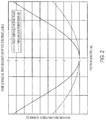
- FIG. 2 illustrates the curvature for a front surface vs. through lens power profile increase for a -3.00 diopter lens.
- the inventive algorithm involves measuring the ramp up in power required to produce the optimized induced aperture.
- the algorithm was developed based on the difference between the reading at the central 2.0 mm region (i.e., about 2.0 mm from the apex) and the readings for the annular region between about 2.0 and 4.0 mm from the apex.
- the inventive algorithm calculates a "distance power" or labeled power near the apex of the lens as the area weighted average radial sagittal power integrated over the central 2 mm diameter of the lens. This could be, for example, the power a doctor or clinician determines to be the appropriate power for a user to have clear vision.
- the aperture inducing power discussed below can be the power that produces a blur anywhere within the 2.0-4.0 mm radius.
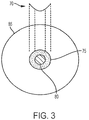
- FIG. 3 illustrates a power profile 70 with respect to the aperture inducing power region 75 and the distance region 80 of the lens.
- the lens diameter 85 is also shown. Based on the calculations above, an exemplary zone diameter is 2 mm for the distance power and between 2-4 mm for the aperture inducing power. However, during clinical testing, the distance and aperture inducing zone diameters were adjusted according to the following rules without substantial deviation in success rate:
- determining the distance power and aperture inducing power in this manner produced a lens profile with great success that matched the target profile with great accuracy.
- the NIMO TR-1504 (NIMO) Power Measurement device was chosen for its accuracy in measuring the VTI lens design.
- the NIMO is a wavefront sensor manufactured by Lambda-X ® .
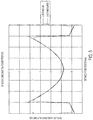
- FIGs. 4-7 illustrate the through lens sagittal power profiles for three separate lenses respectively representing low, medium, and high power lenses for which the present method is utilized.
- the calculations of distance power and aperture inducing power were performed within the central 4.0 mm (within 2.0 mm of the apex) on the graphs.
- the disclosed method resulted in excellent agreement between the designed and measured profiles for all three powers highlighting the precision of the disclosed method for ensuring a correct power profile.
- GR&R gage repeatability and reproducibility
- the power of a spherical (non-astigmatic correction) soft contact lens two corrections or calculations are accepted as standard clinical practice.
- the power can be adjusted from the spectacle plane to the corneal plane. This is called the vertex distance adjustment.
- the sphere and cylinder meridians of the vertex distance adjusted refraction are averaged to a single sphere equivalent power.
- the vertex distance adjusted sphere equivalent subjective refraction is the clinical estimate or starting point for selection of the soft contact lens power.
- eighteen patients 36 eyes were analyzed and conventional subjective refractions were performed.
- the vertex distance adjusted sphere equivalent subjective refractions were calculated and compared to the 2.0 mm average measured power algorithm using a Lambda-X NIMO instrument.
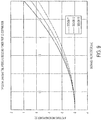
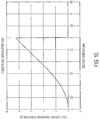
- FIG. 7 shows the linear regression comparing these two powers.
- the "DISPENSED" lens power plot is a linear regression of the best soft contact lens power after a short-term, in-office, evaluation.
- the "FINAL” lens power plot is a linear regression of the measure lenses after a period of 21 days of wearing the lens outside.
- the agreement between the "DISPENSED" clinical refraction estimate and the "FINAL” measured lens power is high.
- the relationship between the estimated DISPENSED lens and the actual FINAL lens is linear to 5 and 8% error with a standard deviation of the difference of 0.25 D.
- the inventive algorithm is applied to the use of a specific type of optical lens, namely, one with an induced aperture.
- the inventive algorithm is not an algorithm per se, but one applied in a meaningful way so as not to monopolize the entire algorithm.
- the algorithm is tied to a machine in that it is tied to a lens having an induced aperture. Further, it is not applied with respect to any sort of naturally occurring composition or natural phenomena, but rather with respect to a man-made optical lens having an induced aperture.
- the above invention can further be a lens itself that is verified according to the above method, or a combination of package identified with a labeled power and a lens verified according to the above method.
- the present invention also involves, in some embodiments, a single lens that can be applied to a wide range of presbyopes.
- the prior art lenses required a determination of which "add power" best fits the individual wearer's visual needs.
- the typical presbyope initially requires a low add power at a young age (45 years on average and +1.00D in spectacles) with a greater add power required at an older age until all accommodative ability is lost (at 65 years on average and +2.50D in spectacles).
- the present inventors unexpectedly discovered that a single power profile could induce a single optical aperture with enough depth of focus to satisfy a wide range of presbyopes. Rather than requiring different power profiles to produce different "add powers" in prior art contact lenses for wearers with different degrees of presbyopia, only one lens need be used for individuals with different degrees of presbyopia.
- the disclosed power rise ranges are for the aperture inducing power of the lens.
- the numerical values of ranges are the front surface tangential power rise at the 3 mm diameter (1.5 mm radius) measurement of the lens.
- the critical range is for a power rise, i.e., a power above and beyond the central power. This range is different for polymacon material contact lenses and cast molded etafilcon lenses.
- the critical range is between +2.00 to +2.75 diopters.
- the critical range is between +2.375 to +3.125 diopters.
- lens designs were tested in the lathe cut polymacon 38% lenses. They ranged from an 8.1 mm base curve with a 9.2 mm peripheral posterior bevel to an 8.3 mm base curve with a 9.2 mm bevel and a monocurve 8.3 mm spherical and aspherical curvatures.
- the design A1 with an aperture inducing power increase of +2.75D was acceptable but very high. This produced a smaller aperture having good depth of focus and near vision while the closely surrounding blur zone restricted more light entering the pupil, thereby reducing distance vision.
- the lower power profile tested was the design A2 at +2.00D power increase. This produced a larger induced aperture having less depth of focus and near vision while the further out surrounding blur zone restricted less light entering the pupil to thereby improve distance vision.
- the general basis of improving the power profile was discovered by changing the induced aperture size and its corresponding directional effect on visual performance.
- Table 10-A Lathed Polymacon Summary of Data Design # Inducing Power (Wet) Overall Objective Vision Visual Acuity Contrast Sensitivity Overall Visual Tasks A1 2.7500 Worst Worst Worst Worst A2 2 Middle Best 13F 2.75 (Hybrid) Middle Best A1PF 2.75 Worst Middle A2PF 2 Best Middle 10F 2.375 Middle Middle 11F 2.3750 Best Best Best 12F 2.75 (Hybrid) Middle Middle Table 10-B Lathed Polymacon Summary of Data Design # Visual Tasks Overall Subjective Vision Low Illumination Subjective Vision Halo Disturbance Overall Satisfaction A1 Worst Worst Worst Worst Worst Worst A2 Best Best 13F Best Middle Middle Middle A1PF Best Best Best A2PF Middle Middle 10F Middle Middle Middle 11F Best Middle Middle 12F Middle Best Middle Best Middle
- Tables 10-A and 10-B summarize some of the studies concerning power profiles using polymacon material contact lenses.
- the table references the Design Number and the aperture inducing power ("Inducing Power").
- the remaining cells summarize the comparative visual performance for different tests and the comparative overall satisfaction from the wearer's assessment.
- hybrid is meant to describe a power profile shape slightly different from others in this chart.
- Design A1 with an aperture inducing power increase of +2.75D was acceptable but not optimum.
- Design 13F included slight modifications to the A1 design and performed better, as did Designs 13F and 12F.
- Designs 10F and 11F with aperture inducing power increases of +2.375D were generally the best combination of distance and near vision performance.
- Designs A2 and A2PF had the lowest aperture inducing power increase of +2.00D and were generally the best for distance and less so for near vision performance. In one trial A2 performed well with wearers requiring a spectacle lower reading addition. To fit a wide range of the presbyopes, which have a wide range of reading additions, the lowest aperture inducing power increase of +2.00D had reduced near vision performance with wearers needing higher reading additions, but was still acceptable.
- FIG. 8 illustrates the designed front surface tangential aperture inducing power profiles for the disclosed lenses.
- the x-axis of FIG. 8 is the radial distance from the center in mm.
- the y-axis is the aperture inducing power increase in diopters.
- Three different aperture inducing power profiles are graphed, including Design 11 (the lowest power increase), Design 12 (the middle power increase), and Design 13 (the highest power increase).
- FIG. 9 illustrates the through lens sagittal aperture inducing power profile comparison for lenses with an apical power of -3.00D.
- the x-axis is the radial distance from the center in mm.
- the y-axis is the instantaneous sagittal power in diopters.
- the same three aperture inducing power increases are graphed in FIG. 9 as in FIG. 8 , that is, Designs 11-13.
- Table 11 Designs With Scotopic Rings Design Number Aperture Inducing Power Increase (D) 11 2.375 12 2.75 13 3.125 24 2.75
- Table 11 illustrates various design numbers from Tables 1-A and 1-B with optical designs based on Table 10 and a "scotopic ring.”
- a scotopic ring is an optical design where the power at, for example, a 3.0 mm radius reduces back to the power at the apex, and is described in more detail in U.S. Patent No. 7,178,918 , the contents of which are incorporated by reference herein in their entirety.
- An example of a power profile having a scotopic ring is shown in FIG. 10 .
- An unanticipated finding during the testing of A1 and A2 was a rapid power and thickness increase that would excessively increase the thickness of the lenses. This was increased for the high water content etafilcon 58% material due to its lower refractive index.
- Design 12 with an aperture inducing power increase of +2.75D performed best on the objective tests and ratings of distance, intermediate, and near vision.
- One unexpected finding was that the lower power profile Design 11 at +2.375 was not the best design as with the previous lathe-cut polymacon 38% material contact lenses, but it still provided good near vision.
- the next unexpected finding was that the higher power profile Design 13 at +3.125 was now the new upper acceptable limit as it reduced distance vision.
- Table 13 Subjective Testing of Lenses Subjective at Dispensing Average ⁇ SD (min - max), n VTI It11 VTI It12 VTI It13 Distance Vision 85.7 ⁇ 17.3 (30 - 100), 21 89.6 ⁇ 10.7 (60 - 100), 21 80.4 ⁇ 22.1 (20 - 100), 21 Distance ghosting 90.8 ⁇ 11.2 (50 - 100), 21 89.0 ⁇ 12.2 (50 - 100), 21 83.5 ⁇ 15.2 (50 - 100), 21 Distance Haloes 90.1 ⁇ 12.4 (50 - 100), 21 87.7 ⁇ 23.3 (0 - 100), 21 86.3 ⁇ 20.3 (20 - 100), 21 Distance Fluctuation 84.2 ⁇ 18.0 (50 - 100), 20 90.1 ⁇ 12.6 (50 - 100), 21 83.0 ⁇ 18.8 (20 - 100), 21 Near Vision Good Lighting 90.2 ⁇ 10.3 (70 - 100), 21 92.0 ⁇ 9.3 (70 - 100), 21 88.0 ⁇ 15.3 (30 - 100
- Design 12 had better overall lens visual performance and other key components of good vision for presbyopic wearers, such as distance vision, distance fluctuation, near vision good lighting, near vision low lighting and using/viewing cell phone/PDA.
- Design 24 Combining Design 12 (+2.75D aperture inducing power increase with the scotopic ring) with lens geometry discussed above with respect to Tables 1A and 1B, the present inventors found further improvement in vision and lens performance as shown in Design 24. Overall success rate for Design 24 was 93-95% with 91% intent to continue wearing the lens. As used herein, "success rate" means the percentage of wearers in which the lens treated presbyopia and where the users could perform their daily tasks while wearing the lens.
- BCSV best-corrected spectacle vision
- both the high contrast high illumination and low contrast low illumination visual acuities for the Design 24 lens were within two letters of the BCSV. This was particularly impressive because of the difficulty for soft contact lenses, with their high water content, to achieve visual acuities similar to spectacles.
- Stereoacuity is considered the leading indicator of how well the two eyes are working together, and is a critical attribute for eye-hand coordination tasks, such as the use of a cell phone. Published information on competitive multifocals demonstrates that other multifocals are not able to achieve this level of stereoacuity.
- the areas of the greatest difference in favor of the Design 24 lens were seen for near and intermediate tasks such as the need to not use supplemental reading glasses, reading very small print, using a cell phone, working on a computer, writing, personal grooming, and reading books or newspaper. These attributes were found to be 20-40 points greater with the Design 24 lens than they were for the habitual correction in subjective testing.
- AirOptix Multifocal (Alcon, Ft Worth, TX), which is currently the leading brand of multifocal.
- AirOptix Multifocal (Alcon, Ft Worth, TX)
- the preference was 82% for the Design 24 lens versus 18% for the AirOptix Multifocal. This was determined to be a statistically significant difference in favor of the Design 24 lens.
- the comfort of the lenses was also rated very high at 92.5 out of 100, where 100 is considered extremely comfortable. This is notable given that almost 70% of the wearers typically wore a habitual silicone hydrogel lens material.
- the Design 24 lens performed very well in terms of both objective and subjective visual results.
- the performance of the Design 24 lens for near and intermediate tasks was especially notable as these are the areas in which many competitive multifocals struggle.
- the high preference rates and the high likelihood to continue wearing the lens are both excellent indicators that the lens demonstrated successful performance with its unique single physical and optical aperture inducing power profile lens design.
- the single lens optimized lens geometry can meet all the physical design criteria of a comfortable and well fitted soft contact lens on a wide range of eye shapes and meet the optical design objective of keeping the center of the lens as close as practical to the pupil center or line of sight of the eye.
- the single power profile creates an induced optical aperture and increased depth of focus that can provide good distance, intermediate, and near vision to a wide age range of presbyopes that need a low spectacle near addition powers when they are younger and high spectacle near addition powers when they are older.
- the optimized one design per distance correcting sphere power had a 93 to 95% success rate.
- the fitting characteristics were improved with respect to a design objective to keep the center of the lens, where the center of the induced aperture is, as close as practical to the pupil center or line of sight of the eye.
- some of the fitting characteristics were:
- a methodology can be used to determine the acceptable parameters of a lens regardless of material.
- the peripheral thickness of the lens can be increased until the lens decentration is minimized.
- the edge thickness can be reduced until the lens edge sensation is removed.
- the base curve can be reduced until movement is minimized or the lens stops moving or optically distorts on the eye. If the lens optically distorts on the eye and is still moving with a blink, the center thickness of the lens should be increased first.
- the optimum physical lens parameters will include a steeper base curve, a larger diameter, and a thicker thickness profile.
- the inventors of the present invention determined that a lens with an induced aperture would function with an aperture inducing power rise of +2.00 to +3.25 D, preferably +2.75 D.
- the present inventors determined that silicon hydrogel lenses would function within this range. Insubstantial differences from the above range would be based on scientifically and ANSI-accepted tolerances.
- the present invention can be directed to methods and devices including lenses. However, the invention is not so limited, and can include contact lenses, intraocular lenses, eyeglasses, other types of lenses, or any other optical device.
Landscapes
- Health & Medical Sciences (AREA)
- Ophthalmology & Optometry (AREA)
- Physics & Mathematics (AREA)
- General Health & Medical Sciences (AREA)
- General Physics & Mathematics (AREA)
- Optics & Photonics (AREA)
- Eyeglasses (AREA)
- Non-Silver Salt Photosensitive Materials And Non-Silver Salt Photography (AREA)
- Prostheses (AREA)
Applications Claiming Priority (1)
| Application Number | Priority Date | Filing Date | Title |
|---|---|---|---|
| US15/040,518 US11567346B2 (en) | 2016-02-10 | 2016-02-10 | Induced aperture lens and method |
Publications (3)
| Publication Number | Publication Date |
|---|---|
| EP3206077A1 true EP3206077A1 (de) | 2017-08-16 |
| EP3206077B1 EP3206077B1 (de) | 2023-06-07 |
| EP3206077C0 EP3206077C0 (de) | 2023-06-07 |
Family
ID=56026726
Family Applications (1)
| Application Number | Title | Priority Date | Filing Date |
|---|---|---|---|
| EP16170493.7A Active EP3206077B1 (de) | 2016-02-10 | 2016-05-19 | Linse mit induzierter öffnung und verfahren |
Country Status (6)
| Country | Link |
|---|---|
| US (3) | US11567346B2 (de) |
| EP (1) | EP3206077B1 (de) |
| CN (1) | CN107065218B (de) |
| AU (1) | AU2016201071B2 (de) |
| ES (1) | ES2949209T3 (de) |
| SG (2) | SG10201603913SA (de) |
Cited By (1)
| Publication number | Priority date | Publication date | Assignee | Title |
|---|---|---|---|---|
| EP3676659A4 (de) * | 2017-08-28 | 2021-05-26 | Shanghai Ticon Optical Co., Ltd. | Optische linse zur sichtkorrektur |
Families Citing this family (14)
| Publication number | Priority date | Publication date | Assignee | Title |
|---|---|---|---|---|
| US11947197B2 (en) | 2018-03-29 | 2024-04-02 | Reopia Optics, Inc. | Spectacles for presbyopia treatment and myopia progression control and associated methods |
| US10921612B2 (en) | 2018-03-29 | 2021-02-16 | Reopia Optics, Llc. | Spectacles and associated methods for presbyopia treatment and myopia progression control |
| US11681161B2 (en) | 2018-03-29 | 2023-06-20 | Reopia Optics, Inc. | Anti-myopia-progression spectacles and associated methods |
| US12638700B2 (en) | 2018-03-29 | 2026-05-26 | Reopia Optics, Inc. | Systems and related methods for optimizing spectacle based myopia progression control and management |
| US12130503B2 (en) | 2018-12-05 | 2024-10-29 | Hanita Lenses Ltd. | Contact lens with adaptable curvature |
| EP4006624B1 (de) | 2020-11-26 | 2024-04-24 | Carl Zeiss Vision International GmbH | Brillenglas design, brillenglas kit und herstllungsmethod eines brillenglases zur behandlung der fortschreitenden kurzsichtigkeit |
| TWI813083B (zh) * | 2021-12-01 | 2023-08-21 | 長庚醫療財團法人基隆長庚紀念醫院 | 加強近視控制效果的方法、鏡片與其製備方法 |
| US20250102830A1 (en) * | 2022-01-28 | 2025-03-27 | Ohio State Innovation Foundation | Contact lens comprising an optical zone |
| EP4292798A1 (de) | 2022-06-14 | 2023-12-20 | Carl Zeiss Vision International GmbH | Verfahren zum bereitsstellen von lichtbrechenden mikrostrukturen auf einer brillenglasoberfläche und brillenglasdesign |
| TWI886585B (zh) * | 2022-09-29 | 2025-06-11 | 英商庫博光學國際有限公司 | 隱形眼鏡及其相關方法 |
| US20240210729A1 (en) * | 2022-12-22 | 2024-06-27 | Johnson & Johnson Vision Care, Inc. | Opthalmic lens for myopia control |
| GB2640009B (en) * | 2023-03-31 | 2026-07-08 | Coopervision Int Ltd | Ophthalmic lenses and methods relating thereto |
| WO2025088303A1 (en) * | 2023-10-27 | 2025-05-01 | Coopervision International Limited | Ophthalmic lenses and methods relating thereto |
| CN120703988B (zh) * | 2025-08-22 | 2026-02-13 | 歌尔股份有限公司 | 光学调节方法、装置、头显设备及存储介质 |
Citations (4)
| Publication number | Priority date | Publication date | Assignee | Title |
|---|---|---|---|---|
| US20050068494A1 (en) * | 2000-09-08 | 2005-03-31 | Griffin Richard A. | Ophthalmic lenses with induced aperture and redundant power regions |
| EP1691741A1 (de) * | 2003-11-19 | 2006-08-23 | Vision Crc Limited | Verfahren und geräte zur veränderung der relativen krümmung des felds und der positionen von peripheren achsenverschobenen fokalpositionen |
| US20100036489A1 (en) * | 2008-08-11 | 2010-02-11 | Joseph Michael Lindacher | Lens design and method for preventing or slowing the progression of myopia |
| US20150085246A1 (en) * | 2009-04-27 | 2015-03-26 | Dakota Sciences, Inc. | Progressive Multifocal Rigid Gas Permeable Contact Lens |
Family Cites Families (36)
| Publication number | Priority date | Publication date | Assignee | Title |
|---|---|---|---|---|
| US4640595A (en) | 1984-05-02 | 1987-02-03 | David Volk | Aspheric contact lens |
| DE3516575A1 (de) | 1985-05-08 | 1986-11-13 | Hecht Contactlinsen GmbH, 7800 Freiburg | Contactlinse |
| US5225858A (en) | 1987-06-01 | 1993-07-06 | Valdemar Portney | Multifocal ophthalmic lens |
| US5192317A (en) | 1988-07-26 | 1993-03-09 | Irvin Kalb | Multi focal intra-ocular lens |
| US5112351A (en) | 1990-10-12 | 1992-05-12 | Ioptex Research Inc. | Multifocal intraocular lenses |
| US5448312A (en) | 1992-12-09 | 1995-09-05 | Johnson & Johnson Vision Products, Inc. | Pupil-tuned multifocal ophthalmic lens |
| US5327181A (en) | 1993-01-12 | 1994-07-05 | Gentex Optics, Inc. | Progressive lens for specialty and occupational use |
| US5619289A (en) | 1993-03-31 | 1997-04-08 | Permeable Technologies, Inc. | Multifocal contact lens |
| US5436678A (en) | 1993-09-30 | 1995-07-25 | Wilmington Partners L.P. | Aspheric multifocal contact lens |
| CA2195858A1 (en) * | 1994-10-21 | 1996-05-02 | Simon John Edwards | Enhanced ophthalmic lens |
| US5929969A (en) | 1995-05-04 | 1999-07-27 | Johnson & Johnson Vision Products, Inc. | Multifocal ophthalmic lens |
| US5684560A (en) | 1995-05-04 | 1997-11-04 | Johnson & Johnson Vision Products, Inc. | Concentric ring single vision lens designs |
| US5650838A (en) | 1995-05-04 | 1997-07-22 | Johnson & Johnson Vision Products, Inc. | Programmable smooth junctions on lenses |
| IL118065A0 (en) | 1995-05-04 | 1996-08-04 | Johnson & Johnson Vision Prod | Aspheric toric lens designs |
| US5815237A (en) | 1996-07-01 | 1998-09-29 | Bausch & Lomb Incorporated | Contact lens and method for making the same |
| US5975694A (en) | 1996-07-01 | 1999-11-02 | Bausch & Lomb Incorporated | Contact lens and method for making the same |
| US5835187A (en) | 1996-11-22 | 1998-11-10 | Wilmington Partners L.P. | Aspheric multifocal contact lens having concentric front surface |
| US6260966B1 (en) | 1998-03-11 | 2001-07-17 | Menicon Co. Ltd. | Multifocal ocular lens |
| US6030077A (en) | 1998-03-11 | 2000-02-29 | Menicon Co., Ltd. | Multifocal ocular lens having intermediate region with continuously varying optical power |
| CN1204440C (zh) * | 1998-07-17 | 2005-06-01 | 索拉国际控股有限公司 | 光学镜片 |
| US6286956B1 (en) | 1998-10-19 | 2001-09-11 | Mencion Co., Ltd. | Multifocal ocular lens including intermediate vision correction region between near and distant vision correction regions |
| US6474814B1 (en) | 2000-09-08 | 2002-11-05 | Florida Optical Engineering, Inc | Multifocal ophthalmic lens with induced aperture |
| US20040237971A1 (en) * | 2003-06-02 | 2004-12-02 | Hema Radhakrishnan | Methods and apparatuses for controlling optical aberrations to alter modulation transfer functions |
| US7503655B2 (en) | 2003-11-19 | 2009-03-17 | Vision Crc Limited | Methods and apparatuses for altering relative curvature of field and positions of peripheral, off-axis focal positions |
| JP2005202107A (ja) * | 2004-01-15 | 2005-07-28 | Asahi Kasei Aimii Kk | 2焦点コンタクトレンズ |
| CA2653286C (en) * | 2006-06-08 | 2016-01-05 | Vision Crc Limited | Means for controlling the progression of myopia |
| CN101495010A (zh) | 2006-07-26 | 2009-07-29 | 美你康株式会社 | 将接触透镜提供给消费者的系统和方法 |
| TWI487516B (zh) | 2007-08-22 | 2015-06-11 | Novartis Ag | 老花眼的治療系統 |
| EP2279445A1 (de) * | 2008-04-18 | 2011-02-02 | Novartis AG | Kurzsicht-steuermittel |
| MY156101A (en) | 2009-05-04 | 2016-01-15 | Coopervision Int Holding Co Lp | Ophthalmic lenses and reduction of accommodative error |
| JP5369317B2 (ja) * | 2009-12-09 | 2013-12-18 | 東海光学株式会社 | プラスチック製眼鏡レンズの製造方法、同製造方法によって製造されるレンズ及び眼鏡レンズ用母型 |
| JP2012103669A (ja) * | 2010-10-12 | 2012-05-31 | Seiko Epson Corp | 眼鏡用レンズ、眼鏡、及び眼鏡用レンズの製造方法 |
| JP5789108B2 (ja) * | 2011-03-08 | 2015-10-07 | イーエイチエス レンズ フィリピン インク | 累進屈折力レンズおよびその設計方法 |
| KR20140074271A (ko) * | 2011-06-15 | 2014-06-17 | 비져니어링 테크놀로지스, 인크. | 근시 진행을 치료하는 방법 |
| CN202995164U (zh) * | 2012-07-26 | 2013-06-12 | 苏州苏大明世光学股份有限公司 | 一种盲区优化的渐进眼用镜片及其模具 |
| CN106610535A (zh) * | 2015-10-26 | 2017-05-03 | 鸿富锦精密工业(深圳)有限公司 | 眼用镜片及其制备方法 |
-
2016
- 2016-02-10 US US15/040,518 patent/US11567346B2/en active Active
- 2016-02-22 AU AU2016201071A patent/AU2016201071B2/en active Active
- 2016-05-16 SG SG10201603913SA patent/SG10201603913SA/en unknown
- 2016-05-16 SG SG10201705911YA patent/SG10201705911YA/en unknown
- 2016-05-19 ES ES16170493T patent/ES2949209T3/es active Active
- 2016-05-19 EP EP16170493.7A patent/EP3206077B1/de active Active
- 2016-09-12 CN CN201610818780.XA patent/CN107065218B/zh active Active
-
2018
- 2018-08-21 US US16/106,481 patent/US20180356651A1/en not_active Abandoned
-
2021
- 2021-09-22 US US17/481,621 patent/US11630326B2/en active Active
Patent Citations (4)
| Publication number | Priority date | Publication date | Assignee | Title |
|---|---|---|---|---|
| US20050068494A1 (en) * | 2000-09-08 | 2005-03-31 | Griffin Richard A. | Ophthalmic lenses with induced aperture and redundant power regions |
| EP1691741A1 (de) * | 2003-11-19 | 2006-08-23 | Vision Crc Limited | Verfahren und geräte zur veränderung der relativen krümmung des felds und der positionen von peripheren achsenverschobenen fokalpositionen |
| US20100036489A1 (en) * | 2008-08-11 | 2010-02-11 | Joseph Michael Lindacher | Lens design and method for preventing or slowing the progression of myopia |
| US20150085246A1 (en) * | 2009-04-27 | 2015-03-26 | Dakota Sciences, Inc. | Progressive Multifocal Rigid Gas Permeable Contact Lens |
Non-Patent Citations (1)
| Title |
|---|
| WOODS: "Visual Performance of a Multifocal Contact Lens versus Monovision in Established Prototypes", O AND VISION SCIENCE, vol. 92, no. 2, February 2015 (2015-02-01) |
Cited By (1)
| Publication number | Priority date | Publication date | Assignee | Title |
|---|---|---|---|---|
| EP3676659A4 (de) * | 2017-08-28 | 2021-05-26 | Shanghai Ticon Optical Co., Ltd. | Optische linse zur sichtkorrektur |
Also Published As
| Publication number | Publication date |
|---|---|
| US11567346B2 (en) | 2023-01-31 |
| US20170227788A1 (en) | 2017-08-10 |
| EP3206077B1 (de) | 2023-06-07 |
| CN107065218B (zh) | 2019-06-28 |
| CN107065218A (zh) | 2017-08-18 |
| US20220011597A1 (en) | 2022-01-13 |
| SG10201603913SA (en) | 2017-09-28 |
| ES2949209T3 (es) | 2023-09-26 |
| AU2016201071B2 (en) | 2017-12-14 |
| AU2016201071A1 (en) | 2017-08-24 |
| SG10201705911YA (en) | 2017-09-28 |
| EP3206077C0 (de) | 2023-06-07 |
| US20180356651A1 (en) | 2018-12-13 |
| US11630326B2 (en) | 2023-04-18 |
Similar Documents
| Publication | Publication Date | Title |
|---|---|---|
| US11630326B2 (en) | Induced aperture lens and method | |
| US10928654B2 (en) | Myopia controlling ophthalmic lenses | |
| EP1381908B1 (de) | Multifokale ophthalmische linse mit induzierter öffnung | |
| US6582076B1 (en) | Ophthalmic lenses useful in correcting astigmatism and presbyopia | |
| US9417463B2 (en) | Lens design and method for minimizing visual acuity variation experienced by myopia progressors | |
| KR20160026725A (ko) | 근시 진행을 예방하고/하거나 늦추기 위한 자유 형태 렌즈 설계 및 방법 | |
| KR20140098006A (ko) | 근시 진행을 예방하고/하거나 늦추기 위한 비대칭 렌즈 설계 및 방법 | |
| US20050068494A1 (en) | Ophthalmic lenses with induced aperture and redundant power regions | |
| KR20160026773A (ko) | 근시 진행을 예방하고/하거나 늦추기 위한 마스크 렌즈 설계 및 방법 | |
| EP2057501A1 (de) | Torische kontaktlinsen mit gesteuertem optischem leistungsprofil | |
| KR20130098929A (ko) | 난시를 위한 다축 렌즈 설계 | |
| CN102171601B (zh) | 多焦镜片的拟合方法 | |
| GB2288033A (en) | Contact lens having central aspherical and annular spherical lens | |
| US20230073059A1 (en) | Lenses having diffractive profiles with elevated surface roughness | |
| HK1168658B (en) | Design of myopia control ophthalmic lenses | |
| HK1170027B (en) | Design of myopia control ophthalmic lenses |
Legal Events
| Date | Code | Title | Description |
|---|---|---|---|
| PUAI | Public reference made under article 153(3) epc to a published international application that has entered the european phase |
Free format text: ORIGINAL CODE: 0009012 |
|
| STAA | Information on the status of an ep patent application or granted ep patent |
Free format text: STATUS: THE APPLICATION HAS BEEN PUBLISHED |
|
| AK | Designated contracting states |
Kind code of ref document: A1 Designated state(s): AL AT BE BG CH CY CZ DE DK EE ES FI FR GB GR HR HU IE IS IT LI LT LU LV MC MK MT NL NO PL PT RO RS SE SI SK SM TR |
|
| AX | Request for extension of the european patent |
Extension state: BA ME |
|
| STAA | Information on the status of an ep patent application or granted ep patent |
Free format text: STATUS: REQUEST FOR EXAMINATION WAS MADE |
|
| RIN1 | Information on inventor provided before grant (corrected) |
Inventor name: DILLEHAY, SALLY M. Inventor name: PAYOR, RICK E. Inventor name: TYSON, MARK K. Inventor name: GRIFFIN, RICHARD A. |
|
| 17P | Request for examination filed |
Effective date: 20180124 |
|
| RBV | Designated contracting states (corrected) |
Designated state(s): AL AT BE BG CH CY CZ DE DK EE ES FI FR GB GR HR HU IE IS IT LI LT LU LV MC MK MT NL NO PL PT RO RS SE SI SK SM TR |
|
| STAA | Information on the status of an ep patent application or granted ep patent |
Free format text: STATUS: EXAMINATION IS IN PROGRESS |
|
| 17Q | First examination report despatched |
Effective date: 20210520 |
|
| GRAP | Despatch of communication of intention to grant a patent |
Free format text: ORIGINAL CODE: EPIDOSNIGR1 |
|
| STAA | Information on the status of an ep patent application or granted ep patent |
Free format text: STATUS: GRANT OF PATENT IS INTENDED |
|
| GRAS | Grant fee paid |
Free format text: ORIGINAL CODE: EPIDOSNIGR3 |
|
| INTG | Intention to grant announced |
Effective date: 20230328 |
|
| GRAA | (expected) grant |
Free format text: ORIGINAL CODE: 0009210 |
|
| STAA | Information on the status of an ep patent application or granted ep patent |
Free format text: STATUS: THE PATENT HAS BEEN GRANTED |
|
| AK | Designated contracting states |
Kind code of ref document: B1 Designated state(s): AL AT BE BG CH CY CZ DE DK EE ES FI FR GB GR HR HU IE IS IT LI LT LU LV MC MK MT NL NO PL PT RO RS SE SI SK SM TR |
|
| REG | Reference to a national code |
Ref country code: GB Ref legal event code: FG4D |
|
| REG | Reference to a national code |
Ref country code: CH Ref legal event code: EP Ref country code: AT Ref legal event code: REF Ref document number: 1576872 Country of ref document: AT Kind code of ref document: T Effective date: 20230615 |
|
| REG | Reference to a national code |
Ref country code: DE Ref legal event code: R096 Ref document number: 602016079799 Country of ref document: DE |
|
| RAP4 | Party data changed (patent owner data changed or rights of a patent transferred) |
Owner name: VISIONEERING TECHNOLOGIES, INC. |
|
| U01 | Request for unitary effect filed |
Effective date: 20230629 |
|
| U07 | Unitary effect registered |
Designated state(s): AT BE BG DE DK EE FI FR IT LT LU LV MT NL PT SE SI Effective date: 20230707 |
|
| REG | Reference to a national code |
Ref country code: NO Ref legal event code: T2 Effective date: 20230607 |
|
| REG | Reference to a national code |
Ref country code: LT Ref legal event code: MG9D |
|
| REG | Reference to a national code |
Ref country code: ES Ref legal event code: FG2A Ref document number: 2949209 Country of ref document: ES Kind code of ref document: T3 Effective date: 20230926 |
|
| PG25 | Lapsed in a contracting state [announced via postgrant information from national office to epo] |
Ref country code: RS Free format text: LAPSE BECAUSE OF FAILURE TO SUBMIT A TRANSLATION OF THE DESCRIPTION OR TO PAY THE FEE WITHIN THE PRESCRIBED TIME-LIMIT Effective date: 20230607 Ref country code: HR Free format text: LAPSE BECAUSE OF FAILURE TO SUBMIT A TRANSLATION OF THE DESCRIPTION OR TO PAY THE FEE WITHIN THE PRESCRIBED TIME-LIMIT Effective date: 20230607 Ref country code: GR Free format text: LAPSE BECAUSE OF FAILURE TO SUBMIT A TRANSLATION OF THE DESCRIPTION OR TO PAY THE FEE WITHIN THE PRESCRIBED TIME-LIMIT Effective date: 20230908 |
|
| PG25 | Lapsed in a contracting state [announced via postgrant information from national office to epo] |
Ref country code: SK Free format text: LAPSE BECAUSE OF FAILURE TO SUBMIT A TRANSLATION OF THE DESCRIPTION OR TO PAY THE FEE WITHIN THE PRESCRIBED TIME-LIMIT Effective date: 20230607 |
|
| PG25 | Lapsed in a contracting state [announced via postgrant information from national office to epo] |
Ref country code: IS Free format text: LAPSE BECAUSE OF FAILURE TO SUBMIT A TRANSLATION OF THE DESCRIPTION OR TO PAY THE FEE WITHIN THE PRESCRIBED TIME-LIMIT Effective date: 20231007 |
|
| PG25 | Lapsed in a contracting state [announced via postgrant information from national office to epo] |
Ref country code: SM Free format text: LAPSE BECAUSE OF FAILURE TO SUBMIT A TRANSLATION OF THE DESCRIPTION OR TO PAY THE FEE WITHIN THE PRESCRIBED TIME-LIMIT Effective date: 20230607 Ref country code: SK Free format text: LAPSE BECAUSE OF FAILURE TO SUBMIT A TRANSLATION OF THE DESCRIPTION OR TO PAY THE FEE WITHIN THE PRESCRIBED TIME-LIMIT Effective date: 20230607 Ref country code: RO Free format text: LAPSE BECAUSE OF FAILURE TO SUBMIT A TRANSLATION OF THE DESCRIPTION OR TO PAY THE FEE WITHIN THE PRESCRIBED TIME-LIMIT Effective date: 20230607 Ref country code: IS Free format text: LAPSE BECAUSE OF FAILURE TO SUBMIT A TRANSLATION OF THE DESCRIPTION OR TO PAY THE FEE WITHIN THE PRESCRIBED TIME-LIMIT Effective date: 20231007 Ref country code: CZ Free format text: LAPSE BECAUSE OF FAILURE TO SUBMIT A TRANSLATION OF THE DESCRIPTION OR TO PAY THE FEE WITHIN THE PRESCRIBED TIME-LIMIT Effective date: 20230607 |
|
| PG25 | Lapsed in a contracting state [announced via postgrant information from national office to epo] |
Ref country code: PL Free format text: LAPSE BECAUSE OF FAILURE TO SUBMIT A TRANSLATION OF THE DESCRIPTION OR TO PAY THE FEE WITHIN THE PRESCRIBED TIME-LIMIT Effective date: 20230607 |
|
| REG | Reference to a national code |
Ref country code: DE Ref legal event code: R097 Ref document number: 602016079799 Country of ref document: DE |
|
| PLBE | No opposition filed within time limit |
Free format text: ORIGINAL CODE: 0009261 |
|
| STAA | Information on the status of an ep patent application or granted ep patent |
Free format text: STATUS: NO OPPOSITION FILED WITHIN TIME LIMIT |
|
| 26N | No opposition filed |
Effective date: 20240308 |
|
| U20 | Renewal fee for the european patent with unitary effect paid |
Year of fee payment: 9 Effective date: 20240408 |
|
| PG25 | Lapsed in a contracting state [announced via postgrant information from national office to epo] |
Ref country code: MC Free format text: LAPSE BECAUSE OF FAILURE TO SUBMIT A TRANSLATION OF THE DESCRIPTION OR TO PAY THE FEE WITHIN THE PRESCRIBED TIME-LIMIT Effective date: 20230607 |
|
| PG25 | Lapsed in a contracting state [announced via postgrant information from national office to epo] |
Ref country code: MC Free format text: LAPSE BECAUSE OF FAILURE TO SUBMIT A TRANSLATION OF THE DESCRIPTION OR TO PAY THE FEE WITHIN THE PRESCRIBED TIME-LIMIT Effective date: 20230607 |
|
| U20 | Renewal fee for the european patent with unitary effect paid |
Year of fee payment: 10 Effective date: 20250407 |
|
| PG25 | Lapsed in a contracting state [announced via postgrant information from national office to epo] |
Ref country code: CY Free format text: LAPSE BECAUSE OF FAILURE TO SUBMIT A TRANSLATION OF THE DESCRIPTION OR TO PAY THE FEE WITHIN THE PRESCRIBED TIME-LIMIT; INVALID AB INITIO Effective date: 20160519 |
|
| PG25 | Lapsed in a contracting state [announced via postgrant information from national office to epo] |
Ref country code: HU Free format text: LAPSE BECAUSE OF FAILURE TO SUBMIT A TRANSLATION OF THE DESCRIPTION OR TO PAY THE FEE WITHIN THE PRESCRIBED TIME-LIMIT; INVALID AB INITIO Effective date: 20160519 |
|
| PGFP | Annual fee paid to national office [announced via postgrant information from national office to epo] |
Ref country code: GB Payment date: 20260312 Year of fee payment: 11 |
|
| PGFP | Annual fee paid to national office [announced via postgrant information from national office to epo] |
Ref country code: IE Payment date: 20260310 Year of fee payment: 11 |
|
| U20 | Renewal fee for the european patent with unitary effect paid |
Year of fee payment: 11 Effective date: 20260410 |
|
| PG25 | Lapsed in a contracting state [announced via postgrant information from national office to epo] |
Ref country code: TR Free format text: LAPSE BECAUSE OF FAILURE TO SUBMIT A TRANSLATION OF THE DESCRIPTION OR TO PAY THE FEE WITHIN THE PRESCRIBED TIME-LIMIT Effective date: 20230607 |
|
| REG | Reference to a national code |
Ref country code: CH Ref legal event code: U11 Free format text: ST27 STATUS EVENT CODE: U-0-0-U10-U11 (AS PROVIDED BY THE NATIONAL OFFICE) Effective date: 20260601 |
|
| PGFP | Annual fee paid to national office [announced via postgrant information from national office to epo] |
Ref country code: ES Payment date: 20260610 Year of fee payment: 11 |
|
| PGFP | Annual fee paid to national office [announced via postgrant information from national office to epo] |
Ref country code: NO Payment date: 20260512 Year of fee payment: 11 |
|
| PGFP | Annual fee paid to national office [announced via postgrant information from national office to epo] |
Ref country code: CH Payment date: 20260601 Year of fee payment: 11 |