EP3206094B1 - Système de modification de valeur prédite, système de commande, procédé de modification de valeur prédite, procédé de commande, et programme de modification de valeur prédite - Google Patents
Système de modification de valeur prédite, système de commande, procédé de modification de valeur prédite, procédé de commande, et programme de modification de valeur prédite Download PDFInfo
- Publication number
- EP3206094B1 EP3206094B1 EP15849678.6A EP15849678A EP3206094B1 EP 3206094 B1 EP3206094 B1 EP 3206094B1 EP 15849678 A EP15849678 A EP 15849678A EP 3206094 B1 EP3206094 B1 EP 3206094B1
- Authority
- EP
- European Patent Office
- Prior art keywords
- value
- predicted value
- control
- controlled object
- predicted
- Prior art date
- Legal status (The legal status is an assumption and is not a legal conclusion. Google has not performed a legal analysis and makes no representation as to the accuracy of the status listed.)
- Active
Links
Images





Classifications
-
- G—PHYSICS
- G05—CONTROLLING; REGULATING
- G05B—CONTROL OR REGULATING SYSTEMS IN GENERAL; FUNCTIONAL ELEMENTS OF SUCH SYSTEMS; MONITORING OR TESTING ARRANGEMENTS FOR SUCH SYSTEMS OR ELEMENTS
- G05B11/00—Automatic controllers
- G05B11/01—Automatic controllers electric
- G05B11/36—Automatic controllers electric with provision for obtaining particular characteristics, e.g. proportional, integral, differential
-
- G—PHYSICS
- G05—CONTROLLING; REGULATING
- G05B—CONTROL OR REGULATING SYSTEMS IN GENERAL; FUNCTIONAL ELEMENTS OF SUCH SYSTEMS; MONITORING OR TESTING ARRANGEMENTS FOR SUCH SYSTEMS OR ELEMENTS
- G05B13/00—Adaptive control systems, i.e. systems automatically adjusting themselves to have a performance which is optimum according to some preassigned criterion
- G05B13/02—Adaptive control systems, i.e. systems automatically adjusting themselves to have a performance which is optimum according to some preassigned criterion electric
- G05B13/04—Adaptive control systems, i.e. systems automatically adjusting themselves to have a performance which is optimum according to some preassigned criterion electric involving the use of models or simulators
-
- G—PHYSICS
- G05—CONTROLLING; REGULATING
- G05B—CONTROL OR REGULATING SYSTEMS IN GENERAL; FUNCTIONAL ELEMENTS OF SUCH SYSTEMS; MONITORING OR TESTING ARRANGEMENTS FOR SUCH SYSTEMS OR ELEMENTS
- G05B13/00—Adaptive control systems, i.e. systems automatically adjusting themselves to have a performance which is optimum according to some preassigned criterion
- G05B13/02—Adaptive control systems, i.e. systems automatically adjusting themselves to have a performance which is optimum according to some preassigned criterion electric
- G05B13/04—Adaptive control systems, i.e. systems automatically adjusting themselves to have a performance which is optimum according to some preassigned criterion electric involving the use of models or simulators
- G05B13/048—Adaptive control systems, i.e. systems automatically adjusting themselves to have a performance which is optimum according to some preassigned criterion electric involving the use of models or simulators using a predictor
Definitions
- the present invention relates to a predicted value shaping system for calculating a control value for controlling a controlled object and a control system including the predicted value shaping system, a predicted value shaping method and a control method including the predicted value shaping method, and a predicted value shaping program.
- Patent Literature 2 discloses an apparatus for predicting demand of a water supply.
- the apparatus uses a difference between a measured value from a flow meter and a predicted value that is predicted from a deterministic time series model based on a nonlinear dynamical system theory.
- the difference is input to a correction calculation unit, and the correction calculation unit applies fuzzy inference to it to acquire a corrected predicted value.
- This corrected predicted value is used as a demand forecast for short-term water supply.
- the correction calculating unit corresponds to the above-mentioned prediction governor.
- feedforward control systems for performing feedforward control using a controller to an object to be controlled (controlled object).
- a target value is given to a system, as a control value for controlling a controlled object, and a physical quantity matching the target value is output from the controlled object.
- Fig. 11 is a block diagram illustrating a configuration of the ideal feedforward control system.
- a target value r is given to a controller of a system 101 including the controller and a controlled object, and the controller drives the controlled object with a drive signal in accordance with the target value r, whereby an output y r corresponding to the target value r is obtained from the system 101.
- the above feedforward control system is configured in a power generation system, in which a power generation system including a power generator and its controller is the system 101.
- a power generation system including a power generator and its controller is the system 101.
- power y r of about the same amount as the power demand is output from the power generator.
- a target value to be given to a system that is, an amount of output of a controlled object currently required
- a predicted value obtained by predicting the target value with a predetermined prediction model has to be given to the system in many cases.
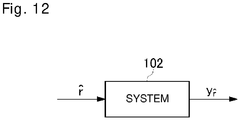
- Fig. 12 is a block diagram illustrating a configuration of a control system controlled with a predicted value.
- a predicted value r obtained with a predetermined prediction model is given to a system 102. Incidentally, in the following, r is also written as "r ⁇ .”
- An output y r ⁇ depending on the predicted value r ⁇ is obtained from the system 102.
- a feedforward control system has been known provided with a prediction governor (predicted value shaper) for correcting (shaping) the predicted value given to the system by using a previous target value (that is, a control value actually required previously) as a result value, in order to prevent influence of the prediction error from influencing the output of the system.
- a prediction governor predicted value shaper
- the result value is not a previous output value, but is a control value actually required, and the result value is independent of the output value.
- Fig. 13 is a block diagram illustrating a configuration of a control system provided with a prediction governor.
- a previous target value (result value) r is given to a prediction governor 201, in addition to a predicted value r ⁇ .
- the prediction governor 201 calculates a control value v on the basis of these predicted value r ⁇ and result value r, and outputs the control value v to a system 103.
- An output y v corresponding to the control value v is obtained in the system 103.
- the predicted value r ⁇ of the amount of power demand obtained by applying the weather, the temperature, and the like to the prediction model is corrected by using the result value r of, for example, a few minutes ago (that is, the control value actually required a few minutes ago) in the prediction governor 201, and can be given to the system 103.
- a feedforward control system balancing control is performed.
- An object of the present invention is to provide a predicted value shaping system for calculating a highly accurate control value by shaping of a predicted value, a control value calculation method, and a control value calculation program.
- a predicted value shaping system according to the present invention is defined in claim 1.
- the predicted value is corrected with the algorithm using the parameters of the control model of the controlled object, so that correction suitable for the controlled object can be performed, and it is possible to obtain a control value which allows the output of the system to approach an output of the system of when the system is controlled with the target value. Further, with this configuration, the algorithm for correcting the predicted value is optimized.
- the algorithm is an algorithm for correcting the predicted value so as to reduce influence on an output of the controlled object given by a previous prediction error that is a difference between the previous predicted value and the result value.
- the algorithm is provided for correcting the predicted value so as to reduce the influence on the output of the controlled object given by the difference (previous prediction error) between the previous predicted value and the result value.
- the predicted value is corrected so as to reduce the influence on the output of the controlled object given by the difference (previous prediction error) between the previous predicted value and the result value, so that correction suitable for the controlled object can be performed, and it is possible to obtain a control value which allows the output of the system to approach an output of the system of when the system is controlled with the target value.
- the influence is an output difference between an actual output and an output of when a target value of when there is not the prediction error is applied.
- the predicted value is corrected so as to reduce the output difference between the actual output and the ideal output (that is, the output of when the target value of when there is not the prediction error is applied).
- Equation (1) when the parameters of the control model are A P , B P , C P , the control model is represented by Equation (1).
- Equation (2) the algorithm is represented by Equation (2).
- Equation 4 where r ⁇ (t) is the predicted value at the time t, r ⁇ (t - 1) is the previous predicted value before the time t, r(t - 1) is the result value, and
- a control system of one aspect of the present invention has a configuration including: the above predicted value shaping system; the controlled object; and a controller that controls the controlled object in accordance with the control value calculated by the predicted value shaping system.
- the predicted value is corrected with the algorithm using the parameters of the control model of the controlled object, so that correction suitable for the controlled object can be performed, or the predicted value is corrected so as to reduce the influence on the output of the controlled object given by the difference (previous prediction error) between the previous predicted value and the result value, so that correction suitable for the controlled object can be performed, and it is possible to obtain a control value which allows the output of the system to approach an output of the system of when the system is controlled with the target value.
- a predicted value shaping method for correcting a predicted value obtained by predicting a target value for controlling a controlled object according to the present invention is defined in claim 3.
- the predicted value is corrected with the algorithm using the parameters of the control model of the controlled object, so that correction suitable for the controlled object can be performed, and it is possible to obtain a control value which allows the output of the system to approach an output of the system of when the system is controlled with the target value.
- the predicted value is corrected so as to reduce the influence on the output of the controlled object given by the difference (previous prediction error) between the previous predicted value and the result value, so that correction suitable for the controlled object can be performed, and it is possible to obtain a control value which allows the output of the system to approach an output of the system of when the system is controlled with the target value.
- a control method of one aspect of the present invention has a configuration including: a control value calculation step of calculating a control value with a predicted value shaping method of the above aspect; and a control step of controlling the controlled object with the control value calculated in the control value calculation step.
- the predicted value is corrected with the algorithm using the parameters of the control model of the controlled object, so that correction suitable for the controlled object can be performed, or the predicted value is corrected so as to reduce the influence on the output of the controlled object given by the difference (previous prediction error) between the previous predicted value and the result value, so that correction suitable for the controlled object can be performed, and it is possible to obtain a control value which allows the output of the system to approach an output of the system of when the system is controlled with the target value.
- a predicted value shaping program according to the present invention is defined in claim 5.
- the predicted value is corrected with the algorithm using the parameters of the control model of the controlled object, so that correction suitable for the controlled object can be performed, and it is possible to obtain a control value which allows the output of the system to approach an output of the system of when the system is controlled with the target value.
- the predicted value is corrected so as to reduce the influence on the output of the controlled object given by the difference (previous prediction error) between the previous predicted value and the result value, so that correction suitable for the controlled object can be performed, and it is possible to obtain a control value which allows the output of the system to approach an output of the system of when the system is controlled with the target value.
- the predicted value is corrected (shaped) with the algorithm using the parameters of the control model of the controlled object, so that correction suitable for the controlled object can be performed, and it is possible to obtain a control value which allows the output of the system to approach an output of the system of when the system is controlled with the target value.
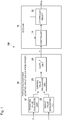
- Fig. 1 is a block diagram illustrating a configuration of a control system including the predicted value shaping system according to the embodiment of the present invention.
- a control system 100 is a feedforward control system including a prediction governor (predicted value shaping system) 20 and a system 10.
- the system 10 is a feedback control system including a controlled object 12 and a controller 11 that controls the controlled object 12. That is, in the control system 100, the prediction governor 20 is connected in series to the feedback control system 10, and a feedforward control system is configured as a whole.
- the controller 11 receives feedback of an output value of the controlled object 12, and performs feedback control for bringing the output of the controlled object 12 to a control value specified from the prediction governor 20 on the basis of the feedback.
- the controller 11 outputs to the controlled object 12 a drive signal that is a control signal, in order to control the controlled object 12.
- the controlled object 12 drives in accordance with the drive signal received from the controller 11, and as a result, outputs a physical quantity depending on the drive signal.
- a target value for controlling the controlled object 12 is unknown.
- An example of such a controlled object 12 is a power generator.
- Power output (generated) from the power generator has characteristics that it is difficult to save the power as electricity, and the power fails when supply is lower than demand. For this reason, power generation control is performed so that an amount of power securing a certain margin is generated according to an amount of power demand fluctuating from hour to hour.
- balancing power generation control is desirably performed accurately estimating the amount of power demand. Accordingly, a technique of control value calculation according to the present embodiment is suitably applied to the power generation control.
- the prediction governor 20 as the predicted value shaping system includes a predicted value acquisition unit 21, a result value acquisition unit 22, a control value calculation unit 23, and an output unit 24.
- the predicted value acquisition unit 21, the result value acquisition unit 22, the control value calculation unit 23, and the output unit 24 that are components of the prediction governor 20 as the predicted value shaping system some or all of the components may be arranged to be distributed on a network, and some or all of the components may be included in the same device (predicted value shaping device) .
- the predicted value acquisition unit 21 acquires a predicted value r ⁇ obtained by predicting the target value of the controlled object 12 with a predetermined prediction model.
- the result value acquisition unit 22 acquires a result value r that is a previous target value of the controlled object 12.
- the control value calculation unit 23 calculates a control value v for controlling the controlled object 12 by applying the result value r and the predicted value r ⁇ to a predetermined predicted value shaping algorithm to correct (shape) the predicted value r ⁇ .
- the output unit 24 outputs the control value v calculated in the control value calculation unit 23 to the controller 11 of the system 10.
- the predicted value r ⁇ is corrected with the result value r by using the prediction governor 20
- accuracy of prediction is improved
- the predicted value r ⁇ which allows the output of the system 10 to approach an output of the system 10 of when the system 10 is controlled with the target value is obtained.
- a predicted value shaping algorithm in a prediction governor does not use information of the controlled object, and accordingly is not optimized for individual controlled objects.
- the predicted value shaping algorithm in the prediction governor is only a general-purpose one that can be applied with a certain degree of effect to any controlled object.
- the prediction governor 20 of the present embodiment corrects the predicted value by using a predicted value shaping algorithm obtained on the basis of a control model of feedback control in the system 10 (hereinafter, also referred to as a "control model of the controlled object 12").
- a predicted value shaping algorithm obtained on the basis of a control model of feedback control in the system 10 (hereinafter, also referred to as a "control model of the controlled object 12").
- each symbol is defined as follows.
- R , R + , N represent a set of real numbers, a set of positive real numbers, and a set of natural numbers, respectively.
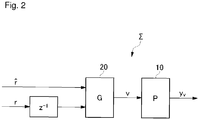
- Fig. 2 is a block diagram illustrating a configuration of a feedforward control system of the present embodiment.
- Fig. 2 illustrates a feedforward control system ⁇ configured by a prediction governor 20 adopting a predicted value shaping algorithm G, and a system 10 performing feedback control with a control model P.
- the control model P is a discrete-time linear model.
- "z -1 " represents operation of acquiring information before a certain time.
- v(t) is a control value output by the prediction governor 20
- y v (t) is an output of the system 10.
- (A p , B p , C p ) are parameters of the control model P, and determined by using a conventional system identification method (for example, a least squares method) from input/output data.
- t ⁇ 0 ⁇ N represents discrete time
- x P ⁇ R n states
- v ⁇ R m represents inputs
- y ⁇ R l represents outputs
- a P ⁇ R n ⁇ n , B P ⁇ R n ⁇ m , C P ⁇ R l ⁇ n represent constant matrices.
- the eigenvalue of A p exists within the unit circle on the complex plane (P is stable) .
- the predicted value shaping algorithm G of the prediction governor 20 is represented by Equation (2) below.
- r(t - 1) is a result value (a target value before a certain time)
- r ⁇ (t - 1) is a predicted value before a certain time obtained by a predetermined prediction model
- r ⁇ (t) is a current predicted value
- v(t) is a current control value (a value obtained by shaping the predicted value).
- (A, B, C, D) are design parameters of the predicted value shaping algorithm.
- r ⁇ , r ⁇ R m represent inputs
- v ⁇ R m represents outputs
- constant matrices
- the signal r is an actual target value.
- the current value r(t) cannot be acquired, but the result value r(t - 1) can be acquired.
- the signal r ⁇ is a predicted value, so that both the current value r ⁇ (t) and the previous value r ⁇ (t - 1) can be used.
- a next assumption (A1) is provided.
- the assumption (A1) means that a prediction error is ⁇ ⁇ R + or less, that is, the predicted value r is obtained with an accuracy of ⁇ or less by using some estimation method.
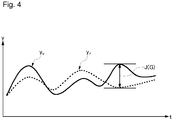
- an evaluation function J(G) illustrated in Fig. 3 , Fig. 4 , and Equation (3) is considered.
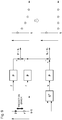
- Fig. 3 is a block diagram for describing the evaluation function J(G)
- Fig. 4 is a graph for describing the evaluation function J(G).
- the evaluation function J(G) is an evaluation function of when the control model of the controlled object 12 P x P 0 ⁇ R n is arbitrarily given in the feedforward control system ⁇ , and is given by the equation below.
- J G : sup r ⁇ ⁇ l ⁇ m ⁇ y v ⁇ y r ⁇ ⁇
- y v is an output of the system 10 of when the system is controlled with the control value v calculated in the prediction governor 20 of the present embodiment
- y r is an output of the system 10 of when the system is controlled with the target value r.
- the evaluation function J(G) represents the maximum difference between the output y v of the feedforward control system ⁇ of the present embodiment and the output y r of an ideal feedforward control system ⁇ I of when the target value r can be used, that is, the maximum output difference of when the worst predicted value is given.
- the evaluation function J(G) is a worst case evaluation index.
- the predicted value shaping algorithm G for minimizing the evaluation function J(G) is an optimal predicted value shaping algorithm. In the following, optimal design will be described of the prediction governor for obtaining the predicted value shaping algorithm G for minimizing the evaluation function J(G).
- Equation (3) it is possible to estimate in advance the degree of the influence on the output of the system 10 by the prediction error ⁇ . Further, the value of the first term of Equation (3) is determined by only the parameters of P, and the value of the second term is determined by the parameters of the control model P and the predicted value shaping algorithm G. Accordingly, since all terms are non-negative values, when the predicted value shaping algorithm G is determined so that the value of the second term is reduced as small as possible, the predicted value shaping algorithm G can be obtained for reducing the value of the evaluation function J(G).
- the predicted value shaping algorithm can be obtained for bringing the second term of Equation (3) to zero.
- a predicted value shaping algorithm G* of the prediction governor 20 of the present embodiment is characterized by the parameters of the control model P of the system 10. That is, the predicted value shaping algorithm G* is a custom made type predicted value shaping algorithm determined for the control model P.
- the predicted value shaping algorithm G* is a custom made type predicted value shaping algorithm determined for the control model P.
- Equation (4) it can be seen that when the prediction error ⁇ is reduced, the value of J (G*) is reduced, that is, the output error is reduced. Further, J(G*) is smaller as ⁇ C p B p ⁇ of the control model P is smaller. As described above, since the control model P is a discrete-time system, ⁇ C p B p ⁇ is reduced as the sampling period of when a continuous-time system P c is discretized is shorter. From this, it can be seen that performance of the prediction governor 20 is improved as the sampling period is shorter.
- Fig. 5 is a graph illustrating the target value
- Fig. 6 is a graph illustrating the predicted value for the target value in Fig. 5 .
- r(t) 0.5sin(0.1 ⁇ t) + 0.5cos(0.03 ⁇ t) is used.
- Fig. 7 is a graph illustrating a result (output of the controlled object 12) y r ⁇ of when the predicted value r ⁇ is used but the prediction governor 20 is not used
- Fig. 8 is a graph illustrating a result (output of the controlled object 12) y v obtained by correcting the predicted value r ⁇ by using the prediction governor 20 adopting the optimized predicted value shaping algorithm G* to calculate the control value v, and controlling the controlled object 12 with the control value v.
- the dashed line y r is the ideal output of when the target value r is used.
- the predicted value shaping algorithm G* adopted in the control value calculation unit 23 of the prediction governor 20 uses the parameters of the control model P of the controlled object 12, so that the predicted value can be corrected depending on the controlled object 12.
- Fig. 9 is a diagram for describing an effect of the feedforward control system 100 of the present embodiment.
- the predicted value shaping algorithm G* adopted in the control value calculation unit 23 of the prediction governor 20 of the present embodiment is capable of accurately estimating the influence on the output of the controlled object 12 given by the prediction error having previously occurred (that is, the difference r ⁇ (t - 1) - r(t - 1) between the previous predicted value r ⁇ (t - 1) and the result value r(t - 1)), and correcting the current predicted value r ⁇ (t) so as to reduce the influence.
- the prediction governor 20 corrects the predicted value r ⁇ (t) to calculate the control value v(t), by filtering the prediction error r ⁇ (t - 1) - r(t - 1) having previously occurred with the predicted value shaping algorithm G*, by using the predicted value r ⁇ (t), the previous predicted value r ⁇ (t - 1), and the result value (previous target value) r(t - 1), and the control value v(t) of a value which allows the output of the system 10 to approach an output of the system 10 of when the system 10 is controlled with the target value r(t) can be obtained as the control value v(t), and the output error of the system 10 ⁇ y v ⁇ y r ⁇ can be reduced.
- the influence of one step ahead cannot be improved even when the prediction governor 20 is used, but the influence after that can be reduced.
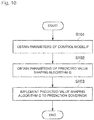
- Fig. 10 is a flowchart illustrating a procedure for achieving the feedforward control system 100 of the present embodiment.
- the parameters (A p , B p , C p ) of the control model P of the system 10 are obtained by system identification (step S101).
- the parameters (A*, B*, C*, D*) of the predicted value shaping algorithm G* are obtained by using the parameters (A p , B p , C p ) of the control model P (step S102). Then, the prediction governor 20 adopting the predicted value shaping algorithm G* is implemented as a program to a calculator by using the parameters (A*, B*, C*, D*) of the predicted value shaping algorithm G* (step S103).
- the feedforward control system 100 of the present embodiment can be applied to the power generation system that predicts the amount of power demand; however, the control system of the present invention can be applied to not only the power generation system, but also another system. When the target value of the system is unknown, the present invention can be effectively applied.
- the system in which the target value is unknown includes a system for predicting the amount of solar radiation in a solar power generation system, a system using a sensor with poor response (for example, a system for controlling an engine), a system in which sensor information is transmitted via network communication, and a system that processes and uses sensor information (for example, a system in which it takes time to process an image acquired, such as robot control or automatic driving control of an automobile), for example, and the present invention can be applied to these systems.
- the present invention can also be applied to an artificial pancreatic system.
- continuous glucose monitoring CGM
- CGM continuous glucose monitoring
- the CGM measures a sugar concentration in interstitial fluid, and it has been found that there is a certain correlation between the sugar concentration and the blood glucose level, but the sugar concentration is delayed for 10 to 15 minutes from the blood glucose level in fact.
- the present invention can also be applied to a field of logistics when the controlled object is a supply chain, and the control target is warehouse inventory management.
- the satisfaction level can be used as the target value or the predicted value, and the satisfaction level based on a customer survey can be used as the result information (previous value).
- the present invention can also be applied to a field of medical treatment when the controlled object is an insulin injection, and the control target is control of the blood glucose level.
- the blood glucose level can be used as the target value or the predicted value, and the blood glucose level ten minutes ago based on body fluid measurement can be used as the result information (previous value).
- the present invention can also be applied to a field of ITS when the controlled object is driving assistance or automatic driving of the automobile, and the control target is track following control.
- the environment information information of an obstacle, a signal, and the like
- the detailed information obtained over time can be used as the result information (previous value).
- the present invention can also be applied to a field of agriculture when the controlled object is planned production of plants, and the control target is control of the growing environment.
- the growing condition of the plants can be used as the target value or the predicted value, and the information of the actual growing condition can be used as the result information (previous value) .
- the present invention can also be applied to a field of architecture when the controlled object is air conditioning control, and the control target is determination of operation time and the number of units to be operated.
- the environment information information of temperature, weather, and the like
- the actual environment information can be used as the result information (previous value).
- the present invention has the effect that the predicted value is corrected (shaped) with the algorithm using the parameters of the control model of the controlled object, so that correction suitable for the controlled object can be performed, and the output closer to the ideal output can be obtained, and is useful as the predicted value shaping system for calculating the control value for controlling the controlled object, and the like.
Landscapes
- Engineering & Computer Science (AREA)
- Physics & Mathematics (AREA)
- General Physics & Mathematics (AREA)
- Automation & Control Theory (AREA)
- Health & Medical Sciences (AREA)
- Artificial Intelligence (AREA)
- Computer Vision & Pattern Recognition (AREA)
- Evolutionary Computation (AREA)
- Medical Informatics (AREA)
- Software Systems (AREA)
- Feedback Control In General (AREA)
Claims (5)
- Système de mise en forme de valeur prédite (20) pour la correction d'une valeur prédite obtenue par la prédiction d'une valeur cible pour la commande d'un objet commandé, le système de mise en forme de valeur prédite comprenant :une unité d'acquisition de valeur prédite (21) qui acquiert la valeur prédite ;une unité d'acquisition de valeur de résultat (22) qui acquiert une valeur de résultat qui est une valeur cible précédente de l'objet commandé ; etune unité de calcul de valeur de commande (23) qui calcule une valeur de commande pour la commande de l'objet commandé par l'application de la valeur de résultat et de la valeur prédite à un algorithme pour corriger la valeur prédite, caractérisé en ce quel'algorithme utilise des paramètres d'un modèle de commande de l'objet commandé,dans lequel les paramètres du modèle de commande sont AP, BP, et CP,le modèle de commande est représenté par
 où v(t) est la valeur de commande au temps t, et y(t) est une sortie de l'objet commandé au temps t, et l'algorithme est représenté par
 où r̂(t) est la valeur prédite au temps t, r̂(t - 1) est la valeur prédite précédente avant le temps t, r(t - 1) est la valeur de résultat, et



- Système de commande (100) comprenant :le système de mise en forme de valeur prédite (20) selon la revendication 1 ;l'objet commandé (12) ; etun dispositif de commande (11) qui commande l'objet commandé conformément à la valeur de commande calculée par le système de mise en forme de valeur prédite.
- Procédé de mise en forme de valeur prédite pour la correction d'une valeur prédite obtenue par la prédiction d'une valeur cible pour la commande d'un objet commandé, le procédé de mise en forme de valeur prédite comprenant :une étape d'acquisition de valeur prédite consistant à acquérir la valeur prédite ;une étape d'acquisition de valeur de résultat consistant à acquérir une valeur de résultat qui est une valeur cible précédente de l'objet commandé ; etune étape de calcul de valeur de commande consistant à calculer une valeur de commande pour la commande de l'objet commandé par l'application de la valeur de résultat et de la valeur prédite à un algorithme pour corriger la valeur prédite, caractérisé en ce quel'algorithme utilise des paramètres d'un modèle de commande de l'objet commandé,dans lequel les paramètres du modèle de commande sont AP, BP, et CP,le modèle de commande est représenté par
 où v(t) est la valeur de commande au temps t, et y(t) est une sortie de l'objet commandé au temps t, et l'algorithme est représenté par
 où r̂(t) est la valeur prédite au temps t, r̂(t - 1) est la valeur prédite précédente avant le temps t, r(t - 1) est la valeur de résultat, et


- Procédé de commande comprenant :une étape de calcul de valeur de commande consistant à calculer une valeur de commande avec un procédé de mise en forme de valeur prédite selon la revendication 3 ; etune étape de commande consistant à commander l'objet commandé avec la valeur de commande calculée à l'étape de calcul de valeur de commande.
- Programme de mise en forme de valeur prédite amenant un ordinateur d'un dispositif de mise en forme de valeur prédite qui corrige une valeur prédite obtenue par la prédiction d'une valeur cible pour la commande d'un objet commandé, à exécuter
une étape d'acquisition de valeur prédite consistant à acquérir la valeur prédite,
une étape d'acquisition de valeur de résultat consistant à acquérir une valeur de résultat qui est une valeur cible précédente de l'objet commandé, et
une étape de calcul de valeur de commande consistant à calculer une valeur de commande pour la commande de l'objet commandé par l'application de la valeur de résultat et de la valeur prédite à un algorithme pour corriger la valeur prédite, caractérisé en ce que
l'algorithme utilise des paramètres d'un modèle de commande de l'objet commandé,
dans lequel les paramètres du modèle de commande sont AP, BP, et CP,
le modèle de commande est représenté par




Applications Claiming Priority (2)
| Application Number | Priority Date | Filing Date | Title |
|---|---|---|---|
| JP2014209483 | 2014-10-10 | ||
| PCT/JP2015/004670 WO2016056176A1 (fr) | 2014-10-10 | 2015-09-14 | Système de modification de valeur prédite, système de commande, procédé de modification de valeur prédite, procédé de commande, et programme de modification de valeur prédite |
Publications (3)
| Publication Number | Publication Date |
|---|---|
| EP3206094A1 EP3206094A1 (fr) | 2017-08-16 |
| EP3206094A4 EP3206094A4 (fr) | 2018-08-15 |
| EP3206094B1 true EP3206094B1 (fr) | 2021-06-09 |
Family
ID=55652816
Family Applications (1)
| Application Number | Title | Priority Date | Filing Date |
|---|---|---|---|
| EP15849678.6A Active EP3206094B1 (fr) | 2014-10-10 | 2015-09-14 | Système de modification de valeur prédite, système de commande, procédé de modification de valeur prédite, procédé de commande, et programme de modification de valeur prédite |
Country Status (5)
| Country | Link |
|---|---|
| US (1) | US10372089B2 (fr) |
| EP (1) | EP3206094B1 (fr) |
| JP (1) | JP6632538B2 (fr) |
| CN (1) | CN106605179B (fr) |
| WO (1) | WO2016056176A1 (fr) |
Families Citing this family (7)
| Publication number | Priority date | Publication date | Assignee | Title |
|---|---|---|---|---|
| JP6859633B2 (ja) * | 2016-09-05 | 2021-04-14 | オムロン株式会社 | モデル予測制御装置、モデル予測制御装置の制御方法、情報処理プログラム、および記録媒体 |
| JP2018041150A (ja) * | 2016-09-05 | 2018-03-15 | オムロン株式会社 | モデル予測制御装置、モデル予測制御装置の制御方法、情報処理プログラム、および記録媒体 |
| JP6946861B2 (ja) * | 2017-08-29 | 2021-10-13 | トヨタ自動車株式会社 | 自動運転評価装置及び自動運転評価方法 |
| JP7151546B2 (ja) * | 2019-02-25 | 2022-10-12 | オムロン株式会社 | 制御装置、制御方法、及び制御プログラム |
| US11740268B2 (en) * | 2020-05-01 | 2023-08-29 | University Of South Carolina | Predictive zero phase filtering |
| JP7359178B2 (ja) * | 2021-03-10 | 2023-10-11 | 横河電機株式会社 | 制御装置、制御方法、および、制御プログラム |
| CN114647187B (zh) * | 2022-02-23 | 2025-03-04 | 暨南大学 | 一种太阳能化石燃料互补蓄能发电系统的控制方法及设备 |
Family Cites Families (11)
| Publication number | Priority date | Publication date | Assignee | Title |
|---|---|---|---|---|
| US4539633A (en) * | 1982-06-16 | 1985-09-03 | Tokyo Shibaura Denki Kabushiki Kaisha | Digital PID process control apparatus |
| JPH06102939A (ja) * | 1992-09-22 | 1994-04-15 | Kazuyuki Aihara | 上水需要量予測装置 |
| JP3641918B2 (ja) * | 1997-10-09 | 2005-04-27 | 富士電機システムズ株式会社 | 電力需要量予測値補正方法 |
| JP2000066731A (ja) * | 1998-08-26 | 2000-03-03 | Mitsubishi Electric Corp | 上水道システムの運用制御システム及び運用制御装置 |
| US6760716B1 (en) * | 2000-06-08 | 2004-07-06 | Fisher-Rosemount Systems, Inc. | Adaptive predictive model in a process control system |
| US6616759B2 (en) * | 2001-09-06 | 2003-09-09 | Hitachi, Ltd. | Method of monitoring and/or controlling a semiconductor manufacturing apparatus and a system therefor |
| JP2004295226A (ja) * | 2003-03-25 | 2004-10-21 | Matsushita Electric Works Ltd | 需要量予測支援システム及びそのプログラム並びにそのプログラムを記録したコンピュータで読み取り可能な記録媒体 |
| JP2006288151A (ja) | 2005-04-04 | 2006-10-19 | Kansai Electric Power Co Inc:The | 電力需給制御システム、電力需給制御方法、および、記録媒体 |
| JP5087140B2 (ja) * | 2008-07-07 | 2012-11-28 | 本田技研工業株式会社 | 制御装置 |
| CN101634837A (zh) * | 2009-08-17 | 2010-01-27 | 浙江大学 | 空分装置制氩系统氮塞的防控方法 |
| CN102444784B (zh) * | 2011-11-14 | 2013-11-20 | 上海金自天正信息技术有限公司 | 基于动态矩阵控制的钢铁企业蒸汽管网压力控制系统 |
-
2015
- 2015-09-14 WO PCT/JP2015/004670 patent/WO2016056176A1/fr not_active Ceased
- 2015-09-14 CN CN201580045459.6A patent/CN106605179B/zh active Active
- 2015-09-14 US US15/503,245 patent/US10372089B2/en active Active
- 2015-09-14 JP JP2016552811A patent/JP6632538B2/ja active Active
- 2015-09-14 EP EP15849678.6A patent/EP3206094B1/fr active Active
Also Published As
| Publication number | Publication date |
|---|---|
| US10372089B2 (en) | 2019-08-06 |
| US20170235285A1 (en) | 2017-08-17 |
| EP3206094A1 (fr) | 2017-08-16 |
| CN106605179A (zh) | 2017-04-26 |
| JP6632538B2 (ja) | 2020-01-22 |
| CN106605179B (zh) | 2020-09-25 |
| WO2016056176A1 (fr) | 2016-04-14 |
| EP3206094A4 (fr) | 2018-08-15 |
| JPWO2016056176A1 (ja) | 2017-07-27 |
Similar Documents
| Publication | Publication Date | Title |
|---|---|---|
| EP3206094B1 (fr) | Système de modification de valeur prédite, système de commande, procédé de modification de valeur prédite, procédé de commande, et programme de modification de valeur prédite | |
| Orchard et al. | A particle-filtering approach for on-line fault diagnosis and failure prognosis | |
| US6801810B1 (en) | Method and device for state estimation | |
| EP2561411B1 (fr) | Procédé et système pour mettre à jour un modèle dans un dispositif de commande prédictif à modèle | |
| WO2020094523A1 (fr) | Solution permettant la commande d'un système cible | |
| EP3200038A1 (fr) | Dispositif d'évaluation de modèle, procédé d'évaluation de modèle, et support d'enregistrement de programmes | |
| KR20200063338A (ko) | 학습을 통한 파라미터 개선 기반의 예측 시스템 및 방법 | |
| US20190317472A1 (en) | Controller and control method | |
| US11347996B2 (en) | System state prediction | |
| EP4439411A1 (fr) | Procédé et appareil d'apprentissage de modèle de planification, dispositif électrique et support d'informations | |
| US20220398360A1 (en) | Remaining useful life predictions using digital-twin simulation model | |
| Daria et al. | Predicting cyber attacks on industrial systems using the Kalman filter | |
| EP3704550A1 (fr) | Génération d'un système de commande pour un système cible | |
| US10528883B2 (en) | Hybrid estimation of transition probability values in markov decision processes | |
| US11231694B2 (en) | Information processing device, information processing method, and non-transitory recording medium | |
| US20230252357A1 (en) | Learning with moment estimation using different time constants | |
| Omitaomu et al. | Online support vector regression with varying parameters for time-dependent data | |
| Zhou et al. | Two-stage spatio-temporal graph network with hierarchical safety corrections for UC-ED integration | |
| Kazemi et al. | Semisupervised learning for noise suppression using deep reinforcement learning of contrastive features | |
| CN115078305A (zh) | 一种基于图神经网络的Zernike系数波前预测算法 | |
| CN121313120B (zh) | 一种知识驱动与数据融合的睡眠分期方法及装置 | |
| Young et al. | A control systems approach to input estimation with hydrological applications | |
| CN121900135A (zh) | 混合控制系统及方法 | |
| Lawrence et al. | Data-driven process control via reinforcement learning and recurrent neural networks | |
| Narayan et al. | A novel approach to time series forecasting using model-free adaptive control framework |
Legal Events
| Date | Code | Title | Description |
|---|---|---|---|
| STAA | Information on the status of an ep patent application or granted ep patent |
Free format text: STATUS: THE INTERNATIONAL PUBLICATION HAS BEEN MADE |
|
| PUAI | Public reference made under article 153(3) epc to a published international application that has entered the european phase |
Free format text: ORIGINAL CODE: 0009012 |
|
| STAA | Information on the status of an ep patent application or granted ep patent |
Free format text: STATUS: REQUEST FOR EXAMINATION WAS MADE |
|
| 17P | Request for examination filed |
Effective date: 20170228 |
|
| AK | Designated contracting states |
Kind code of ref document: A1 Designated state(s): AL AT BE BG CH CY CZ DE DK EE ES FI FR GB GR HR HU IE IS IT LI LT LU LV MC MK MT NL NO PL PT RO RS SE SI SK SM TR |
|
| AX | Request for extension of the european patent |
Extension state: BA ME |
|
| DAV | Request for validation of the european patent (deleted) | ||
| DAX | Request for extension of the european patent (deleted) | ||
| A4 | Supplementary search report drawn up and despatched |
Effective date: 20180713 |
|
| RIC1 | Information provided on ipc code assigned before grant |
Ipc: G05B 11/36 20060101AFI20180709BHEP Ipc: G05B 13/04 20060101ALI20180709BHEP |
|
| GRAP | Despatch of communication of intention to grant a patent |
Free format text: ORIGINAL CODE: EPIDOSNIGR1 |
|
| STAA | Information on the status of an ep patent application or granted ep patent |
Free format text: STATUS: GRANT OF PATENT IS INTENDED |
|
| INTG | Intention to grant announced |
Effective date: 20210315 |
|
| GRAS | Grant fee paid |
Free format text: ORIGINAL CODE: EPIDOSNIGR3 |
|
| GRAA | (expected) grant |
Free format text: ORIGINAL CODE: 0009210 |
|
| STAA | Information on the status of an ep patent application or granted ep patent |
Free format text: STATUS: THE PATENT HAS BEEN GRANTED |
|
| AK | Designated contracting states |
Kind code of ref document: B1 Designated state(s): AL AT BE BG CH CY CZ DE DK EE ES FI FR GB GR HR HU IE IS IT LI LT LU LV MC MK MT NL NO PL PT RO RS SE SI SK SM TR |
|
| REG | Reference to a national code |
Ref country code: GB Ref legal event code: FG4D |
|
| REG | Reference to a national code |
Ref country code: CH Ref legal event code: EP Ref country code: AT Ref legal event code: REF Ref document number: 1401012 Country of ref document: AT Kind code of ref document: T Effective date: 20210615 |
|
| REG | Reference to a national code |
Ref country code: DE Ref legal event code: R096 Ref document number: 602015070320 Country of ref document: DE |
|
| REG | Reference to a national code |
Ref country code: IE Ref legal event code: FG4D |
|
| REG | Reference to a national code |
Ref country code: LT Ref legal event code: MG9D |
|
| PG25 | Lapsed in a contracting state [announced via postgrant information from national office to epo] |
Ref country code: LT Free format text: LAPSE BECAUSE OF FAILURE TO SUBMIT A TRANSLATION OF THE DESCRIPTION OR TO PAY THE FEE WITHIN THE PRESCRIBED TIME-LIMIT Effective date: 20210609 Ref country code: FI Free format text: LAPSE BECAUSE OF FAILURE TO SUBMIT A TRANSLATION OF THE DESCRIPTION OR TO PAY THE FEE WITHIN THE PRESCRIBED TIME-LIMIT Effective date: 20210609 Ref country code: BG Free format text: LAPSE BECAUSE OF FAILURE TO SUBMIT A TRANSLATION OF THE DESCRIPTION OR TO PAY THE FEE WITHIN THE PRESCRIBED TIME-LIMIT Effective date: 20210909 Ref country code: HR Free format text: LAPSE BECAUSE OF FAILURE TO SUBMIT A TRANSLATION OF THE DESCRIPTION OR TO PAY THE FEE WITHIN THE PRESCRIBED TIME-LIMIT Effective date: 20210609 |
|
| REG | Reference to a national code |
Ref country code: AT Ref legal event code: MK05 Ref document number: 1401012 Country of ref document: AT Kind code of ref document: T Effective date: 20210609 |
|
| REG | Reference to a national code |
Ref country code: NL Ref legal event code: MP Effective date: 20210609 |
|
| PG25 | Lapsed in a contracting state [announced via postgrant information from national office to epo] |
Ref country code: NO Free format text: LAPSE BECAUSE OF FAILURE TO SUBMIT A TRANSLATION OF THE DESCRIPTION OR TO PAY THE FEE WITHIN THE PRESCRIBED TIME-LIMIT Effective date: 20210909 Ref country code: SE Free format text: LAPSE BECAUSE OF FAILURE TO SUBMIT A TRANSLATION OF THE DESCRIPTION OR TO PAY THE FEE WITHIN THE PRESCRIBED TIME-LIMIT Effective date: 20210609 Ref country code: RS Free format text: LAPSE BECAUSE OF FAILURE TO SUBMIT A TRANSLATION OF THE DESCRIPTION OR TO PAY THE FEE WITHIN THE PRESCRIBED TIME-LIMIT Effective date: 20210609 Ref country code: LV Free format text: LAPSE BECAUSE OF FAILURE TO SUBMIT A TRANSLATION OF THE DESCRIPTION OR TO PAY THE FEE WITHIN THE PRESCRIBED TIME-LIMIT Effective date: 20210609 Ref country code: GR Free format text: LAPSE BECAUSE OF FAILURE TO SUBMIT A TRANSLATION OF THE DESCRIPTION OR TO PAY THE FEE WITHIN THE PRESCRIBED TIME-LIMIT Effective date: 20210910 |
|
| PG25 | Lapsed in a contracting state [announced via postgrant information from national office to epo] |
Ref country code: PT Free format text: LAPSE BECAUSE OF FAILURE TO SUBMIT A TRANSLATION OF THE DESCRIPTION OR TO PAY THE FEE WITHIN THE PRESCRIBED TIME-LIMIT Effective date: 20211011 Ref country code: RO Free format text: LAPSE BECAUSE OF FAILURE TO SUBMIT A TRANSLATION OF THE DESCRIPTION OR TO PAY THE FEE WITHIN THE PRESCRIBED TIME-LIMIT Effective date: 20210609 Ref country code: NL Free format text: LAPSE BECAUSE OF FAILURE TO SUBMIT A TRANSLATION OF THE DESCRIPTION OR TO PAY THE FEE WITHIN THE PRESCRIBED TIME-LIMIT Effective date: 20210609 Ref country code: ES Free format text: LAPSE BECAUSE OF FAILURE TO SUBMIT A TRANSLATION OF THE DESCRIPTION OR TO PAY THE FEE WITHIN THE PRESCRIBED TIME-LIMIT Effective date: 20210609 Ref country code: AT Free format text: LAPSE BECAUSE OF FAILURE TO SUBMIT A TRANSLATION OF THE DESCRIPTION OR TO PAY THE FEE WITHIN THE PRESCRIBED TIME-LIMIT Effective date: 20210609 Ref country code: SM Free format text: LAPSE BECAUSE OF FAILURE TO SUBMIT A TRANSLATION OF THE DESCRIPTION OR TO PAY THE FEE WITHIN THE PRESCRIBED TIME-LIMIT Effective date: 20210609 Ref country code: SK Free format text: LAPSE BECAUSE OF FAILURE TO SUBMIT A TRANSLATION OF THE DESCRIPTION OR TO PAY THE FEE WITHIN THE PRESCRIBED TIME-LIMIT Effective date: 20210609 Ref country code: EE Free format text: LAPSE BECAUSE OF FAILURE TO SUBMIT A TRANSLATION OF THE DESCRIPTION OR TO PAY THE FEE WITHIN THE PRESCRIBED TIME-LIMIT Effective date: 20210609 Ref country code: CZ Free format text: LAPSE BECAUSE OF FAILURE TO SUBMIT A TRANSLATION OF THE DESCRIPTION OR TO PAY THE FEE WITHIN THE PRESCRIBED TIME-LIMIT Effective date: 20210609 |
|
| PG25 | Lapsed in a contracting state [announced via postgrant information from national office to epo] |
Ref country code: PL Free format text: LAPSE BECAUSE OF FAILURE TO SUBMIT A TRANSLATION OF THE DESCRIPTION OR TO PAY THE FEE WITHIN THE PRESCRIBED TIME-LIMIT Effective date: 20210609 |
|
| REG | Reference to a national code |
Ref country code: DE Ref legal event code: R097 Ref document number: 602015070320 Country of ref document: DE |
|
| PLBE | No opposition filed within time limit |
Free format text: ORIGINAL CODE: 0009261 |
|
| STAA | Information on the status of an ep patent application or granted ep patent |
Free format text: STATUS: NO OPPOSITION FILED WITHIN TIME LIMIT |
|
| PG25 | Lapsed in a contracting state [announced via postgrant information from national office to epo] |
Ref country code: DK Free format text: LAPSE BECAUSE OF FAILURE TO SUBMIT A TRANSLATION OF THE DESCRIPTION OR TO PAY THE FEE WITHIN THE PRESCRIBED TIME-LIMIT Effective date: 20210609 |
|
| REG | Reference to a national code |
Ref country code: CH Ref legal event code: PL |
|
| 26N | No opposition filed |
Effective date: 20220310 |
|
| REG | Reference to a national code |
Ref country code: BE Ref legal event code: MM Effective date: 20210930 |
|
| GBPC | Gb: european patent ceased through non-payment of renewal fee |
Effective date: 20210914 |
|
| PG25 | Lapsed in a contracting state [announced via postgrant information from national office to epo] |
Ref country code: MC Free format text: LAPSE BECAUSE OF FAILURE TO SUBMIT A TRANSLATION OF THE DESCRIPTION OR TO PAY THE FEE WITHIN THE PRESCRIBED TIME-LIMIT Effective date: 20210609 Ref country code: AL Free format text: LAPSE BECAUSE OF FAILURE TO SUBMIT A TRANSLATION OF THE DESCRIPTION OR TO PAY THE FEE WITHIN THE PRESCRIBED TIME-LIMIT Effective date: 20210609 |
|
| PG25 | Lapsed in a contracting state [announced via postgrant information from national office to epo] |
Ref country code: LU Free format text: LAPSE BECAUSE OF NON-PAYMENT OF DUE FEES Effective date: 20210914 Ref country code: IT Free format text: LAPSE BECAUSE OF FAILURE TO SUBMIT A TRANSLATION OF THE DESCRIPTION OR TO PAY THE FEE WITHIN THE PRESCRIBED TIME-LIMIT Effective date: 20210609 Ref country code: IE Free format text: LAPSE BECAUSE OF NON-PAYMENT OF DUE FEES Effective date: 20210914 Ref country code: GB Free format text: LAPSE BECAUSE OF NON-PAYMENT OF DUE FEES Effective date: 20210914 Ref country code: FR Free format text: LAPSE BECAUSE OF NON-PAYMENT OF DUE FEES Effective date: 20210930 Ref country code: BE Free format text: LAPSE BECAUSE OF NON-PAYMENT OF DUE FEES Effective date: 20210930 |
|
| PG25 | Lapsed in a contracting state [announced via postgrant information from national office to epo] |
Ref country code: LI Free format text: LAPSE BECAUSE OF NON-PAYMENT OF DUE FEES Effective date: 20210930 Ref country code: CH Free format text: LAPSE BECAUSE OF NON-PAYMENT OF DUE FEES Effective date: 20210930 |
|
| PG25 | Lapsed in a contracting state [announced via postgrant information from national office to epo] |
Ref country code: HU Free format text: LAPSE BECAUSE OF FAILURE TO SUBMIT A TRANSLATION OF THE DESCRIPTION OR TO PAY THE FEE WITHIN THE PRESCRIBED TIME-LIMIT; INVALID AB INITIO Effective date: 20150914 |
|
| PG25 | Lapsed in a contracting state [announced via postgrant information from national office to epo] |
Ref country code: CY Free format text: LAPSE BECAUSE OF FAILURE TO SUBMIT A TRANSLATION OF THE DESCRIPTION OR TO PAY THE FEE WITHIN THE PRESCRIBED TIME-LIMIT Effective date: 20210609 |
|
| PG25 | Lapsed in a contracting state [announced via postgrant information from national office to epo] |
Ref country code: MK Free format text: LAPSE BECAUSE OF FAILURE TO SUBMIT A TRANSLATION OF THE DESCRIPTION OR TO PAY THE FEE WITHIN THE PRESCRIBED TIME-LIMIT Effective date: 20210609 |
|
| PG25 | Lapsed in a contracting state [announced via postgrant information from national office to epo] |
Ref country code: MT Free format text: LAPSE BECAUSE OF FAILURE TO SUBMIT A TRANSLATION OF THE DESCRIPTION OR TO PAY THE FEE WITHIN THE PRESCRIBED TIME-LIMIT Effective date: 20210609 |
|
| PGFP | Annual fee paid to national office [announced via postgrant information from national office to epo] |
Ref country code: DE Payment date: 20250805 Year of fee payment: 11 |
|
| PG25 | Lapsed in a contracting state [announced via postgrant information from national office to epo] |
Ref country code: TR Free format text: LAPSE BECAUSE OF FAILURE TO SUBMIT A TRANSLATION OF THE DESCRIPTION OR TO PAY THE FEE WITHIN THE PRESCRIBED TIME-LIMIT Effective date: 20210609 |