EP3206390A1 - Aufnahmevorrichtung und aufnahmemethode - Google Patents
Aufnahmevorrichtung und aufnahmemethode Download PDFInfo
- Publication number
- EP3206390A1 EP3206390A1 EP17156057.6A EP17156057A EP3206390A1 EP 3206390 A1 EP3206390 A1 EP 3206390A1 EP 17156057 A EP17156057 A EP 17156057A EP 3206390 A1 EP3206390 A1 EP 3206390A1
- Authority
- EP
- European Patent Office
- Prior art keywords
- recording
- programs
- program
- broadcast programs
- predetermined
- Prior art date
- Legal status (The legal status is an assumption and is not a legal conclusion. Google has not performed a legal analysis and makes no representation as to the accuracy of the status listed.)
- Granted
Links
Images


Classifications
-
- H—ELECTRICITY
- H04—ELECTRIC COMMUNICATION TECHNIQUE
- H04N—PICTORIAL COMMUNICATION, e.g. TELEVISION
- H04N21/00—Selective content distribution, e.g. interactive television or video on demand [VOD]
- H04N21/40—Client devices specifically adapted for the reception of or interaction with content, e.g. set-top-box [STB]; Operations thereof
- H04N21/43—Processing of content or additional data, e.g. demultiplexing additional data from a digital video stream; Elementary client operations, e.g. monitoring of home network or synchronising decoder's clock; Client middleware
- H04N21/438—Interfacing the downstream path of the transmission network originating from a server, e.g. retrieving encoded video stream packets from an IP network
- H04N21/4383—Accessing a communication channel
-
- H—ELECTRICITY
- H04—ELECTRIC COMMUNICATION TECHNIQUE
- H04N—PICTORIAL COMMUNICATION, e.g. TELEVISION
- H04N21/00—Selective content distribution, e.g. interactive television or video on demand [VOD]
- H04N21/40—Client devices specifically adapted for the reception of or interaction with content, e.g. set-top-box [STB]; Operations thereof
- H04N21/41—Structure of client; Structure of client peripherals
- H04N21/414—Specialised client platforms, e.g. receiver in car or embedded in a mobile appliance
- H04N21/4147—PVR [Personal Video Recorder]
-
- G—PHYSICS
- G11—INFORMATION STORAGE
- G11B—INFORMATION STORAGE BASED ON RELATIVE MOVEMENT BETWEEN RECORD CARRIER AND TRANSDUCER
- G11B27/00—Editing; Indexing; Addressing; Timing or synchronising; Monitoring; Measuring tape travel
- G11B27/02—Editing, e.g. varying the order of information signals recorded on, or reproduced from, record carriers
- G11B27/031—Electronic editing of digitised analogue information signals, e.g. audio or video signals
-
- H—ELECTRICITY
- H04—ELECTRIC COMMUNICATION TECHNIQUE
- H04N—PICTORIAL COMMUNICATION, e.g. TELEVISION
- H04N21/00—Selective content distribution, e.g. interactive television or video on demand [VOD]
- H04N21/20—Servers specifically adapted for the distribution of content, e.g. VOD servers; Operations thereof
- H04N21/23—Processing of content or additional data; Elementary server operations; Server middleware
- H04N21/235—Processing of additional data, e.g. scrambling of additional data or processing content descriptors
-
- H—ELECTRICITY
- H04—ELECTRIC COMMUNICATION TECHNIQUE
- H04N—PICTORIAL COMMUNICATION, e.g. TELEVISION
- H04N21/00—Selective content distribution, e.g. interactive television or video on demand [VOD]
- H04N21/20—Servers specifically adapted for the distribution of content, e.g. VOD servers; Operations thereof
- H04N21/23—Processing of content or additional data; Elementary server operations; Server middleware
- H04N21/238—Interfacing the downstream path of the transmission network, e.g. adapting the transmission rate of a video stream to network bandwidth; Processing of multiplex streams
- H04N21/2385—Channel allocation; Bandwidth allocation
-
- H—ELECTRICITY
- H04—ELECTRIC COMMUNICATION TECHNIQUE
- H04N—PICTORIAL COMMUNICATION, e.g. TELEVISION
- H04N21/00—Selective content distribution, e.g. interactive television or video on demand [VOD]
- H04N21/40—Client devices specifically adapted for the reception of or interaction with content, e.g. set-top-box [STB]; Operations thereof
- H04N21/41—Structure of client; Structure of client peripherals
- H04N21/426—Internal components of the client ; Characteristics thereof
- H04N21/42607—Internal components of the client ; Characteristics thereof for processing the incoming bitstream
- H04N21/4263—Internal components of the client ; Characteristics thereof for processing the incoming bitstream involving specific tuning arrangements, e.g. two tuners
-
- H—ELECTRICITY
- H04—ELECTRIC COMMUNICATION TECHNIQUE
- H04N—PICTORIAL COMMUNICATION, e.g. TELEVISION
- H04N21/00—Selective content distribution, e.g. interactive television or video on demand [VOD]
- H04N21/40—Client devices specifically adapted for the reception of or interaction with content, e.g. set-top-box [STB]; Operations thereof
- H04N21/43—Processing of content or additional data, e.g. demultiplexing additional data from a digital video stream; Elementary client operations, e.g. monitoring of home network or synchronising decoder's clock; Client middleware
- H04N21/433—Content storage operation, e.g. storage operation in response to a pause request, caching operations
- H04N21/4334—Recording operations
-
- H—ELECTRICITY
- H04—ELECTRIC COMMUNICATION TECHNIQUE
- H04N—PICTORIAL COMMUNICATION, e.g. TELEVISION
- H04N21/00—Selective content distribution, e.g. interactive television or video on demand [VOD]
- H04N21/40—Client devices specifically adapted for the reception of or interaction with content, e.g. set-top-box [STB]; Operations thereof
- H04N21/43—Processing of content or additional data, e.g. demultiplexing additional data from a digital video stream; Elementary client operations, e.g. monitoring of home network or synchronising decoder's clock; Client middleware
- H04N21/433—Content storage operation, e.g. storage operation in response to a pause request, caching operations
- H04N21/4335—Housekeeping operations, e.g. prioritizing content for deletion because of storage space restrictions
-
- H—ELECTRICITY
- H04—ELECTRIC COMMUNICATION TECHNIQUE
- H04N—PICTORIAL COMMUNICATION, e.g. TELEVISION
- H04N21/00—Selective content distribution, e.g. interactive television or video on demand [VOD]
- H04N21/40—Client devices specifically adapted for the reception of or interaction with content, e.g. set-top-box [STB]; Operations thereof
- H04N21/45—Management operations performed by the client for facilitating the reception of or the interaction with the content or administrating data related to the end-user or to the client device itself, e.g. learning user preferences for recommending movies, resolving scheduling conflicts
- H04N21/458—Scheduling content for creating a personalised stream, e.g. by combining a locally stored advertisement with an incoming stream; Updating operations, e.g. for OS modules ; time-related management operations
- H04N21/4583—Automatically resolving scheduling conflicts, e.g. when a recording by reservation has been programmed for two programmes in the same time slot
-
- H—ELECTRICITY
- H04—ELECTRIC COMMUNICATION TECHNIQUE
- H04N—PICTORIAL COMMUNICATION, e.g. TELEVISION
- H04N21/00—Selective content distribution, e.g. interactive television or video on demand [VOD]
- H04N21/40—Client devices specifically adapted for the reception of or interaction with content, e.g. set-top-box [STB]; Operations thereof
- H04N21/47—End-user applications
- H04N21/472—End-user interface for requesting content, additional data or services; End-user interface for interacting with content, e.g. for content reservation or setting reminders, for requesting event notification, for manipulating displayed content
- H04N21/47214—End-user interface for requesting content, additional data or services; End-user interface for interacting with content, e.g. for content reservation or setting reminders, for requesting event notification, for manipulating displayed content for content reservation or setting reminders; for requesting event notification, e.g. of sport results or stock market
-
- H—ELECTRICITY
- H04—ELECTRIC COMMUNICATION TECHNIQUE
- H04N—PICTORIAL COMMUNICATION, e.g. TELEVISION
- H04N21/00—Selective content distribution, e.g. interactive television or video on demand [VOD]
- H04N21/40—Client devices specifically adapted for the reception of or interaction with content, e.g. set-top-box [STB]; Operations thereof
- H04N21/47—End-user applications
- H04N21/482—End-user interface for programme selection
- H04N21/4825—End-user interface for programme selection using a list of items to be played back in a given order, e.g. playlists
-
- H—ELECTRICITY
- H04—ELECTRIC COMMUNICATION TECHNIQUE
- H04N—PICTORIAL COMMUNICATION, e.g. TELEVISION
- H04N5/00—Details of television systems
- H04N5/76—Television signal recording
- H04N5/765—Interface circuits between an apparatus for recording and another apparatus
- H04N5/775—Interface circuits between an apparatus for recording and another apparatus between a recording apparatus and a television receiver
Definitions
- the present invention generally relates to a recording device and a recording method. More specifically, the present invention relates to a recording device having a tuner and a plurality of recording systems.
- a plurality of broadcast programs are ordinarily recorded individually. However, if broadcast programs are consecutive, then there are situations when recording cannot be performed between broadcast programs due to the need for the processing required at the start and end of the broadcast programs.
- broadcast program refers to the type, content, amount, and layout of the items being broadcast.
- JP 2009-224024 A and JP 2001-351283 A disclose the recording of broadcast programs that follow one after the other, with no gap in between.
- JP 2009-224024 A With the recording in JP 2009-224024 A , if two consecutive broadcast programs are scheduled, then the two broadcast programs are consecutively recorded as a single title, and management information is used to recognize that there are two programs during reproduction.
- JP 2001-351283 A With the recording in JP 2001-351283 A , two recorders are used for reliable execution of subsequent scheduled recording during consecutive scheduled recording.
- continual recording With a product having a function known as continual recording, loop recording, etc., dedicated parts are sometimes used to expand the simultaneous operation function (such as when continual recording is performed at the same time as the distribution of broadcast programs), and this drives up the cost.
- JP 2009-224024 A the recording is not performed for every individual broadcast program, just as with loop recording. Thus, it takes time and effort to store or copy the desired broadcast programs.
- JP 2001-351283 A two recording devices are used, which is impractical from a cost standpoint.
- One object is to provide continual recording (or loop recording) in which titles are divided up by broadcast program while the recording is not bound to the registration limit of scheduled recordings (or scheduling limit number), and recorded programs are prevented from being cut off abruptly at the end.
- recording can be performed without producing a period in which recording is impossible between the consecutive broadcast programs, while avoiding an increase in cost.
- FIG. 1 is a block diagram of a hard disk recorder 10 (e.g., a recording device) to which the recording device and the recording method of the present disclosure are applied.
- a hard disk recorder 10 e.g., a recording device
- This hard disk recorder 10 comprises at least one (three in FIG. 1 ) tuners 11 a to 11c (tuner 1 11 a, tuner 2 11 b, and tuner 3 11c), and a controller 14. Also, the hard disk recorder 10 comprises a hard disk drive 12 (e.g., a memory) and a control panel 13.
- the tuners 11a to 11c receive ground waves, satellite broadcast waves, or other such television broadcasts, radio broadcasts, and data broadcasts (e.g., broadcast programs). In the illustrated embodiment, three tuners 11a to 11c are provided, but the present invention is not limited to this configuration.
- the hard disc recorder 10 can include less than three or more than three tuners as needed and/or desired.
- the hard disk drive 12 records and reproduces digital data according to the broadcast content.
- the control panel 13 is provided for the user to make inputs.
- the controller 14 controls these components and outputs video and audio to an external monitor 20.
- the controller 14 comprises a main control circuit 14a, a plurality of (three in FIG. 1 ) decoders/encoders 14b to 14d (decoder/encoder 1 14b, decoder/encoder 2 14c, decoder/encoder 3 14c), a signal output circuit 14e, and a memory circuit 14f.
- the decoders/encoders 14b to 14d are used in recording and reproducing digital data with the hard disk drive 12.
- the signal output circuit 14e is used to output video and audio based on data, and so forth.
- the memory circuit 14f is used for storing various kinds of settings.
- a network interface for connecting to a network, a Blu-ray disc drive, or the like can be provided in a conventional manner as needed and/or
- the various functions of the controller 14 can be realized by independent circuit configurations. Specifically, each components (e.g., the main control circuit 14a, the decoders/encoders 14b to 14d, the signal output circuit 14e, and the memory circuit 14f) of the controller 14 can be usually realized by providing dedicated integrated circuits (e.g., LSI) corresponding to the various functions. Also, the main control circuit 14 (e.g., controller) includes a microcomputer or processor, such as a CPU (central processing unit), and can control these integrated circuits of the controller 14 with this CPU.
- a microcomputer or processor such as a CPU (central processing unit)
- the controller 14 can also include other conventional components such as an input interface circuit, an output interface circuit, and storage devices such as a ROM (Read Only Memory) device and a RAM (Random Access Memory) device.
- the storage devices stores processing results and control programs.
- the RAM of the controller 14 stores statuses of operational flags and various control data.
- the ROM of the controller 14 stores the programs for various operations. It will be apparent to those skilled in the art from this disclosure that the precise structure and algorithms can be any combination of hardware and software that will carry out the functions of the present invention. Therefore, with the controller 14, a CPU and a ROM, RAM, etc., for the programs thereof are provided, and the various functions are realized by hardware and software.
- a remote control 15 is provided to convey the user's commands.
- the main control circuit 14a are provided with a plurality of (eight in FIG. 1 ) input paths TS1 to TS8 as input-use transport stream lines.
- three pairs of the input paths TS1 to TS8 are allocated for input from the three tuners 11a to 11c, respectively.
- the digital output signal (e.g., the output) from the tuner 11a is inputted to the transport stream lines TS1 and TS2
- the digital output signal (e.g., the output) from the tuner 11 b is inputted to the transport stream lines TS3 and TS4
- the digital output signal (e.g., the output) from the tuner 11c is inputted to the transport stream lines TS5 and TS6.
- the main control circuit 14a internally connects the decoders/encoders 14b to 14d to the various input-use transport stream lines (e.g., TS1 to TS8), thereby decoding digital data or encoding analog data.
- the main control circuit 14a records decoded digital data to the hard disk drive 12 either directly as it is or after encoding it to another recording format.
- the main control circuit 14a reads the digital data stored in the hard disk drive 12.
- the main control circuit 14a decodes the digital data into analog data.
- the main control circuit 14a outputs a video signal, audio signal, and data signal via the signal output circuit 14e to the monitor 20 for reproduction or playback.
- the main control circuit 14a also decodes the inputted digital data with the decoders/encoders 14b to 14d, without recording it first, and output a video signal, audio signal, and data signal to the monitor 20.
- the processing to descramble transport streams of a digital broadcast can be performed inside the main control circuit 14a. However, an external descrambler can instead be provided.
- the main control circuit 14a can internally include components required to execute the programs in the CPU, the ROM, the RAM, etc., and executes predetermined programs.
- the tuners 11a to 11c form tuners of the present disclosure that receive broadcast programs (hereinafter referred to simply as programs).
- the transport stream lines TS1 to TS8, the decoders/encoders 14b to 14d, and the lines to the hard disk drive 12 form a plurality of recording systems (recording processors or recording paths) of the present disclosure that records the programs.
- the recording systems are defined between the tuners 11a to 11c and the hard disk drive 12.
- the tuners 11a to 11c are connected to the transport stream lines TS1 to TS6, respectively.
- the signal (e.g., broadcast program) from the transport stream lines TS1 to TS6 are descrambled by the main control circuit 14a, and are recorded to the hard disk drive 12, either directly as they are or after being re-encoded to different recording mode by the decoders/encoders 14b to 14d.
- the recording systems are formed by connections or allocations of the decoders/encoders 14b to 14d relative to the transport stream lines TS1 to TS6.
- the hard disk drive 12 records the broadcast programs via the recording systems (or recording paths) between the tuners 11 a to 11 c and the hard disk drive 12.
- the main control circuit 14a determines which of the decoders/encoders 14b to 14d are internally or externally connected to which of the transport stream lines TS1 to TS6 that are connected to the tuners 11 a to 11c.
- this does not mean that only one recording system can be provided relative to one tuner.
- one tuner can also be connected to a plurality of the decoders/encoders 14b to 14d. In other words, a plurality of recording systems can be connected to one tuner.
- an output of one tuner can be simultaneously inputted to different recording systems (or both of the at least two of recording paths).
- the same or single output of one tuner can be simultaneously inputted to different recording systems (or both of the at least two of recording paths).
- the same output of one tuner can be always inputted to different recording systems.
- the same output of one tune can be inputted to different recording systems simultaneously only for a predetermined period (such as 2 minutes, or 5 minutes) before and after a partition point between consecutive broadcast programs.
- the tuners 11a to 11c and the decoders/encoders 14b to 14d correspond to one another by default. Naturally, the recording systems can be changed as needed and/or desired.
- the recording systems can be changed by changing connections or allocations of the decoders/encoders 14b to 14d relative to the transport stream lines TS1 to TS6 (or TS1 to TS8 when TS7 and TS8 are also connected to tuners).
- FIG. 2 is a diagram showing a screen shot of a recording list.
- a recording list is an information source with which the main control circuit 14a performs recording, and is stored in the memory circuit 14f or the hard disk drive 12.
- the recording list can hold up to a maximum of 60 scheduled recordings (or 60 scheduled recording content) (e.g., predetermined range).
- the maximum number of the scheduled recording is 60. Of course, this number can be different as needed and/or desired.
- a single scheduled recording comprises a broadcast wave channel number L1 that is received by the tuners 11 a to 11 c, a program title (or ID) L2 that is to be recorded, a start date L3, a start time L4, an end time L5, a recording system L6, a designated mode L7 (e.g., a recording mode), an actual mode L8 (e.g., a recording mode), and conversion necessity L9.
- the channel number L1, the program title (or ID) L2, the start date L3, the start time L4, and the end time L5 are what their names indicate.
- the recording system L6 indicates via which of the three decoders/encoders 14b to 14d the recording will be performed.
- the decoder/encoder 14b is used in the recording system 1
- the decoder/encoder 14c is used in the recording system 2
- the decoder/encoder 14d is used in the recording system 3, for example.
- the designated mode L7 shows whether the setting of a scheduled recording will be in DR mode (e.g., direct recording mode) or AVC (Advanced Video Coding) mode (e.g., compressed recording mode).
- DR mode e.g., direct recording mode
- AVC Advanced Video Coding
- these recording mode of the schedule recording can include different recording mode from described above.
- the actual mode L8 shows the recording mode (DR mode or AVC mode) when a broadcast is received and recorded, regardless of the setting of a scheduled recording. As will be discussed below, this is because there are cases when recording is performed in DR mode, in which the load is low during recording, and is converted later to the designated recording mode.
- the conversion necessity L9 shows whether or not this conversion is necessary. This will be described in detail below.
- FIG. 3 is a diagram showing a screen shot of automatic scheduling (i.e., scheduled recording).
- This screen is a setting screen with which all of the programs broadcast in a predetermined time slot on a predetermined channel can be recorded, which is called time shift recording or loop recording, and can then be viewed later at any time.
- time shift recording or loop recording which is called time shift recording or loop recording.
- this display screen At the uppermost part of this display screen are displayed the heading "Automatic scheduling” and, to the right thereof, a switch M1 that can be switched “on” or “off.” Below this are displayed three main categories: “Channel,” “Time slot,” and “Filtering.” “Channel” and “Time slot” are essential setting categories, but a switch M2 that can be switched on or off is displayed to the right of the "Filtering" category, and is an optional setting category.
- a channel is selected as an essential setting category.
- a selected channel group M3 which comprises radio buttons that are selected or not and which displays as labels all of the channels that can currently be received, is displayed on the screen. The user puts check marks on the radio button in front of the channel on which the time shift recording is to be performed, out of this selected channel group M3.
- the hard disk drive 12 needs to have a large-capacity storage region. This storage region is proportional to the number of selected channels. Therefore, the user can select a radio button so as to narrow down the channels.
- the storage region used in the hard disk drive 12 is also approximately proportional to the length of the time slot. Therefore, an input box M4 for setting the start time and an input box M5 for setting the end time are provided so that the user can narrow down the time slot.
- the automatic scheduling function When the automatic scheduling is performed, if the automatic scheduling function has been set to "on" with the switch M1, then the user selects the channel in the selected channel group M3, sets the start time with the input box M4, and sets the end time with the input box M5.
- the broadcast programs on the selected channel are consecutively recorded from the start time until the end time on the hard disk drive 12 based on the above information alone.
- all of the programs on the selected channel in the predetermined time slot are put on the recording list shown in FIG. 2 , and scheduled recording is performed based on the recording list.
- individual programs are scheduled to be record, and a plurality of consecutive programs on a single channel (e.g., a predetermined channel) are recorded from the start time until the end time with different recording systems (or at least two of recording paths).
- the recorded programs are not cut off at the start or end.
- FIG. 4 is a flowchart of automatic scheduling processing.
- the main control circuit 14a determines whether automatic scheduling has been set. Whether or not automatic scheduling has been set is determined by reading what has been set with the switch M1 shown in FIG. 3 .
- step S105 the main control circuit 14a returns X and Y to their initial values.
- X here is a parameter indicating the time interval (e.g., the predetermined time interval), in hours, at which this automatic scheduling processing is to be repeated.
- Y is a parameter indicating how many hours of programs to be scheduled (e.g., the predetermined time period) when automatic scheduling has begun.
- X and Y are both initially set to 6 hours, for example.
- step S110 the programs on the predetermined channel in the predetermined time slot are confirmed, within the range of Y hours from the current time.
- the main control circuit 14a acquires a program list (e.g., program list information) for the predetermined channel.
- the program list is included in the transport packet of broadcast data for each channel. Data for the program list is stored at the point of descrambling, and is reconfigured as a series of program list data. This processing is always carried out in parallel with the automatic scheduling processing.
- the predetermined time slot is the period between the start and end times set with the input boxes M4 and M5. Usually, this is set so that the start time is 04:00 and the end time is 23:30. However, it is also possible for the end time to go past 24:00. For instance, if it is 02:00, the predetermined time slot should be determined by adding 24 hours, which gives 26:00. Specifically, if the start time is 04:00 and the end time is 02:00, the start time is left as 04:00, but the end time is given as 26:00.
- Step S115 will not be described here because it is not executed in the process of the first embodiment.
- the main control circuit 14a in step S120 counts the number of the programs for Y hours (e.g., the predetermined time period) that have been listed in step S110, and in step S125 counts the number of the programs that are currently scheduled. Then, in step S130, it is determined whether the sum of the number of the programs for Y hours that have been listed and the number of the programs that are currently scheduled falls within the range of the registration limit of scheduled recordings (e.g., the predetermined range) for the hard disk recorder 10. In the illustrated embodiment, any overlaps between the programs that are currently scheduled and the programs for Y hours that have been listed are deleted in advance before calculating the sum.
- step S135 Y is reduced to decrease the number of the programs for Y hours that are listed such that the sum falls within the range of the registration limit of scheduled recordings.
- steps S110 to S130 are repeated. Sometimes subtracting of just 1 (hour) is enough, but other times 2 or 3 (hours) have to be subtracted. In this case, the processing in steps S110 to S130 are repeated twice or three times (1 hour subtraction at a time), for example.
- the main control circuit 14a in step S140 registers all of the programs for Y hours for scheduled recordings. Specifically, at this point, the recording systems L6 corresponding to the initial values for the tuners 11 a to 11c, and the designated mode L7 for designating DR mode as the default designated mode are registered, in addition to the channel number L1, the program title L2, the start date L3, the start time L4, and the end time L5 obtained from the program list. The actual mode L8 and the conversion necessity L9 are left blank in the recording list.
- the number of the tuners 11 a to 11c corresponds to the number of channels that can be time-shift recorded at the same time.
- step S145 it is determined whether "X > Y,” and if the determination result is positive, then X is changed to Y or less in step S150.
- the main control circuit 14a sets X (e.g., predetermined time interval) to be less than or equal to Y (e.g., predetermined time period). The purpose of this is to avoid a situation in which there is a time slot that is not automatically scheduled when automatic scheduling processing is again started after X hours (greater than Y hours) after the programs for Y hours have been added to the recording list.
- step S155 After X has thus been adjusted, in step S155 it is determined whether X hours have elapsed since the above-mentioned automatic scheduling processing. If the result is negative, then in step S160 the processing stands by. Once X hours have elapsed, the processing from step S100 onward is once again executed.
- the recording list for recording the programs on a plurality of channels is produced based on program list (e.g., program list information) for these channels at X hours interval (e.g., at a predetermined time intervals.
- the value of Y (e.g., length of the predetermined time period) can be adjusted so as not to exceed the range of the registration limit upon registering the automatic scheduling. Thus, no scheduling is missed. For example, if the registration limit of scheduled recordings is 60, the number of the programs that are currently scheduled is 30, and the number of the programs for Y hours that have been listed is 40, then the sum of the number of the programs that are currently scheduled and the number of the programs for Y hours exceeds the range of the registration limit of 60.
- the value of Y is reduced until the number of the programs for Y hours that are listed is less than 30.
- the maximum number of programs within the range of the registration limit of 60 can be scheduled for recording.
- the next automatic scheduling processing will be executed in X hours which are within a range that does not exceed Y hours. Thus, no programs will be left out in the next automatic scheduling processing.
- the time interval for producing or updating the recording list can also be set according to the number of the programs for Y hours (e.g., the predetermined time period) based on the program list (e.g., program list information) for a plurality of channels.
- the above processing method forms a recording method of the present disclosure.
- the recording list e.g., automatic recording list
- the processing in step S110 (and S115) corresponds to a step of listing the programs for a predetermined channel in a predetermined time slot within a predetermined time period after the current time.
- the processing in step S125 corresponds to a step of counting the number of the programs that are currently scheduled.
- the processing in step S130 corresponds to a step of reducing the predetermined time period for the sum of the number of the programs that have been listed and the number of the programs that are currently scheduled to fall within the range of the registration limit of scheduled recordings (e.g., within the predetermined range) when the sum exceeds the range of the registration limit of scheduled recordings.
- the processing in step S130 corresponds to a step of reducing the predetermined time period until the sum of the number of the programs that are listed and the number of the programs that are currently scheduled (i.e., the number of the programs to be registered for scheduled recordings) falls within the range of the registration limit of scheduled recordings when the sum exceeds the range of the registration limit of scheduled recordings.
- the processing in steps S135 and S140 corresponds to a step of adding the programs that have been listed to the recording list as scheduled programs in addition to the programs that are currently scheduled within the range of the registration limit of scheduled recordings.
- the processing in steps S145 to S160 corresponds to a step of waiting for a time period (X hours) within the above-mentioned range of the predetermined time period (Y hours) to elapse, and a step of repeating automatic scheduling.
- the processing in steps S155 and S105 corresponds to a step of returning the predetermined time period (X hours) to the initial value after the predetermined time period (X hours) has elapsed.
- FIG. 5 is a flowchart of scheduling registration confirmation processing.
- the time shift recordings or loop recordings on three channels are possible at the maximum.
- the setting of the time shift recording can be different from this setting, and the number of the channels for the time shift recording is reduced such that scheduled recording for programs can be executed individually.
- the time shift recording is set for one channel received with the tuner 11 a.
- the scheduling registration confirmation processing shown in FIG. 5 prevents the recorded programs from being cut off at the start or end when the programs are scheduled to record automatically.
- the main control circuit 14a in step S200 arranges the scheduled recording content by the start date and time for each channel in the recording list. Then, the main control circuit 14 in step S205 determines whether or not there are consecutive programs (back-to-back programs) in which the end time of a previous program and the start time of a subsequent program coincide with each other. Of course, the end time of the previous program and the start time of the subsequent program coincide in the case of automatic scheduling. However, even without automatic scheduling, for example, this scheduling registration confirmation processing is still performed because performing scheduling registration confirmation processing prevents the recorded programs from being cut off at the start or end.
- step S210 changes the designations of the recording systems so that one recording system will not be continuously used for recording the consecutive programs. For example, the recording systems are switched one after the other, in order.
- FIG. 6 is a simplified diagram of the state when recording systems have been allocated.
- programs A to C are consecutive programs on the same channel received by the tuner 11 a between 7:00am and 10:00am.
- the decoder/encoder 14b of the recording system that is allocated by default to the tuner 11 a is allocated to the programs A to C.
- the decoder/encoder 14b performs predetermined processing at the end of the recording.
- the processing by the decoder/encoder 14b at the end of the recording is commenced after the recording is ended at the original end time, then the recording of the next program by the decoder/encoder 14b cannot be commenced at the start time of the next program.
- the first part of the next program is cut off, for example. To avoid this, the processing at the end of the recording can be commenced before the original end time of the previous program. However, in this case, the end part of the previous program is cut off.
- the main control circuit 14 in step S210 changes the designation of the recording system so that the same recording system is not continuously used for recording the consecutive programs.
- the recording system 1 is allocated to the program A, the program B, and the program C by default after the automatic scheduling processing shown in FIG. 4 .
- the scheduling registration confirmation processing shown in FIG. 6 is executed, the recording system allocated to the program B is changed to the recording system 2 while the recording system 1 is still allocated to the program A and the program C such that the recording system 1 is prevented from being continuously used.
- the recording list in FIG. 2 the allocated recording system is set to the recording system L6.
- the recording list is updated such that the entry under the recording system L6 for the program B is changed to the recording system 2.
- the main control circuit 14a executes scheduled recording by using the allocated recording system when the current time coincides with the start date and start time of the program in this recording list.
- This processing corresponds to recording the programs with a recording component (recording system) based on the recording list, and constitutes a controller.
- the main control circuit 14a deletes from the recording list the content of the programs after completion of recording of the programs.
- the main control circuit 14a receives the predetermined channel with the tuner 11a based on the scheduled recording content in the recording list.
- the TS that is outputted from the tuner 11a is inputted via the transport stream line TS1 and the transport stream line TS2.
- the first program A is inputted to the decoder/encoder 14b using the transport stream line TS1, and the converted digital data is recorded to the hard disk drive 12 (i.e., scheduled recording using the recording system 1).
- the recording system is changed to the recording system 2 for the next program B.
- the main control circuit 14a causes the tuner 11a to receive on the same channel, the output is inputted to the decoder/encoder 14c using the transport stream line TS2, and the converted digital data is recorded to the hard disk drive 12 (i.e., scheduled recording using the recording system 2).
- the main control circuit 14a e.g., the controller
- the main control circuit 14a (e.g., the controller) records the consecutive programs A and B with the different recording systems 1 and 2 based on the recording list in which the different recording systems 1 and 2 are allocated for the consecutive programs A and B on the predetermined channel. Also, in the illustrated embodiment, the main control circuit 14a (e.g., the controller) acquire the program list (e.g., the program list information) for the predetermined channel, and records the consecutive programs A and B on the predetermined channel based on the recording list in which the consecutive programs A and B are allocated to the different recording systems 1 and 2 based on the program list for the predetermined channel.
- the program list e.g., the program list information
- step S200 the scheduled recording content at the start date and time for each channel in the recording list is arranged.
- step S205 it is determined whether or not there are consecutive programs (back-to-back programs) in which the end time of the previous program and the start time of the subsequent program coincide with each other. Since information about the start time and the end time of the programs is acquired for each channel in this processing, this processing corresponds to an acquisition component. Information about the start time and the end time of the programs for each channel can be acquired by various methods, and the processing in steps S200 and S205 is not the only option.
- step S205 if it is determined that there are consecutive programs in which the end time of the previous program coincides with the start time of the subsequent program, then in step S210 the designation of the recording system is changed so that the same recording system is not continuously used.
- the recording list is produced for allocating a plurality of different recording systems for the recording of the consecutive programs that are consecutive on a single channel.
- this processing corresponds to a recording list production component.
- a variety of methods can be employed for reflecting this in the recording list, and the procedure given in steps S205 and S210 is not the only option.
- the main control circuit 14a when the end time of the first program A coincides with the start time of the second program B on the predetermined channel, the main control circuit 14a produces the recording list in which the first program A and this second program B are allocated to the different recording systems 1 and 2. Also, the processing in step S210 corresponds to a step of producing the recording list in which the consecutive programs A and B on the predetermined channel are allocated to the different recording systems 1 and 2.
- the recording list for recording different programs that are consecutive on the same channel by using different recording systems is produced based on the program list (e.g., program list information) for the channel.
- the programs are then recorded based on the recording list.
- the programs are individually scheduled for recording by automatic scheduled recording.
- titles are divided up by program after recording the programs.
- switching between the different recording systems prevents the start or end of the recorded programs from being cut off.
- automatically adjusting the time of the automatic scheduling processing also prevents the recoding from being bound to the registration limit of scheduled recording.
- continual recording (loop recording) can be performed in which the programs are divided up by title, and is not bound to the registration limit of scheduled recording.
- the recorded programs are not cut off abruptly at the start or the end.
- the programs are individually scheduled for recording by automatic recording scheduling involving the automatic scheduling processing.
- the recording systems (recording processors) are switched by the scheduling registration confirmation processing.
- the recorded programs are not cut off at the start or the end.
- the duration of the automatic scheduling processing is automatically adjusted until the number of the programs falls within the range of the registration limit of scheduled recording.
- the recording of the programs is not bound by the registration limit.
- FIGS 5 , 7 and 8 a hard disk recorder 10 ( FIG. 1 ) in accordance with a second embodiment will now be explained.
- the parts of the second embodiment that are identical to the parts of the first embodiment will be given the same reference numerals as the parts of the first embodiment.
- the descriptions of the parts of the second embodiment that are identical to the parts of the first embodiment may be omitted for the sake of brevity.
- DR mode is a direct recording mode.
- DR mode basically includes all of the data that has been broadcast. However, all of the data does not necessarily have to be included in DR mode. Thus, in the illustrated embodiment, it is still called DR mode when some of the data is intentionally left out.
- AVC mode basically include data that has been subjected to processing to reduce the amount of data by changing the video compression mode, for example.
- two or more of the decoders/encoders 14b to 14d are required to process the data of the programs.
- the user can manually schedule the recordings individually using the program list.
- the user can designate AVC mode, rather than DR mode, as the recording mode.
- the designated mode (AVC mode) is stored in the recording list shown in FIG. 2 as the category for the designated mode L7.
- steps S215 and S220 are executed, which is not executed in the first embodiment in the flowchart shown in FIG. 5 .
- a state in which the designated modes for the consecutive programs are both AVC mode is called double scheduling of AVC mode.
- steps S200 to S210 it is determined whether or not there are consecutive programs (back-to-back programs) in which the end time of the previous program and the start time of the subsequent program coincide with each other. Also, in step S215 it is determined whether or not a state of the double scheduling of AVC mode has occurred, in which the designated mode is AVC mode for both the previous and the subsequent programs.
- the hard disk recorder 10 ( FIG. 1 ) includes three decoders/encoders 14b to 14d.
- the decoders/encoders 14b to 14d there is a case in which it is impossible to use two of the decoders/encoders 14b to 14d for both the previous and the subsequent programs.
- two of the decoders/encoders 14b to 14d are allocated for playback the recorded programs.
- only one of the decoders/encoders 14b to 14d is available for the time shift recording on each channel. In this case, the double scheduling of AVC mode for the consecutive programs on the same channel cannot be performed.
- step S220 the actual modes L8 for recording the consecutive programs are changed from AVC mode to DR mode. Also, the conversion necessities L9 for the consecutive programs are set to "necessary.” If the recording mode is designated, then during recording the main control circuit 14a refers not only to the designated mode L7, but also to the actual mode L8, and executes processing corresponding to the recording mode determined by giving priority to the actual mode L8. Of course, since the intent of the user is not reflected with this recording, the post-conversion processing described later will be executed.
- FIG. 7 is a simplified diagram of the state when the recording systems have been allocated, premised on the post-conversion processing.
- the designated modes for the recording of the programs A to C are AVC mode under the same conditions as in the example shown in FIG. 6 .
- the main control circuit 14a refers to the designated mode L7 (AVC mode), and changes the actual mode L8 to DR mode as shown in FIG. 7 .
- the main control circuit 14 changes the recording system for recording the program B to the recording system 2 in the same manner as mentioned above. Consequently, consecutive recoding using the same recording system and consecutive recording in AVC mode can be avoided.
- FIG. 8 is a flowchart of the post-conversion processing.
- the recordings of the programs are executed in DR mode during broadcast even though the user has specified AVC mode as the recording mode for the programs.
- the intent of the user will be reflected by executing this post-conversion processing.
- the main control circuit 14a in step S300 determines whether or not the state is one of recording in progress, reproduction in progress, or waiting for the start of recording. This is because if one of these states exists, there can be situations in which the input of the user cannot be reflected by executing the post-conversion processing. Therefore, the conversion processing is to be executed at some point when none of this processing is in progress.
- step S305 the content of the conversion necessity L9 in the recording list is checked, and it is determined whether or not there is a program that has been recorded by DR mode and need to convert to AVC mode. Conversion is needed when the content of the conversion necessity L9 indicates "necessary.” If there is a program for which the content of the conversion necessity L9 is "necessary,” then in step S310 the program recorded by DR mode is converted to AVC mode. Basically, the content for the program in the recording list is deleted upon completion of recording of the program. However, with the programs for which the content of the conversion necessity L9 is "necessary,” the content for the programs in the recording list is deleted after conversion.
- the main control circuit 14a records at least one of the consecutive programs (the programs A to C in FIG. 7 ) while changing the predetermined recording mode (AVC mode). Also, in the illustrated embodiment, the main control circuit 14a executes the post-conversion processing to the at least one of the consecutive programs (the programs A to C in FIG. 7 ).
- the recording list includes the designated mode L7 or the actual mode L8 (e.g., information about the recording mode) and the conversion necessity L9 (e.g., information about whether or not to change the recording mode upon completion of recording).
- FIGS 5 and 9 a hard disk recorder 10 ( FIG. 1 ) in accordance with a third embodiment will now be explained.
- the parts of the third embodiment that are identical to the parts of the first and second embodiments will be given the same reference numerals as the parts of the first and second embodiments.
- the descriptions of the parts of the third embodiment that are identical to the parts of the first and second embodiments may be omitted for the sake of brevity.
- step S225 the processing in step S225 is performed instead of the processing in step S220 in FIG. 5 .
- step S225 the designation of AVC mode is unchanged for recording the previous program A by giving priority to the previous program A, and the content of the actual mode L8 for the subsequent program B is changed from AVC mode to DR mode.
- FIG. 9 is a simplified diagram of the state when the recording systems have been allocated in this embodiment.
- the designated modes for the recording of the consecutive programs A to D is AVC mode under the same conditions as in the example shown in FIG. 6 .
- the main control circuit 14a maintains the designation of AVC mode for the previous program A by giving priority to the previous program A as shown in FIG. 9 .
- the main control circuit 14a refers to the designated mode L7 (AVC mode) for the subsequent program B, and changes the actual mode L8 to DR mode.
- the main control circuit 14a maintains the designation of AVC mode for the further subsequent program C as shown in FIG. 9 .
- the main control circuit 14a further refers to the designated mode L7 (AVC mode) for the subsequent program D, and changes the actual mode L8 to DR mode. Also, the main control circuit 14 changes the recording system for recording the programs B and D to the recording system 2 by giving priority to the programs A and C in the same manner as mentioned above. Consequently, recording in AVC mode can be executed as much as possible in a state in which recording in AVC mode is possible. With this configuration, the processing load for the post-conversion processing from DR mode to AVC mode can be reduced. This also allows the recording mode of the programs recorded to the hard disk drive 12 to be made into the designated recording mode as designated by the user as soon as possible.
- the main control circuit 14a record at least one of the consecutive programs (the programs B and D in FIG. 9 ) while changing the predetermined recording mode (AVC mode). Also, in the illustrated embodiment, when the recording modes of two consecutive programs (programs A and B, programs B and C, or programs C and D in FIG. 9 ) are AVC mode (e.g., compressed recording mode), the main control circuit 14a maintains the designation of AVC mode (e.g., the predetermined recording mode) for one of the two consecutive broadcast programs (program A or program C in FIG. 9 ), and changes the designation of AVC mode (e.g., the predetermined recording mode) of the other one of the two consecutive broadcast programs (program B or program D in FIG.
- AVC mode e.g., the predetermined recording mode
- the main control circuit 14a executes the post-conversion processing to the at least one of the consecutive programs (program B or program D in FIG. 9 ). Also, in the illustrated embodiment, the main control circuit 14 at least one of the consecutive programs (program A or program C in FIG. 9 ) without changing the predetermined recording mode (AVC mode).
- a hard disk recorder 10 ( FIG. 1 ) in accordance with a fourth embodiment will now be explained.
- the parts of the fourth embodiment that are identical to the parts of the first to third embodiments will be given the same reference numerals as the parts of the first to third embodiments.
- the descriptions of the parts of the fourth embodiment that are identical to the parts of the first to third embodiments may be omitted for the sake of brevity.
- program filtering (or narrowing down) can be executed in addition to designations of the predetermined channel and the predetermined time slot.
- input boxes M6 to M9 for program filtering are displayed in addition to the designations of the predetermined channel and the predetermined time slot as discussed above. With this configuration, the program filtering can be executed.
- the input boxes M6 to M9 for category, genre, performer, and keyword are displayed to allow for setting.
- the user can select “drama” with the input box M6 as the category, and can select “Domestic drama” with the input box M7 as the genre thereof.
- Categories that can be selected include “sports,” “movies,” and so forth, and categories that can be selected under sports include genres such as “soccer,” “baseball,” and the like.
- the user can use the input box M8 to input the desired name or nickname, and can also use the input box M9 to input keywords as desired.
- step S115 in FIG. 4 When the user moves the switch M2 to the right of "Filtering" to the "off" position, the program filtering processing of step S115 in FIG. 4 is not executed, and the processing as described in the first embodiment will be executed. On the other hand, when the switch M2 is moved to the "on" position, the program filtering processing of step S115 shown in FIG. 4 is executed.
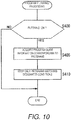
- FIG. 10 is a flowchart of the program filtering processing.
- step S405 the program guide information corresponding to the programs that are listed in step S110 is acquired.
- the program guide information is information included in the program list.
- the main control circuit 14a determines whether or not at least one of the programs for the next Y hours that are listed in step S110 matches the conditions designated with the input boxes M6 to M9.
- step S410 only the programs matching the designated conditions are kept as listed programs. That is, as a result of determining whether or not there is a match in the processing in step S405, the programs that do match are left as listed programs for the subsequent processing after step S115 in FIG. 4 , and programs with no match at all are deleted or discarded.
- the program list includes information that describes the programs, such as the category, genre, and performers of the programs, in addition to the channel number L1, the program title L2, the start date L3, the start time L4, and the end time L5.
- the above-mentioned program filtering can be performed based on the information designated with the input boxes M6 to M9.
- the information used for the program filtering process is not limited to the content of the input boxes M6 to M9, and the different or additional information can be utilized.
- the present invention is not limited to or by the above examples. It should also be obvious to a person skilled in the art that: suitably changing the combinations of mutually interchangeable members, configurations, etc., disclosed in the above examples, suitably replacing, or changing the combinations of, the mutually interchangeable members, configurations, etc., disclosed in the above examples with members, configurations, etc., that are known technology, albeit not disclosed in the above examples, and suitably replacing, or changing the combinations of, members, configurations, etc., that a person skilled in the art could imagine, based on known technology and the like, as substitutes for the mutually interchangeable members, configurations, etc., disclosed in the above examples are disclosed as examples of the present invention.
- the recording device includes a tuner and a plurality of recording processors.
- the recording device is configured such that a plurality of consecutive broadcast programs on a predetermined channel are recorded with different recording processors.
- the consecutive broadcast programs on the predetermined channel are recorded with different recording processors.
- a previous broadcast program can be recorded from start to end with one recording processor.
- a subsequent broadcast program can be recorded from start to end using another recording processor. Consequently, there is no period in which recording is impossible between the consecutive broadcast programs.
- the recording device can include a recording component having the plurality of the recording processors relative to the tuner, and an acquisition component that acquires information about the start time and the end time of each of the broadcast programs for each channel.
- the controller records the broadcast programs with the recording component based on a recording list. In the recording list, different recording processors are allocated to the consecutive broadcast programs on the predetermined channel.
- the tuner can receive the broadcast programs, and the recording component has a plurality of recording systems for a single tuner.
- the acquisition component acquires information about the start time and the end time of the broadcast programs for each channel
- the recording list for recording the broadcast programs is produced in which different recording systems are allocated to the consecutive broadcast programs for the predetermined channel.
- the controller records the broadcast programs with the recording component based on the recording list.
- recording can be performed without producing a period in which recording is impossible between the consecutive broadcast programs, while avoiding an increase in cost of the recording device.
Landscapes
- Engineering & Computer Science (AREA)
- Multimedia (AREA)
- Signal Processing (AREA)
- Databases & Information Systems (AREA)
- Human Computer Interaction (AREA)
- Computer Networks & Wireless Communication (AREA)
- Software Systems (AREA)
- Strategic Management (AREA)
- Finance (AREA)
- Business, Economics & Management (AREA)
- Television Signal Processing For Recording (AREA)
- Management Or Editing Of Information On Record Carriers (AREA)
- Two-Way Televisions, Distribution Of Moving Picture Or The Like (AREA)
- Signal Processing For Digital Recording And Reproducing (AREA)
Applications Claiming Priority (1)
| Application Number | Priority Date | Filing Date | Title |
|---|---|---|---|
| JP2016025933A JP6701776B2 (ja) | 2016-02-15 | 2016-02-15 | 録画装置、録画方法 |
Publications (2)
| Publication Number | Publication Date |
|---|---|
| EP3206390A1 true EP3206390A1 (de) | 2017-08-16 |
| EP3206390B1 EP3206390B1 (de) | 2021-07-14 |
Family
ID=58043966
Family Applications (1)
| Application Number | Title | Priority Date | Filing Date |
|---|---|---|---|
| EP17156057.6A Active EP3206390B1 (de) | 2016-02-15 | 2017-02-14 | Aufnahmevorrichtung |
Country Status (4)
| Country | Link |
|---|---|
| US (1) | US10965978B2 (de) |
| EP (1) | EP3206390B1 (de) |
| JP (1) | JP6701776B2 (de) |
| CN (1) | CN107087228B (de) |
Families Citing this family (2)
| Publication number | Priority date | Publication date | Assignee | Title |
|---|---|---|---|---|
| US10728617B2 (en) * | 2017-06-07 | 2020-07-28 | Sports Direct, Inc. | Computing system with timing prediction and electronic program guide feature |
| TWI819894B (zh) * | 2022-11-14 | 2023-10-21 | 緯創資通股份有限公司 | 儲存多鏡頭錄製檔的方法以及多鏡頭錄製裝置 |
Citations (9)
| Publication number | Priority date | Publication date | Assignee | Title |
|---|---|---|---|---|
| JP2001351283A (ja) | 2000-06-06 | 2001-12-21 | Hitachi Ltd | デジタル録画予約機能付き電子機器 |
| EP1638344A2 (de) * | 2004-09-21 | 2006-03-22 | D & M Holdings, Inc. | Aufnahmegerät, Abspielgerät |
| EP1775947A1 (de) * | 2004-08-02 | 2007-04-18 | Matsushita Electric Industrial Co., Ltd. | Aufnahme-vorrichtung und aufnahme-methode |
| EP2009641A1 (de) * | 2007-06-29 | 2008-12-31 | Kabushiki Kaisha Toshiba | Aufzeichnungsvorrichtung, Aufzeichnungs-/Wiedergabesystem und Aufzeichnungsverfahren |
| EP2033438A1 (de) * | 2006-06-29 | 2009-03-11 | Scientific-Atlanta, Inc. | Restzeitverzögerungs-pufferung in einer digitalmedienvorrichtung |
| JP2009224024A (ja) | 2004-05-25 | 2009-10-01 | Panasonic Corp | 番組録画装置および番組録画方法 |
| US20100178025A1 (en) * | 2009-01-14 | 2010-07-15 | International Business Machines Corporation | Intelligent synchronization of portable video devices |
| WO2010111239A2 (en) * | 2009-03-26 | 2010-09-30 | Dish Network Llc | Apparatus and methods for recording adjacent time slots of television programming on the same channel |
| US20160007091A1 (en) * | 2014-07-03 | 2016-01-07 | Eldon Technology Limited | Methods and Systems for Managing Consecutive Recordings |
Family Cites Families (38)
| Publication number | Priority date | Publication date | Assignee | Title |
|---|---|---|---|---|
| JPH10261251A (ja) * | 1997-03-18 | 1998-09-29 | Sony Corp | 受信装置、受信方法、送信装置、送信方法、送受信装置、および、送受信方法 |
| JP3491665B2 (ja) * | 1997-04-16 | 2004-01-26 | ソニー株式会社 | 遠隔制御装置および遠隔制御方法 |
| US6141488A (en) * | 1997-09-05 | 2000-10-31 | United Video Properties, Inc. | Program guide system for recording television programs |
| US8250617B2 (en) * | 1999-10-29 | 2012-08-21 | Opentv, Inc. | System and method for providing multi-perspective instant replay |
| AU2056401A (en) * | 1999-12-02 | 2001-06-12 | Senvid, Inc. | Method, system and service model for remote recording of television programs |
| US20020009285A1 (en) * | 2000-03-08 | 2002-01-24 | General Instrument Corporation | Personal versatile recorder: enhanced features, and methods for its use |
| JP2001268459A (ja) * | 2000-03-17 | 2001-09-28 | Hitachi Ltd | 番組検索装置及び方法並びに番組検索プログラムを記録した記録媒体 |
| US7552460B2 (en) * | 2000-05-08 | 2009-06-23 | Microsoft Corporation | Modifying an electronic program guide based on viewer statistics |
| US7248777B2 (en) * | 2003-04-17 | 2007-07-24 | Nielsen Media Research, Inc. | Methods and apparatus to detect content skipping by a consumer of a recorded program |
| JP2005167782A (ja) | 2003-12-04 | 2005-06-23 | Hitachi Ltd | デジタル放送の記録方法及びデジタル放送受信装置 |
| JP2005277757A (ja) * | 2004-03-24 | 2005-10-06 | Orion Denki Kk | 簡易タイマー予約機能付き記録再生装置 |
| US7792417B2 (en) * | 2004-04-20 | 2010-09-07 | Panasonic Corporation | Data processor |
| CN1737937A (zh) * | 2004-08-16 | 2006-02-22 | 上海乐金广电电子有限公司 | 数字录像机中录制节目删除方法 |
| KR101007881B1 (ko) * | 2004-09-23 | 2011-01-14 | 엘지전자 주식회사 | 방송 프로그램의 연속 녹화 제어 방법 |
| JP2006216153A (ja) | 2005-02-03 | 2006-08-17 | Matsushita Electric Ind Co Ltd | デジタル信号記録再生装置 |
| US8886014B2 (en) * | 2005-08-11 | 2014-11-11 | Mitsubishi Electric Corporation | Video recording apparatus, scene change extraction method, and video audio recording apparatus |
| JP4264657B2 (ja) * | 2005-10-31 | 2009-05-20 | ソニー株式会社 | 番組予約システム及びリモートコントロール装置 |
| US20070124769A1 (en) * | 2005-11-30 | 2007-05-31 | Qwest Communications International Inc. | Personal broadcast channels |
| US7765235B2 (en) * | 2005-12-29 | 2010-07-27 | Rovi Guides, Inc. | Systems and methods for resolving conflicts and managing system resources in multimedia delivery systems |
| JP2007219178A (ja) * | 2006-02-16 | 2007-08-30 | Sony Corp | 楽曲抽出プログラム、楽曲抽出装置及び楽曲抽出方法 |
| JP4187029B2 (ja) * | 2006-09-28 | 2008-11-26 | 船井電機株式会社 | デジタル放送受信装置、デジタル放送録画装置 |
| JP2008148190A (ja) | 2006-12-13 | 2008-06-26 | Funai Electric Co Ltd | 録画装置 |
| KR20080058971A (ko) * | 2006-12-23 | 2008-06-26 | 삼성전자주식회사 | 디지털 방송 수신기의 예약 녹화 방법 및 이를 적용한 예약녹화 장치 |
| JP2008306606A (ja) * | 2007-06-09 | 2008-12-18 | Masahide Tanaka | 動画データ鑑賞装置 |
| JP5137955B2 (ja) * | 2007-08-01 | 2013-02-06 | パナソニック株式会社 | デジタル放送送信装置、デジタル放送受信装置 |
| JP5142673B2 (ja) | 2007-11-09 | 2013-02-13 | 株式会社東芝 | 録画装置および録画予約処理方法 |
| US8565586B2 (en) * | 2009-05-20 | 2013-10-22 | Microsoft Corporation | Recorder vacation mode |
| US9113127B2 (en) * | 2010-02-08 | 2015-08-18 | Echostar Technologies L.L.C. | Systems and methods for automatically scheduling recordings of programming events |
| JP5075943B2 (ja) * | 2010-06-08 | 2012-11-21 | 株式会社ソニー・コンピュータエンタテインメント | 情報提供装置および情報提供方法 |
| GB2486002A (en) * | 2010-11-30 | 2012-06-06 | Youview Tv Ltd | Media Content Provision |
| KR20130011078A (ko) * | 2011-07-20 | 2013-01-30 | 삼성전자주식회사 | 영상처리장치 및 그 제어방법 |
| US9280545B2 (en) * | 2011-11-09 | 2016-03-08 | Microsoft Technology Licensing, Llc | Generating and updating event-based playback experiences |
| US8726313B2 (en) * | 2012-04-23 | 2014-05-13 | Verizon Patent And Licensing Inc. | Previously aired episode retrieval based on series DVR scheduling |
| US10362351B2 (en) * | 2013-08-19 | 2019-07-23 | Tivo Solutions, Inc. | Dynamic tuner allocation |
| KR20150051815A (ko) * | 2013-11-05 | 2015-05-13 | 삼성전자주식회사 | 방송 수신 장치 및 그 채널 선국 방법 |
| US20160309227A1 (en) * | 2015-04-20 | 2016-10-20 | Echostar Technologies L.L.C. | Real-time recording timer adjustments and related methods, devices and systems |
| US9465996B1 (en) * | 2015-09-15 | 2016-10-11 | Echostar Technologies Llc | Apparatus, systems and methods for control of media content event recording |
| US9848242B2 (en) * | 2015-09-30 | 2017-12-19 | Rovi Guides, Inc. | Systems and methods for adjusting the priority of media assets scheduled to be recorded |
-
2016
- 2016-02-15 JP JP2016025933A patent/JP6701776B2/ja not_active Expired - Fee Related
-
2017
- 2017-02-13 US US15/430,615 patent/US10965978B2/en not_active Expired - Fee Related
- 2017-02-14 EP EP17156057.6A patent/EP3206390B1/de active Active
- 2017-02-15 CN CN201710081169.8A patent/CN107087228B/zh not_active Expired - Fee Related
Patent Citations (9)
| Publication number | Priority date | Publication date | Assignee | Title |
|---|---|---|---|---|
| JP2001351283A (ja) | 2000-06-06 | 2001-12-21 | Hitachi Ltd | デジタル録画予約機能付き電子機器 |
| JP2009224024A (ja) | 2004-05-25 | 2009-10-01 | Panasonic Corp | 番組録画装置および番組録画方法 |
| EP1775947A1 (de) * | 2004-08-02 | 2007-04-18 | Matsushita Electric Industrial Co., Ltd. | Aufnahme-vorrichtung und aufnahme-methode |
| EP1638344A2 (de) * | 2004-09-21 | 2006-03-22 | D & M Holdings, Inc. | Aufnahmegerät, Abspielgerät |
| EP2033438A1 (de) * | 2006-06-29 | 2009-03-11 | Scientific-Atlanta, Inc. | Restzeitverzögerungs-pufferung in einer digitalmedienvorrichtung |
| EP2009641A1 (de) * | 2007-06-29 | 2008-12-31 | Kabushiki Kaisha Toshiba | Aufzeichnungsvorrichtung, Aufzeichnungs-/Wiedergabesystem und Aufzeichnungsverfahren |
| US20100178025A1 (en) * | 2009-01-14 | 2010-07-15 | International Business Machines Corporation | Intelligent synchronization of portable video devices |
| WO2010111239A2 (en) * | 2009-03-26 | 2010-09-30 | Dish Network Llc | Apparatus and methods for recording adjacent time slots of television programming on the same channel |
| US20160007091A1 (en) * | 2014-07-03 | 2016-01-07 | Eldon Technology Limited | Methods and Systems for Managing Consecutive Recordings |
Also Published As
| Publication number | Publication date |
|---|---|
| JP6701776B2 (ja) | 2020-05-27 |
| CN107087228B (zh) | 2020-07-07 |
| EP3206390B1 (de) | 2021-07-14 |
| CN107087228A (zh) | 2017-08-22 |
| US20170238042A1 (en) | 2017-08-17 |
| US10965978B2 (en) | 2021-03-30 |
| JP2017147497A (ja) | 2017-08-24 |
Similar Documents
| Publication | Publication Date | Title |
|---|---|---|
| US6344878B1 (en) | Television program recording reservation apparatus | |
| US8813122B1 (en) | Apparatus and method for selecting, scheduling, and reproducing programs while accounting for scheduling gaps | |
| US9113127B2 (en) | Systems and methods for automatically scheduling recordings of programming events | |
| US20010023498A1 (en) | Process for displaying broadcast and recorded transmissions possessing a common characteristic and associated receiver | |
| US20070245382A1 (en) | Digital Broadcast Receiving Apparatus and Method and Program Therefor | |
| US20100239228A1 (en) | Information processing system, information processing method, and information processing program | |
| US20020110360A1 (en) | Systems and methods for recording fragmented programs | |
| WO2013016626A1 (en) | Variable real time buffer and apparatus | |
| WO2007041588A2 (en) | Systems and methods for recording and playing back programs having desirable recording attributes | |
| US8983274B2 (en) | Systems and methods for revolving recording conflicts | |
| EP3206390B1 (de) | Aufnahmevorrichtung | |
| US20110058791A1 (en) | Recording controller and recording control method | |
| CN105959805B (zh) | 电视节目的播放方法及播放装置 | |
| WO2007054880A2 (en) | Optimally selecting partial tv programs | |
| US20080267583A1 (en) | Video-recording programming apparatus and video-recording programming method | |
| GB2466692A (en) | Recorder that records everything except exclusions | |
| EP2398231A1 (de) | Rundfunkaufzeichnungsvorrichtung und Rundfunkaufzeichnungsverfahren | |
| US20170127121A1 (en) | Dvr live pause and recording in referenced chunks | |
| JP4651451B2 (ja) | 番組情報処理装置および番組情報処理方法 | |
| US20060041911A1 (en) | Information processing apparatus, information processing method, and program | |
| KR101328942B1 (ko) | 방송 프로그램에 대한 방송 정보를 처리하는 방법 및 장치 | |
| JP6390168B2 (ja) | 録画装置 | |
| US20080010363A1 (en) | Communication apparatus and communication method | |
| EP1955539A2 (de) | Optimale auswahl von tv-programmen mit zeitreserven | |
| JP2005353112A (ja) | 記録装置 |
Legal Events
| Date | Code | Title | Description |
|---|---|---|---|
| PUAI | Public reference made under article 153(3) epc to a published international application that has entered the european phase |
Free format text: ORIGINAL CODE: 0009012 |
|
| STAA | Information on the status of an ep patent application or granted ep patent |
Free format text: STATUS: THE APPLICATION HAS BEEN PUBLISHED |
|
| AK | Designated contracting states |
Kind code of ref document: A1 Designated state(s): AL AT BE BG CH CY CZ DE DK EE ES FI FR GB GR HR HU IE IS IT LI LT LU LV MC MK MT NL NO PL PT RO RS SE SI SK SM TR |
|
| AX | Request for extension of the european patent |
Extension state: BA ME |
|
| STAA | Information on the status of an ep patent application or granted ep patent |
Free format text: STATUS: REQUEST FOR EXAMINATION WAS MADE |
|
| 17P | Request for examination filed |
Effective date: 20170926 |
|
| RBV | Designated contracting states (corrected) |
Designated state(s): AL AT BE BG CH CY CZ DE DK EE ES FI FR GB GR HR HU IE IS IT LI LT LU LV MC MK MT NL NO PL PT RO RS SE SI SK SM TR |
|
| STAA | Information on the status of an ep patent application or granted ep patent |
Free format text: STATUS: EXAMINATION IS IN PROGRESS |
|
| 17Q | First examination report despatched |
Effective date: 20190321 |
|
| RIC1 | Information provided on ipc code assigned before grant |
Ipc: H04N 21/4335 20110101ALI20200723BHEP Ipc: H04N 5/775 20060101AFI20200723BHEP Ipc: H04N 21/4147 20110101ALI20200723BHEP Ipc: H04N 21/426 20110101ALI20200723BHEP Ipc: H04N 21/2385 20110101ALI20200723BHEP Ipc: H04N 21/433 20110101ALI20200723BHEP Ipc: H04N 21/482 20110101ALI20200723BHEP Ipc: H04N 21/458 20110101ALI20200723BHEP Ipc: H04N 21/235 20110101ALI20200723BHEP Ipc: G11B 27/031 20060101ALI20200723BHEP |
|
| GRAP | Despatch of communication of intention to grant a patent |
Free format text: ORIGINAL CODE: EPIDOSNIGR1 |
|
| STAA | Information on the status of an ep patent application or granted ep patent |
Free format text: STATUS: GRANT OF PATENT IS INTENDED |
|
| INTG | Intention to grant announced |
Effective date: 20200910 |
|
| RAP1 | Party data changed (applicant data changed or rights of an application transferred) |
Owner name: FUNAI ELECTRIC CO., LTD. |
|
| GRAJ | Information related to disapproval of communication of intention to grant by the applicant or resumption of examination proceedings by the epo deleted |
Free format text: ORIGINAL CODE: EPIDOSDIGR1 |
|
| STAA | Information on the status of an ep patent application or granted ep patent |
Free format text: STATUS: EXAMINATION IS IN PROGRESS |
|
| INTC | Intention to grant announced (deleted) | ||
| GRAP | Despatch of communication of intention to grant a patent |
Free format text: ORIGINAL CODE: EPIDOSNIGR1 |
|
| STAA | Information on the status of an ep patent application or granted ep patent |
Free format text: STATUS: GRANT OF PATENT IS INTENDED |
|
| INTG | Intention to grant announced |
Effective date: 20210414 |
|
| GRAS | Grant fee paid |
Free format text: ORIGINAL CODE: EPIDOSNIGR3 |
|
| GRAA | (expected) grant |
Free format text: ORIGINAL CODE: 0009210 |
|
| STAA | Information on the status of an ep patent application or granted ep patent |
Free format text: STATUS: THE PATENT HAS BEEN GRANTED |
|
| AK | Designated contracting states |
Kind code of ref document: B1 Designated state(s): AL AT BE BG CH CY CZ DE DK EE ES FI FR GB GR HR HU IE IS IT LI LT LU LV MC MK MT NL NO PL PT RO RS SE SI SK SM TR |
|
| REG | Reference to a national code |
Ref country code: GB Ref legal event code: FG4D |
|
| REG | Reference to a national code |
Ref country code: DE Ref legal event code: R096 Ref document number: 602017041974 Country of ref document: DE |
|
| REG | Reference to a national code |
Ref country code: IE Ref legal event code: FG4D |
|
| REG | Reference to a national code |
Ref country code: AT Ref legal event code: REF Ref document number: 1411564 Country of ref document: AT Kind code of ref document: T Effective date: 20210815 |
|
| REG | Reference to a national code |
Ref country code: LT Ref legal event code: MG9D |
|
| REG | Reference to a national code |
Ref country code: NL Ref legal event code: MP Effective date: 20210714 |
|
| REG | Reference to a national code |
Ref country code: AT Ref legal event code: MK05 Ref document number: 1411564 Country of ref document: AT Kind code of ref document: T Effective date: 20210714 |
|
| PG25 | Lapsed in a contracting state [announced via postgrant information from national office to epo] |
Ref country code: NO Free format text: LAPSE BECAUSE OF FAILURE TO SUBMIT A TRANSLATION OF THE DESCRIPTION OR TO PAY THE FEE WITHIN THE PRESCRIBED TIME-LIMIT Effective date: 20211014 Ref country code: NL Free format text: LAPSE BECAUSE OF FAILURE TO SUBMIT A TRANSLATION OF THE DESCRIPTION OR TO PAY THE FEE WITHIN THE PRESCRIBED TIME-LIMIT Effective date: 20210714 Ref country code: PT Free format text: LAPSE BECAUSE OF FAILURE TO SUBMIT A TRANSLATION OF THE DESCRIPTION OR TO PAY THE FEE WITHIN THE PRESCRIBED TIME-LIMIT Effective date: 20211115 Ref country code: ES Free format text: LAPSE BECAUSE OF FAILURE TO SUBMIT A TRANSLATION OF THE DESCRIPTION OR TO PAY THE FEE WITHIN THE PRESCRIBED TIME-LIMIT Effective date: 20210714 Ref country code: FI Free format text: LAPSE BECAUSE OF FAILURE TO SUBMIT A TRANSLATION OF THE DESCRIPTION OR TO PAY THE FEE WITHIN THE PRESCRIBED TIME-LIMIT Effective date: 20210714 Ref country code: HR Free format text: LAPSE BECAUSE OF FAILURE TO SUBMIT A TRANSLATION OF THE DESCRIPTION OR TO PAY THE FEE WITHIN THE PRESCRIBED TIME-LIMIT Effective date: 20210714 Ref country code: LT Free format text: LAPSE BECAUSE OF FAILURE TO SUBMIT A TRANSLATION OF THE DESCRIPTION OR TO PAY THE FEE WITHIN THE PRESCRIBED TIME-LIMIT Effective date: 20210714 Ref country code: AT Free format text: LAPSE BECAUSE OF FAILURE TO SUBMIT A TRANSLATION OF THE DESCRIPTION OR TO PAY THE FEE WITHIN THE PRESCRIBED TIME-LIMIT Effective date: 20210714 Ref country code: BG Free format text: LAPSE BECAUSE OF FAILURE TO SUBMIT A TRANSLATION OF THE DESCRIPTION OR TO PAY THE FEE WITHIN THE PRESCRIBED TIME-LIMIT Effective date: 20211014 Ref country code: RS Free format text: LAPSE BECAUSE OF FAILURE TO SUBMIT A TRANSLATION OF THE DESCRIPTION OR TO PAY THE FEE WITHIN THE PRESCRIBED TIME-LIMIT Effective date: 20210714 Ref country code: SE Free format text: LAPSE BECAUSE OF FAILURE TO SUBMIT A TRANSLATION OF THE DESCRIPTION OR TO PAY THE FEE WITHIN THE PRESCRIBED TIME-LIMIT Effective date: 20210714 |
|
| PG25 | Lapsed in a contracting state [announced via postgrant information from national office to epo] |
Ref country code: PL Free format text: LAPSE BECAUSE OF FAILURE TO SUBMIT A TRANSLATION OF THE DESCRIPTION OR TO PAY THE FEE WITHIN THE PRESCRIBED TIME-LIMIT Effective date: 20210714 Ref country code: LV Free format text: LAPSE BECAUSE OF FAILURE TO SUBMIT A TRANSLATION OF THE DESCRIPTION OR TO PAY THE FEE WITHIN THE PRESCRIBED TIME-LIMIT Effective date: 20210714 Ref country code: GR Free format text: LAPSE BECAUSE OF FAILURE TO SUBMIT A TRANSLATION OF THE DESCRIPTION OR TO PAY THE FEE WITHIN THE PRESCRIBED TIME-LIMIT Effective date: 20211015 |
|
| REG | Reference to a national code |
Ref country code: DE Ref legal event code: R097 Ref document number: 602017041974 Country of ref document: DE |
|
| PG25 | Lapsed in a contracting state [announced via postgrant information from national office to epo] |
Ref country code: DK Free format text: LAPSE BECAUSE OF FAILURE TO SUBMIT A TRANSLATION OF THE DESCRIPTION OR TO PAY THE FEE WITHIN THE PRESCRIBED TIME-LIMIT Effective date: 20210714 |
|
| PLBE | No opposition filed within time limit |
Free format text: ORIGINAL CODE: 0009261 |
|
| STAA | Information on the status of an ep patent application or granted ep patent |
Free format text: STATUS: NO OPPOSITION FILED WITHIN TIME LIMIT |
|
| PG25 | Lapsed in a contracting state [announced via postgrant information from national office to epo] |
Ref country code: SM Free format text: LAPSE BECAUSE OF FAILURE TO SUBMIT A TRANSLATION OF THE DESCRIPTION OR TO PAY THE FEE WITHIN THE PRESCRIBED TIME-LIMIT Effective date: 20210714 Ref country code: SK Free format text: LAPSE BECAUSE OF FAILURE TO SUBMIT A TRANSLATION OF THE DESCRIPTION OR TO PAY THE FEE WITHIN THE PRESCRIBED TIME-LIMIT Effective date: 20210714 Ref country code: RO Free format text: LAPSE BECAUSE OF FAILURE TO SUBMIT A TRANSLATION OF THE DESCRIPTION OR TO PAY THE FEE WITHIN THE PRESCRIBED TIME-LIMIT Effective date: 20210714 Ref country code: EE Free format text: LAPSE BECAUSE OF FAILURE TO SUBMIT A TRANSLATION OF THE DESCRIPTION OR TO PAY THE FEE WITHIN THE PRESCRIBED TIME-LIMIT Effective date: 20210714 Ref country code: CZ Free format text: LAPSE BECAUSE OF FAILURE TO SUBMIT A TRANSLATION OF THE DESCRIPTION OR TO PAY THE FEE WITHIN THE PRESCRIBED TIME-LIMIT Effective date: 20210714 Ref country code: AL Free format text: LAPSE BECAUSE OF FAILURE TO SUBMIT A TRANSLATION OF THE DESCRIPTION OR TO PAY THE FEE WITHIN THE PRESCRIBED TIME-LIMIT Effective date: 20210714 |
|
| 26N | No opposition filed |
Effective date: 20220419 |
|
| PG25 | Lapsed in a contracting state [announced via postgrant information from national office to epo] |
Ref country code: IT Free format text: LAPSE BECAUSE OF FAILURE TO SUBMIT A TRANSLATION OF THE DESCRIPTION OR TO PAY THE FEE WITHIN THE PRESCRIBED TIME-LIMIT Effective date: 20210714 |
|
| PG25 | Lapsed in a contracting state [announced via postgrant information from national office to epo] |
Ref country code: MC Free format text: LAPSE BECAUSE OF FAILURE TO SUBMIT A TRANSLATION OF THE DESCRIPTION OR TO PAY THE FEE WITHIN THE PRESCRIBED TIME-LIMIT Effective date: 20210714 |
|
| REG | Reference to a national code |
Ref country code: CH Ref legal event code: PL |
|
| REG | Reference to a national code |
Ref country code: BE Ref legal event code: MM Effective date: 20220228 |
|
| GBPC | Gb: european patent ceased through non-payment of renewal fee |
Effective date: 20220214 |
|
| PG25 | Lapsed in a contracting state [announced via postgrant information from national office to epo] |
Ref country code: LU Free format text: LAPSE BECAUSE OF NON-PAYMENT OF DUE FEES Effective date: 20220214 |
|
| PG25 | Lapsed in a contracting state [announced via postgrant information from national office to epo] |
Ref country code: FR Free format text: LAPSE BECAUSE OF NON-PAYMENT OF DUE FEES Effective date: 20220228 |
|
| PG25 | Lapsed in a contracting state [announced via postgrant information from national office to epo] |
Ref country code: LI Free format text: LAPSE BECAUSE OF NON-PAYMENT OF DUE FEES Effective date: 20220228 Ref country code: IE Free format text: LAPSE BECAUSE OF NON-PAYMENT OF DUE FEES Effective date: 20220214 Ref country code: GB Free format text: LAPSE BECAUSE OF NON-PAYMENT OF DUE FEES Effective date: 20220214 Ref country code: CH Free format text: LAPSE BECAUSE OF NON-PAYMENT OF DUE FEES Effective date: 20220228 |
|
| PG25 | Lapsed in a contracting state [announced via postgrant information from national office to epo] |
Ref country code: BE Free format text: LAPSE BECAUSE OF NON-PAYMENT OF DUE FEES Effective date: 20220228 |
|
| PG25 | Lapsed in a contracting state [announced via postgrant information from national office to epo] |
Ref country code: HU Free format text: LAPSE BECAUSE OF FAILURE TO SUBMIT A TRANSLATION OF THE DESCRIPTION OR TO PAY THE FEE WITHIN THE PRESCRIBED TIME-LIMIT; INVALID AB INITIO Effective date: 20170214 |
|
| PG25 | Lapsed in a contracting state [announced via postgrant information from national office to epo] |
Ref country code: MK Free format text: LAPSE BECAUSE OF FAILURE TO SUBMIT A TRANSLATION OF THE DESCRIPTION OR TO PAY THE FEE WITHIN THE PRESCRIBED TIME-LIMIT Effective date: 20210714 Ref country code: CY Free format text: LAPSE BECAUSE OF FAILURE TO SUBMIT A TRANSLATION OF THE DESCRIPTION OR TO PAY THE FEE WITHIN THE PRESCRIBED TIME-LIMIT Effective date: 20210714 |
|
| PGFP | Annual fee paid to national office [announced via postgrant information from national office to epo] |
Ref country code: DE Payment date: 20231228 Year of fee payment: 8 |
|
| PG25 | Lapsed in a contracting state [announced via postgrant information from national office to epo] |
Ref country code: MT Free format text: LAPSE BECAUSE OF FAILURE TO SUBMIT A TRANSLATION OF THE DESCRIPTION OR TO PAY THE FEE WITHIN THE PRESCRIBED TIME-LIMIT Effective date: 20210714 |
|
| REG | Reference to a national code |
Ref country code: DE Ref legal event code: R119 Ref document number: 602017041974 Country of ref document: DE |
|
| PG25 | Lapsed in a contracting state [announced via postgrant information from national office to epo] |
Ref country code: TR Free format text: LAPSE BECAUSE OF FAILURE TO SUBMIT A TRANSLATION OF THE DESCRIPTION OR TO PAY THE FEE WITHIN THE PRESCRIBED TIME-LIMIT Effective date: 20210714 |
|
| PG25 | Lapsed in a contracting state [announced via postgrant information from national office to epo] |
Ref country code: DE Free format text: LAPSE BECAUSE OF NON-PAYMENT OF DUE FEES Effective date: 20250902 |