EP3206411A1 - Anordnung und verfahren zur vorhersage der strassenreibung in einem strassennetz - Google Patents
Anordnung und verfahren zur vorhersage der strassenreibung in einem strassennetz Download PDFInfo
- Publication number
- EP3206411A1 EP3206411A1 EP16155263.3A EP16155263A EP3206411A1 EP 3206411 A1 EP3206411 A1 EP 3206411A1 EP 16155263 A EP16155263 A EP 16155263A EP 3206411 A1 EP3206411 A1 EP 3206411A1
- Authority
- EP
- European Patent Office
- Prior art keywords
- road
- specific position
- road friction
- road network
- floating car
- Prior art date
- Legal status (The legal status is an assumption and is not a legal conclusion. Google has not performed a legal analysis and makes no representation as to the accuracy of the status listed.)
- Granted
Links
Images

Classifications
-
- G—PHYSICS
- G06—COMPUTING OR CALCULATING; COUNTING
- G06N—COMPUTING ARRANGEMENTS BASED ON SPECIFIC COMPUTATIONAL MODELS
- G06N3/00—Computing arrangements based on biological models
- G06N3/02—Neural networks
- G06N3/04—Architecture, e.g. interconnection topology
- G06N3/042—Knowledge-based neural networks; Logical representations of neural networks
-
- G—PHYSICS
- G06—COMPUTING OR CALCULATING; COUNTING
- G06F—ELECTRIC DIGITAL DATA PROCESSING
- G06F30/00—Computer-aided design [CAD]
- G06F30/20—Design optimisation, verification or simulation
-
- G—PHYSICS
- G08—SIGNALLING
- G08G—TRAFFIC CONTROL SYSTEMS
- G08G1/00—Traffic control systems for road vehicles
- G08G1/01—Detecting movement of traffic to be counted or controlled
- G08G1/0104—Measuring and analyzing of parameters relative to traffic conditions
- G08G1/0108—Measuring and analyzing of parameters relative to traffic conditions based on the source of data
- G08G1/0112—Measuring and analyzing of parameters relative to traffic conditions based on the source of data from the vehicle, e.g. floating car data [FCD]
-
- G—PHYSICS
- G01—MEASURING; TESTING
- G01N—INVESTIGATING OR ANALYSING MATERIALS BY DETERMINING THEIR CHEMICAL OR PHYSICAL PROPERTIES
- G01N19/00—Investigating materials by mechanical methods
- G01N19/02—Measuring coefficient of friction between materials
-
- G—PHYSICS
- G01—MEASURING; TESTING
- G01N—INVESTIGATING OR ANALYSING MATERIALS BY DETERMINING THEIR CHEMICAL OR PHYSICAL PROPERTIES
- G01N33/00—Investigating or analysing materials by specific methods not covered by groups G01N1/00 - G01N31/00
- G01N33/42—Road-making materials
-
- G—PHYSICS
- G06—COMPUTING OR CALCULATING; COUNTING
- G06N—COMPUTING ARRANGEMENTS BASED ON SPECIFIC COMPUTATIONAL MODELS
- G06N3/00—Computing arrangements based on biological models
- G06N3/02—Neural networks
- G06N3/04—Architecture, e.g. interconnection topology
- G06N3/0499—Feedforward networks
-
- G—PHYSICS
- G06—COMPUTING OR CALCULATING; COUNTING
- G06N—COMPUTING ARRANGEMENTS BASED ON SPECIFIC COMPUTATIONAL MODELS
- G06N3/00—Computing arrangements based on biological models
- G06N3/02—Neural networks
- G06N3/08—Learning methods
- G06N3/09—Supervised learning
-
- G—PHYSICS
- G06—COMPUTING OR CALCULATING; COUNTING
- G06N—COMPUTING ARRANGEMENTS BASED ON SPECIFIC COMPUTATIONAL MODELS
- G06N3/00—Computing arrangements based on biological models
- G06N3/02—Neural networks
- G06N3/08—Learning methods
- G06N3/098—Distributed learning, e.g. federated learning
-
- G—PHYSICS
- G08—SIGNALLING
- G08G—TRAFFIC CONTROL SYSTEMS
- G08G1/00—Traffic control systems for road vehicles
- G08G1/01—Detecting movement of traffic to be counted or controlled
- G08G1/0104—Measuring and analyzing of parameters relative to traffic conditions
- G08G1/0125—Traffic data processing
- G08G1/0129—Traffic data processing for creating historical data or processing based on historical data
-
- G—PHYSICS
- G08—SIGNALLING
- G08G—TRAFFIC CONTROL SYSTEMS
- G08G1/00—Traffic control systems for road vehicles
- G08G1/01—Detecting movement of traffic to be counted or controlled
- G08G1/0104—Measuring and analyzing of parameters relative to traffic conditions
- G08G1/0137—Measuring and analyzing of parameters relative to traffic conditions for specific applications
- G08G1/0141—Measuring and analyzing of parameters relative to traffic conditions for specific applications for traffic information dissemination
-
- G—PHYSICS
- G08—SIGNALLING
- G08G—TRAFFIC CONTROL SYSTEMS
- G08G1/00—Traffic control systems for road vehicles
- G08G1/20—Monitoring the location of vehicles belonging to a group, e.g. fleet of vehicles, countable or determined number of vehicles
- G08G1/205—Indicating the location of the monitored vehicles as destination, e.g. accidents, stolen, rental
-
- H—ELECTRICITY
- H04—ELECTRIC COMMUNICATION TECHNIQUE
- H04Q—SELECTING
- H04Q9/00—Arrangements in telecontrol or telemetry systems for selectively calling a substation from a main station, in which substation desired apparatus is selected for applying a control signal thereto or for obtaining measured values therefrom
-
- G—PHYSICS
- G06—COMPUTING OR CALCULATING; COUNTING
- G06F—ELECTRIC DIGITAL DATA PROCESSING
- G06F2119/00—Details relating to the type or aim of the analysis or the optimisation
- G06F2119/06—Power analysis or power optimisation
-
- H—ELECTRICITY
- H04—ELECTRIC COMMUNICATION TECHNIQUE
- H04Q—SELECTING
- H04Q2209/00—Arrangements in telecontrol or telemetry systems
- H04Q2209/50—Arrangements in telecontrol or telemetry systems using a mobile data collecting device, e.g. walk by or drive by
-
- H—ELECTRICITY
- H04—ELECTRIC COMMUNICATION TECHNIQUE
- H04Q—SELECTING
- H04Q2209/00—Arrangements in telecontrol or telemetry systems
- H04Q2209/80—Arrangements in the sub-station, i.e. sensing device
- H04Q2209/82—Arrangements in the sub-station, i.e. sensing device where the sensing device takes the initiative of sending data
- H04Q2209/826—Arrangements in the sub-station, i.e. sensing device where the sensing device takes the initiative of sending data where the data is sent periodically
Definitions
- the present disclosure relates to a system for predicting road friction using data from a fleet of connected vehicles equipped with respective positioning systems and one or more respective sensor systems capable of determining a plurality of road friction influencing parameters during travel within a road network the road friction within which is of interest.
- the disclosure further relates to a method for predicting road friction using data from a fleet of connected vehicles equipped with respective positioning systems and one or more respective sensor systems capable of determining a plurality of road friction influencing parameters during travel within a road network the road friction within which is of interest.
- the disclosure further relates to a connected vehicle, suitable to form part fleet of connected vehicles, the connected vehicle equipped with a positioning system and one or more respective sensor systems capable of determining a plurality of road friction influencing parameters during travel within a road network the friction of which is of interest.
- road surface ice will melt faster, e.g. if the road surface is freely exposed to sunlight. In other road segments road surface ice will develop more quickly during cold weather, e.g. if these road segments are located close to open water.
- Attributes affecting road friction can be related to the shape of the landscape profile, to the geographical topology, to the geology.
- the number of parameters and the multitude of combinations possible make it difficult, but not impossible, to create analytical models to forecast road conditions, including road friction.
- Embodiments herein aim to provide an improved system for more accurately predicting road friction by forecasts models requiring less effort to create and maintain.
- each respective vehicle in the fleet of connected vehicles comprises: a communication arrangement, arranged to communicate with a back end system to continuously report floating car data sets including a position of the connected vehicle within the road network, time data and data regarding determined road friction influencing parameters and a determined road friction associated with that position within the road network; and the system for predicting road friction further comprising: a central database, residing in the back end system, and arranged to collect the reported floating car data sets of the connected vehicles within the fleet and to aggregate in the central database a series of such floating car data sets over a predetermined time period; and a neural network computer arranged to be trained and validated, using the aggregated floating car data sets from the connected vehicles within the fleet, to create a model to predict future road friction for a specific position within the road network, using
- the floating car data sets from each respective vehicle in the fleet of connected vehicles include, but are not limited to, ambient temperature, wiper speed, air humidity, sun load, fog lights activation and detected actual road friction.
- the communication arrangement is arranged to communicate with the back end system by an arrangement for wireless communication and in particular wireless data communication over a cellular network or similar.
- each series of floating car data sets aggregated in the central database comprises all floating car data related to a specific position within the road network or segment of the road network associated with that specific position within a specified time window prior to a reported determined road friction related to the specific position within the road network or the segment of the road network associated with that specific position.
- the neural network computer further is arranged to be re-trained and re-validated to create an updated model to predict future road friction, with a re-training frequency based either on a pre-determined time interval or on the availability of a pre-determined amount of floating car data sets from the connected vehicles within the fleet collected and aggregated in the central database since a previous training and validation of the neural network computer.
- the provision of having the neural network computer further arranged to be re-trained and re-validated as above provides an efficient way of ensuring the availability of an up to date model for forecasting road friction accounting for changed conditions in a road network.
- the neural network computer further is arranged to be trained and validated to create a model to predict future road friction, for a specific position within the road network, using, in addition to the aggregated floating car data sets from the connected vehicles within the fleet, data related to a time correlated weather forecast for the specific position within the road network or the segment of the road network associated with that specific position.
- the provision of having the neural network computer further arranged to be trained and validated using also data related to a time correlated weather forecast as above provides for additionally increasing the quality of road friction predictions.
- the neural network computer further is arranged to be trained and validated to create a model to predict future road friction, for a specific position within the road network, using, in addition to the aggregated floating car data sets from the connected vehicles within the fleet, time correlated actual weather data for the specific position within the road network or the segment of the road network associated with that specific position.
- the provision of having the neural network computer further arranged to be trained and validated using also time correlated actual weather data as above provides for yet further increasing the quality of road friction predictions.
- Embodiments herein also aim to provide an improved method for more accurately predicting road friction.
- this is provided through a method for predicting road friction using data from a fleet of connected vehicles equipped with respective positioning systems and one or more respective sensor systems capable of determining a plurality of road friction influencing parameters during travel within a road network the road friction within which is of interest, where the method comprises: each respective vehicle in the fleet of connected vehicles communicating, using a communication arrangement, with a back end system to continuously report floating car data sets including a position of the connected vehicle within the road network, time data and data regarding determined road friction influencing parameters and a determined road friction associated with that position within the road network; and where the method further comprises: collecting to a central database, residing in the back end system, the reported floating car data sets of the connected vehicles within the fleet and aggregating in the central database a series of such floating car data sets over a predetermined time period; and training and validating a neural network computer, using the aggregated floating car data sets from the connected vehicles within the fleet, to create a model to predict future road friction for a specific position within the road network, based on the
- a ninth aspect further comprises including in the floating car data sets from each respective vehicle in the fleet of connected vehicles, at least, ambient temperature, wiper speed, air humidity, sun load, fog lights activation and detected actual road friction.
- a tenth aspect further comprises arranging the communication arrangement to communicate with the back end system by an arrangement for wireless communication and in particular wireless data communication over a cellular network or similar.
- the provision of arranging the communication arrangement arranged to communicate with the back end system as above provides for cost efficient use of readily available and proven communications infrastructure.
- it further comprises including in each series of floating car data sets to be aggregated in the central database all floating car data related to a specific position within the road network or segment of the road network associated with that specific position within a specified time window prior to a reported determined road friction related to the specific position within the road network or the segment of the road network associated with that specific position.
- a twelfth aspect further comprises arranging the neural network computer to be re-trained and re-validated to create an updated model to predict future road friction, with a re-training frequency based either on a pre-determined time interval or on the availability of a pre-determined amount of floating car data sets from the connected vehicles within the fleet collected and aggregated in the central database since a previous training and validation of the neural network computer.
- the provision of arranging the neural network computer to be re-trained and re-validated as above provides an efficient way of ensuring the availability of an up to date model for forecasting road friction accounting for changed conditions in a road network.
- a thirteenth aspect further comprises arranging the neural network computer to be trained and validated to create a model to predict future road friction, for a specific position within the road network, using, in addition to the aggregated floating car data sets from the connected vehicles within the fleet, data related to a time correlated weather forecast for the specific position within the road network or the segment of the road network associated with that specific position.
- the provision of arranging the neural network computer to be trained and validated using also data related to a time correlated weather forecast as above provides for additionally increasing the quality of road friction predictions.
- an fourteenth aspect further comprises arranging the neural network computer to be trained and validated to create a model to predict future road friction, for a specific position within the road network, using, in addition to the aggregated floating car data sets from the connected vehicles within the fleet, time correlated actual weather data for the specific position within the road network or the segment of the road network associated with that specific position.
- the provision of arranging the neural network computer to be trained and validated using also time correlated actual weather data as above provides for yet further increasing the quality of road friction predictions.
- a connected vehicle suitable to form part of a fleet of connected vehicles, the connected vehicle equipped with a positioning system and one or more respective sensor systems capable of determining a plurality of road friction influencing parameters during travel within a road network the friction of which is of interest, which comprises: a communication arrangement, arranged to communicate with a back end system to continuously report floating car data sets including a position of the connected vehicle within the road network, time data and data regarding determined road friction influencing parameters and a determined road friction associated with that position within the road network.
- a vehicle as above, is able to, in an efficient way, without manual effort, harvest and update data describing a road network useful for creating and validating models for predicting road friction according to embodiments of the system for predicting road friction as described herein and in accordance with at least some embodiments of the method for predicting road friction as described herein.
- Measured friction data from such vehicles V 1-n can be collected in a remote database 6, also called cloud or cloud database, to gather a comprehensive description of the present state of road friction in a road network 3, i.e. on what road segments low road friction is occurring. Information on present road friction can be used in new safety related applications of road vehicles to further increase road safety.
- a number of safety related road vehicle functions would benefit from a prognosis of a future status of road friction, not limited to the present status, i.e. a forecast estimating which road segments in a road network 3 can be expected to have low road friction in a close future.
- the present disclosure proposes a solution such that data from a fleet of connected vehicles V 1-n , can be used to accurately and cost efficiently predict road friction for a specific position P 1 -P n within a road network 3 or segment of a road network 3 associated with that specific position P 1 -P n , the road friction within which is of interest. It is based on the use of vehicle data D 1 -D n from on board vehicle systems and sensors 2 of the fleet of connected vehicles V 1-n , aggregated during travels within the road network 3, in combination with a neural network computer 7, trained and validated using the aggregated data D 1 -D n to create a model to predict future road friction.
- a new computing model is needed in order to process and make sense of it.
- Such a new computing model is provided by cognitive computing systems, such as e.g. developed by IBM and others under US DARPA SyNAPSE (Systems of Neuromorphic Adaptive Plastic Scalable Electronics) project.
- cognitive computing systems can process data and learn by experience, much in the same way humans do.
- Neural network computers 7 are based on artificial neural networks that intended to mimic the human brain structure and function as an information processing system.
- FCD Floating Cars Data
- respective positioning systems such as satellite based GPS (Global Positioning Systems) or similar
- respective sensor systems 2 capable of determining a plurality of road friction influencing parameters during travel within a road network 3 the road friction within which is of interest.
- V 1 out of the fleet of connected vehicles V 1-n is illustrated in figure 1 approaching the position P n in the road network 3.
- Each respective vehicle in the fleet of connected vehicles V 1-n comprises: a communication arrangement 4, such as an arrangement for wireless communication and in particular data communication over e.g. a cellular network or similar.
- the communication arrangement 4 is arranged to communicate with a back end system 5 to continuously report floating car data sets D 1 -D n , including a position P 1 -P n of the connected vehicle within the road network 3, time data and data regarding determined road friction influencing parameters and a determined road friction, associated with that position P 1 -P n within the road network 3.
- Actual road friction may e.g. be determined from traction control systems of a road vehicle (not shown).
- Road friction influencing parameters include, but are not limited to, ambient temperature, wiper speed, air humidity, sun load, fog lights activation.
- the system for predicting road friction further comprises a central database 6, residing in the back end system 5, and arranged to collect the reported floating car data sets D 1 -D n of the connected vehicles V 1-n within the fleet and to aggregate in the central database 6 a series of such floating car data sets D 1 -D n over a predetermined time period.
- the central database 6 or cloud/cloud database, residing in the back end system 5, will receive a stream of floating car data D 1 -D n from all connected vehicles V 1-n .
- a connected vehicle V 1-n passes any given road segment, or position P 1 -P n , in the road network 3, new data will be available to the central database 6, so that the present status data related to that geographical position P 1 -P n is updated.
- the present status data related to that geographical position P 1 -P n is updated.
- an optional data pre-processing arrangement 10 may be arranged to pre-process the floating car data sets D 1 -D n to an appropriate structure.
- the distribution of the passing connected vehicles V 1-n within the fleet during a desired interval, e.g., one hour, will be different over time.
- tens of floating car data sets D 1 -D n might be received from 30 minutes ago until 15 minutes ago, while no floating car data sets D 1 -D n may be received from 15 minutes ago until the current time.
- the missing floating car data sets D 1 -D n i.e., the ones that have not been received during the desired interval, provide a complication in the prediction. It is thus appropriate to define a reference sampling rate for the floating car data sets D 1 -D n , which can be different for each road segment. This reference sampling rate should be set proportional to the number of connected vehicles V 1-n passing a road segment.
- the number ten is referred to as the sampling rate.
- the sampling rate For example, assuming that ten connected vehicles V 1-n within the fleet pass the given segment during one hour, then the number ten is referred to as the sampling rate.
- the sampling rate In structuring floating car data sets D 1 -D n , we need to take care of two cases: firstly that the number of passing connected vehicles V 1-n within the fleet is larger than the sampling rate; and secondly that the number of passing connected vehicles V 1-n within the fleet is less than the sampling rate. The latter case is referred to as the "missing-data" case.
- Handling missing data for the case that the number of passing connected vehicles V 1-n within the fleet is less than the sampling rate is done as follows.
- the general approach to handle the missing data is to develop a function to fill in the missing data entries using all the other received floating car data sets D 1 -D n .
- Imputation methods based on K-nearest neighbor (K-nn) method and multi-layer perceptron imputation can be used to design such functions.
- K-nn K-nearest neighbor
- multi-layer perceptron imputation can be used to design such functions.
- we propose to use a very effective solution for this problem motivated by the observation that each set of floating cars data corresponds to measurements from the same set of parameters such as temperature, sun load etc. If no sets of floating cars data are available at a given time, we can use the sets of floating cars data from neighboring times to impute the missing elements.
- an estimate for the missing sets of floating cars data is obtained as a weighted sum of all available floating car data sets D 1 -D n in the given dataset, where the weights are set such that a higher weight is associated with the sets of floating cars data whose time-of-receipt is close to the time of the missing data.
- the missing part is replaced with the estimated quantity to obtain a dataset where the number of floating car data sets D 1 -D n is exactly equal to the sampling rate.
- the available data from floating car data sets D 1 -D n be heterogeneous, i.e., some entries might be real-valued parameters taking real values, while some other entries might only take discrete values.
- the temperature is an example for the first category while the wiper status, which can be only on or off, is an example for the second category.
- a pre-processing might be necessary to make the data heterogeneous, for example such that all the entries have zero mean.
- a neural network computer 7 is arranged to be trained and validated, using the aggregated floating car data sets D 1 -D n from the connected vehicles V 1-n within the fleet, to create a model to predict future road friction for a specific position P 1 -P n within the road network 3, based on the same type of new, up to date, input data.
- the neural network computer 7 is further arranged to, once trained and validated, receive the same type of new, up to date, input data, and use the created model to predict future road friction, for a specific position P 1 -P n within the road network 3 or segment of the road network 3 associated with that specific position P 1 -P n .
- Hence will be output data, corresponding to the predicted future road friction.
- the neural network computer 7 Since the data series are all related to a unique position P 1 -P n or segment of the road network 3, it is understood that the neural network computer 7 will be uniquely trained to predict road friction for a specific location in the road network 3. Repeating the process for each unique position P 1 -P n or road segment will lead to a model that can forecast road friction throughout the road network 3.
- the proposed solution will provide a forecast model for road friction without the need to design an advanced analytical model that accommodates for how all the relevant attributes effect prognosis of road friction for each individual road segment in the road network 3, a model based on a neural network computer 7 that forecasts road friction based on historical vehicle sensor 2 data.
- training of a neural network computer 7 can be a relatively costly operation with respect to the computer processing required. But, since the training has to be done just once to train the neural network computer 7 this is not a major concern.
- the neural network computer 7 is trained to predict road friction for a position P 1 -P n or road segment, the forecasting operation, where new up-to-date floating cars data is applied to the forecast function, is relatively quick and inexpensive.
- the selected type of neural network computer 7 could possibly require periodic data to be used as input for the training. In such case a relatively long period time could be used to accommodate for the aperiodic pattern of floating cars data.
- the window of the historical data series that defines each of the data sets that are used for training of the neural network computer 7, are then divided into sub periods (sub windows). Note that the same period time would be used for all the datasets to make it possible to combine them into a sufficient dataset, with the same period, to enable training of the neural network computer 7 for a specific position P 1 -P n in the road network 3.
- any floating cars data within a period in the time window, prior to an actual road friction measurement, will be generalized to that whole period without respect to the exact point in time during the period that the data was measured by the connected vehicle V 1-n and reported to the central database 6. Note that this is just one example of how the aperiodic floating cars data could be managed to support training of the neural network computer 7.
- time windows of different lengths e.g. 1 h, 3h or 5h
- the trained neural network computer 7 can also be used to provide a function to aggregate multiple floating cars data, including friction detection data, to estimate the present road friction.
- the time window could be thought of as set closer to 0h, i.e. a "forecast for the present state".
- Other reference data measuring road friction can be used for the training, e.g. friction data from high quality road friction measurement units.
- One purpose of the estimation model is to relate the road friction as measured by the connected vehicles V 1-n to the more accurate friction measurements. With such training, the estimation model will become more accurate in the estimation of road friction based on friction data measured by the connected vehicles V 1-n .
- the neural network computer 7 function trained to estimate present road friction, based on road friction measurement from connected vehicles V 1-n , could be expected to be more generally applicable, i.e. constant over the whole road network 3.
- the estimation function is different to the forecast function in that it could be generally applicable to the complete road network 3 whereas the forecast function will be unique to each road segment associated with a specific position P 1 -P n in the road network 3.
- the floating car data sets D 1 -D n from each respective vehicle V 1-n in the fleet of connected vehicles include, but are not limited to, ambient temperature, wiper speed, air humidity, sun load, fog lights activation and detected actual road friction. Having the floating car data sets D 1 -D n including the above data provides for the inclusion of readily available data from existing vehicle systems and sensors 2.
- the communication arrangement 4 is arranged to communicate with the back end system 5 by an arrangement for wireless communication and in particular wireless data communication over a cellular network 8 or similar, as illustrated by the broken arrows 9. This provides for cost efficient use of readily available and proven communications infrastructure.
- Each series of floating car data sets D 1 -D n aggregated in the central database 6, in accordance with embodiments herein, comprises all floating car data related to a specific position within the road network or segment of the road network associated with that specific position P 1 -P n , within a specified time window prior to a reported determined road friction related to the specific position P 1 -P n within the road network 3 or the segment of the road network 3 associated with that specific position P 1 -P n .
- a connected vehicle V 1-n detects actual road friction, high or low, this is a chance to create a new data set that includes the series of all relevant historical data in the central database 6 for that specific position P 1 -P n in the road network 3 and for some defined time window prior to the friction detection.
- the neural network computer 7 further is arranged to be re-trained and re-validated to create an updated model to predict future road friction. Re-training and re-validation is performed with a re-training frequency based either on a pre-determined time interval or on the availability of a pre-determined amount of floating car data sets D 1 -D n from the connected vehicles V 1-n within the fleet, collected and aggregated in the central database 6 since a previous training and validation of the neural network computer 7.
- Automated re-training of the neural network computer 7 may be applied in order to update the neural network computer 7 based on more recent datasets for that road segment. This allows the solution to adapt to changed conditions, such as e.g. a forest growing higher over time with longer shadows over the road that would affect the development of low road friction. Re-training of the neural network computer 7 on new data would accommodate for such changes. Note that such training is agnostic regarding to what conditions have changed. Still the re-training will be able to accommodate for the changes. This is fundamentally different from an analytical function, which would be based on some model of how an aspect, such as shadows, would affect road friction. Re-training will not have to be done too frequently, since the changes to accommodate for are assumed to be slow processes, e.g. a forest grows slowly. Therefore the cost of re-training the neural network computer 7 should not be a problem.
- the operation of letting the trained neural network computer 7 calculate the forecast for road friction, given a set of up-to-date input data, is a much quicker operation than the training process of the neural network computer 7. This is a good thing since this is an operation that will be repeated much more often than the re-training, e.g. whenever new floating cars data are available in the central database 6, the road friction prognosis for that position P 1 -P n or segment of the road network 3 can be updated.
- weather forecasts may be used as an input to the road friction prognosis function. It is natural to assume a close correlation between weather forecasts and the change of road friction over time, e.g. just as floating cars data regarding temperature measurements is relevant to the neural network computer 7 prognosis, it is natural to assume that there will be a similarly close correlation to temperature predictions in weather forecasts. Hence, it makes sense to include weather forecast data to the dataset used to train the neural network computer 7.
- the neural network computer 7 is further arranged to be trained and validated to create a model to predict future road friction, for a specific position P 1 -P n within the road network 3, using, in addition to the aggregated floating car data sets D 1 -D n from the connected vehicles V 1-n within the fleet, data related to a time correlated weather forecast for the specific position P 1 -P n within the road network 3 or the segment of the road network 3 associated with that specific position P 1 -P n .
- weather forecasts do not always turn out to be correct.
- the actual future weather may turn out to be different than the forecasted future weather.
- the sampled “historical weather forecasts” could be replaced by the actual weather as it turned out to be, since this will be known at the time of the training.
- the data set used as input for the training of the neural network computer 7 includes data over a time window, ending at the time of friction detection data, the floating cars data describing the actual weather during the time window will be known, e.g. sampled as floating cars data, such as ambient temperature and wiper speed by the same connected vehicle that measured and sampled the road friction.
- This strategy could eliminate noise from incorrect historical weather forecasts to the training of the neural network computer 7. However, this strategy will obviously not be able to eliminate the error from new up-to-date forecasts. If errors in weather forecasts are expected to be systematic, which should normally not be the case, it could be wise to let the forecast error remain in the training data, i.e. not replacing it with the correct actual weather data, to train the neural network computer 7 to compensate for such systematically erroneous weather forecasts.
- the neural network computer 7 further is arranged to be trained and validated to create a model to predict future road friction for a specific position P 1 -P n within the road network 3, using, in addition to the aggregated floating car data sets D 1 -D n from the connected vehicles V 1-n within the fleet, time correlated actual weather data for the specific position P 1 -P n within the road network 3 or the segment of the road network 3 associated with that specific position P 1 -P n .
- the present disclosure also proposes an improved method for more accurately predicting road friction in a road network 3.
- This is provided through a method for predicting road friction, which will be described in more detail in the following with reference to the schematic illustration provided in figure 1 .
- the method relies on using data from a fleet of connected vehicles equipped with respective positioning systems 1 and one or more respective sensor systems 2 capable of determining a plurality of road friction influencing parameters during travel within a road network 3 the road friction within which is of interest, where the method comprises:
- the method further comprises including in the floating car data sets D 1 -D n from each respective vehicle in the fleet of connected vehicles V 1-n , at least, ambient temperature, wiper speed, air humidity, sun load, fog lights activation and detected actual road friction. This provides for the inclusion of readily available data from existing vehicle systems and sensors 2.
- the method further comprises arranging the communication arrangement 4 to communicate with the back end system by an arrangement for wireless communication and in particular wireless data communication over a cellular network 8 or similar, as illustrated by the broken arrows 9. This provides for cost efficient use of readily available and proven communications infrastructure.
- the method further comprises including in each series of floating car data sets D 1 -D n to be aggregated in the central database 6 all floating car data related to a specific position P 1 -P n within the road network 3 or segment of the road network 3 associated with that specific position P 1 -P n within a specified time window prior to a reported determined road friction related to the specific position P 1 -P n within the road network 3 or the segment of the road network 3 associated with that specific position P 1 -P n .
- the method further comprises arranging the neural network computer 7 to be re-trained and re-validated to create an updated model to predict future road friction, with a re-training frequency based either on a pre-determined time interval or on the availability of a pre-determined amount of floating car data sets D 1 -D n from the connected vehicles V 1-n within the fleet, collected and aggregated in the central database since a previous training and validation of the neural network computer 7.
- Embodiments of the method for additionally increasing the quality of road friction predictions provides that it further comprises arranging the neural network computer 7 to be trained and validated to create a model to predict future road friction, for a specific position P 1 -P n within the road network 3, using, in addition to the aggregated floating car data sets D 1 -D n from the connected vehicles V 1-n within the fleet, data related to a time correlated weather forecast for the specific position P 1 -P n within the road network 3 or the segment of the road network 3 associated with that specific position P 1 -P n .
- the method further comprises arranging the neural network computer 7 to be trained and validated to create a model to predict future road friction, for a specific position P 1 -P n within the road network 3, using, in addition to the aggregated floating car data sets D 1 -D n from the connected vehicles V 1-n within the fleet, time correlated actual weather data for the specific position P 1 -P n within the road network 3 or the segment of the road network 3 associated with that specific position P 1 -P n .
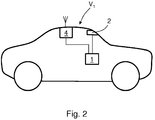
- the present disclosure also proposes a connected vehicle V 1 , as illustrated schematically in figure 2 , suitable to form part of a fleet of connected vehicles V 1-n , the connected vehicle V 1 equipped with a positioning system 1 and one or more respective sensor systems 2 capable of determining a plurality of road friction influencing parameters during travel within a road network 3 the friction of which is of interest.
- the connected vehicle V 1 comprises a communication arrangement 4, arranged to communicate with a back end system 5 to continuously report floating car data sets D 1 -D n including a position P 1 -P n of the connected vehicle V 1 within the road network 3, time data and data regarding determined road friction influencing parameters and a determined road friction associated with that position P 1 -P n within the road network 3.
- a vehicle V 1 as above, is able to, in an efficient way, without manual effort, harvest and update data describing a road network 3, which data is useful for creating and validating models for predicting road friction according to embodiments of the system for predicting road friction as described herein and in accordance with embodiments of the method for predicting road friction as described herein.
Landscapes
- Physics & Mathematics (AREA)
- Engineering & Computer Science (AREA)
- General Physics & Mathematics (AREA)
- Chemical & Material Sciences (AREA)
- Theoretical Computer Science (AREA)
- Life Sciences & Earth Sciences (AREA)
- Health & Medical Sciences (AREA)
- Analytical Chemistry (AREA)
- General Health & Medical Sciences (AREA)
- Evolutionary Computation (AREA)
- General Engineering & Computer Science (AREA)
- Biomedical Technology (AREA)
- Data Mining & Analysis (AREA)
- Software Systems (AREA)
- Mathematical Physics (AREA)
- Computing Systems (AREA)
- Molecular Biology (AREA)
- Computational Linguistics (AREA)
- Biophysics (AREA)
- Artificial Intelligence (AREA)
- Biochemistry (AREA)
- Pathology (AREA)
- Immunology (AREA)
- Food Science & Technology (AREA)
- Medicinal Chemistry (AREA)
- Computer Networks & Wireless Communication (AREA)
- Automation & Control Theory (AREA)
- Geometry (AREA)
- Computer Hardware Design (AREA)
- Traffic Control Systems (AREA)
Priority Applications (3)
| Application Number | Priority Date | Filing Date | Title |
|---|---|---|---|
| EP16155263.3A EP3206411B1 (de) | 2016-02-11 | 2016-02-11 | Anordnung und verfahren zur vorhersage der strassenreibung in einem strassennetz |
| US15/424,246 US10936940B2 (en) | 2016-02-11 | 2017-02-03 | Arrangement and method for predicting road friction within a road network |
| CN201710076895.0A CN107066682B (zh) | 2016-02-11 | 2017-02-13 | 用于预测道路网内道路摩擦力的设备和方法 |
Applications Claiming Priority (1)
| Application Number | Priority Date | Filing Date | Title |
|---|---|---|---|
| EP16155263.3A EP3206411B1 (de) | 2016-02-11 | 2016-02-11 | Anordnung und verfahren zur vorhersage der strassenreibung in einem strassennetz |
Publications (2)
| Publication Number | Publication Date |
|---|---|
| EP3206411A1 true EP3206411A1 (de) | 2017-08-16 |
| EP3206411B1 EP3206411B1 (de) | 2020-10-07 |
Family
ID=55357892
Family Applications (1)
| Application Number | Title | Priority Date | Filing Date |
|---|---|---|---|
| EP16155263.3A Active EP3206411B1 (de) | 2016-02-11 | 2016-02-11 | Anordnung und verfahren zur vorhersage der strassenreibung in einem strassennetz |
Country Status (3)
| Country | Link |
|---|---|
| US (1) | US10936940B2 (de) |
| EP (1) | EP3206411B1 (de) |
| CN (1) | CN107066682B (de) |
Cited By (4)
| Publication number | Priority date | Publication date | Assignee | Title |
|---|---|---|---|---|
| WO2020074563A1 (de) * | 2018-10-09 | 2020-04-16 | Robert Bosch Gmbh | Verfahren und system zum bereitstellen einer reibwertinformation an ein fahrzeug |
| WO2020074559A1 (de) * | 2018-10-09 | 2020-04-16 | Robert Bosch Gmbh | Verfahren und system zum bereitstellen eines reibwerts an ein fahrzeug |
| WO2021094148A1 (fr) * | 2019-11-14 | 2021-05-20 | Continental Automotive Gmbh | Détermination d'un coefficient de friction pour un véhicule sur une route |
| WO2022078770A1 (de) * | 2020-10-12 | 2022-04-21 | Mercedes-Benz Group AG | Verfahren zum erzeugen eines verhaltensmodells für eine kraftfahrzeugflotte mittels einer kraftfahrzeugexternen elektronischen recheneinrichtung, sowie kraftfahrzeugexterne elektronische recheneinrichtung |
Families Citing this family (21)
| Publication number | Priority date | Publication date | Assignee | Title |
|---|---|---|---|---|
| US11093829B2 (en) * | 2017-10-12 | 2021-08-17 | Honda Motor Co., Ltd. | Interaction-aware decision making |
| US11657266B2 (en) | 2018-11-16 | 2023-05-23 | Honda Motor Co., Ltd. | Cooperative multi-goal, multi-agent, multi-stage reinforcement learning |
| KR102406522B1 (ko) * | 2017-12-12 | 2022-06-10 | 현대자동차주식회사 | 기상 환경 기반 군집 주행 제어 장치, 그를 포함한 시스템 및 그 방법 |
| US10762399B2 (en) | 2017-12-18 | 2020-09-01 | Ford Global Technologies, Llc | Using deep video frame prediction for training a controller of an autonomous vehicle |
| EP3514494A1 (de) * | 2018-01-19 | 2019-07-24 | Zenuity AB | Erstellung und aktualisierung einer verhaltensschicht einer mehrschichtigen hochdefinierten digitalen karte eines strassennetzes |
| US11440543B2 (en) * | 2019-01-24 | 2022-09-13 | The Regents Of Hte University Of Michigan | Prefix-based bounded-error estimation with intermittent observations |
| CN110108633B (zh) * | 2019-04-26 | 2021-08-10 | 辽宁工程技术大学 | 一种矿井通风摩擦阻力系数测定的方法 |
| DE102020113937A1 (de) * | 2019-05-27 | 2020-12-03 | Jtekt Corporation | System zur Bestimmung eines Reifenzustands |
| CN112537314A (zh) * | 2019-09-20 | 2021-03-23 | 大陆汽车有限公司 | 用于确定湿路状况的系统和方法 |
| US11250703B2 (en) * | 2019-09-25 | 2022-02-15 | GM Cruise Holdings, LLC | Highly localized weather data recorded by vehicles in a fleet |
| CN110910531B (zh) * | 2019-10-21 | 2020-10-20 | 同济大学 | 一种基于车载obd信息的路面摩擦系数快速检测方法 |
| RU2751734C2 (ru) * | 2019-12-30 | 2021-07-16 | Общество с ограниченной ответственностью "Яндекс Беспилотные Технологии" | Способы и процессоры для управления рулением беспилотным автомобилем |
| EP3967565B1 (de) * | 2020-09-14 | 2022-09-28 | Bayerische Motoren Werke Aktiengesellschaft | Verfahren und vorrichtungen zur abschätzung eines umgebungszustandes |
| CN114283606A (zh) * | 2020-09-27 | 2022-04-05 | 阿波罗智联(北京)科技有限公司 | 用于车辆导航的方法、装置、设备、系统和云控平台 |
| CN112329106A (zh) * | 2020-11-05 | 2021-02-05 | 深圳壹账通智能科技有限公司 | 道路安全设计方法、系统、计算机设备和可读存储介质 |
| US20220207348A1 (en) * | 2020-12-29 | 2022-06-30 | Ford Global Technologies, Llc | Real-time neural network retraining |
| WO2022146866A1 (en) * | 2020-12-30 | 2022-07-07 | ClearMotion, Inc. | Systems and methods for vehicle control using terrain-based localization |
| FR3127065B1 (fr) * | 2021-09-13 | 2023-08-04 | Continental Automotive | Procédé de prédiction d’une condition météo de surface d’un segment routier |
| FR3130431B1 (fr) * | 2021-12-14 | 2023-11-24 | Continental Automotive Gmbh | Procédé de prédiction d’une condition de surface d’un segment routier |
| WO2025073375A1 (en) * | 2023-10-06 | 2025-04-10 | Volvo Truck Corporation | Sensor arrangement for determining operating conditions of a vehicle |
| US12548441B1 (en) * | 2025-04-04 | 2026-02-10 | Leigh M. Rothschild | AI-assisted vehicle communication and safety system for tailgating detection |
Citations (3)
| Publication number | Priority date | Publication date | Assignee | Title |
|---|---|---|---|---|
| US20080030370A1 (en) * | 2006-08-02 | 2008-02-07 | Doyle Marquis D | Method and apparatus for obtaining weather information from road-going vehicles |
| US20110043377A1 (en) * | 2009-08-24 | 2011-02-24 | Navteq North America, Llc | Providing Driving Condition Alerts Using Road Attribute Data |
| WO2013173911A1 (en) * | 2012-05-23 | 2013-11-28 | Omer Raqib | Road surface condition classification method and system |
Family Cites Families (5)
| Publication number | Priority date | Publication date | Assignee | Title |
|---|---|---|---|---|
| JP4046059B2 (ja) * | 2002-11-08 | 2008-02-13 | 株式会社豊田中央研究所 | 路面状態推定装置 |
| NO20083543L (no) * | 2008-08-14 | 2010-02-15 | Modulprodukter As | System for automatisk varsling og/eller nedbremsing ved glatt kjorebane |
| DE102012014457A1 (de) * | 2012-07-21 | 2014-01-23 | Audi Ag | Verfahren zum Betreiben eines Kraftfahrzeugs und Kraftfahrzeug |
| SI2757539T1 (sl) * | 2013-01-22 | 2020-10-30 | Klimator Ab | Postopek in ureditev za zbiranje in obdelavo podatkov v zvezi s stanjem na cestah |
| US9187099B2 (en) * | 2013-10-17 | 2015-11-17 | Richard M. Powers | Systems and methods for predicting weather performance for a vehicle |
-
2016
- 2016-02-11 EP EP16155263.3A patent/EP3206411B1/de active Active
-
2017
- 2017-02-03 US US15/424,246 patent/US10936940B2/en active Active
- 2017-02-13 CN CN201710076895.0A patent/CN107066682B/zh active Active
Patent Citations (3)
| Publication number | Priority date | Publication date | Assignee | Title |
|---|---|---|---|---|
| US20080030370A1 (en) * | 2006-08-02 | 2008-02-07 | Doyle Marquis D | Method and apparatus for obtaining weather information from road-going vehicles |
| US20110043377A1 (en) * | 2009-08-24 | 2011-02-24 | Navteq North America, Llc | Providing Driving Condition Alerts Using Road Attribute Data |
| WO2013173911A1 (en) * | 2012-05-23 | 2013-11-28 | Omer Raqib | Road surface condition classification method and system |
Cited By (6)
| Publication number | Priority date | Publication date | Assignee | Title |
|---|---|---|---|---|
| WO2020074563A1 (de) * | 2018-10-09 | 2020-04-16 | Robert Bosch Gmbh | Verfahren und system zum bereitstellen einer reibwertinformation an ein fahrzeug |
| WO2020074559A1 (de) * | 2018-10-09 | 2020-04-16 | Robert Bosch Gmbh | Verfahren und system zum bereitstellen eines reibwerts an ein fahrzeug |
| WO2021094148A1 (fr) * | 2019-11-14 | 2021-05-20 | Continental Automotive Gmbh | Détermination d'un coefficient de friction pour un véhicule sur une route |
| FR3103303A1 (fr) * | 2019-11-14 | 2021-05-21 | Continental Automotive | Détermination d’un coefficient de friction pour un véhicule sur une route |
| US11667296B2 (en) | 2019-11-14 | 2023-06-06 | Continental Automotive Gmbh | Determination of a coefficient of friction for a vehicle on a road |
| WO2022078770A1 (de) * | 2020-10-12 | 2022-04-21 | Mercedes-Benz Group AG | Verfahren zum erzeugen eines verhaltensmodells für eine kraftfahrzeugflotte mittels einer kraftfahrzeugexternen elektronischen recheneinrichtung, sowie kraftfahrzeugexterne elektronische recheneinrichtung |
Also Published As
| Publication number | Publication date |
|---|---|
| US20170236052A1 (en) | 2017-08-17 |
| US10936940B2 (en) | 2021-03-02 |
| CN107066682A (zh) | 2017-08-18 |
| EP3206411B1 (de) | 2020-10-07 |
| CN107066682B (zh) | 2022-05-03 |
Similar Documents
| Publication | Publication Date | Title |
|---|---|---|
| EP3206411B1 (de) | Anordnung und verfahren zur vorhersage der strassenreibung in einem strassennetz | |
| US12056936B2 (en) | Model generating apparatus, method and program, and prediction apparatus | |
| Lana et al. | Road traffic forecasting: Recent advances and new challenges | |
| ChikkaKrishna et al. | Short-term traffic prediction using fb-prophet and neural-prophet | |
| EP3035314B1 (de) | Verkehrsdatenfusionssystem und entsprechendes Verfahren zur Bereitstellung eines Verkehrszustands für ein Straßennetz | |
| CN104778837B (zh) | 一种道路交通运行态势多时间尺度预测方法 | |
| CN118568412B (zh) | 一种扬尘预警方法 | |
| WO2018035058A1 (en) | Latent space model for road networks to predict time-varying traffic | |
| CN110175690A (zh) | 一种景区客流量预测的方法、装置、服务器和存储介质 | |
| US20230104214A1 (en) | Method and system for real time trajectory optimization | |
| CN113095443A (zh) | 基于lstm-dnn网络模型的实时天气预测算法 | |
| CN120496329A (zh) | 一种城市道路碳排放预测与优化控制方法及系统 | |
| US20250296580A1 (en) | System and method for electric vehicle operational optimization | |
| CN116776745A (zh) | 基于边缘计算的污染物浓度和轨迹移动预测的方法与系统 | |
| Fahs et al. | Traffic congestion prediction based on multivariate modelling and neural networks regressions | |
| CN119672973B (zh) | 一种基于物联网的交通指示灯通过计算方法及系统 | |
| Mung et al. | Time series weather data forecasting using deep learning | |
| CN120338215A (zh) | 一种基于灰色关联覆冰厚度预测方法、系统、设备及介质 | |
| CN112733728A (zh) | 一种能见度边缘计算方法、装置、电子设备及存储介质 | |
| CN108877224A (zh) | 一种可进行置信区间估计的短时交通流预测方法 | |
| CN117197784A (zh) | 自动驾驶行为决策及模型训练方法、系统和设备及介质 | |
| CN102122004A (zh) | 铁路防灾风预测方法 | |
| CN119459750A (zh) | 一种车辆行驶电子信息系统 | |
| Shen et al. | Hybrid CSA optimization with seasonal RVR in traffic flow forecasting | |
| Zhang | Uncertainty associated with travel time prediction: Advanced volatility approaches and ensemble methods |
Legal Events
| Date | Code | Title | Description |
|---|---|---|---|
| PUAI | Public reference made under article 153(3) epc to a published international application that has entered the european phase |
Free format text: ORIGINAL CODE: 0009012 |
|
| STAA | Information on the status of an ep patent application or granted ep patent |
Free format text: STATUS: THE APPLICATION HAS BEEN PUBLISHED |
|
| AK | Designated contracting states |
Kind code of ref document: A1 Designated state(s): AL AT BE BG CH CY CZ DE DK EE ES FI FR GB GR HR HU IE IS IT LI LT LU LV MC MK MT NL NO PL PT RO RS SE SI SK SM TR |
|
| AX | Request for extension of the european patent |
Extension state: BA ME |
|
| STAA | Information on the status of an ep patent application or granted ep patent |
Free format text: STATUS: REQUEST FOR EXAMINATION WAS MADE |
|
| 17P | Request for examination filed |
Effective date: 20180216 |
|
| RBV | Designated contracting states (corrected) |
Designated state(s): AL AT BE BG CH CY CZ DE DK EE ES FI FR GB GR HR HU IE IS IT LI LT LU LV MC MK MT NL NO PL PT RO RS SE SI SK SM TR |
|
| STAA | Information on the status of an ep patent application or granted ep patent |
Free format text: STATUS: EXAMINATION IS IN PROGRESS |
|
| 17Q | First examination report despatched |
Effective date: 20190322 |
|
| REG | Reference to a national code |
Ref country code: DE Ref legal event code: R079 Ref document number: 602016045249 Country of ref document: DE Free format text: PREVIOUS MAIN CLASS: H04Q0009000000 Ipc: G01N0033420000 |
|
| GRAP | Despatch of communication of intention to grant a patent |
Free format text: ORIGINAL CODE: EPIDOSNIGR1 |
|
| STAA | Information on the status of an ep patent application or granted ep patent |
Free format text: STATUS: GRANT OF PATENT IS INTENDED |
|
| RIC1 | Information provided on ipc code assigned before grant |
Ipc: G08G 1/01 20060101ALI20200407BHEP Ipc: H04Q 9/00 20060101ALI20200407BHEP Ipc: G01N 33/42 20060101AFI20200407BHEP |
|
| INTG | Intention to grant announced |
Effective date: 20200507 |
|
| GRAS | Grant fee paid |
Free format text: ORIGINAL CODE: EPIDOSNIGR3 |
|
| GRAA | (expected) grant |
Free format text: ORIGINAL CODE: 0009210 |
|
| STAA | Information on the status of an ep patent application or granted ep patent |
Free format text: STATUS: THE PATENT HAS BEEN GRANTED |
|
| AK | Designated contracting states |
Kind code of ref document: B1 Designated state(s): AL AT BE BG CH CY CZ DE DK EE ES FI FR GB GR HR HU IE IS IT LI LT LU LV MC MK MT NL NO PL PT RO RS SE SI SK SM TR |
|
| REG | Reference to a national code |
Ref country code: GB Ref legal event code: FG4D |
|
| REG | Reference to a national code |
Ref country code: AT Ref legal event code: REF Ref document number: 1321707 Country of ref document: AT Kind code of ref document: T Effective date: 20201015 Ref country code: CH Ref legal event code: EP |
|
| REG | Reference to a national code |
Ref country code: IE Ref legal event code: FG4D |
|
| REG | Reference to a national code |
Ref country code: DE Ref legal event code: R096 Ref document number: 602016045249 Country of ref document: DE |
|
| REG | Reference to a national code |
Ref country code: NL Ref legal event code: MP Effective date: 20201007 |
|
| REG | Reference to a national code |
Ref country code: AT Ref legal event code: MK05 Ref document number: 1321707 Country of ref document: AT Kind code of ref document: T Effective date: 20201007 |
|
| PG25 | Lapsed in a contracting state [announced via postgrant information from national office to epo] |
Ref country code: PT Free format text: LAPSE BECAUSE OF FAILURE TO SUBMIT A TRANSLATION OF THE DESCRIPTION OR TO PAY THE FEE WITHIN THE PRESCRIBED TIME-LIMIT Effective date: 20210208 Ref country code: RS Free format text: LAPSE BECAUSE OF FAILURE TO SUBMIT A TRANSLATION OF THE DESCRIPTION OR TO PAY THE FEE WITHIN THE PRESCRIBED TIME-LIMIT Effective date: 20201007 Ref country code: FI Free format text: LAPSE BECAUSE OF FAILURE TO SUBMIT A TRANSLATION OF THE DESCRIPTION OR TO PAY THE FEE WITHIN THE PRESCRIBED TIME-LIMIT Effective date: 20201007 Ref country code: NO Free format text: LAPSE BECAUSE OF FAILURE TO SUBMIT A TRANSLATION OF THE DESCRIPTION OR TO PAY THE FEE WITHIN THE PRESCRIBED TIME-LIMIT Effective date: 20210107 Ref country code: NL Free format text: LAPSE BECAUSE OF FAILURE TO SUBMIT A TRANSLATION OF THE DESCRIPTION OR TO PAY THE FEE WITHIN THE PRESCRIBED TIME-LIMIT Effective date: 20201007 Ref country code: GR Free format text: LAPSE BECAUSE OF FAILURE TO SUBMIT A TRANSLATION OF THE DESCRIPTION OR TO PAY THE FEE WITHIN THE PRESCRIBED TIME-LIMIT Effective date: 20210108 |
|
| REG | Reference to a national code |
Ref country code: LT Ref legal event code: MG4D |
|
| PG25 | Lapsed in a contracting state [announced via postgrant information from national office to epo] |
Ref country code: AT Free format text: LAPSE BECAUSE OF FAILURE TO SUBMIT A TRANSLATION OF THE DESCRIPTION OR TO PAY THE FEE WITHIN THE PRESCRIBED TIME-LIMIT Effective date: 20201007 Ref country code: ES Free format text: LAPSE BECAUSE OF FAILURE TO SUBMIT A TRANSLATION OF THE DESCRIPTION OR TO PAY THE FEE WITHIN THE PRESCRIBED TIME-LIMIT Effective date: 20201007 Ref country code: BG Free format text: LAPSE BECAUSE OF FAILURE TO SUBMIT A TRANSLATION OF THE DESCRIPTION OR TO PAY THE FEE WITHIN THE PRESCRIBED TIME-LIMIT Effective date: 20210107 Ref country code: SE Free format text: LAPSE BECAUSE OF FAILURE TO SUBMIT A TRANSLATION OF THE DESCRIPTION OR TO PAY THE FEE WITHIN THE PRESCRIBED TIME-LIMIT Effective date: 20201007 Ref country code: PL Free format text: LAPSE BECAUSE OF FAILURE TO SUBMIT A TRANSLATION OF THE DESCRIPTION OR TO PAY THE FEE WITHIN THE PRESCRIBED TIME-LIMIT Effective date: 20201007 Ref country code: IS Free format text: LAPSE BECAUSE OF FAILURE TO SUBMIT A TRANSLATION OF THE DESCRIPTION OR TO PAY THE FEE WITHIN THE PRESCRIBED TIME-LIMIT Effective date: 20210207 Ref country code: LV Free format text: LAPSE BECAUSE OF FAILURE TO SUBMIT A TRANSLATION OF THE DESCRIPTION OR TO PAY THE FEE WITHIN THE PRESCRIBED TIME-LIMIT Effective date: 20201007 |
|
| PG25 | Lapsed in a contracting state [announced via postgrant information from national office to epo] |
Ref country code: HR Free format text: LAPSE BECAUSE OF FAILURE TO SUBMIT A TRANSLATION OF THE DESCRIPTION OR TO PAY THE FEE WITHIN THE PRESCRIBED TIME-LIMIT Effective date: 20201007 |
|
| REG | Reference to a national code |
Ref country code: DE Ref legal event code: R097 Ref document number: 602016045249 Country of ref document: DE |
|
| PG25 | Lapsed in a contracting state [announced via postgrant information from national office to epo] |
Ref country code: CZ Free format text: LAPSE BECAUSE OF FAILURE TO SUBMIT A TRANSLATION OF THE DESCRIPTION OR TO PAY THE FEE WITHIN THE PRESCRIBED TIME-LIMIT Effective date: 20201007 Ref country code: EE Free format text: LAPSE BECAUSE OF FAILURE TO SUBMIT A TRANSLATION OF THE DESCRIPTION OR TO PAY THE FEE WITHIN THE PRESCRIBED TIME-LIMIT Effective date: 20201007 Ref country code: SM Free format text: LAPSE BECAUSE OF FAILURE TO SUBMIT A TRANSLATION OF THE DESCRIPTION OR TO PAY THE FEE WITHIN THE PRESCRIBED TIME-LIMIT Effective date: 20201007 Ref country code: LT Free format text: LAPSE BECAUSE OF FAILURE TO SUBMIT A TRANSLATION OF THE DESCRIPTION OR TO PAY THE FEE WITHIN THE PRESCRIBED TIME-LIMIT Effective date: 20201007 Ref country code: RO Free format text: LAPSE BECAUSE OF FAILURE TO SUBMIT A TRANSLATION OF THE DESCRIPTION OR TO PAY THE FEE WITHIN THE PRESCRIBED TIME-LIMIT Effective date: 20201007 Ref country code: SK Free format text: LAPSE BECAUSE OF FAILURE TO SUBMIT A TRANSLATION OF THE DESCRIPTION OR TO PAY THE FEE WITHIN THE PRESCRIBED TIME-LIMIT Effective date: 20201007 |
|
| PLBE | No opposition filed within time limit |
Free format text: ORIGINAL CODE: 0009261 |
|
| STAA | Information on the status of an ep patent application or granted ep patent |
Free format text: STATUS: NO OPPOSITION FILED WITHIN TIME LIMIT |
|
| PG25 | Lapsed in a contracting state [announced via postgrant information from national office to epo] |
Ref country code: DK Free format text: LAPSE BECAUSE OF FAILURE TO SUBMIT A TRANSLATION OF THE DESCRIPTION OR TO PAY THE FEE WITHIN THE PRESCRIBED TIME-LIMIT Effective date: 20201007 |
|
| 26N | No opposition filed |
Effective date: 20210708 |
|
| PG25 | Lapsed in a contracting state [announced via postgrant information from national office to epo] |
Ref country code: MC Free format text: LAPSE BECAUSE OF FAILURE TO SUBMIT A TRANSLATION OF THE DESCRIPTION OR TO PAY THE FEE WITHIN THE PRESCRIBED TIME-LIMIT Effective date: 20201007 |
|
| GBPC | Gb: european patent ceased through non-payment of renewal fee |
Effective date: 20210211 |
|
| REG | Reference to a national code |
Ref country code: BE Ref legal event code: MM Effective date: 20210228 |
|
| PG25 | Lapsed in a contracting state [announced via postgrant information from national office to epo] |
Ref country code: LI Free format text: LAPSE BECAUSE OF NON-PAYMENT OF DUE FEES Effective date: 20210228 Ref country code: LU Free format text: LAPSE BECAUSE OF NON-PAYMENT OF DUE FEES Effective date: 20210211 Ref country code: AL Free format text: LAPSE BECAUSE OF FAILURE TO SUBMIT A TRANSLATION OF THE DESCRIPTION OR TO PAY THE FEE WITHIN THE PRESCRIBED TIME-LIMIT Effective date: 20201007 Ref country code: CH Free format text: LAPSE BECAUSE OF NON-PAYMENT OF DUE FEES Effective date: 20210228 |
|
| PG25 | Lapsed in a contracting state [announced via postgrant information from national office to epo] |
Ref country code: SI Free format text: LAPSE BECAUSE OF FAILURE TO SUBMIT A TRANSLATION OF THE DESCRIPTION OR TO PAY THE FEE WITHIN THE PRESCRIBED TIME-LIMIT Effective date: 20201007 |
|
| PG25 | Lapsed in a contracting state [announced via postgrant information from national office to epo] |
Ref country code: IE Free format text: LAPSE BECAUSE OF NON-PAYMENT OF DUE FEES Effective date: 20210211 Ref country code: GB Free format text: LAPSE BECAUSE OF NON-PAYMENT OF DUE FEES Effective date: 20210211 |
|
| PG25 | Lapsed in a contracting state [announced via postgrant information from national office to epo] |
Ref country code: IS Free format text: LAPSE BECAUSE OF FAILURE TO SUBMIT A TRANSLATION OF THE DESCRIPTION OR TO PAY THE FEE WITHIN THE PRESCRIBED TIME-LIMIT Effective date: 20210207 |
|
| PG25 | Lapsed in a contracting state [announced via postgrant information from national office to epo] |
Ref country code: BE Free format text: LAPSE BECAUSE OF NON-PAYMENT OF DUE FEES Effective date: 20210228 |
|
| PG25 | Lapsed in a contracting state [announced via postgrant information from national office to epo] |
Ref country code: HU Free format text: LAPSE BECAUSE OF FAILURE TO SUBMIT A TRANSLATION OF THE DESCRIPTION OR TO PAY THE FEE WITHIN THE PRESCRIBED TIME-LIMIT; INVALID AB INITIO Effective date: 20160211 |
|
| PG25 | Lapsed in a contracting state [announced via postgrant information from national office to epo] |
Ref country code: CY Free format text: LAPSE BECAUSE OF FAILURE TO SUBMIT A TRANSLATION OF THE DESCRIPTION OR TO PAY THE FEE WITHIN THE PRESCRIBED TIME-LIMIT Effective date: 20201007 |
|
| P01 | Opt-out of the competence of the unified patent court (upc) registered |
Effective date: 20231212 |
|
| PG25 | Lapsed in a contracting state [announced via postgrant information from national office to epo] |
Ref country code: MK Free format text: LAPSE BECAUSE OF FAILURE TO SUBMIT A TRANSLATION OF THE DESCRIPTION OR TO PAY THE FEE WITHIN THE PRESCRIBED TIME-LIMIT Effective date: 20201007 |
|
| PGFP | Annual fee paid to national office [announced via postgrant information from national office to epo] |
Ref country code: IT Payment date: 20240123 Year of fee payment: 9 |
|
| PG25 | Lapsed in a contracting state [announced via postgrant information from national office to epo] |
Ref country code: TR Free format text: LAPSE BECAUSE OF FAILURE TO SUBMIT A TRANSLATION OF THE DESCRIPTION OR TO PAY THE FEE WITHIN THE PRESCRIBED TIME-LIMIT Effective date: 20201007 |
|
| PG25 | Lapsed in a contracting state [announced via postgrant information from national office to epo] |
Ref country code: MT Free format text: LAPSE BECAUSE OF FAILURE TO SUBMIT A TRANSLATION OF THE DESCRIPTION OR TO PAY THE FEE WITHIN THE PRESCRIBED TIME-LIMIT Effective date: 20201007 |
|
| PG25 | Lapsed in a contracting state [announced via postgrant information from national office to epo] |
Ref country code: IT Free format text: LAPSE BECAUSE OF NON-PAYMENT OF DUE FEES Effective date: 20250211 |
|
| PGFP | Annual fee paid to national office [announced via postgrant information from national office to epo] |
Ref country code: DE Payment date: 20260121 Year of fee payment: 11 |
|
| PGFP | Annual fee paid to national office [announced via postgrant information from national office to epo] |
Ref country code: FR Payment date: 20260121 Year of fee payment: 11 |