EP3206607B1 - Clou centro-medullaire - Google Patents
Clou centro-medullaire Download PDFInfo
- Publication number
- EP3206607B1 EP3206607B1 EP15805562.4A EP15805562A EP3206607B1 EP 3206607 B1 EP3206607 B1 EP 3206607B1 EP 15805562 A EP15805562 A EP 15805562A EP 3206607 B1 EP3206607 B1 EP 3206607B1
- Authority
- EP
- European Patent Office
- Prior art keywords
- tapping
- intramedullary nail
- fixing
- diameter
- nail
- Prior art date
- Legal status (The legal status is an assumption and is not a legal conclusion. Google has not performed a legal analysis and makes no representation as to the accuracy of the status listed.)
- Active
Links
Images

Classifications
-
- A—HUMAN NECESSITIES
- A61—MEDICAL OR VETERINARY SCIENCE; HYGIENE
- A61B—DIAGNOSIS; SURGERY; IDENTIFICATION
- A61B17/00—Surgical instruments, devices or methods
- A61B17/56—Surgical instruments or methods for treatment of bones or joints; Devices specially adapted therefor
- A61B17/58—Surgical instruments or methods for treatment of bones or joints; Devices specially adapted therefor for osteosynthesis, e.g. bone plates, screws or setting implements
- A61B17/68—Internal fixation devices, including fasteners and spinal fixators, even if a part thereof projects from the skin
- A61B17/72—Intramedullary devices, e.g. pins or nails
- A61B17/7233—Intramedullary devices, e.g. pins or nails with special means of locking the nail to the bone
Definitions
- the present invention relates to a centromedullary nail, capable of being introduced into a medullary canal of a bone, intended either to reduce a fracture of the head or the body of a long bone of a patient, or to bone lengthening.
- a nail or a centromedullary rod acts as an internal guardian sharing with the bone the management of bio-mechanical constraints promoting bone consolidation.
- Centromedullary nails are generally used for the reduction of fractures of the tibia, femur or humerus.
- These nails are particularly advantageous especially for reducing fractures of the head of a bone to collect and consolidate multiple fractured fragments.
- Centromedullary nails are also used in bone lengthening of upper and lower limbs. These extension nails comprise a sliding portion, adjustable mechanically.
- a centro-medullary nail is usually made of titanium alloy or stainless steel.
- a titanium alloy implant has the particularity of being able to combine mechanical stability with elastic properties.
- the advantage of a stainless steel implant lies in particular in increased resistance to significant mechanical stresses.
- Screws usually self-drilling, hold the nail to fractured or elongated bone parts. These screws pass right through the centromedullary nail through fixing holes. These fixing holes are threaded by a single thread, as in the document EP 0 855 882 for the reduction of a fracture of the femur and the documents FR 2,881,340 , EP 1 398 000 , and US 5,472,444 for the reduction of a fracture of a humerus.
- a centro-medullary nail being of small diameter, the thread of the tapping is necessarily narrow. Therefore, a number of towers Revolution is needed to cross the nail, which exerts significant pressure on the bones and surrounding tissue.
- Single thread tapping requires some screw rotation operations to engage the screw. It is thus not easy to be able to engage, without prior rotation, a screw in a nut with a single thread, to the maximum, realizing a revolution revolution.
- the centromedullary nail adapted to be arranged in the medullary canal of a long bone, according to the invention, comprises a solid body and at least one fixing orifice adapted to cooperate with a fastener.
- the fixation orifice comprises a tapping with at least two threads, while the tapping is carried out on a part of the diameter of the centromedullary nail, namely that the tapping is surrounded laterally on both sides by unthreaded conduits. .
- the unthreaded conduits are rectilinear on at least a part.
- tapping is advantageously centered on the diameter of the centromedullary nail.
- the portion of the diameter of the centromedullary nail, including tapping is between 20 and 80% of the diameter, preferably between 20 and 60%, preferably between 20 and 40%, more preferably the tapping is carried out on the third of the diameter of the centromedullary nail.
- the fixing orifice preferably comprises a thread with three threads.
- the fixing orifice comprises a tapping with a constant axial pitch and a triangular profile.
- the proximal portion comprises at least two fastening apertures angularly offset from one another relative to each other at an angle of between 20 ° and 50 °, preferably between 30 ° and 40 °.
- the fixing orifice comprises a helical pitch between 1 and 3 millimeters (s).
- the fixing orifice and / or the fixing member comprises a locking means of the fixing member.
- centromedullary nail (100) is a non-ductal nail, namely, which comprises a solid body constituted in known manner by a proximal portion (1), a central portion (2) and a distal portion (3).
- centromedullary nail (100) of the invention comprises fixing holes (4) comprising a tapping at least two threads, preferably three threads, adapted to receive fasteners (5), such as screws, preferentially self-drilling.
- a threaded tapping corresponds to multiple threads parallel to each other.
- the fixing orifice (4) thus comprises at least two threads, preferably three threads, staggered at the entrance of said orifice of at least 180 °, preferably 120 °, allowing the entry of a fixing member at least every half-turn, preferably every third of turns.
- This configuration of the fixing orifice (4) thus makes it possible to limit the manipulation by rotation of the fixing member (5) at the inlet of said fixing orifice (4).
- This configuration also makes it possible to obtain a greater advance for a turn of the screw in comparison with that of a single-threaded nut.
- the present invention therefore makes it possible to limit the insertion manipulations of the fixing member (5) in the fixing orifice (4), and thus to limit the pressure exerted on the centromedullary nail (100) during placement. of the latter, and consequently, to limit the pressure on the bones and the surrounding tissues.
- the thread of the tapping forms a continuous helical protrusion and of uniform section on a cylindrical or conical surface, preferably cylindrical.
- a helical pitch is the distance between two consecutive vertices of the same thread.
- the pitch (Pa) axial corresponding to the distance between two consecutive vertices, is equal to the helical pitch (Ph) divided by the number of threads .
- the fastener (5) therefore has a thread pitch equal to the helical thread pitch (Ph) of the fastening hole (4) as illustrated in FIGS. Figures 4 and 5 .
- the helical pitch (Ph) of a thread is between 1 and 3 millimeters (s).
- the helical pitch (Ph) of a thread is advantageously a function of the corresponding diameter of the fixing orifice (4).
- the pitch (Pa) is advantageously constant over the entire length of the tapping of the fixing orifice (4).
- the tapping advantageously has a triangular profile with an angle, preferably equal to 60 °, but it could be otherwise, the thread is advantageously rounded or square.
- fixation holes (4) are at least located in the proximal portion (1) of the centromedullary nail (100) for in particular a reduction of a fracture of the head of a long bone of a limb.
- the centromedullary nail (100) comprises at least two fixing apertures (4) in the proximal portion (1), preferably a number of fixing orifices (4) between 2 and 6.
- the fixing holes (4) are at least located in the central portion (2) and / or in the distal portion (3) of the centromedullary nail (100), in particular for reducing a fracture of the body of a long bone of a limb.
- the fixing orifices (4) are advantageously localized at the proximal (1), central (2) and distal (3) portions of the centromedullary nail (100), in particular for reducing a fracture, or for elongation of a long bone of a limb.
- the fixing orifices (4) are angularly offset relative to each other at an angle of between 20 ° and 50 °, preferably between 30 ° and 40 °, more preferably 35 °.
- angles between the fixing holes (4) are advantageously equal, but it could be otherwise.
- the tapping of the latter is a tapping at least two threads.
- the latter comprises self-centering systems.
- the tapping of a fixing orifice (4) is made on a part of the diameter of the centromedullary nail (100), preferably centered along a median longitudinal axis (AA) of the centromedullary nail (100), namely centered with respect to the diameter of the centromedullary nail (100).
- a tapping is surrounded laterally on both sides of self-centering systems, namely unthreaded conduits, preferentially rectilinear on at least a part. It should be noted that non-tapped conduits are at least straight at the entrance of the tapping.
- the portion of the diameter of the centromedullary nail, including tapping is between 20 and 80%, preferably between 20 and 60%, preferably between 20 and 40%, more preferably the tapping is performed on about one third of the diameter, as illustrated in particular in figure 4 .
- the diameter of a self-centering system namely a non-threaded conduit, is greater than or equal to that of a fastener (5), allowing its insertion into the corresponding orifice.
- the diameter of the tapping depth is less than or equal to the diameters of the unthreaded pipes.
- a fixing orifice (4) and / or a fixing member (5) comprises a locking means of the fixing member (4), for example by locking means such as those described in documents EP1398000 and FR2881340 , or commonly used locking means such as anti-disc washers and self-locking nuts.
- the upper end of the proximal portion (1) is adapted to be adapted, by a fixing means (B), to a nail guide tool for assisting the insertion of said centromedullary nail (100). in a medullary canal of a long bone of a limb.
- This said tool is thus intended to adapt to the upper end of the proximal portion (1) of the centromedullary nail (100) by means of a fixing means (B), closed after insertion by a screw (6). ).
- the distal portion (3) is adapted to be introduced into the medullary canal.
- the distal portion (3) is of either semi-cylindrical shape or profiled, preferably of profiled shape.
- centromedullary nail (100) is advantageously of the short type, adapted for a reduction of a fracture of the head of a long bone of a limb.
- centromedullary nail (100) is advantageously of the long type, suitable for reducing a fracture of the body of a long bone of a limb or bone lengthening.
- the central portion (2) is according to some particular embodiments, curved according to a gyration diameter or curved at an angle with the proximal portion as illustrated by the document US 5,472,444 ,
Landscapes
- Health & Medical Sciences (AREA)
- Orthopedic Medicine & Surgery (AREA)
- Surgery (AREA)
- Life Sciences & Earth Sciences (AREA)
- Heart & Thoracic Surgery (AREA)
- Nuclear Medicine, Radiotherapy & Molecular Imaging (AREA)
- Engineering & Computer Science (AREA)
- Biomedical Technology (AREA)
- Neurology (AREA)
- Medical Informatics (AREA)
- Molecular Biology (AREA)
- Animal Behavior & Ethology (AREA)
- General Health & Medical Sciences (AREA)
- Public Health (AREA)
- Veterinary Medicine (AREA)
- Surgical Instruments (AREA)
Description
- La présente invention concerne un clou centro-medullaire, apte à être introduit dans un canal médullaire d'un os, destiné soit à la réduction d'une fracture de la tête ou du corps d'un os long d'un patient, soit à l'allongement osseux.
- Dans le cas de réduction de fractures, un clou ou une tige centro-médullaire agit comme un tuteur interne partageant avec l'os la prise en charge des contraintes bio-mécaniques favorisant la consolidation osseuse.
- Les clous centro-médullaires sont généralement utilisés pour la réduction de fractures du tibia, du fémur ou de l'humérus.
- Ces clous sont particulièrement avantageux notamment pour la réduction de fractures de la tête d'un os permettant de rassembler et de consolider de multiples fragments fracturés.
- Les clous centro-médullaires sont également utilisés dans l'allongement osseux de membres supérieurs et inférieurs. Ces clous d'allongement comprennent une partie coulissante, réglable par voie mécanique.
- Un clou centro-médullaire est généralement en alliage de titane ou en acier inoxydable. Un implant en alliage de titane a la particularité de pouvoir combiner une stabilité mécanique avec des propriétés élastiques. En outre, l'avantage d'un implant en acier inoxydable réside notamment dans une résistance accrue à des contraintes mécaniques importantes.
- Des vis, généralement auto-foreuses, maintiennent le clou aux parties d'os fracturés ou à allonger. Ces vis traversent de part en part le clou centro-médullaire par des orifices de fixation. Ces orifices de fixation sont taraudés par un filet simple, tel que dans le document
EP 0 855 882 pour la réduction d'une fracture du fémur et les documentsFR 2 881 340 EP 1 398 000 , etUS 5,472,444 pour la réduction d'une fracture d'un humérus. - Un clou centro-médullaire étant de faible diamètre, le pas de vis du taraudage est forcément étroit. Par conséquent, un certain nombre de tours de révolution sont nécessaires pour traverser le clou, ce qui exerce des pressions non négligeables sur les os et les tissus environnants.
- Un taraudage à simple filet nécessite certaines opérations de rotation de la vis pour enclencher le vissage. Il n'est ainsi pas aisé de pouvoir enclencher, sans rotation préalable une vis dans un écrou à simple filet, au maximum, en réalisant un tour de révolution.
- Lors des phases opératoires de mise en place des organes de fixation maintenant les os à consolider ou à allonger avec un clou centro-médullaire, l'engagement d'une vis à l'entré d'un orifice de fixation, avant toute opération de rotation, nécessite de position la vis selon un angle déterminé. L'engagement du filetage de la vis en correspondance du taraudage de l'orifice de fixation, nécessite des ajustements minutieux, voir un geste très précis, pour ne pas exercer des contraintes supplémentaires, voire traumatiques notamment pour les tissus environnants les fragments osseux. Le document
US 2007/0123878 A1 divulgue un clou centro-médullaire selon le préambule de la revendication 1. La présente invention propose ainsi un clou centro-médullaire permettant de pallier aux inconvénients précités. - Ainsi, le clou centro-médullaire, apte à être agencé dans le canal médullaire d'un os long, selon l'invention, comprend un corps plein et au moins un orifice de fixation apte à coopérer avec un organe de fixation. L'orifice de fixation comprend un taraudage à au moins deux filets, tandis que le taraudage est réalisé sur une partie du diamètre du clou centro-médullaire, à savoir que le taraudage est entouré latéralement de part et d'autre par des conduits non taraudés.
- Selon une caractéristique complémentaire, les conduits non taraudés sont rectilignes sur au moins une partie.
- Ajoutons que le taraudage est avantageusement centré sur le diamètre du clou centro-médullaire.
- Notons que la partie du diamètre du clou centro-médullaire, comprenant le taraudage, est comprise entre 20 et 80 % du diamètre, avantageusement entre 20 et 60 %, de préférence entre 20 et 40 %, plus préférentiellement le taraudage est réalisé sur environs le tiers du diamètre du clou centro-médullaire.
- Ajoutons que l'orifice de fixation comprend préférentiellement un taraudage à trois filets.
- Selon une caractéristique complémentaire, l'orifice de fixation comprend un taraudage avec un pas axial constant et un profil triangulaire.
- Selon une autre caractéristique, la partie proximale comprend au moins deux orifices de fixation décalés angulairement les uns part à rapport aux autres selon un angle compris entre 20° et 50°, préférentiellement entre 30° et 40°.
- Notons que l'orifice de fixation comprend un pas hélicoïdal compris entre 1 et 3 millimètre(s).
- Selon une caractéristique complémentaire, l'orifice de fixation et/ou l'organe de fixation comprend un moyen de blocage de l'organe de fixation.
- D'autres caractéristiques et avantages de l'invention se dégageront de la description qui va suivre en regard des dessins annexés qui ne sont donnés qu'à titre d'exemples non limitatifs.
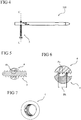
- Les
figures 1 à 7 sont des vues d'un clou centro-médullaire huméral selon un mode de réalisation de l'invention. - La
figure 1 est une vue de coté. - La
figure 2 est une vue en coupe selon l'axe (A-A) de lafigure 1 . - La
figure 3 est un grossissement de la vue en coupe selon l'axe (C-C) de lafigure 2 . - La
figure 4 est une vue simplifiée de lafigure 2 avec un organe de fixation. - La
figure 5 est une vue en coupe selon (C-C) de lafigure 4 . - La
figure 6 est un grossissement de la vue du détail (D) de lafigure 5 . - La
figure 7 est une vue en perspective de l'entré d'un orifice de fixation. - Ainsi, le clou centro-médullaire (100) selon l'invention est un clou non canalaire, à savoir, qui comprend un corps plein constitué de manière connue par une partie proximale (1), une partie centrale (2) et une partie distale (3).
- Notons que le clou centro-médullaire (100) de l'invention comprend des orifices de fixation (4) comprenant un taraudage à au moins deux filets, préférentiellement à trois filets, apte à recevoir des organes de fixation (5), tels que des vis, préférentiellement auto-foreuses.
- Il est entendu qu'un taraudage à multiples filets correspond à de multiples taraudages parallèles entre eux.
- L'orifice de fixation (4) selon l'invention comprend ainsi au moins deux taraudages, préférentiellement trois taraudages, décalés à l'entrée du dit orifice d'au moins 180°, préférentiellement de 120°, permettant l'entrée d'un organe de fixation au moins tous les demi-tours, préférentiellement tous les tiers de tours.
- Cette configuration d'orifice de fixation (4) permet ainsi de limiter la manipulation par rotation de l'organe de fixation (5) au niveau de l'entrée du dit orifice de fixation (4).
- Cette configuration permet également d'obtenir une plus grande avance pour un tour de vis en comparaison de celle d'un écrou à simple filet.
- En effet, avec un taraudage à multiples filets, pour une même distance longitudinale parcourue, par rapport à un taraudage à simple filet, le mouvement de rotation est divisé par deux pour un taraudage à double filets et par trois pour un taraudage à triple filets.
- Ainsi, lors de l'insertion d'une vis dans un écrou à simple filet, l'opérateur procède à une rotation d'au maximum 360°, alors qu'avec un écrou à deux ou trois filets, le chirurgien procède à une rotation d'au maximum 180° ou au maximum 120° respectivement.
- Dans une optique d'optimisation du geste du chirurgien lors des opération d'insertion et de vissage, il est préféré un taraudage à triple filets.
- La présente invention permet donc de limiter les manipulations d'insertion de l'organe de fixation (5) dans l'orifice de fixation (4), et donc de limiter la pression exercée sur le clou centro-médullaire (100) lors du placement de ce dernier, et par conséquent, de limiter la pression sur les os et les tissus environnants.
- Il est entendu que le filet du taraudage forme une saillie hélicoïdale continue et de section uniforme sur une surface cylindrique ou conique, préférentiellement cylindrique.
- Il est en outre entendu qu'un pas hélicoïdal (Ph) est la distance qui sépare deux sommets consécutifs d'un même filet.
- Il est également entendu que dans le cadre de l'invention d'un taraudage à plusieurs filets, le pas (Pa) axial, correspondant à la distance entre deux sommets consécutifs, est égal au pas hélicoïdal (Ph) divisé par le nombre de filets.
- Il est également entendu que pour qu'un écrou puisse être assemblé à une vis, les deux éléments doivent avoir les mêmes caractéristiques, telles que profil du filet, diamètre nominal (Dn), pas (Ph) et sens de l'hélice.
- L'organe de fixation (5) a par conséquent un pas de filetage égal au pas hélicoïdale (Ph) de taraudage de l'orifice de fixation (4) tel qu'illustré aux
figures 4 et 5 . - Le pas hélicoïdal (Ph) d'un filet est compris entre 1 et 3 millimètre(s).
- Le pas hélicoïdal (Ph) d'un filet est avantageusement fonction du diamètre correspondant de l'orifice de fixation (4).
- Le pas (Pa) est avantageusement constant sur toute la longueur du taraudage de l'orifice de fixation (4).
- Le taraudage a avantageusement un profil triangulaire avec un angle, avantageusement égal à 60°, mais il en pourrait être autrement, le filetage est avantageusement arrondi ou carré.
- Les orifices de fixation (4), selon une caractéristique, sont au moins localisés en partie proximale (1) du clou centro-médullaire (100) pour notamment une réduction d'une fracture de la tête d'un os long d'un membre.
- Selon la caractéristique précédente, le clou centro-médullaire (100) comprend au moins deux orifices de fixation (4) en partie proximale (1), préférentiellement un nombre d'orifices de fixation (4) compris entre 2 et 6.
- Les orifices de fixation (4), selon une autre caractéristique, sont au moins localisés en partie centrale (2) et/ou en partie distale (3) du clou centro-médullaire (100) pour notamment une réduction d'une fracture du corps d'un os long d'un membre.
- Les orifices de fixation (4) sont avantageusement localisés en partie proximale (1), en partie centrale (2) et en partie distale (3) du clou centro-médullaire (100) pour notamment une réduction d'une fracture, ou pour l'allongement d'un os long d'un membre.
- Selon un mode de réalisation illustré notamment à la
figure 2 , les orifices de fixation (4) sont décalés angulairement les un part à rapport aux autres selon un angle compris entre 20° et 50°, préférentiellement entre 30° et 40°, plus préférentiellement 35°. - Les angles entre les orifices de fixation (4) sont avantageusement égaux, mais il pourrait en être autrement.
- Rappelons qu'afin de faciliter la fixation d'un organe de fixation (5) dans un orifice de fixation (4), le taraudage de ce dernier est un taraudage à au moins deux filets. Cependant, afin de faciliter l'engagement et le positionnement selon un axe commun d'un organe de fixation (5) dans un orifice de fixation (4), ce dernier comprend des systèmes auto-centreurs.
- Ainsi, le taraudage d'un orifice de fixation (4) est réalisé sur une partie du diamètre du clou centro-médullaire (100), préférentiellement centré selon un axe longitudinal (A-A) médian du clou centro-médullaire (100), à savoir centré par rapport au diamètre du clou centro-médullaire (100).
- Ajoutons qu'un taraudage est entouré latéralement de part et d'autre de systèmes auto-centreurs, à savoir de conduits non taraudés, préférentiellement rectiligne sur au moins une partie. Précisons que les conduits non taraudés sont au moins rectilignes à l'entré du taraudage.
- Notons que la partie du diamètre du clou centro-médullaire, comprenant le taraudage, est comprise entre 20 et 80 %, avantageusement entre 20 et 60 %, de préférence entre 20 et 40 %, plus préférentiellement le taraudage est réalisé sur environs le tiers du diamètre, tel qu'illustré notamment à la
figure 4 . - Il est entendu que le diamètre d'un système auto-centreur, à savoir d'un conduit non taraudé, est supérieur ou égal à celui d'un organe de fixation (5), permettant son insertion dans l'orifice correspondant.
- Précisons que le diamètre de la profondeur du taraudage est inférieur ou égal aux diamètres des conduits non taraudés.
- Ainsi la combinaison des systèmes auto-centreurs et des taraudages à au moins deux filets, permettent un engagement et un visage des organes de fixations (5) dans les orifices de fixations (4) de manière optimale, limitant les contraintes exercer sur les os et les tissus environnants.
- Selon des autres modes de réalisation, un orifice de fixation (4) et/ou un organe de fixation (5) comprend un moyen de blocage de l'organe de fixation (4), par exemple par des moyens de blocage tels que ceux décrits dans les documents
EP1398000 etFR2881340 - L'extrémité supérieure de la partie proximale (1) est apte à être adaptée, par un moyen de fixation (B), à un outil de guidage porte-clou d'aide à l'insertion du dit clou centro-médullaire (100) dans un canal médullaire d'un os long d'un membre.
- Ce dit outil est ainsi destiné à s'adapter à l'extrémité supérieure de la partie proximale (1) du clou centro-médullaire (100) grâce à un moyen de fixation (B), obturé après mise en place par une vis (6).
- La partie distale (3) est apte à être introduite dans le canal médullaire.
- La partie distale (3) est de forme soit semi-cylindrique, soit profilée, préférentiellement de forme profilée.
- Notons que le clou centro-médullaire (100) est avantageusement de type court, adapté pour une réduction d'une fracture de la tête d'un os long d'un membre.
- Précisons que le clou centro-médullaire (100) est avantageusement de type long, adapté pour une réduction d'une fracture du corps d'un os long d'un membre ou d'un allongement osseux.
- La partie centrale (2) est selon certains modes de réalisation particuliers, incurvée selon un diamètre de giration ou incurvée selon un angle avec la partie proximale tel qu'illustré par le document
US 5,472,444 ,
Claims (12)
- Clou centro-médullaire (100), d'un os long, comprenant un corps plein et au moins un orifice de fixation (4) apte à coopérer avec un organe de fixation (5), ledit orifice de fixation (4) comprenant un taraudage à au moins deux filets, caractérisé en ce que le taraudage est réalisé sur une partie du diamètre du clou centro-médullaire, à savoir que le taraudage est entouré latéralement de part et d'autre par des conduits non taraudés.
- Clou centro-médullaire (100) selon la revendication 1, caractérisé en ce que les conduits non taraudés sont rectilignes sur au moins une partie.
- Clou centro-médullaire (100) selon la revendication 1 ou 2, caractérisé en ce que le taraudage est centré sur le diamètre du clou centro-médullaire.
- Clou centro-médullaire (100) selon l'une quelconque des revendications précédentes, caractérisé en ce que la partie du diamètre, comprenant le taraudage, est comprise entre 20 et 80 % du diamètre.
- Clou centro-médullaire (100) selon l'une quelconque des revendications précédentes, caractérisé en ce que le taraudage est réalisé sur une partie du diamètre compris entre 20 et 60 %.
- Clou centro-médullaire (100) selon l'une quelconque des revendications précédentes, caractérisé en ce que le taraudage est réalisé sur une partie du diamètre compris entre 20 et 40 %.
- Clou centro-médullaire (100) selon l'une quelconque des revendications précédentes, caractérisé en ce que le taraudage est réalisé sur environs le tiers du diamètre.
- Clou centro-médullaire (100) selon l'une quelconque des revendications précédentes, caractérisé en ce que l'orifice de fixation (4) comprend un taraudage à trois filets.
- Clou centro-médullaire (100) selon l'une quelconque des revendications précédentes, caractérisé en ce que l'orifice de fixation (4) comprend un taraudage avec un pas axial (Pa) constant et un profil triangulaire.
- Clou centro-médullaire (100) selon l'une quelconque des revendications précédentes, caractérisé en ce que la partie proximale (1) comprend au moins deux orifices de fixation (4) décalés angulairement les uns part à rapport aux autres selon un angle compris entre 20° et 50°, préférentiellement entre 30° et 40°.
- Clou centro-médullaire (100) selon l'une quelconque des revendications précédentes, caractérisé en ce que l'orifice de fixation (4) comprend un pas hélicoïdal (Ph) compris entre 1 et 3 millimètre(s).
- Clou centro-médullaire (100) selon l'une quelconque des revendications précédentes, caractérisé en ce que l'orifice de fixation (4) et/ou l'organe de fixation (5) comprend un moyen de blocage dudit organe de fixation (5).
Applications Claiming Priority (3)
| Application Number | Priority Date | Filing Date | Title |
|---|---|---|---|
| FR1459882A FR3027210A1 (fr) | 2014-10-15 | 2014-10-15 | Clou centro-medullaire |
| FR1550832A FR3027211A1 (fr) | 2014-10-15 | 2015-02-03 | Clou centro medullaire |
| PCT/FR2015/052775 WO2016059347A1 (fr) | 2014-10-15 | 2015-10-15 | Clou centro-medullaire |
Publications (2)
| Publication Number | Publication Date |
|---|---|
| EP3206607A1 EP3206607A1 (fr) | 2017-08-23 |
| EP3206607B1 true EP3206607B1 (fr) | 2018-05-16 |
Family
ID=52779922
Family Applications (1)
| Application Number | Title | Priority Date | Filing Date |
|---|---|---|---|
| EP15805562.4A Active EP3206607B1 (fr) | 2014-10-15 | 2015-10-15 | Clou centro-medullaire |
Country Status (3)
| Country | Link |
|---|---|
| EP (1) | EP3206607B1 (fr) |
| FR (2) | FR3027210A1 (fr) |
| WO (1) | WO2016059347A1 (fr) |
Cited By (2)
| Publication number | Priority date | Publication date | Assignee | Title |
|---|---|---|---|---|
| US12016604B2 (en) | 2022-09-07 | 2024-06-25 | DePuy Synthes Products, Inc. | Methods and devices for achieving semi-rigid bone fixation |
| US12383322B2 (en) | 2023-08-22 | 2025-08-12 | DePuy Synthes Products, Inc. | Methods and devices for syndesmosis tensioning |
Families Citing this family (4)
| Publication number | Priority date | Publication date | Assignee | Title |
|---|---|---|---|---|
| CN106175899A (zh) * | 2016-06-29 | 2016-12-07 | 江苏艾迪尔医疗科技股份有限公司 | 腓骨髓内钉 |
| US11083503B2 (en) | 2016-09-22 | 2021-08-10 | Globus Medical, Inc. | Systems and methods for intramedullary nail implantation |
| US10492803B2 (en) | 2016-09-22 | 2019-12-03 | Globus Medical, Inc. | Systems and methods for intramedullary nail implantation |
| US11633219B2 (en) | 2019-06-26 | 2023-04-25 | Globus Medical, Inc. | Fenestrated pedicle nail |
Family Cites Families (6)
| Publication number | Priority date | Publication date | Assignee | Title |
|---|---|---|---|---|
| US5472444A (en) | 1994-05-13 | 1995-12-05 | Acumed, Inc. | Humeral nail for fixation of proximal humeral fractures |
| WO1998002104A1 (fr) | 1996-07-16 | 1998-01-22 | Philippe Vichard | Le clou centromedullaire ascendant du femur au verrouillage mecanique de ses deux extremites |
| DE60213800T2 (de) | 2002-09-03 | 2007-08-16 | Pennig, Dietmar, Dr.med. Priv. Doz. | Nagel und Schraube für chirurgisches Fixationssystem |
| FR2881340B1 (fr) | 2005-02-01 | 2008-01-11 | Tornier Sas | Clou humeral |
| CN101340851B (zh) * | 2005-10-21 | 2012-12-12 | 精密医疗责任有限公司 | 具有锁定孔的矫形棒 |
| DE102009030177B4 (de) * | 2009-06-24 | 2018-04-26 | Aesculap Ag | Markraumnagel und Implantat zur Festlegung eines Markraumnagels |
-
2014
- 2014-10-15 FR FR1459882A patent/FR3027210A1/fr active Pending
-
2015
- 2015-02-03 FR FR1550832A patent/FR3027211A1/fr not_active Ceased
- 2015-10-15 WO PCT/FR2015/052775 patent/WO2016059347A1/fr not_active Ceased
- 2015-10-15 EP EP15805562.4A patent/EP3206607B1/fr active Active
Non-Patent Citations (1)
| Title |
|---|
| None * |
Cited By (2)
| Publication number | Priority date | Publication date | Assignee | Title |
|---|---|---|---|---|
| US12016604B2 (en) | 2022-09-07 | 2024-06-25 | DePuy Synthes Products, Inc. | Methods and devices for achieving semi-rigid bone fixation |
| US12383322B2 (en) | 2023-08-22 | 2025-08-12 | DePuy Synthes Products, Inc. | Methods and devices for syndesmosis tensioning |
Also Published As
| Publication number | Publication date |
|---|---|
| EP3206607A1 (fr) | 2017-08-23 |
| FR3027211A1 (fr) | 2016-04-22 |
| FR3027210A1 (fr) | 2016-04-22 |
| WO2016059347A1 (fr) | 2016-04-21 |
Similar Documents
| Publication | Publication Date | Title |
|---|---|---|
| EP3206607B1 (fr) | Clou centro-medullaire | |
| EP1119305B1 (fr) | Systeme d'osteosynthese rachidienne a rigidite amelioree | |
| EP0599752B1 (fr) | Dispositif d'ostéosynthèse pour fractures trochantérienne ou trochantéro-diaphysaire | |
| EP3402423B1 (fr) | Dispositif d'implant | |
| WO1998040024A1 (fr) | Vis a tete filetee pour l'osteosynthese de fragments d'os | |
| FR3011729A1 (fr) | Materiel de traitement d'une fracture isthmique | |
| CN103402448A (zh) | 角度可变的接骨螺钉-固定组件 | |
| EP3534813B1 (fr) | Ensemble de fixation polyaxiale d'os | |
| JP4918091B2 (ja) | 骨接合装置 | |
| FR2788960A1 (fr) | Broche filetee | |
| FR3000664A3 (fr) | Vis a os | |
| EP3376982B1 (fr) | Vis osseuse a double filet | |
| WO2009125085A2 (fr) | Dispositif d'ancrage trans-cortical | |
| WO1996039971A1 (fr) | Bague d'osteosynthese utilisable en combinaison avec une broche ou une vis, et ancillaire pour sa mise en compression | |
| FR2971138A1 (fr) | Prothese d'osteosynthese destinee a la reduction des fractures non deplacees | |
| WO2013175099A1 (fr) | Vis autocompressive d'osteosynthese | |
| FR3109075A1 (fr) | Implant d’ancrage osseux à stabilisation corticale | |
| EP0300943B1 (fr) | Tige d'enclouage centro-médullaire | |
| WO2009112705A1 (fr) | Dispositif d'osteosynthese a moyens de fixation rapides | |
| FR2802796A1 (fr) | Instrumentation pour l'etaiement du rachis comprenant des vis a tetes inclinees | |
| FR3000662A3 (fr) | Vis a os auto-foreuse et auto-taraudeuse | |
| EP1361827B1 (fr) | Vis de fixation | |
| WO2009053540A1 (fr) | Vis compressive a tete filetee pour osteosynthese | |
| EP3003183A1 (fr) | Dispositif d'ostéosynthèse à vis cervico-céphalique | |
| EP1795138B1 (fr) | Clou centromedullaire d'osteosynthese |
Legal Events
| Date | Code | Title | Description |
|---|---|---|---|
| PUAI | Public reference made under article 153(3) epc to a published international application that has entered the european phase |
Free format text: ORIGINAL CODE: 0009012 |
|
| 17P | Request for examination filed |
Effective date: 20170515 |
|
| AK | Designated contracting states |
Kind code of ref document: A1 Designated state(s): AL AT BE BG CH CY CZ DE DK EE ES FI FR GB GR HR HU IE IS IT LI LT LU LV MC MK MT NL NO PL PT RO RS SE SI SK SM TR |
|
| AX | Request for extension of the european patent |
Extension state: BA ME |
|
| RAP1 | Party data changed (applicant data changed or rights of an application transferred) |
Owner name: 3 S ORTHO |
|
| GRAP | Despatch of communication of intention to grant a patent |
Free format text: ORIGINAL CODE: EPIDOSNIGR1 |
|
| DAV | Request for validation of the european patent (deleted) | ||
| DAX | Request for extension of the european patent (deleted) | ||
| INTG | Intention to grant announced |
Effective date: 20180105 |
|
| GRAS | Grant fee paid |
Free format text: ORIGINAL CODE: EPIDOSNIGR3 |
|
| GRAA | (expected) grant |
Free format text: ORIGINAL CODE: 0009210 |
|
| AK | Designated contracting states |
Kind code of ref document: B1 Designated state(s): AL AT BE BG CH CY CZ DE DK EE ES FI FR GB GR HR HU IE IS IT LI LT LU LV MC MK MT NL NO PL PT RO RS SE SI SK SM TR |
|
| REG | Reference to a national code |
Ref country code: GB Ref legal event code: FG4D Free format text: NOT ENGLISH |
|
| REG | Reference to a national code |
Ref country code: CH Ref legal event code: EP |
|
| REG | Reference to a national code |
Ref country code: DE Ref legal event code: R096 Ref document number: 602015011305 Country of ref document: DE |
|
| REG | Reference to a national code |
Ref country code: IE Ref legal event code: FG4D Free format text: LANGUAGE OF EP DOCUMENT: FRENCH |
|
| REG | Reference to a national code |
Ref country code: AT Ref legal event code: REF Ref document number: 998846 Country of ref document: AT Kind code of ref document: T Effective date: 20180615 |
|
| REG | Reference to a national code |
Ref country code: NL Ref legal event code: MP Effective date: 20180516 |
|
| REG | Reference to a national code |
Ref country code: LT Ref legal event code: MG4D |
|
| REG | Reference to a national code |
Ref country code: FR Ref legal event code: PLFP Year of fee payment: 4 |
|
| PG25 | Lapsed in a contracting state [announced via postgrant information from national office to epo] |
Ref country code: LT Free format text: LAPSE BECAUSE OF FAILURE TO SUBMIT A TRANSLATION OF THE DESCRIPTION OR TO PAY THE FEE WITHIN THE PRESCRIBED TIME-LIMIT Effective date: 20180516 Ref country code: FI Free format text: LAPSE BECAUSE OF FAILURE TO SUBMIT A TRANSLATION OF THE DESCRIPTION OR TO PAY THE FEE WITHIN THE PRESCRIBED TIME-LIMIT Effective date: 20180516 Ref country code: BG Free format text: LAPSE BECAUSE OF FAILURE TO SUBMIT A TRANSLATION OF THE DESCRIPTION OR TO PAY THE FEE WITHIN THE PRESCRIBED TIME-LIMIT Effective date: 20180816 Ref country code: SE Free format text: LAPSE BECAUSE OF FAILURE TO SUBMIT A TRANSLATION OF THE DESCRIPTION OR TO PAY THE FEE WITHIN THE PRESCRIBED TIME-LIMIT Effective date: 20180516 Ref country code: NO Free format text: LAPSE BECAUSE OF FAILURE TO SUBMIT A TRANSLATION OF THE DESCRIPTION OR TO PAY THE FEE WITHIN THE PRESCRIBED TIME-LIMIT Effective date: 20180816 |
|
| PG25 | Lapsed in a contracting state [announced via postgrant information from national office to epo] |
Ref country code: NL Free format text: LAPSE BECAUSE OF FAILURE TO SUBMIT A TRANSLATION OF THE DESCRIPTION OR TO PAY THE FEE WITHIN THE PRESCRIBED TIME-LIMIT Effective date: 20180516 Ref country code: GR Free format text: LAPSE BECAUSE OF FAILURE TO SUBMIT A TRANSLATION OF THE DESCRIPTION OR TO PAY THE FEE WITHIN THE PRESCRIBED TIME-LIMIT Effective date: 20180817 Ref country code: HR Free format text: LAPSE BECAUSE OF FAILURE TO SUBMIT A TRANSLATION OF THE DESCRIPTION OR TO PAY THE FEE WITHIN THE PRESCRIBED TIME-LIMIT Effective date: 20180516 Ref country code: RS Free format text: LAPSE BECAUSE OF FAILURE TO SUBMIT A TRANSLATION OF THE DESCRIPTION OR TO PAY THE FEE WITHIN THE PRESCRIBED TIME-LIMIT Effective date: 20180516 Ref country code: LV Free format text: LAPSE BECAUSE OF FAILURE TO SUBMIT A TRANSLATION OF THE DESCRIPTION OR TO PAY THE FEE WITHIN THE PRESCRIBED TIME-LIMIT Effective date: 20180516 |
|
| REG | Reference to a national code |
Ref country code: AT Ref legal event code: MK05 Ref document number: 998846 Country of ref document: AT Kind code of ref document: T Effective date: 20180516 |
|
| PG25 | Lapsed in a contracting state [announced via postgrant information from national office to epo] |
Ref country code: AT Free format text: LAPSE BECAUSE OF FAILURE TO SUBMIT A TRANSLATION OF THE DESCRIPTION OR TO PAY THE FEE WITHIN THE PRESCRIBED TIME-LIMIT Effective date: 20180516 Ref country code: DK Free format text: LAPSE BECAUSE OF FAILURE TO SUBMIT A TRANSLATION OF THE DESCRIPTION OR TO PAY THE FEE WITHIN THE PRESCRIBED TIME-LIMIT Effective date: 20180516 Ref country code: EE Free format text: LAPSE BECAUSE OF FAILURE TO SUBMIT A TRANSLATION OF THE DESCRIPTION OR TO PAY THE FEE WITHIN THE PRESCRIBED TIME-LIMIT Effective date: 20180516 Ref country code: SK Free format text: LAPSE BECAUSE OF FAILURE TO SUBMIT A TRANSLATION OF THE DESCRIPTION OR TO PAY THE FEE WITHIN THE PRESCRIBED TIME-LIMIT Effective date: 20180516 Ref country code: CZ Free format text: LAPSE BECAUSE OF FAILURE TO SUBMIT A TRANSLATION OF THE DESCRIPTION OR TO PAY THE FEE WITHIN THE PRESCRIBED TIME-LIMIT Effective date: 20180516 Ref country code: RO Free format text: LAPSE BECAUSE OF FAILURE TO SUBMIT A TRANSLATION OF THE DESCRIPTION OR TO PAY THE FEE WITHIN THE PRESCRIBED TIME-LIMIT Effective date: 20180516 Ref country code: PL Free format text: LAPSE BECAUSE OF FAILURE TO SUBMIT A TRANSLATION OF THE DESCRIPTION OR TO PAY THE FEE WITHIN THE PRESCRIBED TIME-LIMIT Effective date: 20180516 |
|
| REG | Reference to a national code |
Ref country code: DE Ref legal event code: R097 Ref document number: 602015011305 Country of ref document: DE |
|
| PG25 | Lapsed in a contracting state [announced via postgrant information from national office to epo] |
Ref country code: SM Free format text: LAPSE BECAUSE OF FAILURE TO SUBMIT A TRANSLATION OF THE DESCRIPTION OR TO PAY THE FEE WITHIN THE PRESCRIBED TIME-LIMIT Effective date: 20180516 Ref country code: IT Free format text: LAPSE BECAUSE OF FAILURE TO SUBMIT A TRANSLATION OF THE DESCRIPTION OR TO PAY THE FEE WITHIN THE PRESCRIBED TIME-LIMIT Effective date: 20180516 |
|
| PLBE | No opposition filed within time limit |
Free format text: ORIGINAL CODE: 0009261 |
|
| STAA | Information on the status of an ep patent application or granted ep patent |
Free format text: STATUS: NO OPPOSITION FILED WITHIN TIME LIMIT |
|
| 26N | No opposition filed |
Effective date: 20190219 |
|
| PG25 | Lapsed in a contracting state [announced via postgrant information from national office to epo] |
Ref country code: MC Free format text: LAPSE BECAUSE OF FAILURE TO SUBMIT A TRANSLATION OF THE DESCRIPTION OR TO PAY THE FEE WITHIN THE PRESCRIBED TIME-LIMIT Effective date: 20180516 |
|
| REG | Reference to a national code |
Ref country code: IE Ref legal event code: MM4A |
|
| PG25 | Lapsed in a contracting state [announced via postgrant information from national office to epo] |
Ref country code: ES Free format text: LAPSE BECAUSE OF FAILURE TO SUBMIT A TRANSLATION OF THE DESCRIPTION OR TO PAY THE FEE WITHIN THE PRESCRIBED TIME-LIMIT Effective date: 20180516 |
|
| PG25 | Lapsed in a contracting state [announced via postgrant information from national office to epo] |
Ref country code: IE Free format text: LAPSE BECAUSE OF NON-PAYMENT OF DUE FEES Effective date: 20181015 |
|
| PG25 | Lapsed in a contracting state [announced via postgrant information from national office to epo] |
Ref country code: AL Free format text: LAPSE BECAUSE OF FAILURE TO SUBMIT A TRANSLATION OF THE DESCRIPTION OR TO PAY THE FEE WITHIN THE PRESCRIBED TIME-LIMIT Effective date: 20180516 |
|
| PG25 | Lapsed in a contracting state [announced via postgrant information from national office to epo] |
Ref country code: MT Free format text: LAPSE BECAUSE OF FAILURE TO SUBMIT A TRANSLATION OF THE DESCRIPTION OR TO PAY THE FEE WITHIN THE PRESCRIBED TIME-LIMIT Effective date: 20180516 |
|
| PG25 | Lapsed in a contracting state [announced via postgrant information from national office to epo] |
Ref country code: TR Free format text: LAPSE BECAUSE OF FAILURE TO SUBMIT A TRANSLATION OF THE DESCRIPTION OR TO PAY THE FEE WITHIN THE PRESCRIBED TIME-LIMIT Effective date: 20180516 |
|
| REG | Reference to a national code |
Ref country code: DE Ref legal event code: R082 Ref document number: 602015011305 Country of ref document: DE Representative=s name: PATERIS THEOBALD ELBEL FISCHER, PATENTANWAELTE, DE Ref country code: DE Ref legal event code: R082 Ref document number: 602015011305 Country of ref document: DE Representative=s name: PATERIS PATENTANWAELTE, PARTMBB, DE |
|
| PG25 | Lapsed in a contracting state [announced via postgrant information from national office to epo] |
Ref country code: PT Free format text: LAPSE BECAUSE OF FAILURE TO SUBMIT A TRANSLATION OF THE DESCRIPTION OR TO PAY THE FEE WITHIN THE PRESCRIBED TIME-LIMIT Effective date: 20180516 |
|
| PG25 | Lapsed in a contracting state [announced via postgrant information from national office to epo] |
Ref country code: HU Free format text: LAPSE BECAUSE OF FAILURE TO SUBMIT A TRANSLATION OF THE DESCRIPTION OR TO PAY THE FEE WITHIN THE PRESCRIBED TIME-LIMIT; INVALID AB INITIO Effective date: 20151015 Ref country code: CY Free format text: LAPSE BECAUSE OF FAILURE TO SUBMIT A TRANSLATION OF THE DESCRIPTION OR TO PAY THE FEE WITHIN THE PRESCRIBED TIME-LIMIT Effective date: 20180516 Ref country code: MK Free format text: LAPSE BECAUSE OF NON-PAYMENT OF DUE FEES Effective date: 20180516 |
|
| PG25 | Lapsed in a contracting state [announced via postgrant information from national office to epo] |
Ref country code: IS Free format text: LAPSE BECAUSE OF FAILURE TO SUBMIT A TRANSLATION OF THE DESCRIPTION OR TO PAY THE FEE WITHIN THE PRESCRIBED TIME-LIMIT Effective date: 20180916 |
|
| GBPC | Gb: european patent ceased through non-payment of renewal fee |
Effective date: 20191015 |
|
| PG25 | Lapsed in a contracting state [announced via postgrant information from national office to epo] |
Ref country code: GB Free format text: LAPSE BECAUSE OF NON-PAYMENT OF DUE FEES Effective date: 20191015 |
|
| PG25 | Lapsed in a contracting state [announced via postgrant information from national office to epo] |
Ref country code: SI Free format text: LAPSE BECAUSE OF NON-PAYMENT OF DUE FEES Effective date: 20181015 |
|
| PGFP | Annual fee paid to national office [announced via postgrant information from national office to epo] |
Ref country code: LU Payment date: 20221118 Year of fee payment: 8 Ref country code: DE Payment date: 20221123 Year of fee payment: 8 |
|
| PGFP | Annual fee paid to national office [announced via postgrant information from national office to epo] |
Ref country code: CH Payment date: 20221114 Year of fee payment: 8 Ref country code: BE Payment date: 20221118 Year of fee payment: 8 |
|
| PGFP | Annual fee paid to national office [announced via postgrant information from national office to epo] |
Ref country code: FR Payment date: 20231030 Year of fee payment: 9 |
|
| REG | Reference to a national code |
Ref country code: DE Ref legal event code: R119 Ref document number: 602015011305 Country of ref document: DE |
|
| REG | Reference to a national code |
Ref country code: CH Ref legal event code: PL |
|
| REG | Reference to a national code |
Ref country code: BE Ref legal event code: MM Effective date: 20231031 |
|
| PG25 | Lapsed in a contracting state [announced via postgrant information from national office to epo] |
Ref country code: LU Free format text: LAPSE BECAUSE OF NON-PAYMENT OF DUE FEES Effective date: 20231015 |
|
| PG25 | Lapsed in a contracting state [announced via postgrant information from national office to epo] |
Ref country code: LU Free format text: LAPSE BECAUSE OF NON-PAYMENT OF DUE FEES Effective date: 20231015 |
|
| PG25 | Lapsed in a contracting state [announced via postgrant information from national office to epo] |
Ref country code: CH Free format text: LAPSE BECAUSE OF NON-PAYMENT OF DUE FEES Effective date: 20231031 |
|
| PG25 | Lapsed in a contracting state [announced via postgrant information from national office to epo] |
Ref country code: DE Free format text: LAPSE BECAUSE OF NON-PAYMENT OF DUE FEES Effective date: 20240501 Ref country code: CH Free format text: LAPSE BECAUSE OF NON-PAYMENT OF DUE FEES Effective date: 20231031 |
|
| PG25 | Lapsed in a contracting state [announced via postgrant information from national office to epo] |
Ref country code: BE Free format text: LAPSE BECAUSE OF NON-PAYMENT OF DUE FEES Effective date: 20231031 |
|
| PG25 | Lapsed in a contracting state [announced via postgrant information from national office to epo] |
Ref country code: FR Free format text: LAPSE BECAUSE OF NON-PAYMENT OF DUE FEES Effective date: 20241031 |