EP3206852B1 - Procédé de fabrication d'un objet par extrusion d'un caoutchouc vulcanisé granulé avec une résine thermodurcie - Google Patents
Procédé de fabrication d'un objet par extrusion d'un caoutchouc vulcanisé granulé avec une résine thermodurcie Download PDFInfo
- Publication number
- EP3206852B1 EP3206852B1 EP15784327.7A EP15784327A EP3206852B1 EP 3206852 B1 EP3206852 B1 EP 3206852B1 EP 15784327 A EP15784327 A EP 15784327A EP 3206852 B1 EP3206852 B1 EP 3206852B1
- Authority
- EP
- European Patent Office
- Prior art keywords
- die
- mixture
- thermoset resin
- granulated
- vulcanised rubber
- Prior art date
- Legal status (The legal status is an assumption and is not a legal conclusion. Google has not performed a legal analysis and makes no representation as to the accuracy of the status listed.)
- Active
Links
Images

Classifications
-
- C—CHEMISTRY; METALLURGY
- C08—ORGANIC MACROMOLECULAR COMPOUNDS; THEIR PREPARATION OR CHEMICAL WORKING-UP; COMPOSITIONS BASED THEREON
- C08J—WORKING-UP; GENERAL PROCESSES OF COMPOUNDING; AFTER-TREATMENT NOT COVERED BY SUBCLASSES C08B, C08C, C08F, C08G or C08H
- C08J3/00—Processes of treating or compounding macromolecular substances
- C08J3/24—Crosslinking, e.g. vulcanising, of macromolecules
-
- B—PERFORMING OPERATIONS; TRANSPORTING
- B29—WORKING OF PLASTICS; WORKING OF SUBSTANCES IN A PLASTIC STATE IN GENERAL
- B29C—SHAPING OR JOINING OF PLASTICS; SHAPING OF MATERIAL IN A PLASTIC STATE, NOT OTHERWISE PROVIDED FOR; AFTER-TREATMENT OF THE SHAPED PRODUCTS, e.g. REPAIRING
- B29C48/00—Extrusion moulding, i.e. expressing the moulding material through a die or nozzle which imparts the desired form; Apparatus therefor
- B29C48/03—Extrusion moulding, i.e. expressing the moulding material through a die or nozzle which imparts the desired form; Apparatus therefor characterised by the shape of the extruded material at extrusion
- B29C48/06—Rod-shaped
-
- B—PERFORMING OPERATIONS; TRANSPORTING
- B29—WORKING OF PLASTICS; WORKING OF SUBSTANCES IN A PLASTIC STATE IN GENERAL
- B29C—SHAPING OR JOINING OF PLASTICS; SHAPING OF MATERIAL IN A PLASTIC STATE, NOT OTHERWISE PROVIDED FOR; AFTER-TREATMENT OF THE SHAPED PRODUCTS, e.g. REPAIRING
- B29C48/00—Extrusion moulding, i.e. expressing the moulding material through a die or nozzle which imparts the desired form; Apparatus therefor
- B29C48/03—Extrusion moulding, i.e. expressing the moulding material through a die or nozzle which imparts the desired form; Apparatus therefor characterised by the shape of the extruded material at extrusion
- B29C48/09—Articles with cross-sections having partially or fully enclosed cavities, e.g. pipes or channels
-
- B—PERFORMING OPERATIONS; TRANSPORTING
- B29—WORKING OF PLASTICS; WORKING OF SUBSTANCES IN A PLASTIC STATE IN GENERAL
- B29C—SHAPING OR JOINING OF PLASTICS; SHAPING OF MATERIAL IN A PLASTIC STATE, NOT OTHERWISE PROVIDED FOR; AFTER-TREATMENT OF THE SHAPED PRODUCTS, e.g. REPAIRING
- B29C48/00—Extrusion moulding, i.e. expressing the moulding material through a die or nozzle which imparts the desired form; Apparatus therefor
- B29C48/25—Component parts, details or accessories; Auxiliary operations
- B29C48/285—Feeding the extrusion material to the extruder
- B29C48/29—Feeding the extrusion material to the extruder in liquid form
-
- B—PERFORMING OPERATIONS; TRANSPORTING
- B29—WORKING OF PLASTICS; WORKING OF SUBSTANCES IN A PLASTIC STATE IN GENERAL
- B29C—SHAPING OR JOINING OF PLASTICS; SHAPING OF MATERIAL IN A PLASTIC STATE, NOT OTHERWISE PROVIDED FOR; AFTER-TREATMENT OF THE SHAPED PRODUCTS, e.g. REPAIRING
- B29C48/00—Extrusion moulding, i.e. expressing the moulding material through a die or nozzle which imparts the desired form; Apparatus therefor
- B29C48/25—Component parts, details or accessories; Auxiliary operations
- B29C48/285—Feeding the extrusion material to the extruder
- B29C48/298—Feeding the extrusion material to the extruder in a location other than through a barrel, e.g. through a screw
-
- B—PERFORMING OPERATIONS; TRANSPORTING
- B29—WORKING OF PLASTICS; WORKING OF SUBSTANCES IN A PLASTIC STATE IN GENERAL
- B29C—SHAPING OR JOINING OF PLASTICS; SHAPING OF MATERIAL IN A PLASTIC STATE, NOT OTHERWISE PROVIDED FOR; AFTER-TREATMENT OF THE SHAPED PRODUCTS, e.g. REPAIRING
- B29C48/00—Extrusion moulding, i.e. expressing the moulding material through a die or nozzle which imparts the desired form; Apparatus therefor
- B29C48/25—Component parts, details or accessories; Auxiliary operations
- B29C48/88—Thermal treatment of the stream of extruded material, e.g. cooling
- B29C48/91—Heating, e.g. for cross linking
-
- B—PERFORMING OPERATIONS; TRANSPORTING
- B29—WORKING OF PLASTICS; WORKING OF SUBSTANCES IN A PLASTIC STATE IN GENERAL
- B29C—SHAPING OR JOINING OF PLASTICS; SHAPING OF MATERIAL IN A PLASTIC STATE, NOT OTHERWISE PROVIDED FOR; AFTER-TREATMENT OF THE SHAPED PRODUCTS, e.g. REPAIRING
- B29C48/00—Extrusion moulding, i.e. expressing the moulding material through a die or nozzle which imparts the desired form; Apparatus therefor
- B29C48/022—Extrusion moulding, i.e. expressing the moulding material through a die or nozzle which imparts the desired form; Apparatus therefor characterised by the choice of material
-
- B—PERFORMING OPERATIONS; TRANSPORTING
- B29—WORKING OF PLASTICS; WORKING OF SUBSTANCES IN A PLASTIC STATE IN GENERAL
- B29C—SHAPING OR JOINING OF PLASTICS; SHAPING OF MATERIAL IN A PLASTIC STATE, NOT OTHERWISE PROVIDED FOR; AFTER-TREATMENT OF THE SHAPED PRODUCTS, e.g. REPAIRING
- B29C48/00—Extrusion moulding, i.e. expressing the moulding material through a die or nozzle which imparts the desired form; Apparatus therefor
- B29C48/25—Component parts, details or accessories; Auxiliary operations
- B29C48/285—Feeding the extrusion material to the extruder
- B29C48/297—Feeding the extrusion material to the extruder at several locations, e.g. using several hoppers or using a separate additive feeding
-
- B—PERFORMING OPERATIONS; TRANSPORTING
- B29—WORKING OF PLASTICS; WORKING OF SUBSTANCES IN A PLASTIC STATE IN GENERAL
- B29C—SHAPING OR JOINING OF PLASTICS; SHAPING OF MATERIAL IN A PLASTIC STATE, NOT OTHERWISE PROVIDED FOR; AFTER-TREATMENT OF THE SHAPED PRODUCTS, e.g. REPAIRING
- B29C48/00—Extrusion moulding, i.e. expressing the moulding material through a die or nozzle which imparts the desired form; Apparatus therefor
- B29C48/25—Component parts, details or accessories; Auxiliary operations
- B29C48/88—Thermal treatment of the stream of extruded material, e.g. cooling
- B29C48/885—External treatment, e.g. by using air rings for cooling tubular films
-
- B—PERFORMING OPERATIONS; TRANSPORTING
- B29—WORKING OF PLASTICS; WORKING OF SUBSTANCES IN A PLASTIC STATE IN GENERAL
- B29C—SHAPING OR JOINING OF PLASTICS; SHAPING OF MATERIAL IN A PLASTIC STATE, NOT OTHERWISE PROVIDED FOR; AFTER-TREATMENT OF THE SHAPED PRODUCTS, e.g. REPAIRING
- B29C48/00—Extrusion moulding, i.e. expressing the moulding material through a die or nozzle which imparts the desired form; Apparatus therefor
- B29C48/25—Component parts, details or accessories; Auxiliary operations
- B29C48/88—Thermal treatment of the stream of extruded material, e.g. cooling
- B29C48/91—Heating, e.g. for cross linking
- B29C48/9105—Heating, e.g. for cross linking of hollow articles
-
- B—PERFORMING OPERATIONS; TRANSPORTING
- B29—WORKING OF PLASTICS; WORKING OF SUBSTANCES IN A PLASTIC STATE IN GENERAL
- B29C—SHAPING OR JOINING OF PLASTICS; SHAPING OF MATERIAL IN A PLASTIC STATE, NOT OTHERWISE PROVIDED FOR; AFTER-TREATMENT OF THE SHAPED PRODUCTS, e.g. REPAIRING
- B29C48/00—Extrusion moulding, i.e. expressing the moulding material through a die or nozzle which imparts the desired form; Apparatus therefor
- B29C48/25—Component parts, details or accessories; Auxiliary operations
- B29C48/88—Thermal treatment of the stream of extruded material, e.g. cooling
- B29C48/911—Cooling
- B29C48/9115—Cooling of hollow articles
- B29C48/912—Cooling of hollow articles of tubular films
-
- B—PERFORMING OPERATIONS; TRANSPORTING
- B29—WORKING OF PLASTICS; WORKING OF SUBSTANCES IN A PLASTIC STATE IN GENERAL
- B29K—INDEXING SCHEME ASSOCIATED WITH SUBCLASSES B29B, B29C OR B29D, RELATING TO MOULDING MATERIALS OR TO MATERIALS FOR MOULDS, REINFORCEMENTS, FILLERS OR PREFORMED PARTS, e.g. INSERTS
- B29K2101/00—Use of unspecified macromolecular compounds as moulding material
- B29K2101/10—Thermosetting resins
-
- B—PERFORMING OPERATIONS; TRANSPORTING
- B29—WORKING OF PLASTICS; WORKING OF SUBSTANCES IN A PLASTIC STATE IN GENERAL
- B29K—INDEXING SCHEME ASSOCIATED WITH SUBCLASSES B29B, B29C OR B29D, RELATING TO MOULDING MATERIALS OR TO MATERIALS FOR MOULDS, REINFORCEMENTS, FILLERS OR PREFORMED PARTS, e.g. INSERTS
- B29K2407/00—Use of natural rubber as filler
-
- B—PERFORMING OPERATIONS; TRANSPORTING
- B29—WORKING OF PLASTICS; WORKING OF SUBSTANCES IN A PLASTIC STATE IN GENERAL
- B29K—INDEXING SCHEME ASSOCIATED WITH SUBCLASSES B29B, B29C OR B29D, RELATING TO MOULDING MATERIALS OR TO MATERIALS FOR MOULDS, REINFORCEMENTS, FILLERS OR PREFORMED PARTS, e.g. INSERTS
- B29K2409/00—Use of rubber derived from conjugated dienes, as filler
-
- B—PERFORMING OPERATIONS; TRANSPORTING
- B29—WORKING OF PLASTICS; WORKING OF SUBSTANCES IN A PLASTIC STATE IN GENERAL
- B29K—INDEXING SCHEME ASSOCIATED WITH SUBCLASSES B29B, B29C OR B29D, RELATING TO MOULDING MATERIALS OR TO MATERIALS FOR MOULDS, REINFORCEMENTS, FILLERS OR PREFORMED PARTS, e.g. INSERTS
- B29K2411/00—Use of rubber derived from chloroprene as filler
-
- B—PERFORMING OPERATIONS; TRANSPORTING
- B29—WORKING OF PLASTICS; WORKING OF SUBSTANCES IN A PLASTIC STATE IN GENERAL
- B29K—INDEXING SCHEME ASSOCIATED WITH SUBCLASSES B29B, B29C OR B29D, RELATING TO MOULDING MATERIALS OR TO MATERIALS FOR MOULDS, REINFORCEMENTS, FILLERS OR PREFORMED PARTS, e.g. INSERTS
- B29K2419/00—Use of rubber not provided for in a single one of main groups B29K2407/00 - B29K2411/00, as filler
-
- B—PERFORMING OPERATIONS; TRANSPORTING
- B29—WORKING OF PLASTICS; WORKING OF SUBSTANCES IN A PLASTIC STATE IN GENERAL
- B29K—INDEXING SCHEME ASSOCIATED WITH SUBCLASSES B29B, B29C OR B29D, RELATING TO MOULDING MATERIALS OR TO MATERIALS FOR MOULDS, REINFORCEMENTS, FILLERS OR PREFORMED PARTS, e.g. INSERTS
- B29K2421/00—Use of unspecified rubbers as filler
-
- C—CHEMISTRY; METALLURGY
- C08—ORGANIC MACROMOLECULAR COMPOUNDS; THEIR PREPARATION OR CHEMICAL WORKING-UP; COMPOSITIONS BASED THEREON
- C08J—WORKING-UP; GENERAL PROCESSES OF COMPOUNDING; AFTER-TREATMENT NOT COVERED BY SUBCLASSES C08B, C08C, C08F, C08G or C08H
- C08J2300/00—Characterised by the use of unspecified polymers
- C08J2300/30—Polymeric waste or recycled polymer
-
- C—CHEMISTRY; METALLURGY
- C08—ORGANIC MACROMOLECULAR COMPOUNDS; THEIR PREPARATION OR CHEMICAL WORKING-UP; COMPOSITIONS BASED THEREON
- C08J—WORKING-UP; GENERAL PROCESSES OF COMPOUNDING; AFTER-TREATMENT NOT COVERED BY SUBCLASSES C08B, C08C, C08F, C08G or C08H
- C08J2317/00—Characterised by the use of reclaimed rubber
Definitions
- the present invention refers to a continuous process for the manufacture of a solid object by extruding granulated vulcanised rubber with a thermoset resin in an extruder.
- Granulated vulcanised rubber such as that proceeding from scrap tyres, has been processed using different techniques during past years to produce different types of pieces made by moulding a granulated vulcanised rubber with a thermoset resin.
- a batch of said mixture is then introduced in a mould cavity of a forming press, which is usually pre-heated.
- a top member closes the mould cavity and applies pressure on the mixture so that the mixture adapts to the shape of the mould cavity. Pre-established pressure and temperature conditions within the mould cavity are maintained until the thermoset resin has cross-linked.
- Residence time of the mixture within the mould cavity depends on the dimensions of the pieces, as cross-linking of the thermoset resin depends on the applied temperature.
- thermoset resin Once the thermoset resin has cross-linked, the top member of the forming press is removed to allow extraction of the piece. Another batch of the mixture may then be introduced into the mould cavity to obtain another batch of pieces.
- An example of this kind can be found in JP 2005 288704 A .
- the range of the residence times normally varies from 10 and 20 minutes. It would be desirable a continuous process to reduce production times, which, in turn, would reduce substantially production costs.
- thermoplastic pellets are introduced through the hopper of the extruder into the barrel wherein they are melted, transported along the barrel, by means, for example, of a screw, and finally forced through a die that provides the desired shape to the profile.
- heating means are provided on the barrel to melt the thermoplastic pellets. Examples of these can be found in GB 2 059 964 A and GB 2 509 864 A .
- non-vulcanised rubber is introduced through the hopper of the extruder into the barrel, wherein it is transported by means of, for example, a screw and forced through a die that provides the desired shape of the profile. Subsequently the profile undergoes a vulcanisation process outside of the extruder in other appropriate means.
- This technique is exemplified in, for example, JP 2002 361713 .
- the extrusion is much more troublesome when it is intended to apply it to granulated vulcanised rubber since, while the extrusion is a process intended for fluids, granulated vulcanised rubber, however, is a solid that does not melt nor plasticize, which involves special problems when extruding. Furthermore, it has to be taken into account the temperature conditions within the extruder because the outcoming piece has to be sufficiently cross-linked to avoid crumbling of the same when exiting the die. In order to achieve this, the presence of an adequate cross-linking agent is required, which must be added to the mixture at the right time, since due to temperature conditions within the extruder, cross-linking of the thermoset resin may occur at an early stage of the extrusion process.
- thermoset resin chunks of cross-linked thermoset resin are formed within the extruder which are unable to re-melt since cross-linking of the thermoset resin is a non-reversible process. These chunks block the entrance to the die and impede extrusion of the thermoset resin.
- thermoset resins When thermoset resins are extruded in a mixture with a granulated material, such as granulated vulcanised rubber, the problem is aggravated as a result of friction between the grains of the granulated material and parts of the extruder, such as, for example, the barrel and the screw. This further increases the temperature of the mixture and therefore fosters cross-linking to occur at an even earlier stage.
- the extruder further comprises a screw within the barrel additional problems arise: if the cross-linking occurs in the immediate surroundings of the screw, small chunks are broken apart whereas bigger chunks can block the screw. In the first situation, the profile crumbles as soon as it exits the die; in the second situation, the screw may be even forced to stop, which may result in breakage of the motor of the screw or of the screw itself.
- US2002/0101004 A1 discloses the extrusion of materials such as natural rubbers, vulcanised rubbers, synthetic rubbers, etc. with lubricants such as oils or volatile solvents.
- lubricants such as oils or volatile solvents.
- the objective of using such lubricants is replenishing the plasticizers that can be lost in the extrusion process, which results in raw products without being cured nor cross-linked, and so a subsequent processing is required in order to be transformed in finished pieces.
- finished pieces which do not require any further processing to be used, other than, the cut to the required measure are obtained.
- DE19957175 A1 discloses a process in which moulded bodies from leftovers of fragmented synthetic materials and polyurethane binder are prepared.
- the fragmented synthetic materials e.g. ground rubber particles, and a cross-linking agent, are mixed in the extruder.
- EP 0 003 701 A1 discloses a similar process, wherein these components are mixed subsequently to the extruder and before the die which defines the product shape.
- vulcanised rubber such as that proceeding from scrap tyres
- thermoset resin when the final shape has been acquired, in a continuous extruding process obtaining, in only one equipment, substantially finished pieces that do not require any further processing for its subsequent use.
- An object of the present invention is therefore to provide a process to produce a solid piece or profile by extruding granulated vulcanised rubber with a thermoset resin in a continuous process so as to obtain substantially finished pieces in only one equipment, thus avoiding the problems stated above.
- substantially finished piece shall mean a piece that, although its cross-linking process has not been fully completed when exiting the die of the extruder or the optional extender element, it has achieved a cross-linking degree high enough to allow it to maintain its shape without crumbling when exiting said die of the extruder or the optional extender element, so that the cross-linking can be completed in environmental conditions without requiring any further processing for its use, and in particular, without requiring any further moulding step, or similar, other than eventually the cut to the required measure according to its intended use.
- the invention relates to a process for manufacturing a solid object by extruding a granulated vulcanised rubber with a thermoset resin in an extruder, which comprises a die having at least one orifice practised on a lateral surface thereof, and optionally an extender element of the die, wherein the process comprises the steps of:
- the "object” or “piece” shall mean any kind of solid object obtained by the method herein described, that can have any shape or arrangement, which is defined by the shape of the die.
- the object is a solid three-dimensional piece, commonly referred as "profile" in this technical field.
- extender element is intended to mean an optional element of the extruder placed next to the die, and when present, having the function of moving the mixture through it during time enough to allow the resulting object to cross-link to a sufficient extent to avoid its crumbling when exiting the extender element.
- this extender element is simply a hollow tube.
- the extender element is properly polished in order to have the lowest possible resistance, and still more preferably it should be provided with a certain level of conicity, which would improve the movement of the object through the same.
- thermoset resin As the fluid cross-linking agent is added into the mixture, just when it has acquired its final shape, through at least one orifice practised on the lateral surface of the die, cross-linking of the thermoset resin will start at the die and not at an earlier stage nor at a latter stage, hence avoiding blockage of the extruder or the crumbling of the object when exiting the same.
- the cross-linking of the mixture can proceed within the die and optionally within the extender element to a sufficient extent to avoid the crumbling of the resulting object when exiting the die and optionally the extender element.
- the cross-linking of the object do not have to be necessarily complete when exiting the die and optionally the extender element, but rather is enough to have proceeded to such an extent that no crumbling of the object takes place when exiting the die and optionally the extender element, while being possible to finish the cross-linking after exiting the extruder.
- the residence time of the mixture within the die and optionally the extender element two main parameters are available to the skill in the art, which can be varied and combined as appropriate: the speed of the mixture (m lineal /S) and the lengths of the die and optionally the extender element (m), so as to the higher the speed (m lineal /S) the higher the die and optionally the extender element length (m) and viceversa.
- the extender element could have in general a length from a few centimetres to one meter and a half or more, which means residence times of the mixture within the extender element from 0 to 10 minutes, and more preferably between 5 and 7 minutes.
- the length of the extender element is about 50 cm, which involves an average residence time of the mixture within the same of about 5 minutes.
- a fluidizing agent or release agent such as for example Getren type or the like, if required or convenient.
- thermoset resin is a isocyanate and the cross-linking agent is water or glycol, more preferably water.
- water can be added to the mixture in liquid form, which quickly is converted into steam due to the die's temperature or in steam form. In that way, the spreading of the agent through the spaces between the rubber particles is promoted.
- the granulated vulcanised rubber and the thermoset resin are mixed outside of the extruder to form a mixture. Then, the mixture is introduced in the barrel through the feed throat and then is forced through the die. In another embodiment, the granulated vulcanised rubber and the thermoset resin are introduced in the barrel through the feed throat and then are mixed within the barrel by mixing means to form the mixture.
- the extruder comprises a screw within the barrel.
- the screw mixes the granulated vulcanised rubber and the thermoset resin to form the mixture and advances the mixture from within the barrel towards the die.
- the mixing means correspond to the screw.
- a single screw extruder has been used, but the inventors consider that it could be equally applicable to double screw extruders. For this reason, it is considered that the present invention encompasses and is applicable to all types of extruders.
- the mixture is heated within the die by heating means. Heating the mixture fosters cross-linking of the thermoset resin when the cross-linking agent is present, so production times are reduced.
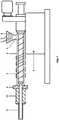
- the extruder 3 depicted in figure 1 is a single screw extruder comprising a barrel 4, a screw 7 and a die 10.
- the barrel 4 has a feed throat 5 through which a granulated vulcanised rubber 1 and the thermoset resin 2 are introduced.
- the extruder 3 comprises a hopper 6 to assist the introduction of the granulated vulcanised rubber 1 and the thermoset resin 2 in the barrel 4 through the feed throat 5.
- the screw 7 mixes the granulated vulcanised rubber 1 and the thermoset resin 2 to form a mixture.
- the granulated vulcanised rubber 1 and the thermoset resin 2 are mixed outside of the extruder 3 to form the mixture, which in turn is introduced in the barrel 4 through the feed throat 5.
- the screw 7 advances the mixture, formed within the barrel 4 of the extruder 3 or outside of the extruder 3, from within the barrel 4 towards the die 10.
- a breaker plate 9 is mounted upstream of the die 10 and downstream of the barrel 4.
- a cross-linking agent is added into the mixture at a point of the die where the final desired shape has been acquired to initiate cross-linking of the thermoset resin within the die 10. Then, optionally the mixture is moved through the extender element 8 and it is kept there during a residence time enough to allow the mixture to cross-link to a sufficient extent to avoid the crumbling of the resulting piece/profile when exiting the extender element.
- the skilled person knows or can easily find the required residence time of the mixture within the die and optionally the extender element to allow the object to cross-link to a sufficient extent to avoid the crumbling of the piece so obtained. It is important to take into account that while the mixture is cross-linking is also moving through the die and optionally the extender element, so that a substantially finished piece is obtained without requiring a further demoulding processing.
- thermoset resin 2 When the cross-linking agent is added at this stage, cross-linking of the thermoset resin 2 take place within the die 10 and not at a too much earlier stage nor a too much later stage.
- the mixture is moved through the die 10 to obtain an extruded profile with the desired shape and then, if present, is forced through the extender element 8, which is mounted downstream of the die 10.
- the cross-linking agent is added into the mixture through at least a set of circumferentially distributed orifices around the perimeter of the die (10).
- the cross-linking agent is added into the mixture at two different cross-linking stages of the thermoset resin, an initial cross-linking stage and an intermediate cross-linking stage. This improves control of the cross-linking of the thermoset resin.
- the die 10 comprises a mandrel 12 so as to allow the profile of granulated vulcanised rubber with the thermoset resin 2 obtained by forcing the mixture to exit through de die 10, to have a tubular form.
- thermoset resin is a isocyanate and the cross-linking agent is water or glycol, more preferably water.
- water can be introduced in the die in liquid form, in which case is quickly is converted into steam due to the high die's temperature or can be introduced directly in steam form.
- the mixture contains 80-91 wt % of the granulated vulcanised rubber and 9-20 wt % of isocyanate. Also, preferably, the ratio isocyanate/granulated vulcanised rubber ranges from 10-25% and the ratio water/isocyanate from 36-75%.
- thermoset resin isocyanate
- Extremely low amounts of thermoset resin can promote crumbling of the extruded profile since the particles of the granulated vulcanised rubber can become only partially covered in the thermoset resin before its cross-linking, while extremely high amounts of thermoset resin can result in a extremely tough profile for its subsequent processing.
- the mixture within the die 10 may be heated up by heating means (not represented) at least partially surrounding the die 10.
- the mixture within the die 10 is heated up to a temperature comprised preferably between 80 - 160 °C, more preferably between 100 °C and 150 °C, and most preferably between 120 °C and 140 °C.
- the grain size of the granulated vulcanised rubber is between 0.1 and 7 mm, more preferably between 0.1 and 5 mm, and most preferably between 0.8 and 4 mm.
- the wt% of the granulated vulcanised rubber in the mixture is preferably between 78 and 96%, more preferably between 80 and 91%, and most preferably between 85 and 89%.
- the wt% of the thermoset resin in the mixture is preferably between 4 and 25%, more preferably between 9 and 20%, and most preferably between 11 and 15%.
- the cross-linking agent is added to the mixture at a ratio cross-linking agent/resin of preferably between 35 and 150%, more preferably between 40 and 75%, and most preferably between 40 and 50%.
- a single screw extruder comprising a barrel 4, a screw 7 and a die 10 was used according to a process known in the prior art, to try to obtain extruded profiles wherein the granulated vulcanised rubber 1, the thermoset resin 2 and the cross-linking agent are introduced altogether through the feed throat 5 of the barrel 4.
- the screw 7 mixed the granulated vulcanised rubber 1, the thermoset resin 2 and the cross-linking agent to form a three-component mixture and advanced the three-component mixture from within the barrel 4 towards the die 10. Finally, the three-component mixture was forced through the die 10.
- Sample A contained 90.5 wt% of the granulated vulcanised rubber 1, 9.5 wt% of isocyanate, that is, the ratio of isocyanate to granulated vulcanised rubber 1 was 10.5%.
- the amount of liquid water added to the mixture, expressed as a ratio of water to isocyanate was 1.1%.
- Sample B contained 75.9 wt% of the granulated vulcanised rubber 1, 24.1 wt% of isocyanate, that is, the ratio of isocyanate to granulated vulcanised rubber 1 was 31.7%.
- the amount of liquid water added to the mixture, expressed as a ratio of water to isocyanate was 3.3%.
- composition of both samples is summarised in the following table.
- the thermocouples located on the die 10 have been depicted in figure 2 as a first and a second thermocouple 13', 13".
- the die 10 employed in the prior testing was substituted for another die 10 with three orifices 11 practised on its lateral surface.
- the die was not provided with extender element.
- the granulated vulcanised rubber 1 and the thermoset resin 2 were introduced through the feed throat 5 of the barrel 4, whereas the cross-linking agent was introduced through three orifices practised on the lateral surface of the die 10.
- the screw 7 mixed the granulated vulcanised rubber 1 and the thermoset resin 2 to form a mixture and advanced the mixture from within the barrel 4 towards the die 10.
- the cross-linking agent was added into the mixture through the orifice 11 practised on the lateral surface of the die 10. Finally, the mixture was moved through the die 10 acquiring its final shape.
- thermoset resin 2 Two samples were tested in such a manner, wherein isocyanate was selected as the thermoset resin 2 and liquid water was selected as the cross-linking agent.
- the nominal grain size the granulated vulcanised rubber 1 in sample C was 50% comprised between 2 - 4 mm, 25% comprised between 0.8 - 2 mm and 25% comprised between 0.2 - 0.8 mm.
- Sample C contained 74.6 wt% of the granulated vulcanised rubber 1 and 25.4 wt% of isocyanate, that is, the ratio of isocyanate to granulated vulcanised rubber 1 was 34.0%.
- the nominal grain size the granulated vulcanised rubber 1 in sample D was 50% comprised between 2-4 mm and 50% comprised between 0.8 - 2 mm.
- Sample D contained 83.1 wt% of the granulated vulcanised rubber 1 and 16.9 wt% of isocyanate, that is, the ratio of isocyanate to granulated vulcanised rubber 1 was 20.3%.
- the nominal grain size of the granulated vulcanised rubber 1 and the composition of both samples are summarised in the following table.
- thermoset resin 2 was selected as the thermoset resin 2 and liquid water was selected as the cross-linking agent.
- the die was not provided with extender element.
- the nominal grain size of the granulated vulcanised rubber 1 and the composition of these samples are summarised in the following table.
- Samples E through I and L resulted in a high consistency granulated vulcanised rubber profile with isocyanate, whereas samples J, K and M resulted in a spongy granulated vulcanised rubber profile bonded by isocyanate.
- thermoset resin 2 was selected as the thermoset resin 2 and liquid water as the cross-linking agent.
- the die was provided with an extender element which had a length of 50 cm and the residence time within the extender element was 5 minutes.
- the nominal size of the granulated vulcanised rubber particle 1 and the composition of these samples is summarised in the Table below Granulated vulcanised rubber (GVR) Isocianato (ThR) ThR/GVR H 2 O/ThR Nominal grain size [mm] [wt %] [wt %] [% (wt/wt)]] [% (wt/wt)] Sample N 100% - ⁇ 2 - 4 ⁇ 89.0 11.0 12,0 150.0
- the time required for manufacturing one linear meter of product was between 3 - 5 minutes, which can be compared in a very favourable way with times required in the processes of the prior art.
Landscapes
- Engineering & Computer Science (AREA)
- Mechanical Engineering (AREA)
- Chemical & Material Sciences (AREA)
- Physics & Mathematics (AREA)
- Thermal Sciences (AREA)
- Health & Medical Sciences (AREA)
- Chemical Kinetics & Catalysis (AREA)
- Medicinal Chemistry (AREA)
- Polymers & Plastics (AREA)
- Organic Chemistry (AREA)
- Processing And Handling Of Plastics And Other Materials For Molding In General (AREA)
- Extrusion Moulding Of Plastics Or The Like (AREA)
Claims (15)
- Procédé continu pour fabriquer un objet solide en extrudant un caoutchouc granulé vulcanisé (1) avec une résine thermodurcissable (2) dans une extrudeuse (3) qui comprend une filière (10) possédant au moins un orifice (11, 11', 11") réalisé sur une surface latérale de cette dernière, le procédé comprenant les étapes consistant à :- mélanger le caoutchouc granulé vulcanisé (1) et la résine thermodurcissable (2) pour former un mélange et faire se déplacer ce mélange en direction de la filière (10) ;- tandis que le mélange se déplace dans la filière (10), ajouter un agent de réticulation fluide au mélange par le au moins un orifice (11, 11', 11") réalisé sur une surface latérale de la filière (10), en un point de la filière où le mélange a acquis la forme désirée et en quantité suffisante pour démarrer la réticulation de la résine à l'intérieur de la filière (10), en lui faisant acquérir ainsi sa forme finale ; et- continuer à faire se déplacer le mélange avec sa forme finale dans la filière (10) durant une période de temps suffisamment longue pour permettre à l'objet produit d'être réticulé de manière suffisante afin d'éviter son émiettement et pour permettre l'obtention d'une pièce substantiellement finie lorsqu'elle sort de l'extrudeuse (3).
- Procédé selon la revendication 1, dans lequel la filière (10) de l'extrudeuse est munie d'un élément d'extension (8) de cette dernière, et le mélange, une fois passé dans la filière (10), est déplacé dans l'élément d'extension (8) durant le temps requis pour que l'objet produit soit suffisamment réticulé afin d'éviter l'émiettement de ce dernier lorsqu'il sort de l'extrudeuse.
- Procédé selon les revendications 1 ou 2, dans lequel la résine thermodurcissable (2) est de l'isocyanate et l'agent de réticulation est de l'eau.
- Procédé selon l'une quelconque des revendications 1 à 3, dans lequel un agent fluidifiant ou un agent de démoulage est ajouté au mélange.
- Procédé selon l'une quelconque des revendications précédentes, dans lequel le temps de résidence du mélange de caoutchouc vulcanisé (1), résine thermodurcissable (2) et agent de réticulation dans la filière (10) et éventuellement dans l'élément d'extension (8) est de 5 à 10 minutes.
- Procédé selon l'une quelconque des revendications précédentes, dans lequel la grosseur de grain du caoutchouc granulé vulcanisé est comprise entre 0,1 et 7 mm.
- Procédé selon la revendication 6, dans lequel la grosseur de grain du caoutchouc granulé vulcanisé est comprise entre 0,8 et 4 mm.
- Procédé selon l'une quelconque des revendications précédentes, dans lequel le mélange de caoutchouc vulcanisé (1) et de résine thermodurcissable (2) est constitué de 78 à 96% en poids de caoutchouc granulé vulcanisé et de 4 à 25% en poids de résine thermodurcissable, et le rapport eau/résine thermodurcissable est compris entre 35 et 150%.
- Procédé selon la revendication 8, dans lequel le mélange de caoutchouc vulcanisé (1) et de résine thermodurcissable (2) est constitué de 85 à 89% en poids de caoutchouc granulé vulcanisé et de 11 à 15% en poids de résine thermodurcissable, et le rapport eau/résine thermodurcissable est compris entre 40 et 50%.
- Procédé selon l'une quelconque des revendications précédentes, dans lequel le mélange à l'intérieur de la filière (10) est chauffé à une température comprise entre 80 et 160°C.
- Procédé selon l'une quelconque des revendications précédentes, dans lequel les orifices (11, 11', 11") réalisés sur la surface latérale de la filière (10), et qui sont destinés à permettre l'ajout d'un agent de réticulation fluide au mélange, sont situés dans au moins un ensemble d'orifices répartis de façon circonférentielle autour du périmètre de la filière (10).
- Procédé selon la revendication 11, dans lequel les orifices (11, 11', 11") réalisés sur la surface latérale de la filière (10), et qui sont destinés à permettre l'ajout d'un agent de réticulation fluide au mélange, sont situés dans deux ou plusieurs ensembles d'orifices répartis de façon circonférentielle autour du périmètre de la filière (10).
- Procédé selon l'une quelconque des revendications précédentes, dans lequel le caoutchouc granulé vulcanisé (1) et la résine thermodurcissable (2) sont fournis séparément au canon (4) de l'extrudeuse (3) via la gorge d'alimentation (5), et sont ensuite mélangés à l'intérieur du canon (4) par une vis (7) qui pousse aussi le mélange vers la filière (10).
- Procédé selon l'une quelconque des revendications précédentes, dans lequel l'extrudeuse (3) comprend en outre une grille (9) montée en aval du canon (4) et en amont de la filière (10) pour que le mélange avance depuis l'intérieur du canon (4) en direction de la filière (10) à travers la grille (9).
- Procédé selon l'une quelconque des revendications précédentes, dans lequel le caoutchouc granulé vulcanisé provient de pneus usagés.
Applications Claiming Priority (2)
| Application Number | Priority Date | Filing Date | Title |
|---|---|---|---|
| EP14382402 | 2014-10-17 | ||
| PCT/EP2015/074060 WO2016059234A1 (fr) | 2014-10-17 | 2015-10-16 | Procédé continu de production d'un objet plein par extrusion de caoutchouc vulcanisé granulé avec une résine thermodurcissable |
Publications (2)
| Publication Number | Publication Date |
|---|---|
| EP3206852A1 EP3206852A1 (fr) | 2017-08-23 |
| EP3206852B1 true EP3206852B1 (fr) | 2018-08-15 |
Family
ID=52102623
Family Applications (1)
| Application Number | Title | Priority Date | Filing Date |
|---|---|---|---|
| EP15784327.7A Active EP3206852B1 (fr) | 2014-10-17 | 2015-10-16 | Procédé de fabrication d'un objet par extrusion d'un caoutchouc vulcanisé granulé avec une résine thermodurcie |
Country Status (4)
| Country | Link |
|---|---|
| EP (1) | EP3206852B1 (fr) |
| ES (1) | ES2698156T3 (fr) |
| PT (1) | PT3206852T (fr) |
| WO (1) | WO2016059234A1 (fr) |
Families Citing this family (1)
| Publication number | Priority date | Publication date | Assignee | Title |
|---|---|---|---|---|
| CN115771294A (zh) * | 2022-11-17 | 2023-03-10 | 安徽轻运达科技有限公司 | 一种车厢胶条的加工方法和胶条加工机 |
Family Cites Families (2)
| Publication number | Priority date | Publication date | Assignee | Title |
|---|---|---|---|---|
| FR2416106A1 (fr) * | 1978-02-02 | 1979-08-31 | Silec Liaisons Elec | Procede et dispositif d'extrusion d'un produit reticule |
| DE19957175A1 (de) * | 1999-11-27 | 2001-05-31 | Basf Ag | Verfahren zur Herstellung von Formkörpern aus (i)zerkleinerten Kunststoffabfällen und (ii) Polyurethan-Bindemitteln |
-
2015
- 2015-10-16 WO PCT/EP2015/074060 patent/WO2016059234A1/fr not_active Ceased
- 2015-10-16 EP EP15784327.7A patent/EP3206852B1/fr active Active
- 2015-10-16 PT PT15784327T patent/PT3206852T/pt unknown
- 2015-10-16 ES ES15784327T patent/ES2698156T3/es active Active
Non-Patent Citations (1)
| Title |
|---|
| None * |
Also Published As
| Publication number | Publication date |
|---|---|
| EP3206852A1 (fr) | 2017-08-23 |
| ES2698156T3 (es) | 2019-01-31 |
| WO2016059234A1 (fr) | 2016-04-21 |
| PT3206852T (pt) | 2018-11-14 |
Similar Documents
| Publication | Publication Date | Title |
|---|---|---|
| CA1332765C (fr) | Granules de gelatine et methode et dispositif de fabrication | |
| DE69728785T2 (de) | Verfahren zum bearbeiten von polymeren | |
| CN101481463A (zh) | 硬质聚氯乙烯型材软硬共挤胶条的生产方法 | |
| EP3206852B1 (fr) | Procédé de fabrication d'un objet par extrusion d'un caoutchouc vulcanisé granulé avec une résine thermodurcie | |
| CN104046050A (zh) | 一种木塑复合材料及型材制造工艺 | |
| EP0590507A1 (fr) | Procédé et dispositif pour la fabrication de produits d'extrusion en polyéthylène hypermoléculaire | |
| DE69612938T2 (de) | Verfahren zur Herstellung von mit Silan modifizierten Polyolefinen und Extruder dafür | |
| DE2524298C3 (de) | Verfahren und Mischung zum Angießen eines Schuhteiles aus thermoplastischem Kautschuk an andere Teile eines. Schuhs | |
| DE69119375T2 (de) | Extrusionsverfahren und Extruder zum Herstellen eines Rohres aus Phenolharz | |
| KR102238259B1 (ko) | 상하수도관용 pvc 파이프 제조방법 | |
| DE102007038671B4 (de) | Verfahren und Vorrichtung zur Herstellung von Prüfkörpern | |
| CN108997682A (zh) | 一种可用于超薄共挤的彩色合金材料及其制备方法 | |
| CN110893692B (zh) | 具有压力相关阀的注射成型系统 | |
| CN118493914A (zh) | 一种pvc塑钢管道成型工艺 | |
| KR101570196B1 (ko) | 친환경 녹색성으로 제조된 고강성 하수관과 그 장치 및 방법 | |
| CN117841330A (zh) | 石墨烯pvc管材的生产工艺 | |
| CN103665904A (zh) | 一种木塑复合材料及其型材的制造方法 | |
| CA1194248A (fr) | Melanges de caoutchouc au silicone se pretant a l'extrusion acceleree | |
| AT412771B (de) | Extrusionswerkzeug für eine kunststoffschmelze | |
| CN209937615U (zh) | 用于制造过氧化物交联聚乙烯管材的螺杆式塑料挤出装置 | |
| CN113183431A (zh) | 一种鞋用热熔胶的制备方法 | |
| CN105647075A (zh) | 椅子防滑垫的制作方法 | |
| CN115536962B (zh) | 一种高效脱模的聚氯乙烯材料及其制备方法与应用 | |
| CN204109318U (zh) | 一种木塑复合材料外墙板型材模具 | |
| KR101108555B1 (ko) | 신발용 외층재 및 그의 제조방법 |
Legal Events
| Date | Code | Title | Description |
|---|---|---|---|
| STAA | Information on the status of an ep patent application or granted ep patent |
Free format text: STATUS: THE INTERNATIONAL PUBLICATION HAS BEEN MADE |
|
| PUAI | Public reference made under article 153(3) epc to a published international application that has entered the european phase |
Free format text: ORIGINAL CODE: 0009012 |
|
| STAA | Information on the status of an ep patent application or granted ep patent |
Free format text: STATUS: REQUEST FOR EXAMINATION WAS MADE |
|
| 17P | Request for examination filed |
Effective date: 20170516 |
|
| AK | Designated contracting states |
Kind code of ref document: A1 Designated state(s): AL AT BE BG CH CY CZ DE DK EE ES FI FR GB GR HR HU IE IS IT LI LT LU LV MC MK MT NL NO PL PT RO RS SE SI SK SM TR |
|
| AX | Request for extension of the european patent |
Extension state: BA ME |
|
| DAV | Request for validation of the european patent (deleted) | ||
| DAX | Request for extension of the european patent (deleted) | ||
| GRAP | Despatch of communication of intention to grant a patent |
Free format text: ORIGINAL CODE: EPIDOSNIGR1 |
|
| STAA | Information on the status of an ep patent application or granted ep patent |
Free format text: STATUS: GRANT OF PATENT IS INTENDED |
|
| INTG | Intention to grant announced |
Effective date: 20180517 |
|
| GRAS | Grant fee paid |
Free format text: ORIGINAL CODE: EPIDOSNIGR3 |
|
| GRAA | (expected) grant |
Free format text: ORIGINAL CODE: 0009210 |
|
| STAA | Information on the status of an ep patent application or granted ep patent |
Free format text: STATUS: THE PATENT HAS BEEN GRANTED |
|
| AK | Designated contracting states |
Kind code of ref document: B1 Designated state(s): AL AT BE BG CH CY CZ DE DK EE ES FI FR GB GR HR HU IE IS IT LI LT LU LV MC MK MT NL NO PL PT RO RS SE SI SK SM TR |
|
| REG | Reference to a national code |
Ref country code: CH Ref legal event code: EP Ref country code: GB Ref legal event code: FG4D Ref country code: AT Ref legal event code: REF Ref document number: 1029253 Country of ref document: AT Kind code of ref document: T Effective date: 20180815 |
|
| REG | Reference to a national code |
Ref country code: IE Ref legal event code: FG4D |
|
| REG | Reference to a national code |
Ref country code: DE Ref legal event code: R096 Ref document number: 602015014913 Country of ref document: DE |
|
| REG | Reference to a national code |
Ref country code: FR Ref legal event code: PLFP Year of fee payment: 4 |
|
| REG | Reference to a national code |
Ref country code: NL Ref legal event code: FP |
|
| REG | Reference to a national code |
Ref country code: PT Ref legal event code: SC4A Ref document number: 3206852 Country of ref document: PT Date of ref document: 20181114 Kind code of ref document: T Free format text: AVAILABILITY OF NATIONAL TRANSLATION Effective date: 20181025 |
|
| REG | Reference to a national code |
Ref country code: DE Ref legal event code: R079 Ref document number: 602015014913 Country of ref document: DE Free format text: PREVIOUS MAIN CLASS: B29C0047100000 Ipc: B29C0048285000 |
|
| REG | Reference to a national code |
Ref country code: LT Ref legal event code: MG4D |
|
| REG | Reference to a national code |
Ref country code: AT Ref legal event code: MK05 Ref document number: 1029253 Country of ref document: AT Kind code of ref document: T Effective date: 20180815 |
|
| PG25 | Lapsed in a contracting state [announced via postgrant information from national office to epo] |
Ref country code: FI Free format text: LAPSE BECAUSE OF FAILURE TO SUBMIT A TRANSLATION OF THE DESCRIPTION OR TO PAY THE FEE WITHIN THE PRESCRIBED TIME-LIMIT Effective date: 20180815 Ref country code: BG Free format text: LAPSE BECAUSE OF FAILURE TO SUBMIT A TRANSLATION OF THE DESCRIPTION OR TO PAY THE FEE WITHIN THE PRESCRIBED TIME-LIMIT Effective date: 20181115 Ref country code: SE Free format text: LAPSE BECAUSE OF FAILURE TO SUBMIT A TRANSLATION OF THE DESCRIPTION OR TO PAY THE FEE WITHIN THE PRESCRIBED TIME-LIMIT Effective date: 20180815 Ref country code: RS Free format text: LAPSE BECAUSE OF FAILURE TO SUBMIT A TRANSLATION OF THE DESCRIPTION OR TO PAY THE FEE WITHIN THE PRESCRIBED TIME-LIMIT Effective date: 20180815 Ref country code: GR Free format text: LAPSE BECAUSE OF FAILURE TO SUBMIT A TRANSLATION OF THE DESCRIPTION OR TO PAY THE FEE WITHIN THE PRESCRIBED TIME-LIMIT Effective date: 20181116 Ref country code: LT Free format text: LAPSE BECAUSE OF FAILURE TO SUBMIT A TRANSLATION OF THE DESCRIPTION OR TO PAY THE FEE WITHIN THE PRESCRIBED TIME-LIMIT Effective date: 20180815 Ref country code: NO Free format text: LAPSE BECAUSE OF FAILURE TO SUBMIT A TRANSLATION OF THE DESCRIPTION OR TO PAY THE FEE WITHIN THE PRESCRIBED TIME-LIMIT Effective date: 20181115 Ref country code: IS Free format text: LAPSE BECAUSE OF FAILURE TO SUBMIT A TRANSLATION OF THE DESCRIPTION OR TO PAY THE FEE WITHIN THE PRESCRIBED TIME-LIMIT Effective date: 20181215 Ref country code: AT Free format text: LAPSE BECAUSE OF FAILURE TO SUBMIT A TRANSLATION OF THE DESCRIPTION OR TO PAY THE FEE WITHIN THE PRESCRIBED TIME-LIMIT Effective date: 20180815 |
|
| REG | Reference to a national code |
Ref country code: ES Ref legal event code: FG2A Ref document number: 2698156 Country of ref document: ES Kind code of ref document: T3 Effective date: 20190131 |
|
| PG25 | Lapsed in a contracting state [announced via postgrant information from national office to epo] |
Ref country code: LV Free format text: LAPSE BECAUSE OF FAILURE TO SUBMIT A TRANSLATION OF THE DESCRIPTION OR TO PAY THE FEE WITHIN THE PRESCRIBED TIME-LIMIT Effective date: 20180815 Ref country code: HR Free format text: LAPSE BECAUSE OF FAILURE TO SUBMIT A TRANSLATION OF THE DESCRIPTION OR TO PAY THE FEE WITHIN THE PRESCRIBED TIME-LIMIT Effective date: 20180815 Ref country code: AL Free format text: LAPSE BECAUSE OF FAILURE TO SUBMIT A TRANSLATION OF THE DESCRIPTION OR TO PAY THE FEE WITHIN THE PRESCRIBED TIME-LIMIT Effective date: 20180815 |
|
| PG25 | Lapsed in a contracting state [announced via postgrant information from national office to epo] |
Ref country code: EE Free format text: LAPSE BECAUSE OF FAILURE TO SUBMIT A TRANSLATION OF THE DESCRIPTION OR TO PAY THE FEE WITHIN THE PRESCRIBED TIME-LIMIT Effective date: 20180815 Ref country code: CZ Free format text: LAPSE BECAUSE OF FAILURE TO SUBMIT A TRANSLATION OF THE DESCRIPTION OR TO PAY THE FEE WITHIN THE PRESCRIBED TIME-LIMIT Effective date: 20180815 Ref country code: RO Free format text: LAPSE BECAUSE OF FAILURE TO SUBMIT A TRANSLATION OF THE DESCRIPTION OR TO PAY THE FEE WITHIN THE PRESCRIBED TIME-LIMIT Effective date: 20180815 Ref country code: PL Free format text: LAPSE BECAUSE OF FAILURE TO SUBMIT A TRANSLATION OF THE DESCRIPTION OR TO PAY THE FEE WITHIN THE PRESCRIBED TIME-LIMIT Effective date: 20180815 |
|
| REG | Reference to a national code |
Ref country code: DE Ref legal event code: R097 Ref document number: 602015014913 Country of ref document: DE |
|
| PG25 | Lapsed in a contracting state [announced via postgrant information from national office to epo] |
Ref country code: DK Free format text: LAPSE BECAUSE OF FAILURE TO SUBMIT A TRANSLATION OF THE DESCRIPTION OR TO PAY THE FEE WITHIN THE PRESCRIBED TIME-LIMIT Effective date: 20180815 Ref country code: SK Free format text: LAPSE BECAUSE OF FAILURE TO SUBMIT A TRANSLATION OF THE DESCRIPTION OR TO PAY THE FEE WITHIN THE PRESCRIBED TIME-LIMIT Effective date: 20180815 Ref country code: SM Free format text: LAPSE BECAUSE OF FAILURE TO SUBMIT A TRANSLATION OF THE DESCRIPTION OR TO PAY THE FEE WITHIN THE PRESCRIBED TIME-LIMIT Effective date: 20180815 |
|
| REG | Reference to a national code |
Ref country code: CH Ref legal event code: PL |
|
| PLBE | No opposition filed within time limit |
Free format text: ORIGINAL CODE: 0009261 |
|
| STAA | Information on the status of an ep patent application or granted ep patent |
Free format text: STATUS: NO OPPOSITION FILED WITHIN TIME LIMIT |
|
| PG25 | Lapsed in a contracting state [announced via postgrant information from national office to epo] |
Ref country code: LU Free format text: LAPSE BECAUSE OF NON-PAYMENT OF DUE FEES Effective date: 20181016 Ref country code: MC Free format text: LAPSE BECAUSE OF FAILURE TO SUBMIT A TRANSLATION OF THE DESCRIPTION OR TO PAY THE FEE WITHIN THE PRESCRIBED TIME-LIMIT Effective date: 20180815 |
|
| 26N | No opposition filed |
Effective date: 20190516 |
|
| REG | Reference to a national code |
Ref country code: IE Ref legal event code: MM4A |
|
| PG25 | Lapsed in a contracting state [announced via postgrant information from national office to epo] |
Ref country code: LI Free format text: LAPSE BECAUSE OF NON-PAYMENT OF DUE FEES Effective date: 20181031 Ref country code: SI Free format text: LAPSE BECAUSE OF FAILURE TO SUBMIT A TRANSLATION OF THE DESCRIPTION OR TO PAY THE FEE WITHIN THE PRESCRIBED TIME-LIMIT Effective date: 20180815 Ref country code: CH Free format text: LAPSE BECAUSE OF NON-PAYMENT OF DUE FEES Effective date: 20181031 |
|
| PG25 | Lapsed in a contracting state [announced via postgrant information from national office to epo] |
Ref country code: IE Free format text: LAPSE BECAUSE OF NON-PAYMENT OF DUE FEES Effective date: 20181016 |
|
| PG25 | Lapsed in a contracting state [announced via postgrant information from national office to epo] |
Ref country code: MT Free format text: LAPSE BECAUSE OF NON-PAYMENT OF DUE FEES Effective date: 20181016 |
|
| PG25 | Lapsed in a contracting state [announced via postgrant information from national office to epo] |
Ref country code: TR Free format text: LAPSE BECAUSE OF FAILURE TO SUBMIT A TRANSLATION OF THE DESCRIPTION OR TO PAY THE FEE WITHIN THE PRESCRIBED TIME-LIMIT Effective date: 20180815 |
|
| PG25 | Lapsed in a contracting state [announced via postgrant information from national office to epo] |
Ref country code: MK Free format text: LAPSE BECAUSE OF NON-PAYMENT OF DUE FEES Effective date: 20180815 Ref country code: HU Free format text: LAPSE BECAUSE OF FAILURE TO SUBMIT A TRANSLATION OF THE DESCRIPTION OR TO PAY THE FEE WITHIN THE PRESCRIBED TIME-LIMIT; INVALID AB INITIO Effective date: 20151016 Ref country code: CY Free format text: LAPSE BECAUSE OF FAILURE TO SUBMIT A TRANSLATION OF THE DESCRIPTION OR TO PAY THE FEE WITHIN THE PRESCRIBED TIME-LIMIT Effective date: 20180815 |
|
| PGFP | Annual fee paid to national office [announced via postgrant information from national office to epo] |
Ref country code: NL Payment date: 20251021 Year of fee payment: 11 |
|
| PGFP | Annual fee paid to national office [announced via postgrant information from national office to epo] |
Ref country code: PT Payment date: 20251016 Year of fee payment: 11 |
|
| PGFP | Annual fee paid to national office [announced via postgrant information from national office to epo] |
Ref country code: DE Payment date: 20251021 Year of fee payment: 11 |
|
| PGFP | Annual fee paid to national office [announced via postgrant information from national office to epo] |
Ref country code: GB Payment date: 20251024 Year of fee payment: 11 |
|
| PGFP | Annual fee paid to national office [announced via postgrant information from national office to epo] |
Ref country code: IT Payment date: 20251024 Year of fee payment: 11 |
|
| PGFP | Annual fee paid to national office [announced via postgrant information from national office to epo] |
Ref country code: FR Payment date: 20251030 Year of fee payment: 11 |
|
| PGFP | Annual fee paid to national office [announced via postgrant information from national office to epo] |
Ref country code: BE Payment date: 20251021 Year of fee payment: 11 |
|
| PGFP | Annual fee paid to national office [announced via postgrant information from national office to epo] |
Ref country code: ES Payment date: 20251113 Year of fee payment: 11 |