EP3207166B1 - Matériau composite pour palier lisse présentant une couche de métal antifriction à base d'aluminium, plaquée à chaud - Google Patents
Matériau composite pour palier lisse présentant une couche de métal antifriction à base d'aluminium, plaquée à chaud Download PDFInfo
- Publication number
- EP3207166B1 EP3207166B1 EP15763366.0A EP15763366A EP3207166B1 EP 3207166 B1 EP3207166 B1 EP 3207166B1 EP 15763366 A EP15763366 A EP 15763366A EP 3207166 B1 EP3207166 B1 EP 3207166B1
- Authority
- EP
- European Patent Office
- Prior art keywords
- weight
- plain bearing
- composite material
- metal layer
- optionally
- Prior art date
- Legal status (The legal status is an assumption and is not a legal conclusion. Google has not performed a legal analysis and makes no representation as to the accuracy of the status listed.)
- Active
Links
Images

Classifications
-
- F—MECHANICAL ENGINEERING; LIGHTING; HEATING; WEAPONS; BLASTING
- F16—ENGINEERING ELEMENTS AND UNITS; GENERAL MEASURES FOR PRODUCING AND MAINTAINING EFFECTIVE FUNCTIONING OF MACHINES OR INSTALLATIONS; THERMAL INSULATION IN GENERAL
- F16C—SHAFTS; FLEXIBLE SHAFTS; ELEMENTS OR CRANKSHAFT MECHANISMS; ROTARY BODIES OTHER THAN GEARING ELEMENTS; BEARINGS
- F16C33/00—Parts of bearings; Special methods for making bearings or parts thereof
- F16C33/02—Parts of sliding-contact bearings
- F16C33/04—Brasses; Bushes; Linings
- F16C33/06—Sliding surface mainly made of metal
- F16C33/12—Structural composition; Use of special materials or surface treatments, e.g. for rust-proofing
- F16C33/121—Use of special materials
-
- B—PERFORMING OPERATIONS; TRANSPORTING
- B32—LAYERED PRODUCTS
- B32B—LAYERED PRODUCTS, i.e. PRODUCTS BUILT-UP OF STRATA OF FLAT OR NON-FLAT, e.g. CELLULAR OR HONEYCOMB, FORM
- B32B15/00—Layered products comprising a layer of metal
- B32B15/01—Layered products comprising a layer of metal all layers being exclusively metallic
- B32B15/012—Layered products comprising a layer of metal all layers being exclusively metallic one layer being formed of an iron alloy or steel, another layer being formed of aluminium or an aluminium alloy
-
- C—CHEMISTRY; METALLURGY
- C22—METALLURGY; FERROUS OR NON-FERROUS ALLOYS; TREATMENT OF ALLOYS OR NON-FERROUS METALS
- C22C—ALLOYS
- C22C21/00—Alloys based on aluminium
-
- C—CHEMISTRY; METALLURGY
- C22—METALLURGY; FERROUS OR NON-FERROUS ALLOYS; TREATMENT OF ALLOYS OR NON-FERROUS METALS
- C22C—ALLOYS
- C22C21/00—Alloys based on aluminium
- C22C21/003—Alloys based on aluminium containing at least 2.6% of one or more of the elements: tin, lead, antimony, bismuth, cadmium, and titanium
-
- C—CHEMISTRY; METALLURGY
- C22—METALLURGY; FERROUS OR NON-FERROUS ALLOYS; TREATMENT OF ALLOYS OR NON-FERROUS METALS
- C22C—ALLOYS
- C22C21/00—Alloys based on aluminium
- C22C21/12—Alloys based on aluminium with copper as the next major constituent
-
- C—CHEMISTRY; METALLURGY
- C22—METALLURGY; FERROUS OR NON-FERROUS ALLOYS; TREATMENT OF ALLOYS OR NON-FERROUS METALS
- C22C—ALLOYS
- C22C21/00—Alloys based on aluminium
- C22C21/12—Alloys based on aluminium with copper as the next major constituent
- C22C21/14—Alloys based on aluminium with copper as the next major constituent with silicon
-
- C—CHEMISTRY; METALLURGY
- C22—METALLURGY; FERROUS OR NON-FERROUS ALLOYS; TREATMENT OF ALLOYS OR NON-FERROUS METALS
- C22C—ALLOYS
- C22C21/00—Alloys based on aluminium
- C22C21/12—Alloys based on aluminium with copper as the next major constituent
- C22C21/16—Alloys based on aluminium with copper as the next major constituent with magnesium
-
- C—CHEMISTRY; METALLURGY
- C22—METALLURGY; FERROUS OR NON-FERROUS ALLOYS; TREATMENT OF ALLOYS OR NON-FERROUS METALS
- C22C—ALLOYS
- C22C21/00—Alloys based on aluminium
- C22C21/12—Alloys based on aluminium with copper as the next major constituent
- C22C21/18—Alloys based on aluminium with copper as the next major constituent with zinc
-
- F—MECHANICAL ENGINEERING; LIGHTING; HEATING; WEAPONS; BLASTING
- F16—ENGINEERING ELEMENTS AND UNITS; GENERAL MEASURES FOR PRODUCING AND MAINTAINING EFFECTIVE FUNCTIONING OF MACHINES OR INSTALLATIONS; THERMAL INSULATION IN GENERAL
- F16C—SHAFTS; FLEXIBLE SHAFTS; ELEMENTS OR CRANKSHAFT MECHANISMS; ROTARY BODIES OTHER THAN GEARING ELEMENTS; BEARINGS
- F16C33/00—Parts of bearings; Special methods for making bearings or parts thereof
- F16C33/02—Parts of sliding-contact bearings
- F16C33/04—Brasses; Bushes; Linings
- F16C33/06—Sliding surface mainly made of metal
- F16C33/12—Structural composition; Use of special materials or surface treatments, e.g. for rust-proofing
- F16C33/122—Multilayer structures of sleeves, washers or liners
- F16C33/125—Details of bearing layers, i.e. the lining
-
- F—MECHANICAL ENGINEERING; LIGHTING; HEATING; WEAPONS; BLASTING
- F16—ENGINEERING ELEMENTS AND UNITS; GENERAL MEASURES FOR PRODUCING AND MAINTAINING EFFECTIVE FUNCTIONING OF MACHINES OR INSTALLATIONS; THERMAL INSULATION IN GENERAL
- F16C—SHAFTS; FLEXIBLE SHAFTS; ELEMENTS OR CRANKSHAFT MECHANISMS; ROTARY BODIES OTHER THAN GEARING ELEMENTS; BEARINGS
- F16C33/00—Parts of bearings; Special methods for making bearings or parts thereof
- F16C33/02—Parts of sliding-contact bearings
- F16C33/04—Brasses; Bushes; Linings
- F16C33/06—Sliding surface mainly made of metal
- F16C33/12—Structural composition; Use of special materials or surface treatments, e.g. for rust-proofing
- F16C33/122—Multilayer structures of sleeves, washers or liners
- F16C33/127—Details of intermediate layers, e.g. nickel dams
-
- F—MECHANICAL ENGINEERING; LIGHTING; HEATING; WEAPONS; BLASTING
- F16—ENGINEERING ELEMENTS AND UNITS; GENERAL MEASURES FOR PRODUCING AND MAINTAINING EFFECTIVE FUNCTIONING OF MACHINES OR INSTALLATIONS; THERMAL INSULATION IN GENERAL
- F16C—SHAFTS; FLEXIBLE SHAFTS; ELEMENTS OR CRANKSHAFT MECHANISMS; ROTARY BODIES OTHER THAN GEARING ELEMENTS; BEARINGS
- F16C33/00—Parts of bearings; Special methods for making bearings or parts thereof
- F16C33/02—Parts of sliding-contact bearings
- F16C33/04—Brasses; Bushes; Linings
- F16C33/20—Sliding surface consisting mainly of plastics
- F16C33/203—Multilayer structures, e.g. sleeves comprising a plastic lining
-
- F—MECHANICAL ENGINEERING; LIGHTING; HEATING; WEAPONS; BLASTING
- F16—ENGINEERING ELEMENTS AND UNITS; GENERAL MEASURES FOR PRODUCING AND MAINTAINING EFFECTIVE FUNCTIONING OF MACHINES OR INSTALLATIONS; THERMAL INSULATION IN GENERAL
- F16C—SHAFTS; FLEXIBLE SHAFTS; ELEMENTS OR CRANKSHAFT MECHANISMS; ROTARY BODIES OTHER THAN GEARING ELEMENTS; BEARINGS
- F16C2202/00—Solid materials defined by their properties
- F16C2202/02—Mechanical properties
- F16C2202/04—Hardness
-
- F—MECHANICAL ENGINEERING; LIGHTING; HEATING; WEAPONS; BLASTING
- F16—ENGINEERING ELEMENTS AND UNITS; GENERAL MEASURES FOR PRODUCING AND MAINTAINING EFFECTIVE FUNCTIONING OF MACHINES OR INSTALLATIONS; THERMAL INSULATION IN GENERAL
- F16C—SHAFTS; FLEXIBLE SHAFTS; ELEMENTS OR CRANKSHAFT MECHANISMS; ROTARY BODIES OTHER THAN GEARING ELEMENTS; BEARINGS
- F16C2204/00—Metallic materials; Alloys
- F16C2204/20—Alloys based on aluminium
- F16C2204/22—Alloys based on aluminium with tin as the next major constituent
-
- F—MECHANICAL ENGINEERING; LIGHTING; HEATING; WEAPONS; BLASTING
- F16—ENGINEERING ELEMENTS AND UNITS; GENERAL MEASURES FOR PRODUCING AND MAINTAINING EFFECTIVE FUNCTIONING OF MACHINES OR INSTALLATIONS; THERMAL INSULATION IN GENERAL
- F16C—SHAFTS; FLEXIBLE SHAFTS; ELEMENTS OR CRANKSHAFT MECHANISMS; ROTARY BODIES OTHER THAN GEARING ELEMENTS; BEARINGS
- F16C2240/00—Specified values or numerical ranges of parameters; Relations between them
- F16C2240/40—Linear dimensions, e.g. length, radius, thickness, gap
- F16C2240/60—Thickness, e.g. thickness of coatings
-
- Y—GENERAL TAGGING OF NEW TECHNOLOGICAL DEVELOPMENTS; GENERAL TAGGING OF CROSS-SECTIONAL TECHNOLOGIES SPANNING OVER SEVERAL SECTIONS OF THE IPC; TECHNICAL SUBJECTS COVERED BY FORMER USPC CROSS-REFERENCE ART COLLECTIONS [XRACs] AND DIGESTS
- Y02—TECHNOLOGIES OR APPLICATIONS FOR MITIGATION OR ADAPTATION AGAINST CLIMATE CHANGE
- Y02T—CLIMATE CHANGE MITIGATION TECHNOLOGIES RELATED TO TRANSPORTATION
- Y02T10/00—Road transport of goods or passengers
- Y02T10/80—Technologies aiming to reduce greenhouse gasses emissions common to all road transportation technologies
- Y02T10/86—Optimisation of rolling resistance, e.g. weight reduction
-
- Y—GENERAL TAGGING OF NEW TECHNOLOGICAL DEVELOPMENTS; GENERAL TAGGING OF CROSS-SECTIONAL TECHNOLOGIES SPANNING OVER SEVERAL SECTIONS OF THE IPC; TECHNICAL SUBJECTS COVERED BY FORMER USPC CROSS-REFERENCE ART COLLECTIONS [XRACs] AND DIGESTS
- Y10—TECHNICAL SUBJECTS COVERED BY FORMER USPC
- Y10T—TECHNICAL SUBJECTS COVERED BY FORMER US CLASSIFICATION
- Y10T428/00—Stock material or miscellaneous articles
- Y10T428/12—All metal or with adjacent metals
- Y10T428/12493—Composite; i.e., plural, adjacent, spatially distinct metal components [e.g., layers, joint, etc.]
- Y10T428/12736—Al-base component
- Y10T428/1275—Next to Group VIII or IB metal-base component
-
- Y—GENERAL TAGGING OF NEW TECHNOLOGICAL DEVELOPMENTS; GENERAL TAGGING OF CROSS-SECTIONAL TECHNOLOGIES SPANNING OVER SEVERAL SECTIONS OF THE IPC; TECHNICAL SUBJECTS COVERED BY FORMER USPC CROSS-REFERENCE ART COLLECTIONS [XRACs] AND DIGESTS
- Y10—TECHNICAL SUBJECTS COVERED BY FORMER USPC
- Y10T—TECHNICAL SUBJECTS COVERED BY FORMER US CLASSIFICATION
- Y10T428/00—Stock material or miscellaneous articles
- Y10T428/12—All metal or with adjacent metals
- Y10T428/12493—Composite; i.e., plural, adjacent, spatially distinct metal components [e.g., layers, joint, etc.]
- Y10T428/12736—Al-base component
- Y10T428/12764—Next to Al-base component
Definitions
- the invention relates to a sliding bearing composite material with a supporting layer of steel, an intermediate layer based on a lead-free impurities aluminum alloy and a bearing metal layer based on a lead-free to contamination aluminum alloy with tin, nickel, manganese and copper as the main alloying elements.
- Such a sliding bearing composite material for example, in the writings DE 10 2005 023 541 A1 and DE 10 2009 002 700 B3 described.
- the subject of the first-mentioned document is a sliding bearing composite material with a metallic support layer and a bearing metal layer of the aforementioned type, which is applied by means of an aluminum-based intermediate layer on the metallic support layer.
- the peculiarity here is that the aluminum alloys of the intermediate layer and the bearing metal layer coincide except for an additional soft phase content in the bearing metal layer.
- the soft phase content in the bearing metal layer is 5 to 20% by weight of tin and particularly preferably 9 to 11% by weight of tin.
- the remaining alloy constituents of the intermediate layer and the bearing metal layer are 1.0-3.0% by weight of nickel, 0.5-2.5% by weight of manganese, 0.02-1.5% by weight of copper and the balance of aluminum ,
- the above-mentioned second document also has a sliding bearing element with a support layer, an intermediate layer and a bearing metal layer based on an aluminum alloy to the object.
- the peculiarity of the intermediate layer in this case is an aluminum alloy with 3.5-4.5% by weight of copper, 0.1-1.5% by weight of manganese and 0.1-1.5% by weight of magnesium, wherein the intermediate layer is adjusted to a microhardness of 70 HV 0.01 - 110 HV 0.01 becomes.
- the bearing metal layer of the sliding bearing element has a composition of 1.0-3% by weight of nickel, 0.5-2.5% by weight of manganese, 0.02-1.5% by weight of copper and a soft phase content of 5. 20 wt .-% and otherwise aluminum on.
- tin in turn is preferred in a proportion of 8-12% by weight.
- the sliding element obtains a sufficiently plastic compliance and conformability.
- the discovered problem of squeezing out of the interlayer material at high peak load due to excessive ductility does not occur.
- the generic sliding bearing composite material for example, from the Scriptures DE 10 2004 025 557 A1 known.
- This document also deals with the modification of the aluminum-based intermediate layer, which has the peculiarity that it is composed of at least two layers, of which the lower, the support layer of steel facing layer has a lower hardness than the upper, the aluminum-based bearing metal layer facing position ,
- the composition of the bearing metal layer is used with a soft phase content of 3 to 20 wt .-% tin, further with 0.1 to 7 wt .-% of one or more of the elements Cu, Zn, Mg and Si, 0.01 to 3 wt.
- the composition of the aluminum-based intermediate layer contains, in addition to aluminum, 1 to 8.5% by weight of Si, 0.01 to 7% by weight of one or more of the elements Cu, Zn and Mg, 0.01 to 3% by weight of one or more of the elements Mn, V, Mo, Cr, Co, Fe, Ni and W and 0.01 to 2 wt .-% of one or more of the elements B, Ti and Zr and otherwise indicated aluminum.
- the font US 2002/0192105 A1 deals with an aluminum alloy for plain bearings based on aluminum-tin.
- the alloy comprises 2 to 20 wt% tin, 3 wt% or less copper, 0.3 to 5 wt% TiC particles, and otherwise aluminum.
- the document also discloses a resin-based coating with MoSi 2 solid lubricant for reducing the tendency to eat in the running-in phase of the bearing.
- the intermediate layer has to be plated on the bearing metal layer and on the other hand the composite of bearing metal and intermediate layer on the steel support layer. Subsequently, the layer composite still has to be subjected to a heat treatment in which the desired microstructure and thus the desired material properties are set by a final annealing.
- the wear resistance is still a significant factor for the mixed friction conditions prevailing in start-stop applications, so that there is always a need for optimization here. Furthermore, however, the inventors have taken on the task at the same time to increase the fatigue strength of the bearing material.
- the invention provides a sliding bearing composite material with a supporting layer of steel, an intermediate layer based on a lead-free to contamination aluminum alloy and a preferably applied by cold roll directly to the support layer bearing metal layer based on a lead-free to contamination aluminum alloy.
- the aluminum alloy of the intermediate layer has a composition of 3.5 to 4.5% by weight. Copper, 0.1 to 1.5% by weight of manganese, 0.1 to 1.5% by weight of magnesium, optionally in the sum of 0.05% to 0.25% of zirconium and titanium, optionally no more in detail as 0.1 wt .-% and in total not more than 0.25 wt .-% of other alloying constituents, the usual permissible impurities and balance aluminum.
- the aluminum alloy of the bearing metal layer has a composition of 6.0-8.0 wt% tin, 1.0-3.0 wt% nickel, 0.5-1.0 wt% manganese, 0.5 1.0 wt.% Copper, 0.15-0.25 wt.% Chromium, 0.1-0.3 wt.% Vanadium, optionally 0.1-0.2 wt.% Zirconium, optionally up to 0.2% by weight of titanium, optionally less than 0.5% by weight of other elements, of the usual permissible impurities and the balance of aluminum.
- the term "lead-free except for impurities" is understood to mean that a lead content which could possibly be present due to contamination of individual alloying elements is at least less than 0.1% by weight.
- the bearing metal is cast in strip form continuously on a so-called belt caster, then annealed and then plated with the interlayer material which is in film form.
- the composite is then rolled and finally applied to the steel in a cold roll plating step with the side of the intermediate layer.
- cold roll cladding a roll cladding method at cladding temperatures ⁇ 300 ° C is referred to. From this manufacturing process results in a sliding bearing composite material with a high-strength, insensitive to fatigue and fatigue bearing metal and adapted thereto intermediate layer, which is very well suited for example for highly stressed applications as a bearing shell of a connecting rod bearing or a crankshaft main bearing in an internal combustion engine, especially in a supercharged diesel engine.
- the inventors have found that, due to the casting process, intermetallic phases, in particular AlNiMn, but also AlCu and other NiMn precipitates, form in the bearing metal layer, which are finely distributed as hard particles in addition to the soft phase tin and the micro-alloying elements V, optionally Zr and Ti in the aluminum matrix.
- the shape of the hard particles changes only slightly after casting by the subsequent heat treatment, so that the particle size and distribution in the matrix is adjusted primarily by the cooling rate during casting, so as to achieve the desired material properties, in particular the fatigue strength.
- micro-alloying elements V, optionally Zr and Ti increase the recrystallization temperature and prevent grain growth in the material, which provides for consistently good material properties in applications in the elevated temperature range, in particular at temperatures in the range of 150 to 200 ° C.
- the combination of the composition according to the invention, including the micro-alloying elements and the particular process steps optimizes the particle size and distribution of the tribologically active particles (hard particles and soft phase) in the matrix with regard to highly stressed applications.
- the bearing metal layer in particular when using a ductile intermediate layer, can be designed significantly in the direction of increased fatigue strength by the specific choice of the tin content in combination with adapted microalloying elements, as was customary in the prior art. Therefore, the bearing is not only suitable for use in the main bearing area, where mixed friction conditions occur more frequently during start-stop operation, under which there is no (hydrodynamic) oil lubrication of the bearing, but also as a connecting rod bearing material.
- Ti enhances the microstructure of the matrix material during the casting process, regardless of a suitable temperature regime and suitable forming levels in the manufacture of the sliding bearing composite.
- a sufficiently fine grain size of the Al matrix material can be set at the cooling rates of the casting process aimed at with regard to the particle size distribution of the intermetallic phases, which ensures high strength with good stretching properties of the matrix material.
- the particle size distribution of the matrix material in turn has an influence both on the distribution of the intermetallic phases and on the incorporation of the soft phase, ie the insoluble Sn along the grain boundaries. Therefore, the Ti content requires a very precise vote with the proportion of Ni, Mn, Cu and Sn content.
- the latter is present according to the invention in a range of 6.0 wt .-% to 8.0 wt .-% before. It is precisely in this area that the alloy system of the bearing metal layer has the excellent sliding properties and has due to a relatively low content of tin as a soft phase, the necessary strength for higher loads, which makes it possible to use in mixed friction conditions.
- Copper contents in the range of 0.5-1.0 wt% are preferably added to increase the strength of the aluminum matrix without unduly reducing the elongation.
- the Cr content must be considered in the context of the Cu content. Both elements have proven to be particularly important in the aluminum matrix with regard to the heat resistance of the material. This is always required for heavily loaded applications.
- the Cr content of 0.15 to 0.25 wt .-% has proved to be favorable with simultaneous addition of Cu with a content of 0.5 to 1.0 wt .-%, in order to increase sufficiently strength-enhancing precipitates in the matrix form.
- a content of 0.25 wt .-% Cr and 1.0 wt .-% Cu should not be exceeded, in turn, not to adversely affect the formability.
- the combination affects From Cr and Cu also positive to the extent that an upper limit of the Cu used of 1.0 wt .-% reduces costs and increases the recyclability of the material.
- the vanadium acts in a proportion of 0.1-0.3 wt .-% recrystallization-inhibiting, because it raises the recrystallization temperature of the matrix material. Vanadium thus serves to increase the heat resistance, which, in conjunction with the titanium, makes it easier to set a particle size that is matched to the soft phase and the intermetallic precipitates.
- vanadium in conjunction with a relatively low tin content of 6 to 8 wt .-% causes a significant increase in strength, in particular an increase in the 0.2% yield strength R p, 0.2 to preferably more than 90 MPa and Tensile strength R m to preferably more than 145 MPa.
- the material parameters were determined at room temperature in a tensile test according to DIN EN ISO 6892-1. The astonishing thing is that this significant change takes place even with small proportions of 0.2% by weight of vanadium and a slight reduction in the tin level of, for example, 10% by weight to 7% by weight, ie within a small margin.
- the intermediate layer of the rolled to final dimension sliding bearing element has a thickness d 2 of 20 microns to 50 microns.
- the intermediate layer preferably has a microhardness of from 70 HV 0.01 to 110 HV 0.01 and preferably from 85 HV 0.01 to 100 HV 0.01.
- the Vickers hardness test is carried out according to the European standard EN 6507-1 at the intermediate layer of the finished (formed) plain bearing element.
- the test probe (the indenter) is here in the plane direction of the intermediate layer in this in the region of a prepared cutting edge of the sliding bearing element pressed.
- the cutting edge is preferably prepared by grinding.
- the hardness and thickness of the intermediate layer are directly related and require a functional coordination with the aforementioned properties of the bearing metal layer.
- the microhardness in connection with the layer thickness of the intermediate layer can be due to the composition of the aluminum alloy with the obligatory constituents 3.5 to 4.5 wt .-% copper, 0.1 to 1.5 wt .-%, preferably 0.4% up to 1.0% by weight of manganese, 0.1 to 1.5% by weight, preferably 0.4% to 1.0% by weight of magnesium, the usual permissible impurities and the balance aluminum, in particular due to the high copper content , without sacrificing bonding strength to the support layer, preferably made of steel.
- the adjustment is done mainly by the Walzplattiervorgang.
- the aluminum alloy of the intermediate layer comprises 0.1% to 1.0% by weight, preferably 0.2% to 0.8% by weight, of silicon.
- the silicon leads as well as the manganese and magnesium to increase the strength of the Al alloy.
- the aluminum alloy of the intermediate layer comprises 0.05% to 1.0% by weight of iron, 0.05 to 0.5% by weight of chromium, 0.05 to 0.5% by weight of zinc.
- a polymer-based sliding layer is arranged on the bearing metal layer.
- the polymer layer results in a more uniform load distribution over the entire bearing width, especially at high loads. Due to the elastic and plastic adaptability of the polymer layer, the operational reliability of the entire bearing can be further increased.
- the bearing metal layer particularly preferably has a thickness of 200 ⁇ m to 400 ⁇ m.
- the bearing metal layer has a Brinell hardness of 50-60 HBW 1/5/30.
- the invention further relates to a sliding bearing element of a sliding bearing composite material of the type described above, which may be in particular a bearing shell, a plain bearing bush or a thrust washer.
- one aspect of the invention is the use of the sliding bearing composite material of the type described above for plain bearing elements, in particular plain bearing shells, plain bearing bushes or thrust washers.
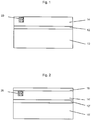
- FIG. 1 shows a schematic representation of a cross section through a sliding bearing composite material according to a first embodiment of the invention. It has a total of three layers.
- a supporting layer 10 made of steel, which ensures the required interference fit of the bearing element due to their rigidity.
- an intermediate layer 12 is arranged with the claimed composition based on aluminum. The intermediate layer serves as a bonding agent between the steel layer 10 and the bearing metal layer 14 arranged on the intermediate layer 12.
- the bearing metal layer 14 has, for example, the following composition: 6 to 8% by weight of tin, 1 to 3% by weight of nickel, 0.5 to 1% by weight of copper, 0.5 to 1% by weight of manganese, 0.2% by weight of vanadium, 0 , 2 wt .-% chromium, 0.2 wt .-% zirconium, balance copper.
- FIG. 1 a surface section 20 shown symbolically, which increases the in FIG. 3 having illustrated internal structure.
- a flat cut is prepared at a suitable point of the bearing metal layer.
- the surface section can also be considered perpendicular to the plane of representation, that is, for example, parallel to the sliding surface.
- the layer thickness of the intermediate layer in the sliding bearing composite material according to the invention is preferably 20 ⁇ m to 50 ⁇ m.
- the particle size distribution of the matrix material furthermore has a favorable influence on the homogeneity of the distribution of the Ni-Mn precipitates, in particular of the Al-Ni-Mn precipitates, and the Al-Cu precipitations along the grain boundaries of the matrix.
- These intermetallic phases form hard particles in the microstructure of the bearing metal layer.
- the second embodiment according to FIG. 2 has the same layer structure in the scope of the steel support layer 10, the intermediate layer 12 and the bearing metal layer 14.
- a polymer coating is applied as a sliding layer 16 on the bearing metal layer 14, which is particularly advantageous in highly stressed storage applications.
- a surface section 20 of the bearing metal layer is selected and marked with a certain edge length and width under a microscope, for example at 500-fold magnification. Let this be, for example, a rectangle with edge lengths of 500 ⁇ m and 800 ⁇ m, ie the measuring surface of 400,000 ⁇ m 2 .
Landscapes
- Engineering & Computer Science (AREA)
- Chemical & Material Sciences (AREA)
- Mechanical Engineering (AREA)
- General Engineering & Computer Science (AREA)
- Materials Engineering (AREA)
- Metallurgy (AREA)
- Organic Chemistry (AREA)
- Sliding-Contact Bearings (AREA)
- Laminated Bodies (AREA)
Claims (10)
- Matériau composite pour palier lisse, avec une couche support (10) en acier, une couche intermédiaire (12) à base d'un alliage d'aluminium exempt de plomb à l'exception d'impuretés et une couche (14) de métal antifriction à base d'un alliage d'aluminium exempt de plomb à l'exception d'impuretés, sachant que l'alliage d'aluminium de la couche intermédiaire (12) présente une composition avecentre 3,5 et 4,5 % en poids de cuivre,entre 0,1 et 1,5 % en poids de manganèse,entre 0,1 et 1,5 % en poids de magnésium,au choix entre 0,1 % et 1,0 % de silicium,au choix entre 0,05 % et 1,0 % de fer,au choix entre 0,05 % et 0,5 % de chrome,au choix entre 0,05 % et 0,5 % de zinc,au choix entre 0,05 % et 0,25 % au total de zirconium et de titane,au choix pas plus de 0,1 % en poids individuellement et pas plus de 0,25 % autotal d'autres composants d'alliage,les impuretés habituelles admissibles et le reste d'aluminium,
et sachant que l'alliage d'aluminium de la couche (14) de métal antifriction présente une composition avecentre 6,0 et 8,0 % en poids d'étain,entre 1,0 et 3,0 % en poids de nickel,entre 0,5 et 1,0 % en poids de manganèse,entre 0,5 et 1,0 en poids de cuivre,entre 0,15 et 0,25 % en poids de chrome,entre 0,1 et 0,3 % en poids de vanadium,au choix entre 0,1 et 0,2 % en poids de zirconium,au choix jusqu' 0,2 % en poids de titane,au choix moins de 0,5 % en poids d'autres éléments,les impuretés habituelles admissibles et le reste d'aluminium,sachant que « à l'exception d'impuretés » signifie que la teneur en plomb est inférieure à 0,1 % en poids. - Matériau composite pour palier lisse selon la revendication 1, caractérisé en ce que la couche intermédiaire (12) présente une épaisseur d2 de 20 µm à 50 µm.
- Matériau composite pour palier lisse selon la revendication 1 ou 2, caractérisé en ce que la couche intermédiaire (12) est appliquée conjointement avec la couche (14) de métal antifriction sur la couche support (10) par le procédé de plaquage par laminage à des températures de plaquage < 300°C.
- Matériau composite pour palier lisse selon l'une des revendications précédentes, caractérisé en ce que la couche intermédiaire (12) présente une microdureté de 70 HV 0,01 à 110 HV 0,01.
- Matériau composite pour palier lisse selon l'une des revendications précédentes, caractérisé en ce que l'alliage d'aluminium de la couche intermédiaire (12) présente, en pourcentages de poids :
manganèse 0,4 % à 1,0 % magnésium 0,4 % à 1,0 % silicium 0,2 % à 0,8 %. - Matériau composite pour palier lisse selon l'une des revendications précédentes, caractérisé en ce que l'alliage d'aluminium de la couche (14) de métal antifriction présente une limite d'élasticité à 0,2 % Rp,0,2 supérieure à 90 MPa et une résistance à la traction supérieure à 145 MPa.
- Matériau composite pour palier lisse selon l'une des revendications précédentes, caractérisé en ce que la couche (14) de métal antifriction présente une épaisseur d de 200 µm à 400 µm.
- Matériau composite pour palier lisse selon l'une des revendications précédentes, caractérisé en ce qu'une couche antifriction (16) à base de polymère est disposée sur la couche (14) de métal antifriction.
- Élément de palier lisse constitué d'un matériau composite pour palier lisse selon l'une des revendications précédentes, caractérisé en ce que l'élément de palier lisse est une coquille de palier, un coussinet de palier lisse ou une rondelle de butée.
- Utilisation du matériau composite pour palier lisse selon l'une des revendications 1 à 8 pour des éléments de palier lisse, en particulier des coquilles de palier lisse, des coussinets de palier lisse ou des rondelles de butée.
Applications Claiming Priority (2)
| Application Number | Priority Date | Filing Date | Title |
|---|---|---|---|
| DE102014220788.6A DE102014220788B4 (de) | 2014-10-14 | 2014-10-14 | Gleitlagerverbundwerkstoff mit Aluminium-Lagermetallschicht |
| PCT/EP2015/071328 WO2016058780A1 (fr) | 2014-10-14 | 2015-09-17 | Matériau composite pour palier lisse présentant une couche de métal antifriction à base d'aluminium, plaquée à chaud |
Publications (2)
| Publication Number | Publication Date |
|---|---|
| EP3207166A1 EP3207166A1 (fr) | 2017-08-23 |
| EP3207166B1 true EP3207166B1 (fr) | 2019-10-23 |
Family
ID=54106382
Family Applications (1)
| Application Number | Title | Priority Date | Filing Date |
|---|---|---|---|
| EP15763366.0A Active EP3207166B1 (fr) | 2014-10-14 | 2015-09-17 | Matériau composite pour palier lisse présentant une couche de métal antifriction à base d'aluminium, plaquée à chaud |
Country Status (8)
| Country | Link |
|---|---|
| US (1) | US10626919B2 (fr) |
| EP (1) | EP3207166B1 (fr) |
| JP (1) | JP2017537218A (fr) |
| KR (1) | KR102471381B1 (fr) |
| CN (1) | CN106574330A (fr) |
| BR (1) | BR112017006744A2 (fr) |
| DE (1) | DE102014220788B4 (fr) |
| WO (1) | WO2016058780A1 (fr) |
Families Citing this family (4)
| Publication number | Priority date | Publication date | Assignee | Title |
|---|---|---|---|---|
| EP2985358B1 (fr) * | 2014-08-14 | 2017-05-03 | KS Gleitlager GmbH | Matériau composite de coussinet |
| DE102020202738A1 (de) * | 2020-03-04 | 2021-09-09 | Mahle International Gmbh | Gleitlager, Verfahren zum Herstellen eines Gleitlagers, Brennkraftmaschine mit Gleitlager sowie elektrische Maschine mit Gleitlager |
| CN112522548B (zh) * | 2020-11-06 | 2022-07-12 | 北京工业大学 | 一种耐磨含Mg铝锡轴瓦合金 |
| GB2607887B (en) * | 2021-06-11 | 2024-07-03 | Mahle Int Gmbh | Sliding element with intermediate layer |
Family Cites Families (11)
| Publication number | Priority date | Publication date | Assignee | Title |
|---|---|---|---|---|
| JP4116166B2 (ja) * | 1998-10-09 | 2008-07-09 | 大豊工業株式会社 | すべり軸受及びその製造方法 |
| GB9929425D0 (en) * | 1999-12-14 | 2000-02-09 | Dana Corp | Bearing materials |
| JP2004360779A (ja) * | 2003-06-04 | 2004-12-24 | Daido Metal Co Ltd | 多層アルミニウム基合金摺動部材 |
| DE102005023541A1 (de) * | 2005-05-21 | 2006-11-23 | Federal-Mogul Wiesbaden Gmbh & Co. Kg | Gleitlagerverbundwerkstoff, Verwendung des Gleitlagerverbundwerkstoffes und Verfahren zur Herstellung des Gleitlagerverbundwerkstoffes |
| GB0613526D0 (en) | 2006-07-07 | 2006-08-16 | Dana Corp | Bearing materials |
| AT503986B1 (de) * | 2006-08-02 | 2008-05-15 | Miba Gleitlager Gmbh | Laufschicht für ein lagerelement |
| JP5399645B2 (ja) * | 2008-03-25 | 2014-01-29 | 大同メタル工業株式会社 | アルミニウム基軸受合金 |
| DE102009002700B3 (de) * | 2009-04-28 | 2010-09-30 | Federal-Mogul Wiesbaden Gmbh | Gleitlagerelement mit bleifreier Aluminium-Lagermetallschicht |
| DE102011003797B3 (de) * | 2011-02-08 | 2012-05-03 | Federal-Mogul Wiesbaden Gmbh | Gleitlagerverbundwerkstoff |
| CN103502665B (zh) | 2011-04-29 | 2016-11-02 | 美国圣戈班性能塑料公司 | 在粘结剂层中具有fep或pfa的免维护滑动轴承 |
| JP2013007395A (ja) * | 2011-06-22 | 2013-01-10 | Daido Metal Co Ltd | Al合金軸受 |
-
2014
- 2014-10-14 DE DE102014220788.6A patent/DE102014220788B4/de not_active Expired - Fee Related
-
2015
- 2015-09-17 JP JP2017514284A patent/JP2017537218A/ja active Pending
- 2015-09-17 BR BR112017006744-7A patent/BR112017006744A2/pt not_active IP Right Cessation
- 2015-09-17 US US15/519,364 patent/US10626919B2/en active Active
- 2015-09-17 CN CN201580040742.XA patent/CN106574330A/zh active Pending
- 2015-09-17 WO PCT/EP2015/071328 patent/WO2016058780A1/fr not_active Ceased
- 2015-09-17 KR KR1020177006366A patent/KR102471381B1/ko active Active
- 2015-09-17 EP EP15763366.0A patent/EP3207166B1/fr active Active
Non-Patent Citations (1)
| Title |
|---|
| None * |
Also Published As
| Publication number | Publication date |
|---|---|
| CN106574330A (zh) | 2017-04-19 |
| DE102014220788B4 (de) | 2016-08-11 |
| WO2016058780A1 (fr) | 2016-04-21 |
| KR102471381B1 (ko) | 2022-11-25 |
| JP2017537218A (ja) | 2017-12-14 |
| EP3207166A1 (fr) | 2017-08-23 |
| DE102014220788A1 (de) | 2016-04-14 |
| KR20170066331A (ko) | 2017-06-14 |
| US10626919B2 (en) | 2020-04-21 |
| US20170248167A1 (en) | 2017-08-31 |
| BR112017006744A2 (pt) | 2018-01-23 |
Similar Documents
| Publication | Publication Date | Title |
|---|---|---|
| AT511196B1 (de) | Mehrschichtlagerschale | |
| EP2673389B1 (fr) | Matériau composite pour paliers lisses | |
| EP2902526B1 (fr) | Palier lisse multicouche | |
| EP2985358B1 (fr) | Matériau composite de coussinet | |
| DE3631029C2 (de) | Zinnhaltige Aluminium-Lagerlegierung und Verwendung derselben für einen Zweischicht-Lagerwerkstoff | |
| AT511432B1 (de) | Verfahren zur herstellung eines gleitlagerelementes | |
| DE3249133C2 (de) | Verfahren zum Herstellen einer Legierung auf Aluminium-Basis für Lager sowie Verwendung der Legierung | |
| EP3374533B1 (fr) | Alliage de laiton à haute résistance et produit d'alliage de laiton à haute résistance | |
| DE4128941C2 (de) | Aluminiumlagerlegierungen mit ausgezeichneter Ermüdungsbeständigkeit und Beständigkeit gegenüber fressendem Verschleiß | |
| WO2018177919A1 (fr) | Palier lisse à trois matériaux plaqué par laminage, doté de deux couches d'aluminum | |
| DE102014220788B4 (de) | Gleitlagerverbundwerkstoff mit Aluminium-Lagermetallschicht | |
| DE4323448C5 (de) | Aluminiumlegierung für mehrschichtige Gleitlager | |
| DE68918900T2 (de) | Lagerlegierung auf Al-Matrizen-Basis. | |
| DE10251457A1 (de) | Gleitelement mit Verbundplattierungsfilm | |
| AT518875B1 (de) | Mehrschichtgleitlagerelement | |
| DE10335086B4 (de) | Mehrschichtiges Lager auf Aluminiumbasis | |
| DE102013210662B4 (de) | Gleitlagerverbundwerkstoff mit Aluminium-Lagermetallschicht | |
| DE102013210663B4 (de) | Gleitlagerverbundwerkstoff mit Aluminium-Zwischenschicht | |
| DE112019006865B4 (de) | Aluminiumlegierung für ein gleitlager, und gleitlager | |
| DE3000775C2 (de) | Zinnhaltige Aluminium-Lagerlegierung | |
| DE102011075580A1 (de) | Lagerlegierung auf Aluminiumbasis und Verfahren zu deren Herstellung | |
| WO2006082000A1 (fr) | Coquille de coussinet de bielle ou coquille de palier principal de moteurs combustion interne | |
| WO2016058632A1 (fr) | Matériau composite pour palier lisse présentant une couche de métal antifriction à base d'aluminium, plaquée à chaud |
Legal Events
| Date | Code | Title | Description |
|---|---|---|---|
| STAA | Information on the status of an ep patent application or granted ep patent |
Free format text: STATUS: THE INTERNATIONAL PUBLICATION HAS BEEN MADE |
|
| PUAI | Public reference made under article 153(3) epc to a published international application that has entered the european phase |
Free format text: ORIGINAL CODE: 0009012 |
|
| STAA | Information on the status of an ep patent application or granted ep patent |
Free format text: STATUS: REQUEST FOR EXAMINATION WAS MADE |
|
| 17P | Request for examination filed |
Effective date: 20170510 |
|
| AK | Designated contracting states |
Kind code of ref document: A1 Designated state(s): AL AT BE BG CH CY CZ DE DK EE ES FI FR GB GR HR HU IE IS IT LI LT LU LV MC MK MT NL NO PL PT RO RS SE SI SK SM TR |
|
| AX | Request for extension of the european patent |
Extension state: BA ME |
|
| DAV | Request for validation of the european patent (deleted) | ||
| DAX | Request for extension of the european patent (deleted) | ||
| STAA | Information on the status of an ep patent application or granted ep patent |
Free format text: STATUS: EXAMINATION IS IN PROGRESS |
|
| 17Q | First examination report despatched |
Effective date: 20180529 |
|
| GRAP | Despatch of communication of intention to grant a patent |
Free format text: ORIGINAL CODE: EPIDOSNIGR1 |
|
| STAA | Information on the status of an ep patent application or granted ep patent |
Free format text: STATUS: GRANT OF PATENT IS INTENDED |
|
| INTG | Intention to grant announced |
Effective date: 20190605 |
|
| GRAS | Grant fee paid |
Free format text: ORIGINAL CODE: EPIDOSNIGR3 |
|
| GRAA | (expected) grant |
Free format text: ORIGINAL CODE: 0009210 |
|
| STAA | Information on the status of an ep patent application or granted ep patent |
Free format text: STATUS: THE PATENT HAS BEEN GRANTED |
|
| AK | Designated contracting states |
Kind code of ref document: B1 Designated state(s): AL AT BE BG CH CY CZ DE DK EE ES FI FR GB GR HR HU IE IS IT LI LT LU LV MC MK MT NL NO PL PT RO RS SE SI SK SM TR |
|
| REG | Reference to a national code |
Ref country code: GB Ref legal event code: FG4D Free format text: NOT ENGLISH |
|
| REG | Reference to a national code |
Ref country code: CH Ref legal event code: EP |
|
| REG | Reference to a national code |
Ref country code: IE Ref legal event code: FG4D Free format text: LANGUAGE OF EP DOCUMENT: GERMAN |
|
| REG | Reference to a national code |
Ref country code: DE Ref legal event code: R096 Ref document number: 502015010758 Country of ref document: DE |
|
| REG | Reference to a national code |
Ref country code: AT Ref legal event code: REF Ref document number: 1193693 Country of ref document: AT Kind code of ref document: T Effective date: 20191115 |
|
| REG | Reference to a national code |
Ref country code: NL Ref legal event code: MP Effective date: 20191023 |
|
| REG | Reference to a national code |
Ref country code: LT Ref legal event code: MG4D |
|
| PG25 | Lapsed in a contracting state [announced via postgrant information from national office to epo] |
Ref country code: PT Free format text: LAPSE BECAUSE OF FAILURE TO SUBMIT A TRANSLATION OF THE DESCRIPTION OR TO PAY THE FEE WITHIN THE PRESCRIBED TIME-LIMIT Effective date: 20200224 Ref country code: NO Free format text: LAPSE BECAUSE OF FAILURE TO SUBMIT A TRANSLATION OF THE DESCRIPTION OR TO PAY THE FEE WITHIN THE PRESCRIBED TIME-LIMIT Effective date: 20200123 Ref country code: LT Free format text: LAPSE BECAUSE OF FAILURE TO SUBMIT A TRANSLATION OF THE DESCRIPTION OR TO PAY THE FEE WITHIN THE PRESCRIBED TIME-LIMIT Effective date: 20191023 Ref country code: GR Free format text: LAPSE BECAUSE OF FAILURE TO SUBMIT A TRANSLATION OF THE DESCRIPTION OR TO PAY THE FEE WITHIN THE PRESCRIBED TIME-LIMIT Effective date: 20200124 Ref country code: PL Free format text: LAPSE BECAUSE OF FAILURE TO SUBMIT A TRANSLATION OF THE DESCRIPTION OR TO PAY THE FEE WITHIN THE PRESCRIBED TIME-LIMIT Effective date: 20191023 Ref country code: LV Free format text: LAPSE BECAUSE OF FAILURE TO SUBMIT A TRANSLATION OF THE DESCRIPTION OR TO PAY THE FEE WITHIN THE PRESCRIBED TIME-LIMIT Effective date: 20191023 Ref country code: SE Free format text: LAPSE BECAUSE OF FAILURE TO SUBMIT A TRANSLATION OF THE DESCRIPTION OR TO PAY THE FEE WITHIN THE PRESCRIBED TIME-LIMIT Effective date: 20191023 Ref country code: NL Free format text: LAPSE BECAUSE OF FAILURE TO SUBMIT A TRANSLATION OF THE DESCRIPTION OR TO PAY THE FEE WITHIN THE PRESCRIBED TIME-LIMIT Effective date: 20191023 Ref country code: BG Free format text: LAPSE BECAUSE OF FAILURE TO SUBMIT A TRANSLATION OF THE DESCRIPTION OR TO PAY THE FEE WITHIN THE PRESCRIBED TIME-LIMIT Effective date: 20200123 Ref country code: FI Free format text: LAPSE BECAUSE OF FAILURE TO SUBMIT A TRANSLATION OF THE DESCRIPTION OR TO PAY THE FEE WITHIN THE PRESCRIBED TIME-LIMIT Effective date: 20191023 |
|
| PG25 | Lapsed in a contracting state [announced via postgrant information from national office to epo] |
Ref country code: HR Free format text: LAPSE BECAUSE OF FAILURE TO SUBMIT A TRANSLATION OF THE DESCRIPTION OR TO PAY THE FEE WITHIN THE PRESCRIBED TIME-LIMIT Effective date: 20191023 Ref country code: IS Free format text: LAPSE BECAUSE OF FAILURE TO SUBMIT A TRANSLATION OF THE DESCRIPTION OR TO PAY THE FEE WITHIN THE PRESCRIBED TIME-LIMIT Effective date: 20200224 Ref country code: RS Free format text: LAPSE BECAUSE OF FAILURE TO SUBMIT A TRANSLATION OF THE DESCRIPTION OR TO PAY THE FEE WITHIN THE PRESCRIBED TIME-LIMIT Effective date: 20191023 |
|
| PG25 | Lapsed in a contracting state [announced via postgrant information from national office to epo] |
Ref country code: AL Free format text: LAPSE BECAUSE OF FAILURE TO SUBMIT A TRANSLATION OF THE DESCRIPTION OR TO PAY THE FEE WITHIN THE PRESCRIBED TIME-LIMIT Effective date: 20191023 |
|
| REG | Reference to a national code |
Ref country code: DE Ref legal event code: R097 Ref document number: 502015010758 Country of ref document: DE |
|
| PG2D | Information on lapse in contracting state deleted |
Ref country code: IS |
|
| PG25 | Lapsed in a contracting state [announced via postgrant information from national office to epo] |
Ref country code: DK Free format text: LAPSE BECAUSE OF FAILURE TO SUBMIT A TRANSLATION OF THE DESCRIPTION OR TO PAY THE FEE WITHIN THE PRESCRIBED TIME-LIMIT Effective date: 20191023 Ref country code: EE Free format text: LAPSE BECAUSE OF FAILURE TO SUBMIT A TRANSLATION OF THE DESCRIPTION OR TO PAY THE FEE WITHIN THE PRESCRIBED TIME-LIMIT Effective date: 20191023 Ref country code: ES Free format text: LAPSE BECAUSE OF FAILURE TO SUBMIT A TRANSLATION OF THE DESCRIPTION OR TO PAY THE FEE WITHIN THE PRESCRIBED TIME-LIMIT Effective date: 20191023 Ref country code: CZ Free format text: LAPSE BECAUSE OF FAILURE TO SUBMIT A TRANSLATION OF THE DESCRIPTION OR TO PAY THE FEE WITHIN THE PRESCRIBED TIME-LIMIT Effective date: 20191023 Ref country code: RO Free format text: LAPSE BECAUSE OF FAILURE TO SUBMIT A TRANSLATION OF THE DESCRIPTION OR TO PAY THE FEE WITHIN THE PRESCRIBED TIME-LIMIT Effective date: 20191023 Ref country code: IS Free format text: LAPSE BECAUSE OF FAILURE TO SUBMIT A TRANSLATION OF THE DESCRIPTION OR TO PAY THE FEE WITHIN THE PRESCRIBED TIME-LIMIT Effective date: 20200223 |
|
| PLBE | No opposition filed within time limit |
Free format text: ORIGINAL CODE: 0009261 |
|
| STAA | Information on the status of an ep patent application or granted ep patent |
Free format text: STATUS: NO OPPOSITION FILED WITHIN TIME LIMIT |
|
| PG25 | Lapsed in a contracting state [announced via postgrant information from national office to epo] |
Ref country code: SK Free format text: LAPSE BECAUSE OF FAILURE TO SUBMIT A TRANSLATION OF THE DESCRIPTION OR TO PAY THE FEE WITHIN THE PRESCRIBED TIME-LIMIT Effective date: 20191023 Ref country code: IT Free format text: LAPSE BECAUSE OF FAILURE TO SUBMIT A TRANSLATION OF THE DESCRIPTION OR TO PAY THE FEE WITHIN THE PRESCRIBED TIME-LIMIT Effective date: 20191023 Ref country code: SM Free format text: LAPSE BECAUSE OF FAILURE TO SUBMIT A TRANSLATION OF THE DESCRIPTION OR TO PAY THE FEE WITHIN THE PRESCRIBED TIME-LIMIT Effective date: 20191023 |
|
| 26N | No opposition filed |
Effective date: 20200724 |
|
| PG25 | Lapsed in a contracting state [announced via postgrant information from national office to epo] |
Ref country code: SI Free format text: LAPSE BECAUSE OF FAILURE TO SUBMIT A TRANSLATION OF THE DESCRIPTION OR TO PAY THE FEE WITHIN THE PRESCRIBED TIME-LIMIT Effective date: 20191023 |
|
| REG | Reference to a national code |
Ref country code: CH Ref legal event code: PL |
|
| GBPC | Gb: european patent ceased through non-payment of renewal fee |
Effective date: 20200917 |
|
| REG | Reference to a national code |
Ref country code: BE Ref legal event code: MM Effective date: 20200930 |
|
| PG25 | Lapsed in a contracting state [announced via postgrant information from national office to epo] |
Ref country code: LU Free format text: LAPSE BECAUSE OF NON-PAYMENT OF DUE FEES Effective date: 20200917 |
|
| PG25 | Lapsed in a contracting state [announced via postgrant information from national office to epo] |
Ref country code: FR Free format text: LAPSE BECAUSE OF NON-PAYMENT OF DUE FEES Effective date: 20200930 |
|
| PG25 | Lapsed in a contracting state [announced via postgrant information from national office to epo] |
Ref country code: LI Free format text: LAPSE BECAUSE OF NON-PAYMENT OF DUE FEES Effective date: 20200930 Ref country code: GB Free format text: LAPSE BECAUSE OF NON-PAYMENT OF DUE FEES Effective date: 20200917 Ref country code: IE Free format text: LAPSE BECAUSE OF NON-PAYMENT OF DUE FEES Effective date: 20200917 Ref country code: CH Free format text: LAPSE BECAUSE OF NON-PAYMENT OF DUE FEES Effective date: 20200930 Ref country code: BE Free format text: LAPSE BECAUSE OF NON-PAYMENT OF DUE FEES Effective date: 20200930 |
|
| REG | Reference to a national code |
Ref country code: DE Ref legal event code: R082 Ref document number: 502015010758 Country of ref document: DE Representative=s name: WSL PATENTANWAELTE PARTNERSCHAFT MBB, DE |
|
| PG25 | Lapsed in a contracting state [announced via postgrant information from national office to epo] |
Ref country code: TR Free format text: LAPSE BECAUSE OF FAILURE TO SUBMIT A TRANSLATION OF THE DESCRIPTION OR TO PAY THE FEE WITHIN THE PRESCRIBED TIME-LIMIT Effective date: 20191023 Ref country code: MT Free format text: LAPSE BECAUSE OF FAILURE TO SUBMIT A TRANSLATION OF THE DESCRIPTION OR TO PAY THE FEE WITHIN THE PRESCRIBED TIME-LIMIT Effective date: 20191023 Ref country code: CY Free format text: LAPSE BECAUSE OF FAILURE TO SUBMIT A TRANSLATION OF THE DESCRIPTION OR TO PAY THE FEE WITHIN THE PRESCRIBED TIME-LIMIT Effective date: 20191023 |
|
| PG25 | Lapsed in a contracting state [announced via postgrant information from national office to epo] |
Ref country code: MK Free format text: LAPSE BECAUSE OF FAILURE TO SUBMIT A TRANSLATION OF THE DESCRIPTION OR TO PAY THE FEE WITHIN THE PRESCRIBED TIME-LIMIT Effective date: 20191023 Ref country code: MC Free format text: LAPSE BECAUSE OF FAILURE TO SUBMIT A TRANSLATION OF THE DESCRIPTION OR TO PAY THE FEE WITHIN THE PRESCRIBED TIME-LIMIT Effective date: 20191023 |
|
| P01 | Opt-out of the competence of the unified patent court (upc) registered |
Effective date: 20230528 |
|
| PGFP | Annual fee paid to national office [announced via postgrant information from national office to epo] |
Ref country code: DE Payment date: 20250820 Year of fee payment: 11 |
|
| PGFP | Annual fee paid to national office [announced via postgrant information from national office to epo] |
Ref country code: AT Payment date: 20250822 Year of fee payment: 11 |