EP3207878A1 - Dispositif de diagnostic à ultrasons - Google Patents
Dispositif de diagnostic à ultrasons Download PDFInfo
- Publication number
- EP3207878A1 EP3207878A1 EP15850434.0A EP15850434A EP3207878A1 EP 3207878 A1 EP3207878 A1 EP 3207878A1 EP 15850434 A EP15850434 A EP 15850434A EP 3207878 A1 EP3207878 A1 EP 3207878A1
- Authority
- EP
- European Patent Office
- Prior art keywords
- transmission
- reception
- sub
- forming
- image
- Prior art date
- Legal status (The legal status is an assumption and is not a legal conclusion. Google has not performed a legal analysis and makes no representation as to the accuracy of the status listed.)
- Withdrawn
Links
- 238000002604 ultrasonography Methods 0.000 title claims description 26
- 230000005540 biological transmission Effects 0.000 claims abstract description 280
- 238000000034 method Methods 0.000 claims description 58
- 238000009826 distribution Methods 0.000 claims description 17
- 238000003491 array Methods 0.000 claims description 7
- 230000015572 biosynthetic process Effects 0.000 claims description 6
- 238000003786 synthesis reaction Methods 0.000 claims description 5
- 238000003384 imaging method Methods 0.000 description 18
- 230000006870 function Effects 0.000 description 15
- 238000010586 diagram Methods 0.000 description 14
- 230000002194 synthesizing effect Effects 0.000 description 4
- 239000000523 sample Substances 0.000 description 3
- 230000035945 sensitivity Effects 0.000 description 3
- 238000006243 chemical reaction Methods 0.000 description 2
- 238000003745 diagnosis Methods 0.000 description 2
- 238000001514 detection method Methods 0.000 description 1
- 229910003460 diamond Inorganic materials 0.000 description 1
- 239000010432 diamond Substances 0.000 description 1
- 230000007717 exclusion Effects 0.000 description 1
- 230000002265 prevention Effects 0.000 description 1
- 238000003325 tomography Methods 0.000 description 1
Images






Classifications
-
- A—HUMAN NECESSITIES
- A61—MEDICAL OR VETERINARY SCIENCE; HYGIENE
- A61B—DIAGNOSIS; SURGERY; IDENTIFICATION
- A61B8/00—Diagnosis using ultrasonic, sonic or infrasonic waves
- A61B8/52—Devices using data or image processing specially adapted for diagnosis using ultrasonic, sonic or infrasonic waves
- A61B8/5215—Devices using data or image processing specially adapted for diagnosis using ultrasonic, sonic or infrasonic waves involving processing of medical diagnostic data
- A61B8/5238—Devices using data or image processing specially adapted for diagnosis using ultrasonic, sonic or infrasonic waves involving processing of medical diagnostic data for combining image data of patient, e.g. merging several images from different acquisition modes into one image
- A61B8/5246—Devices using data or image processing specially adapted for diagnosis using ultrasonic, sonic or infrasonic waves involving processing of medical diagnostic data for combining image data of patient, e.g. merging several images from different acquisition modes into one image combining images from the same or different imaging techniques, e.g. color Doppler and B-mode
- A61B8/5253—Devices using data or image processing specially adapted for diagnosis using ultrasonic, sonic or infrasonic waves involving processing of medical diagnostic data for combining image data of patient, e.g. merging several images from different acquisition modes into one image combining images from the same or different imaging techniques, e.g. color Doppler and B-mode combining overlapping images, e.g. spatial compounding
-
- G—PHYSICS
- G01—MEASURING; TESTING
- G01S—RADIO DIRECTION-FINDING; RADIO NAVIGATION; DETERMINING DISTANCE OR VELOCITY BY USE OF RADIO WAVES; LOCATING OR PRESENCE-DETECTING BY USE OF THE REFLECTION OR RERADIATION OF RADIO WAVES; ANALOGOUS ARRANGEMENTS USING OTHER WAVES
- G01S15/00—Systems using the reflection or reradiation of acoustic waves, e.g. sonar systems
- G01S15/88—Sonar systems specially adapted for specific applications
- G01S15/89—Sonar systems specially adapted for specific applications for mapping or imaging
- G01S15/8906—Short-range imaging systems; Acoustic microscope systems using pulse-echo techniques
- G01S15/8997—Short-range imaging systems; Acoustic microscope systems using pulse-echo techniques using synthetic aperture techniques
-
- A—HUMAN NECESSITIES
- A61—MEDICAL OR VETERINARY SCIENCE; HYGIENE
- A61B—DIAGNOSIS; SURGERY; IDENTIFICATION
- A61B8/00—Diagnosis using ultrasonic, sonic or infrasonic waves
- A61B8/13—Tomography
- A61B8/14—Echo-tomography
-
- A—HUMAN NECESSITIES
- A61—MEDICAL OR VETERINARY SCIENCE; HYGIENE
- A61B—DIAGNOSIS; SURGERY; IDENTIFICATION
- A61B8/00—Diagnosis using ultrasonic, sonic or infrasonic waves
- A61B8/13—Tomography
- A61B8/14—Echo-tomography
- A61B8/145—Echo-tomography characterised by scanning multiple planes
-
- A—HUMAN NECESSITIES
- A61—MEDICAL OR VETERINARY SCIENCE; HYGIENE
- A61B—DIAGNOSIS; SURGERY; IDENTIFICATION
- A61B8/00—Diagnosis using ultrasonic, sonic or infrasonic waves
- A61B8/44—Constructional features of the ultrasonic, sonic or infrasonic diagnostic device
- A61B8/4483—Constructional features of the ultrasonic, sonic or infrasonic diagnostic device characterised by features of the ultrasound transducer
- A61B8/4494—Constructional features of the ultrasonic, sonic or infrasonic diagnostic device characterised by features of the ultrasound transducer characterised by the arrangement of the transducer elements
-
- A—HUMAN NECESSITIES
- A61—MEDICAL OR VETERINARY SCIENCE; HYGIENE
- A61B—DIAGNOSIS; SURGERY; IDENTIFICATION
- A61B8/00—Diagnosis using ultrasonic, sonic or infrasonic waves
- A61B8/46—Ultrasonic, sonic or infrasonic diagnostic devices with special arrangements for interfacing with the operator or the patient
- A61B8/461—Displaying means of special interest
-
- A—HUMAN NECESSITIES
- A61—MEDICAL OR VETERINARY SCIENCE; HYGIENE
- A61B—DIAGNOSIS; SURGERY; IDENTIFICATION
- A61B8/00—Diagnosis using ultrasonic, sonic or infrasonic waves
- A61B8/52—Devices using data or image processing specially adapted for diagnosis using ultrasonic, sonic or infrasonic waves
- A61B8/5207—Devices using data or image processing specially adapted for diagnosis using ultrasonic, sonic or infrasonic waves involving processing of raw data to produce diagnostic data, e.g. for generating an image
-
- A—HUMAN NECESSITIES
- A61—MEDICAL OR VETERINARY SCIENCE; HYGIENE
- A61B—DIAGNOSIS; SURGERY; IDENTIFICATION
- A61B8/00—Diagnosis using ultrasonic, sonic or infrasonic waves
- A61B8/54—Control of the diagnostic device
-
- G—PHYSICS
- G01—MEASURING; TESTING
- G01S—RADIO DIRECTION-FINDING; RADIO NAVIGATION; DETERMINING DISTANCE OR VELOCITY BY USE OF RADIO WAVES; LOCATING OR PRESENCE-DETECTING BY USE OF THE REFLECTION OR RERADIATION OF RADIO WAVES; ANALOGOUS ARRANGEMENTS USING OTHER WAVES
- G01S7/00—Details of systems according to groups G01S13/00, G01S15/00, G01S17/00
- G01S7/52—Details of systems according to groups G01S13/00, G01S15/00, G01S17/00 of systems according to group G01S15/00
- G01S7/52017—Details of systems according to groups G01S13/00, G01S15/00, G01S17/00 of systems according to group G01S15/00 particularly adapted to short-range imaging
- G01S7/52046—Techniques for image enhancement involving transmitter or receiver
Definitions
- the present invention relates to an ultrasound diagnostic device, and particular to an ultrasound diagnostic device that forms an ultrasonic image based on a synthetic aperture imaging method (virtual source method) using a virtual source.
- a synthetic aperture imaging method virtual source method
- the synthetic aperture imaging method using virtual sources is a method of forming an ultrasonic image using synthetic transmission aperture imaging technology on the assumption that a plurality of transmission focal points are regarded as a plurality of sound sources (virtual sources) (Non-Patent Document 1, Patent Document 1, and Patent Document 2).
- the virtual source method upon delay processing of a group of reception signals, in addition to the conventionally used delay conditions for reception focusing, delay conditions for observing spherical waves emitted from each virtual source are added. If parallel reception is performed (or, if synthetic reception aperture imaging is performed) under the virtual source method, one low-resolution image (LRI) as one sub-image is obtained.
- an ultrasonic image as a high-resolution image is formed.
- the virtual source method when the plurality of low-resolution images are synthesized, a plurality of spherical wave components derived from a plurality of virtual sources are added per pixel (each reception point) after their phases are matched.
- the low-resolution images can be recognized regardless of whether before or after scan conversion processing.
- Non-Patent Document 1 S. I. Nikolov, et al. "Practical Applications of Synthetic Aperture Imaging", IEEE IUS, 2010 . (BK Medical)
- Patent Document 2 discloses overcoming the issue of the above-described low sound pressure region by observing spherical waves (edge waves) emitted from each end of a transducer. However, it should be stated that the method is not enough to cancel the above low sound pressure region sufficiently.
- An object of the present invention is to enhance the image quality of an ultrasonic image formed based on the virtual source method.
- an object of the present invention is to prevent or minimize occurrence of a low sound pressure area or low image quality area between adjacent sub-images (low-resolution images).
- an object of the present invention is to minimize occurrence of a low sound pressure area or low image quality area between adjacent virtual sources on the scanning plane.
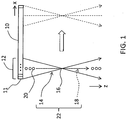
- An array transducer 10 is composed of a plurality of transducer elements 11 arranged linearly along the x direction in FIG. 1 .
- the x direction is a scanning direction (element array direction)
- the z direction is a depth direction (beam direction).
- a transmission aperture 12 is set on the array transducer 10, and by exciting the plurality of transducer elements belonging to it with a certain delay relationship, a transmission beam 14 is formed.
- the transmission beam 14 has a transmission focal point 16 formed at a set depth. In the transmission beam 14, the shallower side (upper side) and the deeper side (lower side) in relation to the transmission focal point become gradually wider as they go further away from the transmission focal point. In each drawing, the transmission beam is depicted schematically.
- Reference numeral 18 represents a piece of reception beam data corresponding to a reception beam.
- the reception beam data 18 is obtained by applying delay summing processing while dynamically changing delay conditions for a plurality of element reception signals output from a plurality of transducer elements in a reception aperture. Delay summing processing is also referred to as phasing alignment processing which is known processing.
- the reception beam data 18 is composed of a plurality of pieces of reception data (echo data) 20 corresponding to a plurality of reception points (sample points) arranged in the depth direction. There are cases where the transmission aperture and the reception aperture are identical, and cases where they differ.
- Reference numeral 22 indicates a transmission and reception beam set composed of the transmission beam 14 and the reception beam (in FIG. 1 , the reception beam data 18 corresponding to the reception beam is shown).
- the transmission and reception beam set 22 By forming the transmission and reception beam set 22 at each position in the scanning direction, a plurality of pieces of reception beam data 18 equivalent to one scanning plane; that is, one reception frame, can be obtained.
- FIG. 2 shows an example of the virtual source method.
- a transmission signal line array 24 is connected to the array transducer 10, and a reception signal line array 26 is drawn out from the middle of the signal line array 24.
- a transmission aperture X0 is set for the array transducer 10, and the plurality of transducer elements belonging to it are provided with a plurality of transmission signals having a delay relationship indicated by a delay curve 28.
- a transmission beam 30a formed.
- the transmission beam 30a has a transmission focal point 32a.
- Those transmission beams have a transmission focal point 32b, a transmission focal point 32c ....
- FIG. 1 shows an example of the virtual source method.
- a plurality of reception beams are formed for each transmission beam so as to cover the whole or the main part of the transmission beam area by applying the parallel reception technology.
- a reception point p will now be examined.
- the reception point p is covered with the three transmission beams 30a, 30b, and 30c.
- the reception point p is associated with the three transmission beams 30a, 30b, and 30c.
- Each transmission focal point 32a, 32b, and 32c can be regarded as a virtual source (hereinafter, depending on circumstances, "transmission focal point” will be referred to as "virtual source”). That is, it is possible to recognize, on the near side and the far side of each virtual focal point, spherical waves having each virtual source as an origin.
- FIG. 2 shows spherical waves coming from the virtual source 32a.
- Three spherical wave components 36a, 36b, and 36c respectively derived from the three virtual sources 32a, 32b, and 32c arrive at the reception point p.
- delay summing processing is performed in consideration of the delay conditions corresponding to the distance between the virtual source 32a and the reception point p in addition to the delay conditions for realizing normal reception dynamic focus at the reception point p.
- Non-Patent Document 1 provides a detailed description of a delay time for realizing synthetic transmission aperture imaging.
- the image quality of an ultrasonic image can be enhanced.
- the image quality of an ultrasonic image can be enhanced, it is possible to reduce the number of transmission beams accordingly and improve the frame rate.
- a virtual source range that is, a virtual source aperture
- synthetic transmission aperture imaging is equivalent to the scanning direction width of the transmission beam at the depth where the reception point p exists.
- FIG. 3 shows a plurality of sub-images 40.
- One sub-image 40 corresponds to one transmission and reception beam set.
- a reception beam array 46 is formed for one transmission beam 44 so as to cover it.
- the reception beam array 46 is composed of a plurality of reception beams 46a to 46e arranged in the scanning direction.
- a portion deviated from an area of the transmission beam 44 is considered to be invalid because the sensitivity suitable for imaging cannot be obtained from it.
- an interval 48 near the transmission focal point 45 in the reception beam 46d is an invalid portion.
- the other portions of the reception beam 46d are valid portions. Invalidation processing of data in the invalid portion can be performed, for example, when the reception beam data is formed or when weighting processing is performed later, as will be described later.
- the reception beam array 46 is a 2D reception data array; that is, it constitutes a sub-image 52. Because the sub-image 52 is an image obtained before synthetic transmission aperture imaging processing, it is a low-resolution image.
- the sub-image 52 is composed of an inversed triangle portion 52A present on the near side of the transmission focal point 45 and a triangle portion 52B present on the far side of the transmission focal point 45. In the example shown in FIG. 3 , a plurality of sub-images constituting an ultrasonic image have the same shape.
- a low sound pressure region 58 is generated as a gap between individual adjacent sub-images.
- each low sound pressure region 58 is represented as a figure having a diamond shape.
- Each low sound pressure region 58 is a region deviated from the area of the transmission beam 44, and is an area that is not suitable for imaging. Therefore, in processing of the reception beam data, the invalidation processing described above is applied. If a plurality of sub-images 52 are synthesized to form an ultrasonic image, a plurality of low image quality regions corresponding to the plurality of low sound pressure regions 58 are generated. As such, if the plurality of virtual sources are uniformly set at the same depth, it is difficult to enhance the image quality of an ultrasonic image.
- FIG. 4 shows a preferred embodiment of an ultrasound diagnostic device according to the present invention.
- This ultrasound diagnostic device is located in medical organizations and performs ultrasonic diagnosis of the human body.
- This ultrasound diagnostic device has a function of forming an ultrasonic image according to the virtual source method.
- the ultrasonic image is a B-mode tomography image, for example.
- a plurality of virtual sources are arranged in two dimensions so as not to generate the low sound pressure regions described above.
- a probe 60 is a transducer that transmits and receives ultrasonic waves while it is in contact with a living body.
- the probe 60 has an array transducer.
- the array transducer forms an ultrasonic beam, and that ultrasonic beam is electronically scanned.
- an electronic linear scanning method is used as an electronic scanning method.
- Other electronic scanning methods include an electronic sector scanning method, for example.
- An electronic convex scanning method is known as an embodiment of the electronic linear scanning method.
- a transmission unit 62 is a transmission beam former configured as an electronic circuit.
- the transmission unit 62 provides the array transducer with a plurality of transmission signals having a predetermined delay relationship. In doing so, a transmission beam is formed.
- a transmission beam is formed repeatedly, while its transmission position is changed in the scanning direction.
- a first transmission beam having a first transmission focal point at a first depth and a second transmission beam having a second transmission focal point at a second depth are formed alternately.
- the first depth is set, for example, at a shallow position
- the second depth is set, for example, at a position that is deeper than the first depth.
- first transmission beam for example, a small first transmission aperture is set
- second transmission aperture that is larger than the first transmission aperture
- the shape of the first transmission beam and the shape of the second transmission beam differ from each other.
- a 2D pattern of a plurality of transmission focal points that is, a plurality of virtual sources
- FIG. 5 to FIG. 8 a detailed description will be provided later with reference to FIG. 5 to FIG. 8 .
- a reception unit 64 is a reception beam former configured as an electronic circuit. Specifically, the reception unit 64 has a parallel reception function of forming a plurality of reception beams (a plurality of pieces of reception beam data) for one transmission beam. Upon forming of the individual reception beams, the reception dynamic focus technology is applied. Specifically, the reception unit has a delay circuit and an adder circuit that respectively perform delay processing and summing processing. In addition, the reception unit has an A/D converter or the like.
- the delay summing processing described above is composed of delay processing and summing processing. In the delay circuit, delay processing is performed on a plurality of element reception signals taken from the reception aperture.
- a delay time includes a delay time for reception dynamic focus and a delay time for spherical wave components from the virtual sources (transmission focal points).
- delay processing according to the virtual source method is performed.
- the plurality of element reception signals subjected to delay processing are added in the adder circuit, and, with this process, reception beam data is obtained.
- a plurality of pieces of reception beam data are simultaneously obtained for one transmission beam by time-division processing. Those pieces of reception beam data constitute a sub-image.
- Each reception beam data is composed of a plurality of pieces of reception data corresponding to a plurality of reception points, and each piece of reception data is equivalent to an RF signal.
- the reception unit 64 has a synthetic circuit that synthesizes the plurality of sub-images spatially and forms an ultrasonic image.
- the ultrasonic image is a data array before scan conversion.
- a first sub-image having a shape according to the shape of the first transmission beam is generated.
- a second sub-image having a shape according to the shape of the second transmission beam is generated. Due to scanning of the ultrasonic beams, the first sub-image and the second sub-image are obtained alternately.
- the synthetic circuit adds those sub-images sequentially, and forms an ultrasonic image in the end. Upon sequential synthesizing of the sub-images, the below-described weighting processing is performed. Functions of the reception unit 64 will be described later with reference to FIG. 9 and FIG. 10 .
- a control unit 66 is composed of a CPU and an operation program, and its transmission and reception control function is indicated as a block (transmission and reception control unit) 68 in FIG. 4 .
- the transmission and reception control unit 68 controls the transmission unit 62 and the reception unit 64, in order to realize the virtual source method.
- a group of parameters that determine a 2D virtual source array are set by the transmission and reception control unit 68.
- a beam data processing unit 70 is provided with circuits, such as a detector circuit and a logarithmic compressor circuit. Each reception beam data is processed by them in a stepwise manner. The reception beam data subjected to their processing are sent to an image forming unit 72.
- the image forming unit 72 is composed of a digital scan converter as an electronic circuit. It has functions of, for example, converting a data array according to a transmission and reception coordinate system to a data array according to a display coordinate system, interpolating the data, and adjusting the frame rate.
- a display frame data is generated in the image forming unit 72 and sent to a display 76 via a display processing unit 74.
- the display 76 displays the display frame data. For example, a B-mode tomographic image is displayed on the screen.
- An operation panel 78 is an input device which has, for example, a track ball and a keyboard.
- the control unit 66 executes operation control of each component shown in FIG. 4 .
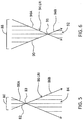
- FIG. 5 and FIG. 6 schematically show a first transmission and reception beam set and a second transmission and reception beam set that are formed alternately in the ultrasound diagnostic device according to the present embodiment.
- the first transmission and reception beam set shown in FIG. 5 is composed of a transmission beam 82 having a first transmission focal point 83 present at a first depth, and a reception beam array 84 provided so as to cover it.
- Reference numeral 80 indicates a first transmission aperture.
- the reception beam array 84 is composed of a plurality of reception beams arranged in the scanning direction, and, except for the reception beam in the center, each reception beam has an invalid portion which is a portion generated on the outside of the transmission beam area.
- the reception beam array is equivalent to a reception beam data array which is equivalent to a sub-image 86.
- the second transmission and reception beam set shown in FIG. 6 is composed of a transmission beam 90 having a second transmission focal point 91 present at a second depth that is deeper than the first depth, and a reception beam array 92 provided so as to cover it.
- Reference numeral 88 indicates a second transmission aperture. That second transmission aperture 88 is larger than the first transmission aperture 80.
- the reception beam array 92 is composed of a plurality of reception beams arranged in the scanning direction, and, except for the reception beam in the center, each reception beam has an invalid portion which is a portion generated on the outside of the transmission beam area.
- the reception beam array is equivalent to a reception beam data array which is equivalent to a sub-image 94.
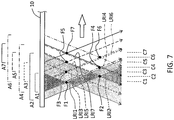
- FIG. 7 shows a case where the first transmission and reception beam set and the second transmission and reception beam set are formed alternately in a repeated manner while their transmission and reception positions are changed in the scanning direction.
- a transmission aperture (first transmission aperture) A1 is set using a position C1 as the center, and a transmission beam (first transmission beam) having a transmission focal point (first transmission focal point) F1 is formed.
- a plurality of pieces of reception beam data are obtained by delay summing processing according to the virtual source method and the parallel reception technology. They constitute a sub-image (first sub-image) LRI1.
- the sub-image LRI1 is composed of a small inversed triangle area present on the near side of the transmission focal point F1 and a large triangle area present on the far side of the transmission focal point F1.
- a transmission aperture (second transmission aperture) A2 is set using a position C2 as the center, and a transmission beam (second transmission beam) having a transmission focal point (second transmission focal point) F2 is formed.
- a plurality of pieces of reception beam data are obtained by delay summing processing according to the virtual source method and the parallel reception technology. They constitute a sub-image LRI2.
- the sub-image LRI2 is composed of a large inversed triangle area present on the near side of the transmission focal point F2 and a small triangle area present on the far side of the transmission focal point F2.
- FIG. 7 shows seven sub-images LRI1 to LRI7.
- Each reception point belonging to a main portion (middle portion) of the scanning plane is associated with two or more transmission beams; that is, that reception point is covered with two or more sub-images.
- Within the scanning plane there are also some reception points, each associated with only one transmission beam. In reality, each of a number of reception points is covered with a number of sub-images.
- C1 to C7 indicate center positions of the individual sub-images.
- F1 to F7 indicate virtual sources (transmission focal points) in the individual sub-images.
- A1 to A7 indicate individual transmission apertures.
- a 2D virtual source array having a 2D zigzag pattern is formed as a result.
- the depth of a certain virtual source differs from the depth of virtual sources on both sides of it.
- the plurality of sub-images are overlapped partly in a repeated manner, thereby preventing occurrence of a plurality of low sound pressure regions. Namely, both side areas of the virtual source of the first sub-image are covered with two second sub-images present on both sides of that first sub-image.
- the virtual source pitch it is preferable to reduce the virtual source pitch, as long as a requested frame rate is satisfied.
- F # that is, transmission focal point distance/transmission aperture width
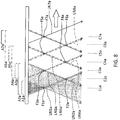
- FIG. 8 shows a second example of the 2D virtual source array.
- the virtual source pitch is extended to the maximum limit in the scanning direction.
- the first transmission and reception beam set and the second transmission and reception beam set are also formed alternately in a repeated manner while their transmission and reception positions are changed in the scanning direction.
- a transmission aperture (first transmission aperture) A 1 a is set using a position C 1 a as the center, and a transmission beam (first transmission beam) having a transmission focal point (first transmission focal point) F1a is formed. Then, a plurality of pieces of reception beam data are obtained by delay summing processing according to the virtual source method and the parallel reception technology. They constitute a sub-image (first sub-image) LRI1a.
- a transmission aperture (second transmission aperture) A2a is set using a position C2a as the center, and a transmission beam (second transmission beam) having a transmission focal point (second transmission focal point) F2a is formed.
- a plurality of pieces of reception beam data are obtained by delay summing processing according to the virtual source method and the parallel reception technology. They constitute a sub-image (first sub-image) LRI2a.
- the transmission aperture A2a, the transmission focal point F2a, and the like are set such that the rear edge of the transmission beam having the transmission focal point F2a (edge on the rear side in the scanning direction) slightly overlaps with the front edge of the transmission beam having the transmission focal point F1a (edge on the near side in the scanning direction) without a gap.
- the third and the following sub-images LRI3a to LRI7a are sequentially formed in a similar manner.
- the position and the shape of a sub-image to be formed next is also determined such that the next sub-image slightly overlaps with the last formed sub-image partly.
- C1a to C7a indicate center positions of the individual sub-images.
- F1a to F7a indicate virtual sources (transmission focal points) in the individual sub-images.
- A1a to A7a indicate individual transmission apertures.
- the number of synthetic transmission apertures is reduced (becomes one) at many reception points, it is possible to prevent lacked image in an ultrasonic image and even increase the frame rate significantly.
- the 2D array including the virtual source pitch can be switched in accordance with the purpose of diagnosis or the like.
- FIG. 9 shows a first example of processing details in the reception unit.
- Each block can be composed of a hardware circuit.
- delay summing processing according to the virtual source method is performed.
- the parallel reception technology is applied.
- delay processing of an element reception signal array and summing processing of the element reception signal array subjected to delay processing is performed.
- a reception beam data array 102 is formed.
- a first reception beam data array corresponding to the first transmission beam and a second reception beam data array corresponding to the second transmission beam are generated alternately.
- the first reception beam data array and the second reception beam data array constitute a first sub-image and a second sub-image, respectively.
- a weight distribution storage unit 106 is composed of a memory.
- the weight distribution storage unit 106 has at least a first weight distribution 108A applied to the first reception beam data array and a second weight distribution 108B applied to the second reception beam data array. Because, in reality, transmission and reception conditions differ depending on transmission and reception positions, in the present embodiment, a weight distribution is prepared per transmission beam; that is, per reception beam data array.
- each reception beam data array is subjected to application of a corresponding weight distribution (that is, subjected to weighting processing), and with this processing, a first reception beam data array 102A subjected to weighting processing and a second reception beam data array 102B subjected to weighting processing are generated alternately.
- a plurality of reception beam data arrays subjected to weighting processing are synthesized (subjected to addition processing) to generate an ultrasonic image 110.
- This process is equivalent to synthetic transmission aperture imaging.
- the ultrasonic image 110 is composed of the plurality of pieces of reception beam data arranged in the scanning direction.
- inter-line interpolation processing, inter-frame interpolation processing, and the like may be applied.
- the ultrasonic image 110 is sent to a beam data processing circuit which is at a later stage.
- exclusion processing for invalidating data deviated from the transmission beam area is performed. That is, a point deviated from the transmission beam area is multiplied by a weight of 0. As such, by performing invalidation processing on the outside of the transmission beam area together with weighting on the inside of the transmission beam area, it is possible to reduce the amount of computation and simplify a hardware configuration.
- invalidation processing is performed on data deviated from the transmission beam area at the stage of a block 112 where delay summing processing is performed.
- delay processing is performed according to the virtual source method and the parallel reception technology, and then summing processing is performed, data deviated from the transmission area are excluded at either stage during the processing.
- gate processing for extracting only data in the transmission area may be performed.
- first and second reception beam data 114A and 114B subjected to invalidation processing are generated.
- the first and second reception beam data 114A and 114B are respectively multiplied by first and second weight distributions 120A and 120B (weighting processing).
- First and second reception beam data 114A' and 114B' subjected to weighting processing are sent to the block 108 and undergo addition processing there to generate the ultrasonic image 110.
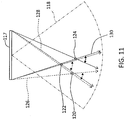
- FIG. 11 shows an electronic sector scanning method based on the virtual source method.
- an entire array transducer 117 constitutes a transmission aperture and a reception aperture.
- a first transmission beam and a second transmission beam are also formed alternately in orientation directions.
- a first transmission beam 126 having a first transmission focal point 120, a second transmission beam 128 having a second transmission focal point 122, and a first transmission beam 130 having a first transmission focal point 124 are formed sequentially.
- a plurality of transmission focal points; that is, a plurality of virtual sources form a 2D zigzag pattern, and in this regard, this embodiment is identical to the embodiments shown in FIG. 7 and FIG. 8 .
- this embodiment also ensures prevention of occurrence of low sound pressure regions between adjacent sub-images.
- reception beam arrays such as those shown in FIG. 12 and FIG. 13 , may be formed.
- FIG. 13 shows a first reception beam array 146 formed in association with the above first transmission beam 140.
- the first reception beam array 146 is composed of a plurality of reception beams 148 crossing with each other at a transmission focal point 142.
- FIG. 12 shows a second reception beam array 1.36 formed in association with the above second transmission beam 132.
- the second reception beam array 136 is composed of a plurality of reception beams 138 crossing with each other at a transmission focal point 134.
- the above processing it is possible to determine, for example, a point lower than a sound pressure peak by a sound pressure of predetermined dB (for example, -3dB) in the scanning direction as an edge of the transmission beam area. Further, in the above processing, it is also possible to form an ultrasonic image using the virtual source method without forming a reception beam. In that case, reception aperture processing is performed for each reception point in a predetermined order, thereby generating a pixel data array. In that case, the delay conditions are also set so that phases of the spherical waves match at the reception point.
- predetermined dB for example, -3dB
- FIG. 14 shows a structure example of a reception unit in a second embodiment.
- a structure of a transmission unit is identical to that already described. Namely, a 2D virtual source array is formed on the scanning plane.
- a reception signal array (a plurality of element reception signals from a reception aperture) is obtained each time a virtual source is formed, and the arrays are sequentially stored in a storage unit 150.
- a plurality of reception signal arrays obtained by forming a plurality of virtual sources are stored in the storage unit 150.
- the plurality of reception signal arrays constitute a dataset.
- a synthesis unit 152 performs phasing addition processing using the dataset based on the virtual source method, thereby forming an ultrasonic image.
- the ultrasonic image is formed directly from the dataset without forming a plurality of sub-images. Because this second embodiment also forms an array where a plurality of virtual sources expand in two dimensions, it is possible to exclude or alleviate low sound pressure regions or low image quality regions generated between adjacent virtual sources on the scanning plane.
- the above 2D virtual source array may be formed on each scanning plane formed in a 3D space. Further, 3D phasing addition processing may be realized by developing the above technique based on the virtual source method.
Landscapes
- Health & Medical Sciences (AREA)
- Life Sciences & Earth Sciences (AREA)
- Engineering & Computer Science (AREA)
- Physics & Mathematics (AREA)
- Animal Behavior & Ethology (AREA)
- Medical Informatics (AREA)
- Veterinary Medicine (AREA)
- Public Health (AREA)
- General Health & Medical Sciences (AREA)
- Biophysics (AREA)
- Nuclear Medicine, Radiotherapy & Molecular Imaging (AREA)
- Pathology (AREA)
- Radiology & Medical Imaging (AREA)
- Biomedical Technology (AREA)
- Heart & Thoracic Surgery (AREA)
- Surgery (AREA)
- Molecular Biology (AREA)
- Radar, Positioning & Navigation (AREA)
- Remote Sensing (AREA)
- Acoustics & Sound (AREA)
- Computer Networks & Wireless Communication (AREA)
- General Physics & Mathematics (AREA)
- Computer Vision & Pattern Recognition (AREA)
- Gynecology & Obstetrics (AREA)
- Ultra Sonic Daignosis Equipment (AREA)
- Measurement Of Velocity Or Position Using Acoustic Or Ultrasonic Waves (AREA)
Applications Claiming Priority (2)
| Application Number | Priority Date | Filing Date | Title |
|---|---|---|---|
| JP2014210483A JP6014643B2 (ja) | 2014-10-15 | 2014-10-15 | 超音波診断装置 |
| PCT/JP2015/078354 WO2016060017A1 (fr) | 2014-10-15 | 2015-10-06 | Dispositif de diagnostic à ultrasons |
Publications (1)
| Publication Number | Publication Date |
|---|---|
| EP3207878A1 true EP3207878A1 (fr) | 2017-08-23 |
Family
ID=55746564
Family Applications (1)
| Application Number | Title | Priority Date | Filing Date |
|---|---|---|---|
| EP15850434.0A Withdrawn EP3207878A1 (fr) | 2014-10-15 | 2015-10-06 | Dispositif de diagnostic à ultrasons |
Country Status (5)
| Country | Link |
|---|---|
| US (1) | US20170238908A1 (fr) |
| EP (1) | EP3207878A1 (fr) |
| JP (1) | JP6014643B2 (fr) |
| CN (1) | CN107072641A (fr) |
| WO (1) | WO2016060017A1 (fr) |
Cited By (5)
| Publication number | Priority date | Publication date | Assignee | Title |
|---|---|---|---|---|
| EP3267223A1 (fr) * | 2016-07-05 | 2018-01-10 | Konica Minolta, Inc. | Dispositif de traitement de signal ultrasonore, procédé de traitement de signal ultrasonore et dispositif de diagnostic à ultrasons |
| JP2018082835A (ja) * | 2016-11-22 | 2018-05-31 | コニカミノルタ株式会社 | 超音波信号処理装置、超音波診断装置、および、超音波信号処理方法 |
| EP3605143A1 (fr) * | 2018-07-30 | 2020-02-05 | Samsung Medison Co., Ltd. | Appareil d'imagerie ultrasonore et procédé de commande correspondant |
| EP4279951A1 (fr) * | 2022-05-20 | 2023-11-22 | Samsung Medison Co., Ltd. | Procédé de traitement d'image ultrasonore et appareil ultrasonore l'utilisant |
| EP4394441A1 (fr) * | 2022-12-29 | 2024-07-03 | Supersonic Imagine | Procédé et système de formation de faisceau |
Families Citing this family (8)
| Publication number | Priority date | Publication date | Assignee | Title |
|---|---|---|---|---|
| JP6848793B2 (ja) * | 2017-09-28 | 2021-03-24 | コニカミノルタ株式会社 | 超音波信号処理方法、及び超音波信号処理装置。 |
| JP7099162B2 (ja) * | 2018-08-10 | 2022-07-12 | コニカミノルタ株式会社 | 超音波信号処理方法、及び超音波信号処理装置 |
| JP7140625B2 (ja) * | 2018-10-05 | 2022-09-21 | 富士フイルムヘルスケア株式会社 | 超音波撮像装置、および、超音波画像の撮像方法 |
| JP6739586B1 (ja) * | 2019-04-26 | 2020-08-12 | ゼネラル・エレクトリック・カンパニイ | 超音波装置及びその制御プログラム |
| US11389135B2 (en) * | 2019-06-27 | 2022-07-19 | Cassandra L. Bates | Breast imaging ultrasound systems and methods |
| JP7523378B2 (ja) * | 2021-02-09 | 2024-07-26 | 富士フイルムヘルスケア株式会社 | 超音波撮像装置、および、超音波撮像方法 |
| JP7526135B2 (ja) | 2021-05-31 | 2024-07-31 | 富士フイルムヘルスケア株式会社 | 超音波診断装置及びイメージ処理方法 |
| JP7693408B2 (ja) * | 2021-06-21 | 2025-06-17 | キヤノンメディカルシステムズ株式会社 | 超音波診断装置 |
Family Cites Families (13)
| Publication number | Priority date | Publication date | Assignee | Title |
|---|---|---|---|---|
| JPH10179579A (ja) * | 1996-12-20 | 1998-07-07 | Matsushita Electric Ind Co Ltd | 超音波診断装置 |
| JP3290092B2 (ja) * | 1997-04-09 | 2002-06-10 | 松下電器産業株式会社 | 超音波診断装置 |
| JP4022393B2 (ja) * | 2001-12-12 | 2007-12-19 | 株式会社日立メディコ | 超音波診断装置 |
| CN101091660A (zh) * | 2007-07-20 | 2007-12-26 | 哈尔滨工业大学(威海) | 多焦点医学超声图像连接方法 |
| JP5355924B2 (ja) * | 2008-03-31 | 2013-11-27 | 株式会社東芝 | 超音波診断装置 |
| KR20110022445A (ko) * | 2009-08-27 | 2011-03-07 | 서강대학교산학협력단 | 초음파 영상 구현 시스템 및 그 방법 |
| JP5665040B2 (ja) * | 2009-09-10 | 2015-02-04 | 学校法人上智学院 | 変位計測方法及び装置、並びに、超音波診断装置 |
| WO2011092718A1 (fr) * | 2010-01-28 | 2011-08-04 | Indian Institute Of Technology Ht P.O. | Technique pour imagerie utilisant un reseau de sources virtuelles focalisees au moyen d'une excitation de phase |
| CN103747729B (zh) * | 2011-06-13 | 2016-07-13 | 皇家飞利浦有限公司 | 利用二维成像探头的三维针定位 |
| WO2014021105A1 (fr) * | 2012-07-30 | 2014-02-06 | 日立アロカメディカル株式会社 | Dispositif de diagnostic ultrasonore |
| JP5871274B2 (ja) * | 2012-09-13 | 2016-03-01 | 新日鐵住金株式会社 | 超音波探傷装置及び方法 |
| JP2014064852A (ja) * | 2012-09-27 | 2014-04-17 | Fujifilm Corp | 超音波診断装置、超音波画像データ生成方法およびプログラム |
| JP6253075B2 (ja) * | 2012-12-19 | 2017-12-27 | 国立研究開発法人産業技術総合研究所 | プローブアレイ |
-
2014
- 2014-10-15 JP JP2014210483A patent/JP6014643B2/ja active Active
-
2015
- 2015-10-06 WO PCT/JP2015/078354 patent/WO2016060017A1/fr not_active Ceased
- 2015-10-06 US US15/519,183 patent/US20170238908A1/en not_active Abandoned
- 2015-10-06 EP EP15850434.0A patent/EP3207878A1/fr not_active Withdrawn
- 2015-10-06 CN CN201580056008.2A patent/CN107072641A/zh active Pending
Cited By (8)
| Publication number | Priority date | Publication date | Assignee | Title |
|---|---|---|---|---|
| EP3267223A1 (fr) * | 2016-07-05 | 2018-01-10 | Konica Minolta, Inc. | Dispositif de traitement de signal ultrasonore, procédé de traitement de signal ultrasonore et dispositif de diagnostic à ultrasons |
| JP2018082835A (ja) * | 2016-11-22 | 2018-05-31 | コニカミノルタ株式会社 | 超音波信号処理装置、超音波診断装置、および、超音波信号処理方法 |
| EP3605143A1 (fr) * | 2018-07-30 | 2020-02-05 | Samsung Medison Co., Ltd. | Appareil d'imagerie ultrasonore et procédé de commande correspondant |
| KR20200013389A (ko) * | 2018-07-30 | 2020-02-07 | 삼성메디슨 주식회사 | 초음파 영상장치 및 그 제어방법 |
| US11408996B2 (en) | 2018-07-30 | 2022-08-09 | Samsung Medison Co. Ltd. | Ultrasonic imaging apparatus and method of controlling the same |
| EP4279951A1 (fr) * | 2022-05-20 | 2023-11-22 | Samsung Medison Co., Ltd. | Procédé de traitement d'image ultrasonore et appareil ultrasonore l'utilisant |
| US12582383B2 (en) | 2022-05-20 | 2026-03-24 | Samsung Medison Co., Ltd. | Ultrasound image processing method, and ultrasound apparatus using the same |
| EP4394441A1 (fr) * | 2022-12-29 | 2024-07-03 | Supersonic Imagine | Procédé et système de formation de faisceau |
Also Published As
| Publication number | Publication date |
|---|---|
| JP2016077442A (ja) | 2016-05-16 |
| WO2016060017A1 (fr) | 2016-04-21 |
| CN107072641A (zh) | 2017-08-18 |
| US20170238908A1 (en) | 2017-08-24 |
| JP6014643B2 (ja) | 2016-10-25 |
Similar Documents
| Publication | Publication Date | Title |
|---|---|---|
| EP3207878A1 (fr) | Dispositif de diagnostic à ultrasons | |
| CN105997137B (zh) | 超声波信号处理装置、以及超声波诊断装置 | |
| JP5355924B2 (ja) | 超音波診断装置 | |
| RU2650738C2 (ru) | Ультразвуковая диагностическая система визуализации с пространственным составлением трапецеидального сектора | |
| JP5864894B2 (ja) | 被検体情報取得装置および信号処理装置 | |
| US8905931B2 (en) | Subject information processing apparatus | |
| JP6793444B2 (ja) | 超音波診断装置 | |
| EP2815701A1 (fr) | Dispositif d'imagerie ultrasonore | |
| US9717477B2 (en) | Ultrasonic diagnosis device and ultrasonic image acquisition method | |
| JP6406019B2 (ja) | 超音波信号処理装置、及び超音波診断装置 | |
| US20200367862A1 (en) | Ultrasound diagnostic device and ultrasound diagnostic device control method | |
| JP6415937B2 (ja) | 医用画像処理装置、超音波診断装置、医用画像処理方法および医用画像処理プログラム | |
| CN108209971B (zh) | 超声波信号处理装置和方法以及超声波诊断装置 | |
| US20180296190A1 (en) | Ultrasonic diagnostic device and ultrasonic signal processing method | |
| US9402600B2 (en) | 3-dimensional elastic image generation method and ultrasonic diagnostic apparatus | |
| JP6189867B2 (ja) | 超音波撮像装置 | |
| CN102970935B (zh) | 超声波诊断装置以及超声波诊断装置控制方法 | |
| CN107569254B (zh) | 超声波信号处理装置、超声波信号处理方法以及超声波诊断装置 | |
| EP2638860B1 (fr) | Procédé de formation de faisceau, dispositif de diagnostic à ultrasons, programme et circuit intégré | |
| US11272906B2 (en) | Ultrasonic imaging device and method for controlling same | |
| KR20150057175A (ko) | 초음파 영상장치 및 그 제어방법 | |
| JP2015186494A (ja) | 超音波診断装置 | |
| US11413012B2 (en) | Ultrasound signal processing device and ultrasound signal processing method | |
| JP2020039604A (ja) | 超音波信号処理装置、超音波診断装置、および、超音波信号処理方法 | |
| JP2020010762A (ja) | 超音波信号処理装置、超音波診断装置、および、超音波信号処理方法 |
Legal Events
| Date | Code | Title | Description |
|---|---|---|---|
| STAA | Information on the status of an ep patent application or granted ep patent |
Free format text: STATUS: THE INTERNATIONAL PUBLICATION HAS BEEN MADE |
|
| PUAI | Public reference made under article 153(3) epc to a published international application that has entered the european phase |
Free format text: ORIGINAL CODE: 0009012 |
|
| STAA | Information on the status of an ep patent application or granted ep patent |
Free format text: STATUS: REQUEST FOR EXAMINATION WAS MADE |
|
| 17P | Request for examination filed |
Effective date: 20170509 |
|
| AK | Designated contracting states |
Kind code of ref document: A1 Designated state(s): AL AT BE BG CH CY CZ DE DK EE ES FI FR GB GR HR HU IE IS IT LI LT LU LV MC MK MT NL NO PL PT RO RS SE SI SK SM TR |
|
| AX | Request for extension of the european patent |
Extension state: BA ME |
|
| DAV | Request for validation of the european patent (deleted) | ||
| DAX | Request for extension of the european patent (deleted) | ||
| STAA | Information on the status of an ep patent application or granted ep patent |
Free format text: STATUS: THE APPLICATION HAS BEEN WITHDRAWN |
|
| 18W | Application withdrawn |
Effective date: 20180215 |