EP3208062B1 - Faserverstärktes harzzwischenmaterial und verfahren zur herstellung davon - Google Patents
Faserverstärktes harzzwischenmaterial und verfahren zur herstellung davon Download PDFInfo
- Publication number
- EP3208062B1 EP3208062B1 EP15849984.8A EP15849984A EP3208062B1 EP 3208062 B1 EP3208062 B1 EP 3208062B1 EP 15849984 A EP15849984 A EP 15849984A EP 3208062 B1 EP3208062 B1 EP 3208062B1
- Authority
- EP
- European Patent Office
- Prior art keywords
- resin
- reinforcing fiber
- fiber
- fiber substrate
- reinforcing
- Prior art date
- Legal status (The legal status is an assumption and is not a legal conclusion. Google has not performed a legal analysis and makes no representation as to the accuracy of the status listed.)
- Active
Links
Images

Classifications
-
- B—PERFORMING OPERATIONS; TRANSPORTING
- B29—WORKING OF PLASTICS; WORKING OF SUBSTANCES IN A PLASTIC STATE IN GENERAL
- B29C—SHAPING OR JOINING OF PLASTICS; SHAPING OF MATERIAL IN A PLASTIC STATE, NOT OTHERWISE PROVIDED FOR; AFTER-TREATMENT OF THE SHAPED PRODUCTS, e.g. REPAIRING
- B29C70/00—Shaping composites, i.e. plastics material comprising reinforcements, fillers or preformed parts, e.g. inserts
- B29C70/04—Shaping composites, i.e. plastics material comprising reinforcements, fillers or preformed parts, e.g. inserts comprising reinforcements only, e.g. self-reinforcing plastics
- B29C70/28—Shaping operations therefor
- B29C70/30—Shaping by lay-up, i.e. applying fibres, tape or broadsheet on a mould, former or core; Shaping by spray-up, i.e. spraying of fibres on a mould, former or core
-
- B—PERFORMING OPERATIONS; TRANSPORTING
- B29—WORKING OF PLASTICS; WORKING OF SUBSTANCES IN A PLASTIC STATE IN GENERAL
- B29B—PREPARATION OR PRETREATMENT OF THE MATERIAL TO BE SHAPED; MAKING GRANULES OR PREFORMS; RECOVERY OF PLASTICS OR OTHER CONSTITUENTS OF WASTE MATERIAL CONTAINING PLASTICS
- B29B15/00—Pretreatment of the material to be shaped, not covered by groups B29B7/00 - B29B13/00
- B29B15/08—Pretreatment of the material to be shaped, not covered by groups B29B7/00 - B29B13/00 of reinforcements or fillers
- B29B15/10—Coating or impregnating independently of the moulding or shaping step
- B29B15/105—Coating or impregnating independently of the moulding or shaping step of reinforcement of definite length with a matrix in solid form, e.g. powder, fibre or sheet form
-
- B—PERFORMING OPERATIONS; TRANSPORTING
- B29—WORKING OF PLASTICS; WORKING OF SUBSTANCES IN A PLASTIC STATE IN GENERAL
- B29C—SHAPING OR JOINING OF PLASTICS; SHAPING OF MATERIAL IN A PLASTIC STATE, NOT OTHERWISE PROVIDED FOR; AFTER-TREATMENT OF THE SHAPED PRODUCTS, e.g. REPAIRING
- B29C70/00—Shaping composites, i.e. plastics material comprising reinforcements, fillers or preformed parts, e.g. inserts
- B29C70/04—Shaping composites, i.e. plastics material comprising reinforcements, fillers or preformed parts, e.g. inserts comprising reinforcements only, e.g. self-reinforcing plastics
- B29C70/28—Shaping operations therefor
- B29C70/40—Shaping or impregnating by compression not applied
- B29C70/50—Shaping or impregnating by compression not applied for producing articles of indefinite length, e.g. prepregs, sheet moulding compounds [SMC] or cross moulding compounds [XMC]
-
- B—PERFORMING OPERATIONS; TRANSPORTING
- B29—WORKING OF PLASTICS; WORKING OF SUBSTANCES IN A PLASTIC STATE IN GENERAL
- B29C—SHAPING OR JOINING OF PLASTICS; SHAPING OF MATERIAL IN A PLASTIC STATE, NOT OTHERWISE PROVIDED FOR; AFTER-TREATMENT OF THE SHAPED PRODUCTS, e.g. REPAIRING
- B29C70/00—Shaping composites, i.e. plastics material comprising reinforcements, fillers or preformed parts, e.g. inserts
- B29C70/04—Shaping composites, i.e. plastics material comprising reinforcements, fillers or preformed parts, e.g. inserts comprising reinforcements only, e.g. self-reinforcing plastics
- B29C70/28—Shaping operations therefor
- B29C70/40—Shaping or impregnating by compression not applied
- B29C70/50—Shaping or impregnating by compression not applied for producing articles of indefinite length, e.g. prepregs, sheet moulding compounds [SMC] or cross moulding compounds [XMC]
- B29C70/504—Shaping or impregnating by compression not applied for producing articles of indefinite length, e.g. prepregs, sheet moulding compounds [SMC] or cross moulding compounds [XMC] using rollers or pressure bands
- B29C70/506—Shaping or impregnating by compression not applied for producing articles of indefinite length, e.g. prepregs, sheet moulding compounds [SMC] or cross moulding compounds [XMC] using rollers or pressure bands and impregnating by melting a solid material, e.g. sheet, powder, fibres
-
- D—TEXTILES; PAPER
- D03—WEAVING
- D03D—WOVEN FABRICS; METHODS OF WEAVING; LOOMS
- D03D25/00—Woven fabrics not otherwise provided for
-
- D—TEXTILES; PAPER
- D06—TREATMENT OF TEXTILES OR THE LIKE; LAUNDERING; FLEXIBLE MATERIALS NOT OTHERWISE PROVIDED FOR
- D06N—WALL, FLOOR, OR LIKE COVERING MATERIALS, e.g. LINOLEUM, OILCLOTH, ARTIFICIAL LEATHER, ROOFING FELT, CONSISTING OF A FIBROUS WEB COATED WITH A LAYER OF MACROMOLECULAR MATERIAL; FLEXIBLE SHEET MATERIAL NOT OTHERWISE PROVIDED FOR
- D06N3/00—Artificial leather, oilcloth or other material obtained by covering fibrous webs with macromolecular material, e.g. resins, rubber or derivatives thereof
- D06N3/0002—Artificial leather, oilcloth or other material obtained by covering fibrous webs with macromolecular material, e.g. resins, rubber or derivatives thereof characterised by the substrate
- D06N3/0015—Artificial leather, oilcloth or other material obtained by covering fibrous webs with macromolecular material, e.g. resins, rubber or derivatives thereof characterised by the substrate using fibres of specified chemical or physical nature, e.g. natural silk
-
- D—TEXTILES; PAPER
- D06—TREATMENT OF TEXTILES OR THE LIKE; LAUNDERING; FLEXIBLE MATERIALS NOT OTHERWISE PROVIDED FOR
- D06N—WALL, FLOOR, OR LIKE COVERING MATERIALS, e.g. LINOLEUM, OILCLOTH, ARTIFICIAL LEATHER, ROOFING FELT, CONSISTING OF A FIBROUS WEB COATED WITH A LAYER OF MACROMOLECULAR MATERIAL; FLEXIBLE SHEET MATERIAL NOT OTHERWISE PROVIDED FOR
- D06N3/00—Artificial leather, oilcloth or other material obtained by covering fibrous webs with macromolecular material, e.g. resins, rubber or derivatives thereof
- D06N3/007—Artificial leather, oilcloth or other material obtained by covering fibrous webs with macromolecular material, e.g. resins, rubber or derivatives thereof characterised by mechanical or physical treatments
- D06N3/0084—Artificial leather, oilcloth or other material obtained by covering fibrous webs with macromolecular material, e.g. resins, rubber or derivatives thereof characterised by mechanical or physical treatments by electrical processes, e.g. potentials, corona discharge, electrophoresis, electrolytic
-
- D—TEXTILES; PAPER
- D06—TREATMENT OF TEXTILES OR THE LIKE; LAUNDERING; FLEXIBLE MATERIALS NOT OTHERWISE PROVIDED FOR
- D06N—WALL, FLOOR, OR LIKE COVERING MATERIALS, e.g. LINOLEUM, OILCLOTH, ARTIFICIAL LEATHER, ROOFING FELT, CONSISTING OF A FIBROUS WEB COATED WITH A LAYER OF MACROMOLECULAR MATERIAL; FLEXIBLE SHEET MATERIAL NOT OTHERWISE PROVIDED FOR
- D06N3/00—Artificial leather, oilcloth or other material obtained by covering fibrous webs with macromolecular material, e.g. resins, rubber or derivatives thereof
- D06N3/0086—Artificial leather, oilcloth or other material obtained by covering fibrous webs with macromolecular material, e.g. resins, rubber or derivatives thereof characterised by the application technique
- D06N3/0088—Artificial leather, oilcloth or other material obtained by covering fibrous webs with macromolecular material, e.g. resins, rubber or derivatives thereof characterised by the application technique by directly applying the resin
- D06N3/0093—Artificial leather, oilcloth or other material obtained by covering fibrous webs with macromolecular material, e.g. resins, rubber or derivatives thereof characterised by the application technique by directly applying the resin by applying resin powders; by sintering
-
- D—TEXTILES; PAPER
- D06—TREATMENT OF TEXTILES OR THE LIKE; LAUNDERING; FLEXIBLE MATERIALS NOT OTHERWISE PROVIDED FOR
- D06N—WALL, FLOOR, OR LIKE COVERING MATERIALS, e.g. LINOLEUM, OILCLOTH, ARTIFICIAL LEATHER, ROOFING FELT, CONSISTING OF A FIBROUS WEB COATED WITH A LAYER OF MACROMOLECULAR MATERIAL; FLEXIBLE SHEET MATERIAL NOT OTHERWISE PROVIDED FOR
- D06N3/00—Artificial leather, oilcloth or other material obtained by covering fibrous webs with macromolecular material, e.g. resins, rubber or derivatives thereof
- D06N3/12—Artificial leather, oilcloth or other material obtained by covering fibrous webs with macromolecular material, e.g. resins, rubber or derivatives thereof with macromolecular compounds obtained otherwise than by reactions only involving carbon-to-carbon unsaturated bonds, e.g. gelatine proteins
- D06N3/125—Artificial leather, oilcloth or other material obtained by covering fibrous webs with macromolecular material, e.g. resins, rubber or derivatives thereof with macromolecular compounds obtained otherwise than by reactions only involving carbon-to-carbon unsaturated bonds, e.g. gelatine proteins with polyamides
-
- D—TEXTILES; PAPER
- D06—TREATMENT OF TEXTILES OR THE LIKE; LAUNDERING; FLEXIBLE MATERIALS NOT OTHERWISE PROVIDED FOR
- D06N—WALL, FLOOR, OR LIKE COVERING MATERIALS, e.g. LINOLEUM, OILCLOTH, ARTIFICIAL LEATHER, ROOFING FELT, CONSISTING OF A FIBROUS WEB COATED WITH A LAYER OF MACROMOLECULAR MATERIAL; FLEXIBLE SHEET MATERIAL NOT OTHERWISE PROVIDED FOR
- D06N7/00—Flexible sheet materials not otherwise provided for, e.g. textile threads, filaments, yarns or tow, glued on macromolecular material
- D06N7/0092—Non-continuous polymer coating on the fibrous substrate, e.g. plastic dots on fabrics
-
- B—PERFORMING OPERATIONS; TRANSPORTING
- B29—WORKING OF PLASTICS; WORKING OF SUBSTANCES IN A PLASTIC STATE IN GENERAL
- B29K—INDEXING SCHEME ASSOCIATED WITH SUBCLASSES B29B, B29C OR B29D, RELATING TO MOULDING MATERIALS OR TO MATERIALS FOR MOULDS, REINFORCEMENTS, FILLERS OR PREFORMED PARTS, e.g. INSERTS
- B29K2077/00—Use of PA, i.e. polyamides, e.g. polyesteramides or derivatives thereof, as moulding material
-
- B—PERFORMING OPERATIONS; TRANSPORTING
- B29—WORKING OF PLASTICS; WORKING OF SUBSTANCES IN A PLASTIC STATE IN GENERAL
- B29K—INDEXING SCHEME ASSOCIATED WITH SUBCLASSES B29B, B29C OR B29D, RELATING TO MOULDING MATERIALS OR TO MATERIALS FOR MOULDS, REINFORCEMENTS, FILLERS OR PREFORMED PARTS, e.g. INSERTS
- B29K2307/00—Use of elements other than metals as reinforcement
- B29K2307/04—Carbon
-
- B—PERFORMING OPERATIONS; TRANSPORTING
- B29—WORKING OF PLASTICS; WORKING OF SUBSTANCES IN A PLASTIC STATE IN GENERAL
- B29K—INDEXING SCHEME ASSOCIATED WITH SUBCLASSES B29B, B29C OR B29D, RELATING TO MOULDING MATERIALS OR TO MATERIALS FOR MOULDS, REINFORCEMENTS, FILLERS OR PREFORMED PARTS, e.g. INSERTS
- B29K2313/00—Use of textile products or fabrics as reinforcement
- B29K2313/02—Use of textile products or fabrics as reinforcement coated
-
- B—PERFORMING OPERATIONS; TRANSPORTING
- B29—WORKING OF PLASTICS; WORKING OF SUBSTANCES IN A PLASTIC STATE IN GENERAL
- B29K—INDEXING SCHEME ASSOCIATED WITH SUBCLASSES B29B, B29C OR B29D, RELATING TO MOULDING MATERIALS OR TO MATERIALS FOR MOULDS, REINFORCEMENTS, FILLERS OR PREFORMED PARTS, e.g. INSERTS
- B29K2995/00—Properties of moulding materials, reinforcements, fillers, preformed parts or moulds
- B29K2995/0037—Other properties
- B29K2995/0063—Density
-
- D—TEXTILES; PAPER
- D06—TREATMENT OF TEXTILES OR THE LIKE; LAUNDERING; FLEXIBLE MATERIALS NOT OTHERWISE PROVIDED FOR
- D06N—WALL, FLOOR, OR LIKE COVERING MATERIALS, e.g. LINOLEUM, OILCLOTH, ARTIFICIAL LEATHER, ROOFING FELT, CONSISTING OF A FIBROUS WEB COATED WITH A LAYER OF MACROMOLECULAR MATERIAL; FLEXIBLE SHEET MATERIAL NOT OTHERWISE PROVIDED FOR
- D06N2201/00—Chemical constitution of the fibres, threads or yarns
- D06N2201/08—Inorganic fibres
- D06N2201/087—Carbon fibres
-
- D—TEXTILES; PAPER
- D06—TREATMENT OF TEXTILES OR THE LIKE; LAUNDERING; FLEXIBLE MATERIALS NOT OTHERWISE PROVIDED FOR
- D06N—WALL, FLOOR, OR LIKE COVERING MATERIALS, e.g. LINOLEUM, OILCLOTH, ARTIFICIAL LEATHER, ROOFING FELT, CONSISTING OF A FIBROUS WEB COATED WITH A LAYER OF MACROMOLECULAR MATERIAL; FLEXIBLE SHEET MATERIAL NOT OTHERWISE PROVIDED FOR
- D06N2203/00—Macromolecular materials of the coating layers
- D06N2203/06—Macromolecular compounds obtained otherwise than by reactions only involving carbon-to-carbon unsaturated bonds
- D06N2203/065—Polyamides
Definitions
- the present invention relates to a fiber-reinforced resin intermediate material to be used under heating and pressurization in a laminated state and a method for manufacturing the same.
- composite fiber-reinforced resins obtained by impregnating reinforcing fiber substrates such as carbon fiber and glass fiber with a resin have been widely utilized in a variety of fields and uses and their application to aircraft components and automobile components have been in progress.
- Such fiber-reinforced resin molded articles are required to have less defects such as voids, the impregnation of the reinforcing fiber substrate with the resin being performed at a predetermined fiber volume content, so as to exhibit predetermined properties such as mechanical strength.
- it is required to have such shaping ability that molding is possible even if the shape is complex one.
- PTL I proposes a fiber-reinforced thermoplastic resin sheet wherein, although a thermoplastic resin has high melt viscosity and uniform impregnation of a reinforcing fiber bundle therewith is difficult to perform, a thermoplastic resin non-woven fabric is melted to impregnate the reinforcing fiber bundle with the thermoplastic resin by overlaying the thermoplastic resin non-woven fabric on a reinforcing fiber sheet in which a plurality of the reinforcing fiber bundles are aligned in one direction and performing pressurization while heating. It is said that the fiber-reinforced thermoplastic resin sheet can be made such a semi-impregnated state that void space parts at which the reinforcing fiber bundle is not impregnated with the thermoplastic resin are present.
- PTL 2 proposes a prepreg which comprises a fiber substrate formed in a layered shape and a resin layer provided on at least one surface side of the fiber substrate and composed of a resin composition and wherein a void space layer not impregnated with the resin composition is formed in at least a part of the fiber substrate.
- the void space layer of the prepreg may have a form that a part of the fiber substrate is exposed and is preferably formed so as to communicate from one end of the prepreg to another end thereof.
- a void space layer communicating from one end to the other end is present at an intermediate part thereof even when resin layers are present on both surfaces of the fiber substrate.
- thermosetting resins such as a phenol novolak resin and a cresol novolak resin are mentioned and a thermoplastic resin such as a phenoxy resin or a polyimide resin may be used in combination.
- PTL 3 proposes a notched prepreg substrate having reinforcing fibers aligned in one direction, wherein a plurality of rows composed of intermittent notches in a direction crossing the reinforcing fibers are provided on the whole surface of the prepreg substrate, projection length of the notches projected to a perpendicular direction of the reinforcing fibers is 30 ⁇ m to 10 mm, all of the reinforcing fibers are substantially cut by the notches, fiber length of the reinforcing fiber cut by the notches is 10 to 100 mm, and fiber volume content falls within the range of 45 to 65%.
- the notched prepreg substrate has good flowability, has molding followability, is excellent in shaping ability, and can provides a prepreg substrate that is an intermediate substrate for fiber-reinforced plastics suitably used in automobile components, sporting goods, and the like.
- shaping ability is required for a fiber-reinforced resin intermediate material.
- PTLs 1 to 3 it is intended to improve the shaping ability of the fiber-reinforced resin intermediate materials by making a fiber-reinforced thermoplastic resin sheet a semi-impregnated state, providing a void space layer not impregnated in a prepreg, or providing notches on a notched prepreg substrate.
- the fiber-reinforced thermoplastic resin sheet described in PTL 1 and the prepreg described in PTL 2 are more preferable than the notched prepreg substrate described in PTL 3.
- the fiber-reinforced thermoplastic resin sheet described in PTL 1 has a problem of easy formation of voids. That is, the fiber-reinforced thermoplastic resin sheet is molded by pressurizing a fabric composed of a thermoplastic resin fiber overlaid on a fiber-reinforced sheet while heating. Therefore, in the fiber-reinforced thermoplastic resin sheet, since the melted thermoplastic resin layer covers a surface of the pressurized and compressed reinforcing fiber sheet in a film shape, there are problems that the thermoplastic resin is less prone to be impregnated, air in the reinforcing fiber sheet is difficult to be released, and thus voids are easily formed.
- the prepreg described in PTL 2 is a prepreg wherein a fiber substrate is impregnated with a resin composition based on a thermosetting resin and thus it is unclear whether a resin composition composed of only a thermoplastic resin having a high viscosity as compared with a thermosetting resin is similarly applicable or not.
- the prepreg has a resin layer formed on the whole upper surface of the fiber substrate and has a void space layer formed so as to communicate from one end to another end under the resin layer.
- the resin layer is a resin layer formed by a roll-to-roll process or a resin layer formed by feeding a liquid resin composition such as a varnish of a resin composition and curing it on the fiber substrate. Therefore, since migration distance of air becomes long and thus the air is difficult to be released, the prepreg described in PTL 2 has a problem that air in the prepreg can not always sufficiently discharged.
- the notched prepreg substrate described in PTL 3 is prepared as follows. That is, it is described that an epoxy resin composition is applied on a release paper subjected to a silicone coating treatment and having a thickness of 100 ⁇ m, using a reverse roll coater to prepare a resin film and then the resin film is overlaid on both surfaces of carbon fibers arranged in one direction, and impregnation with the resin is achieved by heating and pressurization to prepare the prepreg substrate. It has a problem that voids are easily formed similarly to the fiber-reinforced thermoplastic resin sheet described in PTL 1.
- an object of the present invention is to provide a fiber-reinforced resin intermediate material, including not only a thermoplastic resin but also a thermosetting resin, in which defects such as voids are difficult to generate and which is excellent in shaping ability; and a method for manufacturing the same.
- a fiber-reinforced resin intermediate material according to the present invention as defined in claim 1 is formed by attaching a resin to an outer surface part of a reinforcing fiber substrate, which is formed of reinforcing fibers subjected to opening, and heating the resin to a temperature equal to or higher than the melting point of the resin to impregnate the reinforcing fiber substrate with the resin, wherein the reinforcing fiber substrate has void space that is opened on an outer surface thereof and the resin is in a semi-impregnated state.
- the resin to be attached to the reinforcing fiber substrate is a powder.
- the reinforcing fiber is carbon fiber, and basis weight of the reinforcing fiber substrate is 40 to 250 g/m 2 .
- apparent density ⁇ is 1/2 to 1/50 of target apparent density pc.
- a fiber-reinforced resin molded body (molded article) having a complex shape and less defects can be molded by laminating the fiber-reinforced resin intermediate material and performing heating and pressurization.
- the fiber-reinforced resin intermediate material whose reinforcing fiber substrate is impregnated with a resin in a semi-impregnated state and has void space opened on an outer surface thereof can be manufactured by the method as defined in claim 3.
- the fiber-reinforced resin intermediate material of the invention can be suitably manufactured by electrostatically attaching a resin powder having a predetermined average grain size to the reinforcing fiber substrate so that fiber volume content of the reinforcing fiber substrate becomes a predetermined value based on the outer diameter of a reinforcing fiber that forms the reinforcing fiber substrate and the bulk density of the reinforcing fiber substrate.
- the fiber-reinforced resin intermediate material according to the present invention is excellent in shaping ability and impregnating ability simultaneously. Therefore, by laminating the fiber-reinforced resin intermediate material and heating and pressurizing it, a fiber-reinforced resin molded body (molded article) having a desired fiber volume content, sufficiently impregnated, and having less defects such as voids can be manufactured even when it has a complex shape.
- the fiber-reinforced resin intermediate material according to the invention is a fiber-reinforced resin intermediate material formed by attaching a resin to an outer surface part of a reinforcing fiber substrate formed of reinforcing fibers subjected to opening and heating the resin to a temperature equal to or higher than the melting point of the resin to impregnate the reinforcing fiber substrate with the resin, wherein the reinforcing fiber substrate has void space that is opened on an outer surface thereof and the resin is in a semi-impregnated state.
- the fiber-reinforced resin intermediate material of the invention possesses an impregnated part where an outer surface part of the reinforcing fiber substrate is impregnated with a melted resin and a non-impregnated part where the melted resin is absent and has void space resulting from the non-impregnated part, the material can possess shaping ability and impregnation ability simultaneously.
- a phrase of "resin is in a semi-impregnated state” means a state that an impregnated part where an outer surface part of the reinforcing fiber substrate is impregnated with a melted resin and a non-impregnated part where the melted resin is absent are co-present and the phrase discriminates from a state that the outer surface part of the reinforcing fiber substrate is covered with the melted resin.
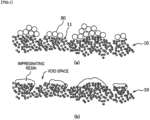
- the material For preparing the fiber-reinforced resin intermediate material composed of such a reinforcing fiber substrate where a resin is in a semi-impregnated state, it is preferable to prepare the material by electrostatically attaching a resin powder to the reinforcing fiber substrate and heating it to achieve impregnation therewith. That is, a resin powder 20 is first electrostatically attached to a reinforcing fiber substrate 10. The resin powder 20 is attached to a surface of the reinforcing fiber substrate 10 in a uniform thickness and in a uniform distribution when macroscopically observed. However, when microscopically observed, as shown in FIG.
- the surface of the reinforcing fiber substrate 10 formed from a large number of bundled reinforcing fibers 11 has a part to which the resin powder 20 is attached in one layer or in plural layers or a part to which the resin powder 20 is not attached.
- Such a state can be generated by electrostatically attaching the resin powder 20 having a predetermined average grain size to the reinforcing fiber substrate 10 so that fiber volume content of the reinforcing fiber substrate 10 becomes a predetermined value based on the outer diameter of the reinforcing fiber 11 that forms the reinforcing fiber substrate 10 and the bulk density of the reinforcing fiber substrate 10.
- the reinforcing fiber substrate 10 having the resin powder 20 attached thereto is heated to a temperature equal to or higher than the melting point of the resin powder 20. Pressurization of the reinforcing fiber substrate 10 having the resin powder 20 attached thereto is not performed. Therefore, as shown in FIG. 1(b) , the resin powder 20 attached to the reinforcing fiber substrate 10 is melted on the surface of the reinforcing fiber substrate 10 in the heating operation but the distribution corresponding to the aforementioned microscopic attaching situation is maintained and a film-like melt layer that covers the whole surface of the reinforcing fiber substrate 10 is not formed.
- the melted resin decreases surface area thereof by surface tension thereof to form a non-impregnated part where the melted resin is absent on the surface of the reinforcing fiber substrate 10. Also, the melted resin penetrates into the void space part in the reinforcing fiber substrate 10 through a space between the reinforcing fibers 11. As for the temperature and time for melting/impregnation of the resin, most suitable conditions are selected according to the reinforcing fiber substrate 10 and the resin powder 20.
- opening means making the fiber flat.
- the reinforcing fiber substrate is impregnated with a resin in a semi-impregnated state and it is facilitated to form a semi-impregnated state having void space opened on an outer surface of the reinforcing fiber substrate.
- the outer surface of the reinforcing fiber substrate means outside of the reinforcing fiber 11 that forms the surface of the reinforcing fiber substrate 10.
- the outer surface part of the reinforcing fiber substrate has a meaning including the surface of the reinforcing fiber substrate 10 and a part under the surface.
- opening means that a bundle of dense fibers to be impregnated is made flat so as to have a predetermined thickness (e.g., 100 ⁇ m) or less and can be applied to even one composed of short fibers such as chopped ones.
- a predetermined thickness e.g. 100 ⁇ m
- the reinforcing fiber 11 is carbon fiber and basis weight of the reinforcing fiber substrate 10 composed of the carbon fiber is suitably 40 to 250 g/m 2 .
- basis weight of the reinforcing fiber substrate 10 composed of the carbon fiber is suitably 40 to 250 g/m 2 .
- the basis weight By controlling the basis weight to 250 g/m 2 or less, it can be prevented to require a long period of time for the step in which the melted resin penetrates into the void space part in the reinforcing fiber substrate 10 through a space between the reinforcing fibers 11 at the time of heating, so that the control is practical.
- the resin powder 20 there can be used polycarbonate (PC), polysulfone (PSU), polyethersulfone (PES), polyamideimide (PAI), polyetherimide (PEI), polyamide-based resins (PA6, PAII, PA66), polybutylene terephthalate (PBT), polyethylene terephthalate (PET), polyphenylene sulfide (PPS), polyether ether ketone (PEEK), polyether ketone ketone (PEKK), and the like.
- PC polycarbonate
- PSU polysulfone
- PES polyamideimide
- PEI polyetherimide
- PA6 polyamide-based resins
- PBT polybutylene terephthalate
- PPS polyethylene terephthalate
- PPS polyphenylene sulfide
- PEEK polyether ether ketone
- PEKK polyether ketone ketone
- it may be a powder of a thermosetting resin such as a phenol resin or
- the resin powder 20 a powder having an average grain size 1/2 to 30 times the outer diameter of the reinforcing fiber 11 can be used.
- the average grain size is appropriately selected according to density and viscosity of the resin to be used, outer shape of fiber, and final fiber volume content.
- the resin powder 20 having such an average grain size has an advantage that it is easy to attach it electrostatically to the reinforcing fiber substrate 10.
- the fiber volume content of the reinforcing fiber substrate 10 can be controlled to a predetermined value, specifically 15 to 70%.
- the resin powder 20 is used for attaching a resin to the reinforcing fiber substrate and the resin powder 20 is attached to the reinforcing fiber substrate 10 by electrostatic attachment. Therefore, the attachment of the resin powder 20 to the reinforcing fiber substrate 10 can be microscopically adjusted.
- the electrostatic attachment of the resin powder 20 can be performed by charging the resin powder 20 in a state of mixing with air and imparting further high voltage just before the attachment of the resin powder 20 to the reinforcing fiber substrate 10.
- the resin powder 20 is preferably one having a smaller average grain size from the viewpoint of impregnation but the one is disadvantageous in view of a high unit price thereof.
- the average grain size of the resin powder 20 is preferably larger.
- the fiber-reinforced resin intermediate material obtained by impregnating the reinforcing fiber substrate with a resin in a semi-impregnated state in such a degree that the reinforcing fiber substrate has void space opened on the outer surface it is suitable to control apparent density p of the reinforcing fiber substrate to a predetermined range. That is, relative to density (target apparent density pc) when the fiber-reinforced resin intermediate material composed of the reinforcing fiber substrate is constituted by the reinforcing fiber and the resin and no void space is present, the apparent density ⁇ of the reinforcing fiber substrate is suitably controlled to 1/2 to 1150.
- the fiber volume content of the carbon fiber is Vf and density thereof is pf and the resin volume content of the resin is Vr and density thereof is pr
- ⁇ c Vr ⁇ r+Vf ⁇ f.
- the apparent density ⁇ is one obtained by dividing the mass of the reinforcing fiber substrate by apparent volume.
- the fiber-reinforced resin intermediate material is laminated in a predetermined mold and heated and pressurized, thereby being molded into a fiber-reinforced resin molded article having a predetermined shape.
- the fiber-reinforced resin intermediate material it is possible to mold it into a fiber-reinforced resin molded article having a fiber volume content of 15 to 70% and a void ratio of 1.5% or less, further a void ratio of 0.5% or less.
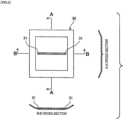
- a test of preparing a rectangular fiber-reinforced resin molded article 30 shown in FIG. 2 was carried out.
- the reinforcing fiber substrate there was used one obtained by opening a carbon fiber bundle (ten thousand fibers) having a diameter of 7 ⁇ m so as to have a width of 2 mm to prepare a plain-woven carbon fiber woven fabric having a basis weight of 63 g/m 2 and cutting therefrom.
- the impregnating resin a PA6 resin powder having an average grain size of 20 ⁇ m was used.
- the PA6 resin powder was electrostatically attached to the carbon fiber substrate so as to be a fiber volume content of 60% and, after the attachment, the PA6 resin powder was promptly melted using an IR heater.
- the thickness of the prepared fiber-reinforced resin intermediate material was 180 ⁇ m.
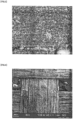
- FIG. 3 shows an optical microscope photograph of a state of the surface where the PA6 resin powder was electrostatically attached to the carbon fiber substrate. The surface of the reinforcing fiber substrate is still mottled but is observed as if powdery snow is thinly spread.
- FIG. 4 shows a scanning electron microscope (SEM) photograph of the surface of the prepared fiber-reinforced resin intermediate material.
- the surface of the fiber-reinforced resin intermediate material is observed such that there are a part where the carbon fiber bundle is covered with a syrup-like relatively thick coating, a part covered with a thin coating, and a part where the carbon fiber bundle itself is exposed.
- the relatively thick coating part narrow and long groove-like parts having different lengths are dotted along the direction of the carbon fiber, as if not completely filled up. That is, the reinforcing fiber substrate is observed to have void space opened on the outer surface in a semi-impregnated state with the PA6 resin.
- FIG. 5 shows an optical microscope photograph of a cross-section of the molded fiber-reinforced resin molded article at a magnification of 400 times.
- the fiber-reinforced resin molded article had a void ratio of 0.5% or less.
- the shaping ability of the fiber-reinforced resin molded article 30 was satisfactory and the edge part 31 of the groove shown in FIG. 2 could be also molded satisfactorily without deviation of fibers.
Landscapes
- Engineering & Computer Science (AREA)
- Chemical & Material Sciences (AREA)
- Mechanical Engineering (AREA)
- Textile Engineering (AREA)
- Composite Materials (AREA)
- Chemical Kinetics & Catalysis (AREA)
- Life Sciences & Earth Sciences (AREA)
- Dispersion Chemistry (AREA)
- Health & Medical Sciences (AREA)
- Electrochemistry (AREA)
- Molecular Biology (AREA)
- Plasma & Fusion (AREA)
- Physics & Mathematics (AREA)
- Proteomics, Peptides & Aminoacids (AREA)
- Reinforced Plastic Materials (AREA)
- Laminated Bodies (AREA)
- Casting Or Compression Moulding Of Plastics Or The Like (AREA)
- Moulding By Coating Moulds (AREA)
Claims (3)
- Faserverstärktes Harz-Zwischenmaterial, gebildet durch Anbringen eines Harzpulvers (20) an einem äußeren Oberflächenteil eines Verstärkungsfasersubstrats (10), das aus Verstärkungsfasern (11) gebildet ist, die einer Öffnung unterworfen sind, und Erhitzen des Harzes auf eine Temperatur, die gleich oder höher als der Schmelzpunkt des Harzes ist, um das Verstärkungsfasersubstrat mit dem Harz zu imprägnieren,wobei das Verstärkungsfasersubstrat einen Hohlraum besitzt, der an Außenoberfläche davon geöffnet ist, und sich das Harz in einem semi-imprägnierten Zustand befindet,wobei das Harz in dem semi-imprägnierten Zustand einen Zustand umfasst, in dem ein Teil der äußeren Oberfläche des Verstärkungsfasersubstrats mit einem geschmolzenen Harz imprägniert ist und ein anderer Teil der äußeren Oberfläche des Verstärkungsfasersubstrats nicht mit dem geschmolzenen Harz imprägniert ist,wobei die Verstärkungsfaser eine Kohlenstofffaser ist und das Flächengewicht des Verstärkungsfasersubstrats 40 bis 250 g/m2 ist,wobei die Schüttdichte p 1/2 bis 1/50 der Sollschüttdichte pc ist,wobei die Sollschüttdichte pc pc=Vr×ρr+Vf×ρf ist, wenn der Faservolumengehalt der Verstärkungsfaser Vf und Dichte davon pf ist und der Harzvolumengehalt des Harzes Vr und die Dichte davon pr ist,wobei die Öffnung der Verstärkungsfasern umfasst, dass ein zu imprägnierendes Faserbündel flach gemacht wird, so dass es eine vorbestimmte Dicke besitzt;wobei die äußere Oberfläche des Verstärkungsfasersubstrats die Oberfläche des Verstärkungsfasersubstrats und einen Teil unter der Oberfläche umfasst.
- Die Verwendung eines faserverstärkten Harz-Zwischenmaterials nach Anspruch 1 zum Herstellen eines faserverstärkten Harzformkörpers (30), wobei das faserverstärkte Harz-Zwischenmaterial durch Laminieren gebildet wird und Erwärmung und Druckbeaufschlagung durchgeführt werden.
- Verfahren zum Herstellen eines faserverstärkten Harz-Zwischenmaterials, dessen Verstärkungsfasersubstrat mit einem Harz in einem semi-imprägnierten Zustand imprägniert ist und an einer Außenfläche davon einen offenen Hohlraum besitzt, wobei das Verfahren umfasst:
elektrostatisches Anbringen eines Harzpulvers (20), besitzend eine vorbestimmte durchschnittlichen Korngröße, an das Verstärkungsfasersubstrat (10), so dass ein Faservolumengehalt des faserverstärkten Harz-Zwischenmaterials einen vorbestimmten Wert annimmt, der auf dem Außendurchmesser einer Verstärkungsfaser (11), die das Verstärkungsfasersubstrat bildet, und der Schüttdichte des Verstärkungsfasersubstrats basiert, wobei die Verstärkungsfaser eine Kohlenstofffaser ist und das Flächengewicht des Verstärkungsfasersubstrats 40 bis 250 g/m2 ist,wobei die Schüttdichte p 1/2 bis 1/50 der Sollschüttdichte pc ist,wobei die Sollschüttdichte pc pc=Vr×ρr+Vf×ρf ist, wenn der Faservolumengehalt der Verstärkungsfaser Vf und Dichte davon pf ist und der Harzvolumengehalt des Harzes Vr und die Dichte davon pr ist,wobei die Öffnung der Verstärkungsfasern umfasst, dass ein zu imprägnierendes Faserbündel flach gemacht wird, so dass es eine vorbestimmte Dicke besitzt;wobei die äußere Oberfläche des Verstärkungsfasersubstrats die Oberfläche des Verstärkungsfasersubstrats und einen Teil unter der Oberfläche umfasst.
Applications Claiming Priority (2)
| Application Number | Priority Date | Filing Date | Title |
|---|---|---|---|
| JP2014213114A JP5999721B2 (ja) | 2014-10-17 | 2014-10-17 | 繊維強化樹脂中間体及びその製造方法 |
| PCT/JP2015/079297 WO2016060240A1 (ja) | 2014-10-17 | 2015-10-16 | 繊維強化樹脂中間材及びその製造方法 |
Publications (4)
| Publication Number | Publication Date |
|---|---|
| EP3208062A1 EP3208062A1 (de) | 2017-08-23 |
| EP3208062A4 EP3208062A4 (de) | 2018-07-25 |
| EP3208062C0 EP3208062C0 (de) | 2024-10-02 |
| EP3208062B1 true EP3208062B1 (de) | 2024-10-02 |
Family
ID=55746774
Family Applications (1)
| Application Number | Title | Priority Date | Filing Date |
|---|---|---|---|
| EP15849984.8A Active EP3208062B1 (de) | 2014-10-17 | 2015-10-16 | Faserverstärktes harzzwischenmaterial und verfahren zur herstellung davon |
Country Status (7)
| Country | Link |
|---|---|
| US (2) | US10351994B2 (de) |
| EP (1) | EP3208062B1 (de) |
| JP (1) | JP5999721B2 (de) |
| CN (2) | CN112223789B (de) |
| BR (1) | BR112017007894B1 (de) |
| CA (1) | CA2964589C (de) |
| WO (1) | WO2016060240A1 (de) |
Families Citing this family (16)
| Publication number | Priority date | Publication date | Assignee | Title |
|---|---|---|---|---|
| JP5999721B2 (ja) * | 2014-10-17 | 2016-09-28 | 株式会社日本製鋼所 | 繊維強化樹脂中間体及びその製造方法 |
| JP6521895B2 (ja) * | 2016-04-15 | 2019-05-29 | 株式会社日本製鋼所 | 繊維強化樹脂中間材及びその製造方法 |
| FR3053627B1 (fr) * | 2016-07-05 | 2021-07-30 | Porcher Ind | Feuille composite a base de tissu et de polyetherimide a porosite controlee |
| JP6953438B2 (ja) | 2016-12-28 | 2021-10-27 | 日鉄ケミカル&マテリアル株式会社 | 金属−繊維強化樹脂材料複合体、その製造方法及び接着シート |
| TW201903013A (zh) | 2017-03-31 | 2019-01-16 | 日商新日鐵住金化學股份有限公司 | 金屬-纖維強化樹脂材料複合體及其製造方法 |
| JP7368929B2 (ja) * | 2017-08-08 | 2023-10-25 | 株式会社日本製鋼所 | 繊維強化樹指中間材の製造方法 |
| JP7215163B2 (ja) | 2017-12-28 | 2023-01-31 | 日本製鉄株式会社 | 金属-繊維強化樹脂材料複合体 |
| JP7295376B2 (ja) | 2017-12-28 | 2023-06-21 | 日本製鉄株式会社 | 金属-繊維強化樹脂材料複合体及びその製造方法 |
| WO2019186281A2 (en) * | 2018-03-30 | 2019-10-03 | Toray Industries, Inc. | Prepreg, laminate body, fiber-reinforced composite material, and manufacturing method for fiber-reinforced composite material |
| CA3108462A1 (en) | 2018-08-22 | 2020-02-27 | Toray Industries, Inc. | Fiber-reinforced thermoplastic resin substrate and laminate using same |
| JP7140381B2 (ja) | 2018-10-09 | 2022-09-21 | ヤマウチ株式会社 | 熱プレス用クッション材および熱プレス用クッション材の製造方法 |
| JP7489335B2 (ja) | 2019-02-14 | 2024-05-23 | 倉敷紡績株式会社 | 繊維強化樹脂成形体及びこれに用いる炭素繊維シートの製造方法 |
| CN111002506B (zh) * | 2019-12-03 | 2022-03-04 | 航天特种材料及工艺技术研究所 | 一种复合材料及其ooa制备方法 |
| EP4079499A4 (de) * | 2019-12-19 | 2023-12-27 | Kurashiki Boseki Kabushiki Kaisha | Faserverstärkter hohler harzforkörper und verfahren zur herstellung davon |
| WO2022009671A1 (ja) * | 2020-07-06 | 2022-01-13 | 株式会社イノアックコーポレーション | 繊維強化樹脂成形体とその製造方法、繊維強化樹脂成形用プリプレグ、繊維強化成形体と繊維強化成形体の製造方法と樹脂シート、繊維強化サンドイッチ複合体、及び繊維強化成形体の製造方法 |
| JP7748185B2 (ja) * | 2021-02-19 | 2025-10-02 | 倉敷紡績株式会社 | 繊維強化中空成形体の製造方法 |
Citations (3)
| Publication number | Priority date | Publication date | Assignee | Title |
|---|---|---|---|---|
| US5094883A (en) * | 1989-04-17 | 1992-03-10 | Georgia Tech Research Corporation | Flexible multiply towpreg and method of production therefor |
| US5370911A (en) * | 1990-04-20 | 1994-12-06 | The University Of Akron | Method of depositing and fusing charged polymer particles on continuous filaments |
| WO1996028258A1 (en) * | 1995-03-15 | 1996-09-19 | Custom Composite Materials, Inc. | Flexible low bulk pre-impregnated tow |
Family Cites Families (22)
| Publication number | Priority date | Publication date | Assignee | Title |
|---|---|---|---|---|
| US5302419A (en) * | 1989-04-17 | 1994-04-12 | Georgia Tech Research Corporation | Towpregs from recycled plastics by powder fusion coating and method of production therefor |
| US5639307A (en) | 1995-01-17 | 1997-06-17 | Electrostatic Technology, Inc. | Fiber bundle coating apparatus |
| US5604020A (en) * | 1995-02-16 | 1997-02-18 | Thermocomp Corporation | Thermoplastic thermoformable composite material and method of forming such material |
| EP1045749B1 (de) * | 1998-01-16 | 2003-04-16 | Neopreg AG | Verfahren zum beschichten von fasern |
| WO1999064216A1 (en) * | 1998-06-08 | 1999-12-16 | Complastik Corporation | Composite articles including prepregs, preforms, laminates and sandwich moldings, and methods of making the same |
| US6083855A (en) * | 1999-01-04 | 2000-07-04 | Isola Laminate Systems Corp. | Methods of manufacturing voidless resin impregnated webs |
| JP4324649B2 (ja) * | 2001-11-28 | 2009-09-02 | 福井県 | 繊維強化熱可塑性樹脂シート及びそれを用いた構造材並びに繊維強化熱可塑性樹脂シートの製造方法 |
| US7141284B2 (en) * | 2002-03-20 | 2006-11-28 | Saint-Gobain Technical Fabrics Canada, Ltd. | Drywall tape and joint |
| JP5223354B2 (ja) | 2007-02-02 | 2013-06-26 | 東レ株式会社 | 切込プリプレグ基材、積層基材、繊維強化プラスチック、および切込プリプレグ基材の製造方法 |
| DE102009001793A1 (de) * | 2009-03-24 | 2010-10-07 | Evonik Degussa Gmbh | Prepregs und daraus hergestellte Formkörper |
| CN103314041B (zh) * | 2011-01-14 | 2015-11-25 | 东丽株式会社 | 成型材料、预浸料、纤维强化复合材料和纤维强化复合材料叠层体以及纤维强化成型基材的制造方法 |
| CN103459283B (zh) * | 2011-03-30 | 2016-07-06 | 东丽株式会社 | 微孔塑料膜卷的制造方法 |
| JP5920690B2 (ja) * | 2011-05-30 | 2016-05-18 | 福井県 | プリプレグシート材及びその製造方法 |
| BR112014017498B1 (pt) * | 2012-01-25 | 2020-12-08 | Hexcel Holding Gmbh | material ou estrutura de moldagem compreendendo uma camada de reforço fibroso e uma resina líquida curável |
| JP2013180406A (ja) | 2012-02-29 | 2013-09-12 | Sumitomo Bakelite Co Ltd | プリプレグ、基板、半導体装置、プリプレグの製造方法、基板の製造方法、および半導体装置の製造方法 |
| WO2013147257A1 (ja) * | 2012-03-29 | 2013-10-03 | 三菱レイヨン株式会社 | 炭素繊維熱可塑性樹脂プリプレグ、炭素繊維複合材料、ならびに製造方法 |
| JP5712171B2 (ja) * | 2012-07-23 | 2015-05-07 | 株式会社 サン・テクトロ | プリプレグ製造装置及びプリプレグ製造方法 |
| US20140147620A1 (en) * | 2012-11-28 | 2014-05-29 | Milliken & Company | Infusible unidirectional fabric |
| JP5814964B2 (ja) * | 2013-03-12 | 2015-11-17 | 株式会社 サン・テクトロ | プリプレグ製造装置及びプリプレグ製造方法 |
| JP5736560B2 (ja) * | 2013-03-28 | 2015-06-17 | 福井県 | 積層成形体 |
| JP6086803B2 (ja) | 2013-04-30 | 2017-03-01 | 株式会社大一商会 | 遊技機 |
| JP5999721B2 (ja) * | 2014-10-17 | 2016-09-28 | 株式会社日本製鋼所 | 繊維強化樹脂中間体及びその製造方法 |
-
2014
- 2014-10-17 JP JP2014213114A patent/JP5999721B2/ja active Active
-
2015
- 2015-10-16 CN CN202010894562.0A patent/CN112223789B/zh active Active
- 2015-10-16 CA CA2964589A patent/CA2964589C/en active Active
- 2015-10-16 US US15/519,237 patent/US10351994B2/en active Active
- 2015-10-16 WO PCT/JP2015/079297 patent/WO2016060240A1/ja not_active Ceased
- 2015-10-16 BR BR112017007894-5A patent/BR112017007894B1/pt active IP Right Grant
- 2015-10-16 EP EP15849984.8A patent/EP3208062B1/de active Active
- 2015-10-16 CN CN201580056265.6A patent/CN107073754B/zh active Active
-
2019
- 2019-06-04 US US16/430,532 patent/US10697114B2/en active Active
Patent Citations (3)
| Publication number | Priority date | Publication date | Assignee | Title |
|---|---|---|---|---|
| US5094883A (en) * | 1989-04-17 | 1992-03-10 | Georgia Tech Research Corporation | Flexible multiply towpreg and method of production therefor |
| US5370911A (en) * | 1990-04-20 | 1994-12-06 | The University Of Akron | Method of depositing and fusing charged polymer particles on continuous filaments |
| WO1996028258A1 (en) * | 1995-03-15 | 1996-09-19 | Custom Composite Materials, Inc. | Flexible low bulk pre-impregnated tow |
Also Published As
| Publication number | Publication date |
|---|---|
| JP2016078360A (ja) | 2016-05-16 |
| JP5999721B2 (ja) | 2016-09-28 |
| EP3208062A1 (de) | 2017-08-23 |
| CN107073754A (zh) | 2017-08-18 |
| EP3208062A4 (de) | 2018-07-25 |
| US20190284755A1 (en) | 2019-09-19 |
| US10697114B2 (en) | 2020-06-30 |
| BR112017007894A2 (pt) | 2018-01-23 |
| CN112223789A (zh) | 2021-01-15 |
| CA2964589C (en) | 2017-12-19 |
| BR112017007894B1 (pt) | 2022-06-28 |
| WO2016060240A1 (ja) | 2016-04-21 |
| CN107073754B (zh) | 2020-09-25 |
| EP3208062C0 (de) | 2024-10-02 |
| CN112223789B (zh) | 2022-08-02 |
| US20170241074A1 (en) | 2017-08-24 |
| US10351994B2 (en) | 2019-07-16 |
| CA2964589A1 (en) | 2016-04-21 |
Similar Documents
| Publication | Publication Date | Title |
|---|---|---|
| US10697114B2 (en) | Fiber-reinforced resin intermediate material and method for manufacturing same | |
| EP3444294B1 (de) | Faserverstärktes harzzwischenmaterial, faserverstärkter harzformkörper und verfahren zur herstellung von faserverstärktem harzzwischenmaterial | |
| JP3894035B2 (ja) | 炭素繊維強化基材、それからなるプリフォームおよび複合材料 | |
| US11383406B2 (en) | Fibrous structure and 3D preform for a composite part | |
| US10272621B2 (en) | Resin coated radius fillers and method of making the same | |
| US20160159998A1 (en) | Prepreg for manufacturing composite materials | |
| KR20160110446A (ko) | 중합체의 수성 분산액을 사용하여 열가소성 중합체로 사전함침된 섬유 재료를 제조하는 방법 | |
| CN104903104A (zh) | 连续碳纤维增强热塑性预浸料的制造方法 | |
| US20160083871A1 (en) | Printing patterns onto composite laminates | |
| CN116438229B (zh) | 纤维增强树脂基材、预制件、一体化成型品及纤维增强树脂基材的制造方法 | |
| CN111699210B (zh) | 纤维铺放用干式带材料及其制造方法、以及使用其的增强纤维层叠体及纤维增强树脂成型体 | |
| JP7689918B2 (ja) | 繊維強化樹脂成形体 | |
| CN105437563B (zh) | 控制复合材料中渗透性和纤维体积分数的聚合物纳米颗粒 | |
| EP3585607B1 (de) | Faserverbundstoff mit verringerter oberflächenrauheit und verfahren zur herstellung davon | |
| JP6148281B2 (ja) | 繊維強化成形品の成形方法 | |
| JP2012251043A (ja) | 糸条、シート状の強化繊維基材、プリフォーム及び繊維強化複合材料の製造方法 | |
| JP7368929B2 (ja) | 繊維強化樹指中間材の製造方法 | |
| EP3000839B1 (de) | Polymernanopartikel für verbesserte verzerrungsfähigkeit in verbundwerkstoffen |
Legal Events
| Date | Code | Title | Description |
|---|---|---|---|
| STAA | Information on the status of an ep patent application or granted ep patent |
Free format text: STATUS: THE INTERNATIONAL PUBLICATION HAS BEEN MADE |
|
| PUAI | Public reference made under article 153(3) epc to a published international application that has entered the european phase |
Free format text: ORIGINAL CODE: 0009012 |
|
| STAA | Information on the status of an ep patent application or granted ep patent |
Free format text: STATUS: REQUEST FOR EXAMINATION WAS MADE |
|
| 17P | Request for examination filed |
Effective date: 20170413 |
|
| AK | Designated contracting states |
Kind code of ref document: A1 Designated state(s): AL AT BE BG CH CY CZ DE DK EE ES FI FR GB GR HR HU IE IS IT LI LT LU LV MC MK MT NL NO PL PT RO RS SE SI SK SM TR |
|
| AX | Request for extension of the european patent |
Extension state: BA ME |
|
| DAV | Request for validation of the european patent (deleted) | ||
| DAX | Request for extension of the european patent (deleted) | ||
| A4 | Supplementary search report drawn up and despatched |
Effective date: 20180627 |
|
| RIC1 | Information provided on ipc code assigned before grant |
Ipc: B29C 70/10 20060101ALI20180621BHEP Ipc: B29K 101/12 20060101ALI20180621BHEP Ipc: B29C 70/06 20060101ALI20180621BHEP Ipc: B29C 70/50 20060101ALI20180621BHEP Ipc: B29C 43/18 20060101ALI20180621BHEP Ipc: B29K 105/08 20060101ALI20180621BHEP Ipc: C08J 5/04 20060101ALI20180621BHEP Ipc: B29B 11/16 20060101AFI20180621BHEP Ipc: B29B 15/10 20060101ALI20180621BHEP |
|
| STAA | Information on the status of an ep patent application or granted ep patent |
Free format text: STATUS: EXAMINATION IS IN PROGRESS |
|
| 17Q | First examination report despatched |
Effective date: 20201124 |
|
| GRAP | Despatch of communication of intention to grant a patent |
Free format text: ORIGINAL CODE: EPIDOSNIGR1 |
|
| STAA | Information on the status of an ep patent application or granted ep patent |
Free format text: STATUS: GRANT OF PATENT IS INTENDED |
|
| INTG | Intention to grant announced |
Effective date: 20240617 |
|
| GRAS | Grant fee paid |
Free format text: ORIGINAL CODE: EPIDOSNIGR3 |
|
| GRAA | (expected) grant |
Free format text: ORIGINAL CODE: 0009210 |
|
| STAA | Information on the status of an ep patent application or granted ep patent |
Free format text: STATUS: THE PATENT HAS BEEN GRANTED |
|
| AK | Designated contracting states |
Kind code of ref document: B1 Designated state(s): AL AT BE BG CH CY CZ DE DK EE ES FI FR GB GR HR HU IE IS IT LI LT LU LV MC MK MT NL NO PL PT RO RS SE SI SK SM TR |
|
| REG | Reference to a national code |
Ref country code: GB Ref legal event code: FG4D |
|
| REG | Reference to a national code |
Ref country code: CH Ref legal event code: EP |
|
| REG | Reference to a national code |
Ref country code: DE Ref legal event code: R096 Ref document number: 602015090048 Country of ref document: DE |
|
| REG | Reference to a national code |
Ref country code: IE Ref legal event code: FG4D |
|
| U01 | Request for unitary effect filed |
Effective date: 20241010 |
|
| U07 | Unitary effect registered |
Designated state(s): AT BE BG DE DK EE FI FR IT LT LU LV MT NL PT RO SE SI Effective date: 20241030 |
|
| U20 | Renewal fee for the european patent with unitary effect paid |
Year of fee payment: 10 Effective date: 20241121 |
|
| PG25 | Lapsed in a contracting state [announced via postgrant information from national office to epo] |
Ref country code: IS Free format text: LAPSE BECAUSE OF FAILURE TO SUBMIT A TRANSLATION OF THE DESCRIPTION OR TO PAY THE FEE WITHIN THE PRESCRIBED TIME-LIMIT Effective date: 20250202 Ref country code: HR Free format text: LAPSE BECAUSE OF FAILURE TO SUBMIT A TRANSLATION OF THE DESCRIPTION OR TO PAY THE FEE WITHIN THE PRESCRIBED TIME-LIMIT Effective date: 20241002 |
|
| PG25 | Lapsed in a contracting state [announced via postgrant information from national office to epo] |
Ref country code: ES Free format text: LAPSE BECAUSE OF FAILURE TO SUBMIT A TRANSLATION OF THE DESCRIPTION OR TO PAY THE FEE WITHIN THE PRESCRIBED TIME-LIMIT Effective date: 20241002 |
|
| PG25 | Lapsed in a contracting state [announced via postgrant information from national office to epo] |
Ref country code: NO Free format text: LAPSE BECAUSE OF FAILURE TO SUBMIT A TRANSLATION OF THE DESCRIPTION OR TO PAY THE FEE WITHIN THE PRESCRIBED TIME-LIMIT Effective date: 20250102 |
|
| PG25 | Lapsed in a contracting state [announced via postgrant information from national office to epo] |
Ref country code: GR Free format text: LAPSE BECAUSE OF FAILURE TO SUBMIT A TRANSLATION OF THE DESCRIPTION OR TO PAY THE FEE WITHIN THE PRESCRIBED TIME-LIMIT Effective date: 20250103 |
|
| PG25 | Lapsed in a contracting state [announced via postgrant information from national office to epo] |
Ref country code: CZ Free format text: LAPSE BECAUSE OF FAILURE TO SUBMIT A TRANSLATION OF THE DESCRIPTION OR TO PAY THE FEE WITHIN THE PRESCRIBED TIME-LIMIT Effective date: 20241002 Ref country code: PL Free format text: LAPSE BECAUSE OF FAILURE TO SUBMIT A TRANSLATION OF THE DESCRIPTION OR TO PAY THE FEE WITHIN THE PRESCRIBED TIME-LIMIT Effective date: 20241002 |
|
| PG25 | Lapsed in a contracting state [announced via postgrant information from national office to epo] |
Ref country code: RS Free format text: LAPSE BECAUSE OF FAILURE TO SUBMIT A TRANSLATION OF THE DESCRIPTION OR TO PAY THE FEE WITHIN THE PRESCRIBED TIME-LIMIT Effective date: 20250102 |
|
| REG | Reference to a national code |
Ref country code: CH Ref legal event code: PL |
|
| PG25 | Lapsed in a contracting state [announced via postgrant information from national office to epo] |
Ref country code: SM Free format text: LAPSE BECAUSE OF FAILURE TO SUBMIT A TRANSLATION OF THE DESCRIPTION OR TO PAY THE FEE WITHIN THE PRESCRIBED TIME-LIMIT Effective date: 20241002 |
|
| PG25 | Lapsed in a contracting state [announced via postgrant information from national office to epo] |
Ref country code: MC Free format text: LAPSE BECAUSE OF FAILURE TO SUBMIT A TRANSLATION OF THE DESCRIPTION OR TO PAY THE FEE WITHIN THE PRESCRIBED TIME-LIMIT Effective date: 20241002 |
|
| PG25 | Lapsed in a contracting state [announced via postgrant information from national office to epo] |
Ref country code: CH Free format text: LAPSE BECAUSE OF NON-PAYMENT OF DUE FEES Effective date: 20241031 |
|
| PG25 | Lapsed in a contracting state [announced via postgrant information from national office to epo] |
Ref country code: SK Free format text: LAPSE BECAUSE OF FAILURE TO SUBMIT A TRANSLATION OF THE DESCRIPTION OR TO PAY THE FEE WITHIN THE PRESCRIBED TIME-LIMIT Effective date: 20241002 |
|
| PLBE | No opposition filed within time limit |
Free format text: ORIGINAL CODE: 0009261 |
|
| STAA | Information on the status of an ep patent application or granted ep patent |
Free format text: STATUS: NO OPPOSITION FILED WITHIN TIME LIMIT |
|
| 26N | No opposition filed |
Effective date: 20250703 |
|
| U20 | Renewal fee for the european patent with unitary effect paid |
Year of fee payment: 11 Effective date: 20250909 |
|
| PGFP | Annual fee paid to national office [announced via postgrant information from national office to epo] |
Ref country code: GB Payment date: 20250828 Year of fee payment: 11 |
|
| PG25 | Lapsed in a contracting state [announced via postgrant information from national office to epo] |
Ref country code: IE Free format text: LAPSE BECAUSE OF NON-PAYMENT OF DUE FEES Effective date: 20241016 |
|
| PG25 | Lapsed in a contracting state [announced via postgrant information from national office to epo] |
Ref country code: CY Free format text: LAPSE BECAUSE OF FAILURE TO SUBMIT A TRANSLATION OF THE DESCRIPTION OR TO PAY THE FEE WITHIN THE PRESCRIBED TIME-LIMIT; INVALID AB INITIO Effective date: 20151016 |
|
| PG25 | Lapsed in a contracting state [announced via postgrant information from national office to epo] |
Ref country code: HU Free format text: LAPSE BECAUSE OF FAILURE TO SUBMIT A TRANSLATION OF THE DESCRIPTION OR TO PAY THE FEE WITHIN THE PRESCRIBED TIME-LIMIT; INVALID AB INITIO Effective date: 20151016 |
|
| U1N | Appointed representative for the unitary patent procedure changed after the registration of the unitary effect |
Representative=s name: MARKS & CLERK LLP; GB |