EP3208085A1 - Vitre composite - Google Patents
Vitre composite Download PDFInfo
- Publication number
- EP3208085A1 EP3208085A1 EP17155308.4A EP17155308A EP3208085A1 EP 3208085 A1 EP3208085 A1 EP 3208085A1 EP 17155308 A EP17155308 A EP 17155308A EP 3208085 A1 EP3208085 A1 EP 3208085A1
- Authority
- EP
- European Patent Office
- Prior art keywords
- silicate glass
- polymer layer
- glass panes
- weight
- parts
- Prior art date
- Legal status (The legal status is an assumption and is not a legal conclusion. Google has not performed a legal analysis and makes no representation as to the accuracy of the status listed.)
- Granted
Links
Images

Classifications
-
- B—PERFORMING OPERATIONS; TRANSPORTING
- B32—LAYERED PRODUCTS
- B32B—LAYERED PRODUCTS, i.e. PRODUCTS BUILT-UP OF STRATA OF FLAT OR NON-FLAT, e.g. CELLULAR OR HONEYCOMB, FORM
- B32B17/00—Layered products essentially comprising sheet glass, or glass, slag, or like fibres
- B32B17/06—Layered products essentially comprising sheet glass, or glass, slag, or like fibres comprising glass as the main or only constituent of a layer, next to another layer of a specific material
- B32B17/10—Layered products essentially comprising sheet glass, or glass, slag, or like fibres comprising glass as the main or only constituent of a layer, next to another layer of a specific material of synthetic resin
- B32B17/10005—Layered products essentially comprising sheet glass, or glass, slag, or like fibres comprising glass as the main or only constituent of a layer, next to another layer of a specific material of synthetic resin laminated safety glass or glazing
- B32B17/10009—Layered products essentially comprising sheet glass, or glass, slag, or like fibres comprising glass as the main or only constituent of a layer, next to another layer of a specific material of synthetic resin laminated safety glass or glazing characterized by the number, the constitution or treatment of glass sheets
- B32B17/10036—Layered products essentially comprising sheet glass, or glass, slag, or like fibres comprising glass as the main or only constituent of a layer, next to another layer of a specific material of synthetic resin laminated safety glass or glazing characterized by the number, the constitution or treatment of glass sheets comprising two outer glass sheets
-
- B—PERFORMING OPERATIONS; TRANSPORTING
- B32—LAYERED PRODUCTS
- B32B—LAYERED PRODUCTS, i.e. PRODUCTS BUILT-UP OF STRATA OF FLAT OR NON-FLAT, e.g. CELLULAR OR HONEYCOMB, FORM
- B32B17/00—Layered products essentially comprising sheet glass, or glass, slag, or like fibres
- B32B17/06—Layered products essentially comprising sheet glass, or glass, slag, or like fibres comprising glass as the main or only constituent of a layer, next to another layer of a specific material
- B32B17/10—Layered products essentially comprising sheet glass, or glass, slag, or like fibres comprising glass as the main or only constituent of a layer, next to another layer of a specific material of synthetic resin
- B32B17/10005—Layered products essentially comprising sheet glass, or glass, slag, or like fibres comprising glass as the main or only constituent of a layer, next to another layer of a specific material of synthetic resin laminated safety glass or glazing
- B32B17/10009—Layered products essentially comprising sheet glass, or glass, slag, or like fibres comprising glass as the main or only constituent of a layer, next to another layer of a specific material of synthetic resin laminated safety glass or glazing characterized by the number, the constitution or treatment of glass sheets
- B32B17/10128—Treatment of at least one glass sheet
- B32B17/10146—Face treatment, e.g. etching, grinding or sand blasting
-
- B—PERFORMING OPERATIONS; TRANSPORTING
- B32—LAYERED PRODUCTS
- B32B—LAYERED PRODUCTS, i.e. PRODUCTS BUILT-UP OF STRATA OF FLAT OR NON-FLAT, e.g. CELLULAR OR HONEYCOMB, FORM
- B32B17/00—Layered products essentially comprising sheet glass, or glass, slag, or like fibres
- B32B17/06—Layered products essentially comprising sheet glass, or glass, slag, or like fibres comprising glass as the main or only constituent of a layer, next to another layer of a specific material
- B32B17/10—Layered products essentially comprising sheet glass, or glass, slag, or like fibres comprising glass as the main or only constituent of a layer, next to another layer of a specific material of synthetic resin
- B32B17/10005—Layered products essentially comprising sheet glass, or glass, slag, or like fibres comprising glass as the main or only constituent of a layer, next to another layer of a specific material of synthetic resin laminated safety glass or glazing
- B32B17/1055—Layered products essentially comprising sheet glass, or glass, slag, or like fibres comprising glass as the main or only constituent of a layer, next to another layer of a specific material of synthetic resin laminated safety glass or glazing characterized by the resin layer, i.e. interlayer
- B32B17/10743—Layered products essentially comprising sheet glass, or glass, slag, or like fibres comprising glass as the main or only constituent of a layer, next to another layer of a specific material of synthetic resin laminated safety glass or glazing characterized by the resin layer, i.e. interlayer containing acrylate (co)polymers or salts thereof
-
- B—PERFORMING OPERATIONS; TRANSPORTING
- B32—LAYERED PRODUCTS
- B32B—LAYERED PRODUCTS, i.e. PRODUCTS BUILT-UP OF STRATA OF FLAT OR NON-FLAT, e.g. CELLULAR OR HONEYCOMB, FORM
- B32B17/00—Layered products essentially comprising sheet glass, or glass, slag, or like fibres
- B32B17/06—Layered products essentially comprising sheet glass, or glass, slag, or like fibres comprising glass as the main or only constituent of a layer, next to another layer of a specific material
- B32B17/10—Layered products essentially comprising sheet glass, or glass, slag, or like fibres comprising glass as the main or only constituent of a layer, next to another layer of a specific material of synthetic resin
- B32B17/10005—Layered products essentially comprising sheet glass, or glass, slag, or like fibres comprising glass as the main or only constituent of a layer, next to another layer of a specific material of synthetic resin laminated safety glass or glazing
- B32B17/10807—Making laminated safety glass or glazing; Apparatus therefor
- B32B17/10981—Pre-treatment of the layers
Definitions
- the present invention relates to a composite pane comprising two silicate glass panes which are interconnected by a polymer layer, wherein the polymer layer is bonded to the silicate glass panes via covalent bonds. Moreover, the invention relates to a method for producing a composite pane, as well as their use.
- Composite materials of glass and plastic are known in the art.
- the flexible intermediate layer may, for. B. of polyvinyl butyral (PVB) or polyurethane (PU) - consist adhesive.
- PVB polyvinyl butyral
- PU polyurethane
- MEMO 3-Methacryloyloxipropyl-triethoxysilane
- PMMA polymethyl methacrylate
- GB1600867 a method in which between the brittle outer layers of z.
- a liquid, polymerizable material is introduced at the open top and solidified between the glass plates by polymerization.
- Non-shrinkable or low-shrinkage polymers such as polyesters, vinyl polymers or epoxy resins were cited as suitable intermediate layers, optionally by admixing an adhesion promoter such as MEMO.
- DE2951763 describes a composite system in which a (meth) acrylate-based photocurable, elastomeric casting resin is polymerized in the presence of a silane (eg MEMO) as a bonding agent at room temperature under the action of light between the rigid glass plates and thereby acts as a flexible adhesive layer, the procedure in Case of sufficient flowability in GB1600867 similar.
- a silane eg MEMO
- the composite systems described usually have a greater thickness of the glass panes relative to the intermediate layer, which results in an overall high weight of the composite.
- adhesion to film laminated composite systems is not significantly improved, so that glass to polymer separations are still possible.
- EP1485416 describes reduced weight composite systems using cast PMMA as the starting material for polymerization and adding a silane coupling agent.
- the thus modified PMMA core may have a greater thickness than the outer silicate glass panes.
- Laminated glasses produced in this way are characterized by high hail resistance. Due to the very different thermal expansion coefficients of the PMMA-based core and the silicate glass panes, however, the resistance of the composite systems to temperature changes is severely limited.
- the object of the present invention is therefore to provide composite panes which have all the advantages of the aforementioned composite systems and a higher stability against temperature fluctuations and other types of loading.
- this object is achieved by a composite pane comprising two silicate glass panes which are interconnected by a polymer layer, characterized in that the polymer layer is connected to the silicate glass panes via covalent bonds by an adhesion promoter, and that the composite pane is obtainable by a process, in which the silicate glass panes have a surface energy of 65 mN / m or more, preferably 72 mN / m or more, before the covalent bond with the polymer layer, at least on the contact surface facing the polymer layer.
- the covalent compounds via which the polymer layer is bonded to the silicate glass panes by a primer preferably comprise (a) a covalent bond between the primer and a polymer contained in the polymer layer, e.g. a poly (meth) acrylate, and (b) a covalent bond between the primer and the silicate glass.
- the covalent compound (a) between the adhesion promoter and a polymer contained in the polymer layer is preferably obtainable by a polymerization reaction via a double bond.
- the covalent compound (b) between the primer and the silicate glass is preferably obtainable via a polycondensation or condensation reaction.
- the composite disks according to the invention are surprisingly characterized by an extremely high bond strength, whereby usually exclusive properties of the silicate glass panes and the polymer layer used can be combined within a composite.
- the composite discs have a high scratch and abrasion resistance, a remarkably low weight, pronounced barrier properties to gases, and a high stability against temperature fluctuations. Due to these advantageous properties, it is possible to produce with the composite disks according to the invention large-area glazing and outstanding stability.
- silicate glass panes immediately after their production have a surface energy of less than 50 mN / m (millinewtons per meter).
- the surface energy of industrially manufactured silicate glass panes is subject to great fluctuations, since the surface energy can change greatly due to modifications of the manufacturing process, the environmental conditions during transport and storage and due to aging. Since the surface energy with the If the number of hydroxyl groups (OH groups) available as binding partner for a coupling agent correlates, the surface energy has a great influence on the strength of the bond between silicate glass panes and a polymer layer containing a coupling agent.
- Composite disks, which are produced with silicate glass panes of different surface energy therefore have very different properties. In particular, the stability, eg the stability to temperature fluctuations, therefore varies greatly.
- the number of free OH groups on the glass surface and the surface energy are increased to 65 mN / m or more by chemical or physical activation of the glass surface according to the invention.
- the number of free OH groups on the silicate glass surface is preferably increased by 5% or more, 10% or more, 25% or more or 50% or more.
- the covalent attachment of the adhesion promoter to the glass surface can thus be significantly improved by increasing the available binding partners.
- the covalent compound is preferably carried out by polycondensation of silanol groups to free OH groups of the glass.
- the use of activated silicate glass panes results in a standardization of the production processes, which can render superfluous a complex control of the initial surface energy and / or a quality control of the produced composite panes.
- the surface energy is increased to 65 mN / m or more irrespective of the initial values.
- the inventive surface energy increase also levels the different surface energies of the air and tin sides of float glass.
- One result of the manufacturing process of float glass is that the tin side often has significantly lower surface energy than the air side. For this reason, the use of the air side as the contact surface to the polymer layer would have to be taken into consideration in the production of glass-fiber composite panes.
- the standardization of the surface energy in the context of the invention makes such a differentiation superfluous.
- the composite disks according to the invention may alternatively be described by indicating the density of the covalent bonds between the polymer and the silicate.
- the present invention thus relates to a composite pane comprising two silicate glass panes interconnected by a polymer layer are connected, characterized in that the polymer layer is connected via covalent compounds by an adhesion promoter with the silicate glass, wherein at least 90% of the located on the contact surfaces to the silicate glass on the polymer layer adhesion promoter are bound in the covalent compounds, wherein the polymer layer preferably by polymerization a polymerizable composition is obtainable containing at least 0.5 wt .-% adhesion promoter.
- the composite pane comprises two silicate glass panes, which are interconnected by a polymer layer.
- the polymer layer lies between the two silicate glass panes.
- the two silicate glass panes and the polymer layer will be arranged parallel or substantially parallel.
- the polymer layer is connected at one contact surface to the two silicate glass panes by covalent bonds between the polymer and the silicate glass panes, there is generally no spacing between the first silk glass pane and the polymer layer and between the polymer layer and the second silicate glass pane at the contact surfaces.
- the contact surfaces between the polymer layer and the silicate glass panes can be more than 50%, more than 60%, more than 70%, more than 80%, more than 90%, more than 95% or 100% of one side of the polymer layer and / or extending one side of the silicate glass panes.
- a "contact surface” is the surface on which the polymer layer and the silicate glass pane touch and on which there are covalent connections between the polymer layer and the silicate glass pane, or the surface over which such contact and compounds are to be produced in the process according to the invention.
- the silicate glass panes thus have a contact surface, the polymer layer has two, since it is connected on both sides with a silicate glass pane.
- the contact surfaces extend over more than 95% of one side of the polymer layer and / or the silicate glass panes. It is further preferred that the polymer layer and the silicate glass panes are substantially the same length and width. This can be achieved, for example, by carrying out a trimming cut after the polymerization. Corresponding cutting methods are known to the person skilled in the art.
- adhesion promoter located on the contact surfaces to the silicate glass panes on the polymer layer is bound in the covalent compounds.
- Such high saturation of the available adhesion promoter can only be achieved by the high number of available binding partners on the contact surface of the silicate glass pane.
- adhesion promoter located on the polymer layer includes any adhesion promoter molecules that are located in the polymer layer such that they are available for a condensation reaction at the silicate glass interface.
- the polymer layer is obtainable by polymerization of a polymerizable composition which contains at least 0.5% by weight of adhesion promoter.
- the polymerizable composition may be e.g. 0.5 wt% or more, 0.8 wt% or more, 1 wt% or more, 1.5 wt% or more, or 5 wt% or more of the adhesion promoter. It is preferred that the polymerizable composition contains from 0.5% to 2% by weight of coupling agent, e.g. about 1% by weight.
- Silicate glass panes and suitable methods of making the same are known to those skilled in the art.
- the discs are available from a variety of suppliers and include silica and / or different silicates on the surface of the silicate glass panes OH - groups present - or O -.
- the silicate glass panes can be, for example, float glass panes, chemically or physically tempered glass (such as toughened safety glass (ESG)), or borosilicate glass. Suitable further silicate glasses are known to the person skilled in the art.
- the silicate glass panes are thus prestressed silicate glass panes, particularly preferably single-pane safety panes (ESG panes).
- ESG panes single-pane safety panes
- Methods for the chemical or physical prestressing of silicate glass panes are known to the person skilled in the art. Due to its prestressing, chemically or physically tempered glass is generally very sensitive to further processing by cutting, sawing or drilling.
- Composite disks according to the invention, the prestressed silk-glass panes can on the other hand, be further processed without damage to the composite discs.
- the silicate glass sheets according to the invention have a small thickness. As a result, the weight of the composite discs is significantly reduced.
- the thickness of the individual silicate glass panes is preferably between 0.1 and 12 mm. In a particularly preferred embodiment, the silicate glass panes have a thickness of 0.5 to 3 mm, particularly preferably about 1 mm.
- the polymer layer is produced according to the invention by polymerization of a polymerizable composition as described elsewhere herein. It is thus preferred that the polymer layer is obtainable by polymerization of a polymerizable composition described herein.
- the polymer layer preferably comprises poly (meth) acrylates. Poly (meth) acrylates are obtained by polymerization of mixtures containing (meth) acrylates. Suitable (meth) acrylates are known to those skilled in the art and described elsewhere herein.
- the polymer layer may e.g. consist of at least 60 wt .-%, 70 wt .-%, 80 wt .-%, 85 wt .-%, 90 wt .-%, or 95 wt .-% poly (meth) acrylates.
- the polymer layer is at least 90% by weight of poly (meth) acrylates, more preferably at least 95% by weight.
- the polymer layer comprises at least 90% by weight of PMMA compounds.
- the polymer layer preferably has a thickness of 1 to 20 mm, more preferably 3 to 15 mm. In a particularly preferred embodiment, the polymer layer has a thickness of 5 to 12 mm. It is particularly preferred according to the invention that the polymer layer has a thickness of about 8 mm. However, the polymer layer can also be thicker than 20 mm. Corresponding methods for producing particularly thick polymer layers are known to the person skilled in the art.
- the polymer layer is preferably thicker than the individual silicate glass panes.
- the polymer layer is connected to the silicate glass panes via covalent bonds.
- the polymerizable composition comprises an adhesion promoter which forms a covalent bond with the (meth) acrylates contained in the polymerizable composition and a further covalent bond with the silicate glass panes, preferably with a silicon compound in the silicate glass panes.
- the primer is a compound and capable of covalently bonding the silicate glass sheets to the polymer layer.
- the adhesion promoter contains at least one, more preferably three, silanol groups.
- Silanol groups are capable of reacting with free OH groups on the silicate glass surface, e.g. with the free OH groups of a silicon compound in the silicate glass, to condense.
- the adhesion promoter is thus preferably able to enter into a covalent bond with the silicate glass panes via a condensation reaction with free OH groups on the silicate surface.
- the primer is capable of forming a covalent bond with the (meth) acrylates contained in the polymerizable composition, preferably the covalent compound via a polymerization reaction via e.g. a double bond is created.
- silicon compounds of the formula (I) which act as adhesion promoters.
- suitable silicon compounds of formula (I) are in EP 1 485416 described.
- Silicon compounds which are suitable as adhesion promoters are, for example, alkyltrialkoxysilanes, dialkyldialkoxysilanes, trialkylalkoxysilanes, alkylsilyltrihalides, dialkylsilyldihalides, trialkylsilyl halides, trichloromethylsilane, dichlorodimethylsilane, chlorotrimethylsilane, Tribromomethylsilan, Dibromodimethylsilan, Bromotrimethylsilan, Trichloroethylsilan, Dichlorodiethylsilan, Chlorotriethylsilan, Tribromoethylsilan, Dibromodiethylsilan, Bromotriethylsilan, trimethoxymethylsilane, dimethoxydimethylsilane, methoxytrimethylsilane, triethoxymethylsilane, diethoxydimethylsilane,
- a composite pane which is characterized in that the polymer layer comprises polymethyl methacrylate (PMMA) compounds and MEMO compounds
- PMMA polymethyl methacrylate
- MEMO polymethyl methacrylate
- “Compounds” in this context refers to all chemical compounds comprising PMMA or MEMO, in particular polymers and / or copolymers which contain PMMA and / or MEMO and / or their polymerization products.
- the adhesion promoter located on the contact surfaces to the silicate glass panes on the polymer layer is bound in the covalent compounds.
- Such a high density of covalent bonds is made possible by the high surface energy of the silicate glass panes and the prior activation of the panes.
- the polymer layer is preferably obtainable by polymerization of a polymerizable composition containing at least 0.5% by weight of adhesion promoter. In this way it is ensured that a sufficient amount of adhesion promoter for the covalent connection between the silicate glass panes and the polymer layer are available. This should not exclude that a smaller amount of adhesion promoter can be used.
- the polymerizable composition may contain at least 0.2 wt%, at least 0.5 wt%, at least 1 wt%, or at least 1.5 wt%.
- the polymerizable composition contains 1 wt .-% or more adhesion promoter.
- the polymerizable composition preferably contains from 0.5 to 5% by weight of adhesion promoter, more preferably from 1 to 2% by weight.
- the composite pane is obtainable by a process in which the silicate glass panes have a surface energy of 65 mN / m or more, at least on the contact surface facing the polymer layer, before the covalent connection with the polymer layer.
- the surface energy can thus be e.g. 65 mN / m, 66 mN / m, 67 mN / m, 68 mN / m, 69 mN / m, 70 mN / m, 71 mN / m, 72 mN / m, 73 mN / m, 74 mN / m, 75 mN / m, 76 mN / m, or more.
- the silicate glass panes preferably have a surface energy of 72 mN / m or more before the covalent bond with the polymer layer, at least on the contact surface facing the polymer layer.
- the silicate glass panes have these surface energy values immediately prior to the production of the composite. In this way it is prevented that the surface energy values z. B. by prolonged storage back to less than 65 mN / m.
- the invention relates to composite panes whose silicate glass panes have a surface energy of 65 mN / m or more, preferably 72 mN / m or more, immediately before the covalent connection with the polymer layer at least on the contact surface facing the polymer layer.
- the silicate glass panes which have a contact surface with a surface energy of 65 mN / m or more, are processed in the composite in such a timely manner that their surface energy does not fall below a value of 65 mN / m, preferably not below a value of 72 mN / m.
- the silicate glass panes have the surface energy values referred to herein at (ie, at the time of) preparation of the composite, especially at the time of preparation of the covalent compounds.
- the invention relates to composite panes whose silicate glass panes have a surface energy of 65 mN / m or more, preferably 72 mN / m or more, in the covalent connection with the polymer layer at least on the contact surface facing the polymer layer.
- a review of the surface energy values and / or corresponding increase in the surface energy can, for. B. be done on the same day, z. B. 12 hours or less before the production of the covalent compound within the composite, preferably 6 hours or less. Therefore, preferred embodiments relate in particular to composite panes whose silicate glass panes have or have a surface energy of 65 mN / m or more, preferably 72, before the covalent connection with the polymer layer, at least on the contact surface facing the polymer layer, for 12 hours or less, preferably 6 hours or less mN / m or more.
- a silicate glass pane which is suitable according to the invention is preferably produced by activation of at least one contact surface. By activating the contact surface or the silicate glass pane, the surface energy is increased and the number of hydroxyl groups available on the surface is increased.
- the activation can be carried out by means of a chemical etching process, e.g. the treatment with an alkaline aqueous solution; or by means of a physical etching process, e.g. the corona, ozone and / or (linear) plasma treatment done.
- a chemical etching process e.g. the treatment with an alkaline aqueous solution
- a physical etching process e.g. the corona, ozone and / or (linear) plasma treatment done.
- the activation may in particular be a treatment of the surface with a plasma, an ionized gas, e.g. Air, oxygen, nitrogen, argon, hydrogen, helium and ammonia or a mixture of these gases, and / or an ion beam include.
- a plasma an ionized gas, e.g. Air, oxygen, nitrogen, argon, hydrogen, helium and ammonia or a mixture of these gases, and / or an ion beam include.
- alkaline aqueous solution such as potassium hydroxide solution
- An alkaline aqueous solution is a homogeneous mixture of two or more components, one of which is necessarily water, the other necessarily a base, the latter increasing the pH of the solution to> 7 by dissolution in water.
- a particularly preferred basic component (base) in the present invention is potassium hydroxide.
- Alkaline aqueous solutions are known to those skilled in the art and include e.g. LiOH, NaOH, and KOH solutions. KOH solutions are particularly preferred according to the invention.
- alkaline aqueous solutions are suitable which comprise between 1 and 15% of the base, such as 3% or 10% base.
- the alkaline aqueous solution is thus one to 15 percent, preferably one to ten percent, the percentages being based on the concentration of the base.
- the alkaline aqueous solution may comprise further additives which positively influence the application properties of the solution without adversely affecting the activation.
- Suitable additives are for.
- Co-solvents improve the wetting of the silicate glass pane and may be e.g. be selected from the group of alcohols, such as. For example, methanol, ethanol, isopropanol, butanol, and others.
- the co-solvent may also be contacted with the disk prior to activating the glass sheet with the alkaline aqueous solution.
- a suitable viscosity regulator is z. B. glycol.
- the composite panes according to the invention are temperature-stable and can have a size of more than 3 m 2 .
- surface energy may be increased by treatment with an etching process, such as treatment with an alkaline aqueous solution, by corona, ozone, and / or (linear) plasma treatment.
- an etching process such as treatment with an alkaline aqueous solution
- corona, ozone, and / or (linear) plasma treatment In a special In the preferred embodiment, the surface energy is increased in step a) by treating the contact surface (s) with a potassium hydroxide solution.
- the polymerizable compositions of the invention comprise monomers, oligomers and / or polymers and are characterized in that their molecular weight can be increased by means of a common polymerization process.
- Common polymerization processes and conditions are known in the art and include, for example, free radical, anionic and cationic polymerization.
- Suitable polymerisable compositions are known to the person skilled in the art and described herein.
- the polymerizable composition contains a polymerizable and / or prepolymerized monomer.
- a "prepolymerized” monomer in this context refers to an oligomer and / or polymer obtainable by polymerization from the monomer and / or by copolymerization of the monomer with one or more other monomers other than the monomer.
- the term "prepolymerized” monomer is synonymous with "polymer and / or copolymer obtainable by polymerization or copolymerization of at least one monomer.”
- Suitable polymerizable compositions and polymerization conditions are in EP 1 485 416 B1 described.
- the related to the composition of the polymerizable compositions and the polymerization conditions in EP 1 485 416 B1 are incorporated herein by reference.
- the above-mentioned components of the polymerizable composition were disclosed in U.S. Pat EP 1 485 416 B1 exactly described. The statements regarding the structure and the amounts of components to be used EP 1 485 416 B1 are expressly incorporated herein by reference.
- the polymerizable composition is preferably obtained by reacting the components of the composition 1 and then adding the components of the composition 2.
- Suitable (meth) acrylates of the formula (II) are therefore known to the person skilled in the art and include, for example, the following: hydroxyalkyl (meth) acrylates, such as 3-hydroxypropyl (meth) acrylate, 3,4-dihydroxybutyl (meth) acrylate, 2-hydroxyethyl (meth) acrylate, 2-hydroxypropyl (meth) acrylate, 2, 5-dimethyl-1,6-hexanediol (meth) acrylate, 1, 10-decanediol (meth) acrylate and 1, 2-propanediol (meth) acrylate; Polyoxyethylene and polyoxypropylene derivatives of (meth) acrylic acid such as triethylene glycol (meth) acrylate, tetraethylene glycol (meth) acrylate and tetrapropylene glycol (meth) acrylate; Aminoalkyl (meth) acrylates such as 2- [N, N-dimethyl
- Suitable (meth) acrylates are furthermore, for example, hydroxylalkyl (meth) acrylates, aminoalkyl (meth) acrylates, oxiranyl (meth) acrylates and mercaptoalkyl (meth) acrylates, in particular Glycidyl (meth) acrylate.
- a particularly preferred (meth) acrylate of the formula (II) is glycidyl methacrylate (GMA).
- the polymerizable composition may be e.g. from 0 to 5 wt .-%, preferably from 0.5 to 5 wt .-% of the (meth) acrylate of the formula (II).
- the polymerizable composition contains from 0.5 to 5 wt% GMA, more preferably between 1 and 3 wt%.
- Polymerizable, D) different monomers are also known in the art and are detailed in EP 1 485 416 B1 described. They preferably comprise all organic compounds other than D) which have at least one ethylenic double bond. In a particularly preferred embodiment, the polymerizable monomer other than D) is methyl methacrylate (MMA).
- MMA methyl methacrylate
- the polymerizable composition may be e.g. from 55 to 98.99 wt.%, preferably from 85 to 98.99 wt.% of the polymerizable monomer other than D).
- the polymerizable composition contains from 55 to 98.99 wt%, preferably from 85 to 98.99 wt, of MMA (and / or prepolymerized MMA).
- the composition 2 may further comprise at least one polymer and / or copolymer obtainable by polymerization or copolymerization of the monomers D).
- the processability of the composition can be improved by increasing the viscosity.
- additives which are able to modify the polymer in its properties are known to the person skilled in the art and are described in US Pat EP 1 485 416 B1 described.
- Suitable additives include, for example, polymerization initiators such as 2,2'-azo-bis-isobutyronitrile (AIBN), di (4-tert-butylcyclohexyl) peroxydicarbonate (BCHPC), and 2,2'-azobis-2,4-dimethylvaleronitrile (ADVN).
- AIBN is a particularly preferred aggregate.
- GMA glycidyl methacrylate
- MEMO silicon compound A
- MMA as a polymerizable monomer other than D
- the polymerizable composition comprises compositions 1 and 2, wherein composition 1 comprises 3-methacryloyloxypropyltriethoxysilane (MEMO); and composition 2 comprises methyl methacrylate (MMA) (and / or prepolymerized methyl methacrylate) and glycidyl methacrylate (GMA).
- MEMO 3-methacryloyloxypropyltriethoxysilane
- MMA methyl methacrylate
- GMA glycidyl methacrylate
- the polymerizable composition comprises 0.5-5% by weight of MEMO, 0.5-5.0% by weight of GMA and 85-98.99% by weight of MMA (or can be obtained by blending or mixing) Implementation of at least these compounds available).
- the polymerizable composition is introduced in step b) of the method according to the invention between the contact surfaces of the two silicate glass panes. It is preferable that the introduction of the polymerizable composition is carried out by a casting method. To this end, the silicate glass panes are provided spaced apart, with the silicate glass panes preferably being substantially parallel to one another, and the polymerizable composition being poured between the silicate glass panes. At the same time, preferably after the end of the casting process, the polymerizable composition substantially fills out the entire space between the spaced-apart silkscreen glass panes. Corresponding casting methods are known in the art.
- the distance between the two silicate glass panes depends on the desired thickness of the polymer layer.
- the distance corresponds to e.g. the preferred values for this polymer layer, e.g. 1 to 20 mm, such as 1 to 10 mm.
- step b) The incorporation of the polymerizable composition in step b) is preferably carried out within 48 hours (h) after increasing the surface energy in step a). In this way it is ensured that the surface energy is not subjected to significant fluctuations in the meantime.
- incorporation of the polymerizable composition in step b) e.g. 60 hours or less, 48 hours or less, 24 hours or less, 12 hours or less, 2 hours or less, or 1 hour or less after increasing the surface energy in step a).
- the introduction occurs after 24 hours or less (i.e., within 24 hours) after increasing the surface energy in step a).
- the contact surfaces of the two silicate glass panes thus have a surface energy of 65 mN / m or more when introducing the polymerizable composition in step b).
- "When” means in this context immediately before the Contacting the contact surface with the polymerizable composition.
- the invention thus relates to a method in which the contact surfaces upon introduction of the polymerizable composition have a surface energy of 65 mN / m or more, preferably 72 mN / m.
- a sufficiently high surface energy can be ensured by using silicate glass sheets which have contact surfaces having a surface energy of 65 mN / m or more, preferably 72 mN / m, for 12 hours or less, preferably 6 hours or less, prior to incorporation of the polymerizable composition ,
- the silicate glass sheets for the polymerization in step c) are carried out vertically.
- the invention relates to a composite disk obtainable by a method of the invention described herein.
- the invention relates to a use of a composite disc according to the invention for discs, e.g. Window panes for ships High-rise buildings and other applications for which the significantly reduced weight of the composite panes is advantageous; Safety glazing; Windows, e.g. Security windows, roof windows, shop windows and vehicle windows; Glass doors; conserveatories; greenhouses; Noise barriers; aquariums; Showcases, such as Safety cabinets; Sales counters; Exhibition construction and / or balcony parapets. Particularly preferred according to the invention is the use in window panes for ships and skyscrapers.
- a composite disc according to the invention for discs, e.g. Window panes for ships High-rise buildings and other applications for which the significantly reduced weight of the composite panes is advantageous; Safety glazing; Windows, e.g. Security windows, roof windows, shop windows and vehicle windows; Glass doors; conserveatories; greenhouses; Noise barriers; Aquariums; Showcases, such as Safety cabinets; Sales counters; Exhibition construction and / or balcony parapets.
- MEMO 3-methacryloyloxipropyltriethoxysilane
- Two float glass plates of the size 1340 x 2100 mm and the thickness of 1 mm were then freed on the polymerizable composition side facing first by washing with water from release agent. Subsequently, the glass plates were activated by completely mixing with a solution of 1000 mL of dist. Water, 1000 mL of isopropanol and 60 g of potassium hydroxide were wetted. The solution was previously stirred for 1 hour at room temperature. The glass sheets so wetted on the side facing the polymerizable composition were allowed to stand in the wetted state for 15 minutes. Subsequently, the activating solution was removed from the glass surface by washing the glass sheets to neutrality with water and then drying.
- the activated glass plates were now in one vertical heatable chamber positioned and using a sealing or sealing cord, z. B. of rubber or PVC, to the desired distance (here: 8 mm), which determines the subsequent thickness of the core consisting of the polymer set.
- the desired distance here: 8 mm
- the polymerization was therefore started at 50 ° C and cooled at the onset of Trommsdorff-Norrish effect to 43 ° C and then polymerized until fully cured.
- the polymerization was carried out in an intertized chamber, ie with a stream of nitrogen over the open chamber.
- ESG panes are hardened / tempered.
- float glass float glass, 200 ⁇ 300 ⁇ 1 mm, Principle glass, float glass, 300 ⁇ 300 ⁇ 8 mm, Tesco
- borosilicate glass 200 ⁇ 300 ⁇ 0.15 mm , Knittel
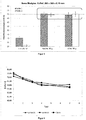
- the stability of activated (inventive) and non-activated composite disks was analyzed in a temperature cycling test.
- the composite panes were produced using the "Microfloat" float glass (1340 x 2100 x 1mm, Pilkington) on a pilot plant scale, with the following weights: solution material Manufacturer / Supplier Weighing [g] 1 methyl methacrylate Evonik 16500.00 glycidyl TCI 289.11 AIBN Sigma Aldrich 1.37 BCHPC United inhibitors 12.70 2 methacrylic acid ABCR 6.80 VE water - 34.22 MEMO ABCR 70.10 KOH KOH, techn. BCD Biesterfeld 30.00 IPA BCD Biesterfeld 470.00 VE water - 500.00
- the glass sheets had on the inside (which should be directed to the PMMA core) in the original state surface energies of 40-55 mN / m.
- the disks were first activated by treatment with 3% KOH solution. For this purpose, the disks were flooded twice at intervals of 5 minutes with the KOH activation solution - standing on a glass stand - flooded. Subsequently, the disc was washed neutral with deionized water and rinsed with IPA (for better drying).
- the surface energy of the inside surfaces of the disks was measured by KOH before and after the surface treatment: Disc no. OE before activation [mN / m] OE after activation [mN / m] 1 a 42 70 1 b 55 72 2 a 51 71 2 B 55 74 3 a 48 72 3 b 61 73 4 a 52 71 4 b 50 72
- Solution 1 and solution 2 were prepared separately and combined after a stirring time of 30 min. The resulting solution was stirred for a further 10 minutes.
- the docked, activated float glass panes were inserted vertically into a chamber, consisting of two heatable aluminum plates, and fixed by vacuum to this standing (vertical). Subsequently, a PVC sealing cord 8 mm thick was inserted and closed the chamber. Now, the combined polymerization solution was filled in the chamber and carried out a polymerization according to the following temperature profile: 1 h at 60 ° C for initial polymerization and preparation of the prepolymer; subsequent temperature control at 45 ° C until the disc was cured; and finally annealing for 4 h at 120 ° C.
- the slices were then cut to size 200 x 300 mm by means of water jet cutting and the edges were polished and lined.
- silicate glass was obtained directly from the manufacturer and the following surface energies were measured on the glass: Disc no. OE [mN / m] 5 a 36 5 b 37 6 a 39 6 b 41
- the composite panes whose inner glass surfaces have undergone a prior activation and whose surface energies were thereby increased to> 70 mN / m by means of KOH treatment, showed a significantly better adhesion than non-pretreated, ie. not activated discs.
- the panes were either treated with a 3 wt% KOH solution or exposed to an ozone atmosphere.
- the treatment with the KOH solution both the flooding and the immersion of the glass sheets in the KOH solution were examined.
- the exposure time was 10 min.
- the samples were cleaned with water and isopropanol.
- the surface energy of the glasses was determined on the air side using the contact angle meter. Over a period of seven days, measurements were taken time and again to record the surface energies as a function of time.
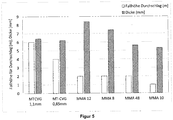
- the falling ball resistance of a disk is an indicator of the impact strength or impact strength of a composite disk.
- the falling ball resistance of composite panes of the invention containing either standard float glass or chemically precured glass panes (CVG) was investigated in the drop tower.
- the composite discs were exposed in the air, ie without support surface, loaded with a 220 g heavy steel ball, the drop height was varied.
- the following discs were tested: template characterization recipe Thickness approx.
- the CVG-based composite panels had a higher impact tolerance than the corresponding glass panels with float glass.
- the breakdown in the CVG based composite disks was observed at a drop height of 6 m (composite thickness: 6.7 mm) and 4 m (6.3 mm), respectively, while breakdown for all float glass based composite disks was at a height of fall between 1 and 2 m was observed.
- Thinner CVG variants were superior even to thicker float glass-based variants and showed exceptionally good ball fall resistance.
Landscapes
- Laminated Bodies (AREA)
- Joining Of Glass To Other Materials (AREA)
- Surface Treatment Of Glass (AREA)
Applications Claiming Priority (1)
| Application Number | Priority Date | Filing Date | Title |
|---|---|---|---|
| DE102016001381.8A DE102016001381A1 (de) | 2016-02-08 | 2016-02-08 | Verbundscheibe |
Publications (2)
| Publication Number | Publication Date |
|---|---|
| EP3208085A1 true EP3208085A1 (fr) | 2017-08-23 |
| EP3208085B1 EP3208085B1 (fr) | 2020-10-14 |
Family
ID=58094174
Family Applications (1)
| Application Number | Title | Priority Date | Filing Date |
|---|---|---|---|
| EP17155308.4A Active EP3208085B1 (fr) | 2016-02-08 | 2017-02-08 | Vitre composite |
Country Status (3)
| Country | Link |
|---|---|
| EP (1) | EP3208085B1 (fr) |
| DE (1) | DE102016001381A1 (fr) |
| LT (1) | LT3208085T (fr) |
Families Citing this family (1)
| Publication number | Priority date | Publication date | Assignee | Title |
|---|---|---|---|---|
| DE102021113396B3 (de) | 2021-05-25 | 2022-09-01 | Krd Sicherheitstechnik Gmbh | Bauelement, und Verfahren zur Herstellung eines Bauelements |
Citations (6)
| Publication number | Priority date | Publication date | Assignee | Title |
|---|---|---|---|---|
| DE2951763A1 (de) | 1978-12-28 | 1980-07-03 | Bridgestone Tire Co Ltd | Sicherheits-verbundglasscheiben und hierfuer geeigneten kleber |
| GB1600867A (en) | 1977-04-15 | 1981-10-21 | Langlands M F T | Safety glass |
| EP0507727A2 (fr) * | 1991-03-06 | 1992-10-07 | Ciba-Geigy Ag | Revêtement pour le verre ayant une adhésion et une résistance aux intempéries améliorées |
| EP0747210A2 (fr) * | 1995-06-08 | 1996-12-11 | Sekisui Chemical Co., Ltd. | Verre laminé et un film comme couche intercalaire |
| EP1485416A1 (fr) | 2002-03-20 | 2004-12-15 | Röhm GmbH & Co. KG | Verre acrylique feuillete resistant a la grele et procede de fabrication associe |
| US8288007B1 (en) * | 2009-06-01 | 2012-10-16 | Agp Plastics, Inc. | Transparent laminating resins |
Family Cites Families (4)
| Publication number | Priority date | Publication date | Assignee | Title |
|---|---|---|---|---|
| DE4227050A1 (de) * | 1992-08-15 | 1994-02-17 | Flachglas Intg Glasveredelungs | Verfahren zur Herstellung einer Vorprodukt-Glasscheibe und Verbundscheiben mit verbesserter Impact-Festigkeit, die eine Vorprodukt-Glasscheibe als Bauteil aufweisen |
| DE19632353A1 (de) * | 1996-02-16 | 1997-08-21 | Hans Peter Boee | Halbzeug-Bauelement für die Verkleidung von Oberflächen |
| DE10019355A1 (de) * | 2000-04-18 | 2001-10-31 | Schott Glas | Glaskörper mit erhöhter Festigkeit |
| DE102008041278A1 (de) * | 2008-08-15 | 2010-02-18 | Evonik Degussa Gmbh | Verwendung von Polyolefinen als Haftvermittler für die Herstellung flächiger Laminate |
-
2016
- 2016-02-08 DE DE102016001381.8A patent/DE102016001381A1/de not_active Withdrawn
-
2017
- 2017-02-08 LT LTEP17155308.4T patent/LT3208085T/lt unknown
- 2017-02-08 EP EP17155308.4A patent/EP3208085B1/fr active Active
Patent Citations (7)
| Publication number | Priority date | Publication date | Assignee | Title |
|---|---|---|---|---|
| GB1600867A (en) | 1977-04-15 | 1981-10-21 | Langlands M F T | Safety glass |
| DE2951763A1 (de) | 1978-12-28 | 1980-07-03 | Bridgestone Tire Co Ltd | Sicherheits-verbundglasscheiben und hierfuer geeigneten kleber |
| EP0507727A2 (fr) * | 1991-03-06 | 1992-10-07 | Ciba-Geigy Ag | Revêtement pour le verre ayant une adhésion et une résistance aux intempéries améliorées |
| EP0747210A2 (fr) * | 1995-06-08 | 1996-12-11 | Sekisui Chemical Co., Ltd. | Verre laminé et un film comme couche intercalaire |
| EP1485416A1 (fr) | 2002-03-20 | 2004-12-15 | Röhm GmbH & Co. KG | Verre acrylique feuillete resistant a la grele et procede de fabrication associe |
| EP1485416B1 (fr) | 2002-03-20 | 2007-06-20 | Röhm GmbH | Verre acrylique feuillete resistant a la grele et procede de fabrication associe |
| US8288007B1 (en) * | 2009-06-01 | 2012-10-16 | Agp Plastics, Inc. | Transparent laminating resins |
Non-Patent Citations (6)
| Title |
|---|
| -: "Technical Note TN306e: So You Want to Measure Surface Energy?", 1 June 1999 (1999-06-01), Hamburg (DE), XP055385676, Retrieved from the Internet <URL:https://www.kruss.de/fileadmin/user_upload/website/literature/kruss-tn306-en.pdf> [retrieved on 20170627] * |
| ALGIRDAS LAZAUSKAS ET AL: "Float Glass Surface Preparation Methods for Improved Chromium Film Adhesive Bonding", MATERIALS SCIENCE, vol. 18, no. 2, 20 June 2012 (2012-06-20), XP055147497, ISSN: 1392-1320, DOI: 10.5755/j01.ms.18.2.1924 * |
| CHRISTIAN LOUTER ET AL: "Durability of SG-laminated reinforced glass beams: Effects of temperature, thermal cycling, humidity and load-duration", CONSTRUCTION AND BUILDING MATERIALS, ELSEVIER, NETHERLANDS, vol. 27, no. 1, 20 July 2011 (2011-07-20), pages 280 - 292, XP028102074, ISSN: 0950-0618, [retrieved on 20110726], DOI: 10.1016/J.CONBUILDMAT.2011.07.046 * |
| DIANA RYMUSZKA ET AL: "Influence of Volume Drop on Surface Free Energy of Glass", ANNALES UMCS, CHEMIA, vol. 68, no. 1-2, 17 January 2014 (2014-01-17), pages 121 - 132, XP055385682, DOI: 10.2478/umcschem-2013-0010 * |
| F HEJDA ET AL: "Surface Free Energy Determination by Contact Angle Measurements - A Comparison of Various Approaches", WDS'10 PROCEEDINGS OF CONTRIBUTED PAPERS, PART III, 1 January 2010 (2010-01-01), pages 25 - 30, XP055385686 * |
| RALF MAUS: "Merkblatt 2014-033: Glasbruch - plötzlich und unerklärlich", 20 August 2014 (2014-08-20), Bitburg (DE), XP055386095, Retrieved from the Internet <URL:http://www.glas-fandel.de/images/PDFs/Merkblätter Fandel/M_2014-033_Glasbruch - plötzlich und unerklärlich.pdf> [retrieved on 20170628] * |
Also Published As
| Publication number | Publication date |
|---|---|
| LT3208085T (lt) | 2021-03-10 |
| EP3208085B1 (fr) | 2020-10-14 |
| DE102016001381A1 (de) | 2017-08-10 |
Similar Documents
| Publication | Publication Date | Title |
|---|---|---|
| DE2166410C3 (de) | Verfahren zur Herstellung einer optisch einwandfreien, aus einer Silikatglasscheibe, einer thermoplastischen Klebeschicht und einer dünnen Kunststoff-Folie bestehenden Verbundsicherheitsglasscheibe | |
| DE2549474C2 (fr) | ||
| DE3888868T2 (de) | Herstellung von photochromischen Elementen. | |
| EP2421704B1 (fr) | Verre composite transparent et son utilisation | |
| DE68909110T2 (de) | Durchsichtige, kratz- und abriebfeste Dunstbeständigkeit und energieabsorbierende Eigenschaften aufweisende Polyurethanschicht, Verfahren zu deren Herstellung sowie diese benutzendes laminiertes Glas. | |
| DE60021870T2 (de) | Verbundglasscheiben mit verbesserter strukturintegrität gegen schwere einschläge | |
| DE69725195T2 (de) | Verbundglasscheibe und Primer zur Verwendung bei seiner Herstellung | |
| DE112013003864B4 (de) | Transparente Schichtstruktur und Verfahren zum Herstellen derselben | |
| EP3060393B1 (fr) | Vitre composite constituée d'une vitre en polymère et d'une vitre en verre | |
| DE202017007305U1 (de) | Chemisch gehärtetes Glas und Glas zum chemischen Härten | |
| EP3124231B1 (fr) | Vitrage ignifuge et son procede de fabrication | |
| EP3154783A1 (fr) | Feuille composite constituée d'une feuille de polymère et d'une feuille de verre | |
| DE2951763C2 (de) | Verfahren zur Herstellung einer Sicherheits-Verbundglasscheibe und hierfür geeignete fotoempfindliche Masse | |
| EP3060392A1 (fr) | Verre feuilleté doté d'au moins une vitre chimiquement précontrainte | |
| DE112018003694T5 (de) | Gehärtetes Glas | |
| DE4227050A1 (de) | Verfahren zur Herstellung einer Vorprodukt-Glasscheibe und Verbundscheiben mit verbesserter Impact-Festigkeit, die eine Vorprodukt-Glasscheibe als Bauteil aufweisen | |
| DE69426906T2 (de) | Verfahren zur Herstellung eineS VerbundglasES | |
| DE3781423T2 (de) | Verfahren zur herstellung eines sicherheitsglases fuer kraftfahrzeuge und gebaeude und so erhaltener gegenstand. | |
| DE69501400T2 (de) | Acrylat mischungen und verbundwerkstoffe die diese benutzen | |
| EP3208085B1 (fr) | Vitre composite | |
| DE69825182T2 (de) | Entlaminierungsresistente verbundglasstrukture | |
| DD275860A5 (de) | Verfahren zur Herstellung von Glas mit modifizierten Strahlungsenergieeigenschaften sowie ein damit hergestellten Glas | |
| DE60214393T2 (de) | Oberflächenmodifizierte, durchsichtige polymethylmethacrylatplatte | |
| DE2136076A1 (de) | Äthylenmischpolymere und Verwendung derselben für Laminate, insbesondere Schichtgläser | |
| WO2006079310A1 (fr) | Element en pierre-verre a blocage de diffusion |
Legal Events
| Date | Code | Title | Description |
|---|---|---|---|
| PUAI | Public reference made under article 153(3) epc to a published international application that has entered the european phase |
Free format text: ORIGINAL CODE: 0009012 |
|
| STAA | Information on the status of an ep patent application or granted ep patent |
Free format text: STATUS: THE APPLICATION HAS BEEN PUBLISHED |
|
| AK | Designated contracting states |
Kind code of ref document: A1 Designated state(s): AL AT BE BG CH CY CZ DE DK EE ES FI FR GB GR HR HU IE IS IT LI LT LU LV MC MK MT NL NO PL PT RO RS SE SI SK SM TR |
|
| AX | Request for extension of the european patent |
Extension state: BA ME |
|
| STAA | Information on the status of an ep patent application or granted ep patent |
Free format text: STATUS: REQUEST FOR EXAMINATION WAS MADE |
|
| 17P | Request for examination filed |
Effective date: 20180221 |
|
| RBV | Designated contracting states (corrected) |
Designated state(s): AL AT BE BG CH CY CZ DE DK EE ES FI FR GB GR HR HU IE IS IT LI LT LU LV MC MK MT NL NO PL PT RO RS SE SI SK SM TR |
|
| STAA | Information on the status of an ep patent application or granted ep patent |
Free format text: STATUS: EXAMINATION IS IN PROGRESS |
|
| 17Q | First examination report despatched |
Effective date: 20180525 |
|
| GRAP | Despatch of communication of intention to grant a patent |
Free format text: ORIGINAL CODE: EPIDOSNIGR1 |
|
| STAA | Information on the status of an ep patent application or granted ep patent |
Free format text: STATUS: GRANT OF PATENT IS INTENDED |
|
| RAP1 | Party data changed (applicant data changed or rights of an application transferred) |
Owner name: KRD COATINGS GMBH |
|
| INTG | Intention to grant announced |
Effective date: 20200720 |
|
| GRAS | Grant fee paid |
Free format text: ORIGINAL CODE: EPIDOSNIGR3 |
|
| GRAA | (expected) grant |
Free format text: ORIGINAL CODE: 0009210 |
|
| STAA | Information on the status of an ep patent application or granted ep patent |
Free format text: STATUS: THE PATENT HAS BEEN GRANTED |
|
| AK | Designated contracting states |
Kind code of ref document: B1 Designated state(s): AL AT BE BG CH CY CZ DE DK EE ES FI FR GB GR HR HU IE IS IT LI LT LU LV MC MK MT NL NO PL PT RO RS SE SI SK SM TR |
|
| REG | Reference to a national code |
Ref country code: GB Ref legal event code: FG4D Free format text: NOT ENGLISH |
|
| REG | Reference to a national code |
Ref country code: AT Ref legal event code: REF Ref document number: 1323174 Country of ref document: AT Kind code of ref document: T Effective date: 20201015 Ref country code: CH Ref legal event code: EP |
|
| REG | Reference to a national code |
Ref country code: DE Ref legal event code: R096 Ref document number: 502017007702 Country of ref document: DE |
|
| REG | Reference to a national code |
Ref country code: IE Ref legal event code: FG4D Free format text: LANGUAGE OF EP DOCUMENT: GERMAN |
|
| REG | Reference to a national code |
Ref country code: CH Ref legal event code: NV Representative=s name: STOLMAR AND PARTNER INTELLECTUAL PROPERTY S.A., CH |
|
| REG | Reference to a national code |
Ref country code: NL Ref legal event code: FP |
|
| REG | Reference to a national code |
Ref country code: SE Ref legal event code: TRGR |
|
| PG25 | Lapsed in a contracting state [announced via postgrant information from national office to epo] |
Ref country code: NO Free format text: LAPSE BECAUSE OF FAILURE TO SUBMIT A TRANSLATION OF THE DESCRIPTION OR TO PAY THE FEE WITHIN THE PRESCRIBED TIME-LIMIT Effective date: 20210114 Ref country code: RS Free format text: LAPSE BECAUSE OF FAILURE TO SUBMIT A TRANSLATION OF THE DESCRIPTION OR TO PAY THE FEE WITHIN THE PRESCRIBED TIME-LIMIT Effective date: 20201014 Ref country code: PT Free format text: LAPSE BECAUSE OF FAILURE TO SUBMIT A TRANSLATION OF THE DESCRIPTION OR TO PAY THE FEE WITHIN THE PRESCRIBED TIME-LIMIT Effective date: 20210215 Ref country code: GR Free format text: LAPSE BECAUSE OF FAILURE TO SUBMIT A TRANSLATION OF THE DESCRIPTION OR TO PAY THE FEE WITHIN THE PRESCRIBED TIME-LIMIT Effective date: 20210115 Ref country code: FI Free format text: LAPSE BECAUSE OF FAILURE TO SUBMIT A TRANSLATION OF THE DESCRIPTION OR TO PAY THE FEE WITHIN THE PRESCRIBED TIME-LIMIT Effective date: 20201014 |
|
| PG25 | Lapsed in a contracting state [announced via postgrant information from national office to epo] |
Ref country code: BG Free format text: LAPSE BECAUSE OF FAILURE TO SUBMIT A TRANSLATION OF THE DESCRIPTION OR TO PAY THE FEE WITHIN THE PRESCRIBED TIME-LIMIT Effective date: 20210114 Ref country code: IS Free format text: LAPSE BECAUSE OF FAILURE TO SUBMIT A TRANSLATION OF THE DESCRIPTION OR TO PAY THE FEE WITHIN THE PRESCRIBED TIME-LIMIT Effective date: 20210214 Ref country code: PL Free format text: LAPSE BECAUSE OF FAILURE TO SUBMIT A TRANSLATION OF THE DESCRIPTION OR TO PAY THE FEE WITHIN THE PRESCRIBED TIME-LIMIT Effective date: 20201014 Ref country code: ES Free format text: LAPSE BECAUSE OF FAILURE TO SUBMIT A TRANSLATION OF THE DESCRIPTION OR TO PAY THE FEE WITHIN THE PRESCRIBED TIME-LIMIT Effective date: 20201014 |
|
| PG25 | Lapsed in a contracting state [announced via postgrant information from national office to epo] |
Ref country code: HR Free format text: LAPSE BECAUSE OF FAILURE TO SUBMIT A TRANSLATION OF THE DESCRIPTION OR TO PAY THE FEE WITHIN THE PRESCRIBED TIME-LIMIT Effective date: 20201014 |
|
| REG | Reference to a national code |
Ref country code: DE Ref legal event code: R097 Ref document number: 502017007702 Country of ref document: DE |
|
| PG25 | Lapsed in a contracting state [announced via postgrant information from national office to epo] |
Ref country code: SM Free format text: LAPSE BECAUSE OF FAILURE TO SUBMIT A TRANSLATION OF THE DESCRIPTION OR TO PAY THE FEE WITHIN THE PRESCRIBED TIME-LIMIT Effective date: 20201014 Ref country code: EE Free format text: LAPSE BECAUSE OF FAILURE TO SUBMIT A TRANSLATION OF THE DESCRIPTION OR TO PAY THE FEE WITHIN THE PRESCRIBED TIME-LIMIT Effective date: 20201014 Ref country code: SK Free format text: LAPSE BECAUSE OF FAILURE TO SUBMIT A TRANSLATION OF THE DESCRIPTION OR TO PAY THE FEE WITHIN THE PRESCRIBED TIME-LIMIT Effective date: 20201014 Ref country code: RO Free format text: LAPSE BECAUSE OF FAILURE TO SUBMIT A TRANSLATION OF THE DESCRIPTION OR TO PAY THE FEE WITHIN THE PRESCRIBED TIME-LIMIT Effective date: 20201014 |
|
| PLBE | No opposition filed within time limit |
Free format text: ORIGINAL CODE: 0009261 |
|
| STAA | Information on the status of an ep patent application or granted ep patent |
Free format text: STATUS: NO OPPOSITION FILED WITHIN TIME LIMIT |
|
| PG25 | Lapsed in a contracting state [announced via postgrant information from national office to epo] |
Ref country code: DK Free format text: LAPSE BECAUSE OF FAILURE TO SUBMIT A TRANSLATION OF THE DESCRIPTION OR TO PAY THE FEE WITHIN THE PRESCRIBED TIME-LIMIT Effective date: 20201014 |
|
| 26N | No opposition filed |
Effective date: 20210715 |
|
| PG25 | Lapsed in a contracting state [announced via postgrant information from national office to epo] |
Ref country code: MC Free format text: LAPSE BECAUSE OF FAILURE TO SUBMIT A TRANSLATION OF THE DESCRIPTION OR TO PAY THE FEE WITHIN THE PRESCRIBED TIME-LIMIT Effective date: 20201014 |
|
| REG | Reference to a national code |
Ref country code: BE Ref legal event code: MM Effective date: 20210228 |
|
| PG25 | Lapsed in a contracting state [announced via postgrant information from national office to epo] |
Ref country code: AL Free format text: LAPSE BECAUSE OF FAILURE TO SUBMIT A TRANSLATION OF THE DESCRIPTION OR TO PAY THE FEE WITHIN THE PRESCRIBED TIME-LIMIT Effective date: 20201014 Ref country code: IT Free format text: LAPSE BECAUSE OF FAILURE TO SUBMIT A TRANSLATION OF THE DESCRIPTION OR TO PAY THE FEE WITHIN THE PRESCRIBED TIME-LIMIT Effective date: 20201014 Ref country code: LU Free format text: LAPSE BECAUSE OF NON-PAYMENT OF DUE FEES Effective date: 20210208 |
|
| PG25 | Lapsed in a contracting state [announced via postgrant information from national office to epo] |
Ref country code: SI Free format text: LAPSE BECAUSE OF FAILURE TO SUBMIT A TRANSLATION OF THE DESCRIPTION OR TO PAY THE FEE WITHIN THE PRESCRIBED TIME-LIMIT Effective date: 20201014 |
|
| PG25 | Lapsed in a contracting state [announced via postgrant information from national office to epo] |
Ref country code: IE Free format text: LAPSE BECAUSE OF NON-PAYMENT OF DUE FEES Effective date: 20210208 |
|
| PG25 | Lapsed in a contracting state [announced via postgrant information from national office to epo] |
Ref country code: IS Free format text: LAPSE BECAUSE OF FAILURE TO SUBMIT A TRANSLATION OF THE DESCRIPTION OR TO PAY THE FEE WITHIN THE PRESCRIBED TIME-LIMIT Effective date: 20210214 |
|
| PG25 | Lapsed in a contracting state [announced via postgrant information from national office to epo] |
Ref country code: BE Free format text: LAPSE BECAUSE OF NON-PAYMENT OF DUE FEES Effective date: 20210228 |
|
| PG25 | Lapsed in a contracting state [announced via postgrant information from national office to epo] |
Ref country code: HU Free format text: LAPSE BECAUSE OF FAILURE TO SUBMIT A TRANSLATION OF THE DESCRIPTION OR TO PAY THE FEE WITHIN THE PRESCRIBED TIME-LIMIT; INVALID AB INITIO Effective date: 20170208 |
|
| P01 | Opt-out of the competence of the unified patent court (upc) registered |
Effective date: 20230302 |
|
| PG25 | Lapsed in a contracting state [announced via postgrant information from national office to epo] |
Ref country code: CY Free format text: LAPSE BECAUSE OF FAILURE TO SUBMIT A TRANSLATION OF THE DESCRIPTION OR TO PAY THE FEE WITHIN THE PRESCRIBED TIME-LIMIT Effective date: 20201014 |
|
| PG25 | Lapsed in a contracting state [announced via postgrant information from national office to epo] |
Ref country code: MK Free format text: LAPSE BECAUSE OF FAILURE TO SUBMIT A TRANSLATION OF THE DESCRIPTION OR TO PAY THE FEE WITHIN THE PRESCRIBED TIME-LIMIT Effective date: 20201014 |
|
| PG25 | Lapsed in a contracting state [announced via postgrant information from national office to epo] |
Ref country code: MT Free format text: LAPSE BECAUSE OF FAILURE TO SUBMIT A TRANSLATION OF THE DESCRIPTION OR TO PAY THE FEE WITHIN THE PRESCRIBED TIME-LIMIT Effective date: 20201014 |
|
| PG25 | Lapsed in a contracting state [announced via postgrant information from national office to epo] |
Ref country code: TR Free format text: LAPSE BECAUSE OF FAILURE TO SUBMIT A TRANSLATION OF THE DESCRIPTION OR TO PAY THE FEE WITHIN THE PRESCRIBED TIME-LIMIT Effective date: 20201014 |
|
| REG | Reference to a national code |
Ref country code: CH Ref legal event code: U11 Free format text: ST27 STATUS EVENT CODE: U-0-0-U10-U11 (AS PROVIDED BY THE NATIONAL OFFICE) Effective date: 20260301 |
|
| PGFP | Annual fee paid to national office [announced via postgrant information from national office to epo] |
Ref country code: NL Payment date: 20260218 Year of fee payment: 10 |
|
| PGFP | Annual fee paid to national office [announced via postgrant information from national office to epo] |
Ref country code: SE Payment date: 20260218 Year of fee payment: 10 |
|
| PGFP | Annual fee paid to national office [announced via postgrant information from national office to epo] |
Ref country code: GB Payment date: 20260219 Year of fee payment: 10 Ref country code: LT Payment date: 20260127 Year of fee payment: 10 |
|
| PGFP | Annual fee paid to national office [announced via postgrant information from national office to epo] |
Ref country code: DE Payment date: 20260217 Year of fee payment: 10 |
|
| PGFP | Annual fee paid to national office [announced via postgrant information from national office to epo] |
Ref country code: AT Payment date: 20260216 Year of fee payment: 10 |
|
| PGFP | Annual fee paid to national office [announced via postgrant information from national office to epo] |
Ref country code: FR Payment date: 20260223 Year of fee payment: 10 |
|
| PGFP | Annual fee paid to national office [announced via postgrant information from national office to epo] |
Ref country code: CH Payment date: 20260301 Year of fee payment: 10 Ref country code: CZ Payment date: 20260127 Year of fee payment: 10 |
|
| PGFP | Annual fee paid to national office [announced via postgrant information from national office to epo] |
Ref country code: LV Payment date: 20260217 Year of fee payment: 10 |