EP3208097B1 - Verfahren und vorrichtung zur herstellung eines bedruckten kunststoffgegenstandes - Google Patents
Verfahren und vorrichtung zur herstellung eines bedruckten kunststoffgegenstandes Download PDFInfo
- Publication number
- EP3208097B1 EP3208097B1 EP17000196.0A EP17000196A EP3208097B1 EP 3208097 B1 EP3208097 B1 EP 3208097B1 EP 17000196 A EP17000196 A EP 17000196A EP 3208097 B1 EP3208097 B1 EP 3208097B1
- Authority
- EP
- European Patent Office
- Prior art keywords
- carrier layer
- injection
- mould
- digital printing
- half mould
- Prior art date
- Legal status (The legal status is an assumption and is not a legal conclusion. Google has not performed a legal analysis and makes no representation as to the accuracy of the status listed.)
- Not-in-force
Links
- 239000004033 plastic Substances 0.000 title claims description 44
- 238000000034 method Methods 0.000 title claims description 31
- 238000007639 printing Methods 0.000 claims description 139
- 238000001746 injection moulding Methods 0.000 claims description 98
- 238000012546 transfer Methods 0.000 claims description 50
- 238000004519 manufacturing process Methods 0.000 claims description 7
- 239000011248 coating agent Substances 0.000 claims description 4
- 238000000576 coating method Methods 0.000 claims description 4
- 238000005266 casting Methods 0.000 claims 1
- 238000002347 injection Methods 0.000 description 7
- 239000007924 injection Substances 0.000 description 7
- 238000005507 spraying Methods 0.000 description 4
- 230000015572 biosynthetic process Effects 0.000 description 2
- 239000003086 colorant Substances 0.000 description 2
- 238000013461 design Methods 0.000 description 2
- 238000011161 development Methods 0.000 description 2
- 239000000758 substrate Substances 0.000 description 2
- 210000002105 tongue Anatomy 0.000 description 2
- 206010040007 Sense of oppression Diseases 0.000 description 1
- 239000002318 adhesion promoter Substances 0.000 description 1
- 238000001816 cooling Methods 0.000 description 1
- 125000004122 cyclic group Chemical group 0.000 description 1
- 238000010586 diagram Methods 0.000 description 1
- 239000002991 molded plastic Substances 0.000 description 1
- 238000012545 processing Methods 0.000 description 1
- 239000007787 solid Substances 0.000 description 1
- 239000012815 thermoplastic material Substances 0.000 description 1
- 238000010023 transfer printing Methods 0.000 description 1
- 238000004804 winding Methods 0.000 description 1
Images




Classifications
-
- B—PERFORMING OPERATIONS; TRANSPORTING
- B41—PRINTING; LINING MACHINES; TYPEWRITERS; STAMPS
- B41M—PRINTING, DUPLICATING, MARKING, OR COPYING PROCESSES; COLOUR PRINTING
- B41M5/00—Duplicating or marking methods; Sheet materials for use therein
- B41M5/0041—Digital printing on surfaces other than ordinary paper
-
- B—PERFORMING OPERATIONS; TRANSPORTING
- B29—WORKING OF PLASTICS; WORKING OF SUBSTANCES IN A PLASTIC STATE IN GENERAL
- B29C—SHAPING OR JOINING OF PLASTICS; SHAPING OF MATERIAL IN A PLASTIC STATE, NOT OTHERWISE PROVIDED FOR; AFTER-TREATMENT OF THE SHAPED PRODUCTS, e.g. REPAIRING
- B29C45/00—Injection moulding, i.e. forcing the required volume of moulding material through a nozzle into a closed mould; Apparatus therefor
- B29C45/16—Making multilayered or multicoloured articles
- B29C45/1615—The materials being injected at different moulding stations
- B29C45/1618—The materials being injected at different moulding stations using an auxiliary treatment station, e.g. for cooling or ejecting
-
- B—PERFORMING OPERATIONS; TRANSPORTING
- B29—WORKING OF PLASTICS; WORKING OF SUBSTANCES IN A PLASTIC STATE IN GENERAL
- B29C—SHAPING OR JOINING OF PLASTICS; SHAPING OF MATERIAL IN A PLASTIC STATE, NOT OTHERWISE PROVIDED FOR; AFTER-TREATMENT OF THE SHAPED PRODUCTS, e.g. REPAIRING
- B29C45/00—Injection moulding, i.e. forcing the required volume of moulding material through a nozzle into a closed mould; Apparatus therefor
- B29C45/16—Making multilayered or multicoloured articles
- B29C45/1671—Making multilayered or multicoloured articles with an insert
-
- B—PERFORMING OPERATIONS; TRANSPORTING
- B41—PRINTING; LINING MACHINES; TYPEWRITERS; STAMPS
- B41J—TYPEWRITERS; SELECTIVE PRINTING MECHANISMS, i.e. MECHANISMS PRINTING OTHERWISE THAN FROM A FORME; CORRECTION OF TYPOGRAPHICAL ERRORS
- B41J3/00—Typewriters or selective printing or marking mechanisms characterised by the purpose for which they are constructed
- B41J3/407—Typewriters or selective printing or marking mechanisms characterised by the purpose for which they are constructed for marking on special material
-
- B—PERFORMING OPERATIONS; TRANSPORTING
- B41—PRINTING; LINING MACHINES; TYPEWRITERS; STAMPS
- B41J—TYPEWRITERS; SELECTIVE PRINTING MECHANISMS, i.e. MECHANISMS PRINTING OTHERWISE THAN FROM A FORME; CORRECTION OF TYPOGRAPHICAL ERRORS
- B41J3/00—Typewriters or selective printing or marking mechanisms characterised by the purpose for which they are constructed
- B41J3/407—Typewriters or selective printing or marking mechanisms characterised by the purpose for which they are constructed for marking on special material
- B41J3/4073—Printing on three-dimensional objects not being in sheet or web form, e.g. spherical or cubic objects
-
- B—PERFORMING OPERATIONS; TRANSPORTING
- B41—PRINTING; LINING MACHINES; TYPEWRITERS; STAMPS
- B41J—TYPEWRITERS; SELECTIVE PRINTING MECHANISMS, i.e. MECHANISMS PRINTING OTHERWISE THAN FROM A FORME; CORRECTION OF TYPOGRAPHICAL ERRORS
- B41J3/00—Typewriters or selective printing or marking mechanisms characterised by the purpose for which they are constructed
- B41J3/407—Typewriters or selective printing or marking mechanisms characterised by the purpose for which they are constructed for marking on special material
- B41J3/4073—Printing on three-dimensional objects not being in sheet or web form, e.g. spherical or cubic objects
- B41J3/40733—Printing on cylindrical or rotationally symmetrical objects, e. g. on bottles
-
- B—PERFORMING OPERATIONS; TRANSPORTING
- B29—WORKING OF PLASTICS; WORKING OF SUBSTANCES IN A PLASTIC STATE IN GENERAL
- B29C—SHAPING OR JOINING OF PLASTICS; SHAPING OF MATERIAL IN A PLASTIC STATE, NOT OTHERWISE PROVIDED FOR; AFTER-TREATMENT OF THE SHAPED PRODUCTS, e.g. REPAIRING
- B29C37/00—Component parts, details, accessories or auxiliary operations, not covered by group B29C33/00 or B29C35/00
- B29C37/0025—Applying surface layers, e.g. coatings, decorative layers, printed layers, to articles during shaping, e.g. in-mould printing
- B29C37/0028—In-mould coating, e.g. by introducing the coating material into the mould after forming the article
- B29C2037/0046—In-mould printing, in-mould transfer printing
-
- B—PERFORMING OPERATIONS; TRANSPORTING
- B29—WORKING OF PLASTICS; WORKING OF SUBSTANCES IN A PLASTIC STATE IN GENERAL
- B29C—SHAPING OR JOINING OF PLASTICS; SHAPING OF MATERIAL IN A PLASTIC STATE, NOT OTHERWISE PROVIDED FOR; AFTER-TREATMENT OF THE SHAPED PRODUCTS, e.g. REPAIRING
- B29C45/00—Injection moulding, i.e. forcing the required volume of moulding material through a nozzle into a closed mould; Apparatus therefor
- B29C45/14—Injection moulding, i.e. forcing the required volume of moulding material through a nozzle into a closed mould; Apparatus therefor incorporating preformed parts or layers, e.g. injection moulding around inserts or for coating articles
- B29C45/14688—Coating articles provided with a decoration
- B29C2045/14696—Coating articles provided with a decoration transparent decorated inserts
-
- B—PERFORMING OPERATIONS; TRANSPORTING
- B29—WORKING OF PLASTICS; WORKING OF SUBSTANCES IN A PLASTIC STATE IN GENERAL
- B29C—SHAPING OR JOINING OF PLASTICS; SHAPING OF MATERIAL IN A PLASTIC STATE, NOT OTHERWISE PROVIDED FOR; AFTER-TREATMENT OF THE SHAPED PRODUCTS, e.g. REPAIRING
- B29C45/00—Injection moulding, i.e. forcing the required volume of moulding material through a nozzle into a closed mould; Apparatus therefor
- B29C45/14—Injection moulding, i.e. forcing the required volume of moulding material through a nozzle into a closed mould; Apparatus therefor incorporating preformed parts or layers, e.g. injection moulding around inserts or for coating articles
- B29C45/14688—Coating articles provided with a decoration
- B29C2045/14704—Coating articles provided with a decoration ink decorations
-
- B—PERFORMING OPERATIONS; TRANSPORTING
- B29—WORKING OF PLASTICS; WORKING OF SUBSTANCES IN A PLASTIC STATE IN GENERAL
- B29C—SHAPING OR JOINING OF PLASTICS; SHAPING OF MATERIAL IN A PLASTIC STATE, NOT OTHERWISE PROVIDED FOR; AFTER-TREATMENT OF THE SHAPED PRODUCTS, e.g. REPAIRING
- B29C45/00—Injection moulding, i.e. forcing the required volume of moulding material through a nozzle into a closed mould; Apparatus therefor
- B29C45/14—Injection moulding, i.e. forcing the required volume of moulding material through a nozzle into a closed mould; Apparatus therefor incorporating preformed parts or layers, e.g. injection moulding around inserts or for coating articles
- B29C45/14688—Coating articles provided with a decoration
- B29C2045/14745—Coating articles provided with a decoration in-line printing
-
- B—PERFORMING OPERATIONS; TRANSPORTING
- B29—WORKING OF PLASTICS; WORKING OF SUBSTANCES IN A PLASTIC STATE IN GENERAL
- B29C—SHAPING OR JOINING OF PLASTICS; SHAPING OF MATERIAL IN A PLASTIC STATE, NOT OTHERWISE PROVIDED FOR; AFTER-TREATMENT OF THE SHAPED PRODUCTS, e.g. REPAIRING
- B29C45/00—Injection moulding, i.e. forcing the required volume of moulding material through a nozzle into a closed mould; Apparatus therefor
- B29C45/16—Making multilayered or multicoloured articles
- B29C45/1671—Making multilayered or multicoloured articles with an insert
- B29C2045/1673—Making multilayered or multicoloured articles with an insert injecting the first layer, then feeding the insert, then injecting the second layer
-
- B—PERFORMING OPERATIONS; TRANSPORTING
- B29—WORKING OF PLASTICS; WORKING OF SUBSTANCES IN A PLASTIC STATE IN GENERAL
- B29C—SHAPING OR JOINING OF PLASTICS; SHAPING OF MATERIAL IN A PLASTIC STATE, NOT OTHERWISE PROVIDED FOR; AFTER-TREATMENT OF THE SHAPED PRODUCTS, e.g. REPAIRING
- B29C2795/00—Printing on articles made from plastics or substances in a plastic state
-
- B—PERFORMING OPERATIONS; TRANSPORTING
- B29—WORKING OF PLASTICS; WORKING OF SUBSTANCES IN A PLASTIC STATE IN GENERAL
- B29C—SHAPING OR JOINING OF PLASTICS; SHAPING OF MATERIAL IN A PLASTIC STATE, NOT OTHERWISE PROVIDED FOR; AFTER-TREATMENT OF THE SHAPED PRODUCTS, e.g. REPAIRING
- B29C2795/00—Printing on articles made from plastics or substances in a plastic state
- B29C2795/007—Printing on articles made from plastics or substances in a plastic state after shaping
-
- B—PERFORMING OPERATIONS; TRANSPORTING
- B29—WORKING OF PLASTICS; WORKING OF SUBSTANCES IN A PLASTIC STATE IN GENERAL
- B29C—SHAPING OR JOINING OF PLASTICS; SHAPING OF MATERIAL IN A PLASTIC STATE, NOT OTHERWISE PROVIDED FOR; AFTER-TREATMENT OF THE SHAPED PRODUCTS, e.g. REPAIRING
- B29C45/00—Injection moulding, i.e. forcing the required volume of moulding material through a nozzle into a closed mould; Apparatus therefor
- B29C45/14—Injection moulding, i.e. forcing the required volume of moulding material through a nozzle into a closed mould; Apparatus therefor incorporating preformed parts or layers, e.g. injection moulding around inserts or for coating articles
- B29C45/14688—Coating articles provided with a decoration
-
- B—PERFORMING OPERATIONS; TRANSPORTING
- B29—WORKING OF PLASTICS; WORKING OF SUBSTANCES IN A PLASTIC STATE IN GENERAL
- B29C—SHAPING OR JOINING OF PLASTICS; SHAPING OF MATERIAL IN A PLASTIC STATE, NOT OTHERWISE PROVIDED FOR; AFTER-TREATMENT OF THE SHAPED PRODUCTS, e.g. REPAIRING
- B29C45/00—Injection moulding, i.e. forcing the required volume of moulding material through a nozzle into a closed mould; Apparatus therefor
- B29C45/16—Making multilayered or multicoloured articles
- B29C45/1615—The materials being injected at different moulding stations
- B29C45/162—The materials being injected at different moulding stations using means, e.g. mould parts, for transferring an injected part between moulding stations
-
- B—PERFORMING OPERATIONS; TRANSPORTING
- B29—WORKING OF PLASTICS; WORKING OF SUBSTANCES IN A PLASTIC STATE IN GENERAL
- B29K—INDEXING SCHEME ASSOCIATED WITH SUBCLASSES B29B, B29C OR B29D, RELATING TO MOULDING MATERIALS OR TO MATERIALS FOR MOULDS, REINFORCEMENTS, FILLERS OR PREFORMED PARTS, e.g. INSERTS
- B29K2995/00—Properties of moulding materials, reinforcements, fillers, preformed parts or moulds
- B29K2995/0018—Properties of moulding materials, reinforcements, fillers, preformed parts or moulds having particular optical properties, e.g. fluorescent or phosphorescent
- B29K2995/002—Coloured
-
- B—PERFORMING OPERATIONS; TRANSPORTING
- B29—WORKING OF PLASTICS; WORKING OF SUBSTANCES IN A PLASTIC STATE IN GENERAL
- B29L—INDEXING SCHEME ASSOCIATED WITH SUBCLASS B29C, RELATING TO PARTICULAR ARTICLES
- B29L2031/00—Other particular articles
- B29L2031/722—Decorative or ornamental articles
-
- B—PERFORMING OPERATIONS; TRANSPORTING
- B41—PRINTING; LINING MACHINES; TYPEWRITERS; STAMPS
- B41M—PRINTING, DUPLICATING, MARKING, OR COPYING PROCESSES; COLOUR PRINTING
- B41M5/00—Duplicating or marking methods; Sheet materials for use therein
- B41M5/0041—Digital printing on surfaces other than ordinary paper
- B41M5/0047—Digital printing on surfaces other than ordinary paper by ink-jet printing
-
- B—PERFORMING OPERATIONS; TRANSPORTING
- B41—PRINTING; LINING MACHINES; TYPEWRITERS; STAMPS
- B41M—PRINTING, DUPLICATING, MARKING, OR COPYING PROCESSES; COLOUR PRINTING
- B41M5/00—Duplicating or marking methods; Sheet materials for use therein
- B41M5/0041—Digital printing on surfaces other than ordinary paper
- B41M5/0052—Digital printing on surfaces other than ordinary paper by thermal printing
-
- B—PERFORMING OPERATIONS; TRANSPORTING
- B41—PRINTING; LINING MACHINES; TYPEWRITERS; STAMPS
- B41M—PRINTING, DUPLICATING, MARKING, OR COPYING PROCESSES; COLOUR PRINTING
- B41M5/00—Duplicating or marking methods; Sheet materials for use therein
- B41M5/0041—Digital printing on surfaces other than ordinary paper
- B41M5/0064—Digital printing on surfaces other than ordinary paper on plastics, horn, rubber, or other organic polymers
-
- B—PERFORMING OPERATIONS; TRANSPORTING
- B41—PRINTING; LINING MACHINES; TYPEWRITERS; STAMPS
- B41M—PRINTING, DUPLICATING, MARKING, OR COPYING PROCESSES; COLOUR PRINTING
- B41M7/00—After-treatment of prints, e.g. heating, irradiating, setting of the ink, protection of the printed stock
- B41M7/0036—After-treatment of prints, e.g. heating, irradiating, setting of the ink, protection of the printed stock using protective coatings or layers dried without curing
Definitions
- the invention relates to a method for producing a printed plastic article according to the preamble of claim 1 and to an apparatus for producing a printed plastic article according to the preamble of claim 8.
- Plastic objects are often printed. This is done for various reasons, for example, to give plastic objects a specific design and / or label.
- the printing of the plastic objects is carried out according to US 2006/0237868 A1 after the production of the same. As a result, the printing can only be applied externally to the plastic objects.
- the plastic objects must be aligned for subsequent printing exactly to the printing device, so that the pressure is applied to the predetermined location of the plastic article.
- a method and apparatus are known in which printing of a molded plastic article in the mold takes place.
- the mold has a porous area for this purpose.
- the article receives a coating.
- the mold with be provided at least one porous area.
- the EP 2 133 188 A1 discloses a method and apparatus for injection molding of printed plastic articles.
- an object is first injected, which is then printed by a so-called transfer printing.
- another part of the plastic article is sprayed onto this printed side of the first molded part of the plastic article to be produced.
- the invention has for its object to provide a method and apparatus for producing a printed plastic article, which ensure an accurate and reliable printing of the plastic article, in particular to create a printed plastic article with a high-quality appearance.
- a method for solving the above-mentioned problem comprises the measures of claim 1.
- it is provided to carry out the printing of the carrier layer by at least one digital print.
- the carrier layer in the form in which it is produced, in particular injected has been provided with the printing.
- the carrier layer made herein occupies an exactly predetermined position. Now, if the carrier layer is also printed in the form, a reliable, reproducible and exact positioning of the pressure on the carrier layer is ensured. Misprints due to off-center placements or tilting are no longer possible.
- Digital printing With digital printing, high-quality and multi-color prints can be produced inexpensively, especially in small quantities.
- Digital printing requires accurate positioning of the substrate to be printed on the printhead. This is ensured if the carrier layer is still provided in the form with the digital printing.
- a preferred way of printing on the carrier strip provides to make the digital printing in the open form.
- the digital printing is then applied to that side of the carrier strip still in the open mold, which is exposed when the mold is open.
- the print side of the support bar is thus easily accessible from the digital print head, even if the digital printing is still located in a mold half of the open mold carrier layer.
- the carrier strip protrudes slightly in relation to the plane of the mold half lying in the parting plane of the mold in which the sprayed carrier layer remains for printing. If necessary, the at least one print head of the digital device can be brought into contact with the free side of the carrier layer to be printed, without the print head touching the front plane of the mold or mold half.
- the carrier strip is at least for the most part injected in a mold half of the injection mold. This ensures that the molded carrier strip remains in the mold half in which it is to be printed after opening the mold.
- the carrier strip is at least for the most part injection molded in an ejector-side mold half. This is the one half of the mold opposite or corresponding to the other injection-molded mold half. Since the sprue-side mold half is associated with the plasticizing unit of the injection molding machine, the opposite ejector-side mold half can be more easily moved together with the carrier layer formed therein to the printing unit, which performs the digital printing.
- the side to be printed of the sprayed carrier layer is first provided with at least one coating, preferably a color layer, before being printed by digital printing.
- the intermediate layer can contribute to improving the appearance of the digital printing, but also alternatively or additionally as adhesion promoter between the sprayed carrier layer and the digital printing.
- the method provides for the at least partially transparent cover layer to be sprayed after printing on the visible, exposed side of the print.
- the spraying of the cover layer preferably takes place in a separate injection molding machine which has an injection-molded mold half in which at least one mold cavity for the cover layer is present.
- the carrier layer and the cover layer are injected successively, wherein between the two injection processes, the printing in the digital printing process takes place in the relevant mold half remaining carrier layer.
- the carrier layer remains in that mold half in which it has been sprayed. It can thereby be the same, preferably ejector side, mold half used to form a part of the mold for the injection molding in both injection molding machines.
- the ejector-side mold half in which the carrier layer is formed, has several functions. It serves to position the carrier layer in digital printing, optionally as a mold half for injection molding with the second injection molding machine and for ejecting the finished and digitally printed plastic object.
- This device has a transfer device which is designed to move the mold half with the carrier layer to be printed therein to the digital printing device and also back to the injection molding machine or to a subsequent injection molding machine.
- the transfer device serves to reorient and / or move a mold half of the injection mold or the digital printing device that forms or forms the carrier layer in such a way that they reach each other in an exact relative position that permits precisely positioned and exact digital printing.
- the transfer device takes the exact positioning between the mold half with the exact position held therein and to be printed carrier layer and the form. Because the carrier layer is left in the mold at least for printing, either only the mold half or the digital printing device needs to be transferred to the printing position.
- the transfer device can be formed in the simplest case of a commercial handling robot.
- the transfer device can preferably serve to fix the intended relative position of the mold half to the digital printing device or vice versa during digital printing.
- the mold half in which the carrier layer has been produced simultaneously serves for holding, clamping and / or for fixation of the carrier layer during the digital printing process. The device thus makes it possible to print the carrier layer accurately and accurately in digital printing.
- the finished plastic article is preferably demoulded by the ejectors in the ejector side mold half. Thereafter, the empty mold half is then moved back from the transfer device into the injection molding machine for spraying the carrier layer for the next plastic article.
- the transfer device thus forms a shuttle system between the injection molding machine and the digital printing device and optionally an additional demolding station.
- the demolding station is located where the digital printing also takes place, so that in the simplest case the mold half of the transfer device only has to be moved back and forth between two positions, namely from the injection molding machine to the digital printing device and vice versa.
- a development possibility of the device provides two injection molding machines, wherein the digital printing device is provided between the injection molding machines or the digital printing device is assigned to one of the two injection molding machines. Due to the two injection molding machines, it is possible to form the plastic article to be printed from two successively molded parts, between which the imprint generated by the digital printing device is located, in particular embedded.
- the carrier layer of the plastic object to be printed is produced by the first injection molding machine, then the digital print is applied to the carrier layer and then a cover layer is applied to the digital print on the carrier layer.
- the preferably at least partially transparent, preferably clear glass-like cover layer then covers the print produced by the digital printing device.
- the cover layer not only protects the print; but it also improves or supports their appearance, especially if the cover layer is formed lens-like or has a profiled outside.
- the cover layer can be formed with a second injection molding machine following digital printing to complete the plastic article.
- the transfer device is designed to reciprocate the mold half of the carrier layer between the adjacent injection molding machines and also to bring the digital printing into an exact position to the digital printing device and to fix it there immobile during the digital printing process ,
- the transfer device can be designed for shuttle-like transport back and forth with a single mold half, but also for circulating transport of the mold halves to form the carrier layer and fixing the same at least on the digital printing device.
- a carrier layer and a cover layer can be sprayed simultaneously on each injection molding machine at each cycle of the transfer device, and the digital printing can also be effected.
- Such a device allows a cost-effective production of printed in digital printing plastic objects.
- a preferred embodiment of the device provides for the same mold half, preferably the mold half for forming the carrier layer, to be used in both injection molding machines.
- the same mold half preferably the mold half for forming the carrier layer
- an individual other mold half in particular mold side mold side, is used.
- the use of a same mold half in all injection molding machines simplifies the mold supply.
- the transfer device takes over the transport of the mold halves used in all injection molding machines to the individual injection molding machines and also to the digital printing device.
- the transfer device is preferably designed such that it positions the mold half which can be transported further by it at precisely defined positions of the respective injection molding machine and the digital printing device, and temporarily fixes it, without play, during the processing time at the respective station. This ensures, among other things, that the digital printing device can make the printing on the carrier layer at the exact location exactly aligned.
- the Fig. 1 and 2 show a designed as a closing strip 10 for a license plate holder printed plastic object.
- the invention is not limited thereto.
- the invention is suitable for any printed plastic objects.
- the elongate closing strip 10 shown has a preferably solid, strip-shaped carrier layer 11 with a rectangular cross-section in the embodiment shown.
- a rear side 12 of the carrier layer 11 is provided with a plurality of latching tongues 13.
- the front side 14 pointing to the printing is planar.
- the front side 14 may also be profiled if required, for example by a concave or convex curvature.
- a thin-layer printing 15 is applied on the front side 14 of the carrier layer 11.
- the printing 15 can be designed in any desired manner, in particular also in any desired colors, above all also having several different colors.
- the printing can be designed pictorially and / or graphically.
- the print 15 may alternatively or additionally have numbers, numbers or other characters.
- the printing is applied to the front side 14 of the carrier layer 11 by digital printing, preferably from a plurality of subsequent printed layers.
- an intermediate layer can be provided between the printing 15 and the front side 14 of the carrier layer 11.
- the intermediate layer serves, for example, to influence the contrast between the color of the carrier layer 11 and the printing 15, in particular to reduce it.
- the intermediate layer may be a light colored layer if the printing 15 is predominantly light. Also, the intermediate layer over the entire surface of the same color, for example, have white.
- the closing strip 10 shown has a covering layer 16 over the printing 15.
- the cover layer 16 is preferably formed from a transparent colorless or possibly also a colored plastic. Particularly preferred is the formation of the cover layer 16 of a completely transparent, crystal-clear thermoplastic material, which may optionally also be slightly colored.
- the cover layer 16 shown covers the print 15 over the entire surface by the surface of the cover layer 16 with the Surface of the front side 14 of the carrier layer 11 matches. However, it is also conceivable to form the cover layer 16 somewhat smaller than the carrier layer 11, so that the larger carrier layer 11 surrounds the cover layer 16 in the manner of a frame.
- smaller cover layer 16 preferably corresponds to the surface of the printing 15 of the surface of the smaller cover layer 16, so that the surface of the printing 15 is the same size as the surface of the cover layer 16.
- the cover layer 16 covers the entire printing 15.
- the printing 15 is enclosed between the carrier layer 11 and the cover layer 16, the print 15 being visible through the cover layer 16 as a result of the transparent or crystal-clear formation of the cover layer 16 by the viewer.
- the front side 17 of the cover layer 16 lying opposite the printing 15 and facing the observer is arched, namely curved convexly outward.
- a reverse concave curvature is conceivable. Due to the curved front side 17, the cover layer 16 forms a kind of lens over the printing 15, whereby the printing 15 is optically influenced, in particular upgraded. It is also conceivable to form the front side 17 of the cover layer 16 in the same way as the front side 14 of the carrier layer 11 in a planar manner. Then, the front side 17 of the cover layer 16 runs parallel to the front side 14 of the carrier layer 11. Finally, the front side 17 of the cover layer 16 can also be profiled in another way, for example wavy, corrugated, stepped or the like.
- the Fig. 3 to 9 show different devices for producing a printed plastic article such as the closing strip 10th
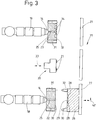
- the in the Fig. 3 to 5 shown apparatus has two adjacent to each other, in particular parallel to each other, arranged injection molding machines 18, 19. It is preferably the same injection molding machines 18. Between the injection molding machines 18 and 19, a digital printing device 20 shown only symbolically in the figures is arranged.
- the injection molding machines 18 and 19 and also the digital printing device 20 are at least with their base frame or feet ortsunver sectionlich arranged in exactly fixed, relative positions relative to each other.
- a print head 21 or, if appropriate, also a plurality of print heads of the digital printing device 20 can be moved back and forth during the digital printing process on at least one fixed and also spatially variable axis, which in the exemplary embodiment shown is a straight linear axis.
- Each injection molding machine 18, 19 is assigned its own mold half 22 and 23 fixed.
- the mold halves 22, 23 represent mold-side mold halves 22, 23.
- the mold-side mold halves 22, 23 are designed differently.
- a nozzle tip 24 of each injection molding machine 18, 19 opens in a schematic only in the Fig. 3 to 5 This can be realized in different ways, depending on how the sprue of the plastic object to be produced is designed and / or which sprue is used.
- each injection molding machine 18 or 19 is formed by a second mold half, which is preferably an ejector-side mold half 26.
- the apparatus has a single ejector side mold half 26 which forms part of the mold of the injection molding machine 18 and 19.
- the mold half 26 is a schematic only in the Fig. 3 to 5 assigned transfer device 27 assigned. This serves to move the mold half 26 assigned to it back and forth according to the shuttle principle between the injection molding machines 18, 19 and thereby to the digital printing device 20 arranged therebetween. Thus, the mold half 26 alternately forms one half each of the mold of the injection molding machine 18 and the injection molding machine 19.
- the mold half 26 movable by the transfer device 27 also serves to lubricate the carrier layer 11 injected by the injection molding machine 18 in the mold half 26 or any other part of the article Plastic object position accurately to the digital printing device 20 to transport and the plastic article, in particular the carrier layer 11, in digital printing absolutely free of play and placetsunver selectedlich in a fixed relative position to the digital printing device 20 to keep.
- the mold half 26 is provided in the embodiment shown with two identical nests 28 with the contour of each of a carrier layer 11 or another part of the printed plastic article to be produced.
- a sprue 29 passes from the plasticizing unit of the injection molding machine 18 plasticized plastic via the Anspritzkanal 23 in the mold half 22 in the runner 29 and from there into the two opposite nests 28 to form a respective carrier layer 11.
- the same nests 28 are so in the mold half 26 arranged so that the front side 14 to be printed on the carrier layer 11 is flush with a parting plane 30 of the mold half 26.
- the carrier layer 11 is formed partially in the casting-side mold half 22 in front of the injection molding machine 18.
- the respective carrier layer 11 is partially formed in the sprue-side mold half 22 and partially in the ejector-side mold half 26, wherein preferably a larger part of the carrier layer 11 is injected in the ejector-side mold half 26, so that upon injection of the mold, the sprayed carrier layer 11 in the ejector side mold half remains.
- the forms are shown in the open state.
- the ejector-side mold half 26 is somewhat moved away from the sprue-side mold half 22, so the mold halves 22 and 26 of the mold pulled apart.
- the sprue side mold halves 22 and 23 guide holes 31 or guide sleeves, while the ejector side mold half 26 is provided with respect to the parting line 30 above guide columns 32.
- the guide columns 32 on the respective casting-side mold half 22 and 23 respectively. Then, the guide holes 31 and guide sleeves of the ejector-side mold half 26 are assigned.
- the transfer device 27 has at least one linear, linear traverse and guide axis 33. Along this traverse and guide axis 33, the mold half 26 can be moved from the injection molding machine 18 to the digital printing device 20 and further to the injection molding machine 19. At the injection molding machine 19, the closing strip 10 is provided with the cover layer 16. For this purpose, in the sprue-side mold half 23 in front of the injection molding machine 19, two nests 34 for each cover layer 16 or other parts of the plastic article to be produced are arranged. The nests 34 for the cover layers 16 are for the purpose of better illustration in the Fig. 3 to 5 represented larger than in the Fig. 2 shown. Alternatively, the transfer device can also be formed by at least one robot, in particular handling robot.
- the transfer device 27 has at least in the area of the digital printing device 20 not shown positioning and locking means. These serve to exactly stop the transport of the mold half 26 along the transfer device 27 in a specific relative position to the digital printing device 20, in particular the at least one print head 21 thereof, and thus to position and also the mold half 26 in the position predetermined by the transfer device 27 during of digital printing backlash too fix.
- a base of the digital printing device 20 has guide sleeves or guide holes which correspond to the guide columns 32 of the mold half 26 so that the digital printing device 20 occupies exactly the same position for the mold half 26 in digital printing, which in the production of the carrier layer 11, the mold half 26 to the mold half 22 has held and the at least one print head 21 without play on at least one fixed linear axis relative to the base of the digital printing device 20 is movable.
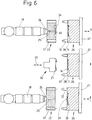
- the Fig. 6 shows another embodiment of the device. This differs from the device described above only in that the transfer device 35 is designed for circulating further transport of the mold halves 36 and not only a single ejector side mold half 36 is provided, but at least three same ejector side mold halves 36. At least three ejector side same mold halves 36 according to of the Fig. 6 Each station is assigned a mold half 36, namely each injection molding machine 18 and 19 and the digital printing device 20. This allows both injection molding machines 18 and 19 and the digital printing device 20 to operate continuously.
- the three same ejector side mold halves 36 of Fig. 6 are each formed the same as the mold half 26 of the embodiment of Fig. 3 to 5 ,
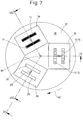
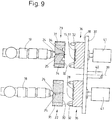
- the Fig. 7 and 8th show a device according to another embodiment of the invention. This differs from the embodiment of Fig. 6 only in that instead of the mold halves 36 further linearly transporting transfer device 35 in the device of Fig. 7 to 9 a trained as a turntable 37 transfer device is provided.
- the turntable 37 has a circular in the embodiment shown receiving plate 38 which is rotatable clockwise about a central vertical or horizontal axis of rotation 39 clockwise.
- the receiving plate 38 of the transfer device are assigned three identically designed ejector-side mold halves 36, with an angular offset of 120 °.
- the two injection molding machines 18 and 19 and the digital printing device 20 in the apparatus shown here are mounted on a pitch circle corresponding to the pitch circle on which the mold halves 36 are on the turntable 37.
- the pitch circle On the pitch circle the injection molding machines 18 and 19 and the digital printing device 20 as well as the three mold halves 36 are arranged on the turntable 37 with an equal angular offset of 120 °.
- the carrier layer 11 is injected in the mold half 26 in the closed mold.
- the front side 14 of the carrier layer 11 to be printed lies in the parting plane 30 of the mold half 26 or somewhat before, when a part of the carrier layer 11 is also formed in the mold half 22.
- the mold half 26 is transported by the transfer device 27 in the transfer direction 42 to the digital printing device 20.
- the mold half 26 preferably passes through a cooling section so that the cooled carrier layer 11 remaining in the mold half 26 moves from the mold half 26 into a predetermined relative position relative to the digital printing device 20 is brought.
- This predetermined relative position is matched to the positioning of the print 15 to be produced by the digital printing device 20 on the front side 14 of the carrier layer 11.
- the mold half 26 is then fixed free of play with the two carrier layers 11 still located in the nests 28 of the transfer device 27 on the transfer device 27. This fixation or determination of the mold half 26 with the carrier layers 11 therein remains unchanged during the digital printing operation, at least during the operation of the digital printing device 20 for the production of the printing 15.
- the printing device 20 is guided on the traverse and guide axis linear play so close to the parting plane 30 and thus the printed front sides 14 of the carrier layers 11 moved up that the digital printing can take place.
- the two separate print heads 21 for a carrier layer 11 are synchronously together via another linear path perpendicular to the plane of the drawing (FIG. Fig. 3 ).
- the digital printing device 20 with the two print heads 21, but possibly also only one print head 21, can be moved back and forth several times on the web extending perpendicular to the plane of the drawing.
- the digital printing device 20 is moved back again on its traversing and guiding axis, that is, it is again spaced from the mold half 26. Then, if necessary, after releasing the positionally accurate locking of the mold half 26 before or next to the digital printing device 20 of the transfer device 27, the mold half 26 with the two printed carrier layers 11 by another clock in the transfer direction 42 moves before the second injection molding machine 19 associated mold half 23.
- the mold is closed in front of the injection molding machine 19.
- the cover layer 16 is then sprayed onto the front side 14 of the respective carrier layer 11 provided with the printing 15 in the nests 34 of the mold half 23.
- the imprints 15 between the two simultaneously formed outer layers 16 and the previously produced carrier layers 11 are embedded and there is a connection to the carrier layers 11 or their printing 15 and the outer layers 16.
- the mold is raised and the two finished closing strips 10 are ejected preferably by an ejector system in the mold half 26.
- this is transported back by the transfer device 27, namely the inactive digital printing device 20 past the mold half 22 of the first injection molding machine 18 and by approaching the mold half 26 to the mold half 22, the shape of the Injection molding machine 18 closed. It then begins the procedure described above for producing the next two printed closing strips 10th
- Fig. 6 to 9 operate on the principle of the same procedure as the device described above.
- two support layers 11, which are produced simultaneously by the injection molding machine 18, with the mold half 26 are moved by the transfer device 27 in front of the digital printing device 20 and positioned here.
- the main difference with the device of the 4 to 6 performed method for the method according to Fig. 3 is that by using three identical ejector-side mold halves 26 in the production of the carrier layers 11 in one mold half 26, the carrier layers 11 are printed simultaneously in the other mold half 26 and at the same time in the third mold half 26, the cover layers 16 on the carrier layers 11 and Prints 15 on the front sides 14 of the same of the second injection molding machine 19 are injected.
- the injection molding machines 18, 19 and the digital printing device 20 do not need to wait until the two closing strips 10 are completed. Instead, the injection molding machines 18 and 19 as well as the digital printing device 20 operate simultaneously at each cycle of the transfer device 27, ie after each simultaneous movement of all three mold halves 26.
- mold half 26 After completing two closing strips 10 on the rear injection molding machine 19 and ejecting the finished closing strips 10 from the currently assigned to the rear injection molding machine 19 of the transfer device 27 mold half 26 is the empty rear mold half 26 along a circumferential path of the transfer device 27, for example, in the Fig. 6 shown three mold halves 26 away, transported back to the first, front injection molding machine 18 with the mold half 22nd
- the in the Fig. 7 to 9 shown device operates in principle by the same method as the device of Fig. 6 , Only here does not transport transfer means 35, the mold halves 36 on a straight line on injection molding machines 18, 19 of the digital printing device 20 over, but on a rotating, closed circular path, in the direction of rotation 43. Accordingly, the transfer device of Fig. 7 to 9 a turntable 37, which is driven cyclically around a central axis of rotation 39 in the direction of rotation 43. On one of the circular path corresponding pitch circle here the three identically designed ejector side mold halves 36 are arranged with an angular offset by 120 °.
- the three same mold halves 36 also allow simultaneous operation of the injection molding machines 18, 19 of the digital printing device 20 after each cyclic rotation of the turntable by 120 °. It can therefore also in the device of Fig. 7 to 9 the injection molding machines 18, 19 and the digital printing device 20 are operated simultaneously, simultaneously or synchronously.
- the advantage of the device Fig. 7 to 9 opposite the device of Fig. 6 consists in that the transfer system does not require a return line for returning the empty mold halves from the second injection molding machine 19 to the first injection molding machine 18. The transfer paths are thereby shorter, which can lead to a corresponding reduction of the cycle times.
- a rotary shaft 40 for cyclically rotating drive of the turntable 37 by 120 ° telescopically, for example, as a propeller shaft, is formed.
- the embodiments of the invention described above relate to molds with two nests 28, 34 in the mold halves 22, 23, 26 and 36.
- the invention is not limited thereto.
- the invention is also suitable for devices with molds which have only one nester or more than two nests.
- the invention is also suitable for plastic articles of any kind and design, so it is not limited to the described closing strip 10.
- the invention is not limited to a closing strip 10 with a carrier layer 11 and a cover layer 16.
- the invention is also suitable for printed plastic articles in which the printing is covered with no sprayed, transparent cover layer.
Landscapes
- Engineering & Computer Science (AREA)
- Manufacturing & Machinery (AREA)
- Mechanical Engineering (AREA)
- Injection Moulding Of Plastics Or The Like (AREA)
- Moulds For Moulding Plastics Or The Like (AREA)
Description
- Die Erfindung betrifft ein Verfahren zur Herstellung eines bedruckten Kunststoffgegenstands gemäß dem Oberbegriff des Anspruchs 1 und eine Vorrichtung zur Herstellung eines bedruckten Kunststoffgegenstands gemäß dem Oberbegriff des Anspruchs 8.
- Kunststoffgegenstände werden häufig bedruckt. Das erfolgt aus verschiedenen Gründen, beispielsweise um Kunststoffgegenständen ein bestimmtes Design zu verleihen und/oder zu beschriften. Das Bedrucken der Kunststoffgegenstände erfolgt gemäß der
US 2006/0237868 A1 nach der Herstellung derselben. Das führt dazu, dass die Bedruckung nur äußerlich auf die Kunststoffgegenstände aufgebracht werden kann. Außerdem müssen die Kunststoffgegenstände zum nachträglichen Bedrucken exakt zur Druckeinrichtung ausgerichtet werden, damit der Druck auf die vorgegebene Stelle des Kunststoffgegenstands aufgebracht wird. - Aus der
US 2005/0051920 A1 sind ein Verfahren und eine Vorrichtung bekannt, bei der eine Bedruckung eines gespritzten Kunststoffgegenstands in der Form erfolgt. Die Form weist dazu einen porösen Bereich auf. In diesem porösen Bereich der Form erhält der Gegenstand eine Beschichtung. Bei diesem bekannten Verfahren muss die Form mit mindestens einem porösen Bereich versehen sein. - Die
EP 2 133 188 A1 offenbart ein Verfahren und eine Vorrichtung zum Spritzgießen von bedruckten Kunststoffgegenständen. Dabei wird zunächst ein Gegenstand gespritzt, der danach bedruckt wird durch einen sogenannten Transferdruck. Anschließend wird auf diese bedruckte Seite des zuerst gespritzten Teils des herzustellenden Kunststoffgegenstands ein anderer Teil des Kunststoffgegenstands aufgespritzt. - Der Erfindung liegt die Aufgabe zugrunde, ein Verfahren und eine Vorrichtung zur Herstellung eines bedruckten Kunststoffgegenstands zu schaffen, die eine exakte und zuverlässige Bedruckung des Kunststoffgegenstands gewährleisten, insbesondere einen bedruckten Kunststoffgegenstand mit einem hochwertigen Erscheinungsbild schaffen.
- Ein Verfahren zur Lösung der eingangs genannten Aufgabe weist die Maßnahmen des Anspruchs 1 auf. Bei diesem Verfahren ist es vorgesehen, die Bedruckung der Trägerschicht durch mindestens einen Digitaldruck vorzunehmen. Dabei wird die Trägerschicht in der Form, worin sie erzeugt, insbesondere gespritzt, worden ist, mit der Bedruckung versehen. In der Form nimmt die hierin hergestellte Trägerschicht eine exakt vorgegebene Position ein. Wenn nun die Trägerschicht in der Form auch bedruckt wird, ist eine zuverlässige, reproduzierbare und exakte Positionierung des Drucks auf der Trägerschicht gewährleistet. Fehldrucke durch außermittige Platzierungen oder Verkantungen sind dadurch nicht mehr möglich.
- Durch den Digitaldruck lassen sich hochwertige und auch mehrfarbige Drucke kostengünstig herstellen, und zwar vor allem auch bei geringer Stückzahl. Der Digitaldruck macht eine exakte Positionierung der zu bedruckenden Trägerschicht zum Druckkopf erforderlich. Dies ist gewährleistet, wenn die Trägerschicht noch in der Form mit dem Digitaldruck versehen wird.
- Eine bevorzugte Möglichkeit der Bedruckung der Trägerleiste sieht es vor, den Digitaldruck bei geöffneter Form vorzunehmen. Vorzugsweise wird dann der Digitaldruck auf diejenige Seite der sich noch in der geöffneten Form befindenden Trägerleiste aufgebracht, die bei geöffneter Form freiliegt. Die zu bedruckende Seite der Trägerleiste ist dadurch vom Digitaldruckkopf gut zugänglich, auch wenn der Digitaldruck bei sich noch in einer Formhälfte der geöffneten Form befindlichen Trägerschicht erfolgt.
- Besonders vorteilhaft kann es sein, wenn die Trägerleiste etwas gegenüber der in der Trennebene der Form liegenden Ebene derjenigen Formhälfte herausragt, in der die gespritzte Trägerschicht zum Bedrucken verbleibt. Da kann der mindestens eine Druckkopf der Digitaleinrichtung bei Bedarf mit der zu bedruckenden freien Seite der Trägerschicht zur Anlage gebracht werden, ohne dass dabei der Druckkopf die vordere Ebene der Form bzw. Formhälfte berührt.
- Bei einer besonders vorteilhaften Ausgestaltung des Verfahrens ist es vorgesehen, dass die Trägerleiste zumindest größtenteils in einer Formhälfte der Spritzgussform gespritzt wird. Dadurch wird sichergestellt, dass die gespritzte Trägerleiste nach dem Öffnen der Form in derjenigen Formhälfte bleibt, in der sie bedruckt werden soll. Vorzugsweise wird die Trägerleiste zumindest größtenteils in einer auswerferseitigen Formhälfte spritzgegossen. Das ist diejenige Formhälfte, die der anderen anspritzseitigen Formhälfte gegenüberliegt bzw. hiermit korrespondiert. Da der angußseitigen Formhälfte die Plastifiziereinheit der Spritzgießmaschine zugeordnet ist, lässt sich die gegenüberliegende auswerferseitige Formhälfte leichter zusammen mit der darin gebildeten Trägerschicht zur Druckeinheit verfahren, die den Digitaldruck vornimmt.
- Eine andere Ausgestaltungsmöglichkeit des Verfahrens sieht es vor, dass die zu bedruckende Seite der gespritzten Trägerschicht zunächst mit wenigstens einer Beschichtung, vorzugsweise einer Farbschicht, versehen wird, bevor darauf die Bedruckung durch Digitaldruck erfolgt. Die Zwischenschicht kann zur Verbesserung des Erscheinungsbilds des Digitaldrucks beitragen, aber auch alternativ oder zusätzlich als Haftvermittler zwischen der gespritzten Trägerschicht und dem Digitaldruck.
- Das Verfahren sieht es im Falle eines bedruckten Kunststoffgegenstands mit einer Deckschicht vor, nach dem Bedrucken auf die sichtbare, freiliegende Seite der Bedruckung die mindestens teil-transparente Deckschicht aufzuspritzen. Bevorzugt erfolgt das Aufspritzen der Deckschicht in einer separaten Spritzgießmaschine, die eine anspritzseitige Formhälfte aufweist, in der mindestens ein Formnest für die Deckschicht vorhanden ist. Bei diesem Verfahren werden die Trägerschicht und die Deckschicht nacheinander gespritzt, wobei zwischen den beiden Spritzvorgängen die Bedruckung im Digitaldruckverfahren bei in der betreffenden Formhälfte verbleibender Trägerschicht erfolgt.
- Besonders vorteilhaft ist es, wenn bis nach dem Spritzgießen der Deckschicht die Trägerschicht in derjenigen Formhälfte verbleibt, in der sie gespritzt worden ist. Es kann dadurch die gleiche, vorzugsweise auswerferseitige, Formhälfte zur Bildung eines Teils der Form für die Spritzgießvorgänge in beiden Spritzgießmaschinen verwendet werden.
- Eine vorteilhafte Möglichkeit der Weiterbildung des Verfahrens sieht es vor, nach dem erfolgten Spritzen der Deckschicht den dann vorzugsweise fertig gedruckten Kunststoffgegenstand bei geöffneter Spritzgussform aus der Formhälfte, in der die Trägerschicht gespritzt worden ist, vorzugsweise der auswerferseitigen Formhälfte, auszuwerfen. Dadurch hat die auswerferseitige Formhälfte, in der die Trägerschicht gebildet wird, mehrere Funktionen. Sie dient zur Positionierung der Trägerschicht beim Digitaldruck, gegebenenfalls als Formhälfte zum Spritzgießen mit der zweiten Spritzgussmaschine und zum Auswerfen des fertigen und digital bedruckten Kunststoffgegenstands.
- Eine Vorrichtung zur Lösung der eingangs genannten Aufgabe weist die Merkmale des Anspruchs 8 auf. Diese Vorrichtung verfügt über eine Transfereinrichtung, die ausgebildet ist, um die Formhälfte mit der darin sich befindenden zu bedruckenden Trägerschicht zur Digitaldruckeinrichtung und auch wieder zurück zur Spritzgussmaschine oder zu einer nachfolgenden Spritzgussmaschine zu verfahren. Die Transfereinrichtung dient dazu, eine die Trägerschicht bildende bzw. aufnehmende Formhälfte der Spritzgussform oder die Digitaldruckeinrichtung derart umzuorientieren und/oder zu verfahren, dass sie in eine exakte Relativposition zueinander gelangen, die einen genau platzierten und exakten Digitaldruck zulässt. Die Transfereinrichtung nimmt dabei die genaue Positionierung zwischen der Formhälfte mit der darin positionsgenau gehaltenen und zu bedruckenden Trägerschicht und der Form vor. Weil die Trägerschicht mindestens zur Bedruckung in der Form belassen wird, braucht entweder nur die Formhälfte oder die Digitaldruckeinrichtung in die Druckposition überführt zu werden. Dieses kann auf festgelegten Bahnen oder Achsen geschehen, die ihre Position stets beibehalten und dadurch die exakte Ausrichtung und Positionierung der zu bedruckenden Trägerschicht mit der diese haltenden Formhälfte und der Digitaldruckeinrichtung herbeiführen. Dazu kann die Transfereinrichtung im einfachsten Falle von einem handelsüblichen Handhabungsroboter gebildet sein.
- Sobald die Digitaldruckeinrichtung und die Formhälfte mit der zu bedruckenden Trägerschicht ihre vorgesehene Relativposition zu einander von der Transfereinrichtung erhalten haben, kann bevorzugt die Transfereinrichtung dazu dienen, die vorgesehene Relativposition der Formhälfte zur Digitaldruckeinrichtung oder umgekehrt während des Digitaldrucks zu fixieren. Dabei dient die Formhälfte, in der die Trägerschicht hergestellt worden ist, gleichzeitig zum Halten, Einspannen und/oder zur lageunveränderlichen Fixierung der Trägerschicht beim Digitaldruckvorgang. Die Vorrichtung ermöglicht es so, die Trägerschicht genau und exakt im Digitaldruck zu bedrucken.
- Nach dem Bedrucken der Trägerschicht wird der fertige Kunststoffgegenstand vorzugsweise durch die Auswerfer in der auswerferseitigen Formhälfte entformt. Danach wird die leere Formhälfte dann von der Transfereinrichtung zurück verfahren in die Spritzgussmaschine zum Spritzen der Trägerschicht für den nächsten Kunststoffgegenstand. Die Transfereinrichtung bildet somit ein Shuttle-System zwischen der Spritzguss maschine und der Digitaldruckeinrichtung sowie gegebenenfalls einer zusätzlichen Entformstation. Bevorzugt befindet sich die Entformstation aber dort, wo auch der Digitaldruck stattfindet, so dass im einfachsten Falle die Formhälfte von der Transfereinrichtung nur zwischen zwei Positionen hin und her verfahren werden muss, nämlich von der Spritzgussmaschine zur Digitaldruckeinrichtung und umgekehrt.
- Eine Weiterbildungsmöglichkeit der Vorrichtung sieht zwei Spritzgussmaschinen vor, wobei zwischen den Spritzgussmaschinen die Digitaldruckeinrichtung vorgesehen ist oder die Digitaldruckeinrichtung einer der beiden Spritzgussmaschinen zugeordnet ist. Durch die zwei Spritzgussmaschinen ist es möglich, den zu druckenden Kunststoffgegenstand aus zwei nacheinander gespritzten Teilen zu bilden, zwischen denen die von der Digitaldruckeinrichtung erzeugte Bedruckung sich befindet, insbesondere eingebettet ist. Beispielsweise wird von der ersten Spritzgussmaschine die Trägerschicht des zu bedruckenden Kunststoffgegenstands hergestellt, danach der Digitaldruck auf die Trägerschicht aufgebracht und anschließend auf den Digitaldruck auf der Trägerschicht eine Deckschicht aufgebracht. Die vorzugsweise mindestens teilweise transparente, vorzugsweise klarglasähnliche Deckschicht überdeckt dann die von der Digitaldruckeinrichtung hergestellte Bedruckung. Die Deckschicht schützt dabei nicht nur die Bedruckung; sie verbessert oder unterstützt aber auch ihr Erscheinungsbild, vor allem, wenn die Deckschicht linsenartig ausgebildet ist oder eine profilierte Außenseite aufweist. Die Deckschicht lässt sich mit einer zweiten Spritzgussmaschine im Anschluss an den Digitaldruck zur Fertigstellung des Kunststoffgegenstands bilden.
- Bei einer Vorrichtung mit zwei vorzugsweise parallelen Spritzgussmaschinen ist die Transfereinrichtung ausgebildet, um die Formhälfte der Trägerschicht zwischen den benachbarten Spritzgussmaschinen hin- und herzufahren und außerdem für den Digitaldruck in eine exakte Position zur Digitaldruckeinrichtung zu bringen und dort während des Digitaldruckvorgangs (temporär) unbeweglich zu fixieren.
- Die Transfereinrichtung kann zum shuttleartigen Hin- und Hertransport mit einer einzigen Formhälfte ausgebildet sein, aber auch zum umlaufenden Transport der Formhälften zur Bildung der Trägerschicht und Fixierung derselben mindestens an der Digitaldruckeinrichtung. Dadurch können bei jedem Takt der Transfereinrichtung an beiden Spritzgussmaschinen gleichzeitig eine Trägerschicht und eine Deckschicht gespritzt werden, und auch der Digitaldruck erfolgen. Eine solche Vorrichtung lässt eine kostengünstige Herstellung von im Digitaldruck bedruckten Kunststoffgegenständen zu.
- Eine bevorzugte Ausgestaltung der Vorrichtung sieht es vor, die gleiche Formhälfte, vorzugsweise die Formhälfte zur Bildung der Trägerschicht, bei beiden Spritzgussmaschinen einzusetzen. Hingegen findet bei jeder Spritzgussmaschine eine individuelle andere Formhälfte, insbesondere angussseitige Formhälfte, Verwendung. Der Einsatz einer gleichen Formhälfte bei allen Spritzgussmaschinen vereinfacht den Formvorrat. Die Transfereinrichtung übernimmt dabei den Transport der bei allen Spritzgussmaschinen verwendeten Formhälften zu den einzelnen Spritzgussmaschinen und auch zur Digitaldruckeinrichtung.
- Die Transfereinrichtung ist bevorzugt so ausgebildet, dass sie die von ihr weitertransportierbare Formhälfte an genau festgelegten Positionen der jeweiligen Spritzgussmaschine und der Digitaldruckeinrichtung positioniert, und zwar anhält, und temporär, nämlich während der Bearbeitungszeit an der jeweiligen Station, spielfrei fixiert. Dadurch wird unter Anderem sichergestellt, dass die Digitaldruckeinrichtung die Bedruckung auf der Trägerschicht an der exakten Stelle genau ausgerichtet vornehmen kann.
- Bevorzugte Ausführungsbeispiele der Erfindung werden nachfolgend anhand der Zeichnung näher erläutert. In dieser zeigen:
- Fig. 1
- eine Draufsicht auf einen bedruckten Kunststoffgegenstand,
- Fig. 2
- einen vergrößerten Querschnitt durch den Kunststoffgegenstand der
Fig. 1 , - Fig. 3
- eine Prinzipdarstellung des ersten Ausführungsbeispiels der Vorrichtung gemäß einem ersten Arbeitstakt,
- Fig. 4
- die Vorrichtung der
Fig. 3 bei einem zweiten Arbeitstakt, - Fig. 5
- die Vorrichtung der
Fig. 3 und4 in einem dritten Arbeitstakt, - Fig. 6
- eine Prinzipdarstellung der Vorrichtung nach einem zweiten Ausführungsbeispiel der Erfindung,
- Fig. 7
- eine Vorrichtung nach einem dritten Ausführungsbeispiel der Erfindung, und zwar eine Draufsicht auf einen Teil der Vorrichtung,
- Fig. 8
- einen Schnitt VIII-VIII durch die Vorrichtung der
Fig. 7 , und - Fig. 9
- einen Schnitt IX-IX durch die Vorrichtung der
Fig. 7 . - Die
Fig. 1 und 2 zeigen einen als Schließleiste 10 für eine Kennzeichenhalterung ausgebildeten bedruckten Kunststoffgegenstand. Hierauf ist die Erfindung aber nicht beschränkt. Die Erfindung eignet sich für beliebige bedruckte Kunststoffgegenstände. - Die gezeigte, längliche Schließleiste 10 verfügt über eine vorzugsweise massive, leistenförmige Trägerschicht 11 mit einem im gezeigten Ausführungsbeispiel rechteckigen Querschnitt. Eine Rückseite 12 der Trägerschicht 11 ist mit mehreren Rastzungen 13 versehen. Bei der gezeigten Schließleiste 10 ist die zur Bedruckung weisende Vorderseite 14 ebenflächig ausgebildet. Die Vorderseite 14 kann bei Bedarf aber auch profiliert sein, beispielsweise durch eine konkave oder konvexe Wölbung.
- Auf die Vorderseite 14 der Trägerschicht 11 ist eine dünnschichtige Bedruckung 15 aufgebracht. Die Bedruckung 15 kann in beliebiger Weise gestaltet sein, insbesondere auch in beliebigen Farben, vor allem auch mehrere verschiedene Farben aufweisen. Beispielsweise kann die Bedruckung bildhaft und/oder graphisch gestaltet sein. Auch kann die Bedruckung 15 alternativ oder zusätzlich Ziffern, Zahlen oder sonstige Zeichen aufweisen. Die Bedruckung ist auf die Vorderseite 14 der Trägerschicht 11 durch Digitaldruck aufgebracht, und zwar vorzugsweise aus mehreren nachfolgenden aufgedruckten Schichten.
- Gegebenenfalls kann zwischen der Bedruckung 15 und der Vorderseite 14 der Trägerschicht 11 eine in den Figuren nicht gezeigte Zwischenschicht vorgesehen sein. Die Zwischenschicht dient beispielsweise dazu, den Kontrast zwischen der Farbe der Trägerschicht 11 und der Bedruckung 15 zu beeinflussen, insbesondere zu verringern. Bei einer eine schwarze Vorderseite 14 aufweisenden Trägerschicht 11, insbesondere einer insgesamt aus schwarzem Kunststoff gebildeten Trägerschicht 11, kann die Zwischenschicht eine helle Farbschicht sein, wenn die Bedruckung 15 überwiegend hell ist. Auch kann die Zwischenschicht vollflächig die gleiche Farbe, zum Beispiel weiß, haben.
- Die gezeigte Schließleiste 10 weist über der Bedruckung 15 eine Deckschicht 16 auf. Die Deckschicht 16 ist vorzugsweise aus einem transparenten farblosen oder gegebenenfalls auch einem eingefärbten Kunststoff gebildet. Besonders bevorzugt ist die Bildung der Deckschicht 16 aus einem vollständig durchsichtigen, glasklaren thermoplastischen Kunststoff, der gegebenenfalls auch etwas eingefärbt sein kann. Die gezeigte Deckschicht 16 überdeckt die Bedruckung 15 vollflächig, indem die Fläche der Deckschicht 16 mit der Fläche der Vorderseite 14 der Trägerschicht 11 übereinstimmt. Es ist aber auch denkbar, die Deckschicht 16 etwas kleiner auszubilden als die Trägerschicht 11, so dass die größere Trägerschicht 11 die Deckschicht 16 nach Art eines Rahmens umgibt. Bei gegenüber der Trägerschicht 11 kleinerer Deckschicht 16 entspricht bevorzugt die Fläche der Bedruckung 15 der Fläche der kleineren Deckschicht 16, so dass die Fläche der Bedruckung 15 genauso groß ist wie die Fläche der Deckschicht 16. Dadurch überdeckt die Deckschicht 16 die gesamte Bedruckung 15. Auf diese Weise ist die Bedruckung 15 zwischen der Trägerschicht 11 und der Deckschicht 16 eingeschlossen, wobei infolge der transparenten bzw. glasklaren Ausbildung der Deckschicht 16 vom Betrachter die Bedruckung 15 durch die Deckschicht 16 hindurch sichtbar ist.
- Bei der hier gezeigten Schließleiste 10 ist die der Bedruckung 15 gegenüberliegende und zum Betrachter weisende Vorderseite 17 der Deckschicht 16 gewölbt, und zwar konvex nach außen gewölbt. Alternativ ist aber auch eine umgekehrte konkave Wölbung denkbar. Durch die gewölbte Vorderseite 17 bildet die Deckschicht 16 eine Art Linse über der Bedruckung 15, wodurch die Bedruckung 15 optisch beeinflusst, insbesondere aufgewertet, wird. Denkbar ist es auch, die Vorderseite 17 der Deckschicht 16 genauso wie die Vorderseite 14 der Trägerschicht 11 ebenflächig auszubilden. Dann verläuft die Vorderseite 17 der Deckschicht 16 parallel zur Vorderseite 14 der Trägerschicht 11. Schließlich kann die Vorderseite 17 der Deckschicht 16 auch in anderer Weise profiliert sein, beispielsweise wellig, geriffelt, gestuft oder dergleichen.
- Die
Fig. 3 bis 9 zeigen unterschiedliche Vorrichtungen zur Herstellung eines bedruckten Kunststoffgegenstands wie beispielsweise auch der Schließleiste 10. - Die in den
Fig. 3 bis 5 gezeigte Vorrichtung verfügt über zwei benachbart zueinander, insbesondere parallel nebeneinander, angeordnete Spritzgussmaschinen 18, 19. Bevorzugt handelt es sich um gleiche Spritzgussmaschinen 18. Zwischen den Spritzgussmaschinen 18 und 19 ist eine in den Figuren nur symbolisch dargestellte Digitaldruckeinrichtung 20 angeordnet. Die Spritzgussmaschinen 18 und 19 und auch die Digitaldruckeinrichtung 20 sind mindestens mit ihrem Grundrahmen bzw. Füßen ortsunveränderlich in exakt festgelegten, fixen Relativpositionen zueinander angeordnet. Dabei können jedoch ein Druckkopf 21 oder gegebenenfalls auch mehrere Druckköpfe der Digitaldruckeinrichtung 20 beim Digitaldruckvorgang auf mindestens einer festgelegten und ebenfalls ortsveränderlichen Achse, bei der es sich im gezeigten Ausführungsbeispiel um eine gerade Linearachse handelt, hin- und herbewegt werden. - Jeder Spritzgussmaschine 18, 19 ist eine eigene Formhälfte 22 bzw. 23 fest zugeordnet. Die Formhälften 22, 23 stellen dadurch angussseitige Formhälften 22, 23 dar. Im gezeigten Ausführungsbeispiel sind die angussseitigen Formhälften 22, 23 unterschiedlich ausgebildet. Ein Düsenmundstück 24 jeder Spritzgussmaschine 18, 19 mündet in einem nur schematisch in den
Fig. 3 bis 5 dargestellten Anspritzkanal 25 der Formhälfte 22 und 23. Dieser kann auf unterschiedliche Weise realisiert sein, je nachdem, wie der Anguss des herzustellenden Kunststoffgegenstands gestaltet ist und/oder welches Angussprinzip eingesetzt wird. - Die Form jeder Spritzgussmaschine 18 bzw. 19 wird gebildet durch eine zweite Formhälfte, bei der es sich bevorzugt um eine auswerferseitige Formhälfte 26 handelt. Die Vorrichtung verfügt über eine einzige auswerferseitige Formhälfte 26, die einen Teil der Form der Spritzgussmaschine 18 und 19 bildet.
- Der Formhälfte 26 ist eine nur schematisch in den
Fig. 3 bis 5 gezeigte Transfereinrichtung 27 zugeordnet. Diese dient dazu, die ihr zugeordnete Formhälfte 26 nach dem Shuttle-Prinzip zwischen den Spritzgussmaschinen 18, 19 und dabei an der dazwischen angeordneten Digitaldruckeinrichtung 20 hin und her zu verfahren. So bildet die Formhälfte 26 wechselweise jeweils eine Hälfte der Form der Spritzgussmaschine 18 und der Spritzgussmaschine 19. Außerdem dient die von der Transfereinrichtung 27 verfahrbare Formhälfte 26 auch dazu, die von der Spritzgussmaschine 18 in der Formhälfte 26 gespritzte Trägerschicht 11 oder einen sonstigen Teil des herzustellenden Kunststoffgegenstands positionsgenau zur Digitaldruckeinrichtung 20 zu transportieren und den Kunststoffgegenstand, insbesondere die Trägerschicht 11, beim Digitaldruck absolut spielfrei und ortsunveränderlich in einer fixen Relativposition zur Digitaldruckeinrichtung 20 zu halten. - Die Formhälfte 26 ist im gezeigten Ausführungsbeispiel mit zwei gleichen Nestern 28 mit der Kontur jeweils einer Trägerschicht 11 oder eines anderen Teils des herzustellenden bedruckten Kunststoffgegenstands versehen. Durch einen Angusskanal 29 gelangt von der Plastifiziereinheit der Spritzgussmaschine 18 plastifizierter Kunststoff über den Anspritzkanal 23 in der Formhälfte 22 in den Angusskanal 29 und von dort in die beiden gegenüberliegenden Nester 28 zur Bildung jeweils einer Trägerschicht 11. Die gleichen Nester 28 sind derart in der Formhälfte 26 angeordnet, dass die zu bedruckende Vorderseite 14 der Trägerschicht 11 bündig mit einer Trennebene 30 der Formhälfte 26 abschließt. Es ist aber auch denkbar, dass die Trägerschicht 11 teilweise in der angussseitigen Formhälfte 22 vor der Spritzgussmaschine 18 gebildet wird. Diese verfügt dann ebenfalls über zwei Nester, die den Nestern 28 der Formhälfte 26 deckungsgleich gegenüberliegen. Dann wird die jeweilige Trägerschicht 11 teilweise in der angussseitigen Formhälfte 22 und teilweise in der auswerferseitigen Formhälfte 26 gebildet, wobei vorzugsweise ein größerer Teil der Trägerschicht 11 in der auswerferseitigen Formhälfte 26 gespritzt wird, damit beim Auffahren der Form die gespritzte Trägerschicht 11 in der auswerferseitigen Formhälfte verbleibt.
- In den
Fig. 3 bis 5 sind die Formen im geöffneten Zustand gezeigt. Dabei ist die auswerferseitige Formhälfte 26 von der angussseitigen Formhälfte 22 etwas weggefahren, also die Formhälften 22 und 26 der Form auseinandergezogen. Zum Spritzen werden die Formhälften 26 wieder zusammengefahren, so dass sich ihre Trennebenen 30 berühren und die Nester 28 geschlossen sind. Zur exakten Ausrichtung und Positionierung der Formhälften 26 und 22 bzw. 23 zueinander weisen im gezeigten Ausführungsbeispiel die angussseitigen Formhälften 22 und 23 Führungsbohrungen 31 oder auch Führungshülsen auf, während die auswerferseitige Formhälfte 26 mit gegenüber der Trennebene 30 vorstehenden Führungssäulen 32 versehen ist. Es ist aber auch denkbar, die Führungssäulen 32 an der jeweiligen angussseitigen Formhälfte 22 bzw. 23 anzuordnen. Dann sind die Führungsbohrungen 31 bzw. Führungshülsen der auswerferseitigen Formhälfte 26 zugeordnet. - Die Transfereinrichtung 27 verfügt über mindestens eine lineare, geradlinige Verfahr- und Führungsachse 33. Längs dieser Verfahr- und Führungsachse 33 ist die Formhälfte 26 von der Spritzgussmaschine 18 zur Digitaldruckeinrichtung 20 und weiter zur Spritzgussmaschine 19 verfahrbar. An der Spritzgussmaschine 19 wird die Schließleiste 10 mit der Deckschicht 16 versehen. Dazu sind in der angussseitigen Formhälfte 23 vor der Spritzgussmaschine 19 zwei Nester 34 für jeweils eine Deckschicht 16 oder sonstige Teile des herzustellenden Kunststoffgegenstands angeordnet. Die Nester 34 für die Deckschichten 16 sind zum Zwecke der besseren Darstellung in den
Fig. 3 bis 5 größer dargestellt als in derFig. 2 gezeigt. Alternativ kann die Transfereinrichtung auch von mindestens einem Roboter, insbesondere Handhabungsroboter, gebildet sein. - Die Transfereinrichtung 27 weist mindestens im Bereich der Digitaldruckeinrichtung 20 nicht gezeigte Positionier- und Arretiermittel auf. Diese dienen dazu, den Transport der Formhälfte 26 längs der Transfereinrichtung 27 in einer bestimmten Relativposition zur Digitaldruckeinrichtung 20, insbesondere dem mindestens einen Druckkopf 21 derselben, exakt zu stoppen, also zu positionieren und außerdem die Formhälfte 26 in der von der Transfereineinrichtung 27 vorgegebenen Position während des Digitaldrucks spielfrei zu fixieren. Gegebenenfalls kann es dazu vorgesehen sein, dass eine Basis der Digitaldruckeinrichtung 20 Führungshülsen oder Führungsbohrungen aufweist, die mit den Führungssäulen 32 der Formhälfte 26 korrespondieren, so dass die Digitaldruckeinrichtung 20 beim Digitaldruck exakt die gleiche Position zur Formhälfte 26 einnimmt, die bei der Herstellung der Trägerschicht 11 die Formhälfte 26 zur Formhälfte 22 inne hat und der mindestens eine Druckkopf 21 spielfrei auf mindestens einer festgelegten Linearachse gegenüber der Basis der Digitaldruckeinrichtung 20 verfahrbar ist.
- Die
Fig. 6 zeigt ein anderes Ausführungsbeispiel der Vorrichtung. Dieses unterscheidet sich von der zuvor beschriebenen Vorrichtung nur dadurch, dass die Transfereinrichtung 35 zum umlaufenden Weitertransport der Formhälften 36 ausgebildet ist und nicht nur eine einzige auswerferseitige Formhälfte 36 vorgesehen ist, sondern mindestens drei gleiche auswerferseitige Formhälften 36. Bei mindestens drei auswerferseitigen gleichen Formhälften 36 gemäß derFig. 6 ist jeder Station eine Formhälfte 36 zugeordnet, und zwar jeder Spritzgussmaschine 18 und 19 und der Digitaldruckeinrichtung 20. Dadurch können beide Spritzgussmaschinen 18 und 19 sowie die Digitaldruckeinrichtung 20 durchgehend arbeiten. Es finden lediglich Unterbrechungen in der Zeit des Weitertransports der Formhälften 36 von der ersten Spritzgussmaschine 18 zur Digitaldruckeinrichtung 20, von der Digitaldruckeinrichtung 20 zur zweiten Spritzgussmaschine 19 und von der zweiten Spritzgussmaschine 19 zurück zur ersten Spritzgussmaschine 18 statt. Die drei gleichen auswerferseitigen Formhälften 36 derFig. 6 sind jeweils genauso ausgebildet wie die Formhälfte 26 des Ausführungsbeispiels derFig. 3 bis 5 . - Die
Fig. 7 und8 zeigen eine Vorrichtung nach einem weiteren Ausführungsbeispiel der Erfindung. Dieses unterscheidet sich vom Ausführungsbeispiel derFig. 6 nur dadurch, dass statt einer die Formhälften 36 linear weitertransportierenden Transfereinrichtung 35 bei der Vorrichtung derFig. 7 bis 9 eine als Drehteller 37 ausgebildete Transfereinrichtung vorgesehen ist. Der Drehteller 37 verfügt über eine im gezeigten Ausführungsbeispiel kreisrunde Aufnahmeplatte 38, die um eine mittige vertikale oder auch horizontale Drehachse 39 taktweise im Uhrzeigersinn verdrehbar ist. Im gezeigten Ausführungsbeispiel sind der Aufnahmeplatte 38 der Transfereinrichtung drei gleich ausgebildete auswerferseitige Formhälften 36 zugeordnet, und zwar mit einem Winkelversatz von 120°. Dadurch werden bei jeder Drittelkreisdrehung gleichzeitig alle drei gleichen Formhälften 36 zur nächsten Station der Vorrichtung transportiert, also von der ersten Spritzgussmaschine 18 zur Digitaldruckeinrichtung 20, von der Digitaldruckeinrichtung 20 zur zweiten Spritzgussmaschine und von der zweiten Spritzgussmaschine 19 zurück zur ersten Spritzgussmaschine 18. - Infolge der auf dem Drehteller 37 mit einem Wickelversatz von 120° angeordneten gleichen Formhälften 36 sind die beiden Spritzgussmaschinen18 und 19 und die Digitaldruckeinrichtung 20 bei der hier gezeigten Vorrichtung wie die drei Formhälften 36 auf einem Teilkreis angebracht, der dem Teilkreis entspricht, auf dem die Formhälften 36 auf dem Drehteller 37 liegen. Auf dem Teilkreis sind die Spritzgussmaschinen 18 und 19 und die Digitaldruckeinrichtung 20 genauso wie die drei Formhälften 36 auf dem Drehteller 37 mit einem gleichen Winkelversatz von jeweils 120° angeordnet.
- Bei der Vorrichtung der
Fig. 7 bis 9 entsprechen die den Spritzgussmaschinen 18 und 19 zugeordneten angussseitigen Formhälften den Formhälften 22 und 23 der vorherigen Ausführungsbeispiele. Deswegen werden für gleiche Teile auch gleiche Bezugsziffern verwendet. - Das erfindungsgemäße Verfahren wird nachfolgend anhand der Vorrichtung der
Fig. 3 bis 5 erläutert:
Von der Spritzgussmaschine 18 wird die Trägerschicht 11 bei geschlossener Form in die Formhälfte 26 gespritzt. Dabei liegt die zu bedruckende Vorderseite 14 der Trägerschicht 11 in der Trennebene 30 der Formhälfte 26 bzw. etwas davor, wenn ein Teil der Trägerschicht 11 auch in der Formhälfte 22 gebildet wird. Bei geöffneter Form wird die Formhälfte 26 von der Transfereinrichtung 27 in Transferrichtung 42 weitertransportiert zur Digitaldruckeinrichtung 20. Dabei durchläuft die Formhälfte 26 bevorzugt eine Kühlstrecke, so dass die in der Formhälfte 26 verbleibende abgekühlte Trägerschicht 11 von der Formhälfte 26 in eine vorgegebene Relativposition gegenüber der Digitaldruckeinrichtung 20 gebracht wird. Diese vorgegebene Relativposition ist abgestimmt auf die Positionierung der von der Digitaldruckeinrichtung 20 herzustellenden Bedruckung 15 auf der Vorderseite 14 der Trägerschicht 11. An der Transfereinrichtung 27 wird dann die Formhälfte 26 mit den sich in den Nestern 28 derselben noch befindenden beiden Trägerschichten 11 spielfrei fixiert. Diese Fixierung oder Feststellung der Formhälfte 26 mit den darin befindlichen Trägerschichten 11 bleibt während des Digitaldruckvorgangs, mindestens während des Betriebs der Digitaldruckeinrichtung 20 zur Herstellung der Bedruckung 15, unverändert aufrechterhalten. - Zur Herstellung der Bedruckungen 15 wird die Druckeinrichtung 20 auf der Verfahr- und Führungsachse linear spielfrei geführt so dicht an die Trennebene 30 und somit die zu bedruckenden Vorderseiten 14 der Trägerschichten 11 herangefahren, dass der Digitaldruck stattfinden kann. Vorzugsweise werden dabei die beiden getrennten Druckköpfe 21 für eine Trägerschicht 11 gemeinsam synchron über eine weitere lineare Bahn senkrecht zur Zeichnungsebene (
Fig. 3 ) verfahren. Je nach der Art der Bedruckung 15 kann auf der senkrecht zur Zeichnungsebene verlaufenden Bahn die Digitaldruckeinrichtung 20 mit den beiden Druckköpfen 21, gegebenenfalls aber auch nur einem Druckkopf 21, mehrmals hin und her verfahren werden. - Nachdem die Bedruckungen 15 der Trägerschichten 11 hergestellt sind, wird die Digitaldruckeinrichtung 20 wieder auf ihrer Verfahr- und Führungsachse zurückbewegt, also von der Formhälfte 26 wieder beabstandet. Dann wird gegebenenfalls nach Lösen der positionsgenauen Arretierung der Formhälfte 26 vor bzw. neben der Digitaldruckeinrichtung 20 von der Transfereinrichtung 27 die Formhälfte 26 mit den beiden bedruckten Trägerschichten 11 um einen weiteren Takt in Transferrichtung 42 weiterbewegt vor die der zweiten Spritzgussmaschine 19 zugeordnete Formhälfte 23. Durch Heranfahren der Formhälfte 26 mit den darin sich noch befindenden bedruckten Trägerschichten 11 an die der zweiten Spritzgussmaschine 19 zugeordnete Formhälfte 23 wird die Form vor der Spritzgussmaschine 19 geschlossen. Von der Spritzgussmaschine 19 wird dann in den Nestern 34 der Formhälfte 23 die Deckschicht 16 auf die mit der Bedruckung 15 versehene Vorderseite 14 der jeweiligen Trägerschicht 11 aufgespritzt. Dabei werden die Bedruckungen 15 zwischen den beiden gleichzeitig gebildeten Deckschichten 16 und den zuvor hergestellten Trägerschichten 11 eingebettet und es kommt eine Verbindung zu den Trägerschichten 11 bzw. deren Bedruckung 15 und den Deckschichten 16 zustande.
- Abschließend wird die Form aufgefahren und die beiden fertigen Schließleisten 10 vorzugsweise durch ein Auswerfersystem in der Formhälfte 26 ausgeworfen. Nach dem Auswerfen der Schließleisten 10 aus der Formhälfte 26 wird diese von der Transfereinrichtung 27 wieder zurücktransportiert, und zwar an der dabei inaktiven Digitaldruckeinrichtung 20 vorbei vor die Formhälfte 22 der ersten Spritzgussmaschine 18 und durch Heranfahren der Formhälfte 26 an die Formhälfte 22 die Form vor der Spritzgussmaschine 18 geschlossen. Es beginnt dann der zuvor beschriebene Verfahrensablauf zur Herstellung der nächsten beiden bedruckten Schließleisten 10.
- Die Vorrichtungen der
Fig. 6 bis 9 arbeiten nach dem prinzipiell gleichen Verfahren wie die zuvor beschriebene Vorrichtung. Es werden wiederum zwei gleichzeitig von der Spritzgussmaschine 18 hergestellte Trägerschichten 11 mit der Formhälfte 26 von der Transfereinrichtung 27 vor die Digitaldruckeinrichtung 20 gefahren und hier positioniert. - Dabei verbleiben wiederum die zuvor hergestellten Trägerschichten 11 in der Formhälfte 26, wodurch sie in die exakte Position zur Herstellung der Bedruckung 15 durch die Digitaldruckeinrichtung 20 gelangen und diese Position zur Bedruckung spielfrei momentan ortsfest gehalten bzw. arretiert wird. Nach dem Herstellen der Bedruckungen 15 werden wieder im Bereich der zweiten Spritzgussmaschine 19 die Deckschichten 16 auf die Bedruckungen 15 der Vorderseiten 14 der Trägerschichten 11 aufgespritzt und dadurch gleichzeitig zwei Schließleisten 11 fertiggestellt.
- Der wesentliche Unterschied des mit der Vorrichtung der
Fig. 4 bis 6 durchgeführten Verfahrens zum Verfahren nach derFig. 3 besteht darin, dass durch Verwendung dreier identischer auswerferseitiger Formhälften 26 beim Herstellen der Trägerschichten 11 in der einen Formhälfte 26 die Trägerschichten 11 in der anderen Formhälfte 26 gleichzeitig bedruckt werden und auch gleichzeitig in der dritten Formhälfte 26 die Deckschichten 16 auf die Trägerschichten 11 bzw. die Bedruckungen 15 auf den Vorderseiten 14 derselben von der zweiten Spritzgussmaschine 19 aufgespritzt werden. Es brauchen also die Spritzgussmaschinen 18, 19 und die Digitaldruckeinrichtung 20 nicht zu warten, bis die beiden Schließleisten 10 fertiggestellt sind. Vielmehr arbeiten die Spritzgussmaschinen 18 und 19 sowie die Digitaldruckeinrichtung 20 simultan bei jedem Takt der Transfereinrichtung 27, also nach jedem gleichzeitigen Weiterfahren aller drei Formhälften 26. - Nach dem Fertigstellen zweier Schließleisten 10 an der hinteren Spritzgussmaschine 19 und Auswerfen der fertigen Schließleisten 10 aus der momentan der hinteren Spritzgussmaschine 19 von der Transfereinrichtung 27 zugeordneten Formhälfte 26 wird die leere hintere Formhälfte 26 längs einer umlaufenden Bahn von der Transfereinrichtung 27 beispielsweise unter den in der
Fig. 6 gezeigten drei Formhälften 26 hinweg, zurücktransportiert zur ersten, vorderen Spritzgussmaschine 18 mit der Formhälfte 22. - Die in den
Fig. 7 bis 9 dargestellte Vorrichtung arbeitet prinzipiell nach dem gleichen Verfahren wie die Vorrichtung derFig. 6 . Nur transportiert hier keine Transfereinrichtung 35 die Formhälften 36 auf einer gradlinigen Bahn an Spritzgussmaschinen 18, 19 der Digitaldruckeinrichtung 20 vorbei, sondern auf einer umlaufenden, geschlossenen Kreisbahn, und zwar in Drehrichtung 43. Demzufolge weist die Transfereinrichtung derFig. 7 bis 9 einen um eine mittige Drehachse 39 in Drehrichtung 43 umlaufend taktweise angetriebenen Drehteller 37 auf. Auf einem der Kreisbahn entsprechenden Teilkreis sind hier die drei gleich ausgebildeten auswerferseitigen Formhälften 36 mit einem Winkelversatz um jeweils 120° angeordnet. Die drei gleichen Formhälften 36 erlauben auch einen gleichzeitigen Betrieb der Spritzgussmaschinen 18, 19 der Digitaldruckeinrichtung 20 nach jedem taktweisen Weiterdrehen der Drehscheibe um 120°. Es können also auch bei der Vorrichtung derFig. 7 bis 9 die Spritzgussmaschinen 18, 19 und die Digitaldruckeinrichtung 20 gleichzeitig, simultan bzw. synchron betrieben werden. Der Vorteil der Vorrichtung derFig. 7 bis 9 gegenüber der Vorrichtung derFig. 6 besteht darin, dass das Transfersystem keine Rückförderstrecke zum Zurücktransportierten der leeren Formhälften von der zweiten Spritzgussmaschine 19 zur ersten Spritzgussmaschine 18 erfordert. Die Transferwege sind dadurch kürzer, was zu einer entsprechenden Verringerung der Taktzeiten führen kann. - Mit der den Drehteller 37 aufweisenden Transfereinrichtung erfolgt das Schließen der Formen an beiden Spritzgussmaschinen 18 und 19 durch ein Verfahren des Drehtellers mit den drei darauf angeordneten gleichen Formhälften 36 längs der Drehachse 39. Dazu dienen geeignete Hubmittel 41, beispielsweise Druckmittelzylinder. Diese sind mindestens gegenüberliegend zu den Spritzgussmaschinen 18 und 19 angeordnet, im gezeigten Ausführungsbeispiel auch gegenüberliegend zur Digitaldruckeinrichtung 20. Die den Spritzgussmaschinen 18 und 19 gegenüberliegenden Hubmittel 21 dienen gleichzeitig zum Zuhalten bzw. zum Zusammenhalten der beiden Formhälften 22 und 36 bzw. 23 und 36 während des Spritzgießens. Damit von den Hubmitteln 41 der Drehteller 27 auf der Drehachse 39 axial zu den Formhälften 22, 23 hin- und zurückbewegbar ist, ist eine Drehwelle 40 zum taktweisen drehenden Antrieb des Drehtellers 37 um jeweils 120° teleskopisch, beispielsweise als Gelenkwelle, ausgebildet.
- Die zuvor beschriebenen Ausführungsbeispiele der Erfindung betreffen Formen mit zwei Nestern 28, 34 in den Formhälften 22, 23, 26 und 36. Hierauf ist die Erfindung aber nicht beschränkt. Die Erfindung eignet sich auch für Vorrichtungen mit Formen, die nur ein Nester oder mehr als zwei Nester aufweisen.
- Ebenso eignet sich die Erfindung auch für Kunststoffgegenstände beliebiger Art und Gestaltung, ist also nicht auf die beschriebene Schließleiste 10 beschränkt. Insbesondere ist die Erfindung auch nicht auf eine Schließleiste 10 mit einer Trägerschicht 11 und einer Deckschicht 16 beschränkt. Schließlich eignet sich die Erfindung auch für bedruckte Kunststoffgegenstände, bei denen die Bedruckung mit keiner gespritzten, durchsichtigen Deckschicht überdeckt ist.
Bezugszeichenliste: 10 Schließleiste 36 Formhälfte 11 Trägerschicht 37 Drehteller 12 Rückseite 38 Aufnahmeplatte 13 Rastzunge 39 Drehachse 14 Vorderseite 40 Drehwelle 15 Bedruckung 41 Hubmittel 16 Deckschicht 42 Transferrichtung 17 Vorderseite 18 Spritzgussmaschine 19 Spritzgussmaschine 20 Digitaldruckeinrichtung 21 Druckkopf 22 Formhälfte 23 Formhälfte 24 Düsenmundstück 25 Anspritzkanal 26 Formhälfte 27 Transfereinrichtung 28 Nest 29 Angusskanal 30 Trennebene 31 Führungsbohrung 32 Führungssäule 33 Verfahr- und Führungsachse 34 Nest 35 Transfereinrichtung
Claims (11)
- Verfahren zur Herstellung eines bedruckten Kunststoffgegenstands, wobei durch Spritzgießen eine gespritzte Trägerschicht (11) erzeugt wird und eine Seite der Trägerschicht (11) mit mindestens einer Bedruckung (15) versehen wird, wobei die Trägerschicht (11) in der Form bzw. Formhälfte (26, 36), in der sie erzeugt worden ist, mit der mindestens einen Bedruckung (15) versehen wird, dadurch gekennzeichnet, dass die mindestens eine Bedruckung (15) der Trägerschicht (11) durch wenigstens einen Digitaldruck erfolgt.
- Verfahren nach Anspruch 1, dadurch gekennzeichnet, dass nach dem Bedrucken auf die sichtbare, freiliegende Seite der mindestens einen Bedruckung (15) eine mindestens teil-transparente Deckschicht (16) aufgespritzt wird.
- Verfahren nach Anspruch 1 oder 2, dadurch gekennzeichnet, dass die mindestens eine Bedruckung (15) der Trägerschicht (11) bei geöffneter Form bzw. Formhälfte (26, 36) vorgenommen wird, vorzugsweise diejenige Seite der in der geöffneten Form bzw. Formhälfte (26, 36) verbleibenden Trägerschicht (11) mit der mindestens einen Bedruckung (15) versehen wird, die bei geöffneter Form in der betreffenden Formenhälfte (26, 36) frei liegt.
- Verfahren nach einem der Ansprüche 1 bis 3, dadurch gekennzeichnet, dass die Trägerschicht (11) mindestens größtenteils in einer Formhälfte (26, 36) spritzgegossen wird, vorzugsweise in einer auswerferseitigen Formhälfte (26, 36).
- Verfahren nach einem der Ansprüche 1 bis 4, dadurch gekennzeichnet, dass die zu bedruckende Seite der gespritzten Trägerschicht (11) mit wenigstens einer Beschichtung bzw. Zwischenschicht, vorzugsweise einer Farbschicht, versehen wird und danach auf die Beschichtung bzw. Farbschicht die mindestens eine Bedruckung (15) im Digitaldruck aufgebracht wird.
- Verfahren nach einem der Ansprüche 1 bis 5, dadurch gekennzeichnet, dass bis nach dem Spritzgießen der Deckschicht (16) die Trägerschicht (15) in derjenigen Formhälfte (26, 36) verbleibt, in der sie gespritzt worden ist und/oder die Form zum Spritzen der Deckschicht (16) mit derjenigen Formhälfte (26, 36) gebildet wird, in der die Trägerschicht (11) gespritzt worden ist.
- Verfahren nach einem der Ansprüche 1 bis 6, dadurch gekennzeichnet, dass erst nach dem erfolgten Spritzen der Deckschicht (16) der vorzugsweise fertig bedruckte Kunststoffgegenstand bei geöffneter Form aus der Formhälfte (26, 36) in der die mindestens einen Trägerschicht (11) gespritzt worden ist und die mindestens eine Bedruckung (15) auf die Trägerschicht (11) aufgebracht worden ist, ausgeworfen wird.
- Vorrichtung zur Herstellung eines bedruckten Kunststoffgegenstands mit mindestens einer Spritzgussmaschine (18, 19) und wenigstens einer Form zum Spritzgießen mindestens einer Trägerschicht (11) des Gegenstands, einer als eine Digitaldruckeinrichtung (20) ausgebildeten Druckeinrichtung zum Bedrucken des Kunststoffgegenstands, und einer Transfereinrichtung (27, 35), dadurch gekennzeichnet, dass die Transfereinrichtung (27, 35) für mindestens eine die Trägerschicht (11) bildende bzw. aufnehmende Formhälfte (26, 36) der Form und/oder die Digitaldruckeinrichtung (20) vorgesehen ist, und die Transfereinrichtung (27, 35) zur Überführung der Formhälfte (26, 36) mit der sich darin noch befindlichen mindestens einen Trägerschicht (11) zur Digitaldruckeinrichtung (20) und zur Rückführung der betreffenden Formhälfte (26, 36) ausgebildet ist.
- Vorrichtung nach Anspruch 8, dadurch gekennzeichnet, dass die Transfereinrichtung (27, 35) Mittel zum Positionieren, Ausrichten und/oder Arretieren der Formhälfte (26, 36) relativ zur Digitaldruckeinrichtung (20) aufweist und/oder die Transfereinrichtung (27, 35) ausgebildet ist, um die die mindestens eine Trägerschicht (11) bildende Formhälfte (26, 36), vorzugsweise die auswerferseitige Formhälfte (26,36), zwischen den Spritzgussmaschinen (18, 19) hin- und herzutransportieren und dabei die Formhälfte (26, 36) zur Digitaldruckeinrichtung (20) zu transportieren und hier zu positionieren und/oder zu arretieren.
- Vorrichtung nach Anspruch 8 oder 9, gekennzeichnet durch zwei Spritzgussmaschinen (18, 19), zwischen denen die Digitaldruckeinrichtung (20) angeordnet ist oder einer Spritzgussmaschine (18, 19) die Digitaleinrichtung (20) zugeordnet ist.
- Vorrichtung nach einem der Ansprüche 8 bis 10, dadurch gekennzeichnet, dass die Formhälfte (26, 36) zur Bildung der mindestens einen Trägerschicht (11), vorzugsweise die auswerferseitige Formhälfte (26, 36), einen Teil der Form jeder Spritzgussmaschine (18, 19) bildet und ein anderer Teil der Form jeder Spritzgussmaschine (18, 19) von einer eigenen Formhälfte (22, 23), vorzugsweise einer eigenen angussseitigen Formhälfte (22, 23), gebildet ist, vorzugsweise eine der jeweiligen Spritzgussmaschine (18, 19) ständig zugeordnete Formhälfte (22, 23) zum Spritzgießen mindestens einer Deckschicht (16) des bedruckten Kunststoffgegenstands ausgebildet ist.
Applications Claiming Priority (1)
| Application Number | Priority Date | Filing Date | Title |
|---|---|---|---|
| DE102016001805.4A DE102016001805A1 (de) | 2016-02-17 | 2016-02-17 | Bedruckter Kunststoffgegenstand sowie Verfahren und Vorrichtung zur Herstellung desselben |
Publications (3)
| Publication Number | Publication Date |
|---|---|
| EP3208097A2 EP3208097A2 (de) | 2017-08-23 |
| EP3208097A3 EP3208097A3 (de) | 2017-11-08 |
| EP3208097B1 true EP3208097B1 (de) | 2019-01-02 |
Family
ID=58098390
Family Applications (1)
| Application Number | Title | Priority Date | Filing Date |
|---|---|---|---|
| EP17000196.0A Not-in-force EP3208097B1 (de) | 2016-02-17 | 2017-02-08 | Verfahren und vorrichtung zur herstellung eines bedruckten kunststoffgegenstandes |
Country Status (2)
| Country | Link |
|---|---|
| EP (1) | EP3208097B1 (de) |
| DE (1) | DE102016001805A1 (de) |
Families Citing this family (2)
| Publication number | Priority date | Publication date | Assignee | Title |
|---|---|---|---|---|
| CN111391228B (zh) * | 2020-03-20 | 2022-05-13 | 东莞市艾尔玛塑件科技有限公司 | 一种双色注塑设备 |
| DE102022134148A1 (de) * | 2022-12-20 | 2024-06-20 | Rehau Automotive Se & Co. Kg | Verfahren zur Herstellung eines wenigstens zwei Farbschichten aufweisenden Bauteils für ein Kraftfahrzeug |
Family Cites Families (18)
| Publication number | Priority date | Publication date | Assignee | Title |
|---|---|---|---|---|
| US5380391A (en) * | 1993-03-08 | 1995-01-10 | Mahn, Jr.; John | Heat activated transfer for elastomeric materials |
| JPH09314568A (ja) * | 1996-03-27 | 1997-12-09 | Toray Ind Inc | 印刷成形品の製造方法および成形金型 |
| SE520827C2 (sv) * | 2000-04-05 | 2003-09-02 | Nolato Ab | Aggregat och metod för framställning av bärare av information eller dekoration |
| GB0213921D0 (en) * | 2002-06-18 | 2002-07-31 | Ici Plc | Improvements in or relating to decoration of plastics articles |
| JP4101840B2 (ja) * | 2003-08-13 | 2008-06-18 | セイコープレシジョン株式会社 | カードの製造方法及びカード製造装置 |
| US20050051920A1 (en) * | 2003-09-04 | 2005-03-10 | Joel Thomson | Methods and devices for in-mold printing on molded parts |
| US8083979B2 (en) * | 2003-12-31 | 2011-12-27 | International Automotive Components Group North America, Inc. | In mold lamination of decorative products |
| TWI248416B (en) * | 2004-03-12 | 2006-02-01 | Hon Hai Prec Ind Co Ltd | Transfer printing method for injection molding process |
| US7210408B2 (en) * | 2004-12-30 | 2007-05-01 | Plastipak Packaging, Inc. | Printing plastic containers with digital images |
| JP5089770B2 (ja) * | 2007-05-01 | 2012-12-05 | エグザテック・リミテッド・ライアビリティー・カンパニー | Uv硬化性印刷パターンを有するプラスチックグレージングパネル及びそのパネルを作製する方法 |
| DE102007030307B4 (de) * | 2007-06-29 | 2011-04-28 | Kilian Saueressig | Verfahren zum Herstellen von farbigen, dreidimensional strukturierten Bauteilen mit Freiformflächen |
| DE102007031121B3 (de) * | 2007-06-29 | 2008-09-25 | Schäfer, Konstanze, Dr. | Verfahren zur Fixierung von Digitalbildern in Kunststoffen und fixiertes Digitalbild |
| US20090295037A1 (en) * | 2008-06-02 | 2009-12-03 | Graham Packaging Company, L.P. | System and process for in-mold decoration of an article |
| KR20090128059A (ko) * | 2008-06-10 | 2009-12-15 | 삼성전자주식회사 | 사출성형시스템 및 사출성형방법 |
| DE102008035728B4 (de) * | 2008-07-31 | 2016-02-11 | Continental Automotive Gmbh | Verfahren und Vorrichtung zur Herstellung eines beschichteten Bauteils |
| KR101155175B1 (ko) * | 2010-02-04 | 2012-06-14 | 최화식 | 다중성형품 자동생산이 가능한 사출성형기 및 이를 이용한 다중성형품 제조방법 |
| CN102233641B (zh) * | 2010-05-05 | 2013-11-13 | 光宝电子(广州)有限公司 | 数字显示器的壳体的制造方法 |
| JP2012012019A (ja) * | 2010-06-29 | 2012-01-19 | Yupo Corp | 射出成形複合容器およびその製造方法 |
-
2016
- 2016-02-17 DE DE102016001805.4A patent/DE102016001805A1/de not_active Withdrawn
-
2017
- 2017-02-08 EP EP17000196.0A patent/EP3208097B1/de not_active Not-in-force
Non-Patent Citations (1)
| Title |
|---|
| None * |
Also Published As
| Publication number | Publication date |
|---|---|
| EP3208097A3 (de) | 2017-11-08 |
| EP3208097A2 (de) | 2017-08-23 |
| DE102016001805A1 (de) | 2017-08-17 |
Similar Documents
| Publication | Publication Date | Title |
|---|---|---|
| EP0504571B1 (de) | Werkzeug zum Mehrkomponenten-Spritzgiessen von Bürstenkörpern | |
| EP2004380B1 (de) | Verfahren und vorrichtung zur herstellung von mehrkomponentigen kunststoff-formteilen | |
| DE3620175C2 (de) | ||
| DE69826526T2 (de) | Verfahren und gerät zum formen eines zusammengesetzten gegenstands | |
| DE69212895T2 (de) | Spritzgiessverfahren, Vorrichtung und Form | |
| AT503682B1 (de) | Verfahren und vorrichtung zur herstellung von beschichteten kunststoffformteilen | |
| DE1479586B1 (de) | Spritzgiessmaschine mit mehreren Stationen zur Herstellung von aus mehreren Schichten oder Teilen zusammengesetzten Gegenstaenden | |
| WO2014161014A1 (de) | Verfahren und vorrichtung zur herstellung eines mehrschichtigen spritzgussteils mit zwischenkühlung | |
| EP0495219A2 (de) | Verfahren und Vorrichtung zum Herstellen laminierter Formteile | |
| EP1174242A2 (de) | Vefahren und Vorrichtung zum Spritzgiessen von aus mehreren Komponenten bestehenden Kunstoffartikeln | |
| DE102014011135B4 (de) | Verfahren und Vorrichtung zur Herstellung eines Dekorteils | |
| EP3208097B1 (de) | Verfahren und vorrichtung zur herstellung eines bedruckten kunststoffgegenstandes | |
| DE102007051701A1 (de) | Vorrichtung und Verfahren zur Herstellung mehrkomponentiger Kunststoff-Formteile | |
| EP1181143B1 (de) | Verfahren zum herstellen von kunststoffteilen mit aufgeprägter struktur und vorrichtung zur durchführung des verfahrens | |
| EP0810919B1 (de) | Spritzgussblasformmaschine | |
| EP0710534B1 (de) | Verfahren und Vorrichtung zur Herstellung von Bürstenkörpern aus mindestens zwei Kunststoffkomponenten | |
| EP0794046B1 (de) | Verfahren zur Herstellung von Kunststofferzeugnissen aus mindestens zwei Komponenten, Anlage und Spritzgiessform zur Ausführung des Verfahrens | |
| DE19722366A1 (de) | Bürstenherstellungsmaschine | |
| DE102021121679B3 (de) | Spritzgiessvorrichtung mit drehbaren Kernabschnitten sowie Verfahren zur Herstellung von spritzgegossenen Mehrkomponenten-Kunststoffteilen | |
| DE4417986B4 (de) | Bürstenherstellungsmaschine | |
| DE19652966C1 (de) | Vorrichtung zur Erzeugung von Mikrostrukturen aus mehrlagigen Kunststoffschichten | |
| DE4400649A1 (de) | Bürstenherstellungsmaschine | |
| DE602005000776T2 (de) | Vorrichtung und Verfahren zum Formen und Zusammenfügen von aus mehreren Komponenten bestehenden Objekten | |
| EP1338398A1 (de) | Vorrichtung zum Herstellen von mehrkomponentigen Kunststoffformteilen | |
| DE112009002031T5 (de) | Verzierungsfolie und Verzierungsfolien-Hinterspritzvorrichtung |
Legal Events
| Date | Code | Title | Description |
|---|---|---|---|
| PUAI | Public reference made under article 153(3) epc to a published international application that has entered the european phase |
Free format text: ORIGINAL CODE: 0009012 |
|
| STAA | Information on the status of an ep patent application or granted ep patent |
Free format text: STATUS: THE APPLICATION HAS BEEN PUBLISHED |
|
| AK | Designated contracting states |
Kind code of ref document: A2 Designated state(s): AL AT BE BG CH CY CZ DE DK EE ES FI FR GB GR HR HU IE IS IT LI LT LU LV MC MK MT NL NO PL PT RO RS SE SI SK SM TR |
|
| AX | Request for extension of the european patent |
Extension state: BA ME |
|
| RIC1 | Information provided on ipc code assigned before grant |
Ipc: B41J 3/407 20060101ALI20170721BHEP Ipc: B41M 7/00 20060101ALN20170721BHEP Ipc: B29C 45/16 20060101ALI20170721BHEP Ipc: B41M 5/00 20060101AFI20170721BHEP |
|
| PUAL | Search report despatched |
Free format text: ORIGINAL CODE: 0009013 |
|
| AK | Designated contracting states |
Kind code of ref document: A3 Designated state(s): AL AT BE BG CH CY CZ DE DK EE ES FI FR GB GR HR HU IE IS IT LI LT LU LV MC MK MT NL NO PL PT RO RS SE SI SK SM TR |
|
| AX | Request for extension of the european patent |
Extension state: BA ME |
|
| RIC1 | Information provided on ipc code assigned before grant |
Ipc: B41J 3/407 20060101ALI20171002BHEP Ipc: B29C 45/16 20060101ALI20171002BHEP Ipc: B41M 5/00 20060101AFI20171002BHEP Ipc: B41M 7/00 20060101ALN20171002BHEP |
|
| STAA | Information on the status of an ep patent application or granted ep patent |
Free format text: STATUS: REQUEST FOR EXAMINATION WAS MADE |
|
| 17P | Request for examination filed |
Effective date: 20180504 |
|
| RBV | Designated contracting states (corrected) |
Designated state(s): AL AT BE BG CH CY CZ DE DK EE ES FI FR GB GR HR HU IE IS IT LI LT LU LV MC MK MT NL NO PL PT RO RS SE SI SK SM TR |
|
| GRAP | Despatch of communication of intention to grant a patent |
Free format text: ORIGINAL CODE: EPIDOSNIGR1 |
|
| STAA | Information on the status of an ep patent application or granted ep patent |
Free format text: STATUS: GRANT OF PATENT IS INTENDED |
|
| RIC1 | Information provided on ipc code assigned before grant |
Ipc: B29C 45/16 20060101ALI20180717BHEP Ipc: B41M 5/00 20060101AFI20180717BHEP Ipc: B41J 3/407 20060101ALI20180717BHEP Ipc: B41M 7/00 20060101ALN20180717BHEP |
|
| INTG | Intention to grant announced |
Effective date: 20180815 |
|
| GRAS | Grant fee paid |
Free format text: ORIGINAL CODE: EPIDOSNIGR3 |
|
| GRAA | (expected) grant |
Free format text: ORIGINAL CODE: 0009210 |
|
| STAA | Information on the status of an ep patent application or granted ep patent |
Free format text: STATUS: THE PATENT HAS BEEN GRANTED |
|
| AK | Designated contracting states |
Kind code of ref document: B1 Designated state(s): AL AT BE BG CH CY CZ DE DK EE ES FI FR GB GR HR HU IE IS IT LI LT LU LV MC MK MT NL NO PL PT RO RS SE SI SK SM TR |
|
| REG | Reference to a national code |
Ref country code: GB Ref legal event code: FG4D Free format text: NOT ENGLISH |
|
| REG | Reference to a national code |
Ref country code: CH Ref legal event code: EP Ref country code: AT Ref legal event code: REF Ref document number: 1083868 Country of ref document: AT Kind code of ref document: T Effective date: 20190115 |
|
| REG | Reference to a national code |
Ref country code: IE Ref legal event code: FG4D Free format text: LANGUAGE OF EP DOCUMENT: GERMAN |
|
| REG | Reference to a national code |
Ref country code: DE Ref legal event code: R096 Ref document number: 502017000565 Country of ref document: DE |
|
| PGFP | Annual fee paid to national office [announced via postgrant information from national office to epo] |
Ref country code: LU Payment date: 20190208 Year of fee payment: 3 |
|
| REG | Reference to a national code |
Ref country code: NL Ref legal event code: MP Effective date: 20190102 |
|
| REG | Reference to a national code |
Ref country code: LT Ref legal event code: MG4D |
|
| PGFP | Annual fee paid to national office [announced via postgrant information from national office to epo] |
Ref country code: BE Payment date: 20190215 Year of fee payment: 3 |
|
| PG25 | Lapsed in a contracting state [announced via postgrant information from national office to epo] |
Ref country code: NL Free format text: LAPSE BECAUSE OF FAILURE TO SUBMIT A TRANSLATION OF THE DESCRIPTION OR TO PAY THE FEE WITHIN THE PRESCRIBED TIME-LIMIT Effective date: 20190102 |
|
| PG25 | Lapsed in a contracting state [announced via postgrant information from national office to epo] |
Ref country code: FI Free format text: LAPSE BECAUSE OF FAILURE TO SUBMIT A TRANSLATION OF THE DESCRIPTION OR TO PAY THE FEE WITHIN THE PRESCRIBED TIME-LIMIT Effective date: 20190102 Ref country code: PL Free format text: LAPSE BECAUSE OF FAILURE TO SUBMIT A TRANSLATION OF THE DESCRIPTION OR TO PAY THE FEE WITHIN THE PRESCRIBED TIME-LIMIT Effective date: 20190102 Ref country code: PT Free format text: LAPSE BECAUSE OF FAILURE TO SUBMIT A TRANSLATION OF THE DESCRIPTION OR TO PAY THE FEE WITHIN THE PRESCRIBED TIME-LIMIT Effective date: 20190502 Ref country code: NO Free format text: LAPSE BECAUSE OF FAILURE TO SUBMIT A TRANSLATION OF THE DESCRIPTION OR TO PAY THE FEE WITHIN THE PRESCRIBED TIME-LIMIT Effective date: 20190402 Ref country code: SE Free format text: LAPSE BECAUSE OF FAILURE TO SUBMIT A TRANSLATION OF THE DESCRIPTION OR TO PAY THE FEE WITHIN THE PRESCRIBED TIME-LIMIT Effective date: 20190102 Ref country code: ES Free format text: LAPSE BECAUSE OF FAILURE TO SUBMIT A TRANSLATION OF THE DESCRIPTION OR TO PAY THE FEE WITHIN THE PRESCRIBED TIME-LIMIT Effective date: 20190102 Ref country code: LT Free format text: LAPSE BECAUSE OF FAILURE TO SUBMIT A TRANSLATION OF THE DESCRIPTION OR TO PAY THE FEE WITHIN THE PRESCRIBED TIME-LIMIT Effective date: 20190102 |
|
| PG25 | Lapsed in a contracting state [announced via postgrant information from national office to epo] |
Ref country code: LV Free format text: LAPSE BECAUSE OF FAILURE TO SUBMIT A TRANSLATION OF THE DESCRIPTION OR TO PAY THE FEE WITHIN THE PRESCRIBED TIME-LIMIT Effective date: 20190102 Ref country code: RS Free format text: LAPSE BECAUSE OF FAILURE TO SUBMIT A TRANSLATION OF THE DESCRIPTION OR TO PAY THE FEE WITHIN THE PRESCRIBED TIME-LIMIT Effective date: 20190102 Ref country code: HR Free format text: LAPSE BECAUSE OF FAILURE TO SUBMIT A TRANSLATION OF THE DESCRIPTION OR TO PAY THE FEE WITHIN THE PRESCRIBED TIME-LIMIT Effective date: 20190102 Ref country code: BG Free format text: LAPSE BECAUSE OF FAILURE TO SUBMIT A TRANSLATION OF THE DESCRIPTION OR TO PAY THE FEE WITHIN THE PRESCRIBED TIME-LIMIT Effective date: 20190402 Ref country code: GR Free format text: LAPSE BECAUSE OF FAILURE TO SUBMIT A TRANSLATION OF THE DESCRIPTION OR TO PAY THE FEE WITHIN THE PRESCRIBED TIME-LIMIT Effective date: 20190403 Ref country code: IS Free format text: LAPSE BECAUSE OF FAILURE TO SUBMIT A TRANSLATION OF THE DESCRIPTION OR TO PAY THE FEE WITHIN THE PRESCRIBED TIME-LIMIT Effective date: 20190502 |
|
| REG | Reference to a national code |
Ref country code: DE Ref legal event code: R097 Ref document number: 502017000565 Country of ref document: DE |
|
| PG25 | Lapsed in a contracting state [announced via postgrant information from national office to epo] |
Ref country code: DK Free format text: LAPSE BECAUSE OF FAILURE TO SUBMIT A TRANSLATION OF THE DESCRIPTION OR TO PAY THE FEE WITHIN THE PRESCRIBED TIME-LIMIT Effective date: 20190102 Ref country code: EE Free format text: LAPSE BECAUSE OF FAILURE TO SUBMIT A TRANSLATION OF THE DESCRIPTION OR TO PAY THE FEE WITHIN THE PRESCRIBED TIME-LIMIT Effective date: 20190102 Ref country code: IT Free format text: LAPSE BECAUSE OF FAILURE TO SUBMIT A TRANSLATION OF THE DESCRIPTION OR TO PAY THE FEE WITHIN THE PRESCRIBED TIME-LIMIT Effective date: 20190102 Ref country code: CZ Free format text: LAPSE BECAUSE OF FAILURE TO SUBMIT A TRANSLATION OF THE DESCRIPTION OR TO PAY THE FEE WITHIN THE PRESCRIBED TIME-LIMIT Effective date: 20190102 Ref country code: SK Free format text: LAPSE BECAUSE OF FAILURE TO SUBMIT A TRANSLATION OF THE DESCRIPTION OR TO PAY THE FEE WITHIN THE PRESCRIBED TIME-LIMIT Effective date: 20190102 Ref country code: RO Free format text: LAPSE BECAUSE OF FAILURE TO SUBMIT A TRANSLATION OF THE DESCRIPTION OR TO PAY THE FEE WITHIN THE PRESCRIBED TIME-LIMIT Effective date: 20190102 Ref country code: AL Free format text: LAPSE BECAUSE OF FAILURE TO SUBMIT A TRANSLATION OF THE DESCRIPTION OR TO PAY THE FEE WITHIN THE PRESCRIBED TIME-LIMIT Effective date: 20190102 Ref country code: MC Free format text: LAPSE BECAUSE OF FAILURE TO SUBMIT A TRANSLATION OF THE DESCRIPTION OR TO PAY THE FEE WITHIN THE PRESCRIBED TIME-LIMIT Effective date: 20190102 |
|
| PLBE | No opposition filed within time limit |
Free format text: ORIGINAL CODE: 0009261 |
|
| STAA | Information on the status of an ep patent application or granted ep patent |
Free format text: STATUS: NO OPPOSITION FILED WITHIN TIME LIMIT |
|
| REG | Reference to a national code |
Ref country code: IE Ref legal event code: MM4A |
|
| PG25 | Lapsed in a contracting state [announced via postgrant information from national office to epo] |
Ref country code: SM Free format text: LAPSE BECAUSE OF FAILURE TO SUBMIT A TRANSLATION OF THE DESCRIPTION OR TO PAY THE FEE WITHIN THE PRESCRIBED TIME-LIMIT Effective date: 20190102 |
|
| 26N | No opposition filed |
Effective date: 20191003 |
|
| PG25 | Lapsed in a contracting state [announced via postgrant information from national office to epo] |
Ref country code: IE Free format text: LAPSE BECAUSE OF NON-PAYMENT OF DUE FEES Effective date: 20190208 |
|
| PG25 | Lapsed in a contracting state [announced via postgrant information from national office to epo] |
Ref country code: SI Free format text: LAPSE BECAUSE OF FAILURE TO SUBMIT A TRANSLATION OF THE DESCRIPTION OR TO PAY THE FEE WITHIN THE PRESCRIBED TIME-LIMIT Effective date: 20190102 Ref country code: FR Free format text: LAPSE BECAUSE OF NON-PAYMENT OF DUE FEES Effective date: 20190302 |
|
| PG25 | Lapsed in a contracting state [announced via postgrant information from national office to epo] |
Ref country code: TR Free format text: LAPSE BECAUSE OF FAILURE TO SUBMIT A TRANSLATION OF THE DESCRIPTION OR TO PAY THE FEE WITHIN THE PRESCRIBED TIME-LIMIT Effective date: 20190102 |
|
| PGFP | Annual fee paid to national office [announced via postgrant information from national office to epo] |
Ref country code: DE Payment date: 20200130 Year of fee payment: 4 |
|
| PG25 | Lapsed in a contracting state [announced via postgrant information from national office to epo] |
Ref country code: MT Free format text: LAPSE BECAUSE OF FAILURE TO SUBMIT A TRANSLATION OF THE DESCRIPTION OR TO PAY THE FEE WITHIN THE PRESCRIBED TIME-LIMIT Effective date: 20190102 |
|
| REG | Reference to a national code |
Ref country code: CH Ref legal event code: PL |
|
| REG | Reference to a national code |
Ref country code: BE Ref legal event code: MM Effective date: 20200229 |
|
| PG25 | Lapsed in a contracting state [announced via postgrant information from national office to epo] |
Ref country code: LU Free format text: LAPSE BECAUSE OF NON-PAYMENT OF DUE FEES Effective date: 20200208 |
|
| PG25 | Lapsed in a contracting state [announced via postgrant information from national office to epo] |
Ref country code: CH Free format text: LAPSE BECAUSE OF NON-PAYMENT OF DUE FEES Effective date: 20200229 Ref country code: LI Free format text: LAPSE BECAUSE OF NON-PAYMENT OF DUE FEES Effective date: 20200229 |
|
| PG25 | Lapsed in a contracting state [announced via postgrant information from national office to epo] |
Ref country code: BE Free format text: LAPSE BECAUSE OF NON-PAYMENT OF DUE FEES Effective date: 20200229 |
|
| PG25 | Lapsed in a contracting state [announced via postgrant information from national office to epo] |
Ref country code: CY Free format text: LAPSE BECAUSE OF FAILURE TO SUBMIT A TRANSLATION OF THE DESCRIPTION OR TO PAY THE FEE WITHIN THE PRESCRIBED TIME-LIMIT Effective date: 20190102 |
|
| PG25 | Lapsed in a contracting state [announced via postgrant information from national office to epo] |
Ref country code: HU Free format text: LAPSE BECAUSE OF FAILURE TO SUBMIT A TRANSLATION OF THE DESCRIPTION OR TO PAY THE FEE WITHIN THE PRESCRIBED TIME-LIMIT; INVALID AB INITIO Effective date: 20170208 |
|
| REG | Reference to a national code |
Ref country code: DE Ref legal event code: R119 Ref document number: 502017000565 Country of ref document: DE |
|
| GBPC | Gb: european patent ceased through non-payment of renewal fee |
Effective date: 20210208 |
|
| PG25 | Lapsed in a contracting state [announced via postgrant information from national office to epo] |
Ref country code: DE Free format text: LAPSE BECAUSE OF NON-PAYMENT OF DUE FEES Effective date: 20210901 Ref country code: GB Free format text: LAPSE BECAUSE OF NON-PAYMENT OF DUE FEES Effective date: 20210208 |
|
| PG25 | Lapsed in a contracting state [announced via postgrant information from national office to epo] |
Ref country code: MK Free format text: LAPSE BECAUSE OF FAILURE TO SUBMIT A TRANSLATION OF THE DESCRIPTION OR TO PAY THE FEE WITHIN THE PRESCRIBED TIME-LIMIT Effective date: 20190102 |
|
| REG | Reference to a national code |
Ref country code: AT Ref legal event code: MM01 Ref document number: 1083868 Country of ref document: AT Kind code of ref document: T Effective date: 20220208 |
|
| PG25 | Lapsed in a contracting state [announced via postgrant information from national office to epo] |
Ref country code: AT Free format text: LAPSE BECAUSE OF NON-PAYMENT OF DUE FEES Effective date: 20220208 |