EP3208570A1 - Projektilzünder - Google Patents
Projektilzünder Download PDFInfo
- Publication number
- EP3208570A1 EP3208570A1 EP16275026.9A EP16275026A EP3208570A1 EP 3208570 A1 EP3208570 A1 EP 3208570A1 EP 16275026 A EP16275026 A EP 16275026A EP 3208570 A1 EP3208570 A1 EP 3208570A1
- Authority
- EP
- European Patent Office
- Prior art keywords
- projectile
- magnetic field
- fuse
- information
- data
- Prior art date
- Legal status (The legal status is an assumption and is not a legal conclusion. Google has not performed a legal analysis and makes no representation as to the accuracy of the status listed.)
- Ceased
Links
Images



Classifications
-
- F—MECHANICAL ENGINEERING; LIGHTING; HEATING; WEAPONS; BLASTING
- F42—AMMUNITION; BLASTING
- F42C—AMMUNITION FUZES; ARMING OR SAFETY MEANS THEREFOR
- F42C11/00—Electric fuzes
- F42C11/06—Electric fuzes with time delay by electric circuitry
- F42C11/065—Programmable electronic delay initiators in projectiles
-
- F—MECHANICAL ENGINEERING; LIGHTING; HEATING; WEAPONS; BLASTING
- F42—AMMUNITION; BLASTING
- F42C—AMMUNITION FUZES; ARMING OR SAFETY MEANS THEREFOR
- F42C13/00—Proximity fuzes; Fuzes for remote detonation
- F42C13/08—Proximity fuzes; Fuzes for remote detonation operated by variations in magnetic field
-
- F—MECHANICAL ENGINEERING; LIGHTING; HEATING; WEAPONS; BLASTING
- F42—AMMUNITION; BLASTING
- F42C—AMMUNITION FUZES; ARMING OR SAFETY MEANS THEREFOR
- F42C17/00—Fuze-setting apparatus
- F42C17/04—Fuze-setting apparatus for electric fuzes
-
- F—MECHANICAL ENGINEERING; LIGHTING; HEATING; WEAPONS; BLASTING
- F42—AMMUNITION; BLASTING
- F42B—EXPLOSIVE CHARGES, e.g. FOR BLASTING, FIREWORKS, AMMUNITION
- F42B10/00—Means for influencing, e.g. improving, the aerodynamic properties of projectiles or missiles; Arrangements on projectiles or missiles for stabilising, steering, range-reducing, range-increasing or fall-retarding
- F42B10/02—Stabilising arrangements
- F42B10/26—Stabilising arrangements using spin
-
- F—MECHANICAL ENGINEERING; LIGHTING; HEATING; WEAPONS; BLASTING
- F42—AMMUNITION; BLASTING
- F42C—AMMUNITION FUZES; ARMING OR SAFETY MEANS THEREFOR
- F42C13/00—Proximity fuzes; Fuzes for remote detonation
- F42C13/006—Proximity fuzes; Fuzes for remote detonation for non-guided, spinning, braked or gravity-driven weapons, e.g. parachute-braked sub-munitions
Definitions
- the present invention relates generally to activating a fuse of a projectile for a ranged weapon, and more particularly to apparatus and methods for use in such activation.
- a projectile for example a shell or similar, may be fired from a ranged weapon.
- the ranged weapon may, for instance, be a tank, a piece of artillery, and so on - something that can fire a projectile over a distance.
- the projectile can be used in one of a number of ways.
- a fuse within the projectile can be activated, in order to detonate, burst or otherwise explode the projectile, on impact of the projectile onto another object, for example a target object or target location.
- the fuse of the projectile needs to be activated by something other than impact of the projectile.
- the fuse of such a projectile might be activated based on a timer within the projectile that is activated or initiated upon firing of the projectile.
- An initial, or muzzle velocity of the projectile is assumed as a typical or otherwise predetermined velocity, and used in a calculation where such velocity, and the timer, can be used to activate the fuse at a certain distance from a firing origin location. If the actual muzzle velocity is the same as the predetermined or assumed velocity, then this approach can be used to quite accurately control the location at which air-burst of the projectile takes place.
- the turn-count approach might have a reduced margin of error when compared with the use of assumed muzzle velocity or turning information in isolation. However, this assumption is based on the turn-count being measured accurately and consistently. Such measurement is not always the case. For instance, with current electro-mechanical sensors or similar, it may not be possible to sense the rotational frequency of the projectile with sufficient accuracy, if at all. More recently, an approach has been suggested where electro-mechanical sensors are not used, and instead a magnetic field sensor is used in their place. Although an approach using magnetic field sensors might avoid some of the problems associated with electro-mechanical sensors, the suggested magnetic field sensor approach also has disadvantages and drawbacks. For example, depending on the relative positions or orientations between the projectile or its fuse system and the magnetic field, the sensors might have difficulty in determining or sensing changes in position or orientation of the projectile relative to that field.
- a fuse system for a projectile for a ranged weapon comprising: a plurality of magnetic field sensors, each sensor being arranged to provide a signal that changes in response to a relative change in position and/or orientation between the system and the Earth's magnetic field, and wherein each sensor has a different alignment in terms of magnetic field sensitivity, and a controller arranged to receive one or more signals from the plurality of magnetic field sensors, and to activate a fuse of the projectile depending on the received one or more signals.
- the system might comprise three sensors, and each sensor might have a different alignment in terms of magnetic field sensitivity.
- the different alignment in terms of magnetic field sensitivity might be an orthogonal alignment.
- the controller might comprise a turn counter, arranged to count a number of turns the projectile makes about a longitudinal axis of the projectile, using the one or more received signals.
- the controller may be arranged to activate the fuse at a particular turn count.
- the controller might be arranged to apply a band pass filter and/or a phased lock loop filter to the received signals, to at least partially filter out signals outside of a turn frequency ranged of interest.
- the controller might be arranged to infer a particular change in location of the projectile from the one or more received signals.
- the controller might be arranged to activate the fuse when the particular change equates to the projectile being at a target location.
- the controller might be arranged to infer a particular change in location of the projectile from the one or more received signals based on a known firing origin of the projectile.
- the one or more received signals, and/or the firing origin, and/or the target location may be at least indicative of a known or sensed magnetic field vector angle and/or a known or sensed magnetic field strength, and/or a known or sensed change in a magnetic field vector angle and/or magnetic field strength.
- the magnetic field sensor might be one or more of: an active magnetic field sensor; a fluxgate sensor or a magnetoresistive sensor; a sensor that is capable of detecting magnetic fields in the ranged of 25-65 ⁇ T, and/or changes in a magnetic field of 25-65 nT.
- the fuse system might be arranged to store data that comprises or is at least indicative of one or more of: priming information; and/or timing information; and/or a muzzle velocity of the projectile; and/or a particular turn count number; and/or magnetic field information; projectile firing origin information; and/or projectile firing origin information in the form or magnetic field strength information and/or magnetic field vector angle information; and/or projectile target location information; and/or projectile target location in the form or magnetic field strength information and/or a magnetic field vector angle information.
- the controller might comprise a receiver, the receiver being arranged to receive an electromagnetic carrier wave, and to decode data encoded in the carrier wave to retrieve that data.
- the receiver might be arranged to decode the data by detecting the presence or absence of particular sub-carriers on the carrier wave, the data optionally being usable by the controller in the activation of the fuse of the projectile.
- the data might comprise or be at least indicative of one or more of: priming information; and/or timing information; and/or a muzzle velocity of the projectile; and/or a particular turn count number; and/or magnetic field information; projectile firing origin information; and/or projectile firing origin information in the form or magnetic field strength information and/or magnetic field vector angle information; and/or projectile target location information; and/or projectile target location in the form or magnetic field strength information and/or a magnetic field vector angle information.
- a projectile for a ranged weapon comprising the fuse system the first aspect of the invention.
- a method of activating a fuse of a projectile for a ranged weapon comprising: using a plurality of magnetic field sensors of the projectile to provide one or more signals that change in response to a relative change in position and/or orientation between the projectile and the Earth's magnetic field, each sensor having a different alignment in terms of magnetic field sensitivity, and activating the fuse of the projectile depending on the received one or more signals.
- a communication system for communicating between a ranged weapon and a projectile for that ranged weapon, the system comprising: a transmitter associated with the ranged weapon, the transmitter being arranged to encode data to be transmitted to the projectile on an electromagnetic carrier wave, and to transmit that electromagnetic carrier wave to the projectile; a receiver associated with the projectile, the receiver being arranged to receive the electromagnetic carrier wave, and to decode data encoded in the electromagnetic carrier wave to retrieve that data, the data being usable in the activation of a fuse of the projectile.
- the data might be encoded in binary form by the presence or absence of particular sub-carriers on the carrier wave, and/or the receiver may be arranged to decode the data by detecting the presence or absence of particular sub-carriers on the carrier wave.
- the communication system might further comprise a controller associated with the projectile, the controller being arranged to activate a fuse of the projectile using the received data.
- the controller may be additionally arranged to activate a fuse of the projectile using one or more signals received from one or more magnetic field sensors associated with the projectile, each sensor being arranged to provide a signal that changes in response to a relative change in position and/or orientation between the sensor and the Earth's magnetic field.
- Each sensor may have a different alignment in terms of magnetic field sensitivity.
- the transmitter and/or receiver might comprise a directional antenna.
- the electromagnetic carrier wave might have a power and/or frequency that results in a transmission ranged of less than 100m, less than 50m, or less than 25m.
- the system might have a transmission window or time, and/or a reception window or time of less than 100ms, or 50ms or less.
- the frequency of the electromagnetic carrier wave, and/or the frequency of one or more sub-carriers on the carrier wave, might be re-programmable, and the transmitter might be configurable to transmit such an electromagnetic carrier wave, and/or the receiver might be configurable to receive and decode data encoded in such an electromagnetic carrier wave.
- the data might comprise or be at least indicative of one or more of: priming information; and/or timing information; and/or a muzzle velocity of the projectile; and/or a particular turn count number; and/or magnetic field information; projectile firing origin information; and/or projectile firing origin information in the form or magnetic field strength information and/or magnetic field vector angle information; and/or projectile target location information; and/or projectile target location in the form or magnetic field strength information and/or a magnetic field vector angle information.
- a ranged weapon for firing of a projectile comprising: a transmitter arranged to encode data to be transmitted to the projectile on an electromagnetic carrier wave, and to transmit that electromagnetic carrier wave to a receiver of the projectile, the data being usable in the activation of a fuse of the projectile
- a transmitter for a ranged weapon the transmitter being arranged to encode data to be transmitted to the projectile on an electromagnetic carrier wave, and to transmit that electromagnetic carrier wave to a receiver of the projectile, the data being usable in the activation of a fuse of the projectile
- projectile for a ranged weapon comprising: a receiver arranged to receive an electromagnetic carrier wave from a transmitter of the ranged weapon, and to decode data encoded in the electromagnetic carrier wave to retrieve that data, the data being usable in the activation of a fuse of the projectile.
- receiver for a projectile of a ranged weapon arranged to receive an electromagnetic carrier wave from a transmitter of the ranged weapon, and to decode data encoded in the carrier wave to retrieve that data, the data being usable in the activation of a fuse of the projectile.
- a ninth aspect of the invention there is provided method of communicating between a ranged weapon and a projectile for that ranged weapon, the method comprising: at the ranged weapon, encoding data to be transmitted to the projectile on an electromagnetic carrier wave, and transmitting that electromagnetic carrier wave to the projectile; at the projectile, receiving the electromagnetic carrier wave, and decoding data encoded in the electromagnetic carrier wave to retrieve that data, the data being usable in the activation of a fuse of the projectile.
- a tenth aspect of the invention there is provided method of transmitting data to a projectile of a ranged weapon, the method comprising: at the ranged weapon, encoding data to be transmitted to the projectile on an electromagnetic carrier wave, and transmitting that electromagnetic carrier wave to the projectile, the data being usable in the activation of a fuse of the projectile
- the method comprising: at the projectile, receiving an electromagnetic carrier wave, and decoding data encoded in the electromagnetic carrier wave to retrieve that data, the data being usable in the activation of a fuse of the projectile.
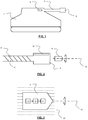
- Figure 1 schematically depicts a ranged weapon 2 - that is a weapon for use in firing a projectile 4, over a distance.
- the ranged weapon 2 in Figure 1 is loosely depicted as a tank, but of course could take one of a number of different forms, for example artillery, self-propelled artillery, a gun battery, and so on.
- the ranged weapon could be fixed in position.
- the projectile 4 will typically be fired along a barrel 6 before leaving a muzzle 8 of the ranged weapon 2.
- the projectile 4 After firing, and once leaving the ranged weapon 2, and in particular the muzzle 8/barrel 6 thereof, the projectile 4 is completely un-propelled (in contrast with, for example, a missile or rocket or the like). That is, after firing and before impact or fuse activation, the projectile 4 is subjected only substantially to forces of gravity and/or air resistance and similar. The projectile is free from/does not comprise a propulsion system.
- Figure 2 shows that the barrel 6 is internally rifled 10 to encourage rotation of the projectile 4 about its longitudinal axis 12, the rotation improving aerodynamic stability of the projectile during its subsequent flight trajectory.
- the projectile 4 may be configured such that its fuse is activated, and such that the projectile 4 bursts or detonates or otherwise explodes on impact.
- the velocity of the projectile 4 upon leaving the muzzle 8 of the ranged weapon may be important in ranging, and in particular in accurate ranging of the projectile and thus accurate targeting of objects.
- Muzzle velocity of the projectile 4 may be known or assumed in advance, for example from previous field trials, or calibrations, or modelling, or similar.
- the ranged weapon might include a muzzle velocity speed sensor 14, for determining the speed of the projectile 4 as it leaves the muzzle 8. This determined speed could perhaps be used in firing of later projectiles, where for example the sensor 14 may be used to improve the accuracy of ranging of the projectile by feeding determined speeds into a fire control or targeting system for firing of that later projectile.
- the muzzle velocity might actually be used in the activation of the fuse of the projectile after it has actually left the muzzle.
- the muzzle velocity sensor 14 may take any particular form, and for example might be inertial, electro-magnetic, capacitive, magnetic, or any other type of sensor which is capable of determining the speed of the projectile 4 at or immediately before the projectile 4 leaves the muzzle 8.
- Figure 3 shows how an alternative and improved approach might be to sense or otherwise detect the number of turns the projectile 4 makes about its longitudinal axis 12 during the trajectory of the projectile.
- the rotational speed of the projectile 4 will be proportional to the previously described rifling of the barrel via which the projectile 4 leaves the ranged weapon 2. So, possibly in combination with some rotation rate decay calibration (e.g. to account for air resistance or similar), the number of rotations (known as the turn-count) can be used to determine how far the projectile has travelled from a firing origin location. Consequently, the turn-count can be used to determine at what turn-count number, and so at what distance, the projectile 4 should be made to explode or otherwise burst.
- the turn-count the number of rotations
- the projectile 4 might comprise a magnetic field sensor 20.
- the magnetic field sensor is arranged to provide a signal that changes in response to a relative change in position and/or orientation between the sensor 20 and the Earth's magnetic field 21.
- This signal can be fed to a controller being or comprising a turn-counter 22.
- the controller 22 can activate a fuse of the projectile to initiate air-burst or otherwise explosion of the projectile 4.
- the sensor 20, controller 22, and fuse 24 might be described as cumulatively forming a fuse system for the projectile 4.
- the fuse system may function sufficiently accurately for accurate air-burst and thus accurate ranging to be implemented in practice.
- such accurate implementation may depend very much on the relative orientations between the projectile 4, the magnetic field sensor 20 thereof, and the configuration (for example field strength or vector angle) of the Earth's magnetic field 21.
- the system of Figure 3 depends on detecting changes relative to the Earth's magnetic field, and that field 21 has relatively low strength (for example 25-65 ⁇ T), and more particularly very small changes thereof will need to be detected (for instance, changes of 0.1 %, or in the range of 25-65nT).
- the magnetic field sensor 22 may not be able to pick up or otherwise sense a change relative to the field 21 that is indicative of or reflects one or more turns of the projectile 4 about its longitudinal axis.
- the many of the problems of previously proposed approaches to activating the fuse of a projectile based on magnetic fields can be largely overcome by employing at least a second magnetic field sensor.
- This at first might appear to be a trivial change.
- the two (or more) magnetic field sensors are not arbitrarily present to provide, for example, redundancy in the event of failure of one of the sensors.
- the magnetic field sensors are arranged or otherwise configured such that each sensor has a different alignment in terms of magnetic field sensitivity. It is this requirement that is subtle, but extremely important and advantageous. This is because the simple but effective additional requirements imposed on the directional sensitivity of the second (or subsequent) sensor ensures that the problems previously described are largely avoided.
- Figure 4 schematically depicts a projectile 30 according to an example embodiment. While the projectile 30 might still comprise a (first) magnetic field sensor 20, a controller 22 and a fuse 24, as with the projectile of Figure 3 , the projectile in Figure 4 now comprises an additional (second) magnetic field sensor 32. Again, and importantly, the magnetic field sensors 20, 32 have different alignments in terms of magnetic field sensitivities. Different alignments could equate to similar or identical sensors being physically aligned in different directions, or being physically aligned in the same directions and having sensitivities to magnetic fields in different directions.
- Figure 5 shows how the magnetic field sensors 20, 32 may have their magnetic field sensitivities aligned relative to one another.
- An advantageous arrangement, shown in Figure 5 might be when the sensitivities are orthogonal to one another since this might maximise the detectable differences in magnetic field properties through which the sensors and/or projectile pass or are exposed to.
- Figure 6 shows that, in another example embodiment, a projectile 40 or more particularly a fuse system thereof, might comprise a further (third) magnetic field sensor 42. This might provide even further gains in accurately or consistently determining relative changes in position/orientation between the projectile 40 and the magnetic field 42.
- Figure 7 shows that an advantageous arrangement might be when the sensitivities to magnetic fields of the sensors 20, 32, 42 are, again, orthogonally aligned with respect to one another.
- a third sensor 42 might improve accuracy with regard to, for instance, turn-count determination
- a third sensor particularly in the orthogonal arrangement of Figure 7 , might also allow for more sophisticated (or at least alternative) navigation/location-based fuse activation methods to be employed, as discussed in more detail below.
- the sensors that form part of the fuse system will need to be capable of detecting sufficiently small changes in relative magnetic field strengths for any measurements to take place, and/or for the results to be used in the activation of the fuse.
- the sensors Given that the sensing is being undertaken relative to the Earth's magnetic field, the sensors will typically need to be capable of detecting fields in the ranged of 25-65 ⁇ T, and/or changes therein in the regional of 25-65nT. This might require the use of an active magnetic field sensor, for example a fluxgate sensor or a magnetoresistive sensor, as opposed to for example a Hall Effect sensor or similar.
- Figure 8 is a basic graph schematically depicting one use of the two-sensor fuse system described above.
- the x-axis depicts a turn-count of the projectile.
- the y-axis depicts a related distance that the projectile has travelled in relation to the turn-count.
- a representation of a sensed or measured turn-count 50 is also shown. It can be seen that at a particular turn-count 52, the projectile will have travelled a particular distance 54 and therefore the fuse might be activated at this particular turn-count, at this particular distance, to achieve explosion or air-burst or similar of the projectile at that distance.
- the representation of the turn-count 50 is shown as progressing in a regular step-wise manner.
- One, more of these properties, or at least a typical rotation frequency decay rate, can be pre-programmed or built into the controller of the fuse system, so such decay can be taken into account when calculating distance travelled for a particular turn-count, or calculating the particular turn-count for a certain distance.
- the typical rotation rates will be known in advance, at least within a particular range. For instance, a typical projectile fired by a tank might involve a spin speed of a few hundred Hz.
- the controller of the fuse system may be arranged to apply a band pass filter and/or a phase locked loop filter to the signals received from the sensors, to at least partially filter out signals outside of a turn frequency range of interest, for example outside of the expected turn-count frequency, or a window or range about that frequency.
- the use of two magnetic field sensors that have their magnetic field sensor activities aligned in different directions overcomes many of the problems associated with the use of a single sensor.
- sensing the field in different directions has additional benefits.
- using two sets of sensors, and in particular three sets of sensors it may be possible to infer a particular change in location of the projectile from the one or more received signals received from the sensors. It is then, of course, possible to have the controller activate the fuse when the particular change equates to the projectile being at a target location.
- the change could, for instance, be a relative or absolute change, for example the fuse being activated when the field strength is 'x' or a magnetic field vector angle is 'y', and/or the fuse could be activated when a particular change in such values is determined.
- Sensing, measurements or fuse activation might be undertaken, again, absolutely, or relative to a background or baseline reference, for example one or more values at the firing origin of the projectile.
- the fuse system may be able to effectively infer (i.e. deduce or determine) a pseudo-navigational determination of the projectile location.
- a determination of navigation-like properties, or location information might have use in isolation, for example the fuse being activated when the projectile is determined to be in a particular location. This might be used in combination with, for example, a turn-count for validation or verification purposes.
- measuring navigational changes relative to the Earth's magnetic field may be advantageous over, for example, transmitting location information or coordinates or the like to the projectile, for example via a GPS system or similar, which could of course be jammed or otherwise interrupted.
- Figure 9 shows a basic graph schematically depicting a change in magnetic field property along the x-axis and, for instance, a related change in distance from firing origin of the projectile in the 'y' axis.
- a sensed magnetic field strength 60 may vary through the projectile's trajectory, and at a particular strength 62 or change therein equate to a particular distance from the firing origin 64 which is a target distance. At this distance, the projectile's fuse might be activated.
- a similar change in magnetic field vector angle 66 may be sensed.
- the fuse At a particular angle 68 or change therein, equating to a particular distance 70 from the firing origin, the fuse might be activated at a required target location.
- Figure 9 shows how location information can be obtained via magnetic field sensing, and this information can be used to activate a fuse of a projectile.
- the fuse system may only be activated during or after the firing procedure.
- the magnetic field sensors may detect a change in sensed field properties as the projectile leaves the barrel/muzzle, and this might be used to prime or otherwise change the state of the fuse system.
- other methods may be used, for example an inertial primer.
- Figure 10 is a flow chart schematically depicting an overview of a method relating to the apparatus already described.
- the method relates generally to activating a fuse for a projectile for a ranged weapon.
- the method comprises using a plurality of magnetic field sensors of the projectile to provide one or more signals that change in response to a relative change in position and/or orientation between the projectile and the Earth's magnetic field 80. Each sensor has a different alignment in terms of its magnetic field sensitivity.
- the method then comprises activating the fuse of the projectile depending on the received one or more signals 82.
- a projectile is set to burst or otherwise explode at a particular distance from a firing origin, and that distance might be determined based on a muzzle velocity, a time from firing, a turn-count, or a combination thereof. It might be desirable, or in some instances even necessary, to provide one or more of these properties or values, or at least data indicative thereof, to the projectile. This is to ensure that the projectile or a controller thereof is capable of ensuring burst of otherwise explosion at a particular distance or location.
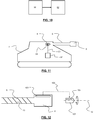
- Figure 11 shows how such data 90 may be transferred from a data store 92 or other system of the ranged weapon 2, to a data receiver or storage 94 or other system of the projectile 4. The data 90 is for use by that projectile 4 in, for instance, activation of a fuse therein. The data 90 might be transferred by inductive coupling, or via electrical contacts or similar.
- the transfer of data in the manner shown in Figure 11 may be sufficient in terms of data transfer rate, the nature of data that is transferred, and how the data is transferred.
- Such up-to-date information might be used to take into account variables that might have changed from the time at which the projectile 4 was stored, and data could have been transferred to the projectile as shown in Figure 11 , and a time at which the projectile is ready to be fired, during the firing and perhaps even after the firing.
- one or more of the problems discussed above may be at least partially overcome by transmitting, or having the capability of transmitting, data from the ranged weapon to the projectile during the firing process, or even after the firing process when the projectile would have left the ranged weapon.
- One approach might be to use a wireless network to achieve such data transfer - i.e. Wi-Fi or similar.
- Wi-Fi wireless network
- the time needed to initiate such a system, transfer data and decode and use such data in the projectile may be too long to be of any practical use, or even for the data to be received in the first place. That is, the speed at which a projectile might be fired might be such that it would be extremely difficult if not impossible to use Wi-Fi like networking to transfer data to the projectile.
- a carrier wave is encoded with data, and the carrier wave is transmitted to the projectile.
- the carrier wave can be generated, transmitted, received and de-coded using relatively simple technology that is reliable, cheap and extremely efficient in terms of speed of data processing. This allows data to be transferred to, and processed by, the projectile even after firing of the projectile.
- Figure 12 shows that the ranged weapon has an associated transmitter 100.
- the transmitter 100 is shown as being located in the muzzle 8 of the ranged weapon, but could of course be located in any other appropriate part of the ranged weapon, for example the main body of the ranged weapon, or a movable turret, and so on.
- the transmitter 100 is arranged to encode data to be transmitted to the projectile 101 on an electromagnetic carrier wave, and to then transmit that electromagnetic carrier wave 102 to the projectile 101.
- the projectile 101 has an associated receiver 104, the receiver being arranged to receive the electromagnetic carrier wave 102 and to decode data encoded in the electromagnetic carrier wave to retrieve that data.
- the data is typically usable in the activation of a fuse of the projectile 101.
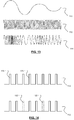
- FIG. 13 schematically depicts basic principles associated with the use and operation of carrier waves.
- a signal to be transmitted is shown 110.
- a carrier wave having a particular frequency is also shown 112.
- the carrier wave 112 is frequency modulated in relation to the signal 110 to be transmitted, thus resulting in a frequency modulated carrier wave 114.
- Frequency modulation being preferred over, for instance, amplitude modulation in terms of the enhanced data transmission capabilities associated with frequency modulation.
- data to be transmitted may not be particularly complex, for example involving images, or video, or large streams of data.
- the data might be relatively simple, for example comprising only a single number in the form of a turn-count, or a muzzle velocity, or a target magnetic field strength or vector angle.
- the frequency modulation or similar may not need to be particularly complex in order to achieve the desired result of quickly and easily transmitting relatively small amounts of data to the projectile. Therefore, in a preferred example, data to be transmitted may be encoded in what could be described as binary form, and in particular by the presence or absence of particular sub-carriers (sometimes known as sub-channels) on the carrier wave (that is, relatively simple (frequency-division multiplexing).
- Figure 14 depicts in very simplistic and somewhat abstract terms how the carrier wave 112 might comprise a certain number of sub-carriers, for example at different frequencies.
- these sub-carriers being present 120 or absent 122, simple binary encoding is relatively easy to implement and subsequently decode.
- An analogy might be that the transmitter plays a particular note, chord or tone and the projectile is ready and able to receive and act upon that note, chord or tone. That is, there may be no need to actually encode data or further data in the sub-carriers - the actual presence or absence of the sub-carriers is all that is required to transmit the data that was required for the particular application/fuse activation.
- a controller of the projectile for example the controller discussed above, many use the received data in the activation of the fuse as and when appropriate. This might be used independently of or in conjunction with, any magnetic field sensing that has been undertaken within the projectile or, for example, the turn-count or navigation-like functionality described above.
- the data might take any particular form depending of course on the application and nature of the fuse system, and projectile and its intended use. Typical examples might include priming information, which might provide the projectile with an indication that the projectile has left the barrel, and for at least a part of the fuse system to be readied, or for a countdown time or similar to begin. Alternatively and/or additionally the magnetic field sensors might be able to provide such information, since it is expected that a magnetic field sensor should be able to readily detect changes in relative magnetic field as the projectile leaves the barrel/muzzle of the ranged weapon.
- the data might comprise timing information, for example a time to detonate or burst of the projectile.
- the data might comprise a muzzle velocity, which might also be used in calculating a range, or a time to burst or a burst location or similar.
- the magnetic field sensors may be used in the calculation of muzzle velocity, since a measured rotational rate of the projectile via the use of the sensors, in combination with a known rifling pitch, should allow for a velocity to be determined.
- a sensed or transmitted/received muzzle velocity could be used in isolation or possibly in combination with validation/verification benefits.
- the data might comprise a particular turn-count number, at which number the projectile is set to burst or detonate.
- Magnetic field information might be transmitted, for example field strengths, changes therein, vector angles, or changes therein, and so on.
- Projectile firing origin information might be transmitted, for example in terms of a condition at the origin in terms of ambient measurement of temperature or wind speed and so on or, in particular to the embodiments described above, in the form of magnetic field strength information and/or magnetic field vector angle information.
- the same sort of data e.g. environmental conditions
- this data or similar might be pre-stored in the projectile before firing, and/or transmitted to the projectile during or after firing, or a combination thereof.
- Data that is transmitted might be used to supplement data that is stored, or verify or validate stored data.
- Transmitted data might provide data that is impossible or impractical to pre-store, for example data of targets that have changed just before, during or after projectile firing.
- the data might not necessarily be the information described above, but instead be indicative thereof.
- the data that is transmitted might not actually be a numerical value that actually equates to a particular turn-count number of field strength, but could be data that simply is indicative of that number or that field strength that would be readily understood and processed by the projectile fuse system.
- Pre-stored and/or received data may be stored in any convenient manner, for example volatile or non-volatile memory.
- the transmission of such data in a wireless manner might be open to reception and inspection by unintended third parties, or possibly even result in interference by such third parties, or interference in general.
- such wireless transmission/reception can result in crosstalk between ranged weapons/projectiles in proximity to one another.
- the aforementioned transmitter and/or receiver may comprise one or more directional antennae.
- the directional antennae may prevent transmission of a signal in, or reception of a signal from, any and all directions, but instead transmission/reception in a particular direction. This might limit potential cross-talk and/or eavesdropping.
- the electromagnetic carrier wave might have properties (e.g. have a power and/or frequency) that results in a transmission range (e.g.
- a suitable carrier wave frequency might be of the order of GHz, for instance approximately 10GHz and above, particularly at or around high attenuation peaks.
- Near field communications could also be used.
- the communication system described above might have a transmission window, and/or a reception window, of less than 100ms or 50ms or less, again to limit the risks of cross-talk, eavesdropping and/or jamming.
- data transmission might be achieved via digital synthesis methods, or via so-called software radio techniques.
- Decoding at the receiver could be via analogue methods, for example a filter array feeding a number of digital latches.
- digital signal processing techniques e.g. Fast Fourier Transforms or active filters
- these may provide greater selectivity (e.g.
- Figure 15 schematically depicts a method which summarises some of the communication principles discussed above.
- the method relates to communication between a ranged weapon and a projectile for that ranged weapon.
- the method comprises, at the ranged weapon, encoding data to be transmitted to the projectile on an electromagnetic carrier wave, and transmitting that electromagnetic carrier wave to the projectile 130.
- the method comprises receiving the electromagnetic carrier wave, and decoding data encoded in the electromagnetic carrier wave to retrieve that data 132.
- the data is usable in the activation of the fuse of the projectile, at least in typical embodiments.
- Figure 16 describes the related method (or method portion) of transmitting data to a projectile of a ranged weapon.
- the method comprises, at the ranged weapon, encoding data to be transmitted to the projectile on an electromagnetic carrier wave 140, and then transmitting that electromagnetic carrier wave to the projectile 142.
- Figure 17 shows a method of receiving data at a projectile for a ranged weapon.
- the method comprises, at the projectile, receiving an electromagnetic carrier wave 150, and then decoding data encoded in the electromagnetic carrier wave to retrieve that data 152.
- the data is usable in the activation of a fuse of the projectile in most embodiments.
- the apparatus described above might be completely new apparatus, or existing apparatus re-configured to work in the new and beneficial manner described above.
- a new ranged weapon might comprise the transmitter described above, or an existing ranged weapon might be retro-fitted with such a transmitter, and so on.
Landscapes
- Engineering & Computer Science (AREA)
- General Engineering & Computer Science (AREA)
- Measurement Of Length, Angles, Or The Like Using Electric Or Magnetic Means (AREA)
Priority Applications (4)
| Application Number | Priority Date | Filing Date | Title |
|---|---|---|---|
| EP16275026.9A EP3208570A1 (de) | 2016-02-16 | 2016-02-16 | Projektilzünder |
| EP17705936.7A EP3417235B1 (de) | 2016-02-16 | 2017-02-08 | Projektilzünder |
| PCT/GB2017/050307 WO2017141009A1 (en) | 2016-02-16 | 2017-02-08 | Fuse system for projectile |
| US15/998,611 US10746519B2 (en) | 2016-02-16 | 2017-02-08 | Fuse system for projectile |
Applications Claiming Priority (1)
| Application Number | Priority Date | Filing Date | Title |
|---|---|---|---|
| EP16275026.9A EP3208570A1 (de) | 2016-02-16 | 2016-02-16 | Projektilzünder |
Publications (1)
| Publication Number | Publication Date |
|---|---|
| EP3208570A1 true EP3208570A1 (de) | 2017-08-23 |
Family
ID=55405281
Family Applications (1)
| Application Number | Title | Priority Date | Filing Date |
|---|---|---|---|
| EP16275026.9A Ceased EP3208570A1 (de) | 2016-02-16 | 2016-02-16 | Projektilzünder |
Country Status (1)
| Country | Link |
|---|---|
| EP (1) | EP3208570A1 (de) |
Cited By (1)
| Publication number | Priority date | Publication date | Assignee | Title |
|---|---|---|---|---|
| CN113375512A (zh) * | 2021-06-07 | 2021-09-10 | 河北迥然科技有限公司 | 空炸弹药复合定距方法、装置及终端设备 |
Citations (4)
| Publication number | Priority date | Publication date | Assignee | Title |
|---|---|---|---|---|
| EP0596845A1 (de) * | 1992-11-04 | 1994-05-11 | Bofors AB | Magnetischer Annäherungszünder |
| EP0661516A1 (de) * | 1993-12-30 | 1995-07-05 | Alliant Techsystems Inc. | Multifunktioneller magnetischer Zünder |
| EP1813905A2 (de) * | 2006-01-30 | 2007-08-01 | Alliant Techsystems Inc. | Rollenausrichtung unter Verwendung von umdrehungszählendem Zünder |
| US20100308152A1 (en) * | 2009-06-08 | 2010-12-09 | Jens Seidensticker | Method for correcting the trajectory of terminally guided ammunition |
-
2016
- 2016-02-16 EP EP16275026.9A patent/EP3208570A1/de not_active Ceased
Patent Citations (4)
| Publication number | Priority date | Publication date | Assignee | Title |
|---|---|---|---|---|
| EP0596845A1 (de) * | 1992-11-04 | 1994-05-11 | Bofors AB | Magnetischer Annäherungszünder |
| EP0661516A1 (de) * | 1993-12-30 | 1995-07-05 | Alliant Techsystems Inc. | Multifunktioneller magnetischer Zünder |
| EP1813905A2 (de) * | 2006-01-30 | 2007-08-01 | Alliant Techsystems Inc. | Rollenausrichtung unter Verwendung von umdrehungszählendem Zünder |
| US20100308152A1 (en) * | 2009-06-08 | 2010-12-09 | Jens Seidensticker | Method for correcting the trajectory of terminally guided ammunition |
Cited By (1)
| Publication number | Priority date | Publication date | Assignee | Title |
|---|---|---|---|---|
| CN113375512A (zh) * | 2021-06-07 | 2021-09-10 | 河北迥然科技有限公司 | 空炸弹药复合定距方法、装置及终端设备 |
Similar Documents
| Publication | Publication Date | Title |
|---|---|---|
| US10746519B2 (en) | Fuse system for projectile | |
| US10900763B2 (en) | Activating a fuse | |
| GB2547425A (en) | Activating a fuse | |
| EP3555664B1 (de) | Steuerungssystem zur steuerung eines geschosses | |
| US6345785B1 (en) | Drag-brake deployment method and apparatus for range error correction of spinning, gun-launched artillery projectiles | |
| EP1813905B1 (de) | Vorrichtung und Verfahren zur Bestimmung der Rolllage eines Projektils | |
| CA2271766C (en) | Impulse radar guidance apparatus and method for use with guided projectiles | |
| NO310381B1 (no) | Multifunksjonelt magnetisk tennrör | |
| KR20140087302A (ko) | 탄속 측정 장치 및 방법 | |
| EP0451122B1 (de) | Bestimmung des Rollwinkels | |
| EP3208569A1 (de) | Aktivierung einer zündeinrichtung | |
| GB2548698A (en) | Activating a fuse | |
| EP3762678B1 (de) | Zündssystem | |
| US6572052B1 (en) | Process and device for determining roll angle | |
| KR101355928B1 (ko) | 탄에 장착되는 제어시스템 및 그 제어 방법 | |
| US11215454B2 (en) | Apparatus and method for up finding | |
| US7926402B2 (en) | Method and apparatus for munition timing and munitions incorporating same | |
| IL204223A (en) | Head start method - shell and vehicle battle | |
| EP3349045A1 (de) | Steuerungssystem zur steuerung eines geschosses | |
| JP5979022B2 (ja) | 弾薬作動システム | |
| GB2557638A (en) | Control system for controlling a projectile | |
| EP3537096A1 (de) | Zündssystem | |
| EP4474756A1 (de) | Datenübertragungssystem zur verwendung mit einem projektil | |
| KR100959357B1 (ko) | 회전감지센서가 내장된 신관 및 이를 이용한 시한 데이터의탄속 보정 방법 | |
| GB2571750A (en) | Fuse system |
Legal Events
| Date | Code | Title | Description |
|---|---|---|---|
| PUAI | Public reference made under article 153(3) epc to a published international application that has entered the european phase |
Free format text: ORIGINAL CODE: 0009012 |
|
| AK | Designated contracting states |
Kind code of ref document: A1 Designated state(s): AL AT BE BG CH CY CZ DE DK EE ES FI FR GB GR HR HU IE IS IT LI LT LU LV MC MK MT NL NO PL PT RO RS SE SI SK SM TR |
|
| AX | Request for extension of the european patent |
Extension state: BA ME |
|
| 18R | Application refused |
Effective date: 20170918 |