EP3208626A1 - Magnetfeldsensor mit abgeneigter messmagnetisierung einer messschicht - Google Patents
Magnetfeldsensor mit abgeneigter messmagnetisierung einer messschicht Download PDFInfo
- Publication number
- EP3208626A1 EP3208626A1 EP17153227.8A EP17153227A EP3208626A1 EP 3208626 A1 EP3208626 A1 EP 3208626A1 EP 17153227 A EP17153227 A EP 17153227A EP 3208626 A1 EP3208626 A1 EP 3208626A1
- Authority
- EP
- European Patent Office
- Prior art keywords
- sense
- layer
- magnetoresistive
- magnetic field
- magnetization
- Prior art date
- Legal status (The legal status is an assumption and is not a legal conclusion. Google has not performed a legal analysis and makes no representation as to the accuracy of the status listed.)
- Granted
Links
Images




Classifications
-
- G—PHYSICS
- G01—MEASURING; TESTING
- G01R—MEASURING ELECTRIC VARIABLES; MEASURING MAGNETIC VARIABLES
- G01R33/00—Arrangements or instruments for measuring magnetic variables
- G01R33/0005—Geometrical arrangement of magnetic sensor elements; Apparatus combining different magnetic sensor types
-
- G—PHYSICS
- G01—MEASURING; TESTING
- G01R—MEASURING ELECTRIC VARIABLES; MEASURING MAGNETIC VARIABLES
- G01R17/00—Measuring arrangements involving comparison with a reference value, e.g. bridge
- G01R17/10—AC or DC measuring bridges
-
- G—PHYSICS
- G01—MEASURING; TESTING
- G01R—MEASURING ELECTRIC VARIABLES; MEASURING MAGNETIC VARIABLES
- G01R33/00—Arrangements or instruments for measuring magnetic variables
- G01R33/0011—Arrangements or instruments for measuring magnetic variables comprising means, e.g. flux concentrators, flux guides, for guiding or concentrating the magnetic flux, e.g. to the magnetic sensor
-
- G—PHYSICS
- G01—MEASURING; TESTING
- G01R—MEASURING ELECTRIC VARIABLES; MEASURING MAGNETIC VARIABLES
- G01R33/00—Arrangements or instruments for measuring magnetic variables
- G01R33/02—Measuring direction or magnitude of magnetic fields or magnetic flux
- G01R33/0206—Three-component magnetometers
-
- G—PHYSICS
- G01—MEASURING; TESTING
- G01R—MEASURING ELECTRIC VARIABLES; MEASURING MAGNETIC VARIABLES
- G01R33/00—Arrangements or instruments for measuring magnetic variables
- G01R33/02—Measuring direction or magnitude of magnetic fields or magnetic flux
- G01R33/06—Measuring direction or magnitude of magnetic fields or magnetic flux using galvano-magnetic devices
- G01R33/09—Magnetoresistive devices
-
- G—PHYSICS
- G01—MEASURING; TESTING
- G01R—MEASURING ELECTRIC VARIABLES; MEASURING MAGNETIC VARIABLES
- G01R33/00—Arrangements or instruments for measuring magnetic variables
- G01R33/02—Measuring direction or magnitude of magnetic fields or magnetic flux
- G01R33/06—Measuring direction or magnitude of magnetic fields or magnetic flux using galvano-magnetic devices
- G01R33/09—Magnetoresistive devices
- G01R33/098—Magnetoresistive devices comprising tunnel junctions, e.g. tunnel magnetoresistance sensors
Definitions
- the present invention relates generally to magnetoelectronic devices. More specifically, the present invention relates to a magnetic field sensor with multiple axis sensing and permanent magnet biasing.
- Magnetic field sensors also known as magnetometers, are widely used in a number of applications including in, for example, compass, security, and military applications, geophysics and space research, biomagnetism and medical applications, and non-destructive testing.
- Magnetic field sensors are typically based on semiconductor materials (e.g., Hall sensors, magnetoresistors, and so forth) and ferromagnetic materials (e.g., ferromagnetic magnetoresistors and flux guides).
- Other magnetic field sensors utilize optical, resonant, and superconducting properties. In many Earth's field magnetic sensing applications, especially those involving compassing or orientation, it is extremely desirable to have three-axis sensing capability.
- the solution be a single chip or even fully integrable onto the accompanying application specific integrated circuit (ASIC) die.
- ASIC application specific integrated circuit
- embodiments disclosed herein entail a magnetic field sensor capable of sensing magnetic fields along one or more mutually exclusive sense axes, typically referred to as the X-axis, Y-axis, and Z-axis. More particularly, a unique sensor bridge design of magnetoresistive sense elements is implemented for each sense axis. Each sensor bridge incorporates an in-plane orientation of reference magnetization of the pinned layer, along with out-of-plane, skewed biasing of the sense magnetization of the sense layer in two opposing directions.
- one or more permanent magnet layers are strategically patterned (shape and position) to generate a unique external bias field vector of the sense magnetization of the sense layer to produce a balanced bridge configuration of magnetoresistive sense elements for the sensor bridge without built-in, zero field offset.
- one sensor bridge design is utilized for sensing an external magnetic field that is perpendicular to the plane of the magnetic field sensor package without the use of flux concentrators.
- the strategically patterned permanent magnet layer(s) for this sensor bridge additionally allows it to respond to the out-of-plane external magnetic field without inter-axis coupling of sensor response.
- FIG. 1 shows a simplified side view of an exemplary magnetoresistive sense element 20 with an accompanying plot 22 of variable resistance 26 that may occur in the presence of an external magnetic field, represented by arrows 28, 30.
- magnetoresistive sense element 20 may be a magnetic tunnel junction (MTJ) sensor.
- An MTJ structure includes a metal-insulator-metal layer sandwich in which the metal layers are ferromagnetic and the insulator layer is very thin. Electrically, this forms a tunnel diode in which electrons can tunnel from one ferromagnet into the other.
- Such a tunnel diode exhibits transport characteristics that depend, not only on the voltage bias, but also on the magnetic states of the top and bottom electrodes.
- Magnetoresistive sense element 20 is an exemplary magnetic tunnel junction (MTJ) structure that includes ferromagnetic layers 32, 34 separated by an insulator layer 36.
- An electrode 38 may be in electrical communication with ferromagnetic layer 32 and another electrode 40 may be in electrical communication with ferromagnetic layer 34.
- This structure may be formed within a dielectric material, not shown herein for simplicity.
- a Z-axis 42 is oriented up-and-down on the page
- an X-axis 44 is oriented right-and-left on the page
- a Y-axis 46 is represented as a dot that depicts an axis going either into or out of the page on which FIG. 1 is situated.
- the X-Y plane in this side view illustration is oriented right-and-left and into or out of the page.
- external magnetic field 28 represents a magnetic field that is parallel to the X-Y plane of magnetoresistive sense element 20. More particularly, external magnetic field 28 is generally parallel to X-axis 44.
- external magnetic field 30 represents a magnetic field that is perpendicular to the X-Y plane of magnetoresistive sense element 20. That is, external magnetic field is generally parallel to Z-axis 42.
- Ferromagnetic layer 32 may be fixed, or "pinned,” to have a reference magnetization, as represented by a solid arrow 48. Therefore, ferromagnetic layer 32 is referred to hereinafter as pinned layer 32.
- Ferromagnetic layer 34 is "free” to respond to, i.e., sense, the applied magnetic field (e.g., external magnetic field 38, 40) to provide a sense magnetization, represented by a dotted arrow 50.
- sense magnetization 50 modulates the measured resistance 26. Accordingly, ferromagnetic layer 34 is referred to hereinafter as sense layer 34.
- resistance 26 depends upon the magnetic states of electrodes 38, 40. Since electrodes 38, 40 are electrically coupled with pinned and sense layers 32, 34, respectively, the states of electrodes 38, 40 depend upon the alignment of the magnetic moments of the pinned and sense layers 32, 34.
- resistance 26 of the junction is lowest. However, resistance 26 of the junction is highest when the magnetic moments are anti-parallel (i.e., the vectors lie along parallel lines but point in the opposite direction).
- resistance 26 of the junction varies as the cosine of the angle between magnetic moments.
- One or more MTJ resistors such as magnetoresistive sense element 20, may be utilized to form either of an X-axis or a Y-axis magnetic field sensor for sensing an external magnetic field that is parallel to the X-Y plane of magnetoresistive sense element 20.
- one or more flux guides 52 are also formed within the dielectric material (not shown) in which magnetoresistive sense element 20 is formed.
- flux guides 52 can be used to guide Z-axis magnetic field 30 into the X-Y plane.
- Flux guides 52 are generally thin, narrow sheets of magnetic material typically used to guide flux, i.e., Z-axis magnetic field 30, to a preferred location.
- Z-axis magnetic field 30 is suitably guided so that it can be sensed using one or more in-plane magnetoresistive sense elements 20.
- flux guides 52 For optimal Z axis response, flux guides 52 have a preferred magnetization orientation. That is, the magnetic polarization for each of flux guides 52 will be directed in a uniform, i.e., generally single, direction.
- flux guides 52 are susceptible to corruption by exposure to externally applied magnetic fields (e.g., disturbing fields of approximately one hundred Gauss or more). This corruption, typically referred to as perming, can alter the magnetic state of flux guides 52 leading to unstable device characteristics including offset, axis alignment, and noise. Large offset shifts, axis rotations, and excess noise can be very difficult or even impossible to compensate/calibrate out of the sensor response and can render Z-axis magnetic field sensor 20 unusable.
- FIG. 2 shows a simplified block diagram of a magnetic field sensor package 54.
- Magnetic field sensor package 54 may be implemented in any device or system in which magnetic field sensing is required, for example, in compass, security, and military applications, in geophysics and space research applications, in biomagnetism and medical applications, and/or in non-destructive testing.
- sensor package 54 may be adapted to sense a magnetic field along three axes.
- sensor package 54 includes an X-axis magnetic field sensor 56, a Y-axis magnetic field sensor 58, and a Z-axis magnetic field sensor 60.
- Magnetic field sensors 56, 58, 60 may be coupled to, or otherwise in communication with, an application specific integrated circuit (ASIC) 62 to form sensor package 54.
- ASIC 62 performs some or all functions including, but not limited to, signal conditioning and data management, reset and stabilization control, bridge/output multiplexing, self-test, electrostatic discharge (ESD) protection, and so forth.
- ASIC application specific integrated circuit
- magnetic field sensor package 54 employs a triad of unique sensor bridge designs for X-axis 44, Y-axis 46, and Z-axis 42 magnetic field sensing.
- Each sensor bridge incorporates an in-plane orientation of reference magnetization of the pinned layer, along with out-of-plane, skewed biasing of the sense magnetization of the sense layer in two opposing directions.
- one or more permanent magnet layers are strategically patterned (shape and position) to generate a unique external bias field vector of the sense magnetization of the sense layer to produce a balanced bridge configuration of magnetoresistive sense elements for the sensor bridge without built-in, zero field offset.
- the strategically patterned permanent magnet layer(s) for a Z-axis sensor bridge design additionally allows it to respond to the out-of-plane external magnetic field without the use of flux concentrators and without inter-axis coupling of sensor response.
- FIG. 3 shows a simplified schematic view of X-axis magnetic field sensor 56 of magnetic field sensor package 54 ( FIG. 2 ). Accordingly, X-axis magnetic field sensor 56 is sensitive to X-axis external magnetic field 28 in a sensing direction (referred to herein as X sensing direction 64) parallel to X-axis 44 and therefore parallel to an X-Y plane 66 (see FIG. 4 ) of magnetic field sensor package 54 ( FIG. 2 ). X-axis magnetic field sensor 56 produces an output signal 68, labeled V X-OUT , indicative of the magnitude of X-axis external magnetic field 28.
- X sensing direction 64 parallel to X-axis 44
- X-Y plane 66 see FIG. 4
- X-axis magnetic field sensor 56 includes a sensor bridge, and more particularly, a Wheatstone bridge, referred to herein as an X-axis Wheatstone bridge 70.
- X-axis magnetic field sensor 56 includes first, second, third, and fourth sensor legs 72, 74, 76, 78, respectively.
- First sensor leg 72 includes one or more first magnetoresistive sense elements 80
- second sensor leg 74 includes one or more second magnetoresistive sense elements 82
- third sensor leg 76 includes one or more third magnetoresistive sense elements 84
- fourth sensor leg 78 includes one or more fourth magnetoresistive sense elements 86.
- magnetoresistive sense elements 80, 82, 84, 86 may be MTJ structures.
- magnetoresistive sense elements 80, 82, 84, 86 Only one each of magnetoresistive sense elements 80, 82, 84, 86 is shown for simplicity of illustration. Those skilled in the art will readily recognize that X-axis magnetic field sensor 56 can include any number of magnetoresistive sense elements 80, 82, 84, 86.
- First and fourth magnetoresistive sense elements 80, 86 are coupled in series to form a first half of X-axis Wheatstone bridge 70 and second and third magnetoresistive sense elements 82, 84 are coupled in series to form a second half of X-axis Wheatstone bridge 70.
- the first half of X-axis Wheatstone bridge 70 is coupled in parallel with the second half of X-axis Wheatstone bridge 70 such that a junction 88 of first and second magnetoresistive sense elements 80, 82 forms a first input terminal 90 and a junction 92 of third and fourth magnetoresistive sense elements 84, 86 forms a second input terminal 94.
- resistances are provided in association with magnetoresistive sense elements 80, 82, 84, 86.
- a resistance 96, R1 X represents the signal output of first magnetoresistive sense element 80.
- a resistance 98, R2 X represents the signal output of second magnetoresistive sense element 82.
- a resistance 100, R3 X represents the signal output of third magnetoresistive sense element 84.
- a resistance 102, R4x represents the signal output of fourth magnetoresistive sense element 86.
- First magnetoresistive sense element 80 includes a first pinned layer 104 and a first sense layer 106 separated by an insulator layer 108.
- second magnetoresistive sense element 82 includes a second pinned layer 110 and a second sense layer 112 separated by an insulator layer 114.
- Third magnetoresistive sense element 84 includes a third pinned layer 116 and a third sense layer 118 separated by an insulator layer 120.
- Fourth magnetoresistive sense element 86 includes a fourth pinned layer 122 and a fourth sense layer 124 separated by an insulator layer 126.
- X-axis magnetic sensor 56 includes a first permanent magnet layer 128 and a second permanent magnet layer 130 positioned proximate second and fourth magnetoresistive sense elements 82, 86 and located away from first and third magnetoresistive elements 80, 84.
- each of first and second permanent magnet layers 128, 130 is located out-of-plane from magnetoresistive sense elements 82, 86.
- first permanent magnet layer 128 is located out-of-plane above second and fourth magnetoresistive sense elements 82, 86 and second permanent magnet layer 130 is located out-of plane below second and fourth magnetoresistive sense elements 82, 86.
- first and second permanent magnet layers 128, 130 may be displaced out-of-plane relative to one another, but may be generally co-planar with magnetoresistive sense elements 82, 86. Further, although two permanent magnet layers 128, 130 are shown, alternative embodiments may include only one or more than two permanent magnet layers and may have different magnetic orientations.
- first and second permanent magnet layers 128, 130 magnetically bias the sense magnetization of second and fourth magnetoresistive sense elements 82, 86.
- first and second permanent magnet layers 128, 130 are located at a distance away from first and third magnetoresistive sense elements 80, 84 to substantially prevent first and second permanent magnet layers 128, 130 from magnetically biasing the sense magnetization first and third magnetoresistive sense elements 80, 84.
- each of first and second permanent magnet layers 128, 130 has a single magnetic orientation, a single thickness, and a single spacing away from magnetoresistive sense elements 82, 86.
- a magnetic orientation 131 of first and second permanent magnet layers 128, 130 is substantially perpendicular to X-Y plane 66 ( FIG. 4 ) of magnetic field sensor package 54 ( FIG. 2 ). More specifically, magnetic orientation 131 is parallel to Z-axis 42 and is directed downward on the page.
- FIG. 4 shows a table 132 demonstrating magnetization vectors of X-axis magnetic field sensor 56. More particularly, table 132 provides a top view representation 135 of magnetoresistive sense elements 80, 82, 84, 86 and a side view representation 137 of magnetoresistive sense elements 80, 82, 84, 86. Top view representation 135 includes symbol representing top views of first and third magnetoresistive sense elements 80, 84 and another symbol representing top views of second and fourth magnetoresistive sense elements 82, 86 with first and second permanent magnet layers 128, 130.
- Side view representation 137 provides a symbol representing side views of first and third magnetoresistive sense elements 80, 84 and another symbol representing side views of second and fourth magnetoresistive sense elements 82, 84.
- a dielectric material 134 surrounds magnetoresistive sense elements 80, 82, 84, 86. Dielectric material 134 is included with the side views representing first and third magnetoresistive sense elements 80, 84 as well as second and fourth magnetoresistive sense elements 82, 86 to illustrate an out-of-plane location of first and second permanent magnet layers 128, 130 relative to magnetoresistive sense elements 80, 82, 84, 86.
- Each of first, second, third, and fourth pinned layers 104, 110, 116, 122 has a reference magnetization 136 oriented substantially parallel to X-Y plane 66. Further, reference magnetization 136 is oriented orthogonal to X sensing direction 64. Thus, as shown in FIG. 3 and in the side view of FIG. 4 , reference magnetization 136 is represented by circles with an inscribed X, denoting a direction going into the page. As further shown in the top view of FIG. 4 , reference magnetization 136 is represented by upwardly directed solid arrows aligned with Y-axis 46 for X-axis magnetic field sensor 56.
- first and third sense layers 106, 118 has a first sense magnetization 138 and each of second and fourth sense layers 112, 124 has a second sense magnetization 140.
- first sense magnetization 138 and second sense magnetization 140 are represented by dotted arrows.
- the respective directions of each of first sense magnetization 138 and second sense magnetization 140 are skewed away from X-axis 44, Y-axis 46, and Z-axis 42.
- first and second sense magnetizations 138, 140 are orientable in response to X magnetic field 28 in X sensing direction 64.
- Miller indices are a notation system typically used to specify directions and plane. For example, they can be used to specify a direction of a vector, r, from the origin to a point.
- the notation [hkl] represents the direction, where the Miller indices h, k, and l are replaced by three integers, and the notation ⁇ hkl> represents a family of directions.
- a negative direction is denoted with a bar on top of one or more of the three integers. In a cubic system, each of the directions in a family of directions has the same indices regardless of order or sign.
- first sense magnetization 138 is oriented in a first ⁇ hkl> direction 142, where h, k, and l are Miller indices 146 all of which are non-zero and ⁇ hkl> represents a family of directions 148.
- first and second permanent magnet layers 128, 130 positioned proximate second and fourth magnetoresistive sense elements 82, 86 magnetically bias second sense magnetization 140 in a second ⁇ hkl> direction 144 relative to first ⁇ hkl> direction 142, where one of h, k, and l of second ⁇ hkl> direction 144 is a negative value of a corresponding one of h, k, and l in first ⁇ hkl> direction 142.
- first ⁇ hkl> direction 142 of first sense magnetization 138 for each of first and third magnetoresistive sense elements 80, 84 may be characterized by Miller indices of [111].
- Second ⁇ hkl> direction 144 of second sense magnetization 140 for each of second and fourth magnetoresistive sense elements 82, 86 is therefore characterized by Miller indices of [ 1 11].
- the orientation, or direction, of reference magnetization 136 for all of magnetoresistive sense elements 80, 82, 84, 86 can therefore be characterized by Miller indices of [010].
- both of first ⁇ hkl> direction 142 and second ⁇ hkl> direction 144 of respective first and second sense magnetizations 138, 140 are skewed by the same angular magnitude, ⁇ , away from each of X-axis 44, Y-axis 46, and Z-axis 42.
- second ⁇ hkl> direction 144 is skewed in an opposing direction from first ⁇ hkl> direction 142 relative the sensing axis, i.e., X-axis 44, by the negative of the angular magnitude, i.e., by negative ⁇ .
- the direction of reference magnetization 136 is parallel to plane 66 but perpendicular to X sensing direction 64.
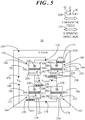
- FIG. 5 shows a simplified schematic view of Y-axis magnetic field sensor 58 of magnetic field sensor package 54 ( FIG. 2 ). Accordingly, Y-axis magnetic field sensor 58 is sensitive to a Y-axis external magnetic field 150 in a sensing direction (referred to herein as Y sensing direction 152) parallel to Y-axis 46 and therefore parallel to an X-Y plane 66 (see FIG. 6 ) of magnetic field sensor package 54 ( FIG. 2 ). Y-axis magnetic field sensor 58 produces an output signal 154, labeled V Y-OUT , indicative of the magnitude of Y-axis external magnetic field 150.
- V Y-OUT an output signal 154
- Y-axis magnetic field sensor 58 includes a sensor bridge, and more particularly, a Wheatstone bridge, referred to herein as a Y-axis Wheatstone bridge 156.
- Y-axis magnetic field sensor 58 includes first, second, third, and fourth sensor legs 158, 160, 162, 164, respectively.
- First sensor leg 158 includes one or more first magnetoresistive sense elements 166
- second sensor leg 160 includes one or more second magnetoresistive sense elements 168
- third sensor leg 162 includes one or more third magnetoresistive sense elements 170
- fourth sensor leg 164 includes one or more fourth magnetoresistive sense elements 172. Only one each of magnetoresistive sense elements 166, 168, 170, 172 is shown for simplicity of illustration.
- Y-axis magnetic field sensor 58 can include any number of magnetoresistive sense elements 166, 168,170,172.
- First and fourth magnetoresistive sense elements 166, 172 are coupled in series to form a first half of Y-axis Wheatstone bridge 156 and second and third magnetoresistive sense elements 168, 170 are coupled in series to form a second half of Y-axis Wheatstone bridge 156.
- the first half of Y-axis Wheatstone bridge 156 is coupled in parallel with the second half of Y-axis Wheatstone bridge 156 such that a junction 174 of first and second magnetoresistive sense elements 166, 168 forms a first input terminal 176 and a junction 178 of third and fourth magnetoresistive sense elements 190 172 forms a second input terminal 180.
- resistances are provided in association with magnetoresistive sense elements 166, 168, 170, 172.
- a resistance 182, R1 Y represents the signal output of first magnetoresistive sense element 166.
- a resistance 184, R2 Y represents the signal output of second magnetoresistive sense element 168.
- a resistance 186, R3 Y represents the signal output of third magnetoresistive sense element 170.
- a resistance 188, R4 Y represents the signal output of fourth magnetoresistive sense element 172.
- First magnetoresistive sense element 166 includes a first pinned layer 190 and a first sense layer 192 separated by an insulator layer 194.
- second magnetoresistive sense element 168 includes a second pinned layer 196 and a second sense layer 198 separated by an insulator layer 200.
- Third magnetoresistive sense element 170 includes a third pinned layer 202 and a third sense layer 204 separated by an insulator layer 206.
- Fourth magnetoresistive sense element 172 includes a fourth pinned layer 208 and a fourth sense layer 210 separated by an insulator layer 212.
- Y-axis magnetic sensor 58 includes first permanent magnet layer 128 and second permanent magnet layer 130 positioned proximate second and fourth magnetoresistive sense elements 168, 172 and located away from first and third magnetoresistive elements 166, 170.
- each of first and second permanent magnet layers 128, 130 is located out-of-plane from magnetoresistive sense elements 168, 172.
- first permanent magnet layer 128 is located out-of-plane above second and fourth magnetoresistive sense elements 168, 172 and second permanent magnet layer 130 is located out-of plane below second and fourth magnetoresistive sense elements 168, 172.
- first and second permanent magnet layers 128, 130 may alternatively be displaced out-of-plane relative to one another, but may be generally co-planar with magnetoresistive sense elements 168, 172. Further, although two permanent magnet layers 128, 130 are shown, alternative embodiments may include only one or more than two permanent magnet layers and may have other single magnetization directions. First and second permanent magnet layers 128, 130 magnetically bias the sense magnetization of second and fourth magnetoresistive sense elements 168, 172. However, first and second permanent magnet layers 128, 130 are located at a distance away from first and third magnetoresistive sense elements 166, 170 to substantially prevent first and second permanent magnet layers 128, 130 from magnetically biasing the sense magnetization first and third magnetoresistive sense elements 166, 170. Again, magnetic orientation 131 of first and second permanent magnet layers 128, 130 is substantially perpendicular to X-Y plane 66 ( FIG. 6 ) of magnetic field sensor package 54 ( FIG. 2 ) and parallel to Z-axis 42.
- FIG. 6 shows a table 214 demonstrating magnetization vectors of Y-axis magnetic field sensor 58. More particularly, table 214 provides a top view representation 216 of magnetoresistive sense elements 166, 168, 170, 172 and a side view representation 218 of magnetoresistive sense elements 166, 168, 170, 172. Top view representation 216 includes a symbol representing top views of first and third magnetoresistive sense elements 166, 170 and another symbol representing top views of second and fourth magnetoresistive sense elements 168, 172 with first and second permanent magnet layers 128, 130.
- Side view representation 218 provides a symbol representing side views of first and third magnetoresistive sense elements 166, 170 and another symbol representing side views of second and fourth magnetoresistive sense elements 168, 172.
- Dielectric material 134 is included with the side views representing first and third magnetoresistive sense elements 166, 170 as well as second and fourth magnetoresistive sense elements 168, 172 to illustrate an out-of-plane location of first and second permanent magnet layers 128, 130 relative to magnetoresistive sense elements 166, 168,170,172.
- Each of first, second, third, and fourth pinned layers 190, 196, 202, 208 has a reference magnetization 220 oriented substantially parallel to X-Y plane 66. Further, reference magnetization 222 is oriented orthogonal to Y sensing direction 152. Thus, as shown in FIG. 5 and in side view representation 218 of FIG. 6 , reference magnetization 220 is represented by circles with an inscribed dot, denoting a direction coming out of the page. As further shown in top view representation 216 of FIG. 6 , reference magnetization 220 is represented by horizontally directed solid arrows aligned with X-axis 44 for Y-axis magnetic field sensor 58.
- first and third sense layers 192, 204 has a first sense magnetization 222 and each of second and fourth sense layers 198, 210 has a second sense magnetization 224.
- first sense magnetization 222 and second sense magnetization 224 are represented by dotted arrows.
- the respective directions of each of first sense magnetization 222 and second sense magnetization 224 are skewed away from X-axis 44, Y-axis 46, and Z-axis 42.
- first and second sense magnetizations 222, 224 are orientable in response to Y magnetic field 150 in Y sensing direction 152.
- first and second sense magnetizations 222, 224 the orientation of each of first sense magnetization 222 and second sense magnetization 224 (as well as the orientation of reference magnetization 220) is defined herein by Miller indices.
- first sense magnetization 222 is oriented in a first ⁇ hkl> direction 226.
- h, k, and l are Miller indices 146 all of which are non-zero and ⁇ hkl> represents family of directions 148.
- first and second permanent magnet layers 128, 130 positioned proximate second and fourth magnetoresistive sense elements 168, 172 magnetically bias second sense magnetization 224 in a second ⁇ hkl> direction 228 relative to first ⁇ hkl> direction 226, where one of h, k, and l of second ⁇ hkl> direction 228 is a negative value of a corresponding one of h, k, and l in first ⁇ hkl> direction 226.
- first ⁇ hkl> direction 226 of first sense magnetization 222 for each of first and third magnetoresistive sense elements 166, 170 may be characterized by Miller indices of [111].
- Second ⁇ hkl> direction 228 of second sense magnetization 224 for each of second and fourth magnetoresistive sense elements 168, 172 is therefore characterized by Miller indices of [1 1 1].
- the orientation, or direction, of reference magnetization 220 of pinned layers 190, 196, 202, 208 for all of magnetoresistive sense elements 166, 168, 170, 172 can therefore be characterized by Miller indices of [100].
- both of first ⁇ hkl> direction 226 and second ⁇ hkl> direction 228 of respective first and second sense magnetizations 222, 224 are skewed by the same angular magnitude, ⁇ , away from each of X-axis 44, Y-axis 46, and Z-axis 42.
- second ⁇ hkl> direction 228 is skewed in an opposing direction from first ⁇ hkl> direction 226 relative the sensing axis, i.e., Y-axis 46, by the negative of the angular magnitude, i.e., by negative ⁇ .
- the direction of reference magnetization 220 is parallel to plane 66 but perpendicular to Y sensing direction 152. This skewed orientation will be discussed further discussed in connection with FIG. 10 .
- FIG. 7 shows a simplified schematic view of Z-axis magnetic field sensor 60 of magnetic field sensor package 54 ( FIG. 2 ). Accordingly, Z-axis magnetic field sensor 60 is sensitive to Z-axis external magnetic field 30 in a sensing direction (referred to herein as a Z sensing direction 230) parallel to Z-axis 42 and therefore perpendicular to X-Y plane 66 (see FIG. 8 ) of magnetic field sensor package 54. Z-axis magnetic field sensor 60 produces an output signal 232, labeled V Z-OUT , indicative of the magnitude of Z-axis external magnetic field 30.
- a sensing direction referred to herein as a Z sensing direction 230
- Z-axis magnetic field sensor 60 produces an output signal 232, labeled V Z-OUT , indicative of the magnitude of Z-axis external magnetic field 30.
- Z-axis magnetic field sensor 60 includes a sensor bridge, and more particularly, a Wheatstone bridge, referred to herein as a Z-axis Wheatstone bridge 234.
- Z-axis magnetic field sensor 60 includes first, second, third, and fourth sensor legs 236, 238, 240, 242, respectively.
- First sensor leg 236 includes one or more first magnetoresistive sense elements 244, second sensor leg 238 includes one or more second magnetoresistive sense elements 246, third sensor leg 240 includes one or more third magnetoresistive sense elements 248, and fourth sensor leg 242 includes one or more fourth magnetoresistive sense elements 250. Only one each of magnetoresistive sense elements 244, 246, 248, 250 is shown for simplicity of illustration. Those skilled in the art will readily recognize that Z-axis magnetic field sensor 60 can include any number of magnetoresistive sense elements 244, 246, 248, 250.
- First and fourth magnetoresistive sense elements 244, 250 are coupled in series to form a first half of Z-axis Wheatstone bridge 234 and second and third magnetoresistive sense elements 246, 248 are coupled in series to form a second half of Z-axis Wheatstone bridge 234.
- the first half of Z-axis Wheatstone bridge 234 is coupled in parallel with the second half of Z-axis Wheatstone bridge 234 such that a junction 252 of first and second magnetoresistive sense elements 244, 246 forms a first input terminal 254 and a junction 256 of third and fourth magnetoresistive sense elements 248, 250 forms a second input terminal 258.
- resistances are provided in association with magnetoresistive sense elements 244, 246, 248, 250.
- a resistance 260, R1 Z represents the signal output of first magnetoresistive sense element 244.
- a resistance 262, R2 Z represents the signal output of second magnetoresistive sense element 246.
- a resistance 264, R3z represents the signal output of third magnetoresistive sense element 248.
- a resistance 266, R4 Z represents the signal output of fourth magnetoresistive sense element 250.
- First magnetoresistive sense element 244 includes a first pinned layer 268 and a first sense layer 270 separated by an insulator layer 272.
- second magnetoresistive sense element 246 includes a second pinned layer 274 and a second sense layer 276 separated by an insulator layer 278.
- Third magnetoresistive sense element 248 includes a third pinned layer 280 and a third sense layer 282 separated by an insulator layer 284.
- Fourth magnetoresistive sense element 250 includes a fourth pinned layer 286 and a fourth sense layer 288 separated by an insulator layer 290.
- Z-axis magnetic sensor 60 includes first permanent magnet layer 128 and second permanent magnet layer 130 positioned proximate second and fourth magnetoresistive sense elements 246, 250 and located away from first and third magnetoresistive elements 244, 248.
- each of first and second permanent magnet layers 128, 130 is located out-of-plane from magnetoresistive sense elements 246, 250.
- first permanent magnet layer 128 is located out-of-plane above second and fourth magnetoresistive sense elements 246, 250 and second permanent magnet layer 130 is located out-of plane below second and fourth magnetoresistive sense elements 246, 250.
- first and second permanent magnet layers 128, 130 may alternatively be displaced out-of-plane relative to one another, but may be generally co-planar with magnetoresistive sense elements 246, 250. Further, although two permanent magnet layers 128, 130 are shown, alternative embodiments may include only one or more than two permanent magnet layers and with different magnetization directions.
- First and second permanent magnet layers 128, 130 magnetically bias the sense magnetization of second and fourth magnetoresistive sense elements 246, 250.
- first and second permanent magnet layers 128, 130 are located at a distance away from first and third magnetoresistive sense elements 244, 248 to substantially prevent first and second permanent magnet layers 128, 130 from magnetically biasing the sense magnetization first and third magnetoresistive sense elements 244, 248.
- magnetic orientation 131 of first and second permanent magnet layers 128, 130 is substantially perpendicular to X-Y plane 66 ( FIG. 6 ) of magnetic field sensor package 54 ( FIG. 2 ) and parallel to Z-axis 42.
- FIG. 8 shows a table 300 demonstrating magnetization vectors of Z-axis magnetic field sensor 60. More particularly, table 300 provides a top view representation 302 of magnetoresistive sense elements 244, 246, 248, 250 and a side view representation 304 of magnetoresistive sense elements 244, 246, 248, 250.
- Top view representation 302 includes a symbol representing top views of first and third magnetoresistive sense elements 244, 248 and another symbol representing top views of second and fourth magnetoresistive sense elements 246, 250 with first permanent magnet layer 128 overlying second and fourth magnetoresistive sense elements 246, 250.
- Side view representation 304 provides a symbol representing side views of first and third magnetoresistive sense elements 244, 248 and another symbol representing side views of second and fourth magnetoresistive sense elements 246, 250.
- Dielectric material 134 is included with the side views representing first and third magnetoresistive sense elements 244, 248 as well as second and fourth magnetoresistive sense elements 246, 250 to illustrate an out-of-plane location of first and second permanent magnet layers 128, 130 relative to magnetoresistive sense elements 244, 246, 248, 250.
- Each of first, second, third, and fourth pinned layers 268, 274, 280, 286 has a reference magnetization 306 oriented substantially parallel to X-Y plane 66. Further, reference magnetization 306 is oriented parallel to X-axis 44 and therefore orthogonal to Z sensing direction 230. Thus, as shown in FIG. 7 and FIG. 8 , reference magnetization 306 is represented by horizontally directed solid arrows aligned with X-axis 44 for Z-axis magnetic field sensor 60.
- first and third sense layers 270, 282 has a first sense magnetization 308 and each of second and fourth sense layers 276, 288 has a second sense magnetization 310.
- first sense magnetization 308 and second sense magnetization 310 are represented by dotted arrows.
- the respective directions of each of first sense magnetization 308 and second sense magnetization 310 are skewed away from X-axis 44, Y-axis 46, and Z-axis 42.
- first and second sense magnetizations 308, 310 are orientable in response to Z magnetic field 30 in Z sensing direction 230.
- first and second sense magnetizations 308, 310 the orientation of each of first sense magnetization 308 and second sense magnetization 310 (as well as the orientation of reference magnetization 306) is defined herein by Miller indices.
- first sense magnetization 308 is oriented in a first ⁇ hkl> direction 312.
- h, k, and l are Miller indices 146 all of which are non-zero and ⁇ hkl> represents family of directions 148.
- first and second permanent magnet layers 128, 130 positioned proximate second and fourth magnetoresistive sense elements 246, 250 magnetically bias second sense magnetization 310 in a second ⁇ hkl> direction 314 relative to first ⁇ hkl> direction 312, where one of h, k, and l of second ⁇ hkl> direction 314 is a negative value of a corresponding one of h, k, and l in first ⁇ hkl> direction 312.
- first ⁇ hkl> direction 312 of first sense magnetization 308 for each of first and third sense layers 270, 282 of corresponding first and third magnetoresistive sense elements 244, 248 may be characterized by Miller indices of [111].
- Second ⁇ hkl> direction 314 of second sense magnetization 310 for each of second and fourth sense layers 276, 288 of corresponding second and fourth magnetoresistive sense elements 246, 250 is therefore characterized by Miller indices of [11 1 ].
- the orientation, or direction, of reference magnetization 306 of pinned layers 268, 274, 280, 286 for all of magnetoresistive sense elements 244, 246, 248, 250 can therefore be characterized by Miller indices of [100].
- both of first ⁇ hkl> direction 312 and second ⁇ hkl> direction 314 of respective first and second sense magnetizations 308, 310 are skewed by the same angular magnitude, ⁇ , away from each of X-axis 44, Y-axis 46, and Z-axis 42.
- second ⁇ hkl> direction 314 is skewed in an opposing direction from first ⁇ hkl> direction 312 relative the sensing axis, i.e., Z-axis 42, by the negative of the angular magnitude, i.e., by negative ⁇ .
- the direction of reference magnetization 306 is parallel to plane 66 but perpendicular to Z sensing direction 30. Again, this skewed orientation will be discussed further discussed in connection with FIG. 10 .
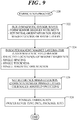
- FIG. 9 shows a flowchart of a fabrication process 320 in accordance with another embodiment.
- Fabrication process 320 is described in connection with the fabrication of magnetic field sensor package 54 ( FIG. 2 ) having three sense axes (e.g., X-axis, Y-axis, Z-axis magnetic field sensors 56, 58, 60).
- fabrication process 320 may be readily adapted to produce a single or dual sense axis magnetic field sensor.
- fabrication process 320 is exemplary in nature. Thus, only the primary operations of fabrication process 320 are discussed herein for simplicity. Furthermore, the process blocks depicted in FIG. 9 may be performed in parallel with each other or with performing other processes, and each process block will include many separate process steps. In addition, it is to be understood that the particular ordering of the process blocks depicted in FIG. 9 may be modified while achieving substantially the same result. Accordingly, such modifications are intended to be included within the scope of the inventive subject matter.
- a magnetic sensor wafer is built, i.e., fabricated, utilizing known methodologies to produce a plurality of sensor bridges (e.g., X-axis Wheatstone bridge 70 of FIG. 3 , Y-axis Wheatstone bridge 156 of FIG. 5 , and Z-axis Wheatstone bridge 234 of FIG. 7 ).
- Each of the sensors bridges are thus fabricated to include four sensor legs, with each sensor leg having one or more magnetoresistive sense elements, e.g., MTJ's.
- the magnetoresistive sense elements can be fabricated so that the magnetoresistive sense elements are formed in a common plane (i.e., they are arranged in-plane) relative to one another within a dielectric material with suitable electrically conductive interconnections. Fabrication of the magnetic sense wafer concurrently entails setting (i.e., self-biasing) the initial orientation of the sense magnetization of each of the sense layers of each of the magnetoresistive sense elements.
- the sense layer may include a sense ferromagnetic layer and a non-magnetic layer.
- the sense ferromagnetic layer of sense layer may include any one of Co, Fe, Ni, or an alloy comprising any one or a combination of these elements.
- the non-magnetic layer may include any one of Pt, Pd, Ta, Hf, Nb, Cr, V, Cu, Au, Ti, Ag, Ru, W, or an alloy comprising any one or a combination of these elements.
- the sense magnetizations of the various sense layers of the magnetoresistive sense elements may be suitably self-biased in the single direction.
- Other embodiments may employ "growing in” or otherwise treating the sense layer, and/or by shape anisotropy so that the sense magnetization of each of the sense layers, in the absence of an external magnetic field and in the absence of the permanent magnet layers described above, will be in skewed direction as characterized above by the Miller indices [111].
- one or more permanent magnet layers (e.g., first and second permanent magnet layers 128. 130 of FIGs. 3 , 5 , and 7 ) is suitably formed in order to magnetically bias the sense magnetization of the second and fourth magnetoresistive sense elements of each of the Wheatstone bridges, in the absence of an external magnetic field.
- Considerations for biasing the sense magnetization include selecting locations at which segments of the permanent magnet layers will be positioned, a single out-of-plane spacing of the magnet segments from the second and fourth magnetoresistive elements, a single thickness of the permanent magnet layer(s), and a single magnetic orientation (e.g., the out-of-plane magnetic).
- Formation of the permanent magnet layer(s) may entail deposition, patterning, and etching of a suitable material to form the magnet segments.
- a suitable material may include iron, nickel, cobalt, some alloys of rare earth materials or an alloy comprising any one or a combination of these elements that is magnetized and creates its own persistent magnetic field.
- the permanent magnet layer(s) is formed from a magnetically "hard” material that is subjected to processing in a powerful magnetic field during manufacture to align its internal microcrystalline structure, so as to make it very difficult to demagnetize.
- each magnetic field sensor may be programmed by setting the reference magnetization of the magnetoresistive sense elements in the predetermined direction in the X-Y plane of pinned layer.
- a programming operation may be thermally assisted (e.g., a thermally assisted switching process) wherein the programming operation includes heating selected ones of the MTJ magnetoresistive sense elements to a high temperature threshold.
- the magnetoresistive sense elements may include an antiferromagnetic layer (not shown) that pins the reference magnetization of the pinned layers at a low temperature threshold and frees the reference magnetization of the pinned layers at the high temperature threshold.
- Heating the selected magnetoresistive sense elements at the high temperature threshold may be performed by passing a heating current in the selected magnetoresistive sense elements via a current line (not shown).
- Other techniques may be implemented to provide localized heating, such as from a separate adjacent current line, by using a laser or other radiative source, and so forth.
- the selected magnetoresistive sense elements can be cooled to the low temperature threshold to pin, or fix, the reference magnetization in the switched state.
- Other embodiments may employ existing or upcoming techniques for pinning the reference magnetization to a desired magnetization orientation so as to achieve the multiple fixed orientations of the reference magnetization of the pinned layer of magnetoresistive sense elements.
- two orientations of the reference magnetization may be set.
- a single orientation of reference magnetization 136 ( FIG. 3 ) for X-axis magnetic field sensor 56 and reference magnetization 306 ( FIG. 7 ) for Z-axis magnetic field sensor 60 is aligned with X-axis 44.
- a single orientation of reference magnetization 220 ( FIG. 5 ) for Y-axis magnetic field sensor 58 is aligned with Y-axis 46.
- fabrication of the magnetic sensor wafer continues with fabrication finalization processes such was wafer level testing, dicing, packaging, and the like. Thereafter, fabrication process 320 ends.
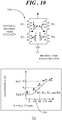
- FIG. 10 shows an exemplary Wheatstone bridge configuration 330 with an accompanying plot 332 of a zero-offset outcome 334 resulting from any of the X-axis Wheatstone bridge 70 ( FIG. 3 ), Y-axis Wheatstone bridge 156 ( FIG. 5 ), and Z-axis Wheatstone bridge 234 ( FIG. 7 ).
- a null (i.e., zero) output will occur with a zero applied external magnetic field whenever R1 i equals R2 i and R3 i equals R4 i so that R1 i /R3 i equals R2 i /R4 i .
- a zero-field offset is defined herein as an output voltage of a Wheatstone bridge that is not zero in the absence of an external magnetic field. This non-zero output, in the absence of an external magnetic field, can increase the complexity of the design of interface electronics associated with such a Wheatstone bridge and can degrade noise performance.
- the balanced bridge design occurs because the corresponding first and second sense magnetizations are skewed by the same angular magnitude, ⁇ , away from the desired sense axis in opposing directions (i.e., positive ⁇ and negative ⁇ ).
- This balanced bridge design results in an equal split of the bias voltage (V IN ) within both halves of Wheatstone bridge configuration 330 such that in the absence of an external magnetic field the output (V i-OUT ) of Wheatstone bridge configuration 330 is identically zero.
- MTJ magnetic tunnel junction
- embodiments disclosed herein entail a magnetic field sensor capable of sensing magnetic fields along one or more mutually exclusive sense axes, typically referred to as the X-axis, Y-axis, and Z-axis.
- An embodiment of a magnetic field sensor comprises a sensor bridge having a first leg and a second leg.
- a first magnetoresistive sense element is formed in the first leg and located in a plane of the magnetic field sensor.
- the first magnetoresistive sense element includes a first pinned layer and a first sense layer, the first sense layer having a first sense magnetization oriented in a first ⁇ hkl> direction, wherein h, k, and l are Miller indices all of which are non-zero and ⁇ hkl> represents a family of directions.
- a second magnetoresistive sense element is formed in the second leg and located in the plane of the magnetic field sensor.
- the second magnetoresistive sense element includes a second pinned layer and a second sense layer.
- the first and second magnetoresistive sense elements are sensitive to an external magnetic field along a sensing direction, wherein each of the first and second pinned layers has a reference magnetization oriented substantially parallel to the plane and the second sense layer has a second sense magnetization.
- a permanent magnet layer is positioned proximate the second magnetoresistive sense element, wherein in the absence of the external magnetic field, the permanent magnet layer magnetically biases the second sense magnetization in a second ⁇ hkl> direction relative to the first ⁇ hkl> direction, wherein one of the h, k, and l of the second ⁇ hkl> direction is a negative value of a corresponding one of the h, k, and l of the first ⁇ hkl> direction.
- a unique sensor bridge design of magnetoresistive sense elements is implemented for each sense axis.
- Each sensor bridge incorporates an in-plane orientation of reference magnetization of the pinned layer, along with out-of-plane, skewed biasing of the sense magnetization of the sense layer in two opposing directions.
- one or more permanent magnet layers are strategically patterned (shape and position) to generate a unique external bias field vector of the sense magnetization of the sense layer to produce a balanced bridge configuration of magnetoresistive sense elements for the sensor bridge without built-in, non-zero magnetic field offset.
- one sensor bridge design is utilized for sensing an external magnetic field that is perpendicular to the plane of the magnetic field sensor package without the use of flux concentrators.
- the strategically patterned permanent magnet layer(s) for this sense bridge additionally allows it to respond to the out-of-plane external magnetic field without inter-axis coupling of sensor response.
- the various inventive concepts and principles embodied herein enable an ultra low power, multiple sense axis magnetic field sensor without detrimental perming effects for improved sensitivity, reliability, and cost savings.
- a magnetic field sensor which comprises a sensor bridge, a first magnetoresistive sense element, a second magnetoresistive sense element and a permanent magnet layer.
- the sensor bridge has a first leg and a second leg.
- the first magnetoresistive sense element is formed in the first leg and located in a plane of the magnetic field sensor.
- the first magnetoresistive sense element includes a first pinned layer and a first sense layer.
- the first sense layer has a first sense magnetization oriented in a first ⁇ hkl> direction, wherein h, k, and l are Miller indices all of which are non-zero and ⁇ hkl> represents a family of directions.
- the second magnetoresistive sense element is formed in the second leg and located in the plane of the magnetic field sensor.
- the second magnetoresistive sense element includes a second pinned layer and a second sense layer.
- the first and second magnetoresistive sense elements are sensitive to an external magnetic field along a sensing direction.
- Each of the first and second pinned layers has a reference magnetization oriented substantially parallel to the plane and the second sense layer has a second sense magnetization.
- the permanent magnet layer is positioned proximate the second magnetoresistive sense element. In the absence of the external magnetic field, the permanent magnet layer magnetically biases the second sense magnetization in a second ⁇ hkl> direction relative to the first ⁇ hkl> direction.
- One of the h, k, and l of the second ⁇ hkl> direction is a negative value of a corresponding one of the h, k, and l of the first ⁇ hkl> direction.
- the permanent magnet layer is located away from the first magnetoresistive sense element to substantially prevent the permanent magnet layer from magnetically biasing the first sense magnetization of the first sense layer of the first magnetoresistive sense element.
- the first ⁇ hkl> direction of the first sense magnetization of the first magnetoresistive sense element is characterized by the Miller indices of [111] and the second ⁇ hkl> direction of the second sense magnetization of the second magnetoresistive sense element is characterized by the Miller indices of [ 1 11].
- the first ⁇ hkl> direction of the first sense magnetization of the first magnetoresistive sense element is characterized by the Miller indices of [111] and the second ⁇ hkl> direction of the second sense magnetization of the second magnetoresistive sense element is characterized by the Miller indices of [1 1 1].
- the first ⁇ hkl> direction of the first sense magnetization of the first magnetoresistive sense element is characterized by the Miller indices of [111] and the second ⁇ hkl> direction of the second sense magnetization of the second magnetoresistive sense element is characterized by the Miller indices of [11 1 ].
- the reference magnetization of each of the first and second pinned layers is oriented in the same direction substantially parallel the plane.
- the reference magnetization of the each of the first and second pinned layers is oriented orthogonal to the sensing direction.
- the sensor bridge further comprises a third leg and a fourth leg.
- the third leg has a third magnetoresistive sense element formed therein.
- the third magnetoresistive sense element includes a third pinned layer and a third sense layer.
- the fourth leg has a fourth magnetoresistive sense element formed therein.
- the fourth magnetoresistive sense element includes a fourth pinned layer and a fourth sense layer.
- the first, second, third, and fourth legs are coupled as a Wheatstone bridge such that the first and fourth magnetoresistive sense elements are coupled in series to form a first half of the Wheatstone bridge.
- the second and third magnetoresistive sense elements are coupled in series to form a second half of the Wheatstone bridge.
- the first half of the Wheatstone bridge is coupled in parallel with the second half of the Wheatstone bridge such that a first junction of the first and second magnetoresistive sense elements forms a first input terminal and a second junction of the third and fourth magnetoresistive sense elements forms a second input terminal.
- the reference magnetization of each of the first, second, third, and fourth pinned layers of each of the first and third magnetoresistive sense elements is oriented in the same direction substantially parallel to the plane.
- the third sense layer of the third magnetoresistive sense element has a third sense magnetization oriented in the first ⁇ hkl> direction.
- the permanent magnet layer is positioned proximate the fourth magnetoresistive sense element.
- the permanent magnet layer magnetically biases a fourth sense magnetization of the fourth sense layer in the second ⁇ hkl> direction.
- the permanent magnet layer is located away from the third magnetoresistive sense element to substantially prevent the permanent magnet layer from magnetically biasing the sense magnetization of the third sense layer of the third magnetoresistive sense element.
- the permanent magnet layer is characterized by a single magnetic orientation.
- the permanent magnet layer is a first permanent magnet layer and the magnetic field sensor further comprises a second permanent magnet layer vertically displaced away from the first permanent magnet layer and positioned proximate the second magnetoresistive sense element.
- the first and second permanent magnet layers function cooperatively to magnetically bias the second sense magnetization of the second magnetoresistive sense element in the second ⁇ hkl> direction.
- the sensor bridge is a first sensor bridge.
- the sensing direction is a first sensing direction.
- the magnetic field sensor further comprises a second sensor bridge, a third magnetoresistive sense element, and a fourth magnetoresistive sense element.
- the second sensor bridge has a third leg and a fourth leg.
- the third magnetoresistive sense element is formed in the third leg and located in the plane of the magnetic field sensor.
- the third magnetoresistive sense element includes a third pinned layer and a third sense layer.
- the third sense layer has a third sense magnetization oriented in the first ⁇ hkl> direction.
- the fourth magnetoresistive sense element is formed in the fourth leg and located in the plane of the magnetic field sensor.
- the fourth magnetoresistive sense element includes a fourth pinned layer and a fourth sense layer.
- the third and fourth magnetoresistive sense elements are sensitive to an external magnetic field along a second sensing direction that is orthogonal to the first sensing direction.
- Each of the third and fourth pinned layers has the reference magnetization oriented substantially parallel to the plane.
- the permanent magnet layer is positioned proximate the fourth magnetoresistive sense element.
- the permanent magnet layer magnetically biases a fourth sense magnetization of the fourth sense layer in a third ⁇ hkl> direction.
- the magnetic field sensor further comprises a third sensor bridge, a fifth magnetoresistive sense element, and a sixth magnetoresistive sense element.
- the third sensor bridge has a fifth leg and a sixth leg.
- the fifth magnetoresistive sense element is formed in the fifth leg and located in the plane of the magnetic field sensor.
- the fifth magnetoresistive sense element includes a fifth pinned layer and a fifth sense layer.
- the fifth sense layer has a fifth sense magnetization oriented in the first ⁇ hkl> direction.
- the sixth magnetoresistive sense element is formed in the sixth leg and located in the plane of the magnetic field sensor.
- the sixth magnetoresistive sense element includes a sixth pinned layer and a sixth sense layer.
- the fifth and sixth magnetoresistive sense elements are sensitive to an external magnetic field along a third sensing direction that is orthogonal to each of the first and second sensing directions.
- Each of the fifth and sixth pinned layers has the reference magnetization oriented substantially parallel to the plane.
- the permanent magnet layer is positioned proximate sixth magnetoresistive sense element.
- the permanent magnet layer magnetically biases a sixth sense magnetization of the sixth sense layer in a fourth ⁇ hkl> direction.
- the first ⁇ hkl> direction of the first, third, and fifth sense magnetizations of corresponding ones of the first, third, and fifth magnetoresistive sense elements is characterized by the Miller indices of [111].
- the second ⁇ hkl> direction of the second sense magnetization of the second magnetoresistive sense element is characterized by the Miller indices of [ 1 11].
- the fourth ⁇ hkl> direction of the fourth sense magnetization of the fourth magnetoresistive sense element is characterized by the Miller indices of [1 1 1].
- the sixth ⁇ hkl> direction of the sixth sense magnetization of the sixth magnetoresistive sense element is characterized by the Miller indices of [11 1 ].
- a magnetic field sensor which comprises a sensor bridge, a first magnetoresistive sense element, a second magnetoresistive sense element, a third magnetoresistive sense element, a fourth magnetoresistive sense element, and a permanent magnet layer.
- the sensor bridge has a first leg, a second leg, a third leg, and a fourth leg.
- the first magnetoresistive sense element is formed in the first leg and located in a plane of the magnetic field sensor.
- the first magnetoresistive sense element includes a first pinned layer and a first sense layer.
- the first pinned layer has a reference magnetization.
- the first sense layer has a first sense magnetization.
- the second magnetoresistive sense element is formed in the second leg and located in the plane of the magnetic field sensor.
- the second magnetoresistive sense element includes a second pinned layer and a second sense layer.
- the second pinned layer has the reference magnetization.
- the second sense layer has a second sense magnetization.
- the third magnetoresistive sense element is formed in the third leg and located in a plane of the magnetic field sensor.
- the third magnetoresistive sense element includes a third pinned layer and a third sense layer.
- the third pinned layer has the reference magnetization.
- the third sense layer has a third sense magnetization.
- the fourth magnetoresistive sense element is formed in the fourth leg and located in a plane of the magnetic field sensor.
- the fourth magnetoresistive sense element includes a fourth pinned layer and a fourth sense layer.
- the fourth pinned layer has the reference magnetization.
- the fourth sense layer has a fourth sense magnetization.
- the permanent magnet layer is positioned proximate the second and fourth magnetoresistive sense elements and characterized by a single magnetic orientation.
- the first, second, third, and fourth legs are coupled as a Wheatstone bridge such that the first and fourth magnetoresistive sense elements are coupled in series to form a first half of the Wheatstone bridge.
- the second and third magnetoresistive sense elements are coupled in series to form a second half of the Wheatstone bridge.
- the first half of the Wheatstone bridge is coupled in parallel with the second half of the Wheatstone bridge such that a first junction of the first and second magnetoresistive sense elements forms a first input terminal and a second junction of the third and fourth magnetoresistive sense elements forms a second input terminal.
- the first, second, third, and fourth magnetoresistive sense elements are sensitive to an external magnetic field along a sensing direction.
- the reference magnetization of each of the first, second, third, and fourth pinned layers is oriented substantially parallel to the plane.
- the first sense magnetization and the third sense magnetization are oriented in a first ⁇ hkl> direction, wherein h, k, and l are Miller indices all of which are non-zero and ⁇ hkl> represents a family of directions.
- the permanent magnet layer magnetically biases the second sense magnetization and the fourth sense magnetization in a second ⁇ hkl> direction relative to the first ⁇ hkl> direction.
- One of the h, k, and l of the second ⁇ hkl> direction is a negative value of a corresponding one of the h, k, and l of the first ⁇ hkl> direction.
- each of the first, second, third, and fourth pinned layers is oriented in the same direction substantially parallel the plane and orthogonal to the sensing direction.
- a magnetic field sensor which comprises a first sensor bridge, a first magnetoresistive sense element, a second magnetoresistive sense element, a second sensor bridge, a third magnetoresistive sense element, a fourth magnetoresistive sense element, and a permanent magnet layer.
- the first sensor bridge has a first leg and a second leg.
- the first magnetoresistive sense element is formed in the first leg and located in a plane of the magnetic field sensor.
- the first magnetoresistive sense element includes a first pinned layer and a first sense layer
- the first sense layer has a first sense magnetization oriented in a first ⁇ hkl> direction, wherein h, k, and l are Miller indices all of which are non-zero and ⁇ hkl> represents a family of directions.
- the second magnetoresistive sense element is formed in the second leg and located in the plane of the magnetic field sensor.
- the second magnetoresistive sense element includes a second pinned layer and a second sense layer.
- the first and second magnetoresistive sense elements are sensitive to a first external magnetic field along a first sensing direction.
- Each of the first and second pinned layers has a reference magnetization oriented substantially parallel to the plane and the second sense layer has a second sense magnetization.
- the second sensor bridge has a third leg and a fourth leg.
- the third magnetoresistive sense element is formed in the third leg and located in the plane of the magnetic field sensor.
- the third magnetoresistive sense element includes a third pinned layer and a third sense layer.
- the third sense layer has a third sense magnetization oriented in the first ⁇ hkl> direction.
- the fourth magnetoresistive sense element is formed in the fourth leg and located in the plane of the magnetic field sensor.
- the fourth magnetoresistive sense element includes a fourth pinned layer and a fourth sense layer.
- the third and fourth magnetoresistive sense elements are sensitive to a second external magnetic field along a second sensing direction that is orthogonal to the first sensing direction.
- Each of the third and fourth pinned layers has the reference magnetization oriented substantially parallel to the plane.
- the permanent magnet layer is positioned proximate the second magnetoresistive sense element and the fourth magnetoresistive sense element.
- the permanent magnet layer is characterized by a single magnetic orientation.
- the permanent magnet layer magnetically biases the second sense magnetization in a second ⁇ hkl> direction relative to the first ⁇ hkl> direction such that a first one of the h, k, and l of the second ⁇ hkl> direction is a negative value of a first corresponding one of the h, k, and l of the first ⁇ hkl> direction.
- the permanent magnet layer magnetically biases the fourth sense magnetization in a third ⁇ hkl> direction such that a second one of the h, k, and l of the third ⁇ hkl> direction is the negative value of a second corresponding one of the h, k, and l of the first ⁇ hkl> direction.
- the magnetic field sensor further comprises a third sensor, a fifth magnetoresistive sense element, and a sixth magnetoresistive sense element.
- the third sensor bridge has a fifth leg and a sixth leg.
- the fifth magnetoresistive sense element is formed in the fifth leg and located in the plane of the magnetic field sensor.
- the fifth magnetoresistive sense element includes a fifth pinned layer and a fifth sense layer.
- the fifth sense layer having a fifth sense magnetization is oriented in the first ⁇ hkl> direction.
- a sixth magnetoresistive sense element is formed in the sixth leg and located in the plane of the magnetic field sensor.
- the sixth magnetoresistive sense element includes a sixth pinned layer and a sixth sense layer.
- the fifth and sixth magnetoresistive sense elements are sensitive to a third external magnetic field along a third sensing direction that is orthogonal to each of the first and second sensing directions.
- Each of the fifth and sixth pinned layers has the reference magnetization oriented substantially parallel to the plane.
- the permanent magnet layer is positioned proximate sixth magnetoresistive sense element. In the absence of the third external magnetic field, the permanent magnet layer magnetically biases a sixth sense magnetization of the sixth sense layer in a fourth ⁇ hkl> direction such that a third one of the h, k, and l of the fourth ⁇ hkl> direction is the negative value of a third corresponding one of the h, k, and l of the first ⁇ hkl> direction.
- the first ⁇ hkl> direction of the first, third, and fifth sense magnetizations of corresponding ones of the first, third, and fifth magnetoresistive sense elements is characterized by the Miller indices of [111].
- the second ⁇ hkl> direction of the second sense magnetization of the second magnetoresistive sense element is characterized by the Miller indices of [111].
- the fourth ⁇ hkl> direction of the fourth sense magnetization of the fourth magnetoresistive sense element is characterized by the Miller indices of [111].
- the sixth ⁇ hkl> direction of the sixth sense magnetization of the sixth magnetoresistive sense element is characterized by the Miller indices of [111].
- the reference magnetization of each of the first, second, third, and fourth pinned layers is oriented in a first planar direction substantially parallel the plane.
- the reference magnetization of each of the fifth and sixth pinned layers is oriented in a second planar direction perpendicular to the first planar direction and substantially parallel to the plane.
Landscapes
- Physics & Mathematics (AREA)
- General Physics & Mathematics (AREA)
- Condensed Matter Physics & Semiconductors (AREA)
- Measuring Magnetic Variables (AREA)
- Hall/Mr Elements (AREA)
Applications Claiming Priority (1)
| Application Number | Priority Date | Filing Date | Title |
|---|---|---|---|
| US15/006,952 US9739842B2 (en) | 2016-01-26 | 2016-01-26 | Magnetic field sensor with skewed sense magnetization of sense layer |
Publications (2)
| Publication Number | Publication Date |
|---|---|
| EP3208626A1 true EP3208626A1 (de) | 2017-08-23 |
| EP3208626B1 EP3208626B1 (de) | 2018-11-28 |
Family
ID=57909494
Family Applications (1)
| Application Number | Title | Priority Date | Filing Date |
|---|---|---|---|
| EP17153227.8A Not-in-force EP3208626B1 (de) | 2016-01-26 | 2017-01-26 | Magnetfeldsensor mit geneigter messmagnetisierung einer messschicht |
Country Status (2)
| Country | Link |
|---|---|
| US (1) | US9739842B2 (de) |
| EP (1) | EP3208626B1 (de) |
Families Citing this family (15)
| Publication number | Priority date | Publication date | Assignee | Title |
|---|---|---|---|---|
| US10091594B2 (en) | 2014-07-29 | 2018-10-02 | Cochlear Limited | Bone conduction magnetic retention system |
| US10130807B2 (en) | 2015-06-12 | 2018-11-20 | Cochlear Limited | Magnet management MRI compatibility |
| US20160381473A1 (en) | 2015-06-26 | 2016-12-29 | Johan Gustafsson | Magnetic retention device |
| US9872115B2 (en) | 2015-09-14 | 2018-01-16 | Cochlear Limited | Retention magnet system for medical device |
| US10917730B2 (en) | 2015-09-14 | 2021-02-09 | Cochlear Limited | Retention magnet system for medical device |
| US9841469B2 (en) | 2016-01-26 | 2017-12-12 | Nxp Usa, Inc. | Magnetic field sensor with multiple sense layer magnetization orientations |
| US9897667B2 (en) | 2016-01-26 | 2018-02-20 | Nxp Usa, Inc. | Magnetic field sensor with permanent magnet biasing |
| US10545196B2 (en) | 2016-03-24 | 2020-01-28 | Nxp Usa, Inc. | Multiple axis magnetic sensor |
| US10145907B2 (en) | 2016-04-07 | 2018-12-04 | Nxp Usa, Inc. | Magnetic field sensor with permanent magnet biasing |
| US9933496B2 (en) | 2016-04-21 | 2018-04-03 | Nxp Usa, Inc. | Magnetic field sensor with multiple axis sense capability |
| US11595768B2 (en) | 2016-12-02 | 2023-02-28 | Cochlear Limited | Retention force increasing components |
| US10794968B2 (en) * | 2017-08-24 | 2020-10-06 | Everspin Technologies, Inc. | Magnetic field sensor and method of manufacture |
| US10509082B2 (en) * | 2018-02-08 | 2019-12-17 | Nxp B.V. | Magnetoresistive sensor systems with stray field cancellation utilizing auxiliary sensor signals |
| US10837753B2 (en) * | 2019-01-10 | 2020-11-17 | Allegro Microsystems, Llc | Magnetic field sensor using MR elements for detecting flux line divergence |
| US12420101B2 (en) | 2019-09-27 | 2025-09-23 | Cochlear Limited | Multipole magnet for medical implant system |
Citations (5)
| Publication number | Priority date | Publication date | Assignee | Title |
|---|---|---|---|---|
| WO2008020817A1 (en) * | 2006-08-17 | 2008-02-21 | Agency For Science, Technology And Research | Read head and magnetic device comprising the same |
| US20130328556A1 (en) * | 2012-06-11 | 2013-12-12 | Wolfgang Granig | Minimum magnetic field detection systems and methods in magnetoresistive sensors |
| US20140035570A1 (en) * | 2011-04-06 | 2014-02-06 | Jiangsu Multidimensional Technology Co., Ltd. | Single-chip push-pull bridge-type magnetic field sensor |
| US20150091560A1 (en) * | 2012-02-20 | 2015-04-02 | Jiangsu Multidimension Technology Co., Ltd. | Magnetoresistive sensor for measuring a magnetic field |
| US20150364677A1 (en) * | 2011-01-07 | 2015-12-17 | MultiDimension Technology Co., Ltd. | Thin-film magnetoresistance sensing element, combination thereof, and electronic device coupled to the combination |
Family Cites Families (10)
| Publication number | Priority date | Publication date | Assignee | Title |
|---|---|---|---|---|
| US7965077B2 (en) | 2008-05-08 | 2011-06-21 | Everspin Technologies, Inc. | Two-axis magnetic field sensor with multiple pinning directions |
| US8257596B2 (en) | 2009-04-30 | 2012-09-04 | Everspin Technologies, Inc. | Two-axis magnetic field sensor with substantially orthogonal pinning directions |
| US8390283B2 (en) | 2009-09-25 | 2013-03-05 | Everspin Technologies, Inc. | Three axis magnetic field sensor |
| US8518734B2 (en) | 2010-03-31 | 2013-08-27 | Everspin Technologies, Inc. | Process integration of a single chip three axis magnetic field sensor |
| US8901924B2 (en) * | 2011-02-21 | 2014-12-02 | Everspin Technologies, Inc. | Apparatus and method for sequentially resetting elements of a magnetic sensor array |
| CN102226835A (zh) | 2011-04-06 | 2011-10-26 | 江苏多维科技有限公司 | 单一芯片双轴磁场传感器及其制备方法 |
| CN102426344B (zh) | 2011-08-30 | 2013-08-21 | 江苏多维科技有限公司 | 三轴磁场传感器 |
| TWI431301B (zh) * | 2012-03-05 | 2014-03-21 | Ind Tech Res Inst | 應用穿隧式磁電阻器之磁場感測方法及磁場感測裝置 |
| EP2860542B1 (de) | 2013-10-11 | 2016-04-20 | Crocus Technology S.A. | Verfahren zur Messung dreidimensionaler Magnetfelder |
| EP2860543B1 (de) | 2013-10-11 | 2016-04-20 | Crocus Technology S.A. | Magnetische Sensorzelle zur Messung dreidimensionaler Magnetfelder |
-
2016
- 2016-01-26 US US15/006,952 patent/US9739842B2/en not_active Expired - Fee Related
-
2017
- 2017-01-26 EP EP17153227.8A patent/EP3208626B1/de not_active Not-in-force
Patent Citations (5)
| Publication number | Priority date | Publication date | Assignee | Title |
|---|---|---|---|---|
| WO2008020817A1 (en) * | 2006-08-17 | 2008-02-21 | Agency For Science, Technology And Research | Read head and magnetic device comprising the same |
| US20150364677A1 (en) * | 2011-01-07 | 2015-12-17 | MultiDimension Technology Co., Ltd. | Thin-film magnetoresistance sensing element, combination thereof, and electronic device coupled to the combination |
| US20140035570A1 (en) * | 2011-04-06 | 2014-02-06 | Jiangsu Multidimensional Technology Co., Ltd. | Single-chip push-pull bridge-type magnetic field sensor |
| US20150091560A1 (en) * | 2012-02-20 | 2015-04-02 | Jiangsu Multidimension Technology Co., Ltd. | Magnetoresistive sensor for measuring a magnetic field |
| US20130328556A1 (en) * | 2012-06-11 | 2013-12-12 | Wolfgang Granig | Minimum magnetic field detection systems and methods in magnetoresistive sensors |
Also Published As
| Publication number | Publication date |
|---|---|
| US20170212176A1 (en) | 2017-07-27 |
| US9739842B2 (en) | 2017-08-22 |
| EP3208626B1 (de) | 2018-11-28 |
Similar Documents
| Publication | Publication Date | Title |
|---|---|---|
| EP3208626B1 (de) | Magnetfeldsensor mit geneigter messmagnetisierung einer messschicht | |
| US9897667B2 (en) | Magnetic field sensor with permanent magnet biasing | |
| US10545196B2 (en) | Multiple axis magnetic sensor | |
| US9841469B2 (en) | Magnetic field sensor with multiple sense layer magnetization orientations | |
| US10145907B2 (en) | Magnetic field sensor with permanent magnet biasing | |
| US10734443B2 (en) | Dual manetoresistance element with two directions of response to external magnetic fields | |
| CN103081008B (zh) | 对于零偏移具有降低的补偿角的二轴磁场传感器 | |
| US7023310B2 (en) | Method for manufacturing magnetic sensor, magnet array used in the method, and method for manufacturing the magnet array | |
| CN102460575B (zh) | 具有基本上正交的钉扎方向的双轴磁场传感器 | |
| US7868613B2 (en) | Magnetic sensor and manufacturing method thereof | |
| US20060039090A1 (en) | System and method for fixing a direction of magnetization of pinned layers in a magnetic field sensor | |
| US20120217961A1 (en) | Magnetic sensor | |
| EP3236276B1 (de) | Magnetfeldsensor mit mehrachsiger erfassungsfähigkeit | |
| JP2022158932A (ja) | 磁気センサ装置 | |
| JP3835445B2 (ja) | 磁気センサ |
Legal Events
| Date | Code | Title | Description |
|---|---|---|---|
| PUAI | Public reference made under article 153(3) epc to a published international application that has entered the european phase |
Free format text: ORIGINAL CODE: 0009012 |
|
| STAA | Information on the status of an ep patent application or granted ep patent |
Free format text: STATUS: THE APPLICATION HAS BEEN PUBLISHED |
|
| AK | Designated contracting states |
Kind code of ref document: A1 Designated state(s): AL AT BE BG CH CY CZ DE DK EE ES FI FR GB GR HR HU IE IS IT LI LT LU LV MC MK MT NL NO PL PT RO RS SE SI SK SM TR |
|
| AX | Request for extension of the european patent |
Extension state: BA ME |
|
| STAA | Information on the status of an ep patent application or granted ep patent |
Free format text: STATUS: REQUEST FOR EXAMINATION WAS MADE |
|
| 17P | Request for examination filed |
Effective date: 20180223 |
|
| RBV | Designated contracting states (corrected) |
Designated state(s): AL AT BE BG CH CY CZ DE DK EE ES FI FR GB GR HR HU IE IS IT LI LT LU LV MC MK MT NL NO PL PT RO RS SE SI SK SM TR |
|
| GRAP | Despatch of communication of intention to grant a patent |
Free format text: ORIGINAL CODE: EPIDOSNIGR1 |
|
| STAA | Information on the status of an ep patent application or granted ep patent |
Free format text: STATUS: GRANT OF PATENT IS INTENDED |
|
| INTG | Intention to grant announced |
Effective date: 20180618 |
|
| GRAJ | Information related to disapproval of communication of intention to grant by the applicant or resumption of examination proceedings by the epo deleted |
Free format text: ORIGINAL CODE: EPIDOSDIGR1 |
|
| STAA | Information on the status of an ep patent application or granted ep patent |
Free format text: STATUS: REQUEST FOR EXAMINATION WAS MADE |
|
| GRAP | Despatch of communication of intention to grant a patent |
Free format text: ORIGINAL CODE: EPIDOSNIGR1 |
|
| STAA | Information on the status of an ep patent application or granted ep patent |
Free format text: STATUS: GRANT OF PATENT IS INTENDED |
|
| INTC | Intention to grant announced (deleted) | ||
| GRAS | Grant fee paid |
Free format text: ORIGINAL CODE: EPIDOSNIGR3 |
|
| GRAA | (expected) grant |
Free format text: ORIGINAL CODE: 0009210 |
|
| STAA | Information on the status of an ep patent application or granted ep patent |
Free format text: STATUS: THE PATENT HAS BEEN GRANTED |
|
| INTG | Intention to grant announced |
Effective date: 20181010 |
|
| AK | Designated contracting states |
Kind code of ref document: B1 Designated state(s): AL AT BE BG CH CY CZ DE DK EE ES FI FR GB GR HR HU IE IS IT LI LT LU LV MC MK MT NL NO PL PT RO RS SE SI SK SM TR |
|
| REG | Reference to a national code |
Ref country code: CH Ref legal event code: EP |
|
| REG | Reference to a national code |
Ref country code: AT Ref legal event code: REF Ref document number: 1070871 Country of ref document: AT Kind code of ref document: T Effective date: 20181215 |
|
| REG | Reference to a national code |
Ref country code: DE Ref legal event code: R096 Ref document number: 602017001014 Country of ref document: DE |
|
| REG | Reference to a national code |
Ref country code: IE Ref legal event code: FG4D |
|
| REG | Reference to a national code |
Ref country code: NL Ref legal event code: MP Effective date: 20181128 |
|
| REG | Reference to a national code |
Ref country code: LT Ref legal event code: MG4D |
|
| REG | Reference to a national code |
Ref country code: AT Ref legal event code: MK05 Ref document number: 1070871 Country of ref document: AT Kind code of ref document: T Effective date: 20181128 |
|
| PG25 | Lapsed in a contracting state [announced via postgrant information from national office to epo] |
Ref country code: LV Free format text: LAPSE BECAUSE OF FAILURE TO SUBMIT A TRANSLATION OF THE DESCRIPTION OR TO PAY THE FEE WITHIN THE PRESCRIBED TIME-LIMIT Effective date: 20181128 Ref country code: HR Free format text: LAPSE BECAUSE OF FAILURE TO SUBMIT A TRANSLATION OF THE DESCRIPTION OR TO PAY THE FEE WITHIN THE PRESCRIBED TIME-LIMIT Effective date: 20181128 Ref country code: NO Free format text: LAPSE BECAUSE OF FAILURE TO SUBMIT A TRANSLATION OF THE DESCRIPTION OR TO PAY THE FEE WITHIN THE PRESCRIBED TIME-LIMIT Effective date: 20190228 Ref country code: AT Free format text: LAPSE BECAUSE OF FAILURE TO SUBMIT A TRANSLATION OF THE DESCRIPTION OR TO PAY THE FEE WITHIN THE PRESCRIBED TIME-LIMIT Effective date: 20181128 Ref country code: LT Free format text: LAPSE BECAUSE OF FAILURE TO SUBMIT A TRANSLATION OF THE DESCRIPTION OR TO PAY THE FEE WITHIN THE PRESCRIBED TIME-LIMIT Effective date: 20181128 Ref country code: BG Free format text: LAPSE BECAUSE OF FAILURE TO SUBMIT A TRANSLATION OF THE DESCRIPTION OR TO PAY THE FEE WITHIN THE PRESCRIBED TIME-LIMIT Effective date: 20190228 Ref country code: IS Free format text: LAPSE BECAUSE OF FAILURE TO SUBMIT A TRANSLATION OF THE DESCRIPTION OR TO PAY THE FEE WITHIN THE PRESCRIBED TIME-LIMIT Effective date: 20190328 Ref country code: FI Free format text: LAPSE BECAUSE OF FAILURE TO SUBMIT A TRANSLATION OF THE DESCRIPTION OR TO PAY THE FEE WITHIN THE PRESCRIBED TIME-LIMIT Effective date: 20181128 |
|
| PG25 | Lapsed in a contracting state [announced via postgrant information from national office to epo] |
Ref country code: PT Free format text: LAPSE BECAUSE OF FAILURE TO SUBMIT A TRANSLATION OF THE DESCRIPTION OR TO PAY THE FEE WITHIN THE PRESCRIBED TIME-LIMIT Effective date: 20190328 Ref country code: RS Free format text: LAPSE BECAUSE OF FAILURE TO SUBMIT A TRANSLATION OF THE DESCRIPTION OR TO PAY THE FEE WITHIN THE PRESCRIBED TIME-LIMIT Effective date: 20181128 Ref country code: SE Free format text: LAPSE BECAUSE OF FAILURE TO SUBMIT A TRANSLATION OF THE DESCRIPTION OR TO PAY THE FEE WITHIN THE PRESCRIBED TIME-LIMIT Effective date: 20181128 Ref country code: AL Free format text: LAPSE BECAUSE OF FAILURE TO SUBMIT A TRANSLATION OF THE DESCRIPTION OR TO PAY THE FEE WITHIN THE PRESCRIBED TIME-LIMIT Effective date: 20181128 Ref country code: GR Free format text: LAPSE BECAUSE OF FAILURE TO SUBMIT A TRANSLATION OF THE DESCRIPTION OR TO PAY THE FEE WITHIN THE PRESCRIBED TIME-LIMIT Effective date: 20190301 |
|
| PG25 | Lapsed in a contracting state [announced via postgrant information from national office to epo] |
Ref country code: NL Free format text: LAPSE BECAUSE OF FAILURE TO SUBMIT A TRANSLATION OF THE DESCRIPTION OR TO PAY THE FEE WITHIN THE PRESCRIBED TIME-LIMIT Effective date: 20181128 |
|
| PG25 | Lapsed in a contracting state [announced via postgrant information from national office to epo] |
Ref country code: CZ Free format text: LAPSE BECAUSE OF FAILURE TO SUBMIT A TRANSLATION OF THE DESCRIPTION OR TO PAY THE FEE WITHIN THE PRESCRIBED TIME-LIMIT Effective date: 20181128 Ref country code: DK Free format text: LAPSE BECAUSE OF FAILURE TO SUBMIT A TRANSLATION OF THE DESCRIPTION OR TO PAY THE FEE WITHIN THE PRESCRIBED TIME-LIMIT Effective date: 20181128 Ref country code: ES Free format text: LAPSE BECAUSE OF FAILURE TO SUBMIT A TRANSLATION OF THE DESCRIPTION OR TO PAY THE FEE WITHIN THE PRESCRIBED TIME-LIMIT Effective date: 20181128 Ref country code: PL Free format text: LAPSE BECAUSE OF FAILURE TO SUBMIT A TRANSLATION OF THE DESCRIPTION OR TO PAY THE FEE WITHIN THE PRESCRIBED TIME-LIMIT Effective date: 20181128 Ref country code: IT Free format text: LAPSE BECAUSE OF FAILURE TO SUBMIT A TRANSLATION OF THE DESCRIPTION OR TO PAY THE FEE WITHIN THE PRESCRIBED TIME-LIMIT Effective date: 20181128 |
|
| REG | Reference to a national code |
Ref country code: DE Ref legal event code: R097 Ref document number: 602017001014 Country of ref document: DE |
|
| PG25 | Lapsed in a contracting state [announced via postgrant information from national office to epo] |
Ref country code: SK Free format text: LAPSE BECAUSE OF FAILURE TO SUBMIT A TRANSLATION OF THE DESCRIPTION OR TO PAY THE FEE WITHIN THE PRESCRIBED TIME-LIMIT Effective date: 20181128 Ref country code: MC Free format text: LAPSE BECAUSE OF FAILURE TO SUBMIT A TRANSLATION OF THE DESCRIPTION OR TO PAY THE FEE WITHIN THE PRESCRIBED TIME-LIMIT Effective date: 20181128 Ref country code: RO Free format text: LAPSE BECAUSE OF FAILURE TO SUBMIT A TRANSLATION OF THE DESCRIPTION OR TO PAY THE FEE WITHIN THE PRESCRIBED TIME-LIMIT Effective date: 20181128 Ref country code: EE Free format text: LAPSE BECAUSE OF FAILURE TO SUBMIT A TRANSLATION OF THE DESCRIPTION OR TO PAY THE FEE WITHIN THE PRESCRIBED TIME-LIMIT Effective date: 20181128 Ref country code: SM Free format text: LAPSE BECAUSE OF FAILURE TO SUBMIT A TRANSLATION OF THE DESCRIPTION OR TO PAY THE FEE WITHIN THE PRESCRIBED TIME-LIMIT Effective date: 20181128 |
|
| PG25 | Lapsed in a contracting state [announced via postgrant information from national office to epo] |
Ref country code: LU Free format text: LAPSE BECAUSE OF NON-PAYMENT OF DUE FEES Effective date: 20190126 |
|
| PLBE | No opposition filed within time limit |
Free format text: ORIGINAL CODE: 0009261 |
|
| STAA | Information on the status of an ep patent application or granted ep patent |
Free format text: STATUS: NO OPPOSITION FILED WITHIN TIME LIMIT |
|
| REG | Reference to a national code |
Ref country code: BE Ref legal event code: MM Effective date: 20190131 |
|
| REG | Reference to a national code |
Ref country code: IE Ref legal event code: MM4A |
|
| PG25 | Lapsed in a contracting state [announced via postgrant information from national office to epo] |
Ref country code: FR Free format text: LAPSE BECAUSE OF NON-PAYMENT OF DUE FEES Effective date: 20190128 Ref country code: SI Free format text: LAPSE BECAUSE OF FAILURE TO SUBMIT A TRANSLATION OF THE DESCRIPTION OR TO PAY THE FEE WITHIN THE PRESCRIBED TIME-LIMIT Effective date: 20181128 |
|
| 26N | No opposition filed |
Effective date: 20190829 |
|
| PG25 | Lapsed in a contracting state [announced via postgrant information from national office to epo] |
Ref country code: BE Free format text: LAPSE BECAUSE OF NON-PAYMENT OF DUE FEES Effective date: 20190131 |
|
| PG25 | Lapsed in a contracting state [announced via postgrant information from national office to epo] |
Ref country code: IE Free format text: LAPSE BECAUSE OF NON-PAYMENT OF DUE FEES Effective date: 20190126 |
|
| PG25 | Lapsed in a contracting state [announced via postgrant information from national office to epo] |
Ref country code: TR Free format text: LAPSE BECAUSE OF FAILURE TO SUBMIT A TRANSLATION OF THE DESCRIPTION OR TO PAY THE FEE WITHIN THE PRESCRIBED TIME-LIMIT Effective date: 20181128 |
|
| PG25 | Lapsed in a contracting state [announced via postgrant information from national office to epo] |
Ref country code: MT Free format text: LAPSE BECAUSE OF NON-PAYMENT OF DUE FEES Effective date: 20190126 |
|
| REG | Reference to a national code |
Ref country code: CH Ref legal event code: PL |
|
| PG25 | Lapsed in a contracting state [announced via postgrant information from national office to epo] |
Ref country code: LI Free format text: LAPSE BECAUSE OF NON-PAYMENT OF DUE FEES Effective date: 20200131 Ref country code: CH Free format text: LAPSE BECAUSE OF NON-PAYMENT OF DUE FEES Effective date: 20200131 |
|
| PG25 | Lapsed in a contracting state [announced via postgrant information from national office to epo] |
Ref country code: CY Free format text: LAPSE BECAUSE OF FAILURE TO SUBMIT A TRANSLATION OF THE DESCRIPTION OR TO PAY THE FEE WITHIN THE PRESCRIBED TIME-LIMIT Effective date: 20181128 |
|
| PG25 | Lapsed in a contracting state [announced via postgrant information from national office to epo] |
Ref country code: HU Free format text: LAPSE BECAUSE OF FAILURE TO SUBMIT A TRANSLATION OF THE DESCRIPTION OR TO PAY THE FEE WITHIN THE PRESCRIBED TIME-LIMIT; INVALID AB INITIO Effective date: 20170126 |
|
| GBPC | Gb: european patent ceased through non-payment of renewal fee |
Effective date: 20210126 |
|
| PG25 | Lapsed in a contracting state [announced via postgrant information from national office to epo] |
Ref country code: GB Free format text: LAPSE BECAUSE OF NON-PAYMENT OF DUE FEES Effective date: 20210126 |
|
| PG25 | Lapsed in a contracting state [announced via postgrant information from national office to epo] |
Ref country code: MK Free format text: LAPSE BECAUSE OF FAILURE TO SUBMIT A TRANSLATION OF THE DESCRIPTION OR TO PAY THE FEE WITHIN THE PRESCRIBED TIME-LIMIT Effective date: 20181128 |
|
| P01 | Opt-out of the competence of the unified patent court (upc) registered |
Effective date: 20230725 |
|
| PGFP | Annual fee paid to national office [announced via postgrant information from national office to epo] |
Ref country code: DE Payment date: 20231219 Year of fee payment: 8 |
|
| REG | Reference to a national code |
Ref country code: DE Ref legal event code: R119 Ref document number: 602017001014 Country of ref document: DE |
|
| PG25 | Lapsed in a contracting state [announced via postgrant information from national office to epo] |
Ref country code: DE Free format text: LAPSE BECAUSE OF NON-PAYMENT OF DUE FEES Effective date: 20250801 |