EP3208638A1 - Verfahren zur vorhersage des zustands einer strassenoberfläche und system zur vorhersage des zustands einer strassenoberfläche - Google Patents
Verfahren zur vorhersage des zustands einer strassenoberfläche und system zur vorhersage des zustands einer strassenoberfläche Download PDFInfo
- Publication number
- EP3208638A1 EP3208638A1 EP15851287.1A EP15851287A EP3208638A1 EP 3208638 A1 EP3208638 A1 EP 3208638A1 EP 15851287 A EP15851287 A EP 15851287A EP 3208638 A1 EP3208638 A1 EP 3208638A1
- Authority
- EP
- European Patent Office
- Prior art keywords
- road surface
- estimated
- predicted
- surface condition
- time
- Prior art date
- Legal status (The legal status is an assumption and is not a legal conclusion. Google has not performed a legal analysis and makes no representation as to the accuracy of the status listed.)
- Ceased
Links
Images






Classifications
-
- B—PERFORMING OPERATIONS; TRANSPORTING
- B60—VEHICLES IN GENERAL
- B60T—VEHICLE BRAKE CONTROL SYSTEMS OR PARTS THEREOF; BRAKE CONTROL SYSTEMS OR PARTS THEREOF, IN GENERAL; ARRANGEMENT OF BRAKING ELEMENTS ON VEHICLES IN GENERAL; PORTABLE DEVICES FOR PREVENTING UNWANTED MOVEMENT OF VEHICLES; VEHICLE MODIFICATIONS TO FACILITATE COOLING OF BRAKES
- B60T8/00—Arrangements for adjusting wheel-braking force to meet varying vehicular or ground-surface conditions, e.g. limiting or varying distribution of braking force
- B60T8/17—Using electrical or electronic regulation means to control braking
- B60T8/172—Determining control parameters used in the regulation, e.g. by calculations involving measured or detected parameters
-
- G—PHYSICS
- G01—MEASURING; TESTING
- G01B—MEASURING LENGTH, THICKNESS OR SIMILAR LINEAR DIMENSIONS; MEASURING ANGLES; MEASURING AREAS; MEASURING IRREGULARITIES OF SURFACES OR CONTOURS
- G01B21/00—Measuring arrangements or details thereof, where the measuring technique is not covered by the other groups of this subclass, unspecified or not relevant
- G01B21/30—Measuring arrangements or details thereof, where the measuring technique is not covered by the other groups of this subclass, unspecified or not relevant for measuring roughness or irregularity of surfaces
-
- G—PHYSICS
- G01—MEASURING; TESTING
- G01W—METEOROLOGY
- G01W1/00—Meteorology
- G01W1/10—Devices for predicting weather conditions
-
- G—PHYSICS
- G08—SIGNALLING
- G08G—TRAFFIC CONTROL SYSTEMS
- G08G1/00—Traffic control systems for road vehicles
- G08G1/01—Detecting movement of traffic to be counted or controlled
-
- G—PHYSICS
- G08—SIGNALLING
- G08G—TRAFFIC CONTROL SYSTEMS
- G08G1/00—Traffic control systems for road vehicles
- G08G1/01—Detecting movement of traffic to be counted or controlled
- G08G1/0104—Measuring and analyzing of parameters relative to traffic conditions
- G08G1/0108—Measuring and analyzing of parameters relative to traffic conditions based on the source of data
- G08G1/0112—Measuring and analyzing of parameters relative to traffic conditions based on the source of data from the vehicle, e.g. floating car data [FCD]
-
- G—PHYSICS
- G08—SIGNALLING
- G08G—TRAFFIC CONTROL SYSTEMS
- G08G1/00—Traffic control systems for road vehicles
- G08G1/01—Detecting movement of traffic to be counted or controlled
- G08G1/0104—Measuring and analyzing of parameters relative to traffic conditions
- G08G1/0125—Traffic data processing
- G08G1/0129—Traffic data processing for creating historical data or processing based on historical data
-
- G—PHYSICS
- G08—SIGNALLING
- G08G—TRAFFIC CONTROL SYSTEMS
- G08G1/00—Traffic control systems for road vehicles
- G08G1/01—Detecting movement of traffic to be counted or controlled
- G08G1/0104—Measuring and analyzing of parameters relative to traffic conditions
- G08G1/0137—Measuring and analyzing of parameters relative to traffic conditions for specific applications
- G08G1/0141—Measuring and analyzing of parameters relative to traffic conditions for specific applications for traffic information dissemination
-
- G—PHYSICS
- G08—SIGNALLING
- G08G—TRAFFIC CONTROL SYSTEMS
- G08G1/00—Traffic control systems for road vehicles
- G08G1/123—Traffic control systems for road vehicles indicating the position of vehicles, e.g. scheduled vehicles; Managing passenger vehicles circulating according to a fixed timetable, e.g. buses, trains, trams
- G08G1/127—Traffic control systems for road vehicles indicating the position of vehicles, e.g. scheduled vehicles; Managing passenger vehicles circulating according to a fixed timetable, e.g. buses, trains, trams to a central station ; Indicators in a central station
- G08G1/13—Traffic control systems for road vehicles indicating the position of vehicles, e.g. scheduled vehicles; Managing passenger vehicles circulating according to a fixed timetable, e.g. buses, trains, trams to a central station ; Indicators in a central station the indicator being in the form of a map
-
- B—PERFORMING OPERATIONS; TRANSPORTING
- B60—VEHICLES IN GENERAL
- B60T—VEHICLE BRAKE CONTROL SYSTEMS OR PARTS THEREOF; BRAKE CONTROL SYSTEMS OR PARTS THEREOF, IN GENERAL; ARRANGEMENT OF BRAKING ELEMENTS ON VEHICLES IN GENERAL; PORTABLE DEVICES FOR PREVENTING UNWANTED MOVEMENT OF VEHICLES; VEHICLE MODIFICATIONS TO FACILITATE COOLING OF BRAKES
- B60T2210/00—Detection or estimation of road or environment conditions; Detection or estimation of road shapes
- B60T2210/10—Detection or estimation of road conditions
- B60T2210/12—Friction
-
- G—PHYSICS
- G08—SIGNALLING
- G08G—TRAFFIC CONTROL SYSTEMS
- G08G1/00—Traffic control systems for road vehicles
- G08G1/123—Traffic control systems for road vehicles indicating the position of vehicles, e.g. scheduled vehicles; Managing passenger vehicles circulating according to a fixed timetable, e.g. buses, trains, trams
Definitions
- the present invention relates to a method for predicting a condition of a road surface on which a vehicle is traveling, and, more particularly, to a method for predicting a road surface condition using road surface condition data estimated by vehicles traveling through a location within a predetermined range and vehicular information.
- the present invention has been made to solve the foregoing problems, and an object of the invention is to provide a method for accurately predicting a road surface condition at a location within a predetermined range.
- a method for predicting a road surface condition provides a method including the steps of obtaining vehicular information, which is information on the behavior of a vehicle during travel by an on-board sensor mounted on the vehicle and predicting a road surface condition at a location within a predetermined range, using road surface estimation decision values to be used in the estimation of road surface conditions, which are calculated using the vehicular information or estimated road surface conditions estimated using the road surface estimation decision values.
- vehicular information which is information on the behavior of a vehicle during travel by an on-board sensor mounted on the vehicle and predicting a road surface condition at a location within a predetermined range
- predicted incidence rates S Rp for respective road surface conditions which are the incidence rates of road surface conditions at the location within the predetermined range, are calculated from time-dependent changes in the road surface estimation decision values calculated using the vehicle information obtained by the vehicles having passed the location within the predetermined range or time-dependent changes in the estimated road surface conditions, and then the road surface condition at the location within the predetermined range is predicted from the calculated predicted incidence rates S Rp .
- FIG. 1 is a functional block diagram showing a configuration of a road surface condition predicting system according to the first embodiment of the invention.
- the system includes vehicles W 1 to W N , and each of the vehicles W 1 to W N includes an acceleration sensor 11 as an on-board sensor, a GPS unit 12, a road surface condition estimating means 13, a vehicular information collecting means 14, a transmitter 15, and a receiver 16.
- a server 20 includes a receiver 21, a data storage means 22, and a transmitter 23.
- a road surface condition predicting unit 30 predicts road surface conditions at the location within a predetermined range from the time-dependent changes in estimated road surface conditions estimated by a plurality of vehicles W at a plurality of times at the location within the predetermined range.
- the "number N of vehicles" is a "gross total of vehicles”. That is, when there is a plurality of data from a single vehicle within a predetermined space of time and at the location within a predetermined range, the plurality of these data are processed as separate data.
- the server 20 and the road surface condition predicting unit 30 are installed in a road surface condition management center 2.
- the road surface condition estimating means 13, the vehicular information collecting means 14, and the road surface condition predicting unit 30 are constituted, for instance, by computer software.
- the acceleration sensor 11 is disposed approximately in the middle portion on the tire air chamber 42 side of the inner liner 41 of the tire 40 as shown in FIG. 2 .
- the acceleration sensor 11 detects the vibration (tire vibration) inputted to the tread 43 of the tire 40 from the road surface R.
- the GPS unit 12 equipped with a not-shown GPS antenna and receiver, acquires position data of the vehicles W i and calculates the travel speeds of the vehicles from the position data thereof.
- the road surface condition estimating means 13 estimates the road surface under a traveling vehicle to be any one of DRY road surface, WET road surface, SNOW road surface, and ICE road surface, using the time-series waveform of tire vibration detected by the acceleration sensor 11.
- a road surface condition estimating means 13 there may be one which includes a vibration waveform extracting means 131 for extracting time-series waveforms of tire vibration from the acceleration sensor 11, a windowing means 132, a feature vector calculating means 133, a storage means 134 for storing four road surface models, a kernel function calculating means 135, and a road surface condition determining means 136 as shown in FIG. 3A .
- Such a road surface condition estimating unit 13K may calculate respective feature vectors X k (a k1 , a k2 , whil, a km ) having vibration levels (a k1 to a km ) in a plurality of specific frequency bands as the components from the time-series waveforms of the respective time windows extracted by windowing the time-series waveform of tire vibration at predetermined time width T as shown in FIG. 3B , calculates the kernel functions from these feature vectors and the feature vectors for the respective road surface conditions having been determined in advance, and estimates a road surface condition to be any one of DRY road surface, WET road surface, SNOW road surface, and ICE road surface from the values of identification (discriminant) functions using the kernel functions.
- the feature vectors for the respective road surface conditions are the feature vectors having a plurality of specific frequency bands as the components which were determined by a test vehicle traveling on DRY road surface, WET road surface, SNOW road surface, and ICE road surface, respectively.
- the road surface condition estimating means 13 may be installed inside the tire 40 or on the vehicle body.
- the arrangement should preferably be such that the data of the acceleration waveform detected by the acceleration sensor is not sent from the tire 40 side to the vehicle body side, and a calculating unit is provided on the tire 40 side and band values to be used in the estimation of road surface conditions, such as the vibration levels in specific frequency bands detected from the acceleration waveform, or calculated values of the band values are sent to the road surface condition estimating means 13.
- the vehicular information collecting means 14 collects the road surface conditions estimated by the road surface condition estimating means 13 (hereinafter referred to as “estimated road surface conditions") and the position data of the vehicle obtained by the GPS unit 12 and sends them as vehicular information, together with the vehicle ID for identifying the vehicle, to the transmitter 15.
- the vehicular information includes the vehicle ID and the data on the time when the vehicular information is obtained (time data) .
- time data may be the time of extracting the time-series waveform of acceleration, the time of obtaining the position data, or the time of transmitting the data. These times, which are almost simultaneous, pose no problem as time data.
- the transmitter 15 transmits the vehicular information, together with the estimated road surface condition data, position data of the vehicle, and vehicle ID for identifying the vehicle collected by the vehicular information collecting means 14, from a not-shown transmission antenna to the server 20 in the road surface condition management center 2.
- the receiver 16 receives prediction data on the road surface condition at the location within the predetermined range predicted by the road surface condition predicting unit 30 in the road surface condition management center 2 and transmitted from the transmitter 23 of the server 20. It is to be noted that the received prediction data on a road surface condition may be displayed on a monitor provided in the vehicle so that the driver may be informed of the predicted result of the road surface condition for the location within the predetermined range.
- the predicted result of the road surface condition may be fed back to vehicle control, thereby improving the travel safety of the vehicle.
- the vehicular information of the respective vehicles W 1 is classified and stored in the data storage means 22.
- n r of the times at which data is obtained may vary with locations L r or be the same for all the locations L r .
- the data at the predetermined locations L r are stored in order of time.
- the data at time t k refers to the data obtained within a predetermined time width ⁇ t k including time t k (e.g., t k - ⁇ t k /2 ⁇ t ⁇ t k + ⁇ t k /2).
- the predetermined time width ⁇ t k may not necessarily be fixed, but may vary with the predetermined locations.
- the predetermined time width ⁇ t k may be 1 to 5 minutes, for instance.
- the "predetermined range” as used herein refers to a range that includes a pre-set location on a road map. Designation of a predetermined range may be made using a grid of appropriate size on a navigation road map as shown in FIG. 4 , for instance. The arrangement like this is preferable because it will ensure consistency of the vehicle positions of vehicles W i , or more specifically vehicles W(r) j in relation to the server 20.
- the registered vehicles include not only the vehicles W i carrying the road surface condition estimating means 13, but also any vehicles in communication with the server 20.
- the road surface condition predicting unit 30 includes a statistical data generating means 31, an actual statistical data storage means 32, a predicted statistical data generating means 33, and a road surface condition predicting means 34.
- the road surface condition predicting unit 30 predicts road surface conditions at the location L r within a predetermined range at future time t p (p > 0), using the vehicular information obtained at t -n to time t -1 .
- the data are processed as those from separate vehicles.
- the number of vehicles is the gross total of the vehicles. Note also that whether the data is from the same vehicle or not can be determined by referring to the vehicle ID.
- Prediction of a road surface condition is done for each of the locations L r .
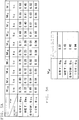
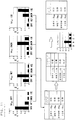
- FIG. 5A is a table showing examples of actual statistical data M k
- FIG. 5B is a table of predicted statistical data M pC showing prediction results of road surface conditions to be described later.
- the predicted statistical data M pC are the predicted values S Rp of incidence rates at a future time t p (p > 0) (hereinafter referred to as predicted incidence rates) calculated for each of the road surface conditions R.
- Generation of the actual statistical data M k is normally done immediately after the storage of estimated road surface condition data at time t -1 , which is the time immediately before the time t p at which a prediction is made.
- the actual statistical data storage means 32 stores the actual statistical data M k generated by the statistical data generating means 31 in order of time.
- the predicted statistical data generating means 33 generates the predicted statistical data M pC for the location L r within the predetermined range at a future time t p (p > 0), using a plurality (10 here) of actual statistical data M k arranged in a time series as shown in FIG. 5A .
- the predicted statistical data M pC are generated by calculating the predicted incidence rates S Rp of road surface conditions R at time t p , using these four function values G R (t p ), respectively.
- the predicted incidence rates S Rp are derived by dividing the function values G R (t p ) of the respective road surfaces R by the sum ( ⁇ R G R (t p )) of the four function values G R (t p ).
- the sum of the predicted incidence rates S Dp , S Wp , S Sp , and S Ip is 1.
- FIG. 5B shows an example of predicted statistical data M pC representing prediction results of road surface conditions.
- the road surface condition predicting means 34 predicts the road surface condition R to be any one of the DRY road surface, WET road surface, SNOW road surface, and ICE road surface. More specifically, the road surface condition predicting means 34 selects an estimated road surface condition R indicating the highest predicted incidence rate S Rp (DRY road surface in FIG. 5B ) from the predicted statistical data M pC and predicts this selected road surface condition as the road surface condition R(t p ) at the location L k within the predetermined range at time t p .
- the road surface condition R(t q ) at a further future time tq (t q > t p ) can be predicted.
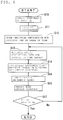
- the estimated road surface condition data and vehicular information are stored for each of the predetermined locations L r in order of acquisition times (step S12).
- the time-dependent changes in the incidence rates S Rk of estimated road surface conditions being R at times t -n to t -1 are respectively approximated by the n-th functions G r (t) (step S14), and the function values G R (t p ), which are the values of n-th functions G R (t)) at a future time t p , are derived, respectively.
- the predicted incidence rates S Rp of road surface conditions R at time t p are derived using these four function values G R (t p ), respectively (step S15) .
- the estimated road surface condition R indicating the highest value of predicted incidence rates S Rp is predicted to be the road surface condition R(t p ) at time t p (step P16) .
- time-series waveforms of vibration of a running tire are detected by the acceleration sensor 11 provided on each of a plurality of vehicles W i traveling through the location within a predetermined range.
- the time-dependent changes in these estimated road surface conditions are respectively approximated by the n-th functions G r (t), and from the function values G R (t p ) of the n-th functions G R (t), the predicted incidence rates S Rp of road surface conditions R at a future time t p at the location within the predetermined range are derived.
- the future road surface condition R(t p ) is predicted from the magnitudes of the predicted incidence rates S Rp . Accordingly, the future road surface condition can be predicted with excellent accuracy.
- the predicted incidence rates S Rp of road surface conditions R at time t p are found by approximating the time-dependent changes in road surface conditions by the n-th functions G r (t).
- the arrangement may be such that a time-series filter, such as a Kalman filter or a particle filter, which is used in predicting the ever-changing vehicle position from the output of an acceleration sensor or GPS data, for instance, may be used to obtain the predicted incidence rates S Rp of road surface conditions R.
- the predicted incidence rates S Rp of road surface conditions R(t p ) at time t p are obtained from the time-dependent changes in the incidence rates S Rk of estimated road surface conditions R at times t -10 to t -1 , which are estimated by the road surface condition estimating means 13, provided on each of a plurality of vehicles W i .
- a decision value estimating means for estimating road surface estimation decision values K k used in estimating road surface conditions R, in the place of the road surface condition estimating means 13, may be provided in each of the vehicles W i , and the predicted values K p of the road surface estimation decision values at time t p may be found from the road surface estimation decision values K k at times t -10 to t -1 .
- the road surface condition R(t p ) at time t p may be predicted from the predicted values K p .
- the statistical data of the estimated road surface conditions is classified into four conditions of DRY road surface, WET road surface, SNOW road surface, and ICE road surface.
- the SNOW road surface and the ICE road surface which are both slippery, may be combined as a dangerous road surface, and the incidence probability of the dangerous road surface may be determined.
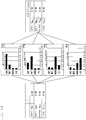
- a weather correction means 35 may be provided between the predicted statistical data generating means 33 and the road surface condition predicting means 34 of the road surface condition predicting unit 30 as shown in FIG. 1 of the first embodiment, and the road surface condition R(t p ) at time t p predicted by the road surface condition predicting means 34 may be corrected based on the weather forecast data at time t p for the location L r within the predetermined range. This will further improve the prediction accuracy of a road surface condition.
- the weather correction means 35 includes a weather forecast data obtaining unit 35a, a weather model storage unit 35b, and a weather correction unit 35c.
- the weather forecast data obtaining unit 35a obtains the forecast data of weather and temperature in the time slot including the time t p by connecting to the not-shown Internet.
- the weather model storage unit 35b stores four weather models M R (R: DRY, WET, SNOW, ICE) .
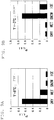
- FIGS. 8A to 8D show examples of weather models M R .
- the axes of the diagrams represent the temperature (°C) and weather (1: fine, 2: cloudy, 3: rainy, 4: snowy) .
- the probability p TmR which is a function of two variables (T and m), can be represented by curved surfaces.
- the incidence frequency P 8,1,D of the road surface condition being DRY is 0.7
- the incidence frequency P 8,1,W of the road surface condition being WET is 0.2
- the incidence frequency P 8,1,S of the road surface condition being SNOW and the incidence frequency P 8,1,I of the road surface condition being ICE are both 0.05. Also, as shown in FIG. 9A , when the temperature is 8°C and the weather is fine, the incidence frequency P 8,1,D of the road surface condition being DRY is 0.7, the incidence frequency P 8,1,W of the road surface condition being WET is 0.2, and the incidence frequency P 8,1,S of the road surface condition being SNOW and the incidence frequency P 8,1,I of the road surface condition being ICE are both 0.05. Also, as shown in FIG.
- the weather models M R are generated using past weather conditions and road surface condition data at the predetermined location L r . It is to be noted that the weather models M R may be generated for different seasons or different months. In the present example, four different weathers and the temperature of -10°C to 10°C are used. However, the weathers may be more finely classified, and different ranges and graduation intervals of temperature may be used.
- the weather correction unit 35c takes out the data of incidence frequencies p TmD , p TmW , p TmS , p TmI when the weather is m and the temperature is T from the weather models stored in the weather model storage unit 35b based on the forecast data of the weather m and temperature T in the time slot including the time t p obtained by the weather forecast data obtaining unit 35a and corrects the predicted incidence rates S Rp of road surface conditions R calculated by the predicted statistical data generating means 33, using these incidence frequencies p TmD , p TmW , p TmS , p TmI .
- the incidence frequencies p TmR of the weather models are added up to the predicted incidence rates S Rp of road surface conditions R at time t p predicted in the foregoing first embodiment, and the values thus obtained are used as the predicted incidence rates S Rpz of road surface conditions R after the correction.
- the road surface condition R at time t p is predicted by comparing the S Rpz of road surface conditions R.
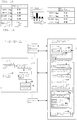
- FIG. 10 shows the values of predicted incidence rates S Rpz of road surface conditions R after the correction as ones normalized such that the sum ( ⁇ R S Rpz ) is 1.
- the road surface condition predicting means 34 predicts the road surface condition indicating the highest predicted value after correction (predicted incidence rate S Rpz ) to be the road surface condition R z (t p ) at the location L k within the predetermined range at time t p .
- the road surface condition R z (t q ) with weather taken into consideration is predicted by correcting the predicted incidence rates S Rp of the road surface conditions R using the incidence frequencies P TmD , P TmW , P TmS , P TmI when the weather is m and the temperature T.
- the incidence frequencies P TmD , P TmW , P TmS , P TmI when the weather is m and the temperature T.
- a map storage means 36 for storing reference maps M R0 for the respective road surface conditions (R: DRY road surface, WET road surface, SNOW road surface, ICE road surface) and a degree of matching calculating means 37 for calculating the degrees of matching J of the predicted incidence rates S Rp of the road surface conditions R generated by the predicted statistical data generating means 33 using the reference maps M R0 for the respective road surface conditions may be provided between the predicted statistical data generating means 33 and the weather correction means 35 of the road surface condition predicting unit 30 as shown in FIG. 7 of the second embodiment.
- a weather probability adding unit 35d for predicting the road surface condition R z (t p ) from the calculated degrees of matching J and the incidence frequencies P TmD , P TmW , P TmS , P TmI when the weather is m and the temperature T may be provided.
- the road surface condition R z (t p ) with weather taken into consideration can be predicted with still more improved accuracy of prediction.
- the reference map M D0 for DRY road surface is statistical data of estimated road surface conditions obtained by a test vehicle fitted with standard tires which has been operated to travel multiple times at constant speed on DRY road surfaces.
- the reference map M D0 for DRY road surface created with the test vehicle traveling on DRY road surfaces, shows a mapping of the rate P DD0 of estimating the road surface to be a DRY road surface, the rate P DW0 of estimating the road surface to be a WET road surface, the rate P DS0 of estimating the road surface to be a SNOW road surface, the rate P DI0 of estimating the road surface to be an ICE road surface.
- the reference map M W0 for WET road surface created with the test vehicle traveling on WET road surfaces, shows a mapping of the rate P WD0 of estimating the road surface to be a DRY road surface, the rate P WW0 of estimating the road surface to be a WET road surface, the rate P WS0 of estimating the road surface to be a SNOW road surface, the rate P WI0 of estimating the road surface to be an ICE road surface.
- And reference map M S0 for SNOW road surface created with the test vehicle traveling on SNOW road surfaces, shows a mapping of the rate P SD0 of estimating the road surface to be a DRY road surface, the rate P SW0 of estimating the road surface to be a WET road surface, the rate P SS0 of estimating the road surface to be a SNOW road surface, the rate P SI0 of estimating the road surface to be an ICE road surface.
- the reference map M I0 for ICE road surface created with the test vehicle traveling on ICE road surfaces, shows a mapping of the rate P ID0 of estimating the road surface to be a DRY road surface, the rate P IW0 of estimating the road surface to be a WET road surface, the rate P IS0 of estimating the road surface to be a SNOW road surface, the rate P II0 of estimating the road surface to be an ICE road surface.
- P DD0 is the highest in the reference map M D0 ;
- P WW0 is the highest in the reference map M W0 ;
- P SS0 is the highest in the reference map M S0 ; and
- P II0 is the highest in the reference map M I0 .
- rates P RR'0 will be referred to as reference incidence rates.
- R and R' herein refer to any one of D, W, S, and I.
- the degree of matching calculating means 37 calculates respectively the degrees of matching J R (R: DRY, WET, SNOW, ICE) of predicted incidence rates S Rp , which are the predicted statistical data M pC generated by the predicted statistical data generating means 33, using the reference maps M D0 to M I0 for the respective road surfaces and sends these four calculated degrees of matching J R to the weather probability adding unit 35d of the weather correction means 35.
- the DRY degree of matching J D is calculated by the following formula (1) using the predicted incidence rates S Rp in the predicted statistical data M pC and the above-described reference incidence rates P DD0 , P DW0 , P DS0 , P DI0 , in the reference maps M D0 :
- J D esp ⁇ S Dp ⁇ P DD 0 2 + S wp ⁇ P DW 0 2 + S Sp ⁇ P DS 0 2 + S Ip ⁇ P DI 0 2
- J W esp ⁇ S Dp ⁇ P WD 0 2 + S Wp ⁇ P WW 0 2 + S Sp ⁇ P WS 0 2 + S Ip ⁇ P WI 0 2
- J S esp ⁇ S Dp ⁇ P SD 0 2 + S Wp ⁇ P SW 0 2 + S Sp ⁇ P SS 0 2 + S Ip ⁇ P SI 0 2
- J I esp ⁇ S Dp ⁇ S ID 0 2 + S Wp ⁇ P IW 0 2 + S Sp ⁇ P IS 0 2 + S Ip ⁇ P II 0 2
- the weather probability adding unit 35d calculates the incidence rates S RpZ of road surface conditions when the weather is m and the temperature T, using the product of the incidence frequency P TmR when the weather is m and the temperature T and the degree of matching J R calculated by the degree of matching calculating means 37.
- FIG. 12 shows the values of predicted incidence rates S RpZ of road surface conditions R when the weather is m and the temperature T, which are normalized such that the sum ( ⁇ R S RpZ is 1.
- the road surface condition predicting means 34 predicts the road surface condition indicating the highest predicted value (predicted incidence rate S RpZ ) when the weather is m and the temperature T to be the road surface condition R Z (t p ) at the location L k within the predetermined range at time t p .
- the predicted incidence rates S DpZ of road surface conditions R when the weather is m and the temperature T are predicted by adding the incidence frequencies P TmR of weather models to the degrees of matching J R obtained from the predicted incidence rates S Rp in the predicted statistical data M pC and the reference maps M R0 for the respective road surface conditions.
- the road surface condition R(t p ) at time t p is predicted using actual statistical data M k of incidence rates S Rk of road surface conditions estimated by a plurality of vehicles W i calculated for the respective road surface conditions R.
- actual statistical data M k at time t k cannot be generated.
- the reference maps M R0 for the respective road surface conditions as described in the foregoing third embodiment are used as actual statistical data M k .
- the reference map M D0 for DRY road surface is used as actual statistical data M k at time t k .
- the reference maps M D0 are mappings of the rate P DD0 of the vehicle traveling on the DRY road surface estimating the road surface to be a DRY road surface, the rate P DW0 of the vehicle estimating the road surface to be a WET road surface, the rate P DS0 of the vehicle estimating the road surface to be a SNOW road surface, and the rate P DI0 of the vehicle estimating the road surface to be an ICE road surface. Therefore, use of the reference maps M D0 in substitution for the actual statistical data M k may get the actual statistical data M k closer to the actuality than when the incidence rate of DRY road surface is assumed to be 1.0. Hence, a sufficient accuracy can be ensured for the prediction of a road surface condition.
- the actual statistical data M k may be generated from the reference map M D0 and the reference map M W0 .
- a plurality of vehicles W i are used for the prediction of road surface conditions.
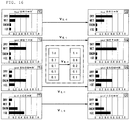
- the reference maps M R0 for the respective road surface conditions, it is also possible to predict road surface conditions R r (t p ) at a plurality of predetermined locations L r by operating a single vehicle W p traveling the route including the plurality of predetermined locations a plurality of times.
- estimated road surface conditions at the predetermined location L r are sent from the vehicle W p to the server20 at times t a , t b , t c , whil , and estimated road surface conditions at the predetermined location L r' at times t a+h , t b+h , t c+h , ........
- the estimated road surface conditions R at a predetermined location L r change as time passes like at times t a , t b , t c , whil (a ⁇ b ⁇ c ⁇ 0).
- the estimated road surface conditions R estimated by the vehicle W p at time t m (m > 0), substituted with the reference maps M R0 of road surfaces R, may be used as actual statistical data M k .
- the road surface conditions at time t m can be predicted as in the foregoing first to third embodiments.
- the reference maps M R0 may be changed for each of vehicles W p .
- the predicted incidence rates S Rp of road surface conditions R(t p ) at a future time t p may be predicted from the data at time t -1 out of the past data generated by the statistical data generating means 31.
- the statistical data generating means 31 generates maps tallying up the incidence rates of estimated road surface conditions R estimated at the location L r within the predetermined range at time t, which is time t (r) -1 immediately before the time t p at which a prediction is made, for the respective estimated road surface conditions R, from the data stored in the data storage means 22 of the server 20.
- the road surface condition transition predicting means 38 includes a transition model storage unit 38a and an incidence rate predicted value calculating unit 38b.
- the transition model storage unit 38a stores four transition models T r (R: DRY, WET, SNOW, ICE).
- transition models T r which are generated for the respective road surface conditions R, represent the probabilities of the road surface conditions R k at time t k becoming the road surface conditions R' at time t k+1 (hereinafter referred to as transition probabilities).
- the probability q D,D of the DRY road surface condition continuing is 0.7; the probability q D,W of the DRY road surface becoming a WET road surface is 0.2; the probability q D,S of the DRY road surface becoming a SNOW road surface is 0.05; and the probability q D,I of the DRY road surface becoming an ICE road surface is 0.05.
- These transition probabilities q R,R are generated using the data of the past road surface conditions R.
- the incidence rate predicted value calculating unit 38b calculates incidence rate predicted values S Rp by correcting the incidence rate predicted value S R-1 for the estimated road surface conditions R at time t -1 using the above-mentioned transition probabilities q R,R' .
- the incidence rate predicted values S Rpt are calculated for the respective road surface conditions R.
- S Dpt S D ⁇ 1 ⁇ q D , D + S W ⁇ 1 ⁇ q W , D + S S ⁇ 1 ⁇ q S , D + S I ⁇ 1 ⁇ q I
- D S Wpt S D ⁇ 1 ⁇ q D , W + S W ⁇ 1 ⁇ q W , W + S S ⁇ 1 ⁇ q S , W + S I ⁇ 1 ⁇ q I
- W S Spt S D ⁇ 1 ⁇ q D , S + S W ⁇ 1 ⁇ q W , S + S S ⁇ 1 ⁇ q S , S + S I ⁇ 1 ⁇ q I
- S S Ipt S D ⁇ 1 ⁇ q D , I + S W ⁇ 1 ⁇ q W
- the road surface condition predicting means 34 predicts the road surface condition indicating the highest value of these incidence rate predicted values S Dpt , S Wpt , S Spt , S Ipt to be the road surface condition R(t p ) at the location L k within the predetermined range at time t p .
- the predicted incidence rates S Rpt of the road surface conditions R at a future time t p (p > 0) are predicted from the transition probabilities q R,R' of road surface conditions determined in advance and the incidence rates S R-1 of the estimated road surface conditions R at time t -1 as the past data.
- the road surface condition R t (t p ) at a future time t p can be predicted by a simple scheme.
- the incidence rate predicted values S Dpt , S Wpt , S Spt , S Ipt are obtained using the transition probabilities q R,R' determined in advance from the past data.
- the denominator 3 is the number of road surface conditions R' other than the road surface condition R.
- the incidence rate predicted values S' Dpt , S' Wpt , S' Spt , S' Ipt for the respective road surface conditions R are respectively calculated by the following formulas (5') to (8'):
- S ′ Dpt S D ⁇ 1 ⁇ 0.8 + S W ⁇ 1 ⁇ 0.2 / 3 + S S ⁇ 1 ⁇ 0.2 / 3 + S I ⁇ 1 ⁇ 0.2 / 3
- S ′ Wpt S D ⁇ 1 ⁇ 0.2 / 3 + S W ⁇ 1 ⁇ 0.8 + S S ⁇ 1 ⁇ 0.2 / 3 + S I ⁇ 1 ⁇ 0.2 / 3
- S ′ Spt S D ⁇ 1 ⁇ 0.2 / 3 + S W ⁇ 1 ⁇ 0.2 / 3 + S S ⁇ 1 ⁇ 0.8 + S I ⁇ 1 ⁇ 0.2 / 3
- S ′ Ipt S D ⁇ 1 ⁇ 0.2 / 3 + S W ⁇ 1 ⁇ 0.8 + S I
- the method for predicting a road surface condition at time t p using the pre-set transition probabilities q' R,R' of estimated road surface conditions or the predetermined transition probabilities q R,R' of estimated road surface conditions may be applied to the prediction in the initial phase when the number of past data is limited. This enables a prediction under the circumstances where there is no adequate amount of past data.
- the predicted incidence rates V Rp of road surface conditions R at a future time t p may be obtained using the preceding predicted incidence rates V R-1 , which are the predicted incidence rates at time t -1 , the transition probability q R,R' described in the fourth embodiment, and the predicted incidence rates S Rp determined in the first embodiment.
- the road surface condition R(t p ) at time t p may be predicted. In this manner, it is possible to predict a future road surface condition with even greater accuracy.
- V Rp Calculation of the predicted incidence rates V Rp is done when preceding predicted incidence rates up to time t -1 , namely, V R-n , ising, V R-2 , V R-1 (calculated values) and actual statistical data M -n , ising, M -2 , M -1 are already known. Note that the initial preceding predicted incidence rate V R-1 is the setting value.
- the predicted incidence rates S Rp at time t p are obtained from the actual statistical data M -n', ......, M -3 , M -2 , M -1 at times preceding time t p , namely, t -n ,. « , t -3 , t -2 , t -1 (procedure 2). Note that the description of the method for predicting the predicted incidence rates S Rk is omitted since it is the same as in the first embodiment.
- the products of the products P R,R'P and the predicted incidence rates S Rp are used as the predicted incidence rates V Rp of the road surface conditions R at a future time t p .
- the degrees of matching J Rp between the reference incidence rates P R,R' in the reference maps M R0 , which are the models corresponding to the respective road surface conditions, and the predicted incidence rates S Rp may be used in the place of the predicted incidence rates S R p.
- J Rp exp ⁇ S Dp ⁇ P RD 0 2 + S Wp ⁇ P RW 0 2 + S Sp ⁇ P RS 0 2 + S Ip ⁇ P RI 0 2
- the predicted incidence rates used are the predicted incidence rates S Rp obtained in the first embodiment.
- the predicted incidence rates V Rp of the road surface conditions R may be obtained using the predicted incidence rates S Rpz corrected by the weather model obtained in the second embodiment or the predicted incidence rates S RpZ corrected using the maps M R0 of the respective road surface conditions and the weather model. In this manner, the prediction with weather changes taken into consideration can be made such that it is possible to predict future road surface conditions with even greater accuracy.
- transition models T RT for the weather or the weather and temperature which are the weather forecast data, may be generated, and the predicted incidence rates V Rp of road surface conditions at a future time t p may be obtained using the transition models T RT , preceding predicted incidence rates V R-1 , and predicted incidence rates S R p.
- the predicted incidence rates S Rpt of road surface conditions R(t p ) at a future time t p are predicted from the transition models T R determined in advance and the incidence rates S R-1 at time t -1 .
- the accuracy of predicting the road surface condition R(t p ) can be further improved.
- V R-k S R-k /S R-k-1
- V D-1 0.86
- V W-1 2.0
- the transition models T R are changed by repeating the above operation for the other transition models T W , T S , and T I .
- transition models after the change will be referred to as U R
- the probability of the road surface condition transiting from R to R' as u R,R' .
- the incidence rate predicted values S RpT are calculated by correcting the incidence rates S R-1 of the estimated road surface conditions R at time t -1 by use of the above-mentioned u R,R' .
- S RpT S D ⁇ 1 ⁇ u D , R + S W ⁇ 1 ⁇ u W , R + S S ⁇ 1 ⁇ u S , R + S I ⁇ 1 ⁇ u I , R
- the incidence rate predicted value S RpT is calculated for each of the road surface conditions R.
- the road surface condition predicting means 34 predicts the road surface condition indicating the highest value of these incidence rate predicted values S DpT , S WpT , S SpT , S IpT to be the road surface condition R T (t p ) at the location L k within the predetermined range at time t p .
- the transition probabilities u R,R' of road surface conditions are changed according to the transitional states of past data (actual measurement data M k ). Accordingly, the road surface condition R T (t p ) at a future time t p can be predicted with even greater accuracy.
- the transition models T R are changed using the change rates V R from the incidence rates S R-2 at time t -2 to the incidence rates S R-1 at time t -1 .
- the transition models T R may be changed using the change rates v R-m , ising , v R-2 , V R-1 at a series of times t -m , whil, t -3 , t -2 preceding time t -1 .
- the change rates v Rp of incidence rates at time t p may be obtained by use of the computing equation of the change rates v R-k of incidence rates, for instance, using the mean value or linear combination of the change rates v R-m , whil, v R-2 , V R-1 of incidence rates.
- the incidence rate predicted values S RpT are calculated using the incidence rates S R-1 at time t -1 and the transition probabilities u R,R' .
- the road surface condition may be predicted using the preceding predicted rates V R-1 , which are the predicted incidence rates at time t -1 , and the transition probabilities u R,R' .
- transition probabilities u R,R' may be changed according to information on the geography and on the weather and temperature supplied as weather forecast.
- the foregoing first to sixth embodiments are not limited to the classification of the statistical data of estimated road surface conditions into the four conditions of DRY road surface, WET road surface, SNOW road surface, and ICE road surface.
- the classification may be done by the road surface friction coefficient or into "high- ⁇ road ( ⁇ ⁇ 0.7)", “intermediate- ⁇ road (0.3 ⁇ ⁇ ⁇ 0.7)", “low- ⁇ road ( ⁇ ⁇ 0.3)", for instance.
- predicted values S Rp of incidence rates of the road surface conditions R at time t p are obtained from the time-dependent changes in the incidence rates S Rk of the estimated road surface conditions being R from time t -10 to t -1 estimated by the road surface condition estimating means 13 provided in each of a plurality of vehicles W i .
- a decision value estimating means for estimating road surface estimation decision values K used in estimating road surface conditions R may be provided in each of the vehicles W i .
- the predicted values K p of the road surface estimation decision values at time t p may be obtained from the road surface estimation decision values K k from time t -10 to time t -1 .
- a road surface condition R p at time t p may be predicted from the predicted values K p .
- a road surface condition estimating means 13 is provided in each of vehicles W i .
- the arrangement may be such that a road surface condition estimating means 13 is provided at the road surface condition management center 2 and a plurality of band values used in estimating road surface conditions (vibration levels of specific frequency bands detected from acceleration waveform) or the calculated values of the band values are sent to the road surface condition management center 2.
- a road surface condition determining unit which is configured to estimate the road surface condition to be one of the DRY road surface, WET road surface, SNOW road surface, and ICE road surface from the values of identification (discriminant) functions using kernel functions.
- other road surface condition determining means may be used.
- such a road surface condition estimating unit may be configured to estimate the road surface friction coefficient ⁇ by comparing the vibration level of vibration spectrum obtained by applying a frequency analysis to the time-series waveform of acceleration detected by the acceleration sensor 11 against a G-table showing the predetermined relationship between the road surface friction coefficient ⁇ and the vibration level.
- such other road surface condition estimating unit may be configured to estimate the road surface condition from the time-series waveform supplied by an acceleration sensor attached to the tire or rim.
- Such a road surface estimating means may detect the tire noise arising from the running tire. And by comparing the mean value of sound pressure levels within a set frequency range of the detected tire noise against the reference sound pressure levels, it may estimate whether the road surface is an asphalt road amply wet with water, a slightly wet asphalt road, a dry asphalt road, or an ice-covered road.
- a method for predicting a road surface condition includes the step of obtaining vehicular information, which is information on the behavior of a traveling vehicle by an on-board sensor mounted on the vehicle and the step of predicting a road surface condition of a location within a predetermined range, using road surface estimation decision values to be used in estimating road surface conditions, which are calculated using the vehicular information, or the estimated road surface conditions estimated using the road surface estimation decision values.
- predicted incidence rates S Rp for respective road surface conditions which are the incidence rates of road surface conditions at the location within the predetermined range, are calculated from the time-dependent changes in the road surface estimated values calculated using the vehicular information obtained by the vehicles having passed the location within the predetermined range or the time-dependent changes in the estimated road surface conditions, and then the road surface condition at the location within the predetermined range is predicted from the calculated predicted incidence rates S Rp .
- the road surface estimation decision values (or estimated road surface conditions) at time t k refer to the road surface estimation decision values (or estimated road surface conditions) obtained within the time width ⁇ t k including time t k (for example, t k - ⁇ t k /2 ⁇ t ⁇ t k + ⁇ t k /2).
- a future road surface condition at a location within a predetermined range is predicted using the road surface estimation decision values at a plurality of times obtained at the location within the predetermined range or the time-dependent changes in the estimated road surface conditions. Therefore, a future road surface condition can be predicted with excellent accuracy.
- the incidence rate predicted values V Rp which are the corrected values of predicted incidence rates S Rp
- the incidence rate predicted values V Rp are calculated by correcting the predicted incidence rates S Rp of road surface conditions at the location within the predetermined range by use of the pre-set transition probabilities q' RR' of estimated road surface conditions or the predetermined transition probabilities q RR' of estimated road surface conditions and the preceding incidence rates V R-1 , which are the predicted incidence rates at time t -1 before the time t p at which the road surface condition is predicted.
- the predicted incidence rates S Rp at the location within the predetermined range are corrected using the pre-set transition probabilities q' RR' of estimated road surface conditions or the predetermined transition probabilities q RR' of estimated road surface conditions and the already calculated preceding incidence rates V R-1 .
- a method for predicting a road surface condition includes the step of obtaining vehicular information, which is information on the behavior of a traveling vehicle by an on-board sensor mounted on the vehicle and the step of predicting a road surface condition at a location within a predetermined range, using road surface estimation decision values to be used in the estimation of road surface conditions, which are calculated using the vehicular information, or the estimated road surface conditions estimated using the road surface estimation decision values.
- a road surface condition at the location within the predetermined range at a time after a predetermined time is predicted from the estimated road surface conditions estimated using vehicular information obtained by vehicles having passed the location within the predetermined range and the pre-set transition probabilities of estimated road surface conditions or the predetermined transition probabilities for the estimated road surface conditions.
- the road surface condition at time t p is predicted using the pre-set transition probabilities q' RR' of estimated road surface conditions or the predetermined transition probabilities q RR of estimated road surface conditions.
- the road surface condition at time t p is predicted using the pre-set transition probabilities q' RR' of estimated road surface conditions or the predetermined transition probabilities q RR of estimated road surface conditions.
- the pre-set transition probabilities q' RR' of estimated road surface conditions or the predetermined transition probabilities q RR' of estimated road surface conditions are corrected using the incidence rates of road surface conditions estimated based on the vehicular information obtained at a time before the time at which the road surface condition is predicted.
- the predicted road surface condition R (t p ) is corrected based on weather forecast information, such as weather, temperature, rainfall, wind speed, and sunshine hours.
- correction means determining whether or not the predicted road surface condition changes with the information on weather or temperature provided as the weather forecast, and when there is any change, predicting which of the road surface conditions will show up.
- the predicted road surface condition is corrected based on the weather forecast information. Therefore, the accuracy in predicting a road surface condition can be improved further.
- the information to be used in correction may include the estimation results of road surface conditions at other locations within a predetermined range. More specifically, among the past conditions (weather, traffic volume, estimation results of road surface conditions), the estimation results of road surface conditions at the location B within a predetermined range having a correlation to the location A within a predetermined range may be used to correct the estimation result at the location A within a predetermined range.
- a road surface condition R(t p ) at a time tq (t q > t p ) even after the time t p at which a prediction is made is predicted using the predicted road surface condition R(t p ).
- the present invention provides methods for determining a road surface condition within a predetermined space of time at a location within a predetermined range with excellent accuracy. Therefore, the travel safety of vehicles may be improved if the determination results are communicated to the vehicles traveling along the location within the predetermined range.
Landscapes
- Physics & Mathematics (AREA)
- General Physics & Mathematics (AREA)
- Engineering & Computer Science (AREA)
- Chemical & Material Sciences (AREA)
- Analytical Chemistry (AREA)
- Transportation (AREA)
- Mechanical Engineering (AREA)
- Environmental & Geological Engineering (AREA)
- Remote Sensing (AREA)
- Radar, Positioning & Navigation (AREA)
- Life Sciences & Earth Sciences (AREA)
- Atmospheric Sciences (AREA)
- Biodiversity & Conservation Biology (AREA)
- Ecology (AREA)
- Environmental Sciences (AREA)
- Traffic Control Systems (AREA)
- Management, Administration, Business Operations System, And Electronic Commerce (AREA)
- Regulating Braking Force (AREA)
Applications Claiming Priority (2)
| Application Number | Priority Date | Filing Date | Title |
|---|---|---|---|
| JP2014210322A JP6408854B2 (ja) | 2014-10-14 | 2014-10-14 | 路面状態予測方法 |
| PCT/JP2015/079029 WO2016060161A1 (ja) | 2014-10-14 | 2015-10-14 | 路面状態予測方法及び路面状態予測システム |
Publications (2)
| Publication Number | Publication Date |
|---|---|
| EP3208638A1 true EP3208638A1 (de) | 2017-08-23 |
| EP3208638A4 EP3208638A4 (de) | 2018-03-14 |
Family
ID=55746703
Family Applications (1)
| Application Number | Title | Priority Date | Filing Date |
|---|---|---|---|
| EP15851287.1A Ceased EP3208638A4 (de) | 2014-10-14 | 2015-10-14 | Verfahren zur vorhersage des zustands einer strassenoberfläche und system zur vorhersage des zustands einer strassenoberfläche |
Country Status (5)
| Country | Link |
|---|---|
| US (1) | US20170241778A1 (de) |
| EP (1) | EP3208638A4 (de) |
| JP (1) | JP6408854B2 (de) |
| CN (1) | CN107003430B (de) |
| WO (1) | WO2016060161A1 (de) |
Cited By (5)
| Publication number | Priority date | Publication date | Assignee | Title |
|---|---|---|---|---|
| KR20190056747A (ko) * | 2017-11-17 | 2019-05-27 | 한국전자통신연구원 | 서리 예측 시스템 및 서리 예측 방법 |
| EP3514579A4 (de) * | 2016-09-13 | 2020-01-01 | Panasonic Intellectual Property Management Co., Ltd. | Strassenoberflächenzustandsvorhersagesystem, fahrassistenzsystem, strassenoberflächenzustandsvorhersageverfahren und datenverteilungsverfahren |
| CN111739283A (zh) * | 2019-10-30 | 2020-10-02 | 腾讯科技(深圳)有限公司 | 一种基于聚类的路况计算方法、装置、设备及介质 |
| WO2021089416A1 (en) * | 2019-11-06 | 2021-05-14 | Schrader Electronics Limited | Adaptively configuring a tire mounted sensor (tms) with a vehicle-provided parameter |
| WO2023131597A1 (de) * | 2022-01-10 | 2023-07-13 | Robert Bosch Gmbh | Erkennen eines fahrbahnzustands basierend auf messdaten einer inertialsensorik eines fahrzeugs |
Families Citing this family (17)
| Publication number | Priority date | Publication date | Assignee | Title |
|---|---|---|---|---|
| JP6614073B2 (ja) | 2016-09-06 | 2019-12-04 | 株式会社デンソー | 路面状態推定装置 |
| JP6810654B2 (ja) * | 2017-05-18 | 2021-01-06 | 日本電信電話株式会社 | 路面データ収集装置、方法、及びプログラム |
| EP3642565A1 (de) | 2017-06-20 | 2020-04-29 | Nira Dynamics AB | Strassenzustandsüberwachung |
| US10311728B2 (en) * | 2017-08-11 | 2019-06-04 | Here Global B.V. | Method and apparatus for providing a confidence-based road event message |
| CN108045376B (zh) * | 2017-11-30 | 2019-10-25 | 广州小鹏汽车科技有限公司 | 一种基于路面附着能力的车辆控制方法、系统及汽车 |
| EP3779929A4 (de) | 2018-03-29 | 2021-05-05 | Panasonic Intellectual Property Management Co., Ltd. | Steuerungsvorrichtung und kartenerzeugungsverfahren |
| JP7103201B2 (ja) * | 2018-12-20 | 2022-07-20 | トヨタ自動車株式会社 | 情報処理システム、プログラム、及び情報処理方法 |
| JP7335713B2 (ja) * | 2019-03-28 | 2023-08-30 | 株式会社Subaru | 路面判定装置 |
| US12205465B2 (en) | 2019-05-24 | 2025-01-21 | 3M Innovative Properties Company | Incentive-driven roadway condition monitoring for improved safety of micromobility device operation |
| CN110211384B (zh) * | 2019-06-24 | 2020-07-24 | 中国汽车工程研究院股份有限公司 | 基于车车通讯的路况实现方法 |
| JP7380718B2 (ja) * | 2020-02-07 | 2023-11-15 | 日本電信電話株式会社 | 路面推定装置、路面推定方法およびプログラム |
| JP7422562B2 (ja) * | 2020-03-02 | 2024-01-26 | 株式会社ブリヂストン | 路面状態予測方法 |
| JP7578488B2 (ja) * | 2020-12-28 | 2024-11-06 | Toyo Tire株式会社 | 摩耗量推定システム、演算モデル生成システムおよび摩耗量推定方法 |
| JP7706311B2 (ja) * | 2021-09-06 | 2025-07-11 | Toyo Tire株式会社 | 非空気圧タイヤ |
| CN113737703A (zh) * | 2021-10-08 | 2021-12-03 | 徐州徐工环境技术有限公司 | 一种扫路机的喷水降尘自动控制方法、系统及扫路机 |
| US12319309B2 (en) * | 2021-10-18 | 2025-06-03 | Kawasaki Motors, Ltd. | Control requirement determiner, rough terrain vehicle, and control requirement determining method for calculating surface unevenness |
| US12600381B2 (en) * | 2024-07-09 | 2026-04-14 | Scott C Harris | Vehicle operation modification based on weather sensing sensors |
Family Cites Families (13)
| Publication number | Priority date | Publication date | Assignee | Title |
|---|---|---|---|---|
| US6853894B1 (en) * | 2000-04-24 | 2005-02-08 | Usa Technologies, Inc. | Global network based vehicle safety and security telematics |
| US6919821B1 (en) * | 2000-05-19 | 2005-07-19 | Navteq North America, Llc | Method and system for collecting meteorological data using in-vehicle systems |
| JP2004198188A (ja) * | 2002-12-17 | 2004-07-15 | Yokogawa Denshikiki Co Ltd | 路面状態判別予測装置及び方法 |
| JP4500603B2 (ja) * | 2004-06-30 | 2010-07-14 | 一般財団法人日本気象協会 | 路面凍結可能性指数算出システム、路面凍結可能性指数算出方法及び路面凍結可能性指数算出プログラム |
| JP2006030139A (ja) * | 2004-07-21 | 2006-02-02 | Japan Weather Association | 路面状態予測システム、路面状態予測方法及び路面状態予測プログラム |
| US8521426B2 (en) * | 2008-02-04 | 2013-08-27 | Weather Central, Lp | System and method for weather mapping to road segments |
| FI124059B (fi) * | 2008-09-19 | 2014-02-28 | Aalto Korkeakoulusaeaetioe | Parannus ajoneuvojen ajonhallintajärjestelmiin |
| JP5657917B2 (ja) * | 2010-05-19 | 2015-01-21 | 株式会社ブリヂストン | 路面状態推定方法 |
| JP5837341B2 (ja) * | 2011-06-24 | 2015-12-24 | 株式会社ブリヂストン | 路面状態判定方法とその装置 |
| CN103717469B (zh) * | 2011-07-20 | 2016-08-03 | 株式会社普利司通 | 路面状态估计方法和路面状态估计设备 |
| US9110196B2 (en) * | 2012-09-20 | 2015-08-18 | Google, Inc. | Detecting road weather conditions |
| US20150260614A1 (en) * | 2012-10-19 | 2015-09-17 | Roadroid Ab | Method and system for monitoring road conditions |
| KR101409222B1 (ko) * | 2013-09-10 | 2014-06-30 | 현대오토에버 주식회사 | 노면상태 정보제공 시스템 |
-
2014
- 2014-10-14 JP JP2014210322A patent/JP6408854B2/ja active Active
-
2015
- 2015-10-14 US US15/518,539 patent/US20170241778A1/en not_active Abandoned
- 2015-10-14 EP EP15851287.1A patent/EP3208638A4/de not_active Ceased
- 2015-10-14 WO PCT/JP2015/079029 patent/WO2016060161A1/ja not_active Ceased
- 2015-10-14 CN CN201580068217.9A patent/CN107003430B/zh active Active
Cited By (8)
| Publication number | Priority date | Publication date | Assignee | Title |
|---|---|---|---|---|
| EP3514579A4 (de) * | 2016-09-13 | 2020-01-01 | Panasonic Intellectual Property Management Co., Ltd. | Strassenoberflächenzustandsvorhersagesystem, fahrassistenzsystem, strassenoberflächenzustandsvorhersageverfahren und datenverteilungsverfahren |
| KR20190056747A (ko) * | 2017-11-17 | 2019-05-27 | 한국전자통신연구원 | 서리 예측 시스템 및 서리 예측 방법 |
| KR102505910B1 (ko) | 2017-11-17 | 2023-03-06 | 한국전자통신연구원 | 서리 예측 시스템 및 서리 예측 방법 |
| CN111739283A (zh) * | 2019-10-30 | 2020-10-02 | 腾讯科技(深圳)有限公司 | 一种基于聚类的路况计算方法、装置、设备及介质 |
| CN111739283B (zh) * | 2019-10-30 | 2022-05-20 | 腾讯科技(深圳)有限公司 | 一种基于聚类的路况计算方法、装置、设备及介质 |
| WO2021089416A1 (en) * | 2019-11-06 | 2021-05-14 | Schrader Electronics Limited | Adaptively configuring a tire mounted sensor (tms) with a vehicle-provided parameter |
| US11321976B2 (en) | 2019-11-06 | 2022-05-03 | Schrader Electronics Limited | Adaptively configuring a tire mounted sensor (TMS) with a vehicle-provided parameter |
| WO2023131597A1 (de) * | 2022-01-10 | 2023-07-13 | Robert Bosch Gmbh | Erkennen eines fahrbahnzustands basierend auf messdaten einer inertialsensorik eines fahrzeugs |
Also Published As
| Publication number | Publication date |
|---|---|
| US20170241778A1 (en) | 2017-08-24 |
| WO2016060161A1 (ja) | 2016-04-21 |
| JP6408854B2 (ja) | 2018-10-17 |
| CN107003430B (zh) | 2019-10-18 |
| JP2016080451A (ja) | 2016-05-16 |
| CN107003430A (zh) | 2017-08-01 |
| EP3208638A4 (de) | 2018-03-14 |
Similar Documents
| Publication | Publication Date | Title |
|---|---|---|
| EP3208638A1 (de) | Verfahren zur vorhersage des zustands einer strassenoberfläche und system zur vorhersage des zustands einer strassenoberfläche | |
| EP3206056B1 (de) | System zur unterscheidung des fahrbahnzustands | |
| US12084054B2 (en) | System and method for predicting wear progression for vehicle tires | |
| EP2638711B1 (de) | Fahrzeugdatensystem und -verfahren | |
| JP6392623B2 (ja) | 路面状態判別システム | |
| JP5645928B2 (ja) | 無線通信システムにおける環境評価 | |
| Wahlström et al. | Risk assessment of vehicle cornering events in GNSS data driven insurance telematics | |
| JP2004295165A (ja) | リンク旅行時間推定方法及び装置 | |
| Langstand et al. | Learning to cooperatively estimate road surface friction | |
| Mizrachi et al. | Road surface characterization using crowdsourcing vehicles |
Legal Events
| Date | Code | Title | Description |
|---|---|---|---|
| STAA | Information on the status of an ep patent application or granted ep patent |
Free format text: STATUS: THE INTERNATIONAL PUBLICATION HAS BEEN MADE |
|
| PUAI | Public reference made under article 153(3) epc to a published international application that has entered the european phase |
Free format text: ORIGINAL CODE: 0009012 |
|
| STAA | Information on the status of an ep patent application or granted ep patent |
Free format text: STATUS: REQUEST FOR EXAMINATION WAS MADE |
|
| 17P | Request for examination filed |
Effective date: 20170505 |
|
| AK | Designated contracting states |
Kind code of ref document: A1 Designated state(s): AL AT BE BG CH CY CZ DE DK EE ES FI FR GB GR HR HU IE IS IT LI LT LU LV MC MK MT NL NO PL PT RO RS SE SI SK SM TR |
|
| AX | Request for extension of the european patent |
Extension state: BA ME |
|
| DAV | Request for validation of the european patent (deleted) | ||
| DAX | Request for extension of the european patent (deleted) | ||
| A4 | Supplementary search report drawn up and despatched |
Effective date: 20180213 |
|
| RIC1 | Information provided on ipc code assigned before grant |
Ipc: G08G 1/123 20060101ALI20180207BHEP Ipc: G08G 1/13 20060101ALI20180207BHEP Ipc: G01W 1/10 20060101AFI20180207BHEP Ipc: G08G 1/01 20060101ALI20180207BHEP Ipc: B60T 8/172 20060101ALI20180207BHEP Ipc: G01B 21/30 20060101ALI20180207BHEP |
|
| STAA | Information on the status of an ep patent application or granted ep patent |
Free format text: STATUS: EXAMINATION IS IN PROGRESS |
|
| 17Q | First examination report despatched |
Effective date: 20190220 |
|
| REG | Reference to a national code |
Ref country code: DE Ref legal event code: R003 |
|
| STAA | Information on the status of an ep patent application or granted ep patent |
Free format text: STATUS: THE APPLICATION HAS BEEN REFUSED |
|
| 18R | Application refused |
Effective date: 20211221 |