EP3209701B1 - Emulgatoren von imidazolinfunktionalisierter oxidierter fettige substanz und verfahren - Google Patents
Emulgatoren von imidazolinfunktionalisierter oxidierter fettige substanz und verfahren Download PDFInfo
- Publication number
- EP3209701B1 EP3209701B1 EP15853526.0A EP15853526A EP3209701B1 EP 3209701 B1 EP3209701 B1 EP 3209701B1 EP 15853526 A EP15853526 A EP 15853526A EP 3209701 B1 EP3209701 B1 EP 3209701B1
- Authority
- EP
- European Patent Office
- Prior art keywords
- fatty substance
- substance composition
- molecular weight
- compounds
- average molecular
- Prior art date
- Legal status (The legal status is an assumption and is not a legal conclusion. Google has not performed a legal analysis and makes no representation as to the accuracy of the status listed.)
- Active
Links
Images

Classifications
-
- C—CHEMISTRY; METALLURGY
- C08—ORGANIC MACROMOLECULAR COMPOUNDS; THEIR PREPARATION OR CHEMICAL WORKING-UP; COMPOSITIONS BASED THEREON
- C08F—MACROMOLECULAR COMPOUNDS OBTAINED BY REACTIONS ONLY INVOLVING CARBON-TO-CARBON UNSATURATED BONDS
- C08F210/00—Copolymers of unsaturated aliphatic hydrocarbons having only one carbon-to-carbon double bond
- C08F210/02—Ethene
-
- C—CHEMISTRY; METALLURGY
- C08—ORGANIC MACROMOLECULAR COMPOUNDS; THEIR PREPARATION OR CHEMICAL WORKING-UP; COMPOSITIONS BASED THEREON
- C08L—COMPOSITIONS OF MACROMOLECULAR COMPOUNDS
- C08L95/00—Compositions of bituminous materials, e.g. asphalt, tar, pitch
- C08L95/005—Aqueous compositions, e.g. emulsions
-
- C—CHEMISTRY; METALLURGY
- C08—ORGANIC MACROMOLECULAR COMPOUNDS; THEIR PREPARATION OR CHEMICAL WORKING-UP; COMPOSITIONS BASED THEREON
- C08G—MACROMOLECULAR COMPOUNDS OBTAINED OTHERWISE THAN BY REACTIONS ONLY INVOLVING UNSATURATED CARBON-TO-CARBON BONDS
- C08G69/00—Macromolecular compounds obtained by reactions forming a carboxylic amide link in the main chain of the macromolecule
- C08G69/02—Polyamides derived from amino-carboxylic acids or from polyamines and polycarboxylic acids
- C08G69/26—Polyamides derived from amino-carboxylic acids or from polyamines and polycarboxylic acids derived from polyamines and polycarboxylic acids
- C08G69/34—Polyamides derived from amino-carboxylic acids or from polyamines and polycarboxylic acids derived from polyamines and polycarboxylic acids using polymerised unsaturated fatty acids
-
- C—CHEMISTRY; METALLURGY
- C08—ORGANIC MACROMOLECULAR COMPOUNDS; THEIR PREPARATION OR CHEMICAL WORKING-UP; COMPOSITIONS BASED THEREON
- C08G—MACROMOLECULAR COMPOUNDS OBTAINED OTHERWISE THAN BY REACTIONS ONLY INVOLVING UNSATURATED CARBON-TO-CARBON BONDS
- C08G73/00—Macromolecular compounds obtained by reactions forming a linkage containing nitrogen with or without oxygen or carbon in the main chain of the macromolecule, not provided for in groups C08G12/00 - C08G71/00
- C08G73/06—Polycondensates having nitrogen-containing heterocyclic rings in the main chain of the macromolecule
- C08G73/0605—Polycondensates containing five-membered rings, not condensed with other rings, with nitrogen atoms as the only ring hetero atoms
- C08G73/0616—Polycondensates containing five-membered rings, not condensed with other rings, with nitrogen atoms as the only ring hetero atoms with only two nitrogen atoms in the ring
-
- C—CHEMISTRY; METALLURGY
- C08—ORGANIC MACROMOLECULAR COMPOUNDS; THEIR PREPARATION OR CHEMICAL WORKING-UP; COMPOSITIONS BASED THEREON
- C08K—Use of inorganic or non-macromolecular organic substances as compounding ingredients
- C08K5/00—Use of organic ingredients
- C08K5/04—Oxygen-containing compounds
- C08K5/10—Esters; Ether-esters
- C08K5/109—Esters; Ether-esters of carbonic acid, e.g. R-O-C(=O)-O-R
-
- C—CHEMISTRY; METALLURGY
- C08—ORGANIC MACROMOLECULAR COMPOUNDS; THEIR PREPARATION OR CHEMICAL WORKING-UP; COMPOSITIONS BASED THEREON
- C08K—Use of inorganic or non-macromolecular organic substances as compounding ingredients
- C08K5/00—Use of organic ingredients
- C08K5/16—Nitrogen-containing compounds
-
- C—CHEMISTRY; METALLURGY
- C08—ORGANIC MACROMOLECULAR COMPOUNDS; THEIR PREPARATION OR CHEMICAL WORKING-UP; COMPOSITIONS BASED THEREON
- C08K—Use of inorganic or non-macromolecular organic substances as compounding ingredients
- C08K5/00—Use of organic ingredients
- C08K5/16—Nitrogen-containing compounds
- C08K5/34—Heterocyclic compounds having nitrogen in the ring
- C08K5/3442—Heterocyclic compounds having nitrogen in the ring having two nitrogen atoms in the ring
- C08K5/3445—Five-membered rings
-
- C—CHEMISTRY; METALLURGY
- C23—COATING METALLIC MATERIAL; COATING MATERIAL WITH METALLIC MATERIAL; CHEMICAL SURFACE TREATMENT; DIFFUSION TREATMENT OF METALLIC MATERIAL; COATING BY VACUUM EVAPORATION, BY SPUTTERING, BY ION IMPLANTATION OR BY CHEMICAL VAPOUR DEPOSITION, IN GENERAL; INHIBITING CORROSION OF METALLIC MATERIAL OR INCRUSTATION IN GENERAL
- C23F—NON-MECHANICAL REMOVAL OF METALLIC MATERIAL FROM SURFACE; INHIBITING CORROSION OF METALLIC MATERIAL OR INCRUSTATION IN GENERAL; MULTI-STEP PROCESSES FOR SURFACE TREATMENT OF METALLIC MATERIAL INVOLVING AT LEAST ONE PROCESS PROVIDED FOR IN CLASS C23 AND AT LEAST ONE PROCESS COVERED BY SUBCLASS C21D OR C22F OR CLASS C25
- C23F11/00—Inhibiting corrosion of metallic material by applying inhibitors to the surface in danger of corrosion or adding them to the corrosive agent
- C23F11/08—Inhibiting corrosion of metallic material by applying inhibitors to the surface in danger of corrosion or adding them to the corrosive agent in other liquids
- C23F11/10—Inhibiting corrosion of metallic material by applying inhibitors to the surface in danger of corrosion or adding them to the corrosive agent in other liquids using organic inhibitors
- C23F11/14—Nitrogen-containing compounds
- C23F11/145—Amides; N-substituted amides
-
- C—CHEMISTRY; METALLURGY
- C08—ORGANIC MACROMOLECULAR COMPOUNDS; THEIR PREPARATION OR CHEMICAL WORKING-UP; COMPOSITIONS BASED THEREON
- C08L—COMPOSITIONS OF MACROMOLECULAR COMPOUNDS
- C08L2555/00—Characteristics of bituminous mixtures
- C08L2555/20—Mixtures of bitumen and aggregate defined by their production temperatures, e.g. production of asphalt for road or pavement applications
- C08L2555/28—Asphalt produced between 0°C and below 65°C, e.g. cold mix asphalt produced between 0°C and 35°C
Definitions
- the present invention relates to emulsifiers. More specifically, the present invention relates to imidazoline functionalized emulsifiers.
- Emulsifiers are used in bituminous asphalt compositions to provide desired rheological properties during application of the compositions to a surface, i.e. to provide workability for a time period at a given composition temperature, followed by breaking of the emulsion for setting of the composition on the substrate.
- Asphalt formulations are in need of modification to meet performance expectations.
- New imidazoline functionalized oxidized fatty substance emulsifiers are provided in a unique process.
- an oxidative oligomerization is carried out on a fatty substance composition to produce an oxidized fatty substance composition comprising from about 10 to about 75% by weight of oligomeric fatty acid components (i.e. compounds having a fatty acid component that are dimers or having three or more mer units) based on the total weight of fatty acid containing components in the composition.
- This oxidized fatty substance composition is reacted with a polyamine comprising at least one ethylene diamine functional group with at least three hydrogens attached to the two nitrogens to form an aminoethylamido functionalized oxidized fatty substance composition
- An imidazoline functionalized oxidized fatty substance emulsifier is formed from the aminoethylamido functionalized oxidized fatty substance composition.
- the oxidative oligomerization is carried out by heating a fatty substance composition and passing an oxygen-containing stream through the heated fatty substance composition to produce an oxidized fatty substance composition.
- Imidazoline functionalized oxidized fatty substance emulsifiers may in one embodiment provide excellent emulsification properties, particularly in the context of the use of asphalt for road pavement or treatment thereof. While not being bound by theory, it is believed that the unique nature of the imidazoline functionalized oxidized fatty substance components provides an imidazoline emulsifier that provides excellent emulsification properties with the ability to tune the performance of the emulsifier to provide reliable and predictable asphalt mix times.
- the emulsifiers made via oxidized fatty substances are superior to those prepared using other oligomer reaction processes, such as fatty substance compositions that are reacted using non-oxidative conditions, such as thermal polymerization or via super-acid catalyzed or acid clay catalyzed reaction processes.
- the present imidazoline functionalized oxidized fatty substance emulsifiers additionally may exhibit excellent performance in applications where fatty acid imidazolines are used, e.g. such as in corrosion inhibitor compositions, epoxy or other polymer curatives, cationic surfactants for hydrophobization or other surface modification applications.
- a fatty substance composition is defined as a composition comprising compounds having a fatty acid component, wherein the compound is in the form of the acid, salt, or esters thereof.
- At least about 60% by weight of the compounds having a fatty acid component in the fatty substance composition are compounds selected from the group consisting of fatty acids or their salts, and combinations thereof.
- at least about 70% or at least about 80% or at least about 90% by weight of the compounds having a fatty acid component in the fatty substance composition are compounds selected from the group consisting of fatty acids or their salts, and combinations thereof.
- At least about 60% by weight of the compounds having a fatty acid component in the fatty substance composition are compounds selected from the group consisting of the fatty acid esters of alkyl mono- or polyalcohols and combinations thereof. In an embodiment, at least about 70% or at least about 80% or at least about 90% by weight of the compounds having a fatty acid component in the fatty substance composition are compounds selected from the group consisting of the fatty acid esters of alkyl mono- or poly- alcohols and combinations thereof.
- At least about 60% by weight of the compounds having a fatty acid component in the fatty substance composition are compounds selected from the group consisting of the fatty acid esters of C 1 -C 8 alkyl mono-alcohols and combinations thereof.
- at least about 70% or at least about 80% or at least about 90% by weight of the compounds having a fatty acid component in the fatty substance composition are compounds selected from the group consisting of the fatty acid esters of C 1 -C 8 alkyl mono-alcohols and combinations thereof.
- At least about 60% by weight of the compounds having a fatty acid component in the fatty substance composition are compounds selected from the group consisting of the mono-, di-, or tri- fatty acid esters of glycerol and combinations thereof.
- at least about 70% or at least about 80% or at least about 90% by weight of the compounds having a fatty acid component in the fatty substance composition are compounds selected from the group consisting of the mono-, di-, or tri- fatty acid esters of glycerol and combinations thereof.
- the fatty substance composition comprises from about 10% to about 15% by weight free fatty acids, from about 1 2% to about 20% by weight diacylglycerides, and from about 65% to about 78% by weight triglycerides, based on the total of the compounds having a fatty acid component in the fatty substance composition.
- At least about 60% by weight of the compounds having a fatty acid component in the fatty substance composition are compounds selected from the group consisting of fatty acid components having an average molecular weight ranging from about 200 to about 1000 (g/mol).
- at least about 70% or at least about 80% or at least about 90% by weight of the compounds having a fatty acid component in the fatty substance composition are compounds selected from the group consisting of fatty acid components having an average molecular weight ranging from about 200 to about 1000 (g/mol).
- At least about 60% by weight of the compounds having a fatty acid component in the fatty substance composition are compounds selected from the group consisting of fatty acid components having an average molecular weight ranging from about 600 to about 2000 (g/mol). In an embodiment, at least about 70% or at least about 80% or at least about 90% by weight of the compounds having a fatty acid component in the fatty substance composition are compounds selected from the group consisting of fatty acid components having an average molecular weight ranging from about 600 to about 2000 (g/mol).
- At least about 60% by weight of the compounds having a fatty acid component in the fatty substance composition are compounds selected from the group consisting of fatty acid components having an average molecular weight ranging from about 900 to about 3000 (g/mol). In an embodiment, at least about 70% or at least about 80% or at least about 90% by weight of the compounds having a fatty acid component in the fatty substance composition are compounds selected from the group consisting of fatty acid components having an average molecular weight ranging from about 900 to about 3000 (g/mol).
- At least about 60% by weight of the compounds having a fatty acid component in the fatty substance composition are compounds wherein the acid portion has an average carbon length of C 4 -C 28 or, in embodiments, an average carbon length of C 8 -C 25 .
- at least about 70% or at least about 80% or at least about 90% by weight of the compounds having a fatty acid component in the fatty substance composition are compounds wherein the acid portion has an average carbon length of C 4 -C 28 or, in embodiments, an average carbon length of C 8 -C 25 .
- the acid portion may comprise saturated, mono-unsaturated or poly-unsaturated, linear or branched, cyclic or acyclic carbon chains.
- At least about 40% by weight of the compounds having a fatty acid component in the fatty substance composition are compounds wherein the acid portion comprises at least one double bond. In an embodiment, from about 10% to about 75% by weight of the compounds having a fatty acid component in the fatty substance composition are compounds wherein the acid portion comprises one double bond. In an embodiment, from about 20% to about 50% by weight of the compounds having a fatty acid component in the fatty substance composition are compounds wherein the acid portion comprises one double bond.
- At least about 5% by weight of the compounds having a fatty acid component in the fatty substance composition are compounds wherein the acid portion comprises at least two double bonds. In an embodiment, from about 5% to about 75% by weight of the compounds having a fatty acid component in the fatty substance composition are compounds wherein the acid portion comprises at least two double bonds. In an embodiment, from about 25% to about 70% by weight of the compounds having a fatty acid component in the fatty substance composition are compounds wherein the acid portion comprises at least two double bonds.
- from about 15% to about 70% by weight of the compounds having a fatty acid component in the fatty substance composition are compounds wherein the acid portion comprises one double bond, and from about 25% to about 75% by weight of the compounds having a fatty acid component in the fatty substance composition are compounds wherein the acid portion comprises at least two double bonds. In an embodiment, from about 15% to about 35% by weight of the compounds having a fatty acid component in the fatty substance composition are compounds wherein the acid portion comprises one double bond, and from about 40% to about 75% by weight of the compounds having a fatty acid component in the fatty substance composition are compounds wherein the acid portion comprises at least two double bonds.
- the fatty substance composition comprises components recovered from a member of the group consisting of oils or derivatives thereof, fats or derivatives thereof, and mixtures thereof.
- the fatty substance composition comprises oils or fats found in nature, such as animal and/or vegetable oils and fats (such as tallow or lanolin).
- the fatty substance composition comprises synthetically produced oils or fats, such as those derived from petroleum.
- the fatty substance composition comprises components recovered from a member of the group selected from castor oil, corn oil, corn stillage oil, cottonseed oil, canola oil, grape seed oil, hazelnut oil, jojoba oil, linseed oil, olive oil, palm oil, peanut oil, poppy seed oil, pumpkin seed oil, safflower oil, sesame oil, soybean oil, sunflower oil, tall oil, tung oil, walnut oil, their derivatives, as well as their mixtures.
- Particularly preferred oils for use as the fatty substance composition include linseed oil, soybean oil, sunflower oil, corn oil, canola oil and peanut oil.
- any of the above mentioned oils or mixtures thereof may be modified by addition of mono- or poly- unsaturated fatty acid components to provide a desired unsaturation profile for the overall fatty substance composition.
- the fatty substance composition is free of rosin. In another embodiment, fatty substance composition is free of tall oil components.
- the fatty substance composition has an iodine value prior to being oxidized from about 50 to about 200, or from about 80 to about 180, or from about 90 to about 160.
- "Iodine Value” (IV) is defined as the number of grams of iodine that will react with 100 grams of material being measured. Iodine value is a measure of the unsaturation (carbon-carbon double bonds and carbon-carbon triple bonds) present in a material. Iodine Value is reported in units of grams iodine (I2) per 100 grams material and is determined using the procedure of AOCS Cd Id-92.
- the fatty substance composition has a hydroxyl value prior to being oxidized of from about 0 to about 200 mg KOH/g. In an embodiment, the fatty substance composition has a hydroxyl value prior to being oxidized of from about 0 to about 50 mg KOH/g fatty acid components.
- "Hydroxyl Value” is a measure of the hydroxyl (-OH) groups present in a material. It is determined using the procedure of AOCS Cd 13-60.
- Additives, initiators, catalysts/driers, or combinations thereof, may optionally be added to the fatty substance composition.
- Additives such as gums, acid oils, lecithin and/or additional fatty acids may be added to the fatty substance composition before or during the oxidation process.
- the use of additives may aid the manufacturing process associated with the fatty substance composition, e.g. via reduced cycle time.
- Initiators such as peroxide may be added to the fatty substance composition before or during the oxidation process.
- a base metal catalyst also may be added to the fatty substance composition before or during the oxidation process.
- a base metal catalyst comprises a transitional metal, and the transitional metal is selected from the group consisting of cobalt, iron, zirconium, and combinations thereof.
- the base metal catalyst may be added, for example, in amounts ranging from 200-1000 ppm.
- a co-catalyst such as CaO or CaOH, or other non-transition metal salts, may be used to enhance the efficacy of the transition metals catalyst.
- accelerators may also be added to the fatty substance composition.
- oxidizing chemicals such as persulfates and permanganates, may be added to the fatty substance composition.
- oxygen from the oxygen-containing stream, described below
- these oxidizers (defined as oxidizers because they donate electrons) accelerate oxidative oligomerization.
- the fatty substance composition components are oxidatively oligomerized to produce an oxidized fatty substance composition comprising oligomeric fatty acid components, i.e. dimers and compounds having three or more mer units.
- the oxidized fatty substance composition comprises from about 20 to about 75% by weight of oligomeric fatty acid components based on the total weight of the fatty acid containing components in the composition.
- the oligomerization of components of the fatty substance composition can be measured by a number of techniques known to the skilled artisan, such as by Gel Permeation Chromatography ("GPC").
- the oxidized fatty substance composition comprises from about 40 to about 75% by weight of oligomeric fatty acid components based on the total weight of the fatty acid containing components in the composition. In embodiments, the oxidized fatty substance composition comprises from about 50 to about 75%, or from about 60 to about 75% by weight of oligomeric fatty acid components based on the total weight of the fatty acid containing components in the composition.
- the oxidized fatty substance composition comprises a trimodal molecular weight distribution of fatty acid containing compounds in the oxidized fatty substance composition, i.e. the composition comprises three different molecular weight content fractions (low, medium and high relative to each other) of fatty acid containing compounds that can be identified by distinguishable peaks on a molecular weight distribution curve.
- about 30 to about 70% by weight of fatty acid containing compounds in the oxidized fatty substance composition are in the low molecular weight range of the trimodal molecular weight distribution
- about 10 to about 30% by weight of fatty acid containing compounds in the oxidized fatty substance composition are in the medium molecular weight range of the trimodal molecular weight distribution
- about 10 to about 65% by weight of fatty acid containing compounds in the oxidized fatty substance composition are in the high molecular weight range of the trimodal molecular weight distribution.
- the oxidized fatty substance composition comprises from about 25 to about 70% by weight of fatty acid containing compounds that are monomers; from about 5 to about 20% by weight of fatty acid containing compounds that are dimers, and from about 5 to about 65% by weight of fatty acid containing compounds having three or more mers.
- the monomers of the oxidized fatty substance composition have an average molecular weight ranging from about 200 to about 1000 (g/mol)
- the dimers of the oxidized fatty substance composition have an average molecular weight ranging from about 500 to about 2000 (g/mol)
- the compounds having three or more mers of the oxidized fatty substance composition have an average molecular weight ranging from about 750 to about 4000 (g/mol).
- the monomers of the oxidized fatty substance composition have an average molecular weight ranging from about 600 to about 2000 (g/mol)
- the dimers of the oxidized fatty substance composition have an average molecular weight ranging from about 1200 to about 4000 (g/mol)
- the compounds having three or more mers of the oxidized fatty substance composition have an average molecular weight ranging from about 1800 to about 6000 (g/mol).
- the monomers of the oxidized fatty substance composition have an average molecular weight ranging from about 850 to about 3000 (g/mol)
- the dimers of the oxidized fatty substance composition have an average molecular weight ranging from about 1700 to about 6000 (g/mol)
- the compounds having three or more mers of the oxidized fatty substance composition have an average molecular weight ranging from about 2100 to about 9000 (g/mol).
- the oxidized fatty substance composition has a kinetic viscosity of from about 10 mm 2 /s (10 cSt) at 100°C to about 750 mm 2 /s (750 cSt) at 100°. Viscosity is measured at the indicated temperature in accordance with ASTM D445 using the Cannon Ubbelohde tubes identified in Table 1 of this ASTM.
- the oxidative oligomerization process introduces hydroxyl functionality into the fatty substance composition, which also tends to increase the viscosity of the fatty substance composition.
- the oxidized fatty substance composition has a hydroxyl value of from about 10 to about 200 mg KOH/g. In an embodiment, the oxidized fatty substance composition has a hydroxyl value of from about 10 to about 75 mg KOH/g, or from about 15 to about 70 mg KOH/g, or from about 20 to about 60 mg KOH/g.
- the oxidized fatty substance composition has an iodine value of from about 10 to about 160.
- This oxidative oligomerization can be carried out by any appropriate method, such as reacting the fatty substance composition with an air stream comprising oxygen or pure oxygen or hydrogen peroxide under oxidative oligomerization temperature, pressure and reaction time conditions, optionally in the presence of catalysts.
- this oxidative oligomerization can be carried out by any appropriate method, such as reacting the fatty substance composition with oxidizing agents such as hydrogen peroxide, peroxides, peroxy acids, sulfur, persulfates, permanganate, under oxidative oligomerization temperature, pressure and reaction time conditions known to the skilled artisan.
- this oxidative oligomerization can be carried out by reacting an oil with a peroxy acid under reaction conditions that epoxidize double bonds of the oil, followed by reacting the epoxidized oil with a ring opener such as alcohol. See, for example, US 7,786,239 .
- the oligomerization is carried out by a blowing reaction, such as reacting the fatty substance composition with an air stream comprising oxygen or pure oxygen or hydrogen peroxide under oxidative oligomerization temperature, pressure and reaction time conditions, optionally in the presence of catalysts.
- a blowing reaction such as reacting the fatty substance composition with an air stream comprising oxygen or pure oxygen or hydrogen peroxide under oxidative oligomerization temperature, pressure and reaction time conditions, optionally in the presence of catalysts.
- the oxidized fatty substance composition prepared by blowing is highly suitable for use in preparation of imidazoline emulsification applications due to the properties obtained by the unique mixture of components in the ultimate product that are present as a result of the unique method of preparation. While not being bound by theory, it is believed that the residual component present as a result of blowing fatty substance compositions aid in stabilizing and otherwise enhancing performance of the ultimate emulsifier composition.
- the oxidative oligomerization carried out by blowing the fatty substance composition is described in more detail as follows.
- the fatty substance composition is heated, in an embodiment, to a temperature of at least 90°C., and preferably from about 100°C to about 115°C.
- an oxygen-containing stream is passed through the heated fatty substance composition to produce an oxidized fatty substance composition.
- Blowing is typically achieved by passing an oxygen-containing stream through the heated fatty substance composition (which may comprise other components (e.g., additives, initiators, catalysts).
- the vessel containing the fatty substance composition during the blowing step typically operates at about atmospheric pressure.
- the pressure of the oxygen-containing stream being blown through the fatty substance composition is generally high enough to achieve the desired air flow through the fatty substance composition.
- the oxygen-containing stream is introduced at a sufficient flow rate for a sufficient period of time to achieve the desired modification of the fatty acid compounds in the fatty substance composition.
- the oxygen-containing stream is introduced into the fatty substance composition at a rate of from about 40 to 450 cubic feet per minute in a fatty substance composition batch that is about 45,000 lbs.
- the oxygen-containing stream is dispersed evenly in the vessel to maximize surface area exposure.
- the vessel will have a distribution ring or spoke-like header to create small volume bubbles evenly within the fatty substance composition.
- the duration of blowing the oxygen-containing stream through the fatty substance composition is varied and determined according to the desired properties of the oxidized fatty substance composition and the end-use application for the resulting product.
- the oxygen-containing stream is an oxygen enriched stream derived from air. In another aspect, the oxygen-containing stream comprises air. In yet another aspect, the oxygen-containing stream comprises hydrogen peroxide.
- the method can stop after blowing without proceeding to an optional stripping step.
- the oxidized fatty substance composition can be further modified.
- One such modification is volatile removal (e.g. stripping) via using a nitrogen sparge and, optionally, under vacuum conditions, and optionally reduced by further reaction to reduce volatile reactive components.
- a base metal catalyst may be added to the oxidized fatty substance composition to enhance the stripping step.
- the base metal catalyst e.g. NaOH or KOH, is added in an amount ranging from 250-1200 ppm, and more preferably ranging from 900-1100 ppm. The amount of catalyst is used sparingly as increased levels of catalyst may produce undesirable soaps.
- the oxidized fatty substance composition (whether further modified or not) is reacted with a polyamine comprising at least one ethylene diamine functional group with at least three hydrogens attached to the two nitrogens to form an aminoethylamido functionalized oxidized fatty substance composition
- the polyamine is selected from the group consisting of diethylene triamine (DETA), triethylene tetramine (TETA), tetraethylene pentamine (TEPA), pentaethylene hexamine (PEHA), and higher homologues; N-aminoethyl propane diamine, N,N'-diaminoethyl propane diamine and the N-aminoethyl or N,N'-diaminoethyl substituted butane diamines, pentane diamines and hexane diamines, aminoethylethanolamine (AEEA), and mixtures thereof. Further alkyl, alkylamine, other other substituents are possible.
- the polyamine is selected from the
- the imidazoline functionalized oxidized fatty substance emulsifier is then formed from the aminoethylamido functionalized oxidized fatty substance composition.
- the aminoethylamido functionality is converted to an imidazoline by removal of water of reaction via exposure of the aminoethylamido functionalized oxidized fatty substance composition to vacuum and heat.
- the aminoethylamido functionalized oxidized fatty substance composition is exposed to a vacuum of from about 0 to about 150 torr.
- the aminoethylamido functionalized oxidized fatty substance composition is exposed vacuum at a temperature of from about 115° to about 230° C.
- the aminoethylamido functionality is converted to an imidazoline to provide an Imidazoline/Amide ratio of from about 1.0 to about 2.2, or from about 1.2 to about 1.7, or from about 1.3 to about 1.5.
- the imidazoline functionalized oxidized fatty substance emulsifier is prepared in a process that does not utilize a separation technique, e.g. a distillation step or other such step that removes a portion of the non-solvent components of the compositions at any of the stages of the described method, such as the oxidized fatty substance composition, the aminoethylamido functionalized oxidized fatty substance composition, the imidazoline functionalized oxidized fatty substance emulsifier, or the imidazoline functionalized oxidized fatty substance emulsifier composition. Avoidance of such separation techniques provides a substantial savings in energy and capital equipment.
- a separation technique e.g. a distillation step or other such step that removes a portion of the non-solvent components of the compositions at any of the stages of the described method, such as the oxidized fatty substance composition, the aminoethylamido functionalized oxidized fatty substance composition, the imidazoline functionalized oxidized fatty substance emulsifier
- the imidazoline functionalized oxidized fatty substance emulsifier is prepared in a process that does utilize a separation technique, however no more than about 10%, or no more than 20%, or no more than 30%, or no more than 40% by weight of any non-solvent components of the composition is removed by the separation technique.
- Imidazoline functionalized oxidized fatty substance emulsifiers made by the above described method are specifically contemplated.
- Imidazoline functionalized oxidized fatty substance emulsifiers are formulated into imidazoline functionalized oxidized fatty substance emulsifier compositions by mixing with appropriate carriers and other adjuvants to form emulsifier compositions.
- the carriers and other components of the emulsifier composition may be present with the imidazoline functionalized oxidized fatty substance emulsifier as part of the preparation of the emulsifier, and so will not need to be added as an additional component.
- Components of the emulsifier composition may comprise any materials appropriate for emulsifiers, such as water, acid (such as HCl or carboxylic acid), viscosity modifiers and latex solutions.
- the imidazoline functionalized oxidized fatty substance emulsifiers are quaternized by, for example, quaternization with a halogen- - substituted carboxylic or halogen-substituted sulfonic acid or a sultone. Examples of similar quaternization reactions are described in US Patent No. 3,738,996 .
- the imidazoline functionalized oxidized fatty substance emulsifier composition comprises less than 15% by weight of the entire composition in total of one or more of undesirable contaminants selected from sterols, steryl esters, and tocopherols. In an embodiment, the imidazoline functionalized oxidized fatty substance emulsifier composition is substantially free one or more of undesirable contaminants selected from sterols, steryl esters, and tocopherols.
- a specifically contemplated embodiment of the present invention is an asphalt emulsion composition
- asphalt emulsion composition
- Asphalt is primarily used in road construction projects, where it is often formulated with aggregate particles and applied to road surfaces for sealing functions.
- the composition is formulated as an emulsion, and then applied to a surface where the emulsion "breaks" and the asphalt will then coalesce on the surface to provide the desired sealing properties.
- the asphalt emulsion compositions should be stable, yet break within a desired time period after mixing so that the surface to be treated can be used within a reasonable amount of time after application of the asphalt composition.
- emulsion compositions prepared according to the methods as described herein can provide asphalt systems that exhibit a reliable and predictable mix time that can be tailored to provide the desired mix time with when used with aggregates having a given level of aggregate reactivity, such as either a medium or a highly reactive reactivity aggregate.
- the present imidazoline functionalized oxidized fatty substance emulsifiers have been observed to perform very well and to provide predictably controllable mix times even though the compositions are not "pure," in the sense that they have not been subjected to separation techniques to present a narrow band of molecular weight emulsifiers.
- the distribution of oligomers in the oxidized fatty substance composition instead provides performance benefit in the final product.
- Preferred asphalt emulsion composition embodiments include tack coat, cold mix, fog seal, chip seal, slurry seal and microsurfacing compositions.
- the asphalt emulsion composition is formulated to be a composition selected from a quick set or slow set composition.
- the asphalt emulsion composition is selected from slurry seal and microsurfacing compositions.
- the imidazoline functionalized oxidized fatty substance emulsifier is selected to provide a Mix Time Performance as according to the test defined below of from about 120 to 300 seconds.
- a specifically contemplated embodiments of the present invention are a corrosion inhibitor compositions, epoxy or other polymer curatives compositions, or cationic surfactants for hydrophobization compositions comprising the imidazoline functionalized oxidized fatty substance emulsifier described herein.
- Three separate fatty substance compositions comprising soy based fatty acid are heated to 115°C.
- An oxygen-containing stream is passed through each of the three heated fatty substance compositions for a time sufficient to produce three oxidized fatty substance compositions comprising 25%, 50%, and 70% by weight, respectively, of oligomeric fatty acid components based on the total weight of fatty acid containing components in the composition.
- FIG. 1 is a GPC spectra showing elution of one of the oxidized fatty substance compositions prepared in this example 1.
- the GPC spectra of the sample evaluated shows a peak at about 27 minutes that corresponds to elution of monomer, another peak at about 25 minutes that corresponds to elution of dimer, and a third peak at about 24 minutes that corresponds to elution of mers of three or greater.
- Molecular weight of these components are calculated based on knowledge of purity and molecular weight of the starting materials, and the relative amounts of these components present in the composition are determined by comparison of the relative % area under each peak. In the present sample, the MWs and relative amounts are as follows:
- the oxidized fatty substance compositions prepared in Example I are reacted with diethylenetriamine to form aminoethylamido functionalized oxidized fatty substance compositions. This reaction is carried out at a temperature of 170-180° C, with nitrogen sparge until an Acid Value of less than 5 is reached.
- the aminoethylamido functionalized oxidized fatty substance composition is further reacted to form an imidazoline functionalized oxidized fatty substance emulsifier. Specifically, after the Acid Value is observed to be less than 5, the temperature of the aminoethylamido functionalized oxidized fatty substance composition is maintained at 170-180° C, the nitrogen sparge is removed and vacuum of about 35 Torr is applied to form the imidazoline. Acid Value and the imidazoline/amide ratio are monitored via FTIR. The Imidazoline/Amide ratio was targeted to 1.4.
- a sample of unoxidized fatty acid composition was also reacted with diethylenetriamine and further reacted to form an imidazoline functionalized unoxidized fatty substance emulsifier as a control.
- the resulting imidazoline emulsifiers were then blended into soap solutions containing water, the emulsifier, HCl, and a latex solution to form imidazoline functionalized oxidized (and unoxidized in the case of the control) fatty substance emulsifier compositions.
- the imidazoline functionalized oxidized (and unoxidized in the case of the control) fatty substance emulsifier compositions prepared as described above and asphalt were mixed in an asphalt mill to obtain the respective asphalt emulsions.
- the final respective emulsions contained 1,4% emulsifier in the total asphalt emulsion.
- the asphalt emulsion was then mixed with an aggregate to obtain mix times.
- the "Mix Time” is defined as the number of seconds that an asphalt emulsion remains liquid when combined with aggregate.
- Mix time is determined by following the procedures and outlines demonstrated by ISSA TB 113-90. Specifically, mix time is determined by combining 200 g medium reactive aggregate, 2 g cement, 16 g water, and 26 g asphalt emulsion at 25°C. The mixture is then mixed manually until the asphalt emulsion breaks, and the resulting mixture becomes a solid.
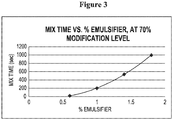
- Example 4 Mix Time Evaluation - Emulsifier Content.
- the imidazoline functionalized oxidized fatty substance emulsifier composition having 70% Oligomer component (i.e. 70% modification) prepared as described above and asphalt were mixed in an asphalt mill to obtain the respective asphalt emulsions.
- the final respective emulsions contained 0.6%, 1%, 1.4%, and 1.8% emulsifier in the total asphalt emulsion.
- compositions having increasing amounts of emulsifier having the same percentage of oligomer content exhibit predictable and increasing mix times.
- a reliable and predictable mix time can be obtained with an imidazoline functionalized oxidized fatty substance emulsifier that can be tailored to provide the desired mix time with a given class of aggregate reactivity, such as either a medium or a highly reactive reactivity aggregate.
- the terms "about” or “approximately” mean within an acceptable range for the particular parameter specified as determined by one of ordinary skill in the art, which will depend in part on how the value is measured or determined, e.g., the limitations of the sample preparation and measurement system. Examples of such limitations include preparing the sample in a wet versus a dry environment, different instruments, variations in sample height, and differing requirements in signal-to-noise ratios. For example, “about” can mean greater or lesser than the value or range of values stated by 1/10 of the stated values, but is not intended to limit any value or range of values to only this broader definition. For instance, a concentration value of about 30% means a concentration between 27% and 33%.
Landscapes
- Chemical & Material Sciences (AREA)
- Organic Chemistry (AREA)
- Polymers & Plastics (AREA)
- Health & Medical Sciences (AREA)
- Chemical Kinetics & Catalysis (AREA)
- Medicinal Chemistry (AREA)
- Engineering & Computer Science (AREA)
- Materials Engineering (AREA)
- Structural Engineering (AREA)
- Civil Engineering (AREA)
- Mechanical Engineering (AREA)
- Metallurgy (AREA)
- Fats And Perfumes (AREA)
- Organic Low-Molecular-Weight Compounds And Preparation Thereof (AREA)
- Polysaccharides And Polysaccharide Derivatives (AREA)
- Lubricants (AREA)
Claims (15)
- Verfahren zur Herstellung eines Imidazolin-funktionalisierten Emulgators für oxidierte Fettsubstanzen, umfassend die Schritte von:(a) Gewinnen einer Fettsubstanzzusammensetzung;(b) Durchführen einer oxidativen Oligomerisierung der Fettsubstanzzusammensetzung zur Herstellung einer oxidierten Fettsubstanzzusammensetzung, die 10 bis 75 Gew.-% oligomere Fettsäurekomponenten, bezogen auf das Gesamtgewicht der Fettsäure enthaltenden Komponenten in der Zusammensetzung, umfasst;(c) Umsetzen der oxidierten Fettsubstanzzusammensetzung mit einem Polyamin, das mindestens eine funktionelle Ethylendiamin-Gruppe mit mindestens drei an die beiden Stickstoffatome gebundenen Wasserstoffen umfasst, um eine Aminoethylamido-funktionalisierte oxidierte Fettsubstanzzusammensetzung zu bilden; und(d) Bilden eines Imidazolin-funktionalisierten Emulgators für oxidierte Fettsubstanzen aus der Aminoethylamido-funktionalisierten oxidierten Fettsubstanzzusammensetzung.
- Verfahren nach Anspruch 1, wobei der Schritt der oxidativen Oligomerisierung umfasst die Schritte des(b-1) Erwärmens der Fettsubstanzzusammensetzung; und(b-2) Durchleitens eines sauerstoffhaltigen Stroms durch die erwärmte Fettsubstanzzusammensetzung zur Herstellung der oxidierten Fettsubstanzzusammensetzung.
- Verfahren nach Anspruch 1, wobei die oxidierte Fettsubstanzzusammensetzung eine trimodale Molekulargewichtsverteilung der Fettsäure enthaltenden Komponenten umfasst.
- Verfahren nach Anspruch 1, wobei die oxidierte Fettsubstanzzusammensetzung eine trimodale Molekulargewichtsverteilung von Fettsäure enthaltenden Komponenten umfasst, wobei 30 bis 70 Gew.-% der Fettsäureverbindungen in der oxidierten Fettsubstanzzusammensetzung im niedrigen Molekulargewichtsbereich der trimodalen Molekulargewichtsverteilung liegen, 10 bis 30 Gew.-% der Fettsäureverbindungen in der oxidierten Fettsubstanzzusammensetzung im durchschnittlichen Molekulargewichtsbereich der trimodalen Molekulargewichtsverteilung liegen und 10 bis 65 Gew.-% der Fettsäureverbindungen in der oxidierten Fettsubstanzzusammensetzung im hohen Molekulargewichtsbereich der trimodalen Molekulargewichtsverteilung liegen.
- Verfahren nach Anspruch 1, wobei die oxidierte Fettsubstanzzusammensetzung 30 bis 70 Gew.-% Verbindungen, die eine Fettsäurekomponente aufweisen, die Monomere sind; 5 bis 20 Gew.-% Verbindungen, die eine Fettsäurekomponente aufweisen, die Dimere sind, und 5 bis 65 Gew.-% Verbindungen, die eine Fettsäurekomponente aufweisen, die drei oder mehr Mere aufweisen, bezogen auf die Gesamtmenge der Verbindungen, die eine Fettsäurekomponente in der oxidierten Fettsubstanzzusammensetzung aufweisen, umfasst.
- Verfahren nach Anspruch 5, wobei
die Monomere der oxidierten Fettsubstanzzusammensetzung ein durchschnittliches Molekulargewicht im Bereich von 200 bis 1000 (g/mol) aufweisen,
die Dimere der oxidierten Fettsubstanzzusammensetzung ein durchschnittliches Molekulargewicht im Bereich von 600 bis 2000 (g/mol) aufweisen und
die Verbindungen, die drei oder mehr Mere der oxidierten Fettsubstanzzusammensetzung aufweisen, ein durchschnittliches Molekulargewicht im Bereich von 900 bis 3000 (g/mol) aufweisen, wobei das durchschnittliche Molekulargewicht das gewichtsdurchschnittliche Molekulargewicht ist, das unter Verwendung von GPC-Spektren bestimmt wird. - Verfahren nach Anspruch 5, wobei
die Monomere der oxidierten Fettsubstanzzusammensetzung ein durchschnittliches Molekulargewicht im Bereich von 600 bis 2000 (g/mol) aufweisen,
die Dimere der oxidierten Fettsubstanzzusammensetzung ein durchschnittliches Molekulargewicht im Bereich von 1200 bis 4000 (g/mol) aufweisen und
die Verbindungen, die drei oder mehr Mere der oxidierten Fettsubstanzzusammensetzung aufweisen, ein durchschnittliches Molekulargewicht im Bereich von 1800 bis 6000 (g/mol) aufweisen, wobei das durchschnittliche Molekulargewicht das gewichtsdurchschnittliche Molekulargewicht ist, das unter Verwendung von GPC-Spektren bestimmt wird. - Verfahren nach Anspruch 5, wobei
die Monomere der oxidierten Fettsubstanzzusammensetzung ein durchschnittliches Molekulargewicht im Bereich von 900 bis 3000 (g/mol) aufweisen,
die Dimere der oxidierten Fettsubstanzzusammensetzung ein durchschnittliches Molekulargewicht im Bereich von 1800 bis 6000 (g/mol) aufweisen und
die Verbindungen, die drei oder mehr Mere der oxidierten Fettsubstanzzusammensetzung aufweisen, ein durchschnittliches Molekulargewicht im Bereich von 2100 bis 9000 (g/mol) aufweisen, wobei das durchschnittliche Molekulargewicht das gewichtsdurchschnittliche Molekulargewicht ist, das unter Verwendung von GPC-Spektren bestimmt wird. - Verfahren nach einem der Ansprüche 1-8, wobei die oxidierte Fettsubstanzzusammensetzung eine Viskosität von mindestens 40 mm2.s-1 (cSt) bei 100 °C aufweist.
- Verfahren nach einem der Ansprüche 1-8, wobei mindestens 60 Gew.-% der Verbindungen, die eine Fettsäurekomponente in der Fettsubstanzzusammensetzung aus Schritt (a) aufweisen, Verbindungen sind, die aus der Gruppe ausgewählt sind, die aus Fettsäuren oder deren Salzen und Kombinationen davon besteht.
- Verfahren nach einem der Ansprüche 1-8, wobei mindestens 60 Gew.-% der Verbindungen, die eine Fettsäurekomponente in der Fettsubstanzzusammensetzung aus Schritt (a) aufweisen, Verbindungen sind, die aus der Gruppe ausgewählt sind, die aus den Fettsäureestern, C1-C6-Alkylmonoalkoholen und Kombinationen davon besteht.
- Verfahren nach einem der Ansprüche 1-8, wobei mindestens 60 Gew.-% der Verbindungen, die eine Fettsäurekomponente in der Fettsubstanzzusammensetzung aus Schritt (a) aufweisen, Verbindungen sind, die aus der Gruppe ausgewählt sind, die aus den Mono-, Di- oder Trifettsäureestern von Glycerin und Kombinationen davon besteht.
- Verfahren nach einem der Ansprüche 1-6, wobei mindestens 60 Gew.-% der Verbindungen, die eine Fettsäurekomponente in der Fettsubstanzzusammensetzung aus Schritt (a) aufweisen, Verbindungen sind, die aus der Gruppe ausgewählt sind, die aus Fettsäurekomponenten besteht, die ein durchschnittliches Molekulargewicht im Bereich von 200 bis 1000 (g/mol) aufweisen, wobei das durchschnittliche Molekulargewicht das gewichtsdurchschnittliche Molekulargewicht ist, das unter Verwendung von GPC-Spektren bestimmt wird.
- Verfahren nach einem der Ansprüche 1-5 und 7, wobei mindestens 60 Gew.-% der Verbindungen, die eine Fettsäurekomponente in der Fettsubstanzzusammensetzung aus Schritt (a) aufweisen, Verbindungen sind, die aus der Gruppe ausgewählt sind, die aus Fettsäurekomponenten besteht, die ein durchschnittliches Molekulargewicht im Bereich von 600 bis 2000 (g/mol) aufweisen, wobei das durchschnittliche Molekulargewicht das gewichtsdurchschnittliche Molekulargewicht ist, das unter Verwendung von GPC-Spektren bestimmt wird.
- Verfahren nach einem der Ansprüche 1-5 und 7, wobei mindestens 60 Gew.-% der Verbindungen, die eine Fettsäurekomponente in der Fettsubstanzzusammensetzung aus Schritt (a) aufweisen, Verbindungen sind, die aus der Gruppe ausgewählt sind, die aus Fettsäurekomponenten besteht, die durchschnittliches Molekulargewicht im Bereich von 900 bis 3000 (g/mol) aufweisen, wobei das durchschnittliche Molekulargewicht das gewichtsdurchschnittliche Molekulargewicht ist, das unter Verwendung von GPC-Spektren bestimmt wird.
Applications Claiming Priority (2)
| Application Number | Priority Date | Filing Date | Title |
|---|---|---|---|
| US201462067776P | 2014-10-23 | 2014-10-23 | |
| PCT/US2015/057129 WO2016065270A1 (en) | 2014-10-23 | 2015-10-23 | Imidazoline functionalized oxidized fatty substance emulsifiers and methods |
Publications (3)
| Publication Number | Publication Date |
|---|---|
| EP3209701A1 EP3209701A1 (de) | 2017-08-30 |
| EP3209701A4 EP3209701A4 (de) | 2018-05-30 |
| EP3209701B1 true EP3209701B1 (de) | 2020-09-23 |
Family
ID=55761630
Family Applications (1)
| Application Number | Title | Priority Date | Filing Date |
|---|---|---|---|
| EP15853526.0A Active EP3209701B1 (de) | 2014-10-23 | 2015-10-23 | Emulgatoren von imidazolinfunktionalisierter oxidierter fettige substanz und verfahren |
Country Status (4)
| Country | Link |
|---|---|
| US (1) | US10150827B2 (de) |
| EP (1) | EP3209701B1 (de) |
| BR (1) | BR112017008303B1 (de) |
| WO (1) | WO2016065270A1 (de) |
Families Citing this family (7)
| Publication number | Priority date | Publication date | Assignee | Title |
|---|---|---|---|---|
| US10174154B2 (en) * | 2014-11-04 | 2019-01-08 | Evonik Degussa Gmbh | Amidopolyamines with enhanced gel-time for elevated temperature applications |
| CN115260775A (zh) | 2016-06-10 | 2022-11-01 | A.L.M控股公司 | 作为沥青粘合剂中的添加剂的粗甾醇 |
| WO2018031540A1 (en) | 2016-08-09 | 2018-02-15 | A.L.M Holding Company | Sterol blends as an additive in asphalt binder |
| JP7206012B2 (ja) * | 2017-02-02 | 2023-01-17 | エー.エル.エム.ホールディング カンパニー | アスファルト舗装のための、ステロール添加剤を有するビチューメン乳剤 |
| US11718756B2 (en) | 2017-10-20 | 2023-08-08 | A.L.M. Holding Company | Asphalt emulsion surface treatment containing sterol |
| US11866664B2 (en) | 2021-06-10 | 2024-01-09 | Saudi Arabian Oil Company | Green corrosion inhibitor from waste vegetable oil for oil and gas applications |
| US12565609B2 (en) * | 2024-08-12 | 2026-03-03 | Schlumberger Technology Corporation | Wellbore fluids including emulsifiers, and related methods |
Family Cites Families (8)
| Publication number | Priority date | Publication date | Assignee | Title |
|---|---|---|---|---|
| US5008382A (en) * | 1988-05-20 | 1991-04-16 | Westvaco Corporation | Cationic aqueous bituminous emulsion-aggregate slurries preparation |
| US4927669A (en) | 1988-07-15 | 1990-05-22 | Westvaco Corporation | Oil field corrosion inhibition |
| PL2221345T3 (pl) * | 2004-02-18 | 2017-03-31 | Meadwestvaco Corporation | Sposób wytwarzania kompozycji bitumicznych |
| US8071715B2 (en) | 2007-01-31 | 2011-12-06 | Georgia-Pacific Chemicals Llc | Maleated and oxidized fatty acids |
| EP2170277A1 (de) * | 2007-07-03 | 2010-04-07 | Georgia-Pacific Chemicals LLC | Chemische modifizierung von maleierten fettsäuren |
| EP2249967B1 (de) | 2008-01-31 | 2019-03-13 | Ingevity South Carolina, LLC | Oxidierte und maleierte derivatzusammensetzung |
| EP2093274B1 (de) * | 2008-02-20 | 2011-07-27 | Ceca S.A. | Bitumenhaltige Zusammensetzungen |
| FR2948944B1 (fr) * | 2009-08-04 | 2012-10-05 | Ceca Sa | Supramolecular polymer-containing bituminous composition |
-
2015
- 2015-10-23 EP EP15853526.0A patent/EP3209701B1/de active Active
- 2015-10-23 BR BR112017008303-5A patent/BR112017008303B1/pt active IP Right Grant
- 2015-10-23 WO PCT/US2015/057129 patent/WO2016065270A1/en not_active Ceased
- 2015-10-23 US US15/520,707 patent/US10150827B2/en active Active
Non-Patent Citations (1)
| Title |
|---|
| None * |
Also Published As
| Publication number | Publication date |
|---|---|
| BR112017008303A2 (pt) | 2017-12-19 |
| EP3209701A1 (de) | 2017-08-30 |
| WO2016065270A1 (en) | 2016-04-28 |
| BR112017008303B1 (pt) | 2022-02-15 |
| US20170306067A1 (en) | 2017-10-26 |
| US10150827B2 (en) | 2018-12-11 |
| EP3209701A4 (de) | 2018-05-30 |
Similar Documents
| Publication | Publication Date | Title |
|---|---|---|
| EP3209701B1 (de) | Emulgatoren von imidazolinfunktionalisierter oxidierter fettige substanz und verfahren | |
| US8071715B2 (en) | Maleated and oxidized fatty acids | |
| EP3036311B1 (de) | Verfahren zur herstellung von emulgatoren für auf öl basierende bohrflüssigkeiten | |
| EP2106423B1 (de) | Bitumenzusammensetzung mit thermoreversiblen eigenschaften | |
| Mantzaridis et al. | Rosin acid oligomers as precursors of DGEBA-free epoxy resins | |
| Ionescu et al. | Functionalized vegetable oils as precursors for polymers by thiol-ene reaction | |
| EP2370534B1 (de) | Cobaltbasiertes katalytisches trocknungsmittel für polymerbeschichtungen | |
| FI78451B (fi) | Utdrygningsolja foer anvaendning i gummi framstaelld genom dekarboxylering av harts, och foerfarande foer dekarboxylering av hartssyror. | |
| Sangermano et al. | Interpenetrated hybrid thiol-ene/epoxy UV-cured network with enhanced impact resistance | |
| CN104144963A (zh) | 具有改进的反应性的源自生物的环氧树脂 | |
| JP2002527555A (ja) | 高枝分れオリゴマー、その調製方法およびその応用 | |
| TWI794838B (zh) | 以二醯胺、官能化聚合物及蠟為主的流變添加劑 | |
| CN101798379A (zh) | 一种改性脂肪胺固化剂 | |
| CN104693418A (zh) | 一种高油脂含量的环氧树脂固化膜及其制备方法和应用 | |
| ES2334392T3 (es) | Composiciones bituminosas para la construccion de carreteras. | |
| WO2016161034A1 (en) | Wax compositions containing dimer acids and rosin oil and methods for making and using same | |
| Mehta et al. | Cyclic carbonated soyabean oil as plasticizer for PVC for replacing di-octyl phthalate | |
| Thanamongkollit | Modification of tung oil for bio-based coating | |
| Sammaiah et al. | Effect of epoxidized jatropha oil on the cure, thermal, morphological and viscoelastic properties of epoxy resins | |
| CN102417313B (zh) | 一种粉煤灰固化用表面活性剂组合物 | |
| CN108440755A (zh) | 一种不饱和超支化聚酰亚胺树脂的合成方法及其应用 | |
| CN110790981A (zh) | Pvc增塑剂及其制备方法 | |
| KR20220153517A (ko) | 회합성 레올로지 개질제 조성물 및 이의 제조 방법 |
Legal Events
| Date | Code | Title | Description |
|---|---|---|---|
| STAA | Information on the status of an ep patent application or granted ep patent |
Free format text: STATUS: THE INTERNATIONAL PUBLICATION HAS BEEN MADE |
|
| PUAI | Public reference made under article 153(3) epc to a published international application that has entered the european phase |
Free format text: ORIGINAL CODE: 0009012 |
|
| STAA | Information on the status of an ep patent application or granted ep patent |
Free format text: STATUS: REQUEST FOR EXAMINATION WAS MADE |
|
| 17P | Request for examination filed |
Effective date: 20170522 |
|
| AK | Designated contracting states |
Kind code of ref document: A1 Designated state(s): AL AT BE BG CH CY CZ DE DK EE ES FI FR GB GR HR HU IE IS IT LI LT LU LV MC MK MT NL NO PL PT RO RS SE SI SK SM TR |
|
| AX | Request for extension of the european patent |
Extension state: BA ME |
|
| DAV | Request for validation of the european patent (deleted) | ||
| DAX | Request for extension of the european patent (deleted) | ||
| REG | Reference to a national code |
Ref country code: DE Ref legal event code: R079 Ref document number: 602015059637 Country of ref document: DE Free format text: PREVIOUS MAIN CLASS: C08G0014073000 Ipc: C08L0095000000 |
|
| A4 | Supplementary search report drawn up and despatched |
Effective date: 20180504 |
|
| RIC1 | Information provided on ipc code assigned before grant |
Ipc: C08G 73/06 20060101ALI20180426BHEP Ipc: C08G 69/34 20060101ALI20180426BHEP Ipc: C08L 95/00 20060101AFI20180426BHEP |
|
| GRAP | Despatch of communication of intention to grant a patent |
Free format text: ORIGINAL CODE: EPIDOSNIGR1 |
|
| STAA | Information on the status of an ep patent application or granted ep patent |
Free format text: STATUS: GRANT OF PATENT IS INTENDED |
|
| INTG | Intention to grant announced |
Effective date: 20200506 |
|
| GRAS | Grant fee paid |
Free format text: ORIGINAL CODE: EPIDOSNIGR3 |
|
| GRAA | (expected) grant |
Free format text: ORIGINAL CODE: 0009210 |
|
| STAA | Information on the status of an ep patent application or granted ep patent |
Free format text: STATUS: THE PATENT HAS BEEN GRANTED |
|
| AK | Designated contracting states |
Kind code of ref document: B1 Designated state(s): AL AT BE BG CH CY CZ DE DK EE ES FI FR GB GR HR HU IE IS IT LI LT LU LV MC MK MT NL NO PL PT RO RS SE SI SK SM TR |
|
| REG | Reference to a national code |
Ref country code: GB Ref legal event code: FG4D |
|
| REG | Reference to a national code |
Ref country code: CH Ref legal event code: EP |
|
| REG | Reference to a national code |
Ref country code: IE Ref legal event code: FG4D |
|
| REG | Reference to a national code |
Ref country code: DE Ref legal event code: R096 Ref document number: 602015059637 Country of ref document: DE Ref country code: AT Ref legal event code: REF Ref document number: 1316372 Country of ref document: AT Kind code of ref document: T Effective date: 20201015 |
|
| REG | Reference to a national code |
Ref country code: NL Ref legal event code: FP |
|
| PG25 | Lapsed in a contracting state [announced via postgrant information from national office to epo] |
Ref country code: SE Free format text: LAPSE BECAUSE OF FAILURE TO SUBMIT A TRANSLATION OF THE DESCRIPTION OR TO PAY THE FEE WITHIN THE PRESCRIBED TIME-LIMIT Effective date: 20200923 Ref country code: BG Free format text: LAPSE BECAUSE OF FAILURE TO SUBMIT A TRANSLATION OF THE DESCRIPTION OR TO PAY THE FEE WITHIN THE PRESCRIBED TIME-LIMIT Effective date: 20201223 Ref country code: GR Free format text: LAPSE BECAUSE OF FAILURE TO SUBMIT A TRANSLATION OF THE DESCRIPTION OR TO PAY THE FEE WITHIN THE PRESCRIBED TIME-LIMIT Effective date: 20201224 Ref country code: NO Free format text: LAPSE BECAUSE OF FAILURE TO SUBMIT A TRANSLATION OF THE DESCRIPTION OR TO PAY THE FEE WITHIN THE PRESCRIBED TIME-LIMIT Effective date: 20201223 Ref country code: FI Free format text: LAPSE BECAUSE OF FAILURE TO SUBMIT A TRANSLATION OF THE DESCRIPTION OR TO PAY THE FEE WITHIN THE PRESCRIBED TIME-LIMIT Effective date: 20200923 Ref country code: HR Free format text: LAPSE BECAUSE OF FAILURE TO SUBMIT A TRANSLATION OF THE DESCRIPTION OR TO PAY THE FEE WITHIN THE PRESCRIBED TIME-LIMIT Effective date: 20200923 |
|
| REG | Reference to a national code |
Ref country code: AT Ref legal event code: MK05 Ref document number: 1316372 Country of ref document: AT Kind code of ref document: T Effective date: 20200923 |
|
| PG25 | Lapsed in a contracting state [announced via postgrant information from national office to epo] |
Ref country code: LV Free format text: LAPSE BECAUSE OF FAILURE TO SUBMIT A TRANSLATION OF THE DESCRIPTION OR TO PAY THE FEE WITHIN THE PRESCRIBED TIME-LIMIT Effective date: 20200923 Ref country code: RS Free format text: LAPSE BECAUSE OF FAILURE TO SUBMIT A TRANSLATION OF THE DESCRIPTION OR TO PAY THE FEE WITHIN THE PRESCRIBED TIME-LIMIT Effective date: 20200923 |
|
| REG | Reference to a national code |
Ref country code: LT Ref legal event code: MG4D |
|
| PG25 | Lapsed in a contracting state [announced via postgrant information from national office to epo] |
Ref country code: RO Free format text: LAPSE BECAUSE OF FAILURE TO SUBMIT A TRANSLATION OF THE DESCRIPTION OR TO PAY THE FEE WITHIN THE PRESCRIBED TIME-LIMIT Effective date: 20200923 Ref country code: SM Free format text: LAPSE BECAUSE OF FAILURE TO SUBMIT A TRANSLATION OF THE DESCRIPTION OR TO PAY THE FEE WITHIN THE PRESCRIBED TIME-LIMIT Effective date: 20200923 Ref country code: PT Free format text: LAPSE BECAUSE OF FAILURE TO SUBMIT A TRANSLATION OF THE DESCRIPTION OR TO PAY THE FEE WITHIN THE PRESCRIBED TIME-LIMIT Effective date: 20210125 Ref country code: EE Free format text: LAPSE BECAUSE OF FAILURE TO SUBMIT A TRANSLATION OF THE DESCRIPTION OR TO PAY THE FEE WITHIN THE PRESCRIBED TIME-LIMIT Effective date: 20200923 Ref country code: LT Free format text: LAPSE BECAUSE OF FAILURE TO SUBMIT A TRANSLATION OF THE DESCRIPTION OR TO PAY THE FEE WITHIN THE PRESCRIBED TIME-LIMIT Effective date: 20200923 Ref country code: CZ Free format text: LAPSE BECAUSE OF FAILURE TO SUBMIT A TRANSLATION OF THE DESCRIPTION OR TO PAY THE FEE WITHIN THE PRESCRIBED TIME-LIMIT Effective date: 20200923 |
|
| PG25 | Lapsed in a contracting state [announced via postgrant information from national office to epo] |
Ref country code: AT Free format text: LAPSE BECAUSE OF FAILURE TO SUBMIT A TRANSLATION OF THE DESCRIPTION OR TO PAY THE FEE WITHIN THE PRESCRIBED TIME-LIMIT Effective date: 20200923 Ref country code: AL Free format text: LAPSE BECAUSE OF FAILURE TO SUBMIT A TRANSLATION OF THE DESCRIPTION OR TO PAY THE FEE WITHIN THE PRESCRIBED TIME-LIMIT Effective date: 20200923 Ref country code: ES Free format text: LAPSE BECAUSE OF FAILURE TO SUBMIT A TRANSLATION OF THE DESCRIPTION OR TO PAY THE FEE WITHIN THE PRESCRIBED TIME-LIMIT Effective date: 20200923 Ref country code: PL Free format text: LAPSE BECAUSE OF FAILURE TO SUBMIT A TRANSLATION OF THE DESCRIPTION OR TO PAY THE FEE WITHIN THE PRESCRIBED TIME-LIMIT Effective date: 20200923 Ref country code: IS Free format text: LAPSE BECAUSE OF FAILURE TO SUBMIT A TRANSLATION OF THE DESCRIPTION OR TO PAY THE FEE WITHIN THE PRESCRIBED TIME-LIMIT Effective date: 20210123 |
|
| REG | Reference to a national code |
Ref country code: CH Ref legal event code: PL |
|
| REG | Reference to a national code |
Ref country code: DE Ref legal event code: R097 Ref document number: 602015059637 Country of ref document: DE |
|
| PG25 | Lapsed in a contracting state [announced via postgrant information from national office to epo] |
Ref country code: LU Free format text: LAPSE BECAUSE OF NON-PAYMENT OF DUE FEES Effective date: 20201023 Ref country code: SK Free format text: LAPSE BECAUSE OF FAILURE TO SUBMIT A TRANSLATION OF THE DESCRIPTION OR TO PAY THE FEE WITHIN THE PRESCRIBED TIME-LIMIT Effective date: 20200923 Ref country code: MC Free format text: LAPSE BECAUSE OF FAILURE TO SUBMIT A TRANSLATION OF THE DESCRIPTION OR TO PAY THE FEE WITHIN THE PRESCRIBED TIME-LIMIT Effective date: 20200923 |
|
| REG | Reference to a national code |
Ref country code: BE Ref legal event code: MM Effective date: 20201031 |
|
| PLBE | No opposition filed within time limit |
Free format text: ORIGINAL CODE: 0009261 |
|
| STAA | Information on the status of an ep patent application or granted ep patent |
Free format text: STATUS: NO OPPOSITION FILED WITHIN TIME LIMIT |
|
| PG25 | Lapsed in a contracting state [announced via postgrant information from national office to epo] |
Ref country code: DK Free format text: LAPSE BECAUSE OF FAILURE TO SUBMIT A TRANSLATION OF THE DESCRIPTION OR TO PAY THE FEE WITHIN THE PRESCRIBED TIME-LIMIT Effective date: 20200923 Ref country code: CH Free format text: LAPSE BECAUSE OF NON-PAYMENT OF DUE FEES Effective date: 20201031 Ref country code: BE Free format text: LAPSE BECAUSE OF NON-PAYMENT OF DUE FEES Effective date: 20201031 Ref country code: LI Free format text: LAPSE BECAUSE OF NON-PAYMENT OF DUE FEES Effective date: 20201031 Ref country code: SI Free format text: LAPSE BECAUSE OF FAILURE TO SUBMIT A TRANSLATION OF THE DESCRIPTION OR TO PAY THE FEE WITHIN THE PRESCRIBED TIME-LIMIT Effective date: 20200923 |
|
| 26N | No opposition filed |
Effective date: 20210624 |
|
| PG25 | Lapsed in a contracting state [announced via postgrant information from national office to epo] |
Ref country code: IT Free format text: LAPSE BECAUSE OF FAILURE TO SUBMIT A TRANSLATION OF THE DESCRIPTION OR TO PAY THE FEE WITHIN THE PRESCRIBED TIME-LIMIT Effective date: 20200923 Ref country code: IE Free format text: LAPSE BECAUSE OF NON-PAYMENT OF DUE FEES Effective date: 20201023 |
|
| PG25 | Lapsed in a contracting state [announced via postgrant information from national office to epo] |
Ref country code: TR Free format text: LAPSE BECAUSE OF FAILURE TO SUBMIT A TRANSLATION OF THE DESCRIPTION OR TO PAY THE FEE WITHIN THE PRESCRIBED TIME-LIMIT Effective date: 20200923 Ref country code: MT Free format text: LAPSE BECAUSE OF FAILURE TO SUBMIT A TRANSLATION OF THE DESCRIPTION OR TO PAY THE FEE WITHIN THE PRESCRIBED TIME-LIMIT Effective date: 20200923 Ref country code: CY Free format text: LAPSE BECAUSE OF FAILURE TO SUBMIT A TRANSLATION OF THE DESCRIPTION OR TO PAY THE FEE WITHIN THE PRESCRIBED TIME-LIMIT Effective date: 20200923 |
|
| PG25 | Lapsed in a contracting state [announced via postgrant information from national office to epo] |
Ref country code: MK Free format text: LAPSE BECAUSE OF FAILURE TO SUBMIT A TRANSLATION OF THE DESCRIPTION OR TO PAY THE FEE WITHIN THE PRESCRIBED TIME-LIMIT Effective date: 20200923 |
|
| P01 | Opt-out of the competence of the unified patent court (upc) registered |
Effective date: 20230522 |
|
| PGFP | Annual fee paid to national office [announced via postgrant information from national office to epo] |
Ref country code: NL Payment date: 20250923 Year of fee payment: 11 |
|
| PGFP | Annual fee paid to national office [announced via postgrant information from national office to epo] |
Ref country code: GB Payment date: 20250923 Year of fee payment: 11 |
|
| PGFP | Annual fee paid to national office [announced via postgrant information from national office to epo] |
Ref country code: FR Payment date: 20250924 Year of fee payment: 11 |
|
| PGFP | Annual fee paid to national office [announced via postgrant information from national office to epo] |
Ref country code: DE Payment date: 20250923 Year of fee payment: 11 |