EP3209781B1 - Modifizierte vorlagenunabhängige enzyme zur polydeoxynukleotidsynthese - Google Patents
Modifizierte vorlagenunabhängige enzyme zur polydeoxynukleotidsynthese Download PDFInfo
- Publication number
- EP3209781B1 EP3209781B1 EP15851895.1A EP15851895A EP3209781B1 EP 3209781 B1 EP3209781 B1 EP 3209781B1 EP 15851895 A EP15851895 A EP 15851895A EP 3209781 B1 EP3209781 B1 EP 3209781B1
- Authority
- EP
- European Patent Office
- Prior art keywords
- tdt
- seq
- modified
- azidomethyl
- terminus
- Prior art date
- Legal status (The legal status is an assumption and is not a legal conclusion. Google has not performed a legal analysis and makes no representation as to the accuracy of the status listed.)
- Active
Links
Images



Classifications
-
- C—CHEMISTRY; METALLURGY
- C12—BIOCHEMISTRY; BEER; SPIRITS; WINE; VINEGAR; MICROBIOLOGY; ENZYMOLOGY; MUTATION OR GENETIC ENGINEERING
- C12N—MICROORGANISMS OR ENZYMES; COMPOSITIONS THEREOF; PROPAGATING, PRESERVING, OR MAINTAINING MICROORGANISMS; MUTATION OR GENETIC ENGINEERING; CULTURE MEDIA
- C12N9/00—Enzymes; Proenzymes; Compositions thereof; Processes for preparing, activating, inhibiting, separating or purifying enzymes
- C12N9/10—Transferases (2.)
- C12N9/12—Transferases (2.) transferring phosphorus containing groups, e.g. kinases (2.7)
- C12N9/1241—Nucleotidyltransferases (2.7.7)
- C12N9/1264—DNA nucleotidylexotransferase (2.7.7.31), i.e. terminal nucleotidyl transferase
-
- C—CHEMISTRY; METALLURGY
- C12—BIOCHEMISTRY; BEER; SPIRITS; WINE; VINEGAR; MICROBIOLOGY; ENZYMOLOGY; MUTATION OR GENETIC ENGINEERING
- C12P—FERMENTATION OR ENZYME-USING PROCESSES TO SYNTHESISE A DESIRED CHEMICAL COMPOUND OR COMPOSITION OR TO SEPARATE OPTICAL ISOMERS FROM A RACEMIC MIXTURE
- C12P19/00—Preparation of compounds containing saccharide radicals
- C12P19/26—Preparation of nitrogen-containing carbohydrates
- C12P19/28—N-glycosides
- C12P19/30—Nucleotides
- C12P19/34—Polynucleotides, e.g. nucleic acids, oligoribonucleotides
-
- C—CHEMISTRY; METALLURGY
- C12—BIOCHEMISTRY; BEER; SPIRITS; WINE; VINEGAR; MICROBIOLOGY; ENZYMOLOGY; MUTATION OR GENETIC ENGINEERING
- C12Y—ENZYMES
- C12Y207/00—Transferases transferring phosphorus-containing groups (2.7)
- C12Y207/07—Nucleotidyltransferases (2.7.7)
- C12Y207/07031—DNA nucleotidylexotransferase (2.7.7.31), i.e. terminal deoxynucleotidyl transferase
Definitions
- the invention relates to modified enzymes for de novo synthesis of polynucleotides with a desired sequence, and without the use of a template.
- the invention provides the capability to make libraries of polynucleotides of varying sequence and varying length for research, genetic engineering, and gene therapy.
- nucleic acid sequences are synthesized using solid phase phosphoramidite-techniques developed more than 30 years ago.
- the technique involves the sequential deprotection and synthesis of sequences built from phosphoramidite reagents corresponding to natural (or non-natural) nucleic acid bases.
- Phosphoramidite nucleic acid synthesis is length-limited, however, in that nucleic acids greater than 200 base pairs (bp) in length experience high rates of breakage and side reactions.
- phosphoramidite synthesis produces toxic byproducts, and the disposal of this waste limits the availability of nucleic acid synthesizers, and increases the costs of contract oligo production.
- the invention discloses modified terminal deoxynucleotidyl transferase (TdT) enzymes according to the claims, that can be used for de novo sequencing of oligonucleotides in the absence of a template.
- TdT modified terminal deoxynucleotidyl transferase
- Methods for creating a template-independent polymerase through a combination of computational guidance and saturation mutagenesis, with a subsequent screen to identify functional mutants are also disclosed.
- the modified TdTs will include a mutation in the TGSR motif, which interact with the nucleotide during synthesis.
- the methods can be used to create template-independent transferases that can synthesize custom oligos in a stepwise fashion using modified 3' hydroxyl-blocked nucleotides. Because of the terminating group, synthesis pauses with the addition of each new base, whereupon the terminating group is cleaved, leaving a polynucleotide that is essentially identical to a naturally occurring nucleotide (i.e., is recognized by the enzyme as a substrate for further nucleotide incorporation).
- the enzymes of the invention represent an important step forward in synthetic biology because the enzymes will allow for aqueous phase, template-independent oligonucleotide synthesis. Such methods represent an improvement over the prior art in that they will greatly reduce the chemical waste produced during oligonucleotide synthesis while allowing for the production of longer polynucleotides. Furthermore, because the methods replace a chemical process with a biological one, costs will be reduced, and the complexity of automated synthetic systems will also be reduced. In an embodiment, a simple five-reagent delivery system can be used to build oligonucleotides in a stepwise fashion, and will enable recycling of unused reagents.
- the invention facilitates the synthesis of polynucleotides, such as DNA, by providing modified enzymes that can be used with nucleic acid analogs.
- modified enzymes that can be used with nucleic acid analogs.
- TdT template-independent terminal deoxynucleotidyl transferase
- the enzymes of the invention lend themselves to aqueous-based, enzyme-mediated methods of synthesizing polynucleotides of a predetermined sequence on a solid support.
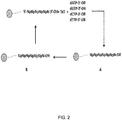
- the modified enzymes of the invention will allow 3'-O-blocked dNTP analogs to be used in a step-by-step method to extend an initiating nucleic acid into a user defined sequence (see Figure 2 ). Furthermore, after each nucleotide extension step, the reactants can be recovered and recycled from the solid support back to the original reagent reservoir. Once that step is complete, the 3'-O-blocking group will be removed, allowing the cycle to start anew. At the conclusion of n cycles of extension-recover-deblock-wash, the full length, single strand polydeoxynucleotide will be cleaved from the solid support and isolated for subsequent use.
- 3'-O-blocked deoxynucleotides may be used, but the choice of specific 3'-O-blocking groups is dictated by: 1) the smallest possible bulk to maximize substrate utilization by TdT and 2) removal of the blocking group with the mildest and preferably aqueous conditions in the shortest period of time.
- Cost savings by this approach will be achieved by exploiting the higher yield of final oligonucleotide product at a lower starting scale than currently being used as the existing industry standard (i.e., less than 1 nanomole).
- Future adaptation of this enzymatic approach to array based formats will allow even further and more dramatic reductions in the cost of synthesis of long oligonucleotides achievable by highly parallel synthesis.
- the enzymatic synthesis process that we propose uses only aqueous based chemistries like buffers and salts, thus greatly reducing the environmental burden of the organic waste generated by the existing phosphoramidite method.
- TdT terminal deoxynucleotidyl transferases
- other enzymes could be modified with similar methods.
- TdT is likely to be a successful starting enzyme because it is capable of 3'- extension activity using single strand initiating primers in a template-independent polymerization.
- 3'-O-blocked nucleotides being incorporated into single-stranded oligonucleotide by an enzyme in the absence of a template.
- substitution of the 3'-hydroxyl group results in complete inactivity of available transferase enzymes. See Chang and Bollum, "Molecular Biology of Terminal Transferase, CRC Critical Reviews in Biochemistry, vol. 21 (1), p. 27-52 (1986 ).
- FIG. 1 shows an agarose gel of a solution phase polymerization reaction composed of terminal deoxynucleotidyl transferase (TdT), deoxyadenosine triphosphate (dATP) and fluorescent strand initiator 5'-Cy5-dA10 at different time points.
- TdT terminal deoxynucleotidyl transferase
- dATP deoxyadenosine triphosphate
- fluorescent strand initiator 5'-Cy5-dA10 fluorescent strand initiator 5'-Cy5-dA10 at different time points.
- TdT can extend primers in a near quantitative manner resulting in the addition of thousands of nucleotides, while TdT is likely to accept a wide variety of modified and substituted dNTPs as efficient substrates. Furthermore, a substantial library of mechanistic and structural information regarding TdT already exists. See Delarue et al., EMBO J. 2002;21(3):427-39 ; Gouge et al., J Mol Biol. 2013 Nov 15;425(22):4334-52 and Romain et al., Nucleic Acids Res. 2009;37(14):4642-56 .
- TdT can use substrates having modifications and/or substitutions at the deoxyribose sugar ring as well as the purine/pyrimidine nucleobases.
- TdT accepts bulky modifications at the C5 of pyrimidines and the C7 of purines. See Sorensen et al., "Enzymatic Ligation of Large Biomolecules to DNA," ACS Nano 2013, 7(9):8098-104 ; Figeys et al., Anal. Chem. 1994, 66(23):4382-3 ; Li et al., Cytometry, 1995, 20(2):172-80 .
- TdT can even accept non-nucleotide triphosphates. See Barone et al., Nucleotides and Nucleic Acids 2001, 20(4-7):1141-5 , and Alexandrova et al., Bioconjug Chem., 2007, 18(3):886-93 , both of which are incorporated by reference in their entireties. However, there is little evidence in the prior art that TdT can accept 3'-O-blocked nucleotides. See, for example, Knapp et al., Chem. Eur. J., 2011, 17:2903 .
- TdT Native TdT is a very efficient enzyme. It has been demonstrated that TdT can polymerize extremely long homopolydeoxynucleotides of 1000 to 10,000 nucleotides in length (see Hoard et al., J of Biol Chem, 1969 244(19):5363-73 ; Bollum, The Enzymes, Volume 10, New York: Academic Press; 1974. p. 141-71 ; Tjong et al., Anal Chem, 2011, 83:5153-59 .
- Random sequence oligomers consisting of all four nucleotides have also been polymerized by TdT, however there are no reports of ordered polynucleotides being synthesized in the absence of a template. See Damiani, et al., Nucleic Acids Res, 1982, 10(20):6401-10 . Support-bound synthesis of polynucleotides by TdT is additionally supported by reports of homopolymer synthesis of 150 bps initiators covalently attached to self-assembled monolayers on gold surfaces. See Chow et al., J Am Chem Soc 2005; 127:14122-3 , and Chow and chilikoti, Langmuir 2007, 23:11712-7 .
- TdT of dATP>dTTP>>dGTP ⁇ dCTP for incorporation of homopolymers.
- Tjong et al. demonstrated the TdT mediated synthesis of long (>1 Kb) homopolymer ssDNA from initiator primers immobilized on glass surfaces.
- TdT The distributive behavior of TdT is reinforced by Figure 3 , which shows a time course of a solution phase synthesis of 1-1.5 kb homopolymers.
- the enzyme dissociates, thus allowing the random extension of any strand in the population.
- the distribution of product lengths in such a system should follow a Poisson distribution, as reported by Bollum and co-workers in 1974. If TdT were used with a terminating nucleotide species, i.e., one with the 3'-O-position blocked, the reaction should proceed to completion, resulting not in a distribution of product lengths, but essentially a pure product of a single nucleotide addition.
- FIG. 3 shows a gel shift assay used to monitor the solution phase incorporation kinetics of 3'-O-azidomethyl dATP and 3'-O-azidomethyl dCTP using a commercially-available, recombinant TdT.
- the data in FIG. 3 clearly show that neither 3'-O-modified dNTP analog is a substrate for TdT, i.e., there is no polynucleotide extension when compared to reactions containing dATP as a positive control (lanes 12 thru 15).
- FIG. 3 thus, adds further evidence that commercially-available TdTs are not able to synthesize oligomers by incorporating dNTPs with modified 3'-OHs.
- 3'-O-blocked dNTP analogs will be suitable for the controlled addition of nucleotides by TdT.
- Modified 3'-O-blocked dNTP analogs include, but are not limited to, the 3'-O-allyl, 3'-O-azidomethyl, 3'-O-NH 2 , and 3'-OCH 2 CN blocking groups.
- the choice of the 3'-O-blocking group will dictated by: 1) the smallest possible bulk to maximize substrate utilization by TdT, which is likely to affect kinetic uptake, and 2) the blocking group with the mildest removal conditions, preferably aqueous, and in the shortest period of time.
- 3'-O-blocking groups that are the suitable for use with this invention are described in WO 2003/048387 ; WO 2004/018497 ; WO 1996/023807 ; WO 2008/037568 ; Hutter D, et al. Nucleosides Nucleotides Nucleic Acids, 2010, 29(11): 879-95 ; and Knapp et al., Chem. Eur. J., 2011, 17:2903 .
- FIG. 4 shows the docking of a 3'-O-allyl-dATP (shown in green) with murine TdT (see SEQ ID NO. 9, below) using the PDB crystal structure 1KDH and AutoDock 4.2 (Molecular Graphics Laboratory, Scripps Research Institute, La Jolla, CA).
- Figure 4 also shows a dATP with an unmodified 3'-OH (white) superimposed on the 3'-O-allyl-dATP.
- the phosphate portions of the dATPs are in complex with the catalytic metal ions (pink) while the alpha phosphate is positioned to be attacked by the 3'-OH of the bound oligonucleotide initiator (black dotted line).
- the model shown in FIG. 4 predicts that there is sufficient room for the 3'-allyl-dNTP to interact with TdT in a catalytically productive conformation, but larger protecting groups at this position will likely prevent catalytically-productive binding of such modified dNTP analogs.
- Arg336 is near the reaction center in the active site, Arg 336 is highly conserved, and early studies found that replacement of Arg336 with Gly or Ala reduced dNTP activity by 10-fold ( Yang B et al. J. Mol. Biol. 1994; 269(16):11859-68 ). Accordingly, one motif for modification is the GGFRR motif including Arg 336 in the above structural model.
- sequence analysis of the TdT family demonstrates a wide range of amino acids that can be accommodated at position 454. This analysis suggests structural flexibility at position 454, and surrounding residues. Additionally, it is thought that Gly452 and Ser453 exist in a cis-peptide bond conformation (see Delarue et al., EMBO J., 2002; 21(3):427-39 ) and that the guanidinium group of Arg336 assists in the stabilization of this conformation. The stability provided by Arg336 may help explain why substitutions at this position have a negative impact on the reactivity of modified TdT proteins.
- the instability created by modifying position 336 may be overcome by using proline residues to stabilize cis-peptide bond conformation.
- Arg336 is substituted, e.g., with alanine or glycine, the entire TGSR motif (positions 451, 452, 453, 454) may also have to be modified to compensate for this change.
- the TGSR motif may be modified to TPSR or TGPR. Accordingly, the TGSR motif, including Gly452 in the above structural model was targeted for modification.
- substitutions at Arg454 to accommodate the steric bulk of a 3'-O-blocking group may require additional modifications to the ⁇ 14 region to compensate for substitutions of glycine or alanine at Arg454.
- substitutions to other residues in the ⁇ 11 region may be required to compensate for substitution to Arg336 either instead of, or in addition to, modification of the TGSR motif.
- FIG. 5 shows a model of a catalytically-productive, docked 3'-O-allyl modified dATP and its interactions with residues such as Gly332, Gly333, Gly452, Thr451 and Ser453 of murine TdT. Each of these residues is within 0.6nm of the 3'-OH of a typical dNTP.
- residues are also potential targets for substitution to allow the extra steric bulk of a 3'-blocking group like 3'-O-azidomethyl or 3'-O-allyl.
- Residues that are within 1.2 nm of the 3'-OH such as Glu457, Ala510, Asp509, Arg508, Lys199, Ser196 Met192, or Leu161 may also potentially interfere with the substrate utilization of a 3'-O-blocked dNTP and are thus targets for substitution in addition to or in combination with Arg336 and Arg454.
- residues may need to be altered are Val 436, Trp450, Ser453, Phe456, Glu491, Phe495.
- residues that may need to be altered are Val 436, Trp450, Ser453, Phe456, Glu491, Phe495.
- the following changes may be required: Arg454Ala, Arg454Gly, Trp450Gly, Trp450A, Thr451Gly, Thr451Ala, Glu491Asp, Ser453Ala, Ser453Gly, Trp450His, Trp450Tyr, Trp450Phe.
- TdTs include the GGFRR and TGSR motifs.
- GGFRR and TGSR motifs have been bolded and underlined for easy reference.
- Native calf thymus TdT is a candidate for alteration of the primary structure to achieve a suitable template-independent polymerase.
- a variety of other proteins may be explored to identify a candidate suitable for the use with 3'-O-blocked dNTP analogs, including human and murine TdT.
- the amino acid sequence corresponding to native calf TdT is listed in Table 1 as SEQ ID NO. 1, while the nucleic acid sequence is listed in Table 2 as SEQ ID NO. 2.
- the resulting protein adapted for sequence-specific de novo polynucleotide synthesis with 3'-O-modified dNTPs and NTPs, will be at least 90% identical, i.e., at least 93% identical, i.e., at least 95% identical, i.e., at least 97% identical, i.e., at least 98% identical, i.e., at least 99% identical, with SEQ ID NO. 1.
- Furthemore it may be possible to truncate portions of the amino acid sequence of bovine TdT and still maintain catalytic activity.
- N-terminal His tag sequence to the recombinant protein (see Boule J-B et al., Molecular Biotechnology, 1998;10:199-208 ), which is used in combination with an affinity column (Hitrap, Amersham Pharmacia Biotech, Uppsala, Sweden).
- affinity column Hitrap, Amersham Pharmacia Biotech, Uppsala, Sweden.
- N-terminal truncated forms of the enzyme with appended His-tag sequence will work with the current invention (see, e.g., US 7,494,797 ).
- the resulting protein adapted for sequence-specific de novo polynucleotide synthesis with 3'-O-modified dNTPs and NTPs, will be at least 85% identical, i.e., at least 90% identical, i.e., at least 93% identical, i.e., at least 95% identical, i.e., at least 97% identical, i.e., at least 98% identical, i.e., at least 99% identical, with SEQ ID NOS. 3, 5, or 7.
- 3'-O-modified dNTPs and NTPs may be used with the disclosed proteins for de novo synthesis.
- the preferred removable 3'-O-blocking group is a 3'-O-amino, a 3'-O-allyl or a 3'-O-azidomethyl.
- the removable 3'-O-blocking moiety is selected from the group consisting of O-phenoxyacetyl; O-methoxyacetyl; O-acetyl; O-(p-toluene)-sulfonate; O-phosphate; O-nitrate; O-[4-methoxy]-tetrahydrothiopyranyl; O-tetrahydrothiopyranyl; O-[5-methyl]-tetrahydrofuranyl; O-[2-methyl,4-methoxy]-tetrahydropyranyl; O-[5-methyl]-tetrahydropyranyl; and O-tetrahydrothiofuranyl (see US 8,133,669 ).
- the removable blocking moiety is selected from the group consisting of esters, ethers, carbonitriles, phosphates, carbonates, carbamates, hydroxylamine, borates, nitrates, sugars, phosphoramide, phosphoramidates, phenylsulfenates, sulfates, sulfones and amino acids (see Metzker ML et al. Nuc Acids Res. 1994;22(20):4259-67 , U.S.P.N. 5,763,594 , 6,232,465 , 7,414,116 ; and 7,279,563 ).
- FIG. 6 shows four exemplary 3'-O-blocked dNTP analogs, namely 3'-O-azidomethyl-dATP, 3'-O-azidomethyl-dCTP, 3'-O-azidomethyl-dGTP, and 3'-O-azidomethyl-dTTP.
- the synthesis of each 3'-O-azidomethyl analog is described below and detailed in FIGS. 7-10 .
- the 3'-O-blocked dNTP analogs can also be purchased from specialty suppliers, such as Azco Biotech, Oceanside, CA. It is to be understood that corresponding 3'-O-blocked ribonucleotides can be formed with similar synthetic methods to enable the creation of custom RNA oligos.
- N 6 -Benzoyl-3'-O-(methylthiomethyl)-5'-O-(tert-butyldimethylsilyl)-2'-deoxyadenosine shown as compound 1 in FIG. 7 ) as a white powder (2.4 g; 71% yield).
- 400 mg of N 6 -Benzoyl-3'-O-(methylthiomethyl)-5'-O-(tert-butyldimethylsilyl)-2'-deoxyadenosine was dissolved in dry CH 2 Cl 2 (7ml) under nitrogen to create a solution (0.76 mmol).
- N 6 -Benzoyl-3'-O-(azidomethyl)-2'-deoxyadenosine (123 mg; 0.3 mmol) and a proton sponge (75.8 mg; 0.35 mmol) were then dried in a vacuum desiccator over P 2 O 5 overnight before dissolving in trimethyl phosphate (600 ⁇ l).
- POCl 3 40 ⁇ l; 0.35 mmol was added dropwise at 0°C and the mixture was stirred at 0°C for 2 h.
- the crude mixture was then purified with anion exchange chromatography on DEAE-Sephadex A-25 at 4°C using a gradient of TEAB (pH 8.0; 0.1-1.0 M).
- the crude product was purified with reverse-phase HPLC to produce 3'-O-azidomethyl-dATP ( FIG. 7 , compound 3), a nucleotide analog to be used for later synthesis.
- 3'-O-azidomethyl-dTTP Acetic acid (4.8 ml) and acetic anhydride (15.4 ml) were added to a stirred solution of 5'-O-(tertbutyldimethylsilyl)thymidine (2.0 g; 5.6 mmol) [CNH Technologies, Woburn, MA] in DMSO. The reaction mixture was stirred at room temperature for 48 h. A saturated NaHCO 3 solution (100 ml) was added, and the aqueous layer was extracted with ethyl acetate (3x100 ml). The combined organic extract was washed with a saturated solution of NaHCO 3 and dried over Na 2 SO 4 .
- Triethyl ammonium bicarbonate solution (TEAB) (0.1 M; pH 8.0; 15 ml) was then added, and the mixture was stirred for 1 hour at room temperature. Subsequently, concentrated NH 4 OH (15 ml) was added and stirred overnight at room temperature. The resulting mixture was concentrated under vacuum and the residue was diluted with 5 ml of water. The crude mixture was then purified with anion exchange chromatography on DEAE-Sephadex A-25 at 4°C using a gradient of TEAB (pH 8.0; 0.1-1.0 M). The crude product was purified with reverse-phase HPLC to produce 3'-O-azidomethyl-dTTP ( FIG. 8 , compound 6), a nucleotide analog to be used for later synthesis.
- TEAB Triethyl ammonium bicarbonate solution
- the reaction mixture was dispersed in distilled water (50 ml) and extracted with CH 2 Cl 2 (3x50 ml). The combined organic extract was dried over Na 2 SO 4 and concentrated under reduced pressure. The residue was dissolved in MeOH (5 ml) and reacted with NH 4 F (600 mg; 16.2 mmol) at room temperature for 24 h. The solvent was removed under reduced pressure. The resulting residue was suspended in water (50 ml) and extracted with CH 2 Cl 2 (3x50 ml). The combined organic extract was dried over Na 2 SO 4 and concentrated under reduced pressure.
- N 4 -Benzoyl-3'-O-(azidomethyl)-2'-deoxycytidine ( FIG. 9 , compound 8) as a white powder (200 mg; 50% yield).
- N 4 -Benzoyl-3'-O-(azidomethyl)-2'-deoxycytidine and a proton sponge (0.35 mmol) were dried in a vacuum desiccator over P 2 O 5 overnight before dissolving in trimethyl phosphate (600 ⁇ l).
- the resulting mixture was concentrated under vacuum and the residue was diluted with 5 ml of water.
- the crude mixture was then purified with anion exchange chromatography on DEAE-Sephadex A-25 at 4°C using a gradient of TEAB (pH 8.0; 0.1-1.0 M).
- the crude product was purified with reverse-phase HPLC to produce 3'-O-azidomethyl-dCTP ( FIG. 9 , compound 9), a nucleotide analog to be used for later synthesis.
- N 2 -Isobutyryl-3'-O-(methylthiomethyl)-5'-O-(tert-butyldimethylsilyl)-2'-deoxyguanosine was subsequently added to dry pyridine (22 ml; 2.0 mmol) along with diphenylcarbamoyl chloride (677 mg; 2.92 mmol) and DIEA (N,N-diisopropylethylamine; SIGMA) (1.02 ml; 5.9 mmol).
- SIGMA N,N-diisopropylethylamine
- N 2 -Isobutyryl-O 6 -(diphenylcarbamoyl)-3'-O-(methylthiomethyl)-5'-O-(tert-butyldimethylsilyl)-2'-deoxyguanosine was then dissolved in dry CH 2 Cl 2 (1.1 mmol) and stirred under nitrogen atmosphere at 0°C for 1.5 h. The solvent was removed under reduced pressure and then under high vacuum for 10 min. The resulting residue was dissolved in dry DMF (5 ml) and reacted with NaN 3 (600 mg; 10 mmol) at room temperature for 3 h. The reaction mixture was then dispersed in distilled water (50 ml) and extracted with CH 2 Cl 2 (3x50 ml).
- the crude mixture was then purified with anion exchange chromatography on DEAE-Sephadex A-25 at 4°C using a gradient of TEAB (pH 8.0; 0.1-1.0 M).
- the crude product was purified with reverse-phase HPLC to produce 3'-O-azidomethyl-dGTP ( FIG. 10 , compound 13), a nucleotide analog to be used for later synthesis.
- the 3'-O-blocking group can be removed with a palladium catalyst in neutral aqueous solution at elevated temperature hydrochloric acid to pH 2, a reducing agent such as mercaptoethanol, or by the addition of tris-(2-carboxyethyl) phosphine. See, e.g., U.S.P.N. 6,664,079 ; Meng, et al. J. Org.
- the 3'-substitution group may be removed by UV irradiation (see, e.g., WO 92/10587 ).
- the removal of the 3'-O-blocking group does not include chemical cleavage but uses a cleaving enzyme such as alkaline phosphatase.
- Automated MALDI-TOF instruments are capable of analyzing hundreds of samples per hour, and can readily detect and differentiate the anticipated mass gain of 304.26 - 329.27 Da from one of the four nucleotide terminators.
- MALDI-TOF analysis of oligonucleotides is typically performed in negative-ion mode, to allow for higher sensitivity, higher resolution, and lower fragmentation compared to positive-ion mode.
- PA polyacrylamide
- the resulting plasmid library is amplified by DH5 ⁇ culture in LB media with ampicillin and extracted for subsequent transformation in the E.coli BL21(DE3) expression strain. Each BL21 clone is assigned to one well of a 96-well plate. Sequence identity of the modified TdT gene is verified with standard DNA sequencing. After induction of TdT expression, cells are harvested and lysed. His-tagged TdT are captured from the lysate using a His tag purification resin. The captured protein is eluted from the resin with imidazole and dialyzed into an extension reaction buffer for activity screens.
- Design simulations that utilize these functional constraints are then run, during which the combinatorial sequence space of the active site are heuristically sampled, and predicted energies for millions of putative active site sequences are calculated. Additionally, amino acids at the active site interface, with the exception of the catalytic residues, are allowed to change to any of the twenty amino acids; while amino acids outside of the active site interface are kept fixed. At the end of the design run the three-dimensional coordinates of the predicted lowest energy structure are recorded. [As this is a simulated annealing simulation it is generally necessary to run roughly ⁇ 1000 design trajectories.
- TdT genes are subjected to extensive mutagenesis by ordering gBlock fragments with up to 6 amino acid modifications on either side of Arg336 and Arg454 residues.
- additional gBlocks encompassing those regions are used for iterative mutagenesis.
- Transfected E. coli cells are grown in 2 ml 96-well plates, pelleted and lysed in the same plates. Lysate are transferred to 96-well filter plates containing His tag purification resin, washed and eluted from the resin using imidazole.
- Eluent containing partially purified recombinant enzyme are dialyzed in-plate into an extension assay reaction buffer for activity screening in 96-well plates.
- the extension assays are then initiated with the addition of a 20-mer primer and ⁇ 1000 uM concentration of each of four 3'-O-azidomethyl-dNTP terminators. After incubation for 12 hrs at 37°C, the reactions are terminated by heating to 70 °C for 10 min. 5 ul of each reaction is transferred to a subsequent 96-well plate and mixed 1:1 with the MALDI-TOF matrix 3-Hydroxypicolinic acid (3-HPA) in acetonitrile with ammonium citrate.
- 3-HPA MALDI-TOF matrix 3-Hydroxypicolinic acid
- MALDI-MS analysis is used to detect the molecular weight gain (304.26-329.27) due to the addition of a single nucleotide terminator.
- MALDI matrices are varied by using 2,3,4-Trihydroxyacetophene (2,3,4-THAP) in acetonitrile with ammonium citrate, or ⁇ -Cyano -4-hydroxycinnamic acid (CHCA) in acetonitrile and trifluoroacetic acid.
- ZipTips with C18 resin may also be used to desalt and concentrate the oligonucleotide product.
- An oligonucleotide standard is used for reference during instrument calibration.
- the 3'-O-R reversible terminator dNTP analogs e.g., 3'-O-azidomethyl-dNTP analogs
- 3'-O-azidomethyl-dNTP analogs are used at high concentrations (approx. 1mM) to insure quantitative TdT-mediated incorporations in 1-5 min reaction times.
- the 3'-O-R reversible terminator is removed.
- 3'-O-azidomethyl block groups are removed by treatment with 0.5M TCEP (pH 10) at 60° C for 5'.
- the resulting oligonucleotide are analyzed via MALDI-TOF.
- the resulting analysis is used to estimate the completeness of utilization of the initiating primers, homopolymer formation due to failure of the terminating species, and the extent of n-1 formation indicative of failure to extend, or failure to deblock the 3'-OR group to completion.
Landscapes
- Life Sciences & Earth Sciences (AREA)
- Chemical & Material Sciences (AREA)
- Health & Medical Sciences (AREA)
- Organic Chemistry (AREA)
- Engineering & Computer Science (AREA)
- Zoology (AREA)
- Wood Science & Technology (AREA)
- Bioinformatics & Cheminformatics (AREA)
- Genetics & Genomics (AREA)
- Molecular Biology (AREA)
- General Health & Medical Sciences (AREA)
- General Engineering & Computer Science (AREA)
- Biochemistry (AREA)
- Microbiology (AREA)
- Biotechnology (AREA)
- Chemical Kinetics & Catalysis (AREA)
- General Chemical & Material Sciences (AREA)
- Medicinal Chemistry (AREA)
- Biomedical Technology (AREA)
- Saccharide Compounds (AREA)
- Enzymes And Modification Thereof (AREA)
- Measuring Or Testing Involving Enzymes Or Micro-Organisms (AREA)
Claims (11)
- Modifizierte terminale Desoxyribonukleotidyltransferase (terminal deoxynucleotidyl transferase - TdT), umfassend eine Aminosäuresequenz, die wenigstens zu 90 % mit SEQ ID NOS 1, 3, 5, 7 oder 9 identisch ist, mit einer Mutation in Folgendem:einem Tryptophan an Position 460 in SEQ ID NO 1, an Position 332 in SEQ ID NO 3, an Position 319 in SEQ ID NO 5, an Position 310 in SEQ ID NO 7 oder an Position 450 in SEQ ID NO 9;einem Threonin an Position 461 in SEQ ID NO 1, an Position 333 in SEQ ID NO 3, an Position 320 in SEQ ID NO 5, an Position 311 in SEQ ID NO 7 oder an Position 451 in SEQ ID NO 9;einem Glycin an Position 462 in SEQ ID NO 1, an Position 334 in SEQ ID NO 3, an Position 321 in SEQ ID NO 5, an Position 312 in SEQ ID NO 7 oder an Position 452 in SEQ ID NO 9;einem Serin an Position 463 in SEQ ID NO 1, an Position 335 in SEQ ID NO 3, an Position 322 in SEQ ID NO 5, an Position 313 in SEQ ID NO 7 oder an Position 453 in SEQ ID NO 9;einem Arginin an Position 464 in SEQ ID NO 1, an Position 336 in SEQ ID NO 3, an Position 323 in SEQ ID NO 5, an Position 314 in SEQ ID NO 7 oder an Position 454 in SEQ ID NO 9;
- Modifizierte TdT nach Anspruch 1, wobei die modifizierte TdT eine Rind-TdT in der n-terminalen Region t-138 und eine an die n-terminale Region fusionierte Proteintagsequenz umfasst.
- Modifizierte TdT nach Anspruch 1, wobei die modifizierte TdT eine Rind-TdT in der n-terminalen Region t-151 und eine an die n-terminale Region fusionierte Proteintagsequenz umfasst.
- Modifizierte TdT nach Anspruch 1, wobei die modifizierte TdT eine Rind-TdT in der n-terminalen Region t-160 und eine an die n-terminale Region fusionierte Proteintagsequenz umfasst.
- Modifizierte TdT nach Anspruch 1, wobei die modifizierte TdT eine erhöhte Inkorporationsquote an modifizierten Nukleotiden im Vergleich zu der nativen TdT zeigt.
- Modifizierte TdT nach Anspruch 1, wobei die modifizierte TdT zu Folgendem fähig ist: Hinzufügen von Adenin-, Cytosin-, Guanin- und Thymindesoxyribonukleotiden, die mit einem entfernbaren 3'-O-blockierenden Molekülteil modifiziert sind.
- Modifizierte TdT nach Anspruch 6, wobei die Nukleotide 2'-Desoxyribonukleotide sind.
- Modifizierte TdT nach Anspruch 1, wobei die modifizierte TdT zu Folgendem fähig ist: Hinzufügen von Adenin-, Cytosin-, Guanin- und Uracilribonukleotiden, die mit einem entfernbaren 3'-O-blockierenden Molekülteil modifiziert sind.
- Modifizierte TdT nach Anspruch 1, wobei die modifizierte TdT fähig ist, ein 5'-Triphosphat mit 3'-O-blockiertem Nukleotid zu inkorporieren und der entfernbare blockierende Molekülteil eine Gruppe umfasst, die aus Folgendem ausgewählt ist: Estern, Ethern, Carbonitrilen, Phosphaten, Carbonaten, Carbamaten, Hydroxylamin, Boraten, Nitraten, Zuckern, Phosphoramid, Phosphoramidaten, Phenylsulfenaten, Sulfaten, Sulfonen und Aminosäuren.
- Modifizierte TdT nach Anspruch 1, wobei die modifizierte TdT zum Inkorporieren von modifizierten Nukleotiden mit einer Konzentration von höchstens 1000 µm fähig ist.
- Modifizierte TdT nach Anspruch 10, wobei die modifizierte TdT zum Inkorporieren von modifizierten Nukleotiden mit einer Konzentration von höchstens 100 µm fähig ist.
Priority Applications (1)
| Application Number | Priority Date | Filing Date | Title |
|---|---|---|---|
| EP19213236.3A EP3699283A1 (de) | 2014-10-20 | 2015-10-20 | Modifizierte vorlagenunabhängige enzyme zur polydeoxynukleotidsynthese |
Applications Claiming Priority (2)
| Application Number | Priority Date | Filing Date | Title |
|---|---|---|---|
| US201462065976P | 2014-10-20 | 2014-10-20 | |
| PCT/US2015/056467 WO2016064880A1 (en) | 2014-10-20 | 2015-10-20 | Modified template-independent enzymes for polydeoxynucleotide systhesis |
Related Child Applications (2)
| Application Number | Title | Priority Date | Filing Date |
|---|---|---|---|
| EP19213236.3A Division EP3699283A1 (de) | 2014-10-20 | 2015-10-20 | Modifizierte vorlagenunabhängige enzyme zur polydeoxynukleotidsynthese |
| EP19213236.3A Division-Into EP3699283A1 (de) | 2014-10-20 | 2015-10-20 | Modifizierte vorlagenunabhängige enzyme zur polydeoxynukleotidsynthese |
Publications (4)
| Publication Number | Publication Date |
|---|---|
| EP3209781A1 EP3209781A1 (de) | 2017-08-30 |
| EP3209781A4 EP3209781A4 (de) | 2018-04-11 |
| EP3209781B1 true EP3209781B1 (de) | 2019-12-04 |
| EP3209781B8 EP3209781B8 (de) | 2020-01-15 |
Family
ID=55748559
Family Applications (2)
| Application Number | Title | Priority Date | Filing Date |
|---|---|---|---|
| EP19213236.3A Pending EP3699283A1 (de) | 2014-10-20 | 2015-10-20 | Modifizierte vorlagenunabhängige enzyme zur polydeoxynukleotidsynthese |
| EP15851895.1A Active EP3209781B8 (de) | 2014-10-20 | 2015-10-20 | Modifizierte vorlagenunabhängige enzyme zur polydeoxynukleotidsynthese |
Family Applications Before (1)
| Application Number | Title | Priority Date | Filing Date |
|---|---|---|---|
| EP19213236.3A Pending EP3699283A1 (de) | 2014-10-20 | 2015-10-20 | Modifizierte vorlagenunabhängige enzyme zur polydeoxynukleotidsynthese |
Country Status (3)
| Country | Link |
|---|---|
| US (2) | US10059929B2 (de) |
| EP (2) | EP3699283A1 (de) |
| WO (1) | WO2016064880A1 (de) |
Families Citing this family (76)
| Publication number | Priority date | Publication date | Assignee | Title |
|---|---|---|---|---|
| US11390858B2 (en) | 2014-10-20 | 2022-07-19 | Molecular Assemblies, Inc. | Modified template-independent enzymes for polydeoxynucleotide synthesis |
| EP3699283A1 (de) | 2014-10-20 | 2020-08-26 | Molecular Assemblies Inc. | Modifizierte vorlagenunabhängige enzyme zur polydeoxynukleotidsynthese |
| US10774316B2 (en) * | 2014-10-20 | 2020-09-15 | Molecular Assemblies, Inc. | Modified template-independent enzymes for polydeoxynucleotide synthesis |
| GB201512372D0 (en) * | 2015-07-15 | 2015-08-19 | Nuclera Nucleics Ltd | Novel method |
| EP3356381A4 (de) | 2015-09-28 | 2019-06-12 | The Trustees of Columbia University in the City of New York | Design und synthese von auf neuartigem disulfidverbinder basierenden nukleotiden als reversible terminatoren zur dna-sequenzierung durch synthese |
| US11266673B2 (en) | 2016-05-23 | 2022-03-08 | The Trustees Of Columbia University In The City Of New York | Nucleotide derivatives and methods of use thereof |
| FR3052462A1 (fr) * | 2016-06-14 | 2017-12-15 | Dna Script | Variants d'une adn polymerase de la famille polx |
| GB201612011D0 (en) | 2016-07-11 | 2016-08-24 | Glaxosmithkline Ip Dev Ltd | Novel processes for the production of oligonucleotides |
| US20190360013A1 (en) * | 2016-12-02 | 2019-11-28 | President And Fellows Of Harvard College | Processive Template Independent DNA Polymerase Variants |
| GB2559117B (en) | 2017-01-19 | 2019-11-27 | Oxford Nanopore Tech Ltd | Double stranded polynucleotide synthesis method, kit and system |
| GB201701396D0 (en) * | 2017-01-27 | 2017-03-15 | Nuclera Nucleics Ltd | Novel alternating-phase synthesis method |
| WO2018152323A1 (en) * | 2017-02-17 | 2018-08-23 | Camena Bioscience Limited | Compositions and methods for template-free enzymatic nucleic acid synthesis |
| US11591647B2 (en) | 2017-03-06 | 2023-02-28 | Singular Genomics Systems, Inc. | Nucleic acid sequencing-by-synthesis (SBS) methods that combine SBS cycle steps |
| WO2018175436A1 (en) * | 2017-03-21 | 2018-09-27 | Molecular Assemblies, Inc. | Nucleic acid synthesis using dna polymerase theta |
| CN119639879A (zh) | 2017-03-28 | 2025-03-18 | 哥伦比亚大学董事会 | 用于连接荧光标记与用于dna合成测序的碱基的具有不同可裂解连接子的3'-o-改性的核苷酸类似物 |
| US12227775B2 (en) | 2017-05-22 | 2025-02-18 | The Charles Stark Draper Laboratory, Inc. | Modified template-independent DNA polymerase |
| US11993800B2 (en) | 2017-05-26 | 2024-05-28 | Nuclera Ltd. | Use of terminal transferase enzyme in nucleic acid synthesis |
| CA3070991C (en) * | 2017-06-19 | 2023-10-17 | Massachusetts Institute Of Technology | Automated methods for scalable, parallelized enzymatic biopolymer synthesis and modification using microfluidic devices |
| EP3665274B1 (de) | 2017-08-07 | 2025-10-15 | DNA Script | Varianten der familie-a-dna-polymerase und verwendungen davon |
| GB201714827D0 (en) | 2017-09-14 | 2017-11-01 | Nuclera Nucleics Ltd | Novel use |
| WO2019075211A1 (en) * | 2017-10-11 | 2019-04-18 | The Charles Stark Draper Laboratory, Inc. | SYNTHESIZER OF OLIGONUCLEOTIDES WITH GUIDED DROPLETS |
| US10752887B2 (en) | 2018-01-08 | 2020-08-25 | Dna Script | Variants of terminal deoxynucleotidyl transferase and uses thereof |
| AU2019205606A1 (en) | 2018-01-08 | 2020-07-30 | Centre National De La Recherche Scientifique | Variants of Terminal deoxynucleotidyl Transferase and uses thereof |
| GB201801768D0 (en) | 2018-02-02 | 2018-03-21 | Oxford Nanopore Tech Ltd | Synthesis method |
| US12215124B2 (en) | 2018-02-21 | 2025-02-04 | Singular Genomics Systems, Inc. | Fluorinated nucleotides and uses thereof |
| US12188086B2 (en) | 2018-03-15 | 2025-01-07 | The Trustees Of Columbia University In The City Of New York | Nucleotide analogues and use thereof for nucleic acid sequencing and analysis preliminary class |
| US12344845B2 (en) | 2018-04-27 | 2025-07-01 | Arizona Board Of Regents On Behalf Of Arizona State University | Highly knotted molecular topologies from single-stranded nucleic acids |
| GB2574197B (en) | 2018-05-23 | 2022-01-05 | Oxford Nanopore Tech Ltd | Double stranded polynucleotide synthesis method and system. |
| GB201811810D0 (en) | 2018-07-19 | 2018-09-05 | Oxford Nanopore Tech Ltd | Method |
| GB201811813D0 (en) | 2018-07-19 | 2018-09-05 | Oxford Nanopore Tech Ltd | Method |
| GB201811811D0 (en) | 2018-07-19 | 2018-09-05 | Oxford Nanopore Tech Ltd | Method |
| WO2020072715A1 (en) * | 2018-10-04 | 2020-04-09 | President And Fellows Of Harvard College | Compositions and methods comprising mutants of terminal deoxynucleotidyl transferase |
| US10738072B1 (en) | 2018-10-25 | 2020-08-11 | Singular Genomics Systems, Inc. | Nucleotide analogues |
| WO2020099451A1 (en) * | 2018-11-14 | 2020-05-22 | Dna Script | Terminal deoxynucleotidyl transferase variants and uses thereof |
| SG11202105441WA (en) * | 2018-12-13 | 2021-06-29 | Dna Script | Direct oligonucleotide synthesis on cells and biomolecules |
| US12415171B2 (en) | 2018-12-21 | 2025-09-16 | Microsoft Technology Licensing, Llc | Regulation of DNA synthesis by nucleotides linked to protecting groups |
| US11584956B2 (en) | 2018-12-21 | 2023-02-21 | Microsoft Technology Licensing, Llc | Selectively controllable cleavable linkers |
| KR20210111262A (ko) * | 2019-01-03 | 2021-09-10 | 디엔에이 스크립트 | 올리고뉴클레오티드 세트의 원 포트 합성 |
| CN113453692A (zh) | 2019-01-08 | 2021-09-28 | 奇异基因组学系统公司 | 核苷酸可裂解接头和其用途 |
| WO2020150143A2 (en) | 2019-01-14 | 2020-07-23 | Camena Bioscience Limited | Compositions and methods for template-free geometric enzymatic nucleic acid synthesis |
| GB201901501D0 (en) * | 2019-02-04 | 2019-03-27 | Nuclera Nucleics Ltd | Modified terminal deoxynucleotidyl transferase (TdT) enzymes |
| CN114207140A (zh) * | 2019-05-28 | 2022-03-18 | Dna斯克瑞普特公司 | 末端脱氧核苷酸转移酶变体及其用途 |
| US12226746B2 (en) | 2019-06-07 | 2025-02-18 | Microsoft Technology Licensing, Llc | Reversing bias in polymer synthesis electrode array |
| US11192086B2 (en) | 2019-06-17 | 2021-12-07 | Microsoft Technology Licensing, Llc | Reuse and recycling for polymer synthesis |
| US11773422B2 (en) | 2019-08-16 | 2023-10-03 | Microsoft Technology Licensing, Llc | Regulation of polymerase using cofactor oxidation states |
| CN110331136B (zh) * | 2019-09-05 | 2019-12-24 | 中国科学院天津工业生物技术研究所 | 一种末端脱氧核糖核苷转移酶变体及其应用 |
| US11795450B2 (en) | 2019-09-06 | 2023-10-24 | Microsoft Technology Licensing, Llc | Array-based enzymatic oligonucleotide synthesis |
| US20220315970A1 (en) * | 2019-09-09 | 2022-10-06 | Dna Script | Template-Free Enzymatic Polynucleotide Synthesis Using Photocleavable Linkages |
| GB201913039D0 (en) | 2019-09-10 | 2019-10-23 | Oxford Nanopore Tech Ltd | Polynicleotide synthesis method kit and system |
| WO2021058438A1 (en) * | 2019-09-23 | 2021-04-01 | Dna Script | Increasing long-sequence yields in template-free enzymatic synthesis of polynucleotides |
| US11896945B2 (en) | 2019-10-09 | 2024-02-13 | Microsoft Technology Licensing, Llc | High surface area coatings for solid-phase synthesis |
| CN112746063B (zh) * | 2019-10-29 | 2021-12-31 | 中国科学院天津工业生物技术研究所 | 核苷转移酶的新功能及应用 |
| CA3157418A1 (en) * | 2019-11-13 | 2021-05-20 | Dna Script | High efficiency template-free enzymatic synthesis of polynucleotides |
| WO2021148809A1 (en) * | 2020-01-22 | 2021-07-29 | Nuclera Nucleics Ltd | Methods of nucleic acid synthesis |
| GB202013102D0 (en) * | 2020-08-21 | 2020-10-07 | Nuclera Nucleics Ltd | Methods of nucleic acid synthesis |
| US12281134B2 (en) | 2020-02-04 | 2025-04-22 | Microsoft Technology Licensing, Llc | Electrochemically-cleavable linkers |
| US11702689B2 (en) | 2020-04-24 | 2023-07-18 | Microsoft Technology Licensing, Llc | Homopolymer primers for amplification of polynucleotides created by enzymatic synthesis |
| EP4117682B1 (de) | 2020-04-24 | 2025-06-04 | Singular Genomics Systems, Inc. | Modifizierte nukleotide und verwendungen davon |
| KR20230035237A (ko) | 2020-05-12 | 2023-03-13 | 일루미나, 인코포레이티드 | 재조합 말단 데옥시뉴클레오티딜 트랜스퍼라제를 사용하여 변형된 염기를 갖는 핵산의 생성 |
| EP4150066A1 (de) | 2020-05-12 | 2023-03-22 | Illumina, Inc. | Thermostabile endständige deoxynucleotidyltransferase |
| CA3178255A1 (en) | 2020-05-15 | 2021-11-18 | Krishna KANNAN | On demand synthesis of polynucleotide sequences |
| US11702683B2 (en) | 2020-05-28 | 2023-07-18 | Microsoft Technology Licensing, Llc | De novo polynucleotide synthesis with substrate-bound polymerase |
| KR20240016237A (ko) * | 2020-06-03 | 2024-02-06 | 몰레큘러 어셈블리즈, 인크. | 폴리데옥시뉴클레오티드 합성을 위한 변형된 템플레이트-비의존성 효소 |
| ES2994021T3 (en) | 2020-07-21 | 2025-01-16 | Illumina Singapore Pte Ltd | Base-modified nucleotides as substrates for tdt-based enzymatic nucleic acid |
| GB2598152B (en) | 2020-08-21 | 2025-04-16 | Nuclera Ltd | Modified terminal deoxynucleotidyl transferase (TdT) enzymes |
| EP4200444A4 (de) * | 2020-10-30 | 2024-09-25 | Singular Genomics Systems, Inc. | Verfahren und zusammensetzungen zur reduzierung von nukleotidverunreinigungen |
| US12344876B2 (en) | 2020-10-30 | 2025-07-01 | Microsoft Technology Licensing, Llc | Spatially addressable control of polymerase activity |
| US12391970B2 (en) | 2020-11-11 | 2025-08-19 | Microsoft Technology Licensing, Llc | Spatial control of polynucleotide synthesis by strand capping |
| WO2022146645A2 (en) | 2020-12-29 | 2022-07-07 | Microsoft Technology Licensing, Llc | Linker structures with minimal scar for enzymatic synthesis |
| US20220372468A1 (en) | 2021-05-19 | 2022-11-24 | Microsoft Technology Licensing, Llc | Real-time detection of errors in oligonucleotide synthesis |
| JP2024522217A (ja) | 2021-06-14 | 2024-06-11 | プリムローズ バイオ、インコーポレイテッド | 酵素核酸合成のための組成物および方法 |
| EP4395933A1 (de) | 2021-09-03 | 2024-07-10 | Elegen Corporation | Vorrichtungen, systeme und verfahren zur mehrweg-wulstsortierung unter verwendung von druckquellen |
| KR20240100491A (ko) | 2021-10-15 | 2024-07-01 | 코덱시스, 인코포레이티드 | 조작된 말단 데옥시뉴클레오티딜 트랜스퍼라제 변이체 |
| EP4444320A4 (de) | 2021-12-10 | 2025-12-10 | Singular Genomics Systems Inc | Spaltbare disulfidlinker und verwendungen davon |
| CN116555216A (zh) * | 2022-01-28 | 2023-08-08 | 中国科学院天津工业生物技术研究所 | 可控合成单链dna的末端转移酶变体及应用 |
| GB202309649D0 (en) | 2023-06-27 | 2023-08-09 | Oxford Nanopore Tech Plc | Method |
Family Cites Families (19)
| Publication number | Priority date | Publication date | Assignee | Title |
|---|---|---|---|---|
| US5547839A (en) | 1989-06-07 | 1996-08-20 | Affymax Technologies N.V. | Sequencing of surface immobilized polymers utilizing microflourescence detection |
| US6232465B1 (en) | 1994-09-02 | 2001-05-15 | Andrew C. Hiatt | Compositions for enzyme catalyzed template-independent creation of phosphodiester bonds using protected nucleotides |
| US5763594A (en) | 1994-09-02 | 1998-06-09 | Andrew C. Hiatt | 3' protected nucleotides for enzyme catalyzed template-independent creation of phosphodiester bonds |
| SE9500342D0 (sv) | 1995-01-31 | 1995-01-31 | Marek Kwiatkowski | Novel chain terminators, the use thereof for nucleic acid sequencing and synthesis and a method of their preparation |
| US6309836B1 (en) | 1999-10-05 | 2001-10-30 | Marek Kwiatkowski | Compounds for protecting hydroxyls and methods for their use |
| JP2004510433A (ja) | 2000-10-06 | 2004-04-08 | ザ・トラスティーズ・オブ・コランビア・ユニバーシティー・イン・ザ・シティー・オブ・ニューヨーク | Dnaおよびrnaを解読するための大量並行方法 |
| GB0129012D0 (en) | 2001-12-04 | 2002-01-23 | Solexa Ltd | Labelled nucleotides |
| US7057026B2 (en) | 2001-12-04 | 2006-06-06 | Solexa Limited | Labelled nucleotides |
| DE10215035A1 (de) * | 2002-04-05 | 2003-10-23 | Roche Diagnostics Gmbh | Rekombinante terminale Deoxynukleotidyltransferase mit verbesserter Funktionalität |
| EP3002289B1 (de) | 2002-08-23 | 2018-02-28 | Illumina Cambridge Limited | Modifizierte nukleotide zur polynukleotidsequenzierung |
| US7414116B2 (en) | 2002-08-23 | 2008-08-19 | Illumina Cambridge Limited | Labelled nucleotides |
| WO2008037568A2 (en) | 2006-09-04 | 2008-04-03 | Quiatech Ab | Reversible terminators for efficient sequencing by synthesis |
| US9163053B2 (en) * | 2007-05-18 | 2015-10-20 | Fluidigm Corporation | Nucleotide analogs |
| WO2009151921A1 (en) | 2008-05-27 | 2009-12-17 | Trilink Biotechnologies | Chemically modified nucleoside 5'-triphosphates for thermally initiated amplification of nucleic acid |
| US8808989B1 (en) | 2013-04-02 | 2014-08-19 | Molecular Assemblies, Inc. | Methods and apparatus for synthesizing nucleic acids |
| EP3183365B1 (de) * | 2014-08-18 | 2025-10-15 | Molecular Assemblies Inc. | Wiederverwendbare initiatoren zur synthetisierung von nukleinsäuren |
| EP3699283A1 (de) | 2014-10-20 | 2020-08-26 | Molecular Assemblies Inc. | Modifizierte vorlagenunabhängige enzyme zur polydeoxynukleotidsynthese |
| GB201502152D0 (en) | 2015-02-10 | 2015-03-25 | Nuclera Nucleics Ltd | Novel use |
| US20190360013A1 (en) | 2016-12-02 | 2019-11-28 | President And Fellows Of Harvard College | Processive Template Independent DNA Polymerase Variants |
-
2015
- 2015-10-20 EP EP19213236.3A patent/EP3699283A1/de active Pending
- 2015-10-20 US US14/918,212 patent/US10059929B2/en active Active
- 2015-10-20 EP EP15851895.1A patent/EP3209781B8/de active Active
- 2015-10-20 WO PCT/US2015/056467 patent/WO2016064880A1/en not_active Ceased
-
2018
- 2018-08-27 US US16/113,757 patent/US10760063B2/en active Active
Non-Patent Citations (1)
| Title |
|---|
| None * |
Also Published As
| Publication number | Publication date |
|---|---|
| US10059929B2 (en) | 2018-08-28 |
| EP3209781A1 (de) | 2017-08-30 |
| EP3209781A4 (de) | 2018-04-11 |
| US20160108382A1 (en) | 2016-04-21 |
| EP3699283A1 (de) | 2020-08-26 |
| EP3209781B8 (de) | 2020-01-15 |
| US20200190490A1 (en) | 2020-06-18 |
| US10760063B2 (en) | 2020-09-01 |
| WO2016064880A1 (en) | 2016-04-28 |
Similar Documents
| Publication | Publication Date | Title |
|---|---|---|
| EP3209781B1 (de) | Modifizierte vorlagenunabhängige enzyme zur polydeoxynukleotidsynthese | |
| US11390858B2 (en) | Modified template-independent enzymes for polydeoxynucleotide synthesis | |
| Lu et al. | Enzymatic DNA synthesis by engineering terminal deoxynucleotidyl transferase | |
| US8173368B2 (en) | Programmable oligonucleotide synthesis | |
| US10774316B2 (en) | Modified template-independent enzymes for polydeoxynucleotide synthesis | |
| EP3425053B1 (de) | Verfahren und vorrichtung zur synthetisierung von nukleinsäure | |
| CN114729389B (zh) | 增加多核苷酸的无模板酶促合成中的长序列产率 | |
| US20180201968A1 (en) | Azidomethyl Ether Deprotection Method | |
| US11466301B2 (en) | Nucleotide triphosphate immobilised on a support and their use in nucleic acid synthesis | |
| JP5615997B2 (ja) | 特異的切断および質量分析法の組合せによる診断的配列決定 | |
| AU2015248673A1 (en) | Method for synthesising nucleic acids, in particular long nucleic acids, use of said method and kit for implementing said method | |
| JP2026042063A (ja) | ポリデオキシヌクレオチド合成のための改変された鋳型非依存的酵素 | |
| Yu et al. | Recent patents on oligonucleotide synthesis and gene synthesis | |
| Zhang et al. | Chemically modified DNA aptamers and DNAzymes for expanded functional capabilities | |
| CN119410752B (zh) | 一种oligo pool的生物合成方法及应用 | |
| Kuszczynska et al. | Chemistry of installing epitranscriptomic 5-modified cytidines in RNA oligomers | |
| WO2022034331A1 (en) | Methods relating to de novo enzymatic nucleic acid synthesis | |
| EP3917660A1 (de) | Wiederverwendbare initiatoren zur synthetisierung von nukleinsäuren |
Legal Events
| Date | Code | Title | Description |
|---|---|---|---|
| STAA | Information on the status of an ep patent application or granted ep patent |
Free format text: STATUS: THE INTERNATIONAL PUBLICATION HAS BEEN MADE |
|
| PUAI | Public reference made under article 153(3) epc to a published international application that has entered the european phase |
Free format text: ORIGINAL CODE: 0009012 |
|
| STAA | Information on the status of an ep patent application or granted ep patent |
Free format text: STATUS: REQUEST FOR EXAMINATION WAS MADE |
|
| 17P | Request for examination filed |
Effective date: 20170522 |
|
| AK | Designated contracting states |
Kind code of ref document: A1 Designated state(s): AL AT BE BG CH CY CZ DE DK EE ES FI FR GB GR HR HU IE IS IT LI LT LU LV MC MK MT NL NO PL PT RO RS SE SI SK SM TR |
|
| AX | Request for extension of the european patent |
Extension state: BA ME |
|
| DAV | Request for validation of the european patent (deleted) | ||
| DAX | Request for extension of the european patent (deleted) | ||
| RIC1 | Information provided on ipc code assigned before grant |
Ipc: C12N 15/54 20060101AFI20180215BHEP |
|
| RIC1 | Information provided on ipc code assigned before grant |
Ipc: C12N 15/54 20060101AFI20180301BHEP |
|
| A4 | Supplementary search report drawn up and despatched |
Effective date: 20180309 |
|
| RIN1 | Information on inventor provided before grant (corrected) |
Inventor name: SYLVESTER, JULIESTA E. Inventor name: EFCAVITCH, JOHN WILLIAM |
|
| GRAP | Despatch of communication of intention to grant a patent |
Free format text: ORIGINAL CODE: EPIDOSNIGR1 |
|
| STAA | Information on the status of an ep patent application or granted ep patent |
Free format text: STATUS: GRANT OF PATENT IS INTENDED |
|
| INTG | Intention to grant announced |
Effective date: 20190515 |
|
| GRAS | Grant fee paid |
Free format text: ORIGINAL CODE: EPIDOSNIGR3 |
|
| GRAA | (expected) grant |
Free format text: ORIGINAL CODE: 0009210 |
|
| STAA | Information on the status of an ep patent application or granted ep patent |
Free format text: STATUS: THE PATENT HAS BEEN GRANTED |
|
| AK | Designated contracting states |
Kind code of ref document: B1 Designated state(s): AL AT BE BG CH CY CZ DE DK EE ES FI FR GB GR HR HU IE IS IT LI LT LU LV MC MK MT NL NO PL PT RO RS SE SI SK SM TR |
|
| REG | Reference to a national code |
Ref country code: GB Ref legal event code: FG4D |
|
| REG | Reference to a national code |
Ref country code: CH Ref legal event code: EP |
|
| REG | Reference to a national code |
Ref country code: AT Ref legal event code: REF Ref document number: 1209448 Country of ref document: AT Kind code of ref document: T Effective date: 20191215 |
|
| REG | Reference to a national code |
Ref country code: DE Ref legal event code: R096 Ref document number: 602015043195 Country of ref document: DE |
|
| REG | Reference to a national code |
Ref country code: IE Ref legal event code: FG4D |
|
| REG | Reference to a national code |
Ref country code: CH Ref legal event code: PK Free format text: BERICHTIGUNG B8 |
|
| RAP2 | Party data changed (patent owner data changed or rights of a patent transferred) |
Owner name: MOLECULAR ASSEMBLIES INC. |
|
| REG | Reference to a national code |
Ref country code: NL Ref legal event code: MP Effective date: 20191204 |
|
| REG | Reference to a national code |
Ref country code: LT Ref legal event code: MG4D |
|
| PG25 | Lapsed in a contracting state [announced via postgrant information from national office to epo] |
Ref country code: NO Free format text: LAPSE BECAUSE OF FAILURE TO SUBMIT A TRANSLATION OF THE DESCRIPTION OR TO PAY THE FEE WITHIN THE PRESCRIBED TIME-LIMIT Effective date: 20200304 Ref country code: GR Free format text: LAPSE BECAUSE OF FAILURE TO SUBMIT A TRANSLATION OF THE DESCRIPTION OR TO PAY THE FEE WITHIN THE PRESCRIBED TIME-LIMIT Effective date: 20200305 Ref country code: LT Free format text: LAPSE BECAUSE OF FAILURE TO SUBMIT A TRANSLATION OF THE DESCRIPTION OR TO PAY THE FEE WITHIN THE PRESCRIBED TIME-LIMIT Effective date: 20191204 Ref country code: LV Free format text: LAPSE BECAUSE OF FAILURE TO SUBMIT A TRANSLATION OF THE DESCRIPTION OR TO PAY THE FEE WITHIN THE PRESCRIBED TIME-LIMIT Effective date: 20191204 Ref country code: SE Free format text: LAPSE BECAUSE OF FAILURE TO SUBMIT A TRANSLATION OF THE DESCRIPTION OR TO PAY THE FEE WITHIN THE PRESCRIBED TIME-LIMIT Effective date: 20191204 Ref country code: BG Free format text: LAPSE BECAUSE OF FAILURE TO SUBMIT A TRANSLATION OF THE DESCRIPTION OR TO PAY THE FEE WITHIN THE PRESCRIBED TIME-LIMIT Effective date: 20200304 Ref country code: FI Free format text: LAPSE BECAUSE OF FAILURE TO SUBMIT A TRANSLATION OF THE DESCRIPTION OR TO PAY THE FEE WITHIN THE PRESCRIBED TIME-LIMIT Effective date: 20191204 |
|
| PG25 | Lapsed in a contracting state [announced via postgrant information from national office to epo] |
Ref country code: RS Free format text: LAPSE BECAUSE OF FAILURE TO SUBMIT A TRANSLATION OF THE DESCRIPTION OR TO PAY THE FEE WITHIN THE PRESCRIBED TIME-LIMIT Effective date: 20191204 Ref country code: HR Free format text: LAPSE BECAUSE OF FAILURE TO SUBMIT A TRANSLATION OF THE DESCRIPTION OR TO PAY THE FEE WITHIN THE PRESCRIBED TIME-LIMIT Effective date: 20191204 |
|
| PG25 | Lapsed in a contracting state [announced via postgrant information from national office to epo] |
Ref country code: AL Free format text: LAPSE BECAUSE OF FAILURE TO SUBMIT A TRANSLATION OF THE DESCRIPTION OR TO PAY THE FEE WITHIN THE PRESCRIBED TIME-LIMIT Effective date: 20191204 |
|
| PG25 | Lapsed in a contracting state [announced via postgrant information from national office to epo] |
Ref country code: EE Free format text: LAPSE BECAUSE OF FAILURE TO SUBMIT A TRANSLATION OF THE DESCRIPTION OR TO PAY THE FEE WITHIN THE PRESCRIBED TIME-LIMIT Effective date: 20191204 Ref country code: PT Free format text: LAPSE BECAUSE OF FAILURE TO SUBMIT A TRANSLATION OF THE DESCRIPTION OR TO PAY THE FEE WITHIN THE PRESCRIBED TIME-LIMIT Effective date: 20200429 Ref country code: RO Free format text: LAPSE BECAUSE OF FAILURE TO SUBMIT A TRANSLATION OF THE DESCRIPTION OR TO PAY THE FEE WITHIN THE PRESCRIBED TIME-LIMIT Effective date: 20191204 Ref country code: CZ Free format text: LAPSE BECAUSE OF FAILURE TO SUBMIT A TRANSLATION OF THE DESCRIPTION OR TO PAY THE FEE WITHIN THE PRESCRIBED TIME-LIMIT Effective date: 20191204 Ref country code: NL Free format text: LAPSE BECAUSE OF FAILURE TO SUBMIT A TRANSLATION OF THE DESCRIPTION OR TO PAY THE FEE WITHIN THE PRESCRIBED TIME-LIMIT Effective date: 20191204 Ref country code: ES Free format text: LAPSE BECAUSE OF FAILURE TO SUBMIT A TRANSLATION OF THE DESCRIPTION OR TO PAY THE FEE WITHIN THE PRESCRIBED TIME-LIMIT Effective date: 20191204 |
|
| PG25 | Lapsed in a contracting state [announced via postgrant information from national office to epo] |
Ref country code: SM Free format text: LAPSE BECAUSE OF FAILURE TO SUBMIT A TRANSLATION OF THE DESCRIPTION OR TO PAY THE FEE WITHIN THE PRESCRIBED TIME-LIMIT Effective date: 20191204 Ref country code: SK Free format text: LAPSE BECAUSE OF FAILURE TO SUBMIT A TRANSLATION OF THE DESCRIPTION OR TO PAY THE FEE WITHIN THE PRESCRIBED TIME-LIMIT Effective date: 20191204 Ref country code: IS Free format text: LAPSE BECAUSE OF FAILURE TO SUBMIT A TRANSLATION OF THE DESCRIPTION OR TO PAY THE FEE WITHIN THE PRESCRIBED TIME-LIMIT Effective date: 20200404 |
|
| REG | Reference to a national code |
Ref country code: DE Ref legal event code: R097 Ref document number: 602015043195 Country of ref document: DE |
|
| REG | Reference to a national code |
Ref country code: AT Ref legal event code: MK05 Ref document number: 1209448 Country of ref document: AT Kind code of ref document: T Effective date: 20191204 |
|
| PLBE | No opposition filed within time limit |
Free format text: ORIGINAL CODE: 0009261 |
|
| STAA | Information on the status of an ep patent application or granted ep patent |
Free format text: STATUS: NO OPPOSITION FILED WITHIN TIME LIMIT |
|
| PG25 | Lapsed in a contracting state [announced via postgrant information from national office to epo] |
Ref country code: DK Free format text: LAPSE BECAUSE OF FAILURE TO SUBMIT A TRANSLATION OF THE DESCRIPTION OR TO PAY THE FEE WITHIN THE PRESCRIBED TIME-LIMIT Effective date: 20191204 |
|
| 26N | No opposition filed |
Effective date: 20200907 |
|
| PG25 | Lapsed in a contracting state [announced via postgrant information from national office to epo] |
Ref country code: SI Free format text: LAPSE BECAUSE OF FAILURE TO SUBMIT A TRANSLATION OF THE DESCRIPTION OR TO PAY THE FEE WITHIN THE PRESCRIBED TIME-LIMIT Effective date: 20191204 Ref country code: PL Free format text: LAPSE BECAUSE OF FAILURE TO SUBMIT A TRANSLATION OF THE DESCRIPTION OR TO PAY THE FEE WITHIN THE PRESCRIBED TIME-LIMIT Effective date: 20191204 Ref country code: AT Free format text: LAPSE BECAUSE OF FAILURE TO SUBMIT A TRANSLATION OF THE DESCRIPTION OR TO PAY THE FEE WITHIN THE PRESCRIBED TIME-LIMIT Effective date: 20191204 |
|
| PG25 | Lapsed in a contracting state [announced via postgrant information from national office to epo] |
Ref country code: IT Free format text: LAPSE BECAUSE OF FAILURE TO SUBMIT A TRANSLATION OF THE DESCRIPTION OR TO PAY THE FEE WITHIN THE PRESCRIBED TIME-LIMIT Effective date: 20191204 |
|
| REG | Reference to a national code |
Ref country code: CH Ref legal event code: PL |
|
| PG25 | Lapsed in a contracting state [announced via postgrant information from national office to epo] |
Ref country code: LU Free format text: LAPSE BECAUSE OF NON-PAYMENT OF DUE FEES Effective date: 20201020 Ref country code: MC Free format text: LAPSE BECAUSE OF FAILURE TO SUBMIT A TRANSLATION OF THE DESCRIPTION OR TO PAY THE FEE WITHIN THE PRESCRIBED TIME-LIMIT Effective date: 20191204 |
|
| REG | Reference to a national code |
Ref country code: BE Ref legal event code: MM Effective date: 20201031 |
|
| PG25 | Lapsed in a contracting state [announced via postgrant information from national office to epo] |
Ref country code: BE Free format text: LAPSE BECAUSE OF NON-PAYMENT OF DUE FEES Effective date: 20201031 Ref country code: CH Free format text: LAPSE BECAUSE OF NON-PAYMENT OF DUE FEES Effective date: 20201031 Ref country code: LI Free format text: LAPSE BECAUSE OF NON-PAYMENT OF DUE FEES Effective date: 20201031 |
|
| PG25 | Lapsed in a contracting state [announced via postgrant information from national office to epo] |
Ref country code: IE Free format text: LAPSE BECAUSE OF NON-PAYMENT OF DUE FEES Effective date: 20201020 |
|
| PG25 | Lapsed in a contracting state [announced via postgrant information from national office to epo] |
Ref country code: TR Free format text: LAPSE BECAUSE OF FAILURE TO SUBMIT A TRANSLATION OF THE DESCRIPTION OR TO PAY THE FEE WITHIN THE PRESCRIBED TIME-LIMIT Effective date: 20191204 Ref country code: MT Free format text: LAPSE BECAUSE OF FAILURE TO SUBMIT A TRANSLATION OF THE DESCRIPTION OR TO PAY THE FEE WITHIN THE PRESCRIBED TIME-LIMIT Effective date: 20191204 Ref country code: CY Free format text: LAPSE BECAUSE OF FAILURE TO SUBMIT A TRANSLATION OF THE DESCRIPTION OR TO PAY THE FEE WITHIN THE PRESCRIBED TIME-LIMIT Effective date: 20191204 |
|
| PG25 | Lapsed in a contracting state [announced via postgrant information from national office to epo] |
Ref country code: MK Free format text: LAPSE BECAUSE OF FAILURE TO SUBMIT A TRANSLATION OF THE DESCRIPTION OR TO PAY THE FEE WITHIN THE PRESCRIBED TIME-LIMIT Effective date: 20191204 |
|
| PGFP | Annual fee paid to national office [announced via postgrant information from national office to epo] |
Ref country code: DE Payment date: 20251029 Year of fee payment: 11 |
|
| PGFP | Annual fee paid to national office [announced via postgrant information from national office to epo] |
Ref country code: GB Payment date: 20251027 Year of fee payment: 11 |
|
| PGFP | Annual fee paid to national office [announced via postgrant information from national office to epo] |
Ref country code: FR Payment date: 20251027 Year of fee payment: 11 |