EP3210843A1 - Fahrtsteuerungsvorrichtung für ein fahrzeug - Google Patents
Fahrtsteuerungsvorrichtung für ein fahrzeug Download PDFInfo
- Publication number
- EP3210843A1 EP3210843A1 EP15853417.2A EP15853417A EP3210843A1 EP 3210843 A1 EP3210843 A1 EP 3210843A1 EP 15853417 A EP15853417 A EP 15853417A EP 3210843 A1 EP3210843 A1 EP 3210843A1
- Authority
- EP
- European Patent Office
- Prior art keywords
- amount
- value
- determining unit
- target position
- follow
- Prior art date
- Legal status (The legal status is an assumption and is not a legal conclusion. Google has not performed a legal analysis and makes no representation as to the accuracy of the status listed.)
- Granted
Links
Images




Classifications
-
- B—PERFORMING OPERATIONS; TRANSPORTING
- B60—VEHICLES IN GENERAL
- B60T—VEHICLE BRAKE CONTROL SYSTEMS OR PARTS THEREOF; BRAKE CONTROL SYSTEMS OR PARTS THEREOF, IN GENERAL; ARRANGEMENT OF BRAKING ELEMENTS ON VEHICLES IN GENERAL; PORTABLE DEVICES FOR PREVENTING UNWANTED MOVEMENT OF VEHICLES; VEHICLE MODIFICATIONS TO FACILITATE COOLING OF BRAKES
- B60T8/00—Arrangements for adjusting wheel-braking force to meet varying vehicular or ground-surface conditions, e.g. limiting or varying distribution of braking force
- B60T8/17—Using electrical or electronic regulation means to control braking
- B60T8/175—Brake regulation specially adapted to prevent excessive wheel spin during vehicle acceleration, e.g. for traction control
-
- G—PHYSICS
- G05—CONTROLLING; REGULATING
- G05D—SYSTEMS FOR CONTROLLING OR REGULATING NON-ELECTRIC VARIABLES
- G05D3/00—Control of position or direction
- G05D3/12—Control of position or direction using feedback
-
- B—PERFORMING OPERATIONS; TRANSPORTING
- B60—VEHICLES IN GENERAL
- B60L—PROPULSION OF ELECTRICALLY-PROPELLED VEHICLES; SUPPLYING ELECTRIC POWER FOR AUXILIARY EQUIPMENT OF ELECTRICALLY-PROPELLED VEHICLES; ELECTRODYNAMIC BRAKE SYSTEMS FOR VEHICLES IN GENERAL; MAGNETIC SUSPENSION OR LEVITATION FOR VEHICLES; MONITORING OPERATING VARIABLES OF ELECTRICALLY-PROPELLED VEHICLES; ELECTRIC SAFETY DEVICES FOR ELECTRICALLY-PROPELLED VEHICLES
- B60L3/00—Electric devices on electrically-propelled vehicles for safety purposes; Monitoring operating variables, e.g. speed, deceleration or energy consumption
- B60L3/0023—Detecting, eliminating, remedying or compensating for drive train abnormalities, e.g. failures within the drive train
- B60L3/0076—Detecting, eliminating, remedying or compensating for drive train abnormalities, e.g. failures within the drive train relating to braking
-
- B—PERFORMING OPERATIONS; TRANSPORTING
- B60—VEHICLES IN GENERAL
- B60L—PROPULSION OF ELECTRICALLY-PROPELLED VEHICLES; SUPPLYING ELECTRIC POWER FOR AUXILIARY EQUIPMENT OF ELECTRICALLY-PROPELLED VEHICLES; ELECTRODYNAMIC BRAKE SYSTEMS FOR VEHICLES IN GENERAL; MAGNETIC SUSPENSION OR LEVITATION FOR VEHICLES; MONITORING OPERATING VARIABLES OF ELECTRICALLY-PROPELLED VEHICLES; ELECTRIC SAFETY DEVICES FOR ELECTRICALLY-PROPELLED VEHICLES
- B60L3/00—Electric devices on electrically-propelled vehicles for safety purposes; Monitoring operating variables, e.g. speed, deceleration or energy consumption
- B60L3/0023—Detecting, eliminating, remedying or compensating for drive train abnormalities, e.g. failures within the drive train
- B60L3/0084—Detecting, eliminating, remedying or compensating for drive train abnormalities, e.g. failures within the drive train relating to control modules
-
- B—PERFORMING OPERATIONS; TRANSPORTING
- B60—VEHICLES IN GENERAL
- B60L—PROPULSION OF ELECTRICALLY-PROPELLED VEHICLES; SUPPLYING ELECTRIC POWER FOR AUXILIARY EQUIPMENT OF ELECTRICALLY-PROPELLED VEHICLES; ELECTRODYNAMIC BRAKE SYSTEMS FOR VEHICLES IN GENERAL; MAGNETIC SUSPENSION OR LEVITATION FOR VEHICLES; MONITORING OPERATING VARIABLES OF ELECTRICALLY-PROPELLED VEHICLES; ELECTRIC SAFETY DEVICES FOR ELECTRICALLY-PROPELLED VEHICLES
- B60L3/00—Electric devices on electrically-propelled vehicles for safety purposes; Monitoring operating variables, e.g. speed, deceleration or energy consumption
- B60L3/10—Indicating wheel slip ; Correction of wheel slip
- B60L3/106—Indicating wheel slip ; Correction of wheel slip for maintaining or recovering the adhesion of the drive wheels
- B60L3/108—Indicating wheel slip ; Correction of wheel slip for maintaining or recovering the adhesion of the drive wheels whilst braking, i.e. ABS
-
- B—PERFORMING OPERATIONS; TRANSPORTING
- B60—VEHICLES IN GENERAL
- B60T—VEHICLE BRAKE CONTROL SYSTEMS OR PARTS THEREOF; BRAKE CONTROL SYSTEMS OR PARTS THEREOF, IN GENERAL; ARRANGEMENT OF BRAKING ELEMENTS ON VEHICLES IN GENERAL; PORTABLE DEVICES FOR PREVENTING UNWANTED MOVEMENT OF VEHICLES; VEHICLE MODIFICATIONS TO FACILITATE COOLING OF BRAKES
- B60T7/00—Brake-action initiating means
- B60T7/12—Brake-action initiating means for automatic initiation; for initiation not subject to will of driver or passenger
-
- B—PERFORMING OPERATIONS; TRANSPORTING
- B60—VEHICLES IN GENERAL
- B60W—CONJOINT CONTROL OF VEHICLE SUB-UNITS OF DIFFERENT TYPE OR DIFFERENT FUNCTION; CONTROL SYSTEMS SPECIALLY ADAPTED FOR HYBRID VEHICLES; ROAD VEHICLE DRIVE CONTROL SYSTEMS FOR PURPOSES NOT RELATED TO THE CONTROL OF A PARTICULAR SUB-UNIT
- B60W30/00—Purposes of road vehicle drive control systems not related to the control of a particular sub-unit, e.g. of systems using conjoint control of vehicle sub-units
- B60W30/14—Adaptive cruise control
-
- G—PHYSICS
- G05—CONTROLLING; REGULATING
- G05D—SYSTEMS FOR CONTROLLING OR REGULATING NON-ELECTRIC VARIABLES
- G05D1/00—Control of position, course, altitude or attitude of land, water, air or space vehicles, e.g. using automatic pilots
- G05D1/02—Control of position or course in two dimensions
-
- G—PHYSICS
- G05—CONTROLLING; REGULATING
- G05D—SYSTEMS FOR CONTROLLING OR REGULATING NON-ELECTRIC VARIABLES
- G05D1/00—Control of position, course, altitude or attitude of land, water, air or space vehicles, e.g. using automatic pilots
- G05D1/02—Control of position or course in two dimensions
- G05D1/021—Control of position or course in two dimensions specially adapted to land vehicles
- G05D1/0212—Control of position or course in two dimensions specially adapted to land vehicles with means for defining a desired trajectory
-
- G—PHYSICS
- G05—CONTROLLING; REGULATING
- G05D—SYSTEMS FOR CONTROLLING OR REGULATING NON-ELECTRIC VARIABLES
- G05D1/00—Control of position, course, altitude or attitude of land, water, air or space vehicles, e.g. using automatic pilots
- G05D1/12—Target-seeking control
-
- B—PERFORMING OPERATIONS; TRANSPORTING
- B60—VEHICLES IN GENERAL
- B60L—PROPULSION OF ELECTRICALLY-PROPELLED VEHICLES; SUPPLYING ELECTRIC POWER FOR AUXILIARY EQUIPMENT OF ELECTRICALLY-PROPELLED VEHICLES; ELECTRODYNAMIC BRAKE SYSTEMS FOR VEHICLES IN GENERAL; MAGNETIC SUSPENSION OR LEVITATION FOR VEHICLES; MONITORING OPERATING VARIABLES OF ELECTRICALLY-PROPELLED VEHICLES; ELECTRIC SAFETY DEVICES FOR ELECTRICALLY-PROPELLED VEHICLES
- B60L15/00—Methods, circuits, or devices for controlling the traction-motor speed of electrically-propelled vehicles
- B60L15/20—Methods, circuits, or devices for controlling the traction-motor speed of electrically-propelled vehicles for control of the vehicle or its driving motor to achieve a desired performance, e.g. speed, torque, programmed variation of speed
- B60L15/2009—Methods, circuits, or devices for controlling the traction-motor speed of electrically-propelled vehicles for control of the vehicle or its driving motor to achieve a desired performance, e.g. speed, torque, programmed variation of speed for braking
- B60L15/2018—Methods, circuits, or devices for controlling the traction-motor speed of electrically-propelled vehicles for control of the vehicle or its driving motor to achieve a desired performance, e.g. speed, torque, programmed variation of speed for braking for braking on a slope
-
- B—PERFORMING OPERATIONS; TRANSPORTING
- B60—VEHICLES IN GENERAL
- B60L—PROPULSION OF ELECTRICALLY-PROPELLED VEHICLES; SUPPLYING ELECTRIC POWER FOR AUXILIARY EQUIPMENT OF ELECTRICALLY-PROPELLED VEHICLES; ELECTRODYNAMIC BRAKE SYSTEMS FOR VEHICLES IN GENERAL; MAGNETIC SUSPENSION OR LEVITATION FOR VEHICLES; MONITORING OPERATING VARIABLES OF ELECTRICALLY-PROPELLED VEHICLES; ELECTRIC SAFETY DEVICES FOR ELECTRICALLY-PROPELLED VEHICLES
- B60L15/00—Methods, circuits, or devices for controlling the traction-motor speed of electrically-propelled vehicles
- B60L15/20—Methods, circuits, or devices for controlling the traction-motor speed of electrically-propelled vehicles for control of the vehicle or its driving motor to achieve a desired performance, e.g. speed, torque, programmed variation of speed
- B60L15/2045—Methods, circuits, or devices for controlling the traction-motor speed of electrically-propelled vehicles for control of the vehicle or its driving motor to achieve a desired performance, e.g. speed, torque, programmed variation of speed for optimising the use of energy
-
- B—PERFORMING OPERATIONS; TRANSPORTING
- B60—VEHICLES IN GENERAL
- B60L—PROPULSION OF ELECTRICALLY-PROPELLED VEHICLES; SUPPLYING ELECTRIC POWER FOR AUXILIARY EQUIPMENT OF ELECTRICALLY-PROPELLED VEHICLES; ELECTRODYNAMIC BRAKE SYSTEMS FOR VEHICLES IN GENERAL; MAGNETIC SUSPENSION OR LEVITATION FOR VEHICLES; MONITORING OPERATING VARIABLES OF ELECTRICALLY-PROPELLED VEHICLES; ELECTRIC SAFETY DEVICES FOR ELECTRICALLY-PROPELLED VEHICLES
- B60L3/00—Electric devices on electrically-propelled vehicles for safety purposes; Monitoring operating variables, e.g. speed, deceleration or energy consumption
- B60L3/12—Recording operating variables ; Monitoring of operating variables
-
- B—PERFORMING OPERATIONS; TRANSPORTING
- B60—VEHICLES IN GENERAL
- B60T—VEHICLE BRAKE CONTROL SYSTEMS OR PARTS THEREOF; BRAKE CONTROL SYSTEMS OR PARTS THEREOF, IN GENERAL; ARRANGEMENT OF BRAKING ELEMENTS ON VEHICLES IN GENERAL; PORTABLE DEVICES FOR PREVENTING UNWANTED MOVEMENT OF VEHICLES; VEHICLE MODIFICATIONS TO FACILITATE COOLING OF BRAKES
- B60T2201/00—Particular use of vehicle brake systems; Special systems using also the brakes; Special software modules within the brake system controller
- B60T2201/10—Automatic or semi-automatic parking aid systems
-
- Y—GENERAL TAGGING OF NEW TECHNOLOGICAL DEVELOPMENTS; GENERAL TAGGING OF CROSS-SECTIONAL TECHNOLOGIES SPANNING OVER SEVERAL SECTIONS OF THE IPC; TECHNICAL SUBJECTS COVERED BY FORMER USPC CROSS-REFERENCE ART COLLECTIONS [XRACs] AND DIGESTS
- Y02—TECHNOLOGIES OR APPLICATIONS FOR MITIGATION OR ADAPTATION AGAINST CLIMATE CHANGE
- Y02T—CLIMATE CHANGE MITIGATION TECHNOLOGIES RELATED TO TRANSPORTATION
- Y02T10/00—Road transport of goods or passengers
- Y02T10/60—Other road transportation technologies with climate change mitigation effect
- Y02T10/72—Electric energy management in electromobility
Definitions
- the present invention relates to a vehicle traveling control apparatus.
- Patent Literature 1 a parking assistant system which causes a vehicle to go over a step with feedback control for a rotating angle of a motor has been known (for example, Patent Literature 1).
- Patent Literature 1 Japanese Unexamined Patent Publication No. 2006-296135
- one of problems of the present invention is, for example, to obtain a vehicle traveling control apparatus having a novel configuration which can adjust or set an amount of operation for controlling an object to be controlled.
- a vehicle traveling control apparatus includes, for example, an operation amount calculating unit which calculates an amount of operation for controlling at least one of a driving mechanism and a braking mechanism of a vehicle to decrease a deviation between a target position and an actual position of the vehicle, a determining unit which determines whether the actual position follows the target position, and a target position setting unit which, when the determining unit determines that the actual position follows the target position, sets the target position changing with elapsed time and, when the determining unit determines that the actual position does not follow the target position, sets the target position such that a change of the target position with elapsed time is smaller than the change of the target position with elapsed time when the determining unit determines that actual position follows the target position.
- the determining unit determines that the actual position does not follow the target position when the amount of operation is equal to or larger than a first threshold value.
- the vehicle traveling control apparatus includes, for example, a threshold value setting unit which changes the first threshold value depending on a height of an obstacle.
- the determining unit determines that the actual position does not follow the target position when it is detected that a vehicle goes down a slope by gravitation.
- the determining unit determines that the actual position begins to follow the target position when a decrease of the amount of operation after the determining unit determines that the actual position does not follow the target position is equal to or larger than a second threshold value.
- the vehicle traveling control apparatus includes, for example, an additional amount calculating unit which calculates an additional amount added to the amount of operation when the determining unit determines that the actual position does not follow the target position.
- the additional amount calculating unit calculates the additional amount which is constant in terms of time after the determining unit determines that the actual position does not follow the target position.
- the additional amount calculating unit increases the additional amount with time, stops the increase of the additional amount when the determining unit determines that the actual position follows the target position, and holds the additional amount added to the amount of operation constant after that time.
- a control apparatus 100 in a control section up to an end position, i.e., a final target position, controls at least one of a driving mechanism 201 and a braking mechanism 202, and thus controls at least one of acceleration and deceleration of a vehicle 1.
- the control apparatus 100 can be configured as a part of, for example, a parking assistant system, an automatic travel control system, an automatic driving system, or the like.
- the driving mechanism 201 is, for example, an internal combustion, a motor, or the like, and includes an ECU thereof.
- the braking mechanism 202 is, for example, an ABS (antilock brake system), and includes an ECU (electronic control unit) thereof.
- the control apparatus 100 does not control the steering, but may control the steering.
- the driving mechanism 201 or the braking mechanism 202 may be simply called an object to be controlled in the following description.
- the control apparatus 100 controls the object to be controlled with control including feedback control.
- the feedback control is control decreasing a deviation between a target value and an actual value.
- the control apparatus 100 has a target value setting unit 10, a control unit 20, a determining unit 30, an additional amount calculating unit 40, an actual value acquiring unit 50, a threshold value setting unit 60, and the like.
- the control unit 20 includes an operation amount calculating unit 21, a command value calculating unit 22, and the like.
- the target value setting unit 10 acquires data of the end position.
- the data of the end position is, for example, a moving distance of the vehicle 1 from a start position to the end position.
- a positional change of the vehicle 1 in terms of time is set such that a speed gradually increases near the start position in a control section, is held constant at an intermediate position in the control section, and gradually decreases near the end position in the control section.
- the target value setting unit 10 sets target values of parameters at control timings, i.e., respective times such that the set positional change of the vehicle 1 in terms of time can be obtained in the control section from the start position to the end position.
- the parameters are, for example, a position and a speed.
- a distance from at least one of the start position and the end position in the control section may be set as a position of the vehicle 1.
- the target value setting unit 10 may calculate target values at control timings, respectively, or may acquire target values calculated in advance and stored at the respective control timings.
- the target value setting unit 10 is an example of the target position setting unit.
- the actual value acquiring unit 50 acquires actual values of the parameters equal to the target values. More specifically, in the embodiment, the actual value acquiring unit 50 acquires, for example, the position of the vehicle 1 and an actual value of the speed of the vehicle 1.
- the actual value is a value obtained depending on an action of the object to be controlled, which is a detected value or a value derived from the detected value.
- the position and the actual value of the speed can be calculated from a detected value of a wheel speed sensor serving as a sensor 203.
- the sensor 203 for example, is a sensor which detects physical quantities such as a position, an attitude, and a state when the vehicle 1 is at a stop or traveling, and may be a sensor except for the wheel speed sensor.
- the actual value acquiring unit 50 can acquire detection results from the plurality of sensors 203.
- the operation amount calculating unit 21 of the control unit 20 calculates an amount of operation for the object to be controlled.
- the amount of operation increases as a deviation between a target value and an actual value of each parameter increases, and is set to reflect a degree of influence of the parameter.
- the amount of operation is set to, for example, a dimension of force or a dimension of acceleration.
- the operation amount calculating unit 21 calculates the amount of operation by multiplying a second-order derivative value obtained by a time of deviation of a position and a first-order derivative value obtained by a time of deviation of a speed by coefficients set depending on the degrees of influence thereof, respectively, and adding to each other.
- the amount of operation is set such that the vehicle 1 is accelerated when the amount of operation increases, the object to be controlled is controlled such that the vehicle 1 is accelerated by a positive amount of operation, and controlled such that the vehicle 1 is decelerated by a negative amount of operation.
- the amount of operation is also called an input value.
- the command value calculating unit 22 of the control unit 20 calculates a command value, which corresponds to the amount of operation calculated by the operation amount calculating unit 21, to the object to be controlled.
- the command value calculating unit 22 can determine torque allocations of the driving mechanism 201 and the braking mechanism 202 to obtain, for example, a state in which the vehicle 1 is accelerated by the driving mechanism 201 while being braked by the braking mechanism 202, or a state in which the vehicle 1 is decelerated by the braking mechanism 202 while being driven forward by the driving mechanism 201 depending on a traveling situation or the like of the vehicle 1.
- the command value calculating unit 22 calculates command values to both the driving mechanism 201 and the braking mechanism 202 depending on the allocations of a driving torque and a braking torque.
- the command value calculating unit 22 even though the amount of operation is an amount of operation to which the additional amount calculated by the additional amount calculating unit 40 is added, calculates a command value to the object to be controlled depending on the amount of operation to which the additional amount is added.
- the determining unit 30 determines whether the actual value follows the target value.
- a condition for determining whether the follow is possible is set.
- the determining unit 30 compares the value of a predetermined parameter and a condition set for the parameter with each other to determine whether the actual value follows the target value.
- the determining unit 30 can determine that the actual value does not follow the target value when, for example, the amount of operation is equal to or larger than the preset first threshold value. As described above, the amount of operation increases as the deviation between the target value and the actual value increases. Thus, in a state in which the actual value does not follow the target value, the amount of operation is relatively large. Thus, the amount of operation is compared with the first threshold value to make it possible to determine whether the actual value follows the target value.
- the amount of operation used in the determination by the determining unit 30 is an amount of operation to which no additional amount is added.
- the determining unit 30 can determine that the actual value does not follow the target value, for example, when the vehicle 1 goes down a slope by gravitation.
- a state in which the vehicle 1 goes down the slope without thrust or against the thrust can be regarded as a state in which the vehicle 1 goes down the slope by gravitation and the actual value does not follow the target value.
- the determining unit 30, for example, can detect that the vehicle 1 goes down the slope by gravitation on the basis of a detection value obtained by the wheel speed sensor or the acceleration sensor serving as the sensor 203 or an actual value based on the detection value.
- the acceleration sensor for example, can detect an acceleration in a forward or backward direction of the vehicle 1.
- the determining unit 30 determines that the vehicle 1 goes down the slope.
- the moving direction of the vehicle 1 can be detected by a signal from the wheel speed sensor, it may be able to determine whether the vehicle 1 goes down the slope on the basis of even only a detection result of the wheel speed sensor.
- the determining unit 30 may determine whether the actual value follows the target value on the basis of the magnitude of the deviation between the target value and the actual value. In this case, when the determining unit 30 can determine that the actual value does not follow the target value when, for example, the deviation of the position is equal to or larger than a predetermined threshold value.
- the determining unit 30 can determine that the actual value begins to follow the target value when a decrease of the amount of operation after the determination is equal to or larger than a second threshold value.
- An amount of operation in the state in which the actual value follows the target value is smaller than an amount of operation in a state in which the actual value does not follow the target value.
- the amount of operation decreases.
- a decrease (magnitude thereof) of the amount of operation is compared with the second threshold value to make it possible to determine whether the actual value follows the target value.
- the control apparatus 100 can change the control states.
- the target value setting unit 10 and the additional amount calculating unit 40 execute processes depending on a determination result obtained by the determining unit 30.
- the target value setting unit 10 can set target values in a plurality of modes. In the embodiment, for example, a first mode for setting a target value changing with elapsed time and a second mode for setting a target value which does not change with elapsed time, i.e., a constant target value are set.
- the target value setting unit 10 sets the target value in the first mode when the determining unit 30 determines that the actual value follows the target value.
- the target value setting unit 10 sets the target value in the second mode when the determining unit 30 determines that the actual value does not follow the target value.
- the first mode may be called a normal mode
- the second mode may be called a restriction mode or a suppression mode.
- a change of the target value with elapsed time need only be smaller than that in the first mode, and the target value need not be constant.
- Various methods of calculating the target value can be set.
- the additional amount calculating unit 40 when the determining unit 30 determines that the actual value does not follow the target value, calculates an additional amount to be added to the amount of operation to increase the amount of operation (magnitude thereof) as needed.
- the additional amount calculated by the additional amount calculating unit 40 is added to the amount of operation by an adder 23.
- the amount of operation to which the additional amount has not been added by the adder 23 is input to the determining unit 30.
- the state in which the actual value does not follow the target value can be understood as a state in which the amount of operation (magnitude thereof) is short.
- the additional amount calculated by the additional amount calculating unit 40 is added to the amount of operation calculated by the operation amount calculating unit 21, the state in which the actual value does not follow the target value may be easily canceled.
- the additional amount calculating unit 40 holds the value of the additional amount even after the state in which the actual value does not follow the target value is canceled. Thus, it is suppressed that the state returns to the state in which the actual value does not follow the target value by eliminating the additional amount when the actual value follows the target value.
- the amount of operation to which the additional amount is added may be called an input value.
- the additional amount can also be understood as a part of the input value or the amount of operation.
- the threshold value setting unit 60 acquires obstacle data.
- the obstacle data is data representing a height of obstacle acquired by a sonar or the like which can detects an obstacle.
- the obstacle is, for example, a stone, a step, or the like on a road.
- the threshold value setting unit 60 can set or change the first threshold value used in the determining unit 30 on the basis of the acquired obstacle data. As the height of obstacle is high, a duration of the state in which the actual value does not follow the target value becomes long, and the amount of operation increases until a wheel (not shown) goes over the obstacle. More specifically, the amount of operation increases in proportion to the height of obstacle.
- the mode of the target value setting unit 10 when the amount of operation is equal to or larger than the first threshold value, the mode of the target value setting unit 10 is switched to the second mode.
- the threshold value setting unit 60 sets the first threshold value depending on the height of obstacle, after the wheel goes over the obstacle, the mode of the target value setting unit 10 can be changed into the second mode soon.
- feedback control is performed such that the actual comes close to the target value the change of which is suppressed immediately after the vehicle 1 goes over the obstacle, in comparison with a case in which feedback control for the target value the change of which is larger is performed, the state in which the actual value does not follow the target value is easily canceled more quickly. Since the vehicle 1 goes over the obstacle without adding the additional amount to the amount of operation, a situation in which an excessively large amount of operation is given to the object to be controlled before and after the vehicle 1 goes over the obstacle can be suppressed.
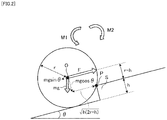
- a rotational moment M1 obtained by a load mg, being along a counterclockwise direction in FIG. 2 , and centered on a point P at a corner of the step S can be expressed by the following numerical expression (1) when a thrust F of the vehicle 1, a radius r of a wheel, a load m, a step h, an angle ⁇ of a slope, and a gravity acceleration g are given.
- M 1 mg cos ⁇ ⁇ h 2 r ⁇ h
- a first threshold value Fth1 of the amount of operation corresponding to the height of the step S can be set by the following numerical expression (4).
- Fth 1 mg cos ⁇ ⁇ h 2 r ⁇ h r ⁇ h + mg sin ⁇
- the threshold value setting unit 60 can set or change the first threshold value Fth1 by assigning the height of obstacle obtained by the obstacle data to the height h in the numerical expression (4).
- the control apparatus 100 is, for example, an ECU.
- the control apparatus 100 may be incorporated in an ECU of any system mounted on the vehicle 1 or may be an independent ECU.
- the control apparatus 100 may have a CPU (Central Processing Unit) (not shown), a controller, an RAM (Random Access Memory), an ROM (Read-Only Memory), a flash memory, and the like.
- the control apparatus 100 executes processes according to an installed and loaded program to make it possible to achieve functions.
- the processes are executed according to the program to make it possible to cause the control apparatus 100 to function as the target value setting unit 10, the control unit 20, the operation amount calculating unit 21, the command value calculating unit 22, the determining unit 30, the additional amount calculating unit 40, the actual value acquiring unit 50, the threshold value setting unit 60, and the like.
- a storage unit data used in arithmetic processes in the units, result data of the arithmetic processes, and the like are stored. At least some of the units may be achieved by hardware.
- another control such as feedforward control may be incorporated.
- the operation amount calculating unit 21 may add an additional amount obtained by the feedforward control to the amount of operation.
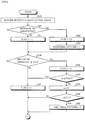
- FIGS. 3 and 4 An example of a control procedure by the control apparatus 100 will be described below with reference to FIGS. 3 and 4 . Flows illustrated in FIGS. 3 and 4 are executed at control timings, respectively.
- the actual value acquiring unit 50 acquires a detection value of the sensor 203 and an actual value based on the detection value (S10).
- the actual value acquiring unit 50 for example, acquires a position, an actual value of a speed, a detection value of an acceleration, and the like.
- the determining unit 30 determines whether the vehicle 1 goes down a slope by gravitation (S20). In S20, the determining unit 30 determines whether the vehicle 1 goes down a slope by gravitation on the basis of, for example, an actual value of a speed and a detection value of an acceleration.
- the determining unit 30 determines in S20 that the vehicle 1 does not go down by gravitation (No in S20)
- the determining unit 30 sets a flag 1 to "1" (S21).
- the flag 1 represents whether the actual value follows the target value. "1” represents that the actual value follows the target value, and "0" represents that the actual value does not follow the target value.
- the flag 1 is used in determination in S40 (will be described later).
- the determining unit 30 determines in S20 that the vehicle 1 goes down by gravitation (Yes in S20), the determining unit 30 sets the flag 1 to "0" (S22), and sets a flag of an additional pattern to "1" (S23).
- the flag 1 is "0"
- the target value is held in S42 (will be described later).
- the flag of the additional pattern is "1”
- a constant additional amount which exhibits a step-like shape in terms of time is calculated in S43 (will be described later). This pattern is called a first additional pattern.
- the determining unit 30 compares the amount of operation with the first threshold value Fth1 (S30).
- the determining unit 30 sets the flag 2 to "1" (S31).
- the flag 2 represents whether the actual value follows the target value. "1" represents that the actual value follows the target value, and "0" represents that the actual value does not follow the target value.
- the flag 2 is used in determination in S40 (will be described later).
- the flag 2 and the flag 1 are independently set, conditions for determining whether the actual value follows the target value can be discriminated from each other. Thus, for example, different processes can be executed depending on determined conditions, respectively.
- the determining unit 30 sets the flag 2 to "0" (S32). Even when the flag 2 is "0", as in the case in which the flag 1 is "0", the target value is held.
- the determining unit 30 executes S31 when a decrease ⁇ of the amount of operation after the determination is made is equal to or larger than a second threshold value Fth2, i.e., when the state in which the actual value does not follow the target value is estimated to be changed into the state in which the actual value follows the target value (Yes in S33). More specifically, the flag 2 is changed from "0" to "1".
- the determining unit 30 sets the flag of the additional pattern to "2" (S36).
- the third threshold value T1 corresponds to the length of the predetermined period of time.
- the control apparatus 100 sets the target value such that the target value setting unit 10 executes the process in the first mode and the target value changes with time at a required change rate (S41).
- S41 the target value is updated from the target value at a previous control timing.
- the target value setting unit 10 executes the process in the second mode and holds the target value (S42).
- the target value is set to the same value as that of the target value at the previous control timing.
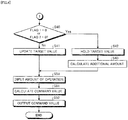
- the additional amount calculating unit 40 calculates an additional amount (S43).
- the additional pattern is calculated on the basis of the values of the flag 1, the flag 2, the flag of the additional pattern, and the like.
- the additional amount calculating unit 40 calculates a constant additional amount in the first additional pattern, i.e., in a pattern in which the additional amount exhibits a step-like shape in terms of time.
- the additional amount calculating unit 40 calculates an additional amount changing in the second additional pattern, i.e., in a pattern in which the additional amount changes in a ramp-like shape in terms of time.
- the additional amount calculating unit 40 can calculate an additional amount as a sum of a component a predetermined amount of which is added in a step-like shape in terms of time and a component which gradually increases in a ramp-like shape in terms of time.
- the additional amount calculating unit 40 sets the additional amount to 0 (zero).
- the additional amount added by the additional amount calculating unit 40 is continuously added even after the state in which the actual value does not follow the target value is canceled. Thus, it is suppressed that the state returns to the state in which the actual value does not follow the target value by decreasing the amount of operation when the actual value follows the target value.
- an amount of operation obtained by adding the additional amount from the additional amount calculating unit 40 to the amount of operation calculated by the operation amount calculating unit 21 is input to the command value calculating unit 22 (S50).
- the command value calculating unit 22 calculates a command value for at least one of the driving mechanism 201 and the braking mechanism 202 on the basis of the input amount of operation (S51).
- the command value calculating unit 22 outputs the calculated command value to at least one of the driving mechanism 201 and the braking mechanism 202 so as to control at least one of acceleration and declaration of the vehicle 1 (S52).
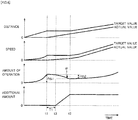
- FIGS. 5 to 7 illustrate changes of parameters with time obtained when control is performed by the procedures in FIGS. 3 and 4 .
- FIG. 5 illustrates a case in which the determining unit 30 determines that the vehicle 1 goes down a slope by gravitation.
- the determining unit 30 determines that the vehicle 1 goes down a slope by gravitation at time t1 on the basis of detection values and actual values.
- the target value setting unit 10 holds the target value at a constant value in the second mode from time t1.
- an additional amount which is constant after time t1 is added to an amount of control such that the amount of operation exhibits a step-like shape in terms of time in the first additional pattern.
- the holding of the target value and the addition of the additional amount to the amount of operation allow the deviations between the target values and the actual values of both the distance and the speed to gradually decrease.
- the determining unit 30 determines that the state changes into the state in which the actual value follows the target value because the decrease ⁇ of the amount of operation after time t1 becomes equal to or larger than the second threshold value Fth2.
- the target value setting unit 10 sets target values changing with elapsed time in the first mode, and the actual values of the distance and the speed change in proportion to the target values thereof.
- the constant additional amount is held even after time t2.
- the magnitude of the additional amount can be set to a magnitude depending on the angle of inclination.
- the distance and the speed may exhibit negative values in the period between time 0 and time t1, in the example in FIG. 5 , when the distance and the speed exhibit negative values, the distance and the speed are set to 0.
- the magnitude of the additional amount may be set to a magnitude depending on the angle of inclination.
- FIG. 6 illustrates a case in which the determining unit 30 determines that the amount of operation is equal to or larger than the first threshold value Fth1.
- the determining unit 30 determines at time t1 that the amount of operation is equal to or larger than the first threshold value Fth1.
- the target value setting unit 10 holds the target value at a constant value in the second mode from time t1.
- the determining unit 30 determines that the state changes into the state the actual value follows the target value because the decrease ⁇ of the amount of operation after time t1 becomes equal to or larger than the second threshold value Fth2.
- the target value setting unit 10 sets target values changing with elapsed time in the first mode, and the actual values of the distance and the speed change in proportion to the target values thereof.
- the additional amount at time t2 is held even after time t2.
- the state returns to the state in which the actual value does not follow the target value by decreasing the additional amount at time t2.
- the control illustrated in FIG. 6 is effective, for example, when a height of obstacle is not known, when an error of a result corresponding to an amount of operation caused by a detection error of the sensor 203 or another cause occurs, and the like. More specifically, for example, when a height of an obstacle is not known when rotation of a wheel is blocked by the obstacle, time at which the state in which the actual value does not follow the target value is canceled is not known, and moreover, a situation in which a magnitude of an amount of operation required to cause the wheel to go over the obstacle is not known may occur.
- the determining unit 30 determines that the actual value does not follow the target value, and suppression of an increase of the target value and an increase of the amount of operation can be executed. After it is determined that the actual value does not follow the target value, since an additional amount gradually increases in terms of time, a state in which an amount of operation for controlling an object to be controlled is excessive is easily avoided.
- the additional amount i.e., an amount of operation input to the object to be controlled linearly (linear functional) increases in terms of time.
- the additional amount is not limited to this, and a manner of increasing with time the additional amount, i.e., the amount of operation input to the object to be controlled can be variously set or changed. For example, even in a state in which an error of a result corresponding to an amount of operation occurs, i.e., a state in which a desired result cannot be obtained by the object to be controlled although a required amount of operation is input in the absence of a particular obstacle or the like, time at which the state in which the actual value does not follow the target value is canceled is not known, and moreover, a situation in which the magnitude of the amount of operation required to cause the actual value to follow the target value is not known may occur.
- the determining unit 30 determines that the actual value does not follow the target value, and suppression of an increase of the target value and an increase of the amount of operation can be executed. After it is determined that the actual value does not follow the target value, since an additional amount gradually increases in terms of time, a state in which an amount of operation for controlling an object to be controlled is excessive is easily avoided.
- the third threshold value T1 is set to set the additional amount to 0 (zero) in a period between time t1 and time t2.
- the wheel goes over an obstacle almost at time t1
- an additional amount is added to increase the amount of operation
- an acceleration may increase unnecessarily.
- the amount of operation is prevented from increasing to easily avoid such a situation.
- the setting of the additional amount is more effective when an obstacle data cannot be acquired.
- FIG. 7 illustrates a case in which the first threshold value Fth1 is set depending on a height of obstacle.
- the first threshold value Fth1 is set depending on a height of obstacle.
- the determining unit 30 determines at time t1 that the amount of operation is equal to or larger than the first threshold value Fth1. In this case, since the actual value does not follow the target value, the target value setting unit 10 holds the target value at a constant value in the second mode from time t1.
- the additional amount calculating unit 40 can set the additional amount to 0 (zero). Control performed after time t1 is the same as those in the cases in FIGS. 5 and 6 except that the additional amount is set to 0. In this case, since the additional amount is not added to the amount of operation, the state in which the amount of operation for controlling an object to be controlled is excessive is easily avoided.
- the target value setting unit 10 sets a target value changing with elapsed time when the determining unit 30 determines that the actual value (actual position) follows the target value (target position), and, when the determining unit 30 determines that the actual value does not follow the target value, sets the target value such that a change of the target value with elapsed time is smaller than that obtained when the determining unit 30 determines that the actual value follow the target value.
- a change of the target value is suppressed, in comparison with a case in which the target value changes more largely, an increase of the amount of operation is suppressed.
- it is easily suppressed that an amount of operation for controlling an object to be controlled is excessive.
- the determining unit 30 determines that the actual value does not follow the target value when the amount of operation is equal to or larger than the first threshold value.
- the state in which the actual value does not follow the target value can be determined more easily or accurately.
- the determining unit 30 determines that the actual position does not follow the target position.
- the state in which the vehicle 1 goes down a slope by gravitation can be canceled more rapidly.
- the determining unit 30 determines that the actual value begins to follow the target value.
- the state in which the actual value does not follow the target value recovers to the state in which the actual value follows the target value.
- the additional amount calculating unit 40 for calculating an additional amount added to the amount of operation is included.
- the amount of operation is increased, the state in which the actual value does not follow the target value is easily canceled.
- the additional amount calculating unit 40 outputs the additional amount which does not change in terms of time after the determining unit 30 determines that an actual position does not follow a target position.
- the state in which the actual position does not follow the target position is easily and quickly canceled.
- the additional amount calculating unit 40 increases the additional amount with elapsed time.
- the increase of the additional amount is stopped when the determining unit 30 determines that the actual position follows the target position, and after that time, the additional amount is held at a constant value.
- the additional amount is held at a constant value.
- the threshold value setting unit 60 which changes the first threshold value depending on a height of obstacle is included.
- a wheel can go over an obstacle when an additional amount is small, and a change of a target value can be suppressed when the wheel goes over the obstacle. For this reason, it is easily suppressed that an amount of operation for controlling an object to be controlled is excessive.
Landscapes
- Engineering & Computer Science (AREA)
- Transportation (AREA)
- Mechanical Engineering (AREA)
- Automation & Control Theory (AREA)
- General Physics & Mathematics (AREA)
- Physics & Mathematics (AREA)
- Aviation & Aerospace Engineering (AREA)
- Radar, Positioning & Navigation (AREA)
- Remote Sensing (AREA)
- Power Engineering (AREA)
- Sustainable Energy (AREA)
- Sustainable Development (AREA)
- Life Sciences & Earth Sciences (AREA)
- Combustion & Propulsion (AREA)
- Chemical & Material Sciences (AREA)
- Control Of Driving Devices And Active Controlling Of Vehicle (AREA)
- Regulating Braking Force (AREA)
- Control Of Position, Course, Altitude, Or Attitude Of Moving Bodies (AREA)
Applications Claiming Priority (2)
| Application Number | Priority Date | Filing Date | Title |
|---|---|---|---|
| JP2014214008A JP6183331B2 (ja) | 2014-10-20 | 2014-10-20 | 車両の走行制御装置 |
| PCT/JP2015/079475 WO2016063841A1 (ja) | 2014-10-20 | 2015-10-19 | 車両の走行制御装置 |
Publications (3)
| Publication Number | Publication Date |
|---|---|
| EP3210843A1 true EP3210843A1 (de) | 2017-08-30 |
| EP3210843A4 EP3210843A4 (de) | 2017-10-04 |
| EP3210843B1 EP3210843B1 (de) | 2019-02-20 |
Family
ID=55760876
Family Applications (1)
| Application Number | Title | Priority Date | Filing Date |
|---|---|---|---|
| EP15853417.2A Active EP3210843B1 (de) | 2014-10-20 | 2015-10-19 | Fahrtsteuerungsvorrichtung für ein fahrzeug |
Country Status (5)
| Country | Link |
|---|---|
| US (1) | US10073467B2 (de) |
| EP (1) | EP3210843B1 (de) |
| JP (1) | JP6183331B2 (de) |
| CN (1) | CN106715222B (de) |
| WO (1) | WO2016063841A1 (de) |
Families Citing this family (8)
| Publication number | Priority date | Publication date | Assignee | Title |
|---|---|---|---|---|
| FR3040955B1 (fr) | 2015-09-14 | 2017-10-06 | Bosch Gmbh Robert | Systeme d'assistance de freinage electromecanique |
| JP6883238B2 (ja) * | 2017-01-23 | 2021-06-09 | 株式会社アイシン | 駐車支援装置 |
| JP2019006253A (ja) * | 2017-06-23 | 2019-01-17 | 株式会社アドヴィックス | 走行制御装置 |
| JP6554568B2 (ja) * | 2018-01-24 | 2019-07-31 | 本田技研工業株式会社 | 車両制御装置 |
| JP7133752B2 (ja) | 2018-03-28 | 2022-09-09 | 株式会社アドヴィックス | 走行制御装置 |
| WO2020095636A1 (ja) * | 2018-11-09 | 2020-05-14 | 日立オートモティブシステムズ株式会社 | 駐車支援装置及び駐車支援方法 |
| CN110356250B (zh) * | 2019-07-25 | 2021-06-29 | 北京智行者科技有限公司 | 无人驾驶车辆的电机控制方法和系统 |
| JP7413842B2 (ja) * | 2020-02-28 | 2024-01-16 | いすゞ自動車株式会社 | 運転支援装置及び運転支援方法 |
Family Cites Families (17)
| Publication number | Priority date | Publication date | Assignee | Title |
|---|---|---|---|---|
| DE10231360A1 (de) * | 2002-07-11 | 2004-01-22 | Robert Bosch Gmbh | Verfahren zur Regelung der Geschwindigkeit eines Fahrzeugs |
| JP3934082B2 (ja) * | 2003-05-16 | 2007-06-20 | トヨタ自動車株式会社 | 走行支援装置 |
| DE10347980B4 (de) * | 2003-08-19 | 2021-06-10 | Volkswagen Ag | Steuerung für ein Kraftfahrzeug |
| JP4272094B2 (ja) * | 2004-03-26 | 2009-06-03 | 株式会社小松製作所 | 作業車両の車速制御装置 |
| JP2006296135A (ja) * | 2005-04-13 | 2006-10-26 | Toyota Motor Corp | 駐車支援装置 |
| JP4432872B2 (ja) * | 2005-10-21 | 2010-03-17 | マツダ株式会社 | 車両の走行制御装置 |
| JP4586795B2 (ja) * | 2006-12-07 | 2010-11-24 | トヨタ自動車株式会社 | 車両用制御装置 |
| JPWO2009060663A1 (ja) * | 2007-11-08 | 2011-03-17 | ボッシュ株式会社 | 駐車支援装置 |
| DE102008027779A1 (de) * | 2008-06-11 | 2009-12-17 | Valeo Schalter Und Sensoren Gmbh | Verfahren zur Unterstützung eines Fahrers eines Fahrzeugs beim Einparken in eine Parklücke |
| DE102008038753A1 (de) * | 2008-08-12 | 2010-02-25 | Mtu Friedrichshafen Gmbh | Verfahren zur Steuerung eines Hybridantriebs in einem Schienenfahrzeug |
| JP5327333B2 (ja) * | 2009-10-30 | 2013-10-30 | トヨタ自動車株式会社 | 車両の走行制御装置 |
| BR112012012741B1 (pt) * | 2009-11-30 | 2019-12-10 | Volvo Lastvagnar Ab | método para controlar um controle de cruzeiro deveículo e sistema de controle de cruzeiro |
| DE102012008858A1 (de) * | 2012-04-28 | 2012-11-08 | Daimler Ag | Verfahren zum autonomen Parken eines Kraftfahrzeugs, Fahrerassistenzvorrichtung zur Durchführung des Verfahrens, sowie Kraftfahrzeug mit der Fahrerassistenzvorrichtung |
| DE102012222562A1 (de) * | 2012-12-07 | 2014-06-12 | Robert Bosch Gmbh | System für bewirtschaftete Parkflächen zur Überführung eines Fahrzeugs von einer Startposition in eine Zielposition |
| KR102108056B1 (ko) * | 2013-07-26 | 2020-05-08 | 주식회사 만도 | 주차 제어 장치 및 주차 제어 방법 |
| US20150149265A1 (en) * | 2013-11-27 | 2015-05-28 | GM Global Technology Operations LLC | Controlled parking of autonomous vehicles |
| US9767366B1 (en) * | 2014-08-06 | 2017-09-19 | Waymo Llc | Using obstacle clearance to measure precise lateral |
-
2014
- 2014-10-20 JP JP2014214008A patent/JP6183331B2/ja active Active
-
2015
- 2015-10-19 WO PCT/JP2015/079475 patent/WO2016063841A1/ja not_active Ceased
- 2015-10-19 EP EP15853417.2A patent/EP3210843B1/de active Active
- 2015-10-19 CN CN201580049424.XA patent/CN106715222B/zh active Active
- 2015-10-19 US US15/516,313 patent/US10073467B2/en active Active
Also Published As
| Publication number | Publication date |
|---|---|
| CN106715222B (zh) | 2019-04-16 |
| JP6183331B2 (ja) | 2017-08-23 |
| WO2016063841A1 (ja) | 2016-04-28 |
| JP2016078744A (ja) | 2016-05-16 |
| EP3210843B1 (de) | 2019-02-20 |
| US20170297453A1 (en) | 2017-10-19 |
| EP3210843A4 (de) | 2017-10-04 |
| CN106715222A (zh) | 2017-05-24 |
| US10073467B2 (en) | 2018-09-11 |
Similar Documents
| Publication | Publication Date | Title |
|---|---|---|
| EP3210843B1 (de) | Fahrtsteuerungsvorrichtung für ein fahrzeug | |
| KR101766081B1 (ko) | 차량의 경사로 출발 보조 제어 방법 | |
| US10081358B2 (en) | Lane departure prevention apparatus | |
| JP6289669B2 (ja) | 車両走行制御装置 | |
| US11332157B2 (en) | Vehicle control apparatus | |
| US20190106149A1 (en) | Driving support control system | |
| US10661768B2 (en) | Lane departure prevention apparatus | |
| US20170259822A1 (en) | Adaptive cruise control system for motor vehicles | |
| EP2862761B1 (de) | Fahrzeugfahrhilfsvorrichtung | |
| EP3552899B1 (de) | Vorrichtung und verfahren zur steuerung des spurwechsels in einem fahrzeug | |
| US11136041B2 (en) | Apparatus and method for monitoring the activity of a driver of a vehicle | |
| CN109562784B (zh) | 辅助力控制装置及辅助力控制方法 | |
| KR20150114749A (ko) | 도로 구배 연산 방법 및 이를 이용한 차량 변속 제어 장치 | |
| US20170158205A1 (en) | Method, computer program, storage medium and electronic control unit for operating a vehicle | |
| EP3321142B1 (de) | Steuerungsvorrichtung für grätschsitzfahrzeug und grätschsitzfahrzeug | |
| US10077048B2 (en) | Lane departure prevention apparatus | |
| JP6455941B2 (ja) | 自動車の縦方向動特性を自動的に制御する方法及び装置 | |
| US12515627B2 (en) | Braking control device for vehicle | |
| JP2016094112A (ja) | 車両の走行制御装置 | |
| JP6572663B2 (ja) | 車両用走行制御装置および車両用走行制御方法 | |
| WO2020035128A1 (en) | Vehicle mounted systems and methods for downhill driving at a safe distance to a target vehicle | |
| CN112706730B (zh) | 调整车辆制动状态的方法和装置、控制系统以及程序载体 | |
| CN117320947A (zh) | 用于探测方向盘干预状态的计算机实现的方法、计算机程序产品、驾驶辅助系统以及机动车 | |
| US20230406328A1 (en) | Control device for vehicle and control method therefor | |
| EP3321141B1 (de) | Steuerungsvorrichtung für grätschsitzfahrzeug sowie grätschsitzfahrzeug |
Legal Events
| Date | Code | Title | Description |
|---|---|---|---|
| STAA | Information on the status of an ep patent application or granted ep patent |
Free format text: STATUS: THE INTERNATIONAL PUBLICATION HAS BEEN MADE |
|
| PUAI | Public reference made under article 153(3) epc to a published international application that has entered the european phase |
Free format text: ORIGINAL CODE: 0009012 |
|
| STAA | Information on the status of an ep patent application or granted ep patent |
Free format text: STATUS: REQUEST FOR EXAMINATION WAS MADE |
|
| 17P | Request for examination filed |
Effective date: 20170208 |
|
| AK | Designated contracting states |
Kind code of ref document: A1 Designated state(s): AL AT BE BG CH CY CZ DE DK EE ES FI FR GB GR HR HU IE IS IT LI LT LU LV MC MK MT NL NO PL PT RO RS SE SI SK SM TR |
|
| AX | Request for extension of the european patent |
Extension state: BA ME |
|
| A4 | Supplementary search report drawn up and despatched |
Effective date: 20170906 |
|
| RIC1 | Information provided on ipc code assigned before grant |
Ipc: B60T 7/12 20060101ALI20170831BHEP Ipc: B60W 30/14 20060101AFI20170831BHEP Ipc: B60T 8/175 20060101ALI20170831BHEP Ipc: G05D 1/02 20060101ALI20170831BHEP |
|
| DAV | Request for validation of the european patent (deleted) | ||
| DAX | Request for extension of the european patent (deleted) | ||
| GRAP | Despatch of communication of intention to grant a patent |
Free format text: ORIGINAL CODE: EPIDOSNIGR1 |
|
| STAA | Information on the status of an ep patent application or granted ep patent |
Free format text: STATUS: GRANT OF PATENT IS INTENDED |
|
| INTG | Intention to grant announced |
Effective date: 20180712 |
|
| RIC1 | Information provided on ipc code assigned before grant |
Ipc: G05D 1/02 20060101ALI20180629BHEP Ipc: B60W 30/14 20060101AFI20180629BHEP Ipc: B60T 8/175 20060101ALI20180629BHEP Ipc: B60T 7/12 20060101ALI20180629BHEP |
|
| GRAS | Grant fee paid |
Free format text: ORIGINAL CODE: EPIDOSNIGR3 |
|
| GRAA | (expected) grant |
Free format text: ORIGINAL CODE: 0009210 |
|
| STAA | Information on the status of an ep patent application or granted ep patent |
Free format text: STATUS: THE PATENT HAS BEEN GRANTED |
|
| RAP1 | Party data changed (applicant data changed or rights of an application transferred) |
Owner name: ADVICS CO., LTD. |
|
| AK | Designated contracting states |
Kind code of ref document: B1 Designated state(s): AL AT BE BG CH CY CZ DE DK EE ES FI FR GB GR HR HU IE IS IT LI LT LU LV MC MK MT NL NO PL PT RO RS SE SI SK SM TR |
|
| REG | Reference to a national code |
Ref country code: GB Ref legal event code: FG4D |
|
| REG | Reference to a national code |
Ref country code: CH Ref legal event code: EP |
|
| REG | Reference to a national code |
Ref country code: DE Ref legal event code: R096 Ref document number: 602015025122 Country of ref document: DE |
|
| REG | Reference to a national code |
Ref country code: AT Ref legal event code: REF Ref document number: 1097774 Country of ref document: AT Kind code of ref document: T Effective date: 20190315 |
|
| REG | Reference to a national code |
Ref country code: IE Ref legal event code: FG4D |
|
| REG | Reference to a national code |
Ref country code: LT Ref legal event code: MG4D |
|
| REG | Reference to a national code |
Ref country code: NL Ref legal event code: MP Effective date: 20190220 |
|
| PG25 | Lapsed in a contracting state [announced via postgrant information from national office to epo] |
Ref country code: LT Free format text: LAPSE BECAUSE OF FAILURE TO SUBMIT A TRANSLATION OF THE DESCRIPTION OR TO PAY THE FEE WITHIN THE PRESCRIBED TIME-LIMIT Effective date: 20190220 Ref country code: FI Free format text: LAPSE BECAUSE OF FAILURE TO SUBMIT A TRANSLATION OF THE DESCRIPTION OR TO PAY THE FEE WITHIN THE PRESCRIBED TIME-LIMIT Effective date: 20190220 Ref country code: NO Free format text: LAPSE BECAUSE OF FAILURE TO SUBMIT A TRANSLATION OF THE DESCRIPTION OR TO PAY THE FEE WITHIN THE PRESCRIBED TIME-LIMIT Effective date: 20190520 Ref country code: PT Free format text: LAPSE BECAUSE OF FAILURE TO SUBMIT A TRANSLATION OF THE DESCRIPTION OR TO PAY THE FEE WITHIN THE PRESCRIBED TIME-LIMIT Effective date: 20190620 Ref country code: SE Free format text: LAPSE BECAUSE OF FAILURE TO SUBMIT A TRANSLATION OF THE DESCRIPTION OR TO PAY THE FEE WITHIN THE PRESCRIBED TIME-LIMIT Effective date: 20190220 |
|
| PG25 | Lapsed in a contracting state [announced via postgrant information from national office to epo] |
Ref country code: GR Free format text: LAPSE BECAUSE OF FAILURE TO SUBMIT A TRANSLATION OF THE DESCRIPTION OR TO PAY THE FEE WITHIN THE PRESCRIBED TIME-LIMIT Effective date: 20190521 Ref country code: HR Free format text: LAPSE BECAUSE OF FAILURE TO SUBMIT A TRANSLATION OF THE DESCRIPTION OR TO PAY THE FEE WITHIN THE PRESCRIBED TIME-LIMIT Effective date: 20190220 Ref country code: IS Free format text: LAPSE BECAUSE OF FAILURE TO SUBMIT A TRANSLATION OF THE DESCRIPTION OR TO PAY THE FEE WITHIN THE PRESCRIBED TIME-LIMIT Effective date: 20190620 Ref country code: BG Free format text: LAPSE BECAUSE OF FAILURE TO SUBMIT A TRANSLATION OF THE DESCRIPTION OR TO PAY THE FEE WITHIN THE PRESCRIBED TIME-LIMIT Effective date: 20190520 Ref country code: LV Free format text: LAPSE BECAUSE OF FAILURE TO SUBMIT A TRANSLATION OF THE DESCRIPTION OR TO PAY THE FEE WITHIN THE PRESCRIBED TIME-LIMIT Effective date: 20190220 Ref country code: RS Free format text: LAPSE BECAUSE OF FAILURE TO SUBMIT A TRANSLATION OF THE DESCRIPTION OR TO PAY THE FEE WITHIN THE PRESCRIBED TIME-LIMIT Effective date: 20190220 Ref country code: NL Free format text: LAPSE BECAUSE OF FAILURE TO SUBMIT A TRANSLATION OF THE DESCRIPTION OR TO PAY THE FEE WITHIN THE PRESCRIBED TIME-LIMIT Effective date: 20190220 |
|
| REG | Reference to a national code |
Ref country code: AT Ref legal event code: MK05 Ref document number: 1097774 Country of ref document: AT Kind code of ref document: T Effective date: 20190220 |
|
| PG25 | Lapsed in a contracting state [announced via postgrant information from national office to epo] |
Ref country code: SK Free format text: LAPSE BECAUSE OF FAILURE TO SUBMIT A TRANSLATION OF THE DESCRIPTION OR TO PAY THE FEE WITHIN THE PRESCRIBED TIME-LIMIT Effective date: 20190220 Ref country code: RO Free format text: LAPSE BECAUSE OF FAILURE TO SUBMIT A TRANSLATION OF THE DESCRIPTION OR TO PAY THE FEE WITHIN THE PRESCRIBED TIME-LIMIT Effective date: 20190220 Ref country code: CZ Free format text: LAPSE BECAUSE OF FAILURE TO SUBMIT A TRANSLATION OF THE DESCRIPTION OR TO PAY THE FEE WITHIN THE PRESCRIBED TIME-LIMIT Effective date: 20190220 Ref country code: ES Free format text: LAPSE BECAUSE OF FAILURE TO SUBMIT A TRANSLATION OF THE DESCRIPTION OR TO PAY THE FEE WITHIN THE PRESCRIBED TIME-LIMIT Effective date: 20190220 Ref country code: AL Free format text: LAPSE BECAUSE OF FAILURE TO SUBMIT A TRANSLATION OF THE DESCRIPTION OR TO PAY THE FEE WITHIN THE PRESCRIBED TIME-LIMIT Effective date: 20190220 Ref country code: DK Free format text: LAPSE BECAUSE OF FAILURE TO SUBMIT A TRANSLATION OF THE DESCRIPTION OR TO PAY THE FEE WITHIN THE PRESCRIBED TIME-LIMIT Effective date: 20190220 Ref country code: IT Free format text: LAPSE BECAUSE OF FAILURE TO SUBMIT A TRANSLATION OF THE DESCRIPTION OR TO PAY THE FEE WITHIN THE PRESCRIBED TIME-LIMIT Effective date: 20190220 Ref country code: EE Free format text: LAPSE BECAUSE OF FAILURE TO SUBMIT A TRANSLATION OF THE DESCRIPTION OR TO PAY THE FEE WITHIN THE PRESCRIBED TIME-LIMIT Effective date: 20190220 |
|
| REG | Reference to a national code |
Ref country code: DE Ref legal event code: R097 Ref document number: 602015025122 Country of ref document: DE |
|
| PG25 | Lapsed in a contracting state [announced via postgrant information from national office to epo] |
Ref country code: PL Free format text: LAPSE BECAUSE OF FAILURE TO SUBMIT A TRANSLATION OF THE DESCRIPTION OR TO PAY THE FEE WITHIN THE PRESCRIBED TIME-LIMIT Effective date: 20190220 Ref country code: SM Free format text: LAPSE BECAUSE OF FAILURE TO SUBMIT A TRANSLATION OF THE DESCRIPTION OR TO PAY THE FEE WITHIN THE PRESCRIBED TIME-LIMIT Effective date: 20190220 |
|
| PLBE | No opposition filed within time limit |
Free format text: ORIGINAL CODE: 0009261 |
|
| STAA | Information on the status of an ep patent application or granted ep patent |
Free format text: STATUS: NO OPPOSITION FILED WITHIN TIME LIMIT |
|
| PG25 | Lapsed in a contracting state [announced via postgrant information from national office to epo] |
Ref country code: AT Free format text: LAPSE BECAUSE OF FAILURE TO SUBMIT A TRANSLATION OF THE DESCRIPTION OR TO PAY THE FEE WITHIN THE PRESCRIBED TIME-LIMIT Effective date: 20190220 |
|
| 26N | No opposition filed |
Effective date: 20191121 |
|
| PG25 | Lapsed in a contracting state [announced via postgrant information from national office to epo] |
Ref country code: SI Free format text: LAPSE BECAUSE OF FAILURE TO SUBMIT A TRANSLATION OF THE DESCRIPTION OR TO PAY THE FEE WITHIN THE PRESCRIBED TIME-LIMIT Effective date: 20190220 |
|
| PG25 | Lapsed in a contracting state [announced via postgrant information from national office to epo] |
Ref country code: TR Free format text: LAPSE BECAUSE OF FAILURE TO SUBMIT A TRANSLATION OF THE DESCRIPTION OR TO PAY THE FEE WITHIN THE PRESCRIBED TIME-LIMIT Effective date: 20190220 |
|
| PG25 | Lapsed in a contracting state [announced via postgrant information from national office to epo] |
Ref country code: MC Free format text: LAPSE BECAUSE OF FAILURE TO SUBMIT A TRANSLATION OF THE DESCRIPTION OR TO PAY THE FEE WITHIN THE PRESCRIBED TIME-LIMIT Effective date: 20190220 |
|
| REG | Reference to a national code |
Ref country code: CH Ref legal event code: PL |
|
| PG25 | Lapsed in a contracting state [announced via postgrant information from national office to epo] |
Ref country code: LU Free format text: LAPSE BECAUSE OF NON-PAYMENT OF DUE FEES Effective date: 20191019 Ref country code: LI Free format text: LAPSE BECAUSE OF NON-PAYMENT OF DUE FEES Effective date: 20191031 Ref country code: CH Free format text: LAPSE BECAUSE OF NON-PAYMENT OF DUE FEES Effective date: 20191031 |
|
| REG | Reference to a national code |
Ref country code: BE Ref legal event code: MM Effective date: 20191031 |
|
| PG25 | Lapsed in a contracting state [announced via postgrant information from national office to epo] |
Ref country code: BE Free format text: LAPSE BECAUSE OF NON-PAYMENT OF DUE FEES Effective date: 20191031 |
|
| GBPC | Gb: european patent ceased through non-payment of renewal fee |
Effective date: 20191019 |
|
| PG25 | Lapsed in a contracting state [announced via postgrant information from national office to epo] |
Ref country code: IE Free format text: LAPSE BECAUSE OF NON-PAYMENT OF DUE FEES Effective date: 20191019 Ref country code: GB Free format text: LAPSE BECAUSE OF NON-PAYMENT OF DUE FEES Effective date: 20191019 Ref country code: FR Free format text: LAPSE BECAUSE OF NON-PAYMENT OF DUE FEES Effective date: 20191031 |
|
| PG25 | Lapsed in a contracting state [announced via postgrant information from national office to epo] |
Ref country code: CY Free format text: LAPSE BECAUSE OF FAILURE TO SUBMIT A TRANSLATION OF THE DESCRIPTION OR TO PAY THE FEE WITHIN THE PRESCRIBED TIME-LIMIT Effective date: 20190220 |
|
| PG25 | Lapsed in a contracting state [announced via postgrant information from national office to epo] |
Ref country code: MT Free format text: LAPSE BECAUSE OF FAILURE TO SUBMIT A TRANSLATION OF THE DESCRIPTION OR TO PAY THE FEE WITHIN THE PRESCRIBED TIME-LIMIT Effective date: 20190220 Ref country code: HU Free format text: LAPSE BECAUSE OF FAILURE TO SUBMIT A TRANSLATION OF THE DESCRIPTION OR TO PAY THE FEE WITHIN THE PRESCRIBED TIME-LIMIT; INVALID AB INITIO Effective date: 20151019 |
|
| PG25 | Lapsed in a contracting state [announced via postgrant information from national office to epo] |
Ref country code: MK Free format text: LAPSE BECAUSE OF FAILURE TO SUBMIT A TRANSLATION OF THE DESCRIPTION OR TO PAY THE FEE WITHIN THE PRESCRIBED TIME-LIMIT Effective date: 20190220 |
|
| PGFP | Annual fee paid to national office [announced via postgrant information from national office to epo] |
Ref country code: DE Payment date: 20250902 Year of fee payment: 11 |