EP3212727B1 - Klebemassen mit aktivierbaren gettermaterialien - Google Patents
Klebemassen mit aktivierbaren gettermaterialien Download PDFInfo
- Publication number
- EP3212727B1 EP3212727B1 EP15786881.1A EP15786881A EP3212727B1 EP 3212727 B1 EP3212727 B1 EP 3212727B1 EP 15786881 A EP15786881 A EP 15786881A EP 3212727 B1 EP3212727 B1 EP 3212727B1
- Authority
- EP
- European Patent Office
- Prior art keywords
- adhesive
- adhesive tape
- electronic arrangement
- cover
- getter
- Prior art date
- Legal status (The legal status is an assumption and is not a legal conclusion. Google has not performed a legal analysis and makes no representation as to the accuracy of the status listed.)
- Active
Links
Images

Classifications
-
- C—CHEMISTRY; METALLURGY
- C08—ORGANIC MACROMOLECULAR COMPOUNDS; THEIR PREPARATION OR CHEMICAL WORKING-UP; COMPOSITIONS BASED THEREON
- C08G—MACROMOLECULAR COMPOUNDS OBTAINED OTHERWISE THAN BY REACTIONS ONLY INVOLVING UNSATURATED CARBON-TO-CARBON BONDS
- C08G59/00—Polycondensates containing more than one epoxy group per molecule; Macromolecules obtained by polymerising compounds containing more than one epoxy group per molecule using curing agents or catalysts which react with the epoxy groups
- C08G59/18—Macromolecules obtained by polymerising compounds containing more than one epoxy group per molecule using curing agents or catalysts which react with the epoxy groups ; e.g. general methods of curing
- C08G59/20—Macromolecules obtained by polymerising compounds containing more than one epoxy group per molecule using curing agents or catalysts which react with the epoxy groups ; e.g. general methods of curing characterised by the epoxy compounds used
- C08G59/22—Di-epoxy compounds
- C08G59/24—Di-epoxy compounds carbocyclic
-
- C—CHEMISTRY; METALLURGY
- C08—ORGANIC MACROMOLECULAR COMPOUNDS; THEIR PREPARATION OR CHEMICAL WORKING-UP; COMPOSITIONS BASED THEREON
- C08K—Use of inorganic or non-macromolecular organic substances as compounding ingredients
- C08K3/00—Use of inorganic substances as compounding ingredients
-
- C—CHEMISTRY; METALLURGY
- C08—ORGANIC MACROMOLECULAR COMPOUNDS; THEIR PREPARATION OR CHEMICAL WORKING-UP; COMPOSITIONS BASED THEREON
- C08K—Use of inorganic or non-macromolecular organic substances as compounding ingredients
- C08K5/00—Use of organic ingredients
- C08K5/54—Silicon-containing compounds
- C08K5/541—Silicon-containing compounds containing oxygen
- C08K5/5435—Silicon-containing compounds containing oxygen containing oxygen in a ring
-
- C—CHEMISTRY; METALLURGY
- C08—ORGANIC MACROMOLECULAR COMPOUNDS; THEIR PREPARATION OR CHEMICAL WORKING-UP; COMPOSITIONS BASED THEREON
- C08L—COMPOSITIONS OF MACROMOLECULAR COMPOUNDS
- C08L53/00—Compositions of block copolymers containing at least one sequence of a polymer obtained by reactions only involving carbon-to-carbon unsaturated bonds; Compositions of derivatives of such polymers
- C08L53/02—Compositions of block copolymers containing at least one sequence of a polymer obtained by reactions only involving carbon-to-carbon unsaturated bonds; Compositions of derivatives of such polymers of vinyl-aromatic monomers and conjugated dienes
-
- C—CHEMISTRY; METALLURGY
- C08—ORGANIC MACROMOLECULAR COMPOUNDS; THEIR PREPARATION OR CHEMICAL WORKING-UP; COMPOSITIONS BASED THEREON
- C08L—COMPOSITIONS OF MACROMOLECULAR COMPOUNDS
- C08L91/00—Compositions of oils, fats or waxes; Compositions of derivatives thereof
-
- C—CHEMISTRY; METALLURGY
- C09—DYES; PAINTS; POLISHES; NATURAL RESINS; ADHESIVES; COMPOSITIONS NOT OTHERWISE PROVIDED FOR; APPLICATIONS OF MATERIALS NOT OTHERWISE PROVIDED FOR
- C09D—COATING COMPOSITIONS, e.g. PAINTS, VARNISHES OR LACQUERS; FILLING PASTES; CHEMICAL PAINT OR INK REMOVERS; INKS; CORRECTING FLUIDS; WOODSTAINS; PASTES OR SOLIDS FOR COLOURING OR PRINTING; USE OF MATERIALS THEREFOR
- C09D163/00—Coating compositions based on epoxy resins; Coating compositions based on derivatives of epoxy resins
-
- C—CHEMISTRY; METALLURGY
- C09—DYES; PAINTS; POLISHES; NATURAL RESINS; ADHESIVES; COMPOSITIONS NOT OTHERWISE PROVIDED FOR; APPLICATIONS OF MATERIALS NOT OTHERWISE PROVIDED FOR
- C09J—ADHESIVES; NON-MECHANICAL ASPECTS OF ADHESIVE PROCESSES IN GENERAL; ADHESIVE PROCESSES NOT PROVIDED FOR ELSEWHERE; USE OF MATERIALS AS ADHESIVES
- C09J11/00—Features of adhesives not provided for in group C09J9/00, e.g. additives
- C09J11/02—Non-macromolecular additives
- C09J11/06—Non-macromolecular additives organic
-
- C—CHEMISTRY; METALLURGY
- C09—DYES; PAINTS; POLISHES; NATURAL RESINS; ADHESIVES; COMPOSITIONS NOT OTHERWISE PROVIDED FOR; APPLICATIONS OF MATERIALS NOT OTHERWISE PROVIDED FOR
- C09J—ADHESIVES; NON-MECHANICAL ASPECTS OF ADHESIVE PROCESSES IN GENERAL; ADHESIVE PROCESSES NOT PROVIDED FOR ELSEWHERE; USE OF MATERIALS AS ADHESIVES
- C09J153/00—Adhesives based on block copolymers containing at least one sequence of a polymer obtained by reactions only involving carbon-to-carbon unsaturated bonds; Adhesives based on derivatives of such polymers
- C09J153/02—Vinyl aromatic monomers and conjugated dienes
-
- C—CHEMISTRY; METALLURGY
- C09—DYES; PAINTS; POLISHES; NATURAL RESINS; ADHESIVES; COMPOSITIONS NOT OTHERWISE PROVIDED FOR; APPLICATIONS OF MATERIALS NOT OTHERWISE PROVIDED FOR
- C09J—ADHESIVES; NON-MECHANICAL ASPECTS OF ADHESIVE PROCESSES IN GENERAL; ADHESIVE PROCESSES NOT PROVIDED FOR ELSEWHERE; USE OF MATERIALS AS ADHESIVES
- C09J163/00—Adhesives based on epoxy resins; Adhesives based on derivatives of epoxy resins
-
- C—CHEMISTRY; METALLURGY
- C09—DYES; PAINTS; POLISHES; NATURAL RESINS; ADHESIVES; COMPOSITIONS NOT OTHERWISE PROVIDED FOR; APPLICATIONS OF MATERIALS NOT OTHERWISE PROVIDED FOR
- C09J—ADHESIVES; NON-MECHANICAL ASPECTS OF ADHESIVE PROCESSES IN GENERAL; ADHESIVE PROCESSES NOT PROVIDED FOR ELSEWHERE; USE OF MATERIALS AS ADHESIVES
- C09J5/00—Adhesive processes in general; Adhesive processes not provided for elsewhere, e.g. relating to primers
-
- C—CHEMISTRY; METALLURGY
- C09—DYES; PAINTS; POLISHES; NATURAL RESINS; ADHESIVES; COMPOSITIONS NOT OTHERWISE PROVIDED FOR; APPLICATIONS OF MATERIALS NOT OTHERWISE PROVIDED FOR
- C09J—ADHESIVES; NON-MECHANICAL ASPECTS OF ADHESIVE PROCESSES IN GENERAL; ADHESIVE PROCESSES NOT PROVIDED FOR ELSEWHERE; USE OF MATERIALS AS ADHESIVES
- C09J7/00—Adhesives in the form of films or foils
-
- C—CHEMISTRY; METALLURGY
- C09—DYES; PAINTS; POLISHES; NATURAL RESINS; ADHESIVES; COMPOSITIONS NOT OTHERWISE PROVIDED FOR; APPLICATIONS OF MATERIALS NOT OTHERWISE PROVIDED FOR
- C09J—ADHESIVES; NON-MECHANICAL ASPECTS OF ADHESIVE PROCESSES IN GENERAL; ADHESIVE PROCESSES NOT PROVIDED FOR ELSEWHERE; USE OF MATERIALS AS ADHESIVES
- C09J7/00—Adhesives in the form of films or foils
- C09J7/10—Adhesives in the form of films or foils without carriers
-
- C—CHEMISTRY; METALLURGY
- C09—DYES; PAINTS; POLISHES; NATURAL RESINS; ADHESIVES; COMPOSITIONS NOT OTHERWISE PROVIDED FOR; APPLICATIONS OF MATERIALS NOT OTHERWISE PROVIDED FOR
- C09J—ADHESIVES; NON-MECHANICAL ASPECTS OF ADHESIVE PROCESSES IN GENERAL; ADHESIVE PROCESSES NOT PROVIDED FOR ELSEWHERE; USE OF MATERIALS AS ADHESIVES
- C09J9/00—Adhesives characterised by their physical nature or the effects produced, e.g. glue sticks
-
- H—ELECTRICITY
- H10—SEMICONDUCTOR DEVICES; ELECTRIC SOLID-STATE DEVICES NOT OTHERWISE PROVIDED FOR
- H10K—ORGANIC ELECTRIC SOLID-STATE DEVICES
- H10K50/00—Organic light-emitting devices
- H10K50/80—Constructional details
- H10K50/84—Passivation; Containers; Encapsulations
- H10K50/842—Containers
- H10K50/8426—Peripheral sealing arrangements, e.g. adhesives, sealants
-
- H—ELECTRICITY
- H10—SEMICONDUCTOR DEVICES; ELECTRIC SOLID-STATE DEVICES NOT OTHERWISE PROVIDED FOR
- H10K—ORGANIC ELECTRIC SOLID-STATE DEVICES
- H10K50/00—Organic light-emitting devices
- H10K50/80—Constructional details
- H10K50/84—Passivation; Containers; Encapsulations
- H10K50/846—Passivation; Containers; Encapsulations comprising getter material or desiccants
-
- C—CHEMISTRY; METALLURGY
- C08—ORGANIC MACROMOLECULAR COMPOUNDS; THEIR PREPARATION OR CHEMICAL WORKING-UP; COMPOSITIONS BASED THEREON
- C08K—Use of inorganic or non-macromolecular organic substances as compounding ingredients
- C08K2201/00—Specific properties of additives
- C08K2201/008—Additives improving gas barrier properties
-
- C—CHEMISTRY; METALLURGY
- C08—ORGANIC MACROMOLECULAR COMPOUNDS; THEIR PREPARATION OR CHEMICAL WORKING-UP; COMPOSITIONS BASED THEREON
- C08K—Use of inorganic or non-macromolecular organic substances as compounding ingredients
- C08K5/00—Use of organic ingredients
- C08K5/54—Silicon-containing compounds
- C08K5/541—Silicon-containing compounds containing oxygen
- C08K5/5415—Silicon-containing compounds containing oxygen containing at least one Si—O bond
-
- C—CHEMISTRY; METALLURGY
- C08—ORGANIC MACROMOLECULAR COMPOUNDS; THEIR PREPARATION OR CHEMICAL WORKING-UP; COMPOSITIONS BASED THEREON
- C08K—Use of inorganic or non-macromolecular organic substances as compounding ingredients
- C08K5/00—Use of organic ingredients
- C08K5/54—Silicon-containing compounds
- C08K5/541—Silicon-containing compounds containing oxygen
- C08K5/5415—Silicon-containing compounds containing oxygen containing at least one Si—O bond
- C08K5/5419—Silicon-containing compounds containing oxygen containing at least one Si—O bond containing at least one Si—C bond
-
- C—CHEMISTRY; METALLURGY
- C09—DYES; PAINTS; POLISHES; NATURAL RESINS; ADHESIVES; COMPOSITIONS NOT OTHERWISE PROVIDED FOR; APPLICATIONS OF MATERIALS NOT OTHERWISE PROVIDED FOR
- C09J—ADHESIVES; NON-MECHANICAL ASPECTS OF ADHESIVE PROCESSES IN GENERAL; ADHESIVE PROCESSES NOT PROVIDED FOR ELSEWHERE; USE OF MATERIALS AS ADHESIVES
- C09J2203/00—Applications of adhesives in processes or use of adhesives in the form of films or foils
- C09J2203/318—Applications of adhesives in processes or use of adhesives in the form of films or foils for the production of liquid crystal displays
-
- C—CHEMISTRY; METALLURGY
- C09—DYES; PAINTS; POLISHES; NATURAL RESINS; ADHESIVES; COMPOSITIONS NOT OTHERWISE PROVIDED FOR; APPLICATIONS OF MATERIALS NOT OTHERWISE PROVIDED FOR
- C09J—ADHESIVES; NON-MECHANICAL ASPECTS OF ADHESIVE PROCESSES IN GENERAL; ADHESIVE PROCESSES NOT PROVIDED FOR ELSEWHERE; USE OF MATERIALS AS ADHESIVES
- C09J2203/00—Applications of adhesives in processes or use of adhesives in the form of films or foils
- C09J2203/322—Applications of adhesives in processes or use of adhesives in the form of films or foils for the production of solar panels
-
- C—CHEMISTRY; METALLURGY
- C09—DYES; PAINTS; POLISHES; NATURAL RESINS; ADHESIVES; COMPOSITIONS NOT OTHERWISE PROVIDED FOR; APPLICATIONS OF MATERIALS NOT OTHERWISE PROVIDED FOR
- C09J—ADHESIVES; NON-MECHANICAL ASPECTS OF ADHESIVE PROCESSES IN GENERAL; ADHESIVE PROCESSES NOT PROVIDED FOR ELSEWHERE; USE OF MATERIALS AS ADHESIVES
- C09J2203/00—Applications of adhesives in processes or use of adhesives in the form of films or foils
- C09J2203/326—Applications of adhesives in processes or use of adhesives in the form of films or foils for bonding electronic components such as wafers, chips or semiconductors
-
- C—CHEMISTRY; METALLURGY
- C09—DYES; PAINTS; POLISHES; NATURAL RESINS; ADHESIVES; COMPOSITIONS NOT OTHERWISE PROVIDED FOR; APPLICATIONS OF MATERIALS NOT OTHERWISE PROVIDED FOR
- C09J—ADHESIVES; NON-MECHANICAL ASPECTS OF ADHESIVE PROCESSES IN GENERAL; ADHESIVE PROCESSES NOT PROVIDED FOR ELSEWHERE; USE OF MATERIALS AS ADHESIVES
- C09J2203/00—Applications of adhesives in processes or use of adhesives in the form of films or foils
- C09J2203/33—Applications of adhesives in processes or use of adhesives in the form of films or foils for batteries or fuel cells
-
- C—CHEMISTRY; METALLURGY
- C09—DYES; PAINTS; POLISHES; NATURAL RESINS; ADHESIVES; COMPOSITIONS NOT OTHERWISE PROVIDED FOR; APPLICATIONS OF MATERIALS NOT OTHERWISE PROVIDED FOR
- C09J—ADHESIVES; NON-MECHANICAL ASPECTS OF ADHESIVE PROCESSES IN GENERAL; ADHESIVE PROCESSES NOT PROVIDED FOR ELSEWHERE; USE OF MATERIALS AS ADHESIVES
- C09J2301/00—Additional features of adhesives in the form of films or foils
- C09J2301/30—Additional features of adhesives in the form of films or foils characterized by the chemical, physicochemical or physical properties of the adhesive or the carrier
- C09J2301/302—Additional features of adhesives in the form of films or foils characterized by the chemical, physicochemical or physical properties of the adhesive or the carrier the adhesive being pressure-sensitive, i.e. tacky at temperatures inferior to 30°C
-
- C—CHEMISTRY; METALLURGY
- C09—DYES; PAINTS; POLISHES; NATURAL RESINS; ADHESIVES; COMPOSITIONS NOT OTHERWISE PROVIDED FOR; APPLICATIONS OF MATERIALS NOT OTHERWISE PROVIDED FOR
- C09J—ADHESIVES; NON-MECHANICAL ASPECTS OF ADHESIVE PROCESSES IN GENERAL; ADHESIVE PROCESSES NOT PROVIDED FOR ELSEWHERE; USE OF MATERIALS AS ADHESIVES
- C09J2301/00—Additional features of adhesives in the form of films or foils
- C09J2301/40—Additional features of adhesives in the form of films or foils characterized by the presence of essential components
- C09J2301/408—Additional features of adhesives in the form of films or foils characterized by the presence of essential components additives as essential feature of the adhesive layer
-
- C—CHEMISTRY; METALLURGY
- C09—DYES; PAINTS; POLISHES; NATURAL RESINS; ADHESIVES; COMPOSITIONS NOT OTHERWISE PROVIDED FOR; APPLICATIONS OF MATERIALS NOT OTHERWISE PROVIDED FOR
- C09J—ADHESIVES; NON-MECHANICAL ASPECTS OF ADHESIVE PROCESSES IN GENERAL; ADHESIVE PROCESSES NOT PROVIDED FOR ELSEWHERE; USE OF MATERIALS AS ADHESIVES
- C09J2453/00—Presence of block copolymer
-
- C—CHEMISTRY; METALLURGY
- C09—DYES; PAINTS; POLISHES; NATURAL RESINS; ADHESIVES; COMPOSITIONS NOT OTHERWISE PROVIDED FOR; APPLICATIONS OF MATERIALS NOT OTHERWISE PROVIDED FOR
- C09J—ADHESIVES; NON-MECHANICAL ASPECTS OF ADHESIVE PROCESSES IN GENERAL; ADHESIVE PROCESSES NOT PROVIDED FOR ELSEWHERE; USE OF MATERIALS AS ADHESIVES
- C09J2463/00—Presence of epoxy resin
Definitions
- the present invention relates to an adhesive containing a getter material and optionally a solvent, an adhesive tape with this adhesive, the use of such an adhesive and of such an adhesive tape, and a method for applying the adhesive or the adhesive tape.
- the invention further relates to an adhesive tape with this adhesive and the use of such an adhesive.
- US 2010/159238 describes a multilayer adhesive composition
- a multilayer adhesive composition comprising a first layer made from a first composition comprising a part A and a part B, wherein part a comprises a plasticizer, a crosslinking agent and an adhesion promoter, wherein part B comprises a moisture barrier and an abrasion barrier, and wherein the first layer is substantially sulfide-free.
- DE10 2012 211 335 relates to a method for protecting an electronic arrangement arranged on a substrate comprising organic components, wherein a cover is applied to the electronic arrangement in such a way that the electronic arrangement is at least partially covered by the cover, wherein the cover is glued at least partially to the substrate and/or to the electronic arrangement, wherein the bonding is effected by means of at least one layer of an adhesive in an adhesive tape, wherein the adhesive comprises a getter material capable of sorbing at least one permeable substance, wherein the getter material is present in the adhesive in a proportion of not more than 2 wt. % based on the adhesive with the getter material.
- US 5304419 discloses a hermetically sealed housing in which an electronic device is housed and the inner surface of which is at least partially provided with a coating of a pressure-sensitive adhesive containing 4 to 40 vol.% of a finely divided, solid desiccant with an average particle size of 0.2 to 100 ⁇ m, the coating having a thickness of 1 to 25 mm and being effective to provide a To keep the environment within the enclosure substantially free of moisture and substantially free of free solid particles.
- US 6121354 claims a hot-melt one-component sealant consisting of a styrene block copolymer, a moisture-curable silylated polyurethane prepolymer, an aromatic adhesive resin, a polar adhesive resin, a polyethylene wax and an organofunctional silane.
- WO 2004/009720 relates to a convertible pressure-sensitive adhesive composition consisting of 15 to 80 wt.% of a polymer having a softening point greater than 60°C, 20 to 85 wt.% of a polymerizable resin having a softening point less than 30°C and a latent initiator in an amount sufficient to cause the reaction between the polymer and the resin and optionally a crosslinking agent.
- WO 201515947 describes a translucent, multiphase adhesive containing at least one continuous phase and dispersely distributed domains, wherein the at least one continuous phase has a refractive index of more than 1.45 and a permeation rate for water vapor of less than 100 g/m 2 and the disperse domains are contained in the adhesive in a weight proportion of not more than 10 wt. %, wherein the disperse domains are polymeric in nature, have a WVTR of less than 100 g/m 2 and a refractive index of less than 1.45.
- WO 2005/118679 discloses an adhesive or sealant composition
- a crosslinkable polymer comprising a crosslinkable polymer, a crosslinking catalyst for the polymer, a rheology modifier and a water scavenger, wherein the crosslinkable polymer has silylic end groups and has an equivalent molecular weight between 10,000 and 20,000.
- the getter material contained in the adhesive is able to capture permeable substances such as water, oxygen, low molecular weight hydrocarbons or volatile organic compounds that penetrate the adhesive.
- permeable substances such as water, oxygen, low molecular weight hydrocarbons or volatile organic compounds that penetrate the adhesive.
- Such adhesives are used, for example, to encapsulate objects that need to be protected from water.
- the permeable substance is water.
- a particularly important area of application for such getters is (opto)electronic devices.
- (Opto-)electronic arrangements are increasingly used in commercial products. Such arrangements include inorganic or organic electronic structures, for example organic, organometallic or polymer semiconductors or combinations of these. These arrangements and products are designed to be rigid or flexible depending on the desired application, with an increasing demand for flexible arrangements.
- Such arrangements are produced, for example, using printing processes such as letterpress, gravure, screen printing, planographic printing or so-called “non-impact printing” such as thermal transfer printing, inkjet printing or digital printing.
- vacuum processes such as chemical vapor deposition (CVD), physical vapor deposition (PVD), plasma-assisted chemical or physical deposition processes (PECVD), sputtering, (plasma) etching or vapor deposition are also often used, with the structuring usually taking place using masks.
- Examples of (opto-)electronic applications that are already commercial or of interest in terms of their market potential include electrophoretic or electrochromic structures or displays, organic or polymer light-emitting diodes (OLEDs or PLEDs) in indicator and display devices or as lighting, electroluminescent lamps, light-emitting electrochemical cells (LEECs), organic solar cells, preferably dye or polymer solar cells, inorganic solar cells, preferably thin-film solar cells, in particular based on silicon, germanium, copper, indium and selenium, perovskite solar cells, organic field-effect transistors, organic switching elements, organic optical amplifiers, organic laser diodes, organic or inorganic sensors or organic or inorganic-based RFID transponders.
- OLEDs or PLEDs organic or polymer light-emitting diodes
- LEECs light-emitting electrochemical cells
- organic solar cells preferably dye or polymer solar cells
- inorganic solar cells preferably thin-film solar cells, in particular based on silicon, germanium, copper
- an organic (opto-)electronic arrangement is understood to mean an electronic arrangement which comprises at least one electronically functional, at least partially organic component - for example organometallic compounds - or whose electronically functional structure has a thickness of less than 20 ⁇ m.
- a technical challenge for the realization of sufficient service life and function of (opto-)electronic arrangements in the field of inorganic and/or organic (opto-)electronics, but especially in the field of organic (opto-)electronics, is to protect the components contained therein from permeates.
- Permeates can be a variety of low-molecular organic or inorganic compounds, in particular water vapor and oxygen.
- EL lamps electroluminescent lamps
- OLEDs organic light-emitting diodes
- EP displays electrophoretic displays
- barrier adhesives also known as water vapor barrier adhesives
- a good adhesive for sealing (opto-)electronic components has a low permeability to oxygen and especially to water vapor, has sufficient adhesion to the arrangement and can flow well onto it.
- the oxygen transmission rate (OTR) and the water vapor transmission rate (WVTR) are usually specified.
- the respective rate indicates the area- and time-related flow of oxygen or water vapor through a film under specific conditions of temperature and partial pressure and, if applicable, other measuring conditions such as relative humidity. The lower these values are, the better the respective material is suited for encapsulation.
- the specification of the permeation is not based solely on the values for WVTR or OTR, but always also includes information on the average path length of the permeation, such as the thickness of the material or a normalization to a specific path length.
- the permeability P is a measure of the permeability of a body to gases and/or liquids. A low P value indicates a good barrier effect.
- the permeability P is a specific value for a defined material and a defined permeate under stationary conditions at a certain permeation path length, partial pressure and temperature.
- the solubility term S primarily describes the affinity of the barrier adhesive to the permeate. In the case of water vapor, for example, a low value for S is achieved by hydrophobic materials.
- the diffusion term D is a measure of the mobility of the permeate in the barrier material and is directly dependent on properties such as molecular mobility or free volume. Often, relatively low values for D are achieved in highly cross-linked or highly crystalline materials. However, highly crystalline materials are generally less transparent, and stronger cross-linking leads to less flexibility.
- the permeability P usually increases with an increase in molecular mobility, for example when the temperature is increased or the glass transition point is exceeded.
- a low solubility term S alone is usually insufficient to achieve good barrier properties.
- a classic example of this is siloxane elastomers.
- the materials are extremely hydrophobic (small solubility term), but have a comparatively low barrier effect against water vapor and oxygen due to their freely rotating Si-O bond (large diffusion term).
- a good balance between the solubility term S and the diffusion term D is therefore necessary for a good barrier effect.
- barrier adhesives based on styrene block copolymers and preferably hydrogenated resins (see DE 10 2008 047 964 A1 ).
- Permeation values (WVTR) of widely used adhesive systems are also given here (measured at 37.5°C and 90% relative humidity).
- Typical acrylate-based PSAs are in the range between 100 g/m 2 d and 1000 g/m 2 d. Silicone PSAs have even higher water permeation values of over 1000 g/m 2 d due to the high mobility of the chains.
- WVTR values in the range of 50 - 100 g/m 2 d are achieved for non- or incompletely hydrogenated systems and values of under 50 g/m 2 d for hydrogenated systems (e.g. SEBS).
- Particularly low WVTR values of less than 15 g/m 2 d are achieved with pure poly(isobutylene) elastomers or block copolymers of styrene and isobutylene.
- One way to improve the barrier effect is to use substances that react with the penetrating substances, the so-called permeable substances, such as water or oxygen. Permeable substances that penetrate the (opto-)electronic arrangement, such as oxygen or water vapor, are then chemically or physically, preferably chemically, bound to these substances and thus increase the breakthrough time ("lag time"). These substances are referred to in the literature as “getters”, “scavengers”, “desiccants” or “absorbers”. The term getter is used below.
- a getter or getter material is a material that is capable of sorbing at least one permeable substance.
- Getter materials are, for example, salts such as cobalt chloride, calcium chloride, calcium bromide, lithium chloride, lithium bromide, magnesium chloride, barium perchlorate, magnesium perchlorate, zinc chloride, zinc bromide, silicic acids (for example silica gel), aluminum sulfate, calcium sulfate, copper sulfate, barium sulfate, magnesium sulfate, lithium sulfate, sodium sulfate, cobalt sulfate, titanium sulfate, sodium dithionite, sodium carbonate, potassium disulfite, potassium carbonate, magnesium carbonate, titanium dioxide, diatomaceous earth, zeolites, layered silicates such as montmorillonite and bentonite, metal oxides such as barium oxide, calcium oxide, iron oxide, magnesium oxide, sodium oxide, potassium oxide, strontium oxide, aluminum oxide (activated alumina); furthermore carbon nanotubes, activated carbon, phosphorus pentoxide and si
- the getter materials are preferably used as materials that are essentially free of permeates, for example anhydrous. This distinguishes getter materials from similar materials that are used as fillers.
- silica in the form of pyrogenic silica is often used as a filler. However, if this filler is stored under ambient conditions as usual, it absorbs water from the environment and is no longer functional as a getter material to a technically usable extent. Only silica that has been dried or kept dry can be used as a getter material.
- silicas are understood to mean compounds of the general formula (SiO 2 )m*nH 2 O. These are silicon dioxide produced by wet-chemical, thermal or pyrogenic processes.
- silica gels for example silica gels impregnated with cobalt compounds as a moisture indicator (blue gel), and pyrogenic silicas are suitable getter materials.
- “Sorption” is understood to mean the process of absorption of one or more substances by another substance - in this case by the getter material.
- the getter could therefore also be referred to as a "sorbent” or “sorbent agent”.
- the sorption of the permeable substance(s) by the getter material can take place, for example, by absorption or adsorption, whereby adsorption can occur in the form of both chemisorption and physisorption.
- a "permeable substance” is understood to mean a substance that can penetrate the adhesive to be protected as a gaseous or liquid, or possibly also as a solid substance, and subsequently penetrate it. Such substances were referred to above and are referred to below as “permeates".
- the permeates can come from the adhesive itself or from the environment, for example from the carrier material of an adhesive tape coated with the adhesive.
- the adhesive or the adhesive tape itself often contains low-molecular organic compounds such as solvent residues, residual monomers, oils, resin components, plasticizers and water. Water, volatile organic compounds (VOCs), low-molecular hydrocarbons and oxygen often come from the environment.
- the binding of the penetrating water occurs either physically by adsorption, typically on silica, molecular sieves, zeolites or sodium sulfate.
- water is bound via alkoxysilanes, oxazolidines, isocyanates, barium oxide, phosphorus pentoxide, alkali and alkaline earth oxides (such as calcium oxide), metallic calcium or metal hydrides ( WO 2004/009720 A2 ).
- getters in adhesives are mainly inorganic fillers such as calcium chloride or various oxides (see US 5,304,419 A , EP 2 380 930 A1 or US 6,936,131 A ).
- Organic getters are also described in adhesives, for example in the EP 2 597 697 A1 , in which polymeric alkoxysilanes are used as getters.
- Numerous different silanes as getters in adhesives are used in the WO 2014/001005 A1 From the large selection of alkoxysilanes, the expert would first select those that are easily hydrolyzable, such as methoxysilanes. However, particularly good activities are achieved in the encapsulation of organic electronic structures when the alkoxy group is an ethoxy group. Surprisingly, it has been shown that ethoxysilanes, which are less reactive than methoxysilanes, reduce the permeation of moisture significantly better, especially at high temperatures.
- the invention was therefore based on the object of providing an adhesive which tolerates short-term contact with permeates, such as moisture in particular, until application by the user, without the getter capacity being significantly impaired.
- the present invention is accordingly based on the finding that such an adhesive can be obtained if an adhesive of the type mentioned at the outset contains a catalyst for the reaction of the getter material from the group of ethoxysilanes with a permeate, which catalyst can be activated by means of an external stimulus.
- the present invention is particularly suitable for water as the permeate.
- the getter function can be activated when it is needed, that is, in particular when the adhesive is applied and is intended to seal an object against the permeate, for example water vapor.
- an adhesive can be described as "switchable”.
- Its permeate-binding function, in particular water-binding function can be "switched on” by an external stimulus or trigger, in that the catalyst is activated by the external stimulus or trigger.
- the catalyst and thus the getter function are not yet activated or switched on.
- the getter does not react or does not react significantly with the permeate, especially with water vapor, and is not consumed. Only when the adhesive is applied and is actually intended to seal an object against water vapor and protect it from the ingress of water vapor is the getter activated or "switched on” and begins its function.
- the catalyst changes the rate constant for the reaction of the getter with the permeate, in particular water (vapor).
- a change in the sense of the present invention is present when the rate constant is increased by at least a factor of 5, preferably 10, particularly preferably at least a factor of 50.
- the catalyst can be, for example, a latent acid or a latent base, i.e. the catalyst can, after activation, change the chemical environment in terms of acid-base properties and thus accelerate a reaction whose speed depends on this environment.
- the dependence of the reaction speed on the pH value is shown using the example of a silane in J. Org. Chem., Vol. 51, No. 20, 1986, pages 3827-3830
- Other pH-dependent reactions with water include the hydrolysis of anhydrides, carbodiimides, oxazolidones, esters or isocyanates.
- latent systems that can bring about a change in the environment are systems based on onium salts, especially sulfonium and iodonium, as well as on metallocene.
- the getter material has its lowest activity towards water preferably in a neutral or quasi-neutral environment.
- a “neutral environment” is understood to mean an environment that would correspond to a pH of 7 in aqueous solution.
- a “quasi-neutral environment” is understood to mean the range that would correspond to a pH between 6 and 8 in aqueous solution, preferably a pH of 6.5 to 7.5.
- the getter material has its lowest reaction rate for the reaction with water in a neutral environment. The reaction rate is so low that no significant reaction with water (vapor) takes place. If, on the other hand, the environment becomes acidic or basic, the reaction rate increases significantly.
- catalysts known to those skilled in the art are also suitable for the invention. This applies in particular to catalysts that are nano- or microencapsulated. These catalysts are activated by breaking the encapsulation.
- the amount of catalyst contained in the adhesive composition according to the invention is preferably less than 5% by weight, more preferably less than 2% by weight and in particular less than 1% by weight. Relatively small amounts are therefore sufficient to achieve the effect according to the invention.
- UV radiation a change in temperature
- microwave radiation or visible light with UV radiation being particularly preferred.
- UV radiation enables easy activation; on the other hand, it is unlikely that the adhesive will be accidentally exposed to UV radiation before the desired application, so unintentional activation can be avoided.
- the adhesive particularly preferably comprises an adhesive base made of at least one elastomer and at least one adhesive resin.
- a particularly suitable adhesive thus comprises an adhesive base, getter material, optionally a solvent and a catalyst for the reaction of the getter material with a permeate, which can be activated by means of an external stimulus.
- the adhesive according to the invention is preferably pressure-sensitive. This enables particularly good handling, since the adhesive already adheres to the area to be bonded before crosslinking.
- the adhesive composition according to the invention is particularly suitable if it also contains at least one reactive resin with at least one curable group.
- Such adhesive compositions can be applied, but are initially still deformable. Only after the curable group has reacted does the adhesive composition harden and develop its full adhesive effect.
- Cyclic ether, vinyl, acrylate, methacrylate, hydroxyl, amino and/or isocyanate are particularly suitable as curable groups.
- Several different curable groups can also be present in the reactive resin.
- the adhesive contains a reactive resin
- such systems are particularly easy to handle, in which the stimulus for the catalyst for the reaction of the getter material with water is simultaneously the initiator for the curing of the reactive resin.
- UV radiation in particular is particularly suitable as a stimulus here.
- the catalyst is then a photocatalyst.
- adhesives that do not contain reactive resin are also suitable. Such adhesives do not require the additional step of curing, so that in such a system no consideration needs to be given to any requirements for the curing of the reactive groups and the only thing that needs to be ensured is that the getter material is activated in the required manner.
- pressure-sensitive adhesives are particularly suitable as adhesives without reactive resin.
- the getter material is particularly preferably at least one compound selected from the group comprising alkoxysilanes and alkoxysiloxanes. These compounds ensure a neutral environment.
- the alkoxysilanes and alkoxysiloxanes can preferably be in the form of monomers or oligomers with 2 to 40 repeating SiR 2 groups.
- the compounds can be chain-shaped or ring-shaped.
- Silanes are understood to mean compounds of the general formula R a -Si-X 4-a or their partial condensation products.
- a is an integer from 0 to 3 and preferably 0 or 1.
- X is a hydrolyzable group, for example and preferably a halogen atom, in particular chlorine, an alkoxy group such as a methoxy, ethoxy, n-propoxy, iso-propoxy, n-butoxy, sec-butoxy or tert-butoxy group or an acetoxy group.
- Other examples of hydrolyzable groups known to the person skilled in the art can also be used in the context of the present invention. If several substituents X are present, they can be the same or different from one another.
- R represents an optionally substituted hydrocarbon radical, for example a methyl, ethyl, n-propyl, isopropyl, n-butyl, sec-butyl, tert-butyl group, a pentyl group and its branched isomers, a hexyl group and the branched isomers, a heptyl group and the branched isomers, an octyl group and the branched isomers, a nonyl group and the branched isomers, a decyl group and the branched isomers, an undecyl group and the branched isomers, a dodecyl group and the branched isomers, a tetradecyl group and the branched isomers, a hexadecyl group and the branched isomers, an octadecyl group and the branched isomers or an eicosyl
- the hydrocarbon radicals can also contain ring-shaped and/or aromatic components. Representative structures for this are cyclohexyl, phenyl and benzyl groups.
- the hydrocarbon radical(s) R may contain, for example, one or more heteroatom-containing substituents such as amino groups, aminoalkyl groups, glycidyloxy groups, (meth)acryloxy groups and the like. If several substituents R are present, these may be the same or different from one another.
- a silane that can be used as a getter material is preferably selected from the group comprising N-(2-aminoethyl)-3-aminopropyltrimethoxysilane, N-(2-aminoethyl)-3-aminopropyltriethoxysilane, 3-aminopropyltrimethoxysilane, 3-aminopropyltriethoxysilane, 3-aminopropyldiethoxymethylsilane, N-(2-aminoethyl)-3-aminopropyldimethoxymethylsilane, (N-butyl)-3-aminopropyltrimethoxysilane, 3-(N-ethylamino)-2-methylpropyltrimethoxysilane, 4-amino-3,3-dimethylbutyltrimethoxysilane, 4-amino-3,3-dimethylbutyldimethoxymethylsilane, (N-cyclohexyl
- Siloxanes in the sense of the invention are understood to be compounds which have at least two SiR 2 groups connected via an oxygen atom.
- at least one R radical is an alkoxy group.
- Examples of siloxanes which are particularly suitable according to the invention are oligomers or polymers of the silanes mentioned in the previous paragraph.
- the getter preferably has at least one curable group.
- curable groups are cyclic ether, vinyl, acrylate, methacrylate, hydroxyl, amino or isocyanate.
- the alkoxysiloxane preferably has one alkoxy group and one curable group per Si atom.
- the alkoxy group can be the same or different to neighboring Si alkoxy groups.
- the curable group of neighboring repeat units can be the same or different.
- the getter material has at least one ethoxysilane group and at least one curable group, the curable group being a cyclic ether group.
- An epoxy or an oxirane group is particularly suitable as a cyclic ether group, the silanes 2-(3,4-epoxycyclohexyl)ethyltrimethoxysilane and in particular 2-(3,4-epoxycyclohexyl)ethyltriethoxysilane and 2-(3,4-epoxycyclohexyl)ethylmethyldiethoxysilane being particularly preferred.
- the proportion of reactive resin in the adhesive is from 15 to 80% by weight, in particular from 20 to 70% by weight and particularly preferably from 25 to 65% by weight.
- a preferred reactive resin proportion is 15 to 35% by weight, in particular 20 to 30% by weight.
- reactive resin proportions of 65 to 80% by weight are preferred.
- Reactive resin proportions of 35 to 65% by weight are particularly balanced in terms of elasticity and degree of cross-linking.
- the reactive resin contains epoxy groups, in particular aliphatic and very particularly preferably cycloaliphatic epoxy groups.
- Reactive resins that contain glycidyl and/or epoxycyclohexyl groups as the curable group are very suitable.
- adhesives in which reactive resin and alkoxysilane or alkoxysiloxane have similar, in particular the same, curable groups.
- reactive resin and alkoxysilane or alkoxysiloxane can polymerize and crosslink with each other particularly well.
- Similar functional curable groups are understood to mean those that are chemically very similar to each other, such as cyclic ethers with different ring sizes or epoxy ethers whose cycloaliphatic frameworks have different ring sizes.
- the adhesive is cured cationically, thermally or radiation-induced. It is further preferred that the adhesive contains at least one type of photoinitiator for the cationic curing of the crosslinkable component.
- the adhesive contains a reactive resin and the steps of curing and activating the getter take place simultaneously and curing and activation are induced in the same way.
- the crosslinking reaction of the reactive resin can be initiated by UV-induced radiation.
- UV radiation can also cause a change in the environment from neutral to acidic, for example, which in turn results in the activation of the getter.
- Parallel curing and activation is particularly suitable because only one step is required after the adhesive or adhesive tape has been applied. Likewise, only one device, such as a UV radiation source, is required. Curing and getter activation can also be thermally induced.
- Pressure-sensitive adhesives are adhesives that allow a permanent bond to the substrate even under relatively light pressure and can be removed from the substrate after use without leaving any residue.
- Pressure-sensitive adhesives are permanently adhesive at room temperature, i.e. they have a sufficiently low viscosity and a high tackiness so that they wet the surface of the respective substrate even under light pressure.
- the bondability of corresponding adhesives is based on their adhesive properties and the removability on their cohesive properties.
- Various materials can be used as a basis for pressure-sensitive adhesives.
- the polymer can be one polymer, but also a mixture of two or more different polymers.
- the at least one polymer can in particular be an elastomer or a thermoplastic.
- the elastomers used are chemically constructed from at least one olefinic monomer or from polyurethane and are, for example, elastomers based on polyurethanes, natural rubbers, synthetic rubbers such as butyl, (iso)butyl, nitrile or butadiene rubbers, styrene block copolymers with an elastomer block made of unsaturated or partially or fully hydrogenated polydiene blocks (polybutadiene, polyisoprene, poly(iso)butylene, copolymers of these and other elastomer blocks familiar to the person skilled in the art), polyolefins, fluoropolymers and/or silicones.
- polyurethanes natural rubbers, synthetic rubbers such as butyl, (iso)butyl, nitrile or butadiene rubbers, styrene block copolymers with an elastomer block made of unsaturated or partially or fully hydrogenated polydiene
- the at least one elastomer is composed of at least one olefinic monomer and/or at least one polyurethane.
- the elastomer is particularly preferably at least one vinyl aromatic block copolymer.
- the natural rubber can basically be selected from all available qualities such as crepe, RSS, ADS, TSR or CV types, depending on the required purity and viscosity level
- the synthetic rubber or synthetic rubbers can be selected from the group of statistically copolymerized styrene-butadiene rubbers (SBR), butadiene rubbers (BR), synthetic polyisoprenes (IR), butyl rubbers (IIR), halogenated butyl rubbers (XIIR), acrylate rubbers (ACM), ethylene-vinyl acetate copolymers (EVA) or polyurethanes and/or their blends.
- thermoplastic Any type of thermoplastic known to the person skilled in the art can also be used as the at least one polymer, as described, for example, in the textbooks " Chemistry and physics of synthetic polymers” by JMG Cowie (Vieweg, Braunschweig ) and " Macromolecular Chemistry” by B. Tieke (VCH Weinheim, 1997 ).
- Poly(acrylate), poly(methacrylate) and poly(methyl methacrylate) (PMMA) are also possible as polymers, but are not preferred in the sense of the present invention.
- Sulfonium, iodonium and metallocene based systems can be used as latent catalysts for the catalysis of the hydrolysis of alkoxysilanes.
- Examples of sulfonium based cations are given in US 6,908,722 B1 (in particular columns 10 to 21).
- anions that serve as counterions for the above-mentioned cations are tetrafluoroborate, tetraphenylborate, hexafluorophosphate, perchlorate, tetrachloroferrate, hexafluoroarsenate, hexafluoroantimonate, pentafluorohydroxyantimonate, hexachloroantimonate, tetrakispentafluorophenylborate, tetrakis(pentafluoromethylphenyl)borate, bi(trifluoromethylsulfonyl)amides and tris(trifluoromethylsulfonyl)methides.
- chloride, bromide or iodide are also conceivable as anions, particularly for iodonium-based initiators, although initiators that are essentially free of chlorine and bromine are preferred.
- photolatent bases are discussed in the paper "Photolatent bases: new catalysts for UV-curing of coatings" by J. Studer et al., presented at the Radtech e5: UV & EB Technology Conference 2006 (RadTech International, NA, April 23-26, 2006, Lakeside Center at McCormick Place - Chicago, IL ) was presented.
- Examples of photolatent bases mentioned therein are ammonium salts of phenylglyoxylates, benzhydrylammonium salts, N-benzophenonemethyl-tri-N-alkylammonium salts, amine imide derivatives, ⁇ -ammonium acetophenone salts or N-methlynifedipine.
- photolatent bases can be found in " Coatings & Inks - Photoinitiators Part 3: What's New or May Be Coming" (Gordon Bradley, January 24, 2007 ) and the US patents cited therein US 6,489,374 , US 6,087,070 , US 20040242867 and US 20030212164 , such as 4-(ortho-nitrophenyl)dihydropyridine, quaternary organoboron photoinitiators, ⁇ -aminoacetophenones and tetra- or tri-arylalkyl borates of ⁇ -ammonium alkenes, iminium alkenes or amidinium alkenes as well as compounds releasing DBN (1,5-diazabicyclo[4.3.0]non-5-ene) under UV light.
- activatable catalysts are known through methods of nano- or microencapsulation known to the person skilled in the art and are described in detail in " Encapsulation Nanotechnologies” edited by Vikas Mittal, Wiley Typical release mechanisms are described there in Chapter 10.8.2.
- Suitable adhesive resins included as an option are adhesive resins such as those known to the expert from Satas, for example.
- the pressure-sensitive adhesive contains at least one type of preferably at least partially hydrogenated adhesive resin, advantageously those which are compatible with the elastomer component or, if a copolymer composed of hard and soft blocks is used, mainly with the soft block (soft resins).
- the corresponding adhesive resin has a softening temperature measured using the ring and ball method of greater than 25 °C. It is also advantageous if at least one type of adhesive resin with a softening temperature of less than 20 °C is used. This can be used to fine-tune the adhesive properties and the flow properties on the bonding substrate if necessary.
- partially or fully hydrogenated resins based on rosin and rosin derivatives hydrogenated polymers of dicyclopentadiene, partially, selectively or fully hydrogenated hydrocarbon resins based on C 5 , C 5 /C 9 or C 9 monomer streams, polyterpene resins based on ⁇ -pinene and/or ⁇ -pinene and/or ⁇ -limonene and/or ⁇ 3 -carene, hydrogenated polymers of preferably pure C 8 and C 9 aromatics can advantageously be used as resins in the pressure-sensitive adhesive.
- the aforementioned adhesive resins can be used alone or in a mixture.
- Both solid and liquid resins can be used at room temperature.
- hydrogenated resins with a degree of hydrogenation of at least 90%, preferably at least 95%, are preferred.
- reactive constituents known to the person skilled in the art in the field of pressure-sensitive adhesives or reactive adhesives that form crosslinking macromolecules in a build-up reaction can be used as optionally contained reactive resins, which are also referred to as crosslinkable components, as are used, for example, in Gerd Habenicht: Bonding - Basics, Technologies, Applications, 6th edition, Springer, 2009 , are described.
- reactive resins which are also referred to as crosslinkable components, as are used, for example, in Gerd Habenicht: Bonding - Basics, Technologies, Applications, 6th edition, Springer, 2009 , are described.
- These are, for example, constituents that form epoxides, polyesters, polyethers, polyurethanes, phenolic resin, cresol or novolak-based polymers, polysulfides or acrylic polymers (acrylic, methacrylic).
- crosslinkable components are not critical as long as they are at least partially miscible with the elastomer phase and the build-up reaction can be carried out under conditions, in particular with regard to the temperatures used, type of catalysts used and the like, which do not lead to any significant impairment and/or decomposition of the elastomer phase.
- the reactive resin preferably consists of a cyclic ether and is suitable for radiation-chemical and optionally thermal crosslinking with a softening temperature of less than 40 °C, preferably less than 20 °C.
- Reactive resins based on cyclic ethers are in particular epoxides, i.e. compounds that carry at least one oxirane group, or oxetanes. They can be aromatic or, in particular, aliphatic or cycloaliphatic in nature.
- Reactive resins that can be used can be monofunctional, difunctional, trifunctional, tetrafunctional or higher functional up to polyfunctional, where the functionality refers to the cyclic ether group.
- Reactive resins based on cyclohexyl epoxy such as 3,4-epoxycyclohexylmethyl-3',4'-epoxycyclohexanecarboxylate (EEC) and derivatives as well as bis-[(3,4-epoxycyclohexyl)methyl]-adipate and derivatives are particularly suitable for cationic curing.
- cyclohexyl epoxy such as 3,4-epoxycyclohexylmethyl-3',4'-epoxycyclohexanecarboxylate (EEC) and derivatives as well as bis-[(3,4-epoxycyclohexyl)methyl]-adipate and derivatives are particularly suitable for cationic curing.
- Reactive resins can be used in their monomeric or dimeric, trimeric, etc. up to their oligomeric form.
- the adhesive composition according to the invention is particularly preferably pressure-sensitive. This enables particularly good handling, since the adhesive composition adheres to the area to be bonded even before crosslinking.
- Pressure-sensitive adhesives are adhesives that allow a permanent bond to the substrate even under relatively light pressure and can be removed from the substrate after use without leaving any residue.
- Pressure-sensitive adhesives are permanently adhesive at room temperature, i.e. they have a sufficiently low viscosity and a high tackiness so that they wet the surface of the respective substrate even under light pressure.
- the bondability of corresponding adhesives is based on their adhesive properties and the removability on their cohesive properties.
- Various materials can be used as a basis for pressure-sensitive adhesives.
- the present invention further relates to an adhesive tape that is coated on one side or both sides with the adhesive composition according to the invention.
- the adhesive tape can also be a transfer adhesive tape.
- An adhesive tape enables particularly simple and precise bonding and is therefore particularly suitable.
- the present invention relates to the use of the adhesive composition according to the invention or the adhesive tape according to the invention as a sealing compound, in particular for encapsulating structures in organic electronics. As stated above, it is of utmost importance in organic electronics that the components must be protected from water (vapor). Due to their very good barrier properties, the adhesive compositions or adhesive tapes according to the invention are able to provide appropriate protection. Due to the high transparency and the low damage to the electronics to be encapsulated, the adhesive composition according to the invention and the adhesive tape according to the invention are suitable not only for edge encapsulation but also in particular for full-surface encapsulation of organic electronics.
- the general term "adhesive tape” includes a carrier material that is provided with an adhesive (pressure-sensitive) compound on one or both sides.
- the carrier material includes all flat structures, for example films or film sections extended in two dimensions, tapes with an extended length and a limited width, tape sections, die-cuts (for example in the form of borders or boundaries of an (opto-)electronic arrangement), multi-layer arrangements and the like.
- a wide variety of carriers such as films, fabrics, fleeces and papers can be combined with the adhesives for different applications.
- the term “adhesive tape” also includes so-called “transfer adhesive tapes", i.e. an adhesive tape without a carrier.
- the adhesive is applied between flexible liners before application, which are provided with a separating layer and/or have anti-adhesive properties.
- one liner is usually removed first, the adhesive is applied and then the second liner is removed.
- the adhesive can thus be used directly to connect two surfaces in (opto-)electronic arrangements.
- adhesive tapes are also possible that do not use two liners but a single liner with a double-sided separating feature.
- the adhesive tape strip is then covered on its upper side with one side of a liner with a double-sided separating feature, and its underside with the back of the liner with a double-sided separating feature, in particular an adjacent winding on a bale or roll.
- Polymer films, film composites or films or film composites provided with organic and/or inorganic layers are preferably used as the carrier material for an adhesive tape.
- Such films/film composites can consist of all common plastics used for film production, including, but not limited to: Polyethylene, polypropylene - in particular oriented polypropylene produced by mono- or biaxial stretching (OPP), cyclic olefin copolymers (COC), polyvinyl chloride (PVC), polyester - in particular polyethylene terephthalate (PET) and polyethylene naphthalate (PEN), ethylene vinyl alcohol (EVOH), polyvinylidene chloride (PVDC), polyvinylidene fluoride (PVDF), polyacrylonitrile (PAN), polycarbonate (PC), polyamide (PA), polyethersulfone (PES) or polyimide (PI).
- Polyester films have the advantage that they provide temperature stability and increased mechanical stability. It is therefore particularly preferred for a carrier layer in a liner according to the invention to consist of a polyester film, for example of biaxially stretched polyethylene terephthalate.
- the carrier material also contains a barrier function against one or more specific permeate(s), in particular against water vapor and oxygen.
- a barrier function can consist of organic or inorganic materials.
- Carrier materials with a barrier function are in EP 2 078 608 A1 presented in detail.
- the carrier material particularly preferably contains at least one inorganic barrier layer.
- Metals deposited in a vacuum for example by means of evaporation, CVD, PVD, PECVD) or under atmospheric pressure (for example by means of atmospheric plasma, reactive corona discharge or flame pyrolysis), such as aluminum, silver, gold, nickel or in particular metal compounds such as metal oxides, nitrides or hydronitrides, for example oxides or nitrides of silicon, boron, aluminum, zirconium, hafnium or tellurium or indium tin oxide (ITO), are particularly suitable as inorganic barrier layers. Layers of the variants mentioned above doped with other elements are also suitable.
- adhesives according to the invention of the same or different type and/or the same or different layer thickness can be used as the upper and lower layers.
- the carrier can be pretreated on one or both sides in accordance with the state of the art, so that, for example, the anchoring of the adhesive is improved.
- one or both sides can be equipped with a functional layer, which can be used, for example, as
- the pressure-sensitive adhesive layers can optionally be covered with release paper or release film.
- only one adhesive layer can be covered with a double-sided separating liner.
- an adhesive composition according to the invention is provided in the double-sided (self-)adhesive tape, as well as any other adhesive composition, for example one which adheres particularly well to a covering substrate or exhibits particularly good repositionability.
- the thickness of the pressure-sensitive adhesive is preferably between 1 ⁇ m and 2000 ⁇ m, more preferably between 5 ⁇ m and 500 ⁇ m and particularly preferably between about 12 ⁇ m and 250 ⁇ m.
- Layer thicknesses between 50 ⁇ m and 150 ⁇ m are used when improved adhesion to the substrate and/or a dampening effect is to be achieved.
- Layer thicknesses between 1 ⁇ m and 50 ⁇ m reduce the amount of material used. However, this reduces adhesion to the substrate.
- the thickness of the individual pressure-sensitive adhesive layer(s) is also preferably between 1 ⁇ m and 2000 ⁇ m, more preferably between 5 ⁇ m and 500 ⁇ m and particularly preferably between about 12 ⁇ m and 250 ⁇ m. If, in addition to the one adhesive according to the invention, another adhesive is used in double-sided adhesive tapes, it can also be advantageous if its thickness is above 150 ⁇ m.
- Adhesive tapes that are coated with adhesives on one or both sides are usually wound up into a roll in the form of an Archimedean spiral at the end of the manufacturing process.
- the adhesive tapes are covered with a covering material (also referred to as release material) before winding, which is wound up together with the adhesive tape.
- a covering material also referred to as release material
- Such Covering materials are known as liners or release liners.
- liners are also used to cover pure adhesive masses (transfer tape) and adhesive tape sections (e.g. labels).
- Another main claim relates to a method for protecting an organic electrical arrangement arranged on a substrate, wherein a cover is applied to the electronic arrangement in such a way that the electronic arrangement is at least partially covered by the cover, wherein the cover is furthermore glued at least partially to the substrate and/or to the electronic arrangement, wherein the bonding is effected by means of at least one layer of an adhesive.
- the adhesive layer is present in particular as a layer of an adhesive tape.
- the method according to the invention can advantageously be carried out in such a way that first the (pressure-sensitive) adhesive layer, optionally as a component of a double-sided adhesive tape comprising further layers, and in a subsequent step the cover is applied to the substrate and/or the electronic arrangement.
- the (pressure-sensitive) adhesive layer, optionally as a component of a double-sided adhesive tape comprising further layers, and the cover are applied together to the substrate and/or the electronic arrangement.
- the transfer adhesive tape can thus first be connected to the substrate or the electronic arrangement or first to the cover.
- the method according to the invention can be carried out in such a way that the cover and/or the (pressure-sensitive) adhesive layer, in particular as a transfer adhesive tape, completely cover the electronic arrangement, since the light-scattering effect then affects the entire surface of the arrangement.
- the cover and/or the (pressure-sensitive) adhesive layer in particular as a transfer adhesive tape
- the full-surface lamination of the transfer adhesive tape over the electronic arrangement also eliminates the effect of harmful permeates that may be trapped in the gas space of an arrangement that is only encapsulated at the edge, since there is no gas space.
- the method according to the invention is preferably carried out in such a way that an area of the substrate around the electronic arrangement is also completely or partially covered by the cover, wherein the adhesive tape for bonding can cover the electronic arrangement over its entire surface and preferably also covers an area of the substrate around the electronic arrangement, preferably the same area as the cover - or can be applied over part of the area, for example in a frame shape around the electrical arrangement - preferably in the area that is also covered by the cover - and optionally additionally in an edge area on the electronic arrangement.
- a further subject matter of the invention is an (opto-)electronic arrangement comprising at least one (opto-)electronic structure and a layer of an adhesive according to the invention, wherein the adhesive layer covers the (opto-)electronic structure over its entire surface.
- FIG. 3 a (opto-)electronic arrangement according to the state of the art in a schematic representation
- Fig. 4 a first (opto-)electronic arrangement according to the invention in a schematic representation
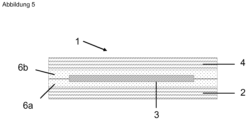
- Fig. 5 a second (opto-)electronic arrangement according to the invention in a schematic representation.
- Fig. 3 shows a first embodiment of an organic electronic device 1 according to the prior art.
- This device 1 has a substrate 2 on which an electronic Structure 3 is arranged.
- the substrate 2 itself is designed as a barrier for permeates and thus forms part of the encapsulation of the electronic structure 3.
- a further cover 4 designed as a barrier is arranged above the electronic structure 3, in this case also spatially spaced from it.
- an adhesive 5 is provided all the way around the electronic structure 3 on the substrate 2. It is irrelevant whether the adhesive was first connected to the substrate 2 or first to the cover 4.
- the adhesive 5 connects the cover 4 to the substrate 2. By being designed with a corresponding thickness, the adhesive 5 also enables the cover 4 to be spaced apart from the electronic structure 3.
- the adhesive 5 is a state-of-the-art adhesive, i.e. an adhesive with a high permeation barrier, which can also be filled to a high degree with getter material.
- the transparency of the adhesive is not relevant in this structure.
- a transfer adhesive tape would be provided in the form of a die-cut product, which is more difficult to handle due to its delicate geometry than a transfer adhesive tape that is essentially applied over the entire surface.
- Fig. 4 shows an inventive design of an (opto)electronic arrangement 1.
- an electronic structure 3 is shown, which is arranged on a substrate 2 and encapsulated from below by the substrate 2.
- the adhesive according to the invention is now arranged over the entire surface, for example in the form of transfer adhesive tape 6.
- the electronic structure 3 is thus completely encapsulated from above by the transfer adhesive tape 6.
- a cover 4 is then applied to the transfer adhesive tape 6.
- the transfer adhesive tape 6 is one based on the transfer adhesive tape according to the invention, as described above in general terms and explained in more detail below in exemplary embodiments.
- the transfer adhesive tape consists of only one layer of an adhesive according to the invention.
- the cover 4 does not necessarily have to meet the high barrier requirements, since when the electronic arrangement is completely covered by the transfer adhesive tape, the barrier is already provided by the adhesive.
- the cover 4 can, for example, only perform a mechanical protective function, but it can also be provided additionally as a permeation barrier.
- Fig. 5 shows an alternative embodiment of an (opto-)electronic arrangement 1.
- two transfer adhesive tapes 6a, b are now provided, which are identical in the present case, but can also be different.
- the first transfer adhesive tape 6a is arranged over the entire surface of the substrate 2.
- the electronic structure 3 is provided on the transfer adhesive tape 6a, which is fixed by the transfer adhesive tape 6a.
- the composite of transfer adhesive tape 6a and electronic structure 3 is then covered over its entire surface with the further transfer adhesive tape 6b, so that the electronic structure 3 is encapsulated on all sides by the transfer adhesive tapes 6a, b.
- the cover 4 is again provided above the transfer adhesive tape 6b.
- neither the substrate 2 nor the cover 4 necessarily have to have barrier properties. However, they can still be provided in order to further restrict the permeation of permeates to the electronic structure 3.
- the transfer adhesive tape here and preferably in each case has a homogeneous layer thickness.
- the transition to the electronic structure therefore, no sharp edge is formed, as it appears in the representation, but rather the transition is fluid and small unfilled or gas-filled areas can remain.
- an adaptation to the substrate can also be made, particularly if the application is carried out under vacuum.
- the adhesive is compressed locally to different degrees, so that a certain amount of the height difference at the edge structures can be compensated for by flow processes.
- the dimensions shown are also not to scale, but rather serve only to better illustrate.
- the electronic structure itself is usually relatively flat (often less than 1 ⁇ m thick).
- Direct contact between the adhesive and the electronic structure is not mandatory. Additional layers can also be arranged in between, such as a thin-film encapsulation of the electronic structure or barrier films.
- the thickness of the transfer adhesive tape can be any of the usual thicknesses, i.e. from 1 ⁇ m to 3000 ⁇ m. A thickness of between 25 and 100 ⁇ m is preferred, as the adhesive strength and handling properties are particularly good in this range. Another preferred range is a thickness of 3 to 25 ⁇ m, as the amount of substances permeating through the adhesive joint in an encapsulation application can be kept low in this range simply by the small cross-sectional area of the adhesive joint.
- the carrier of the adhesive tape or the liner is coated or printed on one side with the adhesive according to the invention from solution or dispersion or 100% (for example melt), or the adhesive tape is produced by (co-)extrusion.
- the adhesive layer can be crosslinked by heat or high-energy rays.
- This manufacturing process preferably takes place in an environment in which the specific permeate is present only in low concentrations or almost not at all.
- An example is a relative humidity of less than 30%, preferably less than 15%.
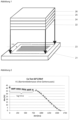
- a calcium test was used as a measure for determining the lifetime of an electronic structure. This is described in the Figure 1 shown.
- a thin calcium layer 23 measuring 10 ⁇ 10 mm 2 is deposited on a glass plate 21 in a vacuum and then stored under a nitrogen atmosphere. The thickness of the calcium layer 23 is approximately 100 nm.
- An adhesive tape (23 ⁇ 23 mm 2 ) with the adhesive 22 to be tested and a thin glass pane 24 (35 ⁇ m, Schott) as a carrier material.
- the thin glass pane was laminated with a 100 ⁇ m thick PET film 26 using a 50 ⁇ m thick transfer adhesive tape 25 of an optically highly transparent acrylic pressure-sensitive adhesive.
- the adhesive 22 is applied to the glass plate 21 in such a way that the adhesive 22 covers the calcium mirror 23 with an edge protruding on all sides of 6.5 mm (AA). Due to the impermeable glass carrier 24, only the permeation through the pressure-sensitive adhesive or along the interfaces is determined.
- the test is based on the reaction of calcium with water vapor and oxygen, as observed for example by AG Erlat et. al. in "47th Annual Technical Conference Proceedings-Society of Vacuum Coaters", 2004, pages 654 to 659 , and from ME Gross et al. in "46th Annual Technical Conference Proceedings-Society of Vacuum Coaters", 2003, pages 89 to 92 , described.
- the light transmission of the calcium layer is monitored, which increases due to the conversion into calcium hydroxide and calcium oxide. In the test setup described, this occurs from the edge, so that the visible surface of the calcium mirror is reduced.
- the time until the light absorption of the calcium mirror is halved is referred to as the service life.
- the method records both the degradation of the surface of the calcium mirror from the edge and through local degradation in the surface, as well as the homogeneous reduction in the layer thickness of the calcium mirror through full-surface degradation.
- the measurement conditions were 60 °C and 90% relative humidity.
- the samples were bonded over the entire surface and without bubbles using a layer of pressure-sensitive adhesive of 50 ⁇ m.
- the reduction in the Ca level is monitored using transmission measurements.
- the breakthrough time (lag time) is defined as the time required for moisture to travel the distance to the Ca (cf. Fig. 2 ). Until this time is reached at 60°C 90% RH, the transmission of the Ca level changes only marginally and at 85°C 85% RH a little.
- the determination of water vapor permeability is carried out according to ASTM F-1249.
- the pressure-sensitive adhesive is applied in a layer thickness of 50 ⁇ m to a highly permeable polysulfone membrane (available from Sartorius), which itself does not contain any Contribution to the permeation barrier.
- the water vapor permeability is determined at 37.5 °C and a relative humidity of 90% using a Mocon OX-Tran 2/21 measuring device.
- the molecular weight determinations of the number-average molecular weights M n and the weight-average molecular weights M w were carried out by means of gel permeation chromatography (GPC). THF (tetrahydrofuran) with 0.1 vol.% trifluoroacetic acid was used as the eluent. The measurement was carried out at 25 °C. The pre-column used was PSS-SDV, 5 ⁇ , 10 3 ⁇ , ID 8.0 mm ⁇ 50 mm. The columns PSS-SDV, 5 ⁇ , 10 3 and 10 5 and 10 6 , each with ID 8.0 mm x 300 mm, were used for separation. The sample concentration was 4 g/l, the flow rate was 1.0 ml per minute. The measurement was carried out against polystyrene standards.
- MMAP is the mixed methylcyclohexane-aniline cloud point determined using a modified ASTM C 611 method. Methylcyclohexane is substituted for the heptane used in the standard test method. The method uses resin/aniline/methylcyclohexane in a ratio of 1/2/1 (5 g/10 mL/5 mL) and the cloud point is determined by cooling a heated, clear mixture of the three components until complete turbidity just occurs.
- the DACP is the diacetone cloud point and is determined by cooling a heated solution of 5 g resin, 5 g xylene and 5 g diacetone alcohol to the point at which the solution becomes cloudy.
- the adhesive resin softening temperature is determined using the relevant methodology known as Ring and Ball, standardized to ASTM E28.
- a ring-ball machine HRB 754 from Herzog is used to determine the adhesive resin softening temperature of the resins. Resin samples are first finely ground. The resulting powder is filled into a brass cylinder with a bottom opening (inner diameter at the top of the cylinder 20 mm, diameter of the bottom opening of the cylinder 16 mm, height of the cylinder 6 mm) and melted on a heating table. The filling quantity is selected so that the resin completely fills the cylinder after melting without any overhang.
- the resulting test specimen is placed in the HRB 754 test holder together with the cylinder.
- Glycerine is used to fill the tempering bath if the adhesive resin softening temperature is between 50 °C and 150 °C. At lower adhesive resin softening temperatures, a water bath can also be used.
- the test balls have a diameter of 9.5 mm and weigh 3.5 g.
- the ball is placed above the test specimen in the tempering bath and placed on the test specimen. There is a collecting plate 25 mm below the cylinder base and a light barrier 2 mm above this. During the measurement process, the temperature is increased by 5 °C/min.
- the ball In the temperature range of the adhesive resin softening temperature, the ball begins to move through the bottom opening of the cylinder until it finally comes to a stop on the collecting plate. In this position, it is detected by the light barrier and the temperature of the tempering bath is recorded at this time. A double determination is carried out.
- the adhesive resin softening temperature is the average of the two individual measurements.
- various adhesives were applied from a solution to a conventional liner (siliconized polyester film) using a laboratory coating device and dried.
- the adhesive layer thickness after drying is 50 ⁇ 5 ⁇ m. Drying was initially carried out at RT for 10 minutes and then for 10 minutes at 120 °C in a laboratory drying cabinet. The dried adhesive layers were immediately laminated to the open side with a second liner (siliconized polyester film with lower release force) after drying.
- Sibstar 62M SiBS polystyrene-block-polyisobutylene block copolymer
- Kaneka 20% by weight block polystyrene content.
- the SBBS contained approx. 68% diblock content.
- a polystyrene-block-polyisobutylene block copolymer from Kaneka was selected as the copolymer.
- the proportion of styrene in the total polymer is 20% by weight.
- Sibstar 62M was used.
- the molecular weight M w is 60,000 g/mol.
- the glass transition temperature of the polystyrene blocks was 100 °C and that of the polyisobutylene blocks was -60 °C.
- the catalyst was present as a 50 wt. % solution in propylene carbonate.
- the photolatent catalyst has an absorption maximum in the range 320 nm to 360 nm.
- Table 1 The exact composition of the individual examples V1 and V2 or K1 and K2 can be found in Table 1.
- Table 1 Example: K1 K2 V1 V2 parts by weight parts by weight parts by weight parts by weight Sibstar 62M 37.5 HBE-100 20 20 Escorez 5600 100 100 Escorez 5300 37.5 Ondina G17 25 25 Tuftec P 1500 100 100 polyacrylate - 75 Glycidoxypropyltri-ethoxysilane 5 triethoxyoctylsilane 10 5 Titanium(IV) isopropoxide 0.3 [4-(2-hydroxytetradecyloxy)phenyl]phenyliodonium hexafluoroantimonate 0.3 0.1 0.1
- the samples were placed in a glove box. Some of the samples were laminated onto a Ca-vaporized glass substrate using a rubber roller to ensure that there were no bubbles. The second PET liner was then laid out and a layer of thin glass was laminated onto it. This sample was used for the durability test.
- a catalyst that is not in accordance with the invention i.e. one that cannot be switched, was used.
- the sample has a certain lag time that does not change when exposed to UV light.
- the getter cannot be switched.
- the lag time changes significantly.
- the lag time after activation of the catalyst and thus of the getter by UV radiation is 15 times higher than before activation.
- K2 is an example of a combined activation of the getter and curing of the reactive resin.
- the adhesive Before activation/curing, the adhesive has no lag time. A long lag time is achieved through activation/curing.
- the non-inventive sample V1 showed that the getter had been consumed and had already reacted with the water, so that the lag time had dropped to zero.
- the non-activated getter had not reacted with the water contained in the moist air during the one day.
- the lag time of the samples was essentially identical to that of a sample that had not been exposed to moist air. Although the samples were exposed to water vapor, this had no influence on their effectiveness as getters, since the getter function had not yet been activated.
- Comparative example V2 shows that a sample with a high WVTR value has no measurable lag time.
Landscapes
- Chemical & Material Sciences (AREA)
- Organic Chemistry (AREA)
- Chemical Kinetics & Catalysis (AREA)
- Health & Medical Sciences (AREA)
- Polymers & Plastics (AREA)
- Medicinal Chemistry (AREA)
- Wood Science & Technology (AREA)
- Oil, Petroleum & Natural Gas (AREA)
- Life Sciences & Earth Sciences (AREA)
- Materials Engineering (AREA)
- Engineering & Computer Science (AREA)
- Physics & Mathematics (AREA)
- Optics & Photonics (AREA)
- Adhesives Or Adhesive Processes (AREA)
- Adhesive Tapes (AREA)
- Electroluminescent Light Sources (AREA)
Description
- Die vorliegende Erfindung betrifft eine Klebemasse enthaltend ein Gettermaterial sowie optional ein Lösungsmittel, ein Klebeband mit dieser Klebemasse, die Verwendung einer solchen Klebemasse sowie eines solchen Klebebandes und ein Verfahren zum Applizieren der Klebemasse beziehungsweise des Klebebandes. Des Weiteren betrifft die Erfindung ein Klebeband mit dieser Klebemasse sowie die Verwendung einer solchen Klebemasse.
- Solche Klebemassen sind allgemein bekannt.
-
US 2010/159238 beschreibt eine mehrschichtige Klebstoffzusammensetzung, die eine erste Schicht, hergestellt aus einer ersten Zusammensetzung, die einen Teil A und einen Teil B umfasst, wobei Teil a einen Weichmacher, ein Vernetzungsmittel und einen Haftvermittler umfasst, wobei Teil B einen Feuchtigkeitsschutz und einen Abriebschutz umfasst und wobei die erste Schicht im Wesentlichen sulfidfrei ist. -
DE10 2012 211 335 betrifft ein Verfahren zum Schutz einer auf einem Substrat angeordneten elektronischen Anordnung umfassend organische Bestandteile, wobei eine Abdeckung derart auf die elektronische Anordnung aufgebracht wird, dass die elektronische Anordnung zumindest teilweise durch die Abdeckung überdeckt wird, wobei die Abdeckung zumindest teilflächig auf dem Substrat und/oder auf der elektronischen Anordnung verklebt wird, wobei die Verklebung mittels zumindest einer Schicht einer Klebemasse in einem Klebeband bewirkt wird, wobei die Klebemasse ein zur Sorption mindestens einer permeationsfähigen Substanz befähigtes Gettermaterial umfasst, wobei das Gettermaterial zu einem Anteil von nicht mehr als 2 Gew.-% bezogen auf die Klebemasse mit dem Gettermaterial, in der Klebemasse vorliegt. -
US 5304419 offenbart ein hermetisch abgedichtetes Gehäuse, in dem sich ein elektronisches Gerät befindet und dessen Innenfläche zumindest teilweise mit einer Beschichtung aus einem druckempfindlichen Klebstoff versehen ist, der 4 bis 40 Vol.-% eines feinteiligen, festen Trockenmittels mit einer durchschnittlichen Partikelgröße von 0,2 bis 100 µm enthält, wobei die Beschichtung eine Dicke von 1 bis 25 mm aufweist und wirksam ist, um eine Umgebung innerhalb des Gehäuses im Wesentlichen feuchtigkeitsfrei und im Wesentlichen frei von freien Feststoffpartikel zu halten. -
US 6121354 beansprucht ein heißschmelzendes Einkomponenten-Dichtmittel, bestehend aus einem Styrolblockcopolymer, einem feuchtigkeitshärtbarem silysierten Polyurethan-Präpolymer, einem aromatischen Klebharz, einem polaren Klebharz, einem Polyethylenwachs und einem organofunktionellem Silan. -
WO 2004/009720 betrifft eine umwandelbare Haftklebstoffzusammensetzung, bestehend aus 15 bis 80 Gew.-% eines Polymers mit einem Erweichungspunkt von mehr als 60 °C, 20 bis 85 Gew.-% eines polymerisierbaren Harzes mit einem Erweichungspunkt von weniger als 30 °C und einem latenten Initiator in einer ausreichenden Menge, um die Reaktion zwischen dem Polymer und dem Harz hervorzurufen und optionalen einem Vernetzungsmittel. -
WO 201515947 -
WO 2005/118679 offenbart eine Kleb- oder Dichtstoffzusammensetzung, die ein vernetzbares Polymer, einen Vernetzungskatalysator für das Polymer, einen Rheologieregler und einen Wasserfänger umfasst, wobei das vernetzbare Polymer Silyil-Endgruppen aufweist und ein äquivalentes Molekulargewicht zwischen 10.000 und 20.000 aufweist. - Das in der Klebemasse enthaltene Gettermaterial ist in der Lage, permeationsfähige Substanzen wie zum Beispiel Wasser, Sauerstoff, niedermolekulare Kohlenwasserstoffe oder flüchtige organische Verbindungen, die in die Klebemasse eindringen, abzufangen. Solche Klebemassen dienen zum Beispiel dazu, Gegenstände, die vor Wasser geschützt werden sollen, abzukapseln. Die permeationsfähige Substanz ist in diesem Fall Wasser. Ein besonders wichtiges Einsatzgebiet für solche Getter sind (opto)elektronische Anordnungen. (Opto-)elektronische Anordnungen werden immer häufiger in kommerziellen Produkten verwendet. Derartige Anordnungen umfassen anorganische oder organische elektronische Strukturen, beispielsweise organische, metallorganische oder polymere Halbleiter oder auch Kombinationen dieser. Diese Anordnungen und Produkte sind je nach gewünschter Anwendung starr oder flexibel ausgebildet, wobei eine zunehmende Nachfrage nach flexiblen Anordnungen besteht. Die Herstellung derartiger Anordnungen erfolgt beispielsweise durch Druckverfahren wie Hochdruck, Tiefdruck, Siebdruck, Flachdruck oder wie auch so genanntes "non impact printing" wie etwa Thermotransferdruck Tintenstrahldruck oder Digitaldruck. Vielfach werden aber auch Vakuumverfahren wie zum Beispiel Chemical Vapor Deposition (CVD), Physical Vapor Deposition (PVD), plasmaunterstützte chemische oder physikalische Depositionsverfahren (PECVD), Sputtern, (Plasma-)Ätzen oder Bedampfung verwendet, wobei die Strukturierung in der Regel durch Masken erfolgt.
- Als Beispiele für bereits kommerzielle oder in ihrem Marktpotential interessante (opto-)elektronische Anwendungen seien hier elektrophoretische oder elektrochrome Aufbauten oder Displays, organische oder polymere Leuchtdioden (OLEDs oder PLEDs) in Anzeige-und Display-Vorrichtungen oder als Beleuchtung genannt, Elektrolumineszenzlampen, lichtemittierende elektrochemische Zellen (LEECs), organische Solarzellen, bevorzugt Farbstoff- oder Polymersolarzellen, anorganische Solarzellen, bevorzugt Dünnschichtsolarzellen, insbesondere auf der Basis von Silizium, Germanium, Kupfer, Indium und Selen, Perowskitsolarzellen, organische Feldeffekt-Transistoren, organische Schaltelemente, organische optische Verstärker, organische Laserdioden, organische oder anorganische Sensoren oder auch organisch- oder anorganischbasierte RFID-Transponder angeführt.
- Weitere Anwendungen verkapselnder Klebebänder sind im Bereich der Batterietechnik bekannt, insbesondere im Bereich der flexiblen Mikrobatterien und Dünnschichtbatterien, ganz besonders solchen umfassend lithiumhaltige Kathoden, Anoden oder Elektrolyte.
- Demgemäß wird in dieser Schrift unter einer organischen (opto-)elektronischen Anordnung eine elektronische Anordnung verstanden, die zumindest einen elektronisch funktionalen, zumindest teilweise organischen Bestandteil umfasst - zum Beispiel metallorganische Verbindungen - oder deren elektronisch funktionaler Aufbau eine Dicke von weniger als 20 µm aufweist.
- Als technische Herausforderung für die Realisierung ausreichender Lebensdauer und Funktion von (opto-)elektronischen Anordnungen im Bereich der anorganischen und/oder organischen (Opto-)Elektronik, ganz besonders aber im Bereich der organischen (Opto-)Elektronik ist ein Schutz der darin enthaltenen Komponenten vor Permeaten zu sehen. Permeate können eine Vielzahl von niedermolekularen organischen oder anorganischen Verbindungen sein, insbesondere Wasserdampf und Sauerstoff.
- Eine Vielzahl von (opto-)elektronischen Anordnungen im Bereich der anorganischen und/oder organischen (Opto-)Elektronik, ganz besonders bei Verwendung von organischen Rohstoffen, ist sowohl gegen Wasserdampf als auch gegen Sauerstoff empfindlich, wobei für viele Anordnungen das Eindringen von Wasser oder Wasserdampf als größeres Problem eingestuft wird. Während der Lebensdauer der elektronischen Anordnung ist deshalb ein Schutz durch eine Verkapselung erforderlich, da andernfalls die Leistung über den Anwendungszeitraum nachlässt. So können sich beispielsweise durch eine Oxidation der Bestandteile etwa bei lichtemittierenden Anordnungen wie Elektrolumineszenz-Lampen (EL-Lampen) oder organischen Leuchtdioden (OLED) die Leuchtkraft, bei elektrophoretischen Displays (EP-Displays) der Kontrast oder bei Solarzellen die Effizienz innerhalb kürzester Zeit drastisch verringern.
- Um eine möglichst gute Versiegelung zu erzielen, werden spezielle Barriereklebemassen (auch als wasserdampfsperrende Klebemassen bezeichnet) verwendet. Eine gute Klebemasse für die Versiegelung von (opto-)elektronischen Bauteilen weist eine geringe Permeabilität gegen Sauerstoff und insbesondere gegen Wasserdampf auf, hat eine ausreichende Haftung auf der Anordnung und kann gut auf diese auffließen.
- Zur Charakterisierung der Barrierewirkung werden üblicherweise die Sauerstofftransmissionsrate OTR (Oxygen Transmission Rate) sowie die Wasserdampftransmissionsrate WVTR (Water Vapor Transmission Rate) angegeben. Die jeweilige Rate gibt dabei den flächen- und zeitbezogenen Fluss von Sauerstoff beziehungsweise Wasserdampf durch einen Film unter spezifischen Bedingungen von Temperatur und Partialdruck sowie gegebenenfalls weiterer Messbedingungen wie relativer Luftfeuchtigkeit an. Je geringer diese Werte sind, desto besser ist das jeweilige Material zur Kapselung geeignet. Die Angabe der Permeation basiert dabei nicht allein auf den Werten für WVTR oder OTR, sondern beinhaltet immer auch eine Angabe zur mittleren Weglänge der Permeation wie zum Beispiel die Dicke des Materials oder eine Normalisierung auf eine bestimmte Weglänge.
- Die Permeabilität P ist ein Maß für die Durchlässigkeit eines Körpers für Gase und/oder Flüssigkeiten. Ein niedriger P-Wert kennzeichnet eine gute Barrierewirkung. Die Permeabilität P ist ein spezifischer Wert für ein definiertes Material und einen definierten Permeaten unter stationären Bedingungen bei bestimmter Permeationsweglänge, Partialdruck und Temperatur. Die Permeabilität P ist das Produkt aus Diffusions-Term D und Löslichkeits-Term S: P = D * S
- Der Löslichkeitsterm S beschreibt vorwiegend die Affinität der Barriereklebemasse zum Permeaten. Im Fall von Wasserdampf wird beispielsweise ein geringer Wert für S von hydrophoben Materialen erreicht. Der Diffusionsterm D ist ein Maß für die Beweglichkeit des Permeaten im Barrierematerial und ist direkt abhängig von Eigenschaften wie der Molekülbeweglichkeit oder dem freien Volumen. Oft werden bei stark vernetzten oder hochkristallinen Materialen für D relativ niedrige Werte erreicht. Hochkristalline Materialien sind jedoch in der Regel weniger transparent, und eine stärkere Vernetzung führt zu einer geringeren Flexibilität. Die Permeabilität P steigt üblicherweise mit einer Erhöhung der molekularen Beweglichkeit an, etwa auch wenn die Temperatur erhöht oder der Glasübergangspunkt überschritten wird.
- Ansätze, um die Barrierewirkung einer Klebemasse zu erhöhen, müssen die beiden Parameter D und S insbesondere berücksichtigen im Hinblick auf den Einfluss auf die Durchlässigkeit von Wasserdampf und Sauerstoff. Zusätzlich zu diesen chemischen Eigenschaften müssen auch Auswirkungen physikalischer Einflüsse auf die Permeabilität bedacht werden, insbesondere die mittlere Permeationsweglänge und Grenzflächeneigenschaften (Auffließverhalten der Klebemasse, Haftung). Die ideale Barriereklebemasse weist geringe D-Werte und S-Werte bei sehr guter Haftung auf dem Substrat auf.
- Ein geringer Löslichkeits-Term S allein ist meist unzureichend, um gute Barriereeigenschaften zu erreichen. Ein klassisches Beispiel dafür sind insbesondere Siloxan-Elastomere. Die Materialien sind äußerst hydrophob (kleiner Löslichkeits-Term), weisen aber durch ihre frei drehbare Si-O-Bindung (großer Diffusions-Term) eine vergleichsweise geringe Barrierewirkung gegen Wasserdampf und Sauerstoff auf. Für eine gute Barrierewirkung ist also eine gute Balance zwischen Löslichkeits-Term S und Diffusions-Term D notwendig.
- Beschrieben sind weiterhin Barriereklebemassen auf der Basis von Styrolblockcopolymeren und möglichst hydrierten Harzen (siehe
DE 10 2008 047 964 A1 ). Hier werden auch Permeationswerte (WVTR) von weit verbreiteten Klebstoffsystemen angegeben (gemessen bei 37.5°C und 90% relativer Feuchte). Typische Haftklebemassen auf Acrylatbasis liegen im Bereich zwischen 100 g/m2 d und 1000 g/m2 d. Silikonhaftklebemassen haben aufgrund der hohen Beweglichkeit der Ketten noch höhere Permeationswerte für Wasser von über 1000 g/m2 d. Werden Styrolblockcopolymere als Elastomerkomponente verwendet, so werden für nicht oder nicht-vollständig hydrierteSysteme WVTR-Werte im Bereich von 50 - 100 g/m2 d und für hydrierte Systeme (zum Beispiel SEBS) Werte unter 50 g/m2 d erreicht. Besonders niedrige WVTR-Werte von unter 15 g/m2 d werden sowohl mit reinen Poly(isobutylen)elastomeren oder Blockcopolymeren aus Styrol und Isobutylen erreicht. - Eine Möglichkeit, die Barrierewirkung noch zu verbessern, ist der Einsatz von Stoffen, die mit den eindringenden Substanzen, den sogenannten permeationsfähigen Substanzen, wie zum Beispiel Wasser oder Sauerstoff reagieren. In die (opto-)elektronische Anordnung eindringende permeationsfähige Substanzen wie Sauerstoff oder Wasserdampf werden dann an diese Stoffe chemisch oder physikalisch, bevorzugt chemisch gebunden und erhöhen somit die Durchbruchszeit ("lag-time"). Diese Stoffe werden in der Literatur als "Getter", "scavenger", "desiccants" oder "absorber" bezeichnet. Im Folgenden wird der Ausdruck Getter verwendet. Ein Getter oder Gettermaterial ist ein Material, das zur Sorption mindestens einer permeationsfähigen Substanz in der Lage ist.
- Gettermaterialien sind beispielsweise Salze wie Cobaltchlorid, Calciumchlorid, Calciumbromid, Lithiumchlorid, Lithiumbromid, Magnesiumchlorid, Bariumperchlorat, Magnesiumperchlorat, Zinkchlorid, Zinkbromid, Kieselsäuren (zum Beispiel Silica Gel), Aluminiumsulfat, Calciumsulfat, Kupfersulfat, Bariumsulfat, Magnesiumsulfat, Lithiumsulfat, Natriumsulfat, Cobaltsulfat, Titansulfat, Natriumdithionit, Natriumcarbonat, Kaliumdisulfit, Kaliumcarbonat, Magnesiumcarbonat, Titandioxid, Kieselgur, Zeolithe, Schichtsilikate wie Montmorillonit und Bentonit, Metalloxide wie Bariumoxid, Calciumoxid, Eisenoxid, Magnesiumoxid, Natriumoxid, Kaliumoxid,Strontiumoxid, Aluminiumoxid (aktiviertes Alumina); weiter Kohlenstoffnanoröhrchen, Aktivkohle, Phosphorpentoxid und Silane; leicht oxidierbare Metalle wie beispielsweise Eisen, Calcium, Natrium und Magnesium; Metallhydride wie beispielsweise Calciumhydrid, Bariumhydrid, Strontiumhydrid, Natriumhydrid und Lithiumaluminiumhydrid; Hydroxide wie Kaliumhydroxid und Natriumhydroxid, Metallkomplexe wie zum Beispiel Aluminiumacetylacetonat; des Weiteren organische Absorber, beispielsweise Polyolefin-Copolymere, Polyamid-Copolymere, PET-Copolyester, Anhydride von einfachen und mehrfachen Carbonsäuren wie Essigsäureanhydrid, Propionsäureanhydrid, Buttersäureanhydrid oder Methyltetrahydrophtalsäureanhydrid, Isocyanate oder weitere auf Hybridpolymeren basierte Absorber, die meist in Kombination mit Katalysatoren wie beispielsweise Cobalt verwendet werden; weitere organische Absorber wie etwa schwach vernetzte Polyacrylsäure, Polyvinylalkohol, Ascorbate, Glucose, Gallussäure oder ungesättigte Fette und Öle.
- Die Gettermaterialien werden ihrer Funktion entsprechend bevorzugt als im Wesentlichen von Permeaten freie Materialien eingesetzt, zum Beispiel wasserfrei. Dies unterscheidet Gettermaterialien von ähnlichen Materialien, die als Füllstoff eingesetzt werden. So wird Silica zum Beispiel in der Form von pyrogener Kieselsäure häufig als Füllstoff eingesetzt. Wird dieser Füllstoff jedoch wie üblich unter Umgebungsbedingungen gelagert, nimmt er bereits Wasser aus der Umgebung auf und ist nicht mehr in technisch nutzbarem Umfang als Gettermaterial funktionsfähig. Erst getrocknetes oder trocken gehaltenes Silica kann als Gettermaterial genutzt werden. Es ist jedoch auch möglich, bereits teilweise mit Permeaten komplexierte Materialien zu verwenden, beispielsweise CaSO4*1/2H2O (Calciumsulfat-Halbhydrat) oder teilhydrierte Kieselsäuren, die per Definition als Verbindungen der allgemeinen Formel (SiO2)m*nH2O vorliegen.
- Unter Kieselsäuren werden, wie vorstehend beschrieben, Verbindungen der allgemeinen Formel (SiO2)m*nH2O verstanden. Es handelt sich dabei um durch nasschemische, thermische oder pyrogene Verfahren hergestelltes Siliciumdioxid. Insbesondere sind unter den Kieselsäuren Kieselgele beziehungsweise Silicagele, beispielsweise mit Kobalt-Verbindungen als Feuchteindikator imprägnierte Kieselgele (Blaugel), und pyrogene Kieselsäuren geeignete Gettermaterialien.
- Unter "Sorption" wird der Vorgang der Aufnahme eines Stoffes oder mehrerer Stoffe durch einen anderen Stoff - erfindungsgemäß durch das Gettermaterial - verstanden. Der Getter ließe sich daher auch als "Sorbens" oder "Sorptionsmittel" bezeichnen. Die Sorption der permeationsfähigen Substanz(en) durch das Gettermaterial kann dabei beispielsweise durch Absorption oder Adsorption erfolgen, wobei Adsorption sowohl in Form von Chemisorption als auch von Physisorption auftreten kann.
- Unter einer "permeationsfähigen Substanz" wird eine Substanz verstanden, die als gasförmiger oder flüssiger, gegebenenfalls auch als fester Stoff, in die zu schützende Klebemasse eindringen und diese nachfolgend durchdringen kann. Derartige Substanzen wurden vorstehend und werden nachstehend als "Permeate" bezeichnet. Die Permeate können aus der Klebemasse selbst oder aus der Umgebung, beispielsweise auch aus dem Trägermaterial eines mit der Klebemasse beschichteten Klebebandes stammen. Aus der Klebemasse beziehungsweise aus dem Klebeband selbst kommen häufig niedermolekulare organische Verbindungen wie Lösemittelreste, Restmonomere, Öle, Harzkomponenten, Weichmacher sowie Wasser. Aus der Umgebung stammen oft Wasser, flüchtige organische Verbindungen (VOCs), niedermolekulare Kohlenwasserstoffe und Sauerstoff.
- Zum Beispiel für Wasser erfolgt die Bindung des eindringenden Wassers entweder physikalisch durch Adsorption typischerweise an Silica, Molekularsieben, Zeoliten oder Natriumsulfat. Chemisch wird Wasser über Alkoxysilane, Oxazolidine, Isocyanate, Bariumoxid, Phosphorpentoxid, Alkali- und Erdalkalioxide (wie beispielsweise Calciumoxid), metallisches Calcium oder Metallhydride gebunden (
WO 2004/009720 A2 ). - Beschrieben als solche Getter sind in Klebmassen hauptsächlich anorganische Füllstoffe wie beispielsweise Calciumchlorid oder verschiedene Oxide (vergleiche
US 5,304,419 A ,EP 2 380 930 A1 oderUS 6,936,131 A ). - Auch organische Getter sind in Klebemassen beschrieben, so zum Beispiel in der
EP 2 597 697 A1 , in der polymere Alkoxysilane als Getter verwendet werden. Zahlreiche verschiedene Silane als Getter in Klebemassen werden in derWO 2014/001005 A1 genannt. Aus der großen Auswahl an Alkoxysilanen würde der Fachhmann zunächst leicht hydrolisierbare wie beispielsweise Methoxysilane auswählen. Besonders gute Aktivitäten erreicht man jedoch bei der Verkapselung von Aufbauten der organischen Elektronik, wenn die Alkoxygruppe eine Ethoxygruppe ist. Es hat sich gezeigt, dass überraschenderweise die im Vergleich zu Methoxysilanen unreaktiveren Ethoxysilane vor allen Dingen bei hohen Temperaturen die Permeation von Feuchtigkeit deutlich besser reduzieren. Dies ist unerwartet, da Methoxysilane normalerweise eine höhere Reaktivität aufweisen als die entsprechenden Ethoxysilane (vergleiche Wacker Produktbeschreibung 6085e/09.13 "GE-NIOSL®", Seite 11 aus September 2013 (09.13)). - Schwierigkeiten bei derartigen Klebemassen oder Tapes aus solchen Klebemassen bestehen in der Lagerung und im Transport bis zum endgültigen Einsatz. Eine Klebemasse oder ein Tape, das einen Getter enthält, muss hermetisch versiegelt bis zur Anwendung gelagert und/oder transportiert werden. Eindringende Permeate wie insbesondere Feuchtigkeit werden vom Getter aufgenommen, wodurch dieser verbraucht wird und somit die Barriereeigenschaft reduziert wird. Dies ist gerade für Anwendungen in der Elektronik sehr nachteilig, da die Klebebänder meist zu Stanzlingen bei externen Convertern zugeschnitten werden und somit Kontakt zu Feuchtigkeit haben. Somit werden die Wasserfänger im Tape je nach Zeit, die der Converter zum Stanzen benötigt und vorhandener Luftfeuchtigkeit mal mehr, mal weniger verbraucht. Abgesehen von der Reduzierung der Getterfunktion, also von der Fähigkeit als Getter zu wirken - und in diesem Fall Wasser aufzunehmen -, ist somit auch keine eindeutige Aussage mehr darüber möglich, über welche Getterkapazität, das heißt über welche Fähigkeit zur Wasseraufnahme, die Klebemasse beziehungsweise das Klebeband nach erfolgter Applikation noch verfügt.
- Der Erfindung lag daher die Aufgabe zugrunde, eine Klebemasse zur Verfügung zu stellen, die bis zur Applikation beim Anwender kurzzeitigen Kontakt mit Permeaten wie insbesondere Feuchtigkeit toleriert, ohne dass die Getterkapazität nennenswert beeinträchtigt wird.
- Überraschenderweise wurde gefunden, dass diese Aufgabe durch eine Klebemasse wie sie in Anspruch 1 definiert ist, gelöst wird. Bevorzugte Ausführungsformen der vorliegenden Erfindung sind in den abhängigen Ansprüchen dargelegt.
- Der vorliegenden Erfindung liegt entsprechend die Erkenntnis zugrunde, dass eine solche Klebemasse erhalten werden kann, wenn eine Klebemasse der eingangs genannten Art einen Katalysator für die Reaktion des Gettermaterials aus der Gruppe der Ethoxysilane mit einem Permeaten enthält, der mittels eines äußeren Stimulus aktivierbar ist. Die vorliegende Erfindung ist für Wasser als Permeat besonders gut geeignet.
- Bei einer solchen Klebemasse kann die Getterfunktion aktiviert werden, wenn sie benötigt wird, das heißt insbesondere dann, wenn die Klebemasse appliziert ist und einen Gegenstand gegen das Permeat, zum Beispiel Wasserdampf, abdichten soll. Eine solche Klebemasse kann als "schaltbar" bezeichnet werden. Ihre permeatbindende Funktion, insbesondere wasserbindende Funktion, kann durch einen äußeren Stimulus oder Trigger "angeschaltet" werden, indem der Katalysator durch den äußeren Stimulus oder Trigger aktiviert wird. Während der Lagerung oder des Transportes der Klebemasse ist der Katalysator und damit die Getterfunktion noch nicht aktiviert beziehungsweise angeschaltet. Der Getter reagiert nicht oder nicht nennenswert mit dem Permeat, insbesondere mit Wasserdampf, und wird nicht verbraucht. Erst wenn die Klebemasse appliziert ist und tatsächlich einen Gegenstand gegen Wasserdampf abdichten und vor Eindringen von Wasserdampf schützen soll, wird der Getter aktiviert oder "angeschaltet" und nimmt seine Funktion auf.
- Der Katalysator verändert die Geschwindigkeitskonstante für die Reaktion des Getters mit dem Permeaten, insbesondere Wasser(dampf). Eine Veränderung im Sinne der vorliegenden Erfindung ist gegeben, wenn die Geschwindigkeitskonstante mindestens um einen Faktor 5, bevorzugt 10, besonders bevorzugt mindestens um einen Faktor 50 erhöht wird.
- Der Katalysator kann zum Beispiel eine latente Säure oder eine latente Base sein, das heißt, der Katalysator kann nach Aktivierung das chemische Milieu im Hinblick auf die Säure-Base-Eigenschaften verändern und damit eine Reaktion, deren Geschwindigkeit von diesem Milieu abhängig ist, beschleunigen. So ist die Abhängigkeit der Reaktionsgeschwindigkeit vom pH-Wert am Beispiel eines Silans im J. Org. Chem., Vol. 51, No. 20, 1986, Seiten 3827-3830 beschrieben. Weitere pH-abhängige Reaktionen mit Wasser sind beispielsweise die Hydrolyse von Anhydriden, Carbodiimiden, Oxazolidonen, Estern oder Isocyanaten.
- Beispiele für solche latenten Systeme, die eine Veränderung des Milieus herbeiführen können, sind auf Onium-Salzen, insbesondere auf Sulfonium und lodonium, sowie auf Metallocen basierende Systeme.
- Im Falle von Wasser hat das Gettermaterial seine geringste Aktivität gegenüber Wasser vorzugsweise im neutralen oder quasi-neutralen Milieu. Unter "neutralem Milieu" ist dabei ein Milieu zu verstehen, das in wässriger Lösung einem pH von 7 entspräche. Unter "quasineutralem Milieu" ist der Bereich zu verstehen, der in wässriger Lösung einem pH zwischen 6 und 8 entspräche, vorzugsweise einem pH von 6,5 bis 7,5. Im neutralen Milieu hat das Gettermaterial in diesem Fall seine geringste Reaktionsgeschwindigkeit für die Reaktion mit Wasser. Die Reaktionsgeschwindigkeit ist so gering, dass keine nennenswerte Reaktion mit Wasser(dampf) erfolgt. Wenn das Milieu hingegen sauer oder basisch wird, erhöht sich die Reaktionsgeschwindigkeit signifikant.
- Auch andere dem Fachmann bekannte Katalysatoren sind für die Erfindung geeignet. Dies gilt insbesondere für Katalysatoren, die nano- oder mikroverkapselt sind. Diese Katalysatoren werden aktiviert, indem die Verkapselung aufgebrochen wird.
- Die Menge an Katalysator, die in der erfindungsgemäßen Klebemasse enthalten ist, beträgt vorzugsweise weniger als 5 Gew.-%, bevorzugt weniger als 2 Gew.-% und insbesondere weniger als 1 Gew.-%. Es reichen also verhältnismäßig geringe Mengen aus, um die erfindungsgemäße Wirkung zu erreichen.
- "Äußerer Stimulus" meint eine Einwirkung von außen auf den Katalysator, der diesen aktiviert.
- Besonders geeignet als äußerer Stimulus sind UV-Strahlung, eine Temperaturveränderung, Mikrowellenstrahlung oder sichtbares Licht, wobei UV-Strahlung ganz besonders bevorzugt ist. Durch UV-Strahlung ist eine einfache Aktivierung möglich; auf der anderen Seite ist es unwahrscheinlich, dass die Klebemasse vor der gewünschten Applikation versehentlich einer UV-Strahlung ausgesetzt wird, so dass eine unbeabsichtigte Aktivierung vermieden werden kann.
- Besonders bevorzugt umfasst die Klebemasse eine Klebstoffbasis aus mindestens einem Elastomer und mindestens einem Klebharz. Eine besonders geeignet Klebemasse umfasst damit Klebstoffbasis, Gettermaterial, optional ein Lösungsmittel sowie einen Katalysator für die Reaktion des Gettermaterials mit einem Permeaten, der mittels eines äußeren Stimulus aktivierbar ist.
- Weiterhin ist die erfindungsgemäße Klebemasse vorzugsweise haftklebrig. Dies ermöglicht eine besonders gute Handhabbarkeit, da die Klebemasse auch vor der Vernetzung bereits an der zu verklebenden Stelle haftet.
- Besonders gut geeignet ist die erfindungsgemäße Klebemasse, wenn sie des Weiteren mindestens ein Reaktivharz mit mindestens einer härtbaren Gruppe enthält. Solche Klebemassen können appliziert werden, sind aber zunächst noch verformbar. Erst nach erfolgter Reaktion der härtbaren Gruppe härtet die Klebemasse aus und entfaltet ihre vollständige Klebewirkung.
- Als härtbare Gruppe sind dabei cyclischer Ether, Vinyl, Acrylat, Methacrylat, Hydroxyl, Amino und/oder Isocyanat besonders geeignet. Es können auch mehrere unterschiedliche härtbare Gruppen im Reaktivharz vorhanden sein.
- Wenn die Klebemasse ein Reaktivharz enthält, sind solche Systeme besonders einfach in der Handhabung, bei denen der Stimulus für den Katalysator für die Reaktion des Gettermaterials mit Wasser gleichzeitig der Initiator für die Härtung des Reaktivharzes ist. Insbesondere UV-Strahlung ist hier als Stimulus besonders geeignet. Der Katalysator ist dann ein Photokatalysator.
- Auf der anderen Seite sind auch solche Klebemassen gut geeignet, die kein Reaktivharz enthalten. Solche Klebemassen kommen ohne den zusätzlichen Schritt der Aushärtung aus, so dass in einem solchen System auf etwaige Anforderungen an die Aushärtung der reaktiven Gruppen keine Rücksicht genommen werden muss und einzig dafür Sorge zu tragen ist, dass das Gettermaterial in erforderlicher Weise aktiviert wird.
- Insbesondere Haftklebemassen sind als Klebemassen ohne Reaktivharz besonders geeignet.
- Vorzugsweise ist die Klebemasse eine Barriereklebemasse, deren Klebstoffbasis - im Falle des Vorhandenseins eines Reaktivharzes nach dessen Aushärtung - eine Wasserdampfpermeationsrate von weniger als 100 g/m2d, bevorzugt von weniger als 50 g/m2d, insbesondere weniger als 15 g/m2d aufweist.
- Vorzugsweise weist die Klebemasse ein neutrales oder quasi-neutrales Milieu vor der Stimulation des Katalysators auf. Bevorzugt enthält also die Klebemasse keine sauren oder basischen Gruppen, insbesondere keine organischen Säuren, Acrylsäuren, Methacrylsäuren, Amine, Amide oder deren Polymere.
- Besonders bevorzugt ist das Gettermaterial mindestens eine Verbindung, ausgewählt aus der Gruppe umfassend Alkoxysilane und Alkoxysiloxane. Diese Verbindungen gewährleisten ein neutrales Milieu. Dabei können die Alkoxysilane und Alkoxysiloxane bevorzugt als Monomere oder als Oligomere mit 2 bis 40 sich wiederholenden SiR2-Gruppen sein. Die Verbindungen können kettenförmig oder ringförmig ausgebildet sein.
- Unter "Silanen" werden Verbindungen der allgemeinen Formel Ra-Si-X4-a oder deren partielle Kondensationsprodukte verstanden. In der Formel steht a für eine ganze Zahl von 0 bis 3 und bevorzugt für 0 oder 1. X steht für eine hydrolysierbare Gruppe, beispielsweise und bevorzugt für ein Halogen-Atom, insbesondere Chlor, eine Alkoxy-Gruppe wie beispielsweise eine Methoxy-, Ethoxy-, n-Propoxy-, iso-Propoxy-, n-Butoxy-, sec-Butoxy- oder tert-Butoxy-Gruppe oder für eine Acetoxy-Gruppe. Weitere, dem Fachmann bekannte Beispiele für hydrolysierbare Gruppen sind im Sinne der vorliegenden Erfindung ebenfalls einsetzbar. Sind mehrere Substituenten X vorhanden, so können diese gleich oder voneinander verschieden sein. R steht für einen gegebenenfalls substituierten Kohlenwasserstoffrest, beispielsweise für eine Methyl-, Ethyl-, n-Propyl-, iso-Propyl-, n-Butyl-, sec-Butyl-, tert-Butyl-Gruppe, eine Pentyl-Gruppe sowie deren verzweigte Isomere, eine Hexyl-Gruppen sowie die verzweigten Isomere, eine Heptyl-Gruppe sowie die verzweigten Isomere, eine Octyl-Gruppe sowie die verzweigten Isomere, eine Nonyl-Gruppe sowie die verzweigten Isomere, eine Decyl-Gruppe sowie die verzweigten Isomere, eine Undecyl-Gruppe sowie die verzweigten Isomere, eine Dodecyl-Gruppe sowie die verzweigten Isomere, eine Tetradecyl-Gruppe sowie die verzweigten Isomere, eine Hexadecyl-Gruppe sowie die verzweigten Isomere, eine Octadecyl-Gruppe sowie die verzweigten Isomere oder eine Eicosyl-Gruppe sowie die verzweigten Isomere. Die Kohlenwasserstoffreste können zudem ringförmige und/oder aromatische Bauteile enthalten. Repräsentative Strukturen dafür sind Cyclohexyl-, Phenyl- und Benzyl-Gruppen. Gegebenenfalls enthält/enthalten der/die Kohlenwasserstoffrest(e) R beispielsweise einen oder mehrere Heteroatom-haltige Substituenten wie Aminogruppen, Aminoalkylgruppen, Glycidyloxygruppen, (Meth)acryloxygruppen und dergleichen. Sind mehrere Substituenten R vorhanden, so können diese gleich oder voneinander verschieden sein.
- Ein als Gettermaterial einsetzbares Silan ist bevorzugt ausgewählt aus der Gruppe umfassend N-(2-Aminoethyl)-3-aminopropyltrimethoxysilan, N-(2-Aminoethyl)-3-aminopropy-Itriethoxysilan, 3-Aminopropyltrimethoxysilan, 3-Aminopropyltriethoxysilan, 3-Aminopropy-Idiethoxymethylsilan, N-(2-Aminoethyl)-3-aminopropyldimethoxymethylsilan, (N-Butyl)-3-aminopropyltrimethoxysilan, 3-(N-Ethylamino)-2-methylpropyltrimethoxysilan, 4-Amino-3,3-dimethylbutyltrimethoxysilan, 4-Amino-3,3-dimethylbutyldimethoxymethylsilan, (N-Cyclohexyl)-aminomethyldimethoxymethylsilan, (N-Cyclohexyl)-aminomethyltrimethoxysilan, (N-Phenyl)-3-aminopropyltrimethoxysilan, (N-Phenyl)-aminomethyldimethoxymethylsilan, (N-Benzyl-2-aminoethyl)-3-aminopropyltrimethoxysilan, [2-(N-Benzyl-N-vinylamino)-ethyl]-3-aminopropyltrimethoxysilan Hydrogenchlorid, [2-(N-Benzyl-N-vinylamino)-ethyl]-3-aminopropyltrimethoxysilan, Bis-(3-propyltriethoxysilyl)-amin, Vinyltrimethoxysilan, Vinyltriethoxysilan, Vinyl-tri(2-methoxyethoxy)-silan, Vinyltriisopropoxysilan, Vinyldimethoxymethylsilan, Vinyltriacetoxysilan, 3-Triethoxysilylpropylbernsteinsäureanhydrid, 3-Glycidyloxypropyltrimethoxysilan, 3-Glycidyloxypropyltriethoxysilan, 2-(3,4-Epoxycyclohexyl)-ethyltriethoxysilan, 2-(3,4-Epoxycyclohexyl)-ethyltrimethoxysilan, 2-(3,4-Epoxycyclohexyl)-ethylmethyldimethoxysilan, 2-(3,4-Epoxycyclohexyl)-ethylmethyldiethoxysilan, Triethoxyoctylsilan, Trimethoxyoctylsilan, 3-Glycidyloxypropyldiethoxymethylsilan, 3-Methacryloyloxypropyltrimethoxysilan, 3-Methacryloyloxypropyltriethoxysilan, 3-Methacryloyloxypropyltriisopropoxysilan, 3-Methacryloyloxypropyldimethoxymethylsilan, 3-Methacryloyloxypropyldiethoxymethylsilan, 3-Chloropropyltrimethoxysilan, 3-Chloropropyltriethoxysilan, 3-Isocyanatopropyltrimethoxysilan, 3-Isocyanatopropyltriethoxysilan, Isocyanatomethyltrimethoxysilan, Isocyanatomethyldimethoxymethylsilan, Tris-[3-(trimethoxysilyl)-propyl]-isocyanurat, 3-Ureidopropyltrimethoxysilan, 3-Ureidopropyltriethoxysilan, 2-Hydroxy-4-(3-triethoxysilylpropoxy)-benzophenon, 4-(3'-Chlorodimethylsilylpropoxy)-benzophenon, 3-Mercaptopropyltrimethoxysilan, 3-Mercaptopropyldimethoxymethylsilan, Bis-(3-triethoxysilylpropyl)-disulfan, Bis-(3-triethoxysilylpropyl)-tetrasulfan, Bis-(triethoxysilylpropyl)-polysulfan und Octadecylaminodimethyltrimethoxysilylpropylammoniumchlorid. Es sind auch andere, nicht vernetzende, Alkoxysilane als Gettermaterial einsetzbar.
- Als Siloxane im Sinne der Erfindung werden Verbindungen verstanden, die mindestens zwei über ein Sauerstoffatom verbundene SiR2-Gruppen aufweisen. Bei den erfindungsgemäß besonders geeigneten Alkoxysiloxanen ist mindestens ein Rest R eine Alkoxygruppe. Beispiele für erfindungsgemäß besonders geeignete Siloxane sind Oligomere oder Polymere der im vorstehenden Absatz genannten Silane.
- Vorzugsweise weist der Getter mindestens eine härtbare Gruppe auf. Als härtbare Gruppe besonders geeignet sind dabei cyclischer Ether, Vinyl, Acrylat, Methacrylat, Hydroxyl, Amino oder Isocyanat.
- Im Falle von Alkoxysiloxanen als Getter weist das Alkoxysiloxan vorzugsweise pro Si-Atom eine Alkoxygruppe und eine härtbare Gruppe auf. Dabei kann die Alkoxygruppe gleich oder verschieden zu benachbarten Si-Alkoxygruppen sein. Ebenso kann die härtbare Gruppe benachbarter Wiederholungseinheiten gleich oder verschieden sein.
- Das Gettermaterial weist mindestens eine Ethoxysilangruppe und mindestens eine härtbare Gruppe auf, wobei die härtbare Gruppe eine cyclische Ethergruppe ist. Als cyclische Ethergruppe sind eine Epoxid- oder eine Oxirangruppe besonders geeignet, wobei die Silane 2-(3,4-Epoxycyclohexyl)ethyltrimethoxysilan und insbesondere 2-(3,4-Epoxycyclohexyl)ethyltriethoxysilan und 2-(3,4-Epoxycyclohexyl)ethylmethyl-diethoxysilan besonders bevorzugt sind.
- Besonders gute Eigenschaften weisen Klebemassen auf, bei denen die Menge an Gettermaterial mindestens 2 Gew.-%, bevorzugt mindestens 3 Gew.-% und insbesondere mindestens 5 Gew.-% beträgt. Dabei sind ganz besonders solche Klebemassen vorteilhaft, bei denen die Menge an Gettermaterial 3 bis 15 Gew.-%, vorzugsweise 4 bis 10 Gew.-% und insbesondere 4,5 bis 7 Gew.-% beträgt.
- Der Anteil des Reaktivharzes in der Klebemasse beträgt von 15 bis 80 Gew.-%, insbesondere von 20 bis 70 Gew.-% und besonders bevorzugt von 25 bis 65 Gew.-%. Um eine gute Handhabbarkeit und elastische Klebmasse nach Aushärtung zu erzielen, ist ein bevorzugter Reaktivharzanteil 15 bis 35 Gew.-%, insbesondere 20 bis 30 Gew.-%. Für stärker vernetzte Verklebungen sind Reaktivharzanteile von 65 bis 80 Gew.-% bevorzugt. Besonders ausgewogen in Bezug auf Elastizität und Vernetzungsgrad sind Reaktivharzanteile von 35 bis 65 Gew.-%.
- In einer bevorzugten Ausführung enthält das Reaktivharz Epoxidgruppen, insbesondere aliphatische und ganz besonders bevorzugt cycloaliphatische Epoxidgruppen. Sehr gut geeignet sind Reaktivharze, die als härtbare Gruppe Glycidyl- und/oder Epoxycyclohexylgruppen enthalten.
- Ganz besonders geeignet sind Klebemassen, in denen Reaktivharz und Alkoxysilan beziehungsweise Alkoxysiloxan gleichartige, insbesondere dieselben härtbaren Gruppen aufweisen. In diesem Fall können Reaktivharz und Alkoxysilan beziehungsweise -siloxan auf besonders gute Weise miteinander polymerisieren und vernetzen. Unter "gleichartigen funktionellen härtbaren Gruppen" sind dabei solche zu verstehen, die einander chemisch sehr ähnlich sind wie zum Beispiel cyclische Ether mit verschiedener Ringgröße oder Epoxyether, deren cycloaliphatische Gerüste eine unterschiedliche Ringgröße aufweisen.
- In einer bevorzugten Ausführung wird die Klebemasse kationisch, thermisch oder strahleninduziert ausgehärtet. Weiterhin ist es bevorzugt, dass die Klebemasse zumindest eine Sorte eines Photoinitiators für die kationische Härtung der vernetzbaren Komponente enthält.
- In einer besonders bevorzugten Ausführungsform enthält die Klebemasse ein Reaktivharz und die Schritte des Aushärtens und des Aktivierens des Getters erfolgen gleichzeitig und Aushärten und Aktivieren werden auf dieselbe Weise induziert. So kann zum Beispiel die Vernetzungsreaktion des Reaktivharzes UV-induziert eingeleitet werden. Durch UV-Strahlung kann auch eine Änderung des Milieus von neutral zu zum Beispiel sauer bewirkt werden, was wiederum die Aktivierung des Getters zur Folge hat. Die parallele Aushärtung und Aktivierung ist besonders geeignet, weil nur ein Schritt erforderlich ist, nachdem die Klebemasse oder das Klebeband appliziert wurde. Ebenso wird nur eine Vorrichtung wie zum Beispiel eine UV-Strahlungsquelle benötigt. Ebenso können Aushärtung und Getteraktivierung thermisch induziert werden.
- Als Haftklebemassen werden Klebemassen bezeichnet, die bereits unter relativ schwachem Andruck eine dauerhafte Verbindung mit dem Haftgrund erlauben und nach Gebrauch im Wesentlichen rückstandsfrei vom Haftgrund wieder abgelöst werden können. Haftklebemassen wirken bei Raumtemperatur permanent haftklebrig, weisen also eine hinreichend geringe Viskosität und eine hohe Anfassklebrigkeit auf, so dass sie die Oberfläche des jeweiligen Klebegrunds bereits bei geringem Andruck benetzen. Die Verklebbarkeit entsprechender Klebemassen beruht auf ihren adhäsiven Eigenschaften und die Wiederablösbarkeit auf ihren kohäsiven Eigenschaften. Als Basis für Haftklebemassen kommen verschiedene Materialien in Frage.
- Das Polymer kann ein Polymer sein, aber auch eine Mischung von zwei oder mehr verschiedenen Polymeren sein. Dabei kann das mindestens eine Polymer insbesondere ein Elastomer oder ein Thermoplast sein.
- Als Elastomere können prinzipiell alle im Bereich der Haftklebemassen üblichen Elastomere verwendet werden, wie sie zum Beispiel in dem "Handbook of Pressure Sensitive Adhesive Technology" von Donatas Satas (Satas & Associates, Warwick 1999), beschrieben sind.
- Bevorzugt im Sinne der Anmeldung sind die verwendeten Elastomere chemisch aus zumindest einem olefinischen Monomer oder aus Polyurethan aufgebaut und sind zum Beispiel Elastomere auf der Basis von Polyurethanen, Naturkautschuken, Synthesekautschuken wie Butyl-, (Iso)Butyl-, Nitril- oder Butadienkautschuke, Styrolblockcopolymeren mit einem Elastomerblock aus ungesättigten oder teilweise oder vollständig hydrierten Polydienblöcken (Polybutadien, Polyisopren, Poly(iso)butylen, Copolymeren aus diesen sowie weitere, dem Fachmann geläufige Elastomerblöcke), Polyolefinen, Fluorpolymeren und/oder Silikonen.
- Vorzugsweise ist das mindestens eine Elastomer aufgebaut aus zumindest einem olefinischen Monomer und/oder aus zumindest einem Polyurethan. Besonders bevorzugt ist das Elastomer mindestens ein Vinylaromatenblockcopolymer.
- Kommt Kautschuk oder Synthesekautschuk oder daraus erzeugte Verschnitte als Basismaterial für die Haftklebemasse zum Einsatz, dann kann der Naturkautschuk grundsätzlich aus allen erhältlichen Qualitäten wie zum Beispiel Crepe-, RSS-, ADS-, TSR- oder CV-Typen, je nach benötigtem Reinheits- und Viskositätsniveau, und der Synthesekautschuk oder die Synthesekautschuke aus der Gruppe der statistisch copolymerisierten Styrol-Butadien-Kautschuke (SBR), der Butadien-Kautschuke (BR), der synthetischen Polyisoprene (IR), der Butyl-Kautschuke (IIR), der halogenierten Butyl-Kautschuke (XIIR), der Acrylat-Kautschuke (ACM), der Ethylenvinylacetat-Copolymere (EVA) oder der Polyurethane und/oder deren Verschnitten gewählt werden.
- Als das mindestens eine Polymer kann auch jegliche dem Fachmann bekannte Art von Thermoplasten zum Einsatz kommen, wie sie zum Beispiel in den Lehrbüchern "Chemie und Physik der synthetischen Polymere" von J.M.G. Cowie (Vieweg, Braunschweig) und "Makromolekulare Chemie" von B. Tieke (VCH Weinheim, 1997) genannt sind. Dies sind zum Beispiel Poly(ethylen), Poly (propylen), Poly (vinylchlorid), Poly (styrol), Poly (oxymethylene), Poly (ethylenoxid), Poly (ethylenterephthalat), Poly (carbonate), Poly (phenylenoxide), Poly (urethane), Poly(harnstoffe), Phenoxy-Harze, Acrylnitril-Butadien-Styrol (ABS), Poly(amide) (PA), Poly (lactat) (PLA), Poly (etheretherketon) (PEEK), Poly (sulfon) (PSU), Poly (ethersulfon) (PES). Poly (acrylate), Poly (methacrylate) und Poly (methylmethacrylate) (PMMA) sind zwar als Polymer ebenfalls möglich, jedoch nicht bevorzugt im Sinne der vorliegenden Erfindung.
- Als latente Katalysatoren für die Katalyse der Hydrolyse von Alkoxysilanen sind insbesondere auf Sulfonium, lodonium und Metallocen basierende Systeme einsetzbar. Als Beispiele für Sulfonium basierende Kationen sei auf die Ausführungen in
US 6,908,722 B1 (insbesondere Spalten 10 bis 21) verwiesen. - Als Beispiele für Anionen, die als Gegenionen für die oben genannten Kationen dienen, seien Tetrafluoroborat, Tetraphenylborat, Hexafluorophosphat, Perchlorat, Tetrachloroferrat, Hexafluoroarsenat, Hexafluoroantimonat, Pentafluorohydroxyantimonat, Hexachloroantimonat, Tetrakispentafluorophenylborat, Tetrakis-(pentafluoromethylphenyl)-borat, Bi-(trifluoromethylsulfonyl)-amide und Tris-(trifluoromethylsulfonyl)-methide genannt. Ferner sind insbesondere für lodonium-basierende Initiatoren auch Chlorid, Bromid oder Iodid als Anionen denkbar, wobei aber Initiatoren, die im Wesentlichen frei von Chlor und Brom sind, bevorzugt sind.
- Konkreter zählen zu den einsetzbaren Systemen
- Sulfonium-Salze (siehe zum Beispiel
US 4,231,951 A ,US 4,256,828 A ,US 4,058,401 A ,US 4,138,255 A undUS 2010/063221 A1 ) wie Triphenylsulfoniumhexafluoroarsenat, Triphenylsulfoniumhexafluoroborat, Triphenylsulfoniumtetrafluoroborat, Triphenylsulfoniumtetrakis-(pentafluorobenzyl)-borat, Methyldiphenylsulfoniumtetrafluoroborat, Methyldiphenylsulfoniumtetrakis-(pentafluorobenzyl)-borat, Dimethylphenylsulfoniumhexafluorophosphat, Triphenylsulfoniumhexafluorophosphat, Triphenylsulfoniumhexafluoroantimonat, Diphenylnaphthylsulfoniumhexafluoroarsenat, Tritolylsulfoniumhexafluorophosphat, Anisyldiphenylsulfoniumhexafluoroantimonat, 4-Butoxyphenyldiphenylsulfoniumtetrafluoroborat, 4-Chlorophenyldiphenylsulfoniumhexafluoroantimonat, Tris-(4-phenoxyphenyl)-sulfoniumhexafluorophosphat, Di-(4-ethoxyphenyl)-methylsulfoniumhexafluoroarsenat, 4-Acetylphenyldiphenylsulfoniumtetrafluoroborat, 4-Acetylphenyldiphenylsulfoniumtetrakis-(pentafluorobenzyl)-borat, Tris-(4-thiomethoxyphenyl)-sulfoniumhexafluorophosphat, Di-(methoxysulfonylphenyl)-methylsulfoniumhexafluoroantimonat, Di-(methoxynaphthyl)-methylsulfoniumtetrafluoroborat, Di-(methoxynaphthyl)-methylsulfoniumetrakis-(pentafluorobenzyl)-borat, Di-(carbomethoxyphenyl)-methylsulfoniumhexafluorophosphat, (4-Octyloxyphenyl)-diphenylsulfoniumtetrakis-(3,5-bis-trifluoromethylphenyl)-borat, Tris-[4-(4-acetylphenyl)-thiophenyl]-sulfoniumtetrakis-(pentafluorophenyl)-borat, Tris-(dodecylphenyl)-sulfoniumtetrakis-(3,5-bis-trifluoromethylphenyl)-borat, 4-Acetamidphenyldiphenylsulfoniumtetrafluoroborat, 4-Acetamidphenyldiphenylsulfoniumtetrakis-(pentafluorobenzyl)-borat, Dimethylnaphthylsulfoniumhexafluorophosphat, Trifluoromethyldiphenylsulfoniumtetrafluoroborat, Trifluoromethyldiphenylsulfoniumtetrakis-(pentafluorobenzyl)-borat, Phenylmethylbenzylsulfoniumhexafluorophosphat, 5-Methylthianthreniumhexafluorophosphat, 10-Phenyl-9,9-dimethylthioxantheniumhexafluorophosphat, 10-Phenyl-9-oxothioxantheniumtetrafluoroborat, 10-Phenyl-9-oxothioxantheniumtetrakis-(pentafluorobenzyl)-borat, 5-Methyl-10-oxothianthreniumtetrafluoroborat, 5-Methyl-10-oxothianthreniumtetrakis-(pentafluorobenzyl)-borat und 5-Methyl-10,10-dioxothianthreniumhexafluorophosphat, - lodonium-Salze (siehe zum Beispiel
US 3,729,313 A ,US 3,741,769 A ,-
US 4,250,053 A ,US 4,394,403 A undUS 2010/063221 A1 ) wie Diphenyliodoniumtetrafluoroborat, - Di-(4-methylphenyl)-iodoniumtetrafluoroborat,
- Phenyl-4-methylphenyliodoniumtetrafluoroborat,
- Di-(4-chlorphenyl)-iodoniumhexafluorophosphat, Dinaphthyliodoniumtetrafluoroborat,
- Di-(4-trifluormethylphenyl)-iodoniumtetrafluoroborat, Diphenyliodoniumhexafluorophosphat,
- Di-(4-methylphenyl)-iodoniumhexafluorophosphat, Diphenyliodoniumhexafluoroarsenat,
- Di-(4-phenoxyphenyl)-iodoniumtetrafluoroborat,
- Phenyl-2-thienyliodoniumhexafluorophosphat,
- 3,5-Dimethylpyrazolyl-4-phenyliodoniumhexafluorophosphat, Diphenyliodoniumhexafluoroantimonat,
- 2,2'-Diphenyliodoniumtetrafluoroborat,
- Di-(2,4-dichlorphenyl)-iodoniumhexafluorophosphat,
- Di-(4-bromphenyl)-iodoniumhexafluorophosphat,
- Di-(4-methoxyphenyl)-iodoniumhexafluorophosphat,
- Di-(3-carboxyphenyl)-iodoniumhexafluorophosphat,
- Di-(3-methoxycarbonylphenyl)-iodoniumhexafluorophosphat,
- Di-(3-methoxysulfonylphenyl)-iodoniumhexafluorophosphat,
- Di-(4-acetamidophenyl)-iodoniumhexafluorophosphat,
- Di-(2-benzothienyl)-iodoniumhexafluorophosphat,
- Diaryliodoniumtristrifluormethylsulfonylmethid wie
- Diphenyliodoniumhexafluoroantimonat,
- Diaryliodoniumtetrakis-(pentafluorophenyl)-borat wie
- Diphenyliodoniumtetrakis-(pentafluorophenyl)-borat,,
- (4-n-Desiloxyphenyl)-phenyliodoniumhexafluoroantimonat,
- [4-(2-Hydroxy-n-tetradesiloxy)-phenyl]-phenyliodoniumhexafluoroantimonat,
- [4-(2-Hydroxy-n-tetradesiloxy)-phenyl]-phenyliodoniumtrifluorosulfonat,
- [4-(2-Hydroxy-n-tetradesiloxy)-phenyl]-phenyliodoniumhexafluorophosphat,
- [4-(2-Hydroxy-n-tetradesiloxy)-phenyl]-phenyliodoniumtetrakis-(pentafluorophenyl)-borat,
- Bis-(4-tert-butylphenyl)-iodoniumhexafluoroantimonat,
- Bis-(4-tert-butylphenyl)-iodoniumhexafluorophosphat,
- Bis-(4-tert-butylphenyl)-iodoniumtrifluorosulfonat,
- Bis-(4-tert-butylphenyl)-iodoniumtetrafluoroborat,
- Bis-(dodecylphenyl)-iodoniumhexafluoroantimonat,
- Bis-(dodecylphenyl)-iodoniumtetrafluoroborat,
- Bis-(dodecylphenyl)-iodoniumhexafluorophosphat,
- Bis-(dodecylphenyl)-iodoniumtrifluoromethylsulfonat,
- Di-(dodecylphenyl)-iodoniumhexafluoroantimonat,
- Di-(dodecylphenyl)-iodoniumtriflat,
- Diphenyliodoniumbisulfat,
- 4,4'-Dichlorodiphenyliodoniumbisulfat, 4,4'-Dibromodiphenyliodoniumbisulfat,
- 3,3'-Dinitrodiphenyliodoniumbisulfat, 4,4'-Dimethyldiphenyliodoniumbisulfat,
- 4,4'-Bis-succinimidodiphenyliodoniumbisulfat, 3-Nitrodiphenyliodoniumbisulfat, 4,4'-Dimethoxydiphenyliodoniumbisulfat,
- Bis-(dodecylphenyl)-iodoniumtetrakis-(pentafluorophenyl)-borat,
- (4-Octyloxyphenyl)-phenyliodoniumtetrakis-(3,5-bis-trifluoromethylphenyl)-borat und (Tolylcumyl)-iodoniumtetrakis-(pentafluorophenyl)-borat,
-
- Ferrocenium-Salze (siehe zum Beispiel
EP 542 716 B1 - Darüber hinaus sind photolatente Basen in dem Aufsatz "Photolatent bases: new catalysts for UV-curing of coatings" von J. Studer et al., der auf der Radtech e5: UV & EB Technology Conference 2006 (RadTech International, NA, 23.-26. April 2006, Lakeside Center at McCormick Place - Chicago, IL) vorgestellt wurde, beschrieben. Darin genannte Beispiele für photolatente Basen sind Ammoniumsalze von Phenylglyoxylaten, Benzhydrylammoniumsalze, N-Benzophenonmethyl-tri-N-alkylammoniumsalze, Aminimidderivate, α-Ammonium acetophenon Salze oder N-Methlynifedipine. Weitere Beispiele für photolatente Basen finden sich in "Coatings & Inks - Photoinitiators Part 3: What's New or May Be Coming" (Gordon Bradley, 24.01.2007) und in den darin angeführten US-Patenten
US 6,489,374 ,US 6,087,070 ,US 20040242867 undUS 20030212164 , so zum Beispiel 4-(Ortho-nitrophenyl)dihydropyridin, quarternäre Organobor-Photoinitiatoren, α-Aminoacetophenone sowie Tetra- oder Tri-arylalkylborate von α-Ammoniumalkenen, Iminiumalkenen oder Amidiniumalkenen sowie unter UV-Licht DBN (1,5-Diazabicyclo[4.3.0]non-5-en) freisetzende Verbindungen. - Andere aktivierbare Katalysatoren sind durch dem Fachmann bekannte Methoden der nano- beziehungsweise Mikroverkapselung bekannt und ausführlich in "Encapsulation Nanotechnologies" edited by Vikas Mittal, Wiley beschrieben. Typische Freisetzungsmechanismen werden dort in Kapitel 10.8.2 beschrieben.
- Geeignet als optional enthaltene Klebharze sind Klebharze, wie sie dem Fachmann zum Beispiel aus dem Satas bekannt sind.
- Besonders vorteilhaft enthält die Haftklebemasse zumindest eine Sorte eines vorzugsweise zumindest teilhydrierten Klebharzes, vorteilhaft solche, die mit der Elastomerkomponente beziehungsweise, sofern ein aus Hart- und Weichblöcken aufgebautes Copolymer eingesetzt wird, hauptsächlich mit dem Weichblock verträglich sind (Weichharze).
- Es ist vorteilhaft, wenn entsprechendes Klebharz eine Erweichungstemperatur gemessen mittels Ring&Ball-Methode von größer 25 °C aufweist. Es ist darüber hinaus vorteilhaft, wenn ergänzend zumindest eine Sorte Klebharz mit einer Erweichungstemperatur von kleiner 20 °C eingesetzt wird. Hierüber kann, falls erforderlich, zum einen das klebtechnische Verhalten, zum anderen aber auch das Auffließverhalten auf dem Verklebungsuntergrund feineingestellt werden.
- Für eher unpolare Elastomere können als Harze in der Haftklebemasse vorteilhaft partiell oder vollständig hydrierte Harze auf Basis von Kolophonium und Kolophoniumderivaten, hydrierte Polymerisate des Dicyclopentadiens, partiell, selektiv oder vollständig hydrierte Kohlenwasserstoffharze auf Basis von C5-, C5/C9- oder C9-Monomerströmen, Polyterpenharze auf Basis von α-Pinen und/oder β-Pinen und/oder δ-Limonen und/oder Δ3-Caren, hydrierte Polymerisate von bevorzugt reinen C8- und C9-Aromaten eingesetzt werden. Vorgenannte Klebharze können sowohl allein als auch im Gemisch eingesetzt werden.
- Dabei können sowohl bei Raumtemperatur feste als auch flüssige Harze zum Einsatz kommen. Um eine hohe Alterungs- und UV-Stabilität zu gewährleisten, sind hydrierte Harze mit einem Hydrierungsgrad von mindestens 90 %, vorzugsweise von mindestens 95 % bevorzugt.
- Als optional enthaltene Reaktivharze, die auch als vernetzbare Komponenten bezeichnet werden, können im Prinzip alle, dem Fachmann im Bereich der Haftklebemassen oder Reaktivklebstoffe bekannten, in einer Aufbaureaktion vernetzenden Makromoleküle bildenden reaktiven Konstituenten verwendet werden, wie sie zum Beispiel in Gerd Habenicht: Kleben -Grundlagen, Technologien, Anwendungen, 6. Auflage, Springer, 2009, beschrieben sind. Dies sind beispielhaft Konstituenten, die Epoxide, Polyester, Polyether, Polyurethane, Phenolharz, Kresol oder Novolak basierte Polymere, Polysulfide oder Acrylpolymere (Acryl, Methacryl) bilden.
- Der Aufbau und die chemische Beschaffenheit der vernetzbaren Komponenten sind nicht kritisch, solange sie mit der Elastomerphase zumindest teilweise mischbar sind und die Aufbaureaktion unter Bedingungen, insbesondere hinsichtlich der angewendeten Temperaturen, Art der verwendeten Katalysatoren und dergleichen, durchgeführt werden kann, die zu keiner wesentlichen Beeinträchtigung und/oder Zersetzung der Elastomerphase führen.
- Das Reaktivharz besteht bevorzugt aus einem cyclischen Ether und eignet sich für die strahlenchemische und gegebenenfalls thermische Vernetzung mit einer Erweichungstemperatur von kleiner 40 °C, bevorzugt von kleiner 20 °C.
- Bei den Reaktivharzen auf Basis cyclischer Ether handelt es sich insbesondere um Epoxide, also Verbindungen, die zumindest eine Oxiran-Gruppe tragen, oder Oxetane. Sie können aromatischer oder insbesondere aliphatischer oder cycloaliphatischer Natur sein.
- Einsetzbare Reaktivharze können monofunktionell, difunktionell, trifunktionell, tetrafunktionell oder höher funktionell bis zu polyfunktionell gestaltet sein, wobei sich die Funktionalität auf die cyclische Ethergruppe bezieht.
- Beispiele, ohne sich einschränken zu wollen, sind 3,4-Epoxycyclohexylmethyl-3',4'-epoxycyclohexancarboxylat (EEC) und Derivate, Dicyclopendadiendioxid und Derivate, 3-Ethyl-3-oxetanmethanol und Derivate, Tetrahydrophthalsäurediglycidylester und Derivate, Hexahydrophthalsäurediglycidylester und Derivate, 1,2-Ethandiglycidylether und Derivate, 1,3-Propandiglycidylether und Derivate, 1,4-Butandioldiglycidylether und Derivate, höhere 1,n-Alkandiglycidylether und Derivate, Bis-[(3,4-epoxycyclohexyl)methyl]-adipat und Derivate, Vinylcyclohexyldioxid und Derivate, 1,4-Cyclohexandimethanol-bis-(3,4-epoxycyclohexancarboxylat) und Derivate, 4,5-Epoxytetrahydrophthalsäurediglycidylester und Derivate, Bis-[1-ethyl(3-oxetanyl)methyl)ether und Derivate, Pentaerythritoltetraglycidylether und Derivate, Bisphenol-A-Digylcidylether (DGEBA), hydriertes Bisphenol-A-Diglycidylether, Bisphenol-F-Diglycidylether, hydriertes Bisphenol-F-Diglycidylether, Epoxyphenol-Novolaks, hydrierte Epoxyphenol-Novolaks, Epoxycresol-Novolaks, hydrierte Epoxycresol-Novolaks, 2-(7-Oxabicyclo;Spiro[1,3-dioxane-5,3'-[7]oxabicyclo[4.1.0]-heptane], 1,4-Bis((2,3-epoxypropoxy)methyl)cyclohexane.
- Zur kationischen Härtung eignen sich besonders Reaktivharze auf Cyclohexylepoxid-Basis wie beispielsweise 3,4-Epoxycyclohexylmethyl-3',4'-epoxycyclohexancarboxylat (EEC) und Derivate sowie Bis-[(3,4-epoxycyclohexyl)methyl]-adipat und Derivate.
- Reaktivharze können in ihrer monomeren oder auch dimeren, trimeren, usw. bis hin zu ihrer oligomeren Form eingesetzt werden.
- Gemische von Reaktivharzen untereinander aber auch mit anderen coreaktiven Verbindungen wie Alkoholen (monofunktionell oder mehrfach funktionell) oder Vinylethern (monofunktionell oder mehrfach funktionell) sind ebenfalls möglich.
- Besonders bevorzugt ist die erfindungsgemäße Klebemasse haftklebrig. Dies ermöglicht eine besonders gute Handhabbarkeit, da die Klebemasse auch vor der Vernetzung bereits an der zu verklebenden Stelle haftet.
- Als Haftklebemassen werden Klebemassen bezeichnet, die bereits unter relativ schwachem Andruck eine dauerhafte Verbindung mit dem Haftgrund erlauben und nach Gebrauch im Wesentlichen rückstandsfrei vom Haftgrund wieder abgelöst werden können. Haftklebemassen wirken bei Raumtemperatur permanent haftklebrig, weisen also eine hinreichend geringe Viskosität und eine hohe Anfassklebrigkeit auf, so dass sie die Oberfläche des jeweiligen Klebegrunds bereits bei geringem Andruck benetzen. Die Verklebbarkeit entsprechender Klebemassen beruht auf ihren adhäsiven Eigenschaften und die Wiederablösbarkeit auf ihren kohäsiven Eigenschaften. Als Basis für Haftklebemassen kommen verschiedene Materialien in Frage.
- Die vorliegende Erfindung betrifft darüber hinaus ein Klebeband, das auf einer Seite oder auf beiden Seiten mit der erfindungsgemäßen Klebemasse beschichtet ist. Dabei kann es sich bei dem Klebeband auch um ein Transferklebeband handeln. Ein Klebeband ermöglicht eine besonders einfache und präzise Verklebung und ist daher besonders geeignet. Schließlich betrifft die vorliegende Erfindung die Verwendung der erfindungsgemäßen Klebemasse beziehungsweise des erfindungsgemäßen Klebebandes als Dichtmasse, insbesondere zur Verkapselung von Aufbauten in der organischen Elektronik. Wie oben ausgeführt, ist es in der organischen Elektronik von eminenter Bedeutung, die Komponenten vor Wasser(dampf) geschützt werden müssen. Aufgrund ihrer sehr guten Barriereeigenschaften sind die erfindungsgemäßen Klebemassen beziehungsweise Klebebänder in der Lage, einen entsprechenden Schutz zu gewähren. Aufgrund der hohen Transparenz und der geringen Schädigung der zu verkapselnden Elektronik sind die erfindungsgemäße Klebemasse und das erfindungsgemäße Klebeband neben einer Randverkapselung insbesondere auch für eine vollflächige Verkapselung von organischer Elektronik geeignet.
- Schließlich betriff die vorliegende Erfindung ein Verfahren zum Applizieren einer Klebemasse oder eines Klebebandes mit einer Klebemasse einer erfindungsgemäßen Klebemasse oder eines erfindungsgemäßen Klebebandes, das die Schritte
- Aufbringen der Klebemasse oder des Klebebandes auf den zu verklebenden Gegenstand und
- Aktivieren des Gettermaterials mittels eines äußeren Stimulus umfasst.
- Mit diesem Verfahren ist es möglich, dass die Barrierewirkung eine Klebemasse oder ein Klebeband erst dann entfaltet wird, wenn sie auch benötigt wird, das heißt, wenn sie einen zu schützenden Gegenstand verkapselt oder bedeckt. Erst ab diesem Zeitpunkt ist der Getter als Wasserfänger aktiv. Da die Getterfunktion zuvor nicht aktiviert ist, wird der Getter nicht während des vorgeschalteten Lagerns oder Transports verbraucht.
- Der allgemeine Ausdruck "Klebeband" umfasst ein Trägermaterial, welches ein- oder beidseitig mit einer (Haft)klebemasse versehen ist. Das Trägermaterial umfasst alle flächigen Gebilde, beispielsweise in zwei Dimensionen ausgedehnte Folien oder Folienabschnitte, Bänder mit ausgedehnter Länge und begrenzter Breite, Bandabschnitte, Stanzlinge (beispielsweise in Form von Umrandungen oder Begrenzungen einer (opto-)elektronischen Anordnung), Mehrschichtanordnungen und dergleichen. Dabei sind für verschiedene Anwendungen unterschiedlichste Träger wie zum Beispiel Folien, Gewebe, Vliese und Papiere mit den Klebmassen kombinierbar. Des Weiteren umfasst der Ausdruck "Klebeband" auch so genannte "Transferklebebänder", das heißt ein Klebeband ohne Träger. Bei einem Transferklebeband ist die Klebemasse vielmehr vor der Applikation zwischen flexiblen Linern aufgebracht, die mit einer Trennschicht versehen sind und/oder anti-adhäsive Eigenschaften aufweisen. Zur Applikation wird regelmäßig zunächst ein Liner entfernt, die Klebemasse appliziert und dann der zweite Liner entfernt. Die Klebemasse kann so direkt zur Verbindung zweier Oberflächen in (opto-) elektronischen Anordnungen verwendet werden.
- Es sind aber auch Klebebänder möglich, bei denen nicht mit zwei Linern sondern mit einem einzigen doppelseitig trennend ausgerüstet Liner gearbeitet wird. Die Klebebandbahn ist dann an ihrer Oberseite mit der einen Seite eines doppelseitig trennend ausgerüsteten Liners abgedeckt, ihre Unterseite mit der Rückseite des doppelseitig trennend ausgerüsteten Liners, insbesondere einer benachbarten Windung auf einem Ballen oder einer Rolle.
- Als Trägermaterial eines Klebebandes werden vorliegend bevorzugt Polymerfolien, Folienverbunde oder mit organischen und/oder anorganischen Schichten versehene Folien oder Folienverbunde eingesetzt. Derartige Folien/Folienverbunde können aus allen gängigen zur Folienherstellung verwendeten Kunststoffen bestehen, beispielhaft aber nicht einschränkend erwähnt seien:
Polyethylen, Polypropylen - insbesondere das durch mono-oder biaxiale Streckung erzeugte orientierte Polypropylen (OPP), Cyclische Olefin Copolymere (COC), Polyvinylchlorid (PVC), Polyester - insbesondere Polyethylenterephthalat (PET) und Poylethylennaphtalat (PEN), Ethylenvinylalkohol (EVOH), Polyvinylidenchlorid (PVDC), Polyvinylidenfluorid (PVDF), Polyacrylnitril (PAN), Polycarbonat (PC), Polyamid (PA), Polyethersulfon (PES) oder Polyimid (Pl). - Polyesterfolien weisen den Vorteil auf, dass sie für Temperaturstabilität sorgen und eine erhöhte mechanische Stabilität einbringen. Ganz besonders bevorzugt besteht daher eine Trägerschicht in einem erfindungsgemäßen Liner aus einer Polyesterfolie, beispielsweise aus biaxial verstrecktem Polyethylenterephthalat.
- In einer bevorzugten Ausführungsform enthält das Trägermaterial auch eine Barrierefunktion gegen ein oder mehrere spezifische(s) Permeat(e), insbesondere gegen Wasserdampf und Sauerstoff. Eine derartige Barrierefunktion kann aus organischen oder anorganischen Materialien bestehen. Trägermaterialien mit Barrierefunktion sind in
EP 2 078 608 A1 ausführlich dargestellt. - Besonders bevorzugt enthält das Trägermaterial mindestens eine anorganische Barriereschicht. Als anorganische Barriereschichten eignen sich besonders gut im Vakuum (zum Beispiel mittels Verdampfen, CVD, PVD, PECVD) oder unter Atmosphärendruck (zum Beispiel mittels Atmosphärenplasma, reaktiver Coronaentladung oder Flammenpyrolyse) abgeschiedene Metalle, wie Aluminium, Silber, Gold, Nickel oder insbesondere Metallverbindungen wie Metalloxide, -nitride oder -hydronitride, beispielsweise Oxide oder Nitride des Siliziums, des Bors, des Aluminiums, des Zirkoniums, des Hafniums oder des Tellurs oder Indium-Zinn-Oxid (ITO). Ebenfalls geeignet sind mit weiteren Elementen dotierte Schichten der vorstehend genannten Varianten.
- Bei doppelseitig (selbst)klebenden Klebebändern können als obere und untere Schicht erfindungsgemäße Klebemassen gleicher oder verschiedener Art und/oder gleicher oder verschiedener Schichtdicke zur Anwendung kommen. Der Träger kann dabei auf einer oder beiden Seiten dem Stand der Technik entsprechend vorbehandelt sein, so dass beispielsweise eine Verbesserung der Klebemassenverankerung erzielt wird. Ebenso können eine oder beide Seiten mit einer funktionalen Schicht ausgerüstet sein, die beispielsweise als Sperrschicht fungieren kann. Die Haftklebemasseschichten können optional mit Trennpapieren oder Trennfolien eingedeckt werden. Alternativ kann auch nur eine Klebemasseschicht mit einem doppelseitig trennenden Liner eingedeckt sein.
- In einer Variante ist in dem doppelseitig (selbst)klebenden Klebeband eine erfindungsgemäße Klebemasse vorgesehen sowie eine beliebige weitere, zum Beispiel eine solche, die besonders gut auf einem Abdecksubstrat haftet oder eine besonders gute Repositionierbarkeit zeigt.
- Die Dicke der Haftklebemasse, die entweder als Transferklebeband oder auf einem flächigen Gebilde beschichtet vorliegt, beträgt bevorzugt zwischen 1 µm und 2000 µm, weiter bevorzugt zwischen 5 µm und 500 µm und besonders bevorzugt zwischen etwa 12 µm und 250 µm.
- Schichtdicken zwischen 50 µm und 150 µm werden dann eingesetzt, wenn eine verbesserte Haftung auf dem Substrat und/oder eine dämpfende Wirkung erreicht werden soll.
- Schichtdicken zwischen 1 µm und 50 µm reduzieren den Materialeinsatz. Jedoch kommt es zu einer Verringerung der Haftung auf dem Substrat.
- Für doppelseitige Klebebänder gilt für die Klebemasse(n) ebenfalls, dass die Dicke der einzelnen Haftklebemasseschicht(en) bevorzugt zwischen 1 µm und 2000 µm, weiter bevorzugt zwischen 5 µm und 500 µm und besonders bevorzugt zwischen etwa 12 µm und 250 µm liegt. Kommt in doppelseitigen Klebebändern neben der einen erfindungsgemäßen Klebemasse eine weitere zum Einsatz, dann kann es auch vorteilhaft sein, wenn ihre Dicke oberhalb 150 µm liegt.
- Klebebänder, die ein- oder beidseitig mit Klebstoffen beschichtet sind, werden am Ende des Herstellungsprozesses zumeist zu einer Rolle in Form einer archimedischen Spirale aufgewickelt. Um bei doppelseitig klebenden Klebebändern zu verhindern, dass die Klebemassen miteinander in Kontakt kommen, oder um bei einseitig klebenden Klebebändern eine Verklebung der Klebemasse auf dem Träger zu verhindern, werden die Klebebänder vor dem Wickeln mit einem Abdeckmaterial (auch als Trennmaterial bezeichnet) eingedeckt, das zusammen mit dem Klebeband aufgewickelt wird. Dem Fachmann sind derartige Abdeckmaterialien unter den Namen Liner oder Releaseliner bekannt. Neben der Abdeckung von ein- oder doppelseitig klebenden Klebebändern werden Liner auch zur Eindeckung von reinen Klebemassen (Transferklebeband) und Klebebandabschnitten (zum Beispiel Etiketten) eingesetzt.
- Ein weiterer Hauptanspruch betrifft ein Verfahren zum Schutz einer auf einem Substrat angeordneten organischen elektrischen Anordnung, wobei eine Abdeckung derart auf die elektronische Anordnung aufgebracht wird, dass die elektronische Anordnung zumindest teilweise durch die Abdeckung überdeckt wird, wobei weiterhin die Abdeckung zumindest teilflächig auf dem Substrat und/oder auf der elektronischen Anordnung verklebt wird, wobei die Verklebung mittels zumindest einer Schicht einer Klebemasse bewirkt wird. Die Klebemassenschicht liegt dabei insbesondere als Schicht eines Klebebandes vor.
- Das erfindungsgemäße Verfahren kann vorteilhaft derart geführt werden, dass zunächst die (Haft-)Klebstoffschicht, gegebenenfalls als Bestandteil eines weitere Schichten umfassenden doppelseitig klebenden Klebebandes, und in einem nachfolgenden Schritt die Abdeckung auf das Substrat und/oder die elektronische Anordnung aufgebracht wird. In einer weiteren vorteilhaften Vorgehensweise werden die (Haft-)Klebstoffschicht, gegebenenfalls als Bestandteil eines weitere Schichten umfassenden doppelseitig klebenden Klebebandes, und die Abdeckung gemeinsam auf das Substrat und/oder die elektronische Anordnung aufgebracht.
- Beim erfindungsgemäßen Verfahren kann das Transferklebeband somit zunächst mit dem Substrat beziehungsweise der elektronischen Anordnung verbunden werden oder zuerst mit der Abdeckung. Bevorzugt ist jedoch, zunächst das Transferklebeband mit der Abdeckung zu verbinden, da somit eine Baugruppe der elektronischen Funktionseinheit unabhängig von der elektronischen Anordnung vorgefertigt und als Ganzes zulaminiert werden kann.
- Vorteilhaft kann das erfindungsgemäße Verfahren derart geführt werden, dass die Abdeckung und/oder die (Haft-)Klebstoffschicht, insbesondere als Transferklebeband, die elektronische Anordnung vollständig überdecken, da dann die lichtstreuende Wirkung die gesamte Fläche der Anordnung betrifft.
- Durch die vollflächige Lamination des Transferklebebands über die elektronische Anordnung wird zudem die Einwirkung möglicherweise im Gasraum einer lediglich randverkapselten Anordnung eingeschlossener schädlicher Permeate ausgeschlossen, da es keinen Gasraum gibt.
- Das erfindungsgemäße Verfahren wird bevorzugt derart geführt, dass auch ein Bereich des Substrats um die elektronische Anordnung herum durch die Abdeckung ganz oder teilweise überdeckt wird, wobei das Klebeband zur Verklebung die elektronische Anordnung dabei vollflächig bedecken kann und bevorzugt ebenfalls einen Bereich des Substrats um die elektronische Anordnung herum bedeckt, bevorzugt denselben Bereich wie die Abdeckung - oder teilflächig aufgebracht sein kann, etwa rahmenförmig um die elektrische Anordnung herum - bevorzugt in dem Bereich, der auch durch die Abdeckung bedeckt wird -, und gegebenenfalls zusätzlich in einem Randbereich auf der elektronischen Anordnung.
- Ein weiterer Gegenstand der Erfindung ist eine (opto-)elektronische Anordnung umfassend zumindest eine (opto-)elektronische Struktur und eine Schicht eines erfindungsgemäßen Klebstoffs, wobei die Klebstoffschicht die (opto-)elektronische Struktur vollflächig überdeckt.
- Weitere Einzelheiten, Merkmale und Vorteile der vorliegenden Erfindung werden nachfolgend anhand bevorzugter Ausführungsbeispiele näher erläutert. In der Zeichnung zeigt
-
Abb. 3 eine (opto-)elektronische Anordnung nach dem Stand der Technik in schematischer Darstellung, -
Abb. 4 eine erste erfindungsgemäße (opto-)elektronische Anordnung in schematischer Darstellung, -
Abb. 5 eine zweite erfindungsgemäße (opto-)elektronische Anordnung in schematischer Darstellung. -
Abb. 3 zeigt eine erste Ausgestaltung einer organischen elektronischen Anordnung 1 nach dem Stand der Technik. Diese Anordnung 1 weist ein Substrat 2 auf, auf dem eine elektronische Struktur 3 angeordnet ist. Das Substrat 2 selbst ist als Barriere für Permeate ausgebildet und bildet damit einen Teil der Kapselung der elektronischen Struktur 3. Oberhalb der elektronischen Struktur 3, vorliegend auch räumlich von dieser beabstandet, ist eine weitere als Barriere ausgebildete Abdeckung 4 angeordnet. - Um die elektronische Struktur 3 auch zur Seite hin zu kapseln und gleichzeitig die Abdeckung 4 mit der elektronischen Anordnung 1 im Übrigen zu verbinden, ist ein Klebstoff 5 umlaufend neben der elektronischen Struktur 3 auf dem Substrat 2 vorgesehen. Dabei ist es unerheblich, ob der Klebstoff zunächst mit dem Substrat 2 verbunden wurde oder zuerst mit der Abdeckung 4. Der Klebstoff 5 verbindet die Abdeckung 4 mit dem Substrat 2. Durch eine entsprechend dicke Ausgestaltung ermöglicht der Klebstoff 5 zudem die Beabstandung der Abdeckung 4 von der elektronischen Struktur 3.
- Bei dem Klebstoff 5 handelt es sich um eine solche nach dem Stand der Technik, also einen Klebstoff mit hoher Permeationsbarriere, der zudem zu einem hohen Anteil mit Gettermaterial gefüllt sein kann. Die Transparenz des Klebstoffs ist in diesem Aufbau nicht relevant.
- Ein Transferklebeband würde vorliegend in Form eines Stanzlings bereitgestellt, welcher aufgrund seiner filigranen Geometrie schwieriger handzuhaben ist als ein im Wesentlichen vollflächig appliziertes Transferklebeband.
-
Abb. 4 zeigt eine erfindungsgemäße Ausgestaltung einer (opto-)elektronischen Anordnung 1. Gezeigt ist wiederum eine elektronische Struktur 3, die auf einem Substrat 2 angeordnet und durch das Substrat 2 von unten gekapselt ist. Oberhalb und seitlich von der elektronischen Struktur ist nun der erfindungsgemäße Klebstoff, zum Beispiel in der Ausführung als Transferklebeband 6 vollflächig angeordnet. Die elektronische Struktur 3 wird somit von oben vollständig durch das Transferklebeband 6 gekapselt. Auf das Transferklebeband 6 ist sodann eine Abdeckung 4 aufgebracht. Bei dem Transferklebeband 6 handelt es sich um ein solches auf Basis des erfindungsgemäßen Transferklebebands wie es vorstehend in allgemeiner Form beschrieben wurde und nachfolgend in Ausführungsbeispielen näher dargelegt ist. Das Transferklebeband besteht in der dargestellten Ausführung nur aus einer Schicht eines erfindungsgemäßen Klebstoffs. - Die Abdeckung 4 muss im Gegensatz zu der vorherigen Ausgestaltung nicht zwingend die hohen Barriereanforderungen erfüllen, da bei vollflächiger Überdeckung der elektronischen Anordnung durch das Transferklebeband die Barriere bereits durch den Klebstoff bereitgestellt wird. Die Abdeckung 4 kann beispielsweise lediglich eine mechanische Schutzfunktion wahrnehmen, sie kann aber auch zusätzlich als Permeationsbarriere vorgesehen sein.
-
Abb. 5 zeigt eine alternative Ausgestaltung einer (opto-)elektronischen Anordnung 1. Im Gegensatz zu den vorherigen Ausgestaltungen sind nun zwei Transferklebebänder 6a, b vorgesehen, die vorliegend identisch ausgebildet sind, aber auch unterschiedlich sein können. Das erste Transferklebeband 6a ist vollflächig auf dem Substrat 2 angeordnet. Auf dem Transferklebeband 6a ist die elektronische Struktur 3 vorgesehen, die durch das Transferklebeband 6a fixiert wird. Der Verbund aus Transferklebeband 6a und elektronischer Struktur 3 wird dann mit dem weiteren Transferklebeband 6b vollflächig überdeckt, so dass die elektronische Struktur 3 von allen Seiten durch die Transferklebebänder 6a, b gekapselt ist. Oberhalb des Transferklebebands 6b ist wiederum die Abdeckung 4 vorgesehen. - In dieser Ausgestaltung müssen somit weder das Substrat 2 noch die Abdeckung 4 zwingend Barriereeigenschaften aufweisen. Sie können aber dennoch vorgesehen sein, um die Permeation von Permeaten zur elektronischen Struktur 3 weiter einzuschränken.
- Insbesondere im Hinblick auf die
Abb. 4 und5 wird darauf hingewiesen, dass es sich vorliegend um schematische Darstellungen handelt. Aus den Darstellungen ist insbesondere nicht ersichtlich, dass das Transferklebeband hier und vorzugsweise jeweils eine homogene Schichtdicke aufweist. Am Übergang zur elektronischen Struktur bildet sich daher keine scharfe Kante, wie es in der Darstellung scheint, sondern der Übergang ist fließend und es können vielmehr kleine un- oder gasgefüllte Bereiche verbleiben. Gegebenenfalls kann jedoch auch eine Anpassung an den Untergrund erfolgen, insbesondere dann, wenn die Applikation unter Vakuum durchgeführt wird. Zudem wird die Klebemasse lokal unterschiedlich stark komprimiert, so dass durch Fließprozesse ein gewisser Ausgleich der Höhendifferenz an den Kantenstrukturen erfolgen kann. Auch die gezeigten Dimensionen sind nicht maßstäblich, sondern dienen vielmehr nur einer besseren Darstellung. Insbesondere die elektronische Struktur selbst ist in der Regel relativ flach ausgebildet (oft weniger als 1 µm dick). - Auch ist ein direkter Kontakt des Klebstoffs mit dem elektronischen Aufbau nicht zwingend vorzusehen. Es können auch weitere Schichten dazwischen angeordnet sein wie zum Beispiel eine Dünnschichtverkapselung des elektronischen Aufbaus oder Barrierefilme.
- Die Dicke des Transferklebebands kann alle üblichen Dicken umfassen, also etwa von 1 µm bis zu 3000 µm. Bevorzugt wird eine Dicke zwischen 25 und 100 µm, da in diesem Bereich Klebkraft und Handlingeigenschaften besonders positiv ausfallen. Ein weiterer bevorzugter Bereich ist eine Dicke von 3 bis 25 µm, da in diesem Bereich die Menge von durch die Klebefuge permeierenden Stoffen allein durch die kleine Querschnittsfläche der Klebefuge in einer Verkapselungsanwendung gering gehalten werden kann.
- Zur Herstellung eines erfindungsgemäßen Transferklebebands wird der Träger des Klebebands oder der Liner einseitig mit dem erfindungsgemäßen Klebstoff aus Lösung oder Dispersion oder 100 %ig (zum Beispiel Schmelze) beschichtet oder bedruckt, oder das Klebeband wird durch (Co-)Extrusion hergestellt. Alternativ ist eine Herstellung durch Transfer einer erfindungsgemäßen Klebstoff-Schicht durch Kaschieren auf eine Trägermaterial oder einen Liner möglich. Die Klebestoffschicht kann durch Wärme oder energiereiche Strahlen vernetzt werden.
- Bevorzugt findet dieser Herstellprozess in einer Umgebung statt, in der das spezifische Permeat nur in geringer Konzentration oder nahezu gar nicht enthalten ist. Als Beispiel kann eine relative Luftfeuchtigkeit von weniger als 30 %, bevorzugt von weniger als 15 % genannt werden.
- Als ein Maß für die Bestimmung der Lebensdauer eines elektronischen Aufbaus wurde ein Calciumtest herangezogen. Dieser ist in der
Abbildung 1 gezeigt. Dazu wird im Vakuum eine 10 × 10 mm2 große, dünne Calciumschicht 23 auf eine Glasplatte 21 abgeschieden und danach unter Stickstoffatmosphäre gelagert. Die Dicke der Calciumschicht 23 liegt bei etwa 100 nm. Für die Verkapselung der Calciumschicht 23 wird ein Klebeband (23 × 23 mm2) mit der zu testenden Klebemasse 22 sowie einer Dünnglasscheibe 24 (35 µm, Firma Schott) als Trägermaterial verwendet. Zur Stabilisierung war die Dünnglasscheibe mit einer 100 µm dicken PET-Folie 26 mittels eines 50 µm dicken Transferklebebands 25 einer optisch hochtransparenten Acrylathaftklebemasse laminiert. Die Klebemasse 22 wird so auf der Glasplatte 21 appliziert, dass die Klebemasse 22 den Calciumspiegel 23 mit einem allseitig überstehenden Rand von 6,5 mm (A-A) abdeckt. Aufgrund des undurchlässigen Glasträgers 24 wird nur die Permeation durch den Haftkleber oder entlang der Grenzflächen ermittelt. - Der Test basiert auf der Reaktion von Calcium mit Wasserdampf und Sauerstoff, wie sie beispielsweise von A.G. Erlat et. al. in "47th Annual Technical Conference Proceedings-Society of Vacuum Coaters", 2004, Seiten 654 bis 659, und von M. E. Gross et al. in "46th Annual Technical Conference Proceedings-Society of Vacuum Coaters", 2003, Seiten 89 bis 92, beschrieben sind. Dabei wird die Lichttransmission der Calciumschicht überwacht, welche durch die Umwandlung in Calciumhydroxid und Calciumoxid zunimmt. Diese erfolgt beim beschriebenen Prüfaufbau vom Rand her, so dass sich die sichtbare Fläche des Calciumspiegels verringert. Es wird die Zeit bis zur Halbierung der Lichtabsorption des Calciumspiegels als Lebensdauer bezeichnet. Durch die Methode werden dabei sowohl der Abbau der Fläche des Calciumspiegels vom Rand aus und durch punktuellen Abbau in der Fläche als auch die homogene Verringerung der Schichtdicke des Calciumspiegels durch vollflächigen Abbau erfasst.
- Als Messbedingungen wurden 60 °C und 90 % relative Luftfeuchte gewählt. Die Muster wurden mit einer Schichtdicke der Haftklebemasse von 50 µm vollflächig und blasenfrei verklebt. Der Abbau des Ca-Spiegels wird über Transmissionsmessungen verfolgt. Die Durchbruchzeit (lag-time) ist definiert als diejenige Zeit, die Feuchtigkeit benötigt, um die Strecke bis zum Ca zurückzulegen (vgl.
Abb.2 ). Bis zum Erreichen dieser Zeit bei 60°C 90% r.F. ändert sich die Transmission des Ca-Spiegels nur marginal und bei 85°C 85% r.F. ein wenig. - Die Bestimmung der Permeabilität für Wasserdampf (WVTR) erfolgt nach ASTM F-1249. Die Haftklebemasse wird dazu mit einer Schichtdicke von 50 µm auf eine hochpermeable Polysulfon-Membran (erhältlich von der Firma Sartorius) aufgebracht, die selbst keinen Beitrag zur Permeationsbarriere liefert. Die Wasserdampfdurchlässigkeit wird bei 37,5 °C und einer relativen Feuchte von 90 % mit einem Messgerät Mocon OX-Tran 2/21 bestimmt.
- Die Molekulargewichtsbestimmungen der zahlenmittleren Molekulargewichte Mn und der gewichtsmittleren Molekulargewichte Mw erfolgten mittels Gelpermeationschromatographie (GPC). Als Eluent wurde THF (Tetrahydrofuran) mit 0,1 Vol.-% Trifluoressigsäure eingesetzt. Die Messung erfolgte bei 25 °C. Als Vorsäule wurde PSS-SDV, 5 µ, 103 Å, ID 8,0 mm × 50 mm verwendet. Zur Auftrennung wurden die Säulen PSS-SDV, 5 µ, 103 sowie 105 und 106 mit jeweils ID 8,0 mm x 300 mm eingesetzt. Die Probenkonzentration betrug 4 g/l, die Durchflussmenge 1,0 ml pro Minute. Es wurde gegen Polystyrol-Standards gemessen.
- MMAP ist der gemischte-Methylcyclohexan-Anilin-Trübungspunkt, der unter Verwendung eines modifizierten ASTM C 611-Verfahrens bestimmt wird. Methylcyclohexan ist für das in dem Standard-Prüfverfahren verwendete Heptan eingesetzt. Das Verfahren verwendet Harz/Anilin/Methylcyclohexan in einem Verhältnis von 1/2/1 (5 g/10 ml/5 ml) und der Trübungspunkt wird durch Abkühlen einer erhitzten, klaren Mischung der drei Komponenten, bis die vollständige Trübung gerade eintritt, bestimmt
- Der DACP ist der Diaceton-Trübungspunkt und wird durch Abkühlen einer erhitzten Lösung von 5 g Harz, 5 g Xylol und 5 g Diacetonalkohol bis zu dem Punkt bestimmt, bei welchem die Lösung trübe wird.
- Die Klebharzerweichungstemperatur wird nach der einschlägigen Methodik durchgeführt, die als Ring and Ball bekannt ist und nach ASTM E28 standardisiert ist.
- Zur Bestimmung der Klebharzerweichungstemperatur der Harze kommt ein Ring-Kugel-Automat HRB 754 der Firma Herzog zum Einsatz. Harzmuster werden zunächst fein gemörsert. Das resultierende Pulver wird in einen Messingzylinder mit Bodenöffnung (Innendurchmesser am oberen Teil des Zylinders 20 mm, Durchmesser der Bodenöffnung des Zylinders 16 mm, Höhe des Zylinders 6 mm) gefüllt und auf einem Heiztisch geschmolzen. Die Befüllmenge wird so gewählt, dass das Harz nach dem Schmelzen den Zylinder ohne Überstand voll ausfüllt.
- Der resultierende Probekörper wird samt Zylinder in die Probehalterung des HRB 754 eingelegt. Zur Befüllung des Temperierbads wird Glycerin verwendet, sofern die Klebharzerweichungstemperatur zwischen 50 °C und 150 °C liegt. Bei niedrigeren Klebharzerweichungstemperaturen kann auch mit einem Wasserbad gearbeitet werden. Die Prüfkugeln haben einen Durchmesser von 9,5 mm und wiegen 3,5 g. Entsprechend der HRB 754 Prozedur wird die Kugel oberhalb des Probekörpers im Temperierbad angeordnet und auf dem Probekörper abgelegt. 25 mm unter dem Zylinderboden befindet sich eine Auffangplatte, 2 mm über dieser eine Lichtschranke. Während des Messvorgangs wird die Temperatur mit 5 °C/min erhöht. Im Temperaturbereich der Klebharzerweichungstemperatur beginnt sich die Kugel durch die Bodenöffnung des Zylinders zu bewegen, bis sie schließlich auf der Auffangplatte zum Stehen kommt. In dieser Position wird sie von der Lichtschranke detektiert und zu diesem Zeitpunkt die Temperatur des Temperierbads registriert. Es findet eine Doppelbestimmung statt. Die Klebharzerweichungstemperatur ist der Mittelwert aus den beiden Einzelmessungen.
- Zur Herstellung von Klebemasseschichten wurden verschiedene Klebemassen aus einer Lösung auf einen konventionellen Liner (silikonisierte Polyesterfolie) mittels eines Laborstreichgeräts aufgebracht und getrocknet. Die Klebemassenschichtdicke nach dem Trocknen beträgt 50±5 µm. Die Trocknung erfolgte jeweils zunächst bei RT für 10 Minuten und 10 Minuten bei 120 °C in einem Labortrockenschrank. Die getrockneten Klebemasseschichten wurden jeweils unverzüglich nach dem Trocknen mit einem zweiten Liner (silikonisierte Polyesterfolie mit geringerer Trennkraft) auf der offenen Seite laminiert.
-
Sibstar 62M SiBS (Polystyrol-block-Polyisobutylen-Blockcopolymer) der Firma Kaneka mit 20 Gew.-% Blockpolystyrolgehalt. Enthält zum Teil auch Diblockcopolymere. Tuftec P 1500 SBBS mit 30 % Blockpolystyrolgehalt der Firma Asahi Das SBBS enthielt ca. 68% Zweiblockgehalt. HBE-100 hydrierter Bisphenol A diglycidylether der Firma ECEM Escorez 5300 ein vollhydriertes Kohlenwasserstoffharz der Firma Exxon. (Ring and Ball 105 °C, DACP = 71, MMAP = 72) Escorez 5600 Hydriertes KW-Harz mit einem Erweichungspunkt von 100°C der Firma Exxon. Ondina G 17 Weißöl aus parafinischen und naphtenischen Anteilen der Firma Shell Polyacrylat Acrylatcopolymer aus 2-Hydroxyethylacrylat, 2 Ethyl-hexylacrylat und C-17-Acrylat, Mn = 884000 g / mol Glycidoxypropyltriethoxysilan [4-(2-hydroxytetradecyloxy)phe- nyl] phenyliodonium hexafluoroantimonat Triethoxysilan mit Glycidylepoxidgruppe kationischer Fotoinitiator von der Firma Sigma-Aldrich Der Photoinitiator weist ein Absorptionsmaximum im Bereich 320 nm bis 360 nm auf und lag als 50 Gew.-%-ige Lösung in Propylencarbonat vor Titan(IV) isopropoxid Katalysator für die Hydrolyse von Alkoxysilanen (Sigma-Aldrich) - Als Copolymer wurde ein Polystyrol-block-Polyisobutylen Blockcopolymer der Firma Kaneka ausgewählt. Der Anteil an Styrol im Gesamtpolymer beträgt 20 Gew.-%. Es wurde Sibstar 62M verwendet. Die Molmasse Mw beträgt 60.000 g/mol. Die Glasübergangstemperatur der Polystyrolblöcke betrug 100 °C und der Polyisobutylenblöcke -60 °C. Als Klebharz kam Escorez 5300 (Ring and Ball 105 °C, DACP = 71, MMAP = 72) der Firma Exxon, ein vollhydriertes Kohlenwasserstoffharz, beziehungsweise Escorez 5600 (Erweichungspunkt 100°C), ein hydriertes Kohlenwasserstoffharz, zum Einsatz. Diese Rohstoffe sowie ggf. das Alkoxysilan wurden in einem Gemisch aus Toluol (300 g), Aceton (150 g) und Siedegrenzenbenzin 60/95 (550 g) gelöst, so dass eine 50 Gew.-% Lösung entsteht.
- Anschließend wurde der Lösung ein Katalysator zugesetzt. Der Katalysator lag als 50 Gew.-%ige Lösung in Propylencarbonat vor. Der photolatente Katalysator weist ein Absorptionsmaximum im Bereich 320 nm bis 360 nm auf.
- Die genaue Zusammensetzung der einzelnen Beispiele V1 und V2 beziehungsweise K1 und K2 ist der Tabelle 1 zu entnehmen.
Tabelle 1: Beispiel: K1 K2 V1 V2 Gew.-Teile Gew.-Teile Gew.-Teile Gew.-Teile Sibstar 62M 37,5 HBE-100 20 20 Escorez 5600 100 100 Escorez 5300 37,5 Ondina G17 25 25 Tuftec P 1500 100 100 Polyacrylat - 75 Glycidoxypropyltri-ethoxysilan 5 Triethoxyoctylsilan 10 5 Titanium(IV) isopropoxide 0,3 [4-(2-hydroxytetradecyloxy)phenyl] phenyliodonium hexafluoroantimonat 0,3 0,1 0,1 - Die Muster wurden in eine Glove-Box eingeschleust. Ein Teil der Muster wurde auf einem mit Ca bedampften Glassubstrat mit einem Gummianroller blasenfrei laminiert. Darauf wurde der zweite PET-Liner ausgedeckt und eine Lage eines Dünnglases auflaminiert. Dieses Muster wurde für den Lebensdauertest verwendet.
- Die Ergebnisse der Feuchtigkeitspermeationsmessung der Massen sowie die ermittelten Durchbruchzeiten von Wasser im Ca-Test vor und nach der Aktivierung des Katalysators und damit des Getters sowie nachdem die Proben Wasser ausgesetzt waren, sind in Tabelle 2 wiedergegeben.
Tabelle 2: K1 K2 V1 V2 WVTR / g m-2d-1 33 12 34 678 lag-time1/ h 10 0 150 0 lag-time2/ h 150 470 150 0 lag-time3/ h 145 480 0 0 1: Frisches Klebeband, (Katalysator nicht durch UV-Licht aktiviert), Ca-Test bei 60°C / 90% rF
2: Frisches Klebeband, Aktivierung des Katalysators mit UV-Licht, Ca-Test bei 60°C / 90% rF
3: nachdem die Probe 1 Tag bei 23°C / 50%rF H2O ausgesetzt war, erneutes Trocknen in inerter Atmosphäre, Aktivierung des Katalysators mit UV-Licht. Ca-Test bei 60°C / 90% rF - Für Vergleichsbeispiel V1 wurde ein nicht erfindungsgemäßer, das heißt ein nicht schaltbarer Katalysator verwendet. Die Probe weist eine gewisse lag-time auf, die sich durch Bestrahlung mit UV-Licht nicht verändert. Der Getter ist nicht schaltbar. Bei dem erfindungsgemäßen Beispiel K1 verändert sich die lag-time signifikant. Im Beispiel K1 ist die lag-time nach der Aktivierung des Katalysators und damit des Getters durch UV-Strahlung 15 Mal höher als vor der Aktivierung. K2 ist ein Beispiel für eine kombinierte Aktivierung des Getters und Aushärtung des Reaktivharzes. Vor Aktivierung/Aushärtung weist die Klebemasse keine lag-time auf. Durch die Aktivierung/Aushärtung wird eine große lag-time erreicht.
- Als die nicht-aktivierten Proben einen Tag feuchter Luft ausgesetzt waren, zeigt die nichterfindungsgemäße Probe V1, dass der Getter verbraucht wurde und mit dem Wasser bereits reagiert hatte, so dass die lag-time auf null abgesunken ist. Bei den erfindungsgemäßen Proben K1 und K2 hingegen hatte der nicht-aktivierte Getter während des einen Tages nicht mit dem in der feuchten Luft enthaltenen Wasser reagiert. Die lag-time der Proben war im Wesentlichen identisch zu derjenigen einer Probe, die nicht feuchter Luft ausgesetzt war. Obwohl die Proben also Wasserdampf ausgesetzt waren, hatte dies keinen Einfluss auf ihre Wirksamkeit als Getter, da die Getterfunktion noch nicht aktiviert gewesen war.
- Vergleichsbeispiel V2 zeigt, dass eine Probe mit einem hohen WVTR-Wert keine messbare lag-time aufweist.
Claims (22)
- Klebemasse, wobei die Klebemasse eine Barriereklebemasse ist, deren Klebstoffbasis im Falle des Vorhandenseins eines Reaktivharzes nach dessen Aushärtung, eine Wasserdampfpermeationsrate von weniger als 100 g/m2d aufweist, bestimmt gemäß ASTM F-1249 bei 37,5 °C und einer relativen Feuchte von 90%,, enthaltendein Gettermaterial sowieoptional ein Lösungsmittel,dadurch gekennzeichnet, dass die Klebemasse einen Katalysator für die Reaktion des Gettermaterials mit einem Permeaten enthält, der mittels eines äußeren Stimulus aktivierbar ist, wobei das Gettermaterial mindestens eine Verbindung ausgewählt aus der Gruppe umfassend Ethoxysilane ist und wobei das Permeat Wasser ist.
- Klebemasse nach Anspruch 1, dadurch gekennzeichnet, dass der Getter in einer Menge von mindestens 2 Gew.-%, bevorzugt mindestens 3 Gew.-%, insbesondere mindestens 5 Gew.-% enthalten ist.
- Klebemasse nach zumindest einem der Ansprüche 1 bis 2, dadurch gekennzeichnet, dass die Menge an Katalysator weniger als 5 Gew.-%, bevorzugt weniger als 2 Gew.-%, insbesondere weniger als 1 Gew.-% beträgt.
- Klebemasse nach zumindest einem der Ansprüche 1 bis 3, dadurch gekennzeichnet, dass der äußere Stimulus UV-Strahlung, eine Temperaturveränderung, Mikrowellenstrahlung oder sichtbares Licht ist.
- Klebemasse nach zumindest einem der Ansprüche 1 bis 4, dadurch gekennzeichnet, dass der durch einen äußeren Stimulus aktivierbare Katalysator eine latente Säure oder eine latente Base ist.
- Klebemasse nach zumindest einem der Ansprüche 1 bis 5, dadurch gekennzeichnet, dass die Klebemasse eine Klebstoffbasis aus- mindestens einem Polymer, insbesondere Elastomer und- mindestens einem Klebharz umfasst.
- Klebemasse nach zumindest einem der Ansprüche 1 bis 6, dadurch gekennzeichnet, dass die Klebstoffbasis des Weiteren mindestens ein Reaktivharz mit mindestens einer härtbaren Gruppe enthält.
- Klebemasse nach Anspruch 6 oder 7, dadurch gekennzeichnet, dass die Klebstoffbasis sofern ein Reaktivharz vorhanden ist, nach dessen Aushärtung eine Wasserdampfpermeationsrate von weniger als 50 g/m2d, insbesondere weniger als 15 g/m2d aufweist.
- Klebemasse nach Anspruch 9, dadurch gekennzeichnet, dass das Ethoxysilan zusätzlich mindestens eine polymerisierbare Gruppe enthält.
- Klebemasse nach Anspruch 9, dadurch gekennzeichnet, dass die polymerisierbare Gruppe mit denen des optionalen Reaktivharzes polymerisierbar ist, insbesondere dadurch gekennzeichnet, dass die polymerisierbare Gruppe die gleiche wie die des Reaktivharzes ist.
- Klebemasse nach Anspruch 7, dadurch gekennzeichnet, dass die mindestens eine härtbare Gruppe mindestens eine Gruppe ausgewählt aus cyclischem Ether, Vinyl, Acrylat, Methacrylat, Hydroxyl, Amino und Isocyanat ist.
- Klebemasse nach zumindest einem der Ansprüche 1 bis 11, dadurch gekennzeichnet, dass die Klebemasse haftklebrig ist.
- Klebeband enthaltend eine Klebemasse nach einem der Ansprüche 1 bis 12.
- Verwendung der Klebemasse nach einem der Ansprüche 1 bis 12 oder des Klebebandes nach Anspruch 13 zur Verkapselung von Aufbauten in der organischen Elektronik.
- Verfahren zum Applizieren einer Klebemasse nach einem der Ansprüche 1 bis 12, oder eines Klebebandes nach Anspruch 13 umfassend die Schritte- Aufbringen der Klebemasse oder des Klebebandes auf den zu verklebenden Gegenstand;- Aktivieren des Gettermaterials mittels eines äußeren Stimulus.
- Verfahren nach Anspruch 15, dadurch gekennzeichnet, dass die Klebemasse ein Reaktivharz enthält und durch den äußeren Stimulus neben dem Aktivieren des Gettermaterials auch das Aushärten der Klebemasse oder des Klebebandes induziert werden.
- Verfahren zum Schutz einer auf einem Substrat angeordneten organischen elektronischen Anordnung,wobei eine Abdeckung derart auf die elektronische Anordnung aufgebracht wird, dass die elektronische Anordnung zumindest teilweise durch die Abdeckung überdeckt wird,wobei weiterhin die Abdeckung zumindest teilflächig auf dem Substrat und/oder auf der elektronischen Anordnung verklebt wird,wobei die Verklebung mittels zumindest einer Schicht einer Klebemasse nach zumindest einem der vorherigen Ansprüche bewirkt wird.
- Verfahren nach Anspruch 17,
dadurch gekennzeichnet, dass
die Klebemasse als Schicht eines Klebebands vorliegt. - Verfahren nach zumindest einem der Ansprüche 17 oder 18,
dadurch gekennzeichnet, dass
zunächst die Klebemasseschicht, gegebenenfalls als Bestandteil eines weitere Schichten umfassenden doppelseitig klebenden Klebebandes, und in einem nachfolgenden Schritt die Abdeckung auf das Substrat und/oder die elektronische Anordnung aufgebracht wird. - Verfahren nach zumindest einem der Ansprüche 17 bis 19,
dadurch gekennzeichnet, dass
die Klebemasseschicht und die Abdeckung gemeinsam auf das Substrat und/oder die elektronische Anordnung aufgebracht werden. - Verfahren nach zumindest einem der Ansprüche 17 bis 20,
dadurch gekennzeichnet, dass
die Abdeckung die elektronische Anordnung vollständig überdeckt. - Verfahren nach zumindest einem der Ansprüche 17 bis 20,
dadurch gekennzeichnet, dass
auch ein Bereich des Substrats um die elektronische Anordnung herum durch die Abdeckung ganz oder teilweise überdeckt wird.
Applications Claiming Priority (2)
| Application Number | Priority Date | Filing Date | Title |
|---|---|---|---|
| DE102014222038 | 2014-10-29 | ||
| PCT/EP2015/073898 WO2016066435A1 (de) | 2014-10-29 | 2015-10-15 | Klebemassen mit aktivierbaren gettermaterialien |
Publications (3)
| Publication Number | Publication Date |
|---|---|
| EP3212727A1 EP3212727A1 (de) | 2017-09-06 |
| EP3212727B1 true EP3212727B1 (de) | 2025-03-05 |
| EP3212727C0 EP3212727C0 (de) | 2025-03-05 |
Family
ID=54360436
Family Applications (1)
| Application Number | Title | Priority Date | Filing Date |
|---|---|---|---|
| EP15786881.1A Active EP3212727B1 (de) | 2014-10-29 | 2015-10-15 | Klebemassen mit aktivierbaren gettermaterialien |
Country Status (7)
| Country | Link |
|---|---|
| US (2) | US20170327717A1 (de) |
| EP (1) | EP3212727B1 (de) |
| JP (1) | JP6474489B2 (de) |
| KR (1) | KR101994466B1 (de) |
| CN (1) | CN107148458A (de) |
| TW (1) | TWI681034B (de) |
| WO (1) | WO2016066435A1 (de) |
Families Citing this family (8)
| Publication number | Priority date | Publication date | Assignee | Title |
|---|---|---|---|---|
| EP3034548A1 (de) * | 2014-12-18 | 2016-06-22 | Nederlandse Organisatie voor toegepast- natuurwetenschappelijk onderzoek TNO | Sperrfolienlaminat enthaltend Submikrongetterpartikel und elektronische Vorrichtung mit solch einem Laminat |
| DE102015222028A1 (de) | 2015-11-09 | 2017-05-11 | Tesa Se | Kationisch polymerisierbare Polyacrylate enthaltend Alkoxysilangruppen und deren Verwendung |
| DE102017111519B4 (de) | 2017-05-26 | 2026-03-19 | Pictiva Displays International Limited | Organisches optoelektronisches Bauteil |
| CN108107619B (zh) * | 2017-12-26 | 2021-06-08 | 上海展扬通信技术有限公司 | 一种显示模组结构及终端设备 |
| DE102018202545A1 (de) * | 2018-02-20 | 2019-08-22 | Tesa Se | Zusammensetzung zur Erzeugung einer Klebemasse insbesondere zur Kapselung einer elektronischen Anordnung |
| DE102018208168A1 (de) | 2018-05-24 | 2019-11-28 | Tesa Se | Kombination einer transparenten vollflächigen Verkapselung mit einer (intransparenten) Randverkapselung mit hohem Gettergehalt |
| KR102897921B1 (ko) | 2020-03-19 | 2025-12-09 | 삼성디스플레이 주식회사 | 전자 소자용 밀봉 또는 충전 조성물 및 전자 장치 |
| CN115518453A (zh) * | 2021-06-25 | 2022-12-27 | 江苏鲁汶仪器有限公司 | 一种减少银刻蚀副产物团聚的方法 |
Citations (2)
| Publication number | Priority date | Publication date | Assignee | Title |
|---|---|---|---|---|
| WO2005118679A2 (en) * | 2004-05-28 | 2005-12-15 | Bostik Sa | Novel adhesive composition |
| WO2015154947A1 (de) * | 2014-04-11 | 2015-10-15 | Tesa Se | Klebeband für die kapselung einer organischen elektronischen anordnung |
Family Cites Families (68)
| Publication number | Priority date | Publication date | Assignee | Title |
|---|---|---|---|---|
| US3729319A (en) | 1971-06-02 | 1973-04-24 | Ilford Ltd | Optical supersensitisation of silver halide emulsions with three cyanine dyes |
| US3741769A (en) | 1972-10-24 | 1973-06-26 | Minnesota Mining & Mfg | Novel photosensitive polymerizable systems and their use |
| JPS5145316B2 (de) * | 1973-08-06 | 1976-12-03 | ||
| AU497960B2 (en) | 1974-04-11 | 1979-01-25 | Minnesota Mining And Manufacturing Company | Photopolymerizable compositions |
| US4058401A (en) | 1974-05-02 | 1977-11-15 | General Electric Company | Photocurable compositions containing group via aromatic onium salts |
| US4256828A (en) | 1975-09-02 | 1981-03-17 | Minnesota Mining And Manufacturing Company | Photocopolymerizable compositions based on epoxy and hydroxyl-containing organic materials |
| US4138255A (en) | 1977-06-27 | 1979-02-06 | General Electric Company | Photo-curing method for epoxy resin using group VIa onium salt |
| US4231951A (en) | 1978-02-08 | 1980-11-04 | Minnesota Mining And Manufacturing Company | Complex salt photoinitiator |
| US4250053A (en) | 1979-05-21 | 1981-02-10 | Minnesota Mining And Manufacturing Company | Sensitized aromatic iodonium or aromatic sulfonium salt photoinitiator systems |
| JPS56163127A (en) | 1980-05-21 | 1981-12-15 | Japan Synthetic Rubber Co Ltd | Treatment of polymer |
| US5089536A (en) | 1982-11-22 | 1992-02-18 | Minnesota Mining And Manufacturing Company | Energy polmerizable compositions containing organometallic initiators |
| DE69132454T2 (de) * | 1990-05-02 | 2001-05-10 | W.R. Grace & Co.-Conn., New York | Polymerzusammensetzungen mit sauerstoff abfangenden verbindungen |
| US5304419A (en) * | 1990-07-06 | 1994-04-19 | Alpha Fry Ltd | Moisture and particle getter for enclosures |
| DE69418826T2 (de) * | 1993-11-22 | 1999-10-21 | Ciba Specialty Chemicals Holding Inc., Basel | Zusammensetzungen zur Herstellung strukturierter Farbbilder und deren Anwendung |
| WO1997011905A1 (en) * | 1995-09-28 | 1997-04-03 | Alliedsignal Inc. | Hydrogen and moisture getter and absorber for sealed devices |
| CA2283446C (en) | 1997-03-18 | 2008-05-06 | Ciba Specialty Chemicals Holding Inc. | Photoactivatable nitrogen-containing bases based on .alpha.-amino alkenes |
| JP2002523393A (ja) | 1998-08-21 | 2002-07-30 | チバ スペシャルティ ケミカルズ ホールディング インコーポレーテッド | 光活性化が可能な窒素含有塩基 |
| US6121354A (en) * | 1998-11-19 | 2000-09-19 | Bostik, Inc. | High performance single-component sealant |
| JP2001039475A (ja) * | 1999-07-27 | 2001-02-13 | Toyo Seikan Kaisha Ltd | 樹脂組成物、積層体、容器及び容器蓋 |
| WO2001092362A1 (en) * | 2000-05-26 | 2001-12-06 | Akzo Nobel N.V. | Photoactivatable coating composition |
| CN1916760B (zh) * | 2001-06-29 | 2010-10-13 | Jsr株式会社 | 酸发生剂、磺酸、磺酸衍生物及辐射敏感树脂组合物 |
| US7538104B2 (en) * | 2001-10-17 | 2009-05-26 | Ciba Specialty Chemicals Corporation | Photoactivable nitrogen bases |
| US6936131B2 (en) * | 2002-01-31 | 2005-08-30 | 3M Innovative Properties Company | Encapsulation of organic electronic devices using adsorbent loaded adhesives |
| US20060100299A1 (en) * | 2002-07-24 | 2006-05-11 | Ranjit Malik | Transformable pressure sensitive adhesive tape and use thereof in display screens |
| JP2005187793A (ja) * | 2003-12-24 | 2005-07-14 | Rohm & Haas Electronic Materials Llc | 改良された接着剤 |
| US20060093844A1 (en) * | 2004-10-29 | 2006-05-04 | Conklin Jeanine A | Photochromic coating compositions, methods of making coated articles and articles thereof |
| US7875149B2 (en) * | 2005-06-08 | 2011-01-25 | Ppg Industries Ohio, Inc. | Aircraft adhesive |
| US8551620B2 (en) * | 2005-06-08 | 2013-10-08 | Ppg Industries Ohio, Inc. | Multi-layer aircraft adhesive |
| US20070193675A1 (en) * | 2006-02-22 | 2007-08-23 | Abhijit Gurav | Process of manufacturing a multilayer device and device manufactured thereby |
| US8040587B2 (en) * | 2006-05-17 | 2011-10-18 | Qualcomm Mems Technologies, Inc. | Desiccant in a MEMS device |
| RU2439082C2 (ru) * | 2006-07-04 | 2012-01-10 | Циба Холдинг Инк. | Концентрированные формы готовых фотоинициаторов на водной основе, полученные с помощью гетерофазной полимеризации |
| WO2008066116A1 (fr) * | 2006-12-01 | 2008-06-05 | Kaneka Corporation | Composition de polysiloxane |
| JP5351044B2 (ja) * | 2007-01-11 | 2013-11-27 | フレッシュポイント・ホールディングス・ソシエテ・アノニム | 時間−温度インジケータ |
| DE102007038458A1 (de) * | 2007-08-14 | 2009-02-19 | Tesa Ag | Verbundelement |
| DE102007045104A1 (de) * | 2007-09-20 | 2009-04-02 | Kömmerling Chemische Fabrik GmbH | Dichtungsmasse zur Herstellung von Zwei- oder Mehrscheiben-Isolierglas oder Solarmodulen |
| US20090159117A1 (en) * | 2007-12-20 | 2009-06-25 | Truseal Technologies, Inc. | Hot melt sealant containing desiccant for use in photovoltaic modules |
| DE102008003546A1 (de) | 2008-01-09 | 2009-07-16 | Tesa Ag | Liner mit einer Barriereschicht |
| US20110048513A1 (en) * | 2008-04-02 | 2011-03-03 | Adco Products, Inc. | Adhesive composition and method for attaching a component to a substrate |
| WO2009156285A1 (en) * | 2008-06-23 | 2009-12-30 | Freshpoint Holdings Sa | Time temperature indicator |
| DE102008047964A1 (de) * | 2008-09-18 | 2010-03-25 | Tesa Se | Verfahren zur Kapselung einer elektronischen Anordnung |
| ES2364725T3 (es) * | 2008-10-31 | 2011-09-13 | Sika Technology Ag | Composición de poliuretano que contiene organometoxisilano con propiedades de material anisotrópico. |
| ATE498642T1 (de) * | 2008-10-31 | 2011-03-15 | Sika Technology Ag | Alpha-silan enthaltende polyurethanzusammensetzung mit anisotropen materialeigenschaften |
| JP5201347B2 (ja) * | 2008-11-28 | 2013-06-05 | 株式会社スリーボンド | 有機el素子封止用光硬化性樹脂組成物 |
| DE102008060113A1 (de) * | 2008-12-03 | 2010-07-29 | Tesa Se | Verfahren zur Kapselung einer elektronischen Anordnung |
| DE102008062130A1 (de) * | 2008-12-16 | 2010-06-17 | Tesa Se | Verfahren zur Kapselung einer elektronischen Anordnung |
| DE102009018518A1 (de) * | 2009-04-24 | 2010-10-28 | Tesa Se | Transparente Barrierelaminate |
| JP5356928B2 (ja) * | 2009-06-17 | 2013-12-04 | 旭化成ケミカルズ株式会社 | 感光性樹脂組成物、並びにそれを用いた感光性インクジェットインク、感光性接着剤、感光性コーティング剤、及び半導体封止材 |
| US20120125438A1 (en) * | 2009-08-04 | 2012-05-24 | Akira Shimizu | Manufacturing method of solar battery module, and solar battery module manufactured with that manufacturing method |
| DE102009036970A1 (de) * | 2009-08-12 | 2011-02-17 | Tesa Se | Verfahren zur Kapselung einer elektronischen Anordnung |
| DE102009036968A1 (de) * | 2009-08-12 | 2011-02-17 | Tesa Se | Verfahren zur Kapselung einer elektronischen Anordnung |
| JP5719647B2 (ja) | 2010-04-09 | 2015-05-20 | 日東電工株式会社 | シーリング組成物、複層ガラスおよび太陽電池パネル |
| DE102010062823A1 (de) * | 2010-12-10 | 2012-06-21 | Tesa Se | Klebmasse und Verfahren zur Kapselung einer elektronischen Anordnung |
| DE102011002809A1 (de) * | 2011-01-18 | 2012-07-19 | Henkel Ag & Co. Kgaa | 2K-PU-Zusammensetzung mit verzögerter Vernetzung |
| US9068103B2 (en) * | 2011-02-03 | 2015-06-30 | Carroll Benford Dickens | Waterproof silane-endcapped adhesive mixture |
| JP2013025961A (ja) | 2011-07-19 | 2013-02-04 | Pioneer Electronic Corp | 有機elモジュール |
| DE102011085034A1 (de) * | 2011-10-21 | 2013-04-25 | Tesa Se | Klebemasse insbesondere zur Kapselung einer elektronischen Anordnung |
| CN103930503B (zh) * | 2011-11-14 | 2017-12-12 | Lg化学株式会社 | 粘合膜 |
| EP2597697A1 (de) | 2011-11-28 | 2013-05-29 | Nederlandse Organisatie voor toegepast -natuurwetenschappelijk onderzoek TNO | Versiegelte Dünnfilmvorrichtung sowie Reparaturverfahren, System zur Reparatur und Computerprogrammprodukt |
| DE102011089566A1 (de) * | 2011-12-22 | 2013-06-27 | Tesa Se | Liner zum Schutz von Klebemassen |
| DE102011089565A1 (de) * | 2011-12-22 | 2013-06-27 | Tesa Se | Liner zum Schutz von Klebemassen |
| DE102012203623A1 (de) * | 2012-03-07 | 2013-09-12 | Tesa Se | Verbundsystem zur Verkapselung elektronischer Anordnungen |
| DE102012206273A1 (de) * | 2012-04-17 | 2013-10-17 | Tesa Se | Vernetzbare Klebmasse mit Hart- und Weichblöcken als Permeantenbarriere |
| DE102012211335A1 (de) | 2012-06-29 | 2014-01-02 | Tesa Se | Klebeband für die Kapselung einer organischen elektronischen Anordnung |
| DE102012219877A1 (de) * | 2012-08-24 | 2014-02-27 | Tesa Se | Haftklebemasse insbesondere zur Kapselung einer elektronischen Anordnung |
| TW201436855A (zh) * | 2012-12-21 | 2014-10-01 | Tesa Se | 從平面結構物移除滲透物的方法 |
| DE102012224310A1 (de) * | 2012-12-21 | 2014-06-26 | Tesa Se | Gettermaterial enthaltendes Klebeband |
| EP3212725B1 (de) * | 2014-10-29 | 2024-03-06 | tesa SE | Oled kompatible klebemassen mit silanwasserfängern |
| US10696016B2 (en) * | 2015-07-31 | 2020-06-30 | Samsung Sdi Co., Ltd. | Window film and flexible display including the same |
-
2015
- 2015-10-15 CN CN201580058849.7A patent/CN107148458A/zh active Pending
- 2015-10-15 KR KR1020177013521A patent/KR101994466B1/ko active Active
- 2015-10-15 US US15/520,003 patent/US20170327717A1/en not_active Abandoned
- 2015-10-15 EP EP15786881.1A patent/EP3212727B1/de active Active
- 2015-10-15 JP JP2017523283A patent/JP6474489B2/ja not_active Expired - Fee Related
- 2015-10-15 WO PCT/EP2015/073898 patent/WO2016066435A1/de not_active Ceased
- 2015-10-26 TW TW104135079A patent/TWI681034B/zh active
-
2019
- 2019-06-03 US US16/429,831 patent/US11390783B2/en active Active
Patent Citations (2)
| Publication number | Priority date | Publication date | Assignee | Title |
|---|---|---|---|---|
| WO2005118679A2 (en) * | 2004-05-28 | 2005-12-15 | Bostik Sa | Novel adhesive composition |
| WO2015154947A1 (de) * | 2014-04-11 | 2015-10-15 | Tesa Se | Klebeband für die kapselung einer organischen elektronischen anordnung |
Also Published As
| Publication number | Publication date |
|---|---|
| US20190284450A1 (en) | 2019-09-19 |
| US20170327717A1 (en) | 2017-11-16 |
| CN107148458A (zh) | 2017-09-08 |
| JP2017537998A (ja) | 2017-12-21 |
| US11390783B2 (en) | 2022-07-19 |
| KR20170070223A (ko) | 2017-06-21 |
| TWI681034B (zh) | 2020-01-01 |
| KR101994466B1 (ko) | 2019-06-28 |
| JP6474489B2 (ja) | 2019-02-27 |
| EP3212727C0 (de) | 2025-03-05 |
| WO2016066435A1 (de) | 2016-05-06 |
| EP3212727A1 (de) | 2017-09-06 |
| TW201634634A (zh) | 2016-10-01 |
Similar Documents
| Publication | Publication Date | Title |
|---|---|---|
| EP3212727B1 (de) | Klebemassen mit aktivierbaren gettermaterialien | |
| EP3212725B1 (de) | Oled kompatible klebemassen mit silanwasserfängern | |
| EP2794791B1 (de) | Verwendung eines liners zum schutz von klebemassen | |
| EP3129443B1 (de) | Klebeband für die kapselung einer organischen elektronischen anordnung | |
| EP3212728B1 (de) | Klebemassen mit multifunktionellen siloxanwasserfängern | |
| DE102012211335A1 (de) | Klebeband für die Kapselung einer organischen elektronischen Anordnung | |
| EP3313798B1 (de) | Klebemasse insbesondere zur kapselung einer elektronischen anordnung | |
| EP2935500A1 (de) | Gettermaterial enthaltendes klebeband | |
| WO2012076262A1 (de) | Klebmasse und verfahren zur kapselung einer elektronischen anordnung | |
| EP3491088B1 (de) | Oled kompatible klebemassen mit cyclischen azasilanwasserfängern | |
| EP3374461B1 (de) | Barriereklebemasse mit polymerem gettermaterial | |
| WO2018019631A1 (de) | Klebeband zur verkapselung elektronischer aufbauten | |
| EP3253842A1 (de) | Klebemasse mit reduziertem gelbwert |
Legal Events
| Date | Code | Title | Description |
|---|---|---|---|
| STAA | Information on the status of an ep patent application or granted ep patent |
Free format text: STATUS: THE INTERNATIONAL PUBLICATION HAS BEEN MADE |
|
| PUAI | Public reference made under article 153(3) epc to a published international application that has entered the european phase |
Free format text: ORIGINAL CODE: 0009012 |
|
| STAA | Information on the status of an ep patent application or granted ep patent |
Free format text: STATUS: REQUEST FOR EXAMINATION WAS MADE |
|
| 17P | Request for examination filed |
Effective date: 20170529 |
|
| AK | Designated contracting states |
Kind code of ref document: A1 Designated state(s): AL AT BE BG CH CY CZ DE DK EE ES FI FR GB GR HR HU IE IS IT LI LT LU LV MC MK MT NL NO PL PT RO RS SE SI SK SM TR |
|
| AX | Request for extension of the european patent |
Extension state: BA ME |
|
| DAV | Request for validation of the european patent (deleted) | ||
| DAX | Request for extension of the european patent (deleted) | ||
| STAA | Information on the status of an ep patent application or granted ep patent |
Free format text: STATUS: EXAMINATION IS IN PROGRESS |
|
| 17Q | First examination report despatched |
Effective date: 20180511 |
|
| GRAP | Despatch of communication of intention to grant a patent |
Free format text: ORIGINAL CODE: EPIDOSNIGR1 |
|
| STAA | Information on the status of an ep patent application or granted ep patent |
Free format text: STATUS: GRANT OF PATENT IS INTENDED |
|
| INTG | Intention to grant announced |
Effective date: 20241105 |
|
| RIC1 | Information provided on ipc code assigned before grant |
Ipc: C08G 59/24 20060101ALI20241025BHEP Ipc: C09J 11/06 20060101ALI20241025BHEP Ipc: C09J 7/10 20180101ALI20241025BHEP Ipc: C09J 163/00 20060101ALI20241025BHEP Ipc: C09J 11/04 20060101ALI20241025BHEP Ipc: H01L 23/26 20060101ALI20241025BHEP Ipc: C08L 53/02 20060101ALI20241025BHEP Ipc: C09J 153/02 20060101AFI20241025BHEP |
|
| GRAS | Grant fee paid |
Free format text: ORIGINAL CODE: EPIDOSNIGR3 |
|
| GRAA | (expected) grant |
Free format text: ORIGINAL CODE: 0009210 |
|
| STAA | Information on the status of an ep patent application or granted ep patent |
Free format text: STATUS: THE PATENT HAS BEEN GRANTED |
|
| AK | Designated contracting states |
Kind code of ref document: B1 Designated state(s): AL AT BE BG CH CY CZ DE DK EE ES FI FR GB GR HR HU IE IS IT LI LT LU LV MC MK MT NL NO PL PT RO RS SE SI SK SM TR |
|
| REG | Reference to a national code |
Ref country code: GB Ref legal event code: FG4D Free format text: NOT ENGLISH |
|
| REG | Reference to a national code |
Ref country code: CH Ref legal event code: EP |
|
| REG | Reference to a national code |
Ref country code: DE Ref legal event code: R096 Ref document number: 502015017036 Country of ref document: DE |
|
| REG | Reference to a national code |
Ref country code: IE Ref legal event code: FG4D Free format text: LANGUAGE OF EP DOCUMENT: GERMAN |
|
| U01 | Request for unitary effect filed |
Effective date: 20250307 |
|
| U07 | Unitary effect registered |
Designated state(s): AT BE BG DE DK EE FI FR IT LT LU LV MT NL PT RO SE SI Effective date: 20250314 |
|
| PG25 | Lapsed in a contracting state [announced via postgrant information from national office to epo] |
Ref country code: RS Free format text: LAPSE BECAUSE OF FAILURE TO SUBMIT A TRANSLATION OF THE DESCRIPTION OR TO PAY THE FEE WITHIN THE PRESCRIBED TIME-LIMIT Effective date: 20250605 |
|
| PG25 | Lapsed in a contracting state [announced via postgrant information from national office to epo] |
Ref country code: ES Free format text: LAPSE BECAUSE OF FAILURE TO SUBMIT A TRANSLATION OF THE DESCRIPTION OR TO PAY THE FEE WITHIN THE PRESCRIBED TIME-LIMIT Effective date: 20250305 |
|
| PG25 | Lapsed in a contracting state [announced via postgrant information from national office to epo] |
Ref country code: NO Free format text: LAPSE BECAUSE OF FAILURE TO SUBMIT A TRANSLATION OF THE DESCRIPTION OR TO PAY THE FEE WITHIN THE PRESCRIBED TIME-LIMIT Effective date: 20250605 |
|
| PG25 | Lapsed in a contracting state [announced via postgrant information from national office to epo] |
Ref country code: HR Free format text: LAPSE BECAUSE OF FAILURE TO SUBMIT A TRANSLATION OF THE DESCRIPTION OR TO PAY THE FEE WITHIN THE PRESCRIBED TIME-LIMIT Effective date: 20250305 |
|
| PG25 | Lapsed in a contracting state [announced via postgrant information from national office to epo] |
Ref country code: GR Free format text: LAPSE BECAUSE OF FAILURE TO SUBMIT A TRANSLATION OF THE DESCRIPTION OR TO PAY THE FEE WITHIN THE PRESCRIBED TIME-LIMIT Effective date: 20250606 |
|
| PG25 | Lapsed in a contracting state [announced via postgrant information from national office to epo] |
Ref country code: SM Free format text: LAPSE BECAUSE OF FAILURE TO SUBMIT A TRANSLATION OF THE DESCRIPTION OR TO PAY THE FEE WITHIN THE PRESCRIBED TIME-LIMIT Effective date: 20250305 |
|
| PG25 | Lapsed in a contracting state [announced via postgrant information from national office to epo] |
Ref country code: PL Free format text: LAPSE BECAUSE OF FAILURE TO SUBMIT A TRANSLATION OF THE DESCRIPTION OR TO PAY THE FEE WITHIN THE PRESCRIBED TIME-LIMIT Effective date: 20250305 |
|
| PG25 | Lapsed in a contracting state [announced via postgrant information from national office to epo] |
Ref country code: CZ Free format text: LAPSE BECAUSE OF FAILURE TO SUBMIT A TRANSLATION OF THE DESCRIPTION OR TO PAY THE FEE WITHIN THE PRESCRIBED TIME-LIMIT Effective date: 20250305 |
|
| PG25 | Lapsed in a contracting state [announced via postgrant information from national office to epo] |
Ref country code: SK Free format text: LAPSE BECAUSE OF FAILURE TO SUBMIT A TRANSLATION OF THE DESCRIPTION OR TO PAY THE FEE WITHIN THE PRESCRIBED TIME-LIMIT Effective date: 20250305 |
|
| PG25 | Lapsed in a contracting state [announced via postgrant information from national office to epo] |
Ref country code: IS Free format text: LAPSE BECAUSE OF FAILURE TO SUBMIT A TRANSLATION OF THE DESCRIPTION OR TO PAY THE FEE WITHIN THE PRESCRIBED TIME-LIMIT Effective date: 20250705 |
|
| U20 | Renewal fee for the european patent with unitary effect paid |
Year of fee payment: 11 Effective date: 20251028 |
|
| PGFP | Annual fee paid to national office [announced via postgrant information from national office to epo] |
Ref country code: GB Payment date: 20251024 Year of fee payment: 11 |
|
| PLBE | No opposition filed within time limit |
Free format text: ORIGINAL CODE: 0009261 |
|
| STAA | Information on the status of an ep patent application or granted ep patent |
Free format text: STATUS: NO OPPOSITION FILED WITHIN TIME LIMIT |
|
| REG | Reference to a national code |
Ref country code: CH Ref legal event code: L10 Free format text: ST27 STATUS EVENT CODE: U-0-0-L10-L00 (AS PROVIDED BY THE NATIONAL OFFICE) Effective date: 20260114 |
|
| 26N | No opposition filed |
Effective date: 20251208 |