EP3212733B1 - Neue chromophore strukturen für makrocyclische lanthanid-chelate - Google Patents
Neue chromophore strukturen für makrocyclische lanthanid-chelate Download PDFInfo
- Publication number
- EP3212733B1 EP3212733B1 EP15790066.3A EP15790066A EP3212733B1 EP 3212733 B1 EP3212733 B1 EP 3212733B1 EP 15790066 A EP15790066 A EP 15790066A EP 3212733 B1 EP3212733 B1 EP 3212733B1
- Authority
- EP
- European Patent Office
- Prior art keywords
- chrom
- group
- chelate
- alkyl
- groups
- Prior art date
- Legal status (The legal status is an assumption and is not a legal conclusion. Google has not performed a legal analysis and makes no representation as to the accuracy of the status listed.)
- Active
Links
- 0 C*(C)(C)N(C(CC1SC)=O)C1=O Chemical compound C*(C)(C)N(C(CC1SC)=O)C1=O 0.000 description 2
Classifications
-
- C—CHEMISTRY; METALLURGY
- C09—DYES; PAINTS; POLISHES; NATURAL RESINS; ADHESIVES; COMPOSITIONS NOT OTHERWISE PROVIDED FOR; APPLICATIONS OF MATERIALS NOT OTHERWISE PROVIDED FOR
- C09K—MATERIALS FOR MISCELLANEOUS APPLICATIONS, NOT PROVIDED FOR ELSEWHERE
- C09K11/00—Luminescent materials, e.g. electroluminescent or chemiluminescent
- C09K11/06—Luminescent materials, e.g. electroluminescent or chemiluminescent containing organic luminescent materials
-
- C—CHEMISTRY; METALLURGY
- C07—ORGANIC CHEMISTRY
- C07D—HETEROCYCLIC COMPOUNDS
- C07D401/00—Heterocyclic compounds containing two or more hetero rings, having nitrogen atoms as the only ring hetero atoms, at least one ring being a six-membered ring with only one nitrogen atom
- C07D401/14—Heterocyclic compounds containing two or more hetero rings, having nitrogen atoms as the only ring hetero atoms, at least one ring being a six-membered ring with only one nitrogen atom containing three or more hetero rings
-
- C—CHEMISTRY; METALLURGY
- C07—ORGANIC CHEMISTRY
- C07K—PEPTIDES
- C07K16/00—Immunoglobulins [IG], e.g. monoclonal or polyclonal antibodies
- C07K16/18—Immunoglobulins [IG], e.g. monoclonal or polyclonal antibodies against material from animals or humans
-
- G—PHYSICS
- G01—MEASURING; TESTING
- G01N—INVESTIGATING OR ANALYSING MATERIALS BY DETERMINING THEIR CHEMICAL OR PHYSICAL PROPERTIES
- G01N33/00—Investigating or analysing materials by specific methods not covered by groups G01N1/00 - G01N31/00
- G01N33/48—Biological material, e.g. blood, urine; Haemocytometers
- G01N33/50—Chemical analysis of biological material, e.g. blood, urine; Testing involving biospecific ligand binding methods; Immunological testing
- G01N33/53—Immunoassay; Biospecific binding assay; Materials therefor
- G01N33/531—Production of immunochemical test materials
- G01N33/532—Production of labelled immunochemicals
- G01N33/533—Production of labelled immunochemicals with fluorescent label
-
- C—CHEMISTRY; METALLURGY
- C09—DYES; PAINTS; POLISHES; NATURAL RESINS; ADHESIVES; COMPOSITIONS NOT OTHERWISE PROVIDED FOR; APPLICATIONS OF MATERIALS NOT OTHERWISE PROVIDED FOR
- C09K—MATERIALS FOR MISCELLANEOUS APPLICATIONS, NOT PROVIDED FOR ELSEWHERE
- C09K2211/00—Chemical nature of organic luminescent or tenebrescent compounds
- C09K2211/10—Non-macromolecular compounds
- C09K2211/1003—Carbocyclic compounds
- C09K2211/1007—Non-condensed systems
-
- C—CHEMISTRY; METALLURGY
- C09—DYES; PAINTS; POLISHES; NATURAL RESINS; ADHESIVES; COMPOSITIONS NOT OTHERWISE PROVIDED FOR; APPLICATIONS OF MATERIALS NOT OTHERWISE PROVIDED FOR
- C09K—MATERIALS FOR MISCELLANEOUS APPLICATIONS, NOT PROVIDED FOR ELSEWHERE
- C09K2211/00—Chemical nature of organic luminescent or tenebrescent compounds
- C09K2211/10—Non-macromolecular compounds
- C09K2211/1018—Heterocyclic compounds
- C09K2211/1025—Heterocyclic compounds characterised by ligands
- C09K2211/1029—Heterocyclic compounds characterised by ligands containing one nitrogen atom as the heteroatom
-
- C—CHEMISTRY; METALLURGY
- C09—DYES; PAINTS; POLISHES; NATURAL RESINS; ADHESIVES; COMPOSITIONS NOT OTHERWISE PROVIDED FOR; APPLICATIONS OF MATERIALS NOT OTHERWISE PROVIDED FOR
- C09K—MATERIALS FOR MISCELLANEOUS APPLICATIONS, NOT PROVIDED FOR ELSEWHERE
- C09K2211/00—Chemical nature of organic luminescent or tenebrescent compounds
- C09K2211/10—Non-macromolecular compounds
- C09K2211/1018—Heterocyclic compounds
- C09K2211/1025—Heterocyclic compounds characterised by ligands
- C09K2211/1059—Heterocyclic compounds characterised by ligands containing three nitrogen atoms as heteroatoms
-
- C—CHEMISTRY; METALLURGY
- C09—DYES; PAINTS; POLISHES; NATURAL RESINS; ADHESIVES; COMPOSITIONS NOT OTHERWISE PROVIDED FOR; APPLICATIONS OF MATERIALS NOT OTHERWISE PROVIDED FOR
- C09K—MATERIALS FOR MISCELLANEOUS APPLICATIONS, NOT PROVIDED FOR ELSEWHERE
- C09K2211/00—Chemical nature of organic luminescent or tenebrescent compounds
- C09K2211/18—Metal complexes
- C09K2211/182—Metal complexes of the rare earth metals, i.e. Sc, Y or lanthanide
-
- G—PHYSICS
- G01—MEASURING; TESTING
- G01N—INVESTIGATING OR ANALYSING MATERIALS BY DETERMINING THEIR CHEMICAL OR PHYSICAL PROPERTIES
- G01N2458/00—Labels used in chemical analysis of biological material
- G01N2458/40—Rare earth chelates
Definitions
- the invention relates to an azamacrocyclic lanthanide chelate design having substituted 4-(phenylethynyl)pyridine chromophores around an emitting lanthanide core.
- the chromophores have high molar absorptivity and luminescence with lanthanide ions.
- the invention also relates to the ligand from which the chelate is prepared, and to chelates attached to a biospecific reactant, and their use in various assays.
- WO2013/011236 discloses luminescent lanthanide chelates having three 4-(phenylethynyl)pyridine chromophoric groups tethered to a triazamacrocyclic core.
- the 4-(phenylethynyl)pyridine chromophoric groups are substituted at the para- position of the phenyl ring with an electron donating group.
- WO2013/092992 discloses luminescent lanthanide chelates having three 4-(phenylethynyl)pyridine chromophoric groups tethered to an acyclic core.
- one chromophoric group comprises a reactive group and the other two chromophoric groups comprise two or three -OCH 2 CO 2 H groups in the ortho and/or para positions.
- WO2014/147288 discloses triazacyclononane-based lanthanide chelate complexes useful as labelling reagents.
- the disclosed chelates have three 4-(phenylethynyl)pyridine chromophoric groups, one of which chromophoric groups comprises a reactive group; the other two chromophoric groups have either (i) two carboxyl (-CO 2 H) substituents on the phenyl ring in the meta and para positions, or (ii) two -OCH 2 CO 2 H groups on the phenyl ring in the meta positions.
- a first aspect of the invention relates to a luminescent lanthanide chelate of formula (I) or a salt or solvate thereof: wherein a, b, and c are independently selected from 0 and 1; and Ln 3+ is selected from Eu 3+, Tb 3+ , Dy 3+ , and Sm 3+ ; and Chrom 1 , Chrom 2 , and Chrom 3 are of formula (II):
- R 1 is one or more substituents independently selected from any one of the group consisting of:
- a second aspect of the invention relates to a detectable molecule comprising a biospecific binding reagent conjugated to a luminescent lanthanide chelate according to the first aspect of the invention.
- a third aspect of the invention relates to the lanthanide chelating ligand from which the chelate of the first aspect of the invention is prepared.
- a fourth aspect of the invention relates to a method of carrying out a biospecific binding assay, said method comprising the steps of:
- a fifth aspect of the invention relates to a use of a detectable molecule according to the second aspect of the invention in a specific bioaffinity based binding assay utilizing time-resolved fluorometric determination of a specific luminescence-resolved fluorometric determination of a specific luminescence.
- a sixth aspect of the invention relates to a solid support material conjugated with a luminescent lanthanide chelate according to the first aspect of the invention or a lanthanide chelating ligand according to the third aspect of the invention.
- the lanthanide chelates and the detectable molecules of the present invention have advantageously high aqueous solubility.
- Detectable molecules having high aqueous solubility are useful in, for example, bioassays which benefit from a high concentration of detectable molecules.
- a higher concentration of detectable molecules enables a more sensitive assay, and necessitates a reduced volume of assay media. It is advantageous also because the detectable molecules have high solubility in aqueous samples requiring analysis such as blood plasma, saliva, other body fluids, and preparations thereof.
- the lanthanide chelates and the detectable molecules of the present invention have advantageously high luminescence yields i.e. brightness ( ⁇ ), especially when dry.
- Examples of antibodies labelled with the claimed chelate demonstrate an exceptionally high luminescence yield of up to 69500 M -1 cm -1 when dry. This high luminescence enables a very sensitive assay because the bright biomolecule-detectable molecule conjugate is easily detected.
- the surprising 80-100 fold improvement in the luminescence of the dry detectable molecule compared to an aqueous solution of the same enables the skilled person to significantly increase the sensitivity of an assay by simply adding a drying step.
- the ligands of the claimed invention form surprisingly stable complexes with lanthanide ions. Therefore the claimed luminescent lanthanide chelates and detectable molecules have an advantageously high stability.
- 'high stability it is meant that the complexed lanthanide ion has a reduced tendency to escape from the ligand or to be exchanged by an alternative ion.
- High stability is advantageous because the loss of the lanthanide ion from the ligand results in a loss of detectable luminescence, and therefore a reduced utility in the assays of the present invention. This high stability is especially useful when the chelates or detectable molecules are used in conditions having a high concentration of alternative metal ions and/or other chelates.
- the high stability enables the chelates of the present invention to be used together with other labelled chelates for example when two or more different probes are used in immunoassays or DNA hybridisation assays.
- the high stability is advantageous because the claimed chelates and detectable molecules can be used in conditions requiring an elevated temperature such as Polymerase Chain Reaction (PCR) assays, especially during the multiplication cycles.
- PCR Polymerase Chain Reaction
- the chelates and detectable molecules can tolerate long incubation times in the presence of additional metal ions and/or at high temperatures.
- the aim of the present invention is to provide means to obtain improved lanthanide chelate labels to be used in specific bioaffinity based binding assays, such as immunoassays (both homogeneous and heterogeneous), nucleic acid hybridization assays, receptor-binding assays, enzymatic assays, immunocytochemical, immunohistochemical assays and cell based assays utilizing fluorometric or time-resolved fluorometric determination of specific luminescence based on one or two photon-excitation.
- Chelates of the present invention provide means to obtain improved bioaffinity based binding assays even at wavelengths above 340 nm.
- the present invention makes available new ligands, chelates and detectable molecules having, for example, improved solubility, improved assay sensitivity, improved luminescence, improved high temperature stability, and improved stability in the presence of other ions and chelates.
- One aspect of the present invention relates to a luminescent lanthanide chelate of formula (I) or a salt thereof:
- Ln 3+ is a trivalent lanthanide ion selected from europium (III) (Eu 3+ ), terbium (III) (Tb 3+ ), dysprosium (III) (Dy 3+ ), and samarium (III) (Sm 3+ ).
- Ln 3+ is Eu 3+ .
- the chelates of the present invention have three chromophoric groups of formula (II), namely Chrom 1 , Chrom 2 , and Chrom 3 .
- the group Che is a chelating group independently selected from -CO 2 H, -PO 3 H 2 ,-PO(OH)R 2 , -CH 2 PO 3 H 2 , and -CONR 3 R 4 such as -CONH 2 .
- the group Che is -CO 2 H.
- the Che group can exist in ionised (e.g. -CO 2 - ) or non-ionised (CO 2 H) forms.
- the group R 2 is selected from phenyl, benzyl, methyl, ethyl, propyl, n-butyl, iso-butyl, sec-butyl or tert-butyl.
- R 3 and R 4 are independently selected from hydrogen and -L 1 -Z 1 , wherein L 1 is a direct bond or a spacer group, and Z 1 is a reactive group enabling the chelate to be linked to a molecule biospecific reactant.
- the groups R 3 and R 4 are both hydrogen.
- the phenyl rings of the chromophoric groups Chrom 1 , Chrom 2 , and Chrom 3 are each substituted with 1, 2, 3, 4, or 5 R 1 groups.
- the 1, 2, 3, 4 or 5 R 1 groups are each individually selected from any one of the groups consisting of:
- Two of the groups Chrom 1 , Chrom 2 , and Chrom 3 have two or three R 1 substituents selected from group (ii) in the para and ortho positions in relation to the acetylene group, and the third Chrom group is substituted with -L 2 -Z 2 .
- X is an oxygen atom.
- X is an oxygen atom and R 5 is -(CH 2 ) 1-6 CO 2 H such as -CH 2 CO 2 H, or -(CH 2 ) 1-6 SO 3 H, or -(CH 2 ) 1-6 N(CH 3 ) 2 + -(CH 2 ) 1-6 -SO 3 - .
- At least one of the chromophoric groups Chrom 1 , Chrom 2 , and Chrom 3 are independently selected from the chromophoric groups of formula (Ila), (IIb) or (IIc) in which the groups R 1A , R 1AA , R 1AAA , R 1B , R 1BB , R 1C , and R 1CC are each independently selected from R 1 group (ii) as defined hereinbefore.
- R 1A , R 1AA , R 1AAA , R 1B , R 1BB , R 1C , and R 1CC are - OCH 2 CO 2 H.
- the chelating agents of formula (I) have only one reactive group.
- the Che group does not comprise a reactive group. Rather, the reactive group Z 2 is connected via L 2 to the phenyl ring of a chromophoric group selected from Chrom 1 , Chrom 2 , and Chrom 3 .
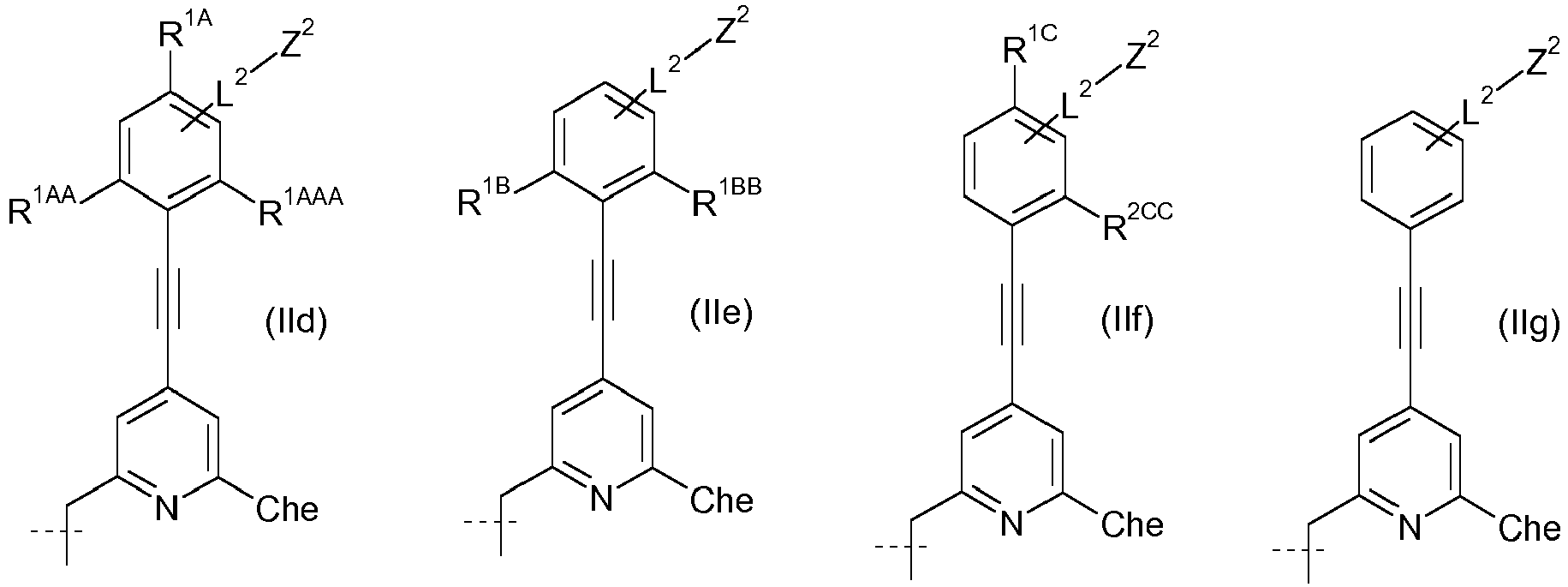
- two of the chromophoric groups Chrom 1 , Chrom 2 , and Chrom 3 are selected from formula (IIa), (IIb) or (IIc) as defined hereinbefore, and the third chromophoric group is selected from (IId), (IIe), or (IIf): wherein R 1A , R 1AA , R 1AAA , R 1B , R 1BB , R 1C , and R 1CC are each independently selected from R 1 group (ii) as defined hereinbefore.
- L 2 is a direct bond and Z 2 is an isothiocyanato (-NCS) group.
- the chromophoric group comprising the reactive group has formula (IIg).
- C 1-6 alkyl includes, but is not limited to, the following alkyl groups: methyl, ethyl, propyl, isopropyl, n-butyl, sec-butyl and t-butyl.
- the terms 'ortho' and 'para' when used to describe the substitution pattern of a 6-membered ring mean substituted at the 2- and 4- positions respectively.
- a phenyl ring substituted with three substituents at the ortho and para positions is a 2, 4, 6 substituted ring.
- the ligands and chelates of the present invention comprise ionisable groups such as carboxylates, sulfonates and the like
- the chelates may be present in ionised (e.g. -CO 2 - ) or non-ionised (e.g. -CO 2 H) forms, and if ionised may include cations as counter ions, e.g. Na+, K+, Ca2+ and the like.
- the chelates and ligands of the present invention comprise a reactive group (Z 1 or Z 2 ), optionally linked to the ligand or chelate by a spacer (L 1 or L 2 ).
- the reactive group is facilitating the labelling of a biospecific binding reactant, or is facilitating the formation of a covalent bond to a solid support material.
- the chelate may be introduced in the solid support, e.g. a particle, simultaneously with the preparation of the particles.
- the substituents in 6-substituted 4- chloro-1,3,5-triazin-2-ylamino can be selected from the group consisting hydrogen, halogen, alkoxy, aryloxy, amino, alkyl with one to six carbon atoms, substituted amino or thioethers, and preferable selected from the group consisting of chloro, fluoro, ethoxy, 2-methoxyethoxy, 2-cyanoethoxy, 2,2,2-trifluoroethoxy, thiophenoxy or ethoxycarbonylthiomethoxy.
- the substituted amino or thioether is preferable mono- or disubstituted each substituent being preferable independently selected from C 1-6 -alkyl, C 1-6 -alkyl-O-, phenyl, carbonyl or carboxyl.
- the group may include a spacer (e.g. L 1 or L 2 ), i.e. a distance-making biradical, so as - if necessary or desirable - to position the reactive group in a position accessible for reaction with the biospecific binding reactant.
- the spacer may be readily introduced in the course of the synthesis of the ligand or the chelate.
- spacer is intended to mean a distance-making group between, e.g., a conjugating group or a pyridine moiety of the core structure and, e.g. the reactive group.
- the spacer typically has a length of 1-20 bonds between the attachment point and reactive group, such as 3-15 bonds, or 5-12 bonds.
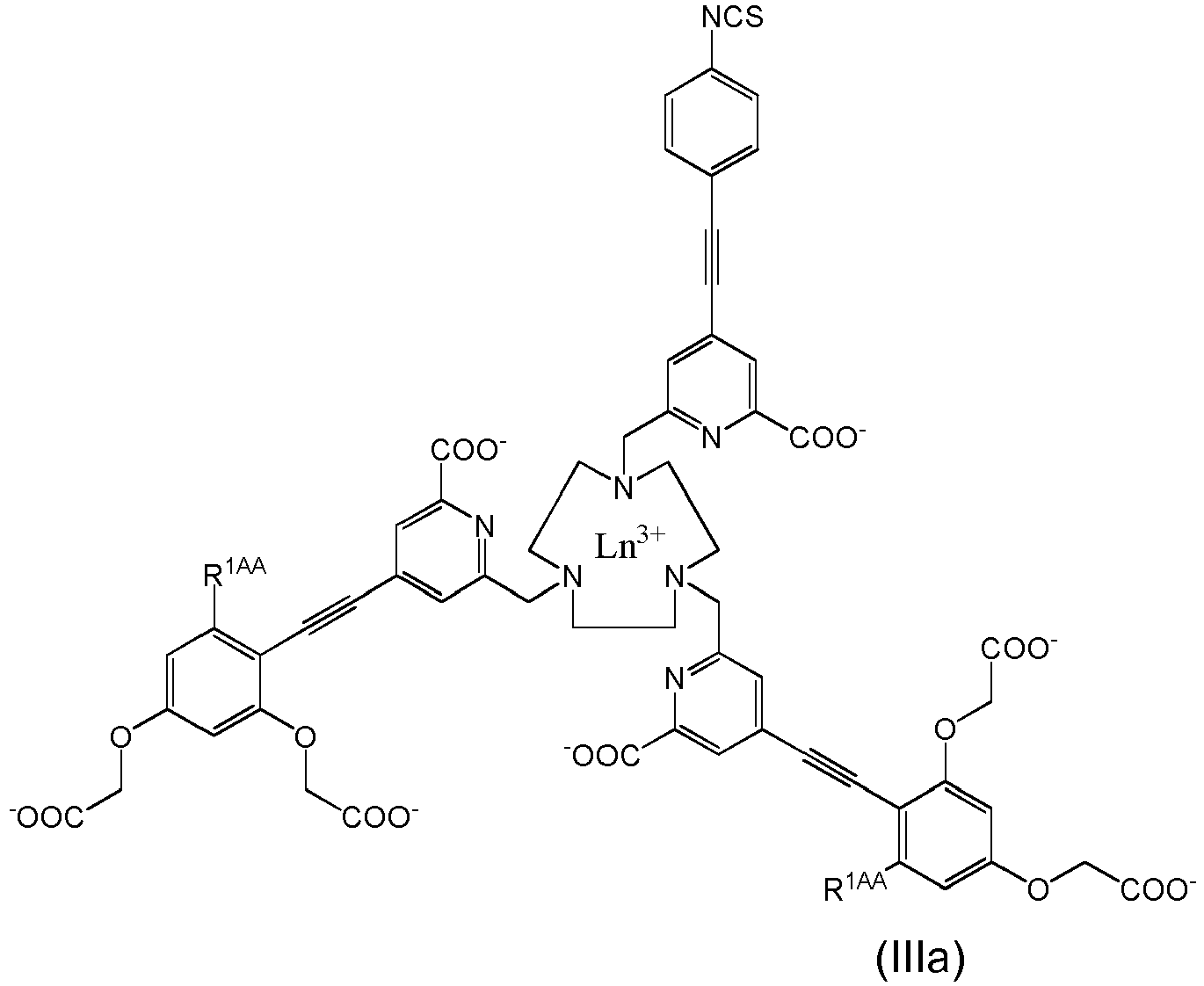
- the chelate of the present invention has formula (IIIa) wherein R 1AA is hydrogen or -OCH 2 CO 2 - :
- the chelate of the present invention has the formula (IIIb)
- Another aspect of the invention relates to a lanthanide chelating ligand of formula (IV) wherein a, b, c, Chrom 1 , Chrom 2 , and Chrom 3 are as defined for formula (I).
- a detectable molecule A detectable molecule
- Still another aspect of the present invention relates to a detectable molecule comprising a biospecific binding reactant conjugated to a luminescent lanthanide chelate as defined hereinabove. Conjugation is typically obtained by means of a reactive group of said chelate.
- the biospecific binding reactant should be capable of specifically binding an analyte of interest for the purpose of quantitative or qualitative analysis of said analyte in a sample.
- biospecific binding reactants are those selected from an antibody, an antigen, a receptor ligand, a specific binding protein, a DNA probe, a RNA probe, an oligopeptide, an oligonucleotide, a modified oligonucleotide (e.g. an LNA modified oligonucleotide), a modified polynucleotide (e.g. an LNA modified polynucleotide), a protein, an oligosaccaride, a polysaccharide, a phospholipid, a PNA, a steroid, a hapten, a drug, a receptor binding ligand, and lectine.
- the biospecific binding reactant is selected from antibodies, e.g. Troponin I antibodies (anti-Tni).
- a still further aspect of the invention relates to a method of carrying out a biospecific binding assay, wherein the method comprises the steps of:
- the excitation wavelength is preferably 300 nm or longer, e.g. around 320-360 nm.
- the method follows the conventional assay steps as will be evident for the skilled person.
- a further aspect of the invention relates to the use of a detectable molecule as defined above in a specific bioaffinity based binding assay utilizing time-resolved fluorometric determination of a specific luminescence based on one or two photon-excitation.
- the specific bioaffinity based binding assay is a heterogeneous immunoassay, a homogenous immunoassay, a DNA hybridization assay, a receptor binding assay, an immunocytochemical or an immunohistochemical assay.
- steps a), b), and c) is performed at an elevated temperature such as above 40°C, above 50°C, above 60°C, above 70°C, above 80°C, above 90°C or above 100°C.
- step a) i.e the formation of the biocomplex is performed at an elevated temperature as defined above.
- the method for carrying out a biospecific binding assay comprises an additional step of drying the biocomplex.
- the drying step occurs after step a) and before step b).
- Still another aspect of the invention relates to a solid support material conjugated with a luminescent lanthanide chelate as defined hereinabove.
- the luminescent lanthanide chelate is typically immobilized to the solid support material either covalently or non-covalently.
- the solid support material is selected from a nano-particle, a microparticle, a slide, a plate, and a solid phase synthesis resin.
- novel lanthanide chelates ligands and the corresponding luminescent lanthanide chelates and labelled biospecific binding reactant are based on a cyclic ligand structure which provides surprisingly efficiently excitation of the chelated lanthanide ion.
- all important features of the luminescent lanthanide chelate and labelled biospecific binding reactant can be retained without any additional formation of aggregates and purification problems.
- This compound 15 was synthesized from the compound 13 using a method analogous to the synthesis described in the Example 9.
- the product was purified by FC (silica gel, from 2% EtOH/DCM/1% TEA). Yield: 84%.
- FC sica gel, from 2% EtOH/DCM/1% TEA.
- Yield 84%.
- the NMR spectra were too complicated to assigned the isomers.
- MALDI TOF-MS mass calculated (M+H + ) 1438.54; found 1439.41.
- This compound 17 was synthesized from the compound 15 using a method analogous to the synthesis described in the Example 11.
- R f (HPLC) 19.2 min.
- UV 350nm.
- This compound 19 was synthesized from the compound 17 using a method analogous to the synthesis described in the Example 13.
- the sample preparation for the ICP-MS was done by using a digestion procedure i.e. a microwave digestion system from Anton Paar, Microwave Sample preparation System, Multiwave 3000.
- the Eu chelate in the 50 mM TRIS buffer was digested with microwave in mixture of Suprapur acids, HNO 3 (5 ml) and H 2 O 2 (1 ml). Afterwards the sample was diluted with deionized water (100 ml).
- This compound 21 was synthesized from the compound 19 using a method analogous to the synthesis described in the Example 15.
- Tnl antibody Labeling of an Tnl antibody was performed as described in von Lode P. et al., Anal. Chem., 2003, 75, 3193-3201 by using 300 fold excess of the labelling reagents 18 or 19. The reactions were carried out overnight at RT. Labeled antibody was separated from the excess of chelates on Superdex 200 HR 10/30 gel filtration column (GE healthcare) by using Tris-saline-azide buffer (Tris 50 mM, NaCl 0.9%, pH 7.75) as an eluent. The fractions containing the antibody were pooled and the Eu concentration was measured by UV and secured by IPC-MS described in the Example 15.
- the Tnl antibody labeled with the chelate 18 or 19 was tested in sandwich immunoassay for cardiac troponin I.
- a Tnl antibody labelled with ⁇ -gal-9-D Eu (von Lode P. et al., Anal. Chem., 2003, 75, 3193-3201 ) was used.
- 10 ⁇ l of diluted tracer antibody (5ng/ ⁇ l) and 20 ⁇ l of Tnl standard solution were pipetted to a pre-coated assay well (single wells in 96 well plate format, wells coated with streptavidin and a biotinylated capture antibody against Tnl, Innotrac Diagnostics).
- the reaction mixtures were incubated 20 min at 36°C with shaking.
- the wells were washed 6 times and dried prior to measurement with VictorTM Plate fluorometer.
- the conventional 9-dentate ⁇ -galactose Eu chelate (Ref in Table 1) was prepared according to von Lode P. et al., Anal. Chem., 2003, 75, 3193-3201 .
- the measured photo-physical properties excitation wavelengths ( ⁇ exc ), luminescence decay times ( ⁇ ), molar absorptivities ( ⁇ ), estimated luminescence yields ( ⁇ ) of the novel chelates ( 20 and 21 ) and the labelled cTnl antibodies with chelates 18 and 19 in 50 mM TRIS buffer (pH 7.75) are in the Table 2.
- Dry measurements ( 18 (dry) and 19 (dry)) represents estimated luminescence yields based on the signal measurements after dry immunoassay done as described in the Example 18.
- Table 2. Compound ⁇ exc /nm ⁇ /ms ⁇ /M -1 cm -1 ⁇ /M -1 cm -1 20 345 0,48 77000 700 21 341 0,58 89000 600 18 a) 348 0,42 104000 1000 18 a) (dry) 69 500 19 a) 346 0,51 99000 500 19 a) (dry) 40 200 a Coupled to protein
- the taurine derivatives and labeled IgG has rather low luminescence (below 1000 M -1 cm -1 ) when measured in aqueous buffer, but the signals are much enhanced in dry format i.e. approximately 80-100 fold increase of brightness.
- This surprising improvement in luminescence in the dry format means that the skilled person can significantly improve the sensitivity of the assay - if necessary - by simply adding a drying step.
Landscapes
- Chemical & Material Sciences (AREA)
- Organic Chemistry (AREA)
- Health & Medical Sciences (AREA)
- Immunology (AREA)
- Engineering & Computer Science (AREA)
- Life Sciences & Earth Sciences (AREA)
- Molecular Biology (AREA)
- Materials Engineering (AREA)
- Medicinal Chemistry (AREA)
- General Health & Medical Sciences (AREA)
- Biochemistry (AREA)
- Hematology (AREA)
- Biomedical Technology (AREA)
- Urology & Nephrology (AREA)
- Analytical Chemistry (AREA)
- Food Science & Technology (AREA)
- Physics & Mathematics (AREA)
- Microbiology (AREA)
- Cell Biology (AREA)
- Biotechnology (AREA)
- General Physics & Mathematics (AREA)
- Pathology (AREA)
- Biophysics (AREA)
- Genetics & Genomics (AREA)
- Proteomics, Peptides & Aminoacids (AREA)
- Plural Heterocyclic Compounds (AREA)
- Investigating Or Analysing Materials By The Use Of Chemical Reactions (AREA)
Claims (19)
- Lumineszierendes Lanthanidchelat der Formel (I) oder Salz davon:

Ln3+ ausgewählt ist aus Eu3+, Tb3+, Dy3+ und Sm3+; und
Chrom1, Chrom2 und Chrom3 der Formel (II) entsprechen: worin Che eine Chelatgruppe darstellt, die unabhängig ausgewählt ist aus -CO2H, -PO3H2, -PO(OH)R2, -CH2PO3H2 und -CONR3R4,R2 ausgewählt ist aus Phenyl, Benzyl, Methyl, Ethyl, Propyl, n-Butyl, Isobutyl, sec-Butyl oder tert-Butyl,R3 und R4 unabhängig ausgewählt sind aus Wasserstoff und -L1-Z1, worin L1 eine Direktbindung oder eine Spacergruppe und Z1 eine reaktive Gruppe darstellt, durch welche das Chelat an einen biospezifischen Reaktanden gebunden werden kann; undd 1, 2, 3, 4 oder 5 ist;R1 einen oder mehrere Substituenten darstellt, unabhängig ausgewählt aus einem Element der Gruppe, bestehend aus:(i) Wasserstoff,(ii) einer elektronenspendenden Solubilisierungsgruppe, ausgewählt aus -X-R5, worin X ein Sauerstoffatom, ein Schwefelatom oder -N(R6)CO- ist, R6 Wasserstoff oder C1-6-Alkyl ist, und R5 ausgewählt ist aus Wasserstoff, -C1-6-Alkyl, -(CH2)1-6OH, -(CH2)1-6OC1-6-Alkyl, -(CH2)1-6CO2H, -(CH2)1-6CONR7R8, -(CH2)1-6SO3H, -(CH2)1-6N(CH3)2, -(CH2)1-6N(CH3)2 +-(CH2)1-6SO3 - und Polyethylenglycol, worin R7 und R8 jeweils unabhängig ausgewählt sind aus Wasserstoff, C1-6-Alkyl, C1-6-Alkyl-OH, -CH(CH2OH)2 und -CH(CH2OH)3,(iii) einer Gruppe, ausgewählt aus C1-6-Alkyl, -(CH2)1-6OH, -(CH2)1-6OCH3,-(CH2)1-6SCH3(iv) -L2-Z2, worin L2 eine Direktgruppe oder eine Spacergruppe ist, und Z2 eine reaktive Gruppe ist, durch die das Chelierungsmittel an ein zu markierendes Molekül gebunden werden kann,worin die Spacergruppen L1 und L2 eine Länge von 1 - 20 Bindungen zwischen dem Befestigungspunkt und der reaktiven Gruppe aufweisen und aus einer bis fünf Einheiten gebildet werden, worin jede Einheit ausgewählt ist aus der Gruppe bestehend aus Phenylen, Alkylen aus 1 - 10 Kohlenstoffatomen, einem Ethindiyl (-C=C-), einem Ether (-O-), einem Thioether (-S-), einem Disulfid (-S-S-), einem Amid (-C(=O)-NH-, -C(=O)-NCH3- und -NCH3-C(=O)-), einem Thioharnstoff (-NH-C(=S)-NH-) und einem Triazol,worin Z1 oder Z2 ausgewählt ist aus Azido (-N3), Alkynyl (-C≡CH), Alkylen (-CH=CH2), Amino (-NH2), Aminooxy (-O-NH2), Aldehyd (-CHO), Hydrazid (-CONHNH2), Mercapto (-SH), Maleimido, aktivierten Derivaten von Maleimido, Isocyanato (-NCO), Isothiocyanato (-NCS), Diazonium (-N+N), Bromacetamido, Iodacetamido, Pyridyl-2-dithio und 6-substituiertes 4-Chlor-1,3,5-triazin-2-ylamino,worin zwei der Gruppen Chrom1, Chrom2 und Chrom3 zwei oder drei R1-Substituenten aufweisen, ausgewählt aus der Gruppe (ii) in den para- und ortho-Positionen in Bezug zur Acetylengruppe;worin die dritte Chromgruppe substituiert ist mit -L2-Z2.
 - Chelat nach Anspruch 1, worin a = b = c = 0 ist.
- Chelat nach Anspruch 1 oder Anspruch 2, worin mindestens eine der Gruppen Chrom1, Chrom2 und Chrom3 ausgewählt ist aus der Formel (IIa), (IIb) oder (IIc):

- Chelat nach einem der Ansprüche 1 bis 3, worin mindestens zwei der Gruppen Chrom1, Chrom2 und Chrom3 ausgewählt sind aus der Formel (IIa), (IIb) oder (IIc), wie in Anspruch 3 definiert.
- Chelat nach einem der Ansprüche 1 bis 4, worin eine der Gruppen Chrom1, Chrom2 und Chrom3 ausgewählt ist aus (IId), (IIe), (IIf) oder (IIg):
- Chelat nach einem der Ansprüche 1 bis 5, worin X = -O- ist.
- Chelat nach einem der Ansprüche 1 bis 6, worin die Gruppen L1 oder L2, falls vorhanden, Direktbindungen darstellen.
- Chelat nach einem der Ansprüche 1 bis 7, worin L1 eine Spacergruppe darstellt, ausgewählt aus -(CH2)1-6- und *-(CH2)1-6Ph, worin die mit * gekennzeichnete Bindung direkt mit dem Stickstoffatom von -CONR3R4 verbunden ist.
- Chelat nach einem der vorhergehenden Ansprüche 1 bis 8, worin Z1 oder Z2 eine Isothiocyanato(-NCS)-Gruppe ist.
- Chelat nach einem der Ansprüche 1 bis 9, worin L2 eine Direktbindung darstellt und Z2 eine Isocyanatgruppe (-NCS) darstellt.
- Chelat nach einem der Ansprüche 1 bis 10, worin Che -CO2H ist.
- Chelat mit der Formel (lila) oder ein Salz davon:
- Nachweisbares Molekül, umfassend einen biospezifischen Bindungsreaktanten, das an ein lumineszierendes Lanthanidchelat der Formel (I) gebunden ist, wie in einem der vorstehenden Ansprüche 1 bis 12 definiert.
- Nachweisbares Molekül nach Anspruch 13, wobei der biospezifische Bindungsreaktant ausgewählt ist aus einem Antikörper, einem Antigen, einem Rezeptorliganden, einem spezifischen Bindungsprotein, einer DNA-Sonde, einer RNA-Sonde, einem Oligopeptid, einem Oligonukleotid, einem modifizierten Oligonukleotid, einem modifizierten Polynukleotid, einem Protein, einem Oligosaccharid, einem Polysaccharid, einem Phospholipid, einer PNA, einem Steroid, einem Hapten, einem Arzneimittel, einem Rezeptorbindungsliganden und Lektin.
- Nachweisbares Molekül nach Anspruch 13 oder 14, worin der biospezifische Bindungsreaktant ein Antikörper ist.
- Lanthanidchelat-Ligand der Formel (IV) oder ein Salz davon

- Verfahren zum Durchführen eines biospezifischen Bindungsassays, wobei das Verfahren die folgenden Schritte umfasst:a) Bilden eines Biokomplexes zwischen dem Analyten und einem biospezifischen Reaktanten, der mit einem lumineszierenden Lanthanidchelat nach einem der Ansprüche 1 bis 12 markiert ist;b) Anregen des Biokomplexes mit Strahlung mit einer Anregungswellenlänge, wodurch ein angeregter Biokomplex gebildet wird; undc) Detektieren der Emissionsstrahlung, die von dem angeregten Biokomplex emittiert wird.
- Verwendung eines nachweisbaren Moleküls nach einem der Ansprüche 13 bis 15 in einem spezifischen Bioaffinitäts-basierten Bindungsassay, der eine zeitaufgelöste fluorimetrische Bestimmung einer spezifischen Lumineszenz verwendet, die auf einer oder zwei Photonenanregungen basiert.
- Festes Trägermaterial, konjugiert mit einem lumineszierenden Lanthanidchelat gemäß einem der Ansprüche 1 bis 12 oder mit einem Lanthanidchelatliganden nach Anspruch 16.
Priority Applications (1)
| Application Number | Priority Date | Filing Date | Title |
|---|---|---|---|
| PL15790066T PL3212733T3 (pl) | 2014-10-29 | 2015-10-27 | Nowe struktury chromoforowe makrocyklicznych chelatów lantanowców |
Applications Claiming Priority (2)
| Application Number | Priority Date | Filing Date | Title |
|---|---|---|---|
| DKPA201400627 | 2014-10-29 | ||
| PCT/EP2015/074867 WO2016066641A1 (en) | 2014-10-29 | 2015-10-27 | New chromophoric structures for macrocyclic lanthanide chelates |
Publications (2)
| Publication Number | Publication Date |
|---|---|
| EP3212733A1 EP3212733A1 (de) | 2017-09-06 |
| EP3212733B1 true EP3212733B1 (de) | 2019-08-28 |
Family
ID=54396851
Family Applications (1)
| Application Number | Title | Priority Date | Filing Date |
|---|---|---|---|
| EP15790066.3A Active EP3212733B1 (de) | 2014-10-29 | 2015-10-27 | Neue chromophore strukturen für makrocyclische lanthanid-chelate |
Country Status (7)
| Country | Link |
|---|---|
| US (2) | US20170313936A1 (de) |
| EP (1) | EP3212733B1 (de) |
| JP (1) | JP6480579B2 (de) |
| CN (1) | CN107074815B (de) |
| DK (1) | DK3212733T3 (de) |
| PL (1) | PL3212733T3 (de) |
| WO (1) | WO2016066641A1 (de) |
Families Citing this family (5)
| Publication number | Priority date | Publication date | Assignee | Title |
|---|---|---|---|---|
| WO2017211799A1 (en) | 2016-06-09 | 2017-12-14 | Radiometer Turku Oy | Background blockers for binding assays |
| FR3067349B1 (fr) | 2017-06-12 | 2020-12-04 | Cisbio Bioassays | Nouveaux agents mono et di-antennes complexants hydrosolubles et complexes de lanthanide correspondants |
| CN114026070A (zh) * | 2019-06-25 | 2022-02-08 | 雷度米特图尔库公司 | 新型发光镧系元素螯合物报道分子、用新型发光镧系元素螯合物报道分子标记的生物特异性结合反应物及其用途 |
| FI128833B (en) | 2019-12-09 | 2021-01-15 | Abacus Diagnostica Oy | Luminescent lanthanide (III) chelates |
| WO2024175677A1 (en) * | 2023-02-21 | 2024-08-29 | Helmholtz Zentrum München - Deutsches Forschungszentrum für Gesundheit und Umwelt (GmbH) | Probes for distinction of sterile and bacterial infection |
Family Cites Families (5)
| Publication number | Priority date | Publication date | Assignee | Title |
|---|---|---|---|---|
| FR2978149B1 (fr) * | 2011-07-18 | 2014-01-10 | Cisbio Bioassays | Nouveaux agents complexants et complexes de lanthanide correspondant, et leur utilisation comme marqueurs luminescents |
| JP5818990B2 (ja) * | 2011-08-19 | 2015-11-18 | デーホーアェル・フィンランド・オサケユキチュア | 3つの発色団を有する発光ランタニドキレート及びそれらの使用 |
| CN104125997B (zh) * | 2011-12-22 | 2017-03-08 | 雷度米特图尔库公司 | 具有提升的激发性质的新型发光镧系元素螯合物 |
| FR3000960B1 (fr) * | 2013-01-16 | 2015-03-06 | Cisbio Bioassays | Nouveaux agents complexants hydrosolubles et complexes de lanthanide correspondants |
| WO2014147288A1 (en) * | 2013-01-31 | 2014-09-25 | Kaivogen Oy | Luminescent triazacyclononane-based lanthanide chelate complexes as labelling reagents |
-
2015
- 2015-10-27 DK DK15790066T patent/DK3212733T3/da active
- 2015-10-27 WO PCT/EP2015/074867 patent/WO2016066641A1/en not_active Ceased
- 2015-10-27 US US15/523,292 patent/US20170313936A1/en not_active Abandoned
- 2015-10-27 JP JP2017522507A patent/JP6480579B2/ja not_active Expired - Fee Related
- 2015-10-27 PL PL15790066T patent/PL3212733T3/pl unknown
- 2015-10-27 CN CN201580058547.XA patent/CN107074815B/zh not_active Expired - Fee Related
- 2015-10-27 EP EP15790066.3A patent/EP3212733B1/de active Active
-
2021
- 2021-06-29 US US17/361,457 patent/US20210395606A1/en not_active Abandoned
Non-Patent Citations (1)
| Title |
|---|
| None * |
Also Published As
| Publication number | Publication date |
|---|---|
| EP3212733A1 (de) | 2017-09-06 |
| CN107074815A (zh) | 2017-08-18 |
| DK3212733T3 (da) | 2019-11-04 |
| JP6480579B2 (ja) | 2019-03-13 |
| JP2017533209A (ja) | 2017-11-09 |
| CN107074815B (zh) | 2021-06-22 |
| WO2016066641A1 (en) | 2016-05-06 |
| US20170313936A1 (en) | 2017-11-02 |
| PL3212733T3 (pl) | 2020-02-28 |
| US20210395606A1 (en) | 2021-12-23 |
Similar Documents
| Publication | Publication Date | Title |
|---|---|---|
| US20210395606A1 (en) | Chromophoric structures for macrocyclic lanthanide chelates | |
| EP2753674B1 (de) | Lumineszierende lanthanidchelate mit drei chromophoren und ihre verwendung | |
| JPH0715471B2 (ja) | 巨大多環式希土類錯体の利用方法 | |
| Zhang et al. | New class of tetradentate β-diketonate-europium complexes that can be covalently bound to proteins for time-gated fluorometric application | |
| JP6087953B2 (ja) | 改良された励起特性を有する新規発光ランタニドキレート | |
| EP3137573B1 (de) | Neue chromophore strukturen für lanthanid-chelate | |
| Leygue et al. | Design of novel tripyridinophane-based Eu (iii) complexes as efficient luminescent labels for bioassay applications | |
| US7955859B2 (en) | Fluorescent labeling compound | |
| EP2897967B1 (de) | Chelate, chelatbildner, davon abgeleitete konjugate und deren verwendung | |
| EP3469370B1 (de) | Hintergrundblocker für bindungsassays | |
| JP2001335574A (ja) | 新規標識化合物 | |
| RU2541794C1 (ru) | Алкинилфосфиновые золотомедные комплексы как люминисцентные метки для флуоресцентной микроскопии | |
| CN104926698A (zh) | 一种四齿β二酮配体-铕荧光配合物及应用 | |
| JP2003254958A (ja) | 新規な蛍光検出試薬及びそれを用いた高感度蛍光分析方法 | |
| EP2794812B1 (de) | Neuartige lumineszente lanthanidchelate mit verbesserten erregungseigenschaften |
Legal Events
| Date | Code | Title | Description |
|---|---|---|---|
| STAA | Information on the status of an ep patent application or granted ep patent |
Free format text: STATUS: THE INTERNATIONAL PUBLICATION HAS BEEN MADE |
|
| PUAI | Public reference made under article 153(3) epc to a published international application that has entered the european phase |
Free format text: ORIGINAL CODE: 0009012 |
|
| STAA | Information on the status of an ep patent application or granted ep patent |
Free format text: STATUS: REQUEST FOR EXAMINATION WAS MADE |
|
| 17P | Request for examination filed |
Effective date: 20170516 |
|
| AK | Designated contracting states |
Kind code of ref document: A1 Designated state(s): AL AT BE BG CH CY CZ DE DK EE ES FI FR GB GR HR HU IE IS IT LI LT LU LV MC MK MT NL NO PL PT RO RS SE SI SK SM TR |
|
| AX | Request for extension of the european patent |
Extension state: BA ME |
|
| DAV | Request for validation of the european patent (deleted) | ||
| DAX | Request for extension of the european patent (deleted) | ||
| STAA | Information on the status of an ep patent application or granted ep patent |
Free format text: STATUS: EXAMINATION IS IN PROGRESS |
|
| 17Q | First examination report despatched |
Effective date: 20180227 |
|
| GRAP | Despatch of communication of intention to grant a patent |
Free format text: ORIGINAL CODE: EPIDOSNIGR1 |
|
| STAA | Information on the status of an ep patent application or granted ep patent |
Free format text: STATUS: GRANT OF PATENT IS INTENDED |
|
| INTG | Intention to grant announced |
Effective date: 20190418 |
|
| GRAS | Grant fee paid |
Free format text: ORIGINAL CODE: EPIDOSNIGR3 |
|
| GRAA | (expected) grant |
Free format text: ORIGINAL CODE: 0009210 |
|
| STAA | Information on the status of an ep patent application or granted ep patent |
Free format text: STATUS: THE PATENT HAS BEEN GRANTED |
|
| AK | Designated contracting states |
Kind code of ref document: B1 Designated state(s): AL AT BE BG CH CY CZ DE DK EE ES FI FR GB GR HR HU IE IS IT LI LT LU LV MC MK MT NL NO PL PT RO RS SE SI SK SM TR |
|
| REG | Reference to a national code |
Ref country code: GB Ref legal event code: FG4D |
|
| REG | Reference to a national code |
Ref country code: CH Ref legal event code: EP |
|
| REG | Reference to a national code |
Ref country code: DE Ref legal event code: R096 Ref document number: 602015036814 Country of ref document: DE |
|
| REG | Reference to a national code |
Ref country code: AT Ref legal event code: REF Ref document number: 1172390 Country of ref document: AT Kind code of ref document: T Effective date: 20190915 |
|
| REG | Reference to a national code |
Ref country code: IE Ref legal event code: FG4D |
|
| REG | Reference to a national code |
Ref country code: DK Ref legal event code: T3 Effective date: 20191030 |
|
| REG | Reference to a national code |
Ref country code: NL Ref legal event code: MP Effective date: 20190828 |
|
| REG | Reference to a national code |
Ref country code: LT Ref legal event code: MG4D |
|
| PG25 | Lapsed in a contracting state [announced via postgrant information from national office to epo] |
Ref country code: SE Free format text: LAPSE BECAUSE OF FAILURE TO SUBMIT A TRANSLATION OF THE DESCRIPTION OR TO PAY THE FEE WITHIN THE PRESCRIBED TIME-LIMIT Effective date: 20190828 Ref country code: NO Free format text: LAPSE BECAUSE OF FAILURE TO SUBMIT A TRANSLATION OF THE DESCRIPTION OR TO PAY THE FEE WITHIN THE PRESCRIBED TIME-LIMIT Effective date: 20191128 Ref country code: PT Free format text: LAPSE BECAUSE OF FAILURE TO SUBMIT A TRANSLATION OF THE DESCRIPTION OR TO PAY THE FEE WITHIN THE PRESCRIBED TIME-LIMIT Effective date: 20191230 Ref country code: HR Free format text: LAPSE BECAUSE OF FAILURE TO SUBMIT A TRANSLATION OF THE DESCRIPTION OR TO PAY THE FEE WITHIN THE PRESCRIBED TIME-LIMIT Effective date: 20190828 Ref country code: NL Free format text: LAPSE BECAUSE OF FAILURE TO SUBMIT A TRANSLATION OF THE DESCRIPTION OR TO PAY THE FEE WITHIN THE PRESCRIBED TIME-LIMIT Effective date: 20190828 Ref country code: BG Free format text: LAPSE BECAUSE OF FAILURE TO SUBMIT A TRANSLATION OF THE DESCRIPTION OR TO PAY THE FEE WITHIN THE PRESCRIBED TIME-LIMIT Effective date: 20191128 Ref country code: LT Free format text: LAPSE BECAUSE OF FAILURE TO SUBMIT A TRANSLATION OF THE DESCRIPTION OR TO PAY THE FEE WITHIN THE PRESCRIBED TIME-LIMIT Effective date: 20190828 |
|
| PG25 | Lapsed in a contracting state [announced via postgrant information from national office to epo] |
Ref country code: AL Free format text: LAPSE BECAUSE OF FAILURE TO SUBMIT A TRANSLATION OF THE DESCRIPTION OR TO PAY THE FEE WITHIN THE PRESCRIBED TIME-LIMIT Effective date: 20190828 Ref country code: GR Free format text: LAPSE BECAUSE OF FAILURE TO SUBMIT A TRANSLATION OF THE DESCRIPTION OR TO PAY THE FEE WITHIN THE PRESCRIBED TIME-LIMIT Effective date: 20191129 Ref country code: ES Free format text: LAPSE BECAUSE OF FAILURE TO SUBMIT A TRANSLATION OF THE DESCRIPTION OR TO PAY THE FEE WITHIN THE PRESCRIBED TIME-LIMIT Effective date: 20190828 Ref country code: LV Free format text: LAPSE BECAUSE OF FAILURE TO SUBMIT A TRANSLATION OF THE DESCRIPTION OR TO PAY THE FEE WITHIN THE PRESCRIBED TIME-LIMIT Effective date: 20190828 Ref country code: IS Free format text: LAPSE BECAUSE OF FAILURE TO SUBMIT A TRANSLATION OF THE DESCRIPTION OR TO PAY THE FEE WITHIN THE PRESCRIBED TIME-LIMIT Effective date: 20191228 Ref country code: RS Free format text: LAPSE BECAUSE OF FAILURE TO SUBMIT A TRANSLATION OF THE DESCRIPTION OR TO PAY THE FEE WITHIN THE PRESCRIBED TIME-LIMIT Effective date: 20190828 |
|
| REG | Reference to a national code |
Ref country code: AT Ref legal event code: MK05 Ref document number: 1172390 Country of ref document: AT Kind code of ref document: T Effective date: 20190828 |
|
| PG25 | Lapsed in a contracting state [announced via postgrant information from national office to epo] |
Ref country code: TR Free format text: LAPSE BECAUSE OF FAILURE TO SUBMIT A TRANSLATION OF THE DESCRIPTION OR TO PAY THE FEE WITHIN THE PRESCRIBED TIME-LIMIT Effective date: 20190828 |
|
| PG25 | Lapsed in a contracting state [announced via postgrant information from national office to epo] |
Ref country code: IT Free format text: LAPSE BECAUSE OF FAILURE TO SUBMIT A TRANSLATION OF THE DESCRIPTION OR TO PAY THE FEE WITHIN THE PRESCRIBED TIME-LIMIT Effective date: 20190828 Ref country code: EE Free format text: LAPSE BECAUSE OF FAILURE TO SUBMIT A TRANSLATION OF THE DESCRIPTION OR TO PAY THE FEE WITHIN THE PRESCRIBED TIME-LIMIT Effective date: 20190828 Ref country code: AT Free format text: LAPSE BECAUSE OF FAILURE TO SUBMIT A TRANSLATION OF THE DESCRIPTION OR TO PAY THE FEE WITHIN THE PRESCRIBED TIME-LIMIT Effective date: 20190828 Ref country code: RO Free format text: LAPSE BECAUSE OF FAILURE TO SUBMIT A TRANSLATION OF THE DESCRIPTION OR TO PAY THE FEE WITHIN THE PRESCRIBED TIME-LIMIT Effective date: 20190828 |
|
| PG25 | Lapsed in a contracting state [announced via postgrant information from national office to epo] |
Ref country code: CZ Free format text: LAPSE BECAUSE OF FAILURE TO SUBMIT A TRANSLATION OF THE DESCRIPTION OR TO PAY THE FEE WITHIN THE PRESCRIBED TIME-LIMIT Effective date: 20190828 Ref country code: SM Free format text: LAPSE BECAUSE OF FAILURE TO SUBMIT A TRANSLATION OF THE DESCRIPTION OR TO PAY THE FEE WITHIN THE PRESCRIBED TIME-LIMIT Effective date: 20190828 Ref country code: IS Free format text: LAPSE BECAUSE OF FAILURE TO SUBMIT A TRANSLATION OF THE DESCRIPTION OR TO PAY THE FEE WITHIN THE PRESCRIBED TIME-LIMIT Effective date: 20200224 Ref country code: SK Free format text: LAPSE BECAUSE OF FAILURE TO SUBMIT A TRANSLATION OF THE DESCRIPTION OR TO PAY THE FEE WITHIN THE PRESCRIBED TIME-LIMIT Effective date: 20190828 Ref country code: MC Free format text: LAPSE BECAUSE OF FAILURE TO SUBMIT A TRANSLATION OF THE DESCRIPTION OR TO PAY THE FEE WITHIN THE PRESCRIBED TIME-LIMIT Effective date: 20190828 |
|
| REG | Reference to a national code |
Ref country code: CH Ref legal event code: PL |
|
| REG | Reference to a national code |
Ref country code: DE Ref legal event code: R097 Ref document number: 602015036814 Country of ref document: DE |
|
| PLBE | No opposition filed within time limit |
Free format text: ORIGINAL CODE: 0009261 |
|
| STAA | Information on the status of an ep patent application or granted ep patent |
Free format text: STATUS: NO OPPOSITION FILED WITHIN TIME LIMIT |
|
| PG2D | Information on lapse in contracting state deleted |
Ref country code: IS |
|
| PG25 | Lapsed in a contracting state [announced via postgrant information from national office to epo] |
Ref country code: LU Free format text: LAPSE BECAUSE OF NON-PAYMENT OF DUE FEES Effective date: 20191027 Ref country code: CH Free format text: LAPSE BECAUSE OF NON-PAYMENT OF DUE FEES Effective date: 20191031 Ref country code: LI Free format text: LAPSE BECAUSE OF NON-PAYMENT OF DUE FEES Effective date: 20191031 |
|
| 26N | No opposition filed |
Effective date: 20200603 |
|
| REG | Reference to a national code |
Ref country code: BE Ref legal event code: MM Effective date: 20191031 |
|
| PG25 | Lapsed in a contracting state [announced via postgrant information from national office to epo] |
Ref country code: BE Free format text: LAPSE BECAUSE OF NON-PAYMENT OF DUE FEES Effective date: 20191031 Ref country code: SI Free format text: LAPSE BECAUSE OF FAILURE TO SUBMIT A TRANSLATION OF THE DESCRIPTION OR TO PAY THE FEE WITHIN THE PRESCRIBED TIME-LIMIT Effective date: 20190828 |
|
| PG25 | Lapsed in a contracting state [announced via postgrant information from national office to epo] |
Ref country code: IE Free format text: LAPSE BECAUSE OF NON-PAYMENT OF DUE FEES Effective date: 20191027 |
|
| PG25 | Lapsed in a contracting state [announced via postgrant information from national office to epo] |
Ref country code: CY Free format text: LAPSE BECAUSE OF FAILURE TO SUBMIT A TRANSLATION OF THE DESCRIPTION OR TO PAY THE FEE WITHIN THE PRESCRIBED TIME-LIMIT Effective date: 20190828 |
|
| PG25 | Lapsed in a contracting state [announced via postgrant information from national office to epo] |
Ref country code: HU Free format text: LAPSE BECAUSE OF FAILURE TO SUBMIT A TRANSLATION OF THE DESCRIPTION OR TO PAY THE FEE WITHIN THE PRESCRIBED TIME-LIMIT; INVALID AB INITIO Effective date: 20151027 Ref country code: MT Free format text: LAPSE BECAUSE OF FAILURE TO SUBMIT A TRANSLATION OF THE DESCRIPTION OR TO PAY THE FEE WITHIN THE PRESCRIBED TIME-LIMIT Effective date: 20190828 |
|
| PG25 | Lapsed in a contracting state [announced via postgrant information from national office to epo] |
Ref country code: MK Free format text: LAPSE BECAUSE OF FAILURE TO SUBMIT A TRANSLATION OF THE DESCRIPTION OR TO PAY THE FEE WITHIN THE PRESCRIBED TIME-LIMIT Effective date: 20190828 |
|
| PGFP | Annual fee paid to national office [announced via postgrant information from national office to epo] |
Ref country code: GB Payment date: 20220908 Year of fee payment: 8 |
|
| PGFP | Annual fee paid to national office [announced via postgrant information from national office to epo] |
Ref country code: FR Payment date: 20220908 Year of fee payment: 8 |
|
| PGFP | Annual fee paid to national office [announced via postgrant information from national office to epo] |
Ref country code: FI Payment date: 20221011 Year of fee payment: 8 Ref country code: DK Payment date: 20221011 Year of fee payment: 8 Ref country code: DE Payment date: 20220831 Year of fee payment: 8 |
|
| P01 | Opt-out of the competence of the unified patent court (upc) registered |
Effective date: 20230530 |
|
| PGFP | Annual fee paid to national office [announced via postgrant information from national office to epo] |
Ref country code: PL Payment date: 20230818 Year of fee payment: 9 |
|
| REG | Reference to a national code |
Ref country code: DE Ref legal event code: R119 Ref document number: 602015036814 Country of ref document: DE |
|
| REG | Reference to a national code |
Ref country code: DK Ref legal event code: EBP Effective date: 20231031 |
|
| GBPC | Gb: european patent ceased through non-payment of renewal fee |
Effective date: 20231027 |
|
| PG25 | Lapsed in a contracting state [announced via postgrant information from national office to epo] |
Ref country code: GB Free format text: LAPSE BECAUSE OF NON-PAYMENT OF DUE FEES Effective date: 20231027 |
|
| PG25 | Lapsed in a contracting state [announced via postgrant information from national office to epo] |
Ref country code: GB Free format text: LAPSE BECAUSE OF NON-PAYMENT OF DUE FEES Effective date: 20231027 Ref country code: FR Free format text: LAPSE BECAUSE OF NON-PAYMENT OF DUE FEES Effective date: 20231031 Ref country code: FI Free format text: LAPSE BECAUSE OF NON-PAYMENT OF DUE FEES Effective date: 20231027 Ref country code: DE Free format text: LAPSE BECAUSE OF NON-PAYMENT OF DUE FEES Effective date: 20240501 |
|
| PG25 | Lapsed in a contracting state [announced via postgrant information from national office to epo] |
Ref country code: DK Free format text: LAPSE BECAUSE OF NON-PAYMENT OF DUE FEES Effective date: 20231031 |
|
| PG25 | Lapsed in a contracting state [announced via postgrant information from national office to epo] |
Ref country code: DK Free format text: LAPSE BECAUSE OF NON-PAYMENT OF DUE FEES Effective date: 20231031 |