EP3214200B1 - Tôle d'acier à résistance élevée - Google Patents
Tôle d'acier à résistance élevée Download PDFInfo
- Publication number
- EP3214200B1 EP3214200B1 EP15856045.8A EP15856045A EP3214200B1 EP 3214200 B1 EP3214200 B1 EP 3214200B1 EP 15856045 A EP15856045 A EP 15856045A EP 3214200 B1 EP3214200 B1 EP 3214200B1
- Authority
- EP
- European Patent Office
- Prior art keywords
- less
- steel sheet
- pwht
- amount
- strength
- Prior art date
- Legal status (The legal status is an assumption and is not a legal conclusion. Google has not performed a legal analysis and makes no representation as to the accuracy of the status listed.)
- Active
Links
Images
Classifications
-
- C—CHEMISTRY; METALLURGY
- C22—METALLURGY; FERROUS OR NON-FERROUS ALLOYS; TREATMENT OF ALLOYS OR NON-FERROUS METALS
- C22C—ALLOYS
- C22C38/00—Ferrous alloys, e.g. steel alloys
- C22C38/02—Ferrous alloys, e.g. steel alloys containing silicon
-
- C—CHEMISTRY; METALLURGY
- C21—METALLURGY OF IRON
- C21D—MODIFYING THE PHYSICAL STRUCTURE OF FERROUS METALS; GENERAL DEVICES FOR HEAT TREATMENT OF FERROUS OR NON-FERROUS METALS OR ALLOYS; MAKING METAL MALLEABLE, e.g. BY DECARBURISATION OR TEMPERING
- C21D8/00—Modifying the physical properties of ferrous metals or ferrous alloys by deformation combined with, or followed by, heat treatment
- C21D8/02—Modifying the physical properties of ferrous metals or ferrous alloys by deformation combined with, or followed by, heat treatment during manufacturing of plates or strips
- C21D8/0221—Modifying the physical properties of ferrous metals or ferrous alloys by deformation combined with, or followed by, heat treatment during manufacturing of plates or strips characterised by the working steps
- C21D8/0226—Hot rolling
-
- C—CHEMISTRY; METALLURGY
- C21—METALLURGY OF IRON
- C21D—MODIFYING THE PHYSICAL STRUCTURE OF FERROUS METALS; GENERAL DEVICES FOR HEAT TREATMENT OF FERROUS OR NON-FERROUS METALS OR ALLOYS; MAKING METAL MALLEABLE, e.g. BY DECARBURISATION OR TEMPERING
- C21D9/00—Heat treatment, e.g. annealing, hardening, quenching or tempering, adapted for particular articles; Furnaces therefor
- C21D9/50—Heat treatment, e.g. annealing, hardening, quenching or tempering, adapted for particular articles; Furnaces therefor for welded joints
-
- C—CHEMISTRY; METALLURGY
- C22—METALLURGY; FERROUS OR NON-FERROUS ALLOYS; TREATMENT OF ALLOYS OR NON-FERROUS METALS
- C22C—ALLOYS
- C22C38/00—Ferrous alloys, e.g. steel alloys
- C22C38/001—Ferrous alloys, e.g. steel alloys containing N
-
- C—CHEMISTRY; METALLURGY
- C22—METALLURGY; FERROUS OR NON-FERROUS ALLOYS; TREATMENT OF ALLOYS OR NON-FERROUS METALS
- C22C—ALLOYS
- C22C38/00—Ferrous alloys, e.g. steel alloys
- C22C38/04—Ferrous alloys, e.g. steel alloys containing manganese
-
- C—CHEMISTRY; METALLURGY
- C22—METALLURGY; FERROUS OR NON-FERROUS ALLOYS; TREATMENT OF ALLOYS OR NON-FERROUS METALS
- C22C—ALLOYS
- C22C38/00—Ferrous alloys, e.g. steel alloys
- C22C38/06—Ferrous alloys, e.g. steel alloys containing aluminium
-
- C—CHEMISTRY; METALLURGY
- C22—METALLURGY; FERROUS OR NON-FERROUS ALLOYS; TREATMENT OF ALLOYS OR NON-FERROUS METALS
- C22C—ALLOYS
- C22C38/00—Ferrous alloys, e.g. steel alloys
- C22C38/08—Ferrous alloys, e.g. steel alloys containing nickel
-
- C—CHEMISTRY; METALLURGY
- C22—METALLURGY; FERROUS OR NON-FERROUS ALLOYS; TREATMENT OF ALLOYS OR NON-FERROUS METALS
- C22C—ALLOYS
- C22C38/00—Ferrous alloys, e.g. steel alloys
- C22C38/12—Ferrous alloys, e.g. steel alloys containing tungsten, tantalum, molybdenum, vanadium, or niobium
-
- C—CHEMISTRY; METALLURGY
- C22—METALLURGY; FERROUS OR NON-FERROUS ALLOYS; TREATMENT OF ALLOYS OR NON-FERROUS METALS
- C22C—ALLOYS
- C22C38/00—Ferrous alloys, e.g. steel alloys
- C22C38/14—Ferrous alloys, e.g. steel alloys containing titanium or zirconium
-
- C—CHEMISTRY; METALLURGY
- C22—METALLURGY; FERROUS OR NON-FERROUS ALLOYS; TREATMENT OF ALLOYS OR NON-FERROUS METALS
- C22C—ALLOYS
- C22C38/00—Ferrous alloys, e.g. steel alloys
- C22C38/16—Ferrous alloys, e.g. steel alloys containing copper
-
- C—CHEMISTRY; METALLURGY
- C22—METALLURGY; FERROUS OR NON-FERROUS ALLOYS; TREATMENT OF ALLOYS OR NON-FERROUS METALS
- C22C—ALLOYS
- C22C38/00—Ferrous alloys, e.g. steel alloys
- C22C38/18—Ferrous alloys, e.g. steel alloys containing chromium
- C22C38/40—Ferrous alloys, e.g. steel alloys containing chromium with nickel
- C22C38/42—Ferrous alloys, e.g. steel alloys containing chromium with nickel with copper
-
- C—CHEMISTRY; METALLURGY
- C22—METALLURGY; FERROUS OR NON-FERROUS ALLOYS; TREATMENT OF ALLOYS OR NON-FERROUS METALS
- C22C—ALLOYS
- C22C38/00—Ferrous alloys, e.g. steel alloys
- C22C38/18—Ferrous alloys, e.g. steel alloys containing chromium
- C22C38/40—Ferrous alloys, e.g. steel alloys containing chromium with nickel
- C22C38/44—Ferrous alloys, e.g. steel alloys containing chromium with nickel with molybdenum or tungsten
-
- C—CHEMISTRY; METALLURGY
- C22—METALLURGY; FERROUS OR NON-FERROUS ALLOYS; TREATMENT OF ALLOYS OR NON-FERROUS METALS
- C22C—ALLOYS
- C22C38/00—Ferrous alloys, e.g. steel alloys
- C22C38/18—Ferrous alloys, e.g. steel alloys containing chromium
- C22C38/40—Ferrous alloys, e.g. steel alloys containing chromium with nickel
- C22C38/46—Ferrous alloys, e.g. steel alloys containing chromium with nickel with vanadium
-
- C—CHEMISTRY; METALLURGY
- C22—METALLURGY; FERROUS OR NON-FERROUS ALLOYS; TREATMENT OF ALLOYS OR NON-FERROUS METALS
- C22C—ALLOYS
- C22C38/00—Ferrous alloys, e.g. steel alloys
- C22C38/18—Ferrous alloys, e.g. steel alloys containing chromium
- C22C38/40—Ferrous alloys, e.g. steel alloys containing chromium with nickel
- C22C38/48—Ferrous alloys, e.g. steel alloys containing chromium with nickel with niobium or tantalum
-
- C—CHEMISTRY; METALLURGY
- C22—METALLURGY; FERROUS OR NON-FERROUS ALLOYS; TREATMENT OF ALLOYS OR NON-FERROUS METALS
- C22C—ALLOYS
- C22C38/00—Ferrous alloys, e.g. steel alloys
- C22C38/18—Ferrous alloys, e.g. steel alloys containing chromium
- C22C38/40—Ferrous alloys, e.g. steel alloys containing chromium with nickel
- C22C38/50—Ferrous alloys, e.g. steel alloys containing chromium with nickel with titanium or zirconium
-
- C—CHEMISTRY; METALLURGY
- C22—METALLURGY; FERROUS OR NON-FERROUS ALLOYS; TREATMENT OF ALLOYS OR NON-FERROUS METALS
- C22C—ALLOYS
- C22C38/00—Ferrous alloys, e.g. steel alloys
- C22C38/18—Ferrous alloys, e.g. steel alloys containing chromium
- C22C38/40—Ferrous alloys, e.g. steel alloys containing chromium with nickel
- C22C38/58—Ferrous alloys, e.g. steel alloys containing chromium with nickel with more than 1.5% by weight of manganese
-
- C—CHEMISTRY; METALLURGY
- C21—METALLURGY OF IRON
- C21D—MODIFYING THE PHYSICAL STRUCTURE OF FERROUS METALS; GENERAL DEVICES FOR HEAT TREATMENT OF FERROUS OR NON-FERROUS METALS OR ALLOYS; MAKING METAL MALLEABLE, e.g. BY DECARBURISATION OR TEMPERING
- C21D2211/00—Microstructure comprising significant phases
- C21D2211/002—Bainite
-
- C—CHEMISTRY; METALLURGY
- C21—METALLURGY OF IRON
- C21D—MODIFYING THE PHYSICAL STRUCTURE OF FERROUS METALS; GENERAL DEVICES FOR HEAT TREATMENT OF FERROUS OR NON-FERROUS METALS OR ALLOYS; MAKING METAL MALLEABLE, e.g. BY DECARBURISATION OR TEMPERING
- C21D2211/00—Microstructure comprising significant phases
- C21D2211/004—Dispersions; Precipitations
-
- C—CHEMISTRY; METALLURGY
- C21—METALLURGY OF IRON
- C21D—MODIFYING THE PHYSICAL STRUCTURE OF FERROUS METALS; GENERAL DEVICES FOR HEAT TREATMENT OF FERROUS OR NON-FERROUS METALS OR ALLOYS; MAKING METAL MALLEABLE, e.g. BY DECARBURISATION OR TEMPERING
- C21D2211/00—Microstructure comprising significant phases
- C21D2211/005—Ferrite
Definitions
- the present invention relates to a steel sheet suitably used for the production of a reserve tank, an offshore structure and the like.
- the present invention relates to a high strength steel sheet capable of securing a strength of 550 MPa or more before and even after a post welding heat treatment performed to reduce residual stress at a welded part after welding.
- a post weld heat treatment (hereinafter sometimes referred to as PWHT) of holding a welded steel sheet at around 600°C for several hours is sometimes performed to reduce residual stress at a welded part after welding of a steel sheet.
- PWHT a post weld heat treatment
- an object is held at a high temperature for a long period, so that the metallographic structure of the steel sheet changes to decrease the strength of the steel sheet in some cases.
- Patent Literature 1 discloses a technique for securing the strength after PWHT at high level.
- the steel sheet disclosed in Patent Literature 1 is characterized in that the amounts of particularly Nb, V, Mo and C in component composition are adjusted to satisfy a predetermined relationship, and the steel sheet has a metallographic structure in which the bainite fraction is 90 area% or more.
- Patent Literature 1 describes that a carbide of Nb and Mo is formed in the steel sheet before PWHT to suppress a decrease in the strength after PWHT.
- Cr is contained as an essential component in the range of 0.5 to 2.0%.
- PWHT of holding the steel sheet at 600°C for a period of sheet thickness (inch) ⁇ 1 hour is performed twice, and the holding period is about 8 hours at a maximum.
- Patent Literature 2 describes a hot coil for line pipe and manufacturing method therefore.
- Patent Literature 3 discloses a high tempering parameter PWHT embrittlement resistant, extra thick cryogenic steel plate and manufacture method thereof.
- the thickness of a steel sheet used as a material has been increased.
- An increased thickness of the steel sheet prolongs the period required for a temperature rise to a prescribed temperature according to the position of a welded structure when a heat treatment is performed.
- PWHT is required again, further prolonging the heat treatment period.
- the strength of the steel sheet is significantly decreased. Therefore, the steel sheet is required to secure predetermined strength even when PWHT is performed for a long period. Specifically, it is desired to secure high strength even when PWHT is performed for 15 hours or more.
- Patent Literature 1 only the margin of change in tensile strength between before and after the heat treatment is measured for steel sheets held for about 8 hours at a maximum, and the margin of change in tensile strength is not measured for a steel sheet when PWHT is performed for 15 hours or more as described above. Therefore, it is possible that the steel sheets decrease in the strength not to secure the predetermined strength when prolonged PWHT is performed.
- the present invention has been made with focused attention on the above-described circumstances, and an object of the present invention is to provide a high strength steel sheet capable of securing high strength before and even after PWHT is performed for a long period, for example, of 15 hours or more.
- the present invention also encompasses a high strength welded structure obtained by subjecting the high strength steel sheet to a heat treatment.
- a high strength steel that has high strength before and after PWHT, because the component composition and metallographic structure of the steel sheet are appropriately controlled, so that the strength of the steel sheet is unlikely to decrease or is rather improved even when PWHT is performed for a long period, for example, of 15 hours or more.
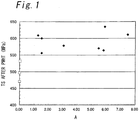
- Fig. 1 is a graph showing the relationship between the solid solution equivalent A and the tensile strength (TS) after PWHT.
- Patent Literature 1 strengthening by transformation with use of a bainite structure is known as means for securing the strength of a steel sheet.
- Patent Literature 1 is a technique of using dislocations introduced during transformation, and therefore, when PWHT is performed for about 15 hours or more, the dislocations may possibly be integrated and annihilated to decrease the strength of the steel sheet.
- the present inventor has studied a method for securing the strength of a steel sheet even when PWHT is performed for a long period, for example, of 15 hours or more while setting ferrite as a main structure of the metallographic structure of the steel sheet.
- a reason for setting ferrite as a main structure is that the ferrite has less dislocations introduced, and therefore, a decrease in the strength is considered to be avoided which is caused by the integration and annihilation of the dislocations, even when prolonged PWHT is performed.
- the present inventor has focused on carbide dispersion strengthening by Nb and Mo as means for securing the strength after PWHT.
- a method of precipitating a carbide of Nb and Mo in the steel sheet before PWHT to improve the strength the carbide is coarsened and aggregated when PWHT is performed for a long period, so that the carbide does not contribute to the improvement in the strength, anyhow leading to a decrease in the strength.
- the present inventor has found that high strength can be secured before and after PWHT by setting the ferrite as a main structure of the metallographic structure of the steel sheet, and appropriately adjusting the chemical component composition so that a carbide containing at least one selected from the group consisting of Nb and Mo is estimated to be precipitated in a predetermined amount or more through prolonged PWHT while a predetermined amount or more of bainite has been generated.
- the present invention has been completed.
- performing PWHT for a long period means performing PWHT for, for example, 15 hours or more.
- the high strength steel sheet according to the present invention has an elemental composition and microstructure as defined in claim 1.
- the high strength steel sheet according to the present invention is described in terms of the metallographic structure.
- the high strength means a tensile strength of 550 MPa or more.
- the metallographic structure of the high strength steel sheet of the present invention has a proportion of ferrite: 60 area% or more, bainite: 4 area% or more and other structures (like pearlite, island martensite): 10 area% or less, relative to the entire structure.
- the ferrite is set to 60 area% or more, preferably 65 area% or more, more preferably 70 area% or more, further preferably 75 area% or more.
- the upper limit of the ferrite fraction is 96 area% or less to secure 4 area% or more of the bainite as described later.
- the ferrite fraction is preferably 90 area% or less.
- the ferrite is 60 area% or more as described above; however, an excessively high ferrite fraction greatly decreases the strength of the steel sheet. Therefore, in the present invention, the bainite fraction in the entire structure is set to 4 area% or more, preferably 5 area% or more, more preferably 10 area% or more, to increase the strength of the steel sheet. With the bainite fraction excessively increased, however, 60 area% or more of the ferrite cannot be secured, and the strength after prolonged PWHT is decreased due to the increased bainite. Therefore, in the present invention, the bainite fraction is 40 area% or less, preferably 30 area% or less, more preferably 20 area% or less.
- the metallographic structure of the steel sheet according to the present invention is basically formed of the ferrite and the bainite, while the metallographic structure may also contain, for example, pearlite, island martensite (M-A) and the like as other structure, as long as the effect of the present invention is not inhibited.
- M-A island martensite
- the fraction of the other structure in the entire structure is 10 area% or less, for example.
- the metallographic structure of the steel sheet according to the present invention may be exposed in a cross section at a position of t/4, with the thickness of the steel sheet as t (mm), and subjected to mirror polishing. Then, a test piece may be collected, etched with a nital solution, and then observed with an optical microscope, to measure the ferrite fraction and the bainite fraction by image analysis. With the observation magnification set to 400 times and the number of observation fields set to 5, the average values of the ferrite fractions and the bainite fractions may be obtained which are measured in the fields.
- the ferrite fraction in the metallographic structure may be measured by the image analysis with use of an optical microscope as described above, while a value obtained by deducting the bainite fraction from 100% may be regarded as the ferrite fraction as the ferrite and the bainite are basically generated in the high strength steel sheet of the present invention.
- the estimated precipitation amount P 0 indicates a maximum amount of precipitate that can be, on the basis of the amounts of Mo, Nb and C included in the steel sheet, estimated to be precipitated as a carbide containing at least one selected from the group consisting of Nb and Mo by, for example, PWHT.
- the estimated precipitation amount P 0 is a calculated value obtained from the amounts of Nb, Mo and C on the basis of the following formula (1).
- the estimated precipitation amount P 0 is to be an index for predicting the strength after PWHT.
- Such a steel sheet whose value P 0 is appropriately controlled is subjected to prolonged PWHT to precipitate a carbide containing at least one selected from the group consisting of Nb and Mo, so that the strength of the steel sheet can be increased by the carbide dispersion strengthening.
- the carbide containing at least one selected from the group consisting of Nb and Mo is not particularly limited as long as the carbide includes at least Nb or Mo.
- Examples of the carbide include, in addition to a Nb carbide and a Mo carbide, a composite carbide containing both Nb and Mo.
- the carbide also includes a carbonitride in which nitrogen is bonded to a carbide, and the composite carbide also includes a composite carbonitride in which nitrogen is bonded to a composite carbide.
- P 0 340 ⁇ 0.6 ⁇ Mo + 22 + Nb ⁇ C 1
- a Mo carbide is represented by MoC and a Nb carbide is represented by NbC, and the precipitation amount of the MoC and the NbC is represented by the following formula (a) on the basis of the mass ratio of each element.
- X ⁇ ⁇ ⁇ ⁇ Mo + ⁇ ⁇ Nb ⁇ C 1
- ⁇ , ⁇ and ⁇ represent constant numbers, and [ ] represents the content of each element (mass%).
- the tensile strength after PWHT has been measured with use of steel sheets obtained by changing only the content of Mo or Nb while the content of the other element is kept the same.
- the conditions for the measurement of the tensile strength are made the same as in examples described later.
- a straight line graph has been made with the content of Nb or Mo as a horizontal axis and the tensile strength after PWHT as a vertical axis, ⁇ has been determined as 340, ⁇ as 0.6 and ⁇ as 22 from the ratio of the gradient of the straight line to determine a parameter x represented by the following formula (b).
- x 340 ⁇ 0.6 ⁇ Mo + 22 ⁇ Nb
- C 1 is a value determined on the basis of the relationship between the amount of C [C] and the total of the amount of Mo [Mo] and the amount of Nb [Nb] included in the steel.
- 12/95 is a coefficient determined in consideration of the atomic weight of C, Mo and Nb.
- the value P 0 is derived from the formula (1) on the basis of the thus derived parameter x and C 1 .
- the value P 0 is set to 1.50 or more.
- the threshold 1.50 of the value P 0 is a value determined on the basis of various experimental results.
- the value P 0 is set to preferably 2 or more, more preferably 3 or more.
- the upper limit of the value P 0 is 29.75 or less which is determined on the basis of the maximum value of the amount of Mo and the maximum value of the amount of Nb.
- the value P 0 is preferably 25 or less, more preferably 20 or less, further preferably 15 or less, particularly preferably 10 or less.
- a solid solution equivalent A represented by the following formula (5) satisfies a value of 0.50 or more.
- a precipitation amount P 1 is calculated by the following formula (4), from an average interval ⁇ ( ⁇ m) between carbides containing at least one selected from the group consisting of Nb and Mo, the solid solution equivalent A is obtained from the estimated precipitation amount P 0 and the precipitation amount P 1 by the following formula (5).
- the solid solution equivalent A indicates the total amount of Mo and Nb solid-solved in the high strength steel sheet, and is an index for predicting the strength of the steel sheet after PWHT.
- the threshold 0.50 of the solid solution equivalent A is a value determined on the basis of various experimental results. With the solid solution equivalent A set to 0.50 or more, a solid-solved Mo and a solid-solved Nb are precipitated as a carbide when PWHT is performed for a long period, so that the strength of a welded structure can be increased by the carbide dispersion strengthening.
- the solid solution equivalent A below 0.50, the amounts of Mo, Nb and C are insufficient or Mo and Nb are already precipitated as a carbide, and therefore, the carbide is coarsened or aggregated when PWHT is performed for a long period, so that the strength of a welded structure is decreased.
- the solid solution equivalent A is 0.50 or more, preferably 1 or more, further preferably 2 or more.
- the upper limit of the solid solution equivalent A is not particularly limited, and is preferably 15 or less, more preferably 10 or less, for example.
- the solid solution equivalent A also includes a fine Mo carbide and a fine Nb carbide that have a particle diameter of 10 nm or less. The fine carbide having a particle diameter of 10 nm or less exceeds the limits of detection by observation with use of a transmission electron microscope described later, and is considered not to contribute to the carbide dispersion strengthening.
- the solid solution equivalent A is a value obtained by deducting the precipitation amount P 1 from the estimated precipitation amount P 0 .
- the precipitation amount P 1 indicates the amounts of a Nb carbide and a Mo carbide that are actually precipitated in the steel sheet. Therefore, the total of amounts of Nb and Mo solid-solved in the steel sheet can be calculated by deducting the precipitation amount P 1 from the estimated precipitation amount P 0 .
- a solid-solved Nb and a solid-solved Mo are precipitated as a carbide by performing PWHT for a long period, contributing to the improvement in the strength of a welded structure after PWHT by the carbide dispersion strengthening.
- the precipitation amount P 1 can be calculated by the formula (4).
- ⁇ represents an average interval ( ⁇ m) between carbides containing at least one selected from the group consisting of Nb and Mo, and f represents an average volume fraction (volume%) of the carbide, and d represents an average particle diameter ( ⁇ m) of the metallographic structure.
- the formula (c) is generally known as formula for calculating the average interval ⁇ between carbides and is described in, for example, Iron and Steel, Vol. 91 (2005) No. 11, pp. 796 to 802 .
- the average volume fraction f of the carbide can be calculated on the basis of the area of the carbide and the number of particles of the carbide measured by observing a cross section at a position of t/4, with the thickness of the steel sheet as t (mm), with use of, for example, a transmission electron microscope.
- the observation magnification may be, for example, 30000 times, and the number of observation fields may be 10.
- the average particle diameter d of the metallographic structure means the average value of circle equivalent diameters of the metallographic structure that are identified in an observation field.
- the observation field for example, when a ferrite structure is identified, particle diameters of the ferrite may be measured, and when a bainite structure is identified, particle diameters of the bainite may be measured. Then, the average value of the particle diameters may be calculated.
- the observation magnification may be, for example, 30000 times, and the number of observation fields may be 10.
- the particle diameter d of the metallographic structure is considered to be substantially constant by conducting controlled rolling described later.
- the average interval ⁇ between the carbides can be obtained on the basis of the average volume fraction f of the carbide and the average particle diameter d of the metallographic structure by the formula (c).
- the precipitation amount P 1 of a carbide per unit mass can be represented by the following formula (A) with use of the average volume fraction of the carbide, the average volume fraction of the metallographic structure, and the mass per unit volume.
- P 1 f ⁇ n 1 / f ⁇ n 1 + F ⁇ n 2
- f is the average volume fraction (volume%) of the carbide
- F is the average volume fraction (volume%) of the metallographic structure
- n 1 is specific gravity (kg/m 3 ) of the carbide
- n 2 is specific gravity (kg/m 3 ) of the metallographic structure.
- n 1 of the carbide component analysis may be conducted for carbide particles identified in an observation field, the specific gravity of each of the carbide particles is obtained, and the average value of the specific gravity may be substituted.
- n 2 of the metallographic structure the specific gravity of iron may be substituted.
- P 1 f ⁇ n 1 / f ⁇ n 1 + 100 ⁇ f ⁇ n 2
- the present inventor has prepared steel sheets obtained by variously changing the amounts of Mo and Nb and measured the precipitation amount of a carbide to learn that the formula (B) can be represented by the following formula (4) with use of the interval ⁇ between carbides.
- P 1 0.7 / ⁇
- the value P 0 calculated on the basis of the amounts of Mo, Nb and C included in the steel is 1.50 or more, and it is also necessary to appropriately control the chemical component composition.
- the chemical components of the high strength steel sheet will be described.
- C is an element that is necessary for increasing the strength of the steel sheet. Also, C is an element that is necessary for precipitating a carbide to suppress a decrease in the strength after PWHT.
- the amount of C is 0.02% or more, preferably 0.025% or more, more preferably 0.030% or more. Excessive addition of C, however, is likely to generate the bainite. Excessive generation of the bainite causes integration and annihilation of dislocations by prolonged PWHT to largely decrease the strength.
- the amount of C is 0.07% or less, preferably 0.065% or less, more preferably 0.06% or less, particularly preferably 0.055% or less.
- Si is an element that acts as a deoxidizing agent during smelting of steel and has an effect of increasing the strength of the steel. For exhibition of such an action, Si is contained in an amount of 0.1% or more, preferably 0.15% or more, more preferably 0.2% or more in the present invention. An excessive amount of Si, however, deteriorates HAZ toughness. Therefore, the amount of Si is 0.4% or less, preferably 0.37% or less, more preferably 0.35% or less in the present invention.
- Mn is an element that effectively acts for increasing the strength of the steel sheet.
- the amount of Mn is 1.2% or more, preferably 1.3% or more, more preferably 1.4% or more.
- An excessive amount of Mn however, excessively generates the bainite to decrease the strength after PWHT is performed for a long period.
- the amount of Mn is 2% or less, preferably 1.8% or less, more preferably 1.6% or less.
- the amount of P is an inevitable impurity and is an element that is segregated in crystal grains and decreases the ductibility and toughness of the steel sheet.
- the amount of P is 0.02 or less, preferably 0.015% or less, more preferably 0.01% or less, particularly preferably 0.008% or less. It is preferred that the amount of P is as less as possible; however, it is industrially difficult to realize 0% of the amount of P.
- the amount of S is 0.005% or less, preferably 0.004% or less, more preferably 0.003% or less. It is preferred that the amount of S is as less as possible; however, it is industrially difficult to realize 0% of the amount of S.
- Cu is an element that acts for increasing the strength of the steel sheet.
- the amount of Cu is 0.1% or more, preferably 0.12% or more, more preferably 0.15% or more. An excessive amount of Cu, however, easily causes generation of a crack during hot working. In the present invention, the amount of Cu is 0.7% or less, preferably 0.65% or less, more preferably 0.5% or less.
- Al is an element that acts as a deoxidizing agent during smelting of steel.
- the amount of Al is 0.01% or more, preferably 0.015% or more, more preferably 0.020% or more.
- An excessive amount of Al inhibits the cleanliness of the steel sheet to decrease the strength.
- the amount of Al is 0.08% or less, preferably 0.06% or less, more preferably 0.04% or less.
- Ni is an element that is necessary for lowering a ferrite transformation start temperature, accelerating the generation of the bainite, and increasing the strength of the steel sheet.
- the amount of Ni is 0.45% or more, preferably 0.5% or more.
- An excessive amount of Ni however, excessively generates the bainite to suppress the generation of the ferrite, decreasing the strength of the steel sheet after PWHT is performed for a long period.
- the amount of Ni is 0.85% or less, preferably 0.75% or less, more preferably 0.65% or less.
- Mo is an element that is necessary for generating the bainite. Also, Mo is an important element that precipitates a carbide after PWHT is performed for a long period to contribute to the improvement in the strength of the steel sheet after PWHT.
- the amount of Mo is 0.01% or more, preferably 0.1% or more, more preferably 0.15% or more. An excessive amount of Mo, however, excessively generates the bainite to suppress the generation of the ferrite, decreasing the strength of the steel sheet after PWHT is performed for a long period.
- the amount of Mo is 0.25% or less, preferably 0.23% or less, more preferably 0.20% or less.
- Nb is an important element that precipitates a carbide after PWHT is performed for a long period to contribute to the improvement in the strength of the steel sheet after PWHT.
- the amount of Nb is 0.015% or more, preferably 0.020% or more. An excessive amount of Nb, however, deteriorates HAZ toughness.
- the amount of Nb is 0.05% or less, preferably 0.048% or less, more preferably 0.045% or less.
- Ti is an element that is likely to form a nitride and is an element that is necessary to precipitate fine TiN, so that crystal grains are refined to increase the toughness of the steel sheet.
- the amount of Ti is 0.005% or more, preferably 0.007% or more, more preferably 0.009% or more.
- An excessive amount of Ti decreases HAZ toughness.
- the amount of Ti is 0.025% or less, preferably 0.02% or less, more preferably 0.015% or less.
- Ca is an element that is necessary for controlling the morphology of an inclusion in the steel to improve the toughness of the steel sheet.
- the amount of Ca is 0.0005% or more, preferably 0.0008% or more, more preferably 0.001% or more.
- An excessive amount of Ca causes coarsening of the inclusion to decrease HAZ toughness.
- the amount of Ca is 0.003% or less, preferably 0.0027% or less, more preferably 0.0025% or less.
- N is an element that is necessary to precipitate fine TiN by bonding to Ti, so that crystal grains are refined to increase the toughness of the steel sheet.
- the amount of N is 0.001% or more, preferably 0.003% or more, more preferably 0.004% or more. An excessive amount of N, however, causes coarsening of the TiN to deteriorate HAZ toughness.
- the amount of N is 0.01% or less, preferably 0.008% or less, more preferably 0.007% or less.
- the chemical components in the steel sheet of the present invention are as described above, and the balance is iron and inevitable impurities such as O (oxygen).
- the steel sheet of the present invention may contain, in addition to the chemical components described above, the following elements as necessary.
- All of Cr, V and B are elements that precipitate a carbonitride to contribute to the improvement in the strength of the steel sheet.
- the amount of Cr is 0.001% or more, preferably 0.005% or more.
- the amount of V is 0.0001% or more, preferably 0.0005% or more.
- the amount of B is 0.0001% or more, preferably 0.0005% or more. Excessive addition of Cr or V, however, decreases HAZ toughness.
- the amount of Cr is 0.2% or less, preferably 0.1% or less, further preferably 0.05% or less.
- the amount of V is 0.02% or less, preferably 0.01% or less, further preferably 0.005% or less.
- An excessive amount of B excessively generates the bainite to decrease the strength after PWHT is performed for a long period.
- the amount of B is 0.001% or less, preferably 0.0005% or less.
- the component composition is appropriately controlled as described above, and the production conditions are not particularly limited, while it is recommended that steel that satisfies the component composition described above be smelted according to a usual method and a resultant steel ingot be subjected to controlled rolling and controlled cooling so that the solid solution equivalent A satisfies the predetermined range. That is, with the solid solution equivalent A satisfying the predetermined range, the precipitation behavior of Mo and Nb can be controlled to secure the high strength. Therefore, it is desirable to effectively make use of the controlled rolling and the controlled cooling.
- thermo-mechanical control process hereinafter, sometimes referred to as a TMCP
- steel that is produced by this production technique is sometimes referred to as a TMCP steel sheet.
- the TMCP steel sheet can be produced by rolling at a cumulative rolling reduction of 5 to 60% in the temperature range at a position of t/4 of 900 to 800°C, with the thickness of the steel ingot as t (mm), followed by cooling from a starting temperature at the position of t/4 of higher than 670°C to room temperature.
- the cumulative rolling reduction in the temperature range at the position of t/4 of 900 to 800°C set to 5% or more, a deformation band which is to be a transformation core of the ferrite can be introduced in austenite grains, so that the generation of the ferrite can be encouraged.
- the cumulative rolling reduction is preferably 10% or more, further preferably 15% or more.
- the cumulative rolling reduction is 60% or less, preferably 50% or less, further preferably 45% or less.
- the resultant rolled steel sheet is cooled from a starting temperature at the position of t/4 of higher than 670°C to room temperature.
- the cooling start temperature set to higher than 670°C, the coarsening of the ferrite can be suppressed.
- the cooling start temperature may be preferably higher than 700°C.
- the upper limit of the cooling start temperature is the same as a rolling finish temperature, for example, 850°C.
- the cooling rate from the cooling start temperature to room temperature is not particularly limited, and for example, the steel sheet may be cooled from the cooling start temperature to the temperature range of higher than 300°C to lower than 500°C at an average cooling rate of 5 to 30°C/sec and air-cooled from the temperature at which the cooling has been stopped to room temperature.
- the steel sheet may be water-cooled from the cooling start temperature to the temperature range of higher than 300°C to lower than 500°C.
- the thickness of the steel sheet of the present invention is not particularly limited, and the thickness may be, for example, 10 mm or more, further 20 mm or more, particularly 30 mm or more.
- the upper limit of the thickness of the steel sheet is not also particularly limited, and the thickness may be, for example, 150 mm or less, further 120 mm or less, particularly 100 mm or less.
- the steel sheet according to the present invention has a high tensile strength of, for example, 550 MPa or more.
- the present invention also encompasses a welded structure obtained by welding the steel sheet, and then subjecting the steel sheet to a heat treatment.
- the welded structure of the present invention is characterized in that the high strength of the steel sheet is retained as it is even after a heat treatment.
- a welded structure thereof can also retain the high tensile strength.
- TMCP steel sheet having a thickness of 64 mm.
- the controlled rolling was performed in the temperature range at a position of t/4 of 900 to 800°C, with the thickness of the steel ingot as t (mm), so that the cumulative rolling reduction was as shown in Table 2 below.
- the controlled cooling was performed by, after the rolling, starting to cool a resultant steel sheet from the temperature at the position of t/4 shown in Table 2.
- the steel sheet was water-cooled from the cooling start temperature to the temperature range of 380 to 430°C at an average cooling rate of about 7°C/sec, and air-cooled from a cooling stop temperature in the temperature range of 380 to 430°C to room temperature.
- the Z value was compared with the amount of C [C] shown in Table 1, and the Z value was set for a value C 1 when [C] ⁇ Z, and [C] was set for the value C 1 when [C] ⁇ Z.
- the determined value C 1 is shown in Table 2.
- the cross section at a position corresponding to 1/4 the thickness of the resultant TMCP steel sheet was observed at an observation magnification of 30000 times with use of a transmission electron microscope.
- a carbide that was observed in an observation field and contained at least one selected from the group consisting of Nb and Mo was measured in terms of the number of the carbide and the area ratio of the carbide to the area of the observation field.
- the number of observation fields was 10.
- the area ratio of the carbide was recognized as a volume fraction f (%) of the carbide.
- the steel sheet was exposed in the cross section at the position corresponding to 1/4 the thickness of the steel sheet and was subjected to mirror polishing. Then, a test piece was collected and etched with a nital solution. After the etching, the test piece was observed at an observation magnification of 400 times with use of an optical microscope, and was subjected to image analysis to measure the bainite fraction. With the area of the observation field as 100%, a value obtained by deducting the bainite fraction from 100% was determined as a ferrite fraction. With the number of observation fields set to 5, the average values of the bainite fractions and the ferrite fractions which were measured in the each observation fields were obtained, respectively. The results are shown in Table 2.
- the particle diameter of the ferrite or the bainite that was identified in the observation field was measured and the average value d ( ⁇ m) of the particle diameters in the 5 fields was obtained.
- a value P 1 calculated by dividing 0.7 by ⁇ is also shown in Table 2.
- test piece for a tensile test defined in ASTM A370 was collected from a position corresponding to 1/4 the thickness of the resultant TMCP steel sheet in a direction orthogonal to the rolling direction, and the tensile test was conducted to measure the tensile strength.
- the measurement result is shown in Table 2 as the tensile strength before PWHT.
- PWHT heat treatment was performed by heating the test piece to a temperature of 595°C and then holding the test piece for 19 hours.
- the tensile strength of the test piece after the heat treatment was measured in the same procedure as described above. The measurement result is shown in Table 2 as the tensile strength after PWHT.
- a steel sheet having a tensile strength of 550 MPa or more both before and after the heat treatment was determined to be acceptable, and a steel sheet having a tensile strength of less than 550 MPa even either before or after the heat treatment was determined to be unacceptable.
- Fig. 1 shows the relationship between the solid solution equivalent A calculated on the basis of the formula (5) and the tensile strength (TS) after PWHT.
- TS tensile strength
- Nos. 1 to 8 are invention examples that satisfy the requirements of the present invention. That is, the predetermined metallographic structure is obtained and the estimated precipitation amount P 0 also satisfies the predetermined range to achieve a high tensile strength of 550 MPa or more. Further, the steel sheets can secure a tensile strength of 550 MPa or more even after prolonged PWHT as long as 19 hours.
- Nos. 9 to 15 are comparative examples that do not satisfy any of the requirements specified in the present invention.
- No. 9 is an example that did not contain Mo to excessively generate the ferrite, not securing the bainite fraction, so that the tensile strength of the steel sheet could not be secured.
- the steel sheet did not contain Mo and Nb, so that the tensile strength after prolonged PWHT was further smaller than before PWHT.
- No. 10 is an example that did not contain Nb and did not satisfy the predetermined range of the estimated precipitation amount P 0 . As a result, the tensile strength after prolonged PWHT lowered.
- No. 11 is an example that did not contain Mo to excessively generate the ferrite, not securing the bainite fraction, so that the tensile strength of the steel sheet could not be secured.
- the steel sheet did not contain Mo and Nb, so that the tensile strength after prolonged PWHT lowered by performing PWHT for a long period.
- No. 12 was small in the amount of Ni to increase the ferrite transformation start temperature, excessively generating the ferrite. Therefore, the bainite fraction was decreased. As a result, the strength before PWHT was near the lower limit of the strength to be aimed at, and the strength was decreased by performing PWHT for a long period.
- No. 13 was small in the amount of Ni to increase the ferrite transformation start temperature, excessively generating the ferrite. Therefore, the bainite fraction was decreased. As a result, the tensile strength before and after PWHT could not be secured.
- No. 14 is an example in which the amounts of Cu, Ni and Nb were below the ranges specified in the present invention and which excessively contained Mo. Therefore, the ferrite was excessively generated and the bainite was not generated. As a result, the tensile strength was low both before and after PWHT.
- No. 15 is an example in which Ni was below the range specified in the present invention and which excessively contained Mo but did not contain Nb. Therefore, the ferrite was excessively generated and the bainite fraction could not be secured. As a result, the tensile strength after PWHT could not be secured.
Landscapes
- Chemical & Material Sciences (AREA)
- Engineering & Computer Science (AREA)
- Materials Engineering (AREA)
- Mechanical Engineering (AREA)
- Metallurgy (AREA)
- Organic Chemistry (AREA)
- Physics & Mathematics (AREA)
- Thermal Sciences (AREA)
- Crystallography & Structural Chemistry (AREA)
- Heat Treatment Of Steel (AREA)
Claims (2)
- Tôle d'acier ayant une résistance en traction de 550 MPa ou plus avant et après un traitement thermique après soudage comprenant, comme composants chimiques, en masse :C : 0,02 à 0,07% ;Si : 0,1 à 0,4% ;Mn : 1,2 à 2% ;P : plus de 0% et 0,02% ou moins ;S : plus de 0% et 0,005% ou moins ;Cu : 0,1 à 0,7% ;Al : 0,01 à 0,08% ;Ni : 0,45 à 0,85% ;Mo : 0,01 à 0,25% ;Nb: 0,015 à 0,05% ;Ti : 0,005 à 0,025% ;Ca : 0,0005 à 0,003%, etN : 0,001 à 0,01% ;le cas échéant comprenant en outre, comme autre élément, au moins l'un choisi parmi le groupe consistant en :Cr : 0,001% ou plus et 0,2% ou moins ;V : 0,0001% ou plus et 0,02% ou moins ; etB : 0,0001% ou plus et 0,001% ou moins ; le reste étant du fer et les impuretés inévitables, oùla quantité estimée de précipitation P0 est de 1,50 ou plus, qui est obtenue par les quantités de Nb, Mo et C et est représentée par la formule (1) ci-dessous, etla structure métallographique consiste en :de la ferrite : 60% en surface ou plus ;de la bainite : 4% en surface ou plus, etd'autres structures comme la perlite, des îlots de martensite : 10% en surface oumoins, par rapport à l'entièreté de la structure,


 lorsque
 où lorsque la quantité de précipitation P1 est calculée par la formule (4) ci-dessous,pour un intervalle moyen À en µm entre carbures contenant au moins l'un choisi parmi le groupe consistant en Nb et Mo,où l'intervalle moyen À est calculé sur base de la formule (c) donnée dans la description,où la résistance en traction et la microstructure se réfèrent à une position de ¼ dans l'épaisseur de la feuille,et où la résistance en traction est mesurée sur une éprouvette définie dans ASTM A370 en direction orthogonale à la direction de laminage,un équivalent de solution solide A satisfait une valeur de 0,50 ou plus, l'équivalent de solution solide A étant obtenu à partir de la quantité de précipitation estimée P0 et la quantité de précipitation P1 et représenté par la formule (5) ci-dessous :

- Structure soudée à haute résistance, obtenue en soumettant la tôle d'acier selon la revendication 1 à un traitement thermique post-soudage.
Applications Claiming Priority (2)
| Application Number | Priority Date | Filing Date | Title |
|---|---|---|---|
| JP2014223751A JP6276163B2 (ja) | 2014-10-31 | 2014-10-31 | 高強度鋼板 |
| PCT/JP2015/079874 WO2016068024A1 (fr) | 2014-10-31 | 2015-10-22 | Tôle d'acier à résistance élevée |
Publications (3)
| Publication Number | Publication Date |
|---|---|
| EP3214200A1 EP3214200A1 (fr) | 2017-09-06 |
| EP3214200A4 EP3214200A4 (fr) | 2018-03-28 |
| EP3214200B1 true EP3214200B1 (fr) | 2020-03-25 |
Family
ID=55857363
Family Applications (1)
| Application Number | Title | Priority Date | Filing Date |
|---|---|---|---|
| EP15856045.8A Active EP3214200B1 (fr) | 2014-10-31 | 2015-10-22 | Tôle d'acier à résistance élevée |
Country Status (5)
| Country | Link |
|---|---|
| EP (1) | EP3214200B1 (fr) |
| JP (1) | JP6276163B2 (fr) |
| KR (1) | KR20170063760A (fr) |
| CN (1) | CN107075641B (fr) |
| WO (1) | WO2016068024A1 (fr) |
Families Citing this family (2)
| Publication number | Priority date | Publication date | Assignee | Title |
|---|---|---|---|---|
| WO2025197259A1 (fr) * | 2024-03-21 | 2025-09-25 | Jfeスチール株式会社 | Tôle d'acier et son procédé de fabrication |
| JP7816651B1 (ja) * | 2024-05-14 | 2026-02-18 | Jfeスチール株式会社 | 鋼板およびその製造方法 |
Citations (1)
| Publication number | Priority date | Publication date | Assignee | Title |
|---|---|---|---|---|
| JP2007321228A (ja) * | 2006-06-05 | 2007-12-13 | Kobe Steel Ltd | Haz靱性に優れ、溶接後熱処理による強度低下が小さい鋼板 |
Family Cites Families (7)
| Publication number | Priority date | Publication date | Assignee | Title |
|---|---|---|---|---|
| JPH09256038A (ja) * | 1996-03-22 | 1997-09-30 | Nippon Steel Corp | 厚鋼板の応力除去焼鈍処理前の熱処理方法 |
| JP3718348B2 (ja) * | 1998-07-31 | 2005-11-24 | 新日本製鐵株式会社 | 高強度高靱性圧延形鋼とその製造方法 |
| JP3528759B2 (ja) * | 2000-06-12 | 2004-05-24 | 住友金属工業株式会社 | Cu時効鋼およびその製造方法 |
| JP2004176172A (ja) * | 2002-10-01 | 2004-06-24 | Sumitomo Metal Ind Ltd | 耐水素誘起割れ性に優れた高強度継目無鋼管およびその製造方法 |
| US9089919B2 (en) * | 2009-11-25 | 2015-07-28 | Jfe Steel Corporation | Welded steel pipe for linepipe with high compressive strength and manufacturing method thereof |
| CN102691007B (zh) * | 2011-03-23 | 2013-09-04 | 宝山钢铁股份有限公司 | 抗高回火参数pwht脆化的低温用特厚钢板及制造方法 |
| US9062363B2 (en) * | 2011-09-27 | 2015-06-23 | Nippon Steel & Sumitomo Metal Corporation | Method of production of hot coil for line pipe |
-
2014
- 2014-10-31 JP JP2014223751A patent/JP6276163B2/ja active Active
-
2015
- 2015-10-22 CN CN201580058247.1A patent/CN107075641B/zh active Active
- 2015-10-22 WO PCT/JP2015/079874 patent/WO2016068024A1/fr not_active Ceased
- 2015-10-22 EP EP15856045.8A patent/EP3214200B1/fr active Active
- 2015-10-22 KR KR1020177010756A patent/KR20170063760A/ko not_active Ceased
Patent Citations (1)
| Publication number | Priority date | Publication date | Assignee | Title |
|---|---|---|---|---|
| JP2007321228A (ja) * | 2006-06-05 | 2007-12-13 | Kobe Steel Ltd | Haz靱性に優れ、溶接後熱処理による強度低下が小さい鋼板 |
Also Published As
| Publication number | Publication date |
|---|---|
| JP6276163B2 (ja) | 2018-02-07 |
| EP3214200A1 (fr) | 2017-09-06 |
| EP3214200A4 (fr) | 2018-03-28 |
| WO2016068024A1 (fr) | 2016-05-06 |
| KR20170063760A (ko) | 2017-06-08 |
| CN107075641A (zh) | 2017-08-18 |
| CN107075641B (zh) | 2020-03-06 |
| JP2016089211A (ja) | 2016-05-23 |
Similar Documents
| Publication | Publication Date | Title |
|---|---|---|
| JP4529872B2 (ja) | 高Mn鋼材及びその製造方法 | |
| EP2762589B1 (fr) | Feuille d'acier galvanisé par immersion à chaud et à haute résistance qui présente une excellente résistance aux chocs et procédé de production de cette dernière et feuille d'acier galvanisé par immersion à chaud alliée et à haute résistance et procédé de production correspondant | |
| CN101960038B (zh) | 冷轧钢板 | |
| JP5728836B2 (ja) | 耐硫化物応力割れ性に優れた油井用高強度継目無鋼管の製造方法 | |
| US10501830B2 (en) | High-strength cold-rolled steel sheet, high-strength hot-dip galvanized steel sheet, and high-strength hot-dip galvannealed steel sheet having excellent ductility, stretch-flangeability, and weldability | |
| EP3219820B1 (fr) | Tôle d'acier à base d'alliage à base de nickel et son procédé de fabrication | |
| EP2743364A1 (fr) | Feuille d'acier laminée à chaud ayant un rapport de limite d'élasticité élevé et une excellente absorption d'énergie d'impact à basse température et une résistance au ramollissement haz et son procédé de fabrication | |
| EP2447383B1 (fr) | Rail en acier à forte teneur en carbone à base de perlite présentant une excellente ductilité et procédé de fabrication de ce rail | |
| US10570473B2 (en) | High-strength cold-rolled steel sheet, high-strength hot-dip galvanized steel sheet, and high-strength hot-dip galvannealed steel sheet having excellent ductility, stretch-flangeability, and weldability | |
| US11578391B2 (en) | Nickel-containing steel for low temperature | |
| JP5466552B2 (ja) | 伸び、伸びフランジ性および溶接性を兼備した高強度冷延鋼板 | |
| WO2015088040A1 (fr) | Tôle d'acier et procédé permettant de fabriquer cette dernière | |
| JP2017155300A (ja) | 低温用厚鋼板及びその製造方法 | |
| CN109154045A (zh) | 镀覆钢板及其制造方法 | |
| CN105452511B (zh) | 疲劳特性优异的厚钢板及其制造方法 | |
| EP3133182A1 (fr) | Fil laminé à chaud | |
| JP6436232B2 (ja) | ばね鋼 | |
| JP5679452B2 (ja) | 成形性と母材および溶接熱影響部の疲労特性とを兼備した高強度熱延鋼板 | |
| JP4441417B2 (ja) | 成形加工性と溶接性に優れる高張力冷延鋼板及びその製造方法 | |
| WO2010109702A1 (fr) | Tôle d'acier laminée à froid | |
| EP3214200A1 (fr) | Tôle d'acier à résistance élevée | |
| JP4878219B2 (ja) | Haz靱性に優れ、溶接後熱処理による強度低下が小さい鋼板 | |
| JP3780956B2 (ja) | 耐sr特性に優れた高強度鋼板及びその製造方法 | |
| JP4201310B2 (ja) | 耐sr特性に優れた高強度鋼板及びその製造方法 | |
| JP4586080B2 (ja) | 耐応力除去焼鈍特性と低温靭性に優れた高強度鋼板 |
Legal Events
| Date | Code | Title | Description |
|---|---|---|---|
| STAA | Information on the status of an ep patent application or granted ep patent |
Free format text: STATUS: THE INTERNATIONAL PUBLICATION HAS BEEN MADE |
|
| PUAI | Public reference made under article 153(3) epc to a published international application that has entered the european phase |
Free format text: ORIGINAL CODE: 0009012 |
|
| STAA | Information on the status of an ep patent application or granted ep patent |
Free format text: STATUS: REQUEST FOR EXAMINATION WAS MADE |
|
| 17P | Request for examination filed |
Effective date: 20170427 |
|
| AK | Designated contracting states |
Kind code of ref document: A1 Designated state(s): AL AT BE BG CH CY CZ DE DK EE ES FI FR GB GR HR HU IE IS IT LI LT LU LV MC MK MT NL NO PL PT RO RS SE SI SK SM TR |
|
| AX | Request for extension of the european patent |
Extension state: BA ME |
|
| DAV | Request for validation of the european patent (deleted) | ||
| DAX | Request for extension of the european patent (deleted) | ||
| A4 | Supplementary search report drawn up and despatched |
Effective date: 20180222 |
|
| RIC1 | Information provided on ipc code assigned before grant |
Ipc: C22C 38/42 20060101ALI20180217BHEP Ipc: C22C 38/08 20060101ALI20180217BHEP Ipc: C22C 38/06 20060101ALI20180217BHEP Ipc: C22C 38/14 20060101ALI20180217BHEP Ipc: C21D 6/02 20060101ALI20180217BHEP Ipc: C22C 38/04 20060101ALI20180217BHEP Ipc: C22C 38/48 20060101ALI20180217BHEP Ipc: C22C 38/44 20060101ALI20180217BHEP Ipc: C21D 8/02 20060101ALI20180217BHEP Ipc: C22C 38/46 20060101ALI20180217BHEP Ipc: C22C 38/16 20060101ALI20180217BHEP Ipc: C22C 38/02 20060101ALI20180217BHEP Ipc: C21D 1/30 20060101ALI20180217BHEP Ipc: C22C 38/12 20060101ALI20180217BHEP Ipc: C22C 38/00 20060101AFI20180217BHEP Ipc: C22C 38/58 20060101ALI20180217BHEP Ipc: C22C 38/50 20060101ALI20180217BHEP |
|
| STAA | Information on the status of an ep patent application or granted ep patent |
Free format text: STATUS: EXAMINATION IS IN PROGRESS |
|
| 17Q | First examination report despatched |
Effective date: 20190313 |
|
| REG | Reference to a national code |
Ref country code: DE Ref legal event code: R079 Ref document number: 602015049592 Country of ref document: DE Free format text: PREVIOUS MAIN CLASS: C22C0038000000 Ipc: C22C0038020000 |
|
| GRAP | Despatch of communication of intention to grant a patent |
Free format text: ORIGINAL CODE: EPIDOSNIGR1 |
|
| STAA | Information on the status of an ep patent application or granted ep patent |
Free format text: STATUS: GRANT OF PATENT IS INTENDED |
|
| RIC1 | Information provided on ipc code assigned before grant |
Ipc: C22C 38/48 20060101ALI20191002BHEP Ipc: C21D 8/02 20060101ALI20191002BHEP Ipc: C22C 38/08 20060101ALI20191002BHEP Ipc: C22C 38/42 20060101ALI20191002BHEP Ipc: C21D 9/50 20060101ALI20191002BHEP Ipc: C22C 38/58 20060101ALI20191002BHEP Ipc: C22C 38/12 20060101ALI20191002BHEP Ipc: C22C 38/46 20060101ALI20191002BHEP Ipc: C22C 38/16 20060101ALI20191002BHEP Ipc: C22C 38/04 20060101ALI20191002BHEP Ipc: C22C 38/02 20060101AFI20191002BHEP Ipc: C22C 38/44 20060101ALI20191002BHEP Ipc: C22C 38/50 20060101ALI20191002BHEP Ipc: C22C 38/14 20060101ALI20191002BHEP |
|
| INTG | Intention to grant announced |
Effective date: 20191022 |
|
| GRAS | Grant fee paid |
Free format text: ORIGINAL CODE: EPIDOSNIGR3 |
|
| GRAA | (expected) grant |
Free format text: ORIGINAL CODE: 0009210 |
|
| STAA | Information on the status of an ep patent application or granted ep patent |
Free format text: STATUS: THE PATENT HAS BEEN GRANTED |
|
| AK | Designated contracting states |
Kind code of ref document: B1 Designated state(s): AL AT BE BG CH CY CZ DE DK EE ES FI FR GB GR HR HU IE IS IT LI LT LU LV MC MK MT NL NO PL PT RO RS SE SI SK SM TR |
|
| REG | Reference to a national code |
Ref country code: GB Ref legal event code: FG4D |
|
| REG | Reference to a national code |
Ref country code: DE Ref legal event code: R096 Ref document number: 602015049592 Country of ref document: DE |
|
| REG | Reference to a national code |
Ref country code: AT Ref legal event code: REF Ref document number: 1248636 Country of ref document: AT Kind code of ref document: T Effective date: 20200415 Ref country code: IE Ref legal event code: FG4D |
|
| PG25 | Lapsed in a contracting state [announced via postgrant information from national office to epo] |
Ref country code: NO Free format text: LAPSE BECAUSE OF FAILURE TO SUBMIT A TRANSLATION OF THE DESCRIPTION OR TO PAY THE FEE WITHIN THE PRESCRIBED TIME-LIMIT Effective date: 20200625 Ref country code: RS Free format text: LAPSE BECAUSE OF FAILURE TO SUBMIT A TRANSLATION OF THE DESCRIPTION OR TO PAY THE FEE WITHIN THE PRESCRIBED TIME-LIMIT Effective date: 20200325 Ref country code: FI Free format text: LAPSE BECAUSE OF FAILURE TO SUBMIT A TRANSLATION OF THE DESCRIPTION OR TO PAY THE FEE WITHIN THE PRESCRIBED TIME-LIMIT Effective date: 20200325 |
|
| PG25 | Lapsed in a contracting state [announced via postgrant information from national office to epo] |
Ref country code: LV Free format text: LAPSE BECAUSE OF FAILURE TO SUBMIT A TRANSLATION OF THE DESCRIPTION OR TO PAY THE FEE WITHIN THE PRESCRIBED TIME-LIMIT Effective date: 20200325 Ref country code: SE Free format text: LAPSE BECAUSE OF FAILURE TO SUBMIT A TRANSLATION OF THE DESCRIPTION OR TO PAY THE FEE WITHIN THE PRESCRIBED TIME-LIMIT Effective date: 20200325 Ref country code: HR Free format text: LAPSE BECAUSE OF FAILURE TO SUBMIT A TRANSLATION OF THE DESCRIPTION OR TO PAY THE FEE WITHIN THE PRESCRIBED TIME-LIMIT Effective date: 20200325 Ref country code: BG Free format text: LAPSE BECAUSE OF FAILURE TO SUBMIT A TRANSLATION OF THE DESCRIPTION OR TO PAY THE FEE WITHIN THE PRESCRIBED TIME-LIMIT Effective date: 20200625 Ref country code: GR Free format text: LAPSE BECAUSE OF FAILURE TO SUBMIT A TRANSLATION OF THE DESCRIPTION OR TO PAY THE FEE WITHIN THE PRESCRIBED TIME-LIMIT Effective date: 20200626 |
|
| REG | Reference to a national code |
Ref country code: NL Ref legal event code: MP Effective date: 20200325 |
|
| REG | Reference to a national code |
Ref country code: LT Ref legal event code: MG4D |
|
| PG25 | Lapsed in a contracting state [announced via postgrant information from national office to epo] |
Ref country code: NL Free format text: LAPSE BECAUSE OF FAILURE TO SUBMIT A TRANSLATION OF THE DESCRIPTION OR TO PAY THE FEE WITHIN THE PRESCRIBED TIME-LIMIT Effective date: 20200325 |
|
| PG25 | Lapsed in a contracting state [announced via postgrant information from national office to epo] |
Ref country code: SK Free format text: LAPSE BECAUSE OF FAILURE TO SUBMIT A TRANSLATION OF THE DESCRIPTION OR TO PAY THE FEE WITHIN THE PRESCRIBED TIME-LIMIT Effective date: 20200325 Ref country code: IS Free format text: LAPSE BECAUSE OF FAILURE TO SUBMIT A TRANSLATION OF THE DESCRIPTION OR TO PAY THE FEE WITHIN THE PRESCRIBED TIME-LIMIT Effective date: 20200725 Ref country code: PT Free format text: LAPSE BECAUSE OF FAILURE TO SUBMIT A TRANSLATION OF THE DESCRIPTION OR TO PAY THE FEE WITHIN THE PRESCRIBED TIME-LIMIT Effective date: 20200818 Ref country code: LT Free format text: LAPSE BECAUSE OF FAILURE TO SUBMIT A TRANSLATION OF THE DESCRIPTION OR TO PAY THE FEE WITHIN THE PRESCRIBED TIME-LIMIT Effective date: 20200325 Ref country code: CZ Free format text: LAPSE BECAUSE OF FAILURE TO SUBMIT A TRANSLATION OF THE DESCRIPTION OR TO PAY THE FEE WITHIN THE PRESCRIBED TIME-LIMIT Effective date: 20200325 Ref country code: EE Free format text: LAPSE BECAUSE OF FAILURE TO SUBMIT A TRANSLATION OF THE DESCRIPTION OR TO PAY THE FEE WITHIN THE PRESCRIBED TIME-LIMIT Effective date: 20200325 Ref country code: SM Free format text: LAPSE BECAUSE OF FAILURE TO SUBMIT A TRANSLATION OF THE DESCRIPTION OR TO PAY THE FEE WITHIN THE PRESCRIBED TIME-LIMIT Effective date: 20200325 Ref country code: RO Free format text: LAPSE BECAUSE OF FAILURE TO SUBMIT A TRANSLATION OF THE DESCRIPTION OR TO PAY THE FEE WITHIN THE PRESCRIBED TIME-LIMIT Effective date: 20200325 |
|
| REG | Reference to a national code |
Ref country code: AT Ref legal event code: UEP Ref document number: 1248636 Country of ref document: AT Kind code of ref document: T Effective date: 20200325 |
|
| REG | Reference to a national code |
Ref country code: DE Ref legal event code: R097 Ref document number: 602015049592 Country of ref document: DE |
|
| PG25 | Lapsed in a contracting state [announced via postgrant information from national office to epo] |
Ref country code: ES Free format text: LAPSE BECAUSE OF FAILURE TO SUBMIT A TRANSLATION OF THE DESCRIPTION OR TO PAY THE FEE WITHIN THE PRESCRIBED TIME-LIMIT Effective date: 20200325 Ref country code: DK Free format text: LAPSE BECAUSE OF FAILURE TO SUBMIT A TRANSLATION OF THE DESCRIPTION OR TO PAY THE FEE WITHIN THE PRESCRIBED TIME-LIMIT Effective date: 20200325 Ref country code: IT Free format text: LAPSE BECAUSE OF FAILURE TO SUBMIT A TRANSLATION OF THE DESCRIPTION OR TO PAY THE FEE WITHIN THE PRESCRIBED TIME-LIMIT Effective date: 20200325 |
|
| PLBE | No opposition filed within time limit |
Free format text: ORIGINAL CODE: 0009261 |
|
| STAA | Information on the status of an ep patent application or granted ep patent |
Free format text: STATUS: NO OPPOSITION FILED WITHIN TIME LIMIT |
|
| PG25 | Lapsed in a contracting state [announced via postgrant information from national office to epo] |
Ref country code: PL Free format text: LAPSE BECAUSE OF FAILURE TO SUBMIT A TRANSLATION OF THE DESCRIPTION OR TO PAY THE FEE WITHIN THE PRESCRIBED TIME-LIMIT Effective date: 20200325 |
|
| 26N | No opposition filed |
Effective date: 20210112 |
|
| REG | Reference to a national code |
Ref country code: DE Ref legal event code: R119 Ref document number: 602015049592 Country of ref document: DE |
|
| PG25 | Lapsed in a contracting state [announced via postgrant information from national office to epo] |
Ref country code: SI Free format text: LAPSE BECAUSE OF FAILURE TO SUBMIT A TRANSLATION OF THE DESCRIPTION OR TO PAY THE FEE WITHIN THE PRESCRIBED TIME-LIMIT Effective date: 20200325 |
|
| REG | Reference to a national code |
Ref country code: CH Ref legal event code: PL |
|
| GBPC | Gb: european patent ceased through non-payment of renewal fee |
Effective date: 20201022 |
|
| PG25 | Lapsed in a contracting state [announced via postgrant information from national office to epo] |
Ref country code: LU Free format text: LAPSE BECAUSE OF NON-PAYMENT OF DUE FEES Effective date: 20201022 Ref country code: MC Free format text: LAPSE BECAUSE OF FAILURE TO SUBMIT A TRANSLATION OF THE DESCRIPTION OR TO PAY THE FEE WITHIN THE PRESCRIBED TIME-LIMIT Effective date: 20200325 |
|
| REG | Reference to a national code |
Ref country code: BE Ref legal event code: MM Effective date: 20201031 |
|
| PG25 | Lapsed in a contracting state [announced via postgrant information from national office to epo] |
Ref country code: FR Free format text: LAPSE BECAUSE OF NON-PAYMENT OF DUE FEES Effective date: 20201031 Ref country code: DE Free format text: LAPSE BECAUSE OF NON-PAYMENT OF DUE FEES Effective date: 20210501 |
|
| PG25 | Lapsed in a contracting state [announced via postgrant information from national office to epo] |
Ref country code: CH Free format text: LAPSE BECAUSE OF NON-PAYMENT OF DUE FEES Effective date: 20201031 Ref country code: BE Free format text: LAPSE BECAUSE OF NON-PAYMENT OF DUE FEES Effective date: 20201031 Ref country code: GB Free format text: LAPSE BECAUSE OF NON-PAYMENT OF DUE FEES Effective date: 20201022 Ref country code: LI Free format text: LAPSE BECAUSE OF NON-PAYMENT OF DUE FEES Effective date: 20201031 |
|
| PG25 | Lapsed in a contracting state [announced via postgrant information from national office to epo] |
Ref country code: IE Free format text: LAPSE BECAUSE OF NON-PAYMENT OF DUE FEES Effective date: 20201022 |
|
| PG25 | Lapsed in a contracting state [announced via postgrant information from national office to epo] |
Ref country code: TR Free format text: LAPSE BECAUSE OF FAILURE TO SUBMIT A TRANSLATION OF THE DESCRIPTION OR TO PAY THE FEE WITHIN THE PRESCRIBED TIME-LIMIT Effective date: 20200325 Ref country code: MT Free format text: LAPSE BECAUSE OF FAILURE TO SUBMIT A TRANSLATION OF THE DESCRIPTION OR TO PAY THE FEE WITHIN THE PRESCRIBED TIME-LIMIT Effective date: 20200325 Ref country code: CY Free format text: LAPSE BECAUSE OF FAILURE TO SUBMIT A TRANSLATION OF THE DESCRIPTION OR TO PAY THE FEE WITHIN THE PRESCRIBED TIME-LIMIT Effective date: 20200325 |
|
| PG25 | Lapsed in a contracting state [announced via postgrant information from national office to epo] |
Ref country code: MK Free format text: LAPSE BECAUSE OF FAILURE TO SUBMIT A TRANSLATION OF THE DESCRIPTION OR TO PAY THE FEE WITHIN THE PRESCRIBED TIME-LIMIT Effective date: 20200325 Ref country code: AL Free format text: LAPSE BECAUSE OF FAILURE TO SUBMIT A TRANSLATION OF THE DESCRIPTION OR TO PAY THE FEE WITHIN THE PRESCRIBED TIME-LIMIT Effective date: 20200325 |
|
| P01 | Opt-out of the competence of the unified patent court (upc) registered |
Effective date: 20230523 |
|
| PGFP | Annual fee paid to national office [announced via postgrant information from national office to epo] |
Ref country code: AT Payment date: 20250925 Year of fee payment: 11 |