EP3214903A1 - Stromsparverfahren für beleuchtung - Google Patents
Stromsparverfahren für beleuchtung Download PDFInfo
- Publication number
- EP3214903A1 EP3214903A1 EP15855812.2A EP15855812A EP3214903A1 EP 3214903 A1 EP3214903 A1 EP 3214903A1 EP 15855812 A EP15855812 A EP 15855812A EP 3214903 A1 EP3214903 A1 EP 3214903A1
- Authority
- EP
- European Patent Office
- Prior art keywords
- brightness
- value
- photosensitivity
- illuminant
- illuminants
- Prior art date
- Legal status (The legal status is an assumption and is not a legal conclusion. Google has not performed a legal analysis and makes no representation as to the accuracy of the status listed.)
- Withdrawn
Links
Images


Classifications
-
- H—ELECTRICITY
- H05—ELECTRIC TECHNIQUES NOT OTHERWISE PROVIDED FOR
- H05B—ELECTRIC HEATING; ELECTRIC LIGHT SOURCES NOT OTHERWISE PROVIDED FOR; CIRCUIT ARRANGEMENTS FOR ELECTRIC LIGHT SOURCES, IN GENERAL
- H05B47/00—Circuit arrangements for operating light sources in general, i.e. where the type of light source is not relevant
- H05B47/10—Controlling the light source
- H05B47/105—Controlling the light source in response to determined parameters
- H05B47/11—Controlling the light source in response to determined parameters by determining the brightness or colour temperature of ambient light
-
- H—ELECTRICITY
- H05—ELECTRIC TECHNIQUES NOT OTHERWISE PROVIDED FOR
- H05B—ELECTRIC HEATING; ELECTRIC LIGHT SOURCES NOT OTHERWISE PROVIDED FOR; CIRCUIT ARRANGEMENTS FOR ELECTRIC LIGHT SOURCES, IN GENERAL
- H05B41/00—Circuit arrangements or apparatus for igniting or operating discharge lamps
- H05B41/02—Details
-
- F—MECHANICAL ENGINEERING; LIGHTING; HEATING; WEAPONS; BLASTING
- F21—LIGHTING
- F21Y—INDEXING SCHEME ASSOCIATED WITH SUBCLASSES F21K, F21L, F21S and F21V, RELATING TO THE FORM OR THE KIND OF THE LIGHT SOURCES OR OF THE COLOUR OF THE LIGHT EMITTED
- F21Y2115/00—Light-generating elements of semiconductor light sources
- F21Y2115/10—Light-emitting diodes [LED]
-
- Y—GENERAL TAGGING OF NEW TECHNOLOGICAL DEVELOPMENTS; GENERAL TAGGING OF CROSS-SECTIONAL TECHNOLOGIES SPANNING OVER SEVERAL SECTIONS OF THE IPC; TECHNICAL SUBJECTS COVERED BY FORMER USPC CROSS-REFERENCE ART COLLECTIONS [XRACs] AND DIGESTS
- Y02—TECHNOLOGIES OR APPLICATIONS FOR MITIGATION OR ADAPTATION AGAINST CLIMATE CHANGE
- Y02B—CLIMATE CHANGE MITIGATION TECHNOLOGIES RELATED TO BUILDINGS, e.g. HOUSING, HOUSE APPLIANCES OR RELATED END-USER APPLICATIONS
- Y02B20/00—Energy efficient lighting technologies, e.g. halogen lamps or gas discharge lamps
- Y02B20/40—Control techniques providing energy savings, e.g. smart controller or presence detection
Definitions
- the present invention relates to an energy saving method, and more particularly to a lighting energy saving method for lighting system.
- Patent Application CN200710053895.5 comprises sensing the light intensity by a photosensitive sensor, feeding back the light intensity to a circuit, and automatically adjusting, by the circuit, the brightness of the lamp according to the light intensity.
- a lighting system with a large number of lights in addition to the use of more energy-efficient lights and lamps and turning off the lights in some areas which do not need lighting, there is no more effective lighting energy saving method for the entire lighting system.
- the present invention solves the technical problem that the prior art can not carry on the lighting energy saving to the entire lighting system in the luminous environment, and provides a lighting energy saving method by adjusting the brightness of the illuminants in the lighting system according to the brightness required by the lighting environment, so as to realize the lighting energy saving of the entire lighting system.
- the present invention is achieved as follows:
- the present invention by continuously adjusting the lighting brightness of each illuminant in the luminous environment until the detected photosensitivity value actually detected by all the photoreceptors satisfies their respective basic photosensitivity values, it is ensured that all the illuminants are lighting in the state of satisfying the basic illumination brightness, which can maximize the savings in lighting power consumption.
- the real-time brightness environment can be periodically detected by the photoreceptors in accordance with the detection frequency so as to re-adjust the most energy-efficient lighting brightness of each illuminant.
- the method of synchronously increasing or decreasing the brightness of illuminants it is possible to quickly reach the brightness value of the illuminant close to the basic illumination brightness. Further by decreasing or increasing the brightness of individual illuminants one by one, and even by increasing the brightness of one of any two illuminants and decreasing the brightness of the other of the any two illuminants by the same or different brightness values, it is possible to ensure that the illuminants reach the set basic illumination brightness with the most energy-efficient brightness value.
- the lighting system comprises a plurality of brightness adjustable, especially brightness continuously adjustable illuminants, and a plurality of photoreceptors for detecting the brightness of the lighting environment.
- the photoreceptors may be provided at positions adjacent to the illuminants, or may be provided in an environment where the illuminants can illuminate, such as a desk, a wall surface, etc.
- the photoreceptors may be TOPCON BM-7, BM-5A, BM-9, SR-3A illuminometers.
- the illuminants may be LED lamps or other brightness adjustable or continuously adjustable illuminants, including fluorescent lamps, incandescent lamps or the like to which a brightness adjusting device is mounted.
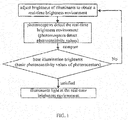
- the energy saving method comprises following steps: A. setting basic illumination brightness of the lighting environment, that is, setting the basic photosensitivity value of each photoreceptor, wherein, the brightness of the lighting environment is brightness of the environment formed by illumination light emitted from all the illuminants, natural light and illumination light emitted from other lighting system; B.
- step C comparing the detected photosensitivity values actually detected by all the photoreceptors to their own basic photosensitivity values, determining whether their own basic photosensitivity values are satisfied, that is, whether their own basic photosensitivity value is reached or exceeded, if not, repeating B, if so, entering D; D. all the illuminants lighting according to the brightness that they should have at the real-time brightness environment.
- the basic photosensitivity values being satisfied may mean that the photosensitivity values are the same within a certain error range.
- the method further comprises step E: setting a detection frequency, detecting, by the photoreceptors, the real-time brightness environment at regular intervals according to the detection frequency to obtain the detected photosensitivity values of the photoreceptors, and then repeating C.
- the detection frequency may be 5-300 minutes, even shorter interval, such as 2 minutes, 1 minute, even 30 seconds.
- This frequency can also be designed to be adjusted as needed, such as: if the outdoor condition is a season or day with a sudden change in weather or brightness, the detection frequency in the room is increased, and vice versa, the detection frequency is reduced. It is also possible that when the detection frequency is a certain value, and when it is found that the conversion range of the detection photosensitivity value exceeds a set value, the detection frequency is adjusted faster or adjusted slower.
- the adjusting illumination brightness of illuminants in B means decreasing or increasing the brightness of the individual illuminants synchronously.
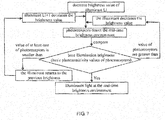
- the steps of this adjustment mode can be seen in Figs. 2 and 3 .
- Fig. 2 shows a case where each illuminant are synchronously increased by certain brightness value to obtain a real-time brightness environment, and this adjustment mode is usually used in situations where the brightness of the illuminants increases from zero.
- the brightness value to be increased synchronously is selected according to the brightness of the environment.
- all illuminants in a lighting space are simultaneously increased to 50% of the maximum illumination brightness, then the photoreceptors detect the real-time brightness environment, and obtain the detected photosensitivity values of each photoreceptors, if the detected photosensitivity values of each photoreceptors are still smaller than the basic illumination brightness (the basic photosensitivity value of each photoreceptor), the brightness of each illuminant is increased synchronously, the second increase in the brightness value is usually different from the first brightness value, such as 20%, or 30%, and so on of the last brightness value. If the value of at least one of the photoreceptors is greater than the basic photosensitivity value of the photoreceptor, the illuminants return to previous brightness.
- each illuminant can be lighting in the real-time illumination brightness environment.
- the next step will be performed.
- the illuminants will be increased or decreased by the same or different brightness value, so that the illuminants perform the adjustment of alternately increasing or decreasing the same or different brightness value to achieve higher energy efficiency goals.
- the illuminants should return to the original photosensitivity value even if the photosensitivity values of all the photoreceptors are greater than their basic photosensitivity values or a part of the photosensitivity values reach and the other part of photosensitivity values exceeds the basic photosensitivity value.
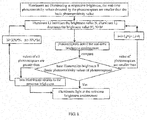
- Fig. 3 shows a situation where the illuminants are synchronously decreased a certain brightness value to obtain a real-time brightness environment.
- This situation is applicable to the lighting energy saving adjustment mode in which the illuminants are first increased synchronously to the respective maximum brightness value after the start-up, and then decreased synchronously by a certain brightness value.
- the synchronously decreasing operation is continued when the photosensitivity values of the photoreceptors are still greater than their basic photosensitivity value; and when the photosensitivity value of the at least one photoreceptor is smaller than its basic photosensitivity value, the illuminants return to the previous brightness.
- each illuminant can be lighting in the real-time illumination brightness environment.
- the next step is necessary if the further energy saving is required.
- the illuminants will be increased or decreased by the same or different brightness value one by one, so that the illuminants perform the adjustment of alternately increasing or decreasing the same or different brightness value to achieve higher energy efficiency goals.
- the illuminants should return to the original photosensitivity value even if the photosensitivity values of all the photoreceptors are less than their basic photosensitivity values or a part of the photosensitivity values reach and the other part of photosensitivity values exceed their basic photosensitivity values.
- the adjusting illumination brightness of illuminants in B means decreasing or increasing the brightness of the individual illuminants.
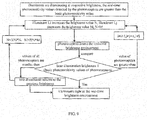
- This adjustment consists of two modes. One is as the adjustment mode shown in Figs. 4 and 5 .
- the illuminants are increased and decreased by a brightness value one by one.
- the other is the adjustment mode shown in Fig. 6 , Fig. 7 .
- a certain illuminant is increased and decreased by a brightness value, and then the other illuminants will be subject to the same process one by one.
- the increasing the brightness of the individual illuminants one by one means increasing the brightness of a certain illuminant Li by a certain brightness value when the photosensitivity values detected by the photoreceptors in a certain real-time brightness environment are all less than basic photosensitivity value at the basic illumination brightness, then the photoreceptors detect the real-time brightness environment, then the detection results are compared to the basic photosensitivity values of all photoreceptors, if in step C, the reading numbers of the photoreceptors are still less than the basic photosensitivity values after the brightness of the illuminant is increased by the brightness value, the brightness of the illuminant is retained, and the next illuminant Li+1 will be subject to the process of increasing the brightness value.
- the illuminant Li returns to the previous brightness and the next illuminant Li+1 will be subject to the process of increasing by the brightness value, and when increasing the brightness of the next illuminant Li+1 by the brightness value, the photoreceptor of which the photosensitivity value has been greater than the basic photosensitivity value will not participate the brightness detection. This is repeated until all illuminants are subjected to the above steps and then the flow proceeds to the next step; if the photosensitivity values of the photoreceptors are all greater than and/or equal to (not less than) the basic photosensitivity values, every illuminants are lighting at the real time brightness environment.
- the decreasing the brightness of the individual illuminants one by one means decreasing the brightness of a certain illuminant Li by a certain brightness value when the photosensitivity values detected by the photoreceptors in a certain real-time brightness environment are all greater than the basic photosensitivity values at the basic illumination brightness.
- the photoreceptors detect the real-time brightness environment, and then the detection results are compared to the basic photosensitivity values of all the photoreceptors, if in the step C, the reading numbers of the photoreceptors are still greater than the basic photosensitivity values after the brightness of the illuminant is decreased by the brightness value, the brightness of the illuminant is retained, and the next illuminant Li+1 will be subject to the process of decreasing the brightness value. If the photosensitivity value of at least one of the photoreceptors is less than the basic photosensitivity value, the illuminant Li returns to the previous brightness and the next illuminant Li + 1 will be subject to the process of decreasing by the brightness value.
- the increasing the brightness of individual illuminants one by one means B1: increasing the brightness of a certain illuminant Li by brightness values step by step, and returning the illuminant to the brightness which is the previous brightness before the last increasing of the brightness value if the reading number of at least one of the photoreceptors will be greater than the basic photosensitivity value when the brightness of the illuminant is increased by one more basic photosensitivity value, B2: performing the process of step B1 on the next illuminant Li+1 and performing the process on all the illuminants.
- the decreasing the brightness of individual illuminants one by one means B1: decreasing the brightness of a certain illuminant Li by brightness values step by step, and returning the illuminant Li to the brightness which is the previous brightness before the last decreasing of the brightness value, if the reading number of at least one of the photoreceptors will be less than the basic photosensitivity value when the brightness of the illuminant is deceased by one more certain brightness value, B2: performing the process of step B 1 on the next illuminant Li+1 and performing the process on all the illuminants, wherein, after that and when performing the process of increasing the brightness by the brightness value on the next illuminant, the photoreceptor of which the photosensitivity value has been greater than the basic photosensitivity value will not participate the brightness detection.
- the certain brightness value means a brightness of 0.5 degree or 1 degree or 2 degree, or any other desired degree, or a percentage of total brightness, such as 1%, 5%, and so on.
- the synchronously increasing or decreasing means increasing or decreasing one degree number at a time; or increasing one degree number many times, the degree number is 1 degree to 3 degree.
- Adjusting the illumination brightness of the illuminants means decreasing or increasing the brightness of the individual illuminants one by one before increasing or decreasing synchronously or without increasing or decreasing synchronously.
- the adjusting the lighting brightness of the illuminants in step B further means increasing the brightness of one of any two illuminants and decreasing the brightness of the other of the any two illuminants by the same or different brightness values.
- the brightness value is 1 degree, 2 degree or 3 degree. This step is preferably carried out after the above step of synchronously increasing or increasing one by one is completed. If the basic illumination brightness is still not satisfied, this adjustment mode could be taken to perform the adjustment, see Figs. 8 and 9 .
- the brightness of the i-th illuminant Li is increased by a brightness value N when the illuminants are illuminating at respective brightness and the real-time photosensitivity values detected by the photoreceptors are smaller than the basic photosensitivity value.
- N may be, for example, 1 degree, 2 degree, 3 degree or 1%, 0.5% of the total brightness, etc.
- the brightness of the illuminant Lj is increased by a brightness value M.
- i and j are illuminants having the number from 1 to n, i#j, N>M.
- N and M may be, for example, 1 degree, 2 degree, 3 degree, or 1%, 0.5% of the total brightness, etc.
- the photoreceptors detect the real-time brightness environment.
- the detection results are compared to the basic illumination brightness, that is, the detected photosensitivity values detected by the photoreceptors are compared to the basic photosensitivity values of the photoreceptors. If the photosensitivity value of the photoreceptors are still less than the basic photosensitivity value, the next two illuminants Li+1, Lj+1 will be subject to the adjustment of increasing the brightness of one of them and decreasing the brightness of the other. If all the N illuminants have been adjusted, and the photosensitivity value of the photoreceptors are still less than the basic photosensitivity values, the N and M values can be increased or decreased to further adjust.
- the N and M value should be decreased to continue the adjustment of increasing the brightness of one illuminant and decreasing the brightness of the other illuminant. If the photosensitivity values of all the photoreceptors are greater than the basic photosensitivity values, the two illuminants which are the latest ones of the illuminants being adjusted return to the previous brightness. The N and M values are decreased respectively, such as, for example being decreased by the same or different percentage.
- the brightness of the illuminant Li is increased a new brightness value N
- the brightness of the illuminant Lj is decreased a new brightness value M.
- the illuminants are further subjected to the adjustment of increasing the brightness of one illuminant and decreasing the brightness of the other illuminant, until the detected photosensitivity values detected real-time by the photoreceptors are equal to the basic photosensitivity value of the photoreceptors under a certain accuracy range.
- the illuminant are lighting in the real-time brightness environment.
- the application condition in Fig. 9 is opposite to those in Fig. 8 . That is such a adjustment that, when the photoreceptors are in the respective brightness and the real-time photosensitivity value of the photoreceptors are greater than the basic photosensitivity value, the brightness of one of two illuminants is increased and the brightness of the other of the two illuminants is decreased by a different brightness value, so as to approach the best energy-saving lighting state. Therefore, it is the opposite of the case of Fig. 8 in the adjustment.
- the detection frequency is 5-300 minutes. Of course the detection frequency can be more frequent or longer.
Landscapes
- Circuit Arrangement For Electric Light Sources In General (AREA)
- Control Or Security For Electrophotography (AREA)
Applications Claiming Priority (2)
| Application Number | Priority Date | Filing Date | Title |
|---|---|---|---|
| CN201410596704.XA CN105636294A (zh) | 2014-10-30 | 2014-10-30 | 一种照明节能方法 |
| PCT/CN2015/093424 WO2016066137A1 (zh) | 2014-10-30 | 2015-10-30 | 一种照明节能方法 |
Publications (2)
| Publication Number | Publication Date |
|---|---|
| EP3214903A1 true EP3214903A1 (de) | 2017-09-06 |
| EP3214903A4 EP3214903A4 (de) | 2018-07-25 |
Family
ID=55856637
Family Applications (1)
| Application Number | Title | Priority Date | Filing Date |
|---|---|---|---|
| EP15855812.2A Withdrawn EP3214903A4 (de) | 2014-10-30 | 2015-10-30 | Stromsparverfahren für beleuchtung |
Country Status (4)
| Country | Link |
|---|---|
| US (1) | US10292239B2 (de) |
| EP (1) | EP3214903A4 (de) |
| CN (1) | CN105636294A (de) |
| WO (1) | WO2016066137A1 (de) |
Families Citing this family (3)
| Publication number | Priority date | Publication date | Assignee | Title |
|---|---|---|---|---|
| CN112333898B (zh) * | 2019-08-30 | 2023-04-25 | 北京字节跳动网络技术有限公司 | 一种灯具亮度调节方法、装置、灯具和存储介质 |
| CN111556628A (zh) * | 2020-06-03 | 2020-08-18 | 一拓通信集团股份有限公司 | 一种新型社区智能照明系统 |
| CN111855041A (zh) * | 2020-07-27 | 2020-10-30 | 深圳华强技术有限公司 | 基于nb-iot的智能门窗开关检测装置及其检测方法 |
Family Cites Families (11)
| Publication number | Priority date | Publication date | Assignee | Title |
|---|---|---|---|---|
| JP3932966B2 (ja) * | 2002-04-23 | 2007-06-20 | 松下電工株式会社 | 照明システム |
| US8299722B2 (en) * | 2008-12-12 | 2012-10-30 | Cirrus Logic, Inc. | Time division light output sensing and brightness adjustment for different spectra of light emitting diodes |
| US9006996B2 (en) * | 2009-12-16 | 2015-04-14 | Enlighted, Inc. | Distributed lighting control |
| US8648550B2 (en) * | 2010-03-13 | 2014-02-11 | Zilog, Inc. | Ambient light sensor auto-calibration in a lighting control system |
| CN201910956U (zh) * | 2010-11-19 | 2011-07-27 | 陈媛媛 | 一种新型led灯用线路 |
| CN201910957U (zh) * | 2010-12-20 | 2011-07-27 | 郭赐福 | 一种自动调光感应器 |
| EP2698042B1 (de) * | 2011-04-13 | 2018-02-21 | Philips Lighting Holding B.V. | Adaptives integriertes tageslicht und steuerung einer elektrischen leuchte mit mehrfachsensor für gesteuerte lichtverteilung |
| US8860324B2 (en) * | 2011-12-16 | 2014-10-14 | Redwood Systems, Inc. | Selective light sensor and auto-commissioning |
| US9913348B2 (en) * | 2012-12-19 | 2018-03-06 | Cree, Inc. | Light fixtures, systems for controlling light fixtures, and methods of controlling fixtures and methods of controlling lighting control systems |
| CN203104872U (zh) * | 2012-12-20 | 2013-07-31 | 浙江山海光电有限公司 | 一种led照明灯亮度控制系统 |
| CN103607832B (zh) * | 2013-12-10 | 2017-01-04 | 北京真明丽华科技有限责任公司 | 智能led照明系统的控制方法 |
-
2014
- 2014-10-30 CN CN201410596704.XA patent/CN105636294A/zh active Pending
-
2015
- 2015-10-30 WO PCT/CN2015/093424 patent/WO2016066137A1/zh not_active Ceased
- 2015-10-30 US US15/522,618 patent/US10292239B2/en not_active Expired - Fee Related
- 2015-10-30 EP EP15855812.2A patent/EP3214903A4/de not_active Withdrawn
Also Published As
| Publication number | Publication date |
|---|---|
| WO2016066137A1 (zh) | 2016-05-06 |
| EP3214903A4 (de) | 2018-07-25 |
| US10292239B2 (en) | 2019-05-14 |
| US20180279447A1 (en) | 2018-09-27 |
| CN105636294A (zh) | 2016-06-01 |
Similar Documents
| Publication | Publication Date | Title |
|---|---|---|
| Rosemann et al. | Lightpipe applications for daylighting systems | |
| Görgülü et al. | Energy saving in lighting system with fuzzy logic controller which uses light-pipe and dimmable ballast | |
| US9877374B2 (en) | Lighting apparatus and methods providing variable illumination characteristics based on object detection | |
| JP5777716B2 (ja) | 照明調光率決定装置 | |
| US20150002029A1 (en) | Lighting System | |
| FI2829161T3 (fi) | Parannettu valo-ohjausjärjestelmä | |
| WO2014045138A2 (en) | System and method for managing lighting systems | |
| US20160234913A1 (en) | Lighting system and method for controlling lighting system | |
| WO2015189118A1 (en) | Demand response for networked distributed lighting systems | |
| US10292239B2 (en) | Illumination power saving method | |
| US9609721B1 (en) | Light controller | |
| US20160143117A1 (en) | Embedded lighting ceiling tiles with an adaptive ceiling luminance distribution | |
| Barbón et al. | New daylight fluctuation control in an optical fiber-based daylighting system | |
| US9788381B2 (en) | Hybrid closed loop daylight harvesting control | |
| EP2925098A1 (de) | Leuchte ausgestaltet zur kommunikation mit mobilem gerät | |
| CN109195284A (zh) | 照明控制方法及系统 | |
| Islam et al. | An Energy-Efficient Microcontroller-Based Smart Light Controlling System | |
| CN104955208A (zh) | 照明系统、照明控制系统及照明系统单元 | |
| CN204901415U (zh) | 一种适用于植物生长的照明灯具 | |
| JP5744261B2 (ja) | 調光制御システム | |
| Özçelik | The design and comparison of central and distributed light sensored smart LED lighting systems | |
| KR20160131739A (ko) | 조명 제어장치 및 조명 제어방법 | |
| WO2011036340A1 (en) | Reflector and light fixture utilizing the same | |
| CN102287719A (zh) | 一种节能路灯 | |
| CN105636296A (zh) | 能定时检测照明亮度的照明节能方法 |
Legal Events
| Date | Code | Title | Description |
|---|---|---|---|
| STAA | Information on the status of an ep patent application or granted ep patent |
Free format text: STATUS: THE INTERNATIONAL PUBLICATION HAS BEEN MADE |
|
| PUAI | Public reference made under article 153(3) epc to a published international application that has entered the european phase |
Free format text: ORIGINAL CODE: 0009012 |
|
| STAA | Information on the status of an ep patent application or granted ep patent |
Free format text: STATUS: REQUEST FOR EXAMINATION WAS MADE |
|
| 17P | Request for examination filed |
Effective date: 20170529 |
|
| AK | Designated contracting states |
Kind code of ref document: A1 Designated state(s): AL AT BE BG CH CY CZ DE DK EE ES FI FR GB GR HR HU IE IS IT LI LT LU LV MC MK MT NL NO PL PT RO RS SE SI SK SM TR |
|
| AX | Request for extension of the european patent |
Extension state: BA ME |
|
| RIN1 | Information on inventor provided before grant (corrected) |
Inventor name: YAU, KINHING |
|
| DAV | Request for validation of the european patent (deleted) | ||
| DAX | Request for extension of the european patent (deleted) | ||
| A4 | Supplementary search report drawn up and despatched |
Effective date: 20180627 |
|
| RIC1 | Information provided on ipc code assigned before grant |
Ipc: H05B 37/02 20060101AFI20180621BHEP |
|
| STAA | Information on the status of an ep patent application or granted ep patent |
Free format text: STATUS: THE APPLICATION IS DEEMED TO BE WITHDRAWN |
|
| 18D | Application deemed to be withdrawn |
Effective date: 20210501 |