EP3215550B1 - Verfahren zur herstellung von glykolsäurepolymeren - Google Patents
Verfahren zur herstellung von glykolsäurepolymeren Download PDFInfo
- Publication number
- EP3215550B1 EP3215550B1 EP15857333.7A EP15857333A EP3215550B1 EP 3215550 B1 EP3215550 B1 EP 3215550B1 EP 15857333 A EP15857333 A EP 15857333A EP 3215550 B1 EP3215550 B1 EP 3215550B1
- Authority
- EP
- European Patent Office
- Prior art keywords
- polymerization
- acid
- polymer
- glycolic acid
- stage
- Prior art date
- Legal status (The legal status is an assumption and is not a legal conclusion. Google has not performed a legal analysis and makes no representation as to the accuracy of the status listed.)
- Active
Links
Images

Classifications
-
- C—CHEMISTRY; METALLURGY
- C08—ORGANIC MACROMOLECULAR COMPOUNDS; THEIR PREPARATION OR CHEMICAL WORKING-UP; COMPOSITIONS BASED THEREON
- C08G—MACROMOLECULAR COMPOUNDS OBTAINED OTHERWISE THAN BY REACTIONS ONLY INVOLVING UNSATURATED CARBON-TO-CARBON BONDS
- C08G63/00—Macromolecular compounds obtained by reactions forming a carboxylic ester link in the main chain of the macromolecule
- C08G63/02—Polyesters derived from hydroxycarboxylic acids or from polycarboxylic acids and polyhydroxy compounds
- C08G63/06—Polyesters derived from hydroxycarboxylic acids or from polycarboxylic acids and polyhydroxy compounds derived from hydroxycarboxylic acids
-
- B—PERFORMING OPERATIONS; TRANSPORTING
- B01—PHYSICAL OR CHEMICAL PROCESSES OR APPARATUS IN GENERAL
- B01J—CHEMICAL OR PHYSICAL PROCESSES, e.g. CATALYSIS OR COLLOID CHEMISTRY; THEIR RELEVANT APPARATUS
- B01J31/00—Catalysts comprising hydrides, coordination complexes or organic compounds
- B01J31/02—Catalysts comprising hydrides, coordination complexes or organic compounds containing organic compounds or metal hydrides
- B01J31/0215—Sulfur-containing compounds
- B01J31/0225—Sulfur-containing compounds comprising sulfonic acid groups or the corresponding salts
-
- C—CHEMISTRY; METALLURGY
- C08—ORGANIC MACROMOLECULAR COMPOUNDS; THEIR PREPARATION OR CHEMICAL WORKING-UP; COMPOSITIONS BASED THEREON
- C08G—MACROMOLECULAR COMPOUNDS OBTAINED OTHERWISE THAN BY REACTIONS ONLY INVOLVING UNSATURATED CARBON-TO-CARBON BONDS
- C08G18/00—Polymeric products of isocyanates or isothiocyanates
- C08G18/06—Polymeric products of isocyanates or isothiocyanates with compounds having active hydrogen
- C08G18/28—Polymeric products of isocyanates or isothiocyanates with compounds having active hydrogen characterised by the compounds used containing active hydrogen
- C08G18/40—High-molecular-weight compounds
- C08G18/42—Polycondensates having carboxylic or carbonic ester groups in the main chain
- C08G18/4266—Polycondensates having carboxylic or carbonic ester groups in the main chain prepared from hydroxycarboxylic acids and/or lactones
- C08G18/4283—Hydroxycarboxylic acid or ester
-
- C—CHEMISTRY; METALLURGY
- C08—ORGANIC MACROMOLECULAR COMPOUNDS; THEIR PREPARATION OR CHEMICAL WORKING-UP; COMPOSITIONS BASED THEREON
- C08G—MACROMOLECULAR COMPOUNDS OBTAINED OTHERWISE THAN BY REACTIONS ONLY INVOLVING UNSATURATED CARBON-TO-CARBON BONDS
- C08G63/00—Macromolecular compounds obtained by reactions forming a carboxylic ester link in the main chain of the macromolecule
- C08G63/78—Preparation processes
- C08G63/80—Solid-state polycondensation
-
- C—CHEMISTRY; METALLURGY
- C08—ORGANIC MACROMOLECULAR COMPOUNDS; THEIR PREPARATION OR CHEMICAL WORKING-UP; COMPOSITIONS BASED THEREON
- C08G—MACROMOLECULAR COMPOUNDS OBTAINED OTHERWISE THAN BY REACTIONS ONLY INVOLVING UNSATURATED CARBON-TO-CARBON BONDS
- C08G63/00—Macromolecular compounds obtained by reactions forming a carboxylic ester link in the main chain of the macromolecule
- C08G63/78—Preparation processes
- C08G63/81—Preparation processes using solvents
-
- C—CHEMISTRY; METALLURGY
- C08—ORGANIC MACROMOLECULAR COMPOUNDS; THEIR PREPARATION OR CHEMICAL WORKING-UP; COMPOSITIONS BASED THEREON
- C08G—MACROMOLECULAR COMPOUNDS OBTAINED OTHERWISE THAN BY REACTIONS ONLY INVOLVING UNSATURATED CARBON-TO-CARBON BONDS
- C08G63/00—Macromolecular compounds obtained by reactions forming a carboxylic ester link in the main chain of the macromolecule
- C08G63/78—Preparation processes
- C08G63/82—Preparation processes characterised by the catalyst used
- C08G63/823—Preparation processes characterised by the catalyst used for the preparation of polylactones or polylactides
-
- C—CHEMISTRY; METALLURGY
- C08—ORGANIC MACROMOLECULAR COMPOUNDS; THEIR PREPARATION OR CHEMICAL WORKING-UP; COMPOSITIONS BASED THEREON
- C08G—MACROMOLECULAR COMPOUNDS OBTAINED OTHERWISE THAN BY REACTIONS ONLY INVOLVING UNSATURATED CARBON-TO-CARBON BONDS
- C08G63/00—Macromolecular compounds obtained by reactions forming a carboxylic ester link in the main chain of the macromolecule
- C08G63/78—Preparation processes
- C08G63/82—Preparation processes characterised by the catalyst used
- C08G63/87—Non-metals or inter-compounds thereof
-
- C—CHEMISTRY; METALLURGY
- C08—ORGANIC MACROMOLECULAR COMPOUNDS; THEIR PREPARATION OR CHEMICAL WORKING-UP; COMPOSITIONS BASED THEREON
- C08G—MACROMOLECULAR COMPOUNDS OBTAINED OTHERWISE THAN BY REACTIONS ONLY INVOLVING UNSATURATED CARBON-TO-CARBON BONDS
- C08G63/00—Macromolecular compounds obtained by reactions forming a carboxylic ester link in the main chain of the macromolecule
- C08G63/88—Post-polymerisation treatment
-
- C—CHEMISTRY; METALLURGY
- C08—ORGANIC MACROMOLECULAR COMPOUNDS; THEIR PREPARATION OR CHEMICAL WORKING-UP; COMPOSITIONS BASED THEREON
- C08G—MACROMOLECULAR COMPOUNDS OBTAINED OTHERWISE THAN BY REACTIONS ONLY INVOLVING UNSATURATED CARBON-TO-CARBON BONDS
- C08G63/00—Macromolecular compounds obtained by reactions forming a carboxylic ester link in the main chain of the macromolecule
- C08G63/91—Polymers modified by chemical after-treatment
- C08G63/912—Polymers modified by chemical after-treatment derived from hydroxycarboxylic acids
Definitions
- the present invention concerns a method comprising the synthesis of difunctional aliphatic polyesters, which may exhibit a low molecular weight limiting their use in practise, and conversion of such polymers to a higher molecular weight polymeric material and production methods thereof leading to products derived mainly from glycolic acid.
- Polyglycolic acid prepared from the smallest member of the ⁇ -hydroxy acid family, has been produced and copolymerized by condensation polymerization processes for decades. (cf. US 2,676,945 , US 2,683,136 ).
- Aliphatic polyesters including polyglycolic acid and polylactic acid, are biodegradable materials as these are degraded through hydrolysis and/or through microbial or enzymatic pathways. The biodegradability and biocompatibility make these useful in many applications.
- Poly( ⁇ -hydroxy acid)s have been under research for medical devices as surgical sutures and artificial skins since the 1960s, where one area of interest has been on polyglycolic acid ( Vert, M. et.al., Makromol Chem Suppl 1981, 5, 30-41 ). Beyond medical applications polyglycolic acid has been proposed as a barrier material for containers ( US Patent 4,424,242 , US Patent 4,565,851 ). Later in 1988 polyglycolic acid copolymers have been applied also for packaging applications (cf. US Patent 4,729,927 ).
- a common disadvantage of conventional condensation polymerization is that a polymer exhibiting a low molar mass is typically formed in the process. The low molecular weight prevents the polymer to achieve sufficiently good properties to be useful in a myriad of applications.
- Similar methods to produce polyglycolic acid are polycondensation of an alkyl glycolate and desalting polycondensation of a glycolic acid salt. Equivalent reactions can be used for lactic acid, albeit with a frequent disadvantage where the desired optical purity of the precursor is lost due to racemization during the polycondensation reactions.
- step growth copolymerization with for example diisocyanates is a well-known technology to extend the molecular weight of suitable prepolymers.
- Step-growth methods have been used for lactic acid based materials ( US 5,380,813 ) with a clear disadvantage as the optically pure precursor undergoes racemization during the condensation process losing its crystallinity, thus severely limiting its applicability due to a low glass transition temperature as the sole thermal transition for the material. Further, during synthesis, depolymerisation to the corresponding lactones may take place which causes a drop in the yield of the aimed product.
- EP 2 280 036 A1 discloses a process to prepare a prepolymer by melt polymerization of L-lactic acid and glycolic acid at 160 degrees and 0.3 kPa pressure for 6 hours, in the presence of 1,3-propane disulfonic acid as a catalyst and under nitrogen atmosphere.
- the prepolymer obtained was crystallized for 2 hours in a vacuum dryer at 100°C and crushed after cooling to a normal temperature (dehydration step), followed by solid state polymerization at 155 degrees C for 24 h at 0.2 kPa pressure.
- a second object of this invention is to provide material compositions consisting of polyglycolic acid segments that are able to form crystalline structures after a step-growth molecular weight extension step.
- One more object of this invention is to carry out the step-growth copolymerization for molecular weight increase in such a manner that the weight percentage of the polyglycolic acid segments is as high as possible in order to retain its useful properties.
- a further object is to avoid glycolide as an intermediate for the polymer through preparation of telechelic hydroxy-terminated prepolymers of glycolic acid by a condensation process, and which can be applied by useful methods, and processes to polymerize hydroxyacid monomers to high molar weight polymers which can be converted to applications.
- Still a further objective is to extend the use of the synthetic procedure to produce high molecular weight polyglycolic acid through a condensation polymerization in high yields, where the formed polymer exhibits high thermal stability.
- Objects of the present invention are also to use said materials as films, sheets, fibers, powders or molded articles in applications.
- the present invention is based on the formation of a polyglycolic acid copolymer, by condensation reactions in the presence of a sulphonic acid catalyst to achieve desired telechelic polymers and followed by a subsequent step-growth polymerization step, wherein molecular weights which are difficult to achieve for polyglycolic acid, particularly by condensation processes, can be achieved, as known for those familiar to the art.
- Significant benefits are achieved when said polyglycolic acid copolymer has been prepared by a condensation process thus avoiding the cumbersome synthesis of glycolide and its subsequent ring-opening polymerization. Further, with the present invention one is able to obtain a discoloration free product without a significant loss in yield during prolonged reaction times.
- compositions of the polyglycolic acid copolymer include, in addition to glycolic acid:
- Preferred classes of the chemicals that can be used to increase the molecular weight of the polyglycolic acid copolymer include: diisocyanates, bisepoxy compounds, dialdehydes, diimines, diketenes, phosphoric acid esters and bisoxazolines. Particularly preferred classes are diisocyanates and bisepoxy compounds.
- Polymerization is carried out in the presence of catalytically active amounts of sulphonic acid(s) which have low volatility at the reaction temperatures.
- the thermal stability of the copolymers thus produced are good - the high molecular weight polymers typically exhibit a glass transition point in excess of 35 °C, in particular 37 °C and even up to 50 °C, and decomposition temperatures, T d 10% of at least 280 °C, in particular at least 295 °C.
- the present invention provides for controlled preparation of polyglycolic acid polymers by condensation polymerization in a first step, in combination with an increase in molecular weight in a second step, which is being carried out after the first step.
- the second step is preferably a step in which the polymer length and molecular weight is increased by bulk polymerization.
- chemicals that extend the polymer chains to longer units yielding high molar mass linear or optionally branched polymers are being used.
- the present technology provides polymers having a degradation temperature which is considerably much higher, e.g. 40 to 50 °C higher.
- the polymers have excellent thermal stability as evidenced by TGA analysis which shows that the TGA 10 % degradation temperature are on the order of 290 to 350 °C. This result is remarkable since it can be achieved without the use of glycolide monomer chemistry.
- Another remarkable feature of this invention is that the loss of material due to depolymerisation to the corresponding lactone is significantly lower.
- Lactic acid is optically active, and condensation polymerization typically leads to racemization of the optically pure monomers.
- corresponding polymers PHAs
- PHAs polymers
- the present glycolic acid polymers are not impaired by such features and they exhibit high melting points and decomposition points.
- the polymers obtained can be used as such or in blends with other polymers in a range of applications.
- Described herein is a feasible, significantly simplified production method that avoids challenging lactonization steps and converts a low molecular weight polyglycolic acid, consisting of glycolic acid and a comonomer, to a polymer whose molecular weight has been increased by step-growth polymerization reactions.
- the method provides a means to obtain polyglycolic acid copolymers which exhibit high thermal stability.
- the method comprises providing a difunctional monomer; subjecting said glycolic acid to condensation polymerization in the presence of the monomer and a catalyst; and continuing polymerization to provide a polymeric chain formed by residues derived from glycolic acid and said difunctional monomer.
- a difunctional monomer for example, a polystyrene glycol dimethacrylate copolymer
- the glycolic acid to condensation polymerization in the presence of the monomer and a catalyst
- continuing polymerization to provide a polymeric chain formed by residues derived from glycolic acid and said difunctional monomer.
- water formed during condensation polymerization is continuously removed.
- the molecular weight of the polyglycolic acid based on comparison of initial and final weight average molecular weights (M w , 1/ M w , 2 ), increased significantly at a rate which permits the use of reactive extrusion to produce high molecular weight polyglycolic acid in a simple, technically and economically feasible manner.
- telechelic polymers of glycolic acid are provided.
- telechelic is used for indicating that the present polymers or prepolymers are capable of being subjected to polymerization through their reactive end-groups.
- the end groups typically exhibit the same (chemical) functionality.
- the polymers of the present kind are capable of being used as prepolymers.
- Such polymers comprise at least 5, for example 5 to 250, preferably 6 to 100, in particular 10 to 50 residues of glycolic acid.
- the polymers comprise in one preferred embodiments essentially linear polymeric chains.
- the prepolymers comprise a branched polymeric chain.
- the present polymers have a degree of crystallinity of at least 20 %, preferably at least 30 %, in particular at least 40 % of the crystallinity or melting enthalpy of the prepolymer.
- the present polymers comprise typically at least 80 mol-%, preferably at least 90 mol-%, of residues derived from glycolic acid.
- the polymer according to the present technology suitably comprises 0.1 to 20 mol-%, preferably 0.5 to 10 mol-%, more preferably 1 to 5 mol-%, of residues derived from a difunctional comonomer, typically a hydroxy-terminated comonomer.
- the molar ratio between residues derived from glycolic acid and residues derived from a comonomer is 1000: 1 or less, for example 500: 1 or less, suitably 300:1 or less, advantageously 45:1 to 55:1, in particular 48:1 to 52:1.
- the comonomers are selected exclusively from comonomers which are hydroxy-terminated comonomers (diols) such as propanediol, butanediol, hexanediol, and oligomeric polyethylene glycol and combinations thereof, to produce a hydroxy-terminated telechelic polymer.
- diols hydroxy-terminated comonomers
- At least a part of the comonomers is selected from the group of dicarboxylic acid, and dithiol, and mixtures thereof.
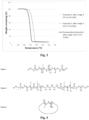
- Formula I shows an example of a telechelic, hydroxyl-terminated glycolic acid polymer of the instant kind.
- m and n are integers which stand for a value of 1 to 100.
- polyhydroxy acid polymers in particular prepolymers of a kind consisting to a high degree of polyglycolic acid, are suitable for a subsequent step growth polymerization process which extends the molecular weight of the resultant material to levels which are required for its acceptable use in applications.
- the polyhydroxy acid polymer can be obtained as a product of condensation polymerization of glycolic acid, optionally one or more hydroxy acid, or the corresponding lactone, as a comonomer, and one or more suitable ⁇ , ⁇ -difunctional compound.
- the step of preparing a hydroxyl-terminated telechelic polymer of glycolic acid comprises the steps of
- the esterification catalyst is an organic sulphonic acid
- polyglycolic acid is polymerized and processed at relatively high temperatures.
- a relatively high concentration of the catalyst is needed.
- conventional catalysts such as inorganic compounds or organometal compounds, frequently induce side reactions during processing and polymerization, such as transesterification and formation of glycolide.
- the present catalyst enable preparation of thermally stable polyglycolide by condensation polymerization in melt and bulk phase.
- the temperatures employed during melt-phase and bulk polymerization of glycolic acid is in the range of 150 to 200 °C
- the catalysts employed are organic sulfonic acids which do not readily evaporate during polymerization conditions. In practice, this means that the boiling of the catalyst is higher than about 250 °C at normal pressure, in particular 300 °C or higher.
- the amount of the catalyst is preferably from 0.001 to 0.5% by weight of the glycolic acid together with the comomoners.
- a solid-phase polymerization method of high-molecular weight aliphatic polyester wherein the solid-phase polymerization of an aliphatic polyester prepolymer is conducted under a gas stream containing sulfonic acid catalyst is disclosed in US20140100350 ( EP 2716678 A1 ).
- Various catalysts are further suggested in US 2006217523 , US 2009176963 , US 2011065871 ( EP 2280036 A1 ) and US 2012027973 ( WO 2010/112602 A1 .
- the known methods achieve polymerization in a two-step process wherein melt-polymerization which gives a prepolymer is followed by a gas phase stage for producing a high molecular weight polymer.
- polymerization is followed by a bulk polymerization step which yields the aimed high-molecular weight polymer by a step polymerization reaction sequence followed by coupling reactions of the prepolymers.
- the present invention provides linear prepolymers, rather than cross-linked prepolymers. Processing a linear material is much more facile and gives a broader range of applications. Furthermore, processing of the present prepolymers is possible by thermoplastic methods, which is not possible when producing cross-linked prepolymers.
- the present sulphonic acids are particularly suitable for producing polyglycolic acids at yields exceeding 90 % and a degree of desired end-terminal groups exceeding similarly 90 %. More preferably, the yield and the degree of desired end-terminal groups exceed 95 %.
- the present sulphonic acids are also particularly suitable for producing polyglycolic acids having a weight average molecular weight of more than 20,000 at a yield in excess of 75 % when no comonomers are used to restrict segmental growth of the polyglycolic acid.
- the content of the glycolic acid in the polyhydroxy acid polymer is so high that the condensated segments of the glycolic acid repeating units are able to form crystals in the polyhydroxy acid polymer and in the subsequent polymer formed after a step growth polymerization process.
- the glycolic acid weight ratio to the total weight of monomers is, at the start of the polymerization, at least more than 50%, preferably more than 70% and most preferably more than 90%.
- Another hydroxy acid, or the corresponding lactone thereof, may be used in a preferred composition as a comonomer to adjust the properties of the polyhydroxy acid polymer.
- Such hydroxy acids have the general formula HO(CH 2 ) n CHR(CH 2 ) m COOH wherein
- hydroxy acid comonomers examples include lactic acid, 3-hydroxypropionic acid, 2-hydroxybutanoic acid, 3-hydroxybutanoic acid, 4-hydroxybutanoic acid, 5-hydroxypentanoic acid, 6-hydroxyhexanoic acid, and benzoic acid.
- the weight ratio of added hydroxy acid comonomers is less than 30 %, more preferably less than 20 % and most preferable less than 10 %.
- Suitable ⁇ , ⁇ -difunctional compounds are used to generate polyhydroxy acid compositions which in turn yield suitable ⁇ , ⁇ -difunctional polyhydroxy acid materials.
- the ability to form ⁇ , ⁇ -difunctional polyhydroxy acid materials is critical to achieve successful increase in molecular weight in the subsequent step growth polymerization step. In the examples below it is demonstrated that having a high degree of ⁇ , ⁇ -difunctionality in the polyhydroxy acid materials has a direct impact on the success of the step growth polymerization step.
- One more preferred embodiment is that no comonomers are used to permit the molecular weight growth to achieve its maximum with minimal yield losses due to formation and evaporation of glycolide.
- the catalyst is composed of compounds bearing sulfonic acid groups.
- the catalyst comprises an organic sulphonic acid compound having a boiling point at normal pressure of more than 275 °C, in particular higher than 300 °C, for example higher than 325 °C, suitably 350 °C or even higher (up to, e.g., 440 °C, although this is no absolute maximum).
- the sulphonic acid comprises an organic residue having at least 10 carbon atoms. Alicyclic residues comprising 1 to 3 alicyclic rings, optionally carrying one or more substituents, are particularly preferred.
- Such substituents can be selected from the group of halogen atoms, oxygen and nitrogen containing radicals, such as oxo or nitro groups or combinatins thereof, and alkyl, alkenyl and alkynyl substituents having 1 to 6 carbon atoms.
- the alicyclic rings may as such have 5 to 24 ring members and they may contain ring atoms selected from heteroatoms, such as oxygen, nitrogen and sulphur.
- Camphor sulphonic acid is an example of a particularly preferred catalyst.
- Camphor sulphonic acid contains a 10 carbon residue (a bicyclic aliphatic structure) which exhibits an oxo substituent. It has a boiling point at normal pressure of about 375 °C.
- the catalyst can be used in the form of enantiomerically pure isomers or as a racemate.
- the properties and molecular weight of ⁇ , ⁇ -difunctional polyhydroxy acid material can be adjusted based on the ratio of the hydroxy acid and the ⁇ , ⁇ -difunctional compound.
- the amount of the ⁇ , ⁇ -difunctional compound will directly impact on the resultant molecular weight of the material.
- An increased use of ⁇ , ⁇ -difunctional compounds results in a decreased molecular weight of the resultant ⁇ , ⁇ -difunctional polyhydroxy acid material.
- the properties of ⁇ , ⁇ -difunctional compound will have an impact on the resultant ⁇ , ⁇ -difunctional polyhydroxy material.
- the use of a polymeric ⁇ , ⁇ -terminated material in the condensation process will yield a copolymer with unique properties.
- the content of the added ⁇ , ⁇ -difunctional compounds is less than 20%, preferably less than 15% and most preferably less than 10%.
- such an organic added ⁇ , ⁇ -difunctional compound may be linear, branched, cyclic, aromatic or polymeric containing hydroxy, carboxylic acid, thio or amino groups.
- examples of such compounds are diols, dicarboxylic acids and their anhydrides, diamines and polymeric materials having ⁇ , ⁇ -difunctionality, wherein the functionality is a dihydroxy, diacid, or dithio.
- Examples of such classes of compounds are ethylene glycol, 1,3-propanediol, 1,4-butanediol, 1,5-pentanediol, 1,6-hexanediol, 1,7-heptanediol, 1,8-octanediol, 1,9-nonanediol, 1,10-decanediol, 1,2-propanediol, 1,2-butanediol, 2,3-butanediol, 1,3-butanediol, 1,2-pentanediol, neopentyl glycol, equivivalent thiols, oxalic acid, malonic acid, maleic acid, maleic anhydride itaconic acid, succinic acid, succinic anhydride, glutaric acid, adipic acid, pimelic acid, suberic acid, azelaic acid, sebacic acid, telechelic
- the present invention also permits the preparation of ⁇ -multiterminated polyhydroxy acids.
- Such materials are obtained when the ⁇ , ⁇ -difunctional compounds is replaced by an equivalent having three or more similar, or dissimilar functionalities permit the preparation of ⁇ -multiterminated polyhydroxy acids which under step growth conditions yield thermosetting materials as known for those familiar to the art.
- Particularly preferred are compounds having three or more similar functionalities. Unambiguous examples of such compounds are glycerol, pentaerytritol, trimethylol propane and the like.
- One further embodiment of this invention is the production process how to obtain ⁇ , ⁇ -difunctional polyhydroxy acid materials.
- Polyglycolic acid as a homopolymer has a melting transition above 210-220 °C, which necessitates high reaction temperatures if one wants to conduct the polymerization process in a molten state.
- reaction media be heated to 230-250 °C, which under prolonged times lead to darkening of the material, in particular if oxygen is present.
- a discoloured product is of disadvantage in consumer applications when optically attractive materials are preferred and hence yellowish or even brown-like materials are unfavourable.
- melt condensation polymerisation of glycolic acid can be performed at temperatures below the melting point of the product polyglycolic acid (which is typically 210-220 °C, as mentioned above).
- the polycondensation temperature is gradually increased and the absolute pressure decreased during the typical melt polycondensation stage.
- ⁇ , ⁇ -difunctional polyhydroxy acid materials can be obtained by a process where the condensation polymerization is carried out sequentially first in the molten state and then followed by a condensation process that takes place in a solid state at 200 °C or less for a prolonged period of time.
- the use of lower polymerization temperatures in the solid-state polymerization does not substantially affect the colour of the material. Prolonged polymerization times at high temperatures will cause undesired yellowing or darkening of the product.
- the solid state polymerization may optionally be followed by a final step at 240 °C or higher for a shortest possible time to obtain a freely flowing product that can be easily handled and transferred.
- Reduced pressure is beneficial for the progress of the condensation polymerisation during all the steps, and in the later stages of polymerisation high vacuum can be applied (below 50 mbar absolute pressure).
- a preferred time for the first melt polymerization is 36 h or less and 24 h or less for the solid polymerization prior to the final dehydration, and condensation process.
- a further method to increase the content of the ⁇ , ⁇ -difunctional polyhydroxy acid materials is to increase the content of the ⁇ , ⁇ -difunctional comonomer in the feed, which increases the probability of obtaining a ⁇ , ⁇ -difunctional polyhydroxy acid material.
- the polymerisation temperatures at the end of the melt stage polycondensation are 180-220 °C, preferably 190-210 °C. Typically, operation at these temperature ranges is possible after 6 to 10 h from the beginning of the polycondensation stage.
- the instant embodiment also makes it possible to produce the telechelic prepolymer with high enough molecular weight and uniform enough end group functionalization without solid state polymerisation stage.
- Another method to produce the ⁇ , ⁇ -difunctional polyhydroxy acid materials is the process in a solvent where the said solvent is capable of dissolving the polymer that is formed and simultaneously assist in removal of the condensation product by azeotropic distillation or the like.
- solvents are dimethylformamide, dimethylacetamide, diphenyl ether and dimethylsulphoxide.
- the monomers and the difunctional compound can be added simultaneously or sequentially.
- glycolic acid monomers are first subjected to condensation polymerization, optionally together with comonomers, to provide oligomers (comprising 2 to 8 units) and only then difunctional compound is added.
- glycolic acid is first condensation polymerized, the comonomer is added, and polymerization is continued. Finally difunctional compound is added and polymerization is continued.
- glycolic acid monomers are first condensation polymerized, then difunctional compound is added and polymerization is continued. Last, comonomer is added and polymerization is continued.
- the temperature for the melt polymerization can be adjusted by the amount of ⁇ , ⁇ -difunctional comonomer.
- increased concentrations of the ⁇ , ⁇ -difunctional comonomer result in a decreased melting temperature for the ⁇ , ⁇ -difunctional polyhydroxy acid material, which permit the use of decreased polymerization times and hence may impart in the desired appearance of the product.
- glycolic acid polymers for example produced by a method according to the present invention, exhibit properties of elongation in combination with high modulus (i.e. high strength properties). Such materials are particularly useful in biaxial orientation or thermoforming applications because they will yield layers that are not prone to having discontinuities.
- Such polymers typically exhibit a molecular ratio between the prepolymer and the coupling agent, e.g. a diisocyanate, amounting to 1:0.9 to 1:1.3, in particular 1: 1 to 1:1.1.
- M w weight average molecular weight of the material should exceed 50,000 g/mol as determined by SEC. If the Mw is lower than this, the material is unable to form continuous articles, such as thin films, which are useful in packaging applications. This can be easily tested as solvent castings from HFIP by monitoring whether continuous films can be achieved or if the film forms cracks during drying. Based on this it has been concluded that the Mw should at minimum double its value during the step growth polymerization.
- carboxylic or hydroxy functions can react with noted comonomers used for the step-growth molecular weight increase step.
- a comonomer may be able to react with both carboxylic and hydroxy functions.
- the reaction with a hydroxy group and an isocyanate yields a carbamate, or urethane, structure while the reaction with a carboxylic acid and an isocyanate yields an amide structure with carbon dioxide as a by-product.
- the OH/COOH ratio of terminal groups, or the degree of ⁇ , ⁇ -difunctionality has a profound impact on the result of the step growth polymerization.
- the degree of the ⁇ , ⁇ -difunctionality is more than 60%, preferably more than 70% and most preferably more than 80%, when the degree of ⁇ , ⁇ -difunctionality is determined from a quantitative 13 C NMR spectra.
- the difunctionality is calculated from the ratios of OH and COOH terminal polymer chain as follows based on three plausible polymer structures that can be formed in the condensation polymerization process of a copolymer of an exemplary diol, 1,6-hexanediol, and glycolic acid (cases 1 to 3).
- Hexanediol unit gives characteristic signals at ⁇ 66.8 ppm, ⁇ 27.7 and ⁇ 24.8 ppm (carbons 13,14 and 15), and the glycolic acid monomers next to hexanediol unit give signals at ⁇ 169.3 and ⁇ 61.3 ppm (carbons 11 and 12).
- the repeating unit is the same in the whole cyclic structure and therefore it gives one signal in carbonyl region and one signal in aliphatic region.
- the signals are most likely fused into the signals of the repeating units at ⁇ 168.0 and ⁇ 59.8 ppm (carbons 5 and 6), and therefore it might increase the value of calculated number average molecular weight (Mn).
- preferred classes of the chemicals that can be used to increase the molecular weight of the polyglycolic acid copolymer in a step growth polymerization process include: diisocyanates, bisepoxy compounds, dialdehydes, diketenes, phosphoric acid derivatives and bisoxazolines.
- alkyl diisocyanates such as butane diisocyanate, hexamethylene diisocyanate
- aromatic isocyanates such as tolylene-2,4-di-isocyanate, tolylene-2,5-diisocyanate, tolylene-2,6-diisocyanate, 1,4-phenylene diisocyanate, 1,3-phenylene diisocyanate, m-xylylene diisocyanate, poly(hexamethylene diisocyanate.
- bis-epoxy function compounds are aliphatic, aromatic and polymeric diglycidyl ethers, such as ethylene glycol diglycidyl ether, propylene glycol diglycidyl ether, neopentyl glycol diglycidyl ether, bisphenol A diglycidyl ether, and polyethylene glycol diglycidyl ether.
- phosphoric acid esters are trimethylphosphate, triphenylphosphate fatty acid phosphates (e.g. stearyl phosphates), and 2,6-di-tert-butyl-4-methylphenyl phosphite.
- the compounds used in the step growth polymerization step are chosen in such a way that the molecular weight increase step can be carried out in a twin screw extruder. Analysis has shown that appropriate manufacturing of ⁇ , ⁇ -difunctional polyhydroxy acid material combined with step growth polymerization comonomer results in rapid completion of the reaction under conditions of twin screw extrusion ( Figure 7).
- the step growth polymerization step can be completed in less than 30 minutes, preferably less than 10 minutes and most preferably in less than 5 minutes.
- the obtained telechelic material from the condensation process can be fed into the extruder by appropriate hoppers as known for those familiar to the art. It is preferable that the hopper has a moisture free atmosphere in order to prevent undesired hydrolysis to take place.
- the telechelic prepolymers can be grinded or prepared with suitable equipment to a grain size that can be easily handled by the hopper feed mechanism.
- the extruder configuration will preferably be such that it consists of four or more segments. The first segment is set up by screw configuration and temperatures so that the telechelic prepolymer melts.
- the second segment consists of an inlet for addition of the comonomer used for the step-growth polymerization, temperatures that permit to keep the material flowing in the segment and a screw configuration suitable for efficient mixing of the telechelic polymer and the step-growth prepolymers.
- the third segment consists of an inlet for addition of suitable additives for stabilizing additives, temperatures that permit to keep the material flowing in the segment and a screw configuration suitable for efficient mixing of the formed copolymer.
- An exhaust to remove potentially gaseous products also can be included in the third segment, or in a separate segment. Other segments may be added according to need if more additions or exhausts are required.
- the final segment consists of a screw configuration that will permit the material to efficiently exit the extruder die.
- the preferred temperatures for the segments used in the step growth polymerization in an extruder are 215-280 °C, more preferably 220-250 °C or most preferable 220-240 °C.
- comonomers used in the step-growth polymerization of the telechelic prepolymers are in liquid form so they can be added to the extruder by pumps.
- suitable solvents are polar or apolar solvents such as THF, DMSO, alkanes, toluene, dichloromethane.
- Protic solvents such as alcohols are not preferred.
- the amount and type of the comonomer used for the step growth polymerization will have a profound impact on the product properties.
- the obtained material may lack sufficient properties if too little of the diisocyanate is used.
- the obtained material may be crosslinked if an extensive amount of the diisocyanate comonomer is used.
- theories of step-growth polymerization teach that optimal amount of the reactive comonomers is in an equimolar amount, it may be beneficial to deviate from this according to need. For instance a slight excess of diisocyanate may yield a polymer which possesses long-chain branching in a suitable amount that can have a beneficial effect on the melt viscosity and processability of the polymer.
- Such materials can be polymers to yield blends, fillers and reinforcing fibres such as silica or CaCO 3 , plasticizers, stabilizers against light, thermally or hydrolytically induced degradation, glass fibres or lignocellulosic fibres.
- the polymer produced can be formed using known processing methods for thermoplastic or solution formable polymers. Examples are extrusion to films, sheets, profiles, pipes or fibres; solvent casting or fibre spinning from solution. Moulded articles can be produced e.g. by injection moulding, blow moulding or thermoforming. The polymer can be applied as single layer material or as laminates or multi-layer structures.
- the method described herein permits production of material which is thermally stable and largely free of discoloration.
- a further benefit is that the step-growth copolymerization of a polyglycolic acid polymer of suitable molecular weight with a comonomer, such as various diisocyanates, yields a material which retains many useful properties of the polyglycolic acid.
- step-growth copolymerization introduces additional properties such as improved elongation which are useful for instance in packaging applications where one or two dimensional orientation is applied to the material or a multilayer structure where the copolymer is one component.
- This approach permits preparation of copolymers exhibiting elongations at break higher than 100 % while similar materials prepared by ring-opening polymerization of to yield polyglycolic acid exhibits an elongation at break less than 20 %.
- Molecular weights and molecular weight distributions were determined with size exclusion chromatography (SEC).
- SEC size exclusion chromatography
- a Waters system equipped with two 7.8 mm ⁇ 300 mm Styragel HR 4E and HR 5E columns and Waters 2414 Refractive Index Detector connected in series was used.
- Hexafluoroisopropanol (HFIP, 5mM CF 3 COONa) was used as an eluent and was delivered at a rate of 1.0 ml/min. The results were calculated against monodisperse polymethylmethacrylate standards.
- DSC Differential scanning calorimetry
- the TGA measurements were conducted with Netzsch STA449 F1 equipment. The sample was first kept at constant temperature at 105°C for 30 min to dry the sample. After the drying sequence, the sample was heated from 105°C to 600°C at a rate of 10 °C/min. Nitrogen flow of 40 ml/min was used during the whole run.
- microstructure of polymers was analysed by 1 H NMR and 13 C NMR using a Bruker 500 MHz spectrometer. Samples were dissolved in a 2:1 mixture of hexafluoroisopropanol and deuterated chloroform (CDCl 3 ). 13 C NMR were acquired using broad band proton decoupling and relaxation delay of 3 s. Chromium (III) acetylacetonate was added as a relaxation reagent. Chemical shift scale was calibrated to TMS.
- Examples 1 and 2 illustrate methods not according to claim 1.
- the coarse polymer powder was then placed into a 2000 ml multipurpose reactor with mechanical stirrer. The reaction was continued in solid state at 170 °C and 30 mbar for 24 h.
- M n (NMR) 4 100 g/mol
- M n (GPC) 12 700 g/mol
- M w (GPC) 34 900 g/mol
- T g 32 °C
- T d 10% 304 °C, Fig. 1 .
- Examples 5-8 illustrate methods not according to claim 1.
- Stage 1 250 g of glycolic acid was weighed into a glass flask with magnetic stirrer (no catalyst added). The reactor was kept under N 2 flow and the temperature was increased to 190°C. The temperature was gradually increased to 230°C, and pressure decreased to 30 mbar. The polymerization was continued in the melt state for 2 h, after which the polymer was poured into an aluminum foil pan, cooled down, and grinded into powder.
- Example 6 was conducted similarly to Example 5, except that 20 mg (0.1 m-%) of CaSA catalyst was added in stage 2 instead of 100 mg of CaSA.
- the molecular weight and yield results are presented in Table 1.
- Thermal properties are presented in Table 2.
- Example 7 was conducted similarly to Example 5, except that 400 mg (2 m-%) of CaSA catalyst was added in stage 2 instead of 100 mg of CaSA.
- the molecular weight and yield results are presented in Table 1.
- Thermal properties are presented in Table 2.
- Comparative Example 2 was conducted similarly to Example 5, except that 20 mg (0.1 m-%) of Sn(Oct) 2 catalyst was added in stage 2 instead of 100 mg of CaSA.
- the molecular weight and yield results are presented in Table 1.
- Comparative Example 3 was conducted similarly to Example 5, except that 20 mg (0.1 m-%) of SnCh catalyst was added in stage 2 instead of 100 mg of CaSA.
- the molecular weight and yield results are presented in Table 1.
- Comparative Example 4 was conducted similarly to Example 5, except that 100 mg (0.5 m-%) of SnCh catalyst was added in stage 2 instead of 100 mg of CaSA.
- Stage 1 500 g of glycolic acid was weighed into a 2000 ml multipurpose reactor equipped with mechanical stirrer. The reactor was kept under N 2 flow and the temperature was increased to 190°C. The temperature was gradually increased to 230°C, and pressure decreased to 30 mbar. The polymerization was continued in the melt state for 2 h, after which 2.5 g (0.5 m-%) of CaSA catalyst was added. After catalyst addition, the reaction mixture was stirred for 5 min. The product was poured into an aluminum foil pan, cooled down at RT, and grinded into powder.
- M n (GPC) 5 800 g/mol
- M w (GPC) 12 000 g/mol.
- T g 37°C
- Stage 3 The powder prepared in Stage 2 was kept in a 2000 ml multipurpose reactor at 190°C and 30 mbar for 1 day under constant stirring (2 days solid state polymerization altogether).
- M n (GPC) 8 900 g/mol
- M w (GPC) 26 200 g/mol.
- T d 10% 301°C.
- T g 41°C
- T c 178°C
- Stage 4 The powder prepared in Stage 3 was kept in a 2000 ml multipurpose reactor at 210°C and 30 mbar for 1 day under constant stirring (3 days solid state polymerization altogether).
- M n (GPC) 9 600 g/mol
- M w (GPC) 32 600 g/mol.
- T g 44°C
- Stage 1 220 g of glycolic acid and 17.1 g of L-lactic acid (5 mol-%) was weighed into a glass flask with magnetic stirrer (no catalyst added). The reactor was kept under N 2 flow and the temperature was increased to 190°C. The temperature was gradually increased to 230°C, and pressure decreased to 30 mbar. The polymerization was continued in the melt state for 2 h, after which the polymer was poured into an aluminum foil pan, cooled down, and grinded into powder.
- Example 11 was conducted similarly to example 10, except that in stage 1 220 g of glycolic acid and 36,2 g of L-lactic acid (10 mol-%) were weighed into the reaction. The molecular weight and yield results are presented in Table 3. Thermal properties are presented in Table 4.
- Example 12 was conducted similarly to example 10, except that in stage 2, 400 mg (2 mol-%) of CaSA was added to the reaction instead of 100 mg.
- the molecular weight and yield results are presented in Table 3.
- Thermal properties are presented in Table 4.
- Example 13 was conducted similarly to example 10, except that in stage 1 220 g of glycolic acid and 36,2 g of L-lactic acid (10 mol-%) were weighed into the reaction, and in stage 2, 400 mg (2 mol-%) of CaSA was added to the reaction instead of 100 mg.
- stage 1 220 g of glycolic acid and 36,2 g of L-lactic acid (10 mol-%) were weighed into the reaction, and in stage 2, 400 mg (2 mol-%) of CaSA was added to the reaction instead of 100 mg.
- the molecular weight and yield results are presented in Table 3.
- Thermal properties are presented in Table 4. Table 3.
- Example 10-13 Thermal properties of the copolymers (Examples 10-13 are not according to claim 1) Sample CaSA catalyst concentration (m-%) Lactic acid concentration (mol-%) DSC T g T m T c ⁇ H m x c Example 10 0.5 5 39 201 66 35 after stage 2 after stage 3 37 202 72 38 after stage 4 39 205 86 45 after stage 5 46 210 141 95 50
- Copolymerization of glycolic acid and hexanediol was carried out in a similar fashion as described in Examples 1 and 2.
- the polymerization was carried out in a 450L stainless steel reactor.
- the temperature was gradually increased to 200 °C.
- the pressure was held for 2.5 h under ambient conditions and then reduced below 30 mbar over a time period of 4.5 h.
- the melt was held at this pressure for 2 h and the polymer was then removed from the reactor, allowed cooled down, ground to particulate shape and then subjected to 150 °C for 43 h under reduced pressure.
- the present high-molecular weight aliphatic polyesters exhibit decreased discoloration, good heat and chemical resistance as well as good gas barrier properties, e.g. excellent oxygen and carbon dioxide barrier properties, and can be used alone or as composite materials or multi-layered structures in a wide variety of fields as extruded, compression-moulded, injection-moulded, blow-moulded products, and other formed or moulded products.
- polymers prepared herein can be extruded to threads, spun to fibers or with suitable additives extruded to foams.
- a particular, but not an exclusive list of examples, is the following: multilayer films obtained after extrusion optionally combined with a subsequent blowing or biaxial orientation process for packaging applications, laminated optionally multi-layered films for packaging applications, injection molded articles for use in oil or gas drilling, injection molded articles for various parts or consumer articles, injection molded articles for use in degradable implants in bone repair, foamed products for insulation of sound or against temperature, spun fibers for cloths, textiles and sutures.
- the instant polymers can be used for coating of specimens, preferably specimens selected from the group of solid objects and webs, in particular by thermal powder coating or extrusion coating.
- the process may also be optimized for reactive extrusion in such way that the above products be directly produced after the described step-growth polymerization process.
Landscapes
- Chemical & Material Sciences (AREA)
- Organic Chemistry (AREA)
- Chemical Kinetics & Catalysis (AREA)
- Health & Medical Sciences (AREA)
- Medicinal Chemistry (AREA)
- Polymers & Plastics (AREA)
- General Chemical & Material Sciences (AREA)
- Engineering & Computer Science (AREA)
- Materials Engineering (AREA)
- Polyesters Or Polycarbonates (AREA)
Claims (16)
- Verfahren zum Herstellen eines telechelen Polymers aus Glykolsäure und einem Polymer davon, das die Schritte umfasst zum- Bereitstellen von Glykolsäure;- Bereitstellen eines difunktionellen Monomers;- Unterziehen der Glykolsäure einer Polymerisation in der Gegenwart eines Katalysators und des difunktionellen Monomers, wobei der Katalysator eine organische Sulfonsäure ist, die einen Siedepunkt von über 250 °C bei Normaldruck aufweist; und- Fortsetzen von Polymerisation, um eine polymere Kette bereitzustellen, die aus von Glykolsäure abgeleiteten Resten und dem Monomer gebildet ist; und- Unterziehen des erhaltenen telechelen Polymers einer Polymerisation in der Gegenwart eines Kettenverlängerers, um ein Polymer, insbesondere ein lineares Polymer, bereitzustellen, das ein Molekulargewicht (Mn) von 20.000 bis 1.000.000 g/mol aufweist, das mit Größenausschlusschromatographie, wie in der Beschreibung offenbart, bestimmt wird.
- Verfahren nach Anspruch 1, wobei eine Hydroxyl-terminierte Polymerkette durch die Schritte gebildet wird zum- Bereitstellen von Glykolsäure;- Bereitstellen eines Hydroxy-terminierten Monomers;- Unterziehen der Glykolsäure einer Kondensationspolymerisation in der Gegenwart eines Veresterungskatalysators und des Hydroxy-terminierten Monomers;- fortlaufendes Entfernen von Wasser, das während der Kondensationspolymerisation gebildet wird; und- Fortsetzen der Polymerisation, um eine polymere Kette bereitzustellen, die aus von Glykolsäure abgeleiteten Resten und dem Hydroxy-terminierten Monomer gebildet ist,wobei der Katalysator eine organische Sulfonsäure ist, die einen Siedepunkt über 250 °C bei Normaldruck aufweist.
- Verfahren zum Herstellen eines telechelen Polyesterpolymers aus Glykolsäure, das bevorzugt Hydroxy-terminiert ist, in Kombination mit einem Verfahren nach Anspruch 1 oder 2, wobei Polymerisation der entsprechenden Monomere in einem anfänglichen festen Zustand bei 200 °C oder weniger für einen längeren Zeitraum unter reduziertem Druck ausgeführt wird, gefolgt von einer abschließenden Dehydratation, wobei die anfängliche Polymerisation für eine Zeit von weniger als 36 Std. ausgeführt wird und der Dehydratationsschritt für eine Zeit von weniger als 24 Std. ausgeführt wird.
- Verfahren nach Anspruch 1 bis 3, wobei die Kondensationspolymerisation, optional in Kombination mit einem Dehydratisierungsschritt, fortgesetzt wird, bis ein Polymer erhalten wird, das mindestens 5 Glykolsäurereste umfasst.
- Verfahren nach einem der vorstehenden Ansprüche zum Vorbereiten von Glykolsäurecopolymeren, bevorzugt durch Kondensationspolymerisation, wobei die Ausbeute des Polymers mehr als 80 %, insbesondere mehr als 90 % beträgt.
- Verfahren nach einem der vorstehenden Ansprüche, wobei Kondensationspolymerisation bei einer Temperatur von 120 bis 250 °C, optional in einer inerten Atmosphäre oder unter vermindertem Druck ausgeführt wird, bevorzugt Kondensationspolymerisation von Glykolsäure bei Temperaturen unter dem Schmelzpunkt des Produkts Polyglykolsäure durchgeführt wird, insbesondere Kondensationspolymerisation von Glykolsäure bei Temperaturen unter 210 °C durchgeführt wird und die Temperatur der Polymerisation von Glykolsäure geeigneterweise allmählich erhöht wird und der absolute Druck verringert wird.
- Verfahren nach einem der vorstehenden Ansprüche, wobei Kondensationspolymerisation in der Gegenwart eines Katalysators ausgeführt wird, der aus der Gruppe organischer Sulfonsäureverbindungen ausgewählt ist, die bei Normaldruck einen Siedepunkt von mehr als 275 °C, insbesondere mehr als 300 °C, beispielsweise mehr als 325 °C, geeigneterweise 350 °C oder sogar mehr aufweisen.
- Verfahren nach einem der vorstehenden Ansprüche, wobei Kondensationspolymerisation in der Gegenwart eines Katalysators ausgeführt wird, der aus der Gruppe organischer Sulfonsäureverbindungen ausgewählt ist, die mindestens einen organischen Rest mit mindestens 10 Kohlenstoffatomen aufweisen.
- Verfahren nach einem der vorstehenden Ansprüche, wobei Kondensationspolymerisation in der Gegenwart eines Katalysators ausgeführt wird, der aus der Gruppe organischer Sulfonsäureverbindungen ausgewählt ist, die mindestens einen organischen Rest mit einem alicyclischen Rest aufweisen, insbesondere einem alicyclischen Rest, der 1 bis 3 alicyclische Ringe umfasst, optional einen oder mehrere Substituenten, wie Camphersulfonsäure und Derivate davon, trägt.
- Verfahren nach einem der vorstehenden Ansprüche, wobei Kondensationspolymerisation in der Gegenwart eines Comonomers ausgeführt wird, z. B. eine zweite Hydroxysäure, wie Milchsäure, und bevorzugt Polymerisation in einem Lösungsmittel ausgeführt wird.
- Verfahren nach einem der vorstehenden Ansprüche, wobei Polymerisation fortgesetzt wird, um eine im Wesentlichen lineare Hydroxy-terminierte polymere Kette bereitzustellen oder um eine im Wesentlichen verzweigte Hydroxy-terminierte polymere Kette bereitzustellen.
- Verfahren nach einem der vorstehenden Ansprüche, umfassend das Herstellen eines telechelen Polymers, das ein Molekulargewicht (Mn) von mehr als 10.000 g/mol, insbesondere etwa 20.000 bis 1.000.000 g/mol aufweist, das mit Größenausschlusschromatographie, wie in der Beschreibung offenbart, bestimmt wird.
- Verfahren nach einem der vorstehenden Ansprüche, wobei die Polymerisation in der Gegenwart eines Sulfonsäurekatalysators zunächst im Schmelzstadium und dann im Massenstadium ausgeführt wird, um ein Polymer, insbesondere ein lineares Polymer zu erzielen, das ein Molekulargewicht (Mn) von über 20.000 g/mol aufweist, das mit Größenausschlusschromatographie, wie in der Beschreibung offenbart, bestimmt wird.
- Verfahren nach einem der vorstehenden Ansprüche, wobei die Kettenverlängerer bevorzugt aus der Gruppe von Diepoxiden und Diisocyanaten ausgewählt werden.
- Verwendung des Verfahrens nach einem der Ansprüche 1 bis 14 zum Herstellen von Polymeren zum Bilden von polymeren Filmen, Folien, Fasern, Pulvern oder geformten Artikeln, insbesondere zum Bilden von formgepressten, spritzgegossenen, schmelzgeblasenen Produkten und anderen gebildeten oder geformten Produkten und/oder zum Bilden von Produkten, die Eigenschaften einer guten Wärme- und chemischen Beständigkeit wie auch gute Gassperreigenschaften, z. B. exzellente Sauerstoff- und Kohlendioxidsperreigenschaften, vorweisen, und optional zum Beschichten von Proben, die bevorzugt aus der Gruppe von festen Objekten und Bahnen ausgewählt sind, insbesondere durch Thermopulverbeschichtung oder Extrusionsbeschichtung.
- Verwendung nach Anspruch 15, wobei das Polymer direkt aus reaktiver Verarbeitung zum Extrudieren oder Formen verwendet wird.
Applications Claiming Priority (2)
| Application Number | Priority Date | Filing Date | Title |
|---|---|---|---|
| FI20145973 | 2014-11-06 | ||
| PCT/FI2015/050768 WO2016071574A1 (en) | 2014-11-06 | 2015-11-06 | Method of producing glycolic acid polymers |
Publications (4)
| Publication Number | Publication Date |
|---|---|
| EP3215550A1 EP3215550A1 (de) | 2017-09-13 |
| EP3215550A4 EP3215550A4 (de) | 2018-06-27 |
| EP3215550B1 true EP3215550B1 (de) | 2024-10-16 |
| EP3215550C0 EP3215550C0 (de) | 2024-10-16 |
Family
ID=55908646
Family Applications (1)
| Application Number | Title | Priority Date | Filing Date |
|---|---|---|---|
| EP15857333.7A Active EP3215550B1 (de) | 2014-11-06 | 2015-11-06 | Verfahren zur herstellung von glykolsäurepolymeren |
Country Status (3)
| Country | Link |
|---|---|
| US (1) | US10227446B2 (de) |
| EP (1) | EP3215550B1 (de) |
| WO (1) | WO2016071574A1 (de) |
Families Citing this family (6)
| Publication number | Priority date | Publication date | Assignee | Title |
|---|---|---|---|---|
| US10647812B2 (en) * | 2015-06-05 | 2020-05-12 | The University Of Rochester | Shape-memory polymers and methods of making and use thereof |
| CN111087579B (zh) * | 2018-10-23 | 2023-04-07 | 中国石油化工股份有限公司 | 残留单体少的聚乙醇酸的制备方法 |
| CA3116438C (en) * | 2018-10-29 | 2023-08-22 | Pujing Chemical Industry Co., Ltd | Polyglycolide copolymer and preparation thereof |
| US11155677B2 (en) | 2019-12-27 | 2021-10-26 | Dak Americas Llc | Process for making poly(glycolic acid) for containers and films with reduced gas permeability |
| US11548979B2 (en) | 2019-12-27 | 2023-01-10 | Dak Americas Llc | Poly(glycolic acid) for containers and films with reduced gas permeability |
| CN114075332B (zh) * | 2020-08-19 | 2023-07-14 | 国家能源投资集团有限责任公司 | 改性聚乙醇酸及其制备方法与应用 |
Family Cites Families (18)
| Publication number | Priority date | Publication date | Assignee | Title |
|---|---|---|---|---|
| US2676945A (en) | 1950-10-18 | 1954-04-27 | Du Pont | Condensation polymers of hydroxyacetic acid |
| US2683136A (en) | 1950-10-25 | 1954-07-06 | Du Pont | Copolymers of hydroxyacetic acid with other alcohol acids |
| DE1228416B (de) | 1957-03-04 | 1966-11-10 | Boehringer Sohn Ingelheim | Verfahren zur Herstellung von Polyestern |
| US3442871A (en) | 1966-05-04 | 1969-05-06 | American Cyanamid Co | Process for polymerizing a glycolide |
| US4454274A (en) * | 1982-09-29 | 1984-06-12 | Ppg Industries, Inc. | Aminoplast curable coating compositions containing cycloaliphatic sulfonic acid esters as latent acid catalysts |
| US4424242A (en) | 1983-04-25 | 1984-01-03 | Eastman Kodak Company | Containers having improved gas barrier properties |
| US4565851A (en) | 1983-04-25 | 1986-01-21 | Eastman Kodak Company | Containers having improved gas barrier properties |
| DE3575700D1 (de) | 1984-11-22 | 1990-03-08 | Teijin Ltd | Polyester verpackungsmaterial. |
| US4650851A (en) | 1986-03-19 | 1987-03-17 | Pfizer Hospital Products Group, Inc. | Purification of glycolide |
| US5223630A (en) | 1989-10-10 | 1993-06-29 | E. I. Du Pont De Nemours And Company | Glycolide purification process |
| FI92592C (fi) | 1992-10-16 | 1994-12-12 | Neste Oy | Menetelmä maitohappopohjaisen polyuretaanin valmistamiseksi |
| KR100895603B1 (ko) | 2001-04-12 | 2009-05-06 | 가부시끼가이샤 구레하 | 글리콜리드 제조 방법, 및 글리콜리드 제조용 글리콜산 올리고머 |
| TWI247782B (en) | 2003-01-10 | 2006-01-21 | Mitsui Chemicals Inc | Polyester resins composition |
| CN101466763B (zh) | 2006-06-15 | 2013-03-13 | 国立大学法人京都工芸纤维大学 | 制备聚-l-乳酸的方法 |
| WO2009142196A1 (ja) * | 2008-05-21 | 2009-11-26 | 東レ株式会社 | 脂肪族ポリエステル樹脂の製造方法および脂肪族ポリエステル樹脂組成物 |
| FR2944021B1 (fr) * | 2009-04-02 | 2011-06-17 | Solvay | Poly(hydroxyacide) ramifie et procede pour sa fabrication |
| FI20115504A0 (fi) * | 2011-05-23 | 2011-05-23 | Teknologian Tutkimuskeskus Vtt Oy | Menetelmä glykolidipolyesterin valmistamiseksi renkaanavauspolymeroinnilla |
| CN102807671A (zh) | 2011-05-31 | 2012-12-05 | 东丽纤维研究所(中国)有限公司 | 一种制备高分子量脂肪族聚酯的固相聚合方法 |
-
2015
- 2015-11-06 US US15/521,308 patent/US10227446B2/en active Active
- 2015-11-06 EP EP15857333.7A patent/EP3215550B1/de active Active
- 2015-11-06 WO PCT/FI2015/050768 patent/WO2016071574A1/en not_active Ceased
Also Published As
| Publication number | Publication date |
|---|---|
| WO2016071574A1 (en) | 2016-05-12 |
| EP3215550A1 (de) | 2017-09-13 |
| EP3215550A4 (de) | 2018-06-27 |
| EP3215550C0 (de) | 2024-10-16 |
| US20180201724A1 (en) | 2018-07-19 |
| US10227446B2 (en) | 2019-03-12 |
Similar Documents
| Publication | Publication Date | Title |
|---|---|---|
| US11214704B2 (en) | Glycolic acid polymers and method of producing the same | |
| US10227446B2 (en) | Method of producing glycolic acid polymers | |
| US10035876B2 (en) | Branched poly (hydroxy acid) and production process thereof | |
| KR101129932B1 (ko) | 생분해성 폴리에스테르류 및 그 제조방법 | |
| Genovese et al. | Design of biobased PLLA triblock copolymers for sustainable food packaging: Thermo-mechanical properties, gas barrier ability and compostability | |
| KR20150002624A (ko) | 중합체, 이의 합성 방법 및 이를 포함하는 조성물 | |
| Shibita et al. | Semi-interpenetrating polymer networks composed of poly (l-lactide) and diisocyanate-bridged 4-arm star-shaped ɛ-caprolactone oligomers | |
| JP5223347B2 (ja) | 樹脂組成物及びその製造方法、並びに共重合体 | |
| CN118994518A (zh) | 异氰酸酯改性硬质热塑性聚合物组合物 | |
| JP5345483B2 (ja) | ポリグリコール酸系樹脂、その製造方法およびその用途 | |
| Mi et al. | Synthesis and characterization of erythritol-modified poly (butylene adipate-co-terephthalate) | |
| EP0647668A1 (de) | Aliphatischer polyester und verfahren zu seiner herstellung | |
| JP5050610B2 (ja) | 低温特性に優れた樹脂組成物の成型体 | |
| US20180282475A1 (en) | Bibenzoate copolyesters and methods to produce them | |
| WO2022271670A1 (en) | Copolymers and degradable plastics including salicylates | |
| Shibita et al. | Toughening modification of diglycerol-based polylactide networks by incorporating poly (propylene sebacate) segments | |
| JP3484813B2 (ja) | 脂肪族ポリエステルカーボネートおよびその製造方法 | |
| Matsuda et al. | Toughening modification of polyester–urethane networks incorporating oligolactide and oligocaprolactone segments by utilizing castor oil as a core molecule | |
| Fujigasaki et al. | Toughening of poly (L-lactide) by polyester-urethane networks based on castor oil-modified ɛ-caprolactone oligomers | |
| KR20250076009A (ko) | 열적 특성 조절이 가능한 생분해성 폴리에스테르 및 이의 제조방법 | |
| JP2026052683A (ja) | ペレット、射出成形品、及び押出成形品 | |
| Sugane et al. | Stereocomplexation, Thermal and Mechanical Properties of Conetworks Composed of Star-Shaped L-Lactide, D-Lactide and ϵ-Caprolactone Oligomers Utilizing Sugar Alcohols as Core Molecules. |
Legal Events
| Date | Code | Title | Description |
|---|---|---|---|
| STAA | Information on the status of an ep patent application or granted ep patent |
Free format text: STATUS: THE INTERNATIONAL PUBLICATION HAS BEEN MADE |
|
| PUAI | Public reference made under article 153(3) epc to a published international application that has entered the european phase |
Free format text: ORIGINAL CODE: 0009012 |
|
| STAA | Information on the status of an ep patent application or granted ep patent |
Free format text: STATUS: REQUEST FOR EXAMINATION WAS MADE |
|
| 17P | Request for examination filed |
Effective date: 20170510 |
|
| AK | Designated contracting states |
Kind code of ref document: A1 Designated state(s): AL AT BE BG CH CY CZ DE DK EE ES FI FR GB GR HR HU IE IS IT LI LT LU LV MC MK MT NL NO PL PT RO RS SE SI SK SM TR |
|
| AX | Request for extension of the european patent |
Extension state: BA ME |
|
| DAV | Request for validation of the european patent (deleted) | ||
| DAX | Request for extension of the european patent (deleted) | ||
| A4 | Supplementary search report drawn up and despatched |
Effective date: 20180530 |
|
| RIC1 | Information provided on ipc code assigned before grant |
Ipc: C08J 5/18 20060101ALI20180524BHEP Ipc: C08G 63/80 20060101ALI20180524BHEP Ipc: C07C 309/23 20060101ALI20180524BHEP Ipc: C08G 18/42 20060101ALI20180524BHEP Ipc: C08G 63/87 20060101ALI20180524BHEP Ipc: C08G 63/91 20060101ALI20180524BHEP Ipc: C08G 63/06 20060101AFI20180524BHEP Ipc: C08G 63/82 20060101ALI20180524BHEP |
|
| STAA | Information on the status of an ep patent application or granted ep patent |
Free format text: STATUS: EXAMINATION IS IN PROGRESS |
|
| 17Q | First examination report despatched |
Effective date: 20220318 |
|
| GRAP | Despatch of communication of intention to grant a patent |
Free format text: ORIGINAL CODE: EPIDOSNIGR1 |
|
| STAA | Information on the status of an ep patent application or granted ep patent |
Free format text: STATUS: GRANT OF PATENT IS INTENDED |
|
| INTG | Intention to grant announced |
Effective date: 20240513 |
|
| GRAS | Grant fee paid |
Free format text: ORIGINAL CODE: EPIDOSNIGR3 |
|
| GRAA | (expected) grant |
Free format text: ORIGINAL CODE: 0009210 |
|
| STAA | Information on the status of an ep patent application or granted ep patent |
Free format text: STATUS: THE PATENT HAS BEEN GRANTED |
|
| AK | Designated contracting states |
Kind code of ref document: B1 Designated state(s): AL AT BE BG CH CY CZ DE DK EE ES FI FR GB GR HR HU IE IS IT LI LT LU LV MC MK MT NL NO PL PT RO RS SE SI SK SM TR |
|
| RAP3 | Party data changed (applicant data changed or rights of an application transferred) |
Owner name: TEKNOLOGIAN TUTKIMUSKESKUS VTT OY |
|
| REG | Reference to a national code |
Ref country code: GB Ref legal event code: FG4D |
|
| REG | Reference to a national code |
Ref country code: CH Ref legal event code: EP |
|
| REG | Reference to a national code |
Ref country code: IE Ref legal event code: FG4D |
|
| REG | Reference to a national code |
Ref country code: DE Ref legal event code: R096 Ref document number: 602015090173 Country of ref document: DE |
|
| U01 | Request for unitary effect filed |
Effective date: 20241023 |
|
| U07 | Unitary effect registered |
Designated state(s): AT BE BG DE DK EE FI FR IT LT LU LV MT NL PT RO SE SI Effective date: 20241106 |
|
| U20 | Renewal fee for the european patent with unitary effect paid |
Year of fee payment: 10 Effective date: 20250128 |
|
| PG25 | Lapsed in a contracting state [announced via postgrant information from national office to epo] |
Ref country code: HR Free format text: LAPSE BECAUSE OF FAILURE TO SUBMIT A TRANSLATION OF THE DESCRIPTION OR TO PAY THE FEE WITHIN THE PRESCRIBED TIME-LIMIT Effective date: 20241016 Ref country code: IS Free format text: LAPSE BECAUSE OF FAILURE TO SUBMIT A TRANSLATION OF THE DESCRIPTION OR TO PAY THE FEE WITHIN THE PRESCRIBED TIME-LIMIT Effective date: 20250216 |
|
| PG25 | Lapsed in a contracting state [announced via postgrant information from national office to epo] |
Ref country code: ES Free format text: LAPSE BECAUSE OF FAILURE TO SUBMIT A TRANSLATION OF THE DESCRIPTION OR TO PAY THE FEE WITHIN THE PRESCRIBED TIME-LIMIT Effective date: 20241016 |
|
| PG25 | Lapsed in a contracting state [announced via postgrant information from national office to epo] |
Ref country code: NO Free format text: LAPSE BECAUSE OF FAILURE TO SUBMIT A TRANSLATION OF THE DESCRIPTION OR TO PAY THE FEE WITHIN THE PRESCRIBED TIME-LIMIT Effective date: 20250116 |
|
| PG25 | Lapsed in a contracting state [announced via postgrant information from national office to epo] |
Ref country code: GR Free format text: LAPSE BECAUSE OF FAILURE TO SUBMIT A TRANSLATION OF THE DESCRIPTION OR TO PAY THE FEE WITHIN THE PRESCRIBED TIME-LIMIT Effective date: 20250117 |
|
| PG25 | Lapsed in a contracting state [announced via postgrant information from national office to epo] |
Ref country code: PL Free format text: LAPSE BECAUSE OF FAILURE TO SUBMIT A TRANSLATION OF THE DESCRIPTION OR TO PAY THE FEE WITHIN THE PRESCRIBED TIME-LIMIT Effective date: 20241016 |
|
| PG25 | Lapsed in a contracting state [announced via postgrant information from national office to epo] |
Ref country code: RS Free format text: LAPSE BECAUSE OF FAILURE TO SUBMIT A TRANSLATION OF THE DESCRIPTION OR TO PAY THE FEE WITHIN THE PRESCRIBED TIME-LIMIT Effective date: 20250116 |
|
| REG | Reference to a national code |
Ref country code: CH Ref legal event code: PL |
|
| PG25 | Lapsed in a contracting state [announced via postgrant information from national office to epo] |
Ref country code: SM Free format text: LAPSE BECAUSE OF FAILURE TO SUBMIT A TRANSLATION OF THE DESCRIPTION OR TO PAY THE FEE WITHIN THE PRESCRIBED TIME-LIMIT Effective date: 20241016 |
|
| PG25 | Lapsed in a contracting state [announced via postgrant information from national office to epo] |
Ref country code: MC Free format text: LAPSE BECAUSE OF FAILURE TO SUBMIT A TRANSLATION OF THE DESCRIPTION OR TO PAY THE FEE WITHIN THE PRESCRIBED TIME-LIMIT Effective date: 20241016 |
|
| REG | Reference to a national code |
Ref country code: CH Ref legal event code: PL |
|
| PG25 | Lapsed in a contracting state [announced via postgrant information from national office to epo] |
Ref country code: CH Free format text: LAPSE BECAUSE OF NON-PAYMENT OF DUE FEES Effective date: 20241130 |
|
| PG25 | Lapsed in a contracting state [announced via postgrant information from national office to epo] |
Ref country code: SK Free format text: LAPSE BECAUSE OF FAILURE TO SUBMIT A TRANSLATION OF THE DESCRIPTION OR TO PAY THE FEE WITHIN THE PRESCRIBED TIME-LIMIT Effective date: 20241016 |
|
| PG25 | Lapsed in a contracting state [announced via postgrant information from national office to epo] |
Ref country code: CZ Free format text: LAPSE BECAUSE OF FAILURE TO SUBMIT A TRANSLATION OF THE DESCRIPTION OR TO PAY THE FEE WITHIN THE PRESCRIBED TIME-LIMIT Effective date: 20241016 |
|
| PLBE | No opposition filed within time limit |
Free format text: ORIGINAL CODE: 0009261 |
|
| STAA | Information on the status of an ep patent application or granted ep patent |
Free format text: STATUS: NO OPPOSITION FILED WITHIN TIME LIMIT |
|
| 26N | No opposition filed |
Effective date: 20250717 |
|
| PG25 | Lapsed in a contracting state [announced via postgrant information from national office to epo] |
Ref country code: IE Free format text: LAPSE BECAUSE OF NON-PAYMENT OF DUE FEES Effective date: 20241106 |
|
| U20 | Renewal fee for the european patent with unitary effect paid |
Year of fee payment: 11 Effective date: 20251127 |
|
| PGFP | Annual fee paid to national office [announced via postgrant information from national office to epo] |
Ref country code: GB Payment date: 20251120 Year of fee payment: 11 |
|
| PG25 | Lapsed in a contracting state [announced via postgrant information from national office to epo] |
Ref country code: HU Free format text: LAPSE BECAUSE OF FAILURE TO SUBMIT A TRANSLATION OF THE DESCRIPTION OR TO PAY THE FEE WITHIN THE PRESCRIBED TIME-LIMIT; INVALID AB INITIO Effective date: 20151106 |
|
| PG25 | Lapsed in a contracting state [announced via postgrant information from national office to epo] |
Ref country code: CY Free format text: LAPSE BECAUSE OF FAILURE TO SUBMIT A TRANSLATION OF THE DESCRIPTION OR TO PAY THE FEE WITHIN THE PRESCRIBED TIME-LIMIT; INVALID AB INITIO Effective date: 20151106 |