EP3217049B1 - Pièces coulissantes - Google Patents
Pièces coulissantes Download PDFInfo
- Publication number
- EP3217049B1 EP3217049B1 EP15857699.1A EP15857699A EP3217049B1 EP 3217049 B1 EP3217049 B1 EP 3217049B1 EP 15857699 A EP15857699 A EP 15857699A EP 3217049 B1 EP3217049 B1 EP 3217049B1
- Authority
- EP
- European Patent Office
- Prior art keywords
- pressure generation
- groove
- fluid
- negative pressure
- grooves
- Prior art date
- Legal status (The legal status is an assumption and is not a legal conclusion. Google has not performed a legal analysis and makes no representation as to the accuracy of the status listed.)
- Active
Links
Images



Classifications
-
- F—MECHANICAL ENGINEERING; LIGHTING; HEATING; WEAPONS; BLASTING
- F16—ENGINEERING ELEMENTS AND UNITS; GENERAL MEASURES FOR PRODUCING AND MAINTAINING EFFECTIVE FUNCTIONING OF MACHINES OR INSTALLATIONS; THERMAL INSULATION IN GENERAL
- F16J—PISTONS; CYLINDERS; SEALINGS
- F16J15/00—Sealings
- F16J15/16—Sealings between relatively-moving surfaces
- F16J15/40—Sealings between relatively-moving surfaces by means of fluid
-
- F—MECHANICAL ENGINEERING; LIGHTING; HEATING; WEAPONS; BLASTING
- F16—ENGINEERING ELEMENTS AND UNITS; GENERAL MEASURES FOR PRODUCING AND MAINTAINING EFFECTIVE FUNCTIONING OF MACHINES OR INSTALLATIONS; THERMAL INSULATION IN GENERAL
- F16J—PISTONS; CYLINDERS; SEALINGS
- F16J15/00—Sealings
- F16J15/16—Sealings between relatively-moving surfaces
- F16J15/34—Sealings between relatively-moving surfaces with slip-ring pressed against a more or less radial face on one member
- F16J15/3404—Sealings between relatively-moving surfaces with slip-ring pressed against a more or less radial face on one member and characterised by parts or details relating to lubrication, cooling or venting of the seal
- F16J15/3408—Sealings between relatively-moving surfaces with slip-ring pressed against a more or less radial face on one member and characterised by parts or details relating to lubrication, cooling or venting of the seal at least one ring having an uneven slipping surface
- F16J15/3412—Sealings between relatively-moving surfaces with slip-ring pressed against a more or less radial face on one member and characterised by parts or details relating to lubrication, cooling or venting of the seal at least one ring having an uneven slipping surface with cavities
-
- F—MECHANICAL ENGINEERING; LIGHTING; HEATING; WEAPONS; BLASTING
- F16—ENGINEERING ELEMENTS AND UNITS; GENERAL MEASURES FOR PRODUCING AND MAINTAINING EFFECTIVE FUNCTIONING OF MACHINES OR INSTALLATIONS; THERMAL INSULATION IN GENERAL
- F16J—PISTONS; CYLINDERS; SEALINGS
- F16J15/00—Sealings
- F16J15/16—Sealings between relatively-moving surfaces
- F16J15/34—Sealings between relatively-moving surfaces with slip-ring pressed against a more or less radial face on one member
-
- F—MECHANICAL ENGINEERING; LIGHTING; HEATING; WEAPONS; BLASTING
- F16—ENGINEERING ELEMENTS AND UNITS; GENERAL MEASURES FOR PRODUCING AND MAINTAINING EFFECTIVE FUNCTIONING OF MACHINES OR INSTALLATIONS; THERMAL INSULATION IN GENERAL
- F16J—PISTONS; CYLINDERS; SEALINGS
- F16J15/00—Sealings
- F16J15/16—Sealings between relatively-moving surfaces
- F16J15/34—Sealings between relatively-moving surfaces with slip-ring pressed against a more or less radial face on one member
- F16J15/3404—Sealings between relatively-moving surfaces with slip-ring pressed against a more or less radial face on one member and characterised by parts or details relating to lubrication, cooling or venting of the seal
- F16J15/3408—Sealings between relatively-moving surfaces with slip-ring pressed against a more or less radial face on one member and characterised by parts or details relating to lubrication, cooling or venting of the seal at least one ring having an uneven slipping surface
- F16J15/3412—Sealings between relatively-moving surfaces with slip-ring pressed against a more or less radial face on one member and characterised by parts or details relating to lubrication, cooling or venting of the seal at least one ring having an uneven slipping surface with cavities
- F16J15/342—Sealings between relatively-moving surfaces with slip-ring pressed against a more or less radial face on one member and characterised by parts or details relating to lubrication, cooling or venting of the seal at least one ring having an uneven slipping surface with cavities with means for feeding fluid directly to the face
Definitions
- the present invention relates to a slide component according to the preamble of claim 1, and in particular to slide components suitable for, for example, mechanical seals, bearings, and other slide units, and in particular, relates to slide components such as seal rings or bearings that require friction reduction by interposing a fluid between sealing faces as well as prevention of fluid leakage from the sealing faces.
- a mechanical seal an example of a slide component, is evaluated for its performance by a leakage rate, a wear rate, and a torque.
- a leakage rate a leakage rate
- a wear rate a torque
- a torque a torque
- a type of antifreeze such as silicate or phosphate (hereinafter, referred to as a "deposit formation-causing substance”) can be concentrated on a sealing face, forming deposits as time passes, and degrading the function of the mechanical seal.
- the deposit formation is considered as a phenomenon that occurs likewise in mechanical seals of apparatuses that handle chemicals or oils.
- Patent Documents 1, 2, and 3, for example There is a known conventional mechanical seal in which a sealing face is formed with grooves to form a fluid layer in order to prevent occurrence of wear or burn damage of sealing faces due to frictional heat generation.
- Patent Documents 1, 2, and 3, for example A generic slide component having the features of the preamble of claim 1 is shown by Patent Document 4.
- Other slide components are shown by Patent Documents 5 to 8.
- the present invention has an object of providing a slide component that can prevent deposit formation on a sealing face as well as promoting circulation of a fluid on sealing faces while fulfilling both conflicting conditions of sealing and lubrication, to maintain the sealing function of the sealing faces for a long period of time.
- a slide component includes a pair of slide parts that relatively slide on each other, one of the slide parts being provided, on a low-pressure side of a sealing face thereof, with a negative pressure generation mechanism including a negative pressure generation groove, the negative pressure generation groove communicating with a high-pressure fluid side and being separated from a low-pressure fluid side by a land portion, the other of the slide parts being provided, in a sealing face thereof, with at least one interference groove communicating with the high-pressure fluid side for producing pressure variations in a fluid in the negative pressure generation groove, the at least one interference groove having an end on an inside-diameter side extending to a position to radially overlap the negative pressure generation groove.
- the pressure difference between an upstream end and a downstream end of the negative pressure generation groove is brought into a state of being constantly varying, and the flow of the fluid in the negative pressure generation groove also varies repeatedly.
- the at least one interference groove includes a plurality of interference grooves provided circumferentially, the plurality of interference grooves is arranged such that when one of the interference grooves is in a position facing the upstream end of the negative pressure generation groove, the other interference grooves are not in a position facing the downstream end of the negative pressure generation groove.
- the pressure variations between the upstream end and the downstream end of the negative pressure generation groove can be produced greatly and reliably, and formation of deposits in the negative pressure generation groove can be further prevented.
- the negative pressure generation mechanism is formed from a reverse Rayleigh step mechanism.
- the negative pressure generation mechanism can be easily formed.
- the one slide part is provided, in the sealing face thereof, with a fluid circulation groove that communicates with the high-pressure fluid side via an inlet portion and an outlet portion and is separated from the low-pressure fluid side by a land portion, and the negative pressure generation groove has a downstream end communicating with the inlet portion of the fluid circulation groove.
- the one slide part is provided with a positive pressure generation mechanism including a positive pressure generation groove in a portion enclosed by the fluid circulation groove in the sealing face thereof and the high-pressure fluid side, and the positive pressure generation groove has an upstream side communicating with an inlet portion of the fluid circulation groove.
- a positive pressure generation mechanism including a positive pressure generation groove in a portion enclosed by the fluid circulation groove in the sealing face thereof and the high-pressure fluid side, and the positive pressure generation groove has an upstream side communicating with an inlet portion of the fluid circulation groove.
- the positive pressure generation mechanism is formed from a Rayleigh step mechanism.
- the positive pressure generation mechanism can be easily formed.
- the one slide part is a stationary-side seal ring
- the other slide part is a rotating-side seal ring
- the rotating-side seal ring is made larger in outside diameter and smaller in inside diameter than the stationary-side seal ring. Accordingly, the sealing face width depends on the stationary-side seal ring, which can reduce variation in the sealing face width.
- the present invention achieves outstanding effects as below.
- a mechanical seal an example of the slide component
- the outer peripheral side of slide parts constituting the mechanical seal is described as the high-pressure fluid side (sealed fluid side), and the inner peripheral side as the low-pressure fluid side (atmosphere side).
- the present invention is not limited to this, and is also applicable to a case where the high-pressure fluid side and the low-pressure fluid side are reversed.
- Fig. 1 is a vertical cross-sectional view showing an example of the mechanical seal, which is an inside mechanical seal in a form of sealing a sealed fluid on the high-pressure fluid side tending to leak from the outer periphery of sealing faces toward the inner periphery.
- the mechanical seal is provided, on the side of a rotating shaft 2 to drive a rotor (e.g.
- a pump impeller not shown) on the high-pressure fluid side with a rotating-side seal ring 1 in an annular shape, one slide part, provided in a state of being rotatable with the rotating shaft 2 in an integrated manner via a sleeve 3 and a cup gasket 4, and at a housing 6, with a stationary-side seal ring 5 in an annular shape, the other slide part, provided in a state of being non-rotatable and axially movable.
- a coiled wave spring 7 and a bellows 8 axially biasing the stationary-side seal ring 5, the rotating-side seal ring 1 and the stationary-side seal ring 5 slide in close contact with each other on sealing portions S of sealing faces mirror-finished by lapping or the like. That is, the mechanical seal prevents the sealed fluid from flowing from the outer periphery of the rotating shaft 2 to the atmosphere side at the sealing portions S between the rotating-side seal ring 1 and the stationary-side seal ring 5.
- sealing face width of one of them is made larger, specifically, the outside diameter thereof is made larger and the inside diameter thereof is made smaller to form a sealing face margin So on the outside-diameter side and a sealing face margin Si on the inside-diameter side.
- sealing portions Ss portions on which the rotating-side seal ring 1 and the stationary-side seal ring 5 actually slide are referred to as sealing portions Ss, and a sealing face including sealing face margins is referred to as a sealing face S.
- Fig. 1 shows a case where the outside diameter of the rotating-side seal ring 1 is larger than the outside diameter of the stationary-side seal ring 5, and the inside diameter of the rotating-side seal ring 1 is smaller than the inside diameter of the stationary-side seal ring 5, and the sealing face margins are formed on the rotating-side seal ring 1.
- the present invention is not limited to this, and is also applicable to the opposite case as a matter of course.
- the outside-diameter side of the sealing faces S is the high-pressure fluid side
- the inside-diameter side is the low-pressure fluid side, for example, the atmosphere side.
- negative pressure generation mechanisms 10 each having a negative pressure generation groove 10a are provided on the low-pressure fluid side of the sealing face S of the stationary-side seal ring 5, that is, on the inner peripheral side.
- the negative pressure generation mechanisms 10 each having the negative pressure generation groove (dimple) 10a will be described below.
- the reverse Rayleigh step mechanisms 10 each have the negative pressure generation groove 10a and a reverse Rayleigh step 10c, and are provided in a circumferential direction.
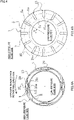
- Fig. 2A eight reverse Rayleigh step mechanisms 10 are evenly spaced, which is not limiting. It is only necessary to provide at least one.
- the negative pressure generation groove (dimple) 10a constituting a part of the reverse Rayleigh step mechanisms 10 is isolated by a smooth portion R (sometimes referred to as a "land portion" in the present invention) of the sealing face S at its high-pressure fluid side and low-pressure fluid side, but a downstream end 10b thereof communicates with the high-pressure fluid side via a radial groove 11.
- the radial groove 11 communicates with the high-pressure fluid side, but does not communicate with the low-pressure fluid side.
- the negative pressure generation groove 10a is a shallow groove, and the radial groove 11 is a groove deeper than the negative pressure generation groove 10a.
- the sealing face S of the rotating-side seal ring 1 is provided with interference grooves 15 for producing pressure variations in a fluid in the negative pressure generation grooves 10a.
- the interference grooves 15 communicate with the high-pressure fluid side, and are arranged radially in positions to produce pressure variations in the fluid in the negative pressure generation grooves 10a.
- the interference grooves 15 are provided in the sealing face margin So on the outside-diameter side and the sealing portion Ss to slide on the stationary-side seal ring 5, and their ends 15a on the inside-diameter side extend to positions to radially overlap the negative pressure generation grooves 10a.
- the shape of the interference grooves 15 illustrated in Fig. 2B is a substantially rectangular shape, but is not limited to this, and may be a circle, oval, or rhombus, for example. It is only essential that they communicate with the high-pressure fluid side, and the ends 15a on the inside-diameter side extend to positions to overlap the negative pressure generation grooves 10a.
- the depth of the interference grooves 15 is not particularly limited, but may be set the same as the depth of the radial grooves 11, or slightly deeper.
- three interference grooves 15 are evenly spaced circumferentially, which is not limiting. It is only necessary to provide at least one. Further, they need not be evenly spaced.
- the pressure of the fluid in the vicinity of the upstream end 10c increases.
- the other interference grooves 15 are set so as not to be in a position facing the downstream end 10b, there is no pressure increase of the fluid in the vicinity of the downstream end 10b.
- the pressure at the upstream end 10c is essentially a negative pressure, and there is a pressure difference between it and the pressure at the downstream end 10b.
- the interference groove 15 reaches the position facing the downstream end 10b of the negative pressure generation groove 10a, the pressure of the fluid in the vicinity of the downstream end 10b increases.
- the other interference grooves 15 are set so as not to be in a position facing the upstream end 10c, there is no pressure increase of the fluid in the vicinity of the upstream end 10c, and the difference between the pressure at the upstream end 10c and the pressure at the downstream end 10b increases.
- the action of the interference grooves 15 brings about a state where the pressure difference between the upstream end 10c and the downstream end 10b is constantly varying.
- the first embodiment achieves prominent effects as below.
- the second embodiment is different from the first embodiment in that fluid circulation grooves 20 are added in a sealing face S of a stationary-side seal ring 5, but the other basic configuration is the same as that in the first embodiment.
- the same numerals and symbols as those in the first embodiment denote the same members, and redundant descriptions will be omitted.
- the number of the fluid circulation grooves 20 is not limited to four. It is only necessary to provide at least one. Further, they need not be evenly spaced.
- the fluid circulation grooves 20 each include an inlet portion 20a for an entry from the high-pressure fluid side, an outlet portion 20b for an exit to the high-pressure fluid side, and a connection portion 20c circumferentially connecting the inlet portion 20a and the outlet portion 20b.
- the fluid circulation grooves 20 have the function of actively introducing a sealed fluid from the high-pressure fluid side into a sealing portion and discharging it in order to prevent a fluid containing corrosion products or the like from being concentrated on a sealing portion Ss, and are formed with wide mouths at the inlet portion 20a and the outlet portion 20b as shown in the figure to facilitate taking the sealed fluid into the sealing portion and discharging it in accordance with the rotation of the opposite sealing face, and on the other hand, are separated from the low-pressure fluid side by the land portion R to reduce leakage.
- the inlet portion 20a and the outlet portion 20b are formed in a linear shape, and form a substantially V shape, but are not particularly limited to this.
- the interior angle ⁇ between the inlet portion 20a and the outlet portion 20b may be further increased or reduced. They may be formed in a curved shape (such as an arc shape) instead of a linear shape.
- the width and depth of the fluid circulation grooves 20 are set optimally according to the pressure, type (viscosity), and others of the sealed fluid. An example of the depth is about 100 to 300 ⁇ m.
- the fluid circulation grooves 20 are not limited to the substantially V shape, and may be in a U shape, for example. It is only essential that the inlet portion 20a and the outlet portion 20b communicate with the high-pressure fluid side.
- four negative pressure generation mechanisms 10 are evenly spaced circumferentially in such a manner as to be located between adjacent fluid circulation grooves 20. Downstream ends 10b of negative pressure generation grooves 10a constituting the negative pressure generation mechanisms 10 communicate with the inlet portions 20a of the fluid circulation grooves 20, and the land portion R is present between upstream ends 10c and the outlet portions 20b of the fluid circulation grooves 20 on the upstream side.
- the inlet portions 20a of the fluid circulation grooves 20 also serve the function of the radial grooves 11 in the first embodiment.
- the interference grooves 15 are provided in a sealing face margin So on the outside-diameter side, and their ends 15a on the inside-diameter side extend to positions to radially overlap the negative pressure generation grooves 10a and the inlet portions 10a and the outlet portions 10b of the fluid circulation grooves 10.
- the twelve interference grooves 15 are evenly spaced circumferentially.
- the plurality of interference grooves 15 is arranged such that when one of the interference grooves 15 is in a position facing the upstream end 10c of a negative pressure generation groove 10a, the other interference grooves 15 are not in a position facing the downstream end 10b of the negative pressure generation groove 10a, and conversely, when one of the interference grooves 15 is in a position facing the downstream end 10b of a negative pressure generation groove 10a, the other interference grooves 15 are not in a position facing the upstream end 10c of the negative pressure generation groove 10a, and further, is arranged such that when one of the interference grooves 15 is in a position facing the inlet portion 20a of a fluid circulation groove 20, the other interference grooves 15 are not in a position facing the outlet portion 20b of the fluid circulation groove 20, and conversely, when one of the interference grooves 15 is in the position facing the outlet portion 20b, the other interference groove 15 are not in the position facing the inlet portion 20a
- the four negative pressure generation grooves 10a and the four fluid circulation grooves 20 are evenly spaced.
- the central angle ⁇ 1 between the upstream end 10c and the downstream end 10b of the negative pressure generation grooves 10a, and the central angle ⁇ 1 between the inlet portion 20a and the outlet portion 20b of the fluid circulation grooves 20 are each about 45°, whereas the central angle ⁇ between adjacent interference grooves 15 is 30°.
- the other interference grooves 15 are not in a position facing the downstream end 10b of the negative pressure generation groove 10a or the outlet portion 20b of the fluid circulation groove 20.
- the interference grooves 15 When attention is focused on the effects of the interference grooves 15 on the fluid circulation grooves 20, for example, when one of the interference grooves 15 reaches a position facing the inlet portion 20a of a fluid circulation groove 20, the pressure of a fluid in the inlet portion 20a increases. At this time, since the other interference grooves 15 are set so as not to be in a position facing the outlet portion 20b, there is no pressure increase of the fluid in the outlet portion 20b, resulting in the state, the pressure in the inlet portion 20a > the pressure in the outlet portion 20b.
- the interference groove 15 reaches the position facing the outlet portion 20b of the fluid circulation groove 20, the pressure of the fluid in the outlet portion 10b increases.
- the other interference grooves 15 are set so as not to be in a position facing the inlet portion 10b, there is no pressure increase of the fluid in the inlet portion 20b, resulting in the state, the pressure in the inlet portion 20a ⁇ the pressure in the outlet portion 20b.
- the action of the interference grooves 15 brings about a state where there is a pressure difference between the inlet portion 20a and the outlet portion 20b, which is constantly varying alternately.
- the second embodiment achieves prominent effects as below.
- the third embodiment is different from the second embodiment in that positive pressure generation mechanisms 25 are added on a sealing face S of a stationary-side seal ring 5, but the other basic configuration is the same as that in the second embodiment.
- the same numerals and symbols as those in the second embodiment denote the same members, and redundant descriptions will be omitted.
- the positive pressure generation mechanisms 25 each having a positive pressure generation groove 25a shallower than fluid circulation grooves 20 are provided in portions enclosed by the fluid circulation grooves 20 in the sealing face S of the stationary-side seal ring 5 and the high-pressure fluid side.
- the positive pressure generation mechanisms 25 are intended to generate positive pressure (dynamic pressure), thereby increasing a fluid film between sealing faces and increasing lubrication performance.
- the positive pressure generation grooves 25a have upstream ends 25c communicating with inlet portions 20a of the fluid circulation grooves 20, and downstream ends (also referred to as Rayleigh steps) 25b separated from outlet portions 20b of the fluid circulation grooves 20 by land portions R.
- the positive pressure generation grooves 25a are also separated from the high-pressure fluid side by the land portions R.
- each positive pressure generation mechanism 25 is formed from a Rayleigh step mechanism including the positive pressure generation groove 25a and the Rayleigh step 25b, but is not limited to this, and may be formed by a femto-groove with a dam, for example. It is only essential that it be a mechanism to generate positive pressure.
- the Rayleigh step mechanism will be described in detail below.
- interference grooves 15 on negative pressure generation grooves 10a and the fluid circulation grooves 20 are the same as those in the second embodiment.
- the interference grooves 15 When attention is focused on the effects of the interference grooves 15 on the positive pressure generation grooves 25a, for example, when one of the interference grooves 15 reaches the upstream end 25c of a positive pressure generation groove 25a, the pressure of a fluid in the vicinity of the upstream end 25c increases. At this time, the other interference grooves 15 are set so as not to be in a position facing the downstream end 25b, there is no pressure increase of the fluid in the vicinity of the downstream end 25b. In the positive pressure generation groove 25a, the pressure in the upstream end 25c is essentially smaller than that in the downstream end 25b. When the interference groove 15 reaches the upstream end 25c, the difference between the pressure at the upstream end 25c and the pressure at the downstream end 25b decreases.
- the interference groove 15 reaches a position facing the downstream end 25b of the positive pressure generation groove 25a, the pressure of the fluid in the vicinity of the downstream end 25b increases.
- the other interference grooves 15 are set so as not to be in a position facing the upstream end 25c, there is no pressure increase of the fluid in the vicinity of the upstream end 25c, and the difference between the pressure at the upstream end 25c and the pressure at the downstream end 25b increases.
- the action of the interference grooves 15 brings about a state where the pressure difference between the upstream end 25c and the downstream end 25b is constantly varying.
- the third embodiment achieves prominent effects as below.
- a positive pressure generation mechanism including a positive pressure generation groove (Rayleigh step mechanism) and a negative pressure generation mechanism including a negative pressure generation groove (reverse Rayleigh step mechanism) in the present invention will be described.
- Fig. 5A As shown by an arrow, the rotating-side seal ring 1 rotationally moves in a counterclockwise direction relative to the stationary-side seal ring 5.
- a positive pressure generation groove (dimple) 25a is formed in the sealing face S of the stationary-side seal ring 5
- a narrowed gap step, also referred to as a Rayleigh step
- the opposite sealing face of the rotating-side seal ring 1 is flat.
- Fig. 5B as shown by an arrow, the rotating-side seal ring 1 rotationally moves in a counterclockwise direction relative to the stationary-side seal ring 5.
- a negative pressure generation groove (dimple) 10a is formed in the sealing face S of the stationary-side seal ring 5
- a widened gap step, also referred to as a reverse Rayleigh step
- the opposite sealing face of the rotating-side seal ring 1 is flat.
- a slide part is used for one of a pair of a rotating seal ring and a stationary seal ring in a mechanical seal device
- it may be used as a slide part of a bearing that slides on a rotating shaft while sealing a lubricating oil on one side in an axial direction of a cylindrical sealing face.
- the present invention may be applied to a case where a high-pressure fluid is on the inner-peripheral side.
- fluid circulation grooves are provided in a stationary-side seal ring of a mechanical seal constituting a slide component, and interference grooves are provided in a rotating-side seal ring has been described, on the contrary, fluid circulation grooves may be provided in a rotating-side seal ring, and interference grooves in a stationary-side seal ring.
Landscapes
- Engineering & Computer Science (AREA)
- General Engineering & Computer Science (AREA)
- Mechanical Engineering (AREA)
- Mechanical Sealing (AREA)
Claims (6)
- Composant de coulissement comprenant :une paire de pièces de coulissement (1, 5) qui coulissent relativement l'une sur l'autre,l'une des pièces de coulissement (5) étant prévue, sur un côté basse pression de sa face d'étanchéité (S), avec un mécanisme de génération de pression négative (10) comprenant une gorge de génération de pression négative (10a), la gorge de génération de pression négative (10a) communiquant avec un côté de fluide haute pression et étant séparée d'un côté de fluide basse pression par une partie d'appui (R),l'autre des pièces de coulissement (1) étant prévue, dans sa face d'étanchéité (S), avec au moins une gorge d'interférence (15) communiquant avec le côté de fluide haute pression pour produire des variations de pression dans un fluide dans la gorge de génération de pression négative (10a), la au moins une gorge d'interférence (15) ayant une extrémité (15a) sur un côté de diamètre interne s'étendant dans une position pour chevaucher radialement la gorge de génération de pression négative (10a),dans lequel la au moins une gorge d'interférence (15) comprend une pluralité de gorges d'interférence (15) prévues de manière circonférentielle, caractérisé en ce que :
la pluralité de gorges d'interférence (15) est agencée de sorte que lorsque l'une des gorges d'interférence (15) est dans une position faisant face à une extrémité en amont (10c) de la gorge de génération de pression négative (10a), les autres gorges d'interférence (15) de la pluralité de gorges d'interférence (15) ne sont pas dans une position faisant face à une extrémité en aval (10b) de la gorge de génération de pression négative (10a). - Composant de coulissement selon la revendication 1, dans lequel le mécanisme de génération de pression négative (10) est formé à partir d'un mécanisme de marche arrière de Rayleigh.
- Composant de coulissement selon l'une quelconque des revendications 1 ou 2, dans lequel :la une pièce de coulissement (5)est prévue, dans sa face d'étanchéité (S), avec une gorge de circulation de fluide (20) qui communique avec le côté de fluide haute pression via une partie d'entrée (20a) et une partie de sortie (20b) et est séparée du côté du fluide basse pression par une partie d'appui (R), etla gorge de génération de pression négative (10a) a une extrémité en aval (10b) communiquant avec la partie d'entrée (20a) de la gorge de circulation de fluide (20).
- Composant de coulissement selon l'une quelconque des revendications 1 à 3, dans lequel :la une pièce de coulissement (5) est prévue avec un mécanisme de génération de pression positive (25) comprenant une gorge de génération de pression positive (25a) dans une partie enfermée par la gorge de circulation de fluide (20) dans sa face d'étanchéité (S) et le côté de fluide haute pression, etla gorge de génération de pression positive (25a) a un côté en amont (25c) communiquant avec une partie d'entrée (20a) de la gorge de circulation de fluide (20).
- Composant de coulissement selon la revendication 4, dans lequel le mécanisme de génération de pression positive (25) est formé à partir d'un mécanisme à étage de Rayleigh.
- Composant de coulissement selon l'une quelconque des revendications 1 à 5, dans lequel :la une pièce de coulissement (5) est une bague d'étanchéité du côté fixe (5),l'autre pièce de coulissement (1) est une bague d'étanchéité du côté rotatif (1), etla bague d'étanchéité du côté rotatif (1) est plus importante du point de vue du diamètre externe et moins importante du point de vue du diamètre interne que la bague d'étanchéité du côté fixe (5).
Applications Claiming Priority (2)
| Application Number | Priority Date | Filing Date | Title |
|---|---|---|---|
| JP2014227597 | 2014-11-08 | ||
| PCT/JP2015/080332 WO2016072325A1 (fr) | 2014-11-08 | 2015-10-28 | Pièces coulissantes |
Publications (3)
| Publication Number | Publication Date |
|---|---|
| EP3217049A1 EP3217049A1 (fr) | 2017-09-13 |
| EP3217049A4 EP3217049A4 (fr) | 2018-07-11 |
| EP3217049B1 true EP3217049B1 (fr) | 2022-03-30 |
Family
ID=55909051
Family Applications (1)
| Application Number | Title | Priority Date | Filing Date |
|---|---|---|---|
| EP15857699.1A Active EP3217049B1 (fr) | 2014-11-08 | 2015-10-28 | Pièces coulissantes |
Country Status (6)
| Country | Link |
|---|---|
| US (1) | US10443737B2 (fr) |
| EP (1) | EP3217049B1 (fr) |
| JP (1) | JP6522000B2 (fr) |
| CN (1) | CN107110370B (fr) |
| AU (1) | AU2015344384A1 (fr) |
| WO (1) | WO2016072325A1 (fr) |
Cited By (2)
| Publication number | Priority date | Publication date | Assignee | Title |
|---|---|---|---|---|
| US11852241B2 (en) | 2019-02-04 | 2023-12-26 | Eagle Industry Co., Ltd. | Sliding component |
| US11852244B2 (en) | 2019-02-04 | 2023-12-26 | Eagle Industry Co., Ltd. | Sliding component and method of manufacturing sliding member |
Families Citing this family (27)
| Publication number | Priority date | Publication date | Assignee | Title |
|---|---|---|---|---|
| CN109844382B (zh) * | 2016-11-14 | 2021-01-12 | 伊格尔工业股份有限公司 | 滑动部件 |
| US10989249B2 (en) | 2016-11-14 | 2021-04-27 | Eagle Industry Co., Ltd. | Sliding component |
| USRE50849E1 (en) | 2016-11-16 | 2026-03-31 | Eagle Industry Co., Ltd. | Sliding component |
| JP6941479B2 (ja) * | 2017-05-26 | 2021-09-29 | 日本ピラー工業株式会社 | シール構造及びメカニカルシール |
| WO2019139107A1 (fr) * | 2018-01-12 | 2019-07-18 | イーグル工業株式会社 | Élément coulissant |
| EP3748205B1 (fr) | 2018-02-01 | 2024-12-18 | Eagle Industry Co., Ltd. | Pièces coulissantes |
| EP4166823A1 (fr) | 2018-10-01 | 2023-04-19 | Eagle Industry Co., Ltd. | Élément coulissant |
| KR102661123B1 (ko) * | 2018-10-24 | 2024-04-29 | 이구루코교 가부시기가이샤 | 슬라이딩 부재 |
| JP7387239B2 (ja) | 2019-02-04 | 2023-11-28 | イーグル工業株式会社 | 摺動部品 |
| JP7292813B2 (ja) | 2019-02-04 | 2023-06-19 | イーグル工業株式会社 | 摺動部品 |
| KR102647265B1 (ko) | 2019-02-04 | 2024-03-14 | 이구루코교 가부시기가이샤 | 슬라이딩 부품 |
| WO2020162349A1 (fr) | 2019-02-04 | 2020-08-13 | イーグル工業株式会社 | Élément coulissant |
| US11933405B2 (en) | 2019-02-14 | 2024-03-19 | Eagle Industry Co., Ltd. | Sliding component |
| WO2020171102A1 (fr) | 2019-02-21 | 2020-08-27 | イーグル工業株式会社 | Composant coulissant |
| JP7419346B2 (ja) | 2019-03-22 | 2024-01-22 | イーグル工業株式会社 | 摺動部品 |
| KR102760809B1 (ko) | 2020-03-31 | 2025-02-03 | 이구루코교 가부시기가이샤 | 슬라이딩 부품 |
| EP4467850A3 (fr) | 2020-05-11 | 2025-03-19 | Eagle Industry Co., Ltd. | Composant coulissant |
| KR20230022986A (ko) | 2020-07-06 | 2023-02-16 | 이구루코교 가부시기가이샤 | 슬라이딩 부품 |
| JP7528218B2 (ja) | 2020-07-06 | 2024-08-05 | イーグル工業株式会社 | 回転機械 |
| CN115917192A (zh) | 2020-07-06 | 2023-04-04 | 伊格尔工业股份有限公司 | 滑动部件 |
| JP7497132B2 (ja) | 2020-07-06 | 2024-06-10 | イーグル工業株式会社 | 摺動部品 |
| KR102868751B1 (ko) | 2020-07-06 | 2025-10-14 | 이구루코교 가부시기가이샤 | 편심 슬라이딩 어셈블리 |
| EP4177501A4 (fr) | 2020-07-06 | 2024-08-14 | Eagle Industry Co., Ltd. | Composant coulissant |
| KR102922811B1 (ko) * | 2021-03-12 | 2026-02-04 | 이구루코교 가부시기가이샤 | 슬라이딩 부품 |
| CN113236781B (zh) * | 2021-04-15 | 2022-04-15 | 大连理工大学 | 一种端面具有减摩散热结构的密封环及其加工方法 |
| EP4394213A4 (fr) | 2021-08-25 | 2025-08-27 | Eagle Ind Co Ltd | Paire de composants coulissants |
| US12404936B2 (en) | 2021-09-28 | 2025-09-02 | Eagle Indusry Co., Ltd. | Sliding component |
Family Cites Families (24)
| Publication number | Priority date | Publication date | Assignee | Title |
|---|---|---|---|---|
| US3804424A (en) * | 1972-04-24 | 1974-04-16 | Crane Packing Co | Gap seal with thermal and pressure distortion compensation |
| JPS59110959A (ja) * | 1982-12-15 | 1984-06-27 | Arai Pump Mfg Co Ltd | メカニカルシ−ル |
| JPS59231268A (ja) * | 1983-06-14 | 1984-12-25 | Arai Pump Mfg Co Ltd | メカニカルシ−ル |
| JPS60167861A (ja) * | 1984-02-10 | 1985-08-31 | Oomi Kenshi Kk | 自動ワインダ−の制御方法 |
| CH677266A5 (fr) * | 1986-10-28 | 1991-04-30 | Pacific Wietz Gmbh & Co Kg | |
| US5090712A (en) * | 1990-07-17 | 1992-02-25 | John Crane Inc. | Non-contacting, gap-type seal having a ring with a patterned microdam seal face |
| DE4303050B4 (de) * | 1992-02-26 | 2004-02-26 | Sedy, Josef, Mt. Prospect | Gleitringdichtung |
| JP2639883B2 (ja) * | 1993-07-22 | 1997-08-13 | 日本ピラー工業株式会社 | 非接触形軸封装置 |
| JPH07180772A (ja) | 1993-12-22 | 1995-07-18 | Mitsubishi Heavy Ind Ltd | 軸封装置 |
| US5498007A (en) | 1994-02-01 | 1996-03-12 | Durametallic Corporation | Double gas barrier seal |
| JPH07224948A (ja) * | 1994-02-15 | 1995-08-22 | Mitsubishi Heavy Ind Ltd | メカニカルシール |
| JP3781463B2 (ja) * | 1995-11-10 | 2006-05-31 | 株式会社ニクニ | メカニカルシール |
| GB2375148A (en) * | 2001-04-30 | 2002-11-06 | Corac Group Plc | A dry gas seal |
| JP4719414B2 (ja) * | 2003-12-22 | 2011-07-06 | イーグル工業株式会社 | 摺動部品 |
| WO2011115073A1 (fr) * | 2010-03-15 | 2011-09-22 | イーグル工業株式会社 | Elément coulissant |
| WO2012046749A1 (fr) * | 2010-10-06 | 2012-04-12 | イーグル工業株式会社 | Partie glissante |
| US9151390B2 (en) * | 2011-09-10 | 2015-10-06 | Eagle Industry Co., Ltd. | Sliding parts |
| JP2014083108A (ja) * | 2012-10-19 | 2014-05-12 | Canon Inc | 移動型のx線画像撮影装置 |
| JP6121446B2 (ja) | 2012-12-25 | 2017-04-26 | イーグル工業株式会社 | 摺動部品 |
| US9964215B2 (en) * | 2012-12-25 | 2018-05-08 | Eagle Industry Co., Ltd. | Sliding component |
| EP2947357B1 (fr) * | 2013-01-16 | 2018-03-07 | Eagle Industry Co., Ltd. | Partie de coulissement |
| CN103133696A (zh) * | 2013-02-22 | 2013-06-05 | 江苏大学 | 一种自动排泄颗粒型流体动压机械密封环 |
| AU2014354094B2 (en) * | 2013-11-22 | 2017-03-16 | Eagle Industry Co., Ltd. | Sliding component |
| US9863473B2 (en) * | 2014-02-24 | 2018-01-09 | Eagle Industry Co., Ltd. | Sliding parts and processing method of sliding parts |
-
2015
- 2015-10-28 AU AU2015344384A patent/AU2015344384A1/en not_active Abandoned
- 2015-10-28 EP EP15857699.1A patent/EP3217049B1/fr active Active
- 2015-10-28 US US15/521,608 patent/US10443737B2/en active Active
- 2015-10-28 CN CN201580058043.8A patent/CN107110370B/zh active Active
- 2015-10-28 WO PCT/JP2015/080332 patent/WO2016072325A1/fr not_active Ceased
- 2015-10-28 JP JP2016557725A patent/JP6522000B2/ja active Active
Cited By (2)
| Publication number | Priority date | Publication date | Assignee | Title |
|---|---|---|---|---|
| US11852241B2 (en) | 2019-02-04 | 2023-12-26 | Eagle Industry Co., Ltd. | Sliding component |
| US11852244B2 (en) | 2019-02-04 | 2023-12-26 | Eagle Industry Co., Ltd. | Sliding component and method of manufacturing sliding member |
Also Published As
| Publication number | Publication date |
|---|---|
| JPWO2016072325A1 (ja) | 2017-10-05 |
| JP6522000B2 (ja) | 2019-05-29 |
| EP3217049A4 (fr) | 2018-07-11 |
| CN107110370B (zh) | 2019-09-13 |
| US20170241549A1 (en) | 2017-08-24 |
| EP3217049A1 (fr) | 2017-09-13 |
| US10443737B2 (en) | 2019-10-15 |
| AU2015344384A1 (en) | 2017-04-27 |
| WO2016072325A1 (fr) | 2016-05-12 |
| CN107110370A (zh) | 2017-08-29 |
Similar Documents
| Publication | Publication Date | Title |
|---|---|---|
| EP3217049B1 (fr) | Pièces coulissantes | |
| EP3196516B1 (fr) | Élément coulissant | |
| EP3553353B1 (fr) | Composant coulissant | |
| EP3540274B1 (fr) | Composant coulissant | |
| EP3315832B1 (fr) | Élément de glissement | |
| JP6305432B2 (ja) | 摺動部品 | |
| US10344867B2 (en) | Sliding component |
Legal Events
| Date | Code | Title | Description |
|---|---|---|---|
| STAA | Information on the status of an ep patent application or granted ep patent |
Free format text: STATUS: THE INTERNATIONAL PUBLICATION HAS BEEN MADE |
|
| PUAI | Public reference made under article 153(3) epc to a published international application that has entered the european phase |
Free format text: ORIGINAL CODE: 0009012 |
|
| STAA | Information on the status of an ep patent application or granted ep patent |
Free format text: STATUS: REQUEST FOR EXAMINATION WAS MADE |
|
| 17P | Request for examination filed |
Effective date: 20170419 |
|
| AK | Designated contracting states |
Kind code of ref document: A1 Designated state(s): AL AT BE BG CH CY CZ DE DK EE ES FI FR GB GR HR HU IE IS IT LI LT LU LV MC MK MT NL NO PL PT RO RS SE SI SK SM TR |
|
| AX | Request for extension of the european patent |
Extension state: BA ME |
|
| DAV | Request for validation of the european patent (deleted) | ||
| DAX | Request for extension of the european patent (deleted) | ||
| A4 | Supplementary search report drawn up and despatched |
Effective date: 20180611 |
|
| RIC1 | Information provided on ipc code assigned before grant |
Ipc: F16J 15/34 20060101AFI20180605BHEP |
|
| GRAP | Despatch of communication of intention to grant a patent |
Free format text: ORIGINAL CODE: EPIDOSNIGR1 |
|
| STAA | Information on the status of an ep patent application or granted ep patent |
Free format text: STATUS: GRANT OF PATENT IS INTENDED |
|
| INTG | Intention to grant announced |
Effective date: 20211213 |
|
| GRAS | Grant fee paid |
Free format text: ORIGINAL CODE: EPIDOSNIGR3 |
|
| GRAA | (expected) grant |
Free format text: ORIGINAL CODE: 0009210 |
|
| STAA | Information on the status of an ep patent application or granted ep patent |
Free format text: STATUS: THE PATENT HAS BEEN GRANTED |
|
| AK | Designated contracting states |
Kind code of ref document: B1 Designated state(s): AL AT BE BG CH CY CZ DE DK EE ES FI FR GB GR HR HU IE IS IT LI LT LU LV MC MK MT NL NO PL PT RO RS SE SI SK SM TR |
|
| REG | Reference to a national code |
Ref country code: GB Ref legal event code: FG4D |
|
| REG | Reference to a national code |
Ref country code: CH Ref legal event code: EP |
|
| REG | Reference to a national code |
Ref country code: AT Ref legal event code: REF Ref document number: 1479486 Country of ref document: AT Kind code of ref document: T Effective date: 20220415 |
|
| REG | Reference to a national code |
Ref country code: DE Ref legal event code: R096 Ref document number: 602015077933 Country of ref document: DE |
|
| REG | Reference to a national code |
Ref country code: IE Ref legal event code: FG4D |
|
| REG | Reference to a national code |
Ref country code: LT Ref legal event code: MG9D |
|
| PG25 | Lapsed in a contracting state [announced via postgrant information from national office to epo] |
Ref country code: SE Free format text: LAPSE BECAUSE OF FAILURE TO SUBMIT A TRANSLATION OF THE DESCRIPTION OR TO PAY THE FEE WITHIN THE PRESCRIBED TIME-LIMIT Effective date: 20220330 Ref country code: RS Free format text: LAPSE BECAUSE OF FAILURE TO SUBMIT A TRANSLATION OF THE DESCRIPTION OR TO PAY THE FEE WITHIN THE PRESCRIBED TIME-LIMIT Effective date: 20220330 Ref country code: NO Free format text: LAPSE BECAUSE OF FAILURE TO SUBMIT A TRANSLATION OF THE DESCRIPTION OR TO PAY THE FEE WITHIN THE PRESCRIBED TIME-LIMIT Effective date: 20220630 Ref country code: LT Free format text: LAPSE BECAUSE OF FAILURE TO SUBMIT A TRANSLATION OF THE DESCRIPTION OR TO PAY THE FEE WITHIN THE PRESCRIBED TIME-LIMIT Effective date: 20220330 Ref country code: HR Free format text: LAPSE BECAUSE OF FAILURE TO SUBMIT A TRANSLATION OF THE DESCRIPTION OR TO PAY THE FEE WITHIN THE PRESCRIBED TIME-LIMIT Effective date: 20220330 Ref country code: BG Free format text: LAPSE BECAUSE OF FAILURE TO SUBMIT A TRANSLATION OF THE DESCRIPTION OR TO PAY THE FEE WITHIN THE PRESCRIBED TIME-LIMIT Effective date: 20220630 |
|
| REG | Reference to a national code |
Ref country code: NL Ref legal event code: MP Effective date: 20220330 |
|
| REG | Reference to a national code |
Ref country code: AT Ref legal event code: MK05 Ref document number: 1479486 Country of ref document: AT Kind code of ref document: T Effective date: 20220330 |
|
| PG25 | Lapsed in a contracting state [announced via postgrant information from national office to epo] |
Ref country code: LV Free format text: LAPSE BECAUSE OF FAILURE TO SUBMIT A TRANSLATION OF THE DESCRIPTION OR TO PAY THE FEE WITHIN THE PRESCRIBED TIME-LIMIT Effective date: 20220330 Ref country code: GR Free format text: LAPSE BECAUSE OF FAILURE TO SUBMIT A TRANSLATION OF THE DESCRIPTION OR TO PAY THE FEE WITHIN THE PRESCRIBED TIME-LIMIT Effective date: 20220701 Ref country code: FI Free format text: LAPSE BECAUSE OF FAILURE TO SUBMIT A TRANSLATION OF THE DESCRIPTION OR TO PAY THE FEE WITHIN THE PRESCRIBED TIME-LIMIT Effective date: 20220330 |
|
| PG25 | Lapsed in a contracting state [announced via postgrant information from national office to epo] |
Ref country code: NL Free format text: LAPSE BECAUSE OF FAILURE TO SUBMIT A TRANSLATION OF THE DESCRIPTION OR TO PAY THE FEE WITHIN THE PRESCRIBED TIME-LIMIT Effective date: 20220330 |
|
| PG25 | Lapsed in a contracting state [announced via postgrant information from national office to epo] |
Ref country code: SM Free format text: LAPSE BECAUSE OF FAILURE TO SUBMIT A TRANSLATION OF THE DESCRIPTION OR TO PAY THE FEE WITHIN THE PRESCRIBED TIME-LIMIT Effective date: 20220330 Ref country code: SK Free format text: LAPSE BECAUSE OF FAILURE TO SUBMIT A TRANSLATION OF THE DESCRIPTION OR TO PAY THE FEE WITHIN THE PRESCRIBED TIME-LIMIT Effective date: 20220330 Ref country code: RO Free format text: LAPSE BECAUSE OF FAILURE TO SUBMIT A TRANSLATION OF THE DESCRIPTION OR TO PAY THE FEE WITHIN THE PRESCRIBED TIME-LIMIT Effective date: 20220330 Ref country code: PT Free format text: LAPSE BECAUSE OF FAILURE TO SUBMIT A TRANSLATION OF THE DESCRIPTION OR TO PAY THE FEE WITHIN THE PRESCRIBED TIME-LIMIT Effective date: 20220801 Ref country code: ES Free format text: LAPSE BECAUSE OF FAILURE TO SUBMIT A TRANSLATION OF THE DESCRIPTION OR TO PAY THE FEE WITHIN THE PRESCRIBED TIME-LIMIT Effective date: 20220330 Ref country code: EE Free format text: LAPSE BECAUSE OF FAILURE TO SUBMIT A TRANSLATION OF THE DESCRIPTION OR TO PAY THE FEE WITHIN THE PRESCRIBED TIME-LIMIT Effective date: 20220330 Ref country code: CZ Free format text: LAPSE BECAUSE OF FAILURE TO SUBMIT A TRANSLATION OF THE DESCRIPTION OR TO PAY THE FEE WITHIN THE PRESCRIBED TIME-LIMIT Effective date: 20220330 Ref country code: AT Free format text: LAPSE BECAUSE OF FAILURE TO SUBMIT A TRANSLATION OF THE DESCRIPTION OR TO PAY THE FEE WITHIN THE PRESCRIBED TIME-LIMIT Effective date: 20220330 |
|
| PG25 | Lapsed in a contracting state [announced via postgrant information from national office to epo] |
Ref country code: PL Free format text: LAPSE BECAUSE OF FAILURE TO SUBMIT A TRANSLATION OF THE DESCRIPTION OR TO PAY THE FEE WITHIN THE PRESCRIBED TIME-LIMIT Effective date: 20220330 Ref country code: IS Free format text: LAPSE BECAUSE OF FAILURE TO SUBMIT A TRANSLATION OF THE DESCRIPTION OR TO PAY THE FEE WITHIN THE PRESCRIBED TIME-LIMIT Effective date: 20220730 Ref country code: AL Free format text: LAPSE BECAUSE OF FAILURE TO SUBMIT A TRANSLATION OF THE DESCRIPTION OR TO PAY THE FEE WITHIN THE PRESCRIBED TIME-LIMIT Effective date: 20220330 |
|
| REG | Reference to a national code |
Ref country code: DE Ref legal event code: R097 Ref document number: 602015077933 Country of ref document: DE |
|
| PG25 | Lapsed in a contracting state [announced via postgrant information from national office to epo] |
Ref country code: DK Free format text: LAPSE BECAUSE OF FAILURE TO SUBMIT A TRANSLATION OF THE DESCRIPTION OR TO PAY THE FEE WITHIN THE PRESCRIBED TIME-LIMIT Effective date: 20220330 |
|
| PLBE | No opposition filed within time limit |
Free format text: ORIGINAL CODE: 0009261 |
|
| STAA | Information on the status of an ep patent application or granted ep patent |
Free format text: STATUS: NO OPPOSITION FILED WITHIN TIME LIMIT |
|
| 26N | No opposition filed |
Effective date: 20230103 |
|
| PG25 | Lapsed in a contracting state [announced via postgrant information from national office to epo] |
Ref country code: SI Free format text: LAPSE BECAUSE OF FAILURE TO SUBMIT A TRANSLATION OF THE DESCRIPTION OR TO PAY THE FEE WITHIN THE PRESCRIBED TIME-LIMIT Effective date: 20220330 Ref country code: MC Free format text: LAPSE BECAUSE OF FAILURE TO SUBMIT A TRANSLATION OF THE DESCRIPTION OR TO PAY THE FEE WITHIN THE PRESCRIBED TIME-LIMIT Effective date: 20220330 |
|
| REG | Reference to a national code |
Ref country code: CH Ref legal event code: PL |
|
| REG | Reference to a national code |
Ref country code: BE Ref legal event code: MM Effective date: 20221031 |
|
| PG25 | Lapsed in a contracting state [announced via postgrant information from national office to epo] |
Ref country code: LU Free format text: LAPSE BECAUSE OF NON-PAYMENT OF DUE FEES Effective date: 20221028 |
|
| PG25 | Lapsed in a contracting state [announced via postgrant information from national office to epo] |
Ref country code: LI Free format text: LAPSE BECAUSE OF NON-PAYMENT OF DUE FEES Effective date: 20221031 Ref country code: IT Free format text: LAPSE BECAUSE OF FAILURE TO SUBMIT A TRANSLATION OF THE DESCRIPTION OR TO PAY THE FEE WITHIN THE PRESCRIBED TIME-LIMIT Effective date: 20220330 Ref country code: FR Free format text: LAPSE BECAUSE OF NON-PAYMENT OF DUE FEES Effective date: 20221031 Ref country code: CH Free format text: LAPSE BECAUSE OF NON-PAYMENT OF DUE FEES Effective date: 20221031 |
|
| PG25 | Lapsed in a contracting state [announced via postgrant information from national office to epo] |
Ref country code: BE Free format text: LAPSE BECAUSE OF NON-PAYMENT OF DUE FEES Effective date: 20221031 |
|
| PG25 | Lapsed in a contracting state [announced via postgrant information from national office to epo] |
Ref country code: IE Free format text: LAPSE BECAUSE OF NON-PAYMENT OF DUE FEES Effective date: 20221028 |
|
| PG25 | Lapsed in a contracting state [announced via postgrant information from national office to epo] |
Ref country code: HU Free format text: LAPSE BECAUSE OF FAILURE TO SUBMIT A TRANSLATION OF THE DESCRIPTION OR TO PAY THE FEE WITHIN THE PRESCRIBED TIME-LIMIT; INVALID AB INITIO Effective date: 20151028 |
|
| PG25 | Lapsed in a contracting state [announced via postgrant information from national office to epo] |
Ref country code: CY Free format text: LAPSE BECAUSE OF FAILURE TO SUBMIT A TRANSLATION OF THE DESCRIPTION OR TO PAY THE FEE WITHIN THE PRESCRIBED TIME-LIMIT Effective date: 20220330 |
|
| PG25 | Lapsed in a contracting state [announced via postgrant information from national office to epo] |
Ref country code: MK Free format text: LAPSE BECAUSE OF FAILURE TO SUBMIT A TRANSLATION OF THE DESCRIPTION OR TO PAY THE FEE WITHIN THE PRESCRIBED TIME-LIMIT Effective date: 20220330 |
|
| PG25 | Lapsed in a contracting state [announced via postgrant information from national office to epo] |
Ref country code: MT Free format text: LAPSE BECAUSE OF FAILURE TO SUBMIT A TRANSLATION OF THE DESCRIPTION OR TO PAY THE FEE WITHIN THE PRESCRIBED TIME-LIMIT Effective date: 20220330 |
|
| PGFP | Annual fee paid to national office [announced via postgrant information from national office to epo] |
Ref country code: GB Payment date: 20250904 Year of fee payment: 11 |
|
| PG25 | Lapsed in a contracting state [announced via postgrant information from national office to epo] |
Ref country code: TR Free format text: LAPSE BECAUSE OF FAILURE TO SUBMIT A TRANSLATION OF THE DESCRIPTION OR TO PAY THE FEE WITHIN THE PRESCRIBED TIME-LIMIT Effective date: 20220330 |
|
| PGFP | Annual fee paid to national office [announced via postgrant information from national office to epo] |
Ref country code: DE Payment date: 20250902 Year of fee payment: 11 |