EP3217799B1 - Dispositif pour l'élimination de lard résiduel d'un animal abattu - Google Patents
Dispositif pour l'élimination de lard résiduel d'un animal abattu Download PDFInfo
- Publication number
- EP3217799B1 EP3217799B1 EP15788073.3A EP15788073A EP3217799B1 EP 3217799 B1 EP3217799 B1 EP 3217799B1 EP 15788073 A EP15788073 A EP 15788073A EP 3217799 B1 EP3217799 B1 EP 3217799B1
- Authority
- EP
- European Patent Office
- Prior art keywords
- lard
- remnants
- rotor
- leaf lard
- lamella
- Prior art date
- Legal status (The legal status is an assumption and is not a legal conclusion. Google has not performed a legal analysis and makes no representation as to the accuracy of the status listed.)
- Active
Links
Images


Classifications
-
- A—HUMAN NECESSITIES
- A22—BUTCHERING; MEAT TREATMENT; PROCESSING POULTRY OR FISH
- A22B—SLAUGHTERING
- A22B5/00—Accessories for use during or after slaughtering
-
- A—HUMAN NECESSITIES
- A22—BUTCHERING; MEAT TREATMENT; PROCESSING POULTRY OR FISH
- A22B—SLAUGHTERING
- A22B5/00—Accessories for use during or after slaughtering
- A22B5/0005—Eviscerating devices, e.g. removing rectum, anus, intestines, brain tissue, hypophysis
-
- A—HUMAN NECESSITIES
- A22—BUTCHERING; MEAT TREATMENT; PROCESSING POULTRY OR FISH
- A22B—SLAUGHTERING
- A22B5/00—Accessories for use during or after slaughtering
- A22B5/08—Scalding; Scraping; Dehairing; Singeing
-
- A—HUMAN NECESSITIES
- A22—BUTCHERING; MEAT TREATMENT; PROCESSING POULTRY OR FISH
- A22C—PROCESSING MEAT, POULTRY, OR FISH
- A22C17/00—Other devices for processing meat or bones
Definitions
- the invention relates to a device and a method for removal of abdominal fat remnants or leaf lard remnants from a slaughtered animal i.e. from a carcass, especially from pigs.
- Removal of the main part of the abdominal lard or leaf lard from a slaughtered animal or a part thereof, of which the abdominal cavity has been opened beforehand can be performed as described e.g. in EP0706761 , EP0836804 , EP1029454 or EP1164858 . However, in nearly each animal from where leaf lard has been removed remnants of leaf lard will still be present at the abdominal meat of the animal.
- the leaf lard remnant removing device described herein can be manually handled or preferably be mounted on a robot and removal of leaf lard remnants can be performed automatically at the slaughter line. Removal of leaf lard remnants increases the value of the meat especially due to visual appearance of the meat pieces produced when the slaughtered animals are further cut. A cut from a carcass such as a meat part thus has a higher quality by way of a higher market value when leaf lard remnants are removed.
- the invention relates to a device for removing leaf lard remnants from a slaughtered animal or a part thereof, of which the abdominal cavity has been opened beforehand and the main part of the leaf lard has been removed, which device comprises at least one rotatable rotor, and the rotor comprises
- the leaf lard remnant removing device can be incorporated into a system for removing leaf lard remnants from at least one slaughtered animal or a part thereof at a slaughter line, where the abdominal cavity of the at least one slaughtered animal has been opened beforehand and the main part of the leaf lard has been removed, which system comprises
- the invention also relates to a method for removing leaf lard remnants from a slaughtered animal or a part thereof, of which the abdominal cavity has been opened beforehand and the main part of the leaf lard has been removed, the method comprises
- the method of removing leaf lard remnants from slaughtered animals hanging at a slaughter line may be included in an automatic process by the use of the leaf lard remnant system comprising at least the leaf lard remnant device and a robot
- a first object of the invention relates to a device for removing abdominal lard remnants or leaf lard remnants from a slaughtered animal or a part thereof, of which the abdominal cavity has been opened beforehand and the main part of the abdominal lard or leaf lard has been removed, which device comprises at least one rotatable rotor, and the rotor comprises
- the longitudinal central kernel with a base end and a front end may also be described as a central axis with a base end and a front end.
- the at least one lamella blade may be connected to the central kernel, such that each lamella blade protrudes from the central kernel in such a way that the overall direction of each of the at least one lamella blade is parallel to the axis of the central kernel.
- the device for removing leaf lard remnants from a carcass or a part thereof, of which the abdominal cavity has been opened beforehand and the main part of the abdominal lard or leaf lard has been removed may also be described as a device comprising at least one rotatable rotor, where the rotor comprises
- the at least one lamella blade of the rotor may be at least 4 lamella blades, such as at least 8 lamella blades, e.g. at least 12 lamella blades, at least 16 lamella blades, or at least 20 lamella blades.
- Preferred are 12-32 lamella blades, such as 18-30 lamella blades, more preferably 20-28 lamella blades, further preferably 22-26 lamella blades. Most preferred are 24 lamella blades.
- the lamella blades of the rotor may have a profile corresponding substantially to the form of the belly of the animal to be treated when the slaughtered animal is hanging in the hind legs and the guts and the main part of the leaf lard are removed.
- each lamella blade in at least one region may protrude more from the central kernel than at the base end and front end of the central kernel.
- this protruding region of the lamella blades may correspond to where the lamella blade touches the fascia of the abdominal wall of a slaughtered animal when the device is in function.
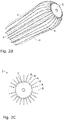
- the rotor may when observed perpendicular to the axis of the kernel have an overall shape resembling a pear i.e. it is pear-shaped or cone-shaped.
- the thick part of the cone-shaped rotor is preferably located closer to the front end of the central kernel than to the base end.
- the shape of the rotor reflects the shape of the abdominal cavity from where leaf lard remnants can be removed by the rotor.
- the at least one lamella blade has a longitudinal direction following the longitudinal axis of the central kernel or is angled to the longitudinal axis with an angel below 60°, such as below 45 °.
- the lamella blades may also be angled and can hereby have a spiral form around the central kernel.
- these lamella blades preferably follow each other in a similar manner along or around the axis of the central kernel.
- two lamella blades of a rotor located side by side are parallel to each other and all the lamella blades of the rotor are located with similar distance to the next lamella blade.
- the at least one lamella blade has a rim which when in function is in contact with the abdominal tissue of the slaughtered animal and wherein said rim is continuous from the base end to the front end of the central kernel.
- a continuous or uninterrupted rim of the lamella blades may be present for straight lamella blades and for angled or spiral lamella blades.
- the continuous rim of lamella blades when this is observed from the side as in Fig 2D has a curved shape.
- the lamella blades are preferably without angular switchovers along the continuous rim.
- every second, third or fourth lamella blade may be higher at the base end of the central kernel than the neighbor lamella blade.
- Such a design increases the pressure of the rotor towards the abdominal tissue e.g. the belly of the slaughtered animal and makes the lamella blade remove an increased amount of leaf lard remnants than if all the lamella blades are similar in shape.
- Each of the lamella blades may have a scraping side and a non-scraping side corresponding to the leading and backward side, respectively, of the lamella blades when the rotor rotates.
- the leading and thus scraping side of the lamella blades may be substantially perpendicular to the central kernel.
- the lamella blades are not sharp as knives i.e. they do not have a cutting blade.
- the function of the lamella blades is to scrape the leaf lard remnants from the carcass not to cut the leaf lard remnants from the carcass.
- the lamella blades may be thicker at the lamella base close to the central kernel than at the rim.
- the thickness of the base of the lamella blades may be increased due to a non-perpendicular line of non-scraping side of the lamella blades while the scraping side may be perpendicular to the central kernel.
- Lamella blades which are thicker at the lamella base than at the rim may direct more heat from the central kernel towards the scraping part of the lamella blade preferably giving a more uniform distribution of the heat within the rotor.
- the lamella blades can have a thickness at the scraping part of less than 5 mm, such as less than 4 mm, e.g. less than 3 mm, preferably about 2 mm.
- the length of straight lamella blades or of the working length of the rotor when lamella blades are angled e.g. spiral formed may correspond substantially to the length measured from the belly strip to the backbone or tender loin of an animal to treat, this length may be between 15 and 40 cm, preferably between 20 and 35 cm, more preferably between 25 and 30 cm, such as about 27 cm.
- the overall dimension of the rotor as shown in Fig 2 may be about 25 cm from the base end to the front end, a diameter of about 10 cm at the base end including the lamellas in this dimension, a diameter of about 7 cm at the front end and a diameter of about 12.5 cm at the thickest part of the cone-shaped rotor.
- a rotor of the described size is suitable to remove leaf lard remnants from pigs with a slaughter weight of e.g. 60-110 kg, where the slaughter weight is determined as the carcass without viscera and internal organs.
- the scraping off of leaf lard remnants can be performed by the edge of the scraping side of the lamella blades.
- This edge may be rounded off such that the edge is not sharp.
- a sharp scraping edge may cause damage to the muscles of the belly or abdominal tissue when in use for removing leaf lard remnants from a slaughtered animal.
- the central kernel of the rotor may be a cylindrical central kernel.
- the central kernel and lamella blades may be made of food approved materials.
- the entire rotor comprising the central kernel and the lamella blades can be made of one material e.g. of a metal such as steel, preferred is stainless steel which is long-lasting under the treatment conditions and is easy to clean.
- the central kernel can be made of aluminum and the lamella blades of another food approved material e.g. steel and preferably stainless steel.
- the lamella blades are preferably made of a hard material such as metal making the lamella blades inflexible or unbending. Inflexible lamella blades when compared to flexible lamella blades increases the scraping effect upon the abdominal tissue making it possible to increase the amount of removed leaf lard remnants.
- Lamella blades are attached to the central kernel in a non-removable manner.
- Lamella blades and the central kernel may be molded as one part in a mold or the lamella blades may be grout in position or welded onto the central kernel.
- the material of the central kernel and of the lamella blades may be able to stand temperatures of at least 90 °C, such as at least 80°C, preferably of at least 70°C, such as of at least 60°C, most preferably of at least 50°C.
- the material may be capable of being cleaned based on the requirements at a slaughterhouse including e.g. the use of hot water with or without a detergent. Also the material may be capable of being heated as described elsewhere herein.
- the rotor comprises heating means for heating the central kernel and/or the lamella blades. Heating of the rotor may be performed by heating the base end of the central kernel and let the heat distribute passively throughout the central kernel and/or the lamella blades. Heating of the central kernel and/or the lamella blades may also be performed by a heating wire located inside the central kernel and/or the lamella blades or the central kernel and/or the lamella blades may be hollow to allow a heated medium such as a liquid or gas to be circulated inside the rotor. The temperature of the central kernel and/or the lamella blades may reach 90°C or a temperature described elsewhere herein.
- the heating of the rotor reduces the risk of contaminating the slaughtered animals with micro-organisms when removing leaf lard remnants from two or more slaughtered animals where there is a risk of transmitting micro-organisms from one slaughtered animal to other slaughtered animals. Heating the rotor may thus increase the food safety during a reduction of growth of micro-organism on e.g. the lamella blades and the kernel.
- the device comprises cleaning means for removing lard remnants from the lamella blades.
- Leaf lard remnants removed from a slaughtered animal may fell off the rotor due to gravity of the rotating rotor, however, leaf lard remnants may also stick to the lamella blades and these remnants can be removed from the lamella blades by cleaning means.
- the cleaning means may be a block with at least one furrow such that the block can be moved along the lamella blades and push the adhering leaf lard remnants towards the front end of the rotor where the leaf lard remnants will fell off the rotor.
- a chute as described herein below may direct the leaf lard remnants away from the slaughtered animal when the leaf lard remnants fell off the rotor.
- the cleaning means may also have a dimension suitable to clean at least 3 lamella blades in one turn.
- the cleaning means may be a block with at least two furrows, e.g. at least three furrows, preferably at least four furrows, more preferably at least 5 furrows.
- the cleaning means may be activated when a predetermined number of slaughtered animals have been treated.
- the cleaning means may also be activated each time a slaughtered animal has been treated with the leaf lard remnant removing device, such that when the leaf lard remnant device moves from one slaughtered animal to another slaughtered animal the cleaning means is activated to clean at least a number of the lamella blades of the rotor.
- the cleaning means do not rotate together with the rotor when this is in function.
- the cleaning means may be activated as soon as the rotor is not rotating.
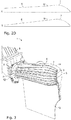
- the leaf lard remnant removing device may further comprise a chute located beneath the rotor, where the chute is capable of directing leaf lard remnants away from the slaughtered animal.
- the chute is for catching released leaf lard remnants and directing the released leaf lard remnants away from the slaughtered animal which is under treatment and hereby avoiding the remnants to stick to the body of the slaughtered animal.
- the leaf lard remnants may stick to the belly or head part of the slaughtered animal if the remnants are not directed away by the chute.
- the chute directs released leaf lard remnants downward from the leaf lard remnant removing device.
- a screen may surround a part of the rotor outside the lamella blades.
- the screen directs leaf lard remnants flung away from the lamella blades towards the chute and avoids the remnants to be directed towards the slaughtered animal and stick to the slaughtered animal.
- the screen may furthermore protect the tender loin from being damaged by the rotating rotor.
- the screen surrounds at least 15% of the rotor, such as at least 25% of the rotor.
- the screen may also surround a part or the entire part of the end of the longitudinal central kernel at the front end of the rotor.
- An edge of the screen may be positioned at the rotor and in short distance to the lamella blades such that when the lamella blades scrape the slaughtered animal to loosen leaf blade remnants the leaf blade remnants may be caught by a lamella blade and the edge of the screen and then be pulled from the slaughtered animal.
- the leaf lard remnant removing device may further comprise a motor for rotating the rotor, where the motor is connected to the rotor through the motor connecting means.
- the motor comprises driving means directing the rotor to drive in a direction such that each lamella blade when in contact with a slaughtered animal is moving from downward and up if a slaughtered animal to be treated is hanging with the head downward.
- the motor may be electrical or hydraulic.
- the leaf lard remnant removing device may be connected to a robot for controlling and moving the rotor along the slaughtered animal.
- the robot may be an industrial robot which is automatically controlled and programmable in three or more axes, and which may be either fixed in place or mobile for use in industrial automation applications.
- a robot may comprise a single leaf lard remnant removing device and remove leaf lard remnants from one of the halves of carcasses e.g. all the left halves or all the right halves of the carcasses brought forward on the slaughter line, or the robot may use the single leaf lard remnant removing device to remove leaf lard remnants from first one half of a carcass and afterwards from the other half of a carcass and then continue in the same manner with the following carcasses on the slaughter line.
- a robot may also comprise two leaf lard remnant removing devices and simultaneously remove leaf lard remnants from both of the halves of a carcass and proceed in the same manner with the following carcasses brought forward on the slaughter line.
- Animal length determining means may be used in connection with the leaf lard remnant removing device for determine the length of a slaughtered animal to be treated with the leaf lard remnant removing device.
- the length of the slaughtered animal is used to determine the start and end positions for the rotor within the slaughtered animal when removing leaf lard remnants from the slaughtered animal.
- the leaf lard remnant removing device may especially remove leaf lard remnants from the belly in an area starting from the thoracic meat and to the meat in the groin, including the fascia of the abdominal wall (fascia mirror).
- the leaf lard remnant removing device is not used on the hide being present on an animal.
- the leaf lard membrane is removed before removing leaf lard remnants with the leaf lard remnant removing device as described herein. The leaf lard membrane may be removed together with the leaf lard.
- a fixture to fix or support at least a part of a slaughtered animal may be used in connection with the leaf lard remnants removing device as described herein.
- the fixture can be designed to support or fix a slaughtered animal and to allow the animal muscles to apply resistance to the rotor when leaf lard remnants are removed from the slaughtered animal by the use of the leaf lard remnant removing device as described herein.
- a fixture may support a slaughtered animal which is hanging at a slaughter line such that the support is provided at least at the ham when the slaughtered animal is hanging in the hind legs.
- a fixture may also support a slaughtered animal which is hanging at a slaughter line the support may be located at the ham and close to the front legs and/or only at the back of the animal.
- the leaf lard remnant removing device may further comprise washing means for cleaning the outer side of the screen.
- the washing means may spray water at the screen to remove leaf lard remnants sticking to the screen.
- the washing operation can be performed between every treatment performed by the leaf lard remnant removing device or at per-determined intervals e.g. for each fifth treatment, such as each tenth treatment or the treatment frequency may be determined in relation to the type of animal being treated.
- the screen is washed by water with a temperature of between 70-95°C, such as between 75-90°C, e.g. 80-85°C and preferably around 82°C.
- the washing means may wash the screen in cycles of cold water, hot water and cold water and where the hot water temperature is as described above.
- Cold water can be water with a temperature of between 35-50°C, such as 40-45°C, preferably about 42°C.
- One cycle of washing may include about 0.45 mSek of cold water, about 0.45 mSek of hot water and about 0.45 mSek of cold water.
- An aspect of the invention relates to a system for removing abdominal lard remnants or leaf lard remnants from at least one slaughtered animal or a part thereof at a slaughter line, where the abdominal cavity of the at least one slaughtered animal has been opened beforehand and the main part of the abdominal lard or leaf lard has been removed, which system comprises
- a system for removing abdominal lard remnants or leaf lard remnants may comprise a leaf lard removing device including a rotor connected to a motor by motor connecting means and a robot for moving the leaf lard removing device towards slaughtered animals.
- the leaf lard removing device of the system further comprises a screen and optionally a chute.
- An automatic system to be installed at a slaughterhouse in a slaughter line to remove leaf lard remnants from slaughtered animals may include the leaf lard remnant removing device as described herein, a motor for rotating the rotor, a robot for controlling and moving the rotor, animal length determining means for determining the length of a slaughtered animal before being treated with the leaf lard remnant removing device and a fixture to fix or support at least a part of a slaughtered animal.
- An aspect of the invention relates to a method for removing leaf lard remnants from a slaughtered animal or a part thereof, of which the abdominal cavity has been opened beforehand and the main part of the abdominal lard or leaf lard has been removed, the method comprises
- the method of removing leaf lard remnants can be performed on slaughtered animals hanging with the head downward, where the device as described herein is moved in a direction from below and upward and the rotating rotor is rotating in a directing such that the lamella blades rotate along the abdominal tissue in a direction corresponding to the overall direction of the movement of the leaf lard remnant removing device and such that removed leaf lard remnants are transported by the rotor upward and away from the abdominal tissue.
- the method can be performed with heated central kernel and/or heated lamella blades of the rotor.
- Heating the device may fulfil hygiene requirements at slaughterhouses as growth of some microorganisms is reduced or avoided but most microorganisms are destroyed due to the increased temperature.
- the temperature of the central kernel may be higher than the temperature of the lamella blades.
- the temperature of the lamella blades are preferably above 37°C, such as above 40°C, e.g. above 45°C.
- the temperature of the lamella blades are below 80°C, such as below 70°C, e.g. below 60°C, such as below 50°C.
- Preferred is a temperature of the lamella blades of between 37-70°C, more preferably of 40-60°C, further preferably of 45-50°C, most preferably about 47°C.
- the temperature of the rotor and especially of the lamella blades should preferably be below a temperature where the leaf lard remnants stick to the material of the rotor and burn.
- the temperature of the lamella blades can be measured at the lamella base close to the central kernel.
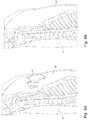
- the device When removing leaf lard remnants with the leaf lard remnant removing device, the device may be pressed against the abdominal tissue.
- the pressure increases the contact between the lamella blades and the abdominal tissue hereby increasing the amount of leaf lard remnants being removed.
- the pressure should preferably be such that the abdominal tissue is not damaged by the lamella blades.
- the pressure may be a springy pressure towards the abdominal tissue of the slaughtered animal i.e. the animal body provides a back pressure to the lamella blades e.g. by being supported or fixed as described elsewhere herein.
- the springy pressure may decrease the risk of damaging the abdominal tissue.
- the slaughtered animal can be at least partly supported or fixed before the rotor of the leaf lard remnant removing device is moved along the abdominal tissue of the slaughtered animal. Support or fixation of the slaughtered animal may be performed as described elsewhere herein.
- the method of removing leaf lard remnants can be performed automatically at a slaughter line.
- a slaughtered animal is transported towards the system for removing leaf lard remnants, the animal body is caught by a fixture to support the body, the leaf lard remnant removing device is directed towards the inner side of the animal body where the rotating rotor may remove leaf lard remnants from the abdominal tissue and then the leaf lard remnant removing device can be withdrawn from the animal body and moved towards another slaughtered animal.
- the method for removing leaf lard remnants from a slaughtered animal hanging in the hind legs may comprise a working way of the rotor starting in the area of the breastbone and ending in the area of the groin and where the rotor is moved along the belly with the rotor rotating in a directing such that the lamella blades rotate along the belly in a direction corresponding to the direction of the movement of the rotor.
- the rotation direction of the rotor is thus from below and upward and then away from the abdominal tissue of the slaughtered animal.
- Removal of leaf lard remnants with the leaf lard remnant removing device described herein can reduce the leaf lard remnants in the belly to below 10 gram per each half slaughtered animal, in most treatments as low as only 2-4 gram of leaf lard remnants have been observed at slaughtered animals treated with the leaf lard remnant device as described herein.
- the leaf lard remnant removing device described herein can be used for any slaughtered animal where the leaf lard are removed.
- Preferred is treatment of slaughtered mammals such as for removing leaf lard remnants from slaughtered pigs, cattle, and sheep including rams and lambs. Further preferred is treatment of slaughtered pigs and cattle. Most preferred is treatment of slaughtered pigs.
- the leaf lard remnant removing device may be used to remove leaf lard remnants in halves of slaughtered animals obtained by dividing entire slaughtered animals by traditional slaughter methods.
- the leaf lard remnant removing device is used when the halves of slaughtered animals are hanging in the hind legs and e.g. still connected to each other in the head.
- the leaf lard remnant removing device is used at slaughterhouses with slaughtered animals divided in halves and hanging in hind legs and from which animals the pluck set and the leaf lard are removed.
- a leaf lard remnant removing device constructed to handle right and left halves of slaughtered animals following each other at a line in a slaughterhouse may include rotor devices which are reversed i.e. the chute and the screen are reverse constructions and the rotating direction is opposite. The rotating direction of each rotor is from below and upward and then away from the abdominal tissue of the slaughtered animal.
- the leaf lard remnant removing device as described herein may further be designed to follow the slaughtered animal or slaughtered animal halves hanging at a slaughter line while the leaf lard remnant removing device removes leaf lard remnants from the slaughtered animal.
- At least 100 slaughtered animals per hour can be treated by the robot.
- At least 200-1000 slaughtered animals per hour can be treated with a system including two rotors.
- Preferably 600-1000 slaughtered animals per hour can be treated with a system including two rotors.
- Only the tool i.e. preferably the central kernel and/or the lamella blades of the leaf lard remnant removing device is heated to a temperature as described elsewhere herein.
- the animal under treatment is not heated substantially.
- the leaf lard remnant removing device has been tested for removing leaf lard remnants at a Danish abattoir.
- 431 half-carcasses were treated with the leaf lard remnant removing device connected to an automatic system for directing the leaf lard remnant removing device towards the abdominal tissue of a half-carcass, directing the rotating rotor along the abdominal tissue and returning to a start/end position of the leaf lard remnant removing device being located away from the half-carcass.
- the average amount of leaf lard remnant being present in the half-carcasses after the treatment was below 2 gram and for 4 % of the half-carcasses the amount of remaining leaf lard remnants was above 10 gram.
Landscapes
- Life Sciences & Earth Sciences (AREA)
- Engineering & Computer Science (AREA)
- Food Science & Technology (AREA)
- Health & Medical Sciences (AREA)
- General Health & Medical Sciences (AREA)
- Neurosurgery (AREA)
- Wood Science & Technology (AREA)
- Zoology (AREA)
- Meat, Egg Or Seafood Products (AREA)
- Dairy Products (AREA)
- Processing Of Meat And Fish (AREA)
Claims (10)
- Dispositif (1) pour enlever le lard abdominal résiduel ou le lard de panne résiduel (18) d'un animal abattu (19) ou d'une partie de celui-ci, dont la cavité abdominale a été ouverte auparavant et la partie principale du lard abdominal ou du lard de panne a été enlevée, ledit dispositif comprenant:au moins un rotor rotatif (2), ledit rotor (2) comprenant:a. un noyau central longitudinal (3) présentant une extrémité de base (4) et une extrémité avant (5),b. au moins une lame en lamelle (6) connectée audit noyau central (3), dans lequel la direction générale de ladite au moins une lame en lamelle est parallèle au noyau central longitudinal, et de telle sorte que chaque lame en lamelle (6) fasse saillie à partir du noyau central (3),c. dans lequel ladite au moins une lame en lamelle (6) dans une région (7) plus proche de l'extrémité avant que de l'extrémité de base du noyau central fait davantage saillie à partir du noyau central (3) qu'à l'extrémité de base (4) et l'extrémité avant (5) du noyau central (3), et dans lequel ladite au moins une lame en lamelle (6) est agencée pour détacher le lard résiduel de la carcasse, etd. des moyens de connexion de moteur (8) appropriés pour connecter ladite extrémité de base (4) du noyau central (3) à un moteur (9).
- Dispositif selon la revendication 1, dans lequel ladite au moins une lame en lamelle (6) présente un bord (10) qui, lors de l'utilisation, est en contact avec le tissu abdominal (20) de l'animal abattu (19), et dans lequel ledit bord (10) est continu à partir de l'extrémité de base (4) jusqu'à l'extrémité avant (5) du noyau central (3).
- Dispositif selon l'une quelconque des revendications précédentes, dans lequel ledit rotor (2) comprend en outre des moyens de chauffage (11) pour chauffer ledit noyau central (3) et/ou lesdites lames en lamelle (6).
- Dispositif selon l'une quelconque des revendications précédentes, dans lequel ledit dispositif comprend en outre des moyens de nettoyage (12) pour enlever le lard résiduel des lames en lamelle (6) .
- Dispositif selon l'une quelconque des revendications précédentes, comprenant en outre un goulotte (13) située en-dessous dudit rotor (2), ladite goulotte (13) étant capable de diriger le lard de panne résiduel à l'écart de l'animal abattu.
- Dispositif selon l'une quelconque des revendications précédentes, comprenant en outre une moteur (9) pour faire tourner le rotor (2), et dans lequel ledit moteur (9) est connecté auxdits moyens de connexion de moteur (8).
- Système (16) pour enlever le lard abdominal résiduel ou le lard de panne résiduel à partir dudit au moins un animal abattu ou d'une partie de celui-ci sur une ligne d'abattage, dans lequel la cavité abdominale dudit au moins un animal abattu a été ouverte auparavant et la partie principale du lard abdominal ou du lard de panne a été enlevée, ledit système (16) comprenanta. le dispositif d'enlèvement de lard de panne résiduel (1) selon l'une quelconque des revendications 1 à 6, etb. un moteur (9) pour faire tourner le rotor (2), et dans lequel ledit moteur (9) est connecté auxdits moyens de connexion de moteur (8), etc. un robot pour commander et déplacer le rotor le long de l'animal abattu, et/oud. des moyens de détermination de la longueur d'animal pour déterminer la longueur d'un animal abattu et/oue. un dispositif de fixation (17) pour fixer ou supporter au moins un partie d'un animal abattu.
- Procédé pour enlever le lard de panne résiduel d'un animal abattu ou d'une partie de celui-ci, dont la cavité abdominale a été ouverte auparavant et dont la partie principale du lard abdominal ou du lard de panne a été enlevée, ledit procédé comprenant les étapes suivantes:a. diriger le dispositif d'enlèvement de lard de panne résiduel (1) selon l'une quelconque des revendications 1 à 6 en direction du tissu abdominal d'un animal abattu (19), etb. déplacer le rotor rotatif (2) en contact avec et le long du tissu abdominal dans la région de laquelle le lard de panne a été enlevé de l'animal abattu.
- Procédé selon la revendication 8, dans lequel, lors de l'enlèvement du lard de panne résiduel d'un animal abattu suspendu avec la tête en bas,a. le dispositif (1) est déplacé de bas en haut, etb. le rotor rotatif (2) tourne dans une direction telle que les lames en lamelle (6) tournent le long du tissu abdominal dans une direction qui correspond à la direction générale du déplacement du dispositif d'enlèvement de lard de panne résiduel (1) de telle sorte que le lard de panne résiduel enlevé soit transporté par le rotor vers le haut et à l'écart du tissu abdominal.
- Procédé selon l'une quelconque des revendications 8 à 9, dans lequel le noyau central (3) et/ou les lames en lamelle (6) est (sont) chauffé(es).
Priority Applications (1)
| Application Number | Priority Date | Filing Date | Title |
|---|---|---|---|
| PL15788073T PL3217799T3 (pl) | 2014-11-12 | 2015-11-03 | Urządzenie do usuwania resztek sadła z ubitego zwierzęcia |
Applications Claiming Priority (2)
| Application Number | Priority Date | Filing Date | Title |
|---|---|---|---|
| DKPA201400661 | 2014-11-12 | ||
| PCT/EP2015/075595 WO2016074993A1 (fr) | 2014-11-12 | 2015-11-03 | Dispositif pour l'élimination de saindoux de panne résiduel à partir d'un animal abattu |
Publications (2)
| Publication Number | Publication Date |
|---|---|
| EP3217799A1 EP3217799A1 (fr) | 2017-09-20 |
| EP3217799B1 true EP3217799B1 (fr) | 2019-01-02 |
Family
ID=54365275
Family Applications (1)
| Application Number | Title | Priority Date | Filing Date |
|---|---|---|---|
| EP15788073.3A Active EP3217799B1 (fr) | 2014-11-12 | 2015-11-03 | Dispositif pour l'élimination de lard résiduel d'un animal abattu |
Country Status (5)
| Country | Link |
|---|---|
| EP (1) | EP3217799B1 (fr) |
| DK (1) | DK3217799T3 (fr) |
| ES (1) | ES2711308T3 (fr) |
| PL (1) | PL3217799T3 (fr) |
| WO (1) | WO2016074993A1 (fr) |
Families Citing this family (3)
| Publication number | Priority date | Publication date | Assignee | Title |
|---|---|---|---|---|
| DK180287B1 (en) | 2019-03-25 | 2020-10-02 | Teknologisk Inst | Removal of abdominal fat from a slaughtered animal |
| PL4247169T3 (pl) | 2020-11-17 | 2025-03-10 | Marel Red Meat B.V. | Urządzenie i sposób usuwania sadła z ubitych zwierząt |
| CN119073360B (zh) * | 2024-08-17 | 2025-12-26 | 重庆琪金食品集团有限公司 | 一种屠宰线的猪胃部网油分离装置及方法 |
Family Cites Families (5)
| Publication number | Priority date | Publication date | Assignee | Title |
|---|---|---|---|---|
| US1722902A (en) * | 1928-05-28 | 1929-07-30 | Peter A Carney | Head scutcher |
| US4063332A (en) * | 1976-03-18 | 1977-12-20 | Mccullough Timothy J | Fish-skinning tool |
| US4901398A (en) * | 1988-02-23 | 1990-02-20 | Societe Anonyme: Societe des Ateliers de Constructions Mecaniques: Lucien Durand | Process and machine for pulling off belly strips from a hog carcass |
| NL9401695A (nl) * | 1994-10-13 | 1996-05-01 | Stork Rms Bv | Inrichting voor het verwijderen van de buikvet- of reuzellaag uit een geslacht dier. |
| US20030143939A1 (en) * | 2002-01-11 | 2003-07-31 | James Barlow | Portable and rechargeable fish scaler devices |
-
2015
- 2015-11-03 DK DK15788073.3T patent/DK3217799T3/en active
- 2015-11-03 EP EP15788073.3A patent/EP3217799B1/fr active Active
- 2015-11-03 PL PL15788073T patent/PL3217799T3/pl unknown
- 2015-11-03 WO PCT/EP2015/075595 patent/WO2016074993A1/fr not_active Ceased
- 2015-11-03 ES ES15788073T patent/ES2711308T3/es active Active
Non-Patent Citations (1)
| Title |
|---|
| None * |
Also Published As
| Publication number | Publication date |
|---|---|
| EP3217799A1 (fr) | 2017-09-20 |
| DK3217799T3 (en) | 2019-03-11 |
| PL3217799T3 (pl) | 2019-06-28 |
| ES2711308T3 (es) | 2019-05-03 |
| WO2016074993A1 (fr) | 2016-05-19 |
Similar Documents
| Publication | Publication Date | Title |
|---|---|---|
| EP3217799B1 (fr) | Dispositif pour l'élimination de lard résiduel d'un animal abattu | |
| US6210262B1 (en) | Method and apparatus for processing fish | |
| CN102113536B (zh) | 冰鲜分割猪肉的加工方法 | |
| EP2907391B1 (fr) | Procédé et dispositif d'ouverture de la carcasse d'un animal abattu | |
| CN111557331A (zh) | 一种用于生猪屠宰加工流水线上的蒸烫刨毛设备 | |
| CN216533557U (zh) | 一种猪大肠外表油脂去除装置 | |
| US10123544B2 (en) | Tool for removal of meat pieces such as tenderloin from a carcass | |
| CN201370045Y (zh) | 猪蹄去毛装置 | |
| NL2013218B1 (en) | An apparatus and method for cleaning a poultry carcass. | |
| US2911668A (en) | Method for cleaning fish | |
| US3165781A (en) | Hog dressing | |
| EP3607827B1 (fr) | Boyau naturel de fuseau ou rosettes, procédé pour son obtention et utilisation du même | |
| EP3735830B1 (fr) | Methode de traitment d'une carcasse d'animal intact | |
| JP4562923B2 (ja) | 後肢で吊った屠殺済み食用獣の前肢を位置決めするための方法及び装置 | |
| CN106386991A (zh) | 一种生猪屠宰加工工艺 | |
| KR20110011121A (ko) | 돼지 곱창의 세척방법과 그 돼지 곱창용 세척장치. | |
| JP6526455B2 (ja) | 包丁 | |
| CN202135638U (zh) | 隧洞式内旋刮毛机 | |
| CN113966760A (zh) | 一种猪大肠外表油脂去除装置 | |
| US3115671A (en) | Method and process of conditioning and processing animals in meat packing plants | |
| CN113796406A (zh) | 一种冰鲜分割猪肉的加工方法 | |
| WO2023130170A2 (fr) | Équipement et procédé de traitement de parties de volaille | |
| Tinker et al. | Assessment of processes and operating conditions in UK pork abattoirs | |
| EP1183951A2 (fr) | Procédé et dispositif à enlever les sabots d'une carcasse | |
| CN104427879B (zh) | 剖开宰杀动物屠体的方法和设备 |
Legal Events
| Date | Code | Title | Description |
|---|---|---|---|
| STAA | Information on the status of an ep patent application or granted ep patent |
Free format text: STATUS: THE INTERNATIONAL PUBLICATION HAS BEEN MADE |
|
| PUAI | Public reference made under article 153(3) epc to a published international application that has entered the european phase |
Free format text: ORIGINAL CODE: 0009012 |
|
| STAA | Information on the status of an ep patent application or granted ep patent |
Free format text: STATUS: REQUEST FOR EXAMINATION WAS MADE |
|
| 17P | Request for examination filed |
Effective date: 20170607 |
|
| AK | Designated contracting states |
Kind code of ref document: A1 Designated state(s): AL AT BE BG CH CY CZ DE DK EE ES FI FR GB GR HR HU IE IS IT LI LT LU LV MC MK MT NL NO PL PT RO RS SE SI SK SM TR |
|
| AX | Request for extension of the european patent |
Extension state: BA ME |
|
| DAV | Request for validation of the european patent (deleted) | ||
| DAX | Request for extension of the european patent (deleted) | ||
| GRAP | Despatch of communication of intention to grant a patent |
Free format text: ORIGINAL CODE: EPIDOSNIGR1 |
|
| STAA | Information on the status of an ep patent application or granted ep patent |
Free format text: STATUS: GRANT OF PATENT IS INTENDED |
|
| INTG | Intention to grant announced |
Effective date: 20180706 |
|
| GRAJ | Information related to disapproval of communication of intention to grant by the applicant or resumption of examination proceedings by the epo deleted |
Free format text: ORIGINAL CODE: EPIDOSDIGR1 |
|
| STAA | Information on the status of an ep patent application or granted ep patent |
Free format text: STATUS: REQUEST FOR EXAMINATION WAS MADE |
|
| GRAR | Information related to intention to grant a patent recorded |
Free format text: ORIGINAL CODE: EPIDOSNIGR71 |
|
| GRAS | Grant fee paid |
Free format text: ORIGINAL CODE: EPIDOSNIGR3 |
|
| STAA | Information on the status of an ep patent application or granted ep patent |
Free format text: STATUS: GRANT OF PATENT IS INTENDED |
|
| GRAA | (expected) grant |
Free format text: ORIGINAL CODE: 0009210 |
|
| STAA | Information on the status of an ep patent application or granted ep patent |
Free format text: STATUS: THE PATENT HAS BEEN GRANTED |
|
| INTC | Intention to grant announced (deleted) | ||
| INTG | Intention to grant announced |
Effective date: 20181113 |
|
| AK | Designated contracting states |
Kind code of ref document: B1 Designated state(s): AL AT BE BG CH CY CZ DE DK EE ES FI FR GB GR HR HU IE IS IT LI LT LU LV MC MK MT NL NO PL PT RO RS SE SI SK SM TR |
|
| REG | Reference to a national code |
Ref country code: GB Ref legal event code: FG4D |
|
| REG | Reference to a national code |
Ref country code: CH Ref legal event code: EP Ref country code: AT Ref legal event code: REF Ref document number: 1083272 Country of ref document: AT Kind code of ref document: T Effective date: 20190115 |
|
| REG | Reference to a national code |
Ref country code: DE Ref legal event code: R096 Ref document number: 602015022889 Country of ref document: DE |
|
| REG | Reference to a national code |
Ref country code: IE Ref legal event code: FG4D |
|
| REG | Reference to a national code |
Ref country code: NL Ref legal event code: FP |
|
| REG | Reference to a national code |
Ref country code: DK Ref legal event code: T3 Effective date: 20190304 |
|
| REG | Reference to a national code |
Ref country code: ES Ref legal event code: FG2A Ref document number: 2711308 Country of ref document: ES Kind code of ref document: T3 Effective date: 20190503 |
|
| REG | Reference to a national code |
Ref country code: LT Ref legal event code: MG4D |
|
| REG | Reference to a national code |
Ref country code: AT Ref legal event code: MK05 Ref document number: 1083272 Country of ref document: AT Kind code of ref document: T Effective date: 20190102 |
|
| PG25 | Lapsed in a contracting state [announced via postgrant information from national office to epo] |
Ref country code: LT Free format text: LAPSE BECAUSE OF FAILURE TO SUBMIT A TRANSLATION OF THE DESCRIPTION OR TO PAY THE FEE WITHIN THE PRESCRIBED TIME-LIMIT Effective date: 20190102 Ref country code: SE Free format text: LAPSE BECAUSE OF FAILURE TO SUBMIT A TRANSLATION OF THE DESCRIPTION OR TO PAY THE FEE WITHIN THE PRESCRIBED TIME-LIMIT Effective date: 20190102 Ref country code: NO Free format text: LAPSE BECAUSE OF FAILURE TO SUBMIT A TRANSLATION OF THE DESCRIPTION OR TO PAY THE FEE WITHIN THE PRESCRIBED TIME-LIMIT Effective date: 20190402 Ref country code: FI Free format text: LAPSE BECAUSE OF FAILURE TO SUBMIT A TRANSLATION OF THE DESCRIPTION OR TO PAY THE FEE WITHIN THE PRESCRIBED TIME-LIMIT Effective date: 20190102 Ref country code: PT Free format text: LAPSE BECAUSE OF FAILURE TO SUBMIT A TRANSLATION OF THE DESCRIPTION OR TO PAY THE FEE WITHIN THE PRESCRIBED TIME-LIMIT Effective date: 20190502 |
|
| PG25 | Lapsed in a contracting state [announced via postgrant information from national office to epo] |
Ref country code: HR Free format text: LAPSE BECAUSE OF FAILURE TO SUBMIT A TRANSLATION OF THE DESCRIPTION OR TO PAY THE FEE WITHIN THE PRESCRIBED TIME-LIMIT Effective date: 20190102 Ref country code: GR Free format text: LAPSE BECAUSE OF FAILURE TO SUBMIT A TRANSLATION OF THE DESCRIPTION OR TO PAY THE FEE WITHIN THE PRESCRIBED TIME-LIMIT Effective date: 20190403 Ref country code: LV Free format text: LAPSE BECAUSE OF FAILURE TO SUBMIT A TRANSLATION OF THE DESCRIPTION OR TO PAY THE FEE WITHIN THE PRESCRIBED TIME-LIMIT Effective date: 20190102 Ref country code: RS Free format text: LAPSE BECAUSE OF FAILURE TO SUBMIT A TRANSLATION OF THE DESCRIPTION OR TO PAY THE FEE WITHIN THE PRESCRIBED TIME-LIMIT Effective date: 20190102 Ref country code: BG Free format text: LAPSE BECAUSE OF FAILURE TO SUBMIT A TRANSLATION OF THE DESCRIPTION OR TO PAY THE FEE WITHIN THE PRESCRIBED TIME-LIMIT Effective date: 20190402 Ref country code: IS Free format text: LAPSE BECAUSE OF FAILURE TO SUBMIT A TRANSLATION OF THE DESCRIPTION OR TO PAY THE FEE WITHIN THE PRESCRIBED TIME-LIMIT Effective date: 20190502 |
|
| REG | Reference to a national code |
Ref country code: DE Ref legal event code: R097 Ref document number: 602015022889 Country of ref document: DE |
|
| PG25 | Lapsed in a contracting state [announced via postgrant information from national office to epo] |
Ref country code: SK Free format text: LAPSE BECAUSE OF FAILURE TO SUBMIT A TRANSLATION OF THE DESCRIPTION OR TO PAY THE FEE WITHIN THE PRESCRIBED TIME-LIMIT Effective date: 20190102 Ref country code: AL Free format text: LAPSE BECAUSE OF FAILURE TO SUBMIT A TRANSLATION OF THE DESCRIPTION OR TO PAY THE FEE WITHIN THE PRESCRIBED TIME-LIMIT Effective date: 20190102 Ref country code: CZ Free format text: LAPSE BECAUSE OF FAILURE TO SUBMIT A TRANSLATION OF THE DESCRIPTION OR TO PAY THE FEE WITHIN THE PRESCRIBED TIME-LIMIT Effective date: 20190102 Ref country code: AT Free format text: LAPSE BECAUSE OF FAILURE TO SUBMIT A TRANSLATION OF THE DESCRIPTION OR TO PAY THE FEE WITHIN THE PRESCRIBED TIME-LIMIT Effective date: 20190102 Ref country code: RO Free format text: LAPSE BECAUSE OF FAILURE TO SUBMIT A TRANSLATION OF THE DESCRIPTION OR TO PAY THE FEE WITHIN THE PRESCRIBED TIME-LIMIT Effective date: 20190102 Ref country code: IT Free format text: LAPSE BECAUSE OF FAILURE TO SUBMIT A TRANSLATION OF THE DESCRIPTION OR TO PAY THE FEE WITHIN THE PRESCRIBED TIME-LIMIT Effective date: 20190102 Ref country code: EE Free format text: LAPSE BECAUSE OF FAILURE TO SUBMIT A TRANSLATION OF THE DESCRIPTION OR TO PAY THE FEE WITHIN THE PRESCRIBED TIME-LIMIT Effective date: 20190102 |
|
| PLBE | No opposition filed within time limit |
Free format text: ORIGINAL CODE: 0009261 |
|
| STAA | Information on the status of an ep patent application or granted ep patent |
Free format text: STATUS: NO OPPOSITION FILED WITHIN TIME LIMIT |
|
| PG25 | Lapsed in a contracting state [announced via postgrant information from national office to epo] |
Ref country code: SM Free format text: LAPSE BECAUSE OF FAILURE TO SUBMIT A TRANSLATION OF THE DESCRIPTION OR TO PAY THE FEE WITHIN THE PRESCRIBED TIME-LIMIT Effective date: 20190102 |
|
| 26N | No opposition filed |
Effective date: 20191003 |
|
| PG25 | Lapsed in a contracting state [announced via postgrant information from national office to epo] |
Ref country code: SI Free format text: LAPSE BECAUSE OF FAILURE TO SUBMIT A TRANSLATION OF THE DESCRIPTION OR TO PAY THE FEE WITHIN THE PRESCRIBED TIME-LIMIT Effective date: 20190102 |
|
| PG25 | Lapsed in a contracting state [announced via postgrant information from national office to epo] |
Ref country code: TR Free format text: LAPSE BECAUSE OF FAILURE TO SUBMIT A TRANSLATION OF THE DESCRIPTION OR TO PAY THE FEE WITHIN THE PRESCRIBED TIME-LIMIT Effective date: 20190102 |
|
| REG | Reference to a national code |
Ref country code: CH Ref legal event code: PL |
|
| PG25 | Lapsed in a contracting state [announced via postgrant information from national office to epo] |
Ref country code: MC Free format text: LAPSE BECAUSE OF FAILURE TO SUBMIT A TRANSLATION OF THE DESCRIPTION OR TO PAY THE FEE WITHIN THE PRESCRIBED TIME-LIMIT Effective date: 20190102 Ref country code: LI Free format text: LAPSE BECAUSE OF NON-PAYMENT OF DUE FEES Effective date: 20191130 Ref country code: LU Free format text: LAPSE BECAUSE OF NON-PAYMENT OF DUE FEES Effective date: 20191103 Ref country code: CH Free format text: LAPSE BECAUSE OF NON-PAYMENT OF DUE FEES Effective date: 20191130 |
|
| REG | Reference to a national code |
Ref country code: BE Ref legal event code: MM Effective date: 20191130 |
|
| PG25 | Lapsed in a contracting state [announced via postgrant information from national office to epo] |
Ref country code: IE Free format text: LAPSE BECAUSE OF NON-PAYMENT OF DUE FEES Effective date: 20191103 |
|
| PG25 | Lapsed in a contracting state [announced via postgrant information from national office to epo] |
Ref country code: BE Free format text: LAPSE BECAUSE OF NON-PAYMENT OF DUE FEES Effective date: 20191130 |
|
| PG25 | Lapsed in a contracting state [announced via postgrant information from national office to epo] |
Ref country code: CY Free format text: LAPSE BECAUSE OF FAILURE TO SUBMIT A TRANSLATION OF THE DESCRIPTION OR TO PAY THE FEE WITHIN THE PRESCRIBED TIME-LIMIT Effective date: 20190102 |
|
| PG25 | Lapsed in a contracting state [announced via postgrant information from national office to epo] |
Ref country code: MT Free format text: LAPSE BECAUSE OF FAILURE TO SUBMIT A TRANSLATION OF THE DESCRIPTION OR TO PAY THE FEE WITHIN THE PRESCRIBED TIME-LIMIT Effective date: 20190102 Ref country code: HU Free format text: LAPSE BECAUSE OF FAILURE TO SUBMIT A TRANSLATION OF THE DESCRIPTION OR TO PAY THE FEE WITHIN THE PRESCRIBED TIME-LIMIT; INVALID AB INITIO Effective date: 20151103 |
|
| PG25 | Lapsed in a contracting state [announced via postgrant information from national office to epo] |
Ref country code: MK Free format text: LAPSE BECAUSE OF FAILURE TO SUBMIT A TRANSLATION OF THE DESCRIPTION OR TO PAY THE FEE WITHIN THE PRESCRIBED TIME-LIMIT Effective date: 20190102 |
|
| PGFP | Annual fee paid to national office [announced via postgrant information from national office to epo] |
Ref country code: NL Payment date: 20251119 Year of fee payment: 11 |
|
| PGFP | Annual fee paid to national office [announced via postgrant information from national office to epo] |
Ref country code: DE Payment date: 20251119 Year of fee payment: 11 |
|
| PGFP | Annual fee paid to national office [announced via postgrant information from national office to epo] |
Ref country code: GB Payment date: 20251121 Year of fee payment: 11 |
|
| PGFP | Annual fee paid to national office [announced via postgrant information from national office to epo] |
Ref country code: DK Payment date: 20251125 Year of fee payment: 11 |
|
| PGFP | Annual fee paid to national office [announced via postgrant information from national office to epo] |
Ref country code: FR Payment date: 20251126 Year of fee payment: 11 |
|
| PGFP | Annual fee paid to national office [announced via postgrant information from national office to epo] |
Ref country code: PL Payment date: 20251022 Year of fee payment: 11 |
|
| PGFP | Annual fee paid to national office [announced via postgrant information from national office to epo] |
Ref country code: ES Payment date: 20251229 Year of fee payment: 11 |